EP3585845B1 - Beschichtungen auf siloxanbasis aus polymeren mit harnstoffbindungen und terminalen alkoxysilanen - Google Patents
Beschichtungen auf siloxanbasis aus polymeren mit harnstoffbindungen und terminalen alkoxysilanen Download PDFInfo
- Publication number
- EP3585845B1 EP3585845B1 EP18758003.0A EP18758003A EP3585845B1 EP 3585845 B1 EP3585845 B1 EP 3585845B1 EP 18758003 A EP18758003 A EP 18758003A EP 3585845 B1 EP3585845 B1 EP 3585845B1
- Authority
- EP
- European Patent Office
- Prior art keywords
- amino
- functional
- composition
- polyurea
- aliphatic
- Prior art date
- Legal status (The legal status is an assumption and is not a legal conclusion. Google has not performed a legal analysis and makes no representation as to the accuracy of the status listed.)
- Active
Links
Images



Classifications
-
- C—CHEMISTRY; METALLURGY
- C09—DYES; PAINTS; POLISHES; NATURAL RESINS; ADHESIVES; COMPOSITIONS NOT OTHERWISE PROVIDED FOR; APPLICATIONS OF MATERIALS NOT OTHERWISE PROVIDED FOR
- C09D—COATING COMPOSITIONS, e.g. PAINTS, VARNISHES OR LACQUERS; FILLING PASTES; CHEMICAL PAINT OR INK REMOVERS; INKS; CORRECTING FLUIDS; WOODSTAINS; PASTES OR SOLIDS FOR COLOURING OR PRINTING; USE OF MATERIALS THEREFOR
- C09D175/00—Coating compositions based on polyureas or polyurethanes; Coating compositions based on derivatives of such polymers
- C09D175/02—Polyureas
-
- C—CHEMISTRY; METALLURGY
- C08—ORGANIC MACROMOLECULAR COMPOUNDS; THEIR PREPARATION OR CHEMICAL WORKING-UP; COMPOSITIONS BASED THEREON
- C08G—MACROMOLECULAR COMPOUNDS OBTAINED OTHERWISE THAN BY REACTIONS ONLY INVOLVING UNSATURATED CARBON-TO-CARBON BONDS
- C08G18/00—Polymeric products of isocyanates or isothiocyanates
- C08G18/06—Polymeric products of isocyanates or isothiocyanates with compounds having active hydrogen
- C08G18/28—Polymeric products of isocyanates or isothiocyanates with compounds having active hydrogen characterised by the compounds used containing active hydrogen
- C08G18/30—Low-molecular-weight compounds
- C08G18/32—Polyhydroxy compounds; Polyamines; Hydroxyamines
- C08G18/3225—Polyamines
- C08G18/3228—Polyamines acyclic
-
- C—CHEMISTRY; METALLURGY
- C08—ORGANIC MACROMOLECULAR COMPOUNDS; THEIR PREPARATION OR CHEMICAL WORKING-UP; COMPOSITIONS BASED THEREON
- C08G—MACROMOLECULAR COMPOUNDS OBTAINED OTHERWISE THAN BY REACTIONS ONLY INVOLVING UNSATURATED CARBON-TO-CARBON BONDS
- C08G18/00—Polymeric products of isocyanates or isothiocyanates
- C08G18/06—Polymeric products of isocyanates or isothiocyanates with compounds having active hydrogen
- C08G18/28—Polymeric products of isocyanates or isothiocyanates with compounds having active hydrogen characterised by the compounds used containing active hydrogen
- C08G18/30—Low-molecular-weight compounds
- C08G18/32—Polyhydroxy compounds; Polyamines; Hydroxyamines
- C08G18/3225—Polyamines
- C08G18/3234—Polyamines cycloaliphatic
-
- C—CHEMISTRY; METALLURGY
- C08—ORGANIC MACROMOLECULAR COMPOUNDS; THEIR PREPARATION OR CHEMICAL WORKING-UP; COMPOSITIONS BASED THEREON
- C08G—MACROMOLECULAR COMPOUNDS OBTAINED OTHERWISE THAN BY REACTIONS ONLY INVOLVING UNSATURATED CARBON-TO-CARBON BONDS
- C08G18/00—Polymeric products of isocyanates or isothiocyanates
- C08G18/06—Polymeric products of isocyanates or isothiocyanates with compounds having active hydrogen
- C08G18/28—Polymeric products of isocyanates or isothiocyanates with compounds having active hydrogen characterised by the compounds used containing active hydrogen
- C08G18/30—Low-molecular-weight compounds
- C08G18/32—Polyhydroxy compounds; Polyamines; Hydroxyamines
- C08G18/3225—Polyamines
- C08G18/3237—Polyamines aromatic
- C08G18/324—Polyamines aromatic containing only one aromatic ring
-
- C—CHEMISTRY; METALLURGY
- C08—ORGANIC MACROMOLECULAR COMPOUNDS; THEIR PREPARATION OR CHEMICAL WORKING-UP; COMPOSITIONS BASED THEREON
- C08G—MACROMOLECULAR COMPOUNDS OBTAINED OTHERWISE THAN BY REACTIONS ONLY INVOLVING UNSATURATED CARBON-TO-CARBON BONDS
- C08G18/00—Polymeric products of isocyanates or isothiocyanates
- C08G18/06—Polymeric products of isocyanates or isothiocyanates with compounds having active hydrogen
- C08G18/28—Polymeric products of isocyanates or isothiocyanates with compounds having active hydrogen characterised by the compounds used containing active hydrogen
- C08G18/30—Low-molecular-weight compounds
- C08G18/38—Low-molecular-weight compounds having heteroatoms other than oxygen
- C08G18/3819—Low-molecular-weight compounds having heteroatoms other than oxygen having nitrogen
- C08G18/3821—Carboxylic acids; Esters thereof with monohydroxyl compounds
-
- C—CHEMISTRY; METALLURGY
- C08—ORGANIC MACROMOLECULAR COMPOUNDS; THEIR PREPARATION OR CHEMICAL WORKING-UP; COMPOSITIONS BASED THEREON
- C08G—MACROMOLECULAR COMPOUNDS OBTAINED OTHERWISE THAN BY REACTIONS ONLY INVOLVING UNSATURATED CARBON-TO-CARBON BONDS
- C08G18/00—Polymeric products of isocyanates or isothiocyanates
- C08G18/06—Polymeric products of isocyanates or isothiocyanates with compounds having active hydrogen
- C08G18/28—Polymeric products of isocyanates or isothiocyanates with compounds having active hydrogen characterised by the compounds used containing active hydrogen
- C08G18/30—Low-molecular-weight compounds
- C08G18/38—Low-molecular-weight compounds having heteroatoms other than oxygen
- C08G18/3893—Low-molecular-weight compounds having heteroatoms other than oxygen containing silicon
-
- C—CHEMISTRY; METALLURGY
- C08—ORGANIC MACROMOLECULAR COMPOUNDS; THEIR PREPARATION OR CHEMICAL WORKING-UP; COMPOSITIONS BASED THEREON
- C08G—MACROMOLECULAR COMPOUNDS OBTAINED OTHERWISE THAN BY REACTIONS ONLY INVOLVING UNSATURATED CARBON-TO-CARBON BONDS
- C08G18/00—Polymeric products of isocyanates or isothiocyanates
- C08G18/06—Polymeric products of isocyanates or isothiocyanates with compounds having active hydrogen
- C08G18/28—Polymeric products of isocyanates or isothiocyanates with compounds having active hydrogen characterised by the compounds used containing active hydrogen
- C08G18/40—High-molecular-weight compounds
- C08G18/42—Polycondensates having carboxylic or carbonic ester groups in the main chain
- C08G18/4205—Polycondensates having carboxylic or carbonic ester groups in the main chain containing cyclic groups
- C08G18/423—Polycondensates having carboxylic or carbonic ester groups in the main chain containing cyclic groups containing cycloaliphatic groups
-
- C—CHEMISTRY; METALLURGY
- C08—ORGANIC MACROMOLECULAR COMPOUNDS; THEIR PREPARATION OR CHEMICAL WORKING-UP; COMPOSITIONS BASED THEREON
- C08G—MACROMOLECULAR COMPOUNDS OBTAINED OTHERWISE THAN BY REACTIONS ONLY INVOLVING UNSATURATED CARBON-TO-CARBON BONDS
- C08G18/00—Polymeric products of isocyanates or isothiocyanates
- C08G18/06—Polymeric products of isocyanates or isothiocyanates with compounds having active hydrogen
- C08G18/28—Polymeric products of isocyanates or isothiocyanates with compounds having active hydrogen characterised by the compounds used containing active hydrogen
- C08G18/40—High-molecular-weight compounds
- C08G18/42—Polycondensates having carboxylic or carbonic ester groups in the main chain
- C08G18/4236—Polycondensates having carboxylic or carbonic ester groups in the main chain containing only aliphatic groups
-
- C—CHEMISTRY; METALLURGY
- C08—ORGANIC MACROMOLECULAR COMPOUNDS; THEIR PREPARATION OR CHEMICAL WORKING-UP; COMPOSITIONS BASED THEREON
- C08G—MACROMOLECULAR COMPOUNDS OBTAINED OTHERWISE THAN BY REACTIONS ONLY INVOLVING UNSATURATED CARBON-TO-CARBON BONDS
- C08G18/00—Polymeric products of isocyanates or isothiocyanates
- C08G18/06—Polymeric products of isocyanates or isothiocyanates with compounds having active hydrogen
- C08G18/28—Polymeric products of isocyanates or isothiocyanates with compounds having active hydrogen characterised by the compounds used containing active hydrogen
- C08G18/40—High-molecular-weight compounds
- C08G18/61—Polysiloxanes
-
- C—CHEMISTRY; METALLURGY
- C08—ORGANIC MACROMOLECULAR COMPOUNDS; THEIR PREPARATION OR CHEMICAL WORKING-UP; COMPOSITIONS BASED THEREON
- C08G—MACROMOLECULAR COMPOUNDS OBTAINED OTHERWISE THAN BY REACTIONS ONLY INVOLVING UNSATURATED CARBON-TO-CARBON BONDS
- C08G18/00—Polymeric products of isocyanates or isothiocyanates
- C08G18/06—Polymeric products of isocyanates or isothiocyanates with compounds having active hydrogen
- C08G18/70—Polymeric products of isocyanates or isothiocyanates with compounds having active hydrogen characterised by the isocyanates or isothiocyanates used
- C08G18/71—Monoisocyanates or monoisothiocyanates
- C08G18/718—Monoisocyanates or monoisothiocyanates containing silicon
-
- C—CHEMISTRY; METALLURGY
- C08—ORGANIC MACROMOLECULAR COMPOUNDS; THEIR PREPARATION OR CHEMICAL WORKING-UP; COMPOSITIONS BASED THEREON
- C08G—MACROMOLECULAR COMPOUNDS OBTAINED OTHERWISE THAN BY REACTIONS ONLY INVOLVING UNSATURATED CARBON-TO-CARBON BONDS
- C08G18/00—Polymeric products of isocyanates or isothiocyanates
- C08G18/06—Polymeric products of isocyanates or isothiocyanates with compounds having active hydrogen
- C08G18/70—Polymeric products of isocyanates or isothiocyanates with compounds having active hydrogen characterised by the isocyanates or isothiocyanates used
- C08G18/72—Polyisocyanates or polyisothiocyanates
- C08G18/77—Polyisocyanates or polyisothiocyanates having heteroatoms in addition to the isocyanate or isothiocyanate nitrogen and oxygen or sulfur
- C08G18/78—Nitrogen
- C08G18/79—Nitrogen characterised by the polyisocyanates used, these having groups formed by oligomerisation of isocyanates or isothiocyanates
- C08G18/791—Nitrogen characterised by the polyisocyanates used, these having groups formed by oligomerisation of isocyanates or isothiocyanates containing isocyanurate groups
- C08G18/792—Nitrogen characterised by the polyisocyanates used, these having groups formed by oligomerisation of isocyanates or isothiocyanates containing isocyanurate groups formed by oligomerisation of aliphatic and/or cycloaliphatic isocyanates or isothiocyanates
-
- C—CHEMISTRY; METALLURGY
- C08—ORGANIC MACROMOLECULAR COMPOUNDS; THEIR PREPARATION OR CHEMICAL WORKING-UP; COMPOSITIONS BASED THEREON
- C08G—MACROMOLECULAR COMPOUNDS OBTAINED OTHERWISE THAN BY REACTIONS ONLY INVOLVING UNSATURATED CARBON-TO-CARBON BONDS
- C08G18/00—Polymeric products of isocyanates or isothiocyanates
- C08G18/06—Polymeric products of isocyanates or isothiocyanates with compounds having active hydrogen
- C08G18/70—Polymeric products of isocyanates or isothiocyanates with compounds having active hydrogen characterised by the isocyanates or isothiocyanates used
- C08G18/72—Polyisocyanates or polyisothiocyanates
- C08G18/77—Polyisocyanates or polyisothiocyanates having heteroatoms in addition to the isocyanate or isothiocyanate nitrogen and oxygen or sulfur
- C08G18/78—Nitrogen
- C08G18/79—Nitrogen characterised by the polyisocyanates used, these having groups formed by oligomerisation of isocyanates or isothiocyanates
- C08G18/798—Nitrogen characterised by the polyisocyanates used, these having groups formed by oligomerisation of isocyanates or isothiocyanates containing urethdione groups
-
- C—CHEMISTRY; METALLURGY
- C08—ORGANIC MACROMOLECULAR COMPOUNDS; THEIR PREPARATION OR CHEMICAL WORKING-UP; COMPOSITIONS BASED THEREON
- C08G—MACROMOLECULAR COMPOUNDS OBTAINED OTHERWISE THAN BY REACTIONS ONLY INVOLVING UNSATURATED CARBON-TO-CARBON BONDS
- C08G18/00—Polymeric products of isocyanates or isothiocyanates
- C08G18/06—Polymeric products of isocyanates or isothiocyanates with compounds having active hydrogen
- C08G18/70—Polymeric products of isocyanates or isothiocyanates with compounds having active hydrogen characterised by the isocyanates or isothiocyanates used
- C08G18/72—Polyisocyanates or polyisothiocyanates
- C08G18/80—Masked polyisocyanates
- C08G18/8061—Masked polyisocyanates masked with compounds having only one group containing active hydrogen
- C08G18/8083—Masked polyisocyanates masked with compounds having only one group containing active hydrogen with compounds containing at least one heteroatom other than oxygen or nitrogen
- C08G18/809—Masked polyisocyanates masked with compounds having only one group containing active hydrogen with compounds containing at least one heteroatom other than oxygen or nitrogen containing silicon
-
- C—CHEMISTRY; METALLURGY
- C08—ORGANIC MACROMOLECULAR COMPOUNDS; THEIR PREPARATION OR CHEMICAL WORKING-UP; COMPOSITIONS BASED THEREON
- C08G—MACROMOLECULAR COMPOUNDS OBTAINED OTHERWISE THAN BY REACTIONS ONLY INVOLVING UNSATURATED CARBON-TO-CARBON BONDS
- C08G59/00—Polycondensates containing more than one epoxy group per molecule; Macromolecules obtained by polymerising compounds containing more than one epoxy group per molecule using curing agents or catalysts which react with the epoxy groups
- C08G59/18—Macromolecules obtained by polymerising compounds containing more than one epoxy group per molecule using curing agents or catalysts which react with the epoxy groups ; e.g. general methods of curing
- C08G59/40—Macromolecules obtained by polymerising compounds containing more than one epoxy group per molecule using curing agents or catalysts which react with the epoxy groups ; e.g. general methods of curing characterised by the curing agents used
- C08G59/4007—Curing agents not provided for by the groups C08G59/42 - C08G59/66
- C08G59/4014—Nitrogen containing compounds
- C08G59/4021—Ureas; Thioureas; Guanidines; Dicyandiamides
-
- C—CHEMISTRY; METALLURGY
- C09—DYES; PAINTS; POLISHES; NATURAL RESINS; ADHESIVES; COMPOSITIONS NOT OTHERWISE PROVIDED FOR; APPLICATIONS OF MATERIALS NOT OTHERWISE PROVIDED FOR
- C09D—COATING COMPOSITIONS, e.g. PAINTS, VARNISHES OR LACQUERS; FILLING PASTES; CHEMICAL PAINT OR INK REMOVERS; INKS; CORRECTING FLUIDS; WOODSTAINS; PASTES OR SOLIDS FOR COLOURING OR PRINTING; USE OF MATERIALS THEREFOR
- C09D163/00—Coating compositions based on epoxy resins; Coating compositions based on derivatives of epoxy resins
Definitions
- the present disclosure is generally related to siloxane-based coatings.
- Polyurethane topcoats are the current technology used to provide protective camouflage, exterior color stability to UV/sunlight, chemical agent resistance, hydrocarbon and chemical resistance, flexibility, first line corrosion resistance, and a host of other properties for a variety of military assets.
- the majority of polyurethane topcoats utilized by the military are qualified to either MIL-DTL-53039E (Coating, Aliphatic Polyurethane, Single Component, Chemical Agent Resistant), MIL-DTL-64159B (Camouflage Coating, Water Dispersible Aliphatic Polyurethane, Chemical Agent Resistant), or MIL-PRF-85285E (Coating, Polyurethane, Aircraft and Support Equipment).
- An isocyanate is a highly reactive functional group that reacts with a hydroxyl-functional molecule to form a carbamate linkage (aka “urethane"). When several urethane linkages are formed, such as in the case of a coating, the resulting material is referred to as a polyurethane. Isocyanates can easily react to form polyurethanes at ambient temperatures, although the use of a catalyst or heat can be utilized to increase the rate of reaction.
- Isocyanates can form polyurethanes using either a two-component (2K) system, which requires mixing of the isocyanate- and hydroxyl-functional component prior to application, or a single-component (1K) system, where the isocyanate-based polymers react with moisture to form carbamic acids, which then decarboxylate to primary amines and subsequently react with remaining isocyanates in the coating to form a self-crosslinked network.
- 2K two-component
- (1K single-component
- Aromatic polyurethane coatings are based on aromatic or aliphatic isocyanates.
- Aromatic polyurethanes contain aromatic isocyanates, which include methylene diphenyl diisocyanate (MDI), toluene diisocyanate (TDI), and diphenyl carbodiamide-diisocyanate (CD).
- Aromatic polyurethanes possess excellent hardness and chemical resistance, although they exhibit generally poor flexibility and weathering performance. As a result, aromatic polyurethanes are typically employed as primers and for chemically resistant interior linings where they are not exposed to UV radiation from sunlight.
- Aliphatic (and cycloaliphatic) polyurethanes are based on variations of either hydrogenated aromatic diisocyanates or linear diisocyanates, such as isophorone diisocyanate (IPDI), methylene dicyclohexyl diisocyanate (HMDI), and hexamethylene 1,6-diisocyanate (HDI).
- IPDI isophorone diisocyanate
- HMDI methylene dicyclohexyl diisocyanate
- HDI hexamethylene 1,6-diisocyanate
- Aliphatic isocyanate-based polyurethanes possess good weathering performance (i.e., color and gloss stability) and flexibility, which render them an excellent choice for military and aerospace topcoats, automotive refinish clearcoats, and high-performance architectural coatings.
- isocyanates are highly reactive molecules with a high vapor pressure, and airborne exposure to individuals can often result in severe irritation to the eyes, nose, throat, and skin.
- the spraying (aerosolized particles), brushing, or rolling of materials that contain isocyanates can induce symptoms of asthma, such as coughing, shortness of breath, wheezing, swelling of the arms and legs, and tightness of chest, in addition to hypersensitivity pneumonitis, which is a lung disease whose symptoms include fever, body aches, and cough with phlegm or sputum.
- PPE personal protective equipment
- US 2016/115351 A1 teaches two-component siloxane-based coatings. More specifically, US 2016/115351 A1 teaches compositions comprising: an amine-functional compound and an alkoxysilane-terminated polyurea. The polyurea is made by reacting an amino-functional alkoxysilane-polyisocyanate adduct with a difunctional amino- or difunctional hydroxyl compound.
- EP 1 971 656 teaches moisture-curable compositions having a silane-terminated polyurethane-polyurea polymer made by reacting a polyol, polyisocyanate, and polyamine together to provide an isocyanate-terminated polyurethane-polyurea polymer with at least two urethane linkages and at least two urea linkages in the polymer chain, and capping at least a portion of the isocyanate-terminated polymer with a silane having at least one alkoxy group to provide the moisture-curable silane-terminated polymer.
- the silane-terminated polyurethane-polyurea polymer has a number average molecular weight of from about 15,000 to about 50,000.
- Two-component (2K) polysiloxane coatings are commercially available by several manufacturers for use in the protective and marine coatings markets. These coatings are based on hybrid cure materials that contain both reactive organic groups and moisture-curable alkoxysilane groups, where one portion of the coating is crosslinked via the ambient reaction between organic groups, such as amines and epoxies, while the other portion forms a three-dimensional polysiloxane network via moisture hydrolysis of the alkoxysilanes and condensation of the resulting silanols. These coatings offer good exterior durability, hardness, and chemical resistance. However, these coatings suffer from low flexibility due to their high crosslink density, which prohibits them from being used as topcoats for military aerospace and vehicle applications.
- a polyurea made by a method comprising: reacting an amino-functional alkoxysilane with a polyisocyanate to form one or more adducts having an unreacted isocyanate group; and reacting the adducts with one or more polyfunctional amino- and/or hydroxyl compounds and a polyisocyanate to form the polyurea.
- At least one of the polyfunctional amino- and/or hydroxyl compounds comprises an amino group.
- At least one of the polyfunctional amino- and/or hydroxyl compounds comprises a hydroxyl group.
- Isocyanate groups do not react with other isocyanate groups.
- the polyurea comprises at least two residues of the polyfunctional amino- and/or hydroxyl compounds. At least 50% of the polyurea molecules have a molecular weight of less than 3000.
- the polyurea contains no unreacted isocyanate groups.
- Also disclosed herein is a method comprising: providing a composition comprising a polyurea; and moisture-curing the composition.
- the polyurea is made by a method comprising: reacting an amino-functional alkoxysilane with a polyisocyanate to form one or more adducts having an unreacted isocyanate group; and reacting the adducts with one or more polyfunctional amino- and/or hydroxyl compounds and a polyisocyanate to form the polyurea.
- the polyurea comprises at least two residues of the polyfunctional amino- and/or hydroxyl compounds. Isocyanate groups do not react with other isocyanate groups.
- the polyurea contains no unreacted isocyanate groups.
- composition comprising: an amine-functional compound or an epoxy- or acrylate-functional compound and the immediately above polyurea.
- the composition does not comprise both the amine-functional compound and the epoxy- or acrylate-functional compound.
- a coating composition comprising: an amine-functional compound; the immediately above polyurea; and an epoxy- or acrylate-functional compound.
- the coating composition is a two-component system.
- Also disclosed herein is a method comprising: providing a composition comprising a polyurea and moisture-curing the composition.
- the polyurea is made by a method comprising: reacting an amino-functional alkoxysilane with a polyisocyanate to form an adduct; and reacting the adduct with a compound having two or more amino and/or hydroxyl groups to form the polyurea.
- the polyurea contains no unreacted isocyanate groups.
- 2K siloxane-based coatings using flexible urea polymers with terminal alkoxysilanes. These polymers possess urea linkages (N-substituted and non-N-substituted), a flexible backbone, and moisture-curable alkoxysilane groups that hydroly
- Coatings based on these systems have application as gloss, semi-gloss, and flat/matte finish topcoats for military and commercial assets.
- the coatings are also low in viscosity and volatile organic compounds (VOCs), and are easily spray-applied via high-volume, low-pressure (HVLP) equipment.
- VOCs volatile organic compounds
- HVLP high-volume, low-pressure
- These coatings are isocyanate-free and can provide a safer alternative to the polyurethane topcoats currently used by the military, commercial aerospace, and the automotive refinish markets.
- the two-component (2K) polysiloxane coatings contain flexible polymers with urea linkages and terminal alkoxysilanes.
- the urea linkages in the polymers can be N-substituted or non-N-substituted, although N-substituted may be preferred.
- the urea linkages are located near the terminal alkoxysilanes and the flexible backbone.
- the flexible backbone may be aliphatic, cycloaliphatic, aromatic, polyester, polyurethane, polycarbonate, polyether, polysulfide, polysiloxane, or a combination thereof, and the N-substituted groups can be C1-C12 alkyl, cycloalkyl, aryl, ester-containing aliphatic, ester-containing fluorinated aliphatic, amide-containing aliphatic, polysiloxane, or any combination thereof.
- the flexible alkoxysilane-terminated urea polymer, based on total binder solids, can range from 1-50 weight % of the formulation.
- the two components (two parts that react once mixed) in the coating are based on amine- and epoxy- or amine- and acrylate-functional materials.
- the amines can be a hybrid organic-inorganic material, such as an amino-functional polydimethylsiloxane, 3-aminopropyltriethoxysilane, or 3-aminopropylmethyldiethoxysilane, or an organic-based material, such as an amino-functional polyether.
- the epoxy can be a hybrid material, such as an epoxy-functional polydimethyldiphenylsiloxane, or an organic material, such as a cycloaliphatic epoxy or aliphatic epoxy.
- Acrylic-functional materials, such as 1,6-hexanedioldiacrylate can be used in lieu or in combination with epoxies.
- These two-component coatings can also contain pigments, fillers, additives, solvents, and catalysts.
- the coating may be made by mixing the two components, applying the mixture to a surface, and allowing the mixture to cure to a coating. Any apparatus for mixing and applying the mixture may be used, and such equipment is known in the art. The mixing and applying may also be performed simultaneously.
- Either or both of the components may optionally include one or more of a catalyst, a reactive diluent, a pigment, a filler, a solvent, or an additive, though pigments and fillers are not typical in the alkoxysilane-terminated polyurea component and catalysts are not typically in the epoxy or acrylate component.
- a catalyst a reactive diluent
- pigments and fillers are not typical in the alkoxysilane-terminated polyurea component and catalysts are not typically in the epoxy or acrylate component.
- Such materials are known in the art of 2K coatings.
- the mixture may be formulated with, for example, up to 50 wt%, 1-50 wt%, or 5-50 wt% of the alkoxysilane-terminated polyurea.
- the first component (part A) includes an amine-functional compound and an alkoxysilane-terminated polyurea.
- the amine-functional compound can be a monoamine, diamine, triamine, primary amine, or secondary amine.
- Suitable amine-functional compounds include, but are not limited to, an amino-functional polydimethylsiloxane, an amino-functional polydimethyldiphenylsiloxane, 3-aminopropyltriethoxysilane, 3-aminopropyltrimethoxysilane, 3-aminopropylmethyldiethoxysilane, 1-aminomethyltrimethoxysilane, an aliphatic monoamine, an aliphatic diamine, a cycloaliphatic diamine, or an amino-functional polyether.
- the polyurea has terminal alkoxysilane groups formed by reacting an amine-functional alkoxysilane with a polyisocyanate to form an adduct, and has no unreacted isocyanate groups.
- no unreacted isocyanate groups means that enough isocyanate-reactive groups are used to react with all isocyanate groups, though it is possible that trace amounts of unreacted isocyanate remain.
- the adduct may be reacted with a difunctional amino- or hydroxyl compound to consume all unreacted isocyanate groups.
- a typical reaction scheme is shown below.
- the value a is 1, 2, or 3, in that there is at least one alkoxy group bound to the silicon atom.
- the value n is a positive integer, in that the polyisocyanate has n+1 isocyanate groups.
- the polyurea may be a mixture of the above compounds with other polyureas. The mixture may include a small amount of polyureas where all the isocyanate groups are reacted with amine-functional alkoxysilanes as shown below.
- the first component may include at least one such compound having a molecular weight of less than 3000, 2500, or 2000, and at least 50, 75, or 90 wt% of all the polyureas in the first component may be of such molecular weights.
- Each R 1 group of the amine-functional alkoxysilane may be an independently selected alkyl group, such that all the R 1 groups are the same or may be of more than one type.
- Each R 2 group of the amine-functional alkoxysilane may be an independently selected hydrogen, aryl, alkyl, cycloalkyl, ester-containing aliphatic, ester-containing fluorinated aliphatic, amide-containing aliphatic, or polysiloxane.
- the amine-functional alkoxysilane is a different compound from the polyurea itself, and may be free of urea groups.
- Suitable amine-functional alkoxysilanes include, but are not limited to, N-butyl-3-aminopropyltrimethoxysilane, 3-aminopropyltriethoxysilane, 3-aminopropyltrimethoxysilane, 3-aminopropylmethyldiethoxysilane, N-methyl-3-aminopropyltrimethoxysilane, or N-[3-(trimethoxysilyl)propyl]- ⁇ -alanine butyl ester.
- the R 3 group of the polyisocyanate may be aliphatic, cycloaliphatic, or aromatic. Aliphatic isocyanates may provide for better flexibility and weatherability in the coating. Suitable polyisocyanates include, but are not limited to, hexamethylene diisocyanate, a homopolymer of hexamethylene diisocyanate, toluene diisocyanate, methylene diphenyl diisocyanate, and mixtures thereof. Commercially available polymeric isocyanates may include mixtures, such as dimers and trimers of hexamethylene diisocyanate.
- Each R 4 group of the difunctional amino compound may be an independently selected hydrogen, aryl, alkyl, cycloalkyl, ester-containing aliphatic, ester-containing fluorinated aliphatic, amide-containing aliphatic, or polysiloxane.
- Each R 5 group of the difunctional amino- or hydroxyl compound may include an independently selected aliphatic, cycloaliphatic, aromatic, polyester, polyether, polysulfide, polyurethane, polycarbonate, polysiloxane, and any combination thereof.
- Suitable difunctional amino- or hydroxyl compounds include, but are not limited to, aspartic acid, N,N'-(2-methyl-1,5-pentanediyl)bis-1,1',4,4'-tetraethyl ester, an unsaturated polyester, a caprolactone-based polyester, or a hydroxyl-propyl terminated polydimethylsiloxane.
- the alkoxysilane-terminated polyurea may also be any of those disclosed in US Patent No. 9,139,753 or US Patent Appl. Publ. No. 2015/0291837 .
- the teachings of these applications may apply to the presently disclosed polyureas.
- the aforementioned polymer is formed by reacting 30-95% of the isocyanate groups on the polyisocyanate with a non-substituted or N-substituted amino-functional alkoxysilane, and 5-70% of the isocyanate groups on the aliphatic polyisocyanate with a diamine, secondary diamine, or diol, such that no unreacted isocyanate remains in the polymer. Addition of the diamine or diol forms larger molecules, which increases the overall molecular weight of the polymer.
- the polyisocyanate can be aliphatic, cycloaliphatic or aromatic.
- Aliphatic polyisocyanates are more weatherable (i.e., exterior durable) than aromatic polyisocyanates, thereby providing greater color stability when utilized for exterior coatings.
- Aliphatic polyisocyanates can have various numbers of reactive isocyanate (NCO) groups per molecule, depending on their structure. Typically, the number ranges from 2.5 to 5.5. For the present coating composition, the aliphatic polyisocyanate may have greater than 2 NCO groups per molecule.
- Suitable aliphatic polyisocyanates include, but are not limited to, structures based on isocyanurates (e.g., HDI and IPDI trimers), biurets, uretdiones, allophanates, oxadiazinetriones, iminooxadiazinedione, and prepolymers containing urethanes. Mixtures of these isocyanates can also be used. There are many commercially available aromatic, aliphatic, and cycloaliphatic polyisocyanates.
- the N-substituted amino-functional alkoxysilane can be N-substituted 3-aminopropyltrialkoxysilane, N-substituted 3-aminopropylalkyldialkoxysilane or N-substituted dialkylalkoxysilane, where the alkyl group attached to the silicon atom can be methyl or ethyl, and the alkoxy group attached to the silicon atom can be methoxy, ethoxy, n -propoxy, or n- butoxy.
- the N-substituted group of the N-substituted amino-functional alkoxysilane can be C1-C12 alkyl, cycloalkyl, or aryl.
- Examples include, but are not limited to, N-methyl-3-aminopropyltrimethoxysilane, N-ethyl-3-aminopropyltriethoxysilane, N-methyl-3-aminopropyltributoxysilane, N-ethyl-3-aminopropyltripropoxysilane, N- iso -propyl-3-aminopropyltrimethoxysilane, N- tert -butyl-3-aminopropyltrimethoxysilane, N-butyl-3-aminopropyltrimethoxysilane, N-butyl-3-aminopropyltrimethoxysilane, N-butyl-3-aminopropylmethyldimethoxysi
- the N-substituted group of the N-substituted amino-functional alkoxysilane can also be an ester-containing aliphatic or ester-containing fluorinated aliphatic, which are formed by the Michael Addition (conjugate addition) reaction between a molecule with a reactive "ene” group, such as an acrylate, and 3-aminopropyltrialkoxysilane, 3-aminopropylalkyldialkoxysilane, or 3-aminopropyldialkylalkoxysilane.
- Michael Addition conjugate addition
- Suitable acrylates include, but are not limited to, methyl acrylate, ethyl acrylate, butyl acrylate, cyclohexyl acrylate, hexyl acrylate, 2-ethylhexyl acrylate, octyl acrylate, 4- tert -butylcyclohexyl acrylate, diethyl maleate, dimethyl maleate, dibutyl maleate, ethylene glycol methyl ether acrylate, 1,1,1,3,3,3-hexafluoroisopropyl acrylate, 2,2,2-trifluoroethyl acrylate, and 3,3,4,4,5,5,6,6,7,7,8,8,8-tridecafluorooctyl acrylate.
- Examples include, but are not limited to, methyl 3-((3-(trimethoxysilyl)propyl)amino)propanoate, butyl 3-((3-(trimethoxysilyl)propyl)amino)propanoate, 2-ethylhexyl 3-((3-(trimethoxysilyl)propyl)amino)propanoate, octyl 3-((3-(trimethoxysilyl)propyl)amino)propanoate, 3,3,3-trifluoropropyl 3-((3-(trimethoxysilyl)propyl)amino)propanoate, dimethyl (3-(trimethoxysilyl)propyl)aspartate, and diethyl (3-(trimethoxysilyl)propyl)aspartate.
- the N-substituted group of the N-substituted amino-functional alkoxysilane can also be an amide-containing aliphatic, which is formed by the Michael Addition (conjugate addition) reaction between a molecule with a reactive "ene” group, such as an acrylamide, and 3-aminopropyltrialkoxysilane, 3-aminopropylalkyldialkoxysilane, or 3-aminopropyldialkylalkoxysilane.
- Suitable acrylamides include, but are not limited to, N-ethylacrylamide, N-propylacrylamide, N- tert -butylacrylamide, N-cyclohexylacrylamide, N-ethyl maleimide, and N,N'-diethylmaleamide.
- Examples include, but are not limited to, N-propyl-3-((3-(trimethoxysilyl)propyl)amino)propanamide, N-butyl-3-((3-(trimethoxysilyl)propyl)amino)propanamide, N-cyclohexyl-3-((3-(trimethoxysilyl)propyl)amino)propanamide, and 1-ethyl-3-((3-(trimethoxysilyl)propyl)amino)pyrrolidine-2,5-dione.
- the secondary diamine is a molecule that contains two reactive secondary amine groups, or N-substituted groups, with a chain of atoms between. These secondary diamines are used for reacting with the isocyanate groups, extending the chain length between the terminal alkoxysilanes, and increasing the overall molecular weight of the N-substituted urea polymer.
- the secondary diamines form N-substituted urea linkages once reacted with the isocyanate groups.
- the secondary diamines provide increased flexibility, exterior durability, and faster tack-free times.
- a mixture of secondary diamines can be used to provide tailored flexibility and hardness.
- the secondary diamine chain extender can be an aliphatic, cycloaliphatic, or aromatic chain with secondary diamines, such as a bis(secondary diamine).
- the secondary diamine chain extender can also be, but is not limited to, a dimethylpolysiloxane chain with secondary diamines, a methylphenylpolysiloxane chain with secondary diamines, a polyether chain with secondary diamines, a polysulfide chain with secondary diamines, or a mixture thereof.
- the N-substituted groups of the N-substituted secondary diamines can be C1-C12 alkyl, cycloalkyl, or ester-containing aliphatic.
- the N-substituted groups can be produced by reductive amination.
- the N-substituted groups can also be produced by reacting an amine with a molecule containing a reactive "ene” group, such as an acrylate or maleate, via a Michael Addition (conjugate addition) reaction.
- Suitable N-substituted secondary diamines include, but are not limited to, the following: Structure Name N 1 ,N 3 -dimethylpropane-1,3-diamine N 1 ,N 3 -diethylpropane-1,3-diamine N 1 ,N 5 -diisopropyl-2-methylpentane-1,5-diamine N 1 ,N 6 -dimethylhexane-1,6-diamine N 1 ,N 6 -bis(3,3-dimethylbutan-2-yl)hexane-1,6-diamine 1,1'-(1,2-phenylene) bis(N-methylmethanamine) N,3,3,5-tetramethyl-5-((methylamino)methyl)cyclohexan-1-amine N-isopropyl-3-((isopropylamino)methyl)-3,5,5-trimethylcyclohexan-1-amine tetraethyl 2,2'-((2-
- alkoxysilane-terminated polyureas can be utilized to provide alkoxysilane-terminated polyureas, thus providing the ability to generate a large variety of polymers that possess differences in molecular weight, structure, and properties (e.g., cure times, hardness, flexibility, solvent resistance and exterior weathering resistance).
- the polymer is the reaction product of (i) an aliphatic, cycloaliphatic or aromatic polyisocyanate with at least 2 isocyanate (NCO) reactive groups per molecule, where (ii) 30-95% of the isocyanate groups are reacted with an N-substituted amino-functional alkoxysilane, and (iii) 5-70% of the isocyanate groups are reacted with a diamine, secondary diamine or diol chain extender, such that no unreacted isocyanate remains in said polymer.
- NCO isocyanate
- the N-substituted urea polymer with terminal alkoxysilanes is the reaction product of (i) an aliphatic, cycloaliphatic or aromatic polyisocyanate with at least 2 isocyanate (NCO) reactive groups per molecule, where (ii) 50-80% of the isocyanate groups are reacted with an N-substituted amino-functional alkoxysilane, and (iii) 20-50% of the isocyanate groups are reacted with a diamine, secondary diamine or diol chain extender, such that no unreacted isocyanate remains in said polymer.
- NCO isocyanate
- the N-substituted urea polymer with terminal alkoxysilanes is the reaction product of (i) an aliphatic, cycloaliphatic or aromatic polyisocyanate with at least 2 isocyanate (NCO) reactive groups per molecule, where (ii) 60-70% of the isocyanate groups are reacted with an N-substituted amino-functional alkoxysilane, and (iii) 30-40% of the isocyanate groups are reacted with a diamine, secondary diamine, or diol chain extender, such that no unreacted isocyanate remains in said polymer.
- NCO isocyanate
- isocyanate groups e.g., 1-5%
- isocyanate groups could remain unreacted in the polymer, and thereby could be used to assist with adhesion to a substrate, or could be used to react with an isocyanate-reactive material that is not discussed herein.
- reacting a small percentage of the isocyanate groups on a polymer with a non-disclosed material is not expected to change the properties of the polymer, and should not be considered a separate polymer.
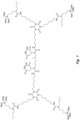
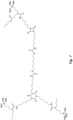
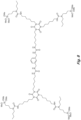
- the structure in Fig. 5 is an example of an N-substituted urea polymer with terminal alkoxysilanes that is synthesized using an aliphatic polyisocyanate based on an HDI isocyanurate trimer, N-butyl-3-aminopropyltrimethoxysilane (an N-substituted amino-functional alkoxysilane), and N-isopropyl-3-((isopropylamino)methyl)-3,5,5-trimethylcyclohexan-1-amine (a cycloaliphatic secondary diamine).
- all newly formed N-substituted urea groups possess either a butyl or isopropyl group.
- the structure in Fig. 6 is an example of an N-substituted urea polymer with terminal alkoxysilanes that is synthesized using an aliphatic polyisocyanate based on an HDI isocyanurate trimer, an N-substituted amino-functional alkoxysilane formed from the Michael Addition reaction of butyl acrylate and 3-aminopropyltrimethoxysilane, and N 1 ,N 3 -diethylpropane-1,3-diamine (an aliphatic secondary diamine).
- N-substituted urea polymers with extended chains and terminal alkoxysilanes can be formed by utilizing a mixture of two different aliphatic isocyanates, an N-substituted amino-functional alkoxysilane, and a secondary diamine.
- the structure in Fig. 7 is an example of an N-substituted urea polymer with terminal alkoxysilanes that is synthesized using a 1:1 mixture of an aliphatic polyisocyanate based on an HDI isocyanurate trimer and an aliphatic polyisocyanate based on a uretdione, N-butyl-3-aminopropyltrimethoxysilane (an N-substituted amino-functional alkoxysilane), and N 1 ,N 6 -dimethylhexane-1,6-diamine (an aliphatic secondary diamine).
- the N-substituted amino-functional alkoxysilane is reacted with -60% of the isocyanate groups, whereas the secondary diamine is reacted with -40% of the isocyanate groups.
- the structure is asymmetric due to the use of two different aliphatic polyisocyanates.
- the structure in Fig. 8 is an example of an N-substituted urea polymer with terminal alkoxysilanes that is synthesized using an aliphatic polyisocyanate based on a HDI isocyanurate trimer, N-butyl-3-aminopropyltrimethoxysilane (an N-substituted amino-functional alkoxysilane), and 1,3-phenylenedimethanamine (an aromatic diamine).
- the N-substituted amino-functional alkoxysilane is reacted with -66% of the isocyanate groups, whereas the diamine is reacted with -33% of the isocyanate groups.
- a reactive diluent also may be used for modifying the properties of the 2K coating, such as increasing the flexibility or hardness, reducing solvent content and viscosity, increasing cleanability, or increasing weatherability (i.e., resistance to exterior degradation from sunlight).
- the reactive diluent can be a polysiloxane with at least 2 hydrolyzable alkoxysilane groups, such as, but not limited to, poly(dimethoxysiloxane), poly(diethoxysiloxane), methoxy-functional dimethylpolysiloxane, methoxy-functional methylphenylpolysiloxane, ethoxy-functional dimethylpolysiloxane, and structures based on tetraethyl orthosilicate.
- the reactive diluent can also be hydroxyl-functional versions of these polysiloxanes or hydroxyl propyl terminated polysiloxanes. Many of these are commercially available.
- the reactive diluent can also be an alkyl-functional alkoxysilane, where the alkyl group is C1-C16 alkyl, cycloalkyl or fluorinated alkyl, and the alkoxysilane group is trimethoxysilane, triethoxysilane, methyldimethoxysilane, methyldiethoxysilane, dimethylmethoxysilane, and dimethylethoxysilane.
- Examples include, but are not limited to, propyltrimethoxysilane, hexyltrimethoxysilane, octyltrimethoxysilane, octyltriethoxysilane, hexadecyltrimethoxysilane, cyclohexyltriethoxysilane, (3,3,3-trifluoropropyl)trimethoxysilane, and 1H,1H,2H,2H-perfluorooctyltriethoxysilane.
- the reactive diluent can also be a polysiloxane-urea polymer with hydrolysable alkoxysilane groups. These reactive diluents are formed by reacting a polysiloxane with primary diamines, or a polysiloxane with secondary diamines, and 3-isocyanatopropyltrimethoxysilane or 3-isocyanatotriethoxysilane. They can also be formed by reacting a diisocyanate-functional polysiloxane with an N-substituted 3-aminopropylalkoxysilane.
- the polysiloxane can be a dimethylpolysiloxane or methylphenylpolysiloxane.
- the N-substituted groups of the secondary diamines (attached to the polysiloxane) and N-substituted 3-aminopropylalkoxysilane can be C1-C12 alkyl, cycloalkyl, aryl, or ester-containing aliphatic.
- the alkoxysilane group of the N-substituted 3-aminopropylalkoxysilane can be trimethoxysilane, triethoxysilane, methyldimethoxysilane, methyldiethoxysilane, dimethylmethoxysilane, and dimethylethoxysilane.
- Example structures of these synthesized reactive diluents include, but are not limited to, the following: Structure Name bis((3-triethoxysilyl)propyl)urea adduct based on N,N'-ethylaminoisobutyl terminated polydimethylsiloxane bis((3-triethoxysilyl)propyl)urea adduct based on aminopropyl terminated polydimethylsiloxane bis(N-substituted 3-aminopropylalkoxysilane) urea adduct based on diisocyanate-functional polydimethylsiloxane
- Reactive diluents that contain N-substituted urea groups are used due to their reduced hydrogen bonding character, lower viscosity and reduced solvent requirements.
- the reactive diluent can also be an aliphatic or cycloaliphatic N-substituted urea with hydrolysable alkoxysilane groups.
- These reactive diluents are formed by reacting an aliphatic or cycloaliphatic secondary diamine with 3-isocyanatopropyltrimethoxysilane or 3-isocyanatotriethoxysilane.
- the 3-isocyanatopropyltrimethoxysilane and 3-isocyanatotriethoxysilane are both commercially available.
- Suitable secondary diamines are the same as those utilized for synthesizing the N-substituted urea polymer with terminal alkoxysilanes.
- Example structures of these synthesized reactive diluents include, but are not limited to, the following: Structure Name 1,1'-(hexane-1,6-diyl)bis(1-(3,3-dimethylbutan-2-yl)-3-(3-(triethoxysilyl)propyl)urea) 1-isopropyl-1-((5-(1-isopropyl-3-(3-(triethoxysilyl)propyl)ureido)-1,3,3-trimethylcyclohexyl)methyl)-3-(3-(triethoxysilyl)propyl)urea 1,1'-(hexane-1,6-diyl)bis(1-methyl-3-(3-(triethoxysilyl)propyl)urea) tetraethyl 2,2'-(4,4,22,22-tetraethoxy-12-methyl-9,17-dioxo-3,23-dioxa-8
- the reactive diluent can also be a polyester-urethane polymer with hydrolyzable alkoxysilane groups. These reactive diluents are formed by reacting an aliphatic or cycloaliphatic polyester polyol with 3-isocyanatopropyltrimethoxysilane, 3-isocyanatopropyltriethoxysilane, or (isocyanatomethyl)trimethoxysilane.
- the polyester polyol should be linear or slightly branched, and can be utilized to provide increased flexibility.
- Suitable polyester polyols include unsaturated polyesters, such as 1,3-benzenedicarboxylic acid, polymer with 2,2-dimethyl-1,3-propanediol, 1,2-ethanediol, hexanedioic acid, and 1,6-hexanediol, and saturated polyesters such as those based on caprolactone. Many polyester polyols are commercially available. The 3-isocyanatopropyltrimethoxysilane, 3-isocyanatotriethoxysilane and (isocyanatomethyl)trimethoxysilane are also commercially available.
- Suitable solvents for synthesis of the polyurea are those that are not reactive with isocyanate groups. These solvents include, but are not limited to, xylenes, light aromatic naphtha, mineral spirits, butyl acetate, 1-methoxy-2-propyl acetate, tert- butyl acetate, butyl propionate, pentyl propionate, ethyl 3-ethoxypropionate, parachlorobenzotrifluoride, tetrahydrofuran, 1,4-dioxane, dimethylacetamide, and N-methyl pyrrolidone.
- the second component (part B) includes the epoxy- or acrylate-functional compound, which may be any compound that includes an amine-reactive epoxy or acrylate group, or any mixture of such compounds.
- Suitable epoxy- or acrylate-functional compounds include, but are not limited to, an epoxy-functional dimethylpolysiloxane, an epoxy-functional polydimethyldiphenylsiloxane, an aliphatic epoxy, a cycloaliphatic epoxy, an acrylate-functional dimethylpolysiloxane, or 1,6-hexanedioldiacrylate.
- a catalyst may be used to accelerate the rate of hydrolysis of the alkoxysilane groups and to facilitate crosslinking of the resulting silanol groups to form a cured coating.
- Suitable catalysts include, but are not limited to, organic tin compounds, such as dibutyl tin dilaurate, dibutyl tin diacetate, and dibutyl tin bis(2-ethylhexoate), metal alkoxides, such as titanium tetraisopropoxide, aluminum triethoxide, and zirconium tetrabutoxide, titanium chelates, alkalines, such as potassium hydroxide, organic acids, inorganic acids, tertiary amines, or mixtures thereof.
- Suitable pigments include, but are not limited to, titanium dioxide, carbon black, red iron oxide, yellow iron oxide, copper phthalocyanine blue, sodium aluminum sulphosilicate, chromium oxide, cobalt chromite green spinel, chromium green-black hematite, nickel antimony titanium yellow rutile, and manganese-based pigments.
- Suitable fillers include, but are not limited to, amorphous silica, functionalized silica, talc, mica, wollastonite, calcium carbonate, glass beads, graphite, polymeric waxes, acrylic beads, polyurethane beads, and ceramic microspheres.
- Suitable additives include, but are not limited to, rheology modifiers, thickening agents, adhesion promoters, reinforcing agents, wetting and dispersing agents, anti-floating agents, flame retardants, ultraviolet (UV) absorbers, hindered amine light stabilizers (HALS), and flow and leveling agents.
- rheology modifiers include, but are not limited to, rheology modifiers, thickening agents, adhesion promoters, reinforcing agents, wetting and dispersing agents, anti-floating agents, flame retardants, ultraviolet (UV) absorbers, hindered amine light stabilizers (HALS), and flow and leveling agents.
- the two components may be provided as a kit having each of the components in its own container.
- the two component system may also be described as a coating composition comprising the amine-functional compound, the alkoxysilane-terminated polyurea, and the epoxy- or acrylate-functional compound.
- the 2K coating can be applied to a variety of substrates.
- Suitable substrates include, but are not limited to, epoxy primed surfaces, polyurethane primed surfaces, pretreatments, epoxy-based composites, weathered or abraded silicone alkyd coatings, weathered or abraded polysiloxane coatings, bare steel surfaces, bare aluminum surfaces, bare aluminum alloy surfaces, concrete, glass, ceramics, and plastics.
- the two components When the two components are mixed and applied to a surface, they may cure to form a solid coating.
- the amine groups of the amine-functional compound in the first component react with the epoxy-functional compound in the second component.
- the amine-functional compound includes alkoxysilane groups, these groups may also hydrolyze and condense as shown below.
- the alkoxysilane groups of the polyurea may also undergo hydrolysis and condensation with each other and with those of the amine-functional compound.
- the amine groups of the amine-functional compound undergo a Michael addition with the acrylate groups as shown below.
- any of the polyureas disclosed herein may be used in a 1K system where the polyurea is moisture cured as described above. The moisture curing may occur in the absence of other compounds that crosslink with the polyurea.
- Any of the polyureas may also be used in 2K systems, coating compositions, and kits where one component contains the polyurea and either an amine-functional compound or an epoxy- or acrylate-functional compound, and the other component contains the other of the amine-functional compound and the epoxy- or acrylate-functional compound.
- the polyurea may be up to 50, 90, or 95 wt% of the total of the mixed components.
- the polyureas may generally be made, among other methods, by a two-step process.
- the amino-functional alkoxysilane is reacted with the polyisocyanate.
- This forms an adduct having an unreacted isocyanate group as shown above in Eq. (1).
- the adduct is then reacted with one or more polyfunctional amino- and/or hydroxyl compounds and optionally additional polyisocyanate.
- the adduct is reacted with a combination of two or more different such compounds.
- the adduct may be reacted with both a diamine and a diol.
- the compounds collectively contain both amine and hydroxyl groups, such as the previously stated diamine and diol combination, or the compound may be a single aminohydroxyl compound. Any free isocyanate groups do not react with other isocyanate groups in this reaction.
- the reaction may produce a composition having a blend of products having different arrangements of the reactants. Individual products may have no unreacted isocyanate groups.
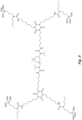
- Fig. 9 shows a number of possible products that could be present in the composition when using N-butyl-3-aminopropyltrimethoxysilane, hexamethylene diisocyanate (dimer and trimer), a diamine, and a polyester diol. Certain compounds in the composition may have the formula of Eqs. (2), (3), or (8). Eq.
- the polyurea may be used in the 2K system.
- Aspartic ester-containing backbone - 86 g (0.445 equiv.) of a hexamethylene diisocyanate homopolymer with mostly isocyanurate trimer structure was dissolved in 74 g of pentyl propionate in a 500 mL 3-neck round bottom flask equipped with an Argon inlet and thermometer. This was followed by the addition of 5 g of vinyltrimethoxysilane as a drying agent. Using an addition funnel, 70.14 g (0.298 equiv.) of N-butyl-3-aminopropyltrimethoxysilane was added dropwise to the solution while keeping the temperature at 40-50 °C.
- a flat/matte gray coating was obtained using the following two-component formulation: Part A Weight % of formula Dibutyltin dilaurate 0.25 Amino-functional polydimethylsiloxane 17.61 Flexible polymer solution ( Fig. 1 ) 8.76 Part B Cycloaliphatic epoxy 14.04 Epoxy-functional polydimethyldiphenylsiloxane 11.09 Titanium dioxide 6.41 Carbon black 0.085 Polyurea matting agent 8.55 Pentyl propionate 18.25 Ceramic microspheres 14.96
- the two parts were mixed at a 2:1 (B to A) ratio by volume and applied on aluminum and tinplate panels using a 3 mil ( ⁇ 75 microns) wet film gauge.
- the coating was then allowed to cure at ambient conditions for 14 days.
- the coating demonstrated a tack-free time of ⁇ 1 hour, a dry-hard time of ⁇ 2 hours, a 60° gloss of 0.6 gloss units, an 85° gloss of 4.7 gloss units, a Konig pendulum hardness of 17 oscillations, a resistance of 100+ double rubs to a methyl ethyl ketone (MEK) soaked rag, a 1 ⁇ 4" Mandrel Bend flexibility without cracking, and a GE Impact Flexibility of 40% elongation.
- MEK methyl ethyl ketone
- the coating has also demonstrated outstanding color retention when subjected to accelerated weathering in a Xenon-Arc Weatherometer (WOM) chamber.
- WOM Xenon-Arc Weatherometer
- Two-component gloss white topcoats have also been formulated.
- An example of a coating with a 1:1 (A to B) mix ratio by volume is as follows: Part A Weight % of formula Dibutyltin dilaurate 0.30 Amino-functional polydimethyldiphenylsiloxane 26.1 3-aminopropyltriethoxysilane 1.32 Flexible polymer solution 10.83 Butyl propionate 3.14 Part B Cycloaliphatic epoxy 25.8 Titanium dioxide 22.86 Butyl propionate 9.65
- the flexible backbone of the urea polymers can be aliphatic, cycloaliphatic, aromatic, polyester, polyurethane, polycarbonate, polyether, polysulfide, polysiloxane or a combination thereof, and the N-substituted groups can be C1-C12 alkyl, cycloalkyl, aryl, ester-containing aliphatic, ester-containing fluorinated aliphatic, amide-containing aliphatic, polysiloxane, or any combination thereof.
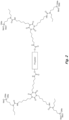
- An example of a polymer with a polyester backbone and N-butyl substituted urea linkages not in accordance with the invention is shown in Fig. 2 .
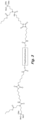
- An example of a polymer with a polydimethylsiloxane backbone and ester-containing N-substituted groups not in accordance with the invention is shown in Fig. 3 .
- FIG. 4 is a photograph showing the results of the bend test on a prior 2K coating (left) that does not contain the polyurea polymer compared to the presently disclosed coating (right) that does contain the polyurea polymer (not according to the invention). The prior coating shows cracking along the bend while the present coating does not.
- Polyurea based on an aliphatic polyisocyanate, N-alkyl amino-functional alkoxysilanes, and a cycloaliphatic secondary diamine with N-alkyl groups - 81.6 g (0.446 equiv.) of a hexamethylene diisocyanate homopolymer with isocyanurate trimer structure was dissolved in 115 g of Aromatic 100 (commercially available from Exxon) in a 500 mL 3-neck round bottom flask equipped with an Argon inlet and thermometer. This was followed by the addition of 5 g of vinyltrimethoxysilane as a drying agent. Using an addition funnel, 71.38 g (0.303 equiv.) of N-butyl-3-aminopropyltrimethoxysilane was added dropwise to the solution
- Polyurea based on an aliphatic polyisocyanate, N-substituted amino-functional alkoxysilanes with butyl ester-containing groups, and an aliphatic secondary diamine with N-alkyl groups - 35.5 g (0.194 equiv.) of a hexamethylene diisocyanate homopolymer with isocyanurate trimer structure was dissolved in 60 g of Aromatic 100 solvent (commercially available from Exxon) in a 500 mL 3-neck round bottom flask equipped with an Argon inlet and thermometer. This was followed by the addition of 2 g of vinyltrimethoxysilane as a drying agent.
- a moisture-curable polymer was synthesized by adding 70.14 g of N-butyl-3-aminopropyltrimethoxysilane (SIB 1932.2, Gelest) dropwise to a solution of 86 g of an aliphatic polyisocyanate mixture based on hexamethylene diisocyanate dimers and trimers (Desmodur N-3400, Covestro) and 5 g of vinyltrimethoxysilane (Sigma-Aldrich) in 100 g of pentyl propionate (Sigma-Aldrich) in a 500 mL round bottom flask under nitrogen.
Landscapes
- Chemical & Material Sciences (AREA)
- Organic Chemistry (AREA)
- Health & Medical Sciences (AREA)
- Chemical Kinetics & Catalysis (AREA)
- Medicinal Chemistry (AREA)
- Polymers & Plastics (AREA)
- Life Sciences & Earth Sciences (AREA)
- Engineering & Computer Science (AREA)
- Materials Engineering (AREA)
- Wood Science & Technology (AREA)
- Polyurethanes Or Polyureas (AREA)
- Paints Or Removers (AREA)
Claims (15)
- Zusammensetzung, umfassend:eine aminofunktionelle Verbindung oder eine epoxy- oder acrylatfunktionelle Verbindung; undeinen Polyharnstoff, hergestellt durch einem Verfahren, umfassend:Umsetzen eines aminofunktionellen Alkoxysilans mit einem ersten Polyisocyanat, um ein oder mehrerer Addukte mit einer nicht umgesetzten Isocyanatgruppe zu bilden; undUmsetzen der Addukte mit einer oder mehreren polyfunktionellen Amino- und/oder Hydroxylverbindungen und einem zweiten Polyisocyanat, um den Polyharnstoff zu bilden;wobei mindestens eine der polyfunktionellen Amino- und/oder Hydroxylverbindungen eine Aminogruppe umfasst;wobei mindestens eine der polyfunktionellen Amino- und/oder Hydroxylverbindungen eine Hydroxylgruppe umfasst;wobei der Polyharnstoff mindestens zwei Reste der polyfunktionellen Amino- und/oder Hydroxylverbindungen umfasst;wobei die Isocyanatgruppen nicht mit anderen Isocyanatgruppen reagieren;wobei mindestens 50% der Polyharnstoffmoleküle ein Molekulargewicht von weniger als 3000 aufweisen; undwobei der Polyharnstoff keine nicht umgesetzten Isocyanatgruppen enthält.
- Zusammensetzung nach Anspruch 1, wobei die aminofunktionelle Verbindung ein Monoamin, Diamin oder Triamin ist.
- Zusammensetzung nach Anspruch 1, wobei die aminofunktionelle Verbindung ein aminofunktionelles Polydimethylsiloxan, ein aminofunktionelles Polydimethyldiphenylsiloxan, 3-Aminopropyltriethoxysilan, 3-Aminopropyltrimethoxysilan, 3-Aminopropylmethyldiethoxysilan, 1-Aminomethyltrimethoxysilan, ein aliphatisches Monoamin, ein aliphatisches Diamin, ein cycloaliphatisches Diamin oder ein aminofunktioneller Polyether ist.
- Zusammensetzung nach Anspruch 1, wobei die Zusammensetzung nicht sowohl die aminofunktionelle Verbindung als auch die epoxy- oder acrylatfunktionelle Verbindung umfasst.
- Zusammensetzung nach Anspruch 1, wobei die Zusammensetzung sowohl die aminofunktionelle Verbindung als auch die epoxy- oder acrylatfunktionelle Verbindung umfasst.
- Zusammensetzung nach Anspruch 1, wobei der Polyharnstoff eine oder mehrere Verbindungen mit der Formel umfasst:
{[(R1O)aR1 3-aSi-(CH2)3-NR2-CO-NH]n-R3-NH-CO-X-R5-X-CO-NH}m-R3
wobei jedes a unabhängig voneinander aus 1, 2 oder 3 ausgewählt ist;wobei m 2 oder 3 ist;wobei jedes n unabhängig voneinander aus 1 oder 2 ausgewählt ist;wobei jedes X unabhängig voneinander aus -NR4- und -O- ausgewählt ist;wobei jede R1-Gruppe eine unabhängig ausgewählte Alkylgruppe ist;wobei jeder R2 und R4 unabhängig voneinander aus Wasserstoff, Aryl, Alkyl, Cycloalkyl, esterhaltigem Aliphat, esterhaltigem fluoriertem Aliphat, amidhaltigem Aliphat und Polysiloxan ausgewählt ist;wobei jeder R3 ein unabhängig voneinander ausgewählter Rest eines aliphatischen, cycloaliphatischen oder aromatischen Polyisocyanats mit 2 oder 3 Isocyanatgruppen ist; undwobei jeder R5 unabhängig voneinander eine Gruppe umfasst, die aus Aliphat, Cycloaliphat, Aromat, Polyester, Polyether, Polysulfid, Polyurethan, Polycarbonat, Polysiloxan und jeder Kombination davon ausgewählt ist. - Zusammensetzung nach Anspruch 6, wobei der Polyharnstoff zwei oder mehr verschiedene R5-Gruppen umfasst.
- Zusammensetzung nach Anspruch 1, wobei das aminofunktionelle Alkoxysilan N-Butyl-3-aminopropyltrimethoxysilan, 3-Aminopropyltriethoxysilan, 3-Aminopropyltrimethoxysilan, 3-Aminopropylmethyldiethoxysilan, N-Methyl-3-aminopropyltrimethoxysilan oder N-[3-(Trimethoxysilyl)propyl]-β-alaninbutylester ist.
- Zusammensetzung nach Anspruch 1, wobei das erste Polyisocyanat oder das zweite Polyisocyanat Hexamethylendiisocyanat, ein Homopolymer von Hexamethylendiisocyanat, Toluoldiisocyanat, Isophorondiisocyanat, ein Homopolymer von Isophorondiisocyanat, Methylendiphenyldiisocyanat oder eine Mischung davon ist.
- Zusammensetzung nach Anspruch 1, wobei die eine oder mehreren polyfunktionellen Amino- und/oder Hydroxylverbindungen Asparaginsäure, N,N'-(2-Methyl-1,5-pentandiyl)bis-1,1',4,4'-tetraethylester, ein ungesättigtes Polyesterdiol, ein Polyesterdiol auf Caprolactonbasis, ein Polymethylphenylsiloxan mit endständigen Hydroxylgruppen oder ein Polydimethylsiloxan mit endständigen Hydroxylpropylgruppen einschließen.
- Verfahren, umfassend:Bereitstellen einer zweiten Zusammensetzung, die die epoxy- oder acrylatfunktionelle Verbindung umfasst, die keine nicht umgesetzten Isocyanatgruppen aufweist;Mischen der Zusammensetzung nach Anspruch 1 mit der zweiten Zusammensetzung, um eine Mischung zu bilden;
wobei die Zusammensetzung nach Anspruch 1 die aminofunktionelle Verbindung umfasst;Auftragen der Mischung auf eine Oberfläche; undAushärtenlassen der Mischung zum Bilden einer Beschichtung. - Verfahren nach Anspruch 11, wobei die Menge des Polyharnstoffs in der Mischung bis zu 95 Gew.-% der Mischung beträgt.
- Verfahren nach Anspruch 11, wobei die epoxy- oder acrylatfunktionelle Verbindung ein epoxyfunktionelles Dimethylpolysiloxan, ein epoxyfunktionelles Polydimethyldiphenylsiloxan, ein aliphatisches Epoxy, ein cycloaliphatisches Epoxy, ein acrylatfunktionelles Dimethylpolysiloxan, ein epoxyfunktionelles Urethan, ein acrylatfunktionelles Urethan oder 1,6-Hexandioldiacrylat ist.
- Verfahren nach Anspruch 11, wobei die Mischung gehärtet wird durch eines oder mehrere von:Hydrolyse und Kondensation von Alkoxysilangruppen; undAmin/Epoxid- oder Amin/Acrylat-Reaktionen.
- Beschichtung, die nach dem Verfahren nach Anspruch 11 hergestellt ist.
Applications Claiming Priority (2)
| Application Number | Priority Date | Filing Date | Title |
|---|---|---|---|
| US15/442,909 US10190020B2 (en) | 2014-10-22 | 2017-02-27 | Siloxane-based coatings containing polymers with urea linkages and terminal alkoxysilanes |
| PCT/US2018/019369 WO2018156864A1 (en) | 2017-02-27 | 2018-02-23 | Siloxane-based coatings containing polymers with urea linkages and terminal alkoxysilanes |
Publications (3)
| Publication Number | Publication Date |
|---|---|
| EP3585845A1 EP3585845A1 (de) | 2020-01-01 |
| EP3585845A4 EP3585845A4 (de) | 2021-01-06 |
| EP3585845B1 true EP3585845B1 (de) | 2024-11-20 |
Family
ID=63253075
Family Applications (1)
| Application Number | Title | Priority Date | Filing Date |
|---|---|---|---|
| EP18758003.0A Active EP3585845B1 (de) | 2017-02-27 | 2018-02-23 | Beschichtungen auf siloxanbasis aus polymeren mit harnstoffbindungen und terminalen alkoxysilanen |
Country Status (4)
| Country | Link |
|---|---|
| EP (1) | EP3585845B1 (de) |
| JP (1) | JP7145577B2 (de) |
| ES (1) | ES2998477T3 (de) |
| WO (1) | WO2018156864A1 (de) |
Families Citing this family (4)
| Publication number | Priority date | Publication date | Assignee | Title |
|---|---|---|---|---|
| CN110894355B (zh) * | 2019-11-25 | 2021-07-27 | 东莞市吉鑫高分子科技有限公司 | 一种高透防静电热塑性聚氨酯弹性体及其制备方法 |
| GB2591099B (en) * | 2020-01-14 | 2023-05-24 | Gkn Aerospace Services Ltd | Coating compositions |
| CN114276508B (zh) * | 2021-12-30 | 2023-04-18 | 贵州理工学院 | 一种有机硅改性聚脲的制备方法 |
| CN115353800B (zh) * | 2022-09-22 | 2023-10-24 | 佛山市万化科技有限公司 | 一种抗污单组分聚脲及其制备方法 |
Citations (1)
| Publication number | Priority date | Publication date | Assignee | Title |
|---|---|---|---|---|
| EP1971656B1 (de) * | 2005-12-06 | 2013-07-24 | Momentive Performance Materials Inc. | Schutzlacke auf basis von silyliertem polyurethan-polyharnstoff |
Family Cites Families (5)
| Publication number | Priority date | Publication date | Assignee | Title |
|---|---|---|---|---|
| DE1745526B2 (de) * | 1967-03-16 | 1980-04-10 | Union Carbide Corp., New York, N.Y. (V.St.A.) | Verfahren zur Herstellung vulkanisierbarer, unter wasserfreien Bedingungen beständiger Polymerisate |
| EP2791198A4 (de) * | 2011-12-15 | 2015-06-17 | Momentive Performance Mat Inc | Feuchtigkeitshärtbare organopolysiloxanzusammensetzung |
| CN105899565B (zh) * | 2013-02-26 | 2019-06-14 | Sika技术股份公司 | 双组分组合物 |
| CA2898297C (en) | 2013-03-14 | 2022-03-22 | The Government Of The United States Of America, As Represented By The Secretary Of The Navy | Single-component moisture-curable coatings based on n-substituted urea polymers with extended chains and terminal alkoxysilanes |
| CA2960413C (en) * | 2014-10-22 | 2023-01-24 | Erick B. Iezzi | Two-component siloxane-based coatings containing polymers with urea linkages and terminal alkoxysilanes |
-
2018
- 2018-02-23 EP EP18758003.0A patent/EP3585845B1/de active Active
- 2018-02-23 WO PCT/US2018/019369 patent/WO2018156864A1/en not_active Ceased
- 2018-02-23 JP JP2019545996A patent/JP7145577B2/ja active Active
- 2018-02-23 ES ES18758003T patent/ES2998477T3/es active Active
Patent Citations (1)
| Publication number | Priority date | Publication date | Assignee | Title |
|---|---|---|---|---|
| EP1971656B1 (de) * | 2005-12-06 | 2013-07-24 | Momentive Performance Materials Inc. | Schutzlacke auf basis von silyliertem polyurethan-polyharnstoff |
Also Published As
| Publication number | Publication date |
|---|---|
| EP3585845A4 (de) | 2021-01-06 |
| WO2018156864A1 (en) | 2018-08-30 |
| EP3585845A1 (de) | 2020-01-01 |
| JP7145577B2 (ja) | 2022-10-03 |
| JP2020508383A (ja) | 2020-03-19 |
| ES2998477T3 (en) | 2025-02-20 |
Similar Documents
| Publication | Publication Date | Title |
|---|---|---|
| EP3209739B1 (de) | Zweikomponentige beschichtungen auf siloxanbasis aus polymeren mit harnstoffbindungen und terminalen alkoxysilanen | |
| US10190020B2 (en) | Siloxane-based coatings containing polymers with urea linkages and terminal alkoxysilanes | |
| EP2970709B1 (de) | Einkomponentige feuchtigkeitshärtende beschichtungen auf basis von n-substituierten harnstoffpolymeren mit verlängerten ketten und endgruppen-alkoxysilanen | |
| US8133964B2 (en) | Single-component coating having alkoxysilane-terminated N-substituted urea resins | |
| EP3585845B1 (de) | Beschichtungen auf siloxanbasis aus polymeren mit harnstoffbindungen und terminalen alkoxysilanen | |
| CN1880393A (zh) | 由聚天冬氨酸酯和磺酸酯改性的聚异氰酸酯组成的粘合剂混合物 | |
| JP7440500B2 (ja) | アスパラギン酸エステル官能性ポリシロキサン、それらの調製およびそれらの使用 | |
| JP2011503267A (ja) | ポリシロキサン変性ポリイソシアネート | |
| US11499001B2 (en) | Single-component polysiloxane non-skid / non-slip coatings | |
| JP7684231B2 (ja) | 1成分ポリシロキサン滑り止め/ノンスリップコーティング |
Legal Events
| Date | Code | Title | Description |
|---|---|---|---|
| STAA | Information on the status of an ep patent application or granted ep patent |
Free format text: STATUS: THE INTERNATIONAL PUBLICATION HAS BEEN MADE |
|
| PUAI | Public reference made under article 153(3) epc to a published international application that has entered the european phase |
Free format text: ORIGINAL CODE: 0009012 |
|
| STAA | Information on the status of an ep patent application or granted ep patent |
Free format text: STATUS: REQUEST FOR EXAMINATION WAS MADE |
|
| 17P | Request for examination filed |
Effective date: 20190912 |
|
| AK | Designated contracting states |
Kind code of ref document: A1 Designated state(s): AL AT BE BG CH CY CZ DE DK EE ES FI FR GB GR HR HU IE IS IT LI LT LU LV MC MK MT NL NO PL PT RO RS SE SI SK SM TR |
|
| AX | Request for extension of the european patent |
Extension state: BA ME |
|
| DAV | Request for validation of the european patent (deleted) | ||
| DAX | Request for extension of the european patent (deleted) | ||
| A4 | Supplementary search report drawn up and despatched |
Effective date: 20201208 |
|
| RIC1 | Information provided on ipc code assigned before grant |
Ipc: C08G 18/28 20060101ALI20201202BHEP Ipc: C09D 175/02 20060101AFI20201202BHEP Ipc: C08G 18/32 20060101ALI20201202BHEP Ipc: C08G 18/83 20060101ALI20201202BHEP Ipc: C08G 18/79 20060101ALI20201202BHEP Ipc: C09D 163/00 20060101ALI20201202BHEP Ipc: C08G 77/26 20060101ALI20201202BHEP Ipc: C08L 75/08 20060101ALI20201202BHEP Ipc: C09D 183/14 20060101ALI20201202BHEP Ipc: C08G 18/42 20060101ALI20201202BHEP |
|
| STAA | Information on the status of an ep patent application or granted ep patent |
Free format text: STATUS: EXAMINATION IS IN PROGRESS |
|
| 17Q | First examination report despatched |
Effective date: 20211201 |
|
| RIN1 | Information on inventor provided before grant (corrected) |
Inventor name: IEZZI, ERICK, B. |
|
| GRAP | Despatch of communication of intention to grant a patent |
Free format text: ORIGINAL CODE: EPIDOSNIGR1 |
|
| STAA | Information on the status of an ep patent application or granted ep patent |
Free format text: STATUS: GRANT OF PATENT IS INTENDED |
|
| INTG | Intention to grant announced |
Effective date: 20240423 |
|
| RIN1 | Information on inventor provided before grant (corrected) |
Inventor name: IEZZI, ERICK B. |
|
| GRAJ | Information related to disapproval of communication of intention to grant by the applicant or resumption of examination proceedings by the epo deleted |
Free format text: ORIGINAL CODE: EPIDOSDIGR1 |
|
| STAA | Information on the status of an ep patent application or granted ep patent |
Free format text: STATUS: EXAMINATION IS IN PROGRESS |
|
| GRAP | Despatch of communication of intention to grant a patent |
Free format text: ORIGINAL CODE: EPIDOSNIGR1 |
|
| STAA | Information on the status of an ep patent application or granted ep patent |
Free format text: STATUS: GRANT OF PATENT IS INTENDED |
|
| INTC | Intention to grant announced (deleted) | ||
| INTG | Intention to grant announced |
Effective date: 20240904 |
|
| GRAS | Grant fee paid |
Free format text: ORIGINAL CODE: EPIDOSNIGR3 |
|
| GRAA | (expected) grant |
Free format text: ORIGINAL CODE: 0009210 |
|
| STAA | Information on the status of an ep patent application or granted ep patent |
Free format text: STATUS: THE PATENT HAS BEEN GRANTED |
|
| AK | Designated contracting states |
Kind code of ref document: B1 Designated state(s): AL AT BE BG CH CY CZ DE DK EE ES FI FR GB GR HR HU IE IS IT LI LT LU LV MC MK MT NL NO PL PT RO RS SE SI SK SM TR |
|
| REG | Reference to a national code |
Ref country code: GB Ref legal event code: FG4D |
|
| REG | Reference to a national code |
Ref country code: NL Ref legal event code: FP |
|
| REG | Reference to a national code |
Ref country code: CH Ref legal event code: EP |
|
| REG | Reference to a national code |
Ref country code: DE Ref legal event code: R096 Ref document number: 602018076725 Country of ref document: DE |
|
| REG | Reference to a national code |
Ref country code: IE Ref legal event code: FG4D |
|
| REG | Reference to a national code |
Ref country code: ES Ref legal event code: FG2A Ref document number: 2998477 Country of ref document: ES Kind code of ref document: T3 Effective date: 20250220 |
|
| REG | Reference to a national code |
Ref country code: LT Ref legal event code: MG9D |
|
| PG25 | Lapsed in a contracting state [announced via postgrant information from national office to epo] |
Ref country code: IS Free format text: LAPSE BECAUSE OF FAILURE TO SUBMIT A TRANSLATION OF THE DESCRIPTION OR TO PAY THE FEE WITHIN THE PRESCRIBED TIME-LIMIT Effective date: 20250320 Ref country code: HR Free format text: LAPSE BECAUSE OF FAILURE TO SUBMIT A TRANSLATION OF THE DESCRIPTION OR TO PAY THE FEE WITHIN THE PRESCRIBED TIME-LIMIT Effective date: 20241120 Ref country code: PT Free format text: LAPSE BECAUSE OF FAILURE TO SUBMIT A TRANSLATION OF THE DESCRIPTION OR TO PAY THE FEE WITHIN THE PRESCRIBED TIME-LIMIT Effective date: 20250320 |
|
| PGFP | Annual fee paid to national office [announced via postgrant information from national office to epo] |
Ref country code: DE Payment date: 20250327 Year of fee payment: 8 |
|
| PG25 | Lapsed in a contracting state [announced via postgrant information from national office to epo] |
Ref country code: FI Free format text: LAPSE BECAUSE OF FAILURE TO SUBMIT A TRANSLATION OF THE DESCRIPTION OR TO PAY THE FEE WITHIN THE PRESCRIBED TIME-LIMIT Effective date: 20241120 |
|
| PGFP | Annual fee paid to national office [announced via postgrant information from national office to epo] |
Ref country code: NL Payment date: 20250327 Year of fee payment: 8 |
|
| REG | Reference to a national code |
Ref country code: AT Ref legal event code: MK05 Ref document number: 1743564 Country of ref document: AT Kind code of ref document: T Effective date: 20241120 |
|
| PG25 | Lapsed in a contracting state [announced via postgrant information from national office to epo] |
Ref country code: BG Free format text: LAPSE BECAUSE OF FAILURE TO SUBMIT A TRANSLATION OF THE DESCRIPTION OR TO PAY THE FEE WITHIN THE PRESCRIBED TIME-LIMIT Effective date: 20241120 |
|
| PG25 | Lapsed in a contracting state [announced via postgrant information from national office to epo] |
Ref country code: NO Free format text: LAPSE BECAUSE OF FAILURE TO SUBMIT A TRANSLATION OF THE DESCRIPTION OR TO PAY THE FEE WITHIN THE PRESCRIBED TIME-LIMIT Effective date: 20250220 |
|
| PG25 | Lapsed in a contracting state [announced via postgrant information from national office to epo] |
Ref country code: LV Free format text: LAPSE BECAUSE OF FAILURE TO SUBMIT A TRANSLATION OF THE DESCRIPTION OR TO PAY THE FEE WITHIN THE PRESCRIBED TIME-LIMIT Effective date: 20241120 Ref country code: GR Free format text: LAPSE BECAUSE OF FAILURE TO SUBMIT A TRANSLATION OF THE DESCRIPTION OR TO PAY THE FEE WITHIN THE PRESCRIBED TIME-LIMIT Effective date: 20250221 Ref country code: AT Free format text: LAPSE BECAUSE OF FAILURE TO SUBMIT A TRANSLATION OF THE DESCRIPTION OR TO PAY THE FEE WITHIN THE PRESCRIBED TIME-LIMIT Effective date: 20241120 |
|
| PG25 | Lapsed in a contracting state [announced via postgrant information from national office to epo] |
Ref country code: PL Free format text: LAPSE BECAUSE OF FAILURE TO SUBMIT A TRANSLATION OF THE DESCRIPTION OR TO PAY THE FEE WITHIN THE PRESCRIBED TIME-LIMIT Effective date: 20241120 |
|
| PGFP | Annual fee paid to national office [announced via postgrant information from national office to epo] |
Ref country code: FR Payment date: 20250325 Year of fee payment: 8 |
|
| PGFP | Annual fee paid to national office [announced via postgrant information from national office to epo] |
Ref country code: GB Payment date: 20250327 Year of fee payment: 8 |
|
| PG25 | Lapsed in a contracting state [announced via postgrant information from national office to epo] |
Ref country code: RS Free format text: LAPSE BECAUSE OF FAILURE TO SUBMIT A TRANSLATION OF THE DESCRIPTION OR TO PAY THE FEE WITHIN THE PRESCRIBED TIME-LIMIT Effective date: 20250220 |
|
| PG25 | Lapsed in a contracting state [announced via postgrant information from national office to epo] |
Ref country code: SM Free format text: LAPSE BECAUSE OF FAILURE TO SUBMIT A TRANSLATION OF THE DESCRIPTION OR TO PAY THE FEE WITHIN THE PRESCRIBED TIME-LIMIT Effective date: 20241120 |
|
| PG25 | Lapsed in a contracting state [announced via postgrant information from national office to epo] |
Ref country code: DK Free format text: LAPSE BECAUSE OF FAILURE TO SUBMIT A TRANSLATION OF THE DESCRIPTION OR TO PAY THE FEE WITHIN THE PRESCRIBED TIME-LIMIT Effective date: 20241120 |
|
| PGFP | Annual fee paid to national office [announced via postgrant information from national office to epo] |
Ref country code: ES Payment date: 20250401 Year of fee payment: 8 |
|
| PG25 | Lapsed in a contracting state [announced via postgrant information from national office to epo] |
Ref country code: EE Free format text: LAPSE BECAUSE OF FAILURE TO SUBMIT A TRANSLATION OF THE DESCRIPTION OR TO PAY THE FEE WITHIN THE PRESCRIBED TIME-LIMIT Effective date: 20241120 |
|
| PG25 | Lapsed in a contracting state [announced via postgrant information from national office to epo] |
Ref country code: RO Free format text: LAPSE BECAUSE OF FAILURE TO SUBMIT A TRANSLATION OF THE DESCRIPTION OR TO PAY THE FEE WITHIN THE PRESCRIBED TIME-LIMIT Effective date: 20241120 |
|
| PG25 | Lapsed in a contracting state [announced via postgrant information from national office to epo] |
Ref country code: SK Free format text: LAPSE BECAUSE OF FAILURE TO SUBMIT A TRANSLATION OF THE DESCRIPTION OR TO PAY THE FEE WITHIN THE PRESCRIBED TIME-LIMIT Effective date: 20241120 |
|
| PG25 | Lapsed in a contracting state [announced via postgrant information from national office to epo] |
Ref country code: CZ Free format text: LAPSE BECAUSE OF FAILURE TO SUBMIT A TRANSLATION OF THE DESCRIPTION OR TO PAY THE FEE WITHIN THE PRESCRIBED TIME-LIMIT Effective date: 20241120 |
|
| PG25 | Lapsed in a contracting state [announced via postgrant information from national office to epo] |
Ref country code: IT Free format text: LAPSE BECAUSE OF FAILURE TO SUBMIT A TRANSLATION OF THE DESCRIPTION OR TO PAY THE FEE WITHIN THE PRESCRIBED TIME-LIMIT Effective date: 20241120 |
|
| REG | Reference to a national code |
Ref country code: DE Ref legal event code: R097 Ref document number: 602018076725 Country of ref document: DE |
|
| PG25 | Lapsed in a contracting state [announced via postgrant information from national office to epo] |
Ref country code: SE Free format text: LAPSE BECAUSE OF FAILURE TO SUBMIT A TRANSLATION OF THE DESCRIPTION OR TO PAY THE FEE WITHIN THE PRESCRIBED TIME-LIMIT Effective date: 20241120 |
|
| PG25 | Lapsed in a contracting state [announced via postgrant information from national office to epo] |
Ref country code: MC Free format text: LAPSE BECAUSE OF FAILURE TO SUBMIT A TRANSLATION OF THE DESCRIPTION OR TO PAY THE FEE WITHIN THE PRESCRIBED TIME-LIMIT Effective date: 20241120 |
|
| PLBE | No opposition filed within time limit |
Free format text: ORIGINAL CODE: 0009261 |
|
| STAA | Information on the status of an ep patent application or granted ep patent |
Free format text: STATUS: NO OPPOSITION FILED WITHIN TIME LIMIT |
|
| REG | Reference to a national code |
Ref country code: CH Ref legal event code: PL |
|
| PG25 | Lapsed in a contracting state [announced via postgrant information from national office to epo] |
Ref country code: LU Free format text: LAPSE BECAUSE OF NON-PAYMENT OF DUE FEES Effective date: 20250223 |
|
| PG25 | Lapsed in a contracting state [announced via postgrant information from national office to epo] |
Ref country code: CH Free format text: LAPSE BECAUSE OF NON-PAYMENT OF DUE FEES Effective date: 20250228 |
|
| 26N | No opposition filed |
Effective date: 20250821 |