EP3582822B1 - Venovenöse ecmo (extrakorporale membranoxygenierungs)-kanüle - Google Patents
Venovenöse ecmo (extrakorporale membranoxygenierungs)-kanüle Download PDFInfo
- Publication number
- EP3582822B1 EP3582822B1 EP18813474.6A EP18813474A EP3582822B1 EP 3582822 B1 EP3582822 B1 EP 3582822B1 EP 18813474 A EP18813474 A EP 18813474A EP 3582822 B1 EP3582822 B1 EP 3582822B1
- Authority
- EP
- European Patent Office
- Prior art keywords
- cannula
- venous
- blood
- patient
- openings
- Prior art date
- Legal status (The legal status is an assumption and is not a legal conclusion. Google has not performed a legal analysis and makes no representation as to the accuracy of the status listed.)
- Active
Links
Images


Classifications
-
- A—HUMAN NECESSITIES
- A61—MEDICAL OR VETERINARY SCIENCE; HYGIENE
- A61M—DEVICES FOR INTRODUCING MEDIA INTO, OR ONTO, THE BODY; DEVICES FOR TRANSDUCING BODY MEDIA OR FOR TAKING MEDIA FROM THE BODY; DEVICES FOR PRODUCING OR ENDING SLEEP OR STUPOR
- A61M25/00—Catheters; Hollow probes
- A61M25/0017—Catheters; Hollow probes specially adapted for long-term hygiene care, e.g. urethral or indwelling catheters to prevent infections
-
- A—HUMAN NECESSITIES
- A61—MEDICAL OR VETERINARY SCIENCE; HYGIENE
- A61L—METHODS OR APPARATUS FOR STERILISING MATERIALS OR OBJECTS IN GENERAL; DISINFECTION, STERILISATION OR DEODORISATION OF AIR; CHEMICAL ASPECTS OF BANDAGES, DRESSINGS, ABSORBENT PADS OR SURGICAL ARTICLES; MATERIALS FOR BANDAGES, DRESSINGS, ABSORBENT PADS OR SURGICAL ARTICLES
- A61L29/00—Materials for catheters, medical tubing, cannulae, or endoscopes or for coating catheters
- A61L29/08—Materials for coatings
-
- A—HUMAN NECESSITIES
- A61—MEDICAL OR VETERINARY SCIENCE; HYGIENE
- A61L—METHODS OR APPARATUS FOR STERILISING MATERIALS OR OBJECTS IN GENERAL; DISINFECTION, STERILISATION OR DEODORISATION OF AIR; CHEMICAL ASPECTS OF BANDAGES, DRESSINGS, ABSORBENT PADS OR SURGICAL ARTICLES; MATERIALS FOR BANDAGES, DRESSINGS, ABSORBENT PADS OR SURGICAL ARTICLES
- A61L29/00—Materials for catheters, medical tubing, cannulae, or endoscopes or for coating catheters
- A61L29/08—Materials for coatings
- A61L29/10—Inorganic materials
- A61L29/106—Inorganic materials other than carbon
-
- A—HUMAN NECESSITIES
- A61—MEDICAL OR VETERINARY SCIENCE; HYGIENE
- A61L—METHODS OR APPARATUS FOR STERILISING MATERIALS OR OBJECTS IN GENERAL; DISINFECTION, STERILISATION OR DEODORISATION OF AIR; CHEMICAL ASPECTS OF BANDAGES, DRESSINGS, ABSORBENT PADS OR SURGICAL ARTICLES; MATERIALS FOR BANDAGES, DRESSINGS, ABSORBENT PADS OR SURGICAL ARTICLES
- A61L29/00—Materials for catheters, medical tubing, cannulae, or endoscopes or for coating catheters
- A61L29/14—Materials characterised by their function or physical properties, e.g. lubricating compositions
- A61L29/16—Biologically active materials, e.g. therapeutic substances
-
- A—HUMAN NECESSITIES
- A61—MEDICAL OR VETERINARY SCIENCE; HYGIENE
- A61M—DEVICES FOR INTRODUCING MEDIA INTO, OR ONTO, THE BODY; DEVICES FOR TRANSDUCING BODY MEDIA OR FOR TAKING MEDIA FROM THE BODY; DEVICES FOR PRODUCING OR ENDING SLEEP OR STUPOR
- A61M1/00—Suction or pumping devices for medical purposes; Devices for carrying-off, for treatment of, or for carrying-over, body-liquids; Drainage systems
- A61M1/14—Dialysis systems; Artificial kidneys; Blood oxygenators ; Reciprocating systems for treatment of body fluids, e.g. single needle systems for hemofiltration or pheresis
-
- A—HUMAN NECESSITIES
- A61—MEDICAL OR VETERINARY SCIENCE; HYGIENE
- A61M—DEVICES FOR INTRODUCING MEDIA INTO, OR ONTO, THE BODY; DEVICES FOR TRANSDUCING BODY MEDIA OR FOR TAKING MEDIA FROM THE BODY; DEVICES FOR PRODUCING OR ENDING SLEEP OR STUPOR
- A61M1/00—Suction or pumping devices for medical purposes; Devices for carrying-off, for treatment of, or for carrying-over, body-liquids; Drainage systems
- A61M1/36—Other treatment of blood in a by-pass of the natural circulatory system, e.g. temperature adaptation, irradiation ; Extra-corporeal blood circuits
- A61M1/3621—Extra-corporeal blood circuits
- A61M1/3653—Interfaces between patient blood circulation and extra-corporal blood circuit
- A61M1/3659—Cannulae pertaining to extracorporeal circulation
-
- A—HUMAN NECESSITIES
- A61—MEDICAL OR VETERINARY SCIENCE; HYGIENE
- A61M—DEVICES FOR INTRODUCING MEDIA INTO, OR ONTO, THE BODY; DEVICES FOR TRANSDUCING BODY MEDIA OR FOR TAKING MEDIA FROM THE BODY; DEVICES FOR PRODUCING OR ENDING SLEEP OR STUPOR
- A61M25/00—Catheters; Hollow probes
- A61M25/0021—Catheters; Hollow probes characterised by the form of the tubing
- A61M25/0023—Catheters; Hollow probes characterised by the form of the tubing by the form of the lumen, e.g. cross-section, variable diameter
- A61M25/0026—Multi-lumen catheters with stationary elements
- A61M25/003—Multi-lumen catheters with stationary elements characterized by features relating to least one lumen located at the distal part of the catheter, e.g. filters, plugs or valves
-
- A—HUMAN NECESSITIES
- A61—MEDICAL OR VETERINARY SCIENCE; HYGIENE
- A61L—METHODS OR APPARATUS FOR STERILISING MATERIALS OR OBJECTS IN GENERAL; DISINFECTION, STERILISATION OR DEODORISATION OF AIR; CHEMICAL ASPECTS OF BANDAGES, DRESSINGS, ABSORBENT PADS OR SURGICAL ARTICLES; MATERIALS FOR BANDAGES, DRESSINGS, ABSORBENT PADS OR SURGICAL ARTICLES
- A61L2300/00—Biologically active materials used in bandages, wound dressings, absorbent pads or medical devices
- A61L2300/40—Biologically active materials used in bandages, wound dressings, absorbent pads or medical devices characterised by a specific therapeutic activity or mode of action
- A61L2300/404—Biocides, antimicrobial agents, antiseptic agents
-
- A—HUMAN NECESSITIES
- A61—MEDICAL OR VETERINARY SCIENCE; HYGIENE
- A61M—DEVICES FOR INTRODUCING MEDIA INTO, OR ONTO, THE BODY; DEVICES FOR TRANSDUCING BODY MEDIA OR FOR TAKING MEDIA FROM THE BODY; DEVICES FOR PRODUCING OR ENDING SLEEP OR STUPOR
- A61M25/00—Catheters; Hollow probes
- A61M25/0021—Catheters; Hollow probes characterised by the form of the tubing
- A61M25/0023—Catheters; Hollow probes characterised by the form of the tubing by the form of the lumen, e.g. cross-section, variable diameter
- A61M25/0026—Multi-lumen catheters with stationary elements
- A61M25/003—Multi-lumen catheters with stationary elements characterized by features relating to least one lumen located at the distal part of the catheter, e.g. filters, plugs or valves
- A61M2025/0031—Multi-lumen catheters with stationary elements characterized by features relating to least one lumen located at the distal part of the catheter, e.g. filters, plugs or valves characterized by lumina for withdrawing or delivering, i.e. used for extracorporeal circuit treatment
-
- A—HUMAN NECESSITIES
- A61—MEDICAL OR VETERINARY SCIENCE; HYGIENE
- A61M—DEVICES FOR INTRODUCING MEDIA INTO, OR ONTO, THE BODY; DEVICES FOR TRANSDUCING BODY MEDIA OR FOR TAKING MEDIA FROM THE BODY; DEVICES FOR PRODUCING OR ENDING SLEEP OR STUPOR
- A61M25/00—Catheters; Hollow probes
- A61M25/0043—Catheters; Hollow probes characterised by structural features
- A61M2025/0056—Catheters; Hollow probes characterised by structural features provided with an antibacterial agent, e.g. by coating, residing in the polymer matrix or releasing an agent out of a reservoir
-
- A—HUMAN NECESSITIES
- A61—MEDICAL OR VETERINARY SCIENCE; HYGIENE
- A61M—DEVICES FOR INTRODUCING MEDIA INTO, OR ONTO, THE BODY; DEVICES FOR TRANSDUCING BODY MEDIA OR FOR TAKING MEDIA FROM THE BODY; DEVICES FOR PRODUCING OR ENDING SLEEP OR STUPOR
- A61M25/00—Catheters; Hollow probes
- A61M25/01—Introducing, guiding, advancing, emplacing or holding catheters
- A61M25/02—Holding devices, e.g. on the body
- A61M2025/024—Holding devices, e.g. on the body having a clip or clamp system
-
- A—HUMAN NECESSITIES
- A61—MEDICAL OR VETERINARY SCIENCE; HYGIENE
- A61M—DEVICES FOR INTRODUCING MEDIA INTO, OR ONTO, THE BODY; DEVICES FOR TRANSDUCING BODY MEDIA OR FOR TAKING MEDIA FROM THE BODY; DEVICES FOR PRODUCING OR ENDING SLEEP OR STUPOR
- A61M2205/00—General characteristics of the apparatus
- A61M2205/02—General characteristics of the apparatus characterised by a particular materials
- A61M2205/0205—Materials having antiseptic or antimicrobial properties, e.g. silver compounds, rubber with sterilising agent
-
- A—HUMAN NECESSITIES
- A61—MEDICAL OR VETERINARY SCIENCE; HYGIENE
- A61M—DEVICES FOR INTRODUCING MEDIA INTO, OR ONTO, THE BODY; DEVICES FOR TRANSDUCING BODY MEDIA OR FOR TAKING MEDIA FROM THE BODY; DEVICES FOR PRODUCING OR ENDING SLEEP OR STUPOR
- A61M2205/00—General characteristics of the apparatus
- A61M2205/02—General characteristics of the apparatus characterised by a particular materials
- A61M2205/0238—General characteristics of the apparatus characterised by a particular materials the material being a coating or protective layer
-
- A—HUMAN NECESSITIES
- A61—MEDICAL OR VETERINARY SCIENCE; HYGIENE
- A61M—DEVICES FOR INTRODUCING MEDIA INTO, OR ONTO, THE BODY; DEVICES FOR TRANSDUCING BODY MEDIA OR FOR TAKING MEDIA FROM THE BODY; DEVICES FOR PRODUCING OR ENDING SLEEP OR STUPOR
- A61M2205/00—General characteristics of the apparatus
- A61M2205/32—General characteristics of the apparatus with radio-opaque indicia
-
- A—HUMAN NECESSITIES
- A61—MEDICAL OR VETERINARY SCIENCE; HYGIENE
- A61M—DEVICES FOR INTRODUCING MEDIA INTO, OR ONTO, THE BODY; DEVICES FOR TRANSDUCING BODY MEDIA OR FOR TAKING MEDIA FROM THE BODY; DEVICES FOR PRODUCING OR ENDING SLEEP OR STUPOR
- A61M25/00—Catheters; Hollow probes
- A61M25/0021—Catheters; Hollow probes characterised by the form of the tubing
-
- A—HUMAN NECESSITIES
- A61—MEDICAL OR VETERINARY SCIENCE; HYGIENE
- A61M—DEVICES FOR INTRODUCING MEDIA INTO, OR ONTO, THE BODY; DEVICES FOR TRANSDUCING BODY MEDIA OR FOR TAKING MEDIA FROM THE BODY; DEVICES FOR PRODUCING OR ENDING SLEEP OR STUPOR
- A61M25/00—Catheters; Hollow probes
- A61M25/0021—Catheters; Hollow probes characterised by the form of the tubing
- A61M25/0023—Catheters; Hollow probes characterised by the form of the tubing by the form of the lumen, e.g. cross-section, variable diameter
-
- A—HUMAN NECESSITIES
- A61—MEDICAL OR VETERINARY SCIENCE; HYGIENE
- A61M—DEVICES FOR INTRODUCING MEDIA INTO, OR ONTO, THE BODY; DEVICES FOR TRANSDUCING BODY MEDIA OR FOR TAKING MEDIA FROM THE BODY; DEVICES FOR PRODUCING OR ENDING SLEEP OR STUPOR
- A61M25/00—Catheters; Hollow probes
- A61M25/0043—Catheters; Hollow probes characterised by structural features
- A61M25/0045—Catheters; Hollow probes characterised by structural features multi-layered, e.g. coated
-
- A—HUMAN NECESSITIES
- A61—MEDICAL OR VETERINARY SCIENCE; HYGIENE
- A61M—DEVICES FOR INTRODUCING MEDIA INTO, OR ONTO, THE BODY; DEVICES FOR TRANSDUCING BODY MEDIA OR FOR TAKING MEDIA FROM THE BODY; DEVICES FOR PRODUCING OR ENDING SLEEP OR STUPOR
- A61M25/00—Catheters; Hollow probes
- A61M25/0043—Catheters; Hollow probes characterised by structural features
- A61M25/005—Catheters; Hollow probes characterised by structural features with embedded materials for reinforcement, e.g. wires, coils, braids
- A61M25/0052—Localized reinforcement, e.g. where only a specific part of the catheter is reinforced, for rapid exchange guidewire port
-
- A—HUMAN NECESSITIES
- A61—MEDICAL OR VETERINARY SCIENCE; HYGIENE
- A61M—DEVICES FOR INTRODUCING MEDIA INTO, OR ONTO, THE BODY; DEVICES FOR TRANSDUCING BODY MEDIA OR FOR TAKING MEDIA FROM THE BODY; DEVICES FOR PRODUCING OR ENDING SLEEP OR STUPOR
- A61M25/00—Catheters; Hollow probes
- A61M25/0067—Catheters; Hollow probes characterised by the distal end, e.g. tips
- A61M25/0068—Static characteristics of the catheter tip, e.g. shape, atraumatic tip, curved tip or tip structure
- A61M25/007—Side holes, e.g. their profiles or arrangements; Provisions to keep side holes unblocked
-
- A—HUMAN NECESSITIES
- A61—MEDICAL OR VETERINARY SCIENCE; HYGIENE
- A61M—DEVICES FOR INTRODUCING MEDIA INTO, OR ONTO, THE BODY; DEVICES FOR TRANSDUCING BODY MEDIA OR FOR TAKING MEDIA FROM THE BODY; DEVICES FOR PRODUCING OR ENDING SLEEP OR STUPOR
- A61M25/00—Catheters; Hollow probes
- A61M25/01—Introducing, guiding, advancing, emplacing or holding catheters
- A61M25/0105—Steering means as part of the catheter or advancing means; Markers for positioning
- A61M25/0108—Steering means as part of the catheter or advancing means; Markers for positioning using radio-opaque or ultrasound markers
Definitions
- This invention is related to a dual lumen triple brimmed venovenous ECMO (Extracorporeal Membrane Oxygenation) cannula (1)
- Extracorporeal Membrane Oxygenation is a method used in patients with heart or respiratory failure in all age groups who do not respond to traditional treatment modalities.
- cannula or cannulas are used to remove dirty (venous) blood, and after the oxygenation of the blood is established, the arterial blood is re-inj ected.
- cannulas used for venovenous (VV) ECMO may have performance problems due to inadequacy of blood collection and blood supply capacity.
- VV venovenous
- an echocardiography device is used to detect the position of the cannula which was difficult to place, and the use of this device for this purpose also requires special experience.
- the cannula may come off from the desired position with a small movement of the patient.
- the United States patent no. US2005085761 which is incorporated in the prior art, refers to a double lumen cannula expandable for venous ECMO.
- This document discloses an apparatus, system and method for the use of a simple, less invasive, self-expanding, intradermal double lumen cannula group for VV ECMO.
- the invention described in this document provides theoretical total venous blood drainage, total extracorporeal gas exchange, and prevent recirculation and more than one (multiple) cannula use.
- VV ECMO is simplified, surgery and blood trauma are diminishing and its application is expanding.
- the cannula described in the document has three apertures in one embodiment.
- the dual lumen cannula of the invention also has a radiopaque marker.
- the cannula described in the United States patent document has a rigid structure and also has an adjustable flow mechanism. However, since this design does not include a design variety that adapts to changes in size and anatomical structure in accordance with the development of the patient, the performance of the cannula may be uncertain or under ideal.
- the upper suction mouth is located very close to the spray mouth, which can cause the arterial (clean) blood to pass back through the venous (dirty) blood suction holes in the system (ie some sort of short circuit mechanism - recirculation). This can cause the total amount of oxygenated blood to be low. There is no fixing element in this design, which carries the risk of moving of cannula from where it was fixed to the skin with simple seam.
- the cannula is circular in cross-section and the structure separating the suction and ejection channels is flexible. With this design, varying lumen diameters in accordance with suction-spray power can be risky for flow stabilization.
- This cannula design does not have a special construction element resistant to infection. In this design, there is only one indicator showing the position of the cannula in the heart and vein. While this shows this level of cannula, it is insufficient to show the direction of openness (port).
- a coaxial venous cannula is disclosed in the United States patent document US9233223 , which is another prior art document
- the double lumen cannula described in the document comprises two intertwined lumens wherein it has a proximal end, a distal end .
- the first tube terminates with a multi-hole proximal end there is a second tube concentric with the first tube and continuing constantly in the middle, and there is also a distal end terminating with a drain hole therefrom.
- the location of the lumen is coaxial in the mentioned cannula and the circular structure of the cannula restricts the amount of blood that is absorbed and ejected.
- the openings in the cannula are of a very porous structure, and it was designed this way so that every opening can perform both the suction and, the depending on the application position, can function to eject from both the neck and the head.
- this structure does not take into account the fact that the suction and ejection forces are countercurrent, so that the blood cells have a risk of causing damage during the process.
- WO2015199486 discloses an integrated double cannula for ECMO.
- Said cannula comprises a cannula body constituted by integrally forming a blood introduction part and a blood supply part that are separated from each other by a partition wall in the interior of a single pipe.
- Said cannula body also has an end hole and also an inlet and an outlet that are open side by side.
- the cannula body comprises multiple side holes that allows introduction of a large amount of blood into ECMO.
- WO02098499 discloses a multilumen catheter that is designed for maximizing the bloodflow into and out of the patient's vasculature while providing for passive or active perfusion of tissue downstream of where the catheter resides.
- the catheter of the document comprises a first and a second distal end and the luments extending between each of these distal ends and the proximal end provide for blood circulation.
- WO9958174 discloses a circulatory support system comprising at least one venous cannula, at least one arterial cannula and at least one blood circulation pump connected between these two cannulae. This way an isolated circulatory loop is formed to support the circulatory system of a patient.
- US2003093027 discloses a catheter omprising a catheter body having a distal portion, a central return lumen extending from a proximal portion of the catheter body to the distal portion to allow blood passage therethrough, at least three longitudinally extending intake lumens independent of the return lumen and radially displaced with respect to the return lumen, and means for enabling simultaneous cut off of fluid flow to the at least three longitudinally extending lumens.
- US6264645 discloses a multi lumen cannula comprising a first sub-cannula and a second sub-cannula.
- the first sub-cannula includes a proximal end, a distal end, a lumen extending between the proximal and distal ends, and proximal and distal fluid apertures formed in the lumen.
- the second sub-cannula includes a proximal end, a distal end, a lumen extending between the proximal and distal ends, and proximal and distal fluid apertures formed in the lumen.
- the distal fluid apertures of the two lumens are spaced from one another along the axial length of the multi-lumen cannula.
- WO9737718 discloses a dual lumen catheter that allows access to the vascular system of a human for providing high volume fluid flow.
- the crosssectional area of the catheter is designed to be minimal for maintaining the desired flow rate.
- the catheter comprises two tubular structures separated by a wall wherein one of the tubular structures is named as arterial line and the other is named as the venous line.
- the purpose of this invention is to provide a venovenous ECMO cannula that achieves performance gains by providing higher blood flow in smaller sizes and saves practitioners from the age, weight and length constraints of patients.
- Another object of the invention is to achieve a venovenous ECMO cannula that facilitates the use of venovenous ECMO and reduces infant mortality in patient groups whose weight are under ten kilograms.
- the other purpose of the invention is to realize a venovenous ECMO cannula which can be placed easily and correctly and the ideal settlement position is easily detected without requiring any special experience.
- This purpose is achieved by means of a cannula according to claim 1. Further objects are achieved by the dependent claims.
- Another object of the invention is to realize a venovenous ECMO cannula in which loss of position of the inserted cannula with the movement of the patient's body is prevented with the use of an ear clamp in the ECMO cannula.
- Another object of the invention is to realize a venovenous ECMO cannula wherein the infections risk arising from the prolonged stay in patient's body is reduced by use os a material such as silver or like.
- Another object of the invention is to realize a venovenous ECMO cannula that is thin, soft and resilient but that is resistant to internal luminal contraction factors such as fracture and bending, such that the risk of vessel and cardiac damage during placement is reduced.
- Another object of the invention is to realize a venovenous ECMO cannula which increases the amount of blood sucked with less suction pressure thanks to the ellipsoidal cross-sectional shape.
- Another object of the invention is to realize an ECMO cannula that provides a controlled blood suction and ejection process to obtain the working system closest to the natural working order of human biology.
- Another object of the invention is to realize a venovenous ECMO cannula in which the ejection opening is in the form of a wide mouth and surrounded by indicators wherein its direction is towards the cardiac valve through which the location of the venovenous ECMO cannula can be determined precisely and accurately.
- Another object of the invention is to realize an ECMO cannula with four indicators wherein there are two indicators at the entrance, one at the blood ejection part and finally one at the bottom, whereby the ideal position of the cannula can be detected and verified as often as desired.
- Another object of the invention is to implement a venovenous ECMO cannula having upper and lower region suction tips suitable for jugular application.
- Another object of the invention is to realize a venovenous ECMO cannula in which different designs can be applied according to the patient size.
- a cannula according to claim 1 is provided.
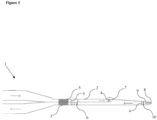
- a Venovenous ECMO (Extracorporeal Membrane Oxygenation) Cannula is shown in the enclosed drawings which disclose;
- the ECMO cannula (1) of the present invention that enables oxygenation of the venous blood and then returning said blood back to the patient, comprises the features of claim 1.
- the cannula of the invention (1) comprises two ends that perform their functions separately at the upper part of the body (2) and from which the venous blood exits and is returned back to the system after cleaning.
- the lumens located at the body (2) which are the continuation of the ends, extend contiguously after one point and after the arterial opening (7), and transforms into a single lumen from which the blood is sucked and stretches out to the lower part of the body (2).
- the body (2) has a structure that narrows down from upper part to lower part and has a thin lower venous basket end (8).
- the body (2) comprises two indicators (4) located on the top and bottom of the upper venous opening (6).
- the anti-bacterial coating (5) is located on the body (2) between the junctions of the ends and the indicator (4) located in the upper part of the venous openings (6)
- the reinforced area (5) preventing breakage is located between the junction of the ends and the indicator (4) located at the upper part of the upper venous openings (6) ( Figure 1-2 ).
- the body (2) has an elliptical shape starting from the junction if the ends to the arterial opening (7) from which the clean blood is ejected. This leads to an increase in the surface area of the body (2) and the volume of venous lumen. A higher number of venous openings (6) that are bigger in size can be placed on the increase surface area of the body (2).
- the arterial lumen located in elliptical body (2) and from which the clean blood ejected has a circular section.
- the distal venous ends have a circular cross-section ( Figure 7 ) .
- the lumens in the body (2) are not concentric, but have a lumen with circular cross-section in which the blood to be ejected proceeds.
- the anti-bacterial coating (3) is preferably made of silver or ta similar material .
- the anti-bacterial coating (3) is located on the part of the body (2) that is in contact with patient's skin preferably at the upper part of the indicator (4) on the upper part of the body (2). With the use of anti-bacterial coating (3), the risk of infecting the patient is reduced in long-term use.
- the indicator (4) is a band made of radio opaque material
- Indicators (4) located at the upper part of the body (2), at the top and bottom of upper venous openings (6) indicate the beginning and end of venous openings.
- the indicator (4) located just above the lower venous basket end (8) at the bottom of the body (2) is the lower radiopaque indicator of the venous lumen.
- the indicator (4) located in the arterial opening (7) is C-shaped and indicates the arterial opening. Said indicator (4) is used to direct the direction of the arterial opening (7) towards the heart valve.
- Indicators (4) are used to place the cannula (1) according to the natural structure of human biology and to maintain this convenient and efficient location.
- the reinforced area (5) used to prevent fracture of the body (2) is stretchable but resistant to breakage. In this way, twisting of the body (2) from the reinforced area (5) is prevented and thus the constriction or closing of the inner lumen and a decrease or stopping of the blood flow is prevented.
- the upper venous opening (6) located at the top of the body (2) and used for entry of the venous blood can be in various shapes and numbers depending on the patient development.
- Said upper venous openings (6) are located gradually on the body (2) ( Fig. 5 ).
- Said upper venous openings (6) are elongated by extending along the body (2) and thus has an eliptical shape. This is because the amount of dirty blood coming from the upper part of the body is high because circulatory physiology changes in small-sized patients. With the design difference in small sized patients the surface area of the upper venous opening (6) is increased so that more blood is collected from the upper part of the body, thereby the performance of the cannula (1) is increased.
- the arterial opening (7) to which clean blood is ejected preferably has a round or transverse or longitudinal elliptical cross-section.
- the problem of hemolysis that is, damage of blood elements by breaking, is minimized by the curved structure of the arterial opening (7) from which the blood exits .
- the lower venous basket end (8) is located at the extreme end of the lower part of the body (2).
- the lower venous basket (8) there are more than one lower end holes named as lower end holes (10).
- basket end openings (9) are located at the distal end of the venous lumen.
- the number and shape of lower end hole (10) located under the body (2) and above the lower venous basket end hole (10) on the lower venous end (8) varies with respect to the size of the patient.
- the number of the upper venous opening (6) and the lower end openings (10) used for suction is increased so as to increase the suction surface as a result which a cannula with a smaller body (2) provides more suction power and hence enhance the performance of the cannula (1).
- the thinner cannula (1) provides better flow dynamics and facilitates ease of placement of the cannula (1).
- the upper venous opening (6) and lower end hole (10) are located on both sides of the body (2). This way, the amount of blood sucked and ejected into the system is kept in a way that does not disturb the body balance. With the help of the upper venous opening (6) and lower end hole (10) it is possible to withdraw blood from both the neck and the leg.
- the ratio of the part comprising upper venous openings (6) located on the upper side of the body (2) and used for suction to the entire body of the cannula is more, whereas in big cannula (1) the suction part comprising lower end holes (10) located at the lower side of body (2) is more.
- the ratio of upper body to lower body is in favor of upper body whereas as they grow up and take up adult sizes this ratio increases in favor of the lower body comprising the body and the legs.
- the clamp (11) can be attached to and detached from the body (2) and with the help of two ears that are present on the clamp can be tied to the skin of the patient (11) with preferably a suture thread.
- the clamp (11) can be attached to and detached from the cannula (1) body (2) with the help of its opening and its elastic structure.
- Said clamp (11) comprises two channels that help fixing to the skin via winding of the suture.
- the clamp (11) is used in the region that is between the reinforced area (5) and the lumen ends on the body (2).
- the distance between upper venous openings used for blood suction and lower end holes (6, 10) and the arterial openings (7) used for ejection of blood are kept in a way that would reduce the recirculation/shunt probability ratio.
- the cannula (1) of the invention the cross-sectioned body (2) constructs provide better flow performance. Additionally, with the cannula (1) the friction and turbulence is reduced and as a result the problem of damage to blood elements via fragmenting decreases.
- the possibility of varying the size of the cannula (1) according to the size of the patient not only provides increase in performance but also provides that the amount of blood sucked from the neck and leg of the patient is in accordance with the biology of the patient.
- the size of the cannula (1) can be changed according to the length / kg ratio and the size of the cannula (1) can be changed and also by creating a cannula (1) portfolio wherein the parameters such as cannula (1) length, arterial opening (7), upper venous opening (6), lower end hole (10) can be changed, the cannula (1) that is most suitable for the patient can be chosen.
- infant mortality is reduced by facilitating the use of venovenous ECMO in the patient group weighing less than 10 kilograms.
Landscapes
- Health & Medical Sciences (AREA)
- Life Sciences & Earth Sciences (AREA)
- Animal Behavior & Ethology (AREA)
- General Health & Medical Sciences (AREA)
- Public Health (AREA)
- Veterinary Medicine (AREA)
- Heart & Thoracic Surgery (AREA)
- Engineering & Computer Science (AREA)
- Biomedical Technology (AREA)
- Hematology (AREA)
- Anesthesiology (AREA)
- Vascular Medicine (AREA)
- Epidemiology (AREA)
- Chemical & Material Sciences (AREA)
- Biophysics (AREA)
- Pulmonology (AREA)
- Urology & Nephrology (AREA)
- Molecular Biology (AREA)
- Cardiology (AREA)
- Medicinal Chemistry (AREA)
- Inorganic Chemistry (AREA)
- Emergency Medicine (AREA)
- External Artificial Organs (AREA)
- Materials For Medical Uses (AREA)
Claims (15)
- Kanüle (1) zur Sauerstoffversorgung von verunreinigtem Blut und zur Rückführung des Blutes zu einem Patienten, wobei die Kanüle (1) umfasst;- mindestens einen Körper (2) mit einer Vielzahl von Öffnungen, in denen bei der Verwendung das Blut gesammelt und versprüht wird, der Körper eine doppelte Lumen Struktur mit Enden aufweist, aus denen bei der Verwendung schmutziges Blut den Körper (2) verlässt und sauberes Blut in den Körper (2) eintritt,- mindestens eine antibakterielle Beschichtung (3), die sich auf einem oberen Teil des Körpers (2) befindet, der konfiguriert ist, um mit der Haut des Patienten in Kontakt zu sein,- mehr als einen Indikator (4), jeder Indikator (4) ein Band aus funkdurchlässigem Material ist, das den Füllstand bestimmt, und ein Indikator (4) am oberen Teil des Körpers (2) in einer arteriellen Öffnung (7) angeordnet ist, an dem sauberen Blut ausgestoßen werden soll, und ein weiterer Indikator am unteren Teil des Körpers (2) angeordnet ist,- mindestens einen verstärkten Bereich (5), der elastisch und bruchfest ist und sich im oberen Teil des Körpers (2) befindet,- mindestens eine obere venöse Öffnung (6), die sich am Körper (2) befindet und für den Eintritt von venösem Blut konfiguriert ist,- mindestens ein unteres venöses Korbende (8), das sich an einem unteren Ende des Körpers (2) befindet und mit mindestens einer Korbendöffnung (9),- mindestens ein unteres Endlöcher (10) am Körper (2) für die Entnahme von Blut, das so angeordnet ist, dass es sich auf der Oberseite des unteren venösen Korbendes (8) befindet,- mindestens eine Klammer (11), die zum Befestigen des Körpers (2) an der Haut des Patienten ausgebildet ist,- der Körper (2) eine elliptische Form hat, um die Menge des angesaugten Blutes zu erhöhen, der Körper durch die nicht-konzentrische Anordnung des Lumens, das zur Injektion von Blut dient, im Inneren des elliptischen Körpers (2) gebildet wird, das Lumen, das zur Injektion von Blut dient, einen kreisförmigen Querschnitt aufweist.
- Kanüle (1) nach Anspruch 1,
dadurch gekennzeichnet, dass
der Körper (2) umfasst zwei Enden, die mit Lumen verbunden sind, wobei die Enden ihre Funktionen getrennt im oberen Teil des Körpers (2) ausüben und aus dem das venöse Blut austritt und nach der Reinigung wieder in das System zurückgeführt wird. - Kanüle (1) nach Anspruch 1 oder 2,
dadurch gekennzeichnet, dass
der Körper (2) im oberen Bereich zwei Indikatoren (4) aufweist und zwischen den Indikatoren obere venöse Öffnung (6) vorhanden sind, aus denen das verschmutzte Blut austritt. - Kanüle (1) nach einem der vorhergehenden Ansprüche,
dadurch gekennzeichnet, dass
der Körper (2) umfasst zwei Indikatoren (4), die sich am oberen und unteren Teil der oberen venöse Öffnung (6) befinden. - Kanüle (1) nach einem der vorhergehenden Ansprüche,
dadurch gekennzeichnet, dass
die arterielle Öffnung (7), aus der das saubere Blut ausgestoßen wird, befindet sich am Körper (2) unter dem Indikator (4), der sich unter der oberen venösen Öffnung (6) befindet. - Kanüle (1) nach einem der vorhergehenden Ansprüche, im Folgenden gekennzeichnet durch:- Indikatoren (4), die sich oben und unten an den oberen venösen Öffnungen (6) oben am Körper (2) befinden, den Beginn und das Ende von Öffnungen anzeigt, und/oder- ein Indikator (4) direkt über dem unteren venösen Korbende (8) am Boden des Körpers (2), der den unteren röntgendichten Indikator des venösen Lumens und/oder- ein Indikator (4) die C-förmig ist und sich an der Öffnung (7) am Körper (2), die arterielle Öffnung definiert.
- Kanüle (1) nach einem der vorhergehenden Ansprüche,
dadurch gekennzeichnet, dass
die obere venöse Öffnung (6), die sich auf der Oberseite des Körpers (2) befindet, so konfiguriert ist, dass ihre Form und Anzahl in Bezug auf die Größe des Patienten variiert und zum Einführen von kontaminiertem Blut verwendet wird. - Kanüle nach Anspruch 7,
dadurch gekennzeichnet, dass
die Kanüle (1) mehr als eine obere venöse Öffnung (6) mit rundem Querschnitt zwischen den beiden Indikatoren (4) umfasst, die sich am oberen Teil des Körpers (2) befinden, wenn die Größe des Patienten vergrößert wird. - Kanüle (1) nach Anspruch 7 oder 8,
dadurch gekennzeichnet, dass
die Kanüle (1) obere venöse Öffnungen (6) aufweist, die sich allmählich am Körper (2) befinden. - Kanüle (1) nach Anspruch 7,
dadurch gekennzeichnet, dass
die Kanüle (1) elliptische, im Querschnitt obere venöse Öffnungen zwischen den beiden Indikatoren (4) umfasst, die sich auf dem oberen Teil des Körpers befinden, wo die Größe des Patienten reduziert ist. - Kanüle nach einem der vorhergehenden Ansprüche,
dadurch gekennzeichnet, dass
die arterielle Öffnung (7) hat einen runden oder transversalen oder longitudinalen elliptischen Querschnitt und auf dem sauberen Blut ausgestoßen wird. - Kanüle (1) nach einem der vorhergehenden Ansprüche,
dadurch gekennzeichnet, dass
die untere venöse Korbende (8) weist mehr als ein Loch auf, das als untere Endlöcher (10) bezeichnet wird. - Kanüle (1) nach Anspruch 12,
dadurch gekennzeichnet, dass
die Kanüle weist Korbendöffnungen (9) auf, die sich am distalen Ende des venösen Lumens befinden. - Kanüle (1) nach einem der vorhergehenden Ansprüche, wobei das untere Endlöcher (10), das sich unter dem Körper (2) und über dem unteren venösen Ende (8) befindet, so konfiguriert ist, dass seine Anzahl und Form in Bezug auf die Größe des Patienten variiert, so dass;- wenn die Patientengröße vergrößert ist, gibt es eine Vielzahl von runden oder elliptischen im Querschnitt unteren Endlöchern (10) oben auf dem unteren venösen Korbende (8) unter dem Körper (2), oder- wenn die Patientengröße kleiner ist, befinden sich elliptische oder runde untere Endlöcher (10) oben auf dem unteren venösen Korbende (8) unter dem Körper (2).
- Kanüle (1) nach einem der vorhergehenden Ansprüche,
dadurch gekennzeichnet, dass
die obere venöse Öffnung (6) und das untere Endlöcher (10) auf beiden Seiten des Körpers (2) angeordnet sind, um eine Oberflächenvergrößerung für die Blutabsaugung bereitzustellen, so dass bei einem schmalen Körper (2) mehr Saugkraft vorhanden ist.
Applications Claiming Priority (2)
| Application Number | Priority Date | Filing Date | Title |
|---|---|---|---|
| TR2017/02278A TR201702278A2 (tr) | 2017-02-15 | 2017-02-15 | Bi̇r venovenöz ecmo (extracorporeal membrane oxygenation ekstrakorporeal membran oksi̇jenasyonu) kanül |
| PCT/TR2018/000010 WO2018226187A2 (en) | 2017-02-15 | 2018-02-12 | A venovenous ecmo (extracorporeal membrane oxygenation) cannula |
Publications (3)
| Publication Number | Publication Date |
|---|---|
| EP3582822A2 EP3582822A2 (de) | 2019-12-25 |
| EP3582822A4 EP3582822A4 (de) | 2020-12-30 |
| EP3582822B1 true EP3582822B1 (de) | 2024-12-18 |
Family
ID=64559248
Family Applications (1)
| Application Number | Title | Priority Date | Filing Date |
|---|---|---|---|
| EP18813474.6A Active EP3582822B1 (de) | 2017-02-15 | 2018-02-12 | Venovenöse ecmo (extrakorporale membranoxygenierungs)-kanüle |
Country Status (4)
| Country | Link |
|---|---|
| US (1) | US20200000998A1 (de) |
| EP (1) | EP3582822B1 (de) |
| TR (1) | TR201702278A2 (de) |
| WO (1) | WO2018226187A2 (de) |
Families Citing this family (2)
| Publication number | Priority date | Publication date | Assignee | Title |
|---|---|---|---|---|
| USD975844S1 (en) | 2019-11-06 | 2023-01-17 | Free Life Medical Gmbh | Cannula |
| TR202022783A1 (tr) * | 2020-12-31 | 2022-07-21 | Univ Istanbul Medipol | Çi̇ft lümenli̇, çok çikişli, çok gi̇ri̇şli̇ venovenöz ekmo (ekstrakorporeal membran oksi̇jenasyonu) kanül |
Citations (1)
| Publication number | Priority date | Publication date | Assignee | Title |
|---|---|---|---|---|
| WO2015089047A1 (en) * | 2013-12-10 | 2015-06-18 | The Charlotte-Mecklenburg Hospital Authority D/B/A Carolinas Healthcare System | Ultrasound-guided vascular device for extracorporeal membrane oxygenation |
Family Cites Families (14)
| Publication number | Priority date | Publication date | Assignee | Title |
|---|---|---|---|---|
| US5868717A (en) | 1996-04-10 | 1999-02-09 | Biolink Corporation | Dual-lumen catheter and method of use |
| US6264645B1 (en) | 1997-08-14 | 2001-07-24 | Medtronic, Inc. | Method of pressurizing the right ventricle of the heart |
| US6508777B1 (en) | 1998-05-08 | 2003-01-21 | Cardeon Corporation | Circulatory support system and method of use for isolated segmental perfusion |
| US6383172B1 (en) * | 1999-04-02 | 2002-05-07 | Coaxia, Inc. | Retrograde venous perfusion with isolation of cerebral circulation |
| US6596235B2 (en) * | 1999-09-30 | 2003-07-22 | Therox, Inc. | Method for blood oxygenation |
| US7011645B2 (en) | 2001-01-09 | 2006-03-14 | Rex Medical, L.P. | Dialysis catheter |
| US7048680B2 (en) | 2001-06-06 | 2006-05-23 | Orqis Medical Corporation | Multilumen catheter for minimizing limb ischemia |
| US7473239B2 (en) | 2003-08-25 | 2009-01-06 | The University Of Texas System | Single expandable double lumen cannula assembly for veno-venous ECMO |
| EP1990066B1 (de) * | 2006-02-23 | 2017-03-08 | Thoratec Delaware LLC | Perfusionskanüle und Blut-Managementsystem |
| WO2009003044A1 (en) | 2007-06-26 | 2008-12-31 | Avalon Laboratories, Llc | Coaxial venal cannula |
| EP4252823A3 (de) * | 2012-08-15 | 2023-11-15 | Artio Medical, Inc. | Blutpumpensysteme und verfahren |
| US20170007800A1 (en) * | 2014-01-30 | 2017-01-12 | Singapore Health Services Pte Ltd | Arterial cannula which allows proximal and distal perfusion within a cannulated vessel |
| WO2015199486A1 (ko) | 2014-06-26 | 2015-12-30 | 사회복지법인 삼성생명공익재단 | Ecmo용 일체형 더블 캐뉼러 |
| DE202016005966U1 (de) * | 2016-09-29 | 2016-10-21 | B. Braun Melsungen Ag | Vorrichtung zur Fixierung eines medizinischen Kunststoffschlauches |
-
2017
- 2017-02-15 TR TR2017/02278A patent/TR201702278A2/tr unknown
-
2018
- 2018-02-12 EP EP18813474.6A patent/EP3582822B1/de active Active
- 2018-02-12 US US16/484,552 patent/US20200000998A1/en not_active Abandoned
- 2018-02-12 WO PCT/TR2018/000010 patent/WO2018226187A2/en not_active Ceased
Patent Citations (1)
| Publication number | Priority date | Publication date | Assignee | Title |
|---|---|---|---|---|
| WO2015089047A1 (en) * | 2013-12-10 | 2015-06-18 | The Charlotte-Mecklenburg Hospital Authority D/B/A Carolinas Healthcare System | Ultrasound-guided vascular device for extracorporeal membrane oxygenation |
Also Published As
| Publication number | Publication date |
|---|---|
| WO2018226187A2 (en) | 2018-12-13 |
| TR201702278A2 (tr) | 2018-09-21 |
| US20200000998A1 (en) | 2020-01-02 |
| EP3582822A4 (de) | 2020-12-30 |
| EP3582822A2 (de) | 2019-12-25 |
| WO2018226187A3 (en) | 2019-03-07 |
Similar Documents
| Publication | Publication Date | Title |
|---|---|---|
| US11918725B2 (en) | Dual lumen cannula | |
| US20260083887A1 (en) | Va ecmo with pulmonary artery ventilation | |
| US12257397B2 (en) | Catheter for portable lung assist device | |
| US6152911A (en) | Venous return catheter having multiple helical support members | |
| EP1476213B1 (de) | Multilumenkatheter zur minimierung der gliedischämie | |
| US9233223B2 (en) | Coaxial venal cannula | |
| JPH0410347B2 (de) | ||
| US20210077774A1 (en) | Dual lumen cannula with flexible distal end | |
| EP3582822B1 (de) | Venovenöse ecmo (extrakorporale membranoxygenierungs)-kanüle | |
| CN214512267U (zh) | 一种动脉血液循环管道组件、人工动脉血液体外循环系统和左心室取血管道 | |
| WO2018009241A9 (en) | Catheter for portable lung assist device | |
| TR202022783A1 (tr) | Çi̇ft lümenli̇, çok çikişli, çok gi̇ri̇şli̇ venovenöz ekmo (ekstrakorporeal membran oksi̇jenasyonu) kanül | |
| TR202021534A1 (tr) | Tek lümenli̇ venovenöz ekmo (ekstrakorporeal membran oksi̇jenasyonu) kanül | |
| CN121314047A (zh) | 用于搏动式血流的自适应双腔插管 |
Legal Events
| Date | Code | Title | Description |
|---|---|---|---|
| STAA | Information on the status of an ep patent application or granted ep patent |
Free format text: STATUS: THE INTERNATIONAL PUBLICATION HAS BEEN MADE |
|
| PUAI | Public reference made under article 153(3) epc to a published international application that has entered the european phase |
Free format text: ORIGINAL CODE: 0009012 |
|
| STAA | Information on the status of an ep patent application or granted ep patent |
Free format text: STATUS: REQUEST FOR EXAMINATION WAS MADE |
|
| 17P | Request for examination filed |
Effective date: 20190911 |
|
| AK | Designated contracting states |
Kind code of ref document: A2 Designated state(s): AL AT BE BG CH CY CZ DE DK EE ES FI FR GB GR HR HU IE IS IT LI LT LU LV MC MK MT NL NO PL PT RO RS SE SI SK SM TR |
|
| AX | Request for extension of the european patent |
Extension state: BA ME |
|
| DAV | Request for validation of the european patent (deleted) | ||
| DAX | Request for extension of the european patent (deleted) | ||
| A4 | Supplementary search report drawn up and despatched |
Effective date: 20201202 |
|
| RIC1 | Information provided on ipc code assigned before grant |
Ipc: A61M 1/14 20060101AFI20201126BHEP |
|
| STAA | Information on the status of an ep patent application or granted ep patent |
Free format text: STATUS: EXAMINATION IS IN PROGRESS |
|
| 17Q | First examination report despatched |
Effective date: 20221027 |
|
| GRAP | Despatch of communication of intention to grant a patent |
Free format text: ORIGINAL CODE: EPIDOSNIGR1 |
|
| STAA | Information on the status of an ep patent application or granted ep patent |
Free format text: STATUS: GRANT OF PATENT IS INTENDED |
|
| INTG | Intention to grant announced |
Effective date: 20240712 |
|
| RAP3 | Party data changed (applicant data changed or rights of an application transferred) |
Owner name: T.C MEDIPOL UENIVERSITESI |
|
| GRAS | Grant fee paid |
Free format text: ORIGINAL CODE: EPIDOSNIGR3 |
|
| GRAA | (expected) grant |
Free format text: ORIGINAL CODE: 0009210 |
|
| STAA | Information on the status of an ep patent application or granted ep patent |
Free format text: STATUS: THE PATENT HAS BEEN GRANTED |
|
| AK | Designated contracting states |
Kind code of ref document: B1 Designated state(s): AL AT BE BG CH CY CZ DE DK EE ES FI FR GB GR HR HU IE IS IT LI LT LU LV MC MK MT NL NO PL PT RO RS SE SI SK SM TR |
|
| REG | Reference to a national code |
Ref country code: GB Ref legal event code: FG4D |
|
| REG | Reference to a national code |
Ref country code: CH Ref legal event code: EP |
|
| REG | Reference to a national code |
Ref country code: DE Ref legal event code: R096 Ref document number: 602018077777 Country of ref document: DE |
|
| REG | Reference to a national code |
Ref country code: IE Ref legal event code: FG4D |
|
| REG | Reference to a national code |
Ref country code: LT Ref legal event code: MG9D |
|
| PG25 | Lapsed in a contracting state [announced via postgrant information from national office to epo] |
Ref country code: HR Free format text: LAPSE BECAUSE OF FAILURE TO SUBMIT A TRANSLATION OF THE DESCRIPTION OR TO PAY THE FEE WITHIN THE PRESCRIBED TIME-LIMIT Effective date: 20241218 |
|
| PG25 | Lapsed in a contracting state [announced via postgrant information from national office to epo] |
Ref country code: FI Free format text: LAPSE BECAUSE OF FAILURE TO SUBMIT A TRANSLATION OF THE DESCRIPTION OR TO PAY THE FEE WITHIN THE PRESCRIBED TIME-LIMIT Effective date: 20241218 |
|
| PG25 | Lapsed in a contracting state [announced via postgrant information from national office to epo] |
Ref country code: BG Free format text: LAPSE BECAUSE OF FAILURE TO SUBMIT A TRANSLATION OF THE DESCRIPTION OR TO PAY THE FEE WITHIN THE PRESCRIBED TIME-LIMIT Effective date: 20241218 |
|
| PG25 | Lapsed in a contracting state [announced via postgrant information from national office to epo] |
Ref country code: NO Free format text: LAPSE BECAUSE OF FAILURE TO SUBMIT A TRANSLATION OF THE DESCRIPTION OR TO PAY THE FEE WITHIN THE PRESCRIBED TIME-LIMIT Effective date: 20250318 |
|
| REG | Reference to a national code |
Ref country code: NL Ref legal event code: MP Effective date: 20241218 |
|
| PG25 | Lapsed in a contracting state [announced via postgrant information from national office to epo] |
Ref country code: LV Free format text: LAPSE BECAUSE OF FAILURE TO SUBMIT A TRANSLATION OF THE DESCRIPTION OR TO PAY THE FEE WITHIN THE PRESCRIBED TIME-LIMIT Effective date: 20241218 Ref country code: GR Free format text: LAPSE BECAUSE OF FAILURE TO SUBMIT A TRANSLATION OF THE DESCRIPTION OR TO PAY THE FEE WITHIN THE PRESCRIBED TIME-LIMIT Effective date: 20250319 |
|
| PG25 | Lapsed in a contracting state [announced via postgrant information from national office to epo] |
Ref country code: RS Free format text: LAPSE BECAUSE OF FAILURE TO SUBMIT A TRANSLATION OF THE DESCRIPTION OR TO PAY THE FEE WITHIN THE PRESCRIBED TIME-LIMIT Effective date: 20250318 |
|
| PG25 | Lapsed in a contracting state [announced via postgrant information from national office to epo] |
Ref country code: NL Free format text: LAPSE BECAUSE OF FAILURE TO SUBMIT A TRANSLATION OF THE DESCRIPTION OR TO PAY THE FEE WITHIN THE PRESCRIBED TIME-LIMIT Effective date: 20241218 |
|
| REG | Reference to a national code |
Ref country code: AT Ref legal event code: MK05 Ref document number: 1751735 Country of ref document: AT Kind code of ref document: T Effective date: 20241218 |
|
| PG25 | Lapsed in a contracting state [announced via postgrant information from national office to epo] |
Ref country code: SM Free format text: LAPSE BECAUSE OF FAILURE TO SUBMIT A TRANSLATION OF THE DESCRIPTION OR TO PAY THE FEE WITHIN THE PRESCRIBED TIME-LIMIT Effective date: 20241218 |
|
| PG25 | Lapsed in a contracting state [announced via postgrant information from national office to epo] |
Ref country code: PL Free format text: LAPSE BECAUSE OF FAILURE TO SUBMIT A TRANSLATION OF THE DESCRIPTION OR TO PAY THE FEE WITHIN THE PRESCRIBED TIME-LIMIT Effective date: 20241218 |
|
| PG25 | Lapsed in a contracting state [announced via postgrant information from national office to epo] |
Ref country code: ES Free format text: LAPSE BECAUSE OF FAILURE TO SUBMIT A TRANSLATION OF THE DESCRIPTION OR TO PAY THE FEE WITHIN THE PRESCRIBED TIME-LIMIT Effective date: 20241218 |
|
| PG25 | Lapsed in a contracting state [announced via postgrant information from national office to epo] |
Ref country code: IS Free format text: LAPSE BECAUSE OF FAILURE TO SUBMIT A TRANSLATION OF THE DESCRIPTION OR TO PAY THE FEE WITHIN THE PRESCRIBED TIME-LIMIT Effective date: 20250418 |
|
| PG25 | Lapsed in a contracting state [announced via postgrant information from national office to epo] |
Ref country code: PT Free format text: LAPSE BECAUSE OF FAILURE TO SUBMIT A TRANSLATION OF THE DESCRIPTION OR TO PAY THE FEE WITHIN THE PRESCRIBED TIME-LIMIT Effective date: 20250421 |
|
| PG25 | Lapsed in a contracting state [announced via postgrant information from national office to epo] |
Ref country code: EE Free format text: LAPSE BECAUSE OF FAILURE TO SUBMIT A TRANSLATION OF THE DESCRIPTION OR TO PAY THE FEE WITHIN THE PRESCRIBED TIME-LIMIT Effective date: 20241218 |
|
| PG25 | Lapsed in a contracting state [announced via postgrant information from national office to epo] |
Ref country code: RO Free format text: LAPSE BECAUSE OF FAILURE TO SUBMIT A TRANSLATION OF THE DESCRIPTION OR TO PAY THE FEE WITHIN THE PRESCRIBED TIME-LIMIT Effective date: 20241218 Ref country code: AT Free format text: LAPSE BECAUSE OF FAILURE TO SUBMIT A TRANSLATION OF THE DESCRIPTION OR TO PAY THE FEE WITHIN THE PRESCRIBED TIME-LIMIT Effective date: 20241218 |
|
| PG25 | Lapsed in a contracting state [announced via postgrant information from national office to epo] |
Ref country code: SK Free format text: LAPSE BECAUSE OF FAILURE TO SUBMIT A TRANSLATION OF THE DESCRIPTION OR TO PAY THE FEE WITHIN THE PRESCRIBED TIME-LIMIT Effective date: 20241218 |
|
| PG25 | Lapsed in a contracting state [announced via postgrant information from national office to epo] |
Ref country code: CZ Free format text: LAPSE BECAUSE OF FAILURE TO SUBMIT A TRANSLATION OF THE DESCRIPTION OR TO PAY THE FEE WITHIN THE PRESCRIBED TIME-LIMIT Effective date: 20241218 |
|
| PG25 | Lapsed in a contracting state [announced via postgrant information from national office to epo] |
Ref country code: IT Free format text: LAPSE BECAUSE OF FAILURE TO SUBMIT A TRANSLATION OF THE DESCRIPTION OR TO PAY THE FEE WITHIN THE PRESCRIBED TIME-LIMIT Effective date: 20241218 |
|
| PG25 | Lapsed in a contracting state [announced via postgrant information from national office to epo] |
Ref country code: SE Free format text: LAPSE BECAUSE OF FAILURE TO SUBMIT A TRANSLATION OF THE DESCRIPTION OR TO PAY THE FEE WITHIN THE PRESCRIBED TIME-LIMIT Effective date: 20241218 |
|
| PG25 | Lapsed in a contracting state [announced via postgrant information from national office to epo] |
Ref country code: MC Free format text: LAPSE BECAUSE OF FAILURE TO SUBMIT A TRANSLATION OF THE DESCRIPTION OR TO PAY THE FEE WITHIN THE PRESCRIBED TIME-LIMIT Effective date: 20241218 |
|
| REG | Reference to a national code |
Ref country code: DE Ref legal event code: R097 Ref document number: 602018077777 Country of ref document: DE |
|
| REG | Reference to a national code |
Ref country code: CH Ref legal event code: PL |
|
| PG25 | Lapsed in a contracting state [announced via postgrant information from national office to epo] |
Ref country code: DK Free format text: LAPSE BECAUSE OF FAILURE TO SUBMIT A TRANSLATION OF THE DESCRIPTION OR TO PAY THE FEE WITHIN THE PRESCRIBED TIME-LIMIT Effective date: 20241218 |
|
| PG25 | Lapsed in a contracting state [announced via postgrant information from national office to epo] |
Ref country code: LU Free format text: LAPSE BECAUSE OF NON-PAYMENT OF DUE FEES Effective date: 20250212 |
|
| PG25 | Lapsed in a contracting state [announced via postgrant information from national office to epo] |
Ref country code: CH Free format text: LAPSE BECAUSE OF NON-PAYMENT OF DUE FEES Effective date: 20250228 |
|
| PLBE | No opposition filed within time limit |
Free format text: ORIGINAL CODE: 0009261 |
|
| STAA | Information on the status of an ep patent application or granted ep patent |
Free format text: STATUS: NO OPPOSITION FILED WITHIN TIME LIMIT |
|
| 26N | No opposition filed |
Effective date: 20250919 |
|
| REG | Reference to a national code |
Ref country code: BE Ref legal event code: MM Effective date: 20250228 |
|
| PG25 | Lapsed in a contracting state [announced via postgrant information from national office to epo] |
Ref country code: BE Free format text: LAPSE BECAUSE OF NON-PAYMENT OF DUE FEES Effective date: 20250228 |
|
| PG25 | Lapsed in a contracting state [announced via postgrant information from national office to epo] |
Ref country code: IE Free format text: LAPSE BECAUSE OF NON-PAYMENT OF DUE FEES Effective date: 20250212 |
|
| PGFP | Annual fee paid to national office [announced via postgrant information from national office to epo] |
Ref country code: GB Payment date: 20260330 Year of fee payment: 9 |
|
| PGFP | Annual fee paid to national office [announced via postgrant information from national office to epo] |
Ref country code: DE Payment date: 20260324 Year of fee payment: 9 |
|
| PGFP | Annual fee paid to national office [announced via postgrant information from national office to epo] |
Ref country code: FR Payment date: 20260330 Year of fee payment: 9 |