EP3579874B1 - 1-(4-amino-5-bromo-6-(1 h-pyrazol-1-yl)pyrimidin-2-yl)-1 h-pyrazol-4-ol and use thereof in the treatment of cancer - Google Patents
1-(4-amino-5-bromo-6-(1 h-pyrazol-1-yl)pyrimidin-2-yl)-1 h-pyrazol-4-ol and use thereof in the treatment of cancer Download PDFInfo
- Publication number
- EP3579874B1 EP3579874B1 EP18707151.9A EP18707151A EP3579874B1 EP 3579874 B1 EP3579874 B1 EP 3579874B1 EP 18707151 A EP18707151 A EP 18707151A EP 3579874 B1 EP3579874 B1 EP 3579874B1
- Authority
- EP
- European Patent Office
- Prior art keywords
- seq
- amino acid
- acid sequence
- cancer
- pyrazol
- Prior art date
- Legal status (The legal status is an assumption and is not a legal conclusion. Google has not performed a legal analysis and makes no representation as to the accuracy of the status listed.)
- Active
Links
Images


Classifications
-
- C—CHEMISTRY; METALLURGY
- C07—ORGANIC CHEMISTRY
- C07D—HETEROCYCLIC COMPOUNDS
- C07D403/00—Heterocyclic compounds containing two or more hetero rings, having nitrogen atoms as the only ring hetero atoms, not provided for by group C07D401/00
- C07D403/14—Heterocyclic compounds containing two or more hetero rings, having nitrogen atoms as the only ring hetero atoms, not provided for by group C07D401/00 containing three or more hetero rings
-
- A—HUMAN NECESSITIES
- A61—MEDICAL OR VETERINARY SCIENCE; HYGIENE
- A61K—PREPARATIONS FOR MEDICAL, DENTAL OR TOILETRY PURPOSES
- A61K31/00—Medicinal preparations containing organic active ingredients
- A61K31/33—Heterocyclic compounds
- A61K31/395—Heterocyclic compounds having nitrogen as a ring hetero atom, e.g. guanethidine or rifamycins
- A61K31/495—Heterocyclic compounds having nitrogen as a ring hetero atom, e.g. guanethidine or rifamycins having six-membered rings with two or more nitrogen atoms as the only ring heteroatoms, e.g. piperazine or tetrazines
- A61K31/505—Pyrimidines; Hydrogenated pyrimidines, e.g. trimethoprim
- A61K31/506—Pyrimidines; Hydrogenated pyrimidines, e.g. trimethoprim not condensed and containing further heterocyclic rings
-
- A—HUMAN NECESSITIES
- A61—MEDICAL OR VETERINARY SCIENCE; HYGIENE
- A61K—PREPARATIONS FOR MEDICAL, DENTAL OR TOILETRY PURPOSES
- A61K39/00—Medicinal preparations containing antigens or antibodies
- A61K39/395—Antibodies; Immunoglobulins; Immune serum, e.g. antilymphocytic serum
-
- A—HUMAN NECESSITIES
- A61—MEDICAL OR VETERINARY SCIENCE; HYGIENE
- A61K—PREPARATIONS FOR MEDICAL, DENTAL OR TOILETRY PURPOSES
- A61K39/00—Medicinal preparations containing antigens or antibodies
- A61K39/395—Antibodies; Immunoglobulins; Immune serum, e.g. antilymphocytic serum
- A61K39/39533—Antibodies; Immunoglobulins; Immune serum, e.g. antilymphocytic serum against materials from animals
- A61K39/39558—Antibodies; Immunoglobulins; Immune serum, e.g. antilymphocytic serum against materials from animals against tumor tissues, cells, antigens
-
- A—HUMAN NECESSITIES
- A61—MEDICAL OR VETERINARY SCIENCE; HYGIENE
- A61K—PREPARATIONS FOR MEDICAL, DENTAL OR TOILETRY PURPOSES
- A61K45/00—Medicinal preparations containing active ingredients not provided for in groups A61K31/00 - A61K41/00
- A61K45/06—Mixtures of active ingredients without chemical characterisation, e.g. antiphlogistics and cardiaca
-
- A—HUMAN NECESSITIES
- A61—MEDICAL OR VETERINARY SCIENCE; HYGIENE
- A61P—SPECIFIC THERAPEUTIC ACTIVITY OF CHEMICAL COMPOUNDS OR MEDICINAL PREPARATIONS
- A61P35/00—Antineoplastic agents
-
- A—HUMAN NECESSITIES
- A61—MEDICAL OR VETERINARY SCIENCE; HYGIENE
- A61P—SPECIFIC THERAPEUTIC ACTIVITY OF CHEMICAL COMPOUNDS OR MEDICINAL PREPARATIONS
- A61P37/00—Drugs for immunological or allergic disorders
-
- A—HUMAN NECESSITIES
- A61—MEDICAL OR VETERINARY SCIENCE; HYGIENE
- A61K—PREPARATIONS FOR MEDICAL, DENTAL OR TOILETRY PURPOSES
- A61K2300/00—Mixtures or combinations of active ingredients, wherein at least one active ingredient is fully defined in groups A61K31/00 - A61K41/00
-
- C—CHEMISTRY; METALLURGY
- C07—ORGANIC CHEMISTRY
- C07K—PEPTIDES
- C07K16/00—Immunoglobulins [IG], e.g. monoclonal or polyclonal antibodies
- C07K16/18—Immunoglobulins [IG], e.g. monoclonal or polyclonal antibodies against material from animals or humans
- C07K16/28—Immunoglobulins [IG], e.g. monoclonal or polyclonal antibodies against material from animals or humans against receptors, cell surface antigens or cell surface determinants
- C07K16/2803—Immunoglobulins [IG], e.g. monoclonal or polyclonal antibodies against material from animals or humans against receptors, cell surface antigens or cell surface determinants against the immunoglobulin superfamily
- C07K16/2818—Immunoglobulins [IG], e.g. monoclonal or polyclonal antibodies against material from animals or humans against receptors, cell surface antigens or cell surface determinants against the immunoglobulin superfamily against CD28 or CD152
-
- C—CHEMISTRY; METALLURGY
- C07—ORGANIC CHEMISTRY
- C07K—PEPTIDES
- C07K16/00—Immunoglobulins [IG], e.g. monoclonal or polyclonal antibodies
- C07K16/18—Immunoglobulins [IG], e.g. monoclonal or polyclonal antibodies against material from animals or humans
- C07K16/28—Immunoglobulins [IG], e.g. monoclonal or polyclonal antibodies against material from animals or humans against receptors, cell surface antigens or cell surface determinants
- C07K16/2803—Immunoglobulins [IG], e.g. monoclonal or polyclonal antibodies against material from animals or humans against receptors, cell surface antigens or cell surface determinants against the immunoglobulin superfamily
- C07K16/2827—Immunoglobulins [IG], e.g. monoclonal or polyclonal antibodies against material from animals or humans against receptors, cell surface antigens or cell surface determinants against the immunoglobulin superfamily against B7 molecules, e.g. CD80, CD86
-
- C—CHEMISTRY; METALLURGY
- C07—ORGANIC CHEMISTRY
- C07K—PEPTIDES
- C07K2317/00—Immunoglobulins specific features
- C07K2317/50—Immunoglobulins specific features characterized by immunoglobulin fragments
- C07K2317/56—Immunoglobulins specific features characterized by immunoglobulin fragments variable (Fv) region, i.e. VH and/or VL
- C07K2317/565—Complementarity determining region [CDR]
Definitions
- This invention relates to an active metabolite of 5-bromo-2,6-di(1 H -pyrazol-1-yl)pyrimindin-4-amine, namely 1-(4-amino-5-bromo-6-(1 H -pyrazol-1-yl)pyrimidin-2-yl)-1 H- pyrazol-4-ol, which modulates adenosine A2a receptor.
- the present invention relates to pharmaceutical compositions comprising 1-(4-amino-5-bromo-6-(1 H -pyrazol-1-yl)pyrimidin-2-yl)-1 H -pyrazol-4-ol, as well as processes for its preparation and its use in the treatment of cancer.
- Cancer is a major public health problem in worldwide. It is currently the second leading cause of death in the United States and in several developed countries, and is expected to surpass heart diseases as the leading cause of death in the next few years. ( Siegel R L, et al, Cancer Statistics, 2015, CA Cancer J Clin 2015; 65:5-29. VC 2015 American Cancer Society and references therein).
- Cancer is considers a complex disease that is dictated by both cancer cell-intrinsic and cell-extrinsic processes.
- Several studies conducted in various in vitro and animal models including, for example, lung metastasis, human lung adenocarcinoma cells, murine melanoma cells, murine ovarian cancer cells, murine breast cancer cells, have confirmed that targeting the adenosinergic system has tremendous potential to develop different treatments.
- a number of lines of evidence highlight the importance of adenosine as a critical regulatory autocrine and paracrine factor that accumulates in the neoplastic microenvironment.
- Extracellular adenosine which is usually present at high concentrations in cancer tissues, is a crucial mediator in the alteration of immune cell functions in cancer.
- A2A adenosine receptor may allow expansion of T cells lacking effector functions in extracellular adenosine-rich microenvironments. J Immunol. 2009, 183, 9:5487-5493 ). Firstly, extracellular ATP will be converted to AMP by the ectoenzyme CD39. Further dephosphorylation of the AMP through the CD73 ectoenzyme will result in extracellular adenosine production.
- adenosine kinase activity of adenosine kinase is also suppressed causing the inhibition of salvage activity of this enzyme and an increase in adenosine levels.
- inhibition of adenosine kinase causes 15-20-fold increase in both extracellular as well as intracellular levels of adenosine ( Decking UK. Et al, Hypoxia-induced inhibition of adenosine kinase potentiates cardiac adenosine release. Circ. Res. 1997; 81(2):154-164. doi: 10.1161/01.RES.81.2.154 ).
- the generated extracellular adenosine binds to four known cell surface receptors (A1, A2A, A2B, and A3) that are expressed on multiple immune subsets including T cells, natural killer (NK) cells, natural killer T cells, macrophages, dendritic cells, and myeloid-derived suppressor cells (MDSCs).
- A2A and A2B receptor subtypes are essentially responsible for the immunosuppressive effects of adenosine. They share a common signalling pathway, both resulting in the activation of adenylate cyclase and the accumulation of intracellular cAMP.
- the intracellular cAMP is the signalling molecule that inhibits T-cell receptor signalling at early and late stages of T-cell receptor-triggered T-cell activating pathway.
- Ohta A Sitkovsky M, Role of G-protein-coupled adenosine receptors in downregulation of inflammation and protection from tissue damage, Nature, 2001, 414: 916-920 ).
- a 2 a receptor functions as a non-redundant negative regulator of activated T cells to protect normal tissues from excessive collateral inflammatory damage. It has been proposed that A 2 a receptor may also 'misguidedly' protect cancerous tissues. It was reasoned that if this were indeed the case, then the genetic inactivation or pharmacological antagonism of A 2 a receptor would prevent the inhibition of anti-tumour T cells and thereby improve tumour rejection by these de-inhibited T cells ( Sitkovsky M. et al, Adenosine A2a receptor antagonists: blockade of adenosinergic effects and T regulatory cells, British Journal of Pharmacology, 2008, 153, S457-S464 ).
- Lung cancer is the leading cause of cancer death around the world and it has been the most common cancer worldwide since 1985, both in terms of incidence and mortality. Globally, lung cancer is the largest contributor to new cancer diagnoses (12.4% of total new cancer cases) and to death from cancer (17.6% of total cancer deaths).
- Lung cancer arises from the cells of the respiratory epithelium and can be divided into two broad categories.
- Small cell lung cancer (SCLC) is a highly malignant tumor derived from cells exhibiting neuroendocrine characteristics and accounts for 15% of lung cancer cases.
- Non-small cell lung cancer (NSCLC), which accounts for the remaining 85% of cases, is further divided into 3 major pathologic subtypes: adenocarcinoma, squamous cell carcinoma, and large cell carcinoma.
- Adenocarcinoma by itself accounts for 38.5% of all lung cancer cases, with squamous cell carcinoma accounting for 20% and large cell carcinoma accounting for 2.9%.
- disease stage determines the treatment, which includes surgery, radiation, platinum-based doublet chemotherapy and recently targeted therapies by interrupting signaling pathways responsible for cell proliferation and survival.
- Earlier stages of the disease benefit from systemic chemotherapy (platinum-doublet, taxanes, gemcitabine, pemetrexed) ( Azzoli CG. et al, 2011 Focused Update of 2009 American Society of Clinical Oncology Clinical Practice Guideline Update on Chemotherapy for Stage IV Non-Small-Cell Lung Cancer, J Oncol Pract. 2012; 8:63-6 doi:10.1200/JOP.2011.000374 ), that results in modest efficacy, thus, multimodal therapeutic strategy has become an important treating option for NSCLC patients.
- Ipilimumab a fully human mAb against CTLA4, has shown a trend toward greater clinical benefit among patients with SQCLC ( Lynch TJ. et al, Ipilimumab in combination with paclitaxel and carboplatin as first-line treatment in stage IIIB/IV non-small-cell lung cancer: Results from a randomized, double-blind, multicenter phase II study, J Clin Oncol.2012; 30: 2046-54 ).
- the PD-1 mAbs (MEDI4735, BMS-936558, BMS-936559) have demonstrated remarkable sustained tumour regressions in the heavily pre-treated advanced NSCLC patients ( Brahmer JR. et al, Safety and activity of anti-PD-L1 antibody in patients with advanced cancer, N Engl J Med. 2012; 366: 2455-65 ).
- NSCLC still has a 5-year survival rate in only 14% implying the need for the continuing research for novel treatments ( Spira A. et al, Multidisciplinary management of lung cancer, N Engl J Med. 2004; 350:379-92 doi: 10.1056/NEJMra035536 ).
- WO2011/121418 discloses a series of aminopyrimidine derivatives as adenosine A2a receptor antagonists for the use in the treatment of neurodegenerative diseases such as Parkinson disease. Furthermore, the effectiveness of the compounds described in WO2011/121418 in the treatment of cancer was later investigated.
- a particular compound in this class is 5-bromo-2,6-di(1 H -pyrazol-1-yl)pyrimindin-4-amine which has been found effective in the treatment of cancer.
- the structure of 5-bromo-2,6-di(1 H -pyrazol-1-yl)pyrimindin-4-amine is shown below:
- PCT/IB2016/054834 discloses the use of such compound alone or in combination with one or more immunotherapeutic agents in the treatment of cancer.
- the instant invention relates to an active metabolite of 5-bromo-2,6-di(1 H -pyrazol-1-yl)pyrimindin-4-amine, namely 1-(4-amino-5-bromo-6-(1 H -pyrazol-1-yl)pyrimidin-2-yl)-1 H- pyrazol-4-ol, or a pharmaceutically acceptable salt thereof.
- the present invention further provides the above compound in a substantially isolated form.
- the instant invention further provides compositions comprising 1-(4-amino-5-bromo-6-(1 H -pyrazol-1-yl)pyrimidin-2-yl)-1 H -pyrazol-4-ol, or a pharmaceutically acceptable salt thereof, and at least one pharmaceutically acceptable carrier.
- the present invention further provides method of inhibiting adenosine A2a receptor comprising administering 1-(4-amino-5-bromo-6-(1 H -pyrazol-1-yl)pyrimidin-2-yl)-1 H- pyrazol-4-ol, or a pharmaceutically acceptable salt thereof.
- the present invention further provides a method of treating cancer in a subject in need of such treatment, comprising administering 1-(4-amino-5-bromo-6-(1 H -pyrazol-1-yl)pyrimidin-2-yl)-1 H -pyrazol-4-ol, or a pharmaceutically acceptable salt thereof, alone or in combination with one or more immunotherapeutic agents.
- the present invention relates in embodiment 1 to the following compound: 1-(4-amino-5-bromo-6-(1 H -pyrazol-1-yl)-pyrimidin-2-yl)-1 H -pyrazol-4-ol : ;which is formed by the metabolism of of 5-bromo-2,6-di(1 H -pyrazol-1-yl)pyrimindin-4-amine in animals, man and/or in in-vitro cellular assays.
- the present invention relates to an isolated form of 1-(4-amino-5-bromo-6-(1 H -pyrazol-1-yl)-pyrimidin-2-yl)-1 H -pyrazol-4-ol, or a pharmaceutically acceptable salt thereof.
- the invention is a pharmaceutical composition
- a pharmaceutical composition comprising, 1-(4-amino-5-bromo-6-(1 H -pyrazol-1-yl)-pyrimidin-2-yl)-1 H -pyrazol-4-ol, or a pharmaceutically acceptable salt thereof, and at least one pharmaceutically acceptable excipient.
- the invention is a combination, in particular a pharmaceutical combination, comprising a therapeutically effective amount of 1-(4-amino-5-bromo-6-(1 H- pyrazol-1-yl)-pyrimidin-2-yl)-1 H -pyrazol-4-ol, or a pharmaceutically acceptable salt thereof and one or more immunotherapeutic agents.
- the invention is a method of treating cancer, in a subject in need of such treatment, the method comprising: administering to a subject in need thereof, a therapeutically effective amount of 1-(4-amino-5-bromo-6-(1 H -pyrazol-1-yl)-pyrimidin-2-yl)-1 H -pyrazol-4-ol, or a pharmaceutically acceptable salt thereof; alone or in combination with one or more immotherapeutic agents.
- the invention relates to the use of 1-(4-amino-5-bromo-6-(1 H- pyrazol-1-yl)-pyrimidin-2-yl)-1 H -pyrazol-4-ol, or a pharmaceutically acceptable salt thereof; alone or in combination with one or more immunotherapeutic agents, for the treatment of cancer.
- the invention pertains to the compound 1-(4-amino-5-bromo-6-(1 H -pyrazol-1-yl)-pyrimidin-2-yl)-1 H -pyrazol-4-ol according to embodiment 2, or a pharmaceutically composition according to embodiment 3, for use in the treatment of cancer.
- the invention pertains to a combination of 1-(4-amino-5-bromo-6-(1 H -pyrazol-1-yl)-pyrimidin-2-yl)-1 H -pyrazol-4-ol and one or more immunotherapeutic agents, for use in the treatment of cancer.
- the invention is a method of inhibiting adenosine A2a receptor in a subject, wherein the method comprises administering to the subject a therapeutically effective amount of the 1-(4-amino-5-bromo-6-(1 H -pyrazol-1-yl)-pyrimidin-2-yl)-1 H- pyrazol-4-ol according to embodiment 2; or administering a pharmaceutical composition according to embodiment 3 to a subject.
- the invention relates to the method of embodiment 5, a use according to embodiment 6, or the compound for use according to embodiment 7, or combination for use according to embodiment 8, wherein the cancer is selected from a lung cancer, a melanoma, a renal cancer, a liver cancer, a myeloma, a prostate cancer, a breast cance, a colorectal cancer, a pancreatic cancer, a head and neck cancer, anal cancer, gastro-esophageal cancer, thyroid cancer, cervical cancer, a lymphoproliferative disease or a hematological cancer, T-cell lymphoma, B-cell lymphoma, a non-Hogdkin lymphoma, or a leukemia.
- the cancer is selected from a lung cancer, a melanoma, a renal cancer, a liver cancer, a myeloma, a prostate cancer, a breast cance, a colorectal cancer, a pancreatic cancer, a head and neck cancer, anal cancer
- the invention relates to the method of embodiment 5, a use according to embodiment 6, or the compound for use according to embodiment 7, or combination for use according to embodiment 8, wherein the cancer is carcinomas, specifically lung cancer and more specifically non-small cell lung cancer.
- the invention relates to the method of embodiment 5, 10 or 11, a use according to embodiment 6, 10 or 11, or the combination for use according to embodiments 9, 10 or 11, wherein one or more immunotherapeutic agents are selected from the group consisting of anti-CTLA4 antibodies, anti-PD-1 antibodies and anti-PD-L1 antibodies.
- the invention relates to the method of embodiment 5, 10 or 11, a use according to embodiment 6, 10 or 11, or the combination for use according to embodiments 9, 10 or 11, wherein the immunotherapeutic agent is selected from the group consisting of: Ipilimumab, Tremelimumab, Nivolumab, Pembrolizumab, Pidilizumab (CT-011), AMP-224, AMP-514 (MEDI0680-Medimmune), MPDL3280A (Genentech Roche), MEDI4736, MSB0010718C (Merck Serono), YW243.55.S70 and MDX-1105.
- the immunotherapeutic agent is selected from the group consisting of: Ipilimumab, Tremelimumab, Nivolumab, Pembrolizumab, Pidilizumab (CT-011), AMP-224, AMP-514 (MEDI0680-Medimmune), MPDL3280A (Genentech Roche), MEDI4736, MSB00107
- the invention relates to the method of embodiment 5, 10 or 11, a use according to embodiment 6, 10 or 11, or the combination for use according to embodiments 9, 10 or 11, wherein the immunotherapeutic agents is an anti-PD-1 antibody.
- the invention relates to the method of embodiment 5, 10 or 11, a use according to embodiment 6, 10 or 11, or the combination for use according to embodiments 9, 10 or 11, wherein the immunotherapeutic agents is an anti-PD-1 antibody selected from Nivulomab, Pembrolizumab, Pidilizumab, MEDI0680 (AMP514 Medimmune), AMP224 (Medimmune), and antibodies described in US 2015/0210769 )
- the immunotherapeutic agents is an anti-PD-1 antibody selected from Nivulomab, Pembrolizumab, Pidilizumab, MEDI0680 (AMP514 Medimmune), AMP224 (Medimmune), and antibodies described in US 2015/0210769 )
- the invention relates to the method, the use or the combination for use according to embodiment 14, wherein the anti-PD-1 antibody comprises:
- the invention pertains to the method, the use or the combination for use according to embodiment 14, wherein the anti-PD-1 comprises a VH comprising the amino acid sequence of SEQ ID NO: 6 and a VL comprising the amino acid sequence of SEQ ID NO: 20.
- the invention pertains to the method, the use or the combination for use according to embodiment 14, wherein the anti-PD-1 antibody comprises a heavy chain comprising the amino acid sequence of SEQ ID NO: 8 and a light chain comprising the amino acid sequence of SEQ ID NO: 22.
- the invention pertains to the method, the use or the combination for use according to embodiment 14, wherein the anti-PD-1 antibody comprises a VH comprising the amino acid sequence of SEQ ID NO: 6 and a VL comprising the amino acid sequence of SEQ ID NO: 16.
- the invention pertains to the method, the use or the combination for use according to embodiment 14, wherein the anti-PD-1 antibody comprises a heavy chain comprising the amino acid sequence of SEQ ID NO: 8 and a light chain comprising the amino acid sequence of SEQ ID NO: 18.
- the invention pertains to the method, the use or the combination for use according to any one of embodiments 14-19, wherein the anti-PD-1 antibody molecule is administered at a dose of about 300 mg once every three weeks.
- the invention pertains to the method, the use or the combination for use according to any one of embodiments 14-19, wherein the anti-PD-1 antibody molecule is administered at a dose of about 400 mg once every four weeks.
- the invention relates to the method of embodiment 5, 10 or 11, a use according to embodiment 6, 10 or 11, or the combination for use according to embodiments 9, 10 or 11, wherein the immunotherapeutic agents is is an anti-PD-L1 antibody.
- the invention relates to the method, the use or the combination for use according to embodiment 22, wherein the anti PD-L1 antibody molecule is selected from YW243.55.S70, MPDL3280A, MEDI-4736, MSB-0010718C, MDX-1105 and an anti PD-L1 antibody described in US 2016/0108123 .
- the invention relates to the method, the use or the combination for use according to embodiment 22, wherein the anti PD-L1 antibody molecule comprises:
- the invention relates to the method, the use or the combination for use according to embodiment 22, wherein the anti PD-L1 antibody molecule comprises a heavy chain variable domain comprising the amino acid sequence of SEQ ID NO: 55 and a light chain variable domain comprising the amino acid sequence of SEQ ID NO: 58.
- the invention relates to the method, the use or the combination for use according to any one of embodiments 12- 24, wherein immunotherapeutic agent is administered together in a single composition or administered separately in two or more different compositions forms.
- the invention pertains to the method the method, the use or the combination for use according to any one of embodiments 12-24 wherein the immunotherapeutic agent is administered concurrently with, prior to, or subsequent to, the compound: -(4-amino-5-bromo-6-(1 H -pyrazol-1-yl)-pyrimidin-2-yl)-1 H -pyrazol-4-ol.
- the invention is a process of making 1-(4-amino-5-bromo-6-(1 H -pyrazol-1-yl)-pyrimidin-2-yl)-1 H -pyrazol-4-ol according to Example 1.
- cancer is used to designate a group of diseases involving abnormal cell growth with the potential to invade or spread to other parts of the body. Cancers are classified by the type of cell that the tumor cells resemble and is therefore presumed to be the origin of the tumor. These types include carcinoma, sarcoma, lymphoma and leukemia, germ cell tumor and blastoma.
- carcinoma is used to designate cancers derived from epithelial cells. This group includes many of the most common cancers, particularly in the aged, and include nearly all those developing in the breast, prostate, lung, pancreas, and colon.
- cancer includes but is not limited to, a solid tumor, a hematological cancer (e.g., leukemia, lymphoma, myeloma, e.g., multiple myeloma), and a metastatic lesion.
- the cancer is a solid tumor.
- solid tumors include malignancies, e.g., sarcomas and carcinomas, e.g., adenocarcinomas of the various organ systems, such as those affecting the lung, breast, ovarian, lymphoid, gastrointestinal ( e.g., colon), anal, genitals and genitourinary tract (e.g., renal, urothelial, bladder cells, prostate), pharynx, CNS ( e.g ., brain, neural or glial cells), head and neck, skin (e.g., melanoma), and pancreas, as well as adenocarcinomas which include malignancies such as colon cancers, rectal cancer, renal-cell carcinoma, liver cancer, non-small cell lung cancer, cancer of the small intestine and cancer of the esophagus.
- the cancer may be at an early, intermediate, late stage or metastatic cancer.
- the cancer is chosen from a lung cancer (e.g ., a non-small cell lung cancer (NSCLC) (e.g ., a NSCLC with squamous and/or non-squamous histology, or a NSCLC adenocarcinoma)), a melanoma (e.g ., an advanced melanoma), a renal cancer (e.g., a renal cell carcinoma), a liver cancer, a myeloma ( e.g., a multiple myeloma), a prostate cancer, a breast cancer ( e.g ., a breast cancer that does not express one, two or all of estrogen receptor, progesterone receptor, or Her2/neu, e.g ., a triple negative breast cancer), a colorectal cancer, a pancreatic cancer, a head and neck cancer (e.g ., head and neck squamous cell carcinoma (HNSCC),
- NSCLC non-small
- the cancer can be, e.g ., a cancer described herein, such as lung cancer (squamous), lung cancer (adenocarcinoma), head and neck cancer, cervical cancer (squamous), stomach cancer, thyroid cancer, melanoma, nasopharyngeal cancer (e.g ., differentiated or undifferentiated metastatic or locally recurrent nasopharyngeal carcinoma), or breast cancer.
- a cancer described herein such as lung cancer (squamous), lung cancer (adenocarcinoma), head and neck cancer, cervical cancer (squamous), stomach cancer, thyroid cancer, melanoma, nasopharyngeal cancer (e.g ., differentiated or undifferentiated metastatic or locally recurrent nasopharyngeal carcinoma), or breast cancer.
- the cancer is chosen form a carcinoma (e.g ., advanced or metastatic carcinoma), melanoma or a lung carcinoma, e.g ., a non-small cell lung carcinoma.
- a carcinoma e.g ., advanced or metastatic carcinoma
- melanoma e.g ., a non-small cell lung carcinoma.
- the cancer is a lung cancer, e.g ., a non-small cell lung cancer or small cell lung cancer.
- lung cancer also known as carcinoma of the lung or pulmonary carcinoma
- carcinoma of the lung or pulmonary carcinoma is used to designate malignant lung tumors characterized by uncontrolled cell growth in tissues of the lung.
- non-small-cell lung carcinoma is used to designate any type of lung cancer other than small cell lung carcinoma (SCLC).
- immunotherapeutic treatment refers to a broad class of therapies designated to elicit immune-mediated destruction of tumor cells. In said therapies are used immunotherapeutic agents.
- immunotherapeutic agents refer to compounds useful to carrying out immunotherapeutic treatment of cancer, such as agent selected from the group consisting of anti-CTLA4 antibodies, such as Ipilimumab and Tremelimumab, anti-PD-1 antibodies such as MDX-1106, MK3475, CT-011, AMP-224 or an anti-PD-1 antibody molecule as described in WO2015/112900 ; and anti-PD-L1 antibodies such as MEDI4736, MDX-1105 or an anti-PD-L1 antibody described in US 2016/0108123 .
- anti-CTLA4 antibodies such as Ipilimumab and Tremelimumab
- anti-PD-1 antibodies such as MDX-1106, MK3475, CT-011, AMP-224 or an anti-PD-1 antibody molecule as described in WO2015/112900
- anti-PD-L1 antibodies such as MEDI4736, MDX-1105 or an anti-PD-L1 antibody described in US 2016/0108123 .
- PD-1 Programmed Death 1
- isoforms mammalian, e.g., human PD-1, species homologs of human PD-1, and analogs comprising at least one common epitope with PD-1.
- the amino acid sequence of PD-1, e.g., human PD-1 is known in the art, e.g., Shinohara T et al. (1994) Genomics 23(3):704-6 ; Finger LR, et al. Gene (1997) 197(1-2):177-87 .
- the term "Programmed Death Ligand 1" or "PD-L1” include isoforms, mammalian, e.g., human PD-L1, species homologs of human PD-1, and analogs comprising at least one common epitope with PD-L1.
- the amino acid sequence of PD-L1, e.g., human PD-1 is known in the art, e.g., Dong et al. (1999) Nat Med. 5(12):1365-9 ; Freeman et al. (2000) J Exp Med. 192(7):1027-34 ).
- isolated form we mean that the compound is free from any of the components that would normally accompany it when it is formed metabolically in vivo. For example, it is free of any biological matter, such as serum components, as well as other metabolites of 5-bromo-2,6-di(1 H -pyrazol-1-yl)pyrimindin-4-amine formed in vivo.
- the compound is in a purified and isolated form.
- purified we mean that the compound is conveniently greater that 75% pure, more conveniently greater than 90% pure, and preferably greater than 95% pure and most preferably greater than 98% pure.
- the term "combination” refers to either a fixed combination in one dosage unit form, or a combined administration where a compound of Formula I and a combination partner (i.e. an immunotherapeutic agent) may be administered independently at the same time or separately within time intervals, especially where these time intervals allow that the combination partners show a cooperative, e.g. synergistic effect.
- the single components may be packaged in a kit or separately.
- One or both of the components e.g., powders or liquids
- co-administration or “combined administration” or the like as utilized herein are meant to encompass administration of the selected combination partner to a single subject in need thereof (e.g. a patient), and are intended to include treatment regimens in which the agents are not necessarily administered by the same route of administration or at the same time.
- pharmaceutical combination and “combination product” are used interchangeably and refers to either a fixed combination in one dosage unit form, or non-fixed combination or a kit of parts for the combined administration where two or more therapeutic agents may be administered independently at the same time or separately within time intervals, especially where these time intervals allow that the combination partners show a cooperative, e.g. synergistic effect.
- fixed combination means that the compound of Formula I and a combination partner (i.e. immunotherapeutic agent), are both administered to a patient simultaneously in the form of a single entity or dosage.
- non-fixed combination means that the compound of Formula I and a combination partner (i.e.
- the immunotherapeutic agent are both administered to a patient as separate entities either simultaneously, concurrently or sequentially with no specific time limits, wherein such administration provides therapeutically effective levels of the two compounds in the body of the patient.
- cocktail therapy e.g. the administration of three or more therapeutic agent.
- the pharmaceutical combination is a non-fixed combination.
- composition therapy refers to the administration of two or more therapeutic agents to treat a cancer as described in the present disclosure.
- administration encompasses co-administration of these therapeutic agents in a substantially simultaneous manner, such as in a single capsule having a fixed ratio of active ingredients.
- administration encompasses co-administration in multiple, or in separate containers (e.g., tablets, capsules, powders, and liquids) for each active ingredient. Powders and/or liquids may be reconstituted or diluted to a desired dose prior to administration.
- administration also encompasses use of each type of therapeutic agent in a sequential manner, either at approximately the same time or at different times. In either case, the treatment regimen will provide beneficial effects of the drug combination in treating the conditions or disorders described herein.
- the term "pharmaceutically acceptable salts” refers to salts that retain the biological effectiveness and properties of the compounds of this invention and, which are not biologically or otherwise undesirable.
- the compounds of the present invention are capable of forming acid and/or base salts by virtue of the presence of amino and/or carboxyl groups or groups similar thereto.
- Pharmaceutically acceptable acid addition salts can be formed with inorganic acids and organic acids, e.g., acetate, aspartate, benzoate, besylate, bicarbonate/carbonate, bisulphate/sulphate, borate, camsylate, citrate, edisylate, esylate, formate, fumarate, gluceptate, gluconate, glucuronate, hexafluorophosphate, hibenzate, hydrochloride/chloride, hydrobromide/bromide, hydroiodide/iodide, isethionate, lactate, malate, maleate, malonate, mesylate, methylsulphate, naphthylate, 2-napsylate, nicotinate, nitrate, orotate, oxalate, palmitate, pamoate, phosphate/hydrogen phosphate/dihydrogen phosphate, saccharate, stearate, succinate, tartrate, tosylate
- Inorganic acids from which salts can be derived include, for example, hydrochloric acid, hydrobromic acid, sulfuric acid, nitric acid and phosphoric acid.
- Organic acids from which salts can be derived include, for example, acetic acid, propionic acid, glycolic acid, pyruvic acid, oxalic acid, maleic acid, malonic acid, succinic acid, fumaric acid, tartaric acid, citric acid, benzoic acid, cinnamic acid, mandelic acid, methanesulfonic acid, ethanesulfonic acid, p- toluenesulfonic acid, and salicylic acid.
- Pharmaceutically acceptable base addition salts can be formed with inorganic and organic bases.
- Inorganic bases from which salts can be derived include, for example, sodium, potassium, lithium, ammonium, calcium, magnesium, iron, zinc, copper, manganese, and aluminum; particularly preferred are the ammonium, potassium, sodium, calcium and magnesium salts.
- Organic bases from which salts can be derived include, for example, primary, secondary, and tertiary amines, substituted amines including naturally occurring substituted amines, cyclic amines, and basic ion exchange resins, specifically such as isopropylamine, trimethylamine, diethylamine, triethylamine, tripropylamine, and ethanolamine.
- the pharmaceutically acceptable salts of the present invention can be synthesized from a parent compound, a basic or acidic moiety, by conventional chemical methods.
- such salts can be prepared by reacting free acid forms of these compounds with a stoichiometric amount of the appropriate base (such as Na, Ca, Mg, or K hydroxide, carbonate, bicarbonate, or the like), or by reacting free base forms of these compounds with a stoichiometric amount of the appropriate acid.
- a stoichiometric amount of the appropriate base such as Na, Ca, Mg, or K hydroxide, carbonate, bicarbonate, or the like
- Such reactions are typically carried out in water or in an organic solvent, or in a mixture of the two.
- non-aqueous media like ether, ethyl acetate, ethanol, isopropanol, or acetonitrile are preferred, where practicable.
- the present invention includes all pharmaceutically acceptable isotopically-labeled compounds of the invention, i.e. compounds of the first through seventieth embodiments, wherein (1) one or more atoms are replaced by atoms having the same atomic number, but an atomic mass or mass number different from the atomic mass or mass number usually found in nature, and/or (2) the isotopic ratio of one or more atoms is different from the naturally occurring ratio.
- isotopes suitable for inclusion in the compounds of the invention comprises isotopes of hydrogen, such as 2 H and 3 H, carbon, such as 11 C, 13 C and 14 C, chlorine, such as 36 Cl, fluorine, such as 18 F, iodine, such as 123 I and 125 I, nitrogen, such as 13 N and 15 N, oxygen, such as 15 O, 17 O and 18 O, phosphorus, such as 32 P, and sulphur, such as 35 S.
- hydrogen such as 2 H and 3 H
- carbon such as 11 C, 13 C and 14 C
- chlorine such as 36 Cl
- fluorine such as 18 F
- iodine such as 123 I and 125 I
- nitrogen such as 13 N and 15 N
- oxygen such as 15 O, 17 O and 18 O
- phosphorus such as 32 P
- sulphur such as 35 S.
- isotopically-labeled compounds of the first through seventieth embodiments are useful in drug and/or substrate tissue distribution studies.
- the radioactive isotopes tritium, i.e. 3 H, and carbon-14, i.e. 14 C, are particularly useful for this purpose in view of their ease of incorporation and ready means of detection.
- residues R 9 or the ring formed by the combination of R 8 and R 9 may comprise one or more deuterium atoms to improve metabolic stability of the compound in vivo.
- Isotopically-labeled compounds of the first through seventieth embodiments can generally be prepared by conventional techniques known to those skilled in the art or by processes analogous to those described in the accompanying Examples and Preparations using an appropriate isotopically-labeled reagents in place of the non-labeled reagent previously employed.
- solvates in accordance with the invention include those wherein the solvent of crystallization may be isotopically substituted, e.g. D 2 O, d 6 -acetone, d 6 -DMSO.
- the term "pharmaceutically acceptable carrier” includes any and all solvents, dispersion media, coatings, surfactants, antioxidants, preservatives (e.g., antibacterial agents, antifungal agents), isotonic agents, absorption delaying agents, salts, preservatives, drugs, drug stabilizers, binders, excipients, disintegration agents, lubricants, sweetening agents, flavoring agents, dyes, such like materials and combinations thereof, as would be known to one of ordinary skill in the art (see, for example, Remington's Pharmaceutical Sciences, 18th Ed. Mack Printing Company, 1990, pp. 1289 - 1329 ). Except insofar as any conventional carrier is incompatible with the active ingredient, its use in the therapeutic or pharmaceutical compositions is contemplated.
- a therapeutically effective amount of a compound of the present invention refers to an amount of the compound of the present invention that will elicit the biological or medical response of a subject, for example, reduction or inhibition of an enzyme or a protein activity, or ameliorate symptoms, alleviate conditions, slow or delay disease progression, or prevent a disease, etc.
- a therapeutically effective amount refers to the amount of the compound of the present invention that, when administered to a subject, is effective to (1) at least partially alleviating, inhibiting, preventing and/or ameliorating a condition, or a disorder or a disease (i) mediated by adenosine A2a receptor thereof, or (ii) associated with adenosine or the activity of adenosine A2a receptor, or (iii) characterized by abnormal activity of adenosine A2a receptor; or (2) reducing or inhibiting the activity of adenosine A2a receptor thereof.
- a therapeutically effective amount refers to the amount of the compound of Formula I that, when administered to a cell, or a tissue, or a non-cellular biological material, or a medium, is effective to at least partially reducing or inhibiting the activity of A 2 a receptor; or at least partially reducing or inhibiting the expression of A 2 a receptor.
- the term "subject" refers to an animal.
- the animal is a mammal.
- a subject also refers to for example, primates (e.g., humans), cows, sheep, goats, horses, dogs, cats, rabbits, rats, mice, fish, birds and the like.
- the subject is a human.
- the term “inhibition” or “inhibiting” refers to the reduction or suppression of a given condition, symptom, or disorder, or disease, or a significant decrease in the baseline activity of a biological activity or process.
- treating refers in one embodiment, to ameliorating the disease or disorder (i.e., slowing or arresting or reducing the development of the disease or at least one of the clinical symptoms thereof).
- treating refers to alleviating or ameliorating at least one physical parameter including those which may not be discernible by the patient.
- treating or “treatment” refers to modulating the disease or disorder, either physically, (e.g., stabilization of a discernible symptom), physiologically, (e.g., stabilization of a physical parameter), or both.
- “treating” or “treatment” refers to preventing or delaying the onset or development or progression of the disease or disorder.
- Compound of the present invention is either obtained in the free form or as a salt thereof. Also described are prodrug derivatives thereof.
- the present description also provides pro-drugs of the compounds of the present invention that converts in vivo to the compounds of the present invention.
- a pro-drug is an active or inactive compound that is modified chemically through in vivo physiological action, such as hydrolysis, metabolism and the like, into a compound of this invention following administration of the prodrug to a subject.
- the suitability and techniques involved in making and using pro-drugs are well known by those skilled in the art.
- Prodrugs can be conceptually divided into two non-exclusive categories, bioprecursor prodrugs and carrier prodrugs. See The Practice of Medicinal Chemistry, Ch. 31-32 (Ed. Wermuth, Academic Press, San Diego, Calif., 2001 ).
- bioprecursor prodrugs are compounds, which are inactive or have low activity compared to the corresponding active drug compound, that contain one or more protective groups and are converted to an active form by metabolism or solvolysis. Both the active drug form and any released metabolic products should have acceptably low toxicity.
- Carrier prodrugs are drug compounds that contain a transport moiety, e.g., that improve uptake and/or localized delivery to a site(s) of action.
- a transport moiety e.g., that improve uptake and/or localized delivery to a site(s) of action.
- the linkage between the drug moiety and the transport moiety is a covalent bond
- the prodrug is inactive or less active than the drug compound
- any released transport moiety is acceptably non-toxic.
- the transport moiety is intended to enhance uptake
- the release of the transport moiety should be rapid.
- it is desirable to utilize a moiety that provides slow release e.g., certain polymers or other moieties, such as cyclodextrins.
- Carrier prodrugs can, for example, be used to improve one or more of the following properties: increased lipophilicity, increased duration of pharmacological effects, increased site-specificity, decreased toxicity and adverse reactions, and/or improvement in drug formulation (e.g ., stability, water solubility, suppression of an undesirable organoleptic or physiochemical property).
- lipophilicity can be increased by esterification of (a) hydroxyl groups with lipophilic carboxylic acids (e.g., a carboxylic acid having at least one lipophilic moiety).
- Exemplary prodrugs are, e.g., O -acyl derivatives of alcohols or arylalcohol. Preferred are pharmaceutically acceptable ester derivatives convertible by solvolysis under physiological conditions.
- amines have been masked as arylcarbonyloxymethyl substituted derivatives which are cleaved by esterases in vivo releasing the free drug and formaldehyde ( Bundgaard, J. Med. Chem. 2503 (1989 )).
- drugs containing an acidic NH group such as imidazole, imide, indole and the like, have been masked with N-acyloxymethyl groups ( Bundgaard, Design of Prodrugs, Elsevier (1985 )). Hydroxy groups have been masked as esters and ethers.
- EP 039,051 (Sloan and Little ) discloses Mannich-base hydroxamic acid prodrugs, their preparation and use.
- the compounds of the present invention can also be obtained in the form of their hydrates, or include other solvents used for their crystallization.
- compositions comprising
- the present invention provides a pharmaceutical composition
- a pharmaceutical composition comprising a compound of the present invention and a carrier, e.g., a pharmaceutically acceptable carrier.
- the pharmaceutical composition can be formulated for particular routes of administration such as oral administration, ophthalmic administration (e.g., topical administration, intravitreal injection, implant (including intravitreal, transscleral, sub-Tenon, and the like, depot or the like), and parenteral administration, etc.
- the pharmaceutical compositions of the present invention can be made up in a solid form including capsules, tablets, pills, granules, powders or suppositories, or in a liquid form including solutions, suspensions or emulsions.
- compositions can be subjected to conventional pharmaceutical operations such as sterilization and/or can contain conventional inert diluents, lubricating agents, or buffering agents, as well as adjuvants, such as preservatives, stabilizers, wetting agents, emulsifers and buffers etc.
- the pharmaceutical compositions are tablets and gelatin capsules comprising the active ingredient together with
- Tablets may be either film coated or enteric coated according to methods known in the art.
- compositions for oral administration include an effective amount of a compound of the invention in the form of tablets, lozenges, aqueous or oily suspensions, dispersible powders or granules, emulsion, hard or soft capsules, or syrups or elixirs.
- Compositions intended for oral use are prepared according to any method known in the art for the manufacture of pharmaceutical compositions and such compositions can contain one or more agents selected from the group consisting of sweetening agents, flavoring agents, coloring agents and preserving agents in order to provide pharmaceutically elegant and palatable preparations. Tablets contain the active ingredient in admixture with nontoxic pharmaceutically acceptable excipients which are suitable for the manufacture of tablets.
- excipients are, for example, inert diluents, such as calcium carbonate, sodium carbonate, lactose, calcium phosphate or sodium phosphate; granulating and disintegrating agents, for example, corn starch, or alginic acid; binding agents, for example, starch, gelatin or acacia; and lubricating agents, for example magnesium stearate, stearic acid or talc.
- the tablets are uncoated or coated by known techniques to delay disintegration and absorption in the gastrointestinal tract and thereby provide a sustained action over a longer period.
- a time delay material such as glyceryl monostearate or glyceryl distearate can be employed.
- Formulations for oral use can be presented as hard gelatin capsules wherein the active ingredient is mixed with an inert solid diluent, for example, calcium carbonate, calcium phosphate or kaolin, or as soft gelatin capsules wherein the active ingredient is mixed with water or an oil medium, for example, peanut oil, liquid paraffin or olive oil.
- an inert solid diluent for example, calcium carbonate, calcium phosphate or kaolin
- water or an oil medium for example, peanut oil, liquid paraffin or olive oil.
- compositions are aqueous isotonic solutions or suspensions, and suppositories are advantageously prepared from fatty emulsions or suspensions.
- Said compositions may be sterilized and/or contain adjuvants, such as preserving, stabilizing, wetting or emulsifying agents, solution promoters, salts for regulating the osmotic pressure and/or buffers. In addition, they may also contain other therapeutically valuable substances.
- Said compositions are prepared according to conventional mixing, granulating or coating methods, respectively, and contain about 0.1-75%, or contain about 1-50%, of the active ingredient.
- injectable compositions include ocular implants and ocular depot formulations which are suitable for intraocular, periocular, subconjunctival and/or sub-tenon administration.
- Typicaly injectable compositions comprise a compound of the first through seventieth embodiments, in combination with a biocompatible or biodegradable polymeric material.
- the present invention further provides anhydrous pharmaceutical compositions and dosage forms comprising the compounds of the present invention as active ingredients, since water may facilitate the degradation of certain compounds.
- Anhydrous pharmaceutical compositions and dosage forms of the invention can be prepared using anhydrous or low moisture containing ingredients and low moisture or low humidity conditions.
- An anhydrous pharmaceutical composition may be prepared and stored such that its anhydrous nature is maintained.
- anhydrous compositions are preferably packaged using materials known to prevent exposure to water such that they can be included in suitable formulary kits. Examples of suitable packaging include, but are not limited to, hermetically sealed foils, plastics, unit dose containers ( e. g ., vials), blister packs, and strip packs.
- compositions and dosage forms that comprise one or more agents that reduce the rate by which the compound of the present invention as an active ingredient will decompose.
- agents which are referred to herein as “stabilizers,” include, but are not limited to, antioxidants such as ascorbic acid, pH buffers, or salt buffers, etc.
- 1-(4-amino-5-bromo-6-(1 H -pyrazol-1-yl)pyrimidin-2-yl)-1 H- pyrazol-4-ol, or pharmaceutically acceptable salt, for use in the treatment of cancer are for administration by parenteral or oral route, preferably by oral route.
- the pharmaceutical composition or combination of the present invention can be in unit dosage of about 1-1000 mg of active ingredient(s) for a subject of about 50-70 kg, or about 1-500 mg or about 1-250 mg or about 1-150 mg or about 0.5-100 mg, or about 1-50 mg of active ingredients.
- the therapeutically effective dosage of a compound, the pharmaceutical composition, or the combinations thereof is dependent on the species of the subject, the body weight, age and individual condition, the disorder or disease or the severity thereof being treated. A physician, clinician or veterinarian of ordinary skill can readily determine the effective amount of each of the active ingredients necessary to prevent, treat or inhibit the progress of the disorder or disease.
- the above-cited dosage properties are demonstrable in vitro and in vivo tests using advantageously mammals, e.g ., mice, rats, dogs, monkeys or isolated organs, tissues and preparations thereof.
- the compounds of the present invention can be applied in vitro in the form of solutions, e.g., preferably aqueous solutions, and in vivo either enterally, parenterally, advantageously intravenously, e.g ., as a suspension or in aqueous solution.
- the dosage in vitro may range between about 10 -3 molar and 10 -9 molar concentrations.
- a therapeutically effective amount in vivo may range depending on the route of administration, between about 0.1-500 mg/kg, or between about 1-100 mg/kg.
- a pharmaceutical composition which comprises at least one compound according to the first through seventieth embodiments and at least one carrier.
- the invention provides a kit comprising two or more separate pharmaceutical compositions, at least one of which contains a compound of formula (I).
- the kit comprises means for separately retaining said compositions, such as a container, divided bottle, or divided foil packet.
- a container, divided bottle, or divided foil packet An example of such a kit is a blister pack, as typically used for the packaging of tablets, capsules and the like.
- the kit of the invention may be used for administering different dosage forms, for example, oral and parenteral, for administering the separate compositions at different dosage intervals, or for titrating the separate compositions against one another.
- the kit of the invention typically comprises directions for administration.
- the compound of Formula I and the other immunotherapeutic agent may be manufactured and/or formulated by the same or different manufacturers.
- the compound of the invention and the other therapeutic may be brought together into a combination therapy: (i) prior to release of the combination product to physicians (e.g. in the case of a kit comprising the compound of the invention and the other therapeutic agent); (ii) by the physician themselves (or under the guidance of the physician) shortly before administration; (iii) in the patient themselves, e.g. during sequential administration of the compound of the invention and the other therapeutic agent.
- the invention provides the use of 1-(4-amino-5-bromo-6-(1 H -pyrazol-1-yl)pyrimidin-2-yl)-1 H -pyrazol-4-ol, or a pharmaceutically acceptable salt thereof, for treating cancer, wherein the medicament is prepared for administration with another immunotherapeutic agent.
- the invention also provides the use of an immunotherapeutic agent for treating cancer, wherein the medicament is administered with 1-(4-amino-5-bromo-6-(1 H -pyrazol-1-yl)pyrimidin-2-yl)-1 H -pyrazol-4-ol, or a pharmaceutically acceptable salt thereof.
- the invention also provides 1-(4-amino-5-bromo-6-(1 H -pyrazol-1-yl)pyrimidin-2-yl)-1 H -pyrazol-4-ol, or a pharmaceutically acceptable salt thereof, for use in a method of treating cancer, wherein 1-(4-amino-5-bromo-6-(1 H -pyrazol-1-yl)pyrimidin-2-yl)-1 H- pyrazol-4-ol is prepared for administration with another immunotherapeutic agent.
- the invention also provides another immunotherapeutic agent for use in a method of treating cancer, wherein the other immunotherapeutic agent is prepared for administration with 1-(4-amino-5-bromo-6-(1 H -pyrazol-1-yl)pyrimidin-2-yl)-1 H -pyrazol-4-ol.
- the invention also provides 1-(4-amino-5-bromo-6-(1 H -pyrazol-1-yl)pyrimidin-2-yl)-1 H -pyrazol-4-ol for use in a method of treating cancer, wherein 1-(4-amino-5-bromo-6-(1 H -pyrazol-1-yl)pyrimidin-2-yl)-1 H -pyrazol-4-ol is administered with another immunotherapeutic agent.
- the invention also provides another immunotherapeutic agent for use in a method of treating cancer, wherein the other therapeutic agent is administered with 1-(4-amino-5-bromo-6-(1 H- pyrazol-1-yl)pyrimidin-2-yl)-1 H -pyrazol-4-ol.
- the invention also provides the use of 1-(4-amino-5-bromo-6-(1 H -pyrazol-1-yl)pyrimidin-2-yl)-1 H -pyrazol-4-ol, for treating cancer, wherein the patient has previously (e.g. within 24 hours) been treated with another immunotherapeutic agent.
- the invention also provides the use of another immunotherapeutic agent for treating cancer, wherein the patient has previously ( e.g . within 24 hours) been treated with a 1-(4-amino-5-bromo-6-(1 H -pyrazol-1-yl)pyrimidin-2-yl)-1 H -pyrazol-4-ol; or a pharmaceutically acceptable salt thereof.
- a pharmaceutical combination comprises a compound of formula (I) or a pharmaceutically acceptable salt or co-crystal thereof, and one or more immunotherapeutic agents selected from the group consisting of anti-CTLA4 antibodies, such as Ipilimumab and Tremelimumab, anti-PD-1 antibodies such as MDX-1106 (Nivolumab), MK3475 (Pembrolizumab), CT-011 (Pidilizumab), AMP-224, AMP-514 (MEDI0680 Medimmune)or an anti-PD-1 antibody molecule as described in WO2015/112900 ( US2015/0210769 ); and anti-PD-L1 antibodies such as MPDL3280A, MEDI4736, MSB0010718C (Merch Sorono), YW243.55.S70, MDX-1105 or an anti-PD-L1 antibody molecules are disclosed in US 2016/0108123, filed October 13, 2015 , entitled "Antibody Molecules to PD-
- the components of the combination product are in the same formulation or in separate formulations.
- the combination product comprises a compound of formula (I) or a pharmaceutically acceptable salt or co-crystal thereof, and one or more immunotherapeutic agent useful in the treatment of cancer, specifically in immunotherapeutic treatment of cancer, such agent is selected from the group consisting of anti-PD-1PD-1 antibodies such as MDX-1106, MK3475, CT-011, AMP-224 or an anti-PD-1 antibody molecule as described in WO2015/112900 ( US2015/0210769 ); and anti-PD-L1 antibodies such as MPDL3280A, MEDI4736, MDX-1105 or an anti-PD-L1 antibody molecules are disclosed in US 2016/0108123 .
- anti-PD-1PD-1 antibodies such as MDX-1106, MK3475, CT-011, AMP-224 or an anti-PD-1 antibody molecule as described in WO2015/112900 ( US2015/0210769 )
- anti-PD-L1 antibodies such as MPDL3280A, MEDI4736, MDX-1105 or an anti-PD-L1 antibody molecules are
- anti PD-1 antibody molecule examples include anti PD-1 antibody molecule
- the combination product comprises a compound of Formula (I) or a pharmaceutically acceptable salt or co-crystal thereof, and an anti-PD-1 antibody molecule such as those described herein.
- PD-1 is a CD28/CTLA-4 family member expressed, e.g ., on activated CD4 + and CD8 + T cells, T regs , and B cells. It negatively regulates effector T cell signaling and function. PD-1 is induced on tumor-infiltrating T cells, and can result in functional exhaustion or dysfunction ( Keir et al. (2008) Annu. Rev. Immunol. 26:677-704 ; Pardoll et al. (2012) Nat Rev Cancer 12(4):252-64 ). PD-1 delivers a coinhibitory signal upon binding to either of its two ligands, Programmed Death- Ligand 1 (PD-L1) or Programed Death-Ligand 2 (PD-L2).
- PD-L1 Programmed Death- Ligand 1
- PD-L2 Programed Death-Ligand 2
- PD-L1 is expressed on a number of cell types, including T cells, Natural killer (NK) cells, macrophages, dendritic cells (DCs), B cells, epithelial cells, vascular endothelial cells, as well as many types of tumors.
- High expression of PD-L1 on murine and human tumors has been linked to poor clinical outcomes in a variety of cancers ( Keir et al. (2008) Annu. Rev. Immunol. 26:677-704 ; Pardoll et al. (2012) Nat Rev Cancer 12(4):252-64 ).
- PD-L2 is expressed on dendritic cells, macrophages, and some tumors. Blockade of the PD-1 pathway has been pre-clinically and clinically validate for cancer immunotherapy.
- blockade of PD-1 pathway can restore exhausted/dysfunctional effector T cell function (e.g. proliferation, IFN-g secretion, or cytolytic function) and/or inhibit T reg cell function ( Keir et al. (2008) Annu. Rev. Immunol. 26:677-704 ; Pardoll et al. (2012) Nat Rev Cancer 12(4):252-64 ).
- Blockade of the PD-1 pathway can be effected with an antibody, an antigen binding fragment thereof, an immunoadhesin, a fusion protein, or oligopeptide of PD-1, PD-L1 and/or PD-L2.
- the PD-1 inhibitor is an anti-PD-1 antibody molecule. In one embodiment, the PD-1 inhibitor is an anti-PD-1 antibody molecule as described in US 2015/0210769, published on July 30, 2015 , entitled "Antibody Molecules to PD-1 and Uses Thereof".
- the anti-PD-1 antibody molecule comprises at least one, two, three, four, five or six complementarity determining regions (CDRs) (or collectively all of the CDRs) from a heavy and light chain variable region comprising an amino acid sequence shown in Table A (e.g ., from the heavy and light chain variable region sequences of BAP049-Clone-E or BAP049-Clone-B disclosed in Table A), or encoded by a nucleotide sequence shown in Table A.
- the CDRs are according to the Kabat definition ( e.g ., as set out in Table A).
- the CDRs are according to the Chothia definition (e.g ., as set out in Table A).
- the CDRs are according to the combined CDR definitions of both Kabat and Chothia (e.g ., as set out in Table A).
- the combination of Kabat and Chothia CDR of VH CDR1 comprises the amino acid sequence GYTFTTYWMH (SEQ ID NO: 41).
- one or more of the CDRs (or collectively all of the CDRs) have one, two, three, four, five, six or more changes, e.g., amino acid substitutions (e.g., conservative amino acid substitutions) or deletions, relative to an amino acid sequence shown in Table A, or encoded by a nucleotide sequence shown in Table A.
- the anti-PD-1 antibody molecule comprises a heavy chain variable region (VH) comprising a VHCDR1 amino acid sequence of SEQ ID NO: 1, a VHCDR2 amino acid sequence of SEQ ID NO: 2, and a VHCDR3 amino acid sequence of SEQ ID NO: 3; and a light chain variable region (VL) comprising a VLCDR1 amino acid sequence of SEQ ID NO: 10, a VLCDR2 amino acid sequence of SEQ ID NO: 11, and a VLCDR3 amino acid sequence of SEQ ID NO: 12, each disclosed in Table A.
- VH heavy chain variable region
- VL light chain variable region
- the antibody molecule comprises a VH comprising a VHCDR1 encoded by the nucleotide sequence of SEQ ID NO: 24, a VHCDR2 encoded by the nucleotide sequence of SEQ ID NO: 25, and a VHCDR3 encoded by the nucleotide sequence of SEQ ID NO: 26; and a VL comprising a VLCDR1 encoded by the nucleotide sequence of SEQ ID NO: 29, a VLCDR2 encoded by the nucleotide sequence of SEQ ID NO: 30, and a VLCDR3 encoded by the nucleotide sequence of SEQ ID NO: 31, each disclosed in Table A.
- the anti-PD-1 antibody molecule comprises a VH comprising the amino acid sequence of SEQ ID NO: 6, or an amino acid sequence at least 85%, 90%, 95%, or 99% identical or higher to SEQ ID NO: 6. In one embodiment, the anti-PD-1 antibody molecule comprises a VL comprising the amino acid sequence of SEQ ID NO: 20, or an amino acid sequence at least 85%, 90%, 95%, or 99% identical or higher to SEQ ID NO: 20. In one embodiment, the anti-PD-1 antibody molecule comprises a VL comprising the amino acid sequence of SEQ ID NO: 16, or an amino acid sequence at least 85%, 90%, 95%, or 99% identical or higher to SEQ ID NO: 16.
- the anti-PD-1 antibody molecule comprises a VH comprising the amino acid sequence of SEQ ID NO: 6 and a VL comprising the amino acid sequence of SEQ ID NO: 20. In one embodiment, the anti-PD-1 antibody molecule comprises a VH comprising the amino acid sequence of SEQ ID NO: 6 and a VL comprising the amino acid sequence of SEQ ID NO: 16.
- the antibody molecule comprises a VH encoded by the nucleotide sequence of SEQ ID NO: 7, or a nucleotide sequence at least 85%, 90%, 95%, or 99% identical or higher to SEQ ID NO: 7. In one embodiment, the antibody molecule comprises a VL encoded by the nucleotide sequence of SEQ ID NO: 21 or 17, or a nucleotide sequence at least 85%, 90%, 95%, or 99% identical or higher to SEQ ID NO: 21 or 17. In one embodiment, the antibody molecule comprises a VH encoded by the nucleotide sequence of SEQ ID NO: 7 and a VL encoded by the nucleotide sequence of SEQ ID NO: 21 or 17.
- the anti-PD-1 antibody molecule comprises a heavy chain comprising the amino acid sequence of SEQ ID NO: 8, or an amino acid sequence at least 85%, 90%, 95%, or 99% identical or higher to SEQ ID NO: 8. In one embodiment, the anti-PD-1 antibody molecule comprises a light chain comprising the amino acid sequence of SEQ ID NO: 22, or an amino acid sequence at least 85%, 90%, 95%, or 99% identical or higher to SEQ ID NO: 22. In one embodiment, the anti-PD-1 antibody molecule comprises a light chain comprising the amino acid sequence of SEQ ID NO: 18, or an amino acid sequence at least 85%, 90%, 95%, or 99% identical or higher to SEQ ID NO: 18.
- the anti-PD-1 antibody molecule comprises a heavy chain comprising the amino acid sequence of SEQ ID NO: 8 and a light chain comprising the amino acid sequence of SEQ ID NO: 22. In one embodiment, the anti-PD-1 antibody molecule comprises a heavy chain comprising the amino acid sequence of SEQ ID NO: 8 and a light chain comprising the amino acid sequence of SEQ ID NO: 18.
- the antibody molecule comprises a heavy chain encoded by the nucleotide sequence of SEQ ID NO: 9, or a nucleotide sequence at least 85%, 90%, 95%, or 99% identical or higher to SEQ ID NO: 9.
- the antibody molecule comprises a light chain encoded by the nucleotide sequence of SEQ ID NO: 23 or 19, or a nucleotide sequence at least 85%, 90%, 95%, or 99% identical or higher to SEQ ID NO: 23 or 19.
- the antibody molecule comprises a heavy chain encoded by the nucleotide sequence of SEQ ID NO: 9 and a light chain encoded by the nucleotide sequence of SEQ ID NO: 23 or 19.
- the antibody molecules described herein can be made by vectors, host cells, and methods described in US 2015/0210769 .
- VH and VL regions can be subdivided into regions of hypervariability, termed “complementarity determining regions” (CDR), interspersed with regions that are more conserved, termed “framework regions” (FR or FW).
- CDR complementarity determining regions
- FR framework regions
- CDR complementarity determining region
- HCDR1, HCDR2, HCDR3 three CDRs in each heavy chain variable region
- LCDR1, LCDR2, LCDR3 three CDRs in each light chain variable region
- the CDR amino acid residues in the heavy chain variable domain (VH) are numbered 31-35 (HCDR1), 50-65 (HCDR2), and 95-102 (HCDR3); and the CDR amino acid residues in the light chain variable domain (VL) are numbered 24-34 (LCDR1), 50-56 (LCDR2), and 89-97 (LCDR3).
- the CDR amino acids in the VH are numbered 26-32 (HCDR1), 52-56 (HCDR2), and 95-102 (HCDR3); and the amino acid residues in VL are numbered 26-32 (LCDR1), 50-52 (LCDR2), and 91-96 (LCDR3).
- the CDRs consist of amino acid residues 26-35 (HCDR1), 50-65 (HCDR2), and 95-102 (HCDR3) in human VH and amino acid residues 24-34 (LCDR1), 50-56 (LCDR2), and 89-97 (LCDR3) in human VL.
- the anti-PD-1 antibody molecules can include any combination of one or more Kabat CDRs and/or Chothia CDRs, e.g ., described in Table A.
- the following definitions are used for the anti-PD-1 antibody molecules described in Table A: HCDR1 according to the combined CDR definitions of both Kabat and Chothia, and HCCDRs 2-3 and LCCDRs 1-3 according the CDR definition of Kabat.
- each VH and VL typically includes three CDRs and four FRs, arranged from amino-terminus to carboxy-terminus in the following order: FR1, CDR1, FR2, CDR2, FR3, CDR3, FR4.
- the sequences are aligned for optimal comparison purposes (e.g ., gaps can be introduced in one or both of a first and a second amino acid or nucleic acid sequence for optimal alignment and non-homologous sequences can be disregarded for comparison purposes).
- the length of a reference sequence aligned for comparison purposes is at least 30%, preferably at least 40%, more preferably at least 50%, 60%, and even more preferably at least 70%, 80%, 90%, 100% of the length of the reference sequence.
- the amino acid residues or nucleotides at corresponding amino acid positions or nucleotide positions are then compared.
- amino acid or nucleic acid “identity” is equivalent to amino acid or nucleic acid “homology”
- the percent identity between the two sequences is a function of the number of identical positions shared by the sequences, taking into account the number of gaps, and the length of each gap, which need to be introduced for optimal alignment of the two sequences.
- the comparison of sequences and determination of percent identity between two sequences can be accomplished using a mathematical algorithm.
- the percent identity between two amino acid sequences is determined using the Needleman and Wunsch ((1970) J. Mol. Biol. 48:444-453 ) algorithm which has been incorporated into the GAP program in the GCG software package (available at www.gcg.com), using either a Blossum 62 matrix or a PAM250 matrix, and a gap weight of 16, 14, 12, 10, 8, 6, or 4 and a length weight of 1, 2, 3, 4, 5, or 6.
- the percent identity between two nucleotide sequences is determined using the GAP program in the GCG software package (available at www.gcg.com), using a NWSgapdna.CMP matrix and a gap weight of 40, 50, 60, 70, or 80 and a length weight of 1, 2, 3, 4, 5, or 6.
- a particularly preferred set of parameters are a Blossum 62 scoring matrix with a gap penalty of 12, a gap extend penalty of 4, and a frameshift gap penalty of 5.
- the percent identity between two amino acid or nucleotide sequences can be determined using the algorithm of E. Meyers and W. Miller ((1989) CABIOS, 4:11-17 ) which has been incorporated into the ALIGN program (version 2.0), using a PAM120 weight residue table, a gap length penalty of 12 and a gap penalty of 4.
- nucleic acid and protein sequences described herein can be used as a "query sequence" to perform a search against public databases to, for example, identify other family members or related sequences.
- Such searches can be performed using the NBLAST and XBLAST programs (version 2.0) of Altschul, et al. (1990) J. Mol. Biol. 215:403-10 .
- Gapped BLAST can be utilized as described in Altschul et al., (1997) Nucleic Acids Res. 25:3389-3402 .
- the default parameters of the respective programs e.g., XBLAST and NBLAST
- XBLAST and NBLAST can be used. See www.ncbi.nlm.nih.gov.
- a “conservative amino acid substitution” is one in which the amino acid residue is replaced with an amino acid residue having a similar side chain.
- Families of amino acid residues having similar side chains have been defined in the art. These families include amino acids with basic side chains (e.g ., lysine, arginine, histidine), acidic side chains (e.g., aspartic acid, glutamic acid), uncharged polar side chains (e.g., glycine, asparagine, glutamine, serine, threonine, tyrosine, cysteine), nonpolar side chains ( e.g ., alanine, valine, leucine, isoleucine, proline, phenylalanine, methionine, tryptophan), beta-branched side chains ( e.g., threonine, valine, isoleucine) and aromatic side chains ( e.g., tyrosine, phenylalanine, tryptophan, his
- the anti-PD-1 antibody molecule is Nivolumab (Bristol-Myers Squibb), also known as MDX-1106, MDX-1106-04, ONO-4538, BMS-936558, or OPDIVO®. Nivolumab (clone 5C4) and other anti-PD-1 antibodies are disclosed in US 8,008,449 and WO 2006/121168 .
- the anti-PD-1 antibody molecule comprises one or more of the CDR sequences (or collectively all of the CDR sequences), the heavy chain or light chain variable region sequence, or the heavy chain or light chain sequence of Nivolumab, e.g., as disclosed in Table B.
- the anti-PD-1 antibody molecule is Pembrolizumab (Merck & Co), also known as Lambrolizumab, MK-3475, MK03475, SCH-900475, or KEYTRUDA®.
- Pembrolizumab and other anti-PD-1 antibodies are disclosed in Hamid, O. et al. (2013) New England Journal of Medicine 369 (2): 134-44 , US 8,354,509 , and WO 2009/114335 .
- the anti-PD-1 antibody molecule comprises one or more of the CDR sequences (or collectively all of the CDR sequences), the heavy chain or light chain variable region sequence, or the heavy chain or light chain sequence of Pembrolizumab, e.g., as disclosed in Table B.
- the anti-PD-1 antibody molecule is Pidilizumab (CureTech), also known as CT-011. Pidilizumab and other anti-PD-1 antibodies are disclosed in Rosenblatt, J. et al. (2011) J Immunotherapy 34(5): 409-18 , US 7,695,715 , US 7,332,582 , and US 8,686,119 .
- the anti-PD-1 antibody molecule comprises one or more of the CDR sequences (or collectively all of the CDR sequences), the heavy chain or light chain variable region sequence, or the heavy chain or light chain sequence of Pidilizumab, e.g., as disclosed in Table B.
- the anti-PD-1 antibody molecule is MEDI0680 (Medimmune), also known as AMP-514. MEDI0680 and other anti-PD-1 antibodies are disclosed in US 9,205,148 and WO 2012/145493 .
- the anti-PD-1 antibody molecule comprises one or more of the CDR sequences (or collectively all of the CDR sequences), the heavy chain or light chain variable region sequence, or the heavy chain or light chain sequence of MEDI0680.
- anti-PD-1 antibodies include those described, e.g., in WO 2015/112800 , WO 2016/092419 , WO 2015/085847 , WO 2014/179664 , WO 2014/194302 , WO 2014/209804 , WO 2015/200119 , US 8,735,553 , US 7,488,802 , US 8,927,697 , US 8,993,731 , and US 9,102,727 .
- the anti-PD-1 antibody is an antibody that competes for binding with, and/or binds to the same epitope on PD-1 as, one of the anti-PD-1 antibodies described herein.
- the PD-1 inhibitor is a peptide that inhibits the PD-1 signaling pathway, e.g., as described in US 8,907,053 .
- the PD-1 inhibitor is an immunoadhesin (e.g., an immunoadhesin comprising an extracellular or PD-1 binding portion of PD-L1 or PD-L2 fused to a constant region (e.g., an Fc region of an immunoglobulin sequence).
- the PD-1 inhibitor is AMP-224 (B7-DCIg (Amplimmune), e.g., disclosed in WO 2010/027827 and WO 2011/066342 ). Table B.
- the combination product comprises a compound of Formula (I) or a pharmaceutically acceptable salt or co-crystal thereof, and an anti-PD-L1 antibody molecule such as those described herein.
- PD-L1 Programmed Death Ligand 1
- PD-1 has been described as a ligand for the immunoinhibitory receptor Programmed Death 1 (PD-1). Binding of PD-L1 to PD-1 leads to the inhibition of T cell receptor-mediated lymphocyte proliferation and cytokine secretion ( Freeman et al. (2000) J Exp Med 192:1027-34 ). Thus, blocking of PD-L1 can lead to enhancement of antitumor immunity.
- PD-L1 is expressed on activated T cells, dendritic cells (DCs), natural killer (NK) cells, macrophages, B cells, monocytes, and vascular endothelium cells.
- DCs dendritic cells
- NK natural killer
- PD-L1 is expressed in many cancers, including human lung, ovarian and colon carcinoma and various myelomas, ( Iwai et al. (2002) PNAS 99:12293-7 ; Ohigashi etal. (2005) Clin Cancer Res 11:2947-53 ; Okazaki et al. (2007) Intern. Immun. 19:813-24 ; Thompson et al. (2006) Cancer Res. 66:3381-5 ).
- PD-L1 expression strongly correlates with unfavorable prognosis in various types of cancer including kidney, ovarian, bladder, breast, gastric and pancreatic cancer.
- T lymphocytes predominantly express PD-1 compared to T lymphocytes in normal tissues and peripheral blood T lymphocytes. This indicates that up-regulation of PD-1 on tumor-reactive T cells can contribute to impaired antitumor immune responses ( Ahmadzadeh et al. (2009) Blood 114:1537-44 ).
- PD-L1 signaling mediated by PD-L1 expressing tumor cells interacting with PD-1 expressing T cells may lead to attenuation of T cell activation and evasion of immune surveillance ( Sharpe et al. (2002) Nat Rev Immunol. 2:116-26 ; Keir et al. (2008) Annu Rev Immunol. 26:677-704 ).
- PD-1 blockade can inhibit hematogenous spread of poorly immunogenic tumor cells by enhanced recruitment of effector T cells ( Iwai et al. (2005) Int. Immunol. 17:133-144 ).
- Anti-PD-L1 can enhance T-cell immunity, e.g., through blocking both its inhibitory interactions with PD-1 and B7-1. Anti-PD-1 can also allow for immune regulation via PD-L2/PD-1. Both PD-1 and B7-1 are expressed on T cells, B cells, DCs, and macrophages, which provides potential for bidirectional interactions between B7-1 and PD-L1 on these cell types. PD-L1 on non-hematopoietic cells may interact with B7-1 as well as PD-1 on T cells.
- the anti-PD-L1 antibody molecule is chosen from YW243.55.S70, MPDL3280A, MEDI-4736, MSB-0010718C, or MDX-1105.
- the anti-PD-L1 antibody is MSB0010718C.
- MSB0010718C (also referred to as A09-246-2; Merck Serono) is a monoclonal antibody that binds to PD-L1.
- MSB0010718C and other humanized anti-PD-L1 antibodies are disclosed in WO2013/079174 , and having a sequence disclosed herein (or a sequence substantially identical or similar thereto, e.g., a sequence at least 85%, 90%, 95% identical or higher to the sequence specified).
- the heavy and light chain amino acid sequences of MSB0010718C include at least the following:
- the PD-L1 inhibitor is YW243.55.S70.
- the YW243.55.S70 antibody is an anti-PD-L1 described in WO 2010/077634 (heavy and light chain variable region sequences shown in SEQ ID NOs. 20 and 21, respectively), and having a sequence disclosed therein (or a sequence substantially identical or similar thereto, e.g ., a sequence at least 85%, 90%, 95% identical or higher to the sequence specified).
- the PD-L1 inhibitor is MDX-1105.
- MDX-1105 also known as BMS-936559, is an anti-PD-L1 antibody described in WO2007/005874 , and having a sequence disclosed therein (or a sequence substantially identical or similar thereto, e.g ., a sequence at least 85%, 90%, 95% identical or higher to the sequence specified).
- the PD-L1 inhibitor is MDPL3280A (Genentech / Roche).
- MDPL3280A is a human Fc optimized IgG1 monoclonal antibody that binds to PD-L1.
- MDPL3280A and other human monoclonal antibodies to PD-L1 are disclosed in U.S. Patent No.: 7,943,743 and U.S Publication No.: 20120039906 .
- the PD-L1 inhibitor is an anti-PD-L1 antibody molecule disclosed in US 2016/0108123, filed October 13, 2015 , entitled "Antibody Molecules to PD-L1 and Uses Thereof”.
- the anti-PD-L1 antibody molecule includes at least one or two heavy chain variable domains (optionally including a constant region), at least one or two light chain variable domains (optionally including a constant region), or both, comprising the amino acid sequence of any of BAP058-hum01, BAP058-hum02, BAP058-hum03, BAP058-hum04, BAP058-hum05, BAP058-hum06, BAP058-hum07, BAP058-hum08, BAP058-hum09, BAP058-hum10, BAP058-hum11, BAP058-hum12, BAP058-hum13, BAP058-hum14, BAP058-hum15, BAP058-hum16, BAP058-hum17, BAP058-Clone-K, BAP058-Clone-L, BAP058-Clone-M, BAP058-Clone-N, or BAP058-Clone-
- the anti-PD-L1 antibody molecule includes at least one, two, or three complementarity determining regions (CDRs) from a heavy chain variable region and/or a light chain variable region of an antibody described herein, e.g ., an antibody chosen from any of BAP058-hum01, BAP058-hum02, BAP058-hum03, BAP058-hum04, BAP058-hum05, BAP058-hum06, BAP058-hum07, BAP058-hum08, BAP058-hum09, BAP058-hum10, BAP058-hum11, BAP058-hum12, BAP058-hum13, BAP058-hum14, BAP058-hum15, BAP058-hum16, BAP058-hum17, BAP058-Clone-K, BAP058-Clone-L, BAP058-Clone-M, BAP058-Clone-N, or BAP0
- the anti-PD-L1 antibody molecule includes at least one, two, or three CDRs (or collectively all of the CDRs) from a heavy chain variable region comprising an amino acid sequence shown in Table 1 of US 2016/0108123 , or encoded by a nucleotide sequence shown in Table 1 of US 2016/0108123 .
- one or more of the CDRs (or collectively all of the CDRs) have one, two, three, four, five, six or more changes, e.g ., amino acid substitutions or deletions, relative to the amino acid sequence shown in Table 1 of US 2016/0108123 , or encoded by a nucleotide sequence shown in Table 1 of US 2016/0108123 .
- the anti-PD-L1 antibody molecule includes at least one, two, or three CDRs (or collectively all of the CDRs) from a light chain variable region comprising an amino acid sequence shown in Table 1 of US 2016/0108123 , or encoded by a nucleotide sequence shown in Table 1.
- one or more of the CDRs (or collectively all of the CDRs) have one, two, three, four, five, six or more changes, e.g ., amino acid substitutions or deletions, relative to the amino acid sequence shown in Table 1 of US 2016/0108123 , or encoded by a nucleotide sequence shown in Table 1 of US 2016/0108123 .
- the anti-PD-L1 antibody molecule includes a substitution in a light chain CDR, e.g ., one or more substitutions in a CDR1, CDR2 and/or CDR3 of the light chain.
- the anti-PD-L1 antibody molecule includes at least one, two, three, four, five or six CDRs (or collectively all of the CDRs) from a heavy and light chain variable region comprising an amino acid sequence shown in Table 1, or encoded by a nucleotide sequence shown in Table 1 of US 2016/0108123 .
- one or more of the CDRs (or collectively all of the CDRs) have one, two, three, four, five, six or more changes, e.g ., amino acid substitutions or deletions, relative to the amino acid sequence shown in Table 1 of US 2016/0108123 , or encoded by a nucleotide sequence shown in Table 1 of US 2016/0108123 .
- the anti-PD-L1 antibody molecule includes at least one, two or three CDRs or hypervariable loops from a heavy chain variable region of an antibody described herein, e.g., an antibody chosen from any of BAP058-hum01, BAP058-hum02, BAP058-hum03, BAP058-hum04, BAP058-hum05, BAP058-hum06, BAP058-hum07, BAP058-hum08, BAP058-hum09, BAP058-hum10, BAP058-hum11, BAP058-hum12, BAP058-hum13, BAP058-hum14, BAP058-hum15, BAP058-hum16, BAP058-hum17, BAP058-Clone-K, BAP058-Clone-L, BAP058-Clone-M, BAP058-Clone-N, or BAP058-Clone-O, according to the Kabat and
- substitutions, deletions, or insertions e.g., conservative substitutions
- the anti-PD-L1 antibody molecule can include VH CDR1 according to Kabat et al. ((1991), "Sequences of Proteins of Immunological Interest," 5th Ed. Public Health Service, National Institutes of Health, Bethesda, MD ) or VH hypervariable loop 1 according to Chothia et al. (1992) J. Mol. Biol. 227:799-817 , or a combination thereof, e.g., as shown in Table 1 of US 2016/0108123 .
- the combination of Kabat and Chothia CDR of VH CDR1 comprises the amino acid sequence GYTFTSYWMY (SEQ ID NO: 63), or an amino acid sequence substantially identical thereto (e.g., having at least one amino acid alteration, but not more than two, three or four alterations (e.g., substitutions, deletions, or insertions, e.g., conservative substitutions)).
- the anti-PD-L1 antibody molecule can further include, e.g ., VH CDRs 2-3 according to Kabat et al. and VL CDRs 1-3 according to Kabat et al., e.g., as shown in Table 1 of US 2016/0108123 .
- the anti PD-L1 antibody molecule for use in the invention comprises:
- the anti-PD-L1 antibody molecule for use in the invention comprises a heavy chain variable domain comprising the amino acid sequence of SEQ ID NO: 55 and a light chain variable domain comprising the amino acid sequence of SEQ ID NO: 58.
- the anti-PD-L1 antibody molecule for use in the invention comprises a heavy chain comprising the amino acid sequence of SEQ ID NO: 62 and a light chain comprising the amino acid sequence of SEQ ID NO: 60.
- Table C Amino acid and nucleotide sequences for humanized anti-PD-L1 mAb BAP058-hum013. The amino acid and nucleotide sequences of the heavy and light chain CDRs, the heavy and light chain variable regions, and the heavy and light chains are shown.
- BAP058-hum13-HC SEQ ID NO: 63 (Chothia and Kabat combined) HCDR1 GYTFTSYWMY SEQ ID NO: 44 (Kabat) HCDR1 SYWMY SEQ ID NO: 45 (Kabat) HCDR2 RIDPNSGSTKYNEKFKN SEQ ID NO: 46 (Kabat) HCDR3 DYRKGLYAMDY SEQ ID NO: 47 (Chothia) HCDR1 GYTFTSY SEQ ID NO: 48 (Chothia) HCDR2 DPNSGS SEQ ID NO: 46 (Chothia) HCDR3 DYRKGLYAMDY SEQ ID NO: 55 VH SEQ ID NO: 56 DNA VH SEQ ID NO: 62 Heavy Chain SEQ ID NO: 57 DNA Heavy Chain BAP058-hum13-LC SEQ ID NO: 49 (Kabat) LCDR1 KASQDVGTAVA SEQ ID NO: 50 (Kabat) LCDR2 WASTRHT SEQ
- the immunotherapeutic agent (Such as an anti-PD-1 antibody molecule or an anti-PD-L1 molecule antibody) can be administered to the subject systemically (e.g., orally, parenterally, subcutaneously, intravenously, rectally, intramuscularly, intraperitoneally, intranasally, transdermally, or by inhalation or intracavitary installation), topically, or by application to mucous membranes, such as the nose, throat and bronchial tubes.
- the subject systemically e.g., orally, parenterally, subcutaneously, intravenously, rectally, intramuscularly, intraperitoneally, intranasally, transdermally, or by inhalation or intracavitary installation
- mucous membranes such as the nose, throat and bronchial tubes.
- the immunotherapeutic agent e.g.anti-PD-1 antibody molecule or anti PD-L1 antibody molecule
- the immunotherapeutic agent e.g. anti-PD-1 antibody molecule
- the immunotherapeutic agent is administered by injection (e.g., subcutaneously or intravenously) at a dose of about 1 to 30 mg/kg, e.g., about 5 to 25 mg/kg, about 10 to 20 mg/kg, about 1 to 5 mg/kg, or about 3 mg/kg.
- the dosing schedule can vary from e.g., once a week to once every 2, 3, or 4 weeks.
- the anti-PD-1 antibody molecule is administered at a dose from about 10 to 20 mg/kg every other week. In another embodiment, the anti-PD-1 antibody molecule is administered at a dose from about 1 to 10 mg/Kg, or from about 1 to 5mg/Kg or about 3mg/kg every 4 weeks.
- the anti-PD-1 antibody molecule is administered or used at a flat or fixed dose.
- the anti-PD-1 antibody molecule is administered by injection (e.g., subcutaneously or intravenously) at a dose (e.g., a flat dose) of about 200 mg to 500 mg, e.g ., about 250 mg to 450 mg, about 300 mg to 400 mg, about 250 mg to 350 mg, about 350 mg to 450 mg, or about 300 mg or about 400 mg.
- the dosing schedule e.g ., flat dosing schedule
- the anti-PD-1 antibody molecule is administered at a dose from about 300 mg to 400 mg once every three weeks or once every four weeks. In one embodiment, the anti-PD-1 antibody molecule is administered at a dose from about 300 mg once every three weeks. In one embodiment, the anti-PD-1 antibody molecule is administered at a dose from about 400 mg once every four weeks. In one embodiment, the anti-PD-1 antibody molecule is administered at a dose from about 300 mg once every four weeks. In one embodiment, the anti-PD-1 antibody molecule is administered at a dose from about 400 mg once every three weeks.
- the anti-PD-1 antibody molecule is administered at a flat dose of about 300mg to 400mg once every three weeks or once every four weeks. In a subset of this embodiment, the anti-PD-1 antibody molecule is administered at a flat dose of about 400mg every four weeks. In yet another subset of this embodiment, the anti-PD-1 antibody molecule is administered at a flat dose of about 300mg every three weeks.
- the reaction was quenched with saturated aqueous NH 4 Cl solution then diluted with water, and extracted 4 times with DCM and 3 times with DCM/MeOH 4/1 mixture.
- the combined organic phases were filtered through a phase separator to dry and the filtrate was concentrated in vacuo.
- the crude product was absorbed onto isolute and purified by column chromatography (ISCO, 12 g-silica-redisep-column, flow: 30 ml/min, Solvent: CH 2 Cl 2 :MeOH from 1:0, hold for 3 min, then to 96:4 over 25 min).
- the product fractions were combined and concentrated in vacuo to give the title compound (14 mg, 0.040 mmol, 60 % yield) as colorless solid.
- 6-chloro-2-(methylthio)pyrimidin-4-amine could be reacted first with pyrazole in the presence of a base, to generate 2-(methylthio)-6-(1 H -pyrazol-1-yl)pyrimidin-4-amine; followed by treatment with NBS to generate 5-Bromo-2-(methylthio)-6-(1 H -pyrazol-1-yl)pyrimidin-4-amine.
- Example 1A Preparation of 1-(6-amino-5-bromo-2-(1 H -pyrazol-1-yl)pyrimidin-4-yl)-1 H -pyrazol-4-ol
- a 2 mM and 0.2 mM stock solution of 5-bromo-2,6-di(1 H -pyrazol-1-yl)pyrimindin-4-amine was prepared in DMSO for in vitro incubations.
- the final organic content in liver microsomal incubations was 0.5 %.
- the stock solutions were further diluted in acetonitrile to obtain 1uM concentration of 1-(6-amino-2-bromo-6-(1 H -pyrazol-1-yl)-pyrimidin-4-yl)-1 H- pyrazol-4-ol and 1-(4-amino-5-bromo-6-(1 H -pyrazol-1-yl)-pyrimidin-4-yl)-1 H -pyrazol-6-ol for chromatographyic runs.
- a 0.1 mM stock solution of diclofenac and verapamil was prepared in DMSO for in vitro incubations.
- the final organic content in liver microsomal incubations was 0.5 %.
- Liver microsomal protein (25 uL for 0.5 mg/mL; 15 uL for 0.3 mg/mL), NADPH (100 uL, 2 mM final concentration) and phosphate buffer (870 uL for 0.5 mg/mL; 880 uL for 0.3 mg/mL) were incubated in a microfuge tube in an orbital shaker incubator for 10 min maintained at 37°C.
- Reactions were initiated by spiking 5 uL of 2 mM and 0.2 mM 5-bromo-2,6-di(1H-pyrazol-1-yl)pyrimindin-4-amine(10uM final concentrations for 0.5 mg/mL protein; 1uM final concentration for 0.3 mg/mL protein; 0.5 % final DMSO concentration) and samples incubated at 37°C. Aliquots (200 uL) were withdrawn from the reaction tube at 0, 60 and 120 minutes and the reaction was quenched by addition of 100 uL acetonitrile. Reactions were performed in duplicates. The quenched samples were centrifuged at 14000 rpm (approximately 21000 g) for 10 minutes(Eppendorf Centrifuge 5810 R) and supernatant was analyzed by LCMS/MS.
- Control incubations (no NADPH added) and blank incubations (no test item added) were performed in singlet for each species. These samples were withdrawn at 0 and 120 min and quenched using acetonitrile. The supernatant was analyzed for any non microsomal degradation and matrix interference. Diclofenac in rat and human liver microsomes and verapamil in dog liver microsomes was used as a positive control. Reaction and control experiments were performed in singlet. Diclofenac and verapamil metabolic turnover data was matching with in-house historical data.
- Samples were processed using protein precipitation method and then analyzed by employing linear gradient with a run time of 28 min in HPLC coupled with tandem mass spectrometry (API 4000 mass spectrometer). Each sample was injected and scanned separately for Q1 (MH+/MH-) and MS/MS.
- Calibration standards of 5-bromo-2,6-di(1 H -pyrazol-1-yl)pyrimindin-4-amine and 1-(4-amino-5-bromo-6-(1 H -pyrazol-1-yl)pyrimidin-2-yl)-1 H -pyrazol-4-ol were prepared by spiking 5uL of the respective spiking solutions in to 995 uL of incubation buffer to obtain 10, 5, 2.5 and 1.25 uM samples for 5-bromo-2,6-di(1 H -pyrazol-1-yl)pyrimindin-4-amine and 5, 2.5, 1.25 and 0.625 uM samples for 1-(4-amino-5-bromo-6-(1 H -pyrazol-1-yl)pyrimidin-2-yl)-1 H -pyrazol-4-ol.
- the incubation samples were also prepared similar to that of the calibration standards by adding 25 uL of the quenched sample with 100 uL of internal standard.
- Table 11 Chromatographic and mass spectrometry conditions-MRM analysis Chromatographic conditions: Column Gemini C18, 150x4.6mm, 5um (Phenomenex) Injection Volume 10uL Flow rate Run time 600uL/min 3 min Sample cooler temperature 8°C Colum oven temperature 40°C Mobile phase Milli-Q water: methanol: ACN (10: 30:60, v/v/v) with 0.1% liquor ammonia Mass spectrometric condition: Instrument API 4000 LC-MS/MS Compound parent metabolite Haloperidol MRM transition 308.1/94.0 324.0/110.1 376.2/165.1 Declustering potential 70 70 50 Entrance energy 10 10 10 Collision energy 48 40 25 Collision cell exit potential 10 12 10 Ionization mode +ve Collision gas 6 Curtain gas 30 Ion source gas 1 30 Ion source gas 2 60 Ion Spray voltage 5500 Temperature 550 Interface ON
- a monooxygenation metabolite (M-I, 6.22 min) was produced in rat, dog and human liver microsomes.
- the percentage of metabolite with respect to parent (5-bromo-2,6-di(1 H -pyrazol-1-yl)pyrimindin-4-amine) was uniformly low. However this analysis assumes equal ionization efficiency for both metabolite and parent compounds (Table 3).
- the identity of the metabolite detected in the human microsomal incubation samples were then determined by co-chromatography with compounds, 1-(6-amino-5-bromo-2-(1 H- pyrazol-1-yl)pyrimidin-4-yl)-1 H -pyrazol-4-ol and 1-(4-amino-5-bromo-6-(1 H -pyrazol-1-yl)pyrimidin-2-yl)-1 H -pyrazol-4-ol by monitoring in Q1 mode.
- the co-chromatography results confirmed the identity of the metabolite (M-I) detected in the microsomal samples as 1-(4-amino-5-bromo-6-(1 H -pyrazol-1-yl)pyrimidin-2-yl)-1 H -pyrazol-4-ol.
- the chromatogram is presented in the Figure 4 .
- Table 7 Mass balance of 5-bromo-2,6-di(1 H -pyrazol-1-yl)pyrimindin-4-amine metabolism in human liver microsomes using MRM analysis % metabolite formation and Mass balance of Parent (10uM) in Human liver microsomes Time (min) Parent Concentration (uM) M-I Concentration (uM) % parent Remaining % M-I detected Mass balance Set-1 0 11.78 a 0 100 0 NA 30 11.34 a 1.29 96.26 10.95 107.22 60 10.47 a 2.23 88 18.93 107.81 Set-2 0 11.54 a 0 100 0 NA 30 10.09 a 0.92 87.44 7.97 95.41 60 9.18 1.74 79.55 15.08 94.63 A Values are within 20% +/- of ULOQ (upper limit of quantification) Table 8: Calibration curve summary of 5-bromo-2,6-di(1 H -pyrazol-1-yl)pyrimindin-4-amine and 1-
- the M-I metabolite formed in human liver microsomes accounts for 15-20% of the parent.
- the M-I metabolite formed in rat and dog is not determined quantitatively and therefore, formation of this metabolite may be higher or lower than in human liver microsomes.
- 5-bromo-2,6-di(1 H -pyrazol-1-yl)pyrimindin-4-amine is metabolized through oxidation pathway in thevtested preclinical species and human microsomes in vitro and the metabolitevdetected was identical to 1-(4-amino-5-bromo-6-(1 H -pyrazol-1-yl)pyrimidin-2-yl)-1 H -pyrazol-4-ol as confirmed chromatographically.
- RLB radioligand binding
- Membranes were precoupled to Yttrium silicate (YSI) wheatgerm agglutinin (WGA) SPA beads (Perkin Elmer RPNQ0023) before equilibration with radioligand (2nM 3H-ZM241385, 0.5ug/well hA2A membrane, 50ug/well YSI WGA, final concentration) and a concentration range of test compound (0.3% DMSO final concentration) in a final volume of 100uL.
- Non-specific binding (NSB) was determined by 10 ⁇ M XAC.
- White, 384 well assay plates were used (Greiner # 781207).
Landscapes
- Health & Medical Sciences (AREA)
- Chemical & Material Sciences (AREA)
- Organic Chemistry (AREA)
- Medicinal Chemistry (AREA)
- Life Sciences & Earth Sciences (AREA)
- General Health & Medical Sciences (AREA)
- Veterinary Medicine (AREA)
- Public Health (AREA)
- Pharmacology & Pharmacy (AREA)
- Animal Behavior & Ethology (AREA)
- Epidemiology (AREA)
- Engineering & Computer Science (AREA)
- Immunology (AREA)
- Bioinformatics & Cheminformatics (AREA)
- Chemical Kinetics & Catalysis (AREA)
- General Chemical & Material Sciences (AREA)
- Nuclear Medicine, Radiotherapy & Molecular Imaging (AREA)
- Mycology (AREA)
- Microbiology (AREA)
- Biomedical Technology (AREA)
- Oncology (AREA)
- Pharmaceuticals Containing Other Organic And Inorganic Compounds (AREA)
- Medicines Containing Antibodies Or Antigens For Use As Internal Diagnostic Agents (AREA)
- Plural Heterocyclic Compounds (AREA)
- Medicines That Contain Protein Lipid Enzymes And Other Medicines (AREA)
- Peptides Or Proteins (AREA)
Description
- This invention relates to an active metabolite of 5-bromo-2,6-di(1H-pyrazol-1-yl)pyrimindin-4-amine, namely 1-(4-amino-5-bromo-6-(1H-pyrazol-1-yl)pyrimidin-2-yl)-1H-pyrazol-4-ol, which modulates adenosine A2a receptor. In particular, the present invention relates to pharmaceutical compositions comprising 1-(4-amino-5-bromo-6-(1H-pyrazol-1-yl)pyrimidin-2-yl)-1H-pyrazol-4-ol, as well as processes for its preparation and its use in the treatment of cancer.
- Cancer is a major public health problem in worldwide. It is currently the second leading cause of death in the United States and in several developed countries, and is expected to surpass heart diseases as the leading cause of death in the next few years. (Siegel R L, et al, Cancer Statistics, 2015, CA Cancer J Clin 2015; 65:5-29. VC 2015 American Cancer Society and references therein).
- Cancer is considers a complex disease that is dictated by both cancer cell-intrinsic and cell-extrinsic processes. Several studies conducted in various in vitro and animal models including, for example, lung metastasis, human lung adenocarcinoma cells, murine melanoma cells, murine ovarian cancer cells, murine breast cancer cells, have confirmed that targeting the adenosinergic system has tremendous potential to develop different treatments. A number of lines of evidence highlight the importance of adenosine as a critical regulatory autocrine and paracrine factor that accumulates in the neoplastic microenvironment. Extracellular adenosine, which is usually present at high concentrations in cancer tissues, is a crucial mediator in the alteration of immune cell functions in cancer. This is possibly because the tightly regulated adenosine receptor pathways of immune cells undergo substantial alterations in tumours, thereby switching the functions of these cells from immune surveillance and host defence to the promotion of cancer cell transformation and growth. (Antonioli L et al, Immunity, inflammation and cancer: a leading role for adenosine, Nature, 842, December 2013, Volume 13, and references therein).
- As it is known tumors use numerous immunosuppressive mechanisms to facilitate tumor growth (Koebel CM. et al, Adaptive immunity maintains occult cancer in an equilibrium state, Nature. 2007, 450, 7171:903-907 and Schreiber RD. et al, Cancer immunoediting: Integrating immunity's roles in cancer suppression and promotion, Science. 2011, 331, 6024:1565-1570). There are studies establishing that one such mechanism was mediated by the catabolism of extracellular AMP into immunosuppressive adenosine (Ohta A. et al, A2A adenosine receptor protects tumors from antitumor T cells. Proc Natl Acad Sci U S A. 2006; 103: 13132-13137 and Ohta A. et al, A2A adenosine receptor may allow expansion of T cells lacking effector functions in extracellular adenosine-rich microenvironments. J Immunol. 2009, 183, 9:5487-5493). Firstly, extracellular ATP will be converted to AMP by the ectoenzyme CD39. Further dephosphorylation of the AMP through the CD73 ectoenzyme will result in extracellular adenosine production.
- During this process, activity of adenosine kinase is also suppressed causing the inhibition of salvage activity of this enzyme and an increase in adenosine levels. For example, under hypoxic conditions during inflammation or within tumor microenvironment, inhibition of adenosine kinase causes 15-20-fold increase in both extracellular as well as intracellular levels of adenosine (Decking UK. Et al, Hypoxia-induced inhibition of adenosine kinase potentiates cardiac adenosine release. Circ. Res. 1997; 81(2):154-164. doi: 10.1161/01.RES.81.2.154). The generated extracellular adenosine binds to four known cell surface receptors (A1, A2A, A2B, and A3) that are expressed on multiple immune subsets including T cells, natural killer (NK) cells, natural killer T cells, macrophages, dendritic cells, and myeloid-derived suppressor cells (MDSCs). The A2A and A2B receptor subtypes are essentially responsible for the immunosuppressive effects of adenosine. They share a common signalling pathway, both resulting in the activation of adenylate cyclase and the accumulation of intracellular cAMP. Several evidences have been further provided demonstrating that the intracellular cAMP is the signalling molecule that inhibits T-cell receptor signalling at early and late stages of T-cell receptor-triggered T-cell activating pathway. (Ohta A, Sitkovsky M, Role of G-protein-coupled adenosine receptors in downregulation of inflammation and protection from tissue damage, Nature, 2001, 414: 916-920).
- It has been suggested that the elimination of A2a receptor genetically or the inhibition of A2a receptor signalling using A2a receptor antagonists prevents inhibition of anti-tumour T cells and improves tumour rejection (Ohta A. et al, A2a adenosine receptor protects tumors from antitumor T cells. Proc Natl Acad Sci U S A. 2006; 103: 13132-13137).
- A2a receptor functions as a non-redundant negative regulator of activated T cells to protect normal tissues from excessive collateral inflammatory damage. It has been proposed that A2a receptor may also 'misguidedly' protect cancerous tissues. It was reasoned that if this were indeed the case, then the genetic inactivation or pharmacological antagonism of A2a receptor would prevent the inhibition of anti-tumour T cells and thereby improve tumour rejection by these de-inhibited T cells (Sitkovsky M. et al, Adenosine A2a receptor antagonists: blockade of adenosinergic effects and T regulatory cells, British Journal of Pharmacology, 2008, 153, S457-S464).
- Lung cancer is the leading cause of cancer death around the world and it has been the most common cancer worldwide since 1985, both in terms of incidence and mortality. Globally, lung cancer is the largest contributor to new cancer diagnoses (12.4% of total new cancer cases) and to death from cancer (17.6% of total cancer deaths).
- Lung cancer arises from the cells of the respiratory epithelium and can be divided into two broad categories. Small cell lung cancer (SCLC) is a highly malignant tumor derived from cells exhibiting neuroendocrine characteristics and accounts for 15% of lung cancer cases. Non-small cell lung cancer (NSCLC), which accounts for the remaining 85% of cases, is further divided into 3 major pathologic subtypes: adenocarcinoma, squamous cell carcinoma, and large cell carcinoma. Adenocarcinoma by itself accounts for 38.5% of all lung cancer cases, with squamous cell carcinoma accounting for 20% and large cell carcinoma accounting for 2.9%. In the past several decades, the incidence of adenocarcinoma has increased greatly, and adenocarcinoma has replaced squamous cell carcinoma as the most prevalent type of NSCLC. (De la Cruz, C et al, Lung Cancer: Epidemiology, Etiology, and Prevention, Clin Chest Med. 2011 December; 32(4)).
- Particularly, in the case of NSCLC, disease stage determines the treatment, which includes surgery, radiation, platinum-based doublet chemotherapy and recently targeted therapies by interrupting signaling pathways responsible for cell proliferation and survival. Earlier stages of the disease benefit from systemic chemotherapy (platinum-doublet, taxanes, gemcitabine, pemetrexed) (Azzoli CG. et al, 2011 Focused Update of 2009 American Society of Clinical Oncology Clinical Practice Guideline Update on Chemotherapy for Stage IV Non-Small-Cell Lung Cancer, J Oncol Pract. 2012; 8:63-6 doi:10.1200/JOP.2011.000374), that results in modest efficacy, thus, multimodal therapeutic strategy has become an important treating option for NSCLC patients. In several studies, two or more drug combinations were proven to have superior efficacy but at the expense of added toxicity (Yoshida T. et al, Comparison of adverse events and efficacy between gefitinib and erlotinib in patients with non-small-cell lung cancer: a retrospective analysis, Med Oncol. 2013; 30:349).
- Recently, several approaches are being developed to boost anticancer responses of T-cells and restore their ability to detect and attack cancer cells among them mAbs blocking the cytotoxic lymphocyte-associated antigen 4 (CTLA4) and the programmed cell death protein 1 (PD-1)-mediated T-cell events have been developed.
Ipilimumab, a fully human mAb against CTLA4, has shown a trend toward greater clinical benefit among patients with SQCLC (Lynch TJ. et al, Ipilimumab in combination with paclitaxel and carboplatin as first-line treatment in stage IIIB/IV non-small-cell lung cancer: Results from a randomized, double-blind, multicenter phase II study, J Clin Oncol.2012; 30: 2046-54). The PD-1 mAbs (MEDI4735, BMS-936558, BMS-936559) have demonstrated remarkable sustained tumour regressions in the heavily pre-treated advanced NSCLC patients (Brahmer JR. et al, Safety and activity of anti-PD-L1 antibody in patients with advanced cancer, N Engl J Med. 2012; 366: 2455-65). - There are studies showing the alterations provoking changes in the extracellular tumor microenvironment. One of such extracellular alterations is the increased adenosine concentrations, which impair T cell mediated rejection and support angiogenesis. The study showed a significant number of lung adenocarcinomas expressing adenosine A2a receptor, supporting tests of adenosine A2a receptor antagonists as anticancer therapies. (Mediavilla-Varela, M et al, Antagonism of adenosine A2a receptor expressed by lung adenocarcinoma tumor cells and cancer associated fibroblasts inhibits their growth, Cancer Biology & Therapy, September 2013, 14:9, 860-868).
- Despite the development of new therapeutics, NSCLC still has a 5-year survival rate in only 14% implying the need for the continuing research for novel treatments (Spira A. et al, Multidisciplinary management of lung cancer, N Engl J Med. 2004; 350:379-92 doi: 10.1056/NEJMra035536).
-
WO2011/121418 , discloses a series of aminopyrimidine derivatives as adenosine A2a receptor antagonists for the use in the treatment of neurodegenerative diseases such as Parkinson disease. Furthermore, the effectiveness of the compounds described inWO2011/121418 in the treatment of cancer was later investigated. A particular compound in this class is 5-bromo-2,6-di(1H-pyrazol-1-yl)pyrimindin-4-amine which has been found effective in the treatment of cancer. The structure of 5-bromo-2,6-di(1H-pyrazol-1-yl)pyrimindin-4-amine is shown below:
- PCT/IB2016/054834 discloses the use of such compound alone or in combination with one or more immunotherapeutic agents in the treatment of cancer.
- The instant invention relates to an active metabolite of 5-bromo-2,6-di(1H-pyrazol-1-yl)pyrimindin-4-amine, namely 1-(4-amino-5-bromo-6-(1H-pyrazol-1-yl)pyrimidin-2-yl)-1H-pyrazol-4-ol, or a pharmaceutically acceptable salt thereof. The present invention further provides the above compound in a substantially isolated form. The instant invention further provides compositions comprising 1-(4-amino-5-bromo-6-(1H-pyrazol-1-yl)pyrimidin-2-yl)-1H-pyrazol-4-ol, or a pharmaceutically acceptable salt thereof, and at least one pharmaceutically acceptable carrier.
- The present invention further provides method of inhibiting adenosine A2a receptor comprising administering 1-(4-amino-5-bromo-6-(1H-pyrazol-1-yl)pyrimidin-2-yl)-1H-pyrazol-4-ol, or a pharmaceutically acceptable salt thereof.
- The present invention further provides a method of treating cancer in a subject in need of such treatment, comprising administering 1-(4-amino-5-bromo-6-(1H-pyrazol-1-yl)pyrimidin-2-yl)-1H-pyrazol-4-ol, or a pharmaceutically acceptable salt thereof, alone or in combination with one or more immunotherapeutic agents.
-
-
FIG. 1 . illustrates XIC chromatogram, Q1 and MS/MS spectrum of 5-bromo-2,6-di(1H-pyrazol-1-yl)pyrimindin-4-amine in aqueous standard (MH+: 308). -
FIG. 2 . Illustrates XIC chromatogram, Q1 and MS/MS spectrum of 5-bromo-2,6-di(1H-pyrazol-1-yl)pyrimindin-4-amine inhuman liver microsomes 120 minutes (MH+: 308). -
FIG. 3 . Illustrates XIC chromatogram, Q1 and MS/MS spectrum of monooxygenated product of 5-bromo-2,6-di(1H-pyrazol-1-yl)pyrimindin-4-amine inhuman liver microsomes 120 minutes (MH+: 324) -
FIG. 4 . illustrates Q1 spectrum of aqueous standards of 5-bromo-2,6-di(1H-pyrazol-1-yl)pyrimindin-4-amine (1uM; MH+:308) and its monooxygenated products: 1-(6-amino-5-bromo-2-(1H-pyrazol-1-yl)-pyrimidin-4-yl)-1H-pyrazol-4-ol (1uM; MH+: 324) and 1-(4-amino-5-bromo-6-(1H-pyrazol-1-yl)-pyrimidin-2-yl)-1H-pyrazol-4-ol (1uM; MH+: 324) and indentification of 1-(4-amino-5-bromo-6-(1H-pyrazol-1-yl)-pyrimidin-2-yl)-1H-pyrazol-4-ol inhuman liver microsomes 120 minutes (MH+: 324) - Thus, the present invention relates in embodiment 1 to the following compound: 1-(4-amino-5-bromo-6-(1H-pyrazol-1-yl)-pyrimidin-2-yl)-1H-pyrazol-4-ol :

- In
embodiment 2, the present invention relates to an isolated form of 1-(4-amino-5-bromo-6-(1H-pyrazol-1-yl)-pyrimidin-2-yl)-1H-pyrazol-4-ol, or a pharmaceutically acceptable salt thereof. - In a embodiment 3, the invention is a pharmaceutical composition comprising, 1-(4-amino-5-bromo-6-(1H-pyrazol-1-yl)-pyrimidin-2-yl)-1H-pyrazol-4-ol, or a pharmaceutically acceptable salt thereof, and at least one pharmaceutically acceptable excipient.
- In
embodiment 4, the invention is a combination, in particular a pharmaceutical combination, comprising a therapeutically effective amount of 1-(4-amino-5-bromo-6-(1H-pyrazol-1-yl)-pyrimidin-2-yl)-1H-pyrazol-4-ol, or a pharmaceutically acceptable salt thereof and one or more immunotherapeutic agents. - In embodiment 5, the invention is a method of treating cancer, in a subject in need of such treatment, the method comprising: administering to a subject in need thereof, a therapeutically effective amount of 1-(4-amino-5-bromo-6-(1H-pyrazol-1-yl)-pyrimidin-2-yl)-1H-pyrazol-4-ol, or a pharmaceutically acceptable salt thereof; alone or in combination with one or more immotherapeutic agents.
- In a
embodiment 6, the invention relates to the use of 1-(4-amino-5-bromo-6-(1H-pyrazol-1-yl)-pyrimidin-2-yl)-1H-pyrazol-4-ol, or a pharmaceutically acceptable salt thereof; alone or in combination with one or more immunotherapeutic agents, for the treatment of cancer. - In embodiment 7, the invention pertains to the compound 1-(4-amino-5-bromo-6-(1H-pyrazol-1-yl)-pyrimidin-2-yl)-1H-pyrazol-4-ol according to
embodiment 2, or a pharmaceutically composition according to embodiment 3, for use in the treatment of cancer. - In
embodiment 8, the invention pertains to a combination of 1-(4-amino-5-bromo-6-(1H-pyrazol-1-yl)-pyrimidin-2-yl)-1H-pyrazol-4-ol and one or more immunotherapeutic agents, for use in the treatment of cancer. - In embodiment 9, the invention is a method of inhibiting adenosine A2a receptor in a subject, wherein the method comprises administering to the subject a therapeutically effective amount of the 1-(4-amino-5-bromo-6-(1H-pyrazol-1-yl)-pyrimidin-2-yl)-1H-pyrazol-4-ol according to
embodiment 2; or administering a pharmaceutical composition according to embodiment 3 to a subject. - In
embodiment 10, the invention relates to the method of embodiment 5, a use according toembodiment 6, or the compound for use according to embodiment 7, or combination for use according toembodiment 8, wherein the cancer is selected from a lung cancer, a melanoma, a renal cancer, a liver cancer, a myeloma, a prostate cancer, a breast cance, a colorectal cancer, a pancreatic cancer, a head and neck cancer, anal cancer, gastro-esophageal cancer, thyroid cancer, cervical cancer, a lymphoproliferative disease or a hematological cancer, T-cell lymphoma, B-cell lymphoma, a non-Hogdkin lymphoma, or a leukemia. - In embodiment 11, the invention relates to the method of embodiment 5, a use according to
embodiment 6, or the compound for use according to embodiment 7, or combination for use according toembodiment 8, wherein the cancer is carcinomas, specifically lung cancer and more specifically non-small cell lung cancer. - In
embodiment 12, the invention relates to the method ofembodiment 5, 10 or 11, a use according toembodiment embodiments 9, 10 or 11, wherein one or more immunotherapeutic agents are selected from the group consisting of anti-CTLA4 antibodies, anti-PD-1 antibodies and anti-PD-L1 antibodies. - In embodiment 13, the invention relates to the method of
embodiment 5, 10 or 11, a use according toembodiment embodiments 9, 10 or 11, wherein the immunotherapeutic agent is selected from the group consisting of: Ipilimumab, Tremelimumab, Nivolumab, Pembrolizumab, Pidilizumab (CT-011), AMP-224, AMP-514 (MEDI0680-Medimmune), MPDL3280A (Genentech Roche), MEDI4736, MSB0010718C (Merck Serono), YW243.55.S70 and MDX-1105. - In
embodiment 14, the invention relates to the method ofembodiment 5, 10 or 11, a use according toembodiment embodiments 9, 10 or 11, wherein the immunotherapeutic agents is an anti-PD-1 antibody. - In embodiment 14A, the invention relates to the method of
embodiment 5, 10 or 11, a use according toembodiment embodiments 9, 10 or 11, wherein the immunotherapeutic agents is an anti-PD-1 antibody selected from Nivulomab, Pembrolizumab, Pidilizumab, MEDI0680 (AMP514 Medimmune), AMP224 (Medimmune), and antibodies described inUS 2015/0210769 ) - In embodiment 15, the invention relates to the method, the use or the combination for use according to
embodiment 14, wherein the anti-PD-1 antibody comprises: - (a) a heavy chain variable region (VH) comprising a VHCDR1 amino acid sequence of SEQ ID NO: 4, a VHCDR2 amino acid sequence of SEQ ID NO: 5, and a VHCDR3 amino acid sequence of SEQ ID NO: 3; and a light chain variable region (VL) comprising a VLCDR1 amino acid sequence of SEQ ID NO: 13, a VLCDR2 amino acid sequence of SEQ ID NO: 14, and a VLCDR3 amino acid sequence of SEQ ID NO: 15;
- (b) a VH comprising a VHCDR1 amino acid sequence of SEQ ID NO: 1; a VHCDR2 amino acid sequence of SEQ ID NO: 2; and a VHCDR3 amino acid sequence of SEQ ID NO: 3; and a VL comprising a VLCDR1 amino acid sequence of SEQ ID NO: 10, a VLCDR2 amino acid sequence of SEQ ID NO: 11, and a VLCDR3 amino acid sequence of SEQ ID NO: 12;
- (c) a VH comprising a VHCDR1 amino acid sequence of SEQ ID NO: 41, a VHCDR2 amino acid sequence of SEQ ID NO: 5, and a VHCDR3 amino acid sequence of SEQ ID NO: 3; and a VL comprising a VLCDR1 amino acid sequence of SEQ ID NO: 13, a VLCDR2 amino acid sequence of SEQ ID NO: 14, and a VLCDR3 amino acid sequence of SEQ ID NO: 15; or
- (d) a VH comprising a VHCDR1 amino acid sequence of SEQ ID NO: 41; a VHCDR2 amino acid sequence of SEQ ID NO: 2; and a VHCDR3 amino acid sequence of SEQ ID NO: 3; and a VL comprising a VLCDR1 amino acid sequence of SEQ ID NO: 10, a VLCDR2 amino acid sequence of SEQ ID NO: 11, and a VLCDR3 amino acid sequence of SEQ ID NO: 12.
- In
embodiment 16, the invention pertains to the method, the use or the combination for use according toembodiment 14, wherein the anti-PD-1 comprises a VH comprising the amino acid sequence of SEQ ID NO: 6 and a VL comprising the amino acid sequence of SEQ ID NO: 20. - In embodiment 17, the invention pertains to the method, the use or the combination for use according to
embodiment 14, wherein the anti-PD-1 antibody comprises a heavy chain comprising the amino acid sequence of SEQ ID NO: 8 and a light chain comprising the amino acid sequence of SEQ ID NO: 22. - In
embodiment 18, , the invention pertains to the method, the use or the combination for use according toembodiment 14, wherein the anti-PD-1 antibody comprises a VH comprising the amino acid sequence of SEQ ID NO: 6 and a VL comprising the amino acid sequence of SEQ ID NO: 16. - In embodiment 19, , the invention pertains to the method, the use or the combination for use according to
embodiment 14, wherein the anti-PD-1 antibody comprises a heavy chain comprising the amino acid sequence of SEQ ID NO: 8 and a light chain comprising the amino acid sequence of SEQ ID NO: 18. - In
embodiment 20, the invention pertains to the method, the use or the combination for use according to any one of embodiments 14-19, wherein the anti-PD-1 antibody molecule is administered at a dose of about 300 mg once every three weeks. - In embodiment 21, the invention pertains to the method, the use or the combination for use according to any one of embodiments 14-19, wherein the anti-PD-1 antibody molecule is administered at a dose of about 400 mg once every four weeks.
- In
embodiment 22, the invention relates to the method ofembodiment 5, 10 or 11, a use according toembodiment embodiments 9, 10 or 11, wherein the immunotherapeutic agents is is an anti-PD-L1 antibody. - In embodiment 22A, the invention relates to the method, the use or the combination for use according to
embodiment 22, wherein the anti PD-L1 antibody molecule is selected from YW243.55.S70, MPDL3280A, MEDI-4736, MSB-0010718C, MDX-1105 and an anti PD-L1 antibody described inUS 2016/0108123 . - In embodiment 23, the invention relates to the method, the use or the combination for use according to
embodiment 22, wherein the anti PD-L1 antibody molecule comprises: - (a) a heavy chain variable region (VH) comprising a VHCDR1 amino acid sequence of SEQ ID NO: 47, a VHCDR2 amino acid sequence of SEQ ID NO: 48, and a VHCDR3 amino acid sequence of SEQ ID NO: 46; and a light chain variable region (VL) comprising a VLCDR1 amino acid sequence of SEQ ID NO: 52, a VLCDR2 amino acid sequence of SEQ ID NO: 53, and a VLCDR3 amino acid sequence of SEQ ID NO: 54;
- (b) a VH comprising a VHCDR1 amino acid sequence of SEQ ID NO: 44; a VHCDR2 amino acid sequence of SEQ ID NO: 45; and a VHCDR3 amino acid sequence of SEQ ID NO: 46; and a VL comprising a VLCDR1 amino acid sequence of SEQ ID NO: 49, a VLCDR2 amino acid sequence of SEQ ID NO: 50, and a VLCDR3 amino acid sequence of SEQ ID NO: 51;
- (c) a VH comprising a VHCDR1 amino acid sequence of SEQ ID NO: 63, a VHCDR2 amino acid sequence of SEQ ID NO: 48, and a VHCDR3 amino acid sequence of SEQ ID NO: 46; and a VL comprising a VLCDR1 amino acid sequence of SEQ ID NO: 52, a VLCDR2 amino acid sequence of SEQ ID NO: 53, and a VLCDR3 amino acid sequence of SEQ ID NO: 54; or
- (d) a VH comprising a VHCDR1 amino acid sequence of SEQ ID NO: 63; a VHCDR2 amino acid sequence of SEQ ID NO: 45; and a VHCDR3 amino acid sequence of SEQ ID NO: 46; and a VL comprising a VLCDR1 amino acid sequence of SEQ ID NO: 49, a VLCDR2 amino acid sequence of SEQ ID NO: 50, and a VLCDR3 amino acid sequence of SEQ ID NO: 51.
- In
embodiment 24, the invention relates to the method, the use or the combination for use according toembodiment 22, wherein the anti PD-L1 antibody molecule comprises a heavy chain variable domain comprising the amino acid sequence of SEQ ID NO: 55 and a light chain variable domain comprising the amino acid sequence of SEQ ID NO: 58. - In embodiment 25, the invention relates to the method, the use or the combination for use according to any one of embodiments 12- 24, wherein immunotherapeutic agent is administered together in a single composition or administered separately in two or more different compositions forms.
- In
embodiment 26, the invention pertains to the method the method, the use or the combination for use according to any one of embodiments 12-24 wherein the immunotherapeutic agent is administered concurrently with, prior to, or subsequent to, the compound: -(4-amino-5-bromo-6-(1H-pyrazol-1-yl)-pyrimidin-2-yl)-1H-pyrazol-4-ol. - In embodiment 27, the invention is a process of making 1-(4-amino-5-bromo-6-(1H-pyrazol-1-yl)-pyrimidin-2-yl)-1H-pyrazol-4-ol according to Example 1.
- As used in the present document the term cancer is used to designate a group of diseases involving abnormal cell growth with the potential to invade or spread to other parts of the body. Cancers are classified by the type of cell that the tumor cells resemble and is therefore presumed to be the origin of the tumor. These types include carcinoma, sarcoma, lymphoma and leukemia, germ cell tumor and blastoma.
- As used in the present document the term carcinoma is used to designate cancers derived from epithelial cells. This group includes many of the most common cancers, particularly in the aged, and include nearly all those developing in the breast, prostate, lung, pancreas, and colon.
- For example the term "cancer" includes but is not limited to, a solid tumor, a hematological cancer (e.g., leukemia, lymphoma, myeloma, e.g., multiple myeloma), and a metastatic lesion. In one embodiment, the cancer is a solid tumor. Examples of solid tumors include malignancies, e.g., sarcomas and carcinomas, e.g., adenocarcinomas of the various organ systems, such as those affecting the lung, breast, ovarian, lymphoid, gastrointestinal (e.g., colon), anal, genitals and genitourinary tract (e.g., renal, urothelial, bladder cells, prostate), pharynx, CNS (e.g., brain, neural or glial cells), head and neck, skin (e.g., melanoma), and pancreas, as well as adenocarcinomas which include malignancies such as colon cancers, rectal cancer, renal-cell carcinoma, liver cancer, non-small cell lung cancer, cancer of the small intestine and cancer of the esophagus. The cancer may be at an early, intermediate, late stage or metastatic cancer.
- In one embodiment, the cancer is chosen from a lung cancer (e.g., a non-small cell lung cancer (NSCLC) (e.g., a NSCLC with squamous and/or non-squamous histology, or a NSCLC adenocarcinoma)), a melanoma (e.g., an advanced melanoma), a renal cancer (e.g., a renal cell carcinoma), a liver cancer, a myeloma (e.g., a multiple myeloma), a prostate cancer, a breast cancer (e.g., a breast cancer that does not express one, two or all of estrogen receptor, progesterone receptor, or Her2/neu, e.g., a triple negative breast cancer), a colorectal cancer, a pancreatic cancer, a head and neck cancer (e.g., head and neck squamous cell carcinoma (HNSCC), anal cancer, gastro-esophageal cancer, thyroid cancer, cervical cancer, a lymphoproliferative disease (e.g., a post-transplant lymphoproliferative disease) or a hematological cancer, T-cell lymphoma, B-cell lymphoma, a non-Hogdkin lymphoma, or a leukemia (e.g., a myeloid leukemia or a lymphoid leukemia).
- In another embodiment, the cancer can be, e.g., a cancer described herein, such as lung cancer (squamous), lung cancer (adenocarcinoma), head and neck cancer, cervical cancer (squamous), stomach cancer, thyroid cancer, melanoma, nasopharyngeal cancer (e.g., differentiated or undifferentiated metastatic or locally recurrent nasopharyngeal carcinoma), or breast cancer.
- In another embodiment, the cancer is chosen form a carcinoma (e.g., advanced or metastatic carcinoma), melanoma or a lung carcinoma, e.g., a non-small cell lung carcinoma.
- In one embodiment, the cancer is a lung cancer, e.g., a non-small cell lung cancer or small cell lung cancer.
- As used in the present document the term lung cancer (also known as carcinoma of the lung or pulmonary carcinoma) is used to designate malignant lung tumors characterized by uncontrolled cell growth in tissues of the lung.
- As used in the present document the term non-small-cell lung carcinoma (NSCLC) is used to designate any type of lung cancer other than small cell lung carcinoma (SCLC).
- As used in the present document the term immunotherapeutic treatment refers to a broad class of therapies designated to elicit immune-mediated destruction of tumor cells. In said therapies are used immunotherapeutic agents.
- As used in the present document the term immunotherapeutic agents refer to compounds useful to carrying out immunotherapeutic treatment of cancer, such as agent selected from the group consisting of anti-CTLA4 antibodies, such as Ipilimumab and Tremelimumab, anti-PD-1 antibodies such as MDX-1106, MK3475, CT-011, AMP-224 or an anti-PD-1 antibody molecule as described in
WO2015/112900 ; and anti-PD-L1 antibodies such as MEDI4736, MDX-1105 or an anti-PD-L1 antibody described inUS 2016/0108123 . - As used herein, the term "Programmed Death 1" or "PD-1" include isoforms, mammalian, e.g., human PD-1, species homologs of human PD-1, and analogs comprising at least one common epitope with PD-1. The amino acid sequence of PD-1, e.g., human PD-1, is known in the art, e.g., Shinohara T et al. (1994) Genomics 23(3):704-6; Finger LR, et al. Gene (1997) 197(1-2):177-87.
- As used herein, the term "Programmed Death Ligand 1" or "PD-L1" include isoforms, mammalian, e.g., human PD-L1, species homologs of human PD-1, and analogs comprising at least one common epitope with PD-L1. The amino acid sequence of PD-L1, e.g., human PD-1, is known in the art, e.g., Dong et al. (1999) Nat Med. 5(12):1365-9; Freeman et al. (2000) J Exp Med. 192(7):1027-34).
- By "isolated form" we mean that the compound is free from any of the components that would normally accompany it when it is formed metabolically in vivo. For example, it is free of any biological matter, such as serum components, as well as other metabolites of 5-bromo-2,6-di(1H-pyrazol-1-yl)pyrimindin-4-amine formed in vivo. Suitably, the compound is in a purified and isolated form. By "purified" we mean that the compound is conveniently greater that 75% pure, more conveniently greater than 90% pure, and preferably greater than 95% pure and most preferably greater than 98% pure.
- As used herein the term "combination" refers to either a fixed combination in one dosage unit form, or a combined administration where a compound of Formula I and a combination partner (i.e. an immunotherapeutic agent) may be administered independently at the same time or separately within time intervals, especially where these time intervals allow that the combination partners show a cooperative, e.g. synergistic effect. The single components may be packaged in a kit or separately. One or both of the components (e.g., powders or liquids) may be reconstituted or diluted to a desired dose prior to administration.
- The terms "co-administration" or "combined administration" or the like as utilized herein are meant to encompass administration of the selected combination partner to a single subject in need thereof (e.g. a patient), and are intended to include treatment regimens in which the agents are not necessarily administered by the same route of administration or at the same time.
- The term "pharmaceutical combination" and "combination product" are used interchangeably and refers to either a fixed combination in one dosage unit form, or non-fixed combination or a kit of parts for the combined administration where two or more therapeutic agents may be administered independently at the same time or separately within time intervals, especially where these time intervals allow that the combination partners show a cooperative, e.g. synergistic effect. The term "fixed combination" means that the compound of Formula I and a combination partner (i.e. immunotherapeutic agent), are both administered to a patient simultaneously in the form of a single entity or dosage. The term "non-fixed combination" means that the compound of Formula I and a combination partner (i.e. the immunotherapeutic agent), are both administered to a patient as separate entities either simultaneously, concurrently or sequentially with no specific time limits, wherein such administration provides therapeutically effective levels of the two compounds in the body of the patient. The latter also applies to cocktail therapy, e.g. the administration of three or more therapeutic agent. In a preferred embodiment, the pharmaceutical combination is a non-fixed combination.
- The term "combination therapy" refers to the administration of two or more therapeutic agents to treat a cancer as described in the present disclosure. Such administration encompasses co-administration of these therapeutic agents in a substantially simultaneous manner, such as in a single capsule having a fixed ratio of active ingredients. Alternatively, such administration encompasses co-administration in multiple, or in separate containers (e.g., tablets, capsules, powders, and liquids) for each active ingredient. Powders and/or liquids may be reconstituted or diluted to a desired dose prior to administration. In addition, such administration also encompasses use of each type of therapeutic agent in a sequential manner, either at approximately the same time or at different times. In either case, the treatment regimen will provide beneficial effects of the drug combination in treating the conditions or disorders described herein.
- As used herein, the term "pharmaceutically acceptable salts" refers to salts that retain the biological effectiveness and properties of the compounds of this invention and, which are not biologically or otherwise undesirable. In many cases, the compounds of the present invention are capable of forming acid and/or base salts by virtue of the presence of amino and/or carboxyl groups or groups similar thereto. Pharmaceutically acceptable acid addition salts can be formed with inorganic acids and organic acids, e.g., acetate, aspartate, benzoate, besylate, bicarbonate/carbonate, bisulphate/sulphate, borate, camsylate, citrate, edisylate, esylate, formate, fumarate, gluceptate, gluconate, glucuronate, hexafluorophosphate, hibenzate, hydrochloride/chloride, hydrobromide/bromide, hydroiodide/iodide, isethionate, lactate, malate, maleate, malonate, mesylate, methylsulphate, naphthylate, 2-napsylate, nicotinate, nitrate, orotate, oxalate, palmitate, pamoate, phosphate/hydrogen phosphate/dihydrogen phosphate, saccharate, stearate, succinate, tartrate, tosylate and trifluoroacetate salts. Inorganic acids from which salts can be derived include, for example, hydrochloric acid, hydrobromic acid, sulfuric acid, nitric acid and phosphoric acid. Organic acids from which salts can be derived include, for example, acetic acid, propionic acid, glycolic acid, pyruvic acid, oxalic acid, maleic acid, malonic acid, succinic acid, fumaric acid, tartaric acid, citric acid, benzoic acid, cinnamic acid, mandelic acid, methanesulfonic acid, ethanesulfonic acid, p- toluenesulfonic acid, and salicylic acid. Pharmaceutically acceptable base addition salts can be formed with inorganic and organic bases. Inorganic bases from which salts can be derived include, for example, sodium, potassium, lithium, ammonium, calcium, magnesium, iron, zinc, copper, manganese, and aluminum; particularly preferred are the ammonium, potassium, sodium, calcium and magnesium salts. Organic bases from which salts can be derived include, for example, primary, secondary, and tertiary amines, substituted amines including naturally occurring substituted amines, cyclic amines, and basic ion exchange resins, specifically such as isopropylamine, trimethylamine, diethylamine, triethylamine, tripropylamine, and ethanolamine. The pharmaceutically acceptable salts of the present invention can be synthesized from a parent compound, a basic or acidic moiety, by conventional chemical methods. Generally, such salts can be prepared by reacting free acid forms of these compounds with a stoichiometric amount of the appropriate base (such as Na, Ca, Mg, or K hydroxide, carbonate, bicarbonate, or the like), or by reacting free base forms of these compounds with a stoichiometric amount of the appropriate acid. Such reactions are typically carried out in water or in an organic solvent, or in a mixture of the two. Generally, non-aqueous media like ether, ethyl acetate, ethanol, isopropanol, or acetonitrile are preferred, where practicable. Lists of additional suitable salts can be found, e.g., in "Remington's Pharmaceutical Sciences", 20th ed., Mack Publishing Company, Easton, Pa., (1985); and in "Handbook of Pharmaceutical Salts: Properties, Selection, and Use" by Stahl and Wermuth (Wiley-VCH, Weinheim, Germany, 2002).
- The present invention includes all pharmaceutically acceptable isotopically-labeled compounds of the invention, i.e. compounds of the first through seventieth embodiments, wherein (1) one or more atoms are replaced by atoms having the same atomic number, but an atomic mass or mass number different from the atomic mass or mass number usually found in nature, and/or (2) the isotopic ratio of one or more atoms is different from the naturally occurring ratio.
- Examples of isotopes suitable for inclusion in the compounds of the invention comprises isotopes of hydrogen, such as 2H and 3H, carbon, such as 11C, 13C and 14C, chlorine, such as 36Cl, fluorine, such as 18F, iodine, such as 123I and 125I, nitrogen, such as 13N and 15N, oxygen, such as 15O, 17O and 18O, phosphorus, such as 32P, and sulphur, such as 35S.
- Certain isotopically-labeled compounds of the first through seventieth embodiments, for example, those incorporating a radioactive isotope, are useful in drug and/or substrate tissue distribution studies. The radioactive isotopes tritium, i.e. 3H, and carbon-14, i.e. 14C, are particularly useful for this purpose in view of their ease of incorporation and ready means of detection.
- Substitution with heavier isotopes such as deuterium, i.e. 2H, may afford certain therapeutic advantages resulting from greater metabolic stability, for example, increased in vivo half-life or reduced dosage requirements, and hence may be preferred in some circumstances. In certain compounds of the first through seventieth embodiments, residues R9 or the ring formed by the combination of R8 and R9 may comprise one or more deuterium atoms to improve metabolic stability of the compound in vivo.
- Substitution with positron emitting isotopes, such as 11C, 18F, 15O and 13N, can be useful in Positron Emission Topography (PET) studies for examining substrate receptor occupancy.
- Isotopically-labeled compounds of the first through seventieth embodiments can generally be prepared by conventional techniques known to those skilled in the art or by processes analogous to those described in the accompanying Examples and Preparations using an appropriate isotopically-labeled reagents in place of the non-labeled reagent previously employed.
- Pharmaceutically acceptable solvates in accordance with the invention include those wherein the solvent of crystallization may be isotopically substituted, e.g. D2O, d6-acetone, d6-DMSO.
- As used herein, the term "pharmaceutically acceptable carrier" includes any and all solvents, dispersion media, coatings, surfactants, antioxidants, preservatives (e.g., antibacterial agents, antifungal agents), isotonic agents, absorption delaying agents, salts, preservatives, drugs, drug stabilizers, binders, excipients, disintegration agents, lubricants, sweetening agents, flavoring agents, dyes, such like materials and combinations thereof, as would be known to one of ordinary skill in the art (see, for example, Remington's Pharmaceutical Sciences, 18th Ed. Mack Printing Company, 1990, pp. 1289 - 1329). Except insofar as any conventional carrier is incompatible with the active ingredient, its use in the therapeutic or pharmaceutical compositions is contemplated.
- The term "a therapeutically effective amount" of a compound of the present invention refers to an amount of the compound of the present invention that will elicit the biological or medical response of a subject, for example, reduction or inhibition of an enzyme or a protein activity, or ameliorate symptoms, alleviate conditions, slow or delay disease progression, or prevent a disease, etc. In one non-limiting embodiment, the term "a therapeutically effective amount" refers to the amount of the compound of the present invention that, when administered to a subject, is effective to (1) at least partially alleviating, inhibiting, preventing and/or ameliorating a condition, or a disorder or a disease (i) mediated by adenosine A2a receptor thereof, or (ii) associated with adenosine or the activity of adenosine A2a receptor, or (iii) characterized by abnormal activity of adenosine A2a receptor; or (2) reducing or inhibiting the activity of adenosine A2a receptor thereof. In another non-limiting embodiment, the term "a therapeutically effective amount" refers to the amount of the compound of Formula I that, when administered to a cell, or a tissue, or a non-cellular biological material, or a medium, is effective to at least partially reducing or inhibiting the activity of A2a receptor; or at least partially reducing or inhibiting the expression of A2a receptor.
- As used herein, the term "subject" refers to an animal. Preferably, the animal is a mammal. A subject also refers to for example, primates (e.g., humans), cows, sheep, goats, horses, dogs, cats, rabbits, rats, mice, fish, birds and the like. In a preferred embodiment, the subject is a human.
- As used herein, the term "inhibition" or "inhibiting" refers to the reduction or suppression of a given condition, symptom, or disorder, or disease, or a significant decrease in the baseline activity of a biological activity or process.
- As used herein, the term "treating" or "treatment" of any disease or disorder refers in one embodiment, to ameliorating the disease or disorder (i.e., slowing or arresting or reducing the development of the disease or at least one of the clinical symptoms thereof). In another embodiment "treating" or "treatment" refers to alleviating or ameliorating at least one physical parameter including those which may not be discernible by the patient. In yet another embodiment, "treating" or "treatment" refers to modulating the disease or disorder, either physically, (e.g., stabilization of a discernible symptom), physiologically, (e.g., stabilization of a physical parameter), or both. In yet another embodiment, "treating" or "treatment" refers to preventing or delaying the onset or development or progression of the disease or disorder.
- As used herein, the term "a," "an," "the" and similar terms used in the context of the present invention (especially in the context of the claims) are to be construed to cover both the singular and plural unless otherwise indicated herein or clearly contradicted by the context.
- All methods described herein can be performed in any suitable order unless otherwise indicated herein or otherwise clearly contradicted by context. The use of any and all examples, or exemplary language (e.g. "such as") provided herein is intended merely to better illuminate the invention and does not pose a limitation on the scope of the invention otherwise claimed.
- Compound of the present invention is either obtained in the free form or as a salt thereof. Also described are prodrug derivatives thereof.
- The present description also provides pro-drugs of the compounds of the present invention that converts in vivo to the compounds of the present invention. A pro-drug is an active or inactive compound that is modified chemically through in vivo physiological action, such as hydrolysis, metabolism and the like, into a compound of this invention following administration of the prodrug to a subject. The suitability and techniques involved in making and using pro-drugs are well known by those skilled in the art. Prodrugs can be conceptually divided into two non-exclusive categories, bioprecursor prodrugs and carrier prodrugs. See The Practice of Medicinal Chemistry, Ch. 31-32 (Ed. Wermuth, Academic Press, San Diego, Calif., 2001). Generally, bioprecursor prodrugs are compounds, which are inactive or have low activity compared to the corresponding active drug compound, that contain one or more protective groups and are converted to an active form by metabolism or solvolysis. Both the active drug form and any released metabolic products should have acceptably low toxicity.
- Carrier prodrugs are drug compounds that contain a transport moiety, e.g., that improve uptake and/or localized delivery to a site(s) of action. Desirably for such a carrier prodrug, the linkage between the drug moiety and the transport moiety is a covalent bond, the prodrug is inactive or less active than the drug compound, and any released transport moiety is acceptably non-toxic. For prodrugs where the transport moiety is intended to enhance uptake, typically the release of the transport moiety should be rapid. In other cases, it is desirable to utilize a moiety that provides slow release, e.g., certain polymers or other moieties, such as cyclodextrins. Carrier prodrugs can, for example, be used to improve one or more of the following properties: increased lipophilicity, increased duration of pharmacological effects, increased site-specificity, decreased toxicity and adverse reactions, and/or improvement in drug formulation (e.g., stability, water solubility, suppression of an undesirable organoleptic or physiochemical property). For example, lipophilicity can be increased by esterification of (a) hydroxyl groups with lipophilic carboxylic acids (e.g., a carboxylic acid having at least one lipophilic moiety).
- Exemplary prodrugs are, e.g., O-acyl derivatives of alcohols or arylalcohol. Preferred are pharmaceutically acceptable ester derivatives convertible by solvolysis under physiological conditions. In addition, amines have been masked as arylcarbonyloxymethyl substituted derivatives which are cleaved by esterases in vivo releasing the free drug and formaldehyde (Bundgaard, J. Med. Chem. 2503 (1989)). Moreover, drugs containing an acidic NH group, such as imidazole, imide, indole and the like, have been masked with N-acyloxymethyl groups (Bundgaard, Design of Prodrugs, Elsevier (1985)). Hydroxy groups have been masked as esters and ethers.
EP 039,051 (Sloan and Little - Furthermore, the compounds of the present invention, including their salts, can also be obtained in the form of their hydrates, or include other solvents used for their crystallization.
- In another aspect, the present invention provides a pharmaceutical composition comprising a compound of the present invention and a carrier, e.g., a pharmaceutically acceptable carrier. The pharmaceutical composition can be formulated for particular routes of administration such as oral administration, ophthalmic administration (e.g., topical administration, intravitreal injection, implant (including intravitreal, transscleral, sub-Tenon, and the like, depot or the like), and parenteral administration, etc. In addition, the pharmaceutical compositions of the present invention can be made up in a solid form including capsules, tablets, pills, granules, powders or suppositories, or in a liquid form including solutions, suspensions or emulsions. The pharmaceutical compositions can be subjected to conventional pharmaceutical operations such as sterilization and/or can contain conventional inert diluents, lubricating agents, or buffering agents, as well as adjuvants, such as preservatives, stabilizers, wetting agents, emulsifers and buffers etc.
- Typically, the pharmaceutical compositions are tablets and gelatin capsules comprising the active ingredient together with
- a) diluents, e.g., lactose, dextrose, sucrose, mannitol, sorbitol, cellulose and/or glycine;
- b) lubricants, e.g., silica, talcum, stearic acid, its magnesium or calcium salt and/or polyethyleneglycol; for tablets also
- c) binders, e.g., magnesium aluminum silicate, starch paste, gelatin, tragacanth, methylcellulose, sodium carboxymethylcellulose and/or polyvinylpyrrolidone; if desired
- d) disintegrants, e.g., starches, agar, alginic acid or its sodium salt, or effervescent mixtures; and/or
- e) absorbents, colorants, flavors and sweeteners.
- Tablets may be either film coated or enteric coated according to methods known in the art.
- Suitable compositions for oral administration include an effective amount of a compound of the invention in the form of tablets, lozenges, aqueous or oily suspensions, dispersible powders or granules, emulsion, hard or soft capsules, or syrups or elixirs. Compositions intended for oral use are prepared according to any method known in the art for the manufacture of pharmaceutical compositions and such compositions can contain one or more agents selected from the group consisting of sweetening agents, flavoring agents, coloring agents and preserving agents in order to provide pharmaceutically elegant and palatable preparations. Tablets contain the active ingredient in admixture with nontoxic pharmaceutically acceptable excipients which are suitable for the manufacture of tablets. These excipients are, for example, inert diluents, such as calcium carbonate, sodium carbonate, lactose, calcium phosphate or sodium phosphate; granulating and disintegrating agents, for example, corn starch, or alginic acid; binding agents, for example, starch, gelatin or acacia; and lubricating agents, for example magnesium stearate, stearic acid or talc. The tablets are uncoated or coated by known techniques to delay disintegration and absorption in the gastrointestinal tract and thereby provide a sustained action over a longer period. For example, a time delay material such as glyceryl monostearate or glyceryl distearate can be employed. Formulations for oral use can be presented as hard gelatin capsules wherein the active ingredient is mixed with an inert solid diluent, for example, calcium carbonate, calcium phosphate or kaolin, or as soft gelatin capsules wherein the active ingredient is mixed with water or an oil medium, for example, peanut oil, liquid paraffin or olive oil.
- Certain injectable compositions are aqueous isotonic solutions or suspensions, and suppositories are advantageously prepared from fatty emulsions or suspensions. Said compositions may be sterilized and/or contain adjuvants, such as preserving, stabilizing, wetting or emulsifying agents, solution promoters, salts for regulating the osmotic pressure and/or buffers. In addition, they may also contain other therapeutically valuable substances. Said compositions are prepared according to conventional mixing, granulating or coating methods, respectively, and contain about 0.1-75%, or contain about 1-50%, of the active ingredient.
- Certain injectable compositions include ocular implants and ocular depot formulations which are suitable for intraocular, periocular, subconjunctival and/or sub-tenon administration. Typicaly injectable compositions comprise a compound of the first through seventieth embodiments, in combination with a biocompatible or biodegradable polymeric material.
- The present invention further provides anhydrous pharmaceutical compositions and dosage forms comprising the compounds of the present invention as active ingredients, since water may facilitate the degradation of certain compounds. Anhydrous pharmaceutical compositions and dosage forms of the invention can be prepared using anhydrous or low moisture containing ingredients and low moisture or low humidity conditions. An anhydrous pharmaceutical composition may be prepared and stored such that its anhydrous nature is maintained. Accordingly, anhydrous compositions are preferably packaged using materials known to prevent exposure to water such that they can be included in suitable formulary kits. Examples of suitable packaging include, but are not limited to, hermetically sealed foils, plastics, unit dose containers (e. g., vials), blister packs, and strip packs.
- The invention further provides pharmaceutical compositions and dosage forms that comprise one or more agents that reduce the rate by which the compound of the present invention as an active ingredient will decompose. Such agents, which are referred to herein as "stabilizers," include, but are not limited to, antioxidants such as ascorbic acid, pH buffers, or salt buffers, etc.
- In a preferred embodiment, 1-(4-amino-5-bromo-6-(1H-pyrazol-1-yl)pyrimidin-2-yl)-1H-pyrazol-4-ol, or pharmaceutically acceptable salt, for use in the treatment of cancer are for administration by parenteral or oral route, preferably by oral route.
- The pharmaceutical composition or combination of the present invention can be in unit dosage of about 1-1000 mg of active ingredient(s) for a subject of about 50-70 kg, or about 1-500 mg or about 1-250 mg or about 1-150 mg or about 0.5-100 mg, or about 1-50 mg of active ingredients. The therapeutically effective dosage of a compound, the pharmaceutical composition, or the combinations thereof, is dependent on the species of the subject, the body weight, age and individual condition, the disorder or disease or the severity thereof being treated. A physician, clinician or veterinarian of ordinary skill can readily determine the effective amount of each of the active ingredients necessary to prevent, treat or inhibit the progress of the disorder or disease.
- The above-cited dosage properties are demonstrable in vitro and in vivo tests using advantageously mammals, e.g., mice, rats, dogs, monkeys or isolated organs, tissues and preparations thereof. The compounds of the present invention can be applied in vitro in the form of solutions, e.g., preferably aqueous solutions, and in vivo either enterally, parenterally, advantageously intravenously, e.g., as a suspension or in aqueous solution. The dosage in vitro may range between about 10-3 molar and 10-9 molar concentrations. A therapeutically effective amount in vivo may range depending on the route of administration, between about 0.1-500 mg/kg, or between about 1-100 mg/kg.
- In other embodiments, a pharmaceutical composition is provided which comprises at least one compound according to the first through seventieth embodiments and at least one carrier.
- In one embodiment, the invention provides a kit comprising two or more separate pharmaceutical compositions, at least one of which contains a compound of formula (I). In one embodiment, the kit comprises means for separately retaining said compositions, such as a container, divided bottle, or divided foil packet. An example of such a kit is a blister pack, as typically used for the packaging of tablets, capsules and the like.
- The kit of the invention may be used for administering different dosage forms, for example, oral and parenteral, for administering the separate compositions at different dosage intervals, or for titrating the separate compositions against one another. To assist compliance, the kit of the invention typically comprises directions for administration.
- In the combination therapies of the invention, the compound of Formula I and the other immunotherapeutic agent may be manufactured and/or formulated by the same or different manufacturers. Moreover, the compound of the invention and the other therapeutic may be brought together into a combination therapy: (i) prior to release of the combination product to physicians (e.g. in the case of a kit comprising the compound of the invention and the other therapeutic agent); (ii) by the physician themselves (or under the guidance of the physician) shortly before administration; (iii) in the patient themselves, e.g. during sequential administration of the compound of the invention and the other therapeutic agent.
- Accordingly, the invention provides the use of 1-(4-amino-5-bromo-6-(1H-pyrazol-1-yl)pyrimidin-2-yl)-1H-pyrazol-4-ol, or a pharmaceutically acceptable salt thereof, for treating cancer, wherein the medicament is prepared for administration with another immunotherapeutic agent. The invention also provides the use of an immunotherapeutic agent for treating cancer, wherein the medicament is administered with 1-(4-amino-5-bromo-6-(1H-pyrazol-1-yl)pyrimidin-2-yl)-1H-pyrazol-4-ol, or a pharmaceutically acceptable salt thereof.
- The invention also provides 1-(4-amino-5-bromo-6-(1H-pyrazol-1-yl)pyrimidin-2-yl)-1H-pyrazol-4-ol, or a pharmaceutically acceptable salt thereof, for use in a method of treating cancer, wherein 1-(4-amino-5-bromo-6-(1H-pyrazol-1-yl)pyrimidin-2-yl)-1H-pyrazol-4-ol is prepared for administration with another immunotherapeutic agent. The invention also provides another immunotherapeutic agent for use in a method of treating cancer, wherein the other immunotherapeutic agent is prepared for administration with 1-(4-amino-5-bromo-6-(1H-pyrazol-1-yl)pyrimidin-2-yl)-1H-pyrazol-4-ol. The invention also provides 1-(4-amino-5-bromo-6-(1H-pyrazol-1-yl)pyrimidin-2-yl)-1H-pyrazol-4-ol for use in a method of treating cancer, wherein 1-(4-amino-5-bromo-6-(1H-pyrazol-1-yl)pyrimidin-2-yl)-1H-pyrazol-4-ol is administered with another immunotherapeutic agent. The invention also provides another immunotherapeutic agent for use in a method of treating cancer, wherein the other therapeutic agent is administered with 1-(4-amino-5-bromo-6-(1H-pyrazol-1-yl)pyrimidin-2-yl)-1H-pyrazol-4-ol.
- The invention also provides the use of 1-(4-amino-5-bromo-6-(1H-pyrazol-1-yl)pyrimidin-2-yl)-1H-pyrazol-4-ol, for treating cancer, wherein the patient has previously (e.g. within 24 hours) been treated with another immunotherapeutic agent. The invention also provides the use of another immunotherapeutic agent for treating cancer, wherein the patient has previously (e.g. within 24 hours) been treated with a 1-(4-amino-5-bromo-6-(1H-pyrazol-1-yl)pyrimidin-2-yl)-1H-pyrazol-4-ol; or a pharmaceutically acceptable salt thereof.
- In one embodiment, a pharmaceutical combination (or combination product) comprises a compound of formula (I) or a pharmaceutically acceptable salt or co-crystal thereof, and one or more immunotherapeutic agents selected from the group consisting of anti-CTLA4 antibodies, such as Ipilimumab and Tremelimumab, anti-PD-1 antibodies such as MDX-1106 (Nivolumab), MK3475 (Pembrolizumab), CT-011 (Pidilizumab), AMP-224, AMP-514 (MEDI0680 Medimmune)or an anti-PD-1 antibody molecule as described in
WO2015/112900 (US2015/0210769 ); and anti-PD-L1 antibodies such as MPDL3280A, MEDI4736, MSB0010718C (Merch Sorono), YW243.55.S70, MDX-1105 or an anti-PD-L1 antibody molecules are disclosed inUS 2016/0108123, filed October 13, 2015 , entitled "Antibody Molecules to PD-L1 and Uses Thereof". - The components of the combination product are in the same formulation or in separate formulations.
- In a preferred embodiment the combination product comprises a compound of formula (I) or a pharmaceutically acceptable salt or co-crystal thereof, and one or more immunotherapeutic agent useful in the treatment of cancer, specifically in immunotherapeutic treatment of cancer, such agent is selected from the group consisting of anti-PD-1PD-1 antibodies such as MDX-1106, MK3475, CT-011, AMP-224 or an anti-PD-1 antibody molecule as described in
WO2015/112900 (US2015/0210769 ); and anti-PD-L1 antibodies such as MPDL3280A, MEDI4736, MDX-1105 or an anti-PD-L1 antibody molecules are disclosed inUS 2016/0108123 . - In a preferred embodiment, the combination product comprises a compound of Formula (I) or a pharmaceutically acceptable salt or co-crystal thereof, and an anti-PD-1 antibody molecule such as those described herein.
- PD-1 is a CD28/CTLA-4 family member expressed, e.g., on activated CD4+ and CD8+ T cells, Tregs, and B cells. It negatively regulates effector T cell signaling and function. PD-1 is induced on tumor-infiltrating T cells, and can result in functional exhaustion or dysfunction (Keir et al. (2008) Annu. Rev. Immunol. 26:677-704; Pardoll et al. (2012) Nat Rev Cancer 12(4):252-64). PD-1 delivers a coinhibitory signal upon binding to either of its two ligands, Programmed Death- Ligand 1 (PD-L1) or Programed Death-Ligand 2 (PD-L2). PD-L1 is expressed on a number of cell types, including T cells, Natural killer (NK) cells, macrophages, dendritic cells (DCs), B cells, epithelial cells, vascular endothelial cells, as well as many types of tumors. High expression of PD-L1 on murine and human tumors has been linked to poor clinical outcomes in a variety of cancers (Keir et al. (2008) Annu. Rev. Immunol. 26:677-704; Pardoll et al. (2012) Nat Rev Cancer 12(4):252-64). PD-L2 is expressed on dendritic cells, macrophages, and some tumors. Blockade of the PD-1 pathway has been pre-clinically and clinically validate for cancer immunotherapy. Both preclinical and clinical studies have demonstrated that anti-PD-1 blockade can restore activity of effector T cells and results in robust anti-tumor response. For example, blockade of PD-1 pathway can restore exhausted/dysfunctional effector T cell function (e.g. proliferation, IFN-g secretion, or cytolytic function) and/or inhibit Treg cell function (Keir et al. (2008) Annu. Rev. Immunol. 26:677-704; Pardoll et al. (2012) Nat Rev Cancer 12(4):252-64). Blockade of the PD-1 pathway can be effected with an antibody, an antigen binding fragment thereof, an immunoadhesin, a fusion protein, or oligopeptide of PD-1, PD-L1 and/or PD-L2.
- In one embodiment, the PD-1 inhibitor is an anti-PD-1 antibody molecule. In one embodiment, the PD-1 inhibitor is an anti-PD-1 antibody molecule as described in
US 2015/0210769, published on July 30, 2015 , entitled "Antibody Molecules to PD-1 and Uses Thereof". - In one embodiment, the anti-PD-1 antibody molecule comprises at least one, two, three, four, five or six complementarity determining regions (CDRs) (or collectively all of the CDRs) from a heavy and light chain variable region comprising an amino acid sequence shown in Table A (e.g., from the heavy and light chain variable region sequences of BAP049-Clone-E or BAP049-Clone-B disclosed in Table A), or encoded by a nucleotide sequence shown in Table A. In some embodiments, the CDRs are according to the Kabat definition (e.g., as set out in Table A). In some embodiments, the CDRs are according to the Chothia definition (e.g., as set out in Table A). In some embodiments, the CDRs are according to the combined CDR definitions of both Kabat and Chothia (e.g., as set out in Table A). In one embodiment, the combination of Kabat and Chothia CDR of VH CDR1 comprises the amino acid sequence GYTFTTYWMH (SEQ ID NO: 41). In one embodiment, one or more of the CDRs (or collectively all of the CDRs) have one, two, three, four, five, six or more changes, e.g., amino acid substitutions (e.g., conservative amino acid substitutions) or deletions, relative to an amino acid sequence shown in Table A, or encoded by a nucleotide sequence shown in Table A.
- In one embodiment, the anti-PD-1 antibody molecule comprises a heavy chain variable region (VH) comprising a VHCDR1 amino acid sequence of SEQ ID NO: 1, a VHCDR2 amino acid sequence of SEQ ID NO: 2, and a VHCDR3 amino acid sequence of SEQ ID NO: 3; and a light chain variable region (VL) comprising a VLCDR1 amino acid sequence of SEQ ID NO: 10, a VLCDR2 amino acid sequence of SEQ ID NO: 11, and a VLCDR3 amino acid sequence of SEQ ID NO: 12, each disclosed in Table A.
- In one embodiment, the antibody molecule comprises a VH comprising a VHCDR1 encoded by the nucleotide sequence of SEQ ID NO: 24, a VHCDR2 encoded by the nucleotide sequence of SEQ ID NO: 25, and a VHCDR3 encoded by the nucleotide sequence of SEQ ID NO: 26; and a VL comprising a VLCDR1 encoded by the nucleotide sequence of SEQ ID NO: 29, a VLCDR2 encoded by the nucleotide sequence of SEQ ID NO: 30, and a VLCDR3 encoded by the nucleotide sequence of SEQ ID NO: 31, each disclosed in Table A.
- In one embodiment, the anti-PD-1 antibody molecule comprises a VH comprising the amino acid sequence of SEQ ID NO: 6, or an amino acid sequence at least 85%, 90%, 95%, or 99% identical or higher to SEQ ID NO: 6. In one embodiment, the anti-PD-1 antibody molecule comprises a VL comprising the amino acid sequence of SEQ ID NO: 20, or an amino acid sequence at least 85%, 90%, 95%, or 99% identical or higher to SEQ ID NO: 20. In one embodiment, the anti-PD-1 antibody molecule comprises a VL comprising the amino acid sequence of SEQ ID NO: 16, or an amino acid sequence at least 85%, 90%, 95%, or 99% identical or higher to SEQ ID NO: 16. In one embodiment, the anti-PD-1 antibody molecule comprises a VH comprising the amino acid sequence of SEQ ID NO: 6 and a VL comprising the amino acid sequence of SEQ ID NO: 20. In one embodiment, the anti-PD-1 antibody molecule comprises a VH comprising the amino acid sequence of SEQ ID NO: 6 and a VL comprising the amino acid sequence of SEQ ID NO: 16.
- In one embodiment, the antibody molecule comprises a VH encoded by the nucleotide sequence of SEQ ID NO: 7, or a nucleotide sequence at least 85%, 90%, 95%, or 99% identical or higher to SEQ ID NO: 7. In one embodiment, the antibody molecule comprises a VL encoded by the nucleotide sequence of SEQ ID NO: 21 or 17, or a nucleotide sequence at least 85%, 90%, 95%, or 99% identical or higher to SEQ ID NO: 21 or 17. In one embodiment, the antibody molecule comprises a VH encoded by the nucleotide sequence of SEQ ID NO: 7 and a VL encoded by the nucleotide sequence of SEQ ID NO: 21 or 17.
- In one embodiment, the anti-PD-1 antibody molecule comprises a heavy chain comprising the amino acid sequence of SEQ ID NO: 8, or an amino acid sequence at least 85%, 90%, 95%, or 99% identical or higher to SEQ ID NO: 8. In one embodiment, the anti-PD-1 antibody molecule comprises a light chain comprising the amino acid sequence of SEQ ID NO: 22, or an amino acid sequence at least 85%, 90%, 95%, or 99% identical or higher to SEQ ID NO: 22. In one embodiment, the anti-PD-1 antibody molecule comprises a light chain comprising the amino acid sequence of SEQ ID NO: 18, or an amino acid sequence at least 85%, 90%, 95%, or 99% identical or higher to SEQ ID NO: 18. In one embodiment, the anti-PD-1 antibody molecule comprises a heavy chain comprising the amino acid sequence of SEQ ID NO: 8 and a light chain comprising the amino acid sequence of SEQ ID NO: 22. In one embodiment, the anti-PD-1 antibody molecule comprises a heavy chain comprising the amino acid sequence of SEQ ID NO: 8 and a light chain comprising the amino acid sequence of SEQ ID NO: 18.
- In one embodiment, the antibody molecule comprises a heavy chain encoded by the nucleotide sequence of SEQ ID NO: 9, or a nucleotide sequence at least 85%, 90%, 95%, or 99% identical or higher to SEQ ID NO: 9. In one embodiment, the antibody molecule comprises a light chain encoded by the nucleotide sequence of SEQ ID NO: 23 or 19, or a nucleotide sequence at least 85%, 90%, 95%, or 99% identical or higher to SEQ ID NO: 23 or 19. In one embodiment, the antibody molecule comprises a heavy chain encoded by the nucleotide sequence of SEQ ID NO: 9 and a light chain encoded by the nucleotide sequence of SEQ ID NO: 23 or 19.
- The antibody molecules described herein can be made by vectors, host cells, and methods described in
US 2015/0210769 . - The VH and VL regions can be subdivided into regions of hypervariability, termed "complementarity determining regions" (CDR), interspersed with regions that are more conserved, termed "framework regions" (FR or FW).
- The extent of the framework region and CDRs has been precisely defined by a number of methods (see, Kabat, E. A., et al. (1991) Sequences of Proteins of Immunological Interest, Fifth Edition, U.S. Department of Health and Human Services, NIH Publication No. 91-3242; Chothia, C. et al. (1987) J. Mol. Biol. 196:901-917; and the AbM definition used by Oxford Molecular's AbM antibody modeling software. See, generally, e.g., Protein Sequence and Structure Analysis of Antibody Variable Domains. In: Antibody Engineering Lab Manual (Ed.: Duebel, S. and Kontermann, R., Springer-Verlag, Heidelberg).
- The terms "complementarity determining region," and "CDR," as used herein refer to the sequences of amino acids within antibody variable regions which confer antigen specificity and binding affinity. In general, there are three CDRs in each heavy chain variable region (HCDR1, HCDR2, HCDR3) and three CDRs in each light chain variable region (LCDR1, LCDR2, LCDR3).
- The precise amino acid sequence boundaries of a given CDR can be determined using any of a number of well-known schemes, including those described by Kabat et al. (1991), "Sequences of Proteins of Immunological Interest," 5th Ed. Public Health Service, National Institutes of Health, Bethesda, MD ("Kabat" numbering scheme), Al-Lazikani et al., (1997) JMB 273,927-948 ("Chothia" numbering scheme). As used herein, the CDRs defined according the "Chothia" number scheme are also sometimes referred to as "hypervariable loops."
- For example, under Kabat, the CDR amino acid residues in the heavy chain variable domain (VH) are numbered 31-35 (HCDR1), 50-65 (HCDR2), and 95-102 (HCDR3); and the CDR amino acid residues in the light chain variable domain (VL) are numbered 24-34 (LCDR1), 50-56 (LCDR2), and 89-97 (LCDR3). Under Chothia the CDR amino acids in the VH are numbered 26-32 (HCDR1), 52-56 (HCDR2), and 95-102 (HCDR3); and the amino acid residues in VL are numbered 26-32 (LCDR1), 50-52 (LCDR2), and 91-96 (LCDR3). By combining the CDR definitions of both Kabat and Chothia, the CDRs consist of amino acid residues 26-35 (HCDR1), 50-65 (HCDR2), and 95-102 (HCDR3) in human VH and amino acid residues 24-34 (LCDR1), 50-56 (LCDR2), and 89-97 (LCDR3) in human VL.
- Generally, unless specifically indicated, the anti-PD-1 antibody molecules can include any combination of one or more Kabat CDRs and/or Chothia CDRs, e.g., described in Table A. In one embodiment, the following definitions are used for the anti-PD-1 antibody molecules described in Table A: HCDR1 according to the combined CDR definitions of both Kabat and Chothia, and HCCDRs 2-3 and LCCDRs 1-3 according the CDR definition of Kabat. Under all definitions, each VH and VL typically includes three CDRs and four FRs, arranged from amino-terminus to carboxy-terminus in the following order: FR1, CDR1, FR2, CDR2, FR3, CDR3, FR4.
- Calculations of homology or sequence identity between sequences (the terms are used interchangeably herein) are performed as follows.
- To determine the percent identity of two amino acid sequences, or of two nucleic acid sequences, the sequences are aligned for optimal comparison purposes (e.g., gaps can be introduced in one or both of a first and a second amino acid or nucleic acid sequence for optimal alignment and non-homologous sequences can be disregarded for comparison purposes). In a preferred embodiment, the length of a reference sequence aligned for comparison purposes is at least 30%, preferably at least 40%, more preferably at least 50%, 60%, and even more preferably at least 70%, 80%, 90%, 100% of the length of the reference sequence. The amino acid residues or nucleotides at corresponding amino acid positions or nucleotide positions are then compared. When a position in the first sequence is occupied by the same amino acid residue or nucleotide as the corresponding position in the second sequence, then the molecules are identical at that position (as used herein amino acid or nucleic acid "identity" is equivalent to amino acid or nucleic acid "homology").
- The percent identity between the two sequences is a function of the number of identical positions shared by the sequences, taking into account the number of gaps, and the length of each gap, which need to be introduced for optimal alignment of the two sequences.
- The comparison of sequences and determination of percent identity between two sequences can be accomplished using a mathematical algorithm. In a preferred embodiment, the percent identity between two amino acid sequences is determined using the Needleman and Wunsch ((1970) J. Mol. Biol. 48:444-453) algorithm which has been incorporated into the GAP program in the GCG software package (available at www.gcg.com), using either a Blossum 62 matrix or a PAM250 matrix, and a gap weight of 16, 14, 12, 10, 8, 6, or 4 and a length weight of 1, 2, 3, 4, 5, or 6. In yet another preferred embodiment, the percent identity between two nucleotide sequences is determined using the GAP program in the GCG software package (available at www.gcg.com), using a NWSgapdna.CMP matrix and a gap weight of 40, 50, 60, 70, or 80 and a length weight of 1, 2, 3, 4, 5, or 6. A particularly preferred set of parameters (and the one that should be used unless otherwise specified) are a Blossum 62 scoring matrix with a gap penalty of 12, a gap extend penalty of 4, and a frameshift gap penalty of 5.
- The percent identity between two amino acid or nucleotide sequences can be determined using the algorithm of E. Meyers and W. Miller ((1989) CABIOS, 4:11-17) which has been incorporated into the ALIGN program (version 2.0), using a PAM120 weight residue table, a gap length penalty of 12 and a gap penalty of 4.
- The nucleic acid and protein sequences described herein can be used as a "query sequence" to perform a search against public databases to, for example, identify other family members or related sequences. Such searches can be performed using the NBLAST and XBLAST programs (version 2.0) of Altschul, et al. (1990) J. Mol. Biol. 215:403-10. BLAST nucleotide searches can be performed with the NBLAST program, score = 100, wordlength = 12 to obtain nucleotide sequences homologous to a nucleic acid molecule of the invention. BLAST protein searches can be performed with the XBLAST program, score = 50, wordlength = 3 to obtain amino acid sequences homologous to protein molecules of the invention. To obtain gapped alignments for comparison purposes, Gapped BLAST can be utilized as described in Altschul et al., (1997) Nucleic Acids Res. 25:3389-3402. When utilizing BLAST and Gapped BLAST programs, the default parameters of the respective programs (e.g., XBLAST and NBLAST) can be used. See www.ncbi.nlm.nih.gov.
- A "conservative amino acid substitution" is one in which the amino acid residue is replaced with an amino acid residue having a similar side chain. Families of amino acid residues having similar side chains have been defined in the art. These families include amino acids with basic side chains (e.g., lysine, arginine, histidine), acidic side chains (e.g., aspartic acid, glutamic acid), uncharged polar side chains (e.g., glycine, asparagine, glutamine, serine, threonine, tyrosine, cysteine), nonpolar side chains (e.g., alanine, valine, leucine, isoleucine, proline, phenylalanine, methionine, tryptophan), beta-branched side chains (e.g., threonine, valine, isoleucine) and aromatic side chains (e.g., tyrosine, phenylalanine, tryptophan, histidine).
Table A. Amino acid and nucleotide sequences of exemplary anti-PD-1 antibody molecules BAP049-Clone-B HC SEQ ID NO: 1 (Kabat) HCDR1 TYWMH SEQ ID NO: 2 (Kabat) HCDR2 NIYPGTGGSNFDEKFKN SEQ ID NO: 3 (Kabat) HCDR3 WTTGTGAY SEQ ID NO: 4 (Chothia) HCDR1 GYTFTTY SEQ ID NO: 5 (Chothia) HCDR2 YPGTGG SEQ ID NO: 3 (Chothia) HCDR3 WTTGTGAY SEQ ID NO: 6 VH 
SEQ ID NO: 7 DNA VH 

SEQ ID NO: 8 HC 
SEQ ID NO: 9 DNA HC 

BAP049-Clone-B LC SEQ ID NO: 10 (Kabat) LCDR1 KSSQSLLDSGNQKNFLT SEQ ID NO: 11 (Kabat) LCDR2 WASTRES SEQ ID NO: 12 (Kabat) LCDR3 QNDYSYPYT SEQ ID NO: 13 (Chothia) LCDR1 SQSLLDSGNQKNF SEQ ID NO: 14 (Chothia) LCDR2 WAS SEQ ID NO: 15 (Chothia) LCDR3 DYSYPY SEQ ID NO: 16 VL 
SEQ ID NO: 17 DNA VL 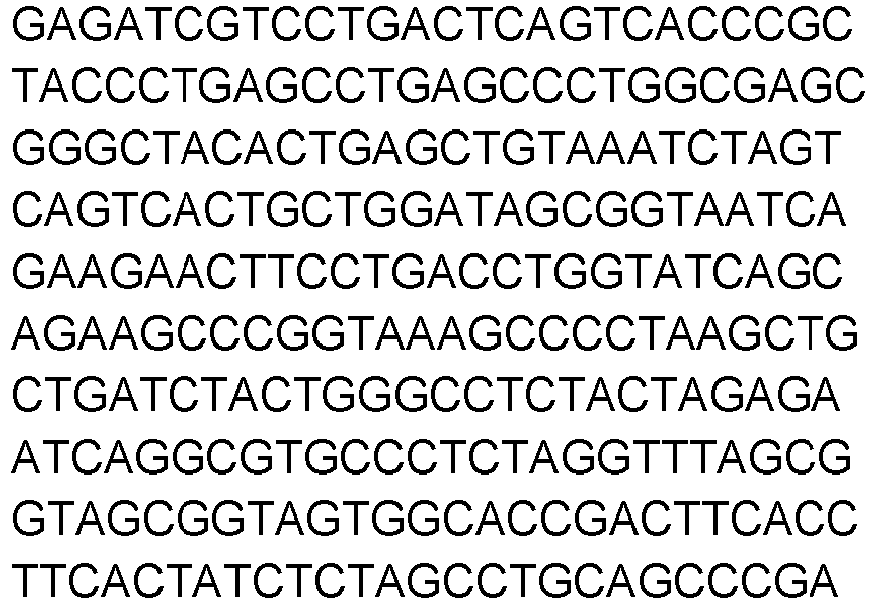

SEQ ID NO: 18 LC 
SEQ ID NO: 19 DNA LC 
BAP049-Clone-E HC SEQ ID NO: 1 (Kabat) HCDR1 TYWMH SEQ ID NO: 2 (Kabat) HCDR2 NIYPGTGGSNFDEKFKN SEQ ID NO: 3 (Kabat) HCDR3 WTTGTGAY SEQ ID NO: 4 (Chothia) HCDR1 GYTFTTY SEQ ID NO: 5 (Chothia) HCDR2 YPGTGG SEQ ID NO: 3 (Chothia) HCDR3 WTTGTGAY SEQ ID NO: 6 VH EVQLVQSGAEVKKPGESLRISCKGSGY 
SEQ ID NO: 7 DNA VH 
SEQ ID NO: 8 HC 
SEQ ID NO: 9 DNA HC 

BAP049-Clone-E LC SEQ ID NO: 10 (Kabat) LCDR1 KSSQSLLDSGNQKNFLT SEQ ID NO: 11 (Kabat) LCDR2 WASTRES SEQ ID NO: 12 (Kabat) LCDR3 QNDYSYPYT SEQ ID NO: 13 (Chothia) LCDR1 SQSLLDSGNQKNF SEQ ID NO: 14 (Chothia) LCDR2 WAS SEQ ID NO: 15 (Chothia) LCDR3 DYSYPY SEQ ID NO: 20 VL 
SEQ ID NO: 21 DNA VL 
SEQ ID NO: 22 LC 
SEQ ID NO: 23 DNA LC 

BAP049-Clone-B HC SEQ ID NO: 24 (Kabat) HCDR1 ACCTACTGGATGCAC SEQ ID NO: 25 (Kabat) HCDR2 
SEQ ID NO: 26 (Kabat) HCDR3 TGGACTACCGGCACAGGCGCCTAC SEQ ID NO: 27 (Chothia) HCDR1 GGCTACACCTTCACTACCTAC SEQ ID NO: 28 (Chothia) HCDR2 TACCCCGGCACCGGCGGC SEQ ID NO: 26 (Chothia) HCDR3 TGGACTACCGGCACAGGCGCCTAC BAP049-Clone-B LC SEQ ID NO: 29 (Kabat) LCDR1 
SEQ ID NO: 30 (Kabat) LCDR2 TGGGCCTCTACTAGAGAATCA SEQ ID NO: 31 (Kabat) LCDR3 
SEQ ID NO: 32 (Chothia) LCDR1 
SEQ ID NO: 33 (Chothia) LCDR2 TGGGCCTCT SEQ ID NO: 34 (Chothia) LCDR3 GACTATAGCTACCCCTAC BAP049-Clone-E HC SEQ ID NO: 24 (Kabat) HCDR1 ACCTACTGGATGCAC SEQ ID NO: 25 (Kabat) HCDR2 
SEQ ID NO: 26 (Kabat) HCDR3 TGGACTACCGGCACAGGCGCCTAC SEQ ID NO: 27 (Chothia) HCDR1 GGCTACACCTTCACTACCTAC SEQ ID NO: 28 (Chothia) HCDR2 TACCCCGGCACCGGCGGC SEQ ID NO: 26 (Chothia) HCDR3 TGGACTACCGGCACAGGCGCCTAC BAP049-Clone-E LC SEQ ID NO: 29 (Kabat) LCDR1 
SEQ ID NO: 30 (Kabat) LCDR2 TGGGCCTCTACTAGAGAATCA SEQ ID NO: 31 (Kabat) LCDR3 
SEQ ID NO: 32 (Chothia) LCDR1 
SEQ ID NO: 33 (Chothia) LCDR2 TGGGCCTCT SEQ ID NO: 34 (Chothia) LCDR3 GACTATAGCTACCCCTAC - In one embodiment, the anti-PD-1 antibody molecule is Nivolumab (Bristol-Myers Squibb), also known as MDX-1106, MDX-1106-04, ONO-4538, BMS-936558, or OPDIVO®. Nivolumab (clone 5C4) and other anti-PD-1 antibodies are disclosed in
US 8,008,449 andWO 2006/121168 . In one embodiment, the anti-PD-1 antibody molecule comprises one or more of the CDR sequences (or collectively all of the CDR sequences), the heavy chain or light chain variable region sequence, or the heavy chain or light chain sequence of Nivolumab, e.g., as disclosed in Table B. - In one embodiment, the anti-PD-1 antibody molecule is Pembrolizumab (Merck & Co), also known as Lambrolizumab, MK-3475, MK03475, SCH-900475, or KEYTRUDA®. Pembrolizumab and other anti-PD-1 antibodies are disclosed in Hamid, O. et al. (2013) New England Journal of Medicine 369 (2): 134-44,
US 8,354,509 , andWO 2009/114335 . In one embodiment, the anti-PD-1 antibody molecule comprises one or more of the CDR sequences (or collectively all of the CDR sequences), the heavy chain or light chain variable region sequence, or the heavy chain or light chain sequence of Pembrolizumab, e.g., as disclosed in Table B. - In one embodiment, the anti-PD-1 antibody molecule is Pidilizumab (CureTech), also known as CT-011. Pidilizumab and other anti-PD-1 antibodies are disclosed in Rosenblatt, J. et al. (2011) J Immunotherapy 34(5): 409-18,
US 7,695,715 ,US 7,332,582 , andUS 8,686,119 . In one embodiment, the anti-PD-1 antibody molecule comprises one or more of the CDR sequences (or collectively all of the CDR sequences), the heavy chain or light chain variable region sequence, or the heavy chain or light chain sequence of Pidilizumab, e.g., as disclosed in Table B. - In one embodiment, the anti-PD-1 antibody molecule is MEDI0680 (Medimmune), also known as AMP-514. MEDI0680 and other anti-PD-1 antibodies are disclosed in
US 9,205,148 WO 2012/145493 . In one embodiment, the anti-PD-1 antibody molecule comprises one or more of the CDR sequences (or collectively all of the CDR sequences), the heavy chain or light chain variable region sequence, or the heavy chain or light chain sequence of MEDI0680. - Further known anti-PD-1 antibodies include those described, e.g., in
WO 2015/112800 ,WO 2016/092419 ,WO 2015/085847 ,WO 2014/179664 ,WO 2014/194302 ,WO 2014/209804 ,WO 2015/200119 ,US 8,735,553 ,US 7,488,802 ,US 8,927,697 ,US 8,993,731 , andUS 9,102,727 - In one embodiment, the anti-PD-1 antibody is an antibody that competes for binding with, and/or binds to the same epitope on PD-1 as, one of the anti-PD-1 antibodies described herein.
- In one embodiment, the PD-1 inhibitor is a peptide that inhibits the PD-1 signaling pathway, e.g., as described in
US 8,907,053 . In one embodiment, the PD-1 inhibitor is an immunoadhesin (e.g., an immunoadhesin comprising an extracellular or PD-1 binding portion of PD-L1 or PD-L2 fused to a constant region (e.g., an Fc region of an immunoglobulin sequence). In one embodiment, the PD-1 inhibitor is AMP-224 (B7-DCIg (Amplimmune), e.g., disclosed inWO 2010/027827 andWO 2011/066342 ).Table B. Amino acid sequences of other exemplary anti-PD-1 antibody molecules Nivolumab SEQ ID NO: 35 HC 
SEQ ID NO: 36 LC 
Pembrolizumab SEQ ID NO: 37 HC 
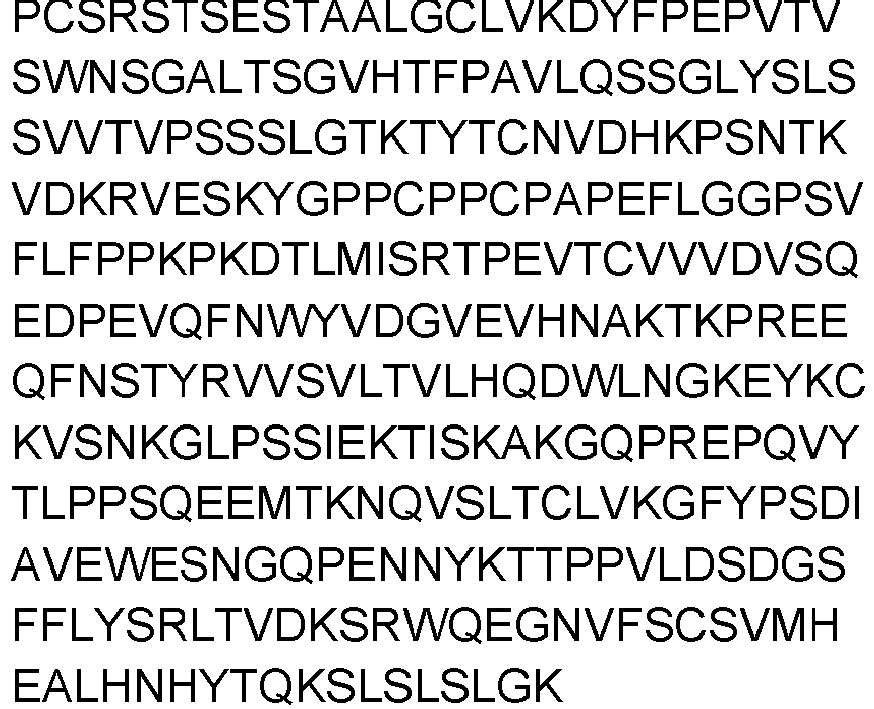
SEQ ID NO: 38 LC 
Pidilizumab SEQ ID NO: 39 HC 
SEQ ID NO: 40 LC 
- In one embodiment, the combination product comprises a compound of Formula (I) or a pharmaceutically acceptable salt or co-crystal thereof, and an anti-PD-L1 antibody molecule such as those described herein.
- Programmed Death Ligand 1 (PD-L1) has been described as a ligand for the immunoinhibitory receptor Programmed Death 1 (PD-1). Binding of PD-L1 to PD-1 leads to the inhibition of T cell receptor-mediated lymphocyte proliferation and cytokine secretion (Freeman et al. (2000) J Exp Med 192:1027-34). Thus, blocking of PD-L1 can lead to enhancement of antitumor immunity.
- Several cell types express PD-L1. For example, PD-L1 is expressed on activated T cells, dendritic cells (DCs), natural killer (NK) cells, macrophages, B cells, monocytes, and vascular endothelium cells. PD-L1 is expressed in many cancers, including human lung, ovarian and colon carcinoma and various myelomas, (Iwai et al. (2002) PNAS 99:12293-7; Ohigashi etal. (2005) Clin Cancer Res 11:2947-53; Okazaki et al. (2007) Intern. Immun. 19:813-24; Thompson et al. (2006) Cancer Res. 66:3381-5). PD-L1 expression strongly correlates with unfavorable prognosis in various types of cancer including kidney, ovarian, bladder, breast, gastric and pancreatic cancer.
- Many tumor infiltrating T lymphocytes predominantly express PD-1 compared to T lymphocytes in normal tissues and peripheral blood T lymphocytes. This indicates that up-regulation of PD-1 on tumor-reactive T cells can contribute to impaired antitumor immune responses (Ahmadzadeh et al. (2009) Blood 114:1537-44). Thus, PD-L1 signaling mediated by PD-L1 expressing tumor cells interacting with PD-1 expressing T cells may lead to attenuation of T cell activation and evasion of immune surveillance (Sharpe et al. (2002) Nat Rev Immunol. 2:116-26; Keir et al. (2008) Annu Rev Immunol. 26:677-704). PD-1 blockade can inhibit hematogenous spread of poorly immunogenic tumor cells by enhanced recruitment of effector T cells (Iwai et al. (2005) Int. Immunol. 17:133-144).
- Anti-PD-L1 can enhance T-cell immunity, e.g., through blocking both its inhibitory interactions with PD-1 and B7-1. Anti-PD-1 can also allow for immune regulation via PD-L2/PD-1. Both PD-1 and B7-1 are expressed on T cells, B cells, DCs, and macrophages, which provides potential for bidirectional interactions between B7-1 and PD-L1 on these cell types. PD-L1 on non-hematopoietic cells may interact with B7-1 as well as PD-1 on T cells.
- In some embodiments, the anti-PD-L1 antibody molecule is chosen from YW243.55.S70, MPDL3280A, MEDI-4736, MSB-0010718C, or MDX-1105.
- In some embodiments, the anti-PD-L1 antibody is MSB0010718C. MSB0010718C (also referred to as A09-246-2; Merck Serono) is a monoclonal antibody that binds to PD-L1. MSB0010718C and other humanized anti-PD-L1 antibodies are disclosed in
WO2013/079174 , and having a sequence disclosed herein (or a sequence substantially identical or similar thereto, e.g., a sequence at least 85%, 90%, 95% identical or higher to the sequence specified). The heavy and light chain amino acid sequences of MSB0010718C include at least the following: - Heavy chain (SEQ ID NO: 24 as disclosed in
WO2013/079174 )
- Light chain (SEQ ID NO: 25 as disclosed in
WO2013/079174 )
- In one embodiment, the PD-L1 inhibitor is YW243.55.S70. The YW243.55.S70 antibody is an anti-PD-L1 described in
WO 2010/077634 (heavy and light chain variable region sequences shown in SEQ ID NOs. 20 and 21, respectively), and having a sequence disclosed therein (or a sequence substantially identical or similar thereto, e.g., a sequence at least 85%, 90%, 95% identical or higher to the sequence specified). - In one embodiment, the PD-L1 inhibitor is MDX-1105. MDX-1105, also known as BMS-936559, is an anti-PD-L1 antibody described in
WO2007/005874 , and having a sequence disclosed therein (or a sequence substantially identical or similar thereto, e.g., a sequence at least 85%, 90%, 95% identical or higher to the sequence specified). - In one embodiment, the PD-L1 inhibitor is MDPL3280A (Genentech / Roche). MDPL3280A is a human Fc optimized IgG1 monoclonal antibody that binds to PD-L1. MDPL3280A and other human monoclonal antibodies to PD-L1 are disclosed in
U.S. Patent No.: 7,943,743 andU.S Publication No.: 20120039906 . - In another embodiment, the PD-L1 inhibitor is an anti-PD-L1 antibody molecule disclosed in
US 2016/0108123, filed October 13, 2015 , entitled "Antibody Molecules to PD-L1 and Uses Thereof". - In one embodiment, the anti-PD-L1 antibody molecule includes at least one or two heavy chain variable domains (optionally including a constant region), at least one or two light chain variable domains (optionally including a constant region), or both, comprising the amino acid sequence of any of BAP058-hum01, BAP058-hum02, BAP058-hum03, BAP058-hum04, BAP058-hum05, BAP058-hum06, BAP058-hum07, BAP058-hum08, BAP058-hum09, BAP058-hum10, BAP058-hum11, BAP058-hum12, BAP058-hum13, BAP058-hum14, BAP058-hum15, BAP058-hum16, BAP058-hum17, BAP058-Clone-K, BAP058-Clone-L, BAP058-Clone-M, BAP058-Clone-N, or BAP058-Clone-O; or as described in Table 1 of
US 2016/0108123 , or encoded by the nucleotide sequence in Table 1; or a sequence substantially identical (e.g., at least 80%, 85%, 90%, 92%, 95%, 97%, 98%, 99% or higher identical) to any of the aforesaid sequences. - In yet another embodiment, the anti-PD-L1 antibody molecule includes at least one, two, or three complementarity determining regions (CDRs) from a heavy chain variable region and/or a light chain variable region of an antibody described herein, e.g., an antibody chosen from any of BAP058-hum01, BAP058-hum02, BAP058-hum03, BAP058-hum04, BAP058-hum05, BAP058-hum06, BAP058-hum07, BAP058-hum08, BAP058-hum09, BAP058-hum10, BAP058-hum11, BAP058-hum12, BAP058-hum13, BAP058-hum14, BAP058-hum15, BAP058-hum16, BAP058-hum17, BAP058-Clone-K, BAP058-Clone-L, BAP058-Clone-M, BAP058-Clone-N, or BAP058-Clone-O; or as described in Table 1 of
US 2016/0108123 , or encoded by the nucleotide sequence in Table 1 ofUS 2016/0108123 ; or a sequence substantially identical (e.g., at least 80%, 85%, 90%, 92%, 95%, 97%, 98%, 99% or higher identical) to any of the aforesaid sequences. - In yet another embodiment, the anti-PD-L1 antibody molecule includes at least one, two, or three CDRs (or collectively all of the CDRs) from a heavy chain variable region comprising an amino acid sequence shown in Table 1 of
US 2016/0108123 , or encoded by a nucleotide sequence shown in Table 1 ofUS 2016/0108123 . In one embodiment, one or more of the CDRs (or collectively all of the CDRs) have one, two, three, four, five, six or more changes, e.g., amino acid substitutions or deletions, relative to the amino acid sequence shown in Table 1 ofUS 2016/0108123 , or encoded by a nucleotide sequence shown in Table 1 ofUS 2016/0108123 . - In yet another embodiment, the anti-PD-L1 antibody molecule includes at least one, two, or three CDRs (or collectively all of the CDRs) from a light chain variable region comprising an amino acid sequence shown in Table 1 of
US 2016/0108123 , or encoded by a nucleotide sequence shown in Table 1. In one embodiment, one or more of the CDRs (or collectively all of the CDRs) have one, two, three, four, five, six or more changes, e.g., amino acid substitutions or deletions, relative to the amino acid sequence shown in Table 1 ofUS 2016/0108123 , or encoded by a nucleotide sequence shown in Table 1 ofUS 2016/0108123 . In certain embodiments, the anti-PD-L1 antibody molecule includes a substitution in a light chain CDR, e.g., one or more substitutions in a CDR1, CDR2 and/or CDR3 of the light chain. - In another embodiment, the anti-PD-L1 antibody molecule includes at least one, two, three, four, five or six CDRs (or collectively all of the CDRs) from a heavy and light chain variable region comprising an amino acid sequence shown in Table 1, or encoded by a nucleotide sequence shown in Table 1 of
US 2016/0108123 . In one embodiment, one or more of the CDRs (or collectively all of the CDRs) have one, two, three, four, five, six or more changes, e.g., amino acid substitutions or deletions, relative to the amino acid sequence shown in Table 1 ofUS 2016/0108123 , or encoded by a nucleotide sequence shown in Table 1 ofUS 2016/0108123 . - In one embodiment, the anti-PD-L1 antibody molecule includes at least one, two or three CDRs or hypervariable loops from a heavy chain variable region of an antibody described herein, e.g., an antibody chosen from any of BAP058-hum01, BAP058-hum02, BAP058-hum03, BAP058-hum04, BAP058-hum05, BAP058-hum06, BAP058-hum07, BAP058-hum08, BAP058-hum09, BAP058-hum10, BAP058-hum11, BAP058-hum12, BAP058-hum13, BAP058-hum14, BAP058-hum15, BAP058-hum16, BAP058-hum17, BAP058-Clone-K, BAP058-Clone-L, BAP058-Clone-M, BAP058-Clone-N, or BAP058-Clone-O, according to the Kabat and Chothia definition (e.g., at least one, two, or three CDRs or hypervariable loops according to the Kabat and Chothia definition as set out in Table 1 of
US 2016/0108123 ); or encoded by the nucleotide sequence in Table 1 ofUS 2016/0108123 ; or a sequence substantially identical (e.g., at least 80%, 85%, 90%, 92%, 95%, 97%, 98%, 99% or higher identical) to any of the aforesaid sequences; or which have at least one amino acid alteration, but not more than two, three or four alterations (e.g., substitutions, deletions, or insertions, e.g., conservative substitutions) relative to one, two, or three CDRs or hypervariable loops according to Kabat and/or Chothia shown in Table 1 ofUS 2016/0108123 . - In one embodiment, the anti-PD-L1 antibody molecule can include VH CDR1 according to Kabat et al. ((1991), "Sequences of Proteins of Immunological Interest," 5th Ed. Public Health Service, National Institutes of Health, Bethesda, MD) or VH hypervariable loop 1 according to Chothia et al. (1992) J. Mol. Biol. 227:799-817, or a combination thereof, e.g., as shown in Table 1 of
US 2016/0108123 . In one embodiment, the combination of Kabat and Chothia CDR of VH CDR1 comprises the amino acid sequence GYTFTSYWMY (SEQ ID NO: 63), or an amino acid sequence substantially identical thereto (e.g., having at least one amino acid alteration, but not more than two, three or four alterations (e.g., substitutions, deletions, or insertions, e.g., conservative substitutions)). The anti-PD-L1 antibody molecule can further include, e.g., VH CDRs 2-3 according to Kabat et al. and VL CDRs 1-3 according to Kabat et al., e.g., as shown in Table 1 ofUS 2016/0108123 . - In a preferred embodiment, the anti PD-L1 antibody molecule for use in the invention comprises:
- (a) a heavy chain variable region (VH) comprising a VHCDR1 amino acid sequence of SEQ ID NO: 47, a VHCDR2 amino acid sequence of SEQ ID NO: 48, and a VHCDR3 amino acid sequence of SEQ ID NO: 46; and a light chain variable region (VL) comprising a VLCDR1 amino acid sequence of SEQ ID NO: 52, a VLCDR2 amino acid sequence of SEQ ID NO: 53, and a VLCDR3 amino acid sequence of SEQ ID NO: 54;
- (b) a VH comprising a VHCDR1 amino acid sequence of SEQ ID NO: 44; a VHCDR2 amino acid sequence of SEQ ID NO: 45; and a VHCDR3 amino acid sequence of SEQ ID NO: 46; and a VL comprising a VLCDR1 amino acid sequence of SEQ ID NO: 49, a VLCDR2 amino acid sequence of SEQ ID NO: 50, and a VLCDR3 amino acid sequence of SEQ ID NO: 51;
- (c) a VH comprising a VHCDR1 amino acid sequence of SEQ ID NO: 63, a VHCDR2 amino acid sequence of SEQ ID NO: 48, and a VHCDR3 amino acid sequence of SEQ ID NO: 46; and a VL comprising a VLCDR1 amino acid sequence of SEQ ID NO: 52, a VLCDR2 amino acid sequence of SEQ ID NO: 53, and a VLCDR3 amino acid sequence of SEQ ID NO: 54; or
- (d) a VH comprising a VHCDR1 amino acid sequence of SEQ ID NO: 63; a VHCDR2 amino acid sequence of SEQ ID NO: 45; and a VHCDR3 amino acid sequence of SEQ ID NO: 46; and a VL comprising a VLCDR1 amino acid sequence of SEQ ID NO: 52, a VLCDR2 amino acid sequence of SEQ ID NO: 53, and a VLCDR3 amino acid sequence of SEQ ID NO: 54.
- In one aspect of the previous embodiment, the anti-PD-L1 antibody molecule for use in the invention comprises a heavy chain variable domain comprising the amino acid sequence of SEQ ID NO: 55 and a light chain variable domain comprising the amino acid sequence of SEQ ID NO: 58.
- In one aspect of the previous embodiment, the anti-PD-L1 antibody molecule for use in the invention comprises a heavy chain comprising the amino acid sequence of SEQ ID NO: 62 and a light chain comprising the amino acid sequence of SEQ ID NO: 60.
Table C. Amino acid and nucleotide sequences for humanized anti-PD-L1 mAb BAP058-hum013. The amino acid and nucleotide sequences of the heavy and light chain CDRs, the heavy and light chain variable regions, and the heavy and light chains are shown. BAP058-hum13-HC SEQ ID NO: 63 (Chothia and Kabat combined) HCDR1 GYTFTSYWMY SEQ ID NO: 44 (Kabat) HCDR1 SYWMY SEQ ID NO: 45 (Kabat) HCDR2 RIDPNSGSTKYNEKFKN SEQ ID NO: 46 (Kabat) HCDR3 DYRKGLYAMDY SEQ ID NO: 47 (Chothia) HCDR1 GYTFTSY SEQ ID NO: 48 (Chothia) HCDR2 DPNSGS SEQ ID NO: 46 (Chothia) HCDR3 DYRKGLYAMDY SEQ ID NO: 55 VH 
SEQ ID NO: 56 DNA VH 
SEQ ID NO: 62 Heavy Chain 

SEQ ID NO: 57 DNA Heavy Chain 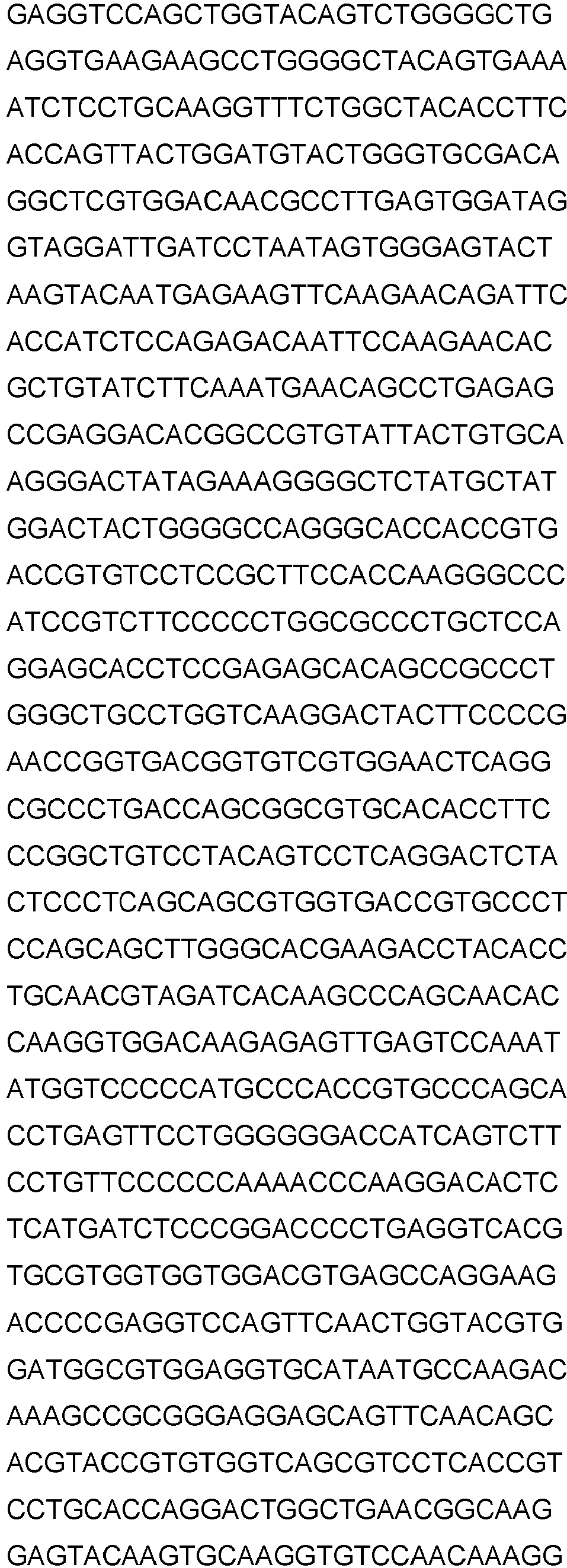

BAP058-hum13-LC SEQ ID NO: 49 (Kabat) LCDR1 KASQDVGTAVA SEQ ID NO: 50 (Kabat) LCDR2 WASTRHT SEQ ID NO: 51 (Kabat) LCDR3 QQYNSYPLT SEQ ID NO:52 (Chothia) LCDR1 SQDVGTA SEQ ID NO: 53 (Chothia) LCDR2 WAS SEQ ID NO: 54 (Chothia) LCDR3 YNSYPL SEQ ID NO: 58 VL 
SEQ ID NO: 59 DNA VL 
SEQ ID NO: 60 Light Chain 
SEQ ID NO: 61 DNA Light Chain 
- The immunotherapeutic agent (Such as an anti-PD-1 antibody molecule or an anti-PD-L1 molecule antibody) can be administered to the subject systemically (e.g., orally, parenterally, subcutaneously, intravenously, rectally, intramuscularly, intraperitoneally, intranasally, transdermally, or by inhalation or intracavitary installation), topically, or by application to mucous membranes, such as the nose, throat and bronchial tubes.
- Dosages and therapeutic regimens of the immunotherapeutic agent (e.g.anti-PD-1 antibody molecule or anti PD-L1 antibody molecule) can be determined by a skilled artisan. In certain embodiments, the immunotherapeutic agent (e.g. anti-PD-1 antibody molecule) is administered by injection (e.g., subcutaneously or intravenously) at a dose of about 1 to 30 mg/kg, e.g., about 5 to 25 mg/kg, about 10 to 20 mg/kg, about 1 to 5 mg/kg, or about 3 mg/kg. The dosing schedule can vary from e.g., once a week to once every 2, 3, or 4 weeks. In one embodiment, the anti-PD-1 antibody molecule is administered at a dose from about 10 to 20 mg/kg every other week. In another embodiment, the anti-PD-1 antibody molecule is administered at a dose from about 1 to 10 mg/Kg, or from about 1 to 5mg/Kg or about 3mg/kg every 4 weeks.
- For example, the anti-PD-1 antibody molecule is administered or used at a flat or fixed dose. In some embodiments, the anti-PD-1 antibody molecule is administered by injection (e.g., subcutaneously or intravenously) at a dose (e.g., a flat dose) of about 200 mg to 500 mg, e.g., about 250 mg to 450 mg, about 300 mg to 400 mg, about 250 mg to 350 mg, about 350 mg to 450 mg, or about 300 mg or about 400 mg. The dosing schedule (e.g., flat dosing schedule) can vary from e.g., once a week to once every 2, 3, 4, 5, or 6 weeks. In one embodiment, the anti-PD-1 antibody molecule is administered at a dose from about 300 mg to 400 mg once every three weeks or once every four weeks. In one embodiment, the anti-PD-1 antibody molecule is administered at a dose from about 300 mg once every three weeks. In one embodiment, the anti-PD-1 antibody molecule is administered at a dose from about 400 mg once every four weeks. In one embodiment, the anti-PD-1 antibody molecule is administered at a dose from about 300 mg once every four weeks. In one embodiment, the anti-PD-1 antibody molecule is administered at a dose from about 400 mg once every three weeks.
- In another embodiment, the anti-PD-1 antibody molecule is administered at a flat dose of about 300mg to 400mg once every three weeks or once every four weeks. In a subset of this embodiment, the anti-PD-1 antibody molecule is administered at a flat dose of about 400mg every four weeks. In yet another subset of this embodiment, the anti-PD-1 antibody molecule is administered at a flat dose of about 300mg every three weeks.
- The following examples are intended to illustrate the invention and are not to be construed as being limitations thereon. Temperatures are given in degrees centrigrade. If not mentioned otherwise, all evaporations are performed under reduced pressure, preferably between about 15 mm Hg and 100 mm Hg (= 20-133 mbar). The structure of final products, intermediates and starting materials is confirmed by standard analytical methods, e.g., microanalysis and spectroscopic characteristics, e.g., MS, IR, NMR. Abbreviations used are those conventional in the art.
- All starting materials, building blocks, reagents, acids, bases, dehydrating agents, solvents, and catalysts utilized to synthesis the compounds of the present invention are either commercially available or can be produced by organic synthesis methods known to one of ordinary skill in the art (Houben-Weyl 4th Ed. 1952, Methods of Organic Synthesis, Thieme, Volume 21). Further, the compounds of the present invention can be produced by organic synthesis methods known to one of ordinary skill in the art as shown in the following examples.
- The invention is illustrated, but in no way limited, by the following Examples.
-
- ACN
- acetonitrile
- aq
- aqueous
- br
- broad
- BSA
- bovine serum albumin
- CPBA:
- 3-chlorobenzoperoxoic acid
- d
- doublet
- dd
- doublet of doublets
- DCM
- dichloromethane
- DMF
- N,N-dimethylformamide
- DMSO
- dimethylsulfoxide
- EtOAc
- ethyl acetate
- g
- grams
- h
- hour(s)
- HPLC
- high performance liquid chromatography
- IS
- internal standard
- LCMS
- liquid chromatography coupled to mass spectrometry
- M
- molar
- m
- multiplet
- MeOH
- methanol
- min
- minutes
- mL
- milliliter(s)
- mmol
- millimoles
- MS
- mass spectrometry
- m/z
- mass to charge ratio
- NADPH
- beta-nicotinamide dinucleotide phosphate, reduced form
- NMR
- nuclear magnetic resonance
- ppm
- parts per million
- rt
- room temperature
- Rt
- retention time
- s
- singlet
- sat
- saturated
- t
- triplet
- THF
- tetrahydrofuran
-
UPLC 2 min : Waters UPLC Acquity; column: Acquity HSS T3, 1.8mm, 2.1*50mm, at 60°C, Eluent A: water + 0.05 % HCOOH + 3.75 mM ammonium acetate, B: ACN + 0.04 % HCOOH, Gradient: 5 to 98 % B in 1.4 min, Flow: 1.0 mL/min. -
UPLC 10 min : Waters UPLC Acquity; column: Acquity HSS T3, 1.8mm, 2.1*50mm, at 60°C, Eluent A: water + 0.05 % HCOOH + 3.75 mM ammonium acetate, B: ACN + 0.04 % HCOOH, Gradient: 5 to 98 % B in 9.4 min hold 0.4 min, Flow: 1 mL/min.) -

- To a cooled solution of 6-chloro-2-(methylthio)pyrimidin-4-amine (15.0 g, 85 mmol) in DMF (150 ml) was added N-bromosuccinimide (16.7 g, 94 mmol) portionwise with stirring at 0 °C. After 10 min the reaction was quenched by the addition of water at 0 °C. The reaction mixture was diluted with brine and extracted 3 times with EtOAc. The combined organic phases were washed twice with saturated aqueous NaHCO3 solution, then brine, separated, and filtered through a phase separator with Na2SO4 to dry. The filtrate was concentrated in vacuo to give the title compound (18.8 g, 74 mmol, 80 % yield, 92% purity) as colorless solid which was used in the next step without further purification. M/z = 254/256/258 [M+H]+, Rt = 0.95 min (
UPLC 2 min), 1H NMR (600 MHz, DMSO-d6) δ 8.03 (br s, 1H), 7.25 (br s, 1H), 2.42 (s, 3H). - A mixture of 5-bromo-6-chloro-2-(methylthio)pyrimidin-4-amine (17.8 g, 70 mmol), 1H-pyrazole (4.7 g, 69 mmol), and KOtBu (7.9 g, 70 mmol) in DMF (250 mL) was stirred at 60 °C for 16 hours. The solvent was reduced in vacuo and the residue was diltued with saturated aqueous NaHCO3 solution and extracted 3 times with EtOAc. The combined organic phases were washed with brine, separated, and filtered through a phase separator with Na2SO4 to dry. The filtrate was concentrated in vacuo to give the title compound (20 g, 64% purity) which was used in the next step without further purification. M/z = 286/288/290 [M+H]+, Rt = 0.85 min (
UPLC 2 min), 1H NMR (600 MHz, DMSO-d6) δ 8.35 (d, J = 2.5 Hz, 1H), 8.03 (br s, 1H), 7.81 (br s, 1H), 7.26 (br s, 1H), 6.55 (s, 1H), 2.46 (s, 3H). - To a suspension of 5-bromo-2-(methylthio)-6-(1H-pyrazol-1-yl)pyrimidin-4-amine (20 g, 64% purity) in DCM (100 mL) was added a solution of 3-chlorobenzoperoxoic acid (9.3 g, 53.7 mmol) in DCM (100 mL) dropwise with stirring over 20 min at 0 °C and the resulting mixture was stirred at 23 °C for 16 hours. The reaction mixture was filtered to collect the precipitate and washed with DCM. The solid was dried in vacuo to give the title compound (2.4 g, 7.6 mmol, 11 % yield over two steps) as colorless solid. M/z = 302/304 [M+H]+, Rt = 0.53 min (
UPLC 2 min), 1H NMR (600 MHz, DMSO-d6) δ 8.63 (br s, 1H), 8.38 (d, J = 2.3 Hz, 1H), 7.87 (s, 1H), 7.72 (s, 1H), 6.60-6.61 (m, 1H), 2.86 (s, 3H). - To a mixture of 5-bromo-2-(methylsulfinyl)-6-(1H-pyrazol-1-yl)pyrimidin-4-amine (50 mg, 0.17 mmol) and (1H-pyrazol-4-yl)boronic acid (18 mg, 0.17 mmol) in DMF (1 ml) was added Cs2CO3 (54 mg, 0.17 mmol) at 0 °C. The resulting mixture was stirred for 1 hour at 23 °C. The reaction mixture was diluted with water and extracted 3 times with EtOAc. The combined organic phases were washed with water then brine, separated, and filtered through a phase separator with Na2SO4 to dry. The filtrate was concentrated in vacuo to give the title compound (30 mg, 0.066 mmol, 40 %yield) which was used in the next step without further purification. M/z = 350/352 [M+H]+, Rt = 0.55 min (
UPLC 2 min). - To a vigorously stirred solution of (1-(4-amino-5-bromo-6-(1H-pyrazol-1-yl)pyrimidin-2-yl)-1H-pyrazol-4-yl)boronic acid (30 mg, 0.066 mmol) in THF (1 mL) were added 25wt% aqueous NaOH solution (0.021 mL, 0.13 mmol) and 30% aqueous H2O2 solution (0.020 mL, 0.20 mmol) at 0 °C. After 30 minutes another 30% aqueous H2O2 solution (0.020 mL, 0.20 mmol) was added and the mixture was stirred at the same temperature for 2.5 hours in total. The reaction was quenched with saturated aqueous NH4Cl solution then diluted with water, and extracted 4 times with DCM and 3 times with DCM/
MeOH 4/1 mixture. The combined organic phases were filtered through a phase separator to dry and the filtrate was concentrated in vacuo. The crude product was absorbed onto isolute and purified by column chromatography (ISCO, 12 g-silica-redisep-column, flow: 30 ml/min, Solvent: CH2Cl2:MeOH from 1:0, hold for 3 min, then to 96:4 over 25 min). The product fractions were combined and concentrated in vacuo to give the title compound (14 mg, 0.040 mmol, 60 % yield) as colorless solid. M/z = 322/324 [M+H]+, Rt = 0.58 min (UPLC 2 min); Rt = 2.27 min; purity at 254 nm: >95 % (UPLC 10 min), 1H NMR (600 MHz, DMSO-d6) δ 9.23 (br s, 1H), 8.44 (d, J = 2.5 Hz, 1H), 8.32 (br s, 1H), 7.94 (s, 1H), 7.90-7.81 (m, 1H), 7.46 (br s, 2H), 6.63-6.50 (m, 1H). - Alernatively, 6-chloro-2-(methylthio)pyrimidin-4-amine could be reacted first with pyrazole in the presence of a base, to generate 2-(methylthio)-6-(1H-pyrazol-1-yl)pyrimidin-4-amine; followed by treatment with NBS to generate 5-Bromo-2-(methylthio)-6-(1H-pyrazol-1-yl)pyrimidin-4-amine.
-

- To a solution of 5-bromo-6-chloro-2-(methylthio)pyrimidine-4-amine 13 g (52 mmol) in 450 ml of DCM, 13 g (57 mmol) of m-chloroperbenzoic acid (77%) (Sigma-Aldrich) dissolved in 100 ml of DCM was added slowly dropwise. The solution was stirred at room temperature for 1 hour. The white precipitate formed was filtered, washed several times with DCM and dried. There were obtained 14 g (99%) of the title compound. M/z = 270/272 [M+H]+, Rt = 0.56 min (
UPLC 2 min), 1H-NMR (400 MHz, DMSO-d6) δ 8.17 (d, 2H), 2.78 (s, 3H). - 2 g (7.4 mmol) of 5-bromo-6-chloro-2-(methylsulfinyl) pyrimidine-4-amine was suspended in 30 ml of DMF. To this suspension was added 0.5 g (7.4 mmol) of 1H-pyrazole and 1.5 g (4.4 mmol) of cesium carbonate. The reaction mixture was strongly stirred at room temperature for 10 min. The solution was poured onto 200 ml of cool water. The formed precipitate was filtered, washed with cool water and dried. The desired product is obtained as white solid (1.5 g, 72 %). M/z = 274/276 [M+H]+, Rt = 0.80 min (
UPLC 2 min), 1H-NMR (400 MHz, DMSO-d6) δ 8.44 (d, 1H), 8.15 (d, 2H), 7.81 (d, 1H), 6.56 (dd, 1H). - A mixture of 0.10 g (0.36 mmol) of 5-bromo-6-chloro-2-(1H-pyrazol-1-yl)pyrimidin-4-amine, 0.14 g (0.73 mmol) of 4-(4,4,5,5-tetramethyl-1,3,2-dioxaborolan-2-yl)-1H-pyrazole and 0.12 g (0.36 mmol) of cesium carbonate in 10 ml of acetonitrile was stirred for 4h at 60°C in a sealed glass tube. Then the solvent was removed by reduced pressure. The solid obtained was washed with ether/pentane and dried. The mixture of boronic acid and boronic ester was used in the next step without further purification.
- To a solution of (1-(6-amino-5-bromo-2-(1H-pyrazol-1-yl)pyrimidin-4-yl)-1H-pyrazol-4-yl)boronic acid or 5-bromo-2-(1H-pyrazol-1-yl)-6-(4-(4,4,5,5-tetramethyl-1,3,2-dioxaborolan-2-yl)-1H-pyrazol-1-yl)pyrimidin-4-amine in THF (2.5 ml), cooled to 0°C, was added 2 ml of NaOH 1N and H2O2 (30%) (0.23 ml, 2.32 mmol). The mixture was stirred at room temperature for 30 min. The reaction was acidified to pH 3-4 by addition of HCl 1N, extracted with ethyl acetate and dried over anhydrous Na2SO4, and concentrated in vacuum. The crude product was purified by silica gel column chromatography using DCM-MeOH (2-5%). M/z = 322/324 [M+H]+, Rt = 0.58 min (
UPLC 2 min); 1H NMR (600 MHz, DMSO-d6) δ 9.18 (br s, 1H), 8.57-8.78 (m, 1H), 8.29 (br s, 1H), 7.97 (s, 1H), 7.79 (s, 1H), 7.54 (s, 1H), 7.40 (br s, 1H), 6.55 (s, 1H). -
- ACN: acetonitrile
- CC: calibration curve
- IS: internal standard
- DMSO: dimethylsulfoxide
- MRM: multiple reaction monitoring
- NADH: nicotinamide adenine dinucleotide phosphate (reduced)
- Rpm: revolution per minute
-
- Rat liver microsomes (male, pooled, Sprague Dawley)
Source: XenoTech, LLC (Kansas, USA)
Protein content: 20 mg/mL
Catalogue number: R I 000, Lot number: 0710623 - Dog liver microsomes (male, pooled, Beagle)
Source: XenoTech, LLC (Kansas, USA)
Protein content: 20 mglmL
Catalogue number: D I 000, Lot number: 0810143 - Human liver microsomes (mixed gender, pooled)
Source: XenoTech, LLC (Kansas, USA)
Protein content: 20 mglmL
Catalogue number: H061 0, Lot number: 101042 - A 2 mM and 0.2 mM stock solution of 5-bromo-2,6-di(1H-pyrazol-1-yl)pyrimindin-4-amine was prepared in DMSO for in vitro incubations. The final organic content in liver microsomal incubations was 0.5 %.
- A 2.5 mM stock solution of 1-(6-amino-5-bromo-2-(1H-pyrazol-1-yl)-pyrimidin-4-yl)-1H-pyrazol-4-ol and 1-(4-amino-5-bromo-6-(1H-pyrazol-1-yl)-pyrimidin-4-yl)-1H-pyrazol-6-ol were prepared separetly in DMSO. The stock solutions were further diluted in acetonitrile to obtain 1uM concentration of 1-(6-amino-2-bromo-6-(1H-pyrazol-1-yl)-pyrimidin-4-yl)-1H-pyrazol-4-ol and 1-(4-amino-5-bromo-6-(1H-pyrazol-1-yl)-pyrimidin-4-yl)-1H-pyrazol-6-ol for chromatographyic runs.
- A 0.1 mM stock solution of diclofenac and verapamil was prepared in DMSO for in vitro incubations. The final organic content in liver microsomal incubations was 0.5 %.
- Liver microsomal protein (25 uL for 0.5 mg/mL; 15 uL for 0.3 mg/mL), NADPH (100 uL, 2 mM final concentration) and phosphate buffer (870 uL for 0.5 mg/mL; 880 uL for 0.3 mg/mL) were incubated in a microfuge tube in an orbital shaker incubator for 10 min maintained at 37°C. Reactions were initiated by spiking 5 uL of 2 mM and 0.2 mM 5-bromo-2,6-di(1H-pyrazol-1-yl)pyrimindin-4-amine(10uM final concentrations for 0.5 mg/mL protein; 1uM final concentration for 0.3 mg/mL protein; 0.5 % final DMSO concentration) and samples incubated at 37°C. Aliquots (200 uL) were withdrawn from the reaction tube at 0, 60 and 120 minutes and the reaction was quenched by addition of 100 uL acetonitrile. Reactions were performed in duplicates. The quenched samples were centrifuged at 14000 rpm (approximately 21000 g) for 10 minutes(Eppendorf Centrifuge 5810 R) and supernatant was analyzed by LCMS/MS.
- Control incubations (no NADPH added) and blank incubations (no test item added) were performed in singlet for each species. These samples were withdrawn at 0 and 120 min and quenched using acetonitrile. The supernatant was analyzed for any non microsomal degradation and matrix interference. Diclofenac in rat and human liver microsomes and verapamil in dog liver microsomes was used as a positive control. Reaction and control experiments were performed in singlet. Diclofenac and verapamil metabolic turnover data was matching with in-house historical data.
- Samples were processed using protein precipitation method and then analyzed by employing linear gradient with a run time of 28 min in HPLC coupled with tandem mass spectrometry (API 4000 mass spectrometer). Each sample was injected and scanned separately for Q1 (MH+/MH-) and MS/MS.
- The different possible metabolite peaks were identified in Q1 scan after assessing for matrix interference using test item free blank samples, and were confirmed from the fragmentation pattern (MSIMS scan). The summary of analytical method is presented in table 9.
Table 9: Chromatographic and mass spectrometry conditions Chromatographic conditions: Column Kromasil C18, 150x4.6mm, 5um (Chromatographic service) Injection Volume 10uL Flow rate Run time 900uL/min 28 min Sample cooler temperature 6°C Colum oven temperature 40°C Linear Gradient Time (min) 5mM Ammonium Formate (0.05% Formic acid) 80% + 20% ACN 5mM Ammonium Formate (0.05% Formic acid) 20% + 80% ACN 0.01 95 5 5 95 5 23 5 95 24 95 5 28 95 5 Mass spectrometric condition: Instrument API 4000 LC-MS/MS Scanning Modes Q1 MS/MS Scanning range/ Production 100 to 1000 amu 308 324 Declustering potential 60 60 60 Entrance potential 10 10 10 Collision energy - 35 35 lonisation Mode +ve +ve +ve Collision gas - 6 6 Curtain gas 20 15 15 Ion source gas 1 40 30 30 Ion source gas 250 60 60 Ion Spray voltage 5500 5500 5500 Temperature 500 500 500 - An alternate analytical method was also developed to increase the retention times and to assess other metabolites apart from the identified M-1 metabolite. Aqueous solutions of 1-(6-amino-5-bromo-2-(1H-pyrazol-1-yl)pyrimidin-4-yl)-1H-pyrazol-4-ol and 1-(4-amino-5-bromo-6-(1H-pyrazol-1-yl)pyrimidin-2-yl)-1H-pyrazol-4-ol (1 uM) were co-chromatographed with the in vitro incubated samples employing modified analytical method to confirm the identity. The summary of modified method is presented in table 10.
Table 10: Modified Chromatographic and mass spectrometry conditions Chromatographic conditions: Column Kromasil C18, 150x4.6mm, 5um (Chromatographic service) Injection Volume 10uL Flow rate 600uL/min 28 min Run time Sample cooler temperature 6°C Colum oven temperature 40°C Linear Gradient Time (min) 0.1% Formic acid in water 0.1% Formic acid in ACN 0.01 95 5 5 95 5 23 5 95 24 95 5 28 95 5 Mass spectrometric condition: Instrument API 4000 LC-MS/MS Scanning Modes Q1 MS/MS Scanning range/ Production 100 to 1000 amu 308 324 Declustering potential 60 60 60 Entrance potential 10 10 10 Collision energy - 35 35 lonisation Mode +ve +ve +ve Collision gas - 6 6 Curtain gas 20 15 15 Ion source gas 1 40 30 30 Ion source gas 250 60 60 Ion Spray voltage 5500 5500 5500 Temperature 500 500 500 - Stock solution of 5-bromo-2,6-di(1H-pyrazol-1-yl)pyrimindin-4-amine and 1-(4-amino-5-bromo-6-(1H-pyrazol-1-yl)pyrimidin-2-yl)-1H-pyrazol-4-ol were serialy diluted in DMSO to obtain spiking solution concentrations of 1, 0.5 and 0.25 mM and 0.5, 0.25 and 0.125 mM, respectively.
- Calibration standards of 5-bromo-2,6-di(1H-pyrazol-1-yl)pyrimindin-4-amine and 1-(4-amino-5-bromo-6-(1H-pyrazol-1-yl)pyrimidin-2-yl)-1H-pyrazol-4-ol were prepared by spiking 5uL of the respective spiking solutions in to 995 uL of incubation buffer to obtain 10, 5, 2.5 and 1.25 uM samples for 5-bromo-2,6-di(1H-pyrazol-1-yl)pyrimindin-4-amine and 5, 2.5, 1.25 and 0.625 uM samples for 1-(4-amino-5-bromo-6-(1H-pyrazol-1-yl)pyrimidin-2-yl)-1H-pyrazol-4-ol.
An aliquot of 200 uL of these spiked samples of 5-bromo-2,6-di(1H-pyrazol-1-yl)pyrimindin-4-amine and 1-(6-amino-5-bromo-2-(1H-pyrazol-1-yl)pyrimidin-4-yl)-1H-pyrazol-4-ol were diluted with 100 uL of acetonitrile. An aliquot (25 uL) of these samples were further diluted with 100 uL of internal standard (Haloperidol, 1 uglmL in acetonitrile). - The incubation samples were also prepared similar to that of the calibration standards by adding 25 uL of the quenched sample with 100 uL of internal standard.
- The incubation samples were then quantified independently for 5-bromo-2,6-di(1H-pyrazol-1-yl)pyrimindin-4-amine and 1-(4-amino-5-bromo-6-(1H-pyrazol-1-yl)pyrimidin-2-yl)-1H-pyrazol-4-ol in MRM mode and method details are presented in table 11.
Table 11: Chromatographic and mass spectrometry conditions-MRM analysis Chromatographic conditions: Column Gemini C18, 150x4.6mm, 5um (Phenomenex) Injection Volume 10uL Flow rate Run time 600uL/min 3 min Sample cooler temperature 8°C Colum oven temperature 40°C Mobile phase Milli-Q water: methanol: ACN (10: 30:60, v/v/v) with 0.1% liquor ammonia Mass spectrometric condition: Instrument API 4000 LC-MS/MS Compound parent metabolite Haloperidol MRM transition 308.1/94.0 324.0/110.1 376.2/165.1 Declustering potential 70 70 50 Entrance energy 10 10 10 Collision energy 48 40 25 Collision cell exit potential 10 12 10 Ionization mode +ve Collision gas 6 Curtain gas 30 Ion source gas 1 30 Ion source gas 260 Ion Spray voltage 5500 Temperature 550 Interface ON - In vitro samples were assessed for the presence of metabolites.cThe MH+ (Q I) and product ions (MS/MS) at different retention times for the possible 5-bromo-2,6-di(1H-pyrazol-1-yl)pyrimindin-4-amine metabolites with fragmentation pattern are presented in Table 1 and below.
Table 1: Fragmentation patter for parent (5-bromo-2,6-di(1H-pyrazol-1-yl)pyrimindin-4-amine) and its metabolites Possible Transformation Retention Time MH+ Prodcut ions Parent 10.36 308.0 308.0, 208.0, 240.1, 200.3, 147.0, 93.9 Monooxygenation product 6.22 324.2 324.2, 266.5, 239.9, 187.0, 161.3, 109.9 
- A summary of these putative metabolites of 5-bromo-2,6-di(1H-pyrazol-1-yl)pyrimindin-4-amine detected across the different species is presented in Table 2.
Table 2: Summary of metabolites of 5-bromo-2,6-di(1H-pyrazol-1-yl)pyrimindin-4-amine detected Possible Transformation Monooxygenation (M-1) 5-bromo-2,6-di(1 H-pyrazol-1-yl)pyrimindin-4-amine (M) Retention time 6.22 10.36 MH+ 324.2 308.0 Rat liver microsomes X X Dog liver microsomes X X Human liver microsomes X X X indicates presence - Relative abundance of parent and its metabolite in microsomal samples is presented in Table 3.
Table 3: Relative abundance of 5-bromo-2,6-di(1H-pyrazol-1-yl)pyrimindin-4-amine (10uM) and its metabolites detected in liver mircosomes using MRM anlysis Liver Microsomes Analyte Percentage area ratio with respect to parent (10uM) Time 0 min 60 min 120 min Replicate Set 1 Set 2Set 1 Set 2Set 1 Set 2Rat Parent 100 100 100* 74 100* 52 M-I ND ND 0.0g 0.06 0.13 0.14 Dog Parent 100 100 84 94 88 100* M-I 0.01 0.01 0.56 0.67 0.95 1.52 Human Parent 100 100 94 85 84 74 M-I 0.01 0.02 0.97 0.93 1.84 1.78 Parent is 5-bromo-2,6-di(1H-pyrazol-1-yl)pyrimindin-4-amine
ND: not detected; relative abundance of Parent and its metabolites are quantitative values; calculated by considering that ionization efficiency is similar for parent and its metabolites; * % remaining values greater than 100% were considered 100 for calculations. - Extracted ion chromatograms (XIC), Q1 and MS/MS spectra of aqueous standard and selected microsomal samples are presented in
Figures 1 to 3 . - A monooxygenation metabolite (M-I, 6.22 min) was produced in rat, dog and human liver microsomes. The percentage of metabolite with respect to parent (5-bromo-2,6-di(1H-pyrazol-1-yl)pyrimindin-4-amine) was uniformly low. However this analysis assumes equal ionization efficiency for both metabolite and parent compounds (Table 3).
- Independently, time dependent loss of 5-bromo-2,6-di(1H-pyrazol-1-yl)pyrimindin-4-amine (1uM), diclofenac (positive control for human and rat, 0.5uM), verapamil (positive control for dog, 0.5uM) in liver microsomes (0.3 mg/mL protein concentration) was studied.The results are presented in Table 4 and Table 5.
Table 4: Time-dependent loss of 5-bromo-2,6-di(1H-pyrazol-1-yl)pyrimindin-4-amine (1uM) incubation in human, dog and rat liver microsomes (0.3mg/mL) Experimental conditions Time (minutes) Human Liver Microsomes % remaining Dog Liver Microsomes % remaining Rat Liver Microsomes % remaining Set-1 Set-2 Set-1 Set-2 Set-1 Set-2 Reaction mixture containing NADPH 0 100 100 100 100 100 100 60 40 48 50 52 78 76 120 24 22 17 17 65 52 NADPH-free control 0 100 100 100 120 97 100 100 Parent compound free Control (Blank) 0 No interference at the retention time of parent compound No interference at the retention time of parent compound No interference at the retention time of parent compound 120 Parent compound is 5-bromo-2,6-di(1H-pyrazol-1-yl)pyrimindin-4-amine
% remaining values greater than 100% were considered 100 for calculationsTable 5: Time-Dependent loss of Positive controls (0.5uM) incubation in liver microsomes (0.3mg/mL) Liver microsomes Time (minutes) % remaining % remaining % remaining Species Positive control-> Human (Diclofenac) Rat (diclofenac) Dog (Verapamil) Reaction mixture containing NADPH 0 100 100 100 60 100 12 9 120 6 1 1 NADPH-free control 0 100 100 100 120 98 100 94 - The control incubations of 5-bromo-2,6-di(1H-pyrazol-1-yl)pyrimindin-4-amine (no NADPH added) was found stable up to 120 min, indicating no non-CYP mediated metabolism. Blank incubations (no test item added) did not show any matrix interference (Table 4).
- The relative metabolism of 5-bromo-2,6-di(1H-pyrazol-1-yl)pyrimindin-4-amine at 1uM concentrations and 0.3 mg/mL microsomal protein concentrations across tested species was DLM>HLM>RLM. The results are presented in Table 6.
Table 6: Relative metabolism of 5-bromo-2,6-di(1H-pyrazol-1-yl)pyrimindin-4-amine in different species Microsomes Final Concentration of parent (uM) Final protein concentration (mg/mL) % metabolism of parent at 120 min Concentration of Analyte metabolized (uM)* Set-1 Set-2 Set-1 Set-2 Rat 10 0.5 0 NA 0 NA Dog 12 6 1.2 0.6 Human 16 26 1.6 2.6 Rat 1 0.3 35 48 0.35 0.48 Dog 83 83 0.83 0.83 Human 76 78 0.76 0.78 * Concentration of analyte metabolized (uM) is calculated by using below Formula: Concentration of analyte Metabolized = (% metabolism at 120 min X Final concentration of parent compound)/100.
Parent compound is 5-bromo-2,6-di(1H-pyrazol-1-yl)pyrimindin-4-amine - 1-(6-amino-5-bromo-2-(1H-pyrazol-1-yl)pyrimidin-4-yl)-1H-pyrazol-4-ol and 1-(4-amino-5-bromo-6-(1H-pyrazol-1-yl)pyrimidin-2-yl)-1H-pyrazol-4-ol were synthesized. The structures of these compounds are presented below.

Figure 4 . - 5-bromo-2,6-di(1H-pyrazol-1-yl)pyrimindin-4-amine and its metabolite (M-I, 1-(4-amino-5-bromo-6-(1H-pyrazol-1-yl)pyrimidin-2-yl)-1H-pyrazol-4-ol) were quantified in the incubated human liver microsomal samples in MRM mode using 4 point calibration curve standard. The percentage of M-I metabolite in human liver microsomes is about 15-20% after 60 minutes of incubation with parent. The mass balance of about 95 to 107% was achieved for the metabolism in human liver microsomes. The results are presented in Table 7. The calibration curve summary for 5-bromo-2,6-di(1H-pyrazol-1-yl)pyrimindin-4-amine and 1-(4-amino-5-bromo-6-(1H-pyrazol-1-yl)pyrimidin-2-yl)-1H-pyrazol-4-ol is presented in Table 8.
Table 7: Mass balance of 5-bromo-2,6-di(1H-pyrazol-1-yl)pyrimindin-4-amine metabolism in human liver microsomes using MRM analysis % metabolite formation and Mass balance of Parent (10uM) in Human liver microsomes Time (min) Parent Concentration (uM) M-I Concentration (uM) % parent Remaining % M-I detected Mass balance Set-1 0 11.78a 0 100 0 NA 30 11.34a 1.29 96.26 10.95 107.22 60 10.47a 2.23 88 18.93 107.81 Set-2 0 11.54a 0 100 0 NA 30 10.09a 0.92 87.44 7.97 95.41 60 9.18 1.74 79.55 15.08 94.63 A Values are within 20% +/- of ULOQ (upper limit of quantification) Table 8: Calibration curve summary of 5-bromo-2,6-di(1H-pyrazol-1-yl)pyrimindin-4-amine and 1-(4-amino-5-bromo-6-(1H-pyrazol-1-yl)pyrimidin-2-yl)-1H-pyrazol-4-ol in human liver microsomes Analyte Standards STD A STD B STD C STD D Slope Intercept Coeff. of determi nation (r2) Parent Nominal Conc (uM) 1.25 2.50 5.00 10.00 NA Calc. Conc (uM) 1.25 2.51 5.02 9.94 0.00409 0.0126 1.000 % accuracy 99.79 100.34 100.44 99.42 Metabolite Nominal Conc (uM 0.63 1.25 2.50 5.00 NA Calc. Conc (uM) 0.63 1.22 2.64 4.82 0.00001 89 0.000618 0.9981 % accuracy 100.2 97.62 105.75 96.43 - The M-I metabolite formed in human liver microsomes accounts for 15-20% of the parent. The M-I metabolite formed in rat and dog is not determined quantitatively and therefore, formation of this metabolite may be higher or lower than in human liver microsomes.
- In conclusion, 5-bromo-2,6-di(1H-pyrazol-1-yl)pyrimindin-4-amine is metabolized through oxidation pathway in thevtested preclinical species and human microsomes in vitro and the metabolitevdetected was identical to 1-(4-amino-5-bromo-6-(1H-pyrazol-1-yl)pyrimidin-2-yl)-1H-pyrazol-4-ol as confirmed chromatographically.
- Compound binding affinity was determined by radioligand binding (RLB) competition assay using [3H]-ZM241385 (ARC, Cat# ART0884) as radioligand and membranes prepared from HEK-293 cells stably expressing the human adenosine A2A receptor (Perkin Elmer RBHA2AM400UA) using 50mM Tris pH 7.5, 1mM MgCl2, 0.1mg/ml BSA, 0.2U/ml Adenosine Deaminase as assay buffer. Membranes were precoupled to Yttrium silicate (YSI) wheatgerm agglutinin (WGA) SPA beads (Perkin Elmer RPNQ0023) before equilibration with radioligand (2nM 3H-ZM241385, 0.5ug/well hA2A membrane, 50ug/well YSI WGA, final concentration) and a concentration range of test compound (0.3% DMSO final concentration) in a final volume of 100uL. Non-specific binding (NSB) was determined by 10µM XAC. White, 384 well assay plates were used (Greiner # 781207). Assay plates were incubated at room temperature until equilibrium (1.5 hours) before centrifugation and counting in a beta scintillation counter (TopCount NXT) with the measurement recorded as counts per minute (CPM). CPM was converted to percentage inhibition using the equation:

The IC50 obtained from the concentration response curves was converted to the inhibition constant (Ki) using the Cheng-Prusoff equation.Table 11. h A2A Ki Values for example 1 Example h A2A Ki (nM) 1 50
Claims (15)
- A compound which is 1-(4-amino-5-bromo-6-(1H-pyrazol-1-yl)-pyrimidin-2-yl)-1H-pyrazol-4-ol of formula:

- A compound according to claim 1, wherein the compound is in an isolated form.
- A pharmaceutical composition comprising a compound according to claim 1, or a pharmaceutically acceptable salt thereof, and at least one pharmaceutically acceptable excipient.
- A combination comprising a therapeutically effective amount of a compound according to claim 1, or a pharmaceutically acceptable salt thereof, and one or more immunotherapeutic agents.
- A compound according to claim 1, or a pharmaceutically acceptable salt thereof, alone or in combination with one or more immunotherapeutic agents, for use in the treatment of cancer, optionally wherein the compound is present in the composition of claim 2.
- A compound according to claim 1, or a pharmaceutically acceptable salt thereof, or a pharmaceutical composition according to claim 3 for use in a method of inhibiting adenosine A2a receptor in a subject.
- A compound according to claim 1, a pharmaceutical composition according to claim 3, or a combination according to claim 4, for use in the treatment of a cancer which is selected from a lung cancer, a melanoma, a renal cancer, a liver cancer, a myeloma, a prostate cancer, a breast cancer, a colorectal cancer, a pancreatic cancer, a head and neck cancer, anal cancer, gastro-esophageal cancer, thyroid cancer, cervical cancer, a lymphoproliferative disease or a hematological cancer, T-cell lymphoma, B-cell lymphoma, a non-Hogdkin lymphoma, or a leukemia, optionally wherein the cancer is a carcinoma, specifically lung cancer and more specifically non-small cell lung cancer.
- A compound for use according to claim 5 or 7, or a pharmaceutical composition for use according to claim 7, or a combination for use according to claim 7, wherein one or more immunotherapeutic agents are selected from the group consisting of anti-CTLA4 antibodies, anti-PD-1 antibodies and anti-PD-L1 antibodies, preferably wherein the immunotherapeutic agent is selected from the group consisting of: Ipilimumab, Tremelimumab, Nivolumab, Pembrolizumab, Pidilizumab (CT-011), AMP-224, AMP-514 (MEDI0680), MPDL3280A, MEDI4736, MSB0010718C, YW243.55.S70 and MDX-1105, more preferably, wherein the immunotherapeutic agents is an anti-PD-1 antibody.
- A compound for use or a pharmaceutical composition for use or a combination for use according to claim 8, wherein the anti-PD-1 antibody comprises:(a) a heavy chain variable region (VH) comprising a VHCDR1 amino acid sequence of SEQ ID NO: 4, a VHCDR2 amino acid sequence of SEQ ID NO: 5, and a VHCDR3 amino acid sequence of SEQ ID NO: 3; and a light chain variable region (VL) comprising a VLCDR1 amino acid sequence of SEQ ID NO: 13, a VLCDR2 amino acid sequence of SEQ ID NO: 14, and a VLCDR3 amino acid sequence of SEQ ID NO: 15;(b) a VH comprising a VHCDR1 amino acid sequence of SEQ ID NO: 1; a VHCDR2 amino acid sequence of SEQ ID NO: 2; and a VHCDR3 amino acid sequence of SEQ ID NO: 3; and a VL comprising a VLCDR1 amino acid sequence of SEQ ID NO: 10, a VLCDR2 amino acid sequence of SEQ ID NO: 11, and a VLCDR3 amino acid sequence of SEQ ID NO: 12;(c) a VH comprising a VHCDR1 amino acid sequence of SEQ ID NO: 41, a VHCDR2 amino acid sequence of SEQ ID NO: 5, and a VHCDR3 amino acid sequence of SEQ ID NO: 3; and a VL comprising a VLCDR1 amino acid sequence of SEQ ID NO: 13, a VLCDR2 amino acid sequence of SEQ ID NO: 14, and a VLCDR3 amino acid sequence of SEQ ID NO: 15; or(d) a VH comprising a VHCDR1 amino acid sequence of SEQ ID NO: 41; a VHCDR2 amino acid sequence of SEQ ID NO: 2; and a VHCDR3 amino acid sequence of SEQ ID NO: 3; and a VL comprising a VLCDR1 amino acid sequence of SEQ ID NO: 10, a VLCDR2 amino acid sequence of SEQ ID NO: 11, and a VLCDR3 amino acid sequence of SEQ ID NO: 12,or
wherein the anti-PD-1 comprises a VH comprising the amino acid sequence of SEQ ID NO: 6 and a VL comprising the amino acid sequence of SEQ ID NO: 20,
or
wherein the anti-PD-1 antibody comprises a heavy chain comprising the amino acid sequence of SEQ ID NO: 8 and a light chain comprising the amino acid sequence of SEQ ID NO: 22,
or
wherein the anti-PD-1 antibody comprises a VH comprising the amino acid sequence of SEQ ID NO: 6 and a VL comprising the amino acid sequence of SEQ ID NO: 16,
or
wherein the anti-PD-1 antibody comprises a heavy chain comprising the amino acid sequence of SEQ ID NO: 8 and a light chain comprising the amino acid sequence of SEQ ID NO: 18. - A compound for use or a pharmaceutical composition for use or a combination for use according to claim 8 or 9, wherein the anti-PD-1 antibody molecule is administered at a dose of about 300 mg once every three weeks,
or
wherein the anti-PD-1 antibody molecule is administered at a dose of about 400 mg once every four weeks. - A compound for use or a pharmaceutical composition for use or a combination for use according to any one of claims 8, 9 or 10, wherein the immunotherapeutic agents is is an anti-PD-L1 antibody, optionally
wherein the anti PD-L1 antibody molecule comprises:(a) a heavy chain variable region (VH) comprising a VHCDR1 amino acid sequence of SEQ ID NO: 47, a VHCDR2 amino acid sequence of SEQ ID NO: 48, and a VHCDR3 amino acid sequence of SEQ ID NO: 46; and a light chain variable region (VL) comprising a VLCDR1 amino acid sequence of SEQ ID NO: 52, a VLCDR2 amino acid sequence of SEQ ID NO: 53, and a VLCDR3 amino acid sequence of SEQ ID NO: 54;(b) a VH comprising a VHCDR1 amino acid sequence of SEQ ID NO: 44; a VHCDR2 amino acid sequence of SEQ ID NO: 45; and a VHCDR3 amino acid sequence of SEQ ID NO: 46; and a VL comprising a VLCDR1 amino acid sequence of SEQ ID NO: 49, a VLCDR2 amino acid sequence of SEQ ID NO: 50, and a VLCDR3 amino acid sequence of SEQ ID NO: 51;(c) a VH comprising a VHCDR1 amino acid sequence of SEQ ID NO: 63, a VHCDR2 amino acid sequence of SEQ ID NO: 48, and a VHCDR3 amino acid sequence of SEQ ID NO: 46; and a VL comprising a VLCDR1 amino acid sequence of SEQ ID NO: 52, a VLCDR2 amino acid sequence of SEQ ID NO: 53, and a VLCDR3 amino acid sequence of SEQ ID NO: 54; or(d) a VH comprising a VHCDR1 amino acid sequence of SEQ ID NO: 63; a VHCDR2 amino acid sequence of SEQ ID NO: 45; and a VHCDR3 amino acid sequence of SEQ ID NO: 46; and a VL comprising a VLCDR1 amino acid sequence of SEQ ID NO: 49, a VLCDR2 amino acid sequence of SEQ ID NO: 50, and a VLCDR3 amino acid sequence of SEQ ID NO: 51. - A compound for use or a pharmaceutical composition for use or a combination for use according to according to claim 11, wherein the anti PD-L1 antibody molecule comprises a heavy chain variable domain comprising the amino acid sequence of SEQ ID NO: 55 and a light chain variable domain comprising the amino acid sequence of SEQ ID NO: 58.
- A compound for use or a pharmaceutical composition for use or a combination for use according to any one of claims 8 to 12, wherein immunotherapeutic agent is administered together in a single composition or administered separately in two or more different compositions forms.
- A compound for use or a pharmaceutical composition for use or a combination for use according to any one of claims 8 to 13, wherein the immunotherapeutic agent is administered concurrently with, prior to, or subsequent to, the compound: 1-(4-amino-5-bromo-6-(1H-pyrazol-1-yl)-pyrimidin-2-yl)-1H-pyrazol-4-ol.
- A process of making 1-(4-amino-5-bromo-6-(1H-pyrazol-1-yl)-pyrimidin-2-yl)-1H-pyrazol-4-ol as depicted in a synthetic scheme which is:

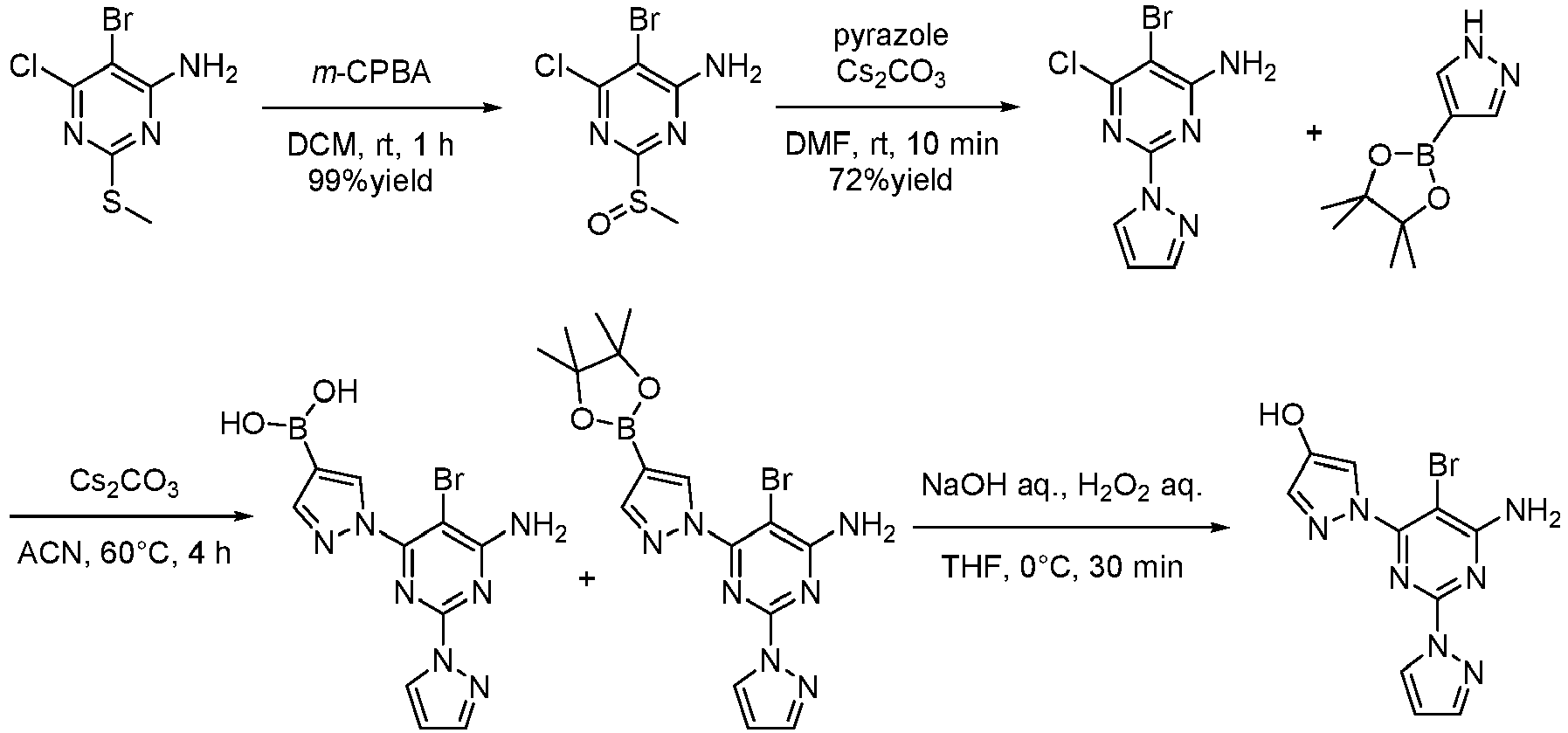
Priority Applications (2)
| Application Number | Priority Date | Filing Date | Title |
|---|---|---|---|
| PL18707151T PL3579874T3 (en) | 2017-02-10 | 2018-02-08 | 1-(4-amino-5-bromo-6-(1 h-pyrazol-1-yl)pyrimidin-2-yl)-1 h-pyrazol-4-ol and use thereof in the treatment of cancer |
| SI201830420T SI3579874T1 (en) | 2017-02-10 | 2018-02-08 | 1-(4-amino-5-bromo-6-(1 h-pyrazol-1-yl)pyrimidin-2-yl)-1 h-pyrazol-4-ol and use thereof in the treatment of cancer |
Applications Claiming Priority (2)
| Application Number | Priority Date | Filing Date | Title |
|---|---|---|---|
| US201762457219P | 2017-02-10 | 2017-02-10 | |
| PCT/IB2018/050783 WO2018146612A1 (en) | 2017-02-10 | 2018-02-08 | 1-(4-amino-5-bromo-6-(1 h-pyrazol-1-yl)pyrimidin-2-yl)-1 h-pyrazol-4-ol and use thereof in the treatment of cancer |
Publications (2)
| Publication Number | Publication Date |
|---|---|
| EP3579874A1 EP3579874A1 (en) | 2019-12-18 |
| EP3579874B1 true EP3579874B1 (en) | 2021-07-21 |
Family
ID=61274309
Family Applications (1)
| Application Number | Title | Priority Date | Filing Date |
|---|---|---|---|
| EP18707151.9A Active EP3579874B1 (en) | 2017-02-10 | 2018-02-08 | 1-(4-amino-5-bromo-6-(1 h-pyrazol-1-yl)pyrimidin-2-yl)-1 h-pyrazol-4-ol and use thereof in the treatment of cancer |
Country Status (15)
| Country | Link |
|---|---|
| US (1) | US11078191B2 (en) |
| EP (1) | EP3579874B1 (en) |
| JP (1) | JP7161481B2 (en) |
| KR (1) | KR20190115053A (en) |
| CN (1) | CN110290808B (en) |
| AU (2) | AU2018217963B2 (en) |
| CA (1) | CA3051986A1 (en) |
| DK (1) | DK3579874T3 (en) |
| ES (1) | ES2893006T3 (en) |
| HU (1) | HUE057337T2 (en) |
| IL (1) | IL268549B (en) |
| PL (1) | PL3579874T3 (en) |
| PT (1) | PT3579874T (en) |
| SI (1) | SI3579874T1 (en) |
| WO (1) | WO2018146612A1 (en) |
Families Citing this family (1)
| Publication number | Priority date | Publication date | Assignee | Title |
|---|---|---|---|---|
| PH12019502703A1 (en) * | 2017-05-31 | 2020-10-26 | Novartis Ag | Crystalline forms of 5-bromo-2,6-di(1h-pyrazol-1-yl) pyrimidin-4-amine and new salts |
Family Cites Families (34)
| Publication number | Priority date | Publication date | Assignee | Title |
|---|---|---|---|---|
| PT72878B (en) | 1980-04-24 | 1983-03-29 | Merck & Co Inc | Process for preparing mannich-base hydroxamic acid pro-drugs for the improved delivery of non-steroidal anti-inflammatory agents |
| IL129299A0 (en) | 1999-03-31 | 2000-02-17 | Mor Research Applic Ltd | Monoclonal antibodies antigens and diagnosis of malignant diseases |
| IL149820A0 (en) | 2002-05-23 | 2002-11-10 | Curetech Ltd | Humanized immunomodulatory monoclonal antibodies for the treatment of neoplastic disease or immunodeficiency |
| US7119200B2 (en) * | 2002-09-04 | 2006-10-10 | Schering Corporation | Pyrazolopyrimidines as cyclin dependent kinase inhibitors |
| WO2004056875A1 (en) | 2002-12-23 | 2004-07-08 | Wyeth | Antibodies against pd-1 and uses therefor |
| PL2161336T5 (en) | 2005-05-09 | 2017-10-31 | Ono Pharmaceutical Co | Human monoclonal antibodies to programmed death 1(PD-1) and methods for treating cancer using anti-PD-1 antibodies alone or in combination with other immunotherapeutics |
| CA2612241C (en) | 2005-07-01 | 2018-11-06 | Medarex, Inc. | Human monoclonal antibodies to programmed death ligand 1 (pd-l1) |
| KR101586617B1 (en) | 2007-06-18 | 2016-01-20 | 머크 샤프 앤 도메 비.브이. | Antibodies to human programmed death receptor PD-1 |
| US8168757B2 (en) | 2008-03-12 | 2012-05-01 | Merck Sharp & Dohme Corp. | PD-1 binding proteins |
| JP2012500652A (en) | 2008-08-25 | 2012-01-12 | アンプリミューン、インコーポレーテッド | Targeted costimulatory polypeptides and methods of use for treating cancer |
| CA2736829C (en) | 2008-09-12 | 2018-02-27 | Isis Innovation Limited | Pd-1 specific antibodies and uses thereof |
| PL2342226T3 (en) | 2008-09-26 | 2017-01-31 | Dana-Farber Cancer Institute, Inc. | Human anti-pd-1, pd-l1, and pd-l2 antibodies and uses thereof |
| EP4209510B1 (en) | 2008-12-09 | 2024-01-31 | F. Hoffmann-La Roche AG | Anti-pd-l1 antibodies and their use to enhance t-cell function |
| EP3192811A1 (en) | 2009-02-09 | 2017-07-19 | Université d'Aix-Marseille | Pd-1 antibodies and pd-l1 antibodies and uses thereof |
| US20130017199A1 (en) | 2009-11-24 | 2013-01-17 | AMPLIMMUNE ,Inc. a corporation | Simultaneous inhibition of pd-l1/pd-l2 |
| EP2545078A1 (en) | 2010-03-11 | 2013-01-16 | UCB Pharma, S.A. | Pd-1 antibody |
| ES2365960B1 (en) * | 2010-03-31 | 2012-06-04 | Palobiofarma, S.L | NEW ANTAGONISTS OF ADENOSINE RECEPTORS. |
| US8907053B2 (en) | 2010-06-25 | 2014-12-09 | Aurigene Discovery Technologies Limited | Immunosuppression modulating compounds |
| SI2699264T1 (en) | 2011-04-20 | 2018-08-31 | Medimmune Llc | Antibodies and other molecules that bind B7-H1 and PD-1 |
| RU2604814C2 (en) | 2011-07-24 | 2016-12-10 | Кьюртек Лтд. | Versions of humanized immunomodulatory monoclonal antibodies |
| US9624298B2 (en) | 2011-11-28 | 2017-04-18 | Merck Patent Gmbh | Anti-PD-L1 antibodies and uses thereof |
| JP6742903B2 (en) | 2013-05-02 | 2020-08-19 | アナプティスバイオ インコーポレイティッド | Antibodies to programmed death-1 (PD-1) |
| US9676853B2 (en) | 2013-05-31 | 2017-06-13 | Sorrento Therapeutics, Inc. | Antigen binding proteins that bind PD-1 |
| CN105658206A (en) * | 2013-06-03 | 2016-06-08 | 诺华股份有限公司 | Combinations of anti-PD-L1 antibodies with MEK inhibitors and/or BRAF inhibitors |
| US20160145355A1 (en) | 2013-06-24 | 2016-05-26 | Biomed Valley Discoveries, Inc. | Bispecific antibodies |
| LT3702373T (en) | 2013-09-13 | 2022-11-10 | Beigene Switzerland Gmbh | Anti-pd1 antibodies and their use as therapeutics and diagnostics |
| GB201320729D0 (en) * | 2013-11-25 | 2014-01-08 | Cancer Rec Tech Ltd | Therapeutic compounds and their use |
| HUE046249T2 (en) | 2013-12-12 | 2020-02-28 | Shanghai hengrui pharmaceutical co ltd | PD-1 antibody, antigen-binding fragment thereof, and its therapeutic use |
| TWI681969B (en) | 2014-01-23 | 2020-01-11 | 美商再生元醫藥公司 | Human antibodies to pd-1 |
| CA2935423C (en) | 2014-01-24 | 2023-11-07 | Dana-Farber Cancer Institute, Inc. | Antibody molecules to pd-1 and uses thereof |
| TWI693232B (en) | 2014-06-26 | 2020-05-11 | 美商宏觀基因股份有限公司 | Covalently bonded diabodies having immunoreactivity with pd-1 and lag-3, and methods of use thereof |
| WO2016061142A1 (en) | 2014-10-14 | 2016-04-21 | Novartis Ag | Antibody molecules to pd-l1 and uses thereof |
| TWI595006B (en) | 2014-12-09 | 2017-08-11 | 禮納特神經系統科學公司 | Anti-PD-1 antibodies and methods of using same |
| US10561653B2 (en) | 2015-08-11 | 2020-02-18 | Novartis Ag | 5-bromo-2,6-di-(1H-pyrazol-1-yl)pyrimidin-4-amine for use in the treatment of cancer |
-
2018
- 2018-02-08 CN CN201880011779.3A patent/CN110290808B/en not_active Expired - Fee Related
- 2018-02-08 AU AU2018217963A patent/AU2018217963B2/en not_active Ceased
- 2018-02-08 PT PT18707151T patent/PT3579874T/en unknown
- 2018-02-08 SI SI201830420T patent/SI3579874T1/en unknown
- 2018-02-08 US US16/484,183 patent/US11078191B2/en not_active Expired - Fee Related
- 2018-02-08 KR KR1020197025984A patent/KR20190115053A/en not_active Abandoned
- 2018-02-08 CA CA3051986A patent/CA3051986A1/en active Pending
- 2018-02-08 HU HUE18707151A patent/HUE057337T2/en unknown
- 2018-02-08 ES ES18707151T patent/ES2893006T3/en active Active
- 2018-02-08 DK DK18707151.9T patent/DK3579874T3/en active
- 2018-02-08 WO PCT/IB2018/050783 patent/WO2018146612A1/en not_active Ceased
- 2018-02-08 JP JP2019542717A patent/JP7161481B2/en active Active
- 2018-02-08 EP EP18707151.9A patent/EP3579874B1/en active Active
- 2018-02-08 PL PL18707151T patent/PL3579874T3/en unknown
-
2019
- 2019-08-06 IL IL268549A patent/IL268549B/en unknown
-
2020
- 2020-10-19 AU AU2020256467A patent/AU2020256467B2/en not_active Ceased
Non-Patent Citations (1)
| Title |
|---|
| None * |
Also Published As
| Publication number | Publication date |
|---|---|
| RU2019128199A3 (en) | 2021-05-14 |
| AU2020256467B2 (en) | 2022-03-03 |
| US11078191B2 (en) | 2021-08-03 |
| CA3051986A1 (en) | 2018-08-16 |
| PL3579874T3 (en) | 2022-02-28 |
| CN110290808B (en) | 2023-07-11 |
| DK3579874T3 (en) | 2021-10-11 |
| KR20190115053A (en) | 2019-10-10 |
| WO2018146612A1 (en) | 2018-08-16 |
| CN110290808A (en) | 2019-09-27 |
| AU2018217963B2 (en) | 2020-11-19 |
| RU2019128199A (en) | 2021-03-10 |
| US20190359600A1 (en) | 2019-11-28 |
| IL268549A (en) | 2019-09-26 |
| AU2020256467A1 (en) | 2020-11-12 |
| IL268549B (en) | 2021-10-31 |
| PT3579874T (en) | 2021-10-07 |
| EP3579874A1 (en) | 2019-12-18 |
| ES2893006T3 (en) | 2022-02-07 |
| HUE057337T2 (en) | 2022-05-28 |
| JP7161481B2 (en) | 2022-10-26 |
| SI3579874T1 (en) | 2021-11-30 |
| AU2018217963A1 (en) | 2019-08-08 |
| JP2020507569A (en) | 2020-03-12 |
Similar Documents
| Publication | Publication Date | Title |
|---|---|---|
| US11427567B2 (en) | Imidazolyl pyrimidinylamine compounds as CDK2 inhibitors | |
| EP3972596B1 (en) | Combinations comprising benzodioxol as glp-1r agonists for use in the treatment of nash/nafld and related diseases | |
| US11472791B2 (en) | Pyrazolyl pyrimidinylamine compounds as CDK2 inhibitors | |
| KR102806778B1 (en) | ERBB receptor inhibitor | |
| EP4101852A1 (en) | Pyridopyrimidinone compound and application thereof | |
| US11679107B2 (en) | Certain aryl pladienolide compounds and methods of use | |
| US20220169646A1 (en) | Heterocyclic compounds and uses thereof | |
| US20200360531A1 (en) | Antibody drug conjugates (adcs) with nampt inhibitors | |
| AU2020256467B2 (en) | 1-(4-amino-5-bromo-6-(1H-pyrazol-1-yl)pyrimidin-2-yl)-1H-pyrazol-4-ol and use thereof in the treatment of cancer | |
| US20240415840A1 (en) | Bicyclic amines as cdk2 inhibitors | |
| EP3630751B1 (en) | Crystalline forms of 5-bromo-2,6-di(1 h-pyrazol-1-yl)pyrimidin-4-amine and new salts | |
| HK40010513B (en) | 1-(4-amino-5-bromo-6-(1 h-pyrazol-1-yl)pyrimidin-2-yl)-1 h-pyrazol-4-ol and use thereof in the treatment of cancer | |
| RU2791531C2 (en) | 1-(4-amino-5-bromo-6-(1h-pyrazol-1-yl)pyrimidin-2-yl)-1h-pyrazol-4-ol and its applications for cancer treatment | |
| HK40045061A (en) | Erbb receptor inhibitors | |
| HK40045061B (en) | Erbb receptor inhibitors | |
| HK40037928A (en) | Erbb receptor inhibitors | |
| HK40037928B (en) | Erbb receptor inhibitors | |
| HK40028318A (en) | Erbb receptor inhibitors | |
| HK40028142A (en) | Erbb receptor inhibitors | |
| HK40046084A (en) | Erbb receptor inhibitors | |
| HK40046084B (en) | Erbb receptor inhibitors |
Legal Events
| Date | Code | Title | Description |
|---|---|---|---|
| STAA | Information on the status of an ep patent application or granted ep patent |
Free format text: STATUS: UNKNOWN |
|
| STAA | Information on the status of an ep patent application or granted ep patent |
Free format text: STATUS: THE INTERNATIONAL PUBLICATION HAS BEEN MADE |
|
| PUAI | Public reference made under article 153(3) epc to a published international application that has entered the european phase |
Free format text: ORIGINAL CODE: 0009012 |
|
| STAA | Information on the status of an ep patent application or granted ep patent |
Free format text: STATUS: REQUEST FOR EXAMINATION WAS MADE |
|
| 17P | Request for examination filed |
Effective date: 20190910 |
|
| AK | Designated contracting states |
Kind code of ref document: A1 Designated state(s): AL AT BE BG CH CY CZ DE DK EE ES FI FR GB GR HR HU IE IS IT LI LT LU LV MC MK MT NL NO PL PT RO RS SE SI SK SM TR |
|
| AX | Request for extension of the european patent |
Extension state: BA ME |
|
| DAV | Request for validation of the european patent (deleted) | ||
| DAX | Request for extension of the european patent (deleted) | ||
| REG | Reference to a national code |
Ref country code: HK Ref legal event code: DE Ref document number: 40010513 Country of ref document: HK |
|
| GRAP | Despatch of communication of intention to grant a patent |
Free format text: ORIGINAL CODE: EPIDOSNIGR1 |
|
| STAA | Information on the status of an ep patent application or granted ep patent |
Free format text: STATUS: GRANT OF PATENT IS INTENDED |
|
| INTG | Intention to grant announced |
Effective date: 20200902 |
|
| GRAJ | Information related to disapproval of communication of intention to grant by the applicant or resumption of examination proceedings by the epo deleted |
Free format text: ORIGINAL CODE: EPIDOSDIGR1 |
|
| STAA | Information on the status of an ep patent application or granted ep patent |
Free format text: STATUS: REQUEST FOR EXAMINATION WAS MADE |
|
| GRAS | Grant fee paid |
Free format text: ORIGINAL CODE: EPIDOSNIGR3 |
|
| STAA | Information on the status of an ep patent application or granted ep patent |
Free format text: STATUS: GRANT OF PATENT IS INTENDED |
|
| GRAP | Despatch of communication of intention to grant a patent |
Free format text: ORIGINAL CODE: EPIDOSNIGR1 |
|
| INTC | Intention to grant announced (deleted) | ||
| INTG | Intention to grant announced |
Effective date: 20210217 |
|
| GRAA | (expected) grant |
Free format text: ORIGINAL CODE: 0009210 |
|
| STAA | Information on the status of an ep patent application or granted ep patent |
Free format text: STATUS: THE PATENT HAS BEEN GRANTED |
|
| AK | Designated contracting states |
Kind code of ref document: B1 Designated state(s): AL AT BE BG CH CY CZ DE DK EE ES FI FR GB GR HR HU IE IS IT LI LT LU LV MC MK MT NL NO PL PT RO RS SE SI SK SM TR |
|
| REG | Reference to a national code |
Ref country code: GB Ref legal event code: FG4D |
|
| REG | Reference to a national code |
Ref country code: CH Ref legal event code: EP |
|
| REG | Reference to a national code |
Ref country code: DE Ref legal event code: R096 Ref document number: 602018020409 Country of ref document: DE |
|
| REG | Reference to a national code |
Ref country code: AT Ref legal event code: REF Ref document number: 1411984 Country of ref document: AT Kind code of ref document: T Effective date: 20210815 |
|
| REG | Reference to a national code |
Ref country code: IE Ref legal event code: FG4D |
|
| REG | Reference to a national code |
Ref country code: FI Ref legal event code: FGE |
|
| REG | Reference to a national code |
Ref country code: PT Ref legal event code: SC4A Ref document number: 3579874 Country of ref document: PT Date of ref document: 20211007 Kind code of ref document: T Free format text: AVAILABILITY OF NATIONAL TRANSLATION Effective date: 20210930 |
|
| REG | Reference to a national code |
Ref country code: RO Ref legal event code: EPE |
|
| REG | Reference to a national code |
Ref country code: DK Ref legal event code: T3 Effective date: 20211004 |
|
| REG | Reference to a national code |
Ref country code: SE Ref legal event code: TRGR |
|
| REG | Reference to a national code |
Ref country code: NL Ref legal event code: FP |
|
| REG | Reference to a national code |
Ref country code: LT Ref legal event code: MG9D |
|
| REG | Reference to a national code |
Ref country code: GR Ref legal event code: EP Ref document number: 20210402791 Country of ref document: GR Effective date: 20211111 |
|
| REG | Reference to a national code |
Ref country code: SK Ref legal event code: T3 Ref document number: E 38419 Country of ref document: SK |
|
| REG | Reference to a national code |
Ref country code: NO Ref legal event code: T2 Effective date: 20210721 |
|
| PG25 | Lapsed in a contracting state [announced via postgrant information from national office to epo] |
Ref country code: LT Free format text: LAPSE BECAUSE OF FAILURE TO SUBMIT A TRANSLATION OF THE DESCRIPTION OR TO PAY THE FEE WITHIN THE PRESCRIBED TIME-LIMIT Effective date: 20210721 Ref country code: HR Free format text: LAPSE BECAUSE OF FAILURE TO SUBMIT A TRANSLATION OF THE DESCRIPTION OR TO PAY THE FEE WITHIN THE PRESCRIBED TIME-LIMIT Effective date: 20210721 Ref country code: RS Free format text: LAPSE BECAUSE OF FAILURE TO SUBMIT A TRANSLATION OF THE DESCRIPTION OR TO PAY THE FEE WITHIN THE PRESCRIBED TIME-LIMIT Effective date: 20210721 |
|
| REG | Reference to a national code |
Ref country code: ES Ref legal event code: FG2A Ref document number: 2893006 Country of ref document: ES Kind code of ref document: T3 Effective date: 20220207 |
|
| PG25 | Lapsed in a contracting state [announced via postgrant information from national office to epo] |
Ref country code: LV Free format text: LAPSE BECAUSE OF FAILURE TO SUBMIT A TRANSLATION OF THE DESCRIPTION OR TO PAY THE FEE WITHIN THE PRESCRIBED TIME-LIMIT Effective date: 20210721 |
|
| REG | Reference to a national code |
Ref country code: DE Ref legal event code: R097 Ref document number: 602018020409 Country of ref document: DE |
|
| PLBE | No opposition filed within time limit |
Free format text: ORIGINAL CODE: 0009261 |
|
| STAA | Information on the status of an ep patent application or granted ep patent |
Free format text: STATUS: NO OPPOSITION FILED WITHIN TIME LIMIT |
|
| REG | Reference to a national code |
Ref country code: HU Ref legal event code: AG4A Ref document number: E057337 Country of ref document: HU |
|
| PG25 | Lapsed in a contracting state [announced via postgrant information from national office to epo] |
Ref country code: SM Free format text: LAPSE BECAUSE OF FAILURE TO SUBMIT A TRANSLATION OF THE DESCRIPTION OR TO PAY THE FEE WITHIN THE PRESCRIBED TIME-LIMIT Effective date: 20210721 Ref country code: EE Free format text: LAPSE BECAUSE OF FAILURE TO SUBMIT A TRANSLATION OF THE DESCRIPTION OR TO PAY THE FEE WITHIN THE PRESCRIBED TIME-LIMIT Effective date: 20210721 Ref country code: AL Free format text: LAPSE BECAUSE OF FAILURE TO SUBMIT A TRANSLATION OF THE DESCRIPTION OR TO PAY THE FEE WITHIN THE PRESCRIBED TIME-LIMIT Effective date: 20210721 |
|
| 26N | No opposition filed |
Effective date: 20220422 |
|
| PG25 | Lapsed in a contracting state [announced via postgrant information from national office to epo] |
Ref country code: MC Free format text: LAPSE BECAUSE OF FAILURE TO SUBMIT A TRANSLATION OF THE DESCRIPTION OR TO PAY THE FEE WITHIN THE PRESCRIBED TIME-LIMIT Effective date: 20210721 |
|
| PG25 | Lapsed in a contracting state [announced via postgrant information from national office to epo] |
Ref country code: LU Free format text: LAPSE BECAUSE OF NON-PAYMENT OF DUE FEES Effective date: 20220208 |
|
| P01 | Opt-out of the competence of the unified patent court (upc) registered |
Effective date: 20230515 |
|
| REG | Reference to a national code |
Ref country code: AT Ref legal event code: UEP Ref document number: 1411984 Country of ref document: AT Kind code of ref document: T Effective date: 20210721 |
|
| PGFP | Annual fee paid to national office [announced via postgrant information from national office to epo] |
Ref country code: NL Payment date: 20240129 Year of fee payment: 7 |
|
| PGFP | Annual fee paid to national office [announced via postgrant information from national office to epo] |
Ref country code: GR Payment date: 20240130 Year of fee payment: 7 |
|
| PGFP | Annual fee paid to national office [announced via postgrant information from national office to epo] |
Ref country code: ES Payment date: 20240306 Year of fee payment: 7 Ref country code: IE Payment date: 20240124 Year of fee payment: 7 |
|
| PGFP | Annual fee paid to national office [announced via postgrant information from national office to epo] |
Ref country code: AT Payment date: 20240125 Year of fee payment: 7 |
|
| PG25 | Lapsed in a contracting state [announced via postgrant information from national office to epo] |
Ref country code: MK Free format text: LAPSE BECAUSE OF FAILURE TO SUBMIT A TRANSLATION OF THE DESCRIPTION OR TO PAY THE FEE WITHIN THE PRESCRIBED TIME-LIMIT Effective date: 20210721 Ref country code: CY Free format text: LAPSE BECAUSE OF FAILURE TO SUBMIT A TRANSLATION OF THE DESCRIPTION OR TO PAY THE FEE WITHIN THE PRESCRIBED TIME-LIMIT Effective date: 20210721 |
|
| PGFP | Annual fee paid to national office [announced via postgrant information from national office to epo] |
Ref country code: RO Payment date: 20240131 Year of fee payment: 7 Ref country code: HU Payment date: 20240205 Year of fee payment: 7 Ref country code: FI Payment date: 20240213 Year of fee payment: 7 Ref country code: DE Payment date: 20240116 Year of fee payment: 7 Ref country code: CZ Payment date: 20240126 Year of fee payment: 7 Ref country code: BG Payment date: 20240130 Year of fee payment: 7 Ref country code: GB Payment date: 20240118 Year of fee payment: 7 Ref country code: PT Payment date: 20240209 Year of fee payment: 7 Ref country code: SK Payment date: 20240123 Year of fee payment: 7 Ref country code: CH Payment date: 20240301 Year of fee payment: 7 |
|
| PGFP | Annual fee paid to national office [announced via postgrant information from national office to epo] |
Ref country code: SI Payment date: 20240124 Year of fee payment: 7 |
|
| PGFP | Annual fee paid to national office [announced via postgrant information from national office to epo] |
Ref country code: TR Payment date: 20240207 Year of fee payment: 7 Ref country code: SE Payment date: 20240130 Year of fee payment: 7 Ref country code: PL Payment date: 20240119 Year of fee payment: 7 Ref country code: NO Payment date: 20240208 Year of fee payment: 7 Ref country code: IT Payment date: 20240126 Year of fee payment: 7 Ref country code: FR Payment date: 20240123 Year of fee payment: 7 Ref country code: DK Payment date: 20240214 Year of fee payment: 7 Ref country code: BE Payment date: 20240129 Year of fee payment: 7 |
|
| PG25 | Lapsed in a contracting state [announced via postgrant information from national office to epo] |
Ref country code: MT Free format text: LAPSE BECAUSE OF FAILURE TO SUBMIT A TRANSLATION OF THE DESCRIPTION OR TO PAY THE FEE WITHIN THE PRESCRIBED TIME-LIMIT Effective date: 20210721 |
|
| REG | Reference to a national code |
Ref country code: DE Ref legal event code: R119 Ref document number: 602018020409 Country of ref document: DE |
|
| REG | Reference to a national code |
Ref country code: DK Ref legal event code: EBP Effective date: 20250228 |
|
| REG | Reference to a national code |
Ref country code: SK Ref legal event code: MM4A Ref document number: E 38419 Country of ref document: SK Effective date: 20250208 |
|
| REG | Reference to a national code |
Ref country code: SE Ref legal event code: EUG Ref country code: CH Ref legal event code: PL |
|
| REG | Reference to a national code |
Ref country code: NL Ref legal event code: MM Effective date: 20250301 |
|
| PG25 | Lapsed in a contracting state [announced via postgrant information from national office to epo] |
Ref country code: PT Free format text: LAPSE BECAUSE OF NON-PAYMENT OF DUE FEES Effective date: 20250808 |
|
| PG25 | Lapsed in a contracting state [announced via postgrant information from national office to epo] |
Ref country code: FI Free format text: LAPSE BECAUSE OF NON-PAYMENT OF DUE FEES Effective date: 20250208 |
|
| PG25 | Lapsed in a contracting state [announced via postgrant information from national office to epo] |
Ref country code: NO Free format text: LAPSE BECAUSE OF NON-PAYMENT OF DUE FEES Effective date: 20250228 Ref country code: GR Free format text: LAPSE BECAUSE OF NON-PAYMENT OF DUE FEES Effective date: 20250903 |
|
| REG | Reference to a national code |
Ref country code: AT Ref legal event code: MM01 Ref document number: 1411984 Country of ref document: AT Kind code of ref document: T Effective date: 20250208 |
|
| PG25 | Lapsed in a contracting state [announced via postgrant information from national office to epo] |
Ref country code: BG Free format text: LAPSE BECAUSE OF NON-PAYMENT OF DUE FEES Effective date: 20250208 |
|
| PG25 | Lapsed in a contracting state [announced via postgrant information from national office to epo] |
Ref country code: AT Free format text: LAPSE BECAUSE OF NON-PAYMENT OF DUE FEES Effective date: 20250208 |
|
| PG25 | Lapsed in a contracting state [announced via postgrant information from national office to epo] |
Ref country code: CH Free format text: LAPSE BECAUSE OF NON-PAYMENT OF DUE FEES Effective date: 20250228 |
|
| PG25 | Lapsed in a contracting state [announced via postgrant information from national office to epo] |
Ref country code: CZ Free format text: LAPSE BECAUSE OF NON-PAYMENT OF DUE FEES Effective date: 20250208 |
|
| PG25 | Lapsed in a contracting state [announced via postgrant information from national office to epo] |
Ref country code: RO Free format text: LAPSE BECAUSE OF NON-PAYMENT OF DUE FEES Effective date: 20250208 |
|
| PG25 | Lapsed in a contracting state [announced via postgrant information from national office to epo] |
Ref country code: SK Free format text: LAPSE BECAUSE OF NON-PAYMENT OF DUE FEES Effective date: 20250208 |
|
| GBPC | Gb: european patent ceased through non-payment of renewal fee |
Effective date: 20250208 |
|
| PG25 | Lapsed in a contracting state [announced via postgrant information from national office to epo] |
Ref country code: HU Free format text: LAPSE BECAUSE OF NON-PAYMENT OF DUE FEES Effective date: 20250209 |
|
| PG25 | Lapsed in a contracting state [announced via postgrant information from national office to epo] |
Ref country code: NL Free format text: LAPSE BECAUSE OF NON-PAYMENT OF DUE FEES Effective date: 20250301 |
|
| REG | Reference to a national code |
Ref country code: BE Ref legal event code: MM Effective date: 20250228 |
|
| PG25 | Lapsed in a contracting state [announced via postgrant information from national office to epo] |
Ref country code: DE Free format text: LAPSE BECAUSE OF NON-PAYMENT OF DUE FEES Effective date: 20250902 |
|
| PG25 | Lapsed in a contracting state [announced via postgrant information from national office to epo] |
Ref country code: GB Free format text: LAPSE BECAUSE OF NON-PAYMENT OF DUE FEES Effective date: 20250208 |
|
| PG25 | Lapsed in a contracting state [announced via postgrant information from national office to epo] |
Ref country code: DK Free format text: LAPSE BECAUSE OF NON-PAYMENT OF DUE FEES Effective date: 20250228 |
|
| PG25 | Lapsed in a contracting state [announced via postgrant information from national office to epo] |
Ref country code: IT Free format text: LAPSE BECAUSE OF NON-PAYMENT OF DUE FEES Effective date: 20250208 Ref country code: FR Free format text: LAPSE BECAUSE OF NON-PAYMENT OF DUE FEES Effective date: 20250228 |
|
| PG25 | Lapsed in a contracting state [announced via postgrant information from national office to epo] |
Ref country code: BE Free format text: LAPSE BECAUSE OF NON-PAYMENT OF DUE FEES Effective date: 20250228 |
|
| PG25 | Lapsed in a contracting state [announced via postgrant information from national office to epo] |
Ref country code: IE Free format text: LAPSE BECAUSE OF NON-PAYMENT OF DUE FEES Effective date: 20250208 |
|
| REG | Reference to a national code |
Ref country code: ES Ref legal event code: FD2A Effective date: 20260327 |
|
| PG25 | Lapsed in a contracting state [announced via postgrant information from national office to epo] |
Ref country code: ES Free format text: LAPSE BECAUSE OF NON-PAYMENT OF DUE FEES Effective date: 20250209 |
|
| PG25 | Lapsed in a contracting state [announced via postgrant information from national office to epo] |
Ref country code: PL Free format text: LAPSE BECAUSE OF NON-PAYMENT OF DUE FEES Effective date: 20250208 |