EP3577165B1 - Einkomponenten-haftklebstoffzusammensetzung mit auf reversibler vernetzung durch metallsalze beruhenden gelgehalt - Google Patents
Einkomponenten-haftklebstoffzusammensetzung mit auf reversibler vernetzung durch metallsalze beruhenden gelgehalt Download PDFInfo
- Publication number
- EP3577165B1 EP3577165B1 EP18700002.1A EP18700002A EP3577165B1 EP 3577165 B1 EP3577165 B1 EP 3577165B1 EP 18700002 A EP18700002 A EP 18700002A EP 3577165 B1 EP3577165 B1 EP 3577165B1
- Authority
- EP
- European Patent Office
- Prior art keywords
- sensitive adhesive
- pressure
- monomers
- polymer
- weight
- Prior art date
- Legal status (The legal status is an assumption and is not a legal conclusion. Google has not performed a legal analysis and makes no representation as to the accuracy of the status listed.)
- Revoked
Links
Classifications
-
- C—CHEMISTRY; METALLURGY
- C09—DYES; PAINTS; POLISHES; NATURAL RESINS; ADHESIVES; COMPOSITIONS NOT OTHERWISE PROVIDED FOR; APPLICATIONS OF MATERIALS NOT OTHERWISE PROVIDED FOR
- C09J—ADHESIVES; NON-MECHANICAL ASPECTS OF ADHESIVE PROCESSES IN GENERAL; ADHESIVE PROCESSES NOT PROVIDED FOR ELSEWHERE; USE OF MATERIALS AS ADHESIVES
- C09J133/00—Adhesives based on homopolymers or copolymers of compounds having one or more unsaturated aliphatic radicals, each having only one carbon-to-carbon double bond, and at least one being terminated by only one carboxyl radical, or of salts, anhydrides, esters, amides, imides, or nitriles thereof; Adhesives based on derivatives of such polymers
- C09J133/04—Homopolymers or copolymers of esters
- C09J133/06—Homopolymers or copolymers of esters of esters containing only carbon, hydrogen and oxygen, the oxygen atom being present only as part of the carboxyl radical
- C09J133/10—Homopolymers or copolymers of methacrylic acid esters
-
- C—CHEMISTRY; METALLURGY
- C08—ORGANIC MACROMOLECULAR COMPOUNDS; THEIR PREPARATION OR CHEMICAL WORKING-UP; COMPOSITIONS BASED THEREON
- C08F—MACROMOLECULAR COMPOUNDS OBTAINED BY REACTIONS ONLY INVOLVING CARBON-TO-CARBON UNSATURATED BONDS
- C08F2/00—Processes of polymerisation
- C08F2/12—Polymerisation in non-solvents
- C08F2/16—Aqueous medium
- C08F2/22—Emulsion polymerisation
-
- C—CHEMISTRY; METALLURGY
- C08—ORGANIC MACROMOLECULAR COMPOUNDS; THEIR PREPARATION OR CHEMICAL WORKING-UP; COMPOSITIONS BASED THEREON
- C08K—Use of inorganic or non-macromolecular organic substances as compounding ingredients
- C08K3/00—Use of inorganic substances as compounding ingredients
- C08K3/01—Use of inorganic substances as compounding ingredients characterized by their specific function
- C08K3/011—Crosslinking or vulcanising agents, e.g. accelerators
-
- C—CHEMISTRY; METALLURGY
- C08—ORGANIC MACROMOLECULAR COMPOUNDS; THEIR PREPARATION OR CHEMICAL WORKING-UP; COMPOSITIONS BASED THEREON
- C08K—Use of inorganic or non-macromolecular organic substances as compounding ingredients
- C08K5/00—Use of organic ingredients
- C08K5/04—Oxygen-containing compounds
- C08K5/09—Carboxylic acids; Metal salts thereof; Anhydrides thereof
- C08K5/098—Metal salts of carboxylic acids
-
- C—CHEMISTRY; METALLURGY
- C09—DYES; PAINTS; POLISHES; NATURAL RESINS; ADHESIVES; COMPOSITIONS NOT OTHERWISE PROVIDED FOR; APPLICATIONS OF MATERIALS NOT OTHERWISE PROVIDED FOR
- C09J—ADHESIVES; NON-MECHANICAL ASPECTS OF ADHESIVE PROCESSES IN GENERAL; ADHESIVE PROCESSES NOT PROVIDED FOR ELSEWHERE; USE OF MATERIALS AS ADHESIVES
- C09J11/00—Features of adhesives not provided for in group C09J9/00, e.g. additives
- C09J11/08—Macromolecular additives
-
- C—CHEMISTRY; METALLURGY
- C09—DYES; PAINTS; POLISHES; NATURAL RESINS; ADHESIVES; COMPOSITIONS NOT OTHERWISE PROVIDED FOR; APPLICATIONS OF MATERIALS NOT OTHERWISE PROVIDED FOR
- C09J—ADHESIVES; NON-MECHANICAL ASPECTS OF ADHESIVE PROCESSES IN GENERAL; ADHESIVE PROCESSES NOT PROVIDED FOR ELSEWHERE; USE OF MATERIALS AS ADHESIVES
- C09J125/00—Adhesives based on homopolymers or copolymers of compounds having one or more unsaturated aliphatic radicals, each having only one carbon-to-carbon double bond, and at least one being terminated by an aromatic carbocyclic ring; Adhesives based on derivatives of such polymers
- C09J125/02—Homopolymers or copolymers of hydrocarbons
- C09J125/04—Homopolymers or copolymers of styrene
- C09J125/08—Copolymers of styrene
- C09J125/14—Copolymers of styrene with unsaturated esters
-
- C—CHEMISTRY; METALLURGY
- C09—DYES; PAINTS; POLISHES; NATURAL RESINS; ADHESIVES; COMPOSITIONS NOT OTHERWISE PROVIDED FOR; APPLICATIONS OF MATERIALS NOT OTHERWISE PROVIDED FOR
- C09J—ADHESIVES; NON-MECHANICAL ASPECTS OF ADHESIVE PROCESSES IN GENERAL; ADHESIVE PROCESSES NOT PROVIDED FOR ELSEWHERE; USE OF MATERIALS AS ADHESIVES
- C09J133/00—Adhesives based on homopolymers or copolymers of compounds having one or more unsaturated aliphatic radicals, each having only one carbon-to-carbon double bond, and at least one being terminated by only one carboxyl radical, or of salts, anhydrides, esters, amides, imides, or nitriles thereof; Adhesives based on derivatives of such polymers
- C09J133/02—Homopolymers or copolymers of acids; Metal or ammonium salts thereof
-
- C—CHEMISTRY; METALLURGY
- C09—DYES; PAINTS; POLISHES; NATURAL RESINS; ADHESIVES; COMPOSITIONS NOT OTHERWISE PROVIDED FOR; APPLICATIONS OF MATERIALS NOT OTHERWISE PROVIDED FOR
- C09J—ADHESIVES; NON-MECHANICAL ASPECTS OF ADHESIVE PROCESSES IN GENERAL; ADHESIVE PROCESSES NOT PROVIDED FOR ELSEWHERE; USE OF MATERIALS AS ADHESIVES
- C09J133/00—Adhesives based on homopolymers or copolymers of compounds having one or more unsaturated aliphatic radicals, each having only one carbon-to-carbon double bond, and at least one being terminated by only one carboxyl radical, or of salts, anhydrides, esters, amides, imides, or nitriles thereof; Adhesives based on derivatives of such polymers
- C09J133/04—Homopolymers or copolymers of esters
- C09J133/06—Homopolymers or copolymers of esters of esters containing only carbon, hydrogen and oxygen, the oxygen atom being present only as part of the carboxyl radical
- C09J133/08—Homopolymers or copolymers of acrylic acid esters
-
- C—CHEMISTRY; METALLURGY
- C09—DYES; PAINTS; POLISHES; NATURAL RESINS; ADHESIVES; COMPOSITIONS NOT OTHERWISE PROVIDED FOR; APPLICATIONS OF MATERIALS NOT OTHERWISE PROVIDED FOR
- C09J—ADHESIVES; NON-MECHANICAL ASPECTS OF ADHESIVE PROCESSES IN GENERAL; ADHESIVE PROCESSES NOT PROVIDED FOR ELSEWHERE; USE OF MATERIALS AS ADHESIVES
- C09J7/00—Adhesives in the form of films or foils
- C09J7/30—Adhesives in the form of films or foils characterised by the adhesive composition
- C09J7/38—Pressure-sensitive adhesives [PSA]
- C09J7/381—Pressure-sensitive adhesives [PSA] based on macromolecular compounds obtained by reactions involving only carbon-to-carbon unsaturated bonds
- C09J7/385—Acrylic polymers
-
- C—CHEMISTRY; METALLURGY
- C09—DYES; PAINTS; POLISHES; NATURAL RESINS; ADHESIVES; COMPOSITIONS NOT OTHERWISE PROVIDED FOR; APPLICATIONS OF MATERIALS NOT OTHERWISE PROVIDED FOR
- C09J—ADHESIVES; NON-MECHANICAL ASPECTS OF ADHESIVE PROCESSES IN GENERAL; ADHESIVE PROCESSES NOT PROVIDED FOR ELSEWHERE; USE OF MATERIALS AS ADHESIVES
- C09J2203/00—Applications of adhesives in processes or use of adhesives in the form of films or foils
- C09J2203/334—Applications of adhesives in processes or use of adhesives in the form of films or foils as a label
-
- C—CHEMISTRY; METALLURGY
- C09—DYES; PAINTS; POLISHES; NATURAL RESINS; ADHESIVES; COMPOSITIONS NOT OTHERWISE PROVIDED FOR; APPLICATIONS OF MATERIALS NOT OTHERWISE PROVIDED FOR
- C09J—ADHESIVES; NON-MECHANICAL ASPECTS OF ADHESIVE PROCESSES IN GENERAL; ADHESIVE PROCESSES NOT PROVIDED FOR ELSEWHERE; USE OF MATERIALS AS ADHESIVES
- C09J2301/00—Additional features of adhesives in the form of films or foils
- C09J2301/30—Additional features of adhesives in the form of films or foils characterized by the chemical, physicochemical or physical properties of the adhesive or the carrier
- C09J2301/312—Additional features of adhesives in the form of films or foils characterized by the chemical, physicochemical or physical properties of the adhesive or the carrier parameters being the characterizing feature
-
- C—CHEMISTRY; METALLURGY
- C09—DYES; PAINTS; POLISHES; NATURAL RESINS; ADHESIVES; COMPOSITIONS NOT OTHERWISE PROVIDED FOR; APPLICATIONS OF MATERIALS NOT OTHERWISE PROVIDED FOR
- C09J—ADHESIVES; NON-MECHANICAL ASPECTS OF ADHESIVE PROCESSES IN GENERAL; ADHESIVE PROCESSES NOT PROVIDED FOR ELSEWHERE; USE OF MATERIALS AS ADHESIVES
- C09J2301/00—Additional features of adhesives in the form of films or foils
- C09J2301/40—Additional features of adhesives in the form of films or foils characterized by the presence of essential components
- C09J2301/408—Additional features of adhesives in the form of films or foils characterized by the presence of essential components additives as essential feature of the adhesive layer
-
- C—CHEMISTRY; METALLURGY
- C09—DYES; PAINTS; POLISHES; NATURAL RESINS; ADHESIVES; COMPOSITIONS NOT OTHERWISE PROVIDED FOR; APPLICATIONS OF MATERIALS NOT OTHERWISE PROVIDED FOR
- C09J—ADHESIVES; NON-MECHANICAL ASPECTS OF ADHESIVE PROCESSES IN GENERAL; ADHESIVE PROCESSES NOT PROVIDED FOR ELSEWHERE; USE OF MATERIALS AS ADHESIVES
- C09J2425/00—Presence of styrenic polymer
-
- C—CHEMISTRY; METALLURGY
- C09—DYES; PAINTS; POLISHES; NATURAL RESINS; ADHESIVES; COMPOSITIONS NOT OTHERWISE PROVIDED FOR; APPLICATIONS OF MATERIALS NOT OTHERWISE PROVIDED FOR
- C09J—ADHESIVES; NON-MECHANICAL ASPECTS OF ADHESIVE PROCESSES IN GENERAL; ADHESIVE PROCESSES NOT PROVIDED FOR ELSEWHERE; USE OF MATERIALS AS ADHESIVES
- C09J2433/00—Presence of (meth)acrylic polymer
Definitions
- the invention relates to a one-component pressure-sensitive adhesive composition in the form of an aqueous polymer dispersion containing at least one pressure-sensitive adhesive polymer, which is formed by emulsion polymerization from soft (meth) acrylic acid ester monomers, methacrylic acid and optionally other monomers, the polymerization taking place in the presence of molecular weight regulators or styrene.
- the pressure-sensitive adhesive polymer has a gel content that is based at least in part on reversible crosslinking by metal salts.
- the one-component pressure-sensitive adhesive composition can be used for the production of adhesive labels, adhesive tapes or adhesive films.
- Pressure-sensitive adhesives for applications e.g. in adhesive tapes or adhesive films are based on polymer solutions in organic solvents and based on aqueous polymer dispersions, which can be obtained by emulsion polymerization. It is desirable to use more aqueous systems and to dispense with organic solvents.
- the adhesive properties of emulsion polymers are not in every respect equivalent to adhesive polymers produced in organic solvents, which is shown by a market share of solvent adhesives of approx. 50-60%, depending on the area of application.
- Solution polymers are generally largely unbranched and non-crosslinked, have a comparatively high molecular weight and, when substrates are coated, form very homogeneous adhesive films in which the long polymer chains can become entangled, which leads to a comparatively high level of cohesion.
- polymers with a higher degree of branching and crosslinking are usually formed than in solution polymerization.
- emulsion polymers are made into films, heterogeneous films with microscopically recognizable interfaces are formed which can be attributed to the dispersion particles, which overall reduces the cohesion with respect to solvent polymers and worsens the water resistance.
- Crosslinking of acrylate adhesive dispersions with, among other things, metal salts is described in Coating 3/99, pages 97-102.
- the acrylate adhesive polymers described have a high gel content based on covalent, irreversible crosslinking (65-79%) and contain acrylic acid as a comonomer.
- Metal salt crosslinking of aqueous acrylate polymer dispersions is also described in JP 03-229784 , JP 02-251589 , JP 01-069681 , JP 03-146582 and JP-103635 .
- Aqueous polymer dispersions which contain a metal acetylacetonate enclosed in a wax layer, the wax layer preventing crosslinking until the wax is melted after application to a substrate US-B-6608134 discloses solvent-based adhesives that are crosslinked with metal salt.
- the metal cations of the metal salts are preferably selected from Al 3+ , Zn 2+ , Ti 4+ , Ca 2+ , Fe 2+ , Fe 3+ and Zr 4+ .
- the percentages by weight of the monomers relate in each case to the sum total of all monomers used in the polymerization, unless stated otherwise.
- a pressure-sensitive adhesive is a viscoelastic adhesive whose set film remains permanently tacky and tacky when dry at room temperature (20 ° C). Adhesion to substrates takes place immediately by applying slight pressure.
- a one-component adhesive is an adhesive to which no further components are added before use and which is stable in storage, the change in viscosity being less than 100% based on the initial viscosity when stored for 5 days at 20 ° C.
- the proportion of coagulum formation (which can be filtered off with a filter with a mesh width of 250 ⁇ m) preferably does not exceed 5% by weight, based on the solids content of the dispersion.
- the glass transition temperature is determined by differential scanning calorimetry (ASTM D 3418-08, so-called “midpoint temperature”).
- the glass transition temperature of the polymer of the polymer dispersion is the glass transition temperature obtained when evaluating the second heating curve (heating rate 20 ° C./min).
- the gel content is measured by producing a polymer film from a polymer dispersion and drying it for one day at room temperature (20 ° C.) and for 4 days at 50 ° C. Then the film is mixed with 99 times the mass of methyl ethyl ketone and stored for 4 days at room temperature. It is filtered off through a tared 125 ⁇ m Perlon filter, the filter is dried at room temperature until it is free of solvent and then dried again at 50 ° C. for one hour.
- the gel fraction is the fraction which is determined by backweighing and is insoluble in methyl ethyl ketone.
- the total gel content ( total gel) is determined after the addition of metal crosslinkers.
- the gel content (irreversible gel) based on covalent, irreversible crosslinking is determined before the addition of metal crosslinkers.
- the total gel content means the gel content of the polymer with polymerized metal salt monomer.
- the gel content based on covalent, irreversible crosslinking means the gel content of an otherwise identically produced polymer without copolymerized metal salt monomer.
- the amount of (meth) acrylic acid ester soft monomer (i) is at least 60% by weight, preferably at least 65% by weight, e.g. from 65 to 99.5% by weight or from 70 to 98% by weight ok.
- Preferred soft monomers are n-butyl acrylate, 2-ethylhexyl acrylate, and ethyl acrylate. N-Butyl acrylate, 2-ethylhexyl acrylate and mixtures thereof are particularly preferred.
- Methacrylic acid (ii) is used in an amount from 0.1 to 10% by weight, preferably from 0.2 to 8% by weight, or from 0.5 to 8% by weight, or from 0.5 to 6% by weight. % used.
- Styrene (iii) is used in an amount of from 0 to 30% by weight, for example from 5 to 25% by weight or from 5 to 20% by weight or from 10 to 20% by weight. If no molecular weight regulator is used, the amount of styrene (iii) is at least 5% by weight, preferably at least 10% by weight.
- monomers (iv) different from monomers (i) to (iii) can be used.
- the other monomers (iv) are copolymerizable, ethylenically unsaturated compounds.
- the optional monomers (iv) are preferably used in amounts from 0 to less than or equal to 10% by weight, from 0.1 to 10% by weight, from 1 to 10% by weight or from 1 to less than or equal to 8% by weight, based on the sum of the monomers used.
- the monomers (iv) are preferably selected from the group consisting of C1 to C20 alkyl (meth) acrylates, monomers containing hydroxyl groups, vinyl esters of carboxylic acids containing up to 20 carbon atoms, vinyl aromatics, different from the monomers (i) to (iii) with up to 20 carbon atoms, ethylenically unsaturated nitriles, vinyl halides, vinyl ethers containing 1 to 10 carbon atoms, aliphatic hydrocarbons with 2 to 8 carbon atoms and one or two double bonds and (meth) acrylamides or mixtures of these monomers.
- Phenyloxyethyl glycol mono- (meth) acrylate, glycidyl (meth) acrylate, aminoalkyl (meth) acrylates, such as, for example, 2-aminoethyl (meth) acrylate, may also be mentioned as further monomers.
- Alkyl groups preferably have from 1 to 20 carbon atoms.
- C 1 -C 20 -alkyl (meth) acrylates have 1-20 carbon atoms in the alkyl groups.
- C 1 -C 10 hydroxyalkyl (meth) acrylates have 1-10 carbon atoms in the hydroxyalkyl groups.
- Monomers can also be used as monomer (iv) which contain functional groups which can react with metal cations, for example 1,2-dicarboxylic acids such as for example maleic acid, fumaric acid, itaconic acid or monomers with complexing groups such as 2- (methacryloyloxy) ethylacetoacetate.
- metal cations for example 1,2-dicarboxylic acids such as for example maleic acid, fumaric acid, itaconic acid or monomers with complexing groups such as 2- (methacryloyloxy) ethylacetoacetate.
- C1 to C20 alkyl (meth) acrylates are, for example, methyl acrylate and methyl methacrylate.
- Monomers containing hydroxyl groups are, for example, C 1 -C 10 -hydroxyalkyl (meth) acrylates.
- Vinyl esters of carboxylic acids having 1 to 20 carbon atoms are, for example, vinyl acetate, vinyl laurate, vinyl stearate, vinyl propionate and vinyl versatic acid.
- Vinyl aromatic compounds are vinyl toluene, alpha- and p-methylstyrene, alpha-butylstyrene, 4-n-butylstyrene and 4-n-decylstyrene.
- nitriles are acrylonitrile and methacrylonitrile.
- the vinyl halides are ethylenically unsaturated compounds substituted with chlorine, fluorine or bromine, preferably vinyl chloride and vinylidene chloride.
- vinyl ethers that may be mentioned are vinyl methyl ether or vinyl isobutyl ether.
- Vinyl ethers of alcohols containing 1 to 4 carbon atoms are preferred. Suitable hydrocarbons with 4 to 8 carbon atoms and two olefinic double bonds are, for example, butadiene, isoprene and chloroprene.
- Preferred further monomers (iv) are methyl acrylate, methyl methacrylate, vinyl esters, in particular vinyl acetate and mixtures thereof, and C2 to C10 hydroxyalkyl (meth) acrylates.
- Methyl acrylate, methyl methacrylate, vinyl acetate and hydroxypropyl acrylate and mixtures of these monomers are very particularly preferred.
- Molecular weight regulators can be used in the polymerization. Preferably no molecular weight regulators are used. If molecular weight regulators are used, this is preferably done in amounts of at least 0.01 parts by weight of molecular weight regulators per 100 parts by weight of monomers, for example from 0.01 to 5 parts by weight, or from 0.01 to 3 parts by weight per 100 parts by weight of the monomers to be polymerized. As a result, the molar mass of the emulsion polymer can be controlled or reduced by a chain termination reaction. The regulators are bound to the polymer, generally to the chain end. The addition can take place continuously or in stages during the polymerization.
- Suitable regulators are, for example, organic compounds that contain sulfur in bound form (e.g. compounds with a thiol group), aliphatic and / or araliphatic halogen compounds, aliphatic and / or aromatic aldehydes, unsaturated fatty acids (such as oleic acid), dienes with non-conjugated double bonds (such as Divinyl methane, terpinolene or vinyl cyclohexene), hydrocarbons with easily abstractable hydrogen atoms (such as toluene), organic acids or their salts (such as formic acid, sodium formate, ammonium formate), alcohols (such as isopropanol) and phosphorus compounds (such as sodium hypophosphite).
- organic compounds that contain sulfur in bound form e.g. compounds with a thiol group
- aliphatic and / or araliphatic halogen compounds aliphatic and / or aromatic aldehydes
- unsaturated fatty acids such
- the regulators are generally low molecular weight compounds with a molecular weight of less than 2000, in particular less than 1000 g / mol. It is advantageous if some or all of the regulators are added to the aqueous reaction medium before the radical polymerization is initiated. In addition, some or all of the free-radical chain transfer compound can advantageously also be added to the aqueous reaction medium together with the monomers during the polymerization.
- Organic compounds with a thiol group are, for example, primary, secondary or tertiary aliphatic thiols such as ethanethiol, n-propanethiol, 2-propanethiol, n-butanethiol, 2-butanethiol, 2-methyl-2-propanethiol, n-pentanethiol, 2-pentanethiol , 3-pentanethiol, 2-methyl-2-butanethiol, 3-methyl-2-butanethiol, n-hexanethiol, 2-hexanethiol, 3-hexanethiol, 2-methyl-2-pentanethiol, 3-methyl-2-pentanethiol, 4 -Methyl-2-pentanethiol, 2-methyl-3-pentanethiol, 3-methyl-3-pentanethiol, 2-ethylbutanethiol, 2-ethyl-2
- Preferred organic compounds which contain sulfur in bound form are, in particular, tert-butyl mercaptan, ethyl thioglycolate, mercaptoethanol, mercaptopropyltrimethoxysilane, tert-dodecyl mercaptan, thiodiglycol, ethylthioethanol, di-n-butyl sulfide, 2-isopropyl sulfide, di-n-octyl sulfide, diphenyl sulfide Mercaptoethanol, 1,3-mercaptopropanol, 3-mercaptopropane-1,2-diol, 1,4-mercaptobutanol, thioglycolic acid, 3-mercaptopropionic acid, mercaptosuccinic acid, thioacetic acid and thiour
- Particularly preferred thio compounds are tert-butyl mercaptan, ethyl thioglycolate, mercaptoethanol, mercaptopropyltrimethoxysilane or tert-dodecyl mercaptan.
- Aliphatic and / or araliphatic halogen compounds are, for example, n-butyl chloride, n-butyl bromide, n-butyl iodide, methylene chloride, ethylene dichloride, chloroform, bromoform, bromotrichloromethane, dibromodichloromethane, carbon tetrachloride, carbon tetrabromide, benzyl bromide chloride.
- Aliphatic and / or aromatic aldehydes are, for example, formaldehyde, acetaldehyde, propionaldehyde and / or benzaldehyde.
- the adhesive properties can be positively influenced by the amount and type of gel content.
- the total gel content of the pressure-sensitive adhesive composition is at least 40% by weight, preferably at least 50% by weight, at least 60% by weight or at least 70% by weight, based on the solids content of the composition.
- the gel content is composed of a gel content based on covalent, irreversible crosslinking of the polymer chains (covalent bonds between polymer chains) and a gel content based on reversible crosslinking of the polymer chains by metal salts.
- the reversible crosslinking does not take place via covalent bonds but, for example, via ion bonds or complex formation with at least divalent metal cations.
- the gel content which is based on reversible crosslinking by metal salts, is at least 10% by weight, preferably at least 20% by weight, at least 25% by weight or at least 30% by weight or at least 40% by weight, based on the solids content.
- the gel content based on reversible crosslinking by metal salts can be adjusted by the type and amount of the metal cations or metal compounds used.
- the gel content which is based on covalent, irreversible crosslinking of the polymers, can be 0 to 50% by weight, preferably a maximum of 40% by weight or a maximum of 30% by weight, e.g. greater than zero to 40% by weight or 1 to 30% by weight, based on the solids content.
- the gel content based on covalent, irreversible crosslinking of the polymers can be adjusted by using small amounts of molecular weight regulators and / or by using styrene as a comonomer. Preferably no molecular weight regulator is used and the amount of styrene is then at least 5 parts by weight, based on the sum of all monomers.
- the metal salt crosslinking can take place by adding suitable metal salts after the polymerization.
- the metal salts are preferably used in a molar ratio of metal cation, based on carboxylate groups of the polymer, of 1 to 300 mol%, preferably 1 to 100 mol%, particularly preferably 1 to 50 mol%.
- Suitable metal salts are, for example, those with the metal cations Al 3+ , Zn 2+ , Ti 4+ , Ca 2+ , Fe 2+ , Fe 3+ and Zr 4+ .
- Suitable counterions are, for example, acetylacetonates, hydroxides, oxalates, lactate, glycinate, acetate and also carboxylate groups or acrylate oligomers containing 2- (methacryloyloxy) -ethyl acetoacetate groups with a molar mass of up to 50,000 g / mol.
- Suitable metal salts are, for example, aluminum acetylacetonate Al (acac) 3 , titanium diisopropoxide bis (acetylacetonate) Ti (acac) 2 OiPr 2 , diammonium bis [carbonato-O] dihydroxyzirconate (Bacote® 20), iron (II) oxalate, calcium hydroxide or zinc hydroxide , e.g. Zn (OH) 2 / NH 3 .
- the metal salt is particularly preferably selected from zinc salts and aluminum salts, preferably the acetylacetonates, in particular Al (acac) 3 .
- Preferred metal salts have a water solubility of less than 10 g / l (at 25 ° C.).
- the metal salt crosslinking can also take place by direct incorporation of metal salts during the emulsion polymerization by copolymerization with suitable organometallic comonomers.
- the amount of such organometallic comonomers is preferably from 0.1 to 3% by weight, particularly preferably from 0.1 to 2.5% by weight, based on the sum of all monomers.
- Suitable organometallic comonomers are, for example, aluminum acrylate Al (AS) 3 , aluminum methacrylate Al (MAS) 3 , zinc acrylate Zn (AS) 2 , zinc methacrylate Zn (MAS) 2 , titanium (IV) acrylate and titanium (IV) methacrylate.
- Zinc (meth) acrylate and aluminum (meth) acrylate, in particular zinc methacrylate, are particularly preferred.
- the metal salts causing the reversible crosslinking are used in uncoated form, so that the reversible metal salt crosslinking can already take place in the aqueous polymer dispersion and is not prevented by coating the metal salts, e.g. in the form of a wax layer.
- the pressure-sensitive adhesive compositions of the invention are storage-stable, i.e. do not coagulate or build up increased viscosity over time.
- Stable in storage means in particular that the viscosity on storage over a period of 5 days at 20 ° C., the change in viscosity is less than 100%, based on the initial viscosity.
- the proportion of coagulum formation (which can be filtered off with a filter with a mesh width of 250 ⁇ m) preferably does not exceed 5% by weight, based on the solids content of the dispersion.
- the adhesive polymers according to the invention can be obtained by radical polymerization of ethylenically unsaturated compounds (monomers).
- the polymers are preferably produced by emulsion polymerization, which is why they are preferably emulsion polymers.
- the invention therefore also provides pressure-sensitive adhesive dispersions comprising a pressure-sensitive adhesive polymer according to the invention which is dispersed in water and prepared by emulsion polymerization.
- ethylenically unsaturated compounds are polymerized in water, ionic and / or nonionic emulsifiers and / or protective colloids or stabilizers being used as surface-active compounds to stabilize the monomer droplets and the polymer particles later formed from the monomers.
- the surface-active substances are usually used in amounts of 0.1 to 10 parts by weight, preferably 0.2 to 5 parts by weight, based on 100 parts by weight of the monomers to be polymerized.
- Anionic and nonionic emulsifiers are preferably used as surface-active substances.
- Common accompanying emulsifiers are, for example, ethoxylated fatty alcohols (EO degree: 3 to 50, alkyl radical: C 8 - to C 36 ), ethoxylated mono-, di- and trialkylphenols (EO degree: 3 to 50, alkyl radical: C 4 - to C) 9 ), alkali metal salts of dialkyl esters of sulfosuccinic acid as well as alkali and ammonium salts of alkyl sulfates (alkyl radical: C 8 - to C 12 ), of ethoxylated alkanols (EO degree: 4 to 30, alkyl radical: C 12 - to C 18 ), of ethoxylated Alkylphenols (EO degree: 3 to 50, alkyl group: C 4 - to C 9 ), of alkylsulfonic acids (alkyl group: C 12
- R5 and R6 are hydrogen or C4- to C14-alkyl and are not simultaneously hydrogen
- X and Y can be alkali metal ions and / or ammonium ions.
- R5 and R6 are preferably linear or branched alkyl radicals having 6 to 18 carbon atoms or hydrogen and in particular having 6, 12 and 16 carbon atoms, where R5 and R6 are not both hydrogen at the same time.
- X and Y are preferably sodium, potassium or ammonium ions, with sodium being particularly preferred.
- Compounds in which X and Y are sodium, R5 is a branched alkyl radical with 12 carbon atoms and R6 is hydrogen or R5 are particularly advantageous.
- emulsifiers are, for example, Dowfax® 2 A1, Emulan® NP 50, Dextrol®OC 50, Emulsifier 825, Emulsifier 825 S, Emulan® OG, Texapon® NSO, Nekanil® 904 S, Lumiten® I-RA, Lumiten® E 3065 , Disponil® FES 77, Lutensol® AT 18, Steinapol® VSL, Emulphor® NPS 25.
- Ionic emulsifiers or protective colloids are preferred for the present invention.
- ionic emulsifiers in particular salts and acids, such as carboxylic acids, sulfonic acids and sulfates, sulfonates or carboxylates.
- ionic emulsifiers in particular salts and acids, such as carboxylic acids, sulfonic acids and sulfates, sulfonates or carboxylates.
- mixtures of ionic and nonionic emulsifiers can also be used.
- the emulsion polymerization can be started with water-soluble initiators.
- Water-soluble initiators are, for example, ammonium and alkali metal salts of peroxodisulfuric acid, for example sodium peroxodisulfate, hydrogen peroxide or organic peroxides, for example tert-butyl hydroperoxide.
- So-called reduction-oxidation (redox) initiator systems are also suitable as initiators.
- the redox initiator systems consist of at least one mostly inorganic reducing agent and an inorganic or organic oxidizing agent.
- the oxidation component is, for example, the initiators for emulsion polymerization already mentioned above.
- the reducing components are, for example, alkali metal salts of sulphurous acid such as sodium sulphite, sodium hydrogen sulphite, alkali metal salts of disulphurous acid such as sodium disulphite, bisulphite addition compounds of aliphatic aldehydes and ketones such as acetone bisulphite or reducing agents such as hydroxymethanesulphinic acid and its salts, or ascorbic acid.
- the redox initiator systems can be used with the use of soluble metal compounds, the metallic components of which can occur in several valency levels.
- Common redox initiator systems are, for example, ascorbic acid / iron (II) sulfate / sodium peroxydisulfate, tert-butyl hydroperoxide / Sodium disulfite, tert-butyl hydroperoxide / Na-hydroxymethanesulfinic acid.
- the individual components for example the reducing component, can also be mixtures, for example a mixture of the sodium salt of hydroxymethanesulfinic acid and sodium disulfite.
- the initiators mentioned are mostly used in the form of aqueous solutions, the lower concentration being determined by the acceptable amount of water in the dispersion and the upper concentration being determined by the solubility of the compound in question in water.
- the concentration of the initiators is 0.1 to 30% by weight, preferably 0.5 to 20% by weight, particularly preferably 1.0 to 10% by weight, based on the monomers to be polymerized.
- Several different initiators can also be used in the emulsion polymerization.
- the emulsion polymerization is generally carried out at from 30 to 130.degree. C., preferably from 50 to 95.degree.
- the polymerization medium can consist of only water or of mixtures of water and liquids which can be mixed with it, such as methanol. Preferably only water is used.
- the emulsion polymerization can be carried out either as a batch process or in the form of a feed process, including a step or gradient procedure.
- During the polymerization it is also possible, for example, to place a polymer seed in order to better adjust the particle size.
- the manner in which the initiator is added to the polymerization vessel in the course of the free radical aqueous emulsion polymerization is known to those of ordinary skill in the art. It can either be placed completely in the initial charge to the polymerization vessel or, depending on its consumption, it can be used continuously or in stages in the course of the free radical aqueous emulsion polymerization. In detail, this depends on the chemical nature of the initiator system and on the polymerization temperature. Preferably, part is initially charged and the remainder is fed to the polymerization zone in accordance with consumption. To remove the residual monomers, initiator is usually also added after the end of the actual emulsion polymerization, i.e. after a monomer conversion of at least 95%. In the case of the feed process, the individual components can be added to the reactor from above, from the side or from below through the reactor base.
- aqueous dispersions of the polymer are generally used with solids contents of 15 to 75% by weight, preferably 40 to 75% by weight receive.
- solids contents For a high space / time yield of the reactor, dispersions with the highest possible solids content are preferred.
- a bimodal or polymodal particle size should be set, since otherwise the viscosity becomes too high and the dispersion can no longer be handled.
- a new generation of particles can be created, for example, by adding seeds ( EP 81083 ), by adding excess amounts of emulsifier or by adding miniemulsions.
- Another advantage associated with the low viscosity and high solids content is the improved coating behavior at high solids content. The creation of a new / new particle generation / s can take place at any point in time. It depends on the particle size distribution aimed for for a low viscosity.
- the polymer produced in this way is preferably used in the form of its aqueous dispersion.
- the size distribution of the dispersion particles can be monomodal, bimodal or multimodal. Average particle size is understood here to mean the d 50 value of the particle size distribution, ie 50% by weight of the total mass of all particles have a smaller particle diameter than the d 50 value.
- the particle size distribution can be determined in a known manner with the analytical ultracentrifuge ( W. Gurchtle, Makromolekulare Chemie 185 (1984), pages 1025-1039 ) can be determined. In the case of bimodal or multimodal particle size distribution, the particle size can be up to 1000 nm.
- the pH of the polymer dispersion is preferably adjusted to a pH greater than 4.5, in particular to a pH between 5 and 8.
- a pressure-sensitive adhesive composition according to the invention preferably contains the pressure-sensitive adhesive polymers in the form of the aqueous polymer dispersion as obtained or obtainable by emulsion polymerization.
- the pressure-sensitive adhesive compositions can consist solely of the polymers or the aqueous dispersion of the polymers.
- the pressure-sensitive adhesive can, however, also contain further additives, e.g. fillers, dyes, leveling agents, thickeners, preferably associative thickeners, defoamers, crosslinkers, plasticizers, pigments or wetting agents.
- the pressure-sensitive adhesives can, in particular, contain wetting aids (wetting agents), e.g. B.
- the amount of additives is generally 0.05 to 5 parts by weight, in particular 0.1 to 3 parts by weight, per 100 parts by weight of polymer (solid).
- the pressure-sensitive adhesive composition preferably contains at least one tackifier (tackifying resins) in an amount of preferably 5 to 40 parts by weight, based on 100 parts by weight of adhesive polymer.
- a tackifier is a polymeric or oligomeric additive for adhesive polymers or in general for elastomers, which increases their autoadhesion (tack, inherent tack, self-adhesion) so that after a short time light pressure to adhere firmly to surfaces.
- Tackifiers are, for example, natural resins such as rosins and their derivatives or terpene resins formed by disproportionation or isomerization, polymerization, dimerization, hydrogenation.
- Alcohols that are used for esterification can be mono- or polyvalent. Examples are methanol, ethanediol, diethylene glycol, triethylene glycol, 1
- hydrocarbon resins for example coumarone-indene resins, polyterpene resins, hydrocarbon resins based on unsaturated CH compounds, such as butadiene, pentene, methylbutene, isoprene, piperylene, divinyl methane, pentadiene, cyclopentene , Cyclopentadiene, cyclohexadiene, styrene, alpha-methylstyrene, vinyltoluene use.
- Tackifiers are eg from Adhesive Age, July 1987, pp. 19-23 or Polym. Mater. Sci. Closely. 61: 588-592 (1989) known
- Polyacrylates which have a low molecular weight, are also increasingly being used as tackifiers. These polyacrylates preferably have a weight-average molecular weight M w below 50,000, in particular below 30,000.
- the polyacrylates preferably consist of at least 60, in particular at least 80% by weight, C 1 -C 8 alkyl (meth) acrylates.
- Preferred tackifiers are natural or chemically modified rosins. Rosins consist predominantly of abietic acid or abietic acid derivatives.
- the tackifiers can be added to the polymer dispersion in a simple manner.
- the tackifiers themselves are preferably in the form of an aqueous dispersion.
- the amount by weight of the tackifier is preferably 5 to 100 parts by weight, particularly preferably 10 to 50 parts by weight. based on 100 parts by weight of polymer (solid / solid).
- the one part pressure sensitive adhesive composition can be used to make pressure sensitive articles.
- the articles are at least partially with the Pressure-sensitive adhesive coated.
- the adhesive properties can be adjusted so that the self-adhesive articles can be peeled off again after bonding.
- the self-adhesive articles can be, for example, adhesive labels, adhesive tapes or adhesive films.
- Suitable carrier materials are, for example, paper, plastic films and metal foils.
- Self-adhesive tapes according to the invention can be tapes made of the above substances and coated on one or both sides.
- Self-adhesive labels according to the invention can be labels made of paper or a thermoplastic film. Adhesive tapes made from thermoplastic film are particularly preferred.
- thermoplastic films are, for example, films made of polyolefins (eg polyethylene, polypropylene), polyolefin copolymers, films made of polyesters (eg polyethylene terephthalate), polyvinyl chloride or polyacetate.
- the surfaces of the thermoplastic polymer films are preferably corona-treated.
- the labels are coated on one side with adhesive.
- Preferred substrates for the self-adhesive articles are paper and polymer films.
- the self-adhesive articles are at least partially coated on at least one surface with a pressure-sensitive adhesive according to the invention.
- the adhesive can be applied to the article by conventional methods such as rolling, knife coating or brushing.
- the amount applied is preferably 0.1 to 300 g, particularly preferably 2 to 150 g of solids per m 2 .
- After application there generally follows a drying step to remove the water or the solvents.
- the water can be removed by drying at, for example, 50 to 150 ° C.
- the coated substrates obtained in this way are used, for example, as self-adhesive articles, such as adhesive labels, adhesive tapes or adhesive films.
- the carriers can be cut into adhesive tapes, labels or foils before or after the adhesive is applied.
- the side of the substrates coated with pressure-sensitive adhesive can be covered with a release paper, for example with a siliconized paper.
- the substrates to which the self-adhesive articles can advantageously be applied can be, for example, metal, wood, glass, paper or plastic.
- the self-adhesive articles are particularly suitable for adhering to packaging surfaces, cardboard boxes, plastic packaging, books, windows, vapor barriers, motor vehicle bodies, tires or body parts.
- the invention also relates to the use of the above-described one-component pressure-sensitive adhesive composition for the production of adhesive labels, adhesive tapes or adhesive films.
- the invention also relates to self-adhesive articles coated with a one-part pressure-sensitive adhesive composition as described above.
- the invention also relates to a method of making a self-adhesive article by coating a substrate with a one-part pressure-sensitive adhesive composition described above.
- room temperature refers to 20 ° C.
- the examples labeled V ... are comparative examples, the examples labeled E ... are examples according to the invention.
- Polymer films are produced from the polymer dispersion to be examined.
- the polymer films are dried at room temperature (20 ° C.) for 1 day and then at 50 ° C. for 4 days.
- the dried film is mixed with 99 times the mass of methyl ethyl ketone.
- the inserted film is stored for 4 days at room temperature.
- the swollen or dissolved film is then filtered off through a tared 125 ⁇ m Perlon filter.
- the filter is dried at room temperature until it is free of solvent. It is then dried again for 1 hour at 50 ° C. and the gel fraction (solid fraction remaining in the filter and insoluble in methyl ethyl ketone) is determined by weighing.
- the total gel content ( total gel) is determined after the addition of metal crosslinkers.
- the gel content (irreversible gel) based on covalent, irreversible crosslinking is determined before the addition of metal crosslinkers.
- the pressure-sensitive adhesives are coated with an application rate of approx. 60 g / m 2 on Hostaphan® RN 36 (biaxially oriented film made of polyethylene terephthalate, 36 ⁇ m thick) as a carrier and dried at 90 ° C. for 3 minutes.
- Dispersion films crosslinked with metal salt are stored for 5 days in a standard climate (23 ° C, 50% relative humidity), dispersion films not mixed with metal salt are stored in a standard climate for 24 hours and the adhesive properties are then determined in a standard climate, unless otherwise stated.
- test substrates are steel or polyethylene.
- a test strip 25 mm wide and 250 mm long is cut from the adhesive-coated carrier and stored for at least 16 hours in a standard climate (23 ° C., 50% relative humidity).
- the two ends of the test strip are folded over to a length of approx. 1 cm with the adhesive side inward.
- a loop is formed from the adhesive strip with the adhesive side facing outwards, the two ends are brought together and clamped into the upper clamp of a tensile testing machine.
- test substrate holder is clamped into the lower clamp.
- the adhesive strip loop is moved downwards through the tensile testing machine at a speed of 300 mm / minute, so that the adhesive side of the test strip is bonded to the substrate without additional pressure.
- the tensile testing machine is stopped and immediately raised again when the lower edge of the upper clamp is 40 mm above the substrate.
- the test result is stated in N / 25 mm width.
- the highest value on the display (Fmax) is read off as a measure of the surface tack.
- a mean value is formed from three individual results.
- a 25 mm wide test strip is glued to a test specimen made of polyethylene or steel and rolled on once with a 1 kg roller. One end of it was then clamped in the upper jaws of a tensile strain tester. The adhesive strip was peeled off the test surface at a speed of 300 mm / min at a 180 ° angle, i.e. the adhesive strip was bent over and pulled off parallel to the test specimen and the force required for this was measured. The measure of the peel strength was the force in N / 25 mm, which was the average value from five measurements. The peel strength was determined 24 hours after bonding. After this time, the adhesive force has fully developed.
- the test methods essentially correspond to Finat test methods (FTM) No. 1 and No. 8.
- the shear strength is a measure of the cohesion.
- the backing coated with pressure-sensitive adhesive is cut into test strips 25 mm or 12.5 mm wide.
- the test strips are glued to steel with a glued area of 25x25 mm (measurements at 70 ° C) or 12.5x12.5 mm (measurements in a standard climate) and rolled on once with a 1 kg roller and stored for 10 minutes ( in a standard climate, 50% relative humidity, 1 bar, 23 ° C) and then hanging with a 1 kg weight (in a standard climate, 12.5x12.5 mm) or with a 2 kg weight (at 70 ° C, 25x25 mm) burdened.
- the measure of the shear strength is the time in minutes until the weight falls; the average of 5 measurements is calculated in each case.
- the shear strength 3 d / 70 ° C [h] is the shear strength after storage of the test strips for 3 days at 70 ° C.
- test strips are glued to AFERA steel with a glued area of 25 x 25 mm, rolled on 4 times with a 2 kg roller and, after at least 16 hours of contact time, loaded with a 1 kg weight while hanging. Starting from 23 ° C., the load is continuously heated at a rate of 0.5 ° C./min. The heating temperature reached when the weight drops is a measure of the thermal stability of the adhesive. The average of 3 measurements was calculated in each case.
- Plasticizer resistance is the ability of an adhesive to counter a possible migration of plasticizer particles from a soft PVC film into the adhesive.
- the loss of volume caused by the migration of plasticizers causes the soft PVC film to shrink.
- the adhesive to be tested by means of a laboratory coating table with a coverage of approximately 22 g / m 2 (dry) on an auxiliary backing material (silicone paper NSA 1370 white, Laufenberg) and dried for 3 minutes at 90 ° C. in a circulating air drying cabinet. After the drying process, the adhesive is transferred from the auxiliary carrier material to the final carrier material (monomer-plasticized PVC film H935693, white, from Renolit) and then covered again with silicone paper.
- the silicone paper After storage for 5 days in a standard climate (23 ° C., 50% relative humidity), the silicone paper is peeled off and the coated carrier material is glued to a glass plate (250 mm ⁇ 250 mm ⁇ 4 mm) without bubbles and rolled on. The direction of travel of the film must be observed and marked. The film edges protruding from the glass plate are cut off flush with a cardboard knife. The glued film is then divided with a razor blade 0.043 mm thick in the middle in the longitudinal direction (running direction of the film, machine direction) and in the transverse direction (transverse to the machine direction) with one cut each, so that four squares of equal size are created. The bonded glass plate is then stored at 70 ° C. for 5 days.
- the glass plate After storage, the glass plate is taken out of the drying cabinet and cooled at room temperature for about 1 hour. With a magnifying glass with a 10-fold magnification and a scale of 10 Skt / mm, the width of the horizontal and vertical cutting gap is measured at at least 2 different points. The mean values of the individual values for each direction are given in mm as the test results.
- a sheet of laminate (25 x 25 cm) is made and conditioned for 5 days in a standard climate (23 ° C., 50% relative humidity).
- the laminate sheet consists of a silicone paper auxiliary carrier, the adhesive layer and the carrier material (monomer-plasticized PVC film, Renolit).
- Comparative samples V1 to V3 only covalent, irreversible crosslinking
- Samples E1 to E4b according to the invention covalent crosslinking of less than 50%, with subsequent metal salt crosslinking
- Emulsion polymers are used, prepared from the monomers mentioned in Table 1 and mixed with Tackifier Snowtack® 933 (rosin ester dispersion) in a weight ratio of 75:25 (solid: solid polymer to tackifier). The quantities given are parts by weight.
- the examples labeled V ... are comparative examples, the examples labeled E ... are examples according to the invention.
- Table 1a Emulsion polymers example EHA BA S.
- Comparative samples V5 to V6 only covalent, irreversible crosslinking.
- Samples E1 to E5 according to the invention covalent crosslinking less than 50%, with subsequent metal salt crosslinking
- Emulsion polymers prepared from the monomers mentioned in Table 2a are used. Examples V5 and E5 do not have a tackifier. Examples C6 and E6 are mixed with Tackifier Snowtack® 933 in a weight ratio of 75:25 (solid: solid polymer to tackifier). The quantities given are parts by weight.
- Adhesive films were produced and the adhesive values were measured (Quickstick, peel strength, shear strength, heat resistance, SAFT test). The results are shown in Table 2b.
- Table 2b Application results example Quickstick [N / 25mm] Peel strength [N / 25mm] Shear strength [h] JUICE [° C] steel PE steel PE NKL 70 ° C V5 11.4 10.9 2.7 85.3 20.0 128 E5 10.6 8.6 2.0 191.0 > 141 > 180 V6 2.1 16.8 10.0 10.4 0.5 109 E6 3.0 17.6 10.0 24.5 8.3 142
- the examples show a strong increase in cohesion and heat resistance with little or no decrease in adhesion.
- Emulsion polymers prepared from the monomers mentioned in Table 3a are used.
- Examples E7a, E8a-c, V7 and V8 are mixed with Tackifier Snowtack® 933 in a weight ratio of 75:25 (solid: solid polymer to tackifier).
- the polymer: tackifier weight ratio is 87.5: 12.5.
- the quantities given are parts by weight.
- Examples C7 and E7a-b used 0.26 pphm sodium persulfate.
- Examples C8 and E8a-c used 0.52 pphm sodium persulfate.
- Table 3a Emulsion polymers with Tg approx. -38 ° C example EHA S.
- Emulsion polymers are used, prepared from the monomers specified in Table 4a, and tackifiers A or B are added in a weight ratio of 75:25 (solid: solid, polymer to tackifier).
- Tackifier polymer dispersion A prepared from 65 parts by weight EHA / 30 parts by weight MMA / 5 parts by weight MAS and 5 parts by weight EHTG as a regulator with a Tg of -35 ° C.
- Tackifier polymer dispersion B prepared from 65 parts by weight EHA / 30 parts by weight MMA / 5 parts by weight MAS and 0.95 parts by weight EHTG as a regulator with a Tg of -18.5 ° C
- Table 4a Emulsion polymers without tackifier or with 25 parts by weight of tackifier to 75 parts by weight of adhesive polymer example
- Adhesive films were produced and the adhesive values were measured (Quickstick, peel strength, shear strength, heat resistance, SAFT test). The results are shown in Table 4c.
- Table 4c Application results example Quickstick [N / 25mm] Peel strength [N / 25mm] Shear strength [h] JUICE [° C] steel PE steel PE NKL 70 ° C E9 5.5 2.7 10.5 1.0 1.3 > 100 > 180 E9a 7.2 6.0 11.5 2.5 0.4 24.1 171 E9b 5.3 3.9 10.3 1.8 1.9 36.3 169 E10 5.5 2.7 10.5 1.0 1.3 > 100 > 180 E10a 7.1 5.9 13.8 2.2 1.0 6.3 > 180 E10b 5.1 4.2 12.6 1.7 12.0 3.4 135
- Emulsion polymers are used, prepared from the monomers mentioned in Table 5a, and tackifiers A or B are added in a weight ratio of 75:25 (solid: solid, polymer to tackifier).
- Tackifier Tackifier polymer made of 65 parts by weight EHA / 30 parts by weight MMA / 5 parts by weight MAS and 0.95 parts by weight EHTG as a regulator
- Table 5a Emulsion polymers with 25 parts by weight of tackifier per 75 parts by weight of adhesive polymer example EHA S.
- Table 5b The results of the white tarnish stability test are shown in Table 5b.
- Table 5b White tarnish stability example 120 min 180 min 240 min 300 min 360 min E11 0.7% 0.7% 0.8% 0.9% 1.3% V11 1.00% 1.5% 2.0% 2.4% 3.0%
- the examples show that the metal salt-crosslinked sample is less turbid than a covalently irreversible crosslinked sample with a comparable total gel content during storage in water, i.e. has better tarnish resistance.
- Polymer dispersions were prepared from the following monomers: 77.5 parts by weight EHA / 10 parts by weight styrene / 8 parts by weight VAc / 2 parts by weight HPA / 2.5 parts by weight MAS
- Comparative example C12 was also produced with 0.07 part by weight of BDA-2.
- the post-polymerization ie the time after the end of the monomer and initiator feed, was carried out for different lengths of time at the reaction temperature.
- 0.75 pphm Al (acac) 3 was added to the samples.
- the polymer dispersions were mixed with 25 parts by weight of Snowtack 933 per 75 parts by weight of adhesive polymer.
- Table 6a Gel contents example Post-polymerization time after adding the emulsion [min] Al (acac) 3 [pphm] Gel irreversible [%] Total money [%] Tg [° C] V12 30th - 83 83 approx. -38 E12a 10 0.75 20th 82.4 approx. -38 E12b 30th 0.75 33 81.6 approx. -38 E12c 60 0.75 49 83.7 approx. -38
- Adhesive films were produced and the adhesive values were measured (Quickstick, peel strength, shear strength, heat resistance, SAFT test). The results are shown in Table 6b.
- Table 6b Application results example Quickstick [N / 25mm] Peel strength [N / 25mm] Shear strength [h] JUICE [° C] steel PE steel NKL 70 ° C V12 11.7 8.1 11.5 0.9 0.1 98 E12a 11.8 8.3 12.2 2.6 15th 128 E12b 12.1 8.3 12.4 1.6 7.6 125 E12c 11.6 8.4 13.4 3.1 21.7 130
- the examples show that the metal salt crosslinked samples show better adhesion and cohesion values as well as better thermal stability (SAFT) compared to a purely covalently irreversibly crosslinked sample with a comparable total gel content.
- SAFT thermal stability
- Preferred metal cations are aluminum and titanium as they provide the greatest increase in gel overall .
- Other metal cations such as zirconium, iron or calcium can also be used as they also increase the total gel. They are preferably used in combination with polymers which have a sufficiently high gel content, gel reversible , that the total gel is at least 40%.
- Polymer dispersions were prepared from the following monomers: 59 parts by weight EHA / 15 parts by weight BA / 20 parts by weight styrene / 4 to 5 parts by weight MA / 0.5 parts by weight MAS and various amounts of Zn (MAS) 2 (see Table 8 ) Table 8: Gel contents example Zn (MAS) 2 [pphm] Gel irreversible [%] Total money [%] Tg [° C] V20 0 0 0 approx. -30 V21 0.36 0 14.4 approx. -30 E22 0.73 0 40.2 approx. -30 E23 1.09 0 79.6 approx. -30 E24 1.45 0 90.2 approx. -30 E25 1 ⁇ 2 (0.73 + 1.45) (1: 1 blend E22 + E24) 0 77 approx. -30
- Emulsion polymers are prepared from the monomers mentioned in Table 9a, and 1 pphm Al (acac) 3 is added. The quantities given are parts by weight.
- Table 9a Emulsion polymers - composition example EHA BA S. VAc HPA MA AS MAS Al (acac) 3 [pphm] E26 77.5 - 10 8th 2 - - 2.5 1 V26 77.5 - 10 8th 2 - 2.5 - 1 E27 - 85 10 - - - - 5 1 V27 - 85 10 - - - 5 - 1 E28 59 15th 20th - - 3.5 - 2.5 1 V28 59 15th 20th - - 3.5 2.5 - 1 example Gel irreversible [%] Total money [%] Fine coagulate 1) 125 ⁇ m [g / 100g] Fine coagulate 2) 125 ⁇ m [g / 100g] viscosity Whitening after 6h [%] E26 12.7 87.3 0.010 0.019 Flow
- methacrylic acid is advantageous over acrylic acid as an acid monomer because the gel content based on irreversible, covalent crosslinking can only be set below 50% with methacrylic acid, the fine coagulate values before or after the addition of Al (acac) 3 tend to be lower, the viscosity tends to be lower and the tarnish stability is improved.
- Emulsion polymers were prepared from the amounts of monomers and Al (acac) 3 given in Table 10a, and 2% by weight of Rheovis® 1420 (thickener) were added. In the case of E30 and E31 the amount of thickener was 1% by weight, in the case of E32 the amount of thickener was 2.5% by weight. The quantities given are parts by weight. Table 10a: Emulsion polymers (quantities in parts by weight) example EHA BA S.
- Adhesive foils made of soft PVC were produced.
- the application properties are shown in Table 10b.
- Table 10b Application properties example Shear strength [h] Shear strength 3 d / 70 ° C [h] Gap width 1) 5 d / 70 ° C [mm] Shrinkage 2) 3 d / 70 ° C [%]
- E31 > 100 > 100 > 100 0.1 vertical 0.2 width 0.1 horizontal 0.3 length
Landscapes
- Chemical & Material Sciences (AREA)
- Organic Chemistry (AREA)
- Chemical Kinetics & Catalysis (AREA)
- Health & Medical Sciences (AREA)
- Medicinal Chemistry (AREA)
- Polymers & Plastics (AREA)
- Adhesives Or Adhesive Processes (AREA)
- Adhesive Tapes (AREA)
- Addition Polymer Or Copolymer, Post-Treatments, Or Chemical Modifications (AREA)
Description
- Die Erfindung betrifft eine Einkomponenten-Haftklebstoffzusammensetzung in Form einer wässrigen Polymerdispersion enthaltend mindestens ein Haftklebstoffpolymer, welches gebildet ist durch Emulsionspolymerisation aus weichen (Meth)acrylsäureester-monomeren, Methacrylsäure und optional weiteren Monomeren, wobei die Polymerisation in Gegenwart von Molekulargewichtsreglern oder Styrol erfolgt. Das Haftklebstoffpolymer hat einen Gelgehalt, der zumindest teilweise auf einer reversiblen Vernetzung durch Metallsalze beruht. Die Einkomponenten-Haftklebstoffzusammensetzung kann verwendet werden zur Herstellung von Klebeetiketten, Klebebändern oder Klebefolien.
- Haftklebstoffe für Anwendungen z.B. in Klebebändern oder Klebefolien gibt es auf Basis von Polymerlösungen in organischen Lösungsmitteln und auf Basis von wässrigen Polymerdispersionen, welche durch Emulsionspolymerisation erhältlich sind. Es ist gewünscht, vermehrt wässrige Systeme einzusetzen und auf organische Lösungsmittel zu verzichten. Allerdings sind die Klebeeigenschaften von Emulsionspolymerisaten noch nicht in jeder Hinsicht gleichwertig mit in organischen Lösungsmitteln hergestellten Klebstoffpolymeren, was sich durch einen Markanteil der Lösungsmittelklebstoffe von ca. 50 - 60%, je nach Anwendungsgebiet, zeigt. Lösungspolymere sind in der Regel weitestgehend unverzweigt und unvernetzt, weisen ein vergleichsweise hohes Molekulargewicht auf und bilden bei der Beschichtung von Substraten sehr homogene Klebstofffilme, in denen die langen Polymerketten verschlaufen können was zu einer vergleichsweise hohen Kohäsion führt. Bei der Emulsionspolymerisation bilden sich herstellungsbedingt in der Regel Polymere mit höherem Verzweigungs- und Vernetzungsgrad (messbar durch den Gelgehalt) als bei der Lösungspolymerisation. Bei der Verfilmung von Emulsionspolymerisaten bilden sich heterogene Filme mit mikroskopisch erkennbaren Grenzflächen, die auf die Dispersionspartikel zurückzuführen sind, was insgesamt die Kohäsion gegenüber Lösungsmittelpolymerisaten verringert und die Wasserbeständigkeit verschlechtert. Eine Vernetzung oder Verschlaufung von Polymerketten über die Grenzflächen der Dispersionspartikel hinweg ist stark beeinträchtigt, was eine Verbesserung der Kohäsion von Haftklebstoffen auf Basis von Emulsionspolymerisaten schwierig macht. Gewünscht sind daher Klebstoffe auf wässriger Basis mit weiter verbesserten Klebeeigenschaften.
- Eine Vernetzung von Acrylatklebstoffdispersionen u.a. mit Metallsalzen ist beschrieben in Coating 3/99, Seite 97-102. Die beschriebenen Acrylatklebstoffpolymere haben einen hohen, auf kovalenter, irreversibler Vernetzung beruhenden Gelanteil (65-79%) und enthalten Acrylsäure als Comonomer. Metallsalzvernetzung von wässrigen Acrylatpolymerdispersionen ist auch beschrieben in
JP 03-229784 JP 02-251589 JP 01-069681 JP 03-146582 JP-103635 JP 05-51565 US-B-6608134 offenbart lösungsmittelbasierte Klebstoffe die mit Metallsalz vernetzt sind. - Aufgabe der vorliegenden Erfindung war es, polymere Haftklebstoffe auf wässriger Basis zur Verfügung zu stellen, d.h. ohne organische Lösungsmittel, die als stabile, Einkomponentenzusammensetzung vorliegen und gute Klebeeigenschaften aufweisen, insbesondere eine verbesserte Kohäsion.
- Gegenstand der Erfindung ist eine Einkomponenten-Haftklebstoffzusammensetzung in Form einer wässrigen Polymerdispersion enthaltend mindestens ein Haftklebstoffpolymer, welches gebildet ist durch Emulsionspolymerisation aus
- (i) mindestens 60 Gew.% bezogen auf die Summe der Monomere, mindestens eines weichen (Meth)acrylsäureestermonomers, welches, wenn es als Homopolymer polymerisiert ist, eine Glasübergangstemperatur von kleiner als 0°C, vorzugsweise kleiner als -20 °C, aufweist,
- (ii) 0,1 bis 10 Gew.%, bezogen auf die Summe der Monomere, Methacrylsäure,
- (iii) 0 bis 30 Gew.%, bezogen auf die Summe der Monomere, Styrol,
- (iv) optional weitere, von (i) bis (iii) verschiedene Monomere,
- Die Metallkationen der Metallsalze sind vorzugsweise ausgewählt aus Al3+, Zn2+, Ti4+, Ca2+, Fe2+, Fe3+ und Zr4+.
- Die Gew.-%-Angaben der Monomere beziehen sich jeweils auf die Summe aller bei der Polymerisation eingesetzten Monomere, sofern nichts anderes angegeben ist.
- Ein Haftklebstoff ist ein viskoelastischer Klebstoff, dessen abgebundener Film bei Raumtemperatur (20°C) in trockenem Zustand permanent klebrig und klebfähig bleibt. Die Klebung auf Substraten erfolgt sofort durch leichten Anpressdruck.
- Im Folgenden werden gelegentlich die Bezeichnung "(Meth)acryl..." und ähnliche Bezeichnungen als abkürzende Schreibweise verwendet für "Acryl... oder Methacryl...". In der Bezeichnung Cx-Alkyl(meth)acrylat und analogen Bezeichnungen bedeutet x die Anzahl der C-Atome der Alkylgruppe.
- Ein Einkomponentenklebstoff ist ein Klebstoff, dem vor der Anwendung keine weitere Komponente zugefügt wird und der lagerstabil ist, wobei bei Lagerung von 5 Tagen bei 20 °C die Viskositätsänderung kleiner ist als 100%, bezogen auf die Ausgangsviskosität. Vorzugsweise überschreitet der Anteil an Koagulatbildung (abfiltrierbar mit einem Filter mit 250 µm Maschenbreite) nicht 5 Gew.-%, bezogen auf den Feststoffgehalt der Dispersion. Die Viskosität wird gemessen mit einem Kegel-Platte-Rotationsviskosimeter (z.B. Rheometer "MCR 301" von Anton Paar, Messaufbau CP25-1-SN12203) bei 23°C, konstante Scherrate 1 s-1, Spaltbreite d = 0,05 mm.
- Die Glasübergangstemperatur wird durch Differential Scanning Calorimetrie (ASTM D 3418-08, sogenannte "midpoint temperature") bestimmen. Die Glasübergangstemperatur des Polymerisats der Polymerdispersion ist die bei Auswertung der zweiten Heizkurve (Heizrate 20° C/min) erhaltene Glasübergangstemperatur.
- Der Gelgehalt wird gemessen, indem aus einer Polymerdispersion ein Polymerfilm hergestellt und einen Tag bei Raumtemperatur (20 °C) und 4 Tage bei 50°C getrocknet wird. Anschließend wird der Film mit der 99fachen Masse an Methylethylketon versetzt und 4 Tage bei Raumtemperatur gelagert. Es wird über einen tarierten 125 µm Perlonfilter abfiltriert, der Filter bei Raumtemperatur getrocknet, bis es frei von Lösemittel ist und dann nochmals für eine Stunde bei 50°C nachgetrocknet. Der Gelanteil ist der durch Zurückwiegen bestimmte, in Methylethylketon unlösliche Anteil.
- Der Gesamtgelgehalt (Gelgesamt) wird nach der Zugabe von Metallvernetzer bestimmt. Der auf kovalenter, irreversibler Vernetzung beruhende Gelgehalt (Gelirreversibel) wird vor der Zugabe von Metallvernetzer bestimmt.
Der auf reversibler Vernetzung durch Metallsalze beruhende Gelgehalt (Gelreversibel) ist die Differenz von Gesamtgelgehalt und irreversiblem Gelgehalt:
- Für den Fall, dass die Vernetzung durch Metallsalze durch Copolymerisation mit mindestens einem Metallsalzmonomer mit einem mindestens zweiwertigen Metallkation erfolgt, bedeutet der Gesamtgelgehalt den Gelgehalt des Polymers mit einpolymerisiertem Metallsalzmonomer. Für den Fall, dass die Vernetzung durch Metallsalze durch Copolymerisation mit Metallsalzmonomer erfolgt, bedeutet der auf kovalenter, irreversibler Vernetzung beruhende Gelgehalt (Gelirreversibel) den Gelgehalt eines ansonsten identisch hergestellten Polymers ohne copolymerisiertes Metallsalzmonomer.
- Die Menge an weichem (Meth)acrylsäureestermonomer (i) beträgt mindestens 60 Gew.%, vorzugsweise mindestens 65 Gew.%, z.B. von 65 bis 99,5 Gew.% oder von 70 bis 98 Gew.% ok. Bevorzugte weiche Monomere sind n-Butylacrylat, 2-Ethylhexylacrylat, und Ethylacrylat. Besonders bevorzugt sind n-Butylacrylat, 2-Ethylhexylacrylat und deren Gemisch.
- Methacrylsäure (ii) wird in einer Menge von 0,1 bis 10 Gew.-%, vorzugsweise von 0,2 bis 8 Gew.%, oder von 0,5 bis 8 Gew.%, oder von 0,5 bis 6 Gew.% eingesetzt.
- Styrol (iii) wird in einer Menge von 0 bis 30 Gew.%, z.B. von 5 bis 25 Gew.% oder von 5 bis 20 Gew.% oder von 10 bis 20 Gew.% eingesetzt. Wenn kein Molekulargewichtsregler verwendet wird, beträgt die Menge an Styrol (iii) mindestens 5 Gew.%, vorzugsweise mindestens 10 Gew.%.
- Optional können weitere, von den Monomeren (i) bis (iii) verschiedene Monomere (iv) eingesetzt werden. Die weiteren Monomere (iv) sind copolymerisierbare, ethylenisch ungesättigte Verbindungen. Die optionalen Monomere (iv) werden vorzugsweise in Mengen von 0 bis kleiner oder gleich 10 Gew.%, von 0,1 bis 10 Gew.%, von 1 bis 10 Gew.% oder von 1 bis kleiner oder gleich 8 Gew.%, bezogen auf die Summe der Monomere, eingesetzt. Die Monomere (iv) sind vorzugsweise ausgewählt aus der Gruppe bestehend aus von den Monomeren (i) bis (iii) verschiedenen C1 bis C20 Alkyl(meth)-acrylaten, Hydroxylgruppen enthaltende Monomere, Vinylestern von bis zu 20 C-Atome enthaltenden Carbonsäuren, Vinylaromaten mit bis zu 20 C-Atomen, ethylenisch ungesättigten Nitrilen, Vinylhalogeniden, Vinylethern von 1 bis 10 C Atome enthaltenden Alkoholen, aliphatischen Kohlenwasserstoffen mit 2 bis 8 C Atomen und ein oder zwei Doppelbindungen und (Meth)acrylamiden oder Mischungen dieser Monomere. Als weitere Monomere seien darüber hinaus Phenyloxyethylglykolmono-(meth)acrylat, Glycidyl(meth)acrylat, Aminoalkyl(meth)acrylate wie z.B. 2-Aminoethyl-(meth)acrylat genannt. Alkylgruppen weisen vorzugsweise von 1 bis 20 C-Atome auf. C1-C20-Alkyl(meth)acrylate weisen 1-20 C-Atome in den Alkylgruppen auf. C1-C10-Hydroxyalkyl(meth)acrylate weisen 1-10 C-Atome in den Hydroxyalkylgruppen auf.
Als Monomer (iv) können auch Monomere verwendet werden, die funktionelle Gruppen beinhalten, die mit Metall-Kationen reagieren können, z.B. 1,2-Dicarbonsäuren wie z.B. Maleinsäure, Fumarsäure, Itaconsäure oder Monomere mit komplexierenden Gruppen wie z.B. 2-(Methacryloyloxy)ethylacetoacetate.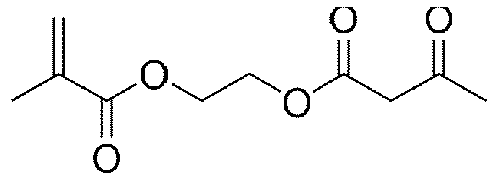
- C1 bis C20 Alkyl(meth)acrylate sind z.B. Methylacrylat und Methylmethacrylat. Hydroxylgruppen enthaltende Monomere sind z.B. C1-C10-Hydroxyalkyl(meth)acrylate. Vinylester von Carbonsäuren mit 1 bis 20 C-Atomen sind z.B. Vinylacetat, Vinyllaurat, Vinylstearat, Vinylpropionat und Versaticsäurevinylester. Als vinylaromatische Verbindungen kommen Vinyltoluol, alpha- und p-Methylstyrol, alpha-Butylstyrol, 4-n-Butylstyrol, 4-n-Decylstyrol in Betracht. Beispiele für Nitrile sind Acrylnitril und Methacrylnitril. Die Vinylhalogenide sind mit Chlor, Fluor oder Brom substituierte ethylenisch ungesättigte Verbindungen, bevorzugt Vinylchlorid und Vinylidenchlorid. Als Vinylether zu nennen sind z.B. Vinylmethylether oder Vinylisobutylether. Bevorzugt sind Vinylether von 1 bis 4 C-Atome enthaltenden Alkoholen. Geeignete Kohlenwasserstoffe mit 4 bis 8 C-Atomen und zwei olefinischen Doppelbindungen sind zum Beispiel Butadien, Isopren und Chloropren.
- Als weitere Monomere (iv) bevorzugt sind Methylacrylat, Methylmethacrylat, Vinylester, insbesondere Vinylacetat und deren Mischungen sowie C2 bis C10 Hydroxyalkyl-(meth)acrylate. Ganz besonders bevorzugt sind Methylacrylat, Methylmethacrylat, Vinylacetat und Hydroxypropylacrylat sowie Mischungen dieser Monomere.
- Bei der Polymerisation können Molekulargewichtsregler eingesetzt werden. Vorzugsweise werden keine Molekulargewichtsregler eingesetzt. Falls Molekulargewichtsregler eingesetzt werden, so erfolgt dies vorzugsweis in Mengen von mindestens 0,01 Gewichtsteilen Molekulargewichtsregler pro 100 Gewichtsteile Monomere, z.B. von 0,01 bis 5 Gew.-Teile, oder von 0,01 bis 3 Gewichtsteilen auf 100 Gew.-Teile der zu polymerisierenden Monomeren. Hierdurch kann durch eine Kettenabbruchsreaktion die Molmasse des Emulsionspolymerisats kontrolliert bzw. verringert werden. Die Regler werden dabei an das Polymer gebunden, im Allgemeinen an das Kettenende. Die Zugabe kann kontinuierlich oder in Stufen während der Polymerisation erfolgen.
- Geeignete Regler sind z.B. organische Verbindungen die Schwefel in gebundener Form enthalten (z.B. Verbindungen mit einer Thiolgruppe), aliphatische und/oder araliphatische Halogenverbindungen, aliphatische und/oder aromatische Aldehyde, ungesättigte Fettsäuren (wie z.B. Ölsäure), Diene mit nicht konjugierten Doppelbindungen (wie z.B. Divinylmethan, Terpinolen oder Vinylcyclohexen), Kohlenwasserstoffe mit leicht abstrahierbaren Wasserstoffatomen (wie z.B. Toluol), organische Säuren bzw. deren Salze (wie z.B. Ameisensäure, Natriumformiat, Ammoniumformiat), Alkohole (wie z.B. Isopropanol) sowie Phosphorverbindungen (wie z.B. Natriumhypophosphit). Es ist aber auch möglich, Gemische sich nicht störender vorgenannter Regler einzusetzen. Bei den Reglern handelt es sich im Allgemeinen um niedermolekulare Verbindungen mit einem Molgewicht kleiner 2000, insbesondere kleiner 1000 g/mol. Günstig ist es, wenn eine Teil- oder die Gesamtmenge der Regler dem wässrigen Reaktionsmedium vor der Initiierung der radikalischen Polymerisation zugeführt wird. Darüber hinaus kann eine Teil- oder die Gesamtmenge der radikalkettenübertragenden Verbindung dem wässrigen Reaktionsmedium vorteilhaft auch gemeinsam mit den Monomeren während der Polymerisation zugeführt werden.
- Organische Verbindungen mit einer Thiolgruppe sind z.B. primäre, sekundäre oder tertiäre aliphatische Thiole, wie beispielsweise Ethanthiol, n-Propanthiol, 2-Propanthiol, n-Butanthiol, 2-Butanthiol, 2-Methyl-2-propanthiol, n-Pentanthiol, 2-Pentanthiol, 3-Pentanthiol, 2-Methyl-2-butanthiol, 3-Methyl-2-butanthiol, n-Hexanthiol, 2-Hexanthiol, 3-Hexanthiol, 2-Methyl-2-pentanthiol, 3-Methyl-2-pentanthiol, 4-Methyl-2-pentanthiol, 2-Methyl-3-pentanthiol, 3-Methyl-3-pentanthiol, 2-Ethylbutanthiol, 2-Ethyl-2-butanthiol, n-Heptanthiol und seine isomeren Verbindungen, n-Octanthiol und seine isomeren Verbindungen, n-Nonanthiol und seine isomeren Verbindungen, n-Decanthiol und seine isomeren Verbindungen, n-Undecanthiol und seine isomeren Verbindungen, n-Dodecanthiol und seine isomeren Verbindungen, n-Tridecanthiol und seine isomeren Verbindungen, substituierte Thiole, wie beispielsweise 2-Hydroxyethanthiol, aromatische Thiole, wie Benzolthiol, ortho-, meta-, oder para-Methylbenzolthiol, Mercaptoalkylcarbonsäureester z.B. von C2- bis C4-Carbonsäuren mit 1 bis 18 C-Atomen in der Alkylgruppe, z.B. 2-Mercaptoethyl-propionat, sowie alle weiteren im Polymerhandbook 3rd edtition, 1989, J. Brandrup und E.H. Immergut, John Wiley & Sons, Abschnitt II, Seiten 133 bis 141, beschriebenen Schwefelverbindungen. Bevorzugte organische Verbindungen, die Schwefel in gebundener Form enthalten sind insbesondere tert.-Butylmercaptan, Thioglycolsäureethylester, Mercaptoethanol, Mercaptopropyltrimethoxysilan, tert.-Dodecylmercaptan, Thiodiglykol, Ethylthioethanol, Di-n-butylsulfid, Di-n-octylsulfid, Diphenylsulfid, Diisopropyldisulfid, 2-Mercaptoethanol, 1,3-Mercaptopropanol, 3-Mercaptopropan-1,2-diol, 1,4-Mercaptobutanol, Thioglykolsäure, 3-Mercaptopropionsäure, Mercaptobernsteinsäure, Thioessigsäure und Thioharnstoff. Besonders bevorzugte Thioverbindungen sind tert.-Butylmercaptan, Thioglycolsäureethylester, Mercaptoethanol, Mercaptopropyltrimethoxysilan oder tert.-Dodecylmercaptan.
- Aliphatische und/oder araliphatische Halogenverbindungen sind z.B. n-Butylchlorid, n-Butylbromid, n-Butyljodid, Methylenchlorid, Ethylendichlorid, Chloroform, Bromoform, Bromtrichlormethan, Dibromdichlormethan, Tetrachlorkohlenstoff, Tetrabromkohlenstoff, Benzylchlorid, Benzylbromid. Aliphatische und/oder aromatische Aldehyde sind z.B. Formaldehyd, Acetaldeyhd, Propionaldehyd und/oder Benzaldehyd.
- Es wurde gefunden, dass die Klebeeigenschafften durch die Menge und Art des Gelgehaltes positiv beeinflusst werden können. Der gesamte Gelgehalt der Haftklebstoffzusammensetzung beträgt mindestens 40 Gew.%, vorzugsweise mindestens 50 Gew.%, mindestens 60 Gew.% oder mindestens 70 Gew.%, bezogen auf den Feststoffgehalt der Zusammensetzung.
- Der Gelgehalt setzt sich zusammen aus einem Gelgehalt, der auf kovalenter, irreversibler Vernetzung der Polymerketten beruht (kovalente Bindungen zwischen Polymerketten) und aus einem Gelgehalt, der auf reversiblen Vernetzung der Polymerketten durch Metallsalze beruht. Die reversible Vernetzung erfolgt dabei nicht über kovalente Bindungen sondern z.B. über lonenbindungen oder Komplexbildung mit mindestens zweiwertigen Metallkationen.
- Der Gelgehalt, der auf einer reversiblen Vernetzung durch Metallsalze beruht beträgt mindestens 10 Gew.%, vorzugsweise mindestens 20 Gew.%, mindestens 25 Gew.% oder mindestens 30 Gew.% oder mindestens 40 Gew.%, bezogen auf den Feststoffgehalt. Der auf reversibler Vernetzung durch Metallsalze beruhende Gelgehalt kann durch Art und Menge der verwendeten Metallkationen bzw. Metallverbindungen eingestellt werden.
- Der Gelgehalt, der auf kovalenter, irreversibler Vernetzung der Polymere beruht, kann 0 bis 50 Gew.%, vorzugsweise maximal 40 Gew.% oder maximal 30 Gew.%, z.B. größer Null bis 40 Gew.% oder 1 bis 30 Gew.%, bezogen auf den Feststoffgehalt betragen. Der auf kovalenter, irreversibler Vernetzung der Polymere beruhende Gelgehalt kann durch Verwendung von geringen Mengen an Molekulargewichtsreglern und/oder durch Verwendung von Styrol als Comonomer eingestellt werden. Vorzugsweise wird kein Molekulargewichtsregler verwendet und die Menge an Styrol beträgt dann mindestens 5 Gewichtsteile, bezogen auf die Summe aller Monomere.
- Die Metallsalzvernetzung kann durch Zugabe geeigneter Metallsalze nach der Polymerisation erfolgen. Die Metallsalze werden vorzugsweise eingesetzt in einem molaren Verhältnis von Metall-Kation bezogen auf Carboxylatgruppen des Polymers, von 1 bis 300 mol-%, vorzugsweise von 1 bis 100 mol-%, besonders bevorzugt 1 bis 50 mol-%.
- Geeignete Metallsalze sind z.B. solche mit den Metallkationen Al3+, Zn2+, Ti4+, Ca2+, Fe2+, Fe3+ und Zr4+. Geeignete Gegenionen sind z.B. Acetylacetonate, Hydroxide, Oxalate, Lactat, Gycinat, Acetat und auch Carboxylatgruppen oder 2-(Methacryloyloxy)-ethyl acetoacetatgruppen aufweisende Acrylatoligomere mit einer Molmasse bis 50.000 g/mol. Geeignete Metallsalze sind z.B. Aluminiumacetylacetonat Al(acac)3, Titandiisopropoxid-bis(acetylacetonat) Ti(acac)2OiPr2, Diammonium-bis[carbonato-O]-dihydroxyzirconat (Bacote® 20), Eisen(II)oxalat, Calciumhydroxid oder Zinkhydroxid, z.B. Zn(OH)2/NH3. Besonders bevorzugt ist das Metallsalz ausgewählt aus Zinksalzen und Aluminiumsalzen, vorzugsweise den Acetylacetonaten, insbesondere Al(acac)3.
- Bevorzugte Metallsalze haben eine Wasserlöslichkeit von kleiner als 10 g/l (bei 25 °C).
- Die Metallsalzvernetzung kann auch durch direkten Einbau von Metallsalzen während der Emulsionspolymerisation durch Copolymerisation mit geeigneten metallorganischen Comonomeren erfolgen. Die Menge an solchen metallorganischen Comonomeren beträgt vorzugsweise 0,1 bis 3 Gew.%, besonders bevorzugt von 0,1 bis 2,5 Gew.% bezogen auf die Summe aller Monomere.
- Geeignete metallorganische Comonomere sind z.B. Aluminiumacrylat Al(AS)3, Aluminummethacrylat Al(MAS)3, Zinkacrylat Zn(AS)2, Zinkmethacrylat Zn(MAS)2, Titan(IV)-acrylat und Titan(IV)methacrylat. Besonders bevorzugt sind Zink(meth)acrylat und Aluminium(meth)acrylat, insbesondere Zinkmethacrylat.
- Die die reversible Vernetzung bewirkenden Metallsalze werden in nicht beschichteter Form eingesetzt werden, sodass die reversible Metallsalzvernetzung bereits in der wässrigen Polymerdispersion erfolgen kann und nicht durch eine Beschichtung der Metallsalze z.B., in Form einer Wachsschicht verhindert wird. Es wurde gefunden, dass die erfindungsgemäßen Haftklebstoffzusammensetzungen lagerstabil sind, d.h. nicht koagulieren oder mit der Zeit erhöhte Viskosität aufbauen. Lagerstabil bedeutet insbesondere, dass die Viskosität bei Lagerung in einem Zeitraum von 5 Tagen bei 20 °C die Viskositätsänderung kleiner ist als 100%, bezogen auf die Ausgangsviskosität. Vorzugsweise überschreitet der Anteil an Koagulatbildung (abfiltrierbar mit einem Filter mit 250 µm Maschenbreite) nicht 5 Gew.-%, bezogen auf den Feststoffgehalt der Dispersion.
- Eine besonders bevorzugte Haftklebstoffzusammensetzung in Form einer wässrigen Polymerdispersion enthält mindestens ein Haftklebstoffpolymer, welches gebildet ist aus
- (i) mindestens 65 Gew.% bezogen auf die Summe der Monomere, mindestens eines Acrylsäureestermonomers ausgewählt aus n-Butylacrylat und 2-Ethylhexylacrylat,
- (ii) 0,5 bis 8 Gew.%, bezogen auf die Summe der Monomere, Methacrylsäure,
- (iii) 0 bis 30 Gew.%, bezogen auf die Summe der Monomere, Styrol,
- (iv) 0 bis 10 Gew.%, bezogen auf die Summe der Monomere, Monomere ausgewählt aus der Gruppe bestehend aus von den Monomeren (i) bis (iii) verschiedenen C1 bis C20 Alkyl(meth)acrylaten, Hydroxylgruppen enthaltende Monomere, Vinylestern von bis zu 20 C-Atome enthaltenden Carbonsäuren, Vinylaromaten mit bis zu 20 C-Atomen, ethylenisch ungesättigten Nitrilen, Vinylhalogeniden, Vinylethern von 1 bis 10 C Atome enthaltenden Alkoholen, aliphatischen Kohlenwasserstoffen mit 2 bis 8 C Atomen und ein oder zwei Doppelbindungen,
- Die erfindungsgemäßen Klebstoffpolymere sind durch radikalische Polymerisation von ethylenisch ungesättigten Verbindungen (Monomeren) erhältlich. Die Herstellung der Polymere erfolgt vorzugsweise durch Emulsionspolymerisation, es handelt sich daher vorzugsweise um Emulsionspolymerisate. Gegenstand der Erfindung sind deshalb auch Haftklebstoffdispersionen, enthaltend ein in Wasser dispergiertes, durch Emulsionspolymerisation hergestelltes erfindungsgemäßes Haftklebstoffpolymer.
- Bei der Emulsionspolymerisation werden ethylenisch ungesättigte Verbindungen (Monomere) in Wasser polymerisiert, wobei ionische und/oder nichtionische Emulgatoren und/oder Schutzkolloide bzw. Stabilisatoren als grenzflächenaktive Verbindungen zur Stabilisierung der Monomertröpfchen und der später aus den Monomeren gebildeten Polymerteilchen verwendet werden. Die grenzflächenaktiven Substanzen werden üblicherweise in Mengen von 0,1 bis 10 Gew.-Teilen, vorzugsweise 0,2 bis 5 Gew.-Teilen bezogen auf 100 Gew.-Teile der zu polymerisierenden Monomeren verwendet.
- Eine ausführliche Beschreibung geeigneter Schutzkolloide findet sich in Houben-Weyl, Methoden der organischen Chemie, Band XIV/1, Makromolekulare Stoffe, Georg-Thieme-Verlag, Stuttgart, 1961, S. 411 bis 420. Als Emulgatoren kommen sowohl anionische, kationische als auch nichtionische Emulgatoren in Betracht. Vorzugsweise werden als grenzflächenaktive Substanzen Emulgatoren eingesetzt, deren Molekulargewicht im Unterschied zu den Schutzkolloiden üblicherweise unter 2000 g/mol liegen. Selbstverständlich müssen im Falle der Verwendung von Gemischen grenzflächenaktiver Substanzen die Einzelkomponenten miteinander verträglich sein, was im Zweifelsfall an Hand weniger Vorversuche überprüft werden kann. Vorzugsweise werden anionische und nichtionische Emulgatoren als grenzflächenaktive Substanzen verwendet. Gebräuchliche begleitende Emulgatoren sind z.B. ethoxylierte Fettalkohole (EO-Grad: 3 bis 50, Alkylrest: C8- bis C36), ethoxylierte Mono-, Di- und Trialkylphenole (EO-Grad: 3 bis 50, Alkylrest: C4- bis C9), Alkalimetallsalze von Dialkylestern der Sulfobernsteinsäure sowie Alkali- und Ammoniumsalze von Alkylsulfaten (Alkylrest: C8- bis C12), von ethoxylierten Alkanolen (EO-Grad: 4 bis 30, Alkylrest: C12- bis C18), von ethoxylierten Alkylphenolen (EO-Grad: 3 bis 50, Alkylrest: C4- bis C9), von Alkylsulfonsäuren (Alkylrest: C12- bis C18) und von Alkylarylsulfonsäuren (Alkylrest: Cg- bis C18).
- Weitere geeignete Emulgatoren sind Verbindungen der allgemeinen Formel

- Die Emulsionspolymerisation kann mit wasserlöslichen Initiatoren gestartet werden. Wasserlösliche Initiatoren sind z.B. Ammonium- und Alkalimetallsalze der Peroxodischwefelsäure, z.B. Natriumperoxodisulfat, Wasserstoffperoxid oder organische Peroxide, z.B. tert-Butylhydroperoxid. Als Initiator geeignet sind auch so genannte Reduktions-Oxidations(Red-Ox)-Initiator Systeme. Die Red-Ox-Initiator-Systeme bestehen aus mindestens einem meist anorganischen Reduktionsmittel und einem anorganischen oder organischen Oxidationsmittel. Bei der Oxidationskomponente handelt es sich z.B. um die bereits vorstehend genannten Initiatoren für die Emulsionspolymerisation. Bei der Reduktionskomponenten handelt es sich z.B. um Alkalimetallsalze der schwefligen Säure, wie z.B. Natriumsulfit, Natriumhydrogensulfit, Alkalisalze der dischwefligen Säure wie Natriumdisulfit, Bisulfitadditionsverbindungen aliphatischer Aldehyde und Ketone, wie Acetonbisulfit oder Reduktionsmittel wie Hydroxymethansulfinsäure und deren Salze, oder Ascorbinsäure. Die Red-Ox-Initiator-Systeme können unter Mitverwendung löslicher Metallverbindungen, deren metallische Komponente in mehreren Wertigkeitsstufen auftreten kann, verwendet werden. Übliche Red-Ox-Initiator-Systeme sind z.B. Ascorbinsäure/Eisen(II)sulfat/Natriumperoxidisulfat, tert-Butylhydroperoxid/ Natriumdisulfit, tert-Butylhydroperoxid/Na-Hydroxymethansulfinsäure. Die einzelnen Komponenten, z.B. die Reduktionskomponente, können auch Mischungen sein z.B. eine Mischung aus dem Natriumsalz der Hydroxymethansulfinsäure und Natriumdisulfit.
- Die genannten Initiatoren werden meist in Form wässriger Lösungen eingesetzt, wobei die untere Konzentration durch die in der Dispersion vertretbare Wassermenge und die obere Konzentration durch die Löslichkeit der betreffenden Verbindung in Wasser bestimmt ist. Im Allgemeinen beträgt die Konzentration der Initiatoren 0,1 bis 30 Gew.-%, bevorzugt 0,5 bis 20 Gew.-%, besonders bevorzugt 1,0 bis 10 Gew.-%, bezogen auf die zu polymerisierenden Monomeren. Es können auch mehrere, verschiedene Initiatoren bei der Emulsionspolymerisation Verwendung finden.
- Die Emulsionspolymerisation erfolgt in der Regel bei 30 bis 130°C, vorzugsweise bei 50 bis 95°C. Das Polymerisationsmedium kann sowohl nur aus Wasser, als auch aus Mischungen aus Wasser und damit mischbaren Flüssigkeiten wie Methanol bestehen. Vorzugsweise wird nur Wasser verwendet. Die Emulsionspolymerisation kann sowohl als Batchprozess als auch in Form eines Zulaufverfahrens, einschließlich Stufen- oder Gradientenfahrweise, durchgeführt werden. Bevorzugt ist das Zulaufverfahren, bei dem man einen Teil des Polymerisationsansatzes vorlegt, auf die Polymerisationstemperatur erhitzt, anpolymerisiert und anschließend den Rest des Polymerisationsansatzes, üblicherweise über mehrere räumlich getrennte Zuläufe, von denen einer oder mehrere die Monomeren in reiner oder in emulgierter Form enthalten, kontinuierlich, stufenweise oder unter Überlagerung eines Konzentrationsgefälles unter Aufrechterhaltung der Polymerisation der Polymerisationszone zuführt. Bei der Polymerisation kann auch z.B. zur besseren Einstellung der Teilchengröße eine Polymersaat vorgelegt werden.
- Die Art und Weise, in der der Initiator im Verlauf der radikalischen wässrigen Emulsionspolymerisation dem Polymerisationsgefäß zugegeben wird, ist dem Durchschnittsfachmann bekannt. Es kann sowohl vollständig in das Polymerisationsgefäß vorgelegt, als auch nach Maßgabe seines Verbrauchs im Verlauf der radikalischen wässrigen Emulsionspolymerisation kontinuierlich oder stufenweise eingesetzt werden. Im Einzelnen hängt dies von der chemischen Natur des Initiatorsystems als auch von der Polymerisationstemperatur ab. Vorzugsweise wird ein Teil vorgelegt und der Rest nach Maßgabe des Verbrauchs der Polymerisationszone zugeführt. Zur Entfernung der Restmonomeren wird üblicherweise auch nach dem Ende der eigentlichen Emulsionspolymerisation, d.h. nach einem Umsatz der Monomeren von mindestens 95 % Initiator zugesetzt. Die einzelnen Komponenten können dem Reaktor beim Zulaufverfahren von oben, in der Seite oder von unten durch den Reaktorboden zugegeben werden.
- Bei der Emulsionspolymerisation werden wässrige Dispersionen des Polymeren in der Regel mit Feststoffgehalten von 15 bis 75 Gew.-%, bevorzugt von 40 bis 75 Gew.-% erhalten. Für eine hohe Raum/Zeitausbeute des Reaktors sind Dispersionen mit einem möglichst hohen Feststoffgehalt bevorzugt. Um Feststoffgehalte > 60 Gew.-% erreichen zu können, sollte man eine bi- oder polymodale Teilchengröße einstellen, da sonst die Viskosität zu hoch wird, und die Dispersion nicht mehr handhabbar ist. Die Erzeugung einer neuen Teilchengeneration kann beispielsweise durch Zusatz von Saat (
EP 81083 - Das so hergestellte Polymer wird vorzugsweise in Form seiner wässrigen Dispersion verwendet. Die Größenverteilung der Dispersionsteilchen kann monomodal, bimodal oder multimodal sein. Unter mittlerer Teilchengröße wird hier der d50-Wert der Teilchengrößenverteilung verstanden, d.h. 50 Gew.-% der Gesamtmasse aller Teilchen haben einen kleineren Teilchendurchmesser als der d50-Wert. Die Teilchengrößenverteilung kann in bekannter Weise mit der analytischen Ultrazentrifuge (W. Mächtle, Makromolekulare Chemie 185 (1984), Seite 1025 - 1039) bestimmt werden. Bei bi- oder multimodaler Teilchengrößenverteilung kann die Teilchengröße bis zu 1000 nm betragen. Der pH-Wert der Polymerdispersion wird vorzugsweise auf pH größer 4,5, insbesondere auf einen pH-Wert zwischen 5 und 8 eingestellt.
- Eine erfindungsgemäße Haftklebstoffzusammensetzung enthält die Haftklebstoffpolymere vorzugsweise in Form der wässrigen Polymerdispersion, wie sie durch die Emulsionspolymerisation erhalten wurde oder erhältlich ist. Die Haftklebstoffzusammensetzungen können allein aus den Polymeren bzw. der wässrigen Dispersion der Polymeren bestehen. Der Haftklebstoff kann jedoch auch noch weitere Zusatzstoffe enthalten, z.B. Füllstoffe, Farbstoffe, Verlaufsmittel, Verdicker, vorzugsweise Assoziativverdicker, Entschäumer, Vernetzer, Weichmacher, Pigmente oder Netzmittel. Für eine bessere Benetzung von Oberflächen können die Haftklebstoffe insbesondere Benetzungshilfsmittel (Netzmittel), z. B. Fettalkoholethoxylate, Alkylphenolethoxylate, Nonylphenolethoxylate, Polyoxyethylene/-propylene oder Natriumdodecylsulfonate enthalten. Die Menge an Zusatzstoffen beträgt im allgemeinen 0,05 bis 5 Gew.-Teile, insbesondere 0,1 bis 3 Gew.-Teile auf 100 Gew.-Teile Polymer (fest).
- Vorzugsweise enthält die Haftklebstoffzusammensetzung mindestens einen Tackifier (klebrigmachende Harze) in einer Menge von vorzugsweise 5 bis 40 Gewichtsteilen, bezogen auf 100 Gewichtsteile Klebstoffpolymer. Ein Tackifier ist ein polymerer oder oligomerer Zusatzstoff für Klebstoffpolymere oder allgemein für Elastomere, der deren Autoadhäsion (Tack, Eigenklebrigkeit, Selbsthaftung) erhöht, sodass sie nach kurzem leichten Andruck fest auf Oberflächen haften. Tackifier sind z.B. Naturharze, wie Kolophoniumharze und deren durch Disproportionierung oder Isomerisierung, Polymerisation, Dimerisation, Hydrierung entstehenden Derivate oder Terpenharze. Diese können in ihrer Salzform (mit z.B. ein- oder mehrwertigen Gegenionen (Kationen) oder bevorzugt in ihrer veresterten Form vorliegen. Alkohole, die zur Veresterung verwendet werden, können ein-oder mehrwertig sein. Beispiele sind Methanol, Ethandiol, Diethylenglykol, Triethylenglykol, 1,2,3-Propanthiol, Pentaerythrit. Des weiteren finden auch Kohlenwasserstoffharze, z.B. Cumaron-Inden-Harze, Polyterpen-Harze, Kohlenwasserstoffharze auf Basis ungesättigter CH-Verbindungen, wie Butadien, Penten, Methylbuten, Isopren, Piperylen, Divinylmethan, Pentadien, Cyclopenten, Cyclopentadien, Cyclohexadien, Styrol, alpha-Methylstyrol, Vinyltoluol Verwendung. Tackifier sind z.B. aus Adhesive Age, Juli 1987, Seite 19-23 oder Polym. Mater. Sci. Eng. 61 (1989), Seite 588-592 bekannt.
- Als Tackifier werden zunehmend auch Polyacrylate, welche ein geringes Molgewicht aufweisen, verwendet. Vorzugsweise haben diese Polyacrylate ein gewichtsmittleres Molekulargewicht Mw unter 50000, insbesondere unter 30 000. Die Polyacrylate bestehen bevorzugt zu mindestens 60, insbesondere mindestens 80 Gew.-% aus C1-C8 Alkyl(meth)acrylaten. Geeignet sind z.B. die in der
WO 2013/117428 beschriebenen niedrigmolekularen Polymerisate und Oligomere mit einem gewichtsmittleren Molekulargewicht von weniger als 50000 und einer Glasübergangstemperatur von größer oder gleich -40 °C bis kleiner oder gleich 0 °C, vorzugsweise von größer oder gleich -35°C, bis kleiner oder gleich 0 °C, herstellbar durch Emulsionspolymerisation in Gegenwart mindestens eines Molekulargewichtsreglers und herstellbar aus einem Monomergemisch enthaltend mindestens 40 Gew.% mindestens eines C1- bis C20-Alkyl(meth)acrylats. - Bevorzugte Tackifier sind natürliche oder chemisch modifizierte Kolophoniumharze. Kolophoniumharze bestehen zum überwiegenden Teil aus Abietinsäure oder Abietinsäurederivaten. Die Tackifier können in einfacher Weise der Polymerdispersion zugesetzt werden. Vorzugsweise liegen die Tackifier dabei selber in Form einer wässrigen Dispersion vor. Die Gewichtsmenge der Tackifier beträgt vorzugsweise 5 bis 100 Gew.-Teile, besonders bevorzugt 10 bis 50 Gew.-Teile. bezogen auf 100 Gew.-Teile Polymer (fest/fest).
- Vorzugsweise enthält die Haftklebstoffzusammensetzung
- 60 - 95 Gewichtsteile Haftklebstoffpolymer,
- 5 - 40 Gewichtsteile Tackifier und
- optional 0 - 10 Gewichtsteile weitere Bestandteile wie z.B. die oben genannten Netzmittel, Verdicker, Entschäumer, Vernetzer, etc..
- Die Einkomponenten-Haftklebstoffzusammensetzung kann zur Herstellung von selbstklebenden Artikeln verwendet werden. Die Artikel sind zumindest teilweise mit dem Haftklebstoff beschichtet. Die Klebeeigenschaften können so eingestellt werden, dass die selbstklebenden Artikel nach der Verklebung wiederabziehbar sind. Bei den selbstklebenden Artikeln kann es sich z.B. um Klebeetiketten, Klebebändern oder Klebefolien handeln. Geeignete Trägermaterialien sind z.B. Papier, Kunststofffolien und Metallfolien. Bei erfindungsgemäßen selbstklebenden Bändern kann es sich um einseitig oder beidseitig beschichtete Bänder aus den obigen Substanzen handeln. Bei erfindungsgemäßen selbstklebenden Etiketten kann es sich um Etiketten aus Papier oder einer thermoplastischen Folie handeln. Besonders bevorzugt sind Klebebänder aus thermoplastischer Folie. Als thermoplastische Folie kommen z.B. Folien aus Polyolefinen (z.B. Polyethylen, Polypropylen), Polyolefincopolymeren, Folien aus Polyestern (z.B. Polyethylenterephtalat), Polyvinylchlorid oder Polyacetat in Betracht. Die Oberflächen der thermoplastischen Polymerfolien sind vorzugweise coronabehandelt. Die Etiketten sind einseitig mit Klebstoff beschichtet. Bevorzugte Substrate für die selbstklebenden Artikel sind Papier und Polymerfolien.
- Die selbstklebenden Artikel sind auf mindestens einer Oberfläche zumindest teilweise mit einem erfindungsgemäßen Haftklebstoff beschichtet. Der Klebstoff kann nach üblichen Methoden wie Rollen, Rakeln oder Streichen auf die Artikel aufgetragen werden. Die Auftragsmenge beträgt bevorzugt 0,1 bis 300 g, besonders bevorzugt 2 bis 150 g Feststoff pro m2. Nach dem Auftragen folgt im Allgemeinen ein Trocknungsschritt zur Entfernung des Wasser bzw. der Lösungsmittel. Das Wasser kann durch Trocknung bei z.B. 50 bis 150°C entfernt werden. Die so erhaltenen, beschichteten Substrate werden z.B. als Selbstklebeartikel, wie Klebeetiketten, Klebebänder oder Klebefolien verwendet. Die Träger können hierzu vor oder nach dem Aufbringen des Klebstoffs zu Klebebändern, Etiketten oder Folien geschnitten werden. Zur späteren Verwendung kann die mit Haftklebstoff beschichtete Seite der Substrate, mit einem Releasepapier, z.B. mit einem silikonisierten Papier, abgedeckt werden.
- Bei den Substraten, auf welche die selbstklebenden Artikel vorteilhaft aufgebracht werden können, kann es sich z.B. um Metall, Holz, Glas, Papier oder Kunststoff handeln. Die selbstklebenden Artikel eignen sich insbesondere zum Verkleben auf Verpackungsoberflächen, Kartons, Kunststoffverpackungen, Bücher, Fenster, Dampfsperren, Kraftfahrzeugkarosserien, Reifen oder Karosserieteilen.
- Die Erfindung betrifft auch die Verwendung der oben beschriebenen Einkomponenten-Haftklebstoffzusammensetzung zur Herstellung von Klebeetiketten, Klebebändern oder Klebefolien.
- Die Erfindung betrifft auch selbstklebende Artikel, beschichtet mit einer oben beschriebenen Einkomponenten-Haftklebstoffzusammensetzung.
- Die Erfindung betrifft auch ein Verfahren zur Herstellung eines selbstklebenden Artikels indem ein Substrat beschichtet wird mit einer oben beschriebenen Einkomponenten-Haftklebstoffzusammensetzung.
- Es werden folgende Einsatzstoffe und Abkürzungen verwendet:
- EHA:
- 2-Ethylhexylacrylat
- BA:
- n-Butylacrylat
- EA:
- Ethylacrylat
- MA
- Methylacrylat
- MMA
- Methylmethacrylat
- VAc:
- Vinylacetat
- S:
- Styrol
- HPA
- Hydroxypropylacrylat
- AS:
- Acrylsäure
- MAS
- Methacrylsäure
- BDA-2
- Butandioldiacrylat (Vernetzer für kovalente, irreversible Vernetzung)
- tDMK
- tert.-Dodecylmercaptan
- EHTG
- 2-Ethlhexylthioglykolat
- Al(acac)3
- Aluminiumacetylacetonat
- Rongalit®
- Natrium-hydroxymethylsulfinat
- Acronal® 310 S
- Acrylatcopolymer aus (Meth)acrylsäureestern und Acrylsäure mit einem Gelgehalt von 67,5%
- Acronal® 4D
- Acrylatcopolymer aus (Meth)acrylsäureestern und Acrylsäure mit einem Gelgehalt von 65%
- Acronal® 50D
- Acrylatcopolymer aus (Meth)acrylsäureestern, Acrylnitril und Acrylsäure mit einem Gelgehalt von 79%
- Raumtemperatur bezieht sich auf 20°C, sofern nicht etwas anderes angegeben ist.
- Die mit V... bezeichneten Beispiele sind Vergleichsbeispiele, die mit E... bezeichneten Beispiele sind erfindungsgemäße Beispiele.
- Aus der zu untersuchenden Polymerdispersion werden Polymerfilme hergestellt. Die Polymerfilme werden 1 Tag bei Raumtemperatur (20 °C) und anschließend 4 Tage bei 50°C getrocknet. Der getrocknete Film wird mit der 99fachen Masse an Methylethylketon versetzt. Der eingelegte Film wird für 4 Tage bei Raumtemperatur gelagert. Dann wird der gequollene oder gelöste Film über tariertem 125 µm Perlonfilter abfiltriert. Der Filter wird bei Raumtemperatur getrocknet, bis er frei von Lösungsmittel ist. Dann wird nochmals für 1 Stunde bei 50 °C nachgetrocknet und der Gelanteil (im Filter verbleibender, in Methylethylketon unlöslicher Feststoffanteil) durch Auswiegen bestimmt.
- Der Gesamtgelgehalt (Gelgesamt) wird nach der Zugabe von Metallvernetzer bestimmt. Der auf kovalenter, irreversibler Vernetzung beruhende Gelgehalt (Gelirreversibel) wird vor der Zugabe von Metallvernetzer bestimmt. Der auf reversibler Vernetzung durch Metallsalze beruhende Gelgehalt (Gelreversibel) ist die Differenz von Gesamtgelgehalt und irreversiblem Gelgehalt:

- Zur Prüfung der Klebeeigenschaften werden die Haftklebstoffe mit einer Auftragsmenge von ca. 60 g/m2 auf Hostaphan® RN 36 (biaxial orientierte Folie aus Polyethylenterephtalat, 36 µm Dicke) als Träger beschichtet und 3 Minuten bei 90°C getrocknet. Mit Metallsalz vernetzte Dispersionsfilme werden 5 Tage bei Normklima (23 °C, 50% relative Luftfeuchtigkeit) gelagert, nicht mit Metallsalz versetzte Dispersionsfilme werden 24h bei Normklima gelagert und dann die Klebeeigenschaften bei Normklima bestimmt, sofern nichts anderes angegeben ist.
- Bei der Bestimmung des Quickstick (Oberflächenklebrigkeit, auch Loop Tack genannt) wird im Allgemeinen die Kraft bestimmt, die ein auf ein Trägermaterial aufgebrachter Klebstoff durch Verklebung ohne Druck auf ein Substrat bei einer definierten Abzugsgeschwindigkeit dem Abziehen vom Substrat entgegensetzt. Prüfsubstrate sind Stahl oder Polyethylen. Aus dem mit Klebstoff beschichteten Träger wird ein Prüfstreifen in 25 mm Breite und 250 mm Länge geschnitten und mindestens 16 Stunden bei Normklima (23°C, 50% rel. Luftfeuchte) gelagert. Die beiden Enden des Prüfstreifens werden auf ca. 1 cm Länge mit der Klebeseite nach innen umgeklappt. Aus dem Klebstreifen wird eine Schlaufe mit der Klebseite nach außen gebildet, die beiden Enden zusammengefasst und in die obere Klemme einer Zugprüfmaschine eingespannt. In die untere Klemme wird die Prüfsubstrathalterung eingespannt. Die Klebestreifenschlaufe wird durch die Zugprüfmaschine mit einer Geschwindigkeit von 300 mm/Minute nach unten gefahren, sodass die Klebseite des Prüfstreifens mit dem Substrat ohne zusätzlichen Druck verklebt. Die Zugprüfmaschine wird gestoppt und sofort wieder nach oben gefahren, wenn sich die Unterkante der oberen Klemme 40 mm über dem Substrat befindet. Die Angabe des Prüfergebnisses erfolgt in N/25 mm Breite. Es wird der höchste Wert der Anzeige (Fmax) als Maß der Oberflächenklebrigkeit abgelesen. Aus drei Einzelergebnissen wird ein Mittelwert gebildet.
- Bei der Bestimmung der Schälfestigkeit (Adhäsion) wird jeweils ein 25 mm breiter Prüfstreifen auf einen Prüfkörper aus Polyethylen oder Stahl geklebt und mit einer 1 kg schweren Rolle 1-mal angerollt. Er wurde dann mit einem Ende in die oberen Backen einer Zug-Dehnungs-Prüfapparatur eingespannt. Der Klebestreifen wurde mit 300 mm/min unter einem 180° Winkel von der Prüffläche abgezogen d.h. der Klebestreifen wurde umgebogen und parallel zum Prüfkörper abgezogen und der dazu benötigte Kraftaufwand gemessen. Das Maß für die Schälfestigkeit war die Kraft in N/25 mm, die sich als Durchschnittswert aus fünf Messungen ergab. Die Schälfestigkeit wurde 24 Stunden nach der Verklebung bestimmt. Nach dieser Zeit hat sich die Klebekraft voll ausgebildet. Die Testmethoden entsprechen im Wesentlichen den Finat-Testmethoden (FTM) Nr. 1 und Nr. 8.
- Die Scherfestigkeit ist ein Maß für die Kohäsion. Der mit Haftklebstoff beschichtete Träger wird in 25 mm bzw. 12,5 mm breite Prüfstreifen geschnitten. Zur Bestimmung der Scherfestigkeit werden die Prüfstreifen mit einer verklebten Fläche von 25x25 mm (Messungen bei 70°C) oder 12,5x12,5 mm (Messungen bei Normklima) auf Stahl geklebt und mit einer 1 kg schweren Rolle einmal angerollt, 10 min gelagert (im Normklima, 50 % rel. Luftfeuchtigkeit, 1 bar, 23 °C) und anschließend hängend mit einem 1 kg Gewicht (im Normklima, 12,5x12,5 mm) oder mit einem 2 kg Gewicht (bei 70°C, 25x25 mm) belastet. Das Maß für die Scherfestigkeit ist die Zeit in Minuten bis zum Abfallen des Gewichts; es wird jeweils der Durchschnitt aus 5 Messungen berechnet.
- Die Scherfestigkeit 3 d/70°C [h] ist die Scherfestigkeit nach Lagerung der Prüfstreifen für 3 Tage bei 70°C.
- Die Prüfstreifen werden mit einer verklebten Fläche von 25 x 25 mm auf AFERA-Stahl geklebt, mit einer 2 kg schweren Rolle 4 mal angerollt und nach mindestens 16 Stunden Kontaktzeit hängend mit einem 1 kg Gewicht belastet. Während der Belastung wird ausgehend von 23°C kontinuierlich mit einer Rate von 0,5°C / min aufgeheizt. Die beim Abfallen des Gewichtes erreichte Aufheiztemperatur ist ein Maß für die Wärmestandfestigkeit des Klebstoffs. Es wurde jeweils der Durchschnitt aus 3 Messungen berechnet.
- Weichmacherbeständigkeit ist die Fähigkeit eines Klebstoffes, einer eventuellen Wanderung von Weichmacherteilchen aus einer Weich-PVC-Folie in den Klebstoff zu entgegnen. Der durch die Weichmacherwanderung entstehende Volumenverlust bewirkt ein Schrumpfen der Weich-PVC-Folie.
Der zu prüfende Klebstoff wird mittels eines Laborbeschichtungstisches mit einer Auftragsmenge von ca. 22 g/m2 (trocken) auf ein Hilfsträgermaterial (Silikonpapier NSA 1370 weiss, Fa. Laufenberg) aufgezogen und 3 Minuten bei 90° C im Umlufttrockenschrank getrocknet. Nach dem Trocknungsvorgang wird der Klebstoff vom Hilfsträgermaterial auf das endgültige Trägermaterial (Monomer-weichgemachte PVC-Folie H935693, weiss, der Firma Renolit) übertragen und dann wieder mit Silikonpapier abgedeckt. Nach 5 Tagen Lagerung bei Normklima (23° C, 50% relative Luftfeuchtigkeit) wird das Silikonpapier abgezogen und das beschichtete Trägermaterial auf eine Glasplatte (250 mm x 250 mm x 4 mm) blasenfrei verklebt und angerollt. Dabei ist die Laufrichtung der Folie zu beachten und zu kennzeichnen. Die an der Glasplatte überstehenden Folienränder werden mit einem Kartonmesser bündig abgeschnitten. Die verklebte Folie wird nun mit einer Rasierklinge einer Dicke von 0,043 mm in der Mitte in Längsrichtung (Laufrichtung der Folie, Maschinenrichtung) und in Querrichtung (quer zu Maschinenrichtung) mit je einem Schnitt geteilt, sodass vier gleich große Quadrate entstehen. Die verklebte Glasplatte wird anschließend bei 70°C 5 Tage gelagert. Nach der Lagerung wird die Glasplatte aus dem Trockenschrank genommen und bei Raumtemperatur etwa 1 Stunde abgekühlt. Mit einer Lupe mit einer 10 fachen Vergrößerung und einer Skalierung von 10 Skt/mm wird die Breite des horizontalen und vertikalen Schnittspaltes an jeweils mindestens 2 verschiedenen Stellen gemessen. Als Prüfergebnisse werden die Mittelwerte der Einzelwerte für jede Richtung in mm angegeben. - Es wird ein Laminatbogen (25 x 25 cm) angefertigt und 5 Tage im Normklima (23° C, 50% relative Luftfeuchtigkeit) konditioniert. Der Laminatbogen besteht aus einem Silikonpapier-Hilfsträger, der Klebstoffschicht und dem Trägermaterial (Monomer-weichgemachte PVC-Folie, Renolit). Die Auftragsmenge des Klebstoffs beträgt ca. 22 g/m2 (trocken)
Nach Wärmelagerung (3 Tage bei 70 °C) wird der Schrumpf in der Länge (= Maschinenrichtung) und Breite (= Querrichtung) mittels Lupe gemessen und in % angegeben. - Beschichten einer OPP Folie (biaxial orientiertes Polypropylen, Foliendicke 45 µm) mit einem Zielauftragsgewicht (trocken) von ca. 20 g/m2.
Trocknung des Films bei 90 °C für 3 min.
Abdecken der Beschichtung mit Silikonpapier, Lagerung der Beschichtung für 24 h. Entnahme einer Probe mit ca. 8 mm Breite und 30 mm Länge.
Transfer der Probe in eine mit vollentsalztem Wasser befüllte PS Küvette, Schichtdicke 1 cm. Sofortige Messung der Absorption gegen unbeschichtete Vergleichsprobe, OPP Folie in vollentsalztem Wasser, im Wellenlängenbereich 300-700 nm. Anschließend weitere Messungen alle 5 min über einen Zeitraum von 6 Stunden. Umrechnung der Absorption in Trübung. - Vergleichsproben V1 bis V3: nur kovalente, irreversible Vernetzung Erfindungsgemäße Proben E1 bis E4b: kovalente Vernetzung kleiner 50%, mit nachträglicher Metallsalzvernetzung
- Es werden Emulsionspolymerisate eingesetzt, hergestellt aus den in Tabelle 1 genannten Monomeren und im Gewichtsverhältnis 75:25 (fest:fest Polymer zu Tackifier) mit Tackifier Snowtack® 933 (Rosinester Dispersion) versetzt. Die Mengenangaben sind Gewichtsteile. Die mit V... bezeichneten Beispiele sind Vergleichsbeispiele, die mit E... bezeichneten Beispiele sind erfindungsgemäße Beispiele.
Tabelle 1a: Emulsionspolymerisate Beispiel EHA BA S MA MAS BDA-2 Al(acac)3 [pphm] tDMK V1 59 15 20 5 1 0,07 - - E1 59 15 20 5 1 - 0,25 - V2 59 15 20 5 1 0,1 - - E2 59 15 20 5 1 - 0,375 - V3 59 15 20 5 1 0,25 - - E3 59 15 20 5 1 - 1 - V41) 97,5 - - - 2,5 - - - E4a2) 97,5 - - - 2,5 - 0,5 0,15 E4b2) 97,5 - - - 2,5 - 1 0,15 1) Initiator Natriumpersulfat 2) Redoxinitiator tert-Butylhydroperoxid/Rongalit® Tabelle 1b: Gelgehalte und Glasübergangstemperatur Beispiel Gelirreversibel [%] Gelgesamt [%] Tg [°C] V1 55,9 55,9 ca. -30 E1 < 5 45,1 ca. -30 V2 68,8 68,8 ca. -30 E2 < 5 67,2 ca. -30 V3 85,6 85,6 ca. -30 E3 < 5 87,7 ca. -30 V4 75 75 ca. -55 E4a 29 nb ca. -55 E4b 29 62,5 ca. -55 - Es wurden Klebefolien hergestellt und die Klebewerte gemessen (Quickstick, Schälfestigkeit, Scherfestigkeit, Wärmestandfestigkeit S.A.F.T.-Test). Die Ergebnisse sind in Tabelle 1c dargestellt.
Tabelle 1c: Anwendungstechnische Ergebnisse Beispiel Quickstick [N/25mm] Schälfestigkeit [N/25mm] Scherfestigkeit [h] S.A.F.T. [°C] Stahl PE Stahl PE NKL 70°C V1 14,9 12,6 15,6 7,3 0,9 0,07 68 E1 15,0 14,9 15,1 7,3 1,4 0,1 81 V2 15,5 12,8 14,2 7,1 0,8 0,1 71 E2 16,2 13,5 14,9 8,0 1,4 0,2 92 V3 11,3 9,2 10,6 5,3 0,8 0,1 93 E3 13,7 11,7 14,5 6,7 0,8 1,2 162 V4 10.0 6,6 9,2 2,6 0,03 0,03 46 E4a 15,7 15,0 14,7 11,3 0,1 0,05 51 E4b 13,8 8,7 13,3 4,1 0,2 0,05 65 - Die Beispiele zeigen, dass bei vergleichbaren Gesamtgelgehalten die Proben mit Metallsalzvernetzung bessere Adhäsions- und Kohäsionswerte bzw. Wärmestandfestigkeiten (SAFT) erzielt werden.
- Vergleichsproben V5 bis V6: nur kovalente, irreversible Vernetzung Erfindungsgemäße Proben E1 bis E5: kovalente Vernetzung kleiner 50%, mit nachträglicher Metallsalzvernetzung
- Es werden Emulsionspolymerisate eingesetzt, hergestellt aus den in Tabelle 2a genannten Monomeren. Die Beispiele V5 und E5 sind ohne Tackifier. Die Beispiele V6 und E6 sind im Gewichtsverhältnis 75:25 (fest:fest Polymer zu Tackifier) mit Tackifier Snowtack® 933 versetzt. Die Mengenangaben sind Gewichtsteile.
Tabelle 2a: Emulsionspolymerisate Beispiel BA S MAS Al(acac)3 [pphm] Gelirreversibel [%] Gelgesamt [%] Tg [°C] V5 75 20 5 - 20,6 20,6 -17 E5 75 20 5 1 20,6 91,8 -17 V6 75 20 5 - 20,6 20,6 -17 E6 75 20 5 1 20,6 91,8 -17 - Es wurden Klebefolien hergestellt und die Klebewerte gemessen (Quickstick, Schälfestigkeit, Scherfestigkeit, Wärmestandfestigkeit S.A.F.T.-Test). Die Ergebnisse sind in Tabelle 2b dargestellt.
Tabelle 2b: Anwendungstechnische Ergebnisse Beispiel Quickstick [N/25mm] Schälfestigkeit [N/25mm] Scherfestigkeit [h] S.A.F.T. [°C] Stahl PE Stahl PE NKL 70°C V5 11,4 10,9 2,7 85,3 20,0 128 E5 10,6 8,6 2,0 191,0 > 141 > 180 V6 2,1 16,8 10,0 10,4 0,5 109 E6 3,0 17,6 10,0 24,5 8,3 142 - Die Beispiele zeigen bei Verwendung der Metallsalzvernetzung eine starke Erhöhung der Kohäsion und Wärmestandfestigkeit bei keinem oder nur geringem Abfall der Adhäsion.
- Es werden Emulsionspolymerisate eingesetzt, hergestellt aus den in Tabelle 3a genannten Monomeren. Die Beispiele E7a, E8a-c, V7 und V8 sind im Gewichtsverhältnis 75:25 (fest:fest Polymer zu Tackifier) mit Tackifier Snowtack® 933 versetzt. In Beispiel E7b ist das Gewichtsverhältnis Polymer:Tackifier 87,5:12,5. Die Mengenangaben sind Gewichtsteile. Bei den Beispielen V7 und E7a-b wurden 0,26 pphm Natriumpersulfat verwendet. Bei den Beispielen V8 und E8a-c wurden 0,52 pphm Natriumpersulfat verwendet.
Tabelle 3a: Emulsionspolymerisate mit Tg ca. -38°C Beispiel EHA S VAc HPA MAS Al(acac)3 [pphm] Gelirreversibel [%] Gelgesamt [%] V7 77,5 10 8 2 2,5 0 17,3 17,3 E7a 77,5 10 8 2 2,5 1 17,3 82,4 E7b 77,5 10 8 2 2,5 1 17,3 82,4 V8 77,5 10 8 2 2,5 0 21,6 21,6 E8a 77,5 10 8 2 2,5 1 21,6 86 E8b 77,5 10 8 2 2,5 1,5 21,6 90 E8c 77,5 10 8 2 2,5 2 21,6 91 Tabelle 3b: Anwendungstechnische Ergebnisse Beispiel Quickstick [N/25mm] Schälfestigkeit [N/25mm] Scherfestigkeit [h] S.A.F.T. [°C] Stahl PE Stahl PE NKL 70°C V7 13,7 9,0 16,5 3,7 0,6 0,08 88 E7a 12,8 6,9 13,2 3,0 5,0 16,1 >180 E7b 9,1 4,2 10,9 0,9 5,6 >100 >180 V8 12,6 6,9 15,9 3,6 2,2 0,3 110 E8a 11,7 6,2 11,6 2,5 10,1 21,2 >180 E8b 9,5 5,8 11,4 2,5 9,3 38,8 >180 E8c 9,3 5,7 10,6 2,4 9,6 37,3 >180 - Die Beispiele zeigen dass durch die Metallsalzzugabe die Kohäsion und die Wärmestandfestigkeit sehr stark erhöht werden ohne die Adhäsion nennenswert zu verschlechtern.
- Es werden Emulsionspolymerisate eingesetzt, hergestellt aus den in Tabelle 4a genannten Monomeren, und im Gewichtsverhältnis 75:25 (fest:fest, Polymer zu Tackifier) mit Tackifiern A bzw. B versetzt.
Tackifierpolymerdispersion A: hergestellt aus 65 Gew.-teilen EHA / 30 Gew.-teilen MMA / 5 Gew.-teilen MAS und 5 Gew.-teilen EHTG als Regler mit Tg von -35°C. Tackifierpolymerdispersion B: hergestellt aus 65 Gew.-teilen EHA / 30 Gew.-teilen MMA / 5 Gew.-teilen MAS und 0,95 Gew.-teilen EHTG als Regler mit Tg von -18,5°CTabelle 4a: Emulsionspolymerisate ohne Tackifier bzw. mit 25 Gew.-Teilen Tackifier auf 75 Gew.-Teile Klebstoffpolymer Beispiel EHA BA S MA VAc HPA MAS Al(acac)3 [pphm] Tackifier E9 59 25 10 3,5 - - 2,5 1 - E9a 59 25 10 3,5 - - 2,5 1 A E9b 59 25 10 3,5 - - 2,5 1 B E10 77,5 - 10 - 8 2 2,5 1 - E10a 77,5 - 10 - 8 2 2,5 1 A E10b 77,5 - 10 - 8 2 2,5 1 B Tabelle 4b: Gelehalte und Glasüberanstemeratur Beispiel Gelirreversibel [%] Gelgesamt [%] Tg [°C] E9 10 89 -39 E9a 10 89 -39 E9b 10 89 -39 E10 20 87 -38 E10a 20 87 -38 E10b 20 87 -38 - Es wurden Klebefolien hergestellt und die Klebewerte gemessen (Quickstick, Schälfestigkeit, Scherfestigkeit, Wärmestandfestigkeit S.A.F.T.-Test). Die Ergebnisse sind in Tabelle 4c dargestellt.
Tabelle 4c: Anwendungstechnische Ergebnisse Beispiel Quickstick [N/25mm] Schälfestigkeit [N/25mm] Scherfestigkeit [h] S.A.F.T. [°C] Stahl PE Stahl PE NKL 70°C E9 5,5 2,7 10,5 1,0 1,3 >100 >180 E9a 7,2 6,0 11,5 2,5 0,4 24,1 171 E9b 5,3 3,9 10,3 1,8 1,9 36,3 169 E10 5,5 2,7 10,5 1,0 1,3 >100 >180 E10a 7,1 5,9 13,8 2,2 1,0 6,3 >180 E10b 5,1 4,2 12,6 1,7 12,0 3,4 135 - Die Beispiele zeigen, dass man mit Tackifier die Adhäsion, insbesondere auf PE, steigern kann ohne dass die Wärmestandfestigkeit (SAFT) stark abfällt.
- Es werden Emulsionspolymerisate eingesetzt, hergestellt aus den in Tabelle 5a genannten Monomeren, und im Gewichtsverhältnis 75:25 (fest:fest, Polymer zu Tackifier) mit Tackifiern A bzw. B versetzt.
Tackifier: Tackifierpolymer aus 65 Gew.-teilen EHA / 30 Gew.-teilen MMA / 5 Gew.-teilen MAS und 0,95 Gew.-teilen EHTG als ReglerTabelle 5a: Emulsionspolymerisate mit 25 Gew.-Teilen Tackifier auf 75 Gew.-Teile Klebstoffpolymer Beispiel EHA S VAc MAS HPA BDA2 Al(acac)3 [pphm] Gelirreversibel [%] Gelgesamt [%] E11 77,5 10 8 2,5 2 - 0,75 30 88 V11 77 10 8 2,5 2 0,5 - 88 88 - Die Ergebnisse des Tests der Weißanlaufstabilität sind in Tabelle 5b dargestellt.
Tabelle 5b: Weissanlaufstabilität Beispiel 120 min 180 min 240 min 300 min 360 min E11 0,7% 0,7% 0,8% 0,9% 1,3% V11 1,00% 1,5% 2,0% 2,4% 3,0% - Die Beispiele zeigen, dass die Metallsalz-vernetze Probe im Vergleich zu einer kovalent irreversiblen vernetzten Probe bei vergleichbarem Gesamtgelgehalt während der Wasserlagerung weniger schnell trüb wird, d.h. eine bessere Weissanlaufbeständigkeit aufweist.
- Es wurden Polymerdispersionen hergestellt aus folgenden Monomeren:
77,5 Gew.-teile EHA / 10 Gew.-teile Styrol / 8 Gew.-teile VAc / 2 Gew.-teile HPA / 2,5 Gew.-teile MAS - Vergleichsbeispiel V12 wurde zusätzlich mit 0,07 Gew.-teilen BDA-2 hergestellt. Bei den Beispielen E12a - c wurde die Nachpolymerisation, d.h. die Zeit nach Beendigung des Monomer- und Initiatorzulaufs, bei Reaktionstemperatur unterschiedlich lange durchgeführt. Die Proben wurden mit 0,75 pphm Al(acac)3 versetzt.
Die Polymerdispersionen wurden mit 25 Gew.-Teilen Snowtack 933 auf 75 Gew.-Teile Klebstoffpolymer abgemischt.Tabelle 6a: Gelgehalte Beispiel Nachpolymerisationszeit nach Emulsionszulauf [min] Al(acac)3 [pphm] Gelirreversibel [%] Gelgesamt [%] Tg [°C] V12 30 - 83 83 ca. -38 E12a 10 0,75 20 82,4 ca. -38 E12b 30 0,75 33 81,6 ca. -38 E12c 60 0,75 49 83,7 ca. -38 - Es wurden Klebefolien hergestellt und die Klebewerte gemessen (Quickstick, Schälfestigkeit, Scherfestigkeit, Wärmestandfestigkeit S.A.F.T.-Test). Die Ergebnisse sind in Tabelle 6b dargestellt.
Tabelle 6b: Anwendungstechnische Ergebnisse Beispiel Quickstick [N/25mm] Schälfestigkeit [N/25mm] Scherfestigkeit [h] S.A.F.T. [°C] Stahl PE Stahl NKL 70°C V12 11,7 8,1 11,5 0,9 0,1 98 E12a 11,8 8,3 12,2 2,6 15 128 E12b 12,1 8,3 12,4 1,6 7,6 125 E12c 11,6 8,4 13,4 3,1 21,7 130 - Die Beispiele zeigen dass die Metallsalz-vernetzen Proben im Vergleich zu einer rein kovalent irreversibel vernetzten Probe bei vergleichbarem Gesamtgelgehalt bessere Adhäsion- und Kohäsionswerte sowie besser Wärmestandfestigkeit (SAFT) zeigen.
- Es wurden Polymerdispersionen hergestellt aus folgenden Monomeren:
- 59 Gew.-teile EHA / 15 Gew.-teile BA / 20 Gew.-teile Styrol / 5 Gew.-teile MA / 1 Gew.-teile MAS
- und mit unterschiedlichen Mengen an verschiedenen Metallsalzen versetzt (siehe Tabelle 7).
- Bevorzugte Metallkationen sind Aluminium und Titan, da sie die stärkste Erhöhung von Gelgesamt bewirken. Andere Metallkationen wie Zirkonium, Eisen oder Calcium können auch eingesetzt werden, da sie ebenfalls eine Erhöhung von Gelgesamt bewirken. Sie werden vorzugsweise in Kombination mit Polymeren verwendet, die eine ausreichend hohen Gelgehalt Gelrreversibel aufweisen, damit Gelgesamt mindestens 40% beträgt.
- Es wurden Polymerdispersionen hergestellt aus folgenden Monomeren:
59 Gew.-teile EHA / 15 Gew.-teile BA / 20 Gew.-teile Styrol / 4 bis 5 Gew.-teile MA / 0,5 Gew.-teile MAS und verschiedenen Mengen Zn(MAS)2 (siehe Tabelle 8)Tabelle 8: Gelgehalte Beispiel Zn(MAS)2 [pphm] Gelirreversibel [%] Gelgesamt [%] Tg [°C] V20 0 0 0 ca. -30 V21 0,36 0 14,4 ca. -30 E22 0,73 0 40,2 ca. -30 E23 1,09 0 79,6 ca. -30 E24 1,45 0 90,2 ca. -30 E25 ½(0,73 + 1,45) (1:1 blend E22+E24) 0 77 ca. -30 - Es werden Emulsionspolymerisate aus den in Tabelle 9a genannten Monomeren hergestellt und mit 1 pphm Al(acac)3 versetzt. Die Mengenangaben sind Gewichtsteile.
Tabelle 9a: Emulsionspolymerisate - Zusammensetzung Beispiel EHA BA S VAc HPA MA AS MAS Al(acac)3 [pphm] E26 77,5 - 10 8 2 - - 2,5 1 V26 77,5 - 10 8 2 - 2,5 - 1 E27 - 85 10 - - - - 5 1 V27 - 85 10 - - - 5 - 1 E28 59 15 20 - - 3,5 - 2,5 1 V28 59 15 20 - - 3,5 2,5 - 1 Tabelle 9b: Emulsionspolymerisate - Eigenschaften Beispiel Gelirreversibel [%] Gelgesamt [%] Feinkoagulat 1) 125 µm [g/100g] Feinkoagulat 2) 125 µm [g/100g] Viskosität Weissanlaufen nach 6h [%] E26 12,7 87,3 0,010 0,019 Fließfähig 2,05 V26 76,6 88,3 0,035 0,034 Pastös Nicht fließ fähig 3,99 E27 10,6 90,1 0,005 0,003 3,5 V27 56,9 89,5 0,008 0,003 13,04 E28 0 91,4 0,005 0,004 6,28 V28 55,4 87,5 0,019 0,011 6,49 1) vor Zugabe von Al(acac)3 2) nach Zugabe von Al(acac)3 - Die Beispiele zeigen, dass Methacrylsäure gegenüber Acrylsäure als Säuremonomer vorteilhaft ist, weil der auf irreversibler, kovalenter Vernetzung beruhende Gelgehalt nur mit Methacrylsäure unter 50% einstellbar ist, die Feinkoagulatwerte vor bzw. nach Zugabe von Al(acac)3 tendenziell geringer sind, die Viskosität tendenziell geringer ist und die Weissanlaufstabilität verbessert ist.
- Es wurden Emulsionspolymerisate aus den in Tabelle 10a genannten Mengen an Monomeren und Al(acac)3 hergestellt und mit 2 Gew.% Rheovis® 1420 (Verdicker) versetzt. Bei E30 und E31 betrug die Verdickermenge 1 Gew.%, bei E32 betrug die Verdickermenge 2,5 Gew.%. Die Mengenangaben sind Gewichtsteile.
Tabelle 10a: Emulsionspolymerisate (Mengenangaben in Gewichtsteilen) Beispiel EHA BA S VAc EA MA MAS Al(acac)3 [pphm] Gelirreversibel [%] Gelgesamt [%] E29 57 0 10 5 25 3 1 <5 83 V29 57 0 10 5 25 3 - <5 <5 E30 52 10 35 3 1 <5 80,5 V30 52 10 35 3 - <5 <5 E31 57 20 5 15 3 1 <5 84 E32 45,5 30 10 12 2,5 1 <5 84,4 E33 64,5 8 15 10 2,5 1 <5 83,5 E34 58,2 5 10 5 25 1,75 1 <5 81,5 E35 59 15 20 5 1 1 <5 81,7 - Es wurden Klebefolien aus Weich-PVC hergestellt. Die Anwendungstechnischen Eigenschaften sind in Tabelle 10b dargestellt.
Tabelle 10b: Anwendungstechnische Eigenschaften Beispiel Scherfestigkeit [h] Scherfestigkeit 3 d/70°C [h] Spaltbreite 1) 5 d/70°C [mm] Schrumpf 2) 3 d/70°C [%] E29 >100 >100 0,1 senkr. 0,1 Breite 0,1 waagr. 0,2 Länge V29 33,1 26,4 2,0 senkr. 0,7 Breite 2,4 waagr. 0,9 Länge E30 >100 >100 0,1 senkr. 0,1 Breite 0,1 waagr. 0,2 Länge V30 69,8 58,9 1,3 senkr. 0,5 Breite 1,5 waagr. 0,6 Länge E31 >100 >100 0,1 senkr. 0,2 Breite 0,1 waagr. 0,3 Länge E32 >100 >100 0,1 senkr. 0,2 Breite 0,1 waagr. 0,2 Länge E33 >100 >100 0,1 senkr. 0,1 Breite 0,1 waagr. 0,2 Länge E34 86 >100 0,1 senkr. 0,2-0,3 Breite >100 0,1 waagr. 0,3-0,4 Länge E35 >100 >100 0,1 senkr. 0,4 Breite 0,1 waagr. 0,5 Länge 1) Messmethode Weichmacherbeständigkeit Kreuzschnitt
2) Messmethode Laminatschrumpf
wobei wenn kein Molekulargewichtsregler verwendet wird, die Menge an Styrol (iii) mindestens 5 Gew.% beträgt,
wobei das Haftklebstoffpolymer einen Gelgehalt (Gelgesamt) von mindestens 40 Gew.%, bezogen auf einen aus dem Haftklebstoffpolymer hergestellten und getrockneten Polymerfilm, aufweist,
wobei der Gelgehalt zumindest teilweise auf einer reversiblen Vernetzung durch Metallsalze beruht und der auf reversibler Vernetzung durch Metallsalze beruhende Gelgehalt des Haftklebstoffpolymers (Gelreversibel) mindestens 10 Gew.% beträgt,
wobei die die reversible Vernetzung bewirkenden Metallsalze in nicht beschichteter Form eingesetzt werden,
wobei der Gelgehalt teilweise auch auf kovalenter, irreversibler Vernetzung beruhen kann und der auf kovalenter, irreversibler Vernetzung beruhende Gelgehalt des Haftklebstoffpolymers (Gelirreversibel) 0 bis 50 Gew.% beträgt, und
wobei die Glasübergangstemperatur des Polymers kleiner als 0°C, vorzugsweise -20 °C oder kleiner ist.
wobei der auf reversibler Vernetzung durch Metallsalze beruhende Gelgehalt des Haftklebstoffpolymers mindestens 40 Gew.% beträgt,
wobei der auf kovalenter, irreversibler Vernetzung beruhende Gelgehalt des Haftklebstoffpolymers größer als 0 und bis zu 30 Gew.% beträgt,
wobei die Metallkationen der Metallsalze ausgewählt sind aus Al3+, Zn2+, Ti4+, Ca2+, Fe3+ und Zr4+, und
wobei die Glasübergangstemperatur des Polymers kleiner als -20°C ist.
| Beispiel | Metallsalz | Gelirreversibel [%] | Gelgesamt [%] | Tg [°C] |
| V13 | - | <5 | 0 | ca. -30 |
| E13 | 1 pphm | <5 | 87,9 | ca. -30 |
| Al(acac)3 | ||||
| E14 | 1,12 pphm | <5 | 77,1 | ca. -30 |
| Ti(acac)2 (IPA)2 | ||||
| E15 | 0,88 pphm | <5 | 30,6 | ca. -30 |
| Zr(IV) (OH/CO3) 1) | ||||
| E16 | 0,83 pphm | <5 | 28,7 | ca. -30 |
| Fe(II)ox | ||||
| E17 | 0,55 pphm | <5 | 28,4 | ca. -30 |
| Fe(II)ox | ||||
| E18 | 1 pphm | <5 | 22,4 | ca. -30 |
| Zr(IV) (OH/CO3) 1) | ||||
| E19 | 0,23 pphm | <5 | 15,2 | ca. -30 |
| V19? | Ca(OH)2 |
| 1) Bacote® 20 |
Claims (16)
- Einkomponenten-Haftklebstoffzusammensetzung in Form einer wässrigen Polymerdispersion enthaltend mindestens ein Haftklebstoffpolymer, welches gebildet ist durch Emulsionspolymerisation aus(i) mindestens 60 Gew.% bezogen auf die Summe der Monomere, mindestens eines weichen (Meth)acrylsäureestermonomers, welches, wenn es als Homopolymer polymerisiert ist, eine Glasübergangstemperatur von weniger als 0°C aufweist,(ii) 0,1 bis 10 Gew.%, bezogen auf die Summe der Monomere, Methacrylsäure,(iii) 0 bis 30 Gew.%, bezogen auf die Summe der Monomere, Styrol,(iv) optional weitere, von (i) bis (iii) verschiedene Monomere,wobei die Polymerisation in Gegenwart von 0 bis 1 Gewichtsteilen Molekulargewichtsregler pro 100 Gewichtsteile Monomere erfolgt,
wobei wenn kein Molekulargewichtsregler verwendet wird, die Menge an Styrol (iii) mindestens 5 Gew.% beträgt,
wobei das Haftklebstoffpolymer einen Gelgehalt von mindestens 40 Gew.%, bezogen auf einen aus dem Haftklebstoffpolymer hergestellten Polymerfilm, aufweist, wobei der Gelgehalt zumindest teilweise auf einer reversiblen Vernetzung durch Metallsalze beruht und der auf reversibler Vernetzung durch Metallsalze beruhende Gelgehalt des Haftklebstoffpolymers mindestens 10 Gew.% beträgt, wobei die die reversible Vernetzung bewirkenden Metallsalze in nicht beschichteter Form eingesetzt werden,
wobei der Gelgehalt teilweise auch auf kovalenter, irreversibler Vernetzung beruhen kann und der auf kovalenter, irreversibler Vernetzung beruhende Gelgehalt des Haftklebstoffpolymers 0 bis 50 Gew.% beträgt, wobei der Gelgehalt nach der in der Beschreibung offenbarten Methode bestimmt wurde, und
wobei die Glasübergangstemperatur des Polymers kleiner als 0°C, vorzugsweise -20 °C oder kleiner ist. - Haftklebstoffzusammensetzung gemäß Anspruch 1, dadurch gekennzeichnet, dass das weiche (Meth)acrylsäureestermonomer ausgewählt ist aus n-Butylacrylat, 2-Ethylhexylacrylat, und Ethylacrylat.
- Haftklebstoffzusammensetzung gemäß einem der vorhergehenden Ansprüche, dadurch gekennzeichnet, dass das Haftklebstoffpolymer gebildet ist aus 65 bis 99,5 Gew.%, bezogen auf die Summe der Monomere, mindestens eines weichen (Meth)acrylsäureestermonomers ausgewählt aus n-Butylacrylat und 2-Ethylhexylacrylat.
- Haftklebstoffzusammensetzung gemäß einem der vorhergehenden Ansprüche, dadurch gekennzeichnet, dass das Haftklebstoffpolymer gebildet ist aus 0,5 bis 6 Gew.%, bezogen auf die Summe der Monomere, Methacrylsäure.
- Haftklebstoffzusammensetzung gemäß einem der vorhergehenden Ansprüche, dadurch gekennzeichnet, dass das Haftklebstoffpolymer gebildet ist aus 5 bis 25 Gew.%, bezogen auf die Summe der Monomere, Styrol.
- Haftklebstoffzusammensetzung gemäß einem der vorhergehenden Ansprüche, dadurch gekennzeichnet, dass die optionalen Monomere (iv) in Mengen von 0 bis 10 Gew.%, bezogen auf die Summe der Monomere, eingesetzt werden und ausgewählt sind aus der Gruppe bestehend aus von den Monomeren (i) bis (iii) verschiedenen C1 bis C20 Alkyl(meth)acrylaten, Hydroxylgruppen enthaltende Monomere, Vinylestern von bis zu 20 C-Atome enthaltenden Carbonsäuren, Vinylaromaten mit bis zu 20 C-Atomen, ethylenisch ungesättigten Nitrilen, Vinylhalogeniden, Vinylethern von 1 bis 10 C Atome enthaltenden Alkoholen, aliphatischen Kohlenwasserstoffen mit 2 bis 8 C Atomen und ein oder zwei Doppelbindungen.
- Haftklebstoffzusammensetzung gemäß einem der vorhergehenden Ansprüche, dadurch gekennzeichnet, dass die Vernetzung durch Metallsalze durch Zugabe mindestens eines Metallsalzes nach der Polymerisation erfolgt, wobei das molare Verhältnis von Metallkationen zu Carboxylatgruppen des Polymers 1 bis 300 mol-% beträgt oder dass die Vernetzung durch Metallsalze durch Copolymerisation mit mindestens einem Metallsalzmonomer mit einem mindestens zweiwertigen Metallkation in einer Menge von vorzugsweise 0,1 bis 3 Gew.%, bezogen auf die Summe aller Monomere erfolgt.
- Haftklebstoffzusammensetzung gemäß einem der vorhergehenden Ansprüche, dadurch gekennzeichnet, dass die Polymerisation in Gegenwart von 0,01 bis 0,75 Gewichtsteilen Molekulargewichtsregler pro 100 Gewichtsteile Monomere erfolgt.
- Haftklebstoffzusammensetzung gemäß einem der vorhergehenden Ansprüche, dadurch gekennzeichnet, dass der auf reversibler Vernetzung durch Metallsalze beruhende Gelgehalt des Haftklebstoffpolymers mindestens 40 Gew.% beträgt, und der auf kovalenter, irreversibler Vernetzung beruhende Gelgehalt des Haftklebstoffpolymers größer als 0 und bis zu 30 Gew.% beträgt.
- Haftklebstoffzusammensetzung gemäß einem der vorhergehenden Ansprüche, dadurch gekennzeichnet, dass die Metallkationen der Metallsalze ausgewählt sind aus Al3+, Zn2+, Ti4+, Ca2+, Fe3+ und Zr4+.
- Haftklebstoffzusammensetzung gemäß einem der vorhergehenden Ansprüche, dadurch gekennzeichnet, dass die Vernetzung durch Metallsalze durch Zugabe mindestens eines Metallsalzes nach der Polymerisation erfolgt und das Metallsalz ausgewählt ist aus Zinksalzen und Aluminiumsalzen, vorzugsweise Aluminiumacetylacetonat; oder dass die Vernetzung durch Metallsalze durch Copolymerisation mit Zink(meth)acrylat oder Aluminium(meth)acrylat erfolgt.
- Haftklebstoffzusammensetzung gemäß einem der vorhergehenden Ansprüche, dadurch gekennzeichnet, dass die Haftklebstoffzusammensetzung mindestens einen Tackifier enthält in einer Menge von vorzugsweise 5 bis 40 Gewichtsteilen, bezogen auf 100 Gewichtsteile Polymer.
- Haftklebstoffzusammensetzung gemäß einem der vorhergehenden Ansprüche, dadurch gekennzeichnet, dass das Haftklebstoffpolymer gebildet ist aus(i) mindestens 65 Gew.% bezogen auf die Summe der Monomere, mindestens eines Acrylsäureestermonomers ausgewählt aus n-Butylacrylat und 2-Ethylhexylacrylat,(ii) 0,5 bis 8 Gew.%, bezogen auf die Summe der Monomere, Methacrylsäure,(iii) 0 bis 30 Gew.%, bezogen auf die Summe der Monomere, Styrol,(iv) 0 bis 10 Gew.%, bezogen auf die Summe der Monomere, Monomere ausgewählt aus der Gruppe bestehend aus von den Monomeren (i) bis (iii) verschiedenen C1 bis C20 Alkyl(meth)acrylaten, Hydroxylgruppen enthaltende Monomere, Vinylestern von bis zu 20 C-Atome enthaltenden Carbonsäuren, Vinylaromaten mit bis zu 20 C-Atomen, ethylenisch ungesättigten Nitrilen, Vinylhalogeniden, Vinylethern von 1 bis 10 C Atome enthaltenden Alkoholen, aliphatischen Kohlenwasserstoffen mit 2 bis 8 C Atomen und ein oder zwei Doppelbindungen,wobei das Haftklebstoffpolymer einen Gelgehalt von mindestens 50 Gew.%, bezogen auf den Polymerfilm, aufweist,
wobei der auf reversibler Vernetzung durch Metallsalze beruhende Gelgehalt des Haftklebstoffpolymers mindestens 40 Gew.% beträgt,
wobei der auf kovalenter, irreversibler Vernetzung beruhende Gelgehalt des Haftklebstoffpolymers größer als 0 und bis zu 30 Gew.% beträgt,
wobei die Metallkationen der Metallsalze ausgewählt sind aus Al3+, Zn2+, Ti4+, Ca2+, Fe3+ und Zr4+ und
wobei die Glasübergangstemperatur des Polymers kleiner als -20°C ist. - Verwendung einer Einkomponenten-Haftklebstoffzusammensetzung gemäß einem der vorhergehenden Ansprüche zur Herstellung von Klebeetiketten, Klebebändern oder Klebefolien.
- Selbstklebender Artikel, beschichtet mit einer Einkomponenten-Haftklebstoffzusammensetzung gemäß einem der Ansprüche 1 bis 13.
- Verfahren zur Herstellung eines selbstklebenden Artikels indem ein Substrat beschichtet wird mit einer Einkomponenten-Haftklebstoffzusammensetzung gemäß einem der Ansprüche 1 bis 13.
Applications Claiming Priority (2)
| Application Number | Priority Date | Filing Date | Title |
|---|---|---|---|
| EP17153873 | 2017-01-31 | ||
| PCT/EP2018/050011 WO2018141489A1 (de) | 2017-01-31 | 2018-01-02 | Einkomponenten-haftklebstoffzusammensetzung mit auf reversibler vernetzung durch metallsalze beruhenden gelgehalt |
Publications (2)
| Publication Number | Publication Date |
|---|---|
| EP3577165A1 EP3577165A1 (de) | 2019-12-11 |
| EP3577165B1 true EP3577165B1 (de) | 2021-04-28 |
Family
ID=57965689
Family Applications (1)
| Application Number | Title | Priority Date | Filing Date |
|---|---|---|---|
| EP18700002.1A Revoked EP3577165B1 (de) | 2017-01-31 | 2018-01-02 | Einkomponenten-haftklebstoffzusammensetzung mit auf reversibler vernetzung durch metallsalze beruhenden gelgehalt |
Country Status (5)
| Country | Link |
|---|---|
| US (1) | US11787984B2 (de) |
| EP (1) | EP3577165B1 (de) |
| CN (1) | CN110268012B (de) |
| ES (1) | ES2881462T3 (de) |
| WO (1) | WO2018141489A1 (de) |
Families Citing this family (9)
| Publication number | Priority date | Publication date | Assignee | Title |
|---|---|---|---|---|
| EP3663339B1 (de) | 2018-12-03 | 2024-05-15 | Trinseo Europe GmbH | Schäume und verfahren zur herstellung von schäumen aus ionomeren von copolymeren aus vinylidenaromatischem monomer und ungesättigten verbindungen mit säuregruppen |
| EP3931227A1 (de) | 2019-03-01 | 2022-01-05 | Dow Global Technologies LLC | Klebrigmacher-zusammensetzung |
| EP3805312B1 (de) | 2019-10-08 | 2023-12-06 | Trinseo Europe GmbH | Schlagzähmodifizierte copolymere von (meth)acrylatestern und/oder freiradikalisch polymerisierbaren monomeren mit nukleophilen gruppen |
| US12344779B2 (en) * | 2020-01-07 | 2025-07-01 | Lg Chem, Ltd. | Acrylic emulsion pressure-sensitive adhesive composition |
| CN113214763B (zh) * | 2020-01-21 | 2023-01-10 | 3M创新有限公司 | 压敏胶组合物和压敏胶带 |
| JP7746677B2 (ja) * | 2021-03-26 | 2025-10-01 | 富士フイルムビジネスイノベーション株式会社 | 感圧接着剤、静電荷像現像用トナー、感圧接着剤の製造方法、静電荷像現像用トナーの製造方法、及び接着物 |
| EP4370562A1 (de) * | 2021-07-15 | 2024-05-22 | Basf Se | Wässrige druckempfindliche klebstoffzusammensetzung für recyclingkompatible druckempfindliche haftetiketten |
| JP7733119B2 (ja) * | 2021-08-23 | 2025-09-02 | 三井化学株式会社 | 積層体 |
| EP4180466A1 (de) | 2021-11-12 | 2023-05-17 | Arkema France | Wässrige dispersion von polymerpartikeln und verwendungen davon als klebstoffzusammensetzung |
Citations (8)
| Publication number | Priority date | Publication date | Assignee | Title |
|---|---|---|---|---|
| US2754280A (en) | 1953-02-12 | 1956-07-10 | Rohm & Haas | Emulsions of ionically cross-linked resins and methods for making them |
| US3740366A (en) | 1969-04-28 | 1973-06-19 | Rohm & Haas | Pressure sensitive adhesive containing carboxylic acid groups and polyvalent metal |
| US4322516A (en) | 1979-04-19 | 1982-03-30 | Wacker-Chemie Gmbh | Copolymers for pressure-sensitive adhesives based on acrylic esters, (meth)acrylamide vinyl acetate and ethylene |
| US4354008A (en) | 1981-05-06 | 1982-10-12 | National Starch And Chemical Corporation | Pressure sensitive, hot melt adhesives |
| WO1991002759A1 (en) | 1989-08-14 | 1991-03-07 | Avery International Corporation | Emulsion pressure-sensitive adhesive polymers exhibiting excellent room- and low-temperature performance |
| WO1994021713A2 (en) | 1993-03-23 | 1994-09-29 | Avery Dennison Corporation | Pressure-sensitive adhesives based on emulsion polymers |
| US20090199965A1 (en) | 2006-06-09 | 2009-08-13 | Basf Se | Adhesive for floor coverings |
| CN102234491A (zh) | 2010-04-30 | 2011-11-09 | 郭春和 | 一种乙酰丙酮铝的使用方法 |
Family Cites Families (18)
| Publication number | Priority date | Publication date | Assignee | Title |
|---|---|---|---|---|
| DE3147008A1 (de) | 1981-11-27 | 1983-06-01 | Röhm GmbH, 6100 Darmstadt | Verfahren zur herstellung von waessrigen, hochkonzentrierten bimodalen kunststoffdispersionen |
| JPH06104815B2 (ja) | 1987-09-10 | 1994-12-21 | アイカ工業株式会社 | 水分散型粘接着剤 |
| JPH02251589A (ja) | 1989-03-25 | 1990-10-09 | Aica Kogyo Co Ltd | 二液型水系接着剤 |
| JPH03146582A (ja) | 1989-10-31 | 1991-06-21 | Aica Kogyo Co Ltd | 二液型接着剤 |
| JPH03229784A (ja) | 1990-02-05 | 1991-10-11 | Aica Kogyo Co Ltd | 化粧材貼り天板の製法 |
| JP2509833B2 (ja) | 1991-08-26 | 1996-06-26 | アイカ工業株式会社 | 一液型架橋性水系接着剤 |
| JP3257391B2 (ja) * | 1996-03-18 | 2002-02-18 | 東洋インキ製造株式会社 | インクジェット記録液 |
| JPH103635A (ja) | 1996-06-12 | 1998-01-06 | Hitachi Ltd | 磁気ヘッドスライダ及びこのスライダを用いた磁気ディスク装置 |
| KR100219666B1 (ko) | 1996-07-15 | 1999-09-01 | 윤종용 | 광자기 기록/재생 장치 |
| AU4700700A (en) * | 1999-05-07 | 2000-11-21 | Avery Dennison Corporation | Adhesives and method for making same |
| US7070051B2 (en) * | 2004-03-26 | 2006-07-04 | Atrion Medical Products, Inc. | Needle counter device including troughs of cohesive material |
| JP4236120B2 (ja) * | 2006-08-03 | 2009-03-11 | 日東電工株式会社 | 水性感圧接着剤組成物の製造方法 |
| KR101422655B1 (ko) * | 2011-08-18 | 2014-07-24 | 주식회사 엘지화학 | 재박리형 수성 에멀젼 점착제 및 이의 제조방법 |
| CN103814095B (zh) * | 2011-11-08 | 2016-08-17 | Lg化学株式会社 | 用于具有抗静电性的保护膜的压敏粘合剂组合物及其制备方法 |
| EP2809515A1 (de) * | 2012-02-03 | 2014-12-10 | 3M Innovative Properties Company | Mischungen für haftkleber für schutzfolien |
| CN104093807B (zh) | 2012-02-06 | 2017-09-12 | 巴斯夫欧洲公司 | 可作为用于粘合剂的增粘剂并且可由基于(甲基)丙烯酸c1至c20烷基酯的乳液聚合制备的水性聚合物分散体 |
| US10550297B2 (en) | 2014-05-16 | 2020-02-04 | 3M Innovative Properties Company | Paint protection films |
| CN105907340A (zh) * | 2016-06-16 | 2016-08-31 | 西安航天三沃化学有限公司 | 低毒低气味的单组份丙烯酸酯压敏胶粘剂及其制备方法 |
-
2018
- 2018-01-02 US US16/482,119 patent/US11787984B2/en active Active
- 2018-01-02 CN CN201880008678.0A patent/CN110268012B/zh not_active Expired - Fee Related
- 2018-01-02 EP EP18700002.1A patent/EP3577165B1/de not_active Revoked
- 2018-01-02 WO PCT/EP2018/050011 patent/WO2018141489A1/de not_active Ceased
- 2018-01-02 ES ES18700002T patent/ES2881462T3/es active Active
Patent Citations (8)
| Publication number | Priority date | Publication date | Assignee | Title |
|---|---|---|---|---|
| US2754280A (en) | 1953-02-12 | 1956-07-10 | Rohm & Haas | Emulsions of ionically cross-linked resins and methods for making them |
| US3740366A (en) | 1969-04-28 | 1973-06-19 | Rohm & Haas | Pressure sensitive adhesive containing carboxylic acid groups and polyvalent metal |
| US4322516A (en) | 1979-04-19 | 1982-03-30 | Wacker-Chemie Gmbh | Copolymers for pressure-sensitive adhesives based on acrylic esters, (meth)acrylamide vinyl acetate and ethylene |
| US4354008A (en) | 1981-05-06 | 1982-10-12 | National Starch And Chemical Corporation | Pressure sensitive, hot melt adhesives |
| WO1991002759A1 (en) | 1989-08-14 | 1991-03-07 | Avery International Corporation | Emulsion pressure-sensitive adhesive polymers exhibiting excellent room- and low-temperature performance |
| WO1994021713A2 (en) | 1993-03-23 | 1994-09-29 | Avery Dennison Corporation | Pressure-sensitive adhesives based on emulsion polymers |
| US20090199965A1 (en) | 2006-06-09 | 2009-08-13 | Basf Se | Adhesive for floor coverings |
| CN102234491A (zh) | 2010-04-30 | 2011-11-09 | 郭春和 | 一种乙酰丙酮铝的使用方法 |
Non-Patent Citations (11)
| Title |
|---|
| "Technology of Pressure-Sensitive Adhesives and Products, chapters 5 and 8", 1 January 2009, article BENEDEK ISTVAN, MIKHAIL M. FELDSTEIN: "Technology of Pressure-Sensitive Adhesives and Products", XP093110319 |
| CZECH Z.: "Crosslinking of pressure sensitive adhesive based on water-borne acrylate", POLYMER INTERNATIONAL, BARKING, GB, vol. 52, no. 3, 1 March 2003 (2003-03-01), GB , pages 347 - 357, XP002743214, ISSN: 0959-8103, DOI: 10.1002/pi.1151 |
| ERIC S. DANIELS: "Mechanisms and Examples of Crosslinking in Latex Systems ", 42ND ANNUAL SHORT COURSE ADVANCES IN EMULSION POLYMERIZATION AND LATEX TECHNOLOGY, vol. 2, 10 June 2011 (2011-06-10), pages 1 - 10, XP055895247 |
| K. MATYJASZEWSKI, M. MÖLLER: "Polymer Science: A Comprehensive Reference", 1 January 2012, ELSEVIER, article H. LUTZ, H-P WEITZEL, W. HUSTER: "10.27 Aqueous Emulsion Polymers", pages: 479 - 518, XP055895240 |
| M. CHAUDHURY AND A.V. POCIUS [EDITORS]: "Adhesion Science and Engineering", 1 January 2002, ELSEVIER B.V. , Netherlands , ISBN: 978-0-444-51140-9, article ALBERT I. EVERAERTS, L.M. CLEMENS: "Chapter 11 - Pressure sensitive adhesives", pages: 465 - 534, XP055432092 |
| MASA, J.A. ; FORCADA, J. ; ASUA, J.: "High-solids-content seeded semicontinuous emulsion terpolymerization of styrene, 2-ethylhexyl acrylate and methacrylic acid", POLYMER, ELSEVIER, AMSTERDAM, NL, vol. 34, no. 13, 1 January 1993 (1993-01-01), AMSTERDAM, NL, pages 2853 - 2859, XP022836204, ISSN: 0032-3861, DOI: 10.1016/0032-3861(93)90131-S |
| PARVATE SUMIT, MAHANWAR PRAKASH: "Advances in self-crosslinking of acrylic emulsion: what we know and what we would like to know", JOURNAL OF DISPERSION SCIENCE AND TECHNOLOGY., TAYLOR AND FRANCIS GROUP, NEW YORK, NY, US, vol. 40, no. 4, 3 April 2019 (2019-04-03), NEW YORK, NY, US , pages 519 - 536, XP055895250, ISSN: 0193-2691, DOI: 10.1080/01932691.2018.1472012 |
| ROBERGE STéPHANE; DUBé MARC A.: "Emulsion-based pressure sensitive adhesives from conjugated linoleic acid/styrene/butyl acrylate terpolymers", INTERNATIONAL JOURNAL OF ADHESION AND ADHESIVES, ELSEVIER, AMSTERDAM, NL, vol. 70, 9 May 2016 (2016-05-09), AMSTERDAM, NL , pages 17 - 25, XP029696830, ISSN: 0143-7496, DOI: 10.1016/j.ijadhadh.2016.05.003 |
| ROBERGE, S. DUBE, M.A.: "The effect of particle size and composition on the performance of styrene/butyl acrylate miniemulsion-based PSAs", POLYMER, ELSEVIER, AMSTERDAM, NL, vol. 47, no. 3, 25 January 2006 (2006-01-25), AMSTERDAM, NL, pages 799 - 807, XP005250450, ISSN: 0032-3861, DOI: 10.1016/j.polymer.2005.12.024 |
| SRIVASTAVA STUTI: "Co-polymerization of Acrylates", DESIGNED MONOMERS AND POLYMERS, vol. 12, no. 1, 1 January 2009 (2009-01-01), pages 1 - 18, XP055895254, DOI: 10.1163/156855508X391103 |
| YAN WENBIN, ZHANG XINYA, ZHU YANAN, CHEN HUANQIN: "Synthesis and characterization of self-crosslinkable zinc polyacrylate latices at room temperature", IRANIAN POLYMER JOURNAL, IRAN POLYMER AND PETROCHEMICAL INSTITUTE, IR, vol. 21, no. 9, 1 September 2012 (2012-09-01), IR , pages 631 - 639, XP055895235, ISSN: 1026-1265, DOI: 10.1007/s13726-012-0068-4 |
Also Published As
| Publication number | Publication date |
|---|---|
| CN110268012B (zh) | 2021-06-25 |
| CN110268012A (zh) | 2019-09-20 |
| US20190390091A1 (en) | 2019-12-26 |
| US11787984B2 (en) | 2023-10-17 |
| EP3577165A1 (de) | 2019-12-11 |
| WO2018141489A1 (de) | 2018-08-09 |
| ES2881462T3 (es) | 2021-11-29 |
Similar Documents
| Publication | Publication Date | Title |
|---|---|---|
| EP2812407B1 (de) | Als tackifier für klebstoffe anwendbare wässrige polymerdispersion, herstellbar durch emulsionspolymerisation auf basis von c1- bis c20 alkyl(meth)acrylaten | |
| EP2274349B1 (de) | Wässrige polymerdispersionen für haftklebstoffe | |
| EP2496655B1 (de) | Haftklebstoffpolymer aus n-butylacrylat, ethylacrylat, vinylacetat und säuremonomer | |
| EP2697323B1 (de) | Haftklebstoffdispersion enthaltend durch stufenpolymerisation hergestellte polymere mit ureidogruppen oder mit ureido-analogen gruppen | |
| EP3577165A1 (de) | Einkomponenten-haftklebstoffzusammensetzung mit auf reversibler vernetzung durch metallsalze beruhenden gelgehalt | |
| EP0917545B1 (de) | Haftklebstoffe mit geringen mengen styrol | |
| EP2619239B1 (de) | Mehrstufige herstellung wässriger haftklebstoffdispersionen für die herstellung von selbstklebenden artikeln | |
| DE69313623T2 (de) | Druckempfindliche emulsionsklebstoffpolymere welche eine hervorragende papierschneidemaschineneignung aufweisen | |
| EP3781622B1 (de) | Haftklebstoffzusammensetzung mit auf vernetzung über keto- oder aldehydgruppen beruhendem gelgehalt | |
| EP3164431B1 (de) | Verfahren zum kleben von substraten auf kalte und feuchte oberflächen | |
| EP2697324B1 (de) | Haftklebstoffdispersion enthaltend polymere mit ureidogruppen oder ureido-analogen gruppen und mit glycidylgruppen | |
| EP0917546B1 (de) | Haftklebstoffe auf basis mehrstufig aufgebauter polymerisate | |
| EP1169403B1 (de) | Haftklebstoffe | |
| EP1828339B1 (de) | Vernetzbarer haftklebstoff für wiederablösbare weich-pvc-träger | |
| EP2510067A1 (de) | Haftklebstoff für pvc-folien | |
| WO2005100502A1 (de) | Haftklebstoff für pvc-folien | |
| EP2547741B1 (de) | Polymerfilm mit mehrphasiger filmmorphologie | |
| EP2493996A1 (de) | Haftklebstoff, enthaltend eine durch stufenpolymerisation hergestellte polymermischung | |
| WO2009115473A1 (de) | Verfahren zur herstellung selbstklebender artikel auf basis von polymerdispersionen, enthaltend sulfonierte dicarbonsäureester | |
| EP1862520A1 (de) | Folienetiketten | |
| DE10311584A1 (de) | Verdicker für wässrige Klebstoffe |
Legal Events
| Date | Code | Title | Description |
|---|---|---|---|
| STAA | Information on the status of an ep patent application or granted ep patent |
Free format text: STATUS: UNKNOWN |
|
| STAA | Information on the status of an ep patent application or granted ep patent |
Free format text: STATUS: THE INTERNATIONAL PUBLICATION HAS BEEN MADE |
|
| PUAI | Public reference made under article 153(3) epc to a published international application that has entered the european phase |
Free format text: ORIGINAL CODE: 0009012 |
|
| STAA | Information on the status of an ep patent application or granted ep patent |
Free format text: STATUS: REQUEST FOR EXAMINATION WAS MADE |
|
| 17P | Request for examination filed |
Effective date: 20190902 |
|
| AK | Designated contracting states |
Kind code of ref document: A1 Designated state(s): AL AT BE BG CH CY CZ DE DK EE ES FI FR GB GR HR HU IE IS IT LI LT LU LV MC MK MT NL NO PL PT RO RS SE SI SK SM TR |
|
| AX | Request for extension of the european patent |
Extension state: BA ME |
|
| DAV | Request for validation of the european patent (deleted) | ||
| DAX | Request for extension of the european patent (deleted) | ||
| GRAP | Despatch of communication of intention to grant a patent |
Free format text: ORIGINAL CODE: EPIDOSNIGR1 |
|
| STAA | Information on the status of an ep patent application or granted ep patent |
Free format text: STATUS: GRANT OF PATENT IS INTENDED |
|
| INTG | Intention to grant announced |
Effective date: 20201125 |
|
| GRAS | Grant fee paid |
Free format text: ORIGINAL CODE: EPIDOSNIGR3 |
|
| GRAA | (expected) grant |
Free format text: ORIGINAL CODE: 0009210 |
|
| STAA | Information on the status of an ep patent application or granted ep patent |
Free format text: STATUS: THE PATENT HAS BEEN GRANTED |
|
| AK | Designated contracting states |
Kind code of ref document: B1 Designated state(s): AL AT BE BG CH CY CZ DE DK EE ES FI FR GB GR HR HU IE IS IT LI LT LU LV MC MK MT NL NO PL PT RO RS SE SI SK SM TR |
|
| REG | Reference to a national code |
Ref country code: GB Ref legal event code: FG4D Free format text: NOT ENGLISH |
|
| REG | Reference to a national code |
Ref country code: CH Ref legal event code: EP |
|
| REG | Reference to a national code |
Ref country code: AT Ref legal event code: REF Ref document number: 1387007 Country of ref document: AT Kind code of ref document: T Effective date: 20210515 |
|
| REG | Reference to a national code |
Ref country code: DE Ref legal event code: R096 Ref document number: 502018004994 Country of ref document: DE |
|
| REG | Reference to a national code |
Ref country code: IE Ref legal event code: FG4D Free format text: LANGUAGE OF EP DOCUMENT: GERMAN |
|
| REG | Reference to a national code |
Ref country code: LT Ref legal event code: MG9D |
|
| PG25 | Lapsed in a contracting state [announced via postgrant information from national office to epo] |
Ref country code: HR Free format text: LAPSE BECAUSE OF FAILURE TO SUBMIT A TRANSLATION OF THE DESCRIPTION OR TO PAY THE FEE WITHIN THE PRESCRIBED TIME-LIMIT Effective date: 20210428 Ref country code: LT Free format text: LAPSE BECAUSE OF FAILURE TO SUBMIT A TRANSLATION OF THE DESCRIPTION OR TO PAY THE FEE WITHIN THE PRESCRIBED TIME-LIMIT Effective date: 20210428 Ref country code: FI Free format text: LAPSE BECAUSE OF FAILURE TO SUBMIT A TRANSLATION OF THE DESCRIPTION OR TO PAY THE FEE WITHIN THE PRESCRIBED TIME-LIMIT Effective date: 20210428 Ref country code: NL Free format text: LAPSE BECAUSE OF FAILURE TO SUBMIT A TRANSLATION OF THE DESCRIPTION OR TO PAY THE FEE WITHIN THE PRESCRIBED TIME-LIMIT Effective date: 20210428 Ref country code: BG Free format text: LAPSE BECAUSE OF FAILURE TO SUBMIT A TRANSLATION OF THE DESCRIPTION OR TO PAY THE FEE WITHIN THE PRESCRIBED TIME-LIMIT Effective date: 20210728 |
|
| REG | Reference to a national code |
Ref country code: ES Ref legal event code: FG2A Ref document number: 2881462 Country of ref document: ES Kind code of ref document: T3 Effective date: 20211129 |
|
| PG25 | Lapsed in a contracting state [announced via postgrant information from national office to epo] |
Ref country code: GR Free format text: LAPSE BECAUSE OF FAILURE TO SUBMIT A TRANSLATION OF THE DESCRIPTION OR TO PAY THE FEE WITHIN THE PRESCRIBED TIME-LIMIT Effective date: 20210729 Ref country code: IS Free format text: LAPSE BECAUSE OF FAILURE TO SUBMIT A TRANSLATION OF THE DESCRIPTION OR TO PAY THE FEE WITHIN THE PRESCRIBED TIME-LIMIT Effective date: 20210828 Ref country code: LV Free format text: LAPSE BECAUSE OF FAILURE TO SUBMIT A TRANSLATION OF THE DESCRIPTION OR TO PAY THE FEE WITHIN THE PRESCRIBED TIME-LIMIT Effective date: 20210428 Ref country code: PT Free format text: LAPSE BECAUSE OF FAILURE TO SUBMIT A TRANSLATION OF THE DESCRIPTION OR TO PAY THE FEE WITHIN THE PRESCRIBED TIME-LIMIT Effective date: 20210830 Ref country code: PL Free format text: LAPSE BECAUSE OF FAILURE TO SUBMIT A TRANSLATION OF THE DESCRIPTION OR TO PAY THE FEE WITHIN THE PRESCRIBED TIME-LIMIT Effective date: 20210428 Ref country code: NO Free format text: LAPSE BECAUSE OF FAILURE TO SUBMIT A TRANSLATION OF THE DESCRIPTION OR TO PAY THE FEE WITHIN THE PRESCRIBED TIME-LIMIT Effective date: 20210728 Ref country code: SE Free format text: LAPSE BECAUSE OF FAILURE TO SUBMIT A TRANSLATION OF THE DESCRIPTION OR TO PAY THE FEE WITHIN THE PRESCRIBED TIME-LIMIT Effective date: 20210428 Ref country code: RS Free format text: LAPSE BECAUSE OF FAILURE TO SUBMIT A TRANSLATION OF THE DESCRIPTION OR TO PAY THE FEE WITHIN THE PRESCRIBED TIME-LIMIT Effective date: 20210428 |
|
| REG | Reference to a national code |
Ref country code: NL Ref legal event code: MP Effective date: 20210428 |
|
| REG | Reference to a national code |
Ref country code: DE Ref legal event code: R026 Ref document number: 502018004994 Country of ref document: DE |
|
| PG25 | Lapsed in a contracting state [announced via postgrant information from national office to epo] |
Ref country code: DK Free format text: LAPSE BECAUSE OF FAILURE TO SUBMIT A TRANSLATION OF THE DESCRIPTION OR TO PAY THE FEE WITHIN THE PRESCRIBED TIME-LIMIT Effective date: 20210428 Ref country code: CZ Free format text: LAPSE BECAUSE OF FAILURE TO SUBMIT A TRANSLATION OF THE DESCRIPTION OR TO PAY THE FEE WITHIN THE PRESCRIBED TIME-LIMIT Effective date: 20210428 Ref country code: RO Free format text: LAPSE BECAUSE OF FAILURE TO SUBMIT A TRANSLATION OF THE DESCRIPTION OR TO PAY THE FEE WITHIN THE PRESCRIBED TIME-LIMIT Effective date: 20210428 Ref country code: SK Free format text: LAPSE BECAUSE OF FAILURE TO SUBMIT A TRANSLATION OF THE DESCRIPTION OR TO PAY THE FEE WITHIN THE PRESCRIBED TIME-LIMIT Effective date: 20210428 Ref country code: SM Free format text: LAPSE BECAUSE OF FAILURE TO SUBMIT A TRANSLATION OF THE DESCRIPTION OR TO PAY THE FEE WITHIN THE PRESCRIBED TIME-LIMIT Effective date: 20210428 Ref country code: EE Free format text: LAPSE BECAUSE OF FAILURE TO SUBMIT A TRANSLATION OF THE DESCRIPTION OR TO PAY THE FEE WITHIN THE PRESCRIBED TIME-LIMIT Effective date: 20210428 |
|
| PLBI | Opposition filed |
Free format text: ORIGINAL CODE: 0009260 |
|
| PLAX | Notice of opposition and request to file observation + time limit sent |
Free format text: ORIGINAL CODE: EPIDOSNOBS2 |
|
| 26 | Opposition filed |
Opponent name: STRAWMAN LIMITED Effective date: 20220128 |
|
| PG25 | Lapsed in a contracting state [announced via postgrant information from national office to epo] |
Ref country code: IS Free format text: LAPSE BECAUSE OF FAILURE TO SUBMIT A TRANSLATION OF THE DESCRIPTION OR TO PAY THE FEE WITHIN THE PRESCRIBED TIME-LIMIT Effective date: 20210828 Ref country code: AL Free format text: LAPSE BECAUSE OF FAILURE TO SUBMIT A TRANSLATION OF THE DESCRIPTION OR TO PAY THE FEE WITHIN THE PRESCRIBED TIME-LIMIT Effective date: 20210428 |
|
| PLBB | Reply of patent proprietor to notice(s) of opposition received |
Free format text: ORIGINAL CODE: EPIDOSNOBS3 |
|
| PG25 | Lapsed in a contracting state [announced via postgrant information from national office to epo] |
Ref country code: MC Free format text: LAPSE BECAUSE OF FAILURE TO SUBMIT A TRANSLATION OF THE DESCRIPTION OR TO PAY THE FEE WITHIN THE PRESCRIBED TIME-LIMIT Effective date: 20210428 |
|
| REG | Reference to a national code |
Ref country code: CH Ref legal event code: PL |
|
| REG | Reference to a national code |
Ref country code: BE Ref legal event code: MM Effective date: 20220131 |
|
| PG25 | Lapsed in a contracting state [announced via postgrant information from national office to epo] |
Ref country code: LU Free format text: LAPSE BECAUSE OF NON-PAYMENT OF DUE FEES Effective date: 20220102 |
|
| PG25 | Lapsed in a contracting state [announced via postgrant information from national office to epo] |
Ref country code: BE Free format text: LAPSE BECAUSE OF NON-PAYMENT OF DUE FEES Effective date: 20220131 |
|
| PG25 | Lapsed in a contracting state [announced via postgrant information from national office to epo] |
Ref country code: LI Free format text: LAPSE BECAUSE OF NON-PAYMENT OF DUE FEES Effective date: 20220131 Ref country code: CH Free format text: LAPSE BECAUSE OF NON-PAYMENT OF DUE FEES Effective date: 20220131 |
|
| PG25 | Lapsed in a contracting state [announced via postgrant information from national office to epo] |
Ref country code: IE Free format text: LAPSE BECAUSE OF NON-PAYMENT OF DUE FEES Effective date: 20220102 |
|
| PGFP | Annual fee paid to national office [announced via postgrant information from national office to epo] |
Ref country code: FR Payment date: 20230124 Year of fee payment: 6 Ref country code: ES Payment date: 20230224 Year of fee payment: 6 |
|
| PGFP | Annual fee paid to national office [announced via postgrant information from national office to epo] |
Ref country code: IT Payment date: 20230120 Year of fee payment: 6 Ref country code: GB Payment date: 20230124 Year of fee payment: 6 Ref country code: DE Payment date: 20230127 Year of fee payment: 6 |
|
| REG | Reference to a national code |
Ref country code: DE Ref legal event code: R103 Ref document number: 502018004994 Country of ref document: DE Ref country code: DE Ref legal event code: R064 Ref document number: 502018004994 Country of ref document: DE |
|
| RDAF | Communication despatched that patent is revoked |
Free format text: ORIGINAL CODE: EPIDOSNREV1 |
|
| RDAG | Patent revoked |
Free format text: ORIGINAL CODE: 0009271 |
|
| STAA | Information on the status of an ep patent application or granted ep patent |
Free format text: STATUS: PATENT REVOKED |
|
| REG | Reference to a national code |
Ref country code: CH Ref legal event code: PL |
|
| 27W | Patent revoked |
Effective date: 20230921 |
|
| GBPR | Gb: patent revoked under art. 102 of the ep convention designating the uk as contracting state |
Effective date: 20230921 |
|
| REG | Reference to a national code |
Ref country code: AT Ref legal event code: MM01 Ref document number: 1387007 Country of ref document: AT Kind code of ref document: T Effective date: 20230102 |
|
| PG25 | Lapsed in a contracting state [announced via postgrant information from national office to epo] |
Ref country code: MK Free format text: LAPSE BECAUSE OF FAILURE TO SUBMIT A TRANSLATION OF THE DESCRIPTION OR TO PAY THE FEE WITHIN THE PRESCRIBED TIME-LIMIT Effective date: 20210428 Ref country code: CY Free format text: LAPSE BECAUSE OF FAILURE TO SUBMIT A TRANSLATION OF THE DESCRIPTION OR TO PAY THE FEE WITHIN THE PRESCRIBED TIME-LIMIT Effective date: 20210428 |
|
| REG | Reference to a national code |
Ref country code: AT Ref legal event code: MA03 Ref document number: 1387007 Country of ref document: AT Kind code of ref document: T Effective date: 20230921 |
|
| PG25 | Lapsed in a contracting state [announced via postgrant information from national office to epo] |
Ref country code: HU Free format text: LAPSE BECAUSE OF FAILURE TO SUBMIT A TRANSLATION OF THE DESCRIPTION OR TO PAY THE FEE WITHIN THE PRESCRIBED TIME-LIMIT; INVALID AB INITIO Effective date: 20180102 |
|
| PG25 | Lapsed in a contracting state [announced via postgrant information from national office to epo] |
Ref country code: AT Free format text: LAPSE BECAUSE OF THE APPLICANT RENOUNCES Effective date: 20230921 |
|
| PG25 | Lapsed in a contracting state [announced via postgrant information from national office to epo] |
Ref country code: MT Free format text: LAPSE BECAUSE OF FAILURE TO SUBMIT A TRANSLATION OF THE DESCRIPTION OR TO PAY THE FEE WITHIN THE PRESCRIBED TIME-LIMIT Effective date: 20210428 Ref country code: AT Free format text: LAPSE BECAUSE OF THE APPLICANT RENOUNCES Effective date: 20230921 |
|
| PG25 | Lapsed in a contracting state [announced via postgrant information from national office to epo] |
Ref country code: TR Free format text: LAPSE BECAUSE OF FAILURE TO SUBMIT A TRANSLATION OF THE DESCRIPTION OR TO PAY THE FEE WITHIN THE PRESCRIBED TIME-LIMIT Effective date: 20210428 |
|
| PGFP | Annual fee paid to national office [announced via postgrant information from national office to epo] |
Ref country code: AT Payment date: 20260410 Year of fee payment: 5 |