EP3571663B1 - Apparatus and method, particularly for microscopes and endoscopes, using baseline estimation and half-quadratic minimization for the deblurring of images - Google Patents
Apparatus and method, particularly for microscopes and endoscopes, using baseline estimation and half-quadratic minimization for the deblurring of images Download PDFInfo
- Publication number
- EP3571663B1 EP3571663B1 EP18734549.1A EP18734549A EP3571663B1 EP 3571663 B1 EP3571663 B1 EP 3571663B1 EP 18734549 A EP18734549 A EP 18734549A EP 3571663 B1 EP3571663 B1 EP 3571663B1
- Authority
- EP
- European Patent Office
- Prior art keywords
- image data
- data
- input image
- baseline estimation
- estimation data
- Prior art date
- Legal status (The legal status is an assumption and is not a legal conclusion. Google has not performed a legal analysis and makes no representation as to the accuracy of the status listed.)
- Active
Links
Images


Classifications
-
- G—PHYSICS
- G06—COMPUTING OR CALCULATING; COUNTING
- G06T—IMAGE DATA PROCESSING OR GENERATION, IN GENERAL
- G06T5/00—Image enhancement or restoration
- G06T5/73—Deblurring; Sharpening
-
- G—PHYSICS
- G02—OPTICS
- G02B—OPTICAL ELEMENTS, SYSTEMS OR APPARATUS
- G02B21/00—Microscopes
- G02B21/06—Means for illuminating specimens
- G02B21/08—Condensers
- G02B21/12—Condensers affording bright-field illumination
-
- G—PHYSICS
- G02—OPTICS
- G02B—OPTICAL ELEMENTS, SYSTEMS OR APPARATUS
- G02B21/00—Microscopes
- G02B21/24—Base structure
- G02B21/241—Devices for focusing
- G02B21/244—Devices for focusing using image analysis techniques
-
- G—PHYSICS
- G02—OPTICS
- G02B—OPTICAL ELEMENTS, SYSTEMS OR APPARATUS
- G02B7/00—Mountings, adjusting means, or light-tight connections, for optical elements
- G02B7/28—Systems for automatic generation of focusing signals
- G02B7/36—Systems for automatic generation of focusing signals using image sharpness techniques, e.g. image processing techniques for generating autofocus signals
- G02B7/38—Systems for automatic generation of focusing signals using image sharpness techniques, e.g. image processing techniques for generating autofocus signals measured at different points on the optical axis, e.g. focussing on two or more planes and comparing image data
-
- G—PHYSICS
- G03—PHOTOGRAPHY; CINEMATOGRAPHY; ANALOGOUS TECHNIQUES USING WAVES OTHER THAN OPTICAL WAVES; ELECTROGRAPHY; HOLOGRAPHY
- G03B—APPARATUS OR ARRANGEMENTS FOR TAKING PHOTOGRAPHS OR FOR PROJECTING OR VIEWING THEM; APPARATUS OR ARRANGEMENTS EMPLOYING ANALOGOUS TECHNIQUES USING WAVES OTHER THAN OPTICAL WAVES; ACCESSORIES THEREFOR
- G03B13/00—Viewfinders; Focusing aids for cameras; Means for focusing for cameras; Autofocus systems for cameras
- G03B13/32—Means for focusing
- G03B13/34—Power focusing
- G03B13/36—Autofocus systems
-
- G—PHYSICS
- G06—COMPUTING OR CALCULATING; COUNTING
- G06F—ELECTRIC DIGITAL DATA PROCESSING
- G06F17/00—Digital computing or data processing equipment or methods, specially adapted for specific functions
- G06F17/10—Complex mathematical operations
- G06F17/11—Complex mathematical operations for solving equations, e.g. nonlinear equations, general mathematical optimization problems
- G06F17/13—Differential equations
-
- G—PHYSICS
- G06—COMPUTING OR CALCULATING; COUNTING
- G06F—ELECTRIC DIGITAL DATA PROCESSING
- G06F17/00—Digital computing or data processing equipment or methods, specially adapted for specific functions
- G06F17/10—Complex mathematical operations
- G06F17/15—Correlation function computation including computation of convolution operations
-
- G—PHYSICS
- G06—COMPUTING OR CALCULATING; COUNTING
- G06T—IMAGE DATA PROCESSING OR GENERATION, IN GENERAL
- G06T5/00—Image enhancement or restoration
- G06T5/10—Image enhancement or restoration using non-spatial domain filtering
-
- G—PHYSICS
- G06—COMPUTING OR CALCULATING; COUNTING
- G06T—IMAGE DATA PROCESSING OR GENERATION, IN GENERAL
- G06T5/00—Image enhancement or restoration
- G06T5/20—Image enhancement or restoration using local operators
-
- G—PHYSICS
- G06—COMPUTING OR CALCULATING; COUNTING
- G06T—IMAGE DATA PROCESSING OR GENERATION, IN GENERAL
- G06T5/00—Image enhancement or restoration
- G06T5/60—Image enhancement or restoration using machine learning, e.g. neural networks
-
- G—PHYSICS
- G06—COMPUTING OR CALCULATING; COUNTING
- G06T—IMAGE DATA PROCESSING OR GENERATION, IN GENERAL
- G06T5/00—Image enhancement or restoration
- G06T5/70—Denoising; Smoothing
-
- G—PHYSICS
- G06—COMPUTING OR CALCULATING; COUNTING
- G06T—IMAGE DATA PROCESSING OR GENERATION, IN GENERAL
- G06T7/00—Image analysis
- G06T7/0002—Inspection of images, e.g. flaw detection
- G06T7/0012—Biomedical image inspection
-
- G—PHYSICS
- G06—COMPUTING OR CALCULATING; COUNTING
- G06V—IMAGE OR VIDEO RECOGNITION OR UNDERSTANDING
- G06V10/00—Arrangements for image or video recognition or understanding
- G06V10/20—Image preprocessing
- G06V10/30—Noise filtering
-
- H—ELECTRICITY
- H04—ELECTRIC COMMUNICATION TECHNIQUE
- H04L—TRANSMISSION OF DIGITAL INFORMATION, e.g. TELEGRAPHIC COMMUNICATION
- H04L25/00—Baseband systems
- H04L25/02—Details ; arrangements for supplying electrical power along data transmission lines
- H04L25/0202—Channel estimation
- H04L25/024—Channel estimation channel estimation algorithms
- H04L25/025—Channel estimation channel estimation algorithms using least-mean-square [LMS] method
-
- H—ELECTRICITY
- H04—ELECTRIC COMMUNICATION TECHNIQUE
- H04N—PICTORIAL COMMUNICATION, e.g. TELEVISION
- H04N23/00—Cameras or camera modules comprising electronic image sensors; Control thereof
- H04N23/60—Control of cameras or camera modules
- H04N23/67—Focus control based on electronic image sensor signals
- H04N23/675—Focus control based on electronic image sensor signals comprising setting of focusing regions
-
- H—ELECTRICITY
- H04—ELECTRIC COMMUNICATION TECHNIQUE
- H04N—PICTORIAL COMMUNICATION, e.g. TELEVISION
- H04N25/00—Circuitry of solid-state image sensors [SSIS]; Control thereof
- H04N25/60—Noise processing, e.g. detecting, correcting, reducing or removing noise
- H04N25/61—Noise processing, e.g. detecting, correcting, reducing or removing noise the noise originating only from the lens unit, e.g. flare, shading, vignetting or "cos4"
- H04N25/615—Noise processing, e.g. detecting, correcting, reducing or removing noise the noise originating only from the lens unit, e.g. flare, shading, vignetting or "cos4" involving a transfer function modelling the optical system, e.g. optical transfer function [OTF], phase transfer function [PhTF] or modulation transfer function [MTF]
-
- G—PHYSICS
- G01—MEASURING; TESTING
- G01S—RADIO DIRECTION-FINDING; RADIO NAVIGATION; DETERMINING DISTANCE OR VELOCITY BY USE OF RADIO WAVES; LOCATING OR PRESENCE-DETECTING BY USE OF THE REFLECTION OR RERADIATION OF RADIO WAVES; ANALOGOUS ARRANGEMENTS USING OTHER WAVES
- G01S13/00—Systems using the reflection or reradiation of radio waves, e.g. radar systems; Analogous systems using reflection or reradiation of waves whose nature or wavelength is irrelevant or unspecified
- G01S13/88—Radar or analogous systems specially adapted for specific applications
- G01S13/89—Radar or analogous systems specially adapted for specific applications for mapping or imaging
-
- G—PHYSICS
- G01—MEASURING; TESTING
- G01S—RADIO DIRECTION-FINDING; RADIO NAVIGATION; DETERMINING DISTANCE OR VELOCITY BY USE OF RADIO WAVES; LOCATING OR PRESENCE-DETECTING BY USE OF THE REFLECTION OR RERADIATION OF RADIO WAVES; ANALOGOUS ARRANGEMENTS USING OTHER WAVES
- G01S15/00—Systems using the reflection or reradiation of acoustic waves, e.g. sonar systems
- G01S15/88—Sonar systems specially adapted for specific applications
- G01S15/89—Sonar systems specially adapted for specific applications for mapping or imaging
-
- G—PHYSICS
- G01—MEASURING; TESTING
- G01S—RADIO DIRECTION-FINDING; RADIO NAVIGATION; DETERMINING DISTANCE OR VELOCITY BY USE OF RADIO WAVES; LOCATING OR PRESENCE-DETECTING BY USE OF THE REFLECTION OR RERADIATION OF RADIO WAVES; ANALOGOUS ARRANGEMENTS USING OTHER WAVES
- G01S7/00—Details of systems according to groups G01S13/00, G01S15/00, G01S17/00
- G01S7/02—Details of systems according to groups G01S13/00, G01S15/00, G01S17/00 of systems according to group G01S13/00
- G01S7/41—Details of systems according to groups G01S13/00, G01S15/00, G01S17/00 of systems according to group G01S13/00 using analysis of echo signal for target characterisation; Target signature; Target cross-section
- G01S7/417—Details of systems according to groups G01S13/00, G01S15/00, G01S17/00 of systems according to group G01S13/00 using analysis of echo signal for target characterisation; Target signature; Target cross-section involving the use of neural networks
-
- G—PHYSICS
- G01—MEASURING; TESTING
- G01V—GEOPHYSICS; GRAVITATIONAL MEASUREMENTS; DETECTING MASSES OR OBJECTS; TAGS
- G01V1/00—Seismology; Seismic or acoustic prospecting or detecting
- G01V1/28—Processing seismic data, e.g. for interpretation or for event detection
- G01V1/36—Effecting static or dynamic corrections on records, e.g. correcting spread; Correlating seismic signals; Eliminating effects of unwanted energy
-
- G—PHYSICS
- G02—OPTICS
- G02B—OPTICAL ELEMENTS, SYSTEMS OR APPARATUS
- G02B21/00—Microscopes
- G02B21/06—Means for illuminating specimens
- G02B21/08—Condensers
- G02B21/086—Condensers for transillumination only
-
- G—PHYSICS
- G02—OPTICS
- G02B—OPTICAL ELEMENTS, SYSTEMS OR APPARATUS
- G02B21/00—Microscopes
- G02B21/24—Base structure
- G02B21/241—Devices for focusing
-
- G—PHYSICS
- G02—OPTICS
- G02B—OPTICAL ELEMENTS, SYSTEMS OR APPARATUS
- G02B21/00—Microscopes
- G02B21/36—Microscopes arranged for photographic purposes or projection purposes or digital imaging or video purposes including associated control and data processing arrangements
- G02B21/365—Control or image processing arrangements for digital or video microscopes
-
- G—PHYSICS
- G02—OPTICS
- G02B—OPTICAL ELEMENTS, SYSTEMS OR APPARATUS
- G02B3/00—Simple or compound lenses
- G02B3/12—Fluid-filled or evacuated lenses
- G02B3/14—Fluid-filled or evacuated lenses of variable focal length
-
- G—PHYSICS
- G06—COMPUTING OR CALCULATING; COUNTING
- G06T—IMAGE DATA PROCESSING OR GENERATION, IN GENERAL
- G06T2207/00—Indexing scheme for image analysis or image enhancement
- G06T2207/10—Image acquisition modality
- G06T2207/10056—Microscopic image
-
- G—PHYSICS
- G06—COMPUTING OR CALCULATING; COUNTING
- G06T—IMAGE DATA PROCESSING OR GENERATION, IN GENERAL
- G06T2207/00—Indexing scheme for image analysis or image enhancement
- G06T2207/10—Image acquisition modality
- G06T2207/10068—Endoscopic image
-
- G—PHYSICS
- G06—COMPUTING OR CALCULATING; COUNTING
- G06T—IMAGE DATA PROCESSING OR GENERATION, IN GENERAL
- G06T2207/00—Indexing scheme for image analysis or image enhancement
- G06T2207/10—Image acquisition modality
- G06T2207/10072—Tomographic images
-
- G—PHYSICS
- G06—COMPUTING OR CALCULATING; COUNTING
- G06T—IMAGE DATA PROCESSING OR GENERATION, IN GENERAL
- G06T2207/00—Indexing scheme for image analysis or image enhancement
- G06T2207/10—Image acquisition modality
- G06T2207/10132—Ultrasound image
-
- G—PHYSICS
- G06—COMPUTING OR CALCULATING; COUNTING
- G06T—IMAGE DATA PROCESSING OR GENERATION, IN GENERAL
- G06T2207/00—Indexing scheme for image analysis or image enhancement
- G06T2207/20—Special algorithmic details
- G06T2207/20048—Transform domain processing
- G06T2207/20056—Discrete and fast Fourier transform, [DFT, FFT]
-
- G—PHYSICS
- G06—COMPUTING OR CALCULATING; COUNTING
- G06T—IMAGE DATA PROCESSING OR GENERATION, IN GENERAL
- G06T2207/00—Indexing scheme for image analysis or image enhancement
- G06T2207/20—Special algorithmic details
- G06T2207/20081—Training; Learning
-
- G—PHYSICS
- G06—COMPUTING OR CALCULATING; COUNTING
- G06T—IMAGE DATA PROCESSING OR GENERATION, IN GENERAL
- G06T2207/00—Indexing scheme for image analysis or image enhancement
- G06T2207/20—Special algorithmic details
- G06T2207/20084—Artificial neural networks [ANN]
-
- G—PHYSICS
- G06—COMPUTING OR CALCULATING; COUNTING
- G06T—IMAGE DATA PROCESSING OR GENERATION, IN GENERAL
- G06T2207/00—Indexing scheme for image analysis or image enhancement
- G06T2207/20—Special algorithmic details
- G06T2207/20172—Image enhancement details
- G06T2207/20182—Noise reduction or smoothing in the temporal domain; Spatio-temporal filtering
-
- G—PHYSICS
- G06—COMPUTING OR CALCULATING; COUNTING
- G06T—IMAGE DATA PROCESSING OR GENERATION, IN GENERAL
- G06T2207/00—Indexing scheme for image analysis or image enhancement
- G06T2207/30—Subject of image; Context of image processing
- G06T2207/30004—Biomedical image processing
- G06T2207/30024—Cell structures in vitro; Tissue sections in vitro
Definitions
- the invention relates to an apparatus, in particular to a medical observation device, such as a microscope or endoscope, and a method for deblurring.
- a medical observation device such as a microscope or endoscope
- the apparatus may in particular be a microscope or an endoscope.
- the method may in particular be a microscopy or endoscopy method.
- WO 99/05503 discloses to segment a digitzed radiographic image, such as a mammogram, into foreground, for example, corresponding to the breast and background, for example, corresponding to the extermanl surroundings of the breast.To remove low spatial frequency components in the background, a two-dimensional, third-order polynomial surface is fitted to a region of interest.
- this object is solved by a method, in particular microscopy or endoscopy method, for - in particular automatically - deblurring an image, the image being represented by input image data, the method comprising the steps of estimating an out-of-focus contribution in the image to obtain baseline estimation data and of subtracting the baseline estimation data from the input image data to obtain deblurred output image data, wherein the step of estimating the out-of-focus contribution comprises the step of computing the baseline estimation data as a fit to at least a subset of the input image data by minimizing a least-square minimization criterion, and wherein the least-square minimization criterion comprises a penalty term and a cost function which includes a truncated quadratic term representing the difference between the input image data and the baseline estimation data, wherein the baseline estimation data are computed using an iterative half-quadratic minimization scheme, and wherein the iterative half-quadratic minimization scheme comprises a first iterative stage and a second iterative stage
- the object is solved by an apparatus, in particular medical observation device, such as an endoscope or microscope, for deblurring an image, the image being represented by input image data, the apparatus being configured to estimate an out-of-focus contribution in the image to obtain baseline estimation data, which comprises to compute the baseline estimation data as a fit to at least a subset of the input image data by minimizing a least-square minimization criterion, and to subtract the baseline estimation data from the input image data to obtain deblurred output image data, wherein the least-square minimization criterion comprises a penalty term and a cost function which includes a truncated quadratic term representing the difference between the input image data and the baseline estimation data, wherein the apparatus is further configured to compute the baseline estimation data using an iterative half-quadratic minimization scheme, wherein the iterative half-quadratic minimization scheme comprises a first iterative stage and a second iterative stage, wherein the apparatus is further configured to update, in the first iterative stage, auxiliary data depending on
- the input image data is preferably an N-dimensional array I ( x i ), where N is an integer larger than 2.
- x i is a shortcut notation for a tuple ⁇ x 1 ; ... ; x N ⁇ containing N location values and representing a discrete location x i - or the position vector to that location - in the array.
- the location x i may be represented by a pixel or a preferably coherent set of pixels in the input image data.
- the discrete location x i denotes e.g. a pair of discrete location variables ⁇ x 1 ; x 2 ⁇ in the case of two-dimensional input image data and a triplet of discrete location variables ⁇ x 1 ; x 2 ; x 3 ⁇ in the case of three-dimensional input image data.
- I ( x i ) may contain ( M 1 ⁇ ... ⁇ M N ) elements.
- I ( x i ) can be any value or combination of values at the location x i , such as a value representing an intensity of a color or "channel" in a color space, e.g. the intensity of the color R in RGB space, or a combined intensity of more than one color, e.g. R + G + B 3 in RGB color space.
- Input images that have been recorded by a multispectral or hyperspectral camera may contain more than three channels.
- each color may be considered as constituting a separate input image and thus separate input image data.
- more than three channels may be represented by the input image data.
- Each channel may represent a different spectrum or spectral range of the light spectrum.
- more than three channels may be used to represent the visible-light spectrum.
- each channel may represent a different fluorescent spectrum.
- each fluorescence spectrum of one fluorophore may be represented by a different channel of the input image data.
- different channels may be used for fluorescence which is selectively triggered by illumination on one hand and auto-fluorescence which may be generated as a byproduct or as a secondary effect of the triggered fluorescence on the other. Additional channels may cover the NIR and IR ranges.
- a channel may not necessarily contain intensity data, but may represent other kind of data related to the image of the object.
- a channel may contain fluorescent lifetime data that are representative of the fluorescence lifetime after triggering at a particular location in the image.
- the apparatus and method according to the invention start from the assumption that the in-focus contributions have a high spatial frequency e.g. are responsible for intensity and/or color changes which take place over a short distance in the input image date.
- the out-of-focus contributions are assumed to have low spatial frequency, i.e. lead to predominantly gradual intensity and/or color changes that extend over larger areas of the input image data.
- the out-of-focus component I 2 ( x i ) can be considered as a more or less smooth baseline on which the in-focus components are superimposed as features having high spatial frequency.
- the baseline is estimated using a fit to the input image data. Computationally, the fit, i.e. the baseline estimate, is represented by discrete baseline estimation data f ( x i ) .
- the baseline estimation data may also be a hypercube array having N dimensions and ( M 1 ⁇ ⁇ ⁇ M N ) elements and thus have the same dimensionality as the input image data.
- a least-square minimization criterion is used, which is to be minimized for the fit.
- the exact formulation of the least-square minimization criterion determines the characteristics of the fit and thus of the baseline estimation data.
- An improper choice of a least-square minimization criterion may cause the baseline estimate to not represent the out-of-focus component with sufficient accuracy.
- the least-square minimization criterion comprises a penalty term.
- the penalty term is used to penalize an unwanted behavior of the baseline estimation data, such as representing components of the input image data which have high spatial frequency content and therefore are thought to belong to the in-focus component of the input image data.
- the output image data 0 ( x i ) are preferably also represented by a discrete array having dimension N and M 1 ⁇ ⁇ ⁇ M N elements and thus have preferably the same dimensionality as the input image data and/or the baseline estimation data.
- the inventive solution is different from what is known in the prior art, e.g. from the 'convoluted background subtraction' in the BioVoxxel toolbox. There, a background is subtracted from a convolved copy of the image and not directly from the (unconvolved) image as according to the invention.
- the above apparatus and method may be further improved by adding one or more of the features that are described in the following.
- Each of the following features, except of the mandatory features defined in the independent claims, may be added to the method and/or the apparatus of the invention independently of the other features.
- each feature has its own advantageous technical effect, as is explained hereinafter.
- the polynomial fit may be done simultaneously in a plurality of dimensions, depending on the dimensions of the input image data.
- the fit may be a polynomial fit to the input image data.
- the optimum value for the maximum polynomial order K depends on the required smoothness of the baseline estimation data. For a smooth baseline, the polynomial order must be set as low as possible, whereas fitting a highly irregular background may require a higher order.
- the baseline estimation data may consist only of the polynomial coefficients a i,k .
- a polynomial fit might be difficult to control and not be precise because the only parameter that allows adjustment to the input image data is the maximum polynomial order.
- the polynomial order can only take integer values. It might therefore not always be possible to find an optimum baseline estimation.
- a non-optimum polynomial fit may exhibit local minima in the baseline estimation, which might lead to annoying artifacts.
- the fit to the input image data may be a spline fit, in particular a smoothing spline.
- a spline fit usually delivers more reliable results than a polynomial fit because it is simpler to control, e.g. in terms of smoothness, and robust to noise and creates less artifacts.
- the spline fit is computationally more complex than the polynomial fit because each pixel value must be varied for minimizing the least-square minimization criterion.
- the least-square minimization criterion, the cost function and the penalty term are preferably scalar values.
- the cost function represents the difference between the input image data I ( x i ) and the baseline estimation data f ( x i ).
- the L 2 -norm ⁇ ⁇ ( x i ) ⁇ 2 is a scalar value.
- the difference between the input image data and the baseline estimate is truncated, e.g. by using a truncated difference term.
- a truncated difference term reduces the effects of peaks in the input image data on the baseline estimation data. Such a reduction is beneficial if the in-focus contribution is assumed to reside in the peaks of I ( x i ). Due to the truncated difference term, peaks in the input image data that deviate from the baseline estimate more than a predetermined constant threshold value s will be "ignored" in the cost function by truncating their penalty on the fit, in particular the spline fit, to the threshold value.
- the truncated quadratic may be symmetric or asymmetric.
- the truncated difference term is denoted by ⁇ ( ⁇ ( x i )) in the following.
- the in-focus contributions may be only or at least predominantly contained in the peaks in the input image data, i.e. the bright spots of an image. This may be reflected by choosing a truncated quadratic term which is asymmetric and allows the fit, in particular the spline fit, to follow the valleys but not the peaks in the input image data.
- a symmetric truncated quadratic may be used instead of the asymmetric truncated quadratic.
- the penalty term P ( f ( x i )) in the least-square minimization criterion M (f( x i )) may take any form that introduces a penalty if the baseline estimate is fitted to data that are considered to belong to the in-focus component I 1 ( x i ).
- a penalty is created in that the penalty term increases in value if the in-focus component in the input image data component is represented in the baseline estimation data.
- the penalty term may be a term that becomes large if the spatial frequency of the baseline estimate becomes large.
- Such a term may be in one embodiment a roughness penalty term which penalizes non-smooth baseline estimation data that deviate from a smooth baseline.
- a roughness penalty term effectively penalizes the fitting of data having high spatial frequency.
- a deviation from a smooth baseline may lead to large values in at least one of the first derivative, i.e. the steepness or gradient, and the second derivative, i.e. the curvature, of the baseline estimation data.
- the roughness penalty term may contain at least one of a first spatial derivative of the baseline estimation data, in particular the square and/or absolute value of the first spatial derivative, and a second derivative of the baseline estimation data, in particular the square and/or absolute value of the second spatial derivative.
- the penalty term may contain a spatial derivative of any arbitrary order of the baseline estimation data, or any linear combination of spatial derivatives of the baseline estimation data. Different penalty terms may be used in different dimensions.
- ⁇ j is a regularization parameter and ⁇ j 2 is a discrete operator for computing the second derivative in the j -th dimension. In the discrete, the differentiation may be computed efficiently using a convolution.
- the regularization parameter ⁇ j depends on the structure of the image, it represents roughly the spatial length scales of the information in the in-focus image data I 1 ( x i ).
- the regularization parameter may be predetermined by a user and is preferably larger than zero.
- the unit of the regularization parameter is chosen such that the penalty function is a scalar, dimensionless quantity.
- the regularization parameter has values between 0.3 and 100.
- the sum over j allows to use different penalty terms in different dimensions.
- x j and f ( x i ) are both discrete, the differentiation can be carried out by convolution with a derivative array ⁇ j .
- the operator ⁇ j represents a discrete first-order derivative or gradient operator in the dimension j, which may be represented by an array.
- the penalty term may contain a feature-extracting, in particular linear, filter or a linear combination of such filters.
- Feature-extracting filters may be a Sobel-filter, a Laplace-filter, and/or a FIR filter, e.g. a high-pass or band-pass spatial filter having a pass-band for high spatial frequencies.
- the least-square minimization criterion M (f( x i )) is minimized using an preferably half-quadratic minimization scheme.
- the baseline estimator engine comprises a half-quadratic minimization engine.
- the half-quadratic minimization comprises an iteration mechanism having two iteration stages.
- the half-quadratic minimization scheme may e.g. comprise at least part of the LEGEND algorithm, which is computationally efficient.
- the LEGEND algorithm is described in Idier, J. (2001): Convex Half-Quadratic Criteria and Interacting Variables for Image Restoration, IEEE Transactions on Image Processing, 10(7), p. 1001-1009 , and in Mazet, V., Carteret, C., Bire, D, Idier, J., and Humbert, B. (2005): Background Removal from Spectra by Designing and Minimizing a Non-Quadratic Cost Function, Chemometrics and Intelligent Laboratory Systems, 76, p. 121-133 . Both articles are herewith incorporated by reference in their entirety.
- the LEGEND algorithm introduces discrete auxiliary data d ( x i ) that are preferably of the same dimensionality as the input image data.
- the auxiliary data are updated at each iteration depending on the latest initial baseline estimation data, the truncated quadratic term and the input image data.
- the least-square minimization criterion containing only a cost function and no penalty term is minimized using two iterative steps until a convergence criterion is met.
- a suitable convergence criterion may, for example, be that the sum of the differences between the current baseline estimation data and the previous baseline estimation data across all locations x i is smaller than a predetermined threshold.
- an initial set of baseline estimation data is defined.
- the baseline estimation data f l ( x i ) are updated based on the previously calculated auxiliary data d l ( x i ), the baseline estimation data f l -1 ( x i ) from the previous iteration l - 1 and on the penalty term P ( x i ).
- the baseline estimation data f l ( x i ) may be minimizing a half-quadratic minimization criterion M ( f ( x i )) which has been modified for the LEGEND algorithm by including the auxiliary data.
- [ ⁇ I ( x i ) - f l- 1 ( x i ) + d l ( x i ) ⁇ 2 + P ( f ( x i )] represents the modified half-quadratic minimization criterion.
- a i 1 N ⁇ i A i T
- a i is a ( M 1 x ... x M N ) 2 dimensional array.
- the second step of the LEGEND algorithm is modified using a convolution instead of a matrix computation. This greatly reduces the computational effort.
- the updated baseline estimation data f l ( x i ) are computed directly by convolving a Green's function with the sum of the input image data and the updated auxiliary data.
- This step reduces the computational burden significantly as compared to the traditional LEGEND algorithm.
- the reduced computational burden results from the fact that according to the inventive second iterative step, a convolution is computed. This computation can be efficiently carried out using an FFT algorithm. Moreover, the second iterative step may make full use of an array processor, such as a graphics processing unit or an FPGA due to the FFT algorithm.
- the computational problem is reduced from ( M x x M y ) 2 to M x x M y if the input image data and all other arrays are two-dimensional. For a general N-dimensional case, the computational burden is reduced from ( M 1 ⁇ ⁇ ⁇ M N ) 2 dimensional matrix calculations to the computation of a FFT with ( M 1 ⁇ ⁇ ⁇ M N ) -dimensional arrays
- the deblurring may be carried out very quickly, preferably in real time for two-dimensional input image data.
- a (2k x 2k) image may be deblurred in 50 ms and less.
- the upper index D ( j ) indicates that there may be a different penalty array for each dimension j.
- the discrete penalty array D i , m j corresponds to the discrete representation of the functional derivative ⁇ P j f x i ⁇ f x i , m of the penalty term P ( j ) ( f ( x i )) that is used for the j -th dimension.
- the differentiation can be carried out numerically by a convolution D i , m j ⁇ P j x i , m , where D i , m j is the discrete array for computing the functional derivative ⁇ ⁇ f x i , m .
- a big advantage of the above Green's function is that any form of penalty term P ( f ( x i )) may benefit from the fast computation of the second iterative step in the half-quadratic minimization engine.
- any penalty term for obtaining a good baseline estimate may be used.
- the image processor, the baseline estimator engine, the deblurring section and the half-quadratic minimization engine may each be implemented in hardware, in software or as a combination or hardware and software.
- at least one of the image processor, the baseline estimator engine, the deblurring section and the half-quadratic minimization engine may be at least partly be implemented by a subroutine, a section of a general-purpose processor, such as a CPU, and/or a dedicated processor such as a CPU, GPU, FPGA, vector processor and/or ASIC.
- inventive deblurring provides best results if the input image data I(xi) are not convolved or deconvolved before the deblurring.
- the deconvolution provides the best results if the input data I ( x i ) are preprocessed by the inventive deblurring.
- the apparatus 1 is a medical observation device, such as an endoscope or a microscope.
- a microscope 2 is shown as an example of an apparatus 1.
- the apparatus 1 may comprise an image-forming section 4, which is adapted to capture input image data 6, e.g. with a camera 8.
- the camera 8 may be a CCD, multispectral or hyperspectral camera which records the input image data 6 in a plurality of channels 10, wherein each channel 10 preferably represents a different light spectrum range from the infrared to the ultraviolet.
- the input image data 6 are also designated as I ( x i ) in the following.
- three channels 10, e.g. a R-channel, a G-channel and a B-channel, may be provided to represent a visible light image of an object 12.
- a total of more than three channels 10 may be used in at least one of the visible light range, the IR light range, the NIR light range and the ultraviolet light range.
- the object 12 may comprise animate and/or inanimate matter.
- the object 12 may further comprise one or more fluorescent materials, such as at least one fluorophore 14.
- a multispectral or hyperspectral camera may have a channel 10 for each different fluorescence spectrum of the fluorescent materials in the object 12.
- each fluorophore 14 may be represented by at least one channel 10 which is matched to the fluorescence spectrum triggered by an illumination 16.
- channels 10 may be provided for auto-fluorescence spectra or for spectra of secondary fluorescence, which is triggered by fluorescence excited by the illumination 16, or for lifetime fluorescence data.
- the illumination 16 may also or solely emit white light or any other composition of light without triggering fluorescence in the object 12.
- the microscope 2 may be adapted to excite fluorescence e.g. of fluorophores 14 within an object 12 with light having a suitable fluorescence excitation wavelength by the illumination 16.
- the illumination may be guided through a lens 17, through which also the input image data are acquired.
- the illumination 16 may comprise or consist of one or more flexible light guides to direct light onto the object 12 from one or more different directions.
- a suitable blocking filter (not shown) may be arranged in the light path in front of the camera 8, e.g to suppress glare. In case of fluorescence, a blocking filter preferably blocks only the illumination wavelength and allows the fluorescent light of the fluorophores 14 in the object 12 to pass to the camera 8.
- the input image data 6 can be captured by any kind of microscope, in particular with a fluorescence light microscope operable in a widefield mode and/or using a confocal laser scanning microscope.
- the input image data 6 are two-dimensional if a single channel 10 is contained in a two-dimensional image.
- the input image may have a higher dimensionality than two if more than one channel 10 is comprised and/or if the input image data 6 represent a three-dimensional image.
- Three-dimensional input image data 6 may be recorded by the apparatus 1 by e.g. using light-field technology, z-stacking in microscopes, images obtained by a SCAPE microscope and/or a three-dimensional reconstruction of images obtained by a SPIM microscope.
- each plane of the three-dimensional input image data 6 may be considered as a two-dimensional input image 6. Again, each plane may comprise several channels 10.
- Each channel 10 may be regarded as a separate two-dimensional image. Alternatively, a plurality of channels may together be interpreted as a multi-dimensional array.
- the input image data are a digital representation of a quantity I (x i ), such as an intensity, where x i represents a location in the input image data 6 and / is the quantity at that location.
- the term x i is a shortcut notation for a tuple ⁇ x 1 ; ⁇ ; x N ⁇ containing N dimensions and representing a discrete location x i in the discrete input image data.
- a location x i may be a pixel or a preferably coherent set of pixels in the input image data.
- the discrete location x i denotes e.g.
- I ( x i ) may contain ( M 1 ⁇ ⁇ ⁇ M N ) elements.
- the camera 8 may produce a time series 18 of subsequent sets of input image data 6.
- the apparatus 1 may further comprise an image storage section 20 which is adapted to contain, at least temporarily, the input image data 6.
- the image storage section 20 may comprise a volatile or non-volatile memory, such as a cache memory of a CPU 22 of a computing device 24, such as a PC, and/or of a GPU 26.
- the image storage section 20 may further comprise RAM, a hard disk drive or an exchangeable storage system, such as a USB stick or an SD card.
- the image storage section 20 may comprise any combination of these types of memory.
- an image input section 28 may be provided.
- the image input section 28 may comprise standardized connection means 30, such as standardized data exchange protocols, hardware connectors and/or wireless connections. Examples of standardized connectors which may be connected to the camera 8 are HDMI, USB and RJ45 connectors.
- the apparatus 1 may further comprise an image output section 32, which may comprise standardized connection means 34, such as standardized data exchange protocols, hardware connectors and/or wireless connections, each configured to output deblurred output image data 36 to one or more displays 37.
- the output image data 36 have preferably the same dimensionality as the input image data 6, and are represented by a discrete array of discrete values O ( x i ).
- an image processor 38 For computing the deblurred output image data 36 from the input image data 6, an image processor 38 may be provided.
- the image processor 38 and its constituents may be at least partly hardware, at least partly software and/or a combination of both hardware and software.
- the image processor 38 may comprise at least one of a CPU 22 and a GPU 26 of the computing device 24, as well as sections that have been coded in software and temporarily exist as structural entities in the CPU 22 and/or the GPU 26 as an operational state.
- the image processor 38 may also comprise additional hardware such as one or more ASICs which have been specifically designed in carrying out operations required for the apparatus and method according to the invention.
- the image processor 38 may comprise a deblurring section 40.
- the input image data I ( x i ) are assumed to be composed additively from an out-of-focus component I 2 ( x i ) and an in-focus component I 1 ( x i ).
- the in-focus component I 1 ( x i ) contains solely the information from the focal plane of the camera 8.
- the out-of-focus component I 2 ( x i ) results from light recorded in the input image data 6 from regions outside the focal region.
- the in-focus component I 1 ( x i ) in contrast, represents only contributions from the focal region. Neither I 1 ( x i ) nor I 2 ( x i ) are known and therefore have to be estimated.
- the out-of-focus component I 2 ( x i ) consists only of components having low spatial frequency which this represent something like a smooth baseline, about which the in-focus component I 1 ( x i ) fluctuates at a higher spatial frequency.
- the out-of-focus component I 2 ( x i ) is smooth and has large length scales; the in-focus component I 1 ( x i ) is, by contrast, not smooth and usually contains peaks.
- an estimate for the out-of-focus component I 2 ( x i ) is computed.
- This estimate is represented in the apparatus 1 and the method according to the invention as baseline estimation data f ( x i ).
- the baseline estimation data are a discrete array that has preferably the same dimensionality as the input image data 6 and/or the output image data 36.
- the baseline estimation data f ( x i ) are indicated by reference number 44 in Fig. 1 .
- the baseline estimation data f ( x i ) may also be at least temporarily present in storage section 20.
- the image processor 38 may comprise a baseline estimator engine 42, which is configured to compute the baseline estimation data f ( x i ), in Fig. 1 indicated at reference numeral 44, by a fit to at least a subset of the input image data 6.
- the fit to at least the subset of the input image data is a spline fit.
- the baseline estimator engine 42 may comprise a half-quadratic minimization engine 46, which may, for example, be a subroutine or a combination of a hard-wired algorithm and a matching software.
- the half-quadratic minimization engine 46 may be configured to execute a half-quadratic minimization scheme and, towards this end, may comprise two iteration stages 48, 50.
- the half-quadratic minimization engine 46 uses a convolution to compute the baseline estimation data 44 in the second iteration stage 50.
- the image processor 38 includes an array processor such as a GPU 26.
- the image processor comprises the half-quadratic minimization engine 46.
- each channel 10 is handled separately.
- various parameters of the baseline estimator engine 42 may be defined by a user, e.g. using a graphical user interface 62 ( Fig. 1 ).
- the parameters may comprise the type of fit to the input image data 6 that is to be performed by the baseline estimator engine 42.
- a user may choose between a polynomial fit and a spline fit of the baseline estimation data 44 to the input image data 6.
- the penalty term determines the shape of the baseline estimate by penalizing the representation of components of the in-focus contribution I 1 ( x i ) in the baseline estimation data.
- the user may be presented with a selection of various penalty terms that penalize non-smooth characteristics of the baseline estimation data 44.
- the penalty term may be a high-pass spatial frequency filter for the baseline estimation data 44, which gets larger if the baseline estimation data 44 contain components having high spatial frequency.
- Other penalty terms may include a gradient of the baseline estimation data 44.
- Another example of a penalty term may be the curvature of the baseline estimation data 44.
- feature extracting filters such as a Sobel, Laplace and/or FIR band-pass, high-pass or low-pass filter may be selected by the user as penalty term. Further, a linear combination of any of the above may be selected. Different penalty terms may be selected for different dimensions or for different channels of the input image data 6.
- the operator ⁇ j represents a first-order derivative or gradient in the dimension j.
- the parameters to be specified by the user may further comprise an array ⁇ j of regularization parameters.
- the regularization parameter array may be between 0.3 and 100.
- the user may choose between a symmetric and asymmetric quadratic term ⁇ ( ⁇ ( x i )), which also determines the shape of the baseline estimate by specifying the effect of large peaks on the baseline estimation data.
- the user may select a convergence criterion and/or a threshold value t which has to be reached by the convergence criterion.
- the threshold value defines a maximum deviation between the input image data and the baseline estimation data. Peaks above the baseline estimate do not attract the baseline estimate more than a peak which deviates by the threshold value.
- the data are initialized in step 64 for the iterative half-quadratic minimization scheme 66.
- the iterative half-quadratic minimization scheme 66 is carried out by the half-quadratic minimization engine 46 until a convergence criterion 68 is met.
- the baseline estimation data f ( x i ) are subtracted from the input image data I ( x i ) to obtain the deblurred output image data O ( x i ) in step 70.
- a post-processing operation 72 may be carried out on the output image data 36, such as a deconvolution.
- the output image data O ( x i ) may be displayed with or without post-processing on the display 37.
- the half-quadratic minimization scheme 66 comprises the first iteration stage 48 and the second iteration stage 50.
- the half-quadratic minimization scheme 66 as carried out by the half-quadratic minimization engine 46 may be the LEGEND algorithm.
- it is preferred to modify the second step of the LEGEND algorithm may be modified to significantly reduce the computational burden.
- the second iterative stage 50 is entered after initializing the data at step 64.
- the first estimate f 1 ( x i ) of the baseline estimation data is computed by using a convolution of the input image data with a Green's function G ( x i ).
- f 1 x i G x i ⁇ I x i
- the parameter ⁇ is a constant which may have been specified by the user.
- the half-quadratic minimization scheme 66 proceeds to iterative step 48 using the updated baseline estimation data f l ( x i ).
- Fig. 4 shows the input image data I ( x i ) or 6 of a sample picture
- Fig. 5 shows the deblurred output image data O ( x i ) or 36.
- Fig. 4 shows a picture of mitochondria recorded with a DM6000 widefield microscope and a HCX PL APO CS 100.0x1.40 OIL at a numerical aperture of 1.4 and a peak emission of 645 nm. The size of a pixel corresponds to 40 nm.
- Figs. 7, 8 and 10 show a Paramecium.
- Fig. 4 contains a single bead-like structure, in which it is comparatively easy to distinguish the in-focus contribution from the out-of-focus contribution
- Fig. 7 contains a more complex structure.
- a pixel corresponds to 65 nm.
- the image was recorded using a DM8 widefield microscope with a HCX FLUOTAR 100x/1.30 OIL lens at a numerical aperture of 1.3 and a peak emission at 520 nm.
- Fig. 7 the input image data I ( x i ) are shown.
- Fig. 8 the deblurred output image data O( x i ) are shown.
- Fig. 10 the intensity distributions of the input image data 6, the baseline estimation data 44 and the output image data 36 along line X of Figs. 7 and 8 are indicated.
- the baseline estimation data f ( x i ) also contains peaks. However, the length scale of these peaks is significantly larger than the intensity variation in the output image data O ( x i ).
- Fig. 9 shows the output image data 36 after deconvolution. As the output image data have been deblurred, the result of the convolution has a very good quality with almost no artifacts.
- an apparatus 1 and method for deblurring input image data have been described.
- the apparatus and method may use a penalty term of any discrete derivative order of the baseline estimation data and/or of feature-extracting filters.
- a spline fit may be preferred over the polynomial fit in order to create a smooth baseline estimate.
- a half-quadratic minimization engine 46 is proposed, which reduces computational burden significantly by introducing a convolution in the second iterative stage 50. The computational efficiency may be preserved for a wide range of penalty terms.
Landscapes
- Engineering & Computer Science (AREA)
- Physics & Mathematics (AREA)
- General Physics & Mathematics (AREA)
- Theoretical Computer Science (AREA)
- Mathematical Physics (AREA)
- Mathematical Optimization (AREA)
- Mathematical Analysis (AREA)
- Computational Mathematics (AREA)
- Pure & Applied Mathematics (AREA)
- Computer Vision & Pattern Recognition (AREA)
- Optics & Photonics (AREA)
- Data Mining & Analysis (AREA)
- Multimedia (AREA)
- Analytical Chemistry (AREA)
- Chemical & Material Sciences (AREA)
- Signal Processing (AREA)
- Software Systems (AREA)
- Databases & Information Systems (AREA)
- General Engineering & Computer Science (AREA)
- Algebra (AREA)
- Health & Medical Sciences (AREA)
- Computer Networks & Wireless Communication (AREA)
- Quality & Reliability (AREA)
- Radiology & Medical Imaging (AREA)
- Nuclear Medicine, Radiotherapy & Molecular Imaging (AREA)
- Medical Informatics (AREA)
- General Health & Medical Sciences (AREA)
- Operations Research (AREA)
- Power Engineering (AREA)
- Computing Systems (AREA)
- Image Processing (AREA)
- Image Analysis (AREA)
- Investigating Or Analysing Materials By Optical Means (AREA)
- Microscoopes, Condenser (AREA)
- Focusing (AREA)
- Instruments For Viewing The Inside Of Hollow Bodies (AREA)
- Automatic Focus Adjustment (AREA)
- Endoscopes (AREA)
- Apparatus For Radiation Diagnosis (AREA)
- Complex Calculations (AREA)
Description
- The invention relates to an apparatus, in particular to a medical observation device, such as a microscope or endoscope, and a method for deblurring. The apparatus may in particular be a microscope or an endoscope. The method may in particular be a microscopy or endoscopy method.
- When a two-dimensional image of a three-dimensional region is recorded using an optical device such as a camera, only those features will be rendered sharply that are in the focal region. Items that are not in the focal region are blurred. This out-of focus contribution to the image leads to artifacts that are not removed by standard engines and methods for image sharpening such as deconvolution.
-
WO 99/05503 - It is an object to provide a faster removal of the out-of focus contribution in images.
- According to the invention, this object is solved by a method, in particular microscopy or endoscopy method, for - in particular automatically - deblurring an image, the image being represented by input image data, the method comprising the steps of estimating an out-of-focus contribution in the image to obtain baseline estimation data and of subtracting the baseline estimation data from the input image data to obtain deblurred output image data, wherein the step of estimating the out-of-focus contribution comprises the step of computing the baseline estimation data as a fit to at least a subset of the input image data by minimizing a least-square minimization criterion, and wherein the least-square minimization criterion comprises a penalty term and a cost function which includes a truncated quadratic term representing the difference between the input image data and the baseline estimation data, wherein the baseline estimation data are computed using an iterative half-quadratic minimization scheme, and wherein the iterative half-quadratic minimization scheme comprises a first iterative stage and a second iterative stage, wherein, in the first iterative stage, auxiliary data are updated depending on the baseline estimation data of the previous iteration, the truncated quadratic term and the input image data and, in the second iterative stage, the baseline estimation data are computed directly using a convolution of a discrete Green's function with a sum of the input image data and the updated auxiliary data.
- Further, the object is solved by an apparatus, in particular medical observation device, such as an endoscope or microscope, for deblurring an image, the image being represented by input image data, the apparatus being configured to estimate an out-of-focus contribution in the image to obtain baseline estimation data, which comprises to compute the baseline estimation data as a fit to at least a subset of the input image data by minimizing a least-square minimization criterion, and to subtract the baseline estimation data from the input image data to obtain deblurred output image data, wherein the least-square minimization criterion comprises a penalty term and a cost function which includes a truncated quadratic term representing the difference between the input image data and the baseline estimation data, wherein the apparatus is further configured to compute the baseline estimation data using an iterative half-quadratic minimization scheme, wherein the iterative half-quadratic minimization scheme comprises a first iterative stage and a second iterative stage, wherein the apparatus is further configured to update, in the first iterative stage, auxiliary data depending on the baseline estimation data of the previous iteration, the truncated quadratic term and the input image data and to compute, in the second iterative stage, the baseline estimation data directly using a convolution of a discrete Green's function with a sum of the input image data and the updated auxiliary data.
- Finally, the object is solved by a non-transitory computer readable medium storing a program causing a computer to execute the deblurring method according to the invention.
- The input image data is preferably an N-dimensional array I(xi ), where N is an integer larger than 2.
- The term xi is a shortcut notation for a tuple {x 1; ... ; xN } containing N location values and representing a discrete location xi - or the position vector to that location - in the array. The location xi may be represented by a pixel or a preferably coherent set of pixels in the input image data. The discrete location xi denotes e.g. a pair of discrete location variables {x 1; x 2} in the case of two-dimensional input image data and a triplet of discrete location variables {x 1; x 2; x 3} in the case of three-dimensional input image data. In the i-th dimension, the array may contain Mi locations, i.e. xi = {x i,1, ..., xi,M
i }. In total, I(xi ) may contain (M 1 × ... × MN ) elements. As, in the following, no reference will be made to a concrete location or a concrete dimension, the location is indicated simply by xi. - I(xi ) can be any value or combination of values at the location xi , such as a value representing an intensity of a color or "channel" in a color space, e.g. the intensity of the color R in RGB space, or a combined intensity of more than one color, e.g.

- For example, two-dimensional input image data which are available in a three-color RGB format may be regarded as three independent sets of two-dimensional input image data I(xi ) = {IR (xi ); IG (xi ); IB (xi )}, where IR (xi ) represents a value such as the intensity of the color R, IG (xi ) represents a value such as the intensity of the color G and IB (xi ) represents a value such as the intensity of the color B. Alternatively, each color may be considered as constituting a separate input image and thus separate input image data.
- If the input image data have been recorded using a multispectral camera or a hyperspectral camera, more than three channels may be represented by the input image data. Each channel may represent a different spectrum or spectral range of the light spectrum. For example, more than three channels may be used to represent the visible-light spectrum.
- If the object contained fluorescent materials, such as at least one fluorophore or at least one auto-fluorescing substance, each channel may represent a different fluorescent spectrum. For example, if a plurality of fluorescing fluorophores is present in the input image data, each fluorescence spectrum of one fluorophore may be represented by a different channel of the input image data. Moreover, different channels may be used for fluorescence which is selectively triggered by illumination on one hand and auto-fluorescence which may be generated as a byproduct or as a secondary effect of the triggered fluorescence on the other. Additional channels may cover the NIR and IR ranges. A channel may not necessarily contain intensity data, but may represent other kind of data related to the image of the object. For example, a channel may contain fluorescent lifetime data that are representative of the fluorescence lifetime after triggering at a particular location in the image. In general, the input image data may thus have the form

- The apparatus and method according to the invention start from the assumption that the in-focus contributions have a high spatial frequency e.g. are responsible for intensity and/or color changes which take place over a short distance in the input image date. The out-of-focus contributions are assumed to have low spatial frequency, i.e. lead to predominantly gradual intensity and/or color changes that extend over larger areas of the input image data.
- Starting from this assumption, the intensity and/or color changes across the input image data may be separated additively into a high spatial frequency in-focus component I 1(xi ) and a low spatial frequency out-of-focus component I 2(xi ) as

- Due to its low spatial frequency, the out-of-focus component I 2(xi ) can be considered as a more or less smooth baseline on which the in-focus components are superimposed as features having high spatial frequency. According to the invention, the baseline is estimated using a fit to the input image data. Computationally, the fit, i.e. the baseline estimate, is represented by discrete baseline estimation data f(xi ). The baseline estimation data may also be a hypercube array having N dimensions and (M 1 × ··· × MN ) elements and thus have the same dimensionality as the input image data.
- For computing the baseline estimation data, a least-square minimization criterion is used, which is to be minimized for the fit. The exact formulation of the least-square minimization criterion determines the characteristics of the fit and thus of the baseline estimation data. An improper choice of a least-square minimization criterion may cause the baseline estimate to not represent the out-of-focus component with sufficient accuracy.
- In order to ensure that the baseline estimation data are an accurate representation of the out-of-focus contributions in the input image data and to avoid that the baseline estimation data are fitted to the in-focus contributions, the least-square minimization criterion according to the invention comprises a penalty term. The penalty term is used to penalize an unwanted behavior of the baseline estimation data, such as representing components of the input image data which have high spatial frequency content and therefore are thought to belong to the in-focus component of the input image data.
- Once the baseline estimation data have been determined and thus a baseline estimate f(xi ) for I 2(xi ) has been obtained, the deblurred output image data 0(xi ) may be computed by subtracting the baseline estimate from the input image data:

- The output image data 0(xi ) are preferably also represented by a discrete array having dimension N and M 1 × ··· × MN elements and thus have preferably the same dimensionality as the input image data and/or the baseline estimation data.
- The inventive solution is different from what is known in the prior art, e.g. from the 'convoluted background subtraction' in the BioVoxxel toolbox. There, a background is subtracted from a convolved copy of the image and not directly from the (unconvolved) image as according to the invention.
- The above apparatus and method may be further improved by adding one or more of the features that are described in the following. Each of the following features, except of the mandatory features defined in the independent claims, may be added to the method and/or the apparatus of the invention independently of the other features. Moreover, each feature has its own advantageous technical effect, as is explained hereinafter. According to one embodiment, the polynomial fit may be done simultaneously in a plurality of dimensions, depending on the dimensions of the input image data.
- In one particular instance, the fit may be a polynomial fit to the input image data. In particular, the baseline estimation data may be represented by a K-order polynomial in any of the N dimensions i:

- The optimum value for the maximum polynomial order K depends on the required smoothness of the baseline estimation data. For a smooth baseline, the polynomial order must be set as low as possible, whereas fitting a highly irregular background may require a higher order.
- In the case of a polynomial fit, the baseline estimation data may consist only of the polynomial coefficients ai,k . However, a polynomial fit might be difficult to control and not be precise because the only parameter that allows adjustment to the input image data is the maximum polynomial order. The polynomial order can only take integer values. It might therefore not always be possible to find an optimum baseline estimation. A non-optimum polynomial fit may exhibit local minima in the baseline estimation, which might lead to annoying artifacts.
- Therefore, according to another advantageous embodiment, the fit to the input image data may be a spline fit, in particular a smoothing spline. A spline fit usually delivers more reliable results than a polynomial fit because it is simpler to control, e.g. in terms of smoothness, and robust to noise and creates less artifacts. On the other hand, the spline fit is computationally more complex than the polynomial fit because each pixel value must be varied for minimizing the least-square minimization criterion.
- According to one embodiment, the least-square minimization criterion M(f(xi )) may have the following form:

- In one particular instance, the cost function represents the difference between the input image data I(xi ) and the baseline estimation data f(xi ). For example, if ε(xi ) denotes the difference term between the input image data and the baseline estimation data as


- The L 2-norm ∥ε(xi )∥2 is a scalar value. An example of a cost function is:

- For improving the accuracy of the baseline estimate, it may be of advantage if the difference between the input image data and the baseline estimate is truncated, e.g. by using a truncated difference term. A truncated difference term reduces the effects of peaks in the input image data on the baseline estimation data. Such a reduction is beneficial if the in-focus contribution is assumed to reside in the peaks of I(xi ). Due to the truncated difference term, peaks in the input image data that deviate from the baseline estimate more than a predetermined constant threshold value s will be "ignored" in the cost function by truncating their penalty on the fit, in particular the spline fit, to the threshold value. Thus, the baseline estimation data will follow such peaks only to a limited amount. The truncated quadratic may be symmetric or asymmetric. The truncated difference term is denoted by ϕ(ε(xi )) in the following.
- In some applications, the in-focus contributions may be only or at least predominantly contained in the peaks in the input image data, i.e. the bright spots of an image. This may be reflected by choosing a truncated quadratic term which is asymmetric and allows the fit, in particular the spline fit, to follow the valleys but not the peaks in the input image data. For example, the asymmetric truncated quadratic ϕ(ε(xi )) may be of the form

- If, in another particular application, valleys, i.e. dark areas in the input image data, are also to be considered as in-focus contributions, a symmetric truncated quadratic may be used instead of the asymmetric truncated quadratic. For example, the symmetric truncated quadratic may have the following form:

- Using a truncated quadratic, the cost function C(f(xi )) preferably may be expressed as

- The penalty term P(f(xi )) in the least-square minimization criterion M(f(xi )) may take any form that introduces a penalty if the baseline estimate is fitted to data that are considered to belong to the in-focus component I 1(xi ). A penalty is created in that the penalty term increases in value if the in-focus component in the input image data component is represented in the baseline estimation data.
- If e.g. one assumes that the out-of-focus component I 2(xi ) is considered to have low spatial frequency, the penalty term may be a term that becomes large if the spatial frequency of the baseline estimate becomes large.
- Such a term may be in one embodiment a roughness penalty term which penalizes non-smooth baseline estimation data that deviate from a smooth baseline. Such a roughness penalty term effectively penalizes the fitting of data having high spatial frequency.
- According to one aspect, a deviation from a smooth baseline may lead to large values in at least one of the first derivative, i.e. the steepness or gradient, and the second derivative, i.e. the curvature, of the baseline estimation data. Therefore, the roughness penalty term may contain at least one of a first spatial derivative of the baseline estimation data, in particular the square and/or absolute value of the first spatial derivative, and a second derivative of the baseline estimation data, in particular the square and/or absolute value of the second spatial derivative. More generally, the penalty term may contain a spatial derivative of any arbitrary order of the baseline estimation data, or any linear combination of spatial derivatives of the baseline estimation data. Different penalty terms may be used in different dimensions.
- For example, the roughness penalty term P(f(xi )) may be formed as

- This roughness penalty term penalizes a large rate of change in the gradient of the baseline estimate or, equivalently, a high curvature, and thus favors smooth estimates. Herein, γj is a regularization parameter and


- The regularization parameter γj depends on the structure of the image, it represents roughly the spatial length scales of the information in the in-focus image data I 1(xi ). The regularization parameter may be predetermined by a user and is preferably larger than zero. The unit of the regularization parameter is chosen such that the penalty function is a scalar, dimensionless quantity. Typically, the regularization parameter has values between 0.3 and 100.
- It is preferred, however, that the roughness penalty term P(f(xi )) is formed as

- This is a roughness penalty term that penalizes large gradients in the baseline estimation data. The sum over j allows to use different penalty terms in different dimensions. It should be noted that, as xj and f(xi ) are both discrete, the differentiation can be carried out by convolution with a derivative array ∂j . The operator ∂j represents a discrete first-order derivative or gradient operator in the dimension j, which may be represented by an array.
- Instead of or in addition to a derivative or a linear combination of derivatives of the baseline estimation data, the penalty term may contain a feature-extracting, in particular linear, filter or a linear combination of such filters. Feature-extracting filters may be a Sobel-filter, a Laplace-filter, and/or a FIR filter, e.g. a high-pass or band-pass spatial filter having a pass-band for high spatial frequencies.
- In such general formulation, the penalty term for the j-th dimension may contain general operators ζ(j) and be expressed as

- The least-square minimization criterion M(f(xi )) is minimized using an preferably half-quadratic minimization scheme. For performing the half-quadratic minimization, the baseline estimator engine comprises a half-quadratic minimization engine. The half-quadratic minimization comprises an iteration mechanism having two iteration stages.
- The half-quadratic minimization scheme may e.g. comprise at least part of the LEGEND algorithm, which is computationally efficient. The LEGEND algorithm is described in Idier, J. (2001): Convex Half-Quadratic Criteria and Interacting Variables for Image Restoration, IEEE Transactions on Image Processing, 10(7), p. 1001-1009, and in Mazet, V., Carteret, C., Bire, D, Idier, J., and Humbert, B. (2005): Background Removal from Spectra by Designing and Minimizing a Non-Quadratic Cost Function, Chemometrics and Intelligent Laboratory Systems, 76, p. 121-133. Both articles are herewith incorporated by reference in their entirety.
- The LEGEND algorithm introduces discrete auxiliary data d(xi ) that are preferably of the same dimensionality as the input image data. The auxiliary data are updated at each iteration depending on the latest initial baseline estimation data, the truncated quadratic term and the input image data.
- In the LEGEND algorithm, the least-square minimization criterion containing only a cost function and no penalty term is minimized using two iterative steps until a convergence criterion is met.
- A suitable convergence criterion may, for example, be that the sum of the differences between the current baseline estimation data and the previous baseline estimation data across all locations xi is smaller than a predetermined threshold.
- In a further improvement, the convergence criterion may be expressed as

- As a starting step in the LEGEND algorithm, an initial set of baseline estimation data is defined.
- The LEGEND algorithm may be started by selecting a starting set of coefficients ak for a first baseline estimate

- If a spline fit is used, the initial condition for starting the LEGEND algorithm may be d(xi ) = 0, f(xi ) = I(xi ) and the iteration is started by entering at the second iterative step.
- In the first iterative step, the auxiliary data may be updated as follows:

- In a second iterative step, the baseline estimation data fl (xi ) are updated based on the previously calculated auxiliary data dl (xi ), the baseline estimation data f l-1(xi ) from the previous iteration l - 1 and on the penalty term P(xi ).
- The baseline estimation data fl (xi ) may be minimizing a half-quadratic minimization criterion M(f(xi )) which has been modified for the LEGEND algorithm by including the auxiliary data.
- In particular, the updated baseline estimation data may be computed using the following formula in the second iterative LEGEND step:

- Here, [∥I(xi ) - f l-1(xi ) + dl (xi )∥2 + P(f(xi )] represents the modified half-quadratic minimization criterion.
- The second iterative step may update the baseline estimation data using the following matrix computation:

- Here

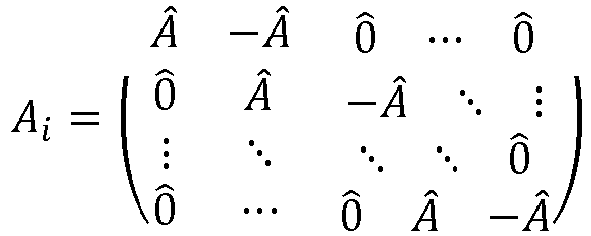

- The two iteration steps for updating dl (xi ) and fl (xi ) are repeated until the convergence criterion is met.
- According to a highly preferable aspect of the invention, the second step of the LEGEND algorithm is modified using a convolution instead of a matrix computation. This greatly reduces the computational effort.
- More particularly, it is preferred that the updated baseline estimation data fl (xi ) are computed directly by convolving a Green's function with the sum of the input image data and the updated auxiliary data.
- According to a more concrete aspect of the inventive solution, the second iterative step of the LEGEND algorithm may be replaced by the following iterative step, where the updated baseline estimation data fl (xi ) is computed in the l-th iteration using a Green's function G(xi ) as follows

- This step reduces the computational burden significantly as compared to the traditional LEGEND algorithm.
- The reduced computational burden results from the fact that according to the inventive second iterative step, a convolution is computed. This computation can be efficiently carried out using an FFT algorithm. Moreover, the second iterative step may make full use of an array processor, such as a graphics processing unit or an FPGA due to the FFT algorithm. The computational problem is reduced from (Mx x M y)2 to Mx x My if the input image data and all other arrays are two-dimensional. For a general N-dimensional case, the computational burden is reduced from (M 1 × ··· × MN )2 dimensional matrix calculations to the computation of a FFT with (M 1 × ··· × MN ) -dimensional arrays
- Thus, the deblurring may be carried out very quickly, preferably in real time for two-dimensional input image data. A (2k x 2k) image may be deblurred in 50 ms and less.
- In one specific embodiment, the Green's function may have the form
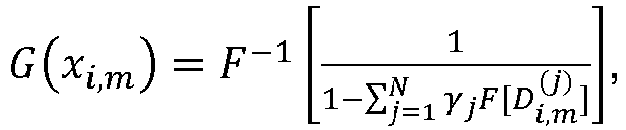

- In general, the discrete penalty array

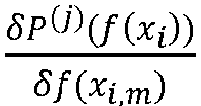


- A big advantage of the above Green's function is that any form of penalty term P(f(xi )) may benefit from the fast computation of the second iterative step in the half-quadratic minimization engine. Thus, in the embodiment which uses the Green's function, any penalty term for obtaining a good baseline estimate may be used.
- For the general formulation of the penalty term



- For example, if the penalty term is


- The image processor, the baseline estimator engine, the deblurring section and the half-quadratic minimization engine may each be implemented in hardware, in software or as a combination or hardware and software. For example, at least one of the image processor, the baseline estimator engine, the deblurring section and the half-quadratic minimization engine may be at least partly be implemented by a subroutine, a section of a general-purpose processor, such as a CPU, and/or a dedicated processor such as a CPU, GPU, FPGA, vector processor and/or ASIC.
- It is to be noted that the inventive deblurring provides best results if the input image data I(xi) are not convolved or deconvolved before the deblurring. The deconvolution provides the best results if the input data I(xi ) are preprocessed by the inventive deblurring.
- Next, the invention is further described by way of example only using a sample embodiment, which is also shown in the drawings. In the drawings, the same reference numerals are used for features which correspond to each other with respect to at least one of function and design.
- The combination of features shown in the enclosed embodiment is for explanatory purposes only and can be modified. For example, a feature of the embodiment having a technical effect that is not needed for a specific application may be omitted. Likewise, a feature which is not shown to be part of the embodiment may be added if the technical effect associated with this feature is needed for a particular application.
- Fig. 1
- shows a schematic representation of an apparatus according to the invention;
- Fig. 2
- shows a schematic rendition of a flow chart for the method according to the invention;
- Fig. 3
- shows a detail of
Fig. 2 ; - Fig. 4
- shows an example of input image data;
- Fig. 5
- shows an example of deblurred output image data derived from the input image data of
Fig. 4 ; - Fig. 6
- shows the intensity distribution in the input image data, baseline estimation data and the deblurred output image data along lines VI of
Figs. 4 and 5 ; - Fig.7
- shows another example of input image data;
- Fig. 8
- shows the output image data based on the input image data of
Fig. 7 ; - Fig. 9
- shows the output image data of
Fig. 8 after deconvolution; - Fig. 10
- shows the intensity distribution in the input image data, the baseline estimation data and output image data along line X in
Figs. 7 and 8 ; and - Fig. 11
- shows a schematic representation of input image data, an in-focus contribution in the input image data, an out-of-focus contribution in the input image data, baseline estimation data and output image data.
- First, the structure of the
apparatus 1 is explained with reference toFig. 1 . Theapparatus 1 is a medical observation device, such as an endoscope or a microscope. Just for the purpose of explanation, a microscope 2 is shown as an example of anapparatus 1. For the purpose of the deblurring apparatus and method, there is no difference between endoscopes of microscopes. - The
apparatus 1 may comprise an image-forming section 4, which is adapted to captureinput image data 6, e.g. with acamera 8. Thecamera 8 may be a CCD, multispectral or hyperspectral camera which records theinput image data 6 in a plurality ofchannels 10, wherein eachchannel 10 preferably represents a different light spectrum range from the infrared to the ultraviolet. Theinput image data 6 are also designated as I(xi ) in the following. - In the case of a CCD camera, for example, three
channels 10, e.g. a R-channel, a G-channel and a B-channel, may be provided to represent a visible light image of anobject 12. In the case of a multi- or hyperspectral camera, a total of more than threechannels 10 may be used in at least one of the visible light range, the IR light range, the NIR light range and the ultraviolet light range. - The
object 12 may comprise animate and/or inanimate matter. Theobject 12 may further comprise one or more fluorescent materials, such as at least onefluorophore 14. A multispectral or hyperspectral camera may have achannel 10 for each different fluorescence spectrum of the fluorescent materials in theobject 12. For example, each fluorophore 14 may be represented by at least onechannel 10 which is matched to the fluorescence spectrum triggered by anillumination 16. Alternatively or additionally,channels 10 may be provided for auto-fluorescence spectra or for spectra of secondary fluorescence, which is triggered by fluorescence excited by theillumination 16, or for lifetime fluorescence data. Of course, theillumination 16 may also or solely emit white light or any other composition of light without triggering fluorescence in theobject 12. The microscope 2 may be adapted to excite fluorescence e.g. offluorophores 14 within anobject 12 with light having a suitable fluorescence excitation wavelength by theillumination 16. - The illumination may be guided through a
lens 17, through which also the input image data are acquired. Theillumination 16 may comprise or consist of one or more flexible light guides to direct light onto theobject 12 from one or more different directions. A suitable blocking filter (not shown) may be arranged in the light path in front of thecamera 8, e.g to suppress glare. In case of fluorescence, a blocking filter preferably blocks only the illumination wavelength and allows the fluorescent light of thefluorophores 14 in theobject 12 to pass to thecamera 8. - It is apparent - without limitation to the general - that the
input image data 6 can be captured by any kind of microscope, in particular with a fluorescence light microscope operable in a widefield mode and/or using a confocal laser scanning microscope. - The
input image data 6 are two-dimensional if asingle channel 10 is contained in a two-dimensional image. The input image may have a higher dimensionality than two if more than onechannel 10 is comprised and/or if theinput image data 6 represent a three-dimensional image. - Three-dimensional
input image data 6 may be recorded by theapparatus 1 by e.g. using light-field technology, z-stacking in microscopes, images obtained by a SCAPE microscope and/or a three-dimensional reconstruction of images obtained by a SPIM microscope. In the case of a three-dimensional image, each plane of the three-dimensionalinput image data 6 may be considered as a two-dimensional input image 6. Again, each plane may compriseseveral channels 10. - Each
channel 10 may be regarded as a separate two-dimensional image. Alternatively, a plurality of channels may together be interpreted as a multi-dimensional array. - The input image data are a digital representation of a quantity I(x i ), such as an intensity, where xi represents a location in the
input image data 6 and / is the quantity at that location. The term xi is a shortcut notation for a tuple {x 1; ··· ; xN } containing N dimensions and representing a discrete location xi in the discrete input image data. A location xi may be a pixel or a preferably coherent set of pixels in the input image data. The discrete location xi denotes e.g. a pair of discrete location variables {x 1; x2} in the case of two-dimensional input image data and a triplet of discrete location variables {x 1; x 2; x 3} in the case of three-dimensional input image data. In the i-th dimension, the array may contain Mi locations, i.e. xi = {x i,1, ..., xi,Mi }. In total, I(xi ) may contain (M 1 × ··· × MN ) elements. - The
camera 8 may produce atime series 18 of subsequent sets ofinput image data 6. - The
apparatus 1 may further comprise animage storage section 20 which is adapted to contain, at least temporarily, theinput image data 6. Theimage storage section 20 may comprise a volatile or non-volatile memory, such as a cache memory of aCPU 22 of acomputing device 24, such as a PC, and/or of aGPU 26. Theimage storage section 20 may further comprise RAM, a hard disk drive or an exchangeable storage system, such as a USB stick or an SD card. Theimage storage section 20 may comprise any combination of these types of memory. - For acquiring the
input image data 6, e.g. from thecamera 8, animage input section 28 may be provided. Theimage input section 28 may comprise standardized connection means 30, such as standardized data exchange protocols, hardware connectors and/or wireless connections. Examples of standardized connectors which may be connected to thecamera 8 are HDMI, USB and RJ45 connectors. - The
apparatus 1 may further comprise animage output section 32, which may comprise standardized connection means 34, such as standardized data exchange protocols, hardware connectors and/or wireless connections, each configured to output deblurredoutput image data 36 to one or more displays 37. Theoutput image data 36 have preferably the same dimensionality as theinput image data 6, and are represented by a discrete array of discrete values O(xi ). - For computing the deblurred
output image data 36 from theinput image data 6, animage processor 38 may be provided. Theimage processor 38 and its constituents may be at least partly hardware, at least partly software and/or a combination of both hardware and software. For example, theimage processor 38 may comprise at least one of aCPU 22 and aGPU 26 of thecomputing device 24, as well as sections that have been coded in software and temporarily exist as structural entities in theCPU 22 and/or theGPU 26 as an operational state. Theimage processor 38 may also comprise additional hardware such as one or more ASICs which have been specifically designed in carrying out operations required for the apparatus and method according to the invention. - Before continuing the further description of
Fig. 1 , the general principle of the deblurring of theinput image data 6 is explained with reference toFig. 11 . For the deblurring of theinput image data 6, theimage processor 38 may comprise adeblurring section 40. - The input image data I(xi ) are assumed to be composed additively from an out-of-focus component I 2(xi ) and an in-focus component I 1(xi ). The in-focus component I 1(xi ) contains solely the information from the focal plane of the
camera 8. The out-of-focus component I 2(xi ) results from light recorded in theinput image data 6 from regions outside the focal region. The in-focus component I 1(xi ), in contrast, represents only contributions from the focal region. Neither I 1(xi ) nor I 2(xi ) are known and therefore have to be estimated. - According to the invention, it is assumed that the out-of-focus component I 2(xi ) consists only of components having low spatial frequency which this represent something like a smooth baseline, about which the in-focus component I 1(xi ) fluctuates at a higher spatial frequency. The out-of-focus component I 2(xi ) is smooth and has large length scales; the in-focus component I 1(xi ) is, by contrast, not smooth and usually contains peaks.
- For the deblurring of the input image data, an estimate for the out-of-focus component I 2(xi ) is computed. This estimate is represented in the
apparatus 1 and the method according to the invention as baseline estimation data f(xi ). The baseline estimation data are a discrete array that has preferably the same dimensionality as theinput image data 6 and/or theoutput image data 36. The baseline estimation data f(xi ) are indicated byreference number 44 inFig. 1 . The baseline estimation data f(xi ) may also be at least temporarily present instorage section 20. Once the baseline estimation data have been computed, the output image data, here represented as O(xi ) are obtained by subtracting the baseline estimation data from the input image data at each location. - According to
Fig. 1 , theimage processor 38 may comprise abaseline estimator engine 42, which is configured to compute the baseline estimation data f(xi ), inFig. 1 indicated atreference numeral 44, by a fit to at least a subset of theinput image data 6. Preferably, the fit to at least the subset of the input image data is a spline fit. - For a computationally efficient spline fit, the
baseline estimator engine 42 may comprise a half-quadratic minimization engine 46, which may, for example, be a subroutine or a combination of a hard-wired algorithm and a matching software. The half-quadratic minimization engine 46 may be configured to execute a half-quadratic minimization scheme and, towards this end, may comprise twoiteration stages - According to the invention, the half-
quadratic minimization engine 46 uses a convolution to compute thebaseline estimation data 44 in thesecond iteration stage 50. As the convolution can be computed more efficiently on an array processor using a FFT, it is preferred that theimage processor 38 includes an array processor such as aGPU 26. In operation, the image processor comprises the half-quadratic minimization engine 46. - Wit reference to
Fig. 2 , the steps of computing the deblurred output image data O(xi ) or 36 from the input image data I(xi ) or 6 are described as they are performed by theapparatus 1. It is to be noted that, preferably, eachchannel 10 is handled separately. - In a
first step 60, various parameters of thebaseline estimator engine 42, which need to be preset, may be defined by a user, e.g. using a graphical user interface 62 (Fig. 1 ). The parameters may comprise the type of fit to theinput image data 6 that is to be performed by thebaseline estimator engine 42. For example, a user may choose between a polynomial fit and a spline fit of thebaseline estimation data 44 to theinput image data 6. - Further, the user may choose between a variety of penalty terms P(f(xi )) which are used in the half-quadratic minimization scheme. The penalty term determines the shape of the baseline estimate by penalizing the representation of components of the in-focus contribution I 1(xi ) in the baseline estimation data.
- For example, the user may be presented with a selection of various penalty terms that penalize non-smooth characteristics of the
baseline estimation data 44. For instance, the penalty term may be a high-pass spatial frequency filter for thebaseline estimation data 44, which gets larger if thebaseline estimation data 44 contain components having high spatial frequency. Other penalty terms may include a gradient of thebaseline estimation data 44. Another example of a penalty term may be the curvature of thebaseline estimation data 44. Further, feature extracting filters, such as a Sobel, Laplace and/or FIR band-pass, high-pass or low-pass filter may be selected by the user as penalty term. Further, a linear combination of any of the above may be selected. Different penalty terms may be selected for different dimensions or for different channels of theinput image data 6. - The general representation of the penalty term is as follows

- In the following, it is assumed that the user selects a gradient-based roughness penalty term based on the gradient of the baseline estimation data f(xi,m ) or 44 having the following form

- This penalty term penalizes large gradients in the baseline estimation data. The operator ∂j represents a first-order derivative or gradient in the dimension j.
- Using the above gradient-based penalty term, the parameters to be specified by the user may further comprise an array γj of regularization parameters. For the gradient-based penalty term, the regularization parameter array may be between 0.3 and 100.
- Further, when selecting a parameter for the baseline estimator engine, the user may choose between a symmetric and asymmetric quadratic term ϕ(ε(xi )), which also determines the shape of the baseline estimate by specifying the effect of large peaks on the baseline estimation data.
- Finally, the user may select a convergence criterion and/or a threshold value t which has to be reached by the convergence criterion.
- For example, the user may select the following asymmetric, truncated quadratic:

- After the initial parameters for the
baseline estimator engine 42 have been set, the data are initialized instep 64 for the iterative half-quadratic minimization scheme 66. - From then on, the iterative half-
quadratic minimization scheme 66 is carried out by the half-quadratic minimization engine 46 until aconvergence criterion 68 is met. In the embodiment, the following convergence criterion is used: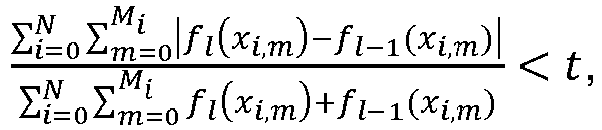
- If the
convergence criterion 68 is met, it is assumed that thebaseline estimation data 44 have been successfully computed. Thus, the baseline estimation data f(xi ) are subtracted from the input image data I(xi ) to obtain the deblurred output image data O(xi ) instep 70. - After the computation of the output image data O(xi ) a
post-processing operation 72 may be carried out on theoutput image data 36, such as a deconvolution. - The output image data O(xi ) may be displayed with or without post-processing on the
display 37. - In
Fig. 3 , detail III ofFig. 2 is shown to explain the half-quadratic minimization scheme 66 in closer detail. The half-quadratic minimization scheme 66 comprises thefirst iteration stage 48 and thesecond iteration stage 50. - In principle, the half-
quadratic minimization scheme 66 as carried out by the half-quadratic minimization engine 46 may be the LEGEND algorithm. However, according to the invention it is preferred to modify the second step of the LEGEND algorithm may be modified to significantly reduce the computational burden. - In the shown embodiment, the second
iterative stage 50 is entered after initializing the data atstep 64. At this point, the first estimate f 1(xi ) of the baseline estimation data is computed by using a convolution of the input image data with a Green's function G(xi ).
- For the gradient-based penalty term used in this embodiment, the Green's function is defined as follows:


- Then, in the
first iteration stage 48, an updated version of auxiliary data dl (xi ) may be computed using the currentbaseline estimation data 44 as follows:
- The parameter α is a constant which may have been specified by the user.
- Next, in the second
iterative stage 50, the updatedbaseline estimation data 44 are computed using the updated auxiliary data dl (xi ) of the current iteration l as follows
- In the next step, it is checked whether the
convergence criterion 68 is met. If this is not the case, the half-quadratic minimization scheme 66 proceeds toiterative step 48 using the updated baseline estimation data fl (xi ). - In the following, two examples of deblurred output image data are given, in which the gradient-based penalty term was used together with the second iterative step using the convolution with the Green's function as described with reference to
Figs. 2 and 3 . -
Fig. 4 shows the input image data I(xi ) or 6 of a sample picture,Fig. 5 shows the deblurred output image data O(xi ) or 36.Fig. 4 shows a picture of mitochondria recorded with a DM6000 widefield microscope and a HCX PL APO CS 100.0x1.40 OIL at a numerical aperture of 1.4 and a peak emission of 645 nm. The size of a pixel corresponds to 40 nm. - From the comparison of
Figs. 4 and 5 it can be seen that a significant part of the out-of-focus component I 2(xi ) has been removed in the output image data. This is verified byFig. 6 , which shows the intensity distribution along the line VI inFigs. 4 and 5 , respectively. It can be seen that the baseline estimation data f(xi ) represent a smooth baseline in the intensity distribution, whereas the peaks are maintained in the output image data O(xi ), 36. - The deblurring also works well if the intensity distribution in the input image data I(xi ) has a different characteristic. This is demonstrated in
Figs. 7, 8 and 10 , which show a Paramecium. WhereasFig. 4 contains a single bead-like structure, in which it is comparatively easy to distinguish the in-focus contribution from the out-of-focus contribution,Fig. 7 contains a more complex structure. InFig. 7 , a pixel corresponds to 65 nm. The image was recorded using a DM8 widefield microscope with a HCX FLUOTAR 100x/1.30 OIL lens at a numerical aperture of 1.3 and a peak emission at 520 nm. - In
Fig. 7 , the input image data I(xi ) are shown. InFig. 8 , the deblurred output image data O(xi ) are shown. InFig. 10 , the intensity distributions of theinput image data 6, thebaseline estimation data 44 and theoutput image data 36 along line X ofFigs. 7 and 8 are indicated. As can be seen, the baseline estimation data f(xi ) also contains peaks. However, the length scale of these peaks is significantly larger than the intensity variation in the output image data O(xi ). -
Fig. 9 shows theoutput image data 36 after deconvolution. As the output image data have been deblurred, the result of the convolution has a very good quality with almost no artifacts. - Thus, to summarize, an
apparatus 1 and method for deblurring input image data have been described. The apparatus and method may use a penalty term of any discrete derivative order of the baseline estimation data and/or of feature-extracting filters. Independently of whether a penalty term is used or not, a spline fit may be preferred over the polynomial fit in order to create a smooth baseline estimate. As a third independent aspect of the invention, a half-quadratic minimization engine 46 is proposed, which reduces computational burden significantly by introducing a convolution in the seconditerative stage 50. The computational efficiency may be preserved for a wide range of penalty terms. -
- 1
- apparatus
- 2
- microscope
- 4
- image-forming section
- 6
- input image data, I(xi )
- 8
- camera
- 10
- channel
- 12
- object
- 14
- fluorophore
- 16
- illumination
- 17
- lens
- 18
- time series of input image data
- 20
- image storage section
- 22
- CPU
- 24
- computing device
- 26
- GPU
- 28
- image input section
- 30
- connection means of image input section
- 32
- image output section
- 34
- connection means of image output section
- 36
- output image data, O(xi )
- 37
- display
- 38
- image processor
- 40
- deblurring section
- 42
- baseline estimator engine
- 44
- baseline estimation data, f(xi )
- 46
- half-quadratic minimization engine
- 48
- first iteration stage
- 50
- second iteration stage
- 60
- setup of baseline estimation parameters
- 62
- graphical user interface
- 64
- initializing of half-quadratic minimization engine and scheme
- 66
- half-quadratic minimization engine and scheme
- 68
- convergence criterion
- 70
- computation of output image data
- 72
- post-processing operation
Claims (10)
- Computer implemented method for deblurring an image, the image being represented by input image data (I(xi )),
the method comprising the steps of- estimating an out-of-focus contribution (I 2(xi )) in the image to obtain baseline estimation data (f(xi )) and of- subtracting the baseline estimation data from the input image data (I(xi )) to obtain deblurred output image data (O(xi )),
wherein the step of estimating the out-of-focus contribution (I 2(x i)) comprises the step of- computing the baseline estimation data (f(xi )) as a fit to at least a subset of the input image data (I(xi )) by minimizing a least-square minimization criterion (M(f(xi ))), andwherein the least-square minimization criterion (M(f(xi ))) comprises a penalty term (P(f(xi ))),
wherein the least-square minimization criterion (M(f(xi ))) comprises a cost function (C(f(xi ))) which includes a truncated quadratic term (ϕ(ε(xi ))) representing the difference between the input image data (I(xi )) and the baseline estimation data (f(xi )),
wherein the baseline estimation data (f(xi )) are computed using an iterative half-quadratic minimization scheme (66),
and wherein the iterative half-quadratic minimization scheme (66) comprises a first iterative stage (48) and a second iterative stage (50), wherein,- in the first iterative stage (48), auxiliary data (d(xi )) are updated depending on the baseline estimation data (f(xi )) of a previous iteration, the truncated quadratic term (ϕ(ε(xi ))) and the input image data (I(xi )) and,- in the second iterative stage (50), the baseline estimation data (f(xi )) are computed directly using a convolution of a discrete Green's function (G(xi )) with a sum of the input image data (I(xi )) and the updated auxiliary data (dl (xi )). - Method according to claim 1, wherein the baseline estimation data (f(xi )) are computed using a spline fit to the input image data (I(xi )).
- Method according to claim 1 or 2, wherein the truncated quadratic term (ϕ(ε(xi ))) is asymmetric.
- Method according to any one of claims 1 to 3, wherein the penalty term (P(f(xi ))) penalizes non-smooth baseline estimation data.
- Method according to any one of claims 1 to 4, wherein the penalty term (P(f(xi ))) comprises at least one of a derivative of arbitrary order of the baseline estimation data (f(xi )), a feature-extracting linear filter, and a linear combination of a feature-extracting linear filter and derivatives of arbitrary order of the baseline estimation data (f(xi )).
- Method according to any one of claims 1 to 5, wherein the output image data are deconvolved.
- Non-transitory computer readable medium storing a program causing a computer to execute the image processing method according to any one of claims 1 to 6.
- Apparatus (1) for deblurring an image, the image being represented by input image data (I(xi )), the apparatus (1) being configured:- to estimate an out-of-focus contribution (I 2(x i)) in the image to obtain baseline estimation data (f(xi )), which comprises to compute the baseline estimation data (f(xi )) as a fit to at least a subset of the input image data (I(xi )) by minimizing a least-square minimization criterion (M(f(xi ))), and- to subtract the baseline estimation data from the input image data (I(xi )) to obtain deblurred output image data (O(xi )),
wherein the least-square minimization criterion (M(f(xi ))) comprises a penalty term (P(f(xi ))) and a cost function (C(f(xi ))) which includes a truncated quadratic term (ϕ(ε(xi ))) representing the difference between the input image data (I(xi )) and the baseline estimation data (f(xi )),
wherein the apparatus is further configured to compute the baseline estimation data (f(xi )) using an iterative half-quadratic minimization scheme (66),
wherein the iterative half-quadratic minimization scheme (66) comprises a first iterative stage (48) and a second iterative stage (50),
wherein the apparatus is further configured- to update, in the first iterative stage (48), auxiliary data (d(xi )) depending on the baseline estimation data (f(xi )) of the previous iteration, the truncated quadratic term (ϕ(ε(xi ))) and the input image data (I(xi )) and- to compute, in the second iterative stage (50), the baseline estimation data (f(xi )) directly using a convolution of a discrete Green's function (G(xi )) with a sum of the input image data (I(xi )) and the updated auxiliary data (dl (xi )). - Apparatus according to claim 8, wherein the half-quadratic minimization engine comprises a discrete first-order derivative operator (∂j ) of the penalty term (P(f(xi ))).
- Apparatus according to claim 8 or 9, wherein the penalty term (P(f(xi ))) comprises at least one of a derivative of arbitrary order of the baseline estimation data (f(xi )), a feature-extracting linear filter, and a linear combination of a feature-extracting linear filter and derivatives of arbitrary order of the baseline estimation data (f(xi )).
Priority Applications (1)
| Application Number | Priority Date | Filing Date | Title |
|---|---|---|---|
| EP20185781.0A EP3742391A1 (en) | 2018-03-29 | 2018-06-27 | Apparatus and computer-implemented method using baseline estimation and half-quadratic minimization for the deblurring of images |
Applications Claiming Priority (2)
| Application Number | Priority Date | Filing Date | Title |
|---|---|---|---|
| DE102018204943 | 2018-03-29 | ||
| PCT/EP2018/067244 WO2019185174A1 (en) | 2018-03-29 | 2018-06-27 | Apparatus and method, particularly for microscopes and endoscopes, using baseline estimation and half-quadratic minimization for the deblurring of images |
Related Child Applications (2)
| Application Number | Title | Priority Date | Filing Date |
|---|---|---|---|
| EP20185781.0A Division EP3742391A1 (en) | 2018-03-29 | 2018-06-27 | Apparatus and computer-implemented method using baseline estimation and half-quadratic minimization for the deblurring of images |
| EP20185781.0A Division-Into EP3742391A1 (en) | 2018-03-29 | 2018-06-27 | Apparatus and computer-implemented method using baseline estimation and half-quadratic minimization for the deblurring of images |
Publications (2)
| Publication Number | Publication Date |
|---|---|
| EP3571663A1 EP3571663A1 (en) | 2019-11-27 |
| EP3571663B1 true EP3571663B1 (en) | 2020-08-19 |
Family
ID=62751006
Family Applications (8)
| Application Number | Title | Priority Date | Filing Date |
|---|---|---|---|
| EP20185781.0A Pending EP3742391A1 (en) | 2018-03-29 | 2018-06-27 | Apparatus and computer-implemented method using baseline estimation and half-quadratic minimization for the deblurring of images |
| EP18734549.1A Active EP3571663B1 (en) | 2018-03-29 | 2018-06-27 | Apparatus and method, particularly for microscopes and endoscopes, using baseline estimation and half-quadratic minimization for the deblurring of images |
| EP19712815.0A Active EP3776452B1 (en) | 2018-03-29 | 2019-03-29 | Apparatus and method for baseline estimation in input signal data |
| EP19712818.4A Pending EP3776453A1 (en) | 2018-03-29 | 2019-03-29 | Apparatus and method using baseline estimation and half-quadratic minimization for the deblurring of signal data |
| EP19181836.8A Pending EP3588430A1 (en) | 2018-03-29 | 2019-06-21 | Image processing apparatus and method for enhancing a phase distribution |
| EP19182090.1A Active EP3588432B1 (en) | 2018-03-29 | 2019-06-24 | Signal processing apparatus and method for enhancing a digital input signal |
| EP19185002.3A Active EP3716199B1 (en) | 2018-03-29 | 2019-07-08 | Signal processing apparatus and method using local length scales for deblurring |
| EP19194731.6A Active EP3716200B1 (en) | 2018-03-29 | 2019-08-30 | Image processing apparatus and method for use in an autofocus system |
Family Applications Before (1)
| Application Number | Title | Priority Date | Filing Date |
|---|---|---|---|
| EP20185781.0A Pending EP3742391A1 (en) | 2018-03-29 | 2018-06-27 | Apparatus and computer-implemented method using baseline estimation and half-quadratic minimization for the deblurring of images |
Family Applications After (6)
| Application Number | Title | Priority Date | Filing Date |
|---|---|---|---|
| EP19712815.0A Active EP3776452B1 (en) | 2018-03-29 | 2019-03-29 | Apparatus and method for baseline estimation in input signal data |
| EP19712818.4A Pending EP3776453A1 (en) | 2018-03-29 | 2019-03-29 | Apparatus and method using baseline estimation and half-quadratic minimization for the deblurring of signal data |
| EP19181836.8A Pending EP3588430A1 (en) | 2018-03-29 | 2019-06-21 | Image processing apparatus and method for enhancing a phase distribution |
| EP19182090.1A Active EP3588432B1 (en) | 2018-03-29 | 2019-06-24 | Signal processing apparatus and method for enhancing a digital input signal |
| EP19185002.3A Active EP3716199B1 (en) | 2018-03-29 | 2019-07-08 | Signal processing apparatus and method using local length scales for deblurring |
| EP19194731.6A Active EP3716200B1 (en) | 2018-03-29 | 2019-08-30 | Image processing apparatus and method for use in an autofocus system |
Country Status (7)
| Country | Link |
|---|---|
| US (6) | US11854166B2 (en) |
| EP (8) | EP3742391A1 (en) |
| JP (6) | JP7436379B2 (en) |
| CN (6) | CN111937032B (en) |
| DE (1) | DE202018006284U1 (en) |
| ES (1) | ES2820228T3 (en) |
| WO (7) | WO2019185174A1 (en) |
Cited By (2)
| Publication number | Priority date | Publication date | Assignee | Title |
|---|---|---|---|---|
| EP4264670A4 (en) * | 2020-12-17 | 2024-12-11 | Lumenuity, LLC | METHODS AND SYSTEMS FOR IMAGE CORRECTION AND PROCESSING IN HIGH MAGNIFICATION PHOTOGRAPHY USING PARTIAL REFLECTORS |
| DE102023118112A1 (en) | 2023-07-10 | 2025-01-16 | Leica Microsystems Cms Gmbh | Data processing device and method for correcting image shading |
Families Citing this family (16)
| Publication number | Priority date | Publication date | Assignee | Title |
|---|---|---|---|---|
| ES2820228T3 (en) * | 2018-03-29 | 2021-04-20 | Leica Microsystems | Apparatus and method, particularly for microscopes and endoscopes, using baseline estimation and semi-quadratic minimization to eliminate image blurring |
| EP3853587B1 (en) * | 2018-09-17 | 2026-02-11 | KOC Universitesi | A method and apparatus for detecting nanoparticles and biological molecules |
| EP3633534A1 (en) * | 2018-10-04 | 2020-04-08 | Thales Dis France SA | A connected device adapted to measure at least a physical quantity |
| EP3726459B1 (en) * | 2019-04-17 | 2022-02-16 | Leica Instruments (Singapore) Pte. Ltd. | Signal to noise ratio adjustment circuit, signal to noise ratio adjustment method and signal to noise ratio adjustment program |
| EP3795100B1 (en) * | 2019-09-20 | 2025-02-19 | Dornier MedTech Systems GmbH | A method for monitoring a coupling quality of an interface between a therapeutic device and a patient |
| WO2021188839A1 (en) * | 2020-03-20 | 2021-09-23 | The Regents Of The University Of California | Single-shot autofocusing of microscopy images using deep learning |
| DE102020204615A1 (en) | 2020-04-09 | 2021-10-14 | Leica Microsystems Cms Gmbh | Inclined plane microscope with improved collection efficiency |
| WO2022066316A1 (en) * | 2020-09-22 | 2022-03-31 | Becton, Dickinson And Company | Methods for continuous measurement of baseline noise in a flow cytometer and systems for same |
| WO2022235559A1 (en) * | 2021-05-03 | 2022-11-10 | The Cleveland Clinic Foundation | Machine vision needle counting imaging tray |
| CN113504503B (en) * | 2021-08-05 | 2022-03-01 | 中国人民解放军战略支援部队航天工程大学 | A Deblurring Method for Rotating Multibaseline Phase Interferometer |
| EP4413349A1 (en) | 2021-10-05 | 2024-08-14 | Leica Microsystems CMS GmbH | Sample carrier and method for imaging a sample |
| DE102023104144A1 (en) | 2023-02-20 | 2024-08-22 | Leica Microsystems Cms Gmbh | Data processing device for a digital imaging device, microscope and microscopy method |
| US20240430567A1 (en) * | 2023-06-20 | 2024-12-26 | Google Llc | Depth-Histogram Based Autofocus |
| WO2025042925A1 (en) * | 2023-08-21 | 2025-02-27 | Dolby Laboratories Licensing Corporation | Image enhancement using implicit tensor-product b-spline modeling |
| DE102023135636A1 (en) * | 2023-12-18 | 2025-06-18 | Karl Storz Se & Co. Kg | Imaging device, in particular endoscopic, exoscopic and/or microscopic imaging device |
| CN118520236B (en) * | 2024-07-23 | 2024-09-27 | 杭州珈晟生物数字技术有限公司 | Signal noise suppression method for prism coupling SPR detector |
Family Cites Families (48)
| Publication number | Priority date | Publication date | Assignee | Title |
|---|---|---|---|---|
| DE3828381C2 (en) * | 1988-08-20 | 1997-09-11 | Zeiss Carl Fa | Method and device for automatically focusing an optical system |
| US5121443A (en) * | 1989-04-25 | 1992-06-09 | Spectra-Physics, Inc. | Neural net system for analyzing chromatographic peaks |
| JPH063268A (en) * | 1992-06-23 | 1994-01-11 | Toshiba Ceramics Co Ltd | Ultraviolet absorption spectroscopy of interstitial oxygen or substitutional carbon concentration in silicon wafers |
| US6058322A (en) * | 1997-07-25 | 2000-05-02 | Arch Development Corporation | Methods for improving the accuracy in differential diagnosis on radiologic examinations |
| NL1016034C2 (en) * | 2000-08-03 | 2002-02-08 | Tno | Method and system for identifying and quantifying chemical components of a mixture of materials to be investigated. |
| AU2002952483A0 (en) | 2002-11-05 | 2002-11-21 | Silverbrook Research Pty Ltd | Methods and Systems (NPW009) |
| US7457708B2 (en) * | 2003-03-13 | 2008-11-25 | Agilent Technologies Inc | Methods and devices for identifying related ions from chromatographic mass spectral datasets containing overlapping components |
| JP2007521905A (en) * | 2004-02-11 | 2007-08-09 | コーニンクレッカ フィリップス エレクトロニクス エヌ ヴィ | Cross-sectional image processing apparatus and method |
| WO2007027893A2 (en) * | 2005-08-30 | 2007-03-08 | The Regents Of The University Of California, Santa Cruz | Kernel regression for image processing and reconstruction |
| US20070196856A1 (en) * | 2006-02-23 | 2007-08-23 | Allergan, Inc. | Methods of determining activity of ryanodine receptor modulators |
| US20070248268A1 (en) * | 2006-04-24 | 2007-10-25 | Wood Douglas O | Moment based method for feature indentification in digital images |
| CN101686819B (en) * | 2007-01-05 | 2014-08-13 | 迈斯金公司 | Systems, devices and methods for imaging skin |
| US20090092319A1 (en) | 2007-10-03 | 2009-04-09 | Olympus Corporation | Phase-information extraction method |
| US8155409B2 (en) * | 2008-04-17 | 2012-04-10 | Ruprecht-Karls-Universitat | Wave field microscope with sub-wavelength resolution and methods for processing microscopic images to detect objects with sub-wavelength dimensions |
| US7983852B2 (en) | 2008-10-21 | 2011-07-19 | Thermo Finnigan Llc | Methods of automated spectral peak detection and quantification without user input |
| US8199248B2 (en) * | 2009-01-30 | 2012-06-12 | Sony Corporation | Two-dimensional polynomial model for depth estimation based on two-picture matching |
| US8645090B2 (en) * | 2009-05-14 | 2014-02-04 | Agilent Technologies, Inc. | Automated baseline removal of signal |
| WO2011106527A2 (en) * | 2010-02-24 | 2011-09-01 | Ampersand International, Inc. | Method for noise filtering based on confidence interval evaluation |
| DE102010003552B4 (en) * | 2010-03-31 | 2012-03-22 | Universitätsklinikum Freiburg | Method for homogenizing the resolution in magnetic resonance tomography images using non-linear coding fields |
| US8045046B1 (en) | 2010-04-13 | 2011-10-25 | Sony Corporation | Four-dimensional polynomial model for depth estimation based on two-picture matching |
| CN102156967B (en) * | 2011-04-11 | 2012-10-17 | 上海交通大学 | Multi-scale local image interpolation method |
| DE102012201286B4 (en) * | 2012-01-30 | 2025-07-24 | Carl Zeiss Microscopy Gmbh | Microscope and method for wavelength-selective and spatially high-resolution microscopy |
| JP6009787B2 (en) | 2012-03-16 | 2016-10-19 | 株式会社東芝 | Optimal imaging position detection method, optimal imaging position detection apparatus, photomask manufacturing method, and semiconductor device manufacturing method |
| AU2013256044B2 (en) * | 2012-05-04 | 2017-05-25 | Rearden, Llc | System and methods for coping with Doppler effects in distributed-input distributed-output wireless systems |
| US9715098B2 (en) * | 2012-05-31 | 2017-07-25 | The Board Of Trustees Of The University Of Illinois | Sparse deconvolution spatial light microscopy in two and three dimensions |
| CN103118323A (en) * | 2012-12-28 | 2013-05-22 | 中国科学院声学研究所 | Web feature service system (WFS) initiative room compensation method and system based on plane wave decomposition (PWD) |
| CN103093436B (en) * | 2013-01-29 | 2015-07-01 | 南京理工大学 | Blurring kernel multi-scale iteration estimation method using directional derivative of image local structure |
| US9456141B2 (en) * | 2013-02-22 | 2016-09-27 | Lytro, Inc. | Light-field based autofocus |
| US20160113587A1 (en) * | 2013-06-03 | 2016-04-28 | The Regents Of The University Of California | Artifact removal techniques with signal reconstruction |
| EP3053143B1 (en) * | 2013-09-30 | 2019-03-27 | Koninklijke Philips N.V. | Method for local adjustment of regularization parameters for image quality optimization in fully 3d iterative ct reconstruction |
| JP6362415B2 (en) | 2014-05-22 | 2018-07-25 | オリンパス株式会社 | Autofocus device and microscope system |
| US9524567B1 (en) * | 2014-06-22 | 2016-12-20 | InstaRecon | Method and system for iterative computed tomography reconstruction |
| CN104123558B (en) * | 2014-06-30 | 2017-10-13 | 中国地质科学院矿产资源研究所 | Multi-source distributed remote sensing discrimination method and system for geothermal resources |
| JP2016053571A (en) * | 2014-09-03 | 2016-04-14 | サイエンスソフトウェア株式会社 | Measurement precision estimation device, method, and program |
| CN104596636B (en) * | 2014-12-29 | 2018-03-27 | 广西科技大学 | Method for sound field separation |
| US9786092B2 (en) * | 2015-02-18 | 2017-10-10 | The Regents Of The University Of California | Physics-based high-resolution head and neck biomechanical models |
| JP6597062B2 (en) * | 2015-08-31 | 2019-10-30 | 株式会社Jvcケンウッド | Noise reduction device, noise reduction method, noise reduction program |
| WO2017050972A1 (en) | 2015-09-25 | 2017-03-30 | Fraunhofer-Gesellschaft zur Förderung der angewandten Forschung e.V. | Encoder and method for encoding an audio signal with reduced background noise using linear predictive coding |
| EP3156937A1 (en) * | 2015-10-15 | 2017-04-19 | Université Paris Est Créteil | Method for analysing a numerical image obtained by microscopy |
| EP3374816A2 (en) * | 2015-11-11 | 2018-09-19 | Scopio Labs Ltd. | Computational microscopes and methods for generating an image under different illumination conditions |
| CN107170007B (en) * | 2016-03-02 | 2019-12-27 | 钰立微电子股份有限公司 | Image device with image defocusing function and method for generating defocused image |
| KR101862490B1 (en) * | 2016-12-13 | 2018-05-29 | 삼성전기주식회사 | image correct processor and computer readable recording medium |
| JP6957197B2 (en) | 2017-05-17 | 2021-11-02 | キヤノン株式会社 | Image processing device and image processing method |
| JP2019053588A (en) | 2017-09-15 | 2019-04-04 | キヤノン株式会社 | Image processing apparatus, image processing method and program |
| EP3692360B1 (en) * | 2017-10-06 | 2023-09-06 | The Governing Council of the University of Toronto | Methods and systems for 3d structure estimation using non-uniform refinement |
| ES2820228T3 (en) * | 2018-03-29 | 2021-04-20 | Leica Microsystems | Apparatus and method, particularly for microscopes and endoscopes, using baseline estimation and semi-quadratic minimization to eliminate image blurring |
| WO2020139835A1 (en) * | 2018-12-26 | 2020-07-02 | The Regents Of The University Of California | Systems and methods for two-dimensional fluorescence wave propagation onto surfaces using deep learning |
| EP4216161A1 (en) * | 2022-01-24 | 2023-07-26 | Leica Microsystems CMS GmbH | Apparatus, method and machine learning product for computing a baseline estimate |
-
2018
- 2018-06-27 ES ES18734549T patent/ES2820228T3/en active Active
- 2018-06-27 DE DE202018006284.7U patent/DE202018006284U1/en active Active
- 2018-06-27 EP EP20185781.0A patent/EP3742391A1/en active Pending
- 2018-06-27 EP EP18734549.1A patent/EP3571663B1/en active Active
- 2018-06-27 WO PCT/EP2018/067244 patent/WO2019185174A1/en not_active Ceased
-
2019
- 2019-03-29 CN CN201980023895.1A patent/CN111937032B/en active Active
- 2019-03-29 WO PCT/EP2019/058089 patent/WO2019185916A1/en not_active Ceased
- 2019-03-29 WO PCT/EP2019/058084 patent/WO2019185912A1/en not_active Ceased
- 2019-03-29 EP EP19712815.0A patent/EP3776452B1/en active Active
- 2019-03-29 JP JP2020552393A patent/JP7436379B2/en active Active
- 2019-03-29 US US17/042,195 patent/US11854166B2/en active Active
- 2019-03-29 US US17/042,194 patent/US11669940B2/en active Active
- 2019-03-29 EP EP19712818.4A patent/EP3776453A1/en active Pending
- 2019-03-29 CN CN201980023893.2A patent/CN111937031B/en active Active
- 2019-03-29 JP JP2020552395A patent/JP7391865B2/en active Active
- 2019-06-21 EP EP19181836.8A patent/EP3588430A1/en active Pending
- 2019-06-24 EP EP19182090.1A patent/EP3588432B1/en active Active
- 2019-07-08 EP EP19185002.3A patent/EP3716199B1/en active Active
- 2019-08-30 EP EP19194731.6A patent/EP3716200B1/en active Active
-
2020
- 2020-06-19 US US17/621,710 patent/US12315119B2/en active Active
- 2020-06-19 WO PCT/EP2020/067096 patent/WO2020254574A1/en not_active Ceased
- 2020-06-19 US US17/620,777 patent/US12260529B2/en active Active
- 2020-06-19 WO PCT/EP2020/067117 patent/WO2020260152A1/en not_active Ceased
- 2020-06-19 JP JP2021576073A patent/JP7638910B2/en active Active
- 2020-06-19 JP JP2021576699A patent/JP7577696B2/en active Active
- 2020-06-19 CN CN202080045519.5A patent/CN114008613A/en active Pending
- 2020-06-19 CN CN202080045891.6A patent/CN114041162B/en active Active
- 2020-07-08 CN CN202080050240.6A patent/CN114097002A/en active Pending
- 2020-07-08 US US17/625,099 patent/US20220327670A1/en not_active Abandoned
- 2020-07-08 WO PCT/EP2020/069224 patent/WO2021005098A1/en not_active Ceased
- 2020-07-08 JP JP2022501010A patent/JP7566864B2/en active Active
- 2020-08-31 CN CN202080061266.0A patent/CN114424102B/en active Active
- 2020-08-31 US US17/637,480 patent/US12106454B2/en active Active
- 2020-08-31 WO PCT/EP2020/074219 patent/WO2021038103A1/en not_active Ceased
- 2020-08-31 JP JP2022513394A patent/JP7589236B2/en active Active
Non-Patent Citations (1)
| Title |
|---|
| None * |
Cited By (2)
| Publication number | Priority date | Publication date | Assignee | Title |
|---|---|---|---|---|
| EP4264670A4 (en) * | 2020-12-17 | 2024-12-11 | Lumenuity, LLC | METHODS AND SYSTEMS FOR IMAGE CORRECTION AND PROCESSING IN HIGH MAGNIFICATION PHOTOGRAPHY USING PARTIAL REFLECTORS |
| DE102023118112A1 (en) | 2023-07-10 | 2025-01-16 | Leica Microsystems Cms Gmbh | Data processing device and method for correcting image shading |
Also Published As
Similar Documents
| Publication | Publication Date | Title |
|---|---|---|
| EP3742391A1 (en) | Apparatus and computer-implemented method using baseline estimation and half-quadratic minimization for the deblurring of images |
Legal Events
| Date | Code | Title | Description |
|---|---|---|---|
| STAA | Information on the status of an ep patent application or granted ep patent |
Free format text: STATUS: UNKNOWN |
|
| STAA | Information on the status of an ep patent application or granted ep patent |
Free format text: STATUS: THE INTERNATIONAL PUBLICATION HAS BEEN MADE |
|
| PUAI | Public reference made under article 153(3) epc to a published international application that has entered the european phase |
Free format text: ORIGINAL CODE: 0009012 |
|
| STAA | Information on the status of an ep patent application or granted ep patent |
Free format text: STATUS: REQUEST FOR EXAMINATION WAS MADE |
|
| 17P | Request for examination filed |
Effective date: 20190812 |
|
| AK | Designated contracting states |
Kind code of ref document: A1 Designated state(s): AL AT BE BG CH CY CZ DE DK EE ES FI FR GB GR HR HU IE IS IT LI LT LU LV MC MK MT NL NO PL PT RO RS SE SI SK SM TR |
|
| AX | Request for extension of the european patent |
Extension state: BA ME |
|
| GRAP | Despatch of communication of intention to grant a patent |
Free format text: ORIGINAL CODE: EPIDOSNIGR1 |
|
| STAA | Information on the status of an ep patent application or granted ep patent |
Free format text: STATUS: GRANT OF PATENT IS INTENDED |
|
| INTG | Intention to grant announced |
Effective date: 20200210 |
|
| GRAJ | Information related to disapproval of communication of intention to grant by the applicant or resumption of examination proceedings by the epo deleted |
Free format text: ORIGINAL CODE: EPIDOSDIGR1 |
|
| STAA | Information on the status of an ep patent application or granted ep patent |
Free format text: STATUS: REQUEST FOR EXAMINATION WAS MADE |
|
| GRAP | Despatch of communication of intention to grant a patent |
Free format text: ORIGINAL CODE: EPIDOSNIGR1 |
|
| STAA | Information on the status of an ep patent application or granted ep patent |
Free format text: STATUS: GRANT OF PATENT IS INTENDED |
|
| INTC | Intention to grant announced (deleted) | ||
| DAV | Request for validation of the european patent (deleted) | ||
| DAX | Request for extension of the european patent (deleted) | ||
| INTG | Intention to grant announced |
Effective date: 20200605 |
|
| GRAS | Grant fee paid |
Free format text: ORIGINAL CODE: EPIDOSNIGR3 |
|
| GRAA | (expected) grant |
Free format text: ORIGINAL CODE: 0009210 |
|
| STAA | Information on the status of an ep patent application or granted ep patent |
Free format text: STATUS: THE PATENT HAS BEEN GRANTED |
|
| AK | Designated contracting states |
Kind code of ref document: B1 Designated state(s): AL AT BE BG CH CY CZ DE DK EE ES FI FR GB GR HR HU IE IS IT LI LT LU LV MC MK MT NL NO PL PT RO RS SE SI SK SM TR |
|
| REG | Reference to a national code |
Ref country code: CH Ref legal event code: EP |
|
| REG | Reference to a national code |
Ref country code: DE Ref legal event code: R096 Ref document number: 602018007126 Country of ref document: DE |
|
| REG | Reference to a national code |
Ref country code: AT Ref legal event code: REF Ref document number: 1304804 Country of ref document: AT Kind code of ref document: T Effective date: 20200915 |
|
| REG | Reference to a national code |
Ref country code: IE Ref legal event code: FG4D |
|
| REG | Reference to a national code |
Ref country code: NL Ref legal event code: FP |
|
| REG | Reference to a national code |
Ref country code: LT Ref legal event code: MG4D |
|
| PG25 | Lapsed in a contracting state [announced via postgrant information from national office to epo] |
Ref country code: BG Free format text: LAPSE BECAUSE OF FAILURE TO SUBMIT A TRANSLATION OF THE DESCRIPTION OR TO PAY THE FEE WITHIN THE PRESCRIBED TIME-LIMIT Effective date: 20201119 Ref country code: SE Free format text: LAPSE BECAUSE OF FAILURE TO SUBMIT A TRANSLATION OF THE DESCRIPTION OR TO PAY THE FEE WITHIN THE PRESCRIBED TIME-LIMIT Effective date: 20200819 Ref country code: LT Free format text: LAPSE BECAUSE OF FAILURE TO SUBMIT A TRANSLATION OF THE DESCRIPTION OR TO PAY THE FEE WITHIN THE PRESCRIBED TIME-LIMIT Effective date: 20200819 Ref country code: GR Free format text: LAPSE BECAUSE OF FAILURE TO SUBMIT A TRANSLATION OF THE DESCRIPTION OR TO PAY THE FEE WITHIN THE PRESCRIBED TIME-LIMIT Effective date: 20201120 Ref country code: HR Free format text: LAPSE BECAUSE OF FAILURE TO SUBMIT A TRANSLATION OF THE DESCRIPTION OR TO PAY THE FEE WITHIN THE PRESCRIBED TIME-LIMIT Effective date: 20200819 Ref country code: FI Free format text: LAPSE BECAUSE OF FAILURE TO SUBMIT A TRANSLATION OF THE DESCRIPTION OR TO PAY THE FEE WITHIN THE PRESCRIBED TIME-LIMIT Effective date: 20200819 Ref country code: NO Free format text: LAPSE BECAUSE OF FAILURE TO SUBMIT A TRANSLATION OF THE DESCRIPTION OR TO PAY THE FEE WITHIN THE PRESCRIBED TIME-LIMIT Effective date: 20201119 Ref country code: PT Free format text: LAPSE BECAUSE OF FAILURE TO SUBMIT A TRANSLATION OF THE DESCRIPTION OR TO PAY THE FEE WITHIN THE PRESCRIBED TIME-LIMIT Effective date: 20201221 |
|
| PG25 | Lapsed in a contracting state [announced via postgrant information from national office to epo] |
Ref country code: LV Free format text: LAPSE BECAUSE OF FAILURE TO SUBMIT A TRANSLATION OF THE DESCRIPTION OR TO PAY THE FEE WITHIN THE PRESCRIBED TIME-LIMIT Effective date: 20200819 Ref country code: RS Free format text: LAPSE BECAUSE OF FAILURE TO SUBMIT A TRANSLATION OF THE DESCRIPTION OR TO PAY THE FEE WITHIN THE PRESCRIBED TIME-LIMIT Effective date: 20200819 Ref country code: PL Free format text: LAPSE BECAUSE OF FAILURE TO SUBMIT A TRANSLATION OF THE DESCRIPTION OR TO PAY THE FEE WITHIN THE PRESCRIBED TIME-LIMIT Effective date: 20200819 Ref country code: IS Free format text: LAPSE BECAUSE OF FAILURE TO SUBMIT A TRANSLATION OF THE DESCRIPTION OR TO PAY THE FEE WITHIN THE PRESCRIBED TIME-LIMIT Effective date: 20201219 |
|
| REG | Reference to a national code |
Ref country code: ES Ref legal event code: FG2A Ref document number: 2820228 Country of ref document: ES Kind code of ref document: T3 Effective date: 20210420 |
|
| PG25 | Lapsed in a contracting state [announced via postgrant information from national office to epo] |
Ref country code: SM Free format text: LAPSE BECAUSE OF FAILURE TO SUBMIT A TRANSLATION OF THE DESCRIPTION OR TO PAY THE FEE WITHIN THE PRESCRIBED TIME-LIMIT Effective date: 20200819 Ref country code: EE Free format text: LAPSE BECAUSE OF FAILURE TO SUBMIT A TRANSLATION OF THE DESCRIPTION OR TO PAY THE FEE WITHIN THE PRESCRIBED TIME-LIMIT Effective date: 20200819 Ref country code: RO Free format text: LAPSE BECAUSE OF FAILURE TO SUBMIT A TRANSLATION OF THE DESCRIPTION OR TO PAY THE FEE WITHIN THE PRESCRIBED TIME-LIMIT Effective date: 20200819 Ref country code: DK Free format text: LAPSE BECAUSE OF FAILURE TO SUBMIT A TRANSLATION OF THE DESCRIPTION OR TO PAY THE FEE WITHIN THE PRESCRIBED TIME-LIMIT Effective date: 20200819 Ref country code: CZ Free format text: LAPSE BECAUSE OF FAILURE TO SUBMIT A TRANSLATION OF THE DESCRIPTION OR TO PAY THE FEE WITHIN THE PRESCRIBED TIME-LIMIT Effective date: 20200819 |
|
| REG | Reference to a national code |
Ref country code: AT Ref legal event code: UEP Ref document number: 1304804 Country of ref document: AT Kind code of ref document: T Effective date: 20200819 |
|
| REG | Reference to a national code |
Ref country code: DE Ref legal event code: R097 Ref document number: 602018007126 Country of ref document: DE |
|
| PG25 | Lapsed in a contracting state [announced via postgrant information from national office to epo] |
Ref country code: AL Free format text: LAPSE BECAUSE OF FAILURE TO SUBMIT A TRANSLATION OF THE DESCRIPTION OR TO PAY THE FEE WITHIN THE PRESCRIBED TIME-LIMIT Effective date: 20200819 |
|
| PLBE | No opposition filed within time limit |
Free format text: ORIGINAL CODE: 0009261 |
|
| STAA | Information on the status of an ep patent application or granted ep patent |
Free format text: STATUS: NO OPPOSITION FILED WITHIN TIME LIMIT |
|
| PG25 | Lapsed in a contracting state [announced via postgrant information from national office to epo] |
Ref country code: SK Free format text: LAPSE BECAUSE OF FAILURE TO SUBMIT A TRANSLATION OF THE DESCRIPTION OR TO PAY THE FEE WITHIN THE PRESCRIBED TIME-LIMIT Effective date: 20200819 |
|
| 26N | No opposition filed |
Effective date: 20210520 |
|
| PG25 | Lapsed in a contracting state [announced via postgrant information from national office to epo] |
Ref country code: MC Free format text: LAPSE BECAUSE OF FAILURE TO SUBMIT A TRANSLATION OF THE DESCRIPTION OR TO PAY THE FEE WITHIN THE PRESCRIBED TIME-LIMIT Effective date: 20200819 |
|
| REG | Reference to a national code |
Ref country code: BE Ref legal event code: MM Effective date: 20210630 |
|
| PG25 | Lapsed in a contracting state [announced via postgrant information from national office to epo] |
Ref country code: LU Free format text: LAPSE BECAUSE OF NON-PAYMENT OF DUE FEES Effective date: 20210627 |
|
| PG25 | Lapsed in a contracting state [announced via postgrant information from national office to epo] |
Ref country code: IE Free format text: LAPSE BECAUSE OF NON-PAYMENT OF DUE FEES Effective date: 20210627 |
|
| PG25 | Lapsed in a contracting state [announced via postgrant information from national office to epo] |
Ref country code: BE Free format text: LAPSE BECAUSE OF NON-PAYMENT OF DUE FEES Effective date: 20210630 |
|
| P01 | Opt-out of the competence of the unified patent court (upc) registered |
Effective date: 20230414 |
|
| PG25 | Lapsed in a contracting state [announced via postgrant information from national office to epo] |
Ref country code: CY Free format text: LAPSE BECAUSE OF FAILURE TO SUBMIT A TRANSLATION OF THE DESCRIPTION OR TO PAY THE FEE WITHIN THE PRESCRIBED TIME-LIMIT Effective date: 20200819 |
|
| PG25 | Lapsed in a contracting state [announced via postgrant information from national office to epo] |
Ref country code: HU Free format text: LAPSE BECAUSE OF FAILURE TO SUBMIT A TRANSLATION OF THE DESCRIPTION OR TO PAY THE FEE WITHIN THE PRESCRIBED TIME-LIMIT; INVALID AB INITIO Effective date: 20180627 |
|
| PG25 | Lapsed in a contracting state [announced via postgrant information from national office to epo] |
Ref country code: SI Free format text: LAPSE BECAUSE OF FAILURE TO SUBMIT A TRANSLATION OF THE DESCRIPTION OR TO PAY THE FEE WITHIN THE PRESCRIBED TIME-LIMIT Effective date: 20200819 |
|
| PG25 | Lapsed in a contracting state [announced via postgrant information from national office to epo] |
Ref country code: MK Free format text: LAPSE BECAUSE OF FAILURE TO SUBMIT A TRANSLATION OF THE DESCRIPTION OR TO PAY THE FEE WITHIN THE PRESCRIBED TIME-LIMIT Effective date: 20200819 |
|
| PG25 | Lapsed in a contracting state [announced via postgrant information from national office to epo] |
Ref country code: MT Free format text: LAPSE BECAUSE OF FAILURE TO SUBMIT A TRANSLATION OF THE DESCRIPTION OR TO PAY THE FEE WITHIN THE PRESCRIBED TIME-LIMIT Effective date: 20200819 |
|
| PGFP | Annual fee paid to national office [announced via postgrant information from national office to epo] |
Ref country code: ES Payment date: 20250710 Year of fee payment: 8 |
|
| PGFP | Annual fee paid to national office [announced via postgrant information from national office to epo] |
Ref country code: CH Payment date: 20250701 Year of fee payment: 8 |
|
| PG25 | Lapsed in a contracting state [announced via postgrant information from national office to epo] |
Ref country code: TR Free format text: LAPSE BECAUSE OF FAILURE TO SUBMIT A TRANSLATION OF THE DESCRIPTION OR TO PAY THE FEE WITHIN THE PRESCRIBED TIME-LIMIT Effective date: 20200819 |
|
| REG | Reference to a national code |
Ref country code: CH Ref legal event code: U11 Free format text: ST27 STATUS EVENT CODE: U-0-0-U10-U11 (AS PROVIDED BY THE NATIONAL OFFICE) Effective date: 20260701 |
|
| PGFP | Annual fee paid to national office [announced via postgrant information from national office to epo] |
Ref country code: GB Payment date: 20260622 Year of fee payment: 9 |
|
| PGFP | Annual fee paid to national office [announced via postgrant information from national office to epo] |
Ref country code: IT Payment date: 20260623 Year of fee payment: 9 |
|
| PGFP | Annual fee paid to national office [announced via postgrant information from national office to epo] |
Ref country code: DE Payment date: 20260623 Year of fee payment: 9 |
|
| PGFP | Annual fee paid to national office [announced via postgrant information from national office to epo] |
Ref country code: AT Payment date: 20260617 Year of fee payment: 9 |
|
| PGFP | Annual fee paid to national office [announced via postgrant information from national office to epo] |
Ref country code: NL Payment date: 20260622 Year of fee payment: 9 |
|
| PGFP | Annual fee paid to national office [announced via postgrant information from national office to epo] |
Ref country code: FR Payment date: 20260622 Year of fee payment: 9 |