EP3569732A1 - Korrosionsschutzschicht - Google Patents
Korrosionsschutzschicht Download PDFInfo
- Publication number
- EP3569732A1 EP3569732A1 EP19174673.4A EP19174673A EP3569732A1 EP 3569732 A1 EP3569732 A1 EP 3569732A1 EP 19174673 A EP19174673 A EP 19174673A EP 3569732 A1 EP3569732 A1 EP 3569732A1
- Authority
- EP
- European Patent Office
- Prior art keywords
- layer
- ceramic material
- component
- corrosion barrier
- applying
- Prior art date
- Legal status (The legal status is an assumption and is not a legal conclusion. Google has not performed a legal analysis and makes no representation as to the accuracy of the status listed.)
- Withdrawn
Links
Images


Classifications
-
- C—CHEMISTRY; METALLURGY
- C23—COATING METALLIC MATERIAL; COATING MATERIAL WITH METALLIC MATERIAL; CHEMICAL SURFACE TREATMENT; DIFFUSION TREATMENT OF METALLIC MATERIAL; COATING BY VACUUM EVAPORATION, BY SPUTTERING, BY ION IMPLANTATION OR BY CHEMICAL VAPOUR DEPOSITION, IN GENERAL; INHIBITING CORROSION OF METALLIC MATERIAL OR INCRUSTATION IN GENERAL
- C23C—COATING METALLIC MATERIAL; COATING MATERIAL WITH METALLIC MATERIAL; SURFACE TREATMENT OF METALLIC MATERIAL BY DIFFUSION INTO THE SURFACE, BY CHEMICAL CONVERSION OR SUBSTITUTION; COATING BY VACUUM EVAPORATION, BY SPUTTERING, BY ION IMPLANTATION OR BY CHEMICAL VAPOUR DEPOSITION, IN GENERAL
- C23C16/00—Chemical coating by decomposition of gaseous compounds, without leaving reaction products of surface material in the coating, i.e. chemical vapour deposition [CVD] processes
- C23C16/22—Chemical coating by decomposition of gaseous compounds, without leaving reaction products of surface material in the coating, i.e. chemical vapour deposition [CVD] processes characterised by the deposition of inorganic material, other than metallic material
- C23C16/30—Deposition of compounds, mixtures or solid solutions, e.g. borides, carbides, nitrides
- C23C16/40—Oxides
-
- C—CHEMISTRY; METALLURGY
- C23—COATING METALLIC MATERIAL; COATING MATERIAL WITH METALLIC MATERIAL; CHEMICAL SURFACE TREATMENT; DIFFUSION TREATMENT OF METALLIC MATERIAL; COATING BY VACUUM EVAPORATION, BY SPUTTERING, BY ION IMPLANTATION OR BY CHEMICAL VAPOUR DEPOSITION, IN GENERAL; INHIBITING CORROSION OF METALLIC MATERIAL OR INCRUSTATION IN GENERAL
- C23C—COATING METALLIC MATERIAL; COATING MATERIAL WITH METALLIC MATERIAL; SURFACE TREATMENT OF METALLIC MATERIAL BY DIFFUSION INTO THE SURFACE, BY CHEMICAL CONVERSION OR SUBSTITUTION; COATING BY VACUUM EVAPORATION, BY SPUTTERING, BY ION IMPLANTATION OR BY CHEMICAL VAPOUR DEPOSITION, IN GENERAL
- C23C28/00—Coating for obtaining at least two superposed coatings either by methods not provided for in a single one of groups C23C2/00 - C23C26/00 or by combinations of methods provided for in subclasses C23C and C25C or C25D
- C23C28/30—Coatings combining at least one metallic layer and at least one inorganic non-metallic layer
- C23C28/34—Coatings combining at least one metallic layer and at least one inorganic non-metallic layer including at least one inorganic non-metallic material layer, e.g. metal carbide, nitride, boride, silicide layer and their mixtures, enamels, phosphates and sulphates
- C23C28/345—Coatings combining at least one metallic layer and at least one inorganic non-metallic layer including at least one inorganic non-metallic material layer, e.g. metal carbide, nitride, boride, silicide layer and their mixtures, enamels, phosphates and sulphates with at least one oxide layer
- C23C28/3455—Coatings combining at least one metallic layer and at least one inorganic non-metallic layer including at least one inorganic non-metallic material layer, e.g. metal carbide, nitride, boride, silicide layer and their mixtures, enamels, phosphates and sulphates with at least one oxide layer with a refractory ceramic layer, e.g. refractory metal oxide, ZrO2, rare earth oxides or a thermal barrier system comprising at least one refractory oxide layer
-
- C—CHEMISTRY; METALLURGY
- C23—COATING METALLIC MATERIAL; COATING MATERIAL WITH METALLIC MATERIAL; CHEMICAL SURFACE TREATMENT; DIFFUSION TREATMENT OF METALLIC MATERIAL; COATING BY VACUUM EVAPORATION, BY SPUTTERING, BY ION IMPLANTATION OR BY CHEMICAL VAPOUR DEPOSITION, IN GENERAL; INHIBITING CORROSION OF METALLIC MATERIAL OR INCRUSTATION IN GENERAL
- C23C—COATING METALLIC MATERIAL; COATING MATERIAL WITH METALLIC MATERIAL; SURFACE TREATMENT OF METALLIC MATERIAL BY DIFFUSION INTO THE SURFACE, BY CHEMICAL CONVERSION OR SUBSTITUTION; COATING BY VACUUM EVAPORATION, BY SPUTTERING, BY ION IMPLANTATION OR BY CHEMICAL VAPOUR DEPOSITION, IN GENERAL
- C23C16/00—Chemical coating by decomposition of gaseous compounds, without leaving reaction products of surface material in the coating, i.e. chemical vapour deposition [CVD] processes
- C23C16/22—Chemical coating by decomposition of gaseous compounds, without leaving reaction products of surface material in the coating, i.e. chemical vapour deposition [CVD] processes characterised by the deposition of inorganic material, other than metallic material
- C23C16/30—Deposition of compounds, mixtures or solid solutions, e.g. borides, carbides, nitrides
- C23C16/40—Oxides
- C23C16/401—Oxides containing silicon
- C23C16/402—Silicon dioxide
-
- C—CHEMISTRY; METALLURGY
- C23—COATING METALLIC MATERIAL; COATING MATERIAL WITH METALLIC MATERIAL; CHEMICAL SURFACE TREATMENT; DIFFUSION TREATMENT OF METALLIC MATERIAL; COATING BY VACUUM EVAPORATION, BY SPUTTERING, BY ION IMPLANTATION OR BY CHEMICAL VAPOUR DEPOSITION, IN GENERAL; INHIBITING CORROSION OF METALLIC MATERIAL OR INCRUSTATION IN GENERAL
- C23C—COATING METALLIC MATERIAL; COATING MATERIAL WITH METALLIC MATERIAL; SURFACE TREATMENT OF METALLIC MATERIAL BY DIFFUSION INTO THE SURFACE, BY CHEMICAL CONVERSION OR SUBSTITUTION; COATING BY VACUUM EVAPORATION, BY SPUTTERING, BY ION IMPLANTATION OR BY CHEMICAL VAPOUR DEPOSITION, IN GENERAL
- C23C16/00—Chemical coating by decomposition of gaseous compounds, without leaving reaction products of surface material in the coating, i.e. chemical vapour deposition [CVD] processes
- C23C16/22—Chemical coating by decomposition of gaseous compounds, without leaving reaction products of surface material in the coating, i.e. chemical vapour deposition [CVD] processes characterised by the deposition of inorganic material, other than metallic material
- C23C16/30—Deposition of compounds, mixtures or solid solutions, e.g. borides, carbides, nitrides
- C23C16/40—Oxides
- C23C16/403—Oxides of aluminium, magnesium or beryllium
-
- C—CHEMISTRY; METALLURGY
- C23—COATING METALLIC MATERIAL; COATING MATERIAL WITH METALLIC MATERIAL; CHEMICAL SURFACE TREATMENT; DIFFUSION TREATMENT OF METALLIC MATERIAL; COATING BY VACUUM EVAPORATION, BY SPUTTERING, BY ION IMPLANTATION OR BY CHEMICAL VAPOUR DEPOSITION, IN GENERAL; INHIBITING CORROSION OF METALLIC MATERIAL OR INCRUSTATION IN GENERAL
- C23C—COATING METALLIC MATERIAL; COATING MATERIAL WITH METALLIC MATERIAL; SURFACE TREATMENT OF METALLIC MATERIAL BY DIFFUSION INTO THE SURFACE, BY CHEMICAL CONVERSION OR SUBSTITUTION; COATING BY VACUUM EVAPORATION, BY SPUTTERING, BY ION IMPLANTATION OR BY CHEMICAL VAPOUR DEPOSITION, IN GENERAL
- C23C16/00—Chemical coating by decomposition of gaseous compounds, without leaving reaction products of surface material in the coating, i.e. chemical vapour deposition [CVD] processes
- C23C16/22—Chemical coating by decomposition of gaseous compounds, without leaving reaction products of surface material in the coating, i.e. chemical vapour deposition [CVD] processes characterised by the deposition of inorganic material, other than metallic material
- C23C16/30—Deposition of compounds, mixtures or solid solutions, e.g. borides, carbides, nitrides
- C23C16/40—Oxides
- C23C16/405—Oxides of refractory metals or yttrium
-
- C—CHEMISTRY; METALLURGY
- C23—COATING METALLIC MATERIAL; COATING MATERIAL WITH METALLIC MATERIAL; CHEMICAL SURFACE TREATMENT; DIFFUSION TREATMENT OF METALLIC MATERIAL; COATING BY VACUUM EVAPORATION, BY SPUTTERING, BY ION IMPLANTATION OR BY CHEMICAL VAPOUR DEPOSITION, IN GENERAL; INHIBITING CORROSION OF METALLIC MATERIAL OR INCRUSTATION IN GENERAL
- C23C—COATING METALLIC MATERIAL; COATING MATERIAL WITH METALLIC MATERIAL; SURFACE TREATMENT OF METALLIC MATERIAL BY DIFFUSION INTO THE SURFACE, BY CHEMICAL CONVERSION OR SUBSTITUTION; COATING BY VACUUM EVAPORATION, BY SPUTTERING, BY ION IMPLANTATION OR BY CHEMICAL VAPOUR DEPOSITION, IN GENERAL
- C23C16/00—Chemical coating by decomposition of gaseous compounds, without leaving reaction products of surface material in the coating, i.e. chemical vapour deposition [CVD] processes
- C23C16/44—Chemical coating by decomposition of gaseous compounds, without leaving reaction products of surface material in the coating, i.e. chemical vapour deposition [CVD] processes characterised by the method of coating
- C23C16/455—Chemical coating by decomposition of gaseous compounds, without leaving reaction products of surface material in the coating, i.e. chemical vapour deposition [CVD] processes characterised by the method of coating characterised by the method used for introducing gases into reaction chamber or for modifying gas flows in reaction chamber
- C23C16/45523—Pulsed gas flow or change of composition over time
- C23C16/45525—Atomic layer deposition [ALD]
-
- C—CHEMISTRY; METALLURGY
- C23—COATING METALLIC MATERIAL; COATING MATERIAL WITH METALLIC MATERIAL; CHEMICAL SURFACE TREATMENT; DIFFUSION TREATMENT OF METALLIC MATERIAL; COATING BY VACUUM EVAPORATION, BY SPUTTERING, BY ION IMPLANTATION OR BY CHEMICAL VAPOUR DEPOSITION, IN GENERAL; INHIBITING CORROSION OF METALLIC MATERIAL OR INCRUSTATION IN GENERAL
- C23C—COATING METALLIC MATERIAL; COATING MATERIAL WITH METALLIC MATERIAL; SURFACE TREATMENT OF METALLIC MATERIAL BY DIFFUSION INTO THE SURFACE, BY CHEMICAL CONVERSION OR SUBSTITUTION; COATING BY VACUUM EVAPORATION, BY SPUTTERING, BY ION IMPLANTATION OR BY CHEMICAL VAPOUR DEPOSITION, IN GENERAL
- C23C16/00—Chemical coating by decomposition of gaseous compounds, without leaving reaction products of surface material in the coating, i.e. chemical vapour deposition [CVD] processes
- C23C16/44—Chemical coating by decomposition of gaseous compounds, without leaving reaction products of surface material in the coating, i.e. chemical vapour deposition [CVD] processes characterised by the method of coating
- C23C16/455—Chemical coating by decomposition of gaseous compounds, without leaving reaction products of surface material in the coating, i.e. chemical vapour deposition [CVD] processes characterised by the method of coating characterised by the method used for introducing gases into reaction chamber or for modifying gas flows in reaction chamber
- C23C16/45523—Pulsed gas flow or change of composition over time
- C23C16/45525—Atomic layer deposition [ALD]
- C23C16/45555—Atomic layer deposition [ALD] applied in non-semiconductor technology
-
- C—CHEMISTRY; METALLURGY
- C23—COATING METALLIC MATERIAL; COATING MATERIAL WITH METALLIC MATERIAL; CHEMICAL SURFACE TREATMENT; DIFFUSION TREATMENT OF METALLIC MATERIAL; COATING BY VACUUM EVAPORATION, BY SPUTTERING, BY ION IMPLANTATION OR BY CHEMICAL VAPOUR DEPOSITION, IN GENERAL; INHIBITING CORROSION OF METALLIC MATERIAL OR INCRUSTATION IN GENERAL
- C23C—COATING METALLIC MATERIAL; COATING MATERIAL WITH METALLIC MATERIAL; SURFACE TREATMENT OF METALLIC MATERIAL BY DIFFUSION INTO THE SURFACE, BY CHEMICAL CONVERSION OR SUBSTITUTION; COATING BY VACUUM EVAPORATION, BY SPUTTERING, BY ION IMPLANTATION OR BY CHEMICAL VAPOUR DEPOSITION, IN GENERAL
- C23C28/00—Coating for obtaining at least two superposed coatings either by methods not provided for in a single one of groups C23C2/00 - C23C26/00 or by combinations of methods provided for in subclasses C23C and C25C or C25D
- C23C28/04—Coating for obtaining at least two superposed coatings either by methods not provided for in a single one of groups C23C2/00 - C23C26/00 or by combinations of methods provided for in subclasses C23C and C25C or C25D only coatings of inorganic non-metallic material
- C23C28/042—Coating for obtaining at least two superposed coatings either by methods not provided for in a single one of groups C23C2/00 - C23C26/00 or by combinations of methods provided for in subclasses C23C and C25C or C25D only coatings of inorganic non-metallic material including a refractory ceramic layer, e.g. refractory metal oxides, ZrO2, rare earth oxides
-
- F—MECHANICAL ENGINEERING; LIGHTING; HEATING; WEAPONS; BLASTING
- F28—HEAT EXCHANGE IN GENERAL
- F28F—DETAILS OF HEAT-EXCHANGE AND HEAT-TRANSFER APPARATUS, OF GENERAL APPLICATION
- F28F19/00—Preventing the formation of deposits or corrosion, e.g. by using filters or scrapers
- F28F19/02—Preventing the formation of deposits or corrosion, e.g. by using filters or scrapers by using coatings, e.g. vitreous or enamel coatings
-
- F—MECHANICAL ENGINEERING; LIGHTING; HEATING; WEAPONS; BLASTING
- F28—HEAT EXCHANGE IN GENERAL
- F28F—DETAILS OF HEAT-EXCHANGE AND HEAT-TRANSFER APPARATUS, OF GENERAL APPLICATION
- F28F2245/00—Coatings; Surface treatments
- F28F2245/04—Coatings; Surface treatments hydrophobic
Definitions
- Corrosion barriers improve the lifetime of the component by improving the corrosion resistance of the component.
- some components have non-line of sight surfaces, such as surfaces of internal passages or the like, which are subject to corrosion and benefit from corrosion barriers.
- non-line of sight surfaces such as surfaces of internal passages or the like
- crevices and small, complex features can serve as initiation sites for corrosion. It is difficult to uniformly apply corrosion barriers to non-line of sight surfaces such as the passages of a heat exchanger. Imperfections in the corrosion barrier can reduce its effectiveness in protecting the underlying component from corrosion as well as negatively impact the performance of the component.
- a method of applying a corrosion barrier according to an example of the present disclosure includes applying a conversion coat onto a component and applying a layer of ceramic material over the conversion coat by atomic layer deposition.
- the conversion coat and the ceramic material provide corrosion resistance.
- the conversion coat is applied by dipping or tumbling.
- the ceramic material is hydrophobic or superhydrophobic.
- the ceramic material includes an element from the Lanthanide series.
- the layer of ceramic material is a first layer
- the method includes applying a second layer of ceramic material over the first layer of ceramic material by atomic layer deposition.
- the second layer of ceramic material is hydrophobic or superhydrophobic.
- the second layer of ceramic material comprises an element from the Lanthanide series.
- the layer of ceramic material includes at least one of an oxide, carbide, or nitride of at least one of aluminum, silicon, magnesium, titanium, chromium, manganese, iron, cobalt, nickel, copper, zinc, zirconium, niobium, molybdenum, hafnium, tantalum, tungsten, rare earth metals (e.g., metals of the Lanthanide series), and combinations thereof.
- the coating is applied to line of sight and non-line of sight surfaces of the component.
- a method of applying a corrosion barrier according to an example of the present disclosure includes applying a first layer of ceramic material onto a component by atomic layer deposition and applying a second layer of ceramic material onto the component by atomic layer deposition.
- the second layer is hydrophobic or superhydrophobic, and the first and second layers of ceramic material provide corrosion resistance.
- the second layer is deposited over the first layer.
- the second layer comprises an element from the Lanthanide series.
- At least one of the first and second layers of ceramic material includes at least one of an oxide, carbide, or nitride of at least one of aluminum, silicon, magnesium, titanium, chromium, manganese, iron, cobalt, nickel, copper, zinc, zirconium, niobium, molybdenum, hafnium, tantalum, tungsten, rare earth metals (e.g., metals of the Lanthanide series), and combinations thereof.
- the applying is to line of sight and non-line of sight surfaces of the component.
- a component according to an example of the present disclosure includes a base material and a corrosion barrier.
- the corrosion barrier includes an active corrosion barrier adjacent the base material and a unitary, homogenous ceramic layer over the active corrosion barrier.
- the corrosion barrier is on at least one of a line of sight surface and a non-line of sight surface of the component.
- the component is a heat exchanger.
- the ceramic layer has a thickness of between about 1 and 500 nanometers (0.00004 and 0.02 mils).
- the second ceramic layer is hydrophobic or superhydrophobic.
- the active corrosion barrier is a conversion coat.
- a conversion coat is a chromium-containing (chromated) coat, such as Permatreat® 686A (Chemetall, Auckland, New Zealand).
- the conversion coat is applied by dipping or tumbling the component in the coating material, and relying on air or gravity to remove excess coating material.
- Example topcoats are silicone or phenolic epoxy coatings, such as Rockhard (Indestructible Paint, Inc., Monroe, CT). These topcoats can contain high amounts of volatile organic components (VOCs), which are also subject to environmental regulations.
- the topcoats typically have a thickness on the order of 5-10 microns (0.2-0.4 mils).
- the application of the conversion coat and topcoats can result in non-uniform coating layers, especially on non-line of site surfaces such as heat exchanger passages.
- the non-uniformity of the coating detracts from its ability to provide corrosion resistance. For example, jagged irregularities in the coating can serve as nucleation cites for acidic (e.g. sulfuric acid) corrosion of the underlying component.
- locations where the coating is deposited too thickly, for instance drips from the gravity-driven removal of excess conversion coating material can cause the coating to chip away from the underlying component, leaving it exposed to a corrosive environment.
- the described coating non-uniformity can also influence the performance of the underlying components, for example, by affecting air or fluid flow through heat exchanger passages.
- the component 100 base material comprised of a nickel-based material, an aluminum-based material, or steel, though other materials are contemplated.
- Heat exchanger 100 includes internal features, such as ribs or fins 102 that define passages 104.
- the internal features 102, 104 have surfaces 106 with a corrosion barrier, as will be discussed below.
- the surfaces 106 are non-line of site surfaces.
- Heat exchanger 100 also includes exterior or line of site surfaces 108.
- Other example components can have other non-line of site or line of site surfaces with the corrosion barrier.
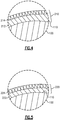
- Figure 2 shows corrosion barrier 200 on a surface of the heat exchanger 100.
- the surface can be one or both of non-line of site surface 106 or line of site surfaces 108.
- the corrosion barrier 200 includes one layer or multiple layers, discussed in more detail below. At least one of the layers is deposited by atomic layer deposition.
- an ALD-deposited layer can constitute a single material, but in other examples, an ALD-deposited layer can constitute multiple materials arranged in sub-layers, as will be discussed in more detail below.
- Figure 3 shows a method 300 for atomic layer deposition (ALD).
- ALD atomic layer deposition
- step 302 a single layer of a first precursor is adsorbed onto the surface of a component, such as the heat exchanger 100, in a reactor.
- step 304 the reactor is purged of excess first precursor.
- step 306 a second precursor is provided to the reactor, wherein the second precursor is selected to react with the adsorbed first precursor.
- the reactor is purged of excess second precursor.
- Adsorption of the first precursor in step 302 can be affected on non-line of site surfaces 106 as well as line of site surfaces 108 by exposing the heat exchanger 100 to the first precursor in a reactor. Accordingly, because the first precursor is introduced and adsorbed on the heat exchanger 100 in a single layer in step 302, and the second precursor reacts only with the adsorbed first precursor in step 306, the resulting deposition of material is a uniform (homogenous), continuous (unitary) layer, generally free of pinholes or other imperfections on both line of site surfaces 108 and non-line of site surfaces 106, along uneven or irregular areas, or areas with complex geometries.
- the ALD process can be automated, as compared to the dipping/or tumbling processes for the conversion coat discussed above, decreasing manufacturing costs and time.
- Steps 302-308 can be repeated to provide a layer of a desired thickness for the corrosion barrier 200.
- steps 302-308 are repeated to provide a layer with a thickness of between about 1 and 500 nanometers (0.00004 and 0.02 mils). This is an order of magnitude or more less than the topcoat layer discussed above.
- the first and second precursors in successive repetitions of steps 302 and 306 are the same, providing an ALD layer of a single material.
- the first and second precursors can be changed in successive repetitions of steps 302 and 306 to provide sub-layers of different material in the ALD layer. For instance, sub-layers may be between 5 and 10 nanometers (0.0002 and 0.0004 mils) thick.
- the ALD layer comprises alternating sub-layers of materials such as Al 2 O 3 and TiO 2 (or any of the materials discussed below), each of which are between 5 and 10 nanometers (0.0002 and 0.0004 mils) thick, built up to an ALD layer with thickness of between about 1 and 500 nanometers (0.00004 and 0.02 mils).
- the corrosion barrier 200 comprises the entire coating which is deposited by ALD as in method 300.
- the corrosion barrier 200 replaces both the conversion coat and the topcoat discussed above.
- the corrosion barrier 200 provides a barrier for preventing moisture and dissolved salts from reaching the component 100 and causing corrosion.
- the corrosion barrier 200 is a relatively thin, uniform (homogenous), and continuous (unitary) layer, even on non-line of sight surfaces of component 100.
- the corrosion barrier 200 is free from volatile organic components, like the topcoats discussed above.
- the corrosion barrier 200 is also free from forms of chromium which are subject to many environmental regulations.
- the corrosion barrier 200 comprises a ceramic material, such as an oxide, carbide, or nitride of aluminum, silicon, magnesium, titanium, chromium, manganese, iron, cobalt, nickel, copper, zinc, zirconium, niobium, molybdenum, hafnium, tantalum, tungsten, rare earth metals (e.g., metals of the Lanthanide series), and combinations thereof.
- Ceramic material such as an oxide, carbide, or nitride of aluminum, silicon, magnesium, titanium, chromium, manganese, iron, cobalt, nickel, copper, zinc, zirconium, niobium, molybdenum, hafnium, tantalum, tungsten, rare earth metals (e.g., metals of the Lanthanide series), and combinations thereof.
- Particular example materials are TiO 2 (titanium dioxide), Ta 2 O 5 (tantalum pentoxide), SiO 2 (silicon dioxide), Nb 2 O 5 (niobi
- Figure 4 shows an example corrosion barrier 210 for a surface 110 of heat exchanger 100.
- the surface 110 can be either of the surfaces 106, 108 discussed above.
- the corrosion barrier 210 includes two layers 212, 214.
- the first, inner, layer 212 is adjacent the heat exchanger 100.
- the first layer 212 is a chromium-based layer, such as the conversion coat discussed above, or could be a chromate free conversion treatment.
- the second, outer layer 214 comprises a ceramic material deposited by ALD such as the ALD corrosion barrier 200 discussed above.
- the ALD layer 214 replaces the topcoat layer discussed above, and provides a uniform (homogenous), continuous (unitary) layer over the conversion coat layer, which may not be uniform or continuous for the reasons discussed above.
- the conversion coat layer 212 provides an active corrosion barrier in case of damage to the ALD layer 214.
- the active corrosion barrier is active in that it can undergo a chemical reaction that inhibits corrosion. For instance, if a chromium-based active corrosion barrier is damaged, chromate ions in a chromium-based active corrosion barrier can enter the damaged portion and react with surrounding electrolytes to form chromium oxide, which protects against corrosion.
- the active corrosion barrier is "self-healing."
- the corrosion barrier 210 comprises more than one ALD layer 214 of the same or a different ceramic material, which is selected to provide desired corrosion-resistant properties to the component.
- the topcoat layer discussed above is deposited on top of the ALD layer 214 to protect the ALD layer 214 from structural or mechanical damage.
- the ALD layer still provides a uniform (homogenous), continuous (unitary) layer over the conversion coat layer, which may not be uniform or continuous for the reasons discussed above.
- FIG. 5 shows another example corrosion barrier 220.
- the corrosion barrier 220 includes an inner ALD layer 222 and an outer ALD layer 224.
- One of the inner ALD layer 222 and the outer ALD layer 224 is similar to the ALD layers 200, 214 discussed above.
- the other of the ALD layer 222 and the outer ALD layer 224 is hydrophobic or superhydrophobic.
- the hydrophobic or superhydrophobic layer comprises an element from the Lanthanide series which imparts the hydrophobicity or superhydrophobicity to the layer.
- the hydrophobic or superhydrophobic layer is the outer ALD layer 224.
- the hydrophobicity/superhydrophobicity allows the ALD layer 224 to remove moisture from the surface 110, which is particularly important in preventing water buildup in small passages such as the passages 104 ( Figure 1B-C ). Furthermore, the hydrophobicity/superhydrophobicity prevents or contributes to the prevention of ice buildup. In one example, the hydrophobic/superhydrophobic layer 224 is between 1 and 10 nm (0.00004 and 0.0004 mils) thick.
- the corrosion barrier 210 of Figure 4 further includes a hydrophobic or superhydrophobic outer layer in addition to the conversion coat layer 212 and the ALD layer 214.
- the ALD layer 214 in Figure 4 is a hydrophobic or superhydrophobic layer, as discussed above.
Landscapes
- Chemical & Material Sciences (AREA)
- Engineering & Computer Science (AREA)
- Mechanical Engineering (AREA)
- Metallurgy (AREA)
- Organic Chemistry (AREA)
- Chemical Kinetics & Catalysis (AREA)
- Materials Engineering (AREA)
- Inorganic Chemistry (AREA)
- General Chemical & Material Sciences (AREA)
- Ceramic Engineering (AREA)
- Physics & Mathematics (AREA)
- Thermal Sciences (AREA)
- General Engineering & Computer Science (AREA)
- Other Surface Treatments For Metallic Materials (AREA)
- Laminated Bodies (AREA)
Applications Claiming Priority (1)
| Application Number | Priority Date | Filing Date | Title |
|---|---|---|---|
| US15/982,290 US20190352781A1 (en) | 2018-05-17 | 2018-05-17 | Corrosion barrier |
Publications (1)
| Publication Number | Publication Date |
|---|---|
| EP3569732A1 true EP3569732A1 (de) | 2019-11-20 |
Family
ID=66751855
Family Applications (1)
| Application Number | Title | Priority Date | Filing Date |
|---|---|---|---|
| EP19174673.4A Withdrawn EP3569732A1 (de) | 2018-05-17 | 2019-05-15 | Korrosionsschutzschicht |
Country Status (2)
| Country | Link |
|---|---|
| US (2) | US20190352781A1 (de) |
| EP (1) | EP3569732A1 (de) |
Cited By (2)
| Publication number | Priority date | Publication date | Assignee | Title |
|---|---|---|---|---|
| EP3770299A1 (de) * | 2019-07-26 | 2021-01-27 | Hamilton Sundstrand Corporation | Korrosionsbarrieren für wärmetauscher |
| EP3808870A1 (de) * | 2019-10-17 | 2021-04-21 | Hamilton Sundstrand Corporation | Niedertemperatur-atomschicht-abgeschiedene deckschichten für vorbehandeltes aluminium |
Families Citing this family (3)
| Publication number | Priority date | Publication date | Assignee | Title |
|---|---|---|---|---|
| US10781318B2 (en) * | 2018-11-09 | 2020-09-22 | Hamilton Sundstrand Corporation | Graphene based corrosion-resistant coating |
| WO2021124582A1 (ja) * | 2019-12-20 | 2021-06-24 | エム・テクニック株式会社 | 熱交換器 |
| DE102021118577B4 (de) | 2021-07-19 | 2024-06-20 | Infineon Technologies Austria Ag | Verfahren zum aufbringen einer schicht auf die innenwand einer kühlungsstruktur |
Citations (4)
| Publication number | Priority date | Publication date | Assignee | Title |
|---|---|---|---|---|
| GB2509335A (en) * | 2012-12-31 | 2014-07-02 | Univ Tartu | Double-structured corrosion resistant coatings and methods of application |
| US20150111063A1 (en) * | 2012-03-23 | 2015-04-23 | Massachusetts Institute Of Technology | Hydrophobic materials incorporating rare earth elements and methods of manufacture |
| KR101659232B1 (ko) * | 2015-07-20 | 2016-09-23 | 부산대학교 산학협력단 | 내부식 및 기계적 특성이 향상된 고경도 코팅막의 제조방법 |
| US20170314125A1 (en) * | 2016-04-27 | 2017-11-02 | Applied Materials, Inc. | Atomic layer deposition of protective coatings for semiconductor process chamber components |
-
2018
- 2018-05-17 US US15/982,290 patent/US20190352781A1/en not_active Abandoned
-
2019
- 2019-05-15 EP EP19174673.4A patent/EP3569732A1/de not_active Withdrawn
- 2019-11-21 US US16/690,357 patent/US20200087796A1/en not_active Abandoned
Patent Citations (4)
| Publication number | Priority date | Publication date | Assignee | Title |
|---|---|---|---|---|
| US20150111063A1 (en) * | 2012-03-23 | 2015-04-23 | Massachusetts Institute Of Technology | Hydrophobic materials incorporating rare earth elements and methods of manufacture |
| GB2509335A (en) * | 2012-12-31 | 2014-07-02 | Univ Tartu | Double-structured corrosion resistant coatings and methods of application |
| KR101659232B1 (ko) * | 2015-07-20 | 2016-09-23 | 부산대학교 산학협력단 | 내부식 및 기계적 특성이 향상된 고경도 코팅막의 제조방법 |
| US20170314125A1 (en) * | 2016-04-27 | 2017-11-02 | Applied Materials, Inc. | Atomic layer deposition of protective coatings for semiconductor process chamber components |
Cited By (2)
| Publication number | Priority date | Publication date | Assignee | Title |
|---|---|---|---|---|
| EP3770299A1 (de) * | 2019-07-26 | 2021-01-27 | Hamilton Sundstrand Corporation | Korrosionsbarrieren für wärmetauscher |
| EP3808870A1 (de) * | 2019-10-17 | 2021-04-21 | Hamilton Sundstrand Corporation | Niedertemperatur-atomschicht-abgeschiedene deckschichten für vorbehandeltes aluminium |
Also Published As
| Publication number | Publication date |
|---|---|
| US20190352781A1 (en) | 2019-11-21 |
| US20200087796A1 (en) | 2020-03-19 |
Similar Documents
| Publication | Publication Date | Title |
|---|---|---|
| US20200087796A1 (en) | Corrosion barrier | |
| Cohen | Replacements for chromium pretreatments on aluminum | |
| Mohammadi et al. | A novel corrosion inhibitive system comprising Zn-Al LDH and hybrid sol-gel silane nanocomposite coating for AA2024-T3 | |
| Popoola et al. | Corrosion resistance through the application of anti-corrosion coatings | |
| CN101461030B (zh) | 耐磨耐蚀涂层 | |
| CN104120420B (zh) | 不含铬的转化涂料 | |
| US20030072962A1 (en) | Steel sheet having organic coating and method for manufacturing the same | |
| KR101829483B1 (ko) | 무기계 크로뮴-프리 금속 표면 처리제 | |
| JP7583934B2 (ja) | 溶融Al-Zn系めっき鋼板、その製造方法、表面処理鋼板及び塗装鋼板 | |
| Zhang et al. | Anticorrosive yet conductive Hf/Si3N4 multilayer coatings on AZ91D magnesium alloy by magnetron sputtering | |
| CN1192124C (zh) | 钢铁制品锌铝包埋共渗方法及其渗剂 | |
| WO2010094256A1 (de) | Erosionsschutz-beschichtungssystem fur gasturbinenbauteile | |
| KR20110059710A (ko) | 내마모 및 내부식성의 층상 복합체 | |
| CN101426955A (zh) | 耐腐蚀基材及其制造方法 | |
| AU2024266773A1 (en) | HOT-DIP Al-Zn-Si-Mg COATED STEEL SHEET, SURFACE-TREATED STEEL SHEET, AND PRE-PAINTED STEEL SHEET | |
| JP2014111839A (ja) | 防食層を有する複合材料及びその製造方法 | |
| US10612118B2 (en) | Methods for producing a pre-lacquered metal sheet having Zn—Al—Mg coatings and corresponding metal sheet | |
| WO2022091851A1 (ja) | 溶融Al-Zn-Si-Mg-Sr系めっき鋼板、表面処理鋼板及び塗装鋼板 | |
| US6768249B1 (en) | Spark plug and producing method therefor | |
| KR20260027333A (ko) | 용융 Al-Zn-Si-Mg 계 도금 강판 및 그 제조 방법, 표면 처리 강판 및 그 제조 방법, 그리고, 도장 강판 및 그 제조 방법 | |
| Härkönen et al. | AlxTayOz mixture coatings prepared using atomic layer deposition for corrosion protection of steel | |
| US20210115568A1 (en) | Low temperature atomic layer deposited topcoats for pretreated aluminum | |
| EP3770299A1 (de) | Korrosionsbarrieren für wärmetauscher | |
| KR101543793B1 (ko) | 마그네슘 합금 표면처리용 조성물 및 이를 이용하여 표면처리된 마그네슘 합금 | |
| CN1703483A (zh) | 用于磷酸盐化金属表面的无铬末级漂洗剂 |
Legal Events
| Date | Code | Title | Description |
|---|---|---|---|
| PUAI | Public reference made under article 153(3) epc to a published international application that has entered the european phase |
Free format text: ORIGINAL CODE: 0009012 |
|
| STAA | Information on the status of an ep patent application or granted ep patent |
Free format text: STATUS: THE APPLICATION HAS BEEN PUBLISHED |
|
| AK | Designated contracting states |
Kind code of ref document: A1 Designated state(s): AL AT BE BG CH CY CZ DE DK EE ES FI FR GB GR HR HU IE IS IT LI LT LU LV MC MK MT NL NO PL PT RO RS SE SI SK SM TR |
|
| AX | Request for extension of the european patent |
Extension state: BA ME |
|
| STAA | Information on the status of an ep patent application or granted ep patent |
Free format text: STATUS: REQUEST FOR EXAMINATION WAS MADE |
|
| 17P | Request for examination filed |
Effective date: 20191202 |
|
| RBV | Designated contracting states (corrected) |
Designated state(s): AL AT BE BG CH CY CZ DE DK EE ES FI FR GB GR HR HU IE IS IT LI LT LU LV MC MK MT NL NO PL PT RO RS SE SI SK SM TR |
|
| STAA | Information on the status of an ep patent application or granted ep patent |
Free format text: STATUS: EXAMINATION IS IN PROGRESS |
|
| 17Q | First examination report despatched |
Effective date: 20220304 |
|
| STAA | Information on the status of an ep patent application or granted ep patent |
Free format text: STATUS: THE APPLICATION IS DEEMED TO BE WITHDRAWN |
|
| 18D | Application deemed to be withdrawn |
Effective date: 20250128 |