EP3568090B1 - Intelligente staubinde - Google Patents
Intelligente staubinde Download PDFInfo
- Publication number
- EP3568090B1 EP3568090B1 EP18739230.3A EP18739230A EP3568090B1 EP 3568090 B1 EP3568090 B1 EP 3568090B1 EP 18739230 A EP18739230 A EP 18739230A EP 3568090 B1 EP3568090 B1 EP 3568090B1
- Authority
- EP
- European Patent Office
- Prior art keywords
- patient
- tourniquet
- recording module
- elongate member
- smart tourniquet
- Prior art date
- Legal status (The legal status is an assumption and is not a legal conclusion. Google has not performed a legal analysis and makes no representation as to the accuracy of the status listed.)
- Active
Links
Images



Classifications
-
- A—HUMAN NECESSITIES
- A61—MEDICAL OR VETERINARY SCIENCE; HYGIENE
- A61B—DIAGNOSIS; SURGERY; IDENTIFICATION
- A61B17/00—Surgical instruments, devices or methods
- A61B17/12—Surgical instruments, devices or methods for ligaturing or otherwise compressing tubular parts of the body, e.g. blood vessels or umbilical cord
- A61B17/132—Tourniquets
- A61B17/1322—Tourniquets comprising a flexible encircling member
-
- A—HUMAN NECESSITIES
- A61—MEDICAL OR VETERINARY SCIENCE; HYGIENE
- A61B—DIAGNOSIS; SURGERY; IDENTIFICATION
- A61B34/00—Computer-aided surgery; Manipulators or robots specially adapted for use in surgery
- A61B34/25—User interfaces for surgical systems
-
- A—HUMAN NECESSITIES
- A61—MEDICAL OR VETERINARY SCIENCE; HYGIENE
- A61M—DEVICES FOR INTRODUCING MEDIA INTO, OR ONTO, THE BODY; DEVICES FOR TRANSDUCING BODY MEDIA OR FOR TAKING MEDIA FROM THE BODY; DEVICES FOR PRODUCING OR ENDING SLEEP OR STUPOR
- A61M5/00—Devices for bringing media into the body in a subcutaneous, intra-vascular or intramuscular way; Accessories therefor, e.g. filling or cleaning devices, arm-rests
- A61M5/178—Syringes
- A61M5/31—Details
- A61M5/315—Pistons; Piston-rods; Guiding, blocking or restricting the movement of the rod or piston; Appliances on the rod for facilitating dosing ; Dosing mechanisms
- A61M5/31565—Administration mechanisms, i.e. constructional features, modes of administering a dose
- A61M5/31566—Means improving security or handling thereof
- A61M5/31568—Means keeping track of the total dose administered, e.g. since the cartridge was inserted
-
- A—HUMAN NECESSITIES
- A61—MEDICAL OR VETERINARY SCIENCE; HYGIENE
- A61M—DEVICES FOR INTRODUCING MEDIA INTO, OR ONTO, THE BODY; DEVICES FOR TRANSDUCING BODY MEDIA OR FOR TAKING MEDIA FROM THE BODY; DEVICES FOR PRODUCING OR ENDING SLEEP OR STUPOR
- A61M5/00—Devices for bringing media into the body in a subcutaneous, intra-vascular or intramuscular way; Accessories therefor, e.g. filling or cleaning devices, arm-rests
- A61M5/42—Devices for bringing media into the body in a subcutaneous, intra-vascular or intramuscular way; Accessories therefor, e.g. filling or cleaning devices, arm-rests having means for desensitising skin, for protruding skin to facilitate piercing, or for locating point where body is to be pierced
- A61M5/425—Protruding skin to facilitate piercing, e.g. vacuum cylinders, vein immobilising means
-
- G—PHYSICS
- G16—INFORMATION AND COMMUNICATION TECHNOLOGY [ICT] SPECIALLY ADAPTED FOR SPECIFIC APPLICATION FIELDS
- G16H—HEALTHCARE INFORMATICS, i.e. INFORMATION AND COMMUNICATION TECHNOLOGY [ICT] SPECIALLY ADAPTED FOR THE HANDLING OR PROCESSING OF MEDICAL OR HEALTHCARE DATA
- G16H20/00—ICT specially adapted for therapies or health-improving plans, e.g. for handling prescriptions, for steering therapy or for monitoring patient compliance
- G16H20/10—ICT specially adapted for therapies or health-improving plans, e.g. for handling prescriptions, for steering therapy or for monitoring patient compliance relating to drugs or medications, e.g. for ensuring correct administration to patients
- G16H20/17—ICT specially adapted for therapies or health-improving plans, e.g. for handling prescriptions, for steering therapy or for monitoring patient compliance relating to drugs or medications, e.g. for ensuring correct administration to patients delivered via infusion or injection
-
- G—PHYSICS
- G16—INFORMATION AND COMMUNICATION TECHNOLOGY [ICT] SPECIALLY ADAPTED FOR SPECIFIC APPLICATION FIELDS
- G16H—HEALTHCARE INFORMATICS, i.e. INFORMATION AND COMMUNICATION TECHNOLOGY [ICT] SPECIALLY ADAPTED FOR THE HANDLING OR PROCESSING OF MEDICAL OR HEALTHCARE DATA
- G16H40/00—ICT specially adapted for the management or administration of healthcare resources or facilities; ICT specially adapted for the management or operation of medical equipment or devices
- G16H40/60—ICT specially adapted for the management or administration of healthcare resources or facilities; ICT specially adapted for the management or operation of medical equipment or devices for the operation of medical equipment or devices
- G16H40/63—ICT specially adapted for the management or administration of healthcare resources or facilities; ICT specially adapted for the management or operation of medical equipment or devices for the operation of medical equipment or devices for local operation
-
- A—HUMAN NECESSITIES
- A61—MEDICAL OR VETERINARY SCIENCE; HYGIENE
- A61B—DIAGNOSIS; SURGERY; IDENTIFICATION
- A61B17/00—Surgical instruments, devices or methods
- A61B17/12—Surgical instruments, devices or methods for ligaturing or otherwise compressing tubular parts of the body, e.g. blood vessels or umbilical cord
- A61B17/132—Tourniquets
- A61B17/1322—Tourniquets comprising a flexible encircling member
- A61B17/1327—Tensioning clamps
-
- A—HUMAN NECESSITIES
- A61—MEDICAL OR VETERINARY SCIENCE; HYGIENE
- A61B—DIAGNOSIS; SURGERY; IDENTIFICATION
- A61B17/00—Surgical instruments, devices or methods
- A61B2017/00017—Electrical control of surgical instruments
- A61B2017/00022—Sensing or detecting at the treatment site
- A61B2017/00026—Conductivity or impedance, e.g. of tissue
-
- A—HUMAN NECESSITIES
- A61—MEDICAL OR VETERINARY SCIENCE; HYGIENE
- A61B—DIAGNOSIS; SURGERY; IDENTIFICATION
- A61B17/00—Surgical instruments, devices or methods
- A61B2017/00017—Electrical control of surgical instruments
- A61B2017/00115—Electrical control of surgical instruments with audible or visual output
-
- A—HUMAN NECESSITIES
- A61—MEDICAL OR VETERINARY SCIENCE; HYGIENE
- A61B—DIAGNOSIS; SURGERY; IDENTIFICATION
- A61B17/00—Surgical instruments, devices or methods
- A61B2017/00017—Electrical control of surgical instruments
- A61B2017/00199—Electrical control of surgical instruments with a console, e.g. a control panel with a display
-
- A—HUMAN NECESSITIES
- A61—MEDICAL OR VETERINARY SCIENCE; HYGIENE
- A61B—DIAGNOSIS; SURGERY; IDENTIFICATION
- A61B17/00—Surgical instruments, devices or methods
- A61B2017/00017—Electrical control of surgical instruments
- A61B2017/00221—Electrical control of surgical instruments with wireless transmission of data, e.g. by infrared radiation or radiowaves
-
- A—HUMAN NECESSITIES
- A61—MEDICAL OR VETERINARY SCIENCE; HYGIENE
- A61B—DIAGNOSIS; SURGERY; IDENTIFICATION
- A61B90/00—Instruments, implements or accessories specially adapted for surgery or diagnosis and not covered by any of the groups A61B1/00 - A61B50/00, e.g. for luxation treatment or for protecting wound edges
- A61B90/08—Accessories or related features not otherwise provided for
- A61B2090/0803—Counting the number of times an instrument is used
-
- A—HUMAN NECESSITIES
- A61—MEDICAL OR VETERINARY SCIENCE; HYGIENE
- A61M—DEVICES FOR INTRODUCING MEDIA INTO, OR ONTO, THE BODY; DEVICES FOR TRANSDUCING BODY MEDIA OR FOR TAKING MEDIA FROM THE BODY; DEVICES FOR PRODUCING OR ENDING SLEEP OR STUPOR
- A61M2205/00—General characteristics of the apparatus
- A61M2205/50—General characteristics of the apparatus with microprocessors or computers
- A61M2205/52—General characteristics of the apparatus with microprocessors or computers with memories providing a history of measured variating parameters of apparatus or patient
Definitions
- the invention generally relates to a device and in particular to a smart tourniquet for recording, automatically, a date and time of when medication is self-administered by a patient.
- Hemophilia is a medical condition in which the ability of blood to clot is severely reduced, causing a sufferer to bleed severely from even a slight injury. Deep internal bleeding, especially in the knees, ankles and elbows, can damage organs and tissues, and may be life-threatening. Hemophilia A or "classical hemophilia,” is the most common form of hemophilia (1 in 4,000 to 1 in 5,000 males worldwide are born with this disorder). Patients with hemophilia A are prone to frequent hemorrhages as a result of a lack of Factor VIII. This congenital deficiency has been successfully treated by infusions of Factor VIII concentrate preparations isolated and purified from either blood plasma of donors having normal levels of Factor VIII, or from cell cultures genetically engineered to express the Factor VIII coagulant protein.
- US 8043327 B1 discloses an auto-release tourniquet apparatus having a strap, a housing having a first slot therein suitable for receiving a first end of the strap and a second slot suitable for receiving another portion of the strap therein, and a strap releasing mechanism positioned in the housing.
- the strap releasing mechanism serves to release at least one of the first and second ends of the strap from the housing after a predetermined period of time.
- a solenoid is positioned in the housing and acts upon the first end of the strap so as to allow for the ejection of the first end of the strap from the first slot after the predetermined period of time.
- a strap tensioning mechanism is associated with the second slot of the housing for allowing the strap to be suitably tensioned.
- a switching mechanism is configured to transmit a signal to a microprocessor to start a timer when the strap is tensioned.
- US 2006/200195 Al discloses an aspiration and delivery safety system that includes a blood restriction unit, an inflating unit, a needle unit, and a puncture site press unit.
- the blood restriction unit is constituted by a plurality of air bands.
- the needle unit is a syringe or butterfly needle or blood collector or intravenous catheter or arteriovenous fistula needle.
- the inflating unit has a controller that monitors a patient's blood pressure and heart rate, and records these data by means of a recording device into which a medical person can also input other medical data.
- hemophilia sufferers While there is no cure for hemophilia, most hemophilia sufferers can and do lead fairly normal lives by taking infusions of recombinant Factor VIII whenever they bleed (e.g., because of an injury or surgery). Some people strive for "zero days of bleeding" by taking prophylactic infusions, for example, every two days or every three days. In either case, there is a need to track the date and time of a bleed and/or infusion.
- a hemophilia sufferer can use an application (e.g., one running on their smart phone) to record their bleeding episodes and/or infusions. Every time the person bleeds and/or takes an infusion, they can enter the date and time into the application.
- a hemophilia sufferer is in a lot of pain when they are bleeding and taking an infusion to stop the bleeding. The pain makes it very difficult for the person to record the date and time of the bleed and/or infusion. Often a hemophilia sufferer is more interested in carrying on with what they were doing before an infusion and they sometimes forgets to record the date and time of their bleed and/or infusion. Incomplete information about bleeds and/or infusions or a delay in delivering this information to a health care provider can lead to misjudging the person's condition or missing a time or window for treating the person. The end result can be pain and suffering or much worse. What is needed is a way from a hemophilia sufferer to record the date and time of a bleed and/or infusion, automatically, with as little intervention as possible.
- a smart tourniquet according to the appended independent claim is provided that records, automatically, the date and time of a bleed and/or infusion, each time a patient uses the smart tourniquet for an infusion.
- the smart tourniquet includes an elongate member having a first end and a second end. There is a longitudinal axis extending between the first end and the second end.
- the elongate member is adapted for wrapping about a limb of a patient, such as their arm.
- the smart tourniquet further includes a recording module.
- the recording module has a slot extending through it for slidably receiving the elongate member and a fastening end for releasably capturing the second end of the elongate member.
- the recording module saves a confirmation timestamp in response to the patient confirming a strength and dosage of the drug.
- the recording module can include a display and one or more keys for: i) entering the dosage of the drug self-administered by the patient so that the record includes the timestamp and the dosage, ii) inquiring about past records, iii) adjusting the timestamp, iv) changing the language of text displayed by the recording module or v) a combination thereof.
- the recording module can include a function key, which when depressed and held for at least a pre-defined period of time causes the recording module to save the timestamp of the patient using the tourniquet to self-administer the drug.
- the recording module can include memory for storing the record and previous records with earlier timestamps of the patient using the tourniquet to self-administer the drug.
- the recording module can also include a wireless interface for communicating with a computing device, for example, using BLUETOOTH, WIFI, ZIGBEE or ZWAVE.
- the recording module can include an audio alarm configured to provide an aural cue in response to the fastening end of the recording module capturing the second end of the elongate member.
- the recording module can also include a visual alarm configured to provide a visual cue in response to the fastening end of the recording module capturing the second end of the elongate member.
- the second end of the elongate member and fastening end of the recording module can form a buckle assembly comprising a male portion and a female portion.
- the recording module can shut off in response to the second end being released from the fastening end.
- the smart tourniquet includes an electrode electrically coupled to the recording module for measuring a galvanic skin response.
- the electrode contacts the patient's skin.
- the recording module then saves the timestamp in response to the galvanic skin response measured by the electrode.
- An associated method for tracking when a patient self-administers a drug includes providing a smart tourniquet, wherein said method does not form part of the claimed invention.
- the smart tourniquet includes an elongate member having a first end and a second end. There is a longitudinal axis extending between the first end and the second end.
- the elongate member is adapted for wrapping about a limb of a patient, such as their arm.
- the smart tourniquet further includes a recording module.
- the recording module has a slot extending through it for slidably receiving the elongate member and a fastening end for releasably capturing the second end of the elongate member.
- the method further includes saving in the recording module a record that includes a timestamp of the patient using the tourniquet to self-administer a drug. Saving the record is in response to the second end of elongate member being captured by the fastening end of the recording module and the tourniquet being tighten about the limb.
- using the smart tourniquet can help the patient record when they took an infusion of a drug.
- the usefulness of the smart tourniquet is not tied to particular drug but can be extended to include any drug administered, intravenously, made by any pharmaceutical company.
- the smart tourniquet can be widely adopted by pharmaceutical companies and patients alike.
- Examples of a smart tourniquet for a patient to use to administer medication to themselves are described with reference to the figures.
- the patient When the patient needs to inject themselves with medication, intravenously, called an "infusion," the patient wears the smart tourniquet around their arm, for example, and tightens the smart tourniquet. Tightening the smart tourniquet helps the patient locate a vein for the infusion.
- the device can automatically record, the date and time of the infusion, called a "timestamp".
- the patient can also use the smart tourniquet to record the dosage or "number of units" of medication taken at the time of the infusion.
- the smart tourniquet can store the timestamp as well as other related information as a record. At a later time, the patient can recall prior records on the smart tourniquet itself.
- the smart tourniquet can be synchronized with an application and records can be downloaded from the smart tourniquet for review by the patient, nurse or doctor.
- a hemophilia sufferer can use the smart tourniquet to take an infusion of recombinant Factor VIII, such as ADVATE produced by the SHIRE pharmaceutical company. They take the infusion whenever they bleed, which can occur spontaneously or as a result of an injury, to stop the bleeding.
- a timestamp of an infusion also represents a date and time of a bleeding episode.
- any discussion below of the smart tourniquet recording a timestamp of an infusion also applies to recording a timestamp of a bleeding episode. Automatically recording the date and time when a hemophilia sufferer bleeds is particular beneficial because they may be in too much pain to record a bleeding episode themselves or they may forget.
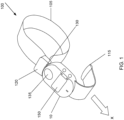
- FIG. 1 shows an example of the smart tourniquet 100 having an elongate member 105 for wrapping tightly around a patient's limb during an infusion and a recording module 110 for recording a timestamp of the infusion (or bleeding episode).
- the elongate member 105 has a first end 115 and second end 120, and a longitudinal axis extending between the first and second ends 115, 120 (shown in FIG. 2 as a double-headed arrow labeled LA).
- the elongate member 105 is of a sufficient length of that allows the first end 115 to be pulled on while the second end 120 is wrapped around the patient's limb.
- the elongate member 105 can be of different lengths to accommodate different limb sizes, for example, a longer elongate member 105 for an adult arm and a shorter elongate member 105 for a child arm.
- the elongate member 105 can be made of a material that is compatible with the patient's skin, for example vinyl if the patient is allergic to latex.
- the recording module 110 includes a slot 125 (shown in FIG. 2 in phantom line) through which the elongate member 105 can slide. As shown in FIG. 1 , the long dimension of the recording module 110 is aligned with the longitudinal axis LA of the elongate member 105.
- the recording module 110 further includes, along its short dimension, a fastening end 130 that is adapted to releasably capture the second end 120 of the elongate member 105.
- the patient wraps the second end 120 of the elongate number 105 around a limb, for example their arm, and fastens the second end 120 to the fastening end 130 of the recording module 110.
- the patient pulls the first end 115 of the elongate member 105 away from the second end 120 in the direction of the longitudinal axis (shown in FIG. 1 as arrow labeled X).
- This tightens the loop around the around the patient's limb and reduces blood circulation in the limb.
- the reduction in blood circulation causes veins near the surface of the patient's skin to enlarge and become more pronounced, thereby helping the patient locate a vein for the infusion.
- the patient can push a release button 135 on the recording module 110 to uncouple the second end 120 of the elongate number 105 from the fasting end 130 of the recording module 110.
- the second end 120 of the elongate member 105 and the fastening end 130 of the recording module 110 can form a buckle.
- the second end 120 is the male portion of the buckle and the fastening end 130 is the female portion of the buckle.
- fastening the smart tourniquet 100 includes inserting the second end 120 into the fastening end 130.
- the gender of the second end 120 and the fastening end 130 are reversed, and the fastening end 130 is inserted into the second end 120 to fasten the smart tourniquet 100.
- the smart tourniquet 100 can include mechanisms that help the patient use the device correctly.
- the recording module 110 can include an audio alarm configured to provide an aural cue in response to the fastening end 130 of the recording module 110 capturing the second end 120 of the elongate member 105.
- a single chirp from the audio alarm confirms that the smart tourniquet 100 is properly fastened around the patient's limb.
- an absent of noise from the audio alarm signifies that the smart tourniquet 100 is not properly fastened around the patient's limb.
- the recording module 110 can include a visual alarm configured to provide a visual cue in response to the fastening end 130 of the recording module 110 capturing the second end 120 of the elongate member 105.
- a green light from the visual alarm confirms that the smart tourniquet 100 is properly fastened around the patient's limb.
- a red light from the visual alarm signifies that the smart tourniquet 100 is not properly fastened around the patient's limb.
- a combination of aural and visual cues can be used to notify the patient whether they are using the device correctly.
- the patient can readily know if they are using the smart tourniquet 100 correctly.
- the smart tourniquet 100 can automatically document a timestamp of an infusion.
- the smart tourniquet 100 records a timestamp when the device is fastened around the patient's arm, for example. In this way, a timestamp is recorded without the patient manually entering a date and time into the smart tourniquet 100.
- Fastening the smart tourniquet 100 around the patient's arm brings the smart tourniquet into contact with the patient's skin.
- One or more electrodes associated with the smart tourniquet 100 measure the conductance of the patient's skin, which is very different than air (as would be case if the smart tourniquet was not fastened around the patient's arm).
- the smart tourniquet 100 Upon detecting the galvanic skin response, the smart tourniquet 100 records a timestamp. For ease of reference, this timestamp is called the "wakeup timestamp".
- the smart tourniquet 100 also records the date and time when the patient confirms the strength and dosage of an infusion, which for ease of reference, is called the "confirmation timestamp.” Again, a timestamp is recorded without the patient manually entering a date and time into the smart tourniquet 100.
- the wake up timestamp and the confirmation timestamp can be used to track when the user has taken an infusion and/or has had a bleeding episode, as will describe in greater detail below.
- records including the wakeup and confirmation timestamps can be used to identify when information about an infusion/bleeding episode is missing and to remind the patient to provide the missing information. For example, when a record of wakeup timestamp is not followed by a record of a confirmation timestamp, there may be information missing about an infusion/bleeding episode.
- the smart tourniquet 100 or an application associated with the device can prompt the patient to enter the missing date, time, strength, and dosage.
- the process of reminding the patient to record infusion/bleeding episode information can also be based on time. For example, when the smart tourniquet 100 records a wakeup timestamp, a timer starts counting down. If the smart tourniquet 100 does not record a confirmation timestamp by the time the timer expires, the smart tourniquet 100 (or device) reminds the patient to provide information about an infusion/bleeding episode.
- the foregoing reduces the likelihood of information about an infusion or bleeding episode not being recorded.
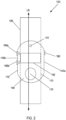
- FIG. 2 shows an example of the recording module 110 having a face 140, and opposing first side 145a and second side 145b that are aligned with the long dimension of the recording module 110.
- the face 140 includes a display 150 for showing the patient for information, e.g., a timestamp of an infusion.
- the display 150 can be an LCD (liquid crystal display) panel.
- an indicator 155 for providing visual cues to the patient.
- the indicator 155 can be an LED (light-emitting diode) light that is illuminated when the smart tourniquet 100 is "awake" and ready to record a timestamp.
- the LED light is not illuminated when the smart tourniquet 100 is "asleep" and not ready to record a timestamp. Beneficially, the patient can readily tell whether the smart tourniquet 100 is ready for them to use by looking at the indicator 155. As another example of information conveyed by the indicator 155, a blinking LED can indicate that the smart tourniquet 100 is not functioning properly and requires servicing or replacement.
- first side 145a of the recording module 110 there is a function key 160 for switching operating modes of the smart tourniquet 100, as will be described later in greater detail.
- second side 145b of the recording module 110 there is a first key 165a and a second key 165b for inputting information into the recording module 110.
- the first key 165a and the second key 165b can be used to increase or decrease the value of an input.
- the first key 165a and the second key 165b can also be used to go forward or backward when selecting an input to enter.
- first key 165a and the second key 165b are called a "plus key” and a “minus key”, respectively; and collectively “plus/minus keys” 165.
- the plus/minus keys 165 are used to enter information, as will be described in greater detail below.
- the keys can be in the form of a button or a bar, just to name a few possible shapes.
- the plus/minus keys 165 can be a "toggle" bar that acts as a plus button or minus button depending upon which end of the toggle bar the patient presses.
- the keys can also be multifunctional.
- the function key 160 can have the added function of recording a timestamp.
- the patient holds down the function key 160 for a predetermined period of time (e.g., at least three seconds) to record a timestamp.
- a predetermined period of time e.g., at least three seconds
- One or more keys can be used to turn on and/or off the smart tourniquet 100. For example, pressing and holding the plus/minus keys 165 for three second turns on the smart tourniquet 100. Doing the same again turns the smart tourniquet 100 off. It should be appreciated that the smart tourniquet 100 can be designed to turn on and/or off using any combination on keys and hold down times.
- the display 150 is sensitive to the patient's touch.
- physical keys are replaced with icons shown on the display 150 that the patient can touch. Any of the aforementioned functions can be accessed by the patient with one or more taps of the touchscreen.
- the smart tourniquet 100 can record the dosage or "number of units" of medication taken by the patient and recall records of past infusions. These and other features are described with reference to FIGS. 3-5 with additional reference to FIG. 2 .
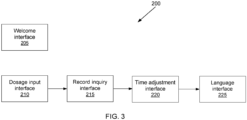
- the series 200 includes a welcome interface 205, a dosage input interface 210, a record inquiry interface 215, a time adjustment interface 220, and language interface 225. These interfaces can be shown on the display 150 as screens.
- the welcome interface 205 or "home screen" can provide information such as the current date and time. Other information that can be provided to the patient, include instructions on how to use the smart tourniquet 100, a firmware version number, and legal information.
- the patient switches between the interfaces to select an operating mode.
- the smart tourniquet 100 starts (e.g., after the smart tourniquet 100 wakes up) with the welcome interface 205.
- the patient can press the function key 160 on the recording module 110 to switch from the welcome interface 205 to the dosage input interface 210.
- the patient can wait for the dosage input operating mode to activate or the patient can press the function key 160 again to switch to the next interface, the record inquiry interface 215.
- the user can cycle through the series of interfaces 200, again and again, until an operating mode is activated. There can more or fewer interfaces as shown in FIG. 3 so long as the patient can activate an operating mode.
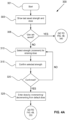
- FIG. 4 shows an example of the smart tourniquet 100 functioning in the dosage input operating mode, referred to as process 300 for ease of reference. Interactions between the process 300 and the patient can be carried out using the function key 160, the plus/minus keys 165, and the display 150, as described above.
- the process 300 starts (301) with the patient switching to the dosage input interface 210 and activating the dosage input operating mode, as described above with reference to FIG. 3 .
- the process 300 shows the patient the strength and dosage saved from the last infusion and asks (308) whether they want to use the saved values.
- the process 300 receives a "yes" from the patient, the process 300 jumps forward to step 340 of FIG. 4B and asks the patient to confirm recording the strength and dosage from the last infusion.
- this saves the patient time by not having them reenter information when there is no change from the prior infusion.
- the process 300 when the process 300 at check 308 receives a "no" from the patient, the process 300 then asks (310) the patient to select a strength (increment) for entering the dosage.
- the patient uses the plus/minus keys 165 to make the strength selection.
- the patient pushes the minus key 165b to select the strength of 250 IU and pushes the plus key 165a to select the strength of 500 IU.
- the process 300 asks (315) the patient to confirm the strength selected.
- the patient uses the plus/minus keys 165 to confirm the strength selection (e.g., the patient pushes the minus key 165b for no and pushes the plus key 165a for yes).
- the process 300 at check 320 receives a "no" from the patient; the process 300 returns to asking (310) the patient to select the strength.
- the process 300 at check 320 receives a "yes" from the patient, the process 300 provides (325) a default dosage.
- the default dosage can be the last dosage entered by the patient.
- the patient uses the plus/minus keys 165 to increase or decrease the default dosage by the selected strength.
- the patient selects and confirms the strength of 250 IU.
- the patient pushes the plus key 165a to increase the default dosage of 1000 IU by 250 IU, resulting in a dosage of 1250 IU being entered.
- the patient pushes the minus key 165b to decrease the default dosage of 1000 IU by 250 IU, resulting in a dosage of 750 IU being entered.
- the process 300 asks (330) the patient to confirm the entered dosage.
- the user uses the plus/minus keys 165 to confirm the dosage entry (e.g., the patient pushes the minus key 165b for no and pushes the plus key 165a for yes).
- process 300 at check 335 receives a "no" from the patient; the process 300 returns to providing (325 of FIG. 4A ) the default dosage to the patient to increase or decrease by the selected strength.
- the process 300 at check 335 receives a "yes" from the patient, the process 300 records (340) the entered dosage.
- the process 300 ends (345) with the patient being returned to the dosage input interface 210.
- the patient can also be brought to the welcome interface 205.
- the process 300 records the entered dosage such that data representing dosage and timestamp of an infusion are associated or otherwise linked together.
- a dosage can be looked by based on a timestamp.
- a dosage can used to look up one or more timestamps. Such information can be useful in analyzing how well the patient is responding to the infusions, for example.
- FIG. 5 shows an example of the smart tourniquet 100 functioning in the record inquiry operating mode, which for ease of reference is referred to as process 400.
- the process 400 provides the patient with the ability to recall timestamps of past infusions or "records.”
- a record can also include the medication dosage taken at the time of the infusion. Interactions between the process 400 and the patient can be carried out using the function key 160, the plus/minus keys 165, and the display 150, as described above.
- the process 400 starts (405) with the patient switching to the record inquiry interface 215 and activating the record inquiry operating mode, as described above with reference to FIG. 3 .
- the process 400 shows (410) the last saved record on the display 150, including the timestamp of the last infusion.
- the patient can use the plus/minus keys 165 to see the "next saved record.”
- the records can be organized in reverse chronological order, with the newest record shown first and the oldest record shown last.
- the process 400 displays (415) the next saved record.
- the process 400 continues to display (415) the next saved record (which is represented in the figure as a looped arrow).
- the process 400 can stop displaying (415) the next saved record when all the saved records have been shown to the patient. Alternatively, the process 400 can continue displaying (415) the next saved record, looping through the saved records, as long as the patient continues to press the plus/minus keys 165. The process 400 ends (420) when the patient presses the function key 160 to exit the record inquiry operating mode and returned to the welcome interface 205.
- the recording module 110 can include a clock for providing date and time of an infusion.
- the clock could be set manually, for example, the patient can use the function key 160 and the plus/minus keys 165 to set the date and time.
- the clock can also be set automatically without the patient's intervention.
- the smart tourniquet 100 can be synchronized with an application and the clock can be set by the application. In this example, the patient switches to the time adjusting interface 220 to activate the time adjusting operating mode.
- the smart tourniquet 100 acquires the present date and time from the application (e.g., by querying the application) to adjust the clock.
- the smart tourniquet 100 can be connected to the Internet and receive date and time information according to a networking protocol for clock synchronization, such as the Network Time Protocol (NTP).
- NTP Network Time Protocol
- the smart tourniquet 100 can receive wireless signals carrying date and time information, such as a beacon frame transmitted by a WIFI access point.
- Synchronizing the smart tourniquet 100 with an application can be useful because the patient's infusion records can be sent from the smart tourniquet 100 to the application.
- the application can then, for example, combine the records with other information (which may have been given by the patient using the application) and provide analytics, which can help the patient manage their own care.
- the information entered into the application can include the reason for the infusion (e.g., prophylaxis, spontaneous, injury, surgery/dental, follow-up or other).
- Such information can also be made available to a network of care providers to provide the patient with more complete care.
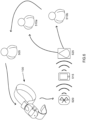
- FIG. 6 shows an example care network 500, including a patient 505, and healthcare providers, such as doctor 510a and nurse 510b, collectively referred to as 510.
- the patient 505 uses the smart tourniquet 100 for self-administer infusions and to record the date and time of the infusions, as described above.
- the smart tourniquet 100 is wirelessly connected to a computing device 515 in accordance with any number of wireless communication protocols, such as BLUETOOTH, WIFI, ZIGBEE, and ZWAVE just to name a few.
- the smart tourniquet 100 is wirelessly connected to a computing device 515 using a wireless communication protocol 520.
- the wireless communication protocol 520 is BLUETOOTH.
- the wireless communication protocol 520 can also be WIFI, ZIGBEE, and ZWAVE just to name a few.
- the computing device 515 can be a smartphone or other mobile device (as shown), and can run an application 525 that is a companion to the smart tourniquet 100.
- the smart tourniquet 100 can be synchronized with the application 525, and records and other information can be sent to the computing device 515. Downloading the records to the computing device 515 is advantageous because there is more memory to store the records than on the smart tourniquet 100. Additionally, the computing device 515 has more computing power to perform analytics.
- the computing device 515 is coupled to a network, such as the Internet or a private network (not shown).
- the healthcare providers 510 can access the patient's information, including records of self-administered infusions, by sending and receiving electronic messages (e.g., requests and responses) over the network.
- the electronic messages can be secured to provide privacy and security of health information in accordance with local regulations (e.g., in the U.S., the Health Insurance Portability and Accountability Act or "HIPAA").
- the healthcare providers 510 can analyze the effectiveness of the prescribed treatment and, in some instance, modify that treatment.
- the care network 500 includes the patient 505 and their feedback in rendering them care.
- the care network 500 is advantageous because it connects the patient 505 with the healthcare providers 510. Additionally, the care network 500 enables information about infusions to be automatically collected (by way of the smart tourniquet 100), thereby reducing any delay in delivering that information to the healthcare providers 510. For example, infusion information is collected in response to the smart tourniquet 100 being synchronized with the application 525. In turn, the healthcare providers 510 can provide the patient 505 with care that is timely and accurate.
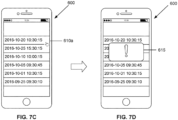
- FIGS. 7A through 7D show a series of screenshots of an application 600 used by a hemophilia sufferer to track infusions of recombinant Factor VIII.
- the application 600 includes a virtual button 605 that the person presses to synchronize and download records of past infusions from a smart tourniquet (such as the smart tourniquet 100 of FIGS. 1 and 2 ).
- the application 600 can display downloaded records 610a-f as a list.
- FIG. 7C the person selects the record 610a (shown in the figure as a pointing icon).
- FIG. 7A the application 600 includes a virtual button 605 that the person presses to synchronize and download records of past infusions from a smart tourniquet (such as the smart tourniquet 100 of FIGS. 1 and 2 ).
- the application 600 can display downloaded records 610a-f as a list.
- FIG. 7C the person selects the record 610a (shown in the figure as a pointing icon).
- the application 600 in response to the selection, provides a popup window 615 asking the person to identify the reason for the selected infusion as being either preventative (e.g., prophylactic treatment) or treatment (e.g., to stop spontaneous bleeding).
- the application 600 guides the person through the steps for providing more information about infusions, the timestamps of which were recorded by the smart tourniquet without the patient having to enter in the timestamps.
- Example uses of a smart tourniquet such as the smart tourniquet 100 of FIGS. 1 and 2 , are described with reference to the tables set out below.
- Tables 8, 9A-B, and 10A-C are diagrams showing a patient using the smart tourniquet to take an infusion, including waking up the smart tourniquet and inputting the dosage taken.
- Tables 11A-D are diagrams showing a patient using the smart tourniquet to review infusion records stored in the device.
- Tables 12A-D are diagrams showing a patient adjusting the time on the smart tourniquet.
- Tables 13A-D are diagrams showing a patient selecting which language the smart tourniquet communicates with the patient.
- Table 14 is a diagram showing the patient confirming that a connection between the smart tourniquet and the application be established. Operation: Wake up the smart tourniquet by: a) fastening the smart tourniquet around patient's arm in preparation for infusion or b) press the function button on the smart tourniquet for 3 seconds (or other amount of time).
- Operation Press function button on the smart tourniquet to show the screen for selecting the language.
- the records are described as being saved to a "database".
- the database is shown in the tables as having rows and columns. Each row of information represents a collection of related information.
- the records can be implemented as any number of data structures, such as a linked list or an array.
- Tables 8, 9A-B, and 10A-C show the patient using the smart tourniquet to take an infusion, including waking up the smart tourniquet, and inputting the strength and dosage taken.
- the patient wakes up the smart tourniquet by tightening the device around their arm.
- the smart tourniquet saves a first record (labeled in the figure as "SN 1") that includes the date and time when the device woke up (i.e., a wakeup timestamp). Because the patient does not take an infusion at the same time as the device wakes up, strength and dosage values associated with the wakeup time are "NULL" as shown in the table.
- Tables 9A-B show the patient using the smart tourniquet to input the strength and dosage of the infusion they took.
- the patient switches to a 'Dosage' screen (e.g., the dosage input interface 210 of FIG. 3 ) and activates the dosage input operating mode, as described above with reference to FIG. 3 .
- the smart tourniquet displays the last saved strength and dosage.
- the device displays a value of zero.
- the strength and dosage of the infusion is the same as the last saved strength and dosage. The patient confirms the last saved strength and dosage.
- the smart tourniquet saves a second record (labeled in the figure as "SN 2") that includes the date and time of when the strength and dosage are confirmed (i.e., a confirmation timestamp).
- SN 2 a second record
- the smart tourniquet displays 'Success' for 3 second (or other amount time) and returns to 'Dosage' screen.
- Tables 10A-C show the smart tourniquet in the dosage input operating mode and patient entering the strength and dosage of an infusion that is different than a prior infusion.
- the patient selects the strength and then in Table 10B, adjusts a dosage by incrementing (as is shown) or decrementing by that strength until the desired dosage is reached.
- the patient confirms the inputted dosage.
- the smart tourniquet saves a third record (labeled in the figure as "SN 3") that includes the date and time of when the strength and dosage are confirmed.
- the smart tourniquet does not add a record with zero dosage to the database (i.e. , a confirmation timestamp).
- the smart tourniquet displays 'Success' for 3 seconds (or other amount time) and returns to 'Dosage' screen.
- Tables 11A-D show the patient using the smart tourniquet to review infusion records stored in the device.
- the patient switches to a 'Records' screen (e.g., the record inquiry interface 215 of FIG. 3 ) and activates the record inquiry operating mode, as described above with reference to FIG. 3 .
- the smart tourniquet displays the last saved record that includes the timestamp, strength, and dosage of the last infusion.
- the patient can view other infusion records using, for example, the plus/minus keys 165 of FIGS. 1 and 2 .
- the smart displays records having strength and dosage values that are not NULL.
- This feature can help a patient differentiate between times when they actually took an infusion from times when they started to but for some reason did not take an infusion. This is particularly beneficial considering patients typically have full and active lives making it difficult from them to recall past events clearly.
- the patient presses the function button to return to the 'Records' screen.
- Tables 12A-C show the patient adjusting the time on the smart tourniquet.
- the patient switches to a ⁇ Time Adjustment' screen (e.g., the time adjustment interface 220 of FIG. 3 ) and activates the time adjustment operating mode, as described above with reference to FIG. 3 .
- the patient can adjust the time as shown.
- the patient presses the function button to return to the ⁇ Time Adjustment' screen.
- Tables 13A-D show the patient selecting which language the smart tourniquet communicates with the patient.
- the patient switches to a 'Language' screen (e.g., the language interface 225 of FIG. 3 ) and activates a time adjustment operating mode.
- the 'Language' screen is written in Chinese.
- Tables 13B-C while operating in this mode, the patient can select a language from the languages available on the smart tourniquet. In the example shown, the patient selects English.
- Table 13D the patient presses the function button to return to the 'Language' screen, which is now written in English.
- the smart tourniquet can be synchronized with an application, such as the application 525 of FIG. 6 .
- an application such as the application 525 of FIG. 6 .
- infusions records can be transferred to the application for analysis and/or sharing with others.
- the synchronization process can include establishing a connection (e.g., a wireless BLUETOOTH connection) between the smart tourniquet and the application.
- Table 14 shows the patient confirming that a connection between the smart tourniquet and the application be established. (In the example shown, the application is running on a mobile phone and the connection is being made between the smart tourniquet and the mobile phone.) In a convenient example, the patient is asked to confirm the connection in response to the smart tourniquet receiving a request from the application to connect.
- the smart tourniquet 100 can help the patient record when they took an infusion of a drug. It should be noted that the usefulness of the smart tourniquet 100 extends beyond a single particular drug but can be readily applied to any drug administered, intravenously, made by any pharmaceutical company. It is common practice in the drug industry for a drug marker to design and market a drug delivery device, such as an auto injector, that must be used to administer their drug. For example, a patient can only inject themselves with company X's insulin using company X's insulin pen (even if company Y's device is easier for patient to use).
- the smart tourniquet 100 is not tied to a particular drug and can be widely adopted by pharmaceutical companies and patients alike.
Landscapes
- Health & Medical Sciences (AREA)
- Engineering & Computer Science (AREA)
- Life Sciences & Earth Sciences (AREA)
- Public Health (AREA)
- Biomedical Technology (AREA)
- General Health & Medical Sciences (AREA)
- Surgery (AREA)
- Animal Behavior & Ethology (AREA)
- Heart & Thoracic Surgery (AREA)
- Veterinary Medicine (AREA)
- Vascular Medicine (AREA)
- Medical Informatics (AREA)
- Nuclear Medicine, Radiotherapy & Molecular Imaging (AREA)
- Molecular Biology (AREA)
- Anesthesiology (AREA)
- Hematology (AREA)
- Reproductive Health (AREA)
- Epidemiology (AREA)
- Primary Health Care (AREA)
- Human Computer Interaction (AREA)
- Dermatology (AREA)
- Robotics (AREA)
- Chemical & Material Sciences (AREA)
- Bioinformatics & Cheminformatics (AREA)
- Medicinal Chemistry (AREA)
- Business, Economics & Management (AREA)
- General Business, Economics & Management (AREA)
- Infusion, Injection, And Reservoir Apparatuses (AREA)
- Surgical Instruments (AREA)
Claims (10)
- Staubinde zum Selbstverabreichen eines Arzneimittels, wobei die Staubinde Folgendes umfasst:ein längliches Element, das ein erstes Ende und ein zweites Ende beinhaltet, und eine Längsachse, die sich zwischen dem ersten Ende und dem zweiten Ende erstreckt, wobei das längliche Element zum Umwickeln einer Gliedmaße eines Patienten angepasst ist;ein Aufzeichnungsmodul, beinhaltend: a) einen Schlitz, der sich durch dieses hindurch erstreckt, um das längliche Element verschiebbar aufzunehmen, und b) ein Befestigungsende zum lösbaren Erfassen des zweiten Endes des länglichen Elements, wobei das Aufzeichnungsmodul konfiguriert ist, um einen Bestätigungszeitstempel zu speichern, als Reaktion darauf, dass der Patient eine Stärke und Dosierung des Arzneimittels bestätigt;eine Elektrode, die elektrisch mit dem Aufzeichnungsmodul gekoppelt ist, das die Haut des Patienten berührt, wenn die Staubinde um die Gliedmaße des Patienten zusammengezogen wird; undwenn das längliche Element um die Gliedmaße des Patienten gewickelt wird und das zweite Ende des länglichen Elements durch das Befestigungsende erfasst wird, sodass das zweite Ende an dem Aufzeichnungsmodul fixiert ist, als Reaktion auf ein Ziehen des ersten Endes des länglichen Elements von dem zweiten Ende weg in der Längsrichtung: a) die Staubinde zieht sich um die Gliedmaße zusammen, und b) das Aufzeichnungsmodul speichert in einer Aufzeichnung einen Zeitstempel als Reaktion auf eine galvanische Hautreaktion, die durch die Elektrode gemessen wird.
- Staubinde nach Anspruch 1, wobei das zweite Ende des länglichen Elements und das Befestigungsende des Aufzeichnungsmoduls eine Schnallenanordnung bilden, die einen Einsteckabschnitt und einen Aufnahmeabschnitt umfasst.
- Staubinde nach Anspruch 1, wobei das Aufzeichnungsmodul eine drahtlose Schnittstelle zur Kommunikation mit einer Rechenvorrichtung beinhaltet.
- Staubinde nach Anspruch 3, wobei die drahtlose Schnittstelle konfiguriert ist, um mit der Computervorrichtung unter Verwendung eines von BLUETOOTH, WIFI, ZIGBEE und ZWAVE zu kommunizieren.
- Staubinde nach Anspruch 1, wobei das Aufzeichnungsmodul eine Anzeige und eine oder mehrere Tasten beinhaltet, um: i) die Dosierung des durch den Patienten selbst verabreichten Arzneimittels einzugeben, sodass die Aufzeichnung den Zeitstempel und die Dosierung beinhaltet, ii) nach früheren Aufzeichnungen zu fragen, iii) den Zeitstempel einzustellen, iv) die durch das Aufzeichnungsmodul angezeigte Textsprache zu ändern oder v) eine Kombination davon.
- Staubinde nach Anspruch 1, wobei das Aufnahmemodul eine Funktionstaste beinhaltet, die, wenn sie gedrückt und für mindestens eine vordefinierte Zeitdauer gehalten wird, bewirkt, dass das Aufnahmemodul den Zeitstempel des Patienten unter Verwendung der Staubinde zum Selbstverabreichen des Arzneimittels speichert.
- Staubinde nach Anspruch 1, wobei das Aufzeichnungsmodul einen Speicher zum Speichern der Aufzeichnung und vorheriger Aufzeichnungen mit früheren Zeitstempeln des Patienten unter Verwendung der Staubinde zum Selbstverabreichen des Arzneimittels umfasst.
- Staubinde nach Anspruch 1, wobei das Aufzeichnungsmodul einen Audioalarm beinhaltet, der konfiguriert ist, um als Reaktion darauf, dass das Befestigungsende des Aufzeichnungsmoduls das zweite Ende des länglichen Elements erfasst, einen akustischen Hinweis bereitzustellen.
- Staubinde nach Anspruch 1, wobei das Aufzeichnungsmodul einen visuellen Alarm beinhaltet, der konfiguriert ist, um als Reaktion darauf, dass das Befestigungsende des Aufzeichnungsmoduls das zweite Ende des länglichen Elements erfasst, einen visuellen Hinweis bereitzustellen.
- Staubinde nach Anspruch 1, wobei sich das Aufzeichnungsmodul als Reaktion darauf, dass das zweite Ende von dem Befestigungsende gelöst wird, abschaltet.
Applications Claiming Priority (2)
| Application Number | Priority Date | Filing Date | Title |
|---|---|---|---|
| US201762445643P | 2017-01-12 | 2017-01-12 | |
| PCT/US2018/013330 WO2018132577A1 (en) | 2017-01-12 | 2018-01-11 | Smart tourniquet |
Publications (4)
| Publication Number | Publication Date |
|---|---|
| EP3568090A1 EP3568090A1 (de) | 2019-11-20 |
| EP3568090A4 EP3568090A4 (de) | 2020-10-28 |
| EP3568090C0 EP3568090C0 (de) | 2025-02-26 |
| EP3568090B1 true EP3568090B1 (de) | 2025-02-26 |
Family
ID=62840171
Family Applications (1)
| Application Number | Title | Priority Date | Filing Date |
|---|---|---|---|
| EP18739230.3A Active EP3568090B1 (de) | 2017-01-12 | 2018-01-11 | Intelligente staubinde |
Country Status (6)
| Country | Link |
|---|---|
| US (1) | US11564694B2 (de) |
| EP (1) | EP3568090B1 (de) |
| JP (2) | JP7079256B2 (de) |
| CN (2) | CN110267608B (de) |
| CA (1) | CA3051686A1 (de) |
| WO (1) | WO2018132577A1 (de) |
Families Citing this family (4)
| Publication number | Priority date | Publication date | Assignee | Title |
|---|---|---|---|---|
| US11730487B2 (en) * | 2019-08-29 | 2023-08-22 | Mohammad Reza Rajebi | Vascular hemostasis system |
| CN111521302A (zh) * | 2020-06-04 | 2020-08-11 | 南通市第一人民医院 | 一种适用于弹力绷带的压力感受器 |
| US20230240689A1 (en) * | 2022-01-28 | 2023-08-03 | Ingenio Technology Co., Limited | Automatic unlock device for tourniquet |
| US20240307069A1 (en) * | 2023-02-14 | 2024-09-19 | University Of Kentucky Research Foundation | Interactive indicator sensing tourniquet |
Family Cites Families (37)
| Publication number | Priority date | Publication date | Assignee | Title |
|---|---|---|---|---|
| US4321929A (en) | 1979-10-12 | 1982-03-30 | Lemelson Jerome H | Tourniquet |
| US5607447A (en) | 1993-09-28 | 1997-03-04 | Mcewen; James A. | Physiologic tourniquet |
| DE9205067U1 (de) | 1992-04-11 | 1992-06-17 | Holtsch Metallwarenherstellung Inh. Maria Holtsch, 6204 Taunusstein | Verschluß für eine Abschnürvorrichtung für Körperteile |
| CN2277745Y (zh) * | 1996-06-17 | 1998-04-08 | 赵吉光 | 多功能血压计袖带 |
| US6149666A (en) * | 1999-07-27 | 2000-11-21 | Becton Dickinson And Company | Tourniquet |
| US7214369B2 (en) * | 2003-05-05 | 2007-05-08 | Mirus Bio Corporation | Devices and processes for distribution of genetic material to mammalian limb |
| US6682547B2 (en) | 2001-08-14 | 2004-01-27 | Mcewen James Allen | Tourniquet cuff with identification apparatus |
| US7582102B2 (en) * | 2003-10-10 | 2009-09-01 | Pyng Medical Corp. | Mechanical advantage tourniquet |
| JP5051767B2 (ja) * | 2004-03-22 | 2012-10-17 | ボディーメディア インコーポレイテッド | 人間の状態パラメータをモニターするためのデバイス |
| JP3815487B2 (ja) * | 2004-04-26 | 2006-08-30 | オムロンヘルスケア株式会社 | 血圧測定用帯の巻付け制御装置 |
| EP1814500B1 (de) | 2004-10-11 | 2008-06-11 | SMM Medical AB | Elektroaktive kompressionsbandage |
| US20060200195A1 (en) * | 2005-02-25 | 2006-09-07 | Chang-Ming Yang | Aspiration and delivery safety system |
| CN101193588A (zh) * | 2005-03-21 | 2008-06-04 | 海尔思-斯玛特有限公司 | 连续血压监测的系统 |
| US7955352B2 (en) | 2005-08-05 | 2011-06-07 | Western Clinical Engineering, Ltd | Surgical tourniquet cuff for limiting usage to improve safety |
| US20080058664A1 (en) * | 2006-08-29 | 2008-03-06 | Neuropace, Inc. | Patient event recording and reporting apparatus, system, and method |
| US8147417B2 (en) * | 2007-01-23 | 2012-04-03 | Ohk Medical Devices Ltd. | Tourniquet timer |
| US20080262535A1 (en) | 2007-04-06 | 2008-10-23 | Ohk Medical Devices Ltd. | Method and an apparatus for adjusting Blood circulation in a limb |
| US8043327B1 (en) | 2007-10-31 | 2011-10-25 | Aaron Arias | Auto release tourniquet apparatus |
| US20100234877A1 (en) | 2008-04-16 | 2010-09-16 | David Pienkowski | Electromechanical tourniquet for battlefield application |
| US9792408B2 (en) * | 2009-07-02 | 2017-10-17 | Covidien Lp | Method and apparatus to detect transponder tagged objects and to communicate with medical telemetry devices, for example during medical procedures |
| CN102178554B (zh) * | 2011-04-19 | 2012-10-31 | 杭州迈迪克仪器有限公司 | 一种电动气压止血带 |
| JP5869327B2 (ja) | 2011-12-07 | 2016-02-24 | 信行 真崎 | 簡易式の自動電子駆血帯 |
| WO2014071292A1 (en) | 2012-11-02 | 2014-05-08 | Vanderbilt University | Compression device, system, and method for decreasing abdominal venous pooling |
| CN102961171B (zh) * | 2012-11-02 | 2015-07-08 | 中国人民解放军总医院 | 血流定量限制装置 |
| US8900169B2 (en) * | 2013-03-15 | 2014-12-02 | Tbi Innovations, Llc | Methods and devices to reduce the likelihood of injury from concussive or blast forces |
| AU2013100587A4 (en) * | 2013-04-26 | 2013-05-30 | Asep Healthcare Limited | Disposable tourniquet |
| US9814467B2 (en) | 2014-07-10 | 2017-11-14 | Western Clinical Engineering Ltd. | Personalized tourniquet apparatus |
| US20170325825A1 (en) | 2014-12-04 | 2017-11-16 | Carebay Europe Ltd | Smart Tourniquet |
| US20160210434A1 (en) * | 2015-01-15 | 2016-07-21 | Umm Al-Qura University | Health information monitoring device and method |
| CN104665798A (zh) * | 2015-01-26 | 2015-06-03 | 周常安 | 血压管理装置及方法 |
| CN204671215U (zh) * | 2015-02-15 | 2015-09-30 | 深圳市妇幼保健院 | 定时压脉带 |
| US20160350511A1 (en) * | 2015-05-27 | 2016-12-01 | Elliot Roger Franz | Method of Improving Patient Medication Compliance |
| CN104840230B (zh) * | 2015-06-05 | 2017-02-22 | 于大志 | 一种带蒂皮瓣血流阻断训练器 |
| US10136903B2 (en) | 2016-03-28 | 2018-11-27 | Patrick James LYNCH | Tourniquet and method thereof having compliance logging and alert features, and a system thereof |
| CN205514759U (zh) * | 2016-03-29 | 2016-08-31 | 江苏省中医院 | 充气式加压动脉按压器 |
| CN205814376U (zh) * | 2016-04-11 | 2016-12-21 | 新疆维吾尔自治区人民医院 | 透析用穿刺、止血、管路固定多功能压脉带 |
| CN205814373U (zh) * | 2016-05-18 | 2016-12-21 | 冯小弟 | 一种数字式桡动脉压迫止血装置 |
-
2018
- 2018-01-11 CA CA3051686A patent/CA3051686A1/en active Pending
- 2018-01-11 CN CN201880010413.4A patent/CN110267608B/zh active Active
- 2018-01-11 EP EP18739230.3A patent/EP3568090B1/de active Active
- 2018-01-11 US US16/476,737 patent/US11564694B2/en active Active
- 2018-01-11 WO PCT/US2018/013330 patent/WO2018132577A1/en not_active Ceased
- 2018-01-11 JP JP2019537356A patent/JP7079256B2/ja active Active
- 2018-01-11 CN CN202211411493.9A patent/CN116392190A/zh active Pending
-
2021
- 2021-12-29 JP JP2021215392A patent/JP7364657B2/ja active Active
Also Published As
| Publication number | Publication date |
|---|---|
| US20190350593A1 (en) | 2019-11-21 |
| CN110267608A (zh) | 2019-09-20 |
| JP2020503965A (ja) | 2020-02-06 |
| JP7364657B2 (ja) | 2023-10-18 |
| JP2022031574A (ja) | 2022-02-18 |
| EP3568090C0 (de) | 2025-02-26 |
| CA3051686A1 (en) | 2018-07-19 |
| EP3568090A4 (de) | 2020-10-28 |
| CN116392190A (zh) | 2023-07-07 |
| WO2018132577A1 (en) | 2018-07-19 |
| CN110267608B (zh) | 2022-11-22 |
| US11564694B2 (en) | 2023-01-31 |
| JP7079256B2 (ja) | 2022-06-01 |
| EP3568090A1 (de) | 2019-11-20 |
Similar Documents
| Publication | Publication Date | Title |
|---|---|---|
| JP7364657B2 (ja) | スマート止血帯 | |
| US11826555B2 (en) | Automatic medication delivery tracking | |
| JP4970045B2 (ja) | 患者モニタリングシステムを用いる患者自己管理鎮痛法 | |
| EP2502172B1 (de) | Behandlungssystem für hypoglykämie | |
| US20100016700A1 (en) | Analyte measurement and management device and associated methods | |
| US20030032868A1 (en) | Method and system for controlling data information between two portable apparatuses | |
| JP2004533900A (ja) | 二つの携帯型医療装置間の無線データ情報を制御する方法とシステム | |
| KR20010025042A (ko) | 환자가 당뇨병의 의학적 자가 치료에 사용하기 위한 의료장치 | |
| JP2002263185A (ja) | 投薬システム及び方法及び投薬装置 | |
| CA2723352A1 (en) | Analyte measurement and management device and associated methods | |
| Shelmet et al. | Preference and resource utilization in elderly patients: InnoLet® versus vial/syringe | |
| US20150367071A1 (en) | Systems and methods for tracking and reversing accidental overdose | |
| Leong et al. | A case series of vital signs‐controlled, patient‐assisted intravenous analgesia (VPIA) using remifentanil for labour and delivery | |
| HK40017283B (en) | Smart tourniquet | |
| HK40017283A (en) | Smart tourniquet | |
| Torjman et al. | Evaluation of an investigational wearable injector in healthy human volunteers | |
| CN110366120B (zh) | 一种基于基站通讯的定时定向广播系统 | |
| CN222033081U (zh) | 一种麻药定量配比针管 | |
| WO2019169026A1 (en) | Autonomous drug delivery system | |
| CN111803751A (zh) | 一种手持式皮下注射用速度控制装置 | |
| TW202034969A (zh) | 注射訊息的記錄方法及裝置 | |
| WO2019220190A1 (en) | Smart pen-type drug injection device for use in contraceptive therapy | |
| HK1236444A (en) | Intelligent diagnosis and treatment injection system | |
| HK1236444A1 (en) | Intelligent diagnosis and treatment injection system | |
| AU2015200504A1 (en) | Analyte measurement and management device and associated methods |
Legal Events
| Date | Code | Title | Description |
|---|---|---|---|
| STAA | Information on the status of an ep patent application or granted ep patent |
Free format text: STATUS: THE INTERNATIONAL PUBLICATION HAS BEEN MADE |
|
| PUAI | Public reference made under article 153(3) epc to a published international application that has entered the european phase |
Free format text: ORIGINAL CODE: 0009012 |
|
| STAA | Information on the status of an ep patent application or granted ep patent |
Free format text: STATUS: REQUEST FOR EXAMINATION WAS MADE |
|
| 17P | Request for examination filed |
Effective date: 20190812 |
|
| AK | Designated contracting states |
Kind code of ref document: A1 Designated state(s): AL AT BE BG CH CY CZ DE DK EE ES FI FR GB GR HR HU IE IS IT LI LT LU LV MC MK MT NL NO PL PT RO RS SE SI SK SM TR |
|
| AX | Request for extension of the european patent |
Extension state: BA ME |
|
| DAV | Request for validation of the european patent (deleted) | ||
| DAX | Request for extension of the european patent (deleted) | ||
| REG | Reference to a national code |
Ref country code: HK Ref legal event code: DE Ref document number: 40017283 Country of ref document: HK |
|
| A4 | Supplementary search report drawn up and despatched |
Effective date: 20200924 |
|
| RIC1 | Information provided on ipc code assigned before grant |
Ipc: A61B 17/132 20060101AFI20200918BHEP |
|
| RAP1 | Party data changed (applicant data changed or rights of an application transferred) |
Owner name: TAKEDA PHARMACEUTICAL COMPANY LIMITED |
|
| STAA | Information on the status of an ep patent application or granted ep patent |
Free format text: STATUS: EXAMINATION IS IN PROGRESS |
|
| 17Q | First examination report despatched |
Effective date: 20230510 |
|
| GRAP | Despatch of communication of intention to grant a patent |
Free format text: ORIGINAL CODE: EPIDOSNIGR1 |
|
| STAA | Information on the status of an ep patent application or granted ep patent |
Free format text: STATUS: GRANT OF PATENT IS INTENDED |
|
| INTG | Intention to grant announced |
Effective date: 20240812 |
|
| GRAS | Grant fee paid |
Free format text: ORIGINAL CODE: EPIDOSNIGR3 |
|
| GRAA | (expected) grant |
Free format text: ORIGINAL CODE: 0009210 |
|
| STAA | Information on the status of an ep patent application or granted ep patent |
Free format text: STATUS: THE PATENT HAS BEEN GRANTED |
|
| AK | Designated contracting states |
Kind code of ref document: B1 Designated state(s): AL AT BE BG CH CY CZ DE DK EE ES FI FR GB GR HR HU IE IS IT LI LT LU LV MC MK MT NL NO PL PT RO RS SE SI SK SM TR |
|
| REG | Reference to a national code |
Ref country code: GB Ref legal event code: FG4D |
|
| REG | Reference to a national code |
Ref country code: CH Ref legal event code: EP |
|
| REG | Reference to a national code |
Ref country code: DE Ref legal event code: R096 Ref document number: 602018079577 Country of ref document: DE |
|
| REG | Reference to a national code |
Ref country code: IE Ref legal event code: FG4D |
|
| U01 | Request for unitary effect filed |
Effective date: 20250325 |
|
| U07 | Unitary effect registered |
Designated state(s): AT BE BG DE DK EE FI FR IT LT LU LV MT NL PT RO SE SI Effective date: 20250331 |
|
| PG25 | Lapsed in a contracting state [announced via postgrant information from national office to epo] |
Ref country code: RS Free format text: LAPSE BECAUSE OF FAILURE TO SUBMIT A TRANSLATION OF THE DESCRIPTION OR TO PAY THE FEE WITHIN THE PRESCRIBED TIME-LIMIT Effective date: 20250526 |
|
| PG25 | Lapsed in a contracting state [announced via postgrant information from national office to epo] |
Ref country code: PL Free format text: LAPSE BECAUSE OF FAILURE TO SUBMIT A TRANSLATION OF THE DESCRIPTION OR TO PAY THE FEE WITHIN THE PRESCRIBED TIME-LIMIT Effective date: 20250226 |
|
| PG25 | Lapsed in a contracting state [announced via postgrant information from national office to epo] |
Ref country code: ES Free format text: LAPSE BECAUSE OF FAILURE TO SUBMIT A TRANSLATION OF THE DESCRIPTION OR TO PAY THE FEE WITHIN THE PRESCRIBED TIME-LIMIT Effective date: 20250226 |
|
| PG25 | Lapsed in a contracting state [announced via postgrant information from national office to epo] |
Ref country code: IS Free format text: LAPSE BECAUSE OF FAILURE TO SUBMIT A TRANSLATION OF THE DESCRIPTION OR TO PAY THE FEE WITHIN THE PRESCRIBED TIME-LIMIT Effective date: 20250626 Ref country code: NO Free format text: LAPSE BECAUSE OF FAILURE TO SUBMIT A TRANSLATION OF THE DESCRIPTION OR TO PAY THE FEE WITHIN THE PRESCRIBED TIME-LIMIT Effective date: 20250526 |
|
| PG25 | Lapsed in a contracting state [announced via postgrant information from national office to epo] |
Ref country code: HR Free format text: LAPSE BECAUSE OF FAILURE TO SUBMIT A TRANSLATION OF THE DESCRIPTION OR TO PAY THE FEE WITHIN THE PRESCRIBED TIME-LIMIT Effective date: 20250226 |
|
| PG25 | Lapsed in a contracting state [announced via postgrant information from national office to epo] |
Ref country code: GR Free format text: LAPSE BECAUSE OF FAILURE TO SUBMIT A TRANSLATION OF THE DESCRIPTION OR TO PAY THE FEE WITHIN THE PRESCRIBED TIME-LIMIT Effective date: 20250527 |
|
| PG25 | Lapsed in a contracting state [announced via postgrant information from national office to epo] |
Ref country code: SM Free format text: LAPSE BECAUSE OF FAILURE TO SUBMIT A TRANSLATION OF THE DESCRIPTION OR TO PAY THE FEE WITHIN THE PRESCRIBED TIME-LIMIT Effective date: 20250226 |
|
| PG25 | Lapsed in a contracting state [announced via postgrant information from national office to epo] |
Ref country code: CZ Free format text: LAPSE BECAUSE OF FAILURE TO SUBMIT A TRANSLATION OF THE DESCRIPTION OR TO PAY THE FEE WITHIN THE PRESCRIBED TIME-LIMIT Effective date: 20250226 |
|
| PG25 | Lapsed in a contracting state [announced via postgrant information from national office to epo] |
Ref country code: SK Free format text: LAPSE BECAUSE OF FAILURE TO SUBMIT A TRANSLATION OF THE DESCRIPTION OR TO PAY THE FEE WITHIN THE PRESCRIBED TIME-LIMIT Effective date: 20250226 |