EP3558053B1 - Dispositif de détermination d'informations capillaires, système de détermination d'informations capillaires et procédé de mise à disposition d'une information d'état capillaire - Google Patents
Dispositif de détermination d'informations capillaires, système de détermination d'informations capillaires et procédé de mise à disposition d'une information d'état capillaire Download PDFInfo
- Publication number
- EP3558053B1 EP3558053B1 EP17835635.8A EP17835635A EP3558053B1 EP 3558053 B1 EP3558053 B1 EP 3558053B1 EP 17835635 A EP17835635 A EP 17835635A EP 3558053 B1 EP3558053 B1 EP 3558053B1
- Authority
- EP
- European Patent Office
- Prior art keywords
- hair
- speed
- user
- information determination
- device body
- Prior art date
- Legal status (The legal status is an assumption and is not a legal conclusion. Google has not performed a legal analysis and makes no representation as to the accuracy of the status listed.)
- Active
Links
Images


Classifications
-
- A—HUMAN NECESSITIES
- A61—MEDICAL OR VETERINARY SCIENCE; HYGIENE
- A61B—DIAGNOSIS; SURGERY; IDENTIFICATION
- A61B5/00—Measuring for diagnostic purposes; Identification of persons
- A61B5/0048—Detecting, measuring or recording by applying mechanical forces or stimuli
- A61B5/0057—Detecting, measuring or recording by applying mechanical forces or stimuli by applying motion other than vibrations, e.g. rolling, rubbing, applying a torque, tribometry
-
- A—HUMAN NECESSITIES
- A45—HAND OR TRAVELLING ARTICLES
- A45D—HAIRDRESSING OR SHAVING EQUIPMENT; EQUIPMENT FOR COSMETICS OR COSMETIC TREATMENTS, e.g. FOR MANICURING OR PEDICURING
- A45D44/00—Other cosmetic or toiletry articles, e.g. for hairdressers' rooms
-
- A—HUMAN NECESSITIES
- A45—HAND OR TRAVELLING ARTICLES
- A45D—HAIRDRESSING OR SHAVING EQUIPMENT; EQUIPMENT FOR COSMETICS OR COSMETIC TREATMENTS, e.g. FOR MANICURING OR PEDICURING
- A45D24/00—Hair combs for care of the hair; Accessories therefor
- A45D24/04—Multi-part combs
- A45D24/10—Multi-part combs combined with additional devices
-
- A—HUMAN NECESSITIES
- A45—HAND OR TRAVELLING ARTICLES
- A45D—HAIRDRESSING OR SHAVING EQUIPMENT; EQUIPMENT FOR COSMETICS OR COSMETIC TREATMENTS, e.g. FOR MANICURING OR PEDICURING
- A45D44/00—Other cosmetic or toiletry articles, e.g. for hairdressers' rooms
- A45D44/005—Other cosmetic or toiletry articles, e.g. for hairdressers' rooms for selecting or displaying personal cosmetic colours or hairstyle
-
- A—HUMAN NECESSITIES
- A46—BRUSHWARE
- A46B—BRUSHES
- A46B15/00—Other brushes; Brushes with additional arrangements
- A46B15/0002—Arrangements for enhancing monitoring or controlling the brushing process
- A46B15/0004—Arrangements for enhancing monitoring or controlling the brushing process with a controlling means
- A46B15/0006—Arrangements for enhancing monitoring or controlling the brushing process with a controlling means with a controlling brush technique device, e.g. stroke movement measuring device
-
- A—HUMAN NECESSITIES
- A46—BRUSHWARE
- A46B—BRUSHES
- A46B15/00—Other brushes; Brushes with additional arrangements
- A46B15/0002—Arrangements for enhancing monitoring or controlling the brushing process
- A46B15/0016—Arrangements for enhancing monitoring or controlling the brushing process with enhancing means
- A46B15/0028—Arrangements for enhancing monitoring or controlling the brushing process with enhancing means with an acoustic means
-
- A—HUMAN NECESSITIES
- A46—BRUSHWARE
- A46B—BRUSHES
- A46B15/00—Other brushes; Brushes with additional arrangements
- A46B15/0002—Arrangements for enhancing monitoring or controlling the brushing process
- A46B15/0038—Arrangements for enhancing monitoring or controlling the brushing process with signalling means
-
- A—HUMAN NECESSITIES
- A46—BRUSHWARE
- A46B—BRUSHES
- A46B15/00—Other brushes; Brushes with additional arrangements
- A46B15/0055—Brushes combined with other articles normally separate from the brushing process, e.g. combs, razors, mirrors
-
- A—HUMAN NECESSITIES
- A46—BRUSHWARE
- A46B—BRUSHES
- A46B9/00—Arrangements of the bristles in the brush body
- A46B9/02—Position or arrangement of bristles in relation to surface of the brush body, e.g. inclined, in rows, in groups
- A46B9/023—Position or arrangement of bristles in relation to surface of the brush body, e.g. inclined, in rows, in groups arranged like in hair brushes, e.g. hair treatment, dyeing, streaking
-
- A—HUMAN NECESSITIES
- A61—MEDICAL OR VETERINARY SCIENCE; HYGIENE
- A61B—DIAGNOSIS; SURGERY; IDENTIFICATION
- A61B5/00—Measuring for diagnostic purposes; Identification of persons
- A61B5/44—Detecting, measuring or recording for evaluating the integumentary system, e.g. skin, hair or nails
- A61B5/448—Hair evaluation, e.g. for hair disorder diagnosis
-
- G—PHYSICS
- G01—MEASURING; TESTING
- G01N—INVESTIGATING OR ANALYSING MATERIALS BY DETERMINING THEIR CHEMICAL OR PHYSICAL PROPERTIES
- G01N29/00—Investigating or analysing materials by the use of ultrasonic, sonic or infrasonic waves; Visualisation of the interior of objects by transmitting ultrasonic or sonic waves through the object
- G01N29/14—Investigating or analysing materials by the use of ultrasonic, sonic or infrasonic waves; Visualisation of the interior of objects by transmitting ultrasonic or sonic waves through the object using acoustic emission techniques
-
- G—PHYSICS
- G01—MEASURING; TESTING
- G01N—INVESTIGATING OR ANALYSING MATERIALS BY DETERMINING THEIR CHEMICAL OR PHYSICAL PROPERTIES
- G01N29/00—Investigating or analysing materials by the use of ultrasonic, sonic or infrasonic waves; Visualisation of the interior of objects by transmitting ultrasonic or sonic waves through the object
- G01N29/44—Processing the detected response signal, e.g. electronic circuits specially adapted therefor
- G01N29/4409—Processing the detected response signal, e.g. electronic circuits specially adapted therefor by comparison
- G01N29/4436—Processing the detected response signal, e.g. electronic circuits specially adapted therefor by comparison with a reference signal
-
- G—PHYSICS
- G01—MEASURING; TESTING
- G01N—INVESTIGATING OR ANALYSING MATERIALS BY DETERMINING THEIR CHEMICAL OR PHYSICAL PROPERTIES
- G01N29/00—Investigating or analysing materials by the use of ultrasonic, sonic or infrasonic waves; Visualisation of the interior of objects by transmitting ultrasonic or sonic waves through the object
- G01N29/44—Processing the detected response signal, e.g. electronic circuits specially adapted therefor
- G01N29/46—Processing the detected response signal, e.g. electronic circuits specially adapted therefor by spectral analysis, e.g. Fourier analysis or wavelet analysis
-
- G—PHYSICS
- G06—COMPUTING OR CALCULATING; COUNTING
- G06F—ELECTRIC DIGITAL DATA PROCESSING
- G06F3/00—Input arrangements for transferring data to be processed into a form capable of being handled by the computer; Output arrangements for transferring data from processing unit to output unit, e.g. interface arrangements
- G06F3/14—Digital output to display device ; Cooperation and interconnection of the display device with other functional units
-
- G—PHYSICS
- G06—COMPUTING OR CALCULATING; COUNTING
- G06Q—INFORMATION AND COMMUNICATION TECHNOLOGY [ICT] SPECIALLY ADAPTED FOR ADMINISTRATIVE, COMMERCIAL, FINANCIAL, MANAGERIAL OR SUPERVISORY PURPOSES; SYSTEMS OR METHODS SPECIALLY ADAPTED FOR ADMINISTRATIVE, COMMERCIAL, FINANCIAL, MANAGERIAL OR SUPERVISORY PURPOSES, NOT OTHERWISE PROVIDED FOR
- G06Q30/00—Commerce
- G06Q30/06—Buying, selling or leasing transactions
- G06Q30/0601—Electronic shopping [e-shopping]
- G06Q30/0631—Recommending goods or services
-
- G—PHYSICS
- G10—MUSICAL INSTRUMENTS; ACOUSTICS
- G10L—SPEECH ANALYSIS TECHNIQUES OR SPEECH SYNTHESIS; SPEECH RECOGNITION; SPEECH OR VOICE PROCESSING TECHNIQUES; SPEECH OR AUDIO CODING OR DECODING
- G10L25/00—Speech or voice analysis techniques not restricted to a single one of groups G10L15/00 - G10L21/00
- G10L25/48—Speech or voice analysis techniques not restricted to a single one of groups G10L15/00 - G10L21/00 specially adapted for particular use
- G10L25/51—Speech or voice analysis techniques not restricted to a single one of groups G10L15/00 - G10L21/00 specially adapted for particular use for comparison or discrimination
-
- H—ELECTRICITY
- H04—ELECTRIC COMMUNICATION TECHNIQUE
- H04R—LOUDSPEAKERS, MICROPHONES, GRAMOPHONE PICK-UPS OR LIKE ACOUSTIC ELECTROMECHANICAL TRANSDUCERS; ELECTRIC HEARING AIDS; PUBLIC ADDRESS SYSTEMS
- H04R1/00—Details of transducers, loudspeakers or microphones
- H04R1/02—Casings; Cabinets ; Supports therefor; Mountings therein
- H04R1/028—Casings; Cabinets ; Supports therefor; Mountings therein associated with devices performing functions other than acoustics, e.g. electric candles
-
- H—ELECTRICITY
- H04—ELECTRIC COMMUNICATION TECHNIQUE
- H04R—LOUDSPEAKERS, MICROPHONES, GRAMOPHONE PICK-UPS OR LIKE ACOUSTIC ELECTROMECHANICAL TRANSDUCERS; ELECTRIC HEARING AIDS; PUBLIC ADDRESS SYSTEMS
- H04R1/00—Details of transducers, loudspeakers or microphones
- H04R1/20—Arrangements for obtaining desired frequency or directional characteristics
- H04R1/32—Arrangements for obtaining desired frequency or directional characteristics for obtaining desired directional characteristic only
- H04R1/40—Arrangements for obtaining desired frequency or directional characteristics for obtaining desired directional characteristic only by combining a number of identical transducers
- H04R1/406—Arrangements for obtaining desired frequency or directional characteristics for obtaining desired directional characteristic only by combining a number of identical transducers microphones
-
- H—ELECTRICITY
- H04—ELECTRIC COMMUNICATION TECHNIQUE
- H04R—LOUDSPEAKERS, MICROPHONES, GRAMOPHONE PICK-UPS OR LIKE ACOUSTIC ELECTROMECHANICAL TRANSDUCERS; ELECTRIC HEARING AIDS; PUBLIC ADDRESS SYSTEMS
- H04R29/00—Monitoring arrangements; Testing arrangements
- H04R29/004—Monitoring arrangements; Testing arrangements for microphones
- H04R29/005—Microphone arrays
-
- H—ELECTRICITY
- H04—ELECTRIC COMMUNICATION TECHNIQUE
- H04R—LOUDSPEAKERS, MICROPHONES, GRAMOPHONE PICK-UPS OR LIKE ACOUSTIC ELECTROMECHANICAL TRANSDUCERS; ELECTRIC HEARING AIDS; PUBLIC ADDRESS SYSTEMS
- H04R3/00—Circuits for transducers
- H04R3/005—Circuits for transducers for combining the signals of two or more microphones
-
- A—HUMAN NECESSITIES
- A45—HAND OR TRAVELLING ARTICLES
- A45D—HAIRDRESSING OR SHAVING EQUIPMENT; EQUIPMENT FOR COSMETICS OR COSMETIC TREATMENTS, e.g. FOR MANICURING OR PEDICURING
- A45D44/00—Other cosmetic or toiletry articles, e.g. for hairdressers' rooms
- A45D2044/007—Devices for determining the condition of hair or skin or for selecting the appropriate cosmetic or hair treatment
-
- A—HUMAN NECESSITIES
- A45—HAND OR TRAVELLING ARTICLES
- A45D—HAIRDRESSING OR SHAVING EQUIPMENT; EQUIPMENT FOR COSMETICS OR COSMETIC TREATMENTS, e.g. FOR MANICURING OR PEDICURING
- A45D24/00—Hair combs for care of the hair; Accessories therefor
-
- A—HUMAN NECESSITIES
- A46—BRUSHWARE
- A46B—BRUSHES
- A46B2200/00—Brushes characterized by their functions, uses or applications
- A46B2200/10—For human or animal care
- A46B2200/104—Hair brush
-
- A—HUMAN NECESSITIES
- A61—MEDICAL OR VETERINARY SCIENCE; HYGIENE
- A61B—DIAGNOSIS; SURGERY; IDENTIFICATION
- A61B5/00—Measuring for diagnostic purposes; Identification of persons
- A61B5/68—Arrangements of detecting, measuring or recording means, e.g. sensors, in relation to patient
- A61B5/6887—Arrangements of detecting, measuring or recording means, e.g. sensors, in relation to patient mounted on external non-worn devices, e.g. non-medical devices
- A61B5/6898—Portable consumer electronic devices, e.g. music players, telephones, tablet computers
-
- G—PHYSICS
- G01—MEASURING; TESTING
- G01N—INVESTIGATING OR ANALYSING MATERIALS BY DETERMINING THEIR CHEMICAL OR PHYSICAL PROPERTIES
- G01N2291/00—Indexing codes associated with group G01N29/00
- G01N2291/02—Indexing codes associated with the analysed material
- G01N2291/024—Mixtures
- G01N2291/02483—Other human or animal parts, e.g. bones
-
- G—PHYSICS
- G01—MEASURING; TESTING
- G01N—INVESTIGATING OR ANALYSING MATERIALS BY DETERMINING THEIR CHEMICAL OR PHYSICAL PROPERTIES
- G01N2291/00—Indexing codes associated with group G01N29/00
- G01N2291/02—Indexing codes associated with the analysed material
- G01N2291/025—Change of phase or condition
- G01N2291/0258—Structural degradation, e.g. fatigue of composites, ageing of oils
Definitions
- the invention relates to a hair information determination device according to claim 1, a hair information determination system according to claim 10 and a method for providing information relating to a condition of a user's hair according to claim 11.
- the optimal product recommendation restores smoothness and shine to damaged hair (hair with damage to the cuticle), whereas incorrect or incorrect cosmetic treatment due to a lack of initial data can be time-consuming and costly.
- a cosmetic method in which external hair damage can be analyzed by looking at the cuticle hair surfaces using an acoustic emission system and a degree of hair damage can be represented using sounds and visualizations.
- the method can be used in various exemplary embodiments as a basis for a correct product recommendation, i.e. that matches the degree of hair damage.
- a correct product recommendation i.e. that matches the degree of hair damage.
- the user can receive an exact product recommendation for hair coloring, bleaching, perming, hair care and/or hair styling that matches the level of external hair damage.
- a user can determine the degree of external hair damage themselves, for example without carrying out complex microscopy and/or having background knowledge for a corresponding evaluation. This makes it possible for the user to forego expert help when determining the condition of his hair.
- the external hair damage can be determined using a device that has a sensor for detecting acoustic emissions, for example a microphone, for example using a contact microphone comb.
- the device is also referred to as a hair information determination device.
- the senor for detecting acoustic emissions can also be referred to as a microphone for the sake of simplicity.
- the sensor for detecting acoustic emissions can also be, for example, an acceleration sensor (which can be suitable for detecting accelerations as a result of acoustic emissions in a certain frequency range) or similar.
- the sensors for example with regard to data transmission between the sensors and a data processing device, an arrangement of the sensors, etc. This is to be understood as meaning that the sensors are a totality of sensors and/or sensors arranged in the hair information determination device. or sensor circuits, e.g. a set of microphone(s), speed sensor circuit, possibly camera, etc., or, if this is clear from the context, a part of the sensors and/or sensor circuits mentioned.
- the hair information determination device can be designed as a contact microphone comb.
- the contact microphone comb can have a substantially commercially available hair comb, on which one or more externally attached measuring systems for acoustic emissions (i.e. sound emissions; a contact microphone from Korg can be used as an exemplary measuring system for acoustic emissions) and/or measuring probes for acoustic emissions.
- the hair information determination device can have one or more measuring systems for acoustic emissions and/or probes that are permanently installed in the hair information determination device, for example a hair comb.
- signals of sound or vibration generated when combing a user's hair can be recorded using the measuring systems for acoustic emissions.
- the hair information determination device can have one or more measuring systems for acoustic emissions and/or probes, for example one or more contact microphones and/or an acceleration sensor.
- the hair information detection device may, in various embodiments, further comprise an internal or external amplifier for amplifying signals measured by the acoustic emissions measurement system.
- analysis of hair damage may be provided by digitizing information from a microphone (and at least one other sensor) and making this data available on a cloud platform.
- the microphone can be part of a hair information determination device.
- the information can be provided after processing for comparison with already recorded examples (reference data).
- a degree of hair damage can be known for the reference data, so that as a result of the comparison, for example, the degree of hair damage of the most similar reference data can be provided as a result in digital form, e.g. transmitted back.
- the hair information determining device e.g. a position in a person's hand
- appropriate cosmetic hair care e.g. products, treatments
- unnecessary hair damage e.g. hair loss
- the data transmission from the measuring system for acoustic emissions, e.g. the contact microphone and/or the acceleration sensor, to the amplifier can take place in various exemplary embodiments using a cable or via known radio data standards (e.g. Bluetooth, WLAN, NFC, etc.).
- radio data standards e.g. Bluetooth, WLAN, NFC, etc.
- the amplifier may include a signal processing and amplification system (also referred to as a signal conditioning system), which may be connected to a data acquisition system, which in turn may be connected to a results storage, correction processing, and an output system.
- a signal processing and amplification system also referred to as a signal conditioning system
- a data acquisition system which in turn may be connected to a results storage, correction processing, and an output system.
- Each of the mentioned components can be commercially available or custom-built in various embodiments, and the acoustic emissions measurement system can be combined in any way with one, all or some of the components described above become.
- the mentioned components can be incorporated into an electronic device, for example a mobile electronic device (also referred to as a mobile device), for example a smartphone or a tablet, or for example in another data processing device (for example a PC), for example combined/integrated.
- a (possibly further) external data processing device for example using a cloud, can be used for signal evaluation, for example as an extension of the signal evaluation.
- the signals detected by the sensors can be compared with signals stored in a database (also referred to as comparison signals, comparison data, reference signals or reference data).
- the external degree of hair damage can be classified based on this, for example by assigning degrees of hair damage to the comparison signals, and assigning the degree of hair damage of the comparison signal that is most similar to the measured signal to the measured hair.
- one or more of the components mentioned can be part of an electronic circuit device, which can be part of the hair information determination device, for example in or on a device body of the hair information determination device may be appropriate.
- a partially or completely processed signal can be provided by means of the hair information determination device, for example an amplified acoustic signal, a corrected acoustic signal, an acoustic signal processed taking into account a determined speed Signal, a degree of hair damage determined by comparing the acoustic signal with a database, a recommendation derived therefrom (e.g. also using the database), e.g. a recommendation for a cosmetic product and/or a cosmetic hair treatment, etc.
- the hair information determination device for example an amplified acoustic signal, a corrected acoustic signal, an acoustic signal processed taking into account a determined speed Signal, a degree of hair damage determined by comparing the acoustic signal with a database, a recommendation derived therefrom (e.g. also using the database), e.g. a recommendation for a cosmetic product and/or a cosmetic hair treatment, etc.
- the signal conditioning and amplification system may be connected to the acoustic emissions measurement system to amplify a received sound, e.g. a received tone, and/or manipulate a signal received via the acceleration sensor into a tone.
- data received from the one or more amplifiers may be transmitted to the data acquisition system.
- the data can also be transmitted directly from the acoustic emissions measurement system to the data acquisition system.
- the hair information determination device may further include a speed sensor circuit for detecting a speed of the hair information determination device.
- the speed sensor circuit may be configured to the speed of this part is recorded.
- the speed sensor circuit can be set up so that it detects a speed at which that part of the hair information determining device whose movement along the user's hair leads to an acoustic emission is moved or moves.
- the speed sensor circuit may have at least one sensor that, (for example in a case of only one sensor) alone or (for example in the case of multiple sensors) based on sensor values from the multiple sensors in combination, determines a speed , with which the speed sensor circuit is moved, enables.
- the speed sensor circuit can have, for example, an acceleration sensor as the at least one sensor, which can be formed, for example, as a MEMS sensor or as a piezoelectric sensor.
- the data collected using the speed sensor circuit may be transmitted to the data acquisition system.
- a method for providing information regarding a user's hair may use acoustic signals that are generated by contact between a hair information determining device and the hair surface and/or between a first hair surface and a second hair surface by sliding.
- a measuring system for acoustic emissions e.g. a microphone
- the acoustic emissions, e.g. the different vibration patterns can be recorded, for example, using a results memory, correction processing and an output system.
- an amplitude of an oscillation and vibrations and a frequency content of an acoustic signal or waves (e.g. vibrations) monitored as a function of time are very sensitive to a change in hair contact properties, for example with associated with the use of hair coloring, bleaching, hair styling and hair care.
- the signal for example a wave, a time course of a noise level and/or a frequency spectrum of an acoustic signal, can be associated with or correlated with certain sensory properties.
- an analysis of the recorded signals can make it possible to characterize and distinguish individual external degrees of hair damage and/or to represent and characterize the effectiveness of hair care products.
- acoustic signals can be examined in a frequency range from approximately 86 Hz to approximately 22,011 Hz, for example in a range from approximately 1,500 Hz to approximately 7,000 Hz and/or, for example, from approximately 7,000 Hz to approximately 18,000 Hz.
- an acoustic signal for example a (time-dependent) amplitude and/or a frequency of an acoustic signal
- an acoustic signal can be assessed in an integrated manner over an entire frequency range, for example one of the above-mentioned frequency ranges or a sub-range thereof, for example as an over the selected frequency range integrated level value, and / or the acoustic signal can be analyzed spectrally resolved as a frequency spectrum, either for an entire frequency range, for example one of the frequency ranges mentioned above or a sub-range thereof.
- a recorded frequency spectrum can be compared with a plurality of reference frequency spectra in various exemplary embodiments.
- a most similar reference frequency spectrum can be determined, for example by determining a square deviation between the recorded frequency spectrum and each of the reference frequency spectra, whereby the reference frequency spectrum with the smallest square deviation can be the most similar frequency spectrum .
- the reference frequency spectra can have frequency spectra for hair obtained empirically (for example in the laboratory), the degree of hair damage of which can be known and can be assigned to the frequency spectrum, for example by means of a database.
- further information about the hair may also be available, which serves as the basis for the reference spectra, for example "hair bleached four times - high degree of damage" or "untreated hair - no damage", and / or for the hair that is used to determine the Reference spectra are used, a development of a hair condition, for example the degree of hair damage, can be provided, for example several reference spectra, each of which was recorded after a different hair treatment stage, wherein the hair treatment can comprise a nourishing hair treatment and/or a damaging hair treatment.
- An agent e.g. product and/or ingredient
- that was used in a treatment may also have been recorded using the database.
- a user can also be provided with additional information (e.g. taken from the database), for example which level of treatment his hair condition corresponds to, and/or how his hair condition is likely to develop if he carries out a specific treatment, e.g. uses a specific agent.
- additional information e.g. taken from the database
- the database can be created using user data as an alternative to being created in the laboratory.
- the database created in the laboratory can be supplemented with user data, which can be made available via the cloud.
- an acoustic signal for example a (time-dependent) amplitude and/or a frequency of an acoustic signal, can be dependent on a speed at which the hair information determining device is moved along the user's hair.
- a speed at which the hair information obtaining device is moved along the user's hair (referred to as a combing speed for convenience, even for cases in which the hair information obtaining device does not have a comb shape) may be used for the method of providing information regarding A user's hair may be suitable if it is in a range between more than 0 cm / s and about 30 cm / s, although a range of 5 cm / s to about 15 cm / s may be more suitable.
- the hair information determining device can be set up to determine the combing speed, for example using speed sensors as described elsewhere herein.
- the determined speed can be used to provide the user with feedback as to whether he is combing at a speed suitable for the method.
- a signal tone and/or a signal light (eg red) and/or a display on a coupled display device can be provided when combing occurs at a speed that is too low or too high.
- the user can also be informed that he is combing at the correct speed, for example by means of a signal light in a different color (eg green) and/or by means of a display on the display device.
- the acoustic signal can only be evaluated if the combing takes place at a suitable speed.
- the determined speed can be used to select from the database those reference spectra as comparison spectra or those reference volumes as comparison volumes which were generated at a comparable combing speed, for example at a combing speed that is not more than 20%, for example not more than 10%. , deviates from the determined combing speed.
- an influence of a combing speed on a spectrum and/or a volume can be determined, for example by means of laboratory tests, and taken into account when comparing the recorded frequency spectrum with the reference spectrum and/or the reference volume. For example, combing the same hair with increasing combing speed can result in a shift of the acoustic frequency spectrum to higher frequencies and an increase in its amplitude (and thus also in a higher volume). Correction factors determined in advance can therefore be applied to each of the reference spectra that was not recorded at the same (or a similar) combing speed as the determined frequency spectrum (or conversely, the frequency spectrum can be adapted to the reference spectrum used for comparison), so that a comparison of the determined frequency spectrum is made possible with each of the reference spectra in the database.
- a volume that can be detected by means of the device for detecting the acoustic emission (eg the microphone) when combing the user's hair can be in a range of about -81 dB to -10 dB, for example from about -81 dB to about -35 dB.
- -81 dB corresponds to the lowest volume that can just be detected using the device for detecting the acoustic emission (eg the microphone).
- dB is a logarithmic unit
- -35 dB corresponds to a volume that is more than 10,000 times louder than the lowest volume
- -10dB corresponds to a volume that is almost 10 7 times louder than the lowest volume, although Even the high volumes can still be comparatively quiet compared to the volumes of ambient noise.
- the hair information obtaining device may be provided as an accessory, e.g., a "smart accessory” (also referred to as a “smart accessory”) for a smartphone (or a similar device such as a tablet, an iPod, or the like), which can be connected to the smartphone, for example plugged into it, which makes it possible to use processing options and/or sensors of the smartphone.
- a “smart accessory” also referred to as a "smart accessory”
- smartphone or a similar device such as a tablet, an iPod, or the like
- the hair information determination device can be provided as an independent device, which can, for example, have its own device for transmitting data and can therefore be a so-called "Internet of Things (loT)" device.
- the independent hair information determination device can transmit the recorded data (e.g. acoustic data and possibly speed data) to an external data processing device, for example to a cloud, for example using Bluetooth, WiFi, NFC or similar.
- the recorded data may be analyzed using software algorithms, for example by comparing acoustic frequency spectra with already recorded reference spectra (or more generally, acoustic data with reference data) to determine a level of hair damage.
- the reference data for example when the reference data is provided using the cloud, it can be available to a user at any time in order to be used as reference data for a comparison.
- the data acquired by means of the hair information determination device can be stored, for example in a memory integrated in the hair information determination device and/or in the external data processing device, e.g. the cloud.
- the stored data can be saved in such a way that at least the user is able to recognize this data as their data. This makes it possible to compare hair information that was obtained, for example, at different times (e.g. before and after a treatment).
- data from sensors such as a microphone can be converted using the hair information determination device, possibly with the aid of an external data processing device.
- Cloud services can be used for precise analysis and comparison of the data (e.g. comparing the data with reference data).
- the hair information determination device can use a combination of sensors, for example at least one gyroscope and/or an acceleration sensor, to determine a position of the hair information determination device in space. Based on a temporal By changing the position in space and/or the acceleration, a speed of the hair information determination device can also be determined.
- sensors for example at least one gyroscope and/or an acceleration sensor
- the hair information determination device is or has an accessory which can, for example, be intended to be attached to a smartphone, e.g. an iPhone
- the (integrated) sensors of the smartphone can be used as the speed sensors become.
- the hair information determination device and/or the hair information determination system may have a connection for transmitting data, for example between a smartphone/tablet, which may be part of the hair information determination system, and a cloud, and/or between the hair information determination system. Determination device and a smartphone/tablet, and/or between a hair information determination device and a cloud.
- a known data transmission standard can be used for data transmission, e.g. Bluetooth, WiFi, NFC or similar.
- the hair information determination device or the hair information determination system can have a corresponding data transmission device for sending and/or receiving the data.
- data collected by means of the hair information determination device i.e. the determined at least one sensor value and/or data and/or recommendations determined based thereon
- the hair information determination device i.e. the determined at least one sensor value and/or data and/or recommendations determined based thereon
- only the determined sensor values can be transmitted and displayed to a display device (e.g. a smartphone or similar).
- a display device e.g. a smartphone or similar.
- the sensor values can be examined (e.g. analyzed and/or evaluated) in different ways.
- the examination can relate to currently collected data (a current cosmetic condition (also referred to as cosmetic status)) and/or to a change in the data (the cosmetic status) over time.
- the analysis may be performed by the hair information determination device itself, for example by means of the circuit device, and an analysis result may be transmitted to a display device, for example a display, a speaker, a smartphone or the like, to provide the analysis result.
- a display device for example a display, a speaker, a smartphone or the like
- the data can be transferred to/to an external data processing device (also referred to as an external platform), e.g. to a smartphone with an app, to a cloud, etc.
- an external data processing device also referred to as an external platform
- the Examination of the data can be carried out, for example to determine a recommendation.
- the data evaluation can be the basis of a recommendation, e.g. a product and/or process recommendation, e.g. the recommendation can have so-called DOs (instructive recommendations) and DON'Ts (warning recommendations), e.g. (as an example of a DO) " Take shampoo
- the consumer can be provided with current, personal data regarding the cosmetic condition of his hair, for example a degree of damage to his hair surface (the hair cuticle).
- the ability to determine the cosmetic (hair damage) condition of his hair himself can relieve the consumer of the need to use a professional (e.g. hairdresser).
- a professional e.g. hairdresser
- matching the cosmetic treatment with individualized consumer data may enable an iterative cosmetic treatment cycle, improve a result of the cosmetic treatment and/or increase the user's motivation to continue the treatment.
- a user can be provided with information about a status of the hair (also referred to as hair condition), which can further be used to determine an individual recommendation tailored to the user's hair condition, for example a product recommendation (e.g. for a hair care product and/or a hair styling product) and/or a care recommendation, e.g. a care recommendation that concerns the user's hair.
- a product recommendation e.g. for a hair care product and/or a hair styling product
- a care recommendation e.g. a care recommendation that concerns the user's hair.
- the recommendation can be determined directly by means of the hair information determination device, that is, the electronic circuit device can be set up to determine the recommendation itself (also referred to as direct).
- the electronic circuit device can be or have a data processing device, for example it can be equipped with a memory and a processor, for example a microprocessor, which can be set up, for example by means of programming Receive sensor data and either provide it directly to the user, or use the sensor data to provide the recommendation.
- the sensor data can be compared with a database, which may have been obtained empirically, for example.
- recommendations can be assigned to a plurality of sensor data, for example a plurality of microphone data, which can each be related to a speed, for example.
- the electronic circuit device can be set up to indirectly determine the recommendation, e.g. product or treatment recommendation.
- the electronic circuit device can be equipped (e.g. in addition to a memory and a processor, e.g. a microprocessor) with a data transmission device, which can be set up to transmit the sensor data received from the electronic circuit device to an external data processing device, e.g. to a computer, e.g. a cloud , by means of which, for example as described above for determining the recommendation using the electronic circuit device, the recommendation can be determined in order to provide the recommendation, for example by transmitting to a recommendation and / or by transmitting the recommendation back to the electronic circuit device (e.g. using the data transmission device).
- the data transmission can take place in multiple stages, for example by first transmitting the sensor data from the circuit device to the display device (e.g. a smartphone, a tablet or similar), and the display device transmits the sensor data to the external data processing device (e.g. the cloud). .
- the display device e.g. a smartphone, a tablet or similar
- the display device transmits the sensor data to the external data processing device (e.g. the cloud).
- providing the recommendation to the user may include providing it by transmitting the recommendation to a display device and displaying the recommendation.
- the transmission can take place using a wireless transmission device.
- the wireless transmission device can, for example, be part of the electronic circuit device.
- the wireless transmission device can have a chip or tag that enables wireless data transmission, for example using Bluetooth, WLAN, ZigBee, NFC, Wibree, Threald, WiMAX or similar.
- the display device may include a computer screen, a smartphone, a tablet, an iPad, a laptop, or the like.
- a hair information determination system may be formed by a hair information determination device and the display device.
- the hair information determination device may further comprise a camera for recording at least one digital image of the user's hair.
- the image captured by the camera can be provided to the electronic circuit device.
- the image can be used, for example, directly (e.g. by means of the electronic circuit device) or indirectly (e.g. by means of an external data processing device), e.g. by comparing with reference data, to determine hair condition information, for example a visual degree of damage.
- the hair condition information determined by the camera can be included when determining a recommendation, e.g. a product or treatment recommendation.
- the camera may further be used in determining a speed at which the device body (in or on which the camera may be arranged) is moved along the user's hair.
- the camera can be used to record a plurality of images of the hair, which enable a path traveled along the hair to be determined.
- the speed can be determined by taking into account the times when the digital images were taken.
- the determined speed can, as described elsewhere herein, be evaluated in conjunction with the determined acoustic signals to determine hair condition (e.g. hair damage) information.
- a hair information determination device for providing information regarding a user's hair.
- the hair information obtaining device may include a device body having at least a first area and a second area configured such that the user's hair is movable between the first area and the second area while in contact with the first area and the second area, at least one microphone arranged in or on the device body for detecting a noise while the hair is moving between the first area and the second area, a speed sensor circuit arranged in or on the device body and having at least one sensor for determining a value, representing a speed of the device body, and an electronic circuit device disposed in or on the device body, wherein the electronic circuit device may be coupled to the at least one microphone and the speed sensor circuit for receiving the detected sound and the speed of the device body, and wherein the electronic Circuit device can be set up to provide the user with information regarding his hair based on the received detected noise and the speed of the device body.
- the device body may be shaped as a comb or a brush, and the first portion and the second portion may have two adjacent comb teeth or two adjacent bristles of the brush.
- the electronic circuit device can be set up to determine hair condition information based on the detected noise and the speed of the device body and to provide it to the user.
- the electronic circuit device may be configured to determine and provide a recommendation to the user based on the detected noise and the speed of the device body.
- the recommendation may include at least one of a hair care product recommendation, a hair styling product recommendation, and a hair treatment recommendation.
- the at least one microphone can have a plurality of microphones.
- the at least one microphone can be arranged sealed in the device body.
- the electronic circuit device may include a wireless data exchange device.
- the hair information determination device may further include a camera for recording a digital image of the hair.
- a hair information determination system can have a hair information determination device according to various exemplary embodiments, and a display device, wherein the at least one hair information determination device can be set up to transmit the information regarding the user's hair to the display device by means of the data exchange device.
- the display device may include a computer screen, a smartphone, a tablet, an iPad, or a laptop.
- a hair information determination system for providing information regarding a user's hair is provided.
- the hair information detection system may include a device body having at least a first portion and a second portion configured such that the user's hair is movable between the first portion and the second portion while in contact with the first portion and the second area, at least one microphone arranged in or on the device body for detecting a noise while the hair is moving between the first area and the second area, an electronic circuit device arranged in or on the device body, a data processing device with a housing, one in the housing of the data processing device arranged speed sensor circuit, which has at least one sensor, for determining a value that represents a speed of the data processing device, the device body being set up to be firmly connected to the data processing device so that the speed of the data processing device is equal to the speed of the device body, wherein the electronic circuit device is coupled to the at least one microphone for receiving the detected sound, the data processing device is coupled to the speed sensor circuit for receiving the speed of the device body, and wherein the data processing device is configured based on the received detected sound and the speed of the device body to provide the user with information regarding
- the data processing device can have a smartphone or a tablet.
- a method for providing information regarding a user's hair may include a Moving a hair information determining device according to various embodiments such that the user's hair moves between the first area and the second area while in contact with the first area and the second area, detecting a sound using the at least one microphone and a speed of the device body by means of the speed sensor circuit while moving the device body, and providing information regarding the user's hair based on the detected sound and the speed of the device body.
- the method may further include determining at least one piece of hair condition information based on the detected noise and the speed of the device body.
- the method may further include determining at least one recommendation based on the detected noise and the speed of the device body.
- the recommendation may include at least one of a hair care product recommendation, a hair styling product recommendation, and a hair treatment recommendation.
- the method may further comprise transmitting the detected noise and the detected speed to an external data processing device, and receiving the information provided by the external data processing device, wherein determining the at least one hair condition information based on the detected noise and the speed by means of the external data processing device can be done.
- the external data processing device can have or be a cloud.
- FIG. 1 shows a schematic representation of a hair information determination device 100, 100a according to various exemplary embodiments
- FIG. 2A shows a schematic representation of a hair information determination system 200, 200a according to various exemplary embodiments in connection with an external data processing device
- FIG. 2 B shows a schematic representation of a hair information determination system 200b according to various exemplary embodiments
- FIG. 3A shows a schematic representation of an application of a hair information determination system 200, 200c according to various exemplary embodiments
- FIG. 3B a schematic representation of an application of a hair information determination system 200, 200d according to various exemplary embodiments.
- a hair information determination device 100 (various embodiments are identified as 100a and 100b) is provided.
- the hair information obtaining device 100 may include a device body 100K.
- the device body 100K may be formed of or include a solid material, such as plastic or metal.
- the device body 100K may be formed of or include a material commonly used for a comb, a brush, or a hair straightener.
- the device body 100K may, in various embodiments, have at least a first region 100K1 and a second region 100K2, which may be designed such that a user's hair 220H is movable between the first region 100K1 and the second region 100K2 while in contact with the first area 100K1 and the second area 100K2, for example so that the hair slides along the first area 100K1 and the second area 100K2.
- the hair information determination device 100 (or at least the device body 100K) can be intended to be guided along the hair 220H of the user 220 in a combing movement, in such a way that the hair 220H of the user 220 is moved while the combing movement is being carried out Users 220 move between the first area 100K1 and the second area 100K2, being in contact with the first area 100K1 and the second area 100K2.
- the fact that the hairs 220H are in contact with the first area 100K1 and the second area 100K2 means that a plurality of hairs 220H, for example a strand or a tuft, are between the first area 100K1 and the second area 100K2 is located, a part of the plurality of hairs 220H is in contact with the first region 100K1 and a part of the plurality of hairs 220H is in contact with the second region 100K2.
- one, several, or all of the plurality of hairs 220H may be in contact with both the first region 100K1 and the second region 100K2.
- the hair information determining device 100 may be designed as a comb or comb-like device. Then the first area 100K1 and the second area 100K2 can be formed, for example, as (adjacent) comb teeth. In various embodiments, for a comb with more than two teeth, each gap between adjacent teeth may be considered a gap between a first region 100K1 and a second region 100K2, that is, the comb may be understood to have a plurality of adjacent first and second Has areas between which there is a gap in which the hair 220H of the user 220 must be moved so that they slide along the two comb teeth. This can be the case with a conventional combing process.
- FIG. 3A and FIG. 3B shown schematically.
- the hair information determining device 100 is moving (indicated as an arrow) along the hair 220H of the user 220, a portion of the hair 220H is located between the comb teeth that form the first area 100K1 and the second area 100K2 the hair information determination device 100 in FIG. 3A and FIG. 3B shown in such a way that essentially only one connecting piece can be seen, which connects the first area 100K1 and the second area 100K2.
- an operation of moving the hair 220H between the first area 100K1 and the second area 100K2 may be referred to as "combing" even if the hair information obtaining device 100 is not designed as a comb.
- the hair information determination device 100 can be formed, for example, as a brush or with a brush-like design, for example with not, as with a comb, teeth arranged along one direction, but with bristles arranged along two directions, or as a straightening iron or with a design similar to a straightener, i.e. with opposing surfaces that are designed to flatten the hair 220H between them.
- the hair information determination device 100 may have at least one sensor 106 arranged in or on the device body for detecting acoustic emissions, for example a microphone 106 and/or an acceleration sensor 106 (which may be suitable for detecting accelerations due to acoustic emissions in a certain frequency range ) or similar.
- the sensor for detecting acoustic emissions 106 may be referred to for simplicity as a microphone 106.
- the microphone 106 may be configured to detect a sound while moving the hair 220H between the first area 100K1 and the second area 100K2, for example during the combing process.
- the microphone 106 may be disposed in or on the device body such that it is suitable for detecting sounds that may be generated during combing by sliding the hairs 220H on the first area 100K1 and/or the second area 100K2 and possibly by sliding the hairs 220H on one another.
- the microphone 106 can be arranged in the device body 100K in such a way that transmission of the combing noises to the at least one microphone 106 is enabled, for example optimized.
- the at least one microphone 106 can be arranged, for example, in at least one of the comb teeth 100K1 or 100K2.
- the microphone 106 may be installed in the device body 100K, for example, installed in a sealed manner.
- the H-E can be insensitive to moisture and dirt.
- sealing can ensure that the H-E can be cleaned without damaging the microphone 106 or another device.
- the microphone 106 can, for example, be cast in when the device body 100K is injection molded.
- the hair information determination device 100 may include a speed sensor circuit 110 disposed in or on the device body 100K, which may include at least one sensor.
- the speed sensor circuit may be configured to determine a value representing a speed of the device body 100K.
- the speed sensor circuit 110 may be implemented as described above in various embodiments.
- the at least one sensor for determining the speed may comprise an acceleration sensor and/or a gyroscope and/or a camera, and/or any other conventional suitable device which is suitable for determining the speed of the device body.
- time information can be taken into account in addition to the respective sensor signal.
- the value representing a speed of the device body 100K may be a speed value, a value proportional to speed, a speed classification (e.g., suitable/unsuitable or too low/suitable/too high, or a classification with more than three classes), or any other value representing the speed, which allows selection of suitable reference values/spectra for the measured microphone data, for example selection from reference values/spectra stored in a database.
- a speed classification e.g., suitable/unsuitable or too low/suitable/too high, or a classification with more than three classes
- the H-E may include an electronic circuit device 104 disposed in or on the device body 100K.
- the electronic circuit device 104 can be coupled to the at least one microphone 106, for example by means of a connection 108, for example Receiving the captured sound. If a plurality of microphones 106 are present, the circuit device 104 may have its own coupling to each of the microphones 106. In various exemplary embodiments, the coupling can have or be an electrically conductive connection, a (fiber) fiber connection and/or a wireless connection. The electronic circuit device 104 may be configured to receive the at least one sensor value from the at least one sensor 106.
- the electronic circuit device 104 may, in various embodiments, be coupled to the speed sensor circuit 110, for example via a connection 112, for receiving the speed of the device body 100K.
- the electronic circuit device may be configured to provide the user 220 with information regarding his hair 220H based on the received detected sound and the speed of the device body 100K.
- the electronic circuit device 104 can be set up to provide the received at least one sensor value to the user 220, for example as a substantially unprocessed signal, for example as a time-varying sound level (see as an example FIG. 4A ), and/or as a processed signal, e.g. an acoustic frequency spectrum (see as an example FIG. 4B ).
- a substantially unprocessed signal for example as a time-varying sound level (see as an example FIG. 4A )
- a processed signal e.g. an acoustic frequency spectrum
- the electronic circuit device 104 may be or have a data processing device, e.g. it may be equipped with a memory and a processor, e.g. a microprocessor, which may be set up, e.g. by means of programming, to receive the data from the microphone 106 and either to provide the user 220 directly, or to use the microphone data to provide the recommendation.
- a data processing device e.g. it may be equipped with a memory and a processor, e.g. a microprocessor, which may be set up, e.g. by means of programming, to receive the data from the microphone 106 and either to provide the user 220 directly, or to use the microphone data to provide the recommendation.
- the electronic circuit device 104 can be set up in various exemplary embodiments to determine at least one recommendation based on the data received from the microphone 102 and to provide it to the user 220.
- the speed sensor circuit 110 and the circuit device 104 may form an integrated circuit device (not shown).
- the HE can, for example, in FIG. 2A shown using the HE 100c, also have a camera 114.
- the camera 114 may be coupled to the electronic circuit device 104 via a connection 116.
- the camera 114 can, as described above, be used to determine the degree of damage to the hair and/or to determine a speed.
- the camera 114 can, in various exemplary embodiments, also be connected to the speed sensor circuit 110 by means of a connection (not shown).
- head hair 220H of a user 220 can be combed using the H-E (i.e. the hair 220H can be moved between the first area 100K1 and the second area 100K2 while in contact with the first area 100K1 and the second area 100K2).
- Acoustic signals generated by combing can be recorded and provided using the at least one microphone 106.
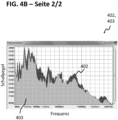
- FIG. 4A and FIG. 4B show exemplary measured values of the microphone 106 of a hair information determination device 100, 101 according to various exemplary embodiments.
- FIG. 4A In the upper representation 400, a time-dependent sound level measured by the microphone 106 is shown, which was recorded when combing hair with extremely little external hair damage, and in the middle representation 401, a time-dependent sound level is shown, which was recorded when combing very severely damaged hair became.
- the sound level of combing the damaged hair has a higher amplitude and therefore a higher volume.
- Such an examination of the volume of the signal can be used to determine the degree of (external) hair damage to the hair 220H of the user 220.
- the following table represents an example database entry that can be used to compare a determined volume with volumes provided in the database.
- a combing speed determined by means of the speed sensor circuit 110 it can be ensured that a comparable speed was used when determining the reference volumes.
- FIG. 4B are frequency spectra of the detected noises FIG. 4A shown (illustration 402: very slight external damage, illustration 403: very severe external damage, page 2: overlay of 402 and 403).
- the entire spectral range can be considered in order to determine a reference spectrum that best matches the recorded spectrum.
- particularly suitable frequency ranges can be identified by examining the reference spectra, which enable the degrees of damage to be easily distinguished, for example areas in which the frequency spectra of slightly damaged hair and severely damaged hair differ greatly, in the example FIG. 4B e.g. a range between about 5000 Hz and about 9000 Hz.
- the reference spectra used for comparison can be assigned degrees of damage, similar to the exemplary table for volume levels.
- the hair of the user 220 can thus be assigned the degree of damage that corresponds to the most similar reference spectrum.
- a database may further provide a product recommendation based on the level of hair damage.
- At least one product recommendation can be assigned to the level of hair damage in the database.
- Hair damage level Product recommendation very low Product with very little care content small amount
- Low maintenance product medium Medium care product strong Product with a high care content
- the recorded (measured) sensor values can either be evaluated directly in the hair information determination device 100, for example by means of the electronic circuit device 104, or can be evaluated indirectly by being transmitted to an external data processing device 226 in order to be evaluated there , e.g. as described above.
- the sensor data or parts of the sensor data can be evaluated in various exemplary embodiments by means of a comparison with (e.g. empirically obtained) database entries.
- a determined degree of hair damage can be included when determining a recommendation, for example a product or treatment recommendation.
- the hair information determination device 100 in conjunction with a display device 228 and/or an external data processing device 226 may be viewed as a hair information determination system 200.
- a hair information determination system 200 In FIG. 2A and FIG. 2 B exemplary hair information determination systems 200 are shown.
- the electronic circuit device 104 may be set up in various embodiments to determine and provide a user with at least one piece of information and/or a recommendation based on the received at least one sensor value (the noise detected by the microphone and the speed). e.g. in FIG. 2 B shown, the information and/or recommendation itself is determined (directly), for example as described above, for example by comparing with reference spectra, values, value ranges and/or data in databases stored in a memory of the electronic circuit device 104, the reference values, At least one recommendation can be assigned to value ranges or data in databases.
- the electronic circuit device 104 can be set up in various embodiments to determine at least one piece of information and/or a recommendation based on the received at least one sensor value (the noise detected by the microphone and the speed) and to provide it to a user by: such as in FIG. 2A shown, the recommendation is determined indirectly, for example as above described, for example by transmitting (illustrated as a transmission signal 230) the at least one sensor value to an external data processing device 226, for example an external computer, for example a cloud, comparing with reference spectra, values, value ranges and/or stored in a memory of the external data processing device 226 Data in a database, whereby at least one recommendation can be assigned to the reference values, value ranges or data in the database.
- the hair information determination device 100 can be set up to receive the recommendation determined by the external data processing device 226, that is, the determined recommendation can be transmitted to the hair information determination device 100 (illustrated as transmission signal 224).
- a hair information determination system 200 may be provided, as shown in FIG. 2A , FIG. 2 B , FIG. 3A and FIG. 3B is shown as an example.
- the hair information detection system can, as in FIG. 2A , 2 B and 3A is shown, in various exemplary embodiments a hair information determination device 100 according to various exemplary embodiments and a display device 228 have.
- the hair information detection system can, as in FIG. 3B is shown, in various exemplary embodiments have a hair information determination device 101 and a display device 228.
- the HE 101 can differ from the HE 100 in that it does not have its own speed sensor circuit 110, but is instead set up, for example by means of a holder, a plug or the like, firmly with the display device 228, which is connected to the data processing device 226 is integrated, for example in the form of a smartphone, a tablet or a similar device.
- This makes it possible to use a sensor integrated in the combined display device/data processing device 226/228 for detecting the speed of the device body 100K instead of the speed sensor circuit 110.
- By means of the fixed connection of HE 101 and display device/data processing device 226/228 it can be ensured that a speed of the display device/data processing device 226/228 corresponds to the speed of the device body 100K.
- the hair information determination device can be used to transmit the at least one sensor value and/or the at least one recommendation to the display device 228 and/or to transmit the at least one sensor value to the external data processing device 226 and/or to receive the at least one recommendation from the external data processing device 226 100/101 be equipped with a transmission device 104a for wireless data transmission, for example with a chip or tag that supports the wireless Data transmission, e.g. via Bluetooth, WLAN, ZigBee, NFC, Wibree, Threald, WiMAX or similar.
- the transmission device 104a may be part of the electronic circuit device 104.
- the display device 228 can form an integrated unit with the data processing device 226 in various exemplary embodiments, for example in the form of a smartphone, tablet, laptop, iPad, or similar.
- the hair information determining device may have an integrated power supply (not shown), for example rechargeable batteries or the like, which can provide an operating voltage for the electronic circuit device 104, the transmission device 104a and the at least one sensor 106.
- the energy supply can be designed to be interchangeable in various exemplary embodiments.
- the power supply can be closed (e.g. waterproof), e.g. cast, in the hair information determination device 100. In this case, the energy supply can be charged inductively, for example.
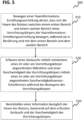
- FIG. 5 shows a flowchart 500 of a method for providing hair condition information according to various exemplary embodiments.
- a hair information determination device according to various embodiments and/or a hair information determination system according to various embodiments may be used.
- the method may include moving a hair information obtaining device such that the user's hair moves between a first area and a second area of a device body of the hair information obtaining device while in contact with the first area and the second area (in 510 ), detecting a sound by means of at least one microphone arranged in or on the device body and a speed of the device body by means of a speed sensor circuit arranged in or on the device body while moving the device body (in 520) and providing information regarding the user's hair, based on the detected sound and the speed of the device body (in 530).
- programming for example software
- Any software that provides the functionality described above can be used.
- the software can be provided as an app.
- a suitable hair care product, hair styling product, a hair treatment recommendation or the like can be determined for the hair.
- the circuit device integrated in the hair information determination device and/or an external data processing device may be suitable for providing a when executing the method Hair condition information, e.g. to be used in determination processes, e.g. by comparing with a database/reference values or similar.
- the programming/software does not need to be provided on the smartphone, tablet, laptop, etc. It may be sufficient, for example, if the circuit device integrated into the hair information determination device and/or the smartphone or the like is connected via the Internet, via WLAN or in another common way to an (e.g. another) external data processing device, e.g.
- the calculations can be carried out, for example, by means of the (further) external data processing device, for example by means of the computer, and the result can be provided to the smartphone/tablet or the like and/or the internal circuit device.
Landscapes
- Health & Medical Sciences (AREA)
- Physics & Mathematics (AREA)
- Engineering & Computer Science (AREA)
- Life Sciences & Earth Sciences (AREA)
- General Health & Medical Sciences (AREA)
- Acoustics & Sound (AREA)
- Signal Processing (AREA)
- Pathology (AREA)
- General Physics & Mathematics (AREA)
- Otolaryngology (AREA)
- Chemical & Material Sciences (AREA)
- Analytical Chemistry (AREA)
- Biochemistry (AREA)
- Biophysics (AREA)
- Immunology (AREA)
- Business, Economics & Management (AREA)
- Theoretical Computer Science (AREA)
- Biomedical Technology (AREA)
- Veterinary Medicine (AREA)
- Public Health (AREA)
- Animal Behavior & Ethology (AREA)
- Surgery (AREA)
- Molecular Biology (AREA)
- Medical Informatics (AREA)
- Heart & Thoracic Surgery (AREA)
- Finance (AREA)
- Human Computer Interaction (AREA)
- Accounting & Taxation (AREA)
- Dermatology (AREA)
- Development Economics (AREA)
- Marketing (AREA)
- Economics (AREA)
- Strategic Management (AREA)
- General Business, Economics & Management (AREA)
- General Engineering & Computer Science (AREA)
- Multimedia (AREA)
- Audiology, Speech & Language Pathology (AREA)
- Computational Linguistics (AREA)
- Mathematical Physics (AREA)
- Spectroscopy & Molecular Physics (AREA)
Claims (14)
- Dispositif de détermination d'information capillaire (100, 100a) permettant de fournir une information concernant des cheveux (220H) d'un utilisateur (220), présentant :un corps de dispositif (100K) comportant au moins une première zone (100K1) et une seconde zone (100K2), lesquelles sont conçues de sorte que les cheveux (220H) de l'utilisateur (220) peuvent être déplacés entre la première zone (100K1) et la seconde zone (100K2) lorsqu'ils sont en contact avec la première zone (100K1) et la seconde zone (100K2) ;au moins un microphone (106) disposé dans ou sur le corps de dispositif (100K) et permettant de détecter un bruit pendant un déplacement des cheveux (220H) entre la première zone (100K1) et la seconde zone (100K2) ;un circuit de capteur de vitesse (110) disposé dans ou sur le corps de dispositif (100K), lequel circuit présente au moins un capteur permettant de déterminer une valeur représentant une vitesse du corps de dispositif (100K) ; etun dispositif à circuit électronique (104) disposé dans ou sur le corps de dispositif (100K),dans lequel le dispositif à circuit électronique (104) est couplé à l'au moins un microphone (106) et au circuit de capteur de vitesse (110) pour la réception du bruit détecté et de la vitesse du corps de dispositif (100K), etdans lequel le dispositif à circuit électronique (104) est configuré pour fournir à l'utilisateur (220) une information concernant ses cheveux (220H) sur la base du bruit détecté reçu et de la vitesse du corps de dispositif (100K),caractérisé en ce quel'information concernant les cheveux (220H) de l'utilisateur (220) comprend un degré d'endommagement des cheveux externe, dans lequel un spectre de fréquences des bruits détectés est comparé à une pluralité de spectres de fréquences de référence dans une plage de fréquences allant de 86 Hz à 22 011 Hz, dans lequel les spectres de fréquences de référence présentent des spectres de fréquences de cheveux (220H) dont le degré d'endommagement des cheveux est connu et dont les spectres de fréquences sont attribués au moyen d'une base de données, dans lequel le degré d'endommagement des cheveux externe de l'utilisateur (220) est attribué comme degré d'endommagement des cheveux externe du spectre de fréquences de référence le plus similaire.
- Dispositif de détermination d'information capillaire (100, 100a) selon la revendication 1,
dans lequel le corps de dispositif (100K) est formé en tant que peigne ou en tant que brosse, et dans lequel la première zone (100K1) et la seconde zone (100K2) présentent deux dents de peigne adjacentes ou deux poils adjacents de la brosse. - Dispositif de détermination d'information capillaire (100, 100a) selon la revendication 1 ou 2,
dans lequel le dispositif à circuit électronique (104) est configuré pour déterminer une information d'état des cheveux sur la base du bruit détecté et de la vitesse du corps de dispositif (100K) et pour la fournir à l'utilisateur (220). - Dispositif de détermination d'information capillaire (100, 100a) selon l'une des revendications 1 à 3,
dans lequel le dispositif à circuit électronique (104) est configuré pour déterminer une recommandation sur la base du bruit détecté et de la vitesse du corps de dispositif (100K) et pour la fournir à l'utilisateur (220). - Dispositif de détermination d'information capillaire (100, 100a) selon la revendication 4, dans lequel la recommandation présente au moins une recommandation parmi une recommandation de produit de soin des cheveux, une recommandation de produit de coiffage des cheveux et une recommandation de traitement des cheveux.
- Dispositif de détermination d'information capillaire (100, 100a) selon l'une des revendications 1 à 4,
dans lequel l'au moins un microphone (106) présente une pluralité de microphones. - Dispositif de détermination d'information capillaire (100, 100a) selon l'une des revendications 1 à 6,
dans lequel l'au moins un microphone (106) est disposé de manière scellée dans le corps de dispositif (100K). - Dispositif de détermination d'information capillaire (100, 100a) selon l'une des revendications 1 à 7,
dans lequel le dispositif à circuit électronique (104) présente un dispositif d'échange de données sans fil (104a). - Dispositif de détermination d'information capillaire (100, 100a) selon l'une des revendications 1 à 8, présentant en outre :
une caméra (114) permettant d'enregistrer une image numérique des cheveux (220H). - Système de détermination d'information capillaire (200, 200c, 200d), présentant :un dispositif de détermination d'information capillaire (100, 100a) selon la revendication 8 ou 9 ; etun dispositif d'affichage (228),dans lequel l'au moins un dispositif de détermination d'information capillaire (100, 100a) est configuré pour transmettre au dispositif d'affichage (228) l'information concernant les cheveux (220H) de l'utilisateur (220) au moyen du dispositif d'échange de données.
- Procédé permettant de fournir une information concernant les cheveux d'un utilisateur, présentant :le déplacement d'un dispositif de détermination d'information capillaire (100, 100a) selon l'une des revendications 1 à 9 ou d'un système de détermination d'information capillaire (200, 200c, 200d) selon la revendication 10, de telle sorte que les cheveux (220H) de l'utilisateur (220) se déplacent entre la première zone (100K1) et la seconde zone (100K2) lorsqu'ils sont en contact avec la première zone (100K1) et la seconde zone (100K2) ;la détection d'un bruit au moyen de l'au moins un microphone (106) et d'une vitesse du corps de dispositif (100K) au moyen du circuit de capteur de vitesse (110) pendant le déplacement du corps de dispositif (100K) ; etla fourniture d'une information concernant les cheveux (220H) de l'utilisateur (20) sur la base du bruit détecté et de la vitesse du corps de dispositif (100K), caractérisé en ce quel'information concernant les cheveux (220H) de l'utilisateur (220) comprend un degré d'endommagement des cheveux externe, dans lequel un spectre de fréquences des bruits détectés est comparé à une pluralité de spectres de fréquences de référence dans une plage de fréquences allant de 86 Hz à 22 011 Hz, dans lequel les spectres de fréquences de référence présentent des spectres de fréquences de cheveux (220H) dont le degré d'endommagement des cheveux est connu et dont les spectres de fréquences sont attribués au moyen d'une base de données, dans lequel le degré d'endommagement des cheveux externe de l'utilisateur (220) est attribué comme degré d'endommagement des cheveux externe du spectre de fréquences de référence le plus similaire.
- Procédé selon la revendication 11, présentant en outre :
la détermination d'au moins une information d'état des cheveux sur la base du bruit détecté et de la vitesse du corps de dispositif (100K). - Procédé selon la revendication 11 ou 12, présentant en outre :
la détermination d'au moins une recommandation, de préférence d'une recommandation de produit de soin des cheveux, d'une recommandation de produit de coiffage des cheveux et/ou d'une recommandation de traitement des cheveux, sur la base du bruit détecté et de la vitesse du corps de dispositif (100K). - Procédé selon l'une des revendications 11 à 13, présentant en outre :la transmission du bruit détecté et de la vitesse détectée à un dispositif de traitement de données externe (226) ; etla réception de l'information fournie par le dispositif de traitement de données externe (226), dans lequel la détermination de l'au moins une information d'état des cheveux est effectuée sur la base du bruit détecté et de la vitesse au moyen du dispositif de traitement de données externe (226).
Applications Claiming Priority (2)
| Application Number | Priority Date | Filing Date | Title |
|---|---|---|---|
| DE102016225964.4A DE102016225964A1 (de) | 2016-12-22 | 2016-12-22 | Haarinformations-Ermittlungsvorrichtung, Haarinformations-Ermittlungssystem und Verfahren zum Bereitstellen einer Haarzustandsinformation |
| PCT/EP2017/083148 WO2018114717A1 (fr) | 2016-12-22 | 2017-12-15 | Dispositif de détermination d'informations capillaires, système de détermination d'informations capillaires et procédé de mise à disposition d'une information d'état capillaire |
Publications (2)
| Publication Number | Publication Date |
|---|---|
| EP3558053A1 EP3558053A1 (fr) | 2019-10-30 |
| EP3558053B1 true EP3558053B1 (fr) | 2024-03-06 |
Family
ID=61027660
Family Applications (1)
| Application Number | Title | Priority Date | Filing Date |
|---|---|---|---|
| EP17835635.8A Active EP3558053B1 (fr) | 2016-12-22 | 2017-12-15 | Dispositif de détermination d'informations capillaires, système de détermination d'informations capillaires et procédé de mise à disposition d'une information d'état capillaire |
Country Status (4)
| Country | Link |
|---|---|
| US (1) | US11071370B2 (fr) |
| EP (1) | EP3558053B1 (fr) |
| DE (1) | DE102016225964A1 (fr) |
| WO (1) | WO2018114717A1 (fr) |
Families Citing this family (7)
| Publication number | Priority date | Publication date | Assignee | Title |
|---|---|---|---|---|
| EP3460433A1 (fr) | 2017-09-20 | 2019-03-27 | Koninklijke Philips N.V. | Dispositif de mesure de propriétés de cheveux |
| CN111125143A (zh) * | 2019-12-16 | 2020-05-08 | 广州皓醒湾科技有限公司 | 一种用户信息的采集方法、装置和系统 |
| DE102020114643A1 (de) | 2020-06-02 | 2021-12-02 | Semhar Teklesembet | Frisierwerkzeug und Vorrichtung zu seiner Positionserfassung |
| GB2597678B (en) * | 2020-07-29 | 2022-11-30 | Dyson Technology Ltd | Hairstyling device |
| GB2597681B (en) * | 2020-07-29 | 2022-11-30 | Dyson Technology Ltd | Hairstyling device |
| GB2597684B (en) * | 2020-07-29 | 2022-09-07 | Dyson Technology Ltd | Hairstyling device |
| GB2632005A (en) * | 2023-07-21 | 2025-01-22 | Dyson Technology Ltd | Hair styling appliance |
Family Cites Families (4)
| Publication number | Priority date | Publication date | Assignee | Title |
|---|---|---|---|---|
| WO2009076162A2 (fr) * | 2007-12-05 | 2009-06-18 | Thomas Hanson | Système et appareil de coiffage |
| FR3000877B1 (fr) * | 2013-01-15 | 2018-09-07 | Withings | Brosse a cheveux instrumentee et connectee, et systeme informatif utilisant une telle brosse |
| US9307830B2 (en) * | 2013-12-13 | 2016-04-12 | Elwha Llc | Grooming systems, devices, and methods including detection of hair-covered skin lesions during grooming and including topographical analysis |
| US20170164887A1 (en) * | 2015-12-11 | 2017-06-15 | Intel Corporation | Apparatus and method for estimating changes to human health based on monitoring hair parameters |
-
2016
- 2016-12-22 DE DE102016225964.4A patent/DE102016225964A1/de not_active Withdrawn
-
2017
- 2017-12-15 US US16/471,764 patent/US11071370B2/en active Active
- 2017-12-15 WO PCT/EP2017/083148 patent/WO2018114717A1/fr not_active Ceased
- 2017-12-15 EP EP17835635.8A patent/EP3558053B1/fr active Active
Also Published As
| Publication number | Publication date |
|---|---|
| US20190350343A1 (en) | 2019-11-21 |
| US11071370B2 (en) | 2021-07-27 |
| EP3558053A1 (fr) | 2019-10-30 |
| DE102016225964A1 (de) | 2018-06-28 |
| WO2018114717A1 (fr) | 2018-06-28 |
Similar Documents
| Publication | Publication Date | Title |
|---|---|---|
| EP3558053B1 (fr) | Dispositif de détermination d'informations capillaires, système de détermination d'informations capillaires et procédé de mise à disposition d'une information d'état capillaire | |
| EP3560185B1 (fr) | Système et procédé de saisie d'images de mesure d'un objet de mesure | |
| EP1827218B1 (fr) | Procédés pour réduire les artefacts de mouvement d'un système de détection comprenant une électrode capacitive | |
| EP3668375B1 (fr) | Système et procédé pour déterminer un état des cheveux | |
| EP3629887B1 (fr) | Dispositif de détermination de l'état des cheveux, système de détermination de l'état des cheveux et procédé pour la détermination d'un état des cheveux | |
| CH713653B1 (de) | Hautanalysegerät. | |
| EP3649459B1 (fr) | Système pour la gestion d'informations d'état de chevelure et procédé pour l'optimisation d'un système de conseils cosmétiques | |
| DE112018003517B4 (de) | Entfernung von artefakten in neurophysiologischen signalen | |
| van der Heijden et al. | Panoramic measurements of the apex of the cochlea | |
| DE69836831T2 (de) | Vorrichtung zur überwachung von physiologischen parametern und zum bio-feedback | |
| DE102018207558A1 (de) | Ermitteln von äußeren Schäden von Haaren | |
| DE102017124838A1 (de) | Erkennungssystem, erkennungsvorrichtung und erkennungsverfahren | |
| DE102017217727A1 (de) | Verfahren zum computergestützten Ermitteln eines Kosmetikprodukts | |
| WO2016190428A1 (fr) | Dispositif de détermination, procédé de détermination, programme et support de stockage d'informations | |
| EP3559863A1 (fr) | Détermination d'une valeur d'ondulation des cheveux | |
| EP3558052A1 (fr) | Caméra servant à l'analyse des cheveux comprenant un dispositif d'étalonnage | |
| DE10313019B4 (de) | Einhandbedienung von Endgeräten per Gestikerkennung | |
| JP2021504068A (ja) | 認知機能の活動のリアルタイム測定のためのシステムおよびかかるシステムを較正する方法 | |
| AT521935A1 (de) | Verfahren zur Erfassung von Fingerabdrücken | |
| Liu et al. | Persistent Homology‐Based Topological Analysis on the Gestalt Patterns during Human Brain Cognition Process | |
| CN118732846A (zh) | 一种认知控制状态的评估系统、方法及介质 | |
| EP1377813A1 (fr) | Procede et dispositif de controle de la qualite du lait et de caracterisation optique du lait | |
| DE10065783B4 (de) | Verfahren, Anordnung und System zur Ermittlung von Prozessgrößen | |
| DE102017222747A1 (de) | Beschädigungsfreies Ermitteln der Dicke von Haupthaar | |
| EP4721665A1 (fr) | Procédés et systèmes d'identification de canal à l'aide de collecteurs d'un signal d'électroencéphalographie (eeg-auriculaire) de l'oreille |
Legal Events
| Date | Code | Title | Description |
|---|---|---|---|
| STAA | Information on the status of an ep patent application or granted ep patent |
Free format text: STATUS: UNKNOWN |
|
| STAA | Information on the status of an ep patent application or granted ep patent |
Free format text: STATUS: THE INTERNATIONAL PUBLICATION HAS BEEN MADE |
|
| PUAI | Public reference made under article 153(3) epc to a published international application that has entered the european phase |
Free format text: ORIGINAL CODE: 0009012 |
|
| STAA | Information on the status of an ep patent application or granted ep patent |
Free format text: STATUS: REQUEST FOR EXAMINATION WAS MADE |
|
| 17P | Request for examination filed |
Effective date: 20190619 |
|
| AK | Designated contracting states |
Kind code of ref document: A1 Designated state(s): AL AT BE BG CH CY CZ DE DK EE ES FI FR GB GR HR HU IE IS IT LI LT LU LV MC MK MT NL NO PL PT RO RS SE SI SK SM TR |
|
| AX | Request for extension of the european patent |
Extension state: BA ME |
|
| DAV | Request for validation of the european patent (deleted) | ||
| DAX | Request for extension of the european patent (deleted) | ||
| STAA | Information on the status of an ep patent application or granted ep patent |
Free format text: STATUS: EXAMINATION IS IN PROGRESS |
|
| 17Q | First examination report despatched |
Effective date: 20220201 |
|
| P01 | Opt-out of the competence of the unified patent court (upc) registered |
Effective date: 20230531 |
|
| GRAP | Despatch of communication of intention to grant a patent |
Free format text: ORIGINAL CODE: EPIDOSNIGR1 |
|
| STAA | Information on the status of an ep patent application or granted ep patent |
Free format text: STATUS: GRANT OF PATENT IS INTENDED |
|
| RIC1 | Information provided on ipc code assigned before grant |
Ipc: G01N 29/46 20060101ALI20230901BHEP Ipc: G01N 29/44 20060101ALI20230901BHEP Ipc: G01N 29/14 20060101ALI20230901BHEP Ipc: A46B 15/00 20060101ALI20230901BHEP Ipc: A46B 9/02 20060101ALI20230901BHEP Ipc: A45D 24/00 20060101ALI20230901BHEP Ipc: A61B 5/00 20060101ALI20230901BHEP Ipc: A46B 5/00 20060101ALI20230901BHEP Ipc: A45D 44/00 20060101AFI20230901BHEP |
|
| INTG | Intention to grant announced |
Effective date: 20230922 |
|
| GRAJ | Information related to disapproval of communication of intention to grant by the applicant or resumption of examination proceedings by the epo deleted |
Free format text: ORIGINAL CODE: EPIDOSDIGR1 |
|
| STAA | Information on the status of an ep patent application or granted ep patent |
Free format text: STATUS: EXAMINATION IS IN PROGRESS |
|
| GRAP | Despatch of communication of intention to grant a patent |
Free format text: ORIGINAL CODE: EPIDOSNIGR1 |
|
| INTC | Intention to grant announced (deleted) | ||
| STAA | Information on the status of an ep patent application or granted ep patent |
Free format text: STATUS: GRANT OF PATENT IS INTENDED |
|
| GRAS | Grant fee paid |
Free format text: ORIGINAL CODE: EPIDOSNIGR3 |
|
| GRAA | (expected) grant |
Free format text: ORIGINAL CODE: 0009210 |
|
| STAA | Information on the status of an ep patent application or granted ep patent |
Free format text: STATUS: THE PATENT HAS BEEN GRANTED |
|
| INTG | Intention to grant announced |
Effective date: 20240118 |
|
| AK | Designated contracting states |
Kind code of ref document: B1 Designated state(s): AL AT BE BG CH CY CZ DE DK EE ES FI FR GB GR HR HU IE IS IT LI LT LU LV MC MK MT NL NO PL PT RO RS SE SI SK SM TR |
|
| REG | Reference to a national code |
Ref country code: GB Ref legal event code: FG4D Free format text: NOT ENGLISH |
|
| REG | Reference to a national code |
Ref country code: CH Ref legal event code: EP |
|
| REG | Reference to a national code |
Ref country code: DE Ref legal event code: R096 Ref document number: 502017015914 Country of ref document: DE |
|
| REG | Reference to a national code |
Ref country code: IE Ref legal event code: FG4D Free format text: LANGUAGE OF EP DOCUMENT: GERMAN |
|
| REG | Reference to a national code |
Ref country code: LT Ref legal event code: MG9D |
|
| PG25 | Lapsed in a contracting state [announced via postgrant information from national office to epo] |
Ref country code: LT Free format text: LAPSE BECAUSE OF FAILURE TO SUBMIT A TRANSLATION OF THE DESCRIPTION OR TO PAY THE FEE WITHIN THE PRESCRIBED TIME-LIMIT Effective date: 20240306 |
|
| REG | Reference to a national code |
Ref country code: NL Ref legal event code: MP Effective date: 20240306 |
|
| PG25 | Lapsed in a contracting state [announced via postgrant information from national office to epo] |
Ref country code: GR Free format text: LAPSE BECAUSE OF FAILURE TO SUBMIT A TRANSLATION OF THE DESCRIPTION OR TO PAY THE FEE WITHIN THE PRESCRIBED TIME-LIMIT Effective date: 20240607 |
|
| PG25 | Lapsed in a contracting state [announced via postgrant information from national office to epo] |
Ref country code: RS Free format text: LAPSE BECAUSE OF FAILURE TO SUBMIT A TRANSLATION OF THE DESCRIPTION OR TO PAY THE FEE WITHIN THE PRESCRIBED TIME-LIMIT Effective date: 20240606 Ref country code: HR Free format text: LAPSE BECAUSE OF FAILURE TO SUBMIT A TRANSLATION OF THE DESCRIPTION OR TO PAY THE FEE WITHIN THE PRESCRIBED TIME-LIMIT Effective date: 20240306 |
|
| PG25 | Lapsed in a contracting state [announced via postgrant information from national office to epo] |
Ref country code: ES Free format text: LAPSE BECAUSE OF FAILURE TO SUBMIT A TRANSLATION OF THE DESCRIPTION OR TO PAY THE FEE WITHIN THE PRESCRIBED TIME-LIMIT Effective date: 20240306 |
|
| PG25 | Lapsed in a contracting state [announced via postgrant information from national office to epo] |
Ref country code: RS Free format text: LAPSE BECAUSE OF FAILURE TO SUBMIT A TRANSLATION OF THE DESCRIPTION OR TO PAY THE FEE WITHIN THE PRESCRIBED TIME-LIMIT Effective date: 20240606 Ref country code: NO Free format text: LAPSE BECAUSE OF FAILURE TO SUBMIT A TRANSLATION OF THE DESCRIPTION OR TO PAY THE FEE WITHIN THE PRESCRIBED TIME-LIMIT Effective date: 20240606 Ref country code: LT Free format text: LAPSE BECAUSE OF FAILURE TO SUBMIT A TRANSLATION OF THE DESCRIPTION OR TO PAY THE FEE WITHIN THE PRESCRIBED TIME-LIMIT Effective date: 20240306 Ref country code: HR Free format text: LAPSE BECAUSE OF FAILURE TO SUBMIT A TRANSLATION OF THE DESCRIPTION OR TO PAY THE FEE WITHIN THE PRESCRIBED TIME-LIMIT Effective date: 20240306 Ref country code: GR Free format text: LAPSE BECAUSE OF FAILURE TO SUBMIT A TRANSLATION OF THE DESCRIPTION OR TO PAY THE FEE WITHIN THE PRESCRIBED TIME-LIMIT Effective date: 20240607 Ref country code: FI Free format text: LAPSE BECAUSE OF FAILURE TO SUBMIT A TRANSLATION OF THE DESCRIPTION OR TO PAY THE FEE WITHIN THE PRESCRIBED TIME-LIMIT Effective date: 20240306 Ref country code: ES Free format text: LAPSE BECAUSE OF FAILURE TO SUBMIT A TRANSLATION OF THE DESCRIPTION OR TO PAY THE FEE WITHIN THE PRESCRIBED TIME-LIMIT Effective date: 20240306 Ref country code: BG Free format text: LAPSE BECAUSE OF FAILURE TO SUBMIT A TRANSLATION OF THE DESCRIPTION OR TO PAY THE FEE WITHIN THE PRESCRIBED TIME-LIMIT Effective date: 20240306 |
|
| PG25 | Lapsed in a contracting state [announced via postgrant information from national office to epo] |
Ref country code: SE Free format text: LAPSE BECAUSE OF FAILURE TO SUBMIT A TRANSLATION OF THE DESCRIPTION OR TO PAY THE FEE WITHIN THE PRESCRIBED TIME-LIMIT Effective date: 20240306 Ref country code: LV Free format text: LAPSE BECAUSE OF FAILURE TO SUBMIT A TRANSLATION OF THE DESCRIPTION OR TO PAY THE FEE WITHIN THE PRESCRIBED TIME-LIMIT Effective date: 20240306 |
|
| PG25 | Lapsed in a contracting state [announced via postgrant information from national office to epo] |
Ref country code: NL Free format text: LAPSE BECAUSE OF FAILURE TO SUBMIT A TRANSLATION OF THE DESCRIPTION OR TO PAY THE FEE WITHIN THE PRESCRIBED TIME-LIMIT Effective date: 20240306 |
|
| PG25 | Lapsed in a contracting state [announced via postgrant information from national office to epo] |
Ref country code: NL Free format text: LAPSE BECAUSE OF FAILURE TO SUBMIT A TRANSLATION OF THE DESCRIPTION OR TO PAY THE FEE WITHIN THE PRESCRIBED TIME-LIMIT Effective date: 20240306 |
|
| PG25 | Lapsed in a contracting state [announced via postgrant information from national office to epo] |
Ref country code: IS Free format text: LAPSE BECAUSE OF FAILURE TO SUBMIT A TRANSLATION OF THE DESCRIPTION OR TO PAY THE FEE WITHIN THE PRESCRIBED TIME-LIMIT Effective date: 20240706 |
|
| PG25 | Lapsed in a contracting state [announced via postgrant information from national office to epo] |
Ref country code: PT Free format text: LAPSE BECAUSE OF FAILURE TO SUBMIT A TRANSLATION OF THE DESCRIPTION OR TO PAY THE FEE WITHIN THE PRESCRIBED TIME-LIMIT Effective date: 20240708 Ref country code: SM Free format text: LAPSE BECAUSE OF FAILURE TO SUBMIT A TRANSLATION OF THE DESCRIPTION OR TO PAY THE FEE WITHIN THE PRESCRIBED TIME-LIMIT Effective date: 20240306 |
|
| PG25 | Lapsed in a contracting state [announced via postgrant information from national office to epo] |
Ref country code: CZ Free format text: LAPSE BECAUSE OF FAILURE TO SUBMIT A TRANSLATION OF THE DESCRIPTION OR TO PAY THE FEE WITHIN THE PRESCRIBED TIME-LIMIT Effective date: 20240306 Ref country code: EE Free format text: LAPSE BECAUSE OF FAILURE TO SUBMIT A TRANSLATION OF THE DESCRIPTION OR TO PAY THE FEE WITHIN THE PRESCRIBED TIME-LIMIT Effective date: 20240306 |
|
| PG25 | Lapsed in a contracting state [announced via postgrant information from national office to epo] |
Ref country code: PL Free format text: LAPSE BECAUSE OF FAILURE TO SUBMIT A TRANSLATION OF THE DESCRIPTION OR TO PAY THE FEE WITHIN THE PRESCRIBED TIME-LIMIT Effective date: 20240306 |
|
| PG25 | Lapsed in a contracting state [announced via postgrant information from national office to epo] |
Ref country code: SK Free format text: LAPSE BECAUSE OF FAILURE TO SUBMIT A TRANSLATION OF THE DESCRIPTION OR TO PAY THE FEE WITHIN THE PRESCRIBED TIME-LIMIT Effective date: 20240306 |
|
| PG25 | Lapsed in a contracting state [announced via postgrant information from national office to epo] |
Ref country code: SM Free format text: LAPSE BECAUSE OF FAILURE TO SUBMIT A TRANSLATION OF THE DESCRIPTION OR TO PAY THE FEE WITHIN THE PRESCRIBED TIME-LIMIT Effective date: 20240306 Ref country code: SK Free format text: LAPSE BECAUSE OF FAILURE TO SUBMIT A TRANSLATION OF THE DESCRIPTION OR TO PAY THE FEE WITHIN THE PRESCRIBED TIME-LIMIT Effective date: 20240306 Ref country code: RO Free format text: LAPSE BECAUSE OF FAILURE TO SUBMIT A TRANSLATION OF THE DESCRIPTION OR TO PAY THE FEE WITHIN THE PRESCRIBED TIME-LIMIT Effective date: 20240306 Ref country code: PT Free format text: LAPSE BECAUSE OF FAILURE TO SUBMIT A TRANSLATION OF THE DESCRIPTION OR TO PAY THE FEE WITHIN THE PRESCRIBED TIME-LIMIT Effective date: 20240708 Ref country code: PL Free format text: LAPSE BECAUSE OF FAILURE TO SUBMIT A TRANSLATION OF THE DESCRIPTION OR TO PAY THE FEE WITHIN THE PRESCRIBED TIME-LIMIT Effective date: 20240306 Ref country code: IS Free format text: LAPSE BECAUSE OF FAILURE TO SUBMIT A TRANSLATION OF THE DESCRIPTION OR TO PAY THE FEE WITHIN THE PRESCRIBED TIME-LIMIT Effective date: 20240706 Ref country code: EE Free format text: LAPSE BECAUSE OF FAILURE TO SUBMIT A TRANSLATION OF THE DESCRIPTION OR TO PAY THE FEE WITHIN THE PRESCRIBED TIME-LIMIT Effective date: 20240306 Ref country code: CZ Free format text: LAPSE BECAUSE OF FAILURE TO SUBMIT A TRANSLATION OF THE DESCRIPTION OR TO PAY THE FEE WITHIN THE PRESCRIBED TIME-LIMIT Effective date: 20240306 |
|
| PG25 | Lapsed in a contracting state [announced via postgrant information from national office to epo] |
Ref country code: IT Free format text: LAPSE BECAUSE OF FAILURE TO SUBMIT A TRANSLATION OF THE DESCRIPTION OR TO PAY THE FEE WITHIN THE PRESCRIBED TIME-LIMIT Effective date: 20240306 |
|
| REG | Reference to a national code |
Ref country code: DE Ref legal event code: R097 Ref document number: 502017015914 Country of ref document: DE |
|
| PG25 | Lapsed in a contracting state [announced via postgrant information from national office to epo] |
Ref country code: IT Free format text: LAPSE BECAUSE OF FAILURE TO SUBMIT A TRANSLATION OF THE DESCRIPTION OR TO PAY THE FEE WITHIN THE PRESCRIBED TIME-LIMIT Effective date: 20240306 |
|
| PLBE | No opposition filed within time limit |
Free format text: ORIGINAL CODE: 0009261 |
|
| STAA | Information on the status of an ep patent application or granted ep patent |
Free format text: STATUS: NO OPPOSITION FILED WITHIN TIME LIMIT |
|
| PG25 | Lapsed in a contracting state [announced via postgrant information from national office to epo] |
Ref country code: DK Free format text: LAPSE BECAUSE OF FAILURE TO SUBMIT A TRANSLATION OF THE DESCRIPTION OR TO PAY THE FEE WITHIN THE PRESCRIBED TIME-LIMIT Effective date: 20240306 |
|
| PG25 | Lapsed in a contracting state [announced via postgrant information from national office to epo] |
Ref country code: DK Free format text: LAPSE BECAUSE OF FAILURE TO SUBMIT A TRANSLATION OF THE DESCRIPTION OR TO PAY THE FEE WITHIN THE PRESCRIBED TIME-LIMIT Effective date: 20240306 |
|
| 26N | No opposition filed |
Effective date: 20241209 |
|
| PG25 | Lapsed in a contracting state [announced via postgrant information from national office to epo] |
Ref country code: SI Free format text: LAPSE BECAUSE OF FAILURE TO SUBMIT A TRANSLATION OF THE DESCRIPTION OR TO PAY THE FEE WITHIN THE PRESCRIBED TIME-LIMIT Effective date: 20240306 |
|
| PG25 | Lapsed in a contracting state [announced via postgrant information from national office to epo] |
Ref country code: MC Free format text: LAPSE BECAUSE OF FAILURE TO SUBMIT A TRANSLATION OF THE DESCRIPTION OR TO PAY THE FEE WITHIN THE PRESCRIBED TIME-LIMIT Effective date: 20240306 |
|
| REG | Reference to a national code |
Ref country code: CH Ref legal event code: PL |
|
| PG25 | Lapsed in a contracting state [announced via postgrant information from national office to epo] |
Ref country code: LU Free format text: LAPSE BECAUSE OF NON-PAYMENT OF DUE FEES Effective date: 20241215 |
|
| REG | Reference to a national code |
Ref country code: BE Ref legal event code: MM Effective date: 20241231 |
|
| PG25 | Lapsed in a contracting state [announced via postgrant information from national office to epo] |
Ref country code: BE Free format text: LAPSE BECAUSE OF NON-PAYMENT OF DUE FEES Effective date: 20241231 |
|
| PG25 | Lapsed in a contracting state [announced via postgrant information from national office to epo] |
Ref country code: CH Free format text: LAPSE BECAUSE OF NON-PAYMENT OF DUE FEES Effective date: 20241231 |
|
| PG25 | Lapsed in a contracting state [announced via postgrant information from national office to epo] |
Ref country code: IE Free format text: LAPSE BECAUSE OF NON-PAYMENT OF DUE FEES Effective date: 20241215 |
|
| PGFP | Annual fee paid to national office [announced via postgrant information from national office to epo] |
Ref country code: DE Payment date: 20251211 Year of fee payment: 9 |
|
| PGFP | Annual fee paid to national office [announced via postgrant information from national office to epo] |
Ref country code: GB Payment date: 20251219 Year of fee payment: 9 |
|
| PGFP | Annual fee paid to national office [announced via postgrant information from national office to epo] |
Ref country code: FR Payment date: 20251229 Year of fee payment: 9 |
|
| REG | Reference to a national code |
Ref country code: AT Ref legal event code: MM01 Ref document number: 1662555 Country of ref document: AT Kind code of ref document: T Effective date: 20241215 |
|
| PG25 | Lapsed in a contracting state [announced via postgrant information from national office to epo] |
Ref country code: AT Free format text: LAPSE BECAUSE OF NON-PAYMENT OF DUE FEES Effective date: 20241215 |