EP3555809B1 - Systeme und verfahren zur einnahme einer digitalisierten handschriftprobe - Google Patents
Systeme und verfahren zur einnahme einer digitalisierten handschriftprobe Download PDFInfo
- Publication number
- EP3555809B1 EP3555809B1 EP17854011.8A EP17854011A EP3555809B1 EP 3555809 B1 EP3555809 B1 EP 3555809B1 EP 17854011 A EP17854011 A EP 17854011A EP 3555809 B1 EP3555809 B1 EP 3555809B1
- Authority
- EP
- European Patent Office
- Prior art keywords
- handwriting
- sample
- code point
- data
- code
- Prior art date
- Legal status (The legal status is an assumption and is not a legal conclusion. Google has not performed a legal analysis and makes no representation as to the accuracy of the status listed.)
- Active
Links
Images




Classifications
-
- G—PHYSICS
- G06—COMPUTING OR CALCULATING; COUNTING
- G06V—IMAGE OR VIDEO RECOGNITION OR UNDERSTANDING
- G06V40/00—Recognition of biometric, human-related or animal-related patterns in image or video data
- G06V40/30—Writer recognition; Reading and verifying signatures
- G06V40/37—Writer recognition; Reading and verifying signatures based only on signature signals such as velocity or pressure, e.g. dynamic signature recognition
-
- G—PHYSICS
- G06—COMPUTING OR CALCULATING; COUNTING
- G06F—ELECTRIC DIGITAL DATA PROCESSING
- G06F3/00—Input arrangements for transferring data to be processed into a form capable of being handled by the computer; Output arrangements for transferring data from processing unit to output unit, e.g. interface arrangements
- G06F3/01—Input arrangements or combined input and output arrangements for interaction between user and computer
- G06F3/048—Interaction techniques based on graphical user interfaces [GUI]
- G06F3/0487—Interaction techniques based on graphical user interfaces [GUI] using specific features provided by the input device, e.g. functions controlled by the rotation of a mouse with dual sensing arrangements, or of the nature of the input device, e.g. tap gestures based on pressure sensed by a digitiser
- G06F3/0488—Interaction techniques based on graphical user interfaces [GUI] using specific features provided by the input device, e.g. functions controlled by the rotation of a mouse with dual sensing arrangements, or of the nature of the input device, e.g. tap gestures based on pressure sensed by a digitiser using a touch-screen or digitiser, e.g. input of commands through traced gestures
- G06F3/04883—Interaction techniques based on graphical user interfaces [GUI] using specific features provided by the input device, e.g. functions controlled by the rotation of a mouse with dual sensing arrangements, or of the nature of the input device, e.g. tap gestures based on pressure sensed by a digitiser using a touch-screen or digitiser, e.g. input of commands through traced gestures for inputting data by handwriting, e.g. gesture or text
-
- G—PHYSICS
- G06—COMPUTING OR CALCULATING; COUNTING
- G06F—ELECTRIC DIGITAL DATA PROCESSING
- G06F3/00—Input arrangements for transferring data to be processed into a form capable of being handled by the computer; Output arrangements for transferring data from processing unit to output unit, e.g. interface arrangements
- G06F3/01—Input arrangements or combined input and output arrangements for interaction between user and computer
- G06F3/03—Arrangements for converting the position or the displacement of a member into a coded form
- G06F3/041—Digitisers, e.g. for touch screens or touch pads, characterised by the transducing means
-
- G—PHYSICS
- G06—COMPUTING OR CALCULATING; COUNTING
- G06F—ELECTRIC DIGITAL DATA PROCESSING
- G06F3/00—Input arrangements for transferring data to be processed into a form capable of being handled by the computer; Output arrangements for transferring data from processing unit to output unit, e.g. interface arrangements
- G06F3/01—Input arrangements or combined input and output arrangements for interaction between user and computer
- G06F3/048—Interaction techniques based on graphical user interfaces [GUI]
-
- G—PHYSICS
- G06—COMPUTING OR CALCULATING; COUNTING
- G06V—IMAGE OR VIDEO RECOGNITION OR UNDERSTANDING
- G06V10/00—Arrangements for image or video recognition or understanding
- G06V10/94—Hardware or software architectures specially adapted for image or video understanding
- G06V10/95—Hardware or software architectures specially adapted for image or video understanding structured as a network, e.g. client-server architectures
-
- G—PHYSICS
- G06—COMPUTING OR CALCULATING; COUNTING
- G06V—IMAGE OR VIDEO RECOGNITION OR UNDERSTANDING
- G06V30/00—Character recognition; Recognising digital ink; Document-oriented image-based pattern recognition
- G06V30/10—Character recognition
- G06V30/14—Image acquisition
- G06V30/142—Image acquisition using hand-held instruments; Constructional details of the instruments
- G06V30/1423—Image acquisition using hand-held instruments; Constructional details of the instruments the instrument generating sequences of position coordinates corresponding to handwriting
-
- G—PHYSICS
- G06—COMPUTING OR CALCULATING; COUNTING
- G06V—IMAGE OR VIDEO RECOGNITION OR UNDERSTANDING
- G06V30/00—Character recognition; Recognising digital ink; Document-oriented image-based pattern recognition
- G06V30/10—Character recognition
- G06V30/14—Image acquisition
- G06V30/148—Segmentation of character regions
- G06V30/153—Segmentation of character regions using recognition of characters or words
-
- G—PHYSICS
- G06—COMPUTING OR CALCULATING; COUNTING
- G06V—IMAGE OR VIDEO RECOGNITION OR UNDERSTANDING
- G06V30/00—Character recognition; Recognising digital ink; Document-oriented image-based pattern recognition
- G06V30/10—Character recognition
- G06V30/32—Digital ink
-
- G—PHYSICS
- G06—COMPUTING OR CALCULATING; COUNTING
- G06V—IMAGE OR VIDEO RECOGNITION OR UNDERSTANDING
- G06V30/00—Character recognition; Recognising digital ink; Document-oriented image-based pattern recognition
- G06V30/10—Character recognition
- G06V30/32—Digital ink
- G06V30/333—Preprocessing; Feature extraction
- G06V30/347—Sampling; Contour coding; Stroke extraction
Definitions
- the present disclosure relates to computer handwriting analysis and synthesis, and more particularly, to systems and methods for digitized handwriting data collection and analysis.
- Figure 1 illustrates a first exemplary client/server-based handwriting ingestion system 100 in accordance with various embodiments.
- Client devices 200A-B and a remote front-end server 300A are in data communication with a network 103.
- network 103 may include the Internet, one or more local area networks ("LANs"), one or more wide area networks ("WANs”), cellular data networks, and/or other data networks.
- Network 103 may, at various points, be a wired and/or wireless network.
- Remote front-end server 300A may be in data communication with a remote handwriting ingestion server 300B and an administrative data store 105.
- Remote handwriting ingestion server 300B may be in data communication with a handwriting sample set data store 108.
- client devices 200 may be networked computing devices having form factors including general purpose computers (including “desktop,” “laptop,” “notebook,” “tablet” computers, or the like); mobile phones; watches, glasses, or other wearable computing devices; or the like.
- general purpose computers including “desktop,” “laptop,” “notebook,” “tablet” computers, or the like
- mobile phones including “desktop,” “laptop,” “notebook,” “tablet” computers, or the like
- watches, glasses, or other wearable computing devices or the like.
- client devices 200 may be networked computing devices having form factors including general purpose computers (including “desktop,” “laptop,” “notebook,” “tablet” computers, or the like); mobile phones; watches, glasses, or other wearable computing devices; or the like.
- two client devices are shown, one of which is depicted as a laptop computer and the other of which is depicted as a tablet computer.
- there may be many more client devices 200 there may be many more client devices 200.
- Client device 200A may be in data communication with an external digitizing surface device 218A and a digitizing marking device (e.g. a "stylus") 220A.
- Digitizing marking device 220A may be in data communication with client device 200A via external digitizing surface device 218A or may be in direct data communication with the client device (as indicated by dotted lines).
- Client device 200B includes a built in digitizing surface device 218B and may be in data communication with a digitizing marking device 220B.
- remote front-end server 300A and remote handwriting ingestion server 300B may be networked computing devices generally capable of accepting requests over network 108, e.g. from client devices 200, each other, various databases, and/or other networked computing devices, such as a remote handwriting generation server (not shown), and providing responses accordingly.
- a remote handwriting generation server not shown
- the primary functional components of an exemplary remote server 300, such as remote front-end server 300A and remote handwriting ingestion server 300B, are described below in reference to Figure 3 .
- FIG. 2 illustrates several components of an exemplary client device 200, such as any of client devices 200A-B, is illustrated.
- a client device 200 may include many more components than those shown in Figure 2 . However, it is not necessary that all of these generally conventional components be shown in order to disclose an illustrative embodiment.
- the data communications between various components of client device 200 may be accomplished by wired and/or wireless connections
- exemplary client device 200 includes a central processing unit 203 in data communication with memory 205 via a bus 208.
- Central processing unit 203 is an electronic circuit designed to carry out instructions of a computer program, e.g. obtained from memory 205, by performing the basic arithmetic, logical, control and input/output (I/O) operations specified by the program's instructions.
- Memory 205 generally comprises some or all of random access memory (RAM), read-only memory (ROM), and/or a permanent mass storage device, such as a disk drive, flash memory, or the like.
- Bus 208 is a communication system that transfers data between components within client device 200, and encompasses any related hardware components (wire, optical fiber, etc.) and software, including communication protocols.
- Client device 200 may also include a network interface 210 for connecting to a network such as network 103, one or more optional user input device(s) 213, e.g. an alphanumeric keyboard, keypad, a mouse or other pointing device, a touchscreen, and/or a microphone, (or a user input port for connecting an external user input device), an optional digitizing surface device 215, such as digitizing surface device 215B, (or a port for connecting an external digitizing surface device, such as digitizing surface device 215A), an optional digitizing marking device (or a port for connecting to an external digitizing marking device, such as digitizing marking devices 218A-B), and the like, all interconnected, along with the network interface 210, to central processing unit 203 and memory 205 via bus 208.
- a network interface 210 for connecting to a network such as network 103
- Memory 205 of exemplary client device 200 may store program code, executable by central processing unit 203, corresponding to an operating system 223, as well as program code corresponding to various software applications, such as a browser application 225, a handwriting ingestion application 228, and other software applications (not shown).
- Operating system 223 and such various software applications may be loaded into memory 205 via network interface 210 or via a computer readable storage medium 230, such as a hard-disk drive, a solid-state drive, an optical disc, a removable memory card, and/or the like.
- Browser application 225 is a software application for retrieving, presenting, and traversing information resources on a network, such as network 108. Although browser application 225 may be primarily intended to use the World Wide Web, it may also be used to access information resources provided by remote servers in private networks. An information resource may be a web page, an image, a video, or other piece of content and may be identified by a Uniform Resource Identifier (URI/URL) on network 108. An information resource may also provide browser application 225 executable program code for web applications, i.e. a software application that runs in and is rendered by browser application 225.
- URI/URL Uniform Resource Identifier
- operating system 223 manages the hardware and software resources of client device 200 and provides common services and memory allocation for various software applications, such as research study data acquisition and quality control application 228.
- software applications such as research study data acquisition and quality control application 228.
- For hardware functions such as network communications via network interface 210, receiving data via input 213, outputting data via optional display 215, and allocation of memory 205 for various software applications, such as handwriting ingestion application 228, operating system 223 acts as an intermediary between software executing on the client device and the device's hardware.
- operating system 223 may cause a representation of available software applications, such as browser application 225 and handwriting ingestion 228, to be presented to a user of client device 200 via display 215. If client device 200 obtains an indication from a user, e.g. via user input 213, a desire to use handwriting ingestion application 228, operating system 223 instantiates a handwriting ingestion application process (not shown), i.e. cause central processing unit 203 to begin executing the executable instructions of the handwriting ingestion application and allocate a portion of memory 205 for its use.
- a handwriting ingestion application process not shown
- browser application 225 may act as an intermediary between a software service operating on a remote server and the operating system 223.
- a software service equivalent of handwriting ingestion application 228 may be executing on front-end server 400A.
- a client device 200 may be any of a great number of devices capable of communicating with network 103 and executing instructions for performing handwriting ingestion application 228.
- FIG 3 illustrates several components of an exemplary server 300, such as front-end server 300A and handwriting ingestion server 300B, in accordance with at least one exemplary embodiment are illustrated.
- a server 300 may include many more components than those shown in Figure 3 . However, it is not necessary that all of these generally conventional components be shown in order to disclose an illustrative embodiment.
- a server 300 includes a central processing unit 303 and memory 305 connected by a bus 308.
- Central processing unit 303 is an electronic circuit designed to carry out instructions of a computer program, e.g. obtained from memory 305, by performing the basic arithmetic, logical, control and input/output (I/O) operations specified by the program's instructions.
- Memory 305 may generally include some or all of random access memory (RAM), read-only memory (ROM), and/or a permanent mass storage device, such as a disk drive, flash memory, or the like.
- Bus 308 is a communication system that transfers data between components within exemplary server 300, and includes any related hardware components (wire, optical fiber, etc.) and software, including communication protocols.
- Server 300 may also include a network interface 310 for connecting to a network such as network 103, one or more optional user input device(s) 313, e.g. an alphanumeric keyboard, keypad, a mouse or other pointing device, a touchscreen, and/or a microphone, (or a user input port for connecting an external user input device) and/or an optional display 315 (or a display port for connecting an external display device), both interconnected along with the network interface 310 via bus 308.
- a network interface 310 for connecting to a network such as network 103
- Memory 305 may store an operating system 320 and program code for various software services 323.
- front-end server 300A may include executable instructions for performing user session management service 323A (indicated by dotted lines) and handwriting ingestion server 300B may include executable instructions for performing handwriting ingestion service 323B (indicated by dotted lines).
- Program code for these and other such software services may be loaded into memory 305 from a non-transient computer readable storage medium 325 using a drive mechanism (not shown) associated with the non-transient computer readable storage medium, such as, but not limited to, a DVD/CD-ROM drive, memory card, or the like.
- Software components may also be loaded into memory 304 via the network interface 310.
- a server 300 may also communicate via bus 308 with a database (not shown), such as admin database 105 and/or trial data database 108, or other local or remote data store.
- operating system 320 manages the hardware and software resources of server 300 and provides common services and memory allocation for various software services, such as user session management service 323A or handwriting ingestion service 323B.
- software services such as user session management service 323A or handwriting ingestion service 323B.
- operating system 320 may act as an intermediary between software executing on server 300 and the server's hardware.
- a server may be any of a great number of devices capable of communicating with network 103 and executing instructions for performing user session management service 323A and/or handwriting ingestion service 323B.
- a server 300 may comprise one or more replicated and/or distributed physical or logical devices.
- one or more of front-end server 300A and handwriting ingestion server 300B may be embodied by the same physical device.
- an instance of client handwriting ingestion application 228 operating on a client device such as client devices 200A-B, remote user session management service 323A operating on front-end server 300A, and remote handwriting ingestion service 323B operating on handwriting ingestion server 300B (collectively a client/server-based handwriting ingestion system) in accordance with the present embodiments may operate to create a code-point sample data set of a user's handwriting comprehensive enough to allow the provider to obtain text data including a message from a user and generate an image, e.g.
- Such a client/server based handwriting ingestion system may be operated in furtherance of a handwriting digitization service provider (not shown) providing handwriting reproduction services.
- Instantiations of client handwriting ingestion application 228 may act as an interface between a user of client device 200 and user session management service 323A operating on front-end server 300A.
- client handwriting ingestion application 228 may send a "create new session" request to user session management service 323A, for example including identifying information for client device 200, identifying information for the particular instantiation of client handwriting ingestion application 228, and/or user-account credentials such as a user name and password, obtained from the user or stored in memory 205. If presented, the user-account credentials may be associated with an existing user account or with a generic, temporary, and/or anonymous "guest" account.
- User session management service 323A may create a corresponding user session (not shown) associated with the particular instantiation of client handwriting ingestion application 228, identified by a user-session identifier (referred to herein as a "session ID") and may obtain user account information, such as a user identifier, associated with the provided identifying information from administrative data store 105 and provide a response to client handwriting ingestion application 228, which may include information related to features and services provided by the handwriting digitization service provider which the user-account associated with the user-account credentials are authorized to access.
- a user-session identifier referred to herein as a "session ID”
- Client handwriting ingestion application 228 may then present the user with a menu of options, e.g. via optional display 215, and wait for the user to indicate a selection of a specific option, e.g. via optional input 213.
- options may include obtaining a new handwriting sample, viewing a measure of completeness of a handwriting sample set associated with the user identifier, creating a new handwriting sample set, and the like.
- client handwriting ingestion application 215 may process the selection and generate a request corresponding to the selected option.
- requests may be provided to user session management service 323A operating on front-end server 300A, e.g. via network 103.
- User session management service 323A may process the requests, provide related internal requests to handwriting ingestion service 323B, obtain responses from handwriting ingestion service 323B, provide responses to client handwriting ingestion application 228 and store records of these requests and responses and other related data, e.g. in administrative data store 105 indexed by a user identifier and/or a user session identifier.
- the handwriting ingestion system may identify a desired style of communication for a user, such as general English language communication, formal Japanese language communication, technical Arabic language communication, and the like. The handwriting ingestion system may then determine a code-point sub-set, applicable to the desired style of communication, from one or more universal code-point sets, such as the set of standard Unicode character code-points.
- the handwriting ingestion system may collect one or more digitized samples of a handwritten glyphs corresponding to the code-point.
- handwriting ingestion application 228 may provide a user interface that presents a user of client device 200 with a visual display of one or more code-points and instructs the user to write out glyphs corresponding to the one or more code-points using digitizing marking device 220 to make one or more strokes on digitizing surface device 218.
- a digitized glyph sample may be made up of one or more strokes and multiple digitized glyph samples may also be contained within a single stroke.
- handwriting ingestion application 228 may (1) accommodate glyph samples being made up of multiple, non-sequential strokes, for example if the digitizing marking device leaves the digitizing surface device during the glyph sample capture (as may be the case when hand writing the lower case English letters "f,” “i,” “j,” “k,” “t,” and “x” for example) (2) provide a user with the opportunity to segment strokes into individual glyphs, and then provide the user with the opportunity to associate one or more strokes and/or one or more stroke segments with a code-point
- the word “This” 403 is made up of four sequential characters represented by four distinct code-points: a "T" code-point 405A, an "h” code-point 405B, an “i” code-point 405C, and a “s” code-point 405D; a corresponding digitized hand-written sample 408 of the word "This” may be made up of four sequential glyphs: a "T” glyph 410A, an "h” glyph 410B, an "i” glyph 410C, and an "s” glyph 410D.
- the digitized hand-written sample of the word "This" is made up of four strokes 413A-D, however strokes 413A-D do not respectively correspond to glyphs 410A-D. Rather, a 'horizontal' stroke 413A and 'vertical' stroke 413B together make up “T” glyph 410A; a third stroke 413C makes up “h” glyph 410B, "s” glyph 410D, and part of "i” glyph 410C. A 'dot' stroke 413D makes up the remainder of the "i" glyph 410C.
- the user may then selectively segment third stroke 413C into an "h" stroke segment 415A, an "i” stroke segment 415B, and an "s" stroke segment 415C.
- the user may then associate 'horizontal' stroke 413A and 'vertical' stroke 413B as a digitized glyph sample for "T" code-point 405A, "h” stroke segment 415A as a digitized glyph sample for "h” code-point 405B, "i” stroke segment 415B and 'dot' stroke 413D as a digitized glyph sample for "i" code-point 405B, and "s" stroke segment 415C as a digitized glyph sample for "s" code-point 405D.
- the handwriting ingestion system may record code-point sample contextual data related to the digitized glyph sample. For example, the handwriting ingestion system may record where the digitized glyph sample was collected within the context of a group of glyphs (e.g. at the beginning, or in the middle of a sequence of glyphs written as a continuous stroke), whether the previous glyph, if any, had an upward or downward exit angle (described in more detail below) and a low or high exit point, and whether the subsequent glyph, if any, had an upward or downward entry angle and a low or high entry point, and the like.
- code-point sample contextual data related to the digitized glyph sample. For example, the handwriting ingestion system may record where the digitized glyph sample was collected within the context of a group of glyphs (e.g. at the beginning, or in the middle of a sequence of glyphs written as a continuous stroke), whether the previous glyph, if any, had an upward or downward exit angle (described in more detail below) and
- the handwriting ingestion system may also record stroke dimension data. For example, for each stroke, the handwriting ingestion system may obtain and record data values relating to the stroke overall temporal duration; the stroke's relative horizontal displacement over time, the stroke's relative vertical displacement displacement over time, the stroke's relative rotational displacement over time, the stroke's relative angular displacement over time, and the stroke's downward pressure over time.
- Each glyph sample may be added to a code-point sample data set associated with the user (e.g. via a user identifier).
- the handwriting ingestion system will continue to collect digitized glyph samples for a given code-point until the system determines it can reproduce a full range of glyph variations of the code-point.
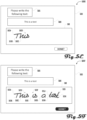
- Figures 5A-K illustrate various states of an exemplary user interface 500 provided by handwriting ingestion application 228 operating on a client device 200 for enabling a user of the client device to selectively provide digitized samples of the user's handwriting via a digitizing surface device in conjunction with a digitizing marking device.
- Exemplary user interface 500 is rendered by display 215 in response to the execution of instructions of an instantiation of client handwriting ingestion application 228 operating on a client device 200.
- Handwriting ingestion UI 500 is rendered in a window 503 including an instructive prompt 505, a sample text display 508, and an input reproduction rendering display 510.
- handwriting ingestion UI 500 is illustrated in an initial prompt state 500A.
- instructive prompt 505 displays text instructing a user operating client device 200 to input the sample text ("This is a test") displayed in sample text display 508 via digitizing surface device 218 and digitizing marking device 220.
- the displayed sample text includes: one instance of a "T" code-point; one instance of an "h” code-point; two instances of an "i” code-point; three instances of an "s” code-point; one instance of an "a” code-point; two instances of a "t” code-point; and one instance of an "e” code-point.
- handwriting ingestion UI 500 is illustrated in a first potential sample ingestion display state 500B.
- input reproduction rendering display 510 displays a visual rendering of input data corresponding to a first stroke 513A, e.g. obtained via digitizing surface device 218 in combination with digitizing marking device 220. The characteristics of such input data are discussed in more detail below, particularly in reference to Figures 7A-B .
- handwriting ingestion UI 500 is illustrated in a second potential sample ingestion display state 500C.
- input reproduction rendering display 510 displays a visual rendering of input data corresponding to first stroke 513A and a second stroke 513B, e.g. obtained via digitizing surface device 218 in combination with digitizing marking device 220 subsequent to the first stroke.
- first and second strokes 513A-B make up a glyph sample corresponding to the first, "T" code-point of the sample text.
- handwriting ingestion UI 500 is illustrated in a third potential sample ingestion display state 500D.
- input reproduction rendering display 510 displays a visual rendering of input data corresponding to first stroke 513A, second stroke 513B, and a third stroke 513C.
- third stroke 513C includes glyph samples corresponding to the "h" code-point, part of the "i" code-point, and one of the "s" code points of the sample text.
- handwriting ingestion UI 500 is illustrated in a fourth potential sample ingestion display state 500E.
- input reproduction rendering display 510 displays a visual rendering of input data corresponding to first stroke 513A, second stroke 513B, third stroke 513C, and a fourth stroke 513D. Similar to the example discussed above with reference to Figure 4 , fourth stroke 513D completes the glyph sample of the "i" code-point of the sample text began by stroke 513C.
- handwriting ingestion UI 500 is illustrated in a fifth potential sample ingestion display state 500F.
- input reproduction rendering display 510 displays a visual rendering of input data corresponding to first stroke 513A, second stroke 513B, third stroke 513C, and fourth stroke 513D, along with a fifth stroke 513E, a sixth stroke 513F, a seventh stroke 513G, an eighth stroke 513H, a ninth stroke 513I, a tenth stroke513J, and an eleventh stroke 513K.
- First through eleventh strokes 513A-K collectively make up glyph samples corresponding to the sample text in sample text display 508.
- handwriting ingestion UI 500 is illustrated in a sample segmentation state 500G.
- instructive prompt 505 displays text instructing a user operating client device 200 to segment any multi-character strokes displayed in input reproduction rendering display 510.
- the user may user a mouse or other pointer-based user input 213 to select segmentation points 515 within a stroke where one glyph sample ends and another begins.
- third stroke 513C is segmented at two segmentation points 515A-B
- fifth stroke 513C is segmented at one segmentation point 515C
- eighth stroke 513H is segmented at two segmentation points 515D-E.
- third stroke 513C is segmented into three stroke segments 520A-C
- fifth stroke 513C is segmented into two stroke segments 520D-E
- eighth stroke 513H is segmented into three stroke segments 520F-H.
- handwriting ingestion UI 500 is illustrated in an initial stroke assignment state 500H.
- initial stroke assignment state 500G the sample text display has been replaced by a character sequence display 523 and instructive prompt 505 displays text instructing a user operating client device 200 to assign the various strokes and stroke segments displayed in reproduction rendering display 510 to a corresponding character from the character sequence display.
- handwriting ingestion UI 500 is illustrated in a first ongoing stroke assignment state 500I.
- first ongoing stroke assignment state 500G the first, "T" character of character sequence display 523 has been highlighted and first stroke 513A has been selected, indicating the first stroke should be associated with a glyph sample for the "T" code point.
- handwriting ingestion UI 500 is illustrated in a second ongoing stroke assignment state 500J.
- second ongoing stroke assignment state 500J the first, "T" character of character sequence display 523 is still highlighted and second stroke 513B has been selected, indicating the second stroke should also be associated with the glyph sample for the "T" code point.
- handwriting ingestion UI 500 is illustrated in a third ongoing stroke assignment state 500K.
- third ongoing stroke assignment state 500K the second, "h" character of character sequence display 523 is now highlighted and first stroke segment 520A has been selected, indicating the first stroke segment should be associated with a glyph sample for the "h" code point. This stroke assignment process may be continued until the user indicates all strokes and stroke segments have been assigned to the appropriate glyph samples.
- Figure 6 illustrates the assignments of data corresponding to various strokes and stroke samples obtained via digitizing surface device 218 and digitizing marking device 220 during the exemplary handwriting sample ingestion process described above with respect to Figures 5A-K are combined into glyph samples and assigned to code-points.
- Data collected during stroke segment 520B and stroke 513D are combined to form glyph sample 603E, which is assigned to the "i" code-point 605E.
- Data collected during stroke segment 520D and stroke 513F are combined to form glyph sample 603F, which is also assigned to the "i" code-point 605E.
- Data collected during stroke segment 520C forms glyph sample 603G, which is assigned to the "s" code-point 605G.
- Data collected during stroke segment 520E forms glyph sample 603H, which is also assigned to the "s" code-point 605G.
- Data collected during stroke segment 520C forms glyph sample 603G, which is assigned to the "s" code-point 605G.
- Data collected during stroke segment 520H forms glyph sample 603I, which is also assigned to the "s" code-point 605G.
- Figures 7A-B illustrate respective graphical representations 700A-B of stroke data collected by client handwriting ingestion application 228 during stroke 513A and stroke 513B (which combine to form a capital letter "T" in the English language) in the example described above and obtained via digitizing surface device 218 and digitizing marking device 220.
- Stroke data obtained from digitizing surface device 218 and digitizing marking device 220 corresponding to strokes, such as strokes 513A-B may take the form of a time-based series of sampled stroke dimensional data values.
- Stroke 513A extends from an origin point 703A, through a series of intermediate points 703B-I, to a termination point 703J.
- Stoke 513B extends from an origin point 705A, through a series of intermediate points 705B-H, to a termination point 705I.
- An exemplary handwriting code point set data structure may include a character map data structure and other associated values corresponding to various aspects of the code point set, such as a user identifier value, an average character width value, an average character height value, a maximum character height value, and the like.
- An exemplary character map data structure may include a plurality of code point data structures, e.g. a code point data structure for each character in the code point set (A, B, C, D, ... T, ... h, i, ... s, ).
- An exemplary code point data structure may include one or more code point sample data structures, e.g. a code point sample data structure for each code point sample obtained for a given code point.
- An exemplary code point sample data structure may include one or more stroke data structures, e.g. a stroke data structure corresponding to each stroke within a given code point sample.
- a code point sample data structure may also include values corresponding to the source of the sample (e.g. the word "This") and the relative position within the source (e.g. 0 in the case of "T,” 1 in the case of "h,” etc.).
- An exemplary stroke data structure may include of a time-based series of sampled stroke dimensional data values, e.g. data values corresponding to a time value (representing the sampling interval of the stroke), relative horizontal position or displacement values, relative vertical position or displacement values, pressure values, spin values, angle values, and the like. (Examples of the horizontal position values, vertical position values, and pressure values are visually depicted in Figures 7A-B (with pressure values being illustrated by data point diameter).)
- an exemplary handwriting code point set data structure may be representable as:
- Figure 8 illustrates a first exemplary series of communications 800 between client device 200A, front-end server 300A, and handwriting ingestion server 300B in accordance with various embodiments of an exemplary client/server-based handwriting ingestion system, such as the exemplary client/server-based handwriting ingestion system illustrated in Figure 1 .
- Client device 200A may obtain 803 and process 805 a user session initiation command, e.g. via user input 213 in response to a prompt provided via display 215.
- Client device 200A may provide front-end server 300A with a corresponding user session initiation request 808.
- User session initiation request 808 may include user identifying information corresponding to a user of client device 200A, e.g. via an alphanumeric identifier associated with a user, and the like.
- Front-end server 300A may process 810 user session initiation request 808. For example, front-end server 300A may instantiate a user session associated with the user identifying information, obtain additional meta-data relating to the user identifying information, e.g. from administrative data store 105 and/or other sources, and the like.
- Front-end server 300A may provide handwriting ingestion server 300B with a user data request 813.
- User data request 813 may include data obtained from client device 200A via user session initiation request 808, such as a user identifier, and via processing 810 the user session initiation request by front-end server 300A.
- Handwriting ingestion server 300B may process 815 user data request 813. For example, handwriting ingestion server 300B may obtain handwriting sample data associated with the user identifier, e.g. from handwriting sample set data store 108, determine a measure of handwriting sample set completeness, and the like.
- Handwriting ingestion server 300B may then provide a user data response 818 to front-end server 300A.
- Front-end server 300A may then process 820 user data response 818, e.g. by parsing the user data response to extract data to pass on to client device 200.
- Front-end server 300A may then provide a user session initiation response 823 to client device 200A.
- User session initiation response 823 may include a user session identifier, handwriting sample set data, and/or the like.
- Client device 200A may then process 825 user session initiation response 820, for example by rendering information provided in the user session initiation response via display 215.
- Client device 200A may then obtain 828 and process 830 new handwriting sample data, such as in the manner described above in reference to Figures 5A-K , to obtain stroke dimension data for one or more glyph samples.
- Client device 200A may provide front-end server 300A with a corresponding handwriting sample update request 833.
- Handwriting sample update request 833 may include the user session identifier, code-point identifiers, stroke dimension data from one or more glyph samples, and/or the like.
- Front-end server 300A may process 835 handwriting sample update request 833 and provide handwriting ingestion server 300B with an internal handwriting sample update request 838.
- Internal handwriting sample update request 838 may include the user identifier associated with the user session, code-point identifiers, stroke dimension data from one or more glyph samples, and/or the like.
- Handwriting ingestion server 300B may process 840 internal handwriting sample update request 838.
- handwriting ingestion server 300B may store the stroke dimension data in handwriting sample set data store 108 associated with the respective user identifier and code-point identifiers, determine an updated measure of handwriting sample set completeness, and the like.
- Handwriting ingestion server 300B may then provide an internal handwriting sample update response 843 to front-end server 300A.
- internal handwriting sample update response 843 may include an acknowledgement the handwriting sample set associated with the user identifier has been updated, the updated measure of handwriting sample set completeness, and the like.
- Front-end server 300A may then process 845 internal handwriting sample update response 843 and provide a handwriting sample update response 848 to client device 200A.
- Handwriting sample update response 848 may include an acknowledgement the handwriting sample set associated with the user identifier has been updated, the updated measure of handwriting sample set completeness, and the like.
- Client device 200A may then process 850 handwriting sample update response 848, for example by rendering information provided in the handwriting sample update response via display 215, and the like.
- Figure 9 illustrates an handwriting sample ingestion routine 900, which is implemented by client handwriting ingestion application 228 operating on a client device, such as client devices 200A-B.
- Handwriting sample ingestion routine 900 obtains a user identifier at execution block 903.
- a client handwriting ingestion application 228 obtains a user identifier via a user input 213 in response to a user's interaction with a user login interface, a user profile file stored in memory 205, or the like.
- Handwriting sample ingestion routine 900 provides a handwriting code-point set request, including the user identifier, at execution block 905.
- client handwriting application provides the handwriting code-point set request to front-end server 300B via network 103.
- handwriting sample ingestion routine 900 calls a handwriting code-point set completeness sub-routine 1100, described below in reference to Figure 11 ; otherwise handwriting sample ingestion routine 900 proceeds to execution block 910.
- Handwriting sample ingestion routine 900 calls an initial sample collection sub-routine 1000, described below in reference to Figure 10 .
- Handwriting sample ingestion routine 900 calls handwriting code-point set completeness sub-routine 1100.
- handwriting sample ingestion routine 900 proceeds to decision block 915; otherwise handwriting sample ingestion routine 900 may call a supplemental sample collection sub-routine 1200, discussed below in reference to Figure 12 . After the completion of supplemental sample collection sub-routine 1200, handwriting sample ingestion routine 900 loops back to handwriting code point set completeness sub-routine block 1100.
- handwriting sample ingestion routine 900 proceeds to execution block 918; otherwise, 900 proceeds to execution block 920.
- handwriting sample ingestion routine 900 may provide a handwriting code point data structure complete prompt, e.g. via display 215, to inform the user of client device 200 that no additional handwriting samples are needed. Handwriting sample ingestion routine 900 may then proceed to termination block 999.
- handwriting sample ingestion routine 900 provides a supplemental sample collection prompt, e.g. via display 215, to inform the user of client device 200 that the handwriting code point set data structure is usable, but that additional samples may improve the results of handwriting generation services, and inviting the user to provide additional samples.
- a supplemental sample collection prompt e.g. via display 215
- handwriting sample ingestion routine 900 obtains an affirmative response to the supplemental sample collection prompt, then handwriting sample ingestion routine 900 calls supplemental sample collection sub-routine 1200; otherwise, handwriting sample ingestion routine 900 proceeds to termination block 999.
- Handwriting sample ingestion routine 900 ends at termination block 999.
- Figure 10 illustrates an initial sample collection sub-routine 1000, which may be implemented by client handwriting ingestion application 228, e.g. in response to a call from handwriting sample ingestion routine 900.
- Initial sample collection sub-routine 1000 obtains an initial handwriting sample collection request at execution block 1003.
- the initial handwriting sample collection request includes a user identifier.
- Initial sample collection sub-routine 1000 instantiates a handwriting code-point set data structure and associate the handwriting code-point set data structure with the user identifier at execution block 1005.
- Initial sample collection sub-routine 1000 may select an initial handwriting sample at execution block 1008. For example, initial sample collection sub-routine 1000 may obtain a handwriting style identifier associated with the user identifier and then obtain a handwriting sample identifier associated with the handwriting style identifier.
- Initial sample collection sub-routine 1000 may then call a handwriting sample collection sub-routine 1300, described below in reference to Figures 13A-B , which may include providing the handwriting sample identifier to handwriting sample collection sub-routine 1300.
- Initial sample collection sub-routine 1000 may return, e.g. to handwriting sample ingestion routine 900, at return block 1099.
- Figures 11A-B illustrate a handwriting code point set completeness sub-routine 1100, which may be implemented by client handwriting ingestion application 228, e.g. in response to a call from handwriting sample ingestion routine 900.
- handwriting code point set completeness sub-routine 1100 obtains a handwriting code point set completeness request at execution block 1103.
- Handwriting code point set completeness request includes a user identifier, a handwriting code point set data structure identifier and a handwriting style identifier.
- Handwriting code point set completeness sub-routine 1100 determines one or more critical code point set requirements associated with the handwriting style identifier at execution block 1105.
- Handwriting code point set completeness sub-routine 1100 may set a critical pass flag value to true at execution block 1108.
- handwriting code point set completeness sub-routine 1100 may process each critical code point set requirement in turn.
- handwriting code point set completeness sub-routine 1100 may proceed to execution block 1115; otherwise handwriting code point set completeness sub-routine 1100 may proceed to ending loop block 1118.
- Handwriting code point set completeness sub-routine 1100 may set the critical pass flag value to false at execution block 1115.
- handwriting code point set completeness sub-routine 1100 may loop back to starting loop block 1110 and process the next critical code point set requirement, if any.
- handwriting code point set completeness sub-routine 1100 may proceed to execution block 1123 ( Figure 11B ); otherwise handwriting code point set completeness sub-routine 1100 may proceed to return block 1197.
- handwriting code point set completeness sub-routine 1100 determines one or more complete code point set requirements associated with the handwriting style identifier at execution block 1123.
- Handwriting code point set completeness sub-routine 1100 may set a complete pass flag value to true at execution block 1125.
- handwriting code point set completeness sub-routine 1100 may process each complete code point set requirement in turn.
- handwriting code point set completeness sub-routine 1100 proceeds to execution block 1133; otherwise handwriting code point set completeness sub-routine 1100 may proceed to ending loop block 1135.
- Handwriting code point set completeness sub-routine 1100 may set the complete pass flag value to false at execution block 1133.
- handwriting code point set completeness sub-routine 1100 may loop back to starting loop block 1128 and process the next complete code point set requirement, if any.
- handwriting code point set completeness sub-routine 1100 proceeds to return block 1198; otherwise handwriting code point set completeness sub-routine 1100 proceeds to return block 1199.
- handwriting code point set completeness sub-routine 1100 may return a handwriting code point set unusable message, e.g. to handwriting sample ingestion routine 900.
- handwriting code point set completeness sub-routine 1100 may return a handwriting code point set complete message, e.g. to handwriting sample ingestion routine 900.
- handwriting code point set completeness sub-routine 1100 may return a handwriting code point set usable message, e.g. to handwriting sample ingestion routine 900.
- Figure 12 illustrates an exemplary supplemental sample collection sub-routine 1200, which may be implemented by client handwriting ingestion application 228, e.g. in response to a call from handwriting sample ingestion routine 900.
- Supplemental sample collection sub-routine 1200 may obtain a supplemental handwriting sample collection request at execution block 1203.
- the supplemental handwriting sample collection request may include a user identifier and/or a handwriting code point set data structure identifier.
- Supplemental sample collection sub-routine 1200 may parse a handwriting code point set data structure associated with the handwriting code point set data structure identifier at execution block 1205. For example, supplemental sample collection sub-routine 1200 may determine one or more code-points for which the handwriting code point set data structure identifier does not contain a minimum acceptable number of glyph samples.
- Supplemental sample collection sub-routine 1200 may select a supplemental handwriting sample target at execution block 1208. For example, supplemental sample collection sub-routine 1200 may select a supplemental handwriting sample target based on the one or more code- points for which the handwriting code point set data structure identifier does not contain a minimum acceptable number of glyph samples.
- Supplemental sample collection sub-routine 1200 may then call handwriting sample collection sub-routine 1300, described below in reference to Figures 13A-B , which may include providing the supplemental handwriting sample target identifier to handwriting sample collection sub-routine 1300.
- Supplemental sample collection sub-routine 1200 may return, e.g. to handwriting sample ingestion routine 900, at return block 1299.
- Figures 13A-B illustrate an exemplary handwriting sample collection sub-routine 1300, which may be implemented by client handwriting ingestion application 228, e.g. in response to a call from initial sample collection sub-routine 1000 or supplemental sample collection supplemental sample collection sub-routine 1200.
- handwriting sample collection sub-routine 1300 may obtain a handwriting sample collection request at execution block 1303.
- Handwriting sample collection sub-routine 1300 may render a visual representation of the handwriting sample text, e.g. via display 215, at execution block 1305 (see sample text display 508, Figure 5 ).
- handwriting sample collection sub-routine 1300 may proceed to execution block 1311; otherwise handwriting sample collection sub-routine 1300 may proceed to decision block 1309.
- handwriting sample collection sub-routine 1300 may proceed to return block 1398.
- handwriting sample collection sub-routine 1300 may obtain digitized handwriting sample data, such as the digitized handwriting sample data described above with respect to Figures 7A-B , representative of the handwriting sample text and captured by digitizing marking surface 218 and digitizing marking device 220,
- Handwriting sample collection sub-routine 1300 may provide a digitized handwriting sample image representative of the handwriting sample data, e.g. via display 215, at execution block 1311.
- Handwriting sample collection sub-routine 1300 may provide a stroke segmentation prompt, e.g. via display 215, at execution block 1312.
- Handwriting sample collection sub-routine 1300 may capture stroke segmentation points, e.g. via user input 213, at execution block 1313.
- Handwriting sample collection sub-routine 1300 may map any captured stroke segmentation points to points in the digitized handwriting sample data at execution block 1314.
- handwriting sample collection sub-routine 1300 may proceed to starting loop block 1318, described below in reference to Figure 13B ); otherwise handwriting sample collection sub-routine 1300 may continue to wait for the stroke segmentation process to complete.
- handwriting sample collection sub-routine 1300 may process each code point sample in the handwriting sample text in turn.
- Handwriting sample collection sub-routine 1300 may provide a stroke identification prompt at execution block 1318, e.g. via display 215.
- handwriting sample collection sub-routine 1300 may proceed to execution block 1323; otherwise handwriting sample collection sub-routine 1300 may continue to wait for a stroke identification response.
- Handwriting sample collection sub-routine 1300 may instantiate a new code point sample value for the current code point of the handwriting sample text in the handwriting code-point set data structure at execution block 1323.
- handwriting sample collection sub-routine 1300 may proceed to starting loop block 1328; otherwise handwriting sample collection sub-routine 1300 may proceed to execution block 1338.
- handwriting sample collection sub-routine 1300 may process each identified stroke segment in turn.
- Handwriting sample collection sub-routine 1300 may instantiate a new segment value for the current sample value in the handwriting code point data structure at execution block 1330.
- Handwriting sample collection sub-routine 1300 may identify digitized handwriting sample data corresponding to the current stroke segment at execution block 1331.
- Handwriting sample collection sub-routine 1300 may associate the identified digitized handwriting sample data with the new segment value for the current code point at execution block 1333.
- handwriting sample collection sub-routine 1300 may loop back to starting loop block 1328 to process the next identified stroke segment, if any.
- handwriting sample collection sub-routine 1300 may identify digitized handwriting sample data corresponding to the identified stroke.
- Handwriting sample collection sub-routine 1300 may associate the identified digitized handwriting sample data with the new code point sample value for the current code point at execution block 1340.
- handwriting sample collection sub-routine 1300 may loop back to starting loop block 1316 to process the next code point in the handwriting sample text, if any.
- handwriting sample collection sub-routine 1300 may return a collection successful message at termination block 1399.
- Handwriting sample collection sub-routine 1300 may return a collection successful message at termination block 1399.
- Certain aspects of the present methods and systems may focus on computer implemented methods of obtaining digitized hand-writing data corresponding to a sample of a needed code point of a set of code points.
- Such methods may include: obtaining a sample of digitized handwritten text, the sample of digitized handwritten text including glyph data corresponding to a first glyph, the first glyph corresponding to the needed code point of the set of code points; associating the first glyph with the needed code point; identifying stroke data in the glyph data, the stroke data corresponding to a stroke component of the first glyph, determining a plurality of dimensional values of the stroke component in the stroke data; and associating the plurality of dimensional values with a new code point sample of the needed code point in a code point set data structure.
- aspects of the present methods and systems focus on computer implemented methods of supplementing an incomplete handwriting code point data structure corresponding to a set of code points.
- Such methods include: identifying a plurality of code points from the set of code points, the plurality of code points corresponding to code points in need of dimensional values for at least one code point sample; selecting a preferred handwriting sample phrase from a plurality of predefined handwriting sample phrases, the preferred handwriting sample phrase including at least a first code point of the plurality of code points; obtaining a sample of digitized handwritten text corresponding to the preferred handwriting sample phrase, the sample of digitized handwritten text including glyph data corresponding to a first glyph, the first glyph corresponding to the first code point; associating the first glyph with the first code point; identifying stroke data in the glyph data, the stroke data corresponding to a stroke component of the first glyph, determining a plurality of dimensional values of the stroke component in the stroke data; and associating the plurality of dimensional values
Landscapes
- Engineering & Computer Science (AREA)
- Theoretical Computer Science (AREA)
- Physics & Mathematics (AREA)
- General Physics & Mathematics (AREA)
- Multimedia (AREA)
- General Engineering & Computer Science (AREA)
- Computer Vision & Pattern Recognition (AREA)
- Human Computer Interaction (AREA)
- Software Systems (AREA)
- Character Discrimination (AREA)
- Information Transfer Between Computers (AREA)
Claims (11)
- Handschriftdatenaufnahmesystem (100), das beim Verbessern der Leistung eines Handschriftbildgenerators von Nutzen ist, wobei das Handschriftdatenaufnahmesystem umfasst:einen Handschriftprobensatzdatenspeicher (108), der Daten speichert, die einer unvollständigen Handschriftcodepunktdatenstruktur entspricht, die eine Vielzahl von Codepunktprobendatenstrukturen beinhaltet, wobei jede Codepunktprobendatenstruktur mit einem Codepunkt eines Satzes von Codepunkten assoziiert ist und Daten beinhaltet, die einer zeitbasierten Reihe von beprobten Strichdimensionswerten entsprechen;eine Computerverarbeitungseinheit (203) in Datenkommunikation mit dem Handschriftprobensatzdatenspeicher (108);eine Anzeige (215) in Datenkommunikation mit der Computerverarbeitungseinheit;eine Digitalisierungsoberflächenvorrichtung (218) in Datenkommunikation mit der Computerverarbeitungseinheit;einen Speicher (205) in Datenkommunikation mit der Computerverarbeitungseinheit und enthaltend ausführbare Anweisungen zum Konfigurieren des Handschriftdatenaufnahmesystems, um die unvollständige Handschriftcodepunktdatenstruktur zu ergänzen, indem bewirkt wird, dass die Computerverarbeitungseinheit ein Probennahmeverfahren durchführt, beinhaltend die Schritte:(a) Identifizieren eines benötigten Codepunkts des Satzes von Codepunkten durch die Computerverarbeitungseinheit, wobei der benötigte Codepunkt einem Codepunkt des Satzes von Codepunkten entspricht, der eine assoziiertes Codepunktprobendatenstruktur in der unvollständigen Handschriftcodepunktdatenstruktur benötigt;(b) Auswählen einer Handschriftprobenphrase aus einer Vielzahl von vordefinierten Handschriftprobenphrasen durch die Computerverarbeitungseinheit, wobei die Handschriftprobenphrase den benötigten Codepunkt beinhaltet;(c) Bereitstellen einer optischen Darstellung der Handschriftprobenphrase durch die Anzeige;(d) Beziehen von digitalisierten handgeschriebenen Textdaten, die der Handschriftprobenphrase entsprechen, durch die Digitalisierungsoberflächenvorrichtung als Antwort auf eine oder mehrere Benutzereingaben mit der Digitalisierungsoberfläche;(e) Identifizieren einer zeitbasierten Reihe von Probenstrichdimensionswerten innerhalb der digitalisierten handgeschriebenen Textdaten, die dem benötigten Codepunkt entsprechen, durch die Computerverarbeitungseinheit;(f) Erzeugen einer neuen Codepunktprobendatenstruktur durch die Computerverarbeitungseinheit und Populieren der neuen Codepunktprobendatenstruktur mit der zeitbasierten Reihe von Probenstrichdimensionswerten und(g) Assoziieren der neuen Codepunktprobendatenstruktur mit dem benötigten Codepunkt in der unvollständigen Handschriftcodepunktdatenstruktur durch den Handschriftprobensatzdatenspeicher;dadurch gekennzeichnet, dass der Speicher weiterhin ausführbare Anweisungen zum Konfigurieren des Handschriftdatenaufnahmesystems, um zu bewirken, dass die Computerverarbeitungseinheit ein Probenaufnahmeverfahren (900) durchführt, beinhaltend die Schritte:Instantiieren einer Handschriftcodepunktesatzdatenstruktur und Durchführen einer anfänglichen Probennahme sowohl als eine bedingte Antwort darauf, dass kein Handschriftcodepunktesatz mit einer Benutzerkennung assoziiert ist, wobei die anfängliche Probennahme die Handschriftcodepunktesatzdatenstruktur mit der Benutzerkennung assoziiert;Bestimmen eines Satzes von kritischen Codepunktesatzerfordernissen (1105), die mit einer Handschriftstilkennung assoziiert sind;Beziehen eines ersten Ergebnisses von einem Handschriftcodepunktesatzvollständigkeitsvorgang (1100) für einen ersten Handschriftcodepunktesatz der Handschriftcodepunktesatzdatenstruktur, der aus der anfänglichen Probennahme resultiert, wobei das erste Ergebnis angibt, dass die Handschriftcodepunktesatzdatenstruktur nicht verwendbar ist, wenn der erste Handschriftcodepunktesatz nicht jedes des einen oder der mehreren kritischen Codepunktesatzerfordernisse erfüllt;Bestimmen eines oder mehrerer Vollständigkeitscodepunktesatzerfordernisse (1123), wobei das eine oder die mehreren Vollständigkeitscodepunktesatzerfordernisse erfordern, dass die Handschriftcodepunktesatzdatenstruktur eine Mindestanzahl von Codepunktprobendatenstrukturen für jeden der Codepunkte in dem Teilsatz von Codepunkten beinhaltet;Beziehen eines zweiten Ergebnisses von einem Handschriftcodepunktesatzvollständigkeitsvorgang (1100) für einen zweiten Handschriftcodepunktesatz der Handschriftcodepunktesatzdatenstruktur, der aus dem Probennahmeverfahren resultiert, wobei das zweite Ergebnis angibt, dass die Handschriftcodepunktesatzdatenstruktur verwendbar ist und nicht vollständig ist, wenn: (i) der zweite Handschriftcodepunktesatz jedes des einen oder der mehreren kritischen Codepunktesatzerfordernisse erfüllt und (ii) der zweite Handschriftcodepunktesatz nicht jedes des einen oder der mehreren vollständigen Codepunktesatzerfordernisse erfüllt; undBereitstellen einer zusätzlichen Probennahmeaufforderung (920) mittels einer Client-Vorrichtung als Antwort auf das Beziehen des zweiten Ergebnisses, das angibt, dass die Handschriftcodepunktesatzdatenstruktur verwendbar ist und nicht vollständig ist.
- Handschriftdatenaufnahmesystem nach Anspruch 1, wobei die zeitbasierte Reihe von Probenstrichdimensionswerten eine Vielzahl von Zeitwerten beinhaltet.
- Handschriftdatenaufnahmesystem nach Anspruch 1, wobei die zeitbasierte Reihe von Probenstrichdimensionswerten eine Vielzahl von Horizontalverschiebungswerten beinhaltet.
- Handschriftdatenaufnahmesystem nach Anspruch 1, wobei die zeitbasierte Reihe von Probenstrichdimensionswerten eine Vielzahl von Vertikalverschiebungswerten beinhaltet.
- Handschriftdatenaufnahmesystem nach Anspruch 1, wobei die zeitbasierte Reihe von Probenstrichdimensionswerten eine Vielzahl von Rotationsverschiebungswerten beinhaltet.
- Handschriftdatenaufnahmesystem nach Anspruch 1, wobei die zeitbasierte Reihe von Probenstrichdimensionswerten eine Vielzahl von Winkelverschiebungswerten beinhaltet.
- Handschriftdatenaufnahmesystem nach Anspruch 1, wobei die zeitbasierte Reihe von Probenstrichdimensionswerten eine Vielzahl von Druckwerten beinhaltet.
- Handschriftdatenaufnahmesystem nach Anspruch 1, wobei die zeitbasierte Reihe von Probenstrichdimensionswerten eine Vielzahl von Zeitwerten, eine Vielzahl von Horizontalverschiebungswerten, eine Vielzahl von Vertikalverschiebungswerten, eine Vielzahl von Rotationsverschiebungswerten, eine Vielzahl von Winkelverschiebungswerten und eine Vielzahl von Druckwerten beinhaltet.
- Handschriftdatenaufnahmesystem nach Anspruch 1, weiterhin umfassend eine Digitalisierungsmarkierungsvorrichtung, und wobei das Probennahmeverfahren weiterhin ein Beziehen von digitalisierten handgeschriebenen Textdaten, die der Handschriftprobenphrase entsprechen, durch die Digitalisierungsmarkierungsvorrichtung beinhaltet.
- Handschriftdatenaufnahmesystem nach Anspruch 1, wobei der Speicher in Datenkommunikation mit der Computerverarbeitungseinheit und enthaltend ausführbare Anweisungen zum Konfigurieren des Handschriftdatenaufnahmesystems, um zu bewirken, dass die Computerverarbeitungseinheit das Probenaufnahmeverfahren durchführt, dazu konfiguriert ist, die Benutzerkennung mittels einer Benutzereingabe als Antwort auf eine Interaktion eines Benutzers mit einer Benutzeranmeldungsoberfläche einer Client-Vorrichtung zu beziehen.
- Handschriftdatenaufnahmesystem nach Anspruch 1, wobei der Speicher in Datenkommunikation mit der Computerverarbeitungseinheit und enthaltend ausführbare Anweisungen zum Konfigurieren des Handschriftdatenaufnahmesystems, um zu bewirken, dass die Computerverarbeitungseinheit das Probenaufnahmeverfahren durchführt, dazu konfiguriert ist, zu bewirken, dass die Computerverarbeitungseinheit das Probennahmeverfahren erneut als eine bedingte Antwort auf eine bestätigende Antwort nach der zusätzlichen Probennahmeaufforderung durchführt.
Applications Claiming Priority (2)
| Application Number | Priority Date | Filing Date | Title |
|---|---|---|---|
| US15/273,610 US9934422B1 (en) | 2016-09-22 | 2016-09-22 | Digitized handwriting sample ingestion systems and methods |
| PCT/US2017/053019 WO2018057932A1 (en) | 2016-09-22 | 2017-09-22 | Digitized handwriting sample ingestion systems and methods |
Publications (4)
| Publication Number | Publication Date |
|---|---|
| EP3555809A1 EP3555809A1 (de) | 2019-10-23 |
| EP3555809A4 EP3555809A4 (de) | 2021-05-05 |
| EP3555809B1 true EP3555809B1 (de) | 2023-11-08 |
| EP3555809C0 EP3555809C0 (de) | 2023-11-08 |
Family
ID=61617523
Family Applications (1)
| Application Number | Title | Priority Date | Filing Date |
|---|---|---|---|
| EP17854011.8A Active EP3555809B1 (de) | 2016-09-22 | 2017-09-22 | Systeme und verfahren zur einnahme einer digitalisierten handschriftprobe |
Country Status (7)
| Country | Link |
|---|---|
| US (2) | US9934422B1 (de) |
| EP (1) | EP3555809B1 (de) |
| CA (1) | CA3042505A1 (de) |
| ES (1) | ES2967808T3 (de) |
| PL (1) | PL3555809T3 (de) |
| TW (1) | TW201818203A (de) |
| WO (1) | WO2018057932A1 (de) |
Families Citing this family (8)
| Publication number | Priority date | Publication date | Assignee | Title |
|---|---|---|---|---|
| CN109493400B (zh) * | 2018-09-18 | 2024-01-19 | 平安科技(深圳)有限公司 | 手写样本生成方法、装置、计算机设备及存储介质 |
| CN110532890B (zh) * | 2019-08-05 | 2021-10-22 | 安徽大学 | 一种基于云端、边缘端和设备端的分布式孪生卷积神经网络行人重识别方法 |
| US20230278228A1 (en) * | 2019-09-18 | 2023-09-07 | ConversionRobots Inc. | System and method for generating a printed copy of a print file according to a dynamic pressure profile |
| US11257267B2 (en) * | 2019-09-18 | 2022-02-22 | ConversionRobotics Inc. | Method for generating a handwriting vector |
| CN113821198B (zh) * | 2021-09-14 | 2023-10-24 | 中南大学 | 一种代码补全方法、系统、存储介质及计算机程序产品 |
| CN114399772B (zh) * | 2021-12-20 | 2024-02-27 | 北京百度网讯科技有限公司 | 样本生成、模型训练和轨迹识别方法、装置、设备和介质 |
| CN114973279B (zh) * | 2022-06-17 | 2023-02-17 | 北京百度网讯科技有限公司 | 手写文本图像生成模型的训练方法、装置和存储介质 |
| WO2025089607A1 (ko) * | 2023-10-25 | 2025-05-01 | 삼성전자주식회사 | 필기 콘텐트를 획득하기 위한 전자 장치 및 그 방법 |
Family Cites Families (24)
| Publication number | Priority date | Publication date | Assignee | Title |
|---|---|---|---|---|
| US5121441A (en) * | 1990-09-21 | 1992-06-09 | International Business Machines Corporation | Robust prototype establishment in an on-line handwriting recognition system |
| US5412771A (en) | 1992-02-07 | 1995-05-02 | Signature Software, Inc. | Generation of interdependent font characters based on ligature and glyph categorizations |
| US6256410B1 (en) * | 1998-07-30 | 2001-07-03 | International Business Machines Corp. | Methods and apparatus for customizing handwriting models to individual writers |
| US6298154B1 (en) * | 1999-03-29 | 2001-10-02 | Eastman Kodak Company | Method for rendering improved personal handwriting |
| EP1192519A2 (de) * | 1999-12-17 | 2002-04-03 | Koninklijke Philips Electronics N.V. | Gerät und system zur wiedergabe von handgeschriebenen eingaben |
| US6958755B1 (en) * | 2002-02-06 | 2005-10-25 | Bellsouth Intellectual Property Corporation | Personalized computer fonts |
| US7227993B2 (en) * | 2003-01-27 | 2007-06-05 | Microsoft Corporation | Learning-based system and process for synthesizing cursive handwriting |
| US7483570B1 (en) | 2004-02-11 | 2009-01-27 | Knight Andrew F | Software and method for creating a dynamic handwriting font |
| US7352899B2 (en) | 2004-10-12 | 2008-04-01 | Loeb Enterprises, Llc | Realistic machine-generated handwriting with personalized fonts |
| US7697001B2 (en) * | 2005-01-31 | 2010-04-13 | Microsoft Corporation | Personalized ink font |
| RO121497B1 (ro) * | 2005-02-09 | 2007-06-29 | Softwin S.R.L. | Sistem informatic şi metodă pentru achiziţia, analiza şi autentificarea semnăturii olografe |
| KR100801224B1 (ko) * | 2006-08-16 | 2008-02-05 | 장경호 | 사용자 필적 구현 시스템 및 방법 |
| US7983478B2 (en) * | 2007-08-10 | 2011-07-19 | Microsoft Corporation | Hidden markov model based handwriting/calligraphy generation |
| US20120001922A1 (en) * | 2009-01-26 | 2012-01-05 | Escher Marc | System and method for creating and sharing personalized fonts on a client/server architecture |
| US8351700B2 (en) | 2009-04-08 | 2013-01-08 | Gracious Eloise, Inc. | Variable glyph system and method |
| US8749800B2 (en) | 2009-12-30 | 2014-06-10 | Eastman Kodak Company | System for generating personalized documents |
| WO2012010211A1 (en) | 2010-07-23 | 2012-01-26 | Sony Ericsson Mobile Communications Ab | Device, method & computer program product |
| WO2012037721A1 (en) * | 2010-09-21 | 2012-03-29 | Hewlett-Packard Development Company,L.P. | Handwritten character font library |
| US9230514B1 (en) | 2012-06-20 | 2016-01-05 | Amazon Technologies, Inc. | Simulating variances in human writing with digital typography |
| US20140363082A1 (en) * | 2013-06-09 | 2014-12-11 | Apple Inc. | Integrating stroke-distribution information into spatial feature extraction for automatic handwriting recognition |
| JP6392036B2 (ja) | 2014-09-03 | 2018-09-19 | 株式会社東芝 | 電子機器および方法 |
| TWI569176B (zh) * | 2015-01-16 | 2017-02-01 | 新普科技股份有限公司 | 手寫軌跡識別方法與系統 |
| US10055659B2 (en) * | 2015-05-04 | 2018-08-21 | King Fahd University Of Petroleum And Minerals | Systems and associated methods for arabic handwriting using synthetic extension concatenation and synthesis |
| US9633255B2 (en) * | 2015-06-26 | 2017-04-25 | Intel Corporation | Substitution of handwritten text with a custom handwritten font |
-
2016
- 2016-09-22 US US15/273,610 patent/US9934422B1/en active Active
-
2017
- 2017-09-21 TW TW106132386A patent/TW201818203A/zh unknown
- 2017-09-22 ES ES17854011T patent/ES2967808T3/es active Active
- 2017-09-22 CA CA3042505A patent/CA3042505A1/en active Pending
- 2017-09-22 EP EP17854011.8A patent/EP3555809B1/de active Active
- 2017-09-22 PL PL17854011.8T patent/PL3555809T3/pl unknown
- 2017-09-22 WO PCT/US2017/053019 patent/WO2018057932A1/en not_active Ceased
-
2018
- 2018-03-06 US US15/913,311 patent/US20180196994A1/en not_active Abandoned
Also Published As
| Publication number | Publication date |
|---|---|
| EP3555809A1 (de) | 2019-10-23 |
| ES2967808T3 (es) | 2024-05-03 |
| CA3042505A1 (en) | 2018-03-29 |
| TW201818203A (zh) | 2018-05-16 |
| WO2018057932A1 (en) | 2018-03-29 |
| PL3555809T3 (pl) | 2024-04-08 |
| US20180196994A1 (en) | 2018-07-12 |
| US20180082105A1 (en) | 2018-03-22 |
| EP3555809A4 (de) | 2021-05-05 |
| US9934422B1 (en) | 2018-04-03 |
| EP3555809C0 (de) | 2023-11-08 |
Similar Documents
| Publication | Publication Date | Title |
|---|---|---|
| EP3555809B1 (de) | Systeme und verfahren zur einnahme einer digitalisierten handschriftprobe | |
| US20180129877A1 (en) | Digitized handwriting sample ingestion systems and methods | |
| CN111695518B (zh) | 结构化文档信息标注的方法、装置及电子设备 | |
| EP3652917B1 (de) | System und verfahren zum integrieren von nachrichteninhalt in eine zieldatenverarbeitungsvorrichtung | |
| CN102262641B (zh) | 网络查询中的在线手写识别系统和方法 | |
| CN111753744B (zh) | 用于票据图像分类的方法、装置、设备及可读存储介质 | |
| US10068155B2 (en) | Verification of optical character recognition results | |
| JP2009295153A (ja) | ウェブベースのテキスト検出方法及びシステム | |
| US11551480B2 (en) | Handwriting input apparatus, handwriting input method, program, and input system | |
| EP3979129A1 (de) | Objekterkennungsverfahren und -vorrichtung sowie elektronische vorrichtung und speichermedium | |
| KR20150082097A (ko) | 클라우드 기반 폰트 서비스 시스템 | |
| TWI688868B (zh) | 用於提取訊息並使用所述訊息擷取聯絡人訊息的系統、非暫時性電腦可讀媒體和方法 | |
| JP6232736B2 (ja) | 文書読解支援装置、文書読解支援システム、文書読解支援方法およびプログラム | |
| JP6094400B2 (ja) | 情報処理装置、情報処理方法、および情報処理プログラム | |
| JP7414449B2 (ja) | データ処理システム、データ処理方法、および、プログラム | |
| JP7803814B2 (ja) | 情報処理方法 | |
| JP7693410B2 (ja) | 情報処理システム、方法及びプログラム | |
| JP2013182459A (ja) | 情報処理装置、情報処理方法及びプログラム | |
| JP2024077308A (ja) | 文字置換支援装置、文字置換支援方法、プログラム及び記録媒体 | |
| JP6264910B2 (ja) | アグリゲーションプログラム、端末装置及びアグリゲーション方法 | |
| JP6693045B2 (ja) | 個人情報表示プログラム、個人情報表示方法、および表示制御装置 | |
| JP2025008039A (ja) | 情報処理装置、情報処理装置の制御方法、およびプログラム | |
| CN104635926A (zh) | 一种用于在计算机设备中收录信息的方法和装置 | |
| JP2009054069A (ja) | 翻訳者選定方法、翻訳者選定装置、および翻訳者選定プログラム | |
| JP2005284716A (ja) | 文字認識システム、文字認識方法およびそのプログラム |
Legal Events
| Date | Code | Title | Description |
|---|---|---|---|
| STAA | Information on the status of an ep patent application or granted ep patent |
Free format text: STATUS: THE INTERNATIONAL PUBLICATION HAS BEEN MADE |
|
| PUAI | Public reference made under article 153(3) epc to a published international application that has entered the european phase |
Free format text: ORIGINAL CODE: 0009012 |
|
| STAA | Information on the status of an ep patent application or granted ep patent |
Free format text: STATUS: REQUEST FOR EXAMINATION WAS MADE |
|
| 17P | Request for examination filed |
Effective date: 20190708 |
|
| AK | Designated contracting states |
Kind code of ref document: A1 Designated state(s): AL AT BE BG CH CY CZ DE DK EE ES FI FR GB GR HR HU IE IS IT LI LT LU LV MC MK MT NL NO PL PT RO RS SE SI SK SM TR |
|
| AX | Request for extension of the european patent |
Extension state: BA ME |
|
| DAV | Request for validation of the european patent (deleted) | ||
| DAX | Request for extension of the european patent (deleted) | ||
| RAP1 | Party data changed (applicant data changed or rights of an application transferred) |
Owner name: MAILING SERVICES OF PITTSBURGH INC. D/B/A BLUESKY ETO |
|
| A4 | Supplementary search report drawn up and despatched |
Effective date: 20210401 |
|
| RIC1 | Information provided on ipc code assigned before grant |
Ipc: G06K 9/00 20060101AFI20210326BHEP Ipc: G06K 9/34 20060101ALI20210326BHEP Ipc: G06F 3/0488 20130101ALI20210326BHEP |
|
| RAP1 | Party data changed (applicant data changed or rights of an application transferred) |
Owner name: PLANETART, LLC |
|
| STAA | Information on the status of an ep patent application or granted ep patent |
Free format text: STATUS: EXAMINATION IS IN PROGRESS |
|
| 17Q | First examination report despatched |
Effective date: 20220222 |
|
| REG | Reference to a national code |
Ref country code: DE Ref legal event code: R079 Free format text: PREVIOUS MAIN CLASS: G06K0009000000 Ipc: G06F0003048830 Ref document number: 602017076395 Country of ref document: DE |
|
| GRAP | Despatch of communication of intention to grant a patent |
Free format text: ORIGINAL CODE: EPIDOSNIGR1 |
|
| STAA | Information on the status of an ep patent application or granted ep patent |
Free format text: STATUS: GRANT OF PATENT IS INTENDED |
|
| RIC1 | Information provided on ipc code assigned before grant |
Ipc: G06V 40/30 20220101ALI20230329BHEP Ipc: G06V 30/32 20220101ALI20230329BHEP Ipc: G06V 30/148 20220101ALI20230329BHEP Ipc: G06V 10/94 20220101ALI20230329BHEP Ipc: G06F 3/04883 20220101AFI20230329BHEP |
|
| INTG | Intention to grant announced |
Effective date: 20230414 |
|
| GRAS | Grant fee paid |
Free format text: ORIGINAL CODE: EPIDOSNIGR3 |
|
| GRAA | (expected) grant |
Free format text: ORIGINAL CODE: 0009210 |
|
| STAA | Information on the status of an ep patent application or granted ep patent |
Free format text: STATUS: THE PATENT HAS BEEN GRANTED |
|
| AK | Designated contracting states |
Kind code of ref document: B1 Designated state(s): AL AT BE BG CH CY CZ DE DK EE ES FI FR GB GR HR HU IE IS IT LI LT LU LV MC MK MT NL NO PL PT RO RS SE SI SK SM TR |
|
| REG | Reference to a national code |
Ref country code: GB Ref legal event code: FG4D |
|
| REG | Reference to a national code |
Ref country code: CH Ref legal event code: EP |
|
| REG | Reference to a national code |
Ref country code: DE Ref legal event code: R096 Ref document number: 602017076395 Country of ref document: DE |
|
| REG | Reference to a national code |
Ref country code: IE Ref legal event code: FG4D |
|
| U01 | Request for unitary effect filed |
Effective date: 20231207 |
|
| U07 | Unitary effect registered |
Designated state(s): AT BE BG DE DK EE FI FR IT LT LU LV MT NL PT SE SI Effective date: 20240118 |
|
| PG25 | Lapsed in a contracting state [announced via postgrant information from national office to epo] |
Ref country code: GR Free format text: LAPSE BECAUSE OF FAILURE TO SUBMIT A TRANSLATION OF THE DESCRIPTION OR TO PAY THE FEE WITHIN THE PRESCRIBED TIME-LIMIT Effective date: 20240209 |
|
| PG25 | Lapsed in a contracting state [announced via postgrant information from national office to epo] |
Ref country code: IS Free format text: LAPSE BECAUSE OF FAILURE TO SUBMIT A TRANSLATION OF THE DESCRIPTION OR TO PAY THE FEE WITHIN THE PRESCRIBED TIME-LIMIT Effective date: 20240308 |
|
| PG25 | Lapsed in a contracting state [announced via postgrant information from national office to epo] |
Ref country code: IS Free format text: LAPSE BECAUSE OF FAILURE TO SUBMIT A TRANSLATION OF THE DESCRIPTION OR TO PAY THE FEE WITHIN THE PRESCRIBED TIME-LIMIT Effective date: 20240308 Ref country code: GR Free format text: LAPSE BECAUSE OF FAILURE TO SUBMIT A TRANSLATION OF THE DESCRIPTION OR TO PAY THE FEE WITHIN THE PRESCRIBED TIME-LIMIT Effective date: 20240209 |
|
| REG | Reference to a national code |
Ref country code: ES Ref legal event code: FG2A Ref document number: 2967808 Country of ref document: ES Kind code of ref document: T3 Effective date: 20240503 |
|
| PG25 | Lapsed in a contracting state [announced via postgrant information from national office to epo] |
Ref country code: RS Free format text: LAPSE BECAUSE OF FAILURE TO SUBMIT A TRANSLATION OF THE DESCRIPTION OR TO PAY THE FEE WITHIN THE PRESCRIBED TIME-LIMIT Effective date: 20231108 Ref country code: NO Free format text: LAPSE BECAUSE OF FAILURE TO SUBMIT A TRANSLATION OF THE DESCRIPTION OR TO PAY THE FEE WITHIN THE PRESCRIBED TIME-LIMIT Effective date: 20240208 Ref country code: HR Free format text: LAPSE BECAUSE OF FAILURE TO SUBMIT A TRANSLATION OF THE DESCRIPTION OR TO PAY THE FEE WITHIN THE PRESCRIBED TIME-LIMIT Effective date: 20231108 |
|
| PG25 | Lapsed in a contracting state [announced via postgrant information from national office to epo] |
Ref country code: CZ Free format text: LAPSE BECAUSE OF FAILURE TO SUBMIT A TRANSLATION OF THE DESCRIPTION OR TO PAY THE FEE WITHIN THE PRESCRIBED TIME-LIMIT Effective date: 20231108 |
|
| PG25 | Lapsed in a contracting state [announced via postgrant information from national office to epo] |
Ref country code: SK Free format text: LAPSE BECAUSE OF FAILURE TO SUBMIT A TRANSLATION OF THE DESCRIPTION OR TO PAY THE FEE WITHIN THE PRESCRIBED TIME-LIMIT Effective date: 20231108 |
|
| PG25 | Lapsed in a contracting state [announced via postgrant information from national office to epo] |
Ref country code: SM Free format text: LAPSE BECAUSE OF FAILURE TO SUBMIT A TRANSLATION OF THE DESCRIPTION OR TO PAY THE FEE WITHIN THE PRESCRIBED TIME-LIMIT Effective date: 20231108 Ref country code: SK Free format text: LAPSE BECAUSE OF FAILURE TO SUBMIT A TRANSLATION OF THE DESCRIPTION OR TO PAY THE FEE WITHIN THE PRESCRIBED TIME-LIMIT Effective date: 20231108 Ref country code: RO Free format text: LAPSE BECAUSE OF FAILURE TO SUBMIT A TRANSLATION OF THE DESCRIPTION OR TO PAY THE FEE WITHIN THE PRESCRIBED TIME-LIMIT Effective date: 20231108 Ref country code: CZ Free format text: LAPSE BECAUSE OF FAILURE TO SUBMIT A TRANSLATION OF THE DESCRIPTION OR TO PAY THE FEE WITHIN THE PRESCRIBED TIME-LIMIT Effective date: 20231108 |
|
| REG | Reference to a national code |
Ref country code: DE Ref legal event code: R097 Ref document number: 602017076395 Country of ref document: DE |
|
| PLBE | No opposition filed within time limit |
Free format text: ORIGINAL CODE: 0009261 |
|
| STAA | Information on the status of an ep patent application or granted ep patent |
Free format text: STATUS: NO OPPOSITION FILED WITHIN TIME LIMIT |
|
| 26N | No opposition filed |
Effective date: 20240809 |
|
| U20 | Renewal fee for the european patent with unitary effect paid |
Year of fee payment: 8 Effective date: 20240930 |
|
| PG25 | Lapsed in a contracting state [announced via postgrant information from national office to epo] |
Ref country code: MC Free format text: LAPSE BECAUSE OF FAILURE TO SUBMIT A TRANSLATION OF THE DESCRIPTION OR TO PAY THE FEE WITHIN THE PRESCRIBED TIME-LIMIT Effective date: 20231108 |
|
| REG | Reference to a national code |
Ref country code: CH Ref legal event code: PL |
|
| PG25 | Lapsed in a contracting state [announced via postgrant information from national office to epo] |
Ref country code: CH Free format text: LAPSE BECAUSE OF NON-PAYMENT OF DUE FEES Effective date: 20240930 |
|
| PGFP | Annual fee paid to national office [announced via postgrant information from national office to epo] |
Ref country code: IE Payment date: 20250930 Year of fee payment: 9 |
|
| U20 | Renewal fee for the european patent with unitary effect paid |
Year of fee payment: 9 Effective date: 20250930 |
|
| PGFP | Annual fee paid to national office [announced via postgrant information from national office to epo] |
Ref country code: GB Payment date: 20251008 Year of fee payment: 9 |
|
| PG25 | Lapsed in a contracting state [announced via postgrant information from national office to epo] |
Ref country code: PL Free format text: LAPSE BECAUSE OF NON-PAYMENT OF DUE FEES Effective date: 20240922 |
|
| PG25 | Lapsed in a contracting state [announced via postgrant information from national office to epo] |
Ref country code: CY Free format text: LAPSE BECAUSE OF FAILURE TO SUBMIT A TRANSLATION OF THE DESCRIPTION OR TO PAY THE FEE WITHIN THE PRESCRIBED TIME-LIMIT; INVALID AB INITIO Effective date: 20170922 |
|
| PGFP | Annual fee paid to national office [announced via postgrant information from national office to epo] |
Ref country code: ES Payment date: 20251004 Year of fee payment: 9 |