EP3555697B1 - Brille mit biosensoren - Google Patents
Brille mit biosensoren Download PDFInfo
- Publication number
- EP3555697B1 EP3555697B1 EP17817171.6A EP17817171A EP3555697B1 EP 3555697 B1 EP3555697 B1 EP 3555697B1 EP 17817171 A EP17817171 A EP 17817171A EP 3555697 B1 EP3555697 B1 EP 3555697B1
- Authority
- EP
- European Patent Office
- Prior art keywords
- branches
- housing
- electronic module
- side body
- glasses
- Prior art date
- Legal status (The legal status is an assumption and is not a legal conclusion. Google has not performed a legal analysis and makes no representation as to the accuracy of the status listed.)
- Active
Links
Images




Classifications
-
- G—PHYSICS
- G02—OPTICS
- G02C—SPECTACLES; SUNGLASSES OR GOGGLES INSOFAR AS THEY HAVE THE SAME FEATURES AS SPECTACLES; CONTACT LENSES
- G02C11/00—Non-optical adjuncts; Attachment thereof
- G02C11/10—Electronic devices other than hearing aids
-
- A—HUMAN NECESSITIES
- A61—MEDICAL OR VETERINARY SCIENCE; HYGIENE
- A61B—DIAGNOSIS; SURGERY; IDENTIFICATION
- A61B5/00—Measuring for diagnostic purposes; Identification of persons
- A61B5/02—Detecting, measuring or recording for evaluating the cardiovascular system, e.g. pulse, heart rate, blood pressure or blood flow
- A61B5/024—Measuring pulse rate or heart rate
- A61B5/02438—Measuring pulse rate or heart rate with portable devices, e.g. worn by the patient
-
- A—HUMAN NECESSITIES
- A61—MEDICAL OR VETERINARY SCIENCE; HYGIENE
- A61B—DIAGNOSIS; SURGERY; IDENTIFICATION
- A61B5/00—Measuring for diagnostic purposes; Identification of persons
- A61B5/02—Detecting, measuring or recording for evaluating the cardiovascular system, e.g. pulse, heart rate, blood pressure or blood flow
- A61B5/024—Measuring pulse rate or heart rate
- A61B5/0245—Measuring pulse rate or heart rate by using sensing means generating electric signals, i.e. ECG signals
-
- A—HUMAN NECESSITIES
- A61—MEDICAL OR VETERINARY SCIENCE; HYGIENE
- A61B—DIAGNOSIS; SURGERY; IDENTIFICATION
- A61B5/00—Measuring for diagnostic purposes; Identification of persons
- A61B5/68—Arrangements of detecting, measuring or recording means, e.g. sensors, in relation to patient
- A61B5/6801—Arrangements of detecting, measuring or recording means, e.g. sensors, in relation to patient specially adapted to be attached to or worn on the body surface
- A61B5/6802—Sensor mounted on worn items
- A61B5/6803—Head-worn items, e.g. helmets, masks, headphones or goggles
-
- B—PERFORMING OPERATIONS; TRANSPORTING
- B29—WORKING OF PLASTICS; WORKING OF SUBSTANCES IN A PLASTIC STATE IN GENERAL
- B29D—PRODUCING PARTICULAR ARTICLES FROM PLASTICS OR FROM SUBSTANCES IN A PLASTIC STATE
- B29D12/00—Producing frames
- B29D12/02—Spectacle frames
-
- G—PHYSICS
- G02—OPTICS
- G02C—SPECTACLES; SUNGLASSES OR GOGGLES INSOFAR AS THEY HAVE THE SAME FEATURES AS SPECTACLES; CONTACT LENSES
- G02C5/00—Constructions of non-optical parts
- G02C5/008—Spectacles frames characterized by their material, material structure and material properties
-
- G—PHYSICS
- G02—OPTICS
- G02C—SPECTACLES; SUNGLASSES OR GOGGLES INSOFAR AS THEY HAVE THE SAME FEATURES AS SPECTACLES; CONTACT LENSES
- G02C5/00—Constructions of non-optical parts
- G02C5/14—Side-members
- G02C5/143—Side-members having special ear pieces
-
- G—PHYSICS
- G02—OPTICS
- G02C—SPECTACLES; SUNGLASSES OR GOGGLES INSOFAR AS THEY HAVE THE SAME FEATURES AS SPECTACLES; CONTACT LENSES
- G02C5/00—Constructions of non-optical parts
- G02C5/14—Side-members
- G02C5/16—Side-members resilient or with resilient parts
-
- G—PHYSICS
- G02—OPTICS
- G02C—SPECTACLES; SUNGLASSES OR GOGGLES INSOFAR AS THEY HAVE THE SAME FEATURES AS SPECTACLES; CONTACT LENSES
- G02C2200/00—Generic mechanical aspects applicable to one or more of the groups G02C1/00 - G02C5/00 and G02C9/00 - G02C13/00 and their subgroups
- G02C2200/16—Frame or frame portions made from rubber
Definitions
- the present invention relates to glasses comprising biosensors having the characteristics stated in the preamble of the main claim, claim 1.
- biosensor a sensor for detecting electrical signals relating to vital functions, for example brain functions, by means of the localised sensor contact in particular zones of the surface of the head.
- sensors of this type on the frames of glasses is becoming widespread, in particular due to the potential advantageous applications that may derive from diagnosing the vital functions in general, in particular brain functions.
- sensors of this type make it possible, for example, to detect changes in brainwaves (electroencephalography), the position of the eyes (electrooculography), contractions of the muscles around the eyes (electromyography), and heart functions (electrocardiography).
- US 9285609 relates to a wearable electronic devices with a circuit including a power supply and an ergonomic power switch to selectively close the circuit.
- a spectacle frame with side arms, which are provided with a switch including temple pad elements in addition to a pair of ear buds.
- the temple pad elements are configured to register a connection event upon another portion of the body (e.g. the user's ears) of the user being positioned between said elements.
- WO 2016/194853 discloses a glasses-shaped electronic device with an eyeglass frame including a bridge, rims, hinges, and temples, and a flexible printed circuit having deformable bends.
- the eyeglass frame has a flexible printed circuit compartment extending through the bridge, the rims, the hinges, and the temples.
- the compartment accommodates the flexible printed circuit and the eyeglass frame has cavities arranged adjacent to the compartment in the hinges, which accommodate the deformable bends of the flexible printed circuit.
- the main object of the invention is to provide glasses provided with biosensors, the structure and function of which are designed to improve the technical solutions known in the prior art, in particular those associated with the problems relating to the integration of the sensors in the frame components, in order to make it easier to produce and to assemble the sensors on the glasses, while ensuring sufficient reliability and efficiency thereof and reasonable comfort when wearing the glasses on the head, in particular where the sensor makes localised contact with the head.
- the dependent claims 2 to 9 contain preferred embodiments of the glasses according to present invention.
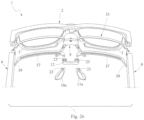
- the glasses comprise a front frame 2 having a pair of respective rims 3 for supporting corresponding lenses 4, which are connected to one another in the centre by a bridge 5 that extends in the nasal region.
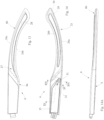
- Reference numeral 6 indicates both the lateral sides of the glasses, which are hinged with respective end pieces 7 provided on laterally opposing sides of the frame 2.
- biosensors located in the central region of the frame that rests against the nose and in the rear zone of the ears, where the lateral sides rest against the user's head.
- biosensor is understood to mean any sensor designed to detect electrical signals relating to vital functions of the person, for example brainwaves, heartbeat or other vital parameters.
- a first and a second nasal-bearing element 10, 11 are provided on the framework 9 so as to be opposite one another, in each of which elements a first 10a and a second 11a nasal sensor is integrated, which can make surface contact with corresponding laterally opposite zones of the nose.
- the sensors 10a, 11a and 12 are advantageously made of a resiliently pliable material that is electrically conductive, for example an electrically conductive elastomer or rubber, so as to ensure comfort and fit adaptability with regards to the bearing contact on the one hand, and for the sensors to fulfil the electrode function in order to detect the respective signals on the other hand.
- the framework 9 comprises a pair of opposite arms 13, which extend with equal orientation from and are interconnected by a central plate-shaped crosspiece 14, which is provided with a through-hole 15 in order to tightly fasten the framework 9 to the inside of the front frame 2 using a screw 16, i.e. the side facing the user's face when the glasses are being worn.
- the screw 16 for fixing the framework 9 to the front frame 2 can be provided in a different position, for example in the lower part of the frame, such that the longitudinal axis of the screw 16 is parallel to the centre line X in Fig. 7 .
- the longitudinal axis of the hole 15 made in the framework 9 for the screw 16 to pass through is also parallel to the axis X; the corresponding hole for fixing the screw 16, which hole is made in the bridge 5, also being parallel to the axis X.
- the arms 13 have mirror symmetry with respect to a median plane of symmetry, which is indicated by the centre line X in Fig. 7 . On account of this symmetry, only one of the arms 13 will be described in detail.
- the particular nasal-bearing element 10 (11) is mounted on each arm 13, the sensor 12 (which is suitably also referred to as the "glabella sensor” in the text) extending in the form of a bridge between the arms 13 and remaining at a spacing from the crosspiece 14 (protruding towards the face when the glasses are being worn) in order to ensure that it stays in bearing contact with the zone of the bridge of the nose, said sensor 12 also being integrally connected to the respective arms 13 of the framework at its two opposite ends 12a, 12b.
- the sensor 12 which is suitably also referred to as the "glabella sensor” in the text
- the sensor 12 also being integrally connected to the respective arms 13 of the framework at its two opposite ends 12a, 12b.
- a first and a second arm portion, indicated by reference numerals 18, 19, respectively, are located on each arm 13 starting from the end 13a thereof that connects to the crosspiece 14, between which portions an arm section 20 is interposed, which is larger than the portions 18, 19 (the size being considered in the direction transverse to the longitudinal extension direction of said portions).
- Said section 20 defines on the portions 18, 19 respective surface shoulders 20a, 20b, against which there can stop respectively the corresponding end 12a (12b) of the glabella sensor 12, which end is coupled to the portion 18, and the corresponding nasal sensor 10a (11a) that is coupled to the region 19.
- Each end 12a, 12b of the sensor 12 is held on the corresponding portion 18 between the shoulder 20a and an opposite bearing surface 20c provided by the crosspiece at the upper end 13a of the arm.
- the production process advantageously provides a first step in which the framework is formed by means of injection-moulding a rigid plastics material, the framework having a moderate degree of elastic deformation due to its structure.
- the sensors 10a, 11a and 12 are directly over-injected on the framework 9 in the corresponding positions in electrically conductive elastomeric material or in conductive rubber.
- Said first step is followed by a second step in which the sensors are injection-moulded, separately from the framework, using an electrically conductive elastomer.
- the sensors are then mounted on the corresponding arms of the framework, and are fitted by means of a relative sliding movement, the regions of the arms engaging in the attachment openings 23 until they reach the corresponding coupling positions.
- Fig. 11 and 12 schematically show the method steps described above, in which the sensors are coupled to the framework.
- thermoplastic elastomer selected from those currently available in the plastics materials sector, including the material known as "Pre-Elec ® TPE 1502", for example, which is produced by the Finnish company PREMIX, is based on a thermoplastic polymer and is made electrically conductive by the use of suitable additives, such as carbon black.
- Pre-Elec ® TPE 1502 has values suitable for all the technological properties that are basically required for implementing the invention. These properties include: high electrical conductivity, a tendentially low modulus of elasticity and surface hardness, a good degree of softness and resilient compliance.
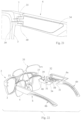
- Fig. 19 and 20 schematically show the circuit 35 (shown by a dashed line) housed in the frame between the bridge 5 and the housing 33 of the side, which circuit extends in the passage from the front frame to the lateral side without interruption.
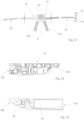
- Fig. 22 and 26 are detailed views of the flexible circuit 35 in its overall preferred embodiment, while Fig. 23 shows a partial and schematic illustration of said circuit.
Landscapes
- Health & Medical Sciences (AREA)
- Physics & Mathematics (AREA)
- Life Sciences & Earth Sciences (AREA)
- General Physics & Mathematics (AREA)
- Ophthalmology & Optometry (AREA)
- Optics & Photonics (AREA)
- General Health & Medical Sciences (AREA)
- Engineering & Computer Science (AREA)
- Cardiology (AREA)
- Public Health (AREA)
- Animal Behavior & Ethology (AREA)
- Veterinary Medicine (AREA)
- Surgery (AREA)
- Biophysics (AREA)
- Pathology (AREA)
- Biomedical Technology (AREA)
- Heart & Thoracic Surgery (AREA)
- Medical Informatics (AREA)
- Molecular Biology (AREA)
- Otolaryngology (AREA)
- Acoustics & Sound (AREA)
- Physiology (AREA)
- Mechanical Engineering (AREA)
- Signal Processing (AREA)
- Measurement And Recording Of Electrical Phenomena And Electrical Characteristics Of The Living Body (AREA)
- Measurement Of The Respiration, Hearing Ability, Form, And Blood Characteristics Of Living Organisms (AREA)
- Eyeglasses (AREA)
- Glass Compositions (AREA)
- Measuring And Recording Apparatus For Diagnosis (AREA)
- Measuring Pulse, Heart Rate, Blood Pressure Or Blood Flow (AREA)
Claims (9)
- Brille, die zum Erfassen von Signalen mit Biosensoren versehen ist, die mit dem Kopf des Benutzers in Berührung kommen, umfassend einen vorderen Rahmen (2) zur Aufnahme jeweiliger Brillengläser (4), ein Paar Seitenelemente (6), die an seitlich gegenüberliegenden Seiten am Rahmen angelenkt sind, und eine Nasenauflagevorrichtung (8), wobei sich jede dieser Seitenelemente (6) in Längsstreckrichtung erstreckt und einen Seitenkörper (6a) umfasst, der sich in einen Endabschnitt (6b) der Seite erstreckt, in dem ein mit dem Kopf berührbarer Sensor (25) integriert ist, dadurch gekennzeichnet, dass der Seitenendabschnitt (6b) ein Paar Schenkel (26a, 26b) umfasst, die sich von einem gemeinsamen Ende (27), das mit dem Seitenkörper (6a) verbunden ist, in der Längserstreckungsrichtung des Seitenelements (6) in einem Abstand voneinander erstrecken, dass der obere Schenkel (26a) der Schenkel, der sich in einem größeren vertikalen Abstand vom Ohr befindet, wenn dieser den Kopf berührt, mit einem inneren Hohlraum (29) zur Aufnahme eines Kerns (30) aus leitfähigem Metallmaterial versehen ist, um die vom Sensor erfassten Signale weiterzuleiten, und dass die beiden Schenkel (26a, 26b) aus einem elastisch biegsamen und elektrisch leitfähigen Elastomer oder Gummi hergestellt sind.
- Brille nach Anspruch 1, wobei die Schenkel (26a, 26b) am freien Ende des seitlichen Endabschnitts (6b), das dem mit dem Seitenkörper (6a) verbundenen Ende (27) gegenüberliegt, miteinander verbunden sind, sodass zwischen den Schenkeln eine geschlitzte Durchgangsöffnung (28) definiert bleibt, die in dieser Richtung verlängert ist und ein Profil mit einer geschlossenen Kontur aufweist.
- Brille nach einem der vorhergehenden Ansprüche, wobei der Metallkern (30) am gemeinsamen Ende (27) der Schenkel, das mit dem Seitenkörper (6a) verbunden ist, in ein Glied (31) verlängert ist, das in den Seitenkörper eingreift und mit einem Elektronikmodul (32) elektrisch verbindbar ist, das im Seitenkörper untergebracht ist, oder mit einer flexiblen Leiterplatte direkt elektrisch verbindbar ist, die in den Seitenkörper eingesetzt ist.
- Brille nach einem der vorhergehenden Ansprüche, wobei die Schenkel (26a, 26b) des seitlichen Endabschnitts (6b) mittels Spritzgusstechnik hergestellt sind und der eine (26a) der beiden Schenkel auf den Metallkern (30) aufgespritzt ist.
- Brille nach einem der vorhergehenden Ansprüche, wobei der Kern (30) plastisch verformbar ist, sodass die Form des seitlichen Endabschnitts (6b) zum Anpassen an den Kopf des Benutzers justiert werden kann.
- Brille nach Anspruch 3, wobei der Seitenkörper (6a) ein Gehäuse (33) umfasst, das durch einen speziellen abnehmbaren Deckel (34) verschließbar ist, wobei das Elektronikmodul (32), das mit dem Kern (30) elektrisch verbunden ist, um die vom Sensor (25) erfassten Signale weiterzuleiten, im Gehäuse aufgenommen ist, wobei das Glied (31) in das Innere des Gehäuses (33) hineinragt, um den Kern (30) mit dem Elektronikmodul elektrisch zu verbinden.
- Brille nach Anspruch 3, wobei der Seitenkörper (6a) ein Gehäuse (33) umfasst, das durch einen speziellen abnehmbaren Deckel (34) verschließbar ist, wobei das Elektronikmodul (32) und eine Batterie zur Versorgung des Elektronikmoduls mit elektrischer Energie im Gehäuse aufgenommen sind.
- Brille nach Anspruch 6, wobei eine Batterie (45) zur Versorgung mit elektrischer Energie im Gehäuse zusammen mit dem Elektronikmodul aufgenommen ist, wobei die Batterie und das Elektronikmodul elektrisch miteinander verbunden sind.
- Brille nach Anspruch 4, wobei jedes Seitenelement (6) durch Überspritzen des Seitenkörpers (6a) auf das Eingriffsglied (31) des Metallkerns (30) und anschließendes Überspritzen des seitlichen Endabschnitts (6b) auf den Metallkern hergestellt ist.
Applications Claiming Priority (2)
| Application Number | Priority Date | Filing Date | Title |
|---|---|---|---|
| IT102016000125574A IT201600125574A1 (it) | 2016-12-13 | 2016-12-13 | Occhiali con bio-sensori |
| PCT/IB2017/057564 WO2018109606A1 (en) | 2016-12-13 | 2017-12-01 | Glasses comprising biosensors |
Publications (3)
| Publication Number | Publication Date |
|---|---|
| EP3555697A1 EP3555697A1 (de) | 2019-10-23 |
| EP3555697C0 EP3555697C0 (de) | 2024-07-10 |
| EP3555697B1 true EP3555697B1 (de) | 2024-07-10 |
Family
ID=58455519
Family Applications (1)
| Application Number | Title | Priority Date | Filing Date |
|---|---|---|---|
| EP17817171.6A Active EP3555697B1 (de) | 2016-12-13 | 2017-12-01 | Brille mit biosensoren |
Country Status (8)
| Country | Link |
|---|---|
| US (1) | US11226501B2 (de) |
| EP (1) | EP3555697B1 (de) |
| JP (1) | JP7227153B2 (de) |
| KR (1) | KR102492804B1 (de) |
| CN (1) | CN110062906B (de) |
| ES (1) | ES2988279T3 (de) |
| IT (1) | IT201600125574A1 (de) |
| WO (1) | WO2018109606A1 (de) |
Families Citing this family (4)
| Publication number | Priority date | Publication date | Assignee | Title |
|---|---|---|---|---|
| CA3085178A1 (en) * | 2018-02-23 | 2019-08-29 | Snap Inc. | Eyewear having biometric sensing |
| IT201800009689A1 (it) * | 2018-10-23 | 2020-04-23 | Edl Srl | Procedimento per la fabbricazione di un terminale d’asta per occhiali e terminale d’asta per occhiali ottenuto con tale procedimento |
| WO2023126109A1 (en) * | 2021-12-29 | 2023-07-06 | Luxottica S.R.L. | Eyeglasses component and its production method |
| TWI852698B (zh) * | 2023-07-24 | 2024-08-11 | 得森科技有限公司 | 工業用輕量化眼鏡構造 |
Family Cites Families (10)
| Publication number | Priority date | Publication date | Assignee | Title |
|---|---|---|---|---|
| US6176576B1 (en) * | 1997-06-06 | 2001-01-23 | Radians, Inc. | Eyewear supported by a wearer's concha of an ear |
| US8328420B2 (en) * | 2003-04-22 | 2012-12-11 | Marcio Marc Abreu | Apparatus and method for measuring biologic parameters |
| JP2004351794A (ja) * | 2003-05-29 | 2004-12-16 | Takeda Kikaku:Kk | 眼鏡用の樹脂被覆テンプルの製造方法 |
| US8783861B2 (en) | 2010-07-02 | 2014-07-22 | Pixeloptics, Inc. | Frame design for electronic spectacles |
| JP5319803B2 (ja) * | 2012-02-10 | 2013-10-16 | オリンパス株式会社 | 頭部装着型表示装置、眼鏡用表示機器及び表示機器用眼鏡モダン |
| US9442305B2 (en) | 2012-06-14 | 2016-09-13 | Mitsui Chemicals, Inc. | Electronic eyeglasses and methods of manufacturing |
| US9067352B2 (en) * | 2013-08-15 | 2015-06-30 | Optimeyes4U, Inc. | System and process for shot-injection molding an eyeglass temple with a wire core |
| US9285609B1 (en) * | 2014-03-24 | 2016-03-15 | Amazon Technologies, Inc. | Ergonomic power switch for a wearable electronic device |
| JP2017212474A (ja) * | 2014-09-30 | 2017-11-30 | コニカミノルタ株式会社 | ヘッドマウントディスプレイ |
| JP6513195B2 (ja) * | 2015-06-01 | 2019-05-15 | アルプスアルパイン株式会社 | 眼鏡型電子機器 |
-
2016
- 2016-12-13 IT IT102016000125574A patent/IT201600125574A1/it unknown
-
2017
- 2017-12-01 ES ES17817171T patent/ES2988279T3/es active Active
- 2017-12-01 WO PCT/IB2017/057564 patent/WO2018109606A1/en not_active Ceased
- 2017-12-01 US US16/468,546 patent/US11226501B2/en active Active
- 2017-12-01 CN CN201780076316.0A patent/CN110062906B/zh active Active
- 2017-12-01 JP JP2019551763A patent/JP7227153B2/ja active Active
- 2017-12-01 KR KR1020197018140A patent/KR102492804B1/ko active Active
- 2017-12-01 EP EP17817171.6A patent/EP3555697B1/de active Active
Also Published As
| Publication number | Publication date |
|---|---|
| US20200012126A1 (en) | 2020-01-09 |
| WO2018109606A1 (en) | 2018-06-21 |
| EP3555697A1 (de) | 2019-10-23 |
| KR20190091475A (ko) | 2019-08-06 |
| US11226501B2 (en) | 2022-01-18 |
| ES2988279T3 (es) | 2024-11-19 |
| JP2020502590A (ja) | 2020-01-23 |
| EP3555697C0 (de) | 2024-07-10 |
| JP7227153B2 (ja) | 2023-02-21 |
| CN110062906B (zh) | 2024-01-02 |
| KR102492804B1 (ko) | 2023-01-27 |
| IT201600125574A1 (it) | 2018-06-13 |
| CN110062906A (zh) | 2019-07-26 |
Similar Documents
| Publication | Publication Date | Title |
|---|---|---|
| EP3555694B1 (de) | Brille mit biosensoren | |
| US11226501B2 (en) | Glasses comprising biosensors | |
| US11675218B2 (en) | Pair of spectacles with bio-sensors | |
| EP3306380A1 (de) | Brillenartige elektronische vorrichtung | |
| CN110741310B (zh) | 具有生物传感器的眼镜 | |
| WO2016194848A1 (ja) | 人体特性検出装置及び眼鏡型電子機器 |
Legal Events
| Date | Code | Title | Description |
|---|---|---|---|
| STAA | Information on the status of an ep patent application or granted ep patent |
Free format text: STATUS: UNKNOWN |
|
| STAA | Information on the status of an ep patent application or granted ep patent |
Free format text: STATUS: THE INTERNATIONAL PUBLICATION HAS BEEN MADE |
|
| PUAI | Public reference made under article 153(3) epc to a published international application that has entered the european phase |
Free format text: ORIGINAL CODE: 0009012 |
|
| STAA | Information on the status of an ep patent application or granted ep patent |
Free format text: STATUS: REQUEST FOR EXAMINATION WAS MADE |
|
| 17P | Request for examination filed |
Effective date: 20190522 |
|
| AK | Designated contracting states |
Kind code of ref document: A1 Designated state(s): AL AT BE BG CH CY CZ DE DK EE ES FI FR GB GR HR HU IE IS IT LI LT LU LV MC MK MT NL NO PL PT RO RS SE SI SK SM TR |
|
| AX | Request for extension of the european patent |
Extension state: BA ME |
|
| DAV | Request for validation of the european patent (deleted) | ||
| DAX | Request for extension of the european patent (deleted) | ||
| STAA | Information on the status of an ep patent application or granted ep patent |
Free format text: STATUS: EXAMINATION IS IN PROGRESS |
|
| 17Q | First examination report despatched |
Effective date: 20220615 |
|
| GRAP | Despatch of communication of intention to grant a patent |
Free format text: ORIGINAL CODE: EPIDOSNIGR1 |
|
| STAA | Information on the status of an ep patent application or granted ep patent |
Free format text: STATUS: GRANT OF PATENT IS INTENDED |
|
| INTG | Intention to grant announced |
Effective date: 20240219 |
|
| GRAS | Grant fee paid |
Free format text: ORIGINAL CODE: EPIDOSNIGR3 |
|
| GRAA | (expected) grant |
Free format text: ORIGINAL CODE: 0009210 |
|
| STAA | Information on the status of an ep patent application or granted ep patent |
Free format text: STATUS: THE PATENT HAS BEEN GRANTED |
|
| AK | Designated contracting states |
Kind code of ref document: B1 Designated state(s): AL AT BE BG CH CY CZ DE DK EE ES FI FR GB GR HR HU IE IS IT LI LT LU LV MC MK MT NL NO PL PT RO RS SE SI SK SM TR |
|
| REG | Reference to a national code |
Ref country code: CH Ref legal event code: EP |
|
| REG | Reference to a national code |
Ref country code: DE Ref legal event code: R096 Ref document number: 602017083224 Country of ref document: DE |
|
| U01 | Request for unitary effect filed |
Effective date: 20240724 |
|
| U07 | Unitary effect registered |
Designated state(s): AT BE BG DE DK EE FI FR IT LT LU LV MT NL PT RO SE SI Effective date: 20240902 |
|
| REG | Reference to a national code |
Ref country code: ES Ref legal event code: FG2A Ref document number: 2988279 Country of ref document: ES Kind code of ref document: T3 Effective date: 20241119 |
|
| U20 | Renewal fee for the european patent with unitary effect paid |
Year of fee payment: 8 Effective date: 20241118 |
|
| PG25 | Lapsed in a contracting state [announced via postgrant information from national office to epo] |
Ref country code: NO Free format text: LAPSE BECAUSE OF FAILURE TO SUBMIT A TRANSLATION OF THE DESCRIPTION OR TO PAY THE FEE WITHIN THE PRESCRIBED TIME-LIMIT Effective date: 20241010 |
|
| PG25 | Lapsed in a contracting state [announced via postgrant information from national office to epo] |
Ref country code: GR Free format text: LAPSE BECAUSE OF FAILURE TO SUBMIT A TRANSLATION OF THE DESCRIPTION OR TO PAY THE FEE WITHIN THE PRESCRIBED TIME-LIMIT Effective date: 20241011 Ref country code: PL Free format text: LAPSE BECAUSE OF FAILURE TO SUBMIT A TRANSLATION OF THE DESCRIPTION OR TO PAY THE FEE WITHIN THE PRESCRIBED TIME-LIMIT Effective date: 20240710 |
|
| PG25 | Lapsed in a contracting state [announced via postgrant information from national office to epo] |
Ref country code: IS Free format text: LAPSE BECAUSE OF FAILURE TO SUBMIT A TRANSLATION OF THE DESCRIPTION OR TO PAY THE FEE WITHIN THE PRESCRIBED TIME-LIMIT Effective date: 20241110 |
|
| PG25 | Lapsed in a contracting state [announced via postgrant information from national office to epo] |
Ref country code: HR Free format text: LAPSE BECAUSE OF FAILURE TO SUBMIT A TRANSLATION OF THE DESCRIPTION OR TO PAY THE FEE WITHIN THE PRESCRIBED TIME-LIMIT Effective date: 20240710 |
|
| PG25 | Lapsed in a contracting state [announced via postgrant information from national office to epo] |
Ref country code: RS Free format text: LAPSE BECAUSE OF FAILURE TO SUBMIT A TRANSLATION OF THE DESCRIPTION OR TO PAY THE FEE WITHIN THE PRESCRIBED TIME-LIMIT Effective date: 20241010 |
|
| PG25 | Lapsed in a contracting state [announced via postgrant information from national office to epo] |
Ref country code: RS Free format text: LAPSE BECAUSE OF FAILURE TO SUBMIT A TRANSLATION OF THE DESCRIPTION OR TO PAY THE FEE WITHIN THE PRESCRIBED TIME-LIMIT Effective date: 20241010 Ref country code: PL Free format text: LAPSE BECAUSE OF FAILURE TO SUBMIT A TRANSLATION OF THE DESCRIPTION OR TO PAY THE FEE WITHIN THE PRESCRIBED TIME-LIMIT Effective date: 20240710 Ref country code: NO Free format text: LAPSE BECAUSE OF FAILURE TO SUBMIT A TRANSLATION OF THE DESCRIPTION OR TO PAY THE FEE WITHIN THE PRESCRIBED TIME-LIMIT Effective date: 20241010 Ref country code: IS Free format text: LAPSE BECAUSE OF FAILURE TO SUBMIT A TRANSLATION OF THE DESCRIPTION OR TO PAY THE FEE WITHIN THE PRESCRIBED TIME-LIMIT Effective date: 20241110 Ref country code: HR Free format text: LAPSE BECAUSE OF FAILURE TO SUBMIT A TRANSLATION OF THE DESCRIPTION OR TO PAY THE FEE WITHIN THE PRESCRIBED TIME-LIMIT Effective date: 20240710 Ref country code: GR Free format text: LAPSE BECAUSE OF FAILURE TO SUBMIT A TRANSLATION OF THE DESCRIPTION OR TO PAY THE FEE WITHIN THE PRESCRIBED TIME-LIMIT Effective date: 20241011 |
|
| PG25 | Lapsed in a contracting state [announced via postgrant information from national office to epo] |
Ref country code: SM Free format text: LAPSE BECAUSE OF FAILURE TO SUBMIT A TRANSLATION OF THE DESCRIPTION OR TO PAY THE FEE WITHIN THE PRESCRIBED TIME-LIMIT Effective date: 20240710 |
|
| PG25 | Lapsed in a contracting state [announced via postgrant information from national office to epo] |
Ref country code: CZ Free format text: LAPSE BECAUSE OF FAILURE TO SUBMIT A TRANSLATION OF THE DESCRIPTION OR TO PAY THE FEE WITHIN THE PRESCRIBED TIME-LIMIT Effective date: 20240710 |
|
| PG25 | Lapsed in a contracting state [announced via postgrant information from national office to epo] |
Ref country code: SK Free format text: LAPSE BECAUSE OF FAILURE TO SUBMIT A TRANSLATION OF THE DESCRIPTION OR TO PAY THE FEE WITHIN THE PRESCRIBED TIME-LIMIT Effective date: 20240710 |
|
| PLBE | No opposition filed within time limit |
Free format text: ORIGINAL CODE: 0009261 |
|
| STAA | Information on the status of an ep patent application or granted ep patent |
Free format text: STATUS: NO OPPOSITION FILED WITHIN TIME LIMIT |
|
| 26N | No opposition filed |
Effective date: 20250411 |
|
| PG25 | Lapsed in a contracting state [announced via postgrant information from national office to epo] |
Ref country code: MC Free format text: LAPSE BECAUSE OF FAILURE TO SUBMIT A TRANSLATION OF THE DESCRIPTION OR TO PAY THE FEE WITHIN THE PRESCRIBED TIME-LIMIT Effective date: 20240710 |
|
| REG | Reference to a national code |
Ref country code: CH Ref legal event code: PL |
|
| PG25 | Lapsed in a contracting state [announced via postgrant information from national office to epo] |
Ref country code: CH Free format text: LAPSE BECAUSE OF NON-PAYMENT OF DUE FEES Effective date: 20241231 |
|
| PG25 | Lapsed in a contracting state [announced via postgrant information from national office to epo] |
Ref country code: IE Free format text: LAPSE BECAUSE OF NON-PAYMENT OF DUE FEES Effective date: 20241201 |
|
| U20 | Renewal fee for the european patent with unitary effect paid |
Year of fee payment: 9 Effective date: 20251118 |
|
| PGFP | Annual fee paid to national office [announced via postgrant information from national office to epo] |
Ref country code: GB Payment date: 20251219 Year of fee payment: 9 |
|
| PG25 | Lapsed in a contracting state [announced via postgrant information from national office to epo] |
Ref country code: CY Free format text: LAPSE BECAUSE OF FAILURE TO SUBMIT A TRANSLATION OF THE DESCRIPTION OR TO PAY THE FEE WITHIN THE PRESCRIBED TIME-LIMIT; INVALID AB INITIO Effective date: 20171201 |
|
| PGFP | Annual fee paid to national office [announced via postgrant information from national office to epo] |
Ref country code: ES Payment date: 20260130 Year of fee payment: 9 |