EP3554758B1 - Lötmaterial - Google Patents
Lötmaterial Download PDFInfo
- Publication number
- EP3554758B1 EP3554758B1 EP17822594.2A EP17822594A EP3554758B1 EP 3554758 B1 EP3554758 B1 EP 3554758B1 EP 17822594 A EP17822594 A EP 17822594A EP 3554758 B1 EP3554758 B1 EP 3554758B1
- Authority
- EP
- European Patent Office
- Prior art keywords
- melting
- brazing
- brazing material
- temperature
- solidus
- Prior art date
- Legal status (The legal status is an assumption and is not a legal conclusion. Google has not performed a legal analysis and makes no representation as to the accuracy of the status listed.)
- Active
Links
Images
Classifications
-
- B—PERFORMING OPERATIONS; TRANSPORTING
- B23—MACHINE TOOLS; METAL-WORKING NOT OTHERWISE PROVIDED FOR
- B23K—SOLDERING OR UNSOLDERING; WELDING; CLADDING OR PLATING BY SOLDERING OR WELDING; CUTTING BY APPLYING HEAT LOCALLY, e.g. FLAME CUTTING; WORKING BY LASER BEAM
- B23K1/00—Soldering, e.g. brazing, or unsoldering
- B23K1/0008—Soldering, e.g. brazing, or unsoldering specially adapted for particular articles or work
- B23K1/0012—Brazing heat exchangers
-
- B—PERFORMING OPERATIONS; TRANSPORTING
- B23—MACHINE TOOLS; METAL-WORKING NOT OTHERWISE PROVIDED FOR
- B23K—SOLDERING OR UNSOLDERING; WELDING; CLADDING OR PLATING BY SOLDERING OR WELDING; CUTTING BY APPLYING HEAT LOCALLY, e.g. FLAME CUTTING; WORKING BY LASER BEAM
- B23K35/00—Rods, electrodes, materials, or media, for use in soldering, welding, or cutting
- B23K35/02—Rods, electrodes, materials, or media, for use in soldering, welding, or cutting characterised by mechanical features, e.g. shape
- B23K35/0222—Rods, electrodes, materials, or media, for use in soldering, welding, or cutting characterised by mechanical features, e.g. shape for use in soldering, brazing
- B23K35/0244—Powders, particles or spheres; Preforms made therefrom
-
- B—PERFORMING OPERATIONS; TRANSPORTING
- B23—MACHINE TOOLS; METAL-WORKING NOT OTHERWISE PROVIDED FOR
- B23K—SOLDERING OR UNSOLDERING; WELDING; CLADDING OR PLATING BY SOLDERING OR WELDING; CUTTING BY APPLYING HEAT LOCALLY, e.g. FLAME CUTTING; WORKING BY LASER BEAM
- B23K35/00—Rods, electrodes, materials, or media, for use in soldering, welding, or cutting
- B23K35/02—Rods, electrodes, materials, or media, for use in soldering, welding, or cutting characterised by mechanical features, e.g. shape
- B23K35/0222—Rods, electrodes, materials, or media, for use in soldering, welding, or cutting characterised by mechanical features, e.g. shape for use in soldering, brazing
- B23K35/0244—Powders, particles or spheres; Preforms made therefrom
- B23K35/025—Pastes, creams, slurries
-
- B—PERFORMING OPERATIONS; TRANSPORTING
- B23—MACHINE TOOLS; METAL-WORKING NOT OTHERWISE PROVIDED FOR
- B23K—SOLDERING OR UNSOLDERING; WELDING; CLADDING OR PLATING BY SOLDERING OR WELDING; CUTTING BY APPLYING HEAT LOCALLY, e.g. FLAME CUTTING; WORKING BY LASER BEAM
- B23K35/00—Rods, electrodes, materials, or media, for use in soldering, welding, or cutting
- B23K35/22—Rods, electrodes, materials, or media, for use in soldering, welding, or cutting characterised by the composition or nature of the material
- B23K35/24—Selection of soldering or welding materials proper
- B23K35/30—Selection of soldering or welding materials proper with the principal constituent melting at less than 1550 degrees C
-
- B—PERFORMING OPERATIONS; TRANSPORTING
- B23—MACHINE TOOLS; METAL-WORKING NOT OTHERWISE PROVIDED FOR
- B23K—SOLDERING OR UNSOLDERING; WELDING; CLADDING OR PLATING BY SOLDERING OR WELDING; CUTTING BY APPLYING HEAT LOCALLY, e.g. FLAME CUTTING; WORKING BY LASER BEAM
- B23K35/00—Rods, electrodes, materials, or media, for use in soldering, welding, or cutting
- B23K35/22—Rods, electrodes, materials, or media, for use in soldering, welding, or cutting characterised by the composition or nature of the material
- B23K35/24—Selection of soldering or welding materials proper
- B23K35/30—Selection of soldering or welding materials proper with the principal constituent melting at less than 1550 degrees C
- B23K35/3053—Fe as the principal constituent
-
- B—PERFORMING OPERATIONS; TRANSPORTING
- B23—MACHINE TOOLS; METAL-WORKING NOT OTHERWISE PROVIDED FOR
- B23K—SOLDERING OR UNSOLDERING; WELDING; CLADDING OR PLATING BY SOLDERING OR WELDING; CUTTING BY APPLYING HEAT LOCALLY, e.g. FLAME CUTTING; WORKING BY LASER BEAM
- B23K35/00—Rods, electrodes, materials, or media, for use in soldering, welding, or cutting
- B23K35/22—Rods, electrodes, materials, or media, for use in soldering, welding, or cutting characterised by the composition or nature of the material
- B23K35/24—Selection of soldering or welding materials proper
- B23K35/30—Selection of soldering or welding materials proper with the principal constituent melting at less than 1550 degrees C
- B23K35/3053—Fe as the principal constituent
- B23K35/308—Fe as the principal constituent with Cr as next major constituent
- B23K35/3086—Fe as the principal constituent with Cr as next major constituent containing Ni or Mn
-
- C—CHEMISTRY; METALLURGY
- C22—METALLURGY; FERROUS OR NON-FERROUS ALLOYS; TREATMENT OF ALLOYS OR NON-FERROUS METALS
- C22C—ALLOYS
- C22C38/00—Ferrous alloys, e.g. steel alloys
- C22C38/02—Ferrous alloys, e.g. steel alloys containing silicon
-
- C—CHEMISTRY; METALLURGY
- C22—METALLURGY; FERROUS OR NON-FERROUS ALLOYS; TREATMENT OF ALLOYS OR NON-FERROUS METALS
- C22C—ALLOYS
- C22C38/00—Ferrous alloys, e.g. steel alloys
- C22C38/18—Ferrous alloys, e.g. steel alloys containing chromium
- C22C38/34—Ferrous alloys, e.g. steel alloys containing chromium with more than 1.5% by weight of silicon
-
- C—CHEMISTRY; METALLURGY
- C22—METALLURGY; FERROUS OR NON-FERROUS ALLOYS; TREATMENT OF ALLOYS OR NON-FERROUS METALS
- C22C—ALLOYS
- C22C38/00—Ferrous alloys, e.g. steel alloys
- C22C38/18—Ferrous alloys, e.g. steel alloys containing chromium
- C22C38/40—Ferrous alloys, e.g. steel alloys containing chromium with nickel
- C22C38/44—Ferrous alloys, e.g. steel alloys containing chromium with nickel with molybdenum or tungsten
-
- C—CHEMISTRY; METALLURGY
- C22—METALLURGY; FERROUS OR NON-FERROUS ALLOYS; TREATMENT OF ALLOYS OR NON-FERROUS METALS
- C22C—ALLOYS
- C22C38/00—Ferrous alloys, e.g. steel alloys
- C22C38/18—Ferrous alloys, e.g. steel alloys containing chromium
- C22C38/40—Ferrous alloys, e.g. steel alloys containing chromium with nickel
- C22C38/54—Ferrous alloys, e.g. steel alloys containing chromium with nickel with boron
-
- C—CHEMISTRY; METALLURGY
- C22—METALLURGY; FERROUS OR NON-FERROUS ALLOYS; TREATMENT OF ALLOYS OR NON-FERROUS METALS
- C22C—ALLOYS
- C22C38/00—Ferrous alloys, e.g. steel alloys
- C22C38/18—Ferrous alloys, e.g. steel alloys containing chromium
- C22C38/40—Ferrous alloys, e.g. steel alloys containing chromium with nickel
- C22C38/58—Ferrous alloys, e.g. steel alloys containing chromium with nickel with more than 1.5% by weight of manganese
-
- B—PERFORMING OPERATIONS; TRANSPORTING
- B23—MACHINE TOOLS; METAL-WORKING NOT OTHERWISE PROVIDED FOR
- B23K—SOLDERING OR UNSOLDERING; WELDING; CLADDING OR PLATING BY SOLDERING OR WELDING; CUTTING BY APPLYING HEAT LOCALLY, e.g. FLAME CUTTING; WORKING BY LASER BEAM
- B23K2101/00—Articles made by soldering, welding or cutting
- B23K2101/04—Tubular or hollow articles
- B23K2101/14—Heat exchangers
Definitions
- the present invention relates to the use of a brazing material for brazing a brazed plate heat exchanger comprising a number of heat exchanger plates of stainless steel provided with a pressed pattern of ridges and grooves adapted to provide contact points between neighbouring heat exchanger plates, such that the heat exchanger plates are kept on a distance from one another and such that interplate flow channels for media to exchange heat are formed between the heat exchanger plates.
- the brazing material comprises a brazing alloy comprising at least one melting point depressing element and metals resembling the composition of the heat exchanger plates.
- one or more materials are joined to one another by applying a brazing material onto contact surfaces of the materials to be joined. Thereafter, the temperature of the materials to be joined and the brazing material is increased to a temperature wherein the brazing material is melted whereas the materials to be joined are not.
- brazed plate heat exchangers In the field of brazed plate heat exchangers, the most common base materials and brazing materials are stainless steel and copper, respectively. This material combination is very beneficial in many ways, but in some cases, it cannot be used. For example, in some countries, it is prohibited to use copper in tap water applications, and if ammonia is used as a refrigerant, copper is excluded due to copper forming water soluble complexes in the presence of copper and ammonia.
- Nickel can be used as a brazing material.
- Nickel as a brazing material has, however, the drawback of producing brittle brazing joints due to the melting point depressants necessary for lowering the melting temperature of nickel.
- the melting point depressants are usually Silicon, Boron, Phosphorous or combinations thereof.
- Still another option is to use a stainless steel based brazing material, i.e. a stainless steel mixed with melting point depressants such as Silicon, Boron and/or Phosphorous.
- a stainless steel with melting point depressants has, however, the drawback that the melting point depressants tend to migrate into the base material, which will lower the melting point of the base material and hence lead to erosion and "burn-throughs", i.e. a phenomenon caused by the melting point depressants in the brazing material lowering the melting point of the plate material to such an extent that the plate material melts over the entire thickness of the plate, hence causing a hole through the plate of the heat exchanger plates.
- braze alloys containing a melting point depressant such as Silicon, Boron and/or Phosphorous does not have a single temperature melting point. Rather, such braze alloy has a melting temperature interval with a lower temperature (the "solidus temperature") where the braze alloy starts to melt and a higher temperature (the "liquidus temperature”) where the braze alloy is completely melted.
- Documents WO2016/193383 A1 , US2016/184935 A1 , US5437737 A and WO2015/006338 A1 disclose some examples of use of brazing materials.
- the present invention solves, or at least mitigates, the above and other problems by providing a brazing material comprising a blend between grains of a melting brazing material having solidus and liquidus temperatures lower than a brazing temperature and grains of a non-melting brazing material having solidus and liquidus temperatures above the brazing temperature, wherein the ratio between the melting and non-melting brazing materials is such that an alloy formed by the melting and non-melting brazing materials has a solidus temperature lower than the brazing temperature and a liquidus temperature higher than the brazing temperature.
- the melting brazing material grains comprise boron as a melting point lowering element.
- the melting brazing material grains may comprise 1.5-3% Mo, 10-15% Ni, 16-20% Cr, 7-10% Si, 5-7% Mn, 1-2% B, balance Fe.
- the non-melting brazing material grains may comprise 1.5-3 Mo, 10-15% Ni, 16-20% Cr, 5-7% Si, 5-7% Mn, balance Fe.
- compositions of the melting and non-melting brazing materials may be identical except for the melting brazing material containing 1-2% Boron.
- the non-melting brazing material may have a solidus temperature exceeding 1250 degrees C and the melting brazing material has a liquidus temperature below 1250 degrees C.
- an alloy formed of the melting and non-melting brazing materials in the proportions of the brazing material may have a solidus temperature lower than 1250 degrees and a liquidus temperature over 1250 degrees C.
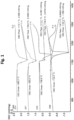
- Fig. 1 two DSC (Differential Scanning Calorimetry) curves for typical brazing alloys comprising one or more melting point lowering elements are shown.
- a DSC curve represents the difference in the amount of heat required to increase the temperature of a sample and reference is measured as a function of temperature.
- the upper DSC curve comprises a first segment from 700 degrees to about 1120 degrees C.
- the heat required to heat the sample is rather constant.
- From about 1120 degrees C to 1164 degrees C i.e. a second segment, much more energy is required in order to increase the temperature. This is due to melting of the braze material.
- the onset temperature is a temperature of a crossing point between a mean tangent of the first segment and a mean tangent of the second segment and wherein the offset temperature is a temperature of a crossing point between a mean tangent of the third segment and a mean tangent of the fourth segment.
- the onset and offset temperatures for the DSC curves will be regarded as the solidus and liquidus temperatures of the brazing material.
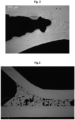
- brazing joints In the following figures, section photographs of brazing joints will be shown. All of the photographs show brazing joints between crossing ridges and grooves of neighbouring heat exchanger plates.
- the brazing material has been added in form of a paste comprising solvent, a binder and a powder of brazing alloy.
- a prior art brazing joint between ridges and grooves of neighbouring heat exchanger plates comprised in a plate heat exchanger is shown.
- the braze material is an alloy comprising stainless steel and melting point depressants (boron and silicon), and the braze temperature is higher than both the liquidus and solidus temperatures of the brazing material - in other words, the brazing material is completely melted during the brazing.
- the brazing material has been added close to, but not at, the crossing point between the ridges and grooves of neighboring plates, such as disclosed in WO2015/062992A1 by the applicant.
- the brazing joint is homogenous (i.e. it comprises no or very few pores).
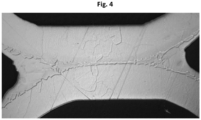
- brazing material having solidus and liquidus temperatures that are higher than the brazing temperatures - in other words, the brazing material will not melt during the brazing.
- the brazing material having solidus and liquidus temperatures higher than the brazing temperature will join the plates by diffusion.
- a typical brazing joint achieved by the brazing material having higher liquidus and solidus temperatures than the brazing temperature is shown in Fig. 3 .
- the brazing joint is completely free from erosion - which is not surprising, since the amount of melting point depressants in the brazing material is not sufficient to enable melting of the brazing material itself. In case some of the melting point lowering elements would migrate into the plate material, the percentage of melting point lowering elements in the plate material also would not be sufficient to melt the plate material. It could be mentioned that, in contrast to Fig. 2 , the brazing material has been applied at the contact point between ridges and grooves of neighbouring plates.
- a central portion of the brazing joint is free from pores; the pressure between crossing ridges and grooves of neighbouring plates is sufficient to make particles of the brazing material fuse together and form a pore free joint. In the outskirts of the brazing joint, there are, however, pores.
- a non-melting brazing alloy i.e. an alloy having higher solidus and liquidus temperature than the brazing temperature
- a melting brazing alloy i.e. a brazing material having lower liquidus and solidus temperatures than the brazing temperature
- the brazing material is in form of a paste, and that the paste comprises grains of brazing material, wherein a certain percentage of the grains are manufactured from a melting brazing material and the remainder of the grains are manufactured from non-melting brazing material. Except from the grains of brazing material, the paste also comprises a solvent and a binder serving to form a paste of the grains.
- Typical grain sizes for the brazing materials are less than 100 microns. This means that the total surface area of the grains will be many times larger than the surface area of the base material the brazing material covers.
- melting brazing materials comprising melting point lowering element(s)
- melting point lowering element(s) tend to migrate into the base material and lower the melting point thereof such that the base material melts, which causes erosion of the base material.
- the erosion process is very dependent on time - the longer brazing times, the more erosion.
- the time available for the melting point lowering elements to migrate into the base material is controlled in an efficient manner: once the melting brazing material has melted, the melting point lowering elements will start to migrate, but since the surface area of the non-melting grains are so much larger than the area of the base material that is in contact with the brazing material, a majority of the melting point depressant will migrate into the non-melting brazing material grains rather than into the base material.
- the non-melting brazing material grains could be made from pure stainless steel of the same type as the base material.
- the best results have been achieved by providing the non-melting brazing material in form of grains made from stainless steel mixed with a small amount of melting point depressing elements. This is probably due to faster depletion/dilution of the melting brazing material.
- the non-melting brazing material according to the above has a solidus temperature of about 1260 degrees C and a liquidus temperature of about 1370 degrees C, i.e. both the solidus and liquidus temperatures are above the brazing temperature of 1250 degrees C.
- the melting brazing material has a solidus temperature of about 1110 degrees C and a liquidus temperature of about 1195 degrees C, i.e. both the solidus temperature and the liquidus temperatures are lower than the brazing temperature.
- the solidus and liquidus temperatures of an alloy made from brazing material containing 10% melting brazing material and 90% non-melting brazing material according to the above is estimated to have a solidus temperature of 1245 degrees C and a liquidus temperature of 1352 degrees C
- an alloy comprising 25% melting brazing material and 75% non-melting brazing material is estimated to have a solidus temperature of 1222 degrees C and a liquidus temperature of 1326 degrees C.
- the solidus and liquidus temperatures of both the alloys will be such that the solidus temperature is lower than the brazing temperature and the liquidus temperature is higher than the brazing temperature.
- the time required to form a homogenous alloy from the grains of melting and non-melting brazing material grains is highly dependent on the grain size of, primarily, the non-melting brazing material grains; smaller grains will give shorter time for forming a homogenous alloy.
- brazing material grains made from stainless steel grains are economically advantageous, since such grains can be bought "off-the-shelf' in various grain sixes, whereas brazing material grains made from melting brazing material can not.
- the present invention is particularly for brazing with brazing material comprising melting point depressing elements that can migrate into the base material, for example stainless steel base material brazed with a stainless steel braze material comprising melting point lowering elements in form of Silicon, Boron, Phosphorous and/or Manganese.
- melting point depressing elements Boron is the most efficient in terms of melting point lowering effect as a function of percentage, and it is also the element with the fastest diffusion rate into the base material or neighbouring non-melting grains having a lower percentage of Boron. It also tends to form brittle Borides, predominantly with the Chromium in the stainless steel.
- Chromium borides are predominantly formed in the liquid phase, and since the present invention reduces the time the brazing material is in liquid phase, the present invention will reduce the problems with boride formation significantly, hence improving both brazing joint strength and corrosion resistance of the joint.
- Silicon and Phosphorous are less efficient melting point lowering elements in terms of melting point lowering effect as a function of percentage. Therefore, larger amounts of these melt depressants are needed, and they are therefore equally problematic in terms of brittle phase formation.
- Manganese is a melting point lowering element that except from the melting point lowering effect also provides for a good wetting between the brazing material and the base material. Manganese, however, tends to vaporize during the brazing (especially if the brazing is performed under a vacuum), meaning that the melting temperature of the finished brazing joint might be higher than the initial melting of the brazing material. This is usually no problem, but if unnecessarily large amounts of manganese are used, there might be a problem with brazing furnace fouling.
- the brazing material is provided in the form of a paste comprising melting and non-melting brazing material particles, a solvent for providing rheological properties to the paste for its application and a binder adapted to keep the brazing material particle together when the solvent has evaporated.
- the brazing material may be provided as a green body, i.e. a body comprising powdered melting and non-melting brazing material particles that has been pressurized such that a cold sintering occurs between the particles. It should be noted that, according to the invention, the green body should not be heat treated such that the composition differences of the brazing material grains is equalized prior to the green-body being used as brazing material in the brazing process.
Landscapes
- Engineering & Computer Science (AREA)
- Mechanical Engineering (AREA)
- Chemical & Material Sciences (AREA)
- Materials Engineering (AREA)
- Metallurgy (AREA)
- Organic Chemistry (AREA)
- Pressure Welding/Diffusion-Bonding (AREA)
- Ceramic Products (AREA)
- Heat-Exchange Devices With Radiators And Conduit Assemblies (AREA)
- Electric Connection Of Electric Components To Printed Circuits (AREA)
- Details Of Heat-Exchange And Heat-Transfer (AREA)
Claims (7)
- Verwendung eines Hartlötmaterials zum Hartlöten eines hartgelöteten Plattenwärmetauschers umfassend eine Anzahl von Wärmetauscherplatten aus Edelstahl, die mit einem gepressten Muster von Erhöhungen und Kerben versehen sind, die geeignet sind, Kontaktpunkte zwischen benachbarten Wärmetauscherplatten bereitzustellen, derart, dass die Wärmetauscherplatten in einem Abstand voneinander gehalten werden und derart, dass Zwischenplattenströmungskanäle für Medien zum Tauschen von Wärme zwischen den Wärmetauscherplatten gebildet werden, wobei das Hartlötmaterial eine Hartlötlegierung umfasst, die mindestens ein schmelzpunktreduzierendes Element in Form von Silizium, Bor, Phosphor und/oder Mangan und Metalle, die der Zusammensetzung der Wärmetauscherplatten ähnlich sind, umfasst, dadurch gekennzeichnet, dass das Hartlötmaterial eine Mischung zwischen Körnern eines schmelzenden Hartlötmaterials, das Solidus- und Liquidustemperaturen unter der Hartlöttemperatur aufweist, und eines nichtschmelzenden Hartlötmaterials, das Solidus- und Liquidustemperaturen über der Hartlöttemperatur aufweist, umfasst, wobei das Verhältnis zwischen den schmelzenden und nichtschmelzenden Hartlötmaterialien derart ist, dass eine Legierung, die durch die schmelzenden und nichtschmelzenden Hartlötmaterialien gebildet wird, eine Solidustemperatur unter der Hartlöttemperatur und eine Liquidustemperatur über der Hartlöttemperatur aufweist und wobei die Körner des schmelzenden Hartlötmaterials Bor als schmelzpunktreduzierendes Element umfassen.
- Verwendung nach Anspruch 1, wobei die Körner des schmelzenden Hartlötmaterials 1,5-3 % Mo, 10-15 % Ni, 16-20 % Cr, 7-10 % Si, 5-7 % Mn, 1-2 % B umfassen, wobei der Rest Fe ist.
- Verwendung nach einem der vorhergehenden Ansprüche, wobei die Körner des nichtschmelzenden Hartlötmaterials 1,5-3 % Mo, 10-15 % Ni, 16-20 % Cr, 5-7 % Si, 5-7 % Mn umfassen, wobei der Rest Fe ist.
- Verwendung nach einem der vorhergehenden Ansprüche, wobei die Zusammensetzungen der schmelzenden und nichtschmelzenden Hartlötmaterialien identisch sind, mit der Ausnahme, dass das schmelzende Hartlötmaterial 1-2 % Bor enthält.
- Verwendung nach einem der vorhergehenden Ansprüche, wobei das nichtschmelzende Hartlötmaterial eine 1250 Grad C übersteigende Solidustemperatur aufweist.
- Verwendung nach einem der vorhergehenden Ansprüche, wobei das schmelzende Hartlötmaterial eine Liquidustemperatur unter 1250 Grad C aufweist.
- Verwendung nach einem der vorhergehenden Ansprüche, wobei eine Legierung, die aus den schmelzenden und nichtschmelzenden Hartlötmaterialien in den Anteilen des Hartlötmaterials gebildet ist, einen Solidus unter 1250 Grad und eine Liquidustemperatur über 1250 Grad C aufweist.
Priority Applications (2)
| Application Number | Priority Date | Filing Date | Title |
|---|---|---|---|
| EP24201156.7A EP4455337A3 (de) | 2016-12-16 | 2017-12-11 | Hartlotwerkstoff |
| SI201731561T SI3554758T1 (sl) | 2016-12-16 | 2017-12-11 | Material za trdo lotanje |
Applications Claiming Priority (2)
| Application Number | Priority Date | Filing Date | Title |
|---|---|---|---|
| SE1651661A SE540384C2 (en) | 2016-12-16 | 2016-12-16 | Brazing material |
| PCT/EP2017/082227 WO2018108815A1 (en) | 2016-12-16 | 2017-12-11 | Brazing material |
Related Child Applications (1)
| Application Number | Title | Priority Date | Filing Date |
|---|---|---|---|
| EP24201156.7A Division EP4455337A3 (de) | 2016-12-16 | 2017-12-11 | Hartlotwerkstoff |
Publications (2)
| Publication Number | Publication Date |
|---|---|
| EP3554758A1 EP3554758A1 (de) | 2019-10-23 |
| EP3554758B1 true EP3554758B1 (de) | 2024-09-25 |
Family
ID=60888376
Family Applications (2)
| Application Number | Title | Priority Date | Filing Date |
|---|---|---|---|
| EP24201156.7A Pending EP4455337A3 (de) | 2016-12-16 | 2017-12-11 | Hartlotwerkstoff |
| EP17822594.2A Active EP3554758B1 (de) | 2016-12-16 | 2017-12-11 | Lötmaterial |
Family Applications Before (1)
| Application Number | Title | Priority Date | Filing Date |
|---|---|---|---|
| EP24201156.7A Pending EP4455337A3 (de) | 2016-12-16 | 2017-12-11 | Hartlotwerkstoff |
Country Status (9)
| Country | Link |
|---|---|
| US (2) | US11491588B2 (de) |
| EP (2) | EP4455337A3 (de) |
| JP (2) | JP7277365B2 (de) |
| KR (1) | KR102362280B1 (de) |
| CN (1) | CN110072665B (de) |
| PL (1) | PL3554758T3 (de) |
| SE (1) | SE540384C2 (de) |
| SI (1) | SI3554758T1 (de) |
| WO (1) | WO2018108815A1 (de) |
Families Citing this family (2)
| Publication number | Priority date | Publication date | Assignee | Title |
|---|---|---|---|---|
| SE543405C2 (en) * | 2019-05-29 | 2021-01-05 | Alfa Laval Corp Ab | Method for joining metal parts |
| JP2025179273A (ja) * | 2022-10-17 | 2025-12-10 | ナイス株式会社 | 金属粉体を成形したろう付け材およびそれを用いたフィンチューブ式熱交換器の製造におけるろう付け処理方法 |
Citations (11)
| Publication number | Priority date | Publication date | Assignee | Title |
|---|---|---|---|---|
| US4073639A (en) | 1975-01-06 | 1978-02-14 | United Technologies Corporation | Metallic filler material |
| US4410604A (en) | 1981-11-16 | 1983-10-18 | The Garrett Corporation | Iron-based brazing alloy compositions and brazed assemblies with iron based brazing alloys |
| US5437737A (en) | 1994-02-07 | 1995-08-01 | United Technologies Corporation | Repair coating for superalloy articles, such as gas turbine engine components |
| JP2007203352A (ja) | 2006-02-03 | 2007-08-16 | T Rad Co Ltd | ステンレス鋼製熱交換器のろう付け方法 |
| WO2008060225A1 (en) * | 2006-11-17 | 2008-05-22 | Alfa Laval Corporate Ab | Brazing material, a method of brazing, a brazed article and a paste comprising this brazing material |
| WO2013144222A1 (en) | 2012-03-28 | 2013-10-03 | Alfa Laval Corporate Ab | A novel brazing concept |
| WO2015006338A1 (en) | 2013-07-12 | 2015-01-15 | United Technologies Corporation | Repair or remanufacture of combustor liner panels with an oxidation resistant braze |
| WO2016055430A1 (en) | 2014-10-08 | 2016-04-14 | Swep International Ab | A brazing material for brazing articles of austenitic stainless steel and method therefore |
| US20160184935A1 (en) | 2006-11-17 | 2016-06-30 | Alfa Laval Corporate Ab | Brazing material |
| WO2016116273A1 (en) | 2015-01-20 | 2016-07-28 | Swep International Ab | A heat exchanger comprising micro channels and manufacturing thereof |
| WO2016193383A1 (en) | 2015-06-03 | 2016-12-08 | Swep International Ab | Brazing method for brazing articles, a brazed heat exchanger and a brazing alloy |
Family Cites Families (8)
| Publication number | Priority date | Publication date | Assignee | Title |
|---|---|---|---|---|
| FR2785559B1 (fr) | 1998-11-10 | 2001-03-02 | Metals Process Systems | Procede de fabrication par metallurgie des poudres de pieces de forme autobrasantes |
| SE523855C2 (sv) * | 2000-11-10 | 2004-05-25 | Alfa Laval Corp Ab | Järnbaserat lodmaterial för sammanfogning av elememt och lödd produkt framställd härmed |
| SE531988C2 (sv) * | 2006-11-17 | 2009-09-22 | Alfa Laval Corp Ab | Lodmaterial samt förfarande för lödning med detta material |
| US7789288B1 (en) | 2009-07-31 | 2010-09-07 | General Electric Company | Brazing process and material for repairing a component |
| US9056443B2 (en) | 2013-02-04 | 2015-06-16 | General Electric Company | Brazing process, braze arrangement, and brazed article |
| WO2015040065A1 (en) * | 2013-09-17 | 2015-03-26 | Swep International Ab | A plate heat exchanger having reinforcing means |
| CN103567656A (zh) * | 2013-10-28 | 2014-02-12 | 顾建 | 一种铝合金用钎焊材料 |
| EP3062949B2 (de) * | 2013-10-29 | 2023-05-24 | SWEP International AB | Verfahren zum löten eines plattenwärmetauschers anhand eines mittels siebdruck hergestellten lötmaterials |
-
2016
- 2016-12-16 SE SE1651661A patent/SE540384C2/en unknown
-
2017
- 2017-12-11 SI SI201731561T patent/SI3554758T1/sl unknown
- 2017-12-11 PL PL17822594.2T patent/PL3554758T3/pl unknown
- 2017-12-11 EP EP24201156.7A patent/EP4455337A3/de active Pending
- 2017-12-11 US US16/470,118 patent/US11491588B2/en active Active
- 2017-12-11 JP JP2019530664A patent/JP7277365B2/ja active Active
- 2017-12-11 EP EP17822594.2A patent/EP3554758B1/de active Active
- 2017-12-11 WO PCT/EP2017/082227 patent/WO2018108815A1/en not_active Ceased
- 2017-12-11 CN CN201780077792.4A patent/CN110072665B/zh active Active
- 2017-12-11 KR KR1020197019336A patent/KR102362280B1/ko active Active
-
2022
- 2022-09-21 US US17/933,961 patent/US11878373B2/en active Active
-
2023
- 2023-01-20 JP JP2023007028A patent/JP7763795B2/ja active Active
Patent Citations (11)
| Publication number | Priority date | Publication date | Assignee | Title |
|---|---|---|---|---|
| US4073639A (en) | 1975-01-06 | 1978-02-14 | United Technologies Corporation | Metallic filler material |
| US4410604A (en) | 1981-11-16 | 1983-10-18 | The Garrett Corporation | Iron-based brazing alloy compositions and brazed assemblies with iron based brazing alloys |
| US5437737A (en) | 1994-02-07 | 1995-08-01 | United Technologies Corporation | Repair coating for superalloy articles, such as gas turbine engine components |
| JP2007203352A (ja) | 2006-02-03 | 2007-08-16 | T Rad Co Ltd | ステンレス鋼製熱交換器のろう付け方法 |
| WO2008060225A1 (en) * | 2006-11-17 | 2008-05-22 | Alfa Laval Corporate Ab | Brazing material, a method of brazing, a brazed article and a paste comprising this brazing material |
| US20160184935A1 (en) | 2006-11-17 | 2016-06-30 | Alfa Laval Corporate Ab | Brazing material |
| WO2013144222A1 (en) | 2012-03-28 | 2013-10-03 | Alfa Laval Corporate Ab | A novel brazing concept |
| WO2015006338A1 (en) | 2013-07-12 | 2015-01-15 | United Technologies Corporation | Repair or remanufacture of combustor liner panels with an oxidation resistant braze |
| WO2016055430A1 (en) | 2014-10-08 | 2016-04-14 | Swep International Ab | A brazing material for brazing articles of austenitic stainless steel and method therefore |
| WO2016116273A1 (en) | 2015-01-20 | 2016-07-28 | Swep International Ab | A heat exchanger comprising micro channels and manufacturing thereof |
| WO2016193383A1 (en) | 2015-06-03 | 2016-12-08 | Swep International Ab | Brazing method for brazing articles, a brazed heat exchanger and a brazing alloy |
Non-Patent Citations (6)
| Title |
|---|
| "ASM Handbook, Volume 6, Welding, Brazing, and Soldering", 1 December 1993, ASM INTERNATIONAL , U.S.A , ISBN: 0-87170-377-7, article A. RABINKIN: "Selection Criteria for Brazing and Soldering Consumables", pages: 903 - 905, XP009562484 |
| "Principles of Brazing", 1 January 2005, ASM INTERNATIONAL, article ANONYMOUS: "Chapter 6 - Diffusion brazing", pages: 207 - 220, XP093293118 |
| "PRODUCT DATA SHEET 316/316L STAINLESS STEEL", AK STEEL CORPORATION, WEST CHESTER, OH, pages 1 - 2, XP002754344, Retrieved from the Internet <URL:http://www.aksteel.com/pdf/markets_products/stainless/austenitic/316_316l_data_sheet.pdf> [retrieved on 20160216] |
| ANONYMOUS: "ATI 316LN™ Stainless Steel: Austenitic - Technical Data Sheet (Version 1)", ATI, 18 February 2014 (2014-02-18), XP093293125, Retrieved from the Internet <URL:https://www.atimaterials.com/Products/Documents/datasheets/stainless-specialty-steel/austenitic/ati_316ln_tds_en_v1.pdf> |
| KAY DAN: "Wide-Gap Brazing When Parts Don't Fit Well", VAC AERO, 7 December 2011 (2011-12-07), XP093293121, Retrieved from the Internet <URL:https://kaybrazing.com/brazing-articles/1000887-wide-gap-brazing-when-parts-don-t-fit-well/> |
| MOBLEY P.R., G.S. HOPPIN: "Wide-Gap - Brazing for High-Temperature Service", WELDING JOURNAL, 1 June 1961 (1961-06-01), pages 610 - 617, XP093293107 |
Also Published As
| Publication number | Publication date |
|---|---|
| CN110072665A (zh) | 2019-07-30 |
| KR102362280B1 (ko) | 2022-02-11 |
| EP4455337A2 (de) | 2024-10-30 |
| US11878373B2 (en) | 2024-01-23 |
| CN110072665B (zh) | 2022-11-04 |
| JP7763795B2 (ja) | 2025-11-04 |
| SE1651661A1 (sv) | 2018-06-17 |
| JP2020503174A (ja) | 2020-01-30 |
| EP4455337A3 (de) | 2025-01-01 |
| WO2018108815A1 (en) | 2018-06-21 |
| PL3554758T3 (pl) | 2025-02-10 |
| SE540384C2 (en) | 2018-09-04 |
| US20190375055A1 (en) | 2019-12-12 |
| US11491588B2 (en) | 2022-11-08 |
| EP3554758A1 (de) | 2019-10-23 |
| JP7277365B2 (ja) | 2023-05-18 |
| KR20190096363A (ko) | 2019-08-19 |
| US20230131567A1 (en) | 2023-04-27 |
| JP2023052539A (ja) | 2023-04-11 |
| SI3554758T1 (sl) | 2025-03-31 |
Similar Documents
| Publication | Publication Date | Title |
|---|---|---|
| US11878373B2 (en) | Brazing material | |
| Mandal et al. | Correlation between the mechanical properties and the microstructural behaviour of Al2O3–(Ag–Cu–Ti) brazed joints | |
| EP2094431B1 (de) | Lötmaterial | |
| EP1888294B2 (de) | Verfahren zum hartlöten von artikeln aus rostfreiem stahl | |
| JP2016533267A5 (de) | ||
| CN105829002A (zh) | 板式换热器 | |
| IL234791A (en) | METHOD FOR CONNECTING METAL PARTS | |
| EP1383624B2 (de) | Verfahren zum hartlöten von dünnen wärmeaustauschplatten und gemäss diesem verfahren hergestellter wärmetauscher mit hartgelöteten platten | |
| RU2762282C2 (ru) | Деталь, содержащая металлокерамическую часть, и способ ее изготовления | |
| EP3204185B1 (de) | Lötmaterial zum löten von artikeln aus austenitischem nichtrostendem stahl und verfahren dafür | |
| KR20170023810A (ko) | 브레이징용 Ni기 비정질 합금 리본 및 그것을 사용한 스테인리스강제 접합물 | |
| CN106270873B (zh) | 一种硬质合金的钎焊方法 | |
| KR20080043365A (ko) | 비정질 철-니켈-계 브레이징 포일 및 브레이징 방법 | |
| EP3247521B1 (de) | Wärmetauscher mit mikrokanälen und herstellung davon | |
| SE529913C2 (sv) | Förfarande för lödning av föremål av rostfritt stål, förfarande för lödning av värmeväxlare av rostfritt stål samt lött föremål samt lödd värmeväxlare | |
| CN117483892A (zh) | 一种不锈钢材料和/或紫铜金属材料间隙钎焊方法 | |
| WO2016193383A1 (en) | Brazing method for brazing articles, a brazed heat exchanger and a brazing alloy | |
| JP6015557B2 (ja) | 接合材、その製造方法および部材接合方法 | |
| Bridges et al. | Brazing of nickel superalloys using high entropy alloy bulk material and nanopaste |
Legal Events
| Date | Code | Title | Description |
|---|---|---|---|
| STAA | Information on the status of an ep patent application or granted ep patent |
Free format text: STATUS: UNKNOWN |
|
| STAA | Information on the status of an ep patent application or granted ep patent |
Free format text: STATUS: THE INTERNATIONAL PUBLICATION HAS BEEN MADE |
|
| PUAI | Public reference made under article 153(3) epc to a published international application that has entered the european phase |
Free format text: ORIGINAL CODE: 0009012 |
|
| STAA | Information on the status of an ep patent application or granted ep patent |
Free format text: STATUS: REQUEST FOR EXAMINATION WAS MADE |
|
| 17P | Request for examination filed |
Effective date: 20190625 |
|
| AK | Designated contracting states |
Kind code of ref document: A1 Designated state(s): AL AT BE BG CH CY CZ DE DK EE ES FI FR GB GR HR HU IE IS IT LI LT LU LV MC MK MT NL NO PL PT RO RS SE SI SK SM TR |
|
| AX | Request for extension of the european patent |
Extension state: BA ME |
|
| DAV | Request for validation of the european patent (deleted) | ||
| DAX | Request for extension of the european patent (deleted) | ||
| STAA | Information on the status of an ep patent application or granted ep patent |
Free format text: STATUS: EXAMINATION IS IN PROGRESS |
|
| 17Q | First examination report despatched |
Effective date: 20210722 |
|
| P01 | Opt-out of the competence of the unified patent court (upc) registered |
Effective date: 20230529 |
|
| GRAP | Despatch of communication of intention to grant a patent |
Free format text: ORIGINAL CODE: EPIDOSNIGR1 |
|
| STAA | Information on the status of an ep patent application or granted ep patent |
Free format text: STATUS: GRANT OF PATENT IS INTENDED |
|
| INTG | Intention to grant announced |
Effective date: 20240424 |
|
| GRAS | Grant fee paid |
Free format text: ORIGINAL CODE: EPIDOSNIGR3 |
|
| GRAA | (expected) grant |
Free format text: ORIGINAL CODE: 0009210 |
|
| STAA | Information on the status of an ep patent application or granted ep patent |
Free format text: STATUS: THE PATENT HAS BEEN GRANTED |
|
| AK | Designated contracting states |
Kind code of ref document: B1 Designated state(s): AL AT BE BG CH CY CZ DE DK EE ES FI FR GB GR HR HU IE IS IT LI LT LU LV MC MK MT NL NO PL PT RO RS SE SI SK SM TR |
|
| REG | Reference to a national code |
Ref country code: GB Ref legal event code: FG4D |
|
| REG | Reference to a national code |
Ref country code: CH Ref legal event code: EP |
|
| REG | Reference to a national code |
Ref country code: DE Ref legal event code: R096 Ref document number: 602017085099 Country of ref document: DE |
|
| REG | Reference to a national code |
Ref country code: IE Ref legal event code: FG4D |
|
| REG | Reference to a national code |
Ref country code: SE Ref legal event code: TRGR |
|
| PGFP | Annual fee paid to national office [announced via postgrant information from national office to epo] |
Ref country code: DE Payment date: 20241211 Year of fee payment: 8 |
|
| REG | Reference to a national code |
Ref country code: LT Ref legal event code: MG9D |
|
| PG25 | Lapsed in a contracting state [announced via postgrant information from national office to epo] |
Ref country code: NO Free format text: LAPSE BECAUSE OF FAILURE TO SUBMIT A TRANSLATION OF THE DESCRIPTION OR TO PAY THE FEE WITHIN THE PRESCRIBED TIME-LIMIT Effective date: 20241225 |
|
| PG25 | Lapsed in a contracting state [announced via postgrant information from national office to epo] |
Ref country code: GR Free format text: LAPSE BECAUSE OF FAILURE TO SUBMIT A TRANSLATION OF THE DESCRIPTION OR TO PAY THE FEE WITHIN THE PRESCRIBED TIME-LIMIT Effective date: 20241226 Ref country code: FI Free format text: LAPSE BECAUSE OF FAILURE TO SUBMIT A TRANSLATION OF THE DESCRIPTION OR TO PAY THE FEE WITHIN THE PRESCRIBED TIME-LIMIT Effective date: 20240925 |
|
| PG25 | Lapsed in a contracting state [announced via postgrant information from national office to epo] |
Ref country code: BG Free format text: LAPSE BECAUSE OF FAILURE TO SUBMIT A TRANSLATION OF THE DESCRIPTION OR TO PAY THE FEE WITHIN THE PRESCRIBED TIME-LIMIT Effective date: 20240925 |
|
| PGFP | Annual fee paid to national office [announced via postgrant information from national office to epo] |
Ref country code: FR Payment date: 20241211 Year of fee payment: 8 |
|
| PG25 | Lapsed in a contracting state [announced via postgrant information from national office to epo] |
Ref country code: LV Free format text: LAPSE BECAUSE OF FAILURE TO SUBMIT A TRANSLATION OF THE DESCRIPTION OR TO PAY THE FEE WITHIN THE PRESCRIBED TIME-LIMIT Effective date: 20240925 |
|
| PGFP | Annual fee paid to national office [announced via postgrant information from national office to epo] |
Ref country code: CZ Payment date: 20241202 Year of fee payment: 8 |
|
| PG25 | Lapsed in a contracting state [announced via postgrant information from national office to epo] |
Ref country code: RS Free format text: LAPSE BECAUSE OF FAILURE TO SUBMIT A TRANSLATION OF THE DESCRIPTION OR TO PAY THE FEE WITHIN THE PRESCRIBED TIME-LIMIT Effective date: 20241225 |
|
| PGFP | Annual fee paid to national office [announced via postgrant information from national office to epo] |
Ref country code: IT Payment date: 20241211 Year of fee payment: 8 |
|
| PGFP | Annual fee paid to national office [announced via postgrant information from national office to epo] |
Ref country code: SE Payment date: 20241212 Year of fee payment: 8 |
|
| REG | Reference to a national code |
Ref country code: NL Ref legal event code: MP Effective date: 20240925 |
|
| PG25 | Lapsed in a contracting state [announced via postgrant information from national office to epo] |
Ref country code: RS Free format text: LAPSE BECAUSE OF FAILURE TO SUBMIT A TRANSLATION OF THE DESCRIPTION OR TO PAY THE FEE WITHIN THE PRESCRIBED TIME-LIMIT Effective date: 20241225 Ref country code: NO Free format text: LAPSE BECAUSE OF FAILURE TO SUBMIT A TRANSLATION OF THE DESCRIPTION OR TO PAY THE FEE WITHIN THE PRESCRIBED TIME-LIMIT Effective date: 20241225 Ref country code: LV Free format text: LAPSE BECAUSE OF FAILURE TO SUBMIT A TRANSLATION OF THE DESCRIPTION OR TO PAY THE FEE WITHIN THE PRESCRIBED TIME-LIMIT Effective date: 20240925 Ref country code: GR Free format text: LAPSE BECAUSE OF FAILURE TO SUBMIT A TRANSLATION OF THE DESCRIPTION OR TO PAY THE FEE WITHIN THE PRESCRIBED TIME-LIMIT Effective date: 20241226 Ref country code: FI Free format text: LAPSE BECAUSE OF FAILURE TO SUBMIT A TRANSLATION OF THE DESCRIPTION OR TO PAY THE FEE WITHIN THE PRESCRIBED TIME-LIMIT Effective date: 20240925 Ref country code: BG Free format text: LAPSE BECAUSE OF FAILURE TO SUBMIT A TRANSLATION OF THE DESCRIPTION OR TO PAY THE FEE WITHIN THE PRESCRIBED TIME-LIMIT Effective date: 20240925 |
|
| REG | Reference to a national code |
Ref country code: SK Ref legal event code: T3 Ref document number: E 45573 Country of ref document: SK |
|
| REG | Reference to a national code |
Ref country code: AT Ref legal event code: MK05 Ref document number: 1726266 Country of ref document: AT Kind code of ref document: T Effective date: 20240925 |
|
| PG25 | Lapsed in a contracting state [announced via postgrant information from national office to epo] |
Ref country code: NL Free format text: LAPSE BECAUSE OF FAILURE TO SUBMIT A TRANSLATION OF THE DESCRIPTION OR TO PAY THE FEE WITHIN THE PRESCRIBED TIME-LIMIT Effective date: 20240925 |
|
| PG25 | Lapsed in a contracting state [announced via postgrant information from national office to epo] |
Ref country code: IS Free format text: LAPSE BECAUSE OF FAILURE TO SUBMIT A TRANSLATION OF THE DESCRIPTION OR TO PAY THE FEE WITHIN THE PRESCRIBED TIME-LIMIT Effective date: 20250125 Ref country code: PT Free format text: LAPSE BECAUSE OF FAILURE TO SUBMIT A TRANSLATION OF THE DESCRIPTION OR TO PAY THE FEE WITHIN THE PRESCRIBED TIME-LIMIT Effective date: 20250127 |
|
| PG25 | Lapsed in a contracting state [announced via postgrant information from national office to epo] |
Ref country code: RO Free format text: LAPSE BECAUSE OF FAILURE TO SUBMIT A TRANSLATION OF THE DESCRIPTION OR TO PAY THE FEE WITHIN THE PRESCRIBED TIME-LIMIT Effective date: 20240925 Ref country code: SM Free format text: LAPSE BECAUSE OF FAILURE TO SUBMIT A TRANSLATION OF THE DESCRIPTION OR TO PAY THE FEE WITHIN THE PRESCRIBED TIME-LIMIT Effective date: 20240925 |
|
| PG25 | Lapsed in a contracting state [announced via postgrant information from national office to epo] |
Ref country code: ES Free format text: LAPSE BECAUSE OF FAILURE TO SUBMIT A TRANSLATION OF THE DESCRIPTION OR TO PAY THE FEE WITHIN THE PRESCRIBED TIME-LIMIT Effective date: 20240925 |
|
| PG25 | Lapsed in a contracting state [announced via postgrant information from national office to epo] |
Ref country code: AT Free format text: LAPSE BECAUSE OF FAILURE TO SUBMIT A TRANSLATION OF THE DESCRIPTION OR TO PAY THE FEE WITHIN THE PRESCRIBED TIME-LIMIT Effective date: 20240925 Ref country code: EE Free format text: LAPSE BECAUSE OF FAILURE TO SUBMIT A TRANSLATION OF THE DESCRIPTION OR TO PAY THE FEE WITHIN THE PRESCRIBED TIME-LIMIT Effective date: 20240925 |
|
| PGFP | Annual fee paid to national office [announced via postgrant information from national office to epo] |
Ref country code: SI Payment date: 20241113 Year of fee payment: 8 |
|
| PGFP | Annual fee paid to national office [announced via postgrant information from national office to epo] |
Ref country code: PL Payment date: 20241114 Year of fee payment: 8 |
|
| PGFP | Annual fee paid to national office [announced via postgrant information from national office to epo] |
Ref country code: SK Payment date: 20241202 Year of fee payment: 8 |
|
| REG | Reference to a national code |
Ref country code: DE Ref legal event code: R026 Ref document number: 602017085099 Country of ref document: DE |
|
| PLBI | Opposition filed |
Free format text: ORIGINAL CODE: 0009260 |
|
| PG25 | Lapsed in a contracting state [announced via postgrant information from national office to epo] |
Ref country code: MC Free format text: LAPSE BECAUSE OF FAILURE TO SUBMIT A TRANSLATION OF THE DESCRIPTION OR TO PAY THE FEE WITHIN THE PRESCRIBED TIME-LIMIT Effective date: 20240925 |
|
| PLAX | Notice of opposition and request to file observation + time limit sent |
Free format text: ORIGINAL CODE: EPIDOSNOBS2 |
|
| PG25 | Lapsed in a contracting state [announced via postgrant information from national office to epo] |
Ref country code: DK Free format text: LAPSE BECAUSE OF FAILURE TO SUBMIT A TRANSLATION OF THE DESCRIPTION OR TO PAY THE FEE WITHIN THE PRESCRIBED TIME-LIMIT Effective date: 20240925 |
|
| 26 | Opposition filed |
Opponent name: ALFA LAVAL CORPORATE AB Effective date: 20250625 |
|
| REG | Reference to a national code |
Ref country code: CH Ref legal event code: PL |
|
| PG25 | Lapsed in a contracting state [announced via postgrant information from national office to epo] |
Ref country code: LU Free format text: LAPSE BECAUSE OF NON-PAYMENT OF DUE FEES Effective date: 20241211 |
|
| GBPC | Gb: european patent ceased through non-payment of renewal fee |
Effective date: 20241225 |
|
| REG | Reference to a national code |
Ref country code: BE Ref legal event code: MM Effective date: 20241231 |
|
| PG25 | Lapsed in a contracting state [announced via postgrant information from national office to epo] |
Ref country code: GB Free format text: LAPSE BECAUSE OF NON-PAYMENT OF DUE FEES Effective date: 20241225 Ref country code: BE Free format text: LAPSE BECAUSE OF NON-PAYMENT OF DUE FEES Effective date: 20241231 |
|
| PG25 | Lapsed in a contracting state [announced via postgrant information from national office to epo] |
Ref country code: CH Free format text: LAPSE BECAUSE OF NON-PAYMENT OF DUE FEES Effective date: 20241231 |
|
| PG25 | Lapsed in a contracting state [announced via postgrant information from national office to epo] |
Ref country code: IE Free format text: LAPSE BECAUSE OF NON-PAYMENT OF DUE FEES Effective date: 20241211 |
|
| PLBB | Reply of patent proprietor to notice(s) of opposition received |
Free format text: ORIGINAL CODE: EPIDOSNOBS3 |