EP3554087A1 - Verfahren, vorrichtung und system zur verarbeitung von medieninformationen - Google Patents
Verfahren, vorrichtung und system zur verarbeitung von medieninformationen Download PDFInfo
- Publication number
- EP3554087A1 EP3554087A1 EP17879692.6A EP17879692A EP3554087A1 EP 3554087 A1 EP3554087 A1 EP 3554087A1 EP 17879692 A EP17879692 A EP 17879692A EP 3554087 A1 EP3554087 A1 EP 3554087A1
- Authority
- EP
- European Patent Office
- Prior art keywords
- media
- type
- indication information
- state change
- interaction
- Prior art date
- Legal status (The legal status is an assumption and is not a legal conclusion. Google has not performed a legal analysis and makes no representation as to the accuracy of the status listed.)
- Ceased
Links
Images

Classifications
-
- H—ELECTRICITY
- H04—ELECTRIC COMMUNICATION TECHNIQUE
- H04L—TRANSMISSION OF DIGITAL INFORMATION, e.g. TELEGRAPHIC COMMUNICATION
- H04L65/00—Network arrangements, protocols or services for supporting real-time applications in data packet communication
- H04L65/60—Network streaming of media packets
- H04L65/75—Media network packet handling
-
- H—ELECTRICITY
- H04—ELECTRIC COMMUNICATION TECHNIQUE
- H04N—PICTORIAL COMMUNICATION, e.g. TELEVISION
- H04N21/00—Selective content distribution, e.g. interactive television or video on demand [VOD]
- H04N21/40—Client devices specifically adapted for the reception of or interaction with content, e.g. set-top-box [STB]; Operations thereof
- H04N21/43—Processing of content or additional data, e.g. demultiplexing additional data from a digital video stream; Elementary client operations, e.g. monitoring of home network or synchronising decoder's clock; Client middleware
- H04N21/442—Monitoring of processes or resources, e.g. detecting the failure of a recording device, monitoring the downstream bandwidth, the number of times a movie has been viewed, the storage space available from the internal hard disk
- H04N21/44213—Monitoring of end-user related data
- H04N21/44218—Detecting physical presence or behaviour of the user, e.g. using sensors to detect if the user is leaving the room or changes his face expression during a TV program
-
- H—ELECTRICITY
- H04—ELECTRIC COMMUNICATION TECHNIQUE
- H04N—PICTORIAL COMMUNICATION, e.g. TELEVISION
- H04N21/00—Selective content distribution, e.g. interactive television or video on demand [VOD]
- H04N21/20—Servers specifically adapted for the distribution of content, e.g. VOD servers; Operations thereof
- H04N21/23—Processing of content or additional data; Elementary server operations; Server middleware
- H04N21/234—Processing of video elementary streams, e.g. splicing of video streams or manipulating encoded video stream scene graphs
- H04N21/2343—Processing of video elementary streams, e.g. splicing of video streams or manipulating encoded video stream scene graphs involving reformatting operations of video signals for distribution or compliance with end-user requests or end-user device requirements
- H04N21/234345—Processing of video elementary streams, e.g. splicing of video streams or manipulating encoded video stream scene graphs involving reformatting operations of video signals for distribution or compliance with end-user requests or end-user device requirements the reformatting operation being performed only on part of the stream, e.g. a region of the image or a time segment
-
- H—ELECTRICITY
- H04—ELECTRIC COMMUNICATION TECHNIQUE
- H04N—PICTORIAL COMMUNICATION, e.g. TELEVISION
- H04N21/00—Selective content distribution, e.g. interactive television or video on demand [VOD]
- H04N21/20—Servers specifically adapted for the distribution of content, e.g. VOD servers; Operations thereof
- H04N21/23—Processing of content or additional data; Elementary server operations; Server middleware
- H04N21/235—Processing of additional data, e.g. scrambling of additional data or processing content descriptors
-
- H—ELECTRICITY
- H04—ELECTRIC COMMUNICATION TECHNIQUE
- H04N—PICTORIAL COMMUNICATION, e.g. TELEVISION
- H04N21/00—Selective content distribution, e.g. interactive television or video on demand [VOD]
- H04N21/40—Client devices specifically adapted for the reception of or interaction with content, e.g. set-top-box [STB]; Operations thereof
- H04N21/43—Processing of content or additional data, e.g. demultiplexing additional data from a digital video stream; Elementary client operations, e.g. monitoring of home network or synchronising decoder's clock; Client middleware
- H04N21/434—Disassembling of a multiplex stream, e.g. demultiplexing audio and video streams, extraction of additional data from a video stream; Remultiplexing of multiplex streams; Extraction or processing of SI; Disassembling of packetised elementary stream
- H04N21/4348—Demultiplexing of additional data and video streams
-
- H—ELECTRICITY
- H04—ELECTRIC COMMUNICATION TECHNIQUE
- H04N—PICTORIAL COMMUNICATION, e.g. TELEVISION
- H04N21/00—Selective content distribution, e.g. interactive television or video on demand [VOD]
- H04N21/60—Network structure or processes for video distribution between server and client or between remote clients; Control signalling between clients, server and network components; Transmission of management data between server and client, e.g. sending from server to client commands for recording incoming content stream; Communication details between server and client
- H04N21/65—Transmission of management data between client and server
- H04N21/658—Transmission by the client directed to the server
- H04N21/6581—Reference data, e.g. a movie identifier for ordering a movie or a product identifier in a home shopping application
-
- H—ELECTRICITY
- H04—ELECTRIC COMMUNICATION TECHNIQUE
- H04N—PICTORIAL COMMUNICATION, e.g. TELEVISION
- H04N21/00—Selective content distribution, e.g. interactive television or video on demand [VOD]
- H04N21/60—Network structure or processes for video distribution between server and client or between remote clients; Control signalling between clients, server and network components; Transmission of management data between server and client, e.g. sending from server to client commands for recording incoming content stream; Communication details between server and client
- H04N21/65—Transmission of management data between client and server
- H04N21/658—Transmission by the client directed to the server
- H04N21/6587—Control parameters, e.g. trick play commands, viewpoint selection
-
- H—ELECTRICITY
- H04—ELECTRIC COMMUNICATION TECHNIQUE
- H04N—PICTORIAL COMMUNICATION, e.g. TELEVISION
- H04N21/00—Selective content distribution, e.g. interactive television or video on demand [VOD]
- H04N21/80—Generation or processing of content or additional data by content creator independently of the distribution process; Content per se
- H04N21/81—Monomedia components thereof
- H04N21/816—Monomedia components thereof involving special video data, e.g 3D video
-
- H—ELECTRICITY
- H04—ELECTRIC COMMUNICATION TECHNIQUE
- H04N—PICTORIAL COMMUNICATION, e.g. TELEVISION
- H04N21/00—Selective content distribution, e.g. interactive television or video on demand [VOD]
- H04N21/80—Generation or processing of content or additional data by content creator independently of the distribution process; Content per se
- H04N21/83—Generation or processing of protective or descriptive data associated with content; Content structuring
- H04N21/84—Generation or processing of descriptive data, e.g. content descriptors
Definitions
- the present disclosure relates to the field of communications, and in particular, to a method, apparatus and system for processing media information.
- Immersive media such as virtual reality video, holographic video and light field video
- Immersive media simulates a physical scene in the real or virtual world and allows users to interact with the scene in real time.
- Immersive media different from ordinary media, realizes the interaction between the user and the scene because it simulates the physical scene of real perception and real-time interaction. How to realize the interaction in immersive media is a problem that must be solved in the development of immersive media.
- Embodiments of the present disclosure provide a method, an apparatus, and a system for processing media information, so as to at least solve the problem in the related art that the content covered in the media information during media interaction is incomplete.
- a media information processing method including: generating media indication information according to media state and/or media state change, wherein the media indication information includes at least one of: a media identifier, a media state type, a media state change type, a media state description, and a media state change description; and sending or storing the media indication information.
- the media identifier includes at least one of: an identifier for indicating media type, an identifier for indicating that the media is all or part of media, and an identifier for indicating content of the all or part of the media.
- the media state type or the media state change type is indicated by different identifiers.
- the media state type or the media state change type includes at least one of the following types: no behavior, tracking target, gazing at a target area, moving, touching the target area, and vibrating.
- the media state description or the media state change description comprises at least one of the followings: position information of three-dimensional coordinates, movement velocity type, movement velocity component value, orientation component value, movement duration, vibration frequency, and vibration intensity, wherein the movement velocity type includes linear movement velocity and angular movement velocity.
- generating media indication information according to media state and/or media state change comprises: determining, according to the media state and/or media state change, part or all of content in the media indication information; and generating, according to combination of the part or all of the content, the media indication information.
- a media information processing method comprises: receiving or reading media indication information, wherein the media indication information comprises at least one of: a media identifier, a media state type, a media state change type, a media state description, and a media state change description; and performing an operation according to the media indication information.
- the media identifier includes at least one of: an identifier for indicating media type, an identifier for indicating that the media is all or part of media, and an identifier for indicating content of the all or part of the media.
- the media state type or the media state change type is indicated by different identifiers.
- the media state type or the media state change type includes at least one of the following types: no behavior, tracking target, gazing at a target area, moving, touching the target area, and vibrating.
- the media state description or the media state change description comprises at least one of the followings: position information of three-dimensional coordinates, movement velocity type, movement velocity component value, orientation component value, movement duration, vibration frequency, and vibration intensity, wherein the movement velocity type includes linear movement velocity and angular movement velocity.
- performing an operation according to the media indication information comprises at least one of the following operations: no operation, media state update operation, and media action operation.
- a media information processing apparatus including: a generating module, configured to generate media indication information according to media state and/or media state change, wherein the media indication information includes at least one of: a media identifier, a media state type, a media state change type, a media state description, and a media state change description; and a first processing module, configured to send or store the media indication information.
- the generating module comprises: a determining unit, configured to, according to the media state and/or media state change, determine part or all content of the media indication information; and a generating unit, configured to, according to a combination of the part or all of the content, generate the media indication information.
- a media information processing apparatus including: a second processing module, configured to receive or read media indication information, wherein the media indication information comprises at least one of: a media identifier, a media state type, a media state change type, a media state description, and a media state change description; and a third processing module, configured to perform corresponding operation according to the media indication information.
- a media information processing system characterized in that, the system comprises: a sending end, configured to generate media indication information according to media state and/or media state change, and send or store the media indication information, wherein the media indication information includes at least one of: a media identifier, a media state type, a media state change type, a media state description, and a media state change description; and a receiving end, configured to receive or read media indication information, and perform corresponding operation according to the media indication information.
- a storage medium configured to store program code for performing the following steps: generating media indication information according to media state and/or media state change, wherein the media indication information includes at least one of the followings: a media identifier, a media state type, a state change type, a media state description, and a media state change description; and sending or storing the media indication information.
- the storage medium is further configured to store program code for performing the following steps: receiving or reading media indication information, wherein the media indication information comprises at least one of: a media identifier, a media state type, a media state change type, a media state description, and a media state change description; and performing an operation according to the media indication information.
- the media indication information comprises at least one of: a media identifier, a media state type, a media state change type, a media state description, and a media state change description; and performing an operation according to the media indication information.
- the media indication information is generated according to the media state and/or the media state change, wherein the media indication information includes at least one of the following: a media identifier, a media state type, a media state change type, a media state description, and a media state change description; and the media indication information is sent or stored. That is to say, the media indication information covering the complete content is generated according to the media state and/or the state change, thereby solving the problem in the related art that the content covered in the media information is incomplete during the media interaction, and the media information integrity and extensibility is improved.
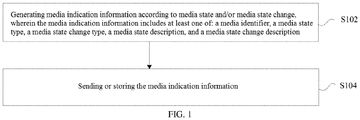
- FIG. 1 is a flowchart of a method for processing media information according to an embodiment of the present disclosure. As shown in FIG. 1 , the method includes the following steps:
- media indication information is generated according to media state and/or media state change, wherein the media indication information includes at least one of the followings: a media identifier, a media state type, a state change type, a media state description, and a media state change description.
- the above media identifier includes at least one of the followings: an identifier for indicating the media type, an identifier for indicating that the media is all or part of the media, and an identifier for indicating content of the all or part of the media.
- the media identifier may include, but is not limited to, a helmet device identifier, a hardware left/right controller identifier, and a user ID.
- the media state description or media state change description includes at least one of the followings: position information of three-dimensional coordinates, type of movement velocity, movement velocity component value, orientation component value, movement duration, vibration frequency, and vibration intensity, wherein the type of movement velocity includes linear movement velocity and angular movement velocity.
- step S104 the media indication information is sent or stored.
- the executive body of the foregoing method for processing media information includes, but is not limited to, a client device that can perform media information processing.
- the application scenario of the method for processing the media information includes, but is not limited to, the message interaction of the immersive media.
- the client device generates the media indication information according to the media state and/or the media state change, wherein the media indication information includes at least one of the followings: a media identifier, a media state type, a media state change type, a media state description, a media state change description, and the media indication information is sent or stored. That is to say, the client device generates the media indication information which covers the complete content according to the media state and/or the state change, thereby solving the problem that the content covered in the media information is incomplete during the media interaction in the related art, and achieving the effect that the integrity and extensibility of media information is improved.
- embodiments of the disclosure provide a method for processing immersive media interaction message.
- the following technical solution is mainly adopted:
- An interaction mechanism for immersive media is provided, mainly to construct a basic model of four parts: media information - interaction target - interaction type - interaction content, and meanwhile, define the content of each part of the four parts of the model. According to the interaction behavior of the user, the four parts of the interaction model are correspondingly encapsulated to define a complete message.
- the information to be added to indicate the media information, the interaction target, the interaction type and the interaction content can be diverse.
- the following set of information is used as an example:
- interaction target and interaction type For the classification of interaction target and interaction type, in embodiments of the present disclosure, some basic interaction targets and interaction types are summarized by summarizing the current immersive media device and the interaction manner, but it should be noted that in embodiments of the present disclosure, the interaction target and interaction type can be extended accordingly for new interactions.
- An exemplary immersive media processing mechanism includes the following steps:
- the above-mentioned interaction message model for immersive media realizeds classification and indication of interaction information.
- the media state type or the media state change type may be indicated by different identifiers, wherein the media state type and/or the media state change type includes at least one of the following types: no behavior, tracking target, gazing at the target area, moving, touching the target area, and vibrating.
- generating the media indication information according to the media state and/or the media state change includes the following steps; Step S21, determining, according to the media state and/or media state change, part or all of the content in the media indication information; Step S22, generating, according to combination of the part or all of the content, the media indication information.
- an interaction mechanism is designed for the interaction behavior of the immersive media, and the interaction behavior is encapsulated into an interaction signaling message by using the interaction model constructed in the embodiment of the disclosure, and the interaction signaling message is transmitted between the sending end and the receiving end.
- the present disclosure proposes an interaction mechanism in immersive media for the blank of current technology.
- MMT MPEG Media Transport
- Signaling information form constructing the interaction signaling information interaction_feedback_message() to indicate the specific content of the user.
- the interaction signaling table interaction_feedback_table() is constructed to indicate the specific content of the user.
- the interaction target is head-mounted device state and the interaction type is tracking, as well as the interaction target is user-interactive device state and the interaction type is vibrating are shown.
- the interaction content encapsulated in the interaction signaling can be dynamically changed and combined according to the actual interaction_target and interaction_type of the user.
- interaction_feedback_message the interaction signaling information
- Step S201 the user logs in and requests an immersive media resource.
- Step S202 the server obtains the media information, assigns, for the user, a unique user_id on the server, and constructs interaction_feedback_message, wherein the message_source is 1, indicating that it is sent from the server to the user.
- the user_id is a unique identifier assigned by the server to the user
- asset_id is the identifier of the immersive media resource requested by the user
- the interaction_num is 0.
- the server delivers immersive media resources, interaction_feedback_message, and other necessary signaling information to the user.
- Step S203 the user receives the corresponding immersive media resource, necessary signaling information and consumes the video, and the user_id is parsed from the interaction_feedback_message.
- Step S204 in the process of watching the immersive video, if interaction is made, the user constructs interaction_feedback_message, wherein the message_source is 0, indicating that it is sent from the user to the server.
- User_id is the user_id parsed in Step 203, asset_id is the asset_id of the immersive video which the user is currently viewing, the interaction_num is 1, and the timestamp is the current time.
- the interaction_target will be 1 and the interaction_type will be 1. Then, position_x, position_y, position_z, velocity_type, velocity_x, velocity_y, velocity_z, orientation_x, orientation_y, orientation_z, orientation_w, etc. are sequentially encapsulated according to the actual sensor information. The user sends the interaction_feedback_message to the server.
- the interaction_target will be 2 and the interaction_type will be 2. Then, the position_x, position_y, position_z, sustain_time, etc. are sequentially encapsulated according to the actual sensor information. The user sends the interaction_feedback_message to the server.
- the interaction_target will be 2 and the interaction_type will be 3. Then, the position_x, position_y, position_z, velocity_type, velocity_x, velocity_y, velocity_z, etc. are sequentially encapsulated according to the actual sensor information. The user sends the interaction_feedback_message to the server.
- the interaction_target will be 2 and the interaction_type will be 4.
- the user sends the interaction_feedback_message to the server.
- the interaction_target will be 3 and the interaction_type will be 1.
- the position_x, position_y, velocity_type, velocity_x, velocity_y, orientation_x, orientation_y, orientation_z, orientation_w, etc. are then sequentially encapsulated according to the actual sensor information.
- the user sends the interaction_feedback_message to the server.
- Step S205 the server receives the user's interaction_feedback_message, parses the content therein, and uses the data therein to make related calculations. If the media content consumed by the user needs to be changed at this time, and a vibration needs to be made on the user's left controller, the server will construct the interaction_feedback_message, wherein the message_source is 1, indicating that the message is sent from the server to the user, user_id is the user_id of the user, asset_id is the asset_id corresponding to the new media resource, the interaction_num is 1, and the timestamp is the current time.
- the message_source is 1, indicating that the message is sent from the server to the user
- user_id is the user_id of the user
- asset_id is the asset_id corresponding to the new media resource
- the interaction_num is 1
- the timestamp is the current time.
- the server sends a new immersive media resource, encapsulated interaction_feedback_message, and other necessary signaling information to the user.
- Step S206 the user receives the media resource, interaction_feedback_message and other signaling information sent by the server, consumes new corresponding media resource by further combining other signaling information, and parses the interaction_feedback_message.
- the hardware left controller vibrates at 50% of the maximum vibration frequency.
- step S207 the user continues to consume the immersive media resource.
- the proposed solution is exemplified by MMT, but these solutions can also be used in other file encapsulation, transmission systems and protocols.
- the interaction mechanism applied in the embodiment of the present disclosure is described by taking the MMT as an example, but is not limited thereto, and all the schemes for indicating the immersive media interaction information can be combined with the disclosure.
- the embodiment of the disclosure constructs a model of immersive media interaction, which uses media information, interaction targets, interaction types, and interaction content as basic parts of interaction information, classifies each part, and lists common media information, interaction target, interaction type and interaction content. These specific interaction types, interaction content and interaction information can be flexibly combined with each other, so as to represent corresponding interaction behavior.
- the method according to the above embodiment can be implemented by means of software plus a necessary general hardware platform, and of course, by hardware; but in many cases, the former is a better implementation.
- the technical solution of the present disclosure which is essential or contributes to the related art, may be embodied in the form of a software product stored in a storage medium (such as ROM/RAM, disk, the optical disc), including a number of instructions for causing a terminal device (which may be a cell phone, a computer, a server, or a network device, etc.) to perform the methods described in various embodiments of the present disclosure.
- module may implement a combination of software and/or hardware of a predetermined function.
- apparatus described in the following embodiments is preferably implemented in software, in fact, hardware, or a combination of software and hardware is also possible and contemplated.
- FIG. 3 is a block diagram of an apparatus for processing media information according to an embodiment of the present disclosure; as shown in FIG. 3 , the apparatus includes:
- the above media identifier includes at least one of the followings: an identifier for indicating the media type, an identifier for indicating that the media is all or part of the media, and an identifier for indicating the content of the all or part of the media.
- the media state type or the media state change type may be indicated by different identifiers, wherein the media state type or the media state change type includes at least one of the following types: no behavior, tracking target, gazing at the target area, moving, touching the target area, and vibrating.
- the media state description or media state change description includes at least one of: position information of three-dimensional coordinates, type of movement velocity, movement velocity component value, orientation component value, movement duration, vibration frequency, and vibration intensity, wherein the movement velocity type includes: linear movement velocity, angular movement velocity.
- FIG. 4 is a structural block diagram (I) of an apparatus for processing media information according to an embodiment of the present disclosure.
- the generating module 32 involved in FIG. 3 includes:
- each of the above modules may be implemented by software or hardware.
- the above modules may be achieved by, but not limited to the following implementations: the modules are all located in the same processor; or, the above modules are located in different processors in any combination.
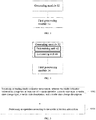
- FIG. 5 is a flowchart of a method for processing media information according to an embodiment of the present disclosure. As shown in FIG. 5 , the process includes the following steps.
- Step S502 media indication information is received or read, wherein the media indication information includes at least one of the followings: a media identifier, a media state type, a media state change type, a media state description, and a media state change description.
- the foregoing media identifier includes at least one of the followings: an identifier for indicating the media type, an identifier for indicating that the media is all or part of the media, and an identifier for indicating content of the all or part of the media.
- the media state description or media state change description includes at least one of: position information of three-dimensional coordinates, movement velocity type, movement velocity component value, orientation component value, movement duration, vibration frequency, and vibration intensity, wherein the movement velocity type includes linear movement velocity and angular movement velocity.
- Step S504 an operation is performed according to the media indication information.
- the foregoing operations according to the media indication information include at least one of the following operations: no operation, media state update operation, and media action operation.
- the executive body of the foregoing method for processing media information includes but is not limited to a server.
- the application scenario of the above method for processing the media information includes, but is not limited to, a message interaction of the immersive media.
- the server receives or reads the media indication information, wherein the media indication information includes at least one of the following contents: media identification, media state type, media state change type, media state description, media state change description, and operation is performed according to the media indication information, thereby solving the problem in the related art that the content covered in the media information during the media interaction is incomplete is solved, and the effect of improving the integrity and extensibility of the media information is achieved.
- the media state type or the media state change type may be indicated by different identifiers, wherein the media state type or the media state change type includes at least one of the following types: no behavior, tracking target, gazing at target area, moving, touching the target area, vibrating.
- the method of the above embodiment can be implemented by means of software plus a necessary general hardware platform; of course, the above embodiment can be implemented by means of hardware, but in many cases, the former is a better implementation.
- the technical solution of the present disclosure which is essential or contributes to the related art, may be embodied in the form of a software product stored in a storage medium (such as ROM/RAM, disk, the optical disc) includes a number of instructions for causing a terminal device (which may be a cell phone, a computer, a server, or a network device, etc.) to perform the methods described in various embodiments of the present disclosure.
- module may implement a combination of software and/or hardware of a predetermined function.
- apparatus described in the following embodiments is preferably implemented in software, in fact, hardware or a combination of software and hardware is also possible and contemplated.
- FIG. 6 is a structural block diagram (II) of an apparatus for processing media information according to an embodiment of the present disclosure. As shown in FIG. 6 , the apparatus includes:
- the media identifier includes at least one of the followings: an identifier for indicating the media type, an identifier for indicating that the media is all or part of the media, and an identifier for indicating content of the all or part of the media.
- the media state type or the media state change type may be indicated by different identifiers, wherein the media state type or the media state change type includes at least one of the following types: no behavior, tracking target, gazing at a target area, moving, touching the target area, vibrating.
- the media state description or media state change description includes at least one of: position information of three-dimensional coordinates, movement velocity type, movement velocity component value, orientation component value, movement duration, vibration frequency, and vibration intensity, wherein the movement velocity type includes: linear movement velocity, angular movement velocity.
- the above mentioned performing corresponding operation according to the media indication information includes at least one of the following operations: no behavior, media state update operation, and media action operation.
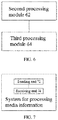
- An embodiment of the present disclosure also provides a system for processing media information. As shown in FIG. 7 , the system includes:
- a relatively complete media information interaction mechanism is implemented on the sending end and the receiving end.
- An embodiment of the disclosure also provides a storage medium.
- the above storage medium may be configured to store program code for performing the following steps:
- the storage medium is further configured to store program code for performing the following steps:
- the foregoing storage medium may include, but not limited to, a USB drive, a Read-Only Memory (ROM), a Random Access Memory (RAM), a mobile hard disk, and a magnetic memory or optical disk and other storage medium that can store program code.
- ROM Read-Only Memory
- RAM Random Access Memory
- mobile hard disk a magnetic memory or optical disk and other storage medium that can store program code.
- a processor executes S1, S2 according to the program code stored in the storage medium.
- a processor executes S3, S4 according to the program code stored in the storage medium.
- modules or steps of the present disclosure described above can be implemented by a general-purpose computing device that can be centralized on a single computing device or distributed across a network of multiple computing devices.
- modules or steps may be implemented by program code executable by the computing device such that they may be stored in the storage device by the computing device and, in some cases, may be different from the order herein.
- the steps shown or described are performed, or they are separately fabricated into individual integrated circuit modules, or a plurality of modules or steps thereof are fabricated as a single integrated circuit module.
- the disclosure is not limited to any specific combination of hardware and software.
- the method for processing the media information provided by the embodiment of the present disclosure generates the media indication information covering the complete content according to the media state and/or the state change, and solves the problem that the content covered in the media information is incomplete during the media interaction in the related art.
- the effect of improving of the integrity and extensibility of media information is achieved.
Landscapes
- Engineering & Computer Science (AREA)
- Multimedia (AREA)
- Signal Processing (AREA)
- Health & Medical Sciences (AREA)
- General Health & Medical Sciences (AREA)
- Social Psychology (AREA)
- Computer Networks & Wireless Communication (AREA)
- Databases & Information Systems (AREA)
- User Interface Of Digital Computer (AREA)
- Information Transfer Between Computers (AREA)
Applications Claiming Priority (2)
| Application Number | Priority Date | Filing Date | Title |
|---|---|---|---|
| CN201611141843.9A CN108616751B (zh) | 2016-12-12 | 2016-12-12 | 媒体信息的处理方法、装置及系统 |
| PCT/CN2017/108163 WO2018107913A1 (zh) | 2016-12-12 | 2017-10-28 | 媒体信息的处理方法、装置及系统 |
Publications (2)
| Publication Number | Publication Date |
|---|---|
| EP3554087A1 true EP3554087A1 (de) | 2019-10-16 |
| EP3554087A4 EP3554087A4 (de) | 2019-10-30 |
Family
ID=62557886
Family Applications (1)
| Application Number | Title | Priority Date | Filing Date |
|---|---|---|---|
| EP17879692.6A Ceased EP3554087A4 (de) | 2016-12-12 | 2017-10-28 | Verfahren, vorrichtung und system zur verarbeitung von medieninformationen |
Country Status (4)
| Country | Link |
|---|---|
| US (1) | US10911823B2 (de) |
| EP (1) | EP3554087A4 (de) |
| CN (1) | CN108616751B (de) |
| WO (1) | WO2018107913A1 (de) |
Cited By (1)
| Publication number | Priority date | Publication date | Assignee | Title |
|---|---|---|---|---|
| EP4412227A4 (de) * | 2021-09-29 | 2025-01-01 | Tencent Technology (Shenzhen) Company Limited | Verfahren, vorrichtung, vorrichtung, speichermedium und programmprodukt zur verarbeitung von immersiven mediendaten |
Families Citing this family (1)
| Publication number | Priority date | Publication date | Assignee | Title |
|---|---|---|---|---|
| CN116248642A (zh) | 2020-10-14 | 2023-06-09 | 腾讯科技(深圳)有限公司 | 媒体文件的封装方法、媒体文件的解封装方法及相关设备 |
Family Cites Families (13)
| Publication number | Priority date | Publication date | Assignee | Title |
|---|---|---|---|---|
| US20060017654A1 (en) * | 2004-07-23 | 2006-01-26 | Romo Justin R | Virtual reality interactivity system and method |
| CN102148818B (zh) * | 2010-12-29 | 2013-10-16 | 北京大学 | 移动设备上实现分布式虚拟现实与可视化的方法及系统 |
| CN103873453B (zh) * | 2012-12-18 | 2019-05-24 | 中兴通讯股份有限公司 | 沉浸通信客户端、服务器及获取内容视图的方法 |
| US9144744B2 (en) * | 2013-06-10 | 2015-09-29 | Microsoft Corporation | Locating and orienting device in space |
| US10600245B1 (en) * | 2014-05-28 | 2020-03-24 | Lucasfilm Entertainment Company Ltd. | Navigating a virtual environment of a media content item |
| CN104735464A (zh) * | 2015-03-31 | 2015-06-24 | 华为技术有限公司 | 一种全景视频交互传输方法、服务器和客户端 |
| CN104793741A (zh) * | 2015-04-03 | 2015-07-22 | 深圳市虚拟现实科技有限公司 | 带眼球跟踪虚拟现实成像系统和方法 |
| KR102313485B1 (ko) * | 2015-04-22 | 2021-10-15 | 삼성전자주식회사 | 가상현실 스트리밍 서비스를 위한 영상 데이터를 송수신하는 방법 및 장치 |
| US10432988B2 (en) * | 2016-04-15 | 2019-10-01 | Ati Technologies Ulc | Low latency wireless virtual reality systems and methods |
| CN106095235B (zh) * | 2016-06-07 | 2018-05-08 | 腾讯科技(深圳)有限公司 | 基于虚拟现实的控制方法和装置 |
| US10805592B2 (en) * | 2016-06-30 | 2020-10-13 | Sony Interactive Entertainment Inc. | Apparatus and method for gaze tracking |
| US11172005B2 (en) * | 2016-09-09 | 2021-11-09 | Nokia Technologies Oy | Method and apparatus for controlled observation point and orientation selection audiovisual content |
| US10754529B2 (en) * | 2016-10-28 | 2020-08-25 | Adobe Inc. | Facilitating editing of virtual-reality content using a virtual-reality headset |
-
2016
- 2016-12-12 CN CN201611141843.9A patent/CN108616751B/zh active Active
-
2017
- 2017-10-28 WO PCT/CN2017/108163 patent/WO2018107913A1/zh not_active Ceased
- 2017-10-28 US US16/349,917 patent/US10911823B2/en active Active
- 2017-10-28 EP EP17879692.6A patent/EP3554087A4/de not_active Ceased
Cited By (1)
| Publication number | Priority date | Publication date | Assignee | Title |
|---|---|---|---|---|
| EP4412227A4 (de) * | 2021-09-29 | 2025-01-01 | Tencent Technology (Shenzhen) Company Limited | Verfahren, vorrichtung, vorrichtung, speichermedium und programmprodukt zur verarbeitung von immersiven mediendaten |
Also Published As
| Publication number | Publication date |
|---|---|
| US10911823B2 (en) | 2021-02-02 |
| CN108616751A (zh) | 2018-10-02 |
| WO2018107913A1 (zh) | 2018-06-21 |
| CN108616751B (zh) | 2023-05-12 |
| EP3554087A4 (de) | 2019-10-30 |
| US20190327523A1 (en) | 2019-10-24 |
Similar Documents
| Publication | Publication Date | Title |
|---|---|---|
| CN108521608B (zh) | 视频文件的处理方法、装置、终端及存储介质 | |
| US9052959B2 (en) | Load balancing between general purpose processors and graphics processors | |
| CN102413150B (zh) | 服务器、虚拟桌面控制方法以及虚拟桌面控制系统 | |
| EP3002674A1 (de) | Bildaktualisierungsverfahren, -system und -vorrichtung | |
| US10165058B2 (en) | Dynamic local function binding apparatus and method | |
| US10754869B2 (en) | Managing data format of data received from devices in an internet of things network | |
| US20170134825A1 (en) | Method and device for processing panoramic live broadcast video resources | |
| KR20190094235A (ko) | 커스텀 디지털 컴포넌트 | |
| CN110166810A (zh) | 视频渲染引擎切换方法、装置、设备及可读存储介质 | |
| CN107908482B (zh) | 一种信息传送方法、设备及计算机可读介质 | |
| CN104765636B (zh) | 一种远程桌面图像的合成方法和装置 | |
| CN114128236A (zh) | 提供云服务的方法和装置 | |
| CN111176715A (zh) | 一种信息调用方法及服务器 | |
| CN111124668A (zh) | 内存释放方法、装置、存储介质及终端 | |
| CN116645493A (zh) | 一种用于呈现增强现实数据的方法、设备及介质 | |
| WO2025157192A1 (zh) | 交互方法、装置、设备和存储介质 | |
| CN113778593B (zh) | 云桌面控制方法、装置、电子设备、存储介质及程序产品 | |
| EP3554087A1 (de) | Verfahren, vorrichtung und system zur verarbeitung von medieninformationen | |
| US9456046B2 (en) | Dynamic generation of proxy connections | |
| CN104618733A (zh) | 图像远程投射方法和相关装置 | |
| US9614900B1 (en) | Multi-process architecture for a split browser | |
| CN103019813B (zh) | 获取基于SaaS的交互式程序的交互强度的方法 | |
| CN110324419B (zh) | 基于云服务的数据处理方法和设备 | |
| CN114285906B (zh) | 报文处理方法、装置、电子设备及存储介质 | |
| KR20190032100A (ko) | 전자 장치에서의 광고 영상 제공 방법 및 그 전자 장치 |
Legal Events
| Date | Code | Title | Description |
|---|---|---|---|
| STAA | Information on the status of an ep patent application or granted ep patent |
Free format text: STATUS: THE INTERNATIONAL PUBLICATION HAS BEEN MADE |
|
| PUAI | Public reference made under article 153(3) epc to a published international application that has entered the european phase |
Free format text: ORIGINAL CODE: 0009012 |
|
| STAA | Information on the status of an ep patent application or granted ep patent |
Free format text: STATUS: REQUEST FOR EXAMINATION WAS MADE |
|
| 17P | Request for examination filed |
Effective date: 20190520 |
|
| AK | Designated contracting states |
Kind code of ref document: A1 Designated state(s): AL AT BE BG CH CY CZ DE DK EE ES FI FR GB GR HR HU IE IS IT LI LT LU LV MC MK MT NL NO PL PT RO RS SE SI SK SM TR |
|
| AX | Request for extension of the european patent |
Extension state: BA ME |
|
| A4 | Supplementary search report drawn up and despatched |
Effective date: 20191001 |
|
| RIC1 | Information provided on ipc code assigned before grant |
Ipc: H04N 21/2343 20110101ALI20190925BHEP Ipc: H04N 21/81 20110101ALI20190925BHEP Ipc: H04N 21/434 20110101ALI20190925BHEP Ipc: H04N 21/658 20110101ALI20190925BHEP Ipc: H04N 21/6587 20110101ALI20190925BHEP Ipc: H04N 21/234 20110101AFI20190925BHEP |
|
| DAV | Request for validation of the european patent (deleted) | ||
| DAX | Request for extension of the european patent (deleted) | ||
| STAA | Information on the status of an ep patent application or granted ep patent |
Free format text: STATUS: EXAMINATION IS IN PROGRESS |
|
| 17Q | First examination report despatched |
Effective date: 20200716 |
|
| REG | Reference to a national code |
Ref country code: DE Ref legal event code: R003 |
|
| STAA | Information on the status of an ep patent application or granted ep patent |
Free format text: STATUS: THE APPLICATION HAS BEEN REFUSED |
|
| 18R | Application refused |
Effective date: 20220118 |