EP3553691B1 - Sicherheitsvorrichtung für ein zahlungsendgerät, die ein eingebautes sicherheitselement umfasst - Google Patents
Sicherheitsvorrichtung für ein zahlungsendgerät, die ein eingebautes sicherheitselement umfasst Download PDFInfo
- Publication number
- EP3553691B1 EP3553691B1 EP19167886.1A EP19167886A EP3553691B1 EP 3553691 B1 EP3553691 B1 EP 3553691B1 EP 19167886 A EP19167886 A EP 19167886A EP 3553691 B1 EP3553691 B1 EP 3553691B1
- Authority
- EP
- European Patent Office
- Prior art keywords
- deformable
- housing
- security
- printed circuit
- safety
- Prior art date
- Legal status (The legal status is an assumption and is not a legal conclusion. Google has not performed a legal analysis and makes no representation as to the accuracy of the status listed.)
- Active
Links
Images
Classifications
-
- G—PHYSICS
- G06—COMPUTING OR CALCULATING; COUNTING
- G06F—ELECTRIC DIGITAL DATA PROCESSING
- G06F21/00—Security arrangements for protecting computers, components thereof, programs or data against unauthorised activity
- G06F21/70—Protecting specific internal or peripheral components, in which the protection of a component leads to protection of the entire computer
- G06F21/88—Detecting or preventing theft or loss
-
- G—PHYSICS
- G06—COMPUTING OR CALCULATING; COUNTING
- G06F—ELECTRIC DIGITAL DATA PROCESSING
- G06F21/00—Security arrangements for protecting computers, components thereof, programs or data against unauthorised activity
- G06F21/70—Protecting specific internal or peripheral components, in which the protection of a component leads to protection of the entire computer
- G06F21/82—Protecting input, output or interconnection devices
- G06F21/83—Protecting input, output or interconnection devices input devices, e.g. keyboards, mice or controllers thereof
-
- G—PHYSICS
- G06—COMPUTING OR CALCULATING; COUNTING
- G06F—ELECTRIC DIGITAL DATA PROCESSING
- G06F21/00—Security arrangements for protecting computers, components thereof, programs or data against unauthorised activity
- G06F21/70—Protecting specific internal or peripheral components, in which the protection of a component leads to protection of the entire computer
- G06F21/86—Secure or tamper-resistant housings
-
- G—PHYSICS
- G07—CHECKING-DEVICES
- G07F—COIN-FREED OR LIKE APPARATUS
- G07F7/00—Mechanisms actuated by objects other than coins to free or to actuate vending, hiring, coin or paper currency dispensing or refunding apparatus
- G07F7/08—Mechanisms actuated by objects other than coins to free or to actuate vending, hiring, coin or paper currency dispensing or refunding apparatus by coded identity card or credit card or other personal identification means
- G07F7/0873—Details of the card reader
-
- H—ELECTRICITY
- H05—ELECTRIC TECHNIQUES NOT OTHERWISE PROVIDED FOR
- H05K—PRINTED CIRCUITS; CASINGS OR CONSTRUCTIONAL DETAILS OF ELECTRIC APPARATUS; MANUFACTURE OF ASSEMBLAGES OF ELECTRICAL COMPONENTS
- H05K7/00—Constructional details common to different types of electric apparatus
- H05K7/02—Arrangements of circuit components or wiring on supporting structure
-
- H—ELECTRICITY
- H10—SEMICONDUCTOR DEVICES; ELECTRIC SOLID-STATE DEVICES NOT OTHERWISE PROVIDED FOR
- H10W—GENERIC PACKAGES, INTERCONNECTIONS, CONNECTORS OR OTHER CONSTRUCTIONAL DETAILS OF DEVICES COVERED BY CLASS H10
- H10W90/00—Package configurations
-
- H—ELECTRICITY
- H10—SEMICONDUCTOR DEVICES; ELECTRIC SOLID-STATE DEVICES NOT OTHERWISE PROVIDED FOR
- H10W—GENERIC PACKAGES, INTERCONNECTIONS, CONNECTORS OR OTHER CONSTRUCTIONAL DETAILS OF DEVICES COVERED BY CLASS H10
- H10W90/00—Package configurations
- H10W90/20—Configurations of stacked chips
- H10W90/291—Configurations of stacked chips characterised by containers, encapsulations, or other housings for the stacked chips
Definitions
- the field of the invention is that of electronic devices and more particularly of data entry devices such as electronic payment terminals.
- the invention relates more specifically to the securing of such data entry devices, in the face of intrusion attempts with a view to fraudulent obtaining of confidential data (confidential code digits, card data, etc.).
- an electronic payment terminal conventionally comprises an upper half-shell and a lower half-shell.
- the upper half-shell comprises openings which are used, for example, to allow the keys of the keyboard and the display screen of the terminal to protrude.
- "false keys” devices are used to detect an attempt to separate the upper half-shell and the lower half-shell.
- EP2146562 A1 describes a protection system for a printed circuit of a payment terminal and constitutes a relevant prior art document.
- the present technique makes it possible to partially solve the problems posed by the prior art.
- the present technique in fact relates to a security device of an electronic payment terminal comprising at least one printed circuit.
- the safety device comprises at least one deformable safety element intended to be inserted into a housing of the printed circuit, the printed circuit comprising at least one safety circuit comprising at least one conductive track internal to the printed circuit and interrupted. at the level of the housing, and the deformable element also has at least one conductive surface intended to close the internal conductive track when the deformable element is deformed in the housing.
- the invention thus proposes a new and inventive technique for securing an electronic payment terminal by means of a deformable security element inserted in a housing of the printed circuit of the electronic payment terminal.
- the security element when it is deformed, allows the closing of a security circuit internal to the printed circuit, and when it returns to its initial shape (for example following an intrusion attempt which modifies the pressures undergone by the deformable element), the security circuit opens, allowing detection of an attempted intrusion into the electronic payment terminal.
- the safety circuit comprises at least one safety track formed inside the printed circuit and not opening onto its surface, making any attempt to access this safety track more difficult, for example by injection of dye. a conductive liquid on the surface of the printed circuit. The closing of the safety circuit is therefore implemented inside the printed circuit and no longer on the surface thereof as is the case in the prior art.
- a housing is therefore provided in the printed circuit, at which the internal safety circuit is interrupted and the safety track divided into several track portions. Unlike the prior art, the safety circuit is therefore not located flush with the surface of the printed circuit.
- the contacting of these track portions is then carried out by means of the deformation of a deformable security element having at least one conductive surface which comes into contact with the track portions when the deformable security element is inserted into the housing and deformed.
- the deformable element When the deformable element is compressed under a component or under the assembled half-shells of the electronic payment terminal, or even when a fixing element (for example a screw) is inserted in its middle, it tends to widen and to occupy all the space inside the housing, which causes its conductive surface to come into contact with the track portions, and thus the closing of the safety circuit.
- a fixing element for example a screw
- the deformable element tends to resume its initial shape, causing the safety circuit to open.
- At least part of the deformable element is made of elastomer.
- the elastomer allows the deformable element to deform easily, without requiring the application of strong pressure. This thus allows deformation by simply mounting a component above the housing in which the deformable element is inserted.
- the housing and the deformable security element have a substantially cylindrical shape.
- the conductive surface of the deformable safety element can be located on the outside of the cylinder, so as to come into contact with the conductive track (s) of the safety circuit when the cylinder expands under the pressure which is applied to it.
- the housing is a through hole.
- a housing passing through the printed circuit with a safety device flush with either side of the printed circuit when it is inserted into the housing, makes it possible to limit the number of safety devices. Indeed, a single security device makes it possible to detect an intrusion by opening one or the other of the covers of the electronic payment terminal, that is to say when the pressure which is applied to it on one or the other the other side of the printed circuit is released.
- the safety device comprises two deformable elements each having at least one conductive surface, intended to be inserted one on top of the other in the housing.
- deformable elements are useful for ensuring the electrical continuity of at least two distinct safety circuits arranged on different layers of the printed circuit, one deformable element coming at least to close one circuit formed in one layer.
- the two deformable elements are in contact via a non-conductive surface.
- the two deformable elements can independently close the at least two safety circuits formed in the respective layers of the printed circuit, because the contact surface between them is insulating. At least two independent safety circuits arranged on different levels of the printed circuit are thus formed.
- the printed circuit comprises two coplanar safety circuits each comprising at least one conductive safety track internal to the printed circuit and interrupted at the level of the housing and the deformable element has at least one conductive surface intended to close the conductive track. of each of the two coplanar safety circuits when the deformable element is deformed.
- the deformable element when two safety circuits are provided in the printed circuit, interrupted at the level of the housing, the deformable element (s) allow (s) the closing of these two circuits.
- the deformable element In the case where two deformable elements are used, it is possible to detect which circuit is open and thus to detect more precisely which side of the payment terminal is attacked.
- the deformable security element has a collar at one of its ends, the collar being intended to cover the housing on the surface of the printed circuit when the deformable security element is inserted into the housing.
- the flange makes it possible to optimize the sealing of the safety device on the surface of the printed circuit and thus make it more difficult, if not impossible, to neutralize the safety device (by injection of a conductive liquid for example) or its fraudulent removal from the accommodation in which it is inserted.
- the two deformable elements are in contact via a conductive exchange surface when the two deformable elements are deformed in the housing.
- the two deformable elements behave like a single deformable element, jointly closing the at least two safety circuits formed in the different layers of the printed circuit.
- the respective flanges of the two deformable elements keep the conductive front surfaces of the two separate elements as long as the safety device is not compressed.
- one of the two deformable elements could be active with a conductive zone, and the other passive non-conductive, the conductive part of the active device having to be positioned opposite the safety circuit to be closed when the two elements deformable are compressed.
- the safety device is covered with a flexible mesh.
- the proposed technique also relates to an electronic payment terminal comprising at least one security device as described above, according to its various embodiments.
- the general principle of the proposed technique consists in securing a data entry device, for example an electronic payment terminal, thanks to at least one deformable security element with a conductive surface, embedded / inserted in a housing of the printed circuit of the device. data entry, making it possible to close one or more safety circuit (s) formed inside the printed circuit when it is deformed.
- Each safety circuit comprises one or more interrupted safety track (s) at a housing, or hole, formed in the printed circuit and in which the deformable element is inserted.
- each security circuit is connected to a security module capable of detecting an attempted intrusion into the electronic payment terminal when one or more security circuits are open.
- the deformable element When the deformable element is deformed, for example under the effect of sufficient pressure, its conductive surface comes into contact with the track (s) and closes the corresponding safety circuit (s). inside - in other words in the thickness - of the printed circuit.
- the general principle of the proposed technique is therefore based on the fact that this deformation is obtained when the data entry device is in a situation of normal operation, and that a release of the pressure (resulting in a return to an initial form of deformable element) indicates an attempted intrusion into the data entry device.
- the deformable element must be deformed in normal operation and an intrusion detection occurs when it returns to its initial undeformed shape and thus no longer closes the safety circuit (s).
- the deformable element when the data entry device is removed by disassembling its covers, or half-shells, the deformable element returns to its initial form of "rest", which opens the safety circuit (s) and allows to detect the intrusion attempt.
- the embedding of the deformable element in the housing makes it possible to ensure the tightness of the device. safety device and therefore makes the injection of the liquid inoperative.
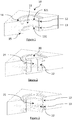
- the figure 1 illustrates a portion of a printed circuit 10 of an electronic payment terminal conventionally having an upper half-shell, or upper cover, and a lower half-shell, or lower cover (not shown).
- the printed circuit 10 comprises an opening housing 11, formed to pass through the thickness of the printed circuit 10, for example at the level of the keyboard, the display, the card reader, etc. any area of the electronic payment terminal where there is information to be protected, or in the free spaces of the terminal that could accommodate spy devices, or to detect attempts to dismantle the payment terminal electronics from its place of installation (fixed mounting on a dispenser or on a counter).
- two safety circuits 12, 13 each formed of a safety track are provided inside the printed circuit 10.
- the safety tracks are provided at the level of the internal layers of the printed circuit 10, in its thickness, and are not flush with the surface of the printed circuit 10 as is the case in the prior art.
- the two safety circuits 12, 13 are coplanar, that is to say that they each extend in a plane corresponding to an internal layer of the printed circuit, the various internal layers being mutually parallel.
- the security tracks are made for example by copper layers etched in the printed circuit 10, for example by a photochemical process as for the other tracks of the printed circuit, and are interrupted at the level of the housing 11.
- a metallization phase (conventionally used for the production of metallized holes) can be used to improve the quality of the contact surface inside the housing 11.
- each track follows the circumference of the housing 11, while being flush with its vertical wall so as to be accessible, and is interrupted in an “insulating” zone 121, 131, thus forming several portions of tracks not connected to each other.
- the printed circuit 10 comprises respectively on its lower and upper surfaces another type of circuit consisting of partially metallized conductive tracks, called a guard ring 14.
- a guard ring 14 constitute an additional security and make it possible to detect whether a contact is established on the surface of the printed circuit 10, for example in the case where a conductive liquid is injected, then causing a closing of the circuit making it possible to neutralize the safety device, according to the techniques of the prior art.
- the cylindrical shape of the housing shown on this figure 1 allows optimum efficiency of the operation of the safety device, since the deformable safety element inserted therein, also of cylindrical shape, can be deformed uniformly and thus ensure effective closing of the safety circuit (s).
- Any other shape, for example oblong, of the housing and of the deformable element, making it possible to respond to the problem is of course possible, also depending on the constraints of implantation of the components on the circuit. printed circuit, the position of this printed circuit inside the electronic payment terminal, etc.
- the housing can be obtained by drilling or milling, which makes it possible to obtain rounded angles and thus allows the deformable element to have a shape as close as possible to the profile of the housing in which it is inserted. .
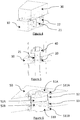
- the figures 2 and 3 illustrate a first embodiment of a safety device 20 corresponding to a deformable safety element 20 inserted in the housing 11 described above in relation to the figure 1 .
- this deformable security element 20 therefore has a substantially cylindrical shape and comprises a first insulating central part 21 (for example in unfilled silicone), corresponding to a support (for example having an "H" profile. when looking at the printed circuit vertically) to ensure the maintenance of a second conductive part 22 (for example carbon loaded silicone), covering the first part 21 over part of its height and part of its circumference.
- a first insulating central part 21 for example in unfilled silicone
- a support for example having an "H" profile. when looking at the printed circuit vertically
- a second conductive part 22 for example carbon loaded silicone
- the two parts 21, 22, for example overmolded or assembled, are made of elastomer (for example silicone) and are therefore deformable.
- the elastomer part 22 is deformed by “swelling” in the manner of a barrel: its height decreases while its circumference increases, part 21 also being deformed by training.
- the first part 21 is insulating, for example made of uncharged silicone, while the second part 22 is conductive.
- This second part 22 is for example produced by molding a loaded material (for example silicone loaded with carbon) and then placed in the mold in which the molding of the unloaded material for the part 21 is carried out, to perform a overmolding.
- the loaded part 22 is cut from the conductive material before being overmolded.
- Part 22 thus has a conductive surface making it possible, when the deformable element 20 is inserted into the housing and deformed (or even compressed), to close the safety circuits 12 and 13 at the positions 121 and 131 illustrated in figure 1 .
- the figure 2 shows the security device 20 in its “rest” position, that is to say before its deformation, here by assembling the two shells of the electronic payment terminal (not shown).
- peripheral conductive surface of part 22 is set back from the walls of housing 11 and the safety circuits 12, 13 are then open. Furthermore, the ends of the support 21 (corresponding here to the two sides of the "H") are slightly raised relative to the lower and upper surfaces of the printed circuit 10.
- the figure 3 for its part, represents the security device 20 when it is deformed, for example when the electronic payment terminal is assembled and in the normal “use” configuration.
- the upper and lower surfaces of the support 21 are compressed under two support elements (not shown) on either side of the housing 11, in the same plane as the lower and upper surfaces of the printed circuit 10.
- the compressive forces are transmitted to part 22, causing its deformation and bringing its peripheral surface into contact with the track portions of the safety circuits 12, 13 flush with the interior of the housing 11.
- the safety circuits 12, 13 are then closed.
- the support elements making it possible to compress the security device are for example formed by the upper and lower half-shells of the electronic payment terminal, or by one or more components mounted on the printed circuit 10, as described below in relation with a variant of this first embodiment illustrated in figure 4 .
- the figure 4 therefore illustrates, according to a variant of this first embodiment, an example of a support element 30 mounted on the printed circuit, above the housing in which is inserted a safety device as illustrated in figures 2 and 3 . It is therefore the component 30 which exerts pressure on the deformable element 20 and more precisely causes the deformation of the part 22, thus closing the safety circuits 12 and 13 as already described above.
- the housing 11 may be blind, or blind, for example formed in a device of the “I / O cache” type which consists of an additional safety device welded to the surface of the printed circuit, intended for to protect one or more sensitive components, such as for example the connections of a card reader or of a security device.
- the support 21 of the security device 20 is provided with a passage through which can be inserted a fixing means, for example a screw 40, intended to assemble two parts, or two components, of the electronic payment terminal on both sides and on the other side of the printed circuit 10. It is the insertion of this fixing means in the deformable safety element which causes its deformation inside the housing and thus the closing of the safety circuit (s) concerned, such as previously described.
- a fixing means for example a screw 40
- the figure 6 illustrates for its part a third embodiment of the safety device embedded in the housing 11, in which the safety device 50 comprises two deformable safety elements 52A, 52B, each having a substantially cylindrical shape.
- deformable security elements 52A, 52B are arranged one on top of the other along a longitudinal axis of the housing 11, that is to say along an axis passing through the printed circuit 10 from bottom to top.
- Each deformable safety element 52A, 52B has a height substantially equal to half the height of the deformable safety element 20 described in the first and second embodiments, but it could be otherwise (two deformable elements of different size ).
- deformable security elements 52A, 52B also include a conductive peripheral surface similar to that of the first and second embodiments.
- Two end “support” 51A, 51B having a generally cylindrical shape provided with a flange 511A, 511B are symmetrically arranged on either side of the elements 52A, 52B, along said longitudinal axis of the housing 11.
- These flanges 511A , 511B have a diameter greater than the diameter of the housing 11, and allow, once positioned, to cover the latter so as to improve the tightness of the device and its security against attacks.
- the deformable safety elements 52A, 52B and the end “support” elements 51A, 51B are deformable, and more precisely compressible.
- the elements 52A, 52B are deformed under the effect of a compressive force by “inflating”: their height decreases while their circumference increases.
- each of these elements 52A, 52B comes into contact with the track portions of the safety circuits 12, 13 flush with the internal periphery of the housing 11, which closes the safety circuits 12, 13.
- the elements 52A, 52B are in contact with each other via a conductive surface when the security element is compressed.
- the flanges 511A, 511B make it possible to keep the conductive front surfaces of the two elements 52A, 52B separate as long as the security element is not under pressure.
- the two safety circuits 12, 13 are closed jointly by the two elements 52A, 52B since the current flows between the conductive peripheral surfaces of each element 52A, 52B.
- the elements 52A, 52B are in contact with each other via an insulating surface.
- the safety circuits 12, 13 are independent since the current does not flow between the conductive peripheral surfaces of each element 52A, 52B.
- the independence of the two circuits 12, 13 makes it more difficult to neutralize one or the other.
- the two superimposed circuits 12, 13 therefore protect each other. It is possible to jointly monitor the opening of the circuits 12, 13, their grounding and their short-circuiting, which makes the attacks more complicated to implement.
- the security device 20, 50 can be covered with a flexible mesh, for example a flexible printed circuit covered with a plurality of nested conductive tracks, adhesive on the security device before the halves. -shells of the electronic payment terminal are not assembled. Indeed, such a flexible mesh is able to deform without losing efficiency and can therefore be positioned on the printed circuit when the deformable security element (s) are in the “at rest” position and then follow the surface of the printed circuit once. the deformable security element (s) in the “compressed” position in the housing. The purpose of this mesh is therefore to strengthen the protection of access to the security device.
- a flexible mesh for example a flexible printed circuit covered with a plurality of nested conductive tracks, adhesive on the security device before the halves. -shells of the electronic payment terminal are not assembled.
- a flexible mesh is able to deform without losing efficiency and can therefore be positioned on the printed circuit when the deformable security element (s) are in the “at rest” position and then follow the surface of the printed circuit once
- the flexible mesh alone, is not sufficient to achieve the forces necessary for the compression of the safety device 20, 50.
- it can be placed outside the safety device and facing this safety device, it can be placed. in place a support on one of the terminal covers electronic payment.
- a fraudster tries to maintain the compression by gluing this support, the gluing will be done on the flexible mesh and will not allow sufficient maintenance of the support to compress the safety device 20, 50 and ensure the closure of the circuits of security 12, 13.
- This new approach to securing an electronic payment terminal has several advantages over the techniques of the prior art.
- One of the advantages lies in the positioning of the safety circuits 12, 13 at the level of the internal layers of the printed circuit 10, which makes the latter less accessible and therefore more difficult to neutralize.
- Another advantage lies in the particular configuration of a housing opening onto the two surfaces of the printed circuit, making it possible to detect an intrusion attempt from one or the other of the faces of the printed circuit. For example, if an attacker tries to open the payment terminal, for example by removing the upper half-shell or the lower half-shell, the security device stops being compressed and returns to its original shape, thus opening the one or the other of the safety circuits 12, 13. Thus, the safety device ceases to be compressed regardless of the half-shell removed, unlike the prior art which makes it possible to detect only the withdrawal of the half-shell. shell on the side where a "false key" is installed for example.
- the element (s) deformable safety device (s) 20, 52A, 52B behaves like an insulating plug when (s) is or are compressed and "inflated” inside the housing 11, thus preventing liquid to enter the housing 11 and come into contact with the tracks of the safety circuits 12, 13. Therefore, if the attacker then dismantles the terminal, the safety circuits 12, 13 open when the The deformable element returns to its original shape upon release of the pressure applied to it, and the intrusion attempt can be detected.
- the solution of the invention requires less effort, or in all cases less than the minimum forces required in the prior art, so that the security element is deformed and comes into contact with the conductive tracks 12, 13. This is in particular due to the fact that the elastomer in which is produced the The security element is more easily deformed, because of its flexibility, than the materials of the "false keys" of the prior art.
- the compression of the elastomer element 22 requires full effort only when the electronic payment terminal is closed, when the two shells of the terminal are assembled.
- a compressive force of less than 200gF is sufficient to deform the deformable element according to a deformation of about 0.9 mm, while a force of about 300gF was for example necessary in the prior art, to activate the metal dome requiring a deformation between 0.9 and 1.4 mm depending on the hardness of the elastomer.
- the force generated by the assembly of the component remains limited to the deformation of the elastomer and not to its compression, but allows it to be deformed sufficiently to close the safety circuits. 12, 13.
- the force required to maintain electrical contact by deformation of the deformable safety element is therefore less than in the solutions of the prior art.
- the solution is thus more reliable in the long term because the deformable safety element is subjected to less forces, not necessarily causing its total compression, and its deformation capacity is therefore less likely to vary over time.
Landscapes
- Engineering & Computer Science (AREA)
- Computer Hardware Design (AREA)
- Theoretical Computer Science (AREA)
- General Physics & Mathematics (AREA)
- Physics & Mathematics (AREA)
- Software Systems (AREA)
- General Engineering & Computer Science (AREA)
- Computer Security & Cryptography (AREA)
- Microelectronics & Electronic Packaging (AREA)
- Storage Device Security (AREA)
- Burglar Alarm Systems (AREA)
- Casings For Electric Apparatus (AREA)
- Pinball Game Machines (AREA)
- Structure Of Printed Boards (AREA)
- Condensed Matter Physics & Semiconductors (AREA)
Claims (12)
- Sicherheitsvorrichtung eines elektronischen Zahlungsterminals, umfassend mindestens eine gedruckte Schaltung (10), wobei die Sicherheitsvorrichtung mindestens ein verformbares Sicherheitselement aufweist, das dazu bestimmt ist, in eine Aufnahme (11) der gedruckten Schaltung (10) eingefügt zu werden,
wobei die gedruckte Schaltung (10) mindestens einen Sicherheitskreis (12, 13) aufweist, der mindestens eine Leiterbahn im Inneren der gedruckten Schaltung (10) aufweist, die nicht an ihrer Oberfläche austritt und an der Aufnahme (11) unterbrochen ist,
wobei das mindestens eine verformbare Element mindestens eine leitfähige Oberfläche aufweist, die dazu bestimmt ist, die mindestens eine innere Leiterbahn zu schließen, wenn das verformbare Element in der Aufnahme (11) verformt ist. - Sicherheitsvorrichtung nach Anspruch 1, dadurch gekennzeichnet, dass das mindestens eine verformbare Sicherheitselement ausgebildet ist, um sich in der Aufnahme (11) durch ein Mittel zu verformen, das zu der Gruppe gehört, umfassend:- Verformen durch Anbringen eines Bauteiles auf der gedruckten Schaltung (10) über dem verformbaren Sicherheitselement, das in die Aufnahme (11) eingefügt ist;- Verformen durch Einfügen eines Befestigungsmittels ins Innere des verformbaren Sicherheitselements, das in die Aufnahme (11) eingefügt ist;- Komprimieren durch Anbringen des elektronischen Zahlungsterminals.
- Sicherheitsvorrichtung nach Anspruch 1, dadurch gekennzeichnet, dass mindestens ein Teil des mindestens einen verformbaren Sicherheitselements aus Elastomer hergestellt ist.
- Sicherheitsvorrichtung nach Anspruch 1 bis 3, dadurch gekennzeichnet, dass die Aufnahme (11) und das mindestens eine verformbare Sicherheitselement eine im Wesentlichen zylindrische Form aufweisen.
- Sicherheitsvorrichtung nach einem der Ansprüche 1 bis 4, dadurch gekennzeichnet, dass die Aufnahme (11) ein Durchgangsloch ist.
- Sicherheitsvorrichtung nach einem der Ansprüche 1 bis 5, dadurch gekennzeichnet, dass sie zwei verformbare Sicherheitselemente (52A, 52B) aufweist, die jeweils mindestens eine leitfähige Oberfläche aufweisen, die dazu bestimmt sind, übereinander in die Aufnahme (11) eingefügt zu werden.
- Sicherheitsvorrichtung nach Anspruch 6, dadurch gekennzeichnet, dass die zwei verformbaren Sicherheitselemente (52A, 52B) durch eine nicht leitfähige Oberfläche in Kontakt stehen.
- Sicherheitsvorrichtung nach einem der Ansprüche 1 bis 7, dadurch gekennzeichnet, dass die gedruckte Schaltung (10) zwei koplanare Sicherheitskreise (12, 13) aufweist, die jeweils mindestens eine Sicherheitsleiterbahn, die sich im Inneren der gedruckten Schaltung (10) befindet und an der Aufnahme (11) unterbrochen ist, aufweisen, und dadurch, dass das mindestens eine verformbare Element (20, 52A, 52B) mindestens eine leitfähige Oberfläche aufweist, die dazu bestimmt ist, die mindestens eine Leiterbahn von jedem der zwei koplanaren Sicherheitskreise (12, 13) zu schließen, wenn das verformbare Element (20, 52A, 52B) verformt wird.
- Sicherheitsvorrichtung nach einem der Ansprüche 1 bis 8, dadurch gekennzeichnet, dass das mindestens eine verformbare Sicherheitselement (20, 52A, 52B) an einem seiner Enden einen Kragen (511A, 511B) aufweist, wobei der Kragen (511A, 511B) dazu bestimmt ist, die Aufnahme (11) an der Oberfläche der gedruckten Schaltung (10) zu bedecken, wenn das mindestens eine verformbare Sicherheitselement (20, 52A, 52B) in die Aufnahme (11) eingefügt ist.
- Sicherheitsvorrichtung nach Anspruch 6 und Anspruch 9, dadurch gekennzeichnet, dass die zwei verformbaren Elemente (52A, 52B) durch eine leitfähige Austauschfläche in Kontakt stehen, wenn die verformbaren Elemente (52A, 52B) in der Aufnahme (11) verformt sind.
- Sicherheitsvorrichtung nach einem der Ansprüche 1 bis 10, dadurch gekennzeichnet, dass sie durch ein biegsames Geflecht bedeckt ist.
- Elektronisches Zahlungsterminal, umfassend mindestens eine Sicherheitsvorrichtung nach einem der Ansprüche 1 bis 11.
Applications Claiming Priority (1)
| Application Number | Priority Date | Filing Date | Title |
|---|---|---|---|
| FR1853073A FR3079947B1 (fr) | 2018-04-09 | 2018-04-09 | Dispositif de securite d'un terminal de paiement comprenant un element de securite encastre. |
Publications (2)
| Publication Number | Publication Date |
|---|---|
| EP3553691A1 EP3553691A1 (de) | 2019-10-16 |
| EP3553691B1 true EP3553691B1 (de) | 2021-03-10 |
Family
ID=62455734
Family Applications (1)
| Application Number | Title | Priority Date | Filing Date |
|---|---|---|---|
| EP19167886.1A Active EP3553691B1 (de) | 2018-04-09 | 2019-04-08 | Sicherheitsvorrichtung für ein zahlungsendgerät, die ein eingebautes sicherheitselement umfasst |
Country Status (5)
| Country | Link |
|---|---|
| US (1) | US11386242B2 (de) |
| EP (1) | EP3553691B1 (de) |
| CA (1) | CA3039712A1 (de) |
| ES (1) | ES2867955T3 (de) |
| FR (1) | FR3079947B1 (de) |
Families Citing this family (3)
| Publication number | Priority date | Publication date | Assignee | Title |
|---|---|---|---|---|
| FR3105468B1 (fr) * | 2019-12-20 | 2022-02-11 | Ingenico Group | Dispositif d’interconnexion de deux terminaux |
| FR3115897B1 (fr) * | 2020-11-04 | 2023-06-09 | Banks And Acquirers Int Holding | Module de sécurité, terminal de paiement électronique, procédé de détection correspondant. |
| CN120239868A (zh) * | 2022-11-18 | 2025-07-01 | 捷普有限公司 | 用于支付终端的安全操作管理模块的装置、系统和方法 |
Family Cites Families (4)
| Publication number | Priority date | Publication date | Assignee | Title |
|---|---|---|---|---|
| US20050059859A1 (en) * | 2003-09-15 | 2005-03-17 | Gregory Konstorum | Method and system for mounting and securing parts inside an instrument housing |
| FR2929042B1 (fr) * | 2008-03-21 | 2011-06-03 | Sagem Monetel | Dispositif de protection d'un systeme electronique |
| FR2934110B1 (fr) * | 2008-07-16 | 2010-10-22 | Ingenico Sa | Dispositif de protection d'un composant electronique. |
| US8736513B2 (en) * | 2010-01-27 | 2014-05-27 | Sarantel Limited | Dielectrically loaded antenna and radio communication apparatus |
-
2018
- 2018-04-09 FR FR1853073A patent/FR3079947B1/fr active Active
-
2019
- 2019-04-08 CA CA3039712A patent/CA3039712A1/en active Pending
- 2019-04-08 ES ES19167886T patent/ES2867955T3/es active Active
- 2019-04-08 EP EP19167886.1A patent/EP3553691B1/de active Active
- 2019-04-08 US US16/377,905 patent/US11386242B2/en active Active
Non-Patent Citations (1)
| Title |
|---|
| None * |
Also Published As
| Publication number | Publication date |
|---|---|
| ES2867955T3 (es) | 2021-10-21 |
| US11386242B2 (en) | 2022-07-12 |
| FR3079947B1 (fr) | 2020-04-17 |
| EP3553691A1 (de) | 2019-10-16 |
| FR3079947A1 (fr) | 2019-10-11 |
| CA3039712A1 (en) | 2019-10-09 |
| US20190311159A1 (en) | 2019-10-10 |
Similar Documents
| Publication | Publication Date | Title |
|---|---|---|
| EP3553691B1 (de) | Sicherheitsvorrichtung für ein zahlungsendgerät, die ein eingebautes sicherheitselement umfasst | |
| CA2654060C (fr) | Dispositif de protection contre les intrusions d'appareils electroniques | |
| EP2241997B1 (de) | Speicherkartenleser | |
| EP3371735B1 (de) | Körper eines speicherkartenlesers mit einem schutznetz auf beiden seiten | |
| EP1671341B1 (de) | Antieindringeinrichtung hauptsächlich für ein elektronisches bezahlungsendgerät | |
| CA2983704C (fr) | Detection d'ouverture d'un dispositif de saisie de donnees | |
| EP3295365B1 (de) | Erkennung der öffnung einer dateneingabevorrichtung | |
| EP2102832A1 (de) | Gesichertes gehäuse | |
| EP3229166A1 (de) | Vorrichtung zum erkennen des öffnens eines eingabegerätes | |
| CA3196577A1 (fr) | Module de securite, terminal de paiement e?lectronique, procede de d etection correspondant | |
| EP4309242B1 (de) | In ein unbeaufsichtigtes elektronisches zahlungsendgerät integrierte zahlungsvorrichtung | |
| FR2721791A1 (fr) | Boîtier muni d'un système d'encrantage libérable. | |
| WO2021204658A1 (fr) | Dispositif de paiement électronique présentant des moyens de blocage de l'accès à un module de mémorisation de données | |
| WO2024133863A1 (fr) | Terminal de paiement électronique à drainage de liquide indésirable optimisé | |
| EP2916266B1 (de) | Leseblock für Speicherkarte, entsprechendes Endgerät für die Verarbeitung von Transaktionsdaten | |
| FR3080202A1 (fr) | Dispositif de securisation d'un volume dans un terminal de paiement electronique. | |
| FR3164304A1 (fr) | terminal électronique et système de sécurité | |
| FR2852888A1 (fr) | Rouleau de circulation | |
| FR2985338A1 (fr) | Clavier securise | |
| FR3051941A1 (fr) | Corps de lecteur de carte a memoire securise | |
| FR2885761A1 (fr) | Presentoir securise, notamment pour appareil muni d'une prise electrique |
Legal Events
| Date | Code | Title | Description |
|---|---|---|---|
| PUAI | Public reference made under article 153(3) epc to a published international application that has entered the european phase |
Free format text: ORIGINAL CODE: 0009012 |
|
| STAA | Information on the status of an ep patent application or granted ep patent |
Free format text: STATUS: THE APPLICATION HAS BEEN PUBLISHED |
|
| AK | Designated contracting states |
Kind code of ref document: A1 Designated state(s): AL AT BE BG CH CY CZ DE DK EE ES FI FR GB GR HR HU IE IS IT LI LT LU LV MC MK MT NL NO PL PT RO RS SE SI SK SM TR |
|
| AX | Request for extension of the european patent |
Extension state: BA ME |
|
| STAA | Information on the status of an ep patent application or granted ep patent |
Free format text: STATUS: REQUEST FOR EXAMINATION WAS MADE |
|
| 17P | Request for examination filed |
Effective date: 20200410 |
|
| RBV | Designated contracting states (corrected) |
Designated state(s): AL AT BE BG CH CY CZ DE DK EE ES FI FR GB GR HR HU IE IS IT LI LT LU LV MC MK MT NL NO PL PT RO RS SE SI SK SM TR |
|
| GRAP | Despatch of communication of intention to grant a patent |
Free format text: ORIGINAL CODE: EPIDOSNIGR1 |
|
| STAA | Information on the status of an ep patent application or granted ep patent |
Free format text: STATUS: GRANT OF PATENT IS INTENDED |
|
| INTG | Intention to grant announced |
Effective date: 20201113 |
|
| GRAS | Grant fee paid |
Free format text: ORIGINAL CODE: EPIDOSNIGR3 |
|
| GRAA | (expected) grant |
Free format text: ORIGINAL CODE: 0009210 |
|
| STAA | Information on the status of an ep patent application or granted ep patent |
Free format text: STATUS: THE PATENT HAS BEEN GRANTED |
|
| AK | Designated contracting states |
Kind code of ref document: B1 Designated state(s): AL AT BE BG CH CY CZ DE DK EE ES FI FR GB GR HR HU IE IS IT LI LT LU LV MC MK MT NL NO PL PT RO RS SE SI SK SM TR |
|
| REG | Reference to a national code |
Ref country code: GB Ref legal event code: FG4D Free format text: NOT ENGLISH |
|
| REG | Reference to a national code |
Ref country code: CH Ref legal event code: EP Ref country code: AT Ref legal event code: REF Ref document number: 1370641 Country of ref document: AT Kind code of ref document: T Effective date: 20210315 |
|
| REG | Reference to a national code |
Ref country code: IE Ref legal event code: FG4D Free format text: LANGUAGE OF EP DOCUMENT: FRENCH |
|
| REG | Reference to a national code |
Ref country code: DE Ref legal event code: R096 Ref document number: 602019003028 Country of ref document: DE |
|
| REG | Reference to a national code |
Ref country code: LT Ref legal event code: MG9D |
|
| PG25 | Lapsed in a contracting state [announced via postgrant information from national office to epo] |
Ref country code: NO Free format text: LAPSE BECAUSE OF FAILURE TO SUBMIT A TRANSLATION OF THE DESCRIPTION OR TO PAY THE FEE WITHIN THE PRESCRIBED TIME-LIMIT Effective date: 20210610 Ref country code: LT Free format text: LAPSE BECAUSE OF FAILURE TO SUBMIT A TRANSLATION OF THE DESCRIPTION OR TO PAY THE FEE WITHIN THE PRESCRIBED TIME-LIMIT Effective date: 20210310 Ref country code: GR Free format text: LAPSE BECAUSE OF FAILURE TO SUBMIT A TRANSLATION OF THE DESCRIPTION OR TO PAY THE FEE WITHIN THE PRESCRIBED TIME-LIMIT Effective date: 20210611 Ref country code: FI Free format text: LAPSE BECAUSE OF FAILURE TO SUBMIT A TRANSLATION OF THE DESCRIPTION OR TO PAY THE FEE WITHIN THE PRESCRIBED TIME-LIMIT Effective date: 20210310 Ref country code: HR Free format text: LAPSE BECAUSE OF FAILURE TO SUBMIT A TRANSLATION OF THE DESCRIPTION OR TO PAY THE FEE WITHIN THE PRESCRIBED TIME-LIMIT Effective date: 20210310 Ref country code: BG Free format text: LAPSE BECAUSE OF FAILURE TO SUBMIT A TRANSLATION OF THE DESCRIPTION OR TO PAY THE FEE WITHIN THE PRESCRIBED TIME-LIMIT Effective date: 20210610 |
|
| REG | Reference to a national code |
Ref country code: AT Ref legal event code: MK05 Ref document number: 1370641 Country of ref document: AT Kind code of ref document: T Effective date: 20210310 |
|
| REG | Reference to a national code |
Ref country code: NL Ref legal event code: MP Effective date: 20210310 |
|
| PG25 | Lapsed in a contracting state [announced via postgrant information from national office to epo] |
Ref country code: RS Free format text: LAPSE BECAUSE OF FAILURE TO SUBMIT A TRANSLATION OF THE DESCRIPTION OR TO PAY THE FEE WITHIN THE PRESCRIBED TIME-LIMIT Effective date: 20210310 Ref country code: LV Free format text: LAPSE BECAUSE OF FAILURE TO SUBMIT A TRANSLATION OF THE DESCRIPTION OR TO PAY THE FEE WITHIN THE PRESCRIBED TIME-LIMIT Effective date: 20210310 Ref country code: SE Free format text: LAPSE BECAUSE OF FAILURE TO SUBMIT A TRANSLATION OF THE DESCRIPTION OR TO PAY THE FEE WITHIN THE PRESCRIBED TIME-LIMIT Effective date: 20210310 |
|
| PG25 | Lapsed in a contracting state [announced via postgrant information from national office to epo] |
Ref country code: NL Free format text: LAPSE BECAUSE OF FAILURE TO SUBMIT A TRANSLATION OF THE DESCRIPTION OR TO PAY THE FEE WITHIN THE PRESCRIBED TIME-LIMIT Effective date: 20210310 |
|
| REG | Reference to a national code |
Ref country code: ES Ref legal event code: FG2A Ref document number: 2867955 Country of ref document: ES Kind code of ref document: T3 Effective date: 20211021 |
|
| PG25 | Lapsed in a contracting state [announced via postgrant information from national office to epo] |
Ref country code: CZ Free format text: LAPSE BECAUSE OF FAILURE TO SUBMIT A TRANSLATION OF THE DESCRIPTION OR TO PAY THE FEE WITHIN THE PRESCRIBED TIME-LIMIT Effective date: 20210310 Ref country code: EE Free format text: LAPSE BECAUSE OF FAILURE TO SUBMIT A TRANSLATION OF THE DESCRIPTION OR TO PAY THE FEE WITHIN THE PRESCRIBED TIME-LIMIT Effective date: 20210310 Ref country code: SM Free format text: LAPSE BECAUSE OF FAILURE TO SUBMIT A TRANSLATION OF THE DESCRIPTION OR TO PAY THE FEE WITHIN THE PRESCRIBED TIME-LIMIT Effective date: 20210310 Ref country code: AT Free format text: LAPSE BECAUSE OF FAILURE TO SUBMIT A TRANSLATION OF THE DESCRIPTION OR TO PAY THE FEE WITHIN THE PRESCRIBED TIME-LIMIT Effective date: 20210310 |
|
| PG25 | Lapsed in a contracting state [announced via postgrant information from national office to epo] |
Ref country code: SK Free format text: LAPSE BECAUSE OF FAILURE TO SUBMIT A TRANSLATION OF THE DESCRIPTION OR TO PAY THE FEE WITHIN THE PRESCRIBED TIME-LIMIT Effective date: 20210310 Ref country code: PT Free format text: LAPSE BECAUSE OF FAILURE TO SUBMIT A TRANSLATION OF THE DESCRIPTION OR TO PAY THE FEE WITHIN THE PRESCRIBED TIME-LIMIT Effective date: 20210712 Ref country code: RO Free format text: LAPSE BECAUSE OF FAILURE TO SUBMIT A TRANSLATION OF THE DESCRIPTION OR TO PAY THE FEE WITHIN THE PRESCRIBED TIME-LIMIT Effective date: 20210310 Ref country code: PL Free format text: LAPSE BECAUSE OF FAILURE TO SUBMIT A TRANSLATION OF THE DESCRIPTION OR TO PAY THE FEE WITHIN THE PRESCRIBED TIME-LIMIT Effective date: 20210310 Ref country code: IS Free format text: LAPSE BECAUSE OF FAILURE TO SUBMIT A TRANSLATION OF THE DESCRIPTION OR TO PAY THE FEE WITHIN THE PRESCRIBED TIME-LIMIT Effective date: 20210710 |
|
| REG | Reference to a national code |
Ref country code: DE Ref legal event code: R097 Ref document number: 602019003028 Country of ref document: DE |
|
| PG25 | Lapsed in a contracting state [announced via postgrant information from national office to epo] |
Ref country code: LU Free format text: LAPSE BECAUSE OF NON-PAYMENT OF DUE FEES Effective date: 20210408 |
|
| PLBE | No opposition filed within time limit |
Free format text: ORIGINAL CODE: 0009261 |
|
| STAA | Information on the status of an ep patent application or granted ep patent |
Free format text: STATUS: NO OPPOSITION FILED WITHIN TIME LIMIT |
|
| REG | Reference to a national code |
Ref country code: BE Ref legal event code: MM Effective date: 20210430 |
|
| PG25 | Lapsed in a contracting state [announced via postgrant information from national office to epo] |
Ref country code: MC Free format text: LAPSE BECAUSE OF FAILURE TO SUBMIT A TRANSLATION OF THE DESCRIPTION OR TO PAY THE FEE WITHIN THE PRESCRIBED TIME-LIMIT Effective date: 20210310 Ref country code: DK Free format text: LAPSE BECAUSE OF FAILURE TO SUBMIT A TRANSLATION OF THE DESCRIPTION OR TO PAY THE FEE WITHIN THE PRESCRIBED TIME-LIMIT Effective date: 20210310 Ref country code: AL Free format text: LAPSE BECAUSE OF FAILURE TO SUBMIT A TRANSLATION OF THE DESCRIPTION OR TO PAY THE FEE WITHIN THE PRESCRIBED TIME-LIMIT Effective date: 20210310 |
|
| 26N | No opposition filed |
Effective date: 20211213 |
|
| REG | Reference to a national code |
Ref country code: GB Ref legal event code: 732E Free format text: REGISTERED BETWEEN 20220127 AND 20220202 |
|
| PG25 | Lapsed in a contracting state [announced via postgrant information from national office to epo] |
Ref country code: SI Free format text: LAPSE BECAUSE OF FAILURE TO SUBMIT A TRANSLATION OF THE DESCRIPTION OR TO PAY THE FEE WITHIN THE PRESCRIBED TIME-LIMIT Effective date: 20210310 |
|
| PG25 | Lapsed in a contracting state [announced via postgrant information from national office to epo] |
Ref country code: IT Free format text: LAPSE BECAUSE OF FAILURE TO SUBMIT A TRANSLATION OF THE DESCRIPTION OR TO PAY THE FEE WITHIN THE PRESCRIBED TIME-LIMIT Effective date: 20210310 Ref country code: IE Free format text: LAPSE BECAUSE OF NON-PAYMENT OF DUE FEES Effective date: 20210408 |
|
| PG25 | Lapsed in a contracting state [announced via postgrant information from national office to epo] |
Ref country code: IS Free format text: LAPSE BECAUSE OF FAILURE TO SUBMIT A TRANSLATION OF THE DESCRIPTION OR TO PAY THE FEE WITHIN THE PRESCRIBED TIME-LIMIT Effective date: 20210710 |
|
| REG | Reference to a national code |
Ref country code: DE Ref legal event code: R081 Ref document number: 602019003028 Country of ref document: DE Owner name: BANKS AND ACQUIRES INTERNATIONAL HOLDING, FR Free format text: FORMER OWNER: INGENICO GROUP, PARIS, FR Ref country code: DE Ref legal event code: R082 Ref document number: 602019003028 Country of ref document: DE Representative=s name: STUMPF PATENTANWAELTE PARTGMBB, DE Ref country code: DE Ref legal event code: R081 Ref document number: 602019003028 Country of ref document: DE Owner name: BANKS AND ACQUIRERS INTERNATIONAL HOLDING, FR Free format text: FORMER OWNER: INGENICO GROUP, PARIS, FR |
|
| PG25 | Lapsed in a contracting state [announced via postgrant information from national office to epo] |
Ref country code: BE Free format text: LAPSE BECAUSE OF NON-PAYMENT OF DUE FEES Effective date: 20210430 |
|
| REG | Reference to a national code |
Ref country code: CH Ref legal event code: PL |
|
| PG25 | Lapsed in a contracting state [announced via postgrant information from national office to epo] |
Ref country code: LI Free format text: LAPSE BECAUSE OF NON-PAYMENT OF DUE FEES Effective date: 20220430 Ref country code: CH Free format text: LAPSE BECAUSE OF NON-PAYMENT OF DUE FEES Effective date: 20220430 |
|
| PG25 | Lapsed in a contracting state [announced via postgrant information from national office to epo] |
Ref country code: CY Free format text: LAPSE BECAUSE OF FAILURE TO SUBMIT A TRANSLATION OF THE DESCRIPTION OR TO PAY THE FEE WITHIN THE PRESCRIBED TIME-LIMIT Effective date: 20210310 |
|
| PG25 | Lapsed in a contracting state [announced via postgrant information from national office to epo] |
Ref country code: HU Free format text: LAPSE BECAUSE OF FAILURE TO SUBMIT A TRANSLATION OF THE DESCRIPTION OR TO PAY THE FEE WITHIN THE PRESCRIBED TIME-LIMIT; INVALID AB INITIO Effective date: 20190408 |
|
| PG25 | Lapsed in a contracting state [announced via postgrant information from national office to epo] |
Ref country code: MK Free format text: LAPSE BECAUSE OF FAILURE TO SUBMIT A TRANSLATION OF THE DESCRIPTION OR TO PAY THE FEE WITHIN THE PRESCRIBED TIME-LIMIT Effective date: 20210310 |
|
| PG25 | Lapsed in a contracting state [announced via postgrant information from national office to epo] |
Ref country code: TR Free format text: LAPSE BECAUSE OF FAILURE TO SUBMIT A TRANSLATION OF THE DESCRIPTION OR TO PAY THE FEE WITHIN THE PRESCRIBED TIME-LIMIT Effective date: 20210310 |
|
| PG25 | Lapsed in a contracting state [announced via postgrant information from national office to epo] |
Ref country code: MT Free format text: LAPSE BECAUSE OF FAILURE TO SUBMIT A TRANSLATION OF THE DESCRIPTION OR TO PAY THE FEE WITHIN THE PRESCRIBED TIME-LIMIT Effective date: 20210310 |
|
| REG | Reference to a national code |
Ref country code: DE Ref legal event code: R081 Ref document number: 602019003028 Country of ref document: DE Owner name: BANKS AND ACQUIRERS INTERNATIONAL HOLDING, FR Free format text: FORMER OWNER: BANKS AND ACQUIRES INTERNATIONAL HOLDING, SURESNES, FR |
|
| PGFP | Annual fee paid to national office [announced via postgrant information from national office to epo] |
Ref country code: DE Payment date: 20250422 Year of fee payment: 7 |
|
| PGFP | Annual fee paid to national office [announced via postgrant information from national office to epo] |
Ref country code: GB Payment date: 20250423 Year of fee payment: 7 Ref country code: ES Payment date: 20250530 Year of fee payment: 7 |
|
| PGFP | Annual fee paid to national office [announced via postgrant information from national office to epo] |
Ref country code: FR Payment date: 20250429 Year of fee payment: 7 |
|
| REG | Reference to a national code |
Ref country code: ES Ref legal event code: PC2A Owner name: BANKS AND ACQUIRERS INTERNATIONAL HOLDING Effective date: 20250930 |
|
| P01 | Opt-out of the competence of the unified patent court (upc) registered |
Free format text: CASE NUMBER: UPC_APP_0000329_3553691/2026 Effective date: 20260106 |