EP3553624B1 - Effective clamping in power supplies - Google Patents
Effective clamping in power supplies Download PDFInfo
- Publication number
- EP3553624B1 EP3553624B1 EP19167221.1A EP19167221A EP3553624B1 EP 3553624 B1 EP3553624 B1 EP 3553624B1 EP 19167221 A EP19167221 A EP 19167221A EP 3553624 B1 EP3553624 B1 EP 3553624B1
- Authority
- EP
- European Patent Office
- Prior art keywords
- voltage
- transistor
- switch
- power supply
- coupled
- Prior art date
- Legal status (The legal status is an assumption and is not a legal conclusion. Google has not performed a legal analysis and makes no representation as to the accuracy of the status listed.)
- Active
Links
Images

Classifications
-
- G—PHYSICS
- G05—CONTROLLING; REGULATING
- G05F—SYSTEMS FOR REGULATING ELECTRIC OR MAGNETIC VARIABLES
- G05F1/00—Automatic systems in which deviations of an electric quantity from one or more predetermined values are detected at the output of the system and fed back to a device within the system to restore the detected quantity to its predetermined value or values, i.e. retroactive systems
- G05F1/10—Regulating voltage or current
- G05F1/46—Regulating voltage or current wherein the variable actually regulated by the final control device is DC
- G05F1/56—Regulating voltage or current wherein the variable actually regulated by the final control device is DC using semiconductor devices in series with the load as final control devices
- G05F1/562—Regulating voltage or current wherein the variable actually regulated by the final control device is DC using semiconductor devices in series with the load as final control devices with a threshold detection shunting the control path of the final control device
-
- G—PHYSICS
- G05—CONTROLLING; REGULATING
- G05F—SYSTEMS FOR REGULATING ELECTRIC OR MAGNETIC VARIABLES
- G05F1/00—Automatic systems in which deviations of an electric quantity from one or more predetermined values are detected at the output of the system and fed back to a device within the system to restore the detected quantity to its predetermined value or values, i.e. retroactive systems
- G05F1/10—Regulating voltage or current
- G05F1/46—Regulating voltage or current wherein the variable actually regulated by the final control device is DC
- G05F1/56—Regulating voltage or current wherein the variable actually regulated by the final control device is DC using semiconductor devices in series with the load as final control devices
- G05F1/565—Regulating voltage or current wherein the variable actually regulated by the final control device is DC using semiconductor devices in series with the load as final control devices sensing a condition of the system or its load in addition to means responsive to deviations in the output of the system, e.g. current, voltage, power factor
-
- G—PHYSICS
- G05—CONTROLLING; REGULATING
- G05F—SYSTEMS FOR REGULATING ELECTRIC OR MAGNETIC VARIABLES
- G05F1/00—Automatic systems in which deviations of an electric quantity from one or more predetermined values are detected at the output of the system and fed back to a device within the system to restore the detected quantity to its predetermined value or values, i.e. retroactive systems
- G05F1/10—Regulating voltage or current
- G05F1/46—Regulating voltage or current wherein the variable actually regulated by the final control device is DC
- G05F1/56—Regulating voltage or current wherein the variable actually regulated by the final control device is DC using semiconductor devices in series with the load as final control devices
- G05F1/575—Regulating voltage or current wherein the variable actually regulated by the final control device is DC using semiconductor devices in series with the load as final control devices characterised by the feedback circuit
-
- H—ELECTRICITY
- H02—GENERATION; CONVERSION OR DISTRIBUTION OF ELECTRIC POWER
- H02M—APPARATUS FOR CONVERSION BETWEEN AC AND AC, BETWEEN AC AND DC, OR BETWEEN DC AND DC, AND FOR USE WITH MAINS OR SIMILAR POWER SUPPLY SYSTEMS; CONVERSION OF DC OR AC INPUT POWER INTO SURGE OUTPUT POWER; CONTROL OR REGULATION THEREOF
- H02M3/00—Conversion of DC power input into DC power output
- H02M3/02—Conversion of DC power input into DC power output without intermediate conversion into AC
- H02M3/04—Conversion of DC power input into DC power output without intermediate conversion into AC by static converters
- H02M3/10—Conversion of DC power input into DC power output without intermediate conversion into AC by static converters using discharge tubes with control electrode or semiconductor devices with control electrode
- H02M3/145—Conversion of DC power input into DC power output without intermediate conversion into AC by static converters using discharge tubes with control electrode or semiconductor devices with control electrode using devices of a triode or transistor type requiring continuous application of a control signal
- H02M3/155—Conversion of DC power input into DC power output without intermediate conversion into AC by static converters using discharge tubes with control electrode or semiconductor devices with control electrode using devices of a triode or transistor type requiring continuous application of a control signal using semiconductor devices only
- H02M3/156—Conversion of DC power input into DC power output without intermediate conversion into AC by static converters using discharge tubes with control electrode or semiconductor devices with control electrode using devices of a triode or transistor type requiring continuous application of a control signal using semiconductor devices only with automatic control of output voltage or current, e.g. switching regulators
- H02M3/158—Conversion of DC power input into DC power output without intermediate conversion into AC by static converters using discharge tubes with control electrode or semiconductor devices with control electrode using devices of a triode or transistor type requiring continuous application of a control signal using semiconductor devices only with automatic control of output voltage or current, e.g. switching regulators including plural semiconductor devices as final control devices for a single load
-
- H—ELECTRICITY
- H03—ELECTRONIC CIRCUITRY
- H03K—PULSE TECHNIQUE
- H03K5/00—Manipulating of pulses not covered by one of the other main groups of this subclass
- H03K5/22—Circuits having more than one input and one output for comparing pulses or pulse trains with each other according to input signal characteristics, e.g. slope, integral
- H03K5/24—Circuits having more than one input and one output for comparing pulses or pulse trains with each other according to input signal characteristics, e.g. slope, integral the characteristic being amplitude
Definitions
- Power supplies are used virtually in every electronic device primarily for converting alternate current (AC) electrical input that may be vary in voltage due to power line conditions and load factors into a constant direct current (DC) output to power the internal circuitry of the electronic device.
- AC alternate current
- DC direct current
- a linear regulator is a system used to maintain a steady voltage. The resistance of the regulator varies in accordance with the load resulting in a constant output voltage.
- the regulating device is made to act like a variable resistor, continuously adjusting a voltage divider network to maintain a constant output voltage and continually dissipating the difference between the input and regulated voltages as waste heat.
- a switching regulator uses an active device that switches on and off to maintain an average value of output.
- a low-dropout or LDO regulator is a DC linear voltage regulator that can regulate the output voltage even when the supply voltage is very close to the output voltage.
- the voltage regulator is forced into the so-called pass-through mode (PTM) when the input supply voltage is too low for regulation, in which case the output pass device will be fully opened, clamping the output to the input.
- PTM pass-through mode
- Large silicon area is often required to fabricate the output pass device to minimize the resistance and reduce the voltage drop across it. Failing to fully open that device will lead to significant silicon area.
- WO 1995/024066 A1 describes a current limited low dropout voltage circuit for coupling between first and second power supply terminals and an output terminal for providing a current limited low dropout voltage having a MOS pass transistor (PI) coupled in series between the first power supply terminal and the output terminal, a drive circuit (P2-P5) coupled to the gate of the MOS pass transistor, circuitry for limiting the gate-source voltage of the MOS pass transistor to limit the maximum current therethrough to a first maximum current level when the voltage between the second power supply terminal and the output terminal is less than a predetermined value, and circuitry for limiting the gate-source voltage of the MOS pass transistor to limit the maximum current therethrough to a second maximum current level when the source to drain voltage of the MOS pass transistor is greater than a predetermined voltage difference and the voltage between the output terminal and the second power supply terminal is greater than the predetermined value, the second maximum current level being greater than the first maximum current level.
- PI MOS pass transistor
- P2-P5 drive circuit
- EP 3 051 378 A1 describes an LDO circuit that comprises a pass element, and input stage, a current sink, a comparator and a control circuit.
- the pass element is configured to generate an output voltage depending on a gate signal and on an input voltage.
- the input stage is configured to generate a steering signal based on a deviation between a first reference signal and a feedback signal, the feedback signal being based on the output voltage.
- the current sink is controlled by a steering signal and connected between the gate control terminal and a reference terminal.
- the comparator is configured to compare the steering signal to a second reference signal and to generate a switch signal based on the comparison.
- the control circuit comprises a first current path and is configured to suspend, in particular temporarily suspend, the first current path depending on the switch signal.
- US 2009/206807 A1 describes voltage regulator including an overcurrent protection circuit, which is capable of enhancing accuracy of a limit current value and a short-circuit current value, and suppressing electric power loss when an overcurrent flows through an output transistor.
- the overcurrent protection circuit includes: an output current detection transistor controlled by an output voltage of an error amplifier circuit, for feeding a detection current; a detection resistor for generating a detection voltage based on the detection current; a second error amplifier circuit for amplifying a difference between a voltage set by a second reference voltage and a divided voltage, and the voltage of the detection resistor, and outputting the amplified difference; and an output current limiting circuit in which a gate thereof is controlled by an output of the second error amplifier circuit, for controlling a gate voltage of the output transistor. Further, the second reference voltage is supplied from a temperature detection circuit.
- US 2017/102724 A1 describes a voltage regulator that includes an input terminal to receive an input voltage, an output terminal to supply an output voltage, a power transistor, a differential amplifier, a driver, a dropout detector and a bias current limiter.
- the differential amplifier provides a drive signal based on a difference between a voltage reference and a feedback signal corresponding to the output voltage.
- the driver includes an impedance device, and a driver transistor that receives the drive signal so as to vary a bias current to a control terminal of the power transistor.
- the dropout detector and the bias current limiter is coupled to the input terminal, the impedance device, and the output terminal and includes first and second transistors coupled together, and a bias current generator coupled to the second transistor.
- a power supply comprising: an input voltage port configured to receive an input supply voltage;
- the power supply further includes a biasing current source coupled to the drain of the first transistor and a drain of the third transistor.
- the third transistor is also coupled to ground.
- the voltage at the feedback port is configured to vary proportionately to the output voltage.
- the second comparator is configured to control the third transistor when the voltage at the feedback port is lower than the fixed reference voltage.
- a method for regulating input voltage in a power supply comprising: comparing the voltage at the feedback port with the fixed reference voltage and, if the voltage at the feedback port is lower than the fixed reference voltage, using the cutoff switch to cut off the power supply from the first switch.
- the method further includes using the third transistor to control the gate of the second transistor when the voltage at the feedback port is lower than the fixed reference voltage.
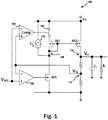
- Figure 1 illustrates a power supply 100 that includes a cutoff switch 102.
- the power supply 100 also includes a first comparator 104 to control the cutoff switch 102.
- a first switch M1 and a second switch M2 are included in a mirror configuration to regulate the output voltage V o .
- the second switch M2 is the main regulator switch that typically occupies the largest space on a semiconductor wafer on which the components of the power supply 100 are fabricated.
- the source of the first switch M1 is coupled to the cutoff switch 102 in series, that is, when the cutoff switch 102 is open, the source of the first switch M1 is disconnected from supply.
- the drain and the gate of the first switch M1 are coupled together.
- the source of the second switch M2 is coupled to the input power supply that is to be regulated.
- the drain of the second switch M2 is coupled to an output port 114.
- the output port 114 may be coupled to a capacitor C L and a resistor R L .
- a feedback port 112 is included.
- the feedback port 112 has a voltage V fb that is inputted to the first comparator 104 and a second comparator 106.
- the second comparator 106 is coupled to a third switch M3 and the second comparator 106 controls the gate of the third switch M3.
- a reference voltage V REF is inputted to the second input ports of the first comparator 104 and the second comparator 106.
- Biasing current I d is generated by a biasing current source 110 and inputted to the drain of the third switch M3.
- the biasing current Id is provided establish predetermined voltages or currents at various points in the power supply 100.
- the third switch M3 is provided to drive the main output device, e.g., the second switch M2 in the pass-through mode.
- the pass-through mode occurs when the input supply voltage falls below a selected threshold. In the pass-through mode, wherein the gate of M2 is pulled down by the front regulation stage, M1 needs to be disabled to prevent excessively large current draining into M3. Otherwise the gate voltage of M2 would remain at an elevated level, preventing the switch M2 from being fully opened, which in turn would necessitate a much larger area for silicon fabrication to handled elevated of passing through current.
- the power supply 100 is configured to provide a constant output voltage V o . But, when the input supply voltage V IN falls below a selected threshold, the output voltage V o also falls below another preselected threshold. If the input supply voltage VIN remains above the selected threshold, the output voltage V o remains constant even when the input supply voltage V IN fluctuates.
- Vo falls below the preselected threshold
- the feedback voltage V fb at the feedback port 112 falls below the reference voltage V REF .
- V fb falls below V REF
- the first comparator 104 turns off the cutoff switch 102, thus cutting of current to the first switch M1.
- the second comparator 106 applies gate voltage at the third switch M3. Cutting of current to the first switch M1 enables pulling the gate of the second switch M2 to close to ground.
- a high value resistor is placed in between the first switch M1 and the third switch M3 at the place shown by the arrow 108.
- the gate of the second switch M2 needs to be pulled down to maximize the output voltage.
- a high value resistor at the line 108 could limit the drain current to the third switch M3, the gate voltage of the second switch M2 is held up at a higher value than needed making a much larger size of the switch M2 necessary.
- the feedback port 112 may be the same as the output port that provides the voltage V o . In other examples, where a lower fixed V REF is used, the feedback port 112 may have a voltage lower than V o .
- FIG. 2 illustrates a method 200 for cutting off supply to a switch in the plurality of switches in a mirror configuration.
- step 202 voltage at a feedback port is compared, using a comparator, with a fixed reference voltage.
- step 204 a determination is made if the voltage at the feedback port is lower than the fixed reference voltage. If so, supply to a switch in the plurality of switched is cutoff using a cutoff switch that is coupled to the drain of the switch being cutoff from the power supply.
- a third switch that is coupled between the source of the switch being cutoff from power supply and ground, is turned on.
- a power supply is disclosed.
- the power supply includes a first switch and a second switch.
- the gate of the first switch is coupled to the gate of the second switch.
- the power supply further includes a cutoff switch coupled between the first switch and an input voltage port.
- a comparator is included for comparing a voltage at a feedback port with a fixed reference voltage. The comparator opens the cutoff switch when the voltage at the feedback port is lower than the fixed reference voltage.
Landscapes
- Engineering & Computer Science (AREA)
- Physics & Mathematics (AREA)
- Electromagnetism (AREA)
- General Physics & Mathematics (AREA)
- Radar, Positioning & Navigation (AREA)
- Automation & Control Theory (AREA)
- Nonlinear Science (AREA)
- Power Engineering (AREA)
- Electronic Switches (AREA)
- Continuous-Control Power Sources That Use Transistors (AREA)
- Dc-Dc Converters (AREA)
- Direct Current Feeding And Distribution (AREA)
Description
- Power supplies are used virtually in every electronic device primarily for converting alternate current (AC) electrical input that may be vary in voltage due to power line conditions and load factors into a constant direct current (DC) output to power the internal circuitry of the electronic device.
- There are several types of power supplies such as a linear regulator, a switching regulator and low drop-out regulator (LDO) are used in different applications. A linear regulator is a system used to maintain a steady voltage. The resistance of the regulator varies in accordance with the load resulting in a constant output voltage. The regulating device is made to act like a variable resistor, continuously adjusting a voltage divider network to maintain a constant output voltage and continually dissipating the difference between the input and regulated voltages as waste heat. A switching regulator uses an active device that switches on and off to maintain an average value of output. A low-dropout or LDO regulator is a DC linear voltage regulator that can regulate the output voltage even when the supply voltage is very close to the output voltage.
- For certain applications, the voltage regulator is forced into the so-called pass-through mode (PTM) when the input supply voltage is too low for regulation, in which case the output pass device will be fully opened, clamping the output to the input. Large silicon area is often required to fabricate the output pass device to minimize the resistance and reduce the voltage drop across it. Failing to fully open that device will lead to significant silicon area.
-
WO 1995/024066 A1 describes a current limited low dropout voltage circuit for coupling between first and second power supply terminals and an output terminal for providing a current limited low dropout voltage having a MOS pass transistor (PI) coupled in series between the first power supply terminal and the output terminal, a drive circuit (P2-P5) coupled to the gate of the MOS pass transistor, circuitry for limiting the gate-source voltage of the MOS pass transistor to limit the maximum current therethrough to a first maximum current level when the voltage between the second power supply terminal and the output terminal is less than a predetermined value, and circuitry for limiting the gate-source voltage of the MOS pass transistor to limit the maximum current therethrough to a second maximum current level when the source to drain voltage of the MOS pass transistor is greater than a predetermined voltage difference and the voltage between the output terminal and the second power supply terminal is greater than the predetermined value, the second maximum current level being greater than the first maximum current level. -
EP 3 051 378 A1 describes an LDO circuit that comprises a pass element, and input stage, a current sink, a comparator and a control circuit. The pass element is configured to generate an output voltage depending on a gate signal and on an input voltage. The input stage is configured to generate a steering signal based on a deviation between a first reference signal and a feedback signal, the feedback signal being based on the output voltage. The current sink is controlled by a steering signal and connected between the gate control terminal and a reference terminal. The comparator is configured to compare the steering signal to a second reference signal and to generate a switch signal based on the comparison. The control circuit comprises a first current path and is configured to suspend, in particular temporarily suspend, the first current path depending on the switch signal. -
US 2009/206807 A1 describes voltage regulator including an overcurrent protection circuit, which is capable of enhancing accuracy of a limit current value and a short-circuit current value, and suppressing electric power loss when an overcurrent flows through an output transistor. The overcurrent protection circuit includes: an output current detection transistor controlled by an output voltage of an error amplifier circuit, for feeding a detection current; a detection resistor for generating a detection voltage based on the detection current; a second error amplifier circuit for amplifying a difference between a voltage set by a second reference voltage and a divided voltage, and the voltage of the detection resistor, and outputting the amplified difference; and an output current limiting circuit in which a gate thereof is controlled by an output of the second error amplifier circuit, for controlling a gate voltage of the output transistor. Further, the second reference voltage is supplied from a temperature detection circuit. -
US 2017/102724 A1 describes a voltage regulator that includes an input terminal to receive an input voltage, an output terminal to supply an output voltage, a power transistor, a differential amplifier, a driver, a dropout detector and a bias current limiter. The differential amplifier provides a drive signal based on a difference between a voltage reference and a feedback signal corresponding to the output voltage. The driver includes an impedance device, and a driver transistor that receives the drive signal so as to vary a bias current to a control terminal of the power transistor. The dropout detector and the bias current limiter is coupled to the input terminal, the impedance device, and the output terminal and includes first and second transistors coupled together, and a bias current generator coupled to the second transistor. - According to an aspect of the invention, there is provided a power supply, comprising:
an input voltage port configured to receive an input supply voltage; - a first transistor and a second transistor in a mirror configuration in which a gate of the first transistor is coupled to a gate of the second transistor and a drain of the first transistor is connected to the gate of the first transistor;
- a cutoff switch coupled between the first transistor and the input voltage port;
- an output port configured to provide an output voltage, wherein the second transistor is coupled between the input voltage port and the output port;
- a third transistor coupled to a drain of the first transistor;
- a feedback port;
- a comparator for comparing a voltage at the feedback port with a fixed reference voltage, wherein the comparator is configured to open the cutoff switch when the voltage at the feedback port is lower than the fixed reference voltage; and
- a second comparator coupled to receive the fixed reference voltage and the voltage at the feedback port to control the gate of the third transistor.
- In one embodiment, the power supply further includes a biasing current source coupled to the drain of the first transistor and a drain of the third transistor.
- In one embodiment, the third transistor is also coupled to ground.
- In one embodiment, the voltage at the feedback port is configured to vary proportionately to the output voltage.
- In one embodiment, the second comparator is configured to control the third transistor when the voltage at the feedback port is lower than the fixed reference voltage.
- According to another aspect of the invention, there is provided a method for regulating input voltage in a power supply according to any of claims 1 to 5, the method comprising:
comparing the voltage at the feedback port with the fixed reference voltage and, if the voltage at the feedback port is lower than the fixed reference voltage, using the cutoff switch to cut off the power supply from the first switch. - In one embodiment, the method further includes using the third transistor to control the gate of the second transistor when the voltage at the feedback port is lower than the fixed reference voltage.
- So that the manner in which the above recited features of the present invention can be understood in detail, a more particular description of the invention, briefly summarized above, may be had by reference to embodiments, some of which are illustrated in the appended drawings. It is to be noted, however, that the appended drawings illustrate only typical embodiments of this invention and are therefore not to be considered limiting of its scope, for the invention may admit to other equally effective embodiments. Advantages of the subject matter claimed will become apparent to those skilled in the art upon reading this description in conjunction with the accompanying drawings, in which like reference numerals have been used to designate like elements, and in which:
-
FIG. 1 depicts a schematic diagram of a power supply with a cutoff switch in accordance with one or more embodiments of the present disclosure; and -
FIG. 2 illustrates a method for cutting off supply to a switch in the plurality of switches in a mirror configuration in accordance with one or more embodiments of the present disclosure. - Note that figures are not drawn to scale. Intermediate steps between figure transitions have been omitted so as not to obfuscate the disclosure. Those intermediate steps are known to a person skilled in the art.
- Many well-known manufacturing steps, components, and connectors have been omitted or not described in detail in the description so as not to obfuscate the present disclosure.
-
Figure 1 illustrates apower supply 100 that includes acutoff switch 102. Thepower supply 100 also includes afirst comparator 104 to control thecutoff switch 102. A first switch M1 and a second switch M2 are included in a mirror configuration to regulate the output voltage Vo. The second switch M2 is the main regulator switch that typically occupies the largest space on a semiconductor wafer on which the components of thepower supply 100 are fabricated. The source of the first switch M1 is coupled to thecutoff switch 102 in series, that is, when thecutoff switch 102 is open, the source of the first switch M1 is disconnected from supply. The drain and the gate of the first switch M1 are coupled together. The source of the second switch M2 is coupled to the input power supply that is to be regulated. The drain of the second switch M2 is coupled to anoutput port 114. In some examples, theoutput port 114 may be coupled to a capacitor CL and a resistor RL.A feedback port 112 is included. Thefeedback port 112 has a voltage Vfb that is inputted to thefirst comparator 104 and asecond comparator 106. Thesecond comparator 106 is coupled to a third switch M3 and thesecond comparator 106 controls the gate of the third switch M3. A reference voltage VREF is inputted to the second input ports of thefirst comparator 104 and thesecond comparator 106. - Biasing current Id is generated by a biasing
current source 110 and inputted to the drain of the third switch M3. The biasing current Id is provided establish predetermined voltages or currents at various points in thepower supply 100. The third switch M3 is provided to drive the main output device, e.g., the second switch M2 in the pass-through mode. The pass-through mode occurs when the input supply voltage falls below a selected threshold. In the pass-through mode, wherein the gate of M2 is pulled down by the front regulation stage, M1 needs to be disabled to prevent excessively large current draining into M3. Otherwise the gate voltage of M2 would remain at an elevated level, preventing the switch M2 from being fully opened, which in turn would necessitate a much larger area for silicon fabrication to handled elevated of passing through current. - The
power supply 100 is configured to provide a constant output voltage Vo. But, when the input supply voltage VIN falls below a selected threshold, the output voltage Vo also falls below another preselected threshold. If the input supply voltage VIN remains above the selected threshold, the output voltage Vo remains constant even when the input supply voltage VIN fluctuates. When Vo falls below the preselected threshold, the feedback voltage Vfb at thefeedback port 112 falls below the reference voltage VREF. When Vfb falls below VREF, thefirst comparator 104 turns off thecutoff switch 102, thus cutting of current to the first switch M1. At the same time, thesecond comparator 106 applies gate voltage at the third switch M3. Cutting of current to the first switch M1 enables pulling the gate of the second switch M2 to close to ground. - Typically, a high value resistor is placed in between the first switch M1 and the third switch M3 at the place shown by the
arrow 108. In pass-through modes, the gate of the second switch M2 needs to be pulled down to maximize the output voltage. While a high value resistor at theline 108 could limit the drain current to the third switch M3, the gate voltage of the second switch M2 is held up at a higher value than needed making a much larger size of the switch M2 necessary. In some examples, thefeedback port 112 may be the same as the output port that provides the voltage Vo. In other examples, where a lower fixed VREF is used, thefeedback port 112 may have a voltage lower than Vo. -
FIG. 2 illustrates amethod 200 for cutting off supply to a switch in the plurality of switches in a mirror configuration. Accordingly, atstep 202, voltage at a feedback port is compared, using a comparator, with a fixed reference voltage. Atstep 204, a determination is made if the voltage at the feedback port is lower than the fixed reference voltage. If so, supply to a switch in the plurality of switched is cutoff using a cutoff switch that is coupled to the drain of the switch being cutoff from the power supply. Atstep 206, if the voltage at the feedback port is lower than the fixed reference voltage, a third switch that is coupled between the source of the switch being cutoff from power supply and ground, is turned on. - A power supply is disclosed. The power supply includes a first switch and a second switch. The gate of the first switch is coupled to the gate of the second switch. The power supply further includes a cutoff switch coupled between the first switch and an input voltage port. A comparator is included for comparing a voltage at a feedback port with a fixed reference voltage. The comparator opens the cutoff switch when the voltage at the feedback port is lower than the fixed reference voltage.
- The subject matter described herein can be embodied in many different variations, and all such variations are contemplated to be within the scope of what is claimed.
- While one or more implementations have been described by way of example and in terms of the specific embodiments, it is to be understood that one or more implementations are not limited to the disclosed embodiments. To the contrary, it is intended to cover various modifications and similar arrangements as would be apparent to those skilled in the art. Therefore, the scope of the appended claims should be accorded the broadest interpretation so as to encompass all such modifications and similar arrangements.
- The use of the terms "a" and "an" and "the" and similar referents in the context of describing the subject matter (particularly in the context of the following claims) are to be construed to cover both the singular and the plural, unless otherwise indicated herein or clearly contradicted by context. Recitation of ranges of values herein are merely intended to serve as a shorthand method of referring individually to each separate value falling within the range, unless otherwise indicated herein, and each separate value is incorporated into the specification as if it were individually recited herein. Furthermore, the foregoing description is for the purpose of illustration only, and not for the purpose of limitation, as the scope of protection sought is defined by the claims as set forth hereinafter together with any equivalents thereof entitled to. The use of any and all examples, or exemplary language (e.g., "such as") provided herein, is intended merely to better illustrate the subject matter and does not pose a limitation on the scope of the subject matter unless otherwise claimed. The use of the term "based on" and other like phrases indicating a condition for bringing about a result, both in the claims and in the written description, is not intended to foreclose any other conditions that bring about that result.
- Preferred embodiments are described herein, including the best mode known to the inventor for carrying out the claimed subject matter. Of course, variations of those preferred embodiments will become apparent to those of ordinary skill in the art upon reading the foregoing description. The inventor expects skilled artisans to employ such variations as appropriate, and the inventor intends for the claimed subject matter to be practiced otherwise than as specifically described herein. Accordingly, this claimed subject matter includes all modifications and equivalents of the subject matter recited in the claims appended hereto as permitted by applicable law.
Claims (7)
- A power supply (100), comprising:
an input voltage port configured to receive an input supply voltage (Vin);a first transistor (M1) and a second transistor (M2) in a mirror configuration in which a gate of the first transistor is coupled to a gate of the second transistor and a drain of the first transistor is connected to the gate of the first transistor;a cutoff switch (102) coupled between the first transistor and the input voltage port;an output port (114) configured to provide an output voltage (Vo), wherein the second transistor is coupled between the input voltage port and the output port;a third transistor (M3) coupled to a drain of the first transistor; anda feedback port; the power supply characterised in that it further comprises:a comparator (104) for comparing a voltage (Vfb) at the feedback port with a fixed reference voltage, wherein the comparator is configured to open the cutoff switch when the voltage at the feedback port (112) is lower than the fixed reference voltage; anda second comparator (106) coupled to receive the fixed reference voltage and the voltage at the feedback port to control the gate of the third transistor. - The power supply of claim 1, further including a biasing current source (110) coupled to the drain of the first transistor and a drain of the third transistor.
- The power supply of claim 1 or 2, wherein the third transistor is also coupled to ground.
- The power supply of any preceding claim, wherein the voltage at the feedback port is configured to vary proportionately to said output voltage.
- The power supply of any preceding claim, wherein the second comparator is configured to control the third transistor when the voltage at the feedback port is lower than the fixed reference voltage.
- A method for regulating input voltage in a power supply (100) according to any preceding claim, the method characterised in that it comprises:
comparing the voltage (Vfb) at the feedback port with the fixed reference voltage and, if the voltage at the feedback port is lower than the fixed reference voltage, using the cutoff switch (102) to cut off the power supply from the first transistor (M1). - The method of claim 6, wherein the method further includes using (206) the third transistor (M3) to control the gate of the second transistor (M2) when the voltage at the feedback port is lower than the fixed reference voltage.
Applications Claiming Priority (1)
| Application Number | Priority Date | Filing Date | Title |
|---|---|---|---|
| US15/952,583 US10317921B1 (en) | 2018-04-13 | 2018-04-13 | Effective clamping in power supplies |
Publications (2)
| Publication Number | Publication Date |
|---|---|
| EP3553624A1 EP3553624A1 (en) | 2019-10-16 |
| EP3553624B1 true EP3553624B1 (en) | 2021-09-15 |
Family
ID=66092126
Family Applications (1)
| Application Number | Title | Priority Date | Filing Date |
|---|---|---|---|
| EP19167221.1A Active EP3553624B1 (en) | 2018-04-13 | 2019-04-04 | Effective clamping in power supplies |
Country Status (3)
| Country | Link |
|---|---|
| US (1) | US10317921B1 (en) |
| EP (1) | EP3553624B1 (en) |
| CN (1) | CN110380610B (en) |
Families Citing this family (2)
| Publication number | Priority date | Publication date | Assignee | Title |
|---|---|---|---|---|
| CN111474974B (en) * | 2020-04-30 | 2022-07-01 | 上海维安半导体有限公司 | Method for improving transient response of LDO (low dropout regulator) during sudden change from heavy load to light load or no load |
| US11656643B2 (en) * | 2021-05-12 | 2023-05-23 | Nxp Usa, Inc. | Capless low dropout regulation |
Family Cites Families (24)
| Publication number | Priority date | Publication date | Assignee | Title |
|---|---|---|---|---|
| US5539603A (en) * | 1994-03-02 | 1996-07-23 | Maxim Integrated Products | Current protection method and apparatus and current protected low dropout voltage circuits |
| FR2798480B1 (en) * | 1999-09-10 | 2001-10-26 | St Microelectronics Sa | VOLTAGE REGULATOR |
| US6411068B1 (en) * | 2000-10-03 | 2002-06-25 | Bae Systems Information & Electronic Systems Integration, Inc. | Self-oscillating switching regulator |
| JP4587804B2 (en) * | 2004-12-22 | 2010-11-24 | 株式会社リコー | Voltage regulator circuit |
| US7221213B2 (en) * | 2005-08-08 | 2007-05-22 | Aimtron Technology Corp. | Voltage regulator with prevention from overvoltage at load transients |
| US7728569B1 (en) * | 2007-04-10 | 2010-06-01 | Altera Corporation | Voltage regulator circuitry with adaptive compensation |
| JP5099505B2 (en) * | 2008-02-15 | 2012-12-19 | セイコーインスツル株式会社 | Voltage regulator |
| CN101841240B (en) * | 2010-04-12 | 2012-08-29 | 无锡中星微电子有限公司 | Power supply converter and error amplifier |
| CN102237812B (en) * | 2010-04-26 | 2013-06-12 | 辉芒微电子(深圳)有限公司 | Primary side feedback (FB) switching power supply controller and switching power supply system |
| US8456784B2 (en) * | 2010-05-03 | 2013-06-04 | Freescale Semiconductor, Inc. | Overvoltage protection circuit for an integrated circuit |
| US8531194B2 (en) * | 2011-03-24 | 2013-09-10 | Freescale Semiconductor, Inc. | Selectable threshold reset circuit |
| JP2013046496A (en) * | 2011-08-24 | 2013-03-04 | Fujitsu Semiconductor Ltd | Control circuit, power supply device, and method of controlling power supply |
| US20130063116A1 (en) * | 2011-09-14 | 2013-03-14 | Fairchild Semiconductor Corporation | True reverse current blocking system |
| CN102420005B (en) * | 2011-11-30 | 2014-02-19 | 中国科学院微电子研究所 | A current-mode sense amplifier and memory with the sense amplifier |
| CN202794314U (en) * | 2012-07-19 | 2013-03-13 | 快捷半导体(苏州)有限公司 | Over-current detection circuit of power switching tube |
| US8975882B2 (en) * | 2012-10-31 | 2015-03-10 | Taiwan Semiconductor Manufacturing Co., Ltd. | Regulator with improved wake-up time |
| KR101974024B1 (en) * | 2012-11-26 | 2019-05-02 | 온세미컨덕터코리아 주식회사 | Undervoltage lockout circuit, switch control circuit and power supply device comprising the undervoltage lockout circuit |
| EP2779452B1 (en) * | 2013-03-13 | 2018-08-15 | Nxp B.V. | Switchable current source circuit and method |
| US9748849B2 (en) * | 2013-07-08 | 2017-08-29 | Fairchild Korea Semiconductor Ltd. | Power supply |
| EP3051378B1 (en) * | 2015-01-28 | 2021-05-12 | ams AG | Low dropout regulator circuit and method for controlling a voltage of a low dropout regulator circuit |
| US9645594B2 (en) * | 2015-10-13 | 2017-05-09 | STMicroelectronics Design & Application S.R.O. | Voltage regulator with dropout detector and bias current limiter and associated methods |
| CN105490537B (en) * | 2015-12-29 | 2017-11-24 | 无锡中感微电子股份有限公司 | A kind of electric power management circuit |
| US10444778B2 (en) * | 2016-08-09 | 2019-10-15 | Nxp Usa, Inc. | Voltage regulator |
| CN106505835B (en) * | 2016-12-12 | 2019-08-27 | 北京集创北方科技股份有限公司 | Voltage clamping circuit and DC-DC converter |
-
2018
- 2018-04-13 US US15/952,583 patent/US10317921B1/en active Active
-
2019
- 2019-04-04 EP EP19167221.1A patent/EP3553624B1/en active Active
- 2019-04-11 CN CN201910291542.1A patent/CN110380610B/en active Active
Also Published As
| Publication number | Publication date |
|---|---|
| EP3553624A1 (en) | 2019-10-16 |
| CN110380610A (en) | 2019-10-25 |
| US10317921B1 (en) | 2019-06-11 |
| CN110380610B (en) | 2024-08-13 |
Similar Documents
| Publication | Publication Date | Title |
|---|---|---|
| US8169202B2 (en) | Low dropout regulators | |
| US12079018B2 (en) | Voltage regulator | |
| EP2846213B1 (en) | Method and apparatus for limiting startup inrush current for low dropout regulator | |
| US8217638B1 (en) | Linear regulation for use with electronic circuits | |
| US7339775B2 (en) | Overcurrent protection circuit and DC power supply | |
| EP1729197A1 (en) | A low-drop out (LDO) voltage regulator with pole zero compensation. | |
| US8026708B2 (en) | Voltage regulator | |
| US7602162B2 (en) | Voltage regulator with over-current protection | |
| EP2894537B1 (en) | Voltage regulator | |
| US7586364B2 (en) | Power supply voltage controlling circuit and semiconductor integrated circuit | |
| US10761549B2 (en) | Voltage sensing mechanism to minimize short-to-ground current for low drop-out and bypass mode regulators | |
| US9645593B2 (en) | Voltage regulator | |
| EP1669831A1 (en) | Voltage regulator output stage with low voltage MOS devices | |
| US20100090755A1 (en) | Current Limiting Load Switch with Dynamically Generated Tracking Reference Voltage | |
| US10571942B2 (en) | Overcurrent limiting circuit, overcurrent limiting method, and power supply circuit | |
| US9966941B2 (en) | Wide input range, low output voltage power supply | |
| EP3588238B1 (en) | Voltage regulation circuits with separately activated control loops | |
| US10310526B2 (en) | Quiescent current limitation for a low-dropout regulator in dropout condition | |
| KR20100094365A (en) | Voltage regulator | |
| US8373398B2 (en) | Area-efficient voltage regulators | |
| US9740222B2 (en) | Overcurrent protection circuit for controlling a gate of an output transistor based on an output current | |
| EP3553624B1 (en) | Effective clamping in power supplies | |
| US8884596B2 (en) | Dynamic control of frequency compensation for improved over-voltage protection in a switching regulator | |
| US10917058B2 (en) | Servo-amplifier with closed-loop biasing | |
| US20250199555A1 (en) | Voltage regulator with switching circuitry |
Legal Events
| Date | Code | Title | Description |
|---|---|---|---|
| PUAI | Public reference made under article 153(3) epc to a published international application that has entered the european phase |
Free format text: ORIGINAL CODE: 0009012 |
|
| STAA | Information on the status of an ep patent application or granted ep patent |
Free format text: STATUS: THE APPLICATION HAS BEEN PUBLISHED |
|
| AK | Designated contracting states |
Kind code of ref document: A1 Designated state(s): AL AT BE BG CH CY CZ DE DK EE ES FI FR GB GR HR HU IE IS IT LI LT LU LV MC MK MT NL NO PL PT RO RS SE SI SK SM TR |
|
| AX | Request for extension of the european patent |
Extension state: BA ME |
|
| STAA | Information on the status of an ep patent application or granted ep patent |
Free format text: STATUS: REQUEST FOR EXAMINATION WAS MADE |
|
| 17P | Request for examination filed |
Effective date: 20200416 |
|
| RBV | Designated contracting states (corrected) |
Designated state(s): AL AT BE BG CH CY CZ DE DK EE ES FI FR GB GR HR HU IE IS IT LI LT LU LV MC MK MT NL NO PL PT RO RS SE SI SK SM TR |
|
| GRAP | Despatch of communication of intention to grant a patent |
Free format text: ORIGINAL CODE: EPIDOSNIGR1 |
|
| STAA | Information on the status of an ep patent application or granted ep patent |
Free format text: STATUS: GRANT OF PATENT IS INTENDED |
|
| INTG | Intention to grant announced |
Effective date: 20210519 |
|
| GRAS | Grant fee paid |
Free format text: ORIGINAL CODE: EPIDOSNIGR3 |
|
| GRAA | (expected) grant |
Free format text: ORIGINAL CODE: 0009210 |
|
| STAA | Information on the status of an ep patent application or granted ep patent |
Free format text: STATUS: THE PATENT HAS BEEN GRANTED |
|
| AK | Designated contracting states |
Kind code of ref document: B1 Designated state(s): AL AT BE BG CH CY CZ DE DK EE ES FI FR GB GR HR HU IE IS IT LI LT LU LV MC MK MT NL NO PL PT RO RS SE SI SK SM TR |
|
| REG | Reference to a national code |
Ref country code: CH Ref legal event code: EP |
|
| REG | Reference to a national code |
Ref country code: DE Ref legal event code: R096 Ref document number: 602019007633 Country of ref document: DE |
|
| REG | Reference to a national code |
Ref country code: IE Ref legal event code: FG4D |
|
| REG | Reference to a national code |
Ref country code: AT Ref legal event code: REF Ref document number: 1430986 Country of ref document: AT Kind code of ref document: T Effective date: 20211015 |
|
| REG | Reference to a national code |
Ref country code: LT Ref legal event code: MG9D |
|
| REG | Reference to a national code |
Ref country code: NL Ref legal event code: MP Effective date: 20210915 |
|
| PG25 | Lapsed in a contracting state [announced via postgrant information from national office to epo] |
Ref country code: HR Free format text: LAPSE BECAUSE OF FAILURE TO SUBMIT A TRANSLATION OF THE DESCRIPTION OR TO PAY THE FEE WITHIN THE PRESCRIBED TIME-LIMIT Effective date: 20210915 Ref country code: NO Free format text: LAPSE BECAUSE OF FAILURE TO SUBMIT A TRANSLATION OF THE DESCRIPTION OR TO PAY THE FEE WITHIN THE PRESCRIBED TIME-LIMIT Effective date: 20211215 Ref country code: LT Free format text: LAPSE BECAUSE OF FAILURE TO SUBMIT A TRANSLATION OF THE DESCRIPTION OR TO PAY THE FEE WITHIN THE PRESCRIBED TIME-LIMIT Effective date: 20210915 Ref country code: BG Free format text: LAPSE BECAUSE OF FAILURE TO SUBMIT A TRANSLATION OF THE DESCRIPTION OR TO PAY THE FEE WITHIN THE PRESCRIBED TIME-LIMIT Effective date: 20211215 Ref country code: SE Free format text: LAPSE BECAUSE OF FAILURE TO SUBMIT A TRANSLATION OF THE DESCRIPTION OR TO PAY THE FEE WITHIN THE PRESCRIBED TIME-LIMIT Effective date: 20210915 Ref country code: RS Free format text: LAPSE BECAUSE OF FAILURE TO SUBMIT A TRANSLATION OF THE DESCRIPTION OR TO PAY THE FEE WITHIN THE PRESCRIBED TIME-LIMIT Effective date: 20210915 Ref country code: FI Free format text: LAPSE BECAUSE OF FAILURE TO SUBMIT A TRANSLATION OF THE DESCRIPTION OR TO PAY THE FEE WITHIN THE PRESCRIBED TIME-LIMIT Effective date: 20210915 |
|
| REG | Reference to a national code |
Ref country code: AT Ref legal event code: MK05 Ref document number: 1430986 Country of ref document: AT Kind code of ref document: T Effective date: 20210915 |
|
| PG25 | Lapsed in a contracting state [announced via postgrant information from national office to epo] |
Ref country code: LV Free format text: LAPSE BECAUSE OF FAILURE TO SUBMIT A TRANSLATION OF THE DESCRIPTION OR TO PAY THE FEE WITHIN THE PRESCRIBED TIME-LIMIT Effective date: 20210915 Ref country code: GR Free format text: LAPSE BECAUSE OF FAILURE TO SUBMIT A TRANSLATION OF THE DESCRIPTION OR TO PAY THE FEE WITHIN THE PRESCRIBED TIME-LIMIT Effective date: 20211216 |
|
| PG25 | Lapsed in a contracting state [announced via postgrant information from national office to epo] |
Ref country code: AT Free format text: LAPSE BECAUSE OF FAILURE TO SUBMIT A TRANSLATION OF THE DESCRIPTION OR TO PAY THE FEE WITHIN THE PRESCRIBED TIME-LIMIT Effective date: 20210915 |
|
| PG25 | Lapsed in a contracting state [announced via postgrant information from national office to epo] |
Ref country code: IS Free format text: LAPSE BECAUSE OF FAILURE TO SUBMIT A TRANSLATION OF THE DESCRIPTION OR TO PAY THE FEE WITHIN THE PRESCRIBED TIME-LIMIT Effective date: 20220115 Ref country code: SM Free format text: LAPSE BECAUSE OF FAILURE TO SUBMIT A TRANSLATION OF THE DESCRIPTION OR TO PAY THE FEE WITHIN THE PRESCRIBED TIME-LIMIT Effective date: 20210915 Ref country code: SK Free format text: LAPSE BECAUSE OF FAILURE TO SUBMIT A TRANSLATION OF THE DESCRIPTION OR TO PAY THE FEE WITHIN THE PRESCRIBED TIME-LIMIT Effective date: 20210915 Ref country code: RO Free format text: LAPSE BECAUSE OF FAILURE TO SUBMIT A TRANSLATION OF THE DESCRIPTION OR TO PAY THE FEE WITHIN THE PRESCRIBED TIME-LIMIT Effective date: 20210915 Ref country code: PT Free format text: LAPSE BECAUSE OF FAILURE TO SUBMIT A TRANSLATION OF THE DESCRIPTION OR TO PAY THE FEE WITHIN THE PRESCRIBED TIME-LIMIT Effective date: 20220117 Ref country code: PL Free format text: LAPSE BECAUSE OF FAILURE TO SUBMIT A TRANSLATION OF THE DESCRIPTION OR TO PAY THE FEE WITHIN THE PRESCRIBED TIME-LIMIT Effective date: 20210915 Ref country code: NL Free format text: LAPSE BECAUSE OF FAILURE TO SUBMIT A TRANSLATION OF THE DESCRIPTION OR TO PAY THE FEE WITHIN THE PRESCRIBED TIME-LIMIT Effective date: 20210915 Ref country code: ES Free format text: LAPSE BECAUSE OF FAILURE TO SUBMIT A TRANSLATION OF THE DESCRIPTION OR TO PAY THE FEE WITHIN THE PRESCRIBED TIME-LIMIT Effective date: 20210915 Ref country code: EE Free format text: LAPSE BECAUSE OF FAILURE TO SUBMIT A TRANSLATION OF THE DESCRIPTION OR TO PAY THE FEE WITHIN THE PRESCRIBED TIME-LIMIT Effective date: 20210915 Ref country code: CZ Free format text: LAPSE BECAUSE OF FAILURE TO SUBMIT A TRANSLATION OF THE DESCRIPTION OR TO PAY THE FEE WITHIN THE PRESCRIBED TIME-LIMIT Effective date: 20210915 Ref country code: AL Free format text: LAPSE BECAUSE OF FAILURE TO SUBMIT A TRANSLATION OF THE DESCRIPTION OR TO PAY THE FEE WITHIN THE PRESCRIBED TIME-LIMIT Effective date: 20210915 |
|
| REG | Reference to a national code |
Ref country code: DE Ref legal event code: R097 Ref document number: 602019007633 Country of ref document: DE |
|
| PLBE | No opposition filed within time limit |
Free format text: ORIGINAL CODE: 0009261 |
|
| STAA | Information on the status of an ep patent application or granted ep patent |
Free format text: STATUS: NO OPPOSITION FILED WITHIN TIME LIMIT |
|
| PG25 | Lapsed in a contracting state [announced via postgrant information from national office to epo] |
Ref country code: DK Free format text: LAPSE BECAUSE OF FAILURE TO SUBMIT A TRANSLATION OF THE DESCRIPTION OR TO PAY THE FEE WITHIN THE PRESCRIBED TIME-LIMIT Effective date: 20210915 |
|
| 26N | No opposition filed |
Effective date: 20220616 |
|
| PG25 | Lapsed in a contracting state [announced via postgrant information from national office to epo] |
Ref country code: SI Free format text: LAPSE BECAUSE OF FAILURE TO SUBMIT A TRANSLATION OF THE DESCRIPTION OR TO PAY THE FEE WITHIN THE PRESCRIBED TIME-LIMIT Effective date: 20210915 |
|
| REG | Reference to a national code |
Ref country code: CH Ref legal event code: PL |
|
| REG | Reference to a national code |
Ref country code: BE Ref legal event code: MM Effective date: 20220430 |
|
| PG25 | Lapsed in a contracting state [announced via postgrant information from national office to epo] |
Ref country code: MC Free format text: LAPSE BECAUSE OF FAILURE TO SUBMIT A TRANSLATION OF THE DESCRIPTION OR TO PAY THE FEE WITHIN THE PRESCRIBED TIME-LIMIT Effective date: 20210915 Ref country code: LU Free format text: LAPSE BECAUSE OF NON-PAYMENT OF DUE FEES Effective date: 20220404 Ref country code: LI Free format text: LAPSE BECAUSE OF NON-PAYMENT OF DUE FEES Effective date: 20220430 Ref country code: IT Free format text: LAPSE BECAUSE OF FAILURE TO SUBMIT A TRANSLATION OF THE DESCRIPTION OR TO PAY THE FEE WITHIN THE PRESCRIBED TIME-LIMIT Effective date: 20210915 Ref country code: CH Free format text: LAPSE BECAUSE OF NON-PAYMENT OF DUE FEES Effective date: 20220430 |
|
| PG25 | Lapsed in a contracting state [announced via postgrant information from national office to epo] |
Ref country code: BE Free format text: LAPSE BECAUSE OF NON-PAYMENT OF DUE FEES Effective date: 20220430 |
|
| PG25 | Lapsed in a contracting state [announced via postgrant information from national office to epo] |
Ref country code: IE Free format text: LAPSE BECAUSE OF NON-PAYMENT OF DUE FEES Effective date: 20220404 |
|
| P01 | Opt-out of the competence of the unified patent court (upc) registered |
Effective date: 20230725 |
|
| GBPC | Gb: european patent ceased through non-payment of renewal fee |
Effective date: 20230404 |
|
| PG25 | Lapsed in a contracting state [announced via postgrant information from national office to epo] |
Ref country code: GB Free format text: LAPSE BECAUSE OF NON-PAYMENT OF DUE FEES Effective date: 20230404 |
|
| PG25 | Lapsed in a contracting state [announced via postgrant information from national office to epo] |
Ref country code: GB Free format text: LAPSE BECAUSE OF NON-PAYMENT OF DUE FEES Effective date: 20230404 |
|
| PG25 | Lapsed in a contracting state [announced via postgrant information from national office to epo] |
Ref country code: HU Free format text: LAPSE BECAUSE OF FAILURE TO SUBMIT A TRANSLATION OF THE DESCRIPTION OR TO PAY THE FEE WITHIN THE PRESCRIBED TIME-LIMIT; INVALID AB INITIO Effective date: 20190404 |
|
| PG25 | Lapsed in a contracting state [announced via postgrant information from national office to epo] |
Ref country code: MK Free format text: LAPSE BECAUSE OF FAILURE TO SUBMIT A TRANSLATION OF THE DESCRIPTION OR TO PAY THE FEE WITHIN THE PRESCRIBED TIME-LIMIT Effective date: 20210915 Ref country code: CY Free format text: LAPSE BECAUSE OF FAILURE TO SUBMIT A TRANSLATION OF THE DESCRIPTION OR TO PAY THE FEE WITHIN THE PRESCRIBED TIME-LIMIT Effective date: 20210915 |
|
| PG25 | Lapsed in a contracting state [announced via postgrant information from national office to epo] |
Ref country code: MT Free format text: LAPSE BECAUSE OF FAILURE TO SUBMIT A TRANSLATION OF THE DESCRIPTION OR TO PAY THE FEE WITHIN THE PRESCRIBED TIME-LIMIT Effective date: 20210915 |
|
| PGFP | Annual fee paid to national office [announced via postgrant information from national office to epo] |
Ref country code: FR Payment date: 20250319 Year of fee payment: 7 |
|
| PGFP | Annual fee paid to national office [announced via postgrant information from national office to epo] |
Ref country code: DE Payment date: 20250319 Year of fee payment: 7 |
|
| PG25 | Lapsed in a contracting state [announced via postgrant information from national office to epo] |
Ref country code: TR Free format text: LAPSE BECAUSE OF FAILURE TO SUBMIT A TRANSLATION OF THE DESCRIPTION OR TO PAY THE FEE WITHIN THE PRESCRIBED TIME-LIMIT Effective date: 20210915 |