EP3553230B1 - Laderauslegerarmanordnung - Google Patents
Laderauslegerarmanordnung Download PDFInfo
- Publication number
- EP3553230B1 EP3553230B1 EP19163533.3A EP19163533A EP3553230B1 EP 3553230 B1 EP3553230 B1 EP 3553230B1 EP 19163533 A EP19163533 A EP 19163533A EP 3553230 B1 EP3553230 B1 EP 3553230B1
- Authority
- EP
- European Patent Office
- Prior art keywords
- hollow beam
- bores
- knee
- arm assembly
- loader
- Prior art date
- Legal status (The legal status is an assumption and is not a legal conclusion. Google has not performed a legal analysis and makes no representation as to the accuracy of the status listed.)
- Active
Links
Images







Classifications
-
- E—FIXED CONSTRUCTIONS
- E02—HYDRAULIC ENGINEERING; FOUNDATIONS; SOIL SHIFTING
- E02F—DREDGING; SOIL-SHIFTING
- E02F3/00—Dredgers; Soil-shifting machines
- E02F3/04—Dredgers; Soil-shifting machines mechanically-driven
- E02F3/28—Dredgers; Soil-shifting machines mechanically-driven with digging tools mounted on a dipper- or bucket-arm, i.e. there is either one arm or a pair of arms, e.g. dippers, buckets
- E02F3/34—Dredgers; Soil-shifting machines mechanically-driven with digging tools mounted on a dipper- or bucket-arm, i.e. there is either one arm or a pair of arms, e.g. dippers, buckets with bucket-arms, i.e. a pair of arms, e.g. manufacturing processes, form, geometry, material of bucket-arms directly pivoted on the frames of tractors or self-propelled machines
-
- A—HUMAN NECESSITIES
- A01—AGRICULTURE; FORESTRY; ANIMAL HUSBANDRY; HUNTING; TRAPPING; FISHING
- A01D—HARVESTING; MOWING
- A01D87/00—Loaders for hay or like field crops
- A01D87/0053—Tractor-mounted loaders
- A01D87/0069—Tractor-mounted loaders mounted on the tractor but having their own lifting device
- A01D87/0076—Front loaders
-
- E—FIXED CONSTRUCTIONS
- E02—HYDRAULIC ENGINEERING; FOUNDATIONS; SOIL SHIFTING
- E02F—DREDGING; SOIL-SHIFTING
- E02F3/00—Dredgers; Soil-shifting machines
- E02F3/04—Dredgers; Soil-shifting machines mechanically-driven
- E02F3/28—Dredgers; Soil-shifting machines mechanically-driven with digging tools mounted on a dipper- or bucket-arm, i.e. there is either one arm or a pair of arms, e.g. dippers, buckets
- E02F3/36—Component parts
- E02F3/369—Devices to connect parts of a boom or an arm
-
- E—FIXED CONSTRUCTIONS
- E02—HYDRAULIC ENGINEERING; FOUNDATIONS; SOIL SHIFTING
- E02F—DREDGING; SOIL-SHIFTING
- E02F3/00—Dredgers; Soil-shifting machines
- E02F3/04—Dredgers; Soil-shifting machines mechanically-driven
- E02F3/28—Dredgers; Soil-shifting machines mechanically-driven with digging tools mounted on a dipper- or bucket-arm, i.e. there is either one arm or a pair of arms, e.g. dippers, buckets
- E02F3/36—Component parts
- E02F3/38—Cantilever beams, i.e. booms;, e.g. manufacturing processes, forms, geometry or materials used for booms; Dipper-arms, e.g. manufacturing processes, forms, geometry or materials used for dipper-arms; Bucket-arms
-
- A—HUMAN NECESSITIES
- A01—AGRICULTURE; FORESTRY; ANIMAL HUSBANDRY; HUNTING; TRAPPING; FISHING
- A01B—SOIL WORKING IN AGRICULTURE OR FORESTRY; PARTS, DETAILS, OR ACCESSORIES OF AGRICULTURAL MACHINES OR IMPLEMENTS, IN GENERAL
- A01B63/00—Lifting or adjusting devices or arrangements for agricultural machines or implements
- A01B63/02—Lifting or adjusting devices or arrangements for agricultural machines or implements for implements mounted on tractors
- A01B63/10—Lifting or adjusting devices or arrangements for agricultural machines or implements for implements mounted on tractors operated by hydraulic or pneumatic means
- A01B63/102—Lifting or adjusting devices or arrangements for agricultural machines or implements for implements mounted on tractors operated by hydraulic or pneumatic means characterised by the location of the mounting on the tractor, e.g. on the rear part
- A01B63/108—Lifting or adjusting devices or arrangements for agricultural machines or implements for implements mounted on tractors operated by hydraulic or pneumatic means characterised by the location of the mounting on the tractor, e.g. on the rear part on the front part
-
- E—FIXED CONSTRUCTIONS
- E02—HYDRAULIC ENGINEERING; FOUNDATIONS; SOIL SHIFTING
- E02F—DREDGING; SOIL-SHIFTING
- E02F3/00—Dredgers; Soil-shifting machines
- E02F3/04—Dredgers; Soil-shifting machines mechanically-driven
- E02F3/28—Dredgers; Soil-shifting machines mechanically-driven with digging tools mounted on a dipper- or bucket-arm, i.e. there is either one arm or a pair of arms, e.g. dippers, buckets
Definitions
- This disclosure relates to work vehicles, such as loaders, and boom arm assemblies that are configured to attach a work implement, such as a bucket, to the work vehicles to carry material.
- a loader may include a bucket pivotally coupled by a loader boom arms to the vehicle chassis.
- One or more hydraulic cylinders move the loader boom arms and/or the bucket to move the bucket between positions relative to the chassis to lift and move materials.
- the disclosure provides a hybrid loader boom arm assembly in which an arm assembly and a second arm assembly formed of a lightweight material are interconnected by a torque transfer tube formed of a lightweight material.
- the disclosure provides a hybrid loader boom arm assembly for a loader work vehicle.
- the loader boom arm includes an arm assembly that includes a first hollow beam formed from a material having a weight lighter than steel and a second hollow beam formed from the material.
- the loader boom arm includes a connection assembly having a first angled intermediate plate and a pair of knee plates formed from the material. A portion of the first angled intermediate plate is received within the first beam at an end and a portion of the first angled intermediate plate is received within the second beam at a second end.
- the pair of knee plates cooperate to define a first channel that receives the end of the first beam and a second channel that receives the second end of the second beam such that the end of the first beam and the second end of the second beam are between the pair of knee plates.
- the first angled intermediate plate and the pair of knee plates are configured for interconnecting the first beam with the second beam.
- the method includes coupling a first angled intermediate plate within a first end of a first hollow beam formed from a material having a weight lighter than steel and within a second end of a second hollow beam formed from the material to form an arm assembly.
- the method includes coupling a first knee plate to the end of the first hollow beam and to the second end of the second hollow beam.
- the first knee plate defines a first channel portion that receives a portion of the end of the first hollow beam and a second channel portion that receives a portion of the second end of the second hollow beam.
- the method includes coupling a second knee plate to the end of the first hollow beam and to the second end of the second hollow beam.
- the second knee plate defines a third channel portion that receives a second portion of the end of the first hollow beam and a fourth channel portion that receives a second portion of the second end of the second hollow beam.
- the method includes interconnecting the first knee plate and the second knee plate.
- lists with elements that are separated by conjunctive terms (e.g., "and") and that are also preceded by the phrase "one or more of” or "at least one of” indicate configurations or arrangements that potentially include individual elements of the list, or any combination thereof.
- “at least one of A, B, and C” or “one or more of A, B, and C” indicates the possibilities of only A, only B, only C, or any combination of two or more of A, B, and C (e.g., A and B; Band C; A and C; or A, B, and C).
- Conventional loader boom arms for use in various construction and agricultural applications to couple a work implement to a work vehicle for hauling materials are typically cast or fabricated of heavy-duty construction using high-strength materials (e.g., steel).
- the heavy-duty construction affords conventional loader boom arms the ability to undergo extreme lifting and treatment during use.
- the weight of the heavy-duty loader boom arms must be accommodated by the host machine, and specifically by its hydraulic system, to ensure that the machine performs as expected, that is will raise and lower the loader boom arms at the rate and range of motion desired.
- the loader boom arms may yield (i.e., crack) due to impact or stress concentrations, or they may experience wear that may impact the performance of the machine. Damage or worn loader boom arms may need to be replaced or repaired at significant expense or operational downtime of the machine.
- the disclosed hybrid loader boom arm assembly has a light-duty construction, and is composed of generally lightweight materials.
- the disclosed hybrid loader boom arm assembly (“HLBAA”) may have arm assemblies composed of a first beam, a second beam and a torque transfer tube, each of which is composed of a lightweight material.
- LBAA hybrid loader boom arm assembly
- lightweight material generally denotes a material that has a weight that is less than a weight of steel, such that an arm assembly of the HLBAA has a weight that is less than a weight of a conventional steel arm assembly.
- Exemplary lightweight materials include, but are not limited to, aluminum, polymer-based material, glass-fiber reinforced polymer-based materials, carbon-fiber reinforced polymer-based materials, G10 material, and the like.
- the HLBAA generally has a weight that is about 10% to about 20% lighter than conventional steel loader boom arms. This reduces fuel consumption, and may enable the use of a light-duty hydraulic system. In this way, the disclosed HLBAA may have both lightweight and low-cost attributes.
- the lightweight construction of the HBLAA enables the HBLAA to be packaged in regular packaging, and transported in a disassembled state, which reduces shipping and transportation costs.
- the HBLAA may be assembled at the customer's location or other location remote from the manufacturing facility, which increases a volume of HBLAA that may be transported in a transportation vehicle, for example.
- the HBLAA may be packaged in containers, for example, which may be stacked within the transportation vehicle.
- the HBLAA is assembled with a plurality of blind oversized mechanical (BOM) fasteners, which enable the customer to assemble the HBLAA at their desired location.
- BOM blind oversized mechanical
- the HLBAA may be utilized with various machines or work vehicles, including loaders and other machines for lifting and moving various materials in the agricultural and construction industries.
- the HLBAA may be used with an agricultural loader 10.
- the configuration of the loader 10 is presented as an example only.
- the disclosed HLBAA may be implemented as a front loader removably coupled to a work vehicle, such as a tractor.
- Other work vehicles such as dedicated wheel loaders used in the construction industry, may benefit from the disclosed HLBAA as well.
- the HLBAA may be used with a skid-steer or other work vehicles that employ one or more boom arms to couple work implements to the work vehicle.
- the loader 10 includes a source of propulsion, such as an engine 12 that supplies power to a transmission 14.
- the engine 12 is an internal combustion engine, such as a diesel engine, that is controlled by an engine control module.
- the transmission 14 transfers power from the engine 12 to a suitable driveline coupled to one or more driven wheels 16 of the loader 10 to enable the loader 10 to move.
- the engine 12, the transmission 14 and the rest of the driveline are supported by a vehicle chassis 18, which is supported off the ground by the wheels 16.
- the transmission 14 can include a suitable gear transmission, which can be operated in a variety of ranges containing one or more gears, including, but not limited to a park range, a neutral range, a reverse range, a drive range, a low range, a high range, etc.
- the transmission 14 may be controlled by a transmission control module, which is, along with the engine control module, in communication with a master controller 22 (or group of controllers).
- the controller 22 may control various aspects of the operation of the loader 10 and may be configured as a computing device with associated processor devices and memory architectures, as a hard-wired computing circuit (or circuits), as a programmable circuit, as a hydraulic, electrical or electro-hydraulic controller, or otherwise. As such, the controller 22 may be configured to execute various computational and control functionality with respect to the loader 10 (or other machinery). In some embodiments, the controller 22 may be configured to receive input signals in various formats (e.g., as hydraulic signals, voltage signals, current signals, and so on), and to output command signals in various formats (e.g., as hydraulic signals, voltage signals, current signals, mechanical movements, and so on).
- various formats e.g., as hydraulic signals, voltage signals, current signals, and so on
- command signals e.g., as hydraulic signals, voltage signals, current signals, mechanical movements, and so on.
- the controller 22 may be configured as an assembly of hydraulic components (e.g., valves, flow lines, pistons and cylinders, and so on), such that control of various devices (e.g., pumps or motors) may be effected with, and based upon, hydraulic, mechanical, or other signals and movements.
- hydraulic components e.g., valves, flow lines, pistons and cylinders, and so on
- various devices e.g., pumps or motors
- the controller 22 may be in electronic, hydraulic, mechanical, or other communication with various other systems or devices of the loader 10 (or other machinery).
- the controller 22 may be in electronic or hydraulic communication with various actuators, sensors, and other devices within (or outside of) the loader 10, including various devices associated with a hydraulic system.
- the controller 22 may communicate with other systems or devices (including other controllers) in various known ways, including via a CAN bus (not shown) of the loader 10, via wireless or hydraulic communication means, or otherwise.
- An example location for the controller 22 is depicted in FIG. 1 . It will be understood, however, that other locations are possible including other locations on the loader 10, or various remote locations.
- the controller 22 may be configured to receive input commands and to interface with an operator via a human-machine interface 26, which may be disposed inside a cab 28 of the loader 10 for easy access by the operator.
- the human-machine interface 26 may be configured in a variety of ways and may include one or more joysticks, various switches or levers, one or more buttons, a touchscreen interface that may be overlaid on a display, a keyboard, a speaker, a microphone associated with a speech recognition system, or various other human-machine interface devices.
- the loader 10 also has a hydraulic system that includes one or more pumps and accumulators (designated generally by reference number 30), which may be driven by the engine 12 of the loader 10.
- Flow from the pumps 30 may be routed through various control valves and various conduits (e.g., flexible hoses) to drive various hydraulic cylinders, such as hydraulic cylinders 34, 36, 38, shown in FIG. 1 .
- Flow from the pumps (and accumulators) 30 may also power various other components of the loader 10.
- the flow from the pumps 30 may be controlled in various ways (e.g., through control of various electro-hydraulic control valves 40) to cause movement of the hydraulic cylinders 34, 36, 38, and thus, a HLBAA 500 relative to the loader 10. In this way, for example, movement of the HLBAA 500 between various positions relative to the chassis 18 of the loader 10 may be implemented by various control signals to the pumps 30, control valves 40, and so on.
- a bucket 52 is pivotally mounted to the HLBAA 500.
- the bucket 52 may comprise a conventional steel bucket, or may comprise a hybrid loader bucket assembly.
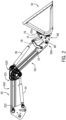
- the HLBAA 500 includes a first or arm assembly 502 and a second arm assembly 504, which are interconnected via a hollow torque transfer tube 506 to operate in parallel.
- the arm assemblies 502, 504 are each coupled to the chassis 18, directly or via another frame portion of the loader 10, at one end, and are coupled at an opposite end to the bucket 52 via a carrier 68, which is pivoted via first and second (left and right) pivot linkages 70, 72.
- the carrier 68 comprises first and second (left and right) couplers 74, 76, connected by a cross-rod 78, that mount to the distal ends of the respective arm assemblies 502, 504 via coupling pins 80. Additional pins pivotally couple the pivot linkages 70, 72 between the arm assemblies 502, 504 and the respective first and second couplers 74, 76.
- the pivot linkages 70, 72 enable pivotal movement of the bucket 52 upon actuation of the hydraulic cylinders 36, 38.
- the hydraulic cylinders may be actuated to raise and lower the HLBAA 500 relative to the loader 10.
- the HLBAA 500 includes two hydraulic cylinders, namely the hydraulic cylinder 34 coupled between the chassis 18 and the arm assembly 502 and a corresponding cylinder on the opposite side of the loader (not shown) coupled between the chassis 18 and the second arm assembly 504.
- the loader 10 may have any number of hydraulic cylinders, such as one, three, etc.
- Each of the hydraulic cylinders 34 includes an end coupled to the chassis 18 (e.g., via a coupling pin) and an end mounted to the respective one of the arm assembly 502 and the second arm assembly 504 (e.g., via another pin).
- the HLBAA 500 may be moved between various positions to elevate the HLBAA 500, and thus the bucket 52, relative to the chassis 18 of the loader 10.
- One or more hydraulic cylinders 36 are mounted to the arm assembly 502 and the first pivot linkage 70, and one or more hydraulic cylinders 38 are mounted to the second arm assembly 504 and the second pivot linkage 72.
- the loader 10 includes a single hydraulic cylinder 36, 38 associated with a respective one of the arm assembly 502 and the second arm assembly 504, respectively.
- Each of the hydraulic cylinders 36, 38 includes an end mounted to the respective one of the arm assembly 502 and the second arm assembly 504 (via another pin) and an end mounted to the respective one of the first pivot linkage 70 and the second pivot linkage 72 (via another pin).
- the bucket 52 may be moved between various positions, namely to pivot the carrier 68, and thereby the bucket 52, relative to the HLBAA 500.
- the bucket 52 is pivotable about the carrier 68 of the HLBAA 500 by the hydraulic cylinders 36, 38.
- a different number or configuration of hydraulic cylinders or other actuators may be used.
- a hoist boom e.g. the HLBAA 500
- an end effector e.g., the bucket 52.
- the carrier 68 (e.g., the couplers 74, 76) may be generally viewed as a component effecting pivotal attachment of a bucket (e.g. the bucket 52) to a vehicle frame.
- a tilt actuator e.g., the hydraulic cylinders 36, 38
- the hoist actuator e.g. the hydraulic cylinders 34
- the carrier 68 may be generally viewed as an actuator for pivoting a hoist boom with respect to a vehicle frame.
- sensors may be provided to observe various conditions associated with the loader 10.
- the sensors may include one or more pressure sensors that observe a pressure within the hydraulic circuit, such as a pressure associated with at least one of the pumps 30, the control valves 40 and/or one or more hydraulic cylinders 34, 36, 38 to observe a pressure within the hydraulic cylinders and generate sensor signals based thereon.
- various sensors may be disposed on or near the carrier 68 and/or the bucket 52.
- sensors e.g., pressure, flow or other sensors
- inertial measurement sensors may be coupled on or near the bucket 52 to observe or measure parameters including the acceleration of the HLBAA 500 and/or the bucket 52 and generate sensor signals, which may indicate if the HLBAA 500 and/or the bucket 52 is accelerating or decelerating.
- various sensors e.g., angular position sensors
- angular position sensors may be configured to detect the angular orientation of the bucket 52 relative to the HLBAA 500, or to detect the angular orientation of the HLBAA 500 relative to the chassis 18, and various other indicators of the current orientation or position of the bucket 52.
- rotary angular positon sensors may be used or linear position or displacement sensors may be used to determine the length of the hydraulic cylinders 34, 36, 38 relative to the HLBAA 500.
- the bucket 52 generally defines a receptacle for carrying various materials, such as dirt, rocks, wet dirt, sand, hay, etc. In one example, the bucket 52 may receive about two cubic yards of material to over about five cubic yards of material.
- the bucket 52 is movable upon actuation of the hydraulic cylinders 36, 38 between a level position, a roll-back position and a dump position, along with various positions in between. In the level position, the bucket 52 can receive various materials. In the roll-back position, the bucket 52 is pivoted upward relative to the earth's surface or ground by the actuation of the hydraulic cylinders 36, 38 such that the bucket 52 may be loaded with and retain the various materials. In the dump position, the bucket 52 is pivoted downward relative to the earth's surface or ground by the actuation of the hydraulic cylinders 36, 38 such that the various materials may fall from the bucket 52 to substantially empty the bucket 52.
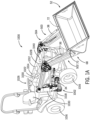
- the HLBAA 500 may be used with a compact utility tractor 1000 having a front loader 1002 removably coupled to the compact utility tractor 1000.
- the compact utility tractor 1000 includes a source of propulsion, such as an engine 1012 that supplies power to a transmission 1014.
- the engine 1012 is an internal combustion engine, such as a diesel engine, that is controlled by an engine control module.
- the transmission 1014 transfers power from the engine 1012 to a suitable driveline coupled to one or more driven wheels 1016 of the compact utility tractor 1000 to enable the compact utility tractor 1000 to move.
- the engine 1012, the transmission 1014 and the rest of the driveline are supported by a vehicle chassis 1018, which is supported off the ground by the wheels 1016.
- the transmission 1014 can include a suitable gear transmission, which can be operated in a variety of ranges.
- the transmission 1014 may be controlled by a transmission control module, which is, along with the engine control module, in communication with a master controller 1022 (or group of controllers).
- the controller 1022 may control various aspects of the operation of the compact utility tractor 1000 and may be configured as a computing device with associated processor devices and memory architectures, as a hard-wired computing circuit (or circuits), as a programmable circuit, as a hydraulic, electrical or electro-hydraulic controller, or otherwise. As such, the controller 1022 may be configured to execute various computational and control functionality with respect to the compact utility tractor 1000 (or other machinery). In some embodiments, the controller 1022 may be configured to receive input signals in various formats (e.g., as hydraulic signals, voltage signals, current signals, and so on), and to output command signals in various formats (e.g., as hydraulic signals, voltage signals, current signals, mechanical movements, and so on).
- various formats e.g., as hydraulic signals, voltage signals, current signals, and so on
- command signals e.g., as hydraulic signals, voltage signals, current signals, mechanical movements, and so on.
- the controller 1022 (or a portion thereof) may be configured as an assembly of hydraulic components (e.g., valves, flow lines, pistons and cylinders, and so on), such that control of various devices (e.g., pumps or motors) may be effected with, and based upon, hydraulic, mechanical, or other signals and movements.
- hydraulic components e.g., valves, flow lines, pistons and cylinders, and so on
- various devices e.g., pumps or motors
- the controller 1022 may be in electronic, hydraulic, mechanical, or other communication with various other systems or devices of the compact utility tractor 1000 (or other machinery), including the front loader 1002.
- the controller 1022 may be in electronic or hydraulic communication with various actuators, sensors, and other devices within (or outside of) the compact utility tractor 1000, including various devices associated with a hydraulic system of the front loader 1002.
- the controller 1022 may communicate with other systems or devices (including other controllers) in various known ways, including via a CAN bus (not shown) of the compact utility tractor 1000, via wireless or hydraulic communication means, or otherwise.
- An example location for the controller 1022 is depicted in FIG. 1A . It will be understood, however, that other locations are possible including other locations on the compact utility tractor 1000, or various remote locations.
- the controller 1022 may be configured to receive input commands and to interface with an operator via a human-machine interface 1026, which may be disposed for easy access by the operator.
- the human-machine interface 1026 is in communication with the controller 1022 over a suitable communication architecture, such as a CAN bus.
- the human-machine interface 1026 may be configured in a variety of ways and may include one or more joysticks, various switches or levers, a steering wheel, one or more buttons, a touchscreen interface that may be overlaid on a display, a keyboard, a speaker, a microphone associated with a speech recognition system, or various other human-machine interface devices.
- the compact utility tractor 1000 also has a hydraulic system that includes one or more pumps and accumulators (designated generally by reference number 1028), which may be driven by the engine 1012 of the compact utility tractor 1000.
- Flow from the pumps 1028 may be routed through various control valves and various conduits (e.g., flexible hoses) to drive various hydraulic cylinders, such as hydraulic cylinders 34, 36, 38 associated with the front loader 1002, shown in FIG. 1A .
- Flow from the pumps (and accumulators) 1028 may also power various other components of the compact utility tractor 1000.
- the flow from the pumps 1028 may be controlled in various ways (e.g., through control of various electro-hydraulic control valves 1040) to cause movement of the hydraulic cylinders 34, 36, 38, and thus, the front loader 1002 relative to the compact utility tractor 1000 when the front loader 1002 is mounted on the compact utility tractor 1000 through a suitable mounting arrangement.
- various electro-hydraulic control valves 1040 to cause movement of the hydraulic cylinders 34, 36, 38, and thus, the front loader 1002 relative to the compact utility tractor 1000 when the front loader 1002 is mounted on the compact utility tractor 1000 through a suitable mounting arrangement.
- movement of the front loader 1002 between various positions relative to the chassis 1018 of the compact utility tractor 1000 may be implemented by various control signals to the pumps 1028, control valves 1040, and so on.
- the front loader 1002 includes the bucket 52 pivotally mounted to the HLBAA 500.
- the arm assemblies 502, 504 are each configured to be coupled to the chassis 18 via a suitable mounting arrangement, at one end, and are coupled at an opposite end to the bucket 52 via the carrier 68.
- the mounting arrangement may include a mast 1030 on each side of the front loader 1002 that cooperates with a mounting frame on each side of the compact utility tractor 1000 to removably couple the front loader 1002 to the compact utility tractor 1000.
- Each of the hydraulic cylinders 34 includes an end coupled to the mast 1030 (e.g., via a coupling pin) and an end mounted to the respective one of the arm assemblies 502, 504 (e.g., via another pin).
- the HLBAA 500 may be moved between various positions to elevate the HLBAA 500, and thus the bucket 52, relative to the chassis 1018 of the compact utility tractor 1000.
- the one or more hydraulic cylinders 36 are mounted to the arm assembly 502 and the first pivot linkage 70, and the one or more hydraulic cylinders 38 are mounted to the second arm assembly 504 and the second pivot linkage 72.
- the front loader 1002 includes a single hydraulic cylinder 36, 38 associated with a respective one of the arm assemblies 502, 504, respectively.
- Each of the hydraulic cylinders 36, 38 includes an end mounted to a respective one of the arm assemblies 502, 504 (via a pin) and an end mounted to the respective one of the first pivot linkage 70 and the second pivot linkage 72 (via another pin).
- the bucket 52 may be moved between various positions, namely to pivot the carrier 68, and thereby the bucket 52, relative to the HLBAA 500.
- the bucket 52 is pivotable about the carrier 68 of the HLBAA 500 by the hydraulic cylinders 36, 38.
- a different number or configuration of hydraulic cylinders or other actuators may be used. Accordingly, it will be understood that the configuration of the hydraulic system and the HLBAA 500 is presented as an example only.
- the HLBAA 500 includes an arm assembly 502, a second arm assembly 504 and a hollow torque transfer tube 506 that interconnects the arm assembly 502 and the second arm assembly 504.
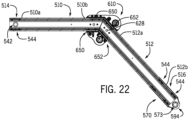
- Each of the arm assembly 502 and the second arm assembly 504 include a first beam 510, a second beam 512, a vehicle mounting subassembly 514, a respective bucket mount bracket or bucket mount bracket subassembly 516, 518 and a knee mounting subassembly 520.
- the first beam 510, the second beam 512 and the torque transfer tube 506 are each formed from the lightweight material.
- the first beam 510, the second beam 512 and the torque transfer tube 506 are each formed from the lightweight material, including, but not limited to, aluminum.
- the first beam 510, the second beam 512 and the torque transfer tube 506 are each formed using extrusion; however, other suitable forming techniques may be used.
- each of the first beam 510, the second beam 512 and the torque transfer tube 506 have the same cross-section. In one example, the cross-section is substantially I-shaped.
- the cross-section of the first beam 510 is shown, with the understanding that the cross-section of the second beam 512 and the torque transfer tube 506 is the same.
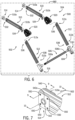
- the cross-section of the first beam 510 defines a first chamber 522, a second chamber 524 and a third chamber 526.
- the first chamber 522 and the second chamber 524 extend along a respective axis A5, A6, which is substantially parallel to a longitudinal axis L1 of the first beam 510.
- the third chamber 526 extends along an axis A7 that is substantially perpendicular to the longitudinal axis L1.
- a first end 526a of the third chamber 526 is defined by a first pair of oblique surfaces 528 that extend into the first chamber 522
- a second end 526b of the third chamber 526 is defined by a second pair of oblique surfaces 530 that extend into the second chamber 524.
- the first chamber 522 and the second chamber 524 extend outwardly on either side of the third chamber 526 and cooperate to define a pair of channels 531 on opposing sides of the cross-section.
- the opposing channels 531 of the first beam 510 and the second beam 512 cooperate to receive a portion of the knee mounting subassembly 520.
- the first beam 510 includes a first end 510a and an opposite second end 510b.
- the first end 510a defines a respective first end of the arm assembly 502 and the second arm assembly 504.
- the first beam 510 defines a plurality of first through bores (generally identified by reference numeral 532) at the first end 510a, and defines a plurality of second through bores (generally identified by reference numeral 534) at the second end 510b.
- the first through bore 532 receives a portion of the vehicle mounting subassembly 514 to couple the vehicle mounting subassembly 514 to the first beam 510.
- the second through bores 534 are for coupling the first beam 510 to the knee mounting subassembly 520.
- each of the first through bore 532 and the second through bores 534 are defined in the first beam 510 so as to extend through the first beam 510.
- the second end 510b of the first beam 510 is beveled. By beveling the second end 510b, the second end 510b of the first beam 510 may be positioned against a cooperating bevel defined on a third end 512a of the second beam 512 so that the second beam 512 extends at an angle relative to the first beam 510.
- the vehicle mounting subassembly 514 is coupled to the first end 510a of each first beam 510 of the arm assembly 502 and the second arm assembly 504. Stated another way, the vehicle mounting subassembly 514 is coupled to the first end of each of the arm assembly 502 and the second arm assembly 504, and is configured to couple the arm assembly 502 and the second arm assembly 504 to the loader 10. With reference to FIG. 7 , the vehicle mounting subassembly 514 is shown in greater detail.
- Each of the intermediate plates 544 is composed of a metal or metal alloy, including, but not limited to, steel, and is cast, forged, stamped, etc. Each of the pair of intermediate plates 544 is substantially an elongated U-shape; however, each of the pair of intermediate plates 544 may have any desired shape. Each of the pair of intermediate plates 544 is received wholly within the first beam 510 at the first end 510a to couple the pair of lock plates 540 to the first beam 510.
- Each of the pair of intermediate plates 544 includes a base 560 and a pair of flanges 562, which extend outwardly from the base 560 on opposed sides of the base 560. Each of the pair of flanges 562 defines a plurality of bores 564. In one example, each bore 564 is spaced apart along the respective one of the pair of flanges 562 to receive a respective one of the mechanical fasteners 550 for coupling the respective lock plate 540 to the first beam 510.
- one of the intermediate plates 544 is disposed within the first chamber 522 and the other one of the intermediate plates 544 is disposed within the second chamber 524.
- the sleeve 542 is inserted the through bore 532a.
- the bores 564 are coaxially aligned with remaining through bores 532b of the first plurality of through bores 532 defined through the first end 510a.
- the mechanical fasteners 550 are inserted into each of the through bores 532b and the bores 564 to couple the lock plates 540 and the intermediate plates 544 to the first end 510a of the first beam 510.
- the mechanical fasteners 550 are blind oversized mechanical (BOM) fasteners, and one of the mechanical fasteners 550 is associated with each of the bores 564 and the through bores 532b.
- BOM fasteners is merely exemplary, as rivets, bolts, etc. may be used to couple the lock plates 540 to the intermediate plates 544, and thus, to the first beam 510, if desired.
- the number of bores 564 and the corresponding through bores 532b is merely exemplary, as any number of bores 564 and through bores 532b may be defined for the receipt of the mechanical fasteners 550.
- the bucket mount bracket subassembly 516, 518 couples the bucket 52 ( FIG. 1 or FIG. 1A ) to the HLBAA 500.
- the bucket mount bracket subassembly 518 is shown in greater detail. As the bucket mount bracket subassembly 518 is a mirror image of the bucket mount bracket subassembly 516, for ease of description, the bucket mount bracket subassembly 518 will be discussed herein with the understanding that the bucket mount bracket subassembly 516 is substantially the same.
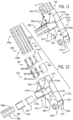
- the bucket mount bracket subassembly 518 includes a first outer jacket assembly 570, a second outer jacket 572, a plurality of supports 574, a bushing 573, a plurality of pairs of the intermediate plates 544 ( FIG. 12 ) and a plurality of the mechanical fasteners 550.
- the first outer jacket assembly 570 is sized and configured to enclose the fourth end 512b of the second beam 512.
- the first outer jacket assembly 570 includes a jacket 576 and a pair of reinforcing flanges 578.
- the jacket 576 and the reinforcing flanges 578 are each composed of a metal or metal alloy, including, but not limited to, steel, and is cast, forged, stamped, etc.
- the jacket 576 is tubular in shape, and defines a channel 576a, which receives the third end 512a of the second beam 512.
- the jacket 576 also defines a first plurality of bores 590, a second plurality of bores 592 and a pair of retaining flanges 594.
- the first plurality of bores 590 receives a respective one of the mechanical fasteners 550 to couple the jacket 576 to the second beam 512 via one pair of the intermediate plates 544 ( FIG. 12 ).
- the second plurality of bores 592 receives a respective one of the mechanical fasteners 550 to couple the jacket 576 to the second beam 512 via one pair of the intermediate plates 544 ( FIG. 12 ).
- the pair of retaining flanges 594 extends outwardly from an end 576b of the jacket 576.
- the pair of retaining flanges 594 are spaced apart at the end 576b, and each define a bore 598 and a pair of opposed notches 600.
- the bore 598 is sized and configured to receive the bushing 573 therethrough.
- the bushing 573 may be coupled to each of the retaining flanges 594 via welding, for example.
- the notches 600 are defined in the retaining flanges 594 so as to be on opposed sides of the bore 598.
- the notches 600 receive a portion of the reinforcing flanges 578 to couple the reinforcing flanges 578 to the jacket 576.
- the pair of reinforcing flanges 578 provides additional rigidity to the retaining flanges 594.
- the reinforcing flanges 578 are substantially H-shaped, and include a plurality of tabs 602 and a plurality of legs 603. Each tab 602 is coupled to a respective one of the notches 600 associated with the retaining flanges 594, and each leg 603 is coupled along an edge of the respective retaining flange 594.
- the reinforcing flanges 578 are each composed of a metal or metal alloy, including, but not limited to, steel, and is cast, forged, stamped, etc. In this example, the reinforcing flanges 578 are coupled to the retaining flanges 594 via welding.
- the second outer jacket 572 is sized and configured to enclose a second tube end 506b of the torque transfer tube 506.
- the second outer jacket 572 is composed of a metal or metal alloy, including, but not limited to, steel, and is cast, forged, stamped, etc.
- the second outer jacket 572 is tubular in shape, and defines a channel 572a, which receives the second tube end 506b of the torque transfer tube 506.
- the second outer jacket 572 also defines a plurality of bores 606.
- the plurality of bores 606 receives a respective one of the mechanical fasteners 550 to couple the second outer jacket 572 to the torque transfer tube 506 via one pair of the intermediate plates 544 ( FIG. 12 ).
- the second outer jacket 572 is coupled to the jacket 576 via welding.
- the plurality of supports 574 imparts stiffness to the connection of the jacket 576 and the second outer jacket 572.
- the supports 574 are each triangular in shape, however, the supports 574 may have any desired shape.
- Each of the supports 574 is composed of a metal or metal alloy, including, but not limited to, steel, and is cast, forged, stamped, etc.
- the supports 574 are coupled to each of the jacket 576 and the second outer jacket 572 via welding, for example.
- a first surface 574a of each of the supports 574 is coupled to the jacket 576
- a second surface 574b of each of the supports 574 is coupled to the second outer jacket 572.
- the bushing 573 comprises a hollow cylinder.
- the bushing 573 is composed of metal or metal alloy, including, but not limited to, steel, and is cast, forged, stamped, extruded, etc.
- the bushing 573 is coupled to the respective one of the pair of retaining flanges 594.
- the bushing 573 is received through the bores 598 and is coupled to the respective one of the pair of retaining flanges 594, via welding, for example.
- a midsection of the bushing 573 is positioned between the pair of retaining flanges 594, and is configured to receive a portion of a hook 52a ( FIG. 2 ) of the bucket 52 to couple the bucket 52 to the second beam 512.
- the plurality of pairs of the intermediate plates 544 ( FIG. 12 ) and the plurality of the mechanical fasteners 550 interconnect the torque transfer tube 506 with the second outer jacket 572, and interconnect the first outer jacket assembly 570 with the second beam 512.
- the plurality of pairs of the intermediate plates 544 ( FIG. 12 ) and the plurality of the mechanical fasteners 550 interconnect the torque transfer tube 506 with the second outer jacket 572, and interconnect the first outer jacket assembly 570 with the second beam 512.
- two of the intermediate plates 544 cooperate with a first sub-plurality 538a of the plurality of bores 538 of the second beam 512 and with the plurality of bores 592 to couple the first outer jacket assembly 570 to the second beam 512; and two of the intermediate plates 544 cooperate with a second sub-plurality 538b of the plurality of bores 538 of the second beam 512 and with the plurality of bores 592 to couple the first outer jacket assembly 570 to the second beam 512.
- two of the intermediate plates 544 are positioned in the first chamber 522 and the second chamber 524, respectively, such that the bores 564 of the intermediate plates 544 are coaxially aligned with the first sub-plurality 538a of the plurality of bores 538.
- two of the intermediate plates 544 are also positioned in the first chamber 522 and the second chamber 524, respectively, and such that the bores 564 of the intermediate plates 544 are coaxially aligned with the second sub-plurality 538b of the plurality of bores 538.
- the mechanical fasteners 550 are inserted through the plurality of bores 592, the first sub-plurality 538a of the plurality of bores 538 and into the bores 564 of the intermediate plates 544 to couple the first outer jacket assembly 570 to the second beam 512 ( FIG. 14 ).
- the mechanical fasteners 550 are also inserted through the plurality of bores 590, the second sub-plurality 538b of the plurality of bores 538 and into the bores 564 of the intermediate plates 544 to couple the first outer jacket assembly 570 to the second beam 512 ( FIG. 14 ).
- the mechanical fasteners 550 are inserted through the plurality of bores 604, the plurality of bores 606 and into the bores 564 of the intermediate plates 544 to couple the second outer jacket 572 to the torque transfer tube 506 ( FIG. 14 ).
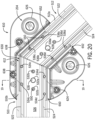
- the knee mounting subassembly 520 interconnects the first beam 510 with the second beam 512.
- the knee mounting subassembly 520 comprises a connection assembly for the first beam 510 and the second beam 512.
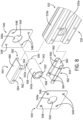
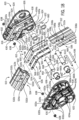
- the knee mounting subassembly 520 includes a pair of knee plates 610, a pair of angled intermediate plates 612 ( FIG. 18 ) and a pair of coupling pins 614.
- Each of the knee plates 610 is composed of metal or metal alloy, including, but not limited to, aluminum, and in this example, is die-cast.
- Each of the pair of knee plates 610 includes a first plate end 616 opposite a second plate end 618, and a first plate side 620 opposite a second plate side 622.
- Each knee plate 610 includes a plurality of knee coupling bores 624, a pair of pin coupling bores 626, a pair of locating pins 628, a channel 630, a first plurality of bores 632 and a second plurality of bores 634.
- the plurality of knee coupling bores 624 receives a respective knee mechanical fastener 636, such as a knee bolt, to couple the knee plates 610 together.
- the knee plates 610 define four knee coupling bores 624 that receive a respective one of four knee mechanical fasteners 636 ( FIGS. 18A and 18B ).
- the knee coupling bores 624 of each of the knee plates 610 are coaxially aligned for receiving the respective knee mechanical fastener 636.
- each of the knee mechanical fasteners 636 has a plurality of threads defined at opposed ends, which matingly engage with respective pairs of flange nuts 638, for example, to secure each of the knee mechanical fasteners 636 to the knee plates 610.
- one of the knee coupling bores 624 is defined at the first side 620 adjacent to the first plate end 616, and one of the knee coupling bores 624 is defined at the first side 620 between the one of the knee coupling bores 624 and the second plate end 618.
- Another one of the knee coupling bores 624 is defined at the second side 622 adjacent to the first plate end 616, and a final one of the knee coupling bores 624 is defined at the second side 622 at the second plate end 618 ( FIGS. 18A and 18B ).
- the pair of pin coupling bores 626 receives a respective one of the coupling pins 614.
- One of the pin coupling bores 626 is defined at the first side 620 at the second plate end 618, and the other of the pin coupling bores 626 is defined at the second side 622 at the second plate end 618.
- the pair of locating pins 628 is integrally formed or monolithic with the knee plates 610.
- the locating pins 628 are formed to extend outwardly from the channel 630.
- One of the locating pins 628 engages a bore 534a of the plurality of bores 534 of the first beam 510, and the other of the locating pins 628 engages a bore 536a of the plurality of bores 536 of the second beam 512.
- the locating pins 628 facilitate the coupling of the knee plates 610 to the first beam 510 and the second beam 512.
- the channel 630 is defined along each of the knee plates 610 from the first plate end 616 to the second plate end 618.
- the channel 630 includes two grooves 640 that are separated by a rail 642.
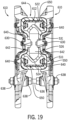
- the two grooves 640 and the rail 642 of the knee plates 610 cooperate to define a first channel portion 644 ( FIG. 19 ) that receives the first beam 510 and a second channel portion 646 that receives the second beam 512 ( FIG. 17 ).
- the two grooves 640 and the rail 642 of the knee plates 610 cooperate to define a cross-section that corresponds to the cross-section of each of the first beam 510 and the second beam 512 ( FIGS. 18A and 18B ).
- each of the grooves 640 of the knee plates 610 cooperate to surround the portion of the first beam 510 and the second beam 512 defined by the first chamber 522 and the second chamber 524, respectively, and the rails 642 of each of the knee plates 610 are received along either side of the channels 531 defined by the shape of the third chamber 526 of the first beam 510 and the second beam 512.
- the first plurality of bores 632 couple the knee plates 610 to the first beam 510.
- a first sub-plurality 632a of the first plurality of bores 632 receive respective ones of the mechanical fasteners 550 to couple the knee plates 610 to the first beam 510 via the angled intermediate plates 612.
- a second sub-plurality 632b of the first plurality of bores 632 receive respective ones of the mechanical fasteners 550 to couple the knee plate 610 to the first beam 510 via a sub-plurality 532b of the second plurality of bores 532 of the first beam 510 ( FIGS. 18A and 18B ).
- the second plurality of bores 634 couple the knee plates 610 to the second beam 512.
- a first sub-plurality 634a of the second plurality of bores 634 receive respective ones of the mechanical fasteners 550 to couple the knee plates 610 to the second beam 512 via the angled intermediate plates 612.
- a second sub-plurality 634b of the second plurality of bores 634 receive respective ones of the mechanical fasteners 550 to couple the knee plate 610 to the second beam 512 via a sub-plurality 534b of the second plurality of bores 534 of the second beam 512 ( FIGS. 18A and 18B ).
- the pair of angled intermediate plates 612 interconnect the knee plates 610 with the first beam 510 and the second beam 512; and interconnect the first beam 510 with the second beam 512.
- Each of the angled intermediate plates 612 is composed of a metal or metal alloy, including, but not limited to, steel, and is cast, forged, stamped, etc.
- Each of the pair of angled intermediate plates 612 is substantially an elongated U-shape; however, each of the pair of angled intermediate plates 612 may have any desired shape.
- Each of the pair of angled intermediate plates 612 is received wholly within the first beam 510 at the second end 510b and the second beam 512 at the third end 512a.
- each of the angled intermediate plates 612 includes a first plate portion 650 interconnected to a second plate portion 652.
- the first plate portion 650 is integrally formed with the second plate portion 652; however, the first plate portion 650 may be separate from the second plate portion 652 and coupled together via welding, for example.
- the second plate portion 652 is angled relative to the first plate portion 650. Stated another way, the first plate portion 650 extends along an axis A8, and the second plate portion 652 extends along a second axis A9, and the second axis A9 is oblique to the axis A8.
- Each of the first plate portion 650 and the second plate portion 652 includes the base 560 and the pair of flanges 562, which extend outwardly from the base 560 on opposed sides of the base 560.
- Each of the pair of flanges 562 defines the plurality of bores 564.
- the first plate portion 650 of one of the angled intermediate plates 612 is disposed within the first chamber 522 of the first beam 510 such that the bores 564 are coaxially aligned with a sub-plurality 532c of the plurality of bores 532
- the second plate portion 652 is disposed within the first chamber 522 of the second beam 512 such that the bores 564 are coaxially aligned with a sub-plurality 536c of the plurality of bores 536.
- the first plate portion 650 of the other of the angled intermediate plates 612 is disposed within the second chamber 524 of the first beam 510 such that the bores 564 are coaxially aligned with a sub-plurality 532d of the plurality of bores 532, and the second plate portion 652 is disposed within the second chamber 524 of the second beam 512 such that the bores 564 are coaxially aligned with a sub-plurality 536d of the plurality of bores 536.
- the mechanical fasteners 550 are inserted into each of the through bores 534c, the bores 564 and the bores 632a of the knee plates 610 to couple the knee plates 610 and the first plate portion 650 of one of the angled intermediate plates 612 to the first end 510a of the first beam 510.
- the mechanical fasteners 550 are also inserted into each of the through bores 534d, the bores 564 and the bores 632a of the knee plates 610 to couple the knee plates 610 and the first plate portion 650 of the other of the angled intermediate plates 612 to the first end 510a of the first beam 510.
- the mechanical fasteners 550 are inserted into each of the through bores 536c, the bores 564 and the bores 634a of the knee plates 610 to couple the knee plates 610 and the second plate portion 652 of one of the angled intermediate plates 612 to the third end 512a of the second beam 512.
- the mechanical fasteners 550 are also inserted into each of the through bores 536d, the bores 564 and the bores 634a of the knee plates 610 to couple the knee plates 610 and the second plate portion 652 of the other of the angled intermediate plates 612 to the third end 512a of the second beam 512.
- the mechanical fasteners 550 are inserted into the bores 632a of the knee plates 610 and the bores 532b of the first beam 510 to further couple the first beam 510 to the knee plates 610.
- the mechanical fasteners 550 are inserted into the bores 634a of the knee plates 610 and the bores 534b of the second beam 512 to further couple the second beam 512 to the knee plates 610.
- the pair of coupling pins 614 couple the hydraulic cylinders 34, 36, 38 to the respective one of the arm assembly 502 and the second arm assembly 504.
- Each of the coupling pins 614 includes a pair of collars 660.
- the pair of collars 660 secures and retains the coupling pins 614 to the pair of knee plates 610.
- one of the coupling pins 614 is received through one pair of the pin coupling bores 626 and the other one of the coupling pins 614 is received through one pair of the pin coupling bores 626.
- a first one of the collars 660 is coupled to one end of one of the coupling pins 614, and a second one of the pair of collars 660 is coupled to the other opposed end of the respective one of the coupling pins 614.
- One of the pair of collars 660 is coupled to one end of the other one of the coupling pins 614, and the second one of the pair of collars 660 is coupled to the opposed end of the other coupling pins 614.
- each of the collars 660 includes a central collar bore 660a that receives the respective end of the coupling pin 614 therein ( FIG. 17 ).
- one end 614a of the coupling pins 614 includes a through bore 662 that cooperates with corresponding cross-bores 660b defined in each of the collars 660.
- a pin is received within the cross-bores 660b and the cross-bores 660b to couple the end 614a of the coupling pins 614 to the knee plates 610.
- An opposed end 614b of the coupling pins 614 includes a cross-pin 664 that cooperates with corresponding cross-bores 660b defined in the collars 660.
- the cross-pin 664 is received within the cross-bores 660b to couple the end 614b of the coupling pins 614 to the knee plates 610.
- Each of the coupling pins 614 may also include a bore 668, which receives a pin, to couple the respective hydraulic cylinders 34, 36, 38 to the respective one of the arm assembly 502 and the second arm assembly 504.
- the torque transfer tube 506 interconnects the arm assembly 502 and the second arm assembly 504.
- the torque transfer tube 506 is coupled to each of the arm assembly 502 and the second arm assembly 504 at the fourth end 512b of the respective second beam 512.
- the torque transfer tube 506 has a first tube end 506a and the opposite second tube end 506b.
- the first tube end 506a is coupled to the arm assembly 502, and the second tube end 506b is coupled to the second arm assembly 504.
- the first tube end 506a is received within and coupled to the second outer jacket 572 of the bucket mounting bracket subassembly 516
- the second tube end 506b is received within and coupled to the second outer jacket 572 of the bucket mounting bracket subassembly 518 via the intermediate plates 544 ( FIG. 12 ) and the mechanical fasteners 550.
- the first beams 510, the second beams 512, the vehicle mounting subassemblies 514, the bucket mount bracket subassemblies 516, 518, the knee mounting subassemblies 520, the torque transfer tube 506 and the mechanical fasteners 550 comprise a kit 680 for the HLBAA 500.
- the first plate portion 650 of the angled intermediate plates 612 are inserted into the first chamber 522 and the second chamber 524 at the second end 510b of the first beams 510.
- the second plate portion 652 of the angled intermediate plates 612 are inserted into the first chamber 522 and the second chamber 524 at the third end 512a of the second beams 512.
- the knee plates 610 are coupled to the second end 510b of the first beam 510 and the third end 512a of the second beam 512 such that the locating pins 628 are received within the bores 534a, 536a.
- the mechanical fasteners 550 are inserted into each of the through bores 534c, the bores 564 and the bores 632a of the knee plates 610 to couple the knee plates 610 and the angled intermediate plates 612 to the first end 510a of the first beam 510.
- the mechanical fasteners 550 are inserted into each of the through bores 536c, the bores 564 and the bores 634a of the knee plates 610 to couple the knee plates 610 and the angled intermediate plates 612 to the third end 512a of the second beam 512.
- the mechanical fasteners 550 are inserted into the bores 632a, 634a of the knee plates 610 and the bores 532b, 534b of the first beam 510 and the second beam 512, respectively, to further couple the first beam 510 and the second beam 512 to the knee plates 610.
- the knee mechanical fasteners 636 are inserted through the respective knee coupling bores 624 and secured with a respective pair of the flange nuts 638 to couple the knee plates 610 together.
- Each of the coupling pins 614 are inserted into a respective one of the pin coupling bores 626, and the collars 660 are positioned about the ends 614a, 614b of the coupling pins 614.
- the cross-pin 664 retains the ends 614b within the respective collar 660, and a pin is received through the bore 662 and the cross-bore 660b to retain the ends 614a within the respective collar 660.
- two intermediate plates 544 are positioned within the first end 510a of the first beam 510.
- the sleeve 542 is inserted through the bore 532a of the first end 510a of the first beam 510.
- the lock plates 540 are positioned on opposed sides of the first beam 510 such that the keyed area 542a of the sleeve 542 contacts the keyed area 546a on the lock plates 540.
- the mechanical fasteners 550 are inserted into each of the through bores 532b and the bores 564 to couple the lock plates 540 and the intermediate plates 544 to the first end 510a of the first beam 510. This process is repeated to couple the vehicle mounting subassembly 514 to the first beam 510 of the second arm assembly 504 ( FIG. 3 ).
- the bushing 573 is coupled to the retaining flanges 594, via welding.
- the reinforcing flanges 578 are coupled to the retaining flanges 594, via welding.
- the second outer jacket 572 is coupled to the jacket 576, via welding, and the supports 574 are coupled between the second outer jacket 572 and the jacket 576, via welding.
- the intermediate plates 544 are inserted into the fourth end 512b of the second beam 512, and the first outer jacket assembly 570 is positioned over the fourth end 512b.
- the intermediate plates 544 are inserted into the respective one of the first chamber 522 and the second chamber 524 at the second tube end 506b.
- the second tube end 506b is inserted into the second outer jacket 572.
- the mechanical fasteners 550 are inserted through the plurality of bores 604, the plurality of bores 606 and into the bores 564 of the intermediate plates 544 to couple the second outer jacket 572 to the torque transfer tube 506 ( FIG. 14 ).
- the intermediate plates 544 are inserted into the respective one of the first chamber 522 and the second chamber 524 at the first tube end 506a.
- the first tube end 506a is inserted into the second outer jacket 572 of the arm assembly 502.
- the mechanical fasteners 550 are inserted through the plurality of bores 604, the plurality of bores 606 and into the bores 564 of the intermediate plates 544 to couple the second outer jacket 572 to the torque transfer tube 506.
- the first end 510a of the first beams 510 of the HLBAA 500 may be coupled to the loader 10 ( FIG. 1 ) or the compact utility tractor 1000 ( FIG. 1A ) via the pin 252 engaging the sleeves 542 of the respective vehicle mounting subassemblies 514.
- the fourth end 512b of the second beams 512 of the HLBAA 500 may be coupled to the respective couplers 74, 76 for coupling the bucket 52 ( FIG. 1 or FIG. 1A ) to the HLBAA 500 by engaging the coupling pins 80 with each of the bushings 573 of each of the bucket mount bracket subassemblies 516, 518 and the couplers 74, 76.
- the hydraulic cylinders 34, 36, 38 may also be coupled to the coupling pins 614 of the arm assembly 502 and the second arm assembly 504.
Landscapes
- Engineering & Computer Science (AREA)
- Mechanical Engineering (AREA)
- Mining & Mineral Resources (AREA)
- Civil Engineering (AREA)
- General Engineering & Computer Science (AREA)
- Structural Engineering (AREA)
- Life Sciences & Earth Sciences (AREA)
- Environmental Sciences (AREA)
- Operation Control Of Excavators (AREA)
Claims (8)
- Laderauslegerarmanordnung für ein Lader-Arbeitsfahrzeug, bei dem der Laderauslegerarm umfasst:
eine Armanordnung, die Folgendes beinhaltet:einen ersten hohlen Träger (510), der aus einem Material mit einem geringeren Gewicht als Stahl gebildet ist;einen zweiten hohlen Träger (512), der aus dem Material gebildet ist; undeine Verbindungsanordnung, die eine erste abgewinkelte Zwischenplatte (612) und ein Paar Knieplatten (610), die aus dem Material gebildet sind, aufweist, wobei ein Teil der ersten abgewinkelten Zwischenplatte (612) an einem ersten Ende in dem ersten hohlen Träger (510) aufgenommen ist und ein zweiter Teil der ersten abgewinkelten Zwischenplatte (612) an einem zweiten Ende in dem zweiten hohlen Trägers (512) aufgenommen ist, das Paar Knieplatten (610) zusammenwirkt, um einen ersten Kanal, der das Ende des ersten hohlen Trägers (510) aufnimmt, und einen zweiten Kanal, der das zweite Ende des zweiten hohlen Trägers (512) aufnimmt, zu definieren, so dass das erste Ende des ersten hohlen Trägers (510) und das zweite Ende des zweiten hohlen Trägers (512) zwischen dem Paar Knieplatten (612) liegen, wobei die erste abgewinkelte Zwischenplatte (612) und das Paar Knieplatten (610) zum Verbinden des ersten hohlen Trägers (510) mit dem zweiten hohlen Träger (612) am ersten und am zweiten Ende konfiguriert sind. - Laderauslegerarm nach Anspruch 1, bei dem die Verbindungsanordnung eine zweite abgewinkelte Zwischenplatte (612) beinhaltet, bei der ein Teil der zweiten abgewinkelten Zwischenplatte (612) in dem ersten hohlen Träger (510) an dem ersten Ende aufgenommen ist und ein zweiter Teil der zweiten abgewinkelten Zwischenplatte in dem zweiten hohlen Träger (512) an dem zweiten Ende aufgenommen ist, wobei die zweite abgewinkelte Zwischenplatte zum Verbinden des ersten hohlen Trägers mit dem zweiten hohlen Träger konfiguriert ist.
- Laderauslegerarm nach Anspruch 1, bei dem der erste hohle Träger (510) und der zweite hohle Träger (512) einen Querschnitt haben, der eine erste Kammer, die einer zweiten Kammer entgegengesetzt ist, und eine dritte Kammer, die sich längs zwischen der ersten Kammer und der zweiten Kammer erstreckt, beinhaltet, wobei die dritte Kammer mindestens eine schräg abgewinkelte Fläche aufweist.
- Laderauslegerarm nach Anspruch 1, bei dem der zweite hohle Träger (512) ein drittes, dem zweiten Ende entgegengesetztes Ende aufweist und die Armanordnung eine Schaufelhalterung beinhaltet, die auf dem dritten Ende angeordnet ist, und die Schaufelhalterung zum Koppeln der Armanordnung mit einer Schaufel des Lader-Arbeitsfahrzeugs konfiguriert ist.
- Laderauslegerarm nach Anspruch 4, bei dem der Laderauslegerarm ferner ein aus dem Material bestehendes Drehmomentübertragungsrohr umfasst, das zum Koppeln mit einem zweiten Laderauslegerarm konfiguriert ist, und die Schaufelhalterung ferner einen rohrförmigen Flansch umfasst, der ein Ende des Drehmomentübertragungsrohrs aufnimmt, um das Drehmomentübertragungsrohr mit dem zweiten hohlen Träger (512) zu koppeln.
- Laderauslegerarm nach Anspruch 5, bei dem der Laderauslegerarm ferner eine zweite Armanordnung umfasst, die eine zweite Schaufelhalterung beinhaltet, wobei die zweite Schaufelhalterung einen zweiten rohrförmigen Flansch aufweist, und ein entgegengesetztes, zweites Ende des Drehmomentübertragungsrohrs in dem zweiten rohrförmigen Flansch aufgenommen ist, um die Armanordnung mit der zweiten Armanordnung zu verbinden.
- Laderauslegerarm nach Anspruch 1, wobei der erste hohle Träger (510) ein dem Ende entgegengesetztes viertes Ende beinhaltet, wobei das vierte Ende eine Öffnung zum Aufnehmen einer Hülse definiert und die Hülse zum Koppeln der Armanordnung mit dem Lader-Arbeitsfahrzeug konfiguriert ist.
- Verfahren zum Zusammenbauen eines Laderauslegerarms für ein Lader-Arbeitsfahrzeug, wobei das Verfahren umfasst:Ankoppeln einer ersten abgewinkelten Zwischenplatte (612) in einem ersten Ende eines ersten hohlen Trägers (510), der aus einem Material mit einem geringeren Gewicht als Stahl gebildet ist, und in einem zweiten Ende eines zweiten hohlen Trägers (512), der aus dem Material gebildet ist, um eine Armanordnung zu bilden;Koppeln einer ersten Knieplatte (612) mit dem ersten Ende des ersten hohlen Trägers (510) und mit dem zweiten Ende des zweiten hohlen Trägers (512), wobei die erste Knieplatte (612) einen ersten Kanalteil, der einen Teil des ersten Endes des ersten hohlen Trägers (510) aufnimmt, und einen zweiten Kanalteil, der einen Teil des zweiten Endes des zweiten hohlen Trägers (512) aufnimmt, definiert;Koppeln einer zweiten Knieplatte (612) mit dem ersten Ende des ersten hohlen Trägers (510) und mit dem zweiten Ende des zweiten hohlen Trägers (512), wobei die zweite Knieplatte (612) einen dritten Kanalteil, der einen zweiten Teil des Endes des ersten hohlen Trägers (510) aufnimmt, und einen vierten Kanalteil, der einen zweiten Teil des zweiten Endes des zweiten hohlen Trägers (512) aufnimmt, definiert; undVerbinden der ersten Knieplatte (612) und der zweiten Knieplatte (612).
Applications Claiming Priority (3)
| Application Number | Priority Date | Filing Date | Title |
|---|---|---|---|
| US15/950,875 US10697148B2 (en) | 2018-04-11 | 2018-04-11 | Hybrid loader boom arm assembly |
| US15/950,900 US10662609B2 (en) | 2018-04-11 | 2018-04-11 | Hybrid loader boom arm assembly |
| US15/950,812 US10822768B2 (en) | 2018-04-11 | 2018-04-11 | Hybrid loader boom arm assembly |
Publications (2)
| Publication Number | Publication Date |
|---|---|
| EP3553230A1 EP3553230A1 (de) | 2019-10-16 |
| EP3553230B1 true EP3553230B1 (de) | 2025-03-26 |
Family
ID=65818371
Family Applications (2)
| Application Number | Title | Priority Date | Filing Date |
|---|---|---|---|
| EP19163524.2A Active EP3553231B1 (de) | 2018-04-11 | 2019-03-18 | Hybridladerauslegerarmanordnung |
| EP19163533.3A Active EP3553230B1 (de) | 2018-04-11 | 2019-03-18 | Laderauslegerarmanordnung |
Family Applications Before (1)
| Application Number | Title | Priority Date | Filing Date |
|---|---|---|---|
| EP19163524.2A Active EP3553231B1 (de) | 2018-04-11 | 2019-03-18 | Hybridladerauslegerarmanordnung |
Country Status (1)
| Country | Link |
|---|---|
| EP (2) | EP3553231B1 (de) |
Families Citing this family (3)
| Publication number | Priority date | Publication date | Assignee | Title |
|---|---|---|---|---|
| US11035094B1 (en) | 2020-01-10 | 2021-06-15 | Ferguson Trailer Transport, Inc. | Device and method for extending material mover reach |
| US12410580B2 (en) * | 2022-10-17 | 2025-09-09 | Chad Coppersmith | Excavator boom extension |
| GB2628159A (en) * | 2023-03-16 | 2024-09-18 | Bamford Excavators Ltd | A method of manufacturing a working arm for a working machine |
Family Cites Families (6)
| Publication number | Priority date | Publication date | Assignee | Title |
|---|---|---|---|---|
| WO1999004104A1 (en) * | 1997-07-15 | 1999-01-28 | Komatsu Ltd. | Structure for working unit for bucket excavators and method for manufacturing the same |
| US6695568B2 (en) * | 2001-11-01 | 2004-02-24 | Clark Equipment Company | Low profile lift arm for small skid steer loader |
| JP2004124357A (ja) * | 2002-08-02 | 2004-04-22 | Kobelco Contstruction Machinery Ltd | ブーム構造およびブーム部材の製造方法 |
| KR100819958B1 (ko) * | 2006-03-27 | 2008-04-07 | 가부시끼 가이샤 구보다 | 붐 어셈블리 |
| JP5674577B2 (ja) * | 2011-07-12 | 2015-02-25 | 株式会社クボタ | ブーム |
| US9534352B2 (en) * | 2013-06-28 | 2017-01-03 | Kubota Corporation | Boom for working machine with swelling part |
-
2019
- 2019-03-18 EP EP19163524.2A patent/EP3553231B1/de active Active
- 2019-03-18 EP EP19163533.3A patent/EP3553230B1/de active Active
Also Published As
| Publication number | Publication date |
|---|---|
| EP3553231B1 (de) | 2023-10-11 |
| EP3553231A1 (de) | 2019-10-16 |
| EP3553230A1 (de) | 2019-10-16 |
Similar Documents
| Publication | Publication Date | Title |
|---|---|---|
| US11111649B2 (en) | Working machine | |
| US9592733B2 (en) | Working machine | |
| CA3035753A1 (en) | Hybrid loader boom arm assembly | |
| CN102180428B (zh) | 小型多功能越野叉车 | |
| KR102657223B1 (ko) | 작업 기계용 하부 주행체 | |
| EP3553232B1 (de) | Hybride lastschaufelanordnung | |
| KR20160052389A (ko) | 작업 기계 | |
| EP3433433B1 (de) | Radladerfronteinheit und radlader | |
| EP3553230A1 (de) | Hybridladerauslegerarmanordnung | |
| US12071740B2 (en) | Hybrid load bucket assembly | |
| GB2531765A (en) | An undercarriage for a working machine | |
| EP2280122B1 (de) | Vertikale hebearmvorrichtung | |
| US10822768B2 (en) | Hybrid loader boom arm assembly | |
| EP3569773B1 (de) | Halter zur kopplung eines arbeitsgeräts an ein arbeitsfahrzeug | |
| US10697148B2 (en) | Hybrid loader boom arm assembly | |
| EP4015441B1 (de) | Wagenanordnung | |
| WO2014017958A1 (en) | Balanced linkage |
Legal Events
| Date | Code | Title | Description |
|---|---|---|---|
| PUAI | Public reference made under article 153(3) epc to a published international application that has entered the european phase |
Free format text: ORIGINAL CODE: 0009012 |
|
| STAA | Information on the status of an ep patent application or granted ep patent |
Free format text: STATUS: THE APPLICATION HAS BEEN PUBLISHED |
|
| AK | Designated contracting states |
Kind code of ref document: A1 Designated state(s): AL AT BE BG CH CY CZ DE DK EE ES FI FR GB GR HR HU IE IS IT LI LT LU LV MC MK MT NL NO PL PT RO RS SE SI SK SM TR |
|
| AX | Request for extension of the european patent |
Extension state: BA ME |
|
| STAA | Information on the status of an ep patent application or granted ep patent |
Free format text: STATUS: REQUEST FOR EXAMINATION WAS MADE |
|
| 17P | Request for examination filed |
Effective date: 20200416 |
|
| RBV | Designated contracting states (corrected) |
Designated state(s): AL AT BE BG CH CY CZ DE DK EE ES FI FR GB GR HR HU IE IS IT LI LT LU LV MC MK MT NL NO PL PT RO RS SE SI SK SM TR |
|
| STAA | Information on the status of an ep patent application or granted ep patent |
Free format text: STATUS: EXAMINATION IS IN PROGRESS |
|
| 17Q | First examination report despatched |
Effective date: 20240503 |
|
| GRAP | Despatch of communication of intention to grant a patent |
Free format text: ORIGINAL CODE: EPIDOSNIGR1 |
|
| STAA | Information on the status of an ep patent application or granted ep patent |
Free format text: STATUS: GRANT OF PATENT IS INTENDED |
|
| INTG | Intention to grant announced |
Effective date: 20241223 |
|
| GRAS | Grant fee paid |
Free format text: ORIGINAL CODE: EPIDOSNIGR3 |
|
| GRAA | (expected) grant |
Free format text: ORIGINAL CODE: 0009210 |
|
| STAA | Information on the status of an ep patent application or granted ep patent |
Free format text: STATUS: THE PATENT HAS BEEN GRANTED |
|
| AK | Designated contracting states |
Kind code of ref document: B1 Designated state(s): AL AT BE BG CH CY CZ DE DK EE ES FI FR GB GR HR HU IE IS IT LI LT LU LV MC MK MT NL NO PL PT RO RS SE SI SK SM TR |
|
| REG | Reference to a national code |
Ref country code: GB Ref legal event code: FG4D |
|
| REG | Reference to a national code |
Ref country code: CH Ref legal event code: EP |
|
| REG | Reference to a national code |
Ref country code: DE Ref legal event code: R096 Ref document number: 602019067674 Country of ref document: DE |
|
| REG | Reference to a national code |
Ref country code: IE Ref legal event code: FG4D |
|
| PG25 | Lapsed in a contracting state [announced via postgrant information from national office to epo] |
Ref country code: RS Free format text: LAPSE BECAUSE OF FAILURE TO SUBMIT A TRANSLATION OF THE DESCRIPTION OR TO PAY THE FEE WITHIN THE PRESCRIBED TIME-LIMIT Effective date: 20250626 |
|
| PG25 | Lapsed in a contracting state [announced via postgrant information from national office to epo] |
Ref country code: FI Free format text: LAPSE BECAUSE OF FAILURE TO SUBMIT A TRANSLATION OF THE DESCRIPTION OR TO PAY THE FEE WITHIN THE PRESCRIBED TIME-LIMIT Effective date: 20250326 |
|
| REG | Reference to a national code |
Ref country code: LT Ref legal event code: MG9D |
|
| PG25 | Lapsed in a contracting state [announced via postgrant information from national office to epo] |
Ref country code: NO Free format text: LAPSE BECAUSE OF FAILURE TO SUBMIT A TRANSLATION OF THE DESCRIPTION OR TO PAY THE FEE WITHIN THE PRESCRIBED TIME-LIMIT Effective date: 20250626 |
|
| PG25 | Lapsed in a contracting state [announced via postgrant information from national office to epo] |
Ref country code: HR Free format text: LAPSE BECAUSE OF FAILURE TO SUBMIT A TRANSLATION OF THE DESCRIPTION OR TO PAY THE FEE WITHIN THE PRESCRIBED TIME-LIMIT Effective date: 20250326 |
|
| PG25 | Lapsed in a contracting state [announced via postgrant information from national office to epo] |
Ref country code: LV Free format text: LAPSE BECAUSE OF FAILURE TO SUBMIT A TRANSLATION OF THE DESCRIPTION OR TO PAY THE FEE WITHIN THE PRESCRIBED TIME-LIMIT Effective date: 20250326 |
|
| PG25 | Lapsed in a contracting state [announced via postgrant information from national office to epo] |
Ref country code: GR Free format text: LAPSE BECAUSE OF FAILURE TO SUBMIT A TRANSLATION OF THE DESCRIPTION OR TO PAY THE FEE WITHIN THE PRESCRIBED TIME-LIMIT Effective date: 20250627 Ref country code: BG Free format text: LAPSE BECAUSE OF FAILURE TO SUBMIT A TRANSLATION OF THE DESCRIPTION OR TO PAY THE FEE WITHIN THE PRESCRIBED TIME-LIMIT Effective date: 20250326 |
|
| REG | Reference to a national code |
Ref country code: NL Ref legal event code: MP Effective date: 20250326 |
|
| PG25 | Lapsed in a contracting state [announced via postgrant information from national office to epo] |
Ref country code: NL Free format text: LAPSE BECAUSE OF FAILURE TO SUBMIT A TRANSLATION OF THE DESCRIPTION OR TO PAY THE FEE WITHIN THE PRESCRIBED TIME-LIMIT Effective date: 20250326 |
|
| PG25 | Lapsed in a contracting state [announced via postgrant information from national office to epo] |
Ref country code: SE Free format text: LAPSE BECAUSE OF FAILURE TO SUBMIT A TRANSLATION OF THE DESCRIPTION OR TO PAY THE FEE WITHIN THE PRESCRIBED TIME-LIMIT Effective date: 20250326 |
|
| REG | Reference to a national code |
Ref country code: AT Ref legal event code: MK05 Ref document number: 1779090 Country of ref document: AT Kind code of ref document: T Effective date: 20250326 |
|
| PG25 | Lapsed in a contracting state [announced via postgrant information from national office to epo] |
Ref country code: SM Free format text: LAPSE BECAUSE OF FAILURE TO SUBMIT A TRANSLATION OF THE DESCRIPTION OR TO PAY THE FEE WITHIN THE PRESCRIBED TIME-LIMIT Effective date: 20250326 |
|
| PG25 | Lapsed in a contracting state [announced via postgrant information from national office to epo] |
Ref country code: PT Free format text: LAPSE BECAUSE OF FAILURE TO SUBMIT A TRANSLATION OF THE DESCRIPTION OR TO PAY THE FEE WITHIN THE PRESCRIBED TIME-LIMIT Effective date: 20250728 Ref country code: ES Free format text: LAPSE BECAUSE OF FAILURE TO SUBMIT A TRANSLATION OF THE DESCRIPTION OR TO PAY THE FEE WITHIN THE PRESCRIBED TIME-LIMIT Effective date: 20250326 |
|
| PG25 | Lapsed in a contracting state [announced via postgrant information from national office to epo] |
Ref country code: IT Free format text: LAPSE BECAUSE OF FAILURE TO SUBMIT A TRANSLATION OF THE DESCRIPTION OR TO PAY THE FEE WITHIN THE PRESCRIBED TIME-LIMIT Effective date: 20250326 Ref country code: PL Free format text: LAPSE BECAUSE OF FAILURE TO SUBMIT A TRANSLATION OF THE DESCRIPTION OR TO PAY THE FEE WITHIN THE PRESCRIBED TIME-LIMIT Effective date: 20250326 |
|
| PG25 | Lapsed in a contracting state [announced via postgrant information from national office to epo] |
Ref country code: AT Free format text: LAPSE BECAUSE OF FAILURE TO SUBMIT A TRANSLATION OF THE DESCRIPTION OR TO PAY THE FEE WITHIN THE PRESCRIBED TIME-LIMIT Effective date: 20250326 |
|
| PG25 | Lapsed in a contracting state [announced via postgrant information from national office to epo] |
Ref country code: EE Free format text: LAPSE BECAUSE OF FAILURE TO SUBMIT A TRANSLATION OF THE DESCRIPTION OR TO PAY THE FEE WITHIN THE PRESCRIBED TIME-LIMIT Effective date: 20250326 |
|
| PG25 | Lapsed in a contracting state [announced via postgrant information from national office to epo] |
Ref country code: RO Free format text: LAPSE BECAUSE OF FAILURE TO SUBMIT A TRANSLATION OF THE DESCRIPTION OR TO PAY THE FEE WITHIN THE PRESCRIBED TIME-LIMIT Effective date: 20250326 |
|
| PG25 | Lapsed in a contracting state [announced via postgrant information from national office to epo] |
Ref country code: SK Free format text: LAPSE BECAUSE OF FAILURE TO SUBMIT A TRANSLATION OF THE DESCRIPTION OR TO PAY THE FEE WITHIN THE PRESCRIBED TIME-LIMIT Effective date: 20250326 |
|
| PG25 | Lapsed in a contracting state [announced via postgrant information from national office to epo] |
Ref country code: IS Free format text: LAPSE BECAUSE OF FAILURE TO SUBMIT A TRANSLATION OF THE DESCRIPTION OR TO PAY THE FEE WITHIN THE PRESCRIBED TIME-LIMIT Effective date: 20250726 |
|
| REG | Reference to a national code |
Ref country code: DE Ref legal event code: R097 Ref document number: 602019067674 Country of ref document: DE |
|
| PG25 | Lapsed in a contracting state [announced via postgrant information from national office to epo] |
Ref country code: DK Free format text: LAPSE BECAUSE OF FAILURE TO SUBMIT A TRANSLATION OF THE DESCRIPTION OR TO PAY THE FEE WITHIN THE PRESCRIBED TIME-LIMIT Effective date: 20250326 |
|
| PG25 | Lapsed in a contracting state [announced via postgrant information from national office to epo] |
Ref country code: CZ Free format text: LAPSE BECAUSE OF FAILURE TO SUBMIT A TRANSLATION OF THE DESCRIPTION OR TO PAY THE FEE WITHIN THE PRESCRIBED TIME-LIMIT Effective date: 20250326 |
|
| PLBE | No opposition filed within time limit |
Free format text: ORIGINAL CODE: 0009261 |
|
| STAA | Information on the status of an ep patent application or granted ep patent |
Free format text: STATUS: NO OPPOSITION FILED WITHIN TIME LIMIT |
|
| REG | Reference to a national code |
Ref country code: CH Ref legal event code: L10 Free format text: ST27 STATUS EVENT CODE: U-0-0-L10-L00 (AS PROVIDED BY THE NATIONAL OFFICE) Effective date: 20260211 |
|
| 26N | No opposition filed |
Effective date: 20260105 |
|
| PGFP | Annual fee paid to national office [announced via postgrant information from national office to epo] |
Ref country code: GB Payment date: 20260327 Year of fee payment: 8 |
|
| PGFP | Annual fee paid to national office [announced via postgrant information from national office to epo] |
Ref country code: DE Payment date: 20260219 Year of fee payment: 8 |
|
| PGFP | Annual fee paid to national office [announced via postgrant information from national office to epo] |
Ref country code: FR Payment date: 20260325 Year of fee payment: 8 |