EP3551793B1 - Method for manufacturing a cut resistant fabric and a cut resistant fabric - Google Patents
Method for manufacturing a cut resistant fabric and a cut resistant fabric Download PDFInfo
- Publication number
- EP3551793B1 EP3551793B1 EP17836038.4A EP17836038A EP3551793B1 EP 3551793 B1 EP3551793 B1 EP 3551793B1 EP 17836038 A EP17836038 A EP 17836038A EP 3551793 B1 EP3551793 B1 EP 3551793B1
- Authority
- EP
- European Patent Office
- Prior art keywords
- yarn
- fabric
- additional
- protective
- dtex
- Prior art date
- Legal status (The legal status is an assumption and is not a legal conclusion. Google has not performed a legal analysis and makes no representation as to the accuracy of the status listed.)
- Active
Links
Images

Classifications
-
- D—TEXTILES; PAPER
- D04—BRAIDING; LACE-MAKING; KNITTING; TRIMMINGS; NON-WOVEN FABRICS
- D04B—KNITTING
- D04B1/00—Weft knitting processes for the production of fabrics or articles not dependent on the use of particular machines; Fabrics or articles defined by such processes
- D04B1/14—Other fabrics or articles characterised primarily by the use of particular thread materials
- D04B1/18—Other fabrics or articles characterised primarily by the use of particular thread materials elastic threads
-
- D—TEXTILES; PAPER
- D04—BRAIDING; LACE-MAKING; KNITTING; TRIMMINGS; NON-WOVEN FABRICS
- D04B—KNITTING
- D04B1/00—Weft knitting processes for the production of fabrics or articles not dependent on the use of particular machines; Fabrics or articles defined by such processes
- D04B1/14—Other fabrics or articles characterised primarily by the use of particular thread materials
- D04B1/16—Other fabrics or articles characterised primarily by the use of particular thread materials synthetic threads
-
- A—HUMAN NECESSITIES
- A41—WEARING APPAREL
- A41D—OUTERWEAR; PROTECTIVE GARMENTS; ACCESSORIES
- A41D31/00—Materials specially adapted for outerwear
- A41D31/04—Materials specially adapted for outerwear characterised by special function or use
- A41D31/24—Resistant to mechanical stress, e.g. pierce-proof
-
- D—TEXTILES; PAPER
- D02—YARNS; MECHANICAL FINISHING OF YARNS OR ROPES; WARPING OR BEAMING
- D02G—CRIMPING OR CURLING FIBRES, FILAMENTS, THREADS, OR YARNS; YARNS OR THREADS
- D02G3/00—Yarns or threads, e.g. fancy yarns; Processes or apparatus for the production thereof, not otherwise provided for
- D02G3/44—Yarns or threads characterised by the purpose for which they are designed
- D02G3/442—Cut or abrasion resistant yarns or threads
-
- D—TEXTILES; PAPER
- D04—BRAIDING; LACE-MAKING; KNITTING; TRIMMINGS; NON-WOVEN FABRICS
- D04B—KNITTING
- D04B1/00—Weft knitting processes for the production of fabrics or articles not dependent on the use of particular machines; Fabrics or articles defined by such processes
- D04B1/22—Weft knitting processes for the production of fabrics or articles not dependent on the use of particular machines; Fabrics or articles defined by such processes specially adapted for knitting goods of particular configuration
- D04B1/24—Weft knitting processes for the production of fabrics or articles not dependent on the use of particular machines; Fabrics or articles defined by such processes specially adapted for knitting goods of particular configuration wearing apparel
-
- D—TEXTILES; PAPER
- D04—BRAIDING; LACE-MAKING; KNITTING; TRIMMINGS; NON-WOVEN FABRICS
- D04B—KNITTING
- D04B15/00—Details of, or auxiliary devices incorporated in, weft knitting machines, restricted to machines of this kind
- D04B15/66—Devices for determining or controlling patterns ; Program-control arrangements
- D04B15/80—Devices for determining or controlling patterns ; Program-control arrangements characterised by the thread guides used
-
- D—TEXTILES; PAPER
- D04—BRAIDING; LACE-MAKING; KNITTING; TRIMMINGS; NON-WOVEN FABRICS
- D04B—KNITTING
- D04B9/00—Circular knitting machines with independently-movable needles
- D04B9/42—Circular knitting machines with independently-movable needles specially adapted for producing goods of particular configuration
-
- D—TEXTILES; PAPER
- D04—BRAIDING; LACE-MAKING; KNITTING; TRIMMINGS; NON-WOVEN FABRICS
- D04B—KNITTING
- D04B1/00—Weft knitting processes for the production of fabrics or articles not dependent on the use of particular machines; Fabrics or articles defined by such processes
- D04B1/22—Weft knitting processes for the production of fabrics or articles not dependent on the use of particular machines; Fabrics or articles defined by such processes specially adapted for knitting goods of particular configuration
-
- D—TEXTILES; PAPER
- D10—INDEXING SCHEME ASSOCIATED WITH SUBLASSES OF SECTION D, RELATING TO TEXTILES
- D10B—INDEXING SCHEME ASSOCIATED WITH SUBLASSES OF SECTION D, RELATING TO TEXTILES
- D10B2321/00—Fibres made from polymers obtained by reactions only involving carbon-to-carbon unsaturated bonds
- D10B2321/02—Fibres made from polymers obtained by reactions only involving carbon-to-carbon unsaturated bonds polyolefins
- D10B2321/021—Fibres made from polymers obtained by reactions only involving carbon-to-carbon unsaturated bonds polyolefins polyethylene
-
- D—TEXTILES; PAPER
- D10—INDEXING SCHEME ASSOCIATED WITH SUBLASSES OF SECTION D, RELATING TO TEXTILES
- D10B—INDEXING SCHEME ASSOCIATED WITH SUBLASSES OF SECTION D, RELATING TO TEXTILES
- D10B2403/00—Details of fabric structure established in the fabric forming process
- D10B2403/01—Surface features
- D10B2403/011—Dissimilar front and back faces
- D10B2403/0114—Dissimilar front and back faces with one or more yarns appearing predominantly on one face, e.g. plated or paralleled yarns
-
- D—TEXTILES; PAPER
- D10—INDEXING SCHEME ASSOCIATED WITH SUBLASSES OF SECTION D, RELATING TO TEXTILES
- D10B—INDEXING SCHEME ASSOCIATED WITH SUBLASSES OF SECTION D, RELATING TO TEXTILES
- D10B2501/00—Wearing apparel
- D10B2501/04—Outerwear; Protective garments
Definitions
- the invention is related to a method for manufacturing a cut resistant fabric, in which method a cut resistant fabric is manufactured according to the following steps:
- Publication WO 2005/116316 A1 proposes a cut resistant garment, which has been manufactured with a circular knitting machine using the rib knit.
- the rib knit is used striving to provide an adequately stretchy cut resistant fabric that fits the wearer properly without a separate fastener.
- other knit types such as jersey knits, have been too loose, so that fabric garments made of these have not fitted the wearer properly.
- polyethene yarn with a tenacity of approximately 350 - 800 dtex and steel yarn have been used in combination to provide cut resistance.
- such a structure is very thick and rigid and is therefore not suitable for applications in which the garment or outfit must be stretchy and thin.
- Publication WO 2010/089410 A1 is also known prior art, wherein a cut resistant fabric is formed from protective yarn made of polyethene and additional yarn made of elastane, wrapped around the protective yarn, using single-jersey knits.
- a cut resistant fabric is formed from protective yarn made of polyethene and additional yarn made of elastane, wrapped around the protective yarn, using single-jersey knits.
- such a fabric is weak regarding its cut resistance and in any event requires that protective yarn and additional yarn are first wrapped around each other.
- An object of the invention is to provide a method better than prior art methods that can be used to manufacture a cut resistant fabric that is thinner and stretchier than heretofore.
- the characteristic features of this invention are set forth in the appended Claim 1.
- This object can be achieved with a method for manufacturing a cut resistant fabric, wherein a cut resistant fabric is manufactured according to the EN388 standard in the following steps, wherein protective yarn and first additional yarn are separately supplied to a circular knitting machine both at a selected tension each through a separate yarn carrier to the same feeder needle for forming a fabric, with the tension of the first additional yarn being higher than that of the protective yarn for compressing the final fabric, and using polyethene yarn with a thickness of 50 - 225 dtex, preferably 100 - 120 dtex, as the protective yarn and uncoated elastane yarn with a thickness of 20 - 80 dtex, preferably 30 - 78 dtex, as the first additional yarn.
- a fabric is formed from the protective yarn and the first additional yarn supplied as single-jersey knits and the fabric is finished in a heat treatment step on a stenter frame for stabilising the fabric.
- polyethene yarn and elastane yarn are supplied parallel with each other to a circular knitting machine at selected tensions so that it is not necessary to wrap polyethene yarn and elastane yarn around each other in a separate step.
- elastane yarn remains in the fabric at a residual tension, which enables the fabric to stretch/recover while simultaneously constricting polyethene yarn.
- elastane yarn and polyethene yarn can be interlocked to form the final fabric.
- the fabric when using thin polyethene yarn, the fabric can be manufactured as notably thin.
- the fabric is finished in a heat treatment step for stabilising the fabric thus achieving fabric shrinkage, which increases the number of polyethene yarns per unit area and thereby improves cut resistance.
- polyethene yarn can also be referred to as polyethylene yarn.
- the filament count of polyethene yarn ranges between 25 and 200.
- polyethene yarn has an adequately great number of individual filaments to provide cut resistance.
- the temperature of the heat treatment step preferably ranges between 100°C and 150°C.
- the temperature is sufficiently high to provide fabric shrinkage, yet suitably low to ensure that synthetic yarns of the fabric will not begin to deform, in which case the fabric becomes rigid and "paper-like".
- the temperature is sufficiently low to prevent the fabric from "burning" on the stenter frame.
- the fabric can be finished in a washing step before the heat treatment step.
- the washing step it is possible to remove any impurities in the fabric thus achieving an end product of higher quality.
- the washing temperature partly thermally stabilises the fabric, interlocking the protective yarn and the first additional yarn.
- an anti-crease agent is used as a lubricant in the washing step of the method. This prevents generation of creases on the delicate surface of the fabric.
- second additional yarn is alternately supplied in the method to every second feeder point relative to the protective yarn.
- the use of polyethene yarn which is notably more expensive than elastane yarn, can be reduced with scarcely any loss of fabric properties.
- the second additional yarn is not cut resistant. Although the amount of polyethene yarn providing cut resistance is half as much in the final fabric, the required cut resistance is achieved as the elastane yarn compresses the polyethene yarn into a dense fabric.
- polyester yarn polypropylene yarn, polyamide yarn. All of the above-mentioned yarns have a notably lower price than polyethene yarn, thus enabling even a reduction of 25% in the manufacturing costs of the fabric according to the invention.
- first additional yarn is also supplied with each second additional yarn through the same feeder of the circular knitting machine as a double-feed.
- elastane yarn runs in each stitch of the fabric keeping the stitches of the fabric tight.
- the first additional yarn can be supplied to the circular knitting machine at a tension where the length of the first additional yarn supplied to one machine cycle of the circular knitting machine is between 5% and 25%, preferably between 10% and 15% of the machine cycle length of the circular knitting machine. Due to an adequate supply tension, elastane yarn can be supplied as a double-feed in a tensioned state, together with polyethene yarn or second additional yarn, whereat elastane yarn tends to retract to its stable state without an external force, pulling polyethene yarn and possibly also second additional yarn into a dense knit.
- a cut resistant fabric can be produced, which is not apart of the invention, which fabric is made cut resistant according to the EN388 standard, the fabric including polyethene yarn as the protective yarn with its thickness ranging from 50 to 220 dtex, preferably from 50 to 120 dtex.
- the fabric also includes elastane yarn as the first additional yarn with its thickness ranging from 20 to 80 dtex, preferably from 30 to 50 dtex, for binding protective yarns together in the fabric.
- the fabric includes individual stitches formed from protective yarn and a first additional yarn, the stitches forming a single-jersey knit, wherein the protective yarn is in each stitch running parallel to the first additional yarn.
- the first additional yarn has a residual tension in the fabric when the first additional yarn is stretched by 10% to 50%, preferably by 20% to 30%.
- polyethene yarn and elastane yarn are used supplied in parallel with each other without being wrapped around each other; which enables stretch of the fabric while simultaneously constricting polyethene yarn into a dense structure.
- good cut resistance is surprisingly achieved with thin polyethene yarn, when there is a large amount of polyethene yarn per unit area and the amount of open space remains small.
- the fabric can be manufactured as notably thin.
- the fabric includes a second additional yarn, which is in every other stitch instead of protective yarn.
- the use of a second additional yarn reduces manufacturing costs of the fabric, since the second additional yarn is not cut resistant and is therefore less expensive than polyethene yarn.
- the first additional yarn runs parallel with the second additional yarn as a double yarn.
- the first additional yarn, or elastane yarn runs through each stitch in the fabric enabling its uniform stretch and cut resistance.
- the second additional yarn can be one of the following: polyester yarn, polypropylene yarn, polyamide yarn. All of the above-mentioned yarns are less expensive than polyethene yarn and thus optimal for replacing expensive polyethene yarn.
- the abrasion resistance, cut resistance and tear resistance values of the fabric are each at least 2 according to the EN388 standard. Then the fabric can be used in a versatile manner for various applications.
- the protective yarn is advantageously polyethene yarn marketed under the trademark Dyneema and the first additional yarn is elastane yarn marketed under the trademark Lycra.
- the fabric has 15 to 40, preferably 25 to 30 stitches per inch, which is equivalent to 38 to 101, preferably 63 to 76 stitches per centimeter.
- the basis weight of a fabric according to the invention may range between 150 and 250 g/m 2 , preferably between 180 and 220 g/m2.
- the tension of the first additional yarn in the fabric is such that the first additional yarn is stretched to a length of 160% to 250% relative to unstretched first additional yarn of a corresponding length.
- a sufficient residual tension remains in the first additional yarn even after the heat treatment carried out on the stenter frame.
- the fabric only includes single-jersey knits that are identical to each other.
- the fabric can be made at a sufficient speed using prior art circular knitting machines.
- the protective yarn and first additional yarn of the fabric are interlocked in the single-jersey knit by help of a heat treatment performed on the stenter frame.
- the fabric is dimensionally stable in use and does not notably stretch during washes.
- the fabric shrinkage is between -4% and -8% after the heat treatment. This means that when washing a product made from the fabric, no significant shrinkage nor stretching takes place, which is important regarding the usability of the product.
- the first additional yarn is 100% elastane.
- the first additional yarn resists to the tension applied to it during feeding without breaking unlike other yarns which are coated with materials with weaker stretch properties.
- the fabric according to the invention is arranged to achieve a cut resistance level in accordance with the above-mentioned standard for cut resistance when it is single-layered.
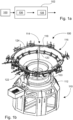
- the method according to the invention can be implemented with the apparatus according to Figure 1a including a circular knitting machine 100 and preferably processing equipment 102.
- the circular knitting machine 100 can be a prior art circular knitting machine similar to that illustrated in Figures 1a and 1b , into which yarns are supplied from bobbins 104.
- a circular knitting machine forms knits 18 according to Figures 4b - 4d , which in this case are single-jersey knits, from yarns using needles 111 shown in Figure 5 .
- the circular knitting machine can be a circular knitting machine made by German Terrot GmbH or Mayer&Cie GmbH&Co, having 20 - 32, preferably 24 - 28 needles per inch.
- the diameter of the circular knitting machine can range between 1000 and 2000 mm, for example.
- prior art circular knitting machines 100 illustrated in Figures 1b and 1c include a multi-angle frame 110 fitted against a base, a needle cylinder 112 containing needles arranged on top of the frame 110 and further, a creel arrangement 114 for feed devices arranged on top of the needle cylinder 112.
- the circular knitting machine 100 includes several yarn feed devices 116 forming individual feeders 103 according to Figure 5 , suspended in supporting rings 118 and 120 included in the creel arrangement 114 for supplying the yarn 104.
- the yarn feed devices 116 are driven by at least one motor 122 via power transmission means 124.
- guiding of yarns to a feeder of the circular knitting machine guiding of yarns to the same needle using separate yarn carriers is meant.
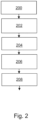
- the fabric that is not a part of the invention is manufactured with the method for manufacturing a cut resistant fabric, wherein, in step 200, polyethene yarn with a thickness of 50 - 130 dtex, preferably 100 - 120 dtex, is supplied to the circular knitting machine as a protective yarn and, in step 202, elastane yarn with a thickness of 20 - 80 dtex, preferably 30 - 50 dtex, is supplied to the circular knitting machine as a first additional yarn in such a way that the first additional yarn is supplied parallel with each protective yarn through the same feeder of the circular knitting machine to the needles, both at their own tension.
- the fabric is formed from the protective yarn and the first additional yarn supplied as a single-jersey knit in step 204.
- double-feeding more precisely means that first additional yarn is also always supplied to the needles parallel with the protective yarn through each feeder of the circular knitting machine.
- a part can also be replaced, preferably every other protective yarn, with a second additional yarn having more affordable investment costs.
- the second additional yarn can be polyester yarn, which has notably lower investment costs compared to the price of corresponding polyethene yarn.
- other additional yarns can also be used, but the minimum amount of protective yarn is in any case at least 40% and at most 95% by weight of the total weight of the fabric.
- the first additional yarn runs through the circular knitting machine together with the protective yarn, the tension force acting on the first additional yarn of the yarn feed devices of the circular knitting machine can be partly released, whereat the first additional yarn can partly recover towards its unstretched dimension.
- the first additional yarn tightens the protective yarn forming a dense and cut resistant fabric.
- both the protective yarn 12 and the first additional yarn 14 are supplied each through its own yarn carrier 125 in the feeder 103; that is, for example, the protective yarn 12 through the opening 128 and the first additional yarn 14 through the feed wheel 130 and the slot 126 to the same needle 111.
- both the protective yarn 12 and the first additional yarn 14 have their own tensions, as the tighter yarn does not pull the looser yarn in the same yarn carrier. In other words, adjustment of yarn tensions can be performed notably accurately in the method.
- the post-processing equipment 102 of Figure 1a used for fabric finishing includes a washing machine 106 and a stenter frame 108.
- the washing machine the fabric manufactured with the circular knitting machine is washed in step 206 of Figure 2 using chemicals for washing, which are manufactured, for example, by a Dutch company Tanatex Chemicals B.V.
- the purpose of washing is to remove impurities from the fabric and stabilise the fabric.
- the temperature used in washing may range, for example, between 40°C and 80°C, preferably between 50°C and 70°C.
- An anti-crease agent for synthetic materials, which is a lubricant, is advantageously used during washing.
- the purpose of the lubricant is to prevent fabric abrasion during washing.
- the purpose of the stenter frame is to heat up the fabric to a sufficiently high temperature in step 208, whereat the fabric shrinks and the fabric stabilises regarding its dimensions.
- the washing machine and the stenter frame can be prior art equipment.
- the washing machine manufacturer can be SOL and the stenter frame manufacturer can be Brücknerjantechnik GmbH & Co. KG.
- the temperature in the heat treatment step advantageously ranges between 100°C and 150°C.
- finishing may also include other steps, such as a stretch treatment, with which it is attempted to influence end product properties.
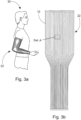
- Figure 3a shows one such product put on a wearer 30 representing a cut resistant sleeve 22, which is useful, for example, in car mechanic jobs.
- Car mechanics must put their hands in many places lacking a direct sight, thus exposing their hands to incised wounds and burns.
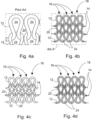
- Figure 4a shows an enlargement of a prior art fabric.
- the single-jersey knit has traditionally been poorly suited to cut resistant fabrics 10, since a very large open area 24 remains between the stitches 16.
- the single-jersey knit 18 has a notably small amount of protective yarn 12, which provides cut resistance for the fabric 10. This defect can be compensated by increasing the thickness of protective yarn, but then the fabric becomes thick and its stretch and usability suffer.
- Figure 3b the situation is different in the fabric 10, since, thanks to its elasticity, the first additional yarn 14, or elastane yarn, simultaneously supplied with each protective yarn 12 pulls the stitches 16 in the fabric 10 notably close to each other, whereat the amount of protective yarn 12 per unit area remarkably increases and the open area 24 remains small.
- Figure 3c is a rear view of the same fabric 10, wherein the stitches 16 look slightly different compared to the front view. It is essential that the protective yarn and the first additional yarn are not wrapped around each other before the supply to the needle so that both yarns can be supplied at a selected tension. In other words, the protective yarn and the first additional yarn run parallel to each other to each needle and through each knit of the fabric, as shown in Figures 4b - 4d .
- Polyethene yarn used as the cover yarn in the method and according to the invention may be polyethene yarn known under the tradename Dyneema with a thickness of 50 - 225 dtex, preferably 100 - 120 dtex.
- elastane yarn known under the tradename Lycra can be used as the first additional yarn, its thickness ranging from 20 to 80 dtex, preferably from 30 to 50 dtex.
- the first additional yarn is advantageously 100% elastane yarn to ensure that the first additional yarn can be supplied sufficiently stretched at the right tension.
- the thickness of the second additional yarn partially replacing the polyethene yarn can also be between 50 and 130 dtex, preferably between 100 and 120 dtex.
- Figure 4d illustrates a second embodiment of the fabric, wherein second additional yarn 20 has been supplied to every other needle to partly replace protective yarn 12.
- first additional yarn is also supplied as a double-feed parallel to the second additional yarn 20.
- tear resistance of the fabric notably reduces in this case.
- Elastane yarn used in a fabric must have such properties that it enables the supply to the circular knitting machine at the above-mentioned tension and, in addition, recovers from the stretched state to its original length without permanent deformation.
- the following resistance values are achieved in tests according to the EN388 standard, when the fabric only included polyethene yarn as protective yarn and elastane yarn as first additional yarn.
- the value of the resistance level is 3 on a scale of 1 - 4
- the tear resistance value is 4 on a scale of 1 - 4
- the cut resistance value is 2 on a scale of 1 - 5.
- the tear resistance value drops from 4 to 2. If necessary, cut resistance or tear resistance can be increased by using a fabric folded over, since the thin structure of the fabric yarn enables the manufacture of a stretchy garment even with the fabric folded over. Products requiring greater cut resistance may be, for example, neck protections and similar.
- the fabric achieves quite high, even excellent values in tests according to the EN388 standard for tear resistance, for example, since the thicknesses of protective yarns and first additional yarns used are less than half of what has been generally used in prior art applications requiring cut resistance.
- a double-feed of the first elastic additional yarn generates forces that pull protective yarns towards each other forming a dense net of protective yarns.
- garments for several different applications.
- Applications of the fabric can include garments related to occupational safety and health for public and security services, garments for pet care, working clothes and sports clothes.
- a high degree of elasticity, thin structure and cut resistance of the fabric enable the use of the fabric in protective underwear, for example.
- Particularly advantageous applications include cut resistant equipment for athletes, such as socks for ice hockey players and figure skaters and other wrist and ankle protections, serving the purpose of preventing cuts produced by skate blades during games.
- a fabric manufactured with a circular knitting machine comes from the circular knitting machine as a finished tubular structure, which can be cut half into a plane form depending on the application.
- all knits advantageously have an identical structure, which facilitates the manufacture of the fabric.
Landscapes
- Engineering & Computer Science (AREA)
- Textile Engineering (AREA)
- Mechanical Engineering (AREA)
- Knitting Of Fabric (AREA)
- Perforating, Stamping-Out Or Severing By Means Other Than Cutting (AREA)
Description
- The invention is related to a method for manufacturing a cut resistant fabric, in which method a cut resistant fabric is manufactured according to the following steps:
- supplying protective yarn and a first additional yarn to a circular knitting machine for forming a fabric, wherein the first additional yarn is supplied with each protective yarn through the same feeder of the circular knitting machine,
- using polyethene yarn with a thickness of 50 - 225 dtex, preferably 100 - 120 dtex, as the protective yarn and uncoated elastane yarn with a thickness of 20 - 80 dtex, preferably 30 - 78 dtex, as the first additional yarn,
- forming a fabric from the protective yarn and the first additional yarn as single-jersey knits,
- finishing the fabric in a heat treatment step for stabilising the fabric by interlocking the protective yarn (12) and the first additional yarn (14) in each single-jersey knit (18) using the heat treatment on a stenter frame.
- Leisure time activities and sports often include an element that can produce an incised wound to a person. In ice hockey, for example, a skate of a player can cut an incised wound. To avoid incised wounds, various protective equipment can be used that provide protection against incised wounds. Cut resistance includes several different levels ranging from resistance to chain saws to resistance to a normal knife. The higher the level of the required cut resistance, the thicker are the fabrics needed for cut resistance. Generally, in sports equipment, for example, it has been necessary to use fabrics of a lower cut resistance level, since fabrics with better cut resistance have been truly thick and thereby impractical for sports.
- Publication
WO 2005/116316 A1 proposes a cut resistant garment, which has been manufactured with a circular knitting machine using the rib knit. Here, the rib knit is used striving to provide an adequately stretchy cut resistant fabric that fits the wearer properly without a separate fastener. Generally, other knit types, such as jersey knits, have been too loose, so that fabric garments made of these have not fitted the wearer properly. In the cut resistant fabric, polyethene yarn with a tenacity of approximately 350 - 800 dtex and steel yarn have been used in combination to provide cut resistance. However, such a structure is very thick and rigid and is therefore not suitable for applications in which the garment or outfit must be stretchy and thin. - Publication
WO 2010/089410 A1 is also known prior art, wherein a cut resistant fabric is formed from protective yarn made of polyethene and additional yarn made of elastane, wrapped around the protective yarn, using single-jersey knits. However, such a fabric is weak regarding its cut resistance and in any event requires that protective yarn and additional yarn are first wrapped around each other. - An object of the invention is to provide a method better than prior art methods that can be used to manufacture a cut resistant fabric that is thinner and stretchier than heretofore. The characteristic features of this invention are set forth in the appended Claim 1.
- This object can be achieved with a method for manufacturing a cut resistant fabric, wherein a cut resistant fabric is manufactured according to the EN388 standard in the following steps, wherein protective yarn and first additional yarn are separately supplied to a circular knitting machine both at a selected tension each through a separate yarn carrier to the same feeder needle for forming a fabric, with the tension of the first additional yarn being higher than that of the protective yarn for compressing the final fabric, and using polyethene yarn with a thickness of 50 - 225 dtex, preferably 100 - 120 dtex, as the protective yarn and uncoated elastane yarn with a thickness of 20 - 80 dtex, preferably 30 - 78 dtex, as the first additional yarn. Furthermore, in the method, a fabric is formed from the protective yarn and the first additional yarn supplied as single-jersey knits and the fabric is finished in a heat treatment step on a stenter frame for stabilising the fabric.
- In the method according to the invention, polyethene yarn and elastane yarn are supplied parallel with each other to a circular knitting machine at selected tensions so that it is not necessary to wrap polyethene yarn and elastane yarn around each other in a separate step. At the same time, elastane yarn remains in the fabric at a residual tension, which enables the fabric to stretch/recover while simultaneously constricting polyethene yarn. With a heat treatment performed using a stenter frame, elastane yarn and polyethene yarn can be interlocked to form the final fabric. Thus, good cut resistance is achieved with thin polyethene yarn, when there is a large amount of polyethene yarn per unit area and the amount of open space remains small. At the same time, when using thin polyethene yarn, the fabric can be manufactured as notably thin. The fabric is finished in a heat treatment step for stabilising the fabric thus achieving fabric shrinkage, which increases the number of polyethene yarns per unit area and thereby improves cut resistance.
- Surprisingly, it has also been noticed that it is possible to use the single-jersey knit, which has been generally considered poor as regards stretch fabrics, when the stretch and cut resistance properties of the fabric are provided through elastane yarn double-fed to a single-jersey knit parallel with protective yarn. Then the polyethene yarn and the elastane yarn can be supplied each at a selected tension, which contributes to providing a stretchy and dense structure for the fabric. In prior art, it has generally been considered that it is necessary to use either the rib knit or the interlock knit as the knit to form a stretchy and cut resistant fabric. In the method according to the invention, a fabric manufactured as single-jersey knits is single-layered and therefore thin.
- In this application, polyethene yarn can also be referred to as polyethylene yarn.
- Advantageously, the filament count of polyethene yarn ranges between 25 and 200. Thus, polyethene yarn has an adequately great number of individual filaments to provide cut resistance.
- The temperature of the heat treatment step preferably ranges between 100°C and 150°C. Thus, the temperature is sufficiently high to provide fabric shrinkage, yet suitably low to ensure that synthetic yarns of the fabric will not begin to deform, in which case the fabric becomes rigid and "paper-like". In other words, the temperature is sufficiently low to prevent the fabric from "burning" on the stenter frame.
- The fabric can be finished in a washing step before the heat treatment step. With the washing step, it is possible to remove any impurities in the fabric thus achieving an end product of higher quality. At the same time, the washing temperature partly thermally stabilises the fabric, interlocking the protective yarn and the first additional yarn.
- Advantageously, an anti-crease agent is used as a lubricant in the washing step of the method. This prevents generation of creases on the delicate surface of the fabric.
- According to an embodiment, second additional yarn is alternately supplied in the method to every second feeder point relative to the protective yarn. In this way, the use of polyethene yarn, which is notably more expensive than elastane yarn, can be reduced with scarcely any loss of fabric properties. Advantageously, the second additional yarn is not cut resistant. Although the amount of polyethene yarn providing cut resistance is half as much in the final fabric, the required cut resistance is achieved as the elastane yarn compresses the polyethene yarn into a dense fabric.
- One of the following can be used as the second additional yarn: polyester yarn, polypropylene yarn, polyamide yarn. All of the above-mentioned yarns have a notably lower price than polyethene yarn, thus enabling even a reduction of 25% in the manufacturing costs of the fabric according to the invention.
- Advantageously, first additional yarn is also supplied with each second additional yarn through the same feeder of the circular knitting machine as a double-feed. Thus, elastane yarn runs in each stitch of the fabric keeping the stitches of the fabric tight.
- The first additional yarn can be supplied to the circular knitting machine at a tension where the length of the first additional yarn supplied to one machine cycle of the circular knitting machine is between 5% and 25%, preferably between 10% and 15% of the machine cycle length of the circular knitting machine. Due to an adequate supply tension, elastane yarn can be supplied as a double-feed in a tensioned state, together with polyethene yarn or second additional yarn, whereat elastane yarn tends to retract to its stable state without an external force, pulling polyethene yarn and possibly also second additional yarn into a dense knit.
- A circular knitting machine provided with 20 to 32 needles per inch (1 inch = 2.54 centimeter) in the machine cycle is advantageously used for manufacturing the fabric. Sufficiently densely placed needles enable a dense structure to the fabric.
- With the method according to the invention a cut resistant fabric can be produced, which is not apart of the invention, which fabric is made cut resistant according to the EN388 standard, the fabric including polyethene yarn as the protective yarn with its thickness ranging from 50 to 220 dtex, preferably from 50 to 120 dtex. The fabric also includes elastane yarn as the first additional yarn with its thickness ranging from 20 to 80 dtex, preferably from 30 to 50 dtex, for binding protective yarns together in the fabric. In addition, the fabric includes individual stitches formed from protective yarn and a first additional yarn, the stitches forming a single-jersey knit, wherein the protective yarn is in each stitch running parallel to the first additional yarn. The first additional yarn has a residual tension in the fabric when the first additional yarn is stretched by 10% to 50%, preferably by 20% to 30%.
- In the fabric, polyethene yarn and elastane yarn are used supplied in parallel with each other without being wrapped around each other; which enables stretch of the fabric while simultaneously constricting polyethene yarn into a dense structure. Thus, good cut resistance is surprisingly achieved with thin polyethene yarn, when there is a large amount of polyethene yarn per unit area and the amount of open space remains small. At the same time, when using thin polyethene yarn, the fabric can be manufactured as notably thin.
- According to an embodiment not according to the invention, the fabric includes a second additional yarn, which is in every other stitch instead of protective yarn. The use of a second additional yarn reduces manufacturing costs of the fabric, since the second additional yarn is not cut resistant and is therefore less expensive than polyethene yarn.
- Advantageously, the first additional yarn runs parallel with the second additional yarn as a double yarn. Thus, the first additional yarn, or elastane yarn, runs through each stitch in the fabric enabling its uniform stretch and cut resistance.
- The second additional yarn can be one of the following: polyester yarn, polypropylene yarn, polyamide yarn. All of the above-mentioned yarns are less expensive than polyethene yarn and thus optimal for replacing expensive polyethene yarn.
- Advantageously, the abrasion resistance, cut resistance and tear resistance values of the fabric are each at least 2 according to the EN388 standard. Then the fabric can be used in a versatile manner for various applications.
- The protective yarn is advantageously polyethene yarn marketed under the trademark Dyneema and the first additional yarn is elastane yarn marketed under the trademark Lycra.
- These yarns are generally known and products that are readily available on the market; therefore, their availability is good.
- According to an embodiment, the fabric has 15 to 40, preferably 25 to 30 stitches per inch, which is equivalent to 38 to 101, preferably 63 to 76 stitches per centimeter.
- An adequately great number of stitches in a certain unit area directly correlates with the cut resistance level, with the fabric being extremely dense, yet simultaneously stretchy.
- The basis weight of a fabric according to the invention may range between 150 and 250 g/m2, preferably between 180 and 220 g/m2.
- Advantageously, the tension of the first additional yarn in the fabric is such that the first additional yarn is stretched to a length of 160% to 250% relative to unstretched first additional yarn of a corresponding length. Thus, a sufficient residual tension remains in the first additional yarn even after the heat treatment carried out on the stenter frame.
- Advantageously, the fabric only includes single-jersey knits that are identical to each other. In this case, the fabric can be made at a sufficient speed using prior art circular knitting machines.
- According to the invention, the protective yarn and first additional yarn of the fabric are interlocked in the single-jersey knit by help of a heat treatment performed on the stenter frame. Thus, the fabric is dimensionally stable in use and does not notably stretch during washes.
- Advantageously, the fabric shrinkage is between -4% and -8% after the heat treatment. This means that when washing a product made from the fabric, no significant shrinkage nor stretching takes place, which is important regarding the usability of the product.
- Advantageously, the first additional yarn is 100% elastane. In this case, the first additional yarn resists to the tension applied to it during feeding without breaking unlike other yarns which are coated with materials with weaker stretch properties.
- Advantageously, the fabric according to the invention is arranged to achieve a cut resistance level in accordance with the above-mentioned standard for cut resistance when it is single-layered.
- Application possibilities of products that are made from a thin fabric are wide, since a thin fabric does not disturb the wearer, it is stretchy and properly fits on the user.
- The invention is described below in detail by making reference to the appended drawings that illustrate some of the embodiments of the invention, in which:
- Figure 1a
- shows block diagrams illustrating an apparatus that is suitable for implementing the method according to the invention,
- Figure 1b
- is an axonometric basic view of a circular knitting machine that can be used in the method according to the invention,
- Figure 1c
- is an axonometric basic view of another circular knitting machine that can be used in the method according to the invention,
- Figure 2
- shows block diagrams illustrating the steps of the method according to the invention,
- Figure 3a
- illustrates a garment formed from a fabric worn by a user,
- Figure 3b
- illustrates a garment formed from a fabric separately,
- Figure 4a
- is an enlarged view of a prior art single-jersey knit,
- Figure 4b
- is an enlarged view of detail A of the enlargement of the fabric of
Figure 3 , - Figure 4c
- is a rear view of the enlargement of
Figure 4a , - Figure 4d
- is an enlarged view of a fabric according to another embodiment,
- Figure 5
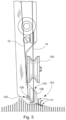
- illustrates the supply of protective yarn and first additional yarn separately to the same feeder of a circular knitting machine.
- The method according to the invention can be implemented with the apparatus according to
Figure 1a including acircular knitting machine 100 and preferably processingequipment 102. For example, thecircular knitting machine 100 can be a prior art circular knitting machine similar to that illustrated inFigures 1a and 1b , into which yarns are supplied frombobbins 104. According to prior art, a circular knitting machine forms knits 18 according toFigures 4b - 4d , which in this case are single-jersey knits, fromyarns using needles 111 shown inFigure 5 . For example, the circular knitting machine can be a circular knitting machine made by German Terrot GmbH or Mayer&Cie GmbH&Co, having 20 - 32, preferably 24 - 28 needles per inch. The diameter of the circular knitting machine can range between 1000 and 2000 mm, for example. - More precisely, prior art
circular knitting machines 100 illustrated inFigures 1b and1c include amulti-angle frame 110 fitted against a base, aneedle cylinder 112 containing needles arranged on top of theframe 110 and further, acreel arrangement 114 for feed devices arranged on top of theneedle cylinder 112. In addition, thecircular knitting machine 100 includes severalyarn feed devices 116 formingindividual feeders 103 according toFigure 5 , suspended in supportingrings creel arrangement 114 for supplying theyarn 104. Theyarn feed devices 116 are driven by at least onemotor 122 via power transmission means 124. In this context, when speaking of guiding of yarns to a feeder of the circular knitting machine, guiding of yarns to the same needle using separate yarn carriers is meant. - As shown in
Figure 2 , the fabric that is not a part of the invention, is manufactured with the method for manufacturing a cut resistant fabric, wherein, instep 200, polyethene yarn with a thickness of 50 - 130 dtex, preferably 100 - 120 dtex, is supplied to the circular knitting machine as a protective yarn and, instep 202, elastane yarn with a thickness of 20 - 80 dtex, preferably 30 - 50 dtex, is supplied to the circular knitting machine as a first additional yarn in such a way that the first additional yarn is supplied parallel with each protective yarn through the same feeder of the circular knitting machine to the needles, both at their own tension. The fabric is formed from the protective yarn and the first additional yarn supplied as a single-jersey knit instep 204. In this context, double-feeding more precisely means that first additional yarn is also always supplied to the needles parallel with the protective yarn through each feeder of the circular knitting machine. In the method, but not according to the invention, a part can also be replaced, preferably every other protective yarn, with a second additional yarn having more affordable investment costs. For example, the second additional yarn can be polyester yarn, which has notably lower investment costs compared to the price of corresponding polyethene yarn. Correspondingly, other additional yarns can also be used, but the minimum amount of protective yarn is in any case at least 40% and at most 95% by weight of the total weight of the fabric. the first additional yarn runs through the circular knitting machine together with the protective yarn, the tension force acting on the first additional yarn of the yarn feed devices of the circular knitting machine can be partly released, whereat the first additional yarn can partly recover towards its unstretched dimension. Thus, in a fabric the first additional yarn tightens the protective yarn forming a dense and cut resistant fabric. - Advantageously, when using Dyneema yarn, for instance, as the cover yarn, the supply length of protective yarn for a machine cycle of 2.8 m is 7.63 m, whereas, for a Lycra yarn used as the first additional yarn, the supply length is 5.55 m. Thus, the tension of both yarns may be 4 cN - 6 cN, preferably 4.5 cN - 5.5 cN. According to
figure 5 , both theprotective yarn 12 and the firstadditional yarn 14 are supplied each through itsown yarn carrier 125 in thefeeder 103; that is, for example, theprotective yarn 12 through theopening 128 and the firstadditional yarn 14 through thefeed wheel 130 and theslot 126 to thesame needle 111. When supplied throughseparate yarn carriers 125, both theprotective yarn 12 and the firstadditional yarn 14 have their own tensions, as the tighter yarn does not pull the looser yarn in the same yarn carrier. In other words, adjustment of yarn tensions can be performed notably accurately in the method. - Advantageously, the
post-processing equipment 102 ofFigure 1a used for fabric finishing includes awashing machine 106 and astenter frame 108. In the washing machine, the fabric manufactured with the circular knitting machine is washed instep 206 ofFigure 2 using chemicals for washing, which are manufactured, for example, by a Dutch company Tanatex Chemicals B.V. The purpose of washing is to remove impurities from the fabric and stabilise the fabric. The temperature used in washing may range, for example, between 40°C and 80°C, preferably between 50°C and 70°C. An anti-crease agent for synthetic materials, which is a lubricant, is advantageously used during washing. The purpose of the lubricant is to prevent fabric abrasion during washing. - The purpose of the stenter frame is to heat up the fabric to a sufficiently high temperature in
step 208, whereat the fabric shrinks and the fabric stabilises regarding its dimensions. The washing machine and the stenter frame can be prior art equipment. For example, the washing machine manufacturer can be SOL and the stenter frame manufacturer can be Brückner Trockentechnik GmbH & Co. KG. The temperature in the heat treatment step advantageously ranges between 100°C and 150°C. In addition to the washing and heat treatment, finishing may also include other steps, such as a stretch treatment, with which it is attempted to influence end product properties. - From a fabric manufactured with a method according to the invention, it is possible to manufacture several different products, in which cut resistance is particularly relevant.
Figure 3a shows one such product put on awearer 30 representing a cutresistant sleeve 22, which is useful, for example, in car mechanic jobs. Car mechanics must put their hands in many places lacking a direct sight, thus exposing their hands to incised wounds and burns. -
Figure 4a shows an enlargement of a prior art fabric. According to the figure, the single-jersey knit has traditionally been poorly suited to cutresistant fabrics 10, since a very largeopen area 24 remains between thestitches 16. Thus, per unit area, the single-jersey knit 18 has a notably small amount ofprotective yarn 12, which provides cut resistance for thefabric 10. This defect can be compensated by increasing the thickness of protective yarn, but then the fabric becomes thick and its stretch and usability suffer. - According to
Figure 3b , the situation is different in thefabric 10, since, thanks to its elasticity, the firstadditional yarn 14, or elastane yarn, simultaneously supplied with eachprotective yarn 12 pulls thestitches 16 in thefabric 10 notably close to each other, whereat the amount ofprotective yarn 12 per unit area remarkably increases and theopen area 24 remains small. In turn, Figure 3c is a rear view of thesame fabric 10, wherein thestitches 16 look slightly different compared to the front view. It is essential that the protective yarn and the first additional yarn are not wrapped around each other before the supply to the needle so that both yarns can be supplied at a selected tension. In other words, the protective yarn and the first additional yarn run parallel to each other to each needle and through each knit of the fabric, as shown inFigures 4b - 4d . - Polyethene yarn used as the cover yarn in the method and according to the invention may be polyethene yarn known under the tradename Dyneema with a thickness of 50 - 225 dtex, preferably 100 - 120 dtex. In turn, as the first additional yarn, elastane yarn known under the tradename Lycra can be used, its thickness ranging from 20 to 80 dtex, preferably from 30 to 50 dtex. The first additional yarn is advantageously 100% elastane yarn to ensure that the first additional yarn can be supplied sufficiently stretched at the right tension. The thickness of the second additional yarn partially replacing the polyethene yarn can also be between 50 and 130 dtex, preferably between 100 and 120 dtex.
Figure 4d illustrates a second embodiment of the fabric, wherein secondadditional yarn 20 has been supplied to every other needle to partly replaceprotective yarn 12. In association with secondadditional yarn 20, first additional yarn is also supplied as a double-feed parallel to the secondadditional yarn 20. When using replacing second additional yarn in every other needle, almost the same level of cut resistance is achieved; however, tear resistance of the fabric notably reduces in this case. Elastane yarn used in a fabric must have such properties that it enables the supply to the circular knitting machine at the above-mentioned tension and, in addition, recovers from the stretched state to its original length without permanent deformation. - With a cut resistant fabric, the following resistance values are achieved in tests according to the EN388 standard, when the fabric only included polyethene yarn as protective yarn and elastane yarn as first additional yarn. Regarding abrasion, the value of the resistance level is 3 on a scale of 1 - 4, the tear resistance value is 4 on a scale of 1 - 4, and the cut resistance value is 2 on a scale of 1 - 5. When part of polyethene yarn is replaced with second additional yarn, the tear resistance value drops from 4 to 2. If necessary, cut resistance or tear resistance can be increased by using a fabric folded over, since the thin structure of the fabric yarn enables the manufacture of a stretchy garment even with the fabric folded over. Products requiring greater cut resistance may be, for example, neck protections and similar.
- It is surprising that the fabric achieves quite high, even excellent values in tests according to the EN388 standard for tear resistance, for example, since the thicknesses of protective yarns and first additional yarns used are less than half of what has been generally used in prior art applications requiring cut resistance. However, a double-feed of the first elastic additional yarn generates forces that pull protective yarns towards each other forming a dense net of protective yarns.
- From the fabric, it is possible to manufacture garments for several different applications. Applications of the fabric can include garments related to occupational safety and health for public and security services, garments for pet care, working clothes and sports clothes. A high degree of elasticity, thin structure and cut resistance of the fabric enable the use of the fabric in protective underwear, for example. Particularly advantageous applications include cut resistant equipment for athletes, such as socks for ice hockey players and figure skaters and other wrist and ankle protections, serving the purpose of preventing cuts produced by skate blades during games.
- A fabric manufactured with a circular knitting machine comes from the circular knitting machine as a finished tubular structure, which can be cut half into a plane form depending on the application. In the fabric, all knits advantageously have an identical structure, which facilitates the manufacture of the fabric.
Claims (10)
- A method for manufacturing a cut resistant fabric, in which method a cut resistant fabric (10) is manufactured according to the following steps:- supplying protective yarn (12) and a first additional yarn (14) to a circular knitting machine (100) for forming a fabric (10), wherein said first additional yarn (14) is supplied with each protective yarn (12) through a same feeder (103) of the circular knitting machine (100),- using polyethene yarn with a thickness of 50 - 225 dtex, preferably 100 - 120 dtex, as said protective yarn (12) and uncoated elastane yarn with a thickness of 20 - 80 dtex, preferably 30 - 78 dtex, as the first additional yarn (14),- forming the fabric from the supplied protective yarn (12) and the first additional yarn (14) as single-jersey knits (18),characterised in that the method comprises- supplying separately the first additional yarn (14) and the protective yarn (12) to a circular knitting machine (100) both at a selected tension each through a separate yarn carrier to the same feeder (103) needle, with the tension of the first additional yarn (14) being higher than that of the protective yarn (12) for compressing the final fabric (10), and- finishing the fabric (10) in a heat treatment step (104) for stabilising the fabric (10) by interlocking the protective yarn (12) and the first additional yarn (14) in each single-jersey knit (18) using the heat treatment on a stenter frame.
- A method according to Claim 1, characterised in that the temperature of the heat treatment step (104) ranges from 100°C to 150°C.
- A method according to Claims 1 or 2, characterised in that second additional yarn (20) is alternately supplied to every second feeder (103) relative to said protective yarn (12) .
- A method according to any of Claims 1 to 3, characterised in that the fabric (10) is washed before the heat treatment.
- A method according to Claim 1, characterised in that an anti-crease agent is used as a lubricant in washing.
- A method according to Claim 1, characterised in that the abrasion resistance, cut resistance and tear resistance values of the thereby manufactured fabric (10) are each at least 2 according to the EN388 standard.
- A method according to Claim 1, characterised in that the thereby manufactured fabric (10) only includes single-jersey knits (18) that are identical to each other.
- A method according to Claim 1, characterised in that the basis weight of the thereby manufactured fabric (10) may range between 150 and 250 g/m2, preferably between 180 and 220 g/m2.
- A method according to Claim 1, characterised in that the thereby manufactured fabric (10) has 38 to 101, preferably 63 to 76 stitches per centimeter.
- A method according to Claim 1, characterised in that the first additional yarn is 100% elastane.
Priority Applications (1)
| Application Number | Priority Date | Filing Date | Title |
|---|---|---|---|
| FIU20234035U FI13454Y1 (en) | 2016-12-09 | 2017-12-11 | Cut resistant fabric |
Applications Claiming Priority (2)
| Application Number | Priority Date | Filing Date | Title |
|---|---|---|---|
| FI20165951 | 2016-12-09 | ||
| PCT/FI2017/050873 WO2018104589A1 (en) | 2016-12-09 | 2017-12-11 | Method for manufacturing a cut resistant fabric and a cut resistant fabric |
Publications (3)
| Publication Number | Publication Date |
|---|---|
| EP3551793A1 EP3551793A1 (en) | 2019-10-16 |
| EP3551793B1 true EP3551793B1 (en) | 2023-07-12 |
| EP3551793C0 EP3551793C0 (en) | 2023-07-12 |
Family
ID=61094534
Family Applications (1)
| Application Number | Title | Priority Date | Filing Date |
|---|---|---|---|
| EP17836038.4A Active EP3551793B1 (en) | 2016-12-09 | 2017-12-11 | Method for manufacturing a cut resistant fabric and a cut resistant fabric |
Country Status (5)
| Country | Link |
|---|---|
| US (1) | US11549203B2 (en) |
| EP (1) | EP3551793B1 (en) |
| DE (1) | DE202017007598U1 (en) |
| FI (2) | FI3551793T1 (en) |
| WO (1) | WO2018104589A1 (en) |
Families Citing this family (7)
| Publication number | Priority date | Publication date | Assignee | Title |
|---|---|---|---|---|
| EP3918122B1 (en) * | 2019-01-29 | 2024-11-13 | Confsport S.R.L. | Ski clothing with anti-cut characteristics and related fabric |
| EP4077783B1 (en) * | 2019-12-16 | 2024-07-03 | Pure Medical, Inc. | Compression garments made from a knitted quilt fabric |
| US12495846B2 (en) | 2020-10-30 | 2025-12-16 | Ansell Limited | Protective knit sleeves |
| USD1058049S1 (en) | 2021-09-03 | 2025-01-14 | Milwaukee Electric Tool Corporation | Protective sleeve |
| US12302959B1 (en) | 2023-11-06 | 2025-05-20 | Lev Innovations Llc | Neck laceration prevention device |
| IT202400005107A1 (en) | 2024-03-07 | 2025-09-07 | Confsport S R L | CUT-RESISTANT PROTECTIVE SUIT |
| CN119969672B (en) * | 2025-04-14 | 2025-08-12 | 烟台泰和新材高分子新材料研究院有限公司 | A flexible, rollable, overlapping stab-proof layer, a stab-proof garment, and a preparation method thereof |
Citations (10)
| Publication number | Priority date | Publication date | Assignee | Title |
|---|---|---|---|---|
| WO2005116316A1 (en) | 2004-05-24 | 2005-12-08 | Wells Lamont Industry Group | Cut resistant garment |
| US20060021387A1 (en) | 2004-06-01 | 2006-02-02 | Invista North America S. A R.L. | Method to make circular knit elastic fabric comprising spandex and hard yarns |
| EP1633916B1 (en) | 2003-06-02 | 2009-09-02 | INVISTA Technologies S.à.r.l. | Method to make circular-knit elastic fabric comprising spandex and hard yarns |
| WO2010089410A1 (en) | 2009-02-09 | 2010-08-12 | Dsm Ip Assets B.V. | Cut resistant composite yarn |
| US7779655B2 (en) | 2004-12-21 | 2010-08-24 | INVISTA North America S.á r.l. | Knit-by-design method and fabric |
| US20100275341A1 (en) | 2009-04-29 | 2010-11-04 | Ansell Healthcare Products Llc | Knitted Glove Having A Single Layer With A Plurality Of Yarns |
| US7943536B2 (en) | 2004-08-13 | 2011-05-17 | Dow Global Technologies Llc | Stretch fabrics with improved heat-setting properties |
| US20120122364A1 (en) | 2010-11-16 | 2012-05-17 | Velcro Industries B.V. | Knitting with yarns of differing stretch properties |
| WO2014134682A1 (en) | 2013-03-07 | 2014-09-12 | Grt Developments Pty Limited | Fabric system |
| US20160265146A1 (en) | 2013-10-14 | 2016-09-15 | Invista North America S.A R.L. | Stretch circular knit fabrics with multiple elastic yarns |
Family Cites Families (1)
| Publication number | Priority date | Publication date | Assignee | Title |
|---|---|---|---|---|
| US20100050699A1 (en) * | 2008-06-06 | 2010-03-04 | Nathaniel H. Kolmes | Lightweight, cut and/or abrasion resistant garments, and related protective wear |
-
2017
- 2017-12-11 FI FIEP17836038.4T patent/FI3551793T1/en unknown
- 2017-12-11 FI FIU20234035U patent/FI13454Y1/en active IP Right Grant
- 2017-12-11 DE DE202017007598.9U patent/DE202017007598U1/en active Active
- 2017-12-11 WO PCT/FI2017/050873 patent/WO2018104589A1/en not_active Ceased
- 2017-12-11 EP EP17836038.4A patent/EP3551793B1/en active Active
-
2019
- 2019-06-05 US US16/432,891 patent/US11549203B2/en active Active
Patent Citations (10)
| Publication number | Priority date | Publication date | Assignee | Title |
|---|---|---|---|---|
| EP1633916B1 (en) | 2003-06-02 | 2009-09-02 | INVISTA Technologies S.à.r.l. | Method to make circular-knit elastic fabric comprising spandex and hard yarns |
| WO2005116316A1 (en) | 2004-05-24 | 2005-12-08 | Wells Lamont Industry Group | Cut resistant garment |
| US20060021387A1 (en) | 2004-06-01 | 2006-02-02 | Invista North America S. A R.L. | Method to make circular knit elastic fabric comprising spandex and hard yarns |
| US7943536B2 (en) | 2004-08-13 | 2011-05-17 | Dow Global Technologies Llc | Stretch fabrics with improved heat-setting properties |
| US7779655B2 (en) | 2004-12-21 | 2010-08-24 | INVISTA North America S.á r.l. | Knit-by-design method and fabric |
| WO2010089410A1 (en) | 2009-02-09 | 2010-08-12 | Dsm Ip Assets B.V. | Cut resistant composite yarn |
| US20100275341A1 (en) | 2009-04-29 | 2010-11-04 | Ansell Healthcare Products Llc | Knitted Glove Having A Single Layer With A Plurality Of Yarns |
| US20120122364A1 (en) | 2010-11-16 | 2012-05-17 | Velcro Industries B.V. | Knitting with yarns of differing stretch properties |
| WO2014134682A1 (en) | 2013-03-07 | 2014-09-12 | Grt Developments Pty Limited | Fabric system |
| US20160265146A1 (en) | 2013-10-14 | 2016-09-15 | Invista North America S.A R.L. | Stretch circular knit fabrics with multiple elastic yarns |
Non-Patent Citations (3)
| Title |
|---|
| A.R. HORROCKS AND S.C. ANAND: "Handbook of Technical Textiles", 31 October 2000, WOODHEAD PUBLISHING LTD, North and South America , ISBN: 1-85573-385-4, article MICHAEL E. HALL: "Chapter 7: Finishing of technical textiles", pages: 152 - 172, XP009556009, DOI: 10.1533/9781855738966.152 |
| DAVID J SPENCER: "Knitting Technology. A Comprehensive Handbook and Practical Guide. 3rd ed.", 1 January 2001, WOODHEAD PUBLISHING LIMITED, Cambridge, England, ISBN: 1-85573-333-1, article "Knitting Technology - ToC", pages: 1 - 446, XP009556513 |
| SADHAN CHANDRA RAY: "Fundamentals and advances in knitting technology", 1 January 2011, WOODHEAD PUBLISHING INDIA PVT. LTD, New Delhi, India, ISBN: 978-93-80308-16-6, article "Fundamentals and Advances in Knitting Technology - ToC", pages: 1 - 393, XP009556514, DOI: 10.1201/b18245 |
Also Published As
| Publication number | Publication date |
|---|---|
| WO2018104589A1 (en) | 2018-06-14 |
| US20190284735A1 (en) | 2019-09-19 |
| DE202017007598U1 (en) | 2023-07-13 |
| US11549203B2 (en) | 2023-01-10 |
| EP3551793C0 (en) | 2023-07-12 |
| EP3551793A1 (en) | 2019-10-16 |
| FI13454Y1 (en) | 2023-08-31 |
| FI3551793T1 (en) | 2023-04-27 |
Similar Documents
| Publication | Publication Date | Title |
|---|---|---|
| US11549203B2 (en) | Method for manufacturing a cut resistant fabric and a cut resistant fabric | |
| US20240191403A1 (en) | Easily settable stretch fabrics including low-melt fiber | |
| JP7756125B2 (en) | High-quality knitwear that is tear-resistant and pill-resistant | |
| US8065894B2 (en) | Double knit fabric having superior run or curling generation preventing ability and a method for processing the double knit fabric | |
| US20060042327A1 (en) | Cut resistant garment | |
| JP2007182650A (en) | Weft knitted fabric mixed with heat fusion polyurethane elastic fiber, garment using the weft knitted fabric, and method for producing the weft knitted fabric | |
| US7013680B1 (en) | Method to prevent deknitting | |
| JP2002266118A (en) | Protective clothing or sports clothing | |
| US20250305191A1 (en) | Pantyhose article having ultra-high molecular weight polyethylene and method for manufacturing thereof | |
| JP2011144479A (en) | Continuous fabric and method for knitting the same | |
| JP7320357B2 (en) | Knitted fabric and clothing using said knitted fabric | |
| KR20180007928A (en) | Toe sock and a method of manufacturing | |
| WO2025264596A1 (en) | Shaping, compressing, and supporting stretch fabrics including low-melt fiber | |
| HK40079410A (en) | Rip-resistant, non-pilling fine knit garments | |
| JP2005042240A (en) | Garment excellent in wound-proofing property | |
| WO1999029947A1 (en) | Fiber product made of covered elastic thread and covered elastic threads | |
| JPS61186557A (en) | Polyurethane elastic yarn sheet | |
| HK1142102A (en) | Double knitted fabric excellent in prevention of run or curling and method of processing the same |
Legal Events
| Date | Code | Title | Description |
|---|---|---|---|
| STAA | Information on the status of an ep patent application or granted ep patent |
Free format text: STATUS: UNKNOWN |
|
| STAA | Information on the status of an ep patent application or granted ep patent |
Free format text: STATUS: THE INTERNATIONAL PUBLICATION HAS BEEN MADE |
|
| PUAI | Public reference made under article 153(3) epc to a published international application that has entered the european phase |
Free format text: ORIGINAL CODE: 0009012 |
|
| STAA | Information on the status of an ep patent application or granted ep patent |
Free format text: STATUS: REQUEST FOR EXAMINATION WAS MADE |
|
| 17P | Request for examination filed |
Effective date: 20190703 |
|
| AK | Designated contracting states |
Kind code of ref document: A1 Designated state(s): AL AT BE BG CH CY CZ DE DK EE ES FI FR GB GR HR HU IE IS IT LI LT LU LV MC MK MT NL NO PL PT RO RS SE SI SK SM TR |
|
| AX | Request for extension of the european patent |
Extension state: BA ME |
|
| DAV | Request for validation of the european patent (deleted) | ||
| DAX | Request for extension of the european patent (deleted) | ||
| STAA | Information on the status of an ep patent application or granted ep patent |
Free format text: STATUS: EXAMINATION IS IN PROGRESS |
|
| 17Q | First examination report despatched |
Effective date: 20210316 |
|
| GRAP | Despatch of communication of intention to grant a patent |
Free format text: ORIGINAL CODE: EPIDOSNIGR1 |
|
| STAA | Information on the status of an ep patent application or granted ep patent |
Free format text: STATUS: GRANT OF PATENT IS INTENDED |
|
| INTG | Intention to grant announced |
Effective date: 20230208 |
|
| GRAS | Grant fee paid |
Free format text: ORIGINAL CODE: EPIDOSNIGR3 |
|
| GRAA | (expected) grant |
Free format text: ORIGINAL CODE: 0009210 |
|
| STAA | Information on the status of an ep patent application or granted ep patent |
Free format text: STATUS: THE PATENT HAS BEEN GRANTED |
|
| AK | Designated contracting states |
Kind code of ref document: B1 Designated state(s): AL AT BE BG CH CY CZ DE DK EE ES FI FR GB GR HR HU IE IS IT LI LT LU LV MC MK MT NL NO PL PT RO RS SE SI SK SM TR |
|
| REG | Reference to a national code |
Ref country code: CH Ref legal event code: EP |
|
| REG | Reference to a national code |
Ref country code: IE Ref legal event code: FG4D |
|
| REG | Reference to a national code |
Ref country code: DE Ref legal event code: R096 Ref document number: 602017071286 Country of ref document: DE |
|
| U01 | Request for unitary effect filed |
Effective date: 20230809 |
|
| U07 | Unitary effect registered |
Designated state(s): AT BE BG DE DK EE FI FR IT LT LU LV MT NL PT SE SI Effective date: 20230816 |
|
| REG | Reference to a national code |
Ref country code: LT Ref legal event code: MG9D |
|
| PG25 | Lapsed in a contracting state [announced via postgrant information from national office to epo] |
Ref country code: GR Free format text: LAPSE BECAUSE OF FAILURE TO SUBMIT A TRANSLATION OF THE DESCRIPTION OR TO PAY THE FEE WITHIN THE PRESCRIBED TIME-LIMIT Effective date: 20231013 |
|
| PG25 | Lapsed in a contracting state [announced via postgrant information from national office to epo] |
Ref country code: ES Free format text: LAPSE BECAUSE OF FAILURE TO SUBMIT A TRANSLATION OF THE DESCRIPTION OR TO PAY THE FEE WITHIN THE PRESCRIBED TIME-LIMIT Effective date: 20230712 |
|
| PG25 | Lapsed in a contracting state [announced via postgrant information from national office to epo] |
Ref country code: IS Free format text: LAPSE BECAUSE OF FAILURE TO SUBMIT A TRANSLATION OF THE DESCRIPTION OR TO PAY THE FEE WITHIN THE PRESCRIBED TIME-LIMIT Effective date: 20231112 |
|
| PG25 | Lapsed in a contracting state [announced via postgrant information from national office to epo] |
Ref country code: RS Free format text: LAPSE BECAUSE OF FAILURE TO SUBMIT A TRANSLATION OF THE DESCRIPTION OR TO PAY THE FEE WITHIN THE PRESCRIBED TIME-LIMIT Effective date: 20230712 Ref country code: NO Free format text: LAPSE BECAUSE OF FAILURE TO SUBMIT A TRANSLATION OF THE DESCRIPTION OR TO PAY THE FEE WITHIN THE PRESCRIBED TIME-LIMIT Effective date: 20231012 Ref country code: IS Free format text: LAPSE BECAUSE OF FAILURE TO SUBMIT A TRANSLATION OF THE DESCRIPTION OR TO PAY THE FEE WITHIN THE PRESCRIBED TIME-LIMIT Effective date: 20231112 Ref country code: HR Free format text: LAPSE BECAUSE OF FAILURE TO SUBMIT A TRANSLATION OF THE DESCRIPTION OR TO PAY THE FEE WITHIN THE PRESCRIBED TIME-LIMIT Effective date: 20230712 Ref country code: GR Free format text: LAPSE BECAUSE OF FAILURE TO SUBMIT A TRANSLATION OF THE DESCRIPTION OR TO PAY THE FEE WITHIN THE PRESCRIBED TIME-LIMIT Effective date: 20231013 Ref country code: ES Free format text: LAPSE BECAUSE OF FAILURE TO SUBMIT A TRANSLATION OF THE DESCRIPTION OR TO PAY THE FEE WITHIN THE PRESCRIBED TIME-LIMIT Effective date: 20230712 |
|
| U20 | Renewal fee for the european patent with unitary effect paid |
Year of fee payment: 7 Effective date: 20231222 |
|
| PG25 | Lapsed in a contracting state [announced via postgrant information from national office to epo] |
Ref country code: PL Free format text: LAPSE BECAUSE OF FAILURE TO SUBMIT A TRANSLATION OF THE DESCRIPTION OR TO PAY THE FEE WITHIN THE PRESCRIBED TIME-LIMIT Effective date: 20230712 |
|
| REG | Reference to a national code |
Ref country code: DE Ref legal event code: R026 Ref document number: 602017071286 Country of ref document: DE |
|
| PLBI | Opposition filed |
Free format text: ORIGINAL CODE: 0009260 |
|
| PLAX | Notice of opposition and request to file observation + time limit sent |
Free format text: ORIGINAL CODE: EPIDOSNOBS2 |
|
| PG25 | Lapsed in a contracting state [announced via postgrant information from national office to epo] |
Ref country code: SM Free format text: LAPSE BECAUSE OF FAILURE TO SUBMIT A TRANSLATION OF THE DESCRIPTION OR TO PAY THE FEE WITHIN THE PRESCRIBED TIME-LIMIT Effective date: 20230712 Ref country code: RO Free format text: LAPSE BECAUSE OF FAILURE TO SUBMIT A TRANSLATION OF THE DESCRIPTION OR TO PAY THE FEE WITHIN THE PRESCRIBED TIME-LIMIT Effective date: 20230712 Ref country code: CZ Free format text: LAPSE BECAUSE OF FAILURE TO SUBMIT A TRANSLATION OF THE DESCRIPTION OR TO PAY THE FEE WITHIN THE PRESCRIBED TIME-LIMIT Effective date: 20230712 Ref country code: SK Free format text: LAPSE BECAUSE OF FAILURE TO SUBMIT A TRANSLATION OF THE DESCRIPTION OR TO PAY THE FEE WITHIN THE PRESCRIBED TIME-LIMIT Effective date: 20230712 |
|
| 26 | Opposition filed |
Opponent name: CONCORDIA TEXTILES NV Effective date: 20240412 |
|
| PG25 | Lapsed in a contracting state [announced via postgrant information from national office to epo] |
Ref country code: MC Free format text: LAPSE BECAUSE OF FAILURE TO SUBMIT A TRANSLATION OF THE DESCRIPTION OR TO PAY THE FEE WITHIN THE PRESCRIBED TIME-LIMIT Effective date: 20230712 |
|
| PLBB | Reply of patent proprietor to notice(s) of opposition received |
Free format text: ORIGINAL CODE: EPIDOSNOBS3 |
|
| PG25 | Lapsed in a contracting state [announced via postgrant information from national office to epo] |
Ref country code: MC Free format text: LAPSE BECAUSE OF FAILURE TO SUBMIT A TRANSLATION OF THE DESCRIPTION OR TO PAY THE FEE WITHIN THE PRESCRIBED TIME-LIMIT Effective date: 20230712 |
|
| REG | Reference to a national code |
Ref country code: IE Ref legal event code: MM4A |
|
| PG25 | Lapsed in a contracting state [announced via postgrant information from national office to epo] |
Ref country code: IE Free format text: LAPSE BECAUSE OF NON-PAYMENT OF DUE FEES Effective date: 20231211 |
|
| PG25 | Lapsed in a contracting state [announced via postgrant information from national office to epo] |
Ref country code: IE Free format text: LAPSE BECAUSE OF NON-PAYMENT OF DUE FEES Effective date: 20231211 |
|
| U20 | Renewal fee for the european patent with unitary effect paid |
Year of fee payment: 8 Effective date: 20241223 |
|
| PG25 | Lapsed in a contracting state [announced via postgrant information from national office to epo] |
Ref country code: CY Free format text: LAPSE BECAUSE OF FAILURE TO SUBMIT A TRANSLATION OF THE DESCRIPTION OR TO PAY THE FEE WITHIN THE PRESCRIBED TIME-LIMIT; INVALID AB INITIO Effective date: 20171211 |
|
| PG25 | Lapsed in a contracting state [announced via postgrant information from national office to epo] |
Ref country code: HU Free format text: LAPSE BECAUSE OF FAILURE TO SUBMIT A TRANSLATION OF THE DESCRIPTION OR TO PAY THE FEE WITHIN THE PRESCRIBED TIME-LIMIT; INVALID AB INITIO Effective date: 20171211 |
|
| PG25 | Lapsed in a contracting state [announced via postgrant information from national office to epo] |
Ref country code: TR Free format text: LAPSE BECAUSE OF FAILURE TO SUBMIT A TRANSLATION OF THE DESCRIPTION OR TO PAY THE FEE WITHIN THE PRESCRIBED TIME-LIMIT Effective date: 20230712 |
|
| PLCK | Communication despatched that opposition was rejected |
Free format text: ORIGINAL CODE: EPIDOSNREJ1 |
|
| REG | Reference to a national code |
Ref country code: CH Ref legal event code: U11 Free format text: ST27 STATUS EVENT CODE: U-0-0-U10-U11 (AS PROVIDED BY THE NATIONAL OFFICE) Effective date: 20260101 |
|
| PGFP | Annual fee paid to national office [announced via postgrant information from national office to epo] |
Ref country code: GB Payment date: 20251219 Year of fee payment: 9 |
|
| U20 | Renewal fee for the european patent with unitary effect paid |
Year of fee payment: 9 Effective date: 20251218 |
|
| PLBN | Opposition rejected |
Free format text: ORIGINAL CODE: 0009273 |
|
| STAA | Information on the status of an ep patent application or granted ep patent |
Free format text: STATUS: OPPOSITION REJECTED |
|
| REG | Reference to a national code |
Ref country code: CH Ref legal event code: L18 Free format text: ST27 STATUS EVENT CODE: U-0-0-L10-L18 (AS PROVIDED BY THE NATIONAL OFFICE) Effective date: 20260402 |
|
| PGFP | Annual fee paid to national office [announced via postgrant information from national office to epo] |
Ref country code: CH Payment date: 20260101 Year of fee payment: 9 |
|
| 27O | Opposition rejected |
Effective date: 20251127 |