EP3551349B1 - Thickness-planar mode transducers and related devices - Google Patents
Thickness-planar mode transducers and related devices Download PDFInfo
- Publication number
- EP3551349B1 EP3551349B1 EP17818409.9A EP17818409A EP3551349B1 EP 3551349 B1 EP3551349 B1 EP 3551349B1 EP 17818409 A EP17818409 A EP 17818409A EP 3551349 B1 EP3551349 B1 EP 3551349B1
- Authority
- EP
- European Patent Office
- Prior art keywords
- transducer
- flexible support
- electrically conductive
- conductive flexible
- piezoelectric block
- Prior art date
- Legal status (The legal status is an assumption and is not a legal conclusion. Google has not performed a legal analysis and makes no representation as to the accuracy of the status listed.)
- Active
Links
Images


Classifications
-
- B—PERFORMING OPERATIONS; TRANSPORTING
- B06—GENERATING OR TRANSMITTING MECHANICAL VIBRATIONS IN GENERAL
- B06B—METHODS OR APPARATUS FOR GENERATING OR TRANSMITTING MECHANICAL VIBRATIONS OF INFRASONIC, SONIC, OR ULTRASONIC FREQUENCY, e.g. FOR PERFORMING MECHANICAL WORK IN GENERAL
- B06B1/00—Methods or apparatus for generating mechanical vibrations of infrasonic, sonic, or ultrasonic frequency
- B06B1/02—Methods or apparatus for generating mechanical vibrations of infrasonic, sonic, or ultrasonic frequency making use of electrical energy
- B06B1/06—Methods or apparatus for generating mechanical vibrations of infrasonic, sonic, or ultrasonic frequency making use of electrical energy operating with piezoelectric effect or with electrostriction
- B06B1/0644—Methods or apparatus for generating mechanical vibrations of infrasonic, sonic, or ultrasonic frequency making use of electrical energy operating with piezoelectric effect or with electrostriction using a single piezoelectric element
- B06B1/0662—Methods or apparatus for generating mechanical vibrations of infrasonic, sonic, or ultrasonic frequency making use of electrical energy operating with piezoelectric effect or with electrostriction using a single piezoelectric element with an electrode on the sensitive surface
- B06B1/067—Methods or apparatus for generating mechanical vibrations of infrasonic, sonic, or ultrasonic frequency making use of electrical energy operating with piezoelectric effect or with electrostriction using a single piezoelectric element with an electrode on the sensitive surface which is used as, or combined with, an impedance matching layer
-
- B—PERFORMING OPERATIONS; TRANSPORTING
- B06—GENERATING OR TRANSMITTING MECHANICAL VIBRATIONS IN GENERAL
- B06B—METHODS OR APPARATUS FOR GENERATING OR TRANSMITTING MECHANICAL VIBRATIONS OF INFRASONIC, SONIC, OR ULTRASONIC FREQUENCY, e.g. FOR PERFORMING MECHANICAL WORK IN GENERAL
- B06B1/00—Methods or apparatus for generating mechanical vibrations of infrasonic, sonic, or ultrasonic frequency
- B06B1/02—Methods or apparatus for generating mechanical vibrations of infrasonic, sonic, or ultrasonic frequency making use of electrical energy
- B06B1/06—Methods or apparatus for generating mechanical vibrations of infrasonic, sonic, or ultrasonic frequency making use of electrical energy operating with piezoelectric effect or with electrostriction
- B06B1/0644—Methods or apparatus for generating mechanical vibrations of infrasonic, sonic, or ultrasonic frequency making use of electrical energy operating with piezoelectric effect or with electrostriction using a single piezoelectric element
-
- G—PHYSICS
- G01—MEASURING; TESTING
- G01F—MEASURING VOLUME, VOLUME FLOW, MASS FLOW OR LIQUID LEVEL; METERING BY VOLUME
- G01F1/00—Measuring the volume flow or mass flow of fluid or fluent solid material wherein the fluid passes through a meter in a continuous flow
- G01F1/66—Measuring the volume flow or mass flow of fluid or fluent solid material wherein the fluid passes through a meter in a continuous flow by measuring frequency, phase shift or propagation time of electromagnetic or other waves, e.g. using ultrasonic flowmeters
- G01F1/662—Constructional details
-
- G—PHYSICS
- G01—MEASURING; TESTING
- G01F—MEASURING VOLUME, VOLUME FLOW, MASS FLOW OR LIQUID LEVEL; METERING BY VOLUME
- G01F1/00—Measuring the volume flow or mass flow of fluid or fluent solid material wherein the fluid passes through a meter in a continuous flow
- G01F1/66—Measuring the volume flow or mass flow of fluid or fluent solid material wherein the fluid passes through a meter in a continuous flow by measuring frequency, phase shift or propagation time of electromagnetic or other waves, e.g. using ultrasonic flowmeters
- G01F1/667—Arrangements of transducers for ultrasonic flowmeters; Circuits for operating ultrasonic flowmeters
-
- G—PHYSICS
- G01—MEASURING; TESTING
- G01H—MEASUREMENT OF MECHANICAL VIBRATIONS OR ULTRASONIC, SONIC OR INFRASONIC WAVES
- G01H11/00—Measuring mechanical vibrations or ultrasonic, sonic or infrasonic waves by detecting changes in electric or magnetic properties
- G01H11/06—Measuring mechanical vibrations or ultrasonic, sonic or infrasonic waves by detecting changes in electric or magnetic properties by electric means
- G01H11/08—Measuring mechanical vibrations or ultrasonic, sonic or infrasonic waves by detecting changes in electric or magnetic properties by electric means using piezoelectric devices
-
- G—PHYSICS
- G01—MEASURING; TESTING
- G01N—INVESTIGATING OR ANALYSING MATERIALS BY DETERMINING THEIR CHEMICAL OR PHYSICAL PROPERTIES
- G01N29/00—Investigating or analysing materials by the use of ultrasonic, sonic or infrasonic waves; Visualisation of the interior of objects by transmitting ultrasonic or sonic waves through the object
- G01N29/02—Analysing fluids
- G01N29/024—Analysing fluids by measuring propagation velocity or propagation time of acoustic waves
-
- G—PHYSICS
- G01—MEASURING; TESTING
- G01N—INVESTIGATING OR ANALYSING MATERIALS BY DETERMINING THEIR CHEMICAL OR PHYSICAL PROPERTIES
- G01N2291/00—Indexing codes associated with group G01N29/00
- G01N2291/02—Indexing codes associated with the analysed material
- G01N2291/028—Material parameters
- G01N2291/02836—Flow rate, liquid level
-
- H—ELECTRICITY
- H10—SEMICONDUCTOR DEVICES; ELECTRIC SOLID-STATE DEVICES NOT OTHERWISE PROVIDED FOR
- H10N—ELECTRIC SOLID-STATE DEVICES NOT OTHERWISE PROVIDED FOR
- H10N30/00—Piezoelectric or electrostrictive devices
- H10N30/80—Constructional details
- H10N30/87—Electrodes or interconnections, e.g. leads or terminals
Definitions
- the present inventive concept relates generally to transducers and, more particularly, to ultrasonic transducers and related methods and devices.
- Ultrasonic transducers preferably include small but precisely dimensioned piezoelectric blocks in order to provide a high degree of part-to-part repeatability with low material costs.
- Conventional devices generally include a cylindrical piezoelectric block having a thickness that defines a resonant frequency of the piezoelectric block.
- the element thickness may be, for example, about 7.0 mm when operated at 170 kHz and about 3.0 mm when operated at 400 kHz.
- fabricating precisely dimensioned piezoelectric cylinders of this size and shape can be very expensive as the cylinder faces have to be machined after firing.
- WO-2007/064214 describes an ultrasonic transducer module comprising at least one transmitter layer and at least one receiver layer, each comprising a number of elongated electrodes.
- EP-1237148 describes an ultrasonic transducer comprising a piezoelectric element and an acoustic matching layer.
- US 2015/298174 A1 discloses a transducer comprising a single piezoelectric block with first and second electrically conductive flexible support layer partially on and overhanging the first and second surface of the piezoelectric block.
- the present invention provides a transducer including a single piezoelectric block having first and second opposing surfaces; a first conductive flexible support layer on the first surface of the piezoelectric block, the first flexible support layer having a first thickness; and a second flexible support layer on the second surface of the piezoelectric block, the second flexible support layer having a second thickness, wherein the first and second thicknesses are substantially the same, and wherein the first and second electrically conductive flexible support layers overhang the first and second opposing surfaces of the single piezoelectric block, respectively.
- the first and second thicknesses may be substantially less than a thickness of the piezoelectric block.
- the first and second conductive flexible support layers may include thin metal sheets of material directly on the first and second opposing surfaces of the single piezoelectric block, respectively.
- the thin metal sheets of material may include only stainless steel sheets of material.
- the first and second conductive flexible support layers may be flexible circuits with a copper trace.
- first and second conductive flexible support layers may have a thickness of from about 0.025 mm to about 0.1mm.
- the piezoelectric block may include a soft PZT material selected from one of grade P5A material and P5H material.
- the piezoelectric block may have a thickness of from about 0.5 mm to about 5.0 mm.
- the resonant frequency of the transducer may be about 400 kHz and dimensions of the first and second conductive flexible support layers may be 4.2x4.2x0.1 mm; and dimensions of the piezoelectric block may be 4x4x2 mm.
- first and second conductive flexible support layers may be coupled to the first and second surfaces of the piezoelectric block, respectively, using an adhesive.
- an electrical contact between the piezoelectric block and the first and second conductive flexible support layers may be obtained using the adhesive and without a wire soldered between the piezoelectric block and the first and second conductive flexible support layers.
- the transducer may further include an acoustic matching layer on one of a gas and liquid facing surface of one of the first and second conductive flexible support layers.
- the transducer may be an ultrasonic transducer for use in one of a gas meter and a water meter.
- the present invention further provides a meter including the transducer of claim 1.
- a dicing saw may be used to address the difficult and costly manufacturing of a cylindrical piezoelectric element.
- the dicing saw may be used to create a cuboid piezoelectric element instead of a cylindrical piezoelectric element, which can be a cost-effective way to create a precisely dimensioned part.
- this generally requires a thickness of less than approximately 2.5 mm.
- a thickness mode ultrasonic transducer manufactured using a reduced volume of piezoelectric material to reduce manufacturing costs may be provided as discussed in commonly assigned U.S. Patent Application Serial No. 15/374,044 (Attorney Docket No. 10084-00003).
- the piezoelectric element may be circular, or preferably cuboid to allow precise fabrication using a wafer dicing saw. Additional non-piezoelectric layers or parts may be used to reduce the thickness of piezoelectric material given a target operating frequency and to increase the acoustically transmitting area; however, this may increase the part count and number of adhesive bonding steps, both of which may be undesirable.
- some embodiments of the present inventive concept provide a transducer including a piezoelectric element between electrically conductive flexible support layers, for example, thin flexible shims, which provide mechanical mounting as well as electrical connection.
- the light flexible electrically conducting structures may provide mechanical support and electrical contact to the piezoelectric element and possibly gas or liquid sealing for the transducer as will be discussed further herein with respect to Figs. 1 through 7 .
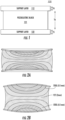
- a transducer 100 includes a piezoelectric block 121 and first and second conductive flexible support layers 112 and 132, respectively.
- the piezoelectric materials of the piezoelectric block 121 may be, for example, PZT, grades P5A and P5H or substantial equivalents thereof.
- PZT lead zirconate titanate
- the piezoelectric block 121 may have a thickness T6 of from about 0.5 mm to about 5.0 mm. In some embodiments, the piezoelectric block 121 may have a thickness T6 of about 2.0 mm.
- the piezoelectric block may be circular, or it may be cuboid in shape to allow precise fabrication using a wafer dicing saw without departing from the scope of the present inventive concept.
- the conductive flexible support layers 112 and 132 may be any flexible material that has the capability of providing an electrical contact.
- the flexible support layers may be provided by thin metal shims 112 and 132, for example, stainless steel shims, but could be other materials without departing from the scope of the present inventive concept. If metal shims are used, the shims should have a low mass and stiffness relative to the piezoelectric block. Providing stainless steel (metal shims) provides an electrically conductive material to the flexible piezoelectric compound.
- the flexible support layers may be a flexible circuit material with a conductive trace, for example, copper without departing from the scope of the present inventive concept.
- the flexible support layers 112 and 132 may have thicknesses T4 and T5, respectively, of from about 0.025mm to about 0.1 mm.
- the thicknesses T4 and T5 of the flexible support layers may be the same or different. In some embodiments of the present inventive concept, the thicknesses of the flexible support layer 112 and 132 are substantially the same. It should be understood that the thicknesses T4 and T5 of the flexible support layers are very small relative to the thickness of the piezoelectric block 121.
- the flexible support layers should be light and flexible compared to the piezoelectric block to provide mechanical support and electrical connection without greatly influencing the vibrational behavior of the piezoelectric block.
- the 400 kHz thickness-planar mode transducer like Fig. 1 , includes a piezoelectric element having thin metal shims positioned on first and second surfaces of the piezoelectric element.
- the shims provide mechanical mounting and electrical connection.
- the piezoelectric dimensions in the example illustrated in Figs. 2A and 2B are approximately 4X2X2 mm.
- the piezoelectric element has a thickness of about 2.0 mm and the shims have a thickness of about 0.1 mm.
- the transducer experiences compression and in Fig. 2B the transducer experiences expansion.
- Finite element simulations were carried out using Ansys Multiphysics.
- An axisymmetric model was used, containing a piezoelectric centre region enclosed between upper and lower stainless steel sheets (0.1 mm thick).
- the harmonic response was simulated for a 10Vpp drive, with frequency swept from 10 kHz to 1MHz. A 5 percent damping factor was applied.
- Figs. 3 and 4 illustrate contour plots showing results of axisymmetric transducer simulations, plotting axial velocity (m/s) at the center of the transducer.
- Fig. 3 illustrates results when the piezoelectric thickness (y_pzt) is varies and the radius (r_face) of 2.3mm (ref: A).
- Fig. 4 illustrates a varying radius (r_face) and a PZT thickness of 2mm (ref: B).
- the contour plots if Figs. 3 and 4 indicate desirable combinations of operating frequencies and transducer dimensions.
- Fig. 3 illustrates an optimal operating frequency of about 400 kHz when the piezoelectric element thickness, y_pzt, is 2.0 mm.
- FIG. 4 illustrates an optimal operating frequency of approximately 400 kHz when the radius of the front face, r_face, is 2.5 mm.
- the operating frequency varies with both thickness and radius of the transducer, indicating the coupled thickness-planar nature of the resonant mode.
- Fig. 5 the simulated axial velocities of a transducer discussed in U.S. Patent Application Serial No. 15/374,044 (Attorney Docket No. 10084-00003) and the transducer illustrated in Fig. 1 are compared on the graph.
- the simulated axial velocity of the Fig. 1 transducer (lower trace) is slightly lower than the axial velocity of the other transducer (dotted upper trace).
- the velocity of the Fig. 1 transducer is slightly lower, this slight loss in velocity may be a small disadvantage compared to the ease of manufacturing of the device of Fig. 1 .
- the flexible support layers are easier to manufacture in the device of Fig. 1 than the front and back blocks of the other transducer.
- a further advantage of embodiments of the present inventive concept is that the flexible support layers provide mechanical mounting, electrical connection and optionally, liquid or gas sealing functions, possibly eliminating the need for additional parts in the transducer assembly.
- some embodiments of the present inventive concept may include an acoustic matching layer 743 on one of a gas and liquid facing surface of one of the first and second conductive flexible support layers.
- the acoustic matching layer 743 is illustrated as being positioned on support layer 712, embodiments of the present inventive concept are not limited to this configuration.
- the acoustic matching layer 743 could be positioned on support layer 732 without departing from the scope of the present inventive concept.
- the acoustic matching layers are used to improve acoustic transmission efficiency between a high acoustic impedance acoustic element (PZT, impedance Z 1 ) and a low acoustic impedance medium (gas, impedance Z 3 ).
- the acoustic impedance of a material is defined as the product of density and speed of sound.
- a matching layer composed of a solid material with very low speed of sound and low density.
- suitable materials do not occur naturally and have to be constructed with special manufacturing processes. For example, suspensions of hollow glass microspheres in epoxy resin are used in the current Sensus transducer, matching layers using glass and resin microspheres are discussed, for example, in U.S. Patent No. 4,523,122 and a matching layer using a dry gel material is discussed in, for example, U.S. Patent No. 6,989,625 .
- the acoustic matching layer may include, for example, Polyethersulfone, Polypropylene, PTFE, PVDF, Nylon, Polyamide, PMMA, Vinylic/acrylic copolymer, Cellulose ester, Cellulose acetate, Nitrocellulose, and the like.
- Embodiments of the present inventive concept may use any acoustic matching layers without departing from the scope of the present inventive concept.
- Transducers in accordance with embodiments discussed herein may be used in any device which lends itself to such transducer.
- these transducers may be used in water meters, gas meters and the like.
- transducers may be used in gas meters as illustrated in Fig. 6 .
- the gas meter 600 includes three transducers.
- Transducer 1 (upstream) and transducer 2 (downstream) may be used to measure time-of-flight of an ultrasonic signal along the flow tube 610 in forward and reverse directions.
- the gas meter 600 may also be configured to compensate for gas properties and conditions using a separate sound measurement using transducer 3.
- Fig. 6 is provided for example only and embodiments of the present inventive concept are not limited to this configuration.
- Transducers as discussed herein may be used in many different devices without departing from the scope of the present inventive concept.
- the piezoelectric block may be manufactured or obtained from third party.
- the piezoelectric materials may be soft PZT, grades P5A and P5H or substantial equivalents thereof, but as discussed above, the piezoelectric materials are not limited to PZT.
- the conductive flexible support layers may be bonded to the piezoelectric block using an adhesive to provide an electrical connection, rather than a soldered wire.
- the adhesive may be, for example, a two-part epoxy resin.
- the bonded structure may then be cured under heat and pressure in a chamber, for example, a mechanical alignment jig.
- a chamber for example, a mechanical alignment jig.
- the quantity of applied adhesive and process conditions provide electrical contact between the piezoelectric electrodes and the flexible support layers, allowing electrical connection to be made to the metal parts and avoiding the need for a solder contact with the piezoelectric block. It will be understood that the manufacturing process is not limited to the process discussed herein and, in fact, more cost-effective manufacturing routes would likely be used for mass production without departing from the scope of the present inventive concept.
- some embodiments of the present inventive concept provide transducers that include upper and lower electrically conductive flexible support layers which provide mechanical protection, mounting and electrical contact, and optionally gas or liquid sealing functions.
- a matching layer as discussed above may be applied to the gas- or liquid-facing side of one of these sheets.
- Example embodiments are described above with reference to block diagrams and/or flowchart illustrations of systems and devices.
- the functions/acts noted in the blocks may occur out of the order noted in the flowcharts.
- two blocks shown in succession may in fact be executed substantially concurrently or the blocks may sometimes be executed in the reverse order, depending upon the functionality/acts involved.
- the functionality of a given block of the flowcharts and/or block diagrams may be separated into multiple blocks and/or the functionality of two or more blocks of the flowcharts and/or block diagrams may be at least partially integrated.
Landscapes
- Physics & Mathematics (AREA)
- General Physics & Mathematics (AREA)
- Engineering & Computer Science (AREA)
- Mechanical Engineering (AREA)
- Fluid Mechanics (AREA)
- Electromagnetism (AREA)
- Analytical Chemistry (AREA)
- Chemical & Material Sciences (AREA)
- Life Sciences & Earth Sciences (AREA)
- Biochemistry (AREA)
- General Health & Medical Sciences (AREA)
- Immunology (AREA)
- Pathology (AREA)
- Health & Medical Sciences (AREA)
- Acoustics & Sound (AREA)
- Transducers For Ultrasonic Waves (AREA)
- Piezo-Electric Transducers For Audible Bands (AREA)
- Investigating Or Analyzing Materials By The Use Of Ultrasonic Waves (AREA)
Description
- This application is related to
U.S. Application Serial No. 15/374,044, filed December 9, 2016 - The present inventive concept relates generally to transducers and, more particularly, to ultrasonic transducers and related methods and devices.
- Ultrasonic transducers preferably include small but precisely dimensioned piezoelectric blocks in order to provide a high degree of part-to-part repeatability with low material costs. Conventional devices generally include a cylindrical piezoelectric block having a thickness that defines a resonant frequency of the piezoelectric block. In these devices, the element thickness may be, for example, about 7.0 mm when operated at 170 kHz and about 3.0 mm when operated at 400 kHz. However, fabricating precisely dimensioned piezoelectric cylinders of this size and shape can be very expensive as the cylinder faces have to be machined after firing.
- Furthermore, conventional devices generally provide an electrical connection to the piezoelectric block using a soldered wire. However, solder can be unreliable and may cause increased part-to-part variability as the mass and placement of solder is not tightly controlled and can have a significant effect on the transducer vibrational behavior. As the size of the piezoelectric block decreases, these problems generally become more severe.
US-2005/156491 describes an apparatus, transducers and methods of manufacture for a composite piezoelectric device comprising a sacrificial base and pillar array.
US-2005/061076 describes a piezoelectric device for actuating and/or sensing Lamb waves for monitoring structural health conditions.
WO-2007/064214 describes an ultrasonic transducer module comprising at least one transmitter layer and at least one receiver layer, each comprising a number of elongated electrodes.EP-1237148 describes an ultrasonic transducer comprising a piezoelectric element and an acoustic matching layer. -
US 2015/298174 A1 discloses a transducer comprising a single piezoelectric block with first and second electrically conductive flexible support layer partially on and overhanging the first and second surface of the piezoelectric block. - The present invention provides a transducer including a single piezoelectric block having first and second opposing surfaces; a first conductive flexible support layer on the first surface of the piezoelectric block, the first flexible support layer having a first thickness; and a second flexible support layer on the second surface of the piezoelectric block, the second flexible support layer having a second thickness, wherein the first and second thicknesses are substantially the same, and wherein the first and second electrically conductive flexible support layers overhang the first and second opposing surfaces of the single piezoelectric block, respectively.
- In further embodiments, the first and second thicknesses may be substantially less than a thickness of the piezoelectric block.
- In still further embodiments, the first and second conductive flexible support layers may include thin metal sheets of material directly on the first and second opposing surfaces of the single piezoelectric block, respectively. The thin metal sheets of material may include only stainless steel sheets of material.
- In some embodiments, the first and second conductive flexible support layers may be flexible circuits with a copper trace.
- In further embodiments, the first and second conductive flexible support layers may have a thickness of from about 0.025 mm to about 0.1mm.
- In still further embodiments, the piezoelectric block may include a soft PZT material selected from one of grade P5A material and P5H material.
- In some embodiments, the piezoelectric block may have a thickness of from about 0.5 mm to about 5.0 mm.
- In further embodiments, the resonant frequency of the transducer may be about 400 kHz and dimensions of the first and second conductive flexible support layers may be 4.2x4.2x0.1 mm; and dimensions of the piezoelectric block may be 4x4x2 mm.
- In still further embodiments, the first and second conductive flexible support layers may be coupled to the first and second surfaces of the piezoelectric block, respectively, using an adhesive.
- In some embodiments, an electrical contact between the piezoelectric block and the first and second conductive flexible support layers may be obtained using the adhesive and without a wire soldered between the piezoelectric block and the first and second conductive flexible support layers.
- In further embodiments, the transducer may further include an acoustic matching layer on one of a gas and liquid facing surface of one of the first and second conductive flexible support layers.
- In still further embodiments, the transducer may be an ultrasonic transducer for use in one of a gas meter and a water meter.
- The present invention further provides a meter including the transducer of
claim 1. -
-
Fig. 1 is a block diagram illustrating transducers including electrically conductive flexible support layers according to some embodiments of the present inventive concept. -
Figs. 2A and 2B are diagrams illustrating thickness-planar mode transducers including metal shims in accordance with some embodiments of the present inventive concept. -
Figs. 3 and 4 are contour plots illustrating results of axisymmetric transducer simulations, plotting axial velocity (m/s) at the centre of the transducer;Fig. 3 illustrates varying of the piezoelectric thickness (y_pzt), radius (r_face) = 2.3mm (ref: A) andFig. 4 illustrates varying radius, and piezoelectric thickness = 2mm (ref: B). -
Fig. 5 is a graph comparing the axial velocities of embodiments of the present inventive concept illustrated inFig. 1 and embodiments discussed in a related application. -
Fig. 6 is a block diagram illustrating an example gas meter including transducers in accordance with embodiments of the present inventive concept. -
Fig. 7 is a diagram illustrating a transducer including an acoustic matching layer in accordance with some embodiments of the present inventive concept. - The present inventive concept will be described more fully hereinafter with reference to the accompanying figures, in which embodiments of the inventive concept are shown. This inventive concept may, however, be embodied in many alternate forms and should not be construed as limited to the embodiments set forth herein.
- Accordingly, while the inventive concept is susceptible to various modifications and alternative forms, specific embodiments thereof are shown by way of example in the drawings and will herein be described in detail. It should be understood, however, that there is no intent to limit the inventive concept to the particular forms disclosed, but on the contrary, the inventive concept is to cover all modifications, equivalents, and alternatives falling within the scope of the inventive concept as defined by the claims. Like numbers refer to like elements throughout the description of the figures.
- The terminology used herein is for the purpose of describing particular embodiments only and is not intended to be limiting of the inventive concept. As used herein, the singular forms "a", "an" and "the" are intended to include the plural forms as well, unless the context clearly indicates otherwise. It will be further understood that the terms "comprises", "comprising," "includes" and/or "including" when used in this specification, specify the presence of stated features, integers, steps, operations, elements, and/or components, but do not preclude the presence or addition of one or more other features, integers, steps, operations, elements, components, and/or groups thereof. Moreover, when an element is referred to as being "responsive" or "connected" to another element, it can be directly responsive or connected to the other element, or intervening elements may be present. In contrast, when an element is referred to as being "directly responsive" or "directly connected" to another element, there are no intervening elements present. As used herein the term "and/or" includes any and all combinations of one or more of the associated listed items and may be abbreviated as "/".
- Unless otherwise defined, all terms (including technical and scientific terms) used herein have the same meaning as commonly understood by one of ordinary skill in the art to which this inventive concept belongs. It will be further understood that terms used herein should be interpreted as having a meaning that is consistent with their meaning in the context of this specification and the relevant art and will not be interpreted in an idealized or overly formal sense unless expressly so defined herein.
- It will be understood that, although the terms first, second, etc. may be used herein to describe various elements, these elements should not be limited by these terms. These terms are only used to distinguish one element from another. For example, a first element could be termed a second element, and, similarly, a second element could be termed a first element without departing from the teachings of the disclosure. Although some of the diagrams include arrows on communication paths to show a primary direction of communication, it is to be understood that communication may occur in the opposite direction to the depicted arrows.
- As discussed in the background of the inventive concept, conventional cylindrical piezoelectric blocks may be expensive to manufacture and soldering the electrical connections may provide poor transducer performance. A dicing saw may be used to address the difficult and costly manufacturing of a cylindrical piezoelectric element. The dicing saw may be used to create a cuboid piezoelectric element instead of a cylindrical piezoelectric element, which can be a cost-effective way to create a precisely dimensioned part. However, this generally requires a thickness of less than approximately 2.5 mm. As a result, there is a need for a transducer design where the piezoelectric element dimensions are small enough to be manufactured cost-effectively by dicing a piezoelectric tile with a wafer dicing saw.
- A thickness mode ultrasonic transducer manufactured using a reduced volume of piezoelectric material to reduce manufacturing costs may be provided as discussed in commonly assigned
U.S. Patent Application Serial No. 15/374,044 (Attorney Docket No. 10084-00003). The piezoelectric element may be circular, or preferably cuboid to allow precise fabrication using a wafer dicing saw. Additional non-piezoelectric layers or parts may be used to reduce the thickness of piezoelectric material given a target operating frequency and to increase the acoustically transmitting area; however, this may increase the part count and number of adhesive bonding steps, both of which may be undesirable. - Accordingly, some embodiments of the present inventive concept provide a transducer including a piezoelectric element between electrically conductive flexible support layers, for example, thin flexible shims, which provide mechanical mounting as well as electrical connection. The light flexible electrically conducting structures may provide mechanical support and electrical contact to the piezoelectric element and possibly gas or liquid sealing for the transducer as will be discussed further herein with respect to
Figs. 1 through 7 . - Referring now to
Fig. 1 , a transducer including electrically conductive flexible support layers in accordance with some embodiments of the present inventive concept will be discussed. As illustrated therein, atransducer 100 includes apiezoelectric block 121 and first and second conductive flexible support layers 112 and 132, respectively. The piezoelectric materials of thepiezoelectric block 121 may be, for example, PZT, grades P5A and P5H or substantial equivalents thereof. However, it will be understood that embodiments of the present inventive concept are not limited to this configuration. In particular, embodiments of the present inventive concept are not limited to lead zirconate titanate (PZT) formulations and may extend to other piezoelectric ceramics without departing from the scope of the present inventive concept. In some embodiments, thepiezoelectric block 121 may have a thickness T6 of from about 0.5 mm to about 5.0 mm. In some embodiments, thepiezoelectric block 121 may have a thickness T6 of about 2.0 mm. The piezoelectric block may be circular, or it may be cuboid in shape to allow precise fabrication using a wafer dicing saw without departing from the scope of the present inventive concept. - The conductive flexible support layers 112 and 132 may be any flexible material that has the capability of providing an electrical contact. For example, in some embodiments, the flexible support layers may be provided by
thin metal shims - In some embodiments, the flexible support layers 112 and 132 may have thicknesses T4 and T5, respectively, of from about 0.025mm to about 0.1 mm. The thicknesses T4 and T5 of the flexible support layers may be the same or different. In some embodiments of the present inventive concept, the thicknesses of the
flexible support layer piezoelectric block 121. In particular, the flexible support layers should be light and flexible compared to the piezoelectric block to provide mechanical support and electrical connection without greatly influencing the vibrational behavior of the piezoelectric block. - Referring now to
Figs. 2A and 2B , diagrams illustrating axial displacement of a 400 kHz thickness-planar mode transducer in accordance with some embodiments of the present inventive concept will be discussed. The 400 kHz thickness-planar mode transducer, likeFig. 1 , includes a piezoelectric element having thin metal shims positioned on first and second surfaces of the piezoelectric element. The shims provide mechanical mounting and electrical connection. The piezoelectric dimensions in the example illustrated inFigs. 2A and 2B are approximately 4X2X2 mm. As further illustrated, in this example, the piezoelectric element has a thickness of about 2.0 mm and the shims have a thickness of about 0.1 mm. As illustrated inFig. 2A the transducer experiences compression and inFig. 2B the transducer experiences expansion. - Finite element simulations were carried out using Ansys Multiphysics. An axisymmetric model was used, containing a piezoelectric centre region enclosed between upper and lower stainless steel sheets (0.1 mm thick). The harmonic response was simulated for a 10Vpp drive, with frequency swept from 10 kHz to 1MHz. A 5 percent damping factor was applied.
-
Figs. 3 and 4 illustrate contour plots showing results of axisymmetric transducer simulations, plotting axial velocity (m/s) at the center of the transducer.Fig. 3 illustrates results when the piezoelectric thickness (y_pzt) is varies and the radius (r_face) of 2.3mm (ref: A).Fig. 4 illustrates a varying radius (r_face) and a PZT thickness of 2mm (ref: B). The contour plots ifFigs. 3 and 4 indicate desirable combinations of operating frequencies and transducer dimensions.Fig. 3 illustrates an optimal operating frequency of about 400 kHz when the piezoelectric element thickness, y_pzt, is 2.0 mm.Fig. 4 illustrates an optimal operating frequency of approximately 400 kHz when the radius of the front face, r_face, is 2.5 mm. The operating frequency varies with both thickness and radius of the transducer, indicating the coupled thickness-planar nature of the resonant mode. - Referring now to
Fig. 5 , the simulated axial velocities of a transducer discussed inU.S. Patent Application Serial No. 15/374,044 (Attorney Docket No. 10084-00003) and the transducer illustrated inFig. 1 are compared on the graph. As illustrated, the simulated axial velocity of theFig. 1 transducer (lower trace) is slightly lower than the axial velocity of the other transducer (dotted upper trace). Although the velocity of theFig. 1 transducer is slightly lower, this slight loss in velocity may be a small disadvantage compared to the ease of manufacturing of the device ofFig. 1 . In other words, the flexible support layers are easier to manufacture in the device ofFig. 1 than the front and back blocks of the other transducer. A further advantage of embodiments of the present inventive concept is that the flexible support layers provide mechanical mounting, electrical connection and optionally, liquid or gas sealing functions, possibly eliminating the need for additional parts in the transducer assembly. - As illustrated in
Fig. 7 , some embodiments of the present inventive concept may include anacoustic matching layer 743 on one of a gas and liquid facing surface of one of the first and second conductive flexible support layers. Although theacoustic matching layer 743 is illustrated as being positioned onsupport layer 712, embodiments of the present inventive concept are not limited to this configuration. Theacoustic matching layer 743 could be positioned onsupport layer 732 without departing from the scope of the present inventive concept. - The acoustic matching layers are used to improve acoustic transmission efficiency between a high acoustic impedance acoustic element (PZT, impedance Z1 ) and a low acoustic impedance medium (gas, impedance Z3 ). The acoustic impedance of a material is defined as the product of density and speed of sound.
- In the case of a single matching layer, the ideal matching layer acoustic impedance, Z2 , is the geometric mean of the transducer and gas acoustic impedances:

TABLE 2 Material Acoustic Impedance (kg/m2.s) PZT 5A 34×106 methane (1atm, 20C) 300 matching layer (ideal) 1×10⁵ - This typically requires a matching layer composed of a solid material with very low speed of sound and low density. However, in general suitable materials do not occur naturally and have to be constructed with special manufacturing processes. For example, suspensions of hollow glass microspheres in epoxy resin are used in the current Sensus transducer, matching layers using glass and resin microspheres are discussed, for example, in
U.S. Patent No. 4,523,122 and a matching layer using a dry gel material is discussed in, for example,U.S. Patent No. 6,989,625 . - The acoustic matching layer may include, for example, Polyethersulfone, Polypropylene, PTFE, PVDF, Nylon, Polyamide, PMMA, Vinylic/acrylic copolymer, Cellulose ester, Cellulose acetate, Nitrocellulose, and the like. Embodiments of the present inventive concept may use any acoustic matching layers without departing from the scope of the present inventive concept.
- Transducers in accordance with embodiments discussed herein may be used in any device which lends itself to such transducer. For example, these transducers may be used in water meters, gas meters and the like. By way of example, transducers may be used in gas meters as illustrated in
Fig. 6 . As illustrated therein, thegas meter 600 includes three transducers. Transducer 1 (upstream) and transducer 2 (downstream) may be used to measure time-of-flight of an ultrasonic signal along the flow tube 610 in forward and reverse directions. Thegas meter 600 may also be configured to compensate for gas properties and conditions using a separate soundmeasurement using transducer 3. - It will be understood that
Fig. 6 is provided for example only and embodiments of the present inventive concept are not limited to this configuration. Transducers as discussed herein may be used in many different devices without departing from the scope of the present inventive concept. - It will be understood that embodiments of the present inventive concept illustrated in
Fig. 1 may be fabricated using any methods know to those having skill in the art without departing from the scope of the present inventive concept. For example, the piezoelectric block may be manufactured or obtained from third party. In some embodiments, the piezoelectric materials may be soft PZT, grades P5A and P5H or substantial equivalents thereof, but as discussed above, the piezoelectric materials are not limited to PZT. The conductive flexible support layers may be bonded to the piezoelectric block using an adhesive to provide an electrical connection, rather than a soldered wire. The adhesive may be, for example, a two-part epoxy resin. The bonded structure may then be cured under heat and pressure in a chamber, for example, a mechanical alignment jig. The quantity of applied adhesive and process conditions provide electrical contact between the piezoelectric electrodes and the flexible support layers, allowing electrical connection to be made to the metal parts and avoiding the need for a solder contact with the piezoelectric block. It will be understood that the manufacturing process is not limited to the process discussed herein and, in fact, more cost-effective manufacturing routes would likely be used for mass production without departing from the scope of the present inventive concept. - As briefly discussed above with respect to
Figs. 1 through 7 , some embodiments of the present inventive concept provide transducers that include upper and lower electrically conductive flexible support layers which provide mechanical protection, mounting and electrical contact, and optionally gas or liquid sealing functions. A matching layer as discussed above may be applied to the gas- or liquid-facing side of one of these sheets. - Example embodiments are described above with reference to block diagrams and/or flowchart illustrations of systems and devices. The functions/acts noted in the blocks may occur out of the order noted in the flowcharts. For example, two blocks shown in succession may in fact be executed substantially concurrently or the blocks may sometimes be executed in the reverse order, depending upon the functionality/acts involved. Moreover, the functionality of a given block of the flowcharts and/or block diagrams may be separated into multiple blocks and/or the functionality of two or more blocks of the flowcharts and/or block diagrams may be at least partially integrated.
- In the drawings and specification, there have been disclosed exemplary embodiments of the inventive concept. However, many variations and modifications can be made to these embodiments without substantially departing from the principles of the present inventive concept. Accordingly, although specific terms are used, they are used in a generic and descriptive sense only and not for purposes of limitation, the scope of the inventive concept being defined by the following claims.
Claims (14)
- A transducer (100) comprising:a single piezoelectric block (121) having first and second opposing surfaces;a first electrically conductive flexible support layer (112) on the first surface of the piezoelectric block (121), the first electrically conductive flexible support layer (112) having a first thickness (T4); anda second electrically conductive flexible support layer (132) on the second surface of the piezoelectric block (121), the second electrically conductive flexible support layer (132) having a second thickness (T5),wherein the first and second thicknesses (T4, T5) are substantially the same; andcharacterized in thatthe first and second electrically conductive flexible support layers (112, 132) extend on the full length of and overhang the first and second opposing surfaces of the single piezoelectric block (121), respectively.
- The transducer (100) of Claim 1, wherein the first and second thicknesses (T4, T5) are substantially less than a thickness (T6) of the piezoelectric block (121).
- The transducer (100) of Claim 1, wherein the first and second electrically conductive flexible support layers (112, 132) comprise thin metal sheets of material directly on the first and second opposing surfaces of the single piezoelectric block (121), respectively.
- The transducer (100) of Claim 3, wherein the thin metal sheets of material comprise only stainless steel sheets of material.
- The transducer (100) of Claim 1, wherein the first and second electrically conductive flexible support layers (112, 132) comprise flexible circuits with a copper trace.
- The transducer (100) of Claim 1, wherein the first and second electrically conductive flexible support layers (112, 132) have a thickness (T4, T5) of from about 0.025 mm to about 0.1mm.
- The transducer (100) of Claim 1, wherein the piezoelectric block (121) comprises a soft PZT material selected from one of grade P5A material and P5H material.
- The transducer (100) of Claim 1, wherein the piezoelectric block (121) has a thickness (T6) of from about 0.5 mm to about 5.0 mm.
- The transducer (100) of Claim 1, wherein a resonant frequency of the transducer (100) is about 400 kHz and dimensions of the first and second electrically conductive flexible support layers (112, 132) are 4.2x4.2x0.1 mm; and dimensions of the piezoelectric block (121) are 4x4x2 mm.
- The transducer (100) of Claim 1, wherein the first and second electrically conductive flexible support layers (112, 132) are coupled to the first and second opposing surfaces of the piezoelectric block (121), respectively, using an adhesive.
- The transducer (100) of Claim 10, wherein electrical contact between the piezoelectric block (121) and the first and second electrically conductive flexible support layers (112, 132) is obtained using the adhesive and without a wire soldered between the piezoelectric block (121) and the first and second electrically conductive flexible support layers (112, 132).
- The transducer (100) of Claim 1, further comprising an acoustic matching layer (743) on one of a gas and liquid facing surface of one of the first and second electrically conductive flexible support layers (112, 132).
- The transducer (100) of Claim 1, wherein the transducer (100) is an ultrasonic transducer configured for use in one of a gas meter and a water meter.
- A meter, comprising the transducer of claim 1.
Applications Claiming Priority (2)
| Application Number | Priority Date | Filing Date | Title |
|---|---|---|---|
| US15/374,129 US10518293B2 (en) | 2016-12-09 | 2016-12-09 | Thickness-planar mode transducers and related devices |
| PCT/US2017/065026 WO2018106869A1 (en) | 2016-12-09 | 2017-12-07 | Thickness-planar mode transducers and related devices |
Publications (3)
| Publication Number | Publication Date |
|---|---|
| EP3551349A1 EP3551349A1 (en) | 2019-10-16 |
| EP3551349C0 EP3551349C0 (en) | 2024-04-24 |
| EP3551349B1 true EP3551349B1 (en) | 2024-04-24 |
Family
ID=60782396
Family Applications (1)
| Application Number | Title | Priority Date | Filing Date |
|---|---|---|---|
| EP17818409.9A Active EP3551349B1 (en) | 2016-12-09 | 2017-12-07 | Thickness-planar mode transducers and related devices |
Country Status (6)
| Country | Link |
|---|---|
| US (1) | US10518293B2 (en) |
| EP (1) | EP3551349B1 (en) |
| CN (1) | CN110290877B (en) |
| CA (1) | CA3045679C (en) |
| ES (1) | ES2979177T3 (en) |
| WO (1) | WO2018106869A1 (en) |
Families Citing this family (1)
| Publication number | Priority date | Publication date | Assignee | Title |
|---|---|---|---|---|
| JP7016198B2 (en) * | 2019-03-29 | 2022-02-04 | 国立大学法人山形大学 | Piezoelectric sensor |
Citations (5)
| Publication number | Priority date | Publication date | Assignee | Title |
|---|---|---|---|---|
| US5495137A (en) * | 1993-09-14 | 1996-02-27 | The Whitaker Corporation | Proximity sensor utilizing polymer piezoelectric film with protective metal layer |
| US20010021807A1 (en) * | 2000-03-07 | 2001-09-13 | Koetsu Saito | Ultrasonic probe |
| US8678565B2 (en) * | 2010-05-14 | 2014-03-25 | Konica Minolta Holdings, Inc. | Electromechanical transducer |
| US20150214470A1 (en) * | 2014-01-29 | 2015-07-30 | Canon Kabushiki Kaisha | Piezoelectric element, method for manufacturing piezoelectric element, and electronic apparatus |
| US20150298174A1 (en) * | 2011-02-15 | 2015-10-22 | Fujifilm Dimatix, Inc. | Piezoelectric transducers using micro-dome arrays |
Family Cites Families (17)
| Publication number | Priority date | Publication date | Assignee | Title |
|---|---|---|---|---|
| US4404489A (en) * | 1980-11-03 | 1983-09-13 | Hewlett-Packard Company | Acoustic transducer with flexible circuit board terminals |
| JPS5999900A (en) * | 1982-11-29 | 1984-06-08 | Toshiba Corp | Ultrasonic wave probe |
| DE3478357D1 (en) | 1983-03-17 | 1989-06-29 | Matsushita Electric Industrial Co Ltd | Ultrasonic transducers having improved acoustic impedance matching layers |
| US5295487A (en) * | 1992-02-12 | 1994-03-22 | Kabushiki Kaisha Toshiba | Ultrasonic probe |
| US5743855A (en) * | 1995-03-03 | 1998-04-28 | Acuson Corporation | Broadband phased array transducer design with frequency controlled two dimension capability and methods for manufacture thereof |
| WO2001003108A2 (en) * | 1999-07-02 | 2001-01-11 | Medison Co., Ltd. | Ultrasonic linear or curvilinear transducer and connection technique therefore |
| JP3611796B2 (en) | 2001-02-28 | 2005-01-19 | 松下電器産業株式会社 | Ultrasonic transducer, manufacturing method of ultrasonic transducer, and ultrasonic flowmeter |
| WO2003064981A1 (en) | 2002-01-28 | 2003-08-07 | Matsushita Electric Industrial Co., Ltd. | Acoustic matching layer, ultrasonic transmitter/receiver, and ultrasonic flowmeter |
| AU2004277166A1 (en) | 2003-09-22 | 2005-04-07 | Kim Hyeung-Yun | Sensors and systems for structural health monitoring |
| US7109642B2 (en) | 2003-11-29 | 2006-09-19 | Walter Guy Scott | Composite piezoelectric apparatus and method |
| GB2432671A (en) | 2005-11-29 | 2007-05-30 | Dolphiscan As | Ultrasonic transducer with transmitter layer and receiver layer each having elongated electrodes |
| KR20140033992A (en) * | 2012-09-11 | 2014-03-19 | 삼성전자주식회사 | Ultrasonic transducer |
| WO2014192012A1 (en) * | 2013-04-29 | 2014-12-04 | Indian Institute Of Technology Madras | Novel segmented strip design for a magnetostriction sensor (mss) using amorphous material for long range inspection of defects and bends in pipes at high temperatures |
| US9419202B2 (en) * | 2013-06-21 | 2016-08-16 | General Electric Company | Ultrasound transducer and method for manufacturing an ultrasound transducer |
| US10265729B2 (en) * | 2015-02-06 | 2019-04-23 | Olympus Scientific Solutions Americas Inc. | Phased array ultrasonic transducers with solderless stack bonding assembly |
| CN105032749A (en) * | 2015-07-09 | 2015-11-11 | 深圳市理邦精密仪器股份有限公司 | Multi-layer lamination ultrasonic transducer and manufacturing method thereof |
| CN110291580B (en) * | 2017-02-21 | 2024-02-20 | 传感频谱有限责任公司 | Multi-element bending transducers and related methods and apparatus |
-
2016
- 2016-12-09 US US15/374,129 patent/US10518293B2/en active Active
-
2017
- 2017-12-07 EP EP17818409.9A patent/EP3551349B1/en active Active
- 2017-12-07 CN CN201780075802.0A patent/CN110290877B/en active Active
- 2017-12-07 CA CA3045679A patent/CA3045679C/en active Active
- 2017-12-07 ES ES17818409T patent/ES2979177T3/en active Active
- 2017-12-07 WO PCT/US2017/065026 patent/WO2018106869A1/en not_active Ceased
Patent Citations (5)
| Publication number | Priority date | Publication date | Assignee | Title |
|---|---|---|---|---|
| US5495137A (en) * | 1993-09-14 | 1996-02-27 | The Whitaker Corporation | Proximity sensor utilizing polymer piezoelectric film with protective metal layer |
| US20010021807A1 (en) * | 2000-03-07 | 2001-09-13 | Koetsu Saito | Ultrasonic probe |
| US8678565B2 (en) * | 2010-05-14 | 2014-03-25 | Konica Minolta Holdings, Inc. | Electromechanical transducer |
| US20150298174A1 (en) * | 2011-02-15 | 2015-10-22 | Fujifilm Dimatix, Inc. | Piezoelectric transducers using micro-dome arrays |
| US20150214470A1 (en) * | 2014-01-29 | 2015-07-30 | Canon Kabushiki Kaisha | Piezoelectric element, method for manufacturing piezoelectric element, and electronic apparatus |
Also Published As
| Publication number | Publication date |
|---|---|
| EP3551349C0 (en) | 2024-04-24 |
| CN110290877A (en) | 2019-09-27 |
| ES2979177T3 (en) | 2024-09-24 |
| WO2018106869A1 (en) | 2018-06-14 |
| CN110290877B (en) | 2022-03-22 |
| US20180161814A1 (en) | 2018-06-14 |
| CA3045679A1 (en) | 2018-06-14 |
| EP3551349A1 (en) | 2019-10-16 |
| CA3045679C (en) | 2024-03-26 |
| US10518293B2 (en) | 2019-12-31 |
Similar Documents
| Publication | Publication Date | Title |
|---|---|---|
| CN111403593B (en) | Sensitive element for manufacturing high-frequency broadband high-sensitivity underwater acoustic transducer and preparation method thereof | |
| US3952216A (en) | Multiple-frequency transducer | |
| US11890644B2 (en) | Ultrasonic devices including acoustically matched regions therein | |
| CN103111410A (en) | Novel ultrasonic wave sensor | |
| EP3586331B1 (en) | Multi-element bending transducers and related methods and devices | |
| EP3551349B1 (en) | Thickness-planar mode transducers and related devices | |
| CN115474128B (en) | High-sensitivity underwater acoustic transducer | |
| JP4134911B2 (en) | Ultrasonic transducer and method for manufacturing the same | |
| CN112378510A (en) | High-sensitivity flextensional hydrophone and manufacturing method thereof | |
| US7583010B1 (en) | Hybrid transducer | |
| US7288878B1 (en) | Piezoelectric transducer assembly | |
| EP3551348B1 (en) | Thickness mode transducer and related fabrication method | |
| CN203071889U (en) | Piezoelectric resonator | |
| CN103117724A (en) | Piezoelectric resonator | |
| CN119603602B (en) | A multifunctional tenon-and-mortise piezoelectric vibrator and its preparation method | |
| KR102304458B1 (en) | Ultrasonic sensor and manufacturing method thereof using piezo-electric single crystal element | |
| CN118541009A (en) | A high-reliability piezoelectric composite element and its preparation method |
Legal Events
| Date | Code | Title | Description |
|---|---|---|---|
| STAA | Information on the status of an ep patent application or granted ep patent |
Free format text: STATUS: UNKNOWN |
|
| STAA | Information on the status of an ep patent application or granted ep patent |
Free format text: STATUS: THE INTERNATIONAL PUBLICATION HAS BEEN MADE |
|
| PUAI | Public reference made under article 153(3) epc to a published international application that has entered the european phase |
Free format text: ORIGINAL CODE: 0009012 |
|
| STAA | Information on the status of an ep patent application or granted ep patent |
Free format text: STATUS: REQUEST FOR EXAMINATION WAS MADE |
|
| 17P | Request for examination filed |
Effective date: 20190611 |
|
| AK | Designated contracting states |
Kind code of ref document: A1 Designated state(s): AL AT BE BG CH CY CZ DE DK EE ES FI FR GB GR HR HU IE IS IT LI LT LU LV MC MK MT NL NO PL PT RO RS SE SI SK SM TR |
|
| AX | Request for extension of the european patent |
Extension state: BA ME |
|
| DAV | Request for validation of the european patent (deleted) | ||
| DAX | Request for extension of the european patent (deleted) | ||
| STAA | Information on the status of an ep patent application or granted ep patent |
Free format text: STATUS: EXAMINATION IS IN PROGRESS |
|
| 17Q | First examination report despatched |
Effective date: 20220223 |
|
| GRAP | Despatch of communication of intention to grant a patent |
Free format text: ORIGINAL CODE: EPIDOSNIGR1 |
|
| STAA | Information on the status of an ep patent application or granted ep patent |
Free format text: STATUS: GRANT OF PATENT IS INTENDED |
|
| INTG | Intention to grant announced |
Effective date: 20231208 |
|
| GRAS | Grant fee paid |
Free format text: ORIGINAL CODE: EPIDOSNIGR3 |
|
| GRAA | (expected) grant |
Free format text: ORIGINAL CODE: 0009210 |
|
| STAA | Information on the status of an ep patent application or granted ep patent |
Free format text: STATUS: THE PATENT HAS BEEN GRANTED |
|
| AK | Designated contracting states |
Kind code of ref document: B1 Designated state(s): AL AT BE BG CH CY CZ DE DK EE ES FI FR GB GR HR HU IE IS IT LI LT LU LV MC MK MT NL NO PL PT RO RS SE SI SK SM TR |
|
| REG | Reference to a national code |
Ref country code: GB Ref legal event code: FG4D |
|
| REG | Reference to a national code |
Ref country code: CH Ref legal event code: EP |
|
| REG | Reference to a national code |
Ref country code: DE Ref legal event code: R096 Ref document number: 602017081343 Country of ref document: DE |
|
| REG | Reference to a national code |
Ref country code: IE Ref legal event code: FG4D |
|
| U01 | Request for unitary effect filed |
Effective date: 20240425 |
|
| U07 | Unitary effect registered |
Designated state(s): AT BE BG DE DK EE FI FR IT LT LU LV MT NL PT SE SI Effective date: 20240503 |
|
| REG | Reference to a national code |
Ref country code: ES Ref legal event code: FG2A Ref document number: 2979177 Country of ref document: ES Kind code of ref document: T3 Effective date: 20240924 |
|
| PG25 | Lapsed in a contracting state [announced via postgrant information from national office to epo] |
Ref country code: IS Free format text: LAPSE BECAUSE OF FAILURE TO SUBMIT A TRANSLATION OF THE DESCRIPTION OR TO PAY THE FEE WITHIN THE PRESCRIBED TIME-LIMIT Effective date: 20240824 |
|
| PG25 | Lapsed in a contracting state [announced via postgrant information from national office to epo] |
Ref country code: HR Free format text: LAPSE BECAUSE OF FAILURE TO SUBMIT A TRANSLATION OF THE DESCRIPTION OR TO PAY THE FEE WITHIN THE PRESCRIBED TIME-LIMIT Effective date: 20240424 |
|
| PG25 | Lapsed in a contracting state [announced via postgrant information from national office to epo] |
Ref country code: GR Free format text: LAPSE BECAUSE OF FAILURE TO SUBMIT A TRANSLATION OF THE DESCRIPTION OR TO PAY THE FEE WITHIN THE PRESCRIBED TIME-LIMIT Effective date: 20240725 |
|
| PG25 | Lapsed in a contracting state [announced via postgrant information from national office to epo] |
Ref country code: PL Free format text: LAPSE BECAUSE OF FAILURE TO SUBMIT A TRANSLATION OF THE DESCRIPTION OR TO PAY THE FEE WITHIN THE PRESCRIBED TIME-LIMIT Effective date: 20240424 |
|
| PG25 | Lapsed in a contracting state [announced via postgrant information from national office to epo] |
Ref country code: PL Free format text: LAPSE BECAUSE OF FAILURE TO SUBMIT A TRANSLATION OF THE DESCRIPTION OR TO PAY THE FEE WITHIN THE PRESCRIBED TIME-LIMIT Effective date: 20240424 Ref country code: NO Free format text: LAPSE BECAUSE OF FAILURE TO SUBMIT A TRANSLATION OF THE DESCRIPTION OR TO PAY THE FEE WITHIN THE PRESCRIBED TIME-LIMIT Effective date: 20240724 Ref country code: IS Free format text: LAPSE BECAUSE OF FAILURE TO SUBMIT A TRANSLATION OF THE DESCRIPTION OR TO PAY THE FEE WITHIN THE PRESCRIBED TIME-LIMIT Effective date: 20240824 Ref country code: HR Free format text: LAPSE BECAUSE OF FAILURE TO SUBMIT A TRANSLATION OF THE DESCRIPTION OR TO PAY THE FEE WITHIN THE PRESCRIBED TIME-LIMIT Effective date: 20240424 Ref country code: GR Free format text: LAPSE BECAUSE OF FAILURE TO SUBMIT A TRANSLATION OF THE DESCRIPTION OR TO PAY THE FEE WITHIN THE PRESCRIBED TIME-LIMIT Effective date: 20240725 Ref country code: RS Free format text: LAPSE BECAUSE OF FAILURE TO SUBMIT A TRANSLATION OF THE DESCRIPTION OR TO PAY THE FEE WITHIN THE PRESCRIBED TIME-LIMIT Effective date: 20240724 |
|
| PG25 | Lapsed in a contracting state [announced via postgrant information from national office to epo] |
Ref country code: CZ Free format text: LAPSE BECAUSE OF FAILURE TO SUBMIT A TRANSLATION OF THE DESCRIPTION OR TO PAY THE FEE WITHIN THE PRESCRIBED TIME-LIMIT Effective date: 20240424 |
|
| PG25 | Lapsed in a contracting state [announced via postgrant information from national office to epo] |
Ref country code: RO Free format text: LAPSE BECAUSE OF FAILURE TO SUBMIT A TRANSLATION OF THE DESCRIPTION OR TO PAY THE FEE WITHIN THE PRESCRIBED TIME-LIMIT Effective date: 20240424 Ref country code: SK Free format text: LAPSE BECAUSE OF FAILURE TO SUBMIT A TRANSLATION OF THE DESCRIPTION OR TO PAY THE FEE WITHIN THE PRESCRIBED TIME-LIMIT Effective date: 20240424 |
|
| REG | Reference to a national code |
Ref country code: DE Ref legal event code: R097 Ref document number: 602017081343 Country of ref document: DE |
|
| PG25 | Lapsed in a contracting state [announced via postgrant information from national office to epo] |
Ref country code: SM Free format text: LAPSE BECAUSE OF FAILURE TO SUBMIT A TRANSLATION OF THE DESCRIPTION OR TO PAY THE FEE WITHIN THE PRESCRIBED TIME-LIMIT Effective date: 20240424 |
|
| PG25 | Lapsed in a contracting state [announced via postgrant information from national office to epo] |
Ref country code: SM Free format text: LAPSE BECAUSE OF FAILURE TO SUBMIT A TRANSLATION OF THE DESCRIPTION OR TO PAY THE FEE WITHIN THE PRESCRIBED TIME-LIMIT Effective date: 20240424 Ref country code: SK Free format text: LAPSE BECAUSE OF FAILURE TO SUBMIT A TRANSLATION OF THE DESCRIPTION OR TO PAY THE FEE WITHIN THE PRESCRIBED TIME-LIMIT Effective date: 20240424 Ref country code: RO Free format text: LAPSE BECAUSE OF FAILURE TO SUBMIT A TRANSLATION OF THE DESCRIPTION OR TO PAY THE FEE WITHIN THE PRESCRIBED TIME-LIMIT Effective date: 20240424 Ref country code: CZ Free format text: LAPSE BECAUSE OF FAILURE TO SUBMIT A TRANSLATION OF THE DESCRIPTION OR TO PAY THE FEE WITHIN THE PRESCRIBED TIME-LIMIT Effective date: 20240424 |
|
| U20 | Renewal fee for the european patent with unitary effect paid |
Year of fee payment: 8 Effective date: 20241227 |
|
| PLBE | No opposition filed within time limit |
Free format text: ORIGINAL CODE: 0009261 |
|
| STAA | Information on the status of an ep patent application or granted ep patent |
Free format text: STATUS: NO OPPOSITION FILED WITHIN TIME LIMIT |
|
| 26N | No opposition filed |
Effective date: 20250127 |
|
| PGFP | Annual fee paid to national office [announced via postgrant information from national office to epo] |
Ref country code: ES Payment date: 20250102 Year of fee payment: 8 |
|
| PG25 | Lapsed in a contracting state [announced via postgrant information from national office to epo] |
Ref country code: MC Free format text: LAPSE BECAUSE OF FAILURE TO SUBMIT A TRANSLATION OF THE DESCRIPTION OR TO PAY THE FEE WITHIN THE PRESCRIBED TIME-LIMIT Effective date: 20240424 |
|
| REG | Reference to a national code |
Ref country code: CH Ref legal event code: PL |
|
| PG25 | Lapsed in a contracting state [announced via postgrant information from national office to epo] |
Ref country code: CH Free format text: LAPSE BECAUSE OF NON-PAYMENT OF DUE FEES Effective date: 20241231 |
|
| PG25 | Lapsed in a contracting state [announced via postgrant information from national office to epo] |
Ref country code: IE Free format text: LAPSE BECAUSE OF NON-PAYMENT OF DUE FEES Effective date: 20241207 |
|
| PGFP | Annual fee paid to national office [announced via postgrant information from national office to epo] |
Ref country code: GB Payment date: 20251229 Year of fee payment: 9 |
|
| U20 | Renewal fee for the european patent with unitary effect paid |
Year of fee payment: 9 Effective date: 20251229 |