EP3545489B1 - Bilderfassungssystem für ein fahrzeug und verfahren zur erzeugung eines flimmerfreies bildes mit hoher auflösung - Google Patents
Bilderfassungssystem für ein fahrzeug und verfahren zur erzeugung eines flimmerfreies bildes mit hoher auflösung Download PDFInfo
- Publication number
- EP3545489B1 EP3545489B1 EP17803866.7A EP17803866A EP3545489B1 EP 3545489 B1 EP3545489 B1 EP 3545489B1 EP 17803866 A EP17803866 A EP 17803866A EP 3545489 B1 EP3545489 B1 EP 3545489B1
- Authority
- EP
- European Patent Office
- Prior art keywords
- image
- super
- recent
- images
- resolution
- Prior art date
- Legal status (The legal status is an assumption and is not a legal conclusion. Google has not performed a legal analysis and makes no representation as to the accuracy of the status listed.)
- Active
Links
Images



Classifications
-
- H—ELECTRICITY
- H04—ELECTRIC COMMUNICATION TECHNIQUE
- H04N—PICTORIAL COMMUNICATION, e.g. TELEVISION
- H04N23/00—Cameras or camera modules comprising electronic image sensors; Control thereof
- H04N23/70—Circuitry for compensating brightness variation in the scene
- H04N23/72—Combination of two or more compensation controls
-
- G—PHYSICS
- G06—COMPUTING OR CALCULATING; COUNTING
- G06T—IMAGE DATA PROCESSING OR GENERATION, IN GENERAL
- G06T3/00—Geometric image transformations in the plane of the image
- G06T3/40—Scaling of whole images or parts thereof, e.g. expanding or contracting
- G06T3/4053—Scaling of whole images or parts thereof, e.g. expanding or contracting based on super-resolution, i.e. the output image resolution being higher than the sensor resolution
- G06T3/4076—Scaling of whole images or parts thereof, e.g. expanding or contracting based on super-resolution, i.e. the output image resolution being higher than the sensor resolution using the original low-resolution images to iteratively correct the high-resolution images
-
- H—ELECTRICITY
- H04—ELECTRIC COMMUNICATION TECHNIQUE
- H04N—PICTORIAL COMMUNICATION, e.g. TELEVISION
- H04N13/00—Stereoscopic video systems; Multi-view video systems; Details thereof
- H04N13/10—Processing, recording or transmission of stereoscopic or multi-view image signals
- H04N13/106—Processing image signals
- H04N13/144—Processing image signals for flicker reduction
-
- H—ELECTRICITY
- H04—ELECTRIC COMMUNICATION TECHNIQUE
- H04N—PICTORIAL COMMUNICATION, e.g. TELEVISION
- H04N13/00—Stereoscopic video systems; Multi-view video systems; Details thereof
- H04N13/10—Processing, recording or transmission of stereoscopic or multi-view image signals
- H04N13/106—Processing image signals
- H04N13/167—Synchronising or controlling image signals
-
- H—ELECTRICITY
- H04—ELECTRIC COMMUNICATION TECHNIQUE
- H04N—PICTORIAL COMMUNICATION, e.g. TELEVISION
- H04N23/00—Cameras or camera modules comprising electronic image sensors; Control thereof
- H04N23/70—Circuitry for compensating brightness variation in the scene
- H04N23/745—Detection of flicker frequency or suppression of flicker wherein the flicker is caused by illumination, e.g. due to fluorescent tube illumination or pulsed LED illumination
-
- H—ELECTRICITY
- H04—ELECTRIC COMMUNICATION TECHNIQUE
- H04N—PICTORIAL COMMUNICATION, e.g. TELEVISION
- H04N25/00—Circuitry of solid-state image sensors [SSIS]; Control thereof
- H04N25/48—Increasing resolution by shifting the sensor relative to the scene
-
- B—PERFORMING OPERATIONS; TRANSPORTING
- B60—VEHICLES IN GENERAL
- B60R—VEHICLES, VEHICLE FITTINGS, OR VEHICLE PARTS, NOT OTHERWISE PROVIDED FOR
- B60R2300/00—Details of viewing arrangements using cameras and displays, specially adapted for use in a vehicle
- B60R2300/10—Details of viewing arrangements using cameras and displays, specially adapted for use in a vehicle characterised by the type of camera system used
- B60R2300/105—Details of viewing arrangements using cameras and displays, specially adapted for use in a vehicle characterised by the type of camera system used using multiple cameras
-
- B—PERFORMING OPERATIONS; TRANSPORTING
- B60—VEHICLES IN GENERAL
- B60R—VEHICLES, VEHICLE FITTINGS, OR VEHICLE PARTS, NOT OTHERWISE PROVIDED FOR
- B60R2300/00—Details of viewing arrangements using cameras and displays, specially adapted for use in a vehicle
- B60R2300/10—Details of viewing arrangements using cameras and displays, specially adapted for use in a vehicle characterised by the type of camera system used
- B60R2300/107—Details of viewing arrangements using cameras and displays, specially adapted for use in a vehicle characterised by the type of camera system used using stereoscopic cameras
-
- B—PERFORMING OPERATIONS; TRANSPORTING
- B60—VEHICLES IN GENERAL
- B60R—VEHICLES, VEHICLE FITTINGS, OR VEHICLE PARTS, NOT OTHERWISE PROVIDED FOR
- B60R2300/00—Details of viewing arrangements using cameras and displays, specially adapted for use in a vehicle
- B60R2300/20—Details of viewing arrangements using cameras and displays, specially adapted for use in a vehicle characterised by the type of display used
-
- B—PERFORMING OPERATIONS; TRANSPORTING
- B60—VEHICLES IN GENERAL
- B60R—VEHICLES, VEHICLE FITTINGS, OR VEHICLE PARTS, NOT OTHERWISE PROVIDED FOR
- B60R2300/00—Details of viewing arrangements using cameras and displays, specially adapted for use in a vehicle
- B60R2300/30—Details of viewing arrangements using cameras and displays, specially adapted for use in a vehicle characterised by the type of image processing
-
- B—PERFORMING OPERATIONS; TRANSPORTING
- B60—VEHICLES IN GENERAL
- B60R—VEHICLES, VEHICLE FITTINGS, OR VEHICLE PARTS, NOT OTHERWISE PROVIDED FOR
- B60R2300/00—Details of viewing arrangements using cameras and displays, specially adapted for use in a vehicle
- B60R2300/80—Details of viewing arrangements using cameras and displays, specially adapted for use in a vehicle characterised by the intended use of the viewing arrangement
Definitions
- the invention relates to an imaging system for a vehicle for obtaining an anti-flickering super-resolution image in line with the pre-amble of claim 1. Further, it relates to a method using such an imaging system.
- LEDs Light Emitting Diodes
- LED lights are used in street lamps, car headlights, traffic lights, warning signs, and/or advertisement displays.
- the LEDs are commonly operated on the principle of fast-pulsed emissions, i.e. the LEDs are switched on and off at a very high rate or frequency which is normally not visible for the human eye.
- modern cameras in particular digital cameras capture images at a very high rate, which can be similar to the pulse rate of the LEDs.
- the rate of capturing images and the pulse rate of the LEDs do not always perfectly overlap, i.e. images may be captured during the off-phase of an LED. If these images are then presented as video stream on a display device, the so-called 'flickering effect' appears, due to the mismatch of frequencies. This effect may even be intensified by effects from rolling shutter.
- the 'flickering effect' can be problematic for a vehicle's Camera Monitoring System, CMS, or Advanced Driver Assistance System, ADAS, since these system rely on constant light recognition for applications such as traffic light recognition, car detection methods, the blind spot detection night mode, etc.
- the approaches designed for the automotive industry usually involve down sampling the obtained images and taking the averages of fixed pixels through a set of different images from a video sequence as described in US 6380985 B1 .
- the approach described in US 6563511 B1 is concerned with smart reduction of influencing pixels.
- Another approach is described in US 9232153 B2 and relates to averaging over two subsequent images.
- An image processing device includes a first motion vector detecting section which detects a first motion vector indicating a motion from a subsequent frame to the target frame; a second motion vector detecting section which detects a second motion vector indicating a motion from a previous frame to the target frame; a first moved image generating section which generates data of a first moved image based on data of the subsequent frame and the first motion vector; a second moved image generating section which generates data of a second moved image based on data of the previous frame and the second motion vector; and a corrected image generating section which generates data of a corrected image, based on data of the target frame, and the data of the first and the second moved images.
- a computer implemented method is known from US 2014/0307982 A2 , which is provided for computing a two-way optical flow between a reference frame and one or more associated frames in an optical flow module.
- a forward warping operator and a backward warping operator can be generated between the reference frame and each of the one or more associated frames in a warping module.
- the forward warping operator and the backward warping operator provide motion compensation between the frames.
- Weights for each of the forward warping operators and the backward warping operators can be computed in a weight module. The weights correspond to uncertainty of motion estimation.
- a super resolution iteration algorithm can be calculated in a super-resolution iteration module.
- US 2004/218834 A1 is directed to a method of computing a result image in a result video sequence from a source image of a source video sequence, the result image having higher spatial frequency image data than the source image, the method comprising: selecting a result patch for association with a source patch location of the source image, the result patch being selected such that spatial consistency within the result image and temporal consistency within the result video sequence are preserved.
- the object of the invention is to further develop the known imaging system to overcome the drawbacks of the prior art, in particular to provide high quality anti-flickering images.
- the invention provides an imaging system for a vehicle for obtaining an anti-flickering super-resolution image, comprising: image sensor means adapted to obtain a sequence of images; and image processing means adapted to: receive the sequence of images, compare image information of the most recent one of the images of the sequence of images to a reference image to detect at least one image region of mismatch in the most recent image, remove the detected image region from the image information of the most recent image to obtain adjusted image information, and add the adjusted image information of the most recent image to a super-resolution image.
- the term 'anti-flickering' can be used to refer to a resulting image that is essentially free of flickering which might be due to pulsed lights.
- the term 'super-resolution image' can be used as referring to an enhanced image where the entire image information or part of the image information of at least two images is used to create an optically enhanced image.
- the 'image sensor means' comprises a plurality of cameras, such as for example each in form of a digital camera, or the plurality of cameras can be arranged in an array, and which are able to obtain a 'sequence of images', which could be a continuous sequence, i.e. images could be continuously taken.
- the 'sequence of images' comprises images obtained at different time instances, and could comprise images obtained from different positions depending on a spatial movement of the image sensor means relative to the imaged object.
- the comparing of image information could be done by comparing the image information of an image in the sequence of images to a reference image, where the reference image could be the image recorded just before the image was recorded, or a plurality of images that were recorded just before the image was recorded.
- the reference image could be an superimposed image that contains image information of a plurality of previously recorded images.
- the comparing of the information could be done, for example, by pixel-wise, or pixel-cluster-wise comparing of the brightness values of a certain pixel position(s).
- the comparing comprises identifying registration errors, as the images are taken from different positions with a plurality of cameras.
- the term 'adjusted image information' can be used to refer to image information, or pixel data, of that part of the image where no miss-match was detected.
- the reference image comprises at least one image of the sequence of images preceding the most recent image, preferably an image directly preceding the most recent image, and/or the super-resolution image.
- the image sensor means comprises at least one camera, preferably a camera of a vehicle's Advanced Driver Assistance System, ADAS, and/or Camera Monitoring System, CMS.
- ADAS Advanced Driver Assistance System
- CMS Camera Monitoring System
- the image sensor means comprises at least one camera array comprising a plurality of cameras, preferably comprising 4 to 9 cameras, and preferably the cameras are positioned apart from each other at a distance in the region of 1 cm to 2 cm, and/or a stereo camera.
- Each of the plurality of cameras is adapted to obtain at least one image, and wherein the plurality of cameras are adapted to obtain images at different time instances. Further each camera of the plurality of cameras is adapted to operate at a rate of 14 to 300 or 600 frames per second, preferably at a rate of 60 or 30 frames per second, and is adapted to obtain images at an interval of 16 or 33 ms.
- the image region of mismatch comprises at least one pixel.
- detecting at least one image region of mismatch in the most recent image comprises to detect an image region comprising a registration error when being registered towards the reference image, preferably wherein the registration error is larger than 0.5 pixel with subpixel precision.
- detecting at least one image region of mismatch in the most recent image further comprises to detect an image region comprising:
- the term 'registration error' could be understood as the error in transforming different regions of the image data of the latest image into the coordinate system of the reference image.
- the image processing means is adapted to process the sequence of images essentially in real-time.
- the term 'real-time' can be used to refer to a process that essentially runs in real-time, i.e. not taking into account the processing speed of the image processing means.
- images might be received one by one at different time instances from the image sensor means, and the comparing, removing of detected image regions, and adding adjusted image information to a super-resolution image could then be done sufficiently fast so that a continuously updated image is shown to the driver.
- the imaging system comprises image display means adapted to display the super-resolution image, preferably the image display means comprises a screen, most preferably a high definition, HD, device in a CMS system.
- the image processing means are realized on a System-on-a-Chip.
- the invention also relates to a rear view display device for a vehicle, preferably for a motor vehicle, comprising at least part of at least one imaging system according to the invention.
- a method of obtaining an anti-flickering super-resolution image by using the imaging system of the invention comprises: obtaining a sequence of images; comparing image information of the most recent one of the images of the sequence of images to a reference image to detect at least one image region of mismatch in the most recent image; removing the detected image region from the image information of the most recent image to obtain adjusted image information; and adding the adjusted image information of the most recent image to a super-resolution image.
- the method could be a computer-implemented method, where the method could be stored as a program for operating a computing device, such as a computer and/or microprocessor.
- the reference image comprises at least one image of the sequence of images preceding the most recent image, preferably an image directly preceding the most recent image, and/or the super-resolution image.
- detecting at least one image region of mismatch, preferably comprising at least one pixel, in the most recent image further comprises to detect an image region comprising:
- the method further comprises displaying the super-resolution image.
- the proposed scheme is more robust, and allows to predict the exact position of the flickering.
- the inherent structure of an object e.g. another vehicle, having the flickering light, e.g. headlamps, can be matched, and the errors in the optic flow in image regions that comprise flickering can be efficiently detected so that only image regions contribute to the super-resolution image that are essentially free of flickering.
- a combination of the various measures that are described in embodiments of the invention to detect an image region of mismatch has been proven to produce outstanding results. Even though by comparing brightness levels alone achieves good results, determining flickering by taking into account varying brightness levels as well as registration errors achieves superior results.
- flickering can be determined only based on the different brightness levels, however, when there is relative movement, e.g. when the vehicle is driving, flickering can be determined on image regions comprising different brightness levels and registration errors resulting from registering the images.
- flickering can be determined solely, or at least partly, based on registration errors, even when there is no relative movement between the vehicle and the flickering object, since the sequence of images comprises images taken at different time instances and different observation points, due to the design of the camera array.
- the imaging system can be advantageously used with cameras that are already installed on the vehicle and being used in a vehicle's ADA System.
- the cameras could face towards, the front, the back, the side of the vehicle, and/or towards any combination thereof.
- no new hardware must be installed in the vehicle for realizing the invention.
- Figure 1 shows a block diagram of the imaging system 1 according to an embodiment of the invention.
- Image sensor means 3 are shown that are adapted to obtain a sequence of images.
- the image sensor means 3 could comprise several cameras, for example a camera array comprising a plurality of digital cameras.
- a sequence of images obtained by the image sensor means 3 is then conveyed to, and received at a processing means 5, where the image information of the most recent one of the images of the sequence of images is compared to a reference image to detect at least one image region of mismatch in the most recent image. Thereafter, the detected image region is removed from the image information of the most recent image to obtain adjusted image information, and the adjusted image information of the most recent image is added to a super-resolution image.
- the skilled person knows that the above image processing could be executed continuously so that the super-resolution image is continuously updated with new image information. Also, at the same rate the super-resolution image is updated with new image information, old image information, e.g. information from images that were recorded a while back, for example ten to twenty frames, e.g. images, ago is removed again from the super-resolution image so that the super-resolution image only contains rather current information.
- image display means 7 adapted to display the super-resolution image.
- the skilled person would know that the image display means 7 could, for example, comprise a display arranged in the center console of the vehicle.
- Figure 2 shows a functional diagram of a method 100 of obtaining an anti-flickering super-resolution image according to an embodiment of the invention.
- the method 100 of obtaining an anti-flickering super-resolution image comprises the steps of obtaining 101 a sequence of images; comparing image information 103 of the most recent one of the images of the sequence of images to a reference image to detect at least one image region of mismatch in the most recent image; removing 105 the detected image region from the image information of the most recent image to obtain adjusted image information; and adding 107 the adjusted image information of the most recent image to a super-resolution image.
- the method 100 can further comprise the step of displaying 109 the super-resolution image.
- the skilled person would know that the super-resolution image could be also transmitted to another computing device located in the vehicle for further processing.
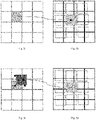
- Figures 3a to 3d show schematic pixel grids of a most recent image and a reference image used for the forward-backward check.
- Figure 3a is an example of a schematic pixel grid of the most recent image that could be input to the method that is described above in regard to figure 2 .
- one random pixel of interest which is shaded grey, is chosen for the forward-backward check.
- Figure 3b shows the pixel grid of the reference image and an arrow is used to show the forward matching of the pixel of interest to the pixel grid of the reference image.
- the pixel of interest is slightly offset in regard to the reference pixel in the pixel grid of the reference image, indicating an error in the concatenation of optical flows.
- Figure 3d essentially corresponds to figure 3c and the arrow pointing from figure 3d to figure 3c shows the backtracking to the original pixel grid with backward matching.
- the arrows that indicate the offset between the two grey-shaded pixels also indicate a local forward-backward matching error that can be used to detect an image region of mismatch in the most recent image.
- a mean distance error larger than 0.2 pixels was empirically determined to provide high quality results.
- Figures 4a to 4i show examples of a sequence of images of a LED display comprising flickering that can be used for obtaining an anti-flickering super-resolution image.
- figure 5a an interpolated image resulting from the sequence of images of figures 4a to 4i is shown. From figure 5a it can be seen that the flickering effects remain if the images of the sequence of images are merely interpolated.
- FIG 5b an anti-flickering super-resolution image resulting from the sequence of images of figures 4a to 4i is shown.
- the shown anti-flickering image could results from the image system according to the invention, and/or from the respective method according to the invention.
- adverse effects that are due to flickering can be nearly completely avoided.
Landscapes
- Engineering & Computer Science (AREA)
- Multimedia (AREA)
- Signal Processing (AREA)
- Physics & Mathematics (AREA)
- General Physics & Mathematics (AREA)
- Theoretical Computer Science (AREA)
- Image Processing (AREA)
- Closed-Circuit Television Systems (AREA)
- Mechanical Engineering (AREA)
- Studio Devices (AREA)
Claims (16)
- Bilderfassungssystem für ein Fahrzeug zum Erhalten eines flimmerfreien Bildes mit hoher Auflösung, umfassend:ein Bildsensormittel (3), das dazu angepasst ist, eine Bildfolge zu erhalten; undein Bildverarbeitungsmittel (5), das angepasst ist zum:Empfangen der Bildfolge,Vergleichen von Bildinformationen des neuesten Bildes aus der Bildfolge mit einem Referenzbild, um mindestens einen Diskrepanz-Bildbereich in dem neuesten Bild zu detektieren,Entfernen des detektierten Bildbereichs aus den Bildinformationen des neuesten Bildes, um angepasste Bildinformationen zu erhalten, undHinzufügen der angepassten Bildinformationen des neuesten Bildes zu einem Bild mit hoher Auflösung,dadurch gekennzeichnet, dassdas Bildsensormittel (3) mindestens eine Kameraanordnung, die eine Mehrzahl von Kameras umfasst, oder eine Mehrzahl von Kameras umfasst, wobeijede aus der Mehrzahl von Kameras dazu angepasst ist, mindestens ein Bild zu erhalten,die Mehrzahl von Kameras dazu angepasst sind, Bilder zu verschiedenen Zeitpunkten zu erhalten,jede Kamera aus der Mehrzahl von Kameras dazu angepasst ist, mit einer Rate von 14 bis 600 Bildern pro Sekunde zu arbeiten, und dazu angepasst ist, Bilder in einem Abstand von 16 oder 33 ms zu erhalten, unddas Bild mit hoher Auflösung ein verbessertes Bild ist, bei dem alle Bildinformationen oder ein Teil der Bildinformationen von mindestens zwei Bildern dazu verwendet werden, ein optisch verbessertes Bild zu erzeugen, sodass es im Wesentlichen frei von Flimmern ist,wobei das Detektieren von mindestens einem Diskrepanz-Bildbereich in dem neuesten Bild das Detektieren eines Bildbereiches, der einen Registrierungsfehler umfasst, wenn er zu dem Referenzbild dazu registriert wird, umfasst, wobei vorzugsweise der Registrierungsfehler größer als 0,5 Pixel mit Subpixelpräzision ist.
- Bilderfassungssystem nach Anspruch 1, dadurch gekennzeichnet, dass das Referenzbild umfasst:mindestens ein Bild aus der Bildfolge, das dem neuesten Bild vorangeht, vorzugsweise ein Bild, das dem neuesten Bild direkt vorangeht, und/oderdas Bild mit hoher Auflösung.
- Bilderfassungssystem nach den Ansprüchen 1 oder 2, dadurch gekennzeichnet, dass das Bildsensormittel (3) mindestens eine Kamera eines höher entwickelten Fahrerassistenzsystems (Advanced Driver Assistance System - ADAS) und/oder eines Kameraüberwachungssystems (Camera Monitoring System - CMS) eines Fahrzeuges umfasst.
- Bilderfassungssystem nach den Ansprüchen 1 oder 2, dadurch gekennzeichnet, dass die Kameraanordnung 4 bis 9 Kameras umfasst, wobei die Kameras vorzugsweise in einem Abstand im Bereich von 1 cm bis 2 cm voneinander beabstandet positioniert sind.
- Bilderfassungssystem nach Anspruch 4, wobei
jede Kamera aus der Mehrzahl von Kameras dazu angepasst ist, mit einer Rate von 14 bis 300 Bildern pro Sekunde zu arbeiten, vorzugsweise mit einer Rate von 60 oder 30 Bildern pro Sekunde. - Bilderfassungssystem nach einem der vorangehenden Ansprüche, wobei der Diskrepanz-Bildbereich mindestens ein Pixel umfasst.
- Bilderfassungssystem nach einem der vorangehenden Ansprüche, wobei das Detektieren mindestens eines Diskrepanz-Bildbereichs in dem neuesten Bild ferner das Detektieren eines Bildbereichs umfasst, umfassend:(i) ein anderes Helligkeitsniveau im Vergleich zu dem gleichen Bereich in dem Referenzbild, wobei vorzugsweise die Helligkeitswerte um mehr als 10 % abweichen, und/oder(ii) einen mittleren Abstandsfehler, resultierend aus einer Vorwärts-rückwärts-Überprüfung der Verkettung von optischen Flüssen von dem neuesten Bild zu dem Referenzbild und zu dem neuesten Bild zurück, wobei vorzugsweise der mittlere Abstand größer als 0,2 Pixel ist.
- Bilderfassungssystem nach einem der vorangehenden Ansprüche, wobeidas Bildverarbeitungsmittel (5) dazu angepasst ist, die Bildfolge im Wesentlichen in Echtzeit zu verarbeiten, und/oderdie Bildverarbeitung kontinuierlich ausgeführt wird, sodass das Bild mit hoher Auflösung kontinuierlich mit neuen Bildinformationen aktualisiert wird, wobei vorzugsweise das Bild mit hoher Auflösung mit derselben Rate mit neuen Bildinformationen aktualisiert wird, mit der alte Bildinformationen aus dem Bild mit hoher Auflösung wieder entfernt werden, sodass das Bild mit hoher Auflösung nur eher aktuelle Informationen enthält.
- Bilderfassungssystem nach einem der vorangehenden Ansprüche, ferner umfassend:
ein Bildanzeigemittel (7), das dazu angepasst ist, das Bild mit hoher Auflösung anzuzeigen, wobei vorzugsweise das Bildanzeigemittel (7) einen Bildschirm, besonders bevorzugt eine High-Definition-, HD-Vorrichtung in einem CMS-System, umfasst. - Bilderfassungssystem nach einem der vorangehenden Ansprüche, wobei das Bildverarbeitungsmittel (5) auf einem System-on-a-Chip realisiert ist.
- Rückblickanzeigevorrichtung für ein Fahrzeug, vorzugsweise für ein Kraftfahrzeug, umfassend mindestens einen Teil eines Bilderfassungssystems nach einem der Ansprüche 1 bis 10.
- Verfahren zum Erhalten eines flimmerfreien Bildes mit hoher Auflösung unter Verwendung des Bilderfassungssystems nach einem der vorangehenden Ansprüche, wobei das Verfahren umfasst:Erhalten (101) einer Bildfolge;Vergleichen (103) von Bildinformationen des neuesten Bildes aus der Bildfolge mit einem Referenzbild, um mindestens einen Diskrepanz-Bildbereich in dem neuesten Bild zu detektieren;Entfernen (105) des detektierten Bildbereichs aus den Bildinformationen des neuesten Bildes, um angepasste Bildinformationen zu erhalten; undHinzufügen (107) der angepassten Bildinformationen des neuesten Bildes zu einem Bild mit hoher Auflösung, welches ein verbessertes Bild ist, bei dem alle Bildinformationen oder ein Teil der Bildinformationen von mindestens zwei Bildern dazu verwendet werden, ein optisch verbessertes Bild zu erzeugen, sodasses im Wesentlichen frei von Flimmern ist;dadurch gekennzeichnet, dass das Detektieren von mindestens einem Diskrepanz-Bildbereich in dem neuesten Bild das Detektieren eines Bildbereiches, der einen Registrierungsfehler umfasst, wenn er zu dem Referenzbild dazu registriert wird, umfasst, wobei vorzugsweise der Registrierungsfehler größer als 0,5 Pixel mit Subpixelpräzision ist.
- Verfahren nach Anspruch 12, dadurch gekennzeichnet, dass das Referenzbild umfasst:mindestens ein Bild aus der Bildfolge, das dem neuesten Bild vorangeht,vorzugsweise ein Bild, das dem neuesten Bild direkt vorangeht, und/oder das Bild mit hoher Auflösung.
- Verfahren nach einem der Ansprüche 12 oder 13, wobei das Detektieren mindestens eines Diskrepanz-Bildbereichs, vorzugsweise mindestens ein Pixel umfassend, in dem neuesten Bild ferner umfasst: das Detektieren eines Bildbereichs, umfassend:(i) ein anderes Helligkeitsniveau im Vergleich zu dem gleichen Bereich in dem Referenzbild, wobei vorzugsweise der Helligkeitswert um mehr als 10 % abweicht,
und/oder(ii) einen mittleren Abstandsfehler, resultierend aus einer Vorwärts-rückwärts-Überprüfung der Verkettung von optischen Flüssen von dem neuesten Bild zu dem Referenzbild und zu dem neuesten Bild zurück, wobei vorzugsweise der mittlere Abstand größer als 0,2 Pixel ist. - Verfahren nach den Ansprüchen 12 bis 14, wobei das Verfahren ferner umfasst:
Anzeigen (109) des Bildes mit hoher Auflösung. - Verfahren nach den Ansprüchen 12 bis 15, wobei
die Bildverarbeitung kontinuierlich ausgeführt wird, sodass das Bild mit hoher Auflösung kontinuierlich mit neuen Bildinformationen aktualisiert wird, wobei vorzugsweise das Bild mit hoher Auflösung mit derselben Rate mit neuen Bildinformationen aktualisiert wird, mit der alte Bildinformationen aus dem Bild mit hoher Auflösung wieder entfernt werden, sodass das Bild mit hoher Auflösung nur eher aktuelle Informationen enthält.
Applications Claiming Priority (2)
| Application Number | Priority Date | Filing Date | Title |
|---|---|---|---|
| DE102016122934.2A DE102016122934A1 (de) | 2016-11-28 | 2016-11-28 | Bildgebungssystem für ein Fahrzeug und Verfahren zum Erhalten eines superaufgelösten Antiflimmer-Bildes |
| PCT/EP2017/079308 WO2018095779A1 (en) | 2016-11-28 | 2017-11-15 | Imaging system for a vehicle and method for obtaining an anti-flickering super-resolution image |
Publications (2)
| Publication Number | Publication Date |
|---|---|
| EP3545489A1 EP3545489A1 (de) | 2019-10-02 |
| EP3545489B1 true EP3545489B1 (de) | 2022-08-10 |
Family
ID=60450627
Family Applications (1)
| Application Number | Title | Priority Date | Filing Date |
|---|---|---|---|
| EP17803866.7A Active EP3545489B1 (de) | 2016-11-28 | 2017-11-15 | Bilderfassungssystem für ein fahrzeug und verfahren zur erzeugung eines flimmerfreies bildes mit hoher auflösung |
Country Status (5)
| Country | Link |
|---|---|
| US (1) | US11178338B2 (de) |
| EP (1) | EP3545489B1 (de) |
| CN (1) | CN110073402B (de) |
| DE (1) | DE102016122934A1 (de) |
| WO (1) | WO2018095779A1 (de) |
Cited By (1)
| Publication number | Priority date | Publication date | Assignee | Title |
|---|---|---|---|---|
| WO2025149127A1 (de) * | 2024-01-12 | 2025-07-17 | Bayerische Motoren Werke Aktiengesellschaft | Unterdrückung von reflexionen auf spiegelnden displayflächen mobiler geräte in einem fahrzeug |
Families Citing this family (5)
| Publication number | Priority date | Publication date | Assignee | Title |
|---|---|---|---|---|
| EP3933690A1 (de) * | 2020-06-30 | 2022-01-05 | Sick IVP AB | Erzeugung eines zweiten objektmodells auf basis eines ersten objektmodells zur verwendung in der objektanpassung |
| US12412247B2 (en) | 2021-09-23 | 2025-09-09 | Samsung Electronics Co., Ltd. | Efficient flicker suppression for single image super-resolution |
| US20250029210A1 (en) * | 2023-07-20 | 2025-01-23 | Samsung Electronics Co., Ltd. | Flicker suppression without motion estimation for single-image super-resolution |
| CN117475359B (zh) * | 2023-12-27 | 2024-08-06 | 湖北经济学院 | 一种led灯的识别方法、装置、电子设备及存储介质 |
| CN120751217B (zh) * | 2025-08-22 | 2025-11-04 | 湖南快乐阳光互动娱乐传媒有限公司 | 一种视频处理方法、装置、存储介质及电子设备 |
Citations (1)
| Publication number | Priority date | Publication date | Assignee | Title |
|---|---|---|---|---|
| US20040218834A1 (en) * | 2003-04-30 | 2004-11-04 | Microsoft Corporation | Patch-based video super-resolution |
Family Cites Families (20)
| Publication number | Priority date | Publication date | Assignee | Title |
|---|---|---|---|---|
| US6421097B1 (en) | 1998-07-31 | 2002-07-16 | Intel Corporation | Method and apparatus for reducing flicker in a video image sequence |
| US6380985B1 (en) | 1998-09-14 | 2002-04-30 | Webtv Networks, Inc. | Resizing and anti-flicker filtering in reduced-size video images |
| US6563511B1 (en) | 1999-03-05 | 2003-05-13 | Teralogic, Inc. | Anti-flickering for video display based on pixel luminance |
| US20060244843A1 (en) | 2005-04-29 | 2006-11-02 | Bart Dierickx | Illumination flicker detection |
| US8581906B2 (en) * | 2008-08-04 | 2013-11-12 | Kabushiki Kaisha Toshiba | Image processing apparatus and image processing method |
| CN102065313B (zh) * | 2010-11-16 | 2012-10-31 | 上海大学 | 平行式相机阵列的未标定多视点图像校正方法 |
| JP2013121099A (ja) * | 2011-12-08 | 2013-06-17 | Sony Corp | 画像処理装置、および画像処理方法、並びにプログラム |
| BR112015010677A2 (pt) * | 2012-11-11 | 2017-07-11 | Kenkou Gmbh | processo e dispositivo para determinar parâmetros vitais |
| US9336574B2 (en) | 2013-01-07 | 2016-05-10 | GM Global Technology Operations LLC | Image super-resolution for dynamic rearview mirror |
| US9106839B2 (en) | 2013-04-05 | 2015-08-11 | Google Inc. | Automatic location-based camera frame rate settings |
| US9230303B2 (en) * | 2013-04-16 | 2016-01-05 | The United States Of America, As Represented By The Secretary Of The Navy | Multi-frame super-resolution of image sequence with arbitrary motion patterns |
| FR3005543A1 (fr) | 2013-10-14 | 2014-11-14 | St Microelectronics Grenoble 2 | Procede de compensation de scintillement utilisant deux images |
| US10026192B2 (en) * | 2013-10-18 | 2018-07-17 | Ford Global Technologies, Llc | Color harmony verification system |
| JP2015115922A (ja) * | 2013-12-16 | 2015-06-22 | オリンパス株式会社 | 撮像装置および撮像方法 |
| KR20150109177A (ko) * | 2014-03-19 | 2015-10-01 | 삼성전자주식회사 | 촬영 장치, 그 제어 방법, 및 컴퓨터 판독가능 기록매체 |
| EP4187523A1 (de) * | 2014-05-14 | 2023-05-31 | Mobileye Vision Technologies Ltd. | Systeme und verfahren zur bordsteindetektion und fussgängergefahrenbeurteilung |
| JP6370134B2 (ja) | 2014-07-02 | 2018-08-08 | キヤノン株式会社 | 撮像装置、その制御方法、および制御プログラム |
| JPWO2016067529A1 (ja) * | 2014-10-30 | 2017-08-17 | パナソニックIpマネジメント株式会社 | 画像処理装置、画像表示システム及びそれを備える車両並びに画像処理方法及びそれを実行させるプログラム |
| US10127463B2 (en) * | 2014-11-21 | 2018-11-13 | Magna Electronics Inc. | Vehicle vision system with multiple cameras |
| CN105551013B (zh) * | 2015-11-03 | 2018-09-25 | 西安电子科技大学 | 基于运动平台参数的sar图像序列配准方法 |
-
2016
- 2016-11-28 DE DE102016122934.2A patent/DE102016122934A1/de not_active Withdrawn
-
2017
- 2017-11-15 EP EP17803866.7A patent/EP3545489B1/de active Active
- 2017-11-15 US US16/464,155 patent/US11178338B2/en active Active
- 2017-11-15 WO PCT/EP2017/079308 patent/WO2018095779A1/en not_active Ceased
- 2017-11-15 CN CN201780073280.0A patent/CN110073402B/zh active Active
Patent Citations (1)
| Publication number | Priority date | Publication date | Assignee | Title |
|---|---|---|---|---|
| US20040218834A1 (en) * | 2003-04-30 | 2004-11-04 | Microsoft Corporation | Patch-based video super-resolution |
Cited By (1)
| Publication number | Priority date | Publication date | Assignee | Title |
|---|---|---|---|---|
| WO2025149127A1 (de) * | 2024-01-12 | 2025-07-17 | Bayerische Motoren Werke Aktiengesellschaft | Unterdrückung von reflexionen auf spiegelnden displayflächen mobiler geräte in einem fahrzeug |
Also Published As
| Publication number | Publication date |
|---|---|
| CN110073402B (zh) | 2023-05-12 |
| CN110073402A (zh) | 2019-07-30 |
| EP3545489A1 (de) | 2019-10-02 |
| US11178338B2 (en) | 2021-11-16 |
| DE102016122934A1 (de) | 2018-06-14 |
| WO2018095779A1 (en) | 2018-05-31 |
| US20200314316A1 (en) | 2020-10-01 |
Similar Documents
| Publication | Publication Date | Title |
|---|---|---|
| EP3545489B1 (de) | Bilderfassungssystem für ein fahrzeug und verfahren zur erzeugung eines flimmerfreies bildes mit hoher auflösung | |
| EP3472000B1 (de) | System und verfahren zur verarbeitung von videodaten zur erkennung und beseitigung von flimmernden lichtquellen durch dynamische belichtungssteuerung | |
| CN107709096B (zh) | 用于处理流式传输视频图像以校正经调幅光的闪变的系统和方法 | |
| US8334893B2 (en) | Method and apparatus for combining range information with an optical image | |
| EP2919197A1 (de) | Objektserkennungsvorrichtung und objekterkennungsverfahren | |
| JP5435307B2 (ja) | 車載カメラ装置 | |
| JP5895955B2 (ja) | 車線境界線検出装置 | |
| US20060018513A1 (en) | Stereo vehicle-exterior monitoring apparatus | |
| JPWO2015098325A1 (ja) | 車載画像認識装置 | |
| JP2013005234A5 (de) | ||
| KR101537559B1 (ko) | 객체 검출 장치, 차량용 객체 검출 장치 및 이들의 방법 | |
| US20230171510A1 (en) | Vision system for a motor vehicle | |
| US20160050342A1 (en) | Image processing apparatus | |
| US20120162425A1 (en) | Device and method for securing visibility for driver | |
| CN106610280A (zh) | 用于利用新的光学分辨率生成立体图的方法 | |
| CN113276772B (zh) | 一种汽车电子外后视镜系统及控制方法 | |
| US20170011539A1 (en) | Image processing apparatus and image processing method | |
| US20150042806A1 (en) | Vehicle vision system with reduction of temporal noise in images | |
| CN102713511A (zh) | 车辆用距离计算装置 | |
| CN113632450B (zh) | 摄影系统及图像处理装置 | |
| KR101815840B1 (ko) | 영상 추정 기반 어라운드 뷰 모니터링 장치 | |
| JP5166111B2 (ja) | 車両周辺監視装置 | |
| CN105247571A (zh) | 用于构建脉冲地发光的对象的拍摄的方法和设备 | |
| CN109788211B (zh) | 拍摄图像显示系统、电子镜系统以及拍摄图像显示方法 | |
| CN102074007A (zh) | 车辆用图像处理装置 |
Legal Events
| Date | Code | Title | Description |
|---|---|---|---|
| STAA | Information on the status of an ep patent application or granted ep patent |
Free format text: STATUS: UNKNOWN |
|
| STAA | Information on the status of an ep patent application or granted ep patent |
Free format text: STATUS: THE INTERNATIONAL PUBLICATION HAS BEEN MADE |
|
| PUAI | Public reference made under article 153(3) epc to a published international application that has entered the european phase |
Free format text: ORIGINAL CODE: 0009012 |
|
| STAA | Information on the status of an ep patent application or granted ep patent |
Free format text: STATUS: REQUEST FOR EXAMINATION WAS MADE |
|
| 17P | Request for examination filed |
Effective date: 20190619 |
|
| AK | Designated contracting states |
Kind code of ref document: A1 Designated state(s): AL AT BE BG CH CY CZ DE DK EE ES FI FR GB GR HR HU IE IS IT LI LT LU LV MC MK MT NL NO PL PT RO RS SE SI SK SM TR |
|
| AX | Request for extension of the european patent |
Extension state: BA ME |
|
| DAV | Request for validation of the european patent (deleted) | ||
| DAX | Request for extension of the european patent (deleted) | ||
| STAA | Information on the status of an ep patent application or granted ep patent |
Free format text: STATUS: EXAMINATION IS IN PROGRESS |
|
| 17Q | First examination report despatched |
Effective date: 20200623 |
|
| GRAP | Despatch of communication of intention to grant a patent |
Free format text: ORIGINAL CODE: EPIDOSNIGR1 |
|
| STAA | Information on the status of an ep patent application or granted ep patent |
Free format text: STATUS: GRANT OF PATENT IS INTENDED |
|
| RIC1 | Information provided on ipc code assigned before grant |
Ipc: H04N 5/349 20110101ALI20220310BHEP Ipc: H04N 5/235 20060101ALI20220310BHEP Ipc: G06T 3/40 20060101AFI20220310BHEP |
|
| INTG | Intention to grant announced |
Effective date: 20220331 |
|
| GRAS | Grant fee paid |
Free format text: ORIGINAL CODE: EPIDOSNIGR3 |
|
| GRAA | (expected) grant |
Free format text: ORIGINAL CODE: 0009210 |
|
| STAA | Information on the status of an ep patent application or granted ep patent |
Free format text: STATUS: THE PATENT HAS BEEN GRANTED |
|
| AK | Designated contracting states |
Kind code of ref document: B1 Designated state(s): AL AT BE BG CH CY CZ DE DK EE ES FI FR GB GR HR HU IE IS IT LI LT LU LV MC MK MT NL NO PL PT RO RS SE SI SK SM TR |
|
| REG | Reference to a national code |
Ref country code: AT Ref legal event code: REF Ref document number: 1511107 Country of ref document: AT Kind code of ref document: T Effective date: 20220815 Ref country code: CH Ref legal event code: EP |
|
| REG | Reference to a national code |
Ref country code: DE Ref legal event code: R084 Ref document number: 602017060539 Country of ref document: DE Ref country code: IE Ref legal event code: FG4D |
|
| REG | Reference to a national code |
Ref country code: DE Ref legal event code: R096 Ref document number: 602017060539 Country of ref document: DE |
|
| REG | Reference to a national code |
Ref country code: NL Ref legal event code: MP Effective date: 20220810 |
|
| REG | Reference to a national code |
Ref country code: LT Ref legal event code: MG9D |
|
| PG25 | Lapsed in a contracting state [announced via postgrant information from national office to epo] |
Ref country code: SE Free format text: LAPSE BECAUSE OF FAILURE TO SUBMIT A TRANSLATION OF THE DESCRIPTION OR TO PAY THE FEE WITHIN THE PRESCRIBED TIME-LIMIT Effective date: 20220810 Ref country code: RS Free format text: LAPSE BECAUSE OF FAILURE TO SUBMIT A TRANSLATION OF THE DESCRIPTION OR TO PAY THE FEE WITHIN THE PRESCRIBED TIME-LIMIT Effective date: 20220810 Ref country code: PT Free format text: LAPSE BECAUSE OF FAILURE TO SUBMIT A TRANSLATION OF THE DESCRIPTION OR TO PAY THE FEE WITHIN THE PRESCRIBED TIME-LIMIT Effective date: 20221212 Ref country code: NO Free format text: LAPSE BECAUSE OF FAILURE TO SUBMIT A TRANSLATION OF THE DESCRIPTION OR TO PAY THE FEE WITHIN THE PRESCRIBED TIME-LIMIT Effective date: 20221110 Ref country code: NL Free format text: LAPSE BECAUSE OF FAILURE TO SUBMIT A TRANSLATION OF THE DESCRIPTION OR TO PAY THE FEE WITHIN THE PRESCRIBED TIME-LIMIT Effective date: 20220810 Ref country code: LV Free format text: LAPSE BECAUSE OF FAILURE TO SUBMIT A TRANSLATION OF THE DESCRIPTION OR TO PAY THE FEE WITHIN THE PRESCRIBED TIME-LIMIT Effective date: 20220810 Ref country code: LT Free format text: LAPSE BECAUSE OF FAILURE TO SUBMIT A TRANSLATION OF THE DESCRIPTION OR TO PAY THE FEE WITHIN THE PRESCRIBED TIME-LIMIT Effective date: 20220810 Ref country code: FI Free format text: LAPSE BECAUSE OF FAILURE TO SUBMIT A TRANSLATION OF THE DESCRIPTION OR TO PAY THE FEE WITHIN THE PRESCRIBED TIME-LIMIT Effective date: 20220810 |
|
| REG | Reference to a national code |
Ref country code: AT Ref legal event code: MK05 Ref document number: 1511107 Country of ref document: AT Kind code of ref document: T Effective date: 20220810 |
|
| PG25 | Lapsed in a contracting state [announced via postgrant information from national office to epo] |
Ref country code: PL Free format text: LAPSE BECAUSE OF FAILURE TO SUBMIT A TRANSLATION OF THE DESCRIPTION OR TO PAY THE FEE WITHIN THE PRESCRIBED TIME-LIMIT Effective date: 20220810 Ref country code: IS Free format text: LAPSE BECAUSE OF FAILURE TO SUBMIT A TRANSLATION OF THE DESCRIPTION OR TO PAY THE FEE WITHIN THE PRESCRIBED TIME-LIMIT Effective date: 20221210 Ref country code: HR Free format text: LAPSE BECAUSE OF FAILURE TO SUBMIT A TRANSLATION OF THE DESCRIPTION OR TO PAY THE FEE WITHIN THE PRESCRIBED TIME-LIMIT Effective date: 20220810 Ref country code: GR Free format text: LAPSE BECAUSE OF FAILURE TO SUBMIT A TRANSLATION OF THE DESCRIPTION OR TO PAY THE FEE WITHIN THE PRESCRIBED TIME-LIMIT Effective date: 20221111 |
|
| PG25 | Lapsed in a contracting state [announced via postgrant information from national office to epo] |
Ref country code: SM Free format text: LAPSE BECAUSE OF FAILURE TO SUBMIT A TRANSLATION OF THE DESCRIPTION OR TO PAY THE FEE WITHIN THE PRESCRIBED TIME-LIMIT Effective date: 20220810 Ref country code: RO Free format text: LAPSE BECAUSE OF FAILURE TO SUBMIT A TRANSLATION OF THE DESCRIPTION OR TO PAY THE FEE WITHIN THE PRESCRIBED TIME-LIMIT Effective date: 20220810 Ref country code: ES Free format text: LAPSE BECAUSE OF FAILURE TO SUBMIT A TRANSLATION OF THE DESCRIPTION OR TO PAY THE FEE WITHIN THE PRESCRIBED TIME-LIMIT Effective date: 20220810 Ref country code: DK Free format text: LAPSE BECAUSE OF FAILURE TO SUBMIT A TRANSLATION OF THE DESCRIPTION OR TO PAY THE FEE WITHIN THE PRESCRIBED TIME-LIMIT Effective date: 20220810 Ref country code: CZ Free format text: LAPSE BECAUSE OF FAILURE TO SUBMIT A TRANSLATION OF THE DESCRIPTION OR TO PAY THE FEE WITHIN THE PRESCRIBED TIME-LIMIT Effective date: 20220810 Ref country code: AT Free format text: LAPSE BECAUSE OF FAILURE TO SUBMIT A TRANSLATION OF THE DESCRIPTION OR TO PAY THE FEE WITHIN THE PRESCRIBED TIME-LIMIT Effective date: 20220810 |
|
| REG | Reference to a national code |
Ref country code: DE Ref legal event code: R097 Ref document number: 602017060539 Country of ref document: DE |
|
| PG25 | Lapsed in a contracting state [announced via postgrant information from national office to epo] |
Ref country code: SK Free format text: LAPSE BECAUSE OF FAILURE TO SUBMIT A TRANSLATION OF THE DESCRIPTION OR TO PAY THE FEE WITHIN THE PRESCRIBED TIME-LIMIT Effective date: 20220810 Ref country code: EE Free format text: LAPSE BECAUSE OF FAILURE TO SUBMIT A TRANSLATION OF THE DESCRIPTION OR TO PAY THE FEE WITHIN THE PRESCRIBED TIME-LIMIT Effective date: 20220810 |
|
| PLBE | No opposition filed within time limit |
Free format text: ORIGINAL CODE: 0009261 |
|
| STAA | Information on the status of an ep patent application or granted ep patent |
Free format text: STATUS: NO OPPOSITION FILED WITHIN TIME LIMIT |
|
| PG25 | Lapsed in a contracting state [announced via postgrant information from national office to epo] |
Ref country code: MC Free format text: LAPSE BECAUSE OF FAILURE TO SUBMIT A TRANSLATION OF THE DESCRIPTION OR TO PAY THE FEE WITHIN THE PRESCRIBED TIME-LIMIT Effective date: 20220810 Ref country code: AL Free format text: LAPSE BECAUSE OF FAILURE TO SUBMIT A TRANSLATION OF THE DESCRIPTION OR TO PAY THE FEE WITHIN THE PRESCRIBED TIME-LIMIT Effective date: 20220810 |
|
| REG | Reference to a national code |
Ref country code: CH Ref legal event code: PL |
|
| 26N | No opposition filed |
Effective date: 20230511 |
|
| P01 | Opt-out of the competence of the unified patent court (upc) registered |
Effective date: 20230616 |
|
| REG | Reference to a national code |
Ref country code: BE Ref legal event code: MM Effective date: 20221130 |
|
| PG25 | Lapsed in a contracting state [announced via postgrant information from national office to epo] |
Ref country code: LI Free format text: LAPSE BECAUSE OF NON-PAYMENT OF DUE FEES Effective date: 20221130 Ref country code: CH Free format text: LAPSE BECAUSE OF NON-PAYMENT OF DUE FEES Effective date: 20221130 |
|
| PG25 | Lapsed in a contracting state [announced via postgrant information from national office to epo] |
Ref country code: SI Free format text: LAPSE BECAUSE OF FAILURE TO SUBMIT A TRANSLATION OF THE DESCRIPTION OR TO PAY THE FEE WITHIN THE PRESCRIBED TIME-LIMIT Effective date: 20220810 Ref country code: LU Free format text: LAPSE BECAUSE OF NON-PAYMENT OF DUE FEES Effective date: 20221115 |
|
| PG25 | Lapsed in a contracting state [announced via postgrant information from national office to epo] |
Ref country code: IE Free format text: LAPSE BECAUSE OF NON-PAYMENT OF DUE FEES Effective date: 20221115 |
|
| PG25 | Lapsed in a contracting state [announced via postgrant information from national office to epo] |
Ref country code: BE Free format text: LAPSE BECAUSE OF NON-PAYMENT OF DUE FEES Effective date: 20221130 |
|
| PG25 | Lapsed in a contracting state [announced via postgrant information from national office to epo] |
Ref country code: HU Free format text: LAPSE BECAUSE OF FAILURE TO SUBMIT A TRANSLATION OF THE DESCRIPTION OR TO PAY THE FEE WITHIN THE PRESCRIBED TIME-LIMIT; INVALID AB INITIO Effective date: 20171115 |
|
| PG25 | Lapsed in a contracting state [announced via postgrant information from national office to epo] |
Ref country code: CY Free format text: LAPSE BECAUSE OF FAILURE TO SUBMIT A TRANSLATION OF THE DESCRIPTION OR TO PAY THE FEE WITHIN THE PRESCRIBED TIME-LIMIT Effective date: 20220810 |
|
| PG25 | Lapsed in a contracting state [announced via postgrant information from national office to epo] |
Ref country code: MK Free format text: LAPSE BECAUSE OF FAILURE TO SUBMIT A TRANSLATION OF THE DESCRIPTION OR TO PAY THE FEE WITHIN THE PRESCRIBED TIME-LIMIT Effective date: 20220810 Ref country code: IT Free format text: LAPSE BECAUSE OF FAILURE TO SUBMIT A TRANSLATION OF THE DESCRIPTION OR TO PAY THE FEE WITHIN THE PRESCRIBED TIME-LIMIT Effective date: 20220810 |
|
| PG25 | Lapsed in a contracting state [announced via postgrant information from national office to epo] |
Ref country code: TR Free format text: LAPSE BECAUSE OF FAILURE TO SUBMIT A TRANSLATION OF THE DESCRIPTION OR TO PAY THE FEE WITHIN THE PRESCRIBED TIME-LIMIT Effective date: 20220810 |
|
| PG25 | Lapsed in a contracting state [announced via postgrant information from national office to epo] |
Ref country code: BG Free format text: LAPSE BECAUSE OF FAILURE TO SUBMIT A TRANSLATION OF THE DESCRIPTION OR TO PAY THE FEE WITHIN THE PRESCRIBED TIME-LIMIT Effective date: 20220810 |
|
| PG25 | Lapsed in a contracting state [announced via postgrant information from national office to epo] |
Ref country code: MT Free format text: LAPSE BECAUSE OF FAILURE TO SUBMIT A TRANSLATION OF THE DESCRIPTION OR TO PAY THE FEE WITHIN THE PRESCRIBED TIME-LIMIT Effective date: 20220810 |
|
| PGFP | Annual fee paid to national office [announced via postgrant information from national office to epo] |
Ref country code: DE Payment date: 20241119 Year of fee payment: 8 |
|
| PGFP | Annual fee paid to national office [announced via postgrant information from national office to epo] |
Ref country code: GB Payment date: 20241121 Year of fee payment: 8 |
|
| PGFP | Annual fee paid to national office [announced via postgrant information from national office to epo] |
Ref country code: FR Payment date: 20241128 Year of fee payment: 8 |