EP3539083B1 - Verfahren und vorrichtung zum ermitteln eines glättewerts einer frisur - Google Patents
Verfahren und vorrichtung zum ermitteln eines glättewerts einer frisur Download PDFInfo
- Publication number
- EP3539083B1 EP3539083B1 EP17735496.6A EP17735496A EP3539083B1 EP 3539083 B1 EP3539083 B1 EP 3539083B1 EP 17735496 A EP17735496 A EP 17735496A EP 3539083 B1 EP3539083 B1 EP 3539083B1
- Authority
- EP
- European Patent Office
- Prior art keywords
- hair
- determining
- hairstyle
- various embodiments
- examination
- Prior art date
- Legal status (The legal status is an assumption and is not a legal conclusion. Google has not performed a legal analysis and makes no representation as to the accuracy of the status listed.)
- Active
Links
Images


Classifications
-
- G—PHYSICS
- G06—COMPUTING OR CALCULATING; COUNTING
- G06T—IMAGE DATA PROCESSING OR GENERATION, IN GENERAL
- G06T7/00—Image analysis
- G06T7/60—Analysis of geometric attributes
-
- A—HUMAN NECESSITIES
- A45—HAND OR TRAVELLING ARTICLES
- A45D—HAIRDRESSING OR SHAVING EQUIPMENT; EQUIPMENT FOR COSMETICS OR COSMETIC TREATMENTS, e.g. FOR MANICURING OR PEDICURING
- A45D44/00—Other cosmetic or toiletry articles, e.g. for hairdressers' rooms
-
- G—PHYSICS
- G06—COMPUTING OR CALCULATING; COUNTING
- G06T—IMAGE DATA PROCESSING OR GENERATION, IN GENERAL
- G06T7/00—Image analysis
- G06T7/40—Analysis of texture
- G06T7/41—Analysis of texture based on statistical description of texture
- G06T7/44—Analysis of texture based on statistical description of texture using image operators, e.g. filters, edge density metrics or local histograms
-
- G—PHYSICS
- G09—EDUCATION; CRYPTOGRAPHY; DISPLAY; ADVERTISING; SEALS
- G09B—EDUCATIONAL OR DEMONSTRATION APPLIANCES; APPLIANCES FOR TEACHING, OR COMMUNICATING WITH, THE BLIND, DEAF OR MUTE; MODELS; PLANETARIA; GLOBES; MAPS; DIAGRAMS
- G09B19/00—Teaching not covered by other main groups of this subclass
-
- A—HUMAN NECESSITIES
- A45—HAND OR TRAVELLING ARTICLES
- A45D—HAIRDRESSING OR SHAVING EQUIPMENT; EQUIPMENT FOR COSMETICS OR COSMETIC TREATMENTS, e.g. FOR MANICURING OR PEDICURING
- A45D44/00—Other cosmetic or toiletry articles, e.g. for hairdressers' rooms
- A45D2044/007—Devices for determining the condition of hair or skin or for selecting the appropriate cosmetic or hair treatment
-
- G—PHYSICS
- G06—COMPUTING OR CALCULATING; COUNTING
- G06T—IMAGE DATA PROCESSING OR GENERATION, IN GENERAL
- G06T2207/00—Indexing scheme for image analysis or image enhancement
- G06T2207/20—Special algorithmic details
- G06T2207/20092—Interactive image processing based on input by user
- G06T2207/20104—Interactive definition of region of interest [ROI]
-
- G—PHYSICS
- G06—COMPUTING OR CALCULATING; COUNTING
- G06T—IMAGE DATA PROCESSING OR GENERATION, IN GENERAL
- G06T2207/00—Indexing scheme for image analysis or image enhancement
- G06T2207/30—Subject of image; Context of image processing
- G06T2207/30196—Human being; Person
Definitions
- the invention relates to a method and a device for determining a smoothness value of a hairstyle.
- Straightening hair can be an important cosmetic goal, which can be achieved through several different procedures. Conversely, curling or curling hair can also be a goal.
- Such methods include, for example, the use of non-reactive hair care products for hair straightening, e.g. products that are intended to be left on the hair, which is also referred to as a leave-on product (e.g. a so-called conditioner), and/or products that are intended to be removed from the hair after use, e.g. by rinsing, such as a hair treatment.
- a leave-on product e.g. a so-called conditioner
- rinsing such as a hair treatment.
- Hair straightening procedures also include the use of reactive products such as perms (which can be suitable for giving hair a relatively permanent desired texture, which can be both wavy and straight), so-called straighteners, and relaxers.
- Other hair straightening procedures may involve the use of hairdressing tools, such as flat irons.
- a straightening result and possibly also the smoothness of the hair to be straightened, has so far been done either subjectively, i.e., the hair is visually inspected after straightening (and possibly even before) and assessed to determine whether satisfactory straightening has been achieved, or indirectly through the application of surrogate methods.
- One such surrogate method can, for example, determine the combability of the hair, which can indirectly provide information about its smoothness.
- Such a determination of (e.g. quantified) combability can be carried out in a laboratory with relative effort, but is not suitable for an end user, and cannot be used via a mobile application.
- Fiber orientation measurement using polarization imaging by N. Lechocinski at al. J: Cosmet. Sci . describes a method for determining the curliness of hair by measuring the light refracted in and reflected from the hair. The method uses the anisotropy of the hair to detect curvature. Anisotropy works by changing the light intensity at different polarization angles of the polarized light.
- the document "Quantitative Orientation Analysis” available at https://web.archive.org/web/20170314225552if_/http://bigwww.epfl.ch/demo/orientation/theoreticl-background.pdf provides a mathematical method for characterizing the orientation and isotropy of a region in an image. US2005/0211599 A1 describes a product for treating hair along with information about the appearance of the hair after using the product.
- a method according to claims 1 to 13 is provided, which makes it possible to precisely determine, e.g., ascertain, a smoothness of hairstyles as a target parameter of an image processing method (in German the English term "Image Analysis” is also used for image processing).
- the method can be carried out with little or no equipment effort.
- the method can be carried out using an app on a tablet or a smartphone.
- This can enable a user, for example, to determine the smoothness value of their hairstyle without professional support and without having to provide a hair sample for manipulation.
- using a smartphone or tablet to capture a digital image of the hairstyle and determine the smoothness value using the smartphone/tablet.
- the smartphone/tablet can be used to provide the image to an external data processing device, e.g., a cloud, and to receive the results determined there and display them to the user.
- a method for determining a smoothness value of a hairstyle may include determining and/or defining at least one hair examination region in a digital image in which hair is depicted, determining hair gradients of the hairs depicted in the at least one hair examination region, wherein the hair gradients of all hairs depicted in the hair examination region form a totality of the hair gradients, determining a main direction of the hair gradients, and determining the smoothness value of the hairstyle based on the main direction of the hair gradients and the totality of the hair gradients.
- determining the smoothness value of the hairstyle based on the main direction of the hair gradients and the entirety of the hair gradients will comprise determining a coherence using a structure tensor and/or determining a dispersion of an angular distribution of the entirety of the hair gradients.
- determining or defining at least one hair examination region will comprise defining the at least one hair examination region by a user.
- the definition of the at least one hair examination area by the user will comprise a definition of position and/or shape and/or size of the hair examination area.
- determining or defining at least one hair examination region will comprise determining a hair representation region in which the hair is depicted in the digital image and defining at least a portion of the hair representation region as the at least one hair examination region.
- the at least one hair examination region will comprise the entire hair display region.
- the at least one hair examination region will comprise a plurality of hair examination regions.
- the majority of hair examination areas will differ from each other in their center position.
- the plurality of hair examination areas will differ from one another in size.
- the plurality of hair examination areas will have a common center position.
- the method will further comprise relating the determined smoothness values of the hairstyle to the center positions of the hair examination areas.
- the method will further comprise relating the determined smoothness values of the hairstyle to the sizes of the hair examination areas.
- the method will further comprise displaying the determined result.
- a device for determining the smoothness of hairstyles may comprise a data processing device and a display device, wherein the data processing device may be configured to perform one of the above methods.
- a digital image can be understood herein as a data packet that can be represented by a data processing system as a two-dimensional (planar) arrangement of image points (also referred to as pixels), for example in a coordinate system having an x-axis and a y-axis, wherein each image point has at least one image position as an x, y coordinate pair and intensity information, wherein the intensity information can be represented, for example, as the color of a pixel of a monitor or a printed dot of a printed image. In the case of a color image, the intensity information can relate to individual color channels.
- the digital image can, for example, be a photo taken with a digital camera or a single image of a video sequence recorded with a digital camera.
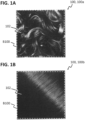
- FIG. 1A and FIG. 1B show images 100 of differently smooth hair for use in a method for determining a smoothness of hairstyles according to various embodiments.
- FIG. 1A shows an illustration of a digital image 100a of curly hair 102
- FIG. 1B an illustration of a digital image 100b of straight hair 102.
- an image processing method can be applied to each of the images.
- the image 100a showing the (in this case curly) hair 102 can be provided digitally.
- the digital image 100a can be provided, for example, to a data processing device.
- At least one hair examination area B100 is determined in the image 100a.
- FIG. 1A and FIG. 1B In the embodiments shown, the hair examination area B100 comprises substantially the entire area of the digital image 100, 100a, 100b and is rectangular, e.g. square, in shape.
- the hair examination region B100 may comprise a partial region of the hair display region.
- the digital image 100 may have, in addition to the hair display area, further display areas in which, for example, objects, body parts, etc., may be displayed.
- the hair examination area B100 may be selected such that no part of the other display areas falls within the hair examination area B100.
- the hair examination region B100 can have any shape.
- the hair examination region B100 can also be triangular, polygonal with a number of corners other than three or four, elliptical, round, or any other shape.
- the hair examination region B100 can comprise the entire area depicted in the digital image 100 in which hair 102 (e.g., main hair, i.e., without eyebrows, beard, etc.) is depicted (also referred to as the hair representation area).
- the hair representation area can comprise a plurality of pixels of a digital image 100 that depict the hair 102 and that can form a contiguous area or one consisting of a plurality of individual areas.
- a plane in which the hair region can be arranged can, for example, be determined by the x-axis and the y-axis of the digital image.
- the hair examination region B100 can consequently comprise a single or multi-part area, which can be examined as a single hair examination region B100 for a subsequent analysis, e.g. for determining a value for a proportion of linear regions and/or for a distribution of linear regions, even in the case of the multi-part area.
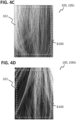
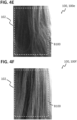
- the at least one hair examination area B100 may comprise a plurality of hair examination areas B100, see e.g. in FIG. 4A the hair examination areas B100_1, B100_2 or FIG. 4B the hair examination regions B100_3, B100_4.
- each of the plurality of hair examination regions B100_1, B100_2 or B100_3, B100_4 can be examined separately, ie, for each of the plurality of hair examination regions B100_1, B100_2 or B100_3, B100_4, the value for a proportion of linear regions and/or for a distribution of linear regions can be determined separately.
- determining the at least one hair examination region B100 can include determining the hair representation region and defining the at least one hair examination region B100.
- defining the at least one hair examination region B100 can mean that, as described above, the entire hair representation region is defined as the hair examination region B100, and/or one or more hair examination regions B100 can be defined, for example, automatically by means of the data processing device, e.g., taking into account predetermined conditions.
- a size and/or number of the hair examination regions B100 can be specified, e.g., by a user, and the hair examination regions B100 can then be defined automatically, e.g., by means of suitable software, for example, in such a way that the hair representation region is covered as evenly as possible between the hair examination regions B100, or the like.
- hair profiles of the hairs 102 depicted therein are determined for the at least one hair examination area B100, wherein the hair profiles of all hairs depicted in the hair examination area form a totality of the hair profiles
- edge detection can be performed in the hair examination region B100, in which pixels at a location determined by image coordinates x, y each have an assigned intensity value, to determine the hair patterns.
- Known methods for example using a first derivative of the position-dependent intensity values, can be used for edge detection, in which regions are identified in which, along a considered direction in the hair examination region, the respective assigned intensity value drops or rises sharply (e.g., more sharply than a predetermined limit value) for the pixels arranged along this direction.
- edges that run at an angle to the considered direction, e.g., perpendicular to it.
- the hair patterns of the hairs 102 in the hair examination region B100 can be determined in different directions.
- a weighted inner product of two functions f, g, each dependent on the image coordinates x, y, can be represented by: f g w ⁇ R 2 w x y f x y g x y dxdy where w(x,y) ⁇ 0 is a weighting function that describes the hair examination area B100.
- the center of the hair examination area can be at (x 0 , y 0 ).
- a maximized eigenvalue ⁇ max of J indicates a direction perpendicular to the principal direction.
- ⁇ H may not be relevant in itself in various embodiments because it depends, for example, on how the hairstyle (or the hair 102) is arranged with respect to the x and y coordinates, it should be mentioned that in a common counting method, 0° points to the east/right and an angle is counted counterclockwise.
- a coherence can be described as a measure of how strong a dominance of the main direction is (for example, the coherence can be 1 if a depicted majority individual structures (here: individual hairs) have a dominant main direction, and 0 in the case of an isotropic distribution of the majority of the individual structures (e.g., the individual hairs).
- 1A shown, and/or in which the courses of the individual hairs have large angular differences to one another can have a low coherence value, for example less than 0.5, e.g. less than 0.4, e.g. less than 0.3, e.g. less than 0.2, e.g. less than 0.1, e.g. close to 0.
- the determined coherence which can relate the entirety of the hair gradients to the main direction of the hair gradients, is used as the smoothness value of the hairstyle.
- the smoothness value coherence can form a quantitative measure of the smoothness of the hairstyle.
- the coherence of the one hair examination region B100 can thus correspond to the smoothness value for the entire hairstyle.
- the coherence of the at least one hair examination region B100 can correspond to a smoothness value for the hairstyle that is only representative of the at least one hair examination region B100.
- a plurality of hair examination areas B100 can be evaluated in order to assess a smoothness of the entire hairstyle based on a plurality of smoothness values determined thereby.
- a main direction also referred to as orientation or predominant alignment referred to
- the measure expressed as coherence, can be normalized such that a coherence of 0 results for an isotropic distribution and a coherence of 1 results for an alignment of all or substantially all pixels along the main direction.
- the structure tensor is determined, which is defined for each pixel of image 100.
- the coherence is derived from a totality of the structure tensors.
- coherence can be represented as a measure of linear components in the image.
- a Fourier component analysis can be performed to determine the main direction ⁇ H . This can be based on a Fourier spectral analysis. Structures with a main direction in a rectangular image, for example, can generate a periodic pattern in the Fourier transform of the image in a second direction offset by +90° from the main direction of the structures.
- the hair examination area B100 can be divided into, for example, rectangular hair examination area sections, for each of which a Fourier power spectrum can be calculated.
- the power spectra can be examined in polar coordinates, and the power can be measured for each angle (i.e., each direction) using spatial filters.
- the angles determined for each of the individual pixels can be represented as an angular frequency distribution.
- a distribution function e.g., a Gaussian curve
- the center of which can indicate the main direction ⁇ H .
- reliability ranges of the distribution function can be used as the hairstyle's smoothness value.
- a standard deviation of the Gaussian curve can form the smoothness value. This again involves circular data, meaning that an angular deviation can be a suitable measure of dispersion.
- software can be used for the calculations described above. Any software that provides the functionality described above can be used. In various embodiments, e.g., in a case where a smartphone or tablet is used to carry out the method for determining a smoothness value of a hairstyle, the software can be provided as an app.
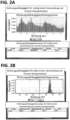
- FIG. 2A and FIG. 2B are results of applying the plug-in "Directionality" (see http://imagej.net/Directionality for a detailed description) according to various embodiments to the curly hair from FIG. 1A (in FIG. 2A ) and on the straight hair FIG. 1B (in FIG. 2B ) are shown graphically.
- Images 100a, 100b and the hair examination areas defined therein, each comprising the entire image, have a resolution of 700 x 700 pixels, and both images have comparable colors and contrasts.
- a frequency distribution of the individual image elements in the hair examination area B100 (here essentially the entire image area) is shown in the form of a bar chart, representing the number of image elements (e.g., as relative frequency) as a function of the angle (direction in degrees). Also shown is a fitted Gaussian curve (as a solid line).
- the frequency distribution of the image 100a with the curly hair 102 has a distribution that is distributed over all angles and that has only about three very broad frequency maxima.
- the determined values reflect that the hair 102 shown in the hair examination area B100 is not smooth.
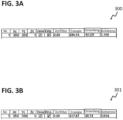
- Tables are shown with results of a method for determining a smoothness value of a hairstyle according to various embodiments, for the determination of which the method described above, which uses the structure tensor, was applied.
- FIG. 3A the results for curly hair FIG. 1A again, and FIG. 3B the results for straight hair FIG. 1B .
- Both dispersion and coherence may be suitable in various embodiments to enable differentiation of images with hairstyles of different smoothness and to quantify the linear components of the hairstyle that may be decisive for the smoothness of the hairstyle.
- a rapid quantitative analysis of the effectiveness of different smoothing methods can be enabled.
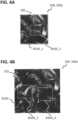
- FIG. 4A and FIG. 4B each show a graphic representation to illustrate a method for determining a smoothness value of a hairstyle according to various embodiments.
- a plurality of hair examination areas B100 of different sizes can be used.
- the method may comprise relating the determined smoothness values of the hairstyle to the sizes of the plurality of hair examination areas B100 (here, for example, B100_1, B100_2).
- the plurality of differently sized hair examination areas B100 may have the same center position, i.e., the hair examination areas B100 may be centered on the same center point.
- FIG. 4A Figure 100a shows two different sized hair examination areas B100_1 and B100_2.
- the two hair examination areas B100_1, B100_2 can be examined separately.
- While one hair examination area B100_1 may correspond to the hair examination area B100 shown above, which has the entire image 100a, the other hair examination area B100_2 may be smaller.
- the plurality of differently sized hair examination areas B100_1, B100_2 can be used to obtain an indication for distinguishing curly hair, which may have a main direction with small dispersion and/or large coherence for smaller hair examination areas B100, although it may have a large dispersion and/or small coherence for a large hair examination area B100, and disordered hair, which may, for example, have a substantially isotropic distribution with a small coherence and/or a large dispersion for each size of the hair examination area.
- a size of the linear (e.g. smooth) structures can be determined by means of a limit size of the hair examination region B100, below which a predetermined minimum value for coherence is exceeded and/or a predetermined maximum value for dispersion is undershot, for example as a number of image elements, and/or, for example if there is an assignment of a size of the image elements to a physical unit of size, as physical dimensions, e.g. centimeters.
- the hair examination area B100_1 As shown in FIG. 3A shown, hairs 102 have a low coherence and a high dispersion, a meaningful specification of a main direction ⁇ does not seem to be possible.
- the smaller hair examination area B100_2 may depict hairs with a principal direction ⁇ that may be approximately -70°. Furthermore, it is expected that the coherence may be relatively high and the dispersion relatively low. Consequently, the smaller hair examination area B100_2 may contain smooth hair structures with a size approximately corresponding to the size (e.g., an edge length) of the hair examination area.
- a plurality of differently positioned hair examination areas B100 can be used, for example hair examination areas B100_3, B100_4, which have different center positions.
- the method may comprise relating the determined smoothness values of the hairstyle to the center positions of the plurality of hair examination areas B100 (here, for example, B100_3, B100_4).
- the plurality of differently positioned hair examination areas B100 may have the same size.
- FIG. 4B Figure 100b shows two differently positioned hair examination areas B100_3 and B100_4.
- the two hair examination areas B100_3, B100_4 can be examined separately.
- the plurality of differently positioned hair examination regions B100_3, B100_4 can be used to obtain an indication of the distribution of straight and/or curly hair in a hairstyle.
- the hair 102 near the scalp can be straight, while the hair near the tips can be curly.
- the hair examination area B100_3 may have a main direction with large dispersion and/or low coherence, whereas the hair examination area B100_4 may have a small dispersion and/or a small coherence.
- hair examination regions B100 distributed in the hair display region for example in a case in which the hair display region has an entire hairstyle, smooth regions in the hair display region can be identified.
- hair examination areas B100 can be averaged. This can be done using appropriate circular statistical methods.
- the method for determining a smoothness value of a hairstyle can be determined before applying a smoothing method, e.g., using a conditioner, a hair treatment, a perm, a relaxer, a straightener, and/or a flat iron. This can be used, for example, to determine whether or at which areas a hair treatment might be necessary.
- a smoothing method e.g., using a conditioner, a hair treatment, a perm, a relaxer, a straightener, and/or a flat iron. This can be used, for example, to determine whether or at which areas a hair treatment might be necessary.
- the smoothness value can be determined after applying the smoothing method. This can be used, for example, to determine the effectiveness of the smoothing method. For this purpose, in various embodiments, a ratio of the smoothness value after smoothing to the smoothness value before smoothing can be determined.
- the method for determining a smoothness value of a hairstyle can be used to determine an effectiveness of the smoothing method.
- a smartphone, a tablet, a laptop, or the like may be suitable for executing the method for determining the smoothness value of a hairstyle.
- the software does not need to be installed on the smartphone, tablet, laptop, etc. It may be sufficient, for example, if the smartphone or the like is connected to the Internet. connected to a computer. In such a case, the calculations can be performed using the computer, for example, and the result can be provided to the smartphone/tablet or similar device.
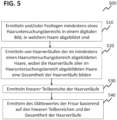
- FIG. 5 shows a flowchart 500 of a method for determining a smoothness value of a hairstyle according to various embodiments.
- the method comprises determining and/or defining at least one hair examination region in a digital image in which hair is depicted (in 510), determining hair gradients of the hair depicted in the at least one hair examination region, wherein the hair gradients of all hairs depicted in the hair examination region form a totality of the hair gradients (in 520), determining a main direction of the hair gradients (in 530) and determining the smoothness value of the hairstyle based on the main direction of the hair gradients and the totality of the hair gradients (in 540).
- Figures 4C to 4H show images 100c, 100d, 100e, 100f, 100g and 100h of differently smooth hair for use in a method for determining a smoothness value of a hairstyle according to various embodiments.
- a coherence i.e. a coherence value, was determined for each of the images 100c to 100h, for example as described above.
- the individual images can be standardized using image processing software.
- the images 100 can be processed such that the respective image sections 100B used for analysis are the same size, e.g., such that their pixel counts match and/or the actual dimensions of the hair depicted in the images are the same or similar.
- color images can be converted to grayscale images, for example, and/or an intensity of the images 100 can be scaled such that the images 100 cover a similar or identical intensity value range, etc.
- one or more of the images 100 can be enhanced using image processing software. For example, sharpness and/or contrast can be increased, which can facilitate the detection of edge gradients.
- Photoshop Lightroom 6 or any other suitable image processing software can be used for standardizing and/or enhancing the images.
- Image 4 > Image 6 > Image 5 > Image 2 > Image 1 > Image 3.
- images 100c, 100d, 100e, 100f, 100g, and 100h were visually inspected by 20 different jurors and sorted in descending order of smoothness.
- the coherence values were converted into ranks and compared with the visually determined rankings of the jurors using a Spearman rank correlation.
- a Spearman rank correlation coefficient of rs 0.8 was determined, which is considered a good value given the difficult-to-perceive differences (significant fluctuations were also evident within the juror panel).
- FIG. 6 shows a graphical representation of a device 600 for determining a smoothness value of a hairstyle according to various embodiments.
- the device 600 for determining a smoothness value of a hairstyle may comprise a data processing device 660.
- the data processing device 660 may, for example, comprise a computer, a tablet, a smartphone, a laptop, or any other data processing device suitable for executing the method for computer-assisted hair color consultation according to various embodiments.
- the data processing device 660 is also referred to herein as computer 660.
- the data processing device 660 may comprise a processor 662, for example, a microprocessor.
- the device 600 for determining a smoothness value of a hairstyle may comprise a display device 664.
- the display device 664 can, for example, comprise a screen of a smartphone, a PC, a laptop, or another device 600 for determining a smoothness value of a hairstyle.
- the display device 664 can, for example, be used to display results of the method for determining a smoothness value of a hairstyle, to request input parameters for executing the method, or the like.
- the display device 664 can be connected to the data processing device 660 via a first data connection 670.
- the display device 664 can exchange data with the data processing device 660 via the first data connection 670.
- the display device 664 and the first data connection 670 can be integrated into the device 600.
- the device 600 for determining a smoothness value of a hairstyle may include a camera 666.
- the camera 666 may be configured, according to various embodiments, to capture a digital image 100 of hair 102, e.g., of a user's hair.
- the at least one camera 666 may comprise a digital still camera or a video camera, i.e., a camera 104, which may be configured to record a plurality of individual images as a time sequence.
- the device 600 for determining a smoothness value of a hairstyle can have a second data connection 674 between the computer 660 and the camera 666.
- data can be transmitted from the computer 660 to the camera 666, for example for a, e.g., conventional, software control of the camera 666.
- data for example the digital image(s) captured by the camera 666, can be transmitted to the computer 660.
- the camera 666 and the second data connection 674 may be integrated into the device 600.
- a camera 666 can be dispensed with in the device 600 for determining a smoothness value of a hairstyle, for example if the digital image 100 is provided to the data processing device 660 in another way, for example by means of a data transmission.
- the data processing device 660 can be configured, for example using the processor 662, to process the image received from the camera 666 or in another way using image processing software, for example to determine the hair representation area in the received image in a known manner and, as described above for various embodiments, to determine the smoothness value of a hairstyle.
- the image processing software can comprise an app.
- the data processing device 600 may include an input device 668 for providing information to the data processing device 600, for example, a keyboard, a mouse, a touch-sensitive surface of the display device 664, or the like.
- an input device 668 for providing information to the data processing device 600, for example, a keyboard, a mouse, a touch-sensitive surface of the display device 664, or the like.
- the input device 668 can be connected to the data processing device 660 via a third data connection 672.
- the input device 668 can exchange data with the data processing device 660 via the third data connection 672.
- the device 600 comprises a smartphone, a tablet, or the like
- the input device 668 and the third data connection 672 can be integrated into the device 600.
- the degree of curl in hair influences the success of a hair treatment.
- the degree of curl in hair particularly influences the treatment with hair care products. Accordingly, determining the smoothness value of a hairstyle can be followed by issuing individual treatment instructions based on the determined smoothness value.
- the individual treatment instructions include a recommendation for hair treatment products, in particular hair care products.
- the recommendation may include the display or announcement of a specific product name of a hair treatment product.
- the recommendation may include the display or announcement of a manufacturer's product line or series.
- the individual treatment instruction consists of advising the individual, for whose hairstyle the smoothness value was determined, on the use of hair treatment products that the individual identifies using QR codes, NFC chips, barcodes or RFID chips.
- the individual treatment instruction may also consist of determining the chemical composition of a hair treatment product, in particular a hair care product.
- the individual treatment instruction may consist of advising the individual to use hair treatment products, in particular hair care products, which are individually manufactured for the individual and initiating an ordering process, preferably by accessing a website of a manufacturer of individual hair care products.
Landscapes
- Engineering & Computer Science (AREA)
- Physics & Mathematics (AREA)
- Theoretical Computer Science (AREA)
- General Physics & Mathematics (AREA)
- Computer Vision & Pattern Recognition (AREA)
- Business, Economics & Management (AREA)
- Probability & Statistics with Applications (AREA)
- Geometry (AREA)
- Entrepreneurship & Innovation (AREA)
- Educational Administration (AREA)
- Educational Technology (AREA)
- Measurement Of The Respiration, Hearing Ability, Form, And Blood Characteristics Of Living Organisms (AREA)
- Image Processing (AREA)
- Image Analysis (AREA)
Applications Claiming Priority (2)
| Application Number | Priority Date | Filing Date | Title |
|---|---|---|---|
| DE102016222194.9A DE102016222194A1 (de) | 2016-11-11 | 2016-11-11 | Verfahren und Vorrichtung zum Ermitteln eines Glättewerts einer Frisur |
| PCT/EP2017/066578 WO2018086772A1 (de) | 2016-11-11 | 2017-07-04 | Verfahren und vorrichtung zum ermitteln eines glättewerts einer frisur |
Publications (2)
| Publication Number | Publication Date |
|---|---|
| EP3539083A1 EP3539083A1 (de) | 2019-09-18 |
| EP3539083B1 true EP3539083B1 (de) | 2025-06-18 |
Family
ID=59285202
Family Applications (1)
| Application Number | Title | Priority Date | Filing Date |
|---|---|---|---|
| EP17735496.6A Active EP3539083B1 (de) | 2016-11-11 | 2017-07-04 | Verfahren und vorrichtung zum ermitteln eines glättewerts einer frisur |
Country Status (6)
| Country | Link |
|---|---|
| US (1) | US10885654B2 (enExample) |
| EP (1) | EP3539083B1 (enExample) |
| JP (1) | JP7042266B2 (enExample) |
| CN (1) | CN109923584B (enExample) |
| DE (1) | DE102016222194A1 (enExample) |
| WO (1) | WO2018086772A1 (enExample) |
Families Citing this family (4)
| Publication number | Priority date | Publication date | Assignee | Title |
|---|---|---|---|---|
| WO2021100120A1 (ja) * | 2019-11-19 | 2021-05-27 | 株式会社資生堂 | 毛髪計測方法、及び毛髪計測システム |
| CN116310314A (zh) * | 2023-01-11 | 2023-06-23 | 磅客策(上海)智能医疗科技有限公司 | 一种面向毛发图像的数据处理方法及系统 |
| CN116543046A (zh) * | 2023-04-23 | 2023-08-04 | 上海术之道机器人有限公司 | 毛发定位方法、装置、设备及存储介质 |
| CN119888094B (zh) * | 2025-03-26 | 2025-06-27 | 深圳玖柒创欣科技有限公司 | 一种基于图像识别的发型模拟方法 |
Family Cites Families (15)
| Publication number | Priority date | Publication date | Assignee | Title |
|---|---|---|---|---|
| FR2867678A1 (fr) * | 2004-03-16 | 2005-09-23 | Oreal | Produit comportant une composition capillaire et une information renseignant sur un parametre mesurable lie a la forme du cheveu |
| JP4180027B2 (ja) * | 2004-08-27 | 2008-11-12 | 株式会社豊田中央研究所 | 顔部品位置検出装置及び方法並びにプログラム |
| EP1931427A4 (en) * | 2005-09-12 | 2008-12-03 | Avlon Ind Inc | LOOP REDUCTION AND KERATIN PROTECTION COMPOSITIONS, METHOD AND KIT FOR SUCH COMPOSITIONS |
| US7477782B2 (en) * | 2006-08-25 | 2009-01-13 | Restoration Robotics, Inc. | System and method for classifying follicular units |
| JP5141883B2 (ja) | 2007-01-30 | 2013-02-13 | 花王株式会社 | 毛髪の評価方法及びシステム |
| WO2008099938A1 (ja) * | 2007-02-16 | 2008-08-21 | Kao Corporation | 毛髪画像表示方法及び表示装置 |
| US20090280088A1 (en) * | 2008-05-09 | 2009-11-12 | Kao Corporation | Method of controlling hair shape |
| US8270682B2 (en) * | 2008-11-25 | 2012-09-18 | Eastman Kodak Company | Hair segmentation |
| WO2012105985A1 (en) * | 2011-02-04 | 2012-08-09 | Syed Ali N | Enhanced hair straightening system |
| KR20140031613A (ko) * | 2012-09-05 | 2014-03-13 | 삼성전자주식회사 | 영상 처리 장치 및 방법 |
| US9326685B2 (en) * | 2012-09-14 | 2016-05-03 | Conopco, Inc. | Device for evaluating condition of skin or hair |
| US20140279192A1 (en) * | 2013-03-14 | 2014-09-18 | JoAnna Selby | Method and system for personalization of a product or service |
| DE102014220077A1 (de) * | 2014-10-02 | 2016-04-07 | Henkel Ag & Co. Kgaa | Verfahren und Datenverarbeitungsvorrichtung zur computergestützten Haarfarbberatung |
| WO2017072008A1 (en) * | 2015-10-30 | 2017-05-04 | Unilever Plc | Hair curl measurement |
| DE102016225678A1 (de) * | 2016-12-20 | 2018-06-21 | Henkel Ag & Co. Kgaa | Verfahren und Vorrichtung zum Ermitteln eines Welligkeitswerts von Haaren und Verfahren zum Ermitteln eines Haarpflegeprodukts |
-
2016
- 2016-11-11 DE DE102016222194.9A patent/DE102016222194A1/de not_active Ceased
-
2017
- 2017-07-04 US US16/347,771 patent/US10885654B2/en active Active
- 2017-07-04 EP EP17735496.6A patent/EP3539083B1/de active Active
- 2017-07-04 CN CN201780069630.6A patent/CN109923584B/zh active Active
- 2017-07-04 WO PCT/EP2017/066578 patent/WO2018086772A1/de not_active Ceased
- 2017-07-04 JP JP2019524434A patent/JP7042266B2/ja active Active
Non-Patent Citations (2)
| Title |
|---|
| SUN CHAO ET AL: "2D hair strands generation based on template matching", 2014 4TH INTERNATIONAL CONFERENCE ON SIMULATION AND MODELING METHODOLOGIES, TECHNOLOGIES AND APPLICATIONS (SIMULTECH), SCITEPRESS, 28 August 2014 (2014-08-28), pages 261 - 266, XP032768757, DOI: 10.5220/0005107102610266 * |
| ZHANGHUI KUANG ET AL: "Local multiple orientations estimation using k-medoids", 2010 17TH IEEE INTERNATIONAL CONFERENCE ON IMAGE PROCESSING (ICIP 2010); 26-29 SEPT. 2010; HONG KONG, CHINA, IEEE, PISCATAWAY, NJ, USA, 26 September 2010 (2010-09-26), pages 109 - 112, XP031813364, ISBN: 978-1-4244-7992-4 * |
Also Published As
| Publication number | Publication date |
|---|---|
| JP7042266B2 (ja) | 2022-03-25 |
| US20190279389A1 (en) | 2019-09-12 |
| CN109923584B (zh) | 2023-10-31 |
| WO2018086772A1 (de) | 2018-05-17 |
| JP2020500370A (ja) | 2020-01-09 |
| DE102016222194A1 (de) | 2018-05-17 |
| EP3539083A1 (de) | 2019-09-18 |
| US10885654B2 (en) | 2021-01-05 |
| CN109923584A (zh) | 2019-06-21 |
Similar Documents
| Publication | Publication Date | Title |
|---|---|---|
| EP3539083B1 (de) | Verfahren und vorrichtung zum ermitteln eines glättewerts einer frisur | |
| DE60118606T2 (de) | Auswahlverfahren für wimperntusche, auswahlsystem für wimperntusche und gerät für die wimperntuscheberatung | |
| EP3098581B1 (de) | Verfahren zur korrektur von untergrundsignalen in einem spektrum | |
| DE69802276T2 (de) | Verfahren und -vorrichtung zur erzeugung dreidimensionaler bilder | |
| DE69322095T2 (de) | Verfahren und gerät zur identifizierung eines objekts mittels eine geordneten folge von grenz-pixel-parametern | |
| DE102010016630A1 (de) | Verfahren und Gerät zur Charakterisierung von Hautunregelmäßigkeiten und Verfahren zur Bewertung der Anti-Aging-Wirkung eines Kosmetikprodukts | |
| EP3649459B1 (de) | System zum verwalten von haarzustandsinformation und verfahren zum optimieren eines kosmetischen beratungssystems | |
| EP2811898A1 (de) | Verfahren zur bestimmung des physischen und/oder psychischen zustands eines probanden | |
| DE2903625C2 (enExample) | ||
| EP3707496B1 (de) | Identifizierung eines oder mehrerer spektraler merkmale in einem spektrum einer probe für eine inhaltsstoffanalyse | |
| WO2018114434A1 (de) | Ermittlung eines welligkeitswerts von haaren | |
| EP1203342A2 (de) | Verfahren und vorrichtung zur segmentierung einer punkteverteilung | |
| EP3558094A1 (de) | Verfahren und anordnung zum ermitteln eines schädigungsgrads von haar | |
| DE102017110339A1 (de) | Computerimplementiertes Verfahren zur Vermessung eines Objekts aus einer digitalen Darstellung des Objekts | |
| DE102008003037B3 (de) | Verfahren, Vorrichtung, computerlesbares Speichermedium und Computerprogramm-Element zum Ermitteln von physikalischen Eigenschaften atmosphärischer Partikel | |
| DE102006002914A1 (de) | Mehrdimensionale Segmentierung basierend auf adaptiven begrenzenden Kasten- und Ellipsoid-Modellen | |
| DE10339227B4 (de) | Verfahren und Vorrichtung zur Charakterisierung von Oberflächen | |
| EP2096578A2 (de) | Verfahren und Vorrichtung zur Charakterisierung der Formation von Papier | |
| EP3155588B1 (de) | Ganzkörperbildaufnahme- und bildverarbeitungssystem sowie verfahren zu dessen betrieb | |
| EP3298393B1 (de) | Verfahren und vorrichtung zur charakterisierung des gefüges eines bands oder blechs aus metall | |
| Takeda et al. | Scale‐robust fibre orientation analysis of hair using two‐dimensional Fourier transform | |
| DE102024134434A1 (de) | Informationsverarbeitungssystem, informationsverarbeitungsverfahren, programm und informationsverarbeitungsvorrichtung | |
| DE102010055980B4 (de) | Verfahren zur Überwachung der Verlässlichkeit einer ortsaufgelösten Messung und korrespondierendes ortsauflösendes Messgerät | |
| WO2009015934A1 (de) | Verfahren und vorrichtung zur erkennung von strukturen in einer faserstoffbahn oder in einem faserstoffsuspensionsstrahl | |
| WO2024218250A1 (de) | Vorrichtung und verfahren zum charakterisieren einer partikelprobe |
Legal Events
| Date | Code | Title | Description |
|---|---|---|---|
| STAA | Information on the status of an ep patent application or granted ep patent |
Free format text: STATUS: UNKNOWN |
|
| STAA | Information on the status of an ep patent application or granted ep patent |
Free format text: STATUS: THE INTERNATIONAL PUBLICATION HAS BEEN MADE |
|
| PUAI | Public reference made under article 153(3) epc to a published international application that has entered the european phase |
Free format text: ORIGINAL CODE: 0009012 |
|
| STAA | Information on the status of an ep patent application or granted ep patent |
Free format text: STATUS: REQUEST FOR EXAMINATION WAS MADE |
|
| 17P | Request for examination filed |
Effective date: 20190603 |
|
| AK | Designated contracting states |
Kind code of ref document: A1 Designated state(s): AL AT BE BG CH CY CZ DE DK EE ES FI FR GB GR HR HU IE IS IT LI LT LU LV MC MK MT NL NO PL PT RO RS SE SI SK SM TR |
|
| AX | Request for extension of the european patent |
Extension state: BA ME |
|
| DAV | Request for validation of the european patent (deleted) | ||
| DAX | Request for extension of the european patent (deleted) | ||
| STAA | Information on the status of an ep patent application or granted ep patent |
Free format text: STATUS: EXAMINATION IS IN PROGRESS |
|
| 17Q | First examination report despatched |
Effective date: 20200423 |
|
| P01 | Opt-out of the competence of the unified patent court (upc) registered |
Effective date: 20230531 |
|
| GRAP | Despatch of communication of intention to grant a patent |
Free format text: ORIGINAL CODE: EPIDOSNIGR1 |
|
| STAA | Information on the status of an ep patent application or granted ep patent |
Free format text: STATUS: GRANT OF PATENT IS INTENDED |
|
| INTG | Intention to grant announced |
Effective date: 20250218 |
|
| GRAS | Grant fee paid |
Free format text: ORIGINAL CODE: EPIDOSNIGR3 |
|
| GRAA | (expected) grant |
Free format text: ORIGINAL CODE: 0009210 |
|
| STAA | Information on the status of an ep patent application or granted ep patent |
Free format text: STATUS: THE PATENT HAS BEEN GRANTED |
|
| AK | Designated contracting states |
Kind code of ref document: B1 Designated state(s): AL AT BE BG CH CY CZ DE DK EE ES FI FR GB GR HR HU IE IS IT LI LT LU LV MC MK MT NL NO PL PT RO RS SE SI SK SM TR |
|
| REG | Reference to a national code |
Ref country code: GB Ref legal event code: FG4D Free format text: NOT ENGLISH |
|
| REG | Reference to a national code |
Ref country code: CH Ref legal event code: EP |
|
| REG | Reference to a national code |
Ref country code: DE Ref legal event code: R096 Ref document number: 502017016905 Country of ref document: DE |
|
| REG | Reference to a national code |
Ref country code: CH Ref legal event code: EP |
|
| REG | Reference to a national code |
Ref country code: IE Ref legal event code: FG4D Free format text: LANGUAGE OF EP DOCUMENT: GERMAN |
|
| PG25 | Lapsed in a contracting state [announced via postgrant information from national office to epo] |
Ref country code: FI Free format text: LAPSE BECAUSE OF FAILURE TO SUBMIT A TRANSLATION OF THE DESCRIPTION OR TO PAY THE FEE WITHIN THE PRESCRIBED TIME-LIMIT Effective date: 20250618 |
|
| PGFP | Annual fee paid to national office [announced via postgrant information from national office to epo] |
Ref country code: DE Payment date: 20250722 Year of fee payment: 9 |
|
| REG | Reference to a national code |
Ref country code: LT Ref legal event code: MG9D |
|
| PG25 | Lapsed in a contracting state [announced via postgrant information from national office to epo] |
Ref country code: GR Free format text: LAPSE BECAUSE OF FAILURE TO SUBMIT A TRANSLATION OF THE DESCRIPTION OR TO PAY THE FEE WITHIN THE PRESCRIBED TIME-LIMIT Effective date: 20250919 Ref country code: NO Free format text: LAPSE BECAUSE OF FAILURE TO SUBMIT A TRANSLATION OF THE DESCRIPTION OR TO PAY THE FEE WITHIN THE PRESCRIBED TIME-LIMIT Effective date: 20250918 |
|
| PG25 | Lapsed in a contracting state [announced via postgrant information from national office to epo] |
Ref country code: BG Free format text: LAPSE BECAUSE OF FAILURE TO SUBMIT A TRANSLATION OF THE DESCRIPTION OR TO PAY THE FEE WITHIN THE PRESCRIBED TIME-LIMIT Effective date: 20250618 |
|
| PGFP | Annual fee paid to national office [announced via postgrant information from national office to epo] |
Ref country code: GB Payment date: 20250722 Year of fee payment: 9 |
|
| PG25 | Lapsed in a contracting state [announced via postgrant information from national office to epo] |
Ref country code: HR Free format text: LAPSE BECAUSE OF FAILURE TO SUBMIT A TRANSLATION OF THE DESCRIPTION OR TO PAY THE FEE WITHIN THE PRESCRIBED TIME-LIMIT Effective date: 20250618 |
|
| PGFP | Annual fee paid to national office [announced via postgrant information from national office to epo] |
Ref country code: FR Payment date: 20250812 Year of fee payment: 9 |
|
| PG25 | Lapsed in a contracting state [announced via postgrant information from national office to epo] |
Ref country code: RS Free format text: LAPSE BECAUSE OF FAILURE TO SUBMIT A TRANSLATION OF THE DESCRIPTION OR TO PAY THE FEE WITHIN THE PRESCRIBED TIME-LIMIT Effective date: 20250918 |
|
| REG | Reference to a national code |
Ref country code: NL Ref legal event code: MP Effective date: 20250618 |
|
| PG25 | Lapsed in a contracting state [announced via postgrant information from national office to epo] |
Ref country code: LV Free format text: LAPSE BECAUSE OF FAILURE TO SUBMIT A TRANSLATION OF THE DESCRIPTION OR TO PAY THE FEE WITHIN THE PRESCRIBED TIME-LIMIT Effective date: 20250618 |
|
| PG25 | Lapsed in a contracting state [announced via postgrant information from national office to epo] |
Ref country code: NL Free format text: LAPSE BECAUSE OF FAILURE TO SUBMIT A TRANSLATION OF THE DESCRIPTION OR TO PAY THE FEE WITHIN THE PRESCRIBED TIME-LIMIT Effective date: 20250618 |
|
| PG25 | Lapsed in a contracting state [announced via postgrant information from national office to epo] |
Ref country code: PT Free format text: LAPSE BECAUSE OF FAILURE TO SUBMIT A TRANSLATION OF THE DESCRIPTION OR TO PAY THE FEE WITHIN THE PRESCRIBED TIME-LIMIT Effective date: 20251020 |
|
| PG25 | Lapsed in a contracting state [announced via postgrant information from national office to epo] |
Ref country code: IS Free format text: LAPSE BECAUSE OF FAILURE TO SUBMIT A TRANSLATION OF THE DESCRIPTION OR TO PAY THE FEE WITHIN THE PRESCRIBED TIME-LIMIT Effective date: 20251018 |
|
| PG25 | Lapsed in a contracting state [announced via postgrant information from national office to epo] |
Ref country code: SM Free format text: LAPSE BECAUSE OF FAILURE TO SUBMIT A TRANSLATION OF THE DESCRIPTION OR TO PAY THE FEE WITHIN THE PRESCRIBED TIME-LIMIT Effective date: 20250618 |