EP3538345B2 - Kunststoffumreifungsband und verfahren zur herstellung eines kunststoffumreifungsbandes - Google Patents
Kunststoffumreifungsband und verfahren zur herstellung eines kunststoffumreifungsbandes Download PDFInfo
- Publication number
- EP3538345B2 EP3538345B2 EP17840424.0A EP17840424A EP3538345B2 EP 3538345 B2 EP3538345 B2 EP 3538345B2 EP 17840424 A EP17840424 A EP 17840424A EP 3538345 B2 EP3538345 B2 EP 3538345B2
- Authority
- EP
- European Patent Office
- Prior art keywords
- embossing
- plastic
- strand
- strapping
- roller
- Prior art date
- Legal status (The legal status is an assumption and is not a legal conclusion. Google has not performed a legal analysis and makes no representation as to the accuracy of the status listed.)
- Active
Links
Images
Classifications
-
- B—PERFORMING OPERATIONS; TRANSPORTING
- B29—WORKING OF PLASTICS; WORKING OF SUBSTANCES IN A PLASTIC STATE IN GENERAL
- B29C—SHAPING OR JOINING OF PLASTICS; SHAPING OF MATERIAL IN A PLASTIC STATE, NOT OTHERWISE PROVIDED FOR; AFTER-TREATMENT OF THE SHAPED PRODUCTS, e.g. REPAIRING
- B29C59/00—Surface shaping of articles, e.g. embossing; Apparatus therefor
- B29C59/02—Surface shaping of articles, e.g. embossing; Apparatus therefor by mechanical means, e.g. pressing
- B29C59/04—Surface shaping of articles, e.g. embossing; Apparatus therefor by mechanical means, e.g. pressing using rollers or endless belts
- B29C59/046—Surface shaping of articles, e.g. embossing; Apparatus therefor by mechanical means, e.g. pressing using rollers or endless belts for layered or coated substantially flat surfaces
-
- B—PERFORMING OPERATIONS; TRANSPORTING
- B29—WORKING OF PLASTICS; WORKING OF SUBSTANCES IN A PLASTIC STATE IN GENERAL
- B29C—SHAPING OR JOINING OF PLASTICS; SHAPING OF MATERIAL IN A PLASTIC STATE, NOT OTHERWISE PROVIDED FOR; AFTER-TREATMENT OF THE SHAPED PRODUCTS, e.g. REPAIRING
- B29C59/00—Surface shaping of articles, e.g. embossing; Apparatus therefor
- B29C59/02—Surface shaping of articles, e.g. embossing; Apparatus therefor by mechanical means, e.g. pressing
- B29C59/022—Surface shaping of articles, e.g. embossing; Apparatus therefor by mechanical means, e.g. pressing characterised by the disposition or the configuration, e.g. dimensions, of the embossments or the shaping tools therefor
-
- B—PERFORMING OPERATIONS; TRANSPORTING
- B65—CONVEYING; PACKING; STORING; HANDLING THIN OR FILAMENTARY MATERIAL
- B65D—CONTAINERS FOR STORAGE OR TRANSPORT OF ARTICLES OR MATERIALS, e.g. BAGS, BARRELS, BOTTLES, BOXES, CANS, CARTONS, CRATES, DRUMS, JARS, TANKS, HOPPERS, FORWARDING CONTAINERS; ACCESSORIES, CLOSURES, OR FITTINGS THEREFOR; PACKAGING ELEMENTS; PACKAGES
- B65D63/00—Flexible elongated elements, e.g. straps, for bundling or supporting articles
- B65D63/10—Non-metallic straps, tapes, or bands; Filamentary elements, e.g. strings, threads or wires; Joints between ends thereof
-
- B—PERFORMING OPERATIONS; TRANSPORTING
- B29—WORKING OF PLASTICS; WORKING OF SUBSTANCES IN A PLASTIC STATE IN GENERAL
- B29K—INDEXING SCHEME ASSOCIATED WITH SUBCLASSES B29B, B29C OR B29D, RELATING TO MOULDING MATERIALS OR TO MATERIALS FOR MOULDS, REINFORCEMENTS, FILLERS OR PREFORMED PARTS, e.g. INSERTS
- B29K2023/00—Use of polyalkenes or derivatives thereof as moulding material
- B29K2023/10—Polymers of propylene
- B29K2023/12—PP, i.e. polypropylene
-
- B—PERFORMING OPERATIONS; TRANSPORTING
- B29—WORKING OF PLASTICS; WORKING OF SUBSTANCES IN A PLASTIC STATE IN GENERAL
- B29K—INDEXING SCHEME ASSOCIATED WITH SUBCLASSES B29B, B29C OR B29D, RELATING TO MOULDING MATERIALS OR TO MATERIALS FOR MOULDS, REINFORCEMENTS, FILLERS OR PREFORMED PARTS, e.g. INSERTS
- B29K2067/00—Use of polyesters or derivatives thereof, as moulding material
- B29K2067/003—PET, i.e. poylethylene terephthalate
-
- B—PERFORMING OPERATIONS; TRANSPORTING
- B29—WORKING OF PLASTICS; WORKING OF SUBSTANCES IN A PLASTIC STATE IN GENERAL
- B29L—INDEXING SCHEME ASSOCIATED WITH SUBCLASS B29C, RELATING TO PARTICULAR ARTICLES
- B29L2031/00—Other particular articles
- B29L2031/727—Fastening elements
- B29L2031/7276—Straps or the like
Definitions
- the plastic strapping bands Due to this preferred orientation of the macromolecule chains of the plastic material, the plastic strapping bands have high tensile strengths or tear strengths, which are at least similar to the tensile strengths of metal bands. Especially with highly stretched plastic materials, the tensile strength can even exceed that of a metal strip. On the other hand, due to this preferred orientation of the macromolecules, stretched plastic strapping also has an increased tendency to separate or unravel along the longitudinal extent or along the main stretching direction, which must be taken into account both during production and during later use.
- a strapping process first requires wrapping around the goods to be strapped or bundled.
- the strapping bands are then tensioned and the two longitudinal ends of the strapping bands are connected to one another.
- the two longitudinal ends or band ends can advantageously be welded together.
- heated wedge closure the two longitudinal ends to be connected are heated or melted on the surface using a heating wedge, for example a metal tongue, and then pressed together to form the material connection.
- the most commonly used method is so-called friction welding.
- the two longitudinal ends are pressed together and moved alternately against each other. The frictional heat released causes the longitudinal ends to soften and are welded together by the pressure applied.
- plastic strapping can be provided with embossing.
- embossing can make the corresponding plastic strapping bands easier to handle and weld by machine.
- embossings can be mechanically introduced into a surface of a band or applied to a band surface.
- Embossing rollers i.e. rollers with a structured embossing surface
- surface processing during production always entails a certain risk of damage to a strapping band itself.
- monoaxially stretched strapping bands in particular show a high tendency to separation or fraying along the longitudinal extent, often also referred to as splicing.
- Embossing creates depressions in the plastic material, in particular through material displacement, so that a strip thickness in the area of these depressions is greatly reduced. This in turn can, for example, have a negative effect on the tensile strength or tear resistance of the strapping, which is so important for the formation of secure strapping.
- EP1657178A1 discloses a method according to the preamble of claim 1.
- the object of the present invention was to provide an improved method for producing plastic strapping, by means of which strapping operations can be carried out as efficiently as possible and stable and safe strapping of goods is possible.
- the process for producing plastic strapping includes providing a semi-crystalline, thermoplastic plastic material and melting the plastic material. Furthermore, the melted plastic material is extruded into at least one plastic strand using an extrusion device. The extruded plastic strand is then cooled, in particular cooled using a cooling device. The plastic strand is then stretched monoaxially or predominantly monoaxially to form a stretched strand by means of at least one stretching mechanism. This drawn strand has two surfaces spaced apart from one another by a thickness of the drawn strand.
- At least one surface of the stretched strand is provided with an embossing, in particular with a continuous embossing, by means of an embossing device having at least one embossing roller.
- the at least one embossing roller comprises extensions on its roller surface for producing depressions on the at least one surface of the stretched strand.
- an embossing roller is used as the at least one embossing roller, the extensions of which have flat or predominantly flat plateau surfaces for producing flat or predominantly flat base surfaces or base surfaces of the depressions on the at least one surface of the stretched strand.
- the plateau surfaces of the extensions are dimensioned in such a way, and the extensions are arranged at a distance from one another on the roller surface in such a way that between 44% and 55% of a total parallel projection, viewed in a vertical plan view, of the at least one embossed band surface of the final plastic strapping bands is represented by the sum of Base surfaces of the depressions are formed.
- the introduction of the depressions causes a distribution of material, so that web-like elevations or elevations are formed between the depressions or between the base surfaces.
- a band thickness of the plastic strapping band is thus reduced by the embossing or in the course of the embossing process in the area of the depressions and increased at least in sections in the area of the elevations.
- the plateau surfaces of the extensions can, for example, have dimensions or dimensions in the three-digit micrometer to single-digit millimeter range. In principle, any geometric shape of the plateau surfaces can be chosen. However, certain geometric configurations can bring additional advantages, as will be explained below.
- a respective geometric shape of a plateau surface is at least predominantly transferred to or into the surface of the stretched strand, so that the base surfaces of the depressions have at least essentially the same geometric shape as the plateau surfaces of the extensions.
- the method can be used to provide plastic strapping bands which have good mechanical properties, in particular high tensile strengths.
- the plastic strapping bands produced can be easily machined into strapping.
- the plastic strapping can be guided, tensioned and welded very well by machine or partially or fully automatically.
- the specified measures allow the plastic strapping to be manufactured without an increased risk of damage during or after production.
- plastic strapping bands can be produced with a relatively low weight per unit area or a relatively low weight per meter, which nevertheless have excellent properties, in particular high tensile strength.
- the reduced strip thickness in the area of the depressions appears to be able to be at least largely compensated for by the elevations formed between the depressions.
- rigidity can be increased even further by the measures specified or due to the increased band thickness in the area of the web-shaped elevations.
- thermoplastic material in the sense of this description is a meltable or weldable, polymeric organic solid, which can be produced synthetically or semi-synthetically from monomeric, organic molecules and/or biopolymers.
- a partially crystalline, thermoplastic material can be selected, for example, from the group of polyolefins, polyesters or polyamides, or mixtures of these polymers.
- a plastic material from the group of polyolefins or polyesters, or mixtures thereof, can be provided. Fillers or additives can also be added to the plastic material provided.
- an embossing roller is used as the at least one embossing roller, the plateau surfaces of the extensions of which are dimensioned in such a way, and the extensions of which are arranged at a distance from one another on the roller surface in such a way that between 45% and 52% of the total, in A parallel projection of at least one embossed band surface of the plastic strapping bands viewed in a vertical plan view is formed by the sum of the base surfaces of the recesses.
- an embossing roller with extensions is used as the at least one embossing roller, the plateau surfaces of which are delimited or limited by closed, oval curves.
- the actual friction welding process can be further improved because the friction energy introduced is distributed over a smaller area. This allows the plastic material to soften more efficiently or more quickly, so that both the energy required and the time required for welding can be reduced.
- an embossed structure optimized for mechanical guiding or clamping can be introduced.
- an embossed structure optimized with regard to a friction welding process can be introduced or applied to the other strip surface.
- the two different embossed structures or different base surfaces of the depressions can complement each other in a synergistic manner. Overall, this makes it possible to produce further improved plastic strapping bands with regard to a mechanical strapping process.
- the embossing has depressions distributed over the band surface, which depressions have flat or predominantly flat base surfaces. Between 44% and 55% of a parallel projection of the entire, at least one, embossed band surface of the plastic strapping band, viewed in a vertical plan view, is or are formed by the sum of the base surfaces of the recesses.
- a plastic strapping band can be provided which has further improved properties, especially with regard to mechanical tensioning and welding by friction welding. This is primarily because when forming a strapping, the force can be transmitted as evenly as possible from a tensioning or closing device to the plastic strapping. In the course of the welding process, the thermoplastic material can also be softened more quickly, which means that the time required to form a strapping can be shortened. In contrast to the boundary lines of the base surfaces that are straight in sections, depressions with base surfaces with oval boundary lines have a significantly lower tendency for the two longitudinal ends of a strapping band to get caught in a disadvantageous manner in the course of a welding process.
- the depth of the depressions is between 50 ⁇ m and 400 ⁇ m.
- the stretched plastic material is formed by a polyolefin, in particular by polypropylene
- the stretched plastic material is formed by a polyester, in particular by polyethylene terephthalate.
- a plastic strapping band can be provided which has very good mechanical properties, in particular high tensile strength.
- the band surfaces of the plastic strapping band each have depressions with differently shaped base surfaces compared to one another.
- an embossed structure that is optimized with regard to mechanical guiding or tensioning can be formed on a belt surface.
- the plastic strapping band can, for example, have an embossed structure that is optimized with regard to a friction welding process.
- the two different embossed structures or different base surfaces of the depressions can complement each other in a synergistic manner. Overall, this makes it possible to provide further improved plastic strapping bands with regard to a mechanical strapping process.
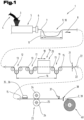
- a device 1 for producing or a method for producing plastic strapping 2 is illustrated schematically. At the beginning of the process, a partially crystalline, thermoplastic material 3 is provided.
- any semi-crystalline, thermoplastic material 3 can be provided, which Thermoplastic can be raw formed, stretched and surface treated.
- a plastic material 3 is provided from the group of polyolefins, polyesters, polyamides, or from mixtures or blends of these polymeric materials.
- a polyolefin or polyester is preferably provided as the plastic material 3, since these plastic materials are particularly suitable for producing strapping bands.
- Polyolefins and polyesters are very easy to extrude and can also be processed by stretching to produce plastic strapping bands 2 with high tensile strength.
- a plastic material 3 can be provided, which is at least predominantly formed by polypropylene or polyethylene terephthalate.
- the semi-crystalline, thermoplastic material can be fed or metered into an extrusion device 5 via a feeding or metering device 4. Fillers and additives, for example dyes, antioxidants and/or other auxiliary substances, can also be added to the plastic material 3.
- the extrusion device 5 for example in a screw extruder, the thermoplastic material 3 is then melted and extruded via an extrusion tool 6 arranged or attached to the extrusion device 5.
- the extrusion tool 6 has one or more nozzle(s), in particular nozzles with a slot-shaped cross section, through which slot nozzle(s) the molten plastic material is pressed or extruded into a band-shaped plastic strand 7 or into several band-shaped plastic strands 7 becomes. If several band- or strip-shaped plastic strands 7 are extruded, they can go through the subsequent process steps together.
- the extrusion tool 6 comprises a nozzle or slot nozzle with a large cross-sectional width, i.e. a wide slot die, so that a film-shaped plastic strand 7 with a large width extension is extruded.
- such a film-shaped plastic strand 7 can be separated into strip- or band-shaped strands or bands along the longitudinal orientation of the plastic strand 7 in order to produce strapping bands with suitable dimensions or width extensions.
- at least one extruded plastic strand 7 is produced by extrusion using the extrusion device 5, the raw shape or raw cross-sectional geometry of which can be at least essentially fixed via the nozzle or nozzles on the extrusion tool 6.
- the extruded plastic strand 7 can be cooled, as described in FIG Fig. 1 is shown. This allows the raw shape or cross-sectional geometry of the extruded plastic strand 7 to be preserved.
- passive cooling of the extruded plastic strand 7 can be carried out using ambient air. If necessary, an air stream can also be used for cooling.
- the extruded plastic strand 7 is guided through a cooling device 9 in the guide or transport direction 8 for efficient cooling, as shown in FIG Fig. 1 is shown.
- the cooling device 9 shown can be formed by a water bath 10, for example.
- the cooling device 9 can, for example, contain water at a certain temperature through which the extruded plastic strand 7 is passed.
- a temperature of the plastic strand 7 after cooling can be influenced or controlled by a certain length 11 of the cooling device 9, for example at a given temperature of a cooling liquid or the water of the cooling device 9.
- a pulling device 12 can be arranged after the cooling device 9. Like in the Fig. 1 is shown, such a pulling device 12 can comprise a plurality of roller elements 13 rotating at a certain angular speed, which form, for example, a godet trio.
- one or more roller element(s) are designed to be temperature-controlled, so that the plastic strand 7 can be heated or cooled for subsequent further processing, in particular the stretching process.
- a roller element 13 can be tempered, for example, using tempering liquids or electrically.
- other means for controlling the temperature of a plastic strand 7, such as sprinkler devices, immersion baths or infrared radiators for heating or cooling the plastic strand 7, can also be arranged.
- roller elements 13 of the pull-off device 17 rotate at a higher angular speed than those roller elements 13 of the previous pull-off device 12.
- a pull-off speed or transport speed of the further pull-off device 17 is selected to be greater than the pull-off speed for the plastic strand 7 of the previous pull-off device 12 , and the plastic strand 7 is stretched along a main stretching direction 18, or in other words drawn out.
- an additional transport or pulling device 19 can be provided at the end of the stretching unit 14 or the stretching section 16.
- an even higher pull-off speed for the plastic strand 7 can be provided during operation of the device 1 than the pull-off speed of the pull-off device 17 previously arranged in relation to the transport direction 8.
- the plastic strand 7 can be further elongated or stretched between the further pulling device 17 and the additional pulling device 19.
- the plastic strand 7 is stretched or stretched monoaxially or at least predominantly monoaxially along the main stretching direction 18 into a stretched strand 15 in the stretching unit 14 or along the stretching section 16.
- a stretching ratio for the plastic material 3 can be selected from a range between 2 and 20 for the stretched strand 15. This is based on the extruded plastic strand 7 before the stretching process. In the course of the stretching process, a thickness of the plastic strand 7 is also reduced by the stretching.
- a stretch ratio for the plastic material 3 is preferably selected from a range between 3 and 15, in particular between 4 and 12. As from the Fig. 1 As can be seen, the stretching can be carried out predominantly along the main stretching direction 18. However, minor stretching or stretching transverse to the main stretching direction 18 cannot be completely ruled out, which is why a stretched strand 15 can be stretched predominantly monoaxially.
- stretched strand 15 After stretching, there is a stretched strand 15 which, due to the preferred orientation of the macromolecules in the main stretching direction 18 now introduced into the plastic material, has an increased risk of so-called splicing, i.e. a separation or fraying along the main stretching direction 18.
- the drawn strand 15 has two surfaces 22 spaced apart from one another by a thickness 21 of the drawn strand 15.
- the at least one embossing roller 24 comprises extensions 26 on its roller surface 25 for producing depressions 28 on the at least one surface 22 of the stretched strand 15.
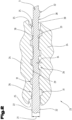
- an embossing roller 24 is used as the at least one embossing roller 24, the extensions 26 of which are flat or predominantly flat plateau surfaces 29 to produce flat or predominantly flat base surfaces 30 of the depressions 28 on the at least one surface 22 of the stretched strand 15, as shown in FIG Fig. 2 is visible.
- the extensions 26 can also be referred to as embossing stamps, for example.
- a stretched strand 15 is provided with an embossing.
- the stretched strand 15 is preferably passed between at least two opposite, counter-rotating embossing rollers 24, so that both surfaces 22 of the stretched strand 15 are each provided with an embossing by means of the two embossing rollers 24, as in the Fig. 1 and the Fig. 2 is shown.
- further improved plastic strapping bands 2 can be produced in terms of their processability into strapping.
- the two embossing rollers 24 are arranged in relation to the two surfaces 22 in such a way that the extensions act on a continuous, stretched strand 15 and create the depressions 28.
- This causes a material distribution of the plastic material 3, which at least partially penetrates into groove-like notches 31 arranged between the extensions 26 of the embossing roller(s) 24 during the embossing process.
- web-like elevations 32 are formed in a stretched strand 15 between the depressions 28 or between the base surfaces 30, as shown in FIG Fig. 2 is shown.
- a band thickness of the plastic strapping is thus reduced by the embossing or in the course of the embossing process in the area of the depressions 28 and increased at least in sections in the area of the elevations 32.
- the increases 32 can also be referred to as surveys.
- the geometric shape and boundary of the base surfaces 30 is at least predominantly determined by the shape of the plateau surfaces 29 of the extensions 26, whereby slight deviations can arise between the design shape and dimensions of the plateau surfaces 29 and the design shape and dimensions of the base surfaces 30 of the recesses 28. This is due to or depending on the nature of the plastic material 3, the temperature of the plastic material 3 during the embossing process, and other process parameters.
- an embossing roller 24 with extensions 26 is used as the at least one embossing roller 24, the plateau surfaces 29 of which are delimited by closed, oval curves.
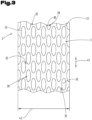
- a plastic strapping band 2 can be produced, the recesses 28 of which have base surfaces 30 with boundary lines 33, which boundary lines 33 in a vertical plan view of the base surfaces 30 are formed by closed, oval curves, as can be seen from the example of the ellipse-shaped base surfaces 30 in the Fig. 3 is illustrated.
- the embossing process is carried out at a temperature selected from a range between 40 and 190 ° C below the melting temperature of the plastic material 3.
- the embossing roller(s) 24 can, for example, have channels for the passage of a tempered, liquid medium. Electrical heating of at least one embossing roller 24 is also possible, for example.
- a sprinkling device 36 is shown, by means of which a stretched strand 15 can be acted upon with a tempered liquid.
- other means can also be used as the temperature control device 35, for example infrared radiators, immersion baths, ovens, and so on.
- the plastic strapping band 2 comprises a partially crystalline, thermoplastic plastic material 3, which plastic material 3 is stretched monoaxially or predominantly monoaxially in the direction of the longitudinal extension 41.
- the semi-crystalline, thermoplastic plastic material 3 can be selected, for example, from the group of polyolefins, polyesters, polyamides, or from mixtures or blends of these polymeric materials.
- a polyolefin or polyester is preferably chosen as the plastic material 3, since these plastic materials are particularly suitable for producing strapping tapes.
- the plastic material 3 may be formed by polypropylene or polyethylene terephthalate.
- a depth of the depressions 28 can be, for example, between 50 and 400 ⁇ m. In particular, it can be provided that a depth of the depressions 28 is between 100 ⁇ m and 200 ⁇ m.
Landscapes
- Engineering & Computer Science (AREA)
- Mechanical Engineering (AREA)
- Package Frames And Binding Bands (AREA)
- Shaping By String And By Release Of Stress In Plastics And The Like (AREA)
- Shaping Of Tube Ends By Bending Or Straightening (AREA)
Priority Applications (1)
| Application Number | Priority Date | Filing Date | Title |
|---|---|---|---|
| PL17840424T PL3538345T3 (pl) | 2016-11-11 | 2017-11-09 | Taśma opasująca z tworzywa sztucznego i sposób wytwarzania taśmy opasującej z tworzywa sztucznego |
Applications Claiming Priority (2)
| Application Number | Priority Date | Filing Date | Title |
|---|---|---|---|
| DE102016121651.8A DE102016121651A1 (de) | 2016-11-11 | 2016-11-11 | Kunststoffumreifungsband und Verfahren zur Herstellung eines Kunststoffumreifungsbandes |
| PCT/AT2017/060300 WO2018085874A1 (de) | 2016-11-11 | 2017-11-09 | Kunststoffumreifungsband und verfahren zur herstellung eines kunststoffumreifungsbandes |
Publications (3)
| Publication Number | Publication Date |
|---|---|
| EP3538345A1 EP3538345A1 (de) | 2019-09-18 |
| EP3538345B1 EP3538345B1 (de) | 2021-02-17 |
| EP3538345B2 true EP3538345B2 (de) | 2023-12-27 |
Family
ID=61187037
Family Applications (1)
| Application Number | Title | Priority Date | Filing Date |
|---|---|---|---|
| EP17840424.0A Active EP3538345B2 (de) | 2016-11-11 | 2017-11-09 | Kunststoffumreifungsband und verfahren zur herstellung eines kunststoffumreifungsbandes |
Country Status (9)
| Country | Link |
|---|---|
| US (1) | US20190255761A1 (es) |
| EP (1) | EP3538345B2 (es) |
| AU (1) | AU2017356334B2 (es) |
| CA (1) | CA3041634A1 (es) |
| DE (1) | DE102016121651A1 (es) |
| ES (1) | ES2872010T5 (es) |
| LT (1) | LT3538345T (es) |
| PL (1) | PL3538345T3 (es) |
| WO (1) | WO2018085874A1 (es) |
Families Citing this family (4)
| Publication number | Priority date | Publication date | Assignee | Title |
|---|---|---|---|---|
| US12330822B2 (en) | 2021-01-29 | 2025-06-17 | Eam-Mosca Corporation | System and apparatus for strapping packaging articles or packaging materials, and methods of use |
| WO2024025977A1 (en) * | 2022-07-29 | 2024-02-01 | Signode Industrial Group Llc | Embossed plastic strap and method of manufacture |
| US20250074675A1 (en) * | 2023-09-01 | 2025-03-06 | Eam-Mosca Corporation | Polyester Straps Useful in Binding Applications, Methods of Manufacture, Systems and Uses Thereof |
| CN119820874B (zh) * | 2024-12-11 | 2026-01-02 | 肇庆贝加莫机械有限公司 | 一种制作天然石纹路的石英板自动化生产系统及方法 |
Citations (2)
| Publication number | Priority date | Publication date | Assignee | Title |
|---|---|---|---|---|
| JPS5755759U (es) † | 1980-09-17 | 1982-04-01 | ||
| EP1657178A1 (en) † | 2003-08-08 | 2006-05-17 | Sekisui Jushi Kabushiki Kaisha | Thermoplastic synthetic resin band and method for producing the same |
Family Cites Families (9)
| Publication number | Priority date | Publication date | Assignee | Title |
|---|---|---|---|---|
| JPS51109063A (en) * | 1975-03-20 | 1976-09-27 | Tokumitsu Nakanose | Insatsuofushita netsukasoseigoseijushiseibandono seizohoho |
| EP0030648B1 (en) * | 1979-11-30 | 1984-03-07 | Sekisui Jushi Kabushiki Kaisha | Method for the production of polyethylene terephthalate packing material |
| US4859519A (en) | 1987-09-03 | 1989-08-22 | Cabe Jr Alex W | Method and apparatus for preparing textured apertured film |
| US5108814A (en) * | 1987-09-14 | 1992-04-28 | Tredegar Industries, Inc. | Embossed oriented film |
| US20030047271A1 (en) | 1998-05-15 | 2003-03-13 | Pai-Chuan Wu | Microembossed thin microporous films having improved impact strength and high moisture vapor transmission rates (MVTRs) |
| WO2004039551A2 (en) * | 2002-08-02 | 2004-05-13 | Avery Dennison Corporation | Process and apparatus for microreplication |
| JP2005015946A (ja) * | 2003-06-25 | 2005-01-20 | Nippon Petrochemicals Co Ltd | 不織布リボン |
| AT514852A2 (de) * | 2013-09-30 | 2015-04-15 | Teufelberger Gmbh | Verstärkungselement, sowie Verfahren zum Herstellen eines derartigen Verstärkungselementes |
| DE102014010691A1 (de) * | 2014-03-21 | 2015-09-24 | Infiana Germany Gmbh & Co. Kg | Mehrschichtige Kunststofffolie mit Trennwirkung |
-
2016
- 2016-11-11 DE DE102016121651.8A patent/DE102016121651A1/de not_active Withdrawn
-
2017
- 2017-11-09 WO PCT/AT2017/060300 patent/WO2018085874A1/de not_active Ceased
- 2017-11-09 PL PL17840424T patent/PL3538345T3/pl unknown
- 2017-11-09 LT LTEP17840424.0T patent/LT3538345T/lt unknown
- 2017-11-09 CA CA3041634A patent/CA3041634A1/en active Pending
- 2017-11-09 US US16/348,717 patent/US20190255761A1/en not_active Abandoned
- 2017-11-09 EP EP17840424.0A patent/EP3538345B2/de active Active
- 2017-11-09 ES ES17840424T patent/ES2872010T5/es active Active
- 2017-11-09 AU AU2017356334A patent/AU2017356334B2/en active Active
Patent Citations (3)
| Publication number | Priority date | Publication date | Assignee | Title |
|---|---|---|---|---|
| JPS5755759U (es) † | 1980-09-17 | 1982-04-01 | ||
| EP1657178A1 (en) † | 2003-08-08 | 2006-05-17 | Sekisui Jushi Kabushiki Kaisha | Thermoplastic synthetic resin band and method for producing the same |
| US20070014971A1 (en) † | 2003-08-08 | 2007-01-18 | Sekisui Jushi Kabushiki Kaisha | Thermoplastic Synthetic Resin Band and Method for Manufacturing the same |
Also Published As
| Publication number | Publication date |
|---|---|
| CA3041634A1 (en) | 2018-05-17 |
| DE102016121651A1 (de) | 2018-05-17 |
| WO2018085874A1 (de) | 2018-05-17 |
| ES2872010T3 (es) | 2021-11-02 |
| EP3538345A1 (de) | 2019-09-18 |
| ES2872010T5 (es) | 2024-07-01 |
| LT3538345T (lt) | 2021-05-25 |
| AU2017356334B2 (en) | 2022-12-01 |
| PL3538345T3 (pl) | 2021-09-20 |
| US20190255761A1 (en) | 2019-08-22 |
| AU2017356334A1 (en) | 2019-05-23 |
| EP3538345B1 (de) | 2021-02-17 |
Similar Documents
| Publication | Publication Date | Title |
|---|---|---|
| EP0013046B1 (de) | Verfahren zum simultanen biaxialen Recken einer Folie aus Kunststoff und Vorrichtung zur Durchführung des Verfahrens | |
| EP3538345B2 (de) | Kunststoffumreifungsband und verfahren zur herstellung eines kunststoffumreifungsbandes | |
| DE1504890A1 (de) | Verfahren zur Herstellung von abriebfesten Gegenstaenden aus Polypropylen | |
| DE2063612C3 (de) | Kontinuierlich ablaufendes Verfahren und Vorrichtung zum Herstellen biaxial molekular orientierter Schlauchfolien aus Poly-ε-capronamidharz | |
| DE2328639C3 (de) | Verfahren zur Herstellung monoaxial verstreckter Folienbändchen aus Polypropylen | |
| AT514852A2 (de) | Verstärkungselement, sowie Verfahren zum Herstellen eines derartigen Verstärkungselementes | |
| EP2914407B1 (de) | Verfahren und vorrichtung zum herstellen eines umreifungsbandes | |
| DE69430124T2 (de) | Kunststoffband und Verfahren zu seiner Herstellung | |
| WO2011069910A1 (de) | Verfahren und vorrichtung zur herstellung von folienbändchen | |
| EP3529030B1 (de) | Kunststoffumreifungsband sowie verfahren zur herstellung von kunststoffumreifungsbändern | |
| DE1947311A1 (de) | Verfahren und Vorrichtung zum Spinnen von Garnen aus Kunststoffasern | |
| EP4017700B1 (de) | Verfahren und vorrichtung zum herstellen mindestens eines pla-bandes | |
| DE1704027A1 (de) | Verfahren zur Herstellung eines Bandes aus Kunststoffmaterial und dadurch erhaltenes Erzeugnis | |
| AT527158B1 (de) | Verfahren zur Herstellung von Kunststoff-Umreifungsbändern | |
| DE2934631C2 (de) | Verfahren zur Herstellung und monoaxialen Verstreckung einer Schar von Folienbändern und Vorrichtung zur Durchführung des Verfahrens | |
| EP4499386B1 (de) | Verfahren zur herstellung warmgeformter kunststoffteile aus polyethylenterephthalat | |
| WO2024227210A1 (de) | Verfahren zur herstellung von mehrschichtigen kunststoff-umreifungsbändern sowie mehrschichtiges kunststoff-umreifungsband | |
| DE1778432A1 (de) | Anlage zur herstellung von halbzeug aus kunststoffen | |
| AT348751B (de) | Verfahren und vorrichtung zur herstellung von gerillten folienbaendchen aus polymerem kunststoff | |
| DE2839381A1 (de) | Verfahren und vorrichtung zur herstellung von granulat | |
| AT514843A1 (de) | Schnurartiges Kunststoffobjekt, sowie Verfahren zum Herstellen eines schnurartigen Kunststoffobjektes | |
| DE1536269B1 (de) | Thermoplastisches Band | |
| EP3513939A1 (de) | Vorrichtung und verfahren zur fertigung eines fasern- und matrixkunststoff enthaltenden verbundwerkstoffes | |
| EP2888093A1 (de) | Folienprodukt | |
| DE1202968B (de) | Verfahren und Vorrichtung zum Herstellen eines Spannbandes aus Kunststoff |
Legal Events
| Date | Code | Title | Description |
|---|---|---|---|
| STAA | Information on the status of an ep patent application or granted ep patent |
Free format text: STATUS: UNKNOWN |
|
| STAA | Information on the status of an ep patent application or granted ep patent |
Free format text: STATUS: THE INTERNATIONAL PUBLICATION HAS BEEN MADE |
|
| PUAI | Public reference made under article 153(3) epc to a published international application that has entered the european phase |
Free format text: ORIGINAL CODE: 0009012 |
|
| STAA | Information on the status of an ep patent application or granted ep patent |
Free format text: STATUS: REQUEST FOR EXAMINATION WAS MADE |
|
| 17P | Request for examination filed |
Effective date: 20190607 |
|
| AK | Designated contracting states |
Kind code of ref document: A1 Designated state(s): AL AT BE BG CH CY CZ DE DK EE ES FI FR GB GR HR HU IE IS IT LI LT LU LV MC MK MT NL NO PL PT RO RS SE SI SK SM TR |
|
| AX | Request for extension of the european patent |
Extension state: BA ME |
|
| DAV | Request for validation of the european patent (deleted) | ||
| DAX | Request for extension of the european patent (deleted) | ||
| GRAP | Despatch of communication of intention to grant a patent |
Free format text: ORIGINAL CODE: EPIDOSNIGR1 |
|
| STAA | Information on the status of an ep patent application or granted ep patent |
Free format text: STATUS: GRANT OF PATENT IS INTENDED |
|
| INTG | Intention to grant announced |
Effective date: 20200629 |
|
| GRAS | Grant fee paid |
Free format text: ORIGINAL CODE: EPIDOSNIGR3 |
|
| GRAA | (expected) grant |
Free format text: ORIGINAL CODE: 0009210 |
|
| STAA | Information on the status of an ep patent application or granted ep patent |
Free format text: STATUS: THE PATENT HAS BEEN GRANTED |
|
| AK | Designated contracting states |
Kind code of ref document: B1 Designated state(s): AL AT BE BG CH CY CZ DE DK EE ES FI FR GB GR HR HU IE IS IT LI LT LU LV MC MK MT NL NO PL PT RO RS SE SI SK SM TR |
|
| RAP1 | Party data changed (applicant data changed or rights of an application transferred) |
Owner name: TEUFELBERGER GESELLSCHAFT M.B.H. |
|
| REG | Reference to a national code |
Ref country code: GB Ref legal event code: FG4D Free format text: NOT ENGLISH |
|
| REG | Reference to a national code |
Ref country code: CH Ref legal event code: EP |
|
| REG | Reference to a national code |
Ref country code: DE Ref legal event code: R096 Ref document number: 502017009424 Country of ref document: DE |
|
| REG | Reference to a national code |
Ref country code: AT Ref legal event code: REF Ref document number: 1360916 Country of ref document: AT Kind code of ref document: T Effective date: 20210315 |
|
| REG | Reference to a national code |
Ref country code: IE Ref legal event code: FG4D Free format text: LANGUAGE OF EP DOCUMENT: GERMAN |
|
| REG | Reference to a national code |
Ref country code: RO Ref legal event code: EPE |
|
| REG | Reference to a national code |
Ref country code: NL Ref legal event code: FP |
|
| REG | Reference to a national code |
Ref country code: GR Ref legal event code: EP Ref document number: 20210401258 Country of ref document: GR Effective date: 20210614 |
|
| PG25 | Lapsed in a contracting state [announced via postgrant information from national office to epo] |
Ref country code: BG Free format text: LAPSE BECAUSE OF FAILURE TO SUBMIT A TRANSLATION OF THE DESCRIPTION OR TO PAY THE FEE WITHIN THE PRESCRIBED TIME-LIMIT Effective date: 20210517 Ref country code: FI Free format text: LAPSE BECAUSE OF FAILURE TO SUBMIT A TRANSLATION OF THE DESCRIPTION OR TO PAY THE FEE WITHIN THE PRESCRIBED TIME-LIMIT Effective date: 20210217 Ref country code: HR Free format text: LAPSE BECAUSE OF FAILURE TO SUBMIT A TRANSLATION OF THE DESCRIPTION OR TO PAY THE FEE WITHIN THE PRESCRIBED TIME-LIMIT Effective date: 20210217 Ref country code: NO Free format text: LAPSE BECAUSE OF FAILURE TO SUBMIT A TRANSLATION OF THE DESCRIPTION OR TO PAY THE FEE WITHIN THE PRESCRIBED TIME-LIMIT Effective date: 20210517 Ref country code: PT Free format text: LAPSE BECAUSE OF FAILURE TO SUBMIT A TRANSLATION OF THE DESCRIPTION OR TO PAY THE FEE WITHIN THE PRESCRIBED TIME-LIMIT Effective date: 20210617 |
|
| PG25 | Lapsed in a contracting state [announced via postgrant information from national office to epo] |
Ref country code: RS Free format text: LAPSE BECAUSE OF FAILURE TO SUBMIT A TRANSLATION OF THE DESCRIPTION OR TO PAY THE FEE WITHIN THE PRESCRIBED TIME-LIMIT Effective date: 20210217 Ref country code: LV Free format text: LAPSE BECAUSE OF FAILURE TO SUBMIT A TRANSLATION OF THE DESCRIPTION OR TO PAY THE FEE WITHIN THE PRESCRIBED TIME-LIMIT Effective date: 20210217 Ref country code: SE Free format text: LAPSE BECAUSE OF FAILURE TO SUBMIT A TRANSLATION OF THE DESCRIPTION OR TO PAY THE FEE WITHIN THE PRESCRIBED TIME-LIMIT Effective date: 20210217 |
|
| PG25 | Lapsed in a contracting state [announced via postgrant information from national office to epo] |
Ref country code: IS Free format text: LAPSE BECAUSE OF FAILURE TO SUBMIT A TRANSLATION OF THE DESCRIPTION OR TO PAY THE FEE WITHIN THE PRESCRIBED TIME-LIMIT Effective date: 20210617 |
|
| PG25 | Lapsed in a contracting state [announced via postgrant information from national office to epo] |
Ref country code: SM Free format text: LAPSE BECAUSE OF FAILURE TO SUBMIT A TRANSLATION OF THE DESCRIPTION OR TO PAY THE FEE WITHIN THE PRESCRIBED TIME-LIMIT Effective date: 20210217 Ref country code: EE Free format text: LAPSE BECAUSE OF FAILURE TO SUBMIT A TRANSLATION OF THE DESCRIPTION OR TO PAY THE FEE WITHIN THE PRESCRIBED TIME-LIMIT Effective date: 20210217 Ref country code: CZ Free format text: LAPSE BECAUSE OF FAILURE TO SUBMIT A TRANSLATION OF THE DESCRIPTION OR TO PAY THE FEE WITHIN THE PRESCRIBED TIME-LIMIT Effective date: 20210217 |
|
| REG | Reference to a national code |
Ref country code: ES Ref legal event code: FG2A Ref document number: 2872010 Country of ref document: ES Kind code of ref document: T3 Effective date: 20211102 |
|
| REG | Reference to a national code |
Ref country code: DE Ref legal event code: R026 Ref document number: 502017009424 Country of ref document: DE |
|
| PLBI | Opposition filed |
Free format text: ORIGINAL CODE: 0009260 |
|
| PLBI | Opposition filed |
Free format text: ORIGINAL CODE: 0009260 |
|
| PG25 | Lapsed in a contracting state [announced via postgrant information from national office to epo] |
Ref country code: DK Free format text: LAPSE BECAUSE OF FAILURE TO SUBMIT A TRANSLATION OF THE DESCRIPTION OR TO PAY THE FEE WITHIN THE PRESCRIBED TIME-LIMIT Effective date: 20210217 Ref country code: SK Free format text: LAPSE BECAUSE OF FAILURE TO SUBMIT A TRANSLATION OF THE DESCRIPTION OR TO PAY THE FEE WITHIN THE PRESCRIBED TIME-LIMIT Effective date: 20210217 |
|
| PLAX | Notice of opposition and request to file observation + time limit sent |
Free format text: ORIGINAL CODE: EPIDOSNOBS2 |
|
| 26 | Opposition filed |
Opponent name: TITAN UMREIFUNGSTECHNIK GMBH & CO. KG Effective date: 20211117 |
|
| 26 | Opposition filed |
Opponent name: SIGNODE PACKAGING IRELAND LIMITED Effective date: 20211117 |
|
| PG25 | Lapsed in a contracting state [announced via postgrant information from national office to epo] |
Ref country code: AL Free format text: LAPSE BECAUSE OF FAILURE TO SUBMIT A TRANSLATION OF THE DESCRIPTION OR TO PAY THE FEE WITHIN THE PRESCRIBED TIME-LIMIT Effective date: 20210217 |
|
| PG25 | Lapsed in a contracting state [announced via postgrant information from national office to epo] |
Ref country code: SI Free format text: LAPSE BECAUSE OF FAILURE TO SUBMIT A TRANSLATION OF THE DESCRIPTION OR TO PAY THE FEE WITHIN THE PRESCRIBED TIME-LIMIT Effective date: 20210217 |
|
| PLBB | Reply of patent proprietor to notice(s) of opposition received |
Free format text: ORIGINAL CODE: EPIDOSNOBS3 |
|
| PG25 | Lapsed in a contracting state [announced via postgrant information from national office to epo] |
Ref country code: IS Free format text: LAPSE BECAUSE OF FAILURE TO SUBMIT A TRANSLATION OF THE DESCRIPTION OR TO PAY THE FEE WITHIN THE PRESCRIBED TIME-LIMIT Effective date: 20210617 |
|
| PG25 | Lapsed in a contracting state [announced via postgrant information from national office to epo] |
Ref country code: MC Free format text: LAPSE BECAUSE OF FAILURE TO SUBMIT A TRANSLATION OF THE DESCRIPTION OR TO PAY THE FEE WITHIN THE PRESCRIBED TIME-LIMIT Effective date: 20210217 |
|
| REG | Reference to a national code |
Ref country code: CH Ref legal event code: PL |
|
| PG25 | Lapsed in a contracting state [announced via postgrant information from national office to epo] |
Ref country code: LU Free format text: LAPSE BECAUSE OF NON-PAYMENT OF DUE FEES Effective date: 20211109 |
|
| PG25 | Lapsed in a contracting state [announced via postgrant information from national office to epo] |
Ref country code: LI Free format text: LAPSE BECAUSE OF NON-PAYMENT OF DUE FEES Effective date: 20211130 Ref country code: CH Free format text: LAPSE BECAUSE OF NON-PAYMENT OF DUE FEES Effective date: 20211130 |
|
| PG25 | Lapsed in a contracting state [announced via postgrant information from national office to epo] |
Ref country code: IE Free format text: LAPSE BECAUSE OF NON-PAYMENT OF DUE FEES Effective date: 20211109 |
|
| PG25 | Lapsed in a contracting state [announced via postgrant information from national office to epo] |
Ref country code: CY Free format text: LAPSE BECAUSE OF FAILURE TO SUBMIT A TRANSLATION OF THE DESCRIPTION OR TO PAY THE FEE WITHIN THE PRESCRIBED TIME-LIMIT Effective date: 20210217 |
|
| PG25 | Lapsed in a contracting state [announced via postgrant information from national office to epo] |
Ref country code: HU Free format text: LAPSE BECAUSE OF FAILURE TO SUBMIT A TRANSLATION OF THE DESCRIPTION OR TO PAY THE FEE WITHIN THE PRESCRIBED TIME-LIMIT; INVALID AB INITIO Effective date: 20171109 |
|
| PUAH | Patent maintained in amended form |
Free format text: ORIGINAL CODE: 0009272 |
|
| STAA | Information on the status of an ep patent application or granted ep patent |
Free format text: STATUS: PATENT MAINTAINED AS AMENDED |
|
| 27A | Patent maintained in amended form |
Effective date: 20231227 |
|
| AK | Designated contracting states |
Kind code of ref document: B2 Designated state(s): AL AT BE BG CH CY CZ DE DK EE ES FI FR GB GR HR HU IE IS IT LI LT LU LV MC MK MT NL NO PL PT RO RS SE SI SK SM TR |
|
| REG | Reference to a national code |
Ref country code: DE Ref legal event code: R102 Ref document number: 502017009424 Country of ref document: DE |
|
| REG | Reference to a national code |
Ref country code: GR Ref legal event code: EP Ref document number: 20240400402 Country of ref document: GR Effective date: 20240312 |
|
| REG | Reference to a national code |
Ref country code: NL Ref legal event code: FP |
|
| PG25 | Lapsed in a contracting state [announced via postgrant information from national office to epo] |
Ref country code: MK Free format text: LAPSE BECAUSE OF FAILURE TO SUBMIT A TRANSLATION OF THE DESCRIPTION OR TO PAY THE FEE WITHIN THE PRESCRIBED TIME-LIMIT Effective date: 20210217 |
|
| REG | Reference to a national code |
Ref country code: ES Ref legal event code: DC2A Ref document number: 2872010 Country of ref document: ES Kind code of ref document: T5 Effective date: 20240701 |
|
| PG25 | Lapsed in a contracting state [announced via postgrant information from national office to epo] |
Ref country code: MT Free format text: LAPSE BECAUSE OF FAILURE TO SUBMIT A TRANSLATION OF THE DESCRIPTION OR TO PAY THE FEE WITHIN THE PRESCRIBED TIME-LIMIT Effective date: 20210217 |
|
| PGFP | Annual fee paid to national office [announced via postgrant information from national office to epo] |
Ref country code: LT Payment date: 20250911 Year of fee payment: 9 |
|
| PGFP | Annual fee paid to national office [announced via postgrant information from national office to epo] |
Ref country code: GR Payment date: 20250922 Year of fee payment: 9 |
|
| PGFP | Annual fee paid to national office [announced via postgrant information from national office to epo] |
Ref country code: PL Payment date: 20250912 Year of fee payment: 9 |
|
| PGFP | Annual fee paid to national office [announced via postgrant information from national office to epo] |
Ref country code: NL Payment date: 20251118 Year of fee payment: 9 |
|
| PGFP | Annual fee paid to national office [announced via postgrant information from national office to epo] |
Ref country code: DE Payment date: 20251118 Year of fee payment: 9 |
|
| PGFP | Annual fee paid to national office [announced via postgrant information from national office to epo] |
Ref country code: GB Payment date: 20251125 Year of fee payment: 9 |
|
| PGFP | Annual fee paid to national office [announced via postgrant information from national office to epo] |
Ref country code: AT Payment date: 20251119 Year of fee payment: 9 |
|
| PGFP | Annual fee paid to national office [announced via postgrant information from national office to epo] |
Ref country code: IT Payment date: 20251119 Year of fee payment: 9 |
|
| PGFP | Annual fee paid to national office [announced via postgrant information from national office to epo] |
Ref country code: FR Payment date: 20251126 Year of fee payment: 9 |
|
| PGFP | Annual fee paid to national office [announced via postgrant information from national office to epo] |
Ref country code: TR Payment date: 20251023 Year of fee payment: 9 Ref country code: BE Payment date: 20251118 Year of fee payment: 9 |
|
| PGFP | Annual fee paid to national office [announced via postgrant information from national office to epo] |
Ref country code: RO Payment date: 20251007 Year of fee payment: 9 |
|
| PGFP | Annual fee paid to national office [announced via postgrant information from national office to epo] |
Ref country code: ES Payment date: 20251208 Year of fee payment: 9 |