EP3534618B1 - Inhaltswiedergabeprogramm und inhaltswiedergabevorrichtung - Google Patents
Inhaltswiedergabeprogramm und inhaltswiedergabevorrichtung Download PDFInfo
- Publication number
- EP3534618B1 EP3534618B1 EP16920393.2A EP16920393A EP3534618B1 EP 3534618 B1 EP3534618 B1 EP 3534618B1 EP 16920393 A EP16920393 A EP 16920393A EP 3534618 B1 EP3534618 B1 EP 3534618B1
- Authority
- EP
- European Patent Office
- Prior art keywords
- content
- sound
- reproduction
- data
- time axis
- Prior art date
- Legal status (The legal status is an assumption and is not a legal conclusion. Google has not performed a legal analysis and makes no representation as to the accuracy of the status listed.)
- Active
Links
Images




Classifications
-
- H—ELECTRICITY
- H04—ELECTRIC COMMUNICATION TECHNIQUE
- H04N—PICTORIAL COMMUNICATION, e.g. TELEVISION
- H04N21/00—Selective content distribution, e.g. interactive television or video on demand [VOD]
- H04N21/40—Client devices specifically adapted for the reception of or interaction with content, e.g. set-top-box [STB]; Operations thereof
- H04N21/43—Processing of content or additional data, e.g. demultiplexing additional data from a digital video stream; Elementary client operations, e.g. monitoring of home network or synchronising decoder's clock; Client middleware
- H04N21/4302—Content synchronisation processes, e.g. decoder synchronisation
- H04N21/4307—Synchronising the rendering of multiple content streams or additional data on devices, e.g. synchronisation of audio on a mobile phone with the video output on the TV screen
- H04N21/43079—Synchronising the rendering of multiple content streams or additional data on devices, e.g. synchronisation of audio on a mobile phone with the video output on the TV screen of additional data with content streams on multiple devices
-
- G—PHYSICS
- G11—INFORMATION STORAGE
- G11B—INFORMATION STORAGE BASED ON RELATIVE MOVEMENT BETWEEN RECORD CARRIER AND TRANSDUCER
- G11B27/00—Editing; Indexing; Addressing; Timing or synchronising; Monitoring; Measuring tape travel
- G11B27/10—Indexing; Addressing; Timing or synchronising; Measuring tape travel
-
- G—PHYSICS
- G11—INFORMATION STORAGE
- G11B—INFORMATION STORAGE BASED ON RELATIVE MOVEMENT BETWEEN RECORD CARRIER AND TRANSDUCER
- G11B27/00—Editing; Indexing; Addressing; Timing or synchronising; Monitoring; Measuring tape travel
- G11B27/10—Indexing; Addressing; Timing or synchronising; Measuring tape travel
- G11B27/11—Indexing; Addressing; Timing or synchronising; Measuring tape travel by using information not detectable on the record carrier
-
- G—PHYSICS
- G11—INFORMATION STORAGE
- G11B—INFORMATION STORAGE BASED ON RELATIVE MOVEMENT BETWEEN RECORD CARRIER AND TRANSDUCER
- G11B27/00—Editing; Indexing; Addressing; Timing or synchronising; Monitoring; Measuring tape travel
- G11B27/10—Indexing; Addressing; Timing or synchronising; Measuring tape travel
- G11B27/19—Indexing; Addressing; Timing or synchronising; Measuring tape travel by using information detectable on the record carrier
- G11B27/28—Indexing; Addressing; Timing or synchronising; Measuring tape travel by using information detectable on the record carrier by using information signals recorded by the same method as the main recording
- G11B27/30—Indexing; Addressing; Timing or synchronising; Measuring tape travel by using information detectable on the record carrier by using information signals recorded by the same method as the main recording on the same track as the main recording
- G11B27/3027—Indexing; Addressing; Timing or synchronising; Measuring tape travel by using information detectable on the record carrier by using information signals recorded by the same method as the main recording on the same track as the main recording used signal is digitally coded
- G11B27/3036—Time code signal
- G11B27/3045—Time code signal superimposed on the recorded main signal, e.g. burn-in-time code
-
- H—ELECTRICITY
- H04—ELECTRIC COMMUNICATION TECHNIQUE
- H04N—PICTORIAL COMMUNICATION, e.g. TELEVISION
- H04N21/00—Selective content distribution, e.g. interactive television or video on demand [VOD]
- H04N21/40—Client devices specifically adapted for the reception of or interaction with content, e.g. set-top-box [STB]; Operations thereof
- H04N21/43—Processing of content or additional data, e.g. demultiplexing additional data from a digital video stream; Elementary client operations, e.g. monitoring of home network or synchronising decoder's clock; Client middleware
- H04N21/4302—Content synchronisation processes, e.g. decoder synchronisation
- H04N21/4307—Synchronising the rendering of multiple content streams or additional data on devices, e.g. synchronisation of audio on a mobile phone with the video output on the TV screen
-
- H—ELECTRICITY
- H04—ELECTRIC COMMUNICATION TECHNIQUE
- H04N—PICTORIAL COMMUNICATION, e.g. TELEVISION
- H04N21/00—Selective content distribution, e.g. interactive television or video on demand [VOD]
- H04N21/40—Client devices specifically adapted for the reception of or interaction with content, e.g. set-top-box [STB]; Operations thereof
- H04N21/43—Processing of content or additional data, e.g. demultiplexing additional data from a digital video stream; Elementary client operations, e.g. monitoring of home network or synchronising decoder's clock; Client middleware
- H04N21/4302—Content synchronisation processes, e.g. decoder synchronisation
- H04N21/4307—Synchronising the rendering of multiple content streams or additional data on devices, e.g. synchronisation of audio on a mobile phone with the video output on the TV screen
- H04N21/43072—Synchronising the rendering of multiple content streams or additional data on devices, e.g. synchronisation of audio on a mobile phone with the video output on the TV screen of multiple content streams on the same device
-
- H—ELECTRICITY
- H04—ELECTRIC COMMUNICATION TECHNIQUE
- H04N—PICTORIAL COMMUNICATION, e.g. TELEVISION
- H04N21/00—Selective content distribution, e.g. interactive television or video on demand [VOD]
- H04N21/40—Client devices specifically adapted for the reception of or interaction with content, e.g. set-top-box [STB]; Operations thereof
- H04N21/43—Processing of content or additional data, e.g. demultiplexing additional data from a digital video stream; Elementary client operations, e.g. monitoring of home network or synchronising decoder's clock; Client middleware
- H04N21/439—Processing of audio elementary streams
-
- H—ELECTRICITY
- H04—ELECTRIC COMMUNICATION TECHNIQUE
- H04N—PICTORIAL COMMUNICATION, e.g. TELEVISION
- H04N21/00—Selective content distribution, e.g. interactive television or video on demand [VOD]
- H04N21/40—Client devices specifically adapted for the reception of or interaction with content, e.g. set-top-box [STB]; Operations thereof
- H04N21/43—Processing of content or additional data, e.g. demultiplexing additional data from a digital video stream; Elementary client operations, e.g. monitoring of home network or synchronising decoder's clock; Client middleware
- H04N21/439—Processing of audio elementary streams
- H04N21/4394—Processing of audio elementary streams involving operations for analysing the audio stream, e.g. detecting features or characteristics in audio streams
-
- H—ELECTRICITY
- H04—ELECTRIC COMMUNICATION TECHNIQUE
- H04N—PICTORIAL COMMUNICATION, e.g. TELEVISION
- H04N21/00—Selective content distribution, e.g. interactive television or video on demand [VOD]
- H04N21/40—Client devices specifically adapted for the reception of or interaction with content, e.g. set-top-box [STB]; Operations thereof
- H04N21/43—Processing of content or additional data, e.g. demultiplexing additional data from a digital video stream; Elementary client operations, e.g. monitoring of home network or synchronising decoder's clock; Client middleware
- H04N21/44—Processing of video elementary streams, e.g. splicing a video clip retrieved from local storage with an incoming video stream or rendering scenes according to encoded video stream scene graphs
-
- H—ELECTRICITY
- H04—ELECTRIC COMMUNICATION TECHNIQUE
- H04N—PICTORIAL COMMUNICATION, e.g. TELEVISION
- H04N21/00—Selective content distribution, e.g. interactive television or video on demand [VOD]
- H04N21/40—Client devices specifically adapted for the reception of or interaction with content, e.g. set-top-box [STB]; Operations thereof
- H04N21/43—Processing of content or additional data, e.g. demultiplexing additional data from a digital video stream; Elementary client operations, e.g. monitoring of home network or synchronising decoder's clock; Client middleware
- H04N21/44—Processing of video elementary streams, e.g. splicing a video clip retrieved from local storage with an incoming video stream or rendering scenes according to encoded video stream scene graphs
- H04N21/44008—Processing of video elementary streams, e.g. splicing a video clip retrieved from local storage with an incoming video stream or rendering scenes according to encoded video stream scene graphs involving operations for analysing video streams, e.g. detecting features or characteristics in the video stream
-
- H—ELECTRICITY
- H04—ELECTRIC COMMUNICATION TECHNIQUE
- H04N—PICTORIAL COMMUNICATION, e.g. TELEVISION
- H04N21/00—Selective content distribution, e.g. interactive television or video on demand [VOD]
- H04N21/80—Generation or processing of content or additional data by content creator independently of the distribution process; Content per se
- H04N21/81—Monomedia components thereof
- H04N21/8126—Monomedia components thereof involving additional data, e.g. news, sports, stocks, weather forecasts
- H04N21/8133—Monomedia components thereof involving additional data, e.g. news, sports, stocks, weather forecasts specifically related to the content, e.g. biography of the actors in a movie, detailed information about an article seen in a video programme
-
- H—ELECTRICITY
- H04—ELECTRIC COMMUNICATION TECHNIQUE
- H04N—PICTORIAL COMMUNICATION, e.g. TELEVISION
- H04N21/00—Selective content distribution, e.g. interactive television or video on demand [VOD]
- H04N21/80—Generation or processing of content or additional data by content creator independently of the distribution process; Content per se
- H04N21/83—Generation or processing of protective or descriptive data associated with content; Content structuring
- H04N21/835—Generation of protective data, e.g. certificates
- H04N21/8358—Generation of protective data, e.g. certificates involving watermark
-
- H—ELECTRICITY
- H04—ELECTRIC COMMUNICATION TECHNIQUE
- H04N—PICTORIAL COMMUNICATION, e.g. TELEVISION
- H04N21/00—Selective content distribution, e.g. interactive television or video on demand [VOD]
- H04N21/80—Generation or processing of content or additional data by content creator independently of the distribution process; Content per se
- H04N21/83—Generation or processing of protective or descriptive data associated with content; Content structuring
- H04N21/845—Structuring of content, e.g. decomposing content into time segments
- H04N21/8456—Structuring of content, e.g. decomposing content into time segments by decomposing the content in the time domain, e.g. in time segments
-
- H—ELECTRICITY
- H04—ELECTRIC COMMUNICATION TECHNIQUE
- H04N—PICTORIAL COMMUNICATION, e.g. TELEVISION
- H04N21/00—Selective content distribution, e.g. interactive television or video on demand [VOD]
- H04N21/80—Generation or processing of content or additional data by content creator independently of the distribution process; Content per se
- H04N21/85—Assembly of content; Generation of multimedia applications
- H04N21/854—Content authoring
- H04N21/8547—Content authoring involving timestamps for synchronizing content
Definitions
- the present invention relates to a content reproduction program and a content reproduction device.
- Patent Document 1 There has been disclosed a method for outputting second screen information for video accompanied with sound to a mobile device enabling the input/output of sound and the display of an image (Patent Document 1).
- a time code associated with each video scene of the video is embedded in the sound as watermark data.
- data corresponding to second screen information is stored in advance in a mobile device so as to be associated with the time code, the sound is input to the mobile device near the video, and the second screen information is output in synchronization with the video scenes.
- Patent Document 2 relates to a playback device that includes one or more processors and a non-transitory computer-readable medium storing instructions that, when executed by the one or more processors, cause the first playback device to perform functions.
- the functions include generating a mixed audio signal comprising one or more components of a first audio stream and one or more components of a second audio stream; and playing the mixed audio signal, where the one or more components of the second audio stream of the mixed audio signal played by the first playback device are played in synchrony with a second playback device configured to play the second audio stream.
- Patent Document 3 is about detecting commercial advertisements associated with media presentations, mainly monitoring digital television feeds to identify transitions between television program content and commercial advertisements. This is achieved through various detection techniques, including profile change detection and random audio detection.
- Patent Document 4 relates to the field of mobile devices and describes methods for triggering applications on these devices using an audible sonic signal.
- watermark data is required to be embedded in sound so as to be associated with each video scene. Therefore, a work load for manufacturing content such as a movie is high, and thus the embedding of watermark data cannot be performed for manufacturer's own convenience in some cases.
- the fingerprint cannot be created in a silent situation or at a place where steady sound continues. Further, when completely the same sound is used in different time zones in one video, each of the time zones cannot be discriminated from each other with fingerprint.
- the present invention has an object of providing a content reproduction program and a content reproduction device that easily and reliably determine the time axis of certain content and reproduce other content in synchronization with the reproduction of the content.
- a content reproduction program causes a computer to implement: a sound detection unit that detects sound of first content reproduced outside the computer; a time axis determination unit that determines, on the basis of the detected sound, a time axis of second content reproduced subsequent to the first content outside the computer; and a content reproduction unit that reproduces third content corresponding to the second content in synchronization with reproduction of the second content on the basis of the determined time axis.
- a content reproduction device includes: a sound detection unit that detects sound of first content reproduced outside; a time axis determination unit that determines, on the basis of the detected sound, a time axis of second content reproduced outside subsequent to the first content; and a content reproduction unit that reproduces third content corresponding to the second content in synchronization with reproduction of the second content on the basis of the determined time axis.
- a "unit” in the present invention does not merely represent physical means, and the present invention also includes a case in which the function of the "unit” is implemented by software. Further, the function of one "unit” or device may be implemented by two or more physical means or devices, or the functions of two or more "units” or devices may be implemented by one physical means or device.
- a content reproduction program and a content reproduction device that easily and reliably determine the time axis of certain content and reproduce other content in synchronization with the reproduction of the content can be provided.
- Fig. 1 is a diagram showing the configuration of a content reproduction system that is an embodiment of the present invention.
- the content reproduction system includes a user terminal 100 (content reproduction device), a screen 110, and speakers 120.
- the screen 110 and the speakers 120 are installed in, for example, a facility such as a movie theater and a stadium, and the user terminal 100 is used by a user who uses the facility.
- the video of content such as a movie is displayed on the screen 110, and the sound of the content is output from the speakers 120.
- other content such as subtitles and an audio guide is reproduced in synchronization with the reproduction of the content.
- Fig. 2 is a diagram showing the outline of content reproduction in the content reproduction system.
- Content reproduced in a facility such as a movie theater contains first content 200 and second content 210 reproduced subsequent to the first content 200.
- the second content 210 is, for example, the main part of a movie.
- the first content 200 is, for example, a trailer, an advertisement, or the like (announcement) reproduced before the main part of a movie.
- watermark data 220 is embedded in its sound.
- the watermark data 220 is, for example, embedded for each frame of the first content 200 and contains data (first data) such as a time code for determining the start timing (time axis) of the second content 210.
- the watermark data 220 contains, for example, data (second data) indicating a facility, an area, or the like.
- Third content 230 reproduced by the user terminal 100 is, for example, the text of the subtitles of a movie reproduced in synchronization with the main part of the movie.
- the third content 230 can be any content such as an audio guide, a sign-language image, and an explanatory image without being limited to subtitles so long as it is reproduced in synchronization with the second content 210.
- the start timing (time axis) of the second content 210 is determined on the basis of the watermark data 220, and the third content 230 is reproduced in synchronization with the second content 210.
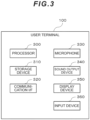
- Fig. 3 is a diagram showing an example of the hardware configuration of the user terminal 100.
- the user terminal 100 is, for example, a computer such as a smart phone and a tablet terminal.
- the user terminal 100 includes a processor 300, a storage device 310, a communication interface (I/F) 320, a microphone 330, a sound output device 340, a display device 350, and an input device 360.
- I/F communication interface
- the processor 300 can implement various functions in the user terminal 100 by performing a program stored in the storage device 310.
- the storage device 310 is a storage region that stores a program or data.
- the storage device 310 can include a volatile memory that is a temporary storage region or a non-volatile memory that is a permanent storage region.
- the storage device 310 may be provided outside the user terminal 100.
- the communication interface 320 is an interface device for performing the transmission and reception of a program or data with an outside device.
- the communication interface 320 includes, for example, an interface for a mobile telephone communication network or an interface for a wireless LAN (Local Area Network).
- the communication interface 320 may include a wired interface.
- the microphone 330 detects surrounding sound.
- the microphone 330 can detect not only sound in an audible range but also sound in a non-audible range.
- the microphone 330 may be provided outside the user terminal 100.
- the sound output device 340 is an output device for outputting sound.
- the sound output device 340 is, for example, a speaker. Further, the sound output device 340 may be a device for outputting sound to an earphone.
- the third content 230 contains sound (for example, an audio guide or dubbing sound)
- the sound is output from the sound output device 340.
- the display device 350 is an output device for displaying an image (still image or moving image).
- the display device 350 is, for example, a liquid crystal display or an organic EL (Electroluminescence) display.
- the display device 350 may be provided outside the user terminal 100.
- the third content 230 contains an image (for example, subtitles)
- the image is displayed on the display device 350.
- the input device 360 is a device for receiving a user's input.
- the input device 360 may be, for example, a touch panel integrally formed with the display device 350.
- the input device 360 may be provided outside the user terminal 100.
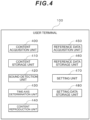
- Fig. 4 is a diagram showing an example of the function configuration of the user terminal 100.
- the user terminal 100 includes a content acquisition unit 400, a content storage unit 410, a sound detection unit 420, a time axis determination unit 430, a content reproduction unit 440, a reference data acquisition unit 450, a reference data storage unit 460, a setting unit 470, and a setting data storage unit 480.
- the respective units shown in Fig. 4 can be implemented, for example, when the storage region of the storage device 310 is used or when a program (content reproduction program) stored in the storage device 310 is performed by the processor 300.
- the content acquisition unit 400 acquires the third content 230 reproduced by the user terminal 100 via, for example, the Internet and stores the acquired third content 230 in the content storage unit 410.
- Fig. 5 is a diagram showing an example of a user interface for acquiring content.
- a screen 500 is displayed, for example, when an application for reproducing the third content 230 is activated.
- the screen 500 includes regions 510 and 520 for selecting content types.
- the screen 500 enables the selection of subtitles, sign language, or an audio guide in the region 510. Further, the screen 500 enables the selection of a movie theater/theater, a theme park, a museum/art museum, a DVD/BD, or other in the region 510. Then, a content list corresponding to content selected in the regions 510 and 520 is displayed in a region 530. in the region 530, the title of the second content 210 (for example, the main part) is, for example, displayed.
- the content acquisition unit 400 acquires the third content 230 corresponding to the second content 210 selected in the region 530. Note that the content acquisition unit 400 may acquire the third content 230 containing an object not to be reproduced.
- the content acquisition unit 400 may acquire the third content 230 specified by sound (watermark data or fingerprint) detected in the first content 200. For example, when watermark data embedded in the first content 200 contains data (second data) for specifying the third content 230, the content acquisition unit 400 may acquire the third content 230 on the basis of the data.
- the sound detection unit 420 detects the sound of content reproduced outside the user terminal 100. Specifically, the sound detection unit 420 can detect the sound of the first content 200 (announcement). Further, the sound detection unit 420 can also detect the sound of the second content 210 (main part). The sound detected by the sound detection unit 420 is, for example, watermark data or fingerprint. The sound detection unit 420 can stop operating when the time axis of the second content 210 is determined by the time axis determination unit 430.
- the time axis determination unit 430 determines the time axis of the second content 210 on the basis of sound detected by the sound detection unit 420. Specifically, the time axis of the second content 210 can be determined on the basis of, for example, data (first data) for determining the time axis of the second content 210, contained in watermark data embedded in the sound of the first content 200. Further, the time axis determination unit 430 can determine the time axis of the second content 210 during the reproduction of the second content 210 on the basis of the fingerprint of the sound of the second content 210. Here, in the determination of the time axis of the second content 210, the reproduction timing of the second content 210 is associated with time.
- the time axis determination unit 430 can determine time at which the reproduction of the second content 210 is started (for example, actual time or relative time based on a certain point). Further, for example, the time axis determination unit 430 can determine which part of the second content 210 is being currently reproduced. The time axis determination unit 430 can stop operating when the time axis of the second content 210 is determined.
- the content reproduction unit 440 reproduces the third content 230 with (in synchronization with) the reproduction of the second content 210 on the basis of a time axis determined by the time axis determination unit 430. Further, the content reproduction unit 440 can output information indicating the state of determination of a time axis determined by the time axis determination unit 430.
- Fig. 6 is a diagram showing an example of a screen on which the determination state of the time axis has been displayed. As shown in a screen 600 of Fig. 6 , the content reproduction unit 440 can display, on the display device 350, a message (for example, "Preparation for displaying subtitles has been completed. Please wait for a while until the main part starts.") indicating that the determination of a time axis has been completed.
- the reference data acquisition unit 450 acquires reference data required when the time axis determination unit 430 determines a time axis on the basis of fingerprint via, for example, the Internet, and stores the acquired reference data in the reference data storage unit 460.
- the reference data is data in which the feature amount of the sound of content is associated with the reproduction time of the content.
- the time axis determination unit 430 can determine the time axis of the second content 210 by comparing the feature amount of the sound of the first content 200 or the second content 210 with the reference data.
- the setting unit 470 receives a setting for reproducing the third content 230 from a user and stores setting data indicating the setting in the setting data storage unit 480.
- the content reproduction unit 440 can reproduce the third content 230 on the basis of the setting data.
- Fig. 7 is a flowchart showing an example of content reproduction processing in the user terminal 100.
- the processing shown in Fig. 7 is started, for example, when a user activates an application.
- the sound detection unit 420 starts detecting watermark data embedded in the sound of the first content 200 (S701). After the watermark data is detected, the time axis determination unit 430 determines the time axis of the second content 210 on the basis of the watermark data (S702). Note that the time axis determination unit 430 may determine the time axis of the second content 210 on the basis of the fingerprint of the sound of the first content 200.
- the sound detection unit 420 performs the determination (S703 to S704) of a time axis based on the sound of the second content 210 concurrently with the determination (S701 to S702) of the time axis based on the sound of the first content 200. Specifically, the sound detection unit 420 starts detecting the fingerprint (feature amount) of the sound of the second content 210 (S703). Then, the time axis determination unit 430 determines the time axis of the second content 210 on the basis of the fingerprint (S704).
- the determination processing (S703 to S704) of the time axis based on the sound of the second content 210 is effective, for example, in a case in which the user starts watching the second content 210 after the reproduction of the second content 210 is started, a case in which the determination (S701 to S702) of the time axis based on the sound of the first content 200 is not normally operated, or the like.
- the determination processing of the time axis is repeatedly performed unless the determination (S701 to S704) of the time axis based on the sound of the first content 200 or the second content 210 is completed (S705: N). Then, when the determination of the time axis is completed (S705: Y), the sound detection unit 420 and the time axis determination unit 430 stop operating and the content reproduction unit 440 reproduces the third content 230 in synchronization with the reproduction of the second content 210 on the basis of the determined time axis (S706).
- the time axis of the second content 210 (for example, the main part) reproduced subsequent to the first content 200 can be determined on the basis of the sound of the first content 200 (for example, announcement). Then, the third content 230 (for example, subtitles or an audio guide) corresponding to the second content 210 can be reproduced in synchronization with the reproduction of the second content 210 on the basis of the determined time axis.
- the third content 230 for example, subtitles or an audio guide
- the time axis of the second content 210 can be easily and reliably determined.
- the time axis of the second content 210 can be determined on the basis of watermark data embedded in the sound of the first content 200. In many cases, it is easier to embed watermark data in the first content 200 than in the second content 210. Therefore, the time axis of the second content 210 can be easily and reliably determined with the watermark data embedded in the first content 200.
- watermark data embedded in the sound of the first content 200 can be sound data in a non-audible range.
- the time axis of the second content 210 can be easily and reliably determined without exerting an influence on a user who watches the first content 200.
- the time axis of the second content 210 can be determined on the basis of the fingerprint (feature amount) of the sound of the second content 210, besides the determination of the time axis of the second content 210 based on watermark data embedded in the sound of the first content 200.
- the time axis of the second content 210 can be easily and reliably determined.
- the watermark data 220 embedded in the sound of the first content 200 may contain data (for example, data indicating a facility, an area, or the like) for specifying the third content 230, besides data (for example, a time code) for determining a time axis.
- the third content 230 can be selected by the watermark data 220 embedded in the sound of the first content 200.
- the time axis of the second content 210 may be determined on the basis of the feature amount of the sound of the first content 200.
- the time axis of the second content 210 can be easily and reliably determined.
- the sound detection unit 420 and the time axis determination unit 430 can stop operating when the time axis of the second content 210 is determined.
- the power consumption of the user terminal 100 can be reduced.
- the time axis determination unit 430 may correct the time axis of the second content 210 on the basis of the fingerprint (feature amount) of the sound of the second content 210 at an appropriate timing.
- the time axis determination unit 430 may correct the time axis of the second content 210 on the basis of the fingerprint (feature amount) of the sound of the second content 210 at a prescribed time interval. Further, for example, after the determination of the time axis of the second content 210 is completed, the time axis determination unit 430 may correct the time axis of the second content 210 on the basis of the fingerprint (feature amount) of the sound of the second content 210 according to instructions from a user.
- information indicating the state of determination of the time axis of the second content 210 can be output to the display device 350.
- the output destination of the information is not limited to the display device 350 but may be the sound output device 340.
- the determination state of the time axis of the second content 210 can be informed to a user.
Landscapes
- Engineering & Computer Science (AREA)
- Multimedia (AREA)
- Signal Processing (AREA)
- Computer Security & Cryptography (AREA)
- Two-Way Televisions, Distribution Of Moving Picture Or The Like (AREA)
- User Interface Of Digital Computer (AREA)
Claims (6)
- Programm zum Wiedergeben von Inhalt, um einen Computer zu veranlassen, Folgendes durchzuführen:Erkennen von Wasserzeichendaten, die in Tönen eines ersten Inhalts (200) eingebettet sind, welcher außerhalb des Computers wiedergegeben und von einem Mikrophon erkannt wird, wobei die Wasserzeichendaten Tondaten in einem nicht-hörbaren Bereich sind und erste Daten zum Bestimmen der Wiedergabezeit von zweitem Inhalt (210) enthalten, der nach dem ersten Inhalt außerhalb des Computers wiedergegeben wird, und zweite Daten zum Spezifizieren eines dritten Inhalts (230), der synchron mit dem zweiten Inhalt (210) wiederzugeben ist; Bestimmen der Wiedergabezeit des zweiten Inhalts (210) auf der Grundlage der ersten Daten, die in den erkannten Wasserzeichendaten enthalten sind, wobei das Bestimmen der Wiedergabezeit ferner das Erkennen eines Fingerabdrucks von Tönen des zweiten Inhalts beinhaltet und das Vergleichen des Fingerabdrucks der Töne des zweiten Inhalts mit Referenzdaten, in denen der Fingerabdruck der Töne des zweiten Inhalts der Wiedergabezeit des zweiten Inhalts zugeordnet ist; undWiedergeben des dritten Inhalts (230) synchron mit der Widergabe des zweiten Inhalts auf der Grundlage der bestimmten Wiedergabezeit des zweiten Inhalts.
- Programm zum Wiedergeben von Inhalt nach Anspruch 1, um den Computer ferner zu veranlassen, Folgendes durchzuführen:Erkennen eines Fingerabdrucks der Töne des zweiten Inhalts undBestimmen der Wiedergabezeit des zweiten Inhalts durch Vergleichen des erkannten Fingerabdrucks der Töne des ersten Inhalts mit weiteren Referenzdaten, in denen der Fingerabdruck der Töne des ersten Inhalts der Wiedergabezeit des zweiten Inhalts zugeordnet ist.
- Programm zum Wiedergeben von Inhalt nach einem der Ansprüche 1 bis 2, um den Computer ferner zu veranlassen, Folgendes durchzuführen:
Abbrechen des Erkennens des in die Töne des zweiten Inhalts eingebetteten Wasserzeichens und des Bestimmens der Wiedergabezeit des zweiten Inhalts, wenn die Wiedergabezeit bestimmt ist. - Programm zum Wiedergeben von Inhalt nach Anspruch 1, um den Computer ferner zu veranlassen, Folgendes durchzuführen:
Korrigieren der Wiedergabezeit auf der Grundlage des Fingerabdrucks des zweiten Inhalts, nachdem die Wiedergabezeit bestimmt wurde. - Programm zum Wiedergeben von Inhalt nach einem der Ansprüche 1 bis 4, um den Computer ferner zu veranlassen, Folgendes durchzuführen:
Ausgeben einer Nachricht, die angibt, dass das Bestimmen der Wiedergabezeit abgeschlossen ist. - Vorrichtung zum Wiedergeben von Inhalt, Folgendes umfassend:eine Tonerkennungseinheit (420), die dafür konfiguriert ist, Wasserzeichendaten zu erkennen, die in Töne ersten Inhalts (200) eingebettet sind, die außerhalb wiedergegeben und von einem Mikrophon erkannt werden, und ferner dafür konfiguriert, einen Fingerabdruck von Tönen zweiten Inhalts zu erkennen, wobei die Wasserzeichendaten Tondaten in einem nicht-hörbaren Bereich sind und erste Daten zum Bestimmen der Wiedergabezeit des zweiten Inhalts (210) enthalten, der nach dem ersten Inhalt außerhalb des Computer wiedergegeben wird, und zweite Daten zum Spezifizieren eines dritten Inhalts (230), der synchron mit dem zweiten Inhalt (210) wiederzugeben ist;eine Einheit (430) zum Bestimmen der Wiedergabezeit, die dafür konfiguriert ist, auf der Grundlage der ersten Daten, die in den erkannten Wasserzeichendaten enthalten sind, die Wiedergabezeit des zweiten Inhalts (210) zu bestimmen, wobei das Bestimmen der Wiedergabezeit ferner das Vergleichen des Fingerabdrucks der Töne des zweiten Inhalts mit Referenzdaten beinhaltet, in denen der Fingerabdruck der Töne des zweiten Inhalts der Wiedergabezeit des zweiten Inhalts zugeordnet ist; undeine Einheit (440) zum Wiedergeben von Inhalt, die dafür konfiguriert ist, den dritten Inhalt (230) synchron mit der Widergabe des zweiten Inhalts auf der Grundlage der bestimmten Wiedergabezeit des zweiten Inhalts wiederzugeben.
Applications Claiming Priority (1)
| Application Number | Priority Date | Filing Date | Title |
|---|---|---|---|
| PCT/JP2016/081900 WO2018078768A1 (ja) | 2016-10-27 | 2016-10-27 | コンテンツ再生プログラム及びコンテンツ再生装置 |
Publications (4)
| Publication Number | Publication Date |
|---|---|
| EP3534618A1 EP3534618A1 (de) | 2019-09-04 |
| EP3534618A4 EP3534618A4 (de) | 2020-06-03 |
| EP3534618C0 EP3534618C0 (de) | 2024-12-11 |
| EP3534618B1 true EP3534618B1 (de) | 2024-12-11 |
Family
ID=59351268
Family Applications (1)
| Application Number | Title | Priority Date | Filing Date |
|---|---|---|---|
| EP16920393.2A Active EP3534618B1 (de) | 2016-10-27 | 2016-10-27 | Inhaltswiedergabeprogramm und inhaltswiedergabevorrichtung |
Country Status (7)
| Country | Link |
|---|---|
| US (1) | US11303951B2 (de) |
| EP (1) | EP3534618B1 (de) |
| JP (1) | JP6163680B1 (de) |
| KR (1) | KR102607703B1 (de) |
| CN (1) | CN109983781B (de) |
| TW (1) | TWI760383B (de) |
| WO (1) | WO2018078768A1 (de) |
Families Citing this family (1)
| Publication number | Priority date | Publication date | Assignee | Title |
|---|---|---|---|---|
| JP7637352B2 (ja) * | 2021-01-06 | 2025-02-28 | 株式会社日本総合研究所 | 音声データ処理装置及び属性情報抽出装置 |
Citations (5)
| Publication number | Priority date | Publication date | Assignee | Title |
|---|---|---|---|---|
| US20070177466A1 (en) * | 2006-01-31 | 2007-08-02 | Hideo Ando | Information reproducing system using information storage medium |
| US20150082332A1 (en) * | 2009-12-31 | 2015-03-19 | The Nielsen Company (Us), Llc | Methods and apparatus to detect commercial advertisements associated with media presentations |
| US20150205578A1 (en) * | 2010-03-16 | 2015-07-23 | Bby Solutions, Inc. | Movie mode and content awardingi system and method |
| JP2016165123A (ja) * | 2016-04-12 | 2016-09-08 | 日本放送協会 | 信号処理装置及びプログラム |
| EP2801208B1 (de) * | 2012-01-06 | 2018-08-29 | Thomson Licensing | Verfahren und system zur synchronisation von inhalten auf einem zweiten bildschirm |
Family Cites Families (23)
| Publication number | Priority date | Publication date | Assignee | Title |
|---|---|---|---|---|
| DE102004021404B4 (de) * | 2004-04-30 | 2007-05-10 | Fraunhofer-Gesellschaft zur Förderung der angewandten Forschung e.V. | Wasserzeicheneinbettung |
| US8763029B1 (en) * | 2006-11-13 | 2014-06-24 | Visible World Inc. | Systems and methods for client-based addressable advertising |
| CN101370261B (zh) * | 2007-08-15 | 2011-12-07 | 华为技术有限公司 | 从cs域向ps域切换的资源准备方法及通信设备 |
| JP2010170604A (ja) * | 2009-01-21 | 2010-08-05 | Sony Corp | 光ディスク装置、光ピックアップ、プリフォーマット信号生成方法及びプログラム |
| CN101877625A (zh) * | 2010-06-29 | 2010-11-03 | 中兴通讯股份有限公司 | 下行语音帧的接收处理方法及装置、基带 |
| JP5724283B2 (ja) * | 2010-10-15 | 2015-05-27 | ソニー株式会社 | 情報処理装置、同期方法およびプログラム |
| US20130083036A1 (en) * | 2011-08-19 | 2013-04-04 | Hall of Hands Limited | Method of rendering a set of correlated events and computerized system thereof |
| CN102664007B (zh) * | 2012-03-27 | 2016-08-31 | 上海量明科技发展有限公司 | 用于生成字符标识内容的方法、客户端及系统 |
| CN102625164A (zh) * | 2012-04-06 | 2012-08-01 | 上海车音网络科技有限公司 | 多媒体数据处理平台及多媒体读物、系统和方法 |
| US9305559B2 (en) * | 2012-10-15 | 2016-04-05 | Digimarc Corporation | Audio watermark encoding with reversing polarity and pairwise embedding |
| FR3006525B1 (fr) * | 2013-06-04 | 2016-10-14 | Visiware | Synchronisation de contenus multimedia sur deuxieme ecran |
| JP6271194B2 (ja) * | 2013-09-17 | 2018-01-31 | 特定非営利活動法人メディア・アクセス・サポートセンター | 携帯デバイスへのセカンドスクリーン情報の提供方法 |
| WO2015039888A1 (en) * | 2013-09-20 | 2015-03-26 | Koninklijke Kpn N.V. | Correlating timeline information between media streams |
| JP6349977B2 (ja) * | 2013-10-21 | 2018-07-04 | ソニー株式会社 | 情報処理装置および方法、並びにプログラム |
| KR102297919B1 (ko) * | 2013-12-09 | 2021-09-02 | 파로님 가부시키가이샤 | 링크처 지정용 인터페이스 장치, 시청자용 인터페이스 장치, 및 컴퓨터 프로그램 |
| CN103702145A (zh) | 2013-12-26 | 2014-04-02 | 京东方科技集团股份有限公司 | 节目播放提醒方法及其系统和显示装置 |
| KR102179321B1 (ko) * | 2014-01-31 | 2020-11-18 | 인터디지털 씨이 페이튼트 홀딩스 | 두 개의 전자 디바이스에서 재생을 동기화하는 방법 및 장치 |
| CN104023251B (zh) * | 2014-06-13 | 2015-08-19 | 腾讯科技(深圳)有限公司 | 基于视频的互动方法和系统 |
| JP6433273B2 (ja) * | 2014-12-05 | 2018-12-05 | 株式会社テレビ朝日 | 端末装置、サーバ装置、及びプログラム |
| US9665341B2 (en) * | 2015-02-09 | 2017-05-30 | Sonos, Inc. | Synchronized audio mixing |
| US20160309214A1 (en) * | 2015-04-15 | 2016-10-20 | Rovi Guides, Inc. | Method of synchronizing alternate audio content with video content |
| EP3226570A1 (de) * | 2016-03-31 | 2017-10-04 | Thomson Licensing | Synchronisierung von audio- und videosignalen, die auf verschiedenen vorrichtungen wiedergegeben werden |
| CN111727608B (zh) * | 2018-02-23 | 2023-12-05 | 日商艾菲克泽股份有限公司 | 存储介质、内容播放方法及内容播放系统 |
-
2016
- 2016-10-27 WO PCT/JP2016/081900 patent/WO2018078768A1/ja not_active Ceased
- 2016-10-27 KR KR1020197014929A patent/KR102607703B1/ko active Active
- 2016-10-27 US US16/345,568 patent/US11303951B2/en active Active
- 2016-10-27 EP EP16920393.2A patent/EP3534618B1/de active Active
- 2016-10-27 JP JP2017508106A patent/JP6163680B1/ja active Active
- 2016-10-27 CN CN201680090523.7A patent/CN109983781B/zh active Active
-
2017
- 2017-10-27 TW TW106137069A patent/TWI760383B/zh active
Patent Citations (5)
| Publication number | Priority date | Publication date | Assignee | Title |
|---|---|---|---|---|
| US20070177466A1 (en) * | 2006-01-31 | 2007-08-02 | Hideo Ando | Information reproducing system using information storage medium |
| US20150082332A1 (en) * | 2009-12-31 | 2015-03-19 | The Nielsen Company (Us), Llc | Methods and apparatus to detect commercial advertisements associated with media presentations |
| US20150205578A1 (en) * | 2010-03-16 | 2015-07-23 | Bby Solutions, Inc. | Movie mode and content awardingi system and method |
| EP2801208B1 (de) * | 2012-01-06 | 2018-08-29 | Thomson Licensing | Verfahren und system zur synchronisation von inhalten auf einem zweiten bildschirm |
| JP2016165123A (ja) * | 2016-04-12 | 2016-09-08 | 日本放送協会 | 信号処理装置及びプログラム |
Also Published As
| Publication number | Publication date |
|---|---|
| US20190253749A1 (en) | 2019-08-15 |
| EP3534618C0 (de) | 2024-12-11 |
| US11303951B2 (en) | 2022-04-12 |
| CN109983781B (zh) | 2022-03-22 |
| CN109983781A (zh) | 2019-07-05 |
| WO2018078768A1 (ja) | 2018-05-03 |
| TW201820316A (zh) | 2018-06-01 |
| KR102607703B1 (ko) | 2023-11-30 |
| EP3534618A1 (de) | 2019-09-04 |
| JPWO2018078768A1 (ja) | 2018-11-01 |
| KR20190085938A (ko) | 2019-07-19 |
| JP6163680B1 (ja) | 2017-07-19 |
| EP3534618A4 (de) | 2020-06-03 |
| TWI760383B (zh) | 2022-04-11 |
Similar Documents
| Publication | Publication Date | Title |
|---|---|---|
| US20220086531A1 (en) | Methods and apparatus to present supplemental media on a second screen | |
| TWI538520B (zh) | 視頻資訊添加方法及裝置、視頻資訊顯示方法及裝置 | |
| US20170171643A1 (en) | Method and electronic device for displaying watermark | |
| JP6271194B2 (ja) | 携帯デバイスへのセカンドスクリーン情報の提供方法 | |
| US20160249091A1 (en) | Method and an electronic device for providing a media stream | |
| KR20160013649A (ko) | 주변 소음에 기초하여 자막을 생성하는 동영상 디스플레이 방법 및 사용자 단말 | |
| KR101789221B1 (ko) | 동영상 제공 장치, 동영상 제공 방법, 및 컴퓨터 프로그램 | |
| US8875213B2 (en) | Video player and portable computer with detection | |
| US11665406B2 (en) | Verbal queries relative to video content | |
| JP2019507978A5 (de) | ||
| CN108172245B (zh) | 电影院中音轨的连续自动同步 | |
| US11303951B2 (en) | Content reproduction program and content reproduction device | |
| JP6089874B2 (ja) | 多言語同時再生システム | |
| RU2636116C2 (ru) | Способ, сервер и устройство отображения для воспроизведения мультимедийного контента | |
| CN106057222B (zh) | 一种多媒体文件的播放方法及电子设备 | |
| CN113841121A (zh) | 用于提供应用内消息收发的系统和方法 | |
| HK40009107A (en) | Content reproduction program and content reproduction apparatus | |
| HK40004576A (en) | Content reproduction program and content reproduction apparatus | |
| JP2014123800A (ja) | 電子機器及び表示制御方法 | |
| CN104994434A (zh) | 一种视频播放方法及装置 | |
| US20120224833A1 (en) | Apparatus and method for segmenting video data in mobile communication terminal | |
| HK40004576B (zh) | 内容播放装置以及计算机可读存储介质 | |
| US20170169852A1 (en) | Method for resuming playing audio-video file after muting and electronic device | |
| KR100703522B1 (ko) | 디지털 멀티미디어 방송 수신 단말의 디지털 멀티미디어방송 오디오 데이터 저장 방법 및 장치 | |
| CN105550192A (zh) | 一种信息展示方法及用户终端 |
Legal Events
| Date | Code | Title | Description |
|---|---|---|---|
| STAA | Information on the status of an ep patent application or granted ep patent |
Free format text: STATUS: THE INTERNATIONAL PUBLICATION HAS BEEN MADE |
|
| PUAI | Public reference made under article 153(3) epc to a published international application that has entered the european phase |
Free format text: ORIGINAL CODE: 0009012 |
|
| STAA | Information on the status of an ep patent application or granted ep patent |
Free format text: STATUS: REQUEST FOR EXAMINATION WAS MADE |
|
| 17P | Request for examination filed |
Effective date: 20190524 |
|
| AK | Designated contracting states |
Kind code of ref document: A1 Designated state(s): AL AT BE BG CH CY CZ DE DK EE ES FI FR GB GR HR HU IE IS IT LI LT LU LV MC MK MT NL NO PL PT RO RS SE SI SK SM TR |
|
| AX | Request for extension of the european patent |
Extension state: BA ME |
|
| DAV | Request for validation of the european patent (deleted) | ||
| DAX | Request for extension of the european patent (deleted) | ||
| A4 | Supplementary search report drawn up and despatched |
Effective date: 20200506 |
|
| RIC1 | Information provided on ipc code assigned before grant |
Ipc: H04N 21/81 20110101ALI20200428BHEP Ipc: H04N 21/43 20110101ALI20200428BHEP Ipc: G11B 27/11 20060101ALI20200428BHEP Ipc: H04N 21/44 20110101ALI20200428BHEP Ipc: H04N 21/8358 20110101ALI20200428BHEP Ipc: H04N 21/8547 20110101ALI20200428BHEP Ipc: H04N 21/439 20110101AFI20200428BHEP |
|
| REG | Reference to a national code |
Ref country code: HK Ref legal event code: DE Ref document number: 40009107 Country of ref document: HK |
|
| STAA | Information on the status of an ep patent application or granted ep patent |
Free format text: STATUS: EXAMINATION IS IN PROGRESS |
|
| 17Q | First examination report despatched |
Effective date: 20210914 |
|
| REG | Reference to a national code |
Ref country code: DE Ref legal event code: R079 Free format text: PREVIOUS MAIN CLASS: H04N0021439000 Ipc: G11B0027100000 Ref document number: 602016090626 Country of ref document: DE |
|
| GRAP | Despatch of communication of intention to grant a patent |
Free format text: ORIGINAL CODE: EPIDOSNIGR1 |
|
| STAA | Information on the status of an ep patent application or granted ep patent |
Free format text: STATUS: GRANT OF PATENT IS INTENDED |
|
| RIC1 | Information provided on ipc code assigned before grant |
Ipc: H04N 21/43 20110101ALI20240609BHEP Ipc: H04N 21/8547 20110101ALI20240609BHEP Ipc: H04N 21/81 20110101ALI20240609BHEP Ipc: G11B 27/11 20060101ALI20240609BHEP Ipc: H04N 21/8358 20110101ALI20240609BHEP Ipc: H04N 21/44 20110101ALI20240609BHEP Ipc: H04N 21/439 20110101ALI20240609BHEP Ipc: G11B 27/30 20060101ALI20240609BHEP Ipc: G11B 27/10 20060101AFI20240609BHEP |
|
| INTG | Intention to grant announced |
Effective date: 20240702 |
|
| GRAS | Grant fee paid |
Free format text: ORIGINAL CODE: EPIDOSNIGR3 |
|
| GRAA | (expected) grant |
Free format text: ORIGINAL CODE: 0009210 |
|
| STAA | Information on the status of an ep patent application or granted ep patent |
Free format text: STATUS: THE PATENT HAS BEEN GRANTED |
|
| AK | Designated contracting states |
Kind code of ref document: B1 Designated state(s): AL AT BE BG CH CY CZ DE DK EE ES FI FR GB GR HR HU IE IS IT LI LT LU LV MC MK MT NL NO PL PT RO RS SE SI SK SM TR |
|
| REG | Reference to a national code |
Ref country code: GB Ref legal event code: FG4D |
|
| REG | Reference to a national code |
Ref country code: CH Ref legal event code: EP |
|
| REG | Reference to a national code |
Ref country code: DE Ref legal event code: R096 Ref document number: 602016090626 Country of ref document: DE |
|
| REG | Reference to a national code |
Ref country code: IE Ref legal event code: FG4D |
|
| U01 | Request for unitary effect filed |
Effective date: 20250102 |
|
| U07 | Unitary effect registered |
Designated state(s): AT BE BG DE DK EE FI FR IT LT LU LV MT NL PT RO SE SI Effective date: 20250115 |
|
| PG25 | Lapsed in a contracting state [announced via postgrant information from national office to epo] |
Ref country code: HR Free format text: LAPSE BECAUSE OF FAILURE TO SUBMIT A TRANSLATION OF THE DESCRIPTION OR TO PAY THE FEE WITHIN THE PRESCRIBED TIME-LIMIT Effective date: 20241211 |
|
| PG25 | Lapsed in a contracting state [announced via postgrant information from national office to epo] |
Ref country code: ES Free format text: LAPSE BECAUSE OF FAILURE TO SUBMIT A TRANSLATION OF THE DESCRIPTION OR TO PAY THE FEE WITHIN THE PRESCRIBED TIME-LIMIT Effective date: 20241211 |
|
| PG25 | Lapsed in a contracting state [announced via postgrant information from national office to epo] |
Ref country code: NO Free format text: LAPSE BECAUSE OF FAILURE TO SUBMIT A TRANSLATION OF THE DESCRIPTION OR TO PAY THE FEE WITHIN THE PRESCRIBED TIME-LIMIT Effective date: 20250311 |
|
| PG25 | Lapsed in a contracting state [announced via postgrant information from national office to epo] |
Ref country code: GR Free format text: LAPSE BECAUSE OF FAILURE TO SUBMIT A TRANSLATION OF THE DESCRIPTION OR TO PAY THE FEE WITHIN THE PRESCRIBED TIME-LIMIT Effective date: 20250312 |
|
| PG25 | Lapsed in a contracting state [announced via postgrant information from national office to epo] |
Ref country code: RS Free format text: LAPSE BECAUSE OF FAILURE TO SUBMIT A TRANSLATION OF THE DESCRIPTION OR TO PAY THE FEE WITHIN THE PRESCRIBED TIME-LIMIT Effective date: 20250311 |
|
| PG25 | Lapsed in a contracting state [announced via postgrant information from national office to epo] |
Ref country code: SM Free format text: LAPSE BECAUSE OF FAILURE TO SUBMIT A TRANSLATION OF THE DESCRIPTION OR TO PAY THE FEE WITHIN THE PRESCRIBED TIME-LIMIT Effective date: 20241211 |
|
| PG25 | Lapsed in a contracting state [announced via postgrant information from national office to epo] |
Ref country code: PL Free format text: LAPSE BECAUSE OF FAILURE TO SUBMIT A TRANSLATION OF THE DESCRIPTION OR TO PAY THE FEE WITHIN THE PRESCRIBED TIME-LIMIT Effective date: 20241211 |
|
| PG25 | Lapsed in a contracting state [announced via postgrant information from national office to epo] |
Ref country code: IS Free format text: LAPSE BECAUSE OF FAILURE TO SUBMIT A TRANSLATION OF THE DESCRIPTION OR TO PAY THE FEE WITHIN THE PRESCRIBED TIME-LIMIT Effective date: 20250411 |
|
| PG25 | Lapsed in a contracting state [announced via postgrant information from national office to epo] |
Ref country code: SK Free format text: LAPSE BECAUSE OF FAILURE TO SUBMIT A TRANSLATION OF THE DESCRIPTION OR TO PAY THE FEE WITHIN THE PRESCRIBED TIME-LIMIT Effective date: 20241211 |
|
| PG25 | Lapsed in a contracting state [announced via postgrant information from national office to epo] |
Ref country code: CZ Free format text: LAPSE BECAUSE OF FAILURE TO SUBMIT A TRANSLATION OF THE DESCRIPTION OR TO PAY THE FEE WITHIN THE PRESCRIBED TIME-LIMIT Effective date: 20241211 |
|
| PLBE | No opposition filed within time limit |
Free format text: ORIGINAL CODE: 0009261 |
|
| STAA | Information on the status of an ep patent application or granted ep patent |
Free format text: STATUS: NO OPPOSITION FILED WITHIN TIME LIMIT |
|
| 26N | No opposition filed |
Effective date: 20250912 |
|
| U20 | Renewal fee for the european patent with unitary effect paid |
Year of fee payment: 10 Effective date: 20251016 |
|
| PGFP | Annual fee paid to national office [announced via postgrant information from national office to epo] |
Ref country code: GB Payment date: 20251016 Year of fee payment: 10 |