EP3526018B1 - Verfahren zur medizinischen untersuchung von augen mit reversiblen gefärbten kontaktlinsen - Google Patents
Verfahren zur medizinischen untersuchung von augen mit reversiblen gefärbten kontaktlinsen Download PDFInfo
- Publication number
- EP3526018B1 EP3526018B1 EP17860528.3A EP17860528A EP3526018B1 EP 3526018 B1 EP3526018 B1 EP 3526018B1 EP 17860528 A EP17860528 A EP 17860528A EP 3526018 B1 EP3526018 B1 EP 3526018B1
- Authority
- EP
- European Patent Office
- Prior art keywords
- dye
- contact lens
- hydrogel
- eye
- dyed
- Prior art date
- Legal status (The legal status is an assumption and is not a legal conclusion. Google has not performed a legal analysis and makes no representation as to the accuracy of the status listed.)
- Active
Links
Images


Classifications
-
- D—TEXTILES; PAPER
- D06—TREATMENT OF TEXTILES OR THE LIKE; LAUNDERING; FLEXIBLE MATERIALS NOT OTHERWISE PROVIDED FOR
- D06P—DYEING OR PRINTING TEXTILES; DYEING LEATHER, FURS OR SOLID MACROMOLECULAR SUBSTANCES IN ANY FORM
- D06P1/00—General processes of dyeing or printing textiles, or general processes of dyeing leather, furs, or solid macromolecular substances in any form, classified according to the dyes, pigments, or auxiliary substances employed
- D06P1/0004—General aspects of dyeing
- D06P1/0012—Effecting dyeing to obtain luminescent or phosphorescent dyeings
-
- A—HUMAN NECESSITIES
- A61—MEDICAL OR VETERINARY SCIENCE; HYGIENE
- A61B—DIAGNOSIS; SURGERY; IDENTIFICATION
- A61B3/00—Apparatus for testing the eyes; Instruments for examining the eyes
- A61B3/10—Objective types, i.e. instruments for examining the eyes independent of the patients' perceptions or reactions
-
- D—TEXTILES; PAPER
- D06—TREATMENT OF TEXTILES OR THE LIKE; LAUNDERING; FLEXIBLE MATERIALS NOT OTHERWISE PROVIDED FOR
- D06P—DYEING OR PRINTING TEXTILES; DYEING LEATHER, FURS OR SOLID MACROMOLECULAR SUBSTANCES IN ANY FORM
- D06P1/00—General processes of dyeing or printing textiles, or general processes of dyeing leather, furs, or solid macromolecular substances in any form, classified according to the dyes, pigments, or auxiliary substances employed
- D06P1/0004—General aspects of dyeing
- D06P1/0016—Dye baths containing a dyeing agent in a special form such as for instance in melted or solid form, as a floating film or gel, spray or aerosol, or atomised dyes
-
- D—TEXTILES; PAPER
- D06—TREATMENT OF TEXTILES OR THE LIKE; LAUNDERING; FLEXIBLE MATERIALS NOT OTHERWISE PROVIDED FOR
- D06P—DYEING OR PRINTING TEXTILES; DYEING LEATHER, FURS OR SOLID MACROMOLECULAR SUBSTANCES IN ANY FORM
- D06P5/00—Other features in dyeing or printing textiles, or dyeing leather, furs, or solid macromolecular substances in any form
- D06P5/13—Fugitive dyeing or stripping dyes
-
- D—TEXTILES; PAPER
- D06—TREATMENT OF TEXTILES OR THE LIKE; LAUNDERING; FLEXIBLE MATERIALS NOT OTHERWISE PROVIDED FOR
- D06P—DYEING OR PRINTING TEXTILES; DYEING LEATHER, FURS OR SOLID MACROMOLECULAR SUBSTANCES IN ANY FORM
- D06P5/00—Other features in dyeing or printing textiles, or dyeing leather, furs, or solid macromolecular substances in any form
- D06P5/13—Fugitive dyeing or stripping dyes
- D06P5/138—Fugitive dyeing or stripping dyes fugitive dyeing
-
- G—PHYSICS
- G02—OPTICS
- G02C—SPECTACLES; SUNGLASSES OR GOGGLES INSOFAR AS THEY HAVE THE SAME FEATURES AS SPECTACLES; CONTACT LENSES
- G02C7/00—Optical parts
- G02C7/02—Lenses; Lens systems ; Methods of designing lenses
- G02C7/04—Contact lenses for the eyes
- G02C7/046—Contact lenses having an iris pattern
Definitions
- One aspect of this disclosure pertains to colored, or dyed, hydrogel or silicon hydrogel substrate, and more particularly to compositions and methods for reversibly dyeing soft contact lenses.
- the simplest colored lenses are enhancing lenses, which look like a regular contact lens with an iris-sized circle of transparent color. These lenses aren't meant to hide the iris's natural color, but rather to augment it. Manufacturers create the color by covalently attaching organic azo dyes to the contact lens polymer.
- the use of opaque pigments is more difficult, as it has a tendency to look fake. Colored contact makers have gotten better at making dramatic yet realistic-looking changes to the appearance of the iris through the use of sophisticated designs of opaque inorganic pigments. Nano- and microscale particles of inorganic pigments such as titanium dioxide, iron oxide, and barium sulfate are typically used to achieve the opaque color in these lenses.
- the FDA has only approved a small number of pigments for use with contact lenses. It is also important that the pigment used have no effect on the morphology and overall mechanical properties of the lens.
- inks are printed directly onto the lens and then covalently fixed onto the polymer surface.
- Other colored contact lenses are made by putting the inks into a mold and polymerizing the lens around these pigments, encapsulating the color within the contact.
- Others are made by stacking layers of dielectric films of alternating low and high refractive index. This, in combination with the films' precise nanoscale thickness, allows scientists to tailor the lens's reflective properties and therefore its color.
- the thin films are applied to the lens using plasma-enhanced chemical vapor deposition or ion-assisted deposition. The process creates a smooth surface on the lens that's imperceptible to the wearer. All of these processes are complicated and require precise application of pigments or films through the use of highly sensitive and technical machinery.
- Colored contact lenses that have a dyed iris area and a light reflecting material on the concave surface of the lens are known.
- the reactive dyes are attached to the lens through the formation of a covalent bond between the lens material and the dye that is created after the lens is contacted with the dye for a sufficient amount of time. These dyes permanently stain the matrix of the contact lens.
- color contact lenses in which the color is applied by direct application of one or more vat dyes, by printing the color onto the surface of the lens, or by incorporating a pigment onto the contact lens surface. These contact lenses are also permanently colored.
- One embodiment of the present disclosure relates generally to the field of a hydrogel or silicon hydrogel substrate. More particularly, it concerns a stabilizing compound and a method of stabilization thereof and examining a physiology of an eye having the soft contact lens applied to a cornea thereof.
- a method for applying dyes to the surface of a soft contact lens, as well as a kit containing the components for application of a dye to a soft contact lens are also included. The dye is applied in a manner to give a dye that is reversible, fadable, and removable in that it does not permanently stain the lens.
- one aspect of the current disclosure pertains to a method for reversibly coloring a substrate, such as contact lenses, preferably soft contact lenses.
- the method can be carried out by a contact lens owner after purchase from a manufacturer.
- the contact lenses are placed in a preserved saline solution.
- a strip that has been impregnated with a dye is added to the saline solution in which the lens is being stored.
- the lens After the lens has absorbed or adsorbed the dye, the lens can be inserted into the eye as it would normally be worn by the user. Exposure of the dyed lenses to ultraviolet light causes the lenses to glow.
- a further embodiment of the method(s) includes stabilizing the combined solution with boric acid and a soluble sodium chloride adapted to maintain the combination solution at the temperature during the amount of time at a pH of 7.2 plus or minus 0.2 with an isotonic adjustment between 290 to 320 mOsm/kg.
- the method also includes adding a bacteriostatic and a fungistasis component to the combined solution to keep pseudomonas aeruginosa and the like from growing in the fluorescein solution.
- the present invention includes examining a pathology of an eye having the reversibly dyed contact lens applied to a cornea thereof, the examining performed under a luminescent radiation stored in the reversibly dyed contact lens.
- embodiments include reducing the concentration adapted to reverse the dyeing of the combination solution at the temperature during the amount of time for a pH from 7.0 to 7.4. Also, examining a physiology of an eye under the luminescent radiation in the soft contact lens applied to a cornea thereof and after a luminescent dye is reversed in the soft contact lens.
- One embodiment of the present invention relates to methods and kits that utilize dyes to temporarily color the surface of hydrogel or silicon hydrogel substrate, such as a soft contact lens.
- the methods and kits produce contact lenses that will fluoresce or glow under fluorescent lights.
- Soft contact lenses are also known as hydrogel and silicon hydrogel contact lenses.
- Soft contact lenses come in four (4) different groups.
- the first group is low water contact lenses containing less than fifty percent water and non-ionic hydrogel polymers.
- the second group is high water content lenses that contain over fifty percent water and non-ionic hydrogel polymers.
- the third group of soft contact lenses is low water contact lenses with less than fifty percent water and ionic hydrogel polymers.
- the fourth group is high water content lenses with greater than fifty percent water and ionic hydrogel polymers.
- one aspect of the current application pertains to compositions and methods for reversibly dyeing soft contact lenses.
- the first step in the method comprises placing a soft contact lens in a container filled with saline solution.
- a strip that has been impregnated with a dye is added to the saline solution that contains the soft contact lens, to produce a combination solution.
- the soft contact lens will absorb or adsorb the dye from the combination solution.
- the soft contact lens is removed from the combination solution, rinsed briefly with saline, and placed in the eye. Exposure to ultraviolet light will cause the soft contact lens to glow, especially in dim illumination or a dark room.
- This effect will fade over time as the dye slowly leaches out of the matrix of the lens, or the lens can be soaked in additional saline for a period of time to reverse the dyeing.
- the dyes do not permanently change the contact lenses.
- the dyes do not permanently stain the matrix of the contact lens.
- the dyes for the current invention include sodium fluorescein, lissamine green, rose Bengal, and mixtures thereof.
- the most preferred dye is sodium fluorescein.
- the strips onto which the dyes can be absorbed include small paper strips about 2 mm wide and 15 mm long.
- the dyes can be absorbed or adsorbed by the strips by placing the absorbent paper strips in sodium fluorescein solution. In one embodiment, the strips absorb or adsorb up to 30 milligrams of dye per strip. If the dye used is rose bengal, the amount of dye can be from 1 milligram to 20 milligrams.
- the amount of dye that is absorbed onto the strip may need to be increased depending on the amount of saline solution in the container.
- the usable amount of saline is up to 10 milliliters but can be varied accordingly.
- An example of a commercially available sodium fluorescein strip is a FUL-GLO.RTM, fluorescein sodium sterile ophthalmic strip (Buffalo Grove, Ill.).
- the strip preferably dissolves in the saline solution to produce a combination solution.
- the amount of time required for the contact lens to absorb the dye will vary, but the preferable minimum amount of time during which the contact lens should be left in the combination solution is three hours.
- the dye used is sodium fluorescein.
- the sodium fluorescein is added to the strip, or directly to the saline solution, in an amount of 0.6 mg.
- the amount of sterile saline solution used is 0.5 mL.
- the lens is placed into the saline solution containing the dye.
- one range of temperature to maintain for the dye, the saline, and the lens is from 16.6667 to 22.2222 degrees Celsius (62 to 72 degrees Farenheit).
- the lens should be allowed to contact the dye and the saline for a period of at least 6 hours and no longer than 48 hours.
- the temperature of the dye, saline, and lens could be between 7.22222 and 37.7778 degrees Celsius (45 and 100 degrees Farenheit).
- the temperature is in the range of from 15.556 and 27.778 degrees Celsius (60 to 82 degrees Fahrenheit).
- the temperature preferably does not exceed 22.2222 degrees Celsius (72 degrees Fahrenheit).
- the dye does not form a permanent or covalent bond with the contact lens. If the dye is not permanently or covalently attached to the lens, then the dye can fade or be removed from the lens at a later time.
- the "reversible" dye on the lens can fade within 48 hours at ambient temperature. The fading is accelerated at higher temperature.
- the lens In order to complete the reversing or removing of the dye process, the lens must be soaked in 5 mL sterile saline solution for 6 hours. This process should then be repeated twice more with new saline solution. After this, the lens should substantially return to its natural color.
- the dye that is absorbed or adsorbed by the strip may be a mixture of any useable dyes.
- the current invention also pertains to a kit that may be used to dye soft contact lenses.
- the kit contains four main components.
- the first component is a contact lens container.
- the container can be a 10 mL size contact lens cup holder or any other suitable container.
- the second component is a bottle of preserved saline solution, available from any commercial source.
- the third component is a strip that has been impregnated with a dye.
- the dye is preferably sodium fluorescein, lissamine green, or rose bengal.
- the strips may vary in size and may contain up to 30 milligrams of dye per strip, depending on the size of the contact lens container and the selected dye.
- a fourth optional component is a UV light emitting system, such as a light bulb that emits ultraviolet light powered by a battery system.
- the user deposits a contact lens, preferably a soft contact lens, into the contact lens container.
- the contact lens is one that has been prescribed by a doctor and obtained from a manufacturer of contact lenses.
- the container is then filled with saline solution from the bottle of preserved saline solution.
- the preferred amount of saline solution added is 10 milliliters.
- a strip that has been impregnated with dye is then added to the saline solution. If the dye is sodium fluorescein, the strip should preferably contain up to 30 milligrams of dye.
- the saline solution used can be up to 10 milliliters. In some embodiments, 0.6 mg sodium fluorescein is used in 0.5 mL saline solution.
- the strip preferably dissolves in the saline solution to produce a combination solution containing molecules of dye.
- the dye is added directly to the saline solution, without the use of a strip.
- the dye molecules are absorbed by the contact lens over a period of time.
- the contact lens should be left in the container with the combination solution for between six hours and 48 hours. No heat (i.e. the temperature of below 37.7778 °C (100 degree F)) should be applied to the system, rather, the temperature should be maintained between 15.5556 and 27.7778 degrees Celsius (60 degrees and 82 degrees Fahrenheit). A temperature of around 22.2222 degrees Celsius (72 degrees F.) has been found to work well. After the lenses are placed in the eye, the UV light emitting system should be permitted to shine into the eyes to cause the contact lenses to glow.
- the effect of utilizing the kit to produce the dyed contact lenses is that the lenses will fluoresce or glow, especially in dim illumination or a dark room. This creates a dazzling, dramatic effect.
- Another embodiment of the present invention pertains to producing a dyed contact lens, or enhancing the glow of a soft contact lens that has already been dyed, while the subject is wearing or using the contact lens.
- a dye in liquid tears (saline) in 0.5 ml to 2 ml single use packages is put directly on the eye with the soft contact lens to either dye the "un-dyed" contact lens or enhance the glowing of the contact lens that has already been dyed.
- Usable dyes include sodium fluorescein, lissamine green, rose Bengal, and mixtures thereof.
- FIG. 1 is a depiction of a chemical composition for a stabilizing compound of the dye impregnated saline solution in accordance with an embodiment of the present disclosure.
- the depiction includes the soft contact lens 5, and the chemical composition includes a saline solution 10, and a sodium fluorescein dye 20 and the boric acid stabilizing compound 30 with claimed ingredients as explained and discussed herein.
- the combined solution also includes a bacteriostatic and a fungistatic component 35 adapted to keep pseudomonas aeruginosa and the like from growing in the fluorescein solution.
- the stabilizing compound 30 may be added prior to or after the contact lens 5 has been dyed. Additionally, the stabilizing compound may be added to one (left or right) contact lens and not to the other contact lens of a pair in order to have different luminescence from left to right in the contact lens pair.
- a further embodiment of the method(s) includes stabilizing the combination solution via a stabilizing the combined solution with boric acid and a soluble sodium chloride adapted to maintain the combination solution at the temperature during the amount of time at a pH of 7.2 plus or minus 0.2 with an isotonic adjustment between 290 to 320 mOsm/kg.
- embodiments include reducing the concentration to reverse the dyeing of the combination solution at the temperature during the amount of time for a pH from 7.0 to 7.4.
- FIG. 2 is a block diagram of a method for stabilizing the dye impregnated saline solution (and the strip) in accordance with an embodiment of the present disclosure.
- the method includes 210 immersing the soft contact lens in 0.5 milliliters of a saline solution, wherein the hydrogel or silicon hydrogel substrate has a non-dyed appearance.
- the method also includes 220 adding 0.6 milligrams of sodium fluorescein dye to the saline solution to produce a combination solution.
- the method additionally includes 230 allowing the contact lens to remain in the combination solution for an amount of time from 6 hours to 48 hours at a temperature from 16.6667 to 22.2222 degrees Celsius (62 to 72 degrees Fahrenheit), wherein the sodium fluorescein dye does not print color into any part of the soft contact lens matrix.
- the method further includes removing 240 the contact lens from the combination solution to produce a reversibly dyed contact lens, wherein the reversibly dyed contact lens returns to its non-dyed appearance over time and the sodium fluorescein dye is removable by soaking in a saline solution.
- the method yet includes stabilizing 250 the combination solution with boric acid and a soluble sodium chloride adapted to maintain the combination solution at the temperature during the amount of time at a pH of 7.2 plus or minus 0.2 with an isotonic adjustment between 290 to 320 mOsm/kg.
- the method also includes adding a bacteriostatic and a fungistatic component to the combined solution to keep pseudomonas aeruginosa and the like from growing in the fluorescein solution.
- the method furthermore includes examining 260 a pathology of an eye having the reversibly dyed contact lens applied to a cornea thereof, the examining performed under a luminescent radiation stored in the reversibly dyed contact lens.
- An embodiment of the method disclosed may also include placing the contact lens on an eye and illuminating the eye with ultraviolet radiation configured to store luminescent radiation in the contact lens.
- Embodiments may further comprise adding the boric acid after the sodium chloride and the dye to adjust the pH of the combined solution to within 0.2 of 7.2.
- FIG. 3 is a depiction of a fluorescein impregnated contact lens which has been exposed to UV light and in turn radiates UV light immediately to surrounding tissue and tissue behind the lens of the human eye for medical examination. Benefits unknown to shining UV light remotely onto the eye are thus obtained. Since a soft contact lens may cover a large portion of the human cornea, the stored luminescent light therefrom enters the lens of the human eye radially from nearly 180 degrees as depicted in part by the broken lines in the drawing. This immediate coverage and exposure to luminescent light allows a broader interior illumination of the retina of the human eye for examination purposes. The broader illumination also of surrounding tissues including the iris and lens of the eye also allows for an extensive examination of the surrounding tissues under an ambient lighting therefrom. The stabilization of the dye in the contact lens also allows for a longer examination window with the benefits of UV light. Also, because the contact lens is reversibly dyed, controlled before and after dye experiments may be performed using the same contact lens for complete process control of experimental variables.
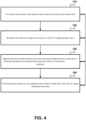
- FIG. 4 is a block diagram of a method for examining the physiology of an eye having an illuminated contact lens fitted thereto in accordance with an embodiment of the present disclosure.
- the method includes 310 covering a large portion of the human cornea with the reversibly dyed contact lens.
- the method also includes 320 remotely illuminating the contact lens on the eye with a UV radiating light source.
- the method additionally includes 330 removing the remote light source and allowing the stored luminescent light from the contact lens to illuminate the human eye surrounding tissues and retina for examination purposes.
- the method further includes 340 examining the same retina and surrounding tissues of the eye after the contact lens no longer illuminates the retina.
- the broader illumination of surrounding tissues including the iris and lens of the eye allows for an extensive examination of the surrounding tissues under an ambient lighting therefrom.
- An embodiment of the present disclosure may include 5 milliliters (ml) of purified water, 2 milligrams (mg) of fluorescein sodium, 45 mg of sodium chloride, and 5 mg of boric acid.
- the pH of the combined solution is a nominal 7.2 plus or minus 0.2.
- the combination solution also has an isotonic adjustment of between 290 to 320 mOsm/kg (osmality per killigram) at room temperature. The osmolality is measured in milliosmols (one-thousandth of an osmole) per kilogram of water (mOsmol/kg).
- Osmolarity is similar but is defined as the number of osmoles (or mOsmol) per liter of solvent and molarity (M) is equal to the number of moles of solute that are dissolved per Liter of solvent.
- M molarity
- the sodium chloride may comprise UNII: 451W47IQ8X and the sodium cation UNII:LYR4M0NH37 per the USP-NF.
- USP-NF United States Pharmacopeia and The National Formulary (USP-NF) is a book of public pharmacopeial standards for chemical and biological drug substances, dosage forms, compounded preparations, excipients, medical devices, and dietary supplements.
- the purified water may comprise UNII: 059QF0KO0R and the boric acid may comprise UNII: R57ZHV85D4.
Landscapes
- Engineering & Computer Science (AREA)
- Textile Engineering (AREA)
- Health & Medical Sciences (AREA)
- Life Sciences & Earth Sciences (AREA)
- Physics & Mathematics (AREA)
- Ophthalmology & Optometry (AREA)
- General Health & Medical Sciences (AREA)
- Dispersion Chemistry (AREA)
- Chemical & Material Sciences (AREA)
- Biomedical Technology (AREA)
- Optics & Photonics (AREA)
- Biophysics (AREA)
- General Physics & Mathematics (AREA)
- Heart & Thoracic Surgery (AREA)
- Medical Informatics (AREA)
- Molecular Biology (AREA)
- Surgery (AREA)
- Animal Behavior & Ethology (AREA)
- Public Health (AREA)
- Veterinary Medicine (AREA)
- Eyeglasses (AREA)
- Materials For Medical Uses (AREA)
Claims (4)
- Das Verfahren zur Untersuchung einer Pathologie eines Auges mittels eines reversibel gefärbten Hydrogel- oder Silikon-Hydrogel-Substrats, das auf dessen Hornhaut aufgebracht wird, wobei das Verfahren umfasst:Eintauchen eines Hydrogel- oder Silikon-Hydrogel-Substrats in eine Kochsalzlösung außerhalb des Auges, wobei das Hydrogel- oder Silikon-Hydrogel-Substrat ein nicht gefärbtes Aussehen hat, wobei das Hydrogel- oder Silikon-Hydrogel-Substrat eine weiche Kontaktlinse ist;Hinzufügen eines Farbstoffs zu der Kochsalzlösung, um eine Kombinationslösung herzustellen;Verbleibenlassen des Hydrogel- oder Silikon-Hydrogel-Substrats in der Kombinationslösung für eine Zeitspanne von 6 Stunden bis 48 Stunden bei einer Temperatur von 15,556°C bis 27,778°C (82°F), wobei der Farbstoff keine Farbe in irgendeinen Teil der weichen Kontaktlinsenmatrix druckt;Entfernen des Hydrogel- oder Silikon-Hydrogel-Substrats aus der Kombinationslösung, um ein reversibel gefärbtes Hydrogel- oder Silikon-Hydrogel-Substrat herzustellen, wobei das reversibel gefärbte Hydrogel- oder Silikon-Hydrogel-Substrat im Laufe der Zeit zu seinem ungefärbten Aussehen zurückkehrt und der Farbstoff durch Einweichen in einer Kochsalzlösung entfernt werden kann;Stabilisieren der Kombinationslösung mit Borsäure und einem löslichen Natriumchlorid, das geeignet ist, die Kombinationslösung während der Zeitspanne bei einem pH-Wert von 7,2 ± 0,2 mit einer isotonischen Einstellung zwischen 290 und 320 mOsm/kg auf Temperatur zu halten;gekennzeichnet durch:
Aufsetzen der Kontaktlinse auf ein Auge und Beleuchten des Auges mit ultravioletter Strahlung und Entfernen der ultravioletten Strahlung und Untersuchen des umgebenden Gewebes des Auges auf eine Homhautabschürfung oder auf ein kleines Teilchen im Auge mittels in der Kontaktlinse gespeicherter Lumineszenzstrahlung und eines von der Kontaktlinse auf das Auge übertragenen Farbstoffs. - Das Verfahren nach Anspruch 1, wobei der Farbstoff in einem mit Farbstoff imprägnierten Streifen enthalten ist.
- Das Verfahren nach Anspruch 1, wobei es sich bei dem Farbstoff um Natriumfluorescein in einer Menge von nominal 0,04 % Gewicht pro Volumen handelt.
- Das Verfahren nach Anspruch 1, das ferner den Schritt umfasst, die gefärbte Kontaktlinse sechs Stunden lang in 5 Milliliter steriler Kochsalzlösung einzuweichen und diesen Schritt dann noch zweimal mit neuer Kochsalzlösung zu wiederholen, um die Färbung der Kontaktlinse umzukehren.
Applications Claiming Priority (2)
| Application Number | Priority Date | Filing Date | Title |
|---|---|---|---|
| US201615291469A | 2016-10-12 | 2016-10-12 | |
| PCT/US2017/023884 WO2018071056A1 (en) | 2016-10-12 | 2017-03-23 | Compositions and methods for reversibly dyeing soft contact lenses and medical examination therefrom |
Publications (4)
| Publication Number | Publication Date |
|---|---|
| EP3526018A1 EP3526018A1 (de) | 2019-08-21 |
| EP3526018A4 EP3526018A4 (de) | 2020-07-01 |
| EP3526018C0 EP3526018C0 (de) | 2024-11-06 |
| EP3526018B1 true EP3526018B1 (de) | 2024-11-06 |
Family
ID=61829970
Family Applications (1)
| Application Number | Title | Priority Date | Filing Date |
|---|---|---|---|
| EP17860528.3A Active EP3526018B1 (de) | 2016-10-12 | 2017-03-23 | Verfahren zur medizinischen untersuchung von augen mit reversiblen gefärbten kontaktlinsen |
Country Status (6)
| Country | Link |
|---|---|
| US (1) | US10246819B2 (de) |
| EP (1) | EP3526018B1 (de) |
| BR (1) | BR112019007268A2 (de) |
| CA (1) | CA3040140C (de) |
| MX (1) | MX2019004208A (de) |
| WO (1) | WO2018071056A1 (de) |
Families Citing this family (1)
| Publication number | Priority date | Publication date | Assignee | Title |
|---|---|---|---|---|
| TWI697707B (zh) * | 2019-07-09 | 2020-07-01 | 望隼科技股份有限公司 | 功能性隱形眼鏡及功能性隱形眼鏡的染色方法 |
Family Cites Families (11)
| Publication number | Priority date | Publication date | Assignee | Title |
|---|---|---|---|---|
| US3536384A (en) * | 1968-07-05 | 1970-10-27 | Battelle Development Corp | Apparatus for determining corneal curvature and the like |
| US3809092A (en) * | 1972-04-13 | 1974-05-07 | S Abraham | Contact lens for viewing fluorescent eye tissue |
| US4518579A (en) | 1979-08-31 | 1985-05-21 | Holles Laboratories | pH stabilized fluorescing ophthalmic composition containing fluorexon |
| US4842401A (en) | 1987-06-15 | 1989-06-27 | The Board Of Trustees Of The Leland Stanford Jr. University | Eye diagnosis process |
| US6218428B1 (en) * | 2000-04-28 | 2001-04-17 | Emil Chynn | Ophthalmic composition |
| US20040063591A1 (en) * | 2002-09-30 | 2004-04-01 | Bausch & Lomb Incorporated | Compositions with enhanced antimicrobial efficacy against acanthamoebae |
| EP1611877A1 (de) * | 2004-06-28 | 2006-01-04 | Universidade de Coimbra | Methode zur Herstellung von verzögert freisetzenden therapeutischen ophthalmologischen Formulierungen unter Anwendung komprimierter Flüssigkeiten für die Imprägnierung von Arzneistoffen. |
| DE102004047156A1 (de) * | 2004-09-29 | 2006-03-30 | Stefan Kloth | Aufbewahrungs-, Reinigungs- und/oder Pflegelösung für Kontaktlinsen |
| US8702816B2 (en) * | 2006-03-03 | 2014-04-22 | Michael D. Conte | Compositions and methods for reversibly dyeing soft contact lenses |
| US20070204411A1 (en) * | 2006-03-03 | 2007-09-06 | Conte Michael D | Dyed soft contact lenses |
| CN105031705A (zh) | 2015-06-24 | 2015-11-11 | 黄红林 | 一种隐形眼镜消毒保湿药水 |
-
2017
- 2017-03-23 EP EP17860528.3A patent/EP3526018B1/de active Active
- 2017-03-23 WO PCT/US2017/023884 patent/WO2018071056A1/en not_active Ceased
- 2017-03-23 CA CA3040140A patent/CA3040140C/en active Active
- 2017-03-23 MX MX2019004208A patent/MX2019004208A/es unknown
- 2017-03-23 BR BR112019007268A patent/BR112019007268A2/pt not_active Application Discontinuation
- 2017-11-10 US US15/809,544 patent/US10246819B2/en active Active
Also Published As
| Publication number | Publication date |
|---|---|
| WO2018071056A1 (en) | 2018-04-19 |
| CA3040140C (en) | 2024-02-06 |
| US20180100268A1 (en) | 2018-04-12 |
| BR112019007268A2 (pt) | 2019-07-09 |
| EP3526018A4 (de) | 2020-07-01 |
| CA3040140A1 (en) | 2018-04-19 |
| MX2019004208A (es) | 2019-06-12 |
| EP3526018C0 (de) | 2024-11-06 |
| US10246819B2 (en) | 2019-04-02 |
| EP3526018A1 (de) | 2019-08-21 |
Similar Documents
| Publication | Publication Date | Title |
|---|---|---|
| TWI530727B (zh) | 顯示降低室內眩光之隱形眼鏡及其使用方法 | |
| ES2295449T3 (es) | Aposito antibacteriano para heridas. | |
| ES2944911T3 (es) | Filtrado selectivo de longitudes de onda de luz de alto rendimiento que proporciona una mayor sensibilidad al contraste | |
| CA2859050C (en) | Contact lenses containing carotenoid and method for making same | |
| CN111292615B (zh) | 提供改进的对比灵敏度的高性能选择性光波长过滤 | |
| JP2017062238A (ja) | 生組織におけるバイオフィルムを検出するための組成物 | |
| BRPI0709038A2 (pt) | sistema oftálmico que combina componentes oftálmicos com funcionalidades de bloqueio do comprimento de onda da luz azul e equilìbrio cromático | |
| JP2015135495A (ja) | 特定の青色光波長を選択的にフィルタ除去するフォトクロミック眼科システム | |
| US8702816B2 (en) | Compositions and methods for reversibly dyeing soft contact lenses | |
| CA2816768A1 (en) | Method for altering the optical density and spectral transmission or reflectance of contact lenses | |
| TW202309612A (zh) | 隱形眼鏡及其製造方法 | |
| EP3526018B1 (de) | Verfahren zur medizinischen untersuchung von augen mit reversiblen gefärbten kontaktlinsen | |
| US11072137B2 (en) | Methods of forming contact lenses to reduce the transmittance of light | |
| US20070204411A1 (en) | Dyed soft contact lenses | |
| TWI828552B (zh) | 光動力抑菌的隱形眼鏡及其產品 | |
| Refojo et al. | A new fluorescent stain for soft hydrophilic lens fitting | |
| Croitoru et al. | Smart dyes for medical textiles and related therapy | |
| CN106478878A (zh) | 一种集变色和防紫外线于一体的隐形眼镜制作工艺 | |
| KR200400687Y1 (ko) | 콘택트렌즈 | |
| Sakr | NANOCOMPOSITE CONTACT LENSES FOR TACKLING COLOR VISION DEFICIENCY | |
| KR20200037001A (ko) | 천연물질을 이용한 청광차단 실리콘 하이드로겔 렌즈 | |
| Ross | Surface modification of silver nanoparticles for biomedical applications | |
| HK1175256A (en) | Contact lenses displaying reduced indoor glare |
Legal Events
| Date | Code | Title | Description |
|---|---|---|---|
| STAA | Information on the status of an ep patent application or granted ep patent |
Free format text: STATUS: THE INTERNATIONAL PUBLICATION HAS BEEN MADE |
|
| PUAI | Public reference made under article 153(3) epc to a published international application that has entered the european phase |
Free format text: ORIGINAL CODE: 0009012 |
|
| STAA | Information on the status of an ep patent application or granted ep patent |
Free format text: STATUS: REQUEST FOR EXAMINATION WAS MADE |
|
| 17P | Request for examination filed |
Effective date: 20190503 |
|
| AK | Designated contracting states |
Kind code of ref document: A1 Designated state(s): AL AT BE BG CH CY CZ DE DK EE ES FI FR GB GR HR HU IE IS IT LI LT LU LV MC MK MT NL NO PL PT RO RS SE SI SK SM TR |
|
| AX | Request for extension of the european patent |
Extension state: BA ME |
|
| DAV | Request for validation of the european patent (deleted) | ||
| DAX | Request for extension of the european patent (deleted) | ||
| A4 | Supplementary search report drawn up and despatched |
Effective date: 20200602 |
|
| RIC1 | Information provided on ipc code assigned before grant |
Ipc: B05C 3/02 20060101ALI20200526BHEP Ipc: G02C 7/04 20060101ALI20200526BHEP Ipc: D06P 1/00 20060101ALN20200526BHEP Ipc: D06P 5/13 20060101ALN20200526BHEP Ipc: B29D 11/00 20060101AFI20200526BHEP Ipc: A61F 9/00 20060101ALI20200526BHEP |
|
| STAA | Information on the status of an ep patent application or granted ep patent |
Free format text: STATUS: EXAMINATION IS IN PROGRESS |
|
| 17Q | First examination report despatched |
Effective date: 20210325 |
|
| GRAP | Despatch of communication of intention to grant a patent |
Free format text: ORIGINAL CODE: EPIDOSNIGR1 |
|
| STAA | Information on the status of an ep patent application or granted ep patent |
Free format text: STATUS: GRANT OF PATENT IS INTENDED |
|
| RIC1 | Information provided on ipc code assigned before grant |
Ipc: D06P 5/13 20060101ALN20240219BHEP Ipc: D06P 1/00 20060101ALN20240219BHEP Ipc: A61F 9/00 20060101ALI20240219BHEP Ipc: B05C 3/02 20060101ALI20240219BHEP Ipc: G02C 7/04 20060101ALI20240219BHEP Ipc: B29D 11/00 20060101AFI20240219BHEP |
|
| INTG | Intention to grant announced |
Effective date: 20240313 |
|
| GRAS | Grant fee paid |
Free format text: ORIGINAL CODE: EPIDOSNIGR3 |
|
| GRAA | (expected) grant |
Free format text: ORIGINAL CODE: 0009210 |
|
| STAA | Information on the status of an ep patent application or granted ep patent |
Free format text: STATUS: THE PATENT HAS BEEN GRANTED |
|
| AK | Designated contracting states |
Kind code of ref document: B1 Designated state(s): AL AT BE BG CH CY CZ DE DK EE ES FI FR GB GR HR HU IE IS IT LI LT LU LV MC MK MT NL NO PL PT RO RS SE SI SK SM TR |
|
| REG | Reference to a national code |
Ref country code: GB Ref legal event code: FG4D |
|
| REG | Reference to a national code |
Ref country code: CH Ref legal event code: EP |
|
| REG | Reference to a national code |
Ref country code: DE Ref legal event code: R096 Ref document number: 602017086002 Country of ref document: DE |
|
| REG | Reference to a national code |
Ref country code: IE Ref legal event code: FG4D |
|
| U01 | Request for unitary effect filed |
Effective date: 20241205 |
|
| U07 | Unitary effect registered |
Designated state(s): AT BE BG DE DK EE FI FR IT LT LU LV MT NL PT RO SE SI Effective date: 20241220 |
|
| PG25 | Lapsed in a contracting state [announced via postgrant information from national office to epo] |
Ref country code: IS Free format text: LAPSE BECAUSE OF FAILURE TO SUBMIT A TRANSLATION OF THE DESCRIPTION OR TO PAY THE FEE WITHIN THE PRESCRIBED TIME-LIMIT Effective date: 20250306 Ref country code: HR Free format text: LAPSE BECAUSE OF FAILURE TO SUBMIT A TRANSLATION OF THE DESCRIPTION OR TO PAY THE FEE WITHIN THE PRESCRIBED TIME-LIMIT Effective date: 20241106 |
|
| PG25 | Lapsed in a contracting state [announced via postgrant information from national office to epo] |
Ref country code: ES Free format text: LAPSE BECAUSE OF FAILURE TO SUBMIT A TRANSLATION OF THE DESCRIPTION OR TO PAY THE FEE WITHIN THE PRESCRIBED TIME-LIMIT Effective date: 20241106 |
|
| PG25 | Lapsed in a contracting state [announced via postgrant information from national office to epo] |
Ref country code: NO Free format text: LAPSE BECAUSE OF FAILURE TO SUBMIT A TRANSLATION OF THE DESCRIPTION OR TO PAY THE FEE WITHIN THE PRESCRIBED TIME-LIMIT Effective date: 20250206 |
|
| PG25 | Lapsed in a contracting state [announced via postgrant information from national office to epo] |
Ref country code: GR Free format text: LAPSE BECAUSE OF FAILURE TO SUBMIT A TRANSLATION OF THE DESCRIPTION OR TO PAY THE FEE WITHIN THE PRESCRIBED TIME-LIMIT Effective date: 20250207 |
|
| PG25 | Lapsed in a contracting state [announced via postgrant information from national office to epo] |
Ref country code: PL Free format text: LAPSE BECAUSE OF FAILURE TO SUBMIT A TRANSLATION OF THE DESCRIPTION OR TO PAY THE FEE WITHIN THE PRESCRIBED TIME-LIMIT Effective date: 20241106 |
|
| PG25 | Lapsed in a contracting state [announced via postgrant information from national office to epo] |
Ref country code: RS Free format text: LAPSE BECAUSE OF FAILURE TO SUBMIT A TRANSLATION OF THE DESCRIPTION OR TO PAY THE FEE WITHIN THE PRESCRIBED TIME-LIMIT Effective date: 20250206 |
|
| PG25 | Lapsed in a contracting state [announced via postgrant information from national office to epo] |
Ref country code: SM Free format text: LAPSE BECAUSE OF FAILURE TO SUBMIT A TRANSLATION OF THE DESCRIPTION OR TO PAY THE FEE WITHIN THE PRESCRIBED TIME-LIMIT Effective date: 20241106 |
|
| PG25 | Lapsed in a contracting state [announced via postgrant information from national office to epo] |
Ref country code: SK Free format text: LAPSE BECAUSE OF FAILURE TO SUBMIT A TRANSLATION OF THE DESCRIPTION OR TO PAY THE FEE WITHIN THE PRESCRIBED TIME-LIMIT Effective date: 20241106 |
|
| PG25 | Lapsed in a contracting state [announced via postgrant information from national office to epo] |
Ref country code: CZ Free format text: LAPSE BECAUSE OF FAILURE TO SUBMIT A TRANSLATION OF THE DESCRIPTION OR TO PAY THE FEE WITHIN THE PRESCRIBED TIME-LIMIT Effective date: 20241106 |
|
| PLBE | No opposition filed within time limit |
Free format text: ORIGINAL CODE: 0009261 |
|
| STAA | Information on the status of an ep patent application or granted ep patent |
Free format text: STATUS: NO OPPOSITION FILED WITHIN TIME LIMIT |
|
| PG25 | Lapsed in a contracting state [announced via postgrant information from national office to epo] |
Ref country code: MC Free format text: LAPSE BECAUSE OF FAILURE TO SUBMIT A TRANSLATION OF THE DESCRIPTION OR TO PAY THE FEE WITHIN THE PRESCRIBED TIME-LIMIT Effective date: 20241106 |
|
| 26N | No opposition filed |
Effective date: 20250807 |
|
| REG | Reference to a national code |
Ref country code: CH Ref legal event code: H13 Free format text: ST27 STATUS EVENT CODE: U-0-0-H10-H13 (AS PROVIDED BY THE NATIONAL OFFICE) Effective date: 20251023 |
|
| U90 | Renewal fees not paid: noting of loss of rights |
Free format text: RENEWAL FEE NOT PAID FOR YEAR 09 Effective date: 20251017 |
|
| GBPC | Gb: european patent ceased through non-payment of renewal fee |
Effective date: 20250323 |
|
| PG25 | Lapsed in a contracting state [announced via postgrant information from national office to epo] |
Ref country code: GB Free format text: LAPSE BECAUSE OF NON-PAYMENT OF DUE FEES Effective date: 20250323 |
|
| PG25 | Lapsed in a contracting state [announced via postgrant information from national office to epo] |
Ref country code: CH Free format text: LAPSE BECAUSE OF NON-PAYMENT OF DUE FEES Effective date: 20250331 |
|
| PG25 | Lapsed in a contracting state [announced via postgrant information from national office to epo] |
Ref country code: IE Free format text: LAPSE BECAUSE OF NON-PAYMENT OF DUE FEES Effective date: 20250323 |
|
| U93 | Unitary patent lapsed |
Free format text: RENEWAL FEE NOT PAID Effective date: 20250331 |