EP3522965B1 - Interface device formable by additive manufacturing process - Google Patents
Interface device formable by additive manufacturing process Download PDFInfo
- Publication number
- EP3522965B1 EP3522965B1 EP17784247.3A EP17784247A EP3522965B1 EP 3522965 B1 EP3522965 B1 EP 3522965B1 EP 17784247 A EP17784247 A EP 17784247A EP 3522965 B1 EP3522965 B1 EP 3522965B1
- Authority
- EP
- European Patent Office
- Prior art keywords
- deformable
- interface device
- patient
- deformable elements
- interface
- Prior art date
- Legal status (The legal status is an assumption and is not a legal conclusion. Google has not performed a legal analysis and makes no representation as to the accuracy of the status listed.)
- Active
Links
Images






Classifications
-
- A—HUMAN NECESSITIES
- A61—MEDICAL OR VETERINARY SCIENCE; HYGIENE
- A61M—DEVICES FOR INTRODUCING MEDIA INTO, OR ONTO, THE BODY; DEVICES FOR TRANSDUCING BODY MEDIA OR FOR TAKING MEDIA FROM THE BODY; DEVICES FOR PRODUCING OR ENDING SLEEP OR STUPOR
- A61M16/00—Devices for influencing the respiratory system of patients by gas treatment, e.g. ventilators; Tracheal tubes
- A61M16/06—Respiratory or anaesthetic masks
- A61M16/0605—Means for improving the adaptation of the mask to the patient
- A61M16/0616—Means for improving the adaptation of the mask to the patient with face sealing means comprising a flap or membrane projecting inwards, such that sealing increases with increasing inhalation gas pressure
- A61M16/0622—Means for improving the adaptation of the mask to the patient with face sealing means comprising a flap or membrane projecting inwards, such that sealing increases with increasing inhalation gas pressure having an underlying cushion
-
- A—HUMAN NECESSITIES
- A61—MEDICAL OR VETERINARY SCIENCE; HYGIENE
- A61M—DEVICES FOR INTRODUCING MEDIA INTO, OR ONTO, THE BODY; DEVICES FOR TRANSDUCING BODY MEDIA OR FOR TAKING MEDIA FROM THE BODY; DEVICES FOR PRODUCING OR ENDING SLEEP OR STUPOR
- A61M16/00—Devices for influencing the respiratory system of patients by gas treatment, e.g. ventilators; Tracheal tubes
- A61M16/06—Respiratory or anaesthetic masks
- A61M16/0605—Means for improving the adaptation of the mask to the patient
-
- B—PERFORMING OPERATIONS; TRANSPORTING
- B33—ADDITIVE MANUFACTURING TECHNOLOGY
- B33Y—ADDITIVE MANUFACTURING, i.e. MANUFACTURING OF THREE-DIMENSIONAL [3D] OBJECTS BY ADDITIVE DEPOSITION, ADDITIVE AGGLOMERATION OR ADDITIVE LAYERING, e.g. BY 3D PRINTING, STEREOLITHOGRAPHY OR SELECTIVE LASER SINTERING
- B33Y80/00—Products made by additive manufacturing
-
- A—HUMAN NECESSITIES
- A61—MEDICAL OR VETERINARY SCIENCE; HYGIENE
- A61M—DEVICES FOR INTRODUCING MEDIA INTO, OR ONTO, THE BODY; DEVICES FOR TRANSDUCING BODY MEDIA OR FOR TAKING MEDIA FROM THE BODY; DEVICES FOR PRODUCING OR ENDING SLEEP OR STUPOR
- A61M2207/00—Methods of manufacture, assembly or production
Definitions
- the present invention relates to patient interface devices for transporting a gas to and/or from an airway of a patient and, in particular, to an interface device that is formable by an additive manufacturing process and that can be customized for a particular patient.
- CPAP continuous positive airway pressure
- VSA obstructive sleep apnea
- Non-invasive ventilation and pressure support therapies involve the placement of an interface device such as a patient interface device including a mask component on the face of a patient.
- the mask component may be, without limitation, a nasal mask that covers the patient's nose, a nasal cushion that rests beneath the patient's nose (such as a "pillows” style nasal cushion having nasal prongs that are received within the patient's nostrils or a "cradle” style nasal cushion that rests beneath and covers the patient's nostrils), a nasal/oral mask that covers the nose and mouth, or a full face mask that covers the patient's face.
- the patient interface device interfaces the ventilator or pressure support device with the airway of the patient so that a flow of breathing gas can be delivered from the pressure/flow generating device to the airway of the patient. It is known to maintain such devices on the face of a wearer by a headgear having one or more straps adapted to fit over/around the patient's head.
- any such device typically is intended to be worn by a large number of people having different head shapes and sizes, and thus any given device typically is not necessarily customized for any particular patient and rather is intended to fit a variety of patents. While some success has been achieved in selecting pre-designed interface devices for patients and achieving a reasonable fit with such patients, the fit is still, on the whole, at best only what can be reasonable achieved with a device that is intended for use with a range of head and facial sizes and shapes, which is not an optimum fit.
- WO 2016/097948 A1 discloses a patient interface device for delivery of a flow of breathing gas to a patient.
- the patient interface includes a patient sealing assembly including a sealing cushion having a sealing flap, a faceplate member coupled to the sealing cushion at the end of the sealing cushion opposite the sealing flap, and a support member provided in between the faceplate member and the sealing flap.
- the sealing cushion includes a lower support portion that is structured to be attached to an interior of a main body portion of the faceplate member, and an upper support portion coupled to the distal end of the lower support portion.
- the sealing flap is coupled to the distal end of the upper support portion.
- the sealing flap is configured to engage and make a substantially fluid tight seal against the face of the wearer of the patient interface device.
- the support member is made of flexible, resilient elastomeric material and includes a top flange, a bottom flange, and a plurality of compression members each extending from the top flange to the bottom flange.
- the top flange and bottom flange are contoured so as to match the facial surface and geometry of the wearer.
- Each of the compression members is configured to buckle when a compressive force is applied to the patient interface device (e.g., by tightening of the straps of a headgear component).
- the compression members define in interior surface and an exterior surface of the support member.
- the support member includes interconnection points between each compression member and the top flange and bottom flange at the exterior surface, and between each compression member and the top flange and bottom flange at the interior surface.
- the support member When the patient sealing assembly is assembled, the support member is positioned between the flange of the faceplate member and the upper support portion and the sealing flap of the sealing cushion, and the bottom flange of the support member engages and rests against the flange of the frame member and the top flange of the support member engages and rests against the upper support portion of the sealing cushion.
- the lower support portion of the sealing cushion is fixedly attached to the main body portion of the faceplate member at an upper portion thereof.
- the support member functions to act as an adaptive buckling mechanism that buckles when a desired contact pressure against the face (applied by, for example, straps of a headgear component) is reached.
- US 2013/0146060 A1 discloses a cushion element forming a part of a patient sealing assembly.
- the cushion element along with a sealing flap assembly, is configured to form a patient sealing assembly portion of a patient interface device for providing a flexible seal between the patient and the patient interface device.
- the cushion element includes a wall portion and a connection portion.
- the wall portion is configured to provide support to the cushion element and to provide for a controlled collapse, deformation and rebound of the cushion element in response to forces exerted on the patient sealing assembly of which it forms a part.
- the connection portion is configured to provide a secure connection between the cushion element and a support structure of the patient interface device.
- the wall portion includes a plurality of orifices extending completely through one or more of its walls.
- the cushion element is not air tight and, thus, alone cannot be used to deliver breathing gas to a patient.
- the sealing flap assembly is placed over and generally surrounding the cushion element, or is fitted inside the cushion element, to cover and seal the orifices and together form an airtight patient sealing assembly that may be used in a patient interface device.
- US 2012/132208 A1 discloses a mask cushion with an inner cushion component and an outer barrier membrane applied to the inner cushion to form a chamber with respect to the inner cushion component.
- the chamber may be flexible.
- the outer barrier and chamber can serve as a patient contact side of the mask cushion relative to the inner cushion component.
- a chamber material such as a gas or liquid, is permitted to flow into and through pores or structural apertures molded into the structure of the inner cushion component.
- a chamber material of the chamber may flow through one or more of the structural apertures of the inner cushion component.
- the outer barrier membrane is adhered to a cap portion, which may serve as an interconnect component or may be integral with a portion of a mask frame.
- the cap portion is formed integrally with the inner cushion component.
- the word "unitary” means a component is created as a single piece or unit. That is, a component that includes pieces that are created separately and then coupled together as a unit is not a “unitary” component or body.
- the statement that two or more parts or components "engage” one another shall mean that the parts exert a force against one another either directly or through one or more intermediate parts or components.
- the term “number” shall mean one or an integer greater than one (i.e., a plurality).
- Interface device 4 in accordance with a first embodiment is depicted generally in FIG. 1 .
- Interface device 4 is structured to be in fluid communication with a source of breathing gas 8 and is configured to interface a flow of breathing gas to the airways of a patient 12 such as is depicted generally in FIG. 1A .
- Patient 12 is an individual who is in need of respiratory therapy, and the airways of patient 12 are represented by a mouth 16 and the nostrils of a nose 20.
- the flow of breathing gas that is supplied to the airways of patient 12 is at a positive pressure, i.e., a pressure in excess of atmospheric pressure.
- Interface device 4 can be said to include a support 24 which, in the depicted exemplary embodiment, includes an elbow that is pivotably mounted thereon for connection with source of breathing gas 8.
- Interface device 4 further includes a deformable portion 28 that is situated on support 24 and an interface portion 32 that is situated on deformable portion 28.
- Deformable portion comprises a plurality of deformable elements 36 that mutually interconnected and that together form a lattice structure that is configured to have predetermined deformation characteristics.
- the lattice structure can also be referred to as a plurality of pillars or one or more springy structures or deformable structures.
- support 24 includes a base 40, and the plurality of deformable elements 36 are arranged such that they are connected with base 40 at a plurality of points of connection 44 with base 40 that are spaced apart from one another and by which the plurality of deformable elements 36 are connected with base 40.
- Such spacing apart of points of connection 44 with base 40 is a result of the lattice structure of mutually interconnected deformable elements 36.
- interface portion 32 includes a wall 48 that is configured to engage the face of patient 12 in the vicinity of the airways.
- the plurality of deformable elements 36 further are connected with wall 48 at a plurality of additional points of connection with wall 48 that are likewise spaced apart from one another and by which the plurality of deformable elements 36 are connected with wall 48.
- Interface portion 32 further includes a barrier apparatus 56 having a barrier 60 that extends between wall 48 and base 40. It can be seen that barrier 60 and the plurality of deformable elements 36 are disconnected from one another. It is noted, however, that barrier 60 and the plurality of deformable elements 36 could be connected together in other embodiments, and at least one such other embodiment is set forth below.
- At least deformable portion 28 is formed from an additive manufacturing process, of which many are known in the relevant art.
- polymer materials may be employed using an SLS (Selective Laser Sintering) process whereby successive layers of material are built, one upon the next, in order to form deformable portion 28 as a unitary and integrally formed single piece component.
- interface device 4 may itself be co-formed as a single piece integral member by co-forming support 24, deformable portion 28, and interface portion 32 together as a single piece unitary structure using the aforementioned additive manufacturing process. That is, while interface device 4 can itself be entirely manufactured as a unitary structure using the aforementioned additive manufacturing process, it is understood that, in other embodiments, less than the entirety of interface device 4 can be formed by the additive manufacturing process depending upon the needs of the particular application.
- Interface device 4 and, more particularly, deformable portion 28, can be formed, by way of example, from one or more deformable polymers such as any one or more of PVC (vinyl), TPU (thermoplastic polyurethane), TPE (thermoplastic elastomer), TEBA (polyether block amide) or other appropriate material having desirable deformation characteristics, whether a metallic material or a non-metallic material. It is expressly noted that deformable portion 28 can be formed from a plurality of these materials or other materials.
- deformable polymers such as any one or more of PVC (vinyl), TPU (thermoplastic polyurethane), TPE (thermoplastic elastomer), TEBA (polyether block amide) or other appropriate material having desirable deformation characteristics, whether a metallic material or a non-metallic material.
- deformable portion 28 can be formed from a plurality of these materials or other materials.
- the plurality of materials may have different material properties such as a modulus of elasticity, yield strength, etc., without limitation, and the resultant deformable portion 28 can be a matrix in the form of a composite or an alloy, for instance, having material properties that are a hybrid of the materials from which it is formed.
- deformable elements 36 are configured in such a fashion, from the perspective of length, cross-sectional dimensions, density (i.e., spacing with respect to one another), and material properties such as modulus of elasticity, and the like, and in other ways to have desirable deformation characteristics and other characteristics at various locations along interface device 4. For instance, it may be desirable for interface device 4 to have greater compliance in the vicinity of the chin of patient 12, and deformable portion 28 may be configured such that the deformable elements 36 in the vicinity of the chin will be, for instance, thinner in cross section and/or spaced apart to a greater extent than elsewhere (thereby having a lesser density than elsewhere), or can be otherwise configured to provide greater compliance in the desired area.
- Reduced compliance i.e., increased resistance to deformation
- barrier 60 and deformable elements 36 are disconnected from one another, whereupon base 40 will deform separately from the deformable elements 36 of deformable portion 28. That is to say, while barrier 60 and deformable elements 36 may deform simultaneously when interface device is received on the face of patient 12, the deformation of barrier 60 does not result in the deformation of deformable elements 36 and vice-versa.
- Barrier 60 being situated on the high pressure side of interface device 4, will advantageously resist the pressurized flow of breathing gas from flowing into the interstices between deformable elements 36, thereby advantageously keeping deformable portion 28 relatively cleaner than would likely otherwise be the case if the flow of breathing gas and the exhalation thereof were constantly flowing through the interstices of deformable portion 28.
- the lattice structure formed by the plurality of deformable elements 36 not only enables the deformation characteristics of deformable portion 28 to have customizable compliance in desirable areas, such as the aforementioned chin area, the lattice structure formed by deformable elements 36 additionally can be customized to individual patients. For instance, patient 12 potentially could visit a professional for a customized evaluation of the profile of the face of patient 12, and interface device 4 could be custom configured such that deformable portion 28 provides customized fit and customized deformation characteristics that provide an optimized fit with patient 12.
- wall 48 engages the face of patient 12 in the vicinity of the airways, and wall 48 and deformable portion 28 can both be customized to suit the face of patient 12 depending upon the needs of the particular application. In this regard, any of a variety of criteria can be employed to determine whether customization of deformable portion 28 is desirable for patient 12.
- the mutually interconnected lattice structure formed by the plurality of deformable elements 36 would likely be very difficult to manufacture if it were not being manufactured by an additive manufacturing process.
- conventional injection molding processes and other material formation methodologies could not be employed to form certain structures due to undercuts in the structures and due to other configuration properties of such structures.
- the formation of such structures is made possible by using additive manufacturing.
- interface device 4 thus advantageously enables deformable elements 36 and the lattice structure thereof to be customized as needed, whether to suit an individual patient or whether to provide customized compliance as a general matter that is suited to a plurality of patients. Moreover, the advantageous use of an additive manufacturing process enables deformable elements 36 to be manufactured as discrete deformable structures that would not be practical or perhaps even possible to form with other types of manufacturing methodologies. It thus can be understood that interface device 4, formed by the aforementioned additive manufacturing process or any other such additive manufacturing process, advantageously provides improved fit and function in a fashion that was previously unobtainable. Other advantages will be apparent.
- Interface device 104 in accordance with a second embodiment is depicted generally in FIG. 2 .
- Interface device 104 is similar to interface device 4 in that it includes a support 124, a deformable portion 128, and an interface portion 132 that are similar to that of interface device 4.
- interface portion 132 additionally includes a flap 150 that extends from a wall 148 of interface portion 132. While flap 150 is provided as a part of interface device 104, it is noted that flap 150 can be optional in other embodiments.
- Flap 150 and wall 148 together advantageously provide enhanced engagement with and sealing with the face of patient 12.
- interface portion 132 can be said to include a pocket 154 that is formed between flap 150 and wall 148.
- pocket 154 is in fluid communication with the high pressure region of interface device 104 and thus receives in pocket 154 the fluid pressure that exists inside interface device 104 when the flow of breathing gas is provided to the airways of patient 12.
- Such positive pressure inside pocket 154 tends to compress flap 150 away from wall 148 and against the face of patient 12 with increased engagement force that is in excess of what could be achieved from deformable portion 128 alone, at least in certain areas.
- a conventional mask or other such device can have limited contact with patient 12 in such a difficult area depending upon the geometry of the face of patient 12.
- flap 150 can be engaged with the face of patient 12 due to the inflation of pocket 154 by the positive pressure of the flow of breathing gas impinging on the flap 150 within pocket 154. Flap 150 thereby advantageously provides a fluid seal between interface device 104 and the face of patient 12.
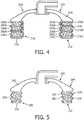
- Interface device 204 in accordance with a third embodiment is depicted in FIGS. 3 and 4 .
- Interface device 204 is similar to interface device 4 in that it includes a support 224, a deformable portion 228, and an interface portion 232 that are configured in a fashion similar to those of interface device 4. It can be understood from FIGS. 3 and 4 , however, that deformable portion 228 includes a plurality of deformable elements that are arranged in separate portions which are indicated at the numerals 236A, 236B, and 236C.
- Support 224 includes a base 240 and further includes a pair of platforms 242A and 242B which are depicted as being oriented roughly parallel with base 240 yet being spaced therefrom.
- Deformable elements 236A are mutually interconnected and form a lattice structure that extends between base 240 and platform 242A, with such deformable elements 236A each having points of connection with face 240 that are spaced apart from one another and likewise having points of connection with platform 242A that are spaced apart from one another.
- deformable elements 246B are connected between platform 242A and platform 242B and are configured to be like deformable elements 236A.
- deformable elements 236C are similar to the deformable elements 236A and 236B, except that deformable elements 236C are connected between platform 242B and a wall 248 of interface portion 232.
- deformable portion 228 includes three separately configurable deformable sub-regions that are formed by deformable elements 236A, 236B, and 236C.
- the deformable sub-regions formed by deformable elements 236A, 236B, and 236C can be of different sizes, shapes, configurations, compliances, etc., and need not be equally coextensive about the perimeter of interface device 204, depending upon the needs of the particular application.
- interface portion 232 includes a barrier apparatus 256 that includes a plurality of barriers that are indicated at the numerals 260A, 260B, and 260C.
- Barriers 260A, 260B, and 260C are situated adjacent the pluralities of deformable elements 236A, 236B, and 236C, respectively, and are disconnected therefrom.
- Barrier apparatus 256 thus deforms separately from deformable portion 228 while being on the high pressure side of interface device 204, whereby barrier apparatus 256 resists the flowing of the flow of breathing gas or the exhaust thereof from patient 12 into the interstices of deformable portion 228.
- interface device 204 can be configured such that its various deformable sub-regions can be separately configured with different deformation characteristics that are suited to the needs of the particular application. It is also noted that a greater or lesser number of platforms and divisions of the deformable elements of deformable portion 228 can be provided depending upon the needs of the particular application. Other variations and advantages will be apparent.
- Interface device 304 in accordance with a fourth embodiment, falling within the scope of the present invention is depicted generally in FIG. 5 .
- Interface device 304 is similar to interface device 4 in that it includes a support 324, a deformable portion 328, and an interface portion 332 that are configured in a fashion similar to that of interface device 4.
- deformable portion 328 includes a plurality of deformable elements 336 that are mutually interconnected and form a lattice structure that is connected between a base 340 of support 324 and a wall 348 of interface portion 332, interface portion 332 additionally includes a barrier apparatus 356 having a barrier 360 that is connected with deformable elements 336.
- barrier 360 is formed by providing material within the interstices between some of the plurality of deformable element 336 in such a fashion that barrier 360 is formed at the high pressure side of deformable portion 328, which is at the inboard side of deformable portion 328. Barrier 360 thus resists the flow of breathing gas from flowing from the high pressure side of interface device 304 into the interstices between the plurality of deformable elements 336. In so doing, barrier 360 will deform together with the plurality of deformable elements 336, and thus the effect of barrier 360 on the deformation of the individual deformable elements 336 with which barrier 360 is connected, and vice-versa, must be considered in designing the overall deformation characteristics of interface device 304.
- barrier 360 extends along the entirety of the exterior of deformable portion 328 and thus can be said to serve as a membrane that encapsulates deformable elements 336 therein.
- barrier 360 may extend along less than the entirety of the exterior of deformable portion 328 to thereby only partially encapsulate deformable portion 328 therein.
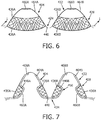
- Interface device 404 in accordance with a fifth embodiment is depicted in FIGS. 6 and 7 .
- Interface device 404 is similar to interface device 4 in that it includes a support 424, a deformable portion 428, and an interface portion 432 that are configured in a fashion similar to that of interface device 4. It can be seen, however, that interface device 404 is a nasal pillows cushion type of device that is intended to be received in or against the nostrils of nose 20 of patient 12.
- deformable portion 428 can be said to include a plurality of deformable elements that are divided into two separate sets of deformable elements that are indicated at the numerals 436A and 436B.
- Deformable elements 436A are mutually interconnected and form a lattice structure
- deformable elements 436B are likewise mutually interconnected and form another lattice structure.
- Support 424 includes a base 440
- interface portion 432 includes a pair of walls that are indicated at the numerals 448A and 448B.
- interface portion 432 additionally includes a barrier apparatus 456 having a pair of barriers that are indicated at the numerals 460A and 460B.
- barriers 460A and 460B are situated on base 440, and walls 448A and 448B are situated on barriers 460A and 460B, respectively.
- Deformable elements 436A are connected with base 440, wall 448, and barrier 460A at a plurality of connection points that are spaced apart from one another.
- deformable elements 436B are connected with base 440, wall 448B, and barrier 460B at a plurality of connection points that are spaced apart from one another.
- interface portion 432 further includes a pair of nozzles 464A and 464B that are situated on walls 448A and 448B, respectively, and that have a pair of openings 468A and 468B, respectively, formed therein.
- Nozzles 464A and 464B are of an approximately conic shape and are configured to engage the nostrils of patient 12 in nose 20.
- nozzles 464A and 464B Such deformation characteristics of nozzles 464A and 464B is provided by configuring deformable elements 436A and 436B to have appropriate deformation characteristics, which thereby provides enhanced fit and superior comfort when engaging the nostrils of nose 20. Other variations and advantages will be apparent.
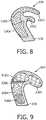
- FIG. 8 An interface device 504 in accordance with a sixth embodiment is depicted generally in FIG. 8 .
- Interface device 504 is similar to interface device 4 in that it includes a support, a deformable portion, and an interface portion in a fashion similar to interface device 4, and it is expressly noted that interface device 504 is intended to illustrate the further variability with which a plurality of deformable elements can be provided.
- FIG. 8 depicts at least four regions of deformable elements that are indicated at the numerals 536A, 536B, 536C, and 536D, which may be collectively or individually referred to herein with the numeral 536, all of which are situated at different locations on a solid portion 538 of the support. That is, deformable elements 536A, 536B, 536C, and 536D are all formed with interstices therebetween whereas solid portion 538 generally does not have such interstices.
- the deformable elements 536A are mutually interconnected and form a lattice structure that is situated adjacent a lattice structure that is formed by the mutually interconnected deformable elements 536B.
- Deformable elements 536C and 536D are each mutually interconnected to form a lattice structure and are each situated on other portions of solid portion 538.
- the variation deformation characteristics of deformable elements 536A, 536B, 536C, and 536D are selected and are customizable according to the needs of the particular application to provide enhanced comfort and fit for patient 12.
- deformable elements 536A form a first deformable portion having different compliance characteristics than a second deformable portion that is formed by deformable element 536B.
- Such different compliance characteristics can be achieved through the use of different materials to form the deformable elements 536A and 536B and/or by configuring the deformable elements to have different physical dimensions such as length, cross-sectional dimensions, density (i.e., spacing with respect to one another), and the like.
- the first deformable portion formed by deformable elements 536A and the second deformable portion formed by deformable elements 536B need not have a wall between them, and rather deformable elements 536A can be directly connected with deformable elements 536B.
- the lattice structures formed by deformable elements 536A and the lattice structures formed by deformable elements 536B can be distinctly different in form and can still be situated adjacent one another without requiring an intervening wall structure to which both are connected. Rather, the lattice structures formed by deformable elements 536A and the lattice structures formed by deformable elements 536B can be directly connected together by directly connecting certain of deformable elements 536A together with certain of deformable elements 536B during the additive manufacturing formation process. As such, it can be understood that multiple different lattice structures can be directly connected together during manufacture to achieve customized physical characteristics.
- Interface device 604 in accordance with a seventh embodiment is depicted generally in FIG. 9 .
- Interface device 604 is similar to interface device 504 except that it includes five different sets of deformable elements 636A, 636B, 636C, 636D, and 636E, which may be collectively or individually referred to herein with the numeral 636, and all of which are situated at various locations on a solid portion 638 of the support.
- the arrangement of the sets of deformable elements 636 is completely different than the arrangement of the sets of deformable elements 536, and FIGS. 8 and 9 are thus intended to illustrate how the various configurations of the various deformable elements can be customized to meet the demands of any particular application with respect to desired distribution of compliance characteristics and the like in any advantageous fashion.
- FIGS. 10A and 10B An interface device 704 in accordance with an eighth embodiment is depicted generally in FIGS. 10A and 10B . More specifically, FIG. 10A depicts a solid portion 736 of a support of interface device 704, and FIG. 10B depicts four sets of deformable elements 736A, 736B, 736C, and 736D that are depicted in different arrangements on solid portion 738. Likewise, an interface device 804 in accordance with a ninth embodiment is depicted generally in FIGS. 11A and 11B . That is, a solid portion 838 of interface device 804 is depicted in FIG. 11A, and FIG. 11B additionally depicts three sets of deformable elements 836A, 836B, and 836C situated at different locations on solid portion 838. Interface devices 704 and 804 further illustrate the variability with which the deformable portions can be configured to provide customized compliance characteristics that are suited to individual patients or to classes of patients depending upon the needs of the particular application.
- solid portions 538, 638, 738, and 838 can be formed of relatively rigid structures such as PVC and the like or can be formed of relatively compliant materials such as polymer foam or other such materials.
- the various deformable elements that are provided at the various locations on interface devices 504, 604, 704, and 804 can be selected to have compliance properties that are suited to the needs of individual patients or to classes of patients and that thus enable such interface devices to have improved fit and function, both of which are desirable. Other variations and advantages will be apparent.
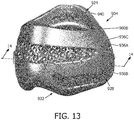
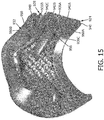
- Interface device 904 in accordance with a tenth embodiment is depicted generally in FIGS. 12-15 .
- Interface device 904 is similar to interface device 4 in that it includes a support 924, a deformable portion 928, and an interface portion 932 that are configured in a fashion similar to that of interface device 4.
- Support 924 can be said to include a base 940, and to further include a plurality of platforms 942A, 942B, and 942C that are not necessarily oriented parallel with base 940 or with one another and rather are at various orientations with respect thereto, interface portion 932 can be said to include a wall 948, a flap 950, and a barrier apparatus 956.
- Barrier apparatus 956 can be said to include a pair of barriers that are indicated at the numerals 960A and 960B.
- the deformable portion 928 can be said to include a plurality of deformable elements that are, in the depicted exemplary embodiment, described herein in an exemplary fashion as being in three sets that are indicated at the numerals 936A, 936B, and 936C.
- the barrier 960A can be said to extend between and/or to include platforms 942A and 942B.
- barrier 960B can be said to extend between and/or to include platform 942C and wall 948.
- Deformable elements 936A can be said to be connected with barrier 960A and to further be connected with platforms 942A and 942B.
- deformable elements 936B can be said to be connected with and to extend between platform 942C, barrier 960B, and wall 948.
- Deformable elements 936C are elsewhere situated on interface device 4 at the high pressure side thereof.
- the various deformable elements 936A, 936B, and 936C are connected with the various structures of support 924 and interface portion 932 at a plurality of spaced apart connection points and are, at least in part, mutually interconnected with one another to form a lattice structure.
- the various deformable elements 936A, 936B, and 936C of deformable portion 928 are co-formed with support 924 and interface portion 932 such that interface device 904 is integrally formed as a single piece unitary structure.
- the configuration of the various deformable elements of deformable portion 928 can be selected as needed to provide customized compliance characteristics that are suited to the needs of any particular application.
- barrier apparatus 956 is depicted herein as providing a barrier that resists the flow of breathing gas from flowing through the wall thereof and to the exterior of interface device 904, it is understood that in other embodiments certain portions of deformable portion 928 can be configured to permit the flow of breathing gas and/or the exhalation thereof to flow through the interstices thereof for exhaust purposes or for other purposes depending upon the needs of the particular application.
- barriers 960A and 960B and platforms 942A, 942B, and 942C may themselves be complaint deformable structures whose deformation characteristics can be custom configured to suit the particular needs presented by the shape of the face of patient 12 and/or other needs.
- interface device 904 can be formed using an additive manufacturing process and likely is formed out of a polymer or other appropriately deformable material as a unitary single piece structure, but other configurations are possible.
- flap 950 engages the face of patient 12 in the vicinity of mouth 16 and nose 20, and deformable elements 936C are configured to provide desirable levels of tensile and compressive compliance in order to provide an improved fit and thus improved functionality of interface device 904 with patient 12. It can further be seen that flap 950 is advantageously configured to conform to the shape of the face of patient 12 in the vicinity of the airways, and some of the deformable elements 936C extend between and are connected with wall 948 and flap 950 in a fashion to provide desirable deformation characteristics therebetween.
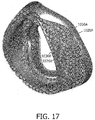
- Interface device 1004 in accordance with an eleventh embodiment is depicted generally in FIGS. 16-17 .
- Interface device 1004 is similar to interface device 4 in that it includes a support 1024, a deformable portion 1028, and an interface portion 1032 that are configured in a fashion similar to that of interface device 4.
- Deformable portion 1028 can be said to include a first deformable portion 1028A that is formed by a plurality of deformable elements 1036A and a second deformable portion 1028B that is formed by a plurality of deformable elements 1036B.
- the exemplary first deformable portion 1028A has different compliance properties than second deformable portion 1028B, and this is due at least in part to the fact that deformable elements 1036A are generally each of a longer length than deformable elements 1036B.
- different materials can be employed in forming first and second deformable portions 1028A and 1028B, and/or other differences can exist therebetween.
- first and second deformable portions 1028A and 1028B being distinctly different in form, certain of deformable elements 1036A are directly connected with certain of deformable elements 1036B. As such, first and second deformable portions 1028A and 1028B can be directly connected together without requiring an intervening wall or other structure to enable such connection. This is accomplished through careful design of deformable portion 1028 such that certain of deformable elements 1036A are directly connected with certain of deformable elements 1036B.
Landscapes
- Health & Medical Sciences (AREA)
- Engineering & Computer Science (AREA)
- Life Sciences & Earth Sciences (AREA)
- Animal Behavior & Ethology (AREA)
- Anesthesiology (AREA)
- Biomedical Technology (AREA)
- Heart & Thoracic Surgery (AREA)
- Hematology (AREA)
- Emergency Medicine (AREA)
- Pulmonology (AREA)
- General Health & Medical Sciences (AREA)
- Public Health (AREA)
- Veterinary Medicine (AREA)
- Chemical & Material Sciences (AREA)
- Manufacturing & Machinery (AREA)
- Materials Engineering (AREA)
- Orthopedics, Nursing, And Contraception (AREA)
Applications Claiming Priority (2)
| Application Number | Priority Date | Filing Date | Title |
|---|---|---|---|
| US201662403935P | 2016-10-04 | 2016-10-04 | |
| PCT/EP2017/075270 WO2018065500A1 (en) | 2016-10-04 | 2017-10-04 | Interface device formable by additive manufacturing process |
Publications (2)
| Publication Number | Publication Date |
|---|---|
| EP3522965A1 EP3522965A1 (en) | 2019-08-14 |
| EP3522965B1 true EP3522965B1 (en) | 2020-07-22 |
Family
ID=60083962
Family Applications (1)
| Application Number | Title | Priority Date | Filing Date |
|---|---|---|---|
| EP17784247.3A Active EP3522965B1 (en) | 2016-10-04 | 2017-10-04 | Interface device formable by additive manufacturing process |
Country Status (5)
| Country | Link |
|---|---|
| US (1) | US11590309B2 (https=) |
| EP (1) | EP3522965B1 (https=) |
| JP (1) | JP7442317B2 (https=) |
| CN (1) | CN109803705A (https=) |
| WO (1) | WO2018065500A1 (https=) |
Families Citing this family (4)
| Publication number | Priority date | Publication date | Assignee | Title |
|---|---|---|---|---|
| KR102461120B1 (ko) | 2018-12-07 | 2022-10-28 | 주식회사 엘지화학 | 고흡수성 수지의 제조 방법 |
| US20230144471A1 (en) * | 2020-05-22 | 2023-05-11 | Hewlett-Packard Development Company, L.P. | Mask arranged to flex about median plane |
| GB2598158B (en) * | 2020-08-21 | 2025-02-12 | Intersurgical Ag | Improvements relating to sealing members |
| EP4554643A1 (en) * | 2022-07-14 | 2025-05-21 | ResMed Pty Ltd | Patient interface and cushion thereof |
Family Cites Families (17)
| Publication number | Priority date | Publication date | Assignee | Title |
|---|---|---|---|---|
| WO2005123166A1 (en) * | 2004-06-16 | 2005-12-29 | Resmed Limited | Cushion for a respiratory mask assembly |
| US8371293B2 (en) * | 2005-12-16 | 2013-02-12 | Resmed Limited | Bladder cushion, forehead cushion, headgear straps, headgear cap and/or chinstrap |
| US9132255B2 (en) * | 2007-11-15 | 2015-09-15 | Resmed Limited | Cushioning structure |
| JP2012515562A (ja) * | 2008-01-22 | 2012-07-12 | アールアイシー・インベストメンツ・エルエルシー | 呼吸フェースマスク |
| WO2009151344A1 (en) * | 2008-06-12 | 2009-12-17 | Fisher & Paykel Healthcare Limited | Respiratory nasal interface with sealing cap portions |
| NZ617661A (en) * | 2009-05-29 | 2015-05-29 | Resmed Ltd | Nasal mask system |
| US10238825B2 (en) | 2009-07-07 | 2019-03-26 | Resmed Limited | Cushion assembly for a respiratory mask |
| JP6226745B2 (ja) | 2010-08-27 | 2017-11-08 | コーニンクレッカ フィリップス エヌ ヴェKoninklijke Philips N.V. | 患者インターフェース装置 |
| DE102010040261A1 (de) * | 2010-09-03 | 2012-03-08 | Eos Gmbh Electro Optical Systems | Verfahren zum Herstellen eines dreidimensionalen Objekts mit einer internen Struktur |
| CN111467636B (zh) | 2011-07-12 | 2023-02-17 | 瑞思迈私人有限公司 | 纺织物面罩系统 |
| GB201113506D0 (en) * | 2011-08-05 | 2011-09-21 | Materialise Nv | Impregnated lattice structure |
| CN104066473B (zh) * | 2012-01-16 | 2017-06-30 | 皇家飞利浦有限公司 | 具有用于为用户提供低摩擦和改善的舒适度的工程化表面的患者界面装置 |
| US20150136139A1 (en) * | 2012-05-10 | 2015-05-21 | Koninklijke Philips N.V. | Patient interface device including deformable nasal prong |
| US20160184538A1 (en) * | 2013-08-12 | 2016-06-30 | Koninklijke Philips N.V. | Detecting the fit of a patient interface device |
| US10463823B2 (en) * | 2014-03-10 | 2019-11-05 | Morpheus Medical Solutions, LLC | Facial mask and method of making |
| CN107106804B (zh) * | 2014-12-18 | 2020-06-05 | 皇家飞利浦有限公司 | 患者界面装置中的适应性屈曲构件 |
| WO2017142568A1 (en) * | 2016-03-30 | 2017-08-24 | Human Design Medical, Llc | Facial mask with internal intermediate maxilla support for use with ventilation and positive air pressure systems |
-
2017
- 2017-10-04 WO PCT/EP2017/075270 patent/WO2018065500A1/en not_active Ceased
- 2017-10-04 JP JP2019508238A patent/JP7442317B2/ja active Active
- 2017-10-04 US US16/339,183 patent/US11590309B2/en active Active
- 2017-10-04 CN CN201780061943.7A patent/CN109803705A/zh active Pending
- 2017-10-04 EP EP17784247.3A patent/EP3522965B1/en active Active
Non-Patent Citations (1)
| Title |
|---|
| None * |
Also Published As
| Publication number | Publication date |
|---|---|
| JP7442317B2 (ja) | 2024-03-04 |
| JP2019528821A (ja) | 2019-10-17 |
| WO2018065500A1 (en) | 2018-04-12 |
| US11590309B2 (en) | 2023-02-28 |
| CN109803705A (zh) | 2019-05-24 |
| EP3522965A1 (en) | 2019-08-14 |
| US20190307980A1 (en) | 2019-10-10 |
Similar Documents
| Publication | Publication Date | Title |
|---|---|---|
| EP2552527B1 (en) | Respiratory mask with ribbed contacting surface | |
| EP2968820B1 (en) | Subnasal sealing cushion | |
| JP6509816B2 (ja) | 患者インタフェース装置 | |
| EP3522965B1 (en) | Interface device formable by additive manufacturing process | |
| CN103974738B (zh) | 具有可调整稳定构件的衬垫 | |
| CN106215297B (zh) | 呼吸面具 | |
| EP2838618B1 (en) | Gas carrying headgear with porous exhalation portions | |
| EP3082925B1 (en) | Customizable facial sealing segment for respiratory device and method of customizing | |
| CN101370557B (zh) | 带有缓冲垫的患者接口装置 | |
| CN102834137B (zh) | 可更换鼻枕套装 | |
| WO2013041996A2 (en) | Patient interface with expandable nasal prongs | |
| WO2013084109A1 (en) | Cushion assembly having compression dampening portion | |
| AU2011234068A1 (en) | Respiratory mask with ribbed contacting surface | |
| US20150128949A1 (en) | Patient interface device having headgear providing integrated gas flow and delivery | |
| WO2013175409A1 (en) | Headgear and patient interface device employing same | |
| US20140196720A1 (en) | Nasal cushion including a confortable septum/nare seal | |
| EP3202449B1 (en) | Elbow connector assembly with anti-asphyxia valve structure for respiratory mask | |
| WO2015063676A1 (en) | Convertible patient interface device | |
| EP3463537B1 (en) | Cushion member and method of manufacturing same | |
| US20210128862A1 (en) | Cushion with buckling prevention structure | |
| US20180207387A1 (en) | Fluid coupling conduit for a patient interface device | |
| TWM633262U (zh) | 額墊及患者介面 |
Legal Events
| Date | Code | Title | Description |
|---|---|---|---|
| STAA | Information on the status of an ep patent application or granted ep patent |
Free format text: STATUS: UNKNOWN |
|
| STAA | Information on the status of an ep patent application or granted ep patent |
Free format text: STATUS: THE INTERNATIONAL PUBLICATION HAS BEEN MADE |
|
| PUAI | Public reference made under article 153(3) epc to a published international application that has entered the european phase |
Free format text: ORIGINAL CODE: 0009012 |
|
| STAA | Information on the status of an ep patent application or granted ep patent |
Free format text: STATUS: REQUEST FOR EXAMINATION WAS MADE |
|
| 17P | Request for examination filed |
Effective date: 20190506 |
|
| AK | Designated contracting states |
Kind code of ref document: A1 Designated state(s): AL AT BE BG CH CY CZ DE DK EE ES FI FR GB GR HR HU IE IS IT LI LT LU LV MC MK MT NL NO PL PT RO RS SE SI SK SM TR |
|
| AX | Request for extension of the european patent |
Extension state: BA ME |
|
| DAV | Request for validation of the european patent (deleted) | ||
| DAX | Request for extension of the european patent (deleted) | ||
| GRAP | Despatch of communication of intention to grant a patent |
Free format text: ORIGINAL CODE: EPIDOSNIGR1 |
|
| STAA | Information on the status of an ep patent application or granted ep patent |
Free format text: STATUS: GRANT OF PATENT IS INTENDED |
|
| INTG | Intention to grant announced |
Effective date: 20200211 |
|
| RAP1 | Party data changed (applicant data changed or rights of an application transferred) |
Owner name: KONINKLIJKE PHILIPS N.V. |
|
| GRAS | Grant fee paid |
Free format text: ORIGINAL CODE: EPIDOSNIGR3 |
|
| GRAA | (expected) grant |
Free format text: ORIGINAL CODE: 0009210 |
|
| STAA | Information on the status of an ep patent application or granted ep patent |
Free format text: STATUS: THE PATENT HAS BEEN GRANTED |
|
| AK | Designated contracting states |
Kind code of ref document: B1 Designated state(s): AL AT BE BG CH CY CZ DE DK EE ES FI FR GB GR HR HU IE IS IT LI LT LU LV MC MK MT NL NO PL PT RO RS SE SI SK SM TR |
|
| REG | Reference to a national code |
Ref country code: GB Ref legal event code: FG4D |
|
| REG | Reference to a national code |
Ref country code: CH Ref legal event code: EP |
|
| REG | Reference to a national code |
Ref country code: DE Ref legal event code: R096 Ref document number: 602017020285 Country of ref document: DE |
|
| REG | Reference to a national code |
Ref country code: AT Ref legal event code: REF Ref document number: 1292834 Country of ref document: AT Kind code of ref document: T Effective date: 20200815 |
|
| REG | Reference to a national code |
Ref country code: IE Ref legal event code: FG4D |
|
| REG | Reference to a national code |
Ref country code: LT Ref legal event code: MG4D |
|
| REG | Reference to a national code |
Ref country code: AT Ref legal event code: MK05 Ref document number: 1292834 Country of ref document: AT Kind code of ref document: T Effective date: 20200722 |
|
| PG25 | Lapsed in a contracting state [announced via postgrant information from national office to epo] |
Ref country code: AT Free format text: LAPSE BECAUSE OF FAILURE TO SUBMIT A TRANSLATION OF THE DESCRIPTION OR TO PAY THE FEE WITHIN THE PRESCRIBED TIME-LIMIT Effective date: 20200722 Ref country code: BG Free format text: LAPSE BECAUSE OF FAILURE TO SUBMIT A TRANSLATION OF THE DESCRIPTION OR TO PAY THE FEE WITHIN THE PRESCRIBED TIME-LIMIT Effective date: 20201022 Ref country code: HR Free format text: LAPSE BECAUSE OF FAILURE TO SUBMIT A TRANSLATION OF THE DESCRIPTION OR TO PAY THE FEE WITHIN THE PRESCRIBED TIME-LIMIT Effective date: 20200722 Ref country code: LT Free format text: LAPSE BECAUSE OF FAILURE TO SUBMIT A TRANSLATION OF THE DESCRIPTION OR TO PAY THE FEE WITHIN THE PRESCRIBED TIME-LIMIT Effective date: 20200722 Ref country code: NO Free format text: LAPSE BECAUSE OF FAILURE TO SUBMIT A TRANSLATION OF THE DESCRIPTION OR TO PAY THE FEE WITHIN THE PRESCRIBED TIME-LIMIT Effective date: 20201022 Ref country code: GR Free format text: LAPSE BECAUSE OF FAILURE TO SUBMIT A TRANSLATION OF THE DESCRIPTION OR TO PAY THE FEE WITHIN THE PRESCRIBED TIME-LIMIT Effective date: 20201023 Ref country code: FI Free format text: LAPSE BECAUSE OF FAILURE TO SUBMIT A TRANSLATION OF THE DESCRIPTION OR TO PAY THE FEE WITHIN THE PRESCRIBED TIME-LIMIT Effective date: 20200722 Ref country code: SE Free format text: LAPSE BECAUSE OF FAILURE TO SUBMIT A TRANSLATION OF THE DESCRIPTION OR TO PAY THE FEE WITHIN THE PRESCRIBED TIME-LIMIT Effective date: 20200722 Ref country code: ES Free format text: LAPSE BECAUSE OF FAILURE TO SUBMIT A TRANSLATION OF THE DESCRIPTION OR TO PAY THE FEE WITHIN THE PRESCRIBED TIME-LIMIT Effective date: 20200722 Ref country code: PT Free format text: LAPSE BECAUSE OF FAILURE TO SUBMIT A TRANSLATION OF THE DESCRIPTION OR TO PAY THE FEE WITHIN THE PRESCRIBED TIME-LIMIT Effective date: 20201123 |
|
| PG25 | Lapsed in a contracting state [announced via postgrant information from national office to epo] |
Ref country code: LV Free format text: LAPSE BECAUSE OF FAILURE TO SUBMIT A TRANSLATION OF THE DESCRIPTION OR TO PAY THE FEE WITHIN THE PRESCRIBED TIME-LIMIT Effective date: 20200722 Ref country code: PL Free format text: LAPSE BECAUSE OF FAILURE TO SUBMIT A TRANSLATION OF THE DESCRIPTION OR TO PAY THE FEE WITHIN THE PRESCRIBED TIME-LIMIT Effective date: 20200722 Ref country code: RS Free format text: LAPSE BECAUSE OF FAILURE TO SUBMIT A TRANSLATION OF THE DESCRIPTION OR TO PAY THE FEE WITHIN THE PRESCRIBED TIME-LIMIT Effective date: 20200722 Ref country code: IS Free format text: LAPSE BECAUSE OF FAILURE TO SUBMIT A TRANSLATION OF THE DESCRIPTION OR TO PAY THE FEE WITHIN THE PRESCRIBED TIME-LIMIT Effective date: 20201122 |
|
| PG25 | Lapsed in a contracting state [announced via postgrant information from national office to epo] |
Ref country code: NL Free format text: LAPSE BECAUSE OF FAILURE TO SUBMIT A TRANSLATION OF THE DESCRIPTION OR TO PAY THE FEE WITHIN THE PRESCRIBED TIME-LIMIT Effective date: 20200722 |
|
| REG | Reference to a national code |
Ref country code: DE Ref legal event code: R097 Ref document number: 602017020285 Country of ref document: DE |
|
| PG25 | Lapsed in a contracting state [announced via postgrant information from national office to epo] |
Ref country code: EE Free format text: LAPSE BECAUSE OF FAILURE TO SUBMIT A TRANSLATION OF THE DESCRIPTION OR TO PAY THE FEE WITHIN THE PRESCRIBED TIME-LIMIT Effective date: 20200722 Ref country code: RO Free format text: LAPSE BECAUSE OF FAILURE TO SUBMIT A TRANSLATION OF THE DESCRIPTION OR TO PAY THE FEE WITHIN THE PRESCRIBED TIME-LIMIT Effective date: 20200722 Ref country code: DK Free format text: LAPSE BECAUSE OF FAILURE TO SUBMIT A TRANSLATION OF THE DESCRIPTION OR TO PAY THE FEE WITHIN THE PRESCRIBED TIME-LIMIT Effective date: 20200722 Ref country code: CZ Free format text: LAPSE BECAUSE OF FAILURE TO SUBMIT A TRANSLATION OF THE DESCRIPTION OR TO PAY THE FEE WITHIN THE PRESCRIBED TIME-LIMIT Effective date: 20200722 Ref country code: SM Free format text: LAPSE BECAUSE OF FAILURE TO SUBMIT A TRANSLATION OF THE DESCRIPTION OR TO PAY THE FEE WITHIN THE PRESCRIBED TIME-LIMIT Effective date: 20200722 Ref country code: IT Free format text: LAPSE BECAUSE OF FAILURE TO SUBMIT A TRANSLATION OF THE DESCRIPTION OR TO PAY THE FEE WITHIN THE PRESCRIBED TIME-LIMIT Effective date: 20200722 |
|
| PLBE | No opposition filed within time limit |
Free format text: ORIGINAL CODE: 0009261 |
|
| STAA | Information on the status of an ep patent application or granted ep patent |
Free format text: STATUS: NO OPPOSITION FILED WITHIN TIME LIMIT |
|
| PG25 | Lapsed in a contracting state [announced via postgrant information from national office to epo] |
Ref country code: AL Free format text: LAPSE BECAUSE OF FAILURE TO SUBMIT A TRANSLATION OF THE DESCRIPTION OR TO PAY THE FEE WITHIN THE PRESCRIBED TIME-LIMIT Effective date: 20200722 |
|
| REG | Reference to a national code |
Ref country code: CH Ref legal event code: PL |
|
| 26N | No opposition filed |
Effective date: 20210423 |
|
| PG25 | Lapsed in a contracting state [announced via postgrant information from national office to epo] |
Ref country code: LU Free format text: LAPSE BECAUSE OF NON-PAYMENT OF DUE FEES Effective date: 20201004 Ref country code: SK Free format text: LAPSE BECAUSE OF FAILURE TO SUBMIT A TRANSLATION OF THE DESCRIPTION OR TO PAY THE FEE WITHIN THE PRESCRIBED TIME-LIMIT Effective date: 20200722 Ref country code: MC Free format text: LAPSE BECAUSE OF FAILURE TO SUBMIT A TRANSLATION OF THE DESCRIPTION OR TO PAY THE FEE WITHIN THE PRESCRIBED TIME-LIMIT Effective date: 20200722 |
|
| REG | Reference to a national code |
Ref country code: BE Ref legal event code: MM Effective date: 20201031 |
|
| PG25 | Lapsed in a contracting state [announced via postgrant information from national office to epo] |
Ref country code: CH Free format text: LAPSE BECAUSE OF NON-PAYMENT OF DUE FEES Effective date: 20201031 Ref country code: BE Free format text: LAPSE BECAUSE OF NON-PAYMENT OF DUE FEES Effective date: 20201031 Ref country code: SI Free format text: LAPSE BECAUSE OF FAILURE TO SUBMIT A TRANSLATION OF THE DESCRIPTION OR TO PAY THE FEE WITHIN THE PRESCRIBED TIME-LIMIT Effective date: 20200722 Ref country code: LI Free format text: LAPSE BECAUSE OF NON-PAYMENT OF DUE FEES Effective date: 20201031 |
|
| REG | Reference to a national code |
Ref country code: NL Ref legal event code: MP Effective date: 20200722 |
|
| PG25 | Lapsed in a contracting state [announced via postgrant information from national office to epo] |
Ref country code: IE Free format text: LAPSE BECAUSE OF NON-PAYMENT OF DUE FEES Effective date: 20201004 |
|
| PG25 | Lapsed in a contracting state [announced via postgrant information from national office to epo] |
Ref country code: TR Free format text: LAPSE BECAUSE OF FAILURE TO SUBMIT A TRANSLATION OF THE DESCRIPTION OR TO PAY THE FEE WITHIN THE PRESCRIBED TIME-LIMIT Effective date: 20200722 Ref country code: MT Free format text: LAPSE BECAUSE OF FAILURE TO SUBMIT A TRANSLATION OF THE DESCRIPTION OR TO PAY THE FEE WITHIN THE PRESCRIBED TIME-LIMIT Effective date: 20200722 Ref country code: CY Free format text: LAPSE BECAUSE OF FAILURE TO SUBMIT A TRANSLATION OF THE DESCRIPTION OR TO PAY THE FEE WITHIN THE PRESCRIBED TIME-LIMIT Effective date: 20200722 |
|
| GBPC | Gb: european patent ceased through non-payment of renewal fee |
Effective date: 20211004 |
|
| PG25 | Lapsed in a contracting state [announced via postgrant information from national office to epo] |
Ref country code: MK Free format text: LAPSE BECAUSE OF FAILURE TO SUBMIT A TRANSLATION OF THE DESCRIPTION OR TO PAY THE FEE WITHIN THE PRESCRIBED TIME-LIMIT Effective date: 20200722 |
|
| PG25 | Lapsed in a contracting state [announced via postgrant information from national office to epo] |
Ref country code: GB Free format text: LAPSE BECAUSE OF NON-PAYMENT OF DUE FEES Effective date: 20211004 |
|
| PGFP | Annual fee paid to national office [announced via postgrant information from national office to epo] |
Ref country code: DE Payment date: 20251028 Year of fee payment: 9 |
|
| PGFP | Annual fee paid to national office [announced via postgrant information from national office to epo] |
Ref country code: FR Payment date: 20251027 Year of fee payment: 9 |