EP3522173A1 - System mit vitaldatensensor und auswertungseinheit - Google Patents
System mit vitaldatensensor und auswertungseinheit Download PDFInfo
- Publication number
- EP3522173A1 EP3522173A1 EP18154688.8A EP18154688A EP3522173A1 EP 3522173 A1 EP3522173 A1 EP 3522173A1 EP 18154688 A EP18154688 A EP 18154688A EP 3522173 A1 EP3522173 A1 EP 3522173A1
- Authority
- EP
- European Patent Office
- Prior art keywords
- time
- state
- change
- evaluation unit
- sensor
- Prior art date
- Legal status (The legal status is an assumption and is not a legal conclusion. Google has not performed a legal analysis and makes no representation as to the accuracy of the status listed.)
- Granted
Links
Images

Classifications
-
- A—HUMAN NECESSITIES
- A61—MEDICAL OR VETERINARY SCIENCE; HYGIENE
- A61B—DIAGNOSIS; SURGERY; IDENTIFICATION
- A61B5/00—Measuring for diagnostic purposes; Identification of persons
- A61B5/48—Other medical applications
- A61B5/4806—Sleep evaluation
- A61B5/4809—Sleep detection, i.e. determining whether a subject is asleep or not
-
- A—HUMAN NECESSITIES
- A61—MEDICAL OR VETERINARY SCIENCE; HYGIENE
- A61B—DIAGNOSIS; SURGERY; IDENTIFICATION
- A61B3/00—Apparatus for testing the eyes; Instruments for examining the eyes
- A61B3/10—Objective types, i.e. instruments for examining the eyes independent of the patients' perceptions or reactions
- A61B3/11—Objective types, i.e. instruments for examining the eyes independent of the patients' perceptions or reactions for measuring interpupillary distance or diameter of pupils
-
- A—HUMAN NECESSITIES
- A61—MEDICAL OR VETERINARY SCIENCE; HYGIENE
- A61B—DIAGNOSIS; SURGERY; IDENTIFICATION
- A61B5/00—Measuring for diagnostic purposes; Identification of persons
- A61B5/0002—Remote monitoring of patients using telemetry, e.g. transmission of vital signals via a communication network
- A61B5/0004—Remote monitoring of patients using telemetry, e.g. transmission of vital signals via a communication network characterised by the type of physiological signal transmitted
- A61B5/0008—Temperature signals
-
- A—HUMAN NECESSITIES
- A61—MEDICAL OR VETERINARY SCIENCE; HYGIENE
- A61B—DIAGNOSIS; SURGERY; IDENTIFICATION
- A61B5/00—Measuring for diagnostic purposes; Identification of persons
- A61B5/01—Measuring temperature of body parts ; Diagnostic temperature sensing, e.g. for malignant or inflamed tissue
-
- A—HUMAN NECESSITIES
- A61—MEDICAL OR VETERINARY SCIENCE; HYGIENE
- A61B—DIAGNOSIS; SURGERY; IDENTIFICATION
- A61B5/00—Measuring for diagnostic purposes; Identification of persons
- A61B5/02—Detecting, measuring or recording for evaluating the cardiovascular system, e.g. pulse, heart rate, blood pressure or blood flow
- A61B5/0205—Simultaneously evaluating both cardiovascular conditions and different types of body conditions, e.g. heart and respiratory condition
-
- A—HUMAN NECESSITIES
- A61—MEDICAL OR VETERINARY SCIENCE; HYGIENE
- A61B—DIAGNOSIS; SURGERY; IDENTIFICATION
- A61B5/00—Measuring for diagnostic purposes; Identification of persons
- A61B5/02—Detecting, measuring or recording for evaluating the cardiovascular system, e.g. pulse, heart rate, blood pressure or blood flow
- A61B5/0205—Simultaneously evaluating both cardiovascular conditions and different types of body conditions, e.g. heart and respiratory condition
- A61B5/02055—Simultaneously evaluating both cardiovascular condition and temperature
-
- A—HUMAN NECESSITIES
- A61—MEDICAL OR VETERINARY SCIENCE; HYGIENE
- A61B—DIAGNOSIS; SURGERY; IDENTIFICATION
- A61B5/00—Measuring for diagnostic purposes; Identification of persons
- A61B5/103—Measuring devices for testing the shape, pattern, colour, size or movement of the body or parts thereof, for diagnostic purposes
- A61B5/11—Measuring movement of the entire body or parts thereof, e.g. head or hand tremor or mobility of a limb
-
- A—HUMAN NECESSITIES
- A61—MEDICAL OR VETERINARY SCIENCE; HYGIENE
- A61B—DIAGNOSIS; SURGERY; IDENTIFICATION
- A61B5/00—Measuring for diagnostic purposes; Identification of persons
- A61B5/103—Measuring devices for testing the shape, pattern, colour, size or movement of the body or parts thereof, for diagnostic purposes
- A61B5/11—Measuring movement of the entire body or parts thereof, e.g. head or hand tremor or mobility of a limb
- A61B5/1103—Detecting muscular movement of the eye, e.g. eyelid movement
-
- A—HUMAN NECESSITIES
- A61—MEDICAL OR VETERINARY SCIENCE; HYGIENE
- A61B—DIAGNOSIS; SURGERY; IDENTIFICATION
- A61B5/00—Measuring for diagnostic purposes; Identification of persons
- A61B5/103—Measuring devices for testing the shape, pattern, colour, size or movement of the body or parts thereof, for diagnostic purposes
- A61B5/11—Measuring movement of the entire body or parts thereof, e.g. head or hand tremor or mobility of a limb
- A61B5/1113—Local tracking of patients, e.g. in a hospital or private home
-
- A—HUMAN NECESSITIES
- A61—MEDICAL OR VETERINARY SCIENCE; HYGIENE
- A61B—DIAGNOSIS; SURGERY; IDENTIFICATION
- A61B5/00—Measuring for diagnostic purposes; Identification of persons
- A61B5/103—Measuring devices for testing the shape, pattern, colour, size or movement of the body or parts thereof, for diagnostic purposes
- A61B5/11—Measuring movement of the entire body or parts thereof, e.g. head or hand tremor or mobility of a limb
- A61B5/1116—Determining posture transitions
-
- A—HUMAN NECESSITIES
- A61—MEDICAL OR VETERINARY SCIENCE; HYGIENE
- A61B—DIAGNOSIS; SURGERY; IDENTIFICATION
- A61B5/00—Measuring for diagnostic purposes; Identification of persons
- A61B5/103—Measuring devices for testing the shape, pattern, colour, size or movement of the body or parts thereof, for diagnostic purposes
- A61B5/11—Measuring movement of the entire body or parts thereof, e.g. head or hand tremor or mobility of a limb
- A61B5/1118—Determining activity level
-
- A—HUMAN NECESSITIES
- A61—MEDICAL OR VETERINARY SCIENCE; HYGIENE
- A61B—DIAGNOSIS; SURGERY; IDENTIFICATION
- A61B5/00—Measuring for diagnostic purposes; Identification of persons
- A61B5/145—Measuring characteristics of blood in vivo, e.g. gas concentration or pH-value ; Measuring characteristics of body fluids or tissues, e.g. interstitial fluid or cerebral tissue
- A61B5/14532—Measuring characteristics of blood in vivo, e.g. gas concentration or pH-value ; Measuring characteristics of body fluids or tissues, e.g. interstitial fluid or cerebral tissue for measuring glucose, e.g. by tissue impedance measurement
-
- A—HUMAN NECESSITIES
- A61—MEDICAL OR VETERINARY SCIENCE; HYGIENE
- A61B—DIAGNOSIS; SURGERY; IDENTIFICATION
- A61B5/00—Measuring for diagnostic purposes; Identification of persons
- A61B5/145—Measuring characteristics of blood in vivo, e.g. gas concentration or pH-value ; Measuring characteristics of body fluids or tissues, e.g. interstitial fluid or cerebral tissue
- A61B5/14542—Measuring characteristics of blood in vivo, e.g. gas concentration or pH-value ; Measuring characteristics of body fluids or tissues, e.g. interstitial fluid or cerebral tissue for measuring blood gases
-
- A—HUMAN NECESSITIES
- A61—MEDICAL OR VETERINARY SCIENCE; HYGIENE
- A61B—DIAGNOSIS; SURGERY; IDENTIFICATION
- A61B5/00—Measuring for diagnostic purposes; Identification of persons
- A61B5/24—Detecting, measuring or recording bioelectric or biomagnetic signals of the body or parts thereof
- A61B5/316—Modalities, i.e. specific diagnostic methods
- A61B5/369—Electroencephalography [EEG]
-
- A—HUMAN NECESSITIES
- A61—MEDICAL OR VETERINARY SCIENCE; HYGIENE
- A61B—DIAGNOSIS; SURGERY; IDENTIFICATION
- A61B5/00—Measuring for diagnostic purposes; Identification of persons
- A61B5/48—Other medical applications
- A61B5/4806—Sleep evaluation
-
- A—HUMAN NECESSITIES
- A61—MEDICAL OR VETERINARY SCIENCE; HYGIENE
- A61B—DIAGNOSIS; SURGERY; IDENTIFICATION
- A61B5/00—Measuring for diagnostic purposes; Identification of persons
- A61B5/48—Other medical applications
- A61B5/4806—Sleep evaluation
- A61B5/4812—Detecting sleep stages or cycles
-
- A—HUMAN NECESSITIES
- A61—MEDICAL OR VETERINARY SCIENCE; HYGIENE
- A61B—DIAGNOSIS; SURGERY; IDENTIFICATION
- A61B5/00—Measuring for diagnostic purposes; Identification of persons
- A61B5/48—Other medical applications
- A61B5/4806—Sleep evaluation
- A61B5/4815—Sleep quality
-
- A—HUMAN NECESSITIES
- A61—MEDICAL OR VETERINARY SCIENCE; HYGIENE
- A61B—DIAGNOSIS; SURGERY; IDENTIFICATION
- A61B5/00—Measuring for diagnostic purposes; Identification of persons
- A61B5/72—Signal processing specially adapted for physiological signals or for diagnostic purposes
- A61B5/7235—Details of waveform analysis
- A61B5/7264—Classification of physiological signals or data, e.g. using neural networks, statistical classifiers, expert systems or fuzzy systems
-
- A—HUMAN NECESSITIES
- A61—MEDICAL OR VETERINARY SCIENCE; HYGIENE
- A61B—DIAGNOSIS; SURGERY; IDENTIFICATION
- A61B5/00—Measuring for diagnostic purposes; Identification of persons
- A61B5/74—Details of notification to user or communication with user or patient; User input means
- A61B5/746—Alarms related to a physiological condition, e.g. details of setting alarm thresholds or avoiding false alarms
-
- G—PHYSICS
- G16—INFORMATION AND COMMUNICATION TECHNOLOGY [ICT] SPECIALLY ADAPTED FOR SPECIFIC APPLICATION FIELDS
- G16H—HEALTHCARE INFORMATICS, i.e. INFORMATION AND COMMUNICATION TECHNOLOGY [ICT] SPECIALLY ADAPTED FOR THE HANDLING OR PROCESSING OF MEDICAL OR HEALTHCARE DATA
- G16H50/00—ICT specially adapted for medical diagnosis, medical simulation or medical data mining; ICT specially adapted for detecting, monitoring or modelling epidemics or pandemics
- G16H50/20—ICT specially adapted for medical diagnosis, medical simulation or medical data mining; ICT specially adapted for detecting, monitoring or modelling epidemics or pandemics for computer-aided diagnosis, e.g. based on medical expert systems
-
- G—PHYSICS
- G16—INFORMATION AND COMMUNICATION TECHNOLOGY [ICT] SPECIALLY ADAPTED FOR SPECIFIC APPLICATION FIELDS
- G16H—HEALTHCARE INFORMATICS, i.e. INFORMATION AND COMMUNICATION TECHNOLOGY [ICT] SPECIALLY ADAPTED FOR THE HANDLING OR PROCESSING OF MEDICAL OR HEALTHCARE DATA
- G16H50/00—ICT specially adapted for medical diagnosis, medical simulation or medical data mining; ICT specially adapted for detecting, monitoring or modelling epidemics or pandemics
- G16H50/50—ICT specially adapted for medical diagnosis, medical simulation or medical data mining; ICT specially adapted for detecting, monitoring or modelling epidemics or pandemics for simulation or modelling of medical disorders
-
- A—HUMAN NECESSITIES
- A61—MEDICAL OR VETERINARY SCIENCE; HYGIENE
- A61B—DIAGNOSIS; SURGERY; IDENTIFICATION
- A61B2503/00—Evaluating a particular growth phase or type of persons or animals
- A61B2503/04—Babies, e.g. for SIDS detection
-
- A—HUMAN NECESSITIES
- A61—MEDICAL OR VETERINARY SCIENCE; HYGIENE
- A61B—DIAGNOSIS; SURGERY; IDENTIFICATION
- A61B2562/00—Details of sensors; Constructional details of sensor housings or probes; Accessories for sensors
- A61B2562/02—Details of sensors specially adapted for in-vivo measurements
- A61B2562/0219—Inertial sensors, e.g. accelerometers, gyroscopes, tilt switches
-
- A—HUMAN NECESSITIES
- A61—MEDICAL OR VETERINARY SCIENCE; HYGIENE
- A61B—DIAGNOSIS; SURGERY; IDENTIFICATION
- A61B2562/00—Details of sensors; Constructional details of sensor housings or probes; Accessories for sensors
- A61B2562/02—Details of sensors specially adapted for in-vivo measurements
- A61B2562/0247—Pressure sensors
-
- A—HUMAN NECESSITIES
- A61—MEDICAL OR VETERINARY SCIENCE; HYGIENE
- A61B—DIAGNOSIS; SURGERY; IDENTIFICATION
- A61B2562/00—Details of sensors; Constructional details of sensor housings or probes; Accessories for sensors
- A61B2562/02—Details of sensors specially adapted for in-vivo measurements
- A61B2562/0261—Strain gauges
-
- A—HUMAN NECESSITIES
- A61—MEDICAL OR VETERINARY SCIENCE; HYGIENE
- A61B—DIAGNOSIS; SURGERY; IDENTIFICATION
- A61B2562/00—Details of sensors; Constructional details of sensor housings or probes; Accessories for sensors
- A61B2562/02—Details of sensors specially adapted for in-vivo measurements
- A61B2562/0271—Thermal or temperature sensors
-
- A—HUMAN NECESSITIES
- A61—MEDICAL OR VETERINARY SCIENCE; HYGIENE
- A61B—DIAGNOSIS; SURGERY; IDENTIFICATION
- A61B5/00—Measuring for diagnostic purposes; Identification of persons
- A61B5/68—Arrangements of detecting, measuring or recording means, e.g. sensors, in relation to patient
- A61B5/6801—Arrangements of detecting, measuring or recording means, e.g. sensors, in relation to patient specially adapted to be attached to or worn on the body surface
- A61B5/683—Means for maintaining contact with the body
- A61B5/6831—Straps, bands or harnesses
Definitions
- the invention relates to a system comprising a sensor which can measure a vital parameter of a living being and output a corresponding measurement signal thereto, as well as an evaluation unit which can evaluate the measurement signal of the sensor.
- Vital parameters such as pulse rate provide information about the current state of a living being.
- a system which comprises a sensor which can measure a vital parameter of a living being and output a corresponding measurement signal.
- the system includes an evaluation unit that can evaluate the measurement signal of the sensor.
- the evaluation unit can use the evaluated measurement signal to predict a time for the occurrence of a change in state of the living being.
- a vital parameter describes an organism of a living organism and can be indicated by a measure.
- a vital parameter describes a basic function or vital function of the living being.
- the vital parameter, ie the measure, can be determined by means of a sensor.
- a measuring signal is a particularly analog signal whose voltage, current and / or frequency are related to the measured vital parameter, i. its metric, correlates.
- An evaluated measurement signal normally results from a signal processing of the measurement signal, for example by means of an analog-to-digital conversion and / or a signal change by an algorithm.
- the evaluated measurement signal is preferably digital.
- the evaluated measurement signal can specify the measure of a vital parameter.
- An evaluation unit preferably comprises a processor and a memory with a computer program code, i. storable commands on the memory.
- the processor, memory and computer program code are configured so that a multi-step process can be performed.
- method steps for example, based on a measurement signal, a vital parameter can be determined.
- the terms "based on” or “based on” introduce an input for detection by the evaluation unit.
- such an input variable is the measurement signal and / or the evaluated measurement signal.
- a determination is made using an algorithm that is mapped in a computer program code and / or that can be executed by method steps.
- Change of state means a certain state change, i. a state change that is set in the evaluation unit.
- the change of state is therefore deposited, for example, next to other state changes in the evaluation unit, so that the state change of the living being can be assigned by the evaluation unit.
- the assignment to a state change can be made by assigning a specific sensor or several specific sensors to the specific state change.
- the evaluation of the evaluated measurement signal of this sensor or of these sensors, which are assigned to a specific change in state then serves to prognosticate this particular change in state.
- a plurality of state changes can be predicted on the basis of the evaluated measurement signal of a plurality of sensors, different evaluation algorithms and / or different combinations of the sensors being stored in the evaluation unit for each state change.
- Change of state of the living being means changing from a before-state to a after-state.
- the before-state before the time and the after-state after the time for the occurrence of a state change are present.
- a Change of state is, for example, changing from a sleep state as a before state to a wake state as a post state.
- a state change is, for example, a change from a closed bladder organ as a precursor to an opened bladder organ as a post-urinal exudate state or a closed intestine as a pre-state to an open intestine post-exudate state.
- a state change is, for example, a change from a non-scream state as a before state to a scream state as a post-state, particularly for signaling hunger and / or thirst. But it can also be the other way around.
- a state change may be a change from a wake state as a before state to a sleep state as a post state.
- a time for the occurrence of a state change of the living being is the time of the change from the before-state to the after-state. Since a change of state itself usually takes a certain amount of time, e.g. the opening of the eyes in the change from a sleep state to a wake state, the time is to be understood as an approximate time, ideally in time in the middle of the process of change of state. In particular, several times may define a period of time, for example if the process of change of state takes a longer time.
- Forecasting means predicting. The prognosis of a time for the occurrence of a change in state thus takes place before the actual occurrence of the state change. In general, at the moment of forecasting or outputting of a predicted time by the evaluation unit, the process of state change has not yet begun. Forecasting expressly excludes the case in which, for example, an alarm is used to change the state, such as an alarm. Waking up at a predetermined time is scheduled. This point in time is then not “predicted” for the purposes of this invention, since the time of waking up during normal scheduled expiration is fixed and also not linked to vital parameters.
- Predicting a time for the occurrence of a state change of the living being by the evaluation unit allows a device, in particular a household appliance, depending on the predicted time, to perform an action and / or to assume an operating state.
- a device for warming a milk bottle or a food preparation machine can be activated so early that the milk bottle is just before, or at least the same time as, or about the same time as waking of the baby is ready made.
- the device may be a notification device that notifies a person of a predicted state change and / or the predicted time for the state change.
- a notification device can inform about a current state and / or report a monitoring event related to a current state.
- a notification device may e.g. to be a bracelet.
- the notification device may emit a tone, vibrate or otherwise alert a person to himself and / or wake the person out of sleep.
- several persons who can be notified each carry a vital signs sensor. It can then be awakened by vibration that person who sleeps the least deep or is currently in the REM sleep phase based on the evaluated vital parameters sensor. The other person, who is currently in a deep sleep for example, can then continue to sleep.
- the notification device has a display device for displaying at least one piece of information of the notification.
- the device is a smartphone or tablet PC. A person can thus be notified in time before a predicted change of state in order to carry out a corresponding measure in good time before the state change occurs.
- a parent may be awakened and notified in time, especially at night, that the parent has just enough time to take a milk bottle and / or baby pudding in a ready-to-administer form To bring baby before the baby wakes up. If the milk bottle warm-up appliance or the baby food preparation food processor has already been activated depending on the predicted wake-up time, the parent merely needs to bring the bottle or baby food to the infant to administer to the infant immediately after waking up. The sleep time of the parents can be maximized.
- the device may be a front door lock, a motorized shutters and / or a smart home server.
- the predicted time of a change of state may be the time of falling asleep.
- the device can thus perform an action temporally before the time of falling asleep or assume an operating state.
- the front door lock can thus be automatically locked at a specified time interval before the predicted time for falling asleep, roller shutters and / or windows can be closed automatically.
- the predicted time of a change of state can be the time of wake-up.
- the heater can be activated in particular in the bathroom at a specified interval before the predicted wake-up, so that a person encounters a preheated bathroom after waking up.
- the creature may be an animal or a pet.
- the owner of the animal or pet can thus be timed before e.g. alerting the animal or pet to, for example, ensuring that all doors and windows are closed. Damage to a cat on a tilted window may be caused e.g. be avoided.
- a urine and / or bowel movement container for a person in need of care in good time can be brought into operating position in good time before a urine or stool.
- the room temperature and / or the lighting can be changed as a function of the predicted time, in particular falling asleep and / or waking time.
- a uniform lowering of the temperature or light intensity over a period before going to sleep can be made possible.
- An increase in temperature or light intensity can occur in a period of time before waking up.
- a person after getting up, to take freshly baked bread rolls and / or a fresh coffee to a corresponding kitchen appliance such as an oven, a coffee machine or a food processor.
- the evaluation unit is equipped with a machine learning algorithm in order to use the evaluated measurement signals to predict the time for the state change of state of the living being.
- a machine learning algorithm generally assigns an output variable to one or more input variables and generally outputs them.
- a machine learning algorithm is often the basis for so-called “artificial intelligence", whereby the machine learning algorithm "learns” from experience and independently “recognizes” patterns and laws in unknown data.
- a machine learning algorithm can be formed by a so-called “neural network” or comprise this in the form of a corresponding program.
- a machine learning algorithm is generated by a modeling phase and a subsequent identification phase, in order finally to be able to predict a time for the occurrence of a state change in a prognosis phase.
- the modeling phase takes place at the manufacturer.
- the identification phase can be done by the manufacturer and / or the end user.
- the forecasting phase is then always carried out by the end user. For test purposes, the forecasting phase can be carried out by the manufacturer.
- a mathematical model i. System of equations, created to assign one or more input variables to an output variable.
- a correlation of one or more vital parameters with a change of state is taken into account, i.e. mapped in the mathematical equation system.
- a dynamic model and / or differential equation system for predicting the time of occurrence of a change in state of a living being based on the evaluated measurement signal is created.
- the evaluated measurement signals of a defined sensor or a plurality of specified sensors serve as input variables and the predicted time for the occurrence of a specific state change as the output variable.
- the machine learning algorithm is supplied with a plurality of value pairs each having an input variable and an output variable or having a plurality of input variables and an output variable.
- the machine learning algorithm is thus optimized and adapted to reality.
- an optimization of constants in a differential equation system of the machine learning algorithm takes place on the basis of the supplied value pairs.
- the machine learning algorithm is used to predict the point in time at which the state change of state takes place on the basis of the evaluated measurement signals.
- the machine learning algorithm which may include an extrapolation parameter and / or a threshold, is used for the entire forecast, so that the output output from the machine learning algorithm corresponds to the time for the state change to occur.
- the machine learning algorithm will only provide an intermediate quantity, such as a. an extrapolation parameter and / or a threshold, for determining the predicted time for the occurrence of the change of state output.
- the evaluation unit extrapolates a time profile of the evaluated measurement signals.
- a relevant for the prognosis of the time of change of state information can be determined very easily.
- the temporal course of the evaluated measuring signals can be used as a measuring curve such as in the FIGS. 3 and 4 graphically, in which the values of the evaluated measurement signals are plotted over the time axis.
- the extrapolation of the temporal course of the evaluated measurement signals can, for example, in the FIGS. 3 and 4 are represented as an extrapolated curve which adjoins the measurement curve in the direction of the time axis and continues it.
- the extrapolation is based on at least one extrapolation parameter that influences the course of the extrapolated curve.
- a curve function is stored for the extrapolation, which includes the at least one extrapolation parameter.
- the curve function is part of the machine learning algorithm.
- the evaluation unit comprises a threshold for the evaluated measurement signals for indicating a change in state.
- Threshold means Threshold.
- Indication of a state change means that when an evaluated measurement signal has reached the threshold or the threshold value or above, this is an indication of the occurrence of the change of state.
- the threshold is part of the machine learning algorithm.
- the evaluation unit identifies the time at which the extrapolated time profile of the evaluated measurement signals reaches the threshold as the predicted time.
- the evaluation unit thus determines the predicted time for the state change to occur through an intersection of the extrapolated curve with the threshold, as in FIGS FIGS. 3 and 4 shown as an example.
- the time for the state change to occur can thus be predicted by a particularly simply constructed algorithm. In one embodiment, this algorithm is part of the machine learning algorithm.
- two thresholds are provided, in particular a minimum threshold or a minimum threshold value and a maximum threshold or a maximum threshold value.
- a predicted earliest time then results from the intersection of the extrapolated curve with the minimum threshold and a latest time from the intersection of the extrapolated curve with the maximum threshold.
- the probability of the state change occurring before or after the predicted time can thus be quantified, for example in the form of a confidence level.
- the threshold and / or the extrapolated time profile of the evaluated measurement signals are determined by the machine learning algorithm.
- the threshold or the extrapolation of the time profile of the evaluated measurement signals can thus be determined particularly precisely when processing a plurality of input variables.
- an input interface for a user.
- User means end user, such as a parent of an infant.
- the user may be the creature itself, for example, when the system is linked to the smart home server for enhanced living comfort.
- An input interface allows in particular the Enter a number or a text.
- an input interface has a display for displaying the inputs.
- the input interface is a smartphone or a tablet PC.
- an app for a smartphone serves as an input interface.
- the user may adjust the threshold, particularly via the input interface.
- the threshold can be adapted to the experience of the user. Sometimes parents partially perceive a correlation of vital parameters with a time of a change of state, such as the time of wake-up, and can thus set the threshold in a targeted manner, e.g. a threshold for body temperature. The user is thus given the opportunity to incorporate his own empirical values into the prognosis of the time for the occurrence of a change of state and to enable a particularly reliable and adapted to the living organism prognosis.
- the user may set a sensitivity or a confidence level of the system for the prediction of the time via the input interface.
- the system can be adapted to customer needs.
- a feedback means is provided by which a user can provide the machine learning algorithm feedback on the occurrence of a change of state.
- the machine learning algorithm may be provided with an output by the end user.
- the machine learning algorithm can thus eg "learn" and take into account typical waking times of a particular baby.
- the feedback means comprises a button.
- a particularly simple and uncomplicated issuing a response by the user can be made possible.
- the button can be pressed to accurately and reliably tell the system how to wake up.
- only one push button is provided as the entire user interface of the feedback device.
- the input interface can be used as a feedback device. A particularly detailed feedback for the machine learning algorithm can thus be made possible.
- a sensor is connected to the feedback device or represents a feedback device, in particular a moisture sensor.
- a change of state such as Urine leakage or sweat leakage can thus be automatically provided to the machine learning algorithm as an output to optimize it.
- the senor is a gyrometer.
- a gyrometer for example, is used to measure a rotational movement. By measuring the rotational movement, a measure of the activity for describing the living being can be determined which is accompanied by a change of state, e.g. Wake up, be correlated.
- a directional change of a rotational movement is detected and / or per time interval of e.g. measured for ten seconds. For example, if there are at least six turns in a ten-second period, this is an indication of a baby's waking state. Similarly, a steep increase in the number of turns in a period of, for example, ten minutes before waking up with a particular approximately constant slope over time is observed.
- the use of a gyrometer as a sensor thus enables a particularly reliable prognosis of the waking time of an infant.
- the gyrometer is attached to the wrist or ankle of an infant, in particular by means of a bracelet or foot band.
- the gyrometer is used to determine an acceleration.
- the senor is a force sensor, a force transducer, a piezoelectric sensor and / or a strain gauge.
- the senor or another sensor is a skin contact sensor for measuring body temperature.
- Body temperature is a vital parameter that correlates with, for example, the sleep / wake cycle. A change of state, such as Waking up can be so easily predicted.
- the at least one sensor may be a moisture sensor for detecting a nasal diaper and / or sweat secretion, a motion sensor for activity measurement, an odor sensor, in particular for methane, a heart rate monitor, a sphygmomanometer, a brainwave sensor for EEG and / or ECG, an oxygen sensor in particular for determining the sleeping portion, an MRI apparatus, in particular for determining a wake-up time, a thermal imaging camera, a night vision camera, in particular for detecting characteristic movements, a camera with color resolution, in particular for the assignment of the skin color, a blood sugar level sensor, a CO 2 measuring device for breathing air, a pupil sizes -Measuring device, a Blinzelfrequenz measuring device in particular for predicting a fall time and / or a respiratory rate measuring device.
- the skin contact sensor may alternatively or additionally serve to measure electrical voltage fluctuations on the skin surface.
- the time for the occurrence of a change in state can thus be predicted particularly reliably by taking into account two different vital parameters.
- the two different vital parameters are the activity measured by the gyrometer and the body temperature measured by the skin contact sensor.
- the body temperature gives an indication of whether the animal is in the middle or at the end of the sleep phase, for example.
- the activity indicates a REM phase or waking up soon.
- body temperature can be used, for example, to identify the rough sleeping section and to specify the remaining time until waking up. For example, if increased activity is measured in a mid-sleep period, it may be either a REM phase or a night waking up at night, but not waking up in the morning.
- the activity, the pulse and / or the respiratory rate and thus different vital parameters can be measured with a combination of gyrometer and strain gauges.
- the senor or sensors are attached to a sleeping place of the living being, in or on a blanket and / or in or on a sleeping bag.
- the predicted time for the occurrence of the change of state can be based on the evaluation of at least two different vital parameters.
- a particularly reliable prognosis is thus made possible.
- the need for care of an infant or a person in need of care can thus be determined at an early stage so that care can be provided particularly quickly and in a timely manner.
- the vital parameters may be two or more of the following: body temperature, activity, pulse, oxygen level in the blood, blood sugar level, brain flow, characteristic movements, CO 2 breath content, respiratory rate, pupil size and / or blink frequency.
- environmental information may additionally be taken into account for determining the predicted time for the change of state to occur.
- the evaluation unit and / or the machine learning algorithm are configured accordingly.
- the environmental information is the weather or a weather forecast or moon phase calendar. If, for example, a thunderstorm is predicted, the likelihood of a faster waking up increases, which can be taken into account accordingly in the prognosis.
- the environment information includes a timetable for a bus, for a train, for a garbage disposal and / or for a vacuum cleaner robot.
- the evaluation unit has an internet interface for communicating with a weather service, a smart home server e.g. to connect with the schedule of the vacuum cleaner robot and / or a public timetable for bus, train and garbage disposal.
- a smart home server e.g. to connect with the schedule of the vacuum cleaner robot and / or a public timetable for bus, train and garbage disposal.
- a temperature sensor for detecting the room temperature
- a brightness sensor for detecting the room brightness
- a humidity sensor for detecting the indoor humidity and / or a microphone for detecting traffic noise, ambient noise or personal noise such as talking or snoring are provided.
- the system includes a home appliance that can be connected to the data exchange evaluation unit to perform an action depending on the predicted time.
- an action is programmed, which is executed by the household appliance, when the household appliance receives a predicted time from the evaluation unit, wherein the predicted time is taken into account in the implementation of the action.
- the user can save time, increase rest time and achieve a very high level of automation.
- Household appliance means an electrically operated device for use in the home. This may be an electrical kitchen appliance or a cleaning device with an interface to the Internet, a WLAN interface and / or a connection to a smart home server.
- a domestic appliance in the sense of the present invention also includes home improvement appliances such as cordless screwdrivers or drilling machines as well as gardening tools such as e.g. Lawnmower robot.
- a cleaning device is e.g. a vacuum cleaner robot.
- a home appliance or device can also be a smart home server that can automate processes with the aid of networked and remotely controllable devices, switches and sensors, thus enabling particularly high quality of living, safety and energy efficiency.
- the smart home server is connected to home appliances, home automation and home appliances such as lights, blinds, shutters, doors, windows, heating, oven, stove, food processor, refrigerator, washing machine, vacuum cleaner, television and / or audio equipment.
- home appliances home automation and home appliances such as lights, blinds, shutters, doors, windows, heating, oven, stove, food processor, refrigerator, washing machine, vacuum cleaner, television and / or audio equipment.
- the household appliance has a WLAN interface and / or an Internet interface.
- a further aspect of the invention relates to the use of the system according to the aspect of the invention described in the introduction, wherein the predicted time for the occurrence of the state change of the living being is the waking-up time of an infant.
- Another aspect of the invention relates to a system, in particular according to the initially described aspect of the invention, comprising a sensor which can measure a vital parameter of a living being and output a corresponding measurement signal.
- the system includes an evaluation unit that can evaluate the measurement signal of the sensor.
- the evaluation unit can detect the occurrence of a fixed state change on the basis of the evaluated measurement signal. A person can be notified promptly about the occurrence of the change of state.
- additional functions such as e.g. Emergency call message to be covered by the system.
- Another aspect of the invention relates to a method in which a vital parameter of a living being is measured with a sensor and a corresponding measurement signal is output.
- An evaluation unit evaluates the measurement signal of the sensor and predicts on the basis of the evaluated measurement signal a time for the occurrence of a change in state of the living being.
- the computer program product includes instructions that, when executed by a computer, execute the program of the computer program product to perform the steps of the method according to the preceding aspect of the invention.
- the computer is the evaluation unit.
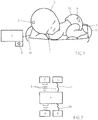
- FIG. 1 shows an infant as the animal 5 in the sleep state.
- the infant has a gyrometer 1 on the wrist, in particular integrated in a bracelet.
- the infant has a skin contact sensor 2, which is preferably attached to the head, especially on the forehead or the temple, in contact with the skin surface.
- the skin contact sensor 2 is glued by means of a plaster or is covered by a headband held and pressed against the skin surface.
- the infant lies on a motion sensor mat 3 equipped with force sensors, such as strain gauges, to measure movement of the infant.
- the movement sensor mat 3 is arranged on a bed 12 in which the infant lies.
- a moisture sensor 4 is mounted to measure or detect leaking urine.
- An evaluation unit 7 can optionally be connected via a cable 11 to one of the sensors (1 to 4), preferably to the motion sensor mat 3.
- the evaluation unit 7 is connected to a feedback device 8, which can be actuated by means of a head. For example, if the wake-up time is predicted, the button may be pressed during the actual waking of the infant to provide feedback to the system about the actual time of wake-up.
- the system can thus optimize the stored algorithms, in particular a machine learning algorithm, for predicting the wake-up time.
- the sensors 1, 2 and 4 are preferably wirelessly connected to the evaluation unit 7 for data exchange.
- FIG. 2 schematically shows the structure of the system, in particular the system of FIG. 1 ,
- a motion sensor mat 3 transmits its measuring signal 6 via a cable to the evaluation unit 7.
- the optionally provided, but not shown, feedback device 8 is either via a cable or wireless to Data exchange with the evaluation unit 7 connected.
- the evaluation unit 7 processes the measurement signals 6 in order to obtain therefrom one or more evaluated measurement signals k1, k2 which indicate one or more vital parameters or at least correlating characteristic values.
- the evaluation unit 7 determines a predicted time t1, t2 for the occurrence of a change of state. For example, this determination may be made as described below FIGS. 3 and 4 is described, done.
- the predicted time is transmitted to a notification device 12 and / or a household device 9.
- information about the state change is also communicated together with the predicted time.
- These notifications to the notification device 12 or the household appliance 9 can, as in the FIG. 2 exemplarily shown wirelessly or done by cable.
- the evaluation unit 7, the notification device 12 and / or the household appliance 9 has a Bluetooth interface and / or a WLAN interface in order to be able to transmit data wirelessly.
- the FIG. 3 shows a diagram of the activity s1 measured by the gyrometer 1, which is plotted over the time t.
- the evaluated measurement signals form a measurement curve k1, which is shown by a solid line.
- the algorithm stored in the evaluation unit 7, in particular a machine learning algorithm is able to extend the course of the curve into the future in the form of the extrapolated curve e1 on the basis of the course of the measurement curve.
- a threshold M1 is provided, which indicates the state change from the sleep state to the awake state, abbreviated to wake-up time.
- the time t1 for the state change from the sleep state to the wake state thus results from the intersection P1 of the extrapolated curve e1 with the threshold M1.
- This time t1 is predicted based on the course of the measurement curve and thus on the basis of measured movements.
- the FIG. 4 illustrates another example for predicting, for example, a wake-up time, in particular, the wake-up time of the infant FIG. 1 .
- the diagram shows the body temperature s2 measured and signal-processed by the skin contact sensor 2, which is plotted over the time t.
- the evaluated measurement signals form a measurement curve k2, which is shown by a solid line.
- the algorithm stored in the evaluation unit 7, in particular a machine learning algorithm, is able to extrapolate the course of the curve into the future in the form of the extrapolated curve e2 on the basis of the course of the measurement curve.
- a threshold M2 is provided which indicates the wakeup time.
- the predicted time t2 results from the intersection point P2 of the extrapolated curve e2 with the threshold M2. Again, the time t2 of waking up can be predicted by means of temperature measurements.
- a consolidation algorithm determines a consolidated predicted time from both predicted times t1 and t2 if the times t1 and t2 deviate from one another.
- the consolidation algorithm is part of the machine learning algorithm.
- the course of the evaluated measurement signals k1 of the gyrometer 1 is only extrapolated when the body temperature measured by the skin contact sensor 2 has reached a certain minimum temperature. Computer capacity can be saved. Furthermore, a point in time is extrapolated only when an early awakening on the basis of the measured body temperature can be assumed to be sufficiently probable.
- the extrapolation of a course of evaluated measurement signals is only performed when a predefined progression pattern or a predefined minimum signal value is reached.
- Computer capacity can be saved.
- an extrapolated time is only then sent to a device connected to the evaluation unit 7, in particular household appliance 9 or notification device 12, when a predefined time interval is reached until the extrapolated time or if the predicted time falls within the time interval.
- the predefined time interval is five to fifteen minutes, such as ten minutes.
- the skin contact sensor 2 is set up to measure the electrical voltage fluctuations on the skin surface. Measurement signals for an electroencephalogram can be measured in this way.
- a measured frequency of voltage fluctuations changes from alpha waves to beta waves.
- a measured frequency of voltage fluctuations in the state change from awake state to sleep state changes from beta waves to alpha waves.
- Alpha waves denote a frequency range between 8 and 13 Hz.
- Beta waves denote a frequency range between> 13 and 30 Hz.
- the threshold is 13 Hz.
- the system may preferably contact an emergency service by means of a router connected to the system and / or send relevant first-aid measurement data to the rescue service.
- an app for a smartphone is used to display the measurement signals 6, the measurement curve k1, k2, the extrapolated curve e1, e2, the threshold M1, M2 and / or the predicted time t1, t2.
- the user can thereby carry out his own analyzes of the historical data.
Landscapes
- Health & Medical Sciences (AREA)
- Life Sciences & Earth Sciences (AREA)
- Engineering & Computer Science (AREA)
- Public Health (AREA)
- Medical Informatics (AREA)
- Biomedical Technology (AREA)
- General Health & Medical Sciences (AREA)
- Physics & Mathematics (AREA)
- Pathology (AREA)
- Biophysics (AREA)
- Surgery (AREA)
- Animal Behavior & Ethology (AREA)
- Molecular Biology (AREA)
- Heart & Thoracic Surgery (AREA)
- Veterinary Medicine (AREA)
- Physiology (AREA)
- Dentistry (AREA)
- Oral & Maxillofacial Surgery (AREA)
- Cardiology (AREA)
- Databases & Information Systems (AREA)
- Primary Health Care (AREA)
- Artificial Intelligence (AREA)
- Epidemiology (AREA)
- Data Mining & Analysis (AREA)
- Psychiatry (AREA)
- Pulmonology (AREA)
- Signal Processing (AREA)
- Evolutionary Computation (AREA)
- Computer Vision & Pattern Recognition (AREA)
- Mathematical Physics (AREA)
- Fuzzy Systems (AREA)
- Ophthalmology & Optometry (AREA)
- Optics & Photonics (AREA)
- Computer Networks & Wireless Communication (AREA)
- Anesthesiology (AREA)
- Psychology (AREA)
- Emergency Medicine (AREA)
- Measuring And Recording Apparatus For Diagnosis (AREA)
- Measurement Of The Respiration, Hearing Ability, Form, And Blood Characteristics Of Living Organisms (AREA)
- Medical Treatment And Welfare Office Work (AREA)
Abstract
Description
- Die Erfindung betrifft ein System umfassend einen Sensor, der einen Vitalparameter eines Lebewesens messen und ein dazu korrespondierendes Messsignal ausgeben kann, sowie eine Auswertungseinheit, die das Messsignal des Sensors auswerten kann.
- Vitalparameter wie zum Beispiel Pulsfrequenz geben Aufschluss über den aktuellen Zustand eines Lebewesens. Es gibt Systeme, die zum Beispiel bei einem Sportler mittels eines Sensors einen Vitalparameter messen und das Messsignal durch eine Auswertungseinheit auswerten und aufzeichnen können. Der Sportler erhält so eine Information über seinen körperlichen Zustand innerhalb des Aufzeichnungszeitraums.
- Es ist Aufgabe der Erfindung, ein weiterentwickeltes System bereitzustellen, das eine erweiterte Funktionalität insbesondere im Hinblick auf ein Zusammenspiel mit anderen Geräten ermöglicht.
- Zur Lösung der Aufgabe dienen ein System gemäß dem Hauptanspruch und eine Verwendung, ein Verfahren sowie ein Computerprogrammprodukt gemäß den Nebenansprüchen. Vorteilhafte Ausführungsformen ergeben sich aus den Unteransprüchen.
- Zur Lösung der Aufgabe dient ein System, das einen Sensor umfasst, der einen Vitalparameter eines Lebewesens messen und ein dazu korrespondierendes Messsignal ausgeben kann. Das System umfasst eine Auswertungseinheit, die das Messsignal des Sensors auswerten kann. Die Auswertungseinheit kann anhand des ausgewerteten Messsignals einen Zeitpunkt für das Eintreten einer Zustandsänderung des Lebewesens prognostizieren.
- Ein Vitalparameter beschreibt einen Organismus eines lebendigen Lebewesens und kann durch eine Maßzahl angegeben werden. In der Regel beschreibt ein Vitalparameter eine Grundfunktion bzw. Vitalfunktion des Lebewesens. Der Vitalparameter, d.h. die Maßzahl, kann mithilfe eines Sensors ermittelt werden.
- Ein Messsignal ist ein insbesondere analoges Signal, dessen Spannung, Stromstärke und/oder Frequenz mit dem gemessenen Vitalparameter, d.h. dessen Maßzahl, korreliert. Ein ausgewertetes Messsignal resultiert normalerweise aus einer Signalverarbeitung des Messsignals beispielsweise mittels einer Analog-Digital-Umwandlung und/oder einer Signaländerung durch einen Algorithmus. Das ausgewertete Messsignal ist bevorzugt digital. Insbesondere kann das ausgewertete Messsignal die Maßzahl eines Vitalparameters angeben.
- Eine Auswertungseinheit umfasst vorzugsweise einen Prozessor und einen Speicher mit einem Computer-Programm-Code, d.h. auf dem Speicher speicherbare Befehle. Der Prozessor, der Speicher und der Computer-Programm-Code sind so konfiguriert, dass ein Verfahren mit mehreren Verfahrensschritten durchgeführt werden kann. Durch Verfahrensschritte kann beispielsweise auf Basis eines Messsignals ein Vitalparameter ermittelt werden. Die Ausdrücke "auf Basis" oder "anhand" leiten eine Eingangsgröße für ein Ermitteln durch die Auswertungseinheit ein. Insbesondere ist eine solche Eingangsgröße das Messsignal und/oder das ausgewertete Messsignal. Vorzugsweise erfolgt ein Ermitteln mithilfe eines Algorithmus, der in einem Computer-Programm-Code abgebildet ist und/oder durch Verfahrensschritte ausgeführt werden kann.
- Zustandsänderung meint eine bestimmte Zustandsänderung, d.h. eine Zustandsänderung, die in der Auswertungseinheit festgelegt ist. Die Zustandsänderung ist also beispielsweise neben weiteren Zustandsänderungen in der Auswertungseinheit hinterlegt, so dass die Zustandsänderung des Lebewesens von der Auswertungseinheit zugeordnet werden kann. Insbesondere kann die Zuordnung zu einer Zustandsänderung durch das Zuordnen eines bestimmten Sensors oder mehrerer bestimmter Sensoren zu der bestimmten Zustandsänderung erfolgen. Die Auswertung des ausgewerteten Messsignals dieses Sensors oder dieser Sensoren, die einer bestimmten Zustandsänderung zugeordnet sind, dient dann gezielt zum Prognostizieren dieser bestimmten Zustandsänderung. Vorzugsweise können mehrere Zustandsänderungen anhand des ausgewerteten Messsignals mehrerer Sensoren prognostiziert werden, wobei für jede Zustandsänderung unterschiedliche Auswertungsalgorithmen und/oder unterschiedliche Kombinationen der Sensoren in der Auswertungseinheit hinterlegt sind.
- Zustandsänderung des Lebewesens bedeutet ein Ändern von einem Vorher-Zustand zu einem Nachher-Zustand. Im Idealfall liegen der Vorher-Zustand vor dem Zeitpunkt und der Nachher-Zustand nach dem Zeitpunkt für das Eintreten einer Zustandsänderung vor. Eine Zustandsänderung ist beispielsweise ein Ändern von einem Schlafzustand als Vorher-Zustand zu einem Wachzustand als Nachher-Zustand. Eine Zustandsänderung ist beispielsweise ein Ändern von einem geschlossenen Blasenorgan als Vorher-zustand zu einem geöffneten Blasenorgan als Nachher-Zustand mit austretendem Urin oder einem geschlossenen Darm als Vorher-Zustand zu einem geöffneten Darm als Nachher-Zustand mit austretendem Stuhlgang. Eine Zustandsänderung ist beispielsweise ein Ändern von einem Nicht-Schrei-Zustand als Vorher-Zustand zu einem Schrei-Zustand als Nachher-Zustand insbesondere zur Signalisierung von Hunger und/oder Durst. Es kann aber auch umgekehrt sein. So kann eine Zustandsänderung ein Ändern von einem Wachzustand als Vorher-Zustand zu einem Schlafzustand als Nachher-Zustand sein.
- Ein Zeitpunkt für das Eintreten einer Zustandsänderung des Lebewesens ist der Zeitpunkt des Wechsels von dem Vorher-Zustand in den Nachher-Zustand. Da eine Zustandsänderung selbst in der Regel eine gewisse Zeit in Anspruch nimmt wie z.B. das Aufschlagen der Augen bei dem Wechsel von einem Schlafzustand in einen Wachzustand, ist der Zeitpunkt als ein ungefährer Zeitpunkt zu verstehen, der idealerweise zeitlich in der Mitte des Vorgangs der Zustandsänderung liegt. Insbesondere können mehrere Zeitpunkte einen Zeitraum definieren, beispielsweise wenn der Vorgang der Zustandsänderung längere Zeit in Anspruch nimmt.
- Prognostizieren bedeutet vorhersagen. Das Prognostizieren eines Zeitpunkts für das Eintreten einer Zustandsänderung erfolgt also zeitlich vor dem wirklichen Eintreten der Zustandsänderung. Allgemein hat in dem Moment des Prognostizierens bzw. der Ausgabe eines prognostizierten Zeitpunktes durch die Auswertungseinheit der Vorgang der Zustandsänderung noch nicht begonnen. Prognostizieren schließt ausdrücklich den Fall aus, in dem beispielsweise durch einen Wecker eine Zustandsänderung wie z.B. Aufwachen zu einem vorher festgelegten Zeitpunkt planmäßig herbeigeführt wird. Dieser Zeitpunkt ist dann nicht im Sinne dieser Erfindung "prognostiziert", da der Zeitpunkt des Aufwachens bei normalem planmäßigem Ablauf fest vorgegeben ist und auch nicht mit Vitalparametern verknüpft ist.
- Das Prognostizieren einen Zeitpunkts für das Eintreten einer Zustandsänderung des Lebewesens durch die Auswertungseinheit ermöglicht, dass ein Gerät, insbesondere ein Haushaltsgerät, in Anhängigkeit von dem prognostizierten Zeitpunkt eine Aktion ausführen und/oder einen Betriebszustand einnehmen kann.
- Wenn beispielsweise das Lebewesen ein Säugling ist, kann durch das Prognostizieren des Aufwachzeitpunkts ein Gerät zum Aufwärmen einer Milchflasche oder eine Küchenmaschine zur Zubereitung eines Babybreis derart frühzeitig aktiviert werden, dass die Milchflasche bzw. der Babybrei kurz vor oder zumindest zeitgleich oder ungefähr zeitgleich mit dem Aufwachen des Säuglings fertig zubereitet ist.
- Alternativ oder ergänzend kann das Gerät ein Benachrichtigungsgerät sein, dass eine Person über eine prognostizierte Zustandsänderung und/oder den prognostizierten Zeitpunkt für die Zustandsänderung benachrichtigt. Insbesondere kann ein Benachrichtigungsgerät über einen aktuellen Zustand informieren und/oder ein Überwachungsereignis bezogen auf einen aktuellen Zustand melden. Ein Benachrichtigungsgerät kann z.B. ein Armband sein. Insbesondere kann das Benachrichtigungsgerät einen Ton abgeben, vibrieren oder in sonstiger Weise eine Person auf sich aufmerksam machen und/oder die Person aus dem Schlaf wecken. In einer Ausgestaltung tragen mehrere Personen, die benachrichtigt werden können, jeweils einen Vitalparameter-Sensor. Es kann dann in der Nacht diejenige Person durch Vibration geweckt werden, die auf Basis des ausgewerteten Vitalparameter-Sensors am wenigsten tief schläft oder sich gerade in der REM-Schlafphase befindet. Die andere Person, die sich beispielsweise gerade in einem tieferen Schlaf befindet, kann dann weiterschlafen.
- Insbesondere hat das Benachrichtigungsgerät eine Anzeigevorrichtung zum Anzeigen mindestens einer Information der Benachrichtigung. Das Gerät ist in einer Ausführungsform ein Smartphone oder Tablet-PC. Eine Person kann somit zeitlich vor einer prognostizierten Zustandsänderung benachrichtigt werden, um eine entsprechende Maßnahme rechtzeitig vordem Eintreten der Zustandsänderung durchzuführen.
- Ist die Zustandsänderung beispielsweise das Aufwachen eines Säuglings und der prognostizierte Zeitpunkt der Aufwachzeitpunkt, so kann ein Elternteil insbesondere in der Nacht zeitlich so geweckt und benachrichtigt werden, dass der Elternteil gerade genug Zeit hat, eine Milchflasche und/oder einen Babybrei in einer verabreichungsbereiten Form zum Säugling zu bringen, bevor der Säugling aufwacht. Wenn bereits das Gerät zum Aufwärmen der Milchflasche bzw. die Küchenmaschine zum Zubereiten des Babybreis in Abhängigkeit von dem prognostizierten Aufwachzeitpunkt aktiviert wurden, braucht der Elternteil lediglich die Flasche oder den Babybrei zum Säugling zu bringen, um es dem Säugling unmittelbar nach dem Aufwachen zu verabreichen. Die Schlafzeit der Eltern kann so maximiert werden.
- Durch das Prognostizieren eines Zeitpunktes für das Eintreten einer Zustandsänderung kann Zeit gespart, Ruhezeit erhöht und ein besonders hoher Automatisierungsgrad erreicht werden. Nachfolgend sind weitere Beispiele hierfür beschrieben.
- Das Gerät kann ein Haustürschloss, ein motorisiert betriebener Rollladen und/oder ein Smart-Home-Server sein. Der prognostizierte Zeitpunkt einer Zustandsänderung kann dabei der Einschlafzeitpunkt sein. Das Gerät kann somit zeitlich vor dem Einschlafzeitpunkt eine Aktion ausführen oder einen Betriebszustand einnehmen. Beispielsweise kann somit in einem festgelegten Zeitabstand vor dem prognostizierten Einschlafzeitpunkt das Haustürschloss automatisch verriegelt, Rollladen und/oder Fenster automatisch geschlossen werden. Der prognostizierte Zeitpunkt einer Zustandsänderung kann dabei der Aufwachzeitpunkt sein. Beispielsweise kann dann die Heizung insbesondere im Badezimmer in einem festgelegten Zeitabstand vor dem prognostizierten Aufwachzeitpunkt aktiviert werden, so dass eine Person nach dem Aufwachen ein vorgewärmtes Badezimmer antrifft.
- Das Lebewesen kann ein Tier oder Haustier sein. Der Besitzer des Tiers oder Haustiers kann so zeitlich vor z.B. einem Aufwachen des Tiers oder Haustiers benachrichtigt werden, um beispielsweise sicherzustellen, dass alle Türen und Fenster geschlossen sind. Ein Verletzen einer Katze an einem gekippten Fenster kann so z.B. vermieden werden.
- In einer Ausgestaltung kann rechtzeitig ein Urin- und/oder Stuhlgangbehälter für eine pflegebedürftige Person rechtzeitig vor einem Urin- bzw. Stuhllassen in Betriebsposition gebracht werden.
- Wenn das Gerät der Smart-Home-Server ist, kann die Raumtemperatur und/oder die Beleuchtung in Abhängigkeit von dem prognostizierten Zeitpunkt, insbesondere Einschlaf- und/oder Aufwachzeitpunkt, verändert werden. Ein gleichmäßiges Senken der Temperatur bzw. Lichtstärke über einen Zeitraum vor dem Einschlafen kann so ermöglicht werden. Ein Anheben der Temperatur bzw. Lichtstärke kann in einem Zeitraum vor dem Aufwachen erfolgen.
- Es kann ferner ermöglicht werden, dass eine Person nach dem Aufstehen frisch gebackene Brötchen und/oder einen frischen Kaffee einem entsprechenden Küchengerät wie z.B. einem Ofen, einer Kaffeemaschine oder einer Küchenmaschine entnehmen kann.
- In einer Ausführungsform ist die Auswertungseinheit mit einem maschinellen Lernalgorithmus ausgestattet, um anhand der ausgewerteten Messsignale den Zeitpunkt für das Eintreten der Zustandsänderung des Lebewesens zu prognostizieren.
- Ein maschineller Lernalgorithmus ordnet allgemein einer oder mehreren Eingangsgrößen eine Ausgangsgröße zu und gibt diese in der Regel aus. Ein maschineller Lernalgorithmus ist häufig die Basis für sogenannte "künstliche Intelligenz", wobei der maschinelle Lernalgorithmus aus Erfahrung "lernt" und eigenständig Muster und Gesetzmäßigkeiten auch in unbekannten Daten "erkennt". Ein maschineller Lernalgorithmus kann durch ein sogenanntes "neuronales Netz" gebildet werden oder dieses in Form eines entsprechenden Programms umfassen. Insbesondere wird ein maschineller Lernalgorithmus durch eine Modellbildungsphase und einer anschließenden Identifikationsphase erzeugt, um schließlich in einer Prognosephase einen Zeitpunkt für das Eintreten einer Zustandsänderung prognostizieren zu können. Insbesondere erfolgt die Modellbildungsphase beim Hersteller. Die Identifikationsphase kann beim Hersteller und/oder beim Endnutzer erfolgen. Die Prognosephase erfolgt dann grundsätzlich beim Endnutzer. Zu Testzwecken kann die Prognosephase beim Hersteller erfolgen.
- In der Modellbildungsphase wird ein mathematisches Modell, d.h. Gleichungssystem, zur Zuordnung eines oder mehrerer Eingangsgrößen zu einer Ausgangsgröße erstellt. Eine Korrelation von einem oder mehreren Vitalparametern mit einer Zustandsänderung wird dabei berücksichtigt, d.h., in dem mathematischen Gleichungssystem abgebildet. Vorzugsweise wird in der Modellbildungsphase ein dynamisches Modell und/oder Differentialgleichungssystem zur Prognose des Zeitpunkts des Eintretens einer Zustandsänderung eines Lebewesens anhand des ausgewerteten Messsignals erstellt. In dem Modell bzw. dem Differentialgleichungssystem dienen die ausgewerteten Messsignale eines festgelegten Sensors oder mehrerer festgelegter Sensoren als Eingangsgröße bzw. Eingangsgrößen und der prognostizierte Zeitpunkt für das Eintreten einer bestimmten Zustandsänderung als die Ausgangsgröße.
- In der Identifikationsphase wird dem maschinellen Lernalgorithmus eine Mehrzahl von Werte-Paaren mit jeweils einer Eingangsgröße und einer Ausgangsgröße bzw. mit jeweils mehreren Eingangsgrößen und einer Ausgangsgröße zugeführt. Der maschinelle Lernalgorithmus wird auf diese Weise optimiert und der Realität angepasst. Insbesondere erfolgt eine Optimierung von Konstanten in einem Differentialgleichungssystem des maschinellen Lernalgorithmus auf Basis der zugeführten Werte-Paare. Durch das Vorsehen einer Rückmeldungseinrichtung kann dem maschinellen Lernalgorithmus eine Ausgangsgröße durch den Endnutzer zugeführt werden, worauf noch später näher eingegangen wird.
- In der Prognosephase wird der maschinelle Lernalgorithmus angewendet, um anhand der ausgewerteten Messsignale den Zeitpunkt für das Eintreten der Zustandsänderung des Lebewesens zu prognostizieren.
- Durch das Ausstatten der Auswertungseinheit mit dem maschinellen Lernalgorithmus kann ein besonders präzises Prognostizieren des Zeitpunkts des Eintretens einer Zustandsänderung ermöglicht werden. Ein Verallgemeinern und Ableiten von Regelmäßigkeiten von dem Verlauf eines Vitalparameters oder mehrerer Vitalparameter im Hinblick auf die Zustandsänderung werden ermöglicht. Eine Prognose, welche die Eigenheit des Lebewesens berücksichtigt, kann so erzielt werden.
- In einer Ausgestaltung wird der maschinelle Lernalgorithmus, der einen Extrapolationsparameter und/oder eine Schwelle umfassen kann, für die gesamte Prognose eingesetzt, so dass die von dem maschinellen Lernalgorithmus ausgegebene Ausgangsgröße dem Zeitpunkt für das Eintreten der Zustandsänderung entspricht. In einer alternativen oder ergänzenden Ausgestaltung wird durch den maschinellen Lernalgorithmus nur eine Zwischengröße, wie z.B. ein Extrapolationsparameter und/oder eine Schwelle, zum Ermitteln des prognostizierten Zeitpunkts für das Eintreten der Zustandsänderung ausgegeben.
- In einer Ausführungsform extrapoliert die Auswertungseinheit einen zeitlichen Verlauf der ausgewerteten Messsignale. Eine für die Prognose des Zeitpunkts der Zustandsänderung relevante Information kann so besonders einfach ermittelt werden. Der zeitliche Verlauf der ausgewerteten Messsignale kann als Messkurve wie z.B. in den
Figuren 3 und 4 grafisch dargestellt werden, bei dem die Werte der ausgewerteten Messsignale über die Zeitachse aufgetragen sind. Die Extrapolation des zeitlichen Verlaufs der ausgewerteten Messsignale kann wie z.B. in denFiguren 3 und 4 als eine extrapolierte Kurve dargestellt werden, die sich in Richtung der Zeitachse an die Messkurve anschließt und diese fortsetzt. Insbesondere erfolgt die Extrapolation auf Basis mindestens eines Extrapolationsparameters, der den Verlauf der extrapolierten Kurve beeinflusst. Bevorzugt ist für die Extrapolation eine Kurvenfunktion hinterlegt, welche den mindestens einen Extrapolationsparameter umfasst. In einer Ausgestaltung ist die Kurvenfunktion Teil des maschinellen Lernalgorithmus. - In einer Ausführungsform umfasst die Auswertungseinheit eine Schwelle für die ausgewerteten Messsignale zur Indikation einer Zustandsänderung. Schwelle meint Schwellwert. Indikation einer Zustandsänderung meint, dass wenn ein ausgewertetes Messsignale die Schwelle bzw. den Schwellwert erreicht hat oder darüber liegt, dies einen Hinweis auf das Eintreten der Zustandsänderung darstellt. Durch das Vorsehen einer Schwelle kann der Zeitpunkt für das Eintreten einer Zustandsänderung besonders einfach umgesetzt werden. In einer Ausgestaltung ist die Schwelle Teil des maschinellen Lernalgorithmus.
- In einer Ausführungsform identifiziert die Auswertungseinheit den Zeitpunkt, bei dem der extrapolierte zeitliche Verlauf der ausgewerteten Messsignale die Schwelle erreicht, als den prognostizierten Zeitpunkt. Die Auswertungseinheit ermittelt also den prognostizierten Zeitpunkt für das Eintreten der Zustandsänderung durch einen Schnittpunkt der extrapolierten Kurve mit der Schwelle, wie in den
Figuren 3 und 4 exemplarisch gezeigt. Der Zeitpunkt für das Eintreten der Zustandsänderung kann somit durch einen besonders einfach aufgebauten Algorithmus prognostiziert werden. In einer Ausgestaltung ist dieser Algorithmus Teil des maschinellen Lernalgorithmus. - In einer Ausgestaltung sind zwei Schwellen vorgesehen, insbesondere eine Mindestschwelle bzw. ein Mindestschwellwert und eine Höchstschwelle bzw. ein Höchstschwellwert. Ein prognostizierter frühester Zeitpunkt ergibt sich dann aus dem Schnittpunkt der extrapolierten Kurve mit dem Mindestschwellwert und ein spätester Zeitpunkt aus dem Schnittpunkt der extrapolierten Kurve mit dem Höchstschwellwert. Die Wahrscheinlichkeit für das Eintreten der Zustandsänderung vor oder nach dem prognostizierten Zeitpunkt kann so quantifiziert werden, beispielsweise in Form eines Konfidenzlevels.
- In einer Ausführungsform werden die Schwelle und/oder der extrapolierte zeitliche Verlauf der ausgewerteten Messsignale durch den maschinellen Lernalgorithmus ermittelt. Die Schwelle bzw. die Extrapolation des zeitlichen Verlaufs der ausgewerteten Messsignale kann so auch bei Verarbeitung mehrerer Eingangsgrößen besonders präzise ermittelt werden.
- In einer Ausführungsform ist eine Eingabeschnittstelle für einen Benutzer vorhanden. Benutzer meint Endnutzer wie z.B. ein Elternteil eines Säuglings. Der Benutzer kann das Lebewesen selbst sein, wenn das System z.B. mit dem Smart-Home-Server zur Steigerung des Wohnkomforts verknüpft ist. Eine Eingabeschnittstelle erlaubt insbesondere das Eingeben einer Zahl oder eines Textes. Bevorzugt weist eine Eingabeschnittstelle ein Display zum Anzeigen der Eingaben auf. Die Eingabeschnittstelle ist in einer Ausgestaltung ein Smartphone oder ein Tablet-PC. In einer Ausgestaltung dient eine App für ein Smartphone als Eingabeschnittstelle.
- In einer Ausführungsform kann der Benutzer die Schwelle einstellen, insbesondere über die Eingabeschnittstelle. Die Schwelle kann so an die Erfahrungswerte des Benutzers angepasst werden. Manchmal nehmen Eltern einen Zusammenhang von Vitalparametern mit einem Zeitpunkt einer Zustandsänderung wie dem Aufwachzeitpunkt zum Teil wahr und können somit die Schwelle gezielt einstellen, z.B. eine Schwelle für die Körpertemperatur. Dem Benutzer wird so die Möglichkeit gegeben, eigene Erfahrungswerte in die Prognose des Zeitpunkts für das Eintreten einer Zustandsänderung einfließen zu lassen und eine besonders zuverlässige und an das Lebewesen angepasste Prognose zu ermöglichen.
- In einer Ausgestaltung kann der Benutzer über die Eingabeschnittstelle eine Sensitivität oder einen Konfidenzlevel des Systems für die Prognose des Zeitpunktes einstellen. Je höher die Sensitivität bzw. der Konfidenzlevel eingestellt wird, desto früher ist der Zeitpunkt, auf den das Eintreten der Zustandsänderung prognostiziert wird. So kann vermieden werden, dass der prognostizierte Zeitpunkt zeitlich hinter wirklichen Zeitpunkt liegt. Gleichsam kann das System auf die Kundenbedürfnisse angepasst werden.
- In einer Ausführungsform ist eine Rückmeldungseinrichtung vorgesehen, durch die ein Benutzer dem maschinellen Lernalgorithmus eine Rückmeldung über das Eintreten einer Zustandsänderung geben kann. Durch das Vorsehen einer Rückmeldungseinrichtung kann dem maschinellen Lernalgorithmus eine Ausgangsgröße durch den Endnutzer zugeführt werden. Der maschinelle Lernalgorithmus kann somit z.B. typische Aufwachzeiten eines bestimmten Säuglings "erlernen" und berücksichtigen. Vorzugsweise umfasst die Rückmeldungseinrichtung einen Knopf. Ein besonders einfaches und unkompliziertes Abgeben einer Rückmeldung durch den Benutzer kann so ermöglicht werden. Wenn der Säugling aufwacht, kann so z.B. der Knopf gedrückt werden, um dem System den Aufwachzeitpunkt exakt und zuverlässig mitzuteilen. Bevorzugt ist nur ein drückbarer Knopf als die gesamte Benutzerschnittstelle der Rückmeldungseinrichtung vorgesehen. In einer alternativen oder ergänzenden Ausgestaltung kann die Eingabeschnittstelle als eine Rückmeldungseinrichtung genutzt werden. Eine besonders detaillierte Rückmeldung für den maschinellen Lernalgorithmus kann so ermöglicht werden.
- In einer Ausgestaltung ist ein Sensor mit der Rückmeldungseinrichtung verbunden oder stellt eine Rückmeldungseinrichtung dar, insbesondere ein Feuchtigkeitssensor. Eine Zustandsänderung wie z.B. Urinaustritt oder Schweißaustritt kann so dem maschinellen Lernalgorithmus automatisch als Ausgangsgröße zu dessen Optimierung bereitgestellt werden.
- In einer Ausführungsform ist der Sensor ein Gyrometer. Ein Gyrometer dient beispielsweise dem Messen einer Drehbewegung. Durch das Messen der Drehbewegung kann ein Maß für die Aktivität zur Beschreibung des Lebewesens ermittelt werden, das mit einer Zustandsänderung, z.B. Aufwachen, in Korrelation gebracht werden kann. Insbesondere wird eine Richtungsänderung einer Drehbewegung erfasst und/oder pro Zeitintervall von z.B. zehn Sekunden gemessen. Erfolgen beispielsweise mindestens sechs Richtungswechsel in einem Zehn-Sekunden-Zeitraum, so ist dies ein Hinweis auf einen Wachzustand eines Säuglings. Gleichsam ist ein steiler Anstieg der Anzahl der Richtungswechsel innerhalb eines Zeitraums von beispielsweise zehn Minuten vor dem Aufwachen mit einer insbesondere näherungsweise konstanten Steigung über die Zeit festzustellen. Der Einsatz eines Gyrometers als Sensor ermöglicht so eine besonders zuverlässige Prognose des Aufwachzeitpunkts eines Säuglings.
- Vorzugsweise wird das Gyrometer am Handgelenk oder Fußgelenk eines Säuglings befestigt, insbesondere mittels eines Armbandes bzw. Fußbandes. Insbesondere wird das Gyrometer zum Ermitteln einer Beschleunigung eingesetzt.
- Alternativ oder ergänzend ist der Sensor ein Kraftsensor, ein Kraftaufnehmer, ein Piezosensor und/oder ein Dehnungsmessstreifen.
- In einer alternativen oder ergänzenden Ausführungsform ist der Sensor oder ein weiterer Sensor ein Hautkontaktsensor zum Messen der Körpertemperatur. Die Körpertemperatur ist ein Vitalparameter, der unter anderem beispielsweise mit dem Schlaf/Wach-Zyklus korreliert. Eine Zustandsänderung wie z.B. das Aufwachen kann so besonders einfach prognostiziert werden.
- Insbesondere kann der mindestens eine Sensor ein Feuchtigkeitssensor zum Detektieren einer eingenässten Windel und/oder Schweißabsonderung, eine Bewegungssensormatte zur Aktivitätsmessung, ein Geruchssensor insbesondere für Methan, ein Pulsmesser, ein Blutdruckmesser, ein Gehirnstromsensor für EEG und/oder EKG, ein Sauerstoffmesssensor insbesondere zur Ermittlung des Schlafabschnitts, ein MRT-Gerät insbesondere zur Ermittlung eines Aufwachzeitpunkts, eine Wärmebildkamera, eine Nachtsichtkamera insbesondere zur Erkennung charakteristischer Bewegungsabläufe, eine Kamera mit Farbauflösung insbesondere zur Zuordnung der Hautfarbe, ein Blutzuckerspiegelsensor, ein CO2-Messgerät für Atemluft, ein Pupillengrößen-Messgerät, ein Blinzelfrequenz-Messgerät insbesondere zum Prognostizieren eines Einschlafzeitpunkts und/oder ein Atemfrequenz-Messgerät sein. Der Hautkontaktsensor kann alternativ oder ergänzend dem Messen von elektrischen Spannungsschwankungen auf der Hautoberfläche dienen.
- In einer Ausführungsform sind mindestens zwei Sensoren für unterschiedliche Vitalparameter vorgesehen. Der Zeitpunkt für das Eintreten einer Zustandsänderung kann so durch Berücksichtigung von zwei unterschiedlichen Vitalparametern besonders zuverlässig prognostiziert werden. Beispielsweise sind die zwei unterschiedlichen Vitalparameter die durch das Gyrometer gemessene Aktivität und die durch den Hautkontaktsensor gemessene Körpertemperatur. Die Körpertemperatur gibt einen Hinweis darüber, ob sich das Lebewesen beispielsweise in der Mitte oder am Ende der Schlafphase befindet. Die Aktivität weist auf eine REM-Phase oder ein baldiges Aufwachen hin. Durch Verknüpfung dieser beiden Vitalparameter kann durch die Körpertemperatur beispielsweise der grobe Schlafabschnitt identifiziert und durch die Aktivität die noch ausstehende Zeit bis zum Aufwachen konkretisiert werden. Wird beispielsweise in einem mittleren Schlafabschnitt eine erhöhte Aktivität gemessen, so kann es sich entweder um eine REM-Phase oder um ein nächtliches Aufwachen in der Nacht handeln, nicht jedoch um das morgendliche Aufwachen.
- In einer Ausgestaltung können mit einer Kombination aus Gyrometer und Dehnungsmessstreifen die Aktivität, der Puls und/oder die Atemfrequenz und somit unterschiedliche Vitalparameter gemessen werden.
- Insbesondere wird der Sensor oder werden die Sensoren an einem Schlafplatz des Lebewesens, in oder an einer Decke und/oder in oder an einem Schlafsack befestigt.
- In einer alternativen oder ergänzenden Ausführungsform kann der prognostizierte Zeitpunkt für das Eintreten der Zustandsänderung auf Basis der Auswertung von mindestens zwei unterschiedlichen Vitalparametern erfolgen. Eine besonders zuverlässige Prognose wird so ermöglicht. Beispielsweise kann so der Pflegebedarf eines Säuglings oder einer pflegebedürftigen Person bereits frühzeitig ermittelt werden, so dass die Versorgung besonders schnell und zeitnah erfolgen kann.
- Insbesondere können die Vitalparameter zwei oder mehr aus den folgenden sein: Körpertemperatur, Aktivität, Puls, Sauerstoffgehalt im Blut, Blutzuckerspiegel, Gehirnstrom, charakteristische Bewegungsabläufe, CO2-Atemluftgehalt, Atemfrequenz, Pupillengröße und/oder Blinzelfrequenz.
- In einer Ausführungsform kann zur Ermittlung des prognostizierten Zeitpunkts für das Eintreten der Zustandsänderung eine Umgebungsinformation zusätzlich berücksichtigt werden. Die Auswertungseinheit und/oder der maschinelle Lernalgorithmus sind entsprechend konfiguriert. Insbesondere ist die Umgebungsinformation das Wetter bzw. eine Wettervorhersage oder Mondphasen-Kalender. Wird beispielsweise ein Gewitter vorhergesagt, steigt die Wahrscheinlichkeit eines schnelleren Aufwachens, was bei der Prognose entsprechend berücksichtigt werden kann. Insbesondere zählt zu der Umgebungsinformation ein Fahrplan für einen Bus, für eine Bahn, für eine Müllabfuhr und/oder für einen Staubsaugerroboter.
- Vorzugsweise weist die Auswertungseinheit eine Internetschnittstelle auf, um sich mit einem Wetterdienst, einem Smart-Home-Server z.B. mit dem Fahrplan des Staubsaugerroboters und/oder einer öffentlichen Fahrplanauskunft für Bus, Bahn und Müllabfuhr zu verbinden.
- In einer Ausgestaltung sind ein Temperatursensor zur Erfassung der Raumtemperatur, ein Helligkeitssensor zur Erfassung der Raumhelligkeit, ein Luftfeuchtigkeitssensor zur Erfassung der Raumluftfeuchtigkeit und/oder ein Mikrofon zur Erfassung von Verkehrslärm, Umgebungsgeräuschen oder Personengeräuschen wie Reden oder Schnarchen vorgesehen.
- In einer Ausführungsform umfasst das System ein Haushaltsgerät, das mit der Auswertungseinheit zum Austausch von Daten verbunden werden kann, um in Abhängigkeit von dem prognostizierten Zeitpunkt eine Aktion auszuführen. In dem Haushaltsgerät ist also eine Aktion programmiert, die von dem Haushaltsgerät ausgeführt wird, wenn das Haushaltsgerät einen prognostizierten Zeitpunkt von der Auswertungseinheit erhält, wobei der prognostizierte Zeitpunkt bei der Durchführung der Aktion berücksichtigt wird. Für den Benutzer können, wie die oben beschriebenen Beispiele für solche Aktionen zeigen, Zeit gespart, Ruhezeit erhöht und ein sehr hoher Automatisierungsgrad erreicht werden.
- Haushaltsgerät meint ein elektrisch betriebenes Gerät zum Einsatz im Privathaushalt. Dies mag ein elektrisches Küchengerät oder ein Reinigungsgerät mit einer Schnittstelle zum Internet, einer WLAN-Schnittstelle und/oder einer Verbindung zu einem Smart-Home-Server sein. Ein Haushaltsgerät im Sinne der vorliegenden Erfindung umfasst auch Heimwerkergeräte wie Akkuschrauber oder Bohrmaschine sowie Gartengeräte wie z.B. Rasenmäher-Roboter. Ein Reinigungsgerät ist z.B. ein Staubsaugerroboter. Ein Haushaltsgerät bzw. Gerät kann auch ein Smart-Home-Server sein, der mithilfe von vernetzten und fernsteuerbaren Geräten, Schaltern und Sensoren Abläufe automatisieren kann und so eine besonders hohe Wohnqualität, Sicherheit und Energieeffizienz ermöglicht. Vorzugsweise ist der Smart-Home-Server mit Hauseinrichtungen, Haustechnik und Haushaltsgeräten wie zum Beispiel Lampen, Jalousien, Rollladen, Türen, Fenstern, Heizung, Ofen, Herd, Küchenmaschine, Kühlschrank, Waschmaschine, Staubsauger, Fernseher und/oder Audio-Geräten verbunden. Insbesondere weist das Haushaltsgerät eine WLAN-Schnittstelle und/oder ein Internet-Schnittstelle auf.
- Ein weiterer Aspekt der Erfindung betrifft die Verwendung des Systems nach dem eingangs beschriebenen Aspekt der Erfindung, wobei der prognostizierte Zeitpunkt für das Eintreten der Zustandsänderung des Lebewesens der Aufwachzeitpunkt eines Säuglings ist. Bei dieser Verwendung des Systems können eine besonders zuverlässige Prognose und eine besonders hohe Zeitersparnis und Ruhezeit für die Eltern erzielt werden.
- Ein weiterer Aspekt der Erfindung betrifft ein System, insbesondere nach dem eingangs beschriebenen Aspekt der Erfindung, umfassend einen Sensor, der einen Vitalparameter eines Lebewesens messen und ein dazu korrespondierendes Messsignal ausgeben kann. Das System umfasst eine Auswertungseinheit, die das Messsignal des Sensors auswerten kann. Die Auswertungseinheit kann anhand des ausgewerteten Messsignals das Eintreten einer festgelegen Zustandsänderung detektieren. Eine Person kann so zeitnah über das Eintreten der Zustandsänderung benachrichtigt werden. Insbesondere in Kombination mit der Prognose können so auch zusätzliche Funktionen wie z.B. Notrufmeldung durch das System abgedeckt werden.
- Ein weiterer Aspekt der Erfindung betrifft ein Verfahren, bei dem mit einem Sensor ein Vitalparameter eines Lebewesens gemessen und ein dazu korrespondierendes Messsignal ausgeben wird. Eine Auswertungseinheit wertet das Messsignal des Sensors aus und prognostiziert anhand des ausgewerteten Messsignals einen Zeitpunkt für das Eintreten einer Zustandsänderung des Lebewesens. Die Merkmale, Ausführungsformen und Wirkungen des eingangs beschriebenen Systems zur Lösung der Aufgabe beziehen sich entsprechend auch auf dieses Verfahren.
- Ein weiterer Aspekt der Erfindung betrifft ein Computerprogrammprodukt. Das Computerprogrammprodukt umfasst Befehle, die bei der Ausführung des Programms des Computerprogrammprodukts durch einen Computer diesen veranlassen, die Schritte des Verfahrens gemäß dem vorhergehenden Aspekt der Erfindung auszuführen. Insbesondere ist der Computer die Auswertungseinheit. Die Merkmale, Ausführungsformen und Wirkungen des eingangs beschriebenen Systems zur Lösung der Aufgabe beziehen sich entsprechend auch auf dieses Computerprogrammprodukt.
- Nachfolgend werden Ausführungsbeispiele der Erfindung auch anhand von Figuren näher erläutert. Merkmale der Ausführungsbeispiele und weiterer nachfolgend beschriebener alternativer oder ergänzender Ausgestaltungen können einzeln oder in einer Mehrzahl mit den beanspruchten Gegenständen kombiniert werden. Die beanspruchten Schutzbereiche sind nicht auf die Ausführungsbeispiele beschränkt.
- Es zeigen:
- Figur 1:
- Schematische Darstellung eines Systems zum Prognostizieren eines Aufwachzeitpunktes eines Säuglings;
- Figur 2:
- Schematische Darstellung eines Systems mit mehreren Sensoren, einer Auswertungseinheit und Benachrichtigungsgeräten;
- Figur 3:
- Schematische Darstellung eines Diagramms mit einer Messkurve der Aktivität, einer extrapolierten Kurve, einer Schwelle und einem prognostiziertem Zeitpunkt für das Eintreten einer Zustandsänderung vom Schlafzustand in den Wachzustand;
- Figur 4:
- Schematische Darstellung eines Diagramms mit einer Messkurve der Körpertemperatur, einer extrapolierten Kurve, einer Schwelle und einem prognostiziertem Zeitpunkt für das Eintreten einer Zustandsänderung vom Schlafzustand in den Wachzustand.
-
Figur 1 zeigt einen Säugling als das Lebewesen 5 im Schlafzustand. Der Säugling hat ein Gyrometer 1 am Handgelenk, insbesondere integriert in ein Armband. Der Säugling weist einen Hautkontaktsensor 2 auf, der bevorzugt am Kopf, besonders bevorzugt an der Stirn oder der Schläfe, mit Kontakt zur Hautoberfläche befestigt ist. Insbesondere ist der Hautkontaktsensor 2 mittels eines Pflasters angeklebt oder wird durch ein Stirnband gehalten und gegen die Hautoberfläche gedrückt. Der Säugling liegt auf einer Bewegungssensormatte 3, die mit Kraftsensoren wie z.B. Dehnungsmessstreifen ausgestattet ist, um eine Bewegung des Säuglings zu messen. Die Bewegungssensormatte 3 ist auf einem Bett 12 angeordnet, in dem der Säugling liegt. In einer Windel 10 des Säuglings ist ein Feuchtigkeitssensor 4 angebracht, um austretenden Urin zu messen bzw. zu detektieren. Eine Auswertungseinheit 7 kann optional über ein Kabel 11 mit einem der Sensoren (1 bis 4), bevorzugt mit der Bewegungssensormatte 3 verbunden werden. - Die Auswertungseinheit 7 ist mit einer Rückmeldungseinrichtung 8 verbunden, die mittels eines Kopfes betätigt werden kann. Wird beispielsweise der Aufwachzeitpunkt prognostiziert, kann der Knopf beim tatsächlichen Aufwachen des Säuglings gedrückt werden, um dem System eine Rückmeldung über den wirklichen Aufwachzeitpunkt zu verschaffen. Das System kann so die hinterlegten Algorithmen, insbesondere einen maschinellen Lernalgorithmus, zum Prognostizieren des Aufwachzeitpunkts optimieren.
- Die Sensoren 1, 2 und 4 sind bevorzugt kabellos zum Datenaustausch mit der Auswertungseinheit 7 verbunden.
- Die
Figur 2 zeigt schematisch den Aufbau des Systems, insbesondere des Systems derFigur 1 . Ein Gyrometer 1 sendet kabellos, insbesondere über Funk, sein Messsignal 6 an die Auswertungseinheit 7. Eine Bewegungssensormatte 3 sendet über ein Kabel ihr Messsignal 6 an die Auswertungseinheit 7. Die optional vorgesehene, jedoch nicht dargestellte Rückmeldungseinrichtung 8 ist entweder über ein Kabel oder kabellos zum Datenaustausch mit der Auswertungseinheit 7 verbunden. Die Auswertungseinheit 7 verarbeitet die Messsignale 6, um daraus einen oder mehrere ausgewertete Messsignale k1, k2 zu erhalten, die einen oder mehrere Vitalparameter oder zumindest dazu korrelierende Kennwerte angeben. Mittels eines Algorithmus ermittelt die Auswertungseinheit 7 einen prognostizierten Zeitpunkt t1, t2 für das Eintreten einer Zustandsänderung. Beispielsweise kann diese Ermittlung, wie unten anhand derFiguren 3 und 4 beschrieben wird, erfolgen. Wird ein Zeitpunkt prognostiziert oder fällt ein prognostizierter Zeitpunkt in einen vorher festgelegten Zeitabstand vor dem prognostizierten Zeitpunkt der Zustandsänderung, z.B. zehn Minuten, wird in einer Ausgestaltung der prognostizierte Zeitpunkt an ein Benachrichtigungsgerät 12 und/oder ein Haushaltsgerät 9 übermittelt. Insbesondere wird gemeinsam mit dem prognostizierten Zeitpunkt auch eine Information über die Zustandsänderung übermittelt. Auch diese Benachrichtigen an das Benachrichtigungsgerät 12 oder das Haushaltsgerät 9 können wie in derFigur 2 exemplarisch gezeigt kabellos oder mittels Kabel erfolgen. Insbesondere weist die Auswertungseinheit 7, das Benachrichtigungsgerät 12 und/oder das Haushaltsgerät 9 eine Bluetooth-Schnittstelle und/oder eine WLAN-Schnittstelle auf, um kabellos Daten übermitteln zu können. - Die
Figur 3 zeigt ein Diagramm der durch das Gyrometer 1 gemessenen Aktivität s1, die über die Zeit t aufgetragen ist. Beispielsweise wird inFigur 3 die Prognose eines Aufwachzeitpunkts illustriert, insbesondere des Aufwachzeitpunkts des Säuglings derFigur 1 . Die ausgewerteten Messsignale bilden eine Messkurve k1, die mit einer durchgezogenen Linie dargestellt ist. Der in der Auswertungseinheit 7 hinterlegte Algorithmus, insbesondere ein maschineller Lernalgorithmus, vermag anhand des Verlaufs der Messkurve den Kurvenverlauf in die Zukunft in Form der extrapolierten Kurve e1 zu verlängern. Eine Schwelle M1 ist vorgesehen, welche die Zustandsänderung vom Schlafzustand in den Wachzustand, abgekürzt Aufwachzeitpunkt genannt, indiziert. Der Zeitpunkt t1 für die Zustandsänderung vom Schlafzustand in den Wachzustand ergibt sich somit aus dem Schnittpunkt P1 der extrapolierten Kurve e1 mit der Schwelle M1. Dieser Zeitpunkt t1 wird anhand des Verlaufs der Messkurve und somit anhand von gemessenen Bewegungen prognostiziert. - Die
Figur 4 illustriert ein weiteres Beispiel zum Prognostizieren beispielsweise eines Aufwachzeitpunkts, insbesondere des Aufwachzeitpunkts des Säuglings derFigur 1 . Das Diagramm zeigt die durch den Hautkontaktsensor 2 gemessene und signalverarbeitete Körpertemperatur s2, die über die Zeit t aufgetragen ist. Die ausgewerteten Messsignale bilden eine Messkurve k2, die mit einer durchgezogenen Linie dargestellt ist. Der in der Auswertungseinheit 7 hinterlegte Algorithmus, insbesondere ein maschineller Lernalgorithmus, vermag anhand des Verlaufs der Messkurve den Kurvenverlauf in die Zukunft in Form der extrapolierten Kurve e2 zu extrapolieren. Eine Schwelle M2 ist vorgesehen, welche den Aufwachzeitpunkt indiziert. Der prognostizierte Zeitpunkt t2 ergibt sich aus dem Schnittpunkt P2 der extrapolierten Kurve e2 mit der Schwelle M2. Wiederum kann der Zeitpunkt t2 des Aufwachens mittels Temperaturmessungen prognostiziert werden. - In einer Ausgestaltung ist ein Konsolidierungsalgorithmus vorgesehen, der aus beiden prognostizierten Zeitpunkten t1 und t2 einen konsolidierten prognostizierten Zeitpunkt ermittelt, wenn die Zeitpunkte t1 und t2 voneinander abweichen. Insbesondere ist der Konsolidierungsalgorithmus Teil des maschinellen Lernalgorithmus.
- In einer Ausgestaltung wird der Verlauf der ausgewerteten Messsignale k1 des Gyrometers 1 erst dann extrapoliert, wenn die durch den Hautkontaktsensor 2 gemessene Körpertemperatur eine bestimmte Mindesttemperatur erreicht hat. Rechnerkapazität kann so eingespart werden. Ferner wird ein Zeitpunkt erst dann extrapoliert, wenn ein baldiges Aufwachen anhand der gemessenen Körpertemperatur als hinreichend wahrscheinlich angenommen werden kann.
- In einer Ausgestaltung wird das Extrapolieren eines Verlaufs von ausgewerteten Messsignalen erst dann durchgeführt, wenn ein vordefiniertes Verlaufsschema oder ein vordefinierter Mindestsignalwert erreicht ist. Rechnerkapazität kann so eingespart werden.
- In einer Ausgestaltung wird ein extrapolierter Zeitpunkt erst dann an ein mit der Auswertungseinheit 7 verbundenes Gerät, insbesondere Haushaltsgerät 9 oder Benachrichtigungsgerät 12, gesendet, wenn ein vordefinierter Zeitabstand bis zu dem extrapolierten Zeitpunkt erreicht ist oder wenn der prognostizierte Zeitpunkt in den Zeitabstand fällt. Vorzugsweise beträgt der vordefinierte zeitliche Abstand fünf bis fünfzehn Minuten, so zum Beispiel zehn Minuten.
- In einer Ausführungsform wird ist der Hautkontaktsensor 2 zur Messung der elektrischen Spannungsschwankungen an der Hautoberfläche eingerichtet. Messsignale für ein Elektroenzephalogramm können so gemessen werden. Bei der Zustandsänderung vom Schlafzustand in den Wachzustand ändert sich eine gemessene Frequenz der Spannungsschwankungen von Alpha-Wellen zu Beta-Wellen. Umgekehrt ändert sich eine gemessene Frequenz der Spannungsschwankungen bei der Zustandsänderung vom Wachzustand in den Schlafzustand von Beta-Wellen zu Alpha-Wellen. Alpha-Wellen bezeichnen einen Frequenzbereich zwischen 8 und 13 Hz. Beta-Wellen bezeichnen einen Frequenzbereich zwischen >13 und 30 Hz. Die Schwelle ist 13 Hz.
- Insbesondere kann das System im Fall eines erkannten bedrohten Lebens vorzugsweise mittels eines mit dem System verbundenen Routers einen Rettungsdienst kontaktieren und/oder relevante Messdaten zur Erstversorgung an den Rettungsdienst senden.
- In einer Ausgestaltung dient eine App für ein Smartphone zum Anzeigen der Messsignale 6, der Messkurve k1, k2, der extrapolierten Kurve e1, e2, der Schwelle M1, M2 und/oder des prognostizierten Zeitpunktes t1, t2. Der Benutzer kann dadurch eigene Analysen der historischen Daten vornehmen.
Claims (15)
- System umfassend einen Sensor (1 bis 4), der einen Vitalparameter eines Lebewesens (5) messen und ein dazu korrespondierendes Messsignal (6) ausgeben kann, sowie eine Auswertungseinheit (7), die das Messsignal (6) des Sensors (1 bis 4) auswerten kann, dadurch gekennzeichnet, dass die Auswertungseinheit (7) anhand des ausgewerteten Messsignals (k1, k2) einen Zeitpunkt (t1, t2) für das Eintreten einer Zustandsänderung des Lebewesens (5) prognostizieren kann.
- System nach Anspruch 1, dadurch gekennzeichnet, dass die Auswertungseinheit (7) mit einem maschinellen Lernalgorithmus ausgestattet ist, um anhand der ausgewerteten Messsignale (k1, k2) den Zeitpunkt (t1, t2) für das Eintreten der Zustandsänderung des Lebewesens (5) zu prognostizieren.
- System nach Anspruch 1 oder 2, dadurch gekennzeichnet, dass die Auswertungseinheit (7) einen zeitlichen Verlauf der ausgewerteten Messsignale (k1, k2) extrapoliert.
- System nach einem der vorhergehenden Ansprüche, dadurch gekennzeichnet, dass die Auswertungseinheit (7) eine Schwelle (M1, M2) für die ausgewerteten Messsignale (k1, k2) zur Indikation einer Zustandsänderung umfasst.
- System nach den zwei vorhergehenden Ansprüchen, dadurch gekennzeichnet, dass die Auswertungseinheit (7) den Zeitpunkt (t1, t2), bei dem der extrapolierte zeitliche Verlauf der ausgewerteten Messsignale (k1, k2) die Schwelle (M1, M2) erreicht, als den prognostizierten Zeitpunkt (t1, t2) identifiziert.
- System nach einem der vier vorhergehenden Ansprüche, dadurch gekennzeichnet, dass die Schwelle (M1, M2) und/oder der extrapolierte zeitliche Verlauf der ausgewerteten Messsignale durch den maschinellen Lernalgorithmus ermittelt werden.
- System nach einem der fünf vorhergehenden Ansprüche, dadurch gekennzeichnet, dass eine Eingabeschnittstelle für einen Benutzer vorhanden ist und/oder der Benutzer die Schwelle (M1, M2) einstellen kann.
- System nach einem der sechs vorhergehenden Ansprüche, dadurch gekennzeichnet, dass eine Rückmeldungseinrichtung (8) vorgesehen ist, durch die ein Benutzer dem maschinellen Lernalgorithmus eine Rückmeldung über das Eintreten einer Zustandsänderung geben kann.
- System nach einem der vorhergehenden Ansprüche, dadurch gekennzeichnet, dass der Sensor ein Gyrometer (1) und/oder ein Hautkontaktsensor (2) zum Messen der Körpertemperatur ist.
- System nach einem der vorhergehenden Ansprüche, dadurch gekennzeichnet, mindestens zwei Sensoren (1 bis 4) für unterschiedliche Vitalparameter vorgesehen sind und/oder der prognostizierte Zeitpunkt (t1, t2) für das Eintreten der Zustandsänderung auf Basis der Auswertung von mindestens zwei unterschiedlichen Vitalparametern erfolgen kann.
- System nach einem der vorhergehenden Ansprüche, dadurch gekennzeichnet, dass zur Ermittlung des prognostizierten Zeitpunkts (t1, t2) für das Eintreten der Zustandsänderung eine Umgebungsinformation berücksichtigt werden kann.
- System nach einem der vorhergehenden Ansprüche, gekennzeichnet durch ein Haushaltsgerät (9), das mit der Auswertungseinheit (7) zum Austausch von Daten verbunden werden kann, um in Abhängigkeit von dem prognostizierten Zeitpunkt (t1, t2) eine Aktion auszuführen.
- Verwendung des Systems nach einem der vorhergehenden Ansprüche, dadurch gekennzeichnet, dass der prognostizierte Zeitpunkt (t1, t2) für das Eintreten der Zustandsänderung des Lebewesens (5) der Aufwachzeitpunkt eines Säuglings ist.
- Verfahren, bei dem mit einem Sensor (1 bis 4) ein Vitalparameter eines Lebewesens (5) gemessen und ein dazu korrespondierendes Messsignal (6) ausgeben wird, wobei eine Auswertungseinheit das Messsignal (6) des Sensors (1 bis 4) auswertet und anhand des ausgewerteten Messsignals einen Zeitpunkt (t1, t2) für das Eintreten einer Zustandsänderung des Lebewesens (5) prognostiziert.
- Computerprogrammprodukt, umfassend Befehle, die bei der Ausführung des Programms durch einen Computer, insbesondere die Auswertungseinheit (7), diesen veranlassen, die Schritte des Verfahrens nach dem vorhergehenden Anspruch auszuführen.
Priority Applications (6)
| Application Number | Priority Date | Filing Date | Title |
|---|---|---|---|
| ES18154688T ES2981725T3 (es) | 2018-02-01 | 2018-02-01 | Sistema con sensor de datos vitales y unidad de evaluación |
| PL18154688.8T PL3522173T3 (pl) | 2018-02-01 | 2018-02-01 | System z czujnikiem danych życiowych i jednostką oceniającą |
| EP18154688.8A EP3522173B1 (de) | 2018-02-01 | 2018-02-01 | System mit vitaldatensensor und auswertungseinheit |
| US16/263,917 US20190231254A1 (en) | 2018-02-01 | 2019-01-31 | System with vital data sensor and evaluation unit |
| CN201910105778.1A CN110101392B (zh) | 2018-02-01 | 2019-02-01 | 具有生命体征数据传感器和分析单元的系统 |
| US17/532,354 US20220079513A1 (en) | 2018-02-01 | 2021-11-22 | Household appliance activation system |
Applications Claiming Priority (1)
| Application Number | Priority Date | Filing Date | Title |
|---|---|---|---|
| EP18154688.8A EP3522173B1 (de) | 2018-02-01 | 2018-02-01 | System mit vitaldatensensor und auswertungseinheit |
Publications (3)
| Publication Number | Publication Date |
|---|---|
| EP3522173A1 true EP3522173A1 (de) | 2019-08-07 |
| EP3522173C0 EP3522173C0 (de) | 2024-04-03 |
| EP3522173B1 EP3522173B1 (de) | 2024-04-03 |
Family
ID=61223691
Family Applications (1)
| Application Number | Title | Priority Date | Filing Date |
|---|---|---|---|
| EP18154688.8A Active EP3522173B1 (de) | 2018-02-01 | 2018-02-01 | System mit vitaldatensensor und auswertungseinheit |
Country Status (5)
| Country | Link |
|---|---|
| US (2) | US20190231254A1 (de) |
| EP (1) | EP3522173B1 (de) |
| CN (1) | CN110101392B (de) |
| ES (1) | ES2981725T3 (de) |
| PL (1) | PL3522173T3 (de) |
Families Citing this family (7)
| Publication number | Priority date | Publication date | Assignee | Title |
|---|---|---|---|---|
| EP4076148A1 (de) * | 2019-12-18 | 2022-10-26 | Koninklijke Philips N.V. | System und verfahren zum alarmieren eines pflegers basierend auf dem zustand einer bedürftigen person |
| US11857311B2 (en) * | 2020-03-17 | 2024-01-02 | Prime Dragon Limited | Multi-purpose video monitoring camera |
| JP7452409B2 (ja) * | 2020-12-25 | 2024-03-19 | トヨタ自動車株式会社 | タスクシステム、制御方法及び制御プログラム |
| CN114963549A (zh) * | 2021-06-01 | 2022-08-30 | 青岛经济技术开发区海尔热水器有限公司 | 热水器预加热控制方法、装置、电子设备及存储介质 |
| WO2023034820A1 (en) * | 2021-08-30 | 2023-03-09 | The Board Of Trustees Of The Leland Stanford Junior University | Systems and methods for predictive glucose management |
| CN114027795A (zh) * | 2021-11-11 | 2022-02-11 | 展讯半导体(南京)有限公司 | 婴儿睡眠状态监测方法、装置、终端设备及可读存储介质 |
| US12622622B2 (en) | 2023-03-01 | 2026-05-12 | Synchneuro, Inc. | Blood glucose states based on sensed brain activity |
Citations (3)
| Publication number | Priority date | Publication date | Assignee | Title |
|---|---|---|---|---|
| US20120253220A1 (en) * | 2011-03-31 | 2012-10-04 | Toyota Motor Engineering And Manufacturing North America | Methods and Systems for Determining Optimum Wake Time |
| US20150094544A1 (en) * | 2013-09-12 | 2015-04-02 | Sproutling, Inc. | Infant monitoring system and methods |
| US20160287076A1 (en) * | 2015-04-05 | 2016-10-06 | Smilables, Inc. | Aggregating inferences related to infant data |
Family Cites Families (15)
| Publication number | Priority date | Publication date | Assignee | Title |
|---|---|---|---|---|
| JP3829544B2 (ja) * | 1999-08-26 | 2006-10-04 | 松下電工株式会社 | 入眠判定装置 |
| JP5266221B2 (ja) * | 2006-08-08 | 2013-08-21 | コーニンクレッカ フィリップス エレクトロニクス エヌ ヴィ | 生理パラメータを監視する方法および装置 |
| CN102549587B (zh) * | 2009-08-10 | 2016-08-03 | 糖尿病工具瑞典股份公司 | 用于处理葡萄糖值的装置和方法 |
| WO2013093692A2 (en) * | 2011-12-21 | 2013-06-27 | Koninklijke Philips Electronics N.V. | Method and system to predict physiologic and clinical status changes |
| US20150068720A1 (en) * | 2013-09-09 | 2015-03-12 | Rest Devices, Inc. | Method and Apparatus for an Infant-milk Warmer |
| US9046414B2 (en) * | 2012-09-21 | 2015-06-02 | Google Inc. | Selectable lens button for a hazard detector and method therefor |
| WO2014071399A1 (en) * | 2012-11-05 | 2014-05-08 | Gauss Surgical | Method for triggering blood salvage |
| US9280366B2 (en) * | 2013-10-21 | 2016-03-08 | Cellco Partnership | Adaptive application of accessory device settings |
| EP3140702A4 (de) * | 2014-05-07 | 2017-12-27 | Vivint, Inc | Steuerung eines gebäudesystems auf grundlage von echtzeitereignissen |
| EP2990999A1 (de) * | 2014-08-29 | 2016-03-02 | Accenture Global Services Limited | Maschinenlernsystem zur Optimierung der Leistung eines biometrischen Systems |
| US9808185B2 (en) * | 2014-09-23 | 2017-11-07 | Fitbit, Inc. | Movement measure generation in a wearable electronic device |
| CN104462780A (zh) * | 2014-11-14 | 2015-03-25 | 河海大学常州校区 | 一种基于物联网技术的婴儿智能辅助护理系统及其方法 |
| CN105137781B (zh) * | 2015-07-31 | 2019-12-03 | 深圳广田智能科技有限公司 | 智能家居模式的触发方法及系统 |
| CN105182776A (zh) * | 2015-09-18 | 2015-12-23 | 小米科技有限责任公司 | 智能家居控制方法及装置 |
| US10959647B2 (en) * | 2015-12-30 | 2021-03-30 | Seismic Holdings, Inc. | System and method for sensing and responding to fatigue during a physical activity |
-
2018
- 2018-02-01 PL PL18154688.8T patent/PL3522173T3/pl unknown
- 2018-02-01 ES ES18154688T patent/ES2981725T3/es active Active
- 2018-02-01 EP EP18154688.8A patent/EP3522173B1/de active Active
-
2019
- 2019-01-31 US US16/263,917 patent/US20190231254A1/en not_active Abandoned
- 2019-02-01 CN CN201910105778.1A patent/CN110101392B/zh active Active
-
2021
- 2021-11-22 US US17/532,354 patent/US20220079513A1/en not_active Abandoned
Patent Citations (3)
| Publication number | Priority date | Publication date | Assignee | Title |
|---|---|---|---|---|
| US20120253220A1 (en) * | 2011-03-31 | 2012-10-04 | Toyota Motor Engineering And Manufacturing North America | Methods and Systems for Determining Optimum Wake Time |
| US20150094544A1 (en) * | 2013-09-12 | 2015-04-02 | Sproutling, Inc. | Infant monitoring system and methods |
| US20160287076A1 (en) * | 2015-04-05 | 2016-10-06 | Smilables, Inc. | Aggregating inferences related to infant data |
Also Published As
| Publication number | Publication date |
|---|---|
| EP3522173C0 (de) | 2024-04-03 |
| EP3522173B1 (de) | 2024-04-03 |
| CN110101392B (zh) | 2022-12-13 |
| CN110101392A (zh) | 2019-08-09 |
| US20190231254A1 (en) | 2019-08-01 |
| PL3522173T3 (pl) | 2024-08-19 |
| US20220079513A1 (en) | 2022-03-17 |
| ES2981725T3 (es) | 2024-10-10 |
Similar Documents
| Publication | Publication Date | Title |
|---|---|---|
| EP3522173B1 (de) | System mit vitaldatensensor und auswertungseinheit | |
| EP3520686B1 (de) | System mit vitaldatensensor | |
| US11491300B2 (en) | Robot-connected IoT-based sleep-caring system | |
| US8348840B2 (en) | Device and method to monitor, assess and improve quality of sleep | |
| CN204636331U (zh) | 一种智能云床垫 | |
| JP4546487B2 (ja) | 睡眠パターンを用いて独居者の在宅活動を遠隔監視する方法 | |
| EP4346570B1 (de) | Gerät zur ermittlung eines physiologischen zustands von babys und kleinkindern | |
| CN109843173B (zh) | 用于监测人的日常生活活动的系统和方法 | |
| US20190088357A1 (en) | Lactation coaching system and method | |
| US20150128353A1 (en) | Sleep monitoring system and method | |
| EP3522170B1 (de) | System zum alarmieren einer person | |
| JP2009254817A (ja) | 人の認知能力を監視するシステム及び方法 | |
| WO2010028911A1 (de) | Vorrichtung zur vermeidung des plötzlichen säuglingstodes | |
| CN111227791A (zh) | 一种睡眠质量监控方法及睡眠监控装置 | |
| DE112017006725T5 (de) | Benutzer-terminal | |
| CN106821382A (zh) | 呼吸监测诊断系统、干扰过滤方法及诊断方法 | |
| CN115185320A (zh) | 一种智能车载睡眠系统及其控制方法 | |
| JP7230920B2 (ja) | 情報処理装置、センサーボックス、および、プログラム | |
| CN211432928U (zh) | 监护系统 | |
| CN120227553A (zh) | 基于多模态感知的智能唤醒方法、存储介质及电子装置 | |
| CN111904399A (zh) | 一种针对老年人的呼吸监测病床 | |
| DE102013103955B3 (de) | Abspielgerätevorrichtung mit Aufwachdetektor zum Abspielen einer bestimmten Information | |
| CN114847872A (zh) | 一种基于物联网技术的医疗诊断系统及其实施方法 | |
| EP3782686B1 (de) | System und beatmungsgerät zur nichtinvasiven infektionserkennung während der beatmung | |
| EP3174024A1 (de) | Verfahren und vorrichtung zur erkennung von aufwachzeiten |
Legal Events
| Date | Code | Title | Description |
|---|---|---|---|
| PUAI | Public reference made under article 153(3) epc to a published international application that has entered the european phase |
Free format text: ORIGINAL CODE: 0009012 |
|
| STAA | Information on the status of an ep patent application or granted ep patent |
Free format text: STATUS: THE APPLICATION HAS BEEN PUBLISHED |
|
| AK | Designated contracting states |
Kind code of ref document: A1 Designated state(s): AL AT BE BG CH CY CZ DE DK EE ES FI FR GB GR HR HU IE IS IT LI LT LU LV MC MK MT NL NO PL PT RO RS SE SI SK SM TR |
|
| AX | Request for extension of the european patent |
Extension state: BA ME |
|
| STAA | Information on the status of an ep patent application or granted ep patent |
Free format text: STATUS: REQUEST FOR EXAMINATION WAS MADE |
|
| 17P | Request for examination filed |
Effective date: 20190925 |
|
| RBV | Designated contracting states (corrected) |
Designated state(s): AL AT BE BG CH CY CZ DE DK EE ES FI FR GB GR HR HU IE IS IT LI LT LU LV MC MK MT NL NO PL PT RO RS SE SI SK SM TR |
|
| STAA | Information on the status of an ep patent application or granted ep patent |
Free format text: STATUS: EXAMINATION IS IN PROGRESS |
|
| 17Q | First examination report despatched |
Effective date: 20210618 |
|
| GRAP | Despatch of communication of intention to grant a patent |
Free format text: ORIGINAL CODE: EPIDOSNIGR1 |
|
| STAA | Information on the status of an ep patent application or granted ep patent |
Free format text: STATUS: GRANT OF PATENT IS INTENDED |
|
| RIC1 | Information provided on ipc code assigned before grant |
Ipc: A61B 5/00 20060101ALI20230913BHEP Ipc: A61B 5/11 20060101ALI20230913BHEP Ipc: A61B 5/01 20060101ALI20230913BHEP Ipc: G16H 50/20 20180101ALI20230913BHEP Ipc: G16H 50/50 20180101AFI20230913BHEP |
|
| INTG | Intention to grant announced |
Effective date: 20231013 |
|
| GRAS | Grant fee paid |
Free format text: ORIGINAL CODE: EPIDOSNIGR3 |
|
| GRAA | (expected) grant |
Free format text: ORIGINAL CODE: 0009210 |
|
| STAA | Information on the status of an ep patent application or granted ep patent |
Free format text: STATUS: THE PATENT HAS BEEN GRANTED |
|
| AK | Designated contracting states |
Kind code of ref document: B1 Designated state(s): AL AT BE BG CH CY CZ DE DK EE ES FI FR GB GR HR HU IE IS IT LI LT LU LV MC MK MT NL NO PL PT RO RS SE SI SK SM TR |
|
| REG | Reference to a national code |
Ref country code: GB Ref legal event code: FG4D Free format text: NOT ENGLISH |
|
| REG | Reference to a national code |
Ref country code: CH Ref legal event code: EP |
|
| REG | Reference to a national code |
Ref country code: IE Ref legal event code: FG4D Free format text: LANGUAGE OF EP DOCUMENT: GERMAN |
|
| REG | Reference to a national code |
Ref country code: DE Ref legal event code: R096 Ref document number: 502018014355 Country of ref document: DE |
|
| U01 | Request for unitary effect filed |
Effective date: 20240403 |
|
| U07 | Unitary effect registered |
Designated state(s): AT BE BG DE DK EE FI FR IT LT LU LV MT NL PT SE SI Effective date: 20240408 |
|
| PG25 | Lapsed in a contracting state [announced via postgrant information from national office to epo] |
Ref country code: IS Free format text: LAPSE BECAUSE OF FAILURE TO SUBMIT A TRANSLATION OF THE DESCRIPTION OR TO PAY THE FEE WITHIN THE PRESCRIBED TIME-LIMIT Effective date: 20240803 |
|
| PG25 | Lapsed in a contracting state [announced via postgrant information from national office to epo] |
Ref country code: HR Free format text: LAPSE BECAUSE OF FAILURE TO SUBMIT A TRANSLATION OF THE DESCRIPTION OR TO PAY THE FEE WITHIN THE PRESCRIBED TIME-LIMIT Effective date: 20240403 |
|
| REG | Reference to a national code |
Ref country code: ES Ref legal event code: FG2A Ref document number: 2981725 Country of ref document: ES Kind code of ref document: T3 Effective date: 20241010 |
|
| PG25 | Lapsed in a contracting state [announced via postgrant information from national office to epo] |
Ref country code: GR Free format text: LAPSE BECAUSE OF FAILURE TO SUBMIT A TRANSLATION OF THE DESCRIPTION OR TO PAY THE FEE WITHIN THE PRESCRIBED TIME-LIMIT Effective date: 20240704 |
|
| PG25 | Lapsed in a contracting state [announced via postgrant information from national office to epo] |
Ref country code: CZ Free format text: LAPSE BECAUSE OF FAILURE TO SUBMIT A TRANSLATION OF THE DESCRIPTION OR TO PAY THE FEE WITHIN THE PRESCRIBED TIME-LIMIT Effective date: 20240403 |
|
| PG25 | Lapsed in a contracting state [announced via postgrant information from national office to epo] |
Ref country code: NO Free format text: LAPSE BECAUSE OF FAILURE TO SUBMIT A TRANSLATION OF THE DESCRIPTION OR TO PAY THE FEE WITHIN THE PRESCRIBED TIME-LIMIT Effective date: 20240703 Ref country code: IS Free format text: LAPSE BECAUSE OF FAILURE TO SUBMIT A TRANSLATION OF THE DESCRIPTION OR TO PAY THE FEE WITHIN THE PRESCRIBED TIME-LIMIT Effective date: 20240803 Ref country code: HR Free format text: LAPSE BECAUSE OF FAILURE TO SUBMIT A TRANSLATION OF THE DESCRIPTION OR TO PAY THE FEE WITHIN THE PRESCRIBED TIME-LIMIT Effective date: 20240403 Ref country code: GR Free format text: LAPSE BECAUSE OF FAILURE TO SUBMIT A TRANSLATION OF THE DESCRIPTION OR TO PAY THE FEE WITHIN THE PRESCRIBED TIME-LIMIT Effective date: 20240704 Ref country code: CZ Free format text: LAPSE BECAUSE OF FAILURE TO SUBMIT A TRANSLATION OF THE DESCRIPTION OR TO PAY THE FEE WITHIN THE PRESCRIBED TIME-LIMIT Effective date: 20240403 Ref country code: RS Free format text: LAPSE BECAUSE OF FAILURE TO SUBMIT A TRANSLATION OF THE DESCRIPTION OR TO PAY THE FEE WITHIN THE PRESCRIBED TIME-LIMIT Effective date: 20240703 |
|
| REG | Reference to a national code |
Ref country code: DE Ref legal event code: R097 Ref document number: 502018014355 Country of ref document: DE |
|
| PG25 | Lapsed in a contracting state [announced via postgrant information from national office to epo] |
Ref country code: SK Free format text: LAPSE BECAUSE OF FAILURE TO SUBMIT A TRANSLATION OF THE DESCRIPTION OR TO PAY THE FEE WITHIN THE PRESCRIBED TIME-LIMIT Effective date: 20240403 Ref country code: RO Free format text: LAPSE BECAUSE OF FAILURE TO SUBMIT A TRANSLATION OF THE DESCRIPTION OR TO PAY THE FEE WITHIN THE PRESCRIBED TIME-LIMIT Effective date: 20240403 |
|
| PG25 | Lapsed in a contracting state [announced via postgrant information from national office to epo] |
Ref country code: SM Free format text: LAPSE BECAUSE OF FAILURE TO SUBMIT A TRANSLATION OF THE DESCRIPTION OR TO PAY THE FEE WITHIN THE PRESCRIBED TIME-LIMIT Effective date: 20240403 |
|
| PG25 | Lapsed in a contracting state [announced via postgrant information from national office to epo] |
Ref country code: SM Free format text: LAPSE BECAUSE OF FAILURE TO SUBMIT A TRANSLATION OF THE DESCRIPTION OR TO PAY THE FEE WITHIN THE PRESCRIBED TIME-LIMIT Effective date: 20240403 Ref country code: SK Free format text: LAPSE BECAUSE OF FAILURE TO SUBMIT A TRANSLATION OF THE DESCRIPTION OR TO PAY THE FEE WITHIN THE PRESCRIBED TIME-LIMIT Effective date: 20240403 Ref country code: RO Free format text: LAPSE BECAUSE OF FAILURE TO SUBMIT A TRANSLATION OF THE DESCRIPTION OR TO PAY THE FEE WITHIN THE PRESCRIBED TIME-LIMIT Effective date: 20240403 |
|
| PLBE | No opposition filed within time limit |
Free format text: ORIGINAL CODE: 0009261 |
|
| STAA | Information on the status of an ep patent application or granted ep patent |
Free format text: STATUS: NO OPPOSITION FILED WITHIN TIME LIMIT |
|
| 26N | No opposition filed |
Effective date: 20250106 |
|
| U20 | Renewal fee for the european patent with unitary effect paid |
Year of fee payment: 8 Effective date: 20250224 |
|
| PG25 | Lapsed in a contracting state [announced via postgrant information from national office to epo] |
Ref country code: MC Free format text: LAPSE BECAUSE OF FAILURE TO SUBMIT A TRANSLATION OF THE DESCRIPTION OR TO PAY THE FEE WITHIN THE PRESCRIBED TIME-LIMIT Effective date: 20240403 |
|
| PG25 | Lapsed in a contracting state [announced via postgrant information from national office to epo] |
Ref country code: IE Free format text: LAPSE BECAUSE OF NON-PAYMENT OF DUE FEES Effective date: 20250201 |
|
| REG | Reference to a national code |
Ref country code: CH Ref legal event code: U11 Free format text: ST27 STATUS EVENT CODE: U-0-0-U10-U11 (AS PROVIDED BY THE NATIONAL OFFICE) Effective date: 20260301 |
|
| U20 | Renewal fee for the european patent with unitary effect paid |
Year of fee payment: 9 Effective date: 20260224 |
|
| PGFP | Annual fee paid to national office [announced via postgrant information from national office to epo] |
Ref country code: GB Payment date: 20260219 Year of fee payment: 9 |
|
| PGFP | Annual fee paid to national office [announced via postgrant information from national office to epo] |
Ref country code: ES Payment date: 20260319 Year of fee payment: 9 |
|
| PGFP | Annual fee paid to national office [announced via postgrant information from national office to epo] |
Ref country code: CH Payment date: 20260301 Year of fee payment: 9 |
|
| PGFP | Annual fee paid to national office [announced via postgrant information from national office to epo] |
Ref country code: PL Payment date: 20260121 Year of fee payment: 9 |
|
| PG25 | Lapsed in a contracting state [announced via postgrant information from national office to epo] |
Ref country code: CY Free format text: LAPSE BECAUSE OF FAILURE TO SUBMIT A TRANSLATION OF THE DESCRIPTION OR TO PAY THE FEE WITHIN THE PRESCRIBED TIME-LIMIT Effective date: 20240403 |
|
| PG25 | Lapsed in a contracting state [announced via postgrant information from national office to epo] |
Ref country code: TR Free format text: LAPSE BECAUSE OF FAILURE TO SUBMIT A TRANSLATION OF THE DESCRIPTION OR TO PAY THE FEE WITHIN THE PRESCRIBED TIME-LIMIT Effective date: 20240403 |