EP3517539B1 - Substituted dimeric quinazoline derivative, its preparation and its use in pharmaceutical compositions for the treatment of type i and ii diabetes - Google Patents
Substituted dimeric quinazoline derivative, its preparation and its use in pharmaceutical compositions for the treatment of type i and ii diabetes Download PDFInfo
- Publication number
- EP3517539B1 EP3517539B1 EP19151416.5A EP19151416A EP3517539B1 EP 3517539 B1 EP3517539 B1 EP 3517539B1 EP 19151416 A EP19151416 A EP 19151416A EP 3517539 B1 EP3517539 B1 EP 3517539B1
- Authority
- EP
- European Patent Office
- Prior art keywords
- disclosure
- compounds
- formula
- acid
- compound
- Prior art date
- Legal status (The legal status is an assumption and is not a legal conclusion. Google has not performed a legal analysis and makes no representation as to the accuracy of the status listed.)
- Revoked
Links
Classifications
-
- C—CHEMISTRY; METALLURGY
- C07—ORGANIC CHEMISTRY
- C07D—HETEROCYCLIC COMPOUNDS
- C07D519/00—Heterocyclic compounds containing more than one system of two or more relevant hetero rings condensed among themselves or condensed with a common carbocyclic ring system not provided for in groups C07D453/00 or C07D455/00
-
- C—CHEMISTRY; METALLURGY
- C07—ORGANIC CHEMISTRY
- C07D—HETEROCYCLIC COMPOUNDS
- C07D473/00—Heterocyclic compounds containing purine ring systems
- C07D473/02—Heterocyclic compounds containing purine ring systems with oxygen, sulphur, or nitrogen atoms directly attached in positions 2 and 6
- C07D473/04—Heterocyclic compounds containing purine ring systems with oxygen, sulphur, or nitrogen atoms directly attached in positions 2 and 6 two oxygen atoms
- C07D473/06—Heterocyclic compounds containing purine ring systems with oxygen, sulphur, or nitrogen atoms directly attached in positions 2 and 6 two oxygen atoms with radicals containing only hydrogen and carbon atoms, attached in position 1 or 3
-
- A—HUMAN NECESSITIES
- A61—MEDICAL OR VETERINARY SCIENCE; HYGIENE
- A61K—PREPARATIONS FOR MEDICAL, DENTAL OR TOILETRY PURPOSES
- A61K31/00—Medicinal preparations containing organic active ingredients
- A61K31/13—Amines
- A61K31/155—Amidines (), e.g. guanidine (H2N—C(=NH)—NH2), isourea (N=C(OH)—NH2), isothiourea (—N=C(SH)—NH2)
-
- A—HUMAN NECESSITIES
- A61—MEDICAL OR VETERINARY SCIENCE; HYGIENE
- A61K—PREPARATIONS FOR MEDICAL, DENTAL OR TOILETRY PURPOSES
- A61K31/00—Medicinal preparations containing organic active ingredients
- A61K31/33—Heterocyclic compounds
- A61K31/395—Heterocyclic compounds having nitrogen as a ring hetero atom, e.g. guanethidine or rifamycins
- A61K31/435—Heterocyclic compounds having nitrogen as a ring hetero atom, e.g. guanethidine or rifamycins having six-membered rings with one nitrogen as the only ring hetero atom
- A61K31/44—Non condensed pyridines; Hydrogenated derivatives thereof
- A61K31/4427—Non condensed pyridines; Hydrogenated derivatives thereof containing further heterocyclic ring systems
- A61K31/4439—Non condensed pyridines; Hydrogenated derivatives thereof containing further heterocyclic ring systems containing a five-membered ring with nitrogen as a ring hetero atom, e.g. omeprazole
-
- A—HUMAN NECESSITIES
- A61—MEDICAL OR VETERINARY SCIENCE; HYGIENE
- A61K—PREPARATIONS FOR MEDICAL, DENTAL OR TOILETRY PURPOSES
- A61K31/00—Medicinal preparations containing organic active ingredients
- A61K31/33—Heterocyclic compounds
- A61K31/395—Heterocyclic compounds having nitrogen as a ring hetero atom, e.g. guanethidine or rifamycins
- A61K31/495—Heterocyclic compounds having nitrogen as a ring hetero atom, e.g. guanethidine or rifamycins having six-membered rings with two or more nitrogen atoms as the only ring heteroatoms, e.g. piperazine or tetrazines
- A61K31/505—Pyrimidines; Hydrogenated pyrimidines, e.g. trimethoprim
- A61K31/519—Pyrimidines; Hydrogenated pyrimidines, e.g. trimethoprim ortho- or peri-condensed with heterocyclic rings
- A61K31/52—Purines, e.g. adenine
- A61K31/522—Purines, e.g. adenine having oxo groups directly attached to the heterocyclic ring, e.g. hypoxanthine, guanine, acyclovir
-
- A—HUMAN NECESSITIES
- A61—MEDICAL OR VETERINARY SCIENCE; HYGIENE
- A61K—PREPARATIONS FOR MEDICAL, DENTAL OR TOILETRY PURPOSES
- A61K45/00—Medicinal preparations containing active ingredients not provided for in groups A61K31/00 - A61K41/00
- A61K45/06—Mixtures of active ingredients without chemical characterisation, e.g. antiphlogistics and cardiaca
-
- A—HUMAN NECESSITIES
- A61—MEDICAL OR VETERINARY SCIENCE; HYGIENE
- A61P—SPECIFIC THERAPEUTIC ACTIVITY OF CHEMICAL COMPOUNDS OR MEDICINAL PREPARATIONS
- A61P3/00—Drugs for disorders of the metabolism
- A61P3/04—Anorexiants; Antiobesity agents
-
- A—HUMAN NECESSITIES
- A61—MEDICAL OR VETERINARY SCIENCE; HYGIENE
- A61P—SPECIFIC THERAPEUTIC ACTIVITY OF CHEMICAL COMPOUNDS OR MEDICINAL PREPARATIONS
- A61P3/00—Drugs for disorders of the metabolism
- A61P3/08—Drugs for disorders of the metabolism for glucose homeostasis
- A61P3/10—Drugs for disorders of the metabolism for glucose homeostasis for hyperglycaemia, e.g. antidiabetics
-
- A—HUMAN NECESSITIES
- A61—MEDICAL OR VETERINARY SCIENCE; HYGIENE
- A61P—SPECIFIC THERAPEUTIC ACTIVITY OF CHEMICAL COMPOUNDS OR MEDICINAL PREPARATIONS
- A61P43/00—Drugs for specific purposes, not provided for in groups A61P1/00-A61P41/00
-
- C—CHEMISTRY; METALLURGY
- C07—ORGANIC CHEMISTRY
- C07D—HETEROCYCLIC COMPOUNDS
- C07D473/00—Heterocyclic compounds containing purine ring systems
- C07D473/02—Heterocyclic compounds containing purine ring systems with oxygen, sulphur, or nitrogen atoms directly attached in positions 2 and 6
- C07D473/04—Heterocyclic compounds containing purine ring systems with oxygen, sulphur, or nitrogen atoms directly attached in positions 2 and 6 two oxygen atoms
-
- C—CHEMISTRY; METALLURGY
- C07—ORGANIC CHEMISTRY
- C07D—HETEROCYCLIC COMPOUNDS
- C07D487/00—Heterocyclic compounds containing nitrogen atoms as the only ring hetero atoms in the condensed system, not provided for by groups C07D451/00 - C07D477/00
- C07D487/02—Heterocyclic compounds containing nitrogen atoms as the only ring hetero atoms in the condensed system, not provided for by groups C07D451/00 - C07D477/00 in which the condensed system contains two hetero rings
- C07D487/04—Ortho-condensed systems
Definitions
- the present invention relates to the following embodiments 1 to 6:
- the present disclosure provides substituted quinazolines of formula (I) wherein the groups X and Y are as defined hereinafter, including the tautomers, stereoisomers (e.g. enantiomers, diastereomers), mixtures and salts thereof, particularly the physiologically acceptable salts thereof with inorganic or organic acids, which have interesting properties.
- they have pharmacological properties such as e.g. an inhibitory effect on the activity of the enzyme dipeptidylpeptidase-IV (DPP-IV) and can be used in the in the pharmaceutical industry for the production of pharmaceutical compositions for use in human and/or veterinary medicine.
- DPP-IV dipeptidylpeptidase-IV
- the present disclosure relates to the compounds of formula (I), the tautomers, stereoisomers (e.g. enantiomers, diastereomers), mixtures and salts thereof, the preparation thereof, the use thereof for the prevention or treatment of disorders or conditions which are connected with an increased DPP-IV activity or which can be prevented or alleviated by reducing the DPP-IV activity, particularly type I or type II diabetes mellitus, the pharmaceutical compositions containing a compound of formula (I) or a physiologically acceptable salt thereof as well as processes for the preparation thereof.
- the disclosure further relates to pharmaceutical compositions or combinations comprising one or more such compounds of the disclosure and, optionally, one or more further active substances, as well as to the preparation and use thereof.
- the disclosure further relates to the use of compounds, pharmaceutical compositions or combinations according to this disclosure for preparing medicaments, particularly for preparing medicaments for the treatment and/or prevention of metabolic diseases, especially type 2 diabetes mellitus and/or conditions related thereto (e.g. diabetic complications).
- metabolic diseases especially type 2 diabetes mellitus and/or conditions related thereto (e.g. diabetic complications).
- the disclosure relates to compounds according to the disclosure, pharmaceutical compositions or combinations comprising such active ingredients, for use in methods of inhibiting DPP-IV and/or of treating and/or preventing diseases, disorders or consitions as described herein.
- the disclosure relates to a method of treating and/or preventing diseases, disorders or conditions as described herein, said method comprising administering an effective amount of a compound according to the disclosure, or a pharmaceutical composition or combination comprising such compound, to the patient (particularly human patient) in need thereof.
- the compounds of formula (I) shown above include the tautomers, stereoisomers (e.g. enantiomers, diastereomers), mixtures and salts thereof wherein X, Y, R, R1 and R2 are defined as follows:
- X and Y are the same or different and are independently selected from the following:
- X and Y are the same or different and are independently selected from and
- R1 and R2 are the same or different and are independently selected from 3-(R)-amino-piperidin-1-yl, (2-amino-2-methyl-propyl)-methylamino and (2-(S)-aminopropyl)-methylamino.
- R1 and R2 are the same.
- R1 and R2 are the same and are selected from 3-(R)-amino-piperidin-1-yl, (2-amino-2-methyl-propyl)-methylamino and (2-(S)-amino-propyl)-methylamino.
- R1 and R2 are the same and are each 3-(R)-amino-piperidin-1-yl.
- X and Y are the same or different and are each the following radical: , in which each R is independently selected from 3-amino-piperidin-1-yl, (2-amino-2-methylpropyl)-methylamino and (2-amino-propyl)-methylamino.
- X and Y are the same or different and are each the following radical: in which each R is independently selected from 3-amino-piperidin-1-yl, (2-amino-2-methylpropyl)-methylamino and (2-amino-propyl)-methylamino.
- X and Y are the same.
- X and Y are the same and are each the following radical: in which R is 3-(R)-amino-piperidin-1-yl.
- the present disclosure relates to a compound of formula (IB): wherein R1 and R2 are as defined above, or a tautomer, stereosiomer (e.g. enantiomer or diastereomer), mixture or salt thereof.
- the present disclosure relates to a compound of formula (IB), wherein R1 and R2 are the same and are as defined above, or a tautomer, stereosiomer (e.g. enantiomer or diastereomer), mixture or salt thereof.
- US2004097510 discloses monomeric compounds of this type as DPP IV inhibitors.
- the compounds of formula (I) may be obtained by methods known per se, for example by the following method comprising reacting a compound of formula (II) wherein X is as hereinbefore defined, with a compound of formula (II') wherein Y is as hereinbefore defined, preferably in the presence of a suitable acid, for example HCI, such as e.g. aqueous hydrochloric acid, or an other suitable inorganic or organic acid.
- a suitable acid for example HCI, such as e.g. aqueous hydrochloric acid, or an other suitable inorganic or organic acid.
- This reaction may be conducted in a suitable reaction medium (or mixture of media).
- such method of preparing may further comprise:
- Compounds of formula (I) according to this disclosure may be reversibly dissociable into the compounds of formulae (II) and (II'), in which X and Y are as herein defined.
- Such dissociation of a compound of formula (I) into its monomers can be obtained under acidic conditions, for example in the presence a suitable acid, for example HCI, such as e.g. aqueous hydrochloric acid, or an other suitable inorganic or organic acid.
- This reaction may be conducted in a suitable reaction medium (or mixture of media).
- the compounds of formulae (II) or (II') shown above may include the tautomers, stereoisomers (e.g. enantiomers, diastereomers), mixtures and salts thereof, as well as solvates thereof, wherein X and Y are defined as disclosed herein.
- the preparation of compounds of formula (I) from compounds of formula (II) and/or compounds of formula (II') is conducted in the presence of a suitable solvent or mixture of solvents.
- a suitable solvent or mixture of solvents is a polar solvent or mixture of polar solvents or a polar solvent system, such as e.g. water or an aqueous medium.
- such reaction is conducted in a solvent-free medium.
- the compounds of formula (I) are isolated or obtained from a suitable solvent or mixture of solvents.
- the preparation of compounds of formulae (II) or (II') from compounds of formula (I) is conducted in the presence of a suitable solvent or mixture of solvents.
- a suitable solvent or mixture of solvents is a polar solvent or mixture of polar solvents or a polar solvent system, such as e.g. water or an aqueous medium.
- such reaction is conducted in a solvent-free medium.
- the compounds of formulae (II) or (II') are isolated or obtained from a suitable solvent or mixture of solvents.
- the solvent or mixture of solvents may be removed (e.g. evaporated) or the solid material may be collected or isolated, e.g. in order to obtain the compounds of formulae (I), (II) or (II'), or salts thereof, e.g. in isolated, pure, precipitated, solid (e.g. crystalline or amorphous), lyophilized, etc. form.
- Such steps may be optionally conducted at lower, ambient or elevated temperature.
- such procedures may be repeatedly and/or alternately applied to the obtained material. Further optionally, such procedures may be conducted independently or dependently from the foregoing preparation step(s).
- the obtained material may be dried (e.g.
- the material may be spray-, freeze- or drum dried.
- the material may be in isolated, precipitated, crystallized, lyophilized, amorphous or solid form.
- the material may be in solution or suspension form.
- the material may be in salt or free form.
- the material may be in crude or purified form.
- solvents or solvent systems may include, without being limited to, organic, non-aqueous or aqueous, protic or aprotic, polar or apolar solvents, such as, for example, ketones such as e.g. acetone, methyl ethyl ketone, methyl propyl ketone, methyl tert- or isobutyl ketone, or the like, lactones such as e.g. valerolactone, ethers such as e.g.
- esters such as e.g. acetic acid lower alkyl esters (e.g. ethyl acetate) or the like, amides or lactames such as e.g. N,N- dimethylformamide, N-methyl-2-pyrrolidone, N,N-dimethylacetamide, N-methylacetamide, or the like, nitriles such as e.g. acetonitrile, or the like, or sulfoxides such as e.g. DMSO, or the like, amines, e.g. triethylamine pyridine, or the like, or water, or mixtures thereof.
- esters such as e.g. acetic acid lower alkyl esters (e.g. ethyl acetate) or the like
- amides or lactames such as e.g. N,N- dimethylformamide, N-methyl-2-pyrrolidone, N,N-dimethylacetamide
- acids in the presence of which the formation and/or dissociation of a compound of formula (I) may be conducted, may include, without being limited to, strong inorganic or organic acids (which may be of Bronsted and/or Lewis acid type, and/or which may be in solid, liquid or gas form), for example HCI, such as e.g. aqueous hydrochloric acid, or the like.
- HCI such as e.g. aqueous hydrochloric acid, or the like.
- the formation and/or dissociation of a compound of formula (I) may be conducted under any other suitable acidic conditions, acidic medium or acidic milieu.
- the preparation of compounds of formula (I) from compounds of formula (II) and/or compounds of formula (II') is conducted in a polar solvent or mixture of polar solvents.
- the compounds of formula (I) are obtained or isolated from a polar solvent or mixture of polar solvents.
- such a suitable solvent within the meaning of this disclosure is water or an aqueous medium.
- solvent or solvent system within the meaning of this disclosure may include or consist (essentially) of water or an aqueous medium, a low-molecular-weight aliphatic alcohol or such an alcoholic medium, or a mixture thereof.
- the present disclosure further relates to the compounds of formulae (I), (II) or (II'), the tautomers, enantiomers, diastereomers, mixtures or salts thereof or solvates thereof, including in any form, each as obtainable or obtained according to a procedure as disclosed herein.
- protecting groups for an amino, alkylamino or imino group may be, for example, a formyl, acetyl, trifluoroacetyl, methoxycarbonyl, ethoxycarbonyl, tert.-butoxycarbonyl or phthalimido group.
- the cleaving of a tert.-butyloxycarbonyl group is preferably carried out by treating with an acid such as trifluoroacetic acid or hydrochloric acid, optionally using a solvent such as methylene chloride, dioxane, methanol, ethanol, isopropanol or diethyl ether.
- an acid such as trifluoroacetic acid or hydrochloric acid
- a solvent such as methylene chloride, dioxane, methanol, ethanol, isopropanol or diethyl ether.
- a formyl, acetyl, methoxycarbonyl, ethoxycarbonyl or trifluoroacetyl group is preferably cleaved by treating with an acid such as hydrochloric acid, optionally in the presence of a solvent such as acetic acid, at temperatures between 20 and 120°C or by treating with sodium hydroxide solution, optionally in the presence of a solvent such as tetrahydrofuran, methanol or ethanol, at temperatures between 0 and 100°C.
- a phthaloyl group is preferably cleaved in the presence of hydrazine or a primary amine such as methylamine, ethylamine, ethanolamine or n-butylamine in a solvent such as methanol, ethanol, isopropanol, toluene/water, dioxane or tetrahydrofurane, with or without water, at temperatures between 20°C and the reflux temperature of the reaction mixture.
- a primary amine such as methylamine, ethylamine, ethanolamine or n-butylamine
- a solvent such as methanol, ethanol, isopropanol, toluene/water, dioxane or tetrahydrofurane, with or without water
- Salts of the compounds according to the present disclosure include - depending upon their nature - all acid addition salts and all salts with bases, especially all pharmaceutically acceptable acid addition salts and salts with bases. Particular mention may be made of the physiologically tolerable salts with inorganic or organic acids or bases customarily used in pharmacy.
- the salts include water-insoluble and, particularly, water-soluble salts.
- Inorganic acids which may be suitable for forming pharmaceutically or physiologically acceptable acid addition salts include, by way of example and not limitation, hydrochloric acid, hydrobromic acid, phosphoric acid, sulfuric acid, and the like.
- Organic acids which may be suitable for forming pharmaceutically or physiologically acceptable acid addition salts include, by way of example and not limitation, citric acid, maleic acid, fumaric acid, succinic acid, lactic acid, tartaric acid, methanesulfonic acid, and the like.
- pharmaceutically or physiologically acceptable acid addition salts with inorganic or organic acids may include, by way of example and not limitation, hydrochlorides, hydrobromides, phosphates, sulfates, citrates, maleates, fumarates, succinates, lactates, tartrates, methanesulfonates (mesylates), and the like.
- Salts which are unsuitable for pharmaceutical uses but which can be employed, for example, for the isolation or purification of free compounds of formula (I) or their pharmaceutically acceptable salts, are also included.
- the compounds of the present disclosure contain at least one, two or more asymmetrically substituted carbon atoms, and may be isolated as pure diastereomers or diastereomeric mixtures in optically active or racemic forms.
- the disclosure contemplates all conceivable stereoisomers, particularly the diastereomers and enantiomers mentioned herein, e.g. in substantially pure form, in enriched form (e.g. substantially free of any or all other undesired diastereomers and/or enantiomers) and/or in any mixing ratio, including the racemic forms, as well as the salts thereof.
- substantially pure stereoisomers can be obtained according to synthetic principles customary to the skilled person, e.g. by separation of corresponding mixtures, by using stereochemically pure starting materials and/or by stereoselective synthesis.
- optically active forms such as by resolution of racemic forms or by synthesis, e.g. from optically active starting materials and/or by using chiral reagents.
- Enantiomerically pure compounds of this disclosure can be prepared via asymmetric synthesis, for example by preparation and separation of appropriate diastereoisomeric compounds/intermediates which can be separated by known methods (e.g. by chromatographic separation or (fractional) crystallization from a suitable solvent), and/or by using chiral reaction components (e.g. chiral reagents, chiral catalysts, chiral ligands, chiral synthons, chiral building blocks, or the like).
- chiral reaction components e.g. chiral reagents, chiral catalysts, chiral ligands, chiral synthons, chiral building blocks, or the like.
- the compounds of formula (I) obtained may be separated into the enantiomers and/or diastereomers thereof.
- cis-/trans mixtures may be separated into their cis and trans isomers, and compounds with at least one optically active carbon atom may be resolved into their enantiomers.
- cis-/trans mixtures obtained may be separated by chromatography into their cis and trans isomers and the compounds of formula (I) obtained which occur as racemates may be separated by methods known per se (cf. Allinger N. L. and Eliel E. L. in "Topics in Stereochemistry", Vol. 6, Wiley Interscience, 1971 ) into their optical antipodes.
- Compounds of formula (I) with at least 2 asymmetric carbon atoms may be resolved into their diastereomers on the basis of their physical-chemical differences using methods known per se, e.g. by chromatography and/or fractional crystallisation, and, if these compounds are obtained in racemic form, they may subsequently be resolved into the enantiomers as mentioned above.
- the enantiomers are preferably separated by column separation on chiral phases or by recrystallisation from an optically active solvent or by reacting with an optically active substance which forms salts or derivatives such as e.g. esters or amides with the racemic compound, particularly acids and the activated derivatives or alcohols thereof, and separating the diastereomeric mixture of salts or derivatives thus obtained, e.g. on the basis of their differences in solubility, whilst the free antipodes may be released from the pure diastereomeric salts or derivatives by the action of suitable agents.
- Optically active acids in common use are e.g.
- An optically active alcohol may be, for example, (+) or (-)-menthol and an optically active acyl group in amides, for example, may be a (+)- or (-)-menthyloxycarbonyl.
- organic compounds or their salts can be isolated in association with solvent molecules or can form complexes with solvents with which they are contacted, in which they are reacted or from which they are isolated (e.g. precipitated, crystallized, lyophilized, etc.) or the like.
- some of the compounds according to this disclosure may contain, e.g. when obtained or isolated in solid form, varying or fixed amounts of solvents (including aqueous and/or non-aqueous solvents).
- solvates including hydrates, organic solvates and mixed hydrates/organic solvates
- Solvates of the compounds according to this disclosure may include stoichiometric or non-stoichiometric solvates, tightly or weakly bound solvates, as well as homo- or heterosolvates.
- the solvent(s) used is a pharmaceutically acceptable solvent(s), e.g. water and/or a low molecular weight aliphatic alcohol such as ethanol or the like.
- solvates of the compounds of this disclosure may include, for example, hydrates or alcoholates, or mixed hydrates/alcoholates.
- the present disclosure embraces both the unsolvated and all solvated forms.
- the present disclosure embraces any solvate, ansolvate, hydrate, anhydrous, hygroscopic and/or non-hygroscopic forms.
- the compounds of formula (II) used as starting materials are either known from the literature or are obtained by methods such as those described for example in WO 04/018468 , WO 04/050658 , WO 05/085246 , WO 06/029769 or WO 06/048427 , or WO 2007/071738 , WO 2008/017670 , WO 2012/088682 or WO 2012/089127 .
- the compounds of formula (I) according to the disclosure and the physiologically acceptable salts thereof have valuable (in-vivo and in-vitro) pharmacological properties, particularly an inhibiting effect on the enzyme DPP-IV.
- the ability of the substances including their salts to inhibit the DPP-IV activity may be demonstrated in an experiment as described herein.
- the DPP-IV assay may be carried out as follows: Blood is taken from up to 4 human donors having no pharmacological therapy for the last 14 days via venous puncture in EDTA precoated tubes (Sarstedt, 2.6 ml Monovette). Blood samples are centrifuged at 4°C at 800 rpm and finally supernatant was taken and used as EDTA plasma.
- the 96-well plates are purchased from Greiner bio-one, CatNo 655900 (black, flat bottom).
- the substrate H-Ala-Pro-7-amido-4-trifluoromethylcoumarin (AlaPro-AFC) is from Bachem (Prod.-Nol-1680). All other materials are of highest grade commercially available.
- EDTA-plasma is diluted 1:42.5 with assay buffer (100mM Tris, 100mM NaCl, adjusted to pH 7.8 with HCI). The final dilution of the plasma in the assay is 140 fold.
- test substance in assay buffer 20 ⁇ L test substance in assay buffer (final DMSO concentration 1%) are mixed with 50 ⁇ L substrate (200mM stock solution in DMF (dimethylformamide), diluted 1:1000 with water, final concentration 100 ⁇ M) and 30 ⁇ L of diluted plasma.
- substrate 200mM stock solution in DMF (dimethylformamide)
- DMF dimethylformamide
- 30 ⁇ L of diluted plasma The plate is then incubated at room temperature for 1 hour and fluorescence of the wells is determined using a Wallac, VictorTM 1420 Multilabel Counter, at an Excitation wavelength of 405 nm and an Emission wavelength of 535nm.
- Each assay microtiter plate contains wells with vehicle controls (1% DMSO in assay buffer) as reference for non-inhibited enzyme activity and wells with assay buffer instead of enzyme as controls for background fluorescence. Background fluorescence is negligible.
- the potency of the test substance in question is calculated from dosage/activity curves consisting of about 10 measured points in each case.
- the compounds of formula (I) according to the disclosure and the corresponding pharmaceutically acceptable salts thereof are suitable for influencing any conditions or disorders which can be affected by the inhibition of the DPP-IV activity. It is therefore to be expected that the compounds according to the disclosure will be suitable for the prevention or treatment of diseases or conditions such as type I and type II diabetes mellitus, prediabetes, reduced glucose tolerance or changes in the fasting blood sugar, diabetic complications (e.g.
- retinopathy retinopathy, nephropathy or neuropathies
- metabolic acidosis or ketosis reactive hypoglycaemia
- insulin resistance metabolic syndrome
- dyslipidaemias of various origins arthritis, atherosclerosis and related diseases
- obesity allograft transplantation and osteoporosis caused by calcitonin.
- these substances are suitable for preventing B-cell degeneration such as e.g. apoptosis or necrosis of pancreatic B-cells.
- the substances are also suitable for improving or restoring the function of pancreatic cells and additionally increasing the size and number of pancreatic B-cells.
- the compounds according to the disclosure will be suitable for achieving a sedative or tranquillising effect, as well as having a favourable effect on catabolic states after operations or hormonal stress responses or possibly reducing mortality and morbidity after myocardial infarction. Moreover, they are suitable for treating any conditions connected with the effects mentioned above and mediated by GLP-1 or GLP-2.
- the compounds according to the disclosure may also be used as diuretics or antihypertensives and are suitable for preventing and treating acute kidney failure.
- the compounds according to the disclosure may also be used to treat inflammatory complaints of the respiratory tract.
- irritable bowel syndrome IBS
- Crohn's disease Crohn's disease or ulcerative colitis and also pancreatitis.
- IBS chronic inflammatory bowel diseases
- Crohn's disease Crohn's disease or ulcerative colitis and also pancreatitis.
- they can be used for all kinds of injury or damage to the gastrointestinal tract such as may occur in colitis and enteritis, for example.
- DPP-IV inhibitors and hence the compounds according to the disclosure can be used to treat infertility or to improve fertility in humans or mammals, particularly if the infertility is connected with insulin resistance or with polycystic ovary syndrome.
- these substances are suitable for influencing sperm motility and are thus suitable for use as male contraceptives.
- the substances are suitable for treating growth hormone deficiencies connected with restricted growth, and may reasonably be used for all indications for which growth hormone may be used.
- the compounds according to the disclosure are also suitable, on the basis of their inhibitory effect on DPP-IV, for treating various autoimmune diseases such as e.g. rheumatoid arthritis, multiple sclerosis, thyroiditis and Basedow's disease, etc. They may also be used to treat viral diseases and also, for example, in HIV infections, for stimulating blood production, in benign prostatic hyperplasia, gingivitis, as well as for the treatment of neuronal defects and neurodegenerative diseases such as Alzheimer's disease, for example.
- the compounds described may also be used for the treatment of tumours, particularly for modifying tumour invasion and also metastasisation; examples here are their use in treating T-cell lymphomas, acute lymphoblastic leukaemia, cell-based thyroid carcinomas, basal cell carcinomas or breast cancers.
- Other indications are stroke, ischaemia of various origins, Parkinson's disease and migraine.
- further indications include follicular and epidermal hyperkeratoses, increased keratinocyte proliferation, psoriasis, encephalomyelitis, glomerulonephritis, lipodystrophies, as well as psychosomatic, depressive and neuropsychiatric diseases of all kinds.
- the present disclosure further relates to a compound of formula (I), or a tautomer or salt thereof, for use in the therapies described herein.
- the present disclosure further relates to a pharmaceutical composition
- a pharmaceutical composition comprising a compound of formula (I), or a tautomer or salt thereof, and, optionally, one or more pharmaceutically acceptable excipients.
- the present disclosure further relates to a combination or composition
- a combination or composition comprising a compound of formula (I), or a tautomer or salt thereof, and one or more other active substances selected from those mentioned herein, e.g. selected from other antidiabetic substances, active substances that lower the blood sugar level, active substances that lower the lipid level in the blood, active substances that raise the HDL level in the blood, active substances that lower blood pressure, and active substances that are indicated in the treatment of atherosclerosis or obesity, e.g. each as described herein; particularly for simultaneous, separate or sequential use in the therapies described herein.
- the present disclosure further relates to a pharmaceutical composition
- a pharmaceutical composition comprising a compound of formula (I), or a tautomer or salt thereof, and another agent or substance, such as e.g. in free or salt form (e.g. in an acid addition salt form), and, optionally, one or more pharmaceutically acceptable excipients.
- the present disclosure further relates to a pharmaceutical composition
- a pharmaceutical composition comprising a compound of formula (I), or a tautomer or salt thereof, and metformin (e.g. metformin hydrochloride), and, optionally, one or more pharmaceutically acceptable excipients.
- metformin e.g. metformin hydrochloride
- the present disclosure further relates to a pharmaceutical composition
- a pharmaceutical composition comprising a compound of formula (I), or a tautomer or salt thereof, and pioglitazone (e.g. pioglitazone hydrochloride), and, optionally, one or more pharmaceutically acceptable excipients.
- pioglitazone e.g. pioglitazone hydrochloride
- the present disclosure further relates to a compound of formula (I), or a tautomer or salt thereof, or a composition thereof, in combination with metformin (e.g. metformin hydrochloride), for use in the therapies described herein.
- metformin e.g. metformin hydrochloride
- the present disclosure further relates to a compound of formula (I), or a tautomer or salt thereof, or a composition thereof, in combination with pioglitazone (e.g. pioglitazone hydrochloride), for use in the therapies described herein.
- pioglitazone e.g. pioglitazone hydrochloride
- the present disclosure further relates to a compound of formula (I), or a tautomer or salt thereof, or a composition thereof, in combination with telmisartan, for use in the therapies described herein.
- the present disclosure further relates to a method for treating and/or preventing metabolic diseases, especially type 2 diabetes mellitus and/or conditions related thereto (e.g. diabetic complications) comprising the combined (e.g. simultaneous, separate or sequential) administration of one or more other antidiabetics selected from the group consisting of metformin, a sulphonylurea, nateglinide, repaglinide, a thiazolidinedione (e.g.
- pioglitazone a PPAR-gamma-agonist, an alpha-glucosidase inhibitor, insulin or an insulin analogue, and GLP-1 or a GLP-1 analogue, and a compound of formula (I), a tautomer or salt thereof, or composition thereof, to the patient (particularly human patient) in need thereof.
- Examples of such metabolic disorders or diseases amenable by the therapy of this disclosure, particularly in the patients described herein, may include, without being limited to, type 1 diabetes, type 2 diabetes, latent autoimmune diabetes in the adult (LADA), impaired glucose tolerance (IGT), impaired fasting blood glucose (IFG), hyperglycemia, postprandial hyperglycemia, postabsorptive hyperglycemia, overweight, obesity, dyslipidemia, hyperlipidemia, hypercholesterolemia, hypertriglyceridemia, hypertension, atherosclerosis, endothelial dysfunction, osteoporosis, chronic systemic inflammation, non alcoholic fatty liver disease (NAFLD), retinopathy, neuropathy, nephropathy, polycystic ovarian syndrome, and/or metabolic syndrome.
- LADA type 1 diabetes
- ITT impaired glucose tolerance
- IGF impaired fasting blood glucose
- hyperglycemia postprandial hyperglycemia, postabsorptive hyperglycemia, overweight, obesity, dyslipidemia, hyperlipidemia, hyper
- the present disclosure further relates to at least one of the following methods:
- the compounds of formula (I) or their pharmaceutically acceptable salts can be used as medicaments, e.g. in the form of pharmaceutical compositions for enteral, parenteral or topical administration. They may be administered in any of the generally accepted modes of administration available in the art, e.g., perorally, e.g. in the form of tablets, coated tablets, dragees, hard and soft gelatine capsules, solutions, emulsions or suspensions, rectally, e.g. in the form of suppositories, parenterally (including intravenously), e.g. in the form of injection solutions or infusion solutions, or topically, e.g. in the form of ointments, creams or oils.
- oral and intravenous delivery are preferred.
- compositions according to this disclosure may typically contain at least one of the compounds of the disclosure in a total amount of from about 0.05 to 80 wt%, or from about 0.1 to 50 wt%, optionally together with pharmaceutically acceptable excipients.
- the amount of the compound of formula (I) according to this disclosure, or a tautomer or salt thereof, comprised in a dosage form or pharmaceutical composition according to this disclosure may be at least 0.1% to 0.5%, or at least 0.5% to 1.5%, or at least 1% to 3%, optionally in addition to one or more excipients.
- compositions such as e.g. diluents, carriers, binders, disintegrants, surfactants, lubricants, vehicles, auxiliaries, adjuvants and/or further additives which are known to be suitable for preparing pharmaceutical compositions, on account of his/her expert knowledge.
- excipients such as e.g. diluents, carriers, binders, disintegrants, surfactants, lubricants, vehicles, auxiliaries, adjuvants and/or further additives which are known to be suitable for preparing pharmaceutical compositions, on account of his/her expert knowledge.
- any excipients known to be appropriate for pharmaceutical compositions come into consideration.
- examples thereof include, but are not limited to, diluents, fillers, binders, disintegrants, lubricants, glidants, solvents, dispersants, emulsifiers, solubilizers, gel formers, ointment bases, antioxidants, preservatives, stabilizers, carriers, thickeners, complexing agents, buffers, pH regulators (e.g. to obtain neutral, alkaline or acidic formulations), permeation promoters, polymers, coating agents, propellants, tonicity adjusting agents, surfactants, colorants, flavorings, sweeteners and dyes.
- diluents fillers, binders, disintegrants, lubricants, glidants, solvents, dispersants, emulsifiers, solubilizers, gel formers, ointment bases, antioxidants, preservatives, stabilizers, carriers, thickeners,
- suitable carrier materials are not only inorganic carrier materials, but also organic carrier materials.
- lactose, starches (e.g. corn starch) or derivatives thereof, talc, silica, polyvinylpyrrolidones, stearic acid or its salts can be used as carrier materials for tablets, coated tablets, dragees and hard gelatine capsules.
- Suitable carrier materials for soft gelatine capsules are, e.g., vegetable oils, waxes, fats and semi-solid and liquid polyols.
- Suitable carrier materials for the production of solutions and syrups are, e.g., water, polyols, sucrose, invert sugar and the like.
- Suitable carrier materials for injection or infusion solutions are, e.g., water, alcohols, polyols, glycerol and vegetable oils.
- Suitable carrier materials for suppositories are, e.g., natural or hardened oils, waxes, fats and semi-liquid or liquid polyols or polyethylene glycols.
- Suitable carrier materials for topical preparations are glycerides, semi-synthetic and synthetic glycerides, hydrogenated oils, liquid waxes, liquid paraffins, liquid fatty alcohols, sterols, polyethylene glycols and cellulose derivatives.
- excipients, carriers and/or diluents of a type appropriate to the desired pharmaceutical composition, formulation or preparation and the desired mode of administration are used.
- compositions e.g. tablets
- suitable excipients for example known inert diluents, carriers, disintegrants, adjuvants, surfactants, binders and/or lubricants .
- the tablets may also consist of several layers.
- the compositions of this disclosure may also contain further active substances.
- compositions according to this disclosure can be prepared by processes which are known per se and familiar to the person skilled in the art, e.g. by incorporating the described compounds of formula (I) or their pharmaceutically acceptable salts (optionally combined with other active substances) optionally together with one or more conventional carriers (e.g. solid or liquid carriers) and/or diluents, e.g.
- conventional carriers e.g. solid or liquid carriers
- diluents e.g.
- the dosage of the compounds of the disclosure can vary within wide limits depending on the compound which is to be administered, the nature and gravity of the disease to be treated or prevented, the age and the individual condition of the patient and the mode and frequency of administration, and will, of course, be fitted to the individual requirements in each particular case.
- a dosage of the compounds of the disclosure in the order of magnitude customary for DPP-IV inhibitors comes into consideration.
- the dosage typically required for compounds of this disclosure when administered by intravenous route, may be 0.001 mg to 10 mg, or 0.01 mg to 10 mg, or 0.1 mg to 10 mg, such as e.g. 0.25 mg to 5 mg, and, when administered by oral route, may be 0.005 mg to 100 mg, or 0.05 mg to 100 mg, or 0.5 mg to 100 mg, such as e.g. 2.5 mg to 50 mg or 0.5 mg to 10 mg, preferably 2.5 mg to 10 mg or 1 mg to 5 mg, in each case 1 to 4 times a day. Depending on the dosage it may be convenient to administer the daily dosage in several dosage units.
- a dosage form containing a pharmaceutical composition according to this disclosure may typically comprise the compound of formula (I) according to this disclosure, or a tautomer or salt thereof, in a dosage range from about 0.1 mg to 100 mg.
- compositions according to this disclosure comprising the compounds of this disclosure are prepared by the skilled person using pharmaceutically acceptable formulation excipients as described in the art and appropriate for the desired route of administration.
- Oral preparations or dosage forms of the compounds of this disclosure may be prepared according to known techniques.
- Suitable diluents for compounds according to this disclosure may include cellulose powder, calcium hydrogen phosphate, erythritol, low substituted hydroxypropyl cellulose, mannitol, pregelatinized starch or xylitol.
- Suitable lubricants for compounds according to this disclosure may include talc, polyethyleneglycol, calcium behenate, calcium stearate, hydrogenated castor oil or magnesium stearate.
- Suitable binders for compounds according to this disclosure may include copovidone (copolymerisates of vinylpyrrolidon with other vinylderivates), hydroxypropyl methylcellulose (HPMC), hydroxypropylcellulose (HPC), polyvinylpyrrolidon (povidone), pregelatinized starch, or low-substituted hydroxypropylcellulose (L-HPC).
- copovidone copolymerisates of vinylpyrrolidon with other vinylderivates
- HPMC hydroxypropyl methylcellulose
- HPC hydroxypropylcellulose
- polyvinylpyrrolidon povidone
- pregelatinized starch or low-substituted hydroxypropylcellulose (L-HPC).
- Suitable disintegrants for compounds according to this disclosure may include corn starch or crospovidone.
- Suitable methods of preparing pharmaceutical formulations of the DPP-IV inhibitors according to the disclosure may be
- Suitable granulation methods may be
- compositions e.g. tablet core
- a compound according to the disclosure may comprise the first diluent mannitol, pregelatinized starch as a second diluent with additional binder properties, the binder copovidone, the disintegrant corn starch, and magnesium stearate as lubricant; wherein copovidone and/or corn starch may be optional.
- a tablet of a compound according to the disclosure may be film coated, preferably the film coat comprises hydroxypropylmethylcellulose (HPMC), polyethylene glycol (PEG) or propylene glycol (PG), talc, titanium dioxide and iron oxide (e.g. red and/or yellow).
- HPMC hydroxypropylmethylcellulose
- PEG polyethylene glycol
- PG propylene glycol
- talc titanium dioxide
- iron oxide e.g. red and/or yellow
- compositions may be packaged in a variety of ways.
- an article for distribution includes one or more containers that contain the one or more pharmaceutical compositions in an appropriate form. Tablets are typically packed in an appropriate primary package for easy handling, distribution and storage and for assurance of proper stability of the composition at prolonged contact with the environment during storage.
- Primary containers for tablets may be bottles or blister packs.
- a suitable bottle e.g. for a pharmaceutical composition or combination (tablet) comprising a compound according to the disclosure, may be made from glass or polymer (preferably polypropylene (PP) or high density polyethylene (HD-PE)) and sealed with a screw cap.
- the screw cap may be provided with a child resistant safety closure (e.g. press-and-twist closure) for preventing or hampering access to the contents by children.
- a child resistant safety closure e.g. press-and-twist closure
- a desiccant such as e.g. bentonite clay, molecular sieves, or, preferably, silica gel
- the shelf life of the packaged composition can be prolonged.
- a suitable blister pack e.g. for a pharmaceutical composition or combination (tablet) comprising a compound according to the disclosure, may comprise or formed of a top foil (which is breachable by the tablets) and a bottom part (which contains pockets for the tablets).
- the top foil may contain a metalic foil, particularly an aluminium or aluminium alloy foil (e.g. having a thickness of 20 ⁇ m to 45 ⁇ m, preferably 20 ⁇ m to 25 ⁇ m) that is coated with a heat-sealing polymer layer on its inner side (sealing side).
- the bottom part may contain a multi-layer polymer foil (such as e.g.
- PVDC poly(vinyl choride) coated with poly(vinylidene choride)
- PCTFE poly(chlorotriflouroethylene)
- multi-layer polymer-metal-polymer foil such as e.g. a cold-formable laminated PVC/aluminium/polyamide composition
- an additional overwrap or pouch made of a multi-layer polymer-metal-polymer foil may be used for the blister packs.
- Supplementary desiccant such as e.g. bentonite clay, molecular sieves, or, preferably, silica gel
- this pouch package may prolong the shelf life even more under such harsh conditions.
- the article may further comprise a label or package insert, which refer to instructions customarily included in commercial packages of therapeutic products, that may contain information about the indications, usage, dosage, administration, contraindications and/or warnings concerning the use of such therapeutic products.
- the label or package inserts indicates that the composition can be used for any of the purposes described herein.
- the DPP-IV inhibitors of this disclosure - besides their use in mono-therapy - may also be used in conjunction with other active substances, by means of which improved treatment results can be obtained.
- Such a combined treatment may be given as a free combination of the substances or in the form of a fixed combination, for example in a tablet or capsule.
- Pharmaceutical formulations of the combination partner needed for this may either be obtained commercially as pharmaceutical compositions or may be formulated by the skilled man using conventional methods.
- the active substances which may be obtained commercially as pharmaceutical compositions are described in numerous places in the prior art, for example in the list of drugs that appears annually, the "Rote Liste ® " of the federal association of the pharmaceutical industry, or in the annually updated compilation of manufacturers' information on prescription drugs known as the "Physicians' Desk Reference".
- Examples of antidiabetic combination partners are metformin; sulphonylureas such as glibenclamide, tolbutamide, glimepiride, glipizide, gliquidon, glibornuride and gliclazide; nateglinide; repaglinide; mitiglinide, thiazolidinediones such as rosiglitazone and pioglitazone; PPAR gamma modulators such as metaglidases; PPAR-gamma agonists such as mitoglitazone, INT-131, balaglitazone or rivoglitazone; PPAR-gamma antagonists; PPAR-gamma/alpha modulators such as tesaglitazar, muraglitazar, aleglitazar, indeglitazar and KRP297; PPAR-gamma/alpha/delta modulators such as e.g.
- AMPK-activators such as AICAR; acetyl-CoA carboxylase (ACC1 and ACC2) inhibitors; diacylglycerol-acetyltransferase (DGAT) inhibitors; pancreatic beta cell GCRP agonists such as GPR119 agonists (SMT3-receptor-agonists), such as the GPR119 agonists 5-ethyl-2- ⁇ 4-[4-(4-tetrazol-1-yl-phenoxymethyl)-thiazol-2-yl]-piperidin-1-yl ⁇ -pyrimidine or 5-[1-(3-isopropyl-[1,2,4]oxadiazol-5-yl)-piperidin-4-ylmethoxy]-2-(4-methanesulfonyl-phenyl)-pyridine; 11ß-HSD-inhibitors; FGF19 agonists or analogues; alpha-glucosidase blockers such as
- GLP-1 and GLP-1 analogues such as Exendin-4, e.g. exenatide, exenatide LAR, liraglutide, taspoglutide, lixisenatide (AVE-0010), LY-2428757 (a PEGylated version of GLP-1), dulaglutide (LY-2189265), semaglutide or albiglutide; SGLT2-inhibitors such as e.g.
- dapagliflozin sergliflozin (KGT-1251), atigliflozin, canagliflozin or (1S)-1,5-anhydro-1-[3-(1-benzothiophen-2-ylmethyl)-4-fluorophenyl]-D-glucitol, ipragliflozin, tofogliflozin, luseogliflozin; inhibitors of protein tyrosine-phosphatase (e.g.
- trodusquemine inhibitors of glucose-6-phosphatase; fructose-1,6-bisphosphatase modulators; glycogen phosphorylase modulators; glucagon receptor antagonists; phosphoenolpyruvatecarboxykinase (PEPCK) inhibitors; pyruvate dehydrogenasekinase (PDK) inhibitors; inhibitors of tyrosine-kinases (50 mg to 600 mg) such as PDGF-receptor-kinase (cf.
- PEPCK phosphoenolpyruvatecarboxykinase
- PDK pyruvate dehydrogenasekinase
- EP-A-564409 WO 98/35958 , US 5093330 , WO 2004/005281 , and WO 2006/041976 ) or of serine/threonine kinases; glucokinase/regulatory protein modulators incl.
- glucokinase activators glycogen synthase kinase inhibitors; inhibitors of the SH2-domain-containing inositol 5-phosphatase type 2 (SHIP2) ; IKK inhibitors such as high-dose salicylate; JNK1 inhibitors; protein kinase C-theta inhibitors; beta 3 agonists such as ritobegron, YM 178, solabegron, talibegron, N-5984, GRC-1087, rafabegron, FMP825; aldosereductase inhibitors such as AS 3201, zenarestat, fidarestat, epalrestat, ranirestat, NZ-314, CP-744809, and CT-112; SGLT-1 or SGLT-2 inhibitors; KV 1.3 channel inhibitors; GPR40 modulators such as e.g.
- Metformin is usually given in doses varying from about 500 mg to 2000 mg up to 2500 mg per day using various dosing regimens from about 100 mg to 500 mg or 200 mg to 850 mg (1-3 times a day), or about 300 mg to 1000 mg once or twice a day, or delayed-release metformin in doses of about 100 mg to 1000 mg or preferably 500 mg to 1000 mg once or twice a day or about 500 mg to 2000 mg once a day.
- Particular dosage strengths may be 250, 500, 625, 750, 850 and 1000 mg of metformin hydrochloride.
- metformin For children 10 to 16 years of age, the recommended starting dose of metformin is 500 mg given once daily. If this dose fails to produce adequate results, the dose may be increased to 500 mg twice daily. Further increases may be made in increments of 500 mg weekly to a maximum daily dose of 2000 mg, given in divided doses (e.g. 2 or 3 divided doses). Metformin may be administered with food to decrease nausea.
- a dosage of pioglitazone is usually of about 1-10 mg, 15 mg, 30 mg, or 45 mg once a day.
- Rosiglitazone is usually given in doses from 4 to 8 mg once (or divided twice) a day (typical dosage strengths are 2, 4 and 8 mg).
- Glibenclamide is usually given in doses from 2.5-5 to 20 mg once (or divided twice) a day (typical dosage strengths are 1.25, 2.5 and 5 mg), or micronized glibenclamide in doses from 0.75-3 to 12 mg once (or divided twice) a day (typical dosage strengths are 1.5, 3, 4.5 and 6 mg).
- Glipizide is usually given in doses from 2.5 to 10-20 mg once (or up to 40 mg divided twice) a day (typical dosage strengths are 5 and 10 mg), or extended-release glibenclamide in doses from 5 to 10 mg (up to 20 mg) once a day (typical dosage strengths are 2.5, 5 and 10 mg).
- Glimepiride is usually given in doses from 1-2 to 4 mg (up to 8 mg) once a day (typical dosage strengths are 1, 2 and 4 mg).
- a dual combination of glibenclamide/metformin is usually given in doses from 1.25/250 once daily to 10/1000 mg twice daily. (typical dosage strengths are 1.25/250, 2.5/500 and 5/500 mg).
- a dual combination of glipizide/metformin is usually given in doses from 2.5/250 to 10/1000 mg twice daily (typical dosage strengths are 2.5/250, 2.5/500 and 5/500 mg).
- a dual combination of glimepiride/metformin is usually given in doses from 1/250 to 4/1000 mg twice daily.
- a dual combination of rosiglitazone/glimepiride is usually given in doses from 4/1 once or twice daily to 4/2 mg twice daily (typical dosage strengths are 4/1, 4/2, 4/4, 8/2 and 8/4 mg).
- a dual combination of pioglitazone/glimepiride is usually given in doses from 30/2 to 30/4 mg once daily (typical dosage strengths are 30/4 and 45/4 mg).
- a dual combination of rosiglitazone/metformin is usually given in doses from 1/500 to 4/1000 mg twice daily (typical dosage strengths are 1/500, 2/500, 4/500, 2/1000 and 4/1000 mg).
- a dual combination of pioglitazone/metformin is usually given in doses from 15/500 once or twice daily to 15/850 mg thrice daily (typical dosage strengths are 15/500 and 15/850 mg).
- the non-sulphonylurea insulin secretagogue nateglinide is usually given in doses from 60 to 120 mg with meals (up to 360 mg/day, typical dosage strengths are 60 and 120 mg); repaglinide is usually given in doses from 0.5 to 4 mg with meals (up to 16 mg/day, typical dosage strengths are 0.5, 1 and 2 mg).
- a dual combination of repaglinide/metformin is available in dosage strengths of 1/500 and 2/850 mg.
- Acarbose is usually given in doses from 25 to 100 mg with meals.
- Miglitol is usually given in doses from 25 to 100 mg with meals.
- HMG-CoA-reductase inhibitors such as simvastatin, atorvastatin, lovastatin, fluvastatin, pravastatin, pitavastatin and rosuvastatin; fibrates such as bezafibrate, fenofibrate, clofibrate, gemfibrozil, etofibrate and etofyllinclofibrate; nicotinic acid and the derivatives thereof such as acipimox; PPAR-alpha agonists; PPAR-delta agonists such as e.g.
- acyl-coenzyme A cholesterolacyltransferase (ACAT; EC 2.3.1.26) such as avasimibe; cholesterol resorption inhibitors such as ezetimib; substances that bind to bile acid, such as cholestyramine, colestipol and colesevelam; inhibitors of bile acid transport; HDL modulating active substances such as D4F, reverse D4F, LXR modulating active substances and FXR modulating active substances; CETP inhibitors such as torcetrapib, JTT-705 (dalcetrapib) or compound 12 from WO 2007/005572 (anacetrapib); LDL receptor modulators; MTP inhibitors (e.g. lomitapide); and ApoB100 antisense RNA.
- ACAT acyl-coenzyme A:cholesterolacyltransferase
- avasimibe cholesterol resorption inhibitors
- ezetimib substances that bind to bile acid, such as
- a dosage of atorvastatin is usually from 1 mg to 40 mg or 10 mg to 80 mg once a day.
- beta-blockers such as atenolol, bisoprolol, celiprolol, metoprolol and carvedilol
- diuretics such as hydrochlorothiazide, chlortalidon, xipamide, furosemide, piretanide, torasemide, spironolactone, eplerenone, amiloride and triamterene
- calcium channel blockers such as amlodipine, nifedipine, nitrendipine, nisoldipine, nicardipine, felodipine, lacidipine, lercanipidine, manidipine, isradipine, nilvadipine, verapamil, gallopamil and diltiazem
- ACE inhibitors such as ramipril, lisinopril, cilazapril, quinapril, captopril, enalapril, ben
- a dosage of telmisartan is usually from 20 mg to 320 mg or 40 mg to 160 mg per day.
- combination partners which increase the HDL level in the blood are Cholesteryl Ester Transfer Protein (CETP) inhibitors; inhibitors of endothelial lipase; regulators of ABC1; LXRalpha antagonists; LXRbeta agonists; PPAR-delta agonists; LXRalpha/beta regulators, and substances that increase the expression and/or plasma concentration of apolipoprotein A-I.
- CETP Cholesteryl Ester Transfer Protein
- combination partners for the treatment of obesity are sibutramine; tetrahydrolipstatin (orlistat); alizyme (cetilistat); dexfenfluramine; axokine; cannabinoid receptor 1 antagonists such as the CB1 antagonist rimonobant; MCH-1 receptor antagonists; MC4 receptor agonists; NPY5 as well as NPY2 antagonists (e.g.
- beta3-AR agonists such as SB-418790 and AD-9677
- 5HT2c receptor agonists such as APD 356 (lorcaserin); myostatin inhibitors; Acrp30 and adiponectin; steroyl CoA desaturase (SCD1) inhibitors; fatty acid synthase (FAS) inhibitors; CCK receptor agonists; Ghrelin receptor modulators; Pyy 3-36; orexin receptor antagonists; and tesofensine; as well as the dual combinations bupropion/naltrexone, bupropion/zonisamide, topiramate/phentermine and pramlintide/metreleptin.
- SCD1 steroyl CoA desaturase
- FES fatty acid synthase
- CCK receptor agonists Ghrelin receptor modulators
- Pyy 3-36 orexin receptor antagonists
- tesofensine as well as the dual combinations bupropion/naltrexone, bupropion/zonisamide,
- combination partners for the treatment of atherosclerosis are phospholipase A2 inhibitors; inhibitors of tyrosine-kinases (50 mg to 600 mg) such as PDGF-receptor-kinase (cf. EP-A-564409 , WO 98/35958 , US 5093330 , WO 2004/005281 , and WO 2006/041976 ); oxLDL antibodies and oxLDL vaccines; apoA-1 Milano; ASA; and VCAM-1 inhibitors.
- phospholipase A2 inhibitors inhibitors of tyrosine-kinases (50 mg to 600 mg) such as PDGF-receptor-kinase (cf. EP-A-564409 , WO 98/35958 , US 5093330 , WO 2004/005281 , and WO 2006/041976 ); oxLDL antibodies and oxLDL vaccines; apoA-1 Milano; ASA; and VCAM-1 inhibitor
- the compounds according to this disclosure may be administered in combination therapy separately, sequentially, simultaneously, concurrently or chronologically staggered with one or more further active substances, such as e.g. any of the therapeutic agents mentioned herein above as a combination partner.
- the present disclosure further relates to a combination comprising a first active ingredient, which is at least one compound according to this disclosure, and a second active ingredient, which is at least one of the active substances described above as a combination partner, for separate, sequential, simultaneous, concurrent or chronologically staggered use in therapy, particularly for treatment and/or prevention of metabolic diseases, such as e.g. any of those mentioned herein.
- this disclosure relates to the use of a compound according to this disclosure combined with at least one of the active substances described above as a combination partner, for preparing a pharmaceutical composition which is suitable for the treatment or prevention of diseases or conditions which may be affected by the inhibition of the DPP-IV activity, particularly one of the diseases, disorders or conditions listed above, more particularly metabolic diseases.
- this disclosure relates to a pharmaceutical composition which comprises a compound according to the disclosure and at least one of the active substances described above as combination partners, optionally together with one or more inert carriers and/or diluents.
- combination may be present as a fixed combination, a non-fixed combination, a free combination or a kit-of-parts.
- a “fixed combination” is defined as a combination wherein the said first active ingredient and the said second active ingredient are present together in one unit dosage or in a single entity.
- a “fixed combination” is a pharmaceutical composition wherein the said first active ingredient and the said second active ingredient are present in admixture for simultaneous administration.
- Another example of a “fixed combination” is a pharmaceutical combination wherein the said first active ingredient and the said second active ingredient are present in one unit without being in admixture.
- kits-of-parts is defined as a combination wherein the said first active ingredient and the said second active ingredient are present in more than one unit.
- a “kit-of-parts” is a combination wherein the said first active ingredient and the said second active ingredient are present separately.
- the components of the kit-of-parts may be administered separately, sequentially, simultaneously, concurrently or chronologically staggered.
- the first and second active ingredient of a kit-of-parts according to this disclosure may be provided as separate formulations (i.e. independently of one another), which are subsequently brought together for simultaneous, concurrent, sequential, separate or chronologically staggered use in combination therapy; or packaged and presented together as separate components of a combination pack for simultaneous, concurrent, sequential, separate or chronologically staggered use in combination therapy.
- the type of pharmaceutical formulation of the first and second active ingredient of a kit-of-parts according to this disclosure can be similar, i.e. both ingredients are formulated in separate tablets or capsules, or can be different, i.e. suited for different administration forms, such as e.g. one active ingredient is formulated as tablet or capsule and the other is formulated for e.g. intravenous administration.
- the amounts of the first and second active ingredients of the combinations, compositions or kits according to this disclosure may together comprise a therapeutically effective amount, particularly for the treatment and/or prevention of the diseases, disorders and conditions mentioned above.
- Example 1 1H-purine-2,6-dione, 8-[(3R)-3-amino-1-piperidinyl]-1-[[4-[[2-[[8-[(3R)-3-amino-1-piperidinyl]-7-(2-butynyl)-2,3,6,7-tetrahydro-3-methyl-2,6-dioxo-1H-purin-1-yl]methyl]-1,4-dihydro-4-methyl-4-quinazolinyl]methyl]-2-quinazolinyl]methyl]-7-(2-butynyl)-3,7-dihydro-3-methyl 10.0 g (21.2 mmol) 1H-Purine-2,6-dione, 8-[(3R)-3-amino-1-piperidinyl]-7-(2-butyn-1-yl)-3,7-dihydro-3-methyl-1-[(4-methyl-2-quinazolinyl)methyl] of
- Copovidone is dissolved in purified water at ambient temperature to produce a granulation liquid.
- a DPP-IV inhibitor (active ingredient), mannitol, pregelatinized starch and corn starch are blended in a suitable mixer, to produce a pre-mix.
- the pre-mix is moistened with the granulation liquid and subsequently granulated e.g. using a high shear mixer.
- the moist granulate is optionally sieved through a suitable sieve (e.g. with a mesh size of 1.6-3.0 mm).
- the granulate is dried at about 60 °C inlet air temperature in a fluid bed dryer until a loss on drying value of 1-4 % or 2-4 % is obtained.
- the dried granulate may be sieved through a sieve with a mesh size of 1.0 mm.
- Magnesium stearate is passed through a sieve for delumping and added to the granulation.
- a final blend is produced by final blending in a suitable blender.
- the final blend is compressed into tablet cores.
- the tablet cores may be film-coated: Hydroxypropyl methylcellulose, polyethylene glycol, talc, titanium dioxide and iron oxide are suspended in purified water in a suitable mixer at ambient temperature to produce a coating suspension.
- the tablet cores are coated with the coating suspension to a weight gain of about 3 % to produce film-coated tablets.
- the following tablet compositions can be obtained: Component mg mg mg mg mg mg Active ingredient 0.500 1.000 2.500 5.000 10.000 Mannitol 67.450 66.950 65.450 130.900 125.900 Pregelatinized starch 9.000 9.000 9.000 18.000 18.000 Corn starch 9.000 9.000 18.000 18.000 Copovidone 2.700 2.700 2.700 5.400 5.400 Magnesium stearate 1.350 1.350 1.350 2.700 2.700 Total Mass (tablet core) 90.000 90.000 90.000 180.000 180.000 HPMC 1.500 1.500 1.500 2.500 2.500 PEG 0.150 0.150 0.150 0.250 0.250 Titanium dioxide 0.750 0.750 0.750 1.250 1.250 Talc 0.525 0.525 0.525 0.875 0.875 Iron oxide 0.075 0.075 0.075 0.125 0.125 Total Mass (coated tablet) 93.000 93.000 93.000 185.000 185.000 185.000
Landscapes
- Health & Medical Sciences (AREA)
- Chemical & Material Sciences (AREA)
- Organic Chemistry (AREA)
- General Health & Medical Sciences (AREA)
- Veterinary Medicine (AREA)
- Public Health (AREA)
- Medicinal Chemistry (AREA)
- Animal Behavior & Ethology (AREA)
- Life Sciences & Earth Sciences (AREA)
- Pharmacology & Pharmacy (AREA)
- Epidemiology (AREA)
- Diabetes (AREA)
- Bioinformatics & Cheminformatics (AREA)
- Nuclear Medicine, Radiotherapy & Molecular Imaging (AREA)
- Engineering & Computer Science (AREA)
- General Chemical & Material Sciences (AREA)
- Chemical Kinetics & Catalysis (AREA)
- Hematology (AREA)
- Obesity (AREA)
- Endocrinology (AREA)
- Child & Adolescent Psychology (AREA)
- Emergency Medicine (AREA)
- Pharmaceuticals Containing Other Organic And Inorganic Compounds (AREA)
- Plural Heterocyclic Compounds (AREA)
- Medicines That Contain Protein Lipid Enzymes And Other Medicines (AREA)
- Acyclic And Carbocyclic Compounds In Medicinal Compositions (AREA)
- Nitrogen And Oxygen Or Sulfur-Condensed Heterocyclic Ring Systems (AREA)
Description
- The present invention relates to the following embodiments 1 to 6:
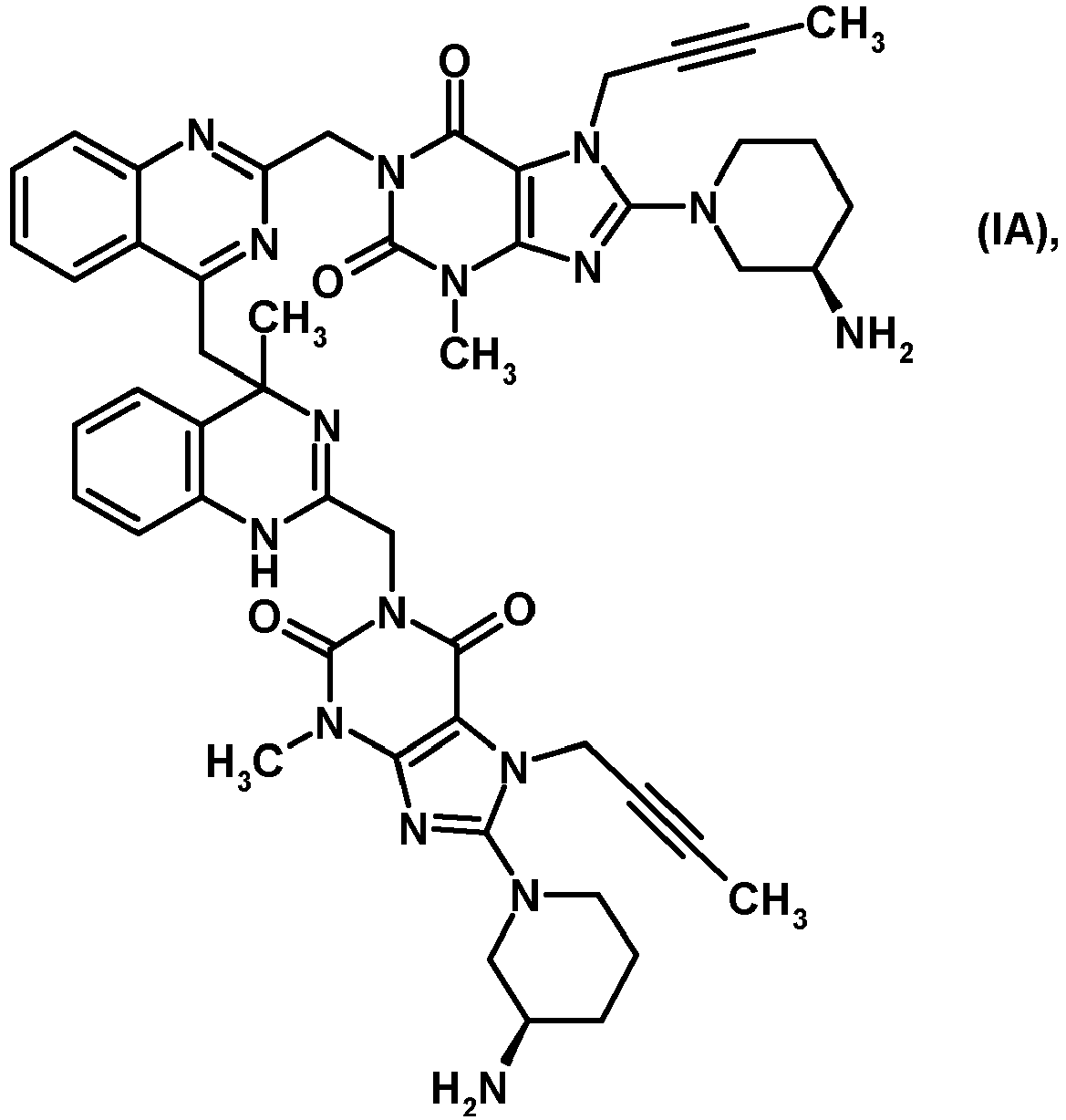
- 1. A compound having the formula (IA):

- 2. Physiologically acceptable salt of the compound according to embodiment 1 with an inorganic or organic acid or base.
- 3. Pharmaceutical composition containing a compound according to embodiment 1 or a physiologically acceptable salt according to embodiment 2 optionally together with one or more pharmaceutically acceptable excipients.
- 4. Process for preparing a pharmaceutical composition according to embodiment 3, characterised in that a compound according to at least one of embodiments 1 to 2 is incorporated in one or more pharmaceutically acceptable excipients.
- 5. Pharmaceutical composition comprising a compound according to embodiment 1 or a physiologically acceptable salt according to embodiment 2 and metformin (e.g. metformin hydrochloride), optionally together with one or more pharmaceutically acceptable excipients.
- 6. Pharmaceutical composition comprising a compound according to embodiment 1 or a physiologically acceptable salt according to embodiment 2 and pioglitazone (e.g. pioglitazone hydrochloride), optionally together with one or more pharmaceutically acceptable excipients
- The present disclosure provides substituted quinazolines of formula (I)

- The present disclosure relates to the compounds of formula (I), the tautomers, stereoisomers (e.g. enantiomers, diastereomers), mixtures and salts thereof, the preparation thereof, the use thereof for the prevention or treatment of disorders or conditions which are connected with an increased DPP-IV activity or which can be prevented or alleviated by reducing the DPP-IV activity, particularly type I or type II diabetes mellitus, the pharmaceutical compositions containing a compound of formula (I) or a physiologically acceptable salt thereof as well as processes for the preparation thereof.
- The disclosure further relates to pharmaceutical compositions or combinations comprising one or more such compounds of the disclosure and, optionally, one or more further active substances, as well as to the preparation and use thereof.
- The disclosure further relates to the use of compounds, pharmaceutical compositions or combinations according to this disclosure for preparing medicaments, particularly for preparing medicaments for the treatment and/or prevention of metabolic diseases, especially type 2 diabetes mellitus and/or conditions related thereto (e.g. diabetic complications).
- Further, the disclosure relates to compounds according to the disclosure, pharmaceutical compositions or combinations comprising such active ingredients, for use in methods of inhibiting DPP-IV and/or of treating and/or preventing diseases, disorders or consitions as described herein.
- Further, the disclosure relates to a method of treating and/or preventing diseases, disorders or conditions as described herein, said method comprising administering an effective amount of a compound according to the disclosure, or a pharmaceutical composition or combination comprising such compound, to the patient (particularly human patient) in need thereof.
- The compounds of formula (I) shown above include the tautomers, stereoisomers (e.g. enantiomers, diastereomers), mixtures and salts thereof wherein X, Y, R, R1 and R2 are defined as follows:
- In an embodiment of the disclosure, X and Y are the same or different and are independently selected from the following:

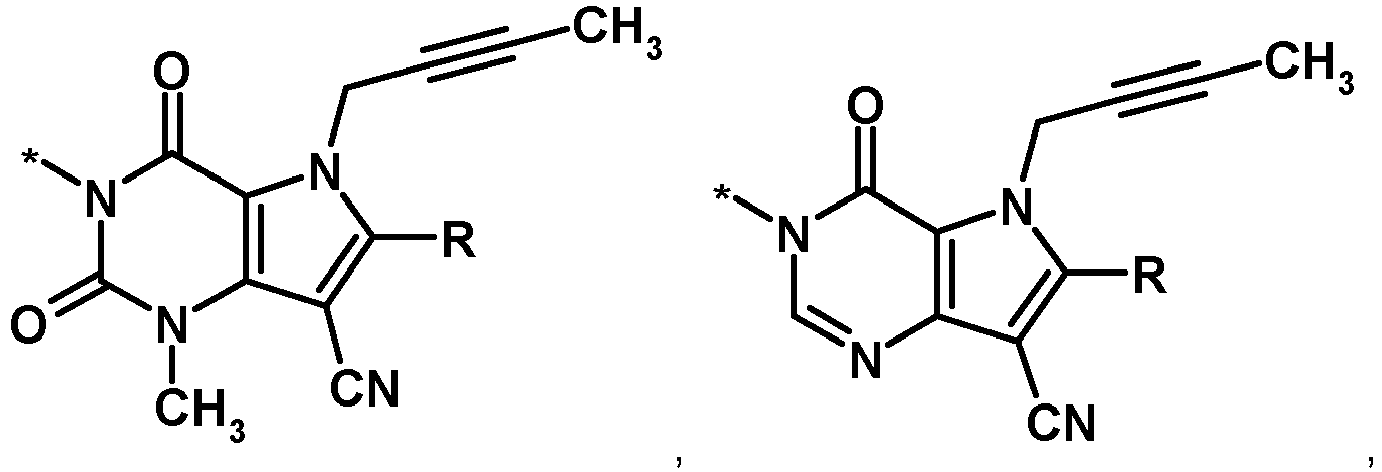

- each R is independently selected from R1 and R2, in which
- R1 and R2 are the same or different and are independently selected from 3-amino-piperidin-1-yl, (2-amino-2-methyl-propyl)-methylamino and (2-amino-propyl)-methylamino.
- In a further embodiment of the disclosure, X and Y are the same or different and are independently selected from

- each R is independently selected from R1 and R2, in which
- R1 and R2 are the same or different and are independently selected from 3-amino-piperidin-1-yl, (2-amino-2-methyl-propyl)-methylamino and (2-amino-propyl)-methylamino.
- In certain embodiments, R1 and R2 are the same or different and are independently selected from 3-(R)-amino-piperidin-1-yl, (2-amino-2-methyl-propyl)-methylamino and (2-(S)-aminopropyl)-methylamino.
- In certain embodiments, R1 and R2 are the same.
- In certain embodiments, R1 and R2 are the same and are selected from 3-(R)-amino-piperidin-1-yl, (2-amino-2-methyl-propyl)-methylamino and (2-(S)-amino-propyl)-methylamino. Preferably, R1 and R2 are the same and are each 3-(R)-amino-piperidin-1-yl.
- In certain embodiments, X and Y are the same or different and are each the following radical:

- In certain embodiments, X and Y are the same or different and are each the following radical:

- In certain embodiments, X and Y are the same.
- Preferably, X and Y are the same and are each the following radical:

- In a particular embodiment, the present disclosure relates to a compound of formula (IB):

or a tautomer, stereosiomer (e.g. enantiomer or diastereomer), mixture or salt thereof. - In a further particular embodiment, the present disclosure relates to a compound of formula (IB), wherein R1 and R2 are the same and are as defined above, or a tautomer, stereosiomer (e.g. enantiomer or diastereomer), mixture or salt thereof.
- Preferred is the compound of following formula (IA):
US2004097510 discloses monomeric compounds of this type as DPP IV inhibitors. - The compounds of formula (I) may be obtained by methods known per se, for example by the following method comprising reacting a compound of formula (II)


preferably in the presence of a suitable acid, for example HCI, such as e.g. aqueous hydrochloric acid, or an other suitable inorganic or organic acid. - This reaction may be conducted in a suitable reaction medium (or mixture of media).
- Optionally, such method of preparing may further comprise:
- Subsequently, if desired, any protecting groups used during the reaction are cleaved and/or the compounds of formula (I) thus obtained are resolved into their stereosiomers (e.g. enantiomers or diastereomers) and/or
- the compounds of formula (I) thus obtained are converted into the salts thereof, particularly for pharmaceutical use into the physiologically acceptable salts thereof with inorganic or organic acids or bases.
- Compounds of formula (I) according to this disclosure may be reversibly dissociable into the compounds of formulae (II) and (II'), in which X and Y are as herein defined. Such dissociation of a compound of formula (I) into its monomers can be obtained under acidic conditions, for example in the presence a suitable acid, for example HCI, such as e.g. aqueous hydrochloric acid, or an other suitable inorganic or organic acid.
- This reaction may be conducted in a suitable reaction medium (or mixture of media).
- The compounds of formulae (II) or (II') shown above may include the tautomers, stereoisomers (e.g. enantiomers, diastereomers), mixtures and salts thereof, as well as solvates thereof, wherein X and Y are defined as disclosed herein.
- In an embodiment, the preparation of compounds of formula (I) from compounds of formula (II) and/or compounds of formula (II') (e.g. by dimerization) is conducted in the presence of a suitable solvent or mixture of solvents. For example, such a reaction solvent is a polar solvent or mixture of polar solvents or a polar solvent system, such as e.g. water or an aqueous medium. In another embodiment, such reaction is conducted in a solvent-free medium. In a further embodiment, the compounds of formula (I) are isolated or obtained from a suitable solvent or mixture of solvents.
- In another embodiment, the preparation of compounds of formulae (II) or (II') from compounds of formula (I) (e.g. by dissociation) is conducted in the presence of a suitable solvent or mixture of solvents. For example, such a reaction solvent is a polar solvent or mixture of polar solvents or a polar solvent system, such as e.g. water or an aqueous medium. In another embodiment, such reaction is conducted in a solvent-free medium. In a further embodiment, the compounds of formulae (II) or (II') are isolated or obtained from a suitable solvent or mixture of solvents.
- Above-mentioned methods of preparation may be conducted in a suitable solvent, or mixture of solvents. The compounds of formulae (I), (II) or (II'), or their salts, thus obtainable may be isolated from such solvent or mixture of solvents (e.g. either in crystalline or amorphous form) in a manner customary per se. Optionally, purification, chromatographic separation, slurrying, suspending, dissolving, crystallization, precipitating (e.g. with a non-solvent, anti- or poor solvent), filtration, washing, lyophilization, or the like of the compounds of formulae (I), (II) or (II'), or salts thereof, may be performed, e.g. in the presence of one or more suitable solvents or mixture of solvents. Subsequently, optionally the solvent or mixture of solvents may be removed (e.g. evaporated) or the solid material may be collected or isolated, e.g. in order to obtain the compounds of formulae (I), (II) or (II'), or salts thereof, e.g. in isolated, pure, precipitated, solid (e.g. crystalline or amorphous), lyophilized, etc. form. Such steps may be optionally conducted at lower, ambient or elevated temperature. Optionally such procedures may be repeatedly and/or alternately applied to the obtained material. Further optionally, such procedures may be conducted independently or dependently from the foregoing preparation step(s). Further optionally, the obtained material may be dried (e.g. at elevated temperature). In an embodiment, the material may be spray-, freeze- or drum dried. In a further embodiment the material may be in isolated, precipitated, crystallized, lyophilized, amorphous or solid form. In another embodiment the material may be in solution or suspension form. In a yet further embodiment the material may be in salt or free form. In a still yet further embodiment the material may be in crude or purified form.
- In general, solvents or solvent systems, which the skilled person may consider within such procedures of the disclosure, may include, without being limited to, organic, non-aqueous or aqueous, protic or aprotic, polar or apolar solvents, such as, for example, ketones such as e.g. acetone, methyl ethyl ketone, methyl propyl ketone, methyl tert- or isobutyl ketone, or the like, lactones such as e.g. valerolactone, ethers such as e.g. diethyl ether, diisopropyl ether, methyl tert-butyl ether, ethylene glycol, tetrahydrofuran, methyl tetrahydrofuran, dioxane, or the like, hydrocarbons such as e.g. toluene, hexane, cyclohexane, methylcyclohexane, or the like, chlorinated hydrocarbons such as e.g. methylene chloride, 1,2-dichloroethane, chloroform, chlorobenzene, or the like, low-molecular-weight aliphatic alcohols such as e.g. methanol, ethanol, 1-propanol, isopropanol, butanol, tert-amylalkohol, or the like, esters such as e.g. acetic acid lower alkyl esters (e.g. ethyl acetate) or the like, amides or lactames such as e.g. N,N- dimethylformamide, N-methyl-2-pyrrolidone, N,N-dimethylacetamide, N-methylacetamide, or the like, nitriles such as e.g. acetonitrile, or the like, or sulfoxides such as e.g. DMSO, or the like, amines, e.g. triethylamine pyridine, or the like, or water, or mixtures thereof.
- Examples of acids, in the presence of which the formation and/or dissociation of a compound of formula (I) may be conducted, may include, without being limited to, strong inorganic or organic acids (which may be of Bronsted and/or Lewis acid type, and/or which may be in solid, liquid or gas form), for example HCI, such as e.g. aqueous hydrochloric acid, or the like. Further, optionally, the formation and/or dissociation of a compound of formula (I) may be conducted under any other suitable acidic conditions, acidic medium or acidic milieu.
- In a particular embodiment, the preparation of compounds of formula (I) from compounds of formula (II) and/or compounds of formula (II') is conducted in a polar solvent or mixture of polar solvents. In a further embodiment, the compounds of formula (I) are obtained or isolated from a polar solvent or mixture of polar solvents.
- For example, such a suitable solvent within the meaning of this disclosure is water or an aqueous medium.
- Another example of such a solvent or solvent system within the meaning of this disclosure may include or consist (essentially) of water or an aqueous medium, a low-molecular-weight aliphatic alcohol or such an alcoholic medium, or a mixture thereof.
- The present disclosure further relates to the compounds of formulae (I), (II) or (II'), the tautomers, enantiomers, diastereomers, mixtures or salts thereof or solvates thereof, including in any form, each as obtainable or obtained according to a procedure as disclosed herein.
- It is moreover known to the person skilled in the art that if there are a number of reactive centers on a starting or intermediate compound it may be necessary to block one or more reactive centers temporarily by protective groups in order to allow a reaction to proceed specifically at the desired reaction center. A detailed description for the use of a large number of proven protective groups is found, for example, in "Protective Groups in Organic Synthesis" by T. Greene and P. Wuts (John Wiley & Sons, Inc. 1999, 3rd Ed.) or in "Protecting Groups (Thieme Foundations Organic Chemistry Series N Group" by P. Kocienski (Thieme Medical Publishers, 2000).
- For example, protecting groups for an amino, alkylamino or imino group may be, for example, a formyl, acetyl, trifluoroacetyl, methoxycarbonyl, ethoxycarbonyl, tert.-butoxycarbonyl or phthalimido group.
- The cleaving of a tert.-butyloxycarbonyl group is preferably carried out by treating with an acid such as trifluoroacetic acid or hydrochloric acid, optionally using a solvent such as methylene chloride, dioxane, methanol, ethanol, isopropanol or diethyl ether.
- A formyl, acetyl, methoxycarbonyl, ethoxycarbonyl or trifluoroacetyl group is preferably cleaved by treating with an acid such as hydrochloric acid, optionally in the presence of a solvent such as acetic acid, at temperatures between 20 and 120°C or by treating with sodium hydroxide solution, optionally in the presence of a solvent such as tetrahydrofuran, methanol or ethanol, at temperatures between 0 and 100°C.
- A phthaloyl group is preferably cleaved in the presence of hydrazine or a primary amine such as methylamine, ethylamine, ethanolamine or n-butylamine in a solvent such as methanol, ethanol, isopropanol, toluene/water, dioxane or tetrahydrofurane, with or without water, at temperatures between 20°C and the reflux temperature of the reaction mixture.
- Salts of the compounds according to the present disclosure include - depending upon their nature - all acid addition salts and all salts with bases, especially all pharmaceutically acceptable acid addition salts and salts with bases. Particular mention may be made of the physiologically tolerable salts with inorganic or organic acids or bases customarily used in pharmacy. The salts include water-insoluble and, particularly, water-soluble salts.
- Inorganic acids which may be suitable for forming pharmaceutically or physiologically acceptable acid addition salts include, by way of example and not limitation, hydrochloric acid, hydrobromic acid, phosphoric acid, sulfuric acid, and the like. Organic acids which may be suitable for forming pharmaceutically or physiologically acceptable acid addition salts include, by way of example and not limitation, citric acid, maleic acid, fumaric acid, succinic acid, lactic acid, tartaric acid, methanesulfonic acid, and the like.
- Thus, pharmaceutically or physiologically acceptable acid addition salts with inorganic or organic acids may include, by way of example and not limitation, hydrochlorides, hydrobromides, phosphates, sulfates, citrates, maleates, fumarates, succinates, lactates, tartrates, methanesulfonates (mesylates), and the like.
- Salts which are unsuitable for pharmaceutical uses but which can be employed, for example, for the isolation or purification of free compounds of formula (I) or their pharmaceutically acceptable salts, are also included.
- Pharmaceutically non-acceptable salts, which can be obtained, for example, as process products during the preparation of the compounds according to this disclosure e.g. on an industrial scale, are converted into pharmaceutically acceptable salts by processes known to the person skilled in the art.
- All isomeric forms (especially all regio- and stereoisomeric forms, e.g. all chiral, enantiomeric, diastereomeric, racemic forms, tautomeric and all geometric isomeric forms) of a compound of formula (I) are intended within this disclosure, unless the specific isomer form is specifically indicated. Obviously, the isomer which is pharmacologically most effective and most free from side effects is preferred.
- It will be appreciated that the compounds of the present disclosure contain at least one, two or more asymmetrically substituted carbon atoms, and may be isolated as pure diastereomers or diastereomeric mixtures in optically active or racemic forms.
- The disclosure contemplates all conceivable stereoisomers, particularly the diastereomers and enantiomers mentioned herein, e.g. in substantially pure form, in enriched form (e.g. substantially free of any or all other undesired diastereomers and/or enantiomers) and/or in any mixing ratio, including the racemic forms, as well as the salts thereof.
- In general, substantially pure stereoisomers can be obtained according to synthetic principles customary to the skilled person, e.g. by separation of corresponding mixtures, by using stereochemically pure starting materials and/or by stereoselective synthesis.
- It is known in the art how to prepare optically active forms, such as by resolution of racemic forms or by synthesis, e.g. from optically active starting materials and/or by using chiral reagents.
- Enantiomerically pure compounds of this disclosure can be prepared via asymmetric synthesis, for example by preparation and separation of appropriate diastereoisomeric compounds/intermediates which can be separated by known methods (e.g. by chromatographic separation or (fractional) crystallization from a suitable solvent), and/or by using chiral reaction components (e.g. chiral reagents, chiral catalysts, chiral ligands, chiral synthons, chiral building blocks, or the like).
- Further, it is known to the person skilled in the art how to prepare enantiomerically pure compounds from the corresponding racemic mixtures, such as e.g. by chromatographic separation of the corresponding racemic compounds on chiral separating columns; or by resolution of racemic compounds using an appropriate resolving agent; e.g. by means of diastereomeric salt formation of the racemic compounds with optically active acids or bases, subsequent resolution of the salts and release of the desired compound from the salt; or by derivatization of the corresponding racemic compounds with chiral auxiliary reagents, subsequent diastereomer separation and removal of the chiral auxiliary group; by kinetic resolution of a racemate (e.g. by enzymatic resolution); by enantioselective (preferential) crystallization (or crystallization by entrainment) from a conglomerate of enantiomorphous crystals under suitable conditions; or by (fractional) crystallization from a suitable solvent in the presence of a chiral auxiliary.
- The compounds of formula (I) obtained may be separated into the enantiomers and/or diastereomers thereof. For example, cis-/trans mixtures may be separated into their cis and trans isomers, and compounds with at least one optically active carbon atom may be resolved into their enantiomers.
- Thus, for example, cis-/trans mixtures obtained may be separated by chromatography into their cis and trans isomers and the compounds of formula (I) obtained which occur as racemates may be separated by methods known per se (cf. Allinger N. L. and Eliel E. L. in "Topics in Stereochemistry", Vol. 6, Wiley Interscience, 1971) into their optical antipodes. Compounds of formula (I) with at least 2 asymmetric carbon atoms may be resolved into their diastereomers on the basis of their physical-chemical differences using methods known per se, e.g. by chromatography and/or fractional crystallisation, and, if these compounds are obtained in racemic form, they may subsequently be resolved into the enantiomers as mentioned above.
- The enantiomers are preferably separated by column separation on chiral phases or by recrystallisation from an optically active solvent or by reacting with an optically active substance which forms salts or derivatives such as e.g. esters or amides with the racemic compound, particularly acids and the activated derivatives or alcohols thereof, and separating the diastereomeric mixture of salts or derivatives thus obtained, e.g. on the basis of their differences in solubility, whilst the free antipodes may be released from the pure diastereomeric salts or derivatives by the action of suitable agents. Optically active acids in common use are e.g. the D- and L-forms of tartaric acid or dibenzoyltartaric acid, di-o-tolyltartaric acid, malic acid, mandelic acid, camphorsulphonic acid, glutamic acid, aspartic acid or quinic acid. An optically active alcohol may be, for example, (+) or (-)-menthol and an optically active acyl group in amides, for example, may be a (+)- or (-)-menthyloxycarbonyl.
- Those skilled in the art will appreciate that organic compounds or their salts can be isolated in association with solvent molecules or can form complexes with solvents with which they are contacted, in which they are reacted or from which they are isolated (e.g. precipitated, crystallized, lyophilized, etc.) or the like. According to expert's awareness, some of the compounds according to this disclosure (such as e.g. compounds of formulae (I), (II) or (II'), the tautomers, enantiomers, diastereomers, mixtures or salts thereof) may contain, e.g. when obtained or isolated in solid form, varying or fixed amounts of solvents (including aqueous and/or non-aqueous solvents). Included within the scope of the disclosure are therefore solvates (including hydrates, organic solvates and mixed hydrates/organic solvates) of the compounds according to this disclosure. Solvates of the compounds according to this disclosure may include stoichiometric or non-stoichiometric solvates, tightly or weakly bound solvates, as well as homo- or heterosolvates. Preferably the solvent(s) used is a pharmaceutically acceptable solvent(s), e.g. water and/or a low molecular weight aliphatic alcohol such as ethanol or the like. In an embodiment, solvates of the compounds of this disclosure may include, for example, hydrates or alcoholates, or mixed hydrates/alcoholates. The present disclosure embraces both the unsolvated and all solvated forms. Likewise, the present disclosure embraces any solvate, ansolvate, hydrate, anhydrous, hygroscopic and/or non-hygroscopic forms.
- The compounds of formula (II) used as starting materials are either known from the literature or are obtained by methods such as those described for example in
WO 04/018468 WO 04/050658 WO 05/085246 WO 06/029769 WO 06/048427 WO 2007/071738 ,WO 2008/017670 ,WO 2012/088682 orWO 2012/089127 . - The compounds of formula (I) according to the disclosure and the physiologically acceptable salts thereof have valuable (in-vivo and in-vitro) pharmacological properties, particularly an inhibiting effect on the enzyme DPP-IV. The ability of the substances including their salts to inhibit the DPP-IV activity may be demonstrated in an experiment as described herein.
- The DPP-IV assay may be carried out as follows:
Blood is taken from up to 4 human donors having no pharmacological therapy for the last 14 days via venous puncture in EDTA precoated tubes (Sarstedt, 2.6 ml Monovette). Blood samples are centrifuged at 4°C at 800 rpm and finally supernatant was taken and used as EDTA plasma. - The 96-well plates are purchased from Greiner bio-one, CatNo 655900 (black, flat bottom). The substrate H-Ala-Pro-7-amido-4-trifluoromethylcoumarin (AlaPro-AFC) is from Bachem (Prod.-Nol-1680). All other materials are of highest grade commercially available. EDTA-plasma is diluted 1:42.5 with assay buffer (100mM Tris, 100mM NaCl, adjusted to pH 7.8 with HCI). The final dilution of the plasma in the assay is 140 fold. In the 96-well plates 20µL test substance in assay buffer (final DMSO concentration 1%) are mixed with 50µL substrate (200mM stock solution in DMF (dimethylformamide), diluted 1:1000 with water, final concentration 100µM) and 30µL of diluted plasma. The plate is then incubated at room temperature for 1 hour and fluorescence of the wells is determined using a Wallac, VictorTM 1420 Multilabel Counter, at an Excitation wavelength of 405 nm and an Emission wavelength of 535nm.
- Each assay microtiter plate contains wells with vehicle controls (1% DMSO in assay buffer) as reference for non-inhibited enzyme activity and wells with assay buffer instead of enzyme as controls for background fluorescence. Background fluorescence is negligible.
- The potency of the test substance in question, expressed as the IC50 value, is calculated from dosage/activity curves consisting of about 10 measured points in each case.
- The following results are obtained:
Compound (Example no.) DPP-IV inhibition IC50 [pM] 1 6 - In view of their ability to inhibit DPP-IV activity, the compounds of formula (I) according to the disclosure and the corresponding pharmaceutically acceptable salts thereof are suitable for influencing any conditions or disorders which can be affected by the inhibition of the DPP-IV activity. It is therefore to be expected that the compounds according to the disclosure will be suitable for the prevention or treatment of diseases or conditions such as type I and type II diabetes mellitus, prediabetes, reduced glucose tolerance or changes in the fasting blood sugar, diabetic complications (e.g. retinopathy, nephropathy or neuropathies), metabolic acidosis or ketosis, reactive hypoglycaemia, insulin resistance, metabolic syndrome, dyslipidaemias of various origins, arthritis, atherosclerosis and related diseases, obesity, allograft transplantation and osteoporosis caused by calcitonin. In addition, these substances are suitable for preventing B-cell degeneration such as e.g. apoptosis or necrosis of pancreatic B-cells. The substances are also suitable for improving or restoring the function of pancreatic cells and additionally increasing the size and number of pancreatic B-cells.
- Additionally, on the basis of the role of the glucagon-like peptides such as e.g. GLP-1 and GLP-2 and their link with DPP-IV inhibition, it is expected that the compounds according to the disclosure will be suitable for achieving a sedative or tranquillising effect, as well as having a favourable effect on catabolic states after operations or hormonal stress responses or possibly reducing mortality and morbidity after myocardial infarction. Moreover, they are suitable for treating any conditions connected with the effects mentioned above and mediated by GLP-1 or GLP-2. The compounds according to the disclosure may also be used as diuretics or antihypertensives and are suitable for preventing and treating acute kidney failure. The compounds according to the disclosure may also be used to treat inflammatory complaints of the respiratory tract. They are also suitable for preventing and treating chronic inflammatory bowel diseases such as e.g. irritable bowel syndrome (IBS), Crohn's disease or ulcerative colitis and also pancreatitis. It is also expected that they can be used for all kinds of injury or damage to the gastrointestinal tract such as may occur in colitis and enteritis, for example. Moreover, it is expected that DPP-IV inhibitors and hence the compounds according to the disclosure can be used to treat infertility or to improve fertility in humans or mammals, particularly if the infertility is connected with insulin resistance or with polycystic ovary syndrome. On the other hand these substances are suitable for influencing sperm motility and are thus suitable for use as male contraceptives. In addition, the substances are suitable for treating growth hormone deficiencies connected with restricted growth, and may reasonably be used for all indications for which growth hormone may be used. The compounds according to the disclosure are also suitable, on the basis of their inhibitory effect on DPP-IV, for treating various autoimmune diseases such as e.g. rheumatoid arthritis, multiple sclerosis, thyroiditis and Basedow's disease, etc. They may also be used to treat viral diseases and also, for example, in HIV infections, for stimulating blood production, in benign prostatic hyperplasia, gingivitis, as well as for the treatment of neuronal defects and neurodegenerative diseases such as Alzheimer's disease, for example. The compounds described may also be used for the treatment of tumours, particularly for modifying tumour invasion and also metastasisation; examples here are their use in treating T-cell lymphomas, acute lymphoblastic leukaemia, cell-based thyroid carcinomas, basal cell carcinomas or breast cancers. Other indications are stroke, ischaemia of various origins, Parkinson's disease and migraine. In addition, further indications include follicular and epidermal hyperkeratoses, increased keratinocyte proliferation, psoriasis, encephalomyelitis, glomerulonephritis, lipodystrophies, as well as psychosomatic, depressive and neuropsychiatric diseases of all kinds.
- Accordingly, the present disclosure further relates to a compound of formula (I), or a tautomer or salt thereof, for use in the therapies described herein.
- The present disclosure further relates to a pharmaceutical composition comprising a compound of formula (I), or a tautomer or salt thereof, and, optionally, one or more pharmaceutically acceptable excipients.
- The present disclosure further relates to a combination or composition comprising a compound of formula (I), or a tautomer or salt thereof, and one or more other active substances selected from those mentioned herein, e.g. selected from other antidiabetic substances, active substances that lower the blood sugar level, active substances that lower the lipid level in the blood, active substances that raise the HDL level in the blood, active substances that lower blood pressure, and active substances that are indicated in the treatment of atherosclerosis or obesity, e.g. each as described herein; particularly for simultaneous, separate or sequential use in the therapies described herein.
- The present disclosure further relates to a pharmaceutical composition comprising a compound of formula (I), or a tautomer or salt thereof, and another agent or substance, such as e.g. in free or salt form (e.g. in an acid addition salt form), and, optionally, one or more pharmaceutically acceptable excipients.
- The present disclosure further relates to a pharmaceutical composition comprising a compound of formula (I), or a tautomer or salt thereof, and metformin (e.g. metformin hydrochloride), and, optionally, one or more pharmaceutically acceptable excipients.
- The present disclosure further relates to a pharmaceutical composition comprising a compound of formula (I), or a tautomer or salt thereof, and pioglitazone (e.g. pioglitazone hydrochloride), and, optionally, one or more pharmaceutically acceptable excipients.
- The present disclosure further relates to a compound of formula (I), or a tautomer or salt thereof, or a composition thereof, in combination with metformin (e.g. metformin hydrochloride), for use in the therapies described herein.
- The present disclosure further relates to a compound of formula (I), or a tautomer or salt thereof, or a composition thereof, in combination with pioglitazone (e.g. pioglitazone hydrochloride), for use in the therapies described herein.
- The present disclosure further relates to a compound of formula (I), or a tautomer or salt thereof, or a composition thereof, in combination with telmisartan, for use in the therapies described herein.
- The present disclosure further relates to a method for treating and/or preventing metabolic diseases, especially type 2 diabetes mellitus and/or conditions related thereto (e.g. diabetic complications) comprising the combined (e.g. simultaneous, separate or sequential) administration of one or more other antidiabetics selected from the group consisting of metformin, a sulphonylurea, nateglinide, repaglinide, a thiazolidinedione (e.g. pioglitazone), a PPAR-gamma-agonist, an alpha-glucosidase inhibitor, insulin or an insulin analogue, and GLP-1 or a GLP-1 analogue, and a compound of formula (I), a tautomer or salt thereof, or composition thereof, to the patient (particularly human patient) in need thereof.
- Examples of such metabolic disorders or diseases amenable by the therapy of this disclosure, particularly in the patients described herein, may include, without being limited to, type 1 diabetes, type 2 diabetes, latent autoimmune diabetes in the adult (LADA), impaired glucose tolerance (IGT), impaired fasting blood glucose (IFG), hyperglycemia, postprandial hyperglycemia, postabsorptive hyperglycemia, overweight, obesity, dyslipidemia, hyperlipidemia, hypercholesterolemia, hypertriglyceridemia, hypertension, atherosclerosis, endothelial dysfunction, osteoporosis, chronic systemic inflammation, non alcoholic fatty liver disease (NAFLD), retinopathy, neuropathy, nephropathy, polycystic ovarian syndrome, and/or metabolic syndrome.
- The present disclosure further relates to at least one of the following methods:
- preventing, slowing the progression of, delaying or treating a metabolic disorder or disease, such as e.g. type 1 diabetes mellitus, type 2 diabetes mellitus, latent autoimmune diabetes in the adult (LADA), impaired glucose tolerance (IGT), impaired fasting blood glucose (IFG), hyperglycemia, postprandial hyperglycemia, postabsorptive hyperglycemia, overweight, obesity, dyslipidemia, hyperlipidemia, hypercholesterolemia, hypertriglyceridemia, hypertension, atherosclerosis, endothelial dysfunction, osteoporosis, chronic systemic inflammation, non alcoholic fatty liver disease (NAFLD), retinopathy, neuropathy, nephropathy, polycystic ovarian syndrome, and/or metabolic syndrome;
- improving and/or maintaining glycemic control and/or for reducing of fasting plasma glucose, of postprandial plasma glucose, of postabsorptive plasma glucose and/or of glycosylated hemoglobin HbA1c;
- preventing, slowing, delaying or reversing progression from pre-diabetes, impaired glucose tolerance (IGT), impaired fasting blood glucose (IFG), insulin resistance and/or from metabolic syndrome to type 2 diabetes mellitus;
- preventing, reducing the risk of, slowing the progression of, delaying or treating of complications of diabetes mellitus such as micro- and macrovascular diseases, such as nephropathy, micro- or macroalbuminuria, proteinuria, retinopathy, cataracts, neuropathy, learning or memory impairment, neurodegenerative or cognitive disorders, cardio- or cerebrovascular diseases, tissue ischaemia, diabetic foot or ulcus, atherosclerosis, hypertension, endothelial dysfunction, myocardial infarction, acute coronary syndrome, unstable angina pectoris, stable angina pectoris, peripheral arterial occlusive disease, cardiomyopathy, heart failure, heart rhythm disorders, vascular restenosis, and/or stroke;
- reducing body weight and/or body fat or preventing an increase in body weight and/or body fat or facilitating a reduction in body weight and/or body fat;
- preventing, slowing, delaying or treating the degeneration of pancreatic beta cells and/or the decline of the functionality of pancreatic beta cells and/or for improving, preserving and/or restoring the functionality of pancreatic beta cells and/or stimulating and/or restoring or protecting the functionality of pancreatic insulin secretion;
- preventing, slowing, delaying or treating non alcoholic fatty liver disease (NAFLD) including hepatic steatosis, non-alcoholic steatohepatitis (NASH) and/or liver fibrosis (such as e.g. preventing, slowing the progression, delaying, attenuating, treating or reversing hepatic steatosis, (hepatic) inflammation and/or an abnormal accumulation of liver fat);
- preventing, slowing the progression of, delaying or treating type 2 diabetes with failure to conventional antidiabetic mono- or combination therapy;
- achieving a reduction in the dose of conventional antidiabetic medication required for adequate therapeutic effect;
- reducing the risk for adverse effects associated with conventional antidiabetic medication (e.g. hypoglycemia or weight gain); and/or
- maintaining and/or improving the insulin sensitivity and/or for treating or preventing hyperinsulinemia and/or insulin resistance;
- The compounds of formula (I) or their pharmaceutically acceptable salts can be used as medicaments, e.g. in the form of pharmaceutical compositions for enteral, parenteral or topical administration. They may be administered in any of the generally accepted modes of administration available in the art, e.g., perorally, e.g. in the form of tablets, coated tablets, dragees, hard and soft gelatine capsules, solutions, emulsions or suspensions, rectally, e.g. in the form of suppositories, parenterally (including intravenously), e.g. in the form of injection solutions or infusion solutions, or topically, e.g. in the form of ointments, creams or oils. Among the possible modes of administration, oral and intravenous delivery are preferred.
- The pharmaceutical compositions according to this disclosure may typically contain at least one of the compounds of the disclosure in a total amount of from about 0.05 to 80 wt%, or from about 0.1 to 50 wt%, optionally together with pharmaceutically acceptable excipients.
- For example, the amount of the compound of formula (I) according to this disclosure, or a tautomer or salt thereof, comprised in a dosage form or pharmaceutical composition according to this disclosure may be at least 0.1% to 0.5%, or at least 0.5% to 1.5%, or at least 1% to 3%, optionally in addition to one or more excipients.
- The person skilled in the art is familiar with pharmaceutically acceptable excipients, such as e.g. diluents, carriers, binders, disintegrants, surfactants, lubricants, vehicles, auxiliaries, adjuvants and/or further additives which are known to be suitable for preparing pharmaceutical compositions, on account of his/her expert knowledge.
- As pharmaceutically acceptable excipients, usually any excipients known to be appropriate for pharmaceutical compositions come into consideration. Examples thereof include, but are not limited to, diluents, fillers, binders, disintegrants, lubricants, glidants, solvents, dispersants, emulsifiers, solubilizers, gel formers, ointment bases, antioxidants, preservatives, stabilizers, carriers, thickeners, complexing agents, buffers, pH regulators (e.g. to obtain neutral, alkaline or acidic formulations), permeation promoters, polymers, coating agents, propellants, tonicity adjusting agents, surfactants, colorants, flavorings, sweeteners and dyes.
- In general, suitable carrier materials are not only inorganic carrier materials, but also organic carrier materials. Thus, e.g., lactose, starches (e.g. corn starch) or derivatives thereof, talc, silica, polyvinylpyrrolidones, stearic acid or its salts can be used as carrier materials for tablets, coated tablets, dragees and hard gelatine capsules. Suitable carrier materials for soft gelatine capsules are, e.g., vegetable oils, waxes, fats and semi-solid and liquid polyols. Suitable carrier materials for the production of solutions and syrups are, e.g., water, polyols, sucrose, invert sugar and the like. Suitable carrier materials for injection or infusion solutions are, e.g., water, alcohols, polyols, glycerol and vegetable oils. Suitable carrier materials for suppositories are, e.g., natural or hardened oils, waxes, fats and semi-liquid or liquid polyols or polyethylene glycols. Suitable carrier materials for topical preparations are glycerides, semi-synthetic and synthetic glycerides, hydrogenated oils, liquid waxes, liquid paraffins, liquid fatty alcohols, sterols, polyethylene glycols and cellulose derivatives.
- In particular, excipients, carriers and/or diluents of a type appropriate to the desired pharmaceutical composition, formulation or preparation and the desired mode of administration are used.
- The pharmaceutical compositions (e.g. tablets) according to the disclosure may be obtained, for example, by mixing one or more compounds of formula (I) or a pharmaceutically acceptable salt thereof with suitable excipients, for example known inert diluents, carriers, disintegrants, adjuvants, surfactants, binders and/or lubricants . The tablets may also consist of several layers. The compositions of this disclosure may also contain further active substances.
- Accordingly, the pharmaceutical compositions according to this disclosure can be prepared by processes which are known per se and familiar to the person skilled in the art, e.g. by incorporating the described compounds of formula (I) or their pharmaceutically acceptable salts (optionally combined with other active substances) optionally together with one or more conventional carriers (e.g. solid or liquid carriers) and/or diluents, e.g. with corn starch, lactose, glucose, microcrystalline cellulose, magnesium stearate, polyvinylpyrrolidone, citric acid, tartaric acid, water, water/ethanol, water/glycerol, water/sorbitol, water/polyethylene glycol, propylene glycol, cetylstearyl alcohol, carboxymethylcellulose or fatty substances such as hard fat or suitable mixtures thereof, into conventional galenic preparations such as plain or coated tablets, capsules, powders, suspensions or suppositories.
- The dosage of the compounds of the disclosure can vary within wide limits depending on the compound which is to be administered, the nature and gravity of the disease to be treated or prevented, the age and the individual condition of the patient and the mode and frequency of administration, and will, of course, be fitted to the individual requirements in each particular case. Usually, a dosage of the compounds of the disclosure in the order of magnitude customary for DPP-IV inhibitors comes into consideration.
- The dosage typically required for compounds of this disclosure, when administered by intravenous route, may be 0.001 mg to 10 mg, or 0.01 mg to 10 mg, or 0.1 mg to 10 mg, such as e.g. 0.25 mg to 5 mg, and, when administered by oral route, may be 0.005 mg to 100 mg, or 0.05 mg to 100 mg, or 0.5 mg to 100 mg, such as e.g. 2.5 mg to 50 mg or 0.5 mg to 10 mg, preferably 2.5 mg to 10 mg or 1 mg to 5 mg, in each case 1 to 4 times a day. Depending on the dosage it may be convenient to administer the daily dosage in several dosage units.
- A dosage form containing a pharmaceutical composition according to this disclosure may typically comprise the compound of formula (I) according to this disclosure, or a tautomer or salt thereof, in a dosage range from about 0.1 mg to 100 mg.
- Accordingly, the pharmaceutical compositions according to this disclosure comprising the compounds of this disclosure are prepared by the skilled person using pharmaceutically acceptable formulation excipients as described in the art and appropriate for the desired route of administration.
- Oral preparations or dosage forms of the compounds of this disclosure may be prepared according to known techniques.
- Examples of suitable diluents for compounds according to this disclosure may include cellulose powder, calcium hydrogen phosphate, erythritol, low substituted hydroxypropyl cellulose, mannitol, pregelatinized starch or xylitol.
- Examples of suitable lubricants for compounds according to this disclosure may include talc, polyethyleneglycol, calcium behenate, calcium stearate, hydrogenated castor oil or magnesium stearate.
- Examples of suitable binders for compounds according to this disclosure may include copovidone (copolymerisates of vinylpyrrolidon with other vinylderivates), hydroxypropyl methylcellulose (HPMC), hydroxypropylcellulose (HPC), polyvinylpyrrolidon (povidone), pregelatinized starch, or low-substituted hydroxypropylcellulose (L-HPC).
- Examples of suitable disintegrants for compounds according to this disclosure may include corn starch or crospovidone.
- Suitable methods of preparing pharmaceutical formulations of the DPP-IV inhibitors according to the disclosure may be
- direct tabletting of the active substance in powder mixtures with suitable tabletting excipients;
- granulation with suitable excipients and subsequent mixing with suitable excipients and subsequent tabletting as well as film coating; or
- packing of powder mixtures or granules into capsules.
- Suitable granulation methods may be
- wet granulation in the intensive mixer followed by fluidised bed drying;
- one-pot granulation;
- fluidised bed granulation; or
- dry granulation (e.g. by roller compaction) with suitable excipients and subsequent tabletting or packing into capsules.
- An illustrative composition (e.g. tablet core) of a compound according to the disclosure may comprise the first diluent mannitol, pregelatinized starch as a second diluent with additional binder properties, the binder copovidone, the disintegrant corn starch, and magnesium stearate as lubricant; wherein copovidone and/or corn starch may be optional.
- A tablet of a compound according to the disclosure may be film coated, preferably the film coat comprises hydroxypropylmethylcellulose (HPMC), polyethylene glycol (PEG) or propylene glycol (PG), talc, titanium dioxide and iron oxide (e.g. red and/or yellow).
- The pharmaceutical compositions (or formulations) may be packaged in a variety of ways. Generally, an article for distribution includes one or more containers that contain the one or more pharmaceutical compositions in an appropriate form. Tablets are typically packed in an appropriate primary package for easy handling, distribution and storage and for assurance of proper stability of the composition at prolonged contact with the environment during storage. Primary containers for tablets may be bottles or blister packs.
- A suitable bottle, e.g. for a pharmaceutical composition or combination (tablet) comprising a compound according to the disclosure, may be made from glass or polymer (preferably polypropylene (PP) or high density polyethylene (HD-PE)) and sealed with a screw cap. The screw cap may be provided with a child resistant safety closure (e.g. press-and-twist closure) for preventing or hampering access to the contents by children. If required (e.g. in regions with high humidity), by the additional use of a desiccant (such as e.g. bentonite clay, molecular sieves, or, preferably, silica gel) the shelf life of the packaged composition can be prolonged.
- A suitable blister pack, e.g. for a pharmaceutical composition or combination (tablet) comprising a compound according to the disclosure, may comprise or formed of a top foil (which is breachable by the tablets) and a bottom part (which contains pockets for the tablets). The top foil may contain a metalic foil, particularly an aluminium or aluminium alloy foil (e.g. having a thickness of 20µm to 45µm, preferably 20µm to 25µm) that is coated with a heat-sealing polymer layer on its inner side (sealing side). The bottom part may contain a multi-layer polymer foil (such as e.g. poly(vinyl choride) (PVC) coated with poly(vinylidene choride) (PVDC); or a PVC foil laminated with poly(chlorotriflouroethylene) (PCTFE)) or a multi-layer polymer-metal-polymer foil (such as e.g. a cold-formable laminated PVC/aluminium/polyamide composition).
- To ensure a long storage period especially under hot and wet climate conditions an additional overwrap or pouch made of a multi-layer polymer-metal-polymer foil (e.g. a laminated polyethylen/aluminium/polyester composition) may be used for the blister packs. Supplementary desiccant (such as e.g. bentonite clay, molecular sieves, or, preferably, silica gel) in this pouch package may prolong the shelf life even more under such harsh conditions.
- The article may further comprise a label or package insert, which refer to instructions customarily included in commercial packages of therapeutic products, that may contain information about the indications, usage, dosage, administration, contraindications and/or warnings concerning the use of such therapeutic products. In one embodiment, the label or package inserts indicates that the composition can be used for any of the purposes described herein.
- The DPP-IV inhibitors of this disclosure - besides their use in mono-therapy - may also be used in conjunction with other active substances, by means of which improved treatment results can be obtained. Such a combined treatment may be given as a free combination of the substances or in the form of a fixed combination, for example in a tablet or capsule. Pharmaceutical formulations of the combination partner needed for this may either be obtained commercially as pharmaceutical compositions or may be formulated by the skilled man using conventional methods. The active substances which may be obtained commercially as pharmaceutical compositions are described in numerous places in the prior art, for example in the list of drugs that appears annually, the "Rote Liste ®" of the federal association of the pharmaceutical industry, or in the annually updated compilation of manufacturers' information on prescription drugs known as the "Physicians' Desk Reference".
- Examples of antidiabetic combination partners are metformin; sulphonylureas such as glibenclamide, tolbutamide, glimepiride, glipizide, gliquidon, glibornuride and gliclazide; nateglinide; repaglinide; mitiglinide, thiazolidinediones such as rosiglitazone and pioglitazone; PPAR gamma modulators such as metaglidases; PPAR-gamma agonists such as mitoglitazone, INT-131, balaglitazone or rivoglitazone; PPAR-gamma antagonists; PPAR-gamma/alpha modulators such as tesaglitazar, muraglitazar, aleglitazar, indeglitazar and KRP297; PPAR-gamma/alpha/delta modulators such as e.g. lobeglitazone; AMPK-activators such as AICAR; acetyl-CoA carboxylase (ACC1 and ACC2) inhibitors; diacylglycerol-acetyltransferase (DGAT) inhibitors; pancreatic beta cell GCRP agonists such as GPR119 agonists (SMT3-receptor-agonists), such as the GPR119 agonists 5-ethyl-2-{4-[4-(4-tetrazol-1-yl-phenoxymethyl)-thiazol-2-yl]-piperidin-1-yl}-pyrimidine or 5-[1-(3-isopropyl-[1,2,4]oxadiazol-5-yl)-piperidin-4-ylmethoxy]-2-(4-methanesulfonyl-phenyl)-pyridine; 11ß-HSD-inhibitors; FGF19 agonists or analogues; alpha-glucosidase blockers such as acarbose, voglibose and miglitol; alpha2-antagonists; insulin and insulin analogues such as human insulin, insulin lispro, insulin glusilin, r-DNA-insulinaspart, NPH insulin, insulin detemir, insulin degludec, insulin tregopil, insulin zinc suspension and insulin glargin; Gastric inhibitory Peptide (GIP); amylin and amylin analogues (e.g. pramlintide or davalintide); GLP-1 and GLP-1 analogues such as Exendin-4, e.g. exenatide, exenatide LAR, liraglutide, taspoglutide, lixisenatide (AVE-0010), LY-2428757 (a PEGylated version of GLP-1), dulaglutide (LY-2189265), semaglutide or albiglutide; SGLT2-inhibitors such as e.g. dapagliflozin, sergliflozin (KGT-1251), atigliflozin, canagliflozin or (1S)-1,5-anhydro-1-[3-(1-benzothiophen-2-ylmethyl)-4-fluorophenyl]-D-glucitol, ipragliflozin, tofogliflozin, luseogliflozin; inhibitors of protein tyrosine-phosphatase (e.g. trodusquemine); inhibitors of glucose-6-phosphatase; fructose-1,6-bisphosphatase modulators; glycogen phosphorylase modulators; glucagon receptor antagonists; phosphoenolpyruvatecarboxykinase (PEPCK) inhibitors; pyruvate dehydrogenasekinase (PDK) inhibitors; inhibitors of tyrosine-kinases (50 mg to 600 mg) such as PDGF-receptor-kinase (cf.
EP-A-564409 WO 98/35958 US 5093330 ,WO 2004/005281 , andWO 2006/041976 ) or of serine/threonine kinases; glucokinase/regulatory protein modulators incl. glucokinase activators; glycogen synthase kinase inhibitors; inhibitors of the SH2-domain-containing inositol 5-phosphatase type 2 (SHIP2) ; IKK inhibitors such as high-dose salicylate; JNK1 inhibitors; protein kinase C-theta inhibitors; beta 3 agonists such as ritobegron, YM 178, solabegron, talibegron, N-5984, GRC-1087, rafabegron, FMP825; aldosereductase inhibitors such as AS 3201, zenarestat, fidarestat, epalrestat, ranirestat, NZ-314, CP-744809, and CT-112; SGLT-1 or SGLT-2 inhibitors; KV 1.3 channel inhibitors; GPR40 modulators such as e.g. [(3S)-6-({2',6'-dimethyl-4'-[3-(methylsulfonyl)propoxy]biphenyl-3-yl}methoxy)-2,3-dihydro-1-benzofuran-3-yl]acetic acid; SCD-1 inhibitors; CCR-2 antagonists; dopamine receptor agonists (bromocriptine mesylate [Cycloset]); 4-(3-(2,6-dimethylbenzyloxy)phenyl)-4-oxobutanoic acid; sirtuin stimulants; and other DPP IV inhibitors. - Metformin is usually given in doses varying from about 500 mg to 2000 mg up to 2500 mg per day using various dosing regimens from about 100 mg to 500 mg or 200 mg to 850 mg (1-3 times a day), or about 300 mg to 1000 mg once or twice a day, or delayed-release metformin in doses of about 100 mg to 1000 mg or preferably 500 mg to 1000 mg once or twice a day or about 500 mg to 2000 mg once a day. Particular dosage strengths may be 250, 500, 625, 750, 850 and 1000 mg of metformin hydrochloride.
- For children 10 to 16 years of age, the recommended starting dose of metformin is 500 mg given once daily. If this dose fails to produce adequate results, the dose may be increased to 500 mg twice daily. Further increases may be made in increments of 500 mg weekly to a maximum daily dose of 2000 mg, given in divided doses (e.g. 2 or 3 divided doses). Metformin may be administered with food to decrease nausea.
- A dosage of pioglitazone is usually of about 1-10 mg, 15 mg, 30 mg, or 45 mg once a day.
- Rosiglitazone is usually given in doses from 4 to 8 mg once (or divided twice) a day (typical dosage strengths are 2, 4 and 8 mg).
- Glibenclamide (glyburide) is usually given in doses from 2.5-5 to 20 mg once (or divided twice) a day (typical dosage strengths are 1.25, 2.5 and 5 mg), or micronized glibenclamide in doses from 0.75-3 to 12 mg once (or divided twice) a day (typical dosage strengths are 1.5, 3, 4.5 and 6 mg).
- Glipizide is usually given in doses from 2.5 to 10-20 mg once (or up to 40 mg divided twice) a day (typical dosage strengths are 5 and 10 mg), or extended-release glibenclamide in doses from 5 to 10 mg (up to 20 mg) once a day (typical dosage strengths are 2.5, 5 and 10 mg).
- Glimepiride is usually given in doses from 1-2 to 4 mg (up to 8 mg) once a day (typical dosage strengths are 1, 2 and 4 mg).
- A dual combination of glibenclamide/metformin is usually given in doses from 1.25/250 once daily to 10/1000 mg twice daily. (typical dosage strengths are 1.25/250, 2.5/500 and 5/500 mg).
- A dual combination of glipizide/metformin is usually given in doses from 2.5/250 to 10/1000 mg twice daily (typical dosage strengths are 2.5/250, 2.5/500 and 5/500 mg).
- A dual combination of glimepiride/metformin is usually given in doses from 1/250 to 4/1000 mg twice daily.
- A dual combination of rosiglitazone/glimepiride is usually given in doses from 4/1 once or twice daily to 4/2 mg twice daily (typical dosage strengths are 4/1, 4/2, 4/4, 8/2 and 8/4 mg). A dual combination of pioglitazone/glimepiride is usually given in doses from 30/2 to 30/4 mg once daily (typical dosage strengths are 30/4 and 45/4 mg).
- A dual combination of rosiglitazone/metformin is usually given in doses from 1/500 to 4/1000 mg twice daily (typical dosage strengths are 1/500, 2/500, 4/500, 2/1000 and 4/1000 mg).
- A dual combination of pioglitazone/metformin is usually given in doses from 15/500 once or twice daily to 15/850 mg thrice daily (typical dosage strengths are 15/500 and 15/850 mg).
- The non-sulphonylurea insulin secretagogue nateglinide is usually given in doses from 60 to 120 mg with meals (up to 360 mg/day, typical dosage strengths are 60 and 120 mg); repaglinide is usually given in doses from 0.5 to 4 mg with meals (up to 16 mg/day, typical dosage strengths are 0.5, 1 and 2 mg). A dual combination of repaglinide/metformin is available in dosage strengths of 1/500 and 2/850 mg.
- Acarbose is usually given in doses from 25 to 100 mg with meals. Miglitol is usually given in doses from 25 to 100 mg with meals.
- Examples of combination partners that lower the lipid level in the blood are HMG-CoA-reductase inhibitors such as simvastatin, atorvastatin, lovastatin, fluvastatin, pravastatin, pitavastatin and rosuvastatin; fibrates such as bezafibrate, fenofibrate, clofibrate, gemfibrozil, etofibrate and etofyllinclofibrate; nicotinic acid and the derivatives thereof such as acipimox; PPAR-alpha agonists; PPAR-delta agonists such as e.g. {4-[(R)-2-ethoxy-3-(4-trifluoromethyl-phenoxy)-propylsulfanyl]-2-methyl-phenoxy}-acetic acid; inhibitors of acyl-coenzyme A:cholesterolacyltransferase (ACAT; EC 2.3.1.26) such as avasimibe; cholesterol resorption inhibitors such as ezetimib; substances that bind to bile acid, such as cholestyramine, colestipol and colesevelam; inhibitors of bile acid transport; HDL modulating active substances such as D4F, reverse D4F, LXR modulating active substances and FXR modulating active substances; CETP inhibitors such as torcetrapib, JTT-705 (dalcetrapib) or compound 12 from
WO 2007/005572 (anacetrapib); LDL receptor modulators; MTP inhibitors (e.g. lomitapide); and ApoB100 antisense RNA. - A dosage of atorvastatin is usually from 1 mg to 40 mg or 10 mg to 80 mg once a day.
- Examples of combination partners that lower blood pressure are beta-blockers such as atenolol, bisoprolol, celiprolol, metoprolol and carvedilol; diuretics such as hydrochlorothiazide, chlortalidon, xipamide, furosemide, piretanide, torasemide, spironolactone, eplerenone, amiloride and triamterene; calcium channel blockers such as amlodipine, nifedipine, nitrendipine, nisoldipine, nicardipine, felodipine, lacidipine, lercanipidine, manidipine, isradipine, nilvadipine, verapamil, gallopamil and diltiazem; ACE inhibitors such as ramipril, lisinopril, cilazapril, quinapril, captopril, enalapril, benazepril, perindopril, fosinopril and trandolapril; as well as angiotensin II receptor blockers (ARBs) such as telmisartan, candesartan, valsartan, losartan, irbesartan, olmesartan, azilsartan and eprosartan.
- A dosage of telmisartan is usually from 20 mg to 320 mg or 40 mg to 160 mg per day.
- Examples of combination partners which increase the HDL level in the blood are Cholesteryl Ester Transfer Protein (CETP) inhibitors; inhibitors of endothelial lipase; regulators of ABC1; LXRalpha antagonists; LXRbeta agonists; PPAR-delta agonists; LXRalpha/beta regulators, and substances that increase the expression and/or plasma concentration of apolipoprotein A-I.
- Examples of combination partners for the treatment of obesity are sibutramine; tetrahydrolipstatin (orlistat); alizyme (cetilistat); dexfenfluramine; axokine; cannabinoid receptor 1 antagonists such as the CB1 antagonist rimonobant; MCH-1 receptor antagonists; MC4 receptor agonists; NPY5 as well as NPY2 antagonists (e.g. velneperit); beta3-AR agonists such as SB-418790 and AD-9677; 5HT2c receptor agonists such as APD 356 (lorcaserin); myostatin inhibitors; Acrp30 and adiponectin; steroyl CoA desaturase (SCD1) inhibitors; fatty acid synthase (FAS) inhibitors; CCK receptor agonists; Ghrelin receptor modulators; Pyy 3-36; orexin receptor antagonists; and tesofensine; as well as the dual combinations bupropion/naltrexone, bupropion/zonisamide, topiramate/phentermine and pramlintide/metreleptin.
- Examples of combination partners for the treatment of atherosclerosis are phospholipase A2 inhibitors; inhibitors of tyrosine-kinases (50 mg to 600 mg) such as PDGF-receptor-kinase (cf.
EP-A-564409 WO 98/35958 US 5093330 ,WO 2004/005281 , andWO 2006/041976 ); oxLDL antibodies and oxLDL vaccines; apoA-1 Milano; ASA; and VCAM-1 inhibitors. - In practicing the present disclosure, the compounds according to this disclosure may be administered in combination therapy separately, sequentially, simultaneously, concurrently or chronologically staggered with one or more further active substances, such as e.g. any of the therapeutic agents mentioned herein above as a combination partner.
- In this context, the present disclosure further relates to a combination comprising a first active ingredient, which is at least one compound according to this disclosure, and a second active ingredient, which is at least one of the active substances described above as a combination partner, for separate, sequential, simultaneous, concurrent or chronologically staggered use in therapy, particularly for treatment and/or prevention of metabolic diseases, such as e.g. any of those mentioned herein.
- Further, this disclosure relates to the use of a compound according to this disclosure combined with at least one of the active substances described above as a combination partner, for preparing a pharmaceutical composition which is suitable for the treatment or prevention of diseases or conditions which may be affected by the inhibition of the DPP-IV activity, particularly one of the diseases, disorders or conditions listed above, more particularly metabolic diseases.
- Further, this disclosure relates to a pharmaceutical composition which comprises a compound according to the disclosure and at least one of the active substances described above as combination partners, optionally together with one or more inert carriers and/or diluents.
- The term "combination" according to this disclosure may be present as a fixed combination, a non-fixed combination, a free combination or a kit-of-parts.
- A "fixed combination" is defined as a combination wherein the said first active ingredient and the said second active ingredient are present together in one unit dosage or in a single entity. One example of a "fixed combination" is a pharmaceutical composition wherein the said first active ingredient and the said second active ingredient are present in admixture for simultaneous administration. Another example of a "fixed combination" is a pharmaceutical combination wherein the said first active ingredient and the said second active ingredient are present in one unit without being in admixture.
- A "kit-of-parts" is defined as a combination wherein the said first active ingredient and the said second active ingredient are present in more than one unit. One example of a "kit-of-parts" is a combination wherein the said first active ingredient and the said second active ingredient are present separately. The components of the kit-of-parts may be administered separately, sequentially, simultaneously, concurrently or chronologically staggered.
- The first and second active ingredient of a kit-of-parts according to this disclosure may be provided as separate formulations (i.e. independently of one another), which are subsequently brought together for simultaneous, concurrent, sequential, separate or chronologically staggered use in combination therapy; or packaged and presented together as separate components of a combination pack for simultaneous, concurrent, sequential, separate or chronologically staggered use in combination therapy.
- The type of pharmaceutical formulation of the first and second active ingredient of a kit-of-parts according to this disclosure can be similar, i.e. both ingredients are formulated in separate tablets or capsules, or can be different, i.e. suited for different administration forms, such as e.g. one active ingredient is formulated as tablet or capsule and the other is formulated for e.g. intravenous administration.
- The amounts of the first and second active ingredients of the combinations, compositions or kits according to this disclosure may together comprise a therapeutically effective amount, particularly for the treatment and/or prevention of the diseases, disorders and conditions mentioned above.
- The present disclosure is not to be limited in scope by the specific embodiments described herein. Various modifications of the disclosure in addition to those described herein may become apparent to those skilled in the art from the present disclosure.
- All patent applications cited herein are hereby incorporated by reference in their entireties. Further embodiments, features and advantages of the present disclosure may become apparent from the following examples. The following examples serve to illustrate, by way of example, the principles of the disclosure without restricting it.
- Example 1 1H-purine-2,6-dione, 8-[(3R)-3-amino-1-piperidinyl]-1-[[4-[[2-[[8-[(3R)-3-amino-1-piperidinyl]-7-(2-butynyl)-2,3,6,7-tetrahydro-3-methyl-2,6-dioxo-1H-purin-1-yl]methyl]-1,4-dihydro-4-methyl-4-quinazolinyl]methyl]-2-quinazolinyl]methyl]-7-(2-butynyl)-3,7-dihydro-3-methyl
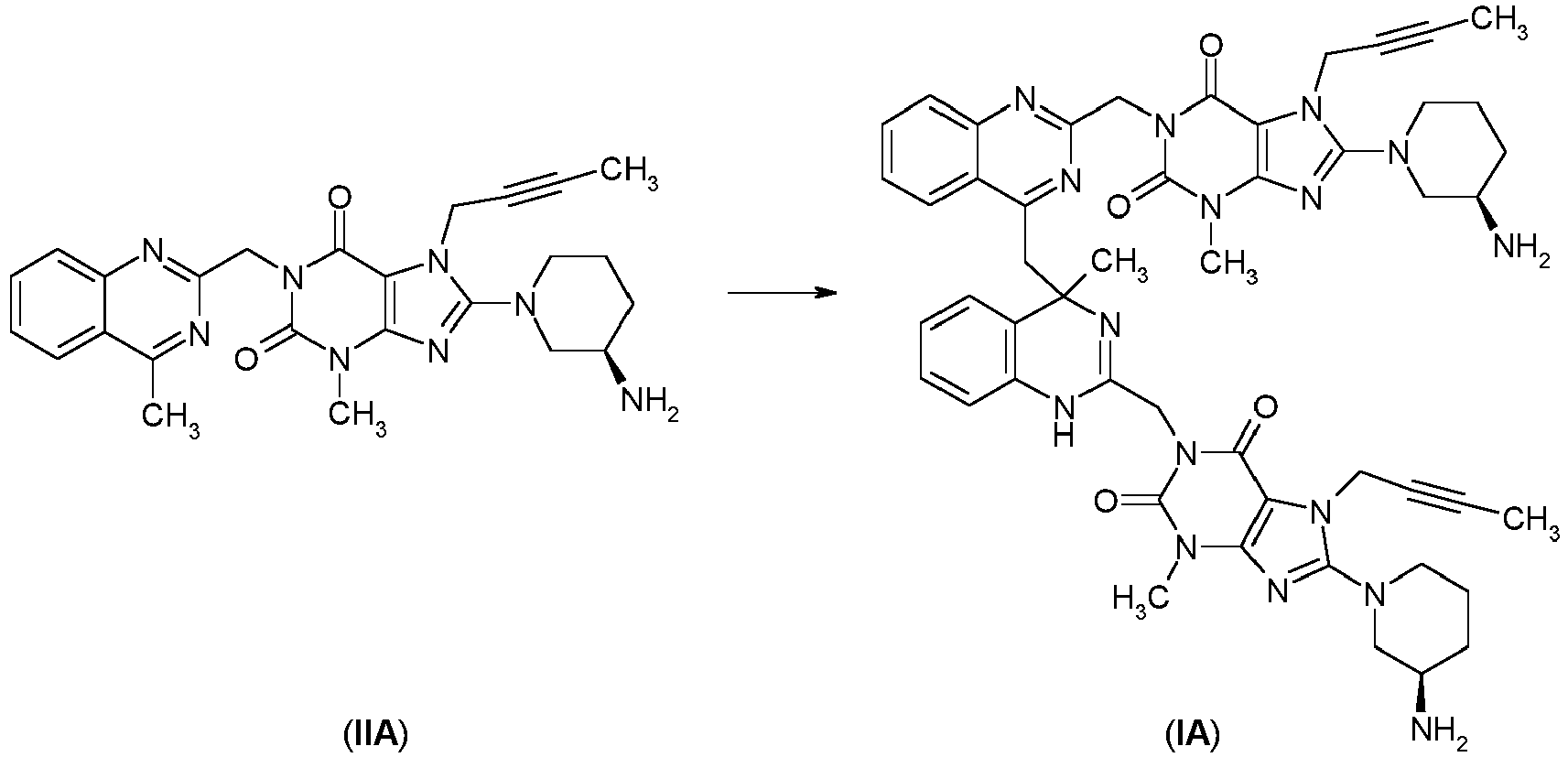
Method: column: diameter = 8 cm, length = 25 cm; silica gel: 35 - 70 micron(DAVlSlL™), Eluent: CH2Cl2 / MeOH / NH4OH = 90 / 10 / 0.25 (0.5 L) CH2Cl2 / MeOH / NH4OH = 40 / 10 / 0.25 (0.5 L) CH2Cl2 / MeOH / NH4OH = 20 / 30 / 0.25 (0.5 L) MeOH / NH4OH = 500 : 1 (1 L) TLC: silica gel 60 F254, CH2Cl2 / MeOH / NH4OH = 4 / 1 / 0.1, Rf = 0.48 - Yield: 4.95 g (25% of theory) of title compound of formula (IA)
- C50H56N16O4 (945.09)
- MS: [M+H]+ = 945
- Copovidone is dissolved in purified water at ambient temperature to produce a granulation liquid. A DPP-IV inhibitor (active ingredient), mannitol, pregelatinized starch and corn starch are blended in a suitable mixer, to produce a pre-mix. The pre-mix is moistened with the granulation liquid and subsequently granulated e.g. using a high shear mixer. The moist granulate is optionally sieved through a suitable sieve (e.g. with a mesh size of 1.6-3.0 mm). The granulate is dried at about 60 °C inlet air temperature in a fluid bed dryer until a loss on drying value of 1-4 % or 2-4 % is obtained. The dried granulate may be sieved through a sieve with a mesh size of 1.0 mm. Magnesium stearate is passed through a sieve for delumping and added to the granulation. Subsequently a final blend is produced by final blending in a suitable blender. The final blend is compressed into tablet cores.
- Optionally the tablet cores may be film-coated: Hydroxypropyl methylcellulose, polyethylene glycol, talc, titanium dioxide and iron oxide are suspended in purified water in a suitable mixer at ambient temperature to produce a coating suspension. The tablet cores are coated with the coating suspension to a weight gain of about 3 % to produce film-coated tablets. The following tablet compositions can be obtained:
Component mg mg mg mg mg Active ingredient 0.500 1.000 2.500 5.000 10.000 Mannitol 67.450 66.950 65.450 130.900 125.900 Pregelatinized starch 9.000 9.000 9.000 18.000 18.000 Corn starch 9.000 9.000 9.000 18.000 18.000 Copovidone 2.700 2.700 2.700 5.400 5.400 Magnesium stearate 1.350 1.350 1.350 2.700 2.700 Total Mass (tablet core) 90.000 90.000 90.000 180.000 180.000 HPMC 1.500 1.500 1.500 2.500 2.500 PEG 0.150 0.150 0.150 0.250 0.250 Titanium dioxide 0.750 0.750 0.750 1.250 1.250 Talc 0.525 0.525 0.525 0.875 0.875 Iron oxide 0.075 0.075 0.075 0.125 0.125 Total Mass (coated tablet) 93.000 93.000 93.000 185.000 185.000
said method comprising administering a compound of formula (I), or a tautomer or salt thereof, or composition thereof, optionally in combination with one or more other therapeutic substances as described herein, to the patient.
Claims (6)
- A compound
having the formula (IA):
- Physiologically acceptable salt of the compound according to claim 1 with an inorganic or organic acid or base.
- Pharmaceutical composition containing a compound according to claim 1 or a physiologically acceptable salt according to claim 2 optionally together with one or more pharmaceutically acceptable excipients.
- Process for preparing a pharmaceutical composition according to claim 3, characterised in that a compound according to at least one of claims 1 to 2 is incorporated in one or more pharmaceutically acceptable excipients.
- Pharmaceutical composition comprising a compound according to claim 1 or a physiologically acceptable salt according to claim 2 and metformin (e.g. metformin hydrochloride), optionally together with one or more pharmaceutically acceptable excipients.
- Pharmaceutical composition comprising a compound according to claim 1 or a physiologically acceptable salt according to claim 2 and pioglitazone (e.g. pioglitazone hydrochloride), optionally together with one or more pharmaceutically acceptable excipients.
Applications Claiming Priority (4)
| Application Number | Priority Date | Filing Date | Title |
|---|---|---|---|
| EP11174266 | 2011-07-15 | ||
| EP12170055 | 2012-05-30 | ||
| PCT/EP2012/063852 WO2013010964A1 (en) | 2011-07-15 | 2012-07-13 | Substituted quinazolines, the preparation thereof and the use thereof in pharmaceutical compositions |
| EP12733784.8A EP2731947B1 (en) | 2011-07-15 | 2012-07-13 | Substituted dimeric quinazoline derivative, its preparation and its use in pharmaceutical compositions for the treatment of type i and ii diabetes |
Related Parent Applications (2)
| Application Number | Title | Priority Date | Filing Date |
|---|---|---|---|
| EP12733784.8A Division EP2731947B1 (en) | 2011-07-15 | 2012-07-13 | Substituted dimeric quinazoline derivative, its preparation and its use in pharmaceutical compositions for the treatment of type i and ii diabetes |
| EP12733784.8A Previously-Filed-Application EP2731947B1 (en) | 2011-07-15 | 2012-07-13 | Substituted dimeric quinazoline derivative, its preparation and its use in pharmaceutical compositions for the treatment of type i and ii diabetes |
Publications (2)
| Publication Number | Publication Date |
|---|---|
| EP3517539A1 EP3517539A1 (en) | 2019-07-31 |
| EP3517539B1 true EP3517539B1 (en) | 2022-12-14 |
Family
ID=46506460
Family Applications (2)
| Application Number | Title | Priority Date | Filing Date |
|---|---|---|---|
| EP12733784.8A Active EP2731947B1 (en) | 2011-07-15 | 2012-07-13 | Substituted dimeric quinazoline derivative, its preparation and its use in pharmaceutical compositions for the treatment of type i and ii diabetes |
| EP19151416.5A Revoked EP3517539B1 (en) | 2011-07-15 | 2012-07-13 | Substituted dimeric quinazoline derivative, its preparation and its use in pharmaceutical compositions for the treatment of type i and ii diabetes |
Family Applications Before (1)
| Application Number | Title | Priority Date | Filing Date |
|---|---|---|---|
| EP12733784.8A Active EP2731947B1 (en) | 2011-07-15 | 2012-07-13 | Substituted dimeric quinazoline derivative, its preparation and its use in pharmaceutical compositions for the treatment of type i and ii diabetes |
Country Status (17)
| Country | Link |
|---|---|
| US (3) | US8883800B2 (en) |
| EP (2) | EP2731947B1 (en) |
| JP (1) | JP5876150B2 (en) |
| KR (2) | KR20190062621A (en) |
| CN (1) | CN103781788B (en) |
| AU (1) | AU2012285904C1 (en) |
| CA (1) | CA2841552C (en) |
| CL (1) | CL2014000076A1 (en) |
| DK (2) | DK3517539T3 (en) |
| EA (1) | EA030121B1 (en) |
| ES (2) | ES2713566T3 (en) |
| HU (2) | HUE043540T2 (en) |
| MX (1) | MX366629B (en) |
| NZ (1) | NZ618698A (en) |
| PH (1) | PH12014500137A1 (en) |
| PL (2) | PL2731947T3 (en) |
| WO (1) | WO2013010964A1 (en) |
Families Citing this family (28)
| Publication number | Priority date | Publication date | Assignee | Title |
|---|---|---|---|---|
| US7407955B2 (en) | 2002-08-21 | 2008-08-05 | Boehringer Ingelheim Pharma Gmbh & Co., Kg | 8-[3-amino-piperidin-1-yl]-xanthines, the preparation thereof and their use as pharmaceutical compositions |
| US7501426B2 (en) | 2004-02-18 | 2009-03-10 | Boehringer Ingelheim International Gmbh | 8-[3-amino-piperidin-1-yl]-xanthines, their preparation and their use as pharmaceutical compositions |
| DE102004054054A1 (en) | 2004-11-05 | 2006-05-11 | Boehringer Ingelheim Pharma Gmbh & Co. Kg | Process for preparing chiral 8- (3-amino-piperidin-1-yl) -xanthines |
| EP1852108A1 (en) | 2006-05-04 | 2007-11-07 | Boehringer Ingelheim Pharma GmbH & Co.KG | DPP IV inhibitor formulations |
| EP2540725A1 (en) | 2006-05-04 | 2013-01-02 | Boehringer Ingelheim International GmbH | Polymorphs of 1-((4-Methyl-chinazolin-2-yl)methyl)-3-methyl-7-(2-butin-1-yl)-8-(3-(R)-amino-piperidin-1-yl)xanthin |
| PE20080251A1 (en) | 2006-05-04 | 2008-04-25 | Boehringer Ingelheim Int | USES OF DPP IV INHIBITORS |
| PE20091730A1 (en) | 2008-04-03 | 2009-12-10 | Boehringer Ingelheim Int | FORMULATIONS INVOLVING A DPP4 INHIBITOR |
| UY32030A (en) | 2008-08-06 | 2010-03-26 | Boehringer Ingelheim Int | "TREATMENT FOR DIABETES IN INAPPROPRIATE PATIENTS FOR THERAPY WITH METFORMIN" |
| BRPI0916997A2 (en) | 2008-08-06 | 2020-12-15 | Boehringer Ingelheim International Gmbh | DPP-4 INHIBITOR AND ITS USE |
| US20200155558A1 (en) | 2018-11-20 | 2020-05-21 | Boehringer Ingelheim International Gmbh | Treatment for diabetes in patients with insufficient glycemic control despite therapy with an oral antidiabetic drug |
| CN102256976A (en) | 2008-12-23 | 2011-11-23 | 贝林格尔.英格海姆国际有限公司 | Salt Forms of Organic Compounds |
| AR074990A1 (en) | 2009-01-07 | 2011-03-02 | Boehringer Ingelheim Int | TREATMENT OF DIABETES IN PATIENTS WITH AN INAPPROPRIATE GLUCEMIC CONTROL THROUGH METFORMIN THERAPY |
| KR20240090632A (en) | 2009-11-27 | 2024-06-21 | 베링거 인겔하임 인터내셔날 게엠베하 | Treatment of genotyped diabetic patients with dpp-iv inhibitors such as linagliptin |
| CN102946875A (en) | 2010-05-05 | 2013-02-27 | 贝林格尔.英格海姆国际有限公司 | Combination therapy |
| WO2011161161A1 (en) | 2010-06-24 | 2011-12-29 | Boehringer Ingelheim International Gmbh | Diabetes therapy |
| AR083878A1 (en) | 2010-11-15 | 2013-03-27 | Boehringer Ingelheim Int | VASOPROTECTORA AND CARDIOPROTECTORA ANTIDIABETIC THERAPY, LINAGLIPTINA, TREATMENT METHOD |
| US8883800B2 (en) | 2011-07-15 | 2014-11-11 | Boehringer Ingelheim International Gmbh | Substituted quinazolines, the preparation thereof and the use thereof in pharmaceutical compositions |
| US9555001B2 (en) | 2012-03-07 | 2017-01-31 | Boehringer Ingelheim International Gmbh | Pharmaceutical composition and uses thereof |
| JP6224084B2 (en) | 2012-05-14 | 2017-11-01 | ベーリンガー インゲルハイム インターナショナル ゲゼルシャフト ミット ベシュレンクテル ハフツング | Xanthine derivatives as DPP-4 inhibitors for the treatment of glomerular epithelial cell related disorders and / or nephrotic syndrome |
| JP6218811B2 (en) | 2012-05-14 | 2017-10-25 | ベーリンガー インゲルハイム インターナショナル ゲゼルシャフト ミット ベシュレンクテル ハフツング | Xanthine derivatives as DPP-4 inhibitors for use in the treatment of SIRS and / or sepsis |
| WO2013174767A1 (en) | 2012-05-24 | 2013-11-28 | Boehringer Ingelheim International Gmbh | A xanthine derivative as dpp -4 inhibitor for use in modifying food intake and regulating food preference |
| EP3110449B1 (en) | 2014-02-28 | 2023-06-28 | Boehringer Ingelheim International GmbH | Medical use of a dpp-4 inhibitor |
| CN109310697A (en) | 2016-06-10 | 2019-02-05 | 勃林格殷格翰国际有限公司 | Combination of linagliptin and metformin |
| CN106389435B (en) * | 2016-09-05 | 2019-07-05 | 深圳海王医药科技研究院有限公司 | It is a kind of to replace Buddhist nun or the pharmaceutical composition and its impurity control method of its salt containing Nabumetone |
| EP3510040A4 (en) | 2016-09-09 | 2020-06-03 | Calithera Biosciences, Inc. | ECTONUCLEOTIDASE INHIBITORS AND METHODS OF USE |
| KR102638592B1 (en) | 2016-12-22 | 2024-02-19 | 안텐진 테라퓨틱스 리미티드 | Ectonucleotidase inhibitors and uses thereof |
| SG11202012001YA (en) * | 2018-06-21 | 2021-01-28 | Calithera Biosciences Inc | Ectonucleotidase inhibitors and methods of use thereof |
| CN110894198B (en) * | 2018-09-13 | 2022-12-02 | 齐鲁制药有限公司 | Xanthine compound and preparation method and application thereof |
Citations (6)
| Publication number | Priority date | Publication date | Assignee | Title |
|---|---|---|---|---|
| WO2004018468A2 (en) | 2002-08-21 | 2004-03-04 | Boehringer Ingelheim Pharma Gmbh & Co. Kg | 8-[3-amino-piperidin-1-yl]-xanthines, the production thereof and the use of the same as medicaments |
| US20060142310A1 (en) | 2004-11-05 | 2006-06-29 | Boehringer Ingelheim International Gmbh | Process for the preparation of chiral 8-(-3-aminopiperidin-1-yl) xanthines |
| US7407955B2 (en) | 2002-08-21 | 2008-08-05 | Boehringer Ingelheim Pharma Gmbh & Co., Kg | 8-[3-amino-piperidin-1-yl]-xanthines, the preparation thereof and their use as pharmaceutical compositions |
| WO2010072776A1 (en) | 2008-12-23 | 2010-07-01 | Boehringer Ingelheim International Gmbh | Salt forms of organic compound |
| EP2023902B1 (en) | 2006-05-04 | 2010-09-08 | Boehringer Ingelheim International Gmbh | Dpp iv inhibitor formulations |
| CN104130258A (en) | 2014-08-13 | 2014-11-05 | 广东东阳光药业有限公司 | Conversion method for dimers |
Family Cites Families (365)
| Publication number | Priority date | Publication date | Assignee | Title |
|---|---|---|---|---|
| US2056046A (en) | 1933-05-19 | 1936-09-29 | Rhone Poulenc Sa | Manufacture of bases derived from benz-dioxane |
| US2375138A (en) | 1942-05-01 | 1945-05-01 | American Cyanamid Co | Alkamine esters of aryloxymethyl benzoic acid |
| US2629736A (en) | 1951-02-24 | 1953-02-24 | Searle & Co | Basically substituted n-alkyl derivatives of alpha, beta, beta-triarylpropionamides |
| US2730544A (en) | 1952-07-23 | 1956-01-10 | Sahyun Lab | Alkylaminoalkyl esters of hydroxycyclohexylbenzoic acid |
| US2750387A (en) | 1953-11-25 | 1956-06-12 | Searle & Co | Basically substituted derivatives of diarylaminobenzamides |
| DE1211359B (en) | 1955-11-29 | 1966-02-24 | Oreal | Oxidant-free cold dye for human hair |
| US2928833A (en) | 1959-03-03 | 1960-03-15 | S E Massengill Company | Theophylline derivatives |
| US3174901A (en) | 1963-01-31 | 1965-03-23 | Jan Marcel Didier Aron Samuel | Process for the oral treatment of diabetes |
| US3454635A (en) | 1965-07-27 | 1969-07-08 | Hoechst Ag | Benzenesulfonyl-ureas and process for their manufacture |
| US3673241A (en) | 1968-04-04 | 1972-06-27 | Ciba Geigy Corp | Substituted benzaldehyde guanylhydrazones |
| ES385302A1 (en) | 1970-10-22 | 1973-04-16 | Miquel S A Lab | Procedure for the obtaining of trisused derivatives of etilendiamine. (Machine-translation by Google Translate, not legally binding) |
| DE2205815A1 (en) | 1972-02-08 | 1973-08-16 | Hoechst Ag | N-(oxazolin-2-yl)-piperazine - with antitussive activity |
| JPS5512435B2 (en) | 1972-07-01 | 1980-04-02 | ||
| US4005208A (en) | 1975-05-16 | 1977-01-25 | Smithkline Corporation | N-Heterocyclic-9-xanthenylamines |
| US4061753A (en) | 1976-02-06 | 1977-12-06 | Interx Research Corporation | Treating psoriasis with transient pro-drug forms of xanthine derivatives |
| NO154918C (en) | 1977-08-27 | 1987-01-14 | Bayer Ag | ANALOGUE PROCEDURE FOR THE PREPARATION OF THERAPEUTIC ACTIVE DERIVATIVES OF 3,4,5-TRIHYDROXYPIPERIDINE. |
| DE2758025A1 (en) | 1977-12-24 | 1979-07-12 | Bayer Ag | Tri:hydroxy-piperidine derivs. - useful as glucosidase inhibitors for treating diabetes etc. and as animal feed additives |
| DE2929596A1 (en) | 1979-07-21 | 1981-02-05 | Hoechst Ag | METHOD FOR PRODUCING OXOALKYL XANTHINES |
| CY1306A (en) | 1980-10-01 | 1985-12-06 | Glaxo Group Ltd | Aminoalkyl furan derivative |
| US4382091A (en) | 1981-04-30 | 1983-05-03 | Syntex (U.S.A.) Inc. | Stabilization of 1-substituted imidazole derivatives in talc |
| FR2558162B1 (en) | 1984-01-17 | 1986-04-25 | Adir | NOVEL XANTHINE DERIVATIVES, PROCESSES FOR THEIR PREPARATION AND PHARMACEUTICAL COMPOSITIONS CONTAINING THEM |
| FI79107C (en) | 1984-06-25 | 1989-11-10 | Orion Yhtymae Oy | Process for the preparation of stable form of prazosin hydrochloride. |
| AR240698A1 (en) | 1985-01-19 | 1990-09-28 | Takeda Chemical Industries Ltd | Process for the preparation of 5-(4-(2-(5-ethyl-2-pyridil)-ethoxy)benzyl)-2,4-thiazolodinedione and their salts |
| GB8515934D0 (en) | 1985-06-24 | 1985-07-24 | Janssen Pharmaceutica Nv | (4-piperidinomethyl and-hetero)purines |
| US5258380A (en) | 1985-06-24 | 1993-11-02 | Janssen Pharmaceutica N.V. | (4-piperidinylmethyl and -hetero)purines |
| EP0223403B1 (en) | 1985-10-25 | 1993-08-04 | Beecham Group Plc | Piperidine derivative, its preparation, and its use as medicament |
| US5433959A (en) | 1986-02-13 | 1995-07-18 | Takeda Chemical Industries, Ltd. | Stabilized pharmaceutical composition |
| EP0237608B1 (en) | 1986-03-21 | 1992-01-29 | HEUMANN PHARMA GMBH & CO | Crystalline anhydrous sigma-form of 2-[4-(2-furoyl-(2-piperazin)-1-yl]-4-amino-6,7-dimethoxyquinazoline hydrochloride, and process for its preparation |
| AU619444B2 (en) | 1986-06-02 | 1992-01-30 | Nippon Chemiphar Co. Ltd. | 2-(2-aminobenzylsulfinyl)- benzimidazole derivatives |
| US4968672A (en) | 1987-01-02 | 1990-11-06 | The United States Of America As Represented By The Department Of Health And Human Services | Adenosine receptor prodrugs |
| US4743450A (en) | 1987-02-24 | 1988-05-10 | Warner-Lambert Company | Stabilized compositions |
| US5093330A (en) | 1987-06-15 | 1992-03-03 | Ciba-Geigy Corporation | Staurosporine derivatives substituted at methylamino nitrogen |
| JPS6440433A (en) | 1987-08-05 | 1989-02-10 | Green Cross Corp | Aqueous liquid composition of thrombin |
| CA1340285C (en) | 1988-05-19 | 1998-12-22 | Hiroyuki Nagano | Novel quinolonecarboxylic acid derivatives having at 7-position a piperidin-1-yl substituent |
| US5329025A (en) | 1988-09-21 | 1994-07-12 | G. D. Searle & Co. | 3-azido compound |
| DE3926119A1 (en) | 1989-08-08 | 1991-02-14 | Bayer Ag | 3-AMINO-5-AMINOCARBONYL-1,2,4-TRIAZOLE DERIVATIVES |
| US5234897A (en) | 1989-03-15 | 1993-08-10 | Bayer Aktiengesellschaft | Herbicidal 3-amino-5-aminocarbonyl-1,2,4-triazoles |
| GB8906792D0 (en) | 1989-03-23 | 1989-05-10 | Beecham Wuelfing Gmbh & Co Kg | Treatment and compounds |
| DE3916430A1 (en) | 1989-05-20 | 1990-11-22 | Bayer Ag | METHOD FOR PRODUCING 3-AMINO-5-AMINOCARBONYL-1,2,4-TRIAZOLE DERIVATIVES |
| IL94390A (en) | 1989-05-30 | 1996-03-31 | Merck & Co Inc | Di-substituted imidazo fused 6-membered nitrogen-containing heterocycles and pharmaceutical compositions containing them |
| US5332744A (en) | 1989-05-30 | 1994-07-26 | Merck & Co., Inc. | Substituted imidazo-fused 6-membered heterocycles as angiotensin II antagonists |
| US5223499A (en) | 1989-05-30 | 1993-06-29 | Merck & Co., Inc. | 6-amino substituted imidazo[4,5-bipyridines as angiotensin II antagonists |
| FI94339C (en) | 1989-07-21 | 1995-08-25 | Warner Lambert Co | Process for the preparation of pharmaceutically acceptable [R- (R *, R *)] - 2- (4-fluorophenyl) -, - dihydroxy-5- (1-methylethyl) -3-phenyl-4 - [(phenylamino) carbonyl] -1H- for the preparation of pyrrole-1-heptanoic acid and its pharmaceutically acceptable salts |
| HU208115B (en) | 1989-10-03 | 1993-08-30 | Biochemie Gmbh | New process for producting pleuromutilin derivatives |
| FR2654935B1 (en) | 1989-11-28 | 1994-07-01 | Lvmh Rech | USE OF XANTHINES, WHICH MAY BE INCORPORATED IN LIPOSOMES, TO PROMOTE PIGMENTATION OF THE SKIN OR HAIR. |
| DE122007000050I1 (en) | 1990-02-19 | 2007-11-08 | Novartis Ag | acyl compounds |
| KR930000861B1 (en) | 1990-02-27 | 1993-02-08 | 한미약품공업 주식회사 | Omeprazole rectal composition |
| EP0475482B1 (en) | 1990-09-13 | 1994-10-05 | Akzo Nobel N.V. | Stabilized solid chemical compositions |
| GB9020959D0 (en) | 1990-09-26 | 1990-11-07 | Beecham Group Plc | Novel compounds |
| US5084460A (en) | 1990-12-24 | 1992-01-28 | A. H. Robins Company, Incorporated | Methods of therapeutic treatment with N-(3-ouinuclidinyl)-2-hydroxybenzamides and thiobenzamides |
| US5594003A (en) | 1991-02-06 | 1997-01-14 | Dr. Karl Thomae Gmbh | Tetrahydroimidazo[1,2-a]pyridin-2-yl-(benzimidazol-1-yl)-methyl-biphenyls useful as angiotensin-II antagonists |
| US5602127A (en) | 1991-02-06 | 1997-02-11 | Karl Thomae Gmbh | (Alkanesultam-1-yl)-benzimidazol-1-yl)-1yl)-methyl-biphenyls useful as angiotensin-II antagonists |
| US5591762A (en) | 1991-02-06 | 1997-01-07 | Dr. Karl Thomae Gmbh | Benzimidazoles useful as angiotensin-11 antagonists |
| GB9109862D0 (en) | 1991-05-08 | 1991-07-03 | Beecham Lab Sa | Pharmaceutical formulations |
| DE4124150A1 (en) | 1991-07-20 | 1993-01-21 | Bayer Ag | SUBSTITUTED TRIAZOLES |
| TW225528B (en) | 1992-04-03 | 1994-06-21 | Ciba Geigy Ag | |
| US5300298A (en) | 1992-05-06 | 1994-04-05 | The Pennsylvania Research Corporation | Methods of treating obesity with purine related compounds |
| GB9215633D0 (en) | 1992-07-23 | 1992-09-09 | Smithkline Beecham Plc | Novel treatment |
| EP0581552B1 (en) | 1992-07-31 | 1998-04-22 | Shionogi & Co., Ltd. | Triazolylthiomethylthio cephalosporin hyrochloride, its crystalline hydrate and the production of the same |
| TW252044B (en) | 1992-08-10 | 1995-07-21 | Boehringer Ingelheim Kg | |
| DE4242459A1 (en) | 1992-12-16 | 1994-06-23 | Merck Patent Gmbh | imidazopyridines |
| FR2707641B1 (en) | 1993-07-16 | 1995-08-25 | Fournier Ind & Sante | Compounds of imidazol-5-carboxamide, their process for preparing their intermediates and their use in therapy. |
| DE4339868A1 (en) | 1993-11-23 | 1995-05-24 | Merck Patent Gmbh | imidazopyridazines |
| DE4404183A1 (en) | 1994-02-10 | 1995-08-17 | Merck Patent Gmbh | 4-amino-1-piperidylbenzoylguanidine |
| US5545745A (en) | 1994-05-23 | 1996-08-13 | Sepracor, Inc. | Enantioselective preparation of optically pure albuterol |
| CO4410190A1 (en) | 1994-09-19 | 1997-01-09 | Lilly Co Eli | 3- [4- (2-AMINOETOXI) -BENZOIL] -2-ARIL-6-HYDROXYBENZO [b] CRYSTALLINE THIOPHEN |
| AU699489B2 (en) | 1994-10-12 | 1998-12-03 | Euro-Celtique S.A. | Novel benzoxazoles |
| GB9501178D0 (en) | 1995-01-20 | 1995-03-08 | Wellcome Found | Guanine derivative |
| AU692104B2 (en) | 1995-05-19 | 1998-05-28 | Darwin Discovery Limited | Xanthines and their therapeutic use |
| DE19543478A1 (en) | 1995-11-22 | 1997-05-28 | Bayer Ag | Crystalline hydrochloride of {(R) - (-) - 2N- [4- (1,1-dioxido-3-oxo-2,3-dihydrobenzisothiazol-2-yl) -buytl] aminomethyl} -chroman |
| WO1999029695A1 (en) | 1997-12-05 | 1999-06-17 | Astrazeneca Uk Limited | Novel compounds |
| FR2742751B1 (en) | 1995-12-22 | 1998-01-30 | Rhone Poulenc Rorer Sa | NOVEL TAXOIDS, THEIR PREPARATION AND THE PHARMACEUTICAL COMPOSITIONS CONTAINING THEM |
| NZ326238A (en) | 1995-12-26 | 1999-11-29 | Alteon Inc | Compositons and methods for inhibiting nonenzymatic cross-linking and glycosylation (protein aging) using N-acylaminoalkylhydrazine carboximidamides |
| DE122010000020I1 (en) | 1996-04-25 | 2010-07-08 | Prosidion Ltd | Method for lowering the blood glucose level in mammals |
| WO1997046526A1 (en) | 1996-06-07 | 1997-12-11 | Eisai Co., Ltd. | Stable polymorphs of donepezil (1-benzyl-4-[(5,6-dimethoxy-1-indanon)-2-yl]methylpiperidine) hydrochloride and process for production |
| US5965555A (en) | 1996-06-07 | 1999-10-12 | Hoechst Aktiengesellschaft | Xanthine compounds having terminally animated alkynol side chains |
| US5958951A (en) | 1996-06-14 | 1999-09-28 | Novo Nordiskials | Modified form of the R(-)-N-(4,4-di(3-methylthien-2-yl)but-3-enyl)-nipecotic acid hydrochloride |
| US5753635A (en) | 1996-08-16 | 1998-05-19 | Berlex Laboratories, Inc. | Purine derivatives and their use as anti-coagulants |
| JP2001500878A (en) | 1996-09-23 | 2001-01-23 | イーライ・リリー・アンド・カンパニー | Olanzapine dihydrate D |
| WO1998018770A1 (en) | 1996-10-28 | 1998-05-07 | Novo Nordisk A/S | A process for the preparation of (-)-3,4-trans-diarylchromans |
| GB9623859D0 (en) | 1996-11-15 | 1997-01-08 | Chiroscience Ltd | Novel compounds |
| TR199901968T2 (en) | 1996-12-24 | 1999-12-21 | Biogen, Inc. | Sabit sabit interferon formlleri |
| CO4950519A1 (en) | 1997-02-13 | 2000-09-01 | Novartis Ag | PHTHALAZINES, PHARMACEUTICAL PREPARATIONS THAT UNDERSTAND THEM AND THE PROCESS FOR THEIR PREPARATION |
| US6011049A (en) | 1997-02-19 | 2000-01-04 | Warner-Lambert Company | Combinations for diabetes |
| IL131651A0 (en) | 1997-03-13 | 2001-01-28 | Hexal Ag | A pharmaceutical formulation containing benzimidazoles with amino acid/caclodextrin combinations and a process for producing the same |
| US5972332A (en) | 1997-04-16 | 1999-10-26 | The Regents Of The University Of Michigan | Wound treatment with keratinocytes on a solid support enclosed in a porous material |
| AR012894A1 (en) | 1997-06-13 | 2000-11-22 | Lilly Co Eli | FORMULATION OF INSULIN IN STABLE SOLUTION, ITS USE TO PREPARE A MEDICINAL PRODUCT AND PROCESS FOR THE PREPARATION OF THE SAME. |
| JPH11193270A (en) | 1997-12-26 | 1999-07-21 | Koei Chem Co Ltd | Production of optically active 1-methyl-3-piperidinemethanol |
| AU1688599A (en) | 1998-01-05 | 1999-07-26 | Eisai Co. Ltd. | Purine derivatives and adenosine a2 receptor antagonists serving as preventives/remedies for diabetes |
| EP2583675A1 (en) | 1998-02-02 | 2013-04-24 | Trustees Of Tufts College | Use of dipeptidylpeptidase inhibitors to regulate glucose metabolism |
| SK14742000A3 (en) | 1998-03-31 | 2001-03-12 | Nissan Chemical Industries, Ltd. | Pyridazinone hydrochloride compound and method for producing the same |
| CA2268621A1 (en) | 1998-04-13 | 1999-10-13 | Takeda Chemical Industries, Ltd. | 2-pipirazinone-1-acetic acid derivative, production and use thereof |
| US6207207B1 (en) | 1998-05-01 | 2001-03-27 | Mars, Incorporated | Coated confectionery having a crispy starch based center and method of preparation |
| DE19823831A1 (en) | 1998-05-28 | 1999-12-02 | Probiodrug Ges Fuer Arzneim | New pharmaceutical use of isoleucyl thiazolidide and its salts |
| DE19828114A1 (en) | 1998-06-24 | 2000-01-27 | Probiodrug Ges Fuer Arzneim | Produgs of unstable inhibitors of dipeptidyl peptidase IV |
| CO5150173A1 (en) | 1998-12-10 | 2002-04-29 | Novartis Ag | COMPOUNDS N- (REPLACED GLYCLE) -2-DIPEPTIDYL-IV PEPTIDASE INHIBITING CYANOPIRROLIDINS (DPP-IV) WHICH ARE EFFECTIVE IN THE TREATMENT OF CONDITIONS MEDIATED BY DPP-IV INHIBITION |
| IT1312018B1 (en) | 1999-03-19 | 2002-04-04 | Fassi Aldo | IMPROVED PROCEDURE FOR THE PRODUCTION OF NON HYGROSCOPICIDAL SALTS OF L (-) - CARNITINE. |
| US6545002B1 (en) | 1999-06-01 | 2003-04-08 | University Of Virginia Patent Foundation | Substituted 8-phenylxanthines useful as antagonists of A2B adenosine receptors |
| HK1044769B (en) | 1999-06-21 | 2005-02-25 | 贝林格尔英格海姆法玛两合公司 | Bicyclic heterocycles, medicaments containing these compounds, their use and methods for the production thereof |
| US6448323B1 (en) | 1999-07-09 | 2002-09-10 | Bpsi Holdings, Inc. | Film coatings and film coating compositions based on polyvinyl alcohol |
| ES2166270B1 (en) | 1999-07-27 | 2003-04-01 | Almirall Prodesfarma Sa | DERIVATIVES OF 8-PHENYL-6,9-DIHIDRO- (1,2,4,) TRIAZOLO (3,4-I) PURIN-5-ONA. |
| US6515117B2 (en) | 1999-10-12 | 2003-02-04 | Bristol-Myers Squibb Company | C-aryl glucoside SGLT2 inhibitors and method |
| GB9928330D0 (en) | 1999-11-30 | 2000-01-26 | Ferring Bv | Novel antidiabetic agents |
| EP1248869A2 (en) | 2000-01-07 | 2002-10-16 | Transform Pharmaceuticals, Inc. | High-throughput formation, identification, and analysis of diverse solid-forms |
| US6362172B2 (en) | 2000-01-20 | 2002-03-26 | Bristol-Myers Squibb Company | Water soluble prodrugs of azole compounds |
| EP1743655B1 (en) | 2000-01-21 | 2014-06-25 | Novartis AG | Combinations comprising dipeptidylpeptidase-iv inhibitors and antidiabetic agents |
| JP4621326B2 (en) | 2000-02-01 | 2011-01-26 | エーザイ・アール・アンド・ディー・マネジメント株式会社 | Teprenone stabilized composition |
| JP4739632B2 (en) | 2000-02-05 | 2011-08-03 | バーテックス ファーマシューティカルズ インコーポレイテッド | Pyrazole compositions useful as inhibitors of ERK |
| EP1132389A1 (en) | 2000-03-06 | 2001-09-12 | Vernalis Research Limited | New aza-indolyl derivatives for the treatment of obesity |
| US6395767B2 (en) | 2000-03-10 | 2002-05-28 | Bristol-Myers Squibb Company | Cyclopropyl-fused pyrrolidine-based inhibitors of dipeptidyl peptidase IV and method |
| GB0006133D0 (en) | 2000-03-14 | 2000-05-03 | Smithkline Beecham Plc | Novel pharmaceutical |
| JP2001278812A (en) | 2000-03-27 | 2001-10-10 | Kyoto Pharmaceutical Industries Ltd | Disintegrant for tablet and tablet using the same |
| KR20080067009A (en) | 2000-03-31 | 2008-07-17 | 프로시디온 리미티드 | Pharmaceutical Compositions Including Dipeptidyl Peptidase IV Enzyme Activity Inhibitors |
| GB0008694D0 (en) | 2000-04-07 | 2000-05-31 | Novartis Ag | Organic compounds |
| WO2001096301A1 (en) | 2000-06-14 | 2001-12-20 | Toray Industries, Inc. | Processes for producing racemic piperidine derivative and for producing optically active piperidine derivative |
| US7078397B2 (en) | 2000-06-19 | 2006-07-18 | Smithkline Beecham Corporation | Combinations of dipeptidyl peptidase IV inhibitors and other antidiabetic agents for the treatment of diabetes mellitus |
| GB0014969D0 (en) | 2000-06-19 | 2000-08-09 | Smithkline Beecham Plc | Novel method of treatment |
| AU2001268958B2 (en) | 2000-07-04 | 2006-03-09 | Novo Nordisk A/S | Heterocyclic compounds, which are inhibitors of the enzyme dpp-iv |
| JP4101053B2 (en) | 2000-08-10 | 2008-06-11 | 田辺三菱製薬株式会社 | Proline derivative and its pharmaceutical use |
| US6821978B2 (en) | 2000-09-19 | 2004-11-23 | Schering Corporation | Xanthine phosphodiesterase V inhibitors |
| US20060034922A1 (en) | 2000-11-03 | 2006-02-16 | Andrx Labs, Llc | Controlled release metformin compositions |
| CA2433090A1 (en) | 2000-12-27 | 2002-07-04 | Kyowa Hakko Kogyo Co., Ltd. | Dipeptidyl peptidase iv inhibitor |
| FR2819254B1 (en) | 2001-01-08 | 2003-04-18 | Fournier Lab Sa | NOVEL N- (PHENYLSULFONYL) GLYCINE COMPOUNDS, PROCESS FOR THEIR PREPARATION AND THEIR USE FOR OBTAINING PHARMACEUTICAL COMPOSITIONS |
| DE10109021A1 (en) | 2001-02-24 | 2002-09-05 | Boehringer Ingelheim Pharma | Xanthine derivatives, their production and their use as pharmaceuticals |
| DE10117803A1 (en) | 2001-04-10 | 2002-10-24 | Boehringer Ingelheim Pharma | New 8-substituted-xanthine derivatives, useful e.g. for treating diabetes and arthritis, act by inhibiting dipeptidylpeptidase-IV |
| EP1368349B1 (en) | 2001-02-24 | 2007-02-14 | Boehringer Ingelheim Pharma GmbH & Co.KG | Xanthine derivative, production and use thereof as a medicament |
| US6936590B2 (en) | 2001-03-13 | 2005-08-30 | Bristol Myers Squibb Company | C-aryl glucoside SGLT2 inhibitors and method |
| US6693094B2 (en) | 2001-03-22 | 2004-02-17 | Chrono Rx Llc | Biguanide and sulfonylurea formulations for the prevention and treatment of insulin resistance and type 2 diabetes mellitus |
| JP2002348279A (en) | 2001-05-25 | 2002-12-04 | Nippon Kayaku Co Ltd | Production method for optically active pyridylketone derivatives and optically active pyridylketone derivatives |
| DE10130371A1 (en) | 2001-06-23 | 2003-01-02 | Boehringer Ingelheim Pharma | New drug compositions based on anticholinergics, corticosteroids and betamimetics |
| GB0115517D0 (en) | 2001-06-25 | 2001-08-15 | Ferring Bv | Novel antidiabetic agents |
| CN1723196A (en) | 2001-06-27 | 2006-01-18 | 史密丝克莱恩比彻姆公司 | Fluoropyrrolidines as dipeptidyl peptidase inhibitors |
| US6869947B2 (en) | 2001-07-03 | 2005-03-22 | Novo Nordisk A/S | Heterocyclic compounds that are inhibitors of the enzyme DPP-IV |
| DE60225556D1 (en) | 2001-07-03 | 2008-04-24 | Novo Nordisk As | DPP-IV INHIBITING PURINE DERIVATIVE FOR THE TREATMENT OF DIABETES |
| UA74912C2 (en) | 2001-07-06 | 2006-02-15 | Merck & Co Inc | Beta-aminotetrahydroimidazo-(1,2-a)-pyrazines and tetratriazolo-(4,3-a)-pyrazines as inhibitors of dipeptylpeptidase for the treatment or prevention of diabetes |
| US7638522B2 (en) | 2001-08-13 | 2009-12-29 | Janssen Pharmaceutica N.V. | Salt of 4-[[4-[[4-(2-cyanoethenyl)-2,6-dimethylphenyl]amino]-2-pyrimidinyl]amino] benzonitrile |
| AU2002331311A1 (en) | 2001-09-19 | 2003-04-01 | Novo Nordisk A/S | Heterocyclic compounds that are inhibitors of the enzyme dpp-iv |
| CN1568166A (en) | 2001-10-15 | 2005-01-19 | 荷姆泰克股份有限公司 | Coated stents to prevent restenosis |
| DE10151296A1 (en) | 2001-10-17 | 2003-04-30 | Boehringer Ingelheim Pharma | Keratinocytes useful as a biologically active substance in the treatment of wounds |
| US6861440B2 (en) | 2001-10-26 | 2005-03-01 | Hoffmann-La Roche Inc. | DPP IV inhibitors |
| US20030083354A1 (en) | 2001-10-26 | 2003-05-01 | Pediamed Pharmaceuticals, Inc. | Phenylephrine tannate and pyrilamine tannate salts in pharmaceutical compositions |
| CA2363053C (en) | 2001-11-09 | 2011-01-25 | Bernard Charles Sherman | Clopidogrel bisulfate tablet formulation |
| US20040171836A1 (en) | 2001-12-21 | 2004-09-02 | Toshihiro Fujino | Method for producing optical-active cis-piperidine derivatives |
| US6727261B2 (en) | 2001-12-27 | 2004-04-27 | Hoffman-La Roche Inc. | Pyrido[2,1-A]Isoquinoline derivatives |
| AU2003201274A1 (en) | 2002-01-11 | 2003-07-24 | Novo Nordisk A/S | Compositions comprising inhibitors of dpp-iv and nep enzymes for the treatment of diabetes |
| EP1333033A1 (en) | 2002-01-30 | 2003-08-06 | Boehringer Ingelheim Pharma GmbH & Co.KG | FAP-activated anti-tumor compounds |
| WO2003063831A2 (en) | 2002-02-01 | 2003-08-07 | Pfizer Products Inc. | Immediate release dosage forms containing solid drug dispersions |
| US7610153B2 (en) | 2002-02-13 | 2009-10-27 | Virginia Commonwealth University | Multi-drug titration and evaluation |
| MXPA04008100A (en) | 2002-02-21 | 2005-06-17 | Biovail Lab Int Srl | Modified release formulations of at least one form of tramadol. |
| EP1338595B1 (en) | 2002-02-25 | 2006-05-03 | Eisai Co., Ltd. | Xanthine derivatives as DPP-IV inhibitors |
| JP4298212B2 (en) | 2002-03-29 | 2009-07-15 | 大日本印刷株式会社 | Method for producing high melting point type epinastine hydrochloride |
| JP2003300977A (en) | 2002-04-10 | 2003-10-21 | Sumitomo Pharmaceut Co Ltd | Xanthine derivative |
| EP1496982A4 (en) | 2002-04-16 | 2006-07-19 | Merck & Co Inc | SOLID FORMS OF SALTS WITH TYROSINE KINASE ACTIVITY |
| CA2484306A1 (en) | 2002-04-26 | 2003-11-06 | Katsumi Maezono | Prophylactic and therapeutic agent of diabetes mellitus |
| AU2003231252A1 (en) | 2002-05-09 | 2003-11-11 | Enos Pharmaceuticals, Inc. | Methods and compositions for the treatment and prevention of intermittent claudication or alzheimer's disease |
| GB0212412D0 (en) | 2002-05-29 | 2002-07-10 | Novartis Ag | Combination of organic compounds |
| DE60307628T2 (en) | 2002-05-31 | 2007-08-09 | Schering Corporation | METHOD FOR THE PRODUCTION OF XANTHINE PHOSPHODIESTERASE V INHIBITORS AND THEIR PREPARATIONS |
| AU2003241960B2 (en) | 2002-06-06 | 2009-07-30 | Eisai R&D Management Co., Ltd. | Novel fused imidazole derivative |
| FR2840897B1 (en) | 2002-06-14 | 2004-09-10 | Fournier Lab Sa | NOVEL ARYLSULFONAMIDE DERIVATIVES AND THEIR USE IN THERAPEUTICS |
| US20040002615A1 (en) | 2002-06-28 | 2004-01-01 | Allen David Robert | Preparation of chiral amino-nitriles |
| GB0215676D0 (en) | 2002-07-05 | 2002-08-14 | Novartis Ag | Organic compounds |
| US20040023981A1 (en) | 2002-07-24 | 2004-02-05 | Yu Ren | Salt forms with tyrosine kinase activity |
| AR040661A1 (en) | 2002-07-26 | 2005-04-13 | Theravance Inc | CRYSTAL DICHLORHYDRATE OF N- {2 - [- ((R) -2-HYDROXI-2-PHENYLETHYLAMINE) PHENYL] ETIL} - (R) -2 HYDROXY-2- (3-FORMAMIDE-4-HYDROXYPHENYL) ETHYLAMINE, RECEIVER AGONIST BETA 2 ADRENERGIC |
| TW200404796A (en) | 2002-08-19 | 2004-04-01 | Ono Pharmaceutical Co | Nitrogen-containing compound |
| DE10238243A1 (en) | 2002-08-21 | 2004-03-04 | Boehringer Ingelheim Pharma Gmbh & Co. Kg | New 8-(3-amino-piperidin-1-yl)-xanthine derivatives are dipeptidylpeptidase-IV inhibitors useful for, e.g. treating diabetes mellitus, arthritis or obesity |
| US7569574B2 (en) | 2002-08-22 | 2009-08-04 | Boehringer Ingelheim Pharma Gmbh & Co. Kg | Purine derivatives, the preparation thereof and their use as pharmaceutical compositions |
| DE10238470A1 (en) | 2002-08-22 | 2004-03-04 | Boehringer Ingelheim Pharma Gmbh & Co. Kg | New xanthine derivatives, their production and their use as medicines |
| US7495005B2 (en) | 2002-08-22 | 2009-02-24 | Boehringer Ingelheim Pharma Gmbh & Co. Kg | Xanthine derivatives, their preparation and their use in pharmaceutical compositions |
| DE10238477A1 (en) | 2002-08-22 | 2004-03-04 | Boehringer Ingelheim Pharma Gmbh & Co. Kg | New purine derivatives, their production and their use as medicines |
| DE10238723A1 (en) | 2002-08-23 | 2004-03-11 | Bayer Ag | Phenyl substituted pyrazolyprimidines |
| DE10238724A1 (en) | 2002-08-23 | 2004-03-04 | Bayer Ag | New 6-alkyl-1,5-dihydro-4H-pyrazolo-(3,4-d)-pyrimidin-4-ones useful as selective phosphodiesterase 9A inhibitors for improving attention, concentration, learning and/or memory performance |
| AU2003262059A1 (en) | 2002-09-11 | 2004-04-30 | Takeda Pharmaceutical Company Limited | Sustained release preparation |
| WO2004024125A1 (en) | 2002-09-16 | 2004-03-25 | Wyeth | Delayed release formulations for oral administration of a polypeptide therapeutic agent and methods of using same |
| MXPA05003252A (en) | 2002-09-26 | 2005-07-05 | Eisai Co Ltd | Combination drug. |
| US20040122048A1 (en) | 2002-10-11 | 2004-06-24 | Wyeth Holdings Corporation | Stabilized pharmaceutical composition containing basic excipients |
| US6861526B2 (en) | 2002-10-16 | 2005-03-01 | Pfizer Inc. | Process for the preparation of (S,S)-cis-2-benzhydryl-3-benzylaminoquinuclidine |
| JP2004161749A (en) | 2002-10-24 | 2004-06-10 | Toray Fine Chemicals Co Ltd | Method for producing optically active, nitrogen-containing compound |
| AU2003280680A1 (en) | 2002-11-01 | 2004-06-18 | Sumitomo Pharmaceuticals Co., Ltd. | Xanthine compound |
| US7482337B2 (en) | 2002-11-08 | 2009-01-27 | Boehringer Ingelheim Pharma Gmbh & Co. Kg | Xanthine derivatives, the preparation thereof and their use as pharmaceutical compositions |
| DE10251927A1 (en) | 2002-11-08 | 2004-05-19 | Boehringer Ingelheim Pharma Gmbh & Co. Kg | New 1,7,8-trisubstituted xanthine derivatives, are dipeptidylpeptidase-IV inhibitors useful e.g. for treating diabetes mellitus type I or II, arthritis or obesity |
| DE10254304A1 (en) | 2002-11-21 | 2004-06-03 | Boehringer Ingelheim Pharma Gmbh & Co. Kg | New xanthine derivatives, their production and their use as medicines |
| US7109192B2 (en) | 2002-12-03 | 2006-09-19 | Boehringer Ingelheim Pharma Gmbh & Co Kg | Substituted imidazo-pyridinones and imidazo-pyridazinones, the preparation thereof and their use as pharmaceutical compositions |
| UY28103A1 (en) * | 2002-12-03 | 2004-06-30 | Boehringer Ingelheim Pharma | NEW IMIDAZO-PIRIDINONAS REPLACED, ITS PREPARATION AND ITS EMPLOYMENT AS MEDICATIONS |
| ATE404191T1 (en) | 2002-12-10 | 2008-08-15 | Novartis Pharma Ag | COMBINATIONS OF A DPP-IV INHIBITOR AND A PPAR-ALPHA AGONIST |
| UA83813C2 (en) | 2002-12-20 | 2008-08-26 | Бёрингер Ингельхайм Фарма Гмбх & Ко. Кг | Powdered medicament for inhalation comprising a tiotropium salt and salmeterol xinafoate |
| US20040152720A1 (en) | 2002-12-20 | 2004-08-05 | Boehringer Ingelheim Pharma Gmbh & Co. Kg | Powdered medicaments containing a tiotropium salt and salmeterol xinafoate |
| DE602004019761D1 (en) | 2003-01-08 | 2009-04-16 | Novartis Vaccines & Diagnostic | STABILIZED AQUEOUS COMPOSITIONS WITH TISSUE FACTOR INHIBITOR (TFPI) OR TISSUE FACTOR INHIBITOR VERSION |
| MXPA05007485A (en) | 2003-01-14 | 2006-01-30 | Arena Pharm Inc | 1,2,3-trisubstituted aryl and heteroaryl derivatives as modulators of metabolism and the prpphylaxis and treatment of disorders related thereto such as diabetes and hyperglycemia. |
| DE10335027A1 (en) | 2003-07-31 | 2005-02-17 | Boehringer Ingelheim Pharma Gmbh & Co. Kg | Use of telmisartan and simvastatin for treatment or prophylaxis of cardiovascular, cardiopulmonary and renal diseases e.g. hypertension combined with hyperlipidemia or atherosclerosis |
| PE20040950A1 (en) | 2003-02-14 | 2005-01-01 | Theravance Inc | BIPHENYL DERIVATIVES AS AGONISTS OF ß2-ADRENERGIC RECEPTORS AND AS ANTAGONISTS OF MUSCARINAL RECEPTORS |
| JP2004250336A (en) | 2003-02-18 | 2004-09-09 | Kao Corp | Process for producing coated tablets and sugar-coated tablets |
| US7135575B2 (en) | 2003-03-03 | 2006-11-14 | Array Biopharma, Inc. | P38 inhibitors and methods of use thereof |
| MXPA05009564A (en) | 2003-03-12 | 2005-11-17 | Univ Arizona | Weak base salts. |
| MXPA05009933A (en) | 2003-03-18 | 2005-11-04 | Novartis Ag | Compositions comprising fatty acids and amino acids. |
| US20040220186A1 (en) | 2003-04-30 | 2004-11-04 | Pfizer Inc. | PDE9 inhibitors for treating type 2 diabetes,metabolic syndrome, and cardiovascular disease |
| JPWO2004096806A1 (en) | 2003-04-30 | 2006-07-13 | 大日本住友製薬株式会社 | Condensed imidazole derivatives |
| TW200510277A (en) | 2003-05-27 | 2005-03-16 | Theravance Inc | Crystalline form of β2-adrenergic receptor agonist |
| AU2003902828A0 (en) | 2003-06-05 | 2003-06-26 | Fujisawa Pharmaceutical Co., Ltd. | Dpp-iv inhibitor |
| DE10327439A1 (en) | 2003-06-18 | 2005-01-05 | Boehringer Ingelheim Pharma Gmbh & Co. Kg | Novel imidazopyridazinone and imidazopyridone derivatives, their production and their use as pharmaceuticals |
| US7566707B2 (en) | 2003-06-18 | 2009-07-28 | Boehringer Ingelheim International Gmbh | Imidazopyridazinone and imidazopyridone derivatives, the preparation thereof and their use as pharmaceutical compositions |
| WO2005000848A1 (en) | 2003-06-20 | 2005-01-06 | F. Hoffmann-La Roche Ag | Pyrido` 2, 1-a - isoquinoline derivatives as dpp-iv inhibitors |
| ATE437876T1 (en) | 2003-06-20 | 2009-08-15 | Hoffmann La Roche | HEXAHYDROPYRIDOISOCHINOLINES AS DPP-IV INHIBITORS |
| JO2625B1 (en) | 2003-06-24 | 2011-11-01 | ميرك شارب اند دوم كوربوريشن | Phosphoric acid salt of a dipeptidyl peptidase-IV inhibitor |
| AR045047A1 (en) | 2003-07-11 | 2005-10-12 | Arena Pharm Inc | ARILO AND HETEROARILO DERIVATIVES TRISUSTITUIDOS AS MODULATORS OF METABOLISM AND PROFILAXIS AND TREATMENT OF DISORDERS RELATED TO THEMSELVES |
| RS20060018A (en) | 2003-07-14 | 2007-12-31 | Arena Pharmaceuticals Inc., | Fused-aryl and heteroaryl derivatives as modulators of metabolism and the prophylaxis and treatment of disorders related thereto |
| CA2536111A1 (en) | 2003-07-24 | 2005-02-03 | Wockhardt Limited | Oral compositions for treatment of diseases |
| JP2007501189A (en) | 2003-08-01 | 2007-01-25 | ジェネラブス テクノロジーズ,インコーポレイテッド | Bicyclic imidazole derivatives for Flaviviridae |
| US6995183B2 (en) | 2003-08-01 | 2006-02-07 | Bristol Myers Squibb Company | Adamantylglycine-based inhibitors of dipeptidyl peptidase IV and methods |
| CN102349927A (en) | 2003-08-29 | 2012-02-15 | Hdac默克研究有限责任公司 | Combination methods of treating cancer |
| EP1699777B1 (en) | 2003-09-08 | 2012-12-12 | Takeda Pharmaceutical Company Limited | Dipeptidyl peptidase inhibitors |
| EP1671649B1 (en) | 2003-10-03 | 2011-11-23 | Takeda Pharmaceutical Company Limited | Dipeptidyl peptidase IV inhibitors for treating diabetic patients with sulfonylurea secondary failure |
| WO2005049022A2 (en) | 2003-11-17 | 2005-06-02 | Novartis Ag | Use of dipeptidyl peptidase iv inhibitors |
| DE10355304A1 (en) | 2003-11-27 | 2005-06-23 | Boehringer Ingelheim Pharma Gmbh & Co. Kg | Novel 8- (piperazin-1-yl) and 8 - ([1,4] diazepan-1-yl) xanthines, their preparation and their use as pharmaceuticals |
| US20070219178A1 (en) | 2003-12-04 | 2007-09-20 | Eisai Co., Ltd. | Preventive or therapeutic agents for multiple sclerosis |
| DE10359098A1 (en) | 2003-12-17 | 2005-07-28 | Boehringer Ingelheim Pharma Gmbh & Co. Kg | Novel 2- (piperazin-1-yl) and 2 - ([1,4] diazepan-1-yl) imidazo [4,5-d] pyridazin-4-ones, their preparation and their use as pharmaceuticals |
| US7217711B2 (en) | 2003-12-17 | 2007-05-15 | Boehringer Ingelheim International Gmbh | Piperazin-1-yl and 2-([1,4]diazepan-1-yl)-imidazo[4,5-d]-pyridazin-4-ones, the preparation thereof and their use as pharmaceutical compositions |
| RU2381224C2 (en) | 2003-12-18 | 2010-02-10 | Тиботек Фармасьютикалз Лтд. | Piperidine-amino-benzimidazole derivatives as inhibitors of respiratory syncytial virus replication |
| DE10360835A1 (en) | 2003-12-23 | 2005-07-21 | Boehringer Ingelheim Pharma Gmbh & Co. Kg | New bicyclic imidazole derivatives are dipeptidylpeptidase-IV inhibitors useful to treat e.g. arthritis, obesity, allograft transplantation and calcitonin-induced osteoporosis |
| JP4958560B2 (en) | 2003-12-24 | 2012-06-20 | プロシディオン・リミテッド | Heterocyclic derivatives as GPCR receptor agonists |
| EP1758905B1 (en) * | 2004-02-18 | 2009-04-29 | Boehringer Ingelheim International GmbH | 8-[3-amino-piperidin-1-yl]-xanthine, the production thereof and the use in the form of a ddp-iv inhibitor |
| US7501426B2 (en) | 2004-02-18 | 2009-03-10 | Boehringer Ingelheim International Gmbh | 8-[3-amino-piperidin-1-yl]-xanthines, their preparation and their use as pharmaceutical compositions |
| DE102004008112A1 (en) * | 2004-02-18 | 2005-09-01 | Boehringer Ingelheim Pharma Gmbh & Co. Kg | New 8-aminopiperidinyl-xanthine derivatives, useful for treating e.g. diabetes, arthritis and osteoporosis, are inhibitors of dipeptidylpeptidase-IV |
| DE102004019540A1 (en) | 2004-04-22 | 2005-11-10 | Boehringer Ingelheim Pharma Gmbh & Co. Kg | Composition, useful for treatment of e.g. inflammatory and obstructive respiratory complaint, sinus rhythm in heart in atrioventricular block and circulatory shock, comprises 6-hydroxy-4H-benzo1,4oxazin-3-one derivatives and other actives |
| DE102004009039A1 (en) | 2004-02-23 | 2005-09-08 | Boehringer Ingelheim Pharma Gmbh & Co. Kg | 8- [3-Amino-piperidin-1-yl] xanthines, their preparation and use as pharmaceuticals |
| EP1593671A1 (en) | 2004-03-05 | 2005-11-09 | Graffinity Pharmaceuticals AG | DPP-IV inhibitors |
| US7393847B2 (en) | 2004-03-13 | 2008-07-01 | Boehringer Ingleheim International Gmbh | Imidazopyridazinediones, their preparation and their use as pharmaceutical compositions |
| UA85871C2 (en) | 2004-03-15 | 2009-03-10 | Такеда Фармасьютікал Компані Лімітед | Dipeptidyl peptidase inhibitors |
| CN103030617A (en) | 2004-03-16 | 2013-04-10 | 贝林格尔.英格海姆国际有限公司 | Glucopyranosyl-substituted phenyl derivatives, medicaments containing such compounds, their use and process for their manufacture |
| EP1577306A1 (en) | 2004-03-17 | 2005-09-21 | Boehringer Ingelheim Pharma GmbH & Co.KG | novel benzoxazinone derivatives as slow-acting betamimetics and use thereof in treatment of respiratory tract diseases |
| US7179809B2 (en) | 2004-04-10 | 2007-02-20 | Boehringer Ingelheim International Gmbh | 2-Amino-imidazo[4,5-d]pyridazin-4-ones, their preparation and their use as pharmaceutical compositions |
| EP1740589A1 (en) | 2004-04-10 | 2007-01-10 | Boehringer Ingelheim International GmbH | Novel 2-amino-imidazo[4,5-d]pyridazin-4-ones and 2-amino-imidazo[4,5-c]pyridin-4-ones, production and use thereof as medicaments |
| US20050239778A1 (en) | 2004-04-22 | 2005-10-27 | Boehringer Ingelheim International Gmbh | Novel medicament combinations for the treatment of respiratory diseases |
| US20050244502A1 (en) | 2004-04-28 | 2005-11-03 | Mathias Neil R | Composition for enhancing absorption of a drug and method |
| US7439370B2 (en) | 2004-05-10 | 2008-10-21 | Boehringer Ingelheim International Gmbh | Imidazole derivatives, their preparation and their use as intermediates for the preparation of pharmaceutical compositions and pesticides |
| PL1753748T3 (en) | 2004-05-12 | 2010-01-29 | Pfizer Prod Inc | Proline derivatives and their use as dipeptidyl peptidase iv inhibitors |
| DE102004024454A1 (en) | 2004-05-14 | 2005-12-08 | Boehringer Ingelheim Pharma Gmbh & Co. Kg | Novel enantiomerically pure beta agonists, process for their preparation and their use as pharmaceuticals |
| PE20060315A1 (en) | 2004-05-24 | 2006-05-15 | Irm Llc | THIAZOLE COMPOUNDS AS PPAR MODULATORS |
| TWI415635B (en) | 2004-05-28 | 2013-11-21 | 必治妥施貴寶公司 | Coated tablet formulation and method |
| CA2567309A1 (en) | 2004-06-01 | 2005-12-15 | Ares Trading S.A. | Method of stabilizing proteins |
| US7935723B2 (en) | 2004-06-04 | 2011-05-03 | Novartis Pharma Ag | Use of organic compounds |
| US20050276794A1 (en) | 2004-06-09 | 2005-12-15 | Papas Klearchos K | Composition and method for improving pancreatic islet cell survival |
| DE102004030502A1 (en) | 2004-06-24 | 2006-01-12 | Boehringer Ingelheim Pharma Gmbh & Co. Kg | Novel imidazoles and triazoles, their preparation and use as medicines |
| AU2005261778A1 (en) | 2004-07-14 | 2006-01-19 | Novartis Ag | Combination of DPP-IV inhibitors and compounds modulating 5-HT3 and/or 5-HT4 receptors |
| JP2006045156A (en) | 2004-08-06 | 2006-02-16 | Sumitomo Pharmaceut Co Ltd | Condensed pyrazole derivatives |
| TW200613275A (en) | 2004-08-24 | 2006-05-01 | Recordati Ireland Ltd | Lercanidipine salts |
| US20070259927A1 (en) | 2004-08-26 | 2007-11-08 | Takeda Pharmaceutical Company Limited | Remedy for Diabetes |
| DE102004043944A1 (en) | 2004-09-11 | 2006-03-30 | Boehringer Ingelheim Pharma Gmbh & Co. Kg | Novel 8- (3-amino-piperidin-1-yl) -7- (but-2-ynyl) -xanthines, their preparation and their use as pharmaceuticals |
| DE102004044221A1 (en) * | 2004-09-14 | 2006-03-16 | Boehringer Ingelheim Pharma Gmbh & Co. Kg | New 3-methyl-7-butynyl xanthines, their preparation and their use as pharmaceuticals |
| CN1759834B (en) | 2004-09-17 | 2010-06-23 | 中国医学科学院医药生物技术研究所 | Use of berberine or its combination with simvastatin in the preparation of products for preventing or treating diseases or symptoms related to blood lipids |
| AU2005289881A1 (en) | 2004-09-23 | 2006-04-06 | Amgen Inc. | Substituted sulfonamidopropionamides and methods of use |
| CN101035536A (en) | 2004-10-08 | 2007-09-12 | 诺瓦提斯公司 | combination of organic compounds |
| EP1799639B1 (en) | 2004-10-12 | 2013-09-04 | Glenmark Pharmaceuticals S.A. | Novel dipeptidyl peptidase iv inhibitors, pharmaceutical compositions containing them, and process for their preparation |
| AU2005299808B2 (en) | 2004-10-25 | 2009-08-20 | Novartis Ag | Combination of DPP-IV inhibitor, PPAR antidiabetic and metformin |
| DE102005013967A1 (en) | 2004-11-05 | 2006-10-05 | Boehringer Ingelheim Pharma Gmbh & Co. Kg | New imidazole or pyrimidine derivatives are bradykinin B1 antagonists used for treating e.g. pain, stroke, peptic ulcers and other inflammatory disorders |
| CN101103032B (en) | 2004-12-24 | 2011-05-11 | 大日本住友制药株式会社 | Bicyclic pyrrole derivatives |
| KR100760430B1 (en) | 2004-12-31 | 2007-10-04 | 한미약품 주식회사 | Sustained release combination preparations for oral administration of a diabetes treatment and preparation method thereof |
| MY148521A (en) | 2005-01-10 | 2013-04-30 | Arena Pharm Inc | Substituted pyridinyl and pyrimidinyl derivatives as modulators of metabolism and the treatment of disorders related thereto |
| DOP2006000008A (en) | 2005-01-10 | 2006-08-31 | Arena Pharm Inc | COMBINED THERAPY FOR THE TREATMENT OF DIABETES AND RELATED AFFECTIONS AND FOR THE TREATMENT OF AFFECTIONS THAT IMPROVE THROUGH AN INCREASE IN THE BLOOD CONCENTRATION OF GLP-1 |
| KR20080000665A (en) | 2005-04-22 | 2008-01-02 | 알란토스 파마슈티컬즈 홀딩, 인코포레이티드 | Dipeptidyl Peptidase-IV Inhibitors |
| US7898255B2 (en) | 2005-04-25 | 2011-03-01 | Hitachi, Ltd. | Inspection apparatus using magnetic resonance and nuclear magnetic resonance signal receiver coil |
| CN101203494A (en) | 2005-05-25 | 2008-06-18 | 惠氏公司 | Process for the synthesis of substituted 3-cyanoquinolines and intermediates thereof |
| GT200600218A (en) | 2005-06-10 | 2007-03-28 | FORMULATION AND PROCESS OF DIRECT COMPRESSION | |
| JP5301987B2 (en) | 2005-06-20 | 2013-09-25 | デコード・ジェネティクス・イーエイチエフ | Genetic variants in the TCF7L2 gene as a diagnostic marker for risk of type 2 diabetes |
| CN102757397A (en) | 2005-07-01 | 2012-10-31 | 默沙东公司 | Method for synthesizing CETP inhibitors |
| EP1904531B1 (en) | 2005-07-08 | 2010-10-06 | Pfizer Limited | Madcam antibodies |
| UY29694A1 (en) | 2005-07-28 | 2007-02-28 | Boehringer Ingelheim Int | METHODS TO PREVENT AND TREAT METABOLIC AND NEW DISORDERS DERIVED FROM PIRAZOL-O-GLUCOSIDO |
| DE102005035891A1 (en) | 2005-07-30 | 2007-02-08 | Boehringer Ingelheim Pharma Gmbh & Co. Kg | 8- (3-amino-piperidin-1-yl) -xanthines, their preparation and their use as pharmaceuticals |
| EP1760076A1 (en) | 2005-09-02 | 2007-03-07 | Ferring B.V. | FAP Inhibitors |
| MY147393A (en) | 2005-09-14 | 2012-11-30 | Takeda Pharmaceutical | Administration of dipeptidyl peptidase inhibitors |
| US20100160359A1 (en) | 2005-09-16 | 2010-06-24 | Arena Pharmaceuticals, Inc. | Modulators of Metabolism and the Treatment of Disorders Related Thereto |
| EP1928499B1 (en) | 2005-09-20 | 2011-06-29 | Novartis AG | Use of a dpp-iv inhibitor to reduce hypoglycemic events |
| BRPI0616694B8 (en) | 2005-09-29 | 2021-05-25 | Novartis Ag | process for preparing pharmaceutical tablet with 80 and 96% by weight based on dry weight of vildagliptin and metformin or their pharmaceutically acceptable salts |
| KR100945632B1 (en) | 2005-11-04 | 2010-03-04 | 엘에스전선 주식회사 | Method for producing magnesium hydroxide polymer hybrid particles |
| CA2633167A1 (en) | 2005-12-16 | 2007-07-12 | Merck & Co., Inc. | Pharmaceutical compositions of combinations of dipeptidyl peptidase-4 inhibitors with metformin |
| GB0526291D0 (en) | 2005-12-23 | 2006-02-01 | Prosidion Ltd | Therapeutic method |
| CA2633484A1 (en) | 2005-12-23 | 2007-06-28 | Novartis Ag | Condensed heterocyclic compounds useful as dpp-iv inhibitors |
| JP2009522374A (en) | 2006-01-06 | 2009-06-11 | ノバルティス アクチエンゲゼルシャフト | Use of vildagliptin for the treatment of diabetes |
| AR059489A1 (en) | 2006-02-15 | 2008-04-09 | Boehringer Ingelheim Vetmed | BENZONITRILE DERIVATIVES REPLACED WITH GLUCOPYRANOSIL, PHARMACEUTICAL COMPOSITIONS CONTAINING COMPOUNDS OF THIS TYPE, USE AND PROCEDURE FOR MANUFACTURING |
| WO2007099345A1 (en) | 2006-03-02 | 2007-09-07 | Betagenon Ab | Medical use of bmp-2 and/ or bmp-4 |
| PE20071221A1 (en) | 2006-04-11 | 2007-12-14 | Arena Pharm Inc | GPR119 RECEPTOR AGONISTS IN METHODS TO INCREASE BONE MASS AND TO TREAT OSTEOPOROSIS AND OTHER CONDITIONS CHARACTERIZED BY LOW BONE MASS, AND COMBINED THERAPY RELATED TO THESE AGONISTS |
| US8455435B2 (en) | 2006-04-19 | 2013-06-04 | Ludwig-Maximilians-Universitat Munchen | Remedies for ischemia |
| EP2540725A1 (en) | 2006-05-04 | 2013-01-02 | Boehringer Ingelheim International GmbH | Polymorphs of 1-((4-Methyl-chinazolin-2-yl)methyl)-3-methyl-7-(2-butin-1-yl)-8-(3-(R)-amino-piperidin-1-yl)xanthin |
| PE20080251A1 (en) | 2006-05-04 | 2008-04-25 | Boehringer Ingelheim Int | USES OF DPP IV INHIBITORS |
| KR20070111099A (en) | 2006-05-16 | 2007-11-21 | 영진약품공업주식회사 | Novel crystalline forms of cytagliptin hydrochloride, methods for their preparation and pharmaceutical compositions comprising the same |
| SI2020996T1 (en) | 2006-05-16 | 2012-03-30 | Gilead Sciences Inc | Method and compositions for treating hematological malignancies |
| US20080064717A1 (en) | 2006-05-19 | 2008-03-13 | Rajesh Iyengar | Inhibitors of diacylglycerol O-acyltransferase type 1 enzyme |
| KR100858848B1 (en) | 2006-05-23 | 2008-09-17 | 한올제약주식회사 | Metformin sustained-release tablet |
| WO2007149797A2 (en) | 2006-06-19 | 2007-12-27 | Novartis Ag | Use of organic compounds |
| WO2007148185A2 (en) | 2006-06-21 | 2007-12-27 | Pfizer Products Inc. | Substituted 3 -amino- pyrrolidino-4 -lactams as dpp inhibitors |
| AT503443B1 (en) | 2006-06-23 | 2007-10-15 | Leopold Franzens Uni Innsbruck | Preparation of an ice surface, useful for ice rink, and ice sports cars and trains, comprises freezing water in which an inorganic substance e.g. ammonia, alkali hydroxide, hydrogen halide, nitric acid and sulfuric acid, is added |
| TW200811140A (en) | 2006-07-06 | 2008-03-01 | Arena Pharm Inc | Modulators of metabolism and the treatment of disorders related thereto |
| TW200811147A (en) | 2006-07-06 | 2008-03-01 | Arena Pharm Inc | Modulators of metabolism and the treatment of disorders related thereto |
| JP2010500326A (en) * | 2006-08-08 | 2010-01-07 | ベーリンガー インゲルハイム インターナショナル ゲゼルシャフト ミット ベシュレンクテル ハフツング | Pyrrolo [3,2-D] pyrimidine as a DPP-IV inhibitor for the treatment of diabetes |
| WO2008020011A1 (en) | 2006-08-15 | 2008-02-21 | Boehringer Ingelheim International Gmbh | Glucopyranosyl-substituted cyclopropylbenzene derivatives, pharmaceutical compositions containing such compounds, their use as sglt inhibitors and process for their manufacture |
| WO2008022267A2 (en) | 2006-08-17 | 2008-02-21 | Wellstat Therapeutics Corporation | Combination treatment for metabolic disorders |
| DE102006042586B4 (en) | 2006-09-11 | 2014-01-16 | Betanie B.V. International Trading | Process for the microparticulate loading of high polymer carbohydrates with hydrophobic active fluids |
| CA2668623A1 (en) | 2006-11-06 | 2008-05-15 | Boehringer Ingelheim International Gmbh | Glucopyranosyl-substituted benzyl-benzonitrile derivatives, medicaments containing such compounds, their use and process for their manufacture |
| US7956201B2 (en) | 2006-11-06 | 2011-06-07 | Hoffman-La Roche Inc. | Process for the preparation of (S)-4-fluoromethyl-dihydro-furan-2-one |
| AU2007316613B2 (en) | 2006-11-09 | 2013-11-28 | Boehringer Ingelheim International Gmbh | Combination therapy with SGLT-2 inhibitors and their pharmaceutical compositions |
| JP5330260B2 (en) | 2006-12-06 | 2013-10-30 | スミスクライン ビーチャム コーポレーション | Bicyclic compounds and use as antidiabetics |
| US7638541B2 (en) | 2006-12-28 | 2009-12-29 | Metabolex Inc. | 5-ethyl-2-{4-[4-(4-tetrazol-1-yl-phenoxymethyl)-thiazol-2-yl]-piperidin-1-yl}-pyrimidine |
| PE20081849A1 (en) | 2007-01-04 | 2009-01-26 | Prosidion Ltd | PIPERIDIN-4-IL-PROPOXY-BENZAMIDE DERIVATIVES AS GPCR AGONISTS |
| CL2008000133A1 (en) | 2007-01-19 | 2008-05-23 | Boehringer Ingelheim Int | PHARMACEUTICAL COMPOSITION THAT INCLUDES A COMPOUND DERIVED FROM PIRAZOL-O-GLUCOSIDE COMBINED WITH AT LEAST A SECOND THERAPEUTIC AGENT; AND USE OF THE COMPOSITION FOR THE TREATMENT OF MELLITUS DIABETES, CATARATS, NEUROPATHY, MYOCARDIAL INFARTS, AND |
| TWI453041B (en) | 2007-02-01 | 2014-09-21 | Takeda Pharmaceutical | Solid preparation |
| AR065096A1 (en) | 2007-02-01 | 2009-05-13 | Takeda Pharmaceutical | SOLID PREPARATION |
| JP2010521492A (en) | 2007-03-15 | 2010-06-24 | ネクティド,インク. | Anti-diabetic combination comprising sustained release biguanide composition and immediate dipeptidyl peptidase IV inhibitor composition |
| KR20120030570A (en) | 2007-04-03 | 2012-03-28 | 미쓰비시 타나베 파마 코퍼레이션 | Combined use of dipeptidyl peptidase iv inhibitor compound and sweetener |
| JP5756289B2 (en) | 2007-04-16 | 2015-07-29 | スミス アンド ネフュー インコーポレーテッドSmith & Nephew,Inc. | Electric surgical system |
| PE20090696A1 (en) | 2007-04-20 | 2009-06-20 | Bristol Myers Squibb Co | CRYSTALLINE FORMS OF SAXAGLIPTIN AND PROCESSES FOR PREPARING THEM |
| US7910583B2 (en) | 2007-05-04 | 2011-03-22 | Bristol-Myers Squibb Company | [6,6] and [6,7]-bicyclic GPR119 G protein-coupled receptor agonists |
| US8440172B2 (en) | 2007-07-09 | 2013-05-14 | Symrise Ag | Stable soluble salts of phenylbenzimidazole sulfonic acid at PHS at or below 7.0 |
| CL2008002425A1 (en) | 2007-08-16 | 2009-09-11 | Boehringer Ingelheim Int | Pharmaceutical composition comprising an inhibitor of sglt2 and 1- (4-methyl-quinazolin-2-yl) methyl-3-methyl-7 - (- 2-butin-1-yl) -8- (3- (r) -amino- Piperidin-1yl) -xanthine, an iv dpp inhibitor and its use for the treatment of obesity and type 1 and 2 diabetes and complications thereof. |
| CL2008002427A1 (en) | 2007-08-16 | 2009-09-11 | Boehringer Ingelheim Int | Pharmaceutical composition comprising 1-chloro-4- (bd-glucopyranos-1-yl) -2- [4 - ((s) -tetrahydrofuran-3-yloxy) benzyl] -benzene combined with 1 - [(4-methylquinazolin- 2-yl) methyl] -3-methyl-7- (2-butyn-1-yl) -8- (3- (r) -aminopiperidin-1-yl) xanthine; and its use to treat type 2 diabetes mellitus. |
| PE20090987A1 (en) | 2007-08-16 | 2009-08-14 | Boehringer Ingelheim Int | PHARMACEUTICAL COMPOSITION INCLUDING A DERIVATIVE OF PIRAZOL-O-GLUCOSIDE |
| UY31291A1 (en) | 2007-08-16 | 2009-03-31 | PHARMACEUTICAL COMPOSITION THAT INCLUDES A DERIVATIVE OF PIRAZOL-0-GLUCOSIDO | |
| WO2009024542A2 (en) | 2007-08-17 | 2009-02-26 | Boehringer Ingelheim International Gmbh | Purin derivatives for use in the treatment of fab-related diseases |
| BRPI0820535B8 (en) | 2007-11-16 | 2021-05-25 | Novo Nordisk As | pharmaceutical compositions containing insulin and an insulinotropic peptide |
| CN101234105A (en) | 2008-01-09 | 2008-08-06 | 北京润德康医药技术有限公司 | Pharmaceutical composition containing diabetosan and vildagliptin and preparation thereof |
| US20090186086A1 (en) | 2008-01-17 | 2009-07-23 | Par Pharmaceutical, Inc. | Solid multilayer oral dosage forms |
| TW200936136A (en) | 2008-01-28 | 2009-09-01 | Sanofi Aventis | Tetrahydroquinoxaline urea derivatives, their preparation and their therapeutic application |
| US20100330177A1 (en) | 2008-02-05 | 2010-12-30 | Merck Sharp & Dohme Corp. | Pharmaceutical compositions of a combination of metformin and a dipeptidyl peptidase-iv inhibitor |
| US20100323011A1 (en) | 2008-03-04 | 2010-12-23 | Nazaneen Pourkavoos | Pharmaceutical compositions of a combination of metformin and a dipeptidyl peptidase-iv inhibitor |
| BRPI0912245A2 (en) | 2008-03-05 | 2019-09-24 | Takeda Pharmaceuticals Co | compound, prodrug, drug, methods of suppressing sugar production in a mammal and for the prophylaxis or treatment of diabetes in a mammal, and use of the compound |
| US8551524B2 (en) | 2008-03-14 | 2013-10-08 | Iycus, Llc | Anti-diabetic combinations |
| AU2009231906A1 (en) | 2008-03-31 | 2009-10-08 | Metabolex, Inc. | Oxymethylene aryl compounds and uses thereof |
| PE20091730A1 (en) | 2008-04-03 | 2009-12-10 | Boehringer Ingelheim Int | FORMULATIONS INVOLVING A DPP4 INHIBITOR |
| PE20100156A1 (en) | 2008-06-03 | 2010-02-23 | Boehringer Ingelheim Int | NAFLD TREATMENT |
| UY32030A (en) | 2008-08-06 | 2010-03-26 | Boehringer Ingelheim Int | "TREATMENT FOR DIABETES IN INAPPROPRIATE PATIENTS FOR THERAPY WITH METFORMIN" |
| NZ604091A (en) | 2008-08-15 | 2014-08-29 | Boehringer Ingelheim Int | Purin derivatives for use in the treatment of fab-related diseases |
| JP2010053576A (en) | 2008-08-27 | 2010-03-11 | Sumitomo Forestry Co Ltd | Paving mat |
| CN102149407A (en) | 2008-09-10 | 2011-08-10 | 贝林格尔.英格海姆国际有限公司 | Combination therapy for the treatment of diabetes and related conditions |
| UY32177A (en) | 2008-10-16 | 2010-05-31 | Boehringer Ingelheim Int | TREATMENT OF DIABETES IN PATIENTS WITH INSUFFICIENT GLUCEMIC CONTROL TO WEIGHT THERAPY WITH DRUG, ORAL OR NOT, ANTIDIABÉTICO |
| WO2010045656A2 (en) | 2008-10-17 | 2010-04-22 | Nectid, Inc. | Novel sglt2 inhibitor dosage forms |
| AR074990A1 (en) | 2009-01-07 | 2011-03-02 | Boehringer Ingelheim Int | TREATMENT OF DIABETES IN PATIENTS WITH AN INAPPROPRIATE GLUCEMIC CONTROL THROUGH METFORMIN THERAPY |
| AR075204A1 (en) | 2009-01-29 | 2011-03-16 | Boehringer Ingelheim Int | DPP-4 INHIBITORS AND PHARMACEUTICAL COMPOSITIONS THAT INCLUDE THEM, USEFUL TO TREAT METABOLIC DISEASES IN PEDIATRIC PATIENTS, PARTICULARLY MELLITUS DIABETES TYPE 2 |
| UY32427A (en) | 2009-02-13 | 2010-09-30 | Boheringer Ingelheim Internat Gmbh | PHARMACEUTICAL COMPOSITION, PHARMACEUTICAL FORM, PROCEDURE FOR PREPARATION, METHODS OF TREATMENT AND USES OF THE SAME |
| AU2010212823B2 (en) | 2009-02-13 | 2016-01-28 | Boehringer Ingelheim International Gmbh | Antidiabetic medications comprising a DPP-4 inhibitor (linagliptin) optionally in combination with other antidiabetics |
| JP5685550B2 (en) | 2009-02-13 | 2015-03-18 | ベーリンガー インゲルハイム インターナショナル ゲゼルシャフト ミット ベシュレンクテル ハフツング | Pharmaceutical composition comprising SGLT2 inhibitor, DPP-IV inhibitor, and optionally antidiabetic agent, and use thereof |
| TW201031661A (en) | 2009-02-17 | 2010-09-01 | Targacept Inc | Fused benzazepines as neuronal nicotinic acetylcholine receptor ligands |
| WO2010106457A2 (en) | 2009-03-20 | 2010-09-23 | Pfizer Inc. | 3-oxa-7-azabicyclo[3.3.1]nonanes |
| US8815292B2 (en) | 2009-04-27 | 2014-08-26 | Revalesio Corporation | Compositions and methods for treating insulin resistance and diabetes mellitus |
| US20120100221A1 (en) | 2009-06-02 | 2012-04-26 | Ranbaxy Laboratories Limited | Pharmaceutical compositions containing a combination of an antihistamine and a decongestant |
| EP2442806A1 (en) | 2009-06-15 | 2012-04-25 | Merck Sharp & Dohme Corp. | Pharmaceutical compositions of combinations of dipeptidyl peptidase-4 inhibitors with pioglitazone |
| WO2011011541A1 (en) | 2009-07-21 | 2011-01-27 | Henry Trong Le | Ferric citrate dosage forms |
| UY32919A (en) | 2009-10-02 | 2011-04-29 | Boehringer Ingelheim Int | Pharmaceutical composition, pharmaceutical dosage form, procedure for its preparation, methods for its treatment and its uses |
| NZ598170A (en) | 2009-10-02 | 2014-06-27 | Boehringer Ingelheim Int | Pharmaceutical compositions comprising bi-1356 and metformin |
| KR20240090632A (en) | 2009-11-27 | 2024-06-21 | 베링거 인겔하임 인터내셔날 게엠베하 | Treatment of genotyped diabetic patients with dpp-iv inhibitors such as linagliptin |
| JP2010070576A (en) | 2009-12-28 | 2010-04-02 | Sato Pharmaceutical Co Ltd | Rapidly soluble tablet |
| EP2547339A1 (en) | 2010-03-18 | 2013-01-23 | Boehringer Ingelheim International GmbH | Combination of a gpr119 agonist and the dpp-iv inhibitor linagliptin for use in the treatment of diabetes and related conditions |
| CN102946875A (en) | 2010-05-05 | 2013-02-27 | 贝林格尔.英格海姆国际有限公司 | Combination therapy |
| AR082091A1 (en) | 2010-05-05 | 2012-11-14 | Boehringer Ingelheim Int | PHARMACEUTICAL COMPOSITIONS THAT INCLUDE PIOGLITAZONA AND LINAGLIPTINE AND PREPARATION PROCEDURE |
| US8486453B2 (en) | 2010-06-22 | 2013-07-16 | Twi Pharmaceuticals, Inc. | Controlled release compositions with reduced food effect |
| WO2011161161A1 (en) | 2010-06-24 | 2011-12-29 | Boehringer Ingelheim International Gmbh | Diabetes therapy |
| EP2611442B1 (en) | 2010-09-03 | 2018-07-04 | Bristol-Myers Squibb Company | Drug formulations using water soluble antioxidants |
| AR083878A1 (en) | 2010-11-15 | 2013-03-27 | Boehringer Ingelheim Int | VASOPROTECTORA AND CARDIOPROTECTORA ANTIDIABETIC THERAPY, LINAGLIPTINA, TREATMENT METHOD |
| WO2012088682A1 (en) * | 2010-12-29 | 2012-07-05 | Shanghai Fochon Pharmaceutical Co Ltd. | 2-(3-aminopiperidin-1-yl)-[1,2,4]triazolo[1,5-c]pyrimidine-5,7(3h,6h)-dione derivates as dipeptidyl peptidase iv(dpp-iv) inhibitors |
| BR112013019026A2 (en) | 2011-02-01 | 2016-10-04 | Astrazeneca Uk Ltd | pharmaceutical formulations including an amine compound |
| AR085689A1 (en) | 2011-03-07 | 2013-10-23 | Boehringer Ingelheim Int | PHARMACEUTICAL COMPOSITIONS OF METFORMIN, LINAGLIPTINE AND AN SGLT-2 INHIBITOR |
| CA2835332C (en) | 2011-05-10 | 2019-03-26 | Sandoz Ag | Polymorph of linagliptin benzoate |
| US8883800B2 (en) | 2011-07-15 | 2014-11-11 | Boehringer Ingelheim International Gmbh | Substituted quinazolines, the preparation thereof and the use thereof in pharmaceutical compositions |
| US20130172244A1 (en) | 2011-12-29 | 2013-07-04 | Thomas Klein | Subcutaneous therapeutic use of dpp-4 inhibitor |
| WO2013103629A1 (en) | 2012-01-04 | 2013-07-11 | The Procter & Gamble Company | Active containing fibrous structures with multiple regions |
| US9555001B2 (en) | 2012-03-07 | 2017-01-31 | Boehringer Ingelheim International Gmbh | Pharmaceutical composition and uses thereof |
| JP6224084B2 (en) | 2012-05-14 | 2017-11-01 | ベーリンガー インゲルハイム インターナショナル ゲゼルシャフト ミット ベシュレンクテル ハフツング | Xanthine derivatives as DPP-4 inhibitors for the treatment of glomerular epithelial cell related disorders and / or nephrotic syndrome |
| JP6374862B2 (en) | 2012-05-24 | 2018-08-15 | ベーリンガー インゲルハイム インターナショナル ゲゼルシャフト ミット ベシュレンクテル ハフツング | Xanthine derivatives as DPP-4 inhibitors for use in the treatment of autoimmune diabetes, particularly LADA |
-
2012
- 2012-07-13 US US13/548,233 patent/US8883800B2/en active Active
- 2012-07-13 PL PL12733784T patent/PL2731947T3/en unknown
- 2012-07-13 KR KR1020197015316A patent/KR20190062621A/en not_active Withdrawn
- 2012-07-13 ES ES12733784T patent/ES2713566T3/en active Active
- 2012-07-13 EP EP12733784.8A patent/EP2731947B1/en active Active
- 2012-07-13 AU AU2012285904A patent/AU2012285904C1/en active Active
- 2012-07-13 DK DK19151416.5T patent/DK3517539T3/en active
- 2012-07-13 NZ NZ618698A patent/NZ618698A/en unknown
- 2012-07-13 HU HUE12733784A patent/HUE043540T2/en unknown
- 2012-07-13 CN CN201280035154.3A patent/CN103781788B/en active Active
- 2012-07-13 PL PL19151416.5T patent/PL3517539T3/en unknown
- 2012-07-13 MX MX2014000354A patent/MX366629B/en active IP Right Grant
- 2012-07-13 PH PH1/2014/500137A patent/PH12014500137A1/en unknown
- 2012-07-13 HU HUE19151416A patent/HUE061596T2/en unknown
- 2012-07-13 WO PCT/EP2012/063852 patent/WO2013010964A1/en not_active Ceased
- 2012-07-13 EA EA201400135A patent/EA030121B1/en not_active IP Right Cessation
- 2012-07-13 US US14/232,418 patent/US8962636B2/en active Active
- 2012-07-13 CA CA2841552A patent/CA2841552C/en active Active
- 2012-07-13 EP EP19151416.5A patent/EP3517539B1/en not_active Revoked
- 2012-07-13 ES ES19151416T patent/ES2934843T3/en active Active
- 2012-07-13 DK DK12733784.8T patent/DK2731947T3/en active
- 2012-07-13 JP JP2014519578A patent/JP5876150B2/en active Active
- 2012-07-13 KR KR1020147001059A patent/KR101985384B1/en active Active
-
2014
- 2014-01-10 CL CL2014000076A patent/CL2014000076A1/en unknown
- 2014-12-23 US US14/580,650 patent/US9199998B2/en active Active
Patent Citations (6)
| Publication number | Priority date | Publication date | Assignee | Title |
|---|---|---|---|---|
| WO2004018468A2 (en) | 2002-08-21 | 2004-03-04 | Boehringer Ingelheim Pharma Gmbh & Co. Kg | 8-[3-amino-piperidin-1-yl]-xanthines, the production thereof and the use of the same as medicaments |
| US7407955B2 (en) | 2002-08-21 | 2008-08-05 | Boehringer Ingelheim Pharma Gmbh & Co., Kg | 8-[3-amino-piperidin-1-yl]-xanthines, the preparation thereof and their use as pharmaceutical compositions |
| US20060142310A1 (en) | 2004-11-05 | 2006-06-29 | Boehringer Ingelheim International Gmbh | Process for the preparation of chiral 8-(-3-aminopiperidin-1-yl) xanthines |
| EP2023902B1 (en) | 2006-05-04 | 2010-09-08 | Boehringer Ingelheim International Gmbh | Dpp iv inhibitor formulations |
| WO2010072776A1 (en) | 2008-12-23 | 2010-07-01 | Boehringer Ingelheim International Gmbh | Salt forms of organic compound |
| CN104130258A (en) | 2014-08-13 | 2014-11-05 | 广东东阳光药业有限公司 | Conversion method for dimers |
Non-Patent Citations (13)
| Title |
|---|
| ANONYMOUS: "Final report for project 15232 . Results of experiments of Linagliptin", TAROS CHEMICALS, 18 March 2021 (2021-03-18), pages 1 - 3, XP093113887, [retrieved on 20231220] |
| ANONYMOUS: "Linagliptin methyl dimer safety datasheet", TLC PHARMACEUTICAL STANDARDS, 4 December 2019 (2019-12-04), pages 1 - 4, XP093113886, Retrieved from the Internet <URL:https://static.cymitquimica.com/products/4Z/pdf/sds-L-445.pdf> [retrieved on 20231220] |
| BEN ADAMS: "Publication Pharmafile: Boehringer-Lilly launch diabetes drug Tradjenta", PHARMAFILE, 16 June 2011 (2011-06-16), XP055651961, Retrieved from the Internet <URL:http://www.pharmafile.com/print/159891> [retrieved on 20191211] |
| BOEHRINGER INGELHEIM PHARMACEUTICALS, INC. ET AL., BOEHRINGER INGELHEIM AND LILLY'S NEW TYPE 2 DIABETES TREATMENT TRADJENTA(TM) LINAGLIPTIN TABLETS FOR ADULTS NOW AVAILABLE IN U.S. PHARMACIES, 15 June 2011 (2011-06-15), XP055651947 |
| ECKHARDT MATTHIAS ET AL: "8-(3-(R)-aminopiperidin-1-yl)-7-but-2-ynyl-3-methyl-1-(4-methyl-quina zolin-2-ylmethyl)-3,7-dihydropurine-2,6-dione (BI 1356), a highly potent, selective, long-acting, and orally bioavailable DPP-4 inhibitor for the treatment of type 2 diabetes", JOURNAL OF MEDICINAL CHEMISTRY, vol. 50, no. 26, 1 December 2007 (2007-12-01), US , pages 6450 - 6453, XP002495244, ISSN: 0022-2623, DOI: 10.1021/jm701280z |
| EMEA: "ICH Topic Q 3 A (R2) Impurities in new Drug Substances ICH Step 5 NOTE FOR GUIDANCE ON IMPURITIES TESTING: IMPURITIES IN NEW DRUG SUBSTANCES", EMEA CPMP/ICH/2737/99, 1 October 2006 (2006-10-01), pages 1 - 15, XP093113891, [retrieved on 20231220] |
| FDA: "Initial Quality/CMC Assessment ONDQA: Linagliptin", FDA - DRUG APPROVAL PACKAGE, 2 May 2011 (2011-05-02), XP093113889, [retrieved on 20231220] |
| FDA: "Tradjenta (Linagliptin) Tablets", FDA - DRUG APPROVAL PACKAGE, 7 June 2011 (2011-06-07), XP093113890, [retrieved on 20231220] |
| FDA: "Tradjenta® (linagliptin) tablets", HIGHLIGHTS PRESCRIBING INFORMATION, 1 May 2011 (2011-05-01), XP093113888, [retrieved on 20231220] |
| JEFFERY B PRESS, BANDURCO VICTOR T, WONG ELIZABETH M, HAJOS ZOLTAN G, KANOJIA RAMESH M, MALLORYT ROBERT A, DEEGAN EDWARD G, MCNALL: "Synthesis of 5,6-Dimethoxyquinazolin-2(1H)-ones", JOURNAL OF HETEROCYCLIC CHEMISTRY, vol. 23, no. 6, 24 April 1986 (1986-04-24), pages 1821 - 1828, XP055650667, DOI: 10.1002/jhet.5570230643 |
| JIBEN ROY: "Pharmaceutical impurities—A mini-review", AAPS PHARMSCITECH, vol. 3, no. 2, 1 June 2002 (2002-06-01), pages 1 - 8, XP055650671, DOI: 10.1208/pt030206 |
| MATTHIAS ECKHARDT , ELKE LANGKOPF, MICHAEL MARK, MOH TADAYYON, LEO THOMAS, HERBERT NAR, WALDEMAR PFRENGLE, BRIAN GUTH, RALF LOTZ, : "8-(3-(R)-aminopiperidin-1-yl)-7-but-2-ynyl-3-methyl-1-(4-methyl-quina zolin- 2-ylmethyl)-3,7-dihydropurine-2,6-dione (BI 1356), a highly potent, selective, long-acting, and orally bioavailable DPP-4 inhibitor for the treatment of type 2 diabetes", JOURNAL OF MEDICINAL CHEMISTRY, AMERICAN CHEMICAL SOCIETY, US, vol. 50, no. 26, 27 December 2007 (2007-12-27), US , pages 6450 - 6453 + S1 - S18, XP002576167, ISSN: 0022-2623, DOI: 10.1021/jm701280z |
| RESULTS OF EXPERIMENTS CONDUCTED BY AN ANONYMOUS LABORATORY |
Also Published As
Similar Documents
| Publication | Publication Date | Title |
|---|---|---|
| EP3517539B1 (en) | Substituted dimeric quinazoline derivative, its preparation and its use in pharmaceutical compositions for the treatment of type i and ii diabetes | |
| CA2752437C (en) | Antidiabetic medications | |
| AU2011268940B2 (en) | Diabetes therapy | |
| US20120122776A1 (en) | Dpp-iv inhibitors for treatment of diabetes in pediatric patients | |
| AU2010204331A1 (en) | Treatment of diabetes in patients with inadequate glycemic control despite metformin therapy comprising a DPP-IV inhibitor | |
| AU2009290911A1 (en) | Combination therapy for the treatment of diabetes and related conditions | |
| EP2547339A1 (en) | Combination of a gpr119 agonist and the dpp-iv inhibitor linagliptin for use in the treatment of diabetes and related conditions | |
| BR112014000938B1 (en) | SUBSTITUTED QUINAZOLINES, THEIR PREPARATION AND THEIR USE IN PHARMACEUTICAL COMPOSITIONS |
Legal Events
| Date | Code | Title | Description |
|---|---|---|---|
| PUAI | Public reference made under article 153(3) epc to a published international application that has entered the european phase |
Free format text: ORIGINAL CODE: 0009012 |
|
| STAA | Information on the status of an ep patent application or granted ep patent |
Free format text: STATUS: THE APPLICATION HAS BEEN PUBLISHED |
|
| AC | Divisional application: reference to earlier application |
Ref document number: 2731947 Country of ref document: EP Kind code of ref document: P |
|
| AK | Designated contracting states |
Kind code of ref document: A1 Designated state(s): AL AT BE BG CH CY CZ DE DK EE ES FI FR GB GR HR HU IE IS IT LI LT LU LV MC MK MT NL NO PL PT RO RS SE SI SK SM TR |
|
| STAA | Information on the status of an ep patent application or granted ep patent |
Free format text: STATUS: REQUEST FOR EXAMINATION WAS MADE |
|
| 17P | Request for examination filed |
Effective date: 20200131 |
|
| RBV | Designated contracting states (corrected) |
Designated state(s): AL AT BE BG CH CY CZ DE DK EE ES FI FR GB GR HR HU IE IS IT LI LT LU LV MC MK MT NL NO PL PT RO RS SE SI SK SM TR |
|
| STAA | Information on the status of an ep patent application or granted ep patent |
Free format text: STATUS: EXAMINATION IS IN PROGRESS |
|
| TPAC | Observations filed by third parties |
Free format text: ORIGINAL CODE: EPIDOSNTIPA |
|
| 17Q | First examination report despatched |
Effective date: 20200930 |
|
| TPAC | Observations filed by third parties |
Free format text: ORIGINAL CODE: EPIDOSNTIPA |
|
| GRAP | Despatch of communication of intention to grant a patent |
Free format text: ORIGINAL CODE: EPIDOSNIGR1 |
|
| STAA | Information on the status of an ep patent application or granted ep patent |
Free format text: STATUS: GRANT OF PATENT IS INTENDED |
|
| INTG | Intention to grant announced |
Effective date: 20220711 |
|
| GRAS | Grant fee paid |
Free format text: ORIGINAL CODE: EPIDOSNIGR3 |
|
| GRAA | (expected) grant |
Free format text: ORIGINAL CODE: 0009210 |
|
| STAA | Information on the status of an ep patent application or granted ep patent |
Free format text: STATUS: THE PATENT HAS BEEN GRANTED |
|
| AC | Divisional application: reference to earlier application |
Ref document number: 2731947 Country of ref document: EP Kind code of ref document: P |
|
| AK | Designated contracting states |
Kind code of ref document: B1 Designated state(s): AL AT BE BG CH CY CZ DE DK EE ES FI FR GB GR HR HU IE IS IT LI LT LU LV MC MK MT NL NO PL PT RO RS SE SI SK SM TR |
|
| REG | Reference to a national code |
Ref country code: GB Ref legal event code: FG4D |
|
| REG | Reference to a national code |
Ref country code: CH Ref legal event code: EP |
|
| REG | Reference to a national code |
Ref country code: DE Ref legal event code: R096 Ref document number: 602012079122 Country of ref document: DE |
|
| REG | Reference to a national code |
Ref country code: IE Ref legal event code: FG4D |
|
| REG | Reference to a national code |
Ref country code: AT Ref legal event code: REF Ref document number: 1537624 Country of ref document: AT Kind code of ref document: T Effective date: 20230115 |
|
| REG | Reference to a national code |
Ref country code: DK Ref legal event code: T3 Effective date: 20230113 |
|
| REG | Reference to a national code |
Ref country code: SK Ref legal event code: T3 Ref document number: E 40981 Country of ref document: SK |
|
| REG | Reference to a national code |
Ref country code: ES Ref legal event code: FG2A Ref document number: 2934843 Country of ref document: ES Kind code of ref document: T3 Effective date: 20230227 |
|
| REG | Reference to a national code |
Ref country code: NL Ref legal event code: FP |
|
| REG | Reference to a national code |
Ref country code: SE Ref legal event code: TRGR |
|
| REG | Reference to a national code |
Ref country code: LT Ref legal event code: MG9D |
|
| PG25 | Lapsed in a contracting state [announced via postgrant information from national office to epo] |
Ref country code: NO Free format text: LAPSE BECAUSE OF FAILURE TO SUBMIT A TRANSLATION OF THE DESCRIPTION OR TO PAY THE FEE WITHIN THE PRESCRIBED TIME-LIMIT Effective date: 20230314 Ref country code: LT Free format text: LAPSE BECAUSE OF FAILURE TO SUBMIT A TRANSLATION OF THE DESCRIPTION OR TO PAY THE FEE WITHIN THE PRESCRIBED TIME-LIMIT Effective date: 20221214 Ref country code: FI Free format text: LAPSE BECAUSE OF FAILURE TO SUBMIT A TRANSLATION OF THE DESCRIPTION OR TO PAY THE FEE WITHIN THE PRESCRIBED TIME-LIMIT Effective date: 20221214 |
|
| PG25 | Lapsed in a contracting state [announced via postgrant information from national office to epo] |
Ref country code: RS Free format text: LAPSE BECAUSE OF FAILURE TO SUBMIT A TRANSLATION OF THE DESCRIPTION OR TO PAY THE FEE WITHIN THE PRESCRIBED TIME-LIMIT Effective date: 20221214 Ref country code: LV Free format text: LAPSE BECAUSE OF FAILURE TO SUBMIT A TRANSLATION OF THE DESCRIPTION OR TO PAY THE FEE WITHIN THE PRESCRIBED TIME-LIMIT Effective date: 20221214 Ref country code: HR Free format text: LAPSE BECAUSE OF FAILURE TO SUBMIT A TRANSLATION OF THE DESCRIPTION OR TO PAY THE FEE WITHIN THE PRESCRIBED TIME-LIMIT Effective date: 20221214 Ref country code: GR Free format text: LAPSE BECAUSE OF FAILURE TO SUBMIT A TRANSLATION OF THE DESCRIPTION OR TO PAY THE FEE WITHIN THE PRESCRIBED TIME-LIMIT Effective date: 20230315 |
|
| P01 | Opt-out of the competence of the unified patent court (upc) registered |
Effective date: 20230508 |
|
| REG | Reference to a national code |
Ref country code: HU Ref legal event code: AG4A Ref document number: E061596 Country of ref document: HU |
|
| PG25 | Lapsed in a contracting state [announced via postgrant information from national office to epo] |
Ref country code: SM Free format text: LAPSE BECAUSE OF FAILURE TO SUBMIT A TRANSLATION OF THE DESCRIPTION OR TO PAY THE FEE WITHIN THE PRESCRIBED TIME-LIMIT Effective date: 20221214 Ref country code: RO Free format text: LAPSE BECAUSE OF FAILURE TO SUBMIT A TRANSLATION OF THE DESCRIPTION OR TO PAY THE FEE WITHIN THE PRESCRIBED TIME-LIMIT Effective date: 20221214 Ref country code: PT Free format text: LAPSE BECAUSE OF FAILURE TO SUBMIT A TRANSLATION OF THE DESCRIPTION OR TO PAY THE FEE WITHIN THE PRESCRIBED TIME-LIMIT Effective date: 20230414 Ref country code: EE Free format text: LAPSE BECAUSE OF FAILURE TO SUBMIT A TRANSLATION OF THE DESCRIPTION OR TO PAY THE FEE WITHIN THE PRESCRIBED TIME-LIMIT Effective date: 20221214 |
|
| PG25 | Lapsed in a contracting state [announced via postgrant information from national office to epo] |
Ref country code: IS Free format text: LAPSE BECAUSE OF FAILURE TO SUBMIT A TRANSLATION OF THE DESCRIPTION OR TO PAY THE FEE WITHIN THE PRESCRIBED TIME-LIMIT Effective date: 20230414 Ref country code: AL Free format text: LAPSE BECAUSE OF FAILURE TO SUBMIT A TRANSLATION OF THE DESCRIPTION OR TO PAY THE FEE WITHIN THE PRESCRIBED TIME-LIMIT Effective date: 20221214 |
|
| REG | Reference to a national code |
Ref country code: DE Ref legal event code: R026 Ref document number: 602012079122 Country of ref document: DE |
|
| PLBI | Opposition filed |
Free format text: ORIGINAL CODE: 0009260 |
|
| PLAB | Opposition data, opponent's data or that of the opponent's representative modified |
Free format text: ORIGINAL CODE: 0009299OPPO |
|
| PLBI | Opposition filed |
Free format text: ORIGINAL CODE: 0009260 |
|
| PLAX | Notice of opposition and request to file observation + time limit sent |
Free format text: ORIGINAL CODE: EPIDOSNOBS2 |
|
| 26 | Opposition filed |
Opponent name: MAIWALD GMBH Effective date: 20230913 |
|
| 26 | Opposition filed |
Opponent name: HAMM&WITTKOPP PATENTANWAELTE PARTMBB Effective date: 20230914 Opponent name: KNPP PARTGMBB Effective date: 20230914 |
|
| R26 | Opposition filed (corrected) |
Opponent name: MAIWALD GMBH Effective date: 20230913 |
|
| PG25 | Lapsed in a contracting state [announced via postgrant information from national office to epo] |
Ref country code: SI Free format text: LAPSE BECAUSE OF FAILURE TO SUBMIT A TRANSLATION OF THE DESCRIPTION OR TO PAY THE FEE WITHIN THE PRESCRIBED TIME-LIMIT Effective date: 20221214 |
|
| PLAF | Information modified related to communication of a notice of opposition and request to file observations + time limit |
Free format text: ORIGINAL CODE: EPIDOSCOBS2 |
|
| PG25 | Lapsed in a contracting state [announced via postgrant information from national office to epo] |
Ref country code: MC Free format text: LAPSE BECAUSE OF FAILURE TO SUBMIT A TRANSLATION OF THE DESCRIPTION OR TO PAY THE FEE WITHIN THE PRESCRIBED TIME-LIMIT Effective date: 20221214 |
|
| PG25 | Lapsed in a contracting state [announced via postgrant information from national office to epo] |
Ref country code: MC Free format text: LAPSE BECAUSE OF FAILURE TO SUBMIT A TRANSLATION OF THE DESCRIPTION OR TO PAY THE FEE WITHIN THE PRESCRIBED TIME-LIMIT Effective date: 20221214 |
|
| PG25 | Lapsed in a contracting state [announced via postgrant information from national office to epo] |
Ref country code: LU Free format text: LAPSE BECAUSE OF NON-PAYMENT OF DUE FEES Effective date: 20230713 |
|
| PG25 | Lapsed in a contracting state [announced via postgrant information from national office to epo] |
Ref country code: LU Free format text: LAPSE BECAUSE OF NON-PAYMENT OF DUE FEES Effective date: 20230713 |
|
| PLBB | Reply of patent proprietor to notice(s) of opposition received |
Free format text: ORIGINAL CODE: EPIDOSNOBS3 |
|
| REG | Reference to a national code |
Ref country code: IE Ref legal event code: MM4A |
|
| REG | Reference to a national code |
Ref country code: AT Ref legal event code: UEP Ref document number: 1537624 Country of ref document: AT Kind code of ref document: T Effective date: 20221214 |
|
| PG25 | Lapsed in a contracting state [announced via postgrant information from national office to epo] |
Ref country code: IE Free format text: LAPSE BECAUSE OF NON-PAYMENT OF DUE FEES Effective date: 20230713 |
|
| PG25 | Lapsed in a contracting state [announced via postgrant information from national office to epo] |
Ref country code: IE Free format text: LAPSE BECAUSE OF NON-PAYMENT OF DUE FEES Effective date: 20230713 |
|
| PG25 | Lapsed in a contracting state [announced via postgrant information from national office to epo] |
Ref country code: BG Free format text: LAPSE BECAUSE OF FAILURE TO SUBMIT A TRANSLATION OF THE DESCRIPTION OR TO PAY THE FEE WITHIN THE PRESCRIBED TIME-LIMIT Effective date: 20221214 |
|
| PG25 | Lapsed in a contracting state [announced via postgrant information from national office to epo] |
Ref country code: BG Free format text: LAPSE BECAUSE OF FAILURE TO SUBMIT A TRANSLATION OF THE DESCRIPTION OR TO PAY THE FEE WITHIN THE PRESCRIBED TIME-LIMIT Effective date: 20221214 |
|
| RDAF | Communication despatched that patent is revoked |
Free format text: ORIGINAL CODE: EPIDOSNREV1 |
|
| PG25 | Lapsed in a contracting state [announced via postgrant information from national office to epo] |
Ref country code: CY Free format text: LAPSE BECAUSE OF FAILURE TO SUBMIT A TRANSLATION OF THE DESCRIPTION OR TO PAY THE FEE WITHIN THE PRESCRIBED TIME-LIMIT; INVALID AB INITIO Effective date: 20120713 |
|
| PGFP | Annual fee paid to national office [announced via postgrant information from national office to epo] |
Ref country code: HU Payment date: 20250723 Year of fee payment: 14 |
|
| PGFP | Annual fee paid to national office [announced via postgrant information from national office to epo] |
Ref country code: NL Payment date: 20250721 Year of fee payment: 14 |
|
| APAH | Appeal reference modified |
Free format text: ORIGINAL CODE: EPIDOSCREFNO |
|
| APBP | Date of receipt of notice of appeal recorded |
Free format text: ORIGINAL CODE: EPIDOSNNOA2O |
|
| PGFP | Annual fee paid to national office [announced via postgrant information from national office to epo] |
Ref country code: ES Payment date: 20250826 Year of fee payment: 14 |
|
| PGFP | Annual fee paid to national office [announced via postgrant information from national office to epo] |
Ref country code: DK Payment date: 20250725 Year of fee payment: 14 Ref country code: DE Payment date: 20250722 Year of fee payment: 14 |
|
| PGFP | Annual fee paid to national office [announced via postgrant information from national office to epo] |
Ref country code: PL Payment date: 20250704 Year of fee payment: 14 Ref country code: TR Payment date: 20250707 Year of fee payment: 14 Ref country code: IT Payment date: 20250724 Year of fee payment: 14 |
|
| PGFP | Annual fee paid to national office [announced via postgrant information from national office to epo] |
Ref country code: BE Payment date: 20250721 Year of fee payment: 14 Ref country code: GB Payment date: 20250722 Year of fee payment: 14 |
|
| PGFP | Annual fee paid to national office [announced via postgrant information from national office to epo] |
Ref country code: FR Payment date: 20250725 Year of fee payment: 14 Ref country code: AT Payment date: 20250722 Year of fee payment: 14 |
|
| PGFP | Annual fee paid to national office [announced via postgrant information from national office to epo] |
Ref country code: CH Payment date: 20250801 Year of fee payment: 14 Ref country code: SE Payment date: 20250722 Year of fee payment: 14 |
|
| PGFP | Annual fee paid to national office [announced via postgrant information from national office to epo] |
Ref country code: CZ Payment date: 20250707 Year of fee payment: 14 |
|
| REG | Reference to a national code |
Ref country code: DE Ref legal event code: R064 Ref document number: 602012079122 Country of ref document: DE Ref country code: DE Ref legal event code: R103 Ref document number: 602012079122 Country of ref document: DE |
|
| APBU | Appeal procedure closed |
Free format text: ORIGINAL CODE: EPIDOSNNOA9O |
|
| PGFP | Annual fee paid to national office [announced via postgrant information from national office to epo] |
Ref country code: SK Payment date: 20250708 Year of fee payment: 14 |
|
| RDAG | Patent revoked |
Free format text: ORIGINAL CODE: 0009271 |
|
| STAA | Information on the status of an ep patent application or granted ep patent |
Free format text: STATUS: PATENT REVOKED |
|
| REG | Reference to a national code |
Ref country code: CH Ref legal event code: N12 Free format text: ST27 STATUS EVENT CODE: U-0-0-N10-N12 (AS PROVIDED BY THE NATIONAL OFFICE) Effective date: 20251105 |
|
| 27W | Patent revoked |
Effective date: 20251024 |
|
| GBPR | Gb: patent revoked under art. 102 of the ep convention designating the uk as contracting state |
Effective date: 20251024 |
|
| REG | Reference to a national code |
Ref country code: SK Ref legal event code: MC4A Ref document number: E 40981 Country of ref document: SK Effective date: 20251024 |
|
| REG | Reference to a national code |
Ref country code: AT Ref legal event code: MA03 Ref document number: 1537624 Country of ref document: AT Kind code of ref document: T Effective date: 20251024 |