EP3510187B1 - Hc-cdr3-only-bibliotheken mit verringerter kombinatorischer redundanz und optimierter schleifenlängenverteilung - Google Patents
Hc-cdr3-only-bibliotheken mit verringerter kombinatorischer redundanz und optimierter schleifenlängenverteilung Download PDFInfo
- Publication number
- EP3510187B1 EP3510187B1 EP17765146.0A EP17765146A EP3510187B1 EP 3510187 B1 EP3510187 B1 EP 3510187B1 EP 17765146 A EP17765146 A EP 17765146A EP 3510187 B1 EP3510187 B1 EP 3510187B1
- Authority
- EP
- European Patent Office
- Prior art keywords
- cdr3
- length
- library
- cdr3 regions
- amino acid
- Prior art date
- Legal status (The legal status is an assumption and is not a legal conclusion. Google has not performed a legal analysis and makes no representation as to the accuracy of the status listed.)
- Active
Links
Images












Classifications
-
- C—CHEMISTRY; METALLURGY
- C12—BIOCHEMISTRY; BEER; SPIRITS; WINE; VINEGAR; MICROBIOLOGY; ENZYMOLOGY; MUTATION OR GENETIC ENGINEERING
- C12N—MICROORGANISMS OR ENZYMES; COMPOSITIONS THEREOF; PROPAGATING, PRESERVING, OR MAINTAINING MICROORGANISMS; MUTATION OR GENETIC ENGINEERING; CULTURE MEDIA
- C12N15/00—Mutation or genetic engineering; DNA or RNA concerning genetic engineering, vectors, e.g. plasmids, or their isolation, preparation or purification; Use of hosts therefor
- C12N15/09—Recombinant DNA-technology
- C12N15/10—Processes for the isolation, preparation or purification of DNA or RNA
- C12N15/1034—Isolating an individual clone by screening libraries
- C12N15/1082—Preparation or screening gene libraries by chromosomal integration of polynucleotide sequences, HR-, site-specific-recombination, transposons, viral vectors
-
- C—CHEMISTRY; METALLURGY
- C12—BIOCHEMISTRY; BEER; SPIRITS; WINE; VINEGAR; MICROBIOLOGY; ENZYMOLOGY; MUTATION OR GENETIC ENGINEERING
- C12N—MICROORGANISMS OR ENZYMES; COMPOSITIONS THEREOF; PROPAGATING, PRESERVING, OR MAINTAINING MICROORGANISMS; MUTATION OR GENETIC ENGINEERING; CULTURE MEDIA
- C12N15/00—Mutation or genetic engineering; DNA or RNA concerning genetic engineering, vectors, e.g. plasmids, or their isolation, preparation or purification; Use of hosts therefor
- C12N15/09—Recombinant DNA-technology
- C12N15/10—Processes for the isolation, preparation or purification of DNA or RNA
- C12N15/1034—Isolating an individual clone by screening libraries
- C12N15/1037—Screening libraries presented on the surface of microorganisms, e.g. phage display, E. coli display
-
- C—CHEMISTRY; METALLURGY
- C07—ORGANIC CHEMISTRY
- C07K—PEPTIDES
- C07K16/00—Immunoglobulins [IG], e.g. monoclonal or polyclonal antibodies
-
- C—CHEMISTRY; METALLURGY
- C07—ORGANIC CHEMISTRY
- C07K—PEPTIDES
- C07K16/00—Immunoglobulins [IG], e.g. monoclonal or polyclonal antibodies
- C07K16/005—Immunoglobulins [IG], e.g. monoclonal or polyclonal antibodies constructed by phage libraries
-
- C—CHEMISTRY; METALLURGY
- C07—ORGANIC CHEMISTRY
- C07K—PEPTIDES
- C07K16/00—Immunoglobulins [IG], e.g. monoclonal or polyclonal antibodies
- C07K16/46—Hybrid immunoglobulins
-
- C—CHEMISTRY; METALLURGY
- C40—COMBINATORIAL TECHNOLOGY
- C40B—COMBINATORIAL CHEMISTRY; LIBRARIES, e.g. CHEMICAL LIBRARIES
- C40B40/00—Libraries per se, e.g. arrays, mixtures
- C40B40/02—Libraries contained in or displayed by microorganisms, e.g. bacteria or animal cells; Libraries contained in or displayed by vectors, e.g. plasmids; Libraries containing only microorganisms or vectors
-
- C—CHEMISTRY; METALLURGY
- C40—COMBINATORIAL TECHNOLOGY
- C40B—COMBINATORIAL CHEMISTRY; LIBRARIES, e.g. CHEMICAL LIBRARIES
- C40B40/00—Libraries per se, e.g. arrays, mixtures
- C40B40/04—Libraries containing only organic compounds
- C40B40/06—Libraries containing nucleotides or polynucleotides, or derivatives thereof
- C40B40/08—Libraries containing RNA or DNA which encodes proteins, e.g. gene libraries
-
- C—CHEMISTRY; METALLURGY
- C40—COMBINATORIAL TECHNOLOGY
- C40B—COMBINATORIAL CHEMISTRY; LIBRARIES, e.g. CHEMICAL LIBRARIES
- C40B40/00—Libraries per se, e.g. arrays, mixtures
- C40B40/04—Libraries containing only organic compounds
- C40B40/10—Libraries containing peptides or polypeptides, or derivatives thereof
-
- C—CHEMISTRY; METALLURGY
- C07—ORGANIC CHEMISTRY
- C07K—PEPTIDES
- C07K2317/00—Immunoglobulins specific features
- C07K2317/50—Immunoglobulins specific features characterized by immunoglobulin fragments
- C07K2317/52—Constant or Fc region; Isotype
- C07K2317/526—CH3 domain
-
- C—CHEMISTRY; METALLURGY
- C07—ORGANIC CHEMISTRY
- C07K—PEPTIDES
- C07K2317/00—Immunoglobulins specific features
- C07K2317/50—Immunoglobulins specific features characterized by immunoglobulin fragments
- C07K2317/56—Immunoglobulins specific features characterized by immunoglobulin fragments variable (Fv) region, i.e. VH and/or VL
- C07K2317/565—Complementarity determining region [CDR]
Definitions
- the present invention provides for a library of vectors comprising human HC-CDR3 regions of varying length, wherein the diversity of said library is focused on the HC-CDR3 region only and diversity has been optimized such that redundancy is reduced for short HC-CDR3 loops and coverage of HC-CDR3 region variants for longer loop lengths has been increased.
- the library of the present invention is displayed on phage for selection against target antigens.
- the loop length distribution (percentage of each loop length present in the library) implemented in recombinant antibody libraries normally mirrors that observed in natural antibodies, that is a distribution showing an approximately bell-shaped distribution with a maximum around HC-CDR3 loops of length 12 (Zemlin et al., 2003). With few exceptions (for example Fellouse et al, 2007; Mahon et al., 2013), recombinant antibody libraries have been designed to follow (approximately) this bell-shaped distribution. This has important consequences when a library of high complexity (10 9 to 10 10 total complexity or higher) is generated in a combinatorial fashion.
- Variants from shorter HC-CDR3 loops will be overrepresented (practically all variants are present or even present several times) relative to variants from long HC-CDR3 loops because for the latter only a tiny fraction of all possible variants is present.
- Using a constant length distribution for the HC-CDR3 loop length (all HC-CDR3 lengths are present with an equal proportion in the library) further increases the redundancy for the shorter HC-CDR3 loops (their percent fraction is higher as compared to the bell-shaped distribution observed for natural antibodies), marginally increases the total coverage of possible variants for long HC-CDR3 loops and reduces the coverage for mid-range length HC-CDR3 loops.
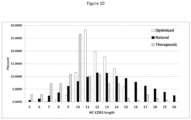
- HC-CDR3 length distribution has a pronounced maximum at HC-CDR3 length 10, different from the smooth bell-shaped length distribution observed for natural human antibodies but also that from mouse antibodies.
- HC-CDR3 loops of length 10 should therefore be represented particularly well in a library aimed at isolation of candidates for therapeutic antibodies. It is likely that antibodies with shorter HC-CDR3 loops express well and show lower tendency for aggregation, important characteristics for a successful product development.
- HC-CDR3-only libraries have been generated in various contexts (Barbas et al., 1992; Braunagel et al., 1997; Pini et al., 1998; Hoet et al., 2005; Silacci et al., 2005; Mahon et al., 2013; US 2006/0257937A1 )
- many recombinant antibody libraries introduce diversity not only in the HC-CDR3 region but also in one or more of the five other CDR regions (for example Knappik et al., 2000; Prassler et al., 2013)
- the diversity present in the various CDR regions is then combined, in a completely random fashion, during library cloning usually starting with the CDR region with the lowest overall diversity.
- each HC-CDR3 region variant has to be considered unique being present only once in the library.
- each HC-CDR3 loop variant becomes "associated" with a completely random combination of variants from the other CDR regions, without any structural or functional selection for compatibility.
- the other CDR regions are represented by germline sequences or by single consensus sequences (for example for the light chain CDR3 region)
- a HC-CDR3-only library should therefore perform as good or even better compared to a library with additional diversity.
- the only exception are short HC-CDR3 loops where, due to the redundancy (presence of variants in more than one copy in the library), a very limited number of combinations of variation in the other CDRs can be explored, i.e. the same HC-CDR3 variant would be present multiple times, each time with a different combination of variants in the other CDR regions.
- the duplication level of the HC-CDR3 region must also be around 10.
- HC-CDR3-only library was compared to a corresponding HC-CDR3-and-LC-CDR3 library.
- the HC-CDR3-only library showed superior properties; however the authors did not fully appreciate the "combinatorial effect" that favors a HC-CDR3-only library but attributed the better performance of the HC-CDR3 library to possible structural incompatibilities between the LC-CDR3 and HC-CDR3 diversity in the HC-CDR3-and-LC-CDR3 library.
- Recombinant antibody libraries where the design of the HC-CDR3 diversity is based on the position-wise amino acid frequencies observed in natural antibodies have been generated using either standard degenerated oligonucleotides (e.g. Philibert et al., 2007), allowing only an approximate representation of the desired amino acid distribution and generating undesired Cys and stop codons, or by oligonucleotides where diversity has been introduced through mixtures of trimer-blocks encoding amino acids (Braunagel et al., 1997; Knappik et al., 2000; Prassler et al, 2013, Mahon et al, 2013; patent applications US 2006/0257937A1 , EP1979378B1 ).
- WO2011032181 Zhai et al. (JMB, 412(1): 55-71, 2011 ), Prassler et al. (JMB. 413(1): 261-268, 2011 ) and WO2016114567 disclose inter alia libraries of HCDR3 in which amino acids appear at specific positions with a certain frequency, wherein HCDR3s of different lengths are combined at certain ratios.
- US 2006/0257937A1 only describes library designs that cover a restricted range of HC-CDR3 loop lengths (8, 10, 13, 14, 15, 17, 18, 19) and the amino acid composition at the HC-CDR3 loop positions either corresponds to a fixed equimolar mixture of 19 different amino acids or is restricted to a fixed mixture of few amino acids for a particular position, indiscriminately for all HC-CDR3 loop lengths.
- EP1979378B1 describes a library design where the HC-CDR3 loop lengths are divided into three varying length ranges, each range having a defined amino acid composition (called diversity factor).
- the diversity factor representing the amino acid composition of all HC-CDR3 loops within a certain length range for the various HC-CDR3 loop positions comprises Kabat positions 95 to 102. For each position or range of positions within HC-CDR3 the diversity factor assigns particular frequencies for a subset of amino acids, while all of the remaining amino acids (except Cys) are included at a fixed frequency, with the exception of positions 101 and 102 where only a subset of amino acids is present.
- the design therefore generates an enormous number of theoretically possible variants since all amino acids (except Cys) are present, with varying frequencies, at nearly all HC-CDR3 loop positions and for all HC-CDR3 loop lengths. Even for mid-range length HC-CDR3 loops (for example lengths 9,10,11) the actual number of variants present in a library of total complexity 10 10 represents only a fraction of all possible variants according to the design.
- library complexity refers to the total number of variants that is present in the library, independently from the HC-CDR3 loop length.
- redundant herein refers to the average number of times the variants for a HC-CDR3 loop with a defined length are represented within the library.
- HC-CDR3-only library we intend a library that has variation only within the HC-CDR3 region and the Kabat position 94 preceding the HC-CDR3 region and that has no variation in the other five CDR regions, HC-CDR1, HC-CDR2, LC-CDR1, LC-CDR2 and LC-CDR3.
- antibody fragment or “functional fragment” as used herein includes any antigen binding fragment, such as Fab, F(ab')2, Fab', Fv, scFv, single chains which include an Fc portion, nanobodies and other antibody like structures having scaffolds other than variable framework regions.
- functional fragment includes, but is not limited to any portion of an antibody, that retains the ability to bind to an antigen of interest.
- germline herein refers to a nucleic acid sequence encoding antibodies or functional fragments thereof that are passed down from parent to offspring.
- variable heavy chain and variable light chain combination refers to the combination of one variable heavy chain and one variable light chain.
- An antibody or a functional antibody fragment comprises at least one variable heavy chain bound to a variable light chain, which form the antigen binding region.
- variable domain light chain variable domain (VL) or heavy chain variable domain (VH), herein refers to the region of an immunoglobulin that is in contact with the antigen and contains the three hypervariable regions referred to as “complementarity determining regions” or "CDRs" (Kabat, 1983; Chothia & Lesk, 1987).
- HC-CDR3 and LC-CDR3 herein refer to the third complementarity determining regions of the heavy chain variable and the light chain variable domain, respectively.
- the term "Kabat nomenclature” herein refers to the residue numbering scheme of the VL or VH domains as defined by Kabat, 1983 and is schematically shown for the VH domain CDR3 region in Fig. 1 . Residue numbering for the VH domain and the HC-CDR3 loop refers to the Kabat nomenclature throughout the present disclosure.
- variable refers to an antibody or antibody fragment with an amino acid sequence that is different from the amino acid sequence of all other antibodies or antibody fragments in the library.
- codon optimized refers to a nucleotide sequence that has been altered in such a way that the encoded amino acid sequence remains the same while codons encoding the individual amino acids have been changed in such a way to optimize the expression of the encoded protein in a particular host, for example bacterial cells.
- library includes, but is not limited to, phage display, ribosomal display, bacterial display, yeast display and mammalian display libraries.
- a preferred embodiment of the present invention utilizes a phage display library.
- display vector includes a DNA sequence having the ability to direct replication and maintenance of the recombinant DNA molecule extra chromosomally in a host cell, such as a bacterial host cell, transformed therewith. Such DNA sequences are well known in the art.
- display vectors can for example be phage vectors or phagemid vectors originating from the class of fd, M13, or fl filamentous bacteriophage. Such vectors are capable of facilitating the display of a protein on the surface of a filamentous bacteriophage.
- antibody related peptides refers to peptides that contain structural domains derived from an antibody and may comprise one or more antibody domains that may be covalently linked, disulfide linked or associated as a complex.
- genetic packages refers to a replicable genetic display package in which the particle is displaying a polypeptide at its surface.
- the package may be a bacteriophage which displays an antigen binding domain at its surface.
- antigen binding domain corresponds to an antibody related peptide this type of package is called a phage antibody.
- the invention provides for a collection of different human antibody HC-CDR3 regions with optimized properties, where diversity is designed through a method that allows, at the desired overall library complexity, for variation of the HC-CDR3 loop length distribution in the library and for variation of the amino acid diversity at each position in each HC-CDR3 loop.
- the present invention generates a human antibody library with optimized properties: reduced combinatorial redundancy (presence of duplicated variants) through optimization of the HC-CDR3 loop length distribution, obtained with an acceptable experimental effort and at a low economic cost.
- the library of the present invention has therefore the advantage to represent particularly well HC-CDR3 loop lengths frequently observed in approved therapeutic antibodies or antibodies in clinical development.
- the desired threshold value of redundancy can be adjusted for each HC-CDR3 loop length.
- each HC-CDR3 loop length (fraction of all possible variants for a particular HC-CDR3 loop length actually present in the library) can be optimized for one or more HC-CDR3 loop lengths of particular interest, within the limits dictated by the overall total complexity of the library.
- it is therefore an object of the present disclosure to generate a library of vectors or genetic packages of overall complexity C that display and express, or comprise a member of a diverse family of antibody related peptides, polypeptides or proteins and collectively display and express, or comprise at least a portion of the diversity of the antibody family, wherein the vectors or genetic packages comprise DNA sequences that encode a HC-CDR3 region and the position preceding the HC-CDR3 region having the following sequence: ZX 1 Y n X 3 X 4 X 5 wherein: C 1.3 ⁇ 10 10
- said antibody related peptides, polypeptides or proteins are from humans.
- said antibody related peptides, polypeptides or proteins are from cat or dog.
- the lengths of the HC-CDR3 loops range from 9 to 11.
- the antibody related peptides, polypeptides or proteins are antibodies or fragments thereof, selected from an antibody comprising one or more constant domains, a single-chain antibody, a FAB fragment, a heavychain only antibody or a variable heavy chain only domain.
- said antibody or fragments thereof is a single-chain antibody.
- the antibody related peptides, polypeptides or proteins according to the present invention comprise human antibody germline variable segments.
- said HC-CDR3 only region is introduced into a constant single-chain scaffold characterized by a human heavy and light chain germline variable domains, wherein the light chain CDR3 region is of length 9.
- Said sequences represent those amino acids most frequently observed at each of the nine positions of the light chain CDR3 in natural human antibodies.
- germline variable domain sequences in the single-chain scaffold is advantageous because these sequences do not contain somatic mutations and are therefore expected to be less immunogenic reducing the likelihood to subsequently observe human anti-human antibody response during clinical testing in human subjects.
- the antibody related peptides, polypeptides or proteins comprises a human antibody VK1 light chain variable domain containing human germline sequences and a human antibody VH3 heavy chain variable domain containing human germline sequences.
- said VK1 kappa light chain variable domain contains the human germline sequences SEQ ID N. 3 and SEQ ID N. 4, the light chain CDR3 region contains the sequence SEQ ID N. 5 and the VH3 heavy chain variable domain contains the human germline sequences SEQ ID N. 1 and SEQ ID N. 2.
- the VH3 heavy chain variable domain comprising the human germline sequence is connected to a human antibody VK1 kappa light chain variable domain comprising the human germline sequence with a linker of SEQ ID N. 6.
- the base vector used to produce the library of the present invention has the SEQ ID N. 8.
- the library of vectors or genetic package according to the present invention is used for the selection of antibodies against target antigens.
- sad library is displayed on phage for selection against target antigens.
- the library of vectors or genetic packages has diversity restricted to the HC-CDR3 region and to the position preceding HC-CDR3.
- High-throughput next-generation sequencing data for HC-CDR3 loop regions was downloaded from the NCBI SRA archive SRR400158 (Ippolito et al, 2012) and examined for length and amino acid composition of the encoded HC-CDR3 loops ( Fig 2 ) following the Kabat nomenclature ( Fig 1 ).
- the HC-CDR3 loop length distribution has a maximum at loop length 12 ( Figure 2 ).
- Amino acid composition at each loop position for HC-CDR3 loop lengths 7 to 15 from natural antibodies are shown in Tables 1a-1i. Table 1a. Amino acid composition for HC-CDR3 loops of length 7 in natural antibodies.
- VH3/VK1 variable domain pairing is one of the most commonly observed VH/VL combinations in natural antibodies (Huang et al., 1996; de Wildt et al., 1999; DeKosky et. al., 2013). It is also observed with high frequency in a recombinant single-chain antibody library of natural variable domains (Glanville et al., 2010), has good thermal stability and is also efficiently expressed (Ewert et al., JMB 2003).
- human germline antibody sequences were selected because germline sequences have favorable properties such as absence of somatic mutations that might cause immunogenicity when present in a therapeutic antibody and an intrinsic tolerance towards the presence of diverse HC-CDR3 regions.
- the heavy chain variable domain scaffold amino acid sequence was assembled from the translated Genbank germline sequence M99660 (SEQ ID 1) and the translated Genbank germline sequence J00256 (J4 fragment) (SEQ ID 2).
- the HC-CDR3 region including few flanking amino acids is represented by a stuffer fragment containing a unique EcoRV site that allows removing of uncleaved vector during library cloning ( Figure 3 ).
- the stuffer fragment contains a Pstl site at its 5' end and a Styl site at its 3' end allowing excision of the fragment during library generation and cloning of the HC-CDR3 diversity encoding oligonucleotides ( Figure 4 ).
- Pstl (CTGCAG) and Styl (CCWWGG) were chosen because only few combinations of codon-encoding trimer blocks ( Figure 5 ), used to synthesize the HC-CDR3 diversity encoding oligonucleotides, generate Pstl and Styl recognition sites. His and Gln trimer blocks (CAT and CAG) were therefore subsequently excluded from the design of the HC-CDR3 diversity encoding oligonucleotides.
- the light chain variable domain amino acid scaffold sequence was assembled from the translated Genbank germline sequence X93627 (SEQ ID 3) and Genbank germline sequence J00242 (VK-1 J1 fragment) (SEQ ID 4).
- the length of the LC-CDR3 loop was chosen to be 9 amino acids, the most frequently observed length in VH3/VK1 heavy chain/light chain combinations in natural antibodies (DeKosky et. al. 2013).
- the amino acid sequence of the LC-CDR3 loop is represented by the most frequently observed amino acids in LC-CDR3 loops of length 9 in VH3/VK1 combinations (SEQ ID 5).
- a single-chain scaffold was then assembled into a VH/VL single-chain topology by a connecting GGGGSGGGGSGGGGS linker (SEQ ID 6) ( Figure 3 ), undesired restriction sites were removed by choosing alternative codons and the resulting nucleotide sequence was codon-optimized for expression in E.coli (SEQ ID 7).
- Example 3 Design and generation of the display vector BaseVector_VH3_VK1_v22 allowing generation of a single-chain HC-CDR3-only library
- the phage display vector for library construction is based on the pCANTAB6 vector, a derivative of the pCANTAB5 vector (McCafferty et al. 1994).
- the sequence of pCANTAB6 was re-constructed starting from Genbank entry U14321 introducing the modifications outlined in McCafferty et al. 1994.
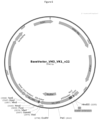
- the scFv cloning site of pCANTAB6 was replaced by the VH3-linker-VK1 single-chain scaffold including the stuffer segment ( Figure 6 ).
- Introduction of a few single base substitutions to remove undesired restriction sites and restoration of the replication origin sequence listed below thus yielded the sequence of the BaseVector_VH3_VK1_v22 (SEQ ID 8).
- Composition of display vector BaseVector_VH3_VK1_v22 Position 1 to 2334: from U14321 with the following modifications: 320 C->T removes Xhol site 617 G->C removes Pvul site 1379 T->C makes sequence of replication original identical to other phagemid vectors 2328 C->G removes Styl site Position 2335 to 3366: VH3-linker-VK1 single-chain scaffold (SEQ ID 7). Position 3367 to 3447: Segment connecting the C-terminus of the light chain variable domain with the plll protein as shown in McCafferty et al. 1994 Position 3448 to 5540: from U14321 with the following modifications:
- BaseVector_VH3_VK1_v22 A schematic layout of BaseVector_VH3_VK1_v22 with the inserted single-chain scaffold is shown in Figure 6 . Excision of the stuffer region with Pstl and Styl allows cloning of oligonucleotides encoding the HC-CDR3 diversity. Additional unique restriction sites allow excision of the complete single-chain antibody, the individual variable light or heavy chains or introduction of additional diversity in the variable light chain domain ( Figure 7 ). BaseVector_VH3_VK1_v22 was then synthesized and assembled by standard methods (Genscript Corporation).
- Example 4 Optimization of the HC-CDR3 loop length distribution and optimization of the position-wise amino acid diversity within each HC-CDR3 loop.
- His and Gln were excluded from the HC-CDR3 diversity design in order to exclude generation of Pstl and Styl sites within the HC-CDR3 loop by the His and Gln trimer-blocks. This exclusion was acceptable because the composition of natural antibody HC-CDR3 sequences revealed that His and Gln are generally observed with only small frequencies (Tables 1a -1i). Cys was excluded at any HC-CDR3 loop position in order to avoid formation of intermolecular disulfide bridges through unpaired Cys residues. Met, prone to oxidation, was also excluded at any of the positions. Met is generally present at only very low frequencies in natural HC-CDR3 sequences (Tables 1a -1i), except for the position preceding position 101. Position 101 was always kept fixed as Asp.
- the design of the HC-CDR3 loop diversity for loop lengths 7 to 15 was optimized using a spreadsheet application.
- the percent fraction for each HC-CDR3 loop length within the library and the variability (number of different amino acids) at each of the HC-CDR3 positions (including also Pos 94 preceding the HC-CDR3 loop) for each HC-CDR3 loop length can be adjusted.
- the number of different amino acids at each HC-CDR3 loop position was set to 16 (all amino acids except Cys, Gln, His and Met) except for positions 101 and 102 (5 and 8 different amino acids, respectively) and the initial percent fractions for each HC-CDR3 loop length was the HC-CDR3 loop length distribution observed in natural antibodies for loop lengths 7 to 15, re-normalized to 100%.
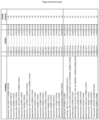
- shorter HC-CDR3 loops are over-represented and for HC-CDR3 loop lengths 10 to 15 less than 1% of the theoretically possibly variants are present in the library (Table 2A).
- HC-CDR3 loops of length 10 enriched in therapeutic antibodies or antibodies in clinical development ( Fig. 8-9 ) only a very small fraction of all possible variants are actually present in the library.
- Adjusting the percent values for the HC-CDR3 loop length distribution introducing additional variability at position 94 for HC-CDR3 loop lengths 7 to 11, gradually reducing the number of different amino acids present at the hypervariable positions for longer HC-CDR3 loops and reducing the number of different amino acids at position 102 and the position preceding position 101 provides a library design with favorable properties (Table 2C). Redundancy is considerably reduced for short HC-CDR3 loops, coverage of variants for loop lengths 9 to 11 is high and longer HC-CDR3 loops are also represented relatively well (Table 2C).
- the optimized HC-CDR3 loop length distribution is shown in Figure 10 together with the HC-CDR3 loop length distribution observed in natural antibodies and that for therapeutic antibodies already approved or in clinical development.
- the amino acid composition for each HC-CDR3 loop length was compiled based on the optimized library design shown in table 2C. At each position and for each HC-CDR3 loop length the number of amino acids present in Table 2C were selected from the most frequently observed amino acids in natural antibodies for that HC-CDR3 loop length and position according to Tables 1a-1i and the percent values were re-normalized to 100. Amino acid composition and percent frequencies for HC-CDR3 lengths 7 to 15 according to the optimized library design are shown in tables 3A-3I. For example, for HC-CDR3 loop length 7 Table 2C indicates that 3 different amino acids should be present at position 94.
- Optimized library amino acid composition for the HC-CDR3 loop with length L 8. For each position the different amino acids present are shown together with their relative frequencies. To increase overall variability also position 94 preceding the HC-CDR3 loop has been varied for HC-CDR3 loop length 8.
- Optimized library amino acid composition for the HC-CDR3 loop with length L 9. For each position the different amino acids present are shown together with their relative frequencies. To increase overall variability also position 94 preceding the HC-CDR3 loop has been varied for HC-CDR3 loop length 9.
- Optimized library amino acid composition for the HC-CDR3 loop with length L 10. For each position the different amino acids present are shown together with their relative frequencies. To increase overall variability also position 94 preceding the HC-CDR3 loop has been varied for HC-CDR3 loop length 10.
- Optimized library amino acid composition for the HC-CDR3 loop with length L 11. For each position the different amino acids present are shown together with their relative frequencies. To increase overall variability also position 94 preceding the HC-CDR3 loop has been varied for HC-CDR3 loop length 11.
- Optimized library amino acid composition for the HC-CDR3 loop with length L 12. For each position the different amino acids present are shown together with their relative frequencies. 92 93 94 95 96 97 98 99 100 100A 100B 100C 100D 101 102 103 C(100.0%) A(100.0%) R(100.0%) D( 33.2%) G( 18.5%) G( 19.7%) G( 18.1%) G( 19.2%) G( 19.9%) G( 15.2%) Y( 20.2%) Y( 22.6%) F( 86.5%) D(100.0%) Y(100.0%) W(100.0%) G( 28.8%) R( 14.4%) S( 12.6%) S( 17.5%) S( 18.8%) S( 16.6%) S( 14.8%) G( 17.9%) G( 17.0%) L( 13.5%) E( 13.4%) P( 9.9%) Y( 12.2%) Y( 12.1%) Y( 11.8%) Y( 12.4%) Y( 14.4%) S( 10.1%) A( 14.
- Optimized library amino acid composition for the HC-CDR3 loop with length L 13. For each position the different amino acids present are shown together with their relative frequencies. 92 93 94 95 96 97 98 99 100 100A 100B 100C 1000 100E 101 102 103 C(100.0%) A(100.0%) R(100,0%) D(40.5%) G(17.6%) G(20.8%) G(17.1%) G(20.0%) G(19.4%) G(19.5%) Y(18.9%) Y(24.9%) Y(22.8%) F(100.0%) D(100.0%) Y(100.0%) W(100.0%) G(32.2%) R(16.0%) S(12.2%) S(16.0%) S(18.5%) S(17.6%) S(15.8%) G(16.5%) G(18,2%) G(20.3%) V(13.9%) P(12.1%) R(11.4%) Y(14.5%)
- Optimized library amino acid composition for the HC-CDR3 loop with length L 14. For each position the different amino acids present are shown together with their relative frequencies. 92 93 94 95 96 97 98 99 100 100A 100B 100C 100D 100E 100F 101 102 103 C(100.0%) A(100.0%) R(100.0%) D(45.4%) G(21.9%) G(20.5%) G(20.0%) G(20.5%) G(21.6%) G(20.3%) Y(21.3%) Y(26.0%) Y(30.1%) Y(25.1%) F(100.0%) D(100.0%) Y(100.0%) W(100.0%) G(38.2%) R)16.4%) S(13.4%) Y(15.7%) S(19.8%) S(20.1%) S(185%) G(20.1%) G(16.3%) G(18.3%) G(23.0%) E(16.4%) P(
- Optimized library amino acid composition for the HC-CDR3 loop with length L 15. For each position the different amino acids present are shown together with their relative frequencies. 92 93 94 95 96 97 98 99 100 100A 100B 100C 100D 100E 100F 100G 101 102 103 C(100.0%) A(100.0%) R(100.0%) D(54.1%) G(20.8%) G(23.7%) Y(19.4%) G(21.0%) G(22.2%) S(23.4%) G(23.5%) Y(28.4%) Y(34.3%) Y(35.1%) G(27.3%) F(100.0%) D(100.0%) Y(100.0%) W(100.0%) G(45.9%) R(19.6%) Y(17.2%) G(17.9%) S(19.9%) S(21.4%) G(21.6%) Y(21.3%) G(19.3%) G(15.5%) G(16.
- Oligonucleotides for each HC-CDR3 loop length were then designed based on the values in tables 3A-I. At positions with more than one amino acid the corresponding trimer-blocks from Figure 5 were selected and included in the design in the desired percent fraction as a mixture.
- trimer blocks encoding complete codons are advantageous because they allow to generate the amino acid composition and frequencies shown in tables 3A-I, at each position of each HC-CDR3 loop, without generation of undesired stop codons or inclusion of undesired amino acids as would be the case for standard degenerate oligonucleotides.
- Constant parts of the oligonucleotides are instead designed to be synthesized by standard oligonucleotide synthesis.
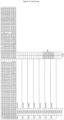
- the oligonucleotide design for the HC-CDR3 loop length 15 is shown in Figure 11 .
- Oligonucleotides for the other HC-CDR3 loop lengths were designed in an equivalent fashion using the values given in tables 3A-I. Oligonucleotides were synthesized by EllaBiotech using their trimer-block technology.
- Example 6 Generation of the library diversity by inserting the oligonucleotides containing the HC-CDR3 diversity into the BaseVector_VH3_VK1 _ 22
- a first step the single-stranded oligonucleotides encoding the HC-CDR3 loop diversity were subjected to primer extension (generation of double-stranded oligonucleotides) using primer Sty_rev_1 (SEQ ID 9) and Herculase II-Fusion DNA polymerase (Agilent cat#600679) and the following conditions: denaturation at 98°C for 35 sec, annealing at 47°C for 15 sec, elongation for 15 sec at 47°C and 65°C for oligonucleotides encoding loop lengths 7 to 11 and 12 to 15, respectively.
- oligonucleotides were then amplified using primers Pstl_for_1 (SEQ ID 10) and Sty_rev_2 (SEQ ID 11) and using Herculase II-Fusion DNA polymerase (Agilent cat#600679) with the following conditions: denaturation at 95°C for 15 sec, annealing at 52°C for 15 sec, elongation at 72°C for 15 sec repeated for 16 cycles.
- oligonucleotides were purified through Qiaquick nucleotide Removal Kit (Qiagen Cat# 28304), subjected to digestion with Pstl/Styl restriction enzymes and ligated into the Pstl/Styl-digested phagemid vector at an insertvector ratio 1:6 (transformation efficiency in the range of 5 ⁇ 10 7 /10 8 clones/ ⁇ g), separately for each HC-CDR3 loop length.
- the resulting ligation product was then transformed into XL1blue-MRF' electro-competent cells (50ng vector in 50 ⁇ l cells), plated onto 23x23 cm 2XTYagar Bioassay plates and grown o/n at 37°C.
- the resulting cell culture was centrifuged and the supernatant containing the phage library was subjected to two PEG precipitation steps (addition of 20%PEG8000/NaCl 2.5M for 3/10 of the volume) followed by resuspension of the phages in 1 ⁇ TE for a further purification step on a CsCI gradient.
- the phage population was then collected from the gradient and dialyzed o/n against 2L of 1X TE to eliminate the CsCI, the phage concentration in the preparation was determined by TU, pfu and PP/ml and stored in TBE1X, glycerol 15%, NaN 3 0.02%.
- the standard blocking buffer is made of 2% milk, and therefore contains plenty of bovine albumin, we reasoned that this soluble BSA could compete with the target recombinant BSA protein coated on the plastic for selection. Consequently, for the selection of phages on this target a blocking buffer reagent with 1% casein (Roche) was used instead of the standard blocking buffer.
- a blocking buffer reagent containing 0.02% NaN 3 was employed, so that phages potentially specific for NaN 3 would remain in solution and be washed away.
- the input/output ratio represents a measure of the enrichment of specific clones, in fact it is usually very high in the first round of selection, and rapidly decreases in the following rounds, when the population of phages eluted from the previous round is progressively enriched for specific phages.
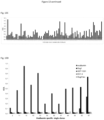
- the input/output ratio suggested a possible enrichment of specific clones from the 1st round to the 3 rd round of panning ( Figure 12A ).
- Polyclonal phages were tested by phage ELISA on BSA and several unrelated antigens.
- Anti-BSA M13-scFv clones were present in the 2 nd and 3 rd rounds of the selection ( Figure 12B ).
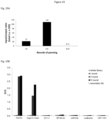
- the library selection was performed by using ten Dsg1 pre-coated wells (MBL ELISA kit) and 9.3 ⁇ 10 12 TU in 1600 ⁇ l of library-containing buffer (160 ⁇ l/well). The concentration of coated antigen is unknown. The input/output ratio suggested a possible enrichment of specific clones from the 1st round to the 3rd round of panning ( Figure 14A ). Polyclonal phages were tested by phage ELISA on Dsg1 pre-coated wells and several unrelated antigens.
- Anti-Dsg1 M13-scFvs were present in the 2nd and 3rd rounds of selection without any unspecific binding to other antigens with the exception of Dsg3 and Dsg3-derived constructs (EC1-2) ( Figure 14B ).
- the detected cross-reactivity was likely due to the high sequence homology between Dsg1 and 3.
- the percentage of anti-Dsg1 clones in the 3rd round of selection was 86 of 94 (91%) ( Figure 14C ).
- the analysis of 8 positive clones showed that all of them were specific for Dsg1 ( Figure 14D ).
- the library selection was performed by using 1600 ⁇ l of the library (160 ⁇ l/well) in 10 microplate wells, coated with FGFR-4 at a concentration of 10 ⁇ g/ml. All three rounds of selection were performed on wells coated with the same concentration of FGFR-4. Since the FGFR-4 recombinant protein is a chimeric protein fused to human IgG1 FC and in order to reduce the amount of anti-FC phages selected, the first round was performed using a different recombinant protein fused to FC (8 ⁇ g/ml of Dsg3-FC). The input/output ratio suggested a possible enrichment of specific clones from the I round to the III round of panning ( Figure 15A ).
- Table 4 Summary of the results of library screening on four different validation targets. A) Number and percentage of phages positively selected against every target; B) Specificity in terms of binding vs the specific target or other unrelated recombinant proteins, and number of different sequences found for each target (see below).
- M13-scFv clone (cl. 33) for its target FGFR-4 was determined by phage ELISA and found to be in the nanomolar range (8,7 ⁇ 10-8 M). This value compares favorably to values reported by Pfizer ( Mahon et al. J.Mol:Biol. 405, 1712, 2013 ), who found affinities between 105 and 457 nM for phages selected with their HC-CDR3-only library. Table 5. Sequence analysis of a subset of clones isolated through the selections. For each target 5 to 10 clones were sequenced.
- the library design was successful for all four target antigens tested. Besides the high target specificity obtained (Table 4), the library provides also a variety of distinct clone sequence families for each target. Importantly, the results obtained also well reflect the basic design principle of the library with most sequences having a HC-CDR3 length of 11. In addition, the presence of a number of selected clones with only a small number (often only 1) of different amino acid confirms that the library provides a large coverage for all HC-CDR3 loop variants for the most important HC-CDR3 length 9 to 11, as implemented in the design.
Landscapes
- Chemical & Material Sciences (AREA)
- Life Sciences & Earth Sciences (AREA)
- Health & Medical Sciences (AREA)
- Organic Chemistry (AREA)
- Genetics & Genomics (AREA)
- Molecular Biology (AREA)
- Biochemistry (AREA)
- Medicinal Chemistry (AREA)
- Engineering & Computer Science (AREA)
- General Health & Medical Sciences (AREA)
- Biophysics (AREA)
- General Chemical & Material Sciences (AREA)
- Biotechnology (AREA)
- Chemical Kinetics & Catalysis (AREA)
- Zoology (AREA)
- Wood Science & Technology (AREA)
- Bioinformatics & Cheminformatics (AREA)
- General Engineering & Computer Science (AREA)
- Biomedical Technology (AREA)
- Virology (AREA)
- Microbiology (AREA)
- Immunology (AREA)
- Proteomics, Peptides & Aminoacids (AREA)
- Physics & Mathematics (AREA)
- Plant Pathology (AREA)
- Crystallography & Structural Chemistry (AREA)
- Bioinformatics & Computational Biology (AREA)
- Peptides Or Proteins (AREA)
- Saccharide Compounds (AREA)
Claims (9)
- Bibliothek von Vektoren mit einer allgemeinen Komplexität C = 1,3 × 10¹⁰, die eine diverse Familie von Antikörpern oder Fragmenten davon anzeigen und exprimieren,wobei die Diversität der Bibliothek von Vektoren auf die HC-CDR3-Region und die Kabat-Position 94 vor der HC-CDR3 beschränkt ist,wobei die HC-CDR3-Regionen jeweils eine Länge von 7, 8, 9, 10, 11, 12, 13, 14 bzw. 15 Aminosäureresten aufweisen,wobei HC-CDR3-Regionen mit einer Länge von 7 in einem Prozentsatz von 0,1 % enthalten sind,wobei HC-CDR3-Regionen mit einer Länge von 8 in einem Prozentsatz von 1,0 % enthalten sind,wobei HC-CDR3-Regionen mit einer Länge von 9 in einem Prozentsatz von 2,5 % enthalten sind,wobei HC-CDR3-Regionen mit einer Länge von 10 in einem Prozentsatz von 11,5 % enthalten sind,wobei HC-CDR3-Regionen mit einer Länge von 11 in einem Prozentsatz von 28,3 % enthalten sind,wobei HC-CDR3-Regionen mit einer Länge von 12 in einem Prozentsatz von 19,8 % enthalten sind,wobei HC-CDR3-Regionen mit einer Länge von 13 in einem Prozentsatz von 17,7 % enthalten sind,wobei HC-CDR3-Regionen mit einer Länge von 14 in einem Prozentsatz von 13,1 % enthalten sind,wobei HC-CDR3-Regionen mit einer Länge von 15 in einem Prozentsatz von 6 % enthalten sind, und- wobei in den HC-CDR3-Regionen mit einer Länge von 7 jeweils die Kabat-Positionen 94, 95, 96, 97, 98, 99, 101 bzw. 102 durch Aminosäuren mit der relativen Aminosäurefrequenz gemäß Tabelle 3A besetzt sind;- wobei in den HC-CDR3-Regionen mit einer Länge von 8 jeweils die Kabat-Positionen 94, 95, 96, 97, 98, 99, 100, 101 bzw. 102 durch Aminosäuren mit der relativen Aminosäurefrequenz gemäß Tabelle 3B besetzt sind;- wobei in den HC-CDR3-Regionen mit einer Länge von 9 jeweils die Kabat-Positionen 94, 95, 96, 97, 98, 99, 100, 100A, 101 bzw. 102 durch Aminosäuren mit der relativen Aminosäurefrequenz gemäß Tabelle 3C besetzt sind;- wobei in den HC-CDR3-Regionen mit einer Länge von 10 jeweils die Kabat-Positionen 94, 95, 96, 97, 98, 99, 100, 100A, 100B, 101 bzw. 102 durch Aminosäuren mit der relativen Aminosäurefrequenz gemäß Tabelle 3D besetzt sind;- wobei in den HC-CDR3-Regionen mit einer Länge von 11 jeweils die Kabat-Positionen 94, 95, 96, 97, 98, 99, 100, 100A, 100B, 100C, 101 bzw. 102 durch Aminosäuren mit der relativen Aminosäurefrequenz gemäß Tabelle 3E besetzt sind;- wobei in den HC-CDR3-Regionen mit einer Länge von 12 jeweils die Kabat-Positionen 94, 95, 96, 97, 98, 99, 100, 100A, 100B, 100C, 100D, 101 bzw. 102 durch Aminosäuren mit der relativen Aminosäurefrequenz gemäß Tabelle 3F besetzt sind;- wobei in den HC-CDR3-Regionen mit einer Länge von 13 jeweils die Kabat-Positionen 94, 95, 96, 97, 98, 99, 100, 100A, 100B, 100C, 100D, 100E, 101 bzw. 102 durch Aminosäuren mit der relativen Aminosäurefrequenz gemäß Tabelle 3G besetzt sind;- wobei in den HC-CDR3-Regionen mit einer Länge von 14 jeweils die Kabat-Positionen 94, 95, 96, 97, 98, 99, 100, 100A, 100B, 100C, 100D, 100E, 100F, 101 bzw. 102 durch Aminosäuren mit der relativen Aminosäurefrequenz gemäß Tabelle 3H besetzt sind;- wobei in den HC-CDR3-Regionen mit einer Länge von 15 jeweils die Kabat-Positionen 94, 95, 96, 97, 98, 99, 100, 100A, 100B, 100C, 100D, 100E, 100F, 100G, 101 bzw. 102 durch Aminosäuren mit der relativen Aminosäurefrequenz gemäß Tabelle 3I besetzt sind.
- Bibliothek von Vektoren nach Anspruch 1, wobei die Antikörper oder Fragmente davon ausgewählt sind aus einem eine oder mehrere konstante Domänen umfassenden Antikörper, einem einkettigen Antikörper, einem FAB-Fragment, einem Antikörper mit nur einer Schwerkette oder einer variablen Domäne von nur einer Schwerkette.
- Bibliothek von Vektoren nach einem der vorstehenden Ansprüche, wobei die Antikörper oder Fragmente davon variable Segmente einer Keimbahn eines menschlichen Antikörpers umfassen.
- Bibliothek von Vektoren nach einem der vorstehenden Ansprüche, wobei die Antikörper oder Fragmente davon eine variable VK1-Domäne einer Leichtkette eines menschlichen Antikörpers umfassen, die menschliche Keimbahnsequenzen enthält, und eine variable VH3-Domäne einer Schwerkette eines menschlichen Antikörpers, die menschliche Keimbahnsequenzen enthält.
- Bibliothek von Vektoren nach Anspruch 4, wobei die variable VK1-Domäne der Kappa-Leichtkette die menschlichen Keimbahnsequenzen SEQ ID N. 3 und SEQ ID N. 4 enthält, die CDR3-Region der Leichtkette die Sequenz SEQ ID N. 5 enthält und die variable VH3-Domäne der Schwerkette die menschlichen Keimbahnsequenzen SEQ ID N.1 und SEQ ID N. 2 enthält.
- Bibliothek von Vektoren nach Anspruch 4, dadurch gekennzeichnet, dass die variable VH3-Domäne der Schwerkette, die die menschlichen Keimbahnsequenzen umfasst, mit einer variablen VK1-Domäne einer Kappa-Leichtkette eines menschlichen Antikörpers verbunden ist, die die menschlichen Keimbahnsequenzen mit einem Linker von SEQ ID N. 6 umfasst.
- Bibliothek von Vektoren nach einem der vorstehenden Ansprüche, dadurch gekennzeichnet, dass der Basisvektor, der zum Erzeugen der Bibliothek verwendet wird, die SEQ ID 8 aufweist.
- Bibliothek von Vektoren nach einem der vorstehenden Ansprüche zur Auswahl gegen Zielantigene.
- Bibliothek von Vektoren nach Anspruch 8, dadurch gekennzeichnet, dass die Bibliothek auf einem Phagen zur Auswahl gegen Zielantigene angezeigt wird.
Priority Applications (2)
| Application Number | Priority Date | Filing Date | Title |
|---|---|---|---|
| HRP20231434TT HRP20231434T1 (hr) | 2016-09-08 | 2017-09-06 | Biblioteke koje sadrže samo hc-cdr3, sa smanjenom kombinatornom zalihošću i optimiziranom raspodjelom duljine petlje |
| SI201731436T SI3510187T1 (sl) | 2016-09-08 | 2017-09-06 | Knjižnice samo hc-cdr3 z zmanjšano kombinatorno redundanco in optimizirano porazdelitvijo dolžine zanke |
Applications Claiming Priority (2)
| Application Number | Priority Date | Filing Date | Title |
|---|---|---|---|
| EP16187884.8A EP3293293A1 (de) | 2016-09-08 | 2016-09-08 | Hc-cdr3-only-bibliotheken mit verringerter kombinatorischer redundanz und optimierter schleifenlängenverteilung |
| PCT/EP2017/072315 WO2018046525A1 (en) | 2016-09-08 | 2017-09-06 | Hc-cdr3-only libraries with reduced combinatorial redundancy and optimized loop length distribution |
Publications (2)
| Publication Number | Publication Date |
|---|---|
| EP3510187A1 EP3510187A1 (de) | 2019-07-17 |
| EP3510187B1 true EP3510187B1 (de) | 2023-09-06 |
Family
ID=56889022
Family Applications (2)
| Application Number | Title | Priority Date | Filing Date |
|---|---|---|---|
| EP16187884.8A Withdrawn EP3293293A1 (de) | 2016-09-08 | 2016-09-08 | Hc-cdr3-only-bibliotheken mit verringerter kombinatorischer redundanz und optimierter schleifenlängenverteilung |
| EP17765146.0A Active EP3510187B1 (de) | 2016-09-08 | 2017-09-06 | Hc-cdr3-only-bibliotheken mit verringerter kombinatorischer redundanz und optimierter schleifenlängenverteilung |
Family Applications Before (1)
| Application Number | Title | Priority Date | Filing Date |
|---|---|---|---|
| EP16187884.8A Withdrawn EP3293293A1 (de) | 2016-09-08 | 2016-09-08 | Hc-cdr3-only-bibliotheken mit verringerter kombinatorischer redundanz und optimierter schleifenlängenverteilung |
Country Status (19)
| Country | Link |
|---|---|
| US (1) | US10745696B2 (de) |
| EP (2) | EP3293293A1 (de) |
| JP (1) | JP6974909B2 (de) |
| KR (1) | KR102281476B1 (de) |
| CN (1) | CN109689947B (de) |
| AU (1) | AU2017323432C1 (de) |
| CA (1) | CA3035435A1 (de) |
| DK (1) | DK3510187T5 (de) |
| ES (1) | ES2966283T3 (de) |
| FI (1) | FI3510187T3 (de) |
| HR (1) | HRP20231434T1 (de) |
| HU (1) | HUE063973T2 (de) |
| IL (1) | IL265146B (de) |
| LT (1) | LT3510187T (de) |
| PL (1) | PL3510187T3 (de) |
| PT (1) | PT3510187T (de) |
| RU (1) | RU2745452C2 (de) |
| SI (1) | SI3510187T1 (de) |
| WO (1) | WO2018046525A1 (de) |
Families Citing this family (1)
| Publication number | Priority date | Publication date | Assignee | Title |
|---|---|---|---|---|
| CN109160948B (zh) * | 2018-09-21 | 2021-07-16 | 成都阿帕克生物科技有限公司 | 一种乙肝表面抗原纳米抗体及核酸分子和应用 |
Citations (1)
| Publication number | Priority date | Publication date | Assignee | Title |
|---|---|---|---|---|
| WO2016114567A1 (ko) * | 2015-01-13 | 2016-07-21 | 이화여자대학교 산학협력단 | 신규 항체 라이브러리 제조방법 및 이로부터 제조된 라이브러리 |
Family Cites Families (11)
| Publication number | Priority date | Publication date | Assignee | Title |
|---|---|---|---|---|
| PT1360288E (pt) | 2000-12-18 | 2011-03-07 | Dyax Corp | Bibliotecas orientadas de pacotes genéticos |
| AU2004261980A1 (en) * | 2003-08-01 | 2005-02-10 | Genentech, Inc. | Antibody CDR polypeptide sequences with restricted diversity |
| US11674240B2 (en) * | 2004-07-06 | 2023-06-13 | Pfizer Inc. | Universal antibody libraries |
| US7226460B2 (en) | 2004-08-02 | 2007-06-05 | Karl Storz Endovision, Inc. | Surgical instrument attachment system |
| WO2008053275A2 (en) | 2005-12-20 | 2008-05-08 | Morphosys Ag | Novel collection of hcdr3 regions and uses therefor |
| US8131480B2 (en) * | 2006-10-02 | 2012-03-06 | Sea Lane Biotechnologies Llc | Construction of diverse synthetic peptide and polypeptide libraries |
| EP3124497B1 (de) * | 2007-09-14 | 2020-04-15 | Adimab, LLC | Synthetische antikörperbibliotheken mit rationalem design und verwendungen davon |
| WO2009114815A1 (en) * | 2008-03-13 | 2009-09-17 | Dyax Corp | Libraries of genetic packages comprising novel hc cdr3 designs |
| WO2009132287A2 (en) * | 2008-04-24 | 2009-10-29 | Dyax Corp. | Libraries of genetic packages comprising novel hc cdr1, cdr2, and cdr3 and novel lc cdr1, cdr2, and cdr3 designs |
| CN102171247A (zh) * | 2008-07-02 | 2011-08-31 | 特鲁比昂药品公司 | TNF-α拮抗剂多靶点结合蛋白 |
| JP2013504602A (ja) * | 2009-09-14 | 2013-02-07 | ダイアックス コーポレーション | 新しく設計したhccdr3を含む遺伝子パッケージライブラリー |
-
2016
- 2016-09-08 EP EP16187884.8A patent/EP3293293A1/de not_active Withdrawn
-
2017
- 2017-09-06 EP EP17765146.0A patent/EP3510187B1/de active Active
- 2017-09-06 AU AU2017323432A patent/AU2017323432C1/en active Active
- 2017-09-06 LT LTEPPCT/EP2017/072315T patent/LT3510187T/lt unknown
- 2017-09-06 HU HUE17765146A patent/HUE063973T2/hu unknown
- 2017-09-06 FI FIEP17765146.0T patent/FI3510187T3/fi active
- 2017-09-06 PT PT177651460T patent/PT3510187T/pt unknown
- 2017-09-06 SI SI201731436T patent/SI3510187T1/sl unknown
- 2017-09-06 HR HRP20231434TT patent/HRP20231434T1/hr unknown
- 2017-09-06 ES ES17765146T patent/ES2966283T3/es active Active
- 2017-09-06 KR KR1020197008894A patent/KR102281476B1/ko active Active
- 2017-09-06 RU RU2019109949A patent/RU2745452C2/ru active
- 2017-09-06 JP JP2019513413A patent/JP6974909B2/ja active Active
- 2017-09-06 CN CN201780054632.8A patent/CN109689947B/zh active Active
- 2017-09-06 CA CA3035435A patent/CA3035435A1/en not_active Abandoned
- 2017-09-06 PL PL17765146.0T patent/PL3510187T3/pl unknown
- 2017-09-06 WO PCT/EP2017/072315 patent/WO2018046525A1/en not_active Ceased
- 2017-09-06 DK DK17765146.0T patent/DK3510187T5/da active
-
2019
- 2019-02-14 US US16/276,557 patent/US10745696B2/en active Active
- 2019-03-03 IL IL265146A patent/IL265146B/en active IP Right Grant
Patent Citations (1)
| Publication number | Priority date | Publication date | Assignee | Title |
|---|---|---|---|---|
| WO2016114567A1 (ko) * | 2015-01-13 | 2016-07-21 | 이화여자대학교 산학협력단 | 신규 항체 라이브러리 제조방법 및 이로부터 제조된 라이브러리 |
Non-Patent Citations (3)
| Title |
|---|
| HONGCHENG LIU ET AL: "Glutamine deamidation of a recombinant monoclonal antibody", RAPID COMMUNICATIONS IN MASS SPECTROMETRY, vol. 22, no. 24, 30 December 2008 (2008-12-30), GB, pages 4081 - 4088, XP055320733, ISSN: 0951-4198, DOI: 10.1002/rcm.3831 * |
| JOSEF PRASSLER ET AL: "HuCAL PLATINUM, a Synthetic Fab Library Optimized for Sequence Diversity and Superior Performance in Mammalian Expression Systems", JOURNAL OF MOLECULAR BIOLOGY, ACADEMIC PRESS, UNITED KINGDOM, vol. 413, no. 1, 5 August 2011 (2011-08-05), pages 261 - 278, XP028301349, ISSN: 0022-2836, [retrieved on 20110812], DOI: 10.1016/J.JMB.2011.08.012 * |
| WENWU ZHAI ET AL: "Synthetic Antibodies Designed on Natural Sequence Landscapes", JOURNAL OF MOLECULAR BIOLOGY, ACADEMIC PRESS, UNITED KINGDOM, vol. 412, no. 1, 11 July 2011 (2011-07-11), pages 55 - 71, XP028265958, ISSN: 0022-2836, [retrieved on 20110720], DOI: 10.1016/J.JMB.2011.07.018 * |
Also Published As
| Publication number | Publication date |
|---|---|
| AU2017323432A1 (en) | 2019-03-21 |
| CN109689947B (zh) | 2022-06-21 |
| CN109689947A (zh) | 2019-04-26 |
| HUE063973T2 (hu) | 2024-02-28 |
| DK3510187T3 (da) | 2023-11-20 |
| IL265146B (en) | 2020-09-30 |
| EP3293293A1 (de) | 2018-03-14 |
| KR102281476B1 (ko) | 2021-07-28 |
| DK3510187T5 (da) | 2024-09-02 |
| CA3035435A1 (en) | 2018-03-15 |
| US20190211326A1 (en) | 2019-07-11 |
| ES2966283T3 (es) | 2024-04-19 |
| LT3510187T (lt) | 2023-11-10 |
| AU2017323432B2 (en) | 2020-08-13 |
| JP6974909B2 (ja) | 2021-12-01 |
| PT3510187T (pt) | 2023-11-03 |
| SI3510187T1 (sl) | 2023-12-29 |
| EP3510187A1 (de) | 2019-07-17 |
| FI3510187T3 (fi) | 2023-10-31 |
| RU2019109949A3 (de) | 2021-01-21 |
| AU2017323432C1 (en) | 2022-05-19 |
| PL3510187T3 (pl) | 2024-01-22 |
| WO2018046525A1 (en) | 2018-03-15 |
| RU2745452C2 (ru) | 2021-03-25 |
| JP2019528712A (ja) | 2019-10-17 |
| RU2019109949A (ru) | 2020-10-09 |
| HRP20231434T1 (hr) | 2024-03-01 |
| KR20190044650A (ko) | 2019-04-30 |
| US10745696B2 (en) | 2020-08-18 |
Similar Documents
| Publication | Publication Date | Title |
|---|---|---|
| CN101548034B (zh) | 多样性合成肽和多肽文库的设计和构建 | |
| Zhao et al. | Phage antibody display libraries: a powerful antibody discovery platform for immunotherapy | |
| EP2231904B1 (de) | Design und erstellung humaner de novo pix-phagen-display-bibliotheken mittels fusion an pix oder pvii, vektoren, antikörper und verfahren | |
| CA2988001C (en) | Method for mass humanization of rabbit antibodies | |
| US20100137156A1 (en) | Construction and use of a functionally human antibody library with maximized repertoire diversity | |
| EP3246434A1 (de) | Verfahren zur erstellung einer neuartigen antikörperbibliothek und damit erstellte bibliothek | |
| Bai et al. | A novel human scFv library with non-combinatorial synthetic CDR diversity | |
| Inbar et al. | Selection of antibodies from synthetic antibody libraries | |
| AU2001252253B2 (en) | A method for in vitro molecular evolution of antibody function | |
| US10745696B2 (en) | HC-CDR3-only libraries with reduced combinatorial redundancy and optimized loop length distribution | |
| KR102194203B1 (ko) | 항체 나이브 라이브러리의 생성 방법, 상기 라이브러리 및 그 적용(들) | |
| US20230332141A1 (en) | Novel antibody library preparation method and library prepared thereby | |
| JP7337850B2 (ja) | 抗体ライブラリー及びこれを用いた抗体スクリーニング方法 | |
| KR20180104675A (ko) | 합성 항체 라이브러리의 생성 방법, 상기 라이브러리 및 그 적용(들) | |
| Yin et al. | Construction of a Fully Synthetic Human scFv Antibody Library with CDR3 Regions Randomized by a Split–Mix–Split Method and Its Application | |
| García Quiroz et al. | Engineering antibody fragments: replicating the immune system and beyond | |
| Rohrbach et al. | Antibody Phage Display Libraries for Use in Therapeutic Gene Targeting |
Legal Events
| Date | Code | Title | Description |
|---|---|---|---|
| REG | Reference to a national code |
Ref country code: HR Ref legal event code: TUEP Ref document number: P20231434T Country of ref document: HR |
|
| STAA | Information on the status of an ep patent application or granted ep patent |
Free format text: STATUS: UNKNOWN |
|
| STAA | Information on the status of an ep patent application or granted ep patent |
Free format text: STATUS: THE INTERNATIONAL PUBLICATION HAS BEEN MADE |
|
| PUAI | Public reference made under article 153(3) epc to a published international application that has entered the european phase |
Free format text: ORIGINAL CODE: 0009012 |
|
| STAA | Information on the status of an ep patent application or granted ep patent |
Free format text: STATUS: REQUEST FOR EXAMINATION WAS MADE |
|
| 17P | Request for examination filed |
Effective date: 20190208 |
|
| AK | Designated contracting states |
Kind code of ref document: A1 Designated state(s): AL AT BE BG CH CY CZ DE DK EE ES FI FR GB GR HR HU IE IS IT LI LT LU LV MC MK MT NL NO PL PT RO RS SE SI SK SM TR |
|
| AX | Request for extension of the european patent |
Extension state: BA ME |
|
| DAV | Request for validation of the european patent (deleted) | ||
| DAX | Request for extension of the european patent (deleted) | ||
| REG | Reference to a national code |
Ref country code: HK Ref legal event code: DE Ref document number: 40004044 Country of ref document: HK |
|
| STAA | Information on the status of an ep patent application or granted ep patent |
Free format text: STATUS: EXAMINATION IS IN PROGRESS |
|
| 17Q | First examination report despatched |
Effective date: 20200512 |
|
| RIN1 | Information on inventor provided before grant (corrected) |
Inventor name: STEINKUEHLER, CHRISTIAN Inventor name: LAHM, ARMIN Inventor name: FILOCAMO, GESSICA |
|
| REG | Reference to a national code |
Ref country code: DE Ref legal event code: R079 Free format text: PREVIOUS MAIN CLASS: C40B0040080000 Ipc: C07K0016000000 Ref country code: DE Ref legal event code: R079 Ref document number: 602017073807 Country of ref document: DE Free format text: PREVIOUS MAIN CLASS: C40B0040080000 Ipc: C07K0016000000 |
|
| RIC1 | Information provided on ipc code assigned before grant |
Ipc: C07K 16/00 20060101AFI20230130BHEP |
|
| GRAP | Despatch of communication of intention to grant a patent |
Free format text: ORIGINAL CODE: EPIDOSNIGR1 |
|
| STAA | Information on the status of an ep patent application or granted ep patent |
Free format text: STATUS: GRANT OF PATENT IS INTENDED |
|
| INTG | Intention to grant announced |
Effective date: 20230317 |
|
| GRAS | Grant fee paid |
Free format text: ORIGINAL CODE: EPIDOSNIGR3 |
|
| GRAA | (expected) grant |
Free format text: ORIGINAL CODE: 0009210 |
|
| STAA | Information on the status of an ep patent application or granted ep patent |
Free format text: STATUS: THE PATENT HAS BEEN GRANTED |
|
| AK | Designated contracting states |
Kind code of ref document: B1 Designated state(s): AL AT BE BG CH CY CZ DE DK EE ES FI FR GB GR HR HU IE IS IT LI LT LU LV MC MK MT NL NO PL PT RO RS SE SI SK SM TR |
|
| REG | Reference to a national code |
Ref country code: GB Ref legal event code: FG4D |
|
| REG | Reference to a national code |
Ref country code: CH Ref legal event code: EP |
|
| REG | Reference to a national code |
Ref country code: NL Ref legal event code: FP Ref country code: IE Ref legal event code: FG4D |
|
| REG | Reference to a national code |
Ref country code: DE Ref legal event code: R096 Ref document number: 602017073807 Country of ref document: DE |
|
| P01 | Opt-out of the competence of the unified patent court (upc) registered |
Effective date: 20230908 |
|
| REG | Reference to a national code |
Ref country code: FI Ref legal event code: FGE |
|
| REG | Reference to a national code |
Ref country code: PT Ref legal event code: SC4A Ref document number: 3510187 Country of ref document: PT Date of ref document: 20231103 Kind code of ref document: T Free format text: AVAILABILITY OF NATIONAL TRANSLATION Effective date: 20231030 |
|
| REG | Reference to a national code |
Ref country code: DK Ref legal event code: T3 Effective date: 20231117 |
|
| REG | Reference to a national code |
Ref country code: SE Ref legal event code: TRGR |
|
| REG | Reference to a national code |
Ref country code: NO Ref legal event code: T2 Effective date: 20230906 |
|
| REG | Reference to a national code |
Ref country code: EE Ref legal event code: FG4A Ref document number: E023738 Country of ref document: EE Effective date: 20231102 |
|
| PG25 | Lapsed in a contracting state [announced via postgrant information from national office to epo] |
Ref country code: GR Free format text: LAPSE BECAUSE OF FAILURE TO SUBMIT A TRANSLATION OF THE DESCRIPTION OR TO PAY THE FEE WITHIN THE PRESCRIBED TIME-LIMIT Effective date: 20231207 |
|
| REG | Reference to a national code |
Ref country code: SK Ref legal event code: T3 Ref document number: E 42674 Country of ref document: SK |
|
| PG25 | Lapsed in a contracting state [announced via postgrant information from national office to epo] |
Ref country code: RS Free format text: LAPSE BECAUSE OF FAILURE TO SUBMIT A TRANSLATION OF THE DESCRIPTION OR TO PAY THE FEE WITHIN THE PRESCRIBED TIME-LIMIT Effective date: 20230906 Ref country code: GR Free format text: LAPSE BECAUSE OF FAILURE TO SUBMIT A TRANSLATION OF THE DESCRIPTION OR TO PAY THE FEE WITHIN THE PRESCRIBED TIME-LIMIT Effective date: 20231207 |
|
| REG | Reference to a national code |
Ref country code: HR Ref legal event code: ODRP Ref document number: P20231434T Country of ref document: HR Payment date: 20231109 Year of fee payment: 7 |
|
| REG | Reference to a national code |
Ref country code: HU Ref legal event code: AG4A Ref document number: E063973 Country of ref document: HU |
|
| REG | Reference to a national code |
Ref country code: HR Ref legal event code: T1PR Ref document number: P20231434 Country of ref document: HR |
|
| REG | Reference to a national code |
Ref country code: AT Ref legal event code: UEP Ref document number: 1608475 Country of ref document: AT Kind code of ref document: T Effective date: 20230906 |
|
| REG | Reference to a national code |
Ref country code: ES Ref legal event code: FG2A Ref document number: 2966283 Country of ref document: ES Kind code of ref document: T3 Effective date: 20240419 |
|
| PG25 | Lapsed in a contracting state [announced via postgrant information from national office to epo] |
Ref country code: SM Free format text: LAPSE BECAUSE OF FAILURE TO SUBMIT A TRANSLATION OF THE DESCRIPTION OR TO PAY THE FEE WITHIN THE PRESCRIBED TIME-LIMIT Effective date: 20230906 Ref country code: RO Free format text: LAPSE BECAUSE OF FAILURE TO SUBMIT A TRANSLATION OF THE DESCRIPTION OR TO PAY THE FEE WITHIN THE PRESCRIBED TIME-LIMIT Effective date: 20230906 |
|
| REG | Reference to a national code |
Ref country code: DE Ref legal event code: R097 Ref document number: 602017073807 Country of ref document: DE |
|
| PG25 | Lapsed in a contracting state [announced via postgrant information from national office to epo] |
Ref country code: MC Free format text: LAPSE BECAUSE OF FAILURE TO SUBMIT A TRANSLATION OF THE DESCRIPTION OR TO PAY THE FEE WITHIN THE PRESCRIBED TIME-LIMIT Effective date: 20230906 |
|
| PLBE | No opposition filed within time limit |
Free format text: ORIGINAL CODE: 0009261 |
|
| STAA | Information on the status of an ep patent application or granted ep patent |
Free format text: STATUS: NO OPPOSITION FILED WITHIN TIME LIMIT |
|
| PG25 | Lapsed in a contracting state [announced via postgrant information from national office to epo] |
Ref country code: MC Free format text: LAPSE BECAUSE OF FAILURE TO SUBMIT A TRANSLATION OF THE DESCRIPTION OR TO PAY THE FEE WITHIN THE PRESCRIBED TIME-LIMIT Effective date: 20230906 |
|
| 26N | No opposition filed |
Effective date: 20240607 |
|
| REG | Reference to a national code |
Ref country code: DK Ref legal event code: T5 Effective date: 20240829 |
|
| REG | Reference to a national code |
Ref country code: HR Ref legal event code: ODRP Ref document number: P20231434 Country of ref document: HR Payment date: 20240821 Year of fee payment: 8 |
|
| PG25 | Lapsed in a contracting state [announced via postgrant information from national office to epo] |
Ref country code: BG Free format text: LAPSE BECAUSE OF FAILURE TO SUBMIT A TRANSLATION OF THE DESCRIPTION OR TO PAY THE FEE WITHIN THE PRESCRIBED TIME-LIMIT Effective date: 20230906 |
|
| PG25 | Lapsed in a contracting state [announced via postgrant information from national office to epo] |
Ref country code: BG Free format text: LAPSE BECAUSE OF FAILURE TO SUBMIT A TRANSLATION OF THE DESCRIPTION OR TO PAY THE FEE WITHIN THE PRESCRIBED TIME-LIMIT Effective date: 20230906 |
|
| PG25 | Lapsed in a contracting state [announced via postgrant information from national office to epo] |
Ref country code: CY Free format text: LAPSE BECAUSE OF FAILURE TO SUBMIT A TRANSLATION OF THE DESCRIPTION OR TO PAY THE FEE WITHIN THE PRESCRIBED TIME-LIMIT; INVALID AB INITIO Effective date: 20170906 |
|
| REG | Reference to a national code |
Ref country code: HR Ref legal event code: ODRP Ref document number: P20231434 Country of ref document: HR Payment date: 20250903 Year of fee payment: 9 |
|
| REG | Reference to a national code |
Ref country code: CH Ref legal event code: U11 Free format text: ST27 STATUS EVENT CODE: U-0-0-U10-U11 (AS PROVIDED BY THE NATIONAL OFFICE) Effective date: 20251001 |
|
| PGFP | Annual fee paid to national office [announced via postgrant information from national office to epo] |
Ref country code: PT Payment date: 20250828 Year of fee payment: 9 Ref country code: FI Payment date: 20250925 Year of fee payment: 9 |
|
| PGFP | Annual fee paid to national office [announced via postgrant information from national office to epo] |
Ref country code: LT Payment date: 20250819 Year of fee payment: 9 Ref country code: DK Payment date: 20250925 Year of fee payment: 9 Ref country code: DE Payment date: 20250929 Year of fee payment: 9 |
|
| PGFP | Annual fee paid to national office [announced via postgrant information from national office to epo] |
Ref country code: NO Payment date: 20250929 Year of fee payment: 9 |
|
| PGFP | Annual fee paid to national office [announced via postgrant information from national office to epo] |
Ref country code: PL Payment date: 20250819 Year of fee payment: 9 Ref country code: NL Payment date: 20250926 Year of fee payment: 9 Ref country code: TR Payment date: 20250822 Year of fee payment: 9 Ref country code: LU Payment date: 20250929 Year of fee payment: 9 Ref country code: IT Payment date: 20250918 Year of fee payment: 9 |
|
| PGFP | Annual fee paid to national office [announced via postgrant information from national office to epo] |
Ref country code: HU Payment date: 20250822 Year of fee payment: 9 Ref country code: BE Payment date: 20250929 Year of fee payment: 9 Ref country code: GB Payment date: 20250929 Year of fee payment: 9 |
|
| PGFP | Annual fee paid to national office [announced via postgrant information from national office to epo] |
Ref country code: HR Payment date: 20250903 Year of fee payment: 9 |
|
| PGFP | Annual fee paid to national office [announced via postgrant information from national office to epo] |
Ref country code: FR Payment date: 20250925 Year of fee payment: 9 Ref country code: AT Payment date: 20250929 Year of fee payment: 9 |
|
| PGFP | Annual fee paid to national office [announced via postgrant information from national office to epo] |
Ref country code: MT Payment date: 20250820 Year of fee payment: 9 Ref country code: SE Payment date: 20250927 Year of fee payment: 9 |
|
| PGFP | Annual fee paid to national office [announced via postgrant information from national office to epo] |
Ref country code: EE Payment date: 20250911 Year of fee payment: 9 Ref country code: CZ Payment date: 20250825 Year of fee payment: 9 Ref country code: IE Payment date: 20250929 Year of fee payment: 9 |
|
| PGFP | Annual fee paid to national office [announced via postgrant information from national office to epo] |
Ref country code: SK Payment date: 20250819 Year of fee payment: 9 |
|
| PGFP | Annual fee paid to national office [announced via postgrant information from national office to epo] |
Ref country code: IS Payment date: 20250909 Year of fee payment: 9 |
|
| PGFP | Annual fee paid to national office [announced via postgrant information from national office to epo] |
Ref country code: LV Payment date: 20250819 Year of fee payment: 9 |
|
| PGFP | Annual fee paid to national office [announced via postgrant information from national office to epo] |
Ref country code: SI Payment date: 20250818 Year of fee payment: 9 |
|
| PGFP | Annual fee paid to national office [announced via postgrant information from national office to epo] |
Ref country code: CH Payment date: 20251001 Year of fee payment: 9 |
|
| PGFP | Annual fee paid to national office [announced via postgrant information from national office to epo] |
Ref country code: ES Payment date: 20251001 Year of fee payment: 9 |
|
| REG | Reference to a national code |
Ref country code: HK Ref legal event code: WD Ref document number: 40004044 Country of ref document: HK |