EP3505873A1 - Optical encoder and method of operating the same - Google Patents
Optical encoder and method of operating the same Download PDFInfo
- Publication number
- EP3505873A1 EP3505873A1 EP18213710.9A EP18213710A EP3505873A1 EP 3505873 A1 EP3505873 A1 EP 3505873A1 EP 18213710 A EP18213710 A EP 18213710A EP 3505873 A1 EP3505873 A1 EP 3505873A1
- Authority
- EP
- European Patent Office
- Prior art keywords
- aperture
- slot
- width
- coding disc
- time period
- Prior art date
- Legal status (The legal status is an assumption and is not a legal conclusion. Google has not performed a legal analysis and makes no representation as to the accuracy of the status listed.)
- Withdrawn
Links
- 230000003287 optical effect Effects 0.000 title claims description 45
- 238000000034 method Methods 0.000 title claims description 15
- 230000000149 penetrating effect Effects 0.000 claims 5
- 230000007246 mechanism Effects 0.000 description 26
- 239000000463 material Substances 0.000 description 5
- 239000003638 chemical reducing agent Substances 0.000 description 4
- 238000004519 manufacturing process Methods 0.000 description 4
- 238000012986 modification Methods 0.000 description 3
- 230000004048 modification Effects 0.000 description 3
- 239000004065 semiconductor Substances 0.000 description 3
- 239000004020 conductor Substances 0.000 description 2
- 230000000737 periodic effect Effects 0.000 description 2
- 230000004075 alteration Effects 0.000 description 1
- 238000013459 approach Methods 0.000 description 1
- 230000000052 comparative effect Effects 0.000 description 1
- 238000010586 diagram Methods 0.000 description 1
- 238000006073 displacement reaction Methods 0.000 description 1
- 230000008569 process Effects 0.000 description 1
- 230000004044 response Effects 0.000 description 1
- 230000001131 transforming effect Effects 0.000 description 1
- 239000012780 transparent material Substances 0.000 description 1
Images



Classifications
-
- G—PHYSICS
- G01—MEASURING; TESTING
- G01B—MEASURING LENGTH, THICKNESS OR SIMILAR LINEAR DIMENSIONS; MEASURING ANGLES; MEASURING AREAS; MEASURING IRREGULARITIES OF SURFACES OR CONTOURS
- G01B11/00—Measuring arrangements characterised by the use of optical techniques
- G01B11/26—Measuring arrangements characterised by the use of optical techniques for measuring angles or tapers; for testing the alignment of axes
-
- G—PHYSICS
- G01—MEASURING; TESTING
- G01D—MEASURING NOT SPECIALLY ADAPTED FOR A SPECIFIC VARIABLE; ARRANGEMENTS FOR MEASURING TWO OR MORE VARIABLES NOT COVERED IN A SINGLE OTHER SUBCLASS; TARIFF METERING APPARATUS; MEASURING OR TESTING NOT OTHERWISE PROVIDED FOR
- G01D5/00—Mechanical means for transferring the output of a sensing member; Means for converting the output of a sensing member to another variable where the form or nature of the sensing member does not constrain the means for converting; Transducers not specially adapted for a specific variable
- G01D5/26—Mechanical means for transferring the output of a sensing member; Means for converting the output of a sensing member to another variable where the form or nature of the sensing member does not constrain the means for converting; Transducers not specially adapted for a specific variable characterised by optical transfer means, i.e. using infrared, visible, or ultraviolet light
- G01D5/32—Mechanical means for transferring the output of a sensing member; Means for converting the output of a sensing member to another variable where the form or nature of the sensing member does not constrain the means for converting; Transducers not specially adapted for a specific variable characterised by optical transfer means, i.e. using infrared, visible, or ultraviolet light with attenuation or whole or partial obturation of beams of light
- G01D5/34—Mechanical means for transferring the output of a sensing member; Means for converting the output of a sensing member to another variable where the form or nature of the sensing member does not constrain the means for converting; Transducers not specially adapted for a specific variable characterised by optical transfer means, i.e. using infrared, visible, or ultraviolet light with attenuation or whole or partial obturation of beams of light the beams of light being detected by photocells
- G01D5/347—Mechanical means for transferring the output of a sensing member; Means for converting the output of a sensing member to another variable where the form or nature of the sensing member does not constrain the means for converting; Transducers not specially adapted for a specific variable characterised by optical transfer means, i.e. using infrared, visible, or ultraviolet light with attenuation or whole or partial obturation of beams of light the beams of light being detected by photocells using displacement encoding scales
- G01D5/3473—Circular or rotary encoders
-
- G—PHYSICS
- G01—MEASURING; TESTING
- G01B—MEASURING LENGTH, THICKNESS OR SIMILAR LINEAR DIMENSIONS; MEASURING ANGLES; MEASURING AREAS; MEASURING IRREGULARITIES OF SURFACES OR CONTOURS
- G01B11/00—Measuring arrangements characterised by the use of optical techniques
- G01B11/02—Measuring arrangements characterised by the use of optical techniques for measuring length, width or thickness
- G01B11/026—Measuring arrangements characterised by the use of optical techniques for measuring length, width or thickness by measuring distance between sensor and object
-
- G—PHYSICS
- G01—MEASURING; TESTING
- G01D—MEASURING NOT SPECIALLY ADAPTED FOR A SPECIFIC VARIABLE; ARRANGEMENTS FOR MEASURING TWO OR MORE VARIABLES NOT COVERED IN A SINGLE OTHER SUBCLASS; TARIFF METERING APPARATUS; MEASURING OR TESTING NOT OTHERWISE PROVIDED FOR
- G01D5/00—Mechanical means for transferring the output of a sensing member; Means for converting the output of a sensing member to another variable where the form or nature of the sensing member does not constrain the means for converting; Transducers not specially adapted for a specific variable
- G01D5/26—Mechanical means for transferring the output of a sensing member; Means for converting the output of a sensing member to another variable where the form or nature of the sensing member does not constrain the means for converting; Transducers not specially adapted for a specific variable characterised by optical transfer means, i.e. using infrared, visible, or ultraviolet light
- G01D5/32—Mechanical means for transferring the output of a sensing member; Means for converting the output of a sensing member to another variable where the form or nature of the sensing member does not constrain the means for converting; Transducers not specially adapted for a specific variable characterised by optical transfer means, i.e. using infrared, visible, or ultraviolet light with attenuation or whole or partial obturation of beams of light
- G01D5/34—Mechanical means for transferring the output of a sensing member; Means for converting the output of a sensing member to another variable where the form or nature of the sensing member does not constrain the means for converting; Transducers not specially adapted for a specific variable characterised by optical transfer means, i.e. using infrared, visible, or ultraviolet light with attenuation or whole or partial obturation of beams of light the beams of light being detected by photocells
- G01D5/347—Mechanical means for transferring the output of a sensing member; Means for converting the output of a sensing member to another variable where the form or nature of the sensing member does not constrain the means for converting; Transducers not specially adapted for a specific variable characterised by optical transfer means, i.e. using infrared, visible, or ultraviolet light with attenuation or whole or partial obturation of beams of light the beams of light being detected by photocells using displacement encoding scales
- G01D5/3473—Circular or rotary encoders
- G01D5/34738—Axles; Driving or coupling means
Definitions
- the present disclosure relates generally to an apparatus and a method for detecting a position and a motion thereof using sensor devices, and more specifically to an apparatus and a method for detecting a position and a motion thereof using optical encoder sensors.
- optical encoders are useful in many applications. For example, optical encoders can be used to determine a position, a motion or an angle of an object by transforming a physical position into an electrical signal corresponding to such position.
- a comparative rotation mechanism e.g., robotic arm
- two optical encoders are required at the joint part of the rotation mechanism to detect or measure the position or the rotating angle of the rotation mechanism and to determine whether the position or the rotation angle of the rotation mechanism has reached a limited potion or angle.
- the use of more optical encoders would increase the cost, which would in turn reduce competitiveness in the market.
- a coding disc having a first surface and a second surface opposite to the first surface is provided.
- the coding disc includes a first aperture and a second aperture.
- the first aperture penetrates the coding disc from the first surface of the coding disc to the second surface of the coding disc.
- the first aperture has a first width.
- the second aperture penetrates the coding disc from the first surface of the coding disc to the second surface of the coding disc.
- the second aperture has a second width. The second width of the second aperture is different from the first width of the first aperture.
- an encoder in one or more embodiments, includes a light emitter, an optical sensor and an opaque plate.
- the light emitter has a light emitting region.
- the optical sensor has an optical sensing region facing the light emitting region.
- the opaque plate is disposed between the light emitting region and the optical sensing region.
- the opaque plate includes a first aperture and a second aperture.
- the first aperture penetrates the opaque plate.
- the first aperture/slot has a first width.
- the second aperture penetrates the opaque plate.
- the second aperture has a second width. The second width of the second aperture is different from the first width of the first aperture.
- a method of determining a position of an object includes determining a reference time period; comparing a first time period of a first signal with the reference time period; and determining the position of the object depending on the comparison between the first time period and the reference time period.
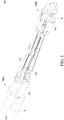
- FIG. 1 illustrates a perspective view of a rotatable mechanism 100 in accordance with some embodiments of the present disclosure.
- the rotatable mechanism 100 is a robotic arm or a portion of a robotic arm.
- the rotatable mechanism 100 includes has a first end portion 100A and a second end portion 100B opposite to the first end portion 100A.
- the rotatable mechanism 100 further includes motors 110, a gear reducer 120, a drive plate 130, a screw rod 140 and a joint 150. (Lee and Li: Since the main invention of the subject application is "the encoder at the joint side," the specification will describe the features of that encoder in detail while the other elements of the robotic arm will not be described in detail)
- the gear reducer 120 is connected to the first end portion 100A of the rotatable mechanism 100 and mounted to the motors 110 to shift the rotational speed of the motors 110. These motors 110 and the gear reducer 120 provide multiple different drivers for the rotatable mechanism 100.
- the drive plate 130 is rotatably mounted to the first end portion 100A of the rotatable mechanism 100.
- the screw rod 140 is connected to the first end portion 100A of the rotatable mechanism 100 with the second end portion 100B of the rotatable mechanism 100 to drive the joint 150 to rotate or move using the power generated by the motors 110.
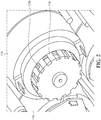
- FIG. 2 illustrates an enlarged view of a portion of the motors 110 in FIG. 1 circled by a red square in accordance with some embodiments of the present disclosure.
- an optical encoder 115 is connected to one of the motors 110.
- the optical encoder 115 includes paired light detectors and light emitters with mechanical interruptions to measure rotary or linear position.
- the optical encoder 115 has a ring 115r with a plurality of apertures (or transparent portions) 115h and disposed between the light detectors and the light emitters (not shown).
- a signal with a first voltage level is generated by, for example, the light detector. If a light emitted by a light emitter is blocked by the ring 115r, a signal with a second voltage level is generated by, for example, the light detector. In some embodiments, the first voltage level is different from the second voltage level.
- the first voltage level is a logic value "1" while the second voltage level is a logic value "0.” Since the motor 110 is rotated periodically, periodic interruptions between the light emitter and the light detector occur as the motor 110 rotates, which would generate a stream of pulses as the waveform shown at the lower part of FIG. 4A or 4B .
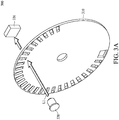
- FIG. 3A illustrates a perspective view of an optical encoder 300 in some embodiments of the present disclosure.
- the optical encoder 300 can be disposed at the second end portion 100B of the rotatable mechanism 100 in FIG. 1 .
- the optical encoder 300 can be connected to or adjacent to the joint 150 of the rotatable mechanism 100 in FIG. 1 .
- the optical encoder 300 includes a disc (also can be referred to as "encoding disc") 310, a light emitter 320 and a light detector (also can be referred to as "photo detector,” “photo sensor” or “optical sensor”) 330.
- the light emitter 320 has a light emitting region and is configured to generate light.
- the light emitter 320 may be a laser diode (LD), a light emitting diode (LED), a vertical-cavity surface-emitting laser (VCSEL)) diode, an edge emitting laser diode or other illuminating component.
- LD laser diode
- LED light emitting diode
- VCSEL vertical-cavity surface-emitting laser
- the light detector 330 has an optical sensing region facing toward the light emitting region of the light emitter 320.
- the light detector 330 is configured to receive or detect the light generated from the light emitter 320 and to generate a signal in response to the received or detected light.
- the light detector 330 is configured to generate a signal with a first voltage level if the light emitted by the light emitter 320 is detected or received by the light detector 330.
- the light detector 330 is configured to generate a signal with a second voltage level if the light emitted by the light emitter 320 is not received or detected by the light detector 330.
- the first voltage level is higher than the second voltage level.
- the first voltage level can be lower than the second voltage level depending on design requirements.
- the light detector 330 may include a PIN diode (a diode including a p-type semiconductor region, an intrinsic semiconductor region, and an n-type semiconductor region) or a photo-diode or a photo-transistor.
- the disc 310 is disposed between the light emitter 320 and the light detector 330.
- the disc 310 is formed of opaque materials.
- FIG. 3B which illustrates a top view of the disc 310 of the optical encoder 300 in some embodiments of the present disclosure, the disc 310 has a first set of apertures (or slots) 310a, 310b, 310c, 310d, 310e and 310f and a second aperture (or slot) 311.
- the first set of apertures and the second aperture can be replaced by transparent materials which allow light to pass through them.
- the first set of apertures 310a, 310b, 310c, 310d, 310e and 310f penetrate the disc 310 from a surface of the disc 310 to an opposite surface of the disc 310.
- the first set of apertures 310a, 310b, 310c, 310d, 310e and 310f are disposed adjacent to the periphery of the disc 310.
- the first set of apertures 310a, 310b, 310c, 310d, 310e and 310f are separated from each other.
- the aperture 310a is adjacent to the aperture 310b and separated from the aperture 310b.
- the widths of the first set of apertures 310a, 310b, 310c, 310d, 310e and 310f are substantially the same. In some embodiments, the distances between any of two adjacent apertures of the first set of apertures 310a, 310b, 310c, 310d, 310e and 310f are substantially the same. For example, a distance between the aperture 310a and the aperture 310b is substantially the same as a distance between the aperture 310b and the aperture 310c. As shown in FIG.
- the aperture 310a is located at one end of the first set of apertures 310a, 310b, 310c, 310d, 310e and 310f and the aperture 310e is located at the other end of the first set of apertures 310a, 310b, 310c, 310d, 310e and 310f.
- the aperture 310a is adjacent to only one aperture (i.e., the aperture 310b) of the first set of apertures 310a, 310b, 310c, 310d, 310e and 310f
- the aperture 310e is adjacent to only one aperture (i.e., the aperture 310f) of the first set of apertures 310a, 310b, 310c, 310d, 310e and 310f.
- the second aperture 311 penetrates the disc 310 from the surface of the disc 310 to the opposite surface of the disc 310.
- the second aperture 311 is located between the aperture 310a and the aperture 310e. As shown in FIG. 3B , the second aperture 311 is closer to the aperture 310a than the aperture 310e.
- a distance between the second aperture 311 and the aperture 310a is less than a distance between the second aperture 311 and the aperture 310e.
- the distance between the second aperture 311 and the aperture 310a is substantially the same as the distance between any two adjacent apertures of the first set of apertures 310a, 310b, 310c, 310d, 310e and 310f.
- a width of the second aperture 311 is greater than a width of each of the first set of apertures 310a, 310b, 310c, 310d, 310e and 310f.
- the disc 310 includes a first region 31A on which the first set of apertures 310a, 310b, 310c, 310d, 310e and 310f and the second aperture 311 are located and a second region 31B having no apertures.
- the second region 31B includes the region between the aperture 310e and the second aperture 311.
- a length (or arc length) of the second region 31B is greater than a distance between any two adjacent apertures in the first region 31A.
- a signal with a first voltage level is generated by, for example, the light detector 330. If the light L1 emitted by the light emitter 320 is blocked by the disc 310 (e.g., an opaque portion of the disc 310 between two adjacent apertures or the second portion 31B of the disc 310), a signal with a second voltage level is generated by, for example, the light detector 330. In some embodiments, the first voltage level is higher than the second voltage level.
- the first voltage level is a logic value "1" while the second voltage level is a logic value "0.”
- the first voltage level may be a logic value "0” while the second voltage level may be a logic value "1” depending on different design requirements. Since the disc 310 is rotated, periodic interruptions between the light emitter 320 and the light detector 330 occur as the disc 310 rotates, which would generate a stream of pulses as the waveform shown at the upper part of FIG. 4A or 4B .
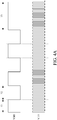
- FIG. 4A illustrates a timing diagram of waveforms in accordance with some embodiments of the represent disclosure.
- the waveform V300 shown at the upper part of FIG. 4A is generated by the light detector 330 of the optical encoder 300 in FIG. 3A while the waveform V115 shown at the lower part of FIG. 4A is generated by the light detector of the optical encoder 115 in FIG. 2 .
- the waveform V300 has the first voltage level (logic value "1") and the second voltage level (logic value "0"). If light L1 emitted by the light emitter 320 in FIG.
- a signal with the first voltage level is generated by, for example, the light detector 330. If the light L1 emitted by the light emitter 320 is blocked by the disc 310, a signal with the second voltage level is generated by, for example, the light detector 330.
- the period T1 of the first voltage level of a pulse is the period during which the aperture is between the light emitter 320 and the light detector 330.
- the period T2 of the second voltage level of a pulse is the period during which the opaque portion of the disc 310 is between the light emitter 320 and the light detector 330.
- the period T1 is identical to the period T2.
- the period T1 or T2 represent a rotation angle of the joint 150 shown in FIG. 1 . Therefore, the rotation angle of the joint 150 can be derived or obtained through the waveform V300 generated by the light detector 330 of the optical encoder 300.
- the gear reducer 120 is connected to the motors 110 to shift the rotational speed of the motors 110, the angular velocity of disc of the optical encoder 300 (connected to the joint 150) is less than the angular velocity of ring of the optical encoder 115 (connected to the motor 110). Therefore, a frequency of pulses generated by the light detector of the encoder 115 is higher than a frequency of pulses generated by the light detector 330 of the encoder 300.
- the light detector 330 of the encoder 300 generates one pulse while the light detector of the encoder 115 generates five pulses.
- a ratio of the frequency of the pulses generated by the light detector of the encoder 115 to the frequency of pulses generated by the light detector 330 of the encoder 300 is about 5:1. In some embodiments, a ratio of the frequency of the pulses generated by the light detector of the encoder 115 to the frequency of pulses generated by the light detector 330 of the encoder 300 can be adjusted depending on different design requirements.
- the ratio of the frequency of the pulses generated by the light detector of the encoder 115 to the frequency of pulses generated by the light detector 330 of the encoder 300 maintains at 5:1 when the disc 310 rotates within a range between one end of the first set of apertures 310a, 310b, 310c, 310d, 310e and 310f and the other end of the first set of apertures 310a, 310b, 310c, 310d, 310e and 310f (i.e., between the aperture 310a to the aperture 310e).
- the joint 150 operates in a working range, and the rotation of the joint 150 has not reached a limited angle yet.
- the voltage level of the signal generated by the light detector 330 of the encoder 300 would be shifted (from logic value "1" to logic value "0” or from logic value "0” to logic value "1") once the light detector of the encoder 115 generates five pulses (or other numbers of pulses depending on different embodiments).
- the signal generated by the light detector 330 of the encoder 300 would be maintained at the first voltage level (logic value "1") even if the light detector of the encoder 115 generates five or more pulses (as shown in the period T3 of FIG. 4A ). In this situation, the rotation of the joint 150 has reached the limited angle in a clockwise direction and should be terminated.
- the signal generated by the light detector 330 of the encoder 300 would maintain at the second voltage level (logic value "0") even the light detector of the encoder 115 generates five or more pulses (as shown in the period T4 of FIG. 4B ). In this situation, the rotation of the joint 150 has reached the limited angle in a counterclockwise direction and should be terminated.
- both of a rotation angle or position and the limited angle or position can be determined by using a single optical encoder 310 that includes a disc 310 having apertures with different widths (i.e., the width of each of the first set of apertures and the width of the second aperture). Therefore, the total manufacturing cost of the rotatable mechanism 100 can be reduced.
- FIG. 5 illustrates a flow chart showing a method of operating the rotatable mechanism 100 in FIG. 1 in accordance with some embodiments of the present disclosure.
- the method shown in FIG. 5 can be used to operate other rotatable mechanisms depending on different design requirements.
- the disc 310 of the optical encoder 300 connected to the joint 150 start rotating as the motor 110 rotates, and then a signal at an output of the light detector 330 of the optical encoder 300 is detected.
- the signal at the output of the light detector 330 of the optical encoder 300 is a digital signal as shown in FIGS. 4A and 4B .
- the signal at the output of the light detector 330 of the optical encoder 300 can be an analog signal and then converted into a digital signal by an analog-to-digital converter.
- the signal at the output of the light detector 330 of the optical encoder 300 is checked to determine whether the outputted signal is a pulse signal having constant period.
- the rotatable mechanism 100 is operated in a working range, and the rotation angle of the joint 150 can be obtained or derived through the waveform generated by the light detector 330 of the optical encoder 300.
- the terms “approximately,” “substantially,” “substantial” and “about” are used to describe and account for small variations. When used in conjunction with an event or circumstance, the terms can refer to instances in which the event or circumstance occurs precisely as well as instances in which the event or circumstance occurs to a close approximation.
- the terms can refer to a range of variation less than or equal to ⁇ 10% of that numerical value, such as less than or equal to ⁇ 5%, less than or equal to ⁇ 4%, less than or equal to ⁇ 3%, less than or equal to ⁇ 2%, less than or equal to ⁇ 1%, less than or equal to ⁇ 0.5%, less than or equal to ⁇ 0.1%, or less than or equal to ⁇ 0.05%.
- two numerical values can be deemed to be “substantially” or “about” the same or equal if a difference between the values is less than or equal to ⁇ 10% of an average of the values, such as less than or equal to ⁇ 5%, less than or equal to ⁇ 4%, less than or equal to ⁇ 3%, less than or equal to ⁇ 2%, less than or equal to ⁇ 1%, less than or equal to ⁇ 0.5%, less than or equal to ⁇ 0.1%, or less than or equal to ⁇ 0.05%.
- substantially parallel can refer to a range of angular variation relative to 0° that is less than or equal to ⁇ 10°, such as less than or equal to ⁇ 5°, less than or equal to ⁇ 4°, less than or equal to ⁇ 3°, less than or equal to ⁇ 2°, less than or equal to ⁇ 1°, less than or equal to ⁇ 0.5°, less than or equal to ⁇ 0.1°, or less than or equal to ⁇ 0.05°.
- substantially perpendicular can refer to a range of angular variation relative to 90° that is less than or equal to ⁇ 10°, such as less than or equal to ⁇ 5°, less than or equal to ⁇ 4°, less than or equal to ⁇ 3°, less than or equal to ⁇ 2°, less than or equal to ⁇ 1°, less than or equal to ⁇ 0.5°, less than or equal to ⁇ 0.1°, or less than or equal to ⁇ 0.05°.
- Two surfaces can be deemed to be coplanar or substantially coplanar if a displacement between the two surfaces is no greater than 5 ⁇ m, no greater than 2 ⁇ m, no greater than 1 ⁇ m, or no greater than 0.5 ⁇ m.
- conductive As used herein, the terms “conductive,” “electrically conductive” and “electrical conductivity” refer to an ability to transport an electric current. Electrically conductive materials typically indicate those materials that exhibit little or no opposition to the flow of an electric current. One measure of electrical conductivity is Siemens per meter (S/m). Typically, an electrically conductive material is one having a conductivity greater than approximately 10 4 S/m, such as at least 10 5 S/m or at least 10 6 S/m. The electrical conductivity of a material can sometimes vary with temperature. Unless otherwise specified, the electrical conductivity of a material is measured at room temperature.
- a component provided “on” or “over” another component can encompass cases where the former component is directly on (e.g., in physical contact with) the latter component, as well as cases where one or more intervening components are located between the former component and the latter component.
Landscapes
- Physics & Mathematics (AREA)
- General Physics & Mathematics (AREA)
- Optical Transform (AREA)
Applications Claiming Priority (1)
| Application Number | Priority Date | Filing Date | Title |
|---|---|---|---|
| US15/857,457 US11300403B2 (en) | 2017-12-28 | 2017-12-28 | Optical encoder and method of operating the same |
Publications (1)
| Publication Number | Publication Date |
|---|---|
| EP3505873A1 true EP3505873A1 (en) | 2019-07-03 |
Family
ID=64745978
Family Applications (1)
| Application Number | Title | Priority Date | Filing Date |
|---|---|---|---|
| EP18213710.9A Withdrawn EP3505873A1 (en) | 2017-12-28 | 2018-12-18 | Optical encoder and method of operating the same |
Country Status (5)
| Country | Link |
|---|---|
| US (1) | US11300403B2 (https=) |
| EP (1) | EP3505873A1 (https=) |
| JP (1) | JP7302841B2 (https=) |
| CN (1) | CN109974754A (https=) |
| TW (1) | TW201930831A (https=) |
Cited By (1)
| Publication number | Priority date | Publication date | Assignee | Title |
|---|---|---|---|---|
| CN111077333A (zh) * | 2019-12-28 | 2020-04-28 | 中国特种设备检测研究院 | 一种滑行车类游乐设施运行速度测试系统及方法 |
Families Citing this family (2)
| Publication number | Priority date | Publication date | Assignee | Title |
|---|---|---|---|---|
| US10889664B2 (en) | 2019-06-12 | 2021-01-12 | Chevron Phillips Chemical Company Lp | Surfactant as titanation ligand |
| JP7120200B2 (ja) * | 2019-10-15 | 2022-08-17 | 株式会社デンソー | 回転角検出装置 |
Citations (3)
| Publication number | Priority date | Publication date | Assignee | Title |
|---|---|---|---|---|
| US4736187A (en) * | 1986-12-04 | 1988-04-05 | The Regents Of The University Of California | Encoder for measuring both incremental and absolute positions of moving elements |
| US6330522B1 (en) * | 1998-09-17 | 2001-12-11 | Kabushiki Kaisha Tokai Rika Denki Seisakusho | Rotational angle detector and method |
| US20110210238A1 (en) * | 2010-02-26 | 2011-09-01 | Samsung Techwin Co., Ltd. | Encoder |
Family Cites Families (5)
| Publication number | Priority date | Publication date | Assignee | Title |
|---|---|---|---|---|
| JPH03258953A (ja) * | 1990-03-06 | 1991-11-19 | Hitachi Ltd | 回転角度検出装置とエンジン制御装置 |
| JP2001264866A (ja) * | 1999-10-07 | 2001-09-26 | Olympus Optical Co Ltd | カメラ |
| JP2001264615A (ja) | 2000-03-21 | 2001-09-26 | Jigu:Kk | ズーム及びフォーカス制御用エンコーダを備えたカメラ |
| US7400269B2 (en) | 2006-11-09 | 2008-07-15 | Avago Technologies Ecbu Ip Pte Ltd | Coding element with integrated limit switch |
| JP2009204505A (ja) | 2008-02-28 | 2009-09-10 | Fujitsu Ten Ltd | レーダ装置 |
-
2017
- 2017-12-28 US US15/857,457 patent/US11300403B2/en active Active
-
2018
- 2018-04-13 TW TW107112700A patent/TW201930831A/zh unknown
- 2018-12-03 JP JP2018226461A patent/JP7302841B2/ja active Active
- 2018-12-18 EP EP18213710.9A patent/EP3505873A1/en not_active Withdrawn
- 2018-12-21 CN CN201811571190.7A patent/CN109974754A/zh active Pending
Patent Citations (3)
| Publication number | Priority date | Publication date | Assignee | Title |
|---|---|---|---|---|
| US4736187A (en) * | 1986-12-04 | 1988-04-05 | The Regents Of The University Of California | Encoder for measuring both incremental and absolute positions of moving elements |
| US6330522B1 (en) * | 1998-09-17 | 2001-12-11 | Kabushiki Kaisha Tokai Rika Denki Seisakusho | Rotational angle detector and method |
| US20110210238A1 (en) * | 2010-02-26 | 2011-09-01 | Samsung Techwin Co., Ltd. | Encoder |
Cited By (1)
| Publication number | Priority date | Publication date | Assignee | Title |
|---|---|---|---|---|
| CN111077333A (zh) * | 2019-12-28 | 2020-04-28 | 中国特种设备检测研究院 | 一种滑行车类游乐设施运行速度测试系统及方法 |
Also Published As
| Publication number | Publication date |
|---|---|
| CN109974754A (zh) | 2019-07-05 |
| TW201930831A (zh) | 2019-08-01 |
| JP2019120679A (ja) | 2019-07-22 |
| US20190204075A1 (en) | 2019-07-04 |
| JP7302841B2 (ja) | 2023-07-04 |
| US11300403B2 (en) | 2022-04-12 |
Similar Documents
| Publication | Publication Date | Title |
|---|---|---|
| EP3505873A1 (en) | Optical encoder and method of operating the same | |
| US20150292918A1 (en) | Encoder, encoder-equipped motor, and servo system | |
| CN102192711B (zh) | 编码器 | |
| CN104613999B (zh) | 编码器、具有编码器的电机、和伺服系统 | |
| CN1229627C (zh) | 编码器 | |
| EP3527952A1 (en) | Optical encoder and method of operating the same | |
| US10215596B2 (en) | Position detection apparatus, lens apparatus, image pickup system, machine tool apparatus, exposure apparatus, position detection method, and non-transitory computer-readable storage medium which are capable of detecting reference position with high accuracy | |
| US10921163B2 (en) | Optical encoder with incremental and absolute code sensors and defining distance between geometric centers of adjacent photosensors of an incremental code sensor | |
| US11946780B2 (en) | Optical encoder and control apparatus | |
| US12222228B2 (en) | Optical encoder | |
| JP6372522B2 (ja) | 光センサ、及び駆動動作検出装置 | |
| WO2024120372A1 (en) | Position detection device for a rotating mechanism of a lidar and self-diagnostic method therefor, and lidar | |
| CN220708412U (zh) | 一种狭缝部、光电编码器、伺服电机和伺服系统 | |
| JP2016136131A (ja) | 位置検出装置、レンズ装置、撮像システム、工作装置、露光装置、位置検出方法、プログラム、記憶媒体 | |
| CN118089801A (zh) | 一种狭缝部、光电编码器、伺服电机和伺服系统 | |
| KR20170103715A (ko) | 편광거울을 이용한 광학식 각도센서 | |
| US20050052729A1 (en) | Optical encoder | |
| EP2778625A1 (en) | Method and system to determine positional movement | |
| JP2004029019A (ja) | 光学位置感知装置 | |
| KR20210040482A (ko) | 스마트팜용 비례제어를 위한 모터 절대위치 센서 및 그를 이용한 센싱방법 | |
| JPH03150415A (ja) | 光学式エンコーダ | |
| WO2017050664A1 (en) | Optical position control | |
| KR20210010775A (ko) | 절대 위치 표시가 가능한 광학식 엔코더 | |
| KR20200123037A (ko) | 라이다 센서 안정화 장치 | |
| JP2011043674A (ja) | ガルバノスキャナ |
Legal Events
| Date | Code | Title | Description |
|---|---|---|---|
| PUAI | Public reference made under article 153(3) epc to a published international application that has entered the european phase |
Free format text: ORIGINAL CODE: 0009012 |
|
| STAA | Information on the status of an ep patent application or granted ep patent |
Free format text: STATUS: THE APPLICATION HAS BEEN PUBLISHED |
|
| AK | Designated contracting states |
Kind code of ref document: A1 Designated state(s): AL AT BE BG CH CY CZ DE DK EE ES FI FR GB GR HR HU IE IS IT LI LT LU LV MC MK MT NL NO PL PT RO RS SE SI SK SM TR |
|
| AX | Request for extension of the european patent |
Extension state: BA ME |
|
| RAP1 | Party data changed (applicant data changed or rights of an application transferred) |
Owner name: AEOLUS ROBOTICS CORPORATION LIMITED |
|
| STAA | Information on the status of an ep patent application or granted ep patent |
Free format text: STATUS: REQUEST FOR EXAMINATION WAS MADE |
|
| 17P | Request for examination filed |
Effective date: 20200103 |
|
| RBV | Designated contracting states (corrected) |
Designated state(s): AL AT BE BG CH CY CZ DE DK EE ES FI FR GB GR HR HU IE IS IT LI LT LU LV MC MK MT NL NO PL PT RO RS SE SI SK SM TR |
|
| STAA | Information on the status of an ep patent application or granted ep patent |
Free format text: STATUS: THE APPLICATION HAS BEEN WITHDRAWN |
|
| 18W | Application withdrawn |
Effective date: 20200429 |