EP3497708B1 - Druckvorrichtung, druckermarkierungssystem und verfahren mit mehrstufiger produktionsdruckinspektion - Google Patents
Druckvorrichtung, druckermarkierungssystem und verfahren mit mehrstufiger produktionsdruckinspektion Download PDFInfo
- Publication number
- EP3497708B1 EP3497708B1 EP17840342.4A EP17840342A EP3497708B1 EP 3497708 B1 EP3497708 B1 EP 3497708B1 EP 17840342 A EP17840342 A EP 17840342A EP 3497708 B1 EP3497708 B1 EP 3497708B1
- Authority
- EP
- European Patent Office
- Prior art keywords
- printer
- ocr
- product
- image
- inspection
- Prior art date
- Legal status (The legal status is an assumption and is not a legal conclusion. Google has not performed a legal analysis and makes no representation as to the accuracy of the status listed.)
- Active
Links
Images





Classifications
-
- G—PHYSICS
- G06—COMPUTING OR CALCULATING; COUNTING
- G06V—IMAGE OR VIDEO RECOGNITION OR UNDERSTANDING
- G06V30/00—Character recognition; Recognising digital ink; Document-oriented image-based pattern recognition
- G06V30/10—Character recognition
- G06V30/12—Detection or correction of errors, e.g. by rescanning the pattern
- G06V30/133—Evaluation of quality of the acquired characters
-
- B—PERFORMING OPERATIONS; TRANSPORTING
- B41—PRINTING; LINING MACHINES; TYPEWRITERS; STAMPS
- B41J—TYPEWRITERS; SELECTIVE PRINTING MECHANISMS, i.e. MECHANISMS PRINTING OTHERWISE THAN FROM A FORME; CORRECTION OF TYPOGRAPHICAL ERRORS
- B41J29/00—Details of, or accessories for, typewriters or selective printing mechanisms not otherwise provided for
- B41J29/38—Drives, motors, controls or automatic cut-off devices for the entire printing mechanism
- B41J29/393—Devices for controlling or analysing the entire machine ; Controlling or analysing mechanical parameters involving printing of test patterns
-
- G—PHYSICS
- G06—COMPUTING OR CALCULATING; COUNTING
- G06F—ELECTRIC DIGITAL DATA PROCESSING
- G06F18/00—Pattern recognition
- G06F18/20—Analysing
- G06F18/21—Design or setup of recognition systems or techniques; Extraction of features in feature space; Blind source separation
- G06F18/217—Validation; Performance evaluation; Active pattern learning techniques
-
- G—PHYSICS
- G06—COMPUTING OR CALCULATING; COUNTING
- G06T—IMAGE DATA PROCESSING OR GENERATION, IN GENERAL
- G06T7/00—Image analysis
- G06T7/0002—Inspection of images, e.g. flaw detection
- G06T7/0004—Industrial image inspection
-
- G—PHYSICS
- G06—COMPUTING OR CALCULATING; COUNTING
- G06V—IMAGE OR VIDEO RECOGNITION OR UNDERSTANDING
- G06V30/00—Character recognition; Recognising digital ink; Document-oriented image-based pattern recognition
- G06V30/10—Character recognition
- G06V30/19—Recognition using electronic means
- G06V30/191—Design or setup of recognition systems or techniques; Extraction of features in feature space; Clustering techniques; Blind source separation
- G06V30/1916—Validation; Performance evaluation
-
- H—ELECTRICITY
- H01—ELECTRIC ELEMENTS
- H01H—ELECTRIC SWITCHES; RELAYS; SELECTORS; EMERGENCY PROTECTIVE DEVICES
- H01H9/00—Details of switching devices, not covered by groups H01H1/00 - H01H7/00
- H01H9/30—Means for extinguishing or preventing arc between current-carrying parts
-
- G—PHYSICS
- G06—COMPUTING OR CALCULATING; COUNTING
- G06T—IMAGE DATA PROCESSING OR GENERATION, IN GENERAL
- G06T2207/00—Indexing scheme for image analysis or image enhancement
- G06T2207/30—Subject of image; Context of image processing
- G06T2207/30108—Industrial image inspection
- G06T2207/30144—Printing quality
-
- G—PHYSICS
- G06—COMPUTING OR CALCULATING; COUNTING
- G06V—IMAGE OR VIDEO RECOGNITION OR UNDERSTANDING
- G06V20/00—Scenes; Scene-specific elements
- G06V20/95—Pattern authentication; Markers therefor; Forgery detection
-
- G—PHYSICS
- G06—COMPUTING OR CALCULATING; COUNTING
- G06V—IMAGE OR VIDEO RECOGNITION OR UNDERSTANDING
- G06V2201/00—Indexing scheme relating to image or video recognition or understanding
- G06V2201/04—Recognition of patterns in DNA microarrays
-
- G—PHYSICS
- G06—COMPUTING OR CALCULATING; COUNTING
- G06V—IMAGE OR VIDEO RECOGNITION OR UNDERSTANDING
- G06V2201/00—Indexing scheme relating to image or video recognition or understanding
- G06V2201/10—Recognition assisted with metadata
-
- G—PHYSICS
- G06—COMPUTING OR CALCULATING; COUNTING
- G06V—IMAGE OR VIDEO RECOGNITION OR UNDERSTANDING
- G06V30/00—Character recognition; Recognising digital ink; Document-oriented image-based pattern recognition
- G06V30/10—Character recognition
Definitions
- the embodiments relate to a printer device, printer marking system and method with multi-stage production print inspection.
- Optical character recognition for continuous inkjet (CIJ) in industrial application is difficult.
- the camera system embedded with vision systems have 50% reliability in the inspection performance for industrial applications.
- Many customers are skeptical about the accuracy of vision systems because these systems fail, usually due to high rates of false positives.
- a false positive is when the vision system rates a good product as a bad product. Rating products as bad has consequences. The first consequence is wasting time to visually inspect the product manually which can be costly if a high number of products must be visually inspected.
- a second consequence is turning the vision system off so the production can run.
- Smart cameras with vision systems are very costly in comparison to cameras without a vision system. For example, a smart camera could cost $3500 while a camera without a vision system may cost $500. In industrial applications, the cost increases with multiple production lines with multiple different printer technology.
- WO 2013/115788 discloses a system comprising a memory to store machine readable instructions and a processing unit to access the memory and execute the machine readable instructions.
- the machine readable instructions can comprise a feature set extractor to extract a feature set from each of a plurality of digital images of print samples.
- the feature set can be a filtered feature set that includes a feature set characterizing a printer that printed a given print sample of the print samples.
- the machine readable instructions can also comprise a cluster component to determine clusters of the print samples based on the feature set of each of the plurality of scanned images of the print samples.
- the machine readable instructions can further comprise a printer identifier to identify the printer of the print samples based on the clusters of the print samples.
- GB 2528261 discloses a method and system for marking items on a production line, with a series of unique identifiers (e.g. promotional codes).
- the system then obtains marking feedback data, indicating whether the marking was completed or not.
- the system inspects the unique identifying mark to obtain inspection data, regarding the visual appearance of the mark.
- the marking feedback data and inspection data may be stored, logged or processed to aid tracing and marking error diagnosis.
- the system may also generate expected data regarding the unique mark, and by comparing this with the inspection data, may obtain an inspection result.
- the system may also determine the verification status of the mark, based upon marking feedback data and/or inspection data. The verification status may indicate whether or not the unique identifier mark has been acceptably marked.
- the article may be kept or discarded, based upon the verification status.
- Embodiments herein relate to a printer device, printer marking system and method with multi-stage production print inspection. Embodiments may also include non-transitory, tangible computer-readable storage medium.
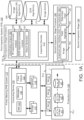
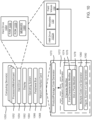
- FIG. 1A illustrates a print marking (PM) system 110 with multi-stage production print inspection.
- the PM system 110 comprises at least one printer 115 and at least one camera 118 interfaced with at least one computing device 150.
- Each computing device 150 may have at least one human machine interface (HMI) 122 and metadata 130 stored in a memory ( FIG. 10 ).
- the at least one computing device 150 may each store field values 132.
- the at least one computing device 150 will be described in more detail in relation to FIG. 10 .
- the at least one printer 115 may include one or more of continuous inkjet (CIJ) printer, laser printer, thermal transfer overprinting (TTO) printer, thermal inkjet (TIJ) printer and LCM printer.
- CIJ continuous inkjet
- TTO thermal transfer overprinting
- TIJ thermal inkjet
- the PM system 110 is interfaced with a print inspection system (PIS) 160.
- the print inspection system 160 may include a first inspection stage processor 161 and a second inspection stage processor 180.
- the at least one HMI 122 may display information received from the first inspection stage processor 161 and a second inspection stage processor 180. In some embodiments, there may be a single HMI 122 per computing device 150.
- the at least one camera 118 may be associated with the PM system 110 or may be part of the PIS 160 system. The at least one camera 118 being part of the PIS 160 would be an embedded component in the PM system 110. In some embodiments, the at least one camera 118 may be shared with one or more systems.
- the printer 115 is paired with an optical character recognition (OCR) algorithm executed by at least one processor to form an optical code detector.
- OCR optical character recognition
- the optical code detector executed by one or more processors, detects the code in a received image of the product printed by the printer 115 by optically recognizing characters in the received image using a trained optical character recognition (OCR) algorithm for the printer technology type.
- OCR optical character recognition
- the OCR algorithm is trained to identify each digit of the plurality of digits of the code in a selected region of interest (ROI) based on printer parameters such as without limitation, a substrate type corresponding to a material of the substrate and a curvature of the substrate to which the printed content is directly applied and the printer technology type.
- the PM system 110 is shown with a production line 140.
- the production line 140 may serially move a plurality of widgets W1, W2 and W3 shown.
- the dashed arrow represents the direction of flow of the production line 140.
- the widgets are printed with content (i.e., printed content) or code.
- the production line 140 may include parallel paths PL1 and PL2.
- the path PL1 may move the widgets W1, W2 and W3 to a printer in path PL1 for printing in a designated region of interest (ROI).
- the path PL2 may move packages (PK), by way of non-limiting example, configured for widgets W1, W2 and W3 to a printer in path PL2 for printing in a designated region of interest (ROI).
- Each path PL1 and PL2 may include at least one camera and at least one printer.
- the metadata and field vale for each path PL1 and PL2 may be synchronized and/or correlated to the metadata and field values of the other parallel path.
- widgets may not include separate packaging.
- some widgets may have additional regions of interest (ROI) which are to be printed, each ROI may have use a different printer technology to print the characters and/or symbols of the printed content and may use a different path in the production line 140.
- ROI regions of interest
- the production line 140 may include at least one printer 115 to print printed content in at least one region of interest on a widget or package.
- the at least one HMI 122 includes a display 1062 ( FIG. 10 ) and HMI driver 1022A ( FIG. 10 ) configured to display printer information from and to the printer 115 and camera information from and to camera 118.
- the display 1062 may be a touchscreen.
- the printer 115 may be controlled by printer metadata and print drivers.
- the print drivers may be specific to the printer manufacture or may have customized features and settings.
- the metadata 130 may include printer settings for the printed text to be printed by the printer 115.
- the production line 140 is controlled by production line metadata.
- the camera 118 is operated based on control data (such as camera setting and triggers) and/or metadata.
- the camera 118 is configured to capture an image of a widget W1, W2 or W3 having a printer marking applied or printed by printer 115.
- the widget W1, W2 and W3 are to be packaged in package (PK) 01, 02 and 03, respectively.
- the codes printed on packages PK 01, 02 and 03 may be synchronized with the codes or field values of widgets W1, W2 and W3, for example.
- the widget comprises a manufactured product.
- the manufactured product includes a widget substrate to or upon which a printed code is printed via a printer 115.
- the widget substrate may be a container filled with a product material. In such instance, the printing is on the widget substrate and not the product material, especially, if the product material is dispensed from the container, such as for consumption or application.
- the camera 118 captures images at a rate R wherein the rate R may be a system setting to initiate the triggering of the image capture process by the camera 118.
- the camera 118 may capture images every one minute, two minutes or other intervals.
- the rate R may vary. By way of non-limiting example, the rate may be slower at the beginning of a production cycle and faster at an end of the production cycle.
- the rate R may be a constant rate.
- the rate of image capture may be a function of the rate at which the production line moves.
- the captured image is a source of information to the computing device 150.
- the computing device 150 communicates the captured image with metadata and field values to the first inspection stage processor 161 to start the inspection process.
- the computing device 150 provides field values 132 to the printer 115 to perform the printing and to the first inspection stage processor 161 for use in the inspection process.
- the computing device 150 identifies field values 132 for a batch of widgets or a single widget being processed by the production line 140.
- Field values 132 may be the character content of printed text or code.
- the field values 132 or product/package codes may be provided by a customer.
- the field values 132 may include a product or package code automatically generated by the product or package code generator 1070 ( FIG. 10 ).
- the product or package code may be a standard code using standard character, numerical or symbols in any language.
- the standard character, numerical or symbol in any language may be printed in a manner consistent with industry and/or industrial standards or practices for any one particular printer technology for the application of printed content on a substrate.
- the production line may generate an authentication code based on the standard product/package code(s), as will be discussed in more detail in relation to FIGS. 10 and 15A-15B .
- a batch of widgets may include two or more widgets.
- FIG. 3 illustrates a block diagram of field values 132.
- the field values 132 may include one or more values which denote a current date 333, current time 335, an expiration date 337, or a best by date.
- the field values may vary and are not limited to those specifically referenced by example.
- the field values 132 may include field value content 339 such as symbols, logo, or text (i.e., alphanumeric characters).
- the values of the field values 132 may include alphanumeric character streams or symbols which are capable of being printed or made by a printer.
- the field value 132 may include information representative of a logo.
- the alphanumeric character stream, symbols, text or logo may hereinafter be referred to as "printed content.”
- the field values 132 provide the basis of comparison to determine whether the printer 115 is printing accurate information (i.e., the printed content).
- image recognition (IR) algorithms in database 168 may be used to reduce an area within the captured image to an area of the printed content, the printed content is compared against the field value 132 to determine correctness or accuracy.
- the human may use the field values 132 provided by way of a graphic user interface (GUI) to determine correctness or accuracy.
- GUI graphic user interface
- This stage of inspection may be used to train the OCR algorithms as the man-in-the-loop may find false positives and/or false failures.
- the OCR algorithms may be updated to address the results of the second stage inspection process.
- the inspection system 160 may include an optical character algorithm(s) database 170 coupled to the first inspection stage processor 161.
- the inspection system 160 may include an image archive database 175 also coupled to the first inspection stage processor 161.
- FIG. 2 illustrates a block diagram of metadata 130.
- Metadata 130 may include parameters which include the print technology or type 233 used to print on the widgets in the production line 140.
- the metadata 130 may include one or more of font data 235, raster data 239, vertical data 237 and other data. Font data 235 and raster data 239 may be used to decipher the image into characters, by an optical character recognition inspection process module 166, as will be described later.
- the metadata may vary and are not limited to the parameters or data specifically referenced by example.
- Metadata 130 may include product packaging specification parameters 241 and data that can classify the product profile to select an image recognition (IR) algorithm in database 168 from a plurality of image recognition algorithms.
- Printer technology may include the type of printer such as continuous inkjet (CIJ), laser, thermal transfer overprinting (TTO), thermal inkjet (TIJ) and LCM used in the specific marking process.
- the product packaging specification parameters may include details of the widget such as without limitation, color, material and surface curvature. Surface curvature may include an indicator which identifies whether the surface is convex or concave surface.
- Material types may include plastic material, reflective material, non-reflective material, glossy material, transparent material, etc.
- the inventor has determined that recognition of images on at least a bottle closure and a curved surface have a higher rate of false positives on such bottle closures or curved surfaces.
- the classification engine 163 may perform an image recognition on a received image to determine first whether the product type is the correct product type.
- Printed characters on a curved surface may have a perspective view as compared to printed characters printed on a non-curved surface.
- FIG. 4 illustrates a block diagram of a database 168 of a plurality of image recognition (IR) algorithms.
- the database 168 may include one or more of an IR bottle closure algorithm 402, an IR curved surface algorithm 404, an IR non-curved surface algorithm 406, an IR color recognition algorithm 408, an IR surface material type recognition algorithm 410 and an IR geometrical shape recognition algorithm 412.
- the database 168 may include a plurality of IR algorithms which can differentiate a geometrical shape of product(s).
- the classification engine 163 of the first inspection stage processor 161 performs two inspection procedures.
- the first inspection procedure may use a selected image recognition algorithm to validate the product (i.e., widget) correlated to the metadata in an IR inspection process module 165.
- the IR inspection process module 165 may use one or more algorithms to verify or validate multiple product profile parameters. For example, a customer may want different product profiles to be processed differently than other product profiles.
- the IR inspection process module 165 may provide an inspection process to validate that the product (i.e., widget) being inspected is a match to the correct product with the correct product parameters.
- the IR inspection process module 165 may also allow validation of a color of the product. Nonetheless, the metadata may include product parameters which may include one or more of size, shape, color, type, design, substrate type, substrate material, reflectivity of substrate, concavity of substrate, convexity of substrate, transparency of substrate, etc. being unique to the product's physical classifiable profile.
- the IR inspection process module 165 may be improved or optimized such that the processing time of the image is reduced by tailoring the IR algorithm based on the metadata.
- the printed content may be designated for a "red" colored widget with a curved surface having a concave surface.
- the first inspection procedure may determine whether the image received classifies the product according to the product's physical classifiable profile.
- the IR inspection process module 165 may specifically look for a curved surface profile or some other geometrical shape.
- the metadata is provided to the first inspection stage processor 161 so that an image recognition algorithm is selected specifically for a geometrical profile by the IR inspection process module 165.
- the image recognition algorithm may be configured to recognize a bottle closure.
- the image recognition algorithm may be configured to recognize a non-curved surface.
- a response may be sent to the computing device 150.
- the production line 140 may be halted or an alert generated to the appropriate production monitor or quality control monitor.
- the alert may include an email alert, text message alert, light indicator or speaker output.
- the production monitor may determine that the wrong product is on the production line 140.
- a certain color product may require a white ink while another color product may require a black ink.
- the product may include multiple areas with different colors. Certain colors may be used to designate a printed content area.
- the printed content area may be detected by the IR inspection process module 165.
- the printed content may be applied to an area with barcodes where the area has a geometrical shape such as a square or rectangle and may be white in color.
- OCR inspection process module 166 may use information from module 165 and the metadata to perform OCR in the designated white area to start the inspection process 166, for example.
- multiple areas in the image may have printed content wherein each area is inspected by an OCR algorithm.
- the entire image may be subjected to an OCR algorithm.
- the first inspection stage processor 161 may perform optical character recognition (OCR) inspection process module 166 to produce an OCR content result to the result generator 167.
- OCR inspection process module 165 may detect printed content in the printed content area if provided by the IR inspection process module 165.
- the OCR inspection process module 166 may use metadata to determine the area within the image to start the OCR inspection process module 166.
- the OCR content result for each optically recognized character and/or logo is sent to the result generator 167 and assembled so that the resultant character stream generated by the OCR inspection process module 166 may be decoded to validate the printed content of the resultant character stream. If the printed content is decoded and validated, the first inspection stage processor 161 provides a response to the computing device 150 to indicate that the inspection passed or validated.
- the first inspection stage processor 161 may include an inspection decoder 172 to decode the OCR content result to validate the printed content.
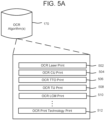
- FIG. 5A illustrates a block diagram of a database 170 of a plurality of optical character recognition (OCR) algorithms.
- the plurality of optical character recognition (OCR) algorithms may include an OCR laser print algorithm 502, OCR CIJ print algorithm 504, OCR TTO print algorithm 506, OCR TIJ print algorithm 508, OCR LCM inkjet print algorithm 510, or other OCR print technology print algorithm 512.
- An LCM inkjet prints large characters.
- the optical character recognition (OCR) inspection process module 166 may be improved or optimized such that the processing time of the OCR is reduced by tailoring the OCR algorithm to the print technology.
- FIG. 5B illustrates a block diagram of a OCR machine learning module 550.
- Each OCR algorithm may include an OCR machine learning module 550 configured to be trained to improve print inspection performance and, if appropriate, authentication codes for a counterfeit detection system.
- the OCR machine learning module 550 may be configured and trained for a printer technology type 552.
- the OCR machine learning module 550 may be trained based on one or more product parameters.
- the product parameters may include material, shape, concavity of the product or substrate, reflectivity of the material or product, the transparency of the material or product, and the color of the product or material.
- the training may be based on the color of material or type of material (i.e., solid, powder, liquid) stored within a transparent container where the transparent container provides the substrate on which a printed code is applied.
- the container and material within the container may be sometimes referred to as a product.
- the OCR machine learning module 550 may be trained based on a product substrate material 554.
- the OCR machine learning module 550 may be trained based on product substrate shape 556.
- the OCR machine learning module 550 may be trained based on product color 558.
- the OCR machine learning module 550 may be trained based on degree of reflectivity 560.
- the OCR machine learning module 550 may be trained based on degree of transparency 562.
- the OCR machine learning module 550 may be trained based on concavity of substrate 564.
- the OCR machine learning module 550 may be trained based on convexity of substrate 566.
- the results from the second inspection stage can update the OCR machine learning module 550 with the results of the second inspection stage, as appropriate, to improve performance.
- the OCR machine learning module 550 may be trained based on at least one digit of a code regardless of whether the at least one digit passed or failed optical recognition detection.
- characters, numbers and/or symbols printed on a reflective substrate may not, in some instances, be properly recognized.
- characters and symbols printed on a transparent substrate may be difficult to recognize based on the product filled in the transparent container. This can be more problematic if the printed characters or symbols include a first character portion which resides in filled portion of the container while a second character portion resides in an un-filled portion of the transparent container. Furthermore, the color of the product filled in a transparent container may diminish the recognition of the characters.
- the second inspection stage can update the OCR machine learning module 550 to train the OCR machine learning module 550 such as, by way of non-limiting example, through supervised learning.
- the OCR machine learning module 550 may be trained in some instances based on unsupervised learning.
- the machine learning module may employ neural networks, artificial neural networks, Bayesian networks, learning classifier systems, decision tree learning, etc.
- FIG. 6 illustrates a block diagram of an inspection decoder 172.
- the inspection decoder 172 may include an IR results to metadata comparator unit 601 to compare the IR result, from the IR inspection process module 165, with one or more parameters of the metadata 130.
- the inspection decoder 172 may include an OCR results to field values comparator unit 603 and a number of characters determination unit 604. The printed content is validated when the OCR content result is the same based on the field value.
- the inspection decoder 172 may determine the number of characters or digits in the OCR content which could be validated by the number of characters determination unit 604.
- the first inspection stage processor 161 may determine an error in the OCR inspection process module 166 such that the process was aborted or whether no characters could be recognized.
- the processor 161 or inspection decoder 172 may determine that decoding failed by at least one of units 601 or 603. If decoding failed, a communication is generated for receipt by the second inspection stage processor 180.
- the second inspection processor 180 includes a graphical user interface (GUI) task generator 182 which produces a GUI for the second inspection stage 190.
- GUI graphical user interface
- the GUI task generator 182 obtains the image 183 for population of the GUI wherein the image was used in the IR inspection process module 165.
- the GUI task generator 182 may generate a data input field 185 to allow a man-in-the-loop in the second inspection stage 190 to enter the visually inspected characters of the text in the image 183 for comparison with the field value 132.
- the image 183 may be overlaid with at least one highlighted box entered by the field highlighter 184 which surrounds an inspection region with the printed content.
- the GUI may include multiple highlighted boxes.
- the second inspection stage 190 may include a man-in-the-loop process where humans perform visual inspection.
- the GUI may include a task request having an application programming interface (API) for Mechanical Turk by Amazon ® .
- the man-in-the-loop may include an in-house inspection team or other quality assurance (QA) service provider.
- the results may train the OCR algorithms.
- the GUI from generator 182 may prompt the user to identify whether the content in the highlighted box matches the expected image/characters. Once the answers are submitted by the GUI interface, the second inspection processor 180 communicates a result to the computing device 150.
- the result may be a pass or fail result.
- the results from the first inspection stage processor 161 or the second inspection stage processor 180 may cause the marking system 110 to take action on the production line 140, such as stopping the production line or sending an alert or notification.
- a notification may include an email, text message, instant messaging alerts, etc.
- FIG. 7 illustrates a block diagram of a database 175 of archived images stored in an image archive record 772.
- the computing device 150 or the first inspection stage processor 161 may store the received image in database 175.
- An image archive record may be developed.
- the image archive record 772 may include storing an image 775 with current date and time log information 777.
- the image may be stored with inspection results 773 such as without limitation pass or fail.
- the image 775 may be stored with metadata 130.
- the repository of images that could not be decoded by may trigger a change in the production line 140 or require further evaluation.
- the archived image may be used by a customer's quality control (QC) department to be able to pull an historical image from the actual production line on a certain date/time.
- QC quality control
- the system may be used for an anti-counterfeit technique.
- the camera 118 would take at least one image of every printed or marked widget.
- the print content may act like a fingerprint for the product.
- the first inspection stage processor 161 may only process every X image for inspection of the print content for quality control purposes. In other words, the printed content of every widget may not be inspected.
- FIG. 8A-8B illustrate a flowchart of a method 800 for print marking with a multi-stage inspection.
- the method may perform the blocks in the order shown or in a different order. Additional blocks may be added or some blocks deleted. One or more of the blocks may be performed contemporaneously.
- the method 800 begins with block 802 and will be described in relation to FIG. 1A . As the widgets W1, W2 and W3 serially move through the printer 115, the widget W1, W2 and W3 is printed with printer text in the form of a code based on the metadata and field values for the production batch, at block 802.
- the camera 118 captures an image of the production line 140 at a predetermined rate R.
- the rate may allow the camera 118 to capture one widget at a time or may skip widget.
- the operation of the production line 140 movement, printing by printer 115 and image capturing by camera 118 may be synchronized or timed appropriately.
- an inspection communication is assembled by the computing device 150.
- the inspection communication may include the captured image.
- the inspection communication may include the field values 132 used in the print process and the metadata 130.
- the inspection communication is sent to the first inspection stage processor 161 where it is received at block 808.
- the first inspection stage processor 161 will process the received communication to perform an image recognition inspection process module 165 to determine a product classifiable profile.
- Metadata 130 may include product packaging specification parameters and values that can classify the image recognition algorithm in database 168 that will be used in process module 165.
- the first inspection stage processor 161 would look-up the image recognition algorithm in database 168 for optimizing the IR inspection process module 165.
- the image is then processed to recognize the physical profile of the widget.
- the classification engine 163 may perform an IR inspection process module 165 on a received image to determine first whether the physical profile is detected based on the product packaging specification parameters.
- an error message may be sent to the computer device 150 at block 814.
- the first inspection procedure may use an IR algorithm to validate the product (i.e., widget) correlated to the metadata.
- the production line 140 may be halted 140 or an alert generated to the appropriate production monitor or quality control monitor.
- the alert may include an email alert, text message alert, light indicator or speaker output.
- the classification engine 163 may perform an optical character recognition (OCR) algorithm from database 170.
- OCR optical character recognition
- the classification engine 163 will look-up the best OCR algorithm for the printer technology in the metadata.
- the classification engine 163 may look-up the best OCR algorithm based on the product packaging specification parameters as well.
- Block 816 will produce the OCR content result of the OCR algorithm.
- the OCR content result may be decoded to validate the printed content.
- the inspection decoder 172 may have to also determine the number of characters in the OCR text which could be validated. A message of validation/inspection failed is sent to the computing device 150. The inspection decoder 172 may determine an error in the OCR process such that the process was aborted or whether no characters could be recognized. The inspection decoder 172 may produce a result which indicates decoding failed.
- a communication is generated for receipt by the second inspection stage processor 180. For example, there decoding may have decoded most characters. Thus, the second inspection stage processor 180 may be initiated only after a certain number of characters have failed decoding.
- the decoding thresholds may be set by the customer and/or for maintenance of the printer.
- the inspection data is sent to the second inspection processor 180.
- an inspection task request is generated which populates a graphic user interface (GUI) with image inspection parameters.
- GUI graphic user interface
- the printed content field is highlighted in the GUI.
- the assembled GUI is communicated such as without limitation to a man-in-the-loop.
- the inspection GUI is displayed. The man-in-the-loop will display the GUI and enter the information based on the instructions.
- the image may be overlaid with at least one highlighted box which surrounds the inspection region.
- the GUI may prompt the user to identify whether the text/content in the highlighted box matches the expected image/characters.
- a field may be provided in the GUI to enter the observed text.
- the second inspection processor 180 communicates a result to the computing device 150.
- the result may be a pass or fail result.
- the results from first inspection stage processor 161 or the second inspection stage processor 180 may cause the marking system 110 to take action on the production line, such as stopping the production line or sending an alert such as, by way of non-limiting example, for maintenance of the printer.
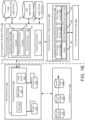
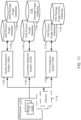
- FIG. 1B illustrates a block diagram of print marking (PM) system with multi-stage production print inspection with a quality check.
- the system in FIG. 1A is similar to FIG. 1B thus only the differences will be described for the sake of brevity.
- the multi-stage production print inspection incorporates a quality check.
- the printer content may be decoded but the quality of the print may be poor.
- the ink may need to be replaced when the quality of the print deteriorates to a certain level.
- the processor 161 or inspection decoder 172 may determine that decoding failed by at least one of units 601 or 603. If decoding failed, a communication is generated for receipt by the second inspection stage processor 180'.
- the second inspection processor 180' includes a graphical user interface (GUI) task generator 182 which produces a GUI for the second inspection stage 190'.
- the GUI task generator 182' obtains the image 183 for population of the GUI wherein the image was used in the IR inspection process module 165.
- the GUI task generator 182 may generate a data input field 185 to allow a man-in-the-loop in the second inspection state 190 to enter the visually inspected characters of the text in the image 183 for comparison with the field value 132.
- the image 183 is overlaid with at least one highlighted box entered by the field highlighter 184 which surrounds an inspection region with the printed content.
- the GUI may include multiple highlighted boxes.
- the GUI from generator 182' may prompt the user to identify whether the content in the highlighted box matches the expected image/characters. Once the answers are submitted by the GUI interface, the second inspection processor 180' communicates a result to the computing device 150.
- the result may be a pass or fail result.
- the GUI task generator 182 may retrieve a plurality of varying print quality images.
- the plurality of varying print quality images may include a poor image sample 186A, a good image sample 186B and a fair image sample 186C where the sample includes printed content having a certain print quality.
- the second inspection stage 190' may provide feedback regarding print quality flaws so the marking system 110 may dynamically adjust parameters to mitigate the print quality flaws.
- the samples may be retrieved from the archived images in database 175.
- every X image decoded may be sent for a print quality check by the second inspection stage processor 180 and second inspection stage 190 where X is a number greater than 1.
- a system may check every 10 th image or every 50 th image for print quality flaws and/or training OCR algorithms.
- the quality check interval may be decreased for example from 5 to 3 until the printed content fails validation.
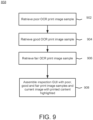
- FIG. 9 illustrates a block diagram of a method 958 to assemble an inspection graphical user interface (GUI) for a print quality check using the system of FIG. 1B .
- the method 958 begins with retrieving a poor OCR print image sample at block 902.
- a good OCR print image sample is retrieved.
- a fair OCR print image sample is retrieved.
- the GUI is assembled with the poor, good and fair samples and the current image with the text section or printed content section highlighted. Examples of images are generated of different classifications (i.e., poor, good, fair) and embedded in the GUI.
- GUI will provide a field for selecting whether the current image is good, bad or fair based on a comparison to the embedded comparison images.
- the comparison images may be specific to the print technology so that the same sample printed font types are used for comparison with the current image's printed content.
- the system may need to replace the printer.
- the ink may need to be replaced.
- FIG. 11 illustrates a block diagram of a printer marking (PM) system 1110 (i.e., PM system 110) interfaced with a plurality of systems 1130, 1140 and 1150.
- the system 1130 may be a quality assurance system (QAS).
- System 1140 may be a counterfeit detection system (CDS).
- System 1160 may be a print inspection system (PIS) (i.e., print inspection system 160).
- the PM system 1110 may include at least one printer 1115.
- the PM system 110 may include at least one camera 1118.
- the PM system 1110 is similar to PM system 110 previously described.
- the images captured by the at least one camera 1118 may be sent to one or more of the QAS, the CDS and the PIS.
- the at least one camera 1118 may be a shared component by the QAS, the CDS and the PIS but embedded in the PM system 1110, by way of non-limiting example. In some embodiments, the at least one camera may be part of the PIS but embedded in the PM system 1110 to capture the image of the product immediately or shortly after the code is printed on the substrate.
- every picture may be sent to the counterfeit detection system.
- the captured images i.e., photographs or picture
- images of the product may be stored in the counterfeit product image database 1145.
- Images of the packaging may be stored in the counterfeit package image database 1146.
- Every X captured image may be sent to the print inspection system 1160 (i.e., inspection system 160).
- images of the product may be stored in the product image archive database 1175.
- Images of the packaging (PK) may be stored in package image archive database 1176.
- the QAS may also receive captured images which are stored in the QA product image database 1135.
- the images of the packaging may be stored in the QA package image database 1136.
- the PM system 1110 i.e., PM system 110
- the PM system 110 may be used the cameras in the production line (i.e., production line 140) to capture images for at least one of the product and package for quality control operations, counterfeit detection and printed content inspection.
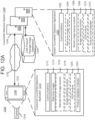
- FIG. 12A illustrates a block diagram of a system 1200 having a mobile computing device 1202 configure to have selective communications with a counterfeit detection system (CDS) 1240.
- the user may initiate a communication session with the CDS 1240 via the mobile computing device1202.
- the mobile computing device 1202 may include a computing device such as described in relation to FIG. 10 .
- the mobile computing device 1202 may be video-enabled or camera-enabled via a video camera or camera 1204.
- the mobile computing device 1202 may include various applications including a network interface for communicating wirelessly through the Internet or other wireless communication system 1230.
- the mobile computing device 1202 may include a consumer counterfeit detection application 1210.
- the consumer counterfeit detection application 1210 may include a communication module 1212 to establish communications with the counterfeit detection system 1240 being remote from the mobile computing device 1202.
- the consumer counterfeit detection application 1210 may include a real-time imager 1214 which interfaces with the video device or camera 1204 to capture an image of the product or package being investigated for authenticity, including a visible code being visible to the unaided eye.
- the consumer counterfeit detection application 1210 may include a remote CDS image receiver 1216 represented in dashed lines to denote an optional function, as will be discussed in more detail.
- the consumer counterfeit detection application 1210 may include an image matching module 1218 configured to determine a match between the real-time image captured by the mobile computing device 1202 and a stored image produced by the PM system 110 at the time of production.
- the image matching module 1218 is represented in dashed lines to denote an optional function, as will be discussed in more detail.
- the consumer counterfeit detection application 1210 may include an optical character recognition (OCR) module 1220, denoted in a dashed line to denote an optional function.
- OCR optical character recognition
- the OCR algorithms of the OCR module 1120 may be trained based on validation of any digit whether passed or failed during the print inspection system.
- a suite of trained OCR algorithms for each printer technology may be stored in the mobile computing device 1202 such that the trained OCR algorithms would detect the authentication code based on printer technology.
- the authentication code instead of the image may be sent to the CDS 1240 for validation matching.
- the application 1210 may include the image matching module 1218 to match the authentication code or OCR algorithms in the OCR module 1220.
- the OCR module 1220 would perform OCR detection using the image captured by the real-time imager 1214 interfaced with the camera 1204, by way of non-limiting example.
- the consumer counterfeit detection application 1210 may include a product validation indicator 1222 configured to provide the user an indication on the display 1206 of the mobile computing device 1202 regarding the status of the authentication or validation.
- the indication may be a visual display on display 1206 or an audible notification through the speaker of the mobile computing device 1202.
- the remote CDS image receiver 1216 and the image match module 1218 may be optional as these functions may be performed by the CDS 1240 sending an indication of authenticity (pass) or failure to verify, for example.
- the indication or result may be display on display 1206.
- the counterfeit detection system (CDS) 1240 may include one or more servers 1248 coupled to the CDS product and package image databases 1245.
- the counterfeit detection system (CDS) 1240 may include a system counterfeit detection application 1260.
- the system counterfeit detection application 1260 may include a communications module 1262 to communicate through the Internet or communication network 1230 to a consumer associated with the mobile computing device 1202.
- the system counterfeit detection application 1260 may receive via a real-time image receiver 1264, a real-time image from the mobile computing device 1202 captured by the camera 1204 or video device.
- the system counterfeit detection application 1260 may lookup the stored product/package image using the stored image lookup module 1266.
- the system counterfeit detection application 1260 may include an image matching module 1268 configured to determine a match between the real-time image received from the mobile computing device 1202 and a stored image retrieved, via a lookup module 1266, from databases 1245.
- the image matching module 1268 is represented in dashed lines to denote an optional function, as this function may be performed by the mobile computing device 1202.
- the system counterfeit detection application 1260 may include a product or code validator 1272 configured to communicate to the mobile computing device 1202 an indication for display representative of an indication of authenticity (pass) or failure to authenticate product/package.
- the indication may be a visual display on display 1206 or an audible notification through the speaker of the mobile computing device 1202.
- FIG. 12B illustrates flowchart of a counterfeit detection process 1280.
- the process 1280 may include, at block 1281, for generating an authentication code for a product or package by the authentication code generator 1072.
- the term "product” may sometimes refer to a "package” or both a product packaged together with a package.
- the process 1280 may include printing by a printer printed content on a substrate including a plurality of digits.
- the process 1280 may include capturing an image of the substrate on a package or product.
- the process 1280 may include archiving the image during production of the product in a database.
- the process 1280 may include activating counterfeit application 1286.
- the process 1280 may include capturing in real-time an image with region of interest (ROI) and all digits of the printed content of the product or package.
- the process 1280 may include retrieving a stored image of the product or package from the CDS database.
- the process 1280 may include comparing a region of interest (ROI) in the two images.
- the process 1280 may determine if there is a match between the two images. If there is a match, an indicator is generated that the product or package is validated or authenticated. If there is not a match, an indicator is generated representative of the failure or that the product or package is counterfeit.
- the same images used in the production line are used in the CDS 1140 or 1240 and the PIS 160 or 1160 to determine a code match based on image recognition.
- the OCR algorithms may be trained based on validation of any digit whether passed or failed during the print inspection system.
- a suite of trained OCR algorithms for each printer technology may be stored in the mobile computing device or remotely such that the trained OCR algorithms when executed would detect the authentication code based on printer technology in the real-time image.
- the authentication code instead of the image would be sent to the CDS 1140 or 1240 for validation matching.
- the CDS 1140 or 1240 may include the trained OCR algorithms.
- the trained OCR algorithm at the CDS 1140 or 1240 may perform optical character recognition on the image from the mobile computing device to detect the authentication code embedded within.
- the CDS 1140 or 1240 would generate a communication back to the mobile computing device to indicate the authenticity of the product or package.
- the computing device 1050 may include any type of stationary computing device or a mobile computing device.
- the computing device 1050 may be a computing system with one or more servers, each server including one or more processors.
- the servers may include a server application running on the server for online communications and may provide graphical user interface (GUI) or webpages.
- GUI graphical user interface
- the term computing device and computing system may be interchangeable.
- the processors 161 and 180 may be computing devices, web servers or other computer devices.
- the processor 161 and 180 may be connected to the computing device 150 via the Internet, Intranet, local area network (LAN), or wide area network (WAN). Communications between computing device 150 and the processors 161 and 180 may be wired, wireless or a combination of wired and wireless.
- Computing device 1050 may include one or more processors 1052 and system memory in hard drive 1054.
- system memory may be volatile (such as RAM 756), non-volatile (such as read only memory (ROM 1058), flash memory 1060, and the like) or some combination of the two.
- System memory may store operating system 1064, one or more applications, and may include program data for performing at least the processes 800, 858 and 1280, described herein.
- Computing device 1050 may also have additional features or functionality.
- computing device 1050 may also include additional data storage devices (removable and/or non-removable) such as, for example, magnetic disks, optical disks, or tape.
- Computer storage media may include volatile and non-volatile, non-transitory, removable and non-removable media implemented in any method or technology for storage of data, such as computer readable instructions, data structures, program modules or other data.
- System memory, removable storage and non-removable storage are all examples of computer storage media.
- Computer storage media includes, but is not limited to, RAM, ROM, Electrically Erasable Read-Only Memory (EEPROM), flash memory or other memory technology, compact-disc-read-only memory (CD-ROM), digital versatile disks (DVD) or other optical storage, magnetic cassettes, magnetic tape, magnetic disk storage or other magnetic storage devices, or any other physical medium which can be used to store the desired data and which can be accessed by computing device. Any such computer storage media may be part of device.
- Computing device 1050 may also include or have interfaces for input device(s) (not shown) such as a keyboard, mouse, pen, voice input device, touch input device, etc.
- the computing device 1050 may include or have interfaces for connection to output device(s) such as a display 1062, speakers, etc.
- the computing device 1050 may include a peripheral bus 1066 for connecting to peripherals.
- Computing device 1050 may contain communication connection(s) that allow the device to communicate with other computing devices, such as over a network or a wireless network.
- communication connection(s) may include wired media such as a wired network or direct-wired connection, and wireless media such as acoustic, radio frequency (RF), infrared and other wireless media.
- the computing device 1050 may include a network interface card 1068 to connect (wired or wireless) to a network.
- the computing device 1050 may include applications stored in the hard drive 1054 for carrying out various processes and functions described herein.
- the hard drive may include a product/package code generator 1070 with a plurality of digits using standard characters, numbers or symbols in any language according to various printer technologies to produce a "standard code" for a product or package.
- a digit includes a character, number, or symbol.
- a digit may include all or part of a logo.
- the product/package code or "standard code” from the code generator 1070 may be converted to an authentication code to prevent or deter counterfeit production of the products and/or packages. All codes including "standard codes” are authentication codes when printed. However, some codes can be duplicated and copied on counterfeit products. Thus, in some instances, the authentication code is for the prevention of counterfeiting of products and/or packages.
- the applications may include an authentication code generator 1072 to deter counterfeit production of similar products or packages.
- the authentication code generator 1072 may include a character modifier 1074.
- the character modifier 1072 may modify any standard digit (i.e., character, number, or symbol) in any language found in the "standard code.”
- the character modifier 1072 may include a font characteristic modifier 1076 and a dot or pixel modifier 1078 to modify a dot or pixel of a digit.
- the font characteristic modifier 1076 may change the size, shape and spacing of a font for a digit.
- the authentication code generator 1072 may include a multiple code line generator 1080 wherein the multiple code line generator 1080 overlays or superimposes two or more lines of digits. In some instances, the multiple code line generator 1080 may generate two or more lines of digits into covert codes which may be used together to verify the authenticity of a product or package.
- the authentication code generator 1072 may include a figure, symbol or logo generator 1082 which is generated randomly or based on a stored set of figures, symbols and/or logos.
- the authentication code generator 1072 may receive the "standard code” from code generator 1070 and modify the "standard code” to generate an authentication code based on one or more of the character modifier 1074, the figure, symbol or logo generator 1082 and the multiple code line generator 1080.
- One of the "standard code” or the authentication code may be stored in the field values 132 for printing by the printer as the printed content on a substrate.
- Computer program code for carrying out operations described above may be written in a variety of programming languages, including but not limited to a high-level programming language, such as Java, C or C++, for development convenience.
- computer program code for carrying out operations of embodiments described herein may also be written in other programming languages, such as, but not limited to, interpreted languages.
- Some modules or routines may be written in assembly language or even micro-code to enhance performance and/or memory usage. It will be further appreciated that the functionality of any or all of the program modules may also be implemented using discrete hardware components, one or more application specific integrated circuits (ASICs), or a programmed Digital Signal Processor (DSP) or microcontroller.
- ASICs application specific integrated circuits
- DSP Digital Signal Processor
- a code in which a program of the embodiments is described can be included as a firmware in a RAM, a ROM and a flash memory. Otherwise, the code can be stored in a tangible computer-readable storage medium such as a magnetic tape, a flexible disc, a hard disc, a compact disc, a photo-magnetic disc, a digital versatile disc (DVD) or other tangible and non-transitory memory device.
- a tangible computer-readable storage medium such as a magnetic tape, a flexible disc, a hard disc, a compact disc, a photo-magnetic disc, a digital versatile disc (DVD) or other tangible and non-transitory memory device.
- the embodiments may be configured for use in a computer or a data processing apparatus which includes memory devices, such as a central processing unit (CPU), a RAM and a ROM as well as a storage medium such as a hard disc.
- memory devices such as a central processing unit (CPU), a RAM and a ROM as well as a storage medium such as a hard disc.
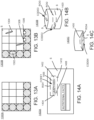
- FIG. 13A illustrates an ideal printed character template 1300A.
- the ideal printed character template 1300A includes for example a matrix X by Y where in the example, X is 4 and Y is 4. However, other values of X and Y may be used such as 8, 9, 10, etc. The values of X and Y may differ.
- the template 1300A represents a matrix used to form an ideal character printed by for example using inkjet technology.
- Each standard character, number or symbol (i.e., digit) is generated using an ideal character template wherein the character, number or symbol size and shape are printed to conform to the size of the matrix such that adjacent symbols, characters or numbers have similar size and shape set to the same font, for example.
- the printer may include a printer controller (not shown) to generate each standard digit and a logo, for example, according to industry standards and practices. For example, in inkjet technology, drop charge values for generating a standard digit is pre-programed in the printer controller.
- the template 1300A includes the character "L" in which includes ink is filled in cells of the matrix in a vertical line on the left side of the template and cells in a horizontal line at a bottom of the template 1300A.
- the ink filled matrix cell is shown hatched by vertical lines.
- FIG. 13B illustrates a printed character template 1300B.
- the template 1300B is represented as the same as template 1300A however, the printed character "L" is shown with some of the cells of the filled/printed matrix include un-inked areas 1302 and/or stray ink marks 1304 in the other cells.
- This un-inked area 1302 and/or stray marks 1304 can cause a failure by the optical character recognition (OCR) algorithm to recognize the digit (i.e., character, number or symbol).
- OCR optical character recognition
- the stray marks 1304 may be generated as a result of normal operation of a printer, such as those using a viscous ink medium.
- the un-inked areas 1306 and 1308 may be the result of a modified character such that a dot or pixel was omitted from the digit as required by an authentication code.
- the un-inked areas 1306 and 1308 may be an appearance of an un-inked area created by a reflection from the substrate S at the time of image capture by the camera in the PM system 110.
- the point of reflection may appear along the same plane of a digit such as based on the ambient lighting conditions in which the camera is operated.
- the trained OCR algorithms may be varied for substrate reflectivity and/or modified characters or digits, accordingly.
- FIG. 14A illustrates a package 1400A with printed content in a region of interest ROI1.
- the printed content includes a plurality of digits "JLKPY09882" in a region of interest ROI1 on substrate S of a product or package.
- the code of the plurality of digits is surrounded by noise represented by dotted area 1406 in the ROI1, and an adjacent text fields titles "NUTRITIONAL FACTS.”
- the ROI1 may also include a shaded area 1404.
- the stray line 1408 and lines 1410 represents extraneous matter which may provide noise in the image.
- the stray line 1408 and lines 1410 are shown to represent extraneous matter which may encroach into the ROI1 area which may cause a false failure by the OCR algorithms.
- FIG. 14B illustrates a convex substrate S in the form of a bottle cap 1400B with printed content "JLKP" denoted as CODE2 in a region of interest ROI2 along a vertical plane of the product.
- the printed content denoted as CODE 2
- CODE3 printed content
- the top substrate of the bottle cap 1400B may include a code, denoted as CODE3, on a top flat surface in region of interest ROI3 of the bottle cap.
- This surfaces of the bottle cap 1400B may be plastic. In some embodiments, the surfaces may be metal and have a reflectivity.
- the line 1420 represents a stray line which may be captured in an image which may encroach into the region of interest ROI2.
- FIG. 14C illustrates a concave substrate 1450 with printed content, denoted as CODE4, partially shown in a region of interest, denoted as ROI4.
- CODE4 printed content
- ROI4 region of interest
- the bottom of the can may include a concaved surface on which is printed a code or printed content is applied thereon.
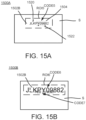
- FIG. 15A illustrates an authentication code 1500A including a plurality of characters, such as by example, "JLKPY09882" as CODE 5 in a region of interest ROI5 on substrate S of a product or package.
- the region of interest ROI5 is denoted by the dashed lined box.
- the area 1502B of the region of interest ROI5 may include a solid color such as white or other colors.
- the area 1502B of the region of interest ROI5 includes noise denoted by the dotted pattern 1504. In some embodiments, the noise may be the result of the product in a transparent or semi-transparent container or substrate.
- the authentication code 1500A may include a code with a modified character, such as described is US Patent No. 8,982,424, to Robert Weaver and assigned to Videojet Technologies, Inc.
- the authentication code may include two covert codes to verify the authenticity of the product or package.
- at least one dot or pixel used to create a character, number or symbol, in any language, may be removed to create a single modified character, number or symbol (i.e., digit).
- the authentication code 1500A may include at least one character, number or symbol which is randomly modified to change a characteristic of one or more characters, number or symbols.
- a characteristic may include a font type, font size and font spacing.
- the original product code or other code may include a first font wherein the modified characters, numbers or symbols may be modified to include at least one of a different font size and a different font type.
- the first character "J" has a characteristic of the modified font.
- the authentication code 1500A may include an arbitrary figure, arbitrary symbol 1520 and 1522 or an arbitrary logo incorporated in the authentication code. While the example authentication code includes one or more modified characters or additional figures, symbols or logo, the authentication code 1500A may include other variations including randomly generated variations to distinguish the authentication code 1500A.
- the authentication code 1500A is visible to the unaided eye or does not require special glasses to see the digits of the code on the substrate.
- FIG. 15B illustrates an authentication code 1500B including a plurality of characters, such as by example, "JLKPY09882" represents code CODE6 in a region of interest ROI6 on substrate S of a product or package.
- the region of interest ROI6 is denoted by the dashed lined box.
- the area 1502B of the region of interest ROI6 may include a solid color such as white or other colors.
- this code 1500B two lines of code CODE6 and CODE7 wherein the code digits "FEB 29 0000" denoted as CODE7 are superimposed or overlaid at least in part on a portion of the code digits "JLKPY09882" denoted as CODE6.
- the OCR algorithm may be trained for reflective surfaces to detect to edges of a character or digit with a "reflective" edge wherein a "reflective" edge appearing white or silver in a captured image under various ambient lighting conditions.
- the code is an authentication code
- non-inked portions embedded within the modified digit may be detected using the field values.
- digits may be adjusted in space relative to an adjacent digit.
Landscapes
- Engineering & Computer Science (AREA)
- Theoretical Computer Science (AREA)
- Computer Vision & Pattern Recognition (AREA)
- Physics & Mathematics (AREA)
- General Physics & Mathematics (AREA)
- Multimedia (AREA)
- Quality & Reliability (AREA)
- Data Mining & Analysis (AREA)
- Life Sciences & Earth Sciences (AREA)
- Artificial Intelligence (AREA)
- Bioinformatics & Cheminformatics (AREA)
- Bioinformatics & Computational Biology (AREA)
- Evolutionary Biology (AREA)
- Evolutionary Computation (AREA)
- General Engineering & Computer Science (AREA)
- Accessory Devices And Overall Control Thereof (AREA)
- Record Information Processing For Printing (AREA)
- Character Discrimination (AREA)
Claims (15)
- Vorrichtung, die Folgendes umfasst:einen Drucker, der zum Aufbringen eines Codes von gedrucktem Inhalt auf ein Substrat eines Produkts konfiguriert ist, wobei der Drucker einen Druckertechnologietyp aufweist, wobei der Code eine Vielzahl von Ziffern aufweist; undeinen optischen Code-Detektor, ausgeführt von einem oder mehreren Prozessoren, um den Code in einem empfangenen Bild des von dem Drucker bedruckten Produkts durch optisches Erkennen von Zeichen in dem empfangenen Bild unter Verwendung eines trainierten Algorithmus für optische Zeichenerkennung (OCR) für den Druckertechnologietyp zu erfassen, wobei der OCR-Algorithmus zum Identifizieren jeder Ziffer der Vielzahl von Ziffern des Codes in einer Region von Interesse (ROI) auf der Basis von mindestens einem Parameter des Produkts, auf das der gedruckte Inhalt direkt aufgebracht wird, und dem Druckertechnologietyp trainiert ist;wobei der optische Code-Detektor zum Auswählen des OCR-Algorithmus für den Druckertechnologietyp aus einer Datenbank von einer Vielzahl von OCR-Algorithmen auf der Basis eines Druckertechnologietyps in Metadaten konfiguriert ist.
- Vorrichtung nach Anspruch 1, wobei:der Druckertechnologietyp einen von einem Drucker mit kontinuierlichem Tintenstrahl (CIJ), einem Laserdrucker, einem Thermotransfer-Überdrucker (TTO) und einem Thermo-Tintenstrahldrucker (TIJ) einschließt;
und/oderder optische Code-Detektor ferner zum Auswählen des OCR-Algorithmus auf der Basis von Produktverpackungs-Spezifikationsparametern konfiguriert ist; und optional die Produktverpackungs-Spezifikationsparameter mindestens eines von einer Farbe, einem Material und einer Oberflächenkrümmung des Produkts umfassen. - Vorrichtung nach Anspruch 1, wobei der Code ein Authentifizierungscode ist, der mindestens eines von einem Standardzeichen, einer Standardzahl und einem Standardsymbol in einer beliebigen Sprache und mindestens eines von einem modifizierten Zeichen, einer modifizierten Zahl und einem modifizierten Symbol einschließt, wobei der OCR-Algorithmus zum Erkennen des mindestens einen von dem Standardzeichen, der Standardzahl und dem Standardsymbol und des mindestens einen von dem modifizierten Zeichen, der modifizierten Zahl und dem modifizierten Symbol trainiert ist.
- Vorrichtung nach Anspruch 1, wobei der trainierte OCR-Algorithmus trainiert ist auf der Basis von Folgendem:(i) einer Validierung fehlgeschlagener Ziffern des erfassten Codes; oder(ii) der Tatsache, dass der mindestens eine Parameter des Produkts eines oder mehrere von Reflexionsvermögen des Substrats, Material des Substrats, Farbe des Substrats, Konkavität des Substrats, Konvexität des Substrats und Transparenz des Substrats einschließt.
- System, das Folgendes umfasst:eine Vorrichtung nach einem vorhergehenden Anspruch; undeine Kamera zum automatischen Aufnehmen eines Bildes des Codes auf dem Substrat des Produkts;wobei das empfangene Bild das von der Kamera aufgenommene Bild ist.
- System nach Anspruch 5, wobei der Drucker ein Drucker einer Vielzahl von Druckern in einem Druckermarkierungs(PM)-System ist und ferner Folgendes umfasst:mindestens eine Speichervorrichtung zum Speichern einer Vielzahl von Algorithmen für Bilderkennung (IR) und einer Vielzahl von Algorithmen für optische Zeichenerkennung (OCR) für eine Vielzahl von Druckertechnologietypen, wobei jeder OCR-Algorithmus einem jeweiligen Druckertechnologietyp zugeordnet ist; undein Druckinspektionssystem (PIS) mit den ein oder mehreren Prozessoren, wobei die ein oder mehreren Prozessoren einen Inspektionsprozessor mit einer Klassifizierungsmaschine in Kommunikation mit dem PM-System einschließen und den optischen Code-Detektor einschließen, wobei der Inspektionsprozessor:Metadaten und Feldwerte bezüglich des mit dem Code bedruckten Produkts durch das PM-System empfängt;einen Algorithmus für Bilderkennung (IR) der Vielzahl von IR-Algorithmen auf der Basis der Metadaten auswählt;das Produkt in dem Bild auf der Basis des IR-Algorithmus erkennt, um ein IR-Ergebnis zu erzeugen und die Region von Interesse zu identifizieren;einen OCR-Algorithmus aus der Vielzahl von OCR-Algorithmen auf der Basis eines Druckertechnologietyps in den Metadaten auswählt;den optischen Code-Detektor veranlasst, die optische Zeichenerkennung (OCR) unter Verwendung des ausgewählten OCR-Algorithmus durchzuführen, um die Vielzahl von Ziffern in der Region von Interesse des Bildes auf der Basis der Metadaten zu erkennen, um ein OCR-Ergebnis zu erzeugen;das OCR-Ergebnis und das IR-Ergebnis decodiert, undeine Mitteilung der decodierten Ergebnisse an das PM-System, die ein Gelingen oder ein Fehlschlagen des gedruckten Inhalts angibt, erzeugt, um mindestens eine Aktion des PM-Systems zu steuern.
- System nach Anspruch 5, das ferner eine Datenbank von archivierten Bildern umfasst, wobei die archivierten Bilder die aufgenommenen Bilder sind.
- System nach Anspruch 5, das ferner einen zweiten Inspektionsprozessor mit einem Aufgabengenerator einer graphischen Benutzeroberfläche (GUI) umfasst, der eine Aufgabe zum Inspizieren eines Inspektionsbildes erzeugt, wobei die GUI das Inspektionsbild und ein Datenfeld zum Eingeben eines Ergebnisses eines Inspektionskriteriums einschließt.
- System nach Anspruch 5 oder 6, wobei der Inspektionsprozessor, wenn der Inspektionsprozessor decodiert, feststellt, ob das erkannte Produkt mit den Metadaten übereinstimmt, und wenn das Produkt nicht mit den Metadaten übereinstimmt, die Mitteilung des decodierten Ergebnisses an das PM-System, die ein Fehlschlagen des Produkts angibt, erzeugt wird.
- Verfahren, das Folgendes umfasst:Drucken, durch einen Drucker, eines Codes von gedrucktem Inhalt auf ein Substrat eines Produkts, wobei der Drucker einen Druckertechnologietyp aufweist, wobei der Code eine Vielzahl von Ziffern aufweist;automatisches Aufnehmen, durch eine Kamera, eines Bildes des Codes auf dem Substrat des Produkts; optisches Erfassen, durch einen oder mehrere Prozessoren, des Codes in dem aufgenommenen Bild des von dem Drucker bedruckten Produkts, wobei das Erfassen das optische Erkennen von Zeichen in dem aufgenommenen Bild unter Verwendung von einem trainierten Algorithmus für optische Zeichenerkennung (OCR) für den Druckertechnologietyp einschließt, wobei der OCR-Algorithmus zum Identifizieren jeder Ziffer der Vielzahl von Ziffern des Codes in einer Region von Interesse (ROI) auf der Basis von mindestens einem Parameter des Produkts, auf das der gedruckte Inhalt direkt aufgebracht wird, und dem Druckertechnologietyp trainiert ist; undAuswählen des OCR-Algorithmus für den Druckertechnologietyp aus einer Datenbank einer Vielzahl von OCR-Algorithmen auf der Basis eines Druckertechnologietyps in Metadaten.
- Verfahren nach Anspruch 10, wobei der Drucker ein Drucker einer Vielzahl von Druckern in einem Druckermarkierungs(PM)-System ist, und das ferner Folgendes umfasst:Speichern, in mindestens einer Speichervorrichtung, einer Vielzahl von Bilderkennungsalgorithmen und einer Vielzahl von Algorithmen für optische Zeichenerkennung (OCR) für eine Vielzahl von Druckertechnologietypen, wobei jeder OCR-Algorithmus einem jeweiligen Druckertechnologietyp zugeordnet ist; undDurchführen einer Druckinspektion in einem Druckinspektionssystem (PIS) mit den ein oder mehreren Prozessoren, wobei die ein oder mehreren Prozessoren einen Inspektionsprozessor mit einer Klassifizierungsmaschine in Kommunikation mit dem PM-System einschließen, wobei das Durchführen der Druckinspektion Folgendes einschließt:Empfangen von Metadaten und Feldwerten bezüglich des mit dem Code bedruckten Produkts durch das PM-System;Auswählen eines Algorithmus für Bilderkennung (IR) aus der Vielzahl von IR-Algorithmen auf der Basis der Metadaten;Erkennen des Produkts in dem Bild auf der Basis des IR-Algorithmus, um ein IR-Ergebnis zu erzeugen und die Region von Interesse zu identifizieren;Auswählen eines OCR-Algorithmus aus der Vielzahl von OCR-Algorithmen auf der Basis eines Druckertechnologietyps in den Metadaten;Durchführen des optischen Erfassens unter Verwendung des ausgewählten OCR-Algorithmus, um die Vielzahl von Ziffern in der Region von Interesse des Bildes auf der Basis der Metadaten zu erkennen, um ein OCR-Ergebnis zu erzeugen;Decodieren des OCR-Ergebnisses und des IR-Ergebnisses, undErzeugen einer Mitteilung des decodierten Ergebnisses an das PM-System, die ein Gelingen oder ein Fehlschlagen des gedruckten Inhalts angibt.
- Verfahren nach Anspruch 11, das ferner das Archivieren der Bilder in einer Datenbank durch das PIS umfasst.
- Verfahren nach Anspruch 10 oder 11, wobei das PIS ferner einen zweiten Inspektionsprozessor mit einem Aufgabengenerator einer graphischen Benutzeroberfläche (GUI) umfasst; und das ferner Folgendes umfasst:
Erzeugen einer Aufgabe zum Inspizieren eines Inspektionsbildes, wobei die GUI das Inspektionsbild und ein Datenfeld zum Eingeben eines Ergebnisses eines Inspektionskriteriums auf der Basis des Inspektionsbildes einschließt. - Verfahren nach Anspruch 10 oder 11, wobei das Decodieren Folgendes einschließt: Feststellen, ob das erkannte Produkt mit den Metadaten übereinstimmt, und wenn das Produkt nicht mit den Metadaten übereinstimmt, wird die Mitteilung des decodierten Ergebnisses an das PM-System erzeugt, die ein Fehlschlagen des Produkts angibt.
- Verfahren nach Anspruch 10 oder 11, wobei der Code ein Authentifizierungscode ist, der mindestens eines von einem Standardzeichen, einer Standardzahl und einem Standardsymbol in einer beliebigen Sprache und mindestens eines von einem modifizierten Zeichen, einer modifizierten Zahl und einem modifizierten Symbol einschließt, wobei der OCR-Algorithmus zum Erkennen des mindestens einen von dem Standardzeichen, der Standardzahl und dem Standardsymbol und des mindestens einen von dem modifiziertem Zeichen, der modifizierten Zahl und dem modifizierten Symbol trainiert ist.
Applications Claiming Priority (2)
| Application Number | Priority Date | Filing Date | Title |
|---|---|---|---|
| US201662373540P | 2016-08-11 | 2016-08-11 | |
| PCT/US2017/046507 WO2018031890A1 (en) | 2016-08-11 | 2017-08-11 | Printer device, printer marking system and method with multi-stage production print inspection |
Publications (3)
| Publication Number | Publication Date |
|---|---|
| EP3497708A1 EP3497708A1 (de) | 2019-06-19 |
| EP3497708A4 EP3497708A4 (de) | 2020-03-11 |
| EP3497708B1 true EP3497708B1 (de) | 2024-11-27 |
Family
ID=61163145
Family Applications (1)
| Application Number | Title | Priority Date | Filing Date |
|---|---|---|---|
| EP17840342.4A Active EP3497708B1 (de) | 2016-08-11 | 2017-08-11 | Druckvorrichtung, druckermarkierungssystem und verfahren mit mehrstufiger produktionsdruckinspektion |
Country Status (4)
| Country | Link |
|---|---|
| US (1) | US10628934B2 (de) |
| EP (1) | EP3497708B1 (de) |
| CN (1) | CN109844886B (de) |
| WO (1) | WO2018031890A1 (de) |
Families Citing this family (11)
| Publication number | Priority date | Publication date | Assignee | Title |
|---|---|---|---|---|
| US10304174B2 (en) | 2016-12-19 | 2019-05-28 | Datamax-O'neil Corporation | Printer-verifiers and systems and methods for verifying printed indicia |
| CN114007846B (zh) * | 2019-06-13 | 2024-11-26 | 录象射流技术公司 | 用于以改进的线路恢复时间标记基底的系统和方法 |
| CN110764721A (zh) * | 2019-09-19 | 2020-02-07 | 北京三快在线科技有限公司 | 模板生成方法、装置、电子设备和计算机可读介质 |
| KR102120051B1 (ko) * | 2019-11-11 | 2020-06-17 | 석인수 | 수치화된 표면지문을 포함한 제품의 물리적 특징정보 및 블록체인을 활용한 원본 인증 시스템 및 방법 |
| US11481678B2 (en) * | 2019-11-14 | 2022-10-25 | Baidu Usa Llc | Systems and methods for learning new watermark algorithms for a data processing accelerator |
| CN111507325B (zh) * | 2020-03-16 | 2023-04-07 | 重庆大学 | 基于深度学习的工业视觉ocr识别系统及方法 |
| JP7346352B2 (ja) * | 2020-04-08 | 2023-09-19 | キヤノン株式会社 | 検査システム、情報処理装置及びその制御方法 |
| US11954846B2 (en) * | 2020-06-16 | 2024-04-09 | Elementary Robotics, Inc. | Explainability and complementary information for camera-based quality assurance inspection processes |
| US11461988B2 (en) * | 2020-07-23 | 2022-10-04 | Suresh Babu Revoled Konti | Method of transferring data between unconnected computing devices |
| PL3954540T3 (pl) | 2020-08-11 | 2025-04-07 | Schott Ag | Sposób drukowania obrazu na podłożu i odpowiedni system |
| US11995813B2 (en) | 2022-09-03 | 2024-05-28 | Printify, Inc. | Automated garment print quality control for garment tracking, processing, storage, and/or defect blocking |
Family Cites Families (13)
| Publication number | Priority date | Publication date | Assignee | Title |
|---|---|---|---|---|
| US4006332A (en) * | 1974-11-11 | 1977-02-01 | Westinghouse Electric Corporation | Convection heating apparatus for multi-phase gas-type circuit interrupters |
| US5212741A (en) | 1992-01-21 | 1993-05-18 | Eastman Kodak Company | Preprocessing of dot-matrix/ink-jet printed text for Optical Character Recognition |
| GB9926198D0 (en) * | 1999-11-05 | 2000-01-12 | Claricom Ltd | Improvements in printer systems |
| US7172121B2 (en) | 2000-11-03 | 2007-02-06 | Claricom Limited | System and method for applying codes onto packaged products |
| US7644281B2 (en) | 2004-09-27 | 2010-01-05 | Universite De Geneve | Character and vector graphics watermark for structured electronic documents security |
| CN103258314A (zh) * | 2005-09-16 | 2013-08-21 | 北京书生国际信息技术有限公司 | 一种隐形编码嵌入和检测的方法 |
| KR100714393B1 (ko) * | 2005-09-16 | 2007-05-07 | 삼성전자주식회사 | 텍스트 추출 기능을 갖는 호스트 장치 및 그의 텍스트 추출방법 |
| GB201116095D0 (en) * | 2011-09-16 | 2011-11-02 | Wessex Technology Opto Electronic Products Ltd | Machine reading of printed data |
| CN104067604A (zh) * | 2012-01-31 | 2014-09-24 | 惠普发展公司,有限责任合伙企业 | 打印样本特征集 |
| CN103577126A (zh) * | 2012-07-30 | 2014-02-12 | Ge医疗系统环球技术有限公司 | 集中打印方法、打印机控制器和系统 |
| GB2528261A (en) * | 2014-07-14 | 2016-01-20 | Enable Marketing & Promotions Ltd | Improvements relating to marking |
| US9460358B2 (en) | 2014-07-15 | 2016-10-04 | Google Inc. | Extracting card identification data |
| US10325148B2 (en) * | 2016-09-30 | 2019-06-18 | Wipro Limited | Method and a system for optical character recognition |
-
2017
- 2017-08-11 WO PCT/US2017/046507 patent/WO2018031890A1/en not_active Ceased
- 2017-08-11 CN CN201780062935.4A patent/CN109844886B/zh active Active
- 2017-08-11 EP EP17840342.4A patent/EP3497708B1/de active Active
- 2017-08-11 US US16/324,410 patent/US10628934B2/en active Active
Also Published As
| Publication number | Publication date |
|---|---|
| US10628934B2 (en) | 2020-04-21 |
| CN109844886B (zh) | 2022-03-11 |
| CN109844886A (zh) | 2019-06-04 |
| EP3497708A4 (de) | 2020-03-11 |
| WO2018031890A1 (en) | 2018-02-15 |
| WO2018031890A9 (en) | 2019-05-23 |
| EP3497708A1 (de) | 2019-06-19 |
| US20190220971A1 (en) | 2019-07-18 |
Similar Documents
| Publication | Publication Date | Title |
|---|---|---|
| EP3497708B1 (de) | Druckvorrichtung, druckermarkierungssystem und verfahren mit mehrstufiger produktionsdruckinspektion | |
| US20250343866A1 (en) | Methods, apparatuses, and systems for detecting printing defects and contaminated components of a printer | |
| US11538262B2 (en) | Multiple field of view (FOV) vision system | |
| US11922259B2 (en) | Universal product labeling for vision-based commerce | |
| CN109409204B (zh) | 防伪检测方法和装置、电子设备、存储介质 | |
| US9684842B2 (en) | Methods and apparatus to extract text from imaged documents | |
| EP3529023B1 (de) | Systeme und verfahren zur identifizierung dreidimensionaler druckobjekte | |
| JP6528147B2 (ja) | 会計データ入力支援システム、方法およびプログラム | |
| US9619807B2 (en) | Genuine product certification means and system | |
| US11557135B2 (en) | System and method to determine the authenticity of a seal | |
| US12217128B2 (en) | Multiple field of view (FOV) vision system | |
| US20210097517A1 (en) | Object of interest selection for neural network systems at point of sale | |
| EP4171051B1 (de) | Kollationsvorrichtung, programm und kollationsverfahren | |
| KR102476496B1 (ko) | 인공지능 기반의 바코드 복원을 통한 상품 식별 방법 및 이를 실행하기 위하여 기록매체에 기록된 컴퓨터 프로그램 | |
| JP7057433B6 (ja) | 印字検査装置 | |
| US20220237931A1 (en) | Systems and methods for printed code inspection | |
| KR102469015B1 (ko) | 서로 다른 파장 범위를 갖는 복수의 카메라를 이용한 상품 식별 방법 및 이를 실행하기 위하여 기록매체에 기록된 컴퓨터 프로그램 | |
| US12254379B2 (en) | Information reader | |
| KR20200097586A (ko) | 패키지 박스의 qr 코드 인증을 이용한 위품 판정 장치 | |
| KR102476493B1 (ko) | 상품 식별 장치 및 이를 이용한 상품 식별 방법 | |
| CN120564194B (zh) | 一种商品识别方法及装置 | |
| KR102476498B1 (ko) | 인공지능 기반의 복합 인식을 통한 상품 식별 방법 및 이를 실행하기 위하여 기록매체에 기록된 컴퓨터 프로그램 | |
| de Souza et al. | Test and Development of a Low-Cost Solution for Automatic Inspection of PET Bottle Codification | |
| WO2016199126A1 (en) | System and method of recognizing state of a product |
Legal Events
| Date | Code | Title | Description |
|---|---|---|---|
| STAA | Information on the status of an ep patent application or granted ep patent |
Free format text: STATUS: THE INTERNATIONAL PUBLICATION HAS BEEN MADE |
|
| PUAI | Public reference made under article 153(3) epc to a published international application that has entered the european phase |
Free format text: ORIGINAL CODE: 0009012 |
|
| STAA | Information on the status of an ep patent application or granted ep patent |
Free format text: STATUS: REQUEST FOR EXAMINATION WAS MADE |
|
| 17P | Request for examination filed |
Effective date: 20190226 |
|
| AK | Designated contracting states |
Kind code of ref document: A1 Designated state(s): AL AT BE BG CH CY CZ DE DK EE ES FI FR GB GR HR HU IE IS IT LI LT LU LV MC MK MT NL NO PL PT RO RS SE SI SK SM TR |
|
| AX | Request for extension of the european patent |
Extension state: BA ME |
|
| DAV | Request for validation of the european patent (deleted) | ||
| DAX | Request for extension of the european patent (deleted) | ||
| RIC1 | Information provided on ipc code assigned before grant |
Ipc: G06K 9/18 20060101AFI20191111BHEP |
|
| REG | Reference to a national code |
Ref legal event code: R079 Ipc: G06K0009180000 Ref country code: DE Ref legal event code: R079 Ref document number: 602017086430 Country of ref document: DE Free format text: PREVIOUS MAIN CLASS: H01H0009300000 Ipc: G06K0009180000 |
|
| A4 | Supplementary search report drawn up and despatched |
Effective date: 20200212 |
|
| RIC1 | Information provided on ipc code assigned before grant |
Ipc: G06K 9/03 20060101ALI20200206BHEP Ipc: G06K 9/62 20060101ALI20200206BHEP Ipc: G06K 9/18 20060101AFI20200206BHEP |
|
| GRAP | Despatch of communication of intention to grant a patent |
Free format text: ORIGINAL CODE: EPIDOSNIGR1 |
|
| STAA | Information on the status of an ep patent application or granted ep patent |
Free format text: STATUS: GRANT OF PATENT IS INTENDED |
|
| INTG | Intention to grant announced |
Effective date: 20211118 |
|
| GRAJ | Information related to disapproval of communication of intention to grant by the applicant or resumption of examination proceedings by the epo deleted |
Free format text: ORIGINAL CODE: EPIDOSDIGR1 |
|
| STAA | Information on the status of an ep patent application or granted ep patent |
Free format text: STATUS: REQUEST FOR EXAMINATION WAS MADE |
|
| INTC | Intention to grant announced (deleted) | ||
| STAA | Information on the status of an ep patent application or granted ep patent |
Free format text: STATUS: EXAMINATION IS IN PROGRESS |
|
| 17Q | First examination report despatched |
Effective date: 20220530 |
|
| REG | Reference to a national code |
Ref country code: DE Free format text: PREVIOUS MAIN CLASS: G06K0009180000 Ref country code: DE Ref legal event code: R079 Ref document number: 602017086430 Country of ref document: DE Free format text: PREVIOUS MAIN CLASS: G06K0009180000 Ipc: G06V0030120000 |
|
| GRAP | Despatch of communication of intention to grant a patent |
Free format text: ORIGINAL CODE: EPIDOSNIGR1 |
|
| STAA | Information on the status of an ep patent application or granted ep patent |
Free format text: STATUS: GRANT OF PATENT IS INTENDED |
|
| P01 | Opt-out of the competence of the unified patent court (upc) registered |
Effective date: 20230530 |
|
| INTG | Intention to grant announced |
Effective date: 20230706 |
|
| RIC1 | Information provided on ipc code assigned before grant |
Ipc: G06V 30/19 20220101ALI20230623BHEP Ipc: G06V 30/12 20220101AFI20230623BHEP |
|
| GRAJ | Information related to disapproval of communication of intention to grant by the applicant or resumption of examination proceedings by the epo deleted |
Free format text: ORIGINAL CODE: EPIDOSDIGR1 |
|
| STAA | Information on the status of an ep patent application or granted ep patent |
Free format text: STATUS: EXAMINATION IS IN PROGRESS |
|
| INTC | Intention to grant announced (deleted) | ||
| GRAP | Despatch of communication of intention to grant a patent |
Free format text: ORIGINAL CODE: EPIDOSNIGR1 |
|
| STAA | Information on the status of an ep patent application or granted ep patent |
Free format text: STATUS: GRANT OF PATENT IS INTENDED |
|
| INTG | Intention to grant announced |
Effective date: 20240118 |
|
| GRAJ | Information related to disapproval of communication of intention to grant by the applicant or resumption of examination proceedings by the epo deleted |
Free format text: ORIGINAL CODE: EPIDOSDIGR1 |
|
| STAA | Information on the status of an ep patent application or granted ep patent |
Free format text: STATUS: EXAMINATION IS IN PROGRESS |
|
| INTC | Intention to grant announced (deleted) | ||
| GRAP | Despatch of communication of intention to grant a patent |
Free format text: ORIGINAL CODE: EPIDOSNIGR1 |
|
| STAA | Information on the status of an ep patent application or granted ep patent |
Free format text: STATUS: GRANT OF PATENT IS INTENDED |
|
| INTG | Intention to grant announced |
Effective date: 20240701 |
|
| GRAS | Grant fee paid |
Free format text: ORIGINAL CODE: EPIDOSNIGR3 |
|
| GRAA | (expected) grant |
Free format text: ORIGINAL CODE: 0009210 |
|
| STAA | Information on the status of an ep patent application or granted ep patent |
Free format text: STATUS: THE PATENT HAS BEEN GRANTED |
|
| AK | Designated contracting states |
Kind code of ref document: B1 Designated state(s): AL AT BE BG CH CY CZ DE DK EE ES FI FR GB GR HR HU IE IS IT LI LT LU LV MC MK MT NL NO PL PT RO RS SE SI SK SM TR |
|
| REG | Reference to a national code |
Ref country code: GB Ref legal event code: FG4D |
|
| REG | Reference to a national code |
Ref country code: CH Ref legal event code: EP |
|
| REG | Reference to a national code |
Ref country code: IE Ref legal event code: FG4D |
|
| REG | Reference to a national code |
Ref country code: DE Ref legal event code: R096 Ref document number: 602017086430 Country of ref document: DE |
|
| REG | Reference to a national code |
Ref country code: LT Ref legal event code: MG9D |
|
| REG | Reference to a national code |
Ref country code: NL Ref legal event code: MP Effective date: 20241127 |
|
| PG25 | Lapsed in a contracting state [announced via postgrant information from national office to epo] |
Ref country code: IS Free format text: LAPSE BECAUSE OF FAILURE TO SUBMIT A TRANSLATION OF THE DESCRIPTION OR TO PAY THE FEE WITHIN THE PRESCRIBED TIME-LIMIT Effective date: 20250327 Ref country code: HR Free format text: LAPSE BECAUSE OF FAILURE TO SUBMIT A TRANSLATION OF THE DESCRIPTION OR TO PAY THE FEE WITHIN THE PRESCRIBED TIME-LIMIT Effective date: 20241127 Ref country code: PT Free format text: LAPSE BECAUSE OF FAILURE TO SUBMIT A TRANSLATION OF THE DESCRIPTION OR TO PAY THE FEE WITHIN THE PRESCRIBED TIME-LIMIT Effective date: 20250327 |
|
| PG25 | Lapsed in a contracting state [announced via postgrant information from national office to epo] |
Ref country code: FI Free format text: LAPSE BECAUSE OF FAILURE TO SUBMIT A TRANSLATION OF THE DESCRIPTION OR TO PAY THE FEE WITHIN THE PRESCRIBED TIME-LIMIT Effective date: 20241127 Ref country code: NL Free format text: LAPSE BECAUSE OF FAILURE TO SUBMIT A TRANSLATION OF THE DESCRIPTION OR TO PAY THE FEE WITHIN THE PRESCRIBED TIME-LIMIT Effective date: 20241127 |
|
| REG | Reference to a national code |
Ref country code: AT Ref legal event code: MK05 Ref document number: 1746475 Country of ref document: AT Kind code of ref document: T Effective date: 20241127 |
|
| PG25 | Lapsed in a contracting state [announced via postgrant information from national office to epo] |
Ref country code: BG Free format text: LAPSE BECAUSE OF FAILURE TO SUBMIT A TRANSLATION OF THE DESCRIPTION OR TO PAY THE FEE WITHIN THE PRESCRIBED TIME-LIMIT Effective date: 20241127 |
|
| PG25 | Lapsed in a contracting state [announced via postgrant information from national office to epo] |
Ref country code: ES Free format text: LAPSE BECAUSE OF FAILURE TO SUBMIT A TRANSLATION OF THE DESCRIPTION OR TO PAY THE FEE WITHIN THE PRESCRIBED TIME-LIMIT Effective date: 20241127 |
|
| PG25 | Lapsed in a contracting state [announced via postgrant information from national office to epo] |
Ref country code: NO Free format text: LAPSE BECAUSE OF FAILURE TO SUBMIT A TRANSLATION OF THE DESCRIPTION OR TO PAY THE FEE WITHIN THE PRESCRIBED TIME-LIMIT Effective date: 20250227 |
|
| PG25 | Lapsed in a contracting state [announced via postgrant information from national office to epo] |
Ref country code: GR Free format text: LAPSE BECAUSE OF FAILURE TO SUBMIT A TRANSLATION OF THE DESCRIPTION OR TO PAY THE FEE WITHIN THE PRESCRIBED TIME-LIMIT Effective date: 20250228 Ref country code: LV Free format text: LAPSE BECAUSE OF FAILURE TO SUBMIT A TRANSLATION OF THE DESCRIPTION OR TO PAY THE FEE WITHIN THE PRESCRIBED TIME-LIMIT Effective date: 20241127 Ref country code: AT Free format text: LAPSE BECAUSE OF FAILURE TO SUBMIT A TRANSLATION OF THE DESCRIPTION OR TO PAY THE FEE WITHIN THE PRESCRIBED TIME-LIMIT Effective date: 20241127 |
|
| PG25 | Lapsed in a contracting state [announced via postgrant information from national office to epo] |
Ref country code: PL Free format text: LAPSE BECAUSE OF FAILURE TO SUBMIT A TRANSLATION OF THE DESCRIPTION OR TO PAY THE FEE WITHIN THE PRESCRIBED TIME-LIMIT Effective date: 20241127 |
|
| PG25 | Lapsed in a contracting state [announced via postgrant information from national office to epo] |
Ref country code: RS Free format text: LAPSE BECAUSE OF FAILURE TO SUBMIT A TRANSLATION OF THE DESCRIPTION OR TO PAY THE FEE WITHIN THE PRESCRIBED TIME-LIMIT Effective date: 20250227 |
|
| PG25 | Lapsed in a contracting state [announced via postgrant information from national office to epo] |
Ref country code: SM Free format text: LAPSE BECAUSE OF FAILURE TO SUBMIT A TRANSLATION OF THE DESCRIPTION OR TO PAY THE FEE WITHIN THE PRESCRIBED TIME-LIMIT Effective date: 20241127 |
|
| PG25 | Lapsed in a contracting state [announced via postgrant information from national office to epo] |
Ref country code: DK Free format text: LAPSE BECAUSE OF FAILURE TO SUBMIT A TRANSLATION OF THE DESCRIPTION OR TO PAY THE FEE WITHIN THE PRESCRIBED TIME-LIMIT Effective date: 20241127 |
|
| PG25 | Lapsed in a contracting state [announced via postgrant information from national office to epo] |
Ref country code: EE Free format text: LAPSE BECAUSE OF FAILURE TO SUBMIT A TRANSLATION OF THE DESCRIPTION OR TO PAY THE FEE WITHIN THE PRESCRIBED TIME-LIMIT Effective date: 20241127 |
|
| PG25 | Lapsed in a contracting state [announced via postgrant information from national office to epo] |
Ref country code: RO Free format text: LAPSE BECAUSE OF FAILURE TO SUBMIT A TRANSLATION OF THE DESCRIPTION OR TO PAY THE FEE WITHIN THE PRESCRIBED TIME-LIMIT Effective date: 20241127 |
|
| PG25 | Lapsed in a contracting state [announced via postgrant information from national office to epo] |
Ref country code: SK Free format text: LAPSE BECAUSE OF FAILURE TO SUBMIT A TRANSLATION OF THE DESCRIPTION OR TO PAY THE FEE WITHIN THE PRESCRIBED TIME-LIMIT Effective date: 20241127 |
|
| PG25 | Lapsed in a contracting state [announced via postgrant information from national office to epo] |
Ref country code: CZ Free format text: LAPSE BECAUSE OF FAILURE TO SUBMIT A TRANSLATION OF THE DESCRIPTION OR TO PAY THE FEE WITHIN THE PRESCRIBED TIME-LIMIT Effective date: 20241127 |
|
| PG25 | Lapsed in a contracting state [announced via postgrant information from national office to epo] |
Ref country code: IT Free format text: LAPSE BECAUSE OF FAILURE TO SUBMIT A TRANSLATION OF THE DESCRIPTION OR TO PAY THE FEE WITHIN THE PRESCRIBED TIME-LIMIT Effective date: 20241127 |
|
| REG | Reference to a national code |
Ref country code: DE Ref legal event code: R097 Ref document number: 602017086430 Country of ref document: DE |
|
| PG25 | Lapsed in a contracting state [announced via postgrant information from national office to epo] |
Ref country code: SE Free format text: LAPSE BECAUSE OF FAILURE TO SUBMIT A TRANSLATION OF THE DESCRIPTION OR TO PAY THE FEE WITHIN THE PRESCRIBED TIME-LIMIT Effective date: 20241127 |
|
| PLBE | No opposition filed within time limit |
Free format text: ORIGINAL CODE: 0009261 |
|
| STAA | Information on the status of an ep patent application or granted ep patent |
Free format text: STATUS: NO OPPOSITION FILED WITHIN TIME LIMIT |
|
| PGFP | Annual fee paid to national office [announced via postgrant information from national office to epo] |
Ref country code: DE Payment date: 20250820 Year of fee payment: 9 |
|
| PGFP | Annual fee paid to national office [announced via postgrant information from national office to epo] |
Ref country code: GB Payment date: 20250821 Year of fee payment: 9 |
|
| PGFP | Annual fee paid to national office [announced via postgrant information from national office to epo] |
Ref country code: FR Payment date: 20250828 Year of fee payment: 9 |
|
| 26N | No opposition filed |
Effective date: 20250828 |