EP3494552B1 - Procédé de détection et de validation de contraintes anormales d'un véhicule de transport enregistrées par un dispositif embarqué adapté à l'acquisition de données relatives à des paramètres de mouvement et/ou de conduite d'un véhicule de transport - Google Patents
Procédé de détection et de validation de contraintes anormales d'un véhicule de transport enregistrées par un dispositif embarqué adapté à l'acquisition de données relatives à des paramètres de mouvement et/ou de conduite d'un véhicule de transport Download PDFInfo
- Publication number
- EP3494552B1 EP3494552B1 EP17761126.6A EP17761126A EP3494552B1 EP 3494552 B1 EP3494552 B1 EP 3494552B1 EP 17761126 A EP17761126 A EP 17761126A EP 3494552 B1 EP3494552 B1 EP 3494552B1
- Authority
- EP
- European Patent Office
- Prior art keywords
- anomalous
- board device
- data representative
- processing station
- remote processing
- Prior art date
- Legal status (The legal status is an assumption and is not a legal conclusion. Google has not performed a legal analysis and makes no representation as to the accuracy of the status listed.)
- Active
Links
Images

Classifications
-
- B—PERFORMING OPERATIONS; TRANSPORTING
- B60—VEHICLES IN GENERAL
- B60R—VEHICLES, VEHICLE FITTINGS, OR VEHICLE PARTS, NOT OTHERWISE PROVIDED FOR
- B60R16/00—Electric or fluid circuits specially adapted for vehicles and not otherwise provided for; Arrangement of elements of electric or fluid circuits specially adapted for vehicles and not otherwise provided for
- B60R16/02—Electric or fluid circuits specially adapted for vehicles and not otherwise provided for; Arrangement of elements of electric or fluid circuits specially adapted for vehicles and not otherwise provided for electric constitutive elements
- B60R16/023—Electric or fluid circuits specially adapted for vehicles and not otherwise provided for; Arrangement of elements of electric or fluid circuits specially adapted for vehicles and not otherwise provided for electric constitutive elements for transmission of signals between vehicle parts or subsystems
- B60R16/0231—Circuits relating to the driving or the functioning of the vehicle
- B60R16/0232—Circuits relating to the driving or the functioning of the vehicle for measuring vehicle parameters and indicating critical, abnormal or dangerous conditions
- B60R16/0233—Vehicle tilting, overturning or roll over
-
- G—PHYSICS
- G01—MEASURING; TESTING
- G01L—MEASURING FORCE, STRESS, TORQUE, WORK, MECHANICAL POWER, MECHANICAL EFFICIENCY, OR FLUID PRESSURE
- G01L5/00—Apparatus for, or methods of, measuring force, work, mechanical power, or torque, specially adapted for specific purposes
- G01L5/0052—Apparatus for, or methods of, measuring force, work, mechanical power, or torque, specially adapted for specific purposes measuring forces due to impact
-
- G—PHYSICS
- G07—CHECKING-DEVICES
- G07C—TIME OR ATTENDANCE REGISTERS; REGISTERING OR INDICATING THE WORKING OF MACHINES; GENERATING RANDOM NUMBERS; VOTING OR LOTTERY APPARATUS; ARRANGEMENTS, SYSTEMS OR APPARATUS FOR CHECKING NOT PROVIDED FOR ELSEWHERE
- G07C5/00—Registering or indicating the working of vehicles
- G07C5/008—Registering or indicating the working of vehicles communicating information to a remotely located station
-
- G—PHYSICS
- G07—CHECKING-DEVICES
- G07C—TIME OR ATTENDANCE REGISTERS; REGISTERING OR INDICATING THE WORKING OF MACHINES; GENERATING RANDOM NUMBERS; VOTING OR LOTTERY APPARATUS; ARRANGEMENTS, SYSTEMS OR APPARATUS FOR CHECKING NOT PROVIDED FOR ELSEWHERE
- G07C5/00—Registering or indicating the working of vehicles
- G07C5/08—Registering or indicating performance data other than driving, working, idle, or waiting time, with or without registering driving, working, idle or waiting time
- G07C5/0841—Registering performance data
- G07C5/085—Registering performance data using electronic data carriers
Definitions
- the present invention relates to a method for detecting and validating anomalous stresses of a transportation vehicle recorded by an on-board device adapted to acquire data relative to motion and/or driving parameters of a transportation vehicle.
- anomalous stresses are the movements of the vehicle or of part thereof which are potentially caused by an accidental crash or rollover of the vehicle itself, in case of accident.
- the on-board device can record the anomalous stresses to which the transportation vehicle is subject.
- This recording is usually performed by comparing the trend of the signals representative of some of the acquired data, e.g. the acceleration trend to which the transportation vehicle is subjected, with a reference profile representative of the acceleration trend of the transportation vehicle in normal use conditions.
- the on-board device is also configured to definitively validate the anomalous stresses, whereby each anomalous stress recorded by the on-board device is processed to establish whether such anomalous stress is "true”, i.e. correlated to a crash on the body of the vehicle, or "false".
- the validation is indeed performed inside the on-board device, which is configured to evaluate the distance traveled by the transportation vehicle in an interval of time successive to the recorded anomalous stress and the final speed achieved by the transportation vehicle.
- Such physical quantities are obtained by the on-board device by means of the satellite geo-positioning system operatively connected to and in communication with the on-board device.
- tuning a large fleet of on-board devices is complex and costly, because it requires many adjustments by remotely updating all the on-board devices (terminals) of the fleet.
- US 2014/358840 A1 describes an apparatus, system and method for risk indicator calculation for driving behaviour and for reconstructing a vehicle trajectory.
- Such object is achieved by means of a method for detecting and validating anomalous stresses of a transportation vehicle, as defined in general in claim 1.
- Such object is also achieved by means of a method for detecting and validating anomalous stresses of a transportation vehicle by means of a program product.
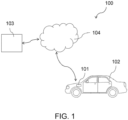
- Figure 1 shows a non-limiting example of embodiment of a system adapted to implement a method for detecting and validating anomalous stresses of a transportation vehicle recorded and transmitted to a remote processing station by an on-board device adapted to acquire data relative to motion and/or driving parameters of a transportation vehicle.
- Such system indicated by numeric reference numeral 100 as a whole, comprises an on-board device 101 installed on a transportation vehicle 102.
- the transportation vehicle 102 is, for example, a car, but it could also be a truck, a motorcycle or a means of public transport, such as, for example, a bus.
- validating an anomalous stress of a transportation vehicle means classifying such anomalous stress, previously only recorded and transmitted by the on-board device, as “true” or “false”, so as to be able to eliminate false alarms (anomalous stresses not caused by an accidental crash or the rollover of the transportation vehicle itself) and to be able to successively supply only the anomalous stresses actually caused by accidents to which a vehicle may have been subjected ("true” anomalous stresses) to an operator for management from the insurance point of view.
- the system 100 further comprises at least one remote processing station 103, e.g. an electronic computer server, operatively connected to the on-board device 101 by means of a data communication network 104.
- a remote processing station 103 e.g. an electronic computer server
- the data communication network 104 e.g. a GSM cellular telephony network, allows data transmission between the on-board device 101 and the remote processing station 103.
- the data transmission between the on-board device 101 and the remote processing station 103 is preferably of the two-way type.
- the on-board device 101 is a hardware and software system configured to acquire data related to motion and/or driving parameters of a transportation vehicle 102.
- the on-board device 101 is configured to record and transmit data representing anomalous stresses (triggers) of the transportation vehicle 102, recorded on the basis of such acquired data, to the remote processing station 103 by means of the data communication network 104.
- the remote processing control unit 103 is instead configured to further receive and process data acquired and processed by a plurality of on-board devices 101 installed aboard respective transportation vehicles 102. It is worth noting that a very high number of the transportation vehicles can be managed by the remote processing station 103, e.g. in the order of a few hundreds of thousands or of millions.
- the remote processing station 103 is a hardware and software system configured to monitor the transportation vehicles, e.g. in order to evaluate risk factors when driving them and the driving habits of the vehicle drivers, to receive requests for help and/or rescue, to detect accidents, to detect thefts, and so on.
- the remote processing station 103 is configured to validate the anomalous stresses recorded and transmitted to the remote processing station 103 by the on-board device 101, on the basis of the acquired data related to motion and/or driving parameters of the transportation vehicle 102.
- the on-board device 101 is instead configured to detect the anomalous stresses.
- the data it acquires, related to motion and/or driving parameters of a transportation vehicle 102 are preferably of accelerometric type.
- the on-board device 101 comprises one or more biaxial or triaxial digital inertia type sensors (accelerometer and/or gyroscope), not shown in the figure 1 .
- the on-board device 101 further comprises a local processing unit, not shown in the figures, configured for managing the on-board device 101 and for processing and transmitting processed data and receiving possible configuration, diagnostic or remote control data.
- the data is transmitted and received by the on-board device 101 by means of a local data communication unit (not shown in the figures), operatively connected to the local data processing unit, which makes it possible for the on-board device 101 to interface with the data communication network 104.
- the local processing unit is configured to record data representative of anomalous stresses (triggers) on the basis of the data acquired by the on-board device 101.
- the local processing unit of the on-board device 101 is configured to load and run one or more set program codes, previously stored in the local memory unit (not shown in the figures) of the on-board device 101.
- the local processing unit of the on-board device 101 is configured to read in real time the data acquired by the accelerometer type sensor and to detect anything which is not compatible with the behavior of the transportation vehicle during its normal use.
- the local processing unit of the on-board device 101 is configured to compare the trend of the transportation vehicle detected with a plurality of reference profiles, each representative of the acceleration of the transportation vehicle in case of a set crash. After having identified the reference profile which comes closest to the acceleration trend of the detected transportation vehicle, the local processing unit of the on-board device is configured to establish whether the detected anomalous stress represents a priority event or not on the basis of the energy content of the reference profile.
- the detected anomalous stress corresponds to a priority event (actual crash).
- the detected anomalous stress corresponds to a secondary event (mini-crash).
- the local processing unit of the on-board device 101 is configured to store in the local memory unit the acceleration trend of the transportation vehicle 102, acquired by the accelerometric type sensor, in a set format, having a sampling frequency preferably of 200 Hz, and total time duration preferably equal to 6 seconds (4 seconds before the anomalous stress, 1 second related to the anomalous stress, 1 second after the anomalous stress) for anomalous stresses representative of a priority event (crash) and preferably equal to 3 seconds (1 second before the anomalous stress, 1 second related to the anomalous stress, 1 second after the anomalous stress) for anomalous stresses representative of a secondary event (mini-crash).
- the local processing unit of the on-board device 101 is configured to filter the acceleration samples received from the accelerometric type sensor, e.g. using a 4-sample moving average filter.
- the local processing unit of the on-board device 101 is further configured to record an anomalous stress on the basis of the filtered accelerometric sample processing, preferably using a so-called triggering algorithm.
- One or more accelerometric threshold values and a corresponding time interval are defined according to such triggering algorithm.
- the accelerometric thresholds are preferably expressed in g, whilst the time durations are preferably expressed in sample units related to an acquisition with sampling frequency at 100 Hz.
- a first accelerometric component Sx corresponding to a set of accelerometric samples T1 recorded on the x axis of the accelerometric triad of the sensor
- a second accelerometric component Sy corresponding to a second set of accelerometric samples T1 recorded on the y axis of the accelerometric triad of the sensor
- a third accelerometric component Sz corresponding to a third set of accelerometric samples T1 recorded on the z axis of the accelerometric triad of the sensor
- the local processing unit of the on-board device 101 is configured to record data representative of anomalous stresses (triggers) if in an event at least one of the components Sx and Sy exceeds the threshold A1, for a number of samples either higher than or equal to the time threshold.
- the local processing unit of the on-board device 101 may be optionally configured to implement further conditions (for example, by defining further acceleration thresholds, time thresholds and/or other conditions) in order to record data representative of anomalous stresses (triggers) of priority type (crash) or of secondary type (mini-crash) or to reject the event itself.
- further conditions for example, by defining further acceleration thresholds, time thresholds and/or other conditions
- the local processing unit of the on-board device 101 is configured to transmit the recorded data representative of anomalous stresses to the remote processing station 103.
- the local processing unit of the on-board device 101 is configured to transmit in real time the data representative of anomalous stresses (triggers) of the priority type (crash) and to transmit at a set time the data representative of anomalous stresses (triggers) of the secondary type (mini-crash).
- the set time may be, for example, when the local processing unit of the on-board device 101 is saturated and must be emptied.
- the remote processing station 103 is configured to validate such anomalous stresses once data representative of anomalous stresses recorded on the basis of the data acquired by the on-board device 101 are received from the on-board device 101 of the transportation vehicle 102.
- a method 200 for detecting and validating anomalous stresses of a transportation vehicle 102 recorded and transmitted to a remote processing station 103 by an on-board device 101 adapted to acquire data relative to motion and/or driving parameters of a transportation vehicle 102 will now be described with reference to figure 2 .
- the aforesaid method 200 for detecting and validating the anomalous stresses makes it advantageously possible to extract only the stresses recorded and transmitted by the on-board device 101 which are representative of events, such as crashes or accidents, to be signaled to an operator for management from an insurance or road safety point of view.
- the method 200 comprises a symbolic step of starting ST.
- the method 200 comprise a step of acquiring 21, by one or more sensors with which the on-board device 101 installed on a transportation vehicle 102 is equipped, data relative to motion and/or driving parameters of a transportation vehicle 102.
- the method 200 further comprises a step of recording 22, by a local processing unit with which the on-board device 101 is equipped, data representative of anomalous stresses of the transportation vehicle 102 on the basis of the data acquired by the on-board device 101.
- the step of recording 22 comprises a step of comparing, by the local processing unit of the on-board device 101, the acceleration trend of the transportation vehicle detected with a plurality of reference profiles, each representative of the acceleration of the transportation vehicle in the case of a set collision.
- the step of recording 22 further comprises a step of establishing, by the local processing unit of the on-board device 101, whether the detected anomalous stress represents a priority event or not, on the basis of the energy content of the reference profile.
- the method 200 further comprises a step of transmitting 23 to the remote processing station 103, by the local processing unit of the on-board device 101, the data recorded representative of anomalous stresses.
- the step of transmitting 23 comprises a step of transmitting in real time the data representative of anomalous stresses (triggers) of priority type (crashes) and at a set later time the data representative of anomalous stresses (triggers) of the secondary type (mini-crashes).
- the method 200 comprises a step of providing 201, by the remote processing station 103, a database of data representative of basic anomalous stresses of true type and a database of data representative of basic anomalous stresses of false type.
- the method 200 further comprises a step of applying 202, by the remote processing station 103, at least one first correlation filter based on a neural network to the data representative of an anomalous stress to be validated, recorded and transmitted by the on-board device 101.
- such neural network is based on the comparison of some parameters with the reference database.
- the signal energy and the mean and peak values of the accelerations on the three axes are taken into consideration.
- the step of applying 202 at least one first correlation filter based on neural network comprises the steps of:
- the method 200 comprises a symbolic step of ending ED.
- the step of validating 204, by the remote processing station 103, the anomalous stress represented by the data representative of the anomalous stress received by the on-board device 101 as a true event comprises a step of assigning 204' a first binary value, e.g. "0", to the anomalous stress.
- the step of validating 205, by the remote processing station 103, the anomalous stress represented by the data representative of the anomalous stress received by the on-board device 101 as a true event comprises a step of assigning 205' a second binary value, e.g. "1", opposite to said first binary value, to the anomalous stress.
- the step of applying 202 further comprises a step of updating 206, by the remote processing station 103, both the data stored in the database of data representative of basic anomalous stresses of the true type and the data stored in the database of data representative of basic anomalous stresses of false type on the basis of the data representative of an anomalous stress received by the on-board device 101 compared therewith.
- the method 200 further comprises a step of applying 207, by the remote processing station 103, at least one second frequency filter of FFT type to the data representative of an anomalous stress to be validated, recorded and transmitted by the on-board device 101.
- Such step of applying 207 the second frequency filter of FFT type comprises the steps of:
- the step of validating 211, by the remote processing station 103, the anomalous stress represented by the data representative of the anomalous stress received by the on-board device 101 as a true or false event comprises a step of assigning 211' a first binary value, e.g. "0", or a second binary value, e.g. "1", opposite to said first binary value, to the anomalous stress.
- the method 200 further comprises a step of applying 212, by the remote processing station 103, a third filter (excessive crash filter) to the data representative of an anomalous stress to be validated, recorded and transmitted by the on-board device 101.
- a third filter excessive crash filter
- the step of applying 212 the third filter comprises the steps of:
- the anomalous stress recorded by the on-board device 101 in the set time interval is higher than the parameter representing the maximum number of stresses which can be recorded by the on-board device 101, the anomalous stress recorded by the on-board device 101 will be validated, by the remote processing station 103, as a false event.
- the method 200 envisages the application of the second filter and of the third filter (or in general of N filters) every time.
- the combination matrix of the N filters very simple and following the "or" pattern repeated N-1 times, envisages that an event must have passed all the N filters in order to be validated.
- the step of validating 215, by the remote processing station 103, the anomalous stress represented by the data representative of the anomalous stress received by the on-board device 101 as a true or false event comprises a step of assigning 215' a first binary value, e.g. "0", or a second binary value, e.g. "1", opposite to said first binary value, to the anomalous stress.
- the method 200 can comprise a step of mutually combining in OR the validation of an anomalous stress obtained after applying at least two of said at least one first filter, a second filter or a third filter.
- the method 200 further comprises a step of classifying the validated anomalous stresses, by the remote processing station 103, on the basis of the acceleration detected on the on-board device 101 at an anomalous stress and the comparison of such detected acceleration with a set reference acceleration value.
- the method 200 further comprises a step of storing, in a remote memory unit, for each validated and classified anomalous stress, information representative of the type of impact (front crash, rear crash, side crash) as a function of the direction of the force received by the on-board device during the anomalous stress, the number of accelerations to which it was subjected, the energy index and the position.
- the event can be classified according to the most common impact dynamics.
- a program product can be loaded in a memory unit of an electronic computer.
- the program product can be run by a data processing unit of the electronic computer in order to run the method for detecting and validating anomalous stresses according to any one of the embodiments described above.
- the program product comprises a first program product which can be loaded in a memory of the on-board device 101 and can be run by a data processing unit of the on-board device 101, to detect the anomalous stresses according to any one of the embodiments described above.
- the program product comprises a second program product which can be loaded in a memory of the remote processing station 103 and can be run by a data processing unit of the remote processing station 103, to validate it according to any one of the embodiments described above.
Landscapes
- Physics & Mathematics (AREA)
- General Physics & Mathematics (AREA)
- Engineering & Computer Science (AREA)
- Automation & Control Theory (AREA)
- Mechanical Engineering (AREA)
- Traffic Control Systems (AREA)
- Electric Propulsion And Braking For Vehicles (AREA)
- Measuring Fluid Pressure (AREA)
- Feeding And Guiding Record Carriers (AREA)
- Train Traffic Observation, Control, And Security (AREA)
- Mobile Radio Communication Systems (AREA)
Claims (12)
- Procédé (200) de détection et de validation de contraintes anormales d'un véhicule de transport (102) enregistrées et transmises à une station de traitement à distance (103) par un dispositif embarqué (101) adapté à l'acquisition de données relatives à des paramètres de mouvement et/ou de conduite d'un véhicule de transport (102), consistant à :- acquérir (21), par un ou plusieurs capteurs dont est équipé le dispositif embarqué (101) installé sur un véhicule de transport (102), des données relatives à des paramètres de mouvement et/ou de conduite d'un véhicule de transport (102) ;- enregistrer (22), par une unité de traitement locale dont est équipé le dispositif embarqué (101), des données représentatives d'une contrainte anormale du véhicule (102) sur la base des données acquises par le dispositif embarqué (101), l'étape d'enregistrement (22) comprenant une étape de comparaison, par l'unité de traitement locale du dispositif embarqué (101), de la tendance de l'accélération du véhicule de transport (102) détectée à une pluralité de profils de référence chacun représentatifs de l'accélération du véhicule de transport (102) en cas de collision définie, dans lequel, une fois que le profil de référence qui se rapproche le plus du schéma d'accélération du véhicule de transport détecté a été identifié, l'étape d'enregistrement (22) comprenant également une étape consistant à établir, par l'unité de traitement locale du dispositif embarqué (101), si la contrainte anormale détectée représente un événement prioritaire ou non, sur la base du contenu énergétique du profil de référence ;- transmettre (23) à la station de traitement à distance (103), par l'unité de traitement locale du dispositif embarqué (101), les données enregistrées représentatives d'une contrainte anormale, l'étape de transmission (23) comprenant une étape de transmission en temps réel des données représentatives des contraintes anormales du type prioritaire et à un moment ultérieur défini des données représentatives des contraintes anormales du type secondaire, stockées dans une unité de mémoire locale du dispositif embarqué (101) ;- fournir (201), par la station de traitement à distance (103), une base de données représentative des contraintes anormales de base de vrai type et une base de données représentative des contraintes anormales de base de faux type ;- appliquer (202) aux données représentatives d'une contrainte anormale à valider, enregistrer et transmettre par le dispositif embarqué (101), par la station de traitement à distance (103), au moins un premier filtre à corrélation basé sur un réseau neuronal, l'étape d'application (202) d'au moins un premier filtre à corrélation comprenant les étapes consistant à :- comparer (203), par la station de traitement à distance (103), les données représentatives d'une contrainte anormale reçues par le dispositif embarqué (101) aux données stockées dans la base de données de données représentatives de contraintes anormales de base de vrai type et dans la base de données de données représentatives de contraintes anormales de base de faux type, respectivement ;- si les données représentatives d'une contrainte anormale reçues par le dispositif embarqué (101) correspondent à des données stockées dans la base de données de données représentatives de contraintes anormales de base de vrai type, valider (204), par la station de traitement à distance (103), la contrainte anormale représentée par les données représentatives de la contrainte anormale reçues par le dispositif embarqué (101) en tant qu'événement vrai ;- si les données représentatives d'une contrainte anormale reçues par le dispositif embarqué (101) correspondent à des données stockées dans la base de données de données représentatives de contraintes anormales de base de faux type, valider (205) la contrainte anormale représentée par les données représentatives de la contrainte anormale reçues par le dispositif embarqué (101) en tant qu'événement faux.
- Procédé (200) selon la revendication 1, dans lequel l'étape de validation (204), par la station de traitement à distance (103), de la contrainte anormale représentée par les données représentatives de la contrainte anormale reçues par le dispositif embarqué (101) en tant qu'événement vrai comprend une étape d'attribution (204') d'une première valeur binaire à la contrainte anormale.
- Procédé (200) selon la revendication 2, dans lequel l'étape de validation (205), par la station de traitement à distance (103), de la contrainte anormale représentée par les données représentatives de la contrainte anormale reçues par le dispositif embarqué (101) en tant qu'événement vrai comprend une étape d'attribution (205') d'une seconde valeur binaire, opposée à ladite première valeur binaire, à la contrainte anormale.
- Procédé (200) selon l'une quelconque des revendications précédentes, dans lequel l'étape d'application (202) comprend également une étape de mise à jour (206), par la station de traitement à distance (103), à la fois des données stockées dans la base de données de données représentatives de contraintes anormales de base de vrai type et des données stockées dans la base de données de données représentatives de contraintes anormales de base de faux type sur la base des données représentatives d'une contrainte anormale reçues par le dispositif embarqué (101) comparées à celles-ci.
- Procédé (200) selon l'une quelconque des revendications précédentes, dans lequel l'étape d'application (207) d'un second filtre de fréquence de type FFT aux données représentatives d'une contrainte anormale à valider et à transmettre par le dispositif embarqué (101), par la station de traitement à distance (103), l'étape d'application (207) du second filtre de fréquence de type FFT comprend les étapes consistant :- établir (208) une valeur de fréquence de référence, les valeurs de fréquence inférieures à une telle valeur de fréquence de référence étant représentatives de contraintes anormales d'un premier type provenant des types vrai et faux, les valeurs de fréquence supérieures à une telle valeur de fréquence de référence étant représentatives de contraintes anormales d'un second type, opposé au premier, provenant des types vrai et faux ;- additionner (209) les basses fréquences et les hautes fréquences du signal représentatif des données représentatives d'une contrainte anormale à valider, enregistrer et transmettre par le dispositif embarqué (101) ;- calculer (210) la distance de la valeur de fréquence obtenue à l'étape d'addition avec la valeur de fréquence de référence ;- valider (211), par la station de traitement à distance (103), la contrainte anormale représentée par les données représentatives de la contrainte anormale reçues par le dispositif embarqué (101) en tant qu'événement vrai ou faux sur la base de la valeur de la distance calculée.
- Procédé (200) selon la revendication 5, dans lequel l'étape de validation (211), par la station de traitement à distance (103), de la contrainte anormale représentée par les données représentatives de la contrainte anormale reçues par le dispositif embarqué (101) en tant qu'événement vrai ou faux comprend une étape d'attribution (211') d'une première valeur binaire ou d'une seconde valeur binaire, opposée à ladite première valeur binaire, à la contrainte anormale.
- Procédé (200) selon l'une quelconque des revendications précédentes, comprenant également une étape d'application (212) d'un troisième filtre aux données représentatives d'une contrainte anormale à valider, à enregistrer et à transmettre par le dispositif embarqué (101), par la station de traitement à distance (103), l'étape d'application (212) du troisième filtre comprend les étapes consistant à :- établir (213), par la station de traitement à distance (103), un paramètre représentatif du nombre maximal de contraintes anormales enregistrables par le dispositif embarqué monté sur un véhicule de transport dans une période de temps définie ;- compter (214), par la station de traitement à distance (103), le nombre de contraintes anormales reçues dans la période de temps définie par un même dispositif embarqué (101) ;- valider (215), par la station de traitement à distance (103), la contrainte anormale représentée par les données représentatives de la contrainte anormale reçues par le dispositif embarqué (101) en tant qu'événement vrai ou faux sur la base de la comparaison entre le nombre de contraintes anormales enregistrées et transmises par le dispositif embarqué (101) dans la période de temps définie et le paramètre représentatif du nombre maximal de contraintes anormales enregistrables par le dispositif embarqué (101).
- Procédé (200) selon la revendication 7, dans lequel l'étape de validation (215), par la station de traitement à distance (103), de la contrainte anormale représentée par les données représentatives de la contrainte anormale reçues par le dispositif embarqué (101) en tant qu'événement vrai ou faux comprend une étape d'attribution (215') d'une première valeur binaire, ou d'une seconde valeur binaire, opposée à ladite première valeur binaire, à la contrainte anormale.
- Procédé (200) selon l'une quelconque des revendications précédentes, comprenant également une étape de classement des contraintes anormales validées, par la station de traitement à distance (103), sur la base de l'accélération détectée sur le dispositif embarqué (101) au niveau d'une contrainte anormale et de la comparaison d'une telle accélération détectée à une valeur d'accélération de référence définie.
- Procédé (200) selon la revendication 9, comprenant également une étape de stockage, par la station de traitement à distance (103), dans une unité de mémoire à distance, pour chaque contrainte anormale validée et classée, d'informations représentatives du type d'impact en fonction de la direction de la force reçue par le dispositif embarqué pendant la contrainte anormale, du nombre d'accélérations subies, de l'indice d'énergie et de la position.
- Système (100) de détection et de validation de contraintes anormales d'un véhicule de transport enregistrées et transmises à une station de traitement à distance (103) par un dispositif embarqué (101) adapté à l'acquisition de données relatives à des paramètres de mouvement et/ou de conduite d'un véhicule de transport (102), le système (100) comprenant :- un dispositif embarqué (101) installé sur un véhicule de transport (102),- au moins une station de traitement à distance (103) fonctionnellement reliée au dispositif embarqué (101) par l'intermédiaire d'un réseau de communication de données (104),le dispositif embarqué (101) et ladite au moins une station de traitement à distance (103) étant configurés pour mettre en oeuvre le procédé de détection et de validation (200) selon l'une quelconque des revendications précédentes.
- Produit-programme pouvant être chargé dans une unité de mémoire d'une calculatrice électronique, le produit-programme pouvant être exécuté par un processeur de données de la calculatrice électronique pour exécuter le procédé de validation (200) selon l'une quelconque des revendications précédentes 1 à 10.
Applications Claiming Priority (2)
| Application Number | Priority Date | Filing Date | Title |
|---|---|---|---|
| IT102016000081122A IT201600081122A1 (it) | 2016-08-02 | 2016-08-02 | Metodo di rilevamento e validazione di sollecitazioni anomale di un veicolo di trasporto registrate da un dispositivo di bordo atto ad acquisire dati relativi a parametri di moto e/o di guida di un veicolo di trasporto |
| PCT/IB2017/054718 WO2018025194A1 (fr) | 2016-08-02 | 2017-08-02 | Procédé de détection et de validation de contraintes anormales d'un véhicule de transport enregistrées par un dispositif embarqué adapté à l'acquisition de données relatives à des paramètres de mouvement et/ou de conduite d'un véhicule de transport |
Publications (2)
| Publication Number | Publication Date |
|---|---|
| EP3494552A1 EP3494552A1 (fr) | 2019-06-12 |
| EP3494552B1 true EP3494552B1 (fr) | 2024-08-14 |
Family
ID=57610269
Family Applications (1)
| Application Number | Title | Priority Date | Filing Date |
|---|---|---|---|
| EP17761126.6A Active EP3494552B1 (fr) | 2016-08-02 | 2017-08-02 | Procédé de détection et de validation de contraintes anormales d'un véhicule de transport enregistrées par un dispositif embarqué adapté à l'acquisition de données relatives à des paramètres de mouvement et/ou de conduite d'un véhicule de transport |
Country Status (9)
| Country | Link |
|---|---|
| US (1) | US20190236861A1 (fr) |
| EP (1) | EP3494552B1 (fr) |
| JP (1) | JP2019523486A (fr) |
| CN (1) | CN109791709B (fr) |
| CA (1) | CA3028996C (fr) |
| ES (1) | ES2986775T3 (fr) |
| IT (1) | IT201600081122A1 (fr) |
| RU (1) | RU2751385C2 (fr) |
| WO (1) | WO2018025194A1 (fr) |
Families Citing this family (27)
| Publication number | Priority date | Publication date | Assignee | Title |
|---|---|---|---|---|
| ES2736901A1 (es) | 2018-06-29 | 2020-01-08 | Geotab Inc | Caracterización de una colisión de vehículo |
| US11775816B2 (en) | 2019-08-12 | 2023-10-03 | Micron Technology, Inc. | Storage and access of neural network outputs in automotive predictive maintenance |
| US11748626B2 (en) | 2019-08-12 | 2023-09-05 | Micron Technology, Inc. | Storage devices with neural network accelerators for automotive predictive maintenance |
| US11853863B2 (en) | 2019-08-12 | 2023-12-26 | Micron Technology, Inc. | Predictive maintenance of automotive tires |
| US11635893B2 (en) | 2019-08-12 | 2023-04-25 | Micron Technology, Inc. | Communications between processors and storage devices in automotive predictive maintenance implemented via artificial neural networks |
| US12249189B2 (en) | 2019-08-12 | 2025-03-11 | Micron Technology, Inc. | Predictive maintenance of automotive lighting |
| US11586194B2 (en) | 2019-08-12 | 2023-02-21 | Micron Technology, Inc. | Storage and access of neural network models of automotive predictive maintenance |
| US11586943B2 (en) | 2019-08-12 | 2023-02-21 | Micron Technology, Inc. | Storage and access of neural network inputs in automotive predictive maintenance |
| US12061971B2 (en) | 2019-08-12 | 2024-08-13 | Micron Technology, Inc. | Predictive maintenance of automotive engines |
| US12497055B2 (en) * | 2019-08-21 | 2025-12-16 | Micron Technology, Inc. | Monitoring controller area network bus for vehicle control |
| US11042350B2 (en) | 2019-08-21 | 2021-06-22 | Micron Technology, Inc. | Intelligent audio control in vehicles |
| US11498388B2 (en) | 2019-08-21 | 2022-11-15 | Micron Technology, Inc. | Intelligent climate control in vehicles |
| US11702086B2 (en) | 2019-08-21 | 2023-07-18 | Micron Technology, Inc. | Intelligent recording of errant vehicle behaviors |
| CN110519362B (zh) * | 2019-08-22 | 2022-04-05 | 东软睿驰汽车技术(沈阳)有限公司 | 一种数据上传方法以及装置 |
| US11435946B2 (en) | 2019-09-05 | 2022-09-06 | Micron Technology, Inc. | Intelligent wear leveling with reduced write-amplification for data storage devices configured on autonomous vehicles |
| US11693562B2 (en) | 2019-09-05 | 2023-07-04 | Micron Technology, Inc. | Bandwidth optimization for different types of operations scheduled in a data storage device |
| US11650746B2 (en) | 2019-09-05 | 2023-05-16 | Micron Technology, Inc. | Intelligent write-amplification reduction for data storage devices configured on autonomous vehicles |
| US12210401B2 (en) | 2019-09-05 | 2025-01-28 | Micron Technology, Inc. | Temperature based optimization of data storage operations |
| US11250648B2 (en) | 2019-12-18 | 2022-02-15 | Micron Technology, Inc. | Predictive maintenance of automotive transmission |
| US11531339B2 (en) | 2020-02-14 | 2022-12-20 | Micron Technology, Inc. | Monitoring of drive by wire sensors in vehicles |
| US11709625B2 (en) | 2020-02-14 | 2023-07-25 | Micron Technology, Inc. | Optimization of power usage of data storage devices |
| CN112504522B (zh) * | 2020-11-27 | 2021-08-03 | 武汉大学 | 一种基于类脑计算的微压力传感器 |
| KR102580586B1 (ko) * | 2020-12-30 | 2023-09-20 | 세메스 주식회사 | 비히클의 처리 방법 |
| US11862022B2 (en) | 2021-02-03 | 2024-01-02 | Geotab Inc. | Methods for characterizing a vehicle collision |
| US12025632B2 (en) | 2021-09-30 | 2024-07-02 | Geotab Inc. | Low-power acceleration detection in a telematics device |
| US12397785B1 (en) | 2024-02-09 | 2025-08-26 | Geotab Inc. | Systems and methods for detecting vehicle collisions |
| US20250294121A1 (en) | 2024-03-18 | 2025-09-18 | Geotab Inc. | Systems, devices, and methods for communicating vehicle-related image data |
Family Cites Families (8)
| Publication number | Priority date | Publication date | Assignee | Title |
|---|---|---|---|---|
| DE10206351B4 (de) * | 2002-02-14 | 2004-08-05 | Daimlerchrysler Ag | Verfahren und Vorrichtung zum Personen- und Kollisionsschutz an einem Fahrzeug |
| US6909985B2 (en) * | 2002-11-27 | 2005-06-21 | Lockheed Martin Corporation | Method and apparatus for recording changes associated with acceleration of a structure |
| HK1204132A1 (en) * | 2012-01-13 | 2015-11-06 | Pulse Function F6 Limited | Telematics system with 3d inertial sensors |
| DE102013203943A1 (de) * | 2013-03-07 | 2014-09-11 | Robert Bosch Gmbh | Vorrichtung, Verfahren und System zum Verarbeiten von Daten eines Fahrzeugs |
| IN2013MU02326A (fr) * | 2013-07-10 | 2015-06-19 | Tata Consultancy Services Ltd | |
| US9392431B2 (en) * | 2014-09-30 | 2016-07-12 | Verizon Patent And Licensing Inc. | Automatic vehicle crash detection using onboard devices |
| DE102015210968A1 (de) * | 2015-06-15 | 2016-12-15 | Continental Automotive Gmbh | Verfahren zum Erkennen eines Überschlags eines Kraftfahrzeugs |
| WO2017160275A1 (fr) * | 2016-03-15 | 2017-09-21 | Ford Global Technologies Llc | Détection d'impacts faibles pour véhicule utilisant un faible surdébit de calcul |
-
2016
- 2016-08-02 IT IT102016000081122A patent/IT201600081122A1/it unknown
-
2017
- 2017-08-02 ES ES17761126T patent/ES2986775T3/es active Active
- 2017-08-02 CN CN201780045116.9A patent/CN109791709B/zh active Active
- 2017-08-02 RU RU2019100714A patent/RU2751385C2/ru active
- 2017-08-02 US US16/318,009 patent/US20190236861A1/en not_active Abandoned
- 2017-08-02 EP EP17761126.6A patent/EP3494552B1/fr active Active
- 2017-08-02 JP JP2018569042A patent/JP2019523486A/ja active Pending
- 2017-08-02 WO PCT/IB2017/054718 patent/WO2018025194A1/fr not_active Ceased
- 2017-08-02 CA CA3028996A patent/CA3028996C/fr active Active
Also Published As
| Publication number | Publication date |
|---|---|
| CN109791709B (zh) | 2022-04-12 |
| CA3028996C (fr) | 2025-07-08 |
| JP2019523486A (ja) | 2019-08-22 |
| ES2986775T3 (es) | 2024-11-12 |
| RU2019100714A (ru) | 2020-07-15 |
| US20190236861A1 (en) | 2019-08-01 |
| EP3494552A1 (fr) | 2019-06-12 |
| WO2018025194A1 (fr) | 2018-02-08 |
| RU2751385C2 (ru) | 2021-07-13 |
| IT201600081122A1 (it) | 2018-02-02 |
| RU2019100714A3 (fr) | 2021-05-21 |
| CA3028996A1 (fr) | 2018-02-08 |
| CN109791709A (zh) | 2019-05-21 |
Similar Documents
| Publication | Publication Date | Title |
|---|---|---|
| EP3494552B1 (fr) | Procédé de détection et de validation de contraintes anormales d'un véhicule de transport enregistrées par un dispositif embarqué adapté à l'acquisition de données relatives à des paramètres de mouvement et/ou de conduite d'un véhicule de transport | |
| US9688282B2 (en) | Driver risk assessment system and method employing automated driver log | |
| US9685098B1 (en) | Driver compliance risk adjustments | |
| US20150006023A1 (en) | System and method for determination of vheicle accident information | |
| US9824064B2 (en) | System and method for use of pattern recognition in assessing or monitoring vehicle status or operator driving behavior | |
| US10311749B1 (en) | Safety score based on compliance and driving | |
| US11769332B2 (en) | Sensor fusion for collision detection | |
| US20130297095A1 (en) | Intelligent Fleet Management System and Method | |
| EP4335703A2 (fr) | Systèmes et procédés de détection d'activité malveillante dans des réseaux de communication de données de véhicule | |
| US20130282228A1 (en) | Even driven data acquisition switch | |
| US20150039174A1 (en) | Vehicular Communication Device and Communication Management System | |
| EP2930697A1 (fr) | Procédé et dispositif pour traiter des données d'état d'un véhicule | |
| AU2017225115B2 (en) | A method of determining if a vehicle has been stolen and a system therefor | |
| US10861260B2 (en) | Driving behaviour monitoring systems | |
| CN108062856B (zh) | 一种基于车载obd接口的车辆碰撞检测系统及方法 | |
| US10282922B1 (en) | Techniques for detecting and reporting a vehicle crash | |
| CA3055944C (fr) | Detection automatique en temps reel d'incidents lies a des vehicules | |
| US11288529B2 (en) | Systems and methods for determining vehicle occupancy rate | |
| KR20140147298A (ko) | 디지털 운행기록 장치 | |
| Schietekat et al. | Detection of reckless driving in the Sub-Saharan informal public transportation system using acceleration-sensing telematics | |
| CN115063904A (zh) | 一种车机端事件相关行车记录方法及系统 | |
| CN111382631B (zh) | 识别方法、识别装置、终端、服务器和存储介质 | |
| DE102020116455A1 (de) | Kraftfahrzeug-Diebstahl-Meldeanordnung | |
| KR102709792B1 (ko) | Fms 교통사고 자동통보 장치 및 방법 | |
| KR20110066885A (ko) | 지능형 차량 정보 저장 장치 |
Legal Events
| Date | Code | Title | Description |
|---|---|---|---|
| STAA | Information on the status of an ep patent application or granted ep patent |
Free format text: STATUS: UNKNOWN |
|
| STAA | Information on the status of an ep patent application or granted ep patent |
Free format text: STATUS: THE INTERNATIONAL PUBLICATION HAS BEEN MADE |
|
| PUAI | Public reference made under article 153(3) epc to a published international application that has entered the european phase |
Free format text: ORIGINAL CODE: 0009012 |
|
| STAA | Information on the status of an ep patent application or granted ep patent |
Free format text: STATUS: REQUEST FOR EXAMINATION WAS MADE |
|
| 17P | Request for examination filed |
Effective date: 20181219 |
|
| AK | Designated contracting states |
Kind code of ref document: A1 Designated state(s): AL AT BE BG CH CY CZ DE DK EE ES FI FR GB GR HR HU IE IS IT LI LT LU LV MC MK MT NL NO PL PT RO RS SE SI SK SM TR |
|
| AX | Request for extension of the european patent |
Extension state: BA ME |
|
| DAV | Request for validation of the european patent (deleted) | ||
| DAX | Request for extension of the european patent (deleted) | ||
| GRAP | Despatch of communication of intention to grant a patent |
Free format text: ORIGINAL CODE: EPIDOSNIGR1 |
|
| STAA | Information on the status of an ep patent application or granted ep patent |
Free format text: STATUS: GRANT OF PATENT IS INTENDED |
|
| INTG | Intention to grant announced |
Effective date: 20230817 |
|
| GRAJ | Information related to disapproval of communication of intention to grant by the applicant or resumption of examination proceedings by the epo deleted |
Free format text: ORIGINAL CODE: EPIDOSDIGR1 |
|
| STAA | Information on the status of an ep patent application or granted ep patent |
Free format text: STATUS: REQUEST FOR EXAMINATION WAS MADE |
|
| INTC | Intention to grant announced (deleted) | ||
| GRAS | Grant fee paid |
Free format text: ORIGINAL CODE: EPIDOSNIGR3 |
|
| STAA | Information on the status of an ep patent application or granted ep patent |
Free format text: STATUS: GRANT OF PATENT IS INTENDED |
|
| GRAP | Despatch of communication of intention to grant a patent |
Free format text: ORIGINAL CODE: EPIDOSNIGR1 |
|
| INTG | Intention to grant announced |
Effective date: 20240222 |
|
| GRAA | (expected) grant |
Free format text: ORIGINAL CODE: 0009210 |
|
| STAA | Information on the status of an ep patent application or granted ep patent |
Free format text: STATUS: THE PATENT HAS BEEN GRANTED |
|
| AK | Designated contracting states |
Kind code of ref document: B1 Designated state(s): AL AT BE BG CH CY CZ DE DK EE ES FI FR GB GR HR HU IE IS IT LI LT LU LV MC MK MT NL NO PL PT RO RS SE SI SK SM TR |
|
| REG | Reference to a national code |
Ref country code: GB Ref legal event code: FG4D |
|
| REG | Reference to a national code |
Ref country code: CH Ref legal event code: EP |
|
| REG | Reference to a national code |
Ref country code: DE Ref legal event code: R096 Ref document number: 602017084072 Country of ref document: DE |
|
| REG | Reference to a national code |
Ref country code: IE Ref legal event code: FG4D |
|
| REG | Reference to a national code |
Ref country code: ES Ref legal event code: FG2A Ref document number: 2986775 Country of ref document: ES Kind code of ref document: T3 Effective date: 20241112 |
|
| REG | Reference to a national code |
Ref country code: LT Ref legal event code: MG9D |
|
| REG | Reference to a national code |
Ref country code: NL Ref legal event code: MP Effective date: 20240814 |
|
| PG25 | Lapsed in a contracting state [announced via postgrant information from national office to epo] |
Ref country code: NO Free format text: LAPSE BECAUSE OF FAILURE TO SUBMIT A TRANSLATION OF THE DESCRIPTION OR TO PAY THE FEE WITHIN THE PRESCRIBED TIME-LIMIT Effective date: 20241114 |
|
| REG | Reference to a national code |
Ref country code: AT Ref legal event code: MK05 Ref document number: 1714037 Country of ref document: AT Kind code of ref document: T Effective date: 20240814 |
|
| PG25 | Lapsed in a contracting state [announced via postgrant information from national office to epo] |
Ref country code: FI Free format text: LAPSE BECAUSE OF FAILURE TO SUBMIT A TRANSLATION OF THE DESCRIPTION OR TO PAY THE FEE WITHIN THE PRESCRIBED TIME-LIMIT Effective date: 20240814 Ref country code: GR Free format text: LAPSE BECAUSE OF FAILURE TO SUBMIT A TRANSLATION OF THE DESCRIPTION OR TO PAY THE FEE WITHIN THE PRESCRIBED TIME-LIMIT Effective date: 20241115 Ref country code: NL Free format text: LAPSE BECAUSE OF FAILURE TO SUBMIT A TRANSLATION OF THE DESCRIPTION OR TO PAY THE FEE WITHIN THE PRESCRIBED TIME-LIMIT Effective date: 20240814 Ref country code: PT Free format text: LAPSE BECAUSE OF FAILURE TO SUBMIT A TRANSLATION OF THE DESCRIPTION OR TO PAY THE FEE WITHIN THE PRESCRIBED TIME-LIMIT Effective date: 20241216 Ref country code: PL Free format text: LAPSE BECAUSE OF FAILURE TO SUBMIT A TRANSLATION OF THE DESCRIPTION OR TO PAY THE FEE WITHIN THE PRESCRIBED TIME-LIMIT Effective date: 20240814 |
|
| PG25 | Lapsed in a contracting state [announced via postgrant information from national office to epo] |
Ref country code: BG Free format text: LAPSE BECAUSE OF FAILURE TO SUBMIT A TRANSLATION OF THE DESCRIPTION OR TO PAY THE FEE WITHIN THE PRESCRIBED TIME-LIMIT Effective date: 20240814 |
|
| PG25 | Lapsed in a contracting state [announced via postgrant information from national office to epo] |
Ref country code: LV Free format text: LAPSE BECAUSE OF FAILURE TO SUBMIT A TRANSLATION OF THE DESCRIPTION OR TO PAY THE FEE WITHIN THE PRESCRIBED TIME-LIMIT Effective date: 20240814 |
|
| PG25 | Lapsed in a contracting state [announced via postgrant information from national office to epo] |
Ref country code: AT Free format text: LAPSE BECAUSE OF FAILURE TO SUBMIT A TRANSLATION OF THE DESCRIPTION OR TO PAY THE FEE WITHIN THE PRESCRIBED TIME-LIMIT Effective date: 20240814 Ref country code: IS Free format text: LAPSE BECAUSE OF FAILURE TO SUBMIT A TRANSLATION OF THE DESCRIPTION OR TO PAY THE FEE WITHIN THE PRESCRIBED TIME-LIMIT Effective date: 20241214 |
|
| PG25 | Lapsed in a contracting state [announced via postgrant information from national office to epo] |
Ref country code: HR Free format text: LAPSE BECAUSE OF FAILURE TO SUBMIT A TRANSLATION OF THE DESCRIPTION OR TO PAY THE FEE WITHIN THE PRESCRIBED TIME-LIMIT Effective date: 20240814 |
|
| PG25 | Lapsed in a contracting state [announced via postgrant information from national office to epo] |
Ref country code: RS Free format text: LAPSE BECAUSE OF FAILURE TO SUBMIT A TRANSLATION OF THE DESCRIPTION OR TO PAY THE FEE WITHIN THE PRESCRIBED TIME-LIMIT Effective date: 20241114 |
|
| PG25 | Lapsed in a contracting state [announced via postgrant information from national office to epo] |
Ref country code: RS Free format text: LAPSE BECAUSE OF FAILURE TO SUBMIT A TRANSLATION OF THE DESCRIPTION OR TO PAY THE FEE WITHIN THE PRESCRIBED TIME-LIMIT Effective date: 20241114 Ref country code: PT Free format text: LAPSE BECAUSE OF FAILURE TO SUBMIT A TRANSLATION OF THE DESCRIPTION OR TO PAY THE FEE WITHIN THE PRESCRIBED TIME-LIMIT Effective date: 20241216 Ref country code: PL Free format text: LAPSE BECAUSE OF FAILURE TO SUBMIT A TRANSLATION OF THE DESCRIPTION OR TO PAY THE FEE WITHIN THE PRESCRIBED TIME-LIMIT Effective date: 20240814 Ref country code: NO Free format text: LAPSE BECAUSE OF FAILURE TO SUBMIT A TRANSLATION OF THE DESCRIPTION OR TO PAY THE FEE WITHIN THE PRESCRIBED TIME-LIMIT Effective date: 20241114 Ref country code: NL Free format text: LAPSE BECAUSE OF FAILURE TO SUBMIT A TRANSLATION OF THE DESCRIPTION OR TO PAY THE FEE WITHIN THE PRESCRIBED TIME-LIMIT Effective date: 20240814 Ref country code: LV Free format text: LAPSE BECAUSE OF FAILURE TO SUBMIT A TRANSLATION OF THE DESCRIPTION OR TO PAY THE FEE WITHIN THE PRESCRIBED TIME-LIMIT Effective date: 20240814 Ref country code: IS Free format text: LAPSE BECAUSE OF FAILURE TO SUBMIT A TRANSLATION OF THE DESCRIPTION OR TO PAY THE FEE WITHIN THE PRESCRIBED TIME-LIMIT Effective date: 20241214 Ref country code: HR Free format text: LAPSE BECAUSE OF FAILURE TO SUBMIT A TRANSLATION OF THE DESCRIPTION OR TO PAY THE FEE WITHIN THE PRESCRIBED TIME-LIMIT Effective date: 20240814 Ref country code: GR Free format text: LAPSE BECAUSE OF FAILURE TO SUBMIT A TRANSLATION OF THE DESCRIPTION OR TO PAY THE FEE WITHIN THE PRESCRIBED TIME-LIMIT Effective date: 20241115 Ref country code: FI Free format text: LAPSE BECAUSE OF FAILURE TO SUBMIT A TRANSLATION OF THE DESCRIPTION OR TO PAY THE FEE WITHIN THE PRESCRIBED TIME-LIMIT Effective date: 20240814 Ref country code: BG Free format text: LAPSE BECAUSE OF FAILURE TO SUBMIT A TRANSLATION OF THE DESCRIPTION OR TO PAY THE FEE WITHIN THE PRESCRIBED TIME-LIMIT Effective date: 20240814 Ref country code: AT Free format text: LAPSE BECAUSE OF FAILURE TO SUBMIT A TRANSLATION OF THE DESCRIPTION OR TO PAY THE FEE WITHIN THE PRESCRIBED TIME-LIMIT Effective date: 20240814 |
|
| P01 | Opt-out of the competence of the unified patent court (upc) registered |
Free format text: CASE NUMBER: APP_9692/2025 Effective date: 20250226 |
|
| PG25 | Lapsed in a contracting state [announced via postgrant information from national office to epo] |
Ref country code: RO Free format text: LAPSE BECAUSE OF FAILURE TO SUBMIT A TRANSLATION OF THE DESCRIPTION OR TO PAY THE FEE WITHIN THE PRESCRIBED TIME-LIMIT Effective date: 20240814 Ref country code: DK Free format text: LAPSE BECAUSE OF FAILURE TO SUBMIT A TRANSLATION OF THE DESCRIPTION OR TO PAY THE FEE WITHIN THE PRESCRIBED TIME-LIMIT Effective date: 20240814 Ref country code: SM Free format text: LAPSE BECAUSE OF FAILURE TO SUBMIT A TRANSLATION OF THE DESCRIPTION OR TO PAY THE FEE WITHIN THE PRESCRIBED TIME-LIMIT Effective date: 20240814 |
|
| PG25 | Lapsed in a contracting state [announced via postgrant information from national office to epo] |
Ref country code: EE Free format text: LAPSE BECAUSE OF FAILURE TO SUBMIT A TRANSLATION OF THE DESCRIPTION OR TO PAY THE FEE WITHIN THE PRESCRIBED TIME-LIMIT Effective date: 20240814 |
|
| PG25 | Lapsed in a contracting state [announced via postgrant information from national office to epo] |
Ref country code: CZ Free format text: LAPSE BECAUSE OF FAILURE TO SUBMIT A TRANSLATION OF THE DESCRIPTION OR TO PAY THE FEE WITHIN THE PRESCRIBED TIME-LIMIT Effective date: 20240814 |
|
| PG25 | Lapsed in a contracting state [announced via postgrant information from national office to epo] |
Ref country code: SK Free format text: LAPSE BECAUSE OF FAILURE TO SUBMIT A TRANSLATION OF THE DESCRIPTION OR TO PAY THE FEE WITHIN THE PRESCRIBED TIME-LIMIT Effective date: 20240814 Ref country code: IT Free format text: LAPSE BECAUSE OF FAILURE TO SUBMIT A TRANSLATION OF THE DESCRIPTION OR TO PAY THE FEE WITHIN THE PRESCRIBED TIME-LIMIT Effective date: 20240814 |
|
| REG | Reference to a national code |
Ref country code: DE Ref legal event code: R097 Ref document number: 602017084072 Country of ref document: DE |
|
| PLBE | No opposition filed within time limit |
Free format text: ORIGINAL CODE: 0009261 |
|
| STAA | Information on the status of an ep patent application or granted ep patent |
Free format text: STATUS: NO OPPOSITION FILED WITHIN TIME LIMIT |
|
| PGFP | Annual fee paid to national office [announced via postgrant information from national office to epo] |
Ref country code: GB Payment date: 20250612 Year of fee payment: 9 |
|
| PGFP | Annual fee paid to national office [announced via postgrant information from national office to epo] |
Ref country code: FR Payment date: 20250610 Year of fee payment: 9 |
|
| 26N | No opposition filed |
Effective date: 20250515 |
|
| PG25 | Lapsed in a contracting state [announced via postgrant information from national office to epo] |
Ref country code: SE Free format text: LAPSE BECAUSE OF FAILURE TO SUBMIT A TRANSLATION OF THE DESCRIPTION OR TO PAY THE FEE WITHIN THE PRESCRIBED TIME-LIMIT Effective date: 20240814 |
|
| PGFP | Annual fee paid to national office [announced via postgrant information from national office to epo] |
Ref country code: ES Payment date: 20250905 Year of fee payment: 9 |
|
| PGFP | Annual fee paid to national office [announced via postgrant information from national office to epo] |
Ref country code: DE Payment date: 20250611 Year of fee payment: 9 |
|
| REG | Reference to a national code |
Ref country code: CH Ref legal event code: H13 Free format text: ST27 STATUS EVENT CODE: U-0-0-H10-H13 (AS PROVIDED BY THE NATIONAL OFFICE) Effective date: 20260324 |
|
| PG25 | Lapsed in a contracting state [announced via postgrant information from national office to epo] |
Ref country code: MC Free format text: LAPSE BECAUSE OF FAILURE TO SUBMIT A TRANSLATION OF THE DESCRIPTION OR TO PAY THE FEE WITHIN THE PRESCRIBED TIME-LIMIT Effective date: 20240814 |
|
| PG25 | Lapsed in a contracting state [announced via postgrant information from national office to epo] |
Ref country code: LU Free format text: LAPSE BECAUSE OF NON-PAYMENT OF DUE FEES Effective date: 20250802 |
|
| PG25 | Lapsed in a contracting state [announced via postgrant information from national office to epo] |
Ref country code: CH Free format text: LAPSE BECAUSE OF NON-PAYMENT OF DUE FEES Effective date: 20250831 |