EP3487682B1 - Nachbeschichterwagen - Google Patents
Nachbeschichterwagen Download PDFInfo
- Publication number
- EP3487682B1 EP3487682B1 EP16919317.4A EP16919317A EP3487682B1 EP 3487682 B1 EP3487682 B1 EP 3487682B1 EP 16919317 A EP16919317 A EP 16919317A EP 3487682 B1 EP3487682 B1 EP 3487682B1
- Authority
- EP
- European Patent Office
- Prior art keywords
- recoater
- roller
- carriage
- support
- spreader
- Prior art date
- Legal status (The legal status is an assumption and is not a legal conclusion. Google has not performed a legal analysis and makes no representation as to the accuracy of the status listed.)
- Active
Links
Images


Classifications
-
- B—PERFORMING OPERATIONS; TRANSPORTING
- B29—WORKING OF PLASTICS; WORKING OF SUBSTANCES IN A PLASTIC STATE IN GENERAL
- B29C—SHAPING OR JOINING OF PLASTICS; SHAPING OF MATERIAL IN A PLASTIC STATE, NOT OTHERWISE PROVIDED FOR; AFTER-TREATMENT OF THE SHAPED PRODUCTS, e.g. REPAIRING
- B29C64/00—Additive manufacturing, i.e. manufacturing of three-dimensional [3D] objects by additive deposition, additive agglomeration or additive layering, e.g. by 3D printing, stereolithography or selective laser sintering
- B29C64/10—Processes of additive manufacturing
- B29C64/141—Processes of additive manufacturing using only solid materials
- B29C64/153—Processes of additive manufacturing using only solid materials using layers of powder being selectively joined, e.g. by selective laser sintering or melting
-
- B—PERFORMING OPERATIONS; TRANSPORTING
- B29—WORKING OF PLASTICS; WORKING OF SUBSTANCES IN A PLASTIC STATE IN GENERAL
- B29C—SHAPING OR JOINING OF PLASTICS; SHAPING OF MATERIAL IN A PLASTIC STATE, NOT OTHERWISE PROVIDED FOR; AFTER-TREATMENT OF THE SHAPED PRODUCTS, e.g. REPAIRING
- B29C64/00—Additive manufacturing, i.e. manufacturing of three-dimensional [3D] objects by additive deposition, additive agglomeration or additive layering, e.g. by 3D printing, stereolithography or selective laser sintering
- B29C64/10—Processes of additive manufacturing
- B29C64/165—Processes of additive manufacturing using a combination of solid and fluid materials, e.g. a powder selectively bound by a liquid binder, catalyst, inhibitor or energy absorber
-
- B—PERFORMING OPERATIONS; TRANSPORTING
- B29—WORKING OF PLASTICS; WORKING OF SUBSTANCES IN A PLASTIC STATE IN GENERAL
- B29C—SHAPING OR JOINING OF PLASTICS; SHAPING OF MATERIAL IN A PLASTIC STATE, NOT OTHERWISE PROVIDED FOR; AFTER-TREATMENT OF THE SHAPED PRODUCTS, e.g. REPAIRING
- B29C64/00—Additive manufacturing, i.e. manufacturing of three-dimensional [3D] objects by additive deposition, additive agglomeration or additive layering, e.g. by 3D printing, stereolithography or selective laser sintering
- B29C64/20—Apparatus for additive manufacturing; Details thereof or accessories therefor
- B29C64/205—Means for applying layers
- B29C64/214—Doctor blades
-
- B—PERFORMING OPERATIONS; TRANSPORTING
- B29—WORKING OF PLASTICS; WORKING OF SUBSTANCES IN A PLASTIC STATE IN GENERAL
- B29C—SHAPING OR JOINING OF PLASTICS; SHAPING OF MATERIAL IN A PLASTIC STATE, NOT OTHERWISE PROVIDED FOR; AFTER-TREATMENT OF THE SHAPED PRODUCTS, e.g. REPAIRING
- B29C64/00—Additive manufacturing, i.e. manufacturing of three-dimensional [3D] objects by additive deposition, additive agglomeration or additive layering, e.g. by 3D printing, stereolithography or selective laser sintering
- B29C64/20—Apparatus for additive manufacturing; Details thereof or accessories therefor
- B29C64/205—Means for applying layers
- B29C64/218—Rollers
-
- B—PERFORMING OPERATIONS; TRANSPORTING
- B29—WORKING OF PLASTICS; WORKING OF SUBSTANCES IN A PLASTIC STATE IN GENERAL
- B29C—SHAPING OR JOINING OF PLASTICS; SHAPING OF MATERIAL IN A PLASTIC STATE, NOT OTHERWISE PROVIDED FOR; AFTER-TREATMENT OF THE SHAPED PRODUCTS, e.g. REPAIRING
- B29C64/00—Additive manufacturing, i.e. manufacturing of three-dimensional [3D] objects by additive deposition, additive agglomeration or additive layering, e.g. by 3D printing, stereolithography or selective laser sintering
- B29C64/20—Apparatus for additive manufacturing; Details thereof or accessories therefor
- B29C64/227—Driving means
- B29C64/236—Driving means for motion in a direction within the plane of a layer
-
- B—PERFORMING OPERATIONS; TRANSPORTING
- B33—ADDITIVE MANUFACTURING TECHNOLOGY
- B33Y—ADDITIVE MANUFACTURING, i.e. MANUFACTURING OF THREE-DIMENSIONAL [3-D] OBJECTS BY ADDITIVE DEPOSITION, ADDITIVE AGGLOMERATION OR ADDITIVE LAYERING, e.g. BY 3-D PRINTING, STEREOLITHOGRAPHY OR SELECTIVE LASER SINTERING
- B33Y10/00—Processes of additive manufacturing
-
- B—PERFORMING OPERATIONS; TRANSPORTING
- B33—ADDITIVE MANUFACTURING TECHNOLOGY
- B33Y—ADDITIVE MANUFACTURING, i.e. MANUFACTURING OF THREE-DIMENSIONAL [3-D] OBJECTS BY ADDITIVE DEPOSITION, ADDITIVE AGGLOMERATION OR ADDITIVE LAYERING, e.g. BY 3-D PRINTING, STEREOLITHOGRAPHY OR SELECTIVE LASER SINTERING
- B33Y30/00—Apparatus for additive manufacturing; Details thereof or accessories therefor
-
- B—PERFORMING OPERATIONS; TRANSPORTING
- B33—ADDITIVE MANUFACTURING TECHNOLOGY
- B33Y—ADDITIVE MANUFACTURING, i.e. MANUFACTURING OF THREE-DIMENSIONAL [3-D] OBJECTS BY ADDITIVE DEPOSITION, ADDITIVE AGGLOMERATION OR ADDITIVE LAYERING, e.g. BY 3-D PRINTING, STEREOLITHOGRAPHY OR SELECTIVE LASER SINTERING
- B33Y70/00—Materials specially adapted for additive manufacturing
Definitions
- additive manufacturing systems including those commonly referred to as “3D printers” build three-dimensional (3D) objects from selective addition of build material.
- build material is formed in layers in a working area.
- Chemical agents referred to as “printing agents” are then selectively deposited onto each layer within the working area.
- the printing agents may comprise a fusing agent and a detailing agent.
- the fusing agent is selectively applied to a layer in areas where particles of the build material are to be fused together by subsequent application of energy, and the detailing agent is selectively applied where the fusing action is to be reduced or amplified.
- a detailing agent may be applied to reduce fusing at an object boundary to produce a part with sharp and smooth edges.
- WO2008/061727 discloses a device for building up a 3D object and having two independent feed sections for supplying build material.
- EP1769902 discloses a rapid prototyping system having a removable build platform.
- a recoater carriage assembly for use in an additive manufacturing system may be used by disengaging a first elongate recoater roller with a first surface characteristic from the recoater carriage, and engaging a second elongate recoater roller with a second surface characteristic with the recoater carriage, wherein the first surface characteristic is different from the second surface characteristic.
- Certain approaches described herein provide benefits over comparative methods that allow use of a recoater carriage assembly in an additive manufacturing system by enabling the possibility of easily replacing the spreader used in a first build that used a first powder with a different spreader for use in a second build using a second powder.
- the first or second powder may include PA11, PA12, TPU, PA12 with glass beads, and PA12 with flame retardant.
- certain approaches described herein enable easier use of different powders.
- Certain approaches described herein provide a greater uniformity of thickness of an uppermost surface of a build powder layer during an additive build, over comparative methods.
- Certain approaches described herein provide a more level uppermost surface of a build powder layer during an additive build, over comparative methods.
- Certain approaches described herein provide benefits over comparative methods by allowing a user to more rapidly remove a recoater roller to clean or replace the roller. Certain approaches described herein provide benefits over comparative methods by enabling a user to replace parts after part failure. This in turn can improve the productivity of the additive manufacturing system.
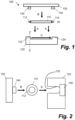
- Figures 1 and 2 show exploded views of a recoater carriage assembly 100 according to a non-claimed example, however, some teaching relating to this example is pertinent to the invention.
- the recoater carriage assembly 100 is to help ensure additive build powder layers have improved surface characteristics, such as for example better level uniformity, in an additive manufacturing system during a build.
- the recoater carriage assembly 100 comprises an elongate powder build material spreader 110 to spread powder build material in use.
- the powder build material may comprise a polymer powder.
- the powder build material may comprise one or more thermoplastics, such as polyamide (PA) 11, PA12, and thermoplastic polyurethane (TPU), or the like.
- a fusing agent may be applied to a layer of build material after the application of fusing energy to defined areas of the layer.
- a detailing agent may be applied to areas of a layer of build material, for example to inhibit, or modify a degree of fusing.
- a three-dimensional object undergoing additive manufacture may thus be built layer-by-layer from a build powder. For correct application of any fusing agents and detailing agents, it is important that the build powder layer is substantially uniformly flat.
- the elongate powder build material spreader 110 may spread the build powder material in use.
- the spreader 100 may spread the powder layer to ensure that the thickness of the layer is regular and the upper surface of the layer is flat.
- the spreader 110 may slide or press or roll the powder material to make the layer substantially uniformly flat and of a regular thickness.
- the spreader 110 may, for example, be in the form of a blade which passes across the surface of the powder layer.
- the spreader 110 may be, for example, a roller which rolls across the surface of the powder layer.
- the recoater carriage assembly 100 comprises a recoater carriage 120 to support the spreader 110.
- the spreader 110 is engageable with the carriage 120.
- the spreader 110 is also disengageable from the carriage 120.
- the spreader 110 is to engage with, and to disengage from, the recoater carriage 120 by movement of the spreader non-concentrically to a longitudinal axis of the spreader 110.
- the engagement of the spreader 110 with the recoater carriage 120 enables the spreader 110 to move together with the recoater carriage 120 in use.
- the spreader 110 is engaged with the carriage 120 by movement of the spreader 110 in direction A relative to the carriage 120.
- the spreader 110 is disengaged from the carriage 120 by movement of the spreader 110 relative to the carriage 120 in a direction opposite to direction A.
- the direction A is a direction orthogonal to the longitudinal axis W of the spreader 110.
- the spreader 110 can be engaged and disengaged by movement in any other direction that is non-concentric to the longitudinal axis W of the spreader 110.
- An advantage of this system is that a housing of the additive manufacturing system does not need to accommodate the movement of, for example, a retaining component in a direction concentric to the longitudinal axis W of the spreader 110, such as direction C (or a direction opposite to direction C) shown in Figure 1 . If a retaining component, housed in the carriage 120, is moved in a direction C to retain the elongate spreader 110 in the carriage 120, then the carriage 120 must have a width in direction C which is sufficient at least to accommodate the width of the spreader 110 and the retaining component end-to-end, and possibly also to accommodate the movement of the retaining component. In such a system, this requirement on carriage width increases the total size of the additive manufacturing system, but not the size of the build area. As such, this may be seen as wasted space.
- the spreader 110 may, for example, be a roller and may move rotationally or laterally across the build powder layer in use to flatten the layer.
- the resilient elements 140, 142 are positioned to not interfere with the motion of the spreader 110 once the spreader 110 is engaged with the carriage 120.
- the spreader 110 is a roller and the roller moves across the powder layer while counter rotating. This movement and counter rotation enables the roller to move a so-called "prism of powder" across the powder layer.
- the "prism of powder” is a build-up of build powder that is located in front of the roller in the direction of movement of the roller across the powder layer.
- the resilient elements 140, 142 engage the outer surfaces of roller bearings 112, 114 that facilitate rotation of the roller relative to the carriage 120 in use.
- the roller bearings 112, 114 are rotatable separately to the roller.
- direct rotation of the spreader 110, rather than counter rotation, is used to move the "prism of powder".
- the recoater carriage assembly 120 may comprise at least one recess 122.
- the carriage 120 may have more than one recess 122, 124, and each recess 122, 124 receives a portion of the spreader 110 in use.
- The, or each, recess 122, 124 may be comprised in a support to support the spreader 110 in use.
- the carriage 120 comprises first and second recesses 122, 124. The first recess 122 is positioned towards a first end of the carriage 120, and the second recess 124 is positioned towards a second end of the carriage 120.
- the recesses 122, 124 shown in Figure 1 are positioned substantially equidistantly from the longitudinal ends of the carriage 120.
- the first recess 122 receives a first portion 112 of the spreader 110 and the second recess 124 receives a second portion 114 of the spreader 110, in use.
- the first and second portions of the spreader 110 may be projections 112, 114 to project into the corresponding recesses 122, 124 of the carriage 120 in use.
- the spreader 110 comprises at least one projection 112
- the recoater carriage 120 comprises at least one recess 122
- the at least one projection 112 of the spreader 110 projects into the at least one recess 122 of the carriage 120 when the spreader 110 is engaged with the carriage 120.
- one or both of the projections 112, 114 of the spreader 110 may comprise a drive element, such as a first gear, and the associated recess 122, 124 of the carriage 120 may comprise a corresponding drive mechanism 150, such as a second gear, for engagement with the drive element.
- the projection 112 of the spreader 110 engages with the drive mechanism 150 of the carriage 120 when the spreader 110 is moved to engage with the carriage 120.
- the drive element of the spreader 110 comprises a worm wheel and the drive mechanism 150 of the carriage 120 comprises a worm screw.
- the drive element of the spreader 110 and the drive mechanism 150 of the carriage 120 form a cam arrangement to enable the spreader 110 to move when the engaging projection 112 of the spreader 110 is received in the recess 122.
- the spreader 110 has two projections 112, 114; one at either end of the spreader 110.
- the two engaging projections 112, 114 may help align the spreader 110 within the recoater carriage assembly 100. Easy alignment of the spreader 110 helps the user to easily engage and disengage the spreader 110 from the recoater carriage 120, while not requiring overly accurate axial alignment. This helps to ensure that, during replacement or change-over of the spreader 110, the user is able to rapidly input the spreader 110 into the recesses 122, 124 to engage the spreader 110 with the recoater carriage 120.
- Figure 3 is a schematic perspective view of a carriage to carry a recoater roller in an additive manufacturing system.
- the carriage 320 comprises a frame 321 comprising a first support 324 and a second support 326.
- the first support 324 is spaced in a first direction D from the second support 326.
- the first support 324 and second support 326 are to engage a recoater roller by movement of the recoater roller in a second direction that is different from the first direction D.
- the first direction D is orthogonal to the second direction.
- first support 324 and the second support 326 are immovable relative to each other.
- a set distance between the first support 324 and second support 326 ensures that any roller with projections spaced this set distance apart are usable with the carriage 320 of Figure 3 . This allows the additive manufacturing system to accommodate many types of rollers, such as rollers with respective different surface characteristics for use in different builds.
- At least one of the first support 324 and second support 326 comprises a slot in the carriage 320, as shown in Figure 3 .
- the slot(s) may each receive a portion of the recoater roller.
- the carriage 320 comprises a resilient retainer 330 to bias the recoater roller towards the first support 324 and second support 326, when the roller is engaged with the first support 324 and the second support 326.
- the carriage comprises a lid 360 to at least partially cover the roller when the roller is engaged with the first support 324 and the second support 326.
- the lid 360 comprises a retainer 365 to retain the recoater roller relative to at least one of the first support 324 and second support 326 when the roller is engaged with the first support 324 and the second support 326.
- the first support 324 and second support 326 are to engage a recoater roller by movement of the recoater roller in a second direction.
- the lid 360 and retainer 365 are moved in a direction E towards the supports 324, 326, to trap the roller between the retainer 365 and the frame 321 in use.
- the direction E is parallel to the second direction.
- Figure 4 shows an example of a spreader 400.
- the spreader 400 comprises a spreader surface 410 to contact the build material in use.
- the spreader 400 comprises end portions 414, 416 to engage with a recoater carriage.
- the dimension or height H' of the spreader surface 410 is greater than the dimension or height H" of the end portions 414, 416.
- the spreader surface 410 has a width W' and the spreader 400 has a total width W".
- the supports of a recoater carriage for use with the spreader 400 must be set at least the width W' of the main spreading surface 410 apart but not more than the width W" of the spreader 400 apart.
- Figure 5 is a flowchart showing a method 500 of using a recoater carriage assembly in an additive manufacturing system according to an example. This method may be used with the recoater carriage assembly 100 of Figure 1 (not according to the appended claims) or upon a different system.
- a first recoater roller is disengaged from a recoater carriage.
- the first recoater roller is an elongate recoater roller.
- the direction in which the first elongate recoater roller is moved to be disengaged from the recoater carriage is opposite to the direction A shown in Figure 1 .
- the direction in which the first elongate recoater roller is moved is a direction orthogonal to a longitudinal axis of the first elongate recoater roller.
- a second elongate recoater roller is moved in a direction non-concentric to a longitudinal axis of the second elongate recoater roller and relative to the recoater carriage, to engage the second elongate recoater roller with the recoater carriage.
- the engagement of the second elongate recoater roller with the recoater carriage enables the second elongate recoater roller to move together with the recoater carriage in use.
- the second elongate recoater roller is moved in the direction A shown in Figure 1 .
- the direction in which the second elongate recoater roller is moved is a direction orthogonal to a longitudinal axis of the second elongate recoater roller.
- the first recoater roller has a surface characteristic which differs from the surface characteristic of the second recoater roller.
- the surface characteristic may be, for example, smoothness, texture or absorbency, or the like.
- the surface characteristic may be affected or determined by use of grooves on the surface of a roller used to create a rough surface. The type of grooves and dimensions of the grooves will create different types of surfaces with different characteristics. This may result in a surface that is more suited for use with one type of powder over another type of powder.
- the surface characteristic may be affected or determined by one or more factors including the surface material, the surface finish and the surface coating (if provided).
- Build layers in additive manufacturing systems may be around 100 microns thick.
- the size of build powder particles may be around 50 microns.
- Rollers with different respective surface characteristics may interact differently with any given build powder.
- a first roller with a certain surface characteristic may interact with a given build powder better than another roller in which the surface characteristic differs from that of the first roller.
- a user may wish to use a first roller with a particular surface characteristic with a first build powder, and a second roller with a second build powder, wherein the surface characteristic of the second roller differs from that of the first roller. This may help to prevent or reduce powder attaching to rollers, and may help the flattening of build layers prior to builds. Examples described herein enable a user to rapidly and easily change rollers that are held by a carriage.
Landscapes
- Chemical & Material Sciences (AREA)
- Engineering & Computer Science (AREA)
- Materials Engineering (AREA)
- Physics & Mathematics (AREA)
- Optics & Photonics (AREA)
- Manufacturing & Machinery (AREA)
- Mechanical Engineering (AREA)
- Coating Apparatus (AREA)
Claims (8)
- Schlitten, um eine Beschichtungsrolle zur Verwendung in einem additiven Fertigungssystem zu tragen, wobei der Schlitten (320) umfasst:einen Rahmen (321), der eine erste Stütze (324) und eine zweite Stütze (326) umfasst, wobei die erste Stütze in einer ersten Richtung (D) von der zweiten Stütze beabstandet ist, und der eine elastische Halterung (330) umfasst, um die Beschichtungsrolle (410) zu der ersten Stütze (324) und der zweiten Stütze (326) hin vorzuspannen, wenn die Rolle in die erste Stütze und die zweite Stütze eingreift;wobei mindestens eine der ersten Stütze (324) und der zweiten Stütze (326) einen Schlitz aufweist, um in die Beschichtungsrolle durch eine Bewegung der Beschichtungsrolle in eine zweite Richtung (E), die sich von der ersten Richtung (D) unterscheidet, einzugreifen; undwobei die erste Richtung (D) orthogonal zu der zweiten Richtung (E) ist.
- Schlitten nach Anspruch 1, der einen Deckel (360) umfasst, um die Rolle (410) mindestens teilweise abzudecken, wenn die Rolle in die erste Stütze (324) und die zweite Stütze (326) eingreift;
wobei der Deckel (360) eine Halterung (365) umfasst, um die Beschichtungsrolle (410) relativ zu mindestens einer der ersten Stütze (324) und der zweiten Stütze (326) zu halten, wenn die Rolle in die erste Stütze und die zweite Stütze eingreift. - Schlitten nach Anspruch 1, wobei der Schlitten (320) ein Zahnrad umfasst, um in ein Zahnrad der Beschichtungsrolle (410) einzugreifen, wenn die Beschichtungsrolle in die erste Stütze und die zweite Stütze eingreift.
- Schlitten nach Anspruch 1, wobei die erste Stütze (324) und die zweite Stütze (326) relativ zueinander unbeweglich sind.
- Beschichtungsschlittenanordnung zur Verwendung in einem additiven Fertigungssystem, wobei die Beschichtungsschlittenanordnung umfasst:eine Beschichtungsrolle; undeinen Schlitten, um eine Beschichtungsrolle nach Anspruch 1 zu tragen.
- Beschichtungsschlittenanordnung nach Anspruch 5, wobeidie Beschichtungsrolle (410) mindestens einen Vorsprung (414, 416) umfasst, undder mindestens eine Vorsprung der Beschichtungsrolle in den mindestens einen Schlitz des Schlittens (320) vorsteht, wenn die Beschichtungsrolle (410) in den Schlitten eingreift.
- Verfahren zum Verwenden einer Beschichtungsschlittenanordnung nach Anspruch 5 in einem additiven Fertigungssystem, wobei das Verfahren umfasst:Bewegen (505) der Beschichtungsrolle (410) relativ zu dem Schlitz, um in den Beschichtungsschlitten einzugreifen, wobei das Bewegen (505) der Beschichtungsrolle, um in den Beschichtungsschlitten einzugreifen, in der zweiten Richtung (E) erfolgt; undVerwenden einer elastischen Halterung (330), um die Beschichtungsrolle (410) zu der ersten Stütze (324) und der zweiten Stütze (326) hin vorzuspannen, wenn die Rolle in die erste Stütze und die zweite Stütze eingreift.
- Verfahren nach Anspruch 7, wobei die Beschichtungsrolle eine erste Rolle ist;wobei das Verfahren, nach einem Entriegeln der ersten Rolle von dem Beschichtungsschlitten, das Eingreifen in eine zweite verlängerte Beschichtungsrolle (510) mit dem Beschichtungsschlitten umfasst; undwobei sich eine Oberflächeneigenschaft der ersten und der zweiten Rolle zwischen der ersten und der zweiten Rolle unterscheidet.
Applications Claiming Priority (1)
| Application Number | Priority Date | Filing Date | Title |
|---|---|---|---|
| PCT/US2016/057325 WO2018074991A1 (en) | 2016-10-17 | 2016-10-17 | Recoater carriage |
Publications (3)
| Publication Number | Publication Date |
|---|---|
| EP3487682A1 EP3487682A1 (de) | 2019-05-29 |
| EP3487682A4 EP3487682A4 (de) | 2020-03-11 |
| EP3487682B1 true EP3487682B1 (de) | 2025-03-12 |
Family
ID=62018746
Family Applications (1)
| Application Number | Title | Priority Date | Filing Date |
|---|---|---|---|
| EP16919317.4A Active EP3487682B1 (de) | 2016-10-17 | 2016-10-17 | Nachbeschichterwagen |
Country Status (4)
| Country | Link |
|---|---|
| US (1) | US11267197B2 (de) |
| EP (1) | EP3487682B1 (de) |
| CN (1) | CN109641390B (de) |
| WO (1) | WO2018074991A1 (de) |
Families Citing this family (4)
| Publication number | Priority date | Publication date | Assignee | Title |
|---|---|---|---|---|
| US11247396B2 (en) * | 2019-05-28 | 2022-02-15 | Vulcanforms Inc. | Recoater system for additive manufacturing |
| WO2022087044A1 (en) | 2020-10-21 | 2022-04-28 | General Electric Company | Material supply system and method for using the same |
| WO2022093942A1 (en) | 2020-10-29 | 2022-05-05 | General Electric Company | Additive manufacturing apparatuses with removable build boxes and build box management systems |
| US11718026B1 (en) | 2022-07-20 | 2023-08-08 | General Electric Company | Recoat assemblies for additive manufacturing systems and methods of using the same |
Family Cites Families (17)
| Publication number | Priority date | Publication date | Assignee | Title |
|---|---|---|---|---|
| US20050104241A1 (en) | 2000-01-18 | 2005-05-19 | Objet Geometried Ltd. | Apparatus and method for three dimensional model printing |
| US7384255B2 (en) | 2005-07-01 | 2008-06-10 | Stratasys, Inc. | Rapid prototyping system with controlled material feedstock |
| US7585450B2 (en) | 2005-09-30 | 2009-09-08 | 3D Systems, Inc. | Rapid prototyping and manufacturing system and method |
| DE102006055074A1 (de) * | 2006-11-22 | 2008-06-19 | Eos Gmbh Electro Optical Systems | Vorrichtung zum schichtweisen Herstellen eines dreidimensionalen Objekts und Verfahren zum Zuführen von Aufbaumaterial |
| EP2447044B1 (de) | 2010-11-01 | 2014-01-08 | DSM IP Assets B.V. | Vorrichtung und Verfahren zur generativen Herstellung aufweisend ein Folienführungssystem |
| CN105188993A (zh) * | 2013-03-15 | 2015-12-23 | 麦特法布公司 | 用于增材制造装置的料盒和方法 |
| GB201308565D0 (en) * | 2013-05-13 | 2013-06-19 | Blueprinter Aps | Three-dimensional printer |
| CN203470903U (zh) * | 2013-07-31 | 2014-03-12 | 济南大学 | 一种快速成型的铺粉装置 |
| CN204035564U (zh) | 2014-04-03 | 2014-12-24 | 上海航天设备制造总厂 | 一种用于可快速更换辊子式3d打印机的铺粉装置 |
| JP6458416B2 (ja) | 2014-09-16 | 2019-01-30 | 株式会社リコー | 立体造形装置、立体造形物の製造方法 |
| WO2016084350A1 (en) | 2014-11-28 | 2016-06-02 | Canon Kabushiki Kaisha | Forming apparatus, three-dimensional forming method, and object formed by using the method |
| US9855704B2 (en) * | 2015-02-27 | 2018-01-02 | Technology Research Association For Future Additive Manufacturing | Powder recoater |
| CN204844878U (zh) * | 2015-07-23 | 2015-12-09 | 南京中科煜宸激光技术有限公司 | 一种用于快速成型制造的铺粉装置 |
| WO2017040521A1 (en) * | 2015-09-03 | 2017-03-09 | The Exone Company | Selectively activated mesh discharge powder recoater for three-dimensional printing |
| WO2017048865A1 (en) * | 2015-09-16 | 2017-03-23 | Applied Materials, Inc. | Adjustable z-axis printhead module for additive manufacturing system |
| RU165868U1 (ru) * | 2015-12-29 | 2016-11-10 | Федеральное государственное бюджетное образовательное учреждение высшего образования "Московский государственный технологический университет "СТАНКИН" (ФГБОУ ВО "МГТУ "СТАНКИН") | Устройство для получения изделий из порошковых материалов |
| CN205464327U (zh) * | 2016-01-12 | 2016-08-17 | 湖南华曙高科技有限责任公司 | 一种选择性激光烧结设备的铺粉装置 |
-
2016
- 2016-10-17 WO PCT/US2016/057325 patent/WO2018074991A1/en not_active Ceased
- 2016-10-17 CN CN201680088213.1A patent/CN109641390B/zh active Active
- 2016-10-17 US US16/089,859 patent/US11267197B2/en active Active
- 2016-10-17 EP EP16919317.4A patent/EP3487682B1/de active Active
Also Published As
| Publication number | Publication date |
|---|---|
| EP3487682A1 (de) | 2019-05-29 |
| WO2018074991A1 (en) | 2018-04-26 |
| EP3487682A4 (de) | 2020-03-11 |
| US20200298474A1 (en) | 2020-09-24 |
| US11267197B2 (en) | 2022-03-08 |
| CN109641390B (zh) | 2022-04-01 |
| CN109641390A (zh) | 2019-04-16 |
Similar Documents
| Publication | Publication Date | Title |
|---|---|---|
| EP3487682B1 (de) | Nachbeschichterwagen | |
| US11958162B2 (en) | CMP pad construction with composite material properties using additive manufacturing processes | |
| US10456992B2 (en) | Modular user-configurable multi-part 3D layering system and hot end assembly | |
| CN101213060B (zh) | 具有受控的材料进料的快速原型系统 | |
| KR101681615B1 (ko) | 롤러 프레임 | |
| DE102016108348A1 (de) | Vorrichtung und Verfahren zur Bildung eines dreidimensionalen Objektes | |
| EP3368259B1 (de) | Maschinensystem zur herstellung eines hybridbauteils | |
| KR20180063363A (ko) | 원하는 제타 전위를 가진 연마 제품을 형성하는 장치 및 방법 | |
| US20200198319A1 (en) | Apparatus and method for fabrication of three dimensional objects | |
| US20190337205A1 (en) | Interchangeable mold for creation of injection molded components | |
| US9782904B2 (en) | Apparatus and method for cutting facestock | |
| CN102574292A (zh) | 与建筑镶板的边缘加工相关的方法和设备 | |
| WO2017211467A1 (de) | Werkzeug, vorrichtung und verfahren zum polieren von linsen | |
| DE102017125602A1 (de) | Zahnradbearbeitungsvorrichtung und Zahnradbearbeitungsverfahren | |
| DE102017124177A1 (de) | Werkzeugwechsel bei der generativen Fertigung | |
| EP3529046A1 (de) | Verfahren und vorrichtung zur herstellung eines dreidimensionalen gegenstands | |
| DE112007003203T5 (de) | Vorrichtung zur Herstellung eines Flüssigsilikonschaums in Rollenform | |
| DE102005040237B4 (de) | Prägekalander | |
| DE102012216724B4 (de) | Verfahren und Vorrichtung zur Polierbearbeitung von Brillenlinsen und Gießformen für die Brillenlinsenherstellung sowie entsprechendes Verfahren zur Herstellung von Brillenlinsen und Gießformen für die Brillenlinsenherstellung | |
| CN203792905U (zh) | 三维打印机 | |
| US20060082052A1 (en) | Sheet feed roll | |
| DE102015112527A1 (de) | Vorrichtung und Verfahren zum Eingießen eines ringförmigen Kunststoffrahmens in eine Ausnehmung einer Läuferscheibe einer Doppelseitenbearbeitungsmaschine | |
| WO2017034386A2 (en) | An improved former holder assembly | |
| CN115230159B (zh) | 挤出机构及3d打印系统 | |
| KR102014559B1 (ko) | 필름의 제조 방법 |
Legal Events
| Date | Code | Title | Description |
|---|---|---|---|
| STAA | Information on the status of an ep patent application or granted ep patent |
Free format text: STATUS: THE INTERNATIONAL PUBLICATION HAS BEEN MADE |
|
| PUAI | Public reference made under article 153(3) epc to a published international application that has entered the european phase |
Free format text: ORIGINAL CODE: 0009012 |
|
| STAA | Information on the status of an ep patent application or granted ep patent |
Free format text: STATUS: REQUEST FOR EXAMINATION WAS MADE |
|
| 17P | Request for examination filed |
Effective date: 20190222 |
|
| AK | Designated contracting states |
Kind code of ref document: A1 Designated state(s): AL AT BE BG CH CY CZ DE DK EE ES FI FR GB GR HR HU IE IS IT LI LT LU LV MC MK MT NL NO PL PT RO RS SE SI SK SM TR |
|
| AX | Request for extension of the european patent |
Extension state: BA ME |
|
| DAV | Request for validation of the european patent (deleted) | ||
| DAX | Request for extension of the european patent (deleted) | ||
| A4 | Supplementary search report drawn up and despatched |
Effective date: 20200212 |
|
| RIC1 | Information provided on ipc code assigned before grant |
Ipc: B29C 64/153 20170101ALI20200206BHEP Ipc: B29C 64/165 20170101ALI20200206BHEP Ipc: B22F 3/105 20060101ALI20200206BHEP Ipc: B29C 64/209 20170101ALI20200206BHEP Ipc: B33Y 30/00 20150101ALI20200206BHEP Ipc: B29C 64/236 20170101ALI20200206BHEP Ipc: B29C 64/205 20170101AFI20200206BHEP |
|
| STAA | Information on the status of an ep patent application or granted ep patent |
Free format text: STATUS: EXAMINATION IS IN PROGRESS |
|
| 17Q | First examination report despatched |
Effective date: 20211019 |
|
| GRAP | Despatch of communication of intention to grant a patent |
Free format text: ORIGINAL CODE: EPIDOSNIGR1 |
|
| STAA | Information on the status of an ep patent application or granted ep patent |
Free format text: STATUS: GRANT OF PATENT IS INTENDED |
|
| INTG | Intention to grant announced |
Effective date: 20241223 |
|
| RAP3 | Party data changed (applicant data changed or rights of an application transferred) |
Owner name: HEWLETT-PACKARD DEVELOPMENT COMPANY, L.P. |
|
| RIN1 | Information on inventor provided before grant (corrected) |
Inventor name: BRUGUE, JOAQUIM Inventor name: MOSQUERA, GERARD Inventor name: GIMENEZ, JORDI |
|
| GRAS | Grant fee paid |
Free format text: ORIGINAL CODE: EPIDOSNIGR3 |
|
| GRAA | (expected) grant |
Free format text: ORIGINAL CODE: 0009210 |
|
| STAA | Information on the status of an ep patent application or granted ep patent |
Free format text: STATUS: THE PATENT HAS BEEN GRANTED |
|
| AK | Designated contracting states |
Kind code of ref document: B1 Designated state(s): AL AT BE BG CH CY CZ DE DK EE ES FI FR GB GR HR HU IE IS IT LI LT LU LV MC MK MT NL NO PL PT RO RS SE SI SK SM TR |
|
| REG | Reference to a national code |
Ref country code: GB Ref legal event code: FG4D |
|
| REG | Reference to a national code |
Ref country code: CH Ref legal event code: EP |
|
| REG | Reference to a national code |
Ref country code: DE Ref legal event code: R096 Ref document number: 602016091564 Country of ref document: DE |
|
| REG | Reference to a national code |
Ref country code: IE Ref legal event code: FG4D |
|
| RAP2 | Party data changed (patent owner data changed or rights of a patent transferred) |
Owner name: PERIDOT PRINT LLC |
|
| PG25 | Lapsed in a contracting state [announced via postgrant information from national office to epo] |
Ref country code: RS Free format text: LAPSE BECAUSE OF FAILURE TO SUBMIT A TRANSLATION OF THE DESCRIPTION OR TO PAY THE FEE WITHIN THE PRESCRIBED TIME-LIMIT Effective date: 20250612 |
|
| PG25 | Lapsed in a contracting state [announced via postgrant information from national office to epo] |
Ref country code: FI Free format text: LAPSE BECAUSE OF FAILURE TO SUBMIT A TRANSLATION OF THE DESCRIPTION OR TO PAY THE FEE WITHIN THE PRESCRIBED TIME-LIMIT Effective date: 20250312 |
|
| PG25 | Lapsed in a contracting state [announced via postgrant information from national office to epo] |
Ref country code: ES Free format text: LAPSE BECAUSE OF FAILURE TO SUBMIT A TRANSLATION OF THE DESCRIPTION OR TO PAY THE FEE WITHIN THE PRESCRIBED TIME-LIMIT Effective date: 20250312 |
|
| REG | Reference to a national code |
Ref country code: LT Ref legal event code: MG9D |
|
| PG25 | Lapsed in a contracting state [announced via postgrant information from national office to epo] |
Ref country code: NO Free format text: LAPSE BECAUSE OF FAILURE TO SUBMIT A TRANSLATION OF THE DESCRIPTION OR TO PAY THE FEE WITHIN THE PRESCRIBED TIME-LIMIT Effective date: 20250612 |
|
| PG25 | Lapsed in a contracting state [announced via postgrant information from national office to epo] |
Ref country code: HR Free format text: LAPSE BECAUSE OF FAILURE TO SUBMIT A TRANSLATION OF THE DESCRIPTION OR TO PAY THE FEE WITHIN THE PRESCRIBED TIME-LIMIT Effective date: 20250312 |
|
| REG | Reference to a national code |
Ref country code: NL Ref legal event code: MP Effective date: 20250312 |
|
| PG25 | Lapsed in a contracting state [announced via postgrant information from national office to epo] |
Ref country code: LV Free format text: LAPSE BECAUSE OF FAILURE TO SUBMIT A TRANSLATION OF THE DESCRIPTION OR TO PAY THE FEE WITHIN THE PRESCRIBED TIME-LIMIT Effective date: 20250312 |
|
| PG25 | Lapsed in a contracting state [announced via postgrant information from national office to epo] |
Ref country code: GR Free format text: LAPSE BECAUSE OF FAILURE TO SUBMIT A TRANSLATION OF THE DESCRIPTION OR TO PAY THE FEE WITHIN THE PRESCRIBED TIME-LIMIT Effective date: 20250613 Ref country code: BG Free format text: LAPSE BECAUSE OF FAILURE TO SUBMIT A TRANSLATION OF THE DESCRIPTION OR TO PAY THE FEE WITHIN THE PRESCRIBED TIME-LIMIT Effective date: 20250312 |
|
| REG | Reference to a national code |
Ref country code: DE Ref legal event code: R081 Ref document number: 602016091564 Country of ref document: DE Owner name: PERIDOT PRINT LLC, PALO ALTO, US Free format text: FORMER OWNER: HEWLETT-PACKARD DEVELOPMENT COMPANY, L.P., SPRING, TX, US |
|
| REG | Reference to a national code |
Ref country code: AT Ref legal event code: MK05 Ref document number: 1774675 Country of ref document: AT Kind code of ref document: T Effective date: 20250312 |
|
| PG25 | Lapsed in a contracting state [announced via postgrant information from national office to epo] |
Ref country code: NL Free format text: LAPSE BECAUSE OF FAILURE TO SUBMIT A TRANSLATION OF THE DESCRIPTION OR TO PAY THE FEE WITHIN THE PRESCRIBED TIME-LIMIT Effective date: 20250312 |
|
| REG | Reference to a national code |
Ref country code: GB Ref legal event code: 732E Free format text: REGISTERED BETWEEN 20250807 AND 20250813 |
|
| PG25 | Lapsed in a contracting state [announced via postgrant information from national office to epo] |
Ref country code: SE Free format text: LAPSE BECAUSE OF FAILURE TO SUBMIT A TRANSLATION OF THE DESCRIPTION OR TO PAY THE FEE WITHIN THE PRESCRIBED TIME-LIMIT Effective date: 20250312 |
|
| PG25 | Lapsed in a contracting state [announced via postgrant information from national office to epo] |
Ref country code: SM Free format text: LAPSE BECAUSE OF FAILURE TO SUBMIT A TRANSLATION OF THE DESCRIPTION OR TO PAY THE FEE WITHIN THE PRESCRIBED TIME-LIMIT Effective date: 20250312 |
|
| PG25 | Lapsed in a contracting state [announced via postgrant information from national office to epo] |
Ref country code: PT Free format text: LAPSE BECAUSE OF FAILURE TO SUBMIT A TRANSLATION OF THE DESCRIPTION OR TO PAY THE FEE WITHIN THE PRESCRIBED TIME-LIMIT Effective date: 20250714 |
|
| PG25 | Lapsed in a contracting state [announced via postgrant information from national office to epo] |
Ref country code: PL Free format text: LAPSE BECAUSE OF FAILURE TO SUBMIT A TRANSLATION OF THE DESCRIPTION OR TO PAY THE FEE WITHIN THE PRESCRIBED TIME-LIMIT Effective date: 20250312 Ref country code: IT Free format text: LAPSE BECAUSE OF FAILURE TO SUBMIT A TRANSLATION OF THE DESCRIPTION OR TO PAY THE FEE WITHIN THE PRESCRIBED TIME-LIMIT Effective date: 20250312 |
|
| PGFP | Annual fee paid to national office [announced via postgrant information from national office to epo] |
Ref country code: GB Payment date: 20250923 Year of fee payment: 10 |
|
| PG25 | Lapsed in a contracting state [announced via postgrant information from national office to epo] |
Ref country code: AT Free format text: LAPSE BECAUSE OF FAILURE TO SUBMIT A TRANSLATION OF THE DESCRIPTION OR TO PAY THE FEE WITHIN THE PRESCRIBED TIME-LIMIT Effective date: 20250312 |
|
| PGFP | Annual fee paid to national office [announced via postgrant information from national office to epo] |
Ref country code: FR Payment date: 20250924 Year of fee payment: 10 |
|
| PG25 | Lapsed in a contracting state [announced via postgrant information from national office to epo] |
Ref country code: EE Free format text: LAPSE BECAUSE OF FAILURE TO SUBMIT A TRANSLATION OF THE DESCRIPTION OR TO PAY THE FEE WITHIN THE PRESCRIBED TIME-LIMIT Effective date: 20250312 Ref country code: CZ Free format text: LAPSE BECAUSE OF FAILURE TO SUBMIT A TRANSLATION OF THE DESCRIPTION OR TO PAY THE FEE WITHIN THE PRESCRIBED TIME-LIMIT Effective date: 20250312 |
|
| PG25 | Lapsed in a contracting state [announced via postgrant information from national office to epo] |
Ref country code: RO Free format text: LAPSE BECAUSE OF FAILURE TO SUBMIT A TRANSLATION OF THE DESCRIPTION OR TO PAY THE FEE WITHIN THE PRESCRIBED TIME-LIMIT Effective date: 20250312 |
|
| PG25 | Lapsed in a contracting state [announced via postgrant information from national office to epo] |
Ref country code: SK Free format text: LAPSE BECAUSE OF FAILURE TO SUBMIT A TRANSLATION OF THE DESCRIPTION OR TO PAY THE FEE WITHIN THE PRESCRIBED TIME-LIMIT Effective date: 20250312 |
|
| PG25 | Lapsed in a contracting state [announced via postgrant information from national office to epo] |
Ref country code: IS Free format text: LAPSE BECAUSE OF FAILURE TO SUBMIT A TRANSLATION OF THE DESCRIPTION OR TO PAY THE FEE WITHIN THE PRESCRIBED TIME-LIMIT Effective date: 20250712 |
|
| REG | Reference to a national code |
Ref country code: DE Ref legal event code: R097 Ref document number: 602016091564 Country of ref document: DE |
|
| PGFP | Annual fee paid to national office [announced via postgrant information from national office to epo] |
Ref country code: DE Payment date: 20250923 Year of fee payment: 10 |
|
| PG25 | Lapsed in a contracting state [announced via postgrant information from national office to epo] |
Ref country code: DK Free format text: LAPSE BECAUSE OF FAILURE TO SUBMIT A TRANSLATION OF THE DESCRIPTION OR TO PAY THE FEE WITHIN THE PRESCRIBED TIME-LIMIT Effective date: 20250312 |
|
| PLBE | No opposition filed within time limit |
Free format text: ORIGINAL CODE: 0009261 |
|
| STAA | Information on the status of an ep patent application or granted ep patent |
Free format text: STATUS: NO OPPOSITION FILED WITHIN TIME LIMIT |
|
| REG | Reference to a national code |
Ref country code: CH Ref legal event code: L10 Free format text: ST27 STATUS EVENT CODE: U-0-0-L10-L00 (AS PROVIDED BY THE NATIONAL OFFICE) Effective date: 20260121 |