EP3485973B1 - Mikrofluidische reagenzkarte, nachweisverfahren und anwendung davon - Google Patents
Mikrofluidische reagenzkarte, nachweisverfahren und anwendung davon Download PDFInfo
- Publication number
- EP3485973B1 EP3485973B1 EP16909440.6A EP16909440A EP3485973B1 EP 3485973 B1 EP3485973 B1 EP 3485973B1 EP 16909440 A EP16909440 A EP 16909440A EP 3485973 B1 EP3485973 B1 EP 3485973B1
- Authority
- EP
- European Patent Office
- Prior art keywords
- micropipes
- sample
- micropipe
- reagent card
- antibody
- Prior art date
- Legal status (The legal status is an assumption and is not a legal conclusion. Google has not performed a legal analysis and makes no representation as to the accuracy of the status listed.)
- Active
Links
Images


Classifications
-
- B—PERFORMING OPERATIONS; TRANSPORTING
- B01—PHYSICAL OR CHEMICAL PROCESSES OR APPARATUS IN GENERAL
- B01L—CHEMICAL OR PHYSICAL LABORATORY APPARATUS FOR GENERAL USE
- B01L3/00—Containers or dishes for laboratory use, e.g. laboratory glassware; Droppers
- B01L3/02—Burettes; Pipettes
- B01L3/021—Pipettes, i.e. with only one conduit for withdrawing and redistributing liquids
- B01L3/0217—Pipettes, i.e. with only one conduit for withdrawing and redistributing liquids of the plunger pump type
- B01L3/022—Capillary pipettes, i.e. having very small bore
-
- B—PERFORMING OPERATIONS; TRANSPORTING
- B01—PHYSICAL OR CHEMICAL PROCESSES OR APPARATUS IN GENERAL
- B01L—CHEMICAL OR PHYSICAL LABORATORY APPARATUS FOR GENERAL USE
- B01L3/00—Containers or dishes for laboratory use, e.g. laboratory glassware; Droppers
- B01L3/50—Containers for the purpose of retaining a material to be analysed, e.g. test tubes
- B01L3/502—Containers for the purpose of retaining a material to be analysed, e.g. test tubes with fluid transport, e.g. in multi-compartment structures
- B01L3/5027—Containers for the purpose of retaining a material to be analysed, e.g. test tubes with fluid transport, e.g. in multi-compartment structures by integrated microfluidic structures, i.e. dimensions of channels and chambers are such that surface tension forces are important, e.g. lab-on-a-chip
-
- B—PERFORMING OPERATIONS; TRANSPORTING
- B01—PHYSICAL OR CHEMICAL PROCESSES OR APPARATUS IN GENERAL
- B01L—CHEMICAL OR PHYSICAL LABORATORY APPARATUS FOR GENERAL USE
- B01L3/00—Containers or dishes for laboratory use, e.g. laboratory glassware; Droppers
-
- B—PERFORMING OPERATIONS; TRANSPORTING
- B01—PHYSICAL OR CHEMICAL PROCESSES OR APPARATUS IN GENERAL
- B01L—CHEMICAL OR PHYSICAL LABORATORY APPARATUS FOR GENERAL USE
- B01L3/00—Containers or dishes for laboratory use, e.g. laboratory glassware; Droppers
- B01L3/50—Containers for the purpose of retaining a material to be analysed, e.g. test tubes
- B01L3/502—Containers for the purpose of retaining a material to be analysed, e.g. test tubes with fluid transport, e.g. in multi-compartment structures
- B01L3/5027—Containers for the purpose of retaining a material to be analysed, e.g. test tubes with fluid transport, e.g. in multi-compartment structures by integrated microfluidic structures, i.e. dimensions of channels and chambers are such that surface tension forces are important, e.g. lab-on-a-chip
- B01L3/502715—Containers for the purpose of retaining a material to be analysed, e.g. test tubes with fluid transport, e.g. in multi-compartment structures by integrated microfluidic structures, i.e. dimensions of channels and chambers are such that surface tension forces are important, e.g. lab-on-a-chip characterised by interfacing components, e.g. fluidic, electrical, optical or mechanical interfaces
-
- B—PERFORMING OPERATIONS; TRANSPORTING
- B01—PHYSICAL OR CHEMICAL PROCESSES OR APPARATUS IN GENERAL
- B01L—CHEMICAL OR PHYSICAL LABORATORY APPARATUS FOR GENERAL USE
- B01L3/00—Containers or dishes for laboratory use, e.g. laboratory glassware; Droppers
- B01L3/50—Containers for the purpose of retaining a material to be analysed, e.g. test tubes
- B01L3/502—Containers for the purpose of retaining a material to be analysed, e.g. test tubes with fluid transport, e.g. in multi-compartment structures
- B01L3/5027—Containers for the purpose of retaining a material to be analysed, e.g. test tubes with fluid transport, e.g. in multi-compartment structures by integrated microfluidic structures, i.e. dimensions of channels and chambers are such that surface tension forces are important, e.g. lab-on-a-chip
- B01L3/502753—Containers for the purpose of retaining a material to be analysed, e.g. test tubes with fluid transport, e.g. in multi-compartment structures by integrated microfluidic structures, i.e. dimensions of channels and chambers are such that surface tension forces are important, e.g. lab-on-a-chip characterised by bulk separation arrangements on lab-on-a-chip devices, e.g. for filtration or centrifugation
-
- C—CHEMISTRY; METALLURGY
- C12—BIOCHEMISTRY; BEER; SPIRITS; WINE; VINEGAR; MICROBIOLOGY; ENZYMOLOGY; MUTATION OR GENETIC ENGINEERING
- C12M—APPARATUS FOR ENZYMOLOGY OR MICROBIOLOGY; APPARATUS FOR CULTURING MICROORGANISMS FOR PRODUCING BIOMASS, FOR GROWING CELLS OR FOR OBTAINING FERMENTATION OR METABOLIC PRODUCTS, i.e. BIOREACTORS OR FERMENTERS
- C12M23/00—Constructional details, e.g. recesses, hinges
- C12M23/02—Form or structure of the vessel
- C12M23/16—Microfluidic devices; Capillary tubes
-
- G—PHYSICS
- G01—MEASURING; TESTING
- G01N—INVESTIGATING OR ANALYSING MATERIALS BY DETERMINING THEIR CHEMICAL OR PHYSICAL PROPERTIES
- G01N33/00—Investigating or analysing materials by specific methods not covered by groups G01N1/00 - G01N31/00
- G01N33/48—Biological material, e.g. blood, urine; Haemocytometers
- G01N33/50—Chemical analysis of biological material, e.g. blood, urine; Testing involving biospecific ligand binding methods; Immunological testing
- G01N33/53—Immunoassay; Biospecific binding assay; Materials therefor
- G01N33/577—Immunoassay; Biospecific binding assay; Materials therefor involving monoclonal antibodies binding reaction mechanisms characterised by the use of monoclonal antibodies
-
- B—PERFORMING OPERATIONS; TRANSPORTING
- B01—PHYSICAL OR CHEMICAL PROCESSES OR APPARATUS IN GENERAL
- B01L—CHEMICAL OR PHYSICAL LABORATORY APPARATUS FOR GENERAL USE
- B01L2200/00—Solutions for specific problems relating to chemical or physical laboratory apparatus
- B01L2200/02—Adapting objects or devices to another
- B01L2200/025—Align devices or objects to ensure defined positions relative to each other
-
- B—PERFORMING OPERATIONS; TRANSPORTING
- B01—PHYSICAL OR CHEMICAL PROCESSES OR APPARATUS IN GENERAL
- B01L—CHEMICAL OR PHYSICAL LABORATORY APPARATUS FOR GENERAL USE
- B01L2200/00—Solutions for specific problems relating to chemical or physical laboratory apparatus
- B01L2200/02—Adapting objects or devices to another
- B01L2200/026—Fluid interfacing between devices or objects, e.g. connectors, inlet details
- B01L2200/027—Fluid interfacing between devices or objects, e.g. connectors, inlet details for microfluidic devices
-
- B—PERFORMING OPERATIONS; TRANSPORTING
- B01—PHYSICAL OR CHEMICAL PROCESSES OR APPARATUS IN GENERAL
- B01L—CHEMICAL OR PHYSICAL LABORATORY APPARATUS FOR GENERAL USE
- B01L2200/00—Solutions for specific problems relating to chemical or physical laboratory apparatus
- B01L2200/06—Fluid handling related problems
- B01L2200/0647—Handling flowable solids, e.g. microscopic beads, cells, particles
- B01L2200/0668—Trapping microscopic beads
-
- B—PERFORMING OPERATIONS; TRANSPORTING
- B01—PHYSICAL OR CHEMICAL PROCESSES OR APPARATUS IN GENERAL
- B01L—CHEMICAL OR PHYSICAL LABORATORY APPARATUS FOR GENERAL USE
- B01L2200/00—Solutions for specific problems relating to chemical or physical laboratory apparatus
- B01L2200/10—Integrating sample preparation and analysis in single entity, e.g. lab-on-a-chip concept
-
- B—PERFORMING OPERATIONS; TRANSPORTING
- B01—PHYSICAL OR CHEMICAL PROCESSES OR APPARATUS IN GENERAL
- B01L—CHEMICAL OR PHYSICAL LABORATORY APPARATUS FOR GENERAL USE
- B01L2300/00—Additional constructional details
- B01L2300/08—Geometry, shape and general structure
- B01L2300/0809—Geometry, shape and general structure rectangular shaped
- B01L2300/0816—Cards, e.g. flat sample carriers usually with flow in two horizontal directions
-
- B—PERFORMING OPERATIONS; TRANSPORTING
- B01—PHYSICAL OR CHEMICAL PROCESSES OR APPARATUS IN GENERAL
- B01L—CHEMICAL OR PHYSICAL LABORATORY APPARATUS FOR GENERAL USE
- B01L2300/00—Additional constructional details
- B01L2300/08—Geometry, shape and general structure
- B01L2300/0832—Geometry, shape and general structure cylindrical, tube shaped
-
- B—PERFORMING OPERATIONS; TRANSPORTING
- B01—PHYSICAL OR CHEMICAL PROCESSES OR APPARATUS IN GENERAL
- B01L—CHEMICAL OR PHYSICAL LABORATORY APPARATUS FOR GENERAL USE
- B01L2300/00—Additional constructional details
- B01L2300/08—Geometry, shape and general structure
- B01L2300/0861—Configuration of multiple channels and/or chambers in a single devices
-
- B—PERFORMING OPERATIONS; TRANSPORTING
- B01—PHYSICAL OR CHEMICAL PROCESSES OR APPARATUS IN GENERAL
- B01L—CHEMICAL OR PHYSICAL LABORATORY APPARATUS FOR GENERAL USE
- B01L2400/00—Moving or stopping fluids
- B01L2400/04—Moving fluids with specific forces or mechanical means
- B01L2400/0403—Moving fluids with specific forces or mechanical means specific forces
- B01L2400/0409—Moving fluids with specific forces or mechanical means specific forces centrifugal forces
-
- B—PERFORMING OPERATIONS; TRANSPORTING
- B01—PHYSICAL OR CHEMICAL PROCESSES OR APPARATUS IN GENERAL
- B01L—CHEMICAL OR PHYSICAL LABORATORY APPARATUS FOR GENERAL USE
- B01L3/00—Containers or dishes for laboratory use, e.g. laboratory glassware; Droppers
- B01L3/02—Burettes; Pipettes
- B01L3/021—Pipettes, i.e. with only one conduit for withdrawing and redistributing liquids
- B01L3/0217—Pipettes, i.e. with only one conduit for withdrawing and redistributing liquids of the plunger pump type
- B01L3/0237—Details of electronic control, e.g. relating to user interface
Definitions
- the present invention is related to the technical field of medical testing/assay techniques, in particular a microfluidic reagent card and its detection method and applications.
- Micropipe gel immunoassay detection methods need to be used with a micropipe reagent card.
- some manufacturers produce ABO blood typing and Rh stereotyped ABO/Rh blood typing detection reagent card, but the gel used is Sephadex, the diameter of Sephadex particles is about 20 - 50 microns.
- Blood type reagent card generally comprises six or eight micropipe gel pipes, which are fixed side by side and uniformly distributed on a transparent polypropylene plastic card.
- Each micropipe gel pipe comprises an upper large pipe, an intermediate transition pipe, and a bottom small pipe, which are connected together.
- Each micropipe gel pipe is equipped with gel that functions to separate red blood cells.
- one or two of the different samples or reagents are usually dribbled into the large upper pipe, and then reagent card is placed into a centrifuge. After centrifugation, the results are interpreted by naked eyes or with a camera system.
- Sample loading, centrifugation and photography of result are carried out at three different devices. The centrifugation is done in a horizontal manner, and the different micropipes are arranged in parallel. As the sample is loaded in a vertical manner, the centrifugation is conducted in a horizontal manner, and the results need to be read in a vertical manner, one need to either use a hand or a mechanical gripper to perform multiple operations to move the reagent card.
- Patent Application No. 201110318663.4 discloses a blood type reagent card, the card comprises a card body and six micropipe gel pipes, each micropipe gel pipe is made by an upper large pipe, an intermediate transition pipe, and a bottom small pipe, the inner side of the intermediate transition pipe is formed by connecting a disc hole and a tapered hole together.
- the disc hole is connected to the upper large pipe; the tapered hole is connected to the bottom small pipe; the major diameter of the disc hole is the same as the diameter of the upper large pipe, the minor diameter of the disc hole is the same as that of the tapered hole; the major diameter of the tapered hole is the same as the diameter of the bottom small pipe.
- Patent Application No. 201110322294.6 discloses an ABO/Rh blood type reagent card and a preparation method thereof for newborns, the card comprises eight micropipe gel pipes: a gel pipe containing IgM monoclonal anti-A antibody, a gel pipe containing IgM monoclonal anti-B antibody, a gel pipe containing IgM monoclonal anti-AB antibody, a gel pipe containing IgM monoclonal anti-D, a gel pipe containing IgM and IgG monoclonal anti-D antibody, a gel pipe containing gel suspension medium for negative control, a gel pipe containing an anti-IgG reagent and a gel pipe containing an anti-C3d reagent.
- Patent Application No. 201510483054.2 discloses an IgG subtype classification detection reagent card and a preparation method thereof, comprising the following six steps: preparation of gel suspension medium, screening of Sephacryl gel, selection of antibodies, preparation of the gel containing anti-IgG antibody, subpackaging and sealing for preservation.
- the inner diameter of the existing reagent card is relatively large, between 2 - 4 mm.
- the liquid interface has high fluidity.
- the reagent cards therefore need to be strictly placed in a vertical manner during transportation to avoid shocks. Otherwise, such shocks might cause a splash of the liquid and even the gel, significantly affecting results of reagent testing.
- the existing reagent cards are typically required to be centrifuged before detection to restore the distribution of the liquid and the separation medium.
- the existing method requires the reagent card to be placed vertically during sample loading, the reagent needs to be added to each hole individually. During centrifugation, the card needs to be placed in a vertical manner and centrifuged with a horizontal rotor.
- the reagent card needs to be placed vertically on the loading platform during operation, transferred from the loading platform to the centrifugal platform.
- the reagent card needs to be placed in a vertical manner for centrifugation.
- the reagent card goes horizontal during centrifugation and goes back to the vertical direction after centrifugation.
- the reagent card is shifted to the interpretoscope for result interpretation.
- the reagent card needs to be frequently changed among the three platforms and between two orientations, which complicates the operation.
- reagent card plane and centrifugal plane are placed vertically, during the course of centrifugation, the reagent card is driven by centrifugal force and rotated by 90 degrees.
- the micropipe and the centrifugation plane become parallel.
- a plurality of micropipes is arranged in parallel.
- CN205353104U discloses a kind of ABO&RhD blood typing detection card, including sequentially connected:
- the present invention discloses a microfluidic reagent card and a detection method and application thereof as defined in the claims.
- Micropipes of the microfluidic reagent card are configured to have a small diameter, which significantly reduces the fluidity of liquid and gel, so that a liquid interface does not flow even when the micropipes are placed in a horizontal manner.
- the microfluidic reagent card can be kept in a horizontal manner without being vertically placed.
- the liquid inside the micropipes can be kept at a fixed interface, and the interface formed by a separation medium is not likely to be stirred easily, thereby facilitating transportation and accurate result determination.
- a micropipe is disclosed.
- the micropipe is configured to have a sample inlet end and a closed end, a detection liquid layer and a separation medium layer are arranged inside each of the micropipe in sequence from the sample inlet end to the closed end, the micropipe has a diameter of 0.1-1.0 mm.
- the micropipe has a length of 8-12mm.
- the cross section of the micropipe is in general configured to have a circular or elliptical shape and may also be configured to have a square or rectangular shape, as long as the structure of the cross section is closed.
- the micropipe has a diameter of 0.8mm.
- the fluidity of liquid and gel is significantly reduced.
- a liquid interface does not flow even when the micropipe is placed in a horizontal manner, i.e., the liquid in the capillary can maintain a fixed interface.
- the diameter of the micropipe that holds the liquid decreases, due to siphoning and capillarity effects, the interface of the liquid gets more stable, thus, the liquid does not flow out even when the micropipe is placed upside down, and the interface of the liquid is still maintained.
- the liquid in the capillary does not flow easily during the course of detection, the interface formed by the separation medium is not easily stirred. Thus, the problem of liquid splashing during transportation can be effectively mitigated.
- the sample is loaded into each of the micropipe separately through the sample inlet end of each of the micropipe, or the sample is loaded into a plurality of micropipes through the sample inlet end connected to an automatic quantitative sample distribution device.
- the plurality of micropipes is integrated with the automatic quantitative sample distribution device, which enables sample loading at one go for multiple detections, as well as obtaining multiple detection results in parallel.
- the automatic quantitative sample distribution device makes use of the capillary and siphon mechanisms to take in the sample, the process of sample addition and distribution can be done on a horizontal plane.
- the separation medium layer is made of gel particles or glass beads.
- the gel particles are modified with antibody or unmodified
- the gel particles can be made of glucan, cellulose and other different materials, and the gel particles mainly function to isolate single cells and agglutinated cells.
- Protein G or protein A can also be used to modify the surface of the separation medium layer, enabling the separation medium layer to absorb sensitized red blood cells.
- the separation medium layer is made of generally circular or nearly circular particles, which can function to block the agglutinated red blood cells and allow the non-agglutinated red blood cells to pass.
- the detection liquid layer comprises a diluent
- the diluent comprises an antibody reagent or does not comprise any antibody reagent.
- the antibody reagent is anti-A reagent or anti-B reagent or anti-Rh(D) reagent or anti-human IgG antibody, but not limited to these antibody reagents.
- the antibody diluent is a buffer containing 1% BSA and 0.1% sodium azide.
- the invention provides a microfluidic reagent card as defined in claim 1, which comprises a card body and a plurality of micropipes fixed onto the card body.
- the microfluidic reagent card also comprises an automatic quantitative sample distribution device, the plurality of micropipes is connected to the automatic quantitative sample distribution device, which comprises a sample adding component and a plurality of quantitative sample distribution systems.
- the automatic quantitative sample distribution device is used to quantitatively distribute the sample (such as whole blood or diluted red blood cells) into multiple reaction chambers at one go after the sample is added once by microfluidic technology, so that multiple detections can be conducted in parallel.
- a predetermined amount of sample is entered into the connected micropipe, the separation medium layer of the micropipe separates agglutinated from non-agglutinated materials (red blood cells).
- the microfluidic reagent card comprises an automatic quantitative sample distribution device and a micropipe gel separation device; the automatic quantitative sample distribution device comprises a sample adding component and a plurality of quantitative sample distribution systems, the micropipe gel separation device is used to separate agglutinated from non-agglutinated red blood cells. A predetermined amount of sample enters into the connected micropipe gel separation device, which separates agglutinated from non-agglutinated red blood cells.
- the automatic quantitative sample distribution devices are arranged in a ring, each of the automatic quantitative sample distribution device is connected to a plurality of micropipes, the plurality of micropipes is arranged radially, and the closed end of the micropipe is arranged at the lateral side of the micropipe.
- the automatic quantitative sample distribution device of the microfluidic reagent card comprises a sample adding component, as defined in the claims, which enables adding the sample at one go for multiple detections, and obtaining multiple detection results in parallel.
- the pathway between the quantitative region and the closing portion gradually narrows, the pathway between the closing portion and the sample inlet end is narrower than the pathway in front of the closing portion; the pathway in front of the closing portion has a diameter of 0.08-0.14mm, the pathway between the closing portion and the sample inlet end has a diameter of 0.15-0.3mm.
- the automatic quantitative sample distribution device As the size of the pathway of the automatic quantitative sample distribution device changes, it facilitates the capillarity and siphoning effects for sample addition, so that sample addition and sample distribution can be conducted on a plane.
- the plurality of micropipes and/or the automatic quantitative sample distribution device is equipped with an exhaust passage.
- the exhaust passage is open to the external atmosphere, can therefore function to balance air pressure during the course of sample addition, which could facilitate the process of sample addition.
- the exhaust passage ensures the flow of reagent fluid inside the micropipe.
- the liquid and gel in the microfluidic reagent card of the present invention can maintain a fixed interface when the microfluidic reagent card is placed horizontally.
- the microfluidic reagent card can be kept horizontally during the course of sample addition and centrifugation, without being vertically placed. This accordingly enables the microfluidic reagent card to be placed horizontally onto a centrifuge for centrifugation.
- the micropipes of the microfluidic reagent card of the present invention are radially distributed, so that the centrifugation can be conducted on a horizontal plane.
- the microfluidic reagent card is connected to an automatic quantitative sample distribution device, which allows the sample addition to be completed at one time, and the distribution of the sample can be conducted automatically. This reduces the operations required during the course of sample addition.
- the automatic quantitative sample distribution device of the present invention also has the function of quantitative sample distribution, making it unnecessary for user to load sample very accurately during the course of sample addition.
- the invention also provides a detection method as defined in the claims.
- the method of the sample addition can be conducted in a horizontal manner.
- the centrifugation and result reading can also be carried out on a horizontal plane.
- the sample distribution system adds sample by siphoning and capillarity effects, thus the sample addition and sample distribution can be conducted on a horizontal plane.
- the microfluidic reagent card can be kept horizontally during the course of sample addition and centrifugation, without being vertically placed. Photography of result can be carried out on the horizontal plane in the late stage, significantly improving the convenience of operation, simplifying the construction of the automatic instruments.
- the present invention is efficient, convenient and cost-effective.
- the design of the present invention also reduces the size of the microfluidic reagent card, the formation of a stable interface eases the transportation requirements, accordingly reducing the transportation costs significantly and improving the stability of the reagent.
- the other purpose of the invention is to provide an application of the microfluidic reagent card in antigen-antibody detection.
- the application is selected from a group consisting of blood grouping, antibody screening and cross-matching of blood.
- the microfluidic reagent card of the present invention can be used in blood grouping, antibody screening and cross-matching of blood.
- the liquid in capillaries does not flow easily, and the interface formed by the separation medium is not stirred easily, thereby facilitating accurate result determination.
- Loading sample through multiple micropipes simultaneously enables adding sample once for multiple detections, which can achieve multiple test results and improve the accuracy of result determination.
- a micropipe as illustrated in Figure 1 wherein the micropipe is configured to have a sample inlet end 1 and a closed end 2, a detection liquid layer 3 and a separation medium layer 4 are arranged inside the micropipe in sequence from the sample inlet end 1 to the closed end 2.
- the micropipe has a diameter of 0.8 mm, and a length of 10mm.
- a micropipe gel separation device is used to separate agglutinated from non-agglutinated red blood cells.
- a predetermined amount of sample is entered into the connected micropipe gel separation device, separating agglutinated from non-agglutinated red blood cells.
- the sample When the sample enters into the micropipe and passes through the detection liquid layer, the sample reacts with the detection liquid layer, and then contacts the separation medium layer, which functions to separate and determine the reactants.
- the small diameter of the micropipe saves the use of sample and reagents, as well as substantially reduces the fluidity of liquid and gel, so that liquid interface does not flow even when the micropipe is placed in a horizontal direction, i.e., the liquid in the capillary can maintain a fixed interface.
- the micropipe is configured to have a sample inlet end 1 and a closed end 2, a detection liquid layer 3 and a separation medium layer 4 are arranged inside the micropipe in sequence from the sample inlet end to the closed end.
- the micropipe has a diameter of 0.8 mm, and a length of 10mm.
- the sample inlet end 1 and a quantitative region 5 are connected.
- a closing portion 6 is provided between the sample inlet end 1 and the quantitative region 5, and the closing portion 6 is filled with sealing material. After the sample enters into the quantitative region 5, unseal the sealing material.
- Any material that can function to seal and unseal the closing portion 6 is suitable for the present invention.
- the present aspect utilizes paraffin wax to seal the closing portion. After the sample is loaded, the paraffin wax can be melted by warm light, accordingly allowing the sample to enter the micropipe.
- the sample inlet end is configured to have an exhaust passage 7.
- the pathway between the quantitative region 5 and the closing portion 6 gradually narrows, the pathway between the closing portion 6 and the sample inlet end 1 is narrower than the pathway in front of the closing portion.
- the diameter of the pathway in front of the closing portion 6 is 0.08 - 0.14mm, the diameter of the pathway between closing portion 6 and sample inlet end 1 is 0.15 - 0.3mm.
- the pathway in front of the closing portion 6 has a diameter of 0.1mm, the pathway between the closing portion 6 and the sample inlet end 1 has a diameter of 0.2mm.
- the micropipe of the present aspect comprises an automatic quantitative sample distribution device.
- the micropipe is configured to be connected to the automatic quantitative sample distribution device, which comprises a sample adding component and a plurality of quantitative sample distribution systems.
- the micropipe gel separation device is used to separate agglutinated from non-agglutinated red blood cells. A predetermined amount of sample enters into the connected micropipe gel separation device, which separates agglutinated from non-agglutinated red blood cells.
- a sample inlet end 1 of the micropipe 11 is connected to an automatic quantitative sample distribution device.
- the automatic quantitative sample distribution device is connected to a plurality of micropipes 11.
- the automatic quantitative sample distribution device comprises a sample adding component and a plurality of quantitative sample distribution systems.
- the present aspect provides six micropipes 11, which are connected to the automatic quantitative sample distribution device, the sample adding component of the automatic quantitative sample distribution device is configured to take the form of a sample adding region 8, which is connected to the quantitative sample distribution system.
- the quantitative sample distribution system of the present aspect comprises six quantitative regions 5 (the number of the quantitative regions correspond to the number of micropipes).
- the sample adding region 8 is connected to the quantitative region 5.
- the furthest from the sample adding region 8 is connected to an overflow region 9. After adding sample into the sample adding region 8, the sample will fill up the six quantitative region 5 from the nearest to the furthest. Once the quantitative region 5 furthest from the sample adding region 8 is filled up, the sample will enter into the overflow region 9.
- the setting of the overflow region 9 is configured to facilitate easy observation once the overflow region 9 has been filled up - once the sample enters into the overflow region 9, it means that the quantitative regions 5 have been fully filled up. Due to the small size of the whole device, in order to avoid any obstruction caused by atmospheric pressure, an exhaust channel 7 is arranged between each two of the quantitative regions 5. Similarly, both the overflow region 9 and the sample inlet end 1 are arranged to have an exhaust channel 7. All of the quantitative regions 5 are configured to have the same size, and to accommodate the same amount of sample, which is to ensure uniformity in the quantities of the experiments. Each quantitative region 5 is connected to the sample inlet end 1 of the micropipe 11 through a pipe. The closing portion 6 is provided in the micropipe, so that the sample and the reagent inside the micropipe do not mix under normal condition.
- a human ABO blood group positive typing and Rh(D) blood group microfluidic reagent card comprises a card body and a plurality of micropipe, and the plurality of micropipe are fixed onto the card body.
- the plurality of the micro cubes is divided into 12 groups, each group has 4 micropipes.
- the plurality of micropipes is arranged radially, and radially distributed according to the center of centrifugation on a plane.
- the microfluidic reagent card further comprises an automatic quantitative sample distribution device, the micropipe is connected to the automatic quantitative sample distribution device.
- the automatic quantitative sample distribution device comprises a sample adding component and a plurality of quantitative sample distribution systems.
- the micropipe gel separation device is used to separate agglutinated from non-agglutinated red blood cells. A predetermined amount of sample enters into the connected micropipe gel separation device, which separates agglutinated from non-agglutinated red blood cells.
- the separation medium layer in the micropipe is gel particles.
- Micropipe No. Component Description Micropipe 1: anti-A reagent anti-A mouse monoclonal (IgM) antibody (clone BRIMA-1)
- Micropipe 2 anti-B reagent anti-B mouse monoclonal (IgM) antibody (clone LB-2)
- Micropipe 3 anti-Rh(D) reagent Anti-Rh(D) human monoclonal (IgM) antibody (clone RUM-1)
- Micropipe 4 antibody diluent Diluent, no antibody
- a human ABO-positive/reverse group and Rh (D) blood group microfluidic reagent card with reference to Figure 4 , comprises a card body and a plurality of micropipes, the plurality of micropipes is fixed on the card body.
- the plurality of micropipes 12 are divided into 12 groups, each group has 6 micropipes, the plurality of micropipes is arranged radially, and radially distributed according to the center of centrifugation on a plane.
- the microfluidic reagent card also comprises an automatic quantitative sample distribution device.
- the micropipe is connected to an automatic quantitative sample distribution device.
- the automatic quantitative sample distribution device comprises a sample adding component and a plurality of quantitative sample distribution systems.
- a micropipe gel separation device is used to separate agglutinated from non-agglutinated red blood cells.
- a predetermined amount of sample enters into the connected micropipe gel separation device, which separates agglutinated from non-agglutinated red blood cells.
- the separation medium layer in the micropipe is gel particles.
- Micropipe No. Component Description Micropipe 1: anti-A reagent anti-A mouse monoclonal (IgM) antibody (clone BRIMA-1)
- Micropipe 2 anti-B reagent anti-B mouse monoclonal (IgM) antibody (clone LB-2)
- Micropipe 3 anti-Rh(D) reagent Anti-Rh(D) human monoclonal (IgM) antibody (clone RUM-1)
- Micropipe 4 control reagent Antibody diluent
- Micropipe 5 reverse buffer Antibody diluent
- Reagent to be used together as verified, "human ABO blood reverse group red blood cell kit (each box contains one A1, B and O reagent,10ml/unit)" produced by Shanghai blood biomedical Limited Liability Company, is suitable for the microfluidic reagent card of the present invention.
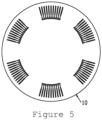
- Figure 5 illustrates a microfluidic reagent card, a plurality of micropipes of aspect 2 are fixed onto a card body 10.
- each of the 6 micropipe groups has 11 micropipes of aspect 2.
- the micropipe groups are arranged in a ring. All of these micropipes are arranged radially, and the closed end of the micropipe is arranged in the lateral side of the micropipe.
- the micropipes are radially distributed according to the center of centrifugation on a plane.
- a detection method of the human ABO blood group positive typing and Rh(D) blood group microfluidic reagent card according to embodiment 5, comprising the following steps:
- An ABO blood group positive typing and Rh(D) blood group microfluidic reagent card for newborns comprises a card body and a plurality of micropipes, the plurality of micropipes is fixed onto the card body.
- the plurality of micro cubes is divided into 12 groups, each group has 6 micropipes.
- the micropipes are arranged radially, and radially distributed according to the center of centrifugation on a plane; the microfluidic reagent card also comprises an automatic quantitative sample distribution device.
- the micropipe is connected to an automatic quantitative sample distribution device.
- the automatic quantitative sample distribution device comprises a sample adding component and a plurality of quantitative sample distribution systems.
- a micropipe gel separation device is used to separate agglutinated from non-agglutinated red blood cells.
- a predetermined amount of sample enters into the connected micropipe gel separation device, which separates agglutinated from non-agglutinated red blood cells.
- the separation medium layer in the micropipe is gel particles
- Micropipe No. Component Description Micropipe 1: anti-A reagent anti-A mouse monoclonal (IgM) antibody (clone BRIMA-1)
- Micropipe 2 anti-B reagent anti-B mouse monoclonal (IgM) antibody (clone LB-2)
- Micropipe 3 anti-AB reagent anti-B mouse monoclonal (IgM) antibody (clone ES-4) anti-A(B) mouse monoclonal (IgM) antibody (clone ES-15)
- Micropipe 4 anti-Rh(D) reagent Anti-Rh(D) human monoclonal (IgM) antibody (clone RUM-1)
- Micropipe 5 control reagent Antibody diluent
- Micropipe 6 anti-human globulin reagent Goat anti-human IgG antibody
- detection method of ABO blood group positive typing and Rh(D) blood group microfluidic reagent card for newborns comprises the following steps:
- a Microfluidic reagent card for human Rh system typing comprises a card body and a plurality of micropipes, the plurality of micropipes is fixed on the card body.
- the plurality of micro cubes is divided into 12 groups, each group has 6 micropipes.
- the micropipes are arranged radially, and radially distributed according to the center of centrifugation on a plane.
- the microfluidic reagent card also comprises automatic quantitative sample distribution device.
- the micropipe is connected to an automatic quantitative sample distribution device, the automatic quantitative sample distribution device comprises a sample adding component and a plurality of quantitative sample distribution systems, the micropipe gel separation device is used to separate agglutinated from non-agglutinated red blood cells, a predetermined amount of sample enters into the connected micropipe gel separation device, which separates agglutinated from non-agglutinated red blood cells.
- the separation medium layer in the micropipe is gel particles.
- Micropipe No. Component Description Micropipe 1: anti-C reagent Anti-C antibody human monoclonal (IgM) antibody (clone MS-24)
- Micropipe 2 anti-c reagent Anti-c antibody human monoclonal (IgM) antibody (clone MS-33)
- Micropipe 3 anti-D reagent Anti-Rh(D) human monoclonal (IgM) antibody (clone RUM-1)
- Micropipe 4 anti-E reagent Anti-E antibody human monoclonal (IgM) antibody (clone MS-80/MS-258)
- Micropipe 5 anti-e reagent Anti-e antibody human monoclonal (IgM) antibody (clone MS-16/MS-21/MS-63)
- Micropipe 6 control reagent Antibody diluent
- a detection method of a microfluidic reagent card for human Rh system typing comprises the following steps:
Landscapes
- Health & Medical Sciences (AREA)
- Chemical & Material Sciences (AREA)
- Life Sciences & Earth Sciences (AREA)
- Immunology (AREA)
- Engineering & Computer Science (AREA)
- Hematology (AREA)
- Chemical Kinetics & Catalysis (AREA)
- General Health & Medical Sciences (AREA)
- Biomedical Technology (AREA)
- Clinical Laboratory Science (AREA)
- Molecular Biology (AREA)
- Analytical Chemistry (AREA)
- Urology & Nephrology (AREA)
- Dispersion Chemistry (AREA)
- Biochemistry (AREA)
- Biotechnology (AREA)
- Microbiology (AREA)
- General Physics & Mathematics (AREA)
- Physics & Mathematics (AREA)
- Food Science & Technology (AREA)
- Cell Biology (AREA)
- Pathology (AREA)
- Medicinal Chemistry (AREA)
- Organic Chemistry (AREA)
- Bioinformatics & Cheminformatics (AREA)
- Wood Science & Technology (AREA)
- Zoology (AREA)
- Sustainable Development (AREA)
- Genetics & Genomics (AREA)
- General Engineering & Computer Science (AREA)
- Investigating Or Analysing Biological Materials (AREA)
- Automatic Analysis And Handling Materials Therefor (AREA)
Claims (7)
- Mikrofluidische Reagenzkarte, umfassend:einen Kartenkörper (10) und eine Vielzahl von Mikroröhren (11), die auf dem Kartenkörper (10) befestigt sind,wobei jede der Vielzahl von Mikroröhren (11) konfiguriert ist, um ein Probeneinlassende (1) und ein geschlossenes Ende (2) aufzuweisen, und wobei eine Nachweisflüssigkeitsschicht (3) und eine Trennmediumschicht (4) im Inneren jeder der Vielzahl von Mikroröhren (11) der Reihe nach von dem Probeneinlassende (1) zu dem geschlossenen Ende (2) angeordnet sind, wobei die Trennmediumschicht (4) aus Gelpartikeln oder Glaskügelchen hergestellt ist und jede der Vielzahl von Mikroröhren (11) einen Durchmesser von 0,1-1,0 mm aufweist;das Probeneinlassende (1)jeder der Vielzahl von Mikroröhren (11) konfiguriert ist, um mit einer Vorrichtung für eine automatische quantitative Probenverteilung verbunden zu sein, wobei die Vielzahl von Mikroröhren angepasst ist, um eine Probe gleichzeitig eingeführt zu bekommen; und die Vielzahl von Mikroröhren radial angeordnet ist, wobei das geschlossene Ende (2) jeder der Vielzahl von Mikroröhren an der lateralen Seite jeder der Vielzahl von Mikroröhren angeordnet ist und die Vielzahl von Mikroröhren gemäß dem Zentrifugationszentrum auf einer Ebene radial verteilt ist;wobei jede der Vorrichtungen für die automatische quantitative Probenverteilung eine Probenzugabekomponente umfasst, die Probenzugabekomponente mit einem quantitativen Bereich (5) verbunden ist, der quantitative Bereich (5) mit dem Probeneinlass (1) jeder der Vielzahl von Mikroröhren (11) verbunden ist, ein Schlussabschnitt (6) zwischen dem quantitativen Bereich (5) und dem Probeneinlassende (1) jeder der Vielzahl von Mikroröhren (11) bereitgestellt ist,wobei sich der Weg zwischen dem quantitativen Bereich (5) und dem Schlussabschnitt (6) allmählich verengt, der Durchmesser des Wegs vor dem Schlussabschnitt (6) 0,08 bis 0,14 mm beträgt und der Durchmesser des Wegs zwischen dem Schlussabschnitt (6) und dem Probeneinlassende (1) jeder der Vielzahl von Mikroröhren (11) 0,15 bis 0,3 mm beträgt.
- Mikrofluidische Reagenzkarte nach Anspruch 1, wobei die Nachweisflüssigkeitsschicht (3) ein Verdünnungsmittel umfasst, das Verdünnungsmittel ein Antikörperreagenz umfasst oder kein Antikörperreagenz umfasst.
- Mikrofluidische Reagenzkarte nach Anspruch 1, wobei jede der Vielzahl von Mikroröhren (11) einen Durchmesser von 0,8 mm und eine Länge von 10 mm aufweist.
- Mikrofluidische Reagenzkarte nach Anspruch 1, wobei der Weg vor dem Schlussabschnitt (6) einen Durchmesser von 0,1 mm aufweist und der Weg zwischen dem Schlussabschnitt (6) und dem Probeneinlassende (1) jeder der Vielzahl von Mikroröhren (11) einen Durchmesser von 0,2 mm aufweist.
- Nachweisverfahren unter Verwendung der mikrofluidischen Reagenzkarte nach einem der Ansprüche 1 bis 4, wobei das Nachweisverfahren die folgenden Schritte umfasst: Eingeben einer Probe in die Vielzahl von Mikroröhren (11), um mit der Nachweisflüssigkeitsschicht in der Vielzahl von Mikroröhren (11) gemischt zu werden, Zentrifugieren der Vielzahl von Mikroröhren (11) und Ablesen eines Ergebnisses.
- Anwendung der mikrofluidischen Reagenzkarte nach Anspruch 1 bei einem Antigen-Antikörper-Nachweis.
- Anwendung nach Anspruch 6, wobei die Anwendung aus einer Gruppe ausgewählt ist, bestehend aus Blutgruppenbestimmung, Antikörperscreening und Blutkreuzprobe.
Applications Claiming Priority (2)
| Application Number | Priority Date | Filing Date | Title |
|---|---|---|---|
| CN201610562969.7A CN106076445B (zh) | 2016-07-18 | 2016-07-18 | 微流控试剂卡及其检测方法和应用 |
| PCT/CN2016/113508 WO2018014513A1 (zh) | 2016-07-18 | 2016-12-30 | 微流控试剂卡及其检测方法和应用 |
Publications (3)
| Publication Number | Publication Date |
|---|---|
| EP3485973A1 EP3485973A1 (de) | 2019-05-22 |
| EP3485973A4 EP3485973A4 (de) | 2020-01-15 |
| EP3485973B1 true EP3485973B1 (de) | 2025-05-07 |
Family
ID=57220698
Family Applications (1)
| Application Number | Title | Priority Date | Filing Date |
|---|---|---|---|
| EP16909440.6A Active EP3485973B1 (de) | 2016-07-18 | 2016-12-30 | Mikrofluidische reagenzkarte, nachweisverfahren und anwendung davon |
Country Status (4)
| Country | Link |
|---|---|
| US (1) | US10695759B2 (de) |
| EP (1) | EP3485973B1 (de) |
| CN (1) | CN106076445B (de) |
| WO (1) | WO2018014513A1 (de) |
Families Citing this family (14)
| Publication number | Priority date | Publication date | Assignee | Title |
|---|---|---|---|---|
| CN106076445B (zh) | 2016-07-18 | 2018-06-15 | 天津德祥生物技术有限公司 | 微流控试剂卡及其检测方法和应用 |
| CN108535464B (zh) * | 2017-12-26 | 2020-11-13 | 北京利德曼生化股份有限公司 | 便携式凝血检测卡 |
| EP3543707B1 (de) * | 2018-03-22 | 2023-07-05 | Tecan Trading AG | Optimierung von flüssigkeitsklassen für eine laborautomationsvorrichtung |
| KR102401909B1 (ko) * | 2018-08-30 | 2022-05-24 | 주식회사 엘지화학 | 반응 최적화를 위한 고속 스크리닝 분석 시스템 |
| CN108704684B (zh) * | 2018-09-04 | 2023-06-06 | 重庆科技学院 | 一种检测用多层微流控芯片的使用方法 |
| CN109439514B (zh) * | 2018-12-14 | 2024-08-06 | 贵州大学 | 一种用于阵列微流体点样微流控制装置的支撑装置 |
| CN109821667A (zh) * | 2019-02-27 | 2019-05-31 | 广西民族大学 | 一种便携式手动高速血液离心装置 |
| CN110180611B (zh) * | 2019-07-05 | 2024-03-08 | 宋禹 | 微流控芯片组件 |
| CN111604098B (zh) * | 2020-06-04 | 2022-01-07 | 天津德祥生物技术有限公司 | 侧面加样微流控芯片 |
| CN113406322A (zh) * | 2021-06-16 | 2021-09-17 | 枣庄科技职业学院 | 一种便捷型免疫层析分析试剂盒 |
| CN114047151A (zh) * | 2021-11-15 | 2022-02-15 | 四川丹诺迪科技有限公司 | 一种同时进行样本分析和免疫测量的仪器及检测方法 |
| CN114563583B (zh) * | 2022-04-24 | 2022-07-22 | 天津德祥生物技术有限公司 | 一种高通量微反应血型正定检测装置 |
| CN116298347B (zh) * | 2023-05-12 | 2023-07-25 | 北京未神生物科技有限公司 | 一种离心式微流控的全自动血型检测卡及其检测方法 |
| CN118914570A (zh) * | 2024-08-21 | 2024-11-08 | 河北吉宣生物科技有限公司 | 一种反应免疫蛋白荧光检测分析装置 |
Family Cites Families (15)
| Publication number | Priority date | Publication date | Assignee | Title |
|---|---|---|---|---|
| DE60045917D1 (de) * | 1999-02-23 | 2011-06-16 | Caliper Life Sciences Inc | Sequenzierung durch inkorporation |
| WO2001087486A2 (en) * | 2000-05-15 | 2001-11-22 | Tecan Trading Ag | Microfluidics devices and methods for performing cell based assays |
| US7534618B2 (en) * | 2005-10-28 | 2009-05-19 | Hewlett-Packard Development Company, L.P. | Systems and methods for measuring glycated hemoglobin |
| CN101118239A (zh) * | 2007-06-14 | 2008-02-06 | 四川省迈克科技有限责任公司 | 一种利用微流体技术检测血型的试剂盒及其制备方法 |
| CN201397336Y (zh) * | 2009-01-16 | 2010-02-03 | 江阴力博医药生物技术有限公司 | 检测试剂卡 |
| EP2233210A1 (de) * | 2009-03-23 | 2010-09-29 | Aleria Biodevices, S. L. | Vorrichtung zur sequentiellen Ausgabe von flüssigen Reagenzien in eine Reaktionskammer |
| NZ625421A (en) * | 2009-09-24 | 2015-09-25 | Univ Monash | Testing device for identifying antigens and antibodies in biofluids |
| GB2474888A (en) * | 2009-10-30 | 2011-05-04 | Univ Dublin City | Microfluidic devices with degassing driven fluid flow |
| CN101701961B (zh) | 2009-11-25 | 2013-03-06 | 江阴力博医药生物技术有限公司 | Abo血型定型检测试剂卡的制备方法 |
| CN102466731A (zh) * | 2010-11-19 | 2012-05-23 | 南京神州英诺华医疗科技有限公司 | 一种新型的血型和配血试验检测方法 |
| TWI475226B (zh) * | 2012-08-01 | 2015-03-01 | Univ Feng Chia | 利用分流結構進行生化檢測之裝置及其運作方法 |
| JP6120518B2 (ja) * | 2012-10-10 | 2017-04-26 | 公益財団法人かずさDna研究所 | 簡易測定器具 |
| CN205353104U (zh) * | 2016-02-23 | 2016-06-29 | 英科新创(厦门)科技有限公司 | 一种ABO&RhD血型定型检测卡 |
| CN206193008U (zh) * | 2016-07-18 | 2017-05-24 | 天津德祥生物技术有限公司 | 一种微流控装置及试剂卡 |
| CN106076445B (zh) * | 2016-07-18 | 2018-06-15 | 天津德祥生物技术有限公司 | 微流控试剂卡及其检测方法和应用 |
-
2016
- 2016-07-18 CN CN201610562969.7A patent/CN106076445B/zh active Active
- 2016-12-30 EP EP16909440.6A patent/EP3485973B1/de active Active
- 2016-12-30 US US16/318,275 patent/US10695759B2/en active Active
- 2016-12-30 WO PCT/CN2016/113508 patent/WO2018014513A1/zh not_active Ceased
Also Published As
| Publication number | Publication date |
|---|---|
| EP3485973A1 (de) | 2019-05-22 |
| WO2018014513A1 (zh) | 2018-01-25 |
| EP3485973A4 (de) | 2020-01-15 |
| US10695759B2 (en) | 2020-06-30 |
| CN106076445A (zh) | 2016-11-09 |
| CN106076445B (zh) | 2018-06-15 |
| US20190283018A1 (en) | 2019-09-19 |
Similar Documents
| Publication | Publication Date | Title |
|---|---|---|
| EP3485973B1 (de) | Mikrofluidische reagenzkarte, nachweisverfahren und anwendung davon | |
| JP4869602B2 (ja) | 被検物をマイクロ流体デバイスの多チャネルに分割する方法及び装置 | |
| CA1220713A (en) | Integrated single-tube plunger immunoassay system | |
| CN113634295B (zh) | 一种微流控血型检测芯片 | |
| JP4351539B2 (ja) | 遠心力及び/又は毛管力によって流体を正確に移動し、操作する方法及び装置 | |
| JP2854058B2 (ja) | アッセイを実施するための方法及び装置 | |
| CN108136397B (zh) | 确定血液样品中的分析物的量的方法以及医疗系统 | |
| US20040166551A1 (en) | Detection of agglutination of assays | |
| US7824873B2 (en) | Blood test kit | |
| Rumsey et al. | New protocols in serologic testing: A review of techniques to meet today's challenges | |
| US5869347A (en) | Particle immunoassay using a compact matrix | |
| CN109932234B (zh) | 一种全血微流控自动交叉配血系统及配血方法 | |
| CN107980096B (zh) | 低密度不混溶化合物在用于检测样本中分析物的装置中的用途 | |
| WO2024234422A1 (zh) | 一种血液检测微流控芯片及其检测方法 | |
| EP2340123B1 (de) | Agglutinierte antikörper geladene erythrozyte erfassendes reaktionsgefäss, verfahren zur erfassung von agglutinierten antikörper geladenen erythrozyten und teilesatz | |
| CN206193008U (zh) | 一种微流控装置及试剂卡 | |
| US20220252622A1 (en) | Single tube preparation comprising a panel of differently labeled cells for serology | |
| CN121314709A (zh) | 一种芯片 | |
| WO2019175744A1 (en) | System and methods for rapid analysis of biological samples |
Legal Events
| Date | Code | Title | Description |
|---|---|---|---|
| STAA | Information on the status of an ep patent application or granted ep patent |
Free format text: STATUS: THE INTERNATIONAL PUBLICATION HAS BEEN MADE |
|
| PUAI | Public reference made under article 153(3) epc to a published international application that has entered the european phase |
Free format text: ORIGINAL CODE: 0009012 |
|
| STAA | Information on the status of an ep patent application or granted ep patent |
Free format text: STATUS: REQUEST FOR EXAMINATION WAS MADE |
|
| 17P | Request for examination filed |
Effective date: 20190218 |
|
| AK | Designated contracting states |
Kind code of ref document: A1 Designated state(s): AL AT BE BG CH CY CZ DE DK EE ES FI FR GB GR HR HU IE IS IT LI LT LU LV MC MK MT NL NO PL PT RO RS SE SI SK SM TR |
|
| AX | Request for extension of the european patent |
Extension state: BA ME |
|
| DAV | Request for validation of the european patent (deleted) | ||
| DAX | Request for extension of the european patent (deleted) | ||
| A4 | Supplementary search report drawn up and despatched |
Effective date: 20191216 |
|
| RIC1 | Information provided on ipc code assigned before grant |
Ipc: C12M 3/06 20060101ALI20191210BHEP Ipc: B01L 3/00 20060101AFI20191210BHEP Ipc: B01L 3/02 20060101ALI20191210BHEP Ipc: B01L 9/00 20060101ALI20191210BHEP Ipc: G01N 33/577 20060101ALI20191210BHEP |
|
| STAA | Information on the status of an ep patent application or granted ep patent |
Free format text: STATUS: EXAMINATION IS IN PROGRESS |
|
| 17Q | First examination report despatched |
Effective date: 20210630 |
|
| GRAP | Despatch of communication of intention to grant a patent |
Free format text: ORIGINAL CODE: EPIDOSNIGR1 |
|
| STAA | Information on the status of an ep patent application or granted ep patent |
Free format text: STATUS: GRANT OF PATENT IS INTENDED |
|
| INTG | Intention to grant announced |
Effective date: 20241209 |
|
| GRAS | Grant fee paid |
Free format text: ORIGINAL CODE: EPIDOSNIGR3 |
|
| GRAA | (expected) grant |
Free format text: ORIGINAL CODE: 0009210 |
|
| STAA | Information on the status of an ep patent application or granted ep patent |
Free format text: STATUS: THE PATENT HAS BEEN GRANTED |
|
| AK | Designated contracting states |
Kind code of ref document: B1 Designated state(s): AL AT BE BG CH CY CZ DE DK EE ES FI FR GB GR HR HU IE IS IT LI LT LU LV MC MK MT NL NO PL PT RO RS SE SI SK SM TR |
|
| REG | Reference to a national code |
Ref country code: GB Ref legal event code: FG4D |
|
| REG | Reference to a national code |
Ref country code: CH Ref legal event code: EP |
|
| REG | Reference to a national code |
Ref country code: DE Ref legal event code: R096 Ref document number: 602016092197 Country of ref document: DE |
|
| REG | Reference to a national code |
Ref country code: IE Ref legal event code: FG4D |
|
| REG | Reference to a national code |
Ref country code: NL Ref legal event code: MP Effective date: 20250507 |
|
| PG25 | Lapsed in a contracting state [announced via postgrant information from national office to epo] |
Ref country code: PT Free format text: LAPSE BECAUSE OF FAILURE TO SUBMIT A TRANSLATION OF THE DESCRIPTION OR TO PAY THE FEE WITHIN THE PRESCRIBED TIME-LIMIT Effective date: 20250908 Ref country code: ES Free format text: LAPSE BECAUSE OF FAILURE TO SUBMIT A TRANSLATION OF THE DESCRIPTION OR TO PAY THE FEE WITHIN THE PRESCRIBED TIME-LIMIT Effective date: 20250507 Ref country code: FI Free format text: LAPSE BECAUSE OF FAILURE TO SUBMIT A TRANSLATION OF THE DESCRIPTION OR TO PAY THE FEE WITHIN THE PRESCRIBED TIME-LIMIT Effective date: 20250507 |
|
| REG | Reference to a national code |
Ref country code: LT Ref legal event code: MG9D |
|
| PG25 | Lapsed in a contracting state [announced via postgrant information from national office to epo] |
Ref country code: NO Free format text: LAPSE BECAUSE OF FAILURE TO SUBMIT A TRANSLATION OF THE DESCRIPTION OR TO PAY THE FEE WITHIN THE PRESCRIBED TIME-LIMIT Effective date: 20250807 Ref country code: GR Free format text: LAPSE BECAUSE OF FAILURE TO SUBMIT A TRANSLATION OF THE DESCRIPTION OR TO PAY THE FEE WITHIN THE PRESCRIBED TIME-LIMIT Effective date: 20250808 |
|
| PG25 | Lapsed in a contracting state [announced via postgrant information from national office to epo] |
Ref country code: PL Free format text: LAPSE BECAUSE OF FAILURE TO SUBMIT A TRANSLATION OF THE DESCRIPTION OR TO PAY THE FEE WITHIN THE PRESCRIBED TIME-LIMIT Effective date: 20250507 Ref country code: NL Free format text: LAPSE BECAUSE OF FAILURE TO SUBMIT A TRANSLATION OF THE DESCRIPTION OR TO PAY THE FEE WITHIN THE PRESCRIBED TIME-LIMIT Effective date: 20250507 |
|
| REG | Reference to a national code |
Ref country code: AT Ref legal event code: MK05 Ref document number: 1791908 Country of ref document: AT Kind code of ref document: T Effective date: 20250507 |
|
| PG25 | Lapsed in a contracting state [announced via postgrant information from national office to epo] |
Ref country code: BG Free format text: LAPSE BECAUSE OF FAILURE TO SUBMIT A TRANSLATION OF THE DESCRIPTION OR TO PAY THE FEE WITHIN THE PRESCRIBED TIME-LIMIT Effective date: 20250507 |
|
| PG25 | Lapsed in a contracting state [announced via postgrant information from national office to epo] |
Ref country code: HR Free format text: LAPSE BECAUSE OF FAILURE TO SUBMIT A TRANSLATION OF THE DESCRIPTION OR TO PAY THE FEE WITHIN THE PRESCRIBED TIME-LIMIT Effective date: 20250507 |
|
| PG25 | Lapsed in a contracting state [announced via postgrant information from national office to epo] |
Ref country code: AT Free format text: LAPSE BECAUSE OF FAILURE TO SUBMIT A TRANSLATION OF THE DESCRIPTION OR TO PAY THE FEE WITHIN THE PRESCRIBED TIME-LIMIT Effective date: 20250507 |
|
| PG25 | Lapsed in a contracting state [announced via postgrant information from national office to epo] |
Ref country code: RS Free format text: LAPSE BECAUSE OF FAILURE TO SUBMIT A TRANSLATION OF THE DESCRIPTION OR TO PAY THE FEE WITHIN THE PRESCRIBED TIME-LIMIT Effective date: 20250807 |
|
| PG25 | Lapsed in a contracting state [announced via postgrant information from national office to epo] |
Ref country code: IS Free format text: LAPSE BECAUSE OF FAILURE TO SUBMIT A TRANSLATION OF THE DESCRIPTION OR TO PAY THE FEE WITHIN THE PRESCRIBED TIME-LIMIT Effective date: 20250907 |
|
| PG25 | Lapsed in a contracting state [announced via postgrant information from national office to epo] |
Ref country code: LV Free format text: LAPSE BECAUSE OF FAILURE TO SUBMIT A TRANSLATION OF THE DESCRIPTION OR TO PAY THE FEE WITHIN THE PRESCRIBED TIME-LIMIT Effective date: 20250507 |
|
| PGFP | Annual fee paid to national office [announced via postgrant information from national office to epo] |
Ref country code: DE Payment date: 20251222 Year of fee payment: 10 |
|
| PGFP | Annual fee paid to national office [announced via postgrant information from national office to epo] |
Ref country code: GB Payment date: 20251221 Year of fee payment: 10 |
|
| PG25 | Lapsed in a contracting state [announced via postgrant information from national office to epo] |
Ref country code: SM Free format text: LAPSE BECAUSE OF FAILURE TO SUBMIT A TRANSLATION OF THE DESCRIPTION OR TO PAY THE FEE WITHIN THE PRESCRIBED TIME-LIMIT Effective date: 20250507 Ref country code: DK Free format text: LAPSE BECAUSE OF FAILURE TO SUBMIT A TRANSLATION OF THE DESCRIPTION OR TO PAY THE FEE WITHIN THE PRESCRIBED TIME-LIMIT Effective date: 20250507 |
|
| PGFP | Annual fee paid to national office [announced via postgrant information from national office to epo] |
Ref country code: FR Payment date: 20251221 Year of fee payment: 10 |
|
| PG25 | Lapsed in a contracting state [announced via postgrant information from national office to epo] |
Ref country code: CZ Free format text: LAPSE BECAUSE OF FAILURE TO SUBMIT A TRANSLATION OF THE DESCRIPTION OR TO PAY THE FEE WITHIN THE PRESCRIBED TIME-LIMIT Effective date: 20250507 |
|
| PG25 | Lapsed in a contracting state [announced via postgrant information from national office to epo] |
Ref country code: EE Free format text: LAPSE BECAUSE OF FAILURE TO SUBMIT A TRANSLATION OF THE DESCRIPTION OR TO PAY THE FEE WITHIN THE PRESCRIBED TIME-LIMIT Effective date: 20250507 |
|
| PG25 | Lapsed in a contracting state [announced via postgrant information from national office to epo] |
Ref country code: SK Free format text: LAPSE BECAUSE OF FAILURE TO SUBMIT A TRANSLATION OF THE DESCRIPTION OR TO PAY THE FEE WITHIN THE PRESCRIBED TIME-LIMIT Effective date: 20250507 Ref country code: RO Free format text: LAPSE BECAUSE OF FAILURE TO SUBMIT A TRANSLATION OF THE DESCRIPTION OR TO PAY THE FEE WITHIN THE PRESCRIBED TIME-LIMIT Effective date: 20250507 |
|
| PG25 | Lapsed in a contracting state [announced via postgrant information from national office to epo] |
Ref country code: IT Free format text: LAPSE BECAUSE OF FAILURE TO SUBMIT A TRANSLATION OF THE DESCRIPTION OR TO PAY THE FEE WITHIN THE PRESCRIBED TIME-LIMIT Effective date: 20250507 |
|
| REG | Reference to a national code |
Ref country code: DE Ref legal event code: R097 Ref document number: 602016092197 Country of ref document: DE |
|
| PLBE | No opposition filed within time limit |
Free format text: ORIGINAL CODE: 0009261 |
|
| STAA | Information on the status of an ep patent application or granted ep patent |
Free format text: STATUS: NO OPPOSITION FILED WITHIN TIME LIMIT |
|
| REG | Reference to a national code |
Ref country code: CH Ref legal event code: L10 Free format text: ST27 STATUS EVENT CODE: U-0-0-L10-L00 (AS PROVIDED BY THE NATIONAL OFFICE) Effective date: 20260318 |
|
| 26N | No opposition filed |
Effective date: 20260210 |