EP3476852B1 - Heterocyclische verbindung und organische lichtemittierende vorrichtung damit - Google Patents
Heterocyclische verbindung und organische lichtemittierende vorrichtung damit Download PDFInfo
- Publication number
- EP3476852B1 EP3476852B1 EP18191151.2A EP18191151A EP3476852B1 EP 3476852 B1 EP3476852 B1 EP 3476852B1 EP 18191151 A EP18191151 A EP 18191151A EP 3476852 B1 EP3476852 B1 EP 3476852B1
- Authority
- EP
- European Patent Office
- Prior art keywords
- group
- substituted
- groups
- different
- aromatic condensed
- Prior art date
- Legal status (The legal status is an assumption and is not a legal conclusion. Google has not performed a legal analysis and makes no representation as to the accuracy of the status listed.)
- Active
Links
Images


Classifications
-
- C—CHEMISTRY; METALLURGY
- C07—ORGANIC CHEMISTRY
- C07F—ACYCLIC, CARBOCYCLIC OR HETEROCYCLIC COMPOUNDS CONTAINING ELEMENTS OTHER THAN CARBON, HYDROGEN, HALOGEN, OXYGEN, NITROGEN, SULFUR, SELENIUM OR TELLURIUM
- C07F9/00—Compounds containing elements of Groups 5 or 15 of the Periodic Table
- C07F9/02—Phosphorus compounds
- C07F9/547—Heterocyclic compounds, e.g. containing phosphorus as a ring hetero atom
- C07F9/6515—Heterocyclic compounds, e.g. containing phosphorus as a ring hetero atom having three nitrogen atoms as the only ring hetero atoms
- C07F9/6521—Six-membered rings
-
- C—CHEMISTRY; METALLURGY
- C07—ORGANIC CHEMISTRY
- C07F—ACYCLIC, CARBOCYCLIC OR HETEROCYCLIC COMPOUNDS CONTAINING ELEMENTS OTHER THAN CARBON, HYDROGEN, HALOGEN, OXYGEN, NITROGEN, SULFUR, SELENIUM OR TELLURIUM
- C07F9/00—Compounds containing elements of Groups 5 or 15 of the Periodic Table
- C07F9/02—Phosphorus compounds
- C07F9/547—Heterocyclic compounds, e.g. containing phosphorus as a ring hetero atom
- C07F9/6558—Heterocyclic compounds, e.g. containing phosphorus as a ring hetero atom containing at least two different or differently substituted hetero rings neither condensed among themselves nor condensed with a common carbocyclic ring or ring system
- C07F9/65583—Heterocyclic compounds, e.g. containing phosphorus as a ring hetero atom containing at least two different or differently substituted hetero rings neither condensed among themselves nor condensed with a common carbocyclic ring or ring system each of the hetero rings containing nitrogen as ring hetero atom
-
- C—CHEMISTRY; METALLURGY
- C07—ORGANIC CHEMISTRY
- C07F—ACYCLIC, CARBOCYCLIC OR HETEROCYCLIC COMPOUNDS CONTAINING ELEMENTS OTHER THAN CARBON, HYDROGEN, HALOGEN, OXYGEN, NITROGEN, SULFUR, SELENIUM OR TELLURIUM
- C07F9/00—Compounds containing elements of Groups 5 or 15 of the Periodic Table
- C07F9/02—Phosphorus compounds
- C07F9/547—Heterocyclic compounds, e.g. containing phosphorus as a ring hetero atom
- C07F9/6558—Heterocyclic compounds, e.g. containing phosphorus as a ring hetero atom containing at least two different or differently substituted hetero rings neither condensed among themselves nor condensed with a common carbocyclic ring or ring system
- C07F9/65586—Heterocyclic compounds, e.g. containing phosphorus as a ring hetero atom containing at least two different or differently substituted hetero rings neither condensed among themselves nor condensed with a common carbocyclic ring or ring system at least one of the hetero rings does not contain nitrogen as ring hetero atom
-
- C—CHEMISTRY; METALLURGY
- C07—ORGANIC CHEMISTRY
- C07F—ACYCLIC, CARBOCYCLIC OR HETEROCYCLIC COMPOUNDS CONTAINING ELEMENTS OTHER THAN CARBON, HYDROGEN, HALOGEN, OXYGEN, NITROGEN, SULFUR, SELENIUM OR TELLURIUM
- C07F9/00—Compounds containing elements of Groups 5 or 15 of the Periodic Table
- C07F9/02—Phosphorus compounds
- C07F9/547—Heterocyclic compounds, e.g. containing phosphorus as a ring hetero atom
- C07F9/6564—Heterocyclic compounds, e.g. containing phosphorus as a ring hetero atom having phosphorus atoms, with or without nitrogen, oxygen, sulfur, selenium or tellurium atoms, as ring hetero atoms
- C07F9/6568—Heterocyclic compounds, e.g. containing phosphorus as a ring hetero atom having phosphorus atoms, with or without nitrogen, oxygen, sulfur, selenium or tellurium atoms, as ring hetero atoms having phosphorus atoms as the only ring hetero atoms
- C07F9/65685—Heterocyclic compounds, e.g. containing phosphorus as a ring hetero atom having phosphorus atoms, with or without nitrogen, oxygen, sulfur, selenium or tellurium atoms, as ring hetero atoms having phosphorus atoms as the only ring hetero atoms the ring phosphorus atom being part of a phosphine oxide or thioxide
-
- C—CHEMISTRY; METALLURGY
- C09—DYES; PAINTS; POLISHES; NATURAL RESINS; ADHESIVES; COMPOSITIONS NOT OTHERWISE PROVIDED FOR; APPLICATIONS OF MATERIALS NOT OTHERWISE PROVIDED FOR
- C09K—MATERIALS FOR MISCELLANEOUS APPLICATIONS, NOT PROVIDED FOR ELSEWHERE
- C09K11/00—Luminescent, e.g. electroluminescent, chemiluminescent materials
- C09K11/06—Luminescent, e.g. electroluminescent, chemiluminescent materials containing organic luminescent materials
-
- H—ELECTRICITY
- H10—SEMICONDUCTOR DEVICES; ELECTRIC SOLID-STATE DEVICES NOT OTHERWISE PROVIDED FOR
- H10K—ORGANIC ELECTRIC SOLID-STATE DEVICES
- H10K50/00—Organic light-emitting devices
- H10K50/10—OLEDs or polymer light-emitting diodes [PLED]
- H10K50/11—OLEDs or polymer light-emitting diodes [PLED] characterised by the electroluminescent [EL] layers
- H10K50/125—OLEDs or polymer light-emitting diodes [PLED] characterised by the electroluminescent [EL] layers specially adapted for multicolour light emission, e.g. for emitting white light
- H10K50/13—OLEDs or polymer light-emitting diodes [PLED] characterised by the electroluminescent [EL] layers specially adapted for multicolour light emission, e.g. for emitting white light comprising stacked EL layers within one EL unit
-
- H—ELECTRICITY
- H10—SEMICONDUCTOR DEVICES; ELECTRIC SOLID-STATE DEVICES NOT OTHERWISE PROVIDED FOR
- H10K—ORGANIC ELECTRIC SOLID-STATE DEVICES
- H10K71/00—Manufacture or treatment specially adapted for the organic devices covered by this subclass
- H10K71/40—Thermal treatment, e.g. annealing in the presence of a solvent vapour
-
- H—ELECTRICITY
- H10—SEMICONDUCTOR DEVICES; ELECTRIC SOLID-STATE DEVICES NOT OTHERWISE PROVIDED FOR
- H10K—ORGANIC ELECTRIC SOLID-STATE DEVICES
- H10K71/00—Manufacture or treatment specially adapted for the organic devices covered by this subclass
- H10K71/60—Forming conductive regions or layers, e.g. electrodes
-
- H—ELECTRICITY
- H10—SEMICONDUCTOR DEVICES; ELECTRIC SOLID-STATE DEVICES NOT OTHERWISE PROVIDED FOR
- H10K—ORGANIC ELECTRIC SOLID-STATE DEVICES
- H10K85/00—Organic materials used in the body or electrodes of devices covered by this subclass
- H10K85/60—Organic compounds having low molecular weight
- H10K85/615—Polycyclic condensed aromatic hydrocarbons, e.g. anthracene
-
- H—ELECTRICITY
- H10—SEMICONDUCTOR DEVICES; ELECTRIC SOLID-STATE DEVICES NOT OTHERWISE PROVIDED FOR
- H10K—ORGANIC ELECTRIC SOLID-STATE DEVICES
- H10K85/00—Organic materials used in the body or electrodes of devices covered by this subclass
- H10K85/60—Organic compounds having low molecular weight
- H10K85/615—Polycyclic condensed aromatic hydrocarbons, e.g. anthracene
- H10K85/626—Polycyclic condensed aromatic hydrocarbons, e.g. anthracene containing more than one polycyclic condensed aromatic rings, e.g. bis-anthracene
-
- H—ELECTRICITY
- H10—SEMICONDUCTOR DEVICES; ELECTRIC SOLID-STATE DEVICES NOT OTHERWISE PROVIDED FOR
- H10K—ORGANIC ELECTRIC SOLID-STATE DEVICES
- H10K85/00—Organic materials used in the body or electrodes of devices covered by this subclass
- H10K85/60—Organic compounds having low molecular weight
- H10K85/649—Aromatic compounds comprising a hetero atom
- H10K85/654—Aromatic compounds comprising a hetero atom comprising only nitrogen as heteroatom
-
- H—ELECTRICITY
- H10—SEMICONDUCTOR DEVICES; ELECTRIC SOLID-STATE DEVICES NOT OTHERWISE PROVIDED FOR
- H10K—ORGANIC ELECTRIC SOLID-STATE DEVICES
- H10K85/00—Organic materials used in the body or electrodes of devices covered by this subclass
- H10K85/60—Organic compounds having low molecular weight
- H10K85/649—Aromatic compounds comprising a hetero atom
- H10K85/656—Aromatic compounds comprising a hetero atom comprising two or more different heteroatoms per ring
-
- H—ELECTRICITY
- H10—SEMICONDUCTOR DEVICES; ELECTRIC SOLID-STATE DEVICES NOT OTHERWISE PROVIDED FOR
- H10K—ORGANIC ELECTRIC SOLID-STATE DEVICES
- H10K85/00—Organic materials used in the body or electrodes of devices covered by this subclass
- H10K85/60—Organic compounds having low molecular weight
- H10K85/649—Aromatic compounds comprising a hetero atom
- H10K85/657—Polycyclic condensed heteroaromatic hydrocarbons
-
- H—ELECTRICITY
- H10—SEMICONDUCTOR DEVICES; ELECTRIC SOLID-STATE DEVICES NOT OTHERWISE PROVIDED FOR
- H10K—ORGANIC ELECTRIC SOLID-STATE DEVICES
- H10K85/00—Organic materials used in the body or electrodes of devices covered by this subclass
- H10K85/60—Organic compounds having low molecular weight
- H10K85/649—Aromatic compounds comprising a hetero atom
- H10K85/657—Polycyclic condensed heteroaromatic hydrocarbons
- H10K85/6572—Polycyclic condensed heteroaromatic hydrocarbons comprising only nitrogen in the heteroaromatic polycondensed ring system, e.g. phenanthroline or carbazole
-
- H—ELECTRICITY
- H10—SEMICONDUCTOR DEVICES; ELECTRIC SOLID-STATE DEVICES NOT OTHERWISE PROVIDED FOR
- H10K—ORGANIC ELECTRIC SOLID-STATE DEVICES
- H10K85/00—Organic materials used in the body or electrodes of devices covered by this subclass
- H10K85/60—Organic compounds having low molecular weight
- H10K85/649—Aromatic compounds comprising a hetero atom
- H10K85/657—Polycyclic condensed heteroaromatic hydrocarbons
- H10K85/6574—Polycyclic condensed heteroaromatic hydrocarbons comprising only oxygen in the heteroaromatic polycondensed ring system, e.g. cumarine dyes
-
- C—CHEMISTRY; METALLURGY
- C09—DYES; PAINTS; POLISHES; NATURAL RESINS; ADHESIVES; COMPOSITIONS NOT OTHERWISE PROVIDED FOR; APPLICATIONS OF MATERIALS NOT OTHERWISE PROVIDED FOR
- C09K—MATERIALS FOR MISCELLANEOUS APPLICATIONS, NOT PROVIDED FOR ELSEWHERE
- C09K2211/00—Chemical nature of organic luminescent or tenebrescent compounds
- C09K2211/10—Non-macromolecular compounds
- C09K2211/1018—Heterocyclic compounds
- C09K2211/1022—Heterocyclic compounds bridged by heteroatoms, e.g. N, P, Si or B
-
- C—CHEMISTRY; METALLURGY
- C09—DYES; PAINTS; POLISHES; NATURAL RESINS; ADHESIVES; COMPOSITIONS NOT OTHERWISE PROVIDED FOR; APPLICATIONS OF MATERIALS NOT OTHERWISE PROVIDED FOR
- C09K—MATERIALS FOR MISCELLANEOUS APPLICATIONS, NOT PROVIDED FOR ELSEWHERE
- C09K2211/00—Chemical nature of organic luminescent or tenebrescent compounds
- C09K2211/10—Non-macromolecular compounds
- C09K2211/1018—Heterocyclic compounds
- C09K2211/1025—Heterocyclic compounds characterised by ligands
- C09K2211/1059—Heterocyclic compounds characterised by ligands containing three nitrogen atoms as heteroatoms
-
- C—CHEMISTRY; METALLURGY
- C09—DYES; PAINTS; POLISHES; NATURAL RESINS; ADHESIVES; COMPOSITIONS NOT OTHERWISE PROVIDED FOR; APPLICATIONS OF MATERIALS NOT OTHERWISE PROVIDED FOR
- C09K—MATERIALS FOR MISCELLANEOUS APPLICATIONS, NOT PROVIDED FOR ELSEWHERE
- C09K2211/00—Chemical nature of organic luminescent or tenebrescent compounds
- C09K2211/10—Non-macromolecular compounds
- C09K2211/1018—Heterocyclic compounds
- C09K2211/1025—Heterocyclic compounds characterised by ligands
- C09K2211/1096—Heterocyclic compounds characterised by ligands containing other heteroatoms
-
- H—ELECTRICITY
- H10—SEMICONDUCTOR DEVICES; ELECTRIC SOLID-STATE DEVICES NOT OTHERWISE PROVIDED FOR
- H10K—ORGANIC ELECTRIC SOLID-STATE DEVICES
- H10K2101/00—Properties of the organic materials covered by group H10K85/00
- H10K2101/10—Triplet emission
-
- H—ELECTRICITY
- H10—SEMICONDUCTOR DEVICES; ELECTRIC SOLID-STATE DEVICES NOT OTHERWISE PROVIDED FOR
- H10K—ORGANIC ELECTRIC SOLID-STATE DEVICES
- H10K2101/00—Properties of the organic materials covered by group H10K85/00
- H10K2101/30—Highest occupied molecular orbital [HOMO], lowest unoccupied molecular orbital [LUMO] or Fermi energy values
-
- H—ELECTRICITY
- H10—SEMICONDUCTOR DEVICES; ELECTRIC SOLID-STATE DEVICES NOT OTHERWISE PROVIDED FOR
- H10K—ORGANIC ELECTRIC SOLID-STATE DEVICES
- H10K2101/00—Properties of the organic materials covered by group H10K85/00
- H10K2101/40—Interrelation of parameters between multiple constituent active layers or sublayers, e.g. HOMO values in adjacent layers
-
- H—ELECTRICITY
- H10—SEMICONDUCTOR DEVICES; ELECTRIC SOLID-STATE DEVICES NOT OTHERWISE PROVIDED FOR
- H10K—ORGANIC ELECTRIC SOLID-STATE DEVICES
- H10K2102/00—Constructional details relating to the organic devices covered by this subclass
- H10K2102/301—Details of OLEDs
- H10K2102/351—Thickness
-
- H—ELECTRICITY
- H10—SEMICONDUCTOR DEVICES; ELECTRIC SOLID-STATE DEVICES NOT OTHERWISE PROVIDED FOR
- H10K—ORGANIC ELECTRIC SOLID-STATE DEVICES
- H10K50/00—Organic light-emitting devices
- H10K50/10—OLEDs or polymer light-emitting diodes [PLED]
- H10K50/11—OLEDs or polymer light-emitting diodes [PLED] characterised by the electroluminescent [EL] layers
-
- H—ELECTRICITY
- H10—SEMICONDUCTOR DEVICES; ELECTRIC SOLID-STATE DEVICES NOT OTHERWISE PROVIDED FOR
- H10K—ORGANIC ELECTRIC SOLID-STATE DEVICES
- H10K50/00—Organic light-emitting devices
- H10K50/10—OLEDs or polymer light-emitting diodes [PLED]
- H10K50/14—Carrier transporting layers
- H10K50/15—Hole transporting layers
- H10K50/155—Hole transporting layers comprising dopants
-
- H—ELECTRICITY
- H10—SEMICONDUCTOR DEVICES; ELECTRIC SOLID-STATE DEVICES NOT OTHERWISE PROVIDED FOR
- H10K—ORGANIC ELECTRIC SOLID-STATE DEVICES
- H10K50/00—Organic light-emitting devices
- H10K50/10—OLEDs or polymer light-emitting diodes [PLED]
- H10K50/14—Carrier transporting layers
- H10K50/16—Electron transporting layers
-
- H—ELECTRICITY
- H10—SEMICONDUCTOR DEVICES; ELECTRIC SOLID-STATE DEVICES NOT OTHERWISE PROVIDED FOR
- H10K—ORGANIC ELECTRIC SOLID-STATE DEVICES
- H10K71/00—Manufacture or treatment specially adapted for the organic devices covered by this subclass
-
- H—ELECTRICITY
- H10—SEMICONDUCTOR DEVICES; ELECTRIC SOLID-STATE DEVICES NOT OTHERWISE PROVIDED FOR
- H10K—ORGANIC ELECTRIC SOLID-STATE DEVICES
- H10K71/00—Manufacture or treatment specially adapted for the organic devices covered by this subclass
- H10K71/10—Deposition of organic active material
- H10K71/16—Deposition of organic active material using physical vapour deposition [PVD], e.g. vacuum deposition or sputtering
- H10K71/164—Deposition of organic active material using physical vapour deposition [PVD], e.g. vacuum deposition or sputtering using vacuum deposition
Definitions
- the present invention relates to a heterocyclic compound and an organic light-emitting device comprising the same.
- the present invention provides a heterocyclic compound represented by Formula 1: wherein, in Formula 1,
- an organic light-emitting device comprises: a first electrode; a second electrode facing the first electrode; and an organic layer disposed between the first electrode and the second electrode, wherein the organic layer comprises an emission layer and at least one of the heterocyclic compound described above.
- n1 may be 2, and n2 may be 1, but embodiments are not limited thereto.
- n1 represents the number of substituent(s) represented by *-[(L 1 ) a1 -(R 1 ) b1 ]; when n1 is 2, at least two substituents represented by *-[(L 1 ) a1 -(R 1 ) b1 ] may be identical to or different from each other. Descriptions for n2 may be understood by referring to the descriptions for n1 provided herein.
- L 1 , L 2 , L 12 , L 14 , R 1 , R 12 and R 14 are each independently selected from a substituted or unsubstituted C 5 -C 60 carbocyclic group and a substituted or unsubstituted C 1 -C 60 heterocyclic group.
- L 1 , L 2 , L 12 , L 14 , R 1 , R 12 and R 14 may each independently be selected from:
- L 1 , L 2 , L 12 , and L 14 may each independently be selected from groups represented by Formulae 3-1 to 3-47, but embodiments are not limited thereto:
- L 1 , L 2 , L 12 , and L 14 may each independently be selected from groups represented by Formulae 4-1 to 4-24, but embodiments are not limited thereto:
- a1, a2, a12 and a14 are each independently an integer from 0 to 5, but embodiments are not limited thereto.
- a1 indicates the number of L 1 groups; when a1 is 2 or greater, at least two L 1 groups may be identical to or different from each other. Descriptions for a2 and a12 and a14 may each be understood by referring to the descriptions for a1 provided herein.
- *-(L 1 ) a1 -*' is a single bond
- *-(L 2 ) a2 -*' is a single bond
- *-(L 12 ) a12 -*' is a single bond
- a14 is 0, *-(L 14 ) a14 -*' is a single bond.
- a1 may be 0, but embodiments are not limited thereto.
- a2 may be 0, 1, 2, 3, or 4, but embodiments are not limited thereto.
- a12 and a14 may each independently be 0, 1, or 2, but embodiments are not limited thereto.
- R 1 , R 12 and R 14 may each independently be selected from groups represented by Formulae 5-1 to 5-79, but embodiments are not limited thereto:
- R 1 may be selected from a benzene group and a naphthalene group
- the heterocyclic compound represented by Formula 1 includes at least one -F.
- At least one of L 1 , L 2 , L 12 , L 14 , R 1 , R 12 and R 14 may include a substituted or unsubstituted fluorine-containing C 5 -C 60 carbocyclic group and a substituted or unsubstituted fluorine-containing C 1 -C 60 heterocyclic group.
- the number of -F(s) included in the heterocyclic compound represented by Formula 1 may be an integer from 1 to 20, but embodiments are not limited thereto. In some embodiments, the number of -F(s) included in the heterocyclic compound may be 1, 2, 3, 4, or 6, but embodiments are not limited thereto.
- At least one of R 12 and R 14 may be selected from a substituted or unsubstituted fluorine-containing C 5 -C 60 carbocyclic group and a substituted or unsubstituted fluorine-containing C 1 -C 60 heterocyclic group.
- At least one of R 12 and R 14 may be a substituted or unsubstituted fluorine-containing C 5 -C 60 carbocyclic group.
- R 12 and R 14 may each independently be selected from a benzene group, a pentalene group, an indene group, a naphthalene group, an azulene group, a heptalene group, an indacene group, an acenaphthalene group, a fluorene group, a spiro-fluorene group, a benzofluorene group, a phenalene group, a phenanthrene group, an anthracene group, a fluoranthene group, a triphenylene group, a pyrene group, a chrysene group, a naphthacene group, a picene group, a perylene group, a pentaphenylene group, a hexacene group, a pyrrole group, an imidazole group, a pyrazole group, a pyridine group, a pyrazine group
- At least one of R 12 (s) in the number of b12 and R 14 (s) in the number of biq may be selected from groups represented by Formulae 7-1 to 7-77, but embodiments are not limited thereto:
- R 1 may be selected from a benzene group and a naphthalene group; and a benzene group and a naphthalene group, each substituted with at least one selected from -F, -Cl, -Br, -I, a hydroxyl group, a cyano group, a nitro group, an amino group, an amidino group, a hydrazino group, a hydrazono group, a C 1 -C 20 alkyl group, a C 1 -C 20 alkoxy group, a phenyl group, and a naphthyl group, and at least one of R 12 (s) in the number of b12, and R 14 (s) in the number of b14 may be selected from groups represented by Formulae 7-1 to 7-77, but embodiments are not limited thereto:
- the heterocyclic compound represented by Formula 1 includes at least one fluorine substituent.
- fluorine has high electronegativity and electron affinity, a dipole moment of a molecule may be increased, thereby improving electron injection ability and electron transport ability of a compound. Therefore, as the heterocyclic compound represented by Formula 1 includes at least one fluorine substituent, the heterocyclic compound may have improved electron injection ability and electron transport ability of a compound.
- the heterocyclic compound represented by Formula 1 includes a phosphine oxide structure.
- the phosphine oxide compound has a tetrahedral structure, an amorphous film may be formed due to its steric molecular structure.
- the phosphine oxide compound is capable of forming a negative hyper conjugation (back donation) and a hydrogen bond and has high electronegativity, a molecule may be stabilized; a dipole may be formed in a molecule, thereby improving electron transport ability.
- an electronic device e.g., an organic light-emitting device, employing the heterocyclic compound may have a low driving voltage, high current density, and high efficiency.
- the heterocyclic compound represented by Formula 1 may be synthesized by using any suitable organic synthetic method available in the art.
- a method of synthesizing the heterocyclic compound may be understood by one of ordinary skill in the art by referring to Examples described herein.
- At least one heterocyclic compound represented by Formula 1 may be included between a pair of electrodes in an organic light-emitting device.
- the heterocyclic compound may be included in at least one selected from a hole transport region, an electron transport region, and an emission layer.
- the heterocyclic compound represented by Formula 1 may be used as a material for forming a capping layer, which is disposed on outer sides of a pair of electrodes in an organic light-emitting device. Accordingly, there is provided an organic light-emitting device including a first electrode; a second electrode facing the first electrode; and an organic layer between the first electrode and the second electrode, wherein the organic layer comprises an emission layer and at least one heterocyclic compound represented by Formula 1.
- the statement "(for example, the organic layer) comprising at least one heterocyclic compound” means that "(the organic layer) comprising a heterocyclic compound of Formula 1, or at least two different heterocyclic compounds of Formula 1".
- the p-dopant may comprise at least one selected from a quinone derivative, a metal oxide, and a cyano group-containing compound, but embodiments are not limited thereto.
- the p-dopant may comprise a cyano group-containing compound, but embodiments are not limited thereto.
- the organic light-emitting device may further comprise i) at least one second emission layer for emitting second color light or ii) at least one second emission layer for emitting second color light and at least one third emission layer for emitting third color light, between the first electrode and the second electrode, a maximum emission wavelength of the first color light, a maximum emission wavelength of the second color light, and a maximum emission wavelength of the third color light may be identical to or different from each other, and the first color light and the second color light are emitted in the form of mixed light, or the first color light, the second color light, and the third color light are emitted in the form of mixed light.
- FIG. 1 illustrates a schematic cross-sectional view of an organic light-emitting device 10 according to an embodiment.
- the organic light-emitting device 10 comprises a first electrode 110, an organic layer 150, and a second electrode 190.
- the structure of the organic light-emitting device 10 according to an embodiment and a method of manufacturing an organic light-emitting device according to an embodiment will be described in connection with FIG. 1 .
- a substrate may be additionally disposed under the first electrode 110 or over the second electrode 190.
- the substrate may be a glass substrate or a plastic substrate, each having excellent mechanical strength, thermal stability, transparency, surface smoothness, ease of handling, and water resistance.
- the first electrode 110 may be formed by depositing or sputtering, onto the substrate, a material for forming the first electrode 110.
- the material for forming the first electrode 110 may be selected from materials with a high work function that facilitate hole injection.
- the first electrode 110 may be a reflective electrode, a semi-transmissive electrode, or a transmissive electrode.
- a material for forming the first electrode 110 may be selected from indium tin oxide (ITO), indium zinc oxide (IZO), tin oxide (SnO 2 ), zinc oxide (ZnO), and any combinations thereof, but embodiments are not limited thereto.
- the first electrode 110 when the first electrode 110 is a semi-transmissive electrode or a reflective electrode, as a material for forming the first electrode 110, at least one of magnesium (Mg), silver (Ag), aluminum (Al), aluminum-lithium (Al-Li), calcium (Ca), magnesium-indium (Mg-In), magnesium-silver (Mg-Ag), and any combination thereof may be used, but embodiments are not limited thereto.
- the first electrode 110 may have a single-layered structure, or a multi-layered structure comprising two or more layers. In some embodiments, the first electrode 110 may have a triple-layered structure of ITO/Ag/ITO, but embodiments are not limited thereto.
- the organic layer 150 may be on the first electrode 110.
- the organic layer 150 may comprise an emission layer.
- the organic layer 150 may further comprise a hole transport region between the first electrode 110 and the emission layer and an electron transport region between the emission layer and the second electrode 190.
- the hole transport region may have i) a single-layered structure including a single layer comprising a single material, ii) a single-layered structure including a single layer comprising a plurality of different materials, or iii) a multi-layered structure having a plurality of layers comprising a plurality of different materials.
- the hole transport region may comprise at least one selected from a hole injection layer, an emission auxiliary layer, and an electron blocking layer.
- the hole transport region may have a single-layered structure including a single layer comprising a plurality of different materials or a multi-layered structure, e.g., a hole injection layer/hole transport layer structure, a hole injection layer/hole transport layer/emission auxiliary layer structure, a hole injection layer/ emission auxiliary layer structure, a hole transport layer/emission auxiliary layer structure, or a hole injection layer/hole transport layer/electron blocking layer structure, wherein layers of each structure are sequentially stacked on the first electrode 110 in each stated order, but embodiments are not limited thereto.
- the hole transport region may comprise at least one selected from m-MTDATA, TDATA, 2-TNATA, NPB (NPD), ⁇ -NPB, TPD, a spiro-TPD, a spiro-NPB, methylated-NPB, TAPC, HMTPD, 4,4',4"-tris(N-carbazolyl)triphenylamine (TCTA), polyaniline/dodecylbenzenesulfonic acid (PANI/DBSA), poly(3,4-ethylenedioxythiophene)/poly(4-styrenesulfonate) (PEDOT/PSS), polyaniline/camphor sulfonic acid (PANI/CSA), (polyaniline)/poly(4-styrenesulfonate) (PANI/PSS), a compound represented by Formula 201, and a compound represented by Formula 202: wherein, in Formulae 201 and 202,
- R 201 and R 202 may optionally be linked via a single bond, a dimethyl-methylene group, or a diphenyl-methylene group
- R 203 and R 204 may optionally be linked via a single bond, a dimethyl-methylene group, or a diphenyl-methylene group.
- L 201 to L 205 may each independently be selected from:
- xa1 to xa4 may each independently be 0, 1, or 2.
- xa5 may be 1, 2, 3, or 4.
- R 201 to R 204 and Q 201 may each independently be selected from a phenyl group, a biphenyl group, a terphenyl group, a pentalenyl group, an indenyl group, a naphthyl group, an azulenyl group, a heptalenyl group, an indacenyl group, an acenaphthyl group, a fluorenyl group, a spiro-bifluorenyl group, a benzofluorenyl group, a dibenzo fluorenyl group, a phenalenyl group, a phenanthrenyl group, an anthracenyl group, a fluoranthenyl group, a triphenylenyl group, a pyrenyl group, a chrysenyl group, a naphthacenyl group, a picenyl group, a
- At least one of R 201 to R 203 may each independently be selected from:
- R 201 may be linked to R 202 via a single bond
- R 203 may be linked to R 204 via a single bond
- At least one of R 201 to R 204 may be selected from: a carbazolyl group; and a carbazolyl group substituted with at least one selected from deuterium, -F, -Cl, -Br, -I, a hydroxyl group, a cyano group, a nitro group, an amidino group, a hydrazino group, a hydrazono group, a C 1 -C 20 alkyl group, a C 1 -C 20 alkoxy group, a cyclopentyl group, a cyclohexyl group, a cycloheptyl group, a cyclopentenyl group, a cyclohexenyl group, a phenyl group, a biphenyl group, a terphenyl group, a phenyl group substituted with a C 1 -C 10 alkyl group, a phenyl group substituted
- the compound represented by Formula 201 may be represented by Formula 201A(1), but embodiments are not limited thereto:
- the compound represented by Formula 201 may be represented by Formula 201A-1, but embodiments are not limited thereto:
- the compound represented by Formula 202 may be represented by Formula 202A:
- the compound represented by Formula 202 may be represented by Formula 202A-1:
- the hole transport region may comprise at least one compound selected from Compounds HT1 to HT39, but embodiments are not limited thereto:
- the thickness of the hole transport region may be in a range of about 100 (Angstroms) ⁇ to about 10,000 ⁇ , and in some embodiments, about 100 ⁇ to about 1,000 ⁇ .
- the thickness of the hole injection layer may be in a range of about 100 ⁇ to about 9,000 ⁇ , and in some embodiments, about 100 ⁇ to about 1,000 ⁇ , and the thickness of the hole transport layer may be in a range of about 50 ⁇ to about 2,000 ⁇ , and in some embodiments, about 100 ⁇ to about 1,500 ⁇ .
- excellent hole transport characteristics may be obtained without a substantial increase in driving voltage.
- the emission auxiliary layer may increase light emission efficiency by compensating for an optical resonance distance according to the wavelength of light emitted by an emission layer.
- the electron blocking layer may reduce or eliminate the flow of electrons from an electron transport region.
- the emission auxiliary layer and the electron blocking layer may comprise the aforementioned materials.
- the hole transport region may comprise a charge generating material as well as the aforementioned materials, to improve conductive properties of the hole transport region.
- the charge generating material may be substantially homogeneously or non-homogeneously dispersed in the hole transport region.
- the charge generating material maycomprise, for example, a p-dopant.
- the LUMO of the p-dopant may be about -3.5 eV or less.
- the p-dopant may comprise at least one selected from a quinone derivative, a metal oxide, and a cyano group-containing compound, but embodiments are not limited thereto.
- the p-dopant may comprise at least one selected from a quinone derivative, such as tetracyanoquinodimethane (TCNQ) or 2,3,5,6-tetrafluoro-7,7,8,8-tetracyanoquinodimethane (F4-TCNQ);
- a quinone derivative such as tetracyanoquinodimethane (TCNQ) or 2,3,5,6-tetrafluoro-7,7,8,8-tetracyanoquinodimethane (F4-TCNQ)
- the emission layer may be patterned into a red emission layer, a green emission layer, or a blue emission layer, according to a sub-pixel.
- the emission layer may have a stacked structure.
- the stacked structure may comprise two or more layers selected from a red emission layer, a green emission layer, and a blue emission layer.
- the two or more layers may be in direct contact with each other.
- the two or more layers may be separated from each other.
- the emission layer may comprise two or more materials.
- the two or more materials may comprise a red light-emitting material, a green light-emitting material, or a blue light-emitting material.
- the two or more materials may be mixed with each other in a single layer.
- the two or more materials mixed with each other in the single layer may emit white light.
- the emission layer may comprise a host and a dopant.
- the dopant may comprise at least one of a fluorescent dopant and a phosphorescent dopant.
- the amount of the dopant in the emission layer may be, in general, in a range of about 0.01 parts to about 15 parts by weight based on 100 parts by weight of the host, but embodiments are not limited thereto.
- the thickness of the emission layer may be in a range of about 100 ⁇ to about 1,000 ⁇ , and in some embodiments, about 200 ⁇ to about 600 ⁇ . When the thickness of the emission layer is within any of these ranges, improved luminescence characteristics may be obtained without a substantial increase in driving voltage.
- the host may comprise a compound represented by Formula 301: Formula 301 [Ar 301 ] xb11 -[(L 301 ) xb1 -R 301 ] xb21 wherein, in Formula 301,
- Ar 301 in Formula 301 may be selected from:
- At least two Ar 301 groups may be linked via a single bond.
- the compound represented by Formula 301 may be represented by Formula 301-1 or 301-2:
- R 501 and R 502 may each independently be selected from a phenyl group, a biphenyl group, a terphenyl group, a naphthyl group, a fluorenyl group, a spiro-bifluorenyl group, a benzofluorenyl group, a dibenzofluorenyl group, a phenanthrenyl group, an anthracenyl group, a fluoranthenyl group, a triphenylenyl group, a pyrenyl group, a chrysenyl group, a perylenyl group, a pentaphenyl group, a hexacenyl group, a pentacenyl group, a thiophenyl group, a furanyl group, a carbazolyl group, an indolyl group, an isoindolyl group, a benzofur
- Ar 601 in Formula 601 may be selected from a benzene group, a naphthalene group, a fluorene group, a spiro-bifluorene group, a benzofluorene group, a dibenzofluorene group, a phenalene group, a phenanthrene group, an anthracene group, a fluoranthene group, a triphenylene group, a pyrene group, a chrysene group, a naphthacene group, a picene group, a perylene group, a pentaphene group, an indenoanthracene group, a dibenzofuran group, a dibenzothiophene group, a carbazole group, an imidazole group, a pyrazole group, a thiazole group, an isothiazole group, an oxazole group, an isoxazole group, an iso
- the electron transport region may comprise an electron injection layer that facilitates injection of electrons from the second electrode 190.
- the electron injection layer may be in direct contact with the second electrode 190.
- the alkaline earth metal may be selected from Mg, Ca, Sr, and Ba.
- the rare earth metal may be selected from Sc, Y, Ce, Tb, Yb, and Gd.
- the alkali metal compound, the alkaline earth metal compound, and the rare earth metal compound may each independently be selected from oxides and halides (e.g., fluorides, chlorides, bromides, or iodines) of the alkali metal, the alkaline earth metal, and the rare earth metal, respectively.
- oxides and halides e.g., fluorides, chlorides, bromides, or iodines
- the alkali metal compound may be selected from alkali metal oxides, such as Li 2 O, Cs 2 O, or K 2 O, and alkali metal halides, such as LiF, NaF, CsF, KF, LiI, NaI, CsI, KI, or RbI.
- the alkali metal compound may be selected from LiF, Li 2 O, NaF, LiI, NaI, CsI, and KI, but embodiments are not limited thereto.
- the alkaline earth metal compound may be selected from alkaline earth metal compounds such as BaO, SrO, CaO, Ba x Sr 1-x O (where 0 ⁇ x ⁇ 1), and Ba x Ca 1-x O (where 0 ⁇ x ⁇ 1).
- the alkaline earth metal compound may be selected from BaO, SrO, and CaO, but embodiments are not limited thereto.
- the rare earth metal compound may be selected from YbF 3 , ScF 3 , ScOs, Y 2 O 3 , Ce 2 O 3 , GdF 3 , and TbF 3 .
- the rare earth metal compound may be selected from YbF 3 , ScF 3 , TbF 3 , YbI 3 , ScI 3 , and TbI 3 , but embodiments are not limited thereto.
- the alkali metal complex, the alkaline earth metal complex, and the rare earth metal complex may each comprise ions of the above-described alkali metal, alkaline earth metal, and rare earth metal.
- Each ligand coordinated with the metal ion of the alkali metal complex, the alkaline earth metal complex, and the rare earth metal complex may independently be selected from a hydroxyquinoline, a hydroxyisoquinoline, a hydroxybenzoquinoline, a hydroxyacridine, a hydroxyphenanthridine, a hydroxyphenyl oxazole, a hydroxyphenyl thiazole, a hydroxydiphenyl oxadiazole, a hydroxydiphenyl thiadiazole, a hydroxyphenyl pyridine, a hydroxyphenyl benzimidazole, a hydroxyphenyl benzothiazole, a bipyridine, a phenanthroline, and a cyclopentadiene, but embodiments are not
- the electron injection layer may comprise an alkali metal, an alkaline earth metal, a rare earth metal, an alkali metal compound, an alkaline earth metal compound, a rare earth metal compound, an alkali metal complex, an alkaline earth metal complex, a rare earth metal complex, or a combination thereof, as described above.
- the electron injection layer may further comprise an organic material.
- the electron injection layer further comprises an organic material
- the alkali metal, the alkaline earth metal, the rare earth metal, the alkali metal compound, the alkaline earth metal compound, the rare earth metal compound, the alkali metal complex, the alkaline earth metal complex, the rare earth metal complex, or a combination thereof may be homogeneously or non-homogeneously dispersed in a matrix including the organic material.
- the thickness of the electron injection layer may be in a range of about 1 ⁇ to about 100 ⁇ , and in some embodiments, about 3 ⁇ to about 90 ⁇ . When the thickness of the electron injection layer is within any of these ranges, excellent electron injection characteristics may be obtained without a substantial increase in driving voltage.
- the second electrode 190 may be disposed on the organic layer 150.
- the second electrode 190 may be a cathode that is an electron injection electrode.
- a material for forming the second electrode 190 may be a material having a low work function, for example, a metal, an alloy, an electrically conductive compound, or a combination thereof.
- the second electrode 190 may comprise at least one selected from lithium (Li), silver (Ag), magnesium (Mg), aluminum (Al), aluminum-lithium (Al-Li), calcium (Ca), magnesium-indium (Mg-In), magnesium-silver (Mg-Ag), ITO, and IZO, but embodiments are not limited thereto.
- the second electrode 190 may be a transmissive electrode, a semi-transmissive electrode, or a reflective electrode.
- the second electrode 190 may comprise a single-layered structure, or a multi-layered structure including two or more layers.
- an organic light-emitting device 20 has a first capping layer 210, the first electrode 110, the organic layer 150, and the second electrode 190 structure, wherein the layers are sequentially stacked in this stated order.
- an organic light-emitting device 30 has the first electrode 110, the organic layer 150, the second electrode 190, and a second capping layer 220 structure, wherein the layers are sequentially stacked in this stated order.
- an organic light-emitting device 40 has the first capping layer 210, the first electrode 110, the organic layer 150, the second electrode 190, and the second capping layer 220 structure, wherein the layers are stacked in this stated order.
- the first electrode 110, the organic layer 150, and the second electrode 190 illustrated in FIGS. 2 to 4 may be substantially the same as those illustrated in FIG. 1 .
- the organic light-emitting devices 20 and 40 light emitted from the emission layer in the organic layer 150 may pass through the first electrode 110 (which may be a semi-transmissive electrode or a transmissive electrode) and through the first capping layer 210 to the outside.
- the organic light-emitting devices 30 and 40 light emitted from the emission layer in the organic layer 150 may pass through the second electrode 190 (which may be a semi-transmissive electrode or a transmissive electrode) and through the second capping layer 220 to the outside.
- the first capping layer 210 and the second capping layer 220 may improve the external luminescence efficiency based on the principle of constructive interference.
- the first capping layer 210 and the second capping layer 220 may each independently be a capping layer comprising an organic material, an inorganic capping layer comprising an inorganic material, or a composite capping layer comprising an organic material and an inorganic material.
- At least one of the first capping layer 210 and the second capping layer 220 may each independently include at least one material selected from carbocyclic compounds, heterocyclic compounds, amine-based compounds, porphine derivatives, phthalocyanine derivatives, naphthalocyanine derivatives, alkali metal complexes, and alkaline earth metal complexes.
- the carbocyclic compound, the heterocyclic compound, and the amine-based compound may optionally be substituted with a substituent containing at least one element selected from O, N, S, Se, Si, F, Cl, Br, and I.
- At least one of the first capping layer 210 and the second capping layer 220 may each independently comprise an amine-based compound. In one or more embodiments, at least one of the first capping layer 210 and the second capping layer 220 may each independently comprise a compound represented by Formula 201 or a compound represented by 202.
- At least one of the first capping layer 210 and the second capping layer 220 may each independently comprise a compound selected from Compounds HT28 to HT33 and Compound CP1 to CP5, but embodiments are not limited thereto:
- the layers comprising the hole transport region, the emission layer, and the layers comprising the electron transport region may be formed in a set or specific region by using one or more suitable methods such as vacuum deposition, spin coating, casting, Langmuir-Blodgett (LB) deposition, ink-jet printing, laser printing, and laser-induced thermal imaging.
- suitable methods such as vacuum deposition, spin coating, casting, Langmuir-Blodgett (LB) deposition, ink-jet printing, laser printing, and laser-induced thermal imaging.
- the vacuum deposition may be performed at a deposition temperature in a range of about 100 °C to about 500 °C at a vacuum degree in a range of about 10 -8 torr to about 10 -3 torr, and at a deposition rate in a range of about 0.01 Angstroms per second ( ⁇ / sec) to about 100 ⁇ / sec, depending on the material to be included in each layer and the structure of each layer to be formed.
- the spin coating may be performed at a coating rate of about 2,000 revolutions per minute (rpm) to about 5,000 rpm and at a heat treatment temperature of about 80 °C to about 200 °C, depending on the material to be included in each layer and the structure of each layer to be formed.
- C 1 -C 60 alkyl group refers to a linear or branched aliphatic hydrocarbon monovalent group having 1 to 60 carbon atoms, e.g. 1 to 30 carbon atoms, 1 to 20 carbon atoms, 1 to 10 carbon atoms, 1 to 6 carbon atoms or 1 to 4 carbon atoms. Examples thereof include a methyl group, an ethyl group, a propyl group, an iso-butyl group, a sec-butyl group, a tert-butyl group, a pentyl group, an isoamyl group, and a hexyl group.
- C 1 -C 60 alkylene group refers to a divalent group having substantially the same structure as the C 1 -C 60 alkyl group.
- C 2 -C 60 alkenyl group refers to a hydrocarbon group having at least one carbon-carbon double bond at a main chain (e.g., in the middle) or at the terminus of the C 2 -C 60 alkyl group. Examples thereof include an ethenyl group, a propenyl group, and a butenyl group.
- C 2 -C 60 alkenylene group refers to a divalent group having substantially the same structure as the C 2 -C 60 alkenyl group.
- C 2 -C 60 alkynyl group refers to a hydrocarbon group having at least one carbon-carbon triple bond at a main chain (e.g., in the middle) or at the terminus of the C 2 -C 60 alkyl group. Examples thereof include an ethynyl group and a propynyl group.
- C 2 -C 60 alkynylene group refers to a divalent group having substantially the same structure as the C 2 -C 60 alkynyl group.
- C 1 -C 60 alkoxy group refers to a monovalent group represented by -OA 101 (wherein A 101 is a C 1 -C 60 alkyl group). Examples thereof include a methoxy group, an ethoxy group, and an isopropyloxy group.
- C 3 -C 10 cycloalkyl group refers to a monovalent monocyclic saturated hydrocarbon group including 3 to 10 carbon atoms. Examples thereof include a cyclopropyl group, a cyclobutyl group, a cyclopentyl group, a cyclohexyl group, and a cycloheptyl group.
- C 3 -C 10 cycloalkylene group refers to a divalent group having substantially the same structure as the C 3 -C 10 cycloalkyl group.
- C 1 -C 10 heterocycloalkyl group refers to a monovalent monocyclic group including at least one heteroatom (e.g. 1, 2, 3, 4 or 5 heteroatoms) selected from N, O, Si, P, and S as a ring-forming atom and 1 to 10 carbon atoms. Examples thereof include a 1,2,3,4-oxatriazolidinyl group, a tetrahydrofuranyl group, and a tetrahydrothiophenyl group.
- C 1 -C 10 heterocycloalkylene group refers to a divalent group having substantially the same structure as the C 1 -C 10 heterocycloalkyl group.
- C 3 -C 10 cycloalkenyl group refers to a monovalent monocyclic group that has 3 to 10 carbon atoms and at least one double bond in its ring, and is not aromatic. Examples thereof include a cyclopentenyl group, a cyclohexenyl group, and a cycloheptenyl group.
- C 3 -C 10 cycloalkenylene group refers to a divalent group having substantially the same structure as the C 3 -C 10 cycloalkenyl group.
- C 1 -C 10 heterocycloalkenyl group refers to a monovalent monocyclic group including at least one heteroatom (e.g. 1, 2, 3, 4 or 5 heteroatoms) selected from N, O, Si, P, and S as a ring-forming atom, 1 to 10 carbon atoms, e.g. 1, 2, 3, 4 or 5 ring carbon atoms, and at least one double bond in its ring.
- heteroatom e.g. 1, 2, 3, 4 or 5 heteroatoms
- Examples of the C 1 -C 10 heterocycloalkenyl group include a 4,5-dihydro-1,2,3,4-oxatriazolyl group, a 2,3-dihydrofuranyl group, and a 2,3-dihydrothiophenyl group.
- C 1 -C 10 heterocycloalkylene group refers to a divalent group having substantially the same structure as the C 1 -C 10 heterocycloalkenyl group.
- C 6 -C 60 aryl group refers to a monovalent group having a carbocyclic aromatic system having 6 to 60 carbon atoms.
- C 6 -C 60 arylene group refers to a divalent group having a carbocyclic aromatic system having 6 to 60 carbon atoms. Examples of the C 6 -C 60 aryl group include a phenyl group, a naphthyl group, an anthracenyl group, a phenanthrenyl group, a pyrenyl group, and a chrysenyl group.
- the respective rings may be fused (e.g., combined together).
- C 1 -C 60 heteroaryl group refers to a monovalent group having a heterocyclic aromatic system having at least one heteroatom (e.g. 1, 2, 3, 4 or 5 heteroatoms) selected from N, O, Si, P, and S as a ring-forming atom and 1 to 60 carbon atoms, e.g. 6 to 20 ring carbon atoms, 6 to 14 ring carbon atoms or 6 to 10 ring carbon atoms.
- C 1 -C 60 heteroarylene group refers to a divalent group having a heterocyclic aromatic system having at least one heteroatom (e.g.
- 1, 2, 3, 4 or 5 heteroatoms selected from N, O, Si, P, and S as a ring-forming atom and 1 to 60 carbon atoms.
- the C 1 -C 60 heteroaryl group include a pyridinyl group, a pyrimidinyl group, a pyrazinyl group, a pyridazinyl group, a triazinyl group, a quinolinyl group, and an isoquinolinyl group.
- the C 1 -C 60 heteroaryl group and the C 1 -C 60 heteroarylene group each independently include two or more rings, the respective rings may be fused (e.g., combined together).
- C 6 -C 60 aryloxy group refers to a group represented by -OA 102 (where A 102 is a C 6 -C 60 aryl group).
- C 6 -C 60 arylthio group refers to a group represented by -SA 103 (where A 103 is a C 6 -C 60 aryl group).
- An example of the monovalent non-aromatic condensed heteropolycyclic group is a carbazolyl group.
- divalent non-aromatic condensed heteropolycyclic group refers to a divalent group having substantially the same structure as the monovalent non-aromatic condensed heteropolycyclic group.
- C 5 -C 60 carbocyclic group refers to a monocyclic or polycyclic group having 5 to 60 carbon atoms e.g. 5 to 20 carbon atoms, 5 to 14 carbon atoms or 5 to 10 carbon atoms in which carbon atoms are the only ring-forming atoms.
- the C 5 -C 60 carbocyclic group may be an aromatic carbocyclic group or a non-aromatic carbocyclic group.
- C 1 -C 60 heterocyclic group refers to a group having substantially the same structure as the C 5 -C 60 carbocyclic group, except that at least one heteroatom (e.g. 1, 2, 3, 4 or 5 heteroatoms) selected from N, O, Si, P, and S is used as a ring-forming atom, in addition to 1 to 60 carbon atoms (e.g., 1 to 20 ring carbon atoms, 1 to 14 ring carbon atoms or 1 to 10 ring carbon atoms).
- heteroatom e.g. 1, 2, 3, 4 or 5 heteroatoms
- fluorine-containing C 5 -C 60 carbocyclic group refers to the C 5 -C 60 carbocyclic group having at least one substituent of -F.
- substituted fluorine-containing C 5 -C 60 carbocyclic group refers to the fluorine-containing C 5 -C 60 carbocyclic group further substituted with at least one substituent defined herein.
- unsubstituted fluorine-containing C 5 -C 60 carbocyclic group refers to the fluorine-containing C 5 -C 60 carbocyclic group having hydrogen only as a substituent, other than -F.
- fluorine-containing C 1 -C 60 heterocyclic group refers to the C 1 -C 60 heterocyclic group having at least one substituent of -F.
- substituted fluorine-containing C 1 -C 60 heterocyclic group refers to the fluorine-containing C 1 -C 60 heterocyclic group further substituted with at least one substituent defined herein.
- unsubstituted fluorine-containing C 1 -C 60 heterocyclic group refers to the fluorine-containing C 1 -C 60 heterocyclic group having hydrogen only as a substituent, other than -F.
- Ph represents a phenyl group.
- Me represents a methyl group.
- Et represents an ethyl group.
- ter-Bu or “Bu t ,” as used herein, represents a tert-butyl group.
- OMe represents a methoxy group.
- biphenyl group refers to a phenyl group substituted with a phenyl group.
- the "biphenyl group” may be a substituted phenyl group having a C 6 -C 60 aryl group as a substituent.
- terphenyl group refers to a phenyl group substituted with a biphenyl group.
- the "terphenyl group” may be a substituted phenyl group having a C 6 -C 60 aryl group substituted with a C 6 -C 60 aryl group as a substituent.
- A15 Ohms per square centimeter ( ⁇ /cm 2 ) (1,200 ⁇ ) ITO glass substrate (available from Corning Inc.) was cut to a size of 50 millimeters (mm) x 50 mm x 0.7 mm, sonicated in isopropyl alcohol and pure water for 5 minutes in each solvent, and cleaned by exposure to ultraviolet rays and ozone for 30 minutes so as to use the ITO glass substrate as a substrate and an anode. Then, the glass substrate was mounted on a vacuum-deposition device.
- 2-TNATA was vacuum-deposited on the ITO anode formed on the glass substrate to form a hole injection layer having a thickness of about 600 ⁇ .
- 4,4'-bis[N-(1-naphthyl)-N-phenylamino]biphenyl (hereinafter, referred to as "NPB") was then vacuum-deposited on the hole injection layer to form a hole transport layer having a thickness of about 300 ⁇ .
- ADN 9,10-di-naphthalene-2-yl-anthracene
- DPAVBi 4,4'-bis[2-(4-(N,N-diphenylamino)phenyl)vinyl]biphenyl
- Compound 2 was deposited on the emission layer to form an electron transport layer having a thickness of 300 ⁇ , LiF was deposited on the electron transport layer to form an electron injection layer having a thickness of 10 ⁇ , and Al was vacuum-deposited on the electron injection layer to form a LiF/ Al electrode, i.e., a cathode, having a thickness of 3,000 ⁇ , thereby completing the manufacture of an organic light-emitting device.
- the device performances (driving voltage, luminance, and efficiency) of the organic light-emitting device manufactured in Examples 1 to 8 and Comparative Examples 1 to 3 at a current density of 50 mA/cm 2 were measured, and the half lifespans of the devices were measured at a current density of 100 mA/cm 2 .
- the results thereof are shown in Table 2.
- the organic light-emitting devices of Examples 1 to 8 have improved driving voltage, excellent I-V-L characteristics with improved efficiency, and for example, significantly improved lifespan, as compared with the organic light-emitting devices of Comparative Examples 1 to 3.
- the device when the compound according to one or more embodiments are used as an electron transport material in a device, the device may have excellent effects in driving voltage, luminescence, efficiency, and lifespan.
- an organic light-emitting device comprising the heterocyclic compound may have a low driving voltage, high efficiency, long lifespan, and high maximum quantum efficiency.
- first may be used herein to describe various elements, components, regions, layers and/or sections, these elements, components, regions, layers and/or sections should not be limited by these terms. These terms are used to distinguish one element, component, region, layer or section from another element, component, region, layer or section. Thus, a first element, component, region, layer or section described below could be termed a second element, component, region, layer or section.
- spatially relative terms such as “beneath,” “below,” “lower,” “under,” “above,” “upper,” and the like, may be used herein for ease of explanation to describe one element or feature's relationship to another element(s) or feature(s) as illustrated in the figures. It will be understood that the spatially relative terms are intended to encompass different orientations of the device in use or in operation, in addition to the orientation depicted in the figures. For example, if the device in the figures is turned over, elements described as “below” or “beneath” or “under” other elements or features would then be oriented “above” the other elements or features. Thus, the example terms “below” and “under” can encompass both an orientation of above and below.
- the device may be otherwise oriented (e.g., rotated 90 degrees or at other orientations) and the spatially relative descriptors used herein should be interpreted accordingly.
- the terms “substantially,” “about,” and similar terms are used as terms of approximation and not as terms of degree, and are intended to account for the inherent deviations in measured or calculated values that would be recognized by those of ordinary skill in the art.
- the use of “may” when describing embodiments of the present disclosure refers to “one or more embodiments of the present disclosure.”
- the terms “use,” “using,” and “used” may be considered synonymous with the terms “utilize,” “utilizing,” and “utilized,” respectively.
- the term “exemplary” is intended to refer to an example or illustration.
- any numerical range recited herein is intended to include all sub-ranges of the same numerical precision subsumed within the recited range.
- a range of "1.0 to 10.0" is intended to include all subranges between (and including) the recited minimum value of 1.0 and the recited maximum value of 10.0, that is, having a minimum value equal to or greater than 1.0 and a maximum value equal to or less than 10.0, such as, for example, 2.4 to 7.6.
- Any maximum numerical limitation recited herein is intended to include all lower numerical limitations subsumed therein, and any minimum numerical limitation recited in this specification is intended to include all higher numerical limitations subsumed therein. Accordingly, Applicant reserves the right to amend this specification, including the claims, to expressly recite any sub-range subsumed within the ranges expressly recited herein.
Landscapes
- Chemical & Material Sciences (AREA)
- Organic Chemistry (AREA)
- Physics & Mathematics (AREA)
- Engineering & Computer Science (AREA)
- Materials Engineering (AREA)
- Spectroscopy & Molecular Physics (AREA)
- Health & Medical Sciences (AREA)
- Life Sciences & Earth Sciences (AREA)
- Biochemistry (AREA)
- General Health & Medical Sciences (AREA)
- Molecular Biology (AREA)
- Optics & Photonics (AREA)
- Manufacturing & Machinery (AREA)
- Electroluminescent Light Sources (AREA)
- Plural Heterocyclic Compounds (AREA)
Claims (13)
- Heterocyclische Verbindung, dargestellt durch Formel 1:
 wobei in Formel 1X11, X13 und X15 jeweils N sind, X12 C-[(L12)a12-(R12)b12] ist und X14 C-[(L14)a14-(R14)b14] ist,n1 ausgewählt ist aus 0, 1 und 2, n2 ausgewählt ist aus 1, 2 und 3, eine Summe von n1+n2 3 ist,L1, L2, L12, L14, R1, R12 und R14 jeweils unabhängig aus einer substituierten oder unsubstituierten carbocyclischen C5-C60-Gruppe und einer substituierten oder unsubstituierten heterocyclischen C1-C60-Gruppe ausgewählt sind,a1, a2, a12 und a14 jeweils unabhängig eine Ganzzahl von 0 bis 5 sind,wenn a1 0 ist, *-(L1)a1-*' eine Einfachbindung ist; wenn a2 0 ist, *-(L2)a2-*' eine Einfachbindung ist; wenn a12 0 ist, *-(L12)a12-*' eine Einfachbindung ist; wenn a14 0 ist, *-(L14)a14-*' eine Einfachbindung ist;wenn a1 2 oder größer ist, mindestens zwei L1-Gruppen identisch oder voneinander verschieden sind; wenn a2 2 oder größer ist, mindestens zwei L2-Gruppen identisch oder voneinander verschieden sind; wenn a12 2 oder größer ist, mindestens zwei L12-Gruppen identisch oder voneinander verschieden sind; wenn a14 2 oder größer ist, mindestens zwei L14-Gruppen identisch oder voneinander verschieden sind;b1, b 12 und b 14 jeweils unabhängig eine Ganzzahl von 1 bis 10 sind,wenn b1 2 oder größer ist, mindestens zwei R1-Gruppen identisch oder voneinander verschieden sind; wenn b 12 2 oder größer ist, mindestens zwei R12-Gruppen identisch oder voneinander verschieden sind; wenn b 14 2 oder größer ist, mindestens zwei R14-Gruppen identisch oder voneinander verschieden sind;zwei benachbarte Gruppen, ausgewählt aus L1, L2, L12, L14, R1, R12 und R14, optional gebunden sind, um eine substituierte oder unsubstituierte carbocyclische C5-C60-Gruppe oder eine substituierte oder unsubstituierte heterocyclische C1-C60-Gruppe zu bilden,wobei die heterocyclische Verbindung dargestellt durch Formel 1 mindestens ein -F umfasst, unddie substituierte carbocyclische C5-C60-Gruppe und die substituierte heterocyclische C1-C60-Gruppe mit einem oder mehreren Substituenten substituiert sind, ausgewählt aus:Deuterium, -F, -Cl, -Br, -I, einer Hydroxygruppe, einer Cyanogruppe, einer Nitrogruppe, einer Amidinogruppe, einer Hydrazingruppe, einer Hydrazongruppe, einer C1-C60-Alkylgruppe, einer C2-C60-Alkenylgruppe, einer C2-C60-Alkinylgruppe und einer C1-C60-Alkoxygruppe;einer C1-C60-Alkylgruppe, einer C2-C60-Alkenylgruppe, einer C2-C60-Alkinylgruppe und einer C1-C60-Alkoxygruppe, jeweils substituiert mit mindestens einem, ausgewählt aus Deuterium, -F, -Cl, -Br, -I, einer Hydroxygruppe, einer Cyanogruppe, einer Nitrogruppe, einer Amidinogruppe, einer Hydrazingruppe, einer Hydrazongruppe, einer C3-C10-Cycloalkylgruppe, einer C1-C10-Heterocycloalkylgruppe, einer C3-C10-Cycloalkenylgruppe, einer C1-C10-Heterocycloalkenylgruppe, einer C6-C60-Arylgruppe, einer C6-C60-Aryloxygruppe, einer C6-C60-Arylthiogruppe, einer C1-C60-Heteroarylgruppe, einer monovalenten nicht aromatischen kondensierten polycyclischen Gruppe, einer monovalenten nicht aromatischen kondensierten heteropolycyclischen Gruppe, -Si(Q11)(Q12)(Q13), -N(Q11)(Q12), -B(Q11)(Q12), -C(=O)(Q11), - S(=O)2(Q11) und -P(=O)(Q11)(Q12);einer C3-C10-Cycloalkylgruppe, einer C1-C10-Heterocycloalkylgruppe, einer C3-C10-Cycloalkenylgruppe, einer C1-C10-Heterocycloalkenylgruppe, einer C6-C60-Arylgruppe, einer C6-C60-Aryloxygruppe, einer C6-C60-Arylthiogruppe, einer C1-C60-Heteroarylgruppe, einer monovalenten nicht aromatischen kondensierten polycyclischen Gruppe, einer monovalenten nicht aromatischen kondensierten heteropolycyclischen Gruppe, einer Biphenylgruppe und einer Terphenylgruppe,einer C3-C10-Cycloalkylgruppe, einer C1-C10-Heterocycloalkylgruppe, einer C3-C10-Cycloalkenylgruppe, einer C1-C10-Heterocycloalkenylgruppe, einer C6-C60-Arylgruppe, einer C6-C60-Aryloxygruppe, einer C6-C60-Arylthiogruppe, einer C1-C60-Heteroarylgruppe, einer monovalenten nicht aromatischen kondensierten polycyclischen Gruppe, einer monovalenten nicht aromatischen kondensierten heteropolycyclischen Gruppe, einer Biphenylgruppe und einer Terphenylgruppe, jeweils substituiert mit mindestens einem, ausgewählt aus Deuterium, -F, -Cl, - Br, -I, einer Hydroxygruppe, einer Cyanogruppe, einer Nitrogruppe, einer Amidinogruppe, einer Hydrazingruppe, einer Hydrazongruppe, einer C1-C60-Alkylgruppe, einer C2-C60-Alkenylgruppe, einer C2-C60-Alkinylgruppe, einer C1-C60-Alkoxygruppe, einer C3-C10-Cycloalkylgruppe, einer C1-C10-Heterocycloalkylgruppe, einer C3-C10-Cycloalkenylgruppe, einer C1-C10-Heterocycloalkenylgruppe, einer C6-C60-Arylgruppe, einer C6-C60-Aryloxygruppe, einer C6-C60-Arylthiogruppe, einer C1-C60-Heteroarylgruppe, einer monovalenten nicht aromatischen kondensierten polycyclischen Gruppe, einer monovalenten nicht aromatischen kondensierten heteropolycyclischen Gruppe, einer Biphenylgruppe, einer Terphenylgruppe, -Si(Q21)(Q22)(Q23), -N(Q21)(Q22), -B(Q21)(Q22), -C(=O)(Q21), -S(=O)2(Q21) und -P(=O)(Q21)(Q22); und-Si(Q31)(Q32)(Q33), -N(Q31)(Q32), -B(Q31)(Q32), -C(=O)(Q31), -S(=O)2(Q31) und - P(=O)(Q31)(Q32),wobei Q1 bis Q3, Q11 bis Q13, Q21 bis Q23 und Q31 bis Q33 jeweils unabhängig ausgewählt sind aus Wasserstoff, Deuterium, -F, -Cl, -Br, -I, einer Hydroxygruppe, einer Cyanogruppe, einer Nitrogruppe, einer Amidinogruppe, einer Hydrazingruppe, einer Hydrazongruppe, einer C1-C60-Alkylgruppe, einer C2-C60-Alkenylgruppe, einer C2-C60-Alkinylgruppe, einer C1-C60-Alkoxygruppe, einer C3-C10-Cycloalkylgruppe, einer C1-C10-Heterocycloalkylgruppe, einer C3-C10-Cycloalkenylgruppe, einer C1-C10-Heterocycloalkenylgruppe, einer C6-C60-Arylgruppe, einer C6-C60-Arylgruppe substituiert mit einer C1-C60-Alkylgruppe, einer C1-C60-Heteroarylgruppe, einer monovalenten nicht aromatischen kondensierten polycyclischen Gruppe, einer monovalenten nicht aromatischen kondensierten heteropolycyclischen Gruppe, einer Biphenylgruppe und einer Terphenylgruppe,* eine Bindungsstelle zu einem benachbarten Atom anzeigt; und(i) mindestens eines von R12 und R14 ausgewählt ist aus einer substituierten oder unsubstituierten fluorhaltigen carbocyclischen C5-C60-Gruppe und einer substituierten oder unsubstituierten fluorhaltigen heterocyclischen C1-C60-Gruppe oder (ii) mindestens eines von R12 und R14 ausgewählt ist aus Gruppen, die durch die Formeln 7-1 bis 7-77 dargestellt werden:








 wobei in Formeln 7-1 bis 7-77,Z41 ausgewählt ist aus Wasserstoff, Deuterium, -F, -Cl, -Br, -I, einer Hydroxygruppe, einer Cyanogruppe, einer Nitrogruppe, einer Amidinogruppe, einer Hydrazingruppe, einer Hydrazongruppe, einer C1-C20-Alkylgruppe, einer C1-C20-Alkoxygruppe, einer Cyclopentylgruppe, einer Cyclohexylgruppe, einer Cycloheptylgruppe, einer Cyclopentenylgruppe, einer Cyclohexenylgruppe, einer Phenylgruppe, einer Biphenylgruppe, einer Naphthylgruppe, einer Fluorenylgruppe, einer Spiro-Bifluorenylgruppe, einer Spiro-Fluoren-Benzofluorenylgruppe, einer Benzofluorenylgruppe, einer Dibenzofluorenylgruppe, einer Phenalenylgruppe, einer Phenanthrenylgruppe, einer Anthracenylgruppe, einer Fluoranthenylgruppe, einer Triphenylenylgruppe, einer Pyridinylgruppe, einer Pyrazinylgruppe, einer Pyrimidinylgruppe, einer Chinolinylgruppe, einer Isochinolinylgruppe, einer Benzochinolinylgruppe, einer Naphthyridinylgruppe, einer Chinoxalinylgruppe, einer Chinazolinylgruppe, einer Carbazolylgruppe, einer Phenanthridinylgruppe, einer Acridinylgruppe, einer Phenanthrolinylgruppe, einer Phenazinylgruppe, einer Triazinylgruppe, einer Dibenzofuranylgruppe, einer Dibenzothiophenylgruppe, und -Si(Q31)(Q32)(Q33),f2 eine Ganzzahl ist, ausgewählt aus 1 und 2; wenn f2 2 ist, mindestens zwei Z41-Gruppen identisch oder voneinander verschieden sind,f3 eine Ganzzahl von 1 bis 3 ist; wenn f3 2 oder größer ist, mindestens zwei Z41-Gruppen identisch oder voneinander verschieden sind,f4 eine Ganzzahl von 1 bis 4 ist; wenn f4 2 oder größer ist, mindestens zwei Z41-Gruppen identisch oder voneinander verschieden sind,f5 eine Ganzzahl von 1 bis 5 ist; wenn f5 2 oder größer ist, mindestens zwei Z41-Gruppen identisch oder voneinander verschieden sind,f6 eine Ganzzahl von 1 bis 6 ist; wenn f6 2 oder größer ist, mindestens zwei Z41-Gruppen identisch oder voneinander verschieden sind,Q31 bis Q33 jeweils unabhängig ausgewählt sind aus Wasserstoff, Deuterium, -F, -Cl, -Br, -I, einer Hydroxygruppe, einer Cyanogruppe, einer Nitrogruppe, einer Amidinogruppe, einer Hydrazingruppe, einer Hydrazongruppe, einer C1-C60-Alkylgruppe, einer C2-C60-Alkenylgruppe, einer C2-C60-Alkinylgruppe, einer C1-C60-Alkoxygruppe, einer C3-C10-Cycloalkylgruppe, einer C1-C10-Heterocycloalkylgruppe, einer C3-C10-Cycloalkenylgruppe, einer C1-C10-Heterocycloalkenylgruppe, einer C6-C60-Arylgruppe, einer mit einer C1-C60-Alkylgruppe substituierten C6-C60-Arylgruppe, einer C1-C60-Heteroarylgruppe, einer monovalenten nicht aromatischen kondensierten polycyclischen Gruppe, einer monovalenten nicht aromatischen kondensierten heteropolycyclischen Gruppe, einer Biphenylgruppe und einer Terphenylgruppe, und* eine Bindungsstelle zu einem benachbarten Atom anzeigt.
 - Heterocyclische Verbindung nach Anspruch 1, wobei L1, L2, L12, L14, R1, R12 und R14 jeweils unabhängig ausgewählt sind aus:einer Benzolgruppe, einer Pentalengruppe, einer Indengruppe, einer Naphthalingruppe, einer Azulengruppe, einer Heptalengruppe, einer Indacengruppe, einer Acenaphthalingruppe, einer Fluorengruppe, einer Spirofluorengruppe, einer Benzofluorengruppe, einer Phenalengruppe, einer Phenanthrengruppe, einer Anthracengruppe, einer Fluoranthengruppe, einer Triphenylengruppe, einer Pyrengruppe, einer Chrysengruppe, einer Naphthacengruppe, einer Picengruppe, einer Perylengruppe, einer Pentaphenylengruppe, einer Hexacengruppe, einer Pyrrolgruppe, einer Imidazolgruppe, einer Pyrazolgruppe, einer Pyridingruppe, einer Pyrazingruppe, einer Pyrimidingruppe, einer Pyridazingruppe, einer Isoindolgruppe, einer Indolgruppe, einer Indazolgruppe, einer Puringruppe, einer Chinolingruppe, einer Isochinolingruppe, einer Benzochinolingruppe, einer Phthalazingruppe, einer Naphthyridingruppe, einer Chinoxalingruppe, einer Chinazolingruppe, einer Cinnolingruppe, einer Carbazolgruppe, einer Phenanthridingruppe, einer Acridingruppe, einer Phenanthrolingruppe, einer Phenazingruppe, einer Benzoxazolgruppe, einer Benzimidazolgruppe, einer Furangruppe, einer Benzofurangruppe, einer Thiophengruppe, einer Benzothiophengruppe, einer Thiazolgruppe, einer Isothiazolgruppe, einer Benzothiazolgruppe, einer Isoxazolgruppe, einer Oxazolgruppe, einer Triazolgruppe, einer Tetrazolgruppe, einer Oxadiazolgruppe, einer Triazingruppe, einer Benzoxazolgruppe, einer Dibenzofurangruppe, einer Dibenzothiophengruppe, einer Benzocarbazolgruppe, und einer Dibenzocarbazolgruppe, undeiner Benzolgruppe, einer Pentalengruppe, einer Indengruppe, einer Naphthalingruppe, einer Azulengruppe, einer Heptalengruppe, einer Indacengruppe, einer Acenaphthalingruppe, einer Fluorengruppe, einer Spirofluorengruppe, einer Benzofluorengruppe, einer Phenalengruppe, einer Phenanthrengruppe, einer Anthracengruppe, einer Fluoranthengruppe, einer Triphenylengruppe, einer Pyrengruppe, einer Chrysengruppe, einer Naphthacengruppe, einer Picengruppe, einer Perylengruppe, einer Pentaphenylengruppe, einer Hexacengruppe, einer Pyrrolgruppe, einer Imidazolgruppe, einer Pyrazolgruppe, einer Pyridingruppe, einer Pyrazingruppe, einer Pyrimidingruppe, einer Pyridazingruppe, einer Isoindolgruppe, einer Indolgruppe, einer Indazolgruppe, einer Puringruppe, einer Chinolingruppe, einer Isochinolingruppe, einer Benzochinolingruppe, einer Phthalazingruppe, einer Naphthyridingruppe, einer Chinoxalingruppe, einer Chinazolingruppe, einer Cinnolingruppe, einer Carbazolgruppe, einer Phenanthridingruppe, einer Acridingruppe, einer Phenanthrolingruppe, einer Phenazingruppe, einer Benzoxazolgruppe, einer Benzimidazolgruppe, einer Furangruppe, einer Benzofurangruppe, einer Thiophengruppe, einer Benzothiophengruppe, einer Thiazolgruppe, einer Isothiazolgruppe, einer Benzothiazolgruppe, einer Isoxazolgruppe, einer Oxazolgruppe, einer Triazolgruppe, einer Tetrazolgruppe, einer Oxadiazolgruppe, einer Triazingruppe, einer Benzoxazolgruppe, einer Dibenzofurangruppe, einer Dibenzothiophengruppe, einer Benzocarbazolgruppe und einer Dibenzocarbazolgruppe, jeweils substituiert mit mindestens einem ausgewählt aus Deuterium, -F, -Cl, -Br, -I, einer Hydroxygruppe, einer Cyanogruppe, einer Nitrogruppe, einer Aminogruppe, einer Amidinogruppe, einer Hydrazingruppe, einer Hydrazongruppe, einer C1-C20-Alkylgruppe, einer C1-C20-Alkoxygruppe, einer C6-C20-Arylgruppe, einer C2-C20-Heteroarylgruppe und - Si(Q31)(Q32)(Q33)wobei Q31 bis Q33 jeweils unabhängig ausgewählt sind aus Wasserstoff, Deuterium, -F, - Cl, -Br, -I, einer Hydroxygruppe, einer Cyanogruppe, einer Nitrogruppe, einer Amidinogruppe, einer Hydrazingruppe, einer Hydrazongruppe, einer C1-C60-Alkylgruppe, einer C2-C60-Alkenylgruppe, einer C2-C60-Alkinylgruppe, einer C1-C60-Alkoxygruppe, einer C3-C10-Cycloalkylgruppe, einer C1-C10-Heterocycloalkylgruppe, einer C3-C10-Cycloalkenylgruppe, einer C1-C10-Heterocycloalkenylgruppe, einer C6-C60-Arylgruppe, einer mit einer C1-C60-Alkylgruppe substituierten C6-C60-Arylgruppe, einer C1-C60-Heteroarylgruppe, einer monovalenten nicht aromatischen kondensierten polycyclischen Gruppe, einer monovalenten nicht aromatischen kondensierten heteropolycyclischen Gruppe, einer Biphenylgruppe und einer Terphenylgruppe.
- Heterocyclische Verbindung nach Anspruch 1 oder Anspruch 2, wobei L1, L2, L12 undL14 jeweils unabhängig ausgewählt sind aus Gruppen, dargestellt durch Formeln 3-1 bis 3-47:





 wobei, in Formeln 3-1 bis 3-47,Y1 ausgewählt ist aus O, S, C(Z3)(Z4), N(Zs) und Si(Z6)(Z7),Z1 bis Z7 jeweils unabhängig ausgewählt sind aus Wasserstoff, Deuterium, -F, -Cl, -Br, -I, einer Hydroxygruppe, einer Cyanogruppe, einer Nitrogruppe, einer Amidinogruppe, einer Hydrazingruppe, einer Hydrazongruppe, einer C1-C20-Alkylgruppe, einer C1-C20-Alkoxygruppe, einer Cyclopentylgruppe, einer Cyclohexylgruppe, einer Cycloheptylgruppe, einer Cyclopentenylgruppe, einer Cyclohexenylgruppe, einer Phenylgruppe, einer Biphenylgruppe, einer Naphthylgruppe, einer Fluorenylgruppe, einer Spiro-Bifluorenylgruppe, einer Phenalenylgruppe, einer Phenanthrenylgruppe, einer Anthracenylgruppe, einer Fluoranthenylgruppe, einer Triphenylenylgruppe, einer Pyridinylgruppe, einer Pyrazinylgruppe, einer Pyrimidinylgruppe, einer Chinolinylgruppe, einer Isochinolinylgruppe, einer Benzochinolinylgruppe, einer Naphthyridinylgruppe, einer Chinoxalinylgruppe, einer Chinazolinylgruppe, einer Carbazolylgruppe, einer Phenanthridinylgruppe, einer Acridinylgruppe, einer Phenanthrolinylgruppe, einer Phenazinylgruppe, einer Triazinylgruppe, einer Dibenzofuranylgruppe, einer Dibenzothiophenylgruppe und -Si(Q31)(Q32)(Q33),d2 eine Ganzzahl von 0 bis 2 ist; wenn d2 2 ist, mindestens zwei Z1-Gruppen identisch oder voneinander verschieden sind,d3 eine Ganzzahl von 0 bis 3 ist; wenn d3 2 oder größer ist, mindestens zwei Z1-Gruppen identisch oder voneinander verschieden sind und mindestens zwei Z2-Gruppen identisch oder voneinander verschieden sind,d4 eine Ganzzahl von 0 bis 4 ist; wenn d4 2 oder größer ist, mindestens zwei Z1-Gruppen identisch oder voneinander verschieden sind und mindestens zwei Z2-Gruppen identisch oder voneinander verschieden sind,d5 eine Ganzzahl von 0 bis 5 ist; wenn d5 2 oder größer ist, mindestens zwei Z1-Gruppen identisch oder voneinander verschieden sind und mindestens zwei Z2-Gruppen identisch oder voneinander verschieden sind,d6 eine Ganzzahl von 0 bis 6 ist; wenn d6 2 oder größer ist, mindestens zwei Z1-Gruppen identisch oder voneinander verschieden sind und mindestens zwei Z2-Gruppen identisch oder voneinander verschieden sind,d8 eine Ganzzahl von 1 bis 8 ist; wenn d8 2 oder größer ist, mindestens zwei Z1-Gruppen identisch oder voneinander verschieden sind,Q31 bis Q33 jeweils unabhängig ausgewählt sind aus Wasserstoff, Deuterium, -F, -Cl, -Br, -I, einer Hydroxygruppe, einer Cyanogruppe, einer Nitrogruppe, einer Amidinogruppe, einer Hydrazingruppe, einer Hydrazongruppe, einer C1-C60-Alkylgruppe, einer C2-C60-Alkenylgruppe, einer C2-C60-Alkinylgruppe, einer C1-C60-Alkoxygruppe, einer C3-C10-Cycloalkylgruppe, einer C1-C10-Heterocycloalkylgruppe, einer C3-C10-Cycloalkenylgruppe, einer C1-C10-Heterocycloalkenylgruppe, einer C6-C60-Arylgruppe, einer mit einer C1-C60-Alkylgruppe substituierten C6-C60-Arylgruppe, einer C1-C60-Heteroarylgruppe, einer monovalenten nicht aromatischen kondensierten polycyclischen Gruppe, einer monovalenten nicht aromatischen kondensierten heteropolycyclischen Gruppe, einer Biphenylgruppe und einer Terphenylgruppe, und* und *'jeweils eine Bindungsstelle zu einem benachbarten Atom anzeigen.
 - Heterocyclische Verbindung nach einem der Ansprüche 1 bis 3, wobei R1, R12 und R14 jeweils unabhängig ausgewählt sind aus Gruppen, dargestellt durch Formeln 5-1 bis 5-79:


 wobei in Formeln 5-1 bis 5-79,Y31 ausgewählt ist aus O, S, C(Z33)(Z34), N(Z35) und Si(Z36)(Z37),Z31 bis Z37 jeweils unabhängig ausgewählt sind aus Wasserstoff, Deuterium, -F, -Cl, -Br, - I, einer Hydroxygruppe, einer Cyanogruppe, einer Nitrogruppe, einer Amidinogruppe, einer Hydrazingruppe, einer Hydrazongruppe, einer C1-C20-Alkylgruppe, einer C1-C20-Alkoxygruppe, einer Cyclopentylgruppe, einer Cyclohexylgruppe, einer Cycloheptylgruppe, einer Cyclopentenylgruppe, einer Cyclohexenylgruppe, einer Phenylgruppe, einer Biphenylgruppe, einer Naphthylgruppe, einer Fluorenylgruppe, einer Spiro-Bifluorenylgruppe, einer Spiro-Fluoren-Benzofluorenylgruppe, einer Benzofluorenylgruppe, einer Dibenzofluorenylgruppe, einer Phenalenylgruppe, einer Phenanthrenylgruppe, einer Anthracenylgruppe, einer Fluoranthenylgruppe, einer Triphenylenylgruppe, einer Pyridinylgruppe, einer Pyrazinylgruppe, einer Pyrimidinylgruppe, einer Chinolinylgruppe, einer Isochinolinylgruppe, einer Benzochinolinylgruppe, einer Naphthyridinylgruppe, einer Chinoxalinylgruppe, einer Chinazolinylgruppe, einer Carbazolylgruppe, einer Phenanthridinylgruppe, einer Acridinylgruppe, einer Phenanthrolinylgruppe, einer Phenazinylgruppe, einer Triazinylgruppe, einer Dibenzofuranylgruppe, einer Dibenzothiophenylgruppe und -Si(Q31)(Q32)(Q33),e2 eine Ganzzahl von 0 bis 2 ist; wenn e2 2 ist, mindestens zwei Z31-Gruppen identisch oder voneinander verschieden sind und mindestens zwei Z32-Gruppen identisch oder voneinander verschieden sind,e3 eine Ganzzahl von 0 bis 3 ist; wenn e3 2 oder größer ist, mindestens zwei Z31-Gruppen identisch oder voneinander verschieden sind, mindestens zwei Z32-Gruppen identisch oder voneinander verschieden sind,e4 eine Ganzzahl von 0 bis 4 ist; wenn e4 2 oder größer ist, mindestens zwei Z31-Gruppen identisch oder voneinander verschieden sind, mindestens zwei Z32-Gruppen identisch oder voneinander verschieden sind,e5 eine Ganzzahl von 0 bis 5 ist; wenn e5 2 oder größer ist, mindestens zwei Z31-Gruppen identisch oder voneinander verschieden sind, mindestens zwei Z32-Gruppen identisch oder voneinander verschieden sind,e6 eine Ganzzahl von 0 bis 6 ist; wenn e6 2 oder größer ist, mindestens zwei Z31-Gruppen identisch oder voneinander verschieden sind, mindestens zwei Z32-Gruppen identisch oder voneinander verschieden sind,e7 eine Ganzzahl von 0 bis 7 ist; wenn e7 2 oder größer ist, mindestens zwei Z31-Gruppen identisch oder voneinander verschieden sind,e9 eine Ganzzahl von 0 bis 9 ist; wenn e9 2 oder größer ist, mindestens zwei Z31-Gruppen identisch oder voneinander verschieden sind,Q31 bis Q33 jeweils unabhängig ausgewählt sind aus Wasserstoff, Deuterium, -F, -Cl, -Br, -I, einer Hydroxygruppe, einer Cyanogruppe, einer Nitrogruppe, einer Amidinogruppe, einer Hydrazingruppe, einer Hydrazongruppe, einer C1-C60-Alkylgruppe, einer C2-C60-Alkenylgruppe, einer C2-C60-Alkinylgruppe, einer C1-C60-Alkoxygruppe, einer C3-C10-Cycloalkylgruppe, einer C1-C10-Heterocycloalkylgruppe, einer C3-C10-Cycloalkenylgruppe, einer C1-C10-Heterocycloalkenylgruppe, einer C6-C60-Arylgruppe, einer mit einer C1-C60-Alkylgruppe substituierten C6-C60-Arylgruppe, einer C1-C60-Heteroarylgruppe, einer monovalenten nicht aromatischen kondensierten polycyclischen Gruppe, einer monovalenten nicht aromatischen kondensierten heteropolycyclischen Gruppe, einer Biphenylgruppe und einer Terphenylgruppe, und* eine Bindungsstelle zu einem benachbarten Atom anzeigt.
 - Heterocyclische Verbindung nach einem der Ansprüche 1 bis 4, wobei n1 2 ist und n2 1 ist.
- Heterocyclische Verbindung nach einem der Ansprüche 1 bis 5, wobei mindestens eines von R12 und R14 ausgewählt ist aus:einer Benzolgruppe, einer Pentalengruppe, einer Indengruppe, einer Naphthalingruppe, einer Azulengruppe, einer Heptalengruppe, einer Indacengruppe, einer Acenaphthalingruppe, einer Fluorengruppe, einer Spirofluorengruppe, einer Benzofluorengruppe, einer Phenalengruppe, einer Phenanthrengruppe, einer Anthracengruppe, einer Fluoranthengruppe, einer Triphenylengruppe, einer Pyrengruppe, einer Chrysengruppe, einer Naphthacengruppe, einer Picengruppe, einer Perylengruppe, einer Pentaphenylengruppe, einer Hexacengruppe, einer Pyrrolgruppe, einer Imidazolgruppe, einer Pyrazolgruppe, einer Pyridingruppe, einer Pyrazingruppe, einer Pyrimidingruppe, einer Pyridazingruppe, einer Isoindolgruppe, einer Indolgruppe, einer Indazolgruppe, einer Puringruppe, einer Chinolingruppe, einer Isochinolingruppe, einer Benzochinolingruppe, einer Phthalazingruppe, einer Naphthyridingruppe, einer Chinoxalingruppe, einer Chinazolingruppe, einer Cinnolingruppe, einer Carbazolgruppe, einer Phenanthridingruppe, einer Acridingruppe, einer Phenanthrolingruppe, einer Phenazingruppe, einer Benzoxazolgruppe, einer Benzimidazolgruppe, einer Furangruppe, einer Benzofurangruppe, einer Thiophengruppe, einer Benzothiophengruppe, einer Thiazolgruppe, einer Isothiazolgruppe, einer Benzothiazolgruppe, einer Isoxazolgruppe, einer Oxazolgruppe, einer Triazolgruppe, einer Tetrazolgruppe, einer Oxadiazolgruppe, einer Triazingruppe, einer Benzoxazolgruppe, einer Dibenzofurangruppe, einer Dibenzothiophengruppe, einer Benzocarbazolgruppe, und einer Dibenzocarbazolgruppe, undeiner Benzolgruppe, einer Pentalengruppe, einer Indengruppe, einer Naphthalingruppe, einer Azulengruppe, einer Heptalengruppe, einer Indacengruppe, einer Acenaphthalingruppe, einer Fluorengruppe, einer Spirofluorengruppe, einer Benzofluorengruppe, einer Phenalengruppe, einer Phenanthrengruppe, einer Anthracengruppe, einer Fluoranthengruppe, einer Triphenylengruppe, einer Pyrengruppe, einer Chrysengruppe, einer Naphthacengruppe, einer Picengruppe, einer Perylengruppe, einer Pentaphenylengruppe, einer Hexacengruppe, einer Pyrrolgruppe, einer Imidazolgruppe, einer Pyrazolgruppe, einer Pyridingruppe, einer Pyrazingruppe, einer Pyrimidingruppe, einer Pyridazingruppe, einer Isoindolgruppe, einer Indolgruppe, einer Indazolgruppe, einer Puringruppe, einer Chinolingruppe, einer Isochinolingruppe, einer Benzochinolingruppe, einer Phthalazingruppe, einer Naphthyridingruppe, einer Chinoxalingruppe, einer Chinazolingruppe, einer Cinnolingruppe, einer Carbazolgruppe, einer Phenanthridingruppe, einer Acridingruppe, einer Phenanthrolingruppe, einer Phenazingruppe, einer Benzoxazolgruppe, einer Benzimidazolgruppe, einer Furangruppe, einer Benzofurangruppe, einer Thiophengruppe, einer Benzothiophengruppe, einer Thiazolgruppe, einer Isothiazolgruppe, einer Benzothiazolgruppe, einer Isoxazolgruppe, einer Oxazolgruppe, einer Triazolgruppe, einer Tetrazolgruppe, einer Oxadiazolgruppe, einer Triazingruppe, einer Benzoxazolgruppe, einer Dibenzofurangruppe, einer Dibenzothiophengruppe, einer Benzocarbazolgruppe und einer Dibenzocarbazolgruppe, jeweils substituiert mit mindestens einem ausgewählt aus Deuterium, -F, -Cl, -Br, -I, einer Hydroxygruppe, einer Cyanogruppe, einer Nitrogruppe, einer Aminogruppe, einer Amidinogruppe, einer Hydrazingruppe, einer Hydrazongruppe, einer C1-C20-Alkylgruppe, einer C1-C20-Alkoxygruppe, einer C6-C20-Arylgruppe, einer C2-C20-Heteroarylgruppe und - Si(Q31)(Q32)(Q33),wobei Q31 bis Q33 jeweils unabhängig ausgewählt sind aus Wasserstoff, Deuterium, -F, - Cl, -Br, -I, einer Hydroxygruppe, einer Cyanogruppe, einer Nitrogruppe, einer Amidinogruppe, einer Hydrazingruppe, einer Hydrazongruppe, einer C1-C60-Alkylgruppe, einer C2-C60-Alkenylgruppe, einer C2-C60-Alkinylgruppe, einer C1-C60-Alkoxygruppe, einer C3-C10-Cycloalkylgruppe, einer C1-C10-Heterocycloalkylgruppe, einer C3-C10-Cycloalkenylgruppe, einer C1-C10-Heterocycloalkenylgruppe, einer C6-C60-Arylgruppe, einer mit einer C1-C60-Alkylgruppe substituierten C6-C60-Arylgruppe, einer C1-C60-Heteroarylgruppe, einer monovalenten nicht aromatischen kondensierten polycyclischen Gruppe, einer monovalenten nicht aromatischen kondensierten heteropolycyclischen Gruppe, einer Biphenylgruppe und einer Terphenylgruppe,wobei mindestens eines ausgewählt aus R12 und R14, mit -F substituiert ist.
- Heterocyclische Verbindung nach einem der Ansprüche 1 bis 6, wobei die Anzahl der in der heterocyclischen Verbindung umfassten -F(s) eine Ganzzahl von 1 bis 20 ist.
- Heterocyclische Verbindung nach einem der Ansprüche 1 bis 7, wobei die durch Formel 1 dargestellte heterocyclische Verbindung durch eine, ausgewählt aus Formeln 1-2 und 1-3, dargestellt wird:


 wobei in Formeln 1-2 und 1-3,A1 und A2 jeweils unabhängig ausgewählt sind aus einer carbocyclischen C5-C60-Gruppe und einer heterocyclischen C1-C60-Gruppe,X21 ausgewählt ist aus einer Einfachbindung, C(R21)(R22), N(R21), O, S, und Si(R21)(R22),L3 wie in einem der vorhergehenden Ansprüche definiert ist,a3 wie in einem der vorhergehenden Ansprüche definiert ist,R21, R22, Z1, Z31 und Z32 jeweils unabhängig ausgewählt sind aus Wasserstoff, Deuterium, -F, -Cl, -Br, -I, einer Hydroxygruppe, einer Cyanogruppe, einer Nitrogruppe, einer Amidinogruppe, einer Hydrazingruppe, einer Hydrazongruppe, einer C1-C60-Alkylgruppe, einer C2-C60-Alkenylgruppe, einer C2-C60-Alkinylgruppe, einer C1-C60-Alkoxygruppe, einer C3-C10-Cycloalkylgruppe, einer C1-C10-Heterocycloalkylgruppe, einer C3-C10-Cycloalkenylgruppe, einer C1-C10-Heterocycloalkenylgruppe, einer C6-C60-Arylgruppe, einer C6-C60-Aryloxygruppe, einer C6-C60-Arylthiogruppe, einer C1-C60-Heteroarylgruppe, einer monovalenten nicht aromatischen kondensierten polycyclischen Gruppe, einer monovalenten nicht aromatischen kondensierten heteropolycyclischen Gruppe, -Si(Q31)(Q32)(Q33), -N(Q31)(Q32), -B(Q31)(Q32), -C(=O)(Q31), - S(=O)2(Q31) und -P(=O)(Q31)(Q32),e51, e52 und d51 jeweils unabhängig eine Ganzzahl von 1 bis 10 sind,X11 bis X15, L1, L2, a1, a2, R1 und b1 jeweils wie in einem der vorhergehenden Ansprüche definiert sind, undQ31 bis Q33 jeweils unabhängig ausgewählt sind aus Wasserstoff, Deuterium, -F, -Cl, -Br, -I, einer Hydroxygruppe, einer Cyanogruppe, einer Nitrogruppe, einer Amidinogruppe, einer Hydrazingruppe, einer Hydrazongruppe, einer C1-C60-Alkylgruppe, einer C2-C60-Alkenylgruppe, einer C2-C60-Alkinylgruppe, einer C1-C60-Alkoxygruppe, einer C3-C10-Cycloalkylgruppe, einer C1-C10-Heterocycloalkylgruppe, einer C3-C10-Cycloalkenylgruppe, einer C1-C10-Heterocycloalkenylgruppe, einer C6-C60-Arylgruppe, einer mit einer C1-C60-Alkylgruppe substituierten C6-C60-Arylgruppe, einer C1-C60-Heteroarylgruppe, einer monovalenten nicht aromatischen kondensierten polycyclischen Gruppe, einer monovalenten nicht aromatischen kondensierten heteropolycyclischen Gruppe, einer Biphenylgruppe und einer Terphenylgruppe.
 - Heterocyclische Verbindung nach einem der Ansprüche 1 bis 8, ausgewählt aus den Verbindungen 1 bis 132:


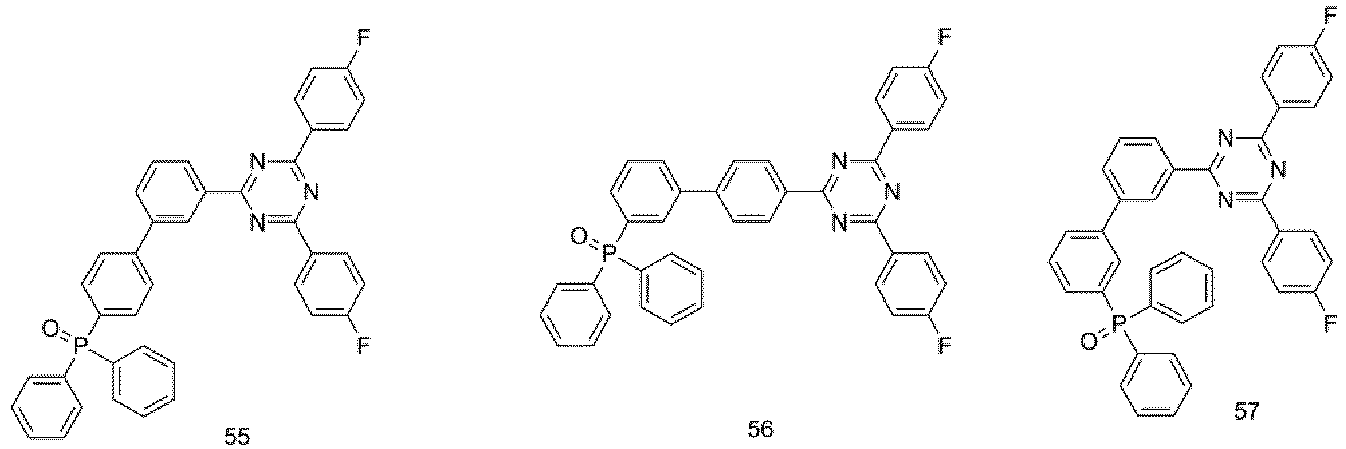


- Organische lichtemittierende Vorrichtung, umfassend:eine erste Elektrode;eine zweite Elektrode, die der ersten Elektrode zugewandt ist; undeine organische Schicht zwischen der ersten Elektrode und der zweiten Elektrode; wobei die organische Schicht eine Emissionsschicht und mindestens eine heterocyclische Verbindung nach einem der Ansprüche 1 bis 9 umfasst; wobei vorzugsweise die Emissionsschicht die heterocyclische Verbindung umfasst.
- Organische lichtemittierende Vorrichtung nach Anspruch 10, wobei:die erste Elektrode eine Anode ist,die zweite Elektrode eine Kathode ist,die organische Schicht ferner einen Lochtransportbereich zwischen der ersten Elektrode und der Emissionsschicht und einen Elektronentransportbereich zwischen der Emissionsschicht und der zweiten Elektrode umfasst,der Lochtransportbereich eine Lochinjektionsschicht, eine Lochtransportschicht, eine Emissionshilfsschicht, eine Elektronenblockierschicht oder eine Kombination davon umfasst, undder Elektronentransportbereich eine Pufferschicht, eine Lochblockierschicht, eine Elektronenkontrollschicht, eine Elektronentransportschicht, eine Elektroneninj ektionsschicht oder eine Kombination davon umfasst.
- Organische lichtemittierende Vorrichtung nach Anspruch 11, wobei(i) der Elektronentransportbereich die heterocyclische Verbindung umfasst, und/oder(ii) der Elektronentransportbereich die Elektronentransportschicht umfasst und die Elektronentransportschicht die heterocyclische Verbindung umfasst, und/oder(iii) der Lochtransportbereich einen p-Dotierstoff mit einem niedrigsten unbesetzten Molekülorbital (LUMO)-Energieniveau von -3,5 eV oder weniger umfasst, vorzugsweisewobei
der p-Dotierstoff eine Cyanogruppen-haltige Verbindung umfasst. - Organische lichtemittierende Vorrichtung nach Anspruch 10, wobei:die Emissionsschicht eine erste Emissionsschicht zum Emittieren von Licht einer ersten Farbe ist,die organische lichtemittierende Vorrichtung ferner i) mindestens eine zweite Emissionsschicht zum Emittieren von Licht einer zweiten Farbe oder ii) mindestens eine zweite Emissionsschicht zum Emittieren von Licht einer zweiten Farbe und mindestens eine dritte Emissionsschicht zum Emittieren von Licht einer dritten Farbe zwischen der ersten Elektrode und der zweiten Elektrode umfasst,eine maximale Emissionswellenlänge von Licht der ersten Farbe, eine maximale Emissionswellenlänge von Licht der zweiten Farbe und eine maximale Emissionswellenlänge von Licht der dritten Farbe identisch oder voneinander verschieden sind, unddas Licht einer ersten Farbe und das Licht einer zweiten Farbe in Form von Mischlicht emittiert werden, oder das Licht einer ersten Farbe, das Licht einer zweiten Farbe und das Licht einer dritten Farbe in Form von Mischlicht emittiert werden.
Applications Claiming Priority (1)
| Application Number | Priority Date | Filing Date | Title |
|---|---|---|---|
| KR1020170144221A KR102571084B1 (ko) | 2017-10-31 | 2017-10-31 | 헤테로시클릭 화합물 및 이를 포함한 유기 발광 소자 |
Publications (2)
| Publication Number | Publication Date |
|---|---|
| EP3476852A1 EP3476852A1 (de) | 2019-05-01 |
| EP3476852B1 true EP3476852B1 (de) | 2024-11-27 |
Family
ID=63442457
Family Applications (1)
| Application Number | Title | Priority Date | Filing Date |
|---|---|---|---|
| EP18191151.2A Active EP3476852B1 (de) | 2017-10-31 | 2018-08-28 | Heterocyclische verbindung und organische lichtemittierende vorrichtung damit |
Country Status (5)
| Country | Link |
|---|---|
| US (1) | US11251376B2 (de) |
| EP (1) | EP3476852B1 (de) |
| JP (1) | JP7813089B2 (de) |
| KR (3) | KR102571084B1 (de) |
| CN (1) | CN109721625B (de) |
Families Citing this family (6)
| Publication number | Priority date | Publication date | Assignee | Title |
|---|---|---|---|---|
| EP3876296A1 (de) * | 2020-03-05 | 2021-09-08 | Samsung Electronics Co., Ltd. | Organische lichtemittierende vorrichtung |
| CN111793087B (zh) * | 2020-05-15 | 2023-06-09 | 浙江虹舞科技有限公司 | 一种发光材料、延迟荧光体及有机发光元件 |
| KR20220052384A (ko) * | 2020-10-19 | 2022-04-28 | 삼성디스플레이 주식회사 | 발광 소자 및 이를 포함하는 장치 |
| KR20230044757A (ko) * | 2021-09-27 | 2023-04-04 | 솔루스첨단소재 주식회사 | 유기 화합물 및 이를 이용한 유기 전계 발광 소자 |
| CN117343078A (zh) | 2021-11-25 | 2024-01-05 | 北京夏禾科技有限公司 | 有机电致发光材料和器件 |
| WO2025053127A1 (ja) * | 2023-09-07 | 2025-03-13 | 東レ株式会社 | 化合物、有機el素子、表示装置および照明装置 |
Citations (4)
| Publication number | Priority date | Publication date | Assignee | Title |
|---|---|---|---|---|
| KR20160050894A (ko) * | 2014-10-31 | 2016-05-11 | (주)더블유에스 | 포스포릴기가 결합된 트리아진 유도체 및 이를 포함한 유기 전계발광 소자 |
| KR20170004432A (ko) * | 2015-07-02 | 2017-01-11 | 희성소재 (주) | 헤테로고리 화합물 및 이를 이용한 유기 발광 소자 |
| KR20170032833A (ko) * | 2015-09-15 | 2017-03-23 | 주식회사 엘지화학 | 헤테로고리 화합물 및 이를 포함하는 유기 발광 소자 |
| US20170244048A1 (en) * | 2016-02-22 | 2017-08-24 | Samsung Display Co., Ltd. | Organic light-emitting device |
Family Cites Families (20)
| Publication number | Priority date | Publication date | Assignee | Title |
|---|---|---|---|---|
| JP3755196B2 (ja) | 1996-06-28 | 2006-03-15 | チッソ株式会社 | シクロペンタジエン誘導体を用いることを特徴とする電界発光素子 |
| US5645948A (en) | 1996-08-20 | 1997-07-08 | Eastman Kodak Company | Blue organic electroluminescent devices |
| JP3834954B2 (ja) | 1997-09-05 | 2006-10-18 | チッソ株式会社 | シラシクロペンタジエン環を有する正孔輸送材料 |
| US6465115B2 (en) | 1998-12-09 | 2002-10-15 | Eastman Kodak Company | Electroluminescent device with anthracene derivatives hole transport layer |
| EP1009043A3 (de) | 1998-12-09 | 2002-07-03 | Eastman Kodak Company | Elektrolumineszente Vorrichtung mit Polyphenyl-Kohlenwasserstoff Ladungslöchertransportschicht |
| KR100691543B1 (ko) | 2002-01-18 | 2007-03-09 | 주식회사 엘지화학 | 새로운 전자 수송용 물질 및 이를 이용한 유기 발광 소자 |
| KR20050017016A (ko) | 2002-07-10 | 2005-02-21 | 이 아이 듀폰 디 네모아 앤드 캄파니 | 플루오르화된 페난트롤린 유도체를 포함하는 전하 이송조성물 |
| JP4254231B2 (ja) | 2002-12-26 | 2009-04-15 | 東レ株式会社 | 発光素子用材料およびそれを用いた発光素子 |
| DE102004008304A1 (de) | 2004-02-20 | 2005-09-08 | Covion Organic Semiconductors Gmbh | Organische elektronische Vorrichtungen |
| KR102023028B1 (ko) | 2012-09-14 | 2019-09-23 | 삼성디스플레이 주식회사 | 포스핀 옥사이드계 화합물 및 이를 포함한 유기 발광 소자 |
| KR101658111B1 (ko) * | 2013-05-13 | 2016-09-20 | 제일모직 주식회사 | 유기광전자소자용 화합물, 이를 포함하는 유기발광소자 및 상기 유기발광소자를 포함하는 표시장치 |
| WO2015137630A1 (ko) * | 2014-03-10 | 2015-09-17 | 삼성에스디아이 주식회사 | 축합환 화합물 및 이를 포함한 유기 발광 소자 |
| KR20160004466A (ko) * | 2014-07-02 | 2016-01-13 | 삼성디스플레이 주식회사 | 유기 발광 소자 |
| KR102322761B1 (ko) * | 2014-07-03 | 2021-11-08 | 삼성디스플레이 주식회사 | 유기 발광 소자 |
| KR20160027940A (ko) * | 2014-09-02 | 2016-03-10 | 주식회사 엘지화학 | 유기 발광 소자 |
| KR20160053048A (ko) | 2014-10-30 | 2016-05-13 | 삼성디스플레이 주식회사 | 포스핀 옥사이드계 화합물 및 이를 포함한 유기 발광 소자 |
| WO2017048060A1 (ko) * | 2015-09-15 | 2017-03-23 | 주식회사 엘지화학 | 헤테로고리 화합물 및 이를 포함하는 유기 발광 소자 |
| KR101673864B1 (ko) | 2015-11-18 | 2016-11-09 | 부산대학교 산학협력단 | 신규한 포스핀 옥사이드 기능화된 트리아진 유도체를 포함하는 전자 소자 및 포스핀 옥사이드 기능화된 트리아진 유도체 |
| CN107056836B (zh) | 2017-01-10 | 2019-03-29 | 湖南大学 | 一类α-苄基修饰的二芳基膦化合物及其制备方法 |
| KR102504130B1 (ko) | 2017-05-23 | 2023-02-28 | 삼성디스플레이 주식회사 | 축합환 화합물 및 이를 포함한 유기 발광 소자 |
-
2017
- 2017-10-31 KR KR1020170144221A patent/KR102571084B1/ko active Active
-
2018
- 2018-05-02 US US15/969,232 patent/US11251376B2/en active Active
- 2018-08-28 EP EP18191151.2A patent/EP3476852B1/de active Active
- 2018-10-22 JP JP2018198306A patent/JP7813089B2/ja active Active
- 2018-10-24 CN CN201811240211.7A patent/CN109721625B/zh active Active
-
2023
- 2023-08-17 KR KR1020230107930A patent/KR20230126688A/ko not_active Ceased
-
2025
- 2025-10-14 KR KR1020250148146A patent/KR20250155495A/ko active Pending
Patent Citations (4)
| Publication number | Priority date | Publication date | Assignee | Title |
|---|---|---|---|---|
| KR20160050894A (ko) * | 2014-10-31 | 2016-05-11 | (주)더블유에스 | 포스포릴기가 결합된 트리아진 유도체 및 이를 포함한 유기 전계발광 소자 |
| KR20170004432A (ko) * | 2015-07-02 | 2017-01-11 | 희성소재 (주) | 헤테로고리 화합물 및 이를 이용한 유기 발광 소자 |
| KR20170032833A (ko) * | 2015-09-15 | 2017-03-23 | 주식회사 엘지화학 | 헤테로고리 화합물 및 이를 포함하는 유기 발광 소자 |
| US20170244048A1 (en) * | 2016-02-22 | 2017-08-24 | Samsung Display Co., Ltd. | Organic light-emitting device |
Also Published As
| Publication number | Publication date |
|---|---|
| KR20230126688A (ko) | 2023-08-30 |
| CN109721625B (zh) | 2023-11-07 |
| EP3476852A1 (de) | 2019-05-01 |
| KR20190049986A (ko) | 2019-05-10 |
| JP7813089B2 (ja) | 2026-02-12 |
| US11251376B2 (en) | 2022-02-15 |
| JP2019081751A (ja) | 2019-05-30 |
| KR20250155495A (ko) | 2025-10-30 |
| US20190131535A1 (en) | 2019-05-02 |
| CN109721625A (zh) | 2019-05-07 |
| KR102571084B1 (ko) | 2023-08-28 |
Similar Documents
| Publication | Publication Date | Title |
|---|---|---|
| EP3441391B1 (de) | Heterocyclische verbindung und organische lichtemittierende vorrichtung damit | |
| EP3447062B1 (de) | Organometallverbindung, organische lichtemittierende vorrichtung mit der organometallverbindung und organische lichtemittierende vorrichtung mit der organischen lichtemittierenden vorrichtung | |
| JP7248476B2 (ja) | 有機発光素子 | |
| JP7617172B2 (ja) | アミン系化合物を含む有機発光素子 | |
| JP7304682B2 (ja) | ヘテロ環式化合物、及びそれを含んだ有機発光素子 | |
| EP3406597B1 (de) | Kondensierte zyklische verbindung und organische lichtemittierende vorrichtung damit | |
| EP3476852B1 (de) | Heterocyclische verbindung und organische lichtemittierende vorrichtung damit | |
| EP3561894B1 (de) | Diaminverbindung und organische lichtemittierende vorrichtung damit | |
| EP3502107B1 (de) | 1-aminodibenzofuran-basierte verbindung und organische lichtemittierende vorrichtung damit | |
| EP3544075B1 (de) | Organometallische verbindung, organische lichtemittierende vorrichtung mit der organometallischen verbindung und organische lichtemittierende einrichtung mit der organischen lichtemittierenden vorrichtung | |
| EP3428149A2 (de) | Kondensierte cyclische verbindung und organische lichtemittierende vorrichtung damit | |
| KR20200113057A (ko) | 아민계 화합물 및 이를 포함한 유기 발광 소자 | |
| KR20240050318A (ko) | 축합환 화합물 및 이를 포함한 유기 발광 소자 | |
| CN107400139B (zh) | 杂环化合物和包括其的有机发光装置 | |
| EP3296288B1 (de) | Kondensierte cyclische verbindung und organische lichtemittierende vorrichtung damit | |
| EP3263558B1 (de) | Heterocyclische verbindung und organische lichtemittierende vorrichtung damit | |
| EP3418272B1 (de) | Triazin-verbindungen und organische lichtemittierende vorrichtungen damit | |
| EP3748706B1 (de) | Heterocyclische verbindung und organische lichtemittierende vorrichtung damit | |
| JP7792204B2 (ja) | ヘテロ環化合物、及びそれを含む有機発光素子 | |
| EP3575295B1 (de) | Heterocyclische verbindung und organische lichtemittierende vorrichtung damit | |
| KR102504126B1 (ko) | 축합환 화합물 및 이를 포함한 유기 발광 소자 | |
| EP3333168A1 (de) | Kondensierte cyclische verbindung und organische lichtemittierende vorrichtung damit |
Legal Events
| Date | Code | Title | Description |
|---|---|---|---|
| PUAI | Public reference made under article 153(3) epc to a published international application that has entered the european phase |
Free format text: ORIGINAL CODE: 0009012 |
|
| STAA | Information on the status of an ep patent application or granted ep patent |
Free format text: STATUS: THE APPLICATION HAS BEEN PUBLISHED |
|
| AK | Designated contracting states |
Kind code of ref document: A1 Designated state(s): AL AT BE BG CH CY CZ DE DK EE ES FI FR GB GR HR HU IE IS IT LI LT LU LV MC MK MT NL NO PL PT RO RS SE SI SK SM TR |
|
| AX | Request for extension of the european patent |
Extension state: BA ME |
|
| STAA | Information on the status of an ep patent application or granted ep patent |
Free format text: STATUS: REQUEST FOR EXAMINATION WAS MADE |
|
| 17P | Request for examination filed |
Effective date: 20190620 |
|
| RBV | Designated contracting states (corrected) |
Designated state(s): AL AT BE BG CH CY CZ DE DK EE ES FI FR GB GR HR HU IE IS IT LI LT LU LV MC MK MT NL NO PL PT RO RS SE SI SK SM TR |
|
| STAA | Information on the status of an ep patent application or granted ep patent |
Free format text: STATUS: EXAMINATION IS IN PROGRESS |
|
| 17Q | First examination report despatched |
Effective date: 20201015 |
|
| P01 | Opt-out of the competence of the unified patent court (upc) registered |
Effective date: 20230516 |
|
| REG | Reference to a national code |
Ref country code: DE Free format text: PREVIOUS MAIN CLASS: C07F0009530000 Ref country code: DE Ref legal event code: R079 Ref document number: 602018076905 Country of ref document: DE Free format text: PREVIOUS MAIN CLASS: C07F0009530000 Ipc: C07F0009652100 |
|
| GRAP | Despatch of communication of intention to grant a patent |
Free format text: ORIGINAL CODE: EPIDOSNIGR1 |
|
| STAA | Information on the status of an ep patent application or granted ep patent |
Free format text: STATUS: GRANT OF PATENT IS INTENDED |
|
| RIC1 | Information provided on ipc code assigned before grant |
Ipc: H10K 101/40 20230101ALI20240612BHEP Ipc: H10K 85/60 20230101ALI20240612BHEP Ipc: H10K 71/60 20230101ALI20240612BHEP Ipc: H10K 71/40 20230101ALI20240612BHEP Ipc: H10K 71/16 20230101ALI20240612BHEP Ipc: H10K 50/13 20230101ALI20240612BHEP Ipc: C07F 9/6558 20060101ALI20240612BHEP Ipc: C07F 9/6568 20060101ALI20240612BHEP Ipc: C07F 9/6521 20060101AFI20240612BHEP |
|
| INTG | Intention to grant announced |
Effective date: 20240705 |
|
| GRAS | Grant fee paid |
Free format text: ORIGINAL CODE: EPIDOSNIGR3 |
|
| GRAA | (expected) grant |
Free format text: ORIGINAL CODE: 0009210 |
|
| STAA | Information on the status of an ep patent application or granted ep patent |
Free format text: STATUS: THE PATENT HAS BEEN GRANTED |
|
| AK | Designated contracting states |
Kind code of ref document: B1 Designated state(s): AL AT BE BG CH CY CZ DE DK EE ES FI FR GB GR HR HU IE IS IT LI LT LU LV MC MK MT NL NO PL PT RO RS SE SI SK SM TR |
|
| REG | Reference to a national code |
Ref country code: GB Ref legal event code: FG4D |
|
| REG | Reference to a national code |
Ref country code: CH Ref legal event code: EP |
|
| REG | Reference to a national code |
Ref country code: IE Ref legal event code: FG4D |
|
| REG | Reference to a national code |
Ref country code: DE Ref legal event code: R096 Ref document number: 602018076905 Country of ref document: DE |
|
| REG | Reference to a national code |
Ref country code: LT Ref legal event code: MG9D |
|
| REG | Reference to a national code |
Ref country code: NL Ref legal event code: MP Effective date: 20241127 |
|
| PG25 | Lapsed in a contracting state [announced via postgrant information from national office to epo] |
Ref country code: IS Free format text: LAPSE BECAUSE OF FAILURE TO SUBMIT A TRANSLATION OF THE DESCRIPTION OR TO PAY THE FEE WITHIN THE PRESCRIBED TIME-LIMIT Effective date: 20250327 Ref country code: HR Free format text: LAPSE BECAUSE OF FAILURE TO SUBMIT A TRANSLATION OF THE DESCRIPTION OR TO PAY THE FEE WITHIN THE PRESCRIBED TIME-LIMIT Effective date: 20241127 Ref country code: PT Free format text: LAPSE BECAUSE OF FAILURE TO SUBMIT A TRANSLATION OF THE DESCRIPTION OR TO PAY THE FEE WITHIN THE PRESCRIBED TIME-LIMIT Effective date: 20250327 |
|
| PG25 | Lapsed in a contracting state [announced via postgrant information from national office to epo] |
Ref country code: FI Free format text: LAPSE BECAUSE OF FAILURE TO SUBMIT A TRANSLATION OF THE DESCRIPTION OR TO PAY THE FEE WITHIN THE PRESCRIBED TIME-LIMIT Effective date: 20241127 Ref country code: NL Free format text: LAPSE BECAUSE OF FAILURE TO SUBMIT A TRANSLATION OF THE DESCRIPTION OR TO PAY THE FEE WITHIN THE PRESCRIBED TIME-LIMIT Effective date: 20241127 |
|
| REG | Reference to a national code |
Ref country code: AT Ref legal event code: MK05 Ref document number: 1745635 Country of ref document: AT Kind code of ref document: T Effective date: 20241127 |
|
| PG25 | Lapsed in a contracting state [announced via postgrant information from national office to epo] |
Ref country code: BG Free format text: LAPSE BECAUSE OF FAILURE TO SUBMIT A TRANSLATION OF THE DESCRIPTION OR TO PAY THE FEE WITHIN THE PRESCRIBED TIME-LIMIT Effective date: 20241127 |
|
| PG25 | Lapsed in a contracting state [announced via postgrant information from national office to epo] |
Ref country code: ES Free format text: LAPSE BECAUSE OF FAILURE TO SUBMIT A TRANSLATION OF THE DESCRIPTION OR TO PAY THE FEE WITHIN THE PRESCRIBED TIME-LIMIT Effective date: 20241127 |
|
| PG25 | Lapsed in a contracting state [announced via postgrant information from national office to epo] |
Ref country code: NO Free format text: LAPSE BECAUSE OF FAILURE TO SUBMIT A TRANSLATION OF THE DESCRIPTION OR TO PAY THE FEE WITHIN THE PRESCRIBED TIME-LIMIT Effective date: 20250227 |
|
| PG25 | Lapsed in a contracting state [announced via postgrant information from national office to epo] |
Ref country code: LV Free format text: LAPSE BECAUSE OF FAILURE TO SUBMIT A TRANSLATION OF THE DESCRIPTION OR TO PAY THE FEE WITHIN THE PRESCRIBED TIME-LIMIT Effective date: 20241127 Ref country code: GR Free format text: LAPSE BECAUSE OF FAILURE TO SUBMIT A TRANSLATION OF THE DESCRIPTION OR TO PAY THE FEE WITHIN THE PRESCRIBED TIME-LIMIT Effective date: 20250228 Ref country code: AT Free format text: LAPSE BECAUSE OF FAILURE TO SUBMIT A TRANSLATION OF THE DESCRIPTION OR TO PAY THE FEE WITHIN THE PRESCRIBED TIME-LIMIT Effective date: 20241127 |
|
| PG25 | Lapsed in a contracting state [announced via postgrant information from national office to epo] |
Ref country code: PL Free format text: LAPSE BECAUSE OF FAILURE TO SUBMIT A TRANSLATION OF THE DESCRIPTION OR TO PAY THE FEE WITHIN THE PRESCRIBED TIME-LIMIT Effective date: 20241127 |
|
| PG25 | Lapsed in a contracting state [announced via postgrant information from national office to epo] |
Ref country code: RS Free format text: LAPSE BECAUSE OF FAILURE TO SUBMIT A TRANSLATION OF THE DESCRIPTION OR TO PAY THE FEE WITHIN THE PRESCRIBED TIME-LIMIT Effective date: 20250227 |
|
| PG25 | Lapsed in a contracting state [announced via postgrant information from national office to epo] |
Ref country code: SM Free format text: LAPSE BECAUSE OF FAILURE TO SUBMIT A TRANSLATION OF THE DESCRIPTION OR TO PAY THE FEE WITHIN THE PRESCRIBED TIME-LIMIT Effective date: 20241127 |
|
| PG25 | Lapsed in a contracting state [announced via postgrant information from national office to epo] |
Ref country code: DK Free format text: LAPSE BECAUSE OF FAILURE TO SUBMIT A TRANSLATION OF THE DESCRIPTION OR TO PAY THE FEE WITHIN THE PRESCRIBED TIME-LIMIT Effective date: 20241127 |
|
| PG25 | Lapsed in a contracting state [announced via postgrant information from national office to epo] |
Ref country code: EE Free format text: LAPSE BECAUSE OF FAILURE TO SUBMIT A TRANSLATION OF THE DESCRIPTION OR TO PAY THE FEE WITHIN THE PRESCRIBED TIME-LIMIT Effective date: 20241127 |
|
| PG25 | Lapsed in a contracting state [announced via postgrant information from national office to epo] |
Ref country code: RO Free format text: LAPSE BECAUSE OF FAILURE TO SUBMIT A TRANSLATION OF THE DESCRIPTION OR TO PAY THE FEE WITHIN THE PRESCRIBED TIME-LIMIT Effective date: 20241127 |
|
| PG25 | Lapsed in a contracting state [announced via postgrant information from national office to epo] |
Ref country code: SK Free format text: LAPSE BECAUSE OF FAILURE TO SUBMIT A TRANSLATION OF THE DESCRIPTION OR TO PAY THE FEE WITHIN THE PRESCRIBED TIME-LIMIT Effective date: 20241127 |
|
| PG25 | Lapsed in a contracting state [announced via postgrant information from national office to epo] |
Ref country code: CZ Free format text: LAPSE BECAUSE OF FAILURE TO SUBMIT A TRANSLATION OF THE DESCRIPTION OR TO PAY THE FEE WITHIN THE PRESCRIBED TIME-LIMIT Effective date: 20241127 |
|
| PG25 | Lapsed in a contracting state [announced via postgrant information from national office to epo] |
Ref country code: IT Free format text: LAPSE BECAUSE OF FAILURE TO SUBMIT A TRANSLATION OF THE DESCRIPTION OR TO PAY THE FEE WITHIN THE PRESCRIBED TIME-LIMIT Effective date: 20241127 |
|
| REG | Reference to a national code |
Ref country code: DE Ref legal event code: R097 Ref document number: 602018076905 Country of ref document: DE |
|
| PG25 | Lapsed in a contracting state [announced via postgrant information from national office to epo] |
Ref country code: SE Free format text: LAPSE BECAUSE OF FAILURE TO SUBMIT A TRANSLATION OF THE DESCRIPTION OR TO PAY THE FEE WITHIN THE PRESCRIBED TIME-LIMIT Effective date: 20241127 |
|
| PLBE | No opposition filed within time limit |
Free format text: ORIGINAL CODE: 0009261 |
|
| STAA | Information on the status of an ep patent application or granted ep patent |
Free format text: STATUS: NO OPPOSITION FILED WITHIN TIME LIMIT |
|
| PGFP | Annual fee paid to national office [announced via postgrant information from national office to epo] |
Ref country code: DE Payment date: 20250721 Year of fee payment: 8 |
|
| PGFP | Annual fee paid to national office [announced via postgrant information from national office to epo] |
Ref country code: GB Payment date: 20250722 Year of fee payment: 8 |
|
| PGFP | Annual fee paid to national office [announced via postgrant information from national office to epo] |
Ref country code: FR Payment date: 20250725 Year of fee payment: 8 |
|
| 26N | No opposition filed |
Effective date: 20250828 |