EP3474584A1 - Verfahren und vorrichtung für mehrere drahtlose verbindungen - Google Patents
Verfahren und vorrichtung für mehrere drahtlose verbindungen Download PDFInfo
- Publication number
- EP3474584A1 EP3474584A1 EP18203371.2A EP18203371A EP3474584A1 EP 3474584 A1 EP3474584 A1 EP 3474584A1 EP 18203371 A EP18203371 A EP 18203371A EP 3474584 A1 EP3474584 A1 EP 3474584A1
- Authority
- EP
- European Patent Office
- Prior art keywords
- access network
- wireless access
- cell
- enb
- network node
- Prior art date
- Legal status (The legal status is an assumption and is not a legal conclusion. Google has not performed a legal analysis and makes no representation as to the accuracy of the status listed.)
- Granted
Links
Images




Classifications
-
- H—ELECTRICITY
- H04—ELECTRIC COMMUNICATION TECHNIQUE
- H04W—WIRELESS COMMUNICATION NETWORKS
- H04W12/00—Security arrangements; Authentication; Protecting privacy or anonymity
- H04W12/04—Key management, e.g. using generic bootstrapping architecture [GBA]
- H04W12/041—Key generation or derivation
-
- H—ELECTRICITY
- H04—ELECTRIC COMMUNICATION TECHNIQUE
- H04W—WIRELESS COMMUNICATION NETWORKS
- H04W12/00—Security arrangements; Authentication; Protecting privacy or anonymity
- H04W12/08—Access security
- H04W12/084—Access security using delegated authorisation, e.g. open authorisation [OAuth] protocol
-
- H—ELECTRICITY
- H04—ELECTRIC COMMUNICATION TECHNIQUE
- H04W—WIRELESS COMMUNICATION NETWORKS
- H04W16/00—Network planning, e.g. coverage or traffic planning tools; Network deployment, e.g. resource partitioning or cells structures
- H04W16/24—Cell structures
- H04W16/32—Hierarchical cell structures
-
- H—ELECTRICITY
- H04—ELECTRIC COMMUNICATION TECHNIQUE
- H04W—WIRELESS COMMUNICATION NETWORKS
- H04W24/00—Supervisory, monitoring or testing arrangements
- H04W24/10—Scheduling measurement reports ; Arrangements for measurement reports
-
- H—ELECTRICITY
- H04—ELECTRIC COMMUNICATION TECHNIQUE
- H04W—WIRELESS COMMUNICATION NETWORKS
- H04W36/00—Hand-off or reselection arrangements
- H04W36/0005—Control or signalling for completing the hand-off
- H04W36/0055—Transmission or use of information for re-establishing the radio link
- H04W36/0077—Transmission or use of information for re-establishing the radio link of access information of target access point
-
- H—ELECTRICITY
- H04—ELECTRIC COMMUNICATION TECHNIQUE
- H04W—WIRELESS COMMUNICATION NETWORKS
- H04W48/00—Access restriction; Network selection; Access point selection
- H04W48/08—Access restriction or access information delivery, e.g. discovery data delivery
-
- H—ELECTRICITY
- H04—ELECTRIC COMMUNICATION TECHNIQUE
- H04W—WIRELESS COMMUNICATION NETWORKS
- H04W36/00—Hand-off or reselection arrangements
- H04W36/0005—Control or signalling for completing the hand-off
- H04W36/0083—Determination of parameters used for hand-off, e.g. generation or modification of neighbour cell lists
- H04W36/00835—Determination of neighbour cell lists
-
- H—ELECTRICITY
- H04—ELECTRIC COMMUNICATION TECHNIQUE
- H04W—WIRELESS COMMUNICATION NETWORKS
- H04W36/00—Hand-off or reselection arrangements
- H04W36/08—Reselecting an access point
Definitions
- a small cell (or multiple small cells) can operate within a coverage area of a larger cell, referred to as a macro cell.
- a small cell has a coverage area that is smaller than the coverage area of the macro cell.
- a small cell (or multiple small cells) can also operate outside the coverage area of the macro cell.
- a first radio connection is established between a first cell and a user equipment (UE).
- a network identity of a second cell is determined based on a first set of at least one network identity associated with the first cell, where the second cell is associated with a second set of at least one network identity.
- the determined network identity is useable for establishing a second radio connection between the second cell and the UE.
- a UE includes a wireless communication component to receive, from a wireless access network node of a first cell, a list of network identifiers, the network identifiers being composed according to a first set of network identifiers for the first cell, and a second set of network identifiers for a second cell, the first cell and the second cell to provide concurrent wireless connections with the UE.
- At least one processor is configured to select, from the list of network identifiers, a network identifier to use for generating a key for protecting data communication of the UE.
- a source wireless access network node generates, for a UE, a plurality of security configurations, wherein each security configuration is associated with a different node in a set of candidate target wireless access network nodes.
- the source wireless access network node sends each security configuration to the respective candidate target wireless network node.
- the source wireless access network node sends security information of the plurality of security configurations to the UE.
- a macro cell has a coverage area that is generally larger than the coverage area of a small cell provided by a small cell wireless access network node.
- a wireless access network node is responsible for performing wireless transmissions and receptions with user equipments (UEs) within a coverage area of the cell.
- UEs user equipments
- a coverage area can refer to a region where mobile services can be provided by a network node to a target level. Examples of UEs can include any of the following: smart phones, personal digital assistants, notebook computers, tablet computers, or any other devices that are capable of wireless communications.
- small cell wireless access network nodes examples include pico wireless access network nodes, femto wireless access network nodes, relay nodes, and so forth.
- a pico cell provided by a pico wireless access network node refers to a cell that has a relatively small coverage area, such as within a building, a train station, an airport, an aircraft, or other small area.
- a femto cell provided by a femto wireless access network node is a cell that is designed for use in a home or small business.
- a femto cell is associated with a closed subscriber group (CSG), which specifies that only users within a specified group are allowed to access the femto cell.
- a relay node is used for wirelessly relaying data from one wireless entity to another wireless entity. There can be other examples of small cell wireless access network nodes.
- a UE is able to establish multiple concurrent connections with respective wireless access network nodes. For example, a UE can establish a dual connection with a macro wireless access network node and a small cell wireless access network node. In other cases, a UE can establish more than two concurrent wireless connections with respective wireless access network nodes, such as one macro wireless access network node and two or more small cell wireless access network nodes. A UE that establishes multiple concurrent wireless connections with respective wireless access network nodes consumes the radio resources provided by those wireless access network nodes.
- a key can be used for protecting information in a control plane or a user plane.
- a key can be used for ciphering (encrypting) the information that is communicated between a UE and a wireless access network node. Encryption encodes information using an encryption key to prevent an unauthorized entity from reading the encoded information.
- a key can also be used for providing information integrity, in which an integrity key can be used to confirm that received information is from an intended source.
- a control plane exchanges control signals between a wireless access network node and a UE to perform specified control tasks, such as any or some combination of the following: network attachment of a UE, authentication of the UE, setup of radio bearers for the UE, mobility management to manage mobility of the UE, performance of handover decisions based on neighbor cell measurements sent by the UE, transmission of a paging message to the UE, broadcast of system information, control of UE measurement reporting, and so forth.
- control tasks and control messages in a control plane are listed above, it is noted that in other examples, other types of control messages and control tasks can be provided. More generally, a control plane can perform call control and connection control functions, and can provide messaging for setting up calls or connections, supervising calls or connections, and releasing calls or connections.
- a user plane provides communication of traffic data (e.g. voice data, user data, application data, etc.) between a UE and a wireless access network node.
- Traffic data e.g. voice data, user data, application data, etc.
- User plane functions can also include exchanging control messages between a wireless access network node and a UE associated with communicating the traffic data, such as flow control, error recovery, and so forth.
- the UE establishes just one wireless connection with a cell at any one time. As such, only one set of keys has to be provided for protecting communications of the UE.
- the derivation of keys for use in protecting communications of the UE over the multiple wireless connections can be more complex.
- a UE establishing a wireless connection with a cell refers to the UE establishing a wireless connection with a wireless access network node that provides the cell.
- a wireless access network node can provide one cell, or alternatively, a wireless access network node can provide multiple cells.
- a wireless access network node can operate using a number of component carriers, which allows a UE to communicate with the wireless access network node using one or multiple component carriers (at respectively different frequencies).
- the component carriers can be aggregated together to provide carrier aggregation service for the UE, in which the UE can establish multiple concurrent wireless connections with the wireless access network node on the respective component carriers.
- Each of the component carriers can provide a respective cell. Accordingly, a wireless access network node can provide multiple cells on the respective component carriers supported by the wireless access network node.
- the network identity is an identity of a public land mobile network (PLMN).
- PLMN can be identified by a mobile country code (MCC) and a mobile network code (MNC), in some examples.
- MCC mobile country code
- MNC mobile network code
- a selected PLMN identity is provided to a network infrastructure for deriving a base key that can be used for deriving other keys used for information encryption or information integrity, or both.
- a network or mobile communications network can refer to any defined arrangement of network nodes that UEs can wirelessly access for the purpose of performing communications with other endpoints.
- Different networks can be provided by respective different network operators.
- a network operator can provide multiple networks.
- LTE Long-Term Evolution
- 3GPP Third Generation Partnership Project
- E-UTRA Evolved Universal Terrestrial Radio Access
- a wireless access network node can be implemented as an enhanced Node B (eNB), which includes functionalities of a base station and base station controller.
- eNB enhanced Node B
- a macro wireless access network node is referred to as a macro eNB (MeNB)
- a small cell wireless access network node is referred to as a small cell eNB (SeNB).
- Fig. 1 illustrates an example arrangement that includes network nodes that are part of a mobile communications network that supports wireless communications with UEs.
- a macro cell 102 corresponds to a coverage area provided by a macro eNB 104. Although just one macro cell 102 and the respective macro eNB 104 is shown in Fig. 1 , note that there can be additional macro cells and respective macro eNBs.
- a number of small cells 106 are depicted as being within the coverage area of the macro cell 102. Each small cell 106 corresponds to a coverage area provided by a respective small cell eNB 108. One of the small cells is labeled 106-1, and the corresponding small cell eNB is labeled 108-1.
- a wireless UE 110 within the coverage area of the small cell 106-1 is able to wirelessly communicate with the small cell eNB 108-1.
- the UE 110 is also able to wirelessly communicate with the macro eNB 104.
- just one UE 110 is depicted in Fig. 1 , it is noted that multiple UEs may be present in coverage areas of each of the small cells 106 as well as within the coverage area of the macro cell 102.
- a first wireless connection 112 can be established between the UE 110 and the small cell eNB 108-1.
- a second wireless connection 114 can be established between the UE 110 and the macro eNB 104.
- the UE 110 is considered to have established dual (i.e. concurrent) wireless connections with the macro eNB 104 and the small cell eNB 108-1.
- the UE 110 can establish multiple concurrent wireless connections with the macro eNB 104 and with multiple small cell eNBs 108.
- the small cell eNBs may be outside of the coverage of a macro eNB, and the UE can establish multiple concurrent wireless connections with multiple small cell eNBs.
- Fig. 1 also shows a backhaul link 116 between the macro eNB 104 and each of the small cell eNBs 108.
- the backhaul link 116 can represent a logical communication link between two nodes; the backhaul link 116 can either be a direct point-to-point link or can be routed through another communication network or node.
- the backhaul link 116 is a wired link.
- the backhaul link 116 is a wireless link.
- backhaul links may also be provided between small cell eNBs 108.
- the macro cell 102 (and more specifically the macro eNB 104) can provide all of the control plane functions, while a small cell 106 (more specifically the corresponding small cell eNB 108) provides at least a portion of the user plane functions for a dual-connection capable UE (i.e . a UE that is capable of concurrently connecting to two cells controlled by two separate eNBs).
- a dual-connection capable UE i.e . a UE that is capable of concurrently connecting to two cells controlled by two separate eNBs.
- the macro eNB 104 can also provide user plane functions for the dual-connection capable UE.
- Fig. 1 shows each eNB (macro eNB 104 or small cell eNB 108) providing a respective cell
- an eNB can also provide multiple cells.
- an eNB can operate using a number of component carriers, which allows a UE to communicate with the eNB using one or multiple component carriers (which are at respective different frequencies).
- the component carriers can be aggregated together to provide carrier aggregation service for the UE.
- Each of the component carriers can provide a respective cell.
- a small cell connection can be added to or removed from a UE under the control of the macro eNB 104.
- the action of adding or removing a small cell for a UE can be transparent to a core network 118 of the mobile communications network.
- the core network 118 includes a control node 120 and one or more data gateways 122.
- the data gateway(s) 122 can be coupled to an external packet data network (PDN) 124, such as the Internet, a local area network (LAN), a wide area network (WAN), and so forth.
- PDN packet data network
- the control node 120 in the core network 118 can be implemented as a mobility management entity (MME).
- MME mobility management entity
- An MME is a control node for performing various control tasks associated with an E-UTRA network.
- the MME can perform idle mode UE tracking and paging, bearer activation and deactivation, selection of a serving gateway (discussed further below) when the UE initially attaches to the E-UTRA network, handover of the UE between macro eNBs, authentication of a user, generation and allocation of a temporary identity to a UE, and so forth.
- the MME can perform other or alternative tasks.
- the data gateway(s) 122 of the core network 118 can include a serving gateway (SGW) and a packet data network gateway (PDN-GW).
- SGW serving gateway
- PDN-GW packet data network gateway
- the SGW routes and forwards traffic data packets of a UE served by the SGW.
- the SGW can also act as a mobility anchor for the user plane during handover procedures.
- the SGW provides connectivity between the UE and the PDN 124.
- the PDN-GW is the entry and egress point for data communicated between a UE in the E-UTRA network and a network element coupled to the PDN 124.
- MMEs and SGWs there can be multiple MMEs and SGWs.
- a legacy UE (a UE that is not capable of establishing multiple concurrent wireless connections with multiple cells belonging to different eNBs, such as a macro cell and one or more small cells) can connect to either a macro cell or a small cell using traditional wireless connection techniques.
- the macro eNB 104 may decide to offload some of the user plane traffic to the small cell. This offload is referred to as a data offload.
- a data offload has been performed from the macro cell 104 to the small cell 106, then a UE that has a dual connection can transmit or receive data to and from the corresponding small cell wireless access network node 108. Additionally, the UE 110 can also communicate user plane traffic with the macro eNB 104.
- data offload to one small cell, it is noted that in other examples, the macro cell 104 can perform data offload for the UE 110 to multiple small cells.
- Fig. 1 also shows that the core network 118 includes a home subscriber server (HSS) 123, which includes a database that stores user-related and subscriber-related information.
- HSS home subscriber server
- the HSS 123 provides support functions in mobility management, call and session setup, user authentication, access authorization, and so forth.
- the HSS 123 is also responsible for producing a base key that is useable for deriving other keys for protecting communications of a UE.
- Protecting communications of a UE can refer to encrypting information sent by or to the UE, or providing information integrity of information sent by or to the UE.
- FIG. 2 An example key hierarchy provided by E-UTRA is shown in Fig. 2 .
- Fig. 2 various entities at different hierarchical levels are shown along with the keys in the key hierarchy produced by these entities.
- Each hierarchical level shown in Fig. 2 includes an entity on the UE side, an entity on the network side, for producing a respective key(s) of the key hierarchy.
- a first level 202 includes a Universal Subscriber Identity Module (USIM) in a UE or an authentication center (AuC) in the core network 118.
- the USIM can provide certain security functions on the UE side, including key generation.
- a second level 204 includes the UE and the HSS 123.
- a third level 206 includes the UE and the MME 120.
- a fourth level 208 includes the UE and an eNB.
- the "base key” mentioned above that is generated based on a selected PLMN identity is referred to as K ASME in an E-UTRA network.
- the base key K ASME is produced by a UE or the HSS 123.
- a permanent key K is used by a USIM in the UE and by an AuC in the core network 118 to produce a key CK for encryption and a key IK for integrity protection.
- the key pair, CK and IK is passed by the USIM to the UE and by the AuC to the HSS 123.
- the base key, K ASME is generated from the key pair, CK and IK, using a key generation function based on an identity of a serving network (serving PLMN) which serves the UE.
- serving PLMN serving PLMN
- the base key K ASME is passed by the HSS 123 to the MME 120 in the core network 118.
- the base key K ASME is also passed between components inside the UE.
- the UE or MME 120 can produce keys for protection of non-access stratum (NAS) information provided by a NAS layer in the UE or MME 120.
- the NAS layer is used for managing the establishment of communication sessions and for maintaining communication sessions between the UE and an eNB. Examples of tasks of an NAS layer include mobility management, session management, and identity management.
- an access stratum (AS) layer is responsible for transporting bearer data over a wireless connection between a UE and an eNB.
- the keys for protection of NAS information include KNASenc (for encrypting the NAS information) and K NASint (for integrity protection of NAS information).
- the base key K ASME is also used by the UE and MME to produce K eNB , which can be more generally referred to as an access network node key.
- the access network node key K eNB is used for the derivation of other keys, as further illustrated in Fig. 2 , which are used for protecting AS information produced by an AS layer in the UE or eNB.
- K eNB can also be derived by a target eNB from a Next Hop (NH) during handover from a source eNB to the target eNB.
- the NH is used by the UE and an eNB for the derivation of K eNB *, which is used by the UE and the target eNB as a new K eNB for Radio Resource Control (RRC) information and user plane information.
- RRC Radio Resource Control
- An RRC entity in the UE or an eNB is used for establishing an RRC connection, which is an example of a radio connection.
- RRC is described further in 3GPP TS 36.331, in some examples.
- radio connection for carrying control plane messages
- RRC connection for carrying control plane messages
- other types of radio connections can be established between a UE and a wireless access network node, including radio connection to transfer data payload (i.e. user plane message).
- K eNB can be used for producing the following keys: KUPenc (for encrypting user plane data), KRRCenc (for encrypting RRC information), and KRRCint (for providing integrity protection for RRC information).
- KUPenc for encrypting user plane data
- KRRCenc for encrypting RRC information
- KRRCint for providing integrity protection for RRC information.
- KUPenc for encrypting user plane data
- KRRCenc for encrypting RRC information
- KRRCint for providing integrity protection for RRC information
- Fig. 2 also shows the derivation of KeNB* based on NH and a Next Hop Chaining Count (NCC), which is a counter related to NH.
- NCC indicates the amount of key chaining that has been performed, which allows the UE to be synchronized with the eNB and to determine whether the next K eNB * is to be based on the current K eNB or a fresh NH.
- a UE or HSS produces K ASME (or more generally, a base key) using an identity of a serving PLMN.
- the PLMN identity is provided to a home environment (HE), which refers to a core network infrastructure that has the responsibility for provision of a service or set of services to users associated with a subscription.
- the home environment can include the HSS 123, in some examples.
- the PLMN identity is provided by an eNB to the MME 120.
- the MME 120 can prepare an authentication data request that includes an international mobile subscriber identity (IMSI) of a UE, the serving PLMN identity, and a network type (e.g. E-UTRA network or some other network type).
- IMSI international mobile subscriber identity
- the HSS 123 in response to the authentication data request, can generate K ASME using the serving PLMN identity (and based on the key pair, CK and IK, shown in Fig. 2 ).
- one PLMN identity which is common to the macro eNB and the small cell eNB(s) is selected.
- different PLMN identities can be selected for the macro eNB and the small cell eNB(s).
- Fig. 3 is a flow diagram of a process of a macro eNB, according to some implementations.
- the macro eNB establishes (at 302) a first radio connection between a macro cell and a UE.
- the macro eNB determines (at 304) a PLMN identity of a small cell (to which the UE is to establish connection as part of dual connectivity or multiple connectivity), based on a PLMN identity list associated with the macro cell.
- each cell e.g. macro cell and small cell
- a respective PLMN identity list which can be referred to as plmn-IdentityList. More generally, each cell is associated with a respective set of one or more network identities.
- the PLMN identity of the small cell determined (at 304) is useable for establishing a second radio connection between a small cell and the UE. More specifically, according to some examples, the determined small cell PLMN identity is communicated in RRC messaging with the UE (which can be exchanged between the macro eNB or the small cell eNB and the UE) for setting up an RRC connection.
- the UE is to establish a dual connection with a macro cell and a small cell. It is noted that the described techniques or mechanisms can also be applied in scenarios where the UE is to establish concurrent connections with more than two cells, or to establish concurrent connections with two cells of the same type (e.g. two small cells).
- the PLMN identity that is determined (at 304) is a PLMN identity that is common to both the macro cell and the small cell to which the UE is to establish a dual connection.
- This common PLMN identity is provided by the macro eNB to the MME 120, which can in turn forward the common PLMN identity to the HSS 123 for use in deriving K ASME .
- the macro eNB can identify the one or more PLMN identities that are common between the plmn-IdentityList of the macro cell and the plmn-IdentityList of the small cell.
- the identified common PLMN identity (or identities) is (are) stored in a data structure, such as plmn-IdentityList_dual.
- the data structure, plmn-IdentityList_dual lists a subset of one or more PLMN identities that are common between the plmn-IdentityList of the macro cell and the plmn-IdentityList of the small cell.
- plmn-IdentityList_dual there is one plmn-IdentityList_dual for each pair of a macro cell and a small cell to which a UE can establish dual connectivity; such a pair can be referred to as a dual-connectivity pair.
- a dual connectivity relationship between a macro cell and a small cell is a cell-to-cell relationship, instead of an eNB-to-eNB relationship.
- Different dual-connectivity pairs of macro cells and small cells are associated with respective plmn-IdentityList_dual' s . For example, for a given macro cell, e.g.
- a first plmn-IdentityList_dual is provided for dual-connectivity pair ⁇ macro_cell_A, small_cell_B ⁇ , while a second plmn-IdentityList_dual is provided for dual-connectivity pair ⁇ macro cell_A, small_cell_C ⁇ .
- PLMN identity or identities
- plmn-IdentityList _ dual if two or more small cells can serve the UE in addition to the macro cell, then PLMN identity (or identities) common to the macro cell and the two or more small cells would be identified and included in plmn-IdentityList _ dual.
- the content of the data structure, plmn-IdentityList_dual can be established when a macro eNB and small cell eNB contact each other to establish the interface between the macro eNB and the small cell eNB.
- This interface between the macro eNB and the small cell eNB can be referred to as an Xn interface, as described in 3GPP TR 36.842.
- the data structure, plmn-IdentityList_dual can be established when constructing the dual connectivity to serve a UE, after the Xn interface has been established.
- a new PLMN information element can be provided in a Neighbor Information IE, so that the PLMN information is exchanged as part of the PLMN IE in the Neighbor Information IE.
- the Neighbor Information IE can be included in an Xn SETUP REQUEST message and an Xn SETUP RESPONSE message that are exchanged during the Xn interface establishment.
- a "new" IE refers to an IE that is not yet defined in current wireless network standards (e.g. 3GPP standards), but which may or may not later be defined by wireless network standards.
- the data structure, plmn-IdentityList_dual can be sent to the UE, from which the UE can select a PLMN identity.
- Sending plmn-IdentityList_dual to the UE allows the UE to select a PLMN that ensures the availability of dual connectivity (or multiple connectivity) by the UE with a macro cell and small cell.
- the PLMN identity selected by the UE is transferred by the UE to the macro eNB, which can then provide the selected PLMN identity to the MME 120 for forwarding to the HSS 123 for deriving K ASME .
- plmn-IdentityList_dual can be broadcast in a system information block (SIB).
- SIB system information block
- plmn-IdentityList_dual can be included in SIB type 1 (SIB1), which can be broadcast by the macro eNB.
- SIB carries various system information that relates to radio resource configurations.
- An SIB can be broadcast by an eNB to multiple UEs within the coverage area of the eNB.
- SIB1 that includes plmn-IdentityList_dual is set forth below:
- a parameter max- dual -connection is a predefined parameter that refers to a maximum number of dual-connection combinations a macro cell can have with neighbor small cells.
- macro_cell_A can have two possible dual-connection combinations: ⁇ macro_cell_A, small_cell_B ⁇ , ⁇ macro_cell_A, small_cell_C ⁇ .
- a field PLMN-IdentityInfoDual in the example SIB1 includes the following sub-fields: PLMN- Identity (an identity of a PLMN), cellldentity-SeNB (small cell identity in the PLMN with the associated PLMN- Identity), and cellReservedForOperatorUse (indicating whether or not a cell that is reserved for operator use).
- PLMN- Identity an identity of a PLMN
- cellldentity-SeNB small cell identity in the PLMN with the associated PLMN- Identity
- cellReservedForOperatorUse indicating whether or not a cell that is reserved for operator use.
- the UE can take into account the detected macro cell identity and small cell identity when selecting plmn-Identity. For example, if the UE is able to detect (based on measurement by the UE) a satisfactory link quality to both macro_cell_A and small cell B, then the UE can select the plmn-Identity associated with the combination ⁇ macro_cell_A, small_cell_B ⁇ .
- the UE While setting up an RRC connection, the UE can set a field selectedPLMN-Identity in an RRC establishment message to the identity of the PLMN selected by upper layers from the PLMN(s) included in the plmn-IdentityList_Dual in SIB1, if the UE intends to establish a dual connection with the macro cell and small cell.
- the foregoing refers to examples in which a single PLMN identity common to the macro cell and small cell(s) is selected, for use in deriving the base key K ASME .
- different PLMN identities can be used for the macro cell and the small cell(s) when establishing dual connectivity.
- the macro cell can belong to a serving PLMN, while a small cell can belong to an assisting PLMN, which is one of the equivalent PLMNs of the UE.
- An equivalent PLMN is considered to be equivalent to the serving PLMN in terms of PLMN selection or reselection, cell selection or reselection, and handover.
- a network operator can own both a Universal Mobile Telecommunications (UMTS) network and an E-UTRA network in the same country or in different countries.
- the different types of networks owned by the same network operator may be assigned different PLMN identities.
- These different PLMN identities of the different types of networks associated with the same network operator can be considered equivalent PLMN identities that are collected in an equivalent PLMN list.
- multiple network operators may want to share a particular network; different PLMN identities for the shared network can be assigned to the different network operators; however, such PLMN identities are considered equivalent PLMN identities.
- Two scenarios are contemplated when different PLMNs are used for the macro cell and the small cell.
- a first scenario only one K ASME is maintained for a UE.
- the serving PLMN identity e.g. the PLMN identity of the macro cell
- K ASME the serving PLMN identity
- the HSS 123 the HSS 123 to derive K ASME .
- the use of one K ASME can be implemented whether the small cell eNB is visible to the MME 120 or not.
- use of just one K ASME may be particularly useful for a user plane architecture where the small cell eNB is not visible to the MME 120.
- K ASME multiple K ASME are maintained simultaneously for a UE.
- the macro cell PLMN identity is used to derive K ASME 's, MeNB, which is used for producing keys for the wireless connection between the macro eNB and the UE.
- the assisting (or equivalent) PLMN identity for each small cell is used to derive K ASME 's eNB to produce keys for the connection between each small cell and the UE.
- K ASME's is applicable to a user plane architecture where the small cell eNB is visible to the MME 120.
- each of the macro eNB 104 and small cell eNB 108 includes the following protocol layers: a physical (PHY) layer, a medium access control (MAC) layer, a radio link control (RLC) layer, and a Packet Data Convergence Protocol (PDCP) layer.
- PHY physical
- MAC medium access control
- RLC radio link control
- PDCP Packet Data Convergence Protocol
- the physical layer is the lowest layer in the corresponding node (UE or eNB).
- the physical layer can include networking hardware for transmitting and receiving signals over a wireless link.
- the MAC layer provides addressing and channel access control mechanisms.
- the RLC layer can provide at least some of the following example functionalities, as described in 3GPP TS 36.322, including: transfer of upper layer packet data units (PDUs); error correction, such as by using Automatic Repeat request (ARQ); concatenation, segmentation, and reassembly of RLC service data units (SDUs); reordering of RLC data PDUs; and so forth.
- PDUs packet data units
- ARQ Automatic Repeat request
- SDUs concatenation, segmentation, and reassembly of RLC service data units (SDUs)
- reordering of RLC data PDUs and so forth.
- the PDCP layer can provide at least some of the following functionalities in the user plane, as described in 3GPP TS 36.323, including: header compression and decompression; in-sequence delivery of upper layer PDUs; duplicate detection of lower layer SDUs; retransmission of PDCP SDUs; and so forth.
- the PDCP layer also includes security functionalities.
- the security functionalities of the PDCP layer includes ciphering (encryption) and integrity protection for the control plane, and ciphering for the user plane.
- a radio bearer can refer to a data radio bearer (DRB) or a signaling radio bearer (SRB).
- DRB is used to transport data of an E-UTRAN (Evolved Universal Terrestrial Radio Access Network) Radio Access Bearer (E-RAB) between a UE and an eNB.
- E-RAB Evolved Universal Terrestrial Radio Access Network
- An SRB is used for carrying control messages, including RRC messages, between the UE and an eNB.
- Each radio bearer (DRB or SRB, except SRBO) is associated with a respective PDCP entity.
- both the macro eNB 104 and the small cell eNB 108 are connected over an Si interface to the core network 118 (including the MME 120 and SGW 122). As a result, the small cell eNB 108 is visible to the MME 120.
- the small cell eNB 108 does not include the PDCP layer. Instead, the small cell eNB 108 includes just the physical layer, MAC layer, and RLC layer. A split from the PDCP layer occurs at the macro eNB 104, over the Xn interface between the macro eNB 104 and the small cell eNB 108. As with Fig. 4, Fig. 5 also just shows the downlink direction.
- the macro eNB 104 includes two types of protocol stacks (stack A and stack B), where each of stacks A and B includes a set of the following protocol layers: a physical layer, an MAC layer, an RLC layer, and a PDCP layer.
- stack A does not support a radio bearer split
- stack B supports split radio bearers.
- plmn-IdentityList_dual is sent by the macro eNB to the UE to allow the UE to select a PLMN identity from plmn-IdentityList_dual, where the selected PLMN identity is common between the macro cell and small cell(s) to which the UE is to establish multiple concurrent connections.
- the UE instead of sending the data structure, plmn-IdentityList_dual, to the UE, the UE performs a selection of a PLMN identity in the traditional fashion, where the selected PLMN identity is from the plmn-IdentityList of the macro eNB. At this point, the UE would not know whether the selected PLMN supports dual connectivity with a neighbor small cell.
- the macro eNB determines if the selected PLMN identity received from the UE allows a dual connection with a neighbor small cell. This determination may involve interaction between the macro eNB and the small cell eNB, where the macro eNB and the small cell eNB can exchange information to determine whether or not the UE-selected PLMN is capable of providing dual connectivity of the UE with the macro cell and the small cell. Alternatively, the macro eNB can perform the determination by consulting the data structure, plmn-IdentityList_dual, stored at the macro eNB to ensure that the macro cell and the small cell can be paired up for dual connectivity.
- plmn-IdentityList_dual allows the macro eNB to determine whether the small cell shares the UE-selected PLMN identity. If the UE-selected PLMN identity is in plmn-IdentityList_dual, then the macro eNB can confirm that the UE-selected PLMN identity supports dual connectivity.
- the macro eNB can check configuration information for the UE stored at the macro eNB to determine whether a small cell has an equivalent PLMN (that is equivalent to the UE-selected PLMN). If so, dual connectivity can be allowed between the UE and the macro cell and small cell.
- PLMN identities are employed, where the UE-selected macro cell PLMN identity is used for establishing a radio connection between the UE and the macro cell, while the equivalent small cell PLMN identity is used for establishing a radio connection between the UE and the small cell.
- two scenarios are possible with the use of multiple PLMNs for multiple connectivity between the UE and the macro cell and small cell(s).
- a first scenario one base key K ASME can be maintained, while in a second scenario, multiple K ASME's can be maintained.
- the macro eNB determines that dual connectivity is possible, the macro eNB identifies the small cell to the UE, and sends the relevant information of the small cell to the UE in a UE-specific RRC message.
- the RRC message may be part of the small cell eNB addition procedure, for example.
- the dual-connectivity relationship between a macro cell and a neighbor small cell can be indicated by a specific attribute, such as an attribute of neighbor relationship (NR) information for the macro cell and the neighbor small cell.
- a specific attribute such as an attribute of neighbor relationship (NR) information for the macro cell and the neighbor small cell.
- NR neighbor relationship
- a new attribute, NoDualConnectivity can be defined for a pair of a macro cell and a neighbor small cell. This neighbor small cell can be identified as a target cell.
- the NoDualConnectivity attribute can be defined as follows: NoDualConnectivity: If set, the target cell (i.e. small cell) in the neighbor relationship (NR) is not to be used by the macro eNB for dual-connectivity.
- plmn-IdentityList_dual can be stored as part of a conceptual Neighbour Relation Table (NRT) in the macro eNB.
- NRT conceptual Neighbour Relation Table
- An Automatic Neighbour Relation (ANR) function in the eNB can maintain the plmn-IdentityList_dual for a pair of a macro cell and a small cell.
- ANR Automatic Neighbour Relation
- the ANR function in the macro eNB manages the conceptual NRT.
- a Neighbour Detection function in the ANR can find new neighbor cells and can add the detected new neighbor cells to the NRT.
- the ANR function also includes a Neighbour Removal Function that removes outdated NRs. For each cell of the macro eNB, the macro eNB maintains a respective NRT.
- the macro eNB By pre-storing information pertaining to availability of dual connectivity (or more generally, multiple connectivity) at the macro eNB, the macro eNB would not have to perform a determination of availability of dual connectivity for each individual UE. Instead, the macro eNB can consult the pre-stored information pertaining to availability of dual connectivity to quickly ascertain whether a given neighbor small cell is available for dual connection (or multiple connection) for a given UE.
- an access network node key KeNB (discussed further above) is derived by the UE and the MME 120 from the base key KASME. From K eNB , various access stratum keys (control plane keys and user plane keys) are derived, including for example, K UPenc , KRRCenc and K RRCint as discussed above.
- the UE For the control plane, if the UE maintains two (or more) RRC connections, the UE has to keep two or more respective sets of RRC keys (a set contains KRRCenc and KRRcint). For example, a first set of RRC keys can be maintained for a first RRC connection between the UE and the macro cell, while a second set of RRC keys can be generated when a second RRC connection between the UE and small cell is added, such as part of offloading one or more radio bearers (e.g. DRBs) to the small cell.
- a radio bearers e.g. DRBs
- the UE In examples where the UE maintains just one RRC connection to (e.g. with the macro cell), the UE would have to maintain just one set of RRC keys (K RRCenc and K RRcint ).
- the PDCP layer is located in just the macro eNB, and not in the small cell eNB.
- the user plane keys (Kup 1 are kept at the macro eNB.
- User plane traffic with security protection (encrypted by KUPenc) is sent from the macro eNB to the small cell eNB.
- the control plane keys K RRCint , K RRCenc
- the user plane keys KUPenc which are all derived from the K eNB , are kept in the same network node (e.g. macro eNB).
- the PDCP layer is located in both the macro eNB and the small cell eNB.
- KUPenc 1 has to be provided in the small cell eNB.
- Two sets of user plane keys are maintained, one set for the radio connection between the macro cell and the UE connection, the other set for the radio connection between the small cell and the UE.
- the second user plane architecture one of the following options can be used:
- just one K eNB can be generated for a given UE, for use in deriving keys for protecting information flow between the UE and each of the macro cell and small cell.
- the reconfiguration, addition and removal of a small cell radio connection can be performed by using RRC messaging, in a fashion similar to reconfiguring, adding, or removing a secondary cell when carrier aggregation is implemented.
- carrier aggregation is implemented by a given eNB
- one of the component carriers can be configured as a primary cell, or Pcell, while the remaining component carrier(s) is (are) configured as secondary cell(s), or Scell(s).
- the primary cell is used to communicate certain control information to UEs served by the primary cell.
- just one access network node key K eNB is generated for a given UE that has dual radio connections (or more generally, multiple radio connections).
- the addition and removal of a small cell radio connection can be performed as an intra-eNB handover (a handover between cells of the same eNB).
- the macro eNB selects a primary cell for the UE (which has a direct radio connection between macro eNB and UE).
- the primary cell can be either provided by a component carrier of link A (associated with protocol stack A in Fig. 5 that is not associated with bearer split) or by a component carrier of link B (associated with protocol stack B in Fig. 5 that is associated with bearer split).
- each of link A and link B can implement carrier aggregation that is composed of two or more component carriers.
- Link A and B may or may not uses the same carrier frequency in the component carrier(s).
- an RRC message can be used to define the primary cell.
- the intra-eNB handover procedure for adding or removing a small cell radio connection triggers the macro eNB to derive a modified access network node key K eNB *.
- K eNB * a key derivation function uses a physical cell identifier (PCI) of the primary cell and a downlink frequency information of the primary cell to produce K eNB * from K eNB .
- PCI physical cell identifier
- the downlink frequency information can include an E-UTRA Absolute Radio Frequency Channel Number-Downlink (EARFCN-DL) of the primary cell.
- the macro eNB uses K eNB * as K eNB after the intra-eNB handover.
- one set of user plane keys can be derived from the single K eNB ; this set of user plane keys can be derived and used for both the macro cell-UE connection and the small cell-UE connection.
- the key hierarchy in such an arrangement can be similar to that depicted in Fig. 2 .
- two sets of user plane keys can be derived from the single K eNB , with one set for the macro cell-UE connection, and the other set for the small cell-UE connection.
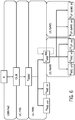
- the key architecture for this alternative implementation is shown in Fig. 6 (discussed further below).
- keys that can be derived from K ASME and K eNB can include the following: K N As en , and K NASin (for encryption and integrity protection of NAS information), KRRCenc and KRRcint (for encrypting and integrity protection of RRC information), and KUPenc (for encrypting user plane data).
- the following parameters can be used to form a string S (as described in 3GPP TS 33.220):
- Table 1 Algorithm Type Distinguisher (P0) Value NAS-enc-alg Ox01 NAS-int-alg 0x02 RRC-enc-alg 0x03 RRC-int-alg 0x04 UP-enc-alg 0x05 UP-int-alg 0x06 UP-SeNB1-enc-alg 0x07 UP-SeNB1-int-alg 0x08
- the algorithm type distinguishers are NAS-enc-alg and NAS-int-alg, respectively.
- the algorithm type distinguishers are RRC-enc-alg and RRC-int-alg, respectively, and to derive KUPenc from K eNB , the algorithm type distinguisher is UP-enc-alg.
- a user plane integrity key for integrity protection can be derived using the algorithm type distinguisher UP-int-alg.
- the keys for the small cell radio connections can be derived from the same existing K eNB , but with newly defined algorithm type distinguishers (P0), including UP-SeNB1-enc-alg and UP-SeNB1-int-alg in Table 1 above, for example.
- P0 algorithm type distinguishers
- a new set of user plane encryption keys (and possibly integrity keys) are derived.
- the following user plane keys (also shown in Fig. 6 ) can be derived for encryption and integrity protection of the user plane connection involving a small cell (referred to as SeNB1 in Fig. 6 ): KUP-SeNB 1 enc and KUPseNB lint. If integrity protection is not employed, then only UP-SeNB1-enc-alg is used for deriving KUP-SeNB 1 enc.
- SeNB1 and SeNB2 two small cells (identified as SeNB1 and SeNB2, for example) to which the UE is connected (in addition to the macro cell).
- two sets of user plane encryption keys are derived for the small cell connections for SeNB1 and SeNB2.
- two sets of algorithm type distinguishers ⁇ UP-SeNB1-enc-alg, UP-SeNB1-int-alg; UP-SeNB2-enc-alg, UP-SeNB2-int-alg ⁇ can be defined for deriving the encryption and integrity keys of the user plane connections of SeNB1 and SeNB2, respectively.
- the algorithm type distinguishers for SeNB2 are illustrated in Table 2 below, which are in addition to the algorithm type distinguishers listed in Table 1.
- Table 2 UP-SeNB2-enc-alg 0x09 UP-SeNB2-int-alg OxOa
- the second user plane architecture (e.g. Fig. 4 architecture) that has a separate PDCP layer in the small cell eNB (separate from the PDCP layer in the macro eNB) for a dual-connectivity UE
- two sets of user plane keys are derived from two different K eNB keys, respectively.
- two different K eNB 's are generated and maintained for a dual-connectivity UE.
- two K eNB' s can also be maintained for the first user plane architecture (e.g. Fig. 5 architecture), the ensuing discussion below assumes the second user plane architecture is employed.
- IC -NB, SeNB * is derived by the UE and the macro eNB from NH using the PCI and EARFCN-DL of the target small cell, where the K eNB , SeNB* is used as the new K eNB , SeNB for RRC and user plane traffic between the target small cell and the UE.
- a further instance of SeNB* is derived by the UE and the macro eNB from NH using the PCI and EARFCN-DL of the second small cell, where the further instance of SeNB* is used as the new K eNB , SeNB for RRC and user plane traffic between the second small cell and the UE.
- K eNB there is a respective K eNB for each cell (macro cell or small cell) that the UE is connected to.
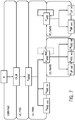
- the key hierarchy for this arrangement is illustrated in Fig. 7 .
- RRC keys KRRont, KRRCenc
- KUPenc, KuPint user plane keys
- KRRcint, KRRCenc The RRC keys (KRRcint, KRRCenc) are derived from the K eNB associated with the macro cell (K eNB in Fig. 7 ).
- the user plane keys KUPenc for the macro cell are derived from K eNB
- the user plane keys KUPenc (and possibly Kupint) for the small cell (SeNB in Fig. 7 ) are derived from the K'eNB associated with the small cell.
- K eNB associated with the macro cell does not have to be updated; as a result, the keys KRRCint, KRRCenc and KUPenc for the macro cell do not have to be updated.
- K 1 e NB is updated, and the associated user plane keys (KUPenc and possibly Kupint) are updated.
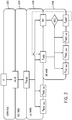
- Fig. 8 shows an example of updating keys in response to intra-eNB and inter-eNB handovers.
- Block 802 represents the initial computation of K eNB when the UE first establishes a radio connection with a macro cell. This initial K eNB from the MME is placed into use in the macro eNB as illustrated in block 804 in Fig. 8 .
- Subsequent intra-eNB handovers (between cells of the macro eNB) cause horizontal key derivation of K eNB , which involves producing K eNB * using the PCI and EARFCN-DL of the target macro cell.
- K eNB * is used by the target macro cell as K eNB .
- a handover between macro eNBs causes a vertical key derivation, as shown by a down arrow from block 802 in Fig. 8 .
- Such inter-eNB handover results in the NH being computed, and the NCC being incremented.
- K eNB * is derived from NH as part of the intereNB handover, and this K eNB * is used as the K eNB at the target eNB.
- Maintaining just one set of ⁇ NH, NCC ⁇ can be performed to reduce complexity in key establishment and key change.
- ⁇ NH, NCC ⁇ is maintained at the macro eNB; a separate set of ⁇ NH, NCC ⁇ does not have to be maintained at the small cell eNB to which a UE has a dual connection.
- K'eNB of a small cell eNB for the UE is horizontally derived using an intra-eNB handover procedure, as depicted in the oval 806 of Fig. 8 .
- Oval 808 shows derivation of K eNB for a potentially different small cell after a vertical key chaining that is performed as part of macro eNB handover.
- the macro eNB When a small cell radio connection is added for the UE, to maintain just one set of ⁇ NH, NCC ⁇ , the macro eNB does not perform a vertical key derivation for the small cell eNB. To maintain key synchronization between the network and the UE, the K'eNB key for a small cell eNB is associated with a cell identifier of the small cell in an RRC message.
- the macro eNB When the macro eNB performs handover, such as intra-eNB handover or intereNB handover (e.g. X2-based handover or SI-based handover), the macro eNB first releases the small cell-UE radio connection, so that there is no dual connection for the UE. Once the small cell-UE radio connection is released, a normal macro cell handover procedure and key derivation can be performed for a single-connection UE. Thus the NH derivation and NCC increment are only used for macro eNB-level handover.
- handover such as intra-eNB handover or intereNB handover (e.g. X2-based handover or SI-based handover)
- the macro eNB first releases the small cell-UE radio connection, so that there is no dual connection for the UE. Once the small cell-UE radio connection is released, a normal macro cell handover procedure and key derivation can be performed for a single-connection UE. Thus the NH derivation and NCC increment are only used for macro e
- K' e NB of the small cell is derived as follows. If the small cell eNB in Fig. 4 employs multiple component carriers, then one component carrier is designated as the primary cell PCells of the small cell eNB. This primary cell PCell s is in addition a primary cell PCell m that is designated for the macro eNB.
- the input to the key derivation function of K' e NB uses the PCI and downlink frequency EARFCN-DL of PCells.
- K eNB , SeNB* is derived by the UE and the macro eNB using the PCI and EARFCN-DL of the target small cell, where the K eNB , s e NB* is used as the new K' e NB for the user plane traffic between the target small cell and the UE.
- a feature here of this arrangement is that, in addition to K eNB for the macro cell-UE radio connection, the macro eNB also holds K' eNB for data radio bearers of the small cell-UE link, since the PDCP layer for the small cell-UE radio link resides in the macro eNB, as shown in Fig. 8 .
- a cluster of small cells can be implemented, such as a small cell cluster 900 as shown in Fig. 9 .
- the UE 110 can move between coverage areas of different small cells.
- Fig. 9 it is assumed that the UE 110 is initially in the coverage area of small cell 0, which has neighbor small cells 1-6 in the small cell cluster 900.
- security for communications of the UE 100 can also be provided with keys.
- a PLMN identity, plmn-Identity that is most common among all small cells in the cluster 900, and which is also acceptable to the UE 100, can be identified.
- plmn-Identity By identifying such plmn-Identity and using it to produce K ASME , the instances where K ASME would have to be updated as the UE 100 moves from small cell to small cell in the cluster 900 can be reduced.
- key derivation can be simplified by providing a list of multiple ⁇ cluster ID, plmn-Identity ⁇ pairs for the small cell cluster 900, where this list is shared by all member small cells in the cluster 900. For each pair of ⁇ cluster ID, plmn-Identity ⁇ , the cluster ID is specific to the associated plmn-Identity, so that a different plmn-Identity value may have a different cluster ID value for the cluster 900.
- the list that the cluster 900 is associated with may be broadcast by the small cells in the entire coverage area of the cluster 900.
- the UE 110 can select a plmn-Identity from the list. This selected plmn-Identity is valid for the entire coverage region of the cluster 900, and the selected plmn-Identity can be used for generating corresponding K ASME for the entire coverage region of the cluster 900. Note that a variation of the scheme is that each pair of ⁇ cluster ID, plmn-Identity ⁇ may include a subset of the small cells in the cluster.
- ⁇ cluster ID A, plmn-Identity Al may be used by small cells ⁇ 0,1,2,3,4 ⁇
- ⁇ cluster ID B, plmn-Identity B ⁇ may be used by small cells ⁇ 0,3,4, 5, 6 ⁇
- ⁇ cluster ID C, plmn-Identity C ⁇ may be used by all small cells ⁇ 0,1,2,3,4,5,6 ⁇ in the cluster.
- a security configuration includes security information, which may include a key, a token, as well as other information, such as one or more of the following: a respective NCC, Evolved Packet System (EPS) security capabilities of the UE 110, security algorithms used in the source small cell for computing the token, and so forth.
- EPS Evolved Packet System
- the set of candidate target small cells to be prepared for handover by the source small cell eNB can be determined according to measurements performed by the UE of signals transmitted by various neighbor small cells of the source small cell.
- the set of candidate target small cells includes those target small cells indicated by the respective UE measurements as more likely to be handover targets.
- a token is calculated from V arShortMAC-Input, where V arShortMAC-Input is composed of a source cell radio network temporary identifier (C-RNTI), a source PCI, and a target cell identifier.
- V arShortMAC-Input is the input to an integrity algorithm, which outputs a 32-bit message authentication code.
- the token is the 16 least significant bits of the message authentication code.
- the token is carried as part of an RRCConnectionReestablishmentRequest message sent by the UE 110 to a target eNB to reestablish RRC connection after a connection failure, where the failure is due to, for example, a radio link failure, a handover failure, and so forth.
- the security configurations generated by the source small cell eNB can be sent to respective target small cell eNBs. Also, the security configurations can be sent by the source small cell eNB to the UE 110. With multiple target small cells prepared, the UE 110 can move to any of the prepared target small cells, and establish a radio connection with such target small cell. This mitigates the shortcomings associated with not employing a macro cell, and the small footprint of a small cell in a cluster.
- each security configuration includes a respective key, e.g. K eNB , PCI2* (for small cell 2) , K eNB , PCI4* (for small cell 4), and K eNB , PCI6* (for small cell 6).
- Each K eNB , PCI2* 5 K eNB , PCI4*, or K eNB , PCI6* can be used by the respective target small cell 2, 4, or 6, respectively, as the corresponding K eNB that can be used to secure communication in the event that the UE establish connection.
- FIG. 10 The corresponding key chaining for K'eNB preparation of multiple target small cells is illustrated in Fig. 10 .
- Ovals 1002, 1004, and 1006 in Fig. 10 represents the derivation of K eNB , PCI3* 5 K eNB , PCI4*, and K eNB , PCI6*, respectively, from the K eNB (represented by block 1008) of the source small cell.
- a timer (which can be referred to as THOprep, for example) can be provided for a handover preparation phase at the source small cell eNB, assuming that multiple candidate target small cell eNBs are involved.
- THOprep a timer
- the timer THoprep is started.
- a HANDOVER REQUEST ACKNOWLEDGE messages for acknowledging the HANDOVER REQUEST message
- the timer THOprep is stopped.
- the candidate target small cell eNBs that have not acknowledged are no longer considered candidate target small cell eNBs by the source small cell eNB, and their mobility information is not passed to the UE 110.
- the source small cell eNB removes the target small cell eNBs that have not acknowledged from the set of candidate small cell eNBs.
- the source small cell eNB can send a HANDOVER CANCEL message to each target small cell eNB that has not acknowledged to formally cancel the handover preparation of that target small cell.
- the source small cell eNB can respond by sending to the UE 110 an RRCConnectionReconfiguration message to convey the respective mobility control information, without waiting for the acknowledgment from other candidate target small cell eNBs. This helps to reduce handover failure.
- the mobility control information included in the RRCConnectionReconfiguration message can include various information, including the carrier frequency of target cell and various physical channel configuration and random access channel (RACH) procedure information about the target cell.
- RRCConnectionReconfiguration messages There may be multiple RRCConnectionReconfiguration messages sent from the source small cell eNB to the UE 110, one for each candidate target small cell eNB that has acknowledged.
- the delivery of multiple RRCConnectionReconfiguration messages can be facilitated by maintaining a dual connection towards the UE 110, one connection from the source small cell eNB to the UE 110, and the other from a target small cell eNB to the UE 110. Note that the UE 110 does not have to immediately break the connection to the source small cell eNB when performing a random access procedure, on a RACH with a target small cell eNB.
- the source small cell eNB can send a HANDOVER CANCEL message to other prepared target small cells.
- the procedure described above is for mobility handling among a cluster of small cells, a similar procedure can be applied in other scenarios, such as a scenario that includes a deployment of a macro cell and one or more small cells, or a deployment of multiple macro cells.
- the timer THOprep is stopped a select subset of the candidate target small cell eNBs are received.
- the source small cell eNB can aggregate mobility control information of multiple target small cells into a single RRCConnectionReconfiguration message to send to the UE 110.
- Fig. 11 is a flow diagram of a process according to some implementations for use in performing handover of the UE 110 in the cluster 900 of small cells.
- the source small cell eNB generates (at 1102), for the UE 110, multiple security configurations, where each security configuration is associated with a different eNB in a set of candidate target small cell eNBs.
- the source small cell eNB sends (at 1104) each security configuration to the respective candidate target small cell eNB.
- the source small cell eNB also sends (at 1106) the security configurations to the UE 110.
- the UE 110 can use a security key of a security configuration of a particular one of the target small cell eNBs to derive further keys that can be used for a radio connection established between the UE and the target small cell eNB.
- Fig. 12 depicts a computing system 1200, which can be any of the macro eNB 104, small cell eNB 108, or other network node discussed above.
- the computing system 1200 includes machine-readable instructions 1202, which are executable on a processor (or multiple processors) 1204 to perform various tasks discussed above.
- a processor can include a microprocessor, microcontroller, processor module or subsystem, programmable integrated circuit, programmable gate array, or another control or computing device.
- the processor(s) 1204 can be coupled to a communication interface (or communication component) 1206 to perform communications.
- the communication interface 1206 can perform wireless communication over an air interface, or perform wired communication over a wired connection.
- the computing system 1200 can include multiple communication interfaces 1206 to communicate with respective different network nodes.
- the processor(s) 1204 can also be coupled to a computer-readable or machine-readable storage medium (or storage media) 1208, for storing data and instructions.
- the storage medium or storage media 1608 can include one or multiple computer-readable or machine-readable storage media.
- the storage media include different forms of memory including semiconductor memory devices such as dynamic or static random access memories (DRAMs or SRAMs), erasable and programmable read-only memories (EPROMs), electrically erasable and programmable read-only memories (EEPROMs) and flash memories; magnetic disks such as fixed, floppy and removable disks; other magnetic media including tape; optical media such as compact disks (CDs) or digital video disks (DVDs); or other types of storage devices.
- DRAMs or SRAMs dynamic or static random access memories
- EPROMs erasable and programmable read-only memories
- EEPROMs electrically erasable and programmable read-only memories
- flash memories magnetic disks such as fixed, floppy and removable disks
- the instructions discussed above can be provided on one computer-readable or machine-readable storage medium, or alternatively, can be provided on multiple computer-readable or machine-readable storage media distributed in a large system having possibly plural nodes.
- Such computer-readable or machine-readable storage medium or media is (are) considered to be part of an article (or article of manufacture).
- An article or article of manufacture can refer to any manufactured single component or multiple components.
- the storage medium or media can be located either in the machine running the machine-readable instructions, or located at a remote site from which machine-readable instructions can be downloaded over a network for execution.
- a first radio connection is established between a first cell and a user equipment (UE).
- a network identity of a second cell is determined based on a first set of at least one network identity associated with the first cell, where the second cell is associated with a second set of at least one network identity, and the determined network identity is useable for establishing a second radio connection between the second cell and the UE.
- a UE includes a wireless communication component to receive, from a wireless access network node of a first cell, a list of network identifiers, the network identifiers being composed according to a first set of network identifiers for the first cell, and a second set of network identifiers for a second cell, the first cell and the second cell to provide concurrent wireless connections with the UE.
- the UE further includes at least one processor configured to select, from the list of network identifiers, a network identifier to use for generating a key for protecting data communication of the UE.
- a source wireless access network node generates, for a UE, a plurality of security configurations, where each security configuration is associated with a different node in a set of candidate target wireless access network nodes.
- the source wireless access network node sends each security configuration to the respective candidate target wireless network node.
- the source wireless access network node sends security information of the plurality of security configurations to the UE.
Landscapes
- Engineering & Computer Science (AREA)
- Computer Networks & Wireless Communication (AREA)
- Signal Processing (AREA)
- Computer Security & Cryptography (AREA)
- Mobile Radio Communication Systems (AREA)
Applications Claiming Priority (4)
| Application Number | Priority Date | Filing Date | Title |
|---|---|---|---|
| US14/069,532 US9497673B2 (en) | 2013-11-01 | 2013-11-01 | Method and apparatus to enable multiple wireless connections |
| PCT/US2014/063308 WO2015066406A2 (en) | 2013-11-01 | 2014-10-31 | Method and apparatus to enable multiple wireless connections |
| EP17161581.8A EP3206421B1 (de) | 2013-11-01 | 2014-10-31 | Verfahren und vorrichtung für mehrere drahtlose verbindungen |
| EP14802265.0A EP3063972B1 (de) | 2013-11-01 | 2014-10-31 | Verfahren zum ermöglichen mehrerer drahtloser verbindungen |
Related Parent Applications (2)
| Application Number | Title | Priority Date | Filing Date |
|---|---|---|---|
| EP14802265.0A Division EP3063972B1 (de) | 2013-11-01 | 2014-10-31 | Verfahren zum ermöglichen mehrerer drahtloser verbindungen |
| EP17161581.8A Division EP3206421B1 (de) | 2013-11-01 | 2014-10-31 | Verfahren und vorrichtung für mehrere drahtlose verbindungen |
Publications (2)
| Publication Number | Publication Date |
|---|---|
| EP3474584A1 true EP3474584A1 (de) | 2019-04-24 |
| EP3474584B1 EP3474584B1 (de) | 2020-07-15 |
Family
ID=51946026
Family Applications (3)
| Application Number | Title | Priority Date | Filing Date |
|---|---|---|---|
| EP17161581.8A Active EP3206421B1 (de) | 2013-11-01 | 2014-10-31 | Verfahren und vorrichtung für mehrere drahtlose verbindungen |
| EP18203371.2A Active EP3474584B1 (de) | 2013-11-01 | 2014-10-31 | Verfahren und vorrichtung für mehrere drahtlose verbindungen |
| EP14802265.0A Active EP3063972B1 (de) | 2013-11-01 | 2014-10-31 | Verfahren zum ermöglichen mehrerer drahtloser verbindungen |
Family Applications Before (1)
| Application Number | Title | Priority Date | Filing Date |
|---|---|---|---|
| EP17161581.8A Active EP3206421B1 (de) | 2013-11-01 | 2014-10-31 | Verfahren und vorrichtung für mehrere drahtlose verbindungen |
Family Applications After (1)
| Application Number | Title | Priority Date | Filing Date |
|---|---|---|---|
| EP14802265.0A Active EP3063972B1 (de) | 2013-11-01 | 2014-10-31 | Verfahren zum ermöglichen mehrerer drahtloser verbindungen |
Country Status (4)
| Country | Link |
|---|---|
| US (3) | US9497673B2 (de) |
| EP (3) | EP3206421B1 (de) |
| CA (1) | CA2927274C (de) |
| WO (1) | WO2015066406A2 (de) |
Families Citing this family (51)
| Publication number | Priority date | Publication date | Assignee | Title |
|---|---|---|---|---|
| WO2015037926A1 (en) | 2013-09-11 | 2015-03-19 | Samsung Electronics Co., Ltd. | Method and system to enable secure communication for inter-enb transmission |
| US9497673B2 (en) * | 2013-11-01 | 2016-11-15 | Blackberry Limited | Method and apparatus to enable multiple wireless connections |
| US9338136B2 (en) * | 2013-12-05 | 2016-05-10 | Alcatel Lucent | Security key generation for simultaneous multiple cell connections for mobile device |
| CN110366177B (zh) | 2013-12-24 | 2022-06-14 | 日本电气株式会社 | 通信系统中的主基站、辅基站和用户设备及其通信方法 |
| CN104969592B (zh) * | 2014-01-17 | 2019-05-31 | 三星电子株式会社 | 无线通信网络中用户设备的双连通操作模式 |
| KR102155523B1 (ko) * | 2014-01-20 | 2020-09-14 | 삼성전자 주식회사 | 이중 연결을 지원하는 무선 통신 시스템에서 단말과 기지국 사이의 연결 구성 결정 및 핸드 오버 수행 방법 및 장치 |
| CN104811917B (zh) * | 2014-01-27 | 2020-03-17 | 北京三星通信技术研究有限公司 | 一种小小区Small cell系统中对UE进行控制、计费和定位的方法 |
| ES2759428T3 (es) * | 2014-01-28 | 2020-05-11 | Huawei Tech Co Ltd | Método de cambio de clave de seguridad y equipo de usuario |
| EP3114882B1 (de) | 2014-03-06 | 2018-10-10 | LG Electronics Inc. | Verfahren und vorrichtung zur durchführung einer übergabe in einem drahtloskommunikationssystem |
| US9936427B2 (en) * | 2014-03-14 | 2018-04-03 | Intel Corporation | Systems and methods for joint handover of user equipment and secondary cell group in 3GPP LTE dual connectivity |
| JP6254467B2 (ja) | 2014-03-20 | 2017-12-27 | Kddi株式会社 | 端末装置、基地局装置、使用アーキテクチャ決定方法、及びコンピュータプログラム |
| JP6299861B2 (ja) * | 2014-04-04 | 2018-03-28 | 富士通株式会社 | 無線通信システム、基地局および端末 |
| WO2015174904A1 (en) * | 2014-05-16 | 2015-11-19 | Telefonaktiebolaget L M Ericsson (Publ) | Determination of ue band and synchronization capability in dual connectivity |
| US11089648B2 (en) * | 2015-01-30 | 2021-08-10 | Kyocera Corporation | User terminal for executing dual connectivity |
| CN106304206A (zh) * | 2015-05-15 | 2017-01-04 | 中兴通讯股份有限公司 | 一种虚拟小区动态的控制面信令的传递方法及系统 |
| US10362011B2 (en) | 2015-07-12 | 2019-07-23 | Qualcomm Incorporated | Network security architecture |
| US10412056B2 (en) * | 2015-07-24 | 2019-09-10 | Futurewei Technologies, Inc. | Ultra dense network security architecture method |
| JP6612554B2 (ja) * | 2015-08-24 | 2019-11-27 | 株式会社Nttドコモ | 無線基地局、ユーザ端末、無線通信方法 |
| US10349326B2 (en) | 2015-12-31 | 2019-07-09 | Huawei Technologies Co., Ltd. | Handover method and system in master-slave network, master device, and slave device |
| KR102088857B1 (ko) * | 2016-04-06 | 2020-03-13 | 삼성전자 주식회사 | 기지국 및/또는 기지국으로부터 수신된 정보의 진정성을 검증하는 시스템 및 방법 |
| DE112017000018T5 (de) * | 2016-04-06 | 2017-12-21 | Sony Corporation | Basisstation, virtuelle zelle, benutzergerät |
| EP3249970B1 (de) * | 2016-05-26 | 2020-07-01 | Alcatel Lucent | Verfahren zur drahtlosen datenübertragunghandover |
| JP6724232B2 (ja) * | 2016-07-29 | 2020-07-15 | エルジー エレクトロニクス インコーポレイティド | 無線通信システムにおけるネットワークスライスベースのnrのためのセル特定手順を実行する方法及び装置 |
| JP6724233B2 (ja) * | 2016-07-29 | 2020-07-15 | エルジー エレクトロニクス インコーポレイティド | 無線通信システムにおけるネットワークスライスベースのnrのためのセル特定手順または移動性手順を実行する方法及び装置 |
| EP3520452B1 (de) * | 2016-09-30 | 2022-12-21 | Nokia Technologies Oy | Aktualisierung eines sicherheitsschlüssels |
| CN108377495B (zh) * | 2016-10-31 | 2021-10-15 | 华为技术有限公司 | 一种数据传输方法、相关设备及系统 |
| US11026126B2 (en) * | 2016-11-04 | 2021-06-01 | Telefonaktiebolaget Lm Ericsson (Publ) | Method and apparatus for facilitating MBMS reception |
| US11799916B2 (en) * | 2016-11-07 | 2023-10-24 | Telefonaktiebolaget Lm Ericsson (Publ) | Handling radio link failure in a narrow bandwidth internet of things control plane |
| EP3599784B1 (de) | 2017-01-30 | 2020-11-18 | Telefonaktiebolaget LM Ericsson (publ) | Verfahren und geräte zur wiederherstellung einer funkressourcensteuerungs (rrc)-verbindung |
| EP3602990A1 (de) * | 2017-03-30 | 2020-02-05 | Intel IP Corporation | Sicherheit für paging-nachrichten |
| WO2018178081A1 (en) * | 2017-03-30 | 2018-10-04 | Sony Corporation | Telecommunications apparatus and methods |
| US10644974B2 (en) | 2017-05-04 | 2020-05-05 | At&T Intellectual Property I, L.P. | Measurements and radio link monitoring in a wireless communications system |
| US11032744B2 (en) | 2017-05-04 | 2021-06-08 | At&T Intellectual Property I, L.P. | Inter-distributed unit beam switch procedure triggered by radio link interruption |
| US11616768B2 (en) | 2017-06-23 | 2023-03-28 | Motorola Mobility Llc | Method and apparatus for handling security keys for individual bearers |
| CN110381496B (zh) * | 2017-08-09 | 2020-10-27 | 华为技术有限公司 | 一种rna分配的方法、装置及可读存储介质 |
| CN109391939B (zh) * | 2017-08-10 | 2021-11-02 | 中兴通讯股份有限公司 | 密钥、参数发送方法及装置、用户面实体、控制面实体 |
| US10764755B2 (en) | 2017-09-07 | 2020-09-01 | 802 Secure, Inc. | Systems and methods for providing wireless access security by interrogation |
| US10499398B2 (en) | 2017-09-29 | 2019-12-03 | At&T Intellectual Property I, L.P. | Facilitating mobile device-assisted mobility enhancement to improve user plane interruption time |
| CN107820287B (zh) * | 2017-10-10 | 2019-09-27 | Oppo广东移动通信有限公司 | 检测终端接入的方法及相关产品 |
| EP3695636B1 (de) * | 2017-10-11 | 2023-01-04 | LG Electronics Inc. | Verfahren und vorrichtung zur änderung der pdcp-version |
| WO2019074242A1 (ko) * | 2017-10-12 | 2019-04-18 | 한국전자통신연구원 | 초고속 차량을 위한 통신 방법 및 장치 |
| EP3510831B1 (de) * | 2017-11-30 | 2021-03-10 | Guangdong Oppo Mobile Telecommunications Corp., Ltd. | Verfahren für systeminformationen, benutzergerät und computerlesbares medium |
| WO2020029075A1 (en) * | 2018-08-07 | 2020-02-13 | Zte Corporation | Method and computing device for carrying out data integrity protection |
| CN110896539B (zh) * | 2018-09-12 | 2021-03-19 | 维沃移动通信有限公司 | 处理方法和设备 |
| US11399322B2 (en) | 2018-09-17 | 2022-07-26 | Telefonaktiebolaget Lm Ericsson (Publ) | User equipment, network node and methods in a wireless communications network |
| CN112970328B (zh) * | 2018-09-17 | 2024-10-29 | 瑞典爱立信有限公司 | 用于使用安全令牌重建无线电资源控制连接的方法和设备 |
| US11950146B2 (en) * | 2018-09-27 | 2024-04-02 | Apple Inc. | PDCP and ROHC handling for multi-connectivity handover |
| EP3909388A1 (de) * | 2019-01-21 | 2021-11-17 | Sony Group Corporation | Endgerät, infrastrukturausrüstung und verfahren |
| CN114390561A (zh) * | 2020-10-16 | 2022-04-22 | 北京三星通信技术研究有限公司 | 一种数据包传输机制及设备 |
| JP2023546424A (ja) * | 2020-10-21 | 2023-11-02 | 富士通株式会社 | Iabノードのマイグレーション方法及び装置 |
| US11552943B2 (en) * | 2020-11-13 | 2023-01-10 | Cyberark Software Ltd. | Native remote access to target resources using secretless connections |
Citations (2)
| Publication number | Priority date | Publication date | Assignee | Title |
|---|---|---|---|---|
| EP2273818A1 (de) * | 2008-06-23 | 2011-01-12 | Huawei Technologies Co., Ltd. | Verfahren, vorrichtung und system zur ableitung eines schlüssels |
| US20130128866A1 (en) * | 2010-07-15 | 2013-05-23 | Huawei Technologies Co., Ltd. | Method, apparatus, and system for security processing in handover process |
Family Cites Families (39)
| Publication number | Priority date | Publication date | Assignee | Title |
|---|---|---|---|---|
| US7396880B2 (en) | 2005-05-24 | 2008-07-08 | Arkema Inc. | Blend of ionic (co)polymer resins and matrix (co)polymers |
| US8260291B2 (en) * | 2005-12-26 | 2012-09-04 | Htc Corporation | Method for handling periodic PLMN search in RRC connected mode in UMTS system |
| JP5279717B2 (ja) | 2006-11-07 | 2013-09-04 | テレフオンアクチーボラゲット エル エム エリクソン(パブル) | 負荷に依存したレート規制方法及びシステム |
| US20080268833A1 (en) | 2007-03-30 | 2008-10-30 | Leping Huang | System and Method for Self-Optimization of Interference Coordination in Communication Systems |
| US8670422B2 (en) | 2007-04-30 | 2014-03-11 | Blackberry Limited | System and method for sending and receiving packets |
| CN101309500B (zh) * | 2007-05-15 | 2011-07-20 | 华为技术有限公司 | 不同无线接入技术间切换时安全协商的方法和装置 |
| JP5600060B2 (ja) | 2007-08-10 | 2014-10-01 | アルカテル−ルーセント | 基地局で移動局のデータ送信及び再送信を制御する通信方法及び装置 |
| GB2452698B (en) | 2007-08-20 | 2010-02-24 | Ipwireless Inc | Apparatus and method for signaling in a wireless communication system |
| US8060093B2 (en) * | 2007-08-22 | 2011-11-15 | Samsung Electronics Co., Ltd. | Handover system and method in a wireless mobile communication system |
| KR101532107B1 (ko) * | 2007-11-21 | 2015-06-26 | 노오텔 네트웍스 리미티드 | 소스 기지국으로부터 타겟 기지국으로 핸드오버하는 이동국에의 자원 할당을 위한 작동 시간 계산 |
| GB2456503A (en) | 2008-01-10 | 2009-07-22 | Ip Access Ltd | Using global cell identifier for handover in a combined femto-cell/macro-cell environment |
| CN101926197A (zh) * | 2008-02-04 | 2010-12-22 | 夏普株式会社 | 移动通信系统、基站装置、移动台装置以及移动通信方法 |
| WO2009116927A1 (en) * | 2008-03-18 | 2009-09-24 | Telefonaktiebolaget L M Ericsson (Publ) | Earthquake and tsunami cellular warning system |
| US8971888B2 (en) * | 2008-03-21 | 2015-03-03 | Qualcomm Incorporated | Cell selection and reselection in deployments with home nodeBs |
| WO2009132824A2 (en) | 2008-04-29 | 2009-11-05 | Nokia Siemens Networks Oy | Simplified local routing |
| US8307250B2 (en) | 2008-06-06 | 2012-11-06 | Research In Motion Limited | Hybrid automatic repeat request associations for downlink semi-persistent scheduling |
| US8532057B2 (en) * | 2008-06-25 | 2013-09-10 | Lg Electronics Inc. | Handover support method using dedicated ranging code |
| US8644244B2 (en) | 2008-12-12 | 2014-02-04 | Research In Motion Limited | Sensor-based wireless communication systems using compressive sampling |
| US8787186B2 (en) | 2008-12-12 | 2014-07-22 | Blackberry Limited | Mobility in a distributed antenna system |
| US8670432B2 (en) | 2009-06-22 | 2014-03-11 | Qualcomm Incorporated | Methods and apparatus for coordination of sending reference signals from multiple cells |
| US8639243B2 (en) | 2009-08-21 | 2014-01-28 | Qualcomm Incorporated | Systems, methods and apparatus configured to manage neighbor cell lists |
| US8600398B2 (en) | 2009-11-03 | 2013-12-03 | Telefonaktiebolaget Lm Ericsson (Publ) | Method, apparatus and system for defining positioning configuration in a wireless network |
| EP2681948B1 (de) * | 2011-03-02 | 2017-09-20 | Nokia Solutions and Networks Oy | Verbesserte beziehung zwischen nachbarzellen |
| US20130137469A1 (en) | 2011-11-30 | 2013-05-30 | Intel Mobile Communications GmbH | Method for transmitting an opportunistic network related message |
| US9386494B2 (en) | 2011-12-06 | 2016-07-05 | Qualcomm Incorporated | Apparatus and methods for performing handover of user equipment between different radio access networks |
| CN105916140B (zh) * | 2011-12-27 | 2019-10-22 | 华为技术有限公司 | 基站间载波聚合的安全通讯方法及设备 |
| EP2627121B1 (de) | 2012-02-13 | 2015-01-07 | Alcatel Lucent | Verfahren zur effizienten Handhabung in einem mobilen Kommunikationssystem |
| WO2013163815A1 (zh) * | 2012-05-04 | 2013-11-07 | 华为技术有限公司 | 一种网络切换过程中的安全处理方法及系统 |
| US9544801B2 (en) | 2012-08-03 | 2017-01-10 | Intel Corporation | Periodic channel state information reporting for coordinated multipoint (coMP) systems |
| EP2901640A2 (de) * | 2012-09-26 | 2015-08-05 | Interdigital Patent Holdings, Inc. | Verfahren, systeme und vorrichtungen zum betreiben in lte-systemen |
| EP2918102B1 (de) * | 2012-11-08 | 2017-07-19 | Telefonaktiebolaget LM Ericsson (publ) | Verfahren und netzknoten zur handhabung von übergabefehlern |
| US9173147B2 (en) * | 2013-01-18 | 2015-10-27 | Blackberry Limited | Communicating data using a local wireless access network node |
| US9444745B2 (en) | 2013-03-08 | 2016-09-13 | Blackberry Limited | Sending data rate information to a wireless access network node |
| US9578671B2 (en) | 2013-03-15 | 2017-02-21 | Blackberry Limited | Establishing multiple connections between a user equipment and wireless access network nodes |
| US9629025B2 (en) | 2013-05-03 | 2017-04-18 | Blackberry Limited | Controlling data offload in response to feedback information |
| US10182390B2 (en) | 2013-07-29 | 2019-01-15 | Blackberry Limited | Communicating an indicator extending an area scope of system information |
| US10932205B2 (en) | 2013-08-02 | 2021-02-23 | Blackberry Limited | Uplink power sharing control |
| US9125112B2 (en) | 2013-08-06 | 2015-09-01 | Blackberry Limited | Communicating radio resource configuration information |
| US9497673B2 (en) * | 2013-11-01 | 2016-11-15 | Blackberry Limited | Method and apparatus to enable multiple wireless connections |
-
2013
- 2013-11-01 US US14/069,532 patent/US9497673B2/en active Active
-
2014
- 2014-10-31 EP EP17161581.8A patent/EP3206421B1/de active Active
- 2014-10-31 EP EP18203371.2A patent/EP3474584B1/de active Active
- 2014-10-31 WO PCT/US2014/063308 patent/WO2015066406A2/en not_active Ceased
- 2014-10-31 EP EP14802265.0A patent/EP3063972B1/de active Active
- 2014-10-31 CA CA2927274A patent/CA2927274C/en active Active
-
2016
- 2016-11-14 US US15/350,440 patent/US9998964B2/en active Active
-
2018
- 2018-06-11 US US16/005,275 patent/US10477441B2/en active Active
Patent Citations (2)
| Publication number | Priority date | Publication date | Assignee | Title |
|---|---|---|---|---|
| EP2273818A1 (de) * | 2008-06-23 | 2011-01-12 | Huawei Technologies Co., Ltd. | Verfahren, vorrichtung und system zur ableitung eines schlüssels |
| US20130128866A1 (en) * | 2010-07-15 | 2013-05-23 | Huawei Technologies Co., Ltd. | Method, apparatus, and system for security processing in handover process |
Non-Patent Citations (3)
| Title |
|---|
| "3rd Generation Partnership Project; Technical Specification Group Radio Access Network; Evolved Universal Terrestrial Radio Access Network (E-UTRAN); X2 application protocol (X2AP) (Release 10)", 19 September 2013 (2013-09-19), XP050905162, Retrieved from the Internet <URL:http://www.3gpp.org/ftp/Specs/2014-12/Rel-10/36_series/> [retrieved on 20130919] * |
| "3rd Generation Partnership Project; Technical Specification Group Services and System Aspects; 3GPP System Architecture Evolution (SAE); Security architecture (Release 12)", 3GPP STANDARD; 3GPP TS 33.401, 3RD GENERATION PARTNERSHIP PROJECT (3GPP), MOBILE COMPETENCE CENTRE ; 650, ROUTE DES LUCIOLES ; F-06921 SOPHIA-ANTIPOLIS CEDEX ; FRANCE, vol. SA WG3, no. V12.9.0, 19 September 2013 (2013-09-19), pages 1 - 121, XP050712663 * |
| HUAWEI ET AL: "RAN2 considerations for D2D communication", vol. RAN WG2, no. Barcelona, Spain; 20130819 - 20130823, 12 August 2013 (2013-08-12), XP050718591, Retrieved from the Internet <URL:http://www.3gpp.org/ftp/tsg_ran/WG2_RL2/TSGR2_83/Docs/> [retrieved on 20130812] * |
Also Published As
| Publication number | Publication date |
|---|---|
| WO2015066406A3 (en) | 2015-07-09 |
| US20180359667A1 (en) | 2018-12-13 |
| EP3206421B1 (de) | 2018-10-31 |
| US20170064590A1 (en) | 2017-03-02 |
| EP3063972A2 (de) | 2016-09-07 |
| CA2927274C (en) | 2017-09-26 |
| US20150124708A1 (en) | 2015-05-07 |
| EP3474584B1 (de) | 2020-07-15 |
| US9998964B2 (en) | 2018-06-12 |
| EP3206421A1 (de) | 2017-08-16 |
| WO2015066406A2 (en) | 2015-05-07 |
| CA2927274A1 (en) | 2015-05-07 |
| US9497673B2 (en) | 2016-11-15 |
| US10477441B2 (en) | 2019-11-12 |
| EP3063972B1 (de) | 2017-12-13 |
Similar Documents
| Publication | Publication Date | Title |
|---|---|---|
| US10477441B2 (en) | Method and apparatus to enable multiple wireless connections | |
| US8520636B2 (en) | Method and apparatus for performing handover | |
| EP2569894B1 (de) | Verfahren und system zur positionierung einer mobilstation in einem weiterleitungsverfahren | |
| EP2838292B1 (de) | Kommunikation von Funkressourcen-Konfigurationsinformationen | |
| US9510387B2 (en) | Recovering connection in LTE local area network for EPS and local services | |
| CN104041125B (zh) | 无线通信系统中的切换方法和装置 | |
| US11026136B2 (en) | Handovers with simplified network topology | |
| TW201739276A (zh) | 增強的非存取層安全 | |
| CN108476217B (zh) | 可配置的接入阶层安全性 | |
| WO2013097672A1 (zh) | 基站间载波聚合的安全通讯方法及设备 | |
| CN105557006A (zh) | 用于支持双连接的pdcp分布式结构的安全密钥生成和管理方法 | |
| WO2013054122A2 (en) | Access point | |
| CN104185227A (zh) | 一种双连接架构下的csg接入控制方法及系统 | |
| EP3251417B1 (de) | Mobilitätssignalisierung für benutzergerät mit dualer konnektivität | |
| US11582214B2 (en) | Updating security key | |
| CN112956226B (zh) | 在通信系统中隔离虚假基站 | |
| US20240406846A1 (en) | Managing ue measurements in an idle or inactive state | |
| CN116325907B (zh) | Iab节点的移植方法及装置 | |
| EP4211912A1 (de) | Quell- und zielnetzwerkknoten und verfahren zur unrechtmässigen identifizierung | |
| CN102685817A (zh) | 在中继节点切换过程中不需要重建高层安全的方法和系统 | |
| EP3520316B1 (de) | Übergaben mit vereinfachter netzwerktopologie |
Legal Events
| Date | Code | Title | Description |
|---|---|---|---|
| PUAI | Public reference made under article 153(3) epc to a published international application that has entered the european phase |
Free format text: ORIGINAL CODE: 0009012 |
|
| STAA | Information on the status of an ep patent application or granted ep patent |
Free format text: STATUS: THE APPLICATION HAS BEEN PUBLISHED |
|
| AC | Divisional application: reference to earlier application |
Ref document number: 3063972 Country of ref document: EP Kind code of ref document: P Ref document number: 3206421 Country of ref document: EP Kind code of ref document: P |
|
| AK | Designated contracting states |
Kind code of ref document: A1 Designated state(s): AL AT BE BG CH CY CZ DE DK EE ES FI FR GB GR HR HU IE IS IT LI LT LU LV MC MK MT NL NO PL PT RO RS SE SI SK SM TR |
|
| STAA | Information on the status of an ep patent application or granted ep patent |
Free format text: STATUS: REQUEST FOR EXAMINATION WAS MADE |
|
| 17P | Request for examination filed |
Effective date: 20191003 |
|
| RBV | Designated contracting states (corrected) |
Designated state(s): AL AT BE BG CH CY CZ DE DK EE ES FI FR GB GR HR HU IE IS IT LI LT LU LV MC MK MT NL NO PL PT RO RS SE SI SK SM TR |
|
| GRAP | Despatch of communication of intention to grant a patent |
Free format text: ORIGINAL CODE: EPIDOSNIGR1 |
|
| STAA | Information on the status of an ep patent application or granted ep patent |
Free format text: STATUS: GRANT OF PATENT IS INTENDED |
|
| RIC1 | Information provided on ipc code assigned before grant |
Ipc: H04W 48/12 20090101ALI20200116BHEP Ipc: H04W 36/00 20090101ALI20200116BHEP Ipc: H04W 76/15 20180101ALI20200116BHEP Ipc: H04W 12/04 20090101AFI20200116BHEP Ipc: H04W 28/08 20090101ALI20200116BHEP |
|
| INTG | Intention to grant announced |
Effective date: 20200205 |
|
| GRAS | Grant fee paid |
Free format text: ORIGINAL CODE: EPIDOSNIGR3 |
|
| GRAA | (expected) grant |
Free format text: ORIGINAL CODE: 0009210 |
|
| STAA | Information on the status of an ep patent application or granted ep patent |
Free format text: STATUS: THE PATENT HAS BEEN GRANTED |
|
| AC | Divisional application: reference to earlier application |
Ref document number: 3063972 Country of ref document: EP Kind code of ref document: P Ref document number: 3206421 Country of ref document: EP Kind code of ref document: P |
|
| AK | Designated contracting states |
Kind code of ref document: B1 Designated state(s): AL AT BE BG CH CY CZ DE DK EE ES FI FR GB GR HR HU IE IS IT LI LT LU LV MC MK MT NL NO PL PT RO RS SE SI SK SM TR |
|
| REG | Reference to a national code |
Ref country code: CH Ref legal event code: EP Ref country code: GB Ref legal event code: FG4D |
|
| REG | Reference to a national code |
Ref country code: DE Ref legal event code: R096 Ref document number: 602014067919 Country of ref document: DE |
|
| REG | Reference to a national code |
Ref country code: IE Ref legal event code: FG4D |
|
| REG | Reference to a national code |
Ref country code: AT Ref legal event code: REF Ref document number: 1292354 Country of ref document: AT Kind code of ref document: T Effective date: 20200815 |
|
| REG | Reference to a national code |
Ref country code: LT Ref legal event code: MG4D |
|
| REG | Reference to a national code |
Ref country code: AT Ref legal event code: MK05 Ref document number: 1292354 Country of ref document: AT Kind code of ref document: T Effective date: 20200715 |
|
| REG | Reference to a national code |
Ref country code: NL Ref legal event code: MP Effective date: 20200715 |
|
| PG25 | Lapsed in a contracting state [announced via postgrant information from national office to epo] |
Ref country code: LT Free format text: LAPSE BECAUSE OF FAILURE TO SUBMIT A TRANSLATION OF THE DESCRIPTION OR TO PAY THE FEE WITHIN THE PRESCRIBED TIME-LIMIT Effective date: 20200715 Ref country code: HR Free format text: LAPSE BECAUSE OF FAILURE TO SUBMIT A TRANSLATION OF THE DESCRIPTION OR TO PAY THE FEE WITHIN THE PRESCRIBED TIME-LIMIT Effective date: 20200715 Ref country code: GR Free format text: LAPSE BECAUSE OF FAILURE TO SUBMIT A TRANSLATION OF THE DESCRIPTION OR TO PAY THE FEE WITHIN THE PRESCRIBED TIME-LIMIT Effective date: 20201016 Ref country code: FI Free format text: LAPSE BECAUSE OF FAILURE TO SUBMIT A TRANSLATION OF THE DESCRIPTION OR TO PAY THE FEE WITHIN THE PRESCRIBED TIME-LIMIT Effective date: 20200715 Ref country code: SE Free format text: LAPSE BECAUSE OF FAILURE TO SUBMIT A TRANSLATION OF THE DESCRIPTION OR TO PAY THE FEE WITHIN THE PRESCRIBED TIME-LIMIT Effective date: 20200715 Ref country code: ES Free format text: LAPSE BECAUSE OF FAILURE TO SUBMIT A TRANSLATION OF THE DESCRIPTION OR TO PAY THE FEE WITHIN THE PRESCRIBED TIME-LIMIT Effective date: 20200715 Ref country code: NO Free format text: LAPSE BECAUSE OF FAILURE TO SUBMIT A TRANSLATION OF THE DESCRIPTION OR TO PAY THE FEE WITHIN THE PRESCRIBED TIME-LIMIT Effective date: 20201015 Ref country code: BG Free format text: LAPSE BECAUSE OF FAILURE TO SUBMIT A TRANSLATION OF THE DESCRIPTION OR TO PAY THE FEE WITHIN THE PRESCRIBED TIME-LIMIT Effective date: 20201015 Ref country code: AT Free format text: LAPSE BECAUSE OF FAILURE TO SUBMIT A TRANSLATION OF THE DESCRIPTION OR TO PAY THE FEE WITHIN THE PRESCRIBED TIME-LIMIT Effective date: 20200715 Ref country code: PT Free format text: LAPSE BECAUSE OF FAILURE TO SUBMIT A TRANSLATION OF THE DESCRIPTION OR TO PAY THE FEE WITHIN THE PRESCRIBED TIME-LIMIT Effective date: 20201116 |
|
| PG25 | Lapsed in a contracting state [announced via postgrant information from national office to epo] |
Ref country code: PL Free format text: LAPSE BECAUSE OF FAILURE TO SUBMIT A TRANSLATION OF THE DESCRIPTION OR TO PAY THE FEE WITHIN THE PRESCRIBED TIME-LIMIT Effective date: 20200715 Ref country code: RS Free format text: LAPSE BECAUSE OF FAILURE TO SUBMIT A TRANSLATION OF THE DESCRIPTION OR TO PAY THE FEE WITHIN THE PRESCRIBED TIME-LIMIT Effective date: 20200715 Ref country code: LV Free format text: LAPSE BECAUSE OF FAILURE TO SUBMIT A TRANSLATION OF THE DESCRIPTION OR TO PAY THE FEE WITHIN THE PRESCRIBED TIME-LIMIT Effective date: 20200715 Ref country code: IS Free format text: LAPSE BECAUSE OF FAILURE TO SUBMIT A TRANSLATION OF THE DESCRIPTION OR TO PAY THE FEE WITHIN THE PRESCRIBED TIME-LIMIT Effective date: 20201115 |
|
| PG25 | Lapsed in a contracting state [announced via postgrant information from national office to epo] |
Ref country code: NL Free format text: LAPSE BECAUSE OF FAILURE TO SUBMIT A TRANSLATION OF THE DESCRIPTION OR TO PAY THE FEE WITHIN THE PRESCRIBED TIME-LIMIT Effective date: 20200715 |
|
| REG | Reference to a national code |
Ref country code: DE Ref legal event code: R097 Ref document number: 602014067919 Country of ref document: DE |
|
| PG25 | Lapsed in a contracting state [announced via postgrant information from national office to epo] |
Ref country code: DK Free format text: LAPSE BECAUSE OF FAILURE TO SUBMIT A TRANSLATION OF THE DESCRIPTION OR TO PAY THE FEE WITHIN THE PRESCRIBED TIME-LIMIT Effective date: 20200715 Ref country code: CZ Free format text: LAPSE BECAUSE OF FAILURE TO SUBMIT A TRANSLATION OF THE DESCRIPTION OR TO PAY THE FEE WITHIN THE PRESCRIBED TIME-LIMIT Effective date: 20200715 Ref country code: RO Free format text: LAPSE BECAUSE OF FAILURE TO SUBMIT A TRANSLATION OF THE DESCRIPTION OR TO PAY THE FEE WITHIN THE PRESCRIBED TIME-LIMIT Effective date: 20200715 Ref country code: EE Free format text: LAPSE BECAUSE OF FAILURE TO SUBMIT A TRANSLATION OF THE DESCRIPTION OR TO PAY THE FEE WITHIN THE PRESCRIBED TIME-LIMIT Effective date: 20200715 Ref country code: SM Free format text: LAPSE BECAUSE OF FAILURE TO SUBMIT A TRANSLATION OF THE DESCRIPTION OR TO PAY THE FEE WITHIN THE PRESCRIBED TIME-LIMIT Effective date: 20200715 Ref country code: IT Free format text: LAPSE BECAUSE OF FAILURE TO SUBMIT A TRANSLATION OF THE DESCRIPTION OR TO PAY THE FEE WITHIN THE PRESCRIBED TIME-LIMIT Effective date: 20200715 |
|
| PLBE | No opposition filed within time limit |
Free format text: ORIGINAL CODE: 0009261 |
|
| STAA | Information on the status of an ep patent application or granted ep patent |
Free format text: STATUS: NO OPPOSITION FILED WITHIN TIME LIMIT |
|
| PG25 | Lapsed in a contracting state [announced via postgrant information from national office to epo] |
Ref country code: AL Free format text: LAPSE BECAUSE OF FAILURE TO SUBMIT A TRANSLATION OF THE DESCRIPTION OR TO PAY THE FEE WITHIN THE PRESCRIBED TIME-LIMIT Effective date: 20200715 |
|
| REG | Reference to a national code |
Ref country code: CH Ref legal event code: PL |
|
| 26N | No opposition filed |
Effective date: 20210416 |
|
| PG25 | Lapsed in a contracting state [announced via postgrant information from national office to epo] |
Ref country code: LU Free format text: LAPSE BECAUSE OF NON-PAYMENT OF DUE FEES Effective date: 20201031 Ref country code: MC Free format text: LAPSE BECAUSE OF FAILURE TO SUBMIT A TRANSLATION OF THE DESCRIPTION OR TO PAY THE FEE WITHIN THE PRESCRIBED TIME-LIMIT Effective date: 20200715 Ref country code: SK Free format text: LAPSE BECAUSE OF FAILURE TO SUBMIT A TRANSLATION OF THE DESCRIPTION OR TO PAY THE FEE WITHIN THE PRESCRIBED TIME-LIMIT Effective date: 20200715 |
|
| REG | Reference to a national code |
Ref country code: BE Ref legal event code: MM Effective date: 20201031 |
|
| PG25 | Lapsed in a contracting state [announced via postgrant information from national office to epo] |
Ref country code: LI Free format text: LAPSE BECAUSE OF NON-PAYMENT OF DUE FEES Effective date: 20201031 Ref country code: SI Free format text: LAPSE BECAUSE OF FAILURE TO SUBMIT A TRANSLATION OF THE DESCRIPTION OR TO PAY THE FEE WITHIN THE PRESCRIBED TIME-LIMIT Effective date: 20200715 Ref country code: CH Free format text: LAPSE BECAUSE OF NON-PAYMENT OF DUE FEES Effective date: 20201031 Ref country code: BE Free format text: LAPSE BECAUSE OF NON-PAYMENT OF DUE FEES Effective date: 20201031 |
|
| PG25 | Lapsed in a contracting state [announced via postgrant information from national office to epo] |
Ref country code: IE Free format text: LAPSE BECAUSE OF NON-PAYMENT OF DUE FEES Effective date: 20201031 |
|
| PG25 | Lapsed in a contracting state [announced via postgrant information from national office to epo] |
Ref country code: TR Free format text: LAPSE BECAUSE OF FAILURE TO SUBMIT A TRANSLATION OF THE DESCRIPTION OR TO PAY THE FEE WITHIN THE PRESCRIBED TIME-LIMIT Effective date: 20200715 Ref country code: MT Free format text: LAPSE BECAUSE OF FAILURE TO SUBMIT A TRANSLATION OF THE DESCRIPTION OR TO PAY THE FEE WITHIN THE PRESCRIBED TIME-LIMIT Effective date: 20200715 Ref country code: CY Free format text: LAPSE BECAUSE OF FAILURE TO SUBMIT A TRANSLATION OF THE DESCRIPTION OR TO PAY THE FEE WITHIN THE PRESCRIBED TIME-LIMIT Effective date: 20200715 |
|
| PG25 | Lapsed in a contracting state [announced via postgrant information from national office to epo] |
Ref country code: MK Free format text: LAPSE BECAUSE OF FAILURE TO SUBMIT A TRANSLATION OF THE DESCRIPTION OR TO PAY THE FEE WITHIN THE PRESCRIBED TIME-LIMIT Effective date: 20200715 |
|
| REG | Reference to a national code |
Ref country code: DE Ref legal event code: R081 Ref document number: 602014067919 Country of ref document: DE Owner name: MALIKIE INNOVATIONS LTD., IE Free format text: FORMER OWNER: BLACKBERRY LIMITED, WATERLOO, ONTARIO, CA |
|
| REG | Reference to a national code |
Ref country code: GB Ref legal event code: 732E Free format text: REGISTERED BETWEEN 20240620 AND 20240627 |
|
| PGFP | Annual fee paid to national office [announced via postgrant information from national office to epo] |
Ref country code: DE Payment date: 20251028 Year of fee payment: 12 |
|
| PGFP | Annual fee paid to national office [announced via postgrant information from national office to epo] |
Ref country code: GB Payment date: 20251023 Year of fee payment: 12 |
|
| PGFP | Annual fee paid to national office [announced via postgrant information from national office to epo] |
Ref country code: FR Payment date: 20251027 Year of fee payment: 12 |