EP3471556B1 - Procédé de traitement par un produit biocide ou phytoprotecteur, dispositif et ensemble de traitement correspondant - Google Patents
Procédé de traitement par un produit biocide ou phytoprotecteur, dispositif et ensemble de traitement correspondant Download PDFInfo
- Publication number
- EP3471556B1 EP3471556B1 EP17731875.5A EP17731875A EP3471556B1 EP 3471556 B1 EP3471556 B1 EP 3471556B1 EP 17731875 A EP17731875 A EP 17731875A EP 3471556 B1 EP3471556 B1 EP 3471556B1
- Authority
- EP
- European Patent Office
- Prior art keywords
- liquid
- injection
- product
- days
- duration
- Prior art date
- Legal status (The legal status is an assumption and is not a legal conclusion. Google has not performed a legal analysis and makes no representation as to the accuracy of the status listed.)
- Active
Links
Images



Classifications
-
- A—HUMAN NECESSITIES
- A23—FOODS OR FOODSTUFFS; TREATMENT THEREOF, NOT COVERED BY OTHER CLASSES
- A23B—PRESERVATION OF FOODS, FOODSTUFFS OR NON-ALCOHOLIC BEVERAGES; CHEMICAL RIPENING OF FRUIT OR VEGETABLES
- A23B7/00—Preservation of fruit or vegetables; Chemical ripening of fruit or vegetables
- A23B7/14—Preserving or ripening with chemicals not covered by group A23B7/08 or A23B7/10
- A23B7/144—Preserving or ripening with chemicals not covered by group A23B7/08 or A23B7/10 in the form of gases, e.g. fumigation; Compositions or apparatus therefor
-
- A—HUMAN NECESSITIES
- A23—FOODS OR FOODSTUFFS; TREATMENT THEREOF, NOT COVERED BY OTHER CLASSES
- A23B—PRESERVATION OF FOODS, FOODSTUFFS OR NON-ALCOHOLIC BEVERAGES; CHEMICAL RIPENING OF FRUIT OR VEGETABLES
- A23B2/00—Preservation of foods or foodstuffs, in general
- A23B2/70—Preservation of foods or foodstuffs, in general by treatment with chemicals
- A23B2/704—Preservation of foods or foodstuffs, in general by treatment with chemicals in the form of gases, e.g. fumigation; Compositions or apparatus therefor
-
- A—HUMAN NECESSITIES
- A23—FOODS OR FOODSTUFFS; TREATMENT THEREOF, NOT COVERED BY OTHER CLASSES
- A23B—PRESERVATION OF FOODS, FOODSTUFFS OR NON-ALCOHOLIC BEVERAGES; CHEMICAL RIPENING OF FRUIT OR VEGETABLES
- A23B2/00—Preservation of foods or foodstuffs, in general
- A23B2/70—Preservation of foods or foodstuffs, in general by treatment with chemicals
- A23B2/704—Preservation of foods or foodstuffs, in general by treatment with chemicals in the form of gases, e.g. fumigation; Compositions or apparatus therefor
- A23B2/7045—Details of apparatus for generating or regenerating gases
-
- B—PERFORMING OPERATIONS; TRANSPORTING
- B65—CONVEYING; PACKING; STORING; HANDLING THIN OR FILAMENTARY MATERIAL
- B65D—CONTAINERS FOR STORAGE OR TRANSPORT OF ARTICLES OR MATERIALS, e.g. BAGS, BARRELS, BOTTLES, BOXES, CANS, CARTONS, CRATES, DRUMS, JARS, TANKS, HOPPERS, FORWARDING CONTAINERS; ACCESSORIES, CLOSURES, OR FITTINGS THEREFOR; PACKAGING ELEMENTS; PACKAGES
- B65D81/00—Containers, packaging elements, or packages, for contents presenting particular transport or storage problems, or adapted to be used for non-packaging purposes after removal of contents
- B65D81/24—Adaptations for preventing deterioration or decay of contents; Applications to the container or packaging material of food preservatives, fungicides, pesticides or animal repellants
- B65D81/28—Applications of food preservatives, fungicides, pesticides or animal repellants
-
- A—HUMAN NECESSITIES
- A01—AGRICULTURE; FORESTRY; ANIMAL HUSBANDRY; HUNTING; TRAPPING; FISHING
- A01N—PRESERVATION OF BODIES OF HUMANS OR ANIMALS OR PLANTS OR PARTS THEREOF; BIOCIDES, e.g. AS DISINFECTANTS, AS PESTICIDES OR AS HERBICIDES; PEST REPELLANTS OR ATTRACTANTS; PLANT GROWTH REGULATORS
- A01N2300/00—Combinations or mixtures of active ingredients covered by classes A01N27/00 - A01N65/48 with other active or formulation relevant ingredients, e.g. specific carrier materials or surfactants, covered by classes A01N25/00 - A01N65/48
-
- A—HUMAN NECESSITIES
- A01—AGRICULTURE; FORESTRY; ANIMAL HUSBANDRY; HUNTING; TRAPPING; FISHING
- A01N—PRESERVATION OF BODIES OF HUMANS OR ANIMALS OR PLANTS OR PARTS THEREOF; BIOCIDES, e.g. AS DISINFECTANTS, AS PESTICIDES OR AS HERBICIDES; PEST REPELLANTS OR ATTRACTANTS; PLANT GROWTH REGULATORS
- A01N27/00—Biocides, pest repellants or attractants, or plant growth regulators containing hydrocarbons
-
- A—HUMAN NECESSITIES
- A01—AGRICULTURE; FORESTRY; ANIMAL HUSBANDRY; HUNTING; TRAPPING; FISHING
- A01N—PRESERVATION OF BODIES OF HUMANS OR ANIMALS OR PLANTS OR PARTS THEREOF; BIOCIDES, e.g. AS DISINFECTANTS, AS PESTICIDES OR AS HERBICIDES; PEST REPELLANTS OR ATTRACTANTS; PLANT GROWTH REGULATORS
- A01N31/00—Biocides, pest repellants or attractants, or plant growth regulators containing organic oxygen or sulfur compounds
- A01N31/02—Acyclic compounds
-
- A—HUMAN NECESSITIES
- A01—AGRICULTURE; FORESTRY; ANIMAL HUSBANDRY; HUNTING; TRAPPING; FISHING
- A01N—PRESERVATION OF BODIES OF HUMANS OR ANIMALS OR PLANTS OR PARTS THEREOF; BIOCIDES, e.g. AS DISINFECTANTS, AS PESTICIDES OR AS HERBICIDES; PEST REPELLANTS OR ATTRACTANTS; PLANT GROWTH REGULATORS
- A01N65/00—Biocides, pest repellants or attractants, or plant growth regulators containing material from algae, lichens, bryophyta, multi-cellular fungi or plants, or extracts thereof
- A01N65/08—Magnoliopsida [dicotyledons]
- A01N65/22—Lamiaceae or Labiatae [Mint family], e.g. thyme, rosemary, skullcap, selfheal, lavender, perilla, pennyroyal, peppermint or spearmint
-
- A—HUMAN NECESSITIES
- A01—AGRICULTURE; FORESTRY; ANIMAL HUSBANDRY; HUNTING; TRAPPING; FISHING
- A01N—PRESERVATION OF BODIES OF HUMANS OR ANIMALS OR PLANTS OR PARTS THEREOF; BIOCIDES, e.g. AS DISINFECTANTS, AS PESTICIDES OR AS HERBICIDES; PEST REPELLANTS OR ATTRACTANTS; PLANT GROWTH REGULATORS
- A01N65/00—Biocides, pest repellants or attractants, or plant growth regulators containing material from algae, lichens, bryophyta, multi-cellular fungi or plants, or extracts thereof
- A01N65/08—Magnoliopsida [dicotyledons]
- A01N65/28—Myrtaceae [Myrtle family], e.g. teatree or clove
Definitions
- the invention generally relates to the vaporization of biocidal and/or phytoprotective products.
- the invention relates, according to a first aspect, to a method of treatment with at least one biocidal and/or phytoprotective product.
- US6375999B1 discloses a method of treating potatoes with DMN and CIPC.
- WO2014/001201A1 relates to a treatment process in which a volatile product, biocide and/or phytoprotectant is cold evaporated using absorbent strips.
- WO93/02563 a process for treating potatoes a volatile product, biocide and/or phytoprotectant is cold evaporated using wicks dipping in a container.
- the quantities of products applied are high and can lead to significant concentrations in plant products.
- the invention aims to propose a treatment method which does not have this defect.
- the invention relates to a treatment method according to claim 1.
- the idea behind the invention is therefore to carry out a treatment that extends over a long period of time, as opposed to known treatments in which a large quantity of products is injected punctually, over a very short period. This makes it possible to inject the product in small quantities, gradually, so that the concentration of products inside the closed enclosure remains constantly at a moderate level.
- the system is self-regulating, the product being vaporized at room temperature, below 50°C, it evaporates until reaching the saturation of the atmosphere without risk of supersaturation (which is the case when heating). This prevents the liquid from recondensing after injection. Condensation of the liquid leads to the formation of drops that can fall back on the stored food products, and be phytotoxic for them.
- cold evaporation allows excellent diffusion and excellent penetration into the mass of plant products stored inside the closed enclosure, due to the absence of condensation in the form of droplets. This leads to relatively constant and moderate concentrations of products on the plant products or on the internal walls of the closed enclosure.
- vapor molecules diffuse more easily than liquid droplets, particularly in plant products stored in bulk or in large volume containers such as pallets or Big-Bags.
- the treatment method may further have one or more of the features set forth in dependent claims 2 to 6.
- the method comprises a step of determining a quantity representative of the speed of absorption of the or each product by the plant products, and a step of selecting the conditions for injecting the liquid as a function of the representative quantity determined.
- the invention relates to a treatment device according to claim 7.
- the device may further represent one or more of the features set forth in dependent claims 8 to 10.
- the invention relates to an assembly comprising a closed enclosure and a treatment device having the above characteristics, the vaporizer being configured to inject the vaporized liquid into the closed enclosure, plant products preferably being stored in the closed enclosure.
- the invention therefore relates to a method of treatment using at least one product, which is either a disinfection treatment or a phytosanitary treatment.
- the method comprises a treatment step of duration DT greater than or equal to 3 days, preferably greater than or equal to 5 days, still preferably greater than or equal to 7 days.
- the duration of the processing stage depends on the type of treatment.
- the duration DT of the treatment step is typically between 3 days and 1 month. It depends on the application case: nature of the contamination to be eliminated and level of residual contamination targeted, nature of the biocide or phytosanitary product to be applied, size of the closed enclosure, temperature inside the closed enclosure, etc.
- the treatment duration DT is a function of the storage duration DS of the plant products inside the closed enclosure ( Figures 2 to 4 ).
- the invention is particularly suitable for cases where plant products are stored for a long period.
- the storage duration DS is typically between 3 months and 1 year.
- the treatment duration DT is typically greater than or equal to 50% of the storage duration, preferably greater than 75%, still preferably greater than 90% of the storage duration DS.
- the duration of DT treatment is thus typically between 3 months and 1 year.
- the processing step comprises at least one injection phase with a duration PI greater than or equal to 3 days, preferably greater than or equal to 5 days, more preferably greater than or equal to 7 days.
- a liquid containing the or each product is evaporated and injected inside a closed enclosure.
- the treatment step comprises, according to an example not in accordance with the invention, a single injection phase, as illustrated in the Figures 1 to 4 .
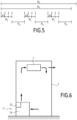
- the treatment step comprises a plurality of injection phases separated from each other by stopping phases without liquid injection, as illustrated in the figure 5 .
- the duration of the injection phase is at least 3 days, preferably greater than or equal to 5 days, more preferably greater than or equal to 7 days. It is at most equal to the duration DT of the treatment step.
- the duration of the injection phase is substantially equal to the duration of the treatment step DT.
- the duration of the injection phase is shorter than that of the treatment step, for example because the last injection operation was carried out slightly before the end of the treatment step.
- the duration of each injection phase is typically between 3 days and 15 days, preferably between 3 days and 10 days.
- the duration of each shutdown phase is typically between 15 days and two months. For example, it is chosen so that the cumulative duration of the injection phase and the following shutdown phase is one month.
- the liquid is evaporated and injected with a period ⁇ T of less than 2 days. This means that the injection operations I of evaporated liquid are separated by a period ⁇ T of 2 days maximum.
- the evaporation and injection of the liquid is for example continuous during the entire injection phase, the period being in this case equal to 0 ( figure 3 ).
- the evaporation and injection of the liquid is split, the injection phase then comprising several separate injection operations I of evaporated liquid ( figures 1, 2 4 , 5 ) spaced from each other by the period ⁇ T.
- the period ⁇ T is the time separating the start of two evaporated liquid injection operations.
- Evaporation and injection are interrupted between two injection operations. These injection operations are symbolized by an I on the figures 1, 2, 4 And 5 .
- the number of injection I operations during the injection phase is at least 2. Typically, between two injection operations per day and one operation every two days are performed. For example, one injection operation is performed per day.
- the duration of each injection operation is at least one hour and at most twenty-four hours. Typically, it is between 1 hour and 15 hours.
- injection operations are regularly spaced in time.
- a closed enclosure is herein understood to mean an enclosure having a relatively high level of sealing, such that the internal atmosphere of the enclosure does not communicate or communicates little with the atmosphere outside the enclosure. As explained below, it is important that the product or products injected into the enclosure do not escape into the external atmosphere, or escape at a reduced flow rate, sufficiently low so as not to penalize the consumption of liquid and products.
- the closed enclosure is for example a part of a hospital, a school, an industrial installation, or any other type of premises.
- the closed enclosure can also be a tank, a storage or transport cistern, or any other type of closed enclosure to be disinfected.
- the closed enclosure can also be a room intended for the storage of plant products, but not containing plant products.
- the closed enclosure is, for example, a room, a silo, a greenhouse or any room intended for the storage of plant products such as fruits or vegetables ( figure 7 ).
- the treatment is applied while the plant products are stored in the closed enclosure, or conversely while the closed enclosure is empty.
- the closed enclosure is a packaging in which plant products are packaged ( figure 8 ).
- the liquid consists of a single product, or consists of several products in a mixture.
- the product is a volatile product. Its boiling point is between 60 and 280°C.
- Each product is either a biocidal product, for disinfection applications, or a phytosanitary product, for the treatment of plant products.
- the liquid contains only biocidal products, or only phytosanitary products, or includes one or more biocidal products mixed with one or more phytosanitary products.
- At least one of the phytosanitary products is chosen from the following list: essential oil, terpenes, saturated or unsaturated C3 to C9 alcohol, such as isopropanol, iso-octanol, 2-ethylhexanol, volatile synthetic products, such as glutaraldehyde, hexanal, dimethylnaphthalene and 3-decen-2-one.
- essential oil such as isopropanol, iso-octanol, 2-ethylhexanol
- volatile synthetic products such as glutaraldehyde, hexanal, dimethylnaphthalene and 3-decen-2-one.
- the essential oil is for example chosen from the group formed by mint oil, clove oil, rose oil, thyme oil, oregano oil.
- the liquid comprises one of the constituents of these oils, chosen from the group formed by L-carvone, eugenol, geraniol, thymol, carvacrol.
- the biocide product is a volatile product, natural or synthetic, having biocidal properties, such as clove oil, thyme oil, geraniol, ethyl alcohol, glutaraldehyde.
- the liquid comprises only the product(s), without solvent or adjuvant.
- the liquid comprises an aqueous or organic solvent, in which the product(s) and one or more adjuvants are dissolved.
- the aqueous solvent is for example water.
- the organic solvent is for example a solvent of the type described in FR 2 791 910 or glycols, di-glycols and their relative esters.
- Adjuvants are, for example, substances capable of carrying the active ingredient(s) or capable of giving a dilution effect.
- the liquid during the injection phase is vaporized at a temperature below 50°C, preferably below 20°C, in particular between -2°C and +12°C, and in particular between 0 and 10°C.
- the liquid is evaporated at room temperature.
- the liquid is evaporated and injected under conditions chosen so as to maintain a concentration of the or each product in an internal atmosphere of the closed enclosure within a predetermined concentration range.
- the concentration range depends on the intended application and the product. It is usually determined experimentally, as described below. For example, a total gradient between 50 and 2000 ppm concentration in the atmosphere is targeted.
- the method comprises a step of determining a quantity representative of a rate of elimination of the or each product inside the closed enclosure, and a step of selecting conditions of evaporation and injection of the liquid according to the determined representative quantity.
- air treatment systems may include activated carbon filters that trap some of the product from the internal atmosphere.
- closed enclosures particularly storage rooms for plant products, are typically refrigerated. Condensation occurs at the heat exchangers to cool the internal atmosphere of the closed enclosure, with some of the product dissolving in the condensed moisture.
- the determination step makes it possible to determine the quantity representative of the elimination rate of the or each product taking into account all of the above parameters.
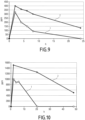
- this step is carried out experimentally, by making measurements of the type shown in the Figures 9 and 10 .
- a quantity of pure alcohol is evaporated and injected into a closed enclosure, which is here a desiccator.
- the desiccator has a volume of 9 liters, and is maintained at a temperature of 7°C.
- the quantity of alcohol injected is 0.01 ml.
- Curve 1 corresponds to a first test, in which the desiccator contains 1 kg of plant product.
- the time expressed in hours is on the abscissa, and the gaseous alcohol concentration, expressed in ppm, is on the ordinate.
- Curve 2 corresponds to a test where the desiccator is empty, and does not contain any plant product. It is carried out under the same conditions as the test corresponding to curve 1.
- Curve 1 shows that at the end of the evaporation phase, the concentration of gaseous alcohol is slightly greater than 300 ppm.
- the evaporation phase lasts about two hours. Then, during a second phase, the concentration of gaseous alcohol decreases rapidly and drops to about 100 ppm after eight hours. In a third phase, the concentration of gaseous alcohol decreases more slowly. After fifteen hours, the quantity of gaseous alcohol is less than 50 ppm. Thus, during the second phase, the rate of elimination of alcohol is of the order of 35 ppm/h.
- Curve 2 shows a gaseous alcohol concentration of approximately 400 ppm at the end of the evaporation phase. The gaseous alcohol concentration then decreases steadily, with a lower slope than for the first curve. The slope is then approximately 12 ppm/h.
- this speed is of the order of 23 ppm/h.
- figure 10 illustrates tests similar to those shown in the figure 9 The only difference is that the amount of alcohol injected for the tests shown in the figure 10 is ten times greater than the amount of alcohol injected for the tests shown in the figure 9 .
- we inject the figure 10 0.1 ml of pure alcohol.
- the curves of the figure 10 have roughly the same shape as the curves of the figure 9 .
- the rate of elimination of gaseous alcohol is about 50 ppm per hour.
- the rate of elimination of gaseous alcohol for curve 2, corresponding to the case where the desiccator is empty, is about 22 ppm/h.
- the plant products absorb about 28 ppm of gaseous alcohol per hour.
- the above results are used to choose the conditions for evaporation and injection of the liquid. These conditions are those listed above.
- these conditions may be chosen to maintain the alcohol concentration in the internal atmosphere of the closed enclosure within a specified range.
- the range could be 100ppm-1000 ppm.
- the conditions chosen would be to inject 0.1 ml of alcohol into the desiccator every 18 hours, or to inject 0.01 ml of alcohol into the desiccator every 8 hours.
- the evaporation and injection conditions may be chosen to maintain the rate of absorption of the or each product into the plant products within a predetermined range.
- the treatment method is a disinfection method.
- the product is a biocidal product, chosen as indicated above.
- the liquid is vaporized and injected inside a closed enclosure 2, which is a room belonging for example to a school, a hospital or an industrial building.
- the closed enclosure 2 is for example equipped with an air treatment system 3, such as a heating/air conditioning system making it possible to maintain the temperature of the internal volume of the closed enclosure 2 within a determined temperature range.
- the processing step typically lasts between 3 days and 1 month, preferably between 3 days and 10 days.
- the treatment duration is one week, with one evaporation and injection operation per day.
- the daily dose injected is 0.5 ml/m 3 of mint oil or clove oil.
- the treatment process is a phytosanitary treatment process.
- it is intended to deposit on plant products a product which is a phytosanitary product.
- the plant protection product is chosen as indicated above.
- the closed enclosure is a room, for example a room or a silo or a room 4 for storing plant products.
- the closed enclosure 4 comprises an air treatment system 5, aimed at maintaining the temperature of the internal volume of the closed enclosure 4 within a predetermined range. Typically, this temperature is between 0°C and 10°C.
- Plant products 6 are typically fruits or vegetables.
- plant products are fruits such as apples, pears, grapes, pomegranates etc.
- Another example is plant products, such as potatoes or broccoli.
- the plant products 6 are in direct contact with the air filling the closed enclosure 4.
- the vaporized liquid is injected directly into the internal volume of the closed enclosure 4.
- the method therefore comprises a step of storing plant products in the closed enclosure 4, for a storage period DS of between 3 days and one year.
- the treatment step is concomitant with the storage step, as illustrated in the Figures 2 to 5 .
- the DS storage duration and DT processing duration are as described above.
- the storage duration DS is short, between 3 days and 1 month.
- This case corresponds to the phytosanitary treatment of wheat in silos, citrus fruits, stone fruits such as peaches.
- the duration DT of the treatment step is typically between 3 days and 1 month.
- the method comprises a single injection phase lasting between 3 days and 1 month, typically with one injection per day.
- the storage duration DS is long, typically between 3 months and 1 year. This case corresponds to the phytosanitary treatment of potatoes for long-term storage, for example.
- the treatment duration DT is substantially equal to the storage duration DS.
- the method comprises a single injection phase of duration PI substantially equal to the treatment duration, typically with one injection per day.
- the method comprises several injection phases separated by stopping phases without injection (as illustrated in the figure 5 ).
- the number of injection days is determined based on the total quantity of product to be injected, as well as the number of contact days and the threshold dose to achieve the desired activity.
- the preferred solution is the injection of low daily doses.
- potatoes are stored in the closed enclosure 4, at a temperature of approximately 7°C to 9°C.
- a liquid comprising at least 50% by mass of L-carvone is evaporated and injected into the closed enclosure 4.
- this liquid is spearmint oil.
- the treatment duration is substantially equal to the storage duration.
- the treatment step comprises a single injection phase, of duration substantially equal to the treatment duration. An injection operation is carried out each day, the quantity of liquid injected being between 1 and 10 ml of liquid per tonne of potatoes, preferably between 1 and 5 ml per tonne of potatoes, and being for example 2 ml per tonne of potatoes.
- potatoes are stored in the closed enclosure 4, at a temperature of approximately 7°C to 9°C.
- a liquid comprising a C3-C9 alcohol is evaporated and injected into the closed enclosure 4.
- this liquid is 2-ethylhexanol.
- the treatment duration is approximately 6 months.
- the treatment step comprises a single injection phase, of duration substantially equal to the treatment duration. An injection operation is carried out each day, the total quantity of liquid injected over the 6 months being between 100 and 2000 ml of liquid per tonne of potatoes, preferably between 600 and 1200 ml per tonne of potatoes, and being for example 1000 ml per tonne of potatoes.
- potatoes are stored in the closed enclosure 4, at a temperature of approximately 7°C to 9°C.
- a liquid comprising a C3-C9 alcohol is evaporated and injected into the closed enclosure 4.
- this liquid is 2-ethylhexanol.
- the treatment time is approximately 6 months.
- the treatment step comprises several injection phases, separated by stop phases without injection. Each injection phase lasts between 3 days and two weeks, typically one week. The duration of each stop phase is approximately 3 weeks.
- an injection operation is carried out each day, the amount of liquid injected being between 5.5 and 110 ml/day ml of liquid per tonne of potatoes, preferably between 33 and 67 ml/day per tonne of potatoes, and being for example 55 ml/day per tonne of potatoes.
- citrus fruits receive a fungicide treatment with clove oil, for protection during the ripening phase during which the fruit changes color at relatively high temperature and humidity.
- This phase occurs just before the fruit is packaged.
- the treatment includes an injection phase of 4 g/tonne per day, for 5 days.
- the storage period is short, from 3 days to 1 month.
- the closed enclosure is a package 12, and not a silo or a cold room.
- This package is for example a bag, or a box, or even a crate as shown in the figure 8 .
- the liquid 14 containing the or each product is placed in a closed container 16, provided with at least one wall made of a material permeable to the or one of the products.
- the container 16 is placed in the packaging 12.
- a porous solid material 17 such as pumice stone is arranged in the container 16, the liquid soaking the solid material.
- Container 16 is for example a bag or a box.
- the liquid is evaporated and diffuses inside the package 12 continuously.
- the injection is carried out through the permeable material.
- the liquid evaporates inside the container, the evaporated liquid diffusing through the wall made of permeable material.
- permeable to the or one of the products is understood to mean that the wall is permeable to the or each product, typically permeable to liquid vapor.
- the packaging contains plant products 6.
- the product is then a phytosanitary product.
- the liquid is a biocidal product, the aim being to maintain the interior of the packaging in a satisfactory sanitary condition.
- the quantity of product injected is controlled by appropriately choosing, depending on the nature of the liquid and the product, the material constituting the permeable wall of the closed container 16, its surface area, its thickness and the volume of liquid contained in the container 16.
- the material of the permeable wall is polyethylene
- the phytoprotective product is mint oil
- the plant product to be treated is potato.
- Potatoes of the Nicolas variety harvested on 12/01/2015 are stored in experimental 200-litre storage cells, each containing 15kg of potatoes.
- Polyethylene sachets containing 4g of peppermint oil absorbed on hydrophobic sand are prepared.
- a processing device 17 will now be described. This device is provided for implementing the method described above.
- the closed enclosure is for example a room that is part of a hospital, a school, an industrial plant, or any other building.
- the closed enclosure can also be a tank, a storage or transport cistern, or any other type of closed enclosure to be disinfected.
- the closed enclosure is a cold room, a plant product storage silo, or any other type of suitable enclosure intended for the storage of plant products such as fruits or vegetables.
- the product is of the type described above in relation to the treatment process.
- the vaporizer 18 is typically a vaporizer of the type described in WO 2014/001201 .
- This vaporizer is particularly suitable for the evaporation at room temperature of relatively heavy liquids, such as essential oils.
- the absorption member 24 comprises a plurality of absorbent strips 28, suitable for retaining the liquid.
- the absorbent strips are for example arranged vertically, or are inclined relative to the vertical with an inclination allowing the liquid to flow by gravity from the upper end of the strip to the lower end.
- the strips are for example arranged in a V, the tip of the V pointing upwards. They can be arranged in a W or accordion shape.
- the absorbent strips 28 are typically made of microfibers.
- the organ 26 for producing a gas flow is for example a fan, oriented so as to create a current of air towards the absorbent strips 28.
- the air stream loaded with vaporized liquid is channeled by a conduit 29 opening into the internal atmosphere of the closed enclosure.
- the liquid absorption member 24 and the gas flow production member 26 are placed directly inside the closed enclosure, the member 26 setting the internal atmosphere of the closed enclosure in motion ( figures 6 And 7 ).
- the vaporizer 18 comprises a member 30 for injecting the liquid into the absorption member 24 from the reserve 22.
- This injection member 30 comprises a metering member 32, for example a metering pump.
- This metering member 32 makes it possible to control the flow rate of liquid injected into the absorbent strips 28. The liquid is injected at the upper end of each strip, and flows by gravity to the lower end of each strip.
- the vaporizer 18 is configured such that all of the injected liquid is evaporated before reaching the lower end of each strip 28, so as to perfectly control the flow rate of evaporated liquid. This result is obtained by adequately choosing, depending on the nature of the liquid, the surface area of the strips, the flow rate of liquid injected into each strip, and the gas flow rate.
- Such a vaporizer is sold by the company XEDA INTERNATIONAL under the name XEDAVAP ® .
- the vaporizer is different.
- the vaporizer comprises, for example, a tank containing the liquid, and a member for producing a gas flow directed towards the free surface of the liquid.
- the vaporizer comprises a tank containing the liquid and a device for bubbling gas through the liquid.
- the gas after passing through the liquid and becoming charged with vapor, is mixed with another gas flow which carries it towards the inside of the closed enclosure.
- the electronic device 20 is for example a calculator or a part of a calculator.
- the electronic control device 20 is produced in the form of programmable logic components (FPGA, Field Programmable Gate Array) or in the form of a dedicated integrated circuit (ASIC, Application Specific Integrated Circuit).
- FPGA programmable logic components
- ASIC Application Specific Integrated Circuit
- the electronic control device 20 is programmed to implement the method of the invention described above.
- this treatment step comprising at least one injection phase of duration greater than or equal to 3 days during which the vaporizer evaporates the liquid and injects the vaporized liquid with a period less than or equal to 2 days.
- the duration of the treatment step is preferably greater than or equal to 5 days, more preferably greater than or equal to 7 days.
- the duration of the or each injection phase is preferably greater than or equal to 5 days, more preferably greater than or equal to 7 days.
- the treatment duration is as described above.
- the treatment duration DT is a function of the storage duration DS of the plant products inside the closed enclosure.
- the invention is particularly suitable for cases where the plant products are stored for a storage duration of between 3 days and 1 year,
- Short storage duration cases from 3 days to 1 month, for example wheat stored in silos before bagging, stone fruits (peaches, nectarines, etc.), oranges stored in a ripening room before packaging.
- the treatment will last at least 3 days.
- Processing duration is greater than or equal to 50% of the storage duration, preferably greater than 75%, and preferably greater than 90% of the storage duration.
- the electronic device 30 is programmed so that the treatment step comprises a single injection phase.
- the duration of the injection phase is substantially equal to the duration of the treatment step.
- the duration of the injection phase is shorter than that of the treatment step, for example because the last injection operation was carried out slightly before the end of the treatment step.
- the electronic device is programmed so that the processing step comprises a plurality of successive injection phases, separated from each other by stop phases without injection ( figure 5 ).
- each injection phase and each shutdown phase is as described above in relation to the treatment method.
- the electronic device is programmed so that during each injection phase, several liquid evaporation and injection operations are carried out, typically with a regular interval, i.e. with a regular period between injections. This is shown in the figures 1, 2, 4 And 5 .
- the period between two injections is, as indicated above, less than 2 days, and is worth, for example, one day. In other words, for example, one liquid injection operation is carried out per day.
- the electronic device is programmed to evaporate and inject the liquid continuously, that is to say without any interruption during the entire injection phase.
- the electronic device 20 is programmed so that, during the or each injection phase, the liquid is evaporated and injected under conditions chosen so as to maintain a concentration of the or each product in the internal atmosphere of the closed enclosure within a predetermined concentration range.
- the concentration range is determined using curves such as those shown in Figures 9 and 10 , as described above in relation to the method of the invention.
- the electronic device 20 is programmed so that, during the or each injection phase, the liquid is evaporated and injected under conditions chosen so as to maintain the rate of absorption of the phytosanitary product by the plant products within a predetermined range.
- This range is determined for example by using curves similar to those of the Figures 9 and 10 , as described above.
- the conditions have the same parameters as described above.
- the vaporizer 18 comprises a tower 40 comprising a packing 42, a device 44 for injecting the liquid above the packing 42, and a device 46 arranged to create an upward air flow through the packing 42.
- the tower 40 typically comprises a tank 47, placed under the packing 42, and containing the liquid.
- the device 44 for injecting the liquid above the packing typically comprises one or more spray ramps 48 placed above the packing. 42, and a liquid transfer member 50, such as a pump, sucking the liquid into the tank 47 and discharging it into the ramp(s) 48.
- a liquid transfer member 50 such as a pump
- the device 46 for creating the air flow comprises one or more air inlets 52 opening into the interior of the tower, under the lining 42, and an air circulation member 54, placed above the lining.
- the member 54 is for example a fan or a blower.
- Each inlet 52 communicates fluidically with the internal atmosphere of the closed enclosure 4.
- the tower 40 has an outlet 56 for the air loaded with evaporated liquid, placed in the upper part, above the packings 42.
- the outlet 56 is fluidically connected to the internal atmosphere of the closed enclosure 4.
- the member 54 sucks in the air loaded with evaporated liquid above the packing 42 and discharges it into or towards the outlet 56.
- the packing 42 is for example a honeycomb packing.
- the vaporizer further comprises a drop separator 58, placed above the spray ramps 48.
- the tower 40 has a vertical axis, and has a substantially constant horizontal section of 700x700mm.
- the tank 47 has the same horizontal section as the tower, and has a height of between 500 and 700mm.
- the vaporizer has, for example, four inlets 52, each arranged on one side of the tower.
- the 42 filling has a height of approximately 1 meter.
- the packing 42 is placed for example 700 mm below the liquid inlet, the drop separator 58 being placed 300 mm above the liquid inlet.
- the operation of the vaporizer 18 is as follows.
- the liquid 46 to be evaporated is placed in the tank 47.
- the pump 50 delivers the liquid into the ramp(s) 48, which project the liquid towards the packing 42.
- the air circulation member 54 creates an upward air flow.
- the air enters the tower 40 through the inlets 52, circulates upwards through the packing 42.
- the liquid circulates downwards through the packing 42, a portion of the liquid being evaporated on contact with the air flow and being entrained by the air flow in the form of vapor.
- the fraction of the liquid that is not evaporated falls back into the tank 47 and is recycled.
- the air loaded with evaporated liquid passes through the drop separator 58 and is delivered by the member 54 to the outlet 56.
- the vaporizer 18 is typically placed inside the closed enclosure 4. It draws in the internal atmosphere directly through the inlet(s) 52, and discharges the air loaded with vapor directly into the internal atmosphere, through the outlet 56.
- a process using such a vaporizer i.e. in which the liquid is evaporated by contact with an air flow in a packed tower, makes it possible to evaporate a significant quantity of liquid, significantly greater than that which can be evaporated in a vaporizer of the XEDAVAP ® type.
- This vaporizer has the advantage of being extremely simple, having a very high evaporation capacity, and having a relatively modest footprint.
- the vaporizer is capable of being controlled by the electronic device 20 in different ways.
- the vaporizer operates continuously. It is placed in the internal atmosphere of the closed enclosure. It sucks it in and rejects the air loaded with vapor. Once the internal atmosphere is saturated with product, it is no longer possible to increase the vapor concentration, and evaporation is stopped naturally.
- the electronic device 20 is programmed to start and stop the evaporator according to a predetermined time diagram.
- the electronic device 20 is connected to an analyzer continuously measuring the concentration of the product vapor in the internal atmosphere of the closed enclosure. It starts, stops or modulates the operation of the vaporizer 18 so as to maintain the concentration within a predetermined range.
- the processing device comprises a camera arranged so as to observe the plant products stored in the closed enclosure.
- the camera is connected to a control station located at a distance from the closed enclosure.
- This control station comprises a screen allowing an operator to see the images taken by the camera, and thus to know the state of the stored plant products.
- the control station is configured to control the electronic control device 20, which allows the operator to adapt the control of the vaporizer, typically to modify the dose of product applied to plant products per unit of time.
- the invention relates to an assembly comprising the closed enclosure 2, 4 and a treatment device 17 having the above characteristics.
- the vaporizer 18 is configured to inject the vapors of the liquid into the closed enclosure 2, 4.
- the assembly comprises plant products stored in the closed enclosure 4.
- the plant products 6 are typically exposed to the internal atmosphere of the closed enclosure 4, as illustrated in the figure 7 , in the sense that they are not packaged in a container.
- This embodiment is illustrated in the figure 8 .
- Container 16 being placed in packaging 12.
- the liquid 14 and the container 16 are chosen so that, at a temperature below 50°C, the liquid containing the or each phytosanitary product is vaporized and injected inside the packaging 12 continuously during an injection phase lasting more than six days.
- the liquid soaks porous solids 17, arranged in the container 16.
- the container 16 is of the type described above with reference to the treatment method.
- Liquid 14 is one of the liquids described above.
- the liquid is a liquid that is easy to evaporate at low temperature, for example an alcohol.
- the surface area of the permeable material wall, the thickness of this wall and the nature of the material are typically chosen depending on the nature of the liquid and the phytosanitary product.
- the material is polyethylene.
Landscapes
- Life Sciences & Earth Sciences (AREA)
- Engineering & Computer Science (AREA)
- Food Science & Technology (AREA)
- Wood Science & Technology (AREA)
- Zoology (AREA)
- Chemical & Material Sciences (AREA)
- Health & Medical Sciences (AREA)
- Polymers & Plastics (AREA)
- General Health & Medical Sciences (AREA)
- Pest Control & Pesticides (AREA)
- Agronomy & Crop Science (AREA)
- Plant Pathology (AREA)
- Environmental Sciences (AREA)
- Natural Medicines & Medicinal Plants (AREA)
- Dentistry (AREA)
- General Chemical & Material Sciences (AREA)
- Chemical Kinetics & Catalysis (AREA)
- Mechanical Engineering (AREA)
- Biotechnology (AREA)
- Mycology (AREA)
- Microbiology (AREA)
- Botany (AREA)
- Agricultural Chemicals And Associated Chemicals (AREA)
- Catching Or Destruction (AREA)
- Storage Of Fruits Or Vegetables (AREA)
- Storage Of Harvested Produce (AREA)
- Preparation Of Fruits And Vegetables (AREA)
- Apparatus For Disinfection Or Sterilisation (AREA)
- Pharmaceuticals Containing Other Organic And Inorganic Compounds (AREA)
Applications Claiming Priority (2)
| Application Number | Priority Date | Filing Date | Title |
|---|---|---|---|
| FR1655731A FR3052639B1 (fr) | 2016-06-20 | 2016-06-20 | Procede de traitement par un produit biocide ou phytoprotecteur, dispositif et ensemble de traitement correspondant |
| PCT/EP2017/065138 WO2017220612A1 (fr) | 2016-06-20 | 2017-06-20 | Procédé de traitement par un produit biocide ou phytoprotecteur, dispositif et ensemble de traitement correspondant |
Publications (3)
| Publication Number | Publication Date |
|---|---|
| EP3471556A1 EP3471556A1 (fr) | 2019-04-24 |
| EP3471556B1 true EP3471556B1 (fr) | 2024-11-06 |
| EP3471556C0 EP3471556C0 (fr) | 2024-11-06 |
Family
ID=57045092
Family Applications (1)
| Application Number | Title | Priority Date | Filing Date |
|---|---|---|---|
| EP17731875.5A Active EP3471556B1 (fr) | 2016-06-20 | 2017-06-20 | Procédé de traitement par un produit biocide ou phytoprotecteur, dispositif et ensemble de traitement correspondant |
Country Status (15)
| Country | Link |
|---|---|
| US (1) | US11330825B2 (cg-RX-API-DMAC7.html) |
| EP (1) | EP3471556B1 (cg-RX-API-DMAC7.html) |
| JP (1) | JP7299835B2 (cg-RX-API-DMAC7.html) |
| CN (1) | CN109310121A (cg-RX-API-DMAC7.html) |
| AU (1) | AU2017281191B2 (cg-RX-API-DMAC7.html) |
| BR (1) | BR112018076186B1 (cg-RX-API-DMAC7.html) |
| CL (1) | CL2018003696A1 (cg-RX-API-DMAC7.html) |
| FR (1) | FR3052639B1 (cg-RX-API-DMAC7.html) |
| IL (1) | IL263614B (cg-RX-API-DMAC7.html) |
| MA (1) | MA45382A (cg-RX-API-DMAC7.html) |
| MX (1) | MX392820B (cg-RX-API-DMAC7.html) |
| PE (1) | PE20190396A1 (cg-RX-API-DMAC7.html) |
| RU (1) | RU2744017C2 (cg-RX-API-DMAC7.html) |
| WO (1) | WO2017220612A1 (cg-RX-API-DMAC7.html) |
| ZA (1) | ZA201808313B (cg-RX-API-DMAC7.html) |
Families Citing this family (4)
| Publication number | Priority date | Publication date | Assignee | Title |
|---|---|---|---|---|
| FR3098686B1 (fr) * | 2019-07-17 | 2023-01-20 | Xeda International | Ensemble de traitement atmosphérique d’un local, installation et procédé associés |
| FR3113560A1 (fr) * | 2020-09-02 | 2022-03-04 | Xeda International S.A. | Procédé de protection de produits végétaux pendant le transport, dispositif de traitement correspondant |
| WO2023288294A1 (en) | 2021-07-16 | 2023-01-19 | Novozymes A/S | Compositions and methods for improving the rainfastness of proteins on plant surfaces |
| EP4525615A2 (en) | 2022-05-14 | 2025-03-26 | Novozymes A/S | Compositions and methods for preventing, treating, supressing and/or eliminating phytopathogenic infestations and infections |
Citations (2)
| Publication number | Priority date | Publication date | Assignee | Title |
|---|---|---|---|---|
| WO1993002563A1 (en) * | 1991-08-10 | 1993-02-18 | Oulton, Richard, John | Improvements in or relating to the storage of potatoes |
| US9950087B2 (en) * | 2012-06-25 | 2018-04-24 | Xeda International | Device for evaporating a liquid and related method |
Family Cites Families (9)
| Publication number | Priority date | Publication date | Assignee | Title |
|---|---|---|---|---|
| US6375999B1 (en) * | 1993-10-07 | 2002-04-23 | Darol Forsythe | Methods for treating potatoes |
| US5918537A (en) * | 1996-07-26 | 1999-07-06 | Forsythe; Darol | Release device for slowly releasing sprout inhibitor into packages of potatoes |
| JPH11332458A (ja) * | 1997-08-01 | 1999-12-07 | Toru Sueyoshi | 食品の貯蔵方法および貯蔵容器 |
| FR2791910B1 (fr) | 1999-04-12 | 2001-07-27 | Xeda International | Procede de thermonebulisation d'une composition liquide de traitement de fruits et legumes et dispositif pour la mise en oeuvre de ce procede |
| FR2923356B1 (fr) * | 2007-11-09 | 2010-01-22 | Xeda International | Utilisation de solutions d'huile de menthe ou de l-carvone pour le traitement fongicide et/ou antigerminatif des bulbes et/ou tubercules |
| US8735321B2 (en) * | 2008-05-09 | 2014-05-27 | Basf Se | Process for the production of particles comprising active agrochemical ingredients in amorphous form |
| FR2992225B1 (fr) * | 2012-06-25 | 2015-05-15 | Xeda International | Dispositif d'evaporation d'un liquide et procede associe |
| US20140272021A1 (en) * | 2013-03-14 | 2014-09-18 | Multisorb Technologies, Inc. | Ethyl alcohol emitting package for baked goods |
| ES2534529B1 (es) * | 2015-03-13 | 2016-02-01 | Universidad Politécnica De Cartagena | Procedimiento de descontaminación superficial de alimentos sólidos envasados |
-
2016
- 2016-06-20 FR FR1655731A patent/FR3052639B1/fr active Active
-
2017
- 2017-06-20 AU AU2017281191A patent/AU2017281191B2/en active Active
- 2017-06-20 JP JP2019518151A patent/JP7299835B2/ja active Active
- 2017-06-20 WO PCT/EP2017/065138 patent/WO2017220612A1/fr not_active Ceased
- 2017-06-20 BR BR112018076186-9A patent/BR112018076186B1/pt active IP Right Grant
- 2017-06-20 RU RU2018145142A patent/RU2744017C2/ru active
- 2017-06-20 MX MX2018016034A patent/MX392820B/es unknown
- 2017-06-20 MA MA045382A patent/MA45382A/fr unknown
- 2017-06-20 EP EP17731875.5A patent/EP3471556B1/fr active Active
- 2017-06-20 CN CN201780038203.1A patent/CN109310121A/zh active Pending
- 2017-06-20 US US16/312,260 patent/US11330825B2/en active Active
- 2017-06-20 PE PE2018003236A patent/PE20190396A1/es unknown
-
2018
- 2018-12-10 ZA ZA2018/08313A patent/ZA201808313B/en unknown
- 2018-12-10 IL IL263614A patent/IL263614B/en unknown
- 2018-12-19 CL CL2018003696A patent/CL2018003696A1/es unknown
Patent Citations (2)
| Publication number | Priority date | Publication date | Assignee | Title |
|---|---|---|---|---|
| WO1993002563A1 (en) * | 1991-08-10 | 1993-02-18 | Oulton, Richard, John | Improvements in or relating to the storage of potatoes |
| US9950087B2 (en) * | 2012-06-25 | 2018-04-24 | Xeda International | Device for evaporating a liquid and related method |
Also Published As
| Publication number | Publication date |
|---|---|
| CN109310121A (zh) | 2019-02-05 |
| NZ749145A (en) | 2024-02-23 |
| FR3052639B1 (fr) | 2020-05-15 |
| RU2744017C2 (ru) | 2021-03-02 |
| CA3028255A1 (fr) | 2017-12-28 |
| WO2017220612A1 (fr) | 2017-12-28 |
| RU2018145142A3 (cg-RX-API-DMAC7.html) | 2020-08-18 |
| PE20190396A1 (es) | 2019-03-13 |
| IL263614B (en) | 2022-04-01 |
| CL2018003696A1 (es) | 2019-05-03 |
| BR112018076186A2 (pt) | 2019-03-26 |
| RU2018145142A (ru) | 2020-06-19 |
| JP2019520854A (ja) | 2019-07-25 |
| MX2018016034A (es) | 2019-05-30 |
| US20190159469A1 (en) | 2019-05-30 |
| AU2017281191A1 (en) | 2019-01-03 |
| ZA201808313B (en) | 2019-08-28 |
| BR112018076186B1 (pt) | 2023-04-11 |
| MX392820B (es) | 2025-03-24 |
| JP7299835B2 (ja) | 2023-06-28 |
| US11330825B2 (en) | 2022-05-17 |
| EP3471556A1 (fr) | 2019-04-24 |
| IL263614A (en) | 2019-02-28 |
| FR3052639A1 (fr) | 2017-12-22 |
| EP3471556C0 (fr) | 2024-11-06 |
| MA45382A (fr) | 2019-04-24 |
| AU2017281191B2 (en) | 2021-08-05 |
Similar Documents
| Publication | Publication Date | Title |
|---|---|---|
| EP3471556B1 (fr) | Procédé de traitement par un produit biocide ou phytoprotecteur, dispositif et ensemble de traitement correspondant | |
| EP3471557B1 (fr) | Procédé et ensemble de traitement de l'atmosphère d'un stockage de produits végétaux | |
| EP2864009B1 (fr) | Dispositif d'évaporation d'un liquide et procédé associé | |
| WO2017220581A1 (fr) | Procédé de traitement de produits végétaux par des vapeurs d'alcool | |
| EP3644725B1 (fr) | Ensemble et procédé de traitement, ensemble de stockage et de culture de produits végétaux comportant l'ensemble de traitement | |
| EP3599851A1 (fr) | Procédé de traitement par au moins un produit biocide et/ou phytoprotecteur moyennement volatile, ensemble de traitement et ensemble de stockage correspondants | |
| BE1023346A1 (fr) | METHODE POUR LE TRAITEMENT ANTI -GERMINATIF DE TUBERCULES PAR UNE QUANTI TE REDUITE DE ClPC | |
| Achour et al. | Effect of vacuum and modified atmosphere packaging on Deglet Nour date storage in Tunisia | |
| CA3028255C (fr) | Procede de traitement par un produit biocide ou phytoprotecteur, dispositif et ensemble de traitement correspondant | |
| EP4208023B1 (fr) | Procédé de protection de produits végétaux pendant le transport, dispositif de traitement correspondant | |
| WO2020225066A1 (fr) | Procédé et ensemble de traitement d'un stockage de produits végétaux à basse température et haute humidité relative | |
| EP3709822B1 (fr) | Procédé de traitement de l'atmosphère d'un stockage de produits végétaux à haute humidité relative | |
| FR3055192A1 (fr) | Procede et ensemble de traitement de l'atmosphere d'un stockage de produits vegetaux |
Legal Events
| Date | Code | Title | Description |
|---|---|---|---|
| STAA | Information on the status of an ep patent application or granted ep patent |
Free format text: STATUS: UNKNOWN |
|
| STAA | Information on the status of an ep patent application or granted ep patent |
Free format text: STATUS: THE INTERNATIONAL PUBLICATION HAS BEEN MADE |
|
| PUAI | Public reference made under article 153(3) epc to a published international application that has entered the european phase |
Free format text: ORIGINAL CODE: 0009012 |
|
| STAA | Information on the status of an ep patent application or granted ep patent |
Free format text: STATUS: REQUEST FOR EXAMINATION WAS MADE |
|
| 17P | Request for examination filed |
Effective date: 20190118 |
|
| AK | Designated contracting states |
Kind code of ref document: A1 Designated state(s): AL AT BE BG CH CY CZ DE DK EE ES FI FR GB GR HR HU IE IS IT LI LT LU LV MC MK MT NL NO PL PT RO RS SE SI SK SM TR |
|
| AX | Request for extension of the european patent |
Extension state: BA ME |
|
| DAX | Request for extension of the european patent (deleted) | ||
| RAV | Requested validation state of the european patent: fee paid |
Extension state: MA Effective date: 20190118 |
|
| STAA | Information on the status of an ep patent application or granted ep patent |
Free format text: STATUS: EXAMINATION IS IN PROGRESS |
|
| 17Q | First examination report despatched |
Effective date: 20201124 |
|
| GRAP | Despatch of communication of intention to grant a patent |
Free format text: ORIGINAL CODE: EPIDOSNIGR1 |
|
| STAA | Information on the status of an ep patent application or granted ep patent |
Free format text: STATUS: GRANT OF PATENT IS INTENDED |
|
| INTG | Intention to grant announced |
Effective date: 20240605 |
|
| GRAS | Grant fee paid |
Free format text: ORIGINAL CODE: EPIDOSNIGR3 |
|
| GRAA | (expected) grant |
Free format text: ORIGINAL CODE: 0009210 |
|
| STAA | Information on the status of an ep patent application or granted ep patent |
Free format text: STATUS: THE PATENT HAS BEEN GRANTED |
|
| AK | Designated contracting states |
Kind code of ref document: B1 Designated state(s): AL AT BE BG CH CY CZ DE DK EE ES FI FR GB GR HR HU IE IS IT LI LT LU LV MC MK MT NL NO PL PT RO RS SE SI SK SM TR |
|
| REG | Reference to a national code |
Ref country code: GB Ref legal event code: FG4D Free format text: NOT ENGLISH |
|
| REG | Reference to a national code |
Ref country code: CH Ref legal event code: EP |
|
| REG | Reference to a national code |
Ref country code: DE Ref legal event code: R096 Ref document number: 602017085917 Country of ref document: DE |
|
| REG | Reference to a national code |
Ref country code: DE Ref legal event code: R079 Ref document number: 602017085917 Country of ref document: DE Free format text: PREVIOUS MAIN CLASS: A23L0003340900 Ipc: A23B0002704000 |
|
| REG | Reference to a national code |
Ref country code: IE Ref legal event code: FG4D Free format text: LANGUAGE OF EP DOCUMENT: FRENCH |
|
| U01 | Request for unitary effect filed |
Effective date: 20241114 |
|
| U07 | Unitary effect registered |
Designated state(s): AT BE BG DE DK EE FI FR IT LT LU LV MT NL PT RO SE SI Effective date: 20241120 |
|
| PG25 | Lapsed in a contracting state [announced via postgrant information from national office to epo] |
Ref country code: IS Free format text: LAPSE BECAUSE OF FAILURE TO SUBMIT A TRANSLATION OF THE DESCRIPTION OR TO PAY THE FEE WITHIN THE PRESCRIBED TIME-LIMIT Effective date: 20250306 Ref country code: HR Free format text: LAPSE BECAUSE OF FAILURE TO SUBMIT A TRANSLATION OF THE DESCRIPTION OR TO PAY THE FEE WITHIN THE PRESCRIBED TIME-LIMIT Effective date: 20241106 |
|
| PG25 | Lapsed in a contracting state [announced via postgrant information from national office to epo] |
Ref country code: ES Free format text: LAPSE BECAUSE OF FAILURE TO SUBMIT A TRANSLATION OF THE DESCRIPTION OR TO PAY THE FEE WITHIN THE PRESCRIBED TIME-LIMIT Effective date: 20241106 |
|
| PG25 | Lapsed in a contracting state [announced via postgrant information from national office to epo] |
Ref country code: NO Free format text: LAPSE BECAUSE OF FAILURE TO SUBMIT A TRANSLATION OF THE DESCRIPTION OR TO PAY THE FEE WITHIN THE PRESCRIBED TIME-LIMIT Effective date: 20250206 |
|
| PG25 | Lapsed in a contracting state [announced via postgrant information from national office to epo] |
Ref country code: GR Free format text: LAPSE BECAUSE OF FAILURE TO SUBMIT A TRANSLATION OF THE DESCRIPTION OR TO PAY THE FEE WITHIN THE PRESCRIBED TIME-LIMIT Effective date: 20250207 |
|
| PG25 | Lapsed in a contracting state [announced via postgrant information from national office to epo] |
Ref country code: PL Free format text: LAPSE BECAUSE OF FAILURE TO SUBMIT A TRANSLATION OF THE DESCRIPTION OR TO PAY THE FEE WITHIN THE PRESCRIBED TIME-LIMIT Effective date: 20241106 |
|
| PG25 | Lapsed in a contracting state [announced via postgrant information from national office to epo] |
Ref country code: RS Free format text: LAPSE BECAUSE OF FAILURE TO SUBMIT A TRANSLATION OF THE DESCRIPTION OR TO PAY THE FEE WITHIN THE PRESCRIBED TIME-LIMIT Effective date: 20250206 |
|
| PG25 | Lapsed in a contracting state [announced via postgrant information from national office to epo] |
Ref country code: SM Free format text: LAPSE BECAUSE OF FAILURE TO SUBMIT A TRANSLATION OF THE DESCRIPTION OR TO PAY THE FEE WITHIN THE PRESCRIBED TIME-LIMIT Effective date: 20241106 |
|
| U20 | Renewal fee for the european patent with unitary effect paid |
Year of fee payment: 9 Effective date: 20250530 |
|
| PGFP | Annual fee paid to national office [announced via postgrant information from national office to epo] |
Ref country code: GB Payment date: 20250625 Year of fee payment: 9 |
|
| PG25 | Lapsed in a contracting state [announced via postgrant information from national office to epo] |
Ref country code: SK Free format text: LAPSE BECAUSE OF FAILURE TO SUBMIT A TRANSLATION OF THE DESCRIPTION OR TO PAY THE FEE WITHIN THE PRESCRIBED TIME-LIMIT Effective date: 20241106 |
|
| PG25 | Lapsed in a contracting state [announced via postgrant information from national office to epo] |
Ref country code: CZ Free format text: LAPSE BECAUSE OF FAILURE TO SUBMIT A TRANSLATION OF THE DESCRIPTION OR TO PAY THE FEE WITHIN THE PRESCRIBED TIME-LIMIT Effective date: 20241106 |
|
| PLBE | No opposition filed within time limit |
Free format text: ORIGINAL CODE: 0009261 |
|
| STAA | Information on the status of an ep patent application or granted ep patent |
Free format text: STATUS: NO OPPOSITION FILED WITHIN TIME LIMIT |
|
| 26N | No opposition filed |
Effective date: 20250807 |
|
| REG | Reference to a national code |
Ref country code: CH Ref legal event code: H13 Free format text: ST27 STATUS EVENT CODE: U-0-0-H10-H13 (AS PROVIDED BY THE NATIONAL OFFICE) Effective date: 20260127 |
|
| PG25 | Lapsed in a contracting state [announced via postgrant information from national office to epo] |
Ref country code: MC Free format text: LAPSE BECAUSE OF FAILURE TO SUBMIT A TRANSLATION OF THE DESCRIPTION OR TO PAY THE FEE WITHIN THE PRESCRIBED TIME-LIMIT Effective date: 20241106 |
|
| VS25 | Lapsed in a validation state [announced via postgrant information from nat. office to epo] |
Ref country code: MA Free format text: FAILURE TO ELECT DOMICILE IN THE NATIONAL COUNTRY Effective date: 20250207 |
|
| VS25 | Lapsed in a validation state [announced via postgrant information from nat. office to epo] |
Ref country code: MA Free format text: LAPSE BECAUSE OF FAILURE TO SUBMIT A TRANSLATION OF THE DESCRIPTION OR TO PAY THE FEE WITHIN THE PRESCRIBED TIME-LIMIT Effective date: 20241106 |
|
| PG25 | Lapsed in a contracting state [announced via postgrant information from national office to epo] |
Ref country code: IE Free format text: LAPSE BECAUSE OF NON-PAYMENT OF DUE FEES Effective date: 20250620 |
|
| PG25 | Lapsed in a contracting state [announced via postgrant information from national office to epo] |
Ref country code: CH Free format text: LAPSE BECAUSE OF NON-PAYMENT OF DUE FEES Effective date: 20250630 |