EP3464071B1 - Method of producing a packaging means enveloping container precursors, especially each for a single dimensionally stable foodstuff container, with folding over of the container precursor - Google Patents
Method of producing a packaging means enveloping container precursors, especially each for a single dimensionally stable foodstuff container, with folding over of the container precursor Download PDFInfo
- Publication number
- EP3464071B1 EP3464071B1 EP17726266.4A EP17726266A EP3464071B1 EP 3464071 B1 EP3464071 B1 EP 3464071B1 EP 17726266 A EP17726266 A EP 17726266A EP 3464071 B1 EP3464071 B1 EP 3464071B1
- Authority
- EP
- European Patent Office
- Prior art keywords
- longitudinal
- internal angle
- container
- crease
- sheetlike composite
- Prior art date
- Legal status (The legal status is an assumption and is not a legal conclusion. Google has not performed a legal analysis and makes no representation as to the accuracy of the status listed.)
- Active
Links
Images




Classifications
-
- B—PERFORMING OPERATIONS; TRANSPORTING
- B31—MAKING ARTICLES OF PAPER, CARDBOARD OR MATERIAL WORKED IN A MANNER ANALOGOUS TO PAPER; WORKING PAPER, CARDBOARD OR MATERIAL WORKED IN A MANNER ANALOGOUS TO PAPER
- B31B—MAKING CONTAINERS OF PAPER, CARDBOARD OR MATERIAL WORKED IN A MANNER ANALOGOUS TO PAPER
- B31B50/00—Making rigid or semi-rigid containers, e.g. boxes or cartons
- B31B50/26—Folding sheets, blanks or webs
- B31B50/262—Folding sheets, blanks or webs involving folding, leading, or trailing flaps of blanks
-
- B—PERFORMING OPERATIONS; TRANSPORTING
- B32—LAYERED PRODUCTS
- B32B—LAYERED PRODUCTS, i.e. PRODUCTS BUILT-UP OF STRATA OF FLAT OR NON-FLAT, e.g. CELLULAR OR HONEYCOMB, FORM
- B32B15/00—Layered products comprising a layer of metal
- B32B15/04—Layered products comprising a layer of metal comprising metal as the main or only constituent of a layer, which is next to another layer of the same or of a different material
- B32B15/08—Layered products comprising a layer of metal comprising metal as the main or only constituent of a layer, which is next to another layer of the same or of a different material of synthetic resin
- B32B15/082—Layered products comprising a layer of metal comprising metal as the main or only constituent of a layer, which is next to another layer of the same or of a different material of synthetic resin comprising vinyl resins; comprising acrylic resins
-
- B—PERFORMING OPERATIONS; TRANSPORTING
- B32—LAYERED PRODUCTS
- B32B—LAYERED PRODUCTS, i.e. PRODUCTS BUILT-UP OF STRATA OF FLAT OR NON-FLAT, e.g. CELLULAR OR HONEYCOMB, FORM
- B32B15/00—Layered products comprising a layer of metal
- B32B15/04—Layered products comprising a layer of metal comprising metal as the main or only constituent of a layer, which is next to another layer of the same or of a different material
- B32B15/08—Layered products comprising a layer of metal comprising metal as the main or only constituent of a layer, which is next to another layer of the same or of a different material of synthetic resin
- B32B15/085—Layered products comprising a layer of metal comprising metal as the main or only constituent of a layer, which is next to another layer of the same or of a different material of synthetic resin comprising polyolefins
-
- B—PERFORMING OPERATIONS; TRANSPORTING
- B32—LAYERED PRODUCTS
- B32B—LAYERED PRODUCTS, i.e. PRODUCTS BUILT-UP OF STRATA OF FLAT OR NON-FLAT, e.g. CELLULAR OR HONEYCOMB, FORM
- B32B15/00—Layered products comprising a layer of metal
- B32B15/04—Layered products comprising a layer of metal comprising metal as the main or only constituent of a layer, which is next to another layer of the same or of a different material
- B32B15/08—Layered products comprising a layer of metal comprising metal as the main or only constituent of a layer, which is next to another layer of the same or of a different material of synthetic resin
- B32B15/09—Layered products comprising a layer of metal comprising metal as the main or only constituent of a layer, which is next to another layer of the same or of a different material of synthetic resin comprising polyesters
-
- B—PERFORMING OPERATIONS; TRANSPORTING
- B32—LAYERED PRODUCTS
- B32B—LAYERED PRODUCTS, i.e. PRODUCTS BUILT-UP OF STRATA OF FLAT OR NON-FLAT, e.g. CELLULAR OR HONEYCOMB, FORM
- B32B15/00—Layered products comprising a layer of metal
- B32B15/18—Layered products comprising a layer of metal comprising iron or steel
-
- B—PERFORMING OPERATIONS; TRANSPORTING
- B32—LAYERED PRODUCTS
- B32B—LAYERED PRODUCTS, i.e. PRODUCTS BUILT-UP OF STRATA OF FLAT OR NON-FLAT, e.g. CELLULAR OR HONEYCOMB, FORM
- B32B15/00—Layered products comprising a layer of metal
- B32B15/20—Layered products comprising a layer of metal comprising aluminium or copper
-
- B—PERFORMING OPERATIONS; TRANSPORTING
- B32—LAYERED PRODUCTS
- B32B—LAYERED PRODUCTS, i.e. PRODUCTS BUILT-UP OF STRATA OF FLAT OR NON-FLAT, e.g. CELLULAR OR HONEYCOMB, FORM
- B32B27/00—Layered products comprising a layer of synthetic resin
- B32B27/06—Layered products comprising a layer of synthetic resin as the main or only constituent of a layer, which is next to another layer of the same or of a different material
- B32B27/08—Layered products comprising a layer of synthetic resin as the main or only constituent of a layer, which is next to another layer of the same or of a different material of synthetic resin
-
- B—PERFORMING OPERATIONS; TRANSPORTING
- B32—LAYERED PRODUCTS
- B32B—LAYERED PRODUCTS, i.e. PRODUCTS BUILT-UP OF STRATA OF FLAT OR NON-FLAT, e.g. CELLULAR OR HONEYCOMB, FORM
- B32B27/00—Layered products comprising a layer of synthetic resin
- B32B27/06—Layered products comprising a layer of synthetic resin as the main or only constituent of a layer, which is next to another layer of the same or of a different material
- B32B27/10—Layered products comprising a layer of synthetic resin as the main or only constituent of a layer, which is next to another layer of the same or of a different material of paper or cardboard
-
- B—PERFORMING OPERATIONS; TRANSPORTING
- B32—LAYERED PRODUCTS
- B32B—LAYERED PRODUCTS, i.e. PRODUCTS BUILT-UP OF STRATA OF FLAT OR NON-FLAT, e.g. CELLULAR OR HONEYCOMB, FORM
- B32B27/00—Layered products comprising a layer of synthetic resin
- B32B27/18—Layered products comprising a layer of synthetic resin characterised by the use of special additives
- B32B27/20—Layered products comprising a layer of synthetic resin characterised by the use of special additives using fillers, pigments, thixotroping agents
-
- B—PERFORMING OPERATIONS; TRANSPORTING
- B32—LAYERED PRODUCTS
- B32B—LAYERED PRODUCTS, i.e. PRODUCTS BUILT-UP OF STRATA OF FLAT OR NON-FLAT, e.g. CELLULAR OR HONEYCOMB, FORM
- B32B27/00—Layered products comprising a layer of synthetic resin
- B32B27/30—Layered products comprising a layer of synthetic resin comprising vinyl (co)polymers; comprising acrylic (co)polymers
- B32B27/306—Layered products comprising a layer of synthetic resin comprising vinyl (co)polymers; comprising acrylic (co)polymers comprising vinyl acetate or vinyl alcohol (co)polymers
-
- B—PERFORMING OPERATIONS; TRANSPORTING
- B32—LAYERED PRODUCTS
- B32B—LAYERED PRODUCTS, i.e. PRODUCTS BUILT-UP OF STRATA OF FLAT OR NON-FLAT, e.g. CELLULAR OR HONEYCOMB, FORM
- B32B27/00—Layered products comprising a layer of synthetic resin
- B32B27/30—Layered products comprising a layer of synthetic resin comprising vinyl (co)polymers; comprising acrylic (co)polymers
- B32B27/308—Layered products comprising a layer of synthetic resin comprising vinyl (co)polymers; comprising acrylic (co)polymers comprising acrylic (co)polymers
-
- B—PERFORMING OPERATIONS; TRANSPORTING
- B32—LAYERED PRODUCTS
- B32B—LAYERED PRODUCTS, i.e. PRODUCTS BUILT-UP OF STRATA OF FLAT OR NON-FLAT, e.g. CELLULAR OR HONEYCOMB, FORM
- B32B27/00—Layered products comprising a layer of synthetic resin
- B32B27/32—Layered products comprising a layer of synthetic resin comprising polyolefins
-
- B—PERFORMING OPERATIONS; TRANSPORTING
- B32—LAYERED PRODUCTS
- B32B—LAYERED PRODUCTS, i.e. PRODUCTS BUILT-UP OF STRATA OF FLAT OR NON-FLAT, e.g. CELLULAR OR HONEYCOMB, FORM
- B32B27/00—Layered products comprising a layer of synthetic resin
- B32B27/32—Layered products comprising a layer of synthetic resin comprising polyolefins
- B32B27/325—Layered products comprising a layer of synthetic resin comprising polyolefins comprising polycycloolefins
-
- B—PERFORMING OPERATIONS; TRANSPORTING
- B32—LAYERED PRODUCTS
- B32B—LAYERED PRODUCTS, i.e. PRODUCTS BUILT-UP OF STRATA OF FLAT OR NON-FLAT, e.g. CELLULAR OR HONEYCOMB, FORM
- B32B27/00—Layered products comprising a layer of synthetic resin
- B32B27/32—Layered products comprising a layer of synthetic resin comprising polyolefins
- B32B27/327—Layered products comprising a layer of synthetic resin comprising polyolefins comprising polyolefins obtained by a metallocene or single-site catalyst
-
- B—PERFORMING OPERATIONS; TRANSPORTING
- B32—LAYERED PRODUCTS
- B32B—LAYERED PRODUCTS, i.e. PRODUCTS BUILT-UP OF STRATA OF FLAT OR NON-FLAT, e.g. CELLULAR OR HONEYCOMB, FORM
- B32B27/00—Layered products comprising a layer of synthetic resin
- B32B27/34—Layered products comprising a layer of synthetic resin comprising polyamides
-
- B—PERFORMING OPERATIONS; TRANSPORTING
- B32—LAYERED PRODUCTS
- B32B—LAYERED PRODUCTS, i.e. PRODUCTS BUILT-UP OF STRATA OF FLAT OR NON-FLAT, e.g. CELLULAR OR HONEYCOMB, FORM
- B32B27/00—Layered products comprising a layer of synthetic resin
- B32B27/36—Layered products comprising a layer of synthetic resin comprising polyesters
-
- B—PERFORMING OPERATIONS; TRANSPORTING
- B32—LAYERED PRODUCTS
- B32B—LAYERED PRODUCTS, i.e. PRODUCTS BUILT-UP OF STRATA OF FLAT OR NON-FLAT, e.g. CELLULAR OR HONEYCOMB, FORM
- B32B29/00—Layered products comprising a layer of paper or cardboard
- B32B29/002—Layered products comprising a layer of paper or cardboard as the main or only constituent of a layer, which is next to another layer of the same or of a different material
- B32B29/005—Layered products comprising a layer of paper or cardboard as the main or only constituent of a layer, which is next to another layer of the same or of a different material next to another layer of paper or cardboard layer
-
- B—PERFORMING OPERATIONS; TRANSPORTING
- B32—LAYERED PRODUCTS
- B32B—LAYERED PRODUCTS, i.e. PRODUCTS BUILT-UP OF STRATA OF FLAT OR NON-FLAT, e.g. CELLULAR OR HONEYCOMB, FORM
- B32B29/00—Layered products comprising a layer of paper or cardboard
- B32B29/08—Corrugated paper or cardboard
-
- B—PERFORMING OPERATIONS; TRANSPORTING
- B32—LAYERED PRODUCTS
- B32B—LAYERED PRODUCTS, i.e. PRODUCTS BUILT-UP OF STRATA OF FLAT OR NON-FLAT, e.g. CELLULAR OR HONEYCOMB, FORM
- B32B3/00—Layered products comprising a layer with external or internal discontinuities or unevennesses, or a layer of non-planar shape; Layered products comprising a layer having particular features of form
- B32B3/26—Layered products comprising a layer with external or internal discontinuities or unevennesses, or a layer of non-planar shape; Layered products comprising a layer having particular features of form characterised by a particular shape of the outline of the cross-section of a continuous layer; characterised by a layer with cavities or internal voids ; characterised by an apertured layer
- B32B3/266—Layered products comprising a layer with external or internal discontinuities or unevennesses, or a layer of non-planar shape; Layered products comprising a layer having particular features of form characterised by a particular shape of the outline of the cross-section of a continuous layer; characterised by a layer with cavities or internal voids ; characterised by an apertured layer characterised by an apertured layer, the apertures going through the whole thickness of the layer, e.g. expanded metal, perforated layer, slit layer regular cells B32B3/12
-
- B—PERFORMING OPERATIONS; TRANSPORTING
- B32—LAYERED PRODUCTS
- B32B—LAYERED PRODUCTS, i.e. PRODUCTS BUILT-UP OF STRATA OF FLAT OR NON-FLAT, e.g. CELLULAR OR HONEYCOMB, FORM
- B32B7/00—Layered products characterised by the relation between layers; Layered products characterised by the relative orientation of features between layers, or by the relative values of a measurable parameter between layers, i.e. products comprising layers having different physical, chemical or physicochemical properties; Layered products characterised by the interconnection of layers
- B32B7/04—Interconnection of layers
- B32B7/12—Interconnection of layers using interposed adhesives or interposed materials with bonding properties
-
- B—PERFORMING OPERATIONS; TRANSPORTING
- B65—CONVEYING; PACKING; STORING; HANDLING THIN OR FILAMENTARY MATERIAL
- B65B—MACHINES, APPARATUS OR DEVICES FOR, OR METHODS OF, PACKAGING ARTICLES OR MATERIALS; UNPACKING
- B65B3/00—Packaging plastic material, semiliquids, liquids or mixed solids and liquids, in individual containers or receptacles, e.g. bags, sacks, boxes, cartons, cans, or jars
- B65B3/02—Machines characterised by the incorporation of means for making the containers or receptacles
- B65B3/025—Making parallelepipedal containers from a single carton blank
-
- B—PERFORMING OPERATIONS; TRANSPORTING
- B65—CONVEYING; PACKING; STORING; HANDLING THIN OR FILAMENTARY MATERIAL
- B65B—MACHINES, APPARATUS OR DEVICES FOR, OR METHODS OF, PACKAGING ARTICLES OR MATERIALS; UNPACKING
- B65B43/00—Forming, feeding, opening or setting-up containers or receptacles in association with packaging
- B65B43/08—Forming three-dimensional containers from sheet material
- B65B43/10—Forming three-dimensional containers from sheet material by folding the material
-
- B—PERFORMING OPERATIONS; TRANSPORTING
- B65—CONVEYING; PACKING; STORING; HANDLING THIN OR FILAMENTARY MATERIAL
- B65B—MACHINES, APPARATUS OR DEVICES FOR, OR METHODS OF, PACKAGING ARTICLES OR MATERIALS; UNPACKING
- B65B43/00—Forming, feeding, opening or setting-up containers or receptacles in association with packaging
- B65B43/26—Opening or distending bags; Opening, erecting, or setting-up boxes, cartons, or carton blanks
-
- B—PERFORMING OPERATIONS; TRANSPORTING
- B65—CONVEYING; PACKING; STORING; HANDLING THIN OR FILAMENTARY MATERIAL
- B65D—CONTAINERS FOR STORAGE OR TRANSPORT OF ARTICLES OR MATERIALS, e.g. BAGS, BARRELS, BOTTLES, BOXES, CANS, CARTONS, CRATES, DRUMS, JARS, TANKS, HOPPERS, FORWARDING CONTAINERS; ACCESSORIES, CLOSURES, OR FITTINGS THEREFOR; PACKAGING ELEMENTS; PACKAGES
- B65D5/00—Rigid or semi-rigid containers of polygonal cross-section, e.g. boxes, cartons or trays, formed by folding or erecting one or more blanks made of paper
- B65D5/02—Rigid or semi-rigid containers of polygonal cross-section, e.g. boxes, cartons or trays, formed by folding or erecting one or more blanks made of paper by folding or erecting a single blank to form a tubular body with or without subsequent folding operations, or the addition of separate elements, to close the ends of the body
-
- B—PERFORMING OPERATIONS; TRANSPORTING
- B65—CONVEYING; PACKING; STORING; HANDLING THIN OR FILAMENTARY MATERIAL
- B65D—CONTAINERS FOR STORAGE OR TRANSPORT OF ARTICLES OR MATERIALS, e.g. BAGS, BARRELS, BOTTLES, BOXES, CANS, CARTONS, CRATES, DRUMS, JARS, TANKS, HOPPERS, FORWARDING CONTAINERS; ACCESSORIES, CLOSURES, OR FITTINGS THEREFOR; PACKAGING ELEMENTS; PACKAGES
- B65D5/00—Rigid or semi-rigid containers of polygonal cross-section, e.g. boxes, cartons or trays, formed by folding or erecting one or more blanks made of paper
- B65D5/02—Rigid or semi-rigid containers of polygonal cross-section, e.g. boxes, cartons or trays, formed by folding or erecting one or more blanks made of paper by folding or erecting a single blank to form a tubular body with or without subsequent folding operations, or the addition of separate elements, to close the ends of the body
- B65D5/06—Rigid or semi-rigid containers of polygonal cross-section, e.g. boxes, cartons or trays, formed by folding or erecting one or more blanks made of paper by folding or erecting a single blank to form a tubular body with or without subsequent folding operations, or the addition of separate elements, to close the ends of the body with end-closing or contents-supporting elements formed by folding inwardly a wall extending from, and continuously around, an end of the tubular body
- B65D5/064—Rectangular containers having a body with gusset-flaps folded outwardly or adhered to the side or the top of the container
-
- B—PERFORMING OPERATIONS; TRANSPORTING
- B65—CONVEYING; PACKING; STORING; HANDLING THIN OR FILAMENTARY MATERIAL
- B65D—CONTAINERS FOR STORAGE OR TRANSPORT OF ARTICLES OR MATERIALS, e.g. BAGS, BARRELS, BOTTLES, BOXES, CANS, CARTONS, CRATES, DRUMS, JARS, TANKS, HOPPERS, FORWARDING CONTAINERS; ACCESSORIES, CLOSURES, OR FITTINGS THEREFOR; PACKAGING ELEMENTS; PACKAGES
- B65D5/00—Rigid or semi-rigid containers of polygonal cross-section, e.g. boxes, cartons or trays, formed by folding or erecting one or more blanks made of paper
- B65D5/42—Details of containers or of foldable or erectable container blanks
- B65D5/4266—Folding lines, score lines, crease lines
-
- B—PERFORMING OPERATIONS; TRANSPORTING
- B65—CONVEYING; PACKING; STORING; HANDLING THIN OR FILAMENTARY MATERIAL
- B65D—CONTAINERS FOR STORAGE OR TRANSPORT OF ARTICLES OR MATERIALS, e.g. BAGS, BARRELS, BOTTLES, BOXES, CANS, CARTONS, CRATES, DRUMS, JARS, TANKS, HOPPERS, FORWARDING CONTAINERS; ACCESSORIES, CLOSURES, OR FITTINGS THEREFOR; PACKAGING ELEMENTS; PACKAGES
- B65D65/00—Wrappers or flexible covers; Packaging materials of special type or form
- B65D65/38—Packaging materials of special type or form
- B65D65/40—Applications of laminates for particular packaging purposes
-
- B—PERFORMING OPERATIONS; TRANSPORTING
- B65—CONVEYING; PACKING; STORING; HANDLING THIN OR FILAMENTARY MATERIAL
- B65D—CONTAINERS FOR STORAGE OR TRANSPORT OF ARTICLES OR MATERIALS, e.g. BAGS, BARRELS, BOTTLES, BOXES, CANS, CARTONS, CRATES, DRUMS, JARS, TANKS, HOPPERS, FORWARDING CONTAINERS; ACCESSORIES, CLOSURES, OR FITTINGS THEREFOR; PACKAGING ELEMENTS; PACKAGES
- B65D65/00—Wrappers or flexible covers; Packaging materials of special type or form
- B65D65/38—Packaging materials of special type or form
- B65D65/42—Applications of coated or impregnated materials
-
- G—PHYSICS
- G01—MEASURING; TESTING
- G01M—TESTING STATIC OR DYNAMIC BALANCE OF MACHINES OR STRUCTURES; TESTING OF STRUCTURES OR APPARATUS, NOT OTHERWISE PROVIDED FOR
- G01M99/00—Subject matter not provided for in other groups of this subclass
- G01M99/007—Subject matter not provided for in other groups of this subclass by applying a load, e.g. for resistance or wear testing
-
- B—PERFORMING OPERATIONS; TRANSPORTING
- B31—MAKING ARTICLES OF PAPER, CARDBOARD OR MATERIAL WORKED IN A MANNER ANALOGOUS TO PAPER; WORKING PAPER, CARDBOARD OR MATERIAL WORKED IN A MANNER ANALOGOUS TO PAPER
- B31B—MAKING CONTAINERS OF PAPER, CARDBOARD OR MATERIAL WORKED IN A MANNER ANALOGOUS TO PAPER
- B31B2100/00—Rigid or semi-rigid containers made by folding single-piece sheets, blanks or webs
-
- B—PERFORMING OPERATIONS; TRANSPORTING
- B32—LAYERED PRODUCTS
- B32B—LAYERED PRODUCTS, i.e. PRODUCTS BUILT-UP OF STRATA OF FLAT OR NON-FLAT, e.g. CELLULAR OR HONEYCOMB, FORM
- B32B2250/00—Layers arrangement
- B32B2250/05—5 or more layers
-
- B—PERFORMING OPERATIONS; TRANSPORTING
- B32—LAYERED PRODUCTS
- B32B—LAYERED PRODUCTS, i.e. PRODUCTS BUILT-UP OF STRATA OF FLAT OR NON-FLAT, e.g. CELLULAR OR HONEYCOMB, FORM
- B32B2255/00—Coating on the layer surface
- B32B2255/10—Coating on the layer surface on synthetic resin layer or on natural or synthetic rubber layer
-
- B—PERFORMING OPERATIONS; TRANSPORTING
- B32—LAYERED PRODUCTS
- B32B—LAYERED PRODUCTS, i.e. PRODUCTS BUILT-UP OF STRATA OF FLAT OR NON-FLAT, e.g. CELLULAR OR HONEYCOMB, FORM
- B32B2255/00—Coating on the layer surface
- B32B2255/12—Coating on the layer surface on paper layer
-
- B—PERFORMING OPERATIONS; TRANSPORTING
- B32—LAYERED PRODUCTS
- B32B—LAYERED PRODUCTS, i.e. PRODUCTS BUILT-UP OF STRATA OF FLAT OR NON-FLAT, e.g. CELLULAR OR HONEYCOMB, FORM
- B32B2255/00—Coating on the layer surface
- B32B2255/20—Inorganic coating
-
- B—PERFORMING OPERATIONS; TRANSPORTING
- B32—LAYERED PRODUCTS
- B32B—LAYERED PRODUCTS, i.e. PRODUCTS BUILT-UP OF STRATA OF FLAT OR NON-FLAT, e.g. CELLULAR OR HONEYCOMB, FORM
- B32B2255/00—Coating on the layer surface
- B32B2255/20—Inorganic coating
- B32B2255/205—Metallic coating
-
- B—PERFORMING OPERATIONS; TRANSPORTING
- B32—LAYERED PRODUCTS
- B32B—LAYERED PRODUCTS, i.e. PRODUCTS BUILT-UP OF STRATA OF FLAT OR NON-FLAT, e.g. CELLULAR OR HONEYCOMB, FORM
- B32B2255/00—Coating on the layer surface
- B32B2255/26—Polymeric coating
-
- B—PERFORMING OPERATIONS; TRANSPORTING
- B32—LAYERED PRODUCTS
- B32B—LAYERED PRODUCTS, i.e. PRODUCTS BUILT-UP OF STRATA OF FLAT OR NON-FLAT, e.g. CELLULAR OR HONEYCOMB, FORM
- B32B2270/00—Resin or rubber layer containing a blend of at least two different polymers
-
- B—PERFORMING OPERATIONS; TRANSPORTING
- B32—LAYERED PRODUCTS
- B32B—LAYERED PRODUCTS, i.e. PRODUCTS BUILT-UP OF STRATA OF FLAT OR NON-FLAT, e.g. CELLULAR OR HONEYCOMB, FORM
- B32B2307/00—Properties of the layers or laminate
- B32B2307/40—Properties of the layers or laminate having particular optical properties
- B32B2307/402—Coloured
- B32B2307/4026—Coloured within the layer by addition of a colorant, e.g. pigments, dyes
-
- B—PERFORMING OPERATIONS; TRANSPORTING
- B32—LAYERED PRODUCTS
- B32B—LAYERED PRODUCTS, i.e. PRODUCTS BUILT-UP OF STRATA OF FLAT OR NON-FLAT, e.g. CELLULAR OR HONEYCOMB, FORM
- B32B2307/00—Properties of the layers or laminate
- B32B2307/40—Properties of the layers or laminate having particular optical properties
- B32B2307/41—Opaque
-
- B—PERFORMING OPERATIONS; TRANSPORTING
- B32—LAYERED PRODUCTS
- B32B—LAYERED PRODUCTS, i.e. PRODUCTS BUILT-UP OF STRATA OF FLAT OR NON-FLAT, e.g. CELLULAR OR HONEYCOMB, FORM
- B32B2307/00—Properties of the layers or laminate
- B32B2307/50—Properties of the layers or laminate having particular mechanical properties
- B32B2307/514—Oriented
-
- B—PERFORMING OPERATIONS; TRANSPORTING
- B32—LAYERED PRODUCTS
- B32B—LAYERED PRODUCTS, i.e. PRODUCTS BUILT-UP OF STRATA OF FLAT OR NON-FLAT, e.g. CELLULAR OR HONEYCOMB, FORM
- B32B2307/00—Properties of the layers or laminate
- B32B2307/70—Other properties
- B32B2307/718—Weight, e.g. weight per square meter
-
- B—PERFORMING OPERATIONS; TRANSPORTING
- B32—LAYERED PRODUCTS
- B32B—LAYERED PRODUCTS, i.e. PRODUCTS BUILT-UP OF STRATA OF FLAT OR NON-FLAT, e.g. CELLULAR OR HONEYCOMB, FORM
- B32B2307/00—Properties of the layers or laminate
- B32B2307/70—Other properties
- B32B2307/724—Permeability to gases, adsorption
- B32B2307/7242—Non-permeable
-
- B—PERFORMING OPERATIONS; TRANSPORTING
- B32—LAYERED PRODUCTS
- B32B—LAYERED PRODUCTS, i.e. PRODUCTS BUILT-UP OF STRATA OF FLAT OR NON-FLAT, e.g. CELLULAR OR HONEYCOMB, FORM
- B32B2307/00—Properties of the layers or laminate
- B32B2307/70—Other properties
- B32B2307/724—Permeability to gases, adsorption
- B32B2307/7242—Non-permeable
- B32B2307/7244—Oxygen barrier
-
- B—PERFORMING OPERATIONS; TRANSPORTING
- B32—LAYERED PRODUCTS
- B32B—LAYERED PRODUCTS, i.e. PRODUCTS BUILT-UP OF STRATA OF FLAT OR NON-FLAT, e.g. CELLULAR OR HONEYCOMB, FORM
- B32B2307/00—Properties of the layers or laminate
- B32B2307/70—Other properties
- B32B2307/724—Permeability to gases, adsorption
- B32B2307/7242—Non-permeable
- B32B2307/7248—Odour barrier
-
- B—PERFORMING OPERATIONS; TRANSPORTING
- B32—LAYERED PRODUCTS
- B32B—LAYERED PRODUCTS, i.e. PRODUCTS BUILT-UP OF STRATA OF FLAT OR NON-FLAT, e.g. CELLULAR OR HONEYCOMB, FORM
- B32B2307/00—Properties of the layers or laminate
- B32B2307/70—Other properties
- B32B2307/732—Dimensional properties
-
- B—PERFORMING OPERATIONS; TRANSPORTING
- B32—LAYERED PRODUCTS
- B32B—LAYERED PRODUCTS, i.e. PRODUCTS BUILT-UP OF STRATA OF FLAT OR NON-FLAT, e.g. CELLULAR OR HONEYCOMB, FORM
- B32B2307/00—Properties of the layers or laminate
- B32B2307/70—Other properties
- B32B2307/732—Dimensional properties
- B32B2307/734—Dimensional stability
-
- B—PERFORMING OPERATIONS; TRANSPORTING
- B32—LAYERED PRODUCTS
- B32B—LAYERED PRODUCTS, i.e. PRODUCTS BUILT-UP OF STRATA OF FLAT OR NON-FLAT, e.g. CELLULAR OR HONEYCOMB, FORM
- B32B2307/00—Properties of the layers or laminate
- B32B2307/70—Other properties
- B32B2307/75—Printability
-
- B—PERFORMING OPERATIONS; TRANSPORTING
- B32—LAYERED PRODUCTS
- B32B—LAYERED PRODUCTS, i.e. PRODUCTS BUILT-UP OF STRATA OF FLAT OR NON-FLAT, e.g. CELLULAR OR HONEYCOMB, FORM
- B32B2439/00—Containers; Receptacles
- B32B2439/40—Closed containers
-
- B—PERFORMING OPERATIONS; TRANSPORTING
- B32—LAYERED PRODUCTS
- B32B—LAYERED PRODUCTS, i.e. PRODUCTS BUILT-UP OF STRATA OF FLAT OR NON-FLAT, e.g. CELLULAR OR HONEYCOMB, FORM
- B32B2439/00—Containers; Receptacles
- B32B2439/70—Food packaging
-
- B—PERFORMING OPERATIONS; TRANSPORTING
- B32—LAYERED PRODUCTS
- B32B—LAYERED PRODUCTS, i.e. PRODUCTS BUILT-UP OF STRATA OF FLAT OR NON-FLAT, e.g. CELLULAR OR HONEYCOMB, FORM
- B32B2553/00—Packaging equipment or accessories not otherwise provided for
-
- B—PERFORMING OPERATIONS; TRANSPORTING
- B32—LAYERED PRODUCTS
- B32B—LAYERED PRODUCTS, i.e. PRODUCTS BUILT-UP OF STRATA OF FLAT OR NON-FLAT, e.g. CELLULAR OR HONEYCOMB, FORM
- B32B29/00—Layered products comprising a layer of paper or cardboard
Definitions
- the present invention relates to a method comprising, as method steps,
- cans and jars have considerable intrinsic weight, which leads to increased energy expenditure in transport.
- production of glass, tinplate or aluminium even when the raw materials used for the purpose are recycled, necessitates quite a high expenditure of energy.
- an additional aggravating factor is increased expenditure on transport.
- the jars are usually prefabricated in a glass factory and then have to be transported to the facility where the foodstuffs are dispensed with utilization of considerable transport volumes.
- jars and cans can be opened only with considerable expenditure of force or with the aid of tools and hence in a rather laborious manner. In the case of cans, there is a high risk of injury emanating from sharp edges that arise on opening.
- container precursors are typically first produced from a laminate blank by a manufacturing method which includes folding and sealing. It has to be possible to transport and store these container precursors in a space-saving manner, and for this reason they are converted to a collapsed, flat state at the early stage of production.
- These flat-folded container precursors are used, in a further method, to produce containers, which are typically filled and closed in the course of this further method.
- the processing of the container precursor in the aforementioned further method proceeds in a very substantially automated manner. In this context, a particular aim is faultless running without delays.
- a contribution to the achievement of at least one of the objects of the invention is made by a method as defined in claim 1, comprising, as method steps,
- the method further comprises, between method steps e) and B), a method step f), wherein, in method step f), the first internal angle and the third internal angle are each increased to at least 165°, preferably to at least 170°, more preferably to at least 172°, more preferably to at least 174°, more preferably to at least 176°, more preferably to at least 178°, most preferably to 180°, and the second internal angle and the fourth internal angle are each reduced to not more than 15°, preferably to not more than 10°, more preferably to not more than 8°, more preferably to not more than 5°, more preferably to not more than 3°, more preferably to not more than 1°, most preferably to 0°.
- the container precursor obtained with preference in method step d) is preferably converted from the further flat-folded state to the first flat-folded state.
- method step f) preferably comprises a further folding over operation.
- the carrier layer can be split along the second longitudinal crease or the fourth longitudinal crease or both into at least 2, preferably at least 3, more preferably 4, sublayers at least partly separated from one another.
- a cavity can be produced in the carrier layer along the second longitudinal crease or the fourth longitudinal crease or both.
- the production of the first longitudinal fold and of the third longitudinal fold in method step b) comprises reducing the first internal angle and the third internal angle each to not more than 65°, preferably to not more than 60°, more preferably to not more than 55°, most preferably to not more than 50°, and increasing the first internal angle and the third internal angle each to at least 165°, preferably to at least 170°, more preferably to at least 172°, more preferably to at least 174°, more preferably to at least 176°, more preferably to at least 178°, most preferably to 180°.
- the sheetlike composite is a blank for production of a single container.
- the method comprises, as method sub-steps of method step a),
- a preferred creasing in method sub-step II. is effected with a creasing tool.
- the sheetlike composite precursor can be a blank for manufacture of a single container.
- the carrier layer of the sheetlike composite comprises an oriented material, wherein the oriented material is characterized by a direction of orientation, wherein the direction of orientation forms an angle of orientation with a longitudinal crease selected from the group consisting of the first longitudinal crease, the second longitudinal crease, the third longitudinal crease and the fourth longitudinal crease, or with a combination of at least two thereof, wherein the angle of orientation is in a range from 60 to 120°, preferably from 70 to 110°, more preferably from 75 to 105°, more preferably from 80 to 100°, most preferably from 85 to 95°.
- a preferred oriented material is one selected from the group consisting of cardboard, paperboard and paper or a combination of at least two thereof.
- a preferred direction of orientation is a direction of a majority of fibres of the oriented material.
- the carrier layer preferably consists of the oriented material.
- the carrier layer is split along the first longitudinal crease or the third longitudinal crease or both into at least 2, preferably at least 3, more preferably at least 4, sublayers at least partly separated from one another.
- a cavity is produced in the carrier layer along the first longitudinal crease or the third longitudinal crease or both.
- the barrier layer comprises, preferably consists of, one selected from the group consisting of a plastic, a metal and a metal oxide, or a combination of at least two thereof.
- the inner polymer layer comprises a polymer prepared by means of a metallocene catalyst to an extent of 10% to 90% by weight, preferably to an extent of 25% to 90% by weight, more preferably to an extent of 30% to 80% by weight, based on the total weight of the inner polymer layer.
- the inner polymer layer comprises a polymer prepared using a metallocene catalyst to an extent of 10% to 90% by weight, preferably to an extent of 25% to 90% by weight, more preferably to an extent of 30% to 80% by weight, based on the total weight of the inner polymer layer.
- the carrier layer has at least one hole, wherein the hole is covered at least by the barrier layer and at least by the inner polymer layer as hole-covering layers.
- a packaging means at least partly enveloping a multitude of container precursors is obtainable by the method according to the invention.
- a preferred container precursor takes the form of a sleeve.
- a container precursor in the form of a tube is a container precursor in the form of a tube.
- the first internal angle and the third internal angle of at least a portion of the container precursors of the multitude of container precursors are each at least 165°, preferably at least 170°, more preferably at least 172°, more preferably at least 174°, more preferably at least 176°, more preferably at least 178°, most preferably 180°; wherein the second internal angle and the fourth internal angle of at least the portion of the container precursors of the multitude of container precursors are each not more than 15°, preferably not more than 10°, more preferably not more than 8°, more preferably not more than 5°, more preferably not more than 3°, more preferably not more than 1°, most preferably 0°; wherein the container precursors of the portion of the container precursors can each be shaped by folding along the first longitudinal crease, the second longitudinal crease, the third longitudinal crease and the fourth longitudinal crease to give a sleeve structure; wherein the container precursors of the portion of the container precursors
- the first to fourth internal angles have been obtained as described above by the method according to any of embodiments 2 to 19 of the method according to the invention and not altered thereafter by more than 1°, preferably not by more than 0.5°. Accordingly, the first to fourth internal angles, after manufacture of the container precursor according to any of embodiments 2 to 19 of the method according to the invention, have preferably not been manipulated by folding.
- the container precursor is preferably folded flat, wherein the container precursor preferably has a thickness of less than 10 mm, more preferably less than 8 mm, more preferably less than 5 mm, most preferably less than 4 mm. Further preferably, the container precursor is in one-piece form.
- the first internal angle and the third internal angle of at least a portion of the container precursors of the multitude of container precursors are each not more than 15°, preferably not more than 10°, more preferably not more than 8°, more preferably not more than 5°, more preferably not more than 3°, more preferably not more than 1°, most preferably 0°; wherein the second internal angle and the fourth internal angle of at least the portion of the container precursors of the multitude of container precursors are each at least 165°, preferably at least 170°, more preferably at least 172°, more preferably at least 174°, more preferably at least 176°, more preferably at least 178°, most preferably 180°; wherein each of the container precursors of the portion of the container precursors can be shaped by folding along the first longitudinal crease, the second longitudinal crease, the third longitudinal crease and the fourth longitudinal crease to give a sleeve-like structure; wherein the container precursor is characterized by a
- the first to fourth internal angles are obtained by the method according to any of embodiments 1 to 19 of the method of the invention and thereafter are altered by not more than 1°, preferably not more than 0.5°. Accordingly, the first to fourth internal angles, after production of the container precursor according to any of embodiments 1 to 19 of the method of the invention, have preferably not been manipulated by folding.
- the container precursor is preferably folded flat, the container precursor preferably having a thickness of less than 10 mm, preferably less than 8 mm, more preferably less than 5 mm, most preferably less than 4 mm. Further preferably, the container precursor is in one-piece form.
- the apparatus further comprises a second flat-folding station designed to increase the first internal angle and the third internal angle each to at least 165°, preferably to at least 170°, more preferably to at least 172°, more preferably to at least 174°, more preferably to at least 176°, more preferably to at least 178°, most preferably to 180°, and to reduce the second internal angle and the fourth internal angle each to not more than 15°, preferably to not more than 10°, more preferably to not more than 8°, more preferably to not more than 5°, more preferably to not more than 3°, more preferably to not more than 1°, most preferably to 0°, wherein the second flat-folding station is arranged beyond the first flat-folding station in the transport direction.
- the first folding station or the second folding station or each of them at least partly comprises at least 2 belts, wherein the belts each rotate about their longitudinal axis along the transport direction.
- a preferred belt is a continuous revolving belt.
- the first flat-folding station or the second flat-folding station or each of them includes one, preferably two, rotating roll(s).
- the first flat-folding station or the second flat-folding station or each of them includes two contra-rotating rolls, the rolls being arranged and designed to press a longitudinal fold of the sheetlike composite.
- the first flat-folding station or the second flat-folding station or each of them comprises two pairs of contra-rotating rolls, the rolls of any pair being arranged and designed to press a longitudinal fold of the sheetlike composite.
- a longitudinal crease selected from the group consisting of the first longitudinal crease, the second longitudinal crease, the third longitudinal crease and the fourth longitudinal crease, or a combination of at least two thereof, forms an angle with the transport direction in a range from 0 to 30°, preferably from 0 to 20°, more preferably from 0 to 15°, more preferably from 0 to 10°, more preferably from 0 to 7°, more preferably from 0 to 5°, most preferably from 0 to 3°.
- the carrier layer of the sheetlike composite comprises an oriented material, wherein the oriented material is characterized by a direction of orientation, wherein the direction of orientation forms an angle with the transport direction in a range from 60 to 120°, preferably from 70 to 110°, more preferably from 75 to 105°, more preferably from 80 to 100°, most preferably from 85 to 95°.
- a preferred oriented material is one selected from the group consisting of cardboard, paperboard and paper or a combination of at least two of these.
- a preferred direction of orientation is a direction of a majority of fibres of the oriented material.
- the carrier layer preferably consists of the oriented material.
- the first folding station is designed to reduce the first internal angle and the third internal angle each to not more than 65°, preferably to not more than 60°, more preferably to not more than 55°, most preferably to not more than 50°.
- the second folding station is designed to reduce the second internal angle and the fourth internal angle each to not more than 15°, preferably to not more than 10°, more preferably to not more than 8°, more preferably to not more than 5°, more preferably to not more than 3°, more preferably to not more than 1°, most preferably to 0°.
- a contribution to the fulfilment of at least one of the objects of the invention is made by a use of the apparatus according to the invention as defined in claim 10 for production of a container precursor.
- Layers joined to one another are preferably layers selected from the group consisting of mutually sealed, mutually glued and mutually compressed layers, or a combination of at least two thereof.
- the layers may follow one another indirectly, i.e. with one or at least two interlayers, or directly, i.e. without an interlayer. This is especially the case in the wording in which one layer superposes another layer.
- a wording in which a layer sequence comprises enumerated layers means that at least the layers specified are present in the sequence specified. This wording does not necessarily mean that these layers directly follow one another.
- a wording in which two layers adjoin one another means that these two layers follow one another directly and hence without an interlayer. However, this wording does not make any stipulation as to whether the two layers are joined to one another or not. Instead, these two layers may be in contact with one another.
- polymer layer hereinafter relates especially to the inner polymer layer and the outer polymer layer, more preferably to the inner polymer layer.
- a preferred polymer, especially for the inner polymer layer is a polyolefin.
- the polymer layers may include further constituents.
- the polymer layers are preferably introduced into or applied to the sheetlike composite material in an extrusion process.
- the further constituents of the polymer layers are preferably constituents that do not adversely affect the behaviour of the polymer melt on application as a layer.
- the further constituents may, for example, be inorganic compounds such as metal salts or further polymers such as further thermoplastics. However, it is also conceivable that the further constituents are fillers or pigments, for example carbon black or metal oxides.
- Suitable thermoplastics for the further constituents especially include those that are easily processible by virtue of good extrusion characteristics.
- polymers obtained by chain polymerization are suitable, especially polyesters or polyolefins, particular preference being given to cyclic olefin copolymers (COCs), polycyclic olefin copolymers (POCs), especially polyethylene and polypropylene, and very particular preference to polyethylene.
- COCs cyclic olefin copolymers
- POCs polycyclic olefin copolymers
- polyethylene and polypropylene and very particular preference to polyethylene.
- HDPE high density polyethylene
- MDPE medium density polyethylene
- LDPE low density polyethylene
- LLDPE linear low density polyethylene
- VLDPE very low density polyethylene
- PE polyethylene
- Suitable polymer layers have a melt flow rate (MFR) in a range from 1 to 25 g/10 min, preferably in a range from 2 to 20 g/10 min and especially preferably in a range from 2.5 to 15 g/10 min, and a density in a range from 0.890 g/cm 3 to 0.980 g/cm 3 , preferably in a range from 0.895 g/cm 3 to 0.975 g/cm 3 , and further preferably in a range from 0.900 g/cm 3 to 0.970 g/cm 3 .
- MFR melt flow rate
- the polymer layers preferably have at least one melting temperature in a range from 80 to 155°C, preferably in a range from 90 to 145°C and especially preferably in a range from 95 to 135°C.
- the sheetlike composite comprises, between the barrier layer and the carrier layer, a polymer layer, preferably a polyolefin layer, preferably a polyethylene layer.
- the composite precursor comprises, between the barrier layer and the carrier layer, a polymer layer, preferably a polyolefin layer, preferably a polyethylene layer.
- the inner polymer layer is based on thermoplastic polymers, and the inner polymer layer may include a particulate inorganic solid. It is preferable, however, that the inner polymer layer comprises a thermoplastic polymer to an extent of at least 70% by weight, preferably at least 80% by weight and especially preferably at least 95% by weight, based in each case on the total weight of the inner polymer layer. It is further preferable that the inner polymer layer comprises at least 30% by weight, especially preferably at least 40% by weight and most preferably at least 50% by weight, based in each case on the total weight of the inner polymer layer, of a polyolefin prepared by means of a metallocene catalyst, preferably a polyethylene prepared by means of a metallocene catalyst (mPE). Further preferably, the inner polymer layer comprises an mLLDPE ( linear low density polyethylene prepared by means of a metallocene catalyst).
- mLLDPE linear low density polyethylene prepared by means of a metallocene catalyst
- the polymer or polymer mixture of the inner polymer layer has a density (according to ISO 1183-1:2004) in a range from 0.900 to 0.930 g/cm 3 , especially preferably in a range from 0.900 to 0.920 g/cm 3 and most preferably in a range from 0.900 to 0.910 g/cm 3 .
- the MFR (ISO 1133, 190°C/2.16kg) is preferably in a range from 4 to 17 g/10 min, especially preferably in a range from 4.5 to 14 g/10 min and most preferably in a range from 6.5 to 10 g/10 min.
- the carrier layer used may be any material which is suitable for a person skilled in the art for this purpose and which has sufficient strength and stiffness to impart stability to the container to such an extent that the container in the filled state essentially retains its shape. This is, in particular, a necessary feature of the carrier layer since the invention relates to the technical field of dimensionally stable containers.
- plant-based fibrous materials especially pulps, preferably sized, bleached and/or unbleached pulps, paper and cardboard being especially preferred.
- the grammage of the carrier layer is preferably in a range from 120 to 450 g/m 2 , especially preferably in a range from 130 to 400 g/m 2 and most preferably in a range from 150 to 380 g/m 2 .
- a more preferred cardboard generally has a single-layer or multilayer structure and may have been coated on one or both sides with one or else more than one cover layer.
- a preferred cardboard has a residual moisture content of less than 20% by weight, preferably of 2% to 15% by weight and especially preferably of 4% to 10% by weight, based on the total weight of the cardboard.
- a particularly preferred cardboard has a multilayer structure.
- the cardboard has, on the surface facing the environment, at least one lamina, but more preferably at least two laminas, of a cover layer known to the person skilled in the art as a "paper coating".
- a more preferred cardboard has a Scott bond value in a range from 100 to 360 J/m 2 , preferably from 120 to 350 J/m 2 and especially preferably from 135 to 310 J/m 2 .
- the barrier layer used may be any material which is suitable for a person skilled in the art for this purpose and which has sufficient barrier action, especially with respect to oxygen.
- the barrier layer is preferably selected from
- the barrier layer is a plastic barrier layer
- this preferably comprises at least 70% by weight, especially preferably at least 80% by weight and most preferably at least 95% by weight of at least one plastic which is known to the person skilled in the art for this purpose, especially for aroma or gas barrier properties suitable for packaging containers.
- Useful plastic, especially thermoplastics, here include N- or O-bearing plastic, either alone or in mixtures of two or more. According to the invention, it may be found to be advantageous when the plastic barrier layer has a melting temperature in a range from more than 155 to 300°C, preferably in a range from 160 to 280°C and especially preferably in a range from 170 to 270°C.
- the polymer barrier layer has a grammage in a range from 2 to 120 g/m 2 , preferably in a range from 3 to 60 g/m 2 , especially preferably in a range from 4 to 40 g/m 2 and further preferably from 6 to 30 g/m 2 .
- the plastic barrier layer is obtainable from melts, for example by extrusion, especially laminar extrusion. Further preferably, the plastic barrier layer may also be introduced into the sheetlike composite via lamination. It is preferable in this context that a film is incorporated into the sheetlike composite. In another embodiment, it is also possible to select plastic barrier layers obtainable by deposition from a solution or dispersion of p plastics.
- Suitable polymers preferably include those having a weight-average molecular weight, determined by gel permeation chromatography (GPC) by means of light scattering, in a range from 3 ⁇ 10 3 to 1 ⁇ 10 7 g/mol, preferably in a range from 5 ⁇ 10 3 to 1 ⁇ 10 6 g/mol and especially preferably in a range from 6 ⁇ 10 3 to 1 ⁇ 10 5 g/mol.
- Suitable polymers especially include polyamide (PA) or polyethylene vinyl alcohol (EVOH) or a mixture thereof.
- PA 6 is commercially available, for example, under the Akulon ® , Durethan ® and Ultramid ® trade names. Additionally suitable are amorphous polyamides, for example MXD6, Grivory ® and Selar ® PA.
- the PA has a density in a range from 1.01 to 1.40 g/cm 3 , preferably in a range from 1.05 to 1.30 g/cm 3 and especially preferably in a range from 1.08 to 1.25 g/cm 3 . It is further preferable that the PA has a viscosity number in a range from 130 to 185 ml/g and preferably in a range from 140 to 180 ml/g.
- Useful EVOHs include all the EVOHs that seem suitable to the person skilled in the art for the use according to the invention. Examples of these are commercially available, inter alia, under the EVAL TM trade names from EVAL Europe NV, Belgium, in a multitude of different versions, for example the EVAL TM F104B or EVAL TM LR171B types. Preferred EVOHs have at least one, two, more than two or all of the following properties:
- At least one polymer layer Preferably at least one polymer layer, further preferably the inner polymer layer, or preferably all polymer layers, have a melting temperature below the melting temperature of the barrier layer. This is especially true when the barrier layer is formed from polymer.
- the melting temperatures of the at least one polymer layer, especially the inner polymer layer, and the melting temperature of the barrier layer differ preferably by at least 1 K, especially preferably by at least 10 K, even more preferably by at least 50 K, further preferably at least 100 K.
- the temperature difference should preferably be chosen only such that it is sufficiently high that there is no melting of the barrier layer, especially no melting of the plastic barrier layer, during the folding.
- the barrier layer is a metal layer.
- Suitable metal layers are in principle all layers comprising metals which are known to the person skilled in the art and which can provide high light opacity and oxygen impermeability.
- the metal layer may take the form of a foil or a deposited layer, for example after a physical gas phase deposition.
- the metal layer is preferably an uninterrupted layer.
- the metal layer has a thickness in a range from 3 to 20 ⁇ m, preferably in a range from 3.5 to 12 ⁇ m and especially preferably in a range from 4 to 10 ⁇ m.
- Metals selected with preference are aluminium, iron or copper.
- a preferred iron layer may be a steel layer, for example in the form of a foil.
- the metal layer is a layer comprising aluminium.
- the aluminium layer may appropriately consist of an aluminium alloy, for example AlFeMn, AlFe1.5Mn, AlFeSi or AlFeSiMn.
- the purity is typically 97.5% or higher, preferably 98.5% or higher, based in each case on the overall aluminium layer.
- the metal layer consists of an aluminium foil.
- Suitable aluminium foils have a ductility of more than 1%, preferably of more than 1.3% and especially preferably of more than 1.5%, and a tensile strength of more than 30 N/mm 2 , preferably more than 40 N/mm 2 and especially preferably more than 50 N/mm 2 .
- Suitable aluminium foils in the pipette test show a droplet size of more than 3 mm, preferably more than 4 mm and especially preferably of more than 5 mm.
- Suitable alloys for creation of aluminium layers or foils are commercially available under the EN AW 1200, EN AW 8079 or EN AW 8111 names from Hydro Aluminium GmbH or Amcor Flexibles Singen GmbH.
- a metal foil as barrier layer it is possible to provide an adhesion promoter layer between the metal foil and a closest polymer layer on one or both sides of the metal foil.
- the barrier layer selected, according to alternative c. may be a metal oxide layer.
- Useful metal oxide layers include all metal oxide layers that are familiar and seem suitable to the person skilled in the art, in order to achieve a barrier effect with respect to light, vapour and/or gas.
- a metal oxide layer is produced by way of example by vapour deposition of metal oxide on a polymer layer, for example an oriented polypropylene film.
- a preferred method for this purpose is physical gas phase deposition.
- the metal layer of the metal oxide layer may take the form of a layer composite composed of one or more polymer layers with a metal layer.
- a layer is obtainable, for example, by vapour deposition of metal on a polymer layer, for example an oriented polypropylene film.
- a preferred method for this purpose is physical gas phase deposition.
- the outer surface of the sheetlike composite is a surface of a lamina of the sheetlike composite which is intended to be in contact with the environment of the container in a container which is to be produced from the sheetlike composite. This does not contradict, outer surfaces of various regions of the composite being folded against one another or joined to one another, for example being sealed to one another, in individual regions of the container.
- the inner surface of the sheetlike composite is a surface of a lamina of the sheetlike composite which is intended to be in contact with the contents of the container, preferably a foodstuff, in a container to be produced from the sheetlike composite.
- colourant is the collective term for all colouring substances, especially for dyes and pigments.
- a preferred colourant is a pigment.
- a preferred pigment is an organic pigment.
- Pigments that are notable in connection with the invention are especially the pigments mentioned in DIN 55943:2001-10 and those mentioned in "Industrial Organic Pigments, Third Edition” (Willy Herbst, Klaus Hunger Copyright ⁇ 2004 WILEY-VCH Verlag GmbH & Co. KGaA, Weinheim ISBN: 3-527-30576-9).
- An adhesion promoter layer may be present between layers which do not directly adjoin one another. More particularly, an adhesion promoter layer may be present between the barrier layer and the inner polymer layer, and between the barrier layer and the carrier layer.
- adhesion promoters in an adhesion promoter layer include all polymers which are suitable for producing a firm bond through functionalization by means of suitable functional groups, through the forming of ionic bonds or covalent bonds with a surface of a respective adjacent layer.
- these comprise functionalized polyolefins which have been obtained by copolymerization of ethylene with acrylic acids such as acrylic acid, methacrylic acid, crotonic acid, acrylates, acrylate derivatives or carboxylic anhydrides that bear double bonds, for example maleic anhydride, or at least two of these.
- EEMAH polyethylene-maleic anhydride graft polymers
- EAA ethylene-acrylic acid copolymers
- EMA ethylene-methacrylic acid copolymers
- the adhesion between a carrier layer, a polymer layer or a barrier layer and the next layer in each case is at least 0.5 N/15mm, preferably at least 0.7 N/15mm and especially preferably at least 0.8 N/15mm.
- the adhesion between a polymer layer and a carrier layer is at least 0.3 N/15mm, preferably at least 0.5 N/15mm and especially preferably at least 0.7 N/15mm.
- the adhesion between a barrier layer and a polymer layer is at least 0.8 N/15mm, preferably at least 1.0 N/15mm and especially preferably at least 1.4 N/15mm.
- the adhesion between the barrier layer and the adhesion promoter layer is at least 1.8 N/15mm, preferably at least 2.2 N/15mm and especially preferably at least 2.8 N/15mm.
- the adhesion between the individual layers is sufficiently strong that a carrier layer is torn apart in an adhesion test, called a cardboard fibre tear in the case of a cardboard as carrier layer.
- a preferred polyolefin is a polyethylene or a polypropylene or both.
- a preferred polyethylene is one selected from the group consisting of an LDPE, an LLDPE, and an HDPE, or a combination of at least two thereof.
- a further preferred polyolefin is an mPolyolefin.
- Suitable polyethylenes have a melt flow rate (MFR) in a range from 1 to 25 g/10 min, preferably in a range from 2 to 20 g/10 min and especially preferably in a range from 2.5 to 15 g/10 min, and a density in a range from 0.910 g/cm 3 to 0.935 g/cm 3 , preferably in a range from 0.912 g/cm 3 to 0.932 g/cm 3 , and further preferably in a range from 0.915 g/cm 3 to 0.930 g/cm 3 .
- MFR melt flow rate
- the polymers are typically heated to temperatures of 210 to 330°C, measured in the molten polymer film beneath the exit from the extruder die.
- the extrusion can be effected by means of extrusion tools which are known to those skilled in the art and are commercially available, for example extruders, extruder screws, feed blocks, etc.
- extrusion tools which are known to those skilled in the art and are commercially available, for example extruders, extruder screws, feed blocks, etc.
- the opening may have any shape that allows extrusion of the polymer melt to the composite precursor.
- the opening may be angular, oval or round.
- the opening is preferably in the form of a slot of a funnel. In a preferred configuration of the method, application is effected through a slot.
- the slot preferably has a length in a range from 0.1 to 100 m, preferably in a range from 0.5 to 50 m, especially preferably in a range from 1 to 10 m.
- the slot preferably has a width in a range from 0.1 to 20 mm, preferably in a range from 0.3 to 10 mm, especially preferably in a range from 0.5 to 5 mm.
- the polymer melt is stretched during the application, this stretching preferably being effected by melt stretching, and most preferably by monoaxial melt stretching.
- the layer is applied to the composite precursor in the molten state by means of a melt extruder, and the layer applied, which is still in the molten state, is subsequently stretched in the preferably monoaxial direction, in order to achieve orientation of the polymer in this direction. Subsequently, the layer applied is left to cool for the purpose of heat-setting.
- the stretching is effected by at least the following application steps:
- the area which has emerged is cooled down to a temperature below the lowest melting temperature of the polymers provided in this area or its flanks, and then at least the flanks of the area are separated from this area.
- the cooling can be effected in any manner which is familiar to the person skilled in the art and seems to be suitable. Preference is given here too to the heat-setting which has already been described above. Subsequently, at least the flanks are separated from the area.
- the separation can be conducted in any manner which is familiar to the person skilled in the art and seems to be suitable.
- the separation is effected by means of a knife, laser beam or waterjet, or a combination of two or more thereof, the use of knives being especially preferable, especially knives for shearing.
- a fold is produced along a crease if an internal angle formed by the fold regions of the sheetlike composite that are adjacent along the crease differs by at least 10° from 180° for the first time as a result of folding.
- the carrier layer is weakened along the fold.
- test methods which follow were utilized in the context of the invention. Unless stated otherwise, the measurements were conducted at an ambient temperature of 23°C, an ambient air pressure of 100 kPa (0.986 atm) and a relative air humidity of 50%.
- MFR is measured in accordance with standard ISO 1133 (unless stated otherwise at 190°C and 2.16 kg).
- Density is measured in accordance with standard ISO 1183-1.
- Melting temperature is determined using the DSC method ISO 11357-1, -5. The instrument is calibrated according to the manufacturer's instructions using the following measurements:
- Oxygen permeation rate is determined in accordance with standard ISO 14663-2 Annex C at 20°C and 65% relative air humidity.
- Moisture content of cardboard is measured in accordance with standard ISO 287:2009.
- the adhesion of two adjacent layers is determined by fixing them in a 90° peel test instrument, for example the Instron "German rotating wheel fixture", on a rotatable roller which rotates at 40 mm/min during the measurement.
- the samples were previously cut into strips of width 15 mm.
- the laminas are detached from one another and the detached end is clamped in a tensile device directed vertically upward.
- a measuring instrument to determine the tensile force is attached to the tensile device. As the roller rotates, the force needed to separate the laminas from one another is measured. This force corresponds to the adhesion of the layers to one another and is reported in N/15 mm.
- the separation of the individual layers can be effected mechanically, for example, or by means of a controlled pretreatment, for example by soaking the sample in 30% acetic acid at 60°C for 3 min.
- Shaping coefficient shaping force / zero sample force ⁇ grammage .
- K the shaping coefficient
- F shaping is the shaping force
- F zero sample is the zero sample force
- GR the grammage.
- the unit of the shaping coefficient is m 2 /kg.
- the individual parameters of the shaping coefficient are determined as specified below.
- the container precursor is clamped in unchanged form as obtained by the method according to the invention in the flat-folded state between two compression plates of a strength testing machine (TIRA test 28025 universal strength testing machine) from TIRA GmbH, Schalkau, Germany and, as in the "Compression test” method according to DIN EN ISO 12048:2000, in the case of the compression test, a load is applied until a fixed displacement (to be selected according to the container precursor format, typically 30 mm) has taken place. The curve profile is recorded and evaluated with the TIRA test software.
- a strength testing machine TIRA test 28025 universal strength testing machine
- the universal strength testing machine is a motor-driven compression plate system capable of applying a load which results from uniform movement of one of the plates at a relative speed of 10 mm/min ⁇ 3 mm/min.
- the grammage is determined by taking a laminate sample of defined size from the container precursor and weighing the sample.
- the laminate obtained by the layer extrusion process is used to manufacture container precursors in the form of sleeves for the examples and comparative examples.
- longitudinal creases 1 to 4 are introduced, as is the corresponding first to fourth longitudinal fold.
- a longitudinal seam is produced by means of heat sealing.
- the internal and external angles of the longitudinal folds are produced in the laboratory with a folding flap (Lexikonmaschinestechnik [Lexicon of Packaging Technology], ISBN3954681668, 9783954681662, page 155).
- the heat sealing is effected by means of an HSG250 heat-sealing unit from Koppmaschinestechnik, Esslingen, Germany.
- the initial pressure is set to 4.5 bar and the sealing temperature to 135°C.
- the outer package for transport has the following dimensions: length 600 mm; width 110 mm; height 152 mm.
- the container precursors in the examples and comparative examples prior to the packaging of a multitude of the respective container precursors in an outer carton, can be folded over once or twice, or the folding over may follow the removal from the outer packaging in the filling machine.
- the advantages and disadvantages detailed in Table 3 arise.
- Table 2 Characterization of container precursor manufacturing methods according to examples and comparative examples Example Production of longitudinal folds prior to longitudinal seam formation First folding over Second folding over 1 2 3 4 Comparative Example 1 yes no yes no no no no Comparative Example 2 yes yes yes yes no no Comparative Example 3 yes yes yes yes, in the filling machine no Example 1 yes yes yes yes, before the outer packaging no Example 2 yes yes yes yes yes, before the outer packaging yes, before the outer packaging Table 3: Characterization of the container precursors according to the examples and comparative examples Example Shaping coefficient of the container precursor [m 2 /kg] Shaping defects in filling machine [per 1000] Damage to the decorative side Number of sleeves in one outer package Comparative Example 1 3 1000 - 300 Comparative Example 2 8 1000 - 150 Comparative Example 3 24 2 - 150 Example 1 24 2 + 280 Example 2 11.7 0 + 293
- Table 3 The results in Table 3 have been established using a CFA 712 standard filling machine from SIG Combibloc, Linnich, Germany. For this purpose, for each example and comparative example, 1000 container precursors were processed in the filling machine. The shaping coefficient for each example and comparative example was measured by the method described above, in each case before the outer packing of the container precursors.
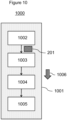
- FIG. 1 shows a flow diagram of a method 100 according to the invention.
- a sheetlike composite 201 is provided in a method step a) 101 of the method 100.
- the latter comprises, as mutually superposed layers, from an inner face 202 of the sheetlike composite 201 to an outer face 203 of the sheetlike composite 201, a layer structure shown in Figure 6 .
- the sheetlike composite 201 as shown in Figure 16 , comprises a first longitudinal edge 208 and, opposite that, a further longitudinal edge 209, and also, in the direction from the first longitudinal edge 208 to the further longitudinal edge 209: a first longitudinal crease 204, a second longitudinal crease 205, a third longitudinal crease 206 and a fourth longitudinal crease 207.
- a method step b) 102 by folding along the first longitudinal crease 204, a first longitudinal fold is produced and, by folding along the third longitudinal crease 206, a third longitudinal fold is produced.
- the first longitudinal fold is characterized by a first internal angle 801 and the third longitudinal fold by a third internal angle 803.
- a method step c) 103 by folding along the fourth longitudinal crease 207, a fourth longitudinal fold is produced and, by folding along the second longitudinal crease 205, a second longitudinal fold is produced.
- the fourth longitudinal fold is characterized by a fourth internal angle 804 and the second longitudinal fold by a second internal angle 802.
- the first to fourth internal angles 801-804 are each on the inner face 202 of the sheetlike composite 201.
- a method step d) 104 the first longitudinal edge 208 and the further longitudinal edge 209 are pressed against one another and sealed to one another.
- a longitudinal seam 210 is produced, which results in formation of a sleeve-like container precursor 800 for a single container from the folded sheetlike composite 201.
- the container precursor 800 is obtained in a first flat-folded state.
- the container precursor 800 is folded in such a way that the first internal angle 801 and the third internal angle 803 are each reduced to 1° and the second internal angle 802 and the fourth internal angle 804 are each increased to 179°.
- the container precursor 800 is converted from the first flat-folded state to a further flat-folded state, i.e. folded over.
- a multitude of container precursors 800 are produced, which constitutes method step A) overall.
- a method step B) 106 150 container precursors 800 obtained according to method steps a) 101 to e) 105 are packaged in an outer box as a stack.
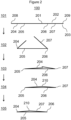
- Figure 2 shows schematic snapshots of the sheetlike composite 201 in method steps a) 101 to e) 105 of the method according to the invention 100 according to Figure 1 .
- the sheetlike composite 201 provided in method step a) 101 is unfolded, but creased.
- the sheetlike composite 201 comprises, in the direction from the first longitudinal edge 208 to the further longitudinal edge 209: the first longitudinal crease 204, the second longitudinal crease 205, the third longitudinal crease 206 and the fourth longitudinal crease 207.
- the sheetlike composite 201 provided is a blank for manufacture of a single closed foodstuff container.
- Figure 2 shows a snapshot in method step b) 102.
- a snapshot of method step c) 103 shows the already produced second longitudinal fold along the second longitudinal crease 205 and the fourth longitudinal fold along the fourth longitudinal crease 207.
- the second internal angle 802 has been reduced to 3° and the fourth internal angle 804 to 5°.
- the first longitudinal edge 208 and the further longitudinal edge 209 have been contacted with one another and joined by sealing.
- FIG. 1 A further snapshot shows the result of method step e) 105.
- the container precursor 800 was folded over as described for Figure 1 , such that the first internal angle 801 of the first longitudinal fold along the first longitudinal crease 204 and the third internal angle 803 of the third longitudinal fold along the third longitudinal crease 206 were each reduced to 1°, and the second internal angle 802 of the second longitudinal fold along the second longitudinal crease 205 and the fourth internal angle 804 of the fourth longitudinal fold along the fourth longitudinal crease 207 were each increased to 179°.
- Figure 3 shows schematic snapshots of a sheetlike composite 201 in method step b) 102 of a further method according to the invention 100.
- the method 100 according to Figure 3 comprises method steps a) 101 and c) 103 to e) 105 according to Figures 1 and 2 .
- the first internal angle 801 is first reduced to 90° and hence the first longitudinal fold along the first longitudinal crease 204 is produced.
- the first internal angle 801 is reduced further to 50° and, at the same time, the third internal angle 803 is reduced to 135° and hence the third longitudinal fold along the third longitudinal crease 206 is produced.
- the first internal angle 801 is increased to 135° and, at the same time, the third internal angle 803 is reduced further to 90°.
- the first internal angle 801 is increased further to 180° and the third internal angle 803 is reduced to 50°.
- the third internal angle 803 is folded to 180°.
- Method steps c) 103, d) 104 and e) 105 follow according to Figures 1 and 2 .
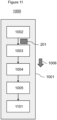
- FIG. 4 shows a flow diagram of a further method 100 of the invention.
- a sheetlike composite 201 is provided.
- the latter comprises, as superposed layers, from an inner face 202 of the sheetlike composite 201 to an outer face 203 of the sheetlike composite 201, a layer structure shown in Figure 6 .
- the sheetlike composite 201 comprises, as shown in Figure 16 , a first longitudinal edge 208 and, opposite that, a further longitudinal edge 209 and, in the direction from the first longitudinal edge 208 to the further longitudinal edge 209: a first longitudinal crease 204, a second longitudinal crease 205, a third longitudinal crease 206 and a fourth longitudinal crease 207.
- a first longitudinal fold is produced by folding along the first longitudinal crease 204, and a third longitudinal fold is produced by folding along the third longitudinal crease 206.
- the first longitudinal fold is characterized by a first internal angle 801 and the third longitudinal fold by a third internal angle 803.
- a fourth longitudinal fold is produced by folding along the fourth longitudinal crease 207, and a second longitudinal fold is produced by folding along the second longitudinal crease 205.
- the fourth longitudinal fold is characterized by a fourth internal angle 804 and the second longitudinal fold by a second internal angle 802.
- the first to fourth internal angles 801 - 804 are each on the inner face 202 of the sheetlike composite 201.
- a method step d) 104 the first longitudinal edge 208 and the further longitudinal edge 209 are pressed onto one another and sealed to one another.
- a longitudinal seam 210 is produced, which gives rise to a sleeve-like container precursor 800 for a single container from the folded sheetlike composite 201.
- the container precursor 800 is obtained in a first flat-folded state.
- a method step e) 105 the container precursor 800 is folded in such a way that the first internal angle 801 and the third internal angle 803 are each reduced to 0°, and the second internal angle 802 and the fourth internal angle 804 are each increased to 180°.
- the container precursor 800 is converted from the first flat-folded state to a further flat-folded state, i.e.
- Method step e) 105 is followed by a method step f) 401.
- method step f) 401 the first internal angle 801 and the third internal angle 803 are each increased to 180°, and the second internal angle 802 and the fourth internal angle 804 are each reduced to 0°.
- the container precursor 800 is converted from the further flat-folded state to the first flat-folded state, i.e. folded over once more.
- method steps a) 101 to f) 401 a multitude of container precursors 800 are produced, which constitutes method step A) overall.
- a method step B) 106 200 container precursors 800 obtained according to method steps a) 101 to g) 401 are packaged in an outer box as a stack.
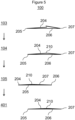
- Figure 5 shows schematic snapshots of the sheetlike composite 201 in method steps c) 103 to g) 401 of the method 100 according to the invention as per Figure 4 .
- the sheetlike composite 201 provided in method step a) 101 is unfolded, but creased (not shown).
- the sheetlike composite 201 comprises, in the direction from the first longitudinal edge 208 to the further longitudinal edge 209: the first longitudinal crease 204, the second longitudinal crease 205, the third longitudinal crease 206 and the fourth longitudinal crease 207.
- the sheetlike composite 201 provided is a blank for production of a single closed foodstuff container.
- method step b) 102 as described above, the first longitudinal fold is produced along the third longitudinal crease 204, and the third longitudinal fold along the third longitudinal crease 206 (not shown). For this purpose, the first internal angle 801 is reduced to 55°, and the third internal angle 803 to 57°.
- Figure 5 shows a snapshot of method step c) 103. This shows the already produced second longitudinal fold along the second longitudinal crease 205 and the fourth longitudinal fold along the fourth longitudinal crease 207.
- the second internal angle 802 has been reduced to 3° and the fourth internal angle 804 has been reduced to 5°.
- a snapshot of method step d) 104 the first longitudinal edge 208 and the further longitudinal edge 209 have been contacted with one another and joined by sealing. Thus, the longitudinal seam 210 has been produced.
- the container precursor 800 obtained is in the first flat-folded state.
- a further snapshot shows the result of method step e) 105.
- the container precursor 800 was folded over as described for Figure 4 , such that the first internal angle 801 of the first longitudinal fold along the first longitudinal crease 204 and the third internal angle 803 of the third longitudinal fold along the third longitudinal crease 206 were each reduced to 0°, and the second internal angle 802 of the second longitudinal fold along the second longitudinal crease 205 and the fourth internal angle 804 of the fourth longitudinal fold along the fourth longitudinal crease 207 were each increased to 180°.
- the container precursor 800 is in the further flat-folded state.
- Figure 5 shows, in a further snapshot, the result of method step f) 401.
- the first internal angle 801 and the third internal angle 803 have each been increased to 180°
- the second internal angle 802 and the fourth internal angle 804 have each been reduced to 0°.
- the container precursor 800 is again in the first flat-folded state.
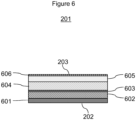
- Figure 6 shows a detail of a layer sequence of the sheetlike composite 201 of the method 100 according to Figure 1 in cross section.
- the layer sequence comprises an inner polymer layer 601, a barrier layer 602, an adhesion promoter layer 603, a carrier layer 604, an outer polymer layer 605 and, printed thereon, a colour layer 606 which comprises a colourant and constitutes a decoration 606.
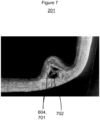
- Figure 7 shows a microscope image of a longitudinal crease 204-207 of a sheetlike composite 201 of the inventive container precursor 800 in Figure 8 in cross section. It is clearly apparent that the carrier layer 604 is split into 2 separate sublayers 701 along the longitudinal crease 204-207. Between the two sublayers 701, the carrier layer 604 forms a cavity 702.
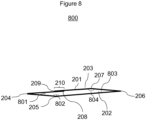
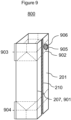
- FIG 8 shows an inventive container precursor 800 in top view (upright).
- the container precursor 800 consists of a sheetlike composite 201, the layer structure of which is shown in cross section in Figure 6 .
- the sheetlike composite 201 is a blank for manufacture of a single container.
- the container precursor 800 comprises a first longitudinal edge 208 and, opposite that across the sheetlike composite 201, a further longitudinal edge 209.
- the first longitudinal edge 208 is sealed to the further longitudinal edge 209.
- the longitudinal seam 210 in this container precursor 800 runs through about the middle of a wall area of the container precursor 800.
- the longitudinal seam 210 may instead run along a longitudinal fold, i.e.
- the sheetlike composite 201 comprises a first longitudinal crease 204, a second longitudinal crease 205, a third longitudinal crease 206 and a fourth longitudinal crease 207.
- a first longitudinal fold runs along the first longitudinal crease 204, a second longitudinal fold along the second longitudinal crease 205, a third longitudinal fold along the third longitudinal crease 206, and a fourth longitudinal fold along the fourth longitudinal crease 207.
- the longitudinal folds are each intended to form a longitudinal edge 901 in the closed container to be produced.
- the first longitudinal fold is characterized by a first internal angle 801, the second longitudinal fold by a second internal angle 802, the third longitudinal fold by a third internal angle 803, and the fourth longitudinal fold by a fourth longitudinal angle 804.
- the first internal angle 801 and the third internal angle 803 are each 3°
- the second internal angle 802 and the fourth internal angle 804 are each 177°.
- the container precursor 800 in accordance with the invention, is in a flat-folded state.
- the shaping 1203 of the flat-folded container precursor 800 it can be formed to give a sleeve structure.
- the shaping 1203 can be effected by simultaneous folding of the first to fourth longitudinal folds as indicated in Figure 12 .
- the container precursor 800 is obtainable by method steps a) 101 to e) 105 of the method 100 according to Figure 1 .
- Figure 9 shows the container precursor 800 according to Figure 8 in side view (upright) after the shaping 1203.
- the container precursor 800 in Figure 9 is no longer in a flat-folded state.
- a hole 905 can be seen in a carrier layer 604 of the sheetlike composite 201.
- the hole 905 is covered by an adhesion promoter layer 603, a barrier layer 602 and an inner polymer layer 601 as hole-covering layers 906 on the inner face 202 of the sheetlike composite 201.
- further creases 902 are shown.
- a top region 903 and a base region 904 of a closed container By folding along the further creases 902 and joining appropriate parts of the sheetlike composite 201, it is possible to form a top region 903 and a base region 904 of a closed container. Also shown here is a longitudinal edge 901 formed from the fourth longitudinal fold along the fourth longitudinal crease 207.
- FIG 10 shows an inventive apparatus 1000.
- the apparatus 1000 comprises a sheetlike composite 201 which, from an inner face 202 to an outer face 203, comprises the layer sequence according to Figure 6 .
- the sheetlike composite 201 as shown in Figure 16 , comprises a first longitudinal edge 208 and a further longitudinal edge 209.
- the sheetlike composite 201 comprises, from the first longitudinal edge 208 to the further longitudinal edge 209: a first longitudinal crease 204, a second longitudinal crease 205, a third longitudinal crease 206, and a fourth longitudinal crease 207.
- the apparatus 1000 comprises a transport unit 1001, designed to transport the sheetlike composite 201 from a first folding station 1002 to a first flat folding station 1005, in a transport direction 1006.
- the first folding station 1002 is designed to produce a first longitudinal fold along the first longitudinal crease 204 by reducing a first internal angle 801 which characterizes the first longitudinal fold to 55° and to produce a third longitudinal fold along the third longitudinal crease 206 by reducing a third internal angle 803 which characterizes the third longitudinal fold to 55°.
- the first folding station 1002 comprises two continuously revolving belts, wherein the belts, for the above-described folding of the sheetlike composite 201, each rotate about their longitudinal axis along the transport direction 1006.
- the apparatus 1000 comprises a second folding station 1003 beyond the first folding station 1002 in transport direction 1006.
- the second folding station 1003 is designed to produce a second longitudinal fold along the second longitudinal crease 205 by reducing a second internal angle 802 that characterizes the second longitudinal fold to 2°, and to produce a fourth longitudinal fold along the fourth longitudinal crease 207 by reducing a fourth internal angle 804 that characterizes the fourth longitudinal fold to 2°.
- the second folding station 1003 comprises two continuously revolving belts, wherein the belts, for the above-described folding of the sheetlike composite 201, each rotate about their longitudinal axis along the transport direction 1006.
- the apparatus 1000 comprises a longitudinal seam-forming station 1004, which is a sealing station.
- the longitudinal seam-forming station 1004 comprises a sonotrode.
- the longitudinal seam-forming station 1004 is arranged beyond the second folding station 1003 in the transport direction 1006. It should also be mentioned that the first internal angle 801, the second internal angle 802, the third internal angle 803 and the fourth internal angle 804 are each on the inner face 202 of the sheetlike composite 201.
- the apparatus 1000 further comprises a first flat-folding station 1005.
- the first flat-folding station 1005 is designed to reduce the first internal angle 801 and the third internal angle 803 each to 0°, and to increase the second internal angle 802 and the fourth internal angle 804 each to 180°.
- the first flat-folding station 1005 comprises two pairs of contra-rotating rolls.
- the rolls of one pair are designed and arranged to press the first longitudinal fold in a gap between the rolls.
- the rolls of the further pair are designed and arranged to press the third longitudinal fold in a gap between the rolls.
- FIG 11 shows a further apparatus 1000 of the invention.
- the apparatus 1000 according to Figure 11 is designed like the apparatus 1000 according to Figure 10 , wherein the apparatus 1000 according to Figure 11 further comprises a second flat-folding station 1101.
- the second flat-folding station 1101 is arranged beyond the first flat-folding station 1005 in the transport direction 1006.
- the second flat-folding station 1101 is designed to increase the first internal angle 801 and the third internal angle 803 each to 180° and to reduce the second internal angle 802 and the fourth internal angle 804 each to 0°.
- the second flat-folding station 1101 comprises two pairs of contra-rotating rolls. In this case, the rolls of one pair are designed and arranged to press the second longitudinal fold in a gap between the rolls.
- the rolls of the further pair are designed and arranged to press the fourth longitudinal fold in a gap between the rolls.
- the transport unit 1001 in the transport direction 1006 downstream of the longitudinal seam-forming station 1004 up to and including the second flat-folding station 1101 is designed as a conveyor belt 1001.
- Figure 12 shows a test setup 1200 for measurement of the shaping force.
- the container precursor 800 according to Figure 8 is clamped between two compression plates 1201 of a compression plate system of a universal strength tester.
- the compression plate system is motor-driven, such that the upper compression plate 1201 can perform a uniform downward motion 1202.
- shaping 1203 of the container precursor 800 from the flat-folded state takes place to give a sleeve structure. Further details relating to the measurement are reported under the "Shaping force" test method.
- Figure 13a shows a holding clamp 1300.
- the holding clamp 1300 was developed in-house and serves to conduct the above-described test method for the zero sample force.
- Figure 13a shows a section A-A through the holding clamp 1300.
- the holding clamp 1300 more particularly comprises a holding plate 1, a clamp 2, a lever 3, a shell 4, a spacer ring 5, a bolt 6, a cylinder pin 7 and a compression spring 8.
- Figure 13b shows the holding clamp 1300 according to Figure 13a ) in a further view. What is shown is a section B-B through the holding clamp 1300.
- Figure 14a shows the holding clamp 1300 according to Figure 13a ) in a further view with dimensions in mm.
- Figure 14b shows the holding clamp 1300 according to Figure 13a ) with a turntable 1401.
- the holding clamp 1300 and the turntable 1401 are used in this arrangement for the "zero sample force" test method as described above.
- Figure 15a shows the holding clamp 1300 according to Figure 13a ) in a further view.
- Figure 15b shows the holding clamp 1300 according to Figure 13a ) in a perspective view.
- Figure 16 shows the sheetlike composite 201 from method step a) 101 of the method 100 according to Figure 1 in a view of the inner face 202. This shows, from left to right, across the sheetlike composite 201: the first longitudinal edge 208, the first longitudinal crease 204, the second longitudinal crease 205, the third longitudinal crease 206, the fourth longitudinal crease 207 and the further longitudinal edge 209.
Landscapes
- Engineering & Computer Science (AREA)
- Mechanical Engineering (AREA)
- Physics & Mathematics (AREA)
- General Physics & Mathematics (AREA)
- Chemical & Material Sciences (AREA)
- Chemical Kinetics & Catalysis (AREA)
- Wrappers (AREA)
- Making Paper Articles (AREA)
- Cartons (AREA)
- Container Filling Or Packaging Operations (AREA)
Applications Claiming Priority (2)
| Application Number | Priority Date | Filing Date | Title |
|---|---|---|---|
| DE102016209236.7A DE102016209236A1 (de) | 2016-05-27 | 2016-05-27 | Verfahren zum Herstellen einer Verpackung umhüllend Behältervorläufer, insbesondere jeweils für einen einzelnen formstabilen Nahrungsmittelbehälter, mit Umfalten des Behältervorläufers |
| PCT/EP2017/062549 WO2017202914A1 (en) | 2016-05-27 | 2017-05-24 | Method of producing a packaging means enveloping container precursors, especially each for a single dimensionally stable foodstuff container, with folding over of the container precursor |
Publications (3)
| Publication Number | Publication Date |
|---|---|
| EP3464071A1 EP3464071A1 (en) | 2019-04-10 |
| EP3464071C0 EP3464071C0 (en) | 2025-02-26 |
| EP3464071B1 true EP3464071B1 (en) | 2025-02-26 |
Family
ID=58794069
Family Applications (1)
| Application Number | Title | Priority Date | Filing Date |
|---|---|---|---|
| EP17726266.4A Active EP3464071B1 (en) | 2016-05-27 | 2017-05-24 | Method of producing a packaging means enveloping container precursors, especially each for a single dimensionally stable foodstuff container, with folding over of the container precursor |
Country Status (10)
| Country | Link |
|---|---|
| US (1) | US11117341B2 (pl) |
| EP (1) | EP3464071B1 (pl) |
| JP (1) | JP7064449B2 (pl) |
| CN (1) | CN109195869B (pl) |
| AU (1) | AU2017270119A1 (pl) |
| DE (1) | DE102016209236A1 (pl) |
| ES (1) | ES3021191T3 (pl) |
| MX (1) | MX2018014657A (pl) |
| PL (1) | PL3464071T3 (pl) |
| WO (1) | WO2017202914A1 (pl) |
Families Citing this family (3)
| Publication number | Priority date | Publication date | Assignee | Title |
|---|---|---|---|---|
| US12170849B2 (en) | 2022-02-04 | 2024-12-17 | Applied Materials, Inc. | Pulsed illumination for fluid inspection |
| WO2023168692A1 (en) * | 2022-03-11 | 2023-09-14 | Sig Combibloc Services Ag | Planar composite with grooves for dimensionally stable foodstuff containers with steep edges running at an angle to each other |
| CN117228118A (zh) * | 2022-06-08 | 2023-12-15 | 康美包(苏州)有限公司 | 包装用套筒及其制造方法和包装容器 |
Citations (1)
| Publication number | Priority date | Publication date | Assignee | Title |
|---|---|---|---|---|
| WO1998014317A1 (en) * | 1996-09-01 | 1998-04-09 | Elopak Systems Ag | Method of and apparatus for treating a laminate |
Family Cites Families (33)
| Publication number | Priority date | Publication date | Assignee | Title |
|---|---|---|---|---|
| US2220746A (en) * | 1937-03-01 | 1940-11-05 | Oscar W Wentz | Container construction |
| US2379038A (en) * | 1944-04-07 | 1945-06-26 | Rous Arthur | Carton and carton blank |
| US2930517A (en) * | 1956-03-01 | 1960-03-29 | Mensing Hans-Jurgen | Folded carton type pack |
| DE1436005A1 (de) * | 1962-06-22 | 1968-10-31 | Jagenberg Werke Ag | Vorrichtung zum Herstellen,Fuellen und Schliessen fluessigkeitsdichter Behaelter |
| US3303985A (en) * | 1965-07-06 | 1967-02-14 | Irvin J Prokes | Beverage container |
| US3754456A (en) * | 1971-05-27 | 1973-08-28 | Reynolds Metals Co | Blank constructions for hermetically sealed cartons and methods of forming same |
| US3884131A (en) * | 1972-08-25 | 1975-05-20 | Tetra Pak Dev | Method of, and means for folding a container blank into a tubular body |
| SE8000471L (sv) * | 1980-01-21 | 1981-07-22 | Tetra Pak Int | Med upprivbar oppningsanordning forsedd forpackningsbehallare |
| US4516382A (en) * | 1981-04-02 | 1985-05-14 | Ace Pak Company Incorporated | Automatic carton packing machine |
| EP0102616B1 (de) * | 1982-09-07 | 1986-06-18 | Tetra Laval Holdings & Finance SA | Verfahren zum Erstellen eines Schlauchstückes aus einer flachen Bahn aus flexiblem Material und Vorrichtung zur Durchführung des Verfahrens |
| US4446971A (en) * | 1982-11-10 | 1984-05-08 | Ex-Cell-O Corporation | Liquid container with straw opening means |
| SE454682B (sv) * | 1985-10-03 | 1988-05-24 | Tetra Pak Ab | Sett och maskin for framstellning av forpackningsbehallare |
| WO1990009926A2 (en) | 1989-03-03 | 1990-09-07 | Fbi Brands Ltd. | Packaging perishable liquids in gable top cartons |
| DK334789D0 (da) * | 1989-07-06 | 1989-07-06 | Schur Int As Brdr | Fremgangsmaade ved fremstilling af emballager med oprivelig svejselukning |
| CA2134392A1 (en) * | 1993-10-28 | 1995-04-29 | Ferrucchio Carmelo Calvano | Method for the manufacturing of an airtight, recyclable and biodegradable package |
| US5482202A (en) * | 1995-06-02 | 1996-01-09 | Wen; Chung-Hsin | Drink box with built-in straw |
| CA2256436C (en) * | 1996-06-03 | 2005-08-09 | Kraft Foods, Inc. | Easy-access beverage pouch |
| US6431434B1 (en) * | 1999-09-23 | 2002-08-13 | Keith Louis Haughton | Individual beverage carton with a straw therein and a method of manufacture |
| KR100733625B1 (ko) * | 2003-08-11 | 2007-06-28 | 가네보 세이야쿠 가부시키가이샤 | 스트로를 구비한 압압변형가능한 종이팩용기 |
| DE102004026690B3 (de) | 2004-05-28 | 2005-12-01 | Sig Technology Ag | Vorrichtung zum kontinuierlichen Falten von Zuschnitten aus Karton/Kunststoff-Verbundmaterial |
| CN2936706Y (zh) * | 2006-07-18 | 2007-08-22 | 长声工业股份有限公司 | 纸箱成型翻折装置 |
| US20080139372A1 (en) * | 2006-12-11 | 2008-06-12 | Cailloux Lionel | Process and machine for blank folding |
| US8066137B2 (en) * | 2007-08-08 | 2011-11-29 | Clear Lam Packaging, Inc. | Flexible, stackable container including a lid and package body folded from a single sheet of film |
| US8602242B2 (en) * | 2008-11-06 | 2013-12-10 | Clear Lam Packaging, Inc. | Flexible, stackable container used for storing a quantity of product and method for manufacturing same |
| JP5218912B2 (ja) | 2009-01-26 | 2013-06-26 | 大日本印刷株式会社 | 内容器ブランク |
| DE102010033464B4 (de) * | 2010-08-05 | 2012-09-06 | Sig Technology Ag | Aus einem Behälterrohling geformter Behälter mit verbesserten Öffnungseigenschaften durch Streckwärmebehandlung von Polymerschichten |
| DE102011108401A1 (de) * | 2011-07-26 | 2013-01-31 | Sig Technology Ag | Robuster flächenförmiger Verbund mit einer Zwischenschicht mit erhöhter Vicat-Erweichungstemperatur |
| DE102011054327A1 (de) * | 2011-10-10 | 2013-04-11 | Elopak Systems Ag | Füllmaschine zum Abfüllen von Produkten in Packungsbehälter sowie Verfahren hierzu |
| DE102012102812A1 (de) | 2012-03-30 | 2013-10-02 | Elopak Systems Ag | Vorrichtung und Verfahren zum Reduzieren von Rückstellkräften von Packungsmänteln in einer Füllmaschine |
| DE102014100203A1 (de) * | 2014-01-09 | 2015-07-09 | Sig Technology Ag | Verfahren zur Behandlung der offenen Schnittkanten von Verpackungsmaterial für die Fertigung von Karton/Kunststoffverbundpackungen sowie ein Verpackungsmaterial, eine daraus hergestellte Verbundpackung und ein Behältnis zur Aufnahme von Verpackungsmaterial |
| DE102014009466A1 (de) | 2014-06-30 | 2015-12-31 | Sig Technology Ag | Flächenförmiger Verbund mit einer mPolyolefinschicht mit verringertem Antioxidansanteil, insbesondere für Nahrungsmittelverpackungen |
| DE102014015960A1 (de) | 2014-10-31 | 2016-05-04 | Sig Technology Ag | Behältervorläufer, insbesondere zum Herstellen eines Nahrungsmittelbehälters, aus einemLaminat mit einer Gas- und Aromabarriere aus Kunststoff und einem geschältem und teilweise auf sich selbst umgeschlagenen Randbereich |
| CN205130486U (zh) * | 2015-11-19 | 2016-04-06 | 沈阳恒德包装制品有限公司 | 纸箱折叠成型机构 |
-
2016
- 2016-05-27 DE DE102016209236.7A patent/DE102016209236A1/de active Pending
-
2017
- 2017-05-24 PL PL17726266.4T patent/PL3464071T3/pl unknown
- 2017-05-24 US US16/304,748 patent/US11117341B2/en active Active
- 2017-05-24 AU AU2017270119A patent/AU2017270119A1/en not_active Abandoned
- 2017-05-24 WO PCT/EP2017/062549 patent/WO2017202914A1/en not_active Ceased
- 2017-05-24 CN CN201780032917.1A patent/CN109195869B/zh active Active
- 2017-05-24 JP JP2018561958A patent/JP7064449B2/ja active Active
- 2017-05-24 EP EP17726266.4A patent/EP3464071B1/en active Active
- 2017-05-24 MX MX2018014657A patent/MX2018014657A/es unknown
- 2017-05-24 ES ES17726266T patent/ES3021191T3/es active Active
Patent Citations (1)
| Publication number | Priority date | Publication date | Assignee | Title |
|---|---|---|---|---|
| WO1998014317A1 (en) * | 1996-09-01 | 1998-04-09 | Elopak Systems Ag | Method of and apparatus for treating a laminate |
Also Published As
| Publication number | Publication date |
|---|---|
| EP3464071C0 (en) | 2025-02-26 |
| EP3464071A1 (en) | 2019-04-10 |
| CN109195869B (zh) | 2021-08-06 |
| US11117341B2 (en) | 2021-09-14 |
| PL3464071T3 (pl) | 2025-06-23 |
| BR112018074371A2 (pt) | 2019-03-06 |
| JP7064449B2 (ja) | 2022-05-10 |
| JP2019517397A (ja) | 2019-06-24 |
| BR112018074371A8 (pt) | 2023-01-03 |
| CN109195869A (zh) | 2019-01-11 |
| ES3021191T3 (en) | 2025-05-26 |
| WO2017202914A1 (en) | 2017-11-30 |
| MX2018014657A (es) | 2019-08-21 |
| DE102016209236A1 (de) | 2017-11-30 |
| US20190299556A1 (en) | 2019-10-03 |
| AU2017270119A1 (en) | 2018-11-29 |
Similar Documents
| Publication | Publication Date | Title |
|---|---|---|
| US10814595B2 (en) | Container precursor with shaping coefficient, especially for a single dimensionally stable food or drink product container | |
| EP3397480B1 (en) | Sheet-like composite, especially packaging laminate for dimensionally stable foodstuff containers, having a polymeric intermediate layer characterized by differential scanning calorimetry | |
| CN108472925B (zh) | 具有聚合物内层的片状复合材料 | |
| EP2736716A1 (en) | Planar composite with layers of plastic of different vicat softening temperatures | |
| US11117689B2 (en) | Method of producing a container precursor, especially for a single dimensionally stable foodstuff container, without folding over the container precursor | |
| WO2017202912A1 (en) | Container precursor with shaping coefficient, especially for a single dimensionally stable food or drink product container | |
| EP3464071B1 (en) | Method of producing a packaging means enveloping container precursors, especially each for a single dimensionally stable foodstuff container, with folding over of the container precursor | |
| WO2018041678A1 (en) | Sheetlike composite for production of dimensionally stable food and drink product containers having a barrier layer of which the shinier surface faces inward | |
| BR112018074371B1 (pt) | Método e arranjo | |
| BR112018072964B1 (pt) | Método, precursor de recipiente e recipiente fechado |
Legal Events
| Date | Code | Title | Description |
|---|---|---|---|
| STAA | Information on the status of an ep patent application or granted ep patent |
Free format text: STATUS: UNKNOWN |
|
| STAA | Information on the status of an ep patent application or granted ep patent |
Free format text: STATUS: THE INTERNATIONAL PUBLICATION HAS BEEN MADE |
|
| PUAI | Public reference made under article 153(3) epc to a published international application that has entered the european phase |
Free format text: ORIGINAL CODE: 0009012 |
|
| STAA | Information on the status of an ep patent application or granted ep patent |
Free format text: STATUS: REQUEST FOR EXAMINATION WAS MADE |
|
| 17P | Request for examination filed |
Effective date: 20181218 |
|
| AK | Designated contracting states |
Kind code of ref document: A1 Designated state(s): AL AT BE BG CH CY CZ DE DK EE ES FI FR GB GR HR HU IE IS IT LI LT LU LV MC MK MT NL NO PL PT RO RS SE SI SK SM TR |
|
| AX | Request for extension of the european patent |
Extension state: BA ME |
|
| DAV | Request for validation of the european patent (deleted) | ||
| DAX | Request for extension of the european patent (deleted) | ||
| STAA | Information on the status of an ep patent application or granted ep patent |
Free format text: STATUS: EXAMINATION IS IN PROGRESS |
|
| 17Q | First examination report despatched |
Effective date: 20200511 |
|
| GRAP | Despatch of communication of intention to grant a patent |
Free format text: ORIGINAL CODE: EPIDOSNIGR1 |
|
| STAA | Information on the status of an ep patent application or granted ep patent |
Free format text: STATUS: GRANT OF PATENT IS INTENDED |
|
| INTG | Intention to grant announced |
Effective date: 20210223 |
|
| GRAJ | Information related to disapproval of communication of intention to grant by the applicant or resumption of examination proceedings by the epo deleted |
Free format text: ORIGINAL CODE: EPIDOSDIGR1 |
|
| STAA | Information on the status of an ep patent application or granted ep patent |
Free format text: STATUS: EXAMINATION IS IN PROGRESS |
|
| INTC | Intention to grant announced (deleted) | ||
| GRAP | Despatch of communication of intention to grant a patent |
Free format text: ORIGINAL CODE: EPIDOSNIGR1 |
|
| STAA | Information on the status of an ep patent application or granted ep patent |
Free format text: STATUS: GRANT OF PATENT IS INTENDED |
|
| RAP1 | Party data changed (applicant data changed or rights of an application transferred) |
Owner name: SIG COMBIBLOC SERVICES AG |
|
| RAP3 | Party data changed (applicant data changed or rights of an application transferred) |
Owner name: SIG SERVICES AG |
|
| INTG | Intention to grant announced |
Effective date: 20240313 |
|
| GRAJ | Information related to disapproval of communication of intention to grant by the applicant or resumption of examination proceedings by the epo deleted |
Free format text: ORIGINAL CODE: EPIDOSDIGR1 |
|
| STAA | Information on the status of an ep patent application or granted ep patent |
Free format text: STATUS: EXAMINATION IS IN PROGRESS |
|
| INTC | Intention to grant announced (deleted) | ||
| GRAP | Despatch of communication of intention to grant a patent |
Free format text: ORIGINAL CODE: EPIDOSNIGR1 |
|
| STAA | Information on the status of an ep patent application or granted ep patent |
Free format text: STATUS: GRANT OF PATENT IS INTENDED |
|
| INTG | Intention to grant announced |
Effective date: 20240920 |
|
| GRAS | Grant fee paid |
Free format text: ORIGINAL CODE: EPIDOSNIGR3 |
|
| GRAA | (expected) grant |
Free format text: ORIGINAL CODE: 0009210 |
|
| STAA | Information on the status of an ep patent application or granted ep patent |
Free format text: STATUS: THE PATENT HAS BEEN GRANTED |
|
| AK | Designated contracting states |
Kind code of ref document: B1 Designated state(s): AL AT BE BG CH CY CZ DE DK EE ES FI FR GB GR HR HU IE IS IT LI LT LU LV MC MK MT NL NO PL PT RO RS SE SI SK SM TR |
|
| REG | Reference to a national code |
Ref country code: GB Ref legal event code: FG4D |
|
| REG | Reference to a national code |
Ref country code: CH Ref legal event code: EP |
|
| REG | Reference to a national code |
Ref country code: DE Ref legal event code: R096 Ref document number: 602017087999 Country of ref document: DE |
|
| REG | Reference to a national code |
Ref country code: IE Ref legal event code: FG4D |
|
| U01 | Request for unitary effect filed |
Effective date: 20250325 |
|
| U07 | Unitary effect registered |
Designated state(s): AT BE BG DE DK EE FI FR IT LT LU LV MT NL PT RO SE SI Effective date: 20250331 |
|
| REG | Reference to a national code |
Ref country code: ES Ref legal event code: FG2A Ref document number: 3021191 Country of ref document: ES Kind code of ref document: T3 Effective date: 20250526 |
|
| U20 | Renewal fee for the european patent with unitary effect paid |
Year of fee payment: 9 Effective date: 20250516 |
|
| PG25 | Lapsed in a contracting state [announced via postgrant information from national office to epo] |
Ref country code: RS Free format text: LAPSE BECAUSE OF FAILURE TO SUBMIT A TRANSLATION OF THE DESCRIPTION OR TO PAY THE FEE WITHIN THE PRESCRIBED TIME-LIMIT Effective date: 20250526 |
|
| PGFP | Annual fee paid to national office [announced via postgrant information from national office to epo] |
Ref country code: PL Payment date: 20250515 Year of fee payment: 9 |
|
| PGFP | Annual fee paid to national office [announced via postgrant information from national office to epo] |
Ref country code: GB Payment date: 20250522 Year of fee payment: 9 Ref country code: ES Payment date: 20250616 Year of fee payment: 9 |
|
| PG25 | Lapsed in a contracting state [announced via postgrant information from national office to epo] |
Ref country code: IS Free format text: LAPSE BECAUSE OF FAILURE TO SUBMIT A TRANSLATION OF THE DESCRIPTION OR TO PAY THE FEE WITHIN THE PRESCRIBED TIME-LIMIT Effective date: 20250626 Ref country code: NO Free format text: LAPSE BECAUSE OF FAILURE TO SUBMIT A TRANSLATION OF THE DESCRIPTION OR TO PAY THE FEE WITHIN THE PRESCRIBED TIME-LIMIT Effective date: 20250526 |
|
| PG25 | Lapsed in a contracting state [announced via postgrant information from national office to epo] |
Ref country code: HR Free format text: LAPSE BECAUSE OF FAILURE TO SUBMIT A TRANSLATION OF THE DESCRIPTION OR TO PAY THE FEE WITHIN THE PRESCRIBED TIME-LIMIT Effective date: 20250226 |
|
| PG25 | Lapsed in a contracting state [announced via postgrant information from national office to epo] |
Ref country code: GR Free format text: LAPSE BECAUSE OF FAILURE TO SUBMIT A TRANSLATION OF THE DESCRIPTION OR TO PAY THE FEE WITHIN THE PRESCRIBED TIME-LIMIT Effective date: 20250527 |
|
| PGFP | Annual fee paid to national office [announced via postgrant information from national office to epo] |
Ref country code: TR Payment date: 20250516 Year of fee payment: 9 |
|
| PG25 | Lapsed in a contracting state [announced via postgrant information from national office to epo] |
Ref country code: SM Free format text: LAPSE BECAUSE OF FAILURE TO SUBMIT A TRANSLATION OF THE DESCRIPTION OR TO PAY THE FEE WITHIN THE PRESCRIBED TIME-LIMIT Effective date: 20250226 |
|
| PG25 | Lapsed in a contracting state [announced via postgrant information from national office to epo] |
Ref country code: CZ Free format text: LAPSE BECAUSE OF FAILURE TO SUBMIT A TRANSLATION OF THE DESCRIPTION OR TO PAY THE FEE WITHIN THE PRESCRIBED TIME-LIMIT Effective date: 20250226 |
|
| PG25 | Lapsed in a contracting state [announced via postgrant information from national office to epo] |
Ref country code: SK Free format text: LAPSE BECAUSE OF FAILURE TO SUBMIT A TRANSLATION OF THE DESCRIPTION OR TO PAY THE FEE WITHIN THE PRESCRIBED TIME-LIMIT Effective date: 20250226 |
|
| REG | Reference to a national code |
Ref country code: CH Ref legal event code: H13 Free format text: ST27 STATUS EVENT CODE: U-0-0-H10-H13 (AS PROVIDED BY THE NATIONAL OFFICE) Effective date: 20251223 |
|
| PLBE | No opposition filed within time limit |
Free format text: ORIGINAL CODE: 0009261 |
|
| STAA | Information on the status of an ep patent application or granted ep patent |
Free format text: STATUS: NO OPPOSITION FILED WITHIN TIME LIMIT |
|
| PG25 | Lapsed in a contracting state [announced via postgrant information from national office to epo] |
Ref country code: CH Free format text: LAPSE BECAUSE OF NON-PAYMENT OF DUE FEES Effective date: 20250531 |
|
| PG25 | Lapsed in a contracting state [announced via postgrant information from national office to epo] |
Ref country code: MC Free format text: LAPSE BECAUSE OF FAILURE TO SUBMIT A TRANSLATION OF THE DESCRIPTION OR TO PAY THE FEE WITHIN THE PRESCRIBED TIME-LIMIT Effective date: 20250226 |
|
| 26N | No opposition filed |
Effective date: 20251127 |