EP3460396B1 - Vermessungssystem - Google Patents
Vermessungssystem Download PDFInfo
- Publication number
- EP3460396B1 EP3460396B1 EP18193950.5A EP18193950A EP3460396B1 EP 3460396 B1 EP3460396 B1 EP 3460396B1 EP 18193950 A EP18193950 A EP 18193950A EP 3460396 B1 EP3460396 B1 EP 3460396B1
- Authority
- EP
- European Patent Office
- Prior art keywords
- scanner
- unit
- surveying
- prism
- camera
- Prior art date
- Legal status (The legal status is an assumption and is not a legal conclusion. Google has not performed a legal analysis and makes no representation as to the accuracy of the status listed.)
- Active
Links
Images





Classifications
-
- G—PHYSICS
- G01—MEASURING; TESTING
- G01C—MEASURING DISTANCES, LEVELS OR BEARINGS; SURVEYING; NAVIGATION; GYROSCOPIC INSTRUMENTS; PHOTOGRAMMETRY OR VIDEOGRAMMETRY
- G01C11/00—Photogrammetry or videogrammetry, e.g. stereogrammetry; Photographic surveying
- G01C11/02—Picture taking arrangements specially adapted for photogrammetry or photographic surveying, e.g. controlling overlapping of pictures
-
- B—PERFORMING OPERATIONS; TRANSPORTING
- B64—AIRCRAFT; AVIATION; COSMONAUTICS
- B64D—EQUIPMENT FOR FITTING IN OR TO AIRCRAFT; FLIGHT SUITS; PARACHUTES; ARRANGEMENT OR MOUNTING OF POWER PLANTS OR PROPULSION TRANSMISSIONS IN AIRCRAFT
- B64D47/00—Equipment not otherwise provided for
- B64D47/08—Arrangements of cameras
-
- G—PHYSICS
- G01—MEASURING; TESTING
- G01C—MEASURING DISTANCES, LEVELS OR BEARINGS; SURVEYING; NAVIGATION; GYROSCOPIC INSTRUMENTS; PHOTOGRAMMETRY OR VIDEOGRAMMETRY
- G01C11/00—Photogrammetry or videogrammetry, e.g. stereogrammetry; Photographic surveying
- G01C11/04—Interpretation of pictures
- G01C11/30—Interpretation of pictures by triangulation
-
- G—PHYSICS
- G01—MEASURING; TESTING
- G01C—MEASURING DISTANCES, LEVELS OR BEARINGS; SURVEYING; NAVIGATION; GYROSCOPIC INSTRUMENTS; PHOTOGRAMMETRY OR VIDEOGRAMMETRY
- G01C15/00—Surveying instruments or accessories not provided for in groups G01C1/00 - G01C13/00
- G01C15/002—Active optical surveying means
-
- G—PHYSICS
- G01—MEASURING; TESTING
- G01S—RADIO DIRECTION-FINDING; RADIO NAVIGATION; DETERMINING DISTANCE OR VELOCITY BY USE OF RADIO WAVES; LOCATING OR PRESENCE-DETECTING BY USE OF THE REFLECTION OR RERADIATION OF RADIO WAVES; ANALOGOUS ARRANGEMENTS USING OTHER WAVES
- G01S17/00—Systems using the reflection or reradiation of electromagnetic waves other than radio waves, e.g. lidar systems
- G01S17/02—Systems using the reflection of electromagnetic waves other than radio waves
- G01S17/06—Systems determining position data of a target
- G01S17/42—Simultaneous measurement of distance and other co-ordinates
-
- G—PHYSICS
- G01—MEASURING; TESTING
- G01S—RADIO DIRECTION-FINDING; RADIO NAVIGATION; DETERMINING DISTANCE OR VELOCITY BY USE OF RADIO WAVES; LOCATING OR PRESENCE-DETECTING BY USE OF THE REFLECTION OR RERADIATION OF RADIO WAVES; ANALOGOUS ARRANGEMENTS USING OTHER WAVES
- G01S17/00—Systems using the reflection or reradiation of electromagnetic waves other than radio waves, e.g. lidar systems
- G01S17/66—Tracking systems using electromagnetic waves other than radio waves
-
- G—PHYSICS
- G01—MEASURING; TESTING
- G01S—RADIO DIRECTION-FINDING; RADIO NAVIGATION; DETERMINING DISTANCE OR VELOCITY BY USE OF RADIO WAVES; LOCATING OR PRESENCE-DETECTING BY USE OF THE REFLECTION OR RERADIATION OF RADIO WAVES; ANALOGOUS ARRANGEMENTS USING OTHER WAVES
- G01S17/00—Systems using the reflection or reradiation of electromagnetic waves other than radio waves, e.g. lidar systems
- G01S17/86—Combinations of lidar systems with systems other than lidar, radar or sonar, e.g. with direction finders
-
- G—PHYSICS
- G01—MEASURING; TESTING
- G01S—RADIO DIRECTION-FINDING; RADIO NAVIGATION; DETERMINING DISTANCE OR VELOCITY BY USE OF RADIO WAVES; LOCATING OR PRESENCE-DETECTING BY USE OF THE REFLECTION OR RERADIATION OF RADIO WAVES; ANALOGOUS ARRANGEMENTS USING OTHER WAVES
- G01S17/00—Systems using the reflection or reradiation of electromagnetic waves other than radio waves, e.g. lidar systems
- G01S17/87—Combinations of systems using electromagnetic waves other than radio waves
-
- G—PHYSICS
- G01—MEASURING; TESTING
- G01S—RADIO DIRECTION-FINDING; RADIO NAVIGATION; DETERMINING DISTANCE OR VELOCITY BY USE OF RADIO WAVES; LOCATING OR PRESENCE-DETECTING BY USE OF THE REFLECTION OR RERADIATION OF RADIO WAVES; ANALOGOUS ARRANGEMENTS USING OTHER WAVES
- G01S17/00—Systems using the reflection or reradiation of electromagnetic waves other than radio waves, e.g. lidar systems
- G01S17/88—Lidar systems specially adapted for specific applications
- G01S17/89—Lidar systems specially adapted for specific applications for mapping or imaging
-
- G—PHYSICS
- G05—CONTROLLING; REGULATING
- G05D—SYSTEMS FOR CONTROLLING OR REGULATING NON-ELECTRIC VARIABLES
- G05D1/00—Control of position, course, altitude or attitude of land, water, air or space vehicles, e.g. using automatic pilots
- G05D1/0094—Control of position, course, altitude or attitude of land, water, air or space vehicles, e.g. using automatic pilots involving pointing a payload, e.g. camera, weapon, sensor, towards a fixed or moving target
-
- B—PERFORMING OPERATIONS; TRANSPORTING
- B64—AIRCRAFT; AVIATION; COSMONAUTICS
- B64U—UNMANNED AERIAL VEHICLES [UAV]; EQUIPMENT THEREFOR
- B64U10/00—Type of UAV
- B64U10/10—Rotorcrafts
- B64U10/13—Flying platforms
-
- B—PERFORMING OPERATIONS; TRANSPORTING
- B64—AIRCRAFT; AVIATION; COSMONAUTICS
- B64U—UNMANNED AERIAL VEHICLES [UAV]; EQUIPMENT THEREFOR
- B64U2101/00—UAVs specially adapted for particular uses or applications
- B64U2101/30—UAVs specially adapted for particular uses or applications for imaging, photography or videography
- B64U2101/31—UAVs specially adapted for particular uses or applications for imaging, photography or videography for surveillance
-
- B—PERFORMING OPERATIONS; TRANSPORTING
- B64—AIRCRAFT; AVIATION; COSMONAUTICS
- B64U—UNMANNED AERIAL VEHICLES [UAV]; EQUIPMENT THEREFOR
- B64U2201/00—UAVs characterised by their flight controls
- B64U2201/10—UAVs characterised by their flight controls autonomous, i.e. by navigating independently from ground or air stations, e.g. by using inertial navigation systems [INS]
- B64U2201/104—UAVs characterised by their flight controls autonomous, i.e. by navigating independently from ground or air stations, e.g. by using inertial navigation systems [INS] using satellite radio beacon positioning systems, e.g. GPS
Definitions
- the present invention relates to a survey system that acquires three-dimensional data of a survey site.
- Patent Literature 1 discloses a survey system that, by using a mobile body equipped with a camera and a prism, and a total station (an electronic distance measuring and angle measuring instrument, hereinafter, referred to as a surveying instrument), performs a photographic survey by identifying a photographing position of the camera by tracking the prism by the surveying instrument.
- a surveying instrument an electronic distance measuring and angle measuring instrument
- Patent Literature 2 discloses a flying vehicle has a retro-reflector, a position measuring instrument has a non-prism measurement function for performing a distance measurement and an angle measurement in non-prism and a prism measurement function for performing the distance measurement and the angle measurement with respect to the retro-reflector, a control device is adapted to have a flight range as set within a flat plane, to prepare an approximate flight plan having a two-dimensional approximate flying route as set within the flight range, to measure the approximate flying route by the non-prism measurement, to calculate a three-dimensional detailed flying route based on the measurement results and the approximate flying route, to prepare a detailed flight plan including the detailed flying route and to control the flying vehicle so as to fly in maintaining a distance between the flying vehicle system and a surface of the object to be measured at a constant value based on the detailed flight plan and a result of the prism measurement.
- Patent Literature 3 Additional relevant state of the art for the present invention is disclosed in Patent Literature 3 and Patent Literature 4
- the present invention is defined in claim 1.
- a survey system as defined in claim 1 comprises a surveying moving device and a surveying instrument, wherein the surveying moving device includes: a mobile body; a scanner including an emitting unit configured to emit a distance measuring light, a light receiving unit configured to receive a reflected distance measuring light, a distance measuring unit configured to perform a distance measurement based on an output of the light receiving unit, a first optical axis deflecting unit disposed on an optical axis of the distance measuring light and configured to deflect the distance measuring light, a second optical axis deflecting unit disposed on a light receiving optical axis of the reflected distance measuring light and configured to deflect the reflected distance measuring light at the same angle in the same direction as those of the first optical axis deflecting unit, and an emitting direction detecting unit configured to detect a deflection angle and a direction of the first optical axis deflecting unit and the second optical axis deflecting unit
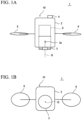
- FIGS. 1 are configuration diagrams of a survey system 1 according to a first example, FIG. 1A is a side view of the same system 1, and FIG. 1B is a bottom view of the same system.
- the survey system 1 is a surveying moving device 10 including a mobile body 2, a scanner 3, a GPS device 4, and an IMU 5.
- the mobile body 2 is a UAV (Unmanned Air Vehicle) capable of autonomous flying.
- the mobile body 2 includes a plurality of propellers 6 extending radially and a flying unit not illustrated in the drawings, and can fly along a flight path determined in advance, and can freely fly by being remotely controlled.
- the GPS device 4 is fixed to the mobile body 2, and receives a signal from a GPS satellite and acquires a UTC, a latitude, and a longitude.
- the GPS device 4 functions as a position measuring device to measure a position of the scanner 3.
- the IMU (Inertial Measurement Unit) 5 is incorporated in the mobile body 2, includes a 3-axis gyro and a 3-axis acceleration sensor, and acquires angular velocities and accelerations in 3-axis directions (roll, pitch, and yaw) of the scanner 3.
- the IMU 5 functions as a posture detecting device to detect a posture of the scanner 3.
- the scanner 3 transmits a laser distance measuring light to measure a three-dimensional position of each scanning point.
- an optical axis deflecting unit including Risley prisms is disposed, and can deflect the distance measuring light in an arbitrary direction.
- a reference optical axis O of the scanner 3 is provided so as to be positioned vertically downward when the mobile body 2 is in a horizontal posture (refer to FIG. 1A ).
- the reference sign 3o denotes a measurement reference point of the scanner 3 on the reference optical axis O.
- FIG. 2 is a configuration block diagram of the scanner 3.
- the scanner 3 includes an emitting unit 3a, a light receiving unit 3b, a distance measuring unit 3c, a scanning arithmetic unit 3d, and an emitting direction detecting unit 3m.
- the emitting unit 3a includes a light emitting element 3e and a pair of Risley prisms 3f and 3g. From the light emitting element 3e, a distance measuring light 3h' is emitted.
- the Risley prisms 3f and 3g face each other while centering on an optical axis 3h of the distance measuring light, and can be rotated independently of each other by a motor driver 3n.
- the Risley prisms 3f and 3g function as a first optical axis deflecting unit to deflect the distance measuring light 3h'.
- the light receiving unit 3b includes a light receiving element 3i and a pair of Fresnel prisms 3j and 3k including a plurality of Risley prisms continuous with each other.
- the light receiving element 3i receives a reflected distance measuring light from a scanning point.
- the Fresnel prisms 3j and 3k face each other while centering on an optical axis 3l of the reflected measuring light 3l', and can be rotated independently of each other by the motor driver 3n.
- the Fresnel prisms 3j and 3k function as a second optical axis deflecting unit to deflect the reflected distance measuring light 3l'.
- the first optical axis deflecting unit is disposed on an emission side
- the second optical axis deflecting unit is disposed on a light receiving side, however, a configuration in which an optical axis deflecting unit is shared by the emission side and the light receiving side may be adopted.
- the distance measuring unit 3c transmits a distance measuring light 3h', and acquires a distance to each scanning point by measuring a round-trip time of the distance measuring light 3h' based on a light receiving signal of the light receiving element 3i.
- the emitting direction detecting unit 3m counts drive pulses input to the motor driver 3n or uses an encoder to detect rotation directions, rotation amounts, and rotation speeds of the Risley prisms 3f and 3g. By passing through the Risley prisms 3f and 3g, the distance measuring light 3h' is deflected in an arbitrary direction.
- the scanning arithmetic unit 3d obtains refractive indexes and rotation angles of the Risley prisms 3f and 3g from the emitting direction detecting unit 3m, and based on these, calculates a deflection angle and direction of the distance measuring light 3h'.
- the emitting direction detecting unit 3m detects rotation directions, rotation amounts, and rotation speeds of the Fresnel prisms 3j and 3k in the same manner.
- the scanning arithmetic unit 3d performs control so that the deflection angles and directions of the Fresnel prisms 3j and 3k are always the same as those of the Risley prisms 3f and 3g.
- the reflected distance measuring light 3l' is deflected so as to match the light receiving optical axis 3l.
- the scanner 3 can arbitrarily deflect the deflection angle and direction of the distance measuring light 3h' in accordance with a combination of rotational positions of the Risley prisms 3f and 3g, and acquire three-dimensional point group data of scanning points.
- the distance measuring light 3h' can be scanned, for example, in a circular form around a deflection reference axis O' (refer to FIG. 3 described below).
- FIG. 3 is a control block diagram of the survey system 1.
- the survey system 1 includes the above-described scanner 3, GPS device 4, and IMU 5, and an arithmetic control unit 7 and an operation unit 8. From the operation unit 8, various operation commands and settings can be input to the arithmetic control unit 7.
- the arithmetic control unit 7 is, for example, a microcontroller including a CPU, a ROM, and a RAM, etc., mounted on an integrated circuit.
- the arithmetic control unit 7 controls a flying unit not illustrated in the drawings, and acquires three-dimensional point group data (distances and angles to scanning points) from the scanner 3, acquires positional information (a latitude and a longitude) of the scanner 3 from the GPS device 4, and acquires posture information (a roll angle, a pitch angle, and a yaw angle) of the scanner 3 from the IMU 5.
- To each of the three-dimensional point group data and the positional information and posture information of the scanner at the timing of outputting a light transmission signal of the scanner 3, time information by the GPS device 4 is provided.
- the arithmetic control unit 7 Based on the time information, the arithmetic control unit 7 records the three-dimensional point group data obtained by the scanner 3, the positional information of the scanner obtained by the GPS device 4, and the posture information of the scanner obtained by the IMU 5 in association with each other.
- the arithmetic control unit 7 further includes a scanning position correcting unit 7A that corrects a three-dimensional position obtained by the scanner 3 by a position and a posture of the scanner. This is described in detail below.
- Step S101 the arithmetic control unit 7 of the survey system 1 acquires a three-dimensional position (absolute coordinates) from the GPS device 4.
- the GPS device 4 and the scanner 3 are integrated together, so that positional information acquired by the GPS device 4 can be regarded as a position of the scanner.
- Step S102 in parallel with Step S101, the scanner 3 performs a distance measurement and an angle measurement to measure a three-dimensional position of each scanning point.
- Step S103 in parallel with Steps S101 and S102, the IMU 5 detects a posture (a roll angle, a pitch angle, and a yaw angle) of the scanner.
- a position of the scanner 3 is acquired as absolute coordinates in Step S101.
- an inclination (posture) of the scanner 3 is known. Therefore, the scanning position correcting unit 7A corrects the reference optical axis O of the scanner to a posture direction of the scanner, and re-calculates a distance and an angle to each scanning point measured by the scanner 3 by setting the coordinates obtained by the GPS device 4 as a measurement reference point 3o of the scanner.
- Step S105 the arithmetic control unit 7 stores the three-dimensional positions (absolute coordinates) of the scanning points corrected in Step S104, and ends the operation.
- the scanner 3 laser scanner
- the scanner 3 so that data omission due to an illuminance does not occur in a product of a three-dimensional survey.
- the distance measuring light 3h' can be freely deflected by the scanner 3, so that by rotating the distance measuring light 3h' at a high speed, two-dimensional circular scanning as illustrated in FIG. 5A can be performed (the arrow in the figure illustrates an advancing direction of the mobile body 2).
- the arrow in the figure illustrates an advancing direction of the mobile body 2.
- three-dimensional point group data of random points can be obtained, so that plants, etc., in the survey site can also be measured.
- FIG. 5B three-dimensional point group data of random points
- the scanner 3 can irradiate a distance measuring light onto not only an upper surface 52 but also a side surface 51 of the structure as compared with a line scanner that irradiates a distance measuring light onto only the upper surface 52 of the structure (one-dimensional scanning). Therefore, at the time of a three-dimensional survey of a survey site, data omission in a product of the survey can be reduced.
- the above-described scanning is just an example, and the scanner 3 can perform line scanning and other arbitrary scanning.
- FIG. 6 is an entire configuration diagram of a survey system 1' according to a second example
- FIGS. 7 are configuration diagrams of a surveying moving device of the survey system 1'
- FIG. 7A is a side view of the same device
- FIG. 7B is a bottom view of the same device.
- the survey system 1' includes a surveying moving device 10' and a surveying instrument 20.
- the surveying moving device 10' includes the mobile body 2, the scanner 3, the IMU 5, and a prism 9 that becomes a target of the surveying instrument 20.
- the prism 9 is fixed to a lateral side of a tip end of a lens portion of the scanner 3.
- the fixation position of the prism 9 may be a position other than this, however, deviations (dr, dp, and dy) in roll axis, pitch axis, and yaw axis directions between the measurement reference point 3o of the scanner and an optical center (optical reflection point) 9o of the prism 9 are made known in advance of attachment of the prism 9.
- the surveying instrument 20 is a total station capable of automatically tracking a target, and includes a main body 20a that rotates horizontally, and a telescope 20b provided vertically rotatably on the main body 20a ( FIG. 6 ).
- the surveying instrument 20 is mounted at a known point by using a tripod.
- the surveying instrument 20 functions as a position measuring device to measure a position of the scanner 3.
- FIG. 8 is a control block diagram of the survey system 1'.
- the surveying moving device 10' includes the scanner 3, the IMU 5, the arithmetic control unit 7, the operation unit 8, a communication unit 11, and a timer 12.
- the arithmetic control unit 7 acquires three-dimensional point group data (distances and angles to scanning points) from the scanner 3, and acquires posture information (a roll angle, a pitch angle, and a yaw angle) of the scanner 3 from the IMU 5.
- the arithmetic control unit 7 acquires a system time from the timer 12 at the timing of outputting a light transmission signal of the scanner 3, and provides the time to the three-dimensional point group data and the posture information of the scanner.
- the scanning position correcting unit 7A corrects a three-dimensional position obtained by the scanner 3 by a position and posture of the scanner. This is described in detail below.
- the surveying instrument 20 includes a horizontal angle detector 21, a vertical angle detector 22, a horizontal rotation drive unit 23, a vertical rotation drive unit 24, a display unit 25, an operation unit 26, an arithmetic control unit 27, a tracking unit 28, a distance measuring unit 29, a storage unit 30, a communication unit 31, and a timer 32.
- the horizontal rotation drive unit 23 and the vertical rotation drive unit 24 are motors, and are controlled by the arithmetic control unit 27 and respectively drive a horizontal rotary shaft and a vertical rotary shaft.
- the display unit 25 and the operation unit 26 are interfaces of the surveying instrument 20, and through these, commanding and setting of a survey work and confirmation of a work situation and measurement results can be performed.
- the horizontal angle detector 21 and the vertical angle detector 22 are absolute encoders or incremental encoders.
- the horizontal angle detector 21 is provided for the horizontal rotary shaft and detects a rotation angle in the horizontal direction of the main body 20a.
- the vertical angle detector 22 is provided for the vertical rotary shaft and detects a rotation angle in the vertical direction of the telescope 20b.
- the tracking unit 28 includes a tracking light transmission system that emits, as a tracking light, an infrared laser or the like with a wavelength different from that of a distance measuring light, and a tracking light receiving system including an image sensor such as a CCD sensor or a CMOS sensor.
- the tracking unit 28 acquires a landscape image including a tracking light and a landscape image from which the tracking light is excluded, and transmits both of these images to the arithmetic control unit 27.
- the arithmetic control unit 27 obtains a center of a target image from a difference between these images, detects a position at which a deviation between the center of the target image and a center of a visual axis of the telescope 20b falls within a certain value as the position of a target, and performs automatic tracking so that the telescope 20b always faces the target.
- the distance measuring unit 29 includes a distance measuring light transmission system that emits a distance measuring light such as an infrared laser to a target, and a distance measuring light receiving system that receives a reflected distance measuring light by a photodiode, etc.
- the distance measuring unit 29 receives a reflected distance measuring light from a target by the distance measuring light receiving system and divides and receives a part of the distance measuring light as an internal reference light, and measures a distance to the target based on a phase difference between the reflected distance measuring light and the internal reference light.
- the distance measuring unit measures an angle to the target from detected values of the horizontal angle detector 21 and the vertical angle detector 22.
- the arithmetic control unit 27 is, for example, a microcontroller including a CPU, a ROM, and a RAM, etc., mounted on an integrated circuit, and controls the rotation drive units 23 and 24 and controls the distance measuring unit 29 and the tracking unit 28.
- the arithmetic control unit 27 acquires a system time from the timer 32 at the timing of outputting a light transmission signal of the distance measuring unit 29, and provides the time to the distance measurement and angle measurement values.
- the storage unit 30 is, for example, a hard disk drive, and stores various programs for the arithmetic control described above.
- a target position (distance and angle) acquired by the distance measuring unit 29 is stored together with time information in the storage unit 30.
- the communication unit 31 can make wireless communication with the communication unit 11 of the surveying moving device 10', and transmits the target position stored in the storage unit 30 to the surveying moving device 10' under control of the arithmetic control unit 27.
- Step S201 the surveying instrument 20 starts automatic tracking of the prism 9 of the surveying moving device 10'.
- Step S202 the surveying instrument 20 measures a distance and an angle to an automatically tracked position by the distance measuring unit 20 to measure a three-dimensional position (absolute coordinates) of the prism 9.
- the surveying instrument 20 transmits the three-dimensional position of the prism 9 to the surveying moving device 10'.
- Step S203 in parallel with Steps S201 and S202, the surveying moving device 10' performs a distance measurement and an angle measurement by the scanner 3 to measure three-dimensional positions of scanning points.
- Step S204 in parallel with Steps S201 to S203, the surveying moving device 10' detects a posture (a roll angle, a pitch angle, and a yaw angle) of the scanner from the IMU 5.
- a posture a roll angle, a pitch angle, and a yaw angle
- Step S205 the arithmetic control unit 7 of the surveying moving device 10' associates the positional information of the prism 9 obtained from the surveying instrument 20 in Step S202, the three-dimensional point group data of the scanning points obtained from the scanner 3 in Step S203, and the posture information of the scanner obtained from the IMU 5 in Step S204 with each other by time. Then, the scanning position correcting unit 7A corrects the three-dimensional positions of the scanning points obtained in Step S203 by the position and posture of the scanner.
- Step S202 the position of the prism 9 is precisely measured as absolute coordinates by the surveying instrument 20.
- Step S204 an inclination (posture) of the scanner 3 is known. Therefore, the scanning position correcting unit 7A corrects the reference optical axis O of the scanner to a posture direction of the scanner, and re-calculates a distance and an angle to each scanning point measured by the scanner 3 by setting coordinates moved by the respective deviations (dr, dp, dy) from the coordinates of the prism 9 as a measurement reference point 3o of the scanner.
- Step S206 the measuring moving device 10' stores the three-dimensional positions (absolute coordinates) of the scanning points corrected in Step S205, and ends the operation.
- a position of the scanner 3 (measurement reference point 3o of the scanner) can be accurately obtained with use of the surveying instrument 20, so that accuracy of the three-dimensional point group data can be further improved.
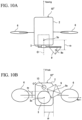
- FIGS. 10 are configuration diagrams of a surveying moving device 10" according to a embodiment, and FIG. 10A is a side view of the same device, and FIG. 10B is a bottom view of the same device.
- FIG. 11 is a control block diagram of the survey system 1".
- the survey system 1" includes the surveying moving device 10" and the surveying instrument 20.
- the surveying moving device 10" includes the mobile body 2, the scanner 3, the prism 9, and a camera 13 in place of the IMU 5.
- the prism 9 is fixed to a lateral side of a tip end of a lens portion of the scanner 3 as in the second example. Deviations (dr, dp, dy) in the roll axis direction, the pitch axis direction, and the yaw axis direction between the measurement reference point 3o of the scanner 3 and the optical center 9o of the prism 9 are made known in advance of attachment of the prism 9.
- the camera 13 is an image sensor such as a CCD sensor or a CMOS sensor, and a position of each pixel on an imaging element can be identified. For example, a position of each pixel on an image is identified by a coordinate system using an imaging optical axis O" of the camera 13 as an origin.
- the camera 13 is incorporated in the mobile body 2, and is fixed so as to be displaced from the mechanism of the scanner 3.
- the imaging optical axis O" of the camera 13 is set so as to be positioned vertically downward when the mobile body 2 is in a horizontal posture (refer to FIG. 10B ).
- the camera 13 functions as a posture detecting device to detect a posture of the scanner 3.
- a control system of the survey system 1" includes, as illustrated in FIG. 11 , on the surveying moving device 10" side, the scanner 3, the arithmetic control unit 7, the operation unit 8, the communication unit 11, the timer 12, and the camera 13.
- the arithmetic control unit 7 acquires three-dimensional point group data (distances and angles to scanning points) from the scanner 3, and acquires image data from the camera 13.
- the arithmetic control unit 7 acquires a system time from the timer 12 at the timing of outputting a light transmission signal of the scanner 3, and provides the time to the three-dimensional point group data and the image data.
- the scanning position correcting unit 7A corrects a three-dimensional position obtained by the scanner 3 by a position and posture of the scanner. This is described in detail below.
- a control system on the surveying instrument 20 is the same as in the second example.
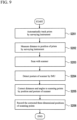
- Step S301 the surveying instrument 20 starts automatic tracking of the prism 9 of the surveying moving device 10".
- Step S302 the surveying instrument 20 measures a distance and an angle to an automatically tracked position by the distance measuring unit 29 to measure a three-dimensional position (absolute coordinates) of the prism 9.
- the surveying instrument 20 transmits the three-dimensional position of the prism 9 to the surveying moving device 10".
- Step S303 in parallel with Steps S301 and S302, the surveying moving device 10" performs a distance measurement and an angle measurement by the scanner 3 to measure three-dimensional positions of scanning points.
- Step S304 in parallel with Steps S301 to S303, the surveying moving device 10" acquires image data by the camera 13.
- the arithmetic control unit 7 of the surveying moving device 10" photographically analyzes the image data to detect a posture (a roll angle, a pitch angle, and a yaw angle) of the camera 13.
- the camera 13 and the scanner 3 are integrated together, so that the posture of the camera 13 can be regarded as a posture of the scanner 3.
- Step S305 the arithmetic control unit 7 associates the positional information of the prism 9 obtained from the surveying instrument 20 in Step S302, the three-dimensional point group data of scanning points obtained from the scanner 3 in Step S303, and the posture information of the scanner obtained through the photographic analysis in Step S304 with each other by time. Then, the scanning position correcting unit 7A corrects the three-dimensional positions of the scanning points obtained in Step S303 by the position and posture of the scanner.
- Step S302 a position of the prism 9 is precisely measured as absolute coordinates by the surveying instrument 20.
- Step S304 an inclination (posture) of the scanner 3 is known. Therefore, the scanning position correcting unit 7A corrects the reference optical axis O of the scanner to a posture direction of the scanner, and re-calculates a distance and an angle to each scanning point measured by the scanner 3 by setting coordinates moved by the deviations (dr, dp, dy) from the coordinates of the prism 9 as a measurement reference point 3o of the scanner.
- the surveying moving device 10 stores the three-dimensional positions (absolute coordinates) of the scanning points corrected in Step S305, and ends the operation.
- the system can be more inexpensively configured than in the case using a precision IMU.
- the surveying moving device 10', 10" and the surveying instrument 20 respectively include the timer 12 and the timer 32 for time synchronization, however, accurate time synchronization is preferably performed by the configuration described below.
- An example is shown by using the second example.
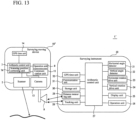
- FIG. 13 illustrates a modification of the survey system 1' according to the second example.
- the surveying moving device 10' includes a GPS time unit 14 in place of the timer 12, and further includes a time synchronizing unit 15.
- the surveying instrument 20 includes a GPS time unit 33 in place of the timer 32.
- Each of the GPS time unit 14 and the GPS time unit 33 includes a clock that receives a signal from a GPS satellite and generates a UTC and a PPS signal being a constant-frequency pulse.
- the GPS time unit 14 provides a first time to the three-dimensional point group data and the posture information of the scanner at the timing of outputting a light transmission signal of the scanner 3.
- the GPS time unit 33 provides a second time to the distance measurement and angle measurement values of the prism 9 at the timing of outputting a light transmission signal of the distance measuring unit 29.
- the time synchronizing unit 15 acquires the three-dimensional point group data given the first time from the arithmetic control unit 7, and acquires the distance measurement and angle measurement values of the prism 9 given the second time via the communication unit 11.
- the time synchronizing unit 15 extracts distance measurement and angle measurement values and three-dimensional point group data which are provided with a first time and a second time, respectively, matching each other, and associates the extracted distance measurement and angle measurement values of the prism 9 and the extracted three-dimensional point group data with each other.
- a second time just before a certain first time and a second time just after the certain first time are extracted, and distance measurement and angle measurement values at a second time are calculated by interpolation.
- the above-described time synchronization can also be applied in a case where the survey period is longer (lower in frequency) than the scanning period.
- the mobile bodies 2 of the surveying moving device 10', 10" is a UAV, however, the mobile body 2 is only required to be movable in a survey site.
- FIG. 14 illustrates another modification of the survey system 1' according to the second example.
- a mobile body 2' illustrated in FIG. 14 is a vehicle, and on the roof of the vehicle, a unit in which the scanner 3, the IMU 5, and the prism 9 are integrated is mounted.
- a mobile body 2" illustrated in FIG. 14 is a handheld housing, and to this housing, a unit in which the scanner 3, the IMU 5, and the prism 9 are integrated is attached. Even when the mobile body has this form, an effect equivalent to that of the second example is obtained.
- the surveying moving device 10, 10' may include, as its arbitrary element, a camera 13 to color three-dimensional point group data acquired by the scanner 3.
- the camera 13 is provided for posture detection of the scanner, however, it may also be used to color three-dimensional point group data.
- the scanner 3 can perform two-dimensional circular scanning as illustrated in FIG. 5A by freely deflecting the distance measuring light 3h', so that scanning according to an angle of view of the camera 13 is possible.
- a scanning range can be made to correspond to an image range of the camera 13, so that there is no waste in the scanning range, and a point group density of three-dimensional point group data in an image taken by the camera 13 can be increased.
- the scanning position correcting unit 7A that corrects three-dimensional positions of scanning points by a position and a posture of the scanner is provided in the arithmetic control unit 7 of the surveying moving device, however, it may be provided in an information processing terminal (personal computer or the like).
- the surveying instrument 20 transmits the three-dimensional position of the prism 9 to the surveying moving device 10, however, it may transmit the three-dimensional position to a separate recording device.
- three-dimensional position group data of scanning points and posture information are also transmitted to a separate recording device and that each data is acquired by an information processing terminal and is corrected another day.
Landscapes
- Engineering & Computer Science (AREA)
- Physics & Mathematics (AREA)
- Radar, Positioning & Navigation (AREA)
- Remote Sensing (AREA)
- General Physics & Mathematics (AREA)
- Electromagnetism (AREA)
- Computer Networks & Wireless Communication (AREA)
- Aviation & Aerospace Engineering (AREA)
- Multimedia (AREA)
- Automation & Control Theory (AREA)
- Length Measuring Devices By Optical Means (AREA)
- Optical Radar Systems And Details Thereof (AREA)
Claims (1)
- Vermessungssystem (1"), das eine Vermessungsbewegungsvorrichtung (10") und ein Vermessungsinstrument (20) aufweist, zum Scannen von dreidimensionalen Punktgruppendaten durch Zusammenwirken der Vermessungsbwegungsvorrichtung und des Vermessungsinstruments,
dadurch gekennzeichnet, dass
die Vermessungsbewegungsvorrichtung (10") aufweist:einen mobilen Körper (2);einen Scanner (3), der aufweist: eine Emissionseinheit (3a), die dazu ausgebildet ist, ein Entfernungsmesslicht zu emittieren; eine Lichtempfangseinheit (3b), die dazu ausgebildet ist, ein reflektiertes Entfernungsmesslicht zu empfangen; eine Entfernungsmesseinheit (3c), die dazu ausgebildet ist, eine Entfernungsmessung basierend auf einer Ausgabe der Lichtempfangseinheit (3b) durchzuführen; eine erste Ablenkeinheit der optischen Achse, die an einer optischen Achse des Entfernungsmesslichts angeordnet und dazu ausgebildet ist, das Entfernungsmesslicht abzulenken; und eine zweite Ablenkeinheit der optischen Achse, die an einer optischen Lichtempfangsachse des reflektierten Entfernungsmesslichts angeordnet und dazu ausgebildet ist, das reflektierte Entfernungsmesslicht im selben Winkel in der selben Richtung wie bei der ersten Ablenkeinheit der optischen Achse abzulenken; und eine Emissionsrichtungsdetektionseinheit, die dazu ausgebildet ist, einen Auslenkwinkel und eine Richtung der ersten Ablenkeinheit der optischen Achse und der zweiten Ablenkeinheit der optischen Achse zu detektieren;eine Kamera (13);ein Prisma (9);einen Zeitgeber (12), der die dreidimensionalen Punktgruppendaten des Scanners und Bilddaten der Kamera mit Zeit versieht;eine arithmetische Steuereinheit (7);eine Kommunikationseinheit (11); undeine Bedieneinheit (8), wobei das Prisma (9) an einer lateralen Seite eines Spitzenendes eines Linsenabschnitts des Scanners (3) befestigt ist,wobei die Kamera (13) ein Bildsensor ist und eine Position jedes Pixels an einem Bildgebungselement identifiziert werden kann,wobei die Kamera (13) in dem mobilen Körper (2) eingebaut und so befestigt ist, dass sie von dem Mechanismus des Scanners (3) verschoben wird,und wobei die optische Bildgebungsachse (O") der Kamera (13) so festgelegt ist, dass sie vertikal nach unten positioniert ist, wenn der mobile Körper (2) in einer horizontalen Lage ist,wobei in dem mobilen Körper (2) Abweichungen (dr, dp, dy) in einer Rollachsenrichtung, einer Nickachsenrichtung, und einer Gierachsenrichtung zwischen einem Messbezugspunkt (30) des Scanners (3) und einem optischen Zentrum (90) des Prismas (9) im Vorfeld bekannt gemacht werden, undwobei die Kamera (13) eine Lagedetektionsvorrichtung ist, die dazu ausgebildet ist, eine Lage des Scanners (3) zu messen,wobei das Vermessungsinstrument (20) eine Tracking-Einheit (28) aufweist, die ein automatisches Tracking zum Prisma (9) durchführt, das zum Ziel des Vermessungsinstruments (20) wird;ein Entfernungsmesseinheit (29) auf Seiten des Vermessungsinstruments, die eine Entfernung und einen Winkel zum Prisma (9) misst;einen Zeitgeber (32) auf Seiten des Vermessungsinstruments, der Messwerte der Entfernung und des Winkels mit Zeit versieht; undeine Kommunikationseinheit (31) auf Seiten des Vermessungsinstruments, wobei das Vermessungsinstrument (20) als eine Positionsmessvorrichtung fungiert, die dazu ausgebildet ist, eine Position des Scanners (3) zu messen, wobei die arithmetische Steuereinheit (7) die dreidimensionalen Punktgruppendaten von dem Scanner (3) erfasst und die Bilddaten von der Kamera (13) erfasst, und wobei die arithmetische Steuereinheit (7) eine Systemzeit von dem Zeitgeber (12) zum Zeitpunkt der Ausgabe eines Lichtübertragungssignals des Scanners (3) erfasst und die dreidimensionalen Punkgruppendaten und die Bilddaten mit der Zeit versieht, und wobei die Scanpositionskorrektureinheit (7A) eine von dem Scanner (3) erhaltene dreidimensionale Position anhand einer Position und Lage des Scanners korrigiert,wobei das Vermessungsinstrument (20) das Prisma (9) anhand der Tracking-Einheit (28) trackt, eine dreidimensionale Position des Prismas (9) anhand der Entfernungsmesseinheit (29) auf Seiten des Vermessungsinstruments misst, und die dreidimensionale Position des Prismas (9) an die Vermessungsbewegungsvorrichtung (10") überträgt,wobei die Vermessungsbewegungsvorrichtung (10") eine Entfernungsmessung und eine Winkelmessung anhand des Scanners (3) durchführt, um dreidimensionale Positionen der Scanpunkte zu messen, und wobei die Scanpositionskorrektureinheit (7A) die von dem Scanner (3) erhaltene dreidimensionale Position anhand einer Position und Lage des Scanners (3) korrigiert, die von der Kamera (13) erfassen Bilddaten analysiert, und eine Lageinformation der Kamera (13) detektiert,wobei die arithmetische Steuereinheit (7) die dreidimensionale Position des Prismas (9), die dreidimensionalen Positionen der Punktgruppendaten der Scanpunkte, und die Lageinformation des Scanners zeitlich einander zuordnet,wobei die Vermessungsbewegungsvorrichtung (10") eine Lage der Kamera (13) berücksichtigt, eine Lage des Scanners (3) anpasst, da die Kamera und der Scanner an dem Bewegungskörper befestigt und daher gemeinsam integriert sind, undwobei die Vermessungsbewegungsvorrichtung (10") eine optische Referenzachse (O) des Scanners zu einer Lagerichtung des Scanners korrigiert und eine Entfernung und einen Winkel für jeden der Scanpunkte neu berechnet, indem um die Abweichungen (dr, dp, dy) von den Koordinaten des Prismas (9) bewegte Koordinaten als Messbezugspunkt (30) des Scanners festgelegt werden.
Applications Claiming Priority (1)
| Application Number | Priority Date | Filing Date | Title |
|---|---|---|---|
| JP2017179701A JP6994879B2 (ja) | 2017-09-20 | 2017-09-20 | 測量システム |
Publications (2)
| Publication Number | Publication Date |
|---|---|
| EP3460396A1 EP3460396A1 (de) | 2019-03-27 |
| EP3460396B1 true EP3460396B1 (de) | 2024-10-23 |
Family
ID=63579011
Family Applications (1)
| Application Number | Title | Priority Date | Filing Date |
|---|---|---|---|
| EP18193950.5A Active EP3460396B1 (de) | 2017-09-20 | 2018-09-12 | Vermessungssystem |
Country Status (3)
| Country | Link |
|---|---|
| US (1) | US11460299B2 (de) |
| EP (1) | EP3460396B1 (de) |
| JP (1) | JP6994879B2 (de) |
Families Citing this family (12)
| Publication number | Priority date | Publication date | Assignee | Title |
|---|---|---|---|---|
| JP7017422B2 (ja) * | 2018-01-31 | 2022-02-08 | 株式会社トプコン | 測量装置 |
| JP7161298B2 (ja) * | 2018-03-26 | 2022-10-26 | 株式会社トプコン | ターゲット装置、測量システム |
| JP2020203664A (ja) * | 2019-03-29 | 2020-12-24 | 株式会社トプコン | 無人飛行機の飛行制御システム及び地形計測システム |
| JP7491730B2 (ja) * | 2020-04-30 | 2024-05-28 | 株式会社トプコン | 作業管理システム,作業管理方法,そのための作業管理プログラム |
| JP2022087978A (ja) * | 2020-12-02 | 2022-06-14 | 三菱電機株式会社 | 位置姿勢算出装置、位置姿勢算出方法及び測量装置 |
| JP2022089308A (ja) * | 2020-12-04 | 2022-06-16 | 株式会社豊田自動織機 | 自律走行システム |
| JP2022120895A (ja) * | 2021-02-08 | 2022-08-19 | 株式会社トプコン | 三次元位置の計測システム,計測方法,および計測マーカー |
| JP7731230B2 (ja) * | 2021-07-14 | 2025-08-29 | 株式会社トプコン | 情報投影システムおよび情報投影方法 |
| JP2023050516A (ja) * | 2021-09-30 | 2023-04-11 | 株式会社トプコン | 打音検査システム |
| EP4311999B1 (de) | 2022-07-29 | 2026-01-21 | Leica Geosystems AG | Automatisches, bezugsloses, genaues stationieren eines geodetischen vermessungsinstruments basierend auf umgebungsinformationen |
| EP4312000B1 (de) | 2022-07-29 | 2025-11-05 | Leica Geosystems AG | Automatisches stationieren eines geodätischen vermessungsinstruments basierend auf referenzmarken-datenbank |
| JP7143001B1 (ja) * | 2022-08-02 | 2022-09-28 | 株式会社マプリィ | 測定システム及び測定方法 |
Family Cites Families (12)
| Publication number | Priority date | Publication date | Assignee | Title |
|---|---|---|---|---|
| JP5145013B2 (ja) * | 2007-11-01 | 2013-02-13 | 株式会社トプコン | 測量機 |
| EP2511656A1 (de) * | 2011-04-14 | 2012-10-17 | Hexagon Technology Center GmbH | Vermessungssystem zur Bestimmung von 3D-Koordinaten einer Objektoberfläche |
| JP5122693B1 (ja) * | 2012-05-18 | 2013-01-16 | エー・シー・エス株式会社 | 車載測量システム |
| US20150254861A1 (en) * | 2012-10-18 | 2015-09-10 | T. Eric Chornenky | Apparatus and method for determining spatial information about environment |
| JP5561843B1 (ja) | 2013-01-07 | 2014-07-30 | 株式会社amuse oneself | 制御装置、測量システム、プログラム及び記録媒体並びに計測方法 |
| US9201424B1 (en) * | 2013-08-27 | 2015-12-01 | Google Inc. | Camera calibration using structure from motion techniques |
| JP6326237B2 (ja) * | 2014-01-31 | 2018-05-16 | 株式会社トプコン | 測定システム |
| JP6541365B2 (ja) * | 2015-02-16 | 2019-07-10 | 株式会社トプコン | 姿勢検出装置及びデータ取得装置 |
| JP6616077B2 (ja) | 2015-02-16 | 2019-12-04 | 株式会社トプコン | 測定装置及び3次元カメラ |
| JP6594686B2 (ja) | 2015-07-14 | 2019-10-23 | 東急建設株式会社 | 三次元形状計測装置、三次元形状計測方法、及びプログラム |
| EP3165945B1 (de) | 2015-11-03 | 2024-01-03 | Leica Geosystems AG | Oberflächenvermessungsgerät zur bestimmung von 3d-koordinaten einer oberfläche |
| JP6691721B2 (ja) * | 2016-02-15 | 2020-05-13 | 株式会社トプコン | 飛行計画作成方法及び飛行体誘導システム |
-
2017
- 2017-09-20 JP JP2017179701A patent/JP6994879B2/ja active Active
-
2018
- 2018-09-05 US US16/122,028 patent/US11460299B2/en active Active
- 2018-09-12 EP EP18193950.5A patent/EP3460396B1/de active Active
Also Published As
| Publication number | Publication date |
|---|---|
| US11460299B2 (en) | 2022-10-04 |
| EP3460396A1 (de) | 2019-03-27 |
| JP2019056571A (ja) | 2019-04-11 |
| US20190086206A1 (en) | 2019-03-21 |
| JP6994879B2 (ja) | 2022-02-04 |
Similar Documents
| Publication | Publication Date | Title |
|---|---|---|
| EP3460396B1 (de) | Vermessungssystem | |
| US11333764B2 (en) | Survey system | |
| US10324183B2 (en) | UAV measuring apparatus and UAV measuring system | |
| JP5688876B2 (ja) | レーザスキャナ測定システムの較正方法 | |
| US9958268B2 (en) | Three-dimensional measuring method and surveying system | |
| EP3205977B1 (de) | Flugplanvorbereitungsverfahren und flugzeugleitsystem | |
| US9758239B2 (en) | System and method for controlling an unmanned air vehicle | |
| CA2832956C (en) | System and method for controlling an unmanned aerial vehicle | |
| US10636171B2 (en) | Device, method, and system for tracking unmanned aerial vehicle, and program therefor | |
| US11614546B2 (en) | Methods for geospatial positioning and portable positioning devices thereof | |
| JP2019132769A5 (de) | ||
| US10527423B1 (en) | Fusion of vision and depth sensors for navigation in complex environments | |
| US20210229810A1 (en) | Information processing device, flight control method, and flight control system | |
| US10146230B2 (en) | Control device, optical device, and control method for tracking unmanned aerial vehicle, and system and program therefor | |
| JP7011908B2 (ja) | 光学情報処理装置、光学情報処理方法および光学情報処理用プログラム | |
| US12524870B2 (en) | Bar arrangement inspection system and bar arrangement inspection method | |
| US20220099442A1 (en) | Surveying System | |
| JP7161298B2 (ja) | ターゲット装置、測量システム | |
| JP2018146524A (ja) | 測量システム | |
| JP7203935B2 (ja) | 光学情報処理装置、光学情報処理方法および光学情報処理用プログラム | |
| JP2022147973A (ja) | 飛行体の姿勢検出装置及び姿勢制御システム | |
| JP2023048409A (ja) | 測量システム | |
| JP6954830B2 (ja) | ターゲット装置、測量方法、測量装置および測量用プログラム |
Legal Events
| Date | Code | Title | Description |
|---|---|---|---|
| PUAI | Public reference made under article 153(3) epc to a published international application that has entered the european phase |
Free format text: ORIGINAL CODE: 0009012 |
|
| STAA | Information on the status of an ep patent application or granted ep patent |
Free format text: STATUS: THE APPLICATION HAS BEEN PUBLISHED |
|
| AK | Designated contracting states |
Kind code of ref document: A1 Designated state(s): AL AT BE BG CH CY CZ DE DK EE ES FI FR GB GR HR HU IE IS IT LI LT LU LV MC MK MT NL NO PL PT RO RS SE SI SK SM TR |
|
| AX | Request for extension of the european patent |
Extension state: BA ME |
|
| STAA | Information on the status of an ep patent application or granted ep patent |
Free format text: STATUS: REQUEST FOR EXAMINATION WAS MADE |
|
| 17P | Request for examination filed |
Effective date: 20190902 |
|
| RBV | Designated contracting states (corrected) |
Designated state(s): AL AT BE BG CH CY CZ DE DK EE ES FI FR GB GR HR HU IE IS IT LI LT LU LV MC MK MT NL NO PL PT RO RS SE SI SK SM TR |
|
| STAA | Information on the status of an ep patent application or granted ep patent |
Free format text: STATUS: EXAMINATION IS IN PROGRESS |
|
| 17Q | First examination report despatched |
Effective date: 20210728 |
|
| GRAP | Despatch of communication of intention to grant a patent |
Free format text: ORIGINAL CODE: EPIDOSNIGR1 |
|
| STAA | Information on the status of an ep patent application or granted ep patent |
Free format text: STATUS: GRANT OF PATENT IS INTENDED |
|
| INTG | Intention to grant announced |
Effective date: 20240605 |
|
| GRAS | Grant fee paid |
Free format text: ORIGINAL CODE: EPIDOSNIGR3 |
|
| GRAA | (expected) grant |
Free format text: ORIGINAL CODE: 0009210 |
|
| STAA | Information on the status of an ep patent application or granted ep patent |
Free format text: STATUS: THE PATENT HAS BEEN GRANTED |
|
| AK | Designated contracting states |
Kind code of ref document: B1 Designated state(s): AL AT BE BG CH CY CZ DE DK EE ES FI FR GB GR HR HU IE IS IT LI LT LU LV MC MK MT NL NO PL PT RO RS SE SI SK SM TR |
|
| REG | Reference to a national code |
Ref country code: GB Ref legal event code: FG4D |
|
| REG | Reference to a national code |
Ref country code: CH Ref legal event code: EP |
|
| REG | Reference to a national code |
Ref country code: DE Ref legal event code: R096 Ref document number: 602018075682 Country of ref document: DE |
|
| REG | Reference to a national code |
Ref country code: IE Ref legal event code: FG4D |
|
| REG | Reference to a national code |
Ref country code: LT Ref legal event code: MG9D |
|
| REG | Reference to a national code |
Ref country code: NL Ref legal event code: MP Effective date: 20241023 |
|
| REG | Reference to a national code |
Ref country code: AT Ref legal event code: MK05 Ref document number: 1735183 Country of ref document: AT Kind code of ref document: T Effective date: 20241023 |
|
| PG25 | Lapsed in a contracting state [announced via postgrant information from national office to epo] |
Ref country code: NL Free format text: LAPSE BECAUSE OF FAILURE TO SUBMIT A TRANSLATION OF THE DESCRIPTION OR TO PAY THE FEE WITHIN THE PRESCRIBED TIME-LIMIT Effective date: 20241023 |
|
| PG25 | Lapsed in a contracting state [announced via postgrant information from national office to epo] |
Ref country code: NL Free format text: LAPSE BECAUSE OF FAILURE TO SUBMIT A TRANSLATION OF THE DESCRIPTION OR TO PAY THE FEE WITHIN THE PRESCRIBED TIME-LIMIT Effective date: 20241023 |
|
| PG25 | Lapsed in a contracting state [announced via postgrant information from national office to epo] |
Ref country code: PT Free format text: LAPSE BECAUSE OF FAILURE TO SUBMIT A TRANSLATION OF THE DESCRIPTION OR TO PAY THE FEE WITHIN THE PRESCRIBED TIME-LIMIT Effective date: 20250224 Ref country code: HR Free format text: LAPSE BECAUSE OF FAILURE TO SUBMIT A TRANSLATION OF THE DESCRIPTION OR TO PAY THE FEE WITHIN THE PRESCRIBED TIME-LIMIT Effective date: 20241023 Ref country code: IS Free format text: LAPSE BECAUSE OF FAILURE TO SUBMIT A TRANSLATION OF THE DESCRIPTION OR TO PAY THE FEE WITHIN THE PRESCRIBED TIME-LIMIT Effective date: 20250223 |
|
| PG25 | Lapsed in a contracting state [announced via postgrant information from national office to epo] |
Ref country code: FI Free format text: LAPSE BECAUSE OF FAILURE TO SUBMIT A TRANSLATION OF THE DESCRIPTION OR TO PAY THE FEE WITHIN THE PRESCRIBED TIME-LIMIT Effective date: 20241023 |
|
| PG25 | Lapsed in a contracting state [announced via postgrant information from national office to epo] |
Ref country code: BG Free format text: LAPSE BECAUSE OF FAILURE TO SUBMIT A TRANSLATION OF THE DESCRIPTION OR TO PAY THE FEE WITHIN THE PRESCRIBED TIME-LIMIT Effective date: 20241023 |
|
| PG25 | Lapsed in a contracting state [announced via postgrant information from national office to epo] |
Ref country code: ES Free format text: LAPSE BECAUSE OF FAILURE TO SUBMIT A TRANSLATION OF THE DESCRIPTION OR TO PAY THE FEE WITHIN THE PRESCRIBED TIME-LIMIT Effective date: 20241023 |
|
| PG25 | Lapsed in a contracting state [announced via postgrant information from national office to epo] |
Ref country code: NO Free format text: LAPSE BECAUSE OF FAILURE TO SUBMIT A TRANSLATION OF THE DESCRIPTION OR TO PAY THE FEE WITHIN THE PRESCRIBED TIME-LIMIT Effective date: 20250123 |
|
| PG25 | Lapsed in a contracting state [announced via postgrant information from national office to epo] |
Ref country code: GR Free format text: LAPSE BECAUSE OF FAILURE TO SUBMIT A TRANSLATION OF THE DESCRIPTION OR TO PAY THE FEE WITHIN THE PRESCRIBED TIME-LIMIT Effective date: 20250124 Ref country code: AT Free format text: LAPSE BECAUSE OF FAILURE TO SUBMIT A TRANSLATION OF THE DESCRIPTION OR TO PAY THE FEE WITHIN THE PRESCRIBED TIME-LIMIT Effective date: 20241023 Ref country code: LV Free format text: LAPSE BECAUSE OF FAILURE TO SUBMIT A TRANSLATION OF THE DESCRIPTION OR TO PAY THE FEE WITHIN THE PRESCRIBED TIME-LIMIT Effective date: 20241023 |
|
| PG25 | Lapsed in a contracting state [announced via postgrant information from national office to epo] |
Ref country code: PL Free format text: LAPSE BECAUSE OF FAILURE TO SUBMIT A TRANSLATION OF THE DESCRIPTION OR TO PAY THE FEE WITHIN THE PRESCRIBED TIME-LIMIT Effective date: 20241023 |
|
| PG25 | Lapsed in a contracting state [announced via postgrant information from national office to epo] |
Ref country code: RS Free format text: LAPSE BECAUSE OF FAILURE TO SUBMIT A TRANSLATION OF THE DESCRIPTION OR TO PAY THE FEE WITHIN THE PRESCRIBED TIME-LIMIT Effective date: 20250123 |
|
| PG25 | Lapsed in a contracting state [announced via postgrant information from national office to epo] |
Ref country code: SM Free format text: LAPSE BECAUSE OF FAILURE TO SUBMIT A TRANSLATION OF THE DESCRIPTION OR TO PAY THE FEE WITHIN THE PRESCRIBED TIME-LIMIT Effective date: 20241023 |
|
| PG25 | Lapsed in a contracting state [announced via postgrant information from national office to epo] |
Ref country code: DK Free format text: LAPSE BECAUSE OF FAILURE TO SUBMIT A TRANSLATION OF THE DESCRIPTION OR TO PAY THE FEE WITHIN THE PRESCRIBED TIME-LIMIT Effective date: 20241023 |
|
| PG25 | Lapsed in a contracting state [announced via postgrant information from national office to epo] |
Ref country code: EE Free format text: LAPSE BECAUSE OF FAILURE TO SUBMIT A TRANSLATION OF THE DESCRIPTION OR TO PAY THE FEE WITHIN THE PRESCRIBED TIME-LIMIT Effective date: 20241023 |
|
| PG25 | Lapsed in a contracting state [announced via postgrant information from national office to epo] |
Ref country code: RO Free format text: LAPSE BECAUSE OF FAILURE TO SUBMIT A TRANSLATION OF THE DESCRIPTION OR TO PAY THE FEE WITHIN THE PRESCRIBED TIME-LIMIT Effective date: 20241023 |
|
| REG | Reference to a national code |
Ref country code: DE Ref legal event code: R097 Ref document number: 602018075682 Country of ref document: DE |
|
| PG25 | Lapsed in a contracting state [announced via postgrant information from national office to epo] |
Ref country code: SK Free format text: LAPSE BECAUSE OF FAILURE TO SUBMIT A TRANSLATION OF THE DESCRIPTION OR TO PAY THE FEE WITHIN THE PRESCRIBED TIME-LIMIT Effective date: 20241023 |
|
| PG25 | Lapsed in a contracting state [announced via postgrant information from national office to epo] |
Ref country code: CZ Free format text: LAPSE BECAUSE OF FAILURE TO SUBMIT A TRANSLATION OF THE DESCRIPTION OR TO PAY THE FEE WITHIN THE PRESCRIBED TIME-LIMIT Effective date: 20241023 |
|
| PG25 | Lapsed in a contracting state [announced via postgrant information from national office to epo] |
Ref country code: IT Free format text: LAPSE BECAUSE OF FAILURE TO SUBMIT A TRANSLATION OF THE DESCRIPTION OR TO PAY THE FEE WITHIN THE PRESCRIBED TIME-LIMIT Effective date: 20241023 |
|
| PLBE | No opposition filed within time limit |
Free format text: ORIGINAL CODE: 0009261 |
|
| STAA | Information on the status of an ep patent application or granted ep patent |
Free format text: STATUS: NO OPPOSITION FILED WITHIN TIME LIMIT |
|
| PG25 | Lapsed in a contracting state [announced via postgrant information from national office to epo] |
Ref country code: SE Free format text: LAPSE BECAUSE OF FAILURE TO SUBMIT A TRANSLATION OF THE DESCRIPTION OR TO PAY THE FEE WITHIN THE PRESCRIBED TIME-LIMIT Effective date: 20241023 |
|
| 26N | No opposition filed |
Effective date: 20250724 |
|
| REG | Reference to a national code |
Ref country code: CH Ref legal event code: U11 Free format text: ST27 STATUS EVENT CODE: U-0-0-U10-U11 (AS PROVIDED BY THE NATIONAL OFFICE) Effective date: 20251001 |
|
| PGFP | Annual fee paid to national office [announced via postgrant information from national office to epo] |
Ref country code: DE Payment date: 20250730 Year of fee payment: 8 |
|
| PGFP | Annual fee paid to national office [announced via postgrant information from national office to epo] |
Ref country code: CH Payment date: 20251001 Year of fee payment: 8 |