EP3458468B1 - Steroid 6.7.beta.-epoxides as chemical intermediates - Google Patents
Steroid 6.7.beta.-epoxides as chemical intermediates Download PDFInfo
- Publication number
- EP3458468B1 EP3458468B1 EP17725744.1A EP17725744A EP3458468B1 EP 3458468 B1 EP3458468 B1 EP 3458468B1 EP 17725744 A EP17725744 A EP 17725744A EP 3458468 B1 EP3458468 B1 EP 3458468B1
- Authority
- EP
- European Patent Office
- Prior art keywords
- general formula
- compound
- alkyl
- halo
- group
- Prior art date
- Legal status (The legal status is an assumption and is not a legal conclusion. Google has not performed a legal analysis and makes no representation as to the accuracy of the status listed.)
- Active
Links
- 0 C[C@](**)[C@@](C(*)CC1C2[C@]3O[C@@]33)[C@@]1(C)C(*)CC2[C@@](C)(CC1)C3=CC1=O Chemical compound C[C@](**)[C@@](C(*)CC1C2[C@]3O[C@@]33)[C@@]1(C)C(*)CC2[C@@](C)(CC1)C3=CC1=O 0.000 description 13
- SDWKKDYWQLIHTJ-YZWPUJPGSA-N CC[C@H](C(CC(CC1)=O)[C@@]1(C)C(CC1)C2C(CC3)[C@@]1(C)[C@H]3[C@H](C)COC(C)=O)C2=O Chemical compound CC[C@H](C(CC(CC1)=O)[C@@]1(C)C(CC1)C2C(CC3)[C@@]1(C)[C@H]3[C@H](C)COC(C)=O)C2=O SDWKKDYWQLIHTJ-YZWPUJPGSA-N 0.000 description 1
- FXJLSXXLIPZVPQ-QGOOLPNBSA-N CC[C@H](C(CC(CC1)=O)[C@@]1(C)C(CC1)C2C(CC3)[C@@]1(C)[C@H]3[C@H](C)COC(C)=O)[C@@H]2O Chemical compound CC[C@H](C(CC(CC1)=O)[C@@]1(C)C(CC1)C2C(CC3)[C@@]1(C)[C@H]3[C@H](C)COC(C)=O)[C@@H]2O FXJLSXXLIPZVPQ-QGOOLPNBSA-N 0.000 description 1
- WCQAEILCSRENTJ-VRDWDQJLSA-N CC[C@H]([C@H](C[C@@H](CC1)O)[C@@]1(C)C(CC1)C2C(CC3)[C@@]1(C)[C@H]3[C@H](C)C=O)[C@H]2O Chemical compound CC[C@H]([C@H](C[C@@H](CC1)O)[C@@]1(C)C(CC1)C2C(CC3)[C@@]1(C)[C@H]3[C@H](C)C=O)[C@H]2O WCQAEILCSRENTJ-VRDWDQJLSA-N 0.000 description 1
- MSGUGGDDULPEQL-VRDWDQJLSA-N CC[C@H]([C@H](C[C@@H](CC1)O)[C@@]1(C)C(CC1)C2C(CC3)[C@@]1(C)[C@H]3[C@H](C)CO)[C@H]2O Chemical compound CC[C@H]([C@H](C[C@@H](CC1)O)[C@@]1(C)C(CC1)C2C(CC3)[C@@]1(C)[C@H]3[C@H](C)CO)[C@H]2O MSGUGGDDULPEQL-VRDWDQJLSA-N 0.000 description 1
- OBWZWWLOOIRLFT-IRYAPPDHSA-N C[C@H](CC(C(OC)=O)C(OC)=O)C(CC1)[C@@](C)(CC2)C1C(CC1)C2[C@@](C)(CC2)C1=CC2=O Chemical compound C[C@H](CC(C(OC)=O)C(OC)=O)C(CC1)[C@@](C)(CC2)C1C(CC1)C2[C@@](C)(CC2)C1=CC2=O OBWZWWLOOIRLFT-IRYAPPDHSA-N 0.000 description 1
- XBJIRNJOJLUDPD-IRYAPPDHSA-N C[C@H](CC(C(OC)=O)C(OC)=O)C(CC1)[C@@](C)(CCC2[C@@]3(C)CC4)C1C2C=CC3=CC4=O Chemical compound C[C@H](CC(C(OC)=O)C(OC)=O)C(CC1)[C@@](C)(CCC2[C@@]3(C)CC4)C1C2C=CC3=CC4=O XBJIRNJOJLUDPD-IRYAPPDHSA-N 0.000 description 1
- XXAIOHKWBTUQKJ-YXKASRFNSA-N C[C@H](CCC#N)C(CC1)[C@@](C)(CC2)C1C(CC1)C2[C@@](C)(CC2)C1=CC2=O Chemical compound C[C@H](CCC#N)C(CC1)[C@@](C)(CC2)C1C(CC1)C2[C@@](C)(CC2)C1=CC2=O XXAIOHKWBTUQKJ-YXKASRFNSA-N 0.000 description 1
- LOIXTNIUXPTFKF-KGLOXSIVSA-N C[C@H](CCC#N)C(CC1)[C@@](C)(CC2)C1C(CC1C34)C2[C@@](C)(CC2)[C@@]13[C@@H]4C21OCCO1 Chemical compound C[C@H](CCC#N)C(CC1)[C@@](C)(CC2)C1C(CC1C34)C2[C@@](C)(CC2)[C@@]13[C@@H]4C21OCCO1 LOIXTNIUXPTFKF-KGLOXSIVSA-N 0.000 description 1
- ZQQPNEANPAYUGN-IESYDMTLSA-N C[C@H](CN)[C@@H](CC1)[C@@](C)(CCC2[C@@]3(C)CC4)C1C2C=CC3=CC4=O Chemical compound C[C@H](CN)[C@@H](CC1)[C@@](C)(CCC2[C@@]3(C)CC4)C1C2C=CC3=CC4=O ZQQPNEANPAYUGN-IESYDMTLSA-N 0.000 description 1
- WJKJZKIHLUIQTO-VHPLENGMSA-N C[C@H](CO)C(CC1)[C@@](C)(CCC2[C@@]3(C)CC4)C1C2C=CC3=CC4=O Chemical compound C[C@H](CO)C(CC1)[C@@](C)(CCC2[C@@]3(C)CC4)C1C2C=CC3=CC4=O WJKJZKIHLUIQTO-VHPLENGMSA-N 0.000 description 1
- KMLJMNOLKWCCDJ-SSGKUPAPSA-N C[C@H](CO)[C@@](C)(CC1)[C@@](C)(CC2)C1C([C@H]1O[C@H]11)C2[C@@](C)(CC2)C1=CC2=O Chemical compound C[C@H](CO)[C@@](C)(CC1)[C@@](C)(CC2)C1C([C@H]1O[C@H]11)C2[C@@](C)(CC2)C1=CC2=O KMLJMNOLKWCCDJ-SSGKUPAPSA-N 0.000 description 1
- ULOITWZKFZYURA-KBEWHFDLSA-N C[C@H](COC)C(CC1)[C@@](C)(CCC2[C@@]3(C)CC4)C1C2C=CC3=CC4=O Chemical compound C[C@H](COC)C(CC1)[C@@](C)(CCC2[C@@]3(C)CC4)C1C2C=CC3=CC4=O ULOITWZKFZYURA-KBEWHFDLSA-N 0.000 description 1
Images






Classifications
-
- C—CHEMISTRY; METALLURGY
- C07—ORGANIC CHEMISTRY
- C07J—STEROIDS
- C07J71/00—Steroids in which the cyclopenta(a)hydrophenanthrene skeleton is condensed with a heterocyclic ring
- C07J71/0005—Oxygen-containing hetero ring
- C07J71/001—Oxiranes
-
- A—HUMAN NECESSITIES
- A61—MEDICAL OR VETERINARY SCIENCE; HYGIENE
- A61P—SPECIFIC THERAPEUTIC ACTIVITY OF CHEMICAL COMPOUNDS OR MEDICINAL PREPARATIONS
- A61P1/00—Drugs for disorders of the alimentary tract or the digestive system
- A61P1/16—Drugs for disorders of the alimentary tract or the digestive system for liver or gallbladder disorders, e.g. hepatoprotective agents, cholagogues, litholytics
-
- C—CHEMISTRY; METALLURGY
- C07—ORGANIC CHEMISTRY
- C07J—STEROIDS
- C07J41/00—Normal steroids containing one or more nitrogen atoms not belonging to a hetero ring
- C07J41/0033—Normal steroids containing one or more nitrogen atoms not belonging to a hetero ring not covered by C07J41/0005
- C07J41/0055—Normal steroids containing one or more nitrogen atoms not belonging to a hetero ring not covered by C07J41/0005 the 17-beta position being substituted by an uninterrupted chain of at least three carbon atoms which may or may not be branched, e.g. cholane or cholestane derivatives, optionally cyclised, e.g. 17-beta-phenyl or 17-beta-furyl derivatives
- C07J41/0061—Normal steroids containing one or more nitrogen atoms not belonging to a hetero ring not covered by C07J41/0005 the 17-beta position being substituted by an uninterrupted chain of at least three carbon atoms which may or may not be branched, e.g. cholane or cholestane derivatives, optionally cyclised, e.g. 17-beta-phenyl or 17-beta-furyl derivatives one of the carbon atoms being part of an amide group
-
- C—CHEMISTRY; METALLURGY
- C07—ORGANIC CHEMISTRY
- C07J—STEROIDS
- C07J9/00—Normal steroids containing carbon, hydrogen, halogen or oxygen substituted in position 17 beta by a chain of more than two carbon atoms, e.g. cholane, cholestane, coprostane
-
- C—CHEMISTRY; METALLURGY
- C07—ORGANIC CHEMISTRY
- C07J—STEROIDS
- C07J9/00—Normal steroids containing carbon, hydrogen, halogen or oxygen substituted in position 17 beta by a chain of more than two carbon atoms, e.g. cholane, cholestane, coprostane
- C07J9/005—Normal steroids containing carbon, hydrogen, halogen or oxygen substituted in position 17 beta by a chain of more than two carbon atoms, e.g. cholane, cholestane, coprostane containing a carboxylic function directly attached or attached by a chain containing only carbon atoms to the cyclopenta[a]hydrophenanthrene skeleton
-
- C—CHEMISTRY; METALLURGY
- C07—ORGANIC CHEMISTRY
- C07J—STEROIDS
- C07J13/00—Normal steroids containing carbon, hydrogen, halogen or oxygen having a carbon-to-carbon double bond from or to position 17
- C07J13/005—Normal steroids containing carbon, hydrogen, halogen or oxygen having a carbon-to-carbon double bond from or to position 17 with double bond in position 16 (17)
-
- C—CHEMISTRY; METALLURGY
- C07—ORGANIC CHEMISTRY
- C07J—STEROIDS
- C07J13/00—Normal steroids containing carbon, hydrogen, halogen or oxygen having a carbon-to-carbon double bond from or to position 17
- C07J13/007—Normal steroids containing carbon, hydrogen, halogen or oxygen having a carbon-to-carbon double bond from or to position 17 with double bond in position 17 (20)
-
- C—CHEMISTRY; METALLURGY
- C07—ORGANIC CHEMISTRY
- C07J—STEROIDS
- C07J17/00—Normal steroids containing carbon, hydrogen, halogen or oxygen, having an oxygen-containing hetero ring not condensed with the cyclopenta(a)hydrophenanthrene skeleton
-
- C—CHEMISTRY; METALLURGY
- C07—ORGANIC CHEMISTRY
- C07J—STEROIDS
- C07J21/00—Normal steroids containing carbon, hydrogen, halogen or oxygen having an oxygen-containing hetero ring spiro-condensed with the cyclopenta(a)hydrophenanthrene skeleton
- C07J21/005—Ketals
- C07J21/006—Ketals at position 3
-
- C—CHEMISTRY; METALLURGY
- C07—ORGANIC CHEMISTRY
- C07J—STEROIDS
- C07J31/00—Normal steroids containing one or more sulfur atoms not belonging to a hetero ring
- C07J31/006—Normal steroids containing one or more sulfur atoms not belonging to a hetero ring not covered by C07J31/003
-
- C—CHEMISTRY; METALLURGY
- C07—ORGANIC CHEMISTRY
- C07J—STEROIDS
- C07J41/00—Normal steroids containing one or more nitrogen atoms not belonging to a hetero ring
- C07J41/0033—Normal steroids containing one or more nitrogen atoms not belonging to a hetero ring not covered by C07J41/0005
- C07J41/0055—Normal steroids containing one or more nitrogen atoms not belonging to a hetero ring not covered by C07J41/0005 the 17-beta position being substituted by an uninterrupted chain of at least three carbon atoms which may or may not be branched, e.g. cholane or cholestane derivatives, optionally cyclised, e.g. 17-beta-phenyl or 17-beta-furyl derivatives
-
- C—CHEMISTRY; METALLURGY
- C07—ORGANIC CHEMISTRY
- C07J—STEROIDS
- C07J41/00—Normal steroids containing one or more nitrogen atoms not belonging to a hetero ring
- C07J41/0033—Normal steroids containing one or more nitrogen atoms not belonging to a hetero ring not covered by C07J41/0005
- C07J41/0094—Normal steroids containing one or more nitrogen atoms not belonging to a hetero ring not covered by C07J41/0005 containing nitrile radicals, including thiocyanide radicals
-
- C—CHEMISTRY; METALLURGY
- C07—ORGANIC CHEMISTRY
- C07J—STEROIDS
- C07J43/00—Normal steroids having a nitrogen-containing hetero ring spiro-condensed or not condensed with the cyclopenta(a)hydrophenanthrene skeleton
- C07J43/003—Normal steroids having a nitrogen-containing hetero ring spiro-condensed or not condensed with the cyclopenta(a)hydrophenanthrene skeleton not condensed
-
- C—CHEMISTRY; METALLURGY
- C07—ORGANIC CHEMISTRY
- C07J—STEROIDS
- C07J51/00—Normal steroids with unmodified cyclopenta(a)hydrophenanthrene skeleton not provided for in groups C07J1/00 - C07J43/00
Definitions
- the present invention relates to methods of preparing compounds which are intermediates in the synthesis of bile acid derivatives with pharmacological activity.
- the invention relates to methods of preparing intermediates in the synthesis of obeticholic acid and its analogues.
- the invention further relates to novel intermediates per se.
- Bile acids are steroid acids which are found in the bile of mammals and include compounds such as cholic acid, chenodeoxycholic acid, lithocholic acid and deoxycholic acid, all of which are found in humans. Many bile acids are natural ligands of the farnesoid X receptor (FXR) which is expressed in the liver and intestine of mammals, including humans.
- FXR farnesoid X receptor
- Bile acids are derivatives of steroids and are numbered in the same way. The following shows the general numbering system for steroids and the numbering of the carbon atoms in chenodeoxycholic acid.
- Agonists of FXR have been found to be of use in the treatment of cholestatic liver disorders including primary biliary cholangitis and non-alcoholic steatohepatitis (see review by Jonker et al., in Journal of Steroid Biochemistry & Molecular Biology, 2012, 130, 147-158 ).
- Ursodeoxycholic acid (UDCA), a bile acid originally isolated from the gall bladder of bears, is currently used in the treatment of cholestatic liver disorders, although it appears to be inactive at the FXR.
- bile acids and their derivatives are also modulators of the G protein-coupled receptor TGR5.
- This is a member of the rhodopsin-like superfamily of G-protein coupled receptors and has an important role in the bile acid signalling network, which complements the role of the FXR.
- obeticholic acid which is a potent agonist of both FXR and TGR5.
- Obeticholic acid is described in WO02/072598 and EP1568706 , both of which describe a process for the preparation of obeticholic acid from 7-keto lithocholic acid, which is derived from cholic acid. Further processes for the production of obeticholic acid and its derivatives are described in WO2006/122977 , US2009/0062256 and WO2013/192097 and all of these processes also start from 7-keto lithocholic acid.
- Cholic acid the current starting material for the production of obeticholic acid
- obeticholic acid is a natural bile acid which is usually obtained from the slaughter of cows and other animals. This means that the availability of cholic acid and other bile acids is limited by the number of cattle available for slaughter. Since the incidence of cholestatic liver disease is increasing worldwide, the demand for synthetic bile acids such as obeticholic acid is also likely to increase and it is doubtful whether the supply of naturally derived bile acids will continue to be sufficient to meet demand.
- a starting material derived from animals means that there is the possibility of the contamination of the material with infectious agents such as viruses or prions, which can not only be hazardous to workers but could potentially contaminate the end products if steps are not taken to prevent this.
- bile acids in an attempt to solve the problems associated with the use of bile acids as starting materials, the present inventors have devised a process for the synthesis of synthetic bile acid derivatives, such as obeticholic acid (OCA, referred to herein as compound (XA)), which uses plant sterols as starting materials.
- OCA obeticholic acid
- XA plant sterols
- the inventors have developed a process for the production of synthetic bile acids which proceeds via novel intermediates and which provides the final product in significantly higher yield than current processes.
- the process is flexible and can use a variety of different starting materials including animal, fungal and plant sterols.
- Suitable animal sterols which can be used as starting materials include deoxycholic acid, cholic acid, while fungal sterols include ergosterol.
- Plant sterols are widely available at significantly lower cost than bile acids and, indeed, are often waste products of other processes.
- Suitable plant sterol and plant sterol derivatives which can be used as starting materials include bis-norcholenol (also known as 20-hydroxymethylpregn-4-en-3-one), androstenedione, androstadienedione, dehydroepiandrosterone, stigmasterol, brassicasterol, campesterol and ⁇ -sitosterol.
- PCT/GB2015/053516 ( WO2016/079517 ), PCT/GB2015/053517 ( WO2016/079518 ), PCT/GB2015/053518 ( WO2016/079519 ) and PCT/GB2015/053519 ( WO2016/079520 ) relate to intermediates in the process of synthesizing obeticholic acid (and analogues) as well as to processes for preparing the intermediates and processes for converting them to the desired products.
- the present application relates to further compounds which are intermediates in the synthesis of obeticholic acid and analogues thereof.
- a process for preparing a compound of general formula (Ia) comprising: reacting a compound of general formula (IIa) with a halogenating agent followed by reaction with base to give a compound of general formula (Ia): wherein Y, R 2 , R 4 and R 5 are as above defined for a compound of general formula (Ia).
- a process for preparing a compound of general formula (I) comprising: reacting a compound of general formula (II) with trichloroisocyanuric acid (TCCA), tribromoisocyanuric acid (TBCA), triiodoisocyanuric acid (TICA), 1,3-dichloro-5,5-dimethylhydantoin (DCDMH), 1,3-dibromo-5,5-dimethylhydantoin (DBDMH), or 1,3-diiodo-5,5-dimethylhydantoin (DIDMH) followed by reaction with base to give a compound of general formula (I): wherein Y, R 2 , R 4 and R 5 are as above defined for a compound of general formula (I).
- TCCA trichloroisocyanuric acid
- TBCA tribromoisocyanuric acid
- TICA triiodoisocyanuric acid
- DCDMH 1,3-dichloro-5,5-
- the compounds of general formula (IIIxa) and general formula (IIIya), and compounds of general formula (IIIx) and general formula (Illy) per se are useful as intermediates in the synthesis of a compound of general formula (Ia) or a compound of general formula (I), respectively.
- a mixture comprising a compound of formula (IIIxa) and a compound of general formula (IIIya).
- a mixture comprising a compound of formula (IIIx) and a compound of general formula (Illy).
- step (A) is carried out in the presence of HOC(O)R x , HOR y , or HSO 3 R z ; wherein R x is H, C 1-4 alkyl (e.g. methyl or ethyl), phenyl or benzyl; R y is phenyl, benzyl or C 2-4 alkene (e.g. allyl); and R z is CF 3 , wherein phenyl and benzyl are optionally substituted with one or more substituents selected from C 1-4 alkyl, OC 1-4 alkyl, halo, nitro, C 1-4 haloalkyl and OC 1-4 haloalkyl.
- HOR x , HOR y or HSO 3 R z may be present as an additive in the reaction (suitably in the absence of water and in the presence of an aprotic solvent) or as the reaction solvent itself.
- mixtures of compounds of general formula (IIIxa) and/or, compounds of general formula (IIIya) and/or compounds of general formula (IIIxz) and/or compounds of general formula (IIIyz) are formed in step A and then reacted in step B.
- the process further includes the step of removal of group R 40 before treatment with base. In one embodiment, the process further includes the step of removal of group R 40 before step (B) is carried out.
- a compound of general formula (IVa) and a compound of general formula (Va) per se and a compound of general formula (IV) and a compound of general formula (V) per se such compounds being useful as intermediates in the synthesis of a compound of general formula (Xa) and a compound of general formula (X), respectively.
- C 1-20 alkyl refers to a straight or branched fully saturated hydrocarbon group having from 1 to 20 carbon atoms.
- the term encompasses methyl, ethyl, n -propyl, isopropyl, n -butyl, isobutyl, s -butyl and t -butyl.
- Other alkyl groups for example C 1-12 alkyl, C 1-10 alkyl, C 1-8 alkyl, C 1-6 alkyl, C 1-5 alkyl, C 1-4 alkyl, C 1-3 alkyl, or C 1-2 alkyl are as defined above but contain different numbers of carbon atoms.
- heterocyclic groups include pyrrolidine, piperidine, morpholine, piperazine, tetrahydrofuran, dioxolane (e.g. 1,3-dioxolane), dioxane (e.g. 1,3-dioxane) and cyclic thioethers.
- the term also includes bicyclic and bridged groups such as 9-borabicyclo(3.3.1)nonane (9-BBN).
- halogen refers to fluorine, chlorine, bromine or iodine and the term “halo" to fluoro, chloro, bromo or iodo groups.
- C 1-6 haloalkyl refers to a straight or branched alkyl group as defined above having from 1 to 6 carbon atoms and substituted with one or more halo atoms, up to perhalo substitution. Examples include trifluoromethyl, chloroethyl and 1,1-difluoroethyl.
- Other haloalkyl groups for example C 1-5 haloalkyl, C 1-4 haloalkyl, C 1-3 haloalkyl or C 1-2 haloalkyl are as defined above but contain different numbers of carbon atoms.
- C 2-20 alkenyl refers to a straight or branched hydrocarbon group having from 2 to 20 carbon atoms and at least one carbon-carbon double bond. Examples include ethenyl (vinyl), prop-1-enyl, prop-2-enyl (allyl), hex-2-enyl etc.
- Other alkenyl groups for example C 2-12 alkenyl, C 2-10 alkenyl, C 2-8 alkenyl, C 2-6 alkenyl, C 2-5 alkenyl, C 2-4 alkenyl or C 2-3 alkenyl are as defined above but contain different numbers of carbon atoms.
- C 2-20 alkynyl refers to a straight or branched hydrocarbon group having from 2 to 20 carbon atoms and at least one carbon-carbon triple bond. Examples include ethynyl, prop-1-ynyl, hex-2-ynyl etc.
- Other alkynyl groups for example C 2-12 alkynyl, C 2-10 alkynyl, C 2-8 alkynyl, C 2-6 alkynyl, C 2-5 alkynyl, C 2-4 alkynyl or C 2-3 alkynyl are as defined above but contain different numbers of carbon atoms.
- alkylene refers to a straight or branched fully saturated hydrocarbon chain.
- alkylene is C 1-20 alkylene, C 1-12 alkylene, C 1-10 alkylene, C 1-8 alkylene, C 1-6 alkylene, C 1-5 alkylene, C 1-4 alkylene, C 1-3 alkylene, or C 1-2 alkylene.
- alkylene groups include -CH 2 -, -CH 2 CH 2 -, -CH(CH 3 )-CH 2 -, -CH 2 CH(CH 3 )-, -CH 2 CH 2 CH 2 -, -CH 2 CH(CH 2 CH 3 )- and -CH 2 CH(CH 2 CH 3 )CH 2 -.
- alkenylene refers to a straight or branched hydrocarbon chain containing at least one carbon-carbon double bond.
- alkenylene is C 2-20 alkenylene, C 2-12 alkenylene, C 2-10 alkenylene, C 2-8 alkenylene, C 2-6 alkenylene, C 2-5 alkenylene, C 2-4 alkenylene, or C 2-3 alkenylene.
- C 2-20 alkynyl refers to a straight or branched hydrocarbon group having from 2 to 20 carbon atoms and at least one carbon-carbon triple bond. Examples include ethynyl, prop-1-ynyl, hex-2-ynyl etc.
- Other alkynyl groups for example C 2-12 alkynyl, C 2-10 alkynyl, C 2-8 alkynyl, C 2-6 alkynyl, C 2-5 alkynyl, C 2-4 alkynyl or C 2-3 alkynyl are as defined above but contain different numbers of carbon atoms.
- alkyl refers to a straight or branched fully saturated hydrocarbon chain.
- alkylene is C 1-20 alkyl, C 1-12 alkyl, C 1-10 alkyl, C 1-8 alkyl, C 1-6 alkyl, C 1-5 alkyl, C 1-4 alkyl, C 1-3 alkyl, or C 1-2 alkyl.
- alkyl groups include -CH 3 , -CH 2 CH 3 , -CH(CH 3 )-CH 3 , - CH 2 CH 2 CH 3 , -C(CH 3 ) 3 and -CH 2 CH 2 CH 2 CH 3 .
- alkenyl refers to a straight or branched hydrocarbon chain containing at least one carbon-carbon double bond.
- alkenyl is C 2-20 alkenyl, C 2-12 alkenyl, C 2-10 alkenyl, C 2-8 alkenyl, C 2-6 alkenyl, C 2-5 alkenyl, C 2-4 alkenyl, or C 2-3 alkenyl.
- alkynylene refers to a straight or branched hydrocarbon chain containing at least one carbon-carbon triple bond.
- alkynylene is C 2-20 alkynylene, C 2-12 alkynylene, C 2-10 alkynylene, C 2-8 alkynylene, C 2-6 alkynylene, C 2-5 alkynylene, C 2-4 alkynylene, or C 2-3 alkynylene.
- alkynylene groups include -C ⁇ C-, -CH 2 C ⁇ C-, -C ⁇ C-CH 2 -, -CH 2 CH 2 C ⁇ C-, -CH 2 C ⁇ CCH 2 - and -CH 2 C ⁇ C-CH 2 CH 2 -.
- aryl and aromatic refer to a cyclic group with aromatic character having from 6 to 14 ring carbon atoms (unless otherwise specified, for example 6 to 10 ring carbon atoms) and containing up to three rings. Where an aryl group contains more than one ring, not all rings must be aromatic in character. Examples include phenyl, naphthyl and anthracenyl as well as partially saturated systems such as tetrahydronaphthyl, indanyl and indenyl. A further example of an aryl group is 1,2,3,4-tetrahydronaphthalene.
- heteroaryl and “heteroaromatic” refer to a cyclic group with aromatic character having from 5 to 14 ring atoms (unless otherwise specified, for example 5 to 10 ring atoms), at least one of which is a heteroatom selected from N, O and S, and containing up to three rings. Where a heteroaryl group contains more than one ring, not all rings must be aromatic in character. Examples of heteroaryl groups include pyridine, pyrimidine, indole, benzofuran, benzimidazole and indolene. Further examples of heteroaryl groups include quinoline and isoquinoline.
- isotopic variant refers to isotopically-labelled compounds which are identical to those recited in formula (Ia) or formula (I) but for the fact that one or more atoms are replaced by an atom having an atomic mass or mass number different from the atomic mass or mass number most commonly found in nature, or in which the proportion of an atom having an atomic mass or mass number found less commonly in nature has been increased (the latter concept being referred to as “isotopic enrichment").
- isotopes that can be incorporated into compounds of the invention include isotopes of hydrogen, carbon, nitrogen, oxygen, fluorine, iodine and chlorine such as 2 H (deuterium), 3 H, 11 C, 13 C, 14 C, 18 F, 123 I or 125 I (e.g. 3 H, 11 C, 14 C, 18 F, 123 I or 125 I), which may be naturally occurring or non-naturally occurring isotopes.
- Polyethylene glycol is a polyether compound, which in linear form has general formula H-[O-CH 2 -CH 2 ] n -OH.
- a polyethylene glycol residue is a PEG in which the terminal H is replaced by a bond linking it to the remainder of the molecule.
- branched versions including hyperbranched and dendritic versions are also contemplated and are generally known in the art.
- a branched polymer has a central branch core moiety and a plurality of linear polymer chains linked to the central branch core.
- PEG is commonly used in branched forms that can be prepared by addition of ethylene oxide to various polyols, such as glycerol, glycerol oligomers, pentaerythritol and sorbitol.
- the central branch moiety can also be derived from several amino acids, such as lysine.
- the branched poly (ethylene glycol) can be represented in general form as R(-PEG-OH) m in which R is derived from a core moiety, such as glycerol, glycerol oligomers, or pentaerythritol, and m represents the number of arms.
- R is derived from a core moiety, such as glycerol, glycerol oligomers, or pentaerythritol
- m represents the number of arms.
- Multi-armed PEG molecules such as those described in US5,932,462 ; US5,643,575 ; US5,229,490 ; US4,289,872 ; US2003/0143596 ; WO96/21469 ; and WO93/21259 may also be used.
- the PEG polymers may have an average molecular weight of, for example, 600-2,000,000 Da, 60,000-2,000,000 Da, 40,000-2,000,000 Da, 400,000-1,600,000 Da, 800-1,200,000 Da, 600-40,000 Da, 600-20,000 Da, 4,000-16,000 Da, or 8,000-12,000 Da.
- protected OH relates to an OH group protected with any suitable protecting group.
- the protected OH may be a group R 4 as defined above.
- Suitable protecting groups include esters such that, for example when R 2 and/or R 5 and/or R 3 is a protected OH group, R 2 and/or R 5 and/or R 3 may independently be a group OC(O)R 14 , where R 14 is a group R 10 as defined above.
- Silyl ethers are also suitable, and in this case, R 2 and/or R 5 and/or R 3 may independently be a group OSi(R 16 ) 3 , where each R 16 is independently a group R 13 as defined above.
- Salts of the compounds of general formula (XVIIIa) and (XVIII) are suitably pharmaceutically or veterinarily acceptable salts. Salts which are not pharmaceutically or veterinarily acceptable may still be valuable as intermediates.
- references to a protecting group which is stable in basic conditions mean that the protecting group cannot be removed by treatment with a base.
- Appropriate salts of the compounds described herein include basic addition salts such as sodium, potassium, calcium, aluminium, zinc, magnesium and other metal salts as well as choline, diethanolamine, ethanolamine, ethyl diamine, meglumine and other well-known basic addition salts as summarised in Paulekuhn et al., J. Med. Chem. 2007, 50, 6665-6672 and/or known to those skilled in the art.
- carboxylic acid mimetic group relates to known carboxylic acid isosteres including tetrazole, substituted tetrazole, -SO 2 -NHR 10 , C(O)NH-SO 2 R 10 and NHC(O)NH-SO 2 R 10 ; wherein R 10 is as above defined for a compound of general formulae (Ia) or (I) and is suitably H, C 1-6 alkyl, C 3-7 cycloalkyl or 6- to 14- membered aryl (e.g. phenyl).
- Tetrazole groups include tetrazole-5-yl and tetrazole-1-yl. Substituted tetrazole includes tetrazole substituted with C 1-4 alkyl, halo, OH, O(C 1-4 alkyl) or SO 2 R 10 (e.g. SO 2 (C 1-4 alkyl), SO 2 -phenyl or SO 2 -tolyl).
- Such carboxylic acid mimetic groups are well known in the art and are discussed, for example in “ On Medicinal Chemistry”; M Stocks, L Alcaraz, E Griffen; Pub: Sci-ink Ltd (April 2007 ).
- carboxylic acid mimetic groups include tetrazole, C(O)NH-SO 2 R 10 and NHC(O)NH-SO 2 R 10 , with tetrazole being particularly suitable.
- the compound of general formula (Ia) is: wherein Y, R 2 , R 4 and R 5 are as above defined.
- the compound of formula (Ia) is:
- the compound of formula (Ia) is:
- the compound of formula (Ia) is not:
- the compound of formula (Ia) is not:
- the compound of general formula (I) is: wherein Y, R 2 , R 4 and R 5 are as above defined.
- the compound of formula (I) is not:
- the compound of formula (I) is not:
- the compound of general formula (IIIxa) is: or a salt an isotopic variant thereof,
- the compound of general formula (IIIIx) is: or a salt an isotopic variant thereof,
- the compound of general formula (IIIya) is: or a salt or an isotopic variant thereof,
- the compound of general formula (Illy) is: or a salt or an isotopic variant thereof,
- the compound of general formula (IVa) is: or a salt an isotopic variant thereof,
- the compound of general formula (IVa) is: or a salt an isotopic variant thereof,
- the compound of general formula (IVa) is: or a salt an isotopic variant thereof,
- the compound of general formula (IV) is: or a salt an isotopic variant thereof,
- the compound of general formula (IV) is: or a salt an isotopic variant thereof,
- the compound of general formula (IV) is: or a salt an isotopic variant thereof,
- the compound of general formula (IIIIxz) is: or a salt an isotopic variant thereof,
- the compound of general formula (IIIyz) is: or a salt or an isotopic variant thereof,
- Embodiments relating to individual R groups, Y groups and X groups are envisaged as being fully combinable with one or more other R groups to form further embodiments of the invention.
- R 2 is H. In one embodiment, R 2 is halo. In one embodiment, R 2 is OH. In one embodiment, R 2 is a protected OH group. In one embodiment, R 2 is a protected OH group which is not stable in a basic environment such that treatment with a base converts the protected OH group to OH. Examples of such groups are well known in the art and include a group OC(O)R 14 , wherein R 14 is a group R 10 as defined above for general formula (I), and is suitably C 1-6 alkyl or benzyl, or C 1-6 alkyl or phenyl. In another embodiment, R 2 is a protected OH group which is stable in a basic environment.
- Si(R 16 ) 3 is selected from the group consisting of trimethylsilyl (TMS), triethylsilyl (TES), triphenylsilyl (TPS), tri-isopropylsilyl (TIPS), thexyldimethylsilyl (TDS), tert -butyldiphenylsilyl (TBDPS), tert -butyldimethylsilyl (TBDMS or TBS), di- tert- butylmethylsilyl (DTBMS), diethylisopropylsilyl (DEIPS) and dimethylisopropylsilyl (DMIPS), in particular TMS, TES, TIPS, TBDMS and TBDPS.
- TMS trimethylsilyl
- TES triethylsilyl
- TPS triphenylsilyl
- TIPS tri-isopropylsilyl
- TDS tert -butyldiphenylsilyl
- R 2 is in the "up" position i.e. is in the beta -configuration.
- Y is a bond
- Y is a C 1-20 , C 1-12 , C 1-10 , C 1-8 , C 1-6 , C 1-5 , C 1-4 , C 1-3 or C 1-2 alkylene or a C 2-12 , C 2-10 , C 2-8 , C 2-6 , C 2-5 , C 2-4 , C 2-3 or C 2 alkenylene linker group either of which is optionally substituted with one or more groups R 3 as defined above.
- Y is a C 1-20 , C 1-12 , C 1-10 , C 1-8 , C 1-6 , C 1-5 , C 1-4 , C 1-3 or C 1-2 alkylene linker group which is optionally substituted with one or more groups R 3 as defined above.
- Y is bond, or a C 1-3 alkylene or C 2-3 alkenylene linker group either of which is optionally substituted with one or more groups R 3 as defined above.
- Y is a C 1-3 alkylene or C 2-3 alkenylene linker group either of which is optionally substituted with one or more groups R 3 as defined above.
- Y is bond, or a C 1-3 alkylene linker group which is optionally substituted with one or more groups R 3 as defined above.
- Y is a C 1-3 alkylene linker group which is optionally substituted with one or more groups R 3 as defined above.
- Y is a bond, -CH 2 - or -CH 2 CH 2 -; suitably -CH 2 - or -CH 2 CH 2 -, in particular -CH 2 CH 2 .
- Y is a bond, an unsubstituted C 1-3 alkylene group, a C 1-3 alkylene group substituted with OH, or a C 1-3 alkenylene group.
- Y is a bond, an unsubstituted C 1-3 alkylene group or a C 1-3 alkylene group substituted with OH.
- Y may be a bond, -CH 2 -, -CH 2 CH 2 - or -CH(OH)-CH 2 -.
- Y is an C 1-15 alkylene linker, more suitably C 1-12 , C 1-10 or C 1-8 alkylene linker and is substituted with an OH group.
- the OH group may be separated from the R 4 moiety by a single CH 2 group such that the linker Y is a group Y 4 -CH(OH)-CH 2 , where Y 4 is as defined for Y, but is shorter by two carbon atoms.
- Y may be -CH(OH)-CH 2 -.
- This Y linker is particularly suitable when R 4 is CN or R 4 is CH(XR 10 )(XR 11 ) e.g. CH(OR 10 )(OR 11 ) wherein R 10 and R 11 are as defined above, but particularly wherein the XR 10 and XR 11 e.g. OR 10 and OR 11 groups together with the carbon atom to which they are attached form a cyclic group, e.g. a cyclic acetal group such as a 1,3-dioxane or 1,3-dioxolane ring.
- R 3 is H. In one embodiment, R 3 is halo. In one embodiment, R 3 is OH. In one embodiment, R 3 is NR 8 R 9 , wherein each of R 8 and R 9 are suitably independently selected from H, methyl, ethyl, benzyl and tert -butyoxycarbonyl. In one embodiment, R 3 is a protected OH group. In one embodiment, R 3 is a protected OH group which is not stable in a basic environment such that treatment with a base converts the protected OH group to OH.
- R 14 is a group R 10 as defined above for general formula (Ia) or (I), and is suitably C 1-6 alkyl or benzyl, or C 1-6 alkyl or phenyl.
- R 3 is a protected OH group which is stable in a basic environment.
- OSi(R 16 ) 3 where each R 16 is independently a group R 13 as defined above for general formula (Ia) or (I), and is suitably C 1-6 alkyl or phenyl.
- Si(R 16 ) 3 is selected from the group consisting of trimethylsilyl (TMS), triethylsilyl (TES), triphenylsilyl (TPS), tri-isopropylsilyl (TIPS), thexyldimethylsilyl (TDS), tert -butyldiphenylsilyl (TBDPS), tert- butyldimethylsilyl (TBDMS or TBS), di- tert -butylmethylsilyl (DTBMS), diethylisopropylsilyl (DEIPS) and dimethylisopropylsilyl (DMIPS), in particular TMS, TES, TIPS, TBDMS and TBDPS.
- TMS trimethylsilyl
- TES triethylsilyl
- TPS triphenylsilyl
- TIPS tri-isopropylsilyl
- TDS thexyldimethylsilyl
- TDPS tert -
- R 3 is H, halo, OH, OC(O)R 14 , OSi(R 16 ) 3 , or NR 8 R 9 ;
- each R 3 is independently halo, OR 8 or NR 8 R 9 ; wherein each of R 8 and R 9 is independently H or C 1-4 alkyl.
- each R 3 is independently halo, OR 8 or NR 8 R 9 ; wherein each of R 8 and R 9 is independently selected from H, methyl or ethyl, especially H or methyl.
- each R 10 and R 11 is independently:
- each R 10 and R 11 is independently:
- each R 10 and R 11 is independently
- each R 10 and R 11 is independently:
- R 4 when R 4 is NR 10 R 11 , R 10 is H or C 1-4 alkyl and R 11 is a 5-10 membered heteroaryl group such as tetrazole.
- R 4 groups include azide and tetrazole.
- each R 13 is independently selected from:
- each R 13 is independently selected from:
- each R 13 is independently selected from C 1-10 alkyl or phenyl, either of which is optionally substituted as described above.
- each R 13 is independently selected from C 1-6 alkyl (in particular methyl, ethyl, isopropyl, tert -butyl, hexyl) and phenyl.
- Si(R 13 ) 3 is selected from the group consisting of trimethylsilyl (TMS), triethylsilyl (TES), triphenylsilyl (TPS), tri-isopropylsilyl (TIPS), thexyldimethylsilyl (TDS), tert -butyldiphenylsilyl (TBDPS), tert -butyldimethylsilyl (TBDMS or TBS), di- tert- butylmethylsilyl (DTBMS), diethylisopropylsilyl (DEIPS) and dimethylisopropylsilyl (DMIPS), in particular TMS, TES, TIPS, TBDMS and TBDPS.
- TMS trimethylsilyl
- TES triethylsilyl
- TPS triphenylsilyl
- TIPS tri-isopropylsilyl
- TDS thexyldimethylsilyl
- TDPS tert -
- Suitable substituents for alkyl, alkenyl and alkynyl R 10 and R 11 groups include halo, NO 2 , CN, OR 19 , SR 19 , C(O)OR 19 , SO 2 R 19 , SO 3 R 19 , OSO 3 R 19 , N(R 19 ) 2 , and a 6- to 10- membered aryl or 5- to 14-membered heteroaryl group, either of which is optionally substituted with C 1-6 alkyl, C 1-6 haloalkyl, halo, NO 2 , CN, OR 19 , SO 2 R 19 , SO 3 R 19 or N(R 19 ) 2 ; where R 19 is as defined above.
- suitable substituents for alkyl, alkenyl and alkynyl R 13 groups include halo, NO 2 , CN, OR 19 , SR 19 , C(O)OR 19 , SO 2 R 19 , SO 3 R 19 , OSO 3 R 19 , N(R 19 ) 2 , and a 6- to 10- membered aryl or 5- to 14-membered heteroaryl group, either of which is optionally substituted with C 1-6 alkyl, C 1-6 haloalkyl, halo, NO 2 , CN, OR 19 , SO 2 R 19 , SO 3 R 19 or N(R 19 ) 2 ; where R 19 is as defined above.
- R 10 and R 11 groups include halo, OR 19 , C(O)OR 19 , N(R 19 ) 2 , SO 3 R 19 , OSO 3 R 19 or a 6- to 10-membered aryl group optionally substituted as described above, and more suitable substituents for these R 13 groups include halo, OR 19 , C(O)OR 19 , N(R 19 ) 2 , SO 3 R 19 , OSO 3 R 19 or a 6- to 10-membered aryl group optionally substituted as described above.
- R 10 , R 11 and R 13 groups include halo, C 1-4 alkyl, C 1-4 haloalkyl, -O-C 1-4 alkyl, -O-C 1-4 haloalkyl, C(O)OH, SO 2 OH, -NH(C 1-4 alkyl) or -N(C 1-4 alkyl) 2 ; for example fluoro, chloro, methyl, ethyl, trifluoromethyl, methoxy, ethoxy, trifluoromethoxy, C(O)OH, SO 2 OH, amino, methyl amino and dimethylamino.
- R 10 , R 11 and R 13 groups include halo, C 1-4 alkyl, C 1-4 haloalkyl, -O-C 1-4 alkyl, -O-C 1-4 haloalkyl, C(O)OH, SO 2 OH, -NH 2 , -NH(C 1-4 alkyl) or -N(C 1-4 alkyl) 2 ; for example fluoro, chloro, methyl, ethyl, trifluoromethyl, methoxy, ethoxy, trifluoromethoxy, C(O)OH, SO 2 OH, amino, methyl amino and dimethylamino.
- Suitable substituents for aryl and heteroaryl R 10 and R 11 groups include C 1-6 alkyl, C 1-6 haloalkyl, halo, NO 2 , CN, OR 19 , SR 19 or N(R 19 ) 2 .
- suitable subsitutents for aryl and heteroaryl R 13 groups include C 1-6 alkyl, C 1-6 haloalkyl, halo, NO 2 , CN, OR 19 , SR 19 or N(R 19 ) 2 .
- substituents for aryl and heteoraryl R 10 and R 11 groups include C 1-4 alkyl, C 1-4 haloalkyl, halo, OR 19 or N(R 19 ) 2 ; and similarly, more suitable substituents for aryl and heteroaryl R 13 groups include C 1-4 alkyl, C 1-4 haloalkyl, halo, OR 19 or N(R 19 ) 2 .
- substituents for aryl and heteroaryl R 10 , R 11 and R 13 groups include halo, C 1-4 alkyl, C 1-4 haloalkyl, -O-C 1-4 alkyl, -O-C 1-4 haloalkyl, -NH(C 1-4 alkyl) or -N(C 1-4 alkyl) 2 .
- substituents for aryl and heteroaryl R 10 , R 11 and R 13 groups include fluoro, chloro, methyl, ethyl, trifluoromethyl, methoxy, ethoxy, trifluoromethoxy, amino, methyl amino and dimethylamino.
- each R 19 is independently selected H, C 1-6 alkyl, C 1-6 haloalkyl, or a 6- to 14- membered aryl or 5- to 14-membered heteroaryl group either of which is optionally substituted with one or more substituents selected from halo, C 1-6 alkyl and C 1-6 haloalkyl.
- R 19 is H, C 1-6 alkyl, C 1-6 haloalkyl, or a 6- to 10- membered aryl or 5 to 10-membered heteroaryl group optionally substituted with one or more substituents selected from halo, C 1-4 alkyl and C 1-4 haloalkyl.
- R 19 is hydrogen, C 1-6 alkyl, C 1-6 haloalkyl or phenyl optionally substituted with one or more halo, C 1-4 alkyl or C 1-4 haloalkyl substituents.
- R 19 include H, methyl, ethyl, trifluoromethyl or phenyl optionally substituted with one or more substituents selected from fluoro, chloro, methyl, ethyl and trifluoromethyl.
- each R 19 is independently H, C 1-6 alkyl or C 1-6 haloalkyl.
- R 19 is H or C 1-6 alkyl such as C 1-4 alkyl, for example, methyl or ethyl.
- Specific examples of R 19 include H, methyl, ethyl or trifluoromethyl.
- R 4 is C(O)OR 10 , OR 10 , SO 3 R 10 , OSO 3 R 10 halo, CN, azide, OSi(R 13 ) 3 , NR 10 C(O)NR 10 SO 2 R 11 , NR 10 C(O)NR 10 SO 2 N R 10 R 11 , NR 10 SO 2 R 11 , CH(XR 10 )(XR 11 ), CH[C(O)OR 10 ] 2 , BR 10 R 11 or phthalimide.
- R 4 is C(O)OR 10 , OR 10 , SO 3 R 10 , OSO 3 R 10 halo, CN, CH(XR 10 )(XR 11 ), CH[C(O)OR 10 ] 2 or BR 10 R 11 ;and each R 10 and R 11 is independently H, C 1-6 alkyl or benzyl; or, when R 4 is CH(XR 10 )(XR 11 ) or BR 10 R 11 , R 10 and R 11 together with the atom or atoms to which they are attached, may combine to form a 3- to 10-membered heterocyclic ring; or R 4 is C(O)NR 10 R 11 wherein each R 10 and R 11 is independently substituted with C(O)OR 19 , OR 19 , SO 3 R 19 , or OSO 3 R
- R 4 is C(O)OR 10 , OR 10 , SO 3 R 10 , OSO 3 R 10 halo, CN, CH(OR 10 )(OR 11 ), CH[C(O)OR 10 ] 2 or BR 10 R 11 ;and each R 10 and R 11 is independently H, C 1-6 alkyl or benzyl; or, when R 4 is CH(OR 10 )(OR 11 ) or BR 10 R 11 , R 10 and R 11 together with the atom or atoms to which they are attached, may combine to form a 3- to 10-membered heterocyclic ring; or R 4 is C(O)NR 10 R 11 wherein each R 10 and R 11 is independently substituted with C(O)OR 19 , OR 19 , SO 3 R 19 , or OSO 3 R 19 and R 19 is H.
- R 4 is CH(XR 10 )(XR 11 ) and R 10 and R 11 together with the atom or atoms to which they are attached combine to form a 3- to 10-membered heterocyclic ring, suitably R 4 is a 3-5 membered heterocyclic ring, in particular a 5-membered heterocyclic ring e.g. R 4 is selected from: and in particular is
- the compound may be in the form of a salt such that:
- R 4 is C(O)OR 10 , OR 10 , C(O)NR 10 R 11 , SO 3 R 10 , or OSO 3 R 10 .
- R 4 is OSi(R 13 ) 3 .
- R 4 is halo, CN, CH(OR 10 )(OR 11 ), NR 10 R 11 ,
- R 4 is CH(XR 10 )(XR 11 )
- X is suitably O or S, e.g. O.
- R 10 and R 11 combine to form a ring, it is suitably a 5- or 6-membered ring. More suitably, both X moieties are O and R 10 and R 11 form a 1,3-dioxane or 1,3-dioxolane ring.
- R 4 is CH(R 10 )(XR 11 )
- X is suitably O or S, e.g. O.
- R 4 is a carboxylic acid mimetic group.
- R 4 is a carboxylic acid mimetic group selected from tetrazole, substituted tetrazole, -SO 2 -NHR 10 , C(O)NH-SO 2 R 10 and NHC(O)NH-SO 2 R 10 ; wherein R 10 is as above defined for a compound of general formulae (Ia) or (I) and is suitably H, C 1-6 alkyl, C 3-7 cycloalkyl or 6- to 14- membered aryl (e.g. phenyl).
- substituted tetrazole is tetrazole substituted with C 1-4 alkyl, halo, OH, O(C 1-4 alkyl) or SO 2 R 10 (e.g. SO 2 (C 1-4 alkyl), SO 2 -phenyl or SO 2 -tolyl).
- R 4 is a carboxylic acid mimetic group, it is suitably a tetrazolyl group, for example tetrazol-1-yl or tetrazol-5-yl.
- R 4 is C(O)OR 10 , C(O)NR 10 R 11 , SO 3 R 10 , or OSO 3 R 10 .
- R 4 is C(O)OR 10 , SO 3 R 10 , or OSO 3 R 10 and R 10 is H; or R 4 is C(O)NR 10 R 11 substituted with C(O)OR 19 , SO 3 R 19 , or OSO 3 R 19 and R 19 is H.
- R 4 is halo, CN, CH(OR 10 )(OR 11 ), NR 10 R 11 , CH[C(O)OR 10 ] 2 or azide; where R 10 and R 11 are as described above but are suitably each independently H or C 1-10 alkyl, C 2-10 alkenyl or C 2-10 alkynyl optionally substituted as described above or, when R 4 is NR 10 R 11 , R 11 may also suitably be a heteroaryl group such as tetrazole; or when R 4 is CH(OR 10 )(OR 11 ), the OR 10 and OR 11 groups together with the carbon atom to which they are attached may form a cyclic acetal group, particularly a 1,3-dioxane or 1,3-dioxolane group.
- R 4 is NR 10 C(O)NR 10 SO 2 R 11 or C(O)NR 10 SO 2 R 11 , where R 10 and R 11 are as described above but are suitably each independently H or C 1-10 alkyl, C 2-10 alkenyl or C 2-10 alkynyl optionally substituted as described above.
- R 4 is C(O)OR 10 , OC(O)R 10 , C(O)NR 10 R 11 , OR 10 , OSi(R 13 ) 3 , S(O)R 10 , SO 2 R 10 , OSO 2 R 10 , SO 3 R 10 , OSO 3 R 10 , halo, CN, NR 10 R 11 , C(O)CH 2 N 2 , CH[C(O)OR 10 ] 2 , azide, NO 2 , NR 10 C(O)NR 10 SO 2 R 11 , C(O)NR 10 SO 2 R 11 , CH(XR 10 )(XR 11 ), CH(R 10 )(XR 11 ) or a carboxylic acid mimetic group such as tetrazole.
- R 4 is C(O)OR 10 , OC(O)R 10 , C(O)NR 10 R 11 , OR 10 , OSi(R 13 ) 3 , S(O)R 10 , SO 2 R 10 , OSO 2 R 10 , SO 3 R 10 , OSO 3 R 10 , halo, CN, CH(OR 10 )(OR 11 ), CH(R 10 )(OR 11 ), CH(SR 10 )(SR 11 ), NR 10 R 11 , C(O)CH 2 N 2 , CH[C(O)OR 10 ] 2 , azide or a carboxylic acid mimetic group such as tetrazole.
- R 4 is C(O)OR 10 , CONR 10 R 11 , OSO 2 R 10 , OSO 3 R 10 , CN, azide, OR 10 , OSi(R 13 ) 3 , CH[C(O)OR 10 ] 2 , CH(OR 10 )(OR 11 ), NR 10 CONR 10 SO 2 R 11 and NR 10 SO 2 R 11 and tetrazole.
- R 4 is C(O)OR 10 , OC(O)R 10 , OR 10 , OSi(R 13 ) 3 , OSO 2 R 10 , halo, CN, NR 10 R 11 , CH[(C(O)OR 10 )] 2 , azide, C(O)NR 10 SO 2 R 11 CH(XR 10 )(XR 11 ); phthalimide, tetrazole or substituted tetrazole.
- R 4 groups include azide and tetrazole.
- R 5 is H. In one embodiment, R 5 is OH. In one embodiment, R 5 is a protected OH group. In one embodiment, R 5 is a protected OH group which is not stable in a basic environment such that treatment with a base converts the protected OH group to OH.
- groups are well known in the art and include a group OC(O)R 14 as defined above in which R 14 is a group R 10 as defined above for general formula (Ia) or formula (I).
- Particularly suitable R 14 groups are as defined for R 10 above and include C 1-6 alkyl such as methyl, or benzyl; or C 1-6 alkyl such as methyl, or phenyl.
- R 5 is a protected OH group which is stable in a basic environment.
- groups are well known in the art and include OSi(R 16 ) 3 , where each R 16 is independently a group R 13 as defined above for general formulae (Ia) and (I), and is suitably C 1-6 alkyl or phenyl.
- Si(R 16 ) 3 is selected from the group consisting of trimethylsilyl (TMS), triethylsilyl (TES), triphenylsilyl (TPS), tri-isopropylsilyl (TIPS), thexyldimethylsilyl (TDS), tert -butyldiphenylsilyl (TBDPS), tert -butyldimethylsilyl (TBDMS or TBS), di- tert -butylmethylsilyl (DTBMS), diethylisopropylsilyl (DEIPS) and dimethylisopropylsilyl (DMIPS), in particular TMS, TES, TIPS, TBDMS and TBDPS.
- TMS trimethylsilyl
- TES triethylsilyl
- TPS triphenylsilyl
- TIPS tri-isopropylsilyl
- TDS thexyldimethylsilyl
- TDPS tert
- the present inventors have now devised an alternative route to obeticholic acid and its analogues utilising the corresponding beta-epoxide.
- peroxides such as mCPBA or MMPP - varying the conditions described in Uekawa et al .
- DMDO dimethyldioxirane
- MTO magnesium oxide
- Mn(II) salts MTO or Mn(II) salts
- epoxides may be formed via reaction of an alkene to form a halohydrin, which then undergoes an intramolecular ring closing reaction upon treatment with a base to form an epoxide.
- a reaction is described by Draper, R. W. in J. Chem. Soc. Perkin Trans. I, 1983, 2781-2786 wherein a 4,6-diene-3-one steroid molecule was reacted with chromyl chloride to form (as a sole product) the 6 ⁇ -chloro,7 ⁇ -hydrin:
- the halohydrin compound (IIIxA) or (IIIyA) was then cyclized to form the desired beta-epoxide (IA) using a base, 1,8-diazabicycloundec-7-ene (DBU) in 50 % yield. This reaction is described in Example 2.
- step (B) is carried out using crude halohydrin intermediates obtained from step (A) without further purification.
- a process for preparing a compound of general formula (Ia) comprising: reacting a compound of general formula (IIa) with a halogenating agent followed by reaction with base to give a compound of general formula (Ia): wherein Y, R 2 , R 4 and R 5 are as defined for a compound of general formula (Ia) and halogenating agent is as defined above.
- a process for preparing a compound of general formula (I) comprising: reacting a compound of general formula (II) with trichloroisocyanuric acid (TCCA), tribromoisocyanuric acid (TBCA), triiodoisocyanuric acid (TICA), 1,3-dichloro-5,5-dimethylhydantoin (DCDMH), 1,3-dibromo-5,5-dimethylhydantoin (DBDMH), or 1,3-diiodo-5,5-dimethylhydantoin (DIDMH) followed by reaction with base to give a compound of general formula (I): wherein Y, R 2 , R 4 and R 5 are as defined for a compound of general formula (I).
- TCCA trichloroisocyanuric acid
- TBCA tribromoisocyanuric acid
- TICA triiodoisocyanuric acid
- DCDMH 1,3-dichloro-5,5-d
- step (A) and step (B) below apply whether the halohydrin intermediates are isolated and purified, or not.
- Suitable halogenating agents are those capable of forming "positive halogen" and include, but are not limited to: Br 2 , Cl 2 , I 2 , N -bromosuccinimide (NBS), N -chlorosuccinimide (NCS), N -iodosuccinimide (NIS), chloramine-T (tosylchloramide), tert -butylhypochlorite, trichloroisocyanuric acid (TCCA), tribromoisocyanuric acid (TBCA), triiodoisocyanuric acid (TICA), 1,3-dichloro-5,5-dimethylhydantoin (DCDMH), 1,3-dibromo-5,5-dimethylhydantoin (DBDMH), or 1,3-diiodo-5,5-dimethylhydantoin (DIDMH).
- Suitable halogenating agents also include reagents where Br 2 , Cl 2 or I 2 are generated in situ, for example di- tert -butyl peroxide with TiCl 4 ; Ca(OCl) 2 with NaCl in AcOH; or TMSCl with H 2 O 2 .
- the halogenating agent is selected from Br 2 , Cl 2 , I 2 , NBS, NCS, NIS, chloramine-T, tert -butylhypochlorite, TCCA, TBCA, TICA, DCDMH, DBDMH, DIDMH, di- tert -butyl peroxide with TiCl 4 , Ca(OCl) 2 with NaCl in AcOH; or TMSCI with H 2 O 2 .
- the halogenating agent is selected from NBS, NCS, NIS, chloramine-T, TCCA, TBCA, TICA, DCDMH, DBDMH and DIDMH, for example, the halogenating agent is selected from TCCA, TBCA, TICA, DCDMH, DBDMH and DIDMH e.g. is selected from TCCA and tert -butylhypochlorite, in particular TCCA.
- Tribromoisocyanuric acid (TBCA) and triiodoisocyanuric acid (TICA) are equivalents of trichloroisocyanuric acid (TCCA), and have the following structure: 1,3-Dichloro-5,5-dimethylhydantoin (DCDMH), 1,3-dibromo-5,5-dimethylhydantoin (DBDMH), and 1,3-diiodo-5,5-dimethylhydantoin (DIDMH) have the following structure:
- step (A) suitably the compound of general formula (II) is reacted with TCCA, TBCA or TICA, especially TCCA.
- step (A) the compound of general formula (II) is reacted with TCCA, TBCA, TICA or tert -butylhypochlorite, especially TCCA or tert -butylhypochlorite, in particular TCCA.
- 0.1-2.2 equivalents of halogenating agent are used, for example 0.2-1.5, 0.2-0.9, 0.2-0.6 or about 0.4 equivalents.
- 0.1-2.2 equivalents of halogenating agent are used, for example 0.2-1.5, 0.2-0.9, 0.2-0.6 or about 0.4 equivalents
- step (A) typically 0.1-2.2 equivalents of halogenating agent e.g. TCCA, TBCA, TICA, DCDMH, DBDMH or DIDMH, are used, for example 0.1-0.9, 0.2-0.6 or about 0.4 equivalents.
- halogenating agent e.g. TCCA, TBCA, TICA, DCDMH, DBDMH or DIDMH
- the reaction is suitably carried out in an organic solvent such as acetone, DMF, MeCN or CH 2 Cl 2 which may optionally be mixed with a co-solvent such as water and/or an additive such as MeSO 3 H or benzoic acid.
- organic solvents include THF, t -butyl alcohol, acetic acid, dioxane, DMSO and formic acid.
- the reaction is carried out in a solvent selected from acetone, DMF, MeCN or CH 2 Cl 2 , THF, t -butyl alcohol, acetic acid, dioxane, DMSO, formic acid and water, and mixtures thereof.
- the reaction solvent is a mixture of acetone and water.
- the reaction solvent is neat formic acid.
- the reaction solvent is neat acetic acid.
- the reaction solvent comprises formic acid or acetic acid.
- the reaction is carried out in the presence of HOC(O)R x , HOR y , or HSO 3 R z ; wherein R x is H, C 1-4 alkyl (e.g. methyl or ethyl), phenyl or benzyl; R y is phenyl, benzyl or C 2-4 alkenyl (e.g. allyl); and R z is CF 3 wherein phenyl and benzyl are optionally substituted with one or more substituents selected from C 1-4 alkyl, OC 1-4 alkyl, halo, nitro, C 1-4 haloalkyl and OC 1-4 haloalkyl.
- R x is H, C 1-4 alkyl (e.g. methyl or ethyl), phenyl or benzyl
- R y is phenyl, benzyl or C 2-4 alkenyl (e.g. allyl)
- R z is
- HOR x , HOR y or HSO 3 R z may be present as an additive in the reaction (suitably in the absence of water and in the presence of an aprotic solvent). In another embodiment, HOR x , HOR y or HSO 3 R z is present as the reaction solvent itself.
- intermediate compounds of formula (IIIxz) and/or intermediate compounds of formula (IIIyz) will be formed following treatment of the compound of formula (IIa) or (II) with halogenating agent.
- group R 40 is not base labile, the process to form the compound of formula (Ia) or (I) further includes an additional step of removal of the R 40 group prior to treatment with base.
- OR 40 is Oallyl (formed by reaction of HOR y wherein R y is allyl)
- the allyl group may be removed by treatment with PdCl 2 .
- steps to remove group R 40 are in effect deprotection steps and are well to those of skill in the art (see Wuts, PGM and Greene, TW (2006) "Greene's Protective Groups in Organic Synthesis", 4th Edition, John Wiley & Sons, Inc., Hoboken, NJ, USA ).
- the reaction is carried out at a temperature of between -40 °C and 50 °C, e.g. between 0 °C and room temperature (e.g. 18 °C), or at 0 °C, or at room temperature (e.g. at 18 °C).
- step (A) is the reaction of a compound of general formula (IIa) or a compound of general formula (II) with a halogenating agent e.g. TCCA, TBCA, TICA, DCDMH, DBDMH or DIDMH to give a compound of general formula (IIIxa) or a compound of formula (IIIx), respectively.
- step (A) is the reaction of a compound of formula (IIa) or a compound of formula (II) with a halogenating agent e.g. TCCA, TBCA, TICA, DCDMH, DBDMH or DIDMH to give a compound of general formula (IIIyx) or a compound of formula (Illy), respectively.
- step (A) is the reaction of a compound of formula (IIa) a compound of formula (II) with a halogenating agent e.g. TCCA, TBCA, TICA, DCDMH, DBDMH or DIDMH to give a mixture of a compound of general formula (IIIxa) and a compound of general formula (IIIya), or a mixture of a compound of general formula (IIIx) and a compound of general formula (Illy), respectively.
- a halogenating agent e.g. TCCA, TBCA, TICA, DCDMH, DBDMH or DIDMH
- suitable bases include but are not limited to KOH, NaOH, NaOMe, NaOEt, NaCO 3 , K 2 CO 3 and non-nucleophilic bases such as N,N -diisopropylethylamine (DIPEA), 1,8-diazabicycloundec-7-ene (DBU), and 2,6-di- tert -butylpyridine.
- DIPEA N,N -diisopropylethylamine
- DBU 1,8-diazabicycloundec-7-ene
- K 2 CO 3 is in EtOH or MeOH.
- Suitable bases would be well known to the skilled person.
- the base is DBU.
- 1-2 equivalents such as about 1.5 equivalents of base are used in the reaction.
- step (B) is the reaction of a compound of general formula (IIIxa) or a compound of formula (IIIx) with a base to give a compound of general formula (Ia) or a compound of general formula (I), respectively.
- step (B) is the reaction of a compound of formula (IIIya) or a compound of formula (Illy) with a base to give a compound of general formula (Ia) or a compound of formula (I), respectively.
- step (B) is the reaction of a mixture of a compound of formula (IIIxa) and a compound of formula (IIIya), or a mixture of a compound of formula (IIIx) and a compound of formula (Illy), with a base to give a compound of general formula (Ia) or a compound of formula (I), respectively.
- the reaction is suitably carried out in an organic solvent such as acetone, DMF, MeCN or CH 2 Cl 2 which may optionally be mixed with a co-solvent such as water and/or an additive such as MeSO 3 H or benzoic acid.
- organic solvents include THF, t -butyl alcohol, acetic acid, dioxane, DMSO, formic acid.
- the reaction is carried out in a solvent selected from acetone, DMF, MeCN or CH 2 Cl 2 , THF, t -butyl alcohol, acetic acid, dioxane, DMSO, formic acid and water, and mixtures thereof.
- the reaction solvent is a mixture of acetone and water.
- the reaction solvent is neat formic acid. In one embodiment, the reaction solvent is neat acetic acid.
- the reaction is carried out at a temperature of between -40 °C and 50 °C, e.g. between 0 °C and room temperature (e.g. 18 °C), or at 0 °C, or at room temperature (e.g. at 18 °C).
- a process for preparing a compound of general formula (I) comprising: reacting a compound of general formula (II) with trichloroisocyanuric acid (TCCA) or tert- butylhypochlorite, or DBDMH (in particular trichloroisocyanuric acid (TCCA) or tert- butylhypochlorite) followed by reaction with base to give a compound of general formula (I):
- TCCA trichloroisocyanuric acid
- DBDMH in particular trichloroisocyanuric acid (TCCA) or tert- butylhypochlorite
- halohydrin intermediate(s) prior to reaction with base the halohydrin intermediate(s) is/are isolated but are not purified.
- This process for forming the beta-epoxide is expected to have one or more advantages of:
- Compounds of general formula (IIa) or compounds of general formula (II) may be prepared from compounds of general formula (VIIa) or from compounds of general formula (VII), respectively:
- the reaction may be carried out under acidic conditions, for example in the presence of acetic acid, and in an organic solvent such as toluene.
- Compounds of general formula (VIIa) or compounds of general formula (VII) may also be prepared from compounds of general formula (VIIIa) or from compounds of general formula (VIII), respectively:
- Compounds of general formula (IXa) or compounds of general formula (IX) may be prepared from compounds of general formula (XIa) or from compounds of general formula (XI), respectively:
- Compounds of general formula (IXa) and compounds of general formula (IX) in which R 4 is C(O)OR 10 , where R 10 is C 1-6 alkyl or benzyl, or C 1-6 alkyl or phenyl, may be prepared from compounds of general formula (IXa) and from compounds of general formula (IX), respectively, in which R 4 is C(O)OH by esterification, typically by reaction with an appropriate alcohol under acidic conditions.
- OR 12 is a protected OH group which is stable under basic conditions
- the reaction may be followed by a reaction to remove the protecting group R 12 to leave an OH group.
- R 12 may be a group C(O)R 14 , where R 14 is as defined above, in particular, C 1-6 alkyl or benzyl; or C 1-6 alkyl or phenyl.
- Silyl ethers are also suitable, and in this case, R 12 may be a group Si(R 16 ) 3 , where each R 16 is independently a group R 13 as defined above but is especially C 1-6 alkyl or phenyl.
- Particularly suitable R 12 groups include groups which are not stable in the presence of a base since this removes the need for the additional step of removing the protecting group.
- An example of a group R 12 which is not stable in basic conditions is a group C(O)R 14 , where R 14 is as defined above, and is particularly C 1-6 alkyl or benzyl, or C 1-6 alkyl or phenyl.
- reaction may be carried out in 2 steps such that the compound of general formula (XIIa) or a compound of formula (XII) is reacted with a compound of general formula (XXXII): R 20 -NH-NH 2 (XXXII) wherein R 20 is a leaving group such as toluene sulfonyl or methane sulfonyl; to give a compound of general formula (XXXIIIa) or a compound of general formula (XXXIII), respectively:
- Compounds of general formula (XIIa) or compounds of general formula (XII) may be prepared from compounds of general formula (XIIIa) or from compounds of general formula (XIII), respectively:
- the reaction may be carried out under acidic conditions, for example in the presence of acetic acid, and in an organic solvent such as ethyl acetate.
- Compounds of general formula (XIVa) or compounds of general formula (XIV) may be prepared by the esterification of compounds of general formula (XVa) or of compounds of general formula (XV), respectively: wherein R 2 and Y are as defined in general formula (Ia) and general formula (I).
- the esterification reaction may be carried out by reacting the acid of general formula (XVa) or of general formula (XV) with a suitable alcohol under acidic conditions. Such a reaction is described in Example 5 of patent application No. PCT/GB2015/053516 .
- the reaction may be carried out under standard HWE conditions, for example using a base such as sodium hydride.
- an HWE olefination may be used to convert a compound of formula (XI), (IX), (VIII), (VII) and (II).in which R 4 is C(O)H to a compound in which Y is an alkenylene group.
- Compounds of general formula (XVIa) or compounds of general formuala (XVI) may be prepared by reaction of a compound of general formula (XVIIIa) or a compound of general formula (XVIII), respectively, with ozone wherein R 2 and R 5 are as defined for general formula (Ia) and for general formula (I) and R 15 is C 1-6 alkyl.
- Compounds of general formula (XIXa) or compounds of general formula (XIX) may be prepared by oxidation of a compound of general formula (XXa) or a compound of general formula (XX), respectively: wherein R 2 and R 5 are as defined for general formula (Ia) and for general formula (I), and R 15 is C 1-6 alkyl, using an Oppenauer oxidation.
- ergosterol referred to herein as (XXA)
- (XXA) ergosterol
- Compounds of general formula (Xa) and of formula (X) are potent agonists of FXR and TGR5 and include obeticholic acid, which is a compound of formulae (Xa) and (X) in which R 1 is ethyl, R 2 and R 5a are both H, Y 1 is -CH 2 CH 2 -, and R 4 is C(O)OH.
- the compounds of general formula (Ia) or compounds of general formula (I) may be converted to the compounds of general formula (Xa) or compounds of general formula (X), respectively, in a 4 step process via intermediates of general formulae (IVa), (IV), (Va), (V), (VIa) and (VI) as described below.
- step (a) An example of step (a) is shown in Example 6, and example of step (b) in shown in Example 7, and an example of step (c) is shown in Example 8.
- Compounds of general formula (Xa) and of general formula (X) are potent agonists of FXR and TGR5 and include, in particular, compounds in which R 1 is ethyl. Also included are the following.
- Y 1 is a bond.
- Y 1 is a C 1-15 alkylene linker group, more suitably C 1-12 , C 1-10 or C 1-8 alkylene linker group and optionally substituted with one or more R 3 as defined above.
- R 3 is independently halo, OR 8 or NR 8 R 9 ; where each of R 8 and R 9 is independently selected from H, methyl or ethyl, especially H or methyl.
- Y 1 is an unsubstituted C 1-15 alkylene or C 2-15 alkenylene linker, more suitably C 1-12 alkylene, C 1-10 alkylnene or C 1-8 alkylene, or C 2-12 alkenylene, C 1-10 alkenylnene or C 1-8 alkenylene.
- R 1 may be C 1-4 alkyl optionally substituted with one or more substituents selected from halo, OR 6 or NR 6 R 7 , where R 6 and R 7 are each independently H, methyl or ethyl, especially H or methyl. More suitably, R 1 is unsubstituted C 1-4 alkyl.
- Compounds of general formula (IVa) may be prepared from compounds of general formula (Ia): wherein R 2 , R 4 , R 5 and Y are as defined above; by selective alkylation with an organometallic reagent, to give a compound of formula:
- the compound of general formula (Ia) is wherein R 2 , R 4 , R 5 and Y are as defined above.
- the compound of general formula (I) is wherein R 2 , R 4 , R 5 and Y are as defined above.
- Suitable organometallic reagents include Gilman reagents formed by reaction of an alkyl lithium compound of formula (XXI): R 1 -Li (XXI) wherein R 1 is as defined for general formula (Xa) or (X); and a copper (I) salt, particularly a copper (I) halide such as copper (I) iodide.
- the reaction may be conducted in an organic solvent such as tetrahydrofuran, other ethers such as diethylether or a mixture thereof.
- organic solvent such as tetrahydrofuran, other ethers such as diethylether or a mixture thereof.
- the addition can be carried out using Grignard reagents R 1 MgX, where R 1 is as defined for general formula (Xa) or (X), and X is a halide, for example ethylmagnesium bromide and the reaction is suitably conducted in the presence of a zinc (II) salt such as zinc chloride and a catalytic amount of a copper (I) or copper(II) salt or complex, for example copper (I) chloride, copper (II) chloride or a copper(I) or copper (II) acetylacetonate (acac) complex.
- a zinc (II) salt such as zinc chloride
- a catalytic amount of a copper (I) or copper(II) salt or complex for example copper (I) chloride, copper (II) chloride or a copper(I) or copper (II) acetylacetonate (acac) complex.
- the reaction may be carried out in an organic solvent, for example an ether such as THF, 2-methyl THF, methyl tert -butyl ether (TBME), diethyl ether.
- an organic solvent for example an ether such as THF, 2-methyl THF, methyl tert -butyl ether (TBME), diethyl ether.
- the reaction temperature is not particularly significant and while in some cases the reaction may be carried out at reduced temperature, for example at about -25 to 0 °C, it has also been successfully conducted at higher temperatures of up to about 55 °C.
- the method is particularly suitable for the preparation of compounds of general formula (IVa) or compounds of general formula (IV) in which R 4 is C(O)OR 10 from compounds of general formula (Ia) or from compounds of general formula (I), respectively, where R 4 is also C(O)OR 10 , where R 10 is as defined above but is especially H, C 1-6 alkyl or benzyl.
- Compounds of general formula (IVa) or of general formula (IV) with other R 4 groups may be prepared from the above compounds of general formula (IVa) or compounds of general formula (IV), respectively, by methods which are familiar to those of skill in the art, as described below.
- Example 6 A representative method of forming a compound of formula (IVa) or a compound of general formula (IV) is described in Example 6, Example 10 and Example 52.
- the compound of formula (IVa) is:
- the compound of formula (IVa) is:
- the compound of formula (IVa) is:
- the compound of formula (IV) is:
- the compound of formula (IV) is:
- the compound of formula (IV) is:
- the conversion of the compound of general formula (IVa) or the compound of general formula (IV) to the compound of general formula (Va) or to the compound of general formula (V) may be carried out by hydrogenation, usually catalytic hydrogenation.
- Suitable catalysts for the catalytic hydrogenation include a palladium/carbon, palladium/calcium carbonate, palladium/aluminium oxide, platinum/palladium or Raney nickel catalyst.
- the reaction may be carried out in an organic solvent, which may be an alcoholic solvent such as methanol, ethanol or isopropanol; ethyl acetate; pyridine; acetic acid; cyclopentyl methyl ether (CPME), acetonitrile (MeCN) or N,N -dimethylformamide (DMF).
- the organic solvent may optionally be mixed with a co-solvent such as acetone or water and/or a base such as triethylamine may also be added.
- a palladium/carbon or palladium/calcium carbonate catalyst is used.
- the palladium is present in an amount of 5-10% by weight with respect to the weight of the matrix (where the matrix is the carbon, calcium carbonate etc.).
- Particularly suitable solvents and catalysts used for the reaction included a mixture of DMF and MeCN with a palladium/calcium carbonate catalyst and DMF with a palladium/carbon catalyst.
- Example 7 A representative method of forming a compound of general formula (Va) or a compound of general formula (V) is described in Example 7, Example 11 and Example 53.
- the oxidation reaction of a compound of general formula (Va) to a compound of general formula (VIa) or of a compound of general formula (V) to a compound of general formula (VI) may be carried out using any suitable method.
- One suitable method is a Dess-Martin periodinane (1,1,1-triacetoxy-1,1-dihydro-1,2-benziodoxol-3-(1H)-one) oxidation, which may be carried out in a chlorinated solvent such as chloroform or dichloromethane at a temperature of about 15 to 25 °C, suitably at room temperature.
- An alternative oxidation method is oxidation using a hypochlorite, for example sodium hypochlorite, under acidic conditions, for example provided by acetic acid.
- the reaction may be carried out in an aqueous solvent and at a temperature of 0 to 15 °C, more usually at about 0 to 10 °C.
- oxidation methods include a Jones reaction using sodium dichromate or, more usually, chromic trioxide in dilute sulfuric acid. This process is known to be reliable for the clean conversion of bile acid hydroxyl groups to the corresponding keto derivatives ( Bortolini et al, J. Org. Chem., 2002, 67, 5802 ).
- oxidation may be carried out using TEMPO ((2,2,6,6-tetramethyl-piperidin-1-yl)oxy) or a derivative thereof.
- TEMPO ((2,2,6,6-tetramethyl-piperidin-1-yl)oxy) or a derivative thereof.
- Example 8 A representative example of such a process is described in Example 8, Example 12 and Example 54.
- a reducing agent which is typically a hydride, such as sodium borohydride which may be used in a solvent such as a mixture of tetrahydrofuran and water.
- a reducing agent typically a hydride, such as sodium borohydride which may be used in a solvent such as a mixture of tetrahydrofuran and water.
- this reaction is carried out under basic conditions, for example in the presence of a strong base such as sodium or potassium hydroxide and at a temperature of about 0 to 110°C, more usually 60 to 100 °C.
- a compound of general formula (Xa) or a compound of formula (X) in which R 4 is C(O)OH may be produced by the reduction of a compound in which R 4 is C(O)OH.
- the process further includes one or more optional steps of converting compounds of general formulae (Ia), (IVa), (Va), (VIa) and (Xa) to other compounds of general formulae (Ia), (IVa), (Va), (VIa) and (Xa), or one or more optional steps of converting compounds of general formulae (I), (IV), (V), (VI) and (X) to other compounds of general formulae (I), (IV), (V), (VI) and (X).
- the optional steps consist of reacting the side chains of the compounds of general formulae (Ia), (IVa), (Va), (VIa) and (Xa) or of the compounds of general formulae (I), (IV), (V), (VI) and (X) as described below to arrive at compounds with alternative Y and/or R 4 moieties.
- the various side chain Y-R 4 groups of compounds of formulae (Ia), (IIa), (IIIxa), (IIIya), (IIIxz), (IIIyz), and, (IVa)-(XIa) and of compounds of formulae (I), (II), (IIIx), (IIIy) and, (IV)-(XI) may be prepared using conversion steps which are well known to the skilled person e.g. by reactions involving a side chain carboxylic acid, ester, OH or protected OH group.
- Analogues of the compounds of formulae (Va), (VIa), (V), (VI) and (X) in which a saturated side chain Y 1 -R 4 is converted to an unsaturated side chain Y-R 4 may also be prepared by these methods as described in more detail below.
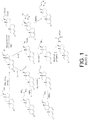
- Figure 1 shows the conversion of a compound of general formula (IIa) or of general formula (II) in which the side chain is -CH 2 OH to other compounds of general formula (IIa) or of general formula (II), respectively, with different side chains.
- a compound of general formula (IIa) or a compound of general formula (II) wherein Y-R 4 is CH 2 -OH may be prepared from a plant sterol such as stigmasterol.
- the olefination may be carried out at about 15 to 25 °C, suitably room temperature, in a solvent such as dichloromethane.
- R 4 is the carboxylic acid mimetic group C(O)NHSO 2 R 10 , wherein R 10 is as defined above, by reaction with: NH 2 SO 2 R 10 wherein R 10 is as defined above, in the presence of a coupling agent such as 1-ethyl-3(3-dimethylaminopropyl)carbodiimide (EDCI).
- a coupling agent such as 1-ethyl-3(3-dimethylaminopropyl)carbodiimide (EDCI).
- X 1 -Si(R 16 ) 3 (XXIII) wherein, R 16 is as defined above and X 1 is a leaving group, for example a halide such as chloride or a sulfonate leaving group such as trifluoromethanesulfonate (triflate), methanesulfonate (mesylate) or toluene sulfate (tosylate).
- a halide such as chloride
- a sulfonate leaving group such as trifluoromethanesulfonate (triflate), methanesulfonate (mesylate) or toluene sulfate (tosylate).
- R 4 is halo, for example bromo
- a halogenating agent e.g. a brominating agent such as carbon tetrabromide as illustrated in Example 30 or N -bromosuccinimide, as illustrated in Example 35.
- Such sulfonate or halide compounds can then be converted to compounds of general formulae (Ia), (IIa), (IIIxa), (IIIya), (IIIxz), (IIIyz) and (IVa)-(XIa) or compounds of general formulae (I), (II), (IIIx), (IIIy) and (IV)-(XI) in which R 4 is cyano by reaction with a cyanide salt, for example sodium or potassium cyanide (see Example 35).
- a cyanide salt for example sodium or potassium cyanide
- reaction with acetonitrile in the presence of a base such as n-butyllithium leads to a chain lengthening reaction so that, for example, a side chain -CH 2 -O-methanesulfonyl or -CH 2 -Br is converted to a side chain -CH 2 CH 2 -CN.
- a base such as n-butyllithium
- Such compounds may be oxidised to compounds in which the side chain is Y 2 -CH(OH)-C(O)H, which may then be protected as a 1,3-dioxane or 1,3-dioxolane by reaction with 1,3-propane diol or 1,2-ethandiol in the presence of an acid catalyst such as toluene sulfonic acid. Similar reactions can be used to prepare the equivalent cyclic dithioacetals, and cyclic aminals.
- Compounds of formulae (Ia), (IIa), (IIIxa), (IIIya), (IIIxz), (IIIyz) and (IVa)-(XIa) and compounds of general formulae (I), (II), (IIIx), (IIIy) and (IV)-(XI) with side chain -Y-C ⁇ CH may be prepared from compounds with side chain Y-X, where X is a halo group, particularly bromo, by reaction with an organometallic reagent, for example: Li-C ⁇ CH.
- the diazomethane may be formed in situ using conventional methods, e.g. the treatment of N -nitroso- N -methylurea with aqueous sodium or potassium hydroxide in diethyl ether.
- the diazomethane is used in excess, typically in an amount of greater than 2 equivalents compared with the acid chloride.
- the reaction is typically conducted in an organic solvent such as diethyl ether, toluene or a mixture thereof.
- the reaction is carried out at a temperature of about -5 to 15 °C, typically 0-10 °C.
- the compound with side chain -Y-C(O)-CH 2 -N 2 may be treated with an aqueous silver compound, for example silver nitrate, at an elevated temperature and in the presence of an alcohol of formula: R 10a -OH wherein R 10a is as defined for R 10 in general formula (Ia) or in general formula (I) except that it is not H. Most suitably, R 10a is C 1-6 alkyl or benzyl. Under these conditions, the compound undergoes a Wolff rearrangement to give a compound in which the side chain is -Y-CH 2 -C(O)OR 10a and thus this sequence can be used to lengthen the side chain.
- R 4 is -N 3
- R 4 is a leaving group such as toluene sulfonate, methane sulfonate or compounds of general formulae (Ia), (IIa), (IIIxa), (IIIya), (IIIxz), (IIIyz) and (IVa)-(XIa) or compounds of general formulae (I), (II), (IIIx), (IIIy) and (IV)-(XI) in which R 4 is -N 3 may be prepared from compounds of (Ia), (IIa), (IIIxa), (IIIya) and (IVa)-(XIa) or compounds of general formulae (I), (II), (IIIx), (IIIy) and (IV)-(XI), respectively, in which R 4 is a leaving group such as toluene sulfonate, methane sulfonate or compounds of general formulae (Ia), (IIa), (IIIxa), (IIIya), (IIIxz),
- a reagent such as N,N' -carbonyldiimidazole (CDI).
- the compound in which R 4 is CN may be reacted with sodium azide in the presence of an acid.
- an acid for example, NaN 3 /NH 4 Cl in toluene/DMF ( Organic and Biomolecular Chemistry, 2008, 6, 4108 ) or NaN 3 / NEt 3 .HCl in DMF ( Brown et al.; Bioorg Med Chem Lett, 2002, 12, 3171 ).
- a compound in which R 4 is azide may be reacted with a suitable cyanide compound, for example tosyl cyanide, under reducing conditions to give a compound in which R 4 is tetrazol-1-yl.
- R 4 is C(O)OR 10
- a compound of general formulae (Ia), (IIa), (IIIxa), (IIIya), (IIIxz), (IIIyz) and (IVa)-(XIa) or a compound of general formulae (I), (II), (IIIx), (IIIy) and (IV)-(XI) in which R 4 is C(O)OH may first be reacted with a C 1-6 alkanoyl or benzoyl chloride or with a C 1-6 alkanoic anhydride to protect any OH groups.
- the protected compound may then be reacted with a reducing agent such as a hydride, suitably lithium aluminium hydride or sodium borohydride in order to reduce the carboxylic acid group to OH.
- the alcohol group may be replaced by a halogen, for example bromine or iodine, using the triphenyl phosphine/imidazole/halogen method described by Classon et al., J. Org. Chem., 1988, 53, 6126-6130 .
- the halogenated compound may then be reacted with sodium sulphite in an alcoholic solvent to give a compound with a SO 3 - Na + substituent.
- a compound of general formulae (Ia), (IIa), (IIIxa), (IIIya), (IIIxz), (IIIyz) and (IVa)-(XIa) or a compound of general formulae (I), (II), (IIIx), (IIIy) and (IV)-(XI) in which R 4 is OSO 3 R 10 can be obtained by reacting the alcohol obtained from reducing the protected carboxylic acid as described above with chlorosulfonic acid in the presence of a base such as triethylamine to yield the protected triethylamine salt.
- a base such as triethylamine
- Reduction of the carboxylic acid followed by reaction of the resultant alcohol with a sulfonyl chloride yields a compound of general formulae (Ia), (IIa), (IIIxa), (IIIya), (IIIxz), (IIIyz) and (IVa)-(XIa) or a compound of general formulae (I), (II), (IIIx), (IIIy) and (IV)-(XI) in which R 4 is OSO 2 R 10 .
- An analogue of a compound of general formulae (Ia), (IIa), (IIIxa), (IIIya), (IIIxz), (IIIyz) and (IVa)-(XIa) or a compound of general formulae (I), (II), (IIIx), (IIIy) and (IV)-(XI) in which R 4 is C(O)R 10 can be obtained by reduction of a compound in which R 4 is C(O)OR 10 using one equivalent of diisobutyl aluminium hydride (DIBAL-H) to obtain an aldehyde in which R 4 is C(O)H (see, for example, WO2011/014661 ).
- DIBAL-H diisobutyl aluminium hydride
- the aldehyde may be prepared by oxidation of a protected compound in which R 4 is OH prepared as described above.
- the oxidation may be Swern oxidation carried out using oxalyl chloride and dimethyl sulfoxide followed by triethylamine (see, for example Xiang-Dong Zhou et al, Tetrahedron, 2002, 58, 10293-10299 ).
- the oxidation may be carried out using an oxidising agent such as pyridinium chlorochromate (PCC) as described by Carnell et al (J. Med. Chem., 2007, 50, 2700-2707 ).
- PCC pyridinium chlorochromate
- An analogue of a compound of general formulae (Ia), (IIa), (IIIxa), (IIIya), (IIIxz), (IIIyz) and (IVa)-(XIa) or an analogue of compound of general formulae (I), (II), (IIIx), (Illy) and (IV)-(XI) in which R 4 is C(O)R 10 where R 10 is other than hydrogen can be obtained by known methods, for example by the reaction of the aldehyde in which R 4 is C(O)H with a suitable Grignard reagent, followed by oxidation. Such methods are well known to those of skill in the art.
- the mixture was stirred under an atmosphere of hydrogen for 48 h while maintaining the temperature at -10 °C (IPC by TLC, eluent 1:1 EtOAc: Heptane; visualized with Anisaldehyde stain) then the flask was evacuated, filled with argon and filtered and the catalyst washed with TBME (100 mL). The filtrate was washed with 10% aq. NaCl (3 x 50 mL), dried over Na 2 SO 4 , filtered and concentrated in vacuo at 40 °C.
- the obtained material was identical to that synthesized from (6 ⁇ , 7 ⁇ , 22 E )-6,7-epoxy-3-oxo-4,22-choladien-24-oic acid ethyl ester (IVB) by the analogous route (confirmed by 1 H and 13 C NMR, TLC and HPLC) (see Figures 5 and 6 ).
- aqueous phase was extracted with EtOAc (3 ⁇ 100 mL) and the combined organic phases were washed with 5% aq. NaCl (3 ⁇ 100 mL).
- the organic phase was dried over Na 2 SO 4 , filtered and concentrated in-vacuo at 40 °C to give (3 ⁇ , 5 ⁇ , 6 ⁇ , 7 ⁇ , 20 S )-6-ethyl-3,7-dihydroxy-23,24-dinor-cholane-22-ol as a white solid (0.53 g, 64%).
- the HWE reagent was prepared by dropwise addition of TEPA (262 ⁇ L, 1.32 mmol) to NaOEt (91 mg, 1.3 mmol) in CH 2 Cl 2 (2 mL) at 0°C. Thr reaction mixture was added dropwise over 10 minutes to a solution of (3 ⁇ , 5 ⁇ , 6 ⁇ , 7 ⁇ )-6-ethyl-3,7-dihydroxy-23,24-dinor-cholane-22-al (199 mg, 0.528 mmol) in CH 2 Cl 2 (4 mL) at 0 °C. The reaction was warmed to ambient temperature and stirred for 1 hour (TLC, eluant 1:1 EtOAc: Heptane; visualized with Cerium Ammonium Molybdate stain).
- the isolated product is a 4:1 mixture of the desired (3 ⁇ , 5 ⁇ , 6 ⁇ , 7 ⁇ )-6-ethyl-3,7-dihydroxy-22-cholen-24-oic acid ethyl ester and (5 ⁇ , 6 ⁇ , 7 ⁇ )-6-ethyl-7-dihydroxy-3-oxo-22-cholen-24-oic acid ethyl ester.
- HMPO (20 S )-20-Hydroxymethyl-pregna-4-en-3-one (HMPO) can be prepared by chemoselective reduction of dinorcholenaldehyde ((20S)-20-formyl-pregn-4-en-3-one) with NaBH 4 in primary alcohol ( Barry M. Trost, Alvin C. Lavoie J. Am. Chem. Soc., 1983, 105 (15), 5075-5090 ).
- HMPO 300 g, 0.913 mol
- AcOH 0.9 L
- toluene 0.3 L
- p -Chloranil 245 g, 1.00 mol
- the reaction mixture heated to 110 °C and maintained at this temperature for 6 h.
- the mixture was then cooled to 5 °C and held at that temperature for 2 h.
- the resulting solid was filtered and the filter-cake washed with cold, premixed 3:1 AcOH : Toluene (4 x 150 mL) and the filtrate was concentrated in-vacuo.
- the reaction mixture was allowed to warm to 0 °C over 4 h, cooled to -78 °C and quenched with 10% aq. NH 4 Cl (3 mL).
- the reaction mixture was diluted with EtOAc (20 mL) and 10% aq. NH 4 Cl (20 mL) and the organic phase was separated.
- the aqueous phase was extracted with EtOAc (20 mL), and the combined organic phases were washed with 5% aq. NaCl (20 mL), dried over sodium sulfate and concentrated under reduced pressure.
- the residue was purified by column chromatography on silica gel using heptane: EtOAc (5:1) as the eluent.
- Example 41 Epoxidation of (20 S )-20-hydroxymethyl-pregna-4,6-dien-3-one to form (6 ⁇ , 7 ⁇ , 20 S )-6,7-epoxy-20-hydroxymethyl-pregna-4-en-3-one
- the reaction was heated to reflux for 15 min then cooled to 40 °C and acetic acid (80 ⁇ L) was added.
- the reaction mixture was diluted with water (5 mL) and CH 2 Cl 2 (10 mL), the aq. phase was separated and extracted with CH 2 Cl 2 (2 ⁇ 10 mL). The combined organic phases were then concentrated in vacuo.
- the crude product (220 mg) was purified by flash chromatography on silica gel (heptane-EtOAc) to yield (6 ⁇ , 7 ⁇ , 20S)-6,7-epoxy-20-hydroxymethyl-pregna-4-en-3-one as a white powder (69 mg, 35% yield).
- Example 42 Epoxidation of (20 S )-20-(bromomethyl)-pregna-4,6-dien-3-one to form (6 ⁇ , 7 ⁇ , 20 S )-6,7-epoxy-20-bromomethyl-pregna-4-en-3-one
- the sodium bicarbonate phase was re-extracted with CH 2 Cl 2 (2 ⁇ 5 mL).
- the combined organic phases were concentrated in vacuo to afford the intermediate as a yellow viscous oil (287 mg, R f : 0.49 (3:2, heptane:EtOAc), which was used in the next step without further purification.
- the residue was dissolved in ethanol (6.0 mL) and a solution of potassium carbonate (146 mg, 1.06 mmol) in water (1.4 mL) was added.
- the reaction was heated to reflux for 15 min, then cooled to 40 °C, and acetic acid (112 ⁇ L) was added.
- the reaction mixture was diluted with water (5 mL) and CH 2 Cl 2 (10 mL), the aq.
- the organic phase was dried over Na 2 SO 4 and concentrated in vacuo to give 186 mg of crude material.
- the crude material was taken up in EtOH (3.7 mL) at 18°C temperature and K 2 CO 3 (105mg, 0.76 mmol) and H 2 O were added. After 30 min the reaction mixture was heated to 80 °C for 2 h and then cooled to 18°C temperature and quenched with a mixture of 1:4 AcOH: EtOH (0.1 mL). The organic solvents were removed in vacuo and the residue taken up in CH 2 Cl 2 (15 mL). The organic phase was washed with aq 5% NaCl (15 mL) and the aq. phase extracted with CH 2 Cl 2 (2 x 10 mL).
- the mixture was concentrated to ⁇ 7 mL to remove ethanol, then diluted with dichloromethane (80 mL) and sodium chloride solution (80 mL, 5% aq.).
- the aq. phase was re-extracted with CH 2 Cl 2 (3 ⁇ 30 mL) and then the combined organic phases were washed with sodium chloride (30 mL, 5% aq.).
- the aq. phase was re-extracted with CH 2 Cl 2 (30 mL) and the combined organic phases concentrated in vacuo.
- Example 45 Epoxidation of (20 S )-20-acetoxymethyl-pregna-4,6-dien-3-one to form (20 S )-20-acetoxymethyl-6,7- ⁇ -epoxy-pregna-4-en-3-one
- the mixture was concentrated to -30 mL to remove ethanol, then diluted with CH 2 Cl 2 (80 mL) and sodium chloride (80 mL of a 5% aq.). The aq. phase was re-extracted with CH 2 Cl 2 (3 ⁇ 50 mL).
- Example 46 Epoxidation of (20 S )- tert -butyldiphenylsilyloxymethyl-pregna-4,6-dien-3-one to form (6 ⁇ , 7 ⁇ , 20 S )-6,7-epoxy-20- tert -butyldiphenylsiloxymethyl-pregna-4-en-3-one
- Example 47 Epoxidation of (20 S )-azidomethyl-pregna-4,6-dien-3-one to form (6 ⁇ , 7 ⁇ , 20 S )-6,7-epoxy-20-azidomethyl-pregna-4-en-3-one
- the organic phase was concentrated in vacuo to the intermediate as an orange viscous oil (392 mg, R f : 0.48 (3:2, heptane:EtOAc), which was used without further purification.
- the residue was suspended in ethanol (8.6 mL) and a solution of potassium carbonate (219 mg, 1.58 mmol) in water (2.0 mL) was added. Reaction was stirred at 18 °C for 15 min, and then heated to reflux for 20 min. After cooling to 40 °C acetic acid (157 ⁇ L) was added. The mixture was concentrated in vacuo, and diluted with EtOAc (20 mL) and water (20 mL). The organic phase was separated and concentrated in vacuo to yellow solid (583 mg).
- Example 48 Epoxidation of (20 S )-( N -phthalimidomethyl)-pregna-4,6-dien-3-one to form (6 ⁇ , 7 ⁇ , 20 S )-6,7-epoxy-20-( N -phthalimidomethyl)-pregna-4,6-dien-3-one
- the organic phase was dried over Na 2 SO 4 , and concentrated in vacuo to give 1.76 g of wet residue.
- the crude material was taken up in EtOH (35 mL) at 18 °C and K 2 CO 3 (912mg, 6.6 mmol) and DI H 2 O (8.8 mL) added. After 30 min the reaction mixture was heated to 80 °C. After 2 hrs the reaction was cooled to 18 °C and quenched with a mixture of 1:4 AcOH: EtOH (1 mL). The organic solvents were removed in vacuo and the residue taken up in CH 2 Cl 2 (50 mL). The organic phase was washed with aq 5% NaCl (50 mL) and the resulting aq.
- Example 50 Epoxidation of (20S)-20-(ethylenedioxymethyl)-pregna-4,6-dien-3-one to form (6 ⁇ , 7 ⁇ , 20 S )-6,7-epoxy-20-(ethylenedioxymethyl)-pregna-4-en-3-one
- Example 51 Epoxidation of 23-carboxy-3-oxo-4,6-choladien-24-oic acid dimethyl ester of (6 ⁇ , 7 ⁇ )-6,7-epoxy-3-oxo-4-cholen-23-carboxy-24-oic acid dimethyl ester
- the flask was evacuated and purged with argon 3 times and the suspension filtered through a PTFE HPLC filter cartridge and the cake washed with TBME (2 x 20 mL). The filtrate was washed with water (2 x 20 mL) and 5% NaCl (aq, 20 mL), dried over Na 2 SO 4 , and concentrated in vacuo.
Landscapes
- Chemical & Material Sciences (AREA)
- Organic Chemistry (AREA)
- Health & Medical Sciences (AREA)
- General Health & Medical Sciences (AREA)
- Nuclear Medicine, Radiotherapy & Molecular Imaging (AREA)
- Life Sciences & Earth Sciences (AREA)
- General Chemical & Material Sciences (AREA)
- Medicinal Chemistry (AREA)
- Bioinformatics & Cheminformatics (AREA)
- Engineering & Computer Science (AREA)
- Pharmacology & Pharmacy (AREA)
- Chemical Kinetics & Catalysis (AREA)
- Animal Behavior & Ethology (AREA)
- Gastroenterology & Hepatology (AREA)
- Public Health (AREA)
- Veterinary Medicine (AREA)
- Steroid Compounds (AREA)
- Pharmaceuticals Containing Other Organic And Inorganic Compounds (AREA)
Applications Claiming Priority (2)
| Application Number | Priority Date | Filing Date | Title |
|---|---|---|---|
| GBGB1608779.3A GB201608779D0 (en) | 2016-05-18 | 2016-05-18 | Methods and compounds |
| PCT/GB2017/051393 WO2017199039A1 (en) | 2016-05-18 | 2017-05-18 | Steroid 6.7.beta.-epoxides as chemical intermediates |
Publications (2)
| Publication Number | Publication Date |
|---|---|
| EP3458468A1 EP3458468A1 (en) | 2019-03-27 |
| EP3458468B1 true EP3458468B1 (en) | 2020-12-09 |
Family
ID=56320631
Family Applications (1)
| Application Number | Title | Priority Date | Filing Date |
|---|---|---|---|
| EP17725744.1A Active EP3458468B1 (en) | 2016-05-18 | 2017-05-18 | Steroid 6.7.beta.-epoxides as chemical intermediates |
Country Status (13)
| Country | Link |
|---|---|
| US (1) | US20190153023A1 (https=) |
| EP (1) | EP3458468B1 (https=) |
| JP (1) | JP7034092B2 (https=) |
| KR (1) | KR102509432B1 (https=) |
| CN (1) | CN109415403A (https=) |
| AU (1) | AU2017265925A1 (https=) |
| BR (1) | BR112018073490A2 (https=) |
| CA (1) | CA3024285A1 (https=) |
| EA (1) | EA037742B1 (https=) |
| ES (1) | ES2857869T3 (https=) |
| GB (1) | GB201608779D0 (https=) |
| MX (1) | MX377644B (https=) |
| WO (1) | WO2017199039A1 (https=) |
Families Citing this family (9)
| Publication number | Priority date | Publication date | Assignee | Title |
|---|---|---|---|---|
| GB201608776D0 (en) * | 2016-05-18 | 2016-06-29 | Dextra Lab Ltd | Methods and compounds |
| GB201608777D0 (en) | 2016-05-18 | 2016-06-29 | Dextra Lab Ltd | Compounds |
| EP3431486A1 (en) * | 2017-07-18 | 2019-01-23 | Bionice, S.L.U. | Process and intermediates for the synthesis of obeticholic acid and derivatives thereof |
| GB201812382D0 (en) | 2018-07-30 | 2018-09-12 | Nzp Uk Ltd | Compounds |
| CN111072744B (zh) * | 2019-12-03 | 2021-09-14 | 江苏佳尔科药业集团股份有限公司 | 一种以ba为原料合成熊去氧胆酸的方法 |
| CN113912661B (zh) * | 2021-11-11 | 2023-04-21 | 湖南科瑞生物制药股份有限公司 | 一种7-羟基甾体化合物的合成方法 |
| CN114702542B (zh) * | 2022-05-11 | 2023-11-24 | 上海其正医药科技有限责任公司 | 一种25-羟基-7-去氢胆固醇的制备方法 |
| CN115974950A (zh) * | 2022-12-23 | 2023-04-18 | 上海彩迩文生化科技有限公司 | 一种3-烷基化的甾体中间体及其制备和应用 |
| CN118852307A (zh) * | 2024-07-28 | 2024-10-29 | 湖北共同甾体药物研究院有限公司 | 一种熊去氧胆酸中间体的制备方法 |
Family Cites Families (7)
| Publication number | Priority date | Publication date | Assignee | Title |
|---|---|---|---|---|
| ITMI20050912A1 (it) * | 2005-05-19 | 2006-11-20 | Erregierre Spa | Processo di preparazione di acidi 3-a-ya(b)-diidrossi-6-a(b)-alchil-5b-colanici |
| CN101374854A (zh) * | 2006-01-12 | 2009-02-25 | 三菱化学株式会社 | 甾类化合物的制备方法 |
| JP2007210888A (ja) * | 2006-01-12 | 2007-08-23 | Mitsubishi Chemicals Corp | ステロイド化合物の製造方法 |
| US10131688B2 (en) | 2014-11-19 | 2018-11-20 | NZP UK Limited | 5.beta.-6-alkyl-7-hydroxy-3-one steroids as intermediates for the production of steroidal FXR modulators |
| KR102526631B1 (ko) * | 2014-11-19 | 2023-04-27 | 엔제트피 유케이 리미티드 | 스테로이드 fxr 조절인자를 제조하기 위한 중간체로서의 6-알킬-7-하이드록시-4-엔-3-온 스테로이드 |
| TWI688571B (zh) | 2014-11-19 | 2020-03-21 | 英商Nzp英國有限公司 | 化合物(四) |
| US10538550B2 (en) | 2014-11-19 | 2020-01-21 | NZP UK Limited | 6.alpha.-alkyl-3,7-dione steroids as intermediates for the production of steroidal FXR modulators |
-
2016
- 2016-05-18 GB GBGB1608779.3A patent/GB201608779D0/en not_active Ceased
-
2017
- 2017-05-18 JP JP2018560585A patent/JP7034092B2/ja active Active
- 2017-05-18 BR BR112018073490-0A patent/BR112018073490A2/pt not_active Application Discontinuation
- 2017-05-18 AU AU2017265925A patent/AU2017265925A1/en not_active Abandoned
- 2017-05-18 KR KR1020187035836A patent/KR102509432B1/ko active Active
- 2017-05-18 CN CN201780030408.5A patent/CN109415403A/zh not_active Withdrawn
- 2017-05-18 EP EP17725744.1A patent/EP3458468B1/en active Active
- 2017-05-18 MX MX2018014128A patent/MX377644B/es active IP Right Grant
- 2017-05-18 WO PCT/GB2017/051393 patent/WO2017199039A1/en not_active Ceased
- 2017-05-18 ES ES17725744T patent/ES2857869T3/es active Active
- 2017-05-18 US US16/302,058 patent/US20190153023A1/en not_active Abandoned
- 2017-05-18 EA EA201892515A patent/EA037742B1/ru unknown
- 2017-05-18 CA CA3024285A patent/CA3024285A1/en active Pending
Non-Patent Citations (1)
| Title |
|---|
| "On Medicinal Chemistry", 1 January 2007, SCI-INK LTD, ISBN: 978-0-9550072-3-1, article M. STOCKS: "On Medicinal Chemistry", pages: 214 - 219, XP055674042 * |
Also Published As
| Publication number | Publication date |
|---|---|
| CA3024285A1 (en) | 2017-11-23 |
| EP3458468A1 (en) | 2019-03-27 |
| GB201608779D0 (en) | 2016-06-29 |
| EA037742B1 (ru) | 2021-05-17 |
| AU2017265925A1 (en) | 2018-11-15 |
| EA201892515A1 (ru) | 2019-05-31 |
| KR102509432B1 (ko) | 2023-03-13 |
| WO2017199039A1 (en) | 2017-11-23 |
| JP7034092B2 (ja) | 2022-03-11 |
| US20190153023A1 (en) | 2019-05-23 |
| MX377644B (es) | 2025-03-04 |
| KR20190006187A (ko) | 2019-01-17 |
| ES2857869T3 (es) | 2021-09-29 |
| CN109415403A (zh) | 2019-03-01 |
| BR112018073490A2 (pt) | 2019-03-26 |
| MX2018014128A (es) | 2019-04-29 |
| JP2019516717A (ja) | 2019-06-20 |
Similar Documents
| Publication | Publication Date | Title |
|---|---|---|
| EP3458468B1 (en) | Steroid 6.7.beta.-epoxides as chemical intermediates | |
| EP3221331B1 (en) | 6-alkyl-7-hydroxy-4-en-3-one steroids as intermediates for the production of steroidal fxr modulators | |
| EP3221333B1 (en) | 6.alpha.-alkyl-3,7-dione steroids as intermediates for the production of steroidal fxr modulators | |
| EP3458469B1 (en) | Intermediates for the synthesis of bile acid derivatives, in particular of obeticholic acid | |
| EP3221332B1 (en) | 5.beta.-6-alkyl-7-hydroxy-3-one steroids as intermediates for the production of steroidal fxr modulators | |
| EP3458467B1 (en) | Process for the 6,7-alpha-epoxidation of steroid 4,6-dienes | |
| HK1244285A1 (en) | 5.beta -6-alkyl-7-hydroxy-3-one steroids as intermediates for the production of steroidal fxr modulators | |
| HK40006371A (en) | Steroid 6.7.beta.-epoxides as chemical intermediates | |
| HK40006371B (en) | Steroid 6.7.beta.-epoxides as chemical intermediates | |
| HK40055816A (en) | Intermediates for the synthesis of bile acid derivatives, in particular of obeticholic acid | |
| HK40055816B (en) | Intermediates for the synthesis of bile acid derivatives, in particular of obeticholic acid | |
| CA3024281C (en) | Intermediates for the synthesis of bile acid derivatives, in particular of obeticholic acid | |
| HK40006370B (en) | Intermediates for the synthesis of bile acid derivatives, in particular of obeticholic acid | |
| HK40006372A (en) | Process for the 6,7-alpha-epoxidation of steroid 4,6-dienes | |
| HK40006372B (en) | Process for the 6,7-alpha-epoxidation of steroid 4,6-dienes | |
| BR112018073492B1 (pt) | Processos de preparo de compostos intermediários na síntese de derivados de ácido biliar com atividade farmacológica | |
| HK1244287B (en) | 6.alpha.-alkyl-3,7-dione steroids as intermediates for the production of steroidal fxr modulators | |
| HK1246801B (en) | 6-alkyl-7-hydroxy-4-en-3-one steroids as intermediates for the production of steroidal fxr modulators |
Legal Events
| Date | Code | Title | Description |
|---|---|---|---|
| STAA | Information on the status of an ep patent application or granted ep patent |
Free format text: STATUS: UNKNOWN |
|
| STAA | Information on the status of an ep patent application or granted ep patent |
Free format text: STATUS: THE INTERNATIONAL PUBLICATION HAS BEEN MADE |
|
| PUAI | Public reference made under article 153(3) epc to a published international application that has entered the european phase |
Free format text: ORIGINAL CODE: 0009012 |
|
| STAA | Information on the status of an ep patent application or granted ep patent |
Free format text: STATUS: REQUEST FOR EXAMINATION WAS MADE |
|
| 17P | Request for examination filed |
Effective date: 20181213 |
|
| AK | Designated contracting states |
Kind code of ref document: A1 Designated state(s): AL AT BE BG CH CY CZ DE DK EE ES FI FR GB GR HR HU IE IS IT LI LT LU LV MC MK MT NL NO PL PT RO RS SE SI SK SM TR |
|
| AX | Request for extension of the european patent |
Extension state: BA ME |
|
| DAV | Request for validation of the european patent (deleted) | ||
| GRAP | Despatch of communication of intention to grant a patent |
Free format text: ORIGINAL CODE: EPIDOSNIGR1 |
|
| STAA | Information on the status of an ep patent application or granted ep patent |
Free format text: STATUS: GRANT OF PATENT IS INTENDED |
|
| INTG | Intention to grant announced |
Effective date: 20200319 |
|
| REG | Reference to a national code |
Ref country code: HK Ref legal event code: DE Ref document number: 40006371 Country of ref document: HK |
|
| GRAJ | Information related to disapproval of communication of intention to grant by the applicant or resumption of examination proceedings by the epo deleted |
Free format text: ORIGINAL CODE: EPIDOSDIGR1 |
|
| STAA | Information on the status of an ep patent application or granted ep patent |
Free format text: STATUS: REQUEST FOR EXAMINATION WAS MADE |
|
| GRAP | Despatch of communication of intention to grant a patent |
Free format text: ORIGINAL CODE: EPIDOSNIGR1 |
|
| STAA | Information on the status of an ep patent application or granted ep patent |
Free format text: STATUS: GRANT OF PATENT IS INTENDED |
|
| INTC | Intention to grant announced (deleted) | ||
| INTG | Intention to grant announced |
Effective date: 20200706 |
|
| GRAS | Grant fee paid |
Free format text: ORIGINAL CODE: EPIDOSNIGR3 |
|
| GRAA | (expected) grant |
Free format text: ORIGINAL CODE: 0009210 |
|
| STAA | Information on the status of an ep patent application or granted ep patent |
Free format text: STATUS: THE PATENT HAS BEEN GRANTED |
|
| AK | Designated contracting states |
Kind code of ref document: B1 Designated state(s): AL AT BE BG CH CY CZ DE DK EE ES FI FR GB GR HR HU IE IS IT LI LT LU LV MC MK MT NL NO PL PT RO RS SE SI SK SM TR |
|
| AX | Request for extension of the european patent |
Extension state: BA ME |
|
| REG | Reference to a national code |
Ref country code: GB Ref legal event code: FG4D |
|
| REG | Reference to a national code |
Ref country code: AT Ref legal event code: REF Ref document number: 1343350 Country of ref document: AT Kind code of ref document: T Effective date: 20201215 Ref country code: CH Ref legal event code: EP |
|
| REG | Reference to a national code |
Ref country code: DE Ref legal event code: R096 Ref document number: 602017029240 Country of ref document: DE |
|
| REG | Reference to a national code |
Ref country code: IE Ref legal event code: FG4D |
|
| PG25 | Lapsed in a contracting state [announced via postgrant information from national office to epo] |
Ref country code: GR Free format text: LAPSE BECAUSE OF FAILURE TO SUBMIT A TRANSLATION OF THE DESCRIPTION OR TO PAY THE FEE WITHIN THE PRESCRIBED TIME-LIMIT Effective date: 20210310 Ref country code: FI Free format text: LAPSE BECAUSE OF FAILURE TO SUBMIT A TRANSLATION OF THE DESCRIPTION OR TO PAY THE FEE WITHIN THE PRESCRIBED TIME-LIMIT Effective date: 20201209 Ref country code: RS Free format text: LAPSE BECAUSE OF FAILURE TO SUBMIT A TRANSLATION OF THE DESCRIPTION OR TO PAY THE FEE WITHIN THE PRESCRIBED TIME-LIMIT Effective date: 20201209 Ref country code: NO Free format text: LAPSE BECAUSE OF FAILURE TO SUBMIT A TRANSLATION OF THE DESCRIPTION OR TO PAY THE FEE WITHIN THE PRESCRIBED TIME-LIMIT Effective date: 20210309 |
|
| REG | Reference to a national code |
Ref country code: AT Ref legal event code: MK05 Ref document number: 1343350 Country of ref document: AT Kind code of ref document: T Effective date: 20201209 |
|
| PG25 | Lapsed in a contracting state [announced via postgrant information from national office to epo] |
Ref country code: SE Free format text: LAPSE BECAUSE OF FAILURE TO SUBMIT A TRANSLATION OF THE DESCRIPTION OR TO PAY THE FEE WITHIN THE PRESCRIBED TIME-LIMIT Effective date: 20201209 Ref country code: BG Free format text: LAPSE BECAUSE OF FAILURE TO SUBMIT A TRANSLATION OF THE DESCRIPTION OR TO PAY THE FEE WITHIN THE PRESCRIBED TIME-LIMIT Effective date: 20210309 Ref country code: LV Free format text: LAPSE BECAUSE OF FAILURE TO SUBMIT A TRANSLATION OF THE DESCRIPTION OR TO PAY THE FEE WITHIN THE PRESCRIBED TIME-LIMIT Effective date: 20201209 |
|
| REG | Reference to a national code |
Ref country code: NL Ref legal event code: MP Effective date: 20201209 |
|
| PG25 | Lapsed in a contracting state [announced via postgrant information from national office to epo] |
Ref country code: HR Free format text: LAPSE BECAUSE OF FAILURE TO SUBMIT A TRANSLATION OF THE DESCRIPTION OR TO PAY THE FEE WITHIN THE PRESCRIBED TIME-LIMIT Effective date: 20201209 Ref country code: NL Free format text: LAPSE BECAUSE OF FAILURE TO SUBMIT A TRANSLATION OF THE DESCRIPTION OR TO PAY THE FEE WITHIN THE PRESCRIBED TIME-LIMIT Effective date: 20201209 |
|
| REG | Reference to a national code |
Ref country code: LT Ref legal event code: MG9D |
|
| PG25 | Lapsed in a contracting state [announced via postgrant information from national office to epo] |
Ref country code: PT Free format text: LAPSE BECAUSE OF FAILURE TO SUBMIT A TRANSLATION OF THE DESCRIPTION OR TO PAY THE FEE WITHIN THE PRESCRIBED TIME-LIMIT Effective date: 20210409 Ref country code: RO Free format text: LAPSE BECAUSE OF FAILURE TO SUBMIT A TRANSLATION OF THE DESCRIPTION OR TO PAY THE FEE WITHIN THE PRESCRIBED TIME-LIMIT Effective date: 20201209 Ref country code: SK Free format text: LAPSE BECAUSE OF FAILURE TO SUBMIT A TRANSLATION OF THE DESCRIPTION OR TO PAY THE FEE WITHIN THE PRESCRIBED TIME-LIMIT Effective date: 20201209 Ref country code: LT Free format text: LAPSE BECAUSE OF FAILURE TO SUBMIT A TRANSLATION OF THE DESCRIPTION OR TO PAY THE FEE WITHIN THE PRESCRIBED TIME-LIMIT Effective date: 20201209 Ref country code: CZ Free format text: LAPSE BECAUSE OF FAILURE TO SUBMIT A TRANSLATION OF THE DESCRIPTION OR TO PAY THE FEE WITHIN THE PRESCRIBED TIME-LIMIT Effective date: 20201209 Ref country code: EE Free format text: LAPSE BECAUSE OF FAILURE TO SUBMIT A TRANSLATION OF THE DESCRIPTION OR TO PAY THE FEE WITHIN THE PRESCRIBED TIME-LIMIT Effective date: 20201209 Ref country code: SM Free format text: LAPSE BECAUSE OF FAILURE TO SUBMIT A TRANSLATION OF THE DESCRIPTION OR TO PAY THE FEE WITHIN THE PRESCRIBED TIME-LIMIT Effective date: 20201209 |
|
| PG25 | Lapsed in a contracting state [announced via postgrant information from national office to epo] |
Ref country code: AT Free format text: LAPSE BECAUSE OF FAILURE TO SUBMIT A TRANSLATION OF THE DESCRIPTION OR TO PAY THE FEE WITHIN THE PRESCRIBED TIME-LIMIT Effective date: 20201209 Ref country code: PL Free format text: LAPSE BECAUSE OF FAILURE TO SUBMIT A TRANSLATION OF THE DESCRIPTION OR TO PAY THE FEE WITHIN THE PRESCRIBED TIME-LIMIT Effective date: 20201209 |
|
| REG | Reference to a national code |
Ref country code: DE Ref legal event code: R097 Ref document number: 602017029240 Country of ref document: DE |
|
| REG | Reference to a national code |
Ref country code: ES Ref legal event code: FG2A Ref document number: 2857869 Country of ref document: ES Kind code of ref document: T3 Effective date: 20210929 |
|
| PG25 | Lapsed in a contracting state [announced via postgrant information from national office to epo] |
Ref country code: IS Free format text: LAPSE BECAUSE OF FAILURE TO SUBMIT A TRANSLATION OF THE DESCRIPTION OR TO PAY THE FEE WITHIN THE PRESCRIBED TIME-LIMIT Effective date: 20210409 |
|
| PLBE | No opposition filed within time limit |
Free format text: ORIGINAL CODE: 0009261 |
|
| STAA | Information on the status of an ep patent application or granted ep patent |
Free format text: STATUS: NO OPPOSITION FILED WITHIN TIME LIMIT |
|
| PG25 | Lapsed in a contracting state [announced via postgrant information from national office to epo] |
Ref country code: AL Free format text: LAPSE BECAUSE OF FAILURE TO SUBMIT A TRANSLATION OF THE DESCRIPTION OR TO PAY THE FEE WITHIN THE PRESCRIBED TIME-LIMIT Effective date: 20201209 |
|
| 26N | No opposition filed |
Effective date: 20210910 |
|
| PG25 | Lapsed in a contracting state [announced via postgrant information from national office to epo] |
Ref country code: DK Free format text: LAPSE BECAUSE OF FAILURE TO SUBMIT A TRANSLATION OF THE DESCRIPTION OR TO PAY THE FEE WITHIN THE PRESCRIBED TIME-LIMIT Effective date: 20201209 Ref country code: SI Free format text: LAPSE BECAUSE OF FAILURE TO SUBMIT A TRANSLATION OF THE DESCRIPTION OR TO PAY THE FEE WITHIN THE PRESCRIBED TIME-LIMIT Effective date: 20201209 |
|
| REG | Reference to a national code |
Ref country code: CH Ref legal event code: PL |
|
| PG25 | Lapsed in a contracting state [announced via postgrant information from national office to epo] |
Ref country code: CH Free format text: LAPSE BECAUSE OF NON-PAYMENT OF DUE FEES Effective date: 20210531 Ref country code: LI Free format text: LAPSE BECAUSE OF NON-PAYMENT OF DUE FEES Effective date: 20210531 Ref country code: MC Free format text: LAPSE BECAUSE OF FAILURE TO SUBMIT A TRANSLATION OF THE DESCRIPTION OR TO PAY THE FEE WITHIN THE PRESCRIBED TIME-LIMIT Effective date: 20201209 Ref country code: LU Free format text: LAPSE BECAUSE OF NON-PAYMENT OF DUE FEES Effective date: 20210518 |
|
| REG | Reference to a national code |
Ref country code: BE Ref legal event code: MM Effective date: 20210531 |
|
| PG25 | Lapsed in a contracting state [announced via postgrant information from national office to epo] |
Ref country code: IS Free format text: LAPSE BECAUSE OF FAILURE TO SUBMIT A TRANSLATION OF THE DESCRIPTION OR TO PAY THE FEE WITHIN THE PRESCRIBED TIME-LIMIT Effective date: 20210409 |
|
| PG25 | Lapsed in a contracting state [announced via postgrant information from national office to epo] |
Ref country code: BE Free format text: LAPSE BECAUSE OF NON-PAYMENT OF DUE FEES Effective date: 20210531 |
|
| PG25 | Lapsed in a contracting state [announced via postgrant information from national office to epo] |
Ref country code: CY Free format text: LAPSE BECAUSE OF FAILURE TO SUBMIT A TRANSLATION OF THE DESCRIPTION OR TO PAY THE FEE WITHIN THE PRESCRIBED TIME-LIMIT Effective date: 20201209 |
|
| PG25 | Lapsed in a contracting state [announced via postgrant information from national office to epo] |
Ref country code: HU Free format text: LAPSE BECAUSE OF FAILURE TO SUBMIT A TRANSLATION OF THE DESCRIPTION OR TO PAY THE FEE WITHIN THE PRESCRIBED TIME-LIMIT; INVALID AB INITIO Effective date: 20170518 |
|
| PG25 | Lapsed in a contracting state [announced via postgrant information from national office to epo] |
Ref country code: MK Free format text: LAPSE BECAUSE OF FAILURE TO SUBMIT A TRANSLATION OF THE DESCRIPTION OR TO PAY THE FEE WITHIN THE PRESCRIBED TIME-LIMIT Effective date: 20201209 |
|
| PG25 | Lapsed in a contracting state [announced via postgrant information from national office to epo] |
Ref country code: TR Free format text: LAPSE BECAUSE OF FAILURE TO SUBMIT A TRANSLATION OF THE DESCRIPTION OR TO PAY THE FEE WITHIN THE PRESCRIBED TIME-LIMIT Effective date: 20201209 |
|
| PG25 | Lapsed in a contracting state [announced via postgrant information from national office to epo] |
Ref country code: MT Free format text: LAPSE BECAUSE OF FAILURE TO SUBMIT A TRANSLATION OF THE DESCRIPTION OR TO PAY THE FEE WITHIN THE PRESCRIBED TIME-LIMIT Effective date: 20201209 |
|
| PGFP | Annual fee paid to national office [announced via postgrant information from national office to epo] |
Ref country code: DE Payment date: 20250520 Year of fee payment: 9 |
|
| PGFP | Annual fee paid to national office [announced via postgrant information from national office to epo] |
Ref country code: GB Payment date: 20250519 Year of fee payment: 9 Ref country code: ES Payment date: 20250611 Year of fee payment: 9 |
|
| PGFP | Annual fee paid to national office [announced via postgrant information from national office to epo] |
Ref country code: IT Payment date: 20250520 Year of fee payment: 9 |
|
| PGFP | Annual fee paid to national office [announced via postgrant information from national office to epo] |
Ref country code: FR Payment date: 20250516 Year of fee payment: 9 |
|
| PGFP | Annual fee paid to national office [announced via postgrant information from national office to epo] |
Ref country code: IE Payment date: 20250522 Year of fee payment: 9 |