EP3455145B1 - Behälterträger mit flexiblem erhöhtem griff - Google Patents
Behälterträger mit flexiblem erhöhtem griff Download PDFInfo
- Publication number
- EP3455145B1 EP3455145B1 EP18812025.7A EP18812025A EP3455145B1 EP 3455145 B1 EP3455145 B1 EP 3455145B1 EP 18812025 A EP18812025 A EP 18812025A EP 3455145 B1 EP3455145 B1 EP 3455145B1
- Authority
- EP
- European Patent Office
- Prior art keywords
- region
- container carrier
- handle
- bifurcated
- graspable
- Prior art date
- Legal status (The legal status is an assumption and is not a legal conclusion. Google has not performed a legal analysis and makes no representation as to the accuracy of the status listed.)
- Active
Links
Images






Classifications
-
- B—PERFORMING OPERATIONS; TRANSPORTING
- B65—CONVEYING; PACKING; STORING; HANDLING THIN OR FILAMENTARY MATERIAL
- B65D—CONTAINERS FOR STORAGE OR TRANSPORT OF ARTICLES OR MATERIALS, e.g. BAGS, BARRELS, BOTTLES, BOXES, CANS, CARTONS, CRATES, DRUMS, JARS, TANKS, HOPPERS, FORWARDING CONTAINERS; ACCESSORIES, CLOSURES, OR FITTINGS THEREFOR; PACKAGING ELEMENTS; PACKAGES
- B65D71/00—Bundles of articles held together by packaging elements for convenience of storage or transport, e.g. portable segregating carrier for plural receptacles such as beer cans or pop bottles; Bales of material
- B65D71/50—Bundles of articles held together by packaging elements for convenience of storage or transport, e.g. portable segregating carrier for plural receptacles such as beer cans or pop bottles; Bales of material comprising a plurality of articles held together only partially by packaging elements formed otherwise than by folding a blank
-
- B—PERFORMING OPERATIONS; TRANSPORTING
- B65—CONVEYING; PACKING; STORING; HANDLING THIN OR FILAMENTARY MATERIAL
- B65D—CONTAINERS FOR STORAGE OR TRANSPORT OF ARTICLES OR MATERIALS, e.g. BAGS, BARRELS, BOTTLES, BOXES, CANS, CARTONS, CRATES, DRUMS, JARS, TANKS, HOPPERS, FORWARDING CONTAINERS; ACCESSORIES, CLOSURES, OR FITTINGS THEREFOR; PACKAGING ELEMENTS; PACKAGES
- B65D71/00—Bundles of articles held together by packaging elements for convenience of storage or transport, e.g. portable segregating carrier for plural receptacles such as beer cans or pop bottles; Bales of material
- B65D71/50—Bundles of articles held together by packaging elements for convenience of storage or transport, e.g. portable segregating carrier for plural receptacles such as beer cans or pop bottles; Bales of material comprising a plurality of articles held together only partially by packaging elements formed otherwise than by folding a blank
- B65D71/504—Bundles of articles held together by packaging elements for convenience of storage or transport, e.g. portable segregating carrier for plural receptacles such as beer cans or pop bottles; Bales of material comprising a plurality of articles held together only partially by packaging elements formed otherwise than by folding a blank the element being formed from a flexible sheet provided with slits or apertures intended to be stretched over the articles and adapt to the shape of the article
-
- B—PERFORMING OPERATIONS; TRANSPORTING
- B29—WORKING OF PLASTICS; WORKING OF SUBSTANCES IN A PLASTIC STATE IN GENERAL
- B29C—SHAPING OR JOINING OF PLASTICS; SHAPING OF MATERIAL IN A PLASTIC STATE, NOT OTHERWISE PROVIDED FOR; AFTER-TREATMENT OF THE SHAPED PRODUCTS, e.g. REPAIRING
- B29C67/00—Shaping techniques not covered by groups B29C39/00 - B29C65/00, B29C70/00 or B29C73/00
- B29C67/24—Shaping techniques not covered by groups B29C39/00 - B29C65/00, B29C70/00 or B29C73/00 characterised by the choice of material
-
- B—PERFORMING OPERATIONS; TRANSPORTING
- B65—CONVEYING; PACKING; STORING; HANDLING THIN OR FILAMENTARY MATERIAL
- B65D—CONTAINERS FOR STORAGE OR TRANSPORT OF ARTICLES OR MATERIALS, e.g. BAGS, BARRELS, BOTTLES, BOXES, CANS, CARTONS, CRATES, DRUMS, JARS, TANKS, HOPPERS, FORWARDING CONTAINERS; ACCESSORIES, CLOSURES, OR FITTINGS THEREFOR; PACKAGING ELEMENTS; PACKAGES
- B65D21/00—Nestable, stackable or joinable containers; Containers of variable capacity
- B65D21/02—Containers specially shaped, or provided with fittings or attachments, to facilitate nesting, stacking, or joining together
- B65D21/0209—Containers specially shaped, or provided with fittings or attachments, to facilitate nesting, stacking, or joining together stackable or joined together one-upon-the-other in the upright or upside-down position
-
- B—PERFORMING OPERATIONS; TRANSPORTING
- B29—WORKING OF PLASTICS; WORKING OF SUBSTANCES IN A PLASTIC STATE IN GENERAL
- B29K—INDEXING SCHEME ASSOCIATED WITH SUBCLASSES B29B, B29C OR B29D, RELATING TO MOULDING MATERIALS OR TO MATERIALS FOR MOULDS, REINFORCEMENTS, FILLERS OR PREFORMED PARTS, e.g. INSERTS
- B29K2023/00—Use of polyalkenes or derivatives thereof as moulding material
- B29K2023/04—Polymers of ethylene
- B29K2023/06—PE, i.e. polyethylene
- B29K2023/0608—PE, i.e. polyethylene characterised by its density
- B29K2023/065—HDPE, i.e. high density polyethylene
-
- B—PERFORMING OPERATIONS; TRANSPORTING
- B29—WORKING OF PLASTICS; WORKING OF SUBSTANCES IN A PLASTIC STATE IN GENERAL
- B29K—INDEXING SCHEME ASSOCIATED WITH SUBCLASSES B29B, B29C OR B29D, RELATING TO MOULDING MATERIALS OR TO MATERIALS FOR MOULDS, REINFORCEMENTS, FILLERS OR PREFORMED PARTS, e.g. INSERTS
- B29K2105/00—Condition, form or state of moulded material or of the material to be shaped
- B29K2105/26—Scrap or recycled material
-
- B—PERFORMING OPERATIONS; TRANSPORTING
- B29—WORKING OF PLASTICS; WORKING OF SUBSTANCES IN A PLASTIC STATE IN GENERAL
- B29L—INDEXING SCHEME ASSOCIATED WITH SUBCLASS B29C, RELATING TO PARTICULAR ARTICLES
- B29L2031/00—Other particular articles
- B29L2031/712—Containers; Packaging elements or accessories, Packages
- B29L2031/7178—Pallets
-
- B—PERFORMING OPERATIONS; TRANSPORTING
- B65—CONVEYING; PACKING; STORING; HANDLING THIN OR FILAMENTARY MATERIAL
- B65D—CONTAINERS FOR STORAGE OR TRANSPORT OF ARTICLES OR MATERIALS, e.g. BAGS, BARRELS, BOTTLES, BOXES, CANS, CARTONS, CRATES, DRUMS, JARS, TANKS, HOPPERS, FORWARDING CONTAINERS; ACCESSORIES, CLOSURES, OR FITTINGS THEREFOR; PACKAGING ELEMENTS; PACKAGES
- B65D25/00—Details of other kinds or types of rigid or semi-rigid containers
- B65D25/28—Handles
- B65D25/2867—Handles with respective ends fixed to local areas of two opposite sides or wall-part
- B65D25/287—Rope or string
-
- B—PERFORMING OPERATIONS; TRANSPORTING
- B65—CONVEYING; PACKING; STORING; HANDLING THIN OR FILAMENTARY MATERIAL
- B65D—CONTAINERS FOR STORAGE OR TRANSPORT OF ARTICLES OR MATERIALS, e.g. BAGS, BARRELS, BOTTLES, BOXES, CANS, CARTONS, CRATES, DRUMS, JARS, TANKS, HOPPERS, FORWARDING CONTAINERS; ACCESSORIES, CLOSURES, OR FITTINGS THEREFOR; PACKAGING ELEMENTS; PACKAGES
- B65D25/00—Details of other kinds or types of rigid or semi-rigid containers
- B65D25/28—Handles
- B65D25/2867—Handles with respective ends fixed to local areas of two opposite sides or wall-part
- B65D25/2873—Straps or slings
Definitions
- Container carriers are used in retail environments to secure a group of containers so that they may be grasped and carried as a single unit.
- the caps of the containers secured within such container carriers may be sharp, posing a potentially uncomfortable situation for a user if the user's skin were to contact a sharp edge of one or more of the caps when attempting to grasp or carry a container carrier.
- the intended grasping location of container carriers may not be intuitive or convenient, which may cause confusion for the user and lead the user to grasp and/or carry the container carrier in an uncomfortable manner in which the weight of the containers is not evenly distributed.
- US 2007/0296231 A1 shows a container carrier according to the preamble of claim 1.
- a container carrier for securing together and carrying one or more containers comprising an integrally molded body including a top surface, a bottom surface, and a plurality of annular structures.
- Each annular structure is connected to at least one adjacent annular structure of the plurality of annular structures by a bridge.
- Each annular structure has a circumferential rib with a plurality of flanges coupled to the circumferential rib.
- Each flange includes an inwardly projecting portion.
- An inner perimeter of each flange is formed to have an arcuate shape, the inner perimeters of the flanges being collectively configured to define a void.
- An integrally formed handle extends in an upward orientation from the body of the container carrier.
- the handle includes a graspable region and a bifurcated region that bifurcates into a pair of arms.
- Each arm of the pair of arms connects to the body of the container carrier at a connection point and supports the graspable region in an upright configuration in an unbiased state.
- the pair of arms flexes to allow an intersection of the bifurcated region and graspable region to move, thereby accommodating a downward flexion of the graspable region of the handle when a downward biasing force is applied to the handle in a biased state.
- the handle may be formed to have a graspable region that spans a peak height of the handle in the unbiased state.
- the graspable region may include a substantially flat expanse on a least a lower surface thereof that is configured to be gripped by the fingers of a user.
- the substantially flat expanse of the graspable region may be solid.
- a potential advantage of this configuration is that the graspable region may possess increased structural integrity.
- the substantially flat expanse of the graspable region may include one or more perforations.
- a potential advantage of this configuration is that the graspable region may be formed with less material.
- the peak height of the handle may be in a range of 1 cm to 10 cm from the top surface of the body of the container carrier, and the handle may be oriented upwardly at a predetermined angle in a range of 15 degrees to 60 degrees relative to the top surface of the body of the container carrier.
- a first arm of the bifurcated region may connect at a first connection point to a first bridge of the body, and a second arm of the bifurcated region may connect at a second connection point to a second bridge of the body.
- the peak height of the handle may be positioned at a central location with respect to the body of the container carrier.
- a shape of a curve of the handle may be concave down when the handle is in an upright position, and the shape of the curve of the handle may be concave up when the handle is in a deflected position.
- each arm of the pair of arms may include a straight portion and a curved portion.
- a potential advantage of this configuration is that the arms may flex when a force is applied, thereby permitting the shape of the handle to distort while remaining anchored to the body of the container carrier.
- the flanges of each annular structure may be configured to flex independently during ingress or egress of one of the containers into or out of the corresponding void, and, in an unflexed state, the flanges may collectively conform to a curvature of a neck of one of the containers to releasably engage the container, the neck being smaller than a lip or a cap of the container.
- a potential advantage of this configuration is that the container carrier is configured to accommodate caps that are of different shapes or larger sizes than the necks of the corresponding containers that are to be secured therein.
- each inwardly projecting portion may extend inwardly from the circumferential rib, and all of the inwardly projecting portions may be oriented upwardly at a predetermined angle from the circumferential rib.
- a potential advantage of this configuration is that the inwardly projecting portions are collectively configured to releasably engage a container at its neck and distribute the weight of the container across the plurality of inwardly projecting portions.
- the bifurcated region may be a first bifurcated region that bifurcates into a first pair of arms, the first bifurcated region being coupled to a first side of the graspable region at a first intersection.
- the handle may further include a second bifurcated region coupled to a second side of the graspable region at a second intersection positioned opposite the first intersection of the graspable region.
- the second bifurcated region may bifurcate into a second pair of arms, and each arm of the second pair of arms may connect to the body of the container carrier at a connection point and support the graspable region in an upright configuration in an unbiased state.
- the second pair of arms may flex to allow a second intersection of the bifurcated region and graspable region to move, thereby accommodating a downward flexion of the graspable region of the handle when a downward biasing force is applied to the handle in a biased state.
- Potential advantages of this configuration are that the weight of the containers secured within the container carrier is distributed across the body of the carrier to provide a balanced load for the user, and the handle of the container carrier is configured to flex downward in such a manner that does not interfere with vertical stacking of multiple container carriers.
- flexing of the first and second pairs of arms may cause the first and second intersections, respectively positioned at the first and second sides of the graspable region, to move away from each other, thereby increasing a distance between the first and second bifurcated regions to accommodate passage of the graspable region between the first and second bifurcated regions as viewed from above, and through a plane of the body, as viewed from a side.
- a potential advantage of this configuration is that the graspable region is flanked by bifurcated regions, the arms of which can deform to allow the handle to move to a position at or below a plane of the body of the container carrier.
- a manufacturing method for a container carrier for securing together and carrying one or more containers includes molding an integrally formed body including a top surface, a bottom surface, and a plurality of annular structures.
- the method further includes forming each annular structure to be connected to at least one adjacent annular structure of the plurality of annular structures by a bridge.
- the method further includes forming each annular structure have a circumferential rib with a plurality of flanges coupled to the circumferential rib, each flange including an inwardly projecting portion.
- the method further includes forming an inner perimeter of each flange to have an arcuate shape, the inner perimeters of the flanges being collectively configured to define a void.
- the method further includes molding an integrally formed handle that extends in an upward orientation from the body of the container carrier.
- the method further includes forming the handle to include a graspable region and a bifurcated region that bifurcates into a pair of arms.
- the method further includes forming each arm of the pair of arms to connect to the body of the container carrier at a connection point and support the graspable region in an upright configuration in an unbiased state.
- the method further includes forming the pair of arms to flex to allow an intersection of the bifurcated region and graspable region to move, thereby accommodating a downward flexion of the graspable region of the handle when a downward biasing force is applied to the handle in a biased state.
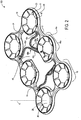
- FIG. 1 illustrates one embodiment of a container carrier 100 configured to secure together and carry one or more containers at one time.
- the body 10 of the container carrier 100 may be integrally molded and may include at least a top surface 12, a bottom surface 14, and a plurality of annular structures 16.
- the body 10 of the container carrier 100 is preferentially formed by injection molding; however, it will be appreciated that another suitable molding technique may be employed to form the body 10 of the container carrier 100.
- Each annular structure 16 is connected to at least one adjacent annular structure 16 of the plurality of annular structures 16 by a bridge 34 and includes a circumferential rib 18.
- a plurality of flanges 20 are coupled to the circumferential rib 18.
- Each flange 20 further includes an inwardly projecting portion 22.
- eight flanges 20 are provided in each annular structure 16, but it will be appreciated that the number of flanges 20 in the annular structures 16 may be more or less than illustrated, so long as their shape and position are sufficient to releasably secure a container.
- each flange 20 is formed to have an arcuate shape. Collectively, the inner perimeters 24 of the flanges 20 are configured to define a void 26. Further, the void 26 defined by the arcuate inner perimeters 24 of the flanges may be formed to have a circular perimeter 28. The circular perimeter 28 of the void 26 may be centered on a vertical central axis C of the annular structure 16. A container may be inserted into void 26, and the flanges 20 may collectively secure the container therein.
- An integrally formed handle 30 extends in an upward orientation from the body 10 of the container carrier 100.
- a shape of the curve of the handle 30 may be concave down when the handle is in an upright configuration in an unbiased state, and the shape of the curve of the handle may be concave up when the handle is in a deflected configuration in a biased state.
- the handle 30 is formed to have a graspable region 36 that spans a peak height H of the handle 30 in an unbiased state and supports the lifting force of a finger or fingers of a user to provide a secure and comfortable structure by which a user may grasp the container carrier 100.
- the graspable region 36 may further include a substantially flat expanse on a least a lower surface thereof that is configured to be gripped by the fingers of a user.
- the substantially flat expanse of the graspable region 36 is typically a solid region without holes or gaps provided therein.
- the substantially flat expanse of the graspable region 36 may include one or more internal perforations or holes.
- the handle 30 is formed to further include a bifurcated region 38, enclosed in dashed lines in FIG. 1 , that bifurcates into a pair of arms separated by a gap.
- Each arm 40a, 40b of the pair of arms connects to the body 10 of the container carrier 100 at a connection point to support the graspable region 36 in an upright configuration in the unbiased state.
- a first arm 40a of the bifurcated region 38 may connect at a first connection point to a first bridge 34a of the body, and a second arm 40b of the bifurcated region 38 may connect at a second connection point to a second bridge 34b of the body 10.
- the arms 40a, 40b may also connect to the same bridge 34.
- the arms 40a, 40b may be formed to include respective straight regions 42a, 42b and respective curved regions 42c, 42d.
- the straight regions 42a, 42b are positioned adjacent an intersection 44 of the bifurcated region 38 and the graspable region 36.
- the straight regions 42a, 42b may flare out into respective curved regions 42c, 42d before connecting to the body 10 of the container carrier 100. This configuration allows the arms 40a, 40b to flex when a force is applied, which permits the shape of the handle 30 to distort while remaining anchored to the body 10 of the container carrier 100.
- the pair of arms 40a, 40b flexes to allow the intersection 44 between the bifurcated region 38 and graspable region 36 to move such that a downward flexion of the graspable region 36 of the handle 30 can be accommodated.
- the straight regions 42a, 42b of the pair of arms 40a, 40b flex away from the graspable region 36, as indicated by the dashed lines in FIG. 3 , as the handle 30 transitions to a deflected configuration in a biased state.
- the above-described bifurcated region 38 and arms 40a, 40b may be designated as a first bifurcated region 38a and a first pair of arms 40a, 40b, and the handle 30 may further include a second bifurcated region 38b that bifurcates into a second pair of arms 40c, 40d.
- the first bifurcated region 38a may be coupled to a first side of the graspable region 36 at a first intersection 44a.
- the second bifurcated region 38b may be coupled to a second side of the graspable region 36 at a second intersection 44b positioned opposite the first intersection 44a of the graspable region 36.
- each arm of the second pair of arms 40c, 40d connects to the body 10 of the container carrier 100 at a respective connection point and support the graspable region 36 in an upright configuration in an unbiased state.
- the first and second pairs of arms 40a, 40b, 40c, 40d may flex to allow the respective first and second intersections 44a, 44b to move, thereby accommodating a downward flexion of the graspable region 36 of the handle 30 when a downward biasing force is applied to the handle 30 in a biased state.
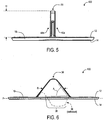
- Such flexing of the first and second pairs of arms 40a, 40b, 40c, 40d causes the first and second intersections 44a, 44b to move away from each other, thereby increasing a distance D between the first and second bifurcated regions 38a, 38b to accommodate passage of the graspable region 36 between the first and second bifurcated regions 38a, 38b as viewed from above, and through a plane P of the body 10, as viewed from a side.
- One embodiment of the handle 30 in a deflected configuration after passage of the graspable region 36 through the plane P of the body 10 is illustrated by the dash-dot line in FIG. 6 .
- FIG. 7 a side view of one embodiment of two container carriers 100a, 100b in a stacked configuration is shown.
- the handle 30 of the respective upper container carrier 100a is in an upright position in an unbiased state, and the shape of the curve of the handle 30 is concave down.
- the graspable region 36 of the handle 30 extends above the top surface 12 of the body 10 of the container carrier 100a to provide a structure that is intuitive for a user to grasp.
- the height of the handle 30 is configured to allow the user to grasp and carry the container carrier 100a without contacting the caps CAP of the containers CON secured within the container carrier 100a, thereby avoiding a potential injury that may be sustained if the caps CAP of the containers CON possess any sharp edges.
- the container carrier 100 assumes a configuration in which the handle 30 is in an upright position in an unbiased state.
- FIG. 7 illustrates the ability of the handle 30 to flex downward below the bottom surface 14 of the body 10 of the container carrier 100 when a force is applied from above.
- the arms 40a, 40b support the graspable region in an upright configuration in the unbiased state.
- the pair of arms may flex to allow an intersection of the bifurcated region and graspable region to move.
- Such movement may accommodate a downward flexion of the graspable region of the handle.
- a user may place a structure S, such as corrugated cardboard or a board, on top of a first level of container carriers 100 to provide a flat surface for stacking the next level of container carriers 100.
- the handle 30 of the respective lower container carrier 100b deflects to a position that is at least partially below the bottom surface 14 of the body 10 of the container carrier 100b, as illustrated by the dashed line in FIG. 7 that represents the handle 30 in a deflected position in a biased state in which the shape of the curve of the handle 30 is concave up.
- the handle 30 does not interfere with a user's ability to arrange containers CON within which respective container carriers 100 are packed in a vertically stacked configuration.
- the flanges 20 included in each annular structure 16 may be configured to flex independently during ingress or egress of one of the containers CON into or out of the corresponding void 26. In an unflexed state, the flanges 20 may be collectively configured to conform to a curvature of a neck of one of the containers CON. The flanges 20 are thus configured to releasably engage a container CON at the neck, the outer diameter of the neck being smaller than an inner diameter of a lip or a cap CAP of the container CON, as illustrated in FIG. 7 .
- one or more of the plurality of flanges 20 of each annular structure 16 may be provided with a support rib 32.
- the support rib 32 may bridge the flange 20 and the circumferential rib 18 of the corresponding annular structure 16 to increase strength and stability of the container carrier 100.
- Support ribs 32 add dimensional support to the annular structures 16 by coupling the circumferential ribs 18 and flanges 20. It will be appreciated that support ribs 32 may be included on or absent from any number of the flanges 20 and that the illustrated embodiment provides only one example of myriad possibilities in which the support ribs 32 may be arranged on the flanges 20, such as centered or offset.
- One or more support ribs 32 may also be arranged between flanges 20 at the point of connection to the circumferential rib 18. Additionally, the thickness and shape of the support ribs 32 may vary depending on the size, shape, and/or weight of container and/or its corresponding cap. For example, the support ribs 32 on a container carrier 100 designed to carry heavier containers may be more numerous, thicker, and/or longer than support ribs 32 on a container carrier 100 that is intended for relatively lighter containers.
- FIG. 2 a bottom perspective of the container carrier 100 is shown.
- the circumferential rib 18 of the container carrier 100 is present but thinner on the bottom surface 14 of the container carrier 100. It will be appreciated that, in other embodiments, the circumferential rib 18 may be thicker on the bottom surface 14 as compared to the top surface 12, or of equal thickness on both the top and bottom surfaces 12, 14 of the container carrier 100.
- the support ribs 32 are absent on the bottom surface 14 of the container carrier 100 in the illustrated embodiment, it will be appreciated that support ribs 32 may formed on either or both of the top and bottom surfaces 12, 14 of the container carrier 100.
- the flanges 20 are attached to a circumferential rib 18 of an annular structure 16 while the inner perimeters 24 of the inwardly projecting portions 22 of the flanges 20 may collectively define a void 26 with a circular perimeter 28.
- the container carrier 100 may include one or more container-engaging structures 16a that are not annular. It will be appreciated that, like the annular structure 16, a semi-annular container-engaging structure 16a may include flanges 20 attached to a circumferential rib 18a.
- annular structures 16 and two semi-annular structures 16a with annular inner perimeters and truncated outer perimeters are shown.
- annular and semi-annular container-engaging structures 16, 16a may vary in other implementations of the container carrier 100 that are not illustrated herein.
- the container-engaging semi-annular structure 16a may be formed to have a semi-annular shape by including a straight portion in the circumferential rib 18a that is positioned toward an interior void 46 of the body 10 of the container carrier 100.
- This implementation increases the area of the interior void 46 of the container carrier 100 to provide room for the flexion of the handle 30 as it transitions from an upright position to a deflected position.
- the circular perimeter 28 of the void 26 may be centered on a vertical central axis C of the annular structure 16 or the container-engaging semi-annular structure 16a. However, it will be appreciated that the circular perimeter 28 of the void 26 may be offset with respect to the annular structure 16 or the container-engaging semi-annular structure 16a.
- the arrangement of the flanges 20 defining a circular perimeter 28 of a void 26 within an annular structure 16 may give rise to a configuration in which the plurality of flanges 20 may have the same lengths.
- This configuration may be observed in an embodiment of a container carrier 100 in which the annular structure 16 and the circular perimeter 28 of the void 26 are both centered on central vertical axis C.
- the container carrier 100 may include one or more container-engaging structures 16a that may be formed to have a semi-annular shape.
- one or more of the flanges 20 positioned proximate the straight region of the circumferential rib 18a of the container-engaging semi-annular structure 16a may be formed to be shorter than adjacent flanges 20.
- the inner perimeters 24 of the flanges 20 may collectively define a void 26 with a circular perimeter 28, regardless of the shape of the container-engaging structure. While the illustrated embodiment includes an even number of flanges 20, with the annular structure 16 and the circular perimeter 28 of the void 26 both centered on the central vertical axis C, it will be appreciated that the configuration of the container carrier 100 is not limited to illustrated embodiment.
- the flanges 20 may occur in an even or an odd number and may be formed to be equal in length to, or longer or shorter than an adjacent flange 20 to accommodate a desired container size/weight and/or a desired cap size/shape.
- the circular perimeter 28 of the void 26 may be offset with respect to the annular structure 16 or the container-engaging semi-annular structure 16a.
- the peak height H of the handle 30 may be in a range of 1 cm to 10 cm from the top surface 12 of the body 10 of the container carrier 100.
- the peak height H of the handle 30 may be positioned at a central location with respect to the body 10 of the container carrier 100.
- the handle 30 may be oriented upwardly at a predetermined angle A in a range of 15 degrees to 60 degrees relative to the top surface 12 of the body 10 of the container carrier 100.
- each flange 20 includes an inwardly projecting portion 22.
- Each inwardly projecting portion 22 extends inwardly from the circumferential rib 18, and all of the inwardly projecting portions 22 may be oriented upwardly from the circumferential rib 18.
- the angle of upward orientation of the inwardly projecting portions may be in a range from 15 to 60 degrees, in one example. Depending on the size or shape of a container neck and cap, as well as the weight of the contents of a container, the angle of upward orientation may be customized to provide the necessary stiffness or flexibility to accommodate a desired container.
- the integrally molded body 10 of the container carrier 100 may be formed to be substantially planar.
- the dashed line P in FIG. 6 indicates the horizontal plane of the body 10 of the container carrier 100.
- the substantially planar body 10 of the container carrier 100 may be between 5 and 25 millimeters thick in a vertical direction.
- the planar configuration of the container carrier 100 coupled with the upward orientation of the inwardly projection portions 22 allows multiple like-shaped container carriers 100 to nest inside one another when stacked. This feature increases the efficiency of packaging and shipping the container carriers 100, and also allows for multiple container carriers 100 to be loaded into a mechanical applicator for applying to containers.
- a container carrier 100 when a container carrier 100 releasably engages containers, the product and its labels are not obscured thereby providing maximum product and label visibility.
- the planar body of a container carrier 100 may allow for placement of a bar code or price tag, further increasing the aesthetic value of the product contained therein.
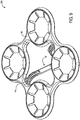
- FIGS. 8-13 a second embodiment of a container carrier 200 is illustrated. Since the container carrier 200 of the second embodiment is generally similar to that of a container carrier 100 of the first embodiment lacking the curved regions 42c, 42d of the handle 30 and the semi-annular container-engaging structures 16a, the detailed description thereof is abbreviated for the sake of brevity. It is to be noted that like parts are designated by like reference numerals throughout the detailed description and the accompanying drawings.
- FIGS. 8 and 9 illustrate top and bottom perspective views, respectively, of the second embodiment of the container carrier 200.
- the bifurcated region 38 in the handle 30 separates the end of the handle 30 into two flexible arms 40a, 40b.
- the arms 40a, 40b are formed to have respective straight regions 42a, 42b along the portion of the handle 30 similar to those of the first embodiment of the container carrier 100.
- the arms 40a, 40b may curve to transition to regions 42e, 42f that remain in the same vertical plane as the handle 30 but become horizontally planar with respect to the body 10 of the container carrier 200.
- the arms 40a, 40b may connect to the body 10 of the container carrier 200 at two connection points.
- the arms 40a, 40b may connect to the body 10 of the container carrier 200 at two connection points on the same bridge 34, as illustrated in FIGS. 8 and 10 , rather than two connection points on two separate bridges as described in the first embodiment and shown in FIGS. 1 and 3 .
- the gap of the bifurcated region 38 allows the straight regions 42e, 42f of the second embodiment to flex apart from one another as the handle 30 is transitioning from an upright position to a deflected position, as indicated by the dashed lines in FIG. 10 .
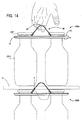
- FIG. 14 a side view of one embodiment of two container carriers 200a, 200b in a stacked configuration is shown.
- some or all of the handle 30 may flex downward below the bottom surface 14 of the body 10 of the container carrier 200 when a downward biasing force F is applied from above.
- the handle 30 of the respective lower container carrier 200b deflects to a position that is at least partially below the bottom surface 14 of the body 10 of the container carrier 200b, as illustrated by the dashed line in FIG. 14 that represents the handle 30 in a deflected position in which the shape of the curve of the loop is concave up.
- top and bottom views of the container carrier 200 are provided.
- the second embodiment of the container carrier 200 lacks one or more container-engaging structures 16a that are formed with a semi-annular shape.
- the equidistant arrangement of four annular structures in the second embodiment provides sufficient room in the area of the interior void 46 for the flexion of the handle 30 as it transitions from an upright position to a deflected position.
- the peak height H of the handle 30 may be in a range of 1 cm to 10 cm from the top surface 12 of the body 10 of the container carrier 200, positioned at a central location with respect to the body 10 of the container carrier 200, and oriented upwardly at a predetermined angle A in a range of 15 degrees to 60 degrees relative to the top surface 12 of the body 10 of the container carrier 200.
- the container carrier may be preferentially formed of a flexible plastic. Being both strong and lightweight, plastic is an advantageous material for use in container carriers. It is preferable that the plastic be flexible in nature to accommodate the flexible nature of the handle, as well as the releasable engagement of the containers with the flanges. Specifically, the plastic may be high density polyethylene (HDPE), and it may further be recycled HDPE. It will be appreciated that container carriers formed of flexible plastic have the additional benefit of being recyclable.
- HDPE high density polyethylene
- the container carriers described above may be used to provide a convenient carrying mechanism for containers of all sorts, but are particularly advantageous due to the manner in which the handle extends beyond the top of the container carrier.
- the caps of the containers secured within the container carrier may possess sharp edges that can cut or damage the skin of the user.
- the container carriers described herein prevent such an undesirable situation by allowing a user to grasp and carry the container carrier without contacting the caps of the containers secured within the container carrier.
Landscapes
- Engineering & Computer Science (AREA)
- Mechanical Engineering (AREA)
- Details Of Rigid Or Semi-Rigid Containers (AREA)
- Making Paper Articles (AREA)
- Containers Having Bodies Formed In One Piece (AREA)
- Packages (AREA)
- Auxiliary Devices For And Details Of Packaging Control (AREA)
Claims (19)
- Behälterträger (100) zum Zusammenhalten und Tragen mehrerer Behälter, wobei der Behälterträger (100) einen einstückig ausgebildeten Körper (10) mit einer oberen Fläche (12), einer unteren Fläche (14) und mehreren ringförmigen Strukturen (16) aufweist, wobei jede ringförmige Struktur (16) mit mindestens einer benachbarten ringförmigen Struktur (16) der mehreren ringförmigen Strukturen (16) durch eine Brücke (34) verbunden ist, wobei jede ringförmige Struktur (16) eine Umfangsrippe (18) mit mehreren Flanschen (20) aufweist, die mit der Umfangsrippe (18) verbunden sind, wobei jeder Flansch (20) einen Abschnitt (22) aufweist, der von der ringförmigen Struktur (16) nach innen vorsteht, wobei ein innerer Umfang (24) jedes Flansches (20) so gebildet ist, dass er eine bogenförmige Form aufweist, und wobei die inneren Umfänge (24) der Flansche (20) gemeinsam geeignet sind, einen Hohlraum (26) zu definieren; und
einen einstückig gebildeten Griff (30) mit einem greifbaren Bereich (36) und einem gegabelten Bereich (38), der sich in ein Paar Arme (40a, 40b) gabelt, wobei jeder Arm des Paares von Armen (40a, 40b) an einem Verbindungspunkt mit dem Körper (10) des Behälterträgers (100) verbunden ist und das Paar von Armen (40a, 40b) sich biegt, um eine Bewegung eines Schnittpunkts des gegabelten Bereichs (38) und des greifbaren Bereichs (36) zu ermöglichen, wodurch eine nach unten gerichtete Biegung des greifbaren Bereichs (36) des Griffs (30) aufgenommen wird, wenn eine nach unten gerichtete Belastungskraft auf den Griff (30) in einem belasteten Zustand ausgeübt wird, dadurch gekennzeichnet, dass
der Griff (30) sich in einer nach oben gerichteten Orientierung von dem Körper (10) des Behälterträgers (100) erstreckt, und jeder Arm den greifbaren Bereich (36) in einer aufrechten Konfiguration in einem nicht belasteten Zustand trägt. - Behälterträger nach Anspruch 1, wobei der greifbare Bereich (36) eine Spitzenhöhe (H) des Griffs (30) in dem nicht belasteten Zustand überspannt.
- Behälterträger nach Anspruch 1, wobei der greifbare Bereich (36) mindestens auf seiner unteren Oberfläche eine im Wesentlichen flache Ausdehnung aufweist, die geeignet ist, von den Fingern eines Benutzers gegriffen zu werden.
- Behälterträger nach Anspruch 3, wobei die im Wesentlichen flache Ausdehnung des greifbaren Bereichs (36) massiv ist.
- Behälterträger nach Anspruch 3, wobei die im Wesentlichen flache Ausdehnung des greifbaren Bereichs (36) eine oder mehrere Perforierungen aufweist.
- Behälterträger nach Anspruch 1, wobei
die Spitzenhöhe (H) des Griffs (30) in einem Bereich von 1 cm bis 10 cm von der oberen Oberfläche (12) des Körpers (10) des Behälterträgers (100) liegt, und
der Griff (30) in einem vorbestimmten Winkel (A) in einem Bereich von 15 Grad bis 60 Grad relativ zu der oberen Oberfläche (12) des Körpers (10) des Behälterträgers (100) nach oben ausgerichtet ist. - Behälterträger nach Anspruch 1, wobei ein erster Arm (40a) des gegabelten Bereichs (38) an einem ersten Verbindungspunkt mit einer ersten Brücke (34a) des Körpers (10) verbunden ist, und ein zweiter Arm (40b) des gegabelten Bereichs (38) an einem zweiten Verbindungspunkt mit einer zweiten Brücke (34b) des Körpers (10) verbunden ist.
- Behälterträger nach Anspruch 2, wobei die Spitzenhöhe (H) des Griffs (30) an einer zentralen Stelle in Bezug auf den Körper (10) des Behälterträgers (100) angeordnet ist.
- Behälterträger nach Anspruch 1, wobei eine Form einer Kurve des Griffs (30) in einer aufrechten Position im nicht belasteten Zustand konkav nach unten ist und die Form der Kurve des Griffs (30) in einer gebeugten Position im belasteten Zustand konkav nach oben ist.
- Behälterträger nach Anspruch 1, wobei jeder Arm (40a, 40b) des Paares von Armen einen geraden Bereich (42a, 42b) und einen gekrümmten Bereich (42c, 42d) aufweist.
- Behälterträger nach Anspruch 1, wobei
die Flansche (20) jeder ringförmigen Struktur (16) geeignet sind, sich während des Eintretens oder Austretens eines der Behälter (CON) in den oder aus dem entsprechenden Hohlraum (26) unabhängig voneinander zu biegen; und
die Flansche (20) in einem nicht gebogenen Zustand gemeinsam einer Krümmung eines Halses eines der Behälter (CON) entsprechen, um lösbar mit dem Behälter (CON) in Eingriff zu kommen, wobei der Hals kleiner ist als eine Lippe oder ein Deckel (CAP) des Behälters (CON). - Behälterträger nach Anspruch 1, wobei sich jeder nach innen vorstehende Abschnitt (22) von der Umfangsrippe (18a) nach innen erstreckt und alle nach innen vorstehenden Abschnitte (22) in einem vorbestimmten Winkel von der Umfangsrippe (18a) nach oben ausgerichtet sind.
- Behälterträger nach Anspruch 1, wobei
der gegabelte Bereich (38) ein erster gegabelter Bereich (38a) ist, der sich in ein erstes Paar Arme (40a, 40b) gabelt, wobei der erste gegabelte Bereich (38a) mit einer ersten Seite des greifbaren Bereichs (36) an einem ersten Schnittpunkt (44a) verbunden ist, und
der Griff (30) ferner einen zweiten gegabelten Bereich (38b) aufweist, der mit einer zweiten Seite des greifbaren Bereichs (36) an einem zweiten Schnittpunkt (44b) verbunden ist, der gegenüber dem ersten Schnittpunkt (44a) des greifbaren Bereichs (36) angeordnet ist,
wobei der zweite gegabelte Bereich (38b) sich in ein zweites Paar Arme (40c, 40d) gabelt,
wobei jeder Arm des zweiten Paar Armen (40c, 40d) mit dem Körper (10) des Behälterträgers (100) an einem Verbindungspunkt verbunden ist und den greifbaren Bereich (36) in einem nicht belasteten Zustand in einer aufrechten Konfiguration trägt, und
wobei sich das zweite Paar Arme (40c, 40d) biegt, um eine Bewegung eines zweiten Schnittpunkts (44b) des gegabelten Bereichs (38) und des greifbaren Bereichs (36) zu ermöglichen, wodurch eine nach unten gerichtete Biegung des greifbaren Bereichs (36) des Griffs (30) aufgenommen wird, wenn eine nach unten gerichtete Belastungskraft auf den Griff (30) in einem belasteten Zustand ausgeübt wird. - Behälterträger nach Anspruch 13, wobei
das Biegen des ersten und zweiten Paar Armen (40a, 40b, 40c, 40d) bewirkt, dass sich der erste und zweite Schnittpunkt (44a, 44b), die jeweils an der ersten und zweiten Seite des greifbaren Bereichs (36) angeordnet sind, voneinander weg bewegen, wodurch ein Abstand (D) zwischen dem ersten und dem zweiten gegabelten Bereich (38a, 38b) vergrößert wird, um den Durchgang des greifbaren Bereichs (36) zwischen dem ersten und dem zweiten gegabelten Bereich (38a, 38b), von oben gesehen, und durch eine Ebene (P) des Körpers (10), von einer Seite gesehen, zu ermöglichen. - Herstellungsverfahren für einen Behälterträger (100) zum Zusammenhalten und Tragen eines oder mehrerer Behälter, wobei das Verfahren umfasst: Formen eines einstückig ausgebildeten Körpers (10) mit einer oberen Fläche (12), einer unteren Fläche (14) und mehreren ringförmigen Strukturen (16); Ausbilden jeder ringförmigen Struktur (16), um mit mindestens einer benachbarten ringförmigen Struktur (16) der mehreren ringförmigen Strukturen (16) durch eine Brücke (34) verbunden zu werden; Ausbilden jeder ringförmigen Struktur (16) mit einer Umfangsrippe (18) mit mehreren Flanschen (20), die mit der Umfangsrippe (18) verbunden sind, wobei jeder Flansch (20) einen Abschnitt (22) aufweist, der von der ringförmigen Struktur (16) nach innen vorsteht; Ausbilden eines inneren Umfangs (24) jedes Flansches (16), so dass er eine bogenförmige Form aufweist, wobei die inneren Umfänge (24) der Flansche (16) gemeinsam geeignet sind, einen Hohlraum (26) zu definieren; Formen eines einstückig gebildeten Griffs (30), so dass er einen greifbaren Bereich (36) und einen gegabelten Bereich (38) aufweist, der sich in ein Paar Arme (40a, 40b) gabelt; Ausbilden jedes Arms des Paars von Armen (40a, 40b), um sich mit dem Körper (10) des Behälterträgers (100) an einem Verbindungspunkt zu verbinden; und Ausbilden des Paars von Armen (40a, 40b), um sich zu biegen, um zu ermöglichen, dass sich ein Schnittpunkt des gegabelten Bereichs (38) und des greifbaren Bereichs (36) bewegt, wodurch eine nach unten gerichtete Biegung des greifbaren Bereichs (36) des Griffs (30) aufgenommen wird, wenn eine nach unten gerichtete Belastungskraft auf den Griff (30) in einem belasteten Zustand ausgeübt wird, dadurch gekennzeichnet, dass:
der Griff (30) sich in einer nach oben gerichteten Orientierung von dem Körper (10) des Behälterträgers (100) erstreckt, und jeder Arm den greifbaren Bereich (36) in einer aufrechten Konfiguration in einem nicht belasteten Zustand trägt. - Herstellungsverfahren für einen Behälterträger nach Anspruch 15, wobei das Verfahren ferner umfasst:
Ausbilden des greifbaren Bereichs (36), um eine Spitzenhöhe (H) des Griffs (30) in dem nicht belasteten Zustand zu überspannen. - Herstellungsverfahren für einen Behälterträger nach Anspruch 15, wobei das Verfahren ferner umfasst:
Ausbilden eines ersten Arms (40a) des gegabelten Bereichs (38) zum Verbinden an einem ersten Verbindungspunkt mit einer ersten Brücke (34a) des Körpers (10), und Ausbilden eines zweiten Arms (40b) des gegabelten Bereichs (38) zum Verbinden an einem zweiten Verbindungspunkt mit einer zweiten Brücke (34b) des Körpers (10). - Herstellungsverfahren für einen Behälterträger nach Anspruch 15, wobei das Verfahren ferner umfasst:Ausbilden des gegabelten Bereichs (38) als einen ersten gegabelten Bereich (38a), der sich in ein erstes Paar Arme (40a, 40b) gabelt, wobei der erste gegabelte Bereich (38a) mit einer ersten Seite des greifbaren Bereichs (36) an einem ersten Schnittpunkt (44a) verbunden ist, undFormen des Griffs (30), sodass er ferner einen zweiten gegabelten Bereich (38b) umfasst, der mit einer zweiten Seite des greifbaren Bereichs (36) an einem zweiten Schnittpunkt (44b) verbunden ist, der gegenüber dem ersten Schnittpunkt (44a) des greifbaren Bereichs (36) angeordnet ist,Ausbilden des zweiten gegabelten Bereichs (38b), um sich in ein zweites Paar Arme (40c, 40d) zu gabeln,Ausbilden jedes Arms des zweiten Paar Armen (40c, 40d), damit sie sich mit dem Körper (10) des Behälterträgers (100) an einem Verbindungspunkt verbinden und den greifbaren Bereich (36) in einer aufrechten Konfiguration in einem nicht belasteten Zustand stützen, undAusbilden des zweiten Paar Armen (40c, 40d), damit es sich biegt, um zu ermöglichen, dass sich ein zweiter Schnittpunkt (44b) des gegabelten Bereichs (38) und des greifbaren Bereichs (36) bewegt, wodurch eine nach unten gerichtete Biegung des greifbaren Bereichs (36) des Griffs (30) aufgenommen wird, wenn eine nach unten gerichtete Belastungskraft auf den Griff (30) in einem vorgespannten Zustand ausgeübt wird.
- Herstellungsverfahren für einen Behälterträger nach Anspruch 15, wobei das Verfahren ferner umfasst:
Ausbilden des ersten und zweiten Schnittpunkts (44a, 44b), die jeweils an der ersten und zweiten Seite des greifbaren Bereichs (36) angeordnet sind, um sich voneinander wegzubewegen, wenn das erste und zweite Paar Arme (40a, 40b, 40c, 40d) gebogen werden, wodurch ein Abstand (D) zwischen dem ersten und dem zweiten gegabelten Bereich (38a, 38b) vergrößert wird, um den Durchgang des greifbaren Bereichs (36) zwischen dem ersten und dem zweiten gegabelten Bereich (38a, 38b), von oben gesehen, und durch eine Ebene (P) des Körpers (10), von einer Seite gesehen, zu ermöglichen.
Priority Applications (1)
| Application Number | Priority Date | Filing Date | Title |
|---|---|---|---|
| PL18812025T PL3455145T3 (pl) | 2017-07-14 | 2018-08-21 | Nosidło na pojemniki z elastycznym podnoszonym uchwytem |
Applications Claiming Priority (2)
| Application Number | Priority Date | Filing Date | Title |
|---|---|---|---|
| US201762532923P | 2017-07-14 | 2017-07-14 | |
| PCT/US2018/047389 WO2019014689A1 (en) | 2017-07-14 | 2018-08-21 | CONTAINER SUPPORT WITH FLEXIBLE RAISED HANDLE |
Publications (3)
| Publication Number | Publication Date |
|---|---|
| EP3455145A1 EP3455145A1 (de) | 2019-03-20 |
| EP3455145A4 EP3455145A4 (de) | 2019-12-11 |
| EP3455145B1 true EP3455145B1 (de) | 2021-02-17 |
Family
ID=65000172
Family Applications (1)
| Application Number | Title | Priority Date | Filing Date |
|---|---|---|---|
| EP18812025.7A Active EP3455145B1 (de) | 2017-07-14 | 2018-08-21 | Behälterträger mit flexiblem erhöhtem griff |
Country Status (21)
| Country | Link |
|---|---|
| US (2) | US11001428B2 (de) |
| EP (1) | EP3455145B1 (de) |
| JP (1) | JP2021535045A (de) |
| KR (1) | KR20210034705A (de) |
| CN (1) | CN111083925B (de) |
| AR (1) | AR113393A1 (de) |
| AU (1) | AU2018236889A1 (de) |
| BR (1) | BR112018074100A2 (de) |
| CA (1) | CA3022974A1 (de) |
| CL (1) | CL2018002971A1 (de) |
| CO (1) | CO2018013038A2 (de) |
| DK (1) | DK3455145T3 (de) |
| EA (1) | EA037506B1 (de) |
| ES (1) | ES2861802T3 (de) |
| MX (1) | MX2018012267A (de) |
| PE (1) | PE20210500A1 (de) |
| PH (1) | PH12018502526A1 (de) |
| PL (1) | PL3455145T3 (de) |
| PT (1) | PT3455145T (de) |
| SA (1) | SA518400556B1 (de) |
| WO (1) | WO2019014689A1 (de) |
Families Citing this family (9)
| Publication number | Priority date | Publication date | Assignee | Title |
|---|---|---|---|---|
| USD996981S1 (en) * | 2020-07-17 | 2023-08-29 | Fishbone Packaging Inc. | Container carrier |
| CN113624342B (zh) * | 2021-06-18 | 2023-05-26 | 张广帅 | 一种握柄反抓式测温枪及其握持方法 |
| USD996227S1 (en) * | 2021-08-20 | 2023-08-22 | Fishbone Packaging Inc. | Container carrier |
| US12122579B2 (en) | 2021-11-05 | 2024-10-22 | Illinois Tool Works Inc. | Container carrier |
| US12280903B2 (en) | 2021-11-05 | 2025-04-22 | Illinois Tool Works Inc. | Container carrier |
| US20230391525A1 (en) * | 2022-06-03 | 2023-12-07 | Illinois Tool Works Inc. | Container carrier |
| US11877608B1 (en) * | 2022-12-07 | 2024-01-23 | Carl Stuckey | Hand protecting device and method |
| FR3144605B1 (fr) * | 2022-12-29 | 2025-09-26 | Sidel Participations | Dispositif amélioré de conditionnement en un lot d'au moins deux récipients |
| US20240351765A1 (en) * | 2023-04-19 | 2024-10-24 | Illinois Tool Works Inc. | Container carrier |
Family Cites Families (16)
| Publication number | Priority date | Publication date | Assignee | Title |
|---|---|---|---|---|
| US3463536A (en) * | 1967-01-10 | 1969-08-26 | Haynes Mfg Co | Container handle |
| AU5895073A (en) * | 1972-08-16 | 1975-02-06 | Fuluse Pty Ltd | Closure for container |
| CN2097172U (zh) * | 1991-04-05 | 1992-02-26 | 湖南省安化县五金厂 | 组合式多用食品桶 |
| US5188413A (en) | 1992-04-08 | 1993-02-23 | Rtc Industries, Inc. | Bottle carrier assembly |
| JPH07137765A (ja) * | 1993-11-12 | 1995-05-30 | Hanshin Kasei Kogyo Kk | 缶キャリアー |
| JPH09110070A (ja) * | 1995-10-16 | 1997-04-28 | Fuji Seal Co Ltd | 複数物品の携帯用ホルダー |
| US6969098B2 (en) | 2002-07-03 | 2005-11-29 | Illinois Tool Works Inc. | Non-elevating handle for center lift carrier |
| US6874620B2 (en) | 2003-01-10 | 2005-04-05 | Roberts Polypro | Container carrier |
| US7137765B1 (en) * | 2003-09-19 | 2006-11-21 | Helmut Richard Elze | Composite dunnage bag |
| US8545375B2 (en) | 2003-10-08 | 2013-10-01 | Illinois Tool Works, Inc. | Top lift carrier and method of manufacture therefor |
| US7823943B2 (en) | 2006-06-27 | 2010-11-02 | Oregon Precision Industries, Inc. | Multiple container carrier |
| WO2008047349A2 (en) * | 2006-10-16 | 2008-04-24 | Mteye Security Ltd. | Device and system for preset field-of-view imaging |
| DE102007034870A1 (de) | 2007-07-24 | 2009-01-29 | Richardson, Mirco I. | Tragegriff |
| EP2197763A4 (de) * | 2007-09-12 | 2011-04-06 | Biba Pty Ltd | Getränkebehälterträger |
| WO2014124402A2 (en) * | 2013-02-11 | 2014-08-14 | Becton, Dickinson And Company | Chromophore compositions and methods of making and using the same |
| WO2016018758A1 (en) * | 2014-08-01 | 2016-02-04 | Westrock Packaging Systems, Llc | Carton and carton blank and a handle structure therefore |
-
2017
- 2017-10-31 US US15/799,670 patent/US11001428B2/en active Active
-
2018
- 2018-08-21 JP JP2018562353A patent/JP2021535045A/ja active Pending
- 2018-08-21 WO PCT/US2018/047389 patent/WO2019014689A1/en not_active Ceased
- 2018-08-21 EA EA201892496A patent/EA037506B1/ru unknown
- 2018-08-21 PE PE2018003123A patent/PE20210500A1/es unknown
- 2018-08-21 PT PT188120257T patent/PT3455145T/pt unknown
- 2018-08-21 KR KR1020187035877A patent/KR20210034705A/ko not_active Withdrawn
- 2018-08-21 ES ES18812025T patent/ES2861802T3/es active Active
- 2018-08-21 PL PL18812025T patent/PL3455145T3/pl unknown
- 2018-08-21 AU AU2018236889A patent/AU2018236889A1/en not_active Abandoned
- 2018-08-21 MX MX2018012267A patent/MX2018012267A/es unknown
- 2018-08-21 BR BR112018074100A patent/BR112018074100A2/pt not_active Application Discontinuation
- 2018-08-21 DK DK18812025.7T patent/DK3455145T3/da active
- 2018-08-21 CN CN201880002026.6A patent/CN111083925B/zh not_active Expired - Fee Related
- 2018-08-21 EP EP18812025.7A patent/EP3455145B1/de active Active
- 2018-08-21 CA CA3022974A patent/CA3022974A1/en not_active Abandoned
- 2018-10-18 CL CL2018002971A patent/CL2018002971A1/es unknown
- 2018-10-19 AR ARP180103063A patent/AR113393A1/es active IP Right Grant
- 2018-11-29 SA SA518400556A patent/SA518400556B1/ar unknown
- 2018-11-29 PH PH12018502526A patent/PH12018502526A1/en unknown
- 2018-11-30 CO CONC2018/0013038A patent/CO2018013038A2/es unknown
-
2021
- 2021-05-11 US US17/317,654 patent/US20210331849A1/en not_active Abandoned
Non-Patent Citations (1)
| Title |
|---|
| None * |
Also Published As
| Publication number | Publication date |
|---|---|
| PL3455145T3 (pl) | 2021-08-23 |
| EA201892496A1 (ru) | 2019-06-28 |
| AR113393A1 (es) | 2020-04-29 |
| CA3022974A1 (en) | 2019-01-14 |
| EP3455145A4 (de) | 2019-12-11 |
| JP2021535045A (ja) | 2021-12-16 |
| US20190016515A1 (en) | 2019-01-17 |
| CN111083925B (zh) | 2022-05-13 |
| DK3455145T3 (da) | 2021-03-29 |
| ES2861802T3 (es) | 2021-10-06 |
| BR112018074100A2 (pt) | 2020-01-28 |
| US20210331849A1 (en) | 2021-10-28 |
| US11001428B2 (en) | 2021-05-11 |
| PT3455145T (pt) | 2021-03-18 |
| PE20210500A1 (es) | 2021-03-15 |
| EP3455145A1 (de) | 2019-03-20 |
| PH12018502526A1 (en) | 2019-10-21 |
| EA037506B1 (ru) | 2021-04-06 |
| SA518400556B1 (ar) | 2022-02-16 |
| CO2018013038A2 (es) | 2019-04-30 |
| MX2018012267A (es) | 2021-01-15 |
| WO2019014689A1 (en) | 2019-01-17 |
| AU2018236889A1 (en) | 2019-01-31 |
| KR20210034705A (ko) | 2021-03-31 |
| CL2018002971A1 (es) | 2019-06-21 |
| CN111083925A (zh) | 2020-04-28 |
Similar Documents
| Publication | Publication Date | Title |
|---|---|---|
| EP3455145B1 (de) | Behälterträger mit flexiblem erhöhtem griff | |
| AU2018203540B2 (en) | Variable Cone Container Carrier | |
| US7108128B2 (en) | Balanced multiple container carrier | |
| AU2018220006B2 (en) | Container carrier with flexible flange | |
| US11111063B2 (en) | Separatable container carrier | |
| US5285892A (en) | Sanitary can carriers and multiple beverage can packages including the same | |
| EP2084072A1 (de) | Kasten für container | |
| US10829283B2 (en) | Container carrier with flexible flange | |
| NZ735007B (en) | Container carrier with flexible flange | |
| JPH09110070A (ja) | 複数物品の携帯用ホルダー |
Legal Events
| Date | Code | Title | Description |
|---|---|---|---|
| STAA | Information on the status of an ep patent application or granted ep patent |
Free format text: STATUS: UNKNOWN |
|
| STAA | Information on the status of an ep patent application or granted ep patent |
Free format text: STATUS: THE INTERNATIONAL PUBLICATION HAS BEEN MADE |
|
| PUAI | Public reference made under article 153(3) epc to a published international application that has entered the european phase |
Free format text: ORIGINAL CODE: 0009012 |
|
| STAA | Information on the status of an ep patent application or granted ep patent |
Free format text: STATUS: REQUEST FOR EXAMINATION WAS MADE |
|
| 17P | Request for examination filed |
Effective date: 20181214 |
|
| AK | Designated contracting states |
Kind code of ref document: A1 Designated state(s): AL AT BE BG CH CY CZ DE DK EE ES FI FR GB GR HR HU IE IS IT LI LT LU LV MC MK MT NL NO PL PT RO RS SE SI SK SM TR |
|
| AX | Request for extension of the european patent |
Extension state: BA ME |
|
| A4 | Supplementary search report drawn up and despatched |
Effective date: 20191113 |
|
| RIC1 | Information provided on ipc code assigned before grant |
Ipc: B29K 23/00 20060101ALI20191107BHEP Ipc: B29L 31/00 20060101ALI20191107BHEP Ipc: B65D 71/50 20060101AFI20191107BHEP Ipc: B65D 21/02 20060101ALI20191107BHEP Ipc: B29C 67/24 20060101ALI20191107BHEP Ipc: B29K 105/26 20060101ALI20191107BHEP |
|
| GRAP | Despatch of communication of intention to grant a patent |
Free format text: ORIGINAL CODE: EPIDOSNIGR1 |
|
| STAA | Information on the status of an ep patent application or granted ep patent |
Free format text: STATUS: GRANT OF PATENT IS INTENDED |
|
| DAV | Request for validation of the european patent (deleted) | ||
| DAX | Request for extension of the european patent (deleted) | ||
| INTG | Intention to grant announced |
Effective date: 20200914 |
|
| GRAS | Grant fee paid |
Free format text: ORIGINAL CODE: EPIDOSNIGR3 |
|
| GRAA | (expected) grant |
Free format text: ORIGINAL CODE: 0009210 |
|
| STAA | Information on the status of an ep patent application or granted ep patent |
Free format text: STATUS: THE PATENT HAS BEEN GRANTED |
|
| AK | Designated contracting states |
Kind code of ref document: B1 Designated state(s): AL AT BE BG CH CY CZ DE DK EE ES FI FR GB GR HR HU IE IS IT LI LT LU LV MC MK MT NL NO PL PT RO RS SE SI SK SM TR |
|
| REG | Reference to a national code |
Ref country code: GB Ref legal event code: FG4D |
|
| REG | Reference to a national code |
Ref country code: CH Ref legal event code: EP |
|
| REG | Reference to a national code |
Ref country code: DE Ref legal event code: R096 Ref document number: 602018012797 Country of ref document: DE |
|
| REG | Reference to a national code |
Ref country code: AT Ref legal event code: REF Ref document number: 1361175 Country of ref document: AT Kind code of ref document: T Effective date: 20210315 |
|
| REG | Reference to a national code |
Ref country code: IE Ref legal event code: FG4D |
|
| REG | Reference to a national code |
Ref country code: PT Ref legal event code: SC4A Ref document number: 3455145 Country of ref document: PT Date of ref document: 20210318 Kind code of ref document: T Free format text: AVAILABILITY OF NATIONAL TRANSLATION Effective date: 20210311 |
|
| REG | Reference to a national code |
Ref country code: RO Ref legal event code: EPE |
|
| REG | Reference to a national code |
Ref country code: DK Ref legal event code: T3 Effective date: 20210324 |
|
| REG | Reference to a national code |
Ref country code: FI Ref legal event code: FGE |
|
| REG | Reference to a national code |
Ref country code: SE Ref legal event code: TRGR |
|
| REG | Reference to a national code |
Ref country code: NL Ref legal event code: FP |
|
| REG | Reference to a national code |
Ref country code: CH Ref legal event code: NV Representative=s name: VALIPAT S.A. C/O BOVARD SA NEUCHATEL, CH |
|
| REG | Reference to a national code |
Ref country code: GR Ref legal event code: EP Ref document number: 20210401002 Country of ref document: GR Effective date: 20210519 |
|
| REG | Reference to a national code |
Ref country code: NO Ref legal event code: T2 Effective date: 20210217 |
|
| REG | Reference to a national code |
Ref country code: LT Ref legal event code: MG9D |
|
| PG25 | Lapsed in a contracting state [announced via postgrant information from national office to epo] |
Ref country code: BG Free format text: LAPSE BECAUSE OF FAILURE TO SUBMIT A TRANSLATION OF THE DESCRIPTION OR TO PAY THE FEE WITHIN THE PRESCRIBED TIME-LIMIT Effective date: 20210517 Ref country code: HR Free format text: LAPSE BECAUSE OF FAILURE TO SUBMIT A TRANSLATION OF THE DESCRIPTION OR TO PAY THE FEE WITHIN THE PRESCRIBED TIME-LIMIT Effective date: 20210217 Ref country code: LT Free format text: LAPSE BECAUSE OF FAILURE TO SUBMIT A TRANSLATION OF THE DESCRIPTION OR TO PAY THE FEE WITHIN THE PRESCRIBED TIME-LIMIT Effective date: 20210217 |
|
| PG25 | Lapsed in a contracting state [announced via postgrant information from national office to epo] |
Ref country code: LV Free format text: LAPSE BECAUSE OF FAILURE TO SUBMIT A TRANSLATION OF THE DESCRIPTION OR TO PAY THE FEE WITHIN THE PRESCRIBED TIME-LIMIT Effective date: 20210217 Ref country code: RS Free format text: LAPSE BECAUSE OF FAILURE TO SUBMIT A TRANSLATION OF THE DESCRIPTION OR TO PAY THE FEE WITHIN THE PRESCRIBED TIME-LIMIT Effective date: 20210217 |
|
| PG25 | Lapsed in a contracting state [announced via postgrant information from national office to epo] |
Ref country code: IS Free format text: LAPSE BECAUSE OF FAILURE TO SUBMIT A TRANSLATION OF THE DESCRIPTION OR TO PAY THE FEE WITHIN THE PRESCRIBED TIME-LIMIT Effective date: 20210617 |
|
| PGFP | Annual fee paid to national office [announced via postgrant information from national office to epo] |
Ref country code: NL Payment date: 20210823 Year of fee payment: 4 |
|
| REG | Reference to a national code |
Ref country code: ES Ref legal event code: FG2A Ref document number: 2861802 Country of ref document: ES Kind code of ref document: T3 Effective date: 20211006 |
|
| PG25 | Lapsed in a contracting state [announced via postgrant information from national office to epo] |
Ref country code: SM Free format text: LAPSE BECAUSE OF FAILURE TO SUBMIT A TRANSLATION OF THE DESCRIPTION OR TO PAY THE FEE WITHIN THE PRESCRIBED TIME-LIMIT Effective date: 20210217 Ref country code: EE Free format text: LAPSE BECAUSE OF FAILURE TO SUBMIT A TRANSLATION OF THE DESCRIPTION OR TO PAY THE FEE WITHIN THE PRESCRIBED TIME-LIMIT Effective date: 20210217 |
|
| PGFP | Annual fee paid to national office [announced via postgrant information from national office to epo] |
Ref country code: CZ Payment date: 20210813 Year of fee payment: 4 Ref country code: FI Payment date: 20210819 Year of fee payment: 4 Ref country code: IE Payment date: 20210827 Year of fee payment: 4 |
|
| REG | Reference to a national code |
Ref country code: DE Ref legal event code: R097 Ref document number: 602018012797 Country of ref document: DE |
|
| PG25 | Lapsed in a contracting state [announced via postgrant information from national office to epo] |
Ref country code: SK Free format text: LAPSE BECAUSE OF FAILURE TO SUBMIT A TRANSLATION OF THE DESCRIPTION OR TO PAY THE FEE WITHIN THE PRESCRIBED TIME-LIMIT Effective date: 20210217 |
|
| PGFP | Annual fee paid to national office [announced via postgrant information from national office to epo] |
Ref country code: ES Payment date: 20210917 Year of fee payment: 4 Ref country code: SE Payment date: 20210823 Year of fee payment: 4 Ref country code: TR Payment date: 20210818 Year of fee payment: 4 Ref country code: RO Payment date: 20210818 Year of fee payment: 4 Ref country code: CH Payment date: 20210824 Year of fee payment: 4 Ref country code: BE Payment date: 20210823 Year of fee payment: 4 Ref country code: PL Payment date: 20210816 Year of fee payment: 4 Ref country code: GR Payment date: 20210819 Year of fee payment: 4 Ref country code: NO Payment date: 20210820 Year of fee payment: 4 Ref country code: DK Payment date: 20210820 Year of fee payment: 4 |
|
| PLBE | No opposition filed within time limit |
Free format text: ORIGINAL CODE: 0009261 |
|
| STAA | Information on the status of an ep patent application or granted ep patent |
Free format text: STATUS: NO OPPOSITION FILED WITHIN TIME LIMIT |
|
| PGFP | Annual fee paid to national office [announced via postgrant information from national office to epo] |
Ref country code: PT Payment date: 20210820 Year of fee payment: 4 |
|
| 26N | No opposition filed |
Effective date: 20211118 |
|
| PG25 | Lapsed in a contracting state [announced via postgrant information from national office to epo] |
Ref country code: AL Free format text: LAPSE BECAUSE OF FAILURE TO SUBMIT A TRANSLATION OF THE DESCRIPTION OR TO PAY THE FEE WITHIN THE PRESCRIBED TIME-LIMIT Effective date: 20210217 |
|
| PG25 | Lapsed in a contracting state [announced via postgrant information from national office to epo] |
Ref country code: SI Free format text: LAPSE BECAUSE OF FAILURE TO SUBMIT A TRANSLATION OF THE DESCRIPTION OR TO PAY THE FEE WITHIN THE PRESCRIBED TIME-LIMIT Effective date: 20210217 |
|
| PG25 | Lapsed in a contracting state [announced via postgrant information from national office to epo] |
Ref country code: MC Free format text: LAPSE BECAUSE OF FAILURE TO SUBMIT A TRANSLATION OF THE DESCRIPTION OR TO PAY THE FEE WITHIN THE PRESCRIBED TIME-LIMIT Effective date: 20210217 |
|
| PG25 | Lapsed in a contracting state [announced via postgrant information from national office to epo] |
Ref country code: IS Free format text: LAPSE BECAUSE OF FAILURE TO SUBMIT A TRANSLATION OF THE DESCRIPTION OR TO PAY THE FEE WITHIN THE PRESCRIBED TIME-LIMIT Effective date: 20210617 Ref country code: LU Free format text: LAPSE BECAUSE OF NON-PAYMENT OF DUE FEES Effective date: 20210821 |
|
| PGFP | Annual fee paid to national office [announced via postgrant information from national office to epo] |
Ref country code: IT Payment date: 20210831 Year of fee payment: 4 |
|
| REG | Reference to a national code |
Ref country code: AT Ref legal event code: UEP Ref document number: 1361175 Country of ref document: AT Kind code of ref document: T Effective date: 20210217 |
|
| REG | Reference to a national code |
Ref country code: NO Ref legal event code: MMEP Ref country code: DK Ref legal event code: EBP Effective date: 20220831 |
|
| REG | Reference to a national code |
Ref country code: SE Ref legal event code: EUG |
|
| REG | Reference to a national code |
Ref country code: CH Ref legal event code: PL |
|
| REG | Reference to a national code |
Ref country code: NL Ref legal event code: MM Effective date: 20220901 |
|
| PG25 | Lapsed in a contracting state [announced via postgrant information from national office to epo] |
Ref country code: SE Free format text: LAPSE BECAUSE OF NON-PAYMENT OF DUE FEES Effective date: 20220822 Ref country code: RO Free format text: LAPSE BECAUSE OF NON-PAYMENT OF DUE FEES Effective date: 20220821 Ref country code: PT Free format text: LAPSE BECAUSE OF NON-PAYMENT OF DUE FEES Effective date: 20230221 Ref country code: NO Free format text: LAPSE BECAUSE OF NON-PAYMENT OF DUE FEES Effective date: 20220831 Ref country code: LI Free format text: LAPSE BECAUSE OF NON-PAYMENT OF DUE FEES Effective date: 20220831 Ref country code: FI Free format text: LAPSE BECAUSE OF NON-PAYMENT OF DUE FEES Effective date: 20220821 Ref country code: CZ Free format text: LAPSE BECAUSE OF NON-PAYMENT OF DUE FEES Effective date: 20220821 Ref country code: CH Free format text: LAPSE BECAUSE OF NON-PAYMENT OF DUE FEES Effective date: 20220831 |
|
| REG | Reference to a national code |
Ref country code: BE Ref legal event code: MM Effective date: 20220831 |
|
| PG25 | Lapsed in a contracting state [announced via postgrant information from national office to epo] |
Ref country code: GR Free format text: LAPSE BECAUSE OF NON-PAYMENT OF DUE FEES Effective date: 20230306 |
|
| PG25 | Lapsed in a contracting state [announced via postgrant information from national office to epo] |
Ref country code: NL Free format text: LAPSE BECAUSE OF NON-PAYMENT OF DUE FEES Effective date: 20220901 Ref country code: CY Free format text: LAPSE BECAUSE OF FAILURE TO SUBMIT A TRANSLATION OF THE DESCRIPTION OR TO PAY THE FEE WITHIN THE PRESCRIBED TIME-LIMIT Effective date: 20210217 |
|
| PG25 | Lapsed in a contracting state [announced via postgrant information from national office to epo] |
Ref country code: IT Free format text: LAPSE BECAUSE OF NON-PAYMENT OF DUE FEES Effective date: 20220821 Ref country code: IE Free format text: LAPSE BECAUSE OF NON-PAYMENT OF DUE FEES Effective date: 20220821 Ref country code: HU Free format text: LAPSE BECAUSE OF FAILURE TO SUBMIT A TRANSLATION OF THE DESCRIPTION OR TO PAY THE FEE WITHIN THE PRESCRIBED TIME-LIMIT; INVALID AB INITIO Effective date: 20180821 Ref country code: DK Free format text: LAPSE BECAUSE OF NON-PAYMENT OF DUE FEES Effective date: 20220831 |
|
| REG | Reference to a national code |
Ref country code: ES Ref legal event code: FD2A Effective date: 20230927 |
|
| PG25 | Lapsed in a contracting state [announced via postgrant information from national office to epo] |
Ref country code: BE Free format text: LAPSE BECAUSE OF NON-PAYMENT OF DUE FEES Effective date: 20220831 |
|
| PG25 | Lapsed in a contracting state [announced via postgrant information from national office to epo] |
Ref country code: ES Free format text: LAPSE BECAUSE OF NON-PAYMENT OF DUE FEES Effective date: 20220822 |
|
| PG25 | Lapsed in a contracting state [announced via postgrant information from national office to epo] |
Ref country code: MK Free format text: LAPSE BECAUSE OF FAILURE TO SUBMIT A TRANSLATION OF THE DESCRIPTION OR TO PAY THE FEE WITHIN THE PRESCRIBED TIME-LIMIT Effective date: 20210217 |
|
| PG25 | Lapsed in a contracting state [announced via postgrant information from national office to epo] |
Ref country code: TR Free format text: LAPSE BECAUSE OF NON-PAYMENT OF DUE FEES Effective date: 20220821 Ref country code: MT Free format text: LAPSE BECAUSE OF FAILURE TO SUBMIT A TRANSLATION OF THE DESCRIPTION OR TO PAY THE FEE WITHIN THE PRESCRIBED TIME-LIMIT Effective date: 20210217 |
|
| PG25 | Lapsed in a contracting state [announced via postgrant information from national office to epo] |
Ref country code: PL Free format text: LAPSE BECAUSE OF NON-PAYMENT OF DUE FEES Effective date: 20220821 |
|
| PG25 | Lapsed in a contracting state [announced via postgrant information from national office to epo] |
Ref country code: PL Free format text: LAPSE BECAUSE OF NON-PAYMENT OF DUE FEES Effective date: 20220821 |
|
| PGFP | Annual fee paid to national office [announced via postgrant information from national office to epo] |
Ref country code: DE Payment date: 20250825 Year of fee payment: 8 |
|
| PGFP | Annual fee paid to national office [announced via postgrant information from national office to epo] |
Ref country code: GB Payment date: 20250822 Year of fee payment: 8 |
|
| PGFP | Annual fee paid to national office [announced via postgrant information from national office to epo] |
Ref country code: AT Payment date: 20250819 Year of fee payment: 8 Ref country code: FR Payment date: 20250821 Year of fee payment: 8 |