EP3449646B1 - Massgefertigtes elastomeres ohrpassstück mit sekundärmaterialinfusion - Google Patents
Massgefertigtes elastomeres ohrpassstück mit sekundärmaterialinfusion Download PDFInfo
- Publication number
- EP3449646B1 EP3449646B1 EP17723930.8A EP17723930A EP3449646B1 EP 3449646 B1 EP3449646 B1 EP 3449646B1 EP 17723930 A EP17723930 A EP 17723930A EP 3449646 B1 EP3449646 B1 EP 3449646B1
- Authority
- EP
- European Patent Office
- Prior art keywords
- mold
- component
- interior cavity
- silicone
- injection mold
- Prior art date
- Legal status (The legal status is an assumption and is not a legal conclusion. Google has not performed a legal analysis and makes no representation as to the accuracy of the status listed.)
- Active
Links
Images




Classifications
-
- H—ELECTRICITY
- H04—ELECTRIC COMMUNICATION TECHNIQUE
- H04R—LOUDSPEAKERS, MICROPHONES, GRAMOPHONE PICK-UPS OR LIKE ACOUSTIC ELECTROMECHANICAL TRANSDUCERS; DEAF-AID SETS; PUBLIC ADDRESS SYSTEMS
- H04R25/00—Deaf-aid sets, i.e. electro-acoustic or electro-mechanical hearing aids; Electric tinnitus maskers providing an auditory perception
- H04R25/65—Housing parts, e.g. shells, tips or moulds, or their manufacture
- H04R25/652—Ear tips; Ear moulds
-
- A—HUMAN NECESSITIES
- A61—MEDICAL OR VETERINARY SCIENCE; HYGIENE
- A61F—FILTERS IMPLANTABLE INTO BLOOD VESSELS; PROSTHESES; DEVICES PROVIDING PATENCY TO, OR PREVENTING COLLAPSING OF, TUBULAR STRUCTURES OF THE BODY, e.g. STENTS; ORTHOPAEDIC, NURSING OR CONTRACEPTIVE DEVICES; FOMENTATION; TREATMENT OR PROTECTION OF EYES OR EARS; BANDAGES, DRESSINGS OR ABSORBENT PADS; FIRST-AID KITS
- A61F11/00—Methods or devices for treatment of the ears or hearing sense; Non-electric hearing aids; Methods or devices for enabling ear patients to achieve auditory perception through physiological senses other than hearing sense; Protective devices for the ears, carried on the body or in the hand
- A61F11/06—Protective devices for the ears
- A61F11/08—Protective devices for the ears internal, e.g. earplugs
-
- B—PERFORMING OPERATIONS; TRANSPORTING
- B29—WORKING OF PLASTICS; WORKING OF SUBSTANCES IN A PLASTIC STATE IN GENERAL
- B29C—SHAPING OR JOINING OF PLASTICS; SHAPING OF MATERIAL IN A PLASTIC STATE, NOT OTHERWISE PROVIDED FOR; AFTER-TREATMENT OF THE SHAPED PRODUCTS, e.g. REPAIRING
- B29C33/00—Moulds or cores; Details thereof or accessories therefor
- B29C33/38—Moulds or cores; Details thereof or accessories therefor characterised by the material or the manufacturing process
- B29C33/3842—Manufacturing moulds, e.g. shaping the mould surface by machining
-
- B—PERFORMING OPERATIONS; TRANSPORTING
- B29—WORKING OF PLASTICS; WORKING OF SUBSTANCES IN A PLASTIC STATE IN GENERAL
- B29C—SHAPING OR JOINING OF PLASTICS; SHAPING OF MATERIAL IN A PLASTIC STATE, NOT OTHERWISE PROVIDED FOR; AFTER-TREATMENT OF THE SHAPED PRODUCTS, e.g. REPAIRING
- B29C33/00—Moulds or cores; Details thereof or accessories therefor
- B29C33/38—Moulds or cores; Details thereof or accessories therefor characterised by the material or the manufacturing process
- B29C33/3842—Manufacturing moulds, e.g. shaping the mould surface by machining
- B29C33/3857—Manufacturing moulds, e.g. shaping the mould surface by machining by making impressions of one or more parts of models, e.g. shaped articles and including possible subsequent assembly of the parts
-
- B—PERFORMING OPERATIONS; TRANSPORTING
- B29—WORKING OF PLASTICS; WORKING OF SUBSTANCES IN A PLASTIC STATE IN GENERAL
- B29C—SHAPING OR JOINING OF PLASTICS; SHAPING OF MATERIAL IN A PLASTIC STATE, NOT OTHERWISE PROVIDED FOR; AFTER-TREATMENT OF THE SHAPED PRODUCTS, e.g. REPAIRING
- B29C44/00—Shaping by internal pressure generated in the material, e.g. swelling or foaming ; Producing porous or cellular expanded plastics articles
- B29C44/02—Shaping by internal pressure generated in the material, e.g. swelling or foaming ; Producing porous or cellular expanded plastics articles for articles of definite length, i.e. discrete articles
- B29C44/12—Incorporating or moulding on preformed parts, e.g. inserts or reinforcements
- B29C44/18—Filling preformed cavities
- B29C44/181—Filling unsupported soft shells having a particular shape
-
- B—PERFORMING OPERATIONS; TRANSPORTING
- B29—WORKING OF PLASTICS; WORKING OF SUBSTANCES IN A PLASTIC STATE IN GENERAL
- B29C—SHAPING OR JOINING OF PLASTICS; SHAPING OF MATERIAL IN A PLASTIC STATE, NOT OTHERWISE PROVIDED FOR; AFTER-TREATMENT OF THE SHAPED PRODUCTS, e.g. REPAIRING
- B29C44/00—Shaping by internal pressure generated in the material, e.g. swelling or foaming ; Producing porous or cellular expanded plastics articles
- B29C44/02—Shaping by internal pressure generated in the material, e.g. swelling or foaming ; Producing porous or cellular expanded plastics articles for articles of definite length, i.e. discrete articles
- B29C44/12—Incorporating or moulding on preformed parts, e.g. inserts or reinforcements
- B29C44/18—Filling preformed cavities
- B29C44/186—Filling multiple cavities
-
- B—PERFORMING OPERATIONS; TRANSPORTING
- B29—WORKING OF PLASTICS; WORKING OF SUBSTANCES IN A PLASTIC STATE IN GENERAL
- B29C—SHAPING OR JOINING OF PLASTICS; SHAPING OF MATERIAL IN A PLASTIC STATE, NOT OTHERWISE PROVIDED FOR; AFTER-TREATMENT OF THE SHAPED PRODUCTS, e.g. REPAIRING
- B29C45/00—Injection moulding, i.e. forcing the required volume of moulding material through a nozzle into a closed mould; Apparatus therefor
- B29C45/0053—Injection moulding, i.e. forcing the required volume of moulding material through a nozzle into a closed mould; Apparatus therefor combined with a final operation, e.g. shaping
- B29C45/0055—Shaping
-
- B—PERFORMING OPERATIONS; TRANSPORTING
- B33—ADDITIVE MANUFACTURING TECHNOLOGY
- B33Y—ADDITIVE MANUFACTURING, i.e. MANUFACTURING OF THREE-DIMENSIONAL [3-D] OBJECTS BY ADDITIVE DEPOSITION, ADDITIVE AGGLOMERATION OR ADDITIVE LAYERING, e.g. BY 3-D PRINTING, STEREOLITHOGRAPHY OR SELECTIVE LASER SINTERING
- B33Y80/00—Products made by additive manufacturing
-
- G—PHYSICS
- G06—COMPUTING OR CALCULATING; COUNTING
- G06T—IMAGE DATA PROCESSING OR GENERATION, IN GENERAL
- G06T17/00—Three dimensional [3D] modelling, e.g. data description of 3D objects
-
- H—ELECTRICITY
- H04—ELECTRIC COMMUNICATION TECHNIQUE
- H04R—LOUDSPEAKERS, MICROPHONES, GRAMOPHONE PICK-UPS OR LIKE ACOUSTIC ELECTROMECHANICAL TRANSDUCERS; DEAF-AID SETS; PUBLIC ADDRESS SYSTEMS
- H04R1/00—Details of transducers, loudspeakers or microphones
- H04R1/10—Earpieces; Attachments therefor ; Earphones; Monophonic headphones
- H04R1/1058—Manufacture or assembly
-
- H—ELECTRICITY
- H04—ELECTRIC COMMUNICATION TECHNIQUE
- H04R—LOUDSPEAKERS, MICROPHONES, GRAMOPHONE PICK-UPS OR LIKE ACOUSTIC ELECTROMECHANICAL TRANSDUCERS; DEAF-AID SETS; PUBLIC ADDRESS SYSTEMS
- H04R25/00—Deaf-aid sets, i.e. electro-acoustic or electro-mechanical hearing aids; Electric tinnitus maskers providing an auditory perception
- H04R25/65—Housing parts, e.g. shells, tips or moulds, or their manufacture
- H04R25/658—Manufacture of housing parts
-
- B—PERFORMING OPERATIONS; TRANSPORTING
- B29—WORKING OF PLASTICS; WORKING OF SUBSTANCES IN A PLASTIC STATE IN GENERAL
- B29C—SHAPING OR JOINING OF PLASTICS; SHAPING OF MATERIAL IN A PLASTIC STATE, NOT OTHERWISE PROVIDED FOR; AFTER-TREATMENT OF THE SHAPED PRODUCTS, e.g. REPAIRING
- B29C33/00—Moulds or cores; Details thereof or accessories therefor
- B29C33/38—Moulds or cores; Details thereof or accessories therefor characterised by the material or the manufacturing process
- B29C33/3842—Manufacturing moulds, e.g. shaping the mould surface by machining
- B29C33/3857—Manufacturing moulds, e.g. shaping the mould surface by machining by making impressions of one or more parts of models, e.g. shaped articles and including possible subsequent assembly of the parts
- B29C2033/3871—Manufacturing moulds, e.g. shaping the mould surface by machining by making impressions of one or more parts of models, e.g. shaped articles and including possible subsequent assembly of the parts the models being organic material, e.g. living or dead bodies or parts thereof
-
- B—PERFORMING OPERATIONS; TRANSPORTING
- B29—WORKING OF PLASTICS; WORKING OF SUBSTANCES IN A PLASTIC STATE IN GENERAL
- B29C—SHAPING OR JOINING OF PLASTICS; SHAPING OF MATERIAL IN A PLASTIC STATE, NOT OTHERWISE PROVIDED FOR; AFTER-TREATMENT OF THE SHAPED PRODUCTS, e.g. REPAIRING
- B29C33/00—Moulds or cores; Details thereof or accessories therefor
- B29C33/38—Moulds or cores; Details thereof or accessories therefor characterised by the material or the manufacturing process
- B29C33/3835—Designing moulds, e.g. using CAD-CAM
-
- B—PERFORMING OPERATIONS; TRANSPORTING
- B29—WORKING OF PLASTICS; WORKING OF SUBSTANCES IN A PLASTIC STATE IN GENERAL
- B29K—INDEXING SCHEME ASSOCIATED WITH SUBCLASSES B29B, B29C OR B29D, RELATING TO MOULDING MATERIALS OR TO MATERIALS FOR MOULDS, REINFORCEMENTS, FILLERS OR PREFORMED PARTS, e.g. INSERTS
- B29K2075/00—Use of PU, i.e. polyureas or polyurethanes or derivatives thereof, as moulding material
-
- B—PERFORMING OPERATIONS; TRANSPORTING
- B29—WORKING OF PLASTICS; WORKING OF SUBSTANCES IN A PLASTIC STATE IN GENERAL
- B29K—INDEXING SCHEME ASSOCIATED WITH SUBCLASSES B29B, B29C OR B29D, RELATING TO MOULDING MATERIALS OR TO MATERIALS FOR MOULDS, REINFORCEMENTS, FILLERS OR PREFORMED PARTS, e.g. INSERTS
- B29K2083/00—Use of polymers having silicon, with or without sulfur, nitrogen, oxygen, or carbon only, in the main chain, as moulding material
-
- G—PHYSICS
- G06—COMPUTING OR CALCULATING; COUNTING
- G06F—ELECTRIC DIGITAL DATA PROCESSING
- G06F30/00—Computer-aided design [CAD]
-
- H—ELECTRICITY
- H04—ELECTRIC COMMUNICATION TECHNIQUE
- H04R—LOUDSPEAKERS, MICROPHONES, GRAMOPHONE PICK-UPS OR LIKE ACOUSTIC ELECTROMECHANICAL TRANSDUCERS; DEAF-AID SETS; PUBLIC ADDRESS SYSTEMS
- H04R2225/00—Details of deaf aids covered by H04R25/00, not provided for in any of its subgroups
- H04R2225/77—Design aspects, e.g. CAD, of hearing aid tips, moulds or housings
Definitions
- This disclosure relates to systems and methods for making a hearing device components, and more specifically, to systems and methods for making earmolds.
- the invention is set out in the appended set of claims.
- Various techniques may be employed to design and fabricate custom earmold and hearing aid shell. For examples, digital data processing and 3D Printing (rapid prototyping) have been utilized to make custom earmolds. These techniques provide the ability to add sophisticated features to a custom product while maintaining a reasonable, machine based fabrication.
- US 2015/030196 A1 discloses an in-ear earphone featuring a housing, an audio output device carried in the housing, a hollow elongated stem formed integral with the housing and a toroidal-shaped ear dome.
- the stem having a first output end extending therefrom and being audibly coupled at a second input end to the output device.
- the ear dome integrally formed on the output end of the stem.
- a mold having additionally feature injection ports to allow the creation of a composite mold from two different materials such as, for example, soft and hard, or different colors. In use, one injection port can allow the filling of the mold with one material and another injection port can allow the filling of only the dome and stem portion with a different material.
- the interior of the housing can contain a sound dampening filling.
- the sound dampening filling can be comprised of as gels, foams, liquids or air and can further block or diminish sounds from reaching the eardrum.
- DE 102 48 755 A1 discloses a hearing aid housing of a matrix being formed of a relatively rigid base material. A cavity of the matrix is injected with yielding, non-rigid material.
- US 2012/243701 A1 discloses an earplug which conforms to the concha of the ear and extends into the ear canal.
- the construction consists of a flexible outer skin with at least one filler material, preferably two or more materials of varying hardness, to form an essentially solid structure except for sound channels, or electronics packages, or other devices, parts and cavities that may be located within the flexible skin.
- the flexible skin can be fabricated using a rapid-prototyping printing process.
- a new process for making custom elastomeric earmoulds used in both active sound processing units (hearing aids, earphones) and passive devices (earplugs, swim plugs) is described herein.
- the process creates a product that is made from soft, biocompatible material such as silicone or urethane that is infused with compatible, compressible foam, or other soft materials, in order to achieve softness and compliance in specific areas on the earmold.
- the result is an earmold with localized softness and compliancy that surpasses previous art by achieving higher degrees of comfort, improved acoustic seal, and by allowing a deeper fit in the ear canal can prevent occlusion effects.
- the combination of the material and the two design concepts accomplishes one of more of the followings: 1) It creates a product with excellent retention in the ear due to the outer ear customization; 2) It creates a product with improved compliance to move as the ear canal moves, improved comfort, increased flexibility, excellent acoustic seal and a deeper seal resulting in reduced occlusion in the ear canal.
- This improvement is the result of the foam infused areas that are softer, more compressible, but springier (e.g., more deformable, more elastic, etc.) than a solid elastomeric material and, therefore, becomes more accommodating to the dynamics of the canal when compared to full custom molds.
- the light spring force of the foam material provides an improved acoustic seal without discomfort; 3) It creates a comfortable product with improved and deeper acoustic seal over a full custom product as the silicone/silicone foam combination provides a compliant seal that does not break when the wearer moves his head or jaw.
- the product may be created using a digital processes common to the manufacture of hearing aid products.
- the process is used to make a one-time mold for casting silicone or urethane elastomers, but in addition to injecting the primary elastomer, an additional process step is performed to add a secondary interior material that is fully contained within the primary elastomer.
- the process takes advantage of the surface tension effect of the primary material to stay adhered to the interior surface of the exterior walls of the mold. This allows the secondary material to occupy the interior without displacing the base elastomer from the exterior.
- Embodiments described herein will improve the performance of any in-ear product including, but not exclusive to: 1) hearing aids, 2) hearing protection, and 3) custom earphones.
- Embodiments described herein involve use of a custom mold for the ear.
- the custom mold has a custom portion confined to the outer ear and entry to the canal only.
- the custom mold may have non-custom portion(s), and/or may not be confined to the outer ear and entry to the canal.
- the custom mold may extend to other parts of the user's ear, such as an outer part of the ear cannal and/or an inner part of the ear canal.
- the mold is made from injecting an elastomeric material into a one use injection made in a 3D printing process. Any portion of the mold can be enhanced through the infusion of a secondary material which displaces the original material from only the interior of the mold due to the surface tension characteristics of the primary elastomeric material which keep the primary material adhered to the injection mold surface.
- Foam has an advantage over monolithic or solid materials in any application requiring compliance and comfort of an item in contact with a human. Foam is commonly used to enhance comfort in products ranging from furniture to shoes to helmets. Foam has also been used in earplugs for decades, but generally in pre-molded form. Foam has also been applied to earmolds to improve comfort and also to improve performance by providing a better acoustic seal.
- foam has some limitations in the custom earmold applications due to problems associated with production (short working times, limitation of material selection) and customer use associated with insertion (the foam is too flaccid to allow insertion), cleanliness (foams allow foreign material to become trapped in the foam cells) and strength (the tear strength of foam limits its ability to be removed from the ear if the mold fits too tight or is handled too roughly). Due to these limitations, most custom soft earmoulds are made from monolithic elastomers (silicone, PVC and urethane) rather than foam.
- the foam may be added as a separate piece of the mold using some assembly process.
- foam may be used by itself or combined with other premolded items to form a more complex device.
- Embodiments described herein provide an improved method for combining foam and silicone in a custom application by using the casting techniques provided by 3D printing.
- a 3D mold can be used as a single use injection mold for a variety of material.
- At least one embodiment uses the basic concept of the one shot mold, but uses the concept of a secondary infusion of material to create a composite mold of both the primary material injected in the mold and the secondary material injected in the mold.
- the process also utilizes the chemical characteristic of surface tension to maintain the primary material as the "outer" skin or layer of the final device, while limiting the secondary material to the interior of the device. In this way the outer layer maintains the advantages of the primary material while the interior maintains the advantages of the secondary material.
- a composite mold has the advantage of combining the desirable properties of both materials.
- the silicone (primary) and silicone foam (secondary) composite has the advantage of the softness and compliance of the foam, but has the stiffness, strength and chemical stability of silicone. This results in an earmold of superior performance since it is very comfortable due to the foam, can go deep in the ear because of this comfort, will provide a better acoustic seal due to the compliance of the foam, but due to the stiffness of the silicone outer layer the earmold can be inserted easily, provides a biologically compatible surface, is easily cleaned and provides durable performance regarding tear strength and chemical resistance.
- the composite earmold accomplishes one or more of the followings: 1) It achieves a better acoustic seal than a tight-fitting, full custom canal due to the improved compliance (softness) and shape changing abilities of foam; 2) It improves the comfort of the device for the same reasons of improved compliance and shape changing while forgiving incomplete ear impressions; 3) The composite mold can go deeper into the canal due to the improved softness and flexibility which has the advantages of reducing the occlusion effect; 4) It achieves lower noise levels associated with jaw movement and leaks associated with the continual loss and regain of an acoustic seal experienced using a tight fitting, monolithic material.
- Another advantage of the molding process that entraps the secondary material on the interior of the mold is the allowance of liquids or gels as the secondary material. This allows the use of superior acoustic dampening caused by a variety of material choices.
- the custom injection mold and casting may be used / performed in various processes, such as digital data processing, 3D Printing (rapid prototyping), etc.
- the shape of a person's ear is acquired through the injection of silicone into the ear and ear canal, or the outer ear and canal entry areas are scanned with a laser or white light scanner.
- the scanned image is used to fashion, or sculpt, the final shape of the product, and to add predesigned features to the mold that are merged into the digital image of the mold.
- a digital file of the final product design is then output to a 3D Rapid Prototyping/Manufacturing machine.
- the object that is made on the 3D printer is an injection mold which is then filled with silicone (Martin). Once the silicone cures, the outer "shell" of the mold is cracked open and removed to reveal the silicone mold on the inside.
- the image of a person's ear may be captured, and a software may be provided to design the mold.
- objects within the software may be used to add complexity to the injection mold and earmold design.
- the one unique object that is added to the earmold design is the injection mold sprue system: 1) a pre-designed shape which is chosen and located to optimize the amount and position of the secondary material, this is usually in the canal area but can also be in the outer ear area where the ear moves or is pressed upon when the wearer rests one side of the head against a surface.
- Embodiments described herein involve a secondary casting operation which infuses a second material (e.g., foam) into the interior of the elastomeric casting. Accordingly, the elastomeric composite system and technique described herein are unique in that the delivery of the second material (e.g., foam) is an integral part of casting process.
- a second material e.g., foam
- custom elastomeric molds may be casted using a single use 3D printed mold.
- Embodiments described herein utilize this process, but moves beyond that by not only creating a specialized exterior shape, but by also creating a specialized interior made from compatible foam.
- the process makes use of the surface tension involved in the elastomer casting process.
- the surface tension of the original, or primary, material causes the elastomer to adhere to the surface of the mold.
- any secondary material such as another elastomer, air, water, other liquids, pastes or foam
- it cannot displace the original material from the interior surface of the mold. Rather, it can only displace the original primary material from the interior of the mold. This means that the original elastomer will remain along the interior surface of the mold and will form the outer "skin” or "layer” of the final device, while the secondary material will form the interior of the device.
- One process control is the timing of the primary material curing and the secondary material infusion. If the curing of the primary material is time dependent, then the thickness of the outer layer of the primary material may be controlled by time. This is because the curing of the primary material, if it is a two-part catalyst curing system, is a function of time. The same would be accomplished by heat exposure with a heat dependent primary material.
- Another process control is the use of specialized sprues and vents in the injection molding process. Placement and shape of sprues and vents controls the injection process and determines the location and volume of each material during injection.
- An interior portion of the primary material is evacuated before the secondary material is placed inside the primary material.
- another process control may be the evacuation of the primary material before the infusion of the secondary material.
- the primary material may be removed by using pressurized air or liquid, such as water, that acts as a temporary displacement of the primary material prior to the infusion of the secondary material into the interior cavity of the primary material.
- the mold comprises a single-use mold.
- the apparatus further includes a first source of the first material.
- the first material comprises silicone or urethane.
- the apparatus further includes a second source of the second material.
- the mold also comprises a second channel for directing the second material to within the first material.
- the second material comprises silicone gel, silicone foam, urethane gel, or urethane foam.
- the apparatus further includes a source of liquid or air for displacing some of the first material after the first material is delivered inside the mold.
- the mold comprises a custom mold.
- a component according to claim 7 is disclosed.
- the housing comprises a channel, and wherein the wall surrounds the channel.
- the earpiece comprises a custom shell.
- the second material is configured to improve a bass effect associated with the hearing device.
- the second material is configured to provide an acoustic seal by attenuating external sounds.
- the second material is configured to reduce an occlusion effect associated with the hearing device.
- the first material comprises first silicone.
- the second material comprises second silicone different from the first silicone.
- the first silicone has a first hardness
- the second silicone has a second hardness different from the first hardness
- the second silicone comprises silicone gel.
- the second silicone comprises silicone foam.
- the first material comprises first urethane.
- the second material comprises second urethane different from the first urethane.
- the first urethane has a first hardness
- the second urethane has a second hardness different from the first hardness
- the second urethane comprises urethane gel.
- the second urethane comprises urethane foam.
- the second material comprises liquid.
- the second material comprises foam.
- the second material comprises air.
- the electronic model comprises a CAD model.
- the data represents a shape of a concha, an outer ear canal, and an inner ear canal.
- the mold is created using a 3D printer.
- the sprue features comprise a first sprue feature representing a first sprue for delivering the first material.
- the sprue features also comprise a second sprue feature representing a second sprue for delivering the second material.
- a method of making a component of a hearing device using the mold includes: injecting a first material into the mold; and injecting a second material into the mold so that the second material is surrounded by the first material; wherein the first material and the second material form parts of the component.
- the method further includes breaking the mold to remove the component.
- the method includes removing an interior portion of the first material to create a cavity within the first material, wherein the second material is injected into the cavity within the first material.
- the act of removing comprises delivering liquid or air into the first material.
- the component comprises an earpiece.
- An apparatus for forming a first component for a first hearing device comprising an earpiece having a housing, the housing comprising a wall made from a first material, wherein the wall of the housing comprises a second material surrounded by the first material
- the apparatus includes: a mold having a first interior cavity for containing the first material and the second material, wherein the mold comprises a first port configured to receive the first material; and a first source of the second material for delivering the second material into the first interior cavity so that the second material is within the first material.
- the first source of the second material comprises a first syringe.
- the apparatus is also for forming a second component for a second hearing device, the apparatus comprising a second interior cavity and a second source of the second material for delivering the second material into the second interior cavity.
- the first source comprises a first syringe
- the second source comprises a second syringe
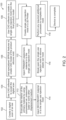
- FIG. 1 illustrates a method 100 of creating a component of a hearing device.
- the component is a earpiece of the hearing device.
- the component may be any other part of the hearing device.
- the hearing device may be a hearing aid (such as in-the-ear hearing aid, completely-in-canal hearing aid, behind-the-ear hearing aid, etc.), an earphone, an earplug, an eardome, an earpiece for testing probe, an ear protection, etc.
- a digital scan of an ear is created (item 102).
- Various techniques may be employed to obtain the digital scan.
- a light-based scanning probe may be used to scan the ear.
- ultrasound-based scanning probe may be used to scan the ear.
- Handheld scanners known in the art may be employed in different embodiments.
- an ear impression e.g., a direct material cast of the ear cavity and shape
- the digital scan may be embodied in a form of a digital file having data that represents features of the ear.
- the features of the ear may include interior cavity of the human ear canal and the outer ear areas.
- the data in the digital file may represent a shape of a concha, an outer ear canal, and an inner ear canal.
- other techniques may be employed to create the digital file, which may or may not involve scanning of the ear.
- a computer-aid-design (CAD) software or tool is used to create a model of the ear based on the digital file (item 104).
- the digital file may be converted into a CAD format to obtain a CAD model of the ear.
- the CAD tool may be used to modify the model of the ear. For example, certain undesirable features of the model may be deleted, certain parts of the model may be adjusted in shape and/or dimension, etc.
- the CAD software or tool may be any design tool that can be used in product design.
- the design tool may be eSculpting.
- the digital file representing features of the ear may be loaded into software (e.g., eSculpting) specifically configured for creating earmold products from digitally scanned images.
- the sprue features include a first sprue feature representing a first sprue for delivering a first material into the injection mold to be created, and a second sprue feature representing a second sprue for delivering a second material into the injection mold to be created.
- the sprue features may include more than two sprue features.
- the first sprue may include a cavity for containing the first material, and one or more channels or tubes for delivering the first material into the cavity of the injection mold to be created.
- the second sprue may include a cavity for containing the second material, and one or more channels or tubes for delivering the second material into the cavity of the injection mold to be created.
- item 106 is not required.
- the design tool may be used to obtain a model of the injection mold to be created (item 108).
- This injection mold model may be a digital representation of the injection mold.
- the design tool may be configured to use the ear model or the modified ear model to create the injection mold model. Such may be accomplished by creating an offset from the ear model or the model of the device (i.e., the component of the hearing device) that is desired to be created. This results in a model of a hollow injection mold with the interior having the shape of the desired component to be created.
- the created model of the injection mold also includes predesigned features of the sprues for both the first (primary) material and the second (secondary) material.
- the sprues features are incorporated in item 106.
- the features of the sprues may be inserted to the injection mold model in item 108 when the injection mold model is being created. In such cases, item 106 may not be required.
- part(s) of the sprues features may be inserted in item 106, and other part(s) of the sprues features may be inserted in item 108.
- eSculpting may be used to alter the shape of the ear model to create the shape of the injection mold model.
- the injection mold model includes objects for creating the sprues for the first material and the sprue for the second material.
- an injection mold is created based on the injection mold model (item 110).
- the injection mold is a single use injection mold.
- the injection mold is destroyed in order to retrieve the created component.
- the injection mold may not be a single use injection mold.
- the injection mold may instead have multiple components that can be detachably coupled to each other.
- the mold components may be detached from each other, and may then be reassembled to create the injection mold repeatedly.
- item 108 may be performed using a 3D printer, which receives the electronic file representing the injection mold, and creates the injection mold based on the received electronic file.
- the 3D printing process may be performed by any of a variety of 3D printers on the market today using a variety of materials.
- the injection mold material may be chemically compatible with the material (e.g., first material) used to make the component of the hearing device.
- the injection mold may then be used to create the component of the hearing device.
- a first material primary material
- the primary material may be an elastomer, or any of other types of materials that may be suitable for the component being created.
- the first material may be silicone, urethane, etc.
- the first sprue may be used to deliver the first material to an interior cavity of the injection mold. The first material may be injected into the injection mold until the entire interior surface, or substantially the entire interior surface, of the injection mold is covered by the first material.
- a second material (secondary material) is placed (e.g., injected) into the injection mold (item 114).
- the second material may be liquid, gel, foam, or any of other types of materials.
- the second material may be silicone gel, silicone foam, urethane gel, urethane form, etc.
- the second material has a characteristic (e.g., hardness, color, etc.) that is different from the characteristic of the first material.
- the second sprue may be used to deliver the second material inside the injection mold.
- the first material will adhere to the interior surface of the outer walls of the injection mold, while the second material is delivered into the injection mold.
- This allows the secondary material to occupy the interior of the injection mold without displacing the first material from the exterior or outer part of the injection mold cavity along the walls of the injection mold cavity.
- This allows the primary material to form the "outer" skin or layer of the component, while limiting the secondary material to the interior of the component.
- the outer layer will have the advantages and features provided by the first material, while the interior part of the component will have the advantages and features provided by the second material.
- the second material is injected into the injection mold using the sprue(s) intended for the second material.
- This places the second material in specific locations chosen to optimize the performance of the injection mold and helps to balance the flow of the material into specific areas of the injection mold.
- the timing of injecting the second material via the one or more sprues, and/or injection pressure may be selected to affect the injection results.
- the amount of time allowed between the first and the second injections and/or a temperature of the process may affect the thickness of component part formed by the first material if the first material's curing reaction is time or temperature dependent.
- the first and second materials are then cured to form the component.
- the component of the hearing device is then removed from the injection mold (item 116).
- the injection mold is a single use injection mold, and item 116 involves breaking the injection mold to remove the component of the hearing device from the injection mold.
- the injection mold may include mold components that are detachably coupled to each other. In such cases, the mold components are separated from each other to remove the component of the hearing device.
- one or more additional processes may be performed on the component of the hearing device (item 118). For example, extra undesirable material attached to the component may be removed from the component by cutting, grinding, etc. Also, the surface of the component may be processed to create a desirable surface for the component. In other embodiments, item 118 is not required, and the component of the hearing device may be considered completed after item 116 is performed.
- the component (e.g., the earmold in the example) of the hearing device made via the above technique has the first material located on the outer parts of the component, with the second material encased within the first material.
- the first material may form a wall of an earmold, and the second material may be located in the wall and may be surrounded by the first material (e.g., the first material may form two opposite surfaces / layers of the wall, with the second material being sandwiched between the two layers of the first material).
- the wall may surrounds a channel, wherein the channel is defined by the wall.
- the first material may form the wall of the earmold, with the second material being located within a cavity of the earmold surrounded by the first material.
- the term “surrounded” or any of other similar terms refers to an item that is completely enclosed by another item, or that is substantially enclosed by another item.
- the second material when the second material is being described as “surrounded” by the first material, the second material may be completely enclosed by the first material, or may be substantially enclosed by the first material (e.g., at least 80%, 85%, 90%, 95%, or 99% of the surface area of the second material may be covered by the first material).
- FIG. 2 illustrates another method 100 of creating a component of a hearing device.
- the method 100 of FIG. 2 is the same as that of FIG. 1 , except that the method 100 of FIG. 2 further includes item 113 that is performed after item 112.
- item 113 an interior of the first material is removed to create a cavity within the first material, wherein the second material can be later injected into the cavity within the first material (in item 114).
- the act of removing the interior of the first material may comprise delivering liquid or air into the first material.
- the removal of the interior part of the first material is accomplished by using a medium that displaces the interior portion of the first material.
- the medium may be compressed air or pressurized liquid to evacuate the interior of the first material.
- the second material is then injected into the injection mold through the sprue(s) and fills the evacuated interior.
- the method 100 of FIG. 2 achieves more displacement of the first material, allowing for more of the second material to be placed in the final device interior. Time and/or injection pressure may also be used to affect the injection results.
- the sprues are described as being attached to the mold that are formed together with the mold. In other embodiments, the sprues may be separately formed from the mold, and may not be integrally formed with the mold.
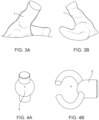
- FIGS. 3A-3B illustrate an ear impression (1) captured with digital 3D scanning. This is the starting point image for creating the component of the hearing device (e.g., earphone device). This figure shows an anterior view (right) and a posterior view (left) of the canal/inner ear.
- FIGS. 4A-4B illustrate sprues (2 & 3) for injecting primary material and secondary material into the injection mold (4).
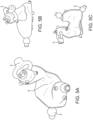
- FIGS. 5A-5C illustrate different views of an injection mold (4) showing the two injection ports (2,3) to allow the creation of a composite earmold from two different materials such as soft and hard, or different colors.
- FIG. 6 illustrates a cross section view of the injection mold (4) of FIGS. 5A-5C used to create the earmold (5), particularly showing how the sprues (2, 3) are used to introduce material into the injection mold (4).
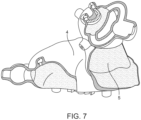
- FIG. 7 illustrates the earmold (5) shown inside of the injection mold (4) during the "demolding" step of removing the earmold from the injection mold (4).
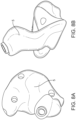
- FIGS. 8A-8B illustrate the earmold (5) made from a primary material of either silicone or silicone elastomer that is infused with an interior of a secondary material such as foam, gel, or a elastomer of a different hardness or characteristic from the primary.
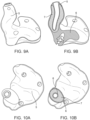
- FIGS. 9A-9B illustrate the earmold (5) as shown from the inferior view (left) and with a cross section through the anterior view to show the location of the primary and secondary materials (7).
- the primary material (6) remains in areas where it was in contact with the injection mold interior wall, but is displaced in specific areas by the secondary material (7).
- FIGS. 10A-10B illustrate the earmold (5) as shown from the end of the ear canal (left) with a cross section through the canal view to show the location of the primary (6) and secondary materials (7).
- the primary material (6) remains in areas where it was in contact with the injection mold interior wall, but is displaced in specific areas by the secondary material (7).
- FIG. 11 illustrates the earmold (5) as shown from the end of the ear canal (left) with a cross section through the canal view to show the location of the primary (6) and secondary (7) materials.
- FIGS. 12A-12B illustrate another injection mold (4) and a cutaway section of the injection mold (4).
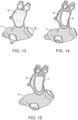
- FIG. 13 illustrates the injection mold (4) of FIGS. 12A-12B , filled with the primary material (6).
- FIG. 14 illustrates the injection mold (4) of FIGS. 12A-12B , filled with the primary material (6), and the interior area of the primary material (6) has been displaced with air or water to create a hollow area (8) in the primary material (6).
- FIG. 15 illustrates the injection mold (4) filled with the evacuated primary material (6) forming a thin wall against the side of the injection mold (4).
- the evacuated interior is filled with the secondary material (7) to form a compliant interior.
- the second material may be configured (e.g., selected and/or positionally designed) to improve a bass effect associated with the hearing device. Also, in some embodiments, the second material may be configured to provide an acoustic seal by attenuating external sounds. Furthermore, in some embodiments, the second material may be configured to reduce an occlusion effect associated with the hearing device.
- the above techniques for creating the earmold (5) are advantageous.
- the earmold (5) achieved is a sophisticated composite structure combining a variety of materials to enhance the properties, performance and appearance of the resulting earmold (5).
- interior features of the earmold (5) are no longer limited to a set arrangement of interior spaces. Rather, the earmold (5) has customized outer shape, and also customized arrangement of the inner characteristics.
- FIG. 16 illustrates another apparatus 300 for forming one or more components of one or more hearing devices.
- the one or more hearing devices include a first hearing device.
- the one or more components include a first component comprising an earpiece having a housing, the housing comprising a wall made from a first material, wherein the wall of the housing comprises a second material surrounded by the first material.
- the apparatus 300 includes a mold 302 having a first interior cavity 304a for containing the first material and the second material, wherein the mold 302 comprises a first port configured to receive the first material.
- the apparatus 300 also includes a first source 310a of the second material for delivering the second material into the first interior cavity 304a so that the second material is within the first material.
- the apparatus 300 is also for forming a second component for a second hearing device.
- the apparatus 300 includes a second interior cavity 304b and a second source 310b of the second material for delivering the second material into the second interior cavity.
- the first source 310a of the second material comprises a first syringe.
- syringe may refer to any fluid delivery device that includes a container for housing fluid.
- the first source 310a comprises a first syringe
- the second source 310b comprises a second syringe
- the cavities 304 are for forming respective components for respective hearing devices. Each cavity 304 is configured to receive a first material, and a second material so that the second material is surrounded by the first material.
- the mold 302 includes multiple first ports for allowing the first material to be delivered into the respective cavities 304. The first ports may also allow the second material to be delivered into the respective cavities 304. Alternatively, the mold 302 may include multiple second ports for allowing the second material to be delivered into the respective cavities.
- the apparatus 300 may include multiple syringes for simultaneously injecting the second material into the respective cavities 304. In such cases, the syringes are arranged in relative positions that correspond with the positions of the respective cavities 304.
- the syringes may be mounted to a common positioner, which is configured to move all of the syringes simultaneously so that the injection ends of the syringes are moved into respective ports of the mold 302 that are in fluid communication with the respective interior cavities 304.
- the above techniques are not limited to creating customized components for hearing devices.
- the above techniques may be employed to create standard components for hearing devices, or components that have both customized and non-customized features.
- the exterior shape of the earmold (5) may be standard, while the interior characteristics are customized.
- the above techniques may be employed to create components for a variety of hearing devices, and not just the examples illustrated in the figures.
- the techniques described herein may be employed to create components for hearing aids (such as in-the-ear hearing aids, completely-in-canal hearing aids, behind-the-ear hearing aids, etc.), earphones, earplugs, eardomes, earpieces for testing probes, ear protection, etc.
Landscapes
- Engineering & Computer Science (AREA)
- Manufacturing & Machinery (AREA)
- Health & Medical Sciences (AREA)
- Physics & Mathematics (AREA)
- Acoustics & Sound (AREA)
- Otolaryngology (AREA)
- General Health & Medical Sciences (AREA)
- Signal Processing (AREA)
- Mechanical Engineering (AREA)
- Life Sciences & Earth Sciences (AREA)
- Neurosurgery (AREA)
- Animal Behavior & Ethology (AREA)
- Heart & Thoracic Surgery (AREA)
- Vascular Medicine (AREA)
- Biomedical Technology (AREA)
- Psychology (AREA)
- Public Health (AREA)
- Veterinary Medicine (AREA)
- Biophysics (AREA)
- Materials Engineering (AREA)
- Chemical & Material Sciences (AREA)
- Software Systems (AREA)
- General Physics & Mathematics (AREA)
- Theoretical Computer Science (AREA)
- Geometry (AREA)
- Computer Graphics (AREA)
- Moulds For Moulding Plastics Or The Like (AREA)
- Injection Moulding Of Plastics Or The Like (AREA)
- Headphones And Earphones (AREA)
- Casting Or Compression Moulding Of Plastics Or The Like (AREA)
Claims (14)
- Eine Vorrichtung (4) zum Formen einer Komponente (5) für ein Hörgerät, wobei die Komponente (5) einen Ohrhörer (5) mit einem Gehäuse umfasst, wobei das Gehäuse eine Wand aus einem ersten Material (6) umfasst, wobei die Wand des Gehäuses ein zweites Material (7) umfasst, das von dem ersten Material (6) umgeben ist, wobei die Vorrichtung (4) umfasst:eine Form (4) mit einem inneren Hohlraum zur Aufnahme des ersten Materials (6) und des zweiten Materials (7);wobei die Form (4) eine erste Öffnung umfasst, die zur Aufnahme des ersten Materials (6) konfiguriert ist;wobei die Form (4) eine zweite Öffnung umfasst, die so konfiguriert ist, dass sie das zweite Material (7) aufnimmt, und einen ersten Kanal zum Leiten des zweiten Materials (7) in einen inneren Hohlraum (8) des ersten Materials (6), wobei der innere Hohlraum (8) des ersten Materials (6) durch Verdrängung eines Teils des ersten Materials (6) gebildet wird, nachdem das erste Material (6) in die Form (4) eingebracht wurde, wobei die Verdrängung unter Verwendung eines Mediums erfolgt, das in das erste Material (6) eingebracht wird, bevor das zweite Material (7) in den inneren Hohlraum (8) des ersten Materials (6) eingebracht wird.
- Vorrichtung (4) nach Anspruch 1, wobei die Form (4) eine Einwegform umfasst.
- Vorrichtung (4) nach Anspruch 1 oder 2, die ferner eine erste Quelle des ersten Materials (6) und eine zweite Quelle des zweiten Materials (7) umfasst.
- Vorrichtung (4) nach einem der vorhergehenden Ansprüche, wobei das erste Material (6) Silikon oder Urethan umfasst und wobei das zweite Material (7) Silikongel, Silikonschaum, Urethangel oder Urethanschaum umfasst.
- Vorrichtung (4) nach einem der vorhergehenden Ansprüche, wobei die Form (4) außerdem einen zweiten Kanal zum Leiten des zweiten Materials (7) in das erste Material (6) umfasst.
- Vorrichtung (4) nach einem der vorhergehenden Ansprüche, wobei das Medium Druckluft oder unter Druck stehende Flüssigkeit ist, wobei die Vorrichtung (4) außerdem eine Quelle für die Flüssigkeit oder Luft umfasst.
- Komponente (5) für ein Hörgerät, umfassend:einen Ohrhörer (5) mit einem Gehäuse, wobei das Gehäuse eine Wand aus einem ersten Material (6) umfasst;wobei die Wand des Gehäuses ein zweites Material (7) umfasst, das von dem ersten Material (6) umgeben ist, wobei das zweite Material (7) sich von dem ersten Material (6) unterscheidet,wobei das zweite Material (7) in einen inneren Hohlraum (8) des ersten Materials (6) eingespritzt wurde, wobei der innere Hohlraum (8) des ersten Materials (6) durch Verdrängung eines inneren Teils des ersten Materials (6) unter Verwendung eines Mediums bereitgestellt wurde, das in das erste Material (6) eingebracht wurde, bevor das zweite Material (7) in den inneren Hohlraum (8) des ersten Materials (6) eingebracht wurde und nachdem das erste Material (6) in eine Form (4) eingebracht wurde, die einen inneren Hohlraum zum Aufnehmen des ersten Materials (6) und des zweiten Materials (7) aufweist, wobei die Form (4) eine erste Öffnung umfasst, die zum Aufnehmen des ersten Materials (6) konfiguriert ist, und eine zweite Öffnung, die zum Aufnehmen des zweiten Materials (7) konfiguriert ist, und einen ersten Kanal zum Leiten des zweiten Materials (7) in den inneren Hohlraum (8) des ersten Materials (6).
- Komponente (5) nach Anspruch 7, wobei das Gehäuse einen Kanal umfasst und die Wand den Kanal umgibt.
- Komponente (5) nach einem der Ansprüche 7 bis 8, wobei der Ohrhörer (5) eine maßgefertigte Schale umfasst.
- Komponente (5) nach einem der Ansprüche 7 bis 9, wobei das erste Material (6) erstes Silikon umfasst und wobei das zweite Material (7) zweites Silikon umfasst, das sich vom ersten Silikon unterscheidet, oder wobei das erste Material (6) erstes Urethan umfasst und wobei das zweite Material (7) zweites Urethan umfasst, das sich vom ersten Urethan unterscheidet, und wobei das erste Material eine erste Härte aufweist und das zweite Material eine zweite Härte aufweist, die sich von der ersten Härte unterscheidet.
- Komponente (5) nach einem der Ansprüche 7 bis 10, wobei das zweite Material (7) Flüssigkeit, Schaum, Gel oder Luft umfasst.
- Verfahren (100) zur Herstellung einer Komponente (5) gemäß einem der Ansprüche 7 bis 11, wobei das Verfahren (100) umfasst:Einspritzen (112) des ersten Materials (6) in die Form (4);Verdrängen (113) des inneren Teils des ersten Materials (6) unter Verwendung des in das erste Material (6) eingebrachten Mediums zum Bereitstellen des inneren Hohlraums (8) innerhalb des ersten Materials (6); undEinspritzen (114) des zweiten Materials (7) in den inneren Hohlraum (8) des ersten Materials (6).
- Verfahren zum Herstellen einer Form (4), wobei die Form (4) einen inneren Hohlraum zum Aufnehmen eines ersten Materials (6) und eines zweiten Materials (7) aufweist, wobei die Form (4) eine erste Öffnung zum Aufnehmen des ersten Materials (6), eine zweite Öffnung zum Aufnehmen des zweiten Materials (7) und einen ersten Kanal zum Leiten des zweiten Materials (7) in einen inneren Hohlraum (8) des ersten Materials (6) umfasst, wobei der innere Hohlraum (8) des ersten Materials (6) durch Verdrängung eines Teils des ersten Materials (6) gebildet wird, nachdem das erste Material (6) in die Form (4) eingebracht wurde, wobei die Verdrängung unter Verwendung eines Mediums bereitgestellt wird, das in das erste Material (6) eingebracht wird, bevor das zweite Material (7) in den inneren Hohlraum (8) des ersten Materials (6) eingebracht wird, wobei das Verfahren umfasst:Bestimmen (102) einer elektronischen Datei mit Daten, die eine Form eines Ohrs darstellen;Verarbeiten (108) der elektronischen Datei zum Erstellen eines elektronischen Modells der Form (4), wobei das elektronische Modell der Form (4) Angussmerkmale aufweist; undErstellen (110) der Form (4) basierend auf dem elektronischen Modell der Form (4).
- Verfahren (100) zum Herstellen einer Komponente (5) eines Hörgeräts, umfassend das Verfahren zum Herstellen einer Form (4) gemäß Anspruch 13, wobei die Komponente (5) einen Ohrhörer (5) umfasst, wobei das Verfahren umfasst:Einspritzen (112) des ersten Materials (6) in die Form (4);Verschieben (113) eines inneren Teils des in die Form (4) eingespritzten ersten Materials (6) unter Verwendung eines in das erste Material (6) eingebrachten Mediums, um den inneren Hohlraum (8) des ersten Materials (6) zu erzeugen;Einspritzen (114) des zweiten Materials (7) in den inneren Hohlraum (8) des ersten Materials (6), so dass das zweite Material (7) von dem ersten Material (6) umgeben ist; undAufbrechen (116) der Form (4), um die Komponente (5) zu entfernen;wobei das erste Material (6) und das zweite Material (7) Teile des Bauteils (5) bilden.
Applications Claiming Priority (3)
| Application Number | Priority Date | Filing Date | Title |
|---|---|---|---|
| US201662327723P | 2016-04-26 | 2016-04-26 | |
| US15/496,773 US11457323B2 (en) | 2016-04-26 | 2017-04-25 | Custom elastomeric earmold with secondary material infusion |
| PCT/EP2017/059891 WO2017186773A1 (en) | 2016-04-26 | 2017-04-26 | Custom elastomeric earmold with secondary material infusion |
Publications (3)
| Publication Number | Publication Date |
|---|---|
| EP3449646A1 EP3449646A1 (de) | 2019-03-06 |
| EP3449646B1 true EP3449646B1 (de) | 2024-10-02 |
| EP3449646C0 EP3449646C0 (de) | 2024-10-02 |
Family
ID=60089304
Family Applications (1)
| Application Number | Title | Priority Date | Filing Date |
|---|---|---|---|
| EP17723930.8A Active EP3449646B1 (de) | 2016-04-26 | 2017-04-26 | Massgefertigtes elastomeres ohrpassstück mit sekundärmaterialinfusion |
Country Status (5)
| Country | Link |
|---|---|
| US (3) | US11457323B2 (de) |
| EP (1) | EP3449646B1 (de) |
| JP (2) | JP7053490B2 (de) |
| CN (1) | CN109155893B (de) |
| WO (1) | WO2017186773A1 (de) |
Families Citing this family (11)
| Publication number | Priority date | Publication date | Assignee | Title |
|---|---|---|---|---|
| US11323794B2 (en) | 2017-03-20 | 2022-05-03 | Buderflys Technologies, Inc. | Personal hearing device |
| US10986432B2 (en) * | 2017-06-30 | 2021-04-20 | Bose Corporation | Customized ear tips |
| US20200121507A1 (en) | 2018-10-18 | 2020-04-23 | Moldex-Metric, Inc. | Foam earplug with transdermal material |
| CN113597610A (zh) | 2019-01-22 | 2021-11-02 | Ddm系统有限责任公司 | 铸造模块及基于模块铸造的系统和方法 |
| GB2586063B (en) * | 2019-08-01 | 2024-06-19 | Drown Ltd | Modular earphone |
| US11451912B1 (en) * | 2019-10-07 | 2022-09-20 | Lockheed Martin Corporation | System, method and computer program product for three-dimensional (3D) computer-aided manufacturing (CAM) of hearing protection and/or noise reduction ear appliance |
| US20230173716A1 (en) * | 2020-06-10 | 2023-06-08 | Chia Chuang Hu | Macromolecule Forming Mold, Thermosetting Elastomer and Manufacturing Method Therefor |
| US11785403B2 (en) | 2020-08-31 | 2023-10-10 | Starkey Laboratories, Inc. | Device to optically verify custom hearing aid fit and method of use |
| US12418759B2 (en) | 2023-03-20 | 2025-09-16 | Sonova Ag | Hearing device having a shell that includes a compressible region and methods of manufacturing the same |
| CN116108763B (zh) * | 2023-04-13 | 2023-06-27 | 湖南工商大学 | 基于温度的发泡材料气泡破裂临界点预测的方法 |
| US20250080895A1 (en) * | 2023-08-31 | 2025-03-06 | Advanced Semiconductor Engineering, Inc. | Electronic device |
Family Cites Families (27)
| Publication number | Priority date | Publication date | Assignee | Title |
|---|---|---|---|---|
| US4774938A (en) | 1987-04-09 | 1988-10-04 | Howard S. Leight & Associates, Inc. | Slow recovery earplug with largely impenetrable surface |
| US5487012A (en) | 1990-12-21 | 1996-01-23 | Topholm & Westermann Aps | Method of preparing an otoplasty or adaptive earpiece individually matched to the shape of an auditory canal |
| JP3243274B2 (ja) | 1992-02-10 | 2002-01-07 | 岡城金型化成株式会社 | 合成樹脂材の成形方法 |
| US6393130B1 (en) | 1998-10-26 | 2002-05-21 | Beltone Electronics Corporation | Deformable, multi-material hearing aid housing |
| WO2000070911A1 (en) * | 1999-05-13 | 2000-11-23 | Softear Technologies, L.L.C. | Method of manufacturing a soft hearing aid |
| US7130437B2 (en) | 2000-06-29 | 2006-10-31 | Beltone Electronics Corporation | Compressible hearing aid |
| JP2004508785A (ja) | 2000-09-25 | 2004-03-18 | フォーナック アーゲー | 耳用装置、同装置の製造方法及び同方法の適用 |
| ES2378060T3 (es) | 2001-03-02 | 2012-04-04 | 3Shape A/S | Procedimiento para modelar piezas auriculares personalizadas |
| DE10248755B4 (de) | 2002-10-18 | 2006-04-06 | Siemens Audiologische Technik Gmbh | Dämpfungsvorrichtung für Hörgerätegehäuse |
| DE102004057102B4 (de) * | 2004-11-26 | 2021-01-14 | Krones Aktiengesellschaft | Formblasmaschine |
| DE102005013834A1 (de) | 2005-03-24 | 2006-09-28 | Siemens Audiologische Technik Gmbh | Verfahren zur Herstellung einer Hörhilfekomponente und entsprechende Hörhilfekomponente |
| US20080013747A1 (en) * | 2006-06-30 | 2008-01-17 | Bao Tran | Digital stethoscope and monitoring instrument |
| WO2008157557A1 (en) | 2007-06-17 | 2008-12-24 | Personics Holdings Inc. | Earpiece sealing system |
| US7984716B2 (en) | 2007-06-22 | 2011-07-26 | Kimberly-Clark Worldwide Inc. | Self-conforming sound attenuation earplug |
| JP2009055202A (ja) * | 2007-08-24 | 2009-03-12 | Kamikado Masayuki | イヤホン |
| EP2396976A4 (de) | 2009-02-13 | 2013-04-03 | Personics Holdings Inc | Verfahren und vorrichtung für schallisolierung und okklusionseffektminderung |
| CN102655996B (zh) | 2009-10-16 | 2015-04-15 | 3形状股份有限公司 | 专门制作的软性元件 |
| US20110271965A1 (en) | 2010-05-10 | 2011-11-10 | Red Tail Hawk Corporation | Multi-Material Hearing Protection Custom Earplug |
| JP2013534779A (ja) | 2010-06-26 | 2013-09-05 | パーソニクス ホールディングス, インコーポレイテッド | 所定のフィルタ特性を有する外耳道を閉塞するための方法およびデバイス |
| EP2594086A1 (de) | 2010-07-13 | 2013-05-22 | Siemens Medical Instruments Pte. Ltd. | Aufblasbarer ohrabdruck mit geschütztem lufteinlass zum aufblasen |
| US8897458B2 (en) | 2011-03-25 | 2014-11-25 | Red Tail Hawk Corporation | Concha-fitting custom earplug with flexible skin and filler material |
| KR101323805B1 (ko) * | 2012-10-24 | 2013-10-31 | 주식회사 에이피케이 | 이어 팁 및 이의 제조방법과 이어 팁을 구비하는 이어 폰 |
| US9313568B2 (en) * | 2013-07-23 | 2016-04-12 | Chicago Custom Acoustics, Inc. | Custom earphone with dome in the canal |
| CN103737777A (zh) * | 2013-12-20 | 2014-04-23 | 玉托英 | 自动灌注pu耳塞制造装置 |
| CN104224443A (zh) * | 2014-08-04 | 2014-12-24 | 南昌大学 | 一种纳米抗菌防噪耳塞的制备方法 |
| US9802347B2 (en) * | 2015-02-02 | 2017-10-31 | Colgate-Palmolive Company | Method of forming an oral care implement |
| CN105034236B (zh) * | 2015-08-17 | 2018-02-06 | 东莞洋京实业有限公司 | 耳机套的一体成型方法及一体成型耳机套 |
-
2017
- 2017-04-25 US US15/496,773 patent/US11457323B2/en active Active
- 2017-04-26 EP EP17723930.8A patent/EP3449646B1/de active Active
- 2017-04-26 CN CN201780032553.7A patent/CN109155893B/zh active Active
- 2017-04-26 JP JP2018555890A patent/JP7053490B2/ja active Active
- 2017-04-26 US US15/498,111 patent/US20170305039A1/en not_active Abandoned
- 2017-04-26 WO PCT/EP2017/059891 patent/WO2017186773A1/en not_active Ceased
-
2019
- 2019-02-22 US US16/282,820 patent/US11477588B2/en active Active
-
2022
- 2022-03-31 JP JP2022060117A patent/JP7362823B2/ja active Active
Also Published As
| Publication number | Publication date |
|---|---|
| CN109155893B (zh) | 2022-02-01 |
| US11477588B2 (en) | 2022-10-18 |
| EP3449646C0 (de) | 2024-10-02 |
| CN109155893A (zh) | 2019-01-04 |
| JP2019515550A (ja) | 2019-06-06 |
| US11457323B2 (en) | 2022-09-27 |
| JP7362823B2 (ja) | 2023-10-17 |
| EP3449646A1 (de) | 2019-03-06 |
| US20190184608A1 (en) | 2019-06-20 |
| WO2017186773A1 (en) | 2017-11-02 |
| US20170305039A1 (en) | 2017-10-26 |
| US20170305040A1 (en) | 2017-10-26 |
| JP7053490B2 (ja) | 2022-04-12 |
| JP2022091934A (ja) | 2022-06-21 |
Similar Documents
| Publication | Publication Date | Title |
|---|---|---|
| US11477588B2 (en) | Custom elastomeric earmold with secondary material infusion | |
| US8897458B2 (en) | Concha-fitting custom earplug with flexible skin and filler material | |
| US6393130B1 (en) | Deformable, multi-material hearing aid housing | |
| JP5823966B2 (ja) | 個別に調整された軟質構成要素 | |
| JP2960544B2 (ja) | 補聴器及びその製造方法 | |
| DK2335426T3 (en) | PROCEDURE FOR THE MANUFACTURING OF A HEARING WHICH HAS AN INDIVIDUALLY CUSTOMIZED ELASTIC COMPONENT | |
| US6022311A (en) | Apparatus and method for a custom soft-solid hearing aid | |
| US6434248B1 (en) | Soft hearing aid moulding apparatus | |
| EP3198890B1 (de) | Abdrucknahmekissen, verfahren zur abdrucknahme, abdruck und verfahren zur herstellung einer individuell angepassten gehörgangschale | |
| US9288592B2 (en) | Custom ear adaptor system with balloon-style or elastomeric dome earpiece | |
| CN110800318A (zh) | 定制的耳塞 | |
| JPS61238198A (ja) | カスタム挿耳型補聴器 | |
| EP2497278B1 (de) | Hörgerät und verfahren zur dessen herstellung | |
| WO2000047016A1 (en) | Molded hearing aid housing | |
| US20040096077A1 (en) | Hearing coupler shells of soft pliable thermoplastic material | |
| KR20160012084A (ko) | 도관에서 돔을 갖는 맞춤 이어폰 | |
| US12418759B2 (en) | Hearing device having a shell that includes a compressible region and methods of manufacturing the same | |
| JP2000210327A (ja) | 補聴器用イヤインプレションの製造方法 | |
| CN119584039A (zh) | 骨架壳体和用于制取耳印模的方法 | |
| WO1999055259A9 (en) | Hearing coupler shells of soft pliable thermoplastic material | |
| CA2452706A1 (en) | Hearing coupler shells of soft pliable thermoplastic material | |
| HK1175914B (en) | Hearing aid and method of fabricating the same |
Legal Events
| Date | Code | Title | Description |
|---|---|---|---|
| STAA | Information on the status of an ep patent application or granted ep patent |
Free format text: STATUS: UNKNOWN |
|
| STAA | Information on the status of an ep patent application or granted ep patent |
Free format text: STATUS: THE INTERNATIONAL PUBLICATION HAS BEEN MADE |
|
| PUAI | Public reference made under article 153(3) epc to a published international application that has entered the european phase |
Free format text: ORIGINAL CODE: 0009012 |
|
| STAA | Information on the status of an ep patent application or granted ep patent |
Free format text: STATUS: REQUEST FOR EXAMINATION WAS MADE |
|
| 17P | Request for examination filed |
Effective date: 20181113 |
|
| AK | Designated contracting states |
Kind code of ref document: A1 Designated state(s): AL AT BE BG CH CY CZ DE DK EE ES FI FR GB GR HR HU IE IS IT LI LT LU LV MC MK MT NL NO PL PT RO RS SE SI SK SM TR |
|
| AX | Request for extension of the european patent |
Extension state: BA ME |
|
| DAV | Request for validation of the european patent (deleted) | ||
| DAX | Request for extension of the european patent (deleted) | ||
| STAA | Information on the status of an ep patent application or granted ep patent |
Free format text: STATUS: EXAMINATION IS IN PROGRESS |
|
| 17Q | First examination report despatched |
Effective date: 20191021 |
|
| RIC1 | Information provided on ipc code assigned before grant |
Ipc: B29C 33/38 20060101ALI20201027BHEP Ipc: H04R 25/00 20060101AFI20201027BHEP Ipc: B29C 44/18 20060101ALI20201027BHEP Ipc: A61F 11/08 20060101ALI20201027BHEP Ipc: B33Y 80/00 20150101ALI20201027BHEP |
|
| RAP1 | Party data changed (applicant data changed or rights of an application transferred) |
Owner name: FALCOM A/S |
|
| GRAP | Despatch of communication of intention to grant a patent |
Free format text: ORIGINAL CODE: EPIDOSNIGR1 |
|
| STAA | Information on the status of an ep patent application or granted ep patent |
Free format text: STATUS: GRANT OF PATENT IS INTENDED |
|
| INTG | Intention to grant announced |
Effective date: 20240515 |
|
| GRAS | Grant fee paid |
Free format text: ORIGINAL CODE: EPIDOSNIGR3 |
|
| GRAA | (expected) grant |
Free format text: ORIGINAL CODE: 0009210 |
|
| STAA | Information on the status of an ep patent application or granted ep patent |
Free format text: STATUS: THE PATENT HAS BEEN GRANTED |
|
| AK | Designated contracting states |
Kind code of ref document: B1 Designated state(s): AL AT BE BG CH CY CZ DE DK EE ES FI FR GB GR HR HU IE IS IT LI LT LU LV MC MK MT NL NO PL PT RO RS SE SI SK SM TR |
|
| REG | Reference to a national code |
Ref country code: GB Ref legal event code: FG4D |
|
| REG | Reference to a national code |
Ref country code: CH Ref legal event code: EP |
|
| REG | Reference to a national code |
Ref country code: DE Ref legal event code: R096 Ref document number: 602017085198 Country of ref document: DE |
|
| REG | Reference to a national code |
Ref country code: IE Ref legal event code: FG4D |
|
| U01 | Request for unitary effect filed |
Effective date: 20241012 |
|
| U07 | Unitary effect registered |
Designated state(s): AT BE BG DE DK EE FI FR IT LT LU LV MT NL PT RO SE SI Effective date: 20241030 |
|
| PG25 | Lapsed in a contracting state [announced via postgrant information from national office to epo] |
Ref country code: HR Free format text: LAPSE BECAUSE OF FAILURE TO SUBMIT A TRANSLATION OF THE DESCRIPTION OR TO PAY THE FEE WITHIN THE PRESCRIBED TIME-LIMIT Effective date: 20241002 Ref country code: IS Free format text: LAPSE BECAUSE OF FAILURE TO SUBMIT A TRANSLATION OF THE DESCRIPTION OR TO PAY THE FEE WITHIN THE PRESCRIBED TIME-LIMIT Effective date: 20250202 |
|
| PG25 | Lapsed in a contracting state [announced via postgrant information from national office to epo] |
Ref country code: ES Free format text: LAPSE BECAUSE OF FAILURE TO SUBMIT A TRANSLATION OF THE DESCRIPTION OR TO PAY THE FEE WITHIN THE PRESCRIBED TIME-LIMIT Effective date: 20241002 |
|
| PG25 | Lapsed in a contracting state [announced via postgrant information from national office to epo] |
Ref country code: NO Free format text: LAPSE BECAUSE OF FAILURE TO SUBMIT A TRANSLATION OF THE DESCRIPTION OR TO PAY THE FEE WITHIN THE PRESCRIBED TIME-LIMIT Effective date: 20250102 |
|
| PG25 | Lapsed in a contracting state [announced via postgrant information from national office to epo] |
Ref country code: GR Free format text: LAPSE BECAUSE OF FAILURE TO SUBMIT A TRANSLATION OF THE DESCRIPTION OR TO PAY THE FEE WITHIN THE PRESCRIBED TIME-LIMIT Effective date: 20250103 |
|
| PG25 | Lapsed in a contracting state [announced via postgrant information from national office to epo] |
Ref country code: CZ Free format text: LAPSE BECAUSE OF FAILURE TO SUBMIT A TRANSLATION OF THE DESCRIPTION OR TO PAY THE FEE WITHIN THE PRESCRIBED TIME-LIMIT Effective date: 20241002 Ref country code: PL Free format text: LAPSE BECAUSE OF FAILURE TO SUBMIT A TRANSLATION OF THE DESCRIPTION OR TO PAY THE FEE WITHIN THE PRESCRIBED TIME-LIMIT Effective date: 20241002 |
|
| PG25 | Lapsed in a contracting state [announced via postgrant information from national office to epo] |
Ref country code: RS Free format text: LAPSE BECAUSE OF FAILURE TO SUBMIT A TRANSLATION OF THE DESCRIPTION OR TO PAY THE FEE WITHIN THE PRESCRIBED TIME-LIMIT Effective date: 20250102 |
|
| U20 | Renewal fee for the european patent with unitary effect paid |
Year of fee payment: 9 Effective date: 20250415 |
|
| PG25 | Lapsed in a contracting state [announced via postgrant information from national office to epo] |
Ref country code: SM Free format text: LAPSE BECAUSE OF FAILURE TO SUBMIT A TRANSLATION OF THE DESCRIPTION OR TO PAY THE FEE WITHIN THE PRESCRIBED TIME-LIMIT Effective date: 20241002 |
|
| PGFP | Annual fee paid to national office [announced via postgrant information from national office to epo] |
Ref country code: GB Payment date: 20250422 Year of fee payment: 9 |
|
| PG25 | Lapsed in a contracting state [announced via postgrant information from national office to epo] |
Ref country code: SK Free format text: LAPSE BECAUSE OF FAILURE TO SUBMIT A TRANSLATION OF THE DESCRIPTION OR TO PAY THE FEE WITHIN THE PRESCRIBED TIME-LIMIT Effective date: 20241002 |
|
| PLBE | No opposition filed within time limit |
Free format text: ORIGINAL CODE: 0009261 |
|
| STAA | Information on the status of an ep patent application or granted ep patent |
Free format text: STATUS: NO OPPOSITION FILED WITHIN TIME LIMIT |
|
| 26N | No opposition filed |
Effective date: 20250703 |
|
| PGFP | Annual fee paid to national office [announced via postgrant information from national office to epo] |
Ref country code: IE Payment date: 20250702 Year of fee payment: 9 |
|
| REG | Reference to a national code |
Ref country code: CH Ref legal event code: H13 Free format text: ST27 STATUS EVENT CODE: U-0-0-H10-H13 (AS PROVIDED BY THE NATIONAL OFFICE) Effective date: 20251125 |
|
| PG25 | Lapsed in a contracting state [announced via postgrant information from national office to epo] |
Ref country code: MC Free format text: LAPSE BECAUSE OF FAILURE TO SUBMIT A TRANSLATION OF THE DESCRIPTION OR TO PAY THE FEE WITHIN THE PRESCRIBED TIME-LIMIT Effective date: 20241002 |
|
| PG25 | Lapsed in a contracting state [announced via postgrant information from national office to epo] |
Ref country code: CH Free format text: LAPSE BECAUSE OF NON-PAYMENT OF DUE FEES Effective date: 20250430 |