EP3445334B1 - Nanoliposomen zur verzögertenfreisetzung von tacrolimus zur behandlung von augenerkrankungen des anterioren segments - Google Patents
Nanoliposomen zur verzögertenfreisetzung von tacrolimus zur behandlung von augenerkrankungen des anterioren segments Download PDFInfo
- Publication number
- EP3445334B1 EP3445334B1 EP17786259.6A EP17786259A EP3445334B1 EP 3445334 B1 EP3445334 B1 EP 3445334B1 EP 17786259 A EP17786259 A EP 17786259A EP 3445334 B1 EP3445334 B1 EP 3445334B1
- Authority
- EP
- European Patent Office
- Prior art keywords
- nanoliposome
- tacrolimus
- unsaturated
- drug
- liposomes
- Prior art date
- Legal status (The legal status is an assumption and is not a legal conclusion. Google has not performed a legal analysis and makes no representation as to the accuracy of the status listed.)
- Active
Links
Images


Classifications
-
- A—HUMAN NECESSITIES
- A61—MEDICAL OR VETERINARY SCIENCE; HYGIENE
- A61K—PREPARATIONS FOR MEDICAL, DENTAL OR TOILETRY PURPOSES
- A61K31/00—Medicinal preparations containing organic active ingredients
- A61K31/33—Heterocyclic compounds
- A61K31/395—Heterocyclic compounds having nitrogen as a ring hetero atom, e.g. guanethidine or rifamycins
- A61K31/435—Heterocyclic compounds having nitrogen as a ring hetero atom, e.g. guanethidine or rifamycins having six-membered rings with one nitrogen as the only ring hetero atom
- A61K31/4353—Heterocyclic compounds having nitrogen as a ring hetero atom, e.g. guanethidine or rifamycins having six-membered rings with one nitrogen as the only ring hetero atom ortho- or peri-condensed with heterocyclic ring systems
- A61K31/436—Heterocyclic compounds having nitrogen as a ring hetero atom, e.g. guanethidine or rifamycins having six-membered rings with one nitrogen as the only ring hetero atom ortho- or peri-condensed with heterocyclic ring systems the heterocyclic ring system containing a six-membered ring having oxygen as a ring hetero atom, e.g. rapamycin
-
- A—HUMAN NECESSITIES
- A61—MEDICAL OR VETERINARY SCIENCE; HYGIENE
- A61K—PREPARATIONS FOR MEDICAL, DENTAL OR TOILETRY PURPOSES
- A61K9/00—Medicinal preparations characterised by special physical form
- A61K9/0012—Galenical forms characterised by the site of application
- A61K9/0048—Eye, e.g. artificial tears
-
- A—HUMAN NECESSITIES
- A61—MEDICAL OR VETERINARY SCIENCE; HYGIENE
- A61K—PREPARATIONS FOR MEDICAL, DENTAL OR TOILETRY PURPOSES
- A61K9/00—Medicinal preparations characterised by special physical form
- A61K9/0012—Galenical forms characterised by the site of application
- A61K9/0048—Eye, e.g. artificial tears
- A61K9/0051—Ocular inserts or implants
-
- A—HUMAN NECESSITIES
- A61—MEDICAL OR VETERINARY SCIENCE; HYGIENE
- A61K—PREPARATIONS FOR MEDICAL, DENTAL OR TOILETRY PURPOSES
- A61K9/00—Medicinal preparations characterised by special physical form
- A61K9/10—Dispersions; Emulsions
- A61K9/127—Synthetic bilayered vehicles, e.g. liposomes or liposomes with cholesterol as the only non-phosphatidyl surfactant
-
- A—HUMAN NECESSITIES
- A61—MEDICAL OR VETERINARY SCIENCE; HYGIENE
- A61K—PREPARATIONS FOR MEDICAL, DENTAL OR TOILETRY PURPOSES
- A61K9/00—Medicinal preparations characterised by special physical form
- A61K9/48—Preparations in capsules, e.g. of gelatin, of chocolate
- A61K9/50—Microcapsules having a gas, liquid or semi-solid filling; Solid microparticles or pellets surrounded by a distinct coating layer, e.g. coated microspheres, coated drug crystals
- A61K9/51—Nanocapsules; Nanoparticles
- A61K9/5107—Excipients; Inactive ingredients
- A61K9/5123—Organic compounds, e.g. fats, sugars
-
- A—HUMAN NECESSITIES
- A61—MEDICAL OR VETERINARY SCIENCE; HYGIENE
- A61P—SPECIFIC THERAPEUTIC ACTIVITY OF CHEMICAL COMPOUNDS OR MEDICINAL PREPARATIONS
- A61P27/00—Drugs for disorders of the senses
- A61P27/02—Ophthalmic agents
- A61P27/04—Artificial tears; Irrigation solutions
Definitions
- the present disclosure generally relates to a nanoliposome for use in the prophylaxis and/or treatment of anterior segment ocular diseases.
- Tacrolimus (also known as FK506 or FK-506) is a macrolactum derivative with immunomodulatory and anti-inflammatory activity. Tacrolimus has been used in eye drops and topical tacrolimus eye drops have been routinely used in clinics for management of various anterior segment eye diseases. Generally, the tacrolimus eye drops may be used to treat seasonal allergies (e.g. conjunctivitis), ocular surface diseases (e.g. dry eye), post-operative management of trabeculectomy and in graft rejection. Although prolonged use of the eye drops tend to be necessary for better therapeutic response, it may lead to complications such as side effects and patient incompliance. For example, some potential drawbacks of using eye drops too often may be sub-optimal management of the aforementioned conditions or diseases, and/or serious side effects such as permanent redness or damage to blood vessels in the eye.
- an alternative treatment strategy of providing sustained release of tacrolimus needs to be developed.
- the treatment strategy also needs to minimize invasive and/or risky administration (e.g. intravitreal injection) of tacrolimus.
- US 2002/013340 A1 describes a method of treating ocular disease by providing an effective amount of tacrolimus contained in a pharmaceutically acceptable formulation, e.g., in an aqueous-based solution containing tacrolimus bound to liposomes.
- the formulation may be applied by intraocular injection.
- the liposomes may be prepared from dipalmitoylphosphatidylcholine (DPPC) or egg yolk phosphatidylcholine (EggPC).
- DPPC dipalmitoylphosphatidylcholine
- EggPC egg yolk phosphatidylcholine
- nanoliposome in the manufacture of a medicament for the prophylaxis and/or treatment of anterior segment ocular diseases, wherein the nanoliposome includes a plurality of unsaturated and/or saturated lipids forming at least one lipid bilayer encapsulating a hydrophobic drug including tacrolimus, and wherein the hydrophobic drug and the plurality of unsaturated and/or saturated lipids have a weight ratio of up to 0.2.
- the present invention refers to a nanoliposome for use in the prophylaxis and/or treatment of anterior segment ocular diseases, wherein the nanoliposome includes a plurality of unsaturated and saturated lipids forming at least one lipid bilayer encapsulating a hydrophobic drug including tacrolimus, and wherein the hydrophobic drug and the plurality of saturated and unsaturated lipids have a weight ratio of up to 0.2, wherein the plurality of unsaturated and saturated lipids (i) include at least one unsaturated lipid constituting more than 50 wt% of the at least one lipid bilayer and (ii) have the hydrophobic drug encapsulated in the at least one lipid bilayer, wherein the nanoliposome is to be administered by subconjunctival injection and sustains daily release of the hydrophobic drug for at least 2 weeks, as measured by a dialysis method, and wherein the at least one unsaturated lipid includes egg yolk phosphatidylcholine (E
- a method of preventing and/or treating anterior segment ocular diseases by administering a nanoliposome comprising a plurality of unsaturated and/or saturated lipids forming at least one lipid bilayer encapsulating a hydrophobic drug include tacrolimus, wherein the hydrophobic drug and the plurality of saturated and/or unsaturated lipids have a weight ratio of up to 0.2.
- sustained release nanoliposomes encapsulating tacrolimus have been developed as an effective treatment strategy for various anterior segment ocular diseases.
- Non-limiting examples of such diseases may include, inflammatory conditions in the anterior eye segment (e.g. allergic conjunctivitis), ocular surface problems (e.g. dry eye), and conditions associated with lack of immunosuppression (e.g. post corneal graft).
- the nanoliposomes of the present disclosure may be applied via a less risky procedure such as subconjunctival injection instead of intravitreal injection.
- the sustained release nanoliposomes as disclosed herein, issues associated with existing clinical treatment strategies that require the use of tacrolimus eye drops on a daily basis for prolonged therapeutic efficacy can be circumvented.
- the drugs are also likely to be released over a longer period of time (e.g. days to months) and thus the therapeutic response can be managed more effectively. This drastically improves patient compliance and minimizes potential side effects arising from frequent eye drops applications required to halt diseases' progression.
- the present disclosure provides for the use of a nanoliposome in the manufacture of a medicament for the prophylaxis and/or treatment of anterior segment ocular diseases.
- the present invention provides for a nanoliposome for use in the prophylaxis and/or treatment of anterior segment ocular diseases.
- the present disclosure further provides for a method of preventing and/or treating anterior segment ocular diseases by administering such a nanoliposome.
- Embodiments described in the context of the nanoliposome and its uses are analogously valid for the method of treating as described herein, and vice versa.
- nanoliposome refers to a liposome that has a size of at most 200 nm.
- hydrophobic refers to materials or substances that are not soluble and/or swellable with water. Hence, “hydrophobic” materials or substances tend to be immiscible with water and/or tend to maintain a separate distinct phase from water. In this regard, the phrase “immiscible” means that the materials or substances do not mix and/or tend to separate when left to stand.
- the articles "a”, “an” and “the” as used with regard to a feature or element include a reference to one or more of the features or elements.
- the term "about” or “approximately” as applied to a numeric value encompasses the exact value and a reasonable variance.
- phrase of the form of "at least one of A and B” may include A or B or both A and B.
- phrase of the form of "at least one of A and B and C", or including further listed items may include any and all combinations of one or more of the associated listed items.
- the terms “comprising” and “comprise”, and grammatical variants thereof, are intended to represent “open” or “inclusive” language such that they include recited elements but also permit inclusion of additional, unrecited elements. Meanwhile, the terms “consisting” and “consist”, and grammatical variants thereof, are intended to represent "close” or “exclusive” language such that they solely include the recited elements but exclude additional, unrecited elements.
- a nanoliposome in the manufacture of a medicament for the prophylaxis and/or treatment of anterior segment ocular diseases, wherein the nanoliposome comprises a plurality of unsaturated and/or saturated lipids forming at least one lipid bilayer encapsulating a hydrophobic drug comprising tacrolimus, and wherein the hydrophobic drug and the plurality of unsaturated and/or saturated lipids have a weight ratio of up to 0.2.
- the hydrophobic drug may be loaded in the nanoliposome up to a concentration of 1 mg/ml, 0.5 mg/ml, 0.1 mg/ml, or any other loadings within these ranges.
- the nanoliposome may have a drug loading of up to 1 mg/ml according to various embodiments.
- the hydrophobic drug loaded may be a concoction of one or more hydrophobic drugs.
- the hydrophobic drug loaded may comprise or consist of tacrolimus. The structure of tacrolimus is shown below.
- the hydrophobic drug may be encapsulated in the nanoliposome.
- the nanoliposome may be formed with at least one lipid bilayer.
- the lipid bilayer may comprise or consist of a plurality of unsaturated and/or saturated lipids. Accordingly, the hydrophobic drug(s) may be encapsulated in the lipid bilayer.
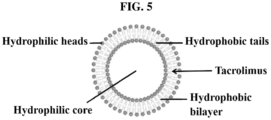
- tacrolimus may be encapsulated between the hydrophobic tails of the lipids that form the bilayer or any other location within the bilayer.
- the plurality of unsaturated and/or saturated lipids may be selected from the group consisting of phosphocholines and sphingolipids.
- the unsaturated lipids may comprise or consist of phosphocholines and/or sphingolipids.
- the saturated lipids may comprise or consist of phosphocholines and/or sphingolipids.
- the phosphocholines may be selected from the group consisting of egg yolk phosphatidylcholine (EggPC), 1-palmitoyl-2-oleoyl-sn-glycero-3-phosphocholine (POPC), 1,2-dioleoyl-sn-glycero-3-phosphocholine (DOPC) and dipalmitoylphosphatidylcholine (DPPC).
- EggPC egg yolk phosphatidylcholine
- POPC 1-palmitoyl-2-oleoyl-sn-glycero-3-phosphocholine
- DOPC 1,2-dioleoyl-sn-glycero-3-phosphocholine
- DPPC dipalmitoylphosphatidylcholine
- Other suitable phosphocholines may also be used to form the at least one bilayer of the nanoliposome.
- sphingolipids may include sphingomyelins, sphingosines, ceramides etc.
- the plurality of unsaturated and/or saturated lipids may comprise or consist of at least one unsaturated lipid constituting more than 50 wt% of the at least one lipid bilayer.
- Nanoliposomes which demonstrate better sustained release of hydrophobic drug(s) (e.g. tacrolimus) over prolonged periods (e.g. several days), may preferably have an unsaturated lipid tail attached to a PC "head” as the major constituent.
- the PC "head” may be understood as a phosphatidylcholine (PC) which incorporates choline as a head group.
- the at least one unsaturated lipid constituting more than 50 wt% of the at least one lipid bilayer may be composed of a phosphatidylcholine (PC) that incorporates choline as a head group.
- PC phosphatidylcholine
- the structure of a non-limiting exemplary unsaturated lipid having a choline group is shown below.
- EggPC may typically contain about more than 50 wt% or even about 95 wt% of POPC and/or other PCs with unsaturated tails, along with about 50 wt% or less, or even about 5 wt% of sphingomyelin which has an unsaturated tail.
- the structures of some major constituents possibly present in EggPC are shown below.
- PE Phosphatidylethanolamine
- 1,2-dioleoyl-sn-glycero-3-phosphocholine DOPC or di-oleyl:
- DPPC Dipalmitoylphosphatidylcholine
- lipids used to form nanoliposomes may preferably contain unsaturated lipid(s) or a mixture of lipids having at least one unsaturated lipid as the major component.
- Preferred unsaturated lipids may include, but not limited to, POPC, DOPC, sphingolipids etc.
- saturated lipids may form the minor components of the nanoliposome. That is to say, saturated lipids in the nanoliposome may be present at about 50 wt% or less than 50 wt%.
- the nanoliposome may have different sizes.
- the size of the nanoliposome may change insignificantly after storage.
- the nanoliposome may have an average size of 80 nm to 150 nm, 85 nm to 110 nm, 85 nm to 105 nm, 85 nm to 100 nm, 90 nm to 115 nm, 90 nm to 100 nm, 90 nm to 95 nm, or any other average sizes falling within these specified ranges. Other sizes may be possible depending on the lipids used.
- the nanoliposome may have a size falling within these ranges before storage, with or without drug loaded. In various instances, the nanoliposomes may have any of these average sizes before storage at 4°C.
- EggPC nanoliposomes may be 89.64 nm ⁇ 0.78 nm before storage (e.g. storing at 4°C).
- DPPC nanoliposomes may be 106.37 nm ⁇ 1.00 nm before storage (e.g. storing at 4°C).
- the nanoliposome(s) may have an average size of 90 nm to 120 nm, 90 nm to 110 nm, 90 nm to 100 nm, 100 nm to 120 nm, 110 nm to 120, or any other average sizes falling within these specified ranges after storage. Other sizes may be possible depending on the lipids used.
- the nanoliposome may have a size falling within these ranges after storage, with or without drug loaded.
- the nanoliposomes may have any of these average sizes after storing (e.g. at 4°C) for a certain duration (days or months).
- EggPC nanoliposomes may be 90.67 nm ⁇ 0.49 nm after storage (e.g. at 4°C).
- DPPC nanoliposomes may be 112.8 nm ⁇ 1.05 nm after storage (e.g. at 4°C).
- the nanoliposomes may be advantageously stored for extended periods of time, even with the drug loaded, without having its structural and the drug integrity compromised.
- the size of a nanoliposome may refer to its diameter.
- the type of lipids used may influence the polydispersity index of the nanoliposome.
- the polydispersity of the nanoliposome may change insignificantly after storage.
- the nanoliposome may have a polydispersity index of less than 0.3, 0.2 or even 0.1 before and after storage. Other polydispersity index may be possible based on the type of lipids used.
- EggPC nanoliposomes may have a polydispersity index of 0.052 ⁇ 0.018 before storage while DPPC nanoliposomes may have a polydispersity index of 0.28 ⁇ 0.016 before storage.
- the EggPC nanoliposomes After storage (e.g. at 4°C), the EggPC nanoliposomes may have a polydispersity index of 0.014 ⁇ 0.007 while the DPPC nanoliposomes may have a polydispersity index of 0.218 ⁇ 0.036 according to various instances. Based on the polydispersity index before and after storage (e.g. at 4°C), this again demonstrates the present nanoliposomes may be stored for extended periods of time, even with the drug loaded, without having the integrity of the nanoliposome and the drug compromised.
- the nanoliposome as described above may be a multilamellar vesicle or an unilamellar vesicle.
- the present invention relates to a nanoliposome for use in the prophylaxis and/or treatment of anterior segment ocular diseases, wherein the nanoliposome comprises a plurality of unsaturated and saturated lipids forming at least one lipid bilayer each encapsulating a hydrophobic drug comprising tacrolimus, and wherein the hydrophobic drug and the plurality of saturated and unsaturated lipids have a weight ratio of up to 0.2.
- Embodiments relating to the nanoliposome have been described above and are reiterated below.
- the nanoliposome has a drug loading of up to 1 mg/ml.
- the hydrophobic drug may be a concoction of one or more hydrophobic drugs.
- the hydrophobic drug comprises or consists of tacrolimus.
- the hydrophobic drug is encapsulated in the nanoliposome, wherein the nanoliposome has at least one lipid bilayer formed from the plurality of unsaturated and saturated lipids. Accordingly, the hydrophobic drug(s) is encapsulated in the lipid bilayer.
- tacrolimus may be encapsulated between the hydrophobic tails of the lipids that form the bilayer or any other location within the bilayer.
- the plurality of unsaturated and saturated lipids may be selected from the group consisting of phosphocholines and sphingolipids.
- the phosphocholines may be selected from the group consisting of egg yolk phosphatidylcholine (EggPC), 1-palmitoyl-2-oleoyl-sn-glycero-3-phosphocholine (POPC), 1,2-dioleoyl-sn-glycero-3-phosphocholine (DOPC) and dipalmitoylphosphatidylcholine (DPPC).
- EggPC egg yolk phosphatidylcholine
- POPC 1-palmitoyl-2-oleoyl-sn-glycero-3-phosphocholine
- DOPC 1,2-dioleoyl-sn-glycero-3-phosphocholine
- DPPC dipalmitoylphosphatidylcholine
- sphingolipids may include sphingomyelins, sphingosines,
- the plurality of unsaturated and saturated lipids comprise or consist of at least one unsaturated lipid constituting more than 50 wt% of the at least one lipid bilayer.
- Preferred embodiments of nanoliposomes which demonstrate better sustained release of hydrophobic drug(s) may comprise or consist of an unsaturated lipid tail attached to a PC "head" as the major constituent.
- the at least one unsaturated lipid constituting more than 50 wt% of the at least one lipid bilayer may be composed of a phosphatidylcholine (PC) that incorporates choline as a head group.
- PC phosphatidylcholine
- the nanoliposome may have different sizes before or after storage.
- the size of the nanoliposome may change insignificantly after storage.
- the nanoliposome has an average size of 80 nm to 150 nm before storage (e.g. at 4°C).
- the nanoliposome has an average size of 90 nm to 120 nm after storage (e.g. at 4°C).
- the type of lipids used may influence the polydispersity index of the nanoliposome.
- the polydispersity of the nanoliposome may change insignificantly after storage.
- the nanoliposome has a polydispersity index of less than 0.3 before and after storage.
- the nanoliposome is a multilamellar vesicle or an unilamellar vesicle.
- the present disclosure further relates to a method of preventing and/or treating anterior segment ocular diseases by administering a nanoliposome comprising a plurality of unsaturated and/or saturated lipids forming at least one lipid bilayer encapsulating a hydrophobic drug comprising tacrolimus, wherein the hydrophobic drug and the plurality of saturated and/or unsaturated lipids have a weight ratio of up to 0.2.
- the present method is advantageous as it mitigates the risk of intravitreal injection as the present nanoliposome may be administered by a less risky procedure of subconjunctival injection.
- subconjunctival injection is able to sustain the release of the hydrophobic drugs from the present nanoliposome which then circumvents the need for frequent topical administration of tacrolimus eye drop(s) and thus avoiding the side effects of frequent topical administration of eye drop(s).
- Embodiments as described above regarding the nanoliposome and its uses are applicable for the present method of treating anterior segment ocular diseases.
- the nanoliposome administered may have a drug loading of up to 1 mg/ml, 0.5 mg/ml, 0.1 mg/ml, or any other loadings within these ranges.
- the hydrophobic drug may be a concoction of one or more hydrophobic drugs.
- the hydrophobic drug may comprise or consist of tacrolimus.
- the hydrophobic drug may be encapsulated in the nanoliposome, wherein the nanoliposome has at least one lipid bilayer of the nanoliposome where the hydrophobic drug (e.g. tacrolimus) is encapsulated as described above.
- the hydrophobic drug e.g. tacrolimus
- the plurality of unsaturated and/or saturated lipids of the nanoliposome administered may be selected from the group consisting of phosphocholines and sphingolipids.
- the phosphocholines may be selected from the group consisting of egg yolk phosphatidylcholine (EggPC), 1-palmitoyl-2-oleoyl-sn-glycero-3-phosphocholine (POPC), 1,2-dioleoyl-sn-glycero-3-phosphocholine (DOPC) and dipalmitoylphosphatidylcholine (DPPC).
- EggPC egg yolk phosphatidylcholine
- POPC 1-palmitoyl-2-oleoyl-sn-glycero-3-phosphocholine
- DOPC 1,2-dioleoyl-sn-glycero-3-phosphocholine
- DPPC dipalmitoylphosphatidylcholine
- sphingolipids may include sphingomyelin
- the plurality of unsaturated and/or saturated lipids may comprise or consist of at least one unsaturated lipid constituting more than 50 wt% of the at least one lipid bilayer.
- nanoliposomes of preferred embodiments demonstrate better sustained release of hydrophobic drug(s) (e.g. tacrolimus) over prolonged periods (e.g. several days) when they possess an unsaturated lipid tail attached to a PC "head" as the major constituent.
- the at least one unsaturated lipid constituting more than 50 wt% of the at least one lipid bilayer may be composed of a phosphatidylcholine (PC) that incorporates choline as a head group.
- PC phosphatidylcholine
- the nanoliposome administered may have different sizes before or after storage.
- the size of the nanoliposome may change insignificantly after storage.
- the nanoliposome administered may have an average size of 80 nm to 150 nm, 85 nm to 110 nm before storage (e.g. storing at 4°C). Embodiments concerning other sizes or range of sizes before storage have been described above. Non-limiting embodiments based on EggPC and DPPC liposomes are also described above.
- the nanoliposome administered may have an average size of 90 nm to 120 nm after storage (e.g. at 4°C). Embodiments concerning other sizes or range of sizes after storage (e.g. at 4°C) have been described above. Non-limiting embodiments based on EggPC and DPPC liposomes are also described above.
- the type of lipids used may influence the polydispersity index of the nanoliposome to be administered.
- the polydispersity of the nanoliposome may change insignificantly after storage.
- the nanoliposome administered may have a polydispersity index of less than 0.3, 0.2 or even 0.1 before and after storage.
- Non-limiting embodiments based on EggPC nanoliposomes and DPPC nanoliposomes before and after storage have been described above.
- the nanoliposome administered may be a multilamellar vesicle or an unilamellar vesicle according to various embodiments as described above.
- the anterior segment ocular diseases may refer to ocular inflammatory diseases, ocular surface diseases, and diseases or disorders associated with lack of immunosuppression (e.g. ocular graft rejection).
- the present disclosure relates to nanoliposomes for use in the delivery of tacrolimus to treat various inflammatory diseases or disorders of the eye, ocular surface diseases and in immunosuppression for preventing ocular graft rejection (e.g. post corneal graft).
- ocular graft rejection e.g. post corneal graft
- the nanoliposomes may be prepared from lipids such as, but are not limited to, phosphocholines and sphingolipids. More specifically, the nanoliposomes containing tacrolimus in desired loading concentrations may be prepared by passive loading techniques.
- the drug loaded nanoliposomes may be applied via subconjunctival injections and may sustain the release of drugs over an extended duration (days to months). This drastically improves patient compliance as well as minimizes side effects associated with frequent topical instillations (e.g. eye drops) to halt the progression of diseases.
- the nanoliposomes may be referred to as a composition of liposomal matter that comprises or consists of saturated and/or unsaturated lipids.
- the encapsulated drug loading in each of the liposomes may be up to 1 mg/ml and the drug/lipid weight ratio may be up to 0.2. This composition advantageously sustains the release of tacrolimus beyond two weeks.
- the present disclosure relates to nanoliposomes for sustained delivery and/or release of tacrolimus for treatment of ocular diseases. Based on the examples described below, high loading concentrations of tacrolimus in nanoliposomes were achieved using a passive loading technique. In addition, controlled and sustained release of tacrolimus from the nanoliposomes were achieved in an in vitro dialysis. The examples demonstrated the release of drug was sustained beyond two weeks based on the in vitro dialysis.
- the examples below exemplify encapsulation of tacrolimus in high loading concentrations in the nanoliposomes, where a desirably high drug/lipid (D/L) weight ratio of up to 0.2 is achieved for both unstaturated and saturated liposomes.
- D/L ratio exceeds 0.2, the encapsulation efficiency for the drug decreases, thereby resulting in the lost of drugs from the nanoliposomes.
- FIG. 5 An example of how tacrolimus is encapsulated in the nanoliposome is shown in FIG. 5 .
- Lipids were weighed and placed in a vacuum desiccator for 1 hour to remove any residual moisture before weighing.
- the drug, tacrolimus was also desiccated before weighing.
- Each batch of liposome was prepared in 5 ml, with an initial lipid concentration of 18 millimolar (mM).
- the weighed lipids and drug were then mixed in a round bottom flask, and dissolved in an organic phase mixture that contained methanol and chloroform in a ratio of 1:2.
- the flask was then maintained in a water bath temperature of 40°C and rotated in a rotary operator under reduced pressure for 1 hour to remove the organic phase, ultimately leaving behind a thin drug loaded lipid film covering the bottom of the flask.
- PBS phosphate buffer solution
- the liposomes' (MLVs) sizes were reduced by extrusion through polycarbonate filter membranes in the corresponding size sequence of 0.2 ⁇ m (5 times), and 0.08 ⁇ m (10 times) using a bench top extruder purchased from Northern Lipids Inc, Canada. After these extrusion steps, the drug loaded large unilamellar vesicles (LUVs) with a size distribution of about 100 ⁇ 20 nm were formed.
- LUVs large unilamellar vesicles
- Hydrophobic drugs such as tacrolimus
- MLVs in microfuge tubes were centrifuged at 13000 rotation per minute (rpm) or 16249 relative centrifugal force (rcf) for half an hour.
- rpm rotation per minute
- rcf relative centrifugal force
- the total amount of drug(s) in the MLVs and the amount of drug(s) in the supernatant were estimated by high performance liquid chromatography (HPLC).
- HPLC high performance liquid chromatography
- a continuous (buffer) phase drug(s) amount was calculated from the drug measured in the supernatant.
- the amount of drug partitioned into the bilayer is calculated by subtracting the drug measured in the supernatant from the total drug amount.
- the drug partition coefficient (P.C.) in MLVs was then estimated using the following expression given below.
- P . C . Total amount of drug ⁇ amount of drug in buffer Amount of drug in buffer
- the various liposome samples were broken with isopropyl alcohol (IPA) in a volume ratio of 1:5 (liposome:IPA) and then diluted with PBS of pH 7.4.
- IPA isopropyl alcohol
- the HPLC method was used to measure the drug concentration of liposomes while taking into consideration the dilution factor and comparing against the standard of tacrolimus in PBS of pH 7.4.
- a dialysis method was used to evaluate release of tacrolimus from liposomal nanocarriers.
- the receptor medium was physically separated from the drug loaded liposomes by a dialysis membrane.
- the released drug concentration was evaluated from the receptor medium over time by HPLC.
- 1 ml of the drug loaded liposomes were filled into a cellulose ester dialysis bag (with a molecular weight cut-off (MWCO) of 100 kD) and clipped by dialysis clips on both ends.
- MWCO molecular weight cut-off
- the average size as well as the size distribution (polydispersity index) of the liposomes were characterized by using Malvern Zetasizer Nano ZS.
- the particle sizes were measured after preparation and continuously monitored during storage (4°C).
- Example 6a Results - In Vitro Size Stability of Tacrolimus In Unsaturated Liposomes (EggPC liposomes)
- the unsaturated liposomes were based on egg yolk phosphatidylcholine (EggPC) liposomes.
- EggPC contains, without being limited to, POPC, phosphatidylethanolamine, DPPC, DOPC and sphingomyelins etc.
- the EggPC liposomes have a D/L weight ratio of 0.2 with a drug (tacrolimus) loading concentration of 1 mg/ml. The loading concentration may depend on what is required to adequately deliver daily amounts over several days.
- Example 6b Results - In Vitro Drug Release Study of Tacrolimus In Unsaturated Liposomes (EggPC liposomes)
- the release of tacrolimus from EggPC liposomes was evaluated by a dialysis technique and expressed in terms of cumulative drug release (%) over time as shown in FIG. 1 .
- FIG. 1 the in vitro drug release studies (1 ml of liposomes dialysed against 40 ml of PBS with pH of 7.4) for three independent samples of tacrolimus loaded EggPC liposomes as carried out are shown. All three samples were of the same drug loading and D/L ratio.
- Example 6c Results - In Vitro Drug Release Study of Tacrolimus In Unsaturated Liposomes (POPC liposomes)
- the unsaturated liposomes in this example were based on 1-palmitoyl-2-oleoyl-sn-glycero-3-phosphocholine (POPC).
- POPC 1-palmitoyl-2-oleoyl-sn-glycero-3-phosphocholine
- the release of tacrolimus from these liposomes was evaluated by the dialysis technique as described above and expressed in terms of cumulative drug release (%) over time as shown in FIG. 2 .
- FIG. 2 the in vitro drug release studies for three independent samples of tacrolimus loaded POPC liposomes (1 ml of liposomes dialysed against 40 ml of PBS with pH of 7.4) as carried out are shown.
- the cumulative percentage of tacrolimus release was then plotted against time (days).
- the almost-complete release of tacrolimus from POPC was sustained for 42 days in vitro with a suppressed burst observed in the first few days.
- FIG. 3 A comparison of tacrolimus release profiles between tacrolimus eye drop(s) and tacrolimus POPC liposome is shown in FIG. 3 .
- FIG. 3 the in vitro drug release studies for three independent samples of tacrolimus loaded POPC liposomes (1 ml of liposomes dialysed against 40 ml of PBS with pH 7.4) as carried out are shown.
- Daily (calculated) tacrolimus mass release profile was plotted against time (days) as shown in FIG. 3 .
- the release profile of tacrolimus based on eye drops is also included in FIG. 3 as represented by the solid flat line.
- Example 7a Results - In Vitro Size Stability of Tacrolimus In Saturated Liposomes (DPPC liposomes)
- the saturated liposomes were based on dipalmitoylphosphatidylcholine (DPPC) liposomes prepared according to example 1.
- DPPC liposomes have a D/L weight ratio of 0.2 with a drug (tacrolimus) loading concentration of 1 mg/ml.
- drug loaded DPPC liposomes were stable in size for at least 1 month storage at 4°C.
- the average size (Z avg ) of the liposomes were found to be about 110 nm with a narrow polydispersity index (PDI) of less than 0.3.
- Example 7b Results - In Vitro Drug Release Study of Tacrolimus In Saturated Liposomes (DPPC liposomes)
- the release of tacrolimus from DPPC liposomes was evaluated by the dialysis technique as described above and expressed in terms of cumulative drug release (%) over time as shown in FIG. 4 .
- FIG. 4 the in vitro drug release studies (1 ml of liposomes dialysed against 40 ml of PBS with pH of 7.4) for three independent samples of tacrolimus loaded DPPC liposomes as carried out are shown.
- the cumulative tacrolimus release (%) was plotted against time (days). For each.The release of tacrolimus from liposomes was sustained beyond two weeks in vitro (about 35%), albeit a smaller burst observed in the first few days.
- DPPC liposomes has a smaller intial burst and only about 35% of the drug is released at the end of two weeks compared to EggPC liposomes (about 60%).
Landscapes
- Health & Medical Sciences (AREA)
- Chemical & Material Sciences (AREA)
- Medicinal Chemistry (AREA)
- Pharmacology & Pharmacy (AREA)
- Life Sciences & Earth Sciences (AREA)
- Animal Behavior & Ethology (AREA)
- General Health & Medical Sciences (AREA)
- Public Health (AREA)
- Veterinary Medicine (AREA)
- Epidemiology (AREA)
- Bioinformatics & Cheminformatics (AREA)
- Engineering & Computer Science (AREA)
- Ophthalmology & Optometry (AREA)
- Dispersion Chemistry (AREA)
- General Chemical & Material Sciences (AREA)
- Nuclear Medicine, Radiotherapy & Molecular Imaging (AREA)
- Organic Chemistry (AREA)
- Chemical Kinetics & Catalysis (AREA)
- Physics & Mathematics (AREA)
- Biomedical Technology (AREA)
- Nanotechnology (AREA)
- Optics & Photonics (AREA)
- Medicinal Preparation (AREA)
- Pharmaceuticals Containing Other Organic And Inorganic Compounds (AREA)
Claims (7)
- Ein Nanoliposom zur Verwendung bei der Prophylaxe und/oder Behandlung von Augenerkrankungen des vorderen Segments, wobei das Nanoliposom eine Vielzahl von ungesättigten und gesättigten Lipiden aufweist, die mindestens eine Lipiddoppelschicht bilden, die ein hydrophobes Medikament einkapselt, das Tacrolimus aufweist, und wobei das hydrophobe Medikament und die Vielzahl von gesättigten und ungesättigten Lipiden ein Gewichtsverhältnis von bis zu 0,2 haben, wobei die Vielzahl der ungesättigten und gesättigten Lipide (i) mindestens ein ungesättigtes Lipid aufweisen, das mehr als 50 Gew.-% der mindestens einen Lipiddoppelschicht ausmacht, und (ii) das hydrophobe Medikament in der mindestens einen Lipiddoppelschicht eingekapselt haben, wobei das Nanoliposom durch subkonjunktivale Injektion zu verabreichen ist und tägliche Freisetzung des hydrophoben Medikaments für mindestens 2 Wochen aufrechterhält, wie durch ein Dialyseverfahren gemessen wird, und wobei das mindestens eine ungesättigte Lipid Eigelbphosphatidylcholin (EggPC) und/oder 1-Palmitoyl-2-oleoyl-sn-glycero-3-phosphocholin (POPC) aufweist, wobei das Dialyseverfahren aufweist: (i) Platzieren des Nanoliposoms in einem Dialysebeutel, (ii) Inkubieren des Dialysebeutels, der einer Phosphatpufferlösung bei einem pH-Wert von 7,4 und 37°C ausgesetzt ist, und (iii) tägliche Entnahme eines Teils eines Dialysemediums für die Hochleistungsflüssigkeitschromatographie, um eine Menge des freigesetzten hydrophoben Medikaments zu messen.
- Das Nanoliposom zur Verwendung nach Anspruch 1, wobei das Nanoliposom eine Wirkstoffbeladung von bis zu 1 mg/ml aufweist.
- Das Nanoliposom zur Verwendung nach Anspruch 1 oder 2, wobei das mindestens eine ungesättigte Lipid ferner ein Sphingolipid und/oder 1,2-Dioleoyl-sn-glycero-3-phosphocholin (DOPC) aufweist.
- Das Nanoliposom zur Verwendung nach einem der Ansprüche 1 bis 3, wobei das Nanoliposom vor Lagerung bei 4°C eine durchschnittliche Größe von 80 nm bis 150 nm aufweist.
- Das Nanoliposom zur Verwendung nach einem der Ansprüche 1 bis 4, wobei das Nanoliposom nach Lagerung bei 4°C eine durchschnittliche Größe von 90 nm bis 120 nm aufweist.
- Das Nanoliposom zur Verwendung nach einem der Ansprüche 1 bis 5, wobei das Nanoliposom vor und nach Lagerung einen Polydispersitätsindex von weniger als 0,3 aufweist.
- Das Nanoliposom zur Verwendung nach einem der Ansprüche 1 bis 6, wobei das Nanoliposom ein multilamellares Vesikel oder ein unilamellares Vesikel ist.
Applications Claiming Priority (2)
| Application Number | Priority Date | Filing Date | Title |
|---|---|---|---|
| SG10201603094P | 2016-04-19 | ||
| PCT/SG2017/050216 WO2017184080A1 (en) | 2016-04-19 | 2017-04-19 | Nanoliposomes for sustained delivery of tacrolimus for treatment of anterior segment eye diseases |
Publications (4)
| Publication Number | Publication Date |
|---|---|
| EP3445334A1 EP3445334A1 (de) | 2019-02-27 |
| EP3445334A4 EP3445334A4 (de) | 2019-12-25 |
| EP3445334C0 EP3445334C0 (de) | 2024-10-09 |
| EP3445334B1 true EP3445334B1 (de) | 2024-10-09 |
Family
ID=60116958
Family Applications (1)
| Application Number | Title | Priority Date | Filing Date |
|---|---|---|---|
| EP17786259.6A Active EP3445334B1 (de) | 2016-04-19 | 2017-04-19 | Nanoliposomen zur verzögertenfreisetzung von tacrolimus zur behandlung von augenerkrankungen des anterioren segments |
Country Status (7)
| Country | Link |
|---|---|
| US (2) | US11672784B2 (de) |
| EP (1) | EP3445334B1 (de) |
| JP (1) | JP7186093B2 (de) |
| CN (1) | CN109310634B (de) |
| ES (1) | ES2991863T3 (de) |
| SG (2) | SG11201809154UA (de) |
| WO (1) | WO2017184080A1 (de) |
Families Citing this family (1)
| Publication number | Priority date | Publication date | Assignee | Title |
|---|---|---|---|---|
| AU2024287943A1 (en) | 2023-07-10 | 2026-01-22 | Eden Ophthalmic Pte Ltd. | Liposomal formulations of corticosteroids and uses thereof |
Family Cites Families (15)
| Publication number | Priority date | Publication date | Assignee | Title |
|---|---|---|---|---|
| US5817333A (en) * | 1991-10-31 | 1998-10-06 | Fujisawa Pharmaceutical Co., Ltd. | Liposome preparation containing a tricyclic compound |
| BR0010459A (pt) * | 1999-03-11 | 2002-02-05 | Fujisawa Pharmaceutical Co | Preparação de lipossoma contendo derivado de ácido pipecólico e preparação sólida |
| US6489335B2 (en) * | 2000-02-18 | 2002-12-03 | Gholam A. Peyman | Treatment of ocular disease |
| US20030018044A1 (en) | 2000-02-18 | 2003-01-23 | Peyman Gholam A. | Treatment of ocular disease |
| CN1127955C (zh) * | 2000-07-07 | 2003-11-19 | 中山医科大学中山眼科中心 | 一种眼前段及眼表免疫相关性疾病治疗药物 |
| US20040224010A1 (en) * | 2002-11-15 | 2004-11-11 | Optime Therapeutics, Inc. | Ophthalmic liposome compositions and uses thereof |
| WO2006050327A2 (en) * | 2004-10-28 | 2006-05-11 | Alza Corporation | Lyophilized liposome formulations and method |
| CA2632568A1 (en) * | 2005-12-07 | 2007-06-14 | Alacrity Biosciences, Inc. | Tetracyclines for treating ocular diseases and disorders |
| JPWO2008026781A1 (ja) * | 2006-08-31 | 2010-01-21 | 直人 奥 | 逆標的化脂質小胞体 |
| CA2737025C (en) * | 2008-09-27 | 2012-09-04 | Jina Pharmaceuticals, Inc. | Lipid based pharmaceutical preparations for oral and topical application; their compositions, methods, and uses thereof |
| CN102202694B (zh) * | 2008-10-07 | 2014-03-12 | 博莱科瑞士股份有限公司 | 包含抗-聚合物抗体的靶向构建体和结合它们的脂质体或微泡 |
| CA2781527C (en) * | 2009-09-23 | 2017-10-24 | Indu Javeri | Methods for the preparation of liposomes |
| SG187770A1 (en) * | 2010-08-12 | 2013-03-28 | Univ Nanyang Tech | A liposomal formulation for ocular drug delivery |
| CN103142468A (zh) | 2012-12-28 | 2013-06-12 | 中山大学 | 用于眼角膜移植的他克莫司眼用剂及其制备方法 |
| ES2952675T3 (es) * | 2013-10-22 | 2023-11-03 | Lipella Pharmaceuticals Inc | Administración de agentes mediante el uso de liposomas metaestables |
-
2017
- 2017-04-19 JP JP2018554752A patent/JP7186093B2/ja active Active
- 2017-04-19 CN CN201780024828.2A patent/CN109310634B/zh active Active
- 2017-04-19 SG SG11201809154UA patent/SG11201809154UA/en unknown
- 2017-04-19 US US16/094,827 patent/US11672784B2/en active Active
- 2017-04-19 SG SG10202010303UA patent/SG10202010303UA/en unknown
- 2017-04-19 ES ES17786259T patent/ES2991863T3/es active Active
- 2017-04-19 WO PCT/SG2017/050216 patent/WO2017184080A1/en not_active Ceased
- 2017-04-19 EP EP17786259.6A patent/EP3445334B1/de active Active
-
2023
- 2023-04-27 US US18/308,557 patent/US12564577B2/en active Active
Also Published As
| Publication number | Publication date |
|---|---|
| US12564577B2 (en) | 2026-03-03 |
| US11672784B2 (en) | 2023-06-13 |
| JP7186093B2 (ja) | 2022-12-08 |
| EP3445334A1 (de) | 2019-02-27 |
| SG10202010303UA (en) | 2020-11-27 |
| US20230263780A1 (en) | 2023-08-24 |
| WO2017184080A1 (en) | 2017-10-26 |
| SG11201809154UA (en) | 2018-11-29 |
| EP3445334A4 (de) | 2019-12-25 |
| EP3445334C0 (de) | 2024-10-09 |
| JP2019513807A (ja) | 2019-05-30 |
| CN109310634A (zh) | 2019-02-05 |
| ES2991863T3 (es) | 2024-12-05 |
| CN109310634B (zh) | 2022-05-31 |
| US20190117631A1 (en) | 2019-04-25 |
Similar Documents
| Publication | Publication Date | Title |
|---|---|---|
| US7357944B2 (en) | Liposomal analgesic drug compositions prepared in GMV using an ammonium sulfate gradient | |
| Bendas et al. | Enhanced transdermal delivery of salbutamol sulfate via ethosomes | |
| Monem et al. | Prolonged effect of liposomes encapsulating pilocarpine HCl in normal and glaucomatous rabbits | |
| El-Nabarawi et al. | Transdermal drug delivery of paroxetine through lipid-vesicular formulation to augment its bioavailability | |
| US7846473B2 (en) | Irinotecan preparation | |
| JP5813011B2 (ja) | リポソーム組成物およびその製造方法 | |
| JP5889279B2 (ja) | 持続徐放性リポソーム組成物およびその製造方法 | |
| KR20010107991A (ko) | 생체내에서 국부적인 비침투성 용도로 사용되는 개선된 제제 | |
| US20180110771A1 (en) | Liposomal Irinotecan Preparations | |
| KR20200044902A (ko) | 서방형 마취제 조성물 및 이의 제조 방법 | |
| US12564577B2 (en) | Nanoliposomes for sustained delivery of tacrolimus for treatment of anterior segment eye diseases | |
| US20020058060A1 (en) | Liposome for incorporating large amounts of hydrophobic substances | |
| KR20200065961A (ko) | 서방형 리포좀 제제의 제조방법 | |
| US20170319573A1 (en) | Stabilizing Camptothecin Pharmaceutical Compositions | |
| US9078812B2 (en) | Particulate drug carriers as desensitizing agents | |
| US20170119666A1 (en) | Stable liposomal formulations of alpha 2 adrenergic agonists for ocular delivery | |
| US20170087089A1 (en) | Process for the preparation of unilamellar liposomal composition | |
| Joshi et al. | Development and Characterization of Liposomal formulation for ophthalmic delivery of Prednisolone Acetate | |
| US20170042809A1 (en) | Stable liposomal formulations of carbonic anhydrase inhibitors for ocular drug delivery | |
| FR2842734A1 (fr) | Procede pour diminuer la variabilite de la biodisponibilite d'un medicament a administration orale et compositions pharmaceutiques a administration orale | |
| Begum et al. | Ketorolac tromethamine loaded liposomes: Development, characterization and in vitro evaluation | |
| RU2791481C2 (ru) | Анестетические композиции с замедленным высвобождением и способы их получения | |
| WO2017027017A1 (en) | Stable liposomal formulations of carbonic anhydrase inhibitors for ocular drug delivery | |
| Kreuter | Delivery of Liposome-Encapsulated Agents to Artificial Membranes |
Legal Events
| Date | Code | Title | Description |
|---|---|---|---|
| STAA | Information on the status of an ep patent application or granted ep patent |
Free format text: STATUS: THE INTERNATIONAL PUBLICATION HAS BEEN MADE |
|
| PUAI | Public reference made under article 153(3) epc to a published international application that has entered the european phase |
Free format text: ORIGINAL CODE: 0009012 |
|
| STAA | Information on the status of an ep patent application or granted ep patent |
Free format text: STATUS: REQUEST FOR EXAMINATION WAS MADE |
|
| 17P | Request for examination filed |
Effective date: 20181105 |
|
| AK | Designated contracting states |
Kind code of ref document: A1 Designated state(s): AL AT BE BG CH CY CZ DE DK EE ES FI FR GB GR HR HU IE IS IT LI LT LU LV MC MK MT NL NO PL PT RO RS SE SI SK SM TR |
|
| AX | Request for extension of the european patent |
Extension state: BA ME |
|
| RIN1 | Information on inventor provided before grant (corrected) |
Inventor name: VENKATRAMAN, SUBRAMANIAN Inventor name: NATARAJAN, JAYAGANESH V. Inventor name: NG, HERR CHEUN ANTHONY Inventor name: HOWDEN, TINA TZEE LING Inventor name: BOEY, YIN CHIANG FREDDY Inventor name: NG, XU WEN Inventor name: MEHTA, JODHBIR SINGH |
|
| DAV | Request for validation of the european patent (deleted) | ||
| DAX | Request for extension of the european patent (deleted) | ||
| A4 | Supplementary search report drawn up and despatched |
Effective date: 20191125 |
|
| RIC1 | Information provided on ipc code assigned before grant |
Ipc: A61K 9/127 20060101AFI20191119BHEP Ipc: A61P 27/02 20060101ALI20191119BHEP Ipc: A61K 31/436 20060101ALI20191119BHEP Ipc: A61K 9/00 20060101ALI20191119BHEP Ipc: A61P 27/04 20060101ALI20191119BHEP Ipc: A61K 9/51 20060101ALI20191119BHEP |
|
| STAA | Information on the status of an ep patent application or granted ep patent |
Free format text: STATUS: EXAMINATION IS IN PROGRESS |
|
| 17Q | First examination report despatched |
Effective date: 20200720 |
|
| GRAP | Despatch of communication of intention to grant a patent |
Free format text: ORIGINAL CODE: EPIDOSNIGR1 |
|
| STAA | Information on the status of an ep patent application or granted ep patent |
Free format text: STATUS: GRANT OF PATENT IS INTENDED |
|
| INTG | Intention to grant announced |
Effective date: 20240429 |
|
| GRAS | Grant fee paid |
Free format text: ORIGINAL CODE: EPIDOSNIGR3 |
|
| GRAA | (expected) grant |
Free format text: ORIGINAL CODE: 0009210 |
|
| STAA | Information on the status of an ep patent application or granted ep patent |
Free format text: STATUS: THE PATENT HAS BEEN GRANTED |
|
| AK | Designated contracting states |
Kind code of ref document: B1 Designated state(s): AL AT BE BG CH CY CZ DE DK EE ES FI FR GB GR HR HU IE IS IT LI LT LU LV MC MK MT NL NO PL PT RO RS SE SI SK SM TR |
|
| REG | Reference to a national code |
Ref country code: CH Ref legal event code: EP |
|
| REG | Reference to a national code |
Ref country code: DE Ref legal event code: R096 Ref document number: 602017085376 Country of ref document: DE |
|
| REG | Reference to a national code |
Ref country code: IE Ref legal event code: FG4D |
|
| U01 | Request for unitary effect filed |
Effective date: 20241015 |
|
| U07 | Unitary effect registered |
Designated state(s): AT BE BG DE DK EE FI FR IT LT LU LV MT NL PT RO SE SI Effective date: 20241031 |
|
| REG | Reference to a national code |
Ref country code: ES Ref legal event code: FG2A Ref document number: 2991863 Country of ref document: ES Kind code of ref document: T3 Effective date: 20241205 |
|
| PG25 | Lapsed in a contracting state [announced via postgrant information from national office to epo] |
Ref country code: HR Free format text: LAPSE BECAUSE OF FAILURE TO SUBMIT A TRANSLATION OF THE DESCRIPTION OR TO PAY THE FEE WITHIN THE PRESCRIBED TIME-LIMIT Effective date: 20241009 Ref country code: IS Free format text: LAPSE BECAUSE OF FAILURE TO SUBMIT A TRANSLATION OF THE DESCRIPTION OR TO PAY THE FEE WITHIN THE PRESCRIBED TIME-LIMIT Effective date: 20250209 |
|
| PG25 | Lapsed in a contracting state [announced via postgrant information from national office to epo] |
Ref country code: NO Free format text: LAPSE BECAUSE OF FAILURE TO SUBMIT A TRANSLATION OF THE DESCRIPTION OR TO PAY THE FEE WITHIN THE PRESCRIBED TIME-LIMIT Effective date: 20250109 |
|
| PG25 | Lapsed in a contracting state [announced via postgrant information from national office to epo] |
Ref country code: GR Free format text: LAPSE BECAUSE OF FAILURE TO SUBMIT A TRANSLATION OF THE DESCRIPTION OR TO PAY THE FEE WITHIN THE PRESCRIBED TIME-LIMIT Effective date: 20250110 |
|
| PG25 | Lapsed in a contracting state [announced via postgrant information from national office to epo] |
Ref country code: PL Free format text: LAPSE BECAUSE OF FAILURE TO SUBMIT A TRANSLATION OF THE DESCRIPTION OR TO PAY THE FEE WITHIN THE PRESCRIBED TIME-LIMIT Effective date: 20241009 |
|
| PG25 | Lapsed in a contracting state [announced via postgrant information from national office to epo] |
Ref country code: RS Free format text: LAPSE BECAUSE OF FAILURE TO SUBMIT A TRANSLATION OF THE DESCRIPTION OR TO PAY THE FEE WITHIN THE PRESCRIBED TIME-LIMIT Effective date: 20250109 |
|
| U20 | Renewal fee for the european patent with unitary effect paid |
Year of fee payment: 9 Effective date: 20250328 |
|
| PG25 | Lapsed in a contracting state [announced via postgrant information from national office to epo] |
Ref country code: SM Free format text: LAPSE BECAUSE OF FAILURE TO SUBMIT A TRANSLATION OF THE DESCRIPTION OR TO PAY THE FEE WITHIN THE PRESCRIBED TIME-LIMIT Effective date: 20241009 |
|
| PGFP | Annual fee paid to national office [announced via postgrant information from national office to epo] |
Ref country code: ES Payment date: 20250519 Year of fee payment: 9 |
|
| PG25 | Lapsed in a contracting state [announced via postgrant information from national office to epo] |
Ref country code: SK Free format text: LAPSE BECAUSE OF FAILURE TO SUBMIT A TRANSLATION OF THE DESCRIPTION OR TO PAY THE FEE WITHIN THE PRESCRIBED TIME-LIMIT Effective date: 20241009 |
|
| PGFP | Annual fee paid to national office [announced via postgrant information from national office to epo] |
Ref country code: TR Payment date: 20250411 Year of fee payment: 9 |
|
| PG25 | Lapsed in a contracting state [announced via postgrant information from national office to epo] |
Ref country code: CZ Free format text: LAPSE BECAUSE OF FAILURE TO SUBMIT A TRANSLATION OF THE DESCRIPTION OR TO PAY THE FEE WITHIN THE PRESCRIBED TIME-LIMIT Effective date: 20241009 |
|
| PLBE | No opposition filed within time limit |
Free format text: ORIGINAL CODE: 0009261 |
|
| STAA | Information on the status of an ep patent application or granted ep patent |
Free format text: STATUS: NO OPPOSITION FILED WITHIN TIME LIMIT |
|
| 26N | No opposition filed |
Effective date: 20250710 |
|
| REG | Reference to a national code |
Ref country code: CH Ref legal event code: H13 Free format text: ST27 STATUS EVENT CODE: U-0-0-H10-H13 (AS PROVIDED BY THE NATIONAL OFFICE) Effective date: 20251125 |
|
| PG25 | Lapsed in a contracting state [announced via postgrant information from national office to epo] |
Ref country code: MC Free format text: LAPSE BECAUSE OF FAILURE TO SUBMIT A TRANSLATION OF THE DESCRIPTION OR TO PAY THE FEE WITHIN THE PRESCRIBED TIME-LIMIT Effective date: 20241009 |
|
| PG25 | Lapsed in a contracting state [announced via postgrant information from national office to epo] |
Ref country code: CH Free format text: LAPSE BECAUSE OF NON-PAYMENT OF DUE FEES Effective date: 20250430 |
|
| PGFP | Annual fee paid to national office [announced via postgrant information from national office to epo] |
Ref country code: GB Payment date: 20260331 Year of fee payment: 10 |
|
| PG25 | Lapsed in a contracting state [announced via postgrant information from national office to epo] |
Ref country code: IE Free format text: LAPSE BECAUSE OF NON-PAYMENT OF DUE FEES Effective date: 20250419 |