EP3435569B1 - Bestimmung einer frequenz für kommunikationssitzungen eines antriebsmotors - Google Patents
Bestimmung einer frequenz für kommunikationssitzungen eines antriebsmotors Download PDFInfo
- Publication number
- EP3435569B1 EP3435569B1 EP18180082.2A EP18180082A EP3435569B1 EP 3435569 B1 EP3435569 B1 EP 3435569B1 EP 18180082 A EP18180082 A EP 18180082A EP 3435569 B1 EP3435569 B1 EP 3435569B1
- Authority
- EP
- European Patent Office
- Prior art keywords
- communication session
- frequency
- propulsor engine
- controller
- new communication
- Prior art date
- Legal status (The legal status is an assumption and is not a legal conclusion. Google has not performed a legal analysis and makes no representation as to the accuracy of the status listed.)
- Active
Links
Images


Classifications
-
- H—ELECTRICITY
- H04—ELECTRIC COMMUNICATION TECHNIQUE
- H04K—SECRET COMMUNICATION; JAMMING OF COMMUNICATION
- H04K1/00—Secret communication
- H04K1/003—Secret communication by varying carrier frequency at or within predetermined or random intervals
-
- H—ELECTRICITY
- H04—ELECTRIC COMMUNICATION TECHNIQUE
- H04K—SECRET COMMUNICATION; JAMMING OF COMMUNICATION
- H04K3/00—Jamming of communication; Counter-measures
- H04K3/20—Countermeasures against jamming
- H04K3/25—Countermeasures against jamming based on characteristics of target signal or of transmission, e.g. using direct sequence spread spectrum or fast frequency hopping
-
- H—ELECTRICITY
- H04—ELECTRIC COMMUNICATION TECHNIQUE
- H04K—SECRET COMMUNICATION; JAMMING OF COMMUNICATION
- H04K3/00—Jamming of communication; Counter-measures
- H04K3/80—Jamming or countermeasure characterized by its function
- H04K3/82—Jamming or countermeasure characterized by its function related to preventing surveillance, interception or detection
- H04K3/827—Jamming or countermeasure characterized by its function related to preventing surveillance, interception or detection using characteristics of target signal or of transmission, e.g. using direct sequence spread spectrum or fast frequency hopping
-
- H—ELECTRICITY
- H04—ELECTRIC COMMUNICATION TECHNIQUE
- H04L—TRANSMISSION OF DIGITAL INFORMATION, e.g. TELEGRAPHIC COMMUNICATION
- H04L63/00—Network architectures or network communication protocols for network security
- H04L63/04—Network architectures or network communication protocols for network security for providing a confidential data exchange among entities communicating through data packet networks
-
- H—ELECTRICITY
- H04—ELECTRIC COMMUNICATION TECHNIQUE
- H04L—TRANSMISSION OF DIGITAL INFORMATION, e.g. TELEGRAPHIC COMMUNICATION
- H04L63/00—Network architectures or network communication protocols for network security
- H04L63/04—Network architectures or network communication protocols for network security for providing a confidential data exchange among entities communicating through data packet networks
- H04L63/0428—Network architectures or network communication protocols for network security for providing a confidential data exchange among entities communicating through data packet networks wherein the data content is protected, e.g. by encrypting or encapsulating the payload
-
- H—ELECTRICITY
- H04—ELECTRIC COMMUNICATION TECHNIQUE
- H04L—TRANSMISSION OF DIGITAL INFORMATION, e.g. TELEGRAPHIC COMMUNICATION
- H04L63/00—Network architectures or network communication protocols for network security
- H04L63/14—Network architectures or network communication protocols for network security for detecting or protecting against malicious traffic
- H04L63/1441—Countermeasures against malicious traffic
-
- B—PERFORMING OPERATIONS; TRANSPORTING
- B63—SHIPS OR OTHER WATERBORNE VESSELS; RELATED EQUIPMENT
- B63H—MARINE PROPULSION OR STEERING
- B63H21/00—Use of propulsion power plant or units on vessels
- B63H21/21—Control means for engine or transmission, specially adapted for use on marine vessels
-
- B—PERFORMING OPERATIONS; TRANSPORTING
- B64—AIRCRAFT; AVIATION; COSMONAUTICS
- B64D—EQUIPMENT FOR FITTING IN OR TO AIRCRAFT; FLIGHT SUITS; PARACHUTES; ARRANGEMENT OR MOUNTING OF POWER PLANTS OR PROPULSION TRANSMISSIONS IN AIRCRAFT
- B64D31/00—Power plant control systems; Arrangement of power plant control systems in aircraft
-
- H—ELECTRICITY
- H04—ELECTRIC COMMUNICATION TECHNIQUE
- H04K—SECRET COMMUNICATION; JAMMING OF COMMUNICATION
- H04K2203/00—Jamming of communication; Countermeasures
- H04K2203/10—Jamming or countermeasure used for a particular application
- H04K2203/22—Jamming or countermeasure used for a particular application for communication related to vehicles
-
- H—ELECTRICITY
- H04—ELECTRIC COMMUNICATION TECHNIQUE
- H04L—TRANSMISSION OF DIGITAL INFORMATION, e.g. TELEGRAPHIC COMMUNICATION
- H04L9/00—Cryptographic mechanisms or cryptographic arrangements for secret or secure communications; Network security protocols
- H04L9/08—Key distribution or management, e.g. generation, sharing or updating, of cryptographic keys or passwords
- H04L9/0861—Generation of secret information including derivation or calculation of cryptographic keys or passwords
- H04L9/0869—Generation of secret information including derivation or calculation of cryptographic keys or passwords involving random numbers or seeds
Definitions
- This disclosure relates to control systems for propulsor engines.
- a propulsor engine (e.g., of a vehicle system) may include a controller configured to control the operations of the propulsor engine, and in some cases, the operations of components, such as sensors, actuators, and data collection devices, associated with the propulsor engine.
- the controller may communicate with the propulsor engine and the components by transmitting control signals on an open, unsecure communication channel. If an attacker or other such unauthorized user knows the frequency of the communication channel, the attacker may be able to snoop on or even interfere with the control signals being sent via the communication channel thereby potentially impacting the operations of the propulsor engine and the components of the propulsor engine.
- United States patent US 9584542 discloses an apparatus for preventing a relay attack.
- the apparatus has a microcontroller, a receiver, and a transmitter.
- the receiver is configured to receive a challenge message from a verifier.
- the challenge message has a challenge message frequency at a first challenge message frequency during a first time slot.
- the transmitter is configured to transmit a response message to the verifier.
- the response message has a response message frequency at a first response message frequency during the first time slot.
- the first response message frequency is different than the first challenge message frequency.
- the challenge message frequency is at a second challenge message frequency and the response message frequency is at a second response message frequency during a second time slit.
- the second challenge message frequency is different than the second response message frequency.
- United States patent application US 2017/127383 A1 discloses a method for obtaining a monitoring frequency channel number, and an access terminal, where the method includes, when an Evolution-Data Optimized session of an access terminal is in a closed state or in an initialization process, and when a first expected frequency channel number obtained according to a first session seed and a first sector parameters message is different from a current frequency channel number of a signal currently received by a access terminal, generating, a second session seed, receiving, a second sector parameters message, obtaining, by the access terminal, a second expected frequency channel number according to the second sector parameters message, the second session seed, and a non-coherence parameter, and setting, the second expected frequency channel number as the monitoring frequency channel number when the second expected frequency channel number is the same as the current frequency channel number.
- United States patent application US 2015/363981 A1 discloses a system for transmitting aircraft data from an aircraft includes a Data Acquisition Unit (DAU) that records aircraft data.
- DAU Data Acquisition Unit
- An A PC card is interfaced to the DAU and stores the aircraft data from the DAU.
- a processor retrieves aircraft data from the memory.
- a first wireless transceiver is controlled by the processor and receives and transmits the aircraft data along a wireless communications signal.
- a wireless local area network (LAN) communications unit is configured as an access point and positioned within the aircraft and transmits and receives wireless communications signals to and from the PC card.
- a second wireless transceiver is mounted within the aircraft and receives the wireless communications signal from the wireless LAN communications unit for transmitting the aircraft data from the aircraft.
- United States patent application US 2009/003413 A1 discloses a real-time data transmission method using a Frequency Hopping Spread Spectrum (FHSS) in which a frequency channel, which causes no interference in real-time data transmission, is found to transmit data.
- FHSS Frequency Hopping Spread Spectrum
- a channel in good state is acquired after a setting time through comparison with a test channel and, to prepare for interference that may occur during data transmission, the setting channel is previously changed to another channel before interference occurs, so that real-time data is transmitted while maintaining the continuity of data transmission, thereby minimizing data loss.
- the present disclosure provides a propulsor engine control system, and a method performed by a controller of a propulsor engine control system, as set out in the appended claims.
- a propulsor engine control system comprising: a propulsor engine; and a controller configured to: determine a frequency for a new communication session on a communication channel based on an algorithm that includes (a) determining a seed for the new communication session based on a for a previous communication session; (b) applying the seed for the new communication session to a random number generator or a pseudorandom number generator to generate a number for the new communication session based on the seed for the new communication session; and (c) determining the frequency for the new communication session by scaling the number for the new communication session to a number between a minimum frequency and a maximum frequency of a predetermined frequency band, wherein the frequency for the new communication session is different than the frequency of the previous communication session; establish the new communication session via the communication channel with the propulsor engine; transmit the seed for the new communication session to the propulsor engine at the frequency of the previous communication session; and exchange information with the propulsor engine at the frequency for the new communication session via the communication channel
- the controller may be further configured to: exchange information with the propulsor engine during the previous communication session via the communication channel; power off the propulsor engine after exchanging information with the propulsor engine during the previous communication session; and power on the propulsor engine after powering off the propulsor engine, wherein the controller may be configured to exchange information with the propulsor engine at the frequency for the new communication session via the communication channel after powering on the propulsor engine and after determining the frequency for the new communication session.
- the propulsor engine may be configured to: exchange information with the controller during the previous communication session; determine a frequency for the new communication session on the communication channel based on the frequency of the previous communication session and the algorithm; exchange information with the controller at the frequency for the new communication session via the communication channel; and decode information received from the controller based on the frequency for the new communication session.
- the propulsor engine may be configured to transmit an acknowledgement signal to the controller in response to receiving information from the controller, and wherein the controller may be further configured to set a bit indicating a failure mode in response to not receiving the acknowledgement signal from the propulsor engine.
- the controller may be configured to: determine the frequency for the new communication session within a predetermined frequency band; and transmit control signals to the propulsor engine at the frequency for the new communication session via the communication channel, wherein the propulsor engine may be further configured to scan the predetermined frequency band for control signals transmitted by the controller to the propulsor engine.
- the new communication session may be a first new communication session
- the previous communication session may be a first previous communication session
- the communication channel may be a first communication channel
- the system may further comprise a component
- the controller may be further configured to: determine a frequency for a second new communication session on a second communication channel based on a frequency of a second previous communication session, wherein the frequency for the second new communication session may be different than the frequency of the second previous communication session; establish the second new communication session via the second communication channel with the component; and exchange information with the component at the frequency for the second new communication session via the second communication channel.
- the controller may be configured to determine the frequency for the first new communication session within a first frequency band, wherein the controller may be configured to determine the frequency for the second new communication session within a second frequency band, the first frequency band and the second frequency band may be different, and the second frequency band may be particular to a type of the component.
- the component may include a sensor configured to sense the operation of the propulsor engine, and the controller may be configured to determine the frequency for the second new communication session within a frequency band ranging from three hundred megahertz to four hundred megahertz.
- the component may include an actuator configured to move a part of the propulsor engine, and the controller may be configured to determine the frequency for the second new communication session within a frequency band ranging from six megahertz to seven megahertz.
- the system may further comprise a diagnostic device configured to receive diagnostic information from a maintenance port of the controller, wherein the controller may be configured to: receive a request for diagnostic information from the diagnostic device, wherein the request includes a passcode; confirm that the passcode matches a security code for the controller; and transmit the diagnostic information through the maintenance port to the diagnostic device in response to confirming that the passcode matches the security code, wherein the diagnostic information indicates operation of the propulsor engine.
- a diagnostic device configured to receive diagnostic information from a maintenance port of the controller, wherein the controller may be configured to: receive a request for diagnostic information from the diagnostic device, wherein the request includes a passcode; confirm that the passcode matches a security code for the controller; and transmit the diagnostic information through the maintenance port to the diagnostic device in response to confirming that the passcode matches the security code, wherein the diagnostic information indicates operation of the propulsor engine.
- a method performed by a controller of a propulsor engine control system of the first aspect comprising: determining a frequency for a new communication session on a communication channel based on an algorithm that includes: (a) determining a seed for the new communication session based on a seed for a previous communication session; (b) applying the seed for the new communication session to a random number generator or a pseudorandom generator to generate a number for the new communication session based on the seed for the new communication session; and (c) determining the frequency for the new communication session by scaling the number for the new communication session to a number between a minimum frequency and a maximum frequency of a predetermined frequency band, wherein the frequency for the new communication session is different than the frequency of the previous communication session; establishing the new communication session via the communication channel with a propulsor engine of the propulsor engine control system according to the first aspect, transmitting the seed for the new communication session to the propulsor engine at the frequency of the previous communication session; and ex
- the method may further comprise: exchanging information with the propulsor engine during the previous communication session via the communication channel; powering off the propulsor engine after exchanging information with the propulsor engine during the previous communication session; and powering on the propulsor engine after powering off the propulsor engine, wherein exchanging information with the propulsor engine at the frequency for the new communication session may comprise exchanging information with the propulsor engine at the frequency for the new communication session after powering on the propulsor engine and after determining the frequency for the new communication session.
- the method may further comprise: transmitting information to the propulsor engine at the frequency for the new communication session via the communication channel, when not receiving an acknowledgement signal from the propulsor engine after transmitting information to the propulsor engine at the frequency for the new communication session: setting a bit indicating failure mode.
- this disclosure describes techniques for establishing secure communication channels between a controller of a propulsor engine and components of the propulsor engine (including internal and external or auxiliary components of the propulsor engine) by changing the frequency that is used for each communication session between the controller and the components of the propulsor engine (e.g., each time the propulsor engine is powered-on, or at other suitable times).
- the controller and the components of the propulsor engine may be configured to exchange information via a communication channel, such as a wired connection and/or a wireless connection.
- the controller may be configured to determine the frequency for a new communication session that is different from, but based on, the frequency used for a previous communication session.
- the techniques of this disclosure may enable the controller to prevent the attacker from snooping on or interfering with a new or current communication session.
- the attacker may be unable to snoop on or interfere with the information being exchanged between the controller and the propulsor engine because the controller will have changed the frequency for the current communication session so that the frequency is based on, but different than the frequency of the previous communication session.
- FIG. 1 is a conceptual block diagram illustrating a controller 120 configured to control operations of a propulsor engine 110, in accordance with one or more techniques of this disclosure.
- system 100 may include additional propulsor engines additional controllers, and/or one or more components of the propulsor engines.
- a single controller e.g., controller 120
- controller 120 may be configured to control operations of multiple propulsor engines and multiple components, or system 100 may include more than one controller.
- the propulsion created by propulsor engine 110 may be used in a variety of ways or for a variety of systems and applications (e.g., aircraft, locomotives, marine craft, power plants, electric generators, and any or all other systems and applications that rely on mechanical energy from a propulsor engine to perform work).
- systems and applications e.g., aircraft, locomotives, marine craft, power plants, electric generators, and any or all other systems and applications that rely on mechanical energy from a propulsor engine to perform work).
- Propulsor engine 110 may be configured to generate propulsion by converting fuel or electrical power to mechanical power. Propulsor engine 110 may be configured to periodically power on to generate propulsion and power off between operations.
- propulsor engine 110 may include one or more internal components, such as an interface for exchanging information with controller 120, a memory device configured to store information exchanged with controller 120, and/or other components that are not shown in FIG. 1 .
- propulsor engine 110 may include a turbine, a shaft, a compressor, a combustor, a generator, and/or any other internal components for generating propulsion and/or electricity.
- Propulsor engine 110 may be a gas turbine engine, a nuclear turbine engine, a steam turbine engine, internal combustion engine, Wankel engine, diesel engine, rotary engine, and/or any other suitable propulsor engine.
- system 100 is a vehicle, and propulsor engine 110 and controller 120 may be mounted on or within the vehicle.
- propulsor engine 110 may include a turbine engine mounted as a center engine on an aircraft, a marine vehicle, or a tank.
- propulsor engine 110 may include a turbine engine mounted on a wing of an aircraft or a marine vehicle. If the vehicle includes more than one propulsor engine, controller 120 may be a central controller configured to control the operations of all of the propulsor engines mounted on the vehicle, or controller 120 may be configured to control the operations of only propulsor engine 110.
- Controller 120 may be configured to determine a frequency for the new communication session through communication channel 130 based on a frequency of a previous communication session. For example, controller 120 may be configured to determine the frequency for the new communication session based on an algorithm. In some examples, controller 120 may be configured to choose a seed to input in the algorithm. Controller 120 may be configured to transmit the chosen seed to propulsor engine 110 at the beginning of the new communication session, and propulsor engine 110 may be configured to determine the new frequency based on the seed and the algorithm.
- Controller 120 may be configured to establish a communication session via communication channel 130 with components of propulsor engine 110. In some examples, controller 120 may be configured to establish a new communication session when propulsor engine 110 powers on. In some examples, controller 120 may be configured to power on propulsor engine 110 by controlling a starting device to initiate the operation of propulsor engine 110. Controller 120 may be configured to initiate the new communication session at a new frequency determined by controller 120. In some examples, controller may be configured to initiate the new communication session at the frequency of a previous communication session before controller 120 determines a new frequency. Controller 120 may also be configured to terminate or conclude the communication session when propulsor engine 110 powers off.
- controller 120 may be configured to cycle through a set list of frequencies that is stored to a memory device. Controller 120 may be configured to iterate through the set list for each communication session. For example, an entry on the set list for the frequency for the new communication session may immediately follow the entry for the frequency of the previous communication session.
- propulsor engine 110 may be configured to store the algorithm and/or set list so that propulsor engine 110 may decode the information transmitted by controller 120 to propulsor engine 110.
- Controller 120 may be configured to exchange information with propulsor engine 110 at the frequency for the new communication session via communication channel 130. Controller 120 may be configured to exchange information 140 by at least transmitting control signals to propulsor engine 110 to control the operations of propulsor engine 110. For example, controller 120 may be configured to cause propulsor engine 110 to generate more or less propulsion, to increase or decrease rotational speed, power on, or power off. Controller 120 may be configured to control the operation of propulsor engine 110 by controlling the operation of components of propulsor engine 110, such as actuators, starter devices, servos, and so on. Controller 120 may be configured to receive information 140 such as fuel flow level(s), engine temperature(s), engine pressure(s), and maintenance information from propulsor engine 110. Controller 120 may be configured to receive information 140 from components such as sensors, data collection devices, and so on.
- propulsor engine 110 and controller 120 may exchange information 140 at a frequency during a previous communication session via communication channel 130.
- Controller 120 may be configured to conclude the previous communication session by powering off propulsor engine 110 after exchanging information 140 during the previous communication session.
- Controller 120 may be configured to power off propulsor engine 110 by transmitting control signals to propulsor engine 110 and/or actuators in propulsor engine 110 to cause the speed of propulsor engine 110 to reduce to zero.
- controller 120 may be configured to power on propulsor engine 110 and establish a new communication session via communication channel 130.
- Controller 120 may be configured to determine a frequency for the new communication session and exchange information 140 at the new frequency during the new communication session after powering off propulsor engine 110.
- Controller 120 may include any suitable arrangement of hardware, software, firmware, or any combination thereof, to perform the techniques attributed to controller 120 herein.
- Examples of controller 120 include any one or more microprocessors, digital signal processors (DSPs), application specific integrated circuits (ASICs), full authority digital engine control (FADEC) units, engine control units (ECUs), field programmable gate arrays (FPGAs), and/or any other equivalent integrated or discrete logic circuitry, as well as any combinations of such components.
- controller 120 includes software or firmware
- controller 120 further includes any necessary hardware for storing and executing the software or firmware, such as one or more processors or processing units.
- controller 120 may be integrated with the control unit for propulsor engine 110, which may include a FADEC unit.
- a processing unit may include one or more microprocessors, DSPs, ASICs, FPGAs, or any other equivalent integrated or discrete logic circuitry, as well as any combinations of such components.
- controller 120 may include a memory device configured to store data.
- the memory device may include any volatile or non-volatile media, such as a random access memory (RAM), read only memory (ROM), non-volatile RAM (NVRAM), electrically erasable programmable ROM (EEPROM), flash memory, and the like.
- the memory device may be external to controller 120 (e.g., may be external to a package in which controller 120 is housed).
- Communication channel 130 may include a wired connection such as an optical fiber cable and/or a metal wire between propulsor engine 110 and controller 120.
- communication channel 130 may include a controller area network (CAN) bus, an ethernet cord, coaxial cables, digital subscriber line (DSL), and/or any other physical connection.
- Communication channel 130 may include an optical fiber cable made of silicon, fluoride glass, phosphate glass, chalcogenide glass, and/or sapphire, a copper wire, an aluminum wire, a nickel wire, a steel wire, and/or any other material configured to conduct signals or transfer information 140.
- communication channel 130 may include a wireless connection, such as Bluetooth, infrared, radio frequency (RF), and/or microwave signals, across a medium such as air.
- a wireless connection such as Bluetooth, infrared, radio frequency (RF), and/or microwave signals
- RF radio frequency
- communication channel 130 may include a wireless connection, such as Bluetooth, infrared, radio frequency (RF), and/or microwave signals, across a medium such as air.
- Propulsor engine 110 and controller 120 may be configured to establish a wireless connection across communication channel 130 during each communication session by transmitting and receiving wireless signals. When propulsor engine 110 and/or controller 120 are powered off, a wireless component of communication channel 130 may cease to exist until propulsor engine 110 and/or controller 120 are powered on again.
- a wireless connection between propulsor engine 110 and controller 120 may be susceptible to snooping and/or frequency jamming by nearby devices and systems.
- An attacker may intentionally or unintentionally interfere with the wireless signals across communication channel 130 in order to disrupt the flow of information 140.
- System 100 may be especially vulnerable to interference if system 100 is mounted on a vehicle such as an aircraft. The aircraft may travel through areas with varying degrees of electromagnetic interference and noise.
- attackers may specifically target aircraft, especially military aircraft and commercial airliners, to intentionally jam or snoop on wireless communications between propulsor engine 110 and controller 120.
- Information 140 may include data encoded in electromagnetic signals and/or optical signals conducted over an optical fiber, a metal wire, and/or a wireless medium such as air.
- the electromagnetic signals and/or optical signals may encode information 140 using amplitude modulation, frequency modulation, a form of digital modulation, and/or another form of encoding.
- Information 140 may include control signals transmitted by controller 120 to propulsor engine 110 to control the operations of propulsor engine 110.
- Information 140 may include data indicating the status of propulsor engine 110 transmitted from propulsor engine 110 to controller 120.
- Propulsor engine 110 and controller 120 may be configured to exchange information 140 over communication channel 130 using a protocol or encoding, such as Aeronautical Radio, Incorporated (ARINC) standard 429 or ARINC standard 629, time-triggered ethernet, a CAN protocol, and/or any other suitable protocol.
- a protocol or encoding such as Aeronautical Radio, Incorporated (ARINC) standard 429 or ARINC standard 629, time-triggered ethernet, a CAN protocol, and/or any other suitable protocol.
- Propulsor engine 110 and controller 120 may be configured to encode information 140 based on the protocol into a bit stream or an analog signal and transmit the signal across communication channel 130.
- Propulsor engine 110 and controller 120 may also be configured to decode information 140 received from communication channel 130 based on the protocol.
- information 140 may use a digital protocol (e.g., shift-keying) or an analog protocol (e.g., modulation) to encode information 140 in electromagnetic signals and/or optical signals.
- controller 120 may be configured to determine a frequency for a new communication session based on the frequency during a previous communication session.
- the new frequency may be different than the previous frequency in order to impede snooping, interference, and/or jamming.
- controller 120 may use an algorithm and/or a random number seed to determine a new frequency, or controller 120 may read a set list of frequencies that is stored to a memory device.
- each of propulsor engine 110 and controller 120 may be configured to determine the new frequency before exchanging information 140 during the new communication session.
- propulsor engine 110 and controller 120 may be configured to synchronize the frequencies of their transmissions before exchanging information 140 during the new communication session.
- propulsor engine 110 and/or controller 120 may be configured to scan a predetermined frequency band on communication channel 130 for signals transmitted by propulsor engine 110 or controller 120.
- Controller 120 and propulsor engine 110 may use frequency-hopping and/or rolling-code technology to prevent an attacker from observing the exchange of information 140 during a first communication session and snooping on the exchange of information 140 during a later communication session. After the end of a first communication session, controller 120 and propulsor engine 110 may be configured to use the same original seed and the same algorithm, which may include a number generator, to determine a new frequency. Controller 120 and propulsor engine 110 may also be configured to determine more than one frequency in the future in case the other device (e.g., controller 120 or propulsor engine 110) skips a frequency in the algorithm or set list.
- controller 120 may use a seed equal to a value of one to determine a frequency for a first communication session with propulsor engine 110. Controller 120 may share the seed with propulsor engine 110, and both propulsor engine 110 and controller 120 may apply the seed to a pseudorandom number generator and use the generated number to determine a frequency. Equation (1) is one possible equation for determining a frequency based on a pseudo-randomly, or randomly, generated number N between zero and one, wherein f max and f min are the maximum and minimum frequencies of a frequency band. In some examples, controller 120 may be configured to store a set list, where the entries of the set list are values of N for controller 120 to use for communication sessions.
- controller 120 may be configured to reset the value of the new seed to a predetermined value, such as one, before applying the new seed to the pseudorandom number generator. Controller 120 may also be configured to transmit the new seed to propulsor engine 110 at the beginning of a new communication session using the frequency of the previous communication session. Propulsor engine 110 may be configured to determine the new frequency based on the new seed received from controller 120 and an algorithm that includes the pseudorandom generator and Equation (1). For the remainder of the new communication session, propulsor engine 110 and controller 120 may exchange information at the new frequency.
- Table I shows seeds, generated numbers, and frequencies for four communication sessions based on a minimum frequency of four hundred megahertz, a maximum frequency of five hundred megahertz, and C equals three. Table I.
- Session k N f (MHz) 1 1 0.6818 468.18 2 2 0.4186 441.86 3 5 0.3381 433.81 4 14 0.9248 492.48
- controller 120 may be configured to transmit, at the beginning of a new communication session, control signals to propulsor engine 110 at the frequency of a previous communication session.
- Propulsor engine 110 may be configured to respond to the control signals by transmitting an acknowledgement signal to controller 120.
- Propulsor engine 110 and controller 120 may then be configured to begin exchanging information 140 during the new communication session at a new frequency based on an algorithm or an established list of frequencies. If controller 120 does not receive an acknowledgement signal from propulsor engine 110, which may occur if propulsor engine 110 transmit an acknowledgement signal at a different frequency, then controller 120 may be configured to set a bit indicating a failure mode. Controller 120 may be configured to set the bit in a status register and report the bit to a diagnostic device through a maintenance port, as explained in further detail below.
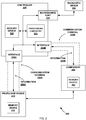
- FIG. 2 is a conceptual block diagram illustrating details of an example controller 220 and an example propulsor engine 210, in accordance with one or more techniques of this disclosure.
- Propulsor engine 210 and controller 220 may be configured to exchange information 240A via communication channel 230A and via interface 226A.
- System 200 may also include diagnostic device 250 configured to receive diagnostic information from controller 220 via maintenance port 228.
- System 200 also includes 260 configured to exchange information 240B with controller 220 via communication channel 230B and via interface 226B.
- Propulsor engine 210 may include a memory device 212, controller 220 may include a memory device 222, and component 260 may include memory device 262.
- Memory devices 212, 222, and 262 may be configured to store data relating to the performance of propulsor engine 210, such as temperatures, pressures, speeds, fuel flow rates, vibration, other "health" characteristics for prognostic purposes, and the like.
- Memory devices 212, 222, and 262 may also be configured to store an algorithm for determining a new frequency or a set list of frequencies to cycle through for each communication session.
- Memory device 222 may be configured to store a master set list for all devices in communication with controller 220 or a separate set list for each device that is in communication with controller 220.
- Propulsor engine 210 and/or component 260 may be configured to request a seed (e.g., a number) from controller 220 at the beginning of a communication session. Controller 220 may be configured to transmit a seed to propulsor engine 210 and/or component 260 in response to the request(s). Propulsor engine 210 and/or component 260 may be configured to input the seed into the algorithm to generate a new frequency for the exchange of information 240A and/or 240B.
- a seed e.g., a number
- Controller 220 may be configured to transmit a seed to propulsor engine 210 and/or component 260 in response to the request(s).
- Propulsor engine 210 and/or component 260 may be configured to input the seed into the algorithm to generate a new frequency for the exchange of information 240A and/or 240B.
- Propulsor engine 210 may be configured to exchange information 240A with controller 220 during a previous communication session.
- the previous communication session may end when controller 220 powers off propulsor engine 210.
- propulsor engine 210 may be configured to determine a frequency for a new communication session on communication channel 230A based on the frequency of the previous communication session and an algorithm.
- propulsor engine 210 may be configured to receive a seed number from controller 220 at the beginning of the new communication session at the previous frequency.
- Propulsor engine 210 may be configured to determine the new frequency based on the seed number and the algorithm, which may include a random or pseudorandom number generator. Propulsor engine 210 may be configured to exchange information 240A with controller 220 at the frequency for the new communication session via communication channel 230A and decode information 240A received from controller 220 based on the frequency for the new communication session. Component 260 may be configured to determine frequencies, exchange information 240B, and decode information 240B in a similar manner to propulsor engine 210.
- Interfaces 226A and 226B may include a pin, a lead, an optical port, and/or any other type of interface between controller 220 and communication channels 230A and 230B.
- Communication channels 230A and 230B may include a wired connection such as an optical fiber cable and/or a metal wire between propulsor engine 210 and controller 220.
- communication channels 230A and 230B may include a pad or trace on a printed circuit board (PCB), and interfaces 226A and 226B may include a pin that is configured to be soldered to the pad or trace.
- PCB printed circuit board
- interfaces 226A and 226B may include a laser, a light emitting diode (LED), a photodiode, a photoresistor, and/or photo-acceptance unit configured to convert between electrical signals and optical signals.
- interfaces 226A and 226B may include an antenna configured to transmit and/or receive wireless electromagnetic signals.
- Processing circuitry 224 may include integrated circuitry with digital logic or analog circuitry configured to determine a frequency for a new communication session on communication channel 230A or 230B based on a frequency of a previous communication session. Processing circuitry 224 may be configured to encode information 240A in the frequency for the current communication session over communication channel 230A. Processing circuitry 224 may also be configured to encode information 240B in the frequency for the current communication session over communication channel 230B. Processing circuitry 224 may be configured to determine new frequencies based on previous frequencies and an algorithm, a set list, a random number seed, and/or any other method of determining a new frequency. In some examples, processing circuitry 224 may be configured to determine a seed at the start of a new communication session and transmit the seed to the follower device (i.e., propulsor engine 210 or component 260.
- the follower device i.e., propulsor engine 210 or component 260.
- Diagnostic device 250 may be configured to receive diagnostic information from maintenance port 228 of controller 220 by at least transmitting a request for diagnostic information to controller 220.
- the diagnostic information may indicate the operations of propulsor engine 210 and controller 220.
- a maintenance worker may use diagnostic device 250 to troubleshoot issues with propulsor engine 210 and download data.
- the data may include communication faults, failure mode bits, and/or other status bits and status information regarding the operation of propulsor engine 210 and/or component 260.
- the maintenance worker may also use diagnostic device 250 to test the performance of propulsor engine 210 and/or controller 220.
- the request received by maintenance port 228 from diagnostic device 250 for diagnostic information may include a passcode, such as a four-digit number.
- An authorized maintenance worker may operate diagnostic device 250, or an attacker may operate diagnostic device 250 to snoop on or hack into controller 220.
- Controller 220 may be configured to receive the request for diagnostic information from diagnostic device 250, where the diagnostic information indicates the operations of propulsor engine 210. Controller 220 may be further configured to confirm that the passcode in the request matches a security code for controller 220 that may be stored in memory device 222. Controller 220 may be configured to transmit the requested diagnostic information through maintenance port 228 to diagnostic device 250 in response to confirming that the passcode matches the security code.
- An attacker may use diagnostic device to snoop on the operations of propulsor engine 210 and/or controller 220. If the attacker sends a request with an incorrect passcode from diagnostic device 250 to maintenance port 228, controller 220 may be configured to reject the request in response to determining that the passcode in the request does not match the security code. Controller 220 may be configured to set a bit indicating unauthorized access attempts in response to receiving a threshold number of consecutive requests with incorrect passcodes or a threshold number of requests in a threshold time duration.
- Component 260 may include a component that controls the operation of propulsor engine 210 (i.e., a controlling component), such as an actuator or a servo. Additionally or alternatively, component 260 may include a sensor or a data collection device, which may be referred to as "non-controlling components.” Component 260 may be positioned inside propulsor engine 210 (i.e., an internal component) and/or positioned outside propulsor engine 210 (i.e., an external component or auxiliary component).
- a sensor may be configured to sense various parameters of the operation of propulsor engine 210, such as a temperature, a pressure, a speed, a movement or a deflection, and/or any other parameters of system 200 and/or propulsor engine 210.
- Controller 220 may be configured to monitor the performance of propulsor engine 210 based on information 240B received from a sensor or data collection device.
- a data collection device may be configured to measure or track the performance of propulsor engine 210 by counting the times that the performance exceeds or fails to meet a threshold.
- a data collection device may include a camera configured to collect images of propulsor engine 210.
- An actuator may be configured to move a part of system 200 and/or propulsor engine 210, such as a piston, a transmission, a gearbox, valves such as air bleed valves, and/or any other part of system 200.
- an actuator of component 260 may be configured to change the geometry of propulsor engine 210 by moving the vanes of a compressor or a turbine of propulsor engine 210.
- An actuator of component 260 may be configured to change a nozzle exhaust area and/or control the flow of fuel by fluid servo valve actuation.
- Component 260 may communicate with controller 220 via communication channel 230B within a predetermined frequency band, where the predetermined frequency band is particular to each component 260 or to each component type. For example, if component 260 includes a sensor type component, controller 220 may be configured to determine a frequency for a new communication session to exchange information 240B with the sensor in a predetermined frequency band ranging from three hundred megahertz to four hundred megahertz. Whereas, if component 260 includes an actuator type component, controller 220 may be configured to determine a frequency for a new communication session to exchange information 240B with the actuator in a predetermined frequency band ranging from six megahertz to seven megahertz. Controller 220 may also be configured to determine the frequency for a communication session with propulsor engine 210 in a predetermined frequency band.
- Component 260 may be configured to determine a frequency for a new communication session on communication channel 230B based on a frequency of a previous communication session and an algorithm or set list stored to memory device 262.
- component 260 may be configured to scan a predetermined frequency band for control signals transmitted by controller 220 to component 260.
- component 260 may be configured to transmit an acknowledgement signal to controller 220.
- Controller 220 may be configured to set a bit in memory device 222 to indicate a failure mode in response to not receiving the acknowledgement signal from component 260.
- controller 220 may be configured to set a timer at the beginning of a communication session. If the timer expires before controller 220 receives an acknowledgement signal from component 260 or propulsor engine 210, controller 220 may be configured to set a bit in memory device 222 to indicate a failure mode for the respective device that failed to acknowledge communications.
- Component 260 may be configured to exchange information 240B with controller 220 at a first frequency during a previous communication session.
- Component 260 may be configured to determine a second frequency for a new communication session on communication channel 230B based on the first frequency and an algorithm and/or a set list stored to memory device 262.
- Component 260 may be configured to exchange information 240B with controller 220 at the second frequency via communication channel 230B and decode information 240B received from controller 220 based on the second frequency for the new communication session.
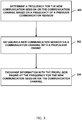
- FIG. 3 is a flowchart illustrating an example process implemented by a controller to control the operation of a propulsor engine, in accordance with one or more techniques of this disclosure. Operations 300-304 are described in the context of system 100 and controller 120 of FIG. 1 , although other controllers, such as controller 220 of FIG. 2 may perform similar operations.
- controller 120 determines a frequency for the new communication session on communication channel 130 based on a frequency of a previous communication session (300).
- the frequency for the new communication session may be different than the frequency of the previous communication session.
- controller 120 may be configured to determine the frequency for the new communication session based on the previous frequency and an algorithm or a set list.
- controller 120 may be configured to choose a seed and determine the new frequency based on the previous frequency and/or the previous seed.
- controller 120 may be configured to transmit the seed to propulsor engine 110 at the beginning of the new communication session using the previous seed.
- Propulsor engine 110 may be configured to independently determine the new frequency based on the seed and the algorithm, which may be stored to a memory device in propulsor engine 110.
- controller 120 establishes a new communication session via communication channel 130 with propulsor engine 110 (302).
- controller 120 may be configured to establish a new communication session when propulsor engine 110 powers on.
- controller 120 may be configured to power on propulsor engine 110 by controlling a starting device to initiate the operation of propulsor engine 110.
- Controller 120 may be configured to initiate the new communication session at a new frequency determined by controller 120.
- controller may be configured to transmit signals at the frequency of a previous communication session at the beginning of the new communication session before determining a new frequency. Controller 120 may also be configured to terminate or conclude the new communication session when propulsor engine 110 powers off.
- controller 120 exchanges information 140 with propulsor engine 110 at the frequency for the new communication session via communication channel 130 (304).
- Controller 120 may be configured to exchange information 140 by at least transmitting control signals to propulsor engine 110 to control the operations of propulsor engine 110.
- controller 120 may be configured to cause propulsor engine 110 to generate more or less propulsion, to increase or decrease rotational speed, power on, or power off.
- Controller 120 may be configured to receive information 140 such as fuel flow level(s), engine temperature(s), engine pressure(s), and maintenance information from propulsor engine 110.
- FIG. 3 has described the operation of controller 120 and system 100 in general.
- system 100 may include one or more components configured to sense various parameters of the operations of propulsor engine 110 and/or move a part of propulsor engine 110.
- Controller 120 may be configured to establish a new communication session with each component when propulsor engine 110 powers on.
- Controller 120 may be configured to determine a unique new frequency for each component based on a unique algorithm or unique set list of frequencies.
- the devices of system 100 may be configured to operate in a default communication state in case of a system failure.
- One or more non-responsive devices may result in a shutdown of system 100, unless controller 120 is able to establish a communication channel with the non-responsive device(s).
- Propulsor engine 110, controller 120, and/or any other device(s) may be configured to communicate using a backup frequency in the case of a communication failure.
- the backup frequency may be a default frequency for the particular non-responsive device or, alternatively, the last frequency at which controller 120 successfully communicated with the non-responsive device.
- controller 120 may be configured to determine a frequency for a future communication session on communication channel 130 and any other communication channels based on a frequency of a current communication session. Controller 120 may be configured to determine the frequency for the future communication session before propulsor engine 110 is powered off to end the current communication session. Controller 120 may be configured to communicate the frequency for the future communication session to the respective device before propulsor engine 110 is powered off. Each device may be configured to store the frequency for the future communication session and begin operating at the frequency for the future communication session when propulsor engine 110 powers on.
- FIG. 4 is a flowchart illustrating an example process implemented by a controller for communicating with a propulsor engine and/or one or more components of the propulsor engine, in accordance with one or more techniques of this disclosure.
- Operations 400-426 are described in the context of system 200 and controller 220 of FIG. 2 , although other controllers, such as controller 120 of FIG. 1 , may perform similar operations.
- controller 220 may power up system 200 including propulsor engine 210 (400). Controller 220 may be configured to transmit control signals to a starter device to power up propulsor engine 210. In the example of FIG. 4 , controller 220 may activate all communications in system 200 except external communications (402). Controller 220 may activate communications with propulsor engine 210 and component 260 by transmitting signals at the frequency of the previous communication session, which may have concluded the last time that propulsor engine 210 was powered down.
- controller 220 may assign a frequency to each communication type (404). For example, controller 220 may be configured to assign a first frequency for communication channel 230A based on a previous frequency for communication channel 230A and assign a second frequency for communication channel 230B based on a previous frequency for communication channel 230B. In the example of FIG. 4 , controller 220 may determine that all communication types have not been assigned a frequency (406) and continue to assign frequencies.
- controller 220 may validate that communication type functions properly with a seed request from each type of device or component (e.g., propulsor engine 210 and component 260) in system 200 (408). In some examples, controller 220 may receive seed requests from propulsor engine 210 and component 260 and may be configured to respond by transmitting seeds to propulsor engine 210 and component 260. Propulsor engine 210 and component 260 may use the seeds to determine a new frequency based on an algorithm stored to memory device 212 and 262.
- a seed request from each type of device or component (e.g., propulsor engine 210 and component 260) in system 200 (408). In some examples, controller 220 may receive seed requests from propulsor engine 210 and component 260 and may be configured to respond by transmitting seeds to propulsor engine 210 and component 260. Propulsor engine 210 and component 260 may use the seeds to determine a new frequency based on an algorithm stored to memory device 212 and 262.
- controller 220 may assign another frequency to communication channel 230A (410, 412, and 404). If controller 220 determines that communication channel 230B is not communicating and has been reassigned more than N times, controller 220 may set a communication fault for communication channel 230B (410, 412, and 416). In some examples, N may be any integer, such as three, serving as a threshold number of times to reassign the frequency for communication channel 230A.
- the communication fault may be a bit in a status register that controller 220 may be configured to transmit to diagnostic device 250 in response to a request for diagnostic information.
- controller 220 may attempt to communicate with propulsor engine 210 using a backup frequency (417).
- the backup frequency may be a default frequency for propulsor engine 210 or the last frequency at which controller 220 successfully communicated with propulsor engine 210.
- controller 220 may store a definition of the active communication channel (e.g., communication channel 230A) (410 and 414).
- the definition may include the established frequency for communication channel 230A.
- controller 220 may determine that system 200 is on the ground and, in response, activate maintenance port 228 (418 and 420). If system 200 includes a vehicle as such as aircraft, authorized personnel may perform maintenance on system 200 while on the ground. Controller 220 may determine that system 200 is not on the ground and, in response, configure system 200 for normal operation (418 and 422). In normal operation, propulsor engine 210 may be configured to generate propulsion for system 200, and component 260 may be configured to sense the operation of propulsor engine 210 or move a part of propulsor engine 210.
- controller 220 may determine that shutdown has not been requested and, in response, continue normal operation (424 and 422). If controller 220 determines that shutdown has been requested or if controller 220 has activated maintenance port 228, controller 220 may power down system 200 (424, 420, and 426). Controller 220 may be configured to power down system 200 by reducing the speed of propulsor engine 210 to zero and turning off component 260.
Landscapes
- Engineering & Computer Science (AREA)
- Computer Security & Cryptography (AREA)
- Computer Networks & Wireless Communication (AREA)
- Signal Processing (AREA)
- Computer Hardware Design (AREA)
- Computing Systems (AREA)
- General Engineering & Computer Science (AREA)
- Radar, Positioning & Navigation (AREA)
- Remote Sensing (AREA)
- Combined Controls Of Internal Combustion Engines (AREA)
Claims (13)
- Antriebsmotorsteuersystem (100, 200), umfassend:einen Antriebsmotor (110, 210); undeine Steuerung (120, 220), die konfiguriert ist um:
eine Frequenz für eine neue Kommunikationssitzung auf einem Kommunikationskanal (130) basierend auf einem Algorithmus zu bestimmen, der umfasst:(a) Bestimmen eines Startwerts für die neue Kommunikationssitzung basierend auf einem Startwert für eine vorherige Kommunikationssitzung;(b) Anwenden des Startwerts für die neue Kommunikationssitzung auf einen Zufallszahlengenerator oder einen Pseudozufallszahlengenerator, um eine Zahl für die neue Kommunikationssitzung basierend auf dem Startwert für die neue Kommunikationssitzung zu generieren; und(c) Bestimmen der Frequenz für die neue Kommunikationssitzung, indem die Zahl für die neue Kommunikationssitzung auf eine Zahl zwischen einer minimalen Frequenz und einer maximalen Frequenz eines vorbestimmten Frequenzbandes skaliert wird, wobei sich die Frequenz für die neue Kommunikationssitzung von der Frequenz der vorherigen Kommunikationssitzung unterscheidet;die neue Kommunikationssitzung über den Kommunikationskanal mit dem Antriebsmotor einzurichten;den Startwert für die neue Kommunikationssitzung an den Antriebsmotor mit der Frequenz der vorherigen Kommunikationssitzung zu übertragen; undInformationen (140) mit dem Antriebsmotor mit der Frequenz für die neue Kommunikationssitzung über den Kommunikationskanal auszutauschen;wobei der Antriebsmotor konfiguriert ist, um die Frequenz für die neue Kommunikationssitzung basierend auf dem Algorithmus und dem Startwert für die neue Kommunikationssitzung zu bestimmen. - Antriebsmotorsteuersystem nach Anspruch 1, wobei die Steuerung ferner konfiguriert ist, um:Informationen mit dem Antriebsmotor (110) während der vorherigen Kommunikationssitzung über den Kommunikationskanal auszutauschen;den Antriebsmotor auszuschalten, nachdem Informationen (140) mit dem Antriebsmotor während der vorherigen Kommunikationssitzung ausgetauscht wurden; undden Antriebsmotor nach dem Ausschalten des Antriebsmotors einzuschalten, wobei die Steuerung konfiguriert ist, um Informationen mit dem Antriebsmotor mit der Frequenz für die neue Kommunikationssitzung über den Kommunikationskanal nach dem Einschalten des Antriebsmotors und nach dem Bestimmen der Frequenz für die neue Kommunikationssitzung auszutauschen.
- Antriebsmotorsteuersystem nach Anspruch 1, wobei der Antriebsmotor (110) konfiguriert ist, um:Informationen mit der Steuerung während der vorherigen Kommunikationssitzung auszutauschen;Informationen mit der Steuerung mit der Frequenz für die neue Kommunikationssitzung über den Kommunikationskanal auszutauschen; undInformationen, die von der Steuerung empfangen werden, basierend auf der Frequenz für die neue Kommunikationssitzung zu decodieren.
- Antriebsmotorsteuersystem nach einem der vorhergehenden Ansprüche,
wobei der Antriebsmotor (110) konfiguriert ist, um ein Bestätigungssignal an die Steuerung als Reaktion auf das Empfangen von Informationen von der Steuerung zu senden, und
wobei die Steuerung (120) ferner konfiguriert ist, um ein Bit zu setzen, das einen Fehlermodus als Reaktion auf das Nichtempfangen des Bestätigungssignals vom Antriebsmotor angibt. - Antriebsmotorsteuersystem nach einem der vorhergehenden Ansprüche, wobei die Steuerung (120) konfiguriert ist, um:die Frequenz für die neue Kommunikationssitzung innerhalb eines vorbestimmten Frequenzbandes zu bestimmen; undüber den Kommunikationskanal Steuersignale an den Antriebsmotor (110) mit der Frequenz für die neue Kommunikationssitzung zu übertragen,wobei der Antriebsmotor ferner konfiguriert ist, um das vorbestimmte Frequenzband nach Steuersignalen abzutasten, die von der Steuerung an den Antriebsmotor übertragen werden.
- Antriebsmotorsteuersystem nach einem der vorhergehenden Ansprüche,
wobei die neue Kommunikationssitzung eine erste neue Kommunikationssitzung ist, wobei die vorherige Kommunikationssitzung eine erste vorherige Kommunikationssitzung ist,
wobei der Kommunikationskanal ein erster Kommunikationskanal (130) ist, wobei das System ferner ein Bauelement (260) umfasst und wobei die Steuerung (120) ferner konfiguriert ist, um:eine Frequenz für eine zweite neue Kommunikationssitzung auf einem zweiten Kommunikationskanal basierend auf einer Frequenz einer zweiten vorherigen Kommunikationssitzung zu bestimmen, wobei sich die Frequenz für die zweite neue Kommunikationssitzung von der Frequenz der zweiten vorherigen Kommunikationssitzung unterscheidet;die zweite neue Kommunikationssitzung über den zweiten Kommunikationskanal mit dem Bauelement einzurichten; undInformationen mit dem Bauelement mit der Frequenz für die zweite neue Kommunikationssitzung über den zweiten Kommunikationskanal auszutauschen. - Antriebsmotorsteuersystem nach Anspruch 6,
wobei die Steuerung (120) konfiguriert ist, um die Frequenz für die erste neue Kommunikationssitzung innerhalb eines ersten Frequenzbandes zu bestimmen,
wobei die Steuerung konfiguriert ist, um die Frequenz für die zweite neue Kommunikationssitzung innerhalb eines zweiten Frequenzbandes zu bestimmen,
wobei das erste Frequenzband und das zweite Frequenzband unterschiedlich sind und wobei das zweite Frequenzband für einen Typ des Bauelements spezifisch ist. - Antriebsmotorsteuersystem nach Anspruch 6 oder 7
wobei das Bauelement einen Sensor umfasst, der konfiguriert ist, um den Betrieb des Antriebsmotors (110) zu erfassen, und
wobei die Steuerung (120) konfiguriert ist, um die Frequenz für die zweite neue Kommunikationssitzung innerhalb eines Frequenzbandes im Bereich von dreihundert Megahertz bis vierhundert Megahertz zu bestimmen. - Antriebsmotorsteuersystem nach einem der Ansprüche 6 bis 8,
wobei das Bauelement ein Stellorgan umfasst, das konfiguriert ist, um einen Teil des Antriebsmotors (110) zu bewegen, und
wobei die Steuerung konfiguriert ist, um die Frequenz für die zweite neue Kommunikationssitzung innerhalb eines Frequenzbandes im Bereich von sechs Megahertz bis sieben Megahertz zu bestimmen. - Antriebsmotorsteuersystem nach einem der vorhergehenden Ansprüche, ferner umfassend eine Diagnosevorrichtung (250), die konfiguriert ist, um Diagnoseinformationen von einem Wartungsport (228) der Steuerung zu empfangen, wobei die Steuerung (120) konfiguriert ist, um:eine Anforderung auf Diagnoseinformationen von der Diagnosevorrichtung zu empfangen, wobei die Anforderung einen Passcode umfasst;zu bestätigen, dass der Passcode mit einem Sicherheitscode für die Steuerung übereinstimmt; und die Diagnoseinformationen über den Wartungsport an die Diagnosevorrichtung als Reaktion auf das Bestätigen, dass der Passcode mit dem Sicherheitscode übereinstimmt, zu übertragen, wobei die Diagnoseinformationen den Betrieb des Antriebsmotors angeben.
- Verfahren, das von einer Steuerung (120, 220) eines Antriebsmotorsteuersystems (100, 200) ausgeführt wird, nach einem der vorhergehenden Ansprüche, wobei das Verfahren umfasst:Bestimmen (300) einer Frequenz für eine neue Kommunikationssitzung auf einem Kommunikationskanal (130) basierend auf einem Algorithmus, der umfasst:(a) Bestimmen eines Startwerts für die neue Kommunikationssitzung basierend auf einem Startwert für eine vorherige Kommunikationssitzung;(b) Anwenden des Startwerts für die neue Kommunikationssitzung auf einen Zufallszahlengenerator oder einen Pseudozufallszahlengenerator, um eine Zahl für die neue Kommunikationssitzung basierend auf dem Startwert für die neue Kommunikationssitzung zu generieren; und(c) Bestimmen der Frequenz für die neue Kommunikationssitzung, indem die Zahl für die neue Kommunikationssitzung auf eine Zahl zwischen einer minimalen Frequenz und einer maximalen Frequenz eines vorbestimmten Frequenzbandes skaliert wird, wobei sich die Frequenz für die neue Kommunikationssitzung von der Frequenz der vorherigen Kommunikationssitzung unterscheidet;Einrichten (302) der neuen Kommunikationssitzung über den Kommunikationskanal (130) mit einem Antriebsmotor (110) des Antriebsmotorsteuersystems (100, 200) gemäß einem der Ansprüche 1 bis 10;Übertragen des Startwerts für die neue Kommunikationssitzung an den Antriebsmotor mit der Frequenz der vorherigen Kommunikationssitzung; undAustauschen (304) von Informationen (140) mit dem Antriebsmotor mit der Frequenz für die neue Kommunikationssitzung über den Kommunikationskanal.
- Verfahren nach Anspruch 11, ferner umfassend:Austauschen von Informationen (140) mit dem Antriebsmotor (110) während der vorherigen Kommunikationssitzung über den Kommunikationskanal (130);Ausschalten des Antriebsmotors, nachdem Informationen mit dem Antriebsmotor während der vorherigen Kommunikationssitzung ausgetauscht wurden; undEinschalten des Antriebsmotors nach dem Ausschalten des Antriebsmotors, wobei das Austauschen von Informationen mit dem Antriebsmotor mit der Frequenz für die neue Kommunikationssitzung das Austauschen von Informationen mit dem Antriebsmotor mit der Frequenz für die neue Kommunikationssitzung nach dem Einschalten des Antriebsmotors und nach dem Bestimmen der Frequenz für die neue Kommunikationssitzung umfasst.
- Verfahren nach Anspruch 11 oder 12, ferner umfassend:Übertragen von Informationen an den Antriebsmotor (110) mit der Frequenz für die neue Kommunikationssitzung über den Kommunikationskanal (130);wenn kein Bestätigungssignal vom Antriebsmotor nach dem übertragen von Informationen an den Antriebsmotor mit der Frequenz für die neue Kommunikationssitzung empfangen wird:
Setzen eines Bits, das den Fehlermodus angibt.
Applications Claiming Priority (1)
| Application Number | Priority Date | Filing Date | Title |
|---|---|---|---|
| US15/662,075 US10623130B2 (en) | 2017-07-27 | 2017-07-27 | Determining a frequency for propulsor engine communication sessions |
Publications (2)
| Publication Number | Publication Date |
|---|---|
| EP3435569A1 EP3435569A1 (de) | 2019-01-30 |
| EP3435569B1 true EP3435569B1 (de) | 2020-06-03 |
Family
ID=62916404
Family Applications (1)
| Application Number | Title | Priority Date | Filing Date |
|---|---|---|---|
| EP18180082.2A Active EP3435569B1 (de) | 2017-07-27 | 2018-06-27 | Bestimmung einer frequenz für kommunikationssitzungen eines antriebsmotors |
Country Status (3)
| Country | Link |
|---|---|
| US (1) | US10623130B2 (de) |
| EP (1) | EP3435569B1 (de) |
| CA (1) | CA3011061A1 (de) |
Families Citing this family (3)
| Publication number | Priority date | Publication date | Assignee | Title |
|---|---|---|---|---|
| US10903871B2 (en) | 2018-08-07 | 2021-01-26 | Rolls-Royce Corporation | Method of improved cyber security with frequency separation |
| US11301349B2 (en) | 2018-08-07 | 2022-04-12 | Rolls-Royce Corporation | Method and process of cyber security via software imaging |
| US12284272B2 (en) | 2022-09-30 | 2025-04-22 | General Electric Company | Methods and systems for starting secure communication in systems with high availability |
Citations (2)
| Publication number | Priority date | Publication date | Assignee | Title |
|---|---|---|---|---|
| US20090003413A1 (en) * | 2005-11-22 | 2009-01-01 | Open Solution Co., Ltd. | Real-Time Data Transmission Method Using Frequency Hopping Spread Spectrum |
| US20150363981A1 (en) * | 2004-09-16 | 2015-12-17 | Harris Corporation | System and method of transmitting data from an aircraft |
Family Cites Families (40)
| Publication number | Priority date | Publication date | Assignee | Title |
|---|---|---|---|---|
| US4276652A (en) | 1978-10-02 | 1981-06-30 | Technical Communications Corp. | Secure communication system with improved frequency-hopping arrangement |
| US6359558B1 (en) | 1998-02-13 | 2002-03-19 | Philip Y. W. Tsui | Low power audible alarm relay device for a rolling code security system |
| US6362768B1 (en) * | 1999-08-09 | 2002-03-26 | Honeywell International Inc. | Architecture for an input and output device capable of handling various signal characteristics |
| GB2374767B (en) * | 2001-03-21 | 2005-04-13 | Agere Syst Guardian Corp | Bluetooth smart offset compensation |
| KR100463786B1 (ko) * | 2002-09-16 | 2004-12-29 | 주식회사 오픈솔루션 | 적응적 주파수 선택 방식을 이용한 무선 데이터 전송방법및 장치 |
| US7027953B2 (en) * | 2002-12-30 | 2006-04-11 | Rsl Electronics Ltd. | Method and system for diagnostics and prognostics of a mechanical system |
| US7418205B2 (en) | 2003-03-25 | 2008-08-26 | General Instrument Corporation | Method and apparatus for controlling a frequency hopping laser |
| US7689394B2 (en) * | 2003-08-26 | 2010-03-30 | Siemens Industry, Inc. | System and method for remotely analyzing machine performance |
| CN101645713B (zh) * | 2003-12-11 | 2013-09-11 | 日立金属株式会社 | 多频带高频电路及多频带通信装置 |
| US8183980B2 (en) | 2005-08-31 | 2012-05-22 | Assa Abloy Ab | Device authentication using a unidirectional protocol |
| US8565998B2 (en) * | 2006-11-27 | 2013-10-22 | United Technologies Corporation | Gas turbine engine having on-engine data storage device |
| US7961091B2 (en) | 2007-12-31 | 2011-06-14 | Honeywell International Inc. | Method for synchronizing frequency-hopping short-range radio devices |
| US8327117B2 (en) * | 2008-08-29 | 2012-12-04 | Rolls-Royce Corporation | Reconfigurable FADEC with flash based FPGA control channel and ASIC sensor signal processor for aircraft engine control |
| FR2937437B1 (fr) * | 2008-10-20 | 2011-09-16 | Airbus France | Procede de fonctionnement d'un equipement embarque, equipement associe et aeronef comprenant un tel equipement |
| US8358613B1 (en) * | 2009-02-27 | 2013-01-22 | L-3 Communications Corp. | Transmitter-directed security for wireless-communications |
| US8351454B2 (en) | 2009-05-20 | 2013-01-08 | Robert Bosch Gmbh | Security system and method for wireless communication within a vehicle |
| US8581695B2 (en) | 2009-05-27 | 2013-11-12 | Grant B. Carlson | Channel-switching remote controlled barrier opening system |
| US8290683B2 (en) * | 2010-02-16 | 2012-10-16 | Telectro-Mek, Inc. | Apparatus and method for reducing aircraft fuel consumption |
| US8594569B2 (en) * | 2010-03-19 | 2013-11-26 | Bose Corporation | Switchable wired-wireless electromagnetic signal communication |
| US8885621B2 (en) | 2010-04-26 | 2014-11-11 | Intel Corporation | Method, apparatus and system for switching traffic streams among multiple bands |
| US9121627B2 (en) * | 2010-09-14 | 2015-09-01 | Johnson Controls Technology Company | System and method for controlling an economizer circuit |
| US8666341B2 (en) * | 2010-10-22 | 2014-03-04 | Ultra Electronics Tcs Inc. | Multi-mode communication unit |
| US9015455B2 (en) * | 2011-07-07 | 2015-04-21 | Intel Corporation | Processsor integral technologies for BIOS flash attack protection and notification |
| US8937554B2 (en) * | 2011-09-28 | 2015-01-20 | Silverplus, Inc. | Low power location-tracking device with combined short-range and wide-area wireless and location capabilities |
| CN103998944B (zh) * | 2011-12-23 | 2017-02-22 | 德克斯科技有限公司 | 故障检测系统 |
| US10028106B2 (en) * | 2012-02-24 | 2018-07-17 | Stopcell, Llc | Vehicle wireless device detection |
| US9058703B2 (en) * | 2012-03-14 | 2015-06-16 | Flextronics Ap, Llc | Shared navigational information between vehicles |
| US9178897B2 (en) | 2012-07-03 | 2015-11-03 | The Boeing Company | Methods and systems for use in identifying cyber-security threats in an aviation platform |
| WO2015006270A1 (en) * | 2013-07-10 | 2015-01-15 | Qmotion Incorporated | Battery retaining system and method for motorized architectural coverings |
| US10369942B2 (en) | 2014-01-06 | 2019-08-06 | Argus Cyber Security Ltd. | Hosted watchman |
| US9584542B2 (en) | 2014-02-04 | 2017-02-28 | Texas Instruments Incorporated | Relay attack countermeasure system |
| US9124580B1 (en) | 2014-02-07 | 2015-09-01 | The Boeing Company | Method and system for securely establishing cryptographic keys for aircraft-to-aircraft communications |
| KR101896560B1 (ko) | 2014-06-09 | 2018-09-07 | 후아웨이 테크놀러지 컴퍼니 리미티드 | 액세스 단말을 위한 모니터링 주파수 포인트를 전환하는 방법, 및 액세스 단말 |
| US9552723B2 (en) * | 2014-06-11 | 2017-01-24 | Gentex Corporation | Trainable transceiver systems and methods for channel frequency offset adjustment |
| US9184960B1 (en) | 2014-09-25 | 2015-11-10 | Corning Optical Communications Wireless Ltd | Frequency shifting a communications signal(s) in a multi-frequency distributed antenna system (DAS) to avoid or reduce frequency interference |
| JP5968501B1 (ja) * | 2015-06-01 | 2016-08-10 | 三菱電機株式会社 | 車載電子制御装置 |
| US9752488B2 (en) * | 2015-10-27 | 2017-09-05 | Cummins, Inc. | Systems and methods of an on-board NOx monitor reset test |
| US9986471B2 (en) * | 2015-11-17 | 2018-05-29 | Dell Products L.P. | Wireless mesh network repair system |
| JP6132952B1 (ja) * | 2016-04-07 | 2017-05-24 | 三菱電機株式会社 | 車載エンジン制御装置 |
| US10506555B2 (en) * | 2016-10-14 | 2019-12-10 | Rurisond, Inc. | System and method for identifying and using an optimum shared spectrum segment as a delay tolerant, low duty-cycle, cooperative communication medium for terrain independent connection |
-
2017
- 2017-07-27 US US15/662,075 patent/US10623130B2/en active Active
-
2018
- 2018-06-27 EP EP18180082.2A patent/EP3435569B1/de active Active
- 2018-07-11 CA CA3011061A patent/CA3011061A1/en not_active Abandoned
Patent Citations (2)
| Publication number | Priority date | Publication date | Assignee | Title |
|---|---|---|---|---|
| US20150363981A1 (en) * | 2004-09-16 | 2015-12-17 | Harris Corporation | System and method of transmitting data from an aircraft |
| US20090003413A1 (en) * | 2005-11-22 | 2009-01-01 | Open Solution Co., Ltd. | Real-Time Data Transmission Method Using Frequency Hopping Spread Spectrum |
Also Published As
| Publication number | Publication date |
|---|---|
| CA3011061A1 (en) | 2019-01-27 |
| US20190036638A1 (en) | 2019-01-31 |
| EP3435569A1 (de) | 2019-01-30 |
| US10623130B2 (en) | 2020-04-14 |
Similar Documents
| Publication | Publication Date | Title |
|---|---|---|
| EP3435569A1 (de) | Bestimmung einer frequenz für kommunikationssitzungen eines antriebsmotors | |
| US7248836B2 (en) | RF channel linking method and system | |
| CN112565176B (zh) | 与分布式控制系统中的装置安全地通信 | |
| EP3111705B1 (de) | Datensendeanordnung und verfahren zum betreiben derselben | |
| EP3596902B1 (de) | Schutzrahmen für elektronische steuereinheit mit sicherheitszonen | |
| EP3076580A1 (de) | Verfahren und vorrichtung zum verschlüsseln einer hochgeschwindigkeits-datenübertragung | |
| JP5312331B2 (ja) | 静電噴霧装置 | |
| US20040153907A1 (en) | Safety network using phantom address information | |
| CN101719308A (zh) | 一种高抗干扰无人机遥控数据链的实现方法 | |
| US11077727B2 (en) | Vehicle TPMS security strategy | |
| CN120281476B (zh) | 一种无人机的保密通信系统 | |
| US10599875B2 (en) | Communications bus data transmission using relative ground shifting | |
| US20110167477A1 (en) | Method and apparatus for providing controlled access to a computer system/facility resource for remote equipment monitoring and diagnostics | |
| CN108894915B (zh) | 一种风力发电远程监控系统及其工作方法 | |
| BR102015031242A2 (pt) | rede sem fio de aeronave e método para o gerenciamento de segurança | |
| CN108649998B (zh) | 一种宽带电力线载波抑制邻居网络干扰的组网方法及系统 | |
| CN106878688A (zh) | 无人机图像处理系统 | |
| Singh et al. | Remote monitoring of critical systems in overhead cranes using wireless data Telemetry | |
| Brown et al. | Defend your home! jamming unsolicited messages in the smart home | |
| KR100385943B1 (ko) | 자동차 원격진단용 인터페이스장치 | |
| CN120034561A (zh) | 基于星闪技术的无人机飞手短距离操控方法和控制系统 | |
| CN115001995B (zh) | 用于处理从站信息的方法、设备和机器可读存储介质 | |
| DE102021201208A1 (de) | Verfahren und Vorrichtung zum Vorbereiten einer Betankung | |
| DE102023202892B4 (de) | Endpunkt und Basisstation eines Telegram-Splitting-basierten Kommunikationssystems mit geringer Latenz im Downlink | |
| Dolmatov et al. | The protection of digital communication systems from interference and radio counteraction |
Legal Events
| Date | Code | Title | Description |
|---|---|---|---|
| PUAI | Public reference made under article 153(3) epc to a published international application that has entered the european phase |
Free format text: ORIGINAL CODE: 0009012 |
|
| STAA | Information on the status of an ep patent application or granted ep patent |
Free format text: STATUS: THE APPLICATION HAS BEEN PUBLISHED |
|
| AK | Designated contracting states |
Kind code of ref document: A1 Designated state(s): AL AT BE BG CH CY CZ DE DK EE ES FI FR GB GR HR HU IE IS IT LI LT LU LV MC MK MT NL NO PL PT RO RS SE SI SK SM TR |
|
| AX | Request for extension of the european patent |
Extension state: BA ME |
|
| STAA | Information on the status of an ep patent application or granted ep patent |
Free format text: STATUS: REQUEST FOR EXAMINATION WAS MADE |
|
| STAA | Information on the status of an ep patent application or granted ep patent |
Free format text: STATUS: EXAMINATION IS IN PROGRESS |
|
| 17P | Request for examination filed |
Effective date: 20190729 |
|
| RBV | Designated contracting states (corrected) |
Designated state(s): AL AT BE BG CH CY CZ DE DK EE ES FI FR GB GR HR HU IE IS IT LI LT LU LV MC MK MT NL NO PL PT RO RS SE SI SK SM TR |
|
| 17Q | First examination report despatched |
Effective date: 20190902 |
|
| GRAP | Despatch of communication of intention to grant a patent |
Free format text: ORIGINAL CODE: EPIDOSNIGR1 |
|
| STAA | Information on the status of an ep patent application or granted ep patent |
Free format text: STATUS: GRANT OF PATENT IS INTENDED |
|
| RIC1 | Information provided on ipc code assigned before grant |
Ipc: H04K 3/00 20060101ALI20200304BHEP Ipc: H04L 29/06 20060101ALI20200304BHEP Ipc: H04L 9/08 20060101ALI20200304BHEP Ipc: H04K 1/00 20060101AFI20200304BHEP |
|
| GRAS | Grant fee paid |
Free format text: ORIGINAL CODE: EPIDOSNIGR3 |
|
| INTG | Intention to grant announced |
Effective date: 20200402 |
|
| GRAA | (expected) grant |
Free format text: ORIGINAL CODE: 0009210 |
|
| STAA | Information on the status of an ep patent application or granted ep patent |
Free format text: STATUS: THE PATENT HAS BEEN GRANTED |
|
| AK | Designated contracting states |
Kind code of ref document: B1 Designated state(s): AL AT BE BG CH CY CZ DE DK EE ES FI FR GB GR HR HU IE IS IT LI LT LU LV MC MK MT NL NO PL PT RO RS SE SI SK SM TR |
|
| REG | Reference to a national code |
Ref country code: GB Ref legal event code: FG4D |
|
| REG | Reference to a national code |
Ref country code: CH Ref legal event code: EP Ref country code: AT Ref legal event code: REF Ref document number: 1278147 Country of ref document: AT Kind code of ref document: T Effective date: 20200615 |
|
| REG | Reference to a national code |
Ref country code: DE Ref legal event code: R096 Ref document number: 602018005011 Country of ref document: DE |
|
| REG | Reference to a national code |
Ref country code: LT Ref legal event code: MG4D |
|
| PG25 | Lapsed in a contracting state [announced via postgrant information from national office to epo] |
Ref country code: FI Free format text: LAPSE BECAUSE OF FAILURE TO SUBMIT A TRANSLATION OF THE DESCRIPTION OR TO PAY THE FEE WITHIN THE PRESCRIBED TIME-LIMIT Effective date: 20200603 Ref country code: SE Free format text: LAPSE BECAUSE OF FAILURE TO SUBMIT A TRANSLATION OF THE DESCRIPTION OR TO PAY THE FEE WITHIN THE PRESCRIBED TIME-LIMIT Effective date: 20200603 Ref country code: LT Free format text: LAPSE BECAUSE OF FAILURE TO SUBMIT A TRANSLATION OF THE DESCRIPTION OR TO PAY THE FEE WITHIN THE PRESCRIBED TIME-LIMIT Effective date: 20200603 Ref country code: GR Free format text: LAPSE BECAUSE OF FAILURE TO SUBMIT A TRANSLATION OF THE DESCRIPTION OR TO PAY THE FEE WITHIN THE PRESCRIBED TIME-LIMIT Effective date: 20200904 Ref country code: NO Free format text: LAPSE BECAUSE OF FAILURE TO SUBMIT A TRANSLATION OF THE DESCRIPTION OR TO PAY THE FEE WITHIN THE PRESCRIBED TIME-LIMIT Effective date: 20200903 |
|
| REG | Reference to a national code |
Ref country code: NL Ref legal event code: MP Effective date: 20200603 |
|
| PG25 | Lapsed in a contracting state [announced via postgrant information from national office to epo] |
Ref country code: BG Free format text: LAPSE BECAUSE OF FAILURE TO SUBMIT A TRANSLATION OF THE DESCRIPTION OR TO PAY THE FEE WITHIN THE PRESCRIBED TIME-LIMIT Effective date: 20200903 Ref country code: LV Free format text: LAPSE BECAUSE OF FAILURE TO SUBMIT A TRANSLATION OF THE DESCRIPTION OR TO PAY THE FEE WITHIN THE PRESCRIBED TIME-LIMIT Effective date: 20200603 Ref country code: RS Free format text: LAPSE BECAUSE OF FAILURE TO SUBMIT A TRANSLATION OF THE DESCRIPTION OR TO PAY THE FEE WITHIN THE PRESCRIBED TIME-LIMIT Effective date: 20200603 Ref country code: HR Free format text: LAPSE BECAUSE OF FAILURE TO SUBMIT A TRANSLATION OF THE DESCRIPTION OR TO PAY THE FEE WITHIN THE PRESCRIBED TIME-LIMIT Effective date: 20200603 |
|
| REG | Reference to a national code |
Ref country code: AT Ref legal event code: MK05 Ref document number: 1278147 Country of ref document: AT Kind code of ref document: T Effective date: 20200603 |
|
| PG25 | Lapsed in a contracting state [announced via postgrant information from national office to epo] |
Ref country code: AL Free format text: LAPSE BECAUSE OF FAILURE TO SUBMIT A TRANSLATION OF THE DESCRIPTION OR TO PAY THE FEE WITHIN THE PRESCRIBED TIME-LIMIT Effective date: 20200603 Ref country code: NL Free format text: LAPSE BECAUSE OF FAILURE TO SUBMIT A TRANSLATION OF THE DESCRIPTION OR TO PAY THE FEE WITHIN THE PRESCRIBED TIME-LIMIT Effective date: 20200603 |
|
| REG | Reference to a national code |
Ref country code: DE Ref legal event code: R119 Ref document number: 602018005011 Country of ref document: DE |
|
| PG25 | Lapsed in a contracting state [announced via postgrant information from national office to epo] |
Ref country code: AT Free format text: LAPSE BECAUSE OF FAILURE TO SUBMIT A TRANSLATION OF THE DESCRIPTION OR TO PAY THE FEE WITHIN THE PRESCRIBED TIME-LIMIT Effective date: 20200603 Ref country code: ES Free format text: LAPSE BECAUSE OF FAILURE TO SUBMIT A TRANSLATION OF THE DESCRIPTION OR TO PAY THE FEE WITHIN THE PRESCRIBED TIME-LIMIT Effective date: 20200603 Ref country code: SM Free format text: LAPSE BECAUSE OF FAILURE TO SUBMIT A TRANSLATION OF THE DESCRIPTION OR TO PAY THE FEE WITHIN THE PRESCRIBED TIME-LIMIT Effective date: 20200603 Ref country code: EE Free format text: LAPSE BECAUSE OF FAILURE TO SUBMIT A TRANSLATION OF THE DESCRIPTION OR TO PAY THE FEE WITHIN THE PRESCRIBED TIME-LIMIT Effective date: 20200603 Ref country code: CZ Free format text: LAPSE BECAUSE OF FAILURE TO SUBMIT A TRANSLATION OF THE DESCRIPTION OR TO PAY THE FEE WITHIN THE PRESCRIBED TIME-LIMIT Effective date: 20200603 Ref country code: IT Free format text: LAPSE BECAUSE OF FAILURE TO SUBMIT A TRANSLATION OF THE DESCRIPTION OR TO PAY THE FEE WITHIN THE PRESCRIBED TIME-LIMIT Effective date: 20200603 Ref country code: RO Free format text: LAPSE BECAUSE OF FAILURE TO SUBMIT A TRANSLATION OF THE DESCRIPTION OR TO PAY THE FEE WITHIN THE PRESCRIBED TIME-LIMIT Effective date: 20200603 Ref country code: PT Free format text: LAPSE BECAUSE OF FAILURE TO SUBMIT A TRANSLATION OF THE DESCRIPTION OR TO PAY THE FEE WITHIN THE PRESCRIBED TIME-LIMIT Effective date: 20201006 |
|
| PG25 | Lapsed in a contracting state [announced via postgrant information from national office to epo] |
Ref country code: PL Free format text: LAPSE BECAUSE OF FAILURE TO SUBMIT A TRANSLATION OF THE DESCRIPTION OR TO PAY THE FEE WITHIN THE PRESCRIBED TIME-LIMIT Effective date: 20200603 Ref country code: SK Free format text: LAPSE BECAUSE OF FAILURE TO SUBMIT A TRANSLATION OF THE DESCRIPTION OR TO PAY THE FEE WITHIN THE PRESCRIBED TIME-LIMIT Effective date: 20200603 Ref country code: IS Free format text: LAPSE BECAUSE OF FAILURE TO SUBMIT A TRANSLATION OF THE DESCRIPTION OR TO PAY THE FEE WITHIN THE PRESCRIBED TIME-LIMIT Effective date: 20201003 |
|
| PG25 | Lapsed in a contracting state [announced via postgrant information from national office to epo] |
Ref country code: LU Free format text: LAPSE BECAUSE OF NON-PAYMENT OF DUE FEES Effective date: 20200627 Ref country code: MC Free format text: LAPSE BECAUSE OF FAILURE TO SUBMIT A TRANSLATION OF THE DESCRIPTION OR TO PAY THE FEE WITHIN THE PRESCRIBED TIME-LIMIT Effective date: 20200603 |
|
| PLBE | No opposition filed within time limit |
Free format text: ORIGINAL CODE: 0009261 |
|
| STAA | Information on the status of an ep patent application or granted ep patent |
Free format text: STATUS: NO OPPOSITION FILED WITHIN TIME LIMIT |
|
| REG | Reference to a national code |
Ref country code: BE Ref legal event code: MM Effective date: 20200630 |
|
| PG25 | Lapsed in a contracting state [announced via postgrant information from national office to epo] |
Ref country code: IE Free format text: LAPSE BECAUSE OF NON-PAYMENT OF DUE FEES Effective date: 20200627 Ref country code: DK Free format text: LAPSE BECAUSE OF FAILURE TO SUBMIT A TRANSLATION OF THE DESCRIPTION OR TO PAY THE FEE WITHIN THE PRESCRIBED TIME-LIMIT Effective date: 20200603 |
|
| 26N | No opposition filed |
Effective date: 20210304 |
|
| PG25 | Lapsed in a contracting state [announced via postgrant information from national office to epo] |
Ref country code: BE Free format text: LAPSE BECAUSE OF NON-PAYMENT OF DUE FEES Effective date: 20200630 Ref country code: DE Free format text: LAPSE BECAUSE OF NON-PAYMENT OF DUE FEES Effective date: 20210101 Ref country code: SI Free format text: LAPSE BECAUSE OF FAILURE TO SUBMIT A TRANSLATION OF THE DESCRIPTION OR TO PAY THE FEE WITHIN THE PRESCRIBED TIME-LIMIT Effective date: 20200603 |
|
| REG | Reference to a national code |
Ref country code: CH Ref legal event code: PL |
|
| PG25 | Lapsed in a contracting state [announced via postgrant information from national office to epo] |
Ref country code: LI Free format text: LAPSE BECAUSE OF NON-PAYMENT OF DUE FEES Effective date: 20210630 Ref country code: CH Free format text: LAPSE BECAUSE OF NON-PAYMENT OF DUE FEES Effective date: 20210630 |
|
| PG25 | Lapsed in a contracting state [announced via postgrant information from national office to epo] |
Ref country code: TR Free format text: LAPSE BECAUSE OF FAILURE TO SUBMIT A TRANSLATION OF THE DESCRIPTION OR TO PAY THE FEE WITHIN THE PRESCRIBED TIME-LIMIT Effective date: 20200603 Ref country code: MT Free format text: LAPSE BECAUSE OF FAILURE TO SUBMIT A TRANSLATION OF THE DESCRIPTION OR TO PAY THE FEE WITHIN THE PRESCRIBED TIME-LIMIT Effective date: 20200603 Ref country code: CY Free format text: LAPSE BECAUSE OF FAILURE TO SUBMIT A TRANSLATION OF THE DESCRIPTION OR TO PAY THE FEE WITHIN THE PRESCRIBED TIME-LIMIT Effective date: 20200603 |
|
| PG25 | Lapsed in a contracting state [announced via postgrant information from national office to epo] |
Ref country code: MK Free format text: LAPSE BECAUSE OF FAILURE TO SUBMIT A TRANSLATION OF THE DESCRIPTION OR TO PAY THE FEE WITHIN THE PRESCRIBED TIME-LIMIT Effective date: 20200603 |
|
| GBPC | Gb: european patent ceased through non-payment of renewal fee |
Effective date: 20220627 |
|
| PG25 | Lapsed in a contracting state [announced via postgrant information from national office to epo] |
Ref country code: GB Free format text: LAPSE BECAUSE OF NON-PAYMENT OF DUE FEES Effective date: 20220627 |
|
| P01 | Opt-out of the competence of the unified patent court (upc) registered |
Effective date: 20230528 |
|
| PGFP | Annual fee paid to national office [announced via postgrant information from national office to epo] |
Ref country code: FR Payment date: 20250624 Year of fee payment: 8 |