EP3435460A1 - Carrier-nanoparticle composite, catalyst comprising same, and method for producing same - Google Patents
Carrier-nanoparticle composite, catalyst comprising same, and method for producing same Download PDFInfo
- Publication number
- EP3435460A1 EP3435460A1 EP17792847.0A EP17792847A EP3435460A1 EP 3435460 A1 EP3435460 A1 EP 3435460A1 EP 17792847 A EP17792847 A EP 17792847A EP 3435460 A1 EP3435460 A1 EP 3435460A1
- Authority
- EP
- European Patent Office
- Prior art keywords
- carrier
- polymer
- group
- ion exchange
- chemical formula
- Prior art date
- Legal status (The legal status is an assumption and is not a legal conclusion. Google has not performed a legal analysis and makes no representation as to the accuracy of the status listed.)
- Granted
Links
Images



Classifications
-
- H—ELECTRICITY
- H01—ELECTRIC ELEMENTS
- H01M—PROCESSES OR MEANS, e.g. BATTERIES, FOR THE DIRECT CONVERSION OF CHEMICAL ENERGY INTO ELECTRICAL ENERGY
- H01M8/00—Fuel cells; Manufacture thereof
- H01M8/10—Fuel cells with solid electrolytes
- H01M8/1004—Fuel cells with solid electrolytes characterised by membrane-electrode assemblies [MEA]
-
- C—CHEMISTRY; METALLURGY
- C08—ORGANIC MACROMOLECULAR COMPOUNDS; THEIR PREPARATION OR CHEMICAL WORKING-UP; COMPOSITIONS BASED THEREON
- C08G—MACROMOLECULAR COMPOUNDS OBTAINED OTHERWISE THAN BY REACTIONS ONLY INVOLVING UNSATURATED CARBON-TO-CARBON BONDS
- C08G73/00—Macromolecular compounds obtained by reactions forming a linkage containing nitrogen with or without oxygen or carbon in the main chain of the macromolecule, not provided for in groups C08G12/00 - C08G71/00
- C08G73/02—Polyamines
- C08G73/0206—Polyalkylene(poly)amines
-
- C—CHEMISTRY; METALLURGY
- C08—ORGANIC MACROMOLECULAR COMPOUNDS; THEIR PREPARATION OR CHEMICAL WORKING-UP; COMPOSITIONS BASED THEREON
- C08J—WORKING-UP; GENERAL PROCESSES OF COMPOUNDING; AFTER-TREATMENT NOT COVERED BY SUBCLASSES C08B, C08C, C08F, C08G or C08H
- C08J5/00—Manufacture of articles or shaped materials containing macromolecular substances
- C08J5/20—Manufacture of shaped structures of ion-exchange resins
- C08J5/22—Films, membranes or diaphragms
- C08J5/2206—Films, membranes or diaphragms based on organic and/or inorganic macromolecular compounds
- C08J5/2218—Synthetic macromolecular compounds
- C08J5/2256—Synthetic macromolecular compounds based on macromolecular compounds obtained by reactions other than those involving carbon-to-carbon bonds, e.g. obtained by polycondensation
-
- H—ELECTRICITY
- H01—ELECTRIC ELEMENTS
- H01M—PROCESSES OR MEANS, e.g. BATTERIES, FOR THE DIRECT CONVERSION OF CHEMICAL ENERGY INTO ELECTRICAL ENERGY
- H01M4/00—Electrodes
- H01M4/86—Inert electrodes with catalytic activity, e.g. for fuel cells
- H01M4/90—Selection of catalytic material
- H01M4/92—Metals of platinum group
-
- H—ELECTRICITY
- H01—ELECTRIC ELEMENTS
- H01M—PROCESSES OR MEANS, e.g. BATTERIES, FOR THE DIRECT CONVERSION OF CHEMICAL ENERGY INTO ELECTRICAL ENERGY
- H01M4/00—Electrodes
- H01M4/86—Inert electrodes with catalytic activity, e.g. for fuel cells
- H01M4/90—Selection of catalytic material
- H01M4/92—Metals of platinum group
- H01M4/925—Metals of platinum group supported on carriers, e.g. powder carriers
- H01M4/926—Metals of platinum group supported on carriers, e.g. powder carriers on carbon or graphite
-
- H—ELECTRICITY
- H01—ELECTRIC ELEMENTS
- H01M—PROCESSES OR MEANS, e.g. BATTERIES, FOR THE DIRECT CONVERSION OF CHEMICAL ENERGY INTO ELECTRICAL ENERGY
- H01M8/00—Fuel cells; Manufacture thereof
- H01M8/10—Fuel cells with solid electrolytes
- H01M8/1016—Fuel cells with solid electrolytes characterised by the electrolyte material
- H01M8/1018—Polymeric electrolyte materials
-
- B—PERFORMING OPERATIONS; TRANSPORTING
- B01—PHYSICAL OR CHEMICAL PROCESSES OR APPARATUS IN GENERAL
- B01J—CHEMICAL OR PHYSICAL PROCESSES, e.g. CATALYSIS OR COLLOID CHEMISTRY; THEIR RELEVANT APPARATUS
- B01J35/00—Catalysts, in general, characterised by their form or physical properties
- B01J35/40—Catalysts, in general, characterised by their form or physical properties characterised by dimensions, e.g. grain size
- B01J35/45—Nanoparticles
-
- B—PERFORMING OPERATIONS; TRANSPORTING
- B82—NANOTECHNOLOGY
- B82Y—SPECIFIC USES OR APPLICATIONS OF NANOSTRUCTURES; MEASUREMENT OR ANALYSIS OF NANOSTRUCTURES; MANUFACTURE OR TREATMENT OF NANOSTRUCTURES
- B82Y40/00—Manufacture or treatment of nanostructures
-
- C—CHEMISTRY; METALLURGY
- C08—ORGANIC MACROMOLECULAR COMPOUNDS; THEIR PREPARATION OR CHEMICAL WORKING-UP; COMPOSITIONS BASED THEREON
- C08J—WORKING-UP; GENERAL PROCESSES OF COMPOUNDING; AFTER-TREATMENT NOT COVERED BY SUBCLASSES C08B, C08C, C08F, C08G or C08H
- C08J2379/00—Characterised by the use of macromolecular compounds obtained by reactions forming in the main chain of the macromolecule a linkage containing nitrogen with or without oxygen, or carbon only, not provided for in groups C08J2361/00 - C08J2377/00
- C08J2379/02—Polyamines
-
- H—ELECTRICITY
- H01—ELECTRIC ELEMENTS
- H01M—PROCESSES OR MEANS, e.g. BATTERIES, FOR THE DIRECT CONVERSION OF CHEMICAL ENERGY INTO ELECTRICAL ENERGY
- H01M8/00—Fuel cells; Manufacture thereof
- H01M8/10—Fuel cells with solid electrolytes
- H01M2008/1095—Fuel cells with polymeric electrolytes
-
- Y—GENERAL TAGGING OF NEW TECHNOLOGICAL DEVELOPMENTS; GENERAL TAGGING OF CROSS-SECTIONAL TECHNOLOGIES SPANNING OVER SEVERAL SECTIONS OF THE IPC; TECHNICAL SUBJECTS COVERED BY FORMER USPC CROSS-REFERENCE ART COLLECTIONS [XRACs] AND DIGESTS
- Y02—TECHNOLOGIES OR APPLICATIONS FOR MITIGATION OR ADAPTATION AGAINST CLIMATE CHANGE
- Y02E—REDUCTION OF GREENHOUSE GAS [GHG] EMISSIONS, RELATED TO ENERGY GENERATION, TRANSMISSION OR DISTRIBUTION
- Y02E60/00—Enabling technologies; Technologies with a potential or indirect contribution to GHG emissions mitigation
- Y02E60/30—Hydrogen technology
- Y02E60/50—Fuel cells
-
- Y—GENERAL TAGGING OF NEW TECHNOLOGICAL DEVELOPMENTS; GENERAL TAGGING OF CROSS-SECTIONAL TECHNOLOGIES SPANNING OVER SEVERAL SECTIONS OF THE IPC; TECHNICAL SUBJECTS COVERED BY FORMER USPC CROSS-REFERENCE ART COLLECTIONS [XRACs] AND DIGESTS
- Y02—TECHNOLOGIES OR APPLICATIONS FOR MITIGATION OR ADAPTATION AGAINST CLIMATE CHANGE
- Y02P—CLIMATE CHANGE MITIGATION TECHNOLOGIES IN THE PRODUCTION OR PROCESSING OF GOODS
- Y02P70/00—Climate change mitigation technologies in the production process for final industrial or consumer products
- Y02P70/50—Manufacturing or production processes characterised by the final manufactured product
Definitions
- the present specification relates to a carrier-nanoparticle complex, a catalyst including the same, an electrochemical battery or a fuel cell including the catalyst, and a method for preparing the same.
- Carbon black is generally used as a support of a fuel cell catalyst. However, when carbon black is used as a support, there occurs a problem with the durability due to the corrosion of carbon.
- CNT carbon nanotube
- CNF carbon nanofiber
- CNC carbon nanocage
- the present specification has been made in an effort to provide a carrier-nanoparticle complex, a catalyst including the same, an electrochemical battery or a fuel cell including the catalyst, and a method for preparing the same.
- the present specification provides a carrier-nanoparticle complex including: a carbon carrier; a polymer layer provided on a surface of the carbon carrier and having an amine group and a hydrogen ion exchange group represented by the following Chemical Formula 12; and metal nanoparticles provided on the polymer layer.
- Chemical Formula 12 [Chemical Formula 12] -SO 3 - X
- X is a monovalent cation group.
- the present specification provides a catalyst including the carrier-nanoparticle complex.
- the present specification provides an electrochemical battery including the catalyst.
- a membrane electrode assembly including: an anode catalyst layer; a cathode catalyst layer; and a polymer electrolyte membrane provided between the anode catalyst layer and the cathode catalyst layer, in which at least one of the anode catalyst layer and the cathode catalyst layer includes the carrier-nanoparticle complex.
- the present specification provides a method for preparing a carrier-nanoparticle complex, the method including: forming a polymer layer having an amine group and a hydrogen ion exchange group represented by the following Chemical Formula 12 in a carbon carrier; and forming metal nanoparticles on the polymer layer of the carbon carrier by adding the carbon carrier having the polymer layer formed and a metal precursor to a solvent.
- Chemical Formula 12 -SO 3 - X
- X is a monovalent cation group.
- a carrier-nanoparticle complex according to an exemplary embodiment of the present specification has an advantage in that the dispersibility of metal nanoparticles is excellent.
- the carrier-nanoparticle complex according to an exemplary embodiment of the present specification has an advantage in that the thermal stability is excellent.
- the carrier-nanoparticle complex according to an exemplary embodiment of the present specification may transfer protons well to an active metal site, and thus may increase a use rate of metal nanoparticles.
- the present specification provides a carrier-nanoparticle complex including: a carbon carrier; a polymer layer provided on a surface of the carbon carrier and having an amine group and a hydrogen ion exchange group represented by the following Chemical Formula 12; and metal nanoparticles provided on the polymer layer.
- Chemical Formula 12 [Chemical Formula 12] -SO 3 - X
- X is a monovalent cation group.
- the carbon-based carrier may include one or more selected from the group consisting of carbon black, carbon nanotube (CNT), graphite, graphene, activated carbon, mesoporous carbon, carbon fiber, and carbon nano wire.
- a portion or all of the surface of the carbon carrier may be provided with a polymer layer. 50% or more and 100% or less of the surface of the carbon carrier may be provided with a polymer layer, and specifically, 75% or more and 100% or less thereof may be provided with a polymer layer.
- the content of the nitrogen element of an amine group may be 0.01 wt% or more and 5 wt% or less
- the content of the sulfur element of the hydrogen ion exchange group of Chemical Formula 12 may be 0.01 wt% or more and 1 wt% or less.
- the carrier surface becomes so hydrophilic that an adverse effect may be shown in the discharge of water in a cell.
- the polymer layer may include a polyalkyleneimine having an amine group and a hydrogen ion exchange polymer having the hydrogen ion exchange group, or may include a polymer derived from a polyalkylneimine having an amine group and a hydrogen ion exchange polymer having a hydrogen ion exchange group.
- a weight ratio (PEI/ionomer) of the polyalkyleneimine (PEI) and the hydrogen ion exchange polymer (ionomer) may be 15 or more and 100 or less.
- the polyalkyleneimine may be a polymer having an aliphatic hydrocarbon main chain and including at least 10 amine groups or more at the main chain and side chain thereof.
- the amine group includes a primary amine group, a secondary amine group, a tertiary amine group, and a quaternary amine group, and in the amine group included in the main chain and side chain of the polyalkyleneimine, at least one of the primary amine group, the secondary amine group, the tertiary amine group, and the quaternary amine group may be 10 or more.
- the polyalkyleneimine may have a weight average molecular weight of 500 or more and 1,000,000 or less.
- the polyalkyleneimine may include at least one of a repeating unit represented by the following Chemical Formula 1 and a repeating unit represented by the following Chemical Formula 2.
- E1 and E2 are each independently an alkylene group having 2 to 10 carbon atoms
- R is a substituent represented by any one of the following Chemical Formulae 3 to 5
- o and p are each an integer from 1 to 1,000
- A1 to A3 are each independently an alkylene group having 2 to 10 carbon atoms, and R1 to R3 are each independently a substituent represented by any one of the following Chemical Formulae 6 to 8,
- A4 to A6 are each independently an alkylene group having 2 to 10 carbon atoms, and R4 to R6 are each independently a substituent represented by the following Chemical Formula 9,
- A7 is an alkylene group having 2 to 10 carbon atoms.
- the polyalkyleneimine may include at least one of a compound represented by the following Chemical Formula 10 and a compound represented by the following Chemical Formula 11.
- X1, X2, Y1, Y2, and Y3 are each independently an alkylene group having 2 to 10 carbon atoms
- R is a substituent represented by any one of the following Chemical Formulae 3 to 5
- q is an integer from 1 to 1,000
- n and m are each an integer from 1 to 5
- l is an integer from 1 to 200.
- A1 to A3 are each independently an alkylene group having 2 to 10 carbon atoms, and R1 to R3 are each independently a substituent represented by any one of the following Chemical Formulae 6 to 8,
- A4 to A6 are each independently an alkylene group having 2 to 10 carbon atoms, and R4 to R6 are each independently a substituent represented by the following Chemical Formula 9,
- A7 is an alkylene group having 2 to 10 carbon atoms.
- the alkylene group may be straight or branched, and the number of carbon atoms thereof is not particularly limited, but is preferably 2 to 10. Specific examples thereof include an ethylene group, a propylene group, an isopropylene group, a butylene group, a t-butylene group, a pentylene group, a hexylene group, a heptylene group, and the like, but are not limited thereto.
- the hydrogen ion exchange polymer includes a hydrogen ion exchange group represented by the following Chemical Formula 12. [Chemical Formula 12] -SO 3 - X
- X is a monovalent cation group.
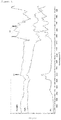
- a platinum particle being a metal nanoparticle is bonded to an amine group on the surface of the polymer layer, and H + is transferred to the platinum particle being an active metal site through a hydrogen ion exchange group of the polymer layer on the surface of the carbon carrier, so that platinum particles are easily used.
- the hydrogen ion exchange polymer is not particularly limited as long as the hydrogen ion exchange polymer includes the hydrogen ion exchange group represented by Chemical Formula 12, and it is possible to use a hydrogen ion exchange polymer generally used in the art.
- the hydrogen ion exchange polymer may be a hydrocarbon-based polymer, a partially fluorine-based polymer, or a fluorine-based polymer.
- the hydrocarbon-based polymer may be a hydrocarbon-based sulfonated polymer having no fluorine group, and in contrast, the fluorine-based polymer may be a sulfonated polymer which is saturated with a fluorine group, and the partially fluorine-based polymer may be a sulfonated polymer which is not saturated with a fluorine group.
- the hydrogen ion exchange polymer may be one polymer or two or more polymers selected from the group consisting of a perfluorosulfonic acid-based polymer, a hydrocarbon-based polymer, an aromatic sulfone-based polymer, an aromatic ketone-based polymer, a polybenzimidazole-based polymer, a polystyrene-based polymer, a polyester-based polymer, a polyimide-based polymer, a polyvinylidene fluoride-based polymer, a polyethersulfone-based polymer, a polyphenylene sulfide-based polymer, a polyphenylene oxide-based polymer, a polyphosphazene-based polymer, a polyethylene naphthalate-based polymer, a polyester-based polymer, a doped polybenzimidazole-based polymer, a polyether ketone-based polymer, a polyphenylquinoxaline-based polymer, a polys
- the polymer may be a single copolymer, an alternating copolymer, a random copolymer, a block copolymer, a multi-block copolymer, or a graft copolymer, but is not limited thereto.
- Examples of the hydrogen ion exchange polymer may include at least one of a cation include at least one of Nafion, sulfonated polyether ether ketone (sPEEK), sulfonated polyether ketone (sPEK), poly(vinylidene fluoride)-graft-poly(styrene sulfonic acid) (PVDF-g-PSSA), and sulfonated poly(fluorenyl ether ketone).
- sPEEK sulfonated polyether ether ketone
- sPEK sulfonated polyether ketone
- PVDF-g-PSSA poly(vinylidene fluoride)-graft-poly(styrene sulfonic acid)
- PVDF-g-PSSA poly(fluorenyl ether ketone)
- the two groups may be bonded to each other to have a sulfonamide bonding structure (-SO 2 -NH-) through a chemical reaction.
- the polymer layer may include a polymer in which the amine group of the polyalkyleneimine and the hydrogen ion exchange group of the hydrogen ion exchange polymer are crosslinked to each other through a crosslinking agent capable of reacting with each of the two groups.
- the crosslinking agent is not particularly limited as long as the crosslinking agent may crosslink the amine group of the polyalkyleneimine and the hydrogen ion exchange group of the hydrogen ion exchange polymer, but for example, POCl 3 , and the like may be used.
- the polymer layer may include a polymer in which a hydrogen ion exchange group (P1-SO 3 H) of the hydrogen ion exchange polymer and the amine group (P2-NH 2 ) of the polyalkyleneimine are crosslinked to each other to form a sulfonamide bonding structure (-SO 2 -NH-) by POCl 3 being a crosslinking agent.
- P1-SO 3 H hydrogen ion exchange group
- P2-NH 2 amine group
- P1 is a hydrogen ion exchange polymer except for -SO 3 H being a hydrogen ion exchange group
- P2 is a polyalkyleneimine except for - NH 2 in the amine group.
- the metal nanoparticle may be bonded to the amine group of the polymer layer, and specifically, may be bonded to the amine group of the polyalkyleneimine.
- the metal nanoparticle may include one or two or more metals selected from the group consisting of platinum (Pt), ruthenium (Ru), rhodium (Rh), molybdenum (Mo), osmium (Os), iridium (Ir), rhenium (Re), palladium (Pd), vanadium (V), tungsten (W), cobalt (Co), iron (Fe), selenium (Se), nickel (Ni), bismuth (Bi), tin (Sn), chromium (Cr), titanium (Ti), gold (Au), cerium (Ce), silver (Ag), and copper (Cu).
- the metal nanoparticle may include: platinum (Pt); and a platinum alloy in which iron (Fe), cobalt (Co), nickel (Ni), palladium (Pd), rhodium (Rh), or ruthenium (Ru) is alloyed with platinum (Pt).
- the metal nanoparticles may have an average particle diameter of 2 nm or more and 20 nm or less, and specifically, 3 nm or more and 10 nm or less.
- the catalyst efficiency is high because metal nanoparticles are not aggregated with each other and are dispersed well on a carbon carrier.
- the average particle diameter of the metal nanoparticles means the average of the lengths of the longest lines among lines that link two points on the surface of the metal nanoparticle.
- the metal nanoparticle may have a spherical shape.
- the spherical shape does not mean only a perfect spherical shape, and may include a roughly spherical shape.
- the outer surface having a spherical shape may not be smooth, and the radius of curvature in one metal nanoparticle may not be constant.
- the content of the metal nanoparticles may be 15 wt% or more and 50 wt% or less based on the total weight of the carrier-nanoparticle complex. Specifically, the content of the metal nanoparticles may be 20 wt% or more and 40 wt% or less based on the total weight of the carrier-nanoparticle complex.
- the present specification provides a catalyst including the carrier-nanoparticle complex.
- the present specification provides an electrochemical battery including the catalyst.
- the electrochemical battery means a battery which uses chemical reactions, and is not particularly limited in type as long as the battery includes the catalyst, but for example, the electrochemical battery may be a fuel cell, a metal secondary battery, or a flow battery.
- the present specification provides an electrochemical battery module including the electrochemical battery as a unit cell.
- the electrochemical battery module may be formed by inserting a bipolar plate between flow batteries according to one exemplary embodiment of the present application to stack the batteries.
- the battery module may be specifically used as a power source for an electric vehicle, a hybrid electric vehicle, a plug-in hybrid electric vehicle, or a power storage device.
- the present specification provides a membrane electrode assembly including: an anode catalyst layer; a cathode catalyst layer; and a polymer electrolyte membrane provided between the anode catalyst layer and the cathode catalyst layer, in which at least one of the anode catalyst layer and the cathode catalyst layer includes the carrier-nanoparticle complex.
- the membrane electrode assembly may further include an anode gas diffusion layer provided on a surface opposite to a surface of the anode catalyst layer on which the polymer electrolyte membrane is provided and a cathode gas diffusion layer provided on a surface opposite to a surface of the cathode catalyst layer on which the polymer electrolyte membrane is provided.
- the present specification provides a fuel cell including the membrane electrode assembly.
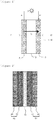
- FIG. 1 schematically illustrates an electricity generation principle of a fuel cell, and in a fuel cell, the most fundamental unit of generating electricity is a membrane electrode assembly (MEA), and the membrane electrode assembly is composed of an electrolyte membrane (M), and an anode (A) and a cathode (C) formed on both surfaces of the electrolyte membrane (M).
- MEA membrane electrode assembly
- FIG. 2 schematically illustrates a structure of a membrane electrode assembly for a fuel cell
- the membrane electrode assembly for the fuel cell may include an electrolyte membrane 10, and a cathode 50 and an anode 51 facing each other with the electrolyte membrane 10 interposed therebetween.
- a cathode catalyst layer 20, and a cathode gas diffusion layer 40 may be provided sequentially from the electrolyte membrane 10, and in the anode, an anode catalyst layer 21, and an anode gas diffusion layer 41 may be provided sequentially from the electrolyte membrane 10.
- the catalyst according to the present specification may be included in at least one of a cathode catalyst layer and an anode catalyst layer in a membrane electrode assembly.
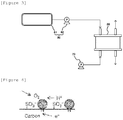
- FIG. 3 schematically illustrates a structure of a fuel cell, and the fuel cell includes a stack 60, an oxidizing agent supplying part 70, and a fuel supplying part 80.
- the stack 60 includes the aforementioned one membrane-electrode assembly or two or more membrane-electrode assemblies, and when two or more membrane-electrode assemblies are included, the stack 60 includes a separator interposed therebetween.
- the separator serves to prevent the membrane-electrode assemblies from being electrically connected to each other, and to transfer fuel and an oxidizing agent, which are supplied from the outside, to the membrane-electrode assemblies.
- the oxidizing agent supplying part 70 serves to supply an oxidizing agent to the stack 60.
- oxygen is representatively used, and oxygen or air may be used by being injected into the oxidizing agent supplying part 70.
- the fuel supplying part 80 serves to supply fuel to the stack 60, and may be composed of a fuel tank 81 which stores fuel, and a pump 82 which supplies the stack 60 with fuel stored in the fuel tank 81.
- a fuel tank 81 which stores fuel
- a pump 82 which supplies the stack 60 with fuel stored in the fuel tank 81.
- the fuel hydrogen or hydrocarbon fuel in a gas or liquid state may be used.
- the hydrocarbon fuel may include methanol, ethanol, propanol, butanol, or natural gases.
- At least one of the anode catalyst layer and the cathode catalyst layer may include the carrier-nanoparticle complex according to the present specification as a catalyst.
- the anode catalyst layer and the cathode catalyst layer may each include an ionomer.
- the ratio of the ionomer of the anode catalyst layer to the carrier-nanoparticle complex is 0.3 to 0.7.
- the ratio of the ionomer of the cathode catalyst layer to the carrier-nanoparticle complex is 0.3 to 0.7.
- the carrier-nanoparticle complex according to the present specification when included as a catalyst, the content of the carrier-nanoparticle complex may be reduced by 20 wt% or more based on the content of the ionomer required for the catalyst layer, may be reduced by specifically 30 wt% or more, and may be reduced by more specifically 50 wt% or more.
- the content of the expensive ionomer may be reduced, and a predetermined or more hydrogen ion conductivity may be maintained even with a small ionomer content.
- the ionomer serves to provide a channel through which ions produced by a reaction between fuel such as hydrogen or methanol and a catalyst move to an electrolyte membrane.
- the ionomer may use a polymer having a cation exchange group, which is selected from the group consisting of a sulfonic acid group, a carboxylic acid group, a phosphoric acid group, a phosphonic acid group, and a derivative thereof, at the side chain thereof.
- a cation exchange group which is selected from the group consisting of a sulfonic acid group, a carboxylic acid group, a phosphoric acid group, a phosphonic acid group, and a derivative thereof, at the side chain thereof.
- the ionomer may include one or more hydrogen ion conductive polymers selected from a fluoro-based polymer, a benzimidazole-based polymer, a polyimide-based polymer, a polyetherimide-based polymer, a polyphenylenesulfide-based polymer, a polysulfone-based polymer, a polyethersulfone-based polymer, a polyetherketone-based polymer, a polyether-etherketone-based polymer, or a polyphenylquinoxaline-based polymer.
- the polymer ionomer may be Nafion.
- the present specification provides a method for preparing a carrier-nanoparticle complex, the method including: forming a polymer layer having an amine group and a hydrogen ion exchange group represented by the following Chemical Formula 12 in a carbon carrier; and forming metal nanoparticles on the polymer layer of the carbon carrier by adding the carbon carrier having the polymer layer formed and a metal precursor to a solvent.
- Chemical Formula 12 -SO 3 - X
- X is a monovalent cation group.
- the method for preparing the carrier-nanoparticle complex includes forming a polymer layer having an amine group and a hydrogen ion exchange group represented by the following Chemical Formula 12 in a carbon carrier.
- the forming of the polymer layer may be forming a polymer layer by putting a carbon carrier into a solution including polyalkyleneimine and a hydrogen ion exchange polymer or a solution including a polymer derived from a polyalkyleneimine having an amine group and a hydrogen ion exchange polymer having a hydrogen ion exchange group.
- the method for preparing the carrier-nanoparticle complex may include: preparing a first solution by adding a carbon carrier, polyalkyleneimine, and a hydrogen ion exchange polymer to a solvent; and stirring the first solution.
- the first solution may further include a crosslinking agent.
- the crosslinking agent may have a reaction group capable of reacting with each of the amine group of the polyalkyleneimine and the hydrogen ion exchange group of the hydrogen ion exchange polymer.
- the method for preparing the carrier-nanoparticle complex may include: preparing a first solution by adding a carbon carrier, and a polymer derived from a polyalkyleneimine and a hydrogen ion exchange polymer having a hydrogen ion exchange group to a solvent; and stirring the first solution.
- the solvent of the first solution is not particularly limited, but may include at least one of water, ethanol, 2-propanol, and iso-propanol.
- the content of the carbon carrier may be 14 wt% or more and 30 wt% or less.
- the content of the polyalkyleneimine may be 65 wt% or more and 85 wt% or less.
- the content of the hydrogen ion exchange polymer may be 0.1 wt% or more and 5 wt% or less.
- the content of the carbon carrier may be more than 0 wt% and 3 wt% or less.
- the first solvent includes a carbon carrier, and a polymer derived from a polyalkyleneimine and a hydrogen ion exchange polymer having a hydrogen ion exchange group
- the content of the carbon carrier may be 14 wt% or more and 30 wt% or less
- the content of the polymer derived from the polyalkyleneimine and the hydrogen ion exchange polymer having the hydrogen ion exchange group may be 70 wt% or more and 86 wt% or less.
- the total content of the solid content of the first solution except for the solvent may be 0.3 wt% or more and 20 wt% or less, and based on the total weight of the first solution, the content of the solvent may be 80 wt% or more and 99.7 wt% or less.
- the time for which the first solution is stirred may be 3 hours or more and 72 hours or less.
- the method for preparing the carrier-nanoparticle complex includes forming metal nanoparticles on the polymer layer of the carbon carrier by adding the carbon carrier having the polymer layer formed and a metal precursor to a solvent.
- the forming of the metal nanoparticles on the polymer layer of the carbon carrier may include: preparing a second solution by adding the carbon carrier having the polymer layer formed and a metal precursor to a solvent; adjusting a pH of the second solution; and stirring the second solution.
- the metal precursor is a material before being reduced to metal nanoparticles, and the metal precursor may be selected according to the type of metal nanoparticle.
- the solvent of the second solution may include a polyhydric alcohol having two or more hydroxy groups.
- the polyhydric alcohol is not particularly limited as long as the polyhydric alcohol has two or more hydroxy groups, but may include at least one of ethylene glycol, diethylene glycol, and propylene glycol.
- the second solution for forming metal nanoparticles on the polymer layer of the carbon carrier does not include a surfactant.
- a surfactant there is an advantage in that a step of removing a surfactant after synthesizing a catalyst is not necessary, and there is no reduction in active point caused by a surfactant.
- the content of the carbon carrier having the polymer layer formed may be 0.1 wt% or more and 3 wt% or less.
- the content of the metal precursor may be 0.1 wt% or more and 4 wt% or less.
- the content of the solvent may be 93 wt% or more and 98 wt% or less.
- the pH of the second solution may be adjusted to 10 to 11, and the method for adjusting the pH is not particularly limited as long as the method may adjust the pH of the second solution, but the pH of the second solution may be adjusted by adding a predetermined amount of NaOH thereto.
- the method for preparing the carrier-nanoparticle complex may further include forming metal nanoparticles on a polymer layer of a carbon carrier, and then removing a solvent.
- the solvent is removed, and the metal nanoparticles provided on the polymer layer of the carbon carrier may be sintered.
- the removing of the solvent may be carrying out a heat treatment under a hydrogen or argon atmosphere.
- the heat treatment temperature may be 180°C or more and 300°C or less.
- the solvent may not be completely removed, and at more than 300°C, the polymer on the surface of the carbon carrier may be decomposed or modified.
- PEI polyethyleneimine
- FIG. 5 An image of the carrier-nanoparticle complex prepared in Example 1 measured by a transmission electron microscope (TEM) is illustrated in FIG. 5 .
- TEM transmission electron microscope
- N (wt%) S (wt%) Example 1 1. 96 0.37
- Example 2 2.03 1.01
- the surface tensions and contact angles of the carbon carrier coated with the PEI and the Nafion polymers (Example 1) and carbon acid-treated with nitric acid were measured. At this time, as the acid-treated carbon, carbon treated with 5 M nitric acid at 90°C for 6 hours was used.
- Example 1 The contact angle was measured using a K100 model manufactured by KRUSS Co., Ltd. The surface tension for water was measured. As shown in Table 2, in the case of Example 1, it can be seen that the surface of the carrier is more hydrophilic because the contact angle was approximately 47°, which is smaller than that of the acid-treated carbon, and it can be seen that because the surface tension in Example 1 is larger than that of the acid-treated carbon, the surface is hydrophilic and has a characteristic of further retaining water. Further, due to these hydrophilic characteristics, Example 1 may be more advantageous in terms of dispersion of a catalyst when an ink is prepared, and thus Example 1 may be advantageous in forming a more uniform electrode layer. [Table 2] Contact angle (degree) Surface tension (mN/m 2 ) Acid-treated carbon 90 29.2 Example 1 47.05 ⁇ 2.74 55.43 ⁇ 1.56
- Example 1 Example 2, Comparative Example 1, and a commercially available catalyst were each mixed with isopropyl alcohol and a 5 wt% Nafion solution, and prepared into a well-dispersed ink. At this time, as the commercially available catalyst, 40 wt% Pt/C manufactured by Johnson Matthey Corp., was used.
- Example 1 the Nafion ionomer was added thereto so as for the I/C (ionomer/carbon) to be 0.48, and in Comparative Example 1 and the commercially available catalyst, the Nafion ionomer was added thereto so as for the I/C to be 0.75.
- the catalyst ink was coated onto a Nafion membrane using a spray device, and then a membrane electrode assembly was prepared by hot pressing the Nafion membrane at 140°C.
- the size of the membrane electrode assembly was 2.5 cm x 2.5 cm, H 2 /Air was supplied under 100% humid conditions, the performance of the single cell was measured under 80°C atmosphere, and the pt per unit area was 0.4 mg/cm 2 .
- the results are shown in FIG. 8 and Table 3.
- Example 1 had a higher current density than those of Comparative Example 1 and the commercially available catalyst, and exhibited a higher current density in a low voltage region being a mass transfer region than those of Comparative Example 1 and the commercially available catalyst. Since the -SO 3 - functional group of the ionomer present in the carrier can transfer hydrogen ions better to platinum particles, the activity is also enhanced, and Example 1 exhibits better performance than the other catalysts, particularly, in the mass transfer region. In the case of Example 2 in which the content of the ionomer was higher than the others, the performance slightly deteriorated, and the advantage in the mass transfer region was greatly offset.
- Example 1 Comparative Example 1 Commercially available catalyst Current density (A/cm 2 ) @ 0.6 V 1.15 1.0 1.12 1.0 Current density (A/cm 2 ) @ 0.3 V 1.61 1.47 1.47 1.43
Landscapes
- Chemical & Material Sciences (AREA)
- Chemical Kinetics & Catalysis (AREA)
- Engineering & Computer Science (AREA)
- General Chemical & Material Sciences (AREA)
- Electrochemistry (AREA)
- Manufacturing & Machinery (AREA)
- Sustainable Energy (AREA)
- Life Sciences & Earth Sciences (AREA)
- Sustainable Development (AREA)
- Materials Engineering (AREA)
- Health & Medical Sciences (AREA)
- Medicinal Chemistry (AREA)
- Polymers & Plastics (AREA)
- Organic Chemistry (AREA)
- Inorganic Chemistry (AREA)
- Inert Electrodes (AREA)
- Fuel Cell (AREA)
- Catalysts (AREA)
- Hybrid Cells (AREA)
Abstract
Description
- The present invention claims priority to and the benefit of Korean Patent Application No.
10-2016-0054223 - The present specification relates to a carrier-nanoparticle complex, a catalyst including the same, an electrochemical battery or a fuel cell including the catalyst, and a method for preparing the same.
- Carbon black is generally used as a support of a fuel cell catalyst. However, when carbon black is used as a support, there occurs a problem with the durability due to the corrosion of carbon.
- In order to alleviate the problem, studies on carbon nanotube (CNT), carbon nanofiber (CNF), carbon nanocage (CNC), and the like, which are crystalline carbon forms having a high corrosion resistance, have been actively conducted. However, these crystalline carbon forms have a problem in that these carbon forms are not dispersed well in a polar solvent due to the strong surface water repellency thereof. For this reason, there is a problem in that platinum is agglomerated without being uniformly dispersed in the process of loading platinum into a carbon support.
- The present specification has been made in an effort to provide a carrier-nanoparticle complex, a catalyst including the same, an electrochemical battery or a fuel cell including the catalyst, and a method for preparing the same.
- The present specification provides a carrier-nanoparticle complex including: a carbon carrier; a polymer layer provided on a surface of the carbon carrier and having an amine group and a hydrogen ion exchange group represented by the following Chemical Formula 12; and metal nanoparticles provided on the polymer layer.
[Chemical Formula 12] -SO3 -X
- In Chemical Formula 12, X is a monovalent cation group.
- Further, the present specification provides a catalyst including the carrier-nanoparticle complex.
- In addition, the present specification provides an electrochemical battery including the catalyst.
- Furthermore, the present specification a membrane electrode assembly including: an anode catalyst layer; a cathode catalyst layer; and a polymer electrolyte membrane provided between the anode catalyst layer and the cathode catalyst layer, in which at least one of the anode catalyst layer and the cathode catalyst layer includes the carrier-nanoparticle complex.
- Further, the present specification provides a method for preparing a carrier-nanoparticle complex, the method including: forming a polymer layer having an amine group and a hydrogen ion exchange group represented by the following Chemical Formula 12 in a carbon carrier; and forming metal nanoparticles on the polymer layer of the carbon carrier by adding the carbon carrier having the polymer layer formed and a metal precursor to a solvent.
[Chemical Formula 12] -SO3 -X
- In Chemical Formula 12, X is a monovalent cation group.
- A carrier-nanoparticle complex according to an exemplary embodiment of the present specification has an advantage in that the dispersibility of metal nanoparticles is excellent.
- The carrier-nanoparticle complex according to an exemplary embodiment of the present specification has an advantage in that the thermal stability is excellent.
- The carrier-nanoparticle complex according to an exemplary embodiment of the present specification may transfer protons well to an active metal site, and thus may increase a use rate of metal nanoparticles.
-
-
FIG. 1 is a schematic view illustrating an electricity generation principle of a fuel cell. -
FIG. 2 is a view schematically illustrating a structure of a membrane electrode assembly for a fuel cell. -
FIG. 3 is a view schematically illustrating an example of a fuel cell. -
FIG. 4 is a schematic view of a reaction on a surface of a carrier-nanoparticle complex according to an exemplary embodiment of the present specification. -
FIG. 5 is a TEM measurement image of a carrier-nanoparticle complex prepared in Example 1. -
FIG. 6 is an FT-IR analysis graph for Example 1 and Comparative Example 1 together with PEI. -
FIG. 7 is an FT-IR analysis graph for Example 1 and Comparative Example 1 together with Nafion. -
FIG. 8 is a unit cell performance result graph for Examples 1 and 2 and Comparative Example 1 together with a commercially available catalyst. -
- 10:
- Electrolyte membrane
- 20, 21:
- Catalyst layer
- 40, 41:
- Gas diffusion layer
- 50:
- Cathode
- 51:
- Anode
- 60:
- Stack
- 70:
- Oxidizing agent supplying part
- 80:
- Fuel supplying part
- 81:
- Fuel tank
- 82:
- Pump
- Hereinafter, the present specification will be described in detail.
- The present specification provides a carrier-nanoparticle complex including: a carbon carrier; a polymer layer provided on a surface of the carbon carrier and having an amine group and a hydrogen ion exchange group represented by the following Chemical Formula 12; and metal nanoparticles provided on the polymer layer.
[Chemical Formula 12] -SO3 -X
- In Chemical Formula 12, X is a monovalent cation group.
- The carbon-based carrier may include one or more selected from the group consisting of carbon black, carbon nanotube (CNT), graphite, graphene, activated carbon, mesoporous carbon, carbon fiber, and carbon nano wire.
- A portion or all of the surface of the carbon carrier may be provided with a polymer layer. 50% or more and 100% or less of the surface of the carbon carrier may be provided with a polymer layer, and specifically, 75% or more and 100% or less thereof may be provided with a polymer layer.
- Based on the total elements on the surface of the polymer layer, the content of the nitrogen element of an amine group may be 0.01 wt% or more and 5 wt% or less, and the content of the sulfur element of the hydrogen ion exchange group of Chemical Formula 12 may be 0.01 wt% or more and 1 wt% or less. When the content of the sulfur element is more than 1 wt%, the carrier surface becomes so hydrophilic that an adverse effect may be shown in the discharge of water in a cell.
- The polymer layer may include a polyalkyleneimine having an amine group and a hydrogen ion exchange polymer having the hydrogen ion exchange group, or may include a polymer derived from a polyalkylneimine having an amine group and a hydrogen ion exchange polymer having a hydrogen ion exchange group.
- A weight ratio (PEI/ionomer) of the polyalkyleneimine (PEI) and the hydrogen ion exchange polymer (ionomer) may be 15 or more and 100 or less.
- The polyalkyleneimine may be a polymer having an aliphatic hydrocarbon main chain and including at least 10 amine groups or more at the main chain and side chain thereof. At this time, the amine group includes a primary amine group, a secondary amine group, a tertiary amine group, and a quaternary amine group, and in the amine group included in the main chain and side chain of the polyalkyleneimine, at least one of the primary amine group, the secondary amine group, the tertiary amine group, and the quaternary amine group may be 10 or more.
- The polyalkyleneimine may have a weight average molecular weight of 500 or more and 1,000,000 or less.
- The polyalkyleneimine may include at least one of a repeating unit represented by the following
Chemical Formula 1 and a repeating unit represented by the followingChemical Formula 2.


- In
Chemical Formulae 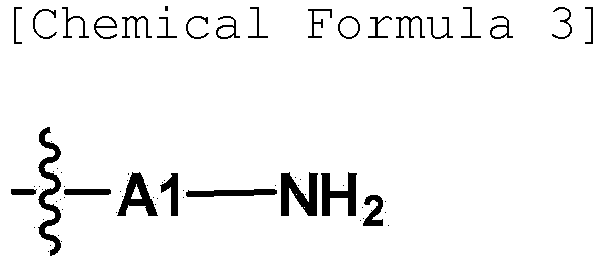


- In Chemical Formulae 3 to 5, A1 to A3 are each independently an alkylene group having 2 to 10 carbon atoms, and R1 to R3 are each independently a substituent represented by any one of the following Chemical Formulae 6 to 8,


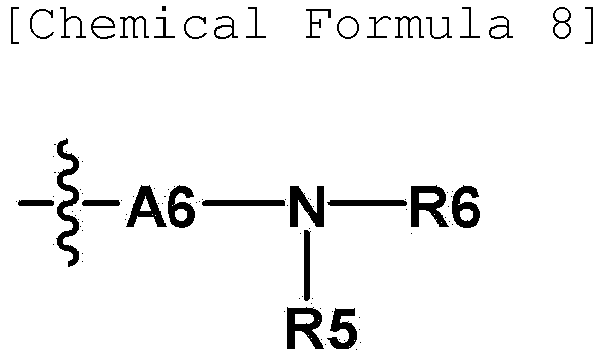
- In Chemical Formulae 6 to 8, A4 to A6 are each independently an alkylene group having 2 to 10 carbon atoms, and R4 to R6 are each independently a substituent represented by the following Chemical Formula 9,
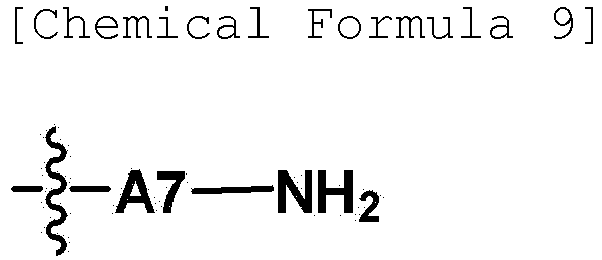
- In Chemical Formula 9, A7 is an alkylene group having 2 to 10 carbon atoms.
- The polyalkyleneimine may include at least one of a compound represented by the following
Chemical Formula 10 and a compound represented by the following Chemical Formula 11.


- In
Chemical Formulae 10 and 11, X1, X2, Y1, Y2, and Y3 are each independently an alkylene group having 2 to 10 carbon atoms, R is a substituent represented by any one of the following Chemical Formulae 3 to 5, q is an integer from 1 to 1,000, n and m are each an integer from 1 to 5, and l is an integer from 1 to 200.


- In Chemical Formulae 3 to 5, A1 to A3 are each independently an alkylene group having 2 to 10 carbon atoms, and R1 to R3 are each independently a substituent represented by any one of the following Chemical Formulae 6 to 8,


- In Chemical Formulae 6 to 8, A4 to A6 are each independently an alkylene group having 2 to 10 carbon atoms, and R4 to R6 are each independently a substituent represented by the following Chemical Formula 9,

- In Chemical Formula 9, A7 is an alkylene group having 2 to 10 carbon atoms.
- In the present specification,

- In the present specification, the alkylene group may be straight or branched, and the number of carbon atoms thereof is not particularly limited, but is preferably 2 to 10. Specific examples thereof include an ethylene group, a propylene group, an isopropylene group, a butylene group, a t-butylene group, a pentylene group, a hexylene group, a heptylene group, and the like, but are not limited thereto.
- The hydrogen ion exchange polymer includes a hydrogen ion exchange group represented by the following Chemical Formula 12.
[Chemical Formula 12] -SO3 -X
- In Chemical Formula 12, X is a monovalent cation group.
- Since proton is easily transferred to a metal nanoparticle bonded to an amine group on the polymer layer through a hydrogen ion exchange group, a use rate of metal nanoparticles may be increased.
- As illustrated in
FIG. 4 , a platinum particle being a metal nanoparticle is bonded to an amine group on the surface of the polymer layer, and H+ is transferred to the platinum particle being an active metal site through a hydrogen ion exchange group of the polymer layer on the surface of the carbon carrier, so that platinum particles are easily used. - The hydrogen ion exchange polymer is not particularly limited as long as the hydrogen ion exchange polymer includes the hydrogen ion exchange group represented by Chemical Formula 12, and it is possible to use a hydrogen ion exchange polymer generally used in the art.
- The hydrogen ion exchange polymer may be a hydrocarbon-based polymer, a partially fluorine-based polymer, or a fluorine-based polymer. The hydrocarbon-based polymer may be a hydrocarbon-based sulfonated polymer having no fluorine group, and in contrast, the fluorine-based polymer may be a sulfonated polymer which is saturated with a fluorine group, and the partially fluorine-based polymer may be a sulfonated polymer which is not saturated with a fluorine group.
- The hydrogen ion exchange polymer may be one polymer or two or more polymers selected from the group consisting of a perfluorosulfonic acid-based polymer, a hydrocarbon-based polymer, an aromatic sulfone-based polymer, an aromatic ketone-based polymer, a polybenzimidazole-based polymer, a polystyrene-based polymer, a polyester-based polymer, a polyimide-based polymer, a polyvinylidene fluoride-based polymer, a polyethersulfone-based polymer, a polyphenylene sulfide-based polymer, a polyphenylene oxide-based polymer, a polyphosphazene-based polymer, a polyethylene naphthalate-based polymer, a polyester-based polymer, a doped polybenzimidazole-based polymer, a polyether ketone-based polymer, a polyphenylquinoxaline-based polymer, a polysulfone-based polymer, a polypyrrole-based polymer, and a polyaniline-based polymer. The polymer may be a single copolymer, an alternating copolymer, a random copolymer, a block copolymer, a multi-block copolymer, or a graft copolymer, but is not limited thereto.
- Examples of the hydrogen ion exchange polymer may include at least one of a cation include at least one of Nafion, sulfonated polyether ether ketone (sPEEK), sulfonated polyether ketone (sPEK), poly(vinylidene fluoride)-graft-poly(styrene sulfonic acid) (PVDF-g-PSSA), and sulfonated poly(fluorenyl ether ketone).
- If the amine group of the polyalkyleneimine and the hydrogen ion exchange group of the hydrogen ion exchange polymer are adjacent to each other, the two groups may be bonded to each other to have a sulfonamide bonding structure (-SO2-NH-) through a chemical reaction.
- The polymer layer may include a polymer in which the amine group of the polyalkyleneimine and the hydrogen ion exchange group of the hydrogen ion exchange polymer are crosslinked to each other through a crosslinking agent capable of reacting with each of the two groups.
- The crosslinking agent is not particularly limited as long as the crosslinking agent may crosslink the amine group of the polyalkyleneimine and the hydrogen ion exchange group of the hydrogen ion exchange polymer, but for example, POCl3, and the like may be used.
- As in the following
Reaction Formula 1, the polymer layer may include a polymer in which a hydrogen ion exchange group (P1-SO3H) of the hydrogen ion exchange polymer and the amine group (P2-NH2) of the polyalkyleneimine are crosslinked to each other to form a sulfonamide bonding structure (-SO2-NH-) by POCl3 being a crosslinking agent.
- In the reaction formula, P1 is a hydrogen ion exchange polymer except for -SO3H being a hydrogen ion exchange group, and P2 is a polyalkyleneimine except for - NH2 in the amine group.
- The metal nanoparticle may be bonded to the amine group of the polymer layer, and specifically, may be bonded to the amine group of the polyalkyleneimine.
- The metal nanoparticle may include one or two or more metals selected from the group consisting of platinum (Pt), ruthenium (Ru), rhodium (Rh), molybdenum (Mo), osmium (Os), iridium (Ir), rhenium (Re), palladium (Pd), vanadium (V), tungsten (W), cobalt (Co), iron (Fe), selenium (Se), nickel (Ni), bismuth (Bi), tin (Sn), chromium (Cr), titanium (Ti), gold (Au), cerium (Ce), silver (Ag), and copper (Cu). Specifically, the metal nanoparticle may include: platinum (Pt); and a platinum alloy in which iron (Fe), cobalt (Co), nickel (Ni), palladium (Pd), rhodium (Rh), or ruthenium (Ru) is alloyed with platinum (Pt).
- The metal nanoparticles may have an average particle diameter of 2 nm or more and 20 nm or less, and specifically, 3 nm or more and 10 nm or less. In this case, there is an advantage in that the catalyst efficiency is high because metal nanoparticles are not aggregated with each other and are dispersed well on a carbon carrier. Here, the average particle diameter of the metal nanoparticles means the average of the lengths of the longest lines among lines that link two points on the surface of the metal nanoparticle.
- The metal nanoparticle may have a spherical shape. In the present specification, the spherical shape does not mean only a perfect spherical shape, and may include a roughly spherical shape. For example, in the metal nanoparticle, the outer surface having a spherical shape may not be smooth, and the radius of curvature in one metal nanoparticle may not be constant.
- The content of the metal nanoparticles may be 15 wt% or more and 50 wt% or less based on the total weight of the carrier-nanoparticle complex. Specifically, the content of the metal nanoparticles may be 20 wt% or more and 40 wt% or less based on the total weight of the carrier-nanoparticle complex.
- The present specification provides a catalyst including the carrier-nanoparticle complex.
- The present specification provides an electrochemical battery including the catalyst.
- The electrochemical battery means a battery which uses chemical reactions, and is not particularly limited in type as long as the battery includes the catalyst, but for example, the electrochemical battery may be a fuel cell, a metal secondary battery, or a flow battery.
- The present specification provides an electrochemical battery module including the electrochemical battery as a unit cell.
- The electrochemical battery module may be formed by inserting a bipolar plate between flow batteries according to one exemplary embodiment of the present application to stack the batteries.
- The battery module may be specifically used as a power source for an electric vehicle, a hybrid electric vehicle, a plug-in hybrid electric vehicle, or a power storage device.
- The present specification provides a membrane electrode assembly including: an anode catalyst layer; a cathode catalyst layer; and a polymer electrolyte membrane provided between the anode catalyst layer and the cathode catalyst layer, in which at least one of the anode catalyst layer and the cathode catalyst layer includes the carrier-nanoparticle complex.
- The membrane electrode assembly may further include an anode gas diffusion layer provided on a surface opposite to a surface of the anode catalyst layer on which the polymer electrolyte membrane is provided and a cathode gas diffusion layer provided on a surface opposite to a surface of the cathode catalyst layer on which the polymer electrolyte membrane is provided.
- The present specification provides a fuel cell including the membrane electrode assembly.
-
FIG. 1 schematically illustrates an electricity generation principle of a fuel cell, and in a fuel cell, the most fundamental unit of generating electricity is a membrane electrode assembly (MEA), and the membrane electrode assembly is composed of an electrolyte membrane (M), and an anode (A) and a cathode (C) formed on both surfaces of the electrolyte membrane (M). Referring toFIG. 1 which illustrates an elasticity generation principle of a fuel cell, an oxidation reaction of fuel (F) such as hydrogen or a hydrocarbon such as methanol and butane occurs in the anode (A), and as a result, hydrogen ions (H+) and electrons (e-) are generated, and the hydrogen ions move to the cathode (C) through the electrolyte membrane (M). In the cathode (C), hydrogen ions transferred through the electrolyte membrane (M), an oxidizing agent (O) such as oxygen, and electrons are reacted to produce water (W). Electrons move to an external circuit by the reaction. -
FIG. 2 schematically illustrates a structure of a membrane electrode assembly for a fuel cell, and the membrane electrode assembly for the fuel cell may include anelectrolyte membrane 10, and acathode 50 and ananode 51 facing each other with theelectrolyte membrane 10 interposed therebetween. In the cathode, acathode catalyst layer 20, and a cathodegas diffusion layer 40 may be provided sequentially from theelectrolyte membrane 10, and in the anode, ananode catalyst layer 21, and an anodegas diffusion layer 41 may be provided sequentially from theelectrolyte membrane 10. - The catalyst according to the present specification may be included in at least one of a cathode catalyst layer and an anode catalyst layer in a membrane electrode assembly.
-
FIG. 3 schematically illustrates a structure of a fuel cell, and the fuel cell includes astack 60, an oxidizingagent supplying part 70, and afuel supplying part 80. - The
stack 60 includes the aforementioned one membrane-electrode assembly or two or more membrane-electrode assemblies, and when two or more membrane-electrode assemblies are included, thestack 60 includes a separator interposed therebetween. The separator serves to prevent the membrane-electrode assemblies from being electrically connected to each other, and to transfer fuel and an oxidizing agent, which are supplied from the outside, to the membrane-electrode assemblies. - The oxidizing
agent supplying part 70 serves to supply an oxidizing agent to thestack 60. As the oxidizing agent, oxygen is representatively used, and oxygen or air may be used by being injected into the oxidizingagent supplying part 70. - The
fuel supplying part 80 serves to supply fuel to thestack 60, and may be composed of afuel tank 81 which stores fuel, and apump 82 which supplies thestack 60 with fuel stored in thefuel tank 81. As the fuel, hydrogen or hydrocarbon fuel in a gas or liquid state may be used. Examples of the hydrocarbon fuel may include methanol, ethanol, propanol, butanol, or natural gases. - At least one of the anode catalyst layer and the cathode catalyst layer may include the carrier-nanoparticle complex according to the present specification as a catalyst.
- The anode catalyst layer and the cathode catalyst layer may each include an ionomer.
- When the anode catalyst layer includes the carrier-nanoparticle complex, the ratio of the ionomer of the anode catalyst layer to the carrier-nanoparticle complex (ionomer/complex, I/C) is 0.3 to 0.7.
- When the cathode catalyst layer includes the carrier-nanoparticle complex, the ratio of the ionomer of the cathode catalyst layer to the carrier-nanoparticle complex (ionomer/complex, I/C) is 0.3 to 0.7.
- In general, considering that the I/C ratio used in a commercially available catalyst is 0.8 to 1 (Book "PEM Fuel Cell Electrocatalyst and Catalyst Layer", page 895), when the carrier-nanoparticle complex according to the present specification is included as a catalyst, the content of the carrier-nanoparticle complex may be reduced by 20 wt% or more based on the content of the ionomer required for the catalyst layer, may be reduced by specifically 30 wt% or more, and may be reduced by more specifically 50 wt% or more. In other words, there is an advantage in that the content of the expensive ionomer may be reduced, and a predetermined or more hydrogen ion conductivity may be maintained even with a small ionomer content.
- The ionomer serves to provide a channel through which ions produced by a reaction between fuel such as hydrogen or methanol and a catalyst move to an electrolyte membrane.
- The ionomer may use a polymer having a cation exchange group, which is selected from the group consisting of a sulfonic acid group, a carboxylic acid group, a phosphoric acid group, a phosphonic acid group, and a derivative thereof, at the side chain thereof. Specifically, the ionomer may include one or more hydrogen ion conductive polymers selected from a fluoro-based polymer, a benzimidazole-based polymer, a polyimide-based polymer, a polyetherimide-based polymer, a polyphenylenesulfide-based polymer, a polysulfone-based polymer, a polyethersulfone-based polymer, a polyetherketone-based polymer, a polyether-etherketone-based polymer, or a polyphenylquinoxaline-based polymer. Specifically, according to an exemplary embodiment of the present specification, the polymer ionomer may be Nafion. The present specification provides a method for preparing a carrier-nanoparticle complex, the method including: forming a polymer layer having an amine group and a hydrogen ion exchange group represented by the following Chemical Formula 12 in a carbon carrier; and forming metal nanoparticles on the polymer layer of the carbon carrier by adding the carbon carrier having the polymer layer formed and a metal precursor to a solvent.
[Chemical Formula 12] -SO3 -X
- In Chemical Formula 12, X is a monovalent cation group.
- For the method for preparing the carrier-nanoparticle complex, it is possible to cite those described above for the carrier-nanoparticle complex.
- The method for preparing the carrier-nanoparticle complex includes forming a polymer layer having an amine group and a hydrogen ion exchange group represented by the following Chemical Formula 12 in a carbon carrier.
- The forming of the polymer layer may be forming a polymer layer by putting a carbon carrier into a solution including polyalkyleneimine and a hydrogen ion exchange polymer or a solution including a polymer derived from a polyalkyleneimine having an amine group and a hydrogen ion exchange polymer having a hydrogen ion exchange group.
- The method for preparing the carrier-nanoparticle complex may include: preparing a first solution by adding a carbon carrier, polyalkyleneimine, and a hydrogen ion exchange polymer to a solvent; and stirring the first solution.
- The first solution may further include a crosslinking agent. The crosslinking agent may have a reaction group capable of reacting with each of the amine group of the polyalkyleneimine and the hydrogen ion exchange group of the hydrogen ion exchange polymer.
- The method for preparing the carrier-nanoparticle complex may include: preparing a first solution by adding a carbon carrier, and a polymer derived from a polyalkyleneimine and a hydrogen ion exchange polymer having a hydrogen ion exchange group to a solvent; and stirring the first solution.
- The solvent of the first solution is not particularly limited, but may include at least one of water, ethanol, 2-propanol, and iso-propanol.
- Based on the solid content weight of the first solution, the content of the carbon carrier may be 14 wt% or more and 30 wt% or less.
- Based on the solid content weight of the first solution, the content of the polyalkyleneimine may be 65 wt% or more and 85 wt% or less.
- Based on the solid content weight of the first solution, the content of the hydrogen ion exchange polymer may be 0.1 wt% or more and 5 wt% or less.
- When the first solvent further includes a crosslinking agent, based on the solid content weight of the first solution, the content of the carbon carrier may be more than 0 wt% and 3 wt% or less.
- When the first solvent includes a carbon carrier, and a polymer derived from a polyalkyleneimine and a hydrogen ion exchange polymer having a hydrogen ion exchange group, based on the solid content weight of the first solution, the content of the carbon carrier may be 14 wt% or more and 30 wt% or less, and the content of the polymer derived from the polyalkyleneimine and the hydrogen ion exchange polymer having the hydrogen ion exchange group may be 70 wt% or more and 86 wt% or less.
- Based on the total weight of the first solution, the total content of the solid content of the first solution except for the solvent may be 0.3 wt% or more and 20 wt% or less, and based on the total weight of the first solution, the content of the solvent may be 80 wt% or more and 99.7 wt% or less.
- The time for which the first solution is stirred may be 3 hours or more and 72 hours or less.
- The method for preparing the carrier-nanoparticle complex includes forming metal nanoparticles on the polymer layer of the carbon carrier by adding the carbon carrier having the polymer layer formed and a metal precursor to a solvent.
- The forming of the metal nanoparticles on the polymer layer of the carbon carrier may include: preparing a second solution by adding the carbon carrier having the polymer layer formed and a metal precursor to a solvent; adjusting a pH of the second solution; and stirring the second solution.
- The metal precursor is a material before being reduced to metal nanoparticles, and the metal precursor may be selected according to the type of metal nanoparticle.
- The solvent of the second solution may include a polyhydric alcohol having two or more hydroxy groups. The polyhydric alcohol is not particularly limited as long as the polyhydric alcohol has two or more hydroxy groups, but may include at least one of ethylene glycol, diethylene glycol, and propylene glycol.
- The second solution for forming metal nanoparticles on the polymer layer of the carbon carrier does not include a surfactant. In this case, there is an advantage in that a step of removing a surfactant after synthesizing a catalyst is not necessary, and there is no reduction in active point caused by a surfactant.
- Based on the total weight of the second solution, the content of the carbon carrier having the polymer layer formed may be 0.1 wt% or more and 3 wt% or less.
- Based on the total weight of the second solution, the content of the metal precursor may be 0.1 wt% or more and 4 wt% or less.
- Based on the total weight of the second solution, the content of the solvent may be 93 wt% or more and 98 wt% or less.
- In the adjusting the pH of the second solution, the pH of the second solution may be adjusted to 10 to 11, and the method for adjusting the pH is not particularly limited as long as the method may adjust the pH of the second solution, but the pH of the second solution may be adjusted by adding a predetermined amount of NaOH thereto.
- The method for preparing the carrier-nanoparticle complex may further include forming metal nanoparticles on a polymer layer of a carbon carrier, and then removing a solvent.
- In the removing of the solvent, the solvent is removed, and the metal nanoparticles provided on the polymer layer of the carbon carrier may be sintered.
- The removing of the solvent may be carrying out a heat treatment under a hydrogen or argon atmosphere. At this time, the heat treatment temperature may be 180°C or more and 300°C or less. At less than 180°C, the solvent may not be completely removed, and at more than 300°C, the polymer on the surface of the carbon carrier may be decomposed or modified.
- Hereinafter, the present specification will be described in more detail through Examples. However, the following Examples are provided only for exemplifying the present specification, but are not intended to limit the present specification.
- 1 g of polyethyleneimine (PEI, Mw. 1800) and 240 mg of a 5 wt Nafion solution (in propanol/water) were dissolved in 200 ml of water/isopropyl alcohol (IPA), and then 240 mg of raw carbon black was added thereto, and the resulting mixture was stirred for 24 hours. Thereafter, the mixture was washed with distilled water and dried to obtain a carbon carrier which was surface-modified with PEI and Nafion.
- After 0.22 mmol of PtCl4 and 65 mg of the carbon carrier which was surface-modified with PEI and Nafion were dissolved in 25 ml of ethylene glycol, the pH was adjusted to 11, and then the solution was stirred for a predetermined time. After the solution was warmed to 160°C, the solution was stirred for 3 hours, and then cooled. The resulting product was washed with ethanol (EtOH) and then dried, and then a heat treatment was carried out under an Ar or Ar/hydrogen atmosphere for 1 hour. As an analysis result of the inductively coupled plasma (ICP), 40 wt% of Pt was supported.
- 1 g of polyethyleneimine (PEI, Mw. 1800) and 1.2 g of a 5 wt% Nafion solution (in propanol/water) were dissolved in 200 ml of water/isopropyl alcohol (IPA), and then 240 mg of raw carbon black was added thereto, and the resulting mixture was stirred for 24 hours. Thereafter, the mixture was washed with distilled water and dried to obtain a carbon carrier which was surface-modified with PEI and Nafion.
- After 0.22 mmol of PtCl4 and 65 mg of the carbon carrier which was surface-modified with PEI and Nafion were dissolved in 25 ml of ethylene glycol, the pH was adjusted to 11, and then the solution was stirred for a predetermined time. After the solution was warmed to 160°C, the solution was stirred for 3 hours, and then cooled. The resulting product was washed with ethanol (EtOH) and then dried, and then a heat treatment was carried out under an Ar or Ar/hydrogen atmosphere for 1 hour. As an analysis result of the inductively coupled plasma (ICP), 40 wt% of Pt was supported.
- 1 g of polyethyleneimine (PEI, Mw. 1800) was dissolved in 200 ml of water, and then 240 mg of raw carbon black and 6 g of KNO3 were added thereto, and the resulting mixture was stirred for 24 hours. The resulting product was washed with distilled water and dried to obtain a carbon carrier coated with PEI.
- After 0.22 mmol of PtCl4 and 65 mg of the carbon carrier coated with PEI were dissolved in 25 ml of ethylene glycol, the pH was adjusted to 11, and then the solution was stirred for a predetermined time. After the solution was warmed to 160°C, the solution was stirred for 3 hours, and then cooled. The resulting product was washed with EtOH and then dried, and then a heat treatment was carried out under an Ar or Ar/hydrogen atmosphere for 1 hour. As an analysis result of the inductively coupled plasma (ICP), 40 wt% of Pt was supported.
- An image of the carrier-nanoparticle complex prepared in Example 1 measured by a transmission electron microscope (TEM) is illustrated in
FIG. 5 . - For Comparative Example 1 in which only PEI was supported and Example 1 in which PEI and Nafion were supported, together with PEI used in Example 1, an infrared spectroscopic analysis (FT-IR) graph measured using raw carbon black as a reference is illustrated in
FIG. 6 , and for Comparative Example 1 in which only PEI was supported and Example 1 in which PEI and Nafion were supported, together with Nafion used in Example 1, an infrared spectroscopic analysis (FT-IR) graph measured using raw carbon black as a reference is illustrated inFIG. 7 . As a result, it was confirmed that PEI was supported in Comparative Example 1 and Example 1, and it was confirmed that Nafion was supported in the complex in Example 1. - The content of N and S in the carbon carrier coated with the PEI and Nafion polymers was measured using pyrolysis ion chromatography.
[Table 1] N (wt%) S (wt%) Example 1 1. 96 0.37 Example 2 2.03 1.01 - The surface tensions and contact angles of the carbon carrier coated with the PEI and the Nafion polymers (Example 1) and carbon acid-treated with nitric acid were measured. At this time, as the acid-treated carbon, carbon treated with 5 M nitric acid at 90°C for 6 hours was used.
- The contact angle was measured using a K100 model manufactured by KRUSS Co., Ltd. The surface tension for water was measured. As shown in Table 2, in the case of Example 1, it can be seen that the surface of the carrier is more hydrophilic because the contact angle was approximately 47°, which is smaller than that of the acid-treated carbon, and it can be seen that because the surface tension in Example 1 is larger than that of the acid-treated carbon, the surface is hydrophilic and has a characteristic of further retaining water. Further, due to these hydrophilic characteristics, Example 1 may be more advantageous in terms of dispersion of a catalyst when an ink is prepared, and thus Example 1 may be advantageous in forming a more uniform electrode layer.
[Table 2] Contact angle (degree) Surface tension (mN/m2) Acid-treated carbon 90 29.2 Example 1 47.05±2.74 55.43±1.56 - Example 1, Example 2, Comparative Example 1, and a commercially available catalyst were each mixed with isopropyl alcohol and a 5 wt% Nafion solution, and prepared into a well-dispersed ink. At this time, as the commercially available catalyst, 40 wt% Pt/C manufactured by Johnson Matthey Corp., was used.
- In Examples 1 and 2, the Nafion ionomer was added thereto so as for the I/C (ionomer/carbon) to be 0.48, and in Comparative Example 1 and the commercially available catalyst, the Nafion ionomer was added thereto so as for the I/C to be 0.75. The catalyst ink was coated onto a Nafion membrane using a spray device, and then a membrane electrode assembly was prepared by hot pressing the Nafion membrane at 140°C.
- The size of the membrane electrode assembly was 2.5 cm x 2.5 cm, H2/Air was supplied under 100% humid conditions, the performance of the single cell was measured under 80°C atmosphere, and the pt per unit area was 0.4 mg/cm2. The results are shown in
FIG. 8 and Table 3. - Example 1 had a higher current density than those of Comparative Example 1 and the commercially available catalyst, and exhibited a higher current density in a low voltage region being a mass transfer region than those of Comparative Example 1 and the commercially available catalyst. Since the -SO3 - functional group of the ionomer present in the carrier can transfer hydrogen ions better to platinum particles, the activity is also enhanced, and Example 1 exhibits better performance than the other catalysts, particularly, in the mass transfer region. In the case of Example 2 in which the content of the ionomer was higher than the others, the performance slightly deteriorated, and the advantage in the mass transfer region was greatly offset. When the amount of ionomer is increased to 1 wt% or more, it is contemplated that the surface of the carrier becomes more hydrophilic, and thus, the discharge of water generated is rather hindered. Further, in the case of Example 1, even though the ionomer was used by reducing the content of the ionomer by about 22% as compared to the commercially available catalyst during the preparation of the catalyst ink, a better performance was exhibited. Since the -SO3 - functional group was present on the surface of the carbon carrier, hydrogen ions could be sufficiently transferred with even a smaller amount of ionomer. In general, it is known that during the preparation of the catalyst ink, the optimal amount of ionomer is between 33% to 50% of the catalyst weight.
[Table 3] Example 1 Example 2 Comparative Example 1 Commercially available catalyst Current density (A/cm2) @ 0.6 V 1.15 1.0 1.12 1.0 Current density (A/cm2) @ 0.3 V 1.61 1.47 1.47 1.43
Claims (13)
- A carrier-nanoparticle complex comprising:a carbon carrier;a polymer layer provided on a surface of the carbon carrier and having an amine group and a hydrogen ion exchange group represented by the following Chemical Formula 12; andmetal nanoparticles provided on the polymer layer:in Chemical Formula 12, X is a monovalent cation group.
[Chemical Formula 12] -SO3 -X
- The carrier-nanoparticle complex of claim 1, wherein the polymer layer comprises a polyalkyleneimine having the amine group and a hydrogen ion exchange polymer having the hydrogen ion exchange group, or comprises a polymer derived from a polyalkylneimine having the amine group and a hydrogen ion exchange polymer having the hydrogen ion exchange group.
- The carrier-nanoparticle complex of claim 2, wherein the polyalkyleneimine comprises at least one of a repeating unit represented by the following Chemical Formula 1 and a repeating unit represented by the following Chemical Formula 2:

 E1 and E2 are each independently an alkylene group having 2 to 10 carbon atoms,R is a substituent represented by any one of the following Chemical Formulae 3 to 5, ando and p are each an integer from 1 to 1,000,


 A1 to A3 are each independently an alkylene group having 2 to 10 carbon atoms, andR1 to R3 are each independently a substituent represented by any one of the following Chemical Formulae 6 to 8,

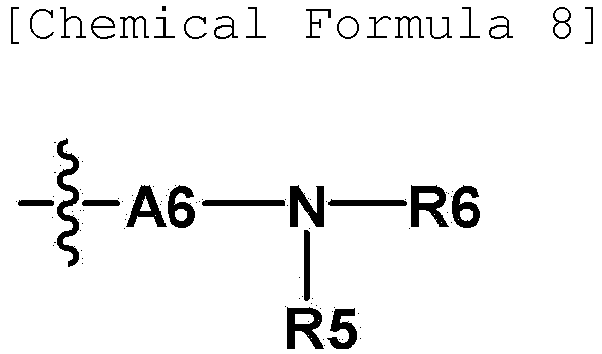 A4 to A6 are each independently an alkylene group having 2 to 10 carbon atoms, andR4 to R6 are each independently a substituent represented by the following Chemical Formula 9,
A7 is an alkylene group having 2 to 10 carbon atoms. - The carrier-nanoparticle complex of claim 2, wherein the polyalkyleneimine comprises at least one of a compound represented by the following Chemical Formula 10 and a compound represented by the following Chemical Formula 11:

 X1, X2, Y1, Y2, and Y3 are each independently an alkylene group having 2 to 10 carbon atoms,R is a substituent represented by any one of the following Chemical Formulae 3 to 5,q is an integer from 1 to 1,000,n and m are each an integer from 1 to 5,l is an integer from 1 to 200,

 A1 to A3 are each independently an alkylene group having 2 to 10 carbon atoms,R1 to R3 are each independently a substituent represented by any one of the following Chemical Formulae 6 to 8,


 A4 to A6 are each independently an alkylene group having 2 to 10 carbon atoms, andR4 to R6 are each independently a substituent represented by the following Chemical Formula 9,
A7 is an alkylene group having 2 to 10 carbon atoms. - The carrier-nanoparticle complex of claim 1, wherein the metal nanoparticle is bonded to the amine group of the polymer layer.
- The carrier-nanoparticle complex of claim 1, wherein based on the total elements on a surface of the polymer layer, a content of a nitrogen element of an amine group is 0.01 wt% or more and 5 wt% or less, and a content of a sulfur element of the hydrogen ion exchange group of Chemical Formula 12 is 0.01 wt% or more and 1 wt% or less.
- The carrier-nanoparticle complex of claim 2, wherein a weight ratio of the polyalkyleneimine and the hydrogen ion exchange polymer is 15 or more and 100 or less.
- A catalyst comprising the carrier-nanoparticle complex of any one of claims 1 to 7.
- An electrochemical battery comprising the catalyst of claim 8.
- A membrane electrode assembly comprising:an anode catalyst layer;a cathode catalyst layer; anda polymer electrolyte membrane provided between the anode catalyst layer and the cathode catalyst layer,wherein at least one of the anode catalyst layer and the cathode catalyst layer comprises the carrier-nanoparticle complex according to any one of claims 1 to 7.
- The membrane electrode assembly of claim 10, wherein the anode catalyst layer and the cathode catalyst layer each comprise an ionomer.
- A method for preparing a carrier-nanoparticle complex, the method comprising:forming a polymer layer having an amine group and a hydrogen ion exchange group represented by the following Chemical Formula 12 in a carbon carrier; andforming metal nanoparticles on the polymer layer of the carbon carrier by adding the carbon carrier having the polymer layer formed and a metal precursor to a solvent.
[Chemical Formula 12] -SO3 -X
in Chemical Formula 12, X is a monovalent cation group. - The method of claim 12, wherein the forming of the polymer layer is forming a polymer layer by putting a carbon carrier into a solution comprising a polyalkyleneimine and a hydrogen ion exchange polymer, or a solution comprising a polymer derived from a polyalkyleneimine having the amine group and a hydrogen ion exchange polymer having the hydrogen ion exchange group.
Applications Claiming Priority (2)
| Application Number | Priority Date | Filing Date | Title |
|---|---|---|---|
| KR1020160054223A KR102096130B1 (en) | 2016-05-02 | 2016-05-02 | Carrier-nano particles complex, catalyst comprising the same and method for fabricating the same |
| PCT/KR2017/004560 WO2017191945A1 (en) | 2016-05-02 | 2017-04-28 | Carrier-nanoparticle composite, catalyst comprising same, and method for producing same |
Publications (3)
| Publication Number | Publication Date |
|---|---|
| EP3435460A1 true EP3435460A1 (en) | 2019-01-30 |
| EP3435460A4 EP3435460A4 (en) | 2019-05-08 |
| EP3435460B1 EP3435460B1 (en) | 2022-03-16 |
Family
ID=60203101
Family Applications (1)
| Application Number | Title | Priority Date | Filing Date |
|---|---|---|---|
| EP17792847.0A Active EP3435460B1 (en) | 2016-05-02 | 2017-04-28 | Carrier-nanoparticle composite, catalyst comprising same, and method for producing same |
Country Status (6)
| Country | Link |
|---|---|
| US (1) | US11245119B2 (en) |
| EP (1) | EP3435460B1 (en) |
| JP (1) | JP6769008B2 (en) |
| KR (1) | KR102096130B1 (en) |
| CN (1) | CN109075350B (en) |
| WO (1) | WO2017191945A1 (en) |
Families Citing this family (6)
| Publication number | Priority date | Publication date | Assignee | Title |
|---|---|---|---|---|
| KR102022413B1 (en) * | 2016-11-21 | 2019-09-18 | 주식회사 엘지화학 | Catalyst and method for fabricating the same |
| KR102235219B1 (en) * | 2017-09-19 | 2021-04-01 | 주식회사 엘지화학 | Carrier-nano particles complex, catalyst comprising the same and method for fabricating the same |
| KR102791540B1 (en) * | 2019-04-02 | 2025-04-03 | 현대자동차주식회사 | A method of manufacturing multi-component alloy catalyst |
| CN113823831B (en) * | 2020-06-18 | 2023-06-09 | 中国科学院广州能源研究所 | Sulfonic acid functionalized polyethylene imine polymer solid electrolyte |
| CN112675834B (en) * | 2021-01-12 | 2022-09-02 | 万华化学集团股份有限公司 | Preparation method of uranium-based catalyst, catalyst prepared by preparation method and application of catalyst in preparation of chlorine gas by hydrogen chloride oxidation |
| CN114196990B (en) * | 2021-10-08 | 2023-07-25 | 鸿基创能科技(广州)有限公司 | Cathode catalyst slurry for proton exchange membrane water electrolysis device and preparation method thereof |
Family Cites Families (32)
| Publication number | Priority date | Publication date | Assignee | Title |
|---|---|---|---|---|
| EP0574791B1 (en) | 1992-06-13 | 1999-12-22 | Aventis Research & Technologies GmbH & Co. KG | Polymer electrolyte membrane and process for its manufacture |
| DE10112585A1 (en) * | 2000-03-15 | 2001-10-31 | Japan Storage Battery Co Ltd | Composite catalyst, useful for production of fuel cell electrodes, comprises catalyst particles and porous or network forming cation exchange resin or hydrophobic polymer on catalyst |
| US20050053818A1 (en) * | 2002-03-28 | 2005-03-10 | Marc St-Arnaud | Ion exchange composite material based on proton conductive functionalized inorganic support compounds in a polymer matrix |
| DE10309135A1 (en) * | 2003-02-28 | 2004-09-09 | Basf Ag | Process for the preparation of a polymer system capable of proton exchange based on polyaryl ether ketones |
| JP2005122925A (en) | 2003-10-14 | 2005-05-12 | Mitsubishi Heavy Ind Ltd | Catalyst carrier, electrode catalysts, method of manufacturing them, electrode using them, and fuel cell |
| JP2005235688A (en) | 2004-02-23 | 2005-09-02 | Cataler Corp | Supported catalyst for fuel cell, production method thereof, and fuel cell |
| KR100953545B1 (en) | 2004-03-23 | 2010-04-21 | 삼성에스디아이 주식회사 | Supported catalyst and its manufacturing method |
| US9346673B2 (en) | 2004-06-23 | 2016-05-24 | Samsung Sdi Co., Ltd. | Electrode for fuel cell, membrane-electrode assembly for fuel cell comprising the same, fuel cell system comprising the same, and method for preparing the electrode |
| KR101117630B1 (en) | 2004-06-23 | 2012-02-29 | 삼성에스디아이 주식회사 | Membrane-electrode assembly for fuel cell and method for preparating the same |
| KR100590555B1 (en) | 2004-07-08 | 2006-06-19 | 삼성에스디아이 주식회사 | Supported catalyst and fuel cell using same |
| KR100665689B1 (en) * | 2004-11-18 | 2007-01-10 | 한국과학기술연구원 | Catalyst for low temperature fuel cell using a carrier modified to have ionic conductivity, method for producing the same, electrode for low temperature fuel cell using the catalyst, method for producing the same, membrane electrode assembly for low temperature fuel cell using the catalyst, method for preparing the same, and using the catalyst Low temperature fuel cell and its manufacturing method |
| DE112005003202B4 (en) * | 2004-12-24 | 2009-04-30 | Asahi Kasei Kabushiki Kaisha | Very durable electrode catalyst layer, process for its preparation, electrolytic polymer solution, membrane electrode assembly and polymer electrolyte membrane fuel cell |
| KR100684836B1 (en) * | 2005-03-28 | 2007-02-20 | 삼성에스디아이 주식회사 | Catalyst complex for fuel cell, method for manufacturing the same, membrane-electrode assembly including the same, and fuel cell system comprising the same |
| JP4845609B2 (en) | 2005-06-28 | 2011-12-28 | 三星エスディアイ株式会社 | Polymer electrolyte membrane for fuel cell, membrane-electrode assembly for fuel cell including the same, and fuel cell system including the same |
| KR100601101B1 (en) | 2005-09-23 | 2006-07-19 | 주식회사 엘지화학 | Manufacturing Method of Platinum Electrocatalyst for Fuel Cell |
| JP5151146B2 (en) | 2006-03-06 | 2013-02-27 | トヨタ自動車株式会社 | Polymer electrolyte fuel cell and method for producing MEA for polymer electrolyte fuel cell used therefor |
| KR101319377B1 (en) * | 2006-06-14 | 2013-10-17 | 삼성에스디아이 주식회사 | Catalyst for fuel cell, and membrane-electrode assembly and fuel cell system comprising same |
| US7993797B2 (en) * | 2007-07-10 | 2011-08-09 | GM Global Technology Operations LLC | Chemically modified catalyzed support particles for electrochemical cells |
| JP2009231158A (en) | 2008-03-25 | 2009-10-08 | Toppan Printing Co Ltd | Electrode catalyst layer for fuel cell, membrane electrode assembly, the fuel cell, and manufacturing method of the electrode catalyst layer for fuel cell |
| JP5396730B2 (en) | 2008-03-26 | 2014-01-22 | 日産自動車株式会社 | Membrane electrode assembly |
| DE102008002457A1 (en) * | 2008-06-16 | 2009-12-17 | Elcomax Membranes Gmbh | Use of a proton conductivity-imparting material in the manufacture of fuel cells |
| EP2341572B1 (en) | 2008-10-22 | 2017-08-02 | Nippon Steel & Sumitomo Metal Corporation | Catalyst for solid polymer electrolyte fuel cell, electrode for solid polymer electrolyte fuel cell, and fuel cell |
| JP5458801B2 (en) * | 2008-10-22 | 2014-04-02 | 新日鐵住金株式会社 | Fuel cell |
| JP4518203B2 (en) | 2008-10-24 | 2010-08-04 | トヨタ自動車株式会社 | Method for producing fuel cell electrode catalyst, and fuel cell electrode catalyst |
| JP5397241B2 (en) | 2009-01-26 | 2014-01-22 | 新日鐵住金株式会社 | Catalyst for polymer electrolyte fuel cell and electrode for polymer electrolyte fuel cell using the same |
| WO2011099493A1 (en) | 2010-02-10 | 2011-08-18 | 昭和電工株式会社 | Method of producing fuel cell electrode catalyst, method of producing transition metal oxycarbonitride, fuel cell electrode catalyst, and uses of same |
| JP6061329B2 (en) * | 2012-02-02 | 2017-01-18 | 国立大学法人九州大学 | Catalyst layer structure and method for preparing the same |
| KR101536623B1 (en) | 2014-05-13 | 2015-07-14 | 서울대학교산학협력단 | Preparation of novel metal catalyst supported on so3h-functionalized ordered mesoporous carbon, preparation method therfof and decomposition of lignin model compound using said catalyst |
| JP2016014080A (en) | 2014-06-30 | 2016-01-28 | 旭化成ファインケム株式会社 | Polyamine having sulfonic acid/sulfonate-group and production method thereof |
| KR101599221B1 (en) * | 2014-07-08 | 2016-03-04 | 건국대학교 산학협력단 | Electrode catalyst for fuel cell and the manufacturing method of the same |
| KR101851424B1 (en) | 2014-08-19 | 2018-04-25 | 주식회사 엘지화학 | Carrier-nano particles complex and method for fabricating the same |
| KR102022413B1 (en) | 2016-11-21 | 2019-09-18 | 주식회사 엘지화학 | Catalyst and method for fabricating the same |
-
2016
- 2016-05-02 KR KR1020160054223A patent/KR102096130B1/en active Active
-
2017
- 2017-04-28 WO PCT/KR2017/004560 patent/WO2017191945A1/en not_active Ceased
- 2017-04-28 JP JP2018553155A patent/JP6769008B2/en active Active
- 2017-04-28 US US16/097,606 patent/US11245119B2/en active Active
- 2017-04-28 EP EP17792847.0A patent/EP3435460B1/en active Active
- 2017-04-28 CN CN201780026963.0A patent/CN109075350B/en active Active
Also Published As
| Publication number | Publication date |
|---|---|
| JP6769008B2 (en) | 2020-10-14 |
| WO2017191945A1 (en) | 2017-11-09 |
| US11245119B2 (en) | 2022-02-08 |
| US20200328430A1 (en) | 2020-10-15 |
| KR20170124386A (en) | 2017-11-10 |
| CN109075350A (en) | 2018-12-21 |
| JP2019520190A (en) | 2019-07-18 |
| EP3435460B1 (en) | 2022-03-16 |
| EP3435460A4 (en) | 2019-05-08 |
| KR102096130B1 (en) | 2020-04-01 |
| CN109075350B (en) | 2021-10-26 |
Similar Documents
| Publication | Publication Date | Title |
|---|---|---|
| US11677089B2 (en) | Catalyst and method for preparing the same | |
| EP3435460B1 (en) | Carrier-nanoparticle composite, catalyst comprising same, and method for producing same | |
| US10541427B2 (en) | Carrier-nanoparticle composite, catalyst containing same, and method for producing same | |
| CN100595953C (en) | Carrier catalyst and its preparation method, electrode containing same and fuel cell containing same | |
| CN101306377B (en) | Catalyst for fuel cell, preparation method thereof, membrane electrode assembly including same, and fuel cell system | |
| KR102121114B1 (en) | Carrior-nano particles complex, catalyst comprising the same, electrochemisty cell comprising the same and manufacturing method threof | |
| US7955756B2 (en) | Catalyst for a fuel cell, a method of preparing the same, and a membrane-electrode assembly for a fuel cell and a fuel cell system including the same | |
| KR102178482B1 (en) | Method for catalyst for fuel cell and catalyst for fuel cell by the method | |
| KR102176879B1 (en) | Catalyst and method for fabricating the same | |
| KR102191155B1 (en) | Fabricating method of the catalyst for fuel cell | |
| US20230187657A1 (en) | Carrier-nanoparticle complex, catalyst comprising same, electrochemical battery comprising catalyst, and method for producing carrier-nanoparticle complex | |
| KR102235219B1 (en) | Carrier-nano particles complex, catalyst comprising the same and method for fabricating the same | |
| US20200164352A1 (en) | Support-nanoparticle composite, catalyst containing same, and fabrication method therefor | |
| KR102228746B1 (en) | Carrior-nano particles complex, catalyst comprising the same, electrochemisty cell using the same and manufacturing method threof the same | |
| KR20170110908A (en) | Method for manufacturing membrane electrode assembly, membrane electrode assembly and fuel cell comprising thereof |
Legal Events
| Date | Code | Title | Description |
|---|---|---|---|
| STAA | Information on the status of an ep patent application or granted ep patent |
Free format text: STATUS: THE INTERNATIONAL PUBLICATION HAS BEEN MADE |
|
| PUAI | Public reference made under article 153(3) epc to a published international application that has entered the european phase |
Free format text: ORIGINAL CODE: 0009012 |
|
| STAA | Information on the status of an ep patent application or granted ep patent |
Free format text: STATUS: REQUEST FOR EXAMINATION WAS MADE |
|
| 17P | Request for examination filed |
Effective date: 20181024 |
|
| AK | Designated contracting states |
Kind code of ref document: A1 Designated state(s): AL AT BE BG CH CY CZ DE DK EE ES FI FR GB GR HR HU IE IS IT LI LT LU LV MC MK MT NL NO PL PT RO RS SE SI SK SM TR |
|
| AX | Request for extension of the european patent |
Extension state: BA ME |
|
| A4 | Supplementary search report drawn up and despatched |
Effective date: 20190408 |
|
| RIC1 | Information provided on ipc code assigned before grant |
Ipc: H01M 8/1018 20160101ALI20190402BHEP Ipc: H01M 4/92 20060101AFI20190402BHEP Ipc: H01M 8/1004 20160101ALI20190402BHEP |
|
| DAV | Request for validation of the european patent (deleted) | ||
| DAX | Request for extension of the european patent (deleted) | ||
| GRAP | Despatch of communication of intention to grant a patent |
Free format text: ORIGINAL CODE: EPIDOSNIGR1 |
|
| STAA | Information on the status of an ep patent application or granted ep patent |
Free format text: STATUS: GRANT OF PATENT IS INTENDED |
|
| INTG | Intention to grant announced |
Effective date: 20211117 |
|
| GRAS | Grant fee paid |
Free format text: ORIGINAL CODE: EPIDOSNIGR3 |
|
| GRAA | (expected) grant |
Free format text: ORIGINAL CODE: 0009210 |
|
| STAA | Information on the status of an ep patent application or granted ep patent |
Free format text: STATUS: THE PATENT HAS BEEN GRANTED |
|
| AK | Designated contracting states |
Kind code of ref document: B1 Designated state(s): AL AT BE BG CH CY CZ DE DK EE ES FI FR GB GR HR HU IE IS IT LI LT LU LV MC MK MT NL NO PL PT RO RS SE SI SK SM TR |
|
| REG | Reference to a national code |
Ref country code: GB Ref legal event code: FG4D |
|
| REG | Reference to a national code |
Ref country code: CH Ref legal event code: EP Ref country code: DE Ref legal event code: R096 Ref document number: 602017054702 Country of ref document: DE |
|
| REG | Reference to a national code |
Ref country code: IE Ref legal event code: FG4D |
|
| REG | Reference to a national code |
Ref country code: AT Ref legal event code: REF Ref document number: 1476527 Country of ref document: AT Kind code of ref document: T Effective date: 20220415 |
|
| REG | Reference to a national code |
Ref country code: LT Ref legal event code: MG9D |
|
| REG | Reference to a national code |
Ref country code: NL Ref legal event code: MP Effective date: 20220316 |
|
| PG25 | Lapsed in a contracting state [announced via postgrant information from national office to epo] |
Ref country code: SE Free format text: LAPSE BECAUSE OF FAILURE TO SUBMIT A TRANSLATION OF THE DESCRIPTION OR TO PAY THE FEE WITHIN THE PRESCRIBED TIME-LIMIT Effective date: 20220316 Ref country code: RS Free format text: LAPSE BECAUSE OF FAILURE TO SUBMIT A TRANSLATION OF THE DESCRIPTION OR TO PAY THE FEE WITHIN THE PRESCRIBED TIME-LIMIT Effective date: 20220316 Ref country code: NO Free format text: LAPSE BECAUSE OF FAILURE TO SUBMIT A TRANSLATION OF THE DESCRIPTION OR TO PAY THE FEE WITHIN THE PRESCRIBED TIME-LIMIT Effective date: 20220616 Ref country code: LT Free format text: LAPSE BECAUSE OF FAILURE TO SUBMIT A TRANSLATION OF THE DESCRIPTION OR TO PAY THE FEE WITHIN THE PRESCRIBED TIME-LIMIT Effective date: 20220316 Ref country code: HR Free format text: LAPSE BECAUSE OF FAILURE TO SUBMIT A TRANSLATION OF THE DESCRIPTION OR TO PAY THE FEE WITHIN THE PRESCRIBED TIME-LIMIT Effective date: 20220316 Ref country code: BG Free format text: LAPSE BECAUSE OF FAILURE TO SUBMIT A TRANSLATION OF THE DESCRIPTION OR TO PAY THE FEE WITHIN THE PRESCRIBED TIME-LIMIT Effective date: 20220616 |
|
| REG | Reference to a national code |
Ref country code: AT Ref legal event code: MK05 Ref document number: 1476527 Country of ref document: AT Kind code of ref document: T Effective date: 20220316 |
|
| PG25 | Lapsed in a contracting state [announced via postgrant information from national office to epo] |
Ref country code: LV Free format text: LAPSE BECAUSE OF FAILURE TO SUBMIT A TRANSLATION OF THE DESCRIPTION OR TO PAY THE FEE WITHIN THE PRESCRIBED TIME-LIMIT Effective date: 20220316 Ref country code: GR Free format text: LAPSE BECAUSE OF FAILURE TO SUBMIT A TRANSLATION OF THE DESCRIPTION OR TO PAY THE FEE WITHIN THE PRESCRIBED TIME-LIMIT Effective date: 20220617 Ref country code: FI Free format text: LAPSE BECAUSE OF FAILURE TO SUBMIT A TRANSLATION OF THE DESCRIPTION OR TO PAY THE FEE WITHIN THE PRESCRIBED TIME-LIMIT Effective date: 20220316 |
|
| PG25 | Lapsed in a contracting state [announced via postgrant information from national office to epo] |
Ref country code: NL Free format text: LAPSE BECAUSE OF FAILURE TO SUBMIT A TRANSLATION OF THE DESCRIPTION OR TO PAY THE FEE WITHIN THE PRESCRIBED TIME-LIMIT Effective date: 20220316 |
|
| PG25 | Lapsed in a contracting state [announced via postgrant information from national office to epo] |
Ref country code: SM Free format text: LAPSE BECAUSE OF FAILURE TO SUBMIT A TRANSLATION OF THE DESCRIPTION OR TO PAY THE FEE WITHIN THE PRESCRIBED TIME-LIMIT Effective date: 20220316 Ref country code: SK Free format text: LAPSE BECAUSE OF FAILURE TO SUBMIT A TRANSLATION OF THE DESCRIPTION OR TO PAY THE FEE WITHIN THE PRESCRIBED TIME-LIMIT Effective date: 20220316 Ref country code: RO Free format text: LAPSE BECAUSE OF FAILURE TO SUBMIT A TRANSLATION OF THE DESCRIPTION OR TO PAY THE FEE WITHIN THE PRESCRIBED TIME-LIMIT Effective date: 20220316 Ref country code: PT Free format text: LAPSE BECAUSE OF FAILURE TO SUBMIT A TRANSLATION OF THE DESCRIPTION OR TO PAY THE FEE WITHIN THE PRESCRIBED TIME-LIMIT Effective date: 20220718 Ref country code: ES Free format text: LAPSE BECAUSE OF FAILURE TO SUBMIT A TRANSLATION OF THE DESCRIPTION OR TO PAY THE FEE WITHIN THE PRESCRIBED TIME-LIMIT Effective date: 20220316 Ref country code: EE Free format text: LAPSE BECAUSE OF FAILURE TO SUBMIT A TRANSLATION OF THE DESCRIPTION OR TO PAY THE FEE WITHIN THE PRESCRIBED TIME-LIMIT Effective date: 20220316 Ref country code: CZ Free format text: LAPSE BECAUSE OF FAILURE TO SUBMIT A TRANSLATION OF THE DESCRIPTION OR TO PAY THE FEE WITHIN THE PRESCRIBED TIME-LIMIT Effective date: 20220316 Ref country code: AT Free format text: LAPSE BECAUSE OF FAILURE TO SUBMIT A TRANSLATION OF THE DESCRIPTION OR TO PAY THE FEE WITHIN THE PRESCRIBED TIME-LIMIT Effective date: 20220316 |
|
| PG25 | Lapsed in a contracting state [announced via postgrant information from national office to epo] |
Ref country code: PL Free format text: LAPSE BECAUSE OF FAILURE TO SUBMIT A TRANSLATION OF THE DESCRIPTION OR TO PAY THE FEE WITHIN THE PRESCRIBED TIME-LIMIT Effective date: 20220316 Ref country code: IS Free format text: LAPSE BECAUSE OF FAILURE TO SUBMIT A TRANSLATION OF THE DESCRIPTION OR TO PAY THE FEE WITHIN THE PRESCRIBED TIME-LIMIT Effective date: 20220716 Ref country code: AL Free format text: LAPSE BECAUSE OF FAILURE TO SUBMIT A TRANSLATION OF THE DESCRIPTION OR TO PAY THE FEE WITHIN THE PRESCRIBED TIME-LIMIT Effective date: 20220316 |
|
| REG | Reference to a national code |
Ref country code: CH Ref legal event code: PL |
|
| REG | Reference to a national code |
Ref country code: DE Ref legal event code: R097 Ref document number: 602017054702 Country of ref document: DE |
|
| REG | Reference to a national code |
Ref country code: BE Ref legal event code: MM Effective date: 20220430 |
|
| PLBE | No opposition filed within time limit |
Free format text: ORIGINAL CODE: 0009261 |
|
| STAA | Information on the status of an ep patent application or granted ep patent |
Free format text: STATUS: NO OPPOSITION FILED WITHIN TIME LIMIT |
|
| PG25 | Lapsed in a contracting state [announced via postgrant information from national office to epo] |
Ref country code: MC Free format text: LAPSE BECAUSE OF FAILURE TO SUBMIT A TRANSLATION OF THE DESCRIPTION OR TO PAY THE FEE WITHIN THE PRESCRIBED TIME-LIMIT Effective date: 20220316 Ref country code: LU Free format text: LAPSE BECAUSE OF NON-PAYMENT OF DUE FEES Effective date: 20220428 Ref country code: LI Free format text: LAPSE BECAUSE OF NON-PAYMENT OF DUE FEES Effective date: 20220430 Ref country code: DK Free format text: LAPSE BECAUSE OF FAILURE TO SUBMIT A TRANSLATION OF THE DESCRIPTION OR TO PAY THE FEE WITHIN THE PRESCRIBED TIME-LIMIT Effective date: 20220316 Ref country code: CH Free format text: LAPSE BECAUSE OF NON-PAYMENT OF DUE FEES Effective date: 20220430 |
|
| 26N | No opposition filed |
Effective date: 20221219 |
|
| PG25 | Lapsed in a contracting state [announced via postgrant information from national office to epo] |
Ref country code: SI Free format text: LAPSE BECAUSE OF FAILURE TO SUBMIT A TRANSLATION OF THE DESCRIPTION OR TO PAY THE FEE WITHIN THE PRESCRIBED TIME-LIMIT Effective date: 20220316 Ref country code: BE Free format text: LAPSE BECAUSE OF NON-PAYMENT OF DUE FEES Effective date: 20220430 |
|
| PG25 | Lapsed in a contracting state [announced via postgrant information from national office to epo] |
Ref country code: IE Free format text: LAPSE BECAUSE OF NON-PAYMENT OF DUE FEES Effective date: 20220428 |
|
| PG25 | Lapsed in a contracting state [announced via postgrant information from national office to epo] |
Ref country code: IT Free format text: LAPSE BECAUSE OF FAILURE TO SUBMIT A TRANSLATION OF THE DESCRIPTION OR TO PAY THE FEE WITHIN THE PRESCRIBED TIME-LIMIT Effective date: 20220316 |
|
| PG25 | Lapsed in a contracting state [announced via postgrant information from national office to epo] |
Ref country code: HU Free format text: LAPSE BECAUSE OF FAILURE TO SUBMIT A TRANSLATION OF THE DESCRIPTION OR TO PAY THE FEE WITHIN THE PRESCRIBED TIME-LIMIT; INVALID AB INITIO Effective date: 20170428 |
|
| PG25 | Lapsed in a contracting state [announced via postgrant information from national office to epo] |
Ref country code: MK Free format text: LAPSE BECAUSE OF FAILURE TO SUBMIT A TRANSLATION OF THE DESCRIPTION OR TO PAY THE FEE WITHIN THE PRESCRIBED TIME-LIMIT Effective date: 20220316 Ref country code: CY Free format text: LAPSE BECAUSE OF FAILURE TO SUBMIT A TRANSLATION OF THE DESCRIPTION OR TO PAY THE FEE WITHIN THE PRESCRIBED TIME-LIMIT Effective date: 20220316 |
|
| PG25 | Lapsed in a contracting state [announced via postgrant information from national office to epo] |
Ref country code: TR Free format text: LAPSE BECAUSE OF FAILURE TO SUBMIT A TRANSLATION OF THE DESCRIPTION OR TO PAY THE FEE WITHIN THE PRESCRIBED TIME-LIMIT Effective date: 20220316 |
|
| PG25 | Lapsed in a contracting state [announced via postgrant information from national office to epo] |
Ref country code: MT Free format text: LAPSE BECAUSE OF FAILURE TO SUBMIT A TRANSLATION OF THE DESCRIPTION OR TO PAY THE FEE WITHIN THE PRESCRIBED TIME-LIMIT Effective date: 20220316 |
|
| PGFP | Annual fee paid to national office [announced via postgrant information from national office to epo] |
Ref country code: DE Payment date: 20250320 Year of fee payment: 9 |
|
| PGFP | Annual fee paid to national office [announced via postgrant information from national office to epo] |
Ref country code: GB Payment date: 20260324 Year of fee payment: 10 |
|
| PGFP | Annual fee paid to national office [announced via postgrant information from national office to epo] |
Ref country code: FR Payment date: 20260323 Year of fee payment: 10 |