EP3431544B1 - Composition for preparing a foam, foam, and shoe employing the same - Google Patents
Composition for preparing a foam, foam, and shoe employing the same Download PDFInfo
- Publication number
- EP3431544B1 EP3431544B1 EP18184830.0A EP18184830A EP3431544B1 EP 3431544 B1 EP3431544 B1 EP 3431544B1 EP 18184830 A EP18184830 A EP 18184830A EP 3431544 B1 EP3431544 B1 EP 3431544B1
- Authority
- EP
- European Patent Office
- Prior art keywords
- polymer
- foam
- styrene
- copolymer
- ethylene
- Prior art date
- Legal status (The legal status is an assumption and is not a legal conclusion. Google has not performed a legal analysis and makes no representation as to the accuracy of the status listed.)
- Active
Links
Images
Classifications
-
- C—CHEMISTRY; METALLURGY
- C08—ORGANIC MACROMOLECULAR COMPOUNDS; THEIR PREPARATION OR CHEMICAL WORKING-UP; COMPOSITIONS BASED THEREON
- C08L—COMPOSITIONS OF MACROMOLECULAR COMPOUNDS
- C08L23/00—Compositions of homopolymers or copolymers of unsaturated aliphatic hydrocarbons having only one carbon-to-carbon double bond; Compositions of derivatives of such polymers
- C08L23/02—Compositions of homopolymers or copolymers of unsaturated aliphatic hydrocarbons having only one carbon-to-carbon double bond; Compositions of derivatives of such polymers not modified by chemical after-treatment
- C08L23/04—Homopolymers or copolymers of ethene
- C08L23/08—Copolymers of ethene
- C08L23/0846—Copolymers of ethene with unsaturated hydrocarbons containing atoms other than carbon or hydrogen
- C08L23/0853—Ethylene vinyl acetate copolymers
-
- A—HUMAN NECESSITIES
- A43—FOOTWEAR
- A43B—CHARACTERISTIC FEATURES OF FOOTWEAR; PARTS OF FOOTWEAR
- A43B13/00—Soles; Sole-and-heel integral units
- A43B13/02—Soles; Sole-and-heel integral units characterised by the material
- A43B13/04—Plastics, rubber or vulcanised fibre
-
- B—PERFORMING OPERATIONS; TRANSPORTING
- B29—WORKING OF PLASTICS; WORKING OF SUBSTANCES IN A PLASTIC STATE IN GENERAL
- B29D—PRODUCING PARTICULAR ARTICLES FROM PLASTICS OR FROM SUBSTANCES IN A PLASTIC STATE
- B29D35/00—Producing footwear
- B29D35/06—Producing footwear having soles or heels formed and joined on to preformed uppers using a moulding technique, e.g. by injection moulding, pressing and vulcanising
-
- C—CHEMISTRY; METALLURGY
- C08—ORGANIC MACROMOLECULAR COMPOUNDS; THEIR PREPARATION OR CHEMICAL WORKING-UP; COMPOSITIONS BASED THEREON
- C08J—WORKING-UP; GENERAL PROCESSES OF COMPOUNDING; AFTER-TREATMENT NOT COVERED BY SUBCLASSES C08B, C08C, C08F, C08G or C08H
- C08J9/00—Working-up of macromolecular substances to porous or cellular articles or materials; After-treatment thereof
- C08J9/0014—Use of organic additives
- C08J9/0023—Use of organic additives containing oxygen
-
- C—CHEMISTRY; METALLURGY
- C08—ORGANIC MACROMOLECULAR COMPOUNDS; THEIR PREPARATION OR CHEMICAL WORKING-UP; COMPOSITIONS BASED THEREON
- C08J—WORKING-UP; GENERAL PROCESSES OF COMPOUNDING; AFTER-TREATMENT NOT COVERED BY SUBCLASSES C08B, C08C, C08F, C08G or C08H
- C08J9/00—Working-up of macromolecular substances to porous or cellular articles or materials; After-treatment thereof
- C08J9/0061—Working-up of macromolecular substances to porous or cellular articles or materials; After-treatment thereof characterized by the use of several polymeric components
-
- C—CHEMISTRY; METALLURGY
- C08—ORGANIC MACROMOLECULAR COMPOUNDS; THEIR PREPARATION OR CHEMICAL WORKING-UP; COMPOSITIONS BASED THEREON
- C08J—WORKING-UP; GENERAL PROCESSES OF COMPOUNDING; AFTER-TREATMENT NOT COVERED BY SUBCLASSES C08B, C08C, C08F, C08G or C08H
- C08J9/00—Working-up of macromolecular substances to porous or cellular articles or materials; After-treatment thereof
- C08J9/04—Working-up of macromolecular substances to porous or cellular articles or materials; After-treatment thereof using blowing gases generated by a previously added blowing agent
- C08J9/06—Working-up of macromolecular substances to porous or cellular articles or materials; After-treatment thereof using blowing gases generated by a previously added blowing agent by a chemical blowing agent
- C08J9/10—Working-up of macromolecular substances to porous or cellular articles or materials; After-treatment thereof using blowing gases generated by a previously added blowing agent by a chemical blowing agent developing nitrogen, the blowing agent being a compound containing a nitrogen-to-nitrogen bond
- C08J9/102—Azo-compounds
- C08J9/103—Azodicarbonamide
-
- C—CHEMISTRY; METALLURGY
- C08—ORGANIC MACROMOLECULAR COMPOUNDS; THEIR PREPARATION OR CHEMICAL WORKING-UP; COMPOSITIONS BASED THEREON
- C08J—WORKING-UP; GENERAL PROCESSES OF COMPOUNDING; AFTER-TREATMENT NOT COVERED BY SUBCLASSES C08B, C08C, C08F, C08G or C08H
- C08J9/00—Working-up of macromolecular substances to porous or cellular articles or materials; After-treatment thereof
- C08J9/04—Working-up of macromolecular substances to porous or cellular articles or materials; After-treatment thereof using blowing gases generated by a previously added blowing agent
- C08J9/12—Working-up of macromolecular substances to porous or cellular articles or materials; After-treatment thereof using blowing gases generated by a previously added blowing agent by a physical blowing agent
- C08J9/122—Hydrogen, oxygen, CO2, nitrogen or noble gases
-
- C—CHEMISTRY; METALLURGY
- C08—ORGANIC MACROMOLECULAR COMPOUNDS; THEIR PREPARATION OR CHEMICAL WORKING-UP; COMPOSITIONS BASED THEREON
- C08L—COMPOSITIONS OF MACROMOLECULAR COMPOUNDS
- C08L15/00—Compositions of rubber derivatives
-
- C—CHEMISTRY; METALLURGY
- C08—ORGANIC MACROMOLECULAR COMPOUNDS; THEIR PREPARATION OR CHEMICAL WORKING-UP; COMPOSITIONS BASED THEREON
- C08L—COMPOSITIONS OF MACROMOLECULAR COMPOUNDS
- C08L25/00—Compositions of, homopolymers or copolymers of compounds having one or more unsaturated aliphatic radicals, each having only one carbon-to-carbon double bond, and at least one being terminated by an aromatic carbocyclic ring; Compositions of derivatives of such polymers
- C08L25/02—Homopolymers or copolymers of hydrocarbons
- C08L25/04—Homopolymers or copolymers of styrene
- C08L25/08—Copolymers of styrene
- C08L25/10—Copolymers of styrene with conjugated dienes
-
- C—CHEMISTRY; METALLURGY
- C08—ORGANIC MACROMOLECULAR COMPOUNDS; THEIR PREPARATION OR CHEMICAL WORKING-UP; COMPOSITIONS BASED THEREON
- C08L—COMPOSITIONS OF MACROMOLECULAR COMPOUNDS
- C08L45/00—Compositions of homopolymers or copolymers of compounds having no unsaturated aliphatic radicals in side chain, and having one or more carbon-to-carbon double bonds in a carbocyclic or in a heterocyclic ring system; Compositions of derivatives of such polymers
-
- C—CHEMISTRY; METALLURGY
- C08—ORGANIC MACROMOLECULAR COMPOUNDS; THEIR PREPARATION OR CHEMICAL WORKING-UP; COMPOSITIONS BASED THEREON
- C08J—WORKING-UP; GENERAL PROCESSES OF COMPOUNDING; AFTER-TREATMENT NOT COVERED BY SUBCLASSES C08B, C08C, C08F, C08G or C08H
- C08J2203/00—Foams characterized by the expanding agent
- C08J2203/04—N2 releasing, ex azodicarbonamide or nitroso compound
-
- C—CHEMISTRY; METALLURGY
- C08—ORGANIC MACROMOLECULAR COMPOUNDS; THEIR PREPARATION OR CHEMICAL WORKING-UP; COMPOSITIONS BASED THEREON
- C08J—WORKING-UP; GENERAL PROCESSES OF COMPOUNDING; AFTER-TREATMENT NOT COVERED BY SUBCLASSES C08B, C08C, C08F, C08G or C08H
- C08J2203/00—Foams characterized by the expanding agent
- C08J2203/06—CO2, N2 or noble gases
-
- C—CHEMISTRY; METALLURGY
- C08—ORGANIC MACROMOLECULAR COMPOUNDS; THEIR PREPARATION OR CHEMICAL WORKING-UP; COMPOSITIONS BASED THEREON
- C08J—WORKING-UP; GENERAL PROCESSES OF COMPOUNDING; AFTER-TREATMENT NOT COVERED BY SUBCLASSES C08B, C08C, C08F, C08G or C08H
- C08J2323/00—Characterised by the use of homopolymers or copolymers of unsaturated aliphatic hydrocarbons having only one carbon-to-carbon double bond; Derivatives of such polymers
- C08J2323/02—Characterised by the use of homopolymers or copolymers of unsaturated aliphatic hydrocarbons having only one carbon-to-carbon double bond; Derivatives of such polymers not modified by chemical after treatment
- C08J2323/04—Homopolymers or copolymers of ethene
- C08J2323/08—Copolymers of ethene
-
- C—CHEMISTRY; METALLURGY
- C08—ORGANIC MACROMOLECULAR COMPOUNDS; THEIR PREPARATION OR CHEMICAL WORKING-UP; COMPOSITIONS BASED THEREON
- C08J—WORKING-UP; GENERAL PROCESSES OF COMPOUNDING; AFTER-TREATMENT NOT COVERED BY SUBCLASSES C08B, C08C, C08F, C08G or C08H
- C08J2409/00—Characterised by the use of homopolymers or copolymers of conjugated diene hydrocarbons
- C08J2409/06—Copolymers with styrene
-
- C—CHEMISTRY; METALLURGY
- C08—ORGANIC MACROMOLECULAR COMPOUNDS; THEIR PREPARATION OR CHEMICAL WORKING-UP; COMPOSITIONS BASED THEREON
- C08J—WORKING-UP; GENERAL PROCESSES OF COMPOUNDING; AFTER-TREATMENT NOT COVERED BY SUBCLASSES C08B, C08C, C08F, C08G or C08H
- C08J2423/00—Characterised by the use of homopolymers or copolymers of unsaturated aliphatic hydrocarbons having only one carbon-to-carbon double bond; Derivatives of such polymers
- C08J2423/02—Characterised by the use of homopolymers or copolymers of unsaturated aliphatic hydrocarbons having only one carbon-to-carbon double bond; Derivatives of such polymers not modified by chemical after treatment
- C08J2423/04—Homopolymers or copolymers of ethene
- C08J2423/06—Polyethene
-
- C—CHEMISTRY; METALLURGY
- C08—ORGANIC MACROMOLECULAR COMPOUNDS; THEIR PREPARATION OR CHEMICAL WORKING-UP; COMPOSITIONS BASED THEREON
- C08J—WORKING-UP; GENERAL PROCESSES OF COMPOUNDING; AFTER-TREATMENT NOT COVERED BY SUBCLASSES C08B, C08C, C08F, C08G or C08H
- C08J2423/00—Characterised by the use of homopolymers or copolymers of unsaturated aliphatic hydrocarbons having only one carbon-to-carbon double bond; Derivatives of such polymers
- C08J2423/02—Characterised by the use of homopolymers or copolymers of unsaturated aliphatic hydrocarbons having only one carbon-to-carbon double bond; Derivatives of such polymers not modified by chemical after treatment
- C08J2423/04—Homopolymers or copolymers of ethene
- C08J2423/08—Copolymers of ethene
-
- C—CHEMISTRY; METALLURGY
- C08—ORGANIC MACROMOLECULAR COMPOUNDS; THEIR PREPARATION OR CHEMICAL WORKING-UP; COMPOSITIONS BASED THEREON
- C08J—WORKING-UP; GENERAL PROCESSES OF COMPOUNDING; AFTER-TREATMENT NOT COVERED BY SUBCLASSES C08B, C08C, C08F, C08G or C08H
- C08J2423/00—Characterised by the use of homopolymers or copolymers of unsaturated aliphatic hydrocarbons having only one carbon-to-carbon double bond; Derivatives of such polymers
- C08J2423/02—Characterised by the use of homopolymers or copolymers of unsaturated aliphatic hydrocarbons having only one carbon-to-carbon double bond; Derivatives of such polymers not modified by chemical after treatment
- C08J2423/18—Homopolymers or copolymers of hydrocarbons having four or more carbon atoms
- C08J2423/20—Homopolymers or copolymers of hydrocarbons having four or more carbon atoms having four to nine carbon atoms
-
- C—CHEMISTRY; METALLURGY
- C08—ORGANIC MACROMOLECULAR COMPOUNDS; THEIR PREPARATION OR CHEMICAL WORKING-UP; COMPOSITIONS BASED THEREON
- C08J—WORKING-UP; GENERAL PROCESSES OF COMPOUNDING; AFTER-TREATMENT NOT COVERED BY SUBCLASSES C08B, C08C, C08F, C08G or C08H
- C08J2425/00—Characterised by the use of homopolymers or copolymers of compounds having one or more unsaturated aliphatic radicals, each having only one carbon-to-carbon double bond, and at least one being terminated by an aromatic carbocyclic ring; Derivatives of such polymers
- C08J2425/02—Homopolymers or copolymers of hydrocarbons
- C08J2425/04—Homopolymers or copolymers of styrene
- C08J2425/08—Copolymers of styrene
- C08J2425/12—Copolymers of styrene with unsaturated nitriles
-
- C—CHEMISTRY; METALLURGY
- C08—ORGANIC MACROMOLECULAR COMPOUNDS; THEIR PREPARATION OR CHEMICAL WORKING-UP; COMPOSITIONS BASED THEREON
- C08J—WORKING-UP; GENERAL PROCESSES OF COMPOUNDING; AFTER-TREATMENT NOT COVERED BY SUBCLASSES C08B, C08C, C08F, C08G or C08H
- C08J2445/00—Characterised by the use of homopolymers or copolymers of compounds having no unsaturated aliphatic radicals in side chain, and having one or more carbon-to-carbon double bonds in a carbocyclic or in a heterocyclic ring system; Derivatives of such polymers
-
- C—CHEMISTRY; METALLURGY
- C08—ORGANIC MACROMOLECULAR COMPOUNDS; THEIR PREPARATION OR CHEMICAL WORKING-UP; COMPOSITIONS BASED THEREON
- C08J—WORKING-UP; GENERAL PROCESSES OF COMPOUNDING; AFTER-TREATMENT NOT COVERED BY SUBCLASSES C08B, C08C, C08F, C08G or C08H
- C08J2447/00—Characterised by the use of homopolymers or copolymers of compounds having one or more unsaturated aliphatic radicals, at least one having two or more carbon-to-carbon double bonds; Derivatives of such polymers
-
- C—CHEMISTRY; METALLURGY
- C08—ORGANIC MACROMOLECULAR COMPOUNDS; THEIR PREPARATION OR CHEMICAL WORKING-UP; COMPOSITIONS BASED THEREON
- C08J—WORKING-UP; GENERAL PROCESSES OF COMPOUNDING; AFTER-TREATMENT NOT COVERED BY SUBCLASSES C08B, C08C, C08F, C08G or C08H
- C08J2453/00—Characterised by the use of block copolymers containing at least one sequence of a polymer obtained by reactions only involving carbon-to-carbon unsaturated bonds; Derivatives of such polymers
- C08J2453/02—Characterised by the use of block copolymers containing at least one sequence of a polymer obtained by reactions only involving carbon-to-carbon unsaturated bonds; Derivatives of such polymers of vinyl aromatic monomers and conjugated dienes
-
- C—CHEMISTRY; METALLURGY
- C08—ORGANIC MACROMOLECULAR COMPOUNDS; THEIR PREPARATION OR CHEMICAL WORKING-UP; COMPOSITIONS BASED THEREON
- C08L—COMPOSITIONS OF MACROMOLECULAR COMPOUNDS
- C08L2203/00—Applications
- C08L2203/14—Applications used for foams
-
- C—CHEMISTRY; METALLURGY
- C08—ORGANIC MACROMOLECULAR COMPOUNDS; THEIR PREPARATION OR CHEMICAL WORKING-UP; COMPOSITIONS BASED THEREON
- C08L—COMPOSITIONS OF MACROMOLECULAR COMPOUNDS
- C08L2205/00—Polymer mixtures characterised by other features
- C08L2205/02—Polymer mixtures characterised by other features containing two or more polymers of the same C08L -group
- C08L2205/025—Polymer mixtures characterised by other features containing two or more polymers of the same C08L -group containing two or more polymers of the same hierarchy C08L, and differing only in parameters such as density, comonomer content, molecular weight, structure
-
- C—CHEMISTRY; METALLURGY
- C08—ORGANIC MACROMOLECULAR COMPOUNDS; THEIR PREPARATION OR CHEMICAL WORKING-UP; COMPOSITIONS BASED THEREON
- C08L—COMPOSITIONS OF MACROMOLECULAR COMPOUNDS
- C08L2205/00—Polymer mixtures characterised by other features
- C08L2205/03—Polymer mixtures characterised by other features containing three or more polymers in a blend
-
- C—CHEMISTRY; METALLURGY
- C08—ORGANIC MACROMOLECULAR COMPOUNDS; THEIR PREPARATION OR CHEMICAL WORKING-UP; COMPOSITIONS BASED THEREON
- C08L—COMPOSITIONS OF MACROMOLECULAR COMPOUNDS
- C08L2205/00—Polymer mixtures characterised by other features
- C08L2205/03—Polymer mixtures characterised by other features containing three or more polymers in a blend
- C08L2205/035—Polymer mixtures characterised by other features containing three or more polymers in a blend containing four or more polymers in a blend
-
- C—CHEMISTRY; METALLURGY
- C08—ORGANIC MACROMOLECULAR COMPOUNDS; THEIR PREPARATION OR CHEMICAL WORKING-UP; COMPOSITIONS BASED THEREON
- C08L—COMPOSITIONS OF MACROMOLECULAR COMPOUNDS
- C08L23/00—Compositions of homopolymers or copolymers of unsaturated aliphatic hydrocarbons having only one carbon-to-carbon double bond; Compositions of derivatives of such polymers
- C08L23/02—Compositions of homopolymers or copolymers of unsaturated aliphatic hydrocarbons having only one carbon-to-carbon double bond; Compositions of derivatives of such polymers not modified by chemical after-treatment
- C08L23/04—Homopolymers or copolymers of ethene
- C08L23/08—Copolymers of ethene
- C08L23/0807—Copolymers of ethene with unsaturated hydrocarbons only containing four or more carbon atoms
- C08L23/0823—Copolymers of ethene with unsaturated hydrocarbons only containing four or more carbon atoms with aliphatic cyclic olefins
-
- C—CHEMISTRY; METALLURGY
- C08—ORGANIC MACROMOLECULAR COMPOUNDS; THEIR PREPARATION OR CHEMICAL WORKING-UP; COMPOSITIONS BASED THEREON
- C08L—COMPOSITIONS OF MACROMOLECULAR COMPOUNDS
- C08L2312/00—Crosslinking
-
- C—CHEMISTRY; METALLURGY
- C08—ORGANIC MACROMOLECULAR COMPOUNDS; THEIR PREPARATION OR CHEMICAL WORKING-UP; COMPOSITIONS BASED THEREON
- C08L—COMPOSITIONS OF MACROMOLECULAR COMPOUNDS
- C08L53/00—Compositions of block copolymers containing at least one sequence of a polymer obtained by reactions only involving carbon-to-carbon unsaturated bonds; Compositions of derivatives of such polymers
- C08L53/02—Compositions of block copolymers containing at least one sequence of a polymer obtained by reactions only involving carbon-to-carbon unsaturated bonds; Compositions of derivatives of such polymers of vinyl-aromatic monomers and conjugated dienes
- C08L53/025—Compositions of block copolymers containing at least one sequence of a polymer obtained by reactions only involving carbon-to-carbon unsaturated bonds; Compositions of derivatives of such polymers of vinyl-aromatic monomers and conjugated dienes modified
Definitions
- the disclosure relates to a composition for preparing a foam, a foam, and a shoe employing the same.
- Rubber/plastic foams are used for various applications (such as electrical/mechanical parts, vehicle parts, building materials, packaging materials, or daily necessities) because of showing various properties (such as heat-shielding property, heat insulation, sound insulation, sound absorbency, vibration resistance, or light weight conveniences), depending on the raw material of the foam and the state of the bubbles that are formed.
- US 2006/205895 A1 discloses a polymer foam comprising a plurality of cells walls which constitute a polymer matrix.
- the polymer foam can be used as a shock absorber such as footwear material.
- a composition for preparing a foam includes 3-30 parts by weight of a first polymer and at least one of a second polymer and a third polymer.
- the first polymer is cyclic olefin polymer (COP), cyclic olefin copolymer (COC), metallocene based cyclic olefin copolymer (mCOC), fully hydrogenated conjugated diene-vinyl aromatic copolymer, or a combination thereof, wherein the fully hydrogenated conjugated diene-vinyl aromatic copolymer is defined as hydrogenation conversion of both of non-aromatic double bonds and aromatic double bonds of a conjugated diene-vinyl aromatic copolymer is greater than or equal to 90%.
- COP cyclic olefin polymer
- COC cyclic olefin copolymer
- mCOC metallocene based cyclic olefin copolymer
- the total weight of the second polymer and the third polymer is 70-97 parts by weight.
- the second polymer is polyolefin, olefin copolymer, or a combination thereof.
- the third polymer is conjugated diene-vinyl aromatic copolymer, partially hydrogenated conjugated diene-vinyl aromatic copolymer, or a combination thereof, wherein the partially hydrogenated conjugated diene-vinyl aromatic copolymer is defined as hydrogenation conversion of non-aromatic double bonds of a conjugated diene-vinyl aromatic copolymer is greater than or equal to 70%.
- the total weight of the first polymer and at least one of the second polymer and the third polymer is 100 parts by weight.
- a low-density and high-strength foam is provided.
- the foam is prepared by the aforementioned composition for preparing a foam.
- the ratio of the compression set to the specific gravity of the foam is less than 450.
- the ratio of the split tear strength to the specific gravity of the foam is greater than or equal to 13.8.
- a shoe including the above-mentioned foam includes an upper vamp, a midsole, and an outsole. At least one of the midsole and the outsole includes the present foam.
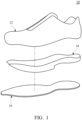
- FIG. 1 is a schematic diagram of a shoe in accordance with one embodiment of the disclosure.
- a composition for preparing a foam, a foam, and a shoe employing the foam are provided.
- the present composition includes specific polymer ingredients and the contents thereof.
- a foaming process e.g. a physical or chemical foaming process
- the obtained foam has a relatively low compression set and improved mechanical strength (such as split tear strength or tensile strength) under a low-density state (e.g. the specific gravity thereof is less than about 0.18). Therefore, the foam can be widely used in various applications (such as electrical/mechanical parts, vehicle parts, building materials, packaging materials, or daily necessities).
- the composition for preparing a foam may include about 3-30 parts by weight (e.g. 5-30 parts by weight, 5-20 parts by weight, 10-30 parts by weight or 20-30 parts by weight) of a first polymer and about 70-97 parts by weight (e.g. 70-95 parts by weight, 80-95 parts by weight, 70-90 parts by weight or 70-80 parts by weight) of a second polymer and/or a third polymer.
- the total weight of the first polymer, the second polymer and the third polymer is 100 parts by weight.
- the composition may include 3-30 parts by weight of the first polymer and 70-97 parts by weight of the second polymer.
- the composition may include 3-30 parts by weight of the first polymer and 70-97 parts by weight of the third polymer.
- the composition may include the first polymer, the second polymer and the third polymer.
- the weight of the first polymer is 3-30 parts by weight.
- the total weight of the second polymer and the third polymer is 70-97 parts by weight.
- the composition may consist of 3-30 parts by weight of the first polymer and 70-97 parts by weight of the second polymer.
- the composition may consist of 3-30 parts by weight of the first polymer and 70-97 parts by weight of the third polymer.
- the composition may consist of the first polymer, the second polymer and the third polymer.
- the weight of the first polymer is 3-30 parts by weight.
- the total weight of the second polymer and the third polymer is 70-97 parts by weight.
- the composition may include the first polymer, the second polymer and the third polymer.
- the weight ratio of the third polymer to the second polymer is in a range from about 1:20 to about 1:5, from about 1:18 to about 1:5, from about 1:17 to about 1:5, from about 1:18 to about 1:7, from about 1:17 to about 1:7, or from about 1:20 to about 1:7.
- the first polymer may be cyclic olefin polymer (COP), cyclic olefin copolymer (COC), metallocene based cyclic olefin copolymer (mCOC), fully hydrogenated conjugated diene-vinyl aromatic copolymer, or a combination thereof, wherein the fully hydrogenated conjugated diene-vinyl aromatic copolymer is defined as hydrogenation conversion of both of non-aromatic double bonds and aromatic double bonds of a conjugated diene-vinyl aromatic copolymer is greater than or equal to 90%.
- COP cyclic olefin polymer
- COC cyclic olefin copolymer
- mCOC metallocene based cyclic olefin copolymer
- fully hydrogenated conjugated diene-vinyl aromatic copolymer is defined as hydrogenation conversion of both of non-aromatic double bonds and aromatic double bonds of a conjugated diene-vinyl aromatic cop
- the weight average molecular weight of the first polymer may be in a range from about 10,000 to about 200,000, such as between about 40,000 and about 180,000, between about 40,000 and about 130,000, between about 50,000 and about 90,000, or between about 90,000 and about 120,000.
- the weight average molecular weight of the second polymer may be in a range from about 10,000 to about 200,000, such as between about 40,000 and about 180,000, or between about 80,000 and about 120,000.
- the weight average molecular weight of the third polymer may be in a range from about 10,000 to about 200,000, such as between about 50,000 and about 150,000, or between about 80,000 and about 120,000.
- the cyclic olefin polymer may be a polymer of substituted or unsubstituted norbornene-based monomer.
- the norbornene-based monomer may be norbornene, ethylidene norbornene, dicyclopentadiene, methano tetrahydrofluorene, tetracyclododecene, or a combination thereof.
- the substituted norbornene-based monomer means that at least one hydrogen (e.g., hydrogen on carbon) of the norbornene-based monomer can be replaced with an alkyl group or a reactive functional group (e.g., an alkenyl group).
- the cyclic olefin copolymer may be a copolymer of substituted or unsubstituted norbornene-based monomer and olefin-based monomer.
- the norbornene-based monomer may be norbornene, ethylidene norbornene, dicyclopentadiene, methano tetrahydrofluorene, tetracyclododecene, or a combination thereof.
- the olefin-based monomer may be ethylene, propylene, isobutylene, 1-butene, 1-pentene, 1-hexene, 3-methyl-1-butene, 3-methyl-1-pentene, 3-ethyl-1-pentene, 4-methyl-1-pentene, 4-methyl-1-hexene, 4,4-dimethyl-1-hexene, 4,4-dimethyl-1-pentene, 4-ethyl-1-hexene, 3-ethyl-1-hexene, 1-octene, isoprene, tetrafluoroethylene, 1-decene, 1-dodecene, 1-tetradecene, 1-hexadecene, 1-octadecene, 1-eicosene, cyclobutene, cyclopentene, cyclohexene, cyclooctene, 1,3-butadiene, 1,3-pentadiene, 3,4-di
- the ratio of the norbornene-based monomer to the olefin-based monomer may be in a range from about 30:70 to about 99: 1, for example, from about 50:50 to about 97:3 or from about 70:30 to about 95:5.
- the first polymer may be, for example, ZEONEX (registered trademark, manufactured by Japan Zeon Co., Ltd.), ZEONOR (registered trademark, manufactured by Japan Zeon Co., Ltd.), ARTON (registered trademark, manufactured by JSR Co., Ltd.), APEL (registered trademark, manufactured by Mitsui Chemicals Co., Ltd.), or TOPAS (registered trademark, manufactured by POLYPLASTICS Co., Ltd., an addition polymer of norbornene-based monomer and ethylene).
- ZEONEX registered trademark, manufactured by Japan Zeon Co., Ltd.
- ZEONOR registered trademark, manufactured by Japan Zeon Co., Ltd.
- ARTON registered trademark, manufactured by JSR Co., Ltd.
- APEL registered trademark, manufactured by Mitsui Chemicals Co., Ltd.
- TOPAS registered trademark, manufactured by POLYPLASTICS Co., Ltd., an addition polymer of norbornene-based monomer and ethylene
- the fully hydrogenated conjugated diene-vinyl aromatic copolymer may be fully hydrogenated styrene-butadiene-styrene (SBS) block copolymer, fully hydrogenated styrene-butadiene-styrene-butadiene-styrene (SBSBS) block copolymer, fully hydrogenated styrene-(isoprene/butadiene)-styrene (S-(I/B)-S) block copolymer, fully hydrogenated styrene-(isoprene/butadiene)-styrene-(isoprene/butadiene)-styrene (S-(I/B)-S-(I/B)-S) block copolymer, fully hydrogenated styrene-isoprene-styrene (SIS) block copolymer, fully hydrogenated styrene-isoprene
- the fully hydrogenated conjugated diene-vinyl aromatic copolymer is prepared by hydrogenation of a conjugated diene-vinyl aromatic copolymer.
- the proportion of its double bonds (including non-aromatic double bonds and aromatic double bonds) converted into single bonds is greater than or equal to 90%, for example, greater than or equal to 95%, greater than or equal to 97%, or greater than or equal to 99%.
- the hydrogenation conversion of the fully hydrogenated conjugated diene-vinyl aromatic copolymer is greater than or equal to 90%, for example, greater than or equal to 95%, greater than or equal to 97%, or greater than or equal to 99%.
- the first polymer may be ViViOn (registered trademark, manufactured by USI Co., Ltd.).
- the metallocene based cyclic olefin copolymer may be prepared by polymerizing the norbornene-based monomer and the olefin-based monomer with a metallocene compound.
- the metallocene based cyclic olefin copolymer may be prepared by polymerizing the norbornene-based monomer and the olefin-based monomer with a metallocene compound and an activated catalyst.
- the examples thereof include the titanocene compounds described in JP1984-152396A ( JP-S59-152396A ), JP1986-151197A ( JP-S61-151197A ), JP1988-41484A ( JP-S63-41484A ), JP1990-249A ( JP-H02-249A ), JP1990-291A ( JP-H02-291A ), and JP1990-4705A ( JP-H02-4705A ), and the iron-arene complexes described in JP1989-304453A ( JP-H01-304453A ) and JP1989-152109A ( JP-H01-152109A ).
- titanocene compound examples include bis(cyclopentadienyl)-titanium-dichloride, bis(cyclopentadienyl)-titanium-bis-phenyl, bis(cyclopentadienyl)-titanium-bis(2,3,4,5,6-pentafluorophenyl), bis(cyclopentadienyl)-titanium-bis(2,3,5,6-tetrafluorophenyl), bis(cyclopentadienyl)-titanium-bis(2,4,6-trifluorophenyl), bis(cyclopentadienyl)-titanium-bis(2,6-difluorophenyl), bis(cyclopentadienyl)-titanium-bis(2,4-difluorophenyl), bis(methylcyclopentadienyl)-titanium-bis(2,3,4,5,6-pentafluorophenyl),
- the polyolefin may be a polymer of olefin-based monomer (e.g., ⁇ -olefin-based monomer).
- the olefin-based monomer may be ethylene, propylene, isobutylene, 1-butene, 1-pentene, 1-hexene, 3-methyl-1-butene, 3-methyl-1-pentene, 3-ethyl-1-pentene, 4-methyl-1-pentene, 4-methyl-1-hexene, 4,4-dimethyl-1-hexene, 4,4-dimethyl-1-pentene, 4-ethyl-1-hexene, 3-ethyl-1-hexene, 1-octene, isoprene, tetrafluoroethylene, 1-decene, 1-dodecene, 1-tetradecene, 1-hexadecene, 1-octadecene, 1-eicosen
- the olefin copolymer may be a copolymer containing olefin-based monomers (e.g., ⁇ -olefin-based monomers).
- the olefin copolymer may be prepared by copolymerizing at least two of the following monomers: ethylene, propylene, isobutylene, 1-butene, 1-pentene, 1-hexene, 3-methyl-1-butene, 3-methyl-1-pentene, 3-ethyl-1-pentene, 4-methyl-1-pentene, 4-methyl-1-hexene, 4,4-dimethyl-1-hexene, 4,4-dimethyl-1-pentene, 4-ethyl-1-hexene, 3-ethyl-1-hexene, 1-octene, isoprene, tetrafluoroethylene, 1-decene, 1-dodecene, 1-tetradecene, 1-
- the second polymer may be poly(ethylene) (PE), high-density polyethylene (HDPE), linear low-density polyethylene (LLDPE), low-density polyethylene (LDPE), polypropylene, poly(propylene- ⁇ -olefin), ethylene-propylene copolymer (EPC), poly(ethylene- ⁇ -olefin), poly(ethylene-octene), poly(ethylene-hexene), poly(ethylene-butylene), poly(ethylene-heptene), polybutylene, polypentene, (ethylene-vinyl acetate) copolymer (EVA), ethylene-ethyl acrylate copolymer (EEA), (ethylene-butyl acrylate) copolymer (EBA), ⁇ -olefin polymer, ⁇ -olefin copolymer, or a combination thereof.
- PE poly(ethylene)
- HDPE high-density polyethylene
- LLDPE linear low-density polyethylene
- EPC
- the high-density polyethylene typically has a density of about 0.94 to about 0.97g/cc.
- the low-density polyethylene (LDPE) typically has a density of about 0.91 to about 0.94g/cc.
- the linear low-density polyethylene (LLDPE) is characterized by having a relatively small amount of long chain branches, if any, relative to the low-density polyethylene (LDPE).
- the second polymer may be, for example, AFFINITY (registered trademark, available from Dow Chemical Company), ENGAGE (registered trademark, available from Dow Chemical Company, an ethylene-1-octene copolymer), INFUSE (registered trademark, available from Dow Chemical Company), ATTANE (registered trademark, available from Dow Chemical Company), DOWLEX (registered trademark, available from Dow Chemical Company), ELITE (registered trademark, available from Dow Chemical Company), EXCEED (registered trademark, available from Exxon Chemical Company), EXACT (registered trademark, available from Exxon Chemical Company), or TAFMER (registered trademark, available from Mitsui Chemical Company).
- AFFINITY registered trademark, available from Dow Chemical Company
- ENGAGE registered trademark, available from Dow Chemical Company, an ethylene-1-octene copolymer
- INFUSE registered trademark, available from Dow Chemical Company
- ATTANE registered trademark, available from Dow Chemical Company
- DOWLEX registered trademark, available from Dow Chemical Company
- the conjugated diene-vinyl aromatic copolymer may be prepared by copolymerizing a conjugated diene monomer and a vinyl aromatic monomer.
- the conjugated diene monomer includes 1,3-butadiene, 2,3-dimethyl-1,3-butadiene, 3-butyl-1,3-octadiene, isoprene, 1-methylbutadiene, 2-phenyl-1,3-butadiene, 2-methyl-1,3-pentadiene 1,3-hexadiene, 4,5-diethyl-1,3-octadiene, or a combination thereof.
- the vinyl aromatic monomer includes styrene, methylstyrene and its isomers, ethylstyrene and its isomers, cyclohexylstyrene, vinyl biphenyl, 1-vinyl-5-hexyl naphthalene, vinyl naphthalene, vinyl anthracene, 4-tert-butylstyrene, divinyl benzene, 1,1-diphenyl ethylene, N,N-dimethyl-p-aminoethylstyrene, N,N-diethyl-p-aminoethylstyrene, or a combination thereof.
- the conjugated diene-vinyl aromatic copolymer may be styrene-butadiene-styrene (SBS) block copolymer, styrene-isoprene-styrene (SIS) block copolymer, styrene-(isoprene/butadiene)-styrene (S-(I/B)-S) block copolymer, or a combination thereof.
- SBS styrene-butadiene-styrene
- SIS styrene-isoprene-styrene
- S-(I/B)-S) block copolymer styrene-(I/B)-S block copolymer
- the partially hydrogenated conjugated diene-vinyl aromatic copolymer may be, for example, partially hydrogenated styrene-butadiene-styrene (SBS) block copolymer (i.e. styrene-ethylene-butylene-styrene (SEBS) block copolymer), partially hydrogenated styrene-isoprene-styrene (SIS) block copolymer (i.e.
- SBS partially hydrogenated styrene-butadiene-styrene
- SEBS styrene-ethylene-butylene-styrene
- SIS partially hydrogenated styrene-isoprene-styrene
- the partially hydrogenated conjugated diene-vinyl aromatic copolymer is prepared by selective hydrogenation of a conjugated diene-vinyl aromatic copolymer.
- the proportion of its non-aromatic double bonds converted into single bonds is greater than or equal to 70%, for example, greater than or equal to 80%, greater than or equal to 90%, greater than or equal to 95%, or greater than or equal to 98%.
- the hydrogenation conversion of the non-aromatic double bonds of the partially hydrogenated conjugated diene-vinyl aromatic copolymer is greater than or equal to 70%, for example, greater than or equal to 80%, or greater than or equal to 90%, or greater than or equal to 95%, or greater than or equal to 98%.
- the present composition may be prepared into a foam using a foaming process (e.g. a physical or chemical foaming process).
- a foaming process e.g. a physical or chemical foaming process
- the ratio of the compression set to the specific gravity of the foam may be less than 450, for example, between 449 and 180, between 445 and 200, between 445 and 250, between 350 and 180, between 350 and 200, or between 350 and 250. Furthermore, in accordance with some embodiments of the disclosure, the ratio of the split tear strength to the specific gravity of the foam is greater than or equal to 13.8, for example, between 13.8 and 20, or between 13.8 and 18.
- the present composition for preparing a foam when the foam is formed by performing a chemical foaming process, further includes 0.1-10 parts by weight of a cross-linking agent and 0.1-25 parts by weight of a blowing agent.
- the cross-linking agent is a peroxide-type cross-linking agent or a sulfur-type cross-linking agent.
- the peroxide-type cross-linking agent includes such as dicumyl peroxide (DCP), perbutyl peroxide (PBP), dimethyl-di-tert-butylperoxy hexane, tert-butylethylhexyl carbonate monoperoxide, di-tert-butyl peroxide, 2,5-dimethyl-2,5-di(tert-butylperoxy)hexane, 2,5-dimethyl-2,5-di(tert-butylperoxy)-3-hexyne, di(tert-butylperoxyisopropyl)benzene, 1,1-di-tert-butyl-peroxy-3,3,5-trimethyl cyclohexane, butyl 4,4-bis(tert-butyl
- the blowing agent may be an organic thermal-decomposition-type blowing agent, for example, N,N'-dinitrosopentamethylenetetramine, azodicarbonamide, p,p' -oxybis(benzenesulfonyl hydrazide), p-toluenesulfonylhydrazide, benzenesulfonyl hydrazide, 3,3'-disulfonylhydrazide diphenylsulfone, p-toluenesulfonyl semicarbazide, trihydrazinotriazine, or a combination thereof, but the disclosure is not limited thereto.
- organic thermal-decomposition-type blowing agent for example, N,N'-dinitrosopentamethylenetetramine, azodicarbonamide, p,p' -oxybis(benzenesulfonyl hydrazide), p-toluenesulfonyl
- the blowing agent may be an inorganic thermal-decomposition-type blowing agent, for example, sodium bicarbonate, potassium bicarbonate, ammonium bicarbonate, sodium carbonate, ammonium carbonate, or a combination thereof, but the disclosure is not limited thereto.
- the present composition may further include heat stabilizer, light stabilizer, softener, plasticizer (such as citric acid or citric acid ester), dye, pigment, antioxidant, UV absorber, filler (such as calcium carbonate, mica or wood fiber), antistatic agent, impact modifier, or a combination thereof.
- plasticizer such as citric acid or citric acid ester
- dye such as citric acid or citric acid ester
- dye such as citric acid or citric acid ester
- dye such as citric acid or citric acid ester
- dye such as citric acid or citric acid ester
- antioxidant such as antioxidant
- UV absorber such as calcium carbonate, mica or wood fiber
- filler such as calcium carbonate, mica or wood fiber
- antistatic agent such as calcium carbonate, mica or wood fiber
- a supercritical fluid when the foam is formed by a physical foaming process, a supercritical fluid may be used for foaming.
- the supercritical fluid may be carbon dioxide, water, methane, ethane, butane, propane, pentane, hexane, ethylene, propylene, methanol, ethanol, acetone, nitrogen, or a combination thereof.
- a shoe 10 is also provided.
- the shoe 10 includes an upper vamp 12, a midsole 14, and an outsole 16.
- at least one of the midsole 14 and the outsole 16 includes the disclosed foam.
- Table 1 lists the materials involved in the embodiments of the disclosure.
- Table 1 Product code Category Supplier Ingredients EVA 7470 Second polymer Taisox Ethylene-vinyl acetate copolymer AS(PN-117C) Second polymer CHIMEI Styrene-acrylonitrile copolymer Infuse 9100 Second polymer Dow Ethylene-1-octene copolymer Infuse 9530 Second polymer Dow Ethylene-1-octene copolymer DF 110 Second polymer Mitsui Ethylene-1-octene copolymer DF 840 Second polymer Mitsui Ethylene- ⁇ -olefin copolymer LDPE NA-112-27 Second polymer USI LDPE DP6014 Third polymer TSRC SEBS SBS 3206 Third polymer TSRC SBS TOPAS 8007 First polymer TOPAS Norbornene-ethylene copolymer TOPAS 6013 First polymer TOPAS Norbornene-ethylene copolymer ViViOn 13
- EVA 7470 50 parts by weight of EVA 7470, 25 parts by weight of Infuse 9100, 10 parts by weight of DF 110, 4.3 parts by weight of DP6014, 0.7 parts by weight of SBS 3206, 10 parts by weight of TOPAS 8007, 1.6 parts by weight of DCP-40, and 14.5 parts by weight of AC D600 were placed in a mixer. After heating to 120°C, the mixing process was continued until the resultant was completely fused. Next, the resultant was pelletized with a twin-screw extruder and the pellets were collected. Next, the pellets were placed in a foam injector and then injected to mold a test piece at a mold temperature of about 172°C. The shaping time was about 390 seconds.
- test piece was placed in an oven and then baked at 70-75°C for 45-60 minutes. After the test piece was removed from the oven and left to stand at room temperature for one day, the test piece was subjected to a cold-hot compression molding process with a mold (size of 400mm ⁇ 305mm ⁇ 90mm (length ⁇ width ⁇ height)), obtaining Foam (I). The surface of the test piece reached 138°C when heated, and the surface of the test piece reached 20°C when cooled.
- the measurement method of the specific gravity was based on ASTM D792.
- the measurement method of the compression set was based on ASTM D573.
- the measurement method of the split tear strength was based on ASTM D3574-95.
- Examples 2-8 and Comparative Example 1 were performed in the same manner as in Example 1 except that the ingredients and contents of the first polymer, the second polymer, the third polymer, the cross-linking agent and the blowing agent listed in Table 2 were substituted for those used in Example 1, obtaining Foam (II)-(IX).
- the specific gravity, compression set, and split tear strength of Foam (II)-(IX) were measured. The results are shown in Table 2.
- Table 2 first polymer/parts by weight second polymer/parts by weight third polymer/parts by weight cross-linking agent /parts by weight, blowing agent/parts by weight specific gravity the ratio of compression set to specific gravity the ratio of split tear strength to specific gravity Ex.
- the foam prepared from the compositions with the added first polymer (Examples 1-8) via a chemical foaming process has the relatively low ratio of compression set to specific gravity.
- the ratio of split tear strength to specific gravity thereof can also be improved at the same time.
- EVA 7470 10 parts by weight of ViViOn 1325, 0.8 parts by weight of BIPB, and 7.0 parts by weight of AC D600 were placed in a mixer. After heating to 120°C, the mixing process was continued until the resultant was completely fused. Next, the resultant was pelletized with a twin-screw extruder and the pellets were collected. Next, the pellets were placed in a foam injector and then injected to mold a test piece at a mold temperature of about 172°C. The shaping time was about 390 seconds. Next, the test piece was placed in an oven and then baked at 70-75°C for 45-60 minutes.
- test piece After the test piece was removed from the oven and left to stand at room temperature for one day, the test piece was subjected to cold-hot compression molding process with a mold (size of 400mm ⁇ 305mm ⁇ 90mm (length ⁇ width ⁇ height)), obtaining Foam (X). The surface of the test piece reached 138°C when heated, and the surface of the test piece reached 20°C when cooled.
- Example 10 was performed in the same manner as in Example 9 except that TOPAS 6013 was substituted for ViViOn 1325, obtaining Foam (XI). Next, the specific gravity, compression set, and split tear strength of Foam (XI) were measured. The results are shown in Table 3.
- EVA 7470 100 parts by weight of EVA 7470, 0.8 parts by weight of BIPB, and 7.0 parts by weight of AC D600 were placed in a mixer. After heating to 120°C, the mixing process was continued until the resultant was completely fused. Next, the resultant was pelletized with a twin-screw extruder and the pellets were collected. Next, the pellets were placed in a foam injector and then injected to mold a test piece at a mold temperature of about 172°C. The shaping time was about 390 seconds. Next, the test piece was placed in an oven and then baked at 70-75°C for 45-60 minutes.
- test piece After the test piece was removed from the oven and left to stand at room temperature for one day, the test piece was subjected to cold-hot compression molding process with a mold (size of 400mm ⁇ 305mm ⁇ 90mm (length ⁇ width ⁇ height)), obtaining Foam (XII). The surface of the test piece reached 138°C when heated, and the surface of the test piece reached 20°C when cooled.
- the foam prepared from the compositions with the added first polymer and second polymer (Examples 9-10) via a chemical foaming process has the relatively low ratio of compression set to specific gravity.
- the ratio of split tear strength to specific gravity thereof can also be improved at the same time.
- EVA 7470 55 parts by weight of EVA 7470, 25 parts by weight of Infuse 9100, 15 parts by weight of DF 840, 5.0 parts by weight of TOPAS 8007, 1.7 parts by weight of DCP-40, and 8.2 parts by weight of D600MT were placed in a mixer. After heating to 120°C, the mixing process was continued until the resultant was completely fused. Next, the resultant was pelletized with a twin-screw extruder and the pellets were collected. Next, the pellets were placed in a foam injector and then injected to mold a test piece at a mold temperature of about 172°C. The shaping time was about 390 seconds. Next, the test piece was placed in an oven and then baked at 70-75°C for 45-60 minutes.
- test piece After the test piece was removed from the oven and left to stand at room temperature for one day, the test piece was subjected to cold-hot compression molding process with a mold (size of 400mm ⁇ 305mm ⁇ 90mm (length ⁇ width ⁇ height)), obtaining Foam (XIII). The surface of the test piece reached 138°C when heated, and the surface of the test piece reached 20°C when cooled.
- Example 12 was performed in the same manner as in Example 11 except that the ingredients and contents of the first polymer, the second polymer, the third polymer, the cross-linking agent and the blowing agent listed in Table 4 were substituted for those used in Example 11, obtaining Foam (XIV). Next, the specific gravity, compression set, and split tear strength of Foam (XIV) were measured. The results are shown in Table 4. Table 4 first polymer/parts by weight second polymer/parts by weight third polymer/parts by weight cross-linking agent /parts by weight, blowing agent/parts by weight specific gravity the ratio of compression set to specific gravity the ratio of split tear strength to specific gravity Ex.
- the resulting foam still has a ratio of compression set to specific gravity less than 450, and the ratio of split tear strength to specific gravity thereof is greater than or equal to 15.
- Example 14 performed in the same manner as in Example 13, except that TOPAS 6013 was substituted for ViViOn 1325, obtaining Foam (XVI) with a specific gravity of 0.133
Landscapes
- Chemical & Material Sciences (AREA)
- Health & Medical Sciences (AREA)
- Polymers & Plastics (AREA)
- Chemical Kinetics & Catalysis (AREA)
- Medicinal Chemistry (AREA)
- Organic Chemistry (AREA)
- Engineering & Computer Science (AREA)
- Materials Engineering (AREA)
- General Chemical & Material Sciences (AREA)
- Mechanical Engineering (AREA)
- Emergency Medicine (AREA)
- Manufacture Of Porous Articles, And Recovery And Treatment Of Waste Products (AREA)
- Compositions Of Macromolecular Compounds (AREA)
- Footwear And Its Accessory, Manufacturing Method And Apparatuses (AREA)
Description
- The disclosure relates to a composition for preparing a foam, a foam, and a shoe employing the same.
- Rubber/plastic foams are used for various applications (such as electrical/mechanical parts, vehicle parts, building materials, packaging materials, or daily necessities) because of showing various properties (such as heat-shielding property, heat insulation, sound insulation, sound absorbency, vibration resistance, or light weight conveniences), depending on the raw material of the foam and the state of the bubbles that are formed.
- However, the compression set and mechanical strength (such as split tear strength or tensile strength) of conventional foams are accordingly reduced along with the decrease in the density of the foams, thus restricting its use.
-
US 2006/205895 A1 discloses a polymer foam comprising a plurality of cells walls which constitute a polymer matrix. The polymer foam can be used as a shock absorber such as footwear material. - Therefore, it is necessary to develop a low-density and high-strength foam to solve the previously described problems.
- In accordance with one embodiment of the disclosure, a composition for preparing a foam is provided. The composition includes 3-30 parts by weight of a first polymer and at least one of a second polymer and a third polymer. The first polymer is cyclic olefin polymer (COP), cyclic olefin copolymer (COC), metallocene based cyclic olefin copolymer (mCOC), fully hydrogenated conjugated diene-vinyl aromatic copolymer, or a combination thereof, wherein the fully hydrogenated conjugated diene-vinyl aromatic copolymer is defined as hydrogenation conversion of both of non-aromatic double bonds and aromatic double bonds of a conjugated diene-vinyl aromatic copolymer is greater than or equal to 90%. The total weight of the second polymer and the third polymer is 70-97 parts by weight. The second polymer is polyolefin, olefin copolymer, or a combination thereof. The third polymer is conjugated diene-vinyl aromatic copolymer, partially hydrogenated conjugated diene-vinyl aromatic copolymer, or a combination thereof, wherein the partially hydrogenated conjugated diene-vinyl aromatic copolymer is defined as hydrogenation conversion of non-aromatic double bonds of a conjugated diene-vinyl aromatic copolymer is greater than or equal to 70%. The total weight of the first polymer and at least one of the second polymer and the third polymer is 100 parts by weight.
- In accordance with one embodiment of the disclosure, a low-density and high-strength foam is provided. The foam is prepared by the aforementioned composition for preparing a foam. In some embodiments, the ratio of the compression set to the specific gravity of the foam is less than 450. The ratio of the split tear strength to the specific gravity of the foam is greater than or equal to 13.8.
- In accordance with one embodiment of the disclosure, a shoe including the above-mentioned foam is provided. The shoe includes an upper vamp, a midsole, and an outsole. At least one of the midsole and the outsole includes the present foam.
- A detailed description is given in the following embodiments with reference to the accompanying drawings.
The present disclosure can be more fully understood by reading the subsequent detailed description and examples with references made to the accompanying drawings, wherein: -
FIG. 1 is a schematic diagram of a shoe in accordance with one embodiment of the disclosure. - The following description is the embodiments of carrying out the disclosure. This description is made for the purpose of illustrating the general principles of the disclosure and should not be taken in a limiting sense. The scope of the disclosure is determined by reference to the appended claims.
- In accordance with one embodiment of the disclosure, a composition for preparing a foam, a foam, and a shoe employing the foam are provided. The present composition includes specific polymer ingredients and the contents thereof. When the composition is prepared into a foam by a foaming process (e.g. a physical or chemical foaming process), the obtained foam has a relatively low compression set and improved mechanical strength (such as split tear strength or tensile strength) under a low-density state (e.g. the specific gravity thereof is less than about 0.18). Therefore, the foam can be widely used in various applications (such as electrical/mechanical parts, vehicle parts, building materials, packaging materials, or daily necessities).
- In accordance with some embodiments of the disclosure, the composition for preparing a foam may include about 3-30 parts by weight (e.g. 5-30 parts by weight, 5-20 parts by weight, 10-30 parts by weight or 20-30 parts by weight) of a first polymer and about 70-97 parts by weight (e.g. 70-95 parts by weight, 80-95 parts by weight, 70-90 parts by weight or 70-80 parts by weight) of a second polymer and/or a third polymer. The total weight of the first polymer, the second polymer and the third polymer is 100 parts by weight. For example, the composition may include 3-30 parts by weight of the first polymer and 70-97 parts by weight of the second polymer. The composition may include 3-30 parts by weight of the first polymer and 70-97 parts by weight of the third polymer. Optionally, the composition may include the first polymer, the second polymer and the third polymer. The weight of the first polymer is 3-30 parts by weight. The total weight of the second polymer and the third polymer is 70-97 parts by weight.
- In accordance with some embodiments of the disclosure, the composition may consist of 3-30 parts by weight of the first polymer and 70-97 parts by weight of the second polymer. The composition may consist of 3-30 parts by weight of the first polymer and 70-97 parts by weight of the third polymer. Optionally, the composition may consist of the first polymer, the second polymer and the third polymer. The weight of the first polymer is 3-30 parts by weight. The total weight of the second polymer and the third polymer is 70-97 parts by weight.
- In accordance with some embodiments of the disclosure, the composition may include the first polymer, the second polymer and the third polymer. The weight ratio of the third polymer to the second polymer is in a range from about 1:20 to about 1:5, from about 1:18 to about 1:5, from about 1:17 to about 1:5, from about 1:18 to about 1:7, from about 1:17 to about 1:7, or from about 1:20 to about 1:7.
- In accordance with some embodiments of the disclosure, the first polymer may be cyclic olefin polymer (COP), cyclic olefin copolymer (COC), metallocene based cyclic olefin copolymer (mCOC), fully hydrogenated conjugated diene-vinyl aromatic copolymer, or a combination thereof, wherein the fully hydrogenated conjugated diene-vinyl aromatic copolymer is defined as hydrogenation conversion of both of non-aromatic double bonds and aromatic double bonds of a conjugated diene-vinyl aromatic copolymer is greater than or equal to 90%.
- In accordance with some embodiments of the disclosure, the weight average molecular weight of the first polymer may be in a range from about 10,000 to about 200,000, such as between about 40,000 and about 180,000, between about 40,000 and about 130,000, between about 50,000 and about 90,000, or between about 90,000 and about 120,000. The weight average molecular weight of the second polymer may be in a range from about 10,000 to about 200,000, such as between about 40,000 and about 180,000, or between about 80,000 and about 120,000. The weight average molecular weight of the third polymer may be in a range from about 10,000 to about 200,000, such as between about 50,000 and about 150,000, or between about 80,000 and about 120,000.
- In accordance with some embodiments of the disclosure, the cyclic olefin polymer (COP) may be a polymer of substituted or unsubstituted norbornene-based monomer. For example, the norbornene-based monomer may be norbornene, ethylidene norbornene, dicyclopentadiene, methano tetrahydrofluorene, tetracyclododecene, or a combination thereof. In accordance with some embodiments of the disclosure, the substituted norbornene-based monomer means that at least one hydrogen (e.g., hydrogen on carbon) of the norbornene-based monomer can be replaced with an alkyl group or a reactive functional group (e.g., an alkenyl group).
- In accordance with some embodiments of the disclosure, the cyclic olefin copolymer (COC) may be a copolymer of substituted or unsubstituted norbornene-based monomer and olefin-based monomer. The norbornene-based monomer may be norbornene, ethylidene norbornene, dicyclopentadiene, methano tetrahydrofluorene, tetracyclododecene, or a combination thereof. The olefin-based monomer may be ethylene, propylene, isobutylene, 1-butene, 1-pentene, 1-hexene, 3-methyl-1-butene, 3-methyl-1-pentene, 3-ethyl-1-pentene, 4-methyl-1-pentene, 4-methyl-1-hexene, 4,4-dimethyl-1-hexene, 4,4-dimethyl-1-pentene, 4-ethyl-1-hexene, 3-ethyl-1-hexene, 1-octene, isoprene, tetrafluoroethylene, 1-decene, 1-dodecene, 1-tetradecene, 1-hexadecene, 1-octadecene, 1-eicosene, cyclobutene, cyclopentene, cyclohexene, cyclooctene, 1,3-butadiene, 1,3-pentadiene, 3,4-dimethyl-cyclopentene, 3-methyl-cyclohexene, 2-(2-methylbutyl)-1-cyclohexene, 1,4-hexadiene, 4-methyl-1,4-hexadiene, 5-methyl-1,4-hexadiene, 7-methyl-1,6-octadiene, 3,7-dimethyl-1,6-octadiene, 5,7-dimethyl-1,6-octadiene, 1,7-octadiene, 3,7,11-trimethyl-1,6,10-octatriene, 6-methyl-1,5-heptadiene, 1,6-heptadiene, 1,8-nonadiene, 1,9-decadiene, 1,10-undecadiene, or a combination thereof. In accordance with some embodiments of the disclosure, the ratio of the norbornene-based monomer to the olefin-based monomer may be in a range from about 30:70 to about 99: 1, for example, from about 50:50 to about 97:3 or from about 70:30 to about 95:5.
- In accordance with some embodiments of the disclosure, the first polymer may be, for example, ZEONEX (registered trademark, manufactured by Japan Zeon Co., Ltd.), ZEONOR (registered trademark, manufactured by Japan Zeon Co., Ltd.), ARTON (registered trademark, manufactured by JSR Co., Ltd.), APEL (registered trademark, manufactured by Mitsui Chemicals Co., Ltd.), or TOPAS (registered trademark, manufactured by POLYPLASTICS Co., Ltd., an addition polymer of norbornene-based monomer and ethylene).
- In accordance with some embodiments of the disclosure, the fully hydrogenated conjugated diene-vinyl aromatic copolymer may be fully hydrogenated styrene-butadiene-styrene (SBS) block copolymer, fully hydrogenated styrene-butadiene-styrene-butadiene-styrene (SBSBS) block copolymer, fully hydrogenated styrene-(isoprene/butadiene)-styrene (S-(I/B)-S) block copolymer, fully hydrogenated styrene-(isoprene/butadiene)-styrene-(isoprene/butadiene)-styrene (S-(I/B)-S-(I/B)-S) block copolymer, fully hydrogenated styrene-isoprene-styrene (SIS) block copolymer, fully hydrogenated styrene-isoprene-styrene-isoprene-styrene (SISIS) block copolymer, or a combination thereof. In accordance with some embodiments of the disclosure, the fully hydrogenated conjugated diene-vinyl aromatic copolymer is prepared by hydrogenation of a conjugated diene-vinyl aromatic copolymer. After the hydrogenation of the conjugated diene-vinyl aromatic copolymer, the proportion of its double bonds (including non-aromatic double bonds and aromatic double bonds) converted into single bonds is greater than or equal to 90%, for example, greater than or equal to 95%, greater than or equal to 97%, or greater than or equal to 99%. In other words, the hydrogenation conversion of the fully hydrogenated conjugated diene-vinyl aromatic copolymer is greater than or equal to 90%, for example, greater than or equal to 95%, greater than or equal to 97%, or greater than or equal to 99%. For example, the first polymer may be ViViOn (registered trademark, manufactured by USI Co., Ltd.).
- In accordance with some embodiments of the disclosure, the metallocene based cyclic olefin copolymer (mCOC) may be prepared by polymerizing the norbornene-based monomer and the olefin-based monomer with a metallocene compound. In addition, the metallocene based cyclic olefin copolymer (mCOC) may be prepared by polymerizing the norbornene-based monomer and the olefin-based monomer with a metallocene compound and an activated catalyst. As the metallocene compound, the examples thereof include the titanocene compounds described in
JP1984-152396A JP-S59-152396A JP1986-151197A JP-S61-151197A JP1988-41484A JP-S63-41484A JP1990-249A JP-H02-249A JP1990-291A JP-H02-291A JP1990-4705A JP-H02-4705A JP1989-304453A JP-H01-304453A JP1989-152109A JP-H01-152109A - In accordance with some embodiments of the disclosure, the polyolefin may be a polymer of olefin-based monomer (e.g., α-olefin-based monomer). For example, the olefin-based monomer may be ethylene, propylene, isobutylene, 1-butene, 1-pentene, 1-hexene, 3-methyl-1-butene, 3-methyl-1-pentene, 3-ethyl-1-pentene, 4-methyl-1-pentene, 4-methyl-1-hexene, 4,4-dimethyl-1-hexene, 4,4-dimethyl-1-pentene, 4-ethyl-1-hexene, 3-ethyl-1-hexene, 1-octene, isoprene, tetrafluoroethylene, 1-decene, 1-dodecene, 1-tetradecene, 1-hexadecene, 1-octadecene, 1-eicosene, cyclobutene, cyclopentene, cyclohexene, cyclooctene, 1,3-butadiene, 1,3-pentadiene, 3,4-dimethyl-cyclopentene, 3-methyl-cyclohexene, 2-(2-methylbutyl)-1-cyclohexene, 1,4-hexadiene, 4-methyl-1,4-hexadiene, 5-methyl-1,4-hexadiene, 7-methyl-1,6-octadiene, 3,7-dimethyl-1,6-octadiene, 5,7-dimethyl-1,6-octadiene, 1,7-octadiene, 3,7,11-trimethyl-1,6,10-octatriene, 6-methyl-1,5-heptadiene, 1,6-heptadiene, 1,8-nonadiene, 1,9-decadiene, or 1,10-undecadiene.
- In accordance with some embodiments of the disclosure, the olefin copolymer may be a copolymer containing olefin-based monomers (e.g., α-olefin-based monomers). For example, the olefin copolymer may be prepared by copolymerizing at least two of the following monomers: ethylene, propylene, isobutylene, 1-butene, 1-pentene, 1-hexene, 3-methyl-1-butene, 3-methyl-1-pentene, 3-ethyl-1-pentene, 4-methyl-1-pentene, 4-methyl-1-hexene, 4,4-dimethyl-1-hexene, 4,4-dimethyl-1-pentene, 4-ethyl-1-hexene, 3-ethyl-1-hexene, 1-octene, isoprene, tetrafluoroethylene, 1-decene, 1-dodecene, 1-tetradecene, 1-hexadecene, 1-octadecene, 1-eicosene, cyclobutene, cyclopentene, cyclohexene, cyclooctene, 1,3-butadiene, 1,3-pentadiene, 3,4-dimethyl-cyclopentene, 3-methyl-cyclohexene, 2-(2-methylbutyl)-1-cyclohexene, 1,4-hexadiene, 4-methyl-1,4-hexadiene, 5-methyl-1,4-hexadiene, 7-methyl-1,6-octadiene, 3,7-dimethyl-1,6-octadiene, 5,7-dimethyl-1,6-octadiene, 1,7-octadiene, 3,7,11-trimethyl-1,6,10-octatriene, 6-methyl-1,5-heptadiene, 1,6-heptadiene, 1,8-nonadiene, 1,9-decadiene, 1,10-undecadiene, acrylate, vinyl acetate, or butyl acrylate.
- In accordance with some embodiments of the disclosure, the second polymer may be poly(ethylene) (PE), high-density polyethylene (HDPE), linear low-density polyethylene (LLDPE), low-density polyethylene (LDPE), polypropylene, poly(propylene-α-olefin), ethylene-propylene copolymer (EPC), poly(ethylene-α-olefin), poly(ethylene-octene), poly(ethylene-hexene), poly(ethylene-butylene), poly(ethylene-heptene), polybutylene, polypentene, (ethylene-vinyl acetate) copolymer (EVA), ethylene-ethyl acrylate copolymer (EEA), (ethylene-butyl acrylate) copolymer (EBA), α-olefin polymer, α-olefin copolymer, or a combination thereof.
- In accordance with some embodiments of the disclosure, the high-density polyethylene (HDPE) typically has a density of about 0.94 to about 0.97g/cc. The low-density polyethylene (LDPE) typically has a density of about 0.91 to about 0.94g/cc. In addition, the linear low-density polyethylene (LLDPE) is characterized by having a relatively small amount of long chain branches, if any, relative to the low-density polyethylene (LDPE).
- In accordance with some embodiments of the disclosure, the second polymer may be, for example, AFFINITY (registered trademark, available from Dow Chemical Company), ENGAGE (registered trademark, available from Dow Chemical Company, an ethylene-1-octene copolymer), INFUSE (registered trademark, available from Dow Chemical Company), ATTANE (registered trademark, available from Dow Chemical Company), DOWLEX (registered trademark, available from Dow Chemical Company), ELITE (registered trademark, available from Dow Chemical Company), EXCEED (registered trademark, available from Exxon Chemical Company), EXACT (registered trademark, available from Exxon Chemical Company), or TAFMER (registered trademark, available from Mitsui Chemical Company).
- In accordance with some embodiments of the disclosure, the conjugated diene-vinyl aromatic copolymer may be prepared by copolymerizing a conjugated diene monomer and a vinyl aromatic monomer. The conjugated diene monomer includes 1,3-butadiene, 2,3-dimethyl-1,3-butadiene, 3-butyl-1,3-octadiene, isoprene, 1-methylbutadiene, 2-phenyl-1,3-butadiene, 2-methyl-1,3-pentadiene 1,3-hexadiene, 4,5-diethyl-1,3-octadiene, or a combination thereof. The vinyl aromatic monomer includes styrene, methylstyrene and its isomers, ethylstyrene and its isomers, cyclohexylstyrene, vinyl biphenyl, 1-vinyl-5-hexyl naphthalene, vinyl naphthalene, vinyl anthracene, 4-tert-butylstyrene, divinyl benzene, 1,1-diphenyl ethylene, N,N-dimethyl-p-aminoethylstyrene, N,N-diethyl-p-aminoethylstyrene, or a combination thereof. For example, the conjugated diene-vinyl aromatic copolymer may be styrene-butadiene-styrene (SBS) block copolymer, styrene-isoprene-styrene (SIS) block copolymer, styrene-(isoprene/butadiene)-styrene (S-(I/B)-S) block copolymer, or a combination thereof. In addition, in accordance with some embodiments of the disclosure, the partially hydrogenated conjugated diene-vinyl aromatic copolymer may be, for example, partially hydrogenated styrene-butadiene-styrene (SBS) block copolymer (i.e. styrene-ethylene-butylene-styrene (SEBS) block copolymer), partially hydrogenated styrene-isoprene-styrene (SIS) block copolymer (i.e. styrene-ethylene-propylene-styrene (SEPS) block copolymer), partially hydrogenated styrene-(isoprene/butadiene)-styrene (S-(I/B)-S) block copolymer (i.e. styrene-[ethylene-(ethylene-propylene)]-styrene (SEEPS) block copolymer), or a combination thereof. In accordance with some embodiments of the disclosure, the partially hydrogenated conjugated diene-vinyl aromatic copolymer is prepared by selective hydrogenation of a conjugated diene-vinyl aromatic copolymer. After the selective hydrogenation of the conjugated diene-vinyl aromatic copolymer, the proportion of its non-aromatic double bonds converted into single bonds is greater than or equal to 70%, for example, greater than or equal to 80%, greater than or equal to 90%, greater than or equal to 95%, or greater than or equal to 98%. In other words, the hydrogenation conversion of the non-aromatic double bonds of the partially hydrogenated conjugated diene-vinyl aromatic copolymer is greater than or equal to 70%, for example, greater than or equal to 80%, or greater than or equal to 90%, or greater than or equal to 95%, or greater than or equal to 98%.
- In accordance with some embodiments of the disclosure, the present composition may be prepared into a foam using a foaming process (e.g. a physical or chemical foaming process).
- In accordance with some embodiments of the disclosure, the ratio of the compression set to the specific gravity of the foam may be less than 450, for example, between 449 and 180, between 445 and 200, between 445 and 250, between 350 and 180, between 350 and 200, or between 350 and 250. Furthermore, in accordance with some embodiments of the disclosure, the ratio of the split tear strength to the specific gravity of the foam is greater than or equal to 13.8, for example, between 13.8 and 20, or between 13.8 and 18.
- In accordance with some embodiments of the disclosure, when the foam is formed by performing a chemical foaming process, the present composition for preparing a foam further includes 0.1-10 parts by weight of a cross-linking agent and 0.1-25 parts by weight of a blowing agent.
- In accordance with some embodiments of the disclosure, the cross-linking agent is a peroxide-type cross-linking agent or a sulfur-type cross-linking agent. For example, the peroxide-type cross-linking agent includes such as dicumyl peroxide (DCP), perbutyl peroxide (PBP), dimethyl-di-tert-butylperoxy hexane, tert-butylethylhexyl carbonate monoperoxide, di-tert-butyl peroxide, 2,5-dimethyl-2,5-di(tert-butylperoxy)hexane, 2,5-dimethyl-2,5-di(tert-butylperoxy)-3-hexyne, di(tert-butylperoxyisopropyl)benzene, 1,1-di-tert-butyl-peroxy-3,3,5-trimethyl cyclohexane, butyl 4,4-bis(tert-butylperoxy)pentanoate, benzoyl peroxide, p-chlorobenzoyl peroxide, 2,4-dichlorobenzoyl peroxide, tert-butyl peroxybenzoate, tert-butylperoxy isopropyl carbonate, diacetyl peroxide, lauryl peroxide, tert-butyl cumyl peroxide, or a combination thereof, but the disclosure is not limited thereto.
- In accordance with some embodiments of the disclosure, the blowing agent may be an organic thermal-decomposition-type blowing agent, for example, N,N'-dinitrosopentamethylenetetramine, azodicarbonamide, p,p' -oxybis(benzenesulfonyl hydrazide), p-toluenesulfonylhydrazide, benzenesulfonyl hydrazide, 3,3'-disulfonylhydrazide diphenylsulfone, p-toluenesulfonyl semicarbazide, trihydrazinotriazine, or a combination thereof, but the disclosure is not limited thereto. In addition, the blowing agent may be an inorganic thermal-decomposition-type blowing agent, for example, sodium bicarbonate, potassium bicarbonate, ammonium bicarbonate, sodium carbonate, ammonium carbonate, or a combination thereof, but the disclosure is not limited thereto.
- In accordance with some embodiments of the disclosure, the present composition may further include heat stabilizer, light stabilizer, softener, plasticizer (such as citric acid or citric acid ester), dye, pigment, antioxidant, UV absorber, filler (such as calcium carbonate, mica or wood fiber), antistatic agent, impact modifier, or a combination thereof.
- In accordance with some embodiments of the disclosure, when the foam is formed by a physical foaming process, a supercritical fluid may be used for foaming. The supercritical fluid may be carbon dioxide, water, methane, ethane, butane, propane, pentane, hexane, ethylene, propylene, methanol, ethanol, acetone, nitrogen, or a combination thereof.
- In accordance with some embodiments of the disclosure, referring to
FIG. 1 , ashoe 10 is also provided. Theshoe 10 includes anupper vamp 12, amidsole 14, and anoutsole 16. Specifically, at least one of themidsole 14 and theoutsole 16 includes the disclosed foam. - In order to make the above-mentioned and other objects, features, and advantages of the present disclosure more apparent and easy to understand, several specific examples and comparative examples are described in detail as follows.
- Table 1 lists the materials involved in the embodiments of the disclosure.
Table 1 Product code Category Supplier Ingredients EVA 7470 Second polymer Taisox Ethylene-vinyl acetate copolymer AS(PN-117C) Second polymer CHIMEI Styrene-acrylonitrile copolymer Infuse 9100 Second polymer Dow Ethylene-1-octene copolymer Infuse 9530 Second polymer Dow Ethylene-1-octene copolymer DF 110 Second polymer Mitsui Ethylene-1-octene copolymer DF 840 Second polymer Mitsui Ethylene-α-olefin copolymer LDPE NA-112-27 Second polymer USI LDPE DP6014 Third polymer TSRC SEBS SBS 3206 Third polymer TSRC SBS TOPAS 8007 First polymer TOPAS Norbornene-ethylene copolymer TOPAS 6013 First polymer TOPAS Norbornene-ethylene copolymer ViViOn 1325 First polymer USI Fully hydrogenated conjugated diene-vinyl aromatic copolymer AC D600 Blowing agent DongJin Azodicarbonamide D600MT Blowing agent DongJin Azodicarbonamide DCP-40 Cross-linking agent Usha Chemicals Dicumyl peroxide BIPB Cross-linking agent Vulchem di(tert-butylperoxyisopropyl)benzene - 50 parts by weight of EVA 7470, 25 parts by weight of
Infuse 9100, 10 parts by weight of DF 110, 4.3 parts by weight of DP6014, 0.7 parts by weight ofSBS 3206, 10 parts by weight of TOPAS 8007, 1.6 parts by weight of DCP-40, and 14.5 parts by weight of AC D600 were placed in a mixer. After heating to 120°C, the mixing process was continued until the resultant was completely fused. Next, the resultant was pelletized with a twin-screw extruder and the pellets were collected. Next, the pellets were placed in a foam injector and then injected to mold a test piece at a mold temperature of about 172°C. The shaping time was about 390 seconds. Next, the test piece was placed in an oven and then baked at 70-75°C for 45-60 minutes. After the test piece was removed from the oven and left to stand at room temperature for one day, the test piece was subjected to a cold-hot compression molding process with a mold (size of 400mm×305mm×90mm (length × width × height)), obtaining Foam (I). The surface of the test piece reached 138°C when heated, and the surface of the test piece reached 20°C when cooled. - Next, the specific gravity, compression set, and split tear strength of Foam (I) were measured. The results are shown in Table 2. The measurement method of the specific gravity was based on ASTM D792. The measurement method of the compression set was based on ASTM D573. The measurement method of the split tear strength was based on ASTM D3574-95.
- Examples 2-8 and Comparative Example 1 were performed in the same manner as in Example 1 except that the ingredients and contents of the first polymer, the second polymer, the third polymer, the cross-linking agent and the blowing agent listed in Table 2 were substituted for those used in Example 1, obtaining Foam (II)-(IX). Next, the specific gravity, compression set, and split tear strength of Foam (II)-(IX) were measured. The results are shown in Table 2.
Table 2 first polymer/parts by weight second polymer/parts by weight third polymer/parts by weight cross-linking agent /parts by weight, blowing agent/parts by weight specific gravity the ratio of compression set to specific gravity the ratio of split tear strength to specific gravity Ex. 1 TOPAS 8007/10 EVA 7470/50, Infuse 9100/25, DF 110/10 DP6014/4.3, SBS 3206/0.7 DCP-40/1.6, AC D600/14.5 0.128 442 13.83 Ex. 2 TOPAS 8007/20 EVA 7470/44.4, Infuse 9100/22.2, DF 110/8.9 DP6014/3.8, SBS 3206/0.7 DCP-40/1.6, AC D600/14.5 0.131 334 14.43 Ex. 3 TOPAS 8007/30 EVA 7470/38.9, Infuse 9100/19.4, DF 110/7.8 DP6014/3.3, SBS 3206/0.6 DCP-40/1.6, AC D600/14.5 0.127 353 16.61 Ex. 4 TOPAS 6013/10 EVA 7470/50, Infuse 9100/25, DF 110/10 DP6014/4.3, SBS 3206/0.8 DCP-40/1.6, AC D600/14.5 0.135 366 14.44 Ex. 5 TOPAS 6013/20 EVA 7470/44.4, Infuse 9100/22.2, DF 110/8.9 DP6014/3.8, SBS 3206/0.7 DCP-40/1.6, AC D600/14.5 0.121 344 14.55 Ex. 6 TOPAS 6013/30 EVA 7470/38.9, Infuse 9100/19.4, DF 110/7.8 DP6014/3.3, SBS 3206/0.6 DCP-40/1.6, AC D600/14.5 0.131 273 15.27 Ex. 7 TOPAS 8007/20, TOPAS 6013/10 EVA 7470/38.9, Infuse 9100/19.4, DF 110/7.8 DP6014/3.3, SBS 3206/0.6 DCP-40/1.6, AC D600/14.5 0.124 306 15.00 Ex. 8 TOPAS 8007/10, TOPAS 6013/20 EVA 7470/38.9, Infuse 9100/19.4, DF 110/7.8 DP6014/3.3, SBS 3206/0.6 DCP-40/1.6, AC D600/14.5 0.121 310 16.36 Com. Ex. 1 - EVA 7470/55.6, Infuse 9100/27.8, DF 110/11.1 DP6014/4.7, SBS 3206/0.8 DCP-40/1.6, AC D600/14.5 0.132 467 13.56 - As shown in Table 2, in comparison with the composition without addition of the first polymer (Comparative Example 1), the foam prepared from the compositions with the added first polymer (Examples 1-8) via a chemical foaming process has the relatively low ratio of compression set to specific gravity. The ratio of split tear strength to specific gravity thereof can also be improved at the same time.
- 90 parts by weight of
EVA 7470, 10 parts by weight of ViViOn 1325, 0.8 parts by weight of BIPB, and 7.0 parts by weight of AC D600 were placed in a mixer. After heating to 120°C, the mixing process was continued until the resultant was completely fused. Next, the resultant was pelletized with a twin-screw extruder and the pellets were collected. Next, the pellets were placed in a foam injector and then injected to mold a test piece at a mold temperature of about 172°C. The shaping time was about 390 seconds. Next, the test piece was placed in an oven and then baked at 70-75°C for 45-60 minutes. After the test piece was removed from the oven and left to stand at room temperature for one day, the test piece was subjected to cold-hot compression molding process with a mold (size of 400mm×305mm×90mm (length × width × height)), obtaining Foam (X). The surface of the test piece reached 138°C when heated, and the surface of the test piece reached 20°C when cooled. - Next, the specific gravity, compression set, and split tear strength of Foam (X) were measured. The results are shown in Table 3.
- Example 10 was performed in the same manner as in Example 9 except that TOPAS 6013 was substituted for ViViOn 1325, obtaining Foam (XI). Next, the specific gravity, compression set, and split tear strength of Foam (XI) were measured. The results are shown in Table 3.
- 100 parts by weight of EVA 7470, 0.8 parts by weight of BIPB, and 7.0 parts by weight of AC D600 were placed in a mixer. After heating to 120°C, the mixing process was continued until the resultant was completely fused. Next, the resultant was pelletized with a twin-screw extruder and the pellets were collected. Next, the pellets were placed in a foam injector and then injected to mold a test piece at a mold temperature of about 172°C. The shaping time was about 390 seconds. Next, the test piece was placed in an oven and then baked at 70-75°C for 45-60 minutes. After the test piece was removed from the oven and left to stand at room temperature for one day, the test piece was subjected to cold-hot compression molding process with a mold (size of 400mm×305mm×90mm (length × width × height)), obtaining Foam (XII). The surface of the test piece reached 138°C when heated, and the surface of the test piece reached 20°C when cooled.
- Next, the specific gravity, compression set, and split tear strength of Foam (XII) were measured. The results are shown in Table 3.
Table 3 first polymer/parts by weight second polymer/parts by weight cross-linking agent /parts by weight, blowing agent/parts by weight specific gravity the ratio of compression set to specific gravity the ratio of split tear strength to specific gravity Ex. 9 ViViOn EVA BIPB/0.8, 0.171 234 14 1325/10 7470/90 AC D600/7.0 Ex. 10 TOPAS 6013/10 EVA 7470/90 BIPB/0.8, AC D600/7.0 0.174 207 16 Com. Ex. 2 - EVA 7470/100 BIPB/0.8, AC D600/7.0 0.176 256 11 - As shown in Table 3, in comparison with the composition consisting essentially of the second polymer (Comparative Example 1), the foam prepared from the compositions with the added first polymer and second polymer (Examples 9-10) via a chemical foaming process has the relatively low ratio of compression set to specific gravity. The ratio of split tear strength to specific gravity thereof can also be improved at the same time.
- 55 parts by weight of EVA 7470, 25 parts by weight of Infuse 9100, 15 parts by weight of DF 840, 5.0 parts by weight of TOPAS 8007, 1.7 parts by weight of DCP-40, and 8.2 parts by weight of D600MT were placed in a mixer. After heating to 120°C, the mixing process was continued until the resultant was completely fused. Next, the resultant was pelletized with a twin-screw extruder and the pellets were collected. Next, the pellets were placed in a foam injector and then injected to mold a test piece at a mold temperature of about 172°C. The shaping time was about 390 seconds. Next, the test piece was placed in an oven and then baked at 70-75°C for 45-60 minutes. After the test piece was removed from the oven and left to stand at room temperature for one day, the test piece was subjected to cold-hot compression molding process with a mold (size of 400mm×305mm×90mm (length × width × height)), obtaining Foam (XIII). The surface of the test piece reached 138°C when heated, and the surface of the test piece reached 20°C when cooled.
- Next, the specific gravity, compression set, and split tear strength of Foam (XIII) were measured. The results are shown in Table 4.
- Example 12 was performed in the same manner as in Example 11 except that the ingredients and contents of the first polymer, the second polymer, the third polymer, the cross-linking agent and the blowing agent listed in Table 4 were substituted for those used in Example 11, obtaining Foam (XIV). Next, the specific gravity, compression set, and split tear strength of Foam (XIV) were measured. The results are shown in Table 4.
Table 4 first polymer/parts by weight second polymer/parts by weight third polymer/parts by weight cross-linking agent /parts by weight, blowing agent/parts by weight specific gravity the ratio of compression set to specific gravity the ratio of split tear strength to specific gravity Ex. 11 TOPAS 8007/5 EVA 7470/55, Infuse 9100/25, DF 840/15 - DCP-40/1.7, D600MT/8.2 0.2148 193 15 Ex. TOPAS EVA DP6014/8.5, BIPB/0.65, 0.1273 429 17 12 6013/5 7470/45, Infuse 9530/20, AS(PN-117C)/5, LDPE NA-112-27/15 SBS 3206/1.5 D600MT/8.1 - As shown in Table 4, when the content of the first polymer of the compositions (described in Examples 11 and 12) is reduced, the resulting foam still has a ratio of compression set to specific gravity less than 450, and the ratio of split tear strength to specific gravity thereof is greater than or equal to 15.
- 90 parts by weight of
EVA 7470 and 10 parts by weight of ViViOn 1325 were placed in a mixer. After heating to 120°C, the mixing process was continued until the resultant was completely fused. Next, the resultant was pelletized with a twin-screw extruder and the pellets were collected. Next, the pellets were placed in a tank of a supercritical fluid foaming system and the system temperature was adjusted to above 60°C (not reaching a molten state). Carbon dioxide was then injected into the supercritical fluid foaming system and mixed with the pellets. Then, the system pressure was adjusted to over 68,947.57 hPa (1,000psi) to form a single-phase solution of the pellets with the supercritical fluid of carbon dioxide and maintain it for more than 10 minutes. Next, the system pressure was adjusted to 1,034.214 hPa (15psi) to obtain Foam (XV) with a specific gravity of 0.126. - Example 14 performed in the same manner as in Example 13, except that TOPAS 6013 was substituted for ViViOn 1325, obtaining Foam (XVI) with a specific gravity of 0.133
- 100 parts by weight of EVA 7470 was placed in a supercritical fluid foaming system and the system temperature was adjusted to above 60°C, the pellets not reaching a molten state. Carbon dioxide was then injected into the supercritical fluid foaming system and mixed with the pellets. Then, the system pressure was adjusted to over 68,947.57 hPa (1,000psi) to form a single-phase solution of the pellets with the supercritical fluid of carbon dioxide and maintain it for more than 10 minutes. Next, the system pressure was adjusted to 1,034.214 hPa (15psi) to obtain Foam (XVII). Herein, it was observed that Foam (XVII) suffered a severe shrinkage phenomenon, resulting in that Foam (XVII) exhibits an extremely poor swelling capability. Foam (XVII), serving as a midsole or outsole of a shoe, does not produce feedback provided by the elasticity when applying a force thereto.
Claims (14)
- A composition for preparing a foam, comprising:3-30 parts by weight of a first polymer, wherein the first polymer is cyclic olefin polymer (COP), cyclic olefin copolymer (COC), metallocene based cyclic olefin copolymer (mCOC), fully hydrogenated conjugated diene-vinyl aromatic copolymer, or a combination thereof, wherein the fully hydrogenated conjugated diene-vinyl aromatic copolymer is defined as hydrogenation conversion of both of non-aromatic double bonds and aromatic double bonds of a conjugated diene-vinyl aromatic copolymer is greater than or equal to 90%; andat least one of a second polymer and a third polymer, wherein the total weight of the second polymer and the third polymer is 70-97 parts by weight, the second polymer is polyolefin, olefin copolymer, or a combination thereof, the third polymer is conjugated diene-vinyl aromatic copolymer, partially hydrogenated conjugated diene-vinyl aromatic copolymer, or a combination thereof, and the total weight of the first polymer and at least one of the second polymer and the third polymer is 100 parts by weight, wherein the partially hydrogenated conjugated diene-vinyl aromatic copolymer is defined as hydrogenation conversion of non-aromatic double bonds of a conjugated diene-vinyl aromatic copolymer is greater than or equal to 70%.
- The composition for preparing a foam as claimed in claim 1, wherein the cyclic olefin copolymer is a copolymer of a norbornene-based monomer and an olefin-based monomer.
- The composition for preparing a foam as claimed in claim 2, wherein the norbornene-based monomer is norbornene, ethylidene norbornene, dicyclopentadiene, methano tetrahydrofluorene, tetracyclododecene, or a combination thereof.
- The composition for preparing a foam as claimed in claim 2 or 3, wherein the olefin-based monomer is ethylene, propylene, isobutylene, 1-butene, 1-pentene, 1-hexene, 3-methyl-1-butene, 3-methyl-1-pentene, 3-ethyl-1-pentene, 4-methyl-1-pentene, 4-methyl-1-hexene, 4,4-dimethyl-1-hexene, 4,4-dimethyl-1-pentene, 4-ethyl-1-hexene, 3-ethyl-1-hexene, 1-octene, isoprene, tetrafluoroethylene, 1-decene, 1-dodecene, 1-tetradecene, 1-hexadecene, 1-octadecene, 1-eicosene, cyclobutene, cyclopentene, cyclohexene, cyclooctene, 1,3-butadiene, 1,3-pentadiene, 3,4-dimethyl-cyclopentene, 3-methyl-cyclohexene, 2-(2-methylbutyl)-1-cyclohexene, 1,4-hexadiene, 4-methyl-1,4-hexadiene, 5-methyl-1,4-hexadiene, 7-methyl-1,6-octadiene, 3,7-dimethyl-1,6-octadiene, 5,7-dimethyl-1,6-octadiene, 1,7-octadiene, 3,7,11-trimethyl-1,6,10-octatriene, 6-methyl-1,5-heptadiene, 1,6-heptadiene, 1,8-nonadiene, 1,9-decadiene, 1,10-undecadiene, or a combination thereof.
- The composition for preparing a foam as claimed in any of claims 1 to 4, wherein the fully hydrogenated conjugated diene-vinyl aromatic copolymer is fully hydrogenated styrene-butadiene-styrene (SBS) block copolymer, fully hydrogenated styrene-butadiene-styrene-butadiene-styrene (SBSBS) block copolymer, fully hydrogenated styrene-(isoprene/butadiene)-styrene (S-(I/B)-S) block copolymer, fully hydrogenated styrene-(isoprene/butadiene)-styrene-(isoprene/butadiene)-styrene (S-(I/B)-S-(I/B)-S) block copolymer, fully hydrogenated styrene-isoprene-styrene (SIS) block copolymer, fully hydrogenated styrene-isoprene-styrene-isoprene-styrene (SISIS) block copolymer, or a combination thereof.
- The composition for preparing a foam as claimed in any of claims 1 to 5, wherein the second polymer is ethylene-propylene copolymer (EPC), poly(ethylene-α-olefin), poly(ethylene-octene), poly(ethylene-hexene), poly(ethylene-butylene), poly(ethylene-heptene), poly(ethylene) (PE), high-density polyethylene (HDPE), linear low-density polyethylene (LLDPE), low-density polyethylene (LDPE), polypropylene, poly(propylene-α-olefin), polybutylene, polypentene, (ethylene-vinyl acetate) copolymer (EVA), ethylene-ethyl acrylate copolymer (EEA), (ethylene-butyl acrylate) copolymer (EBA), α-olefin polymer, α-olefin copolymer, or a combination thereof.
- The composition for preparing a foam as claimed in any of claims 1 to 6, wherein the third polymer is styrene-butadiene-styrene (SBS) block copolymer, styrene-ethylene-butylene-styrene (SEBS) block copolymer, styrene-isoprene-styrene (SIS) block copolymer, styrene-ethylene-propylene-styrene (SEPS) block copolymer, styrene-(isoprene/butadiene)-styrene (S-(I/B)-S) block copolymer, styrene-[ethylene-(ethylene-propylene)]-styrene (SEEPS) block copolymer, or a combination thereof.
- The composition for preparing a foam as claimed in any of claims 1 to 7, wherein the composition for preparing a foam consists of the first polymer and the second polymer, the composition for preparing a foam consists of the first polymer and the third polymer, or the composition for preparing a foam consists of the first polymer, the second polymer and the third polymer.
- The composition for preparing a foam as claimed in any of claims 1 to 8, wherein the composition for preparing a foam includes the first polymer, the second polymer and the third polymer, and the weight ratio of the third polymer to the second polymer is in a range from 1:20 to 1:5.
- The composition for preparing a foam as claimed in any of claims 1 to 9, further comprising 0.1-10 parts by weight of a cross-linking agent and 0.1-25 parts by weight of a blowing agent.
- A foam prepared by the composition for preparing a foam as claimed in any one of claims 1-10.
- The foam as claimed in claim 11, wherein the ratio of the compression set measured according to ASTM D573 to the specific gravity measured according to ASTM D792 of the foam is less than 450.
- The foam as claimed in claim 11 or 12, wherein the ratio of the split tear strength measured according to ASTM D3574-95 to the specific gravity measured according to ASTM D792 of the foam is greater than or equal to 13.8.
- A shoe (10), comprising:an upper vamp (12);a midsole (14); andan outsole (16), wherein at least one of the midsole (14) and the outsole (16) comprises the foam as claimed in any of claims 11 to 13.
Applications Claiming Priority (1)
| Application Number | Priority Date | Filing Date | Title |
|---|---|---|---|
| US201762535680P | 2017-07-21 | 2017-07-21 |
Publications (2)
| Publication Number | Publication Date |
|---|---|
| EP3431544A1 EP3431544A1 (en) | 2019-01-23 |
| EP3431544B1 true EP3431544B1 (en) | 2025-02-26 |
Family
ID=63014451
Family Applications (1)
| Application Number | Title | Priority Date | Filing Date |
|---|---|---|---|
| EP18184830.0A Active EP3431544B1 (en) | 2017-07-21 | 2018-07-20 | Composition for preparing a foam, foam, and shoe employing the same |
Country Status (6)
| Country | Link |
|---|---|
| US (1) | US11939456B2 (en) |
| EP (1) | EP3431544B1 (en) |
| JP (1) | JP6929251B2 (en) |
| KR (1) | KR102203302B1 (en) |
| CN (1) | CN109280255A (en) |
| TW (1) | TWI766073B (en) |
Families Citing this family (4)
| Publication number | Priority date | Publication date | Assignee | Title |
|---|---|---|---|---|
| CN112778685B (en) * | 2019-11-08 | 2023-08-08 | 台橡股份有限公司 | Polymer composition and fiber or nonwoven fabric produced by using the same |
| CA3105086C (en) * | 2020-01-17 | 2026-04-07 | Totes Isotoner Corporation | Footwear sole, boot and sandal |
| WO2021202121A1 (en) * | 2020-03-31 | 2021-10-07 | Exxonmobil Chemical Patents Inc. | Process of foaming cyclic olefin copolymer with a supercritical fluid |
| CN118003735B (en) * | 2024-04-08 | 2024-06-18 | 广东德冠薄膜新材料股份有限公司 | BOPP extinction film and preparation method thereof |
Family Cites Families (42)
| Publication number | Priority date | Publication date | Assignee | Title |
|---|---|---|---|---|
| US4590287A (en) | 1983-02-11 | 1986-05-20 | Ciba-Geigy Corporation | Fluorinated titanocenes and photopolymerizable composition containing same |
| US4713401A (en) | 1984-12-20 | 1987-12-15 | Martin Riediker | Titanocenes and a radiation-polymerizable composition containing these titanocenes |
| AU599400B2 (en) | 1986-08-01 | 1990-07-19 | Ciba-Geigy Ag | Titanocenes and their use |
| US5008302A (en) | 1987-12-01 | 1991-04-16 | Ciba-Geigy Corporation | Titanocenes, the use thereof, and N-substituted pyrroles |
| US5026625A (en) | 1987-12-01 | 1991-06-25 | Ciba-Geigy Corporation | Titanocenes, the use thereof, and n-substituted fluoroanilines |
| JPH01152109A (en) | 1987-12-09 | 1989-06-14 | Toray Ind Inc | Photopolymerizable composition |
| EP0334338A3 (en) | 1988-03-24 | 1990-06-20 | Dentsply International, Inc. | Titanate initiators for light cured compositions |
| JP2757375B2 (en) | 1988-06-02 | 1998-05-25 | 東洋紡績株式会社 | Photopolymerizable composition |
| US5783629A (en) * | 1993-02-10 | 1998-07-21 | Solvay Engineered Polymers | Thermoplastic polyolefins having improved paintability properties |
| US5869591A (en) * | 1994-09-02 | 1999-02-09 | The Dow Chemical Company | Thermoset interpolymers and foams |
| TW387904B (en) * | 1994-12-28 | 2000-04-21 | Hoechst Ag | Cycloolefin copolymer composition |
| JPH09124818A (en) | 1995-11-01 | 1997-05-13 | Kanegafuchi Chem Ind Co Ltd | Foam comprising modified polypropylene resin and method for producing the same |
| JPH09124819A (en) * | 1995-11-06 | 1997-05-13 | Kanegafuchi Chem Ind Co Ltd | Propylene resin foam |
| CN1197467A (en) * | 1996-05-15 | 1998-10-28 | 住友化学工业株式会社 | Thermoplastic elastomer composition powder and molded body obtained therefrom |
| KR100474162B1 (en) * | 1996-12-20 | 2005-05-16 | 스미또모 가가꾸 가부시끼가이샤 | Thermoplastic elastomer composition, powder ot pellet of the same, and molded article comprising the same |
| WO2000027906A1 (en) * | 1998-11-11 | 2000-05-18 | Kaneka Corporation | Extrusion-foamed board of resin blend comprising modified polypropylene resin and polystyrene resin |
| US6521705B1 (en) * | 1999-06-04 | 2003-02-18 | Sumitomo Chemical Company, Limited | Thermoplastic elastomer composition for powder molding, powder and molded article thereof |
| CN1182186C (en) * | 1999-12-07 | 2004-12-29 | 陶氏环球技术公司 | Hydrogenated vinyl aromatic polymer foam |
| JP2001197902A (en) | 2000-01-18 | 2001-07-24 | Jsr Corp | Footwear soles |
| JP2002361768A (en) * | 2001-04-05 | 2002-12-18 | Sumitomo Chem Co Ltd | Multilayer molded body |
| KR20040069949A (en) * | 2003-01-29 | 2004-08-06 | 스미또모 가가꾸 고오교오 가부시끼가이샤 | Powder molding material and process for producing the same |
| CN100439432C (en) * | 2003-04-10 | 2008-12-03 | 旭化成化学株式会社 | Polymer Foams Containing Hydrogenated Copolymers |
| WO2004090028A1 (en) * | 2003-04-10 | 2004-10-21 | Asahi Kasei Chemicals Corporation | Polymer foam containing hydrogenated copolymer |
| JP4300868B2 (en) * | 2003-04-30 | 2009-07-22 | 東ソー株式会社 | Damping foam molding resin composition and damping foam |
| KR100661443B1 (en) * | 2003-05-15 | 2006-12-27 | 아사히 가세이 케미칼즈 가부시키가이샤 | Laminate containing hydrogenated copolymer |
| JP4656819B2 (en) * | 2003-05-15 | 2011-03-23 | 旭化成ケミカルズ株式会社 | Hydrogenated copolymer-containing composition, and sheet and film comprising the same |
| WO2005000958A1 (en) * | 2003-06-27 | 2005-01-06 | Mitsui Chemicals, Inc. | Resin composition for foam and use thereof |
| KR100973375B1 (en) * | 2005-05-19 | 2010-07-30 | 미쓰이 가가쿠 가부시키가이샤 | Resin composition for foams and uses thereof |
| EP1795552A1 (en) * | 2005-12-06 | 2007-06-13 | TSRC Corporation | A thermoplastic elastomer foaming material and its processing |
| KR101006613B1 (en) | 2006-02-13 | 2011-01-07 | 아사히 가세이 케미칼즈 가부시키가이샤 | Hydrogenated block copolymer, the said hydrogenated block copolymer containing resin composition, these crosslinked bodies, and crosslinked foams |
| US20070254971A1 (en) * | 2006-05-01 | 2007-11-01 | Synco De Vogel | Foamable thermoplastic vulcanizate blends, methods, and articles thereof |
| US20080287614A1 (en) * | 2007-05-15 | 2008-11-20 | Sonoco Development, Inc. | Polypropylene-Based Polymer Blend of Enhanced Melt Strength |
| JP5264420B2 (en) * | 2008-11-06 | 2013-08-14 | Dmノバフォーム株式会社 | Olefin resin composition |
| WO2010073589A1 (en) * | 2008-12-22 | 2010-07-01 | 旭化成ケミカルズ株式会社 | Crosslinkable and foamable composition, crosslinked foamed object, and shoe midsole comprising same |
| JP5721354B2 (en) * | 2010-07-20 | 2015-05-20 | 積水化学工業株式会社 | Method for producing polyolefin resin foam |
| JP5643018B2 (en) * | 2010-07-27 | 2014-12-17 | Dmノバフォーム株式会社 | Foam, production method thereof and use thereof |
| WO2013047690A1 (en) * | 2011-09-29 | 2013-04-04 | 三菱化学株式会社 | Hydrogenated block copolymer, resin composition, film and container |
| JP2014101432A (en) * | 2012-11-19 | 2014-06-05 | Idemitsu Unitech Co Ltd | Expanded material, compact, and production method of expanded material |
| JP6200799B2 (en) * | 2012-12-27 | 2017-09-20 | 積水化学工業株式会社 | Electret sheet |
| JP2014141851A (en) | 2013-01-25 | 2014-08-07 | Noboru Machii | Smart key protector with emergency contact entry column |
| US20170318901A1 (en) * | 2014-11-14 | 2017-11-09 | Asics Corporation | Outer sole and shoe |
| ES2816007T3 (en) * | 2017-01-25 | 2021-03-31 | Tsrc Corp | Thermoplastic elastomer composition for cross-linked foam and use thereof |
-
2018
- 2018-07-19 TW TW107124953A patent/TWI766073B/en active
- 2018-07-20 KR KR1020180084996A patent/KR102203302B1/en active Active
- 2018-07-20 US US16/041,188 patent/US11939456B2/en active Active
- 2018-07-20 EP EP18184830.0A patent/EP3431544B1/en active Active
- 2018-07-20 JP JP2018136465A patent/JP6929251B2/en active Active
- 2018-07-20 CN CN201810804877.4A patent/CN109280255A/en active Pending
Also Published As
| Publication number | Publication date |
|---|---|
| JP6929251B2 (en) | 2021-09-01 |
| EP3431544A1 (en) | 2019-01-23 |
| TW201908392A (en) | 2019-03-01 |
| US20190023884A1 (en) | 2019-01-24 |
| TWI766073B (en) | 2022-06-01 |
| KR102203302B1 (en) | 2021-01-15 |
| CN109280255A (en) | 2019-01-29 |
| US11939456B2 (en) | 2024-03-26 |
| KR20190010497A (en) | 2019-01-30 |
| JP2019031661A (en) | 2019-02-28 |
Similar Documents
| Publication | Publication Date | Title |
|---|---|---|
| KR100726276B1 (en) | Resin composition for foams and uses thereof | |
| EP3034549B1 (en) | Crosslinkable and foamable composition, crosslinked foamed object, and shoe midsole comprising same | |
| US11939456B2 (en) | Composition for preparing a foam, foam, and shoe employing the same | |
| TW464672B (en) | Foamable olefin thermoplastic elastomer compositions | |
| US12351694B2 (en) | Thermoplastic elastomer composition, foamed material and manufacturing method thereof | |
| KR100973375B1 (en) | Resin composition for foams and uses thereof | |
| JP6609650B2 (en) | Thermoplastic elastomer composition for crosslinked foam and use thereof | |
| JP2005133045A (en) | Foam molding resin composition, foam, and method for producing foam | |
| JP6153788B2 (en) | Foamed thermoplastic elastomer composition and composite molded body | |
| EP3670591B1 (en) | Polymer composition, foam and method thereof |
Legal Events
| Date | Code | Title | Description |
|---|---|---|---|
| PUAI | Public reference made under article 153(3) epc to a published international application that has entered the european phase |
Free format text: ORIGINAL CODE: 0009012 |
|
| STAA | Information on the status of an ep patent application or granted ep patent |
Free format text: STATUS: THE APPLICATION HAS BEEN PUBLISHED |
|
| AK | Designated contracting states |
Kind code of ref document: A1 Designated state(s): AL AT BE BG CH CY CZ DE DK EE ES FI FR GB GR HR HU IE IS IT LI LT LU LV MC MK MT NL NO PL PT RO RS SE SI SK SM TR |
|
| AX | Request for extension of the european patent |
Extension state: BA ME |
|
| STAA | Information on the status of an ep patent application or granted ep patent |
Free format text: STATUS: REQUEST FOR EXAMINATION WAS MADE |
|
| 17P | Request for examination filed |
Effective date: 20190722 |
|
| RBV | Designated contracting states (corrected) |
Designated state(s): AL AT BE BG CH CY CZ DE DK EE ES FI FR GB GR HR HU IE IS IT LI LT LU LV MC MK MT NL NO PL PT RO RS SE SI SK SM TR |
|
| STAA | Information on the status of an ep patent application or granted ep patent |
Free format text: STATUS: EXAMINATION IS IN PROGRESS |
|
| 17Q | First examination report despatched |
Effective date: 20210719 |
|
| GRAP | Despatch of communication of intention to grant a patent |
Free format text: ORIGINAL CODE: EPIDOSNIGR1 |
|
| STAA | Information on the status of an ep patent application or granted ep patent |
Free format text: STATUS: GRANT OF PATENT IS INTENDED |
|
| INTG | Intention to grant announced |
Effective date: 20240924 |
|
| GRAS | Grant fee paid |
Free format text: ORIGINAL CODE: EPIDOSNIGR3 |
|
| GRAA | (expected) grant |
Free format text: ORIGINAL CODE: 0009210 |
|
| STAA | Information on the status of an ep patent application or granted ep patent |
Free format text: STATUS: THE PATENT HAS BEEN GRANTED |
|
| AK | Designated contracting states |
Kind code of ref document: B1 Designated state(s): AL AT BE BG CH CY CZ DE DK EE ES FI FR GB GR HR HU IE IS IT LI LT LU LV MC MK MT NL NO PL PT RO RS SE SI SK SM TR |
|
| REG | Reference to a national code |
Ref country code: GB Ref legal event code: FG4D |
|
| REG | Reference to a national code |
Ref country code: CH Ref legal event code: EP |
|
| REG | Reference to a national code |
Ref country code: DE Ref legal event code: R096 Ref document number: 602018079533 Country of ref document: DE |
|
| REG | Reference to a national code |
Ref country code: IE Ref legal event code: FG4D |
|
| P01 | Opt-out of the competence of the unified patent court (upc) registered |
Free format text: CASE NUMBER: APP_8918/2025 Effective date: 20250221 |
|
| REG | Reference to a national code |
Ref country code: NL Ref legal event code: MP Effective date: 20250226 |
|
| PG25 | Lapsed in a contracting state [announced via postgrant information from national office to epo] |
Ref country code: RS Free format text: LAPSE BECAUSE OF FAILURE TO SUBMIT A TRANSLATION OF THE DESCRIPTION OR TO PAY THE FEE WITHIN THE PRESCRIBED TIME-LIMIT Effective date: 20250526 |
|
| PG25 | Lapsed in a contracting state [announced via postgrant information from national office to epo] |
Ref country code: FI Free format text: LAPSE BECAUSE OF FAILURE TO SUBMIT A TRANSLATION OF THE DESCRIPTION OR TO PAY THE FEE WITHIN THE PRESCRIBED TIME-LIMIT Effective date: 20250226 |
|
| PG25 | Lapsed in a contracting state [announced via postgrant information from national office to epo] |
Ref country code: PL Free format text: LAPSE BECAUSE OF FAILURE TO SUBMIT A TRANSLATION OF THE DESCRIPTION OR TO PAY THE FEE WITHIN THE PRESCRIBED TIME-LIMIT Effective date: 20250226 |
|
| PG25 | Lapsed in a contracting state [announced via postgrant information from national office to epo] |
Ref country code: ES Free format text: LAPSE BECAUSE OF FAILURE TO SUBMIT A TRANSLATION OF THE DESCRIPTION OR TO PAY THE FEE WITHIN THE PRESCRIBED TIME-LIMIT Effective date: 20250226 |
|
| REG | Reference to a national code |
Ref country code: LT Ref legal event code: MG9D |
|
| PG25 | Lapsed in a contracting state [announced via postgrant information from national office to epo] |
Ref country code: IS Free format text: LAPSE BECAUSE OF FAILURE TO SUBMIT A TRANSLATION OF THE DESCRIPTION OR TO PAY THE FEE WITHIN THE PRESCRIBED TIME-LIMIT Effective date: 20250626 Ref country code: NO Free format text: LAPSE BECAUSE OF FAILURE TO SUBMIT A TRANSLATION OF THE DESCRIPTION OR TO PAY THE FEE WITHIN THE PRESCRIBED TIME-LIMIT Effective date: 20250526 |
|
| PG25 | Lapsed in a contracting state [announced via postgrant information from national office to epo] |
Ref country code: NL Free format text: LAPSE BECAUSE OF FAILURE TO SUBMIT A TRANSLATION OF THE DESCRIPTION OR TO PAY THE FEE WITHIN THE PRESCRIBED TIME-LIMIT Effective date: 20250226 |
|
| PG25 | Lapsed in a contracting state [announced via postgrant information from national office to epo] |
Ref country code: HR Free format text: LAPSE BECAUSE OF FAILURE TO SUBMIT A TRANSLATION OF THE DESCRIPTION OR TO PAY THE FEE WITHIN THE PRESCRIBED TIME-LIMIT Effective date: 20250226 |
|
| PG25 | Lapsed in a contracting state [announced via postgrant information from national office to epo] |
Ref country code: PT Free format text: LAPSE BECAUSE OF FAILURE TO SUBMIT A TRANSLATION OF THE DESCRIPTION OR TO PAY THE FEE WITHIN THE PRESCRIBED TIME-LIMIT Effective date: 20250626 Ref country code: LV Free format text: LAPSE BECAUSE OF FAILURE TO SUBMIT A TRANSLATION OF THE DESCRIPTION OR TO PAY THE FEE WITHIN THE PRESCRIBED TIME-LIMIT Effective date: 20250226 |
|
| PGFP | Annual fee paid to national office [announced via postgrant information from national office to epo] |
Ref country code: FR Payment date: 20250610 Year of fee payment: 8 |
|
| PG25 | Lapsed in a contracting state [announced via postgrant information from national office to epo] |
Ref country code: GR Free format text: LAPSE BECAUSE OF FAILURE TO SUBMIT A TRANSLATION OF THE DESCRIPTION OR TO PAY THE FEE WITHIN THE PRESCRIBED TIME-LIMIT Effective date: 20250527 Ref country code: BG Free format text: LAPSE BECAUSE OF FAILURE TO SUBMIT A TRANSLATION OF THE DESCRIPTION OR TO PAY THE FEE WITHIN THE PRESCRIBED TIME-LIMIT Effective date: 20250226 |
|
| REG | Reference to a national code |
Ref country code: AT Ref legal event code: MK05 Ref document number: 1770599 Country of ref document: AT Kind code of ref document: T Effective date: 20250226 |
|
| PG25 | Lapsed in a contracting state [announced via postgrant information from national office to epo] |
Ref country code: SE Free format text: LAPSE BECAUSE OF FAILURE TO SUBMIT A TRANSLATION OF THE DESCRIPTION OR TO PAY THE FEE WITHIN THE PRESCRIBED TIME-LIMIT Effective date: 20250226 |
|
| PG25 | Lapsed in a contracting state [announced via postgrant information from national office to epo] |
Ref country code: SM Free format text: LAPSE BECAUSE OF FAILURE TO SUBMIT A TRANSLATION OF THE DESCRIPTION OR TO PAY THE FEE WITHIN THE PRESCRIBED TIME-LIMIT Effective date: 20250226 |
|
| PG25 | Lapsed in a contracting state [announced via postgrant information from national office to epo] |
Ref country code: DK Free format text: LAPSE BECAUSE OF FAILURE TO SUBMIT A TRANSLATION OF THE DESCRIPTION OR TO PAY THE FEE WITHIN THE PRESCRIBED TIME-LIMIT Effective date: 20250226 |
|
| PGFP | Annual fee paid to national office [announced via postgrant information from national office to epo] |
Ref country code: DE Payment date: 20250604 Year of fee payment: 8 |
|
| PG25 | Lapsed in a contracting state [announced via postgrant information from national office to epo] |
Ref country code: IT Free format text: LAPSE BECAUSE OF FAILURE TO SUBMIT A TRANSLATION OF THE DESCRIPTION OR TO PAY THE FEE WITHIN THE PRESCRIBED TIME-LIMIT Effective date: 20250226 |
|
| PG25 | Lapsed in a contracting state [announced via postgrant information from national office to epo] |
Ref country code: AT Free format text: LAPSE BECAUSE OF FAILURE TO SUBMIT A TRANSLATION OF THE DESCRIPTION OR TO PAY THE FEE WITHIN THE PRESCRIBED TIME-LIMIT Effective date: 20250226 |
|
| PG25 | Lapsed in a contracting state [announced via postgrant information from national office to epo] |
Ref country code: CZ Free format text: LAPSE BECAUSE OF FAILURE TO SUBMIT A TRANSLATION OF THE DESCRIPTION OR TO PAY THE FEE WITHIN THE PRESCRIBED TIME-LIMIT Effective date: 20250226 Ref country code: EE Free format text: LAPSE BECAUSE OF FAILURE TO SUBMIT A TRANSLATION OF THE DESCRIPTION OR TO PAY THE FEE WITHIN THE PRESCRIBED TIME-LIMIT Effective date: 20250226 |
|
| PG25 | Lapsed in a contracting state [announced via postgrant information from national office to epo] |
Ref country code: RO Free format text: LAPSE BECAUSE OF FAILURE TO SUBMIT A TRANSLATION OF THE DESCRIPTION OR TO PAY THE FEE WITHIN THE PRESCRIBED TIME-LIMIT Effective date: 20250226 |
|
| PG25 | Lapsed in a contracting state [announced via postgrant information from national office to epo] |
Ref country code: SK Free format text: LAPSE BECAUSE OF FAILURE TO SUBMIT A TRANSLATION OF THE DESCRIPTION OR TO PAY THE FEE WITHIN THE PRESCRIBED TIME-LIMIT Effective date: 20250226 |
|
| REG | Reference to a national code |
Ref country code: DE Ref legal event code: R097 Ref document number: 602018079533 Country of ref document: DE |
|
| PLBE | No opposition filed within time limit |
Free format text: ORIGINAL CODE: 0009261 |
|
| STAA | Information on the status of an ep patent application or granted ep patent |
Free format text: STATUS: NO OPPOSITION FILED WITHIN TIME LIMIT |
|
| REG | Reference to a national code |
Ref country code: CH Ref legal event code: L10 Free format text: ST27 STATUS EVENT CODE: U-0-0-L10-L00 (AS PROVIDED BY THE NATIONAL OFFICE) Effective date: 20260107 |
|
| 26N | No opposition filed |
Effective date: 20251127 |
|
| REG | Reference to a national code |
Ref country code: CH Ref legal event code: H13 Free format text: ST27 STATUS EVENT CODE: U-0-0-H10-H13 (AS PROVIDED BY THE NATIONAL OFFICE) Effective date: 20260224 |
|
| PG25 | Lapsed in a contracting state [announced via postgrant information from national office to epo] |
Ref country code: LU Free format text: LAPSE BECAUSE OF NON-PAYMENT OF DUE FEES Effective date: 20250720 |
|
| GBPC | Gb: european patent ceased through non-payment of renewal fee |
Effective date: 20250720 |
|
| REG | Reference to a national code |
Ref country code: BE Ref legal event code: MM Effective date: 20250731 |
|
| PG25 | Lapsed in a contracting state [announced via postgrant information from national office to epo] |
Ref country code: GB Free format text: LAPSE BECAUSE OF NON-PAYMENT OF DUE FEES Effective date: 20250720 |
|
| PG25 | Lapsed in a contracting state [announced via postgrant information from national office to epo] |
Ref country code: BE Free format text: LAPSE BECAUSE OF NON-PAYMENT OF DUE FEES Effective date: 20250731 |
|
| PG25 | Lapsed in a contracting state [announced via postgrant information from national office to epo] |
Ref country code: CH Free format text: LAPSE BECAUSE OF NON-PAYMENT OF DUE FEES Effective date: 20250731 |