EP3427124B1 - Rechnervorrichtungen, stromversorgungsvorrichtungen, verfahren zur steuerung einer rechnervorrichtung und verfahren zur steuerung einer stromversorgungsvorrichtung - Google Patents
Rechnervorrichtungen, stromversorgungsvorrichtungen, verfahren zur steuerung einer rechnervorrichtung und verfahren zur steuerung einer stromversorgungsvorrichtung Download PDFInfo
- Publication number
- EP3427124B1 EP3427124B1 EP16893721.7A EP16893721A EP3427124B1 EP 3427124 B1 EP3427124 B1 EP 3427124B1 EP 16893721 A EP16893721 A EP 16893721A EP 3427124 B1 EP3427124 B1 EP 3427124B1
- Authority
- EP
- European Patent Office
- Prior art keywords
- power supply
- contact
- polarity
- computing device
- voltage
- Prior art date
- Legal status (The legal status is an assumption and is not a legal conclusion. Google has not performed a legal analysis and makes no representation as to the accuracy of the status listed.)
- Active
Links
Images


Classifications
-
- G—PHYSICS
- G06—COMPUTING OR CALCULATING; COUNTING
- G06F—ELECTRIC DIGITAL DATA PROCESSING
- G06F1/00—Details not covered by groups G06F3/00 - G06F13/00 and G06F21/00
- G06F1/26—Power supply means, e.g. regulation thereof
-
- G—PHYSICS
- G06—COMPUTING OR CALCULATING; COUNTING
- G06F—ELECTRIC DIGITAL DATA PROCESSING
- G06F1/00—Details not covered by groups G06F3/00 - G06F13/00 and G06F21/00
- G06F1/24—Resetting means
-
- G—PHYSICS
- G06—COMPUTING OR CALCULATING; COUNTING
- G06F—ELECTRIC DIGITAL DATA PROCESSING
- G06F1/00—Details not covered by groups G06F3/00 - G06F13/00 and G06F21/00
- G06F1/26—Power supply means, e.g. regulation thereof
- G06F1/263—Arrangements for using multiple switchable power supplies, e.g. battery and AC
-
- H—ELECTRICITY
- H02—GENERATION; CONVERSION OR DISTRIBUTION OF ELECTRIC POWER
- H02J—ELECTRIC POWER NETWORKS; CIRCUIT ARRANGEMENTS OR SYSTEMS FOR SUPPLYING OR DISTRIBUTING ELECTRIC POWER; SYSTEMS FOR STORING ELECTRIC ENERGY
- H02J7/00—Circuit arrangements for charging or discharging batteries or for supplying loads from batteries
-
- H—ELECTRICITY
- H02—GENERATION; CONVERSION OR DISTRIBUTION OF ELECTRIC POWER
- H02J—ELECTRIC POWER NETWORKS; CIRCUIT ARRANGEMENTS OR SYSTEMS FOR SUPPLYING OR DISTRIBUTING ELECTRIC POWER; SYSTEMS FOR STORING ELECTRIC ENERGY
- H02J7/00—Circuit arrangements for charging or discharging batteries or for supplying loads from batteries
- H02J7/60—Circuit arrangements for charging or discharging batteries or for supplying loads from batteries including safety or protection arrangements
-
- H—ELECTRICITY
- H02—GENERATION; CONVERSION OR DISTRIBUTION OF ELECTRIC POWER
- H02J—ELECTRIC POWER NETWORKS; CIRCUIT ARRANGEMENTS OR SYSTEMS FOR SUPPLYING OR DISTRIBUTING ELECTRIC POWER; SYSTEMS FOR STORING ELECTRIC ENERGY
- H02J7/00—Circuit arrangements for charging or discharging batteries or for supplying loads from batteries
- H02J7/60—Circuit arrangements for charging or discharging batteries or for supplying loads from batteries including safety or protection arrangements
- H02J7/68—Circuit arrangements for charging or discharging batteries or for supplying loads from batteries including safety or protection arrangements using circuits for correcting or protecting against reverse-polarity
-
- H—ELECTRICITY
- H02—GENERATION; CONVERSION OR DISTRIBUTION OF ELECTRIC POWER
- H02J—ELECTRIC POWER NETWORKS; CIRCUIT ARRANGEMENTS OR SYSTEMS FOR SUPPLYING OR DISTRIBUTING ELECTRIC POWER; SYSTEMS FOR STORING ELECTRIC ENERGY
- H02J7/00—Circuit arrangements for charging or discharging batteries or for supplying loads from batteries
- H02J7/60—Circuit arrangements for charging or discharging batteries or for supplying loads from batteries including safety or protection arrangements
- H02J7/685—Circuit arrangements for charging or discharging batteries or for supplying loads from batteries including safety or protection arrangements using connection detecting circuits
-
- H—ELECTRICITY
- H02—GENERATION; CONVERSION OR DISTRIBUTION OF ELECTRIC POWER
- H02J—ELECTRIC POWER NETWORKS; CIRCUIT ARRANGEMENTS OR SYSTEMS FOR SUPPLYING OR DISTRIBUTING ELECTRIC POWER; SYSTEMS FOR STORING ELECTRIC ENERGY
- H02J7/00—Circuit arrangements for charging or discharging batteries or for supplying loads from batteries
- H02J7/70—Circuit arrangements for charging or discharging batteries or for supplying loads from batteries characterised by the mechanical construction
- H02J7/751—Circuit arrangements for charging or discharging batteries or for supplying loads from batteries characterised by the mechanical construction concerning the insertion or the connection of the batteries
-
- H—ELECTRICITY
- H02—GENERATION; CONVERSION OR DISTRIBUTION OF ELECTRIC POWER
- H02J—ELECTRIC POWER NETWORKS; CIRCUIT ARRANGEMENTS OR SYSTEMS FOR SUPPLYING OR DISTRIBUTING ELECTRIC POWER; SYSTEMS FOR STORING ELECTRIC ENERGY
- H02J7/00—Circuit arrangements for charging or discharging batteries or for supplying loads from batteries
- H02J7/865—Battery or charger load switching, e.g. concurrent charging and load supply
Definitions
- Various embodiments generally relate to computing devices, power supply devices, methods for controlling a computing device, and methods for controlling a power supply device.
- a forced shutdown function or a force reset function is very commonly found on smart electronic devices that are running complex algorithms. However, in commonly used devices, complex user interaction may be required to trigger such a forced shutdown function or forced reset function. Thus, there may be a need for improved devices.
- a computing device may be provided.
- the computing device may include: a battery; a power supply connector; a connection determination circuit configured to determine an input connected to the power supply connector; a charging circuit configured to charge the battery if the connection determination circuit determines a first input connected to the power supply connector; and an exception circuit configured to instruct the computing device to perform exception processing if the connection determination circuit determines a second input connected to the power supply connector.
- a power supply device may be provided.
- the power supply device may include: a power output connector; and a switch configured to switch between a first state in which the power output connector outputs an output for charging a computing device and a second state in which the power output connector outputs an output for initiating exception processing in the computing device.
- a method for controlling a computing device may be provided. The method may include: determining an input connected to a power supply connector of the computing device; charging a battery a first input connected to the power supply connector is determined; and performing exception processing if a second input connected to the power supply connector is determined.
- a method for controlling a power supply device may be provided.
- the method may include switching, using a switch, between a first state in which a power output connector of the power supply device outputs an output for charging a computing device and a second state in which the power output connector outputs an output for initiating exception processing in the computing device.
- the computing device as described in this description may include a memory which is for example used in the processing carried out in the computing device.
- the power supply device as described in this description may include a memory which is for example used in the processing carried out in the power supply device.
- a memory used in the embodiments may be a volatile memory, for example a DRAM (Dynamic Random Access Memory) or a non-volatile memory, for example a PROM (Programmable Read Only Memory), an EPROM (Erasable PROM), EEPROM (Electrically Erasable PROM), or a flash memory, e.g., a floating gate memory, a charge trapping memory, an MRAM (Magnetoresistive Random Access Memory) or a PCRAM (Phase Change Random Access Memory).
- DRAM Dynamic Random Access Memory
- PROM Programmable Read Only Memory
- EPROM Erasable PROM
- EEPROM Electrical Erasable PROM
- flash memory e.g., a floating gate memory, a charge trapping memory, an MRAM (Magnetoresistive Random Access Memory) or a PCRAM (Phase Change Random Access Memory).
- a “circuit” may be understood as any kind of a logic implementing entity, which may be special purpose circuitry or a processor executing software stored in a memory, firmware, or any combination thereof.
- a “circuit” may be a hard-wired logic circuit or a programmable logic circuit such as a programmable processor, e.g. a microprocessor (e.g. a Complex Instruction Set Computer (CISC) processor or a Reduced Instruction Set Computer (RISC) processor).
- a “circuit” may also be a processor executing software, e.g. any kind of computer program, e.g. a computer program using a virtual machine code such as e.g. Java. Any other kind of implementation of the respective functions which will be described in more detail below may also be understood as a "circuit” in accordance with an alternative embodiment.
- Coupled may be understood as electrically coupled or as mechanically coupled, for example attached or fixed or attached, or just in contact without any fixation, and it will be understood that both direct coupling or indirect coupling (in other words: coupling without direct contact) may be provided.
- a forced shutdown function or a force reset function is very commonly found on smart electronic devices that are running complex algorithms. However, in commonly used devices, complex user interaction may be required to trigger such a forced shutdown function or forced reset function. According to various embodiments, improved devices may be provided. According to various embodiments, forced shutdown/ reset functions may be provided on a wearable (in other words: on a wearable device).
- a reverse voltage forced shutdown/reset function on a two contact (for example two pin) charging port for wearables may be provided.
- Various embodiments may provide a forced shutdown/reset function on wearables, such as the Nabu X, for example by running a reverse voltage through charging contacts (for example charging pins) which are normally used for recharging, without any user input interface (e.g. without any push button).
- wearables such as the Nabu X
- Such embodiments may be suited for button-less wearables (in other words: wearables that have no buttons and switches) that require frequent firmware (FW) updates which a failed update may put the device into a hang state. This may improve user experience as such a function (or circuit) may empower the user to perform a forced shutdown/reset (for example directly) on the device.
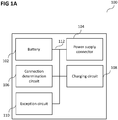
- FIG. 1A shows a computing device 100 (for example a wearable, in other words: a wearable device) according to various embodiments.
- the computing device 100 may include a battery 102.
- the computing device 100 may further include a power supply connector 104 (which for example may be configured to receive power supply from an external source, for example from a power supply device like illustrated in FIG. 1C ).
- the computing device 100 may further include a connection determination circuit 106 configured to determine an input connected to the power supply connector.
- the computing device 100 may further include a charging circuit 108 configured to charge the battery 102 if the connection determination circuit determines a first input connected to the power supply connector.
- the computing device 100 may further include an exception circuit 110 configured to instruct the computing device 100 to perform exception processing if the connection determination circuit determines a second input connected to the power supply connector .
- the battery 102, the power supply connector 104, the connection determination circuit 106, the charging circuit 108, and the exception circuit 110 may be coupled with each other, like indicated by lines 112, for example electrically coupled, for example using a line or a cable, and/ or mechanically coupled.
- the computing device 100 may perform charging or an exception processing, based on the input provided to the power supply connector 104.
- the connection determination circuit 106 may include or may be a voltage polarity determination circuit (not shown in FIG. 1A ) configured to determine a polarity of a power supply connected to the power supply connector 104.
- the first input may include or may be a power supply of a first polarity.
- the second input may include or may be a power supply of a second polarity.
- the charging circuit 108 may be configured to charge the battery 102 if the voltage polarity determination circuit determines a first polarity of the power supply
- the exception circuit 110 may be configured to instruct the computing device 100 to perform exception processing if the voltage polarity determination circuit determines a second polarity of the power supply.
- the first polarity may be inverted compared to the second polarity (in other words: may be opposing to the second polarity).
- the first polarity of the power supply may include or may be a plus pole of the power supply provided to the first contact and a negative pole of the power supply provided to the second contact.
- the second polarity of the power supply may include or may be a negative pole of the power supply provided to the first contact and a plus pole of the power supply provided to the second contact.
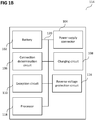
- FIG. 1B shows a computing device 114 (for example a wearable, in other words: a wearable device) according to various embodiments.
- the computing device 114 may, similar to the computing device 100 of FIG. 1A , include a battery 102.
- the computing device 114 may, similar to the computing device 100 of FIG. 1A , further include a power supply connector 104.
- the computing device 114 may, similar to the computing device 100 of FIG. 1A , further include a connection determination circuit 106 configured to determine a polarity of the power supply.
- the computing device 114 may, similar to the computing device 100 of FIG.
- the computing device 114 may, similar to the computing device 100 of FIG. 1A , further include an exception circuit 110 configured to instruct the computing device 114 to perform exception processing if the voltage polarity determination circuit 106 determines a second polarity of the power supply.
- the computing device 114 may further include a reverse voltage protection circuit 116, like will be described in more detail below.
- the computing device 114 may further include a processor 118, like will be described in more detail below.
- the battery 102, the power supply connector 104, the voltage polarity determination circuit 106, the charging circuit 108, the exception circuit 110, the reverse voltage protection circuit 116, and the processor 118 may be coupled with each other, like indicated by lines 120, for example electrically coupled, for example using a line or a cable, and/ or mechanically coupled.
- the reverse voltage protection circuit 116 may be configured to protect the computing device 114 from damage due to a voltage of the second polarity.
- the connection determination circuit 106 may include or may be a short circuit determination circuit (not shown in FIG. 1B ) configured to determine whether a short circuit is provided at the power supply connector 104.
- the first input may include or may be an input different from a short circuit.
- the second input may include or may be a short circuit.
- the charging circuit 108 may be configured to charge the battery 102 if the short circuit determination circuit determines that a voltage different from a short circuit is provided at the power supply connector 104
- the exception circuit 110 may be configured to instruct the computing device 100 to perform exception processing if the short circuit determination circuit determines that a short circuit is provided at the power supply connector 104.
- the exception processing may include or may be or may be included in shutting down the computing device 100.
- the exception processing may include or may be or may be included in restarting the computing device.
- the power supply connector 104 may include or may be or may be included in a plurality of contacts.
- the power supply connector 104 may include or may be or may be included in a first contact and a second contact.
- the exception circuit 110 may include a delay circuit configured to delay the exception processing by a pre-determined amount of time.
- the exception processing may include or may be or may be included in a reset of the processor 118.
- FIG. 1C shows a power supply device 122 according to various embodiments.
- the power supply device 122 may include a power output connector 124.
- the power supply device 122 may further include a switch 126 (for example a mechanical switch or for example an electronic switch) configured to switch between a first state in which the power output connector 124 outputs an output for charging a computing device and a second state in which the power output connector 124 outputs an output for initiating exception processing in the computing device.
- the power output connector 124 and the switch 126 may be coupled with each other, like indicated by line 128, for example electrically coupled, for example using a line or a cable, and/ or mechanically coupled.
- the power output connector 124 may be configured to output a voltage of a first polarity in the first state and to output a voltage of a second polarity in the second state.
- the power output connector 124 may include or may be or may be included in a first contact and a second contact.
- the voltage of the first polarity may include or may be a plus pole at the first contact and a negative pole at the second contact.
- the voltage of the second polarity may include or may be a negative pole at the first contact and a negative pole at the second contact.
- the power output connector 124 may be configured to output a predetermined voltage in the first state and to output a short circuit in the second state.
- FIG. 1D shows a flow diagram 130 illustrating a method for controlling a computing device.
- an input connected to a power supply connector of the computing device may be determined.
- a battery of the computing device may be charged if a first input connected to the power supply connector is determined.
- exception processing may be performed if a second input connected to the power supply connector is determined.
- determining the input may include or may be determining a polarity of a power supply connected to the power supply connector.
- the first input may include or may be a power supply of a first polarity.
- the second input may include or may be a power supply of a second polarity.
- the first polarity may be inverted compared to the second polarity.
- the method may further include protecting the computing device from damage due to a voltage of the second polarity.
- determining the input may include or may be determining whether a short circuit is provided at the power supply connector.
- the first input may include or may be an input different from a short circuit.
- the second input may include or may be a short circuit.
- the exception processing may include or may be or may be included in shutting down the computing device.
- the exception processing may include or may be or may be included in restarting the computing device.
- the power supply connector may include or may be or may be included in a plurality of contacts.
- the power supply connector may include or may be or may be included in a first contact and a second contact.
- the first polarity of the power supply may include or may be a plus pole of the power supply provided to the first contact and a negative pole of the power supply provided to the second contact.
- the second polarity of the power supply may include or may be a negative pole of the power supply provided to the first contact and a plus pole of the power supply provided to the second contact.
- the exception processing may be carried out after a delay of a pre-determined amount of time.
- the exception processing may include or may be or may be included in a reset of a processor of the computing device.
- FIG. IE shows a flow diagram 140 illustrating a method for controlling a power supply device.
- it may be switched, for example using a switch on the power supply device, between a first state in which a power output connector of the power supply device outputs an output for charging a computing device and a second state in which the power output connector outputs an output for initiating exception processing in the computing device.
- the power output connector may output a voltage of a first polarity in the first state and may output a voltage of a second polarity in the second state
- the power output connector may include or may be or may be included in a first contact and a second contact.
- the voltage of the first polarity may include or may be a plus pole at the first contact and a negative pole at the second contact.
- the voltage of the second polarity may include or may be a negative pole at the first contact and a negative pole at the second contact.
- the power output connector may output a predetermined voltage in the first state and may output a short circuit in the second state.
- FIG. 2 shows an illustration 200 of a system with a device 202 (for example a computing device like illustrated in FIG. 1A or like illustrated in FIG. 1B ) and a charging connector 204 (for example a power supply device like illustrated in FIG. 1C ) according to various embodiments.
- a device 202 for example a computing device like illustrated in FIG. 1A or like illustrated in FIG. 1B
- a charging connector 204 for example a power supply device like illustrated in FIG. 1C .
- a circuitry may be provided to allow the same contact pins that are used for charging to perform (or to trigger or to initiate or to instruct or to start) a forced shutdown or reset on a main circuit board of the device 202.
- a reverse voltage may be applied to charging pins 206 of the device to achieve a forced shutdown on the main circuit board.
- the circuitry (for example reverse voltage detection circuit 210 and reset/ shutdown circuit 212) may be further paired with a delay timer reset IC (integrated circuit) to achieve delayed timing reset.
- a charging cable with a built in voltage reversal switch may provide the reverse voltage to trigger the forced shutdown/reset function.
- the device 202 may further include a reverse voltage protection circuit 208.
- a wearable device may be connected to a charging cable (for example live charging cable) with a built-in voltage reversal momentary switch in order to perform a forced shutdown/reset action.
- a charging cable for example live charging cable
- a built-in voltage reversal momentary switch in order to perform a forced shutdown/reset action.
- a voltage reversal switch may be provided (for example on the charging cable), and when the voltage reversal switch is depressed, the following actions may be performed:
- a short pins forced shutdown/reset function on a two-pin charging port for wearables may be provided.
- circuitry may be provided to allow the same contact pins that are used for charging to perform a forced shutdown or reset on the main circuit board of the wearable device. This may be achieved by shorting the charging pins.
- the circuitry may be further paired with a delay timer reset IC to provide delayed timing RESET.
- the charging pins may be shorted with a conductive material (e.g. a pair of stainless steel tweezers) or a specially built charging cable with a momentarily push switch that disconnects the device's charging pins from the charging power source and then shorts the charging pins.
- the device may then go into reset/shutdown immediately or in the case of the usage of a reset/shutdown timer, go into reset/shutdown after time out.
- FIG. 3 shows an illustration 300 of a device 302 according to various embodiments.
- the device 302 may include charging pins 304, a charging pins short circuit detection circuit 306, and a reset/ shutdown circuitry 308 (which may include a timer).
Landscapes
- Engineering & Computer Science (AREA)
- Theoretical Computer Science (AREA)
- Power Engineering (AREA)
- Physics & Mathematics (AREA)
- General Engineering & Computer Science (AREA)
- General Physics & Mathematics (AREA)
- Charge And Discharge Circuits For Batteries Or The Like (AREA)
Claims (15)
- Eine Computervorrichtung (100), umfassend:eine Batterie (102);einen Stromversorgungsstecker (104) umfassend einen ersten Kontakt und einen zweiten Kontakt;eine Verbindungsbestimmungsschaltung (106), die konfiguriert ist, um eine Eingabe zu bestimmen, die mit dem Stromversorgungsstecker (104) verbunden ist;eine Ladeschaltung (108), die zum Laden der Batterie (102) konfiguriert ist, wenn die Verbindungsbestimmungsschaltung (106) eine erste Eingabe bestimmt, die mit dem Stromversorgungsstecker (104) verbunden ist; undeine Ausnahmeschaltung (110), die konfiguriert ist, um die Computervorrichtung (100) anzuweisen, eine Ausnahmeverarbeitung durchzuführen, wenn die Verbindungsbestimmungsschaltung (106) eine zweite Eingabe bestimmt, die mit dem Stromversorgungsstecker (104) verbunden ist;wobei die erste Eingabe von einer ersten Eingabegruppe stammt und eine Spannung zum Laden der Batterie (102) ist; undwobei die zweite Eingabe von einer zweiten Eingabegruppe stammt und ein Kurzschluss ist, der durch ein leitendes Element verursacht wird, das zwischen dem ersten Kontakt und dem zweiten Kontakt angeordnet ist.
- Die Computervorrichtung (100) nach Anspruch 1,
wobei die Verbindungsbestimmungsschaltung (106) eine Spannungspolaritätsbestimmungsschaltung enthält, die konfiguriert ist, um eine Polarität einer Stromversorgung zu bestimmen, die mit dem Stromversorgungsstecker (104) verbunden ist;
wobei die erste Eingabegruppe ferner eine Stromversorgung mit einer ersten Polarität enthält und die zweite Eingabegruppe ferner eine Stromversorgung mit einer zweiten Polarität enthält;
wobei die erste Polarität verglichen mit der zweiten Polarität invertiert ist;
wobei die erste Polarität der Stromversorgung einen Pluspol der Stromversorgung bereitgestellt für einen ersten Kontakt und einen Minuspol der Stromversorgung bereitgestellt für einen zweiten Kontakt umfasst; und
wobei die zweite Polarität der Stromversorgung einen Minuspol der Stromversorgung bereitgestellt für den ersten Kontakt und einen Pluspol der Stromversorgung bereitgestellt für den zweiten Kontakt umfasst. - Die Computervorrichtung (100) nach Anspruch 2, ferner umfassend:
eine Sperrspannungsschutzschaltung (116), die konfiguriert ist, um die Computervorrichtung (100) vor Beschädigung aufgrund einer Spannung der zweiten Polarität zu schützen. - Die Computervorrichtung (100) nach einem der Ansprüche 1 bis 3,
wobei die Ausnahmeverarbeitung Herunterfahren der Computervorrichtung (100) oder Neustarten der Computervorrichtung (100) umfasst; und
wobei gegebenenfalls die Ausnahmeschaltung (110) eine Verzögerungsschaltung umfasst, die konfiguriert ist, um die Ausnahmeverarbeitung um eine vorbestimmte Zeitdauer zu verzögern. - Die Computervorrichtung (100) nach einem der Ansprüche 1 bis 4,
wobei der Stromversorgungsstecker (104) eine Vielzahl an Kontakten umfasst. - Die Computervorrichtung (100) nach einem der Ansprüche 1 bis 5, ferner umfassend:einen Prozessor (118);wobei die Ausnahmeverarbeitung ein Zurücksetzen des Prozessors (118) umfasst.
- Eine Stromversorgungsvorrichtung (122), umfassend:einen Leistungsausgabesteckverbinder (124), der mit Ladestiften einer Computervorrichtung (100) verbunden werden kann; undeinen Schalter (126), der konfiguriert ist, um umzuschalten zwischen einem ersten Zustand, von einer ersten Zustandsgruppe, in dem der Leistungsausgabesteckverbinder eine Stromquelle mit Ladestiften der Computervorrichtung (100) zum Laden der Computervorrichtung (100) verbindet und einem zweiten Zustand, von einer zweiten Zustandsgruppe, in dem der Schalter (126) den Leistungsausgabesteckverbinder (124) von den Ladestiften trennt und die Ladestifte kurzschließt, um die Ausnahmeverarbeitung in der Computervorrichtung (100) einzuleiten;wobei der Schalter (126) ein leitendes Element umfasst, wobei der Schalter (126) die Ladestifte kurzschließt, indem das leitende Element zwischen den Ladestiften angeordnet wird.
- Die Stromversorgungsvorrichtung (122) nach Anspruch 7,
wobei der Leistungsausgabesteckverbinder (124) konfiguriert ist, um eine Spannung einer ersten Polarität in einem weiteren Zustand von der ersten Zustandsgruppe auszugeben und eine Spannung einer zweiten Polarität in einem weiteren Zustand von der zweiten Zustandsgruppe auszugeben;
wobei der Leistungsausgabesteckverbinder (124) einen ersten Kontakt und einen zweiten Kontakt umfasst;
wobei die Spannung der ersten Polarität einen Pluspol am ersten Kontakt und einen Minuspol am zweiten Kontakt umfasst; und
wobei die Spannung der zweiten Polarität einen Minuspol am ersten Kontakt und einen Minuspol am zweiten Kontakt umfasst. - Ein Verfahren zum Steuern einer Computervorrichtung, das Verfahren umfassend:Bestimmen einer Eingabe, die mit einem Stromversorgungsstecker der Computervorrichtung verbunden ist (132), wobei der Stromversorgungsstecker einen ersten Kontakt und einen zweiten Kontakt umfasst;Laden der Batterie, wenn eine erste Eingabe bestimmt wird, die an den Stromversorgungsstecker angeschlossen ist (134);
Ausführen einer Ausnahmeverarbeitung, wenn eine zweite Eingabe bestimmt wird, die an den Stromversorgungsstecker angeschlossen ist (136);wobei die erste Eingabe von einer ersten Eingabegruppe stammt und eine Spannung zum Laden der Batterie ist; undwobei die zweite Eingabe von einer zweiten Eingabegruppe stammt und ein Kurzschluss zwischen dem ersten Kontakt und dem zweiten Kontakt ist; undBereitstellen der zweiten Eingabe durch Anordnen eines leitenden Elements zwischen dem ersten Kontakt und dem zweiten Kontakt. - Das Verfahren nach Anspruch 9,
wobei Bestimmen der Eingabe Bestimmen einer Polarität einer Stromversorgung verbunden mit dem Stromversorgungsstecker umfasst;
wobei die erste Eingabegruppe ferner eine Stromversorgung einer ersten Polarität umfasst und die zweite Eingabegruppe ferner eine Stromversorgung einer zweiten Polarität umfasst;
wobei die erste Polarität verglichen mit der zweiten Polarität invertiert ist;
wobei die erste Polarität der Stromversorgung einen Pluspol der Stromversorgung bereitgestellt für den ersten Kontakt und einen Minuspol der Stromversorgung bereitgestellt für den zweiten Kontakt umfasst; und
wobei die zweite Polarität der Stromversorgung einen Minuspol der Stromversorgung bereitgestellt für den ersten Kontakt und einen Pluspol der Stromversorgung bereitgestellt für den zweiten Kontakt umfasst. - Das Verfahren nach Anspruch 10, ferner umfassend:
Schützen der Computervorrichtung vor Beschädigung durch eine Spannung der zweiten Polarität. - Das Verfahren nach einem der Ansprüche 9 bis 11,
wobei die Ausnahmeverarbeitung Herunterfahren der Computervorrichtung oder Neustarten der Computervorrichtung umfasst;
wobei gegebenenfalls die Ausnahmeverarbeitung nach einer Verzögerung um eine vorbestimmte Zeitdauer ausgeführt wird. - Das Verfahren nach einem der Ansprüche 9 bis 12,
wobei die Ausnahmeverarbeitung ein Zurücksetzen eines Prozessors der Computervorrichtung umfasst. - Ein Verfahren zum Steuern einer Stromversorgungsvorrichtung, das Verfahren umfassend:
Umschalten, unter Verwendung eines Schalters, zwischen einem ersten Zustand, von einer ersten Zustandsgruppe, in der ein Leistungsausgabesteckverbinder der Stromversorgungsvorrichtung eine Stromquelle mit Ladestiften einer Computervorrichtung zum Laden der Computervorrichtung verbindet, und einem zweiten Zustand, von einer zweiten Zustandsgruppe, in der der Schalter den Leistungsausgabesteckverbinder von den Ladestiften trennt und die Ladestifte mit einem leitenden Element des Schalters kurzschließt, um die Ausnahmeverarbeitung in der Computervorrichtung zu initiieren. - Das Verfahren nach Anspruch 14,
wobei der Leistungsausgabesteckverbinder eine Spannung einer ersten Polarität in einem weiteren Zustand von der ersten Zustandsgruppe ausgibt und eine Spannung einer zweiten Polarität in einem weiteren Zustand von der zweiten Zustandsgruppe ausgibt;
wobei der Leistungsausgabesteckverbinder einen ersten Kontakt und einen zweiten Kontakt umfasst;
wobei die Spannung der ersten Polarität einen Pluspol am ersten Kontakt und einen Minuspol am zweiten Kontakt umfasst; und
wobei die Spannung der zweiten Polarität einen Minuspol am ersten Kontakt und einen Minuspol am zweiten Kontakt umfasst.
Applications Claiming Priority (1)
| Application Number | Priority Date | Filing Date | Title |
|---|---|---|---|
| PCT/SG2016/050110 WO2017155462A1 (en) | 2016-03-09 | 2016-03-09 | Computing devices, power supply devices, methods for controlling a computing device, and methods for controlling a power supply device |
Publications (3)
| Publication Number | Publication Date |
|---|---|
| EP3427124A1 EP3427124A1 (de) | 2019-01-16 |
| EP3427124A4 EP3427124A4 (de) | 2019-03-13 |
| EP3427124B1 true EP3427124B1 (de) | 2021-08-04 |
Family
ID=59790665
Family Applications (1)
| Application Number | Title | Priority Date | Filing Date |
|---|---|---|---|
| EP16893721.7A Active EP3427124B1 (de) | 2016-03-09 | 2016-03-09 | Rechnervorrichtungen, stromversorgungsvorrichtungen, verfahren zur steuerung einer rechnervorrichtung und verfahren zur steuerung einer stromversorgungsvorrichtung |
Country Status (7)
| Country | Link |
|---|---|
| US (1) | US20200097058A1 (de) |
| EP (1) | EP3427124B1 (de) |
| CN (1) | CN108780345B (de) |
| AU (1) | AU2016396983B2 (de) |
| SG (1) | SG11201807462VA (de) |
| TW (1) | TWI735540B (de) |
| WO (1) | WO2017155462A1 (de) |
Families Citing this family (2)
| Publication number | Priority date | Publication date | Assignee | Title |
|---|---|---|---|---|
| US11152935B2 (en) | 2018-08-28 | 2021-10-19 | Google Llc | System and method to deliver reset via power line |
| CN114597982B (zh) * | 2020-12-04 | 2025-06-24 | 南昌逸勤科技有限公司 | 充电电路、终端设备和充电系统 |
Family Cites Families (16)
| Publication number | Priority date | Publication date | Assignee | Title |
|---|---|---|---|---|
| US7106566B2 (en) * | 2003-07-08 | 2006-09-12 | Arques Technology | Power adapter interface circuitry for protecting a battery operated system |
| KR20070110829A (ko) * | 2004-10-15 | 2007-11-20 | 프록심 와이어리스 코포레이션 | 리로드 검출을 위한 극성 반전 시스템 및 방법 |
| DE102007026786A1 (de) * | 2006-08-21 | 2008-04-03 | Continental Teves Ag & Co. Ohg | Aktiver Sensor mit Betriebsmodus-Umschaltung |
| JP4573884B2 (ja) * | 2008-06-18 | 2010-11-04 | 三菱電機株式会社 | 車載電子制御装置の電源異常検出回路 |
| US8283899B2 (en) * | 2008-11-04 | 2012-10-09 | Broadcom Corporation | Reducing current leakage and improving shelf life time of battery-based-devices |
| CN101989751B (zh) * | 2009-07-30 | 2014-01-15 | 宏达国际电子股份有限公司 | 可携式电子装置及其相关判断方法 |
| JP5575506B2 (ja) * | 2010-02-26 | 2014-08-20 | 三洋電機株式会社 | 車両用電源装置及びこの電源装置を備える車両 |
| US8667882B1 (en) * | 2011-05-06 | 2014-03-11 | Rock River Arms, Inc. | Firearm |
| US8542472B2 (en) * | 2011-07-26 | 2013-09-24 | Apple Inc. | Protection circuitry for reversible connectors |
| CN104737381B (zh) * | 2012-10-18 | 2017-09-22 | 惠普发展公司,有限责任合伙企业 | 扁平连接器的极性控制 |
| US9153986B1 (en) * | 2014-04-15 | 2015-10-06 | Fuelbox, Inc. | Versatile plug and play charging station |
| TWI531133B (zh) * | 2014-05-02 | 2016-04-21 | 宏碁股份有限公司 | 充電方法與電子裝置 |
| US9448605B2 (en) * | 2014-08-29 | 2016-09-20 | Zippy Technology Corp. | Redundant power supply system providing rapid start of backup |
| CN104978300B (zh) * | 2015-07-16 | 2019-04-12 | Oppo广东移动通信有限公司 | 移动终端及其与外部设备连接的检测方法和装置 |
| CN105138101A (zh) * | 2015-08-31 | 2015-12-09 | 联想(北京)有限公司 | 一种供电方法及电子设备 |
| CN105322397B (zh) * | 2015-10-13 | 2018-01-23 | 深圳市祝你快乐科技有限公司 | 具有充电保护功能的usb端口连接器及其实现方法 |
-
2016
- 2016-03-09 EP EP16893721.7A patent/EP3427124B1/de active Active
- 2016-03-09 SG SG11201807462VA patent/SG11201807462VA/en unknown
- 2016-03-09 CN CN201680083360.XA patent/CN108780345B/zh active Active
- 2016-03-09 WO PCT/SG2016/050110 patent/WO2017155462A1/en not_active Ceased
- 2016-03-09 US US16/083,387 patent/US20200097058A1/en not_active Abandoned
- 2016-03-09 AU AU2016396983A patent/AU2016396983B2/en active Active
-
2017
- 2017-02-20 TW TW106105585A patent/TWI735540B/zh active
Also Published As
| Publication number | Publication date |
|---|---|
| AU2016396983B2 (en) | 2021-12-16 |
| CN108780345A (zh) | 2018-11-09 |
| AU2016396983A1 (en) | 2018-09-20 |
| TW201734704A (zh) | 2017-10-01 |
| SG11201807462VA (en) | 2018-09-27 |
| TWI735540B (zh) | 2021-08-11 |
| EP3427124A1 (de) | 2019-01-16 |
| US20200097058A1 (en) | 2020-03-26 |
| CN108780345B (zh) | 2022-07-08 |
| EP3427124A4 (de) | 2019-03-13 |
| WO2017155462A1 (en) | 2017-09-14 |
Similar Documents
| Publication | Publication Date | Title |
|---|---|---|
| AU2015401874B2 (en) | Charge control method and device, and electronic device | |
| CN103858070B (zh) | 一种关机门限电压的调节方法、开机方法及其电子设备 | |
| CN106532882A (zh) | 一种充电控制方法及装置 | |
| EP3427124B1 (de) | Rechnervorrichtungen, stromversorgungsvorrichtungen, verfahren zur steuerung einer rechnervorrichtung und verfahren zur steuerung einer stromversorgungsvorrichtung | |
| JP2015521835A (ja) | 充電/放電管理装置およびモバイル端末 | |
| CN113381479B (zh) | 充电方法、装置及电子设备 | |
| CN105470925A (zh) | 二次电池保护电路及电池装置 | |
| CN106797414B (zh) | 一种终端的漏电流检测电路及终端 | |
| US20160094059A1 (en) | Charging/discharging control device and battery device | |
| CN104461664A (zh) | Mcu启动模式选择电路 | |
| CN107678871B (zh) | 一种电子设备开机方法及电子设备 | |
| CN106130093A (zh) | 一种充电控制装置和方法 | |
| CN104778040A (zh) | 一种拍照装置 | |
| CN103872399B (zh) | 切换电池系统中电池组态的方法 | |
| CN103747335B (zh) | 一种智能电视模式的切换方法及装置 | |
| CN110262992A (zh) | 一种控制装置 | |
| US20170256935A1 (en) | System reset for a portable apparatus | |
| TW201603445A (zh) | 電池管理晶片之截止放電電壓點自動調變電路 | |
| CN104485699B (zh) | 便携设备的电池电量保护电路 | |
| CN109739342B (zh) | 一种电子设备 | |
| US20200272591A1 (en) | Port circuit, method for supplying power for electronic device via port circuit and electronic device | |
| CN110417086B (zh) | 一种电池过度放电的复位控制电路及移动终端 | |
| CN107479919A (zh) | 遥控器及使用遥控器控制主机进入下载模式的方法 | |
| WO2016013962A2 (ru) | Мобильный компьютер с аппаратной защитой доверенной операционной системы | |
| KR20170049197A (ko) | 순간 고전압 방지 회로 |
Legal Events
| Date | Code | Title | Description |
|---|---|---|---|
| STAA | Information on the status of an ep patent application or granted ep patent |
Free format text: STATUS: THE INTERNATIONAL PUBLICATION HAS BEEN MADE |
|
| PUAI | Public reference made under article 153(3) epc to a published international application that has entered the european phase |
Free format text: ORIGINAL CODE: 0009012 |
|
| STAA | Information on the status of an ep patent application or granted ep patent |
Free format text: STATUS: REQUEST FOR EXAMINATION WAS MADE |
|
| 17P | Request for examination filed |
Effective date: 20180831 |
|
| AK | Designated contracting states |
Kind code of ref document: A1 Designated state(s): AL AT BE BG CH CY CZ DE DK EE ES FI FR GB GR HR HU IE IS IT LI LT LU LV MC MK MT NL NO PL PT RO RS SE SI SK SM TR |
|
| AX | Request for extension of the european patent |
Extension state: BA ME |
|
| A4 | Supplementary search report drawn up and despatched |
Effective date: 20190211 |
|
| RIC1 | Information provided on ipc code assigned before grant |
Ipc: G06F 1/24 20060101ALI20190205BHEP Ipc: G06F 1/26 20060101AFI20190205BHEP Ipc: H02J 7/00 20060101ALI20190205BHEP Ipc: G06F 1/16 20060101ALI20190205BHEP |
|
| DAV | Request for validation of the european patent (deleted) | ||
| DAX | Request for extension of the european patent (deleted) | ||
| GRAP | Despatch of communication of intention to grant a patent |
Free format text: ORIGINAL CODE: EPIDOSNIGR1 |
|
| STAA | Information on the status of an ep patent application or granted ep patent |
Free format text: STATUS: GRANT OF PATENT IS INTENDED |
|
| INTG | Intention to grant announced |
Effective date: 20210315 |
|
| GRAS | Grant fee paid |
Free format text: ORIGINAL CODE: EPIDOSNIGR3 |
|
| GRAA | (expected) grant |
Free format text: ORIGINAL CODE: 0009210 |
|
| STAA | Information on the status of an ep patent application or granted ep patent |
Free format text: STATUS: THE PATENT HAS BEEN GRANTED |
|
| AK | Designated contracting states |
Kind code of ref document: B1 Designated state(s): AL AT BE BG CH CY CZ DE DK EE ES FI FR GB GR HR HU IE IS IT LI LT LU LV MC MK MT NL NO PL PT RO RS SE SI SK SM TR |
|
| REG | Reference to a national code |
Ref country code: GB Ref legal event code: FG4D |
|
| REG | Reference to a national code |
Ref country code: AT Ref legal event code: REF Ref document number: 1417640 Country of ref document: AT Kind code of ref document: T Effective date: 20210815 |
|
| REG | Reference to a national code |
Ref country code: CH Ref legal event code: EP |
|
| REG | Reference to a national code |
Ref country code: DE Ref legal event code: R096 Ref document number: 602016061810 Country of ref document: DE |
|
| REG | Reference to a national code |
Ref country code: IE Ref legal event code: FG4D |
|
| RAP4 | Party data changed (patent owner data changed or rights of a patent transferred) |
Owner name: RAZER (ASIA-PACIFIC) PTE. LTD. |
|
| REG | Reference to a national code |
Ref country code: LT Ref legal event code: MG9D |
|
| REG | Reference to a national code |
Ref country code: NL Ref legal event code: MP Effective date: 20210804 |
|
| REG | Reference to a national code |
Ref country code: AT Ref legal event code: MK05 Ref document number: 1417640 Country of ref document: AT Kind code of ref document: T Effective date: 20210804 |
|
| PG25 | Lapsed in a contracting state [announced via postgrant information from national office to epo] |
Ref country code: SE Free format text: LAPSE BECAUSE OF FAILURE TO SUBMIT A TRANSLATION OF THE DESCRIPTION OR TO PAY THE FEE WITHIN THE PRESCRIBED TIME-LIMIT Effective date: 20210804 Ref country code: RS Free format text: LAPSE BECAUSE OF FAILURE TO SUBMIT A TRANSLATION OF THE DESCRIPTION OR TO PAY THE FEE WITHIN THE PRESCRIBED TIME-LIMIT Effective date: 20210804 Ref country code: NO Free format text: LAPSE BECAUSE OF FAILURE TO SUBMIT A TRANSLATION OF THE DESCRIPTION OR TO PAY THE FEE WITHIN THE PRESCRIBED TIME-LIMIT Effective date: 20211104 Ref country code: PT Free format text: LAPSE BECAUSE OF FAILURE TO SUBMIT A TRANSLATION OF THE DESCRIPTION OR TO PAY THE FEE WITHIN THE PRESCRIBED TIME-LIMIT Effective date: 20211206 Ref country code: HR Free format text: LAPSE BECAUSE OF FAILURE TO SUBMIT A TRANSLATION OF THE DESCRIPTION OR TO PAY THE FEE WITHIN THE PRESCRIBED TIME-LIMIT Effective date: 20210804 Ref country code: FI Free format text: LAPSE BECAUSE OF FAILURE TO SUBMIT A TRANSLATION OF THE DESCRIPTION OR TO PAY THE FEE WITHIN THE PRESCRIBED TIME-LIMIT Effective date: 20210804 Ref country code: ES Free format text: LAPSE BECAUSE OF FAILURE TO SUBMIT A TRANSLATION OF THE DESCRIPTION OR TO PAY THE FEE WITHIN THE PRESCRIBED TIME-LIMIT Effective date: 20210804 Ref country code: LT Free format text: LAPSE BECAUSE OF FAILURE TO SUBMIT A TRANSLATION OF THE DESCRIPTION OR TO PAY THE FEE WITHIN THE PRESCRIBED TIME-LIMIT Effective date: 20210804 Ref country code: AT Free format text: LAPSE BECAUSE OF FAILURE TO SUBMIT A TRANSLATION OF THE DESCRIPTION OR TO PAY THE FEE WITHIN THE PRESCRIBED TIME-LIMIT Effective date: 20210804 Ref country code: BG Free format text: LAPSE BECAUSE OF FAILURE TO SUBMIT A TRANSLATION OF THE DESCRIPTION OR TO PAY THE FEE WITHIN THE PRESCRIBED TIME-LIMIT Effective date: 20211104 |
|
| PG25 | Lapsed in a contracting state [announced via postgrant information from national office to epo] |
Ref country code: PL Free format text: LAPSE BECAUSE OF FAILURE TO SUBMIT A TRANSLATION OF THE DESCRIPTION OR TO PAY THE FEE WITHIN THE PRESCRIBED TIME-LIMIT Effective date: 20210804 Ref country code: LV Free format text: LAPSE BECAUSE OF FAILURE TO SUBMIT A TRANSLATION OF THE DESCRIPTION OR TO PAY THE FEE WITHIN THE PRESCRIBED TIME-LIMIT Effective date: 20210804 Ref country code: GR Free format text: LAPSE BECAUSE OF FAILURE TO SUBMIT A TRANSLATION OF THE DESCRIPTION OR TO PAY THE FEE WITHIN THE PRESCRIBED TIME-LIMIT Effective date: 20211105 |
|
| PG25 | Lapsed in a contracting state [announced via postgrant information from national office to epo] |
Ref country code: NL Free format text: LAPSE BECAUSE OF FAILURE TO SUBMIT A TRANSLATION OF THE DESCRIPTION OR TO PAY THE FEE WITHIN THE PRESCRIBED TIME-LIMIT Effective date: 20210804 |
|
| PG25 | Lapsed in a contracting state [announced via postgrant information from national office to epo] |
Ref country code: DK Free format text: LAPSE BECAUSE OF FAILURE TO SUBMIT A TRANSLATION OF THE DESCRIPTION OR TO PAY THE FEE WITHIN THE PRESCRIBED TIME-LIMIT Effective date: 20210804 |
|
| REG | Reference to a national code |
Ref country code: DE Ref legal event code: R097 Ref document number: 602016061810 Country of ref document: DE |
|
| PG25 | Lapsed in a contracting state [announced via postgrant information from national office to epo] |
Ref country code: SM Free format text: LAPSE BECAUSE OF FAILURE TO SUBMIT A TRANSLATION OF THE DESCRIPTION OR TO PAY THE FEE WITHIN THE PRESCRIBED TIME-LIMIT Effective date: 20210804 Ref country code: SK Free format text: LAPSE BECAUSE OF FAILURE TO SUBMIT A TRANSLATION OF THE DESCRIPTION OR TO PAY THE FEE WITHIN THE PRESCRIBED TIME-LIMIT Effective date: 20210804 Ref country code: RO Free format text: LAPSE BECAUSE OF FAILURE TO SUBMIT A TRANSLATION OF THE DESCRIPTION OR TO PAY THE FEE WITHIN THE PRESCRIBED TIME-LIMIT Effective date: 20210804 Ref country code: EE Free format text: LAPSE BECAUSE OF FAILURE TO SUBMIT A TRANSLATION OF THE DESCRIPTION OR TO PAY THE FEE WITHIN THE PRESCRIBED TIME-LIMIT Effective date: 20210804 Ref country code: CZ Free format text: LAPSE BECAUSE OF FAILURE TO SUBMIT A TRANSLATION OF THE DESCRIPTION OR TO PAY THE FEE WITHIN THE PRESCRIBED TIME-LIMIT Effective date: 20210804 Ref country code: AL Free format text: LAPSE BECAUSE OF FAILURE TO SUBMIT A TRANSLATION OF THE DESCRIPTION OR TO PAY THE FEE WITHIN THE PRESCRIBED TIME-LIMIT Effective date: 20210804 |
|
| PLBE | No opposition filed within time limit |
Free format text: ORIGINAL CODE: 0009261 |
|
| STAA | Information on the status of an ep patent application or granted ep patent |
Free format text: STATUS: NO OPPOSITION FILED WITHIN TIME LIMIT |
|
| 26N | No opposition filed |
Effective date: 20220506 |
|
| PG25 | Lapsed in a contracting state [announced via postgrant information from national office to epo] |
Ref country code: IT Free format text: LAPSE BECAUSE OF FAILURE TO SUBMIT A TRANSLATION OF THE DESCRIPTION OR TO PAY THE FEE WITHIN THE PRESCRIBED TIME-LIMIT Effective date: 20210804 |
|
| PG25 | Lapsed in a contracting state [announced via postgrant information from national office to epo] |
Ref country code: SI Free format text: LAPSE BECAUSE OF FAILURE TO SUBMIT A TRANSLATION OF THE DESCRIPTION OR TO PAY THE FEE WITHIN THE PRESCRIBED TIME-LIMIT Effective date: 20210804 |
|
| PG25 | Lapsed in a contracting state [announced via postgrant information from national office to epo] |
Ref country code: MC Free format text: LAPSE BECAUSE OF FAILURE TO SUBMIT A TRANSLATION OF THE DESCRIPTION OR TO PAY THE FEE WITHIN THE PRESCRIBED TIME-LIMIT Effective date: 20210804 |
|
| REG | Reference to a national code |
Ref country code: CH Ref legal event code: PL |
|
| REG | Reference to a national code |
Ref country code: BE Ref legal event code: MM Effective date: 20220331 |
|
| PG25 | Lapsed in a contracting state [announced via postgrant information from national office to epo] |
Ref country code: LU Free format text: LAPSE BECAUSE OF NON-PAYMENT OF DUE FEES Effective date: 20220309 Ref country code: LI Free format text: LAPSE BECAUSE OF NON-PAYMENT OF DUE FEES Effective date: 20220331 Ref country code: IE Free format text: LAPSE BECAUSE OF NON-PAYMENT OF DUE FEES Effective date: 20220309 Ref country code: CH Free format text: LAPSE BECAUSE OF NON-PAYMENT OF DUE FEES Effective date: 20220331 |
|
| PG25 | Lapsed in a contracting state [announced via postgrant information from national office to epo] |
Ref country code: BE Free format text: LAPSE BECAUSE OF NON-PAYMENT OF DUE FEES Effective date: 20220331 |
|
| P01 | Opt-out of the competence of the unified patent court (upc) registered |
Effective date: 20230327 |
|
| PG25 | Lapsed in a contracting state [announced via postgrant information from national office to epo] |
Ref country code: HU Free format text: LAPSE BECAUSE OF FAILURE TO SUBMIT A TRANSLATION OF THE DESCRIPTION OR TO PAY THE FEE WITHIN THE PRESCRIBED TIME-LIMIT; INVALID AB INITIO Effective date: 20160309 |
|
| PG25 | Lapsed in a contracting state [announced via postgrant information from national office to epo] |
Ref country code: MK Free format text: LAPSE BECAUSE OF FAILURE TO SUBMIT A TRANSLATION OF THE DESCRIPTION OR TO PAY THE FEE WITHIN THE PRESCRIBED TIME-LIMIT Effective date: 20210804 Ref country code: CY Free format text: LAPSE BECAUSE OF FAILURE TO SUBMIT A TRANSLATION OF THE DESCRIPTION OR TO PAY THE FEE WITHIN THE PRESCRIBED TIME-LIMIT Effective date: 20210804 |
|
| PG25 | Lapsed in a contracting state [announced via postgrant information from national office to epo] |
Ref country code: TR Free format text: LAPSE BECAUSE OF FAILURE TO SUBMIT A TRANSLATION OF THE DESCRIPTION OR TO PAY THE FEE WITHIN THE PRESCRIBED TIME-LIMIT Effective date: 20210804 |
|
| PG25 | Lapsed in a contracting state [announced via postgrant information from national office to epo] |
Ref country code: MT Free format text: LAPSE BECAUSE OF FAILURE TO SUBMIT A TRANSLATION OF THE DESCRIPTION OR TO PAY THE FEE WITHIN THE PRESCRIBED TIME-LIMIT Effective date: 20210804 |
|
| PGFP | Annual fee paid to national office [announced via postgrant information from national office to epo] |
Ref country code: GB Payment date: 20260216 Year of fee payment: 11 |
|
| PGFP | Annual fee paid to national office [announced via postgrant information from national office to epo] |
Ref country code: DE Payment date: 20260211 Year of fee payment: 11 |
|
| PGFP | Annual fee paid to national office [announced via postgrant information from national office to epo] |
Ref country code: FR Payment date: 20260209 Year of fee payment: 11 |