EP3426322B1 - System zur extrakorporalen elimination von kohlenmonoxid - Google Patents
System zur extrakorporalen elimination von kohlenmonoxid Download PDFInfo
- Publication number
- EP3426322B1 EP3426322B1 EP17709578.3A EP17709578A EP3426322B1 EP 3426322 B1 EP3426322 B1 EP 3426322B1 EP 17709578 A EP17709578 A EP 17709578A EP 3426322 B1 EP3426322 B1 EP 3426322B1
- Authority
- EP
- European Patent Office
- Prior art keywords
- exchange chamber
- gas
- blood
- oxygen
- carbon monoxide
- Prior art date
- Legal status (The legal status is an assumption and is not a legal conclusion. Google has not performed a legal analysis and makes no representation as to the accuracy of the status listed.)
- Active
Links
Images

Classifications
-
- A—HUMAN NECESSITIES
- A61—MEDICAL OR VETERINARY SCIENCE; HYGIENE
- A61M—DEVICES FOR INTRODUCING MEDIA INTO, OR ONTO, THE BODY; DEVICES FOR TRANSDUCING BODY MEDIA OR FOR TAKING MEDIA FROM THE BODY; DEVICES FOR PRODUCING OR ENDING SLEEP OR STUPOR
- A61M1/00—Suction or pumping devices for medical purposes; Devices for carrying-off, for treatment of, or for carrying-over, body-liquids; Drainage systems
- A61M1/14—Dialysis systems; Artificial kidneys; Blood oxygenators ; Reciprocating systems for treatment of body fluids, e.g. single needle systems for hemofiltration or pheresis
- A61M1/30—Single needle dialysis ; Reciprocating systems, alternately withdrawing blood from and returning it to the patient, e.g. single-lumen-needle dialysis or single needle systems for hemofiltration or pheresis
- A61M1/301—Details
- A61M1/304—Treatment chamber used as reservoir, e.g. centrifuge bowl or filter with movable membrane
-
- A—HUMAN NECESSITIES
- A61—MEDICAL OR VETERINARY SCIENCE; HYGIENE
- A61M—DEVICES FOR INTRODUCING MEDIA INTO, OR ONTO, THE BODY; DEVICES FOR TRANSDUCING BODY MEDIA OR FOR TAKING MEDIA FROM THE BODY; DEVICES FOR PRODUCING OR ENDING SLEEP OR STUPOR
- A61M1/00—Suction or pumping devices for medical purposes; Devices for carrying-off, for treatment of, or for carrying-over, body-liquids; Drainage systems
- A61M1/14—Dialysis systems; Artificial kidneys; Blood oxygenators ; Reciprocating systems for treatment of body fluids, e.g. single needle systems for hemofiltration or pheresis
- A61M1/16—Dialysis systems; Artificial kidneys; Blood oxygenators ; Reciprocating systems for treatment of body fluids, e.g. single needle systems for hemofiltration or pheresis with membranes
- A61M1/1621—Constructional aspects thereof
- A61M1/1645—Constructional aspects thereof with mechanically linked peristaltic dialysis fluid pumps one upstream, the other one downstream of the dialyser
-
- A—HUMAN NECESSITIES
- A61—MEDICAL OR VETERINARY SCIENCE; HYGIENE
- A61M—DEVICES FOR INTRODUCING MEDIA INTO, OR ONTO, THE BODY; DEVICES FOR TRANSDUCING BODY MEDIA OR FOR TAKING MEDIA FROM THE BODY; DEVICES FOR PRODUCING OR ENDING SLEEP OR STUPOR
- A61M1/00—Suction or pumping devices for medical purposes; Devices for carrying-off, for treatment of, or for carrying-over, body-liquids; Drainage systems
- A61M1/14—Dialysis systems; Artificial kidneys; Blood oxygenators ; Reciprocating systems for treatment of body fluids, e.g. single needle systems for hemofiltration or pheresis
- A61M1/16—Dialysis systems; Artificial kidneys; Blood oxygenators ; Reciprocating systems for treatment of body fluids, e.g. single needle systems for hemofiltration or pheresis with membranes
- A61M1/1698—Blood oxygenators with or without heat-exchangers
-
- A—HUMAN NECESSITIES
- A61—MEDICAL OR VETERINARY SCIENCE; HYGIENE
- A61M—DEVICES FOR INTRODUCING MEDIA INTO, OR ONTO, THE BODY; DEVICES FOR TRANSDUCING BODY MEDIA OR FOR TAKING MEDIA FROM THE BODY; DEVICES FOR PRODUCING OR ENDING SLEEP OR STUPOR
- A61M1/00—Suction or pumping devices for medical purposes; Devices for carrying-off, for treatment of, or for carrying-over, body-liquids; Drainage systems
- A61M1/14—Dialysis systems; Artificial kidneys; Blood oxygenators ; Reciprocating systems for treatment of body fluids, e.g. single needle systems for hemofiltration or pheresis
- A61M1/30—Single needle dialysis ; Reciprocating systems, alternately withdrawing blood from and returning it to the patient, e.g. single-lumen-needle dialysis or single needle systems for hemofiltration or pheresis
-
- A—HUMAN NECESSITIES
- A61—MEDICAL OR VETERINARY SCIENCE; HYGIENE
- A61M—DEVICES FOR INTRODUCING MEDIA INTO, OR ONTO, THE BODY; DEVICES FOR TRANSDUCING BODY MEDIA OR FOR TAKING MEDIA FROM THE BODY; DEVICES FOR PRODUCING OR ENDING SLEEP OR STUPOR
- A61M1/00—Suction or pumping devices for medical purposes; Devices for carrying-off, for treatment of, or for carrying-over, body-liquids; Drainage systems
- A61M1/14—Dialysis systems; Artificial kidneys; Blood oxygenators ; Reciprocating systems for treatment of body fluids, e.g. single needle systems for hemofiltration or pheresis
- A61M1/32—Oxygenators without membranes
-
- A—HUMAN NECESSITIES
- A61—MEDICAL OR VETERINARY SCIENCE; HYGIENE
- A61M—DEVICES FOR INTRODUCING MEDIA INTO, OR ONTO, THE BODY; DEVICES FOR TRANSDUCING BODY MEDIA OR FOR TAKING MEDIA FROM THE BODY; DEVICES FOR PRODUCING OR ENDING SLEEP OR STUPOR
- A61M1/00—Suction or pumping devices for medical purposes; Devices for carrying-off, for treatment of, or for carrying-over, body-liquids; Drainage systems
- A61M1/14—Dialysis systems; Artificial kidneys; Blood oxygenators ; Reciprocating systems for treatment of body fluids, e.g. single needle systems for hemofiltration or pheresis
- A61M1/32—Oxygenators without membranes
- A61M1/322—Antifoam; Defoaming
-
- A—HUMAN NECESSITIES
- A61—MEDICAL OR VETERINARY SCIENCE; HYGIENE
- A61M—DEVICES FOR INTRODUCING MEDIA INTO, OR ONTO, THE BODY; DEVICES FOR TRANSDUCING BODY MEDIA OR FOR TAKING MEDIA FROM THE BODY; DEVICES FOR PRODUCING OR ENDING SLEEP OR STUPOR
- A61M1/00—Suction or pumping devices for medical purposes; Devices for carrying-off, for treatment of, or for carrying-over, body-liquids; Drainage systems
- A61M1/36—Other treatment of blood in a by-pass of the natural circulatory system, e.g. temperature adaptation, irradiation ; Extra-corporeal blood circuits
- A61M1/3621—Extra-corporeal blood circuits
- A61M1/3653—Interfaces between patient blood circulation and extra-corporal blood circuit
- A61M1/3659—Cannulae pertaining to extracorporeal circulation
-
- A—HUMAN NECESSITIES
- A61—MEDICAL OR VETERINARY SCIENCE; HYGIENE
- A61M—DEVICES FOR INTRODUCING MEDIA INTO, OR ONTO, THE BODY; DEVICES FOR TRANSDUCING BODY MEDIA OR FOR TAKING MEDIA FROM THE BODY; DEVICES FOR PRODUCING OR ENDING SLEEP OR STUPOR
- A61M2202/00—Special media to be introduced, removed or treated
- A61M2202/02—Gases
- A61M2202/0225—Carbon oxides, e.g. Carbon dioxide
- A61M2202/0233—Carbon monoxide
-
- A—HUMAN NECESSITIES
- A61—MEDICAL OR VETERINARY SCIENCE; HYGIENE
- A61M—DEVICES FOR INTRODUCING MEDIA INTO, OR ONTO, THE BODY; DEVICES FOR TRANSDUCING BODY MEDIA OR FOR TAKING MEDIA FROM THE BODY; DEVICES FOR PRODUCING OR ENDING SLEEP OR STUPOR
- A61M2205/00—General characteristics of the apparatus
- A61M2205/33—Controlling, regulating or measuring
- A61M2205/3331—Pressure; Flow
-
- A—HUMAN NECESSITIES
- A61—MEDICAL OR VETERINARY SCIENCE; HYGIENE
- A61M—DEVICES FOR INTRODUCING MEDIA INTO, OR ONTO, THE BODY; DEVICES FOR TRANSDUCING BODY MEDIA OR FOR TAKING MEDIA FROM THE BODY; DEVICES FOR PRODUCING OR ENDING SLEEP OR STUPOR
- A61M2205/00—General characteristics of the apparatus
- A61M2205/33—Controlling, regulating or measuring
- A61M2205/3331—Pressure; Flow
- A61M2205/3337—Controlling, regulating pressure or flow by means of a valve by-passing a pump
-
- A—HUMAN NECESSITIES
- A61—MEDICAL OR VETERINARY SCIENCE; HYGIENE
- A61M—DEVICES FOR INTRODUCING MEDIA INTO, OR ONTO, THE BODY; DEVICES FOR TRANSDUCING BODY MEDIA OR FOR TAKING MEDIA FROM THE BODY; DEVICES FOR PRODUCING OR ENDING SLEEP OR STUPOR
- A61M2205/00—General characteristics of the apparatus
- A61M2205/75—General characteristics of the apparatus with filters
-
- A—HUMAN NECESSITIES
- A61—MEDICAL OR VETERINARY SCIENCE; HYGIENE
- A61M—DEVICES FOR INTRODUCING MEDIA INTO, OR ONTO, THE BODY; DEVICES FOR TRANSDUCING BODY MEDIA OR FOR TAKING MEDIA FROM THE BODY; DEVICES FOR PRODUCING OR ENDING SLEEP OR STUPOR
- A61M2209/00—Ancillary equipment
- A61M2209/08—Supports for equipment
Definitions
- the invention relates to a system for the extracorporeal elimination of carbon monoxide, comprising at least one pump and a gas exchange chamber, wherein at least one pump can be connected to the bloodstream of a person via a first hose section that can be connected to a cannula and is connected to a gas exchange chamber via a second hose section.
- the hemoglobin in the blood is available to bind oxygen (O 2 ), whereby oxygen is bound to the iron atoms in the hemoglobin, so that the oxygen is transported through the bloodstream from the lungs to other organs and tissues.
- oxygen O 2
- carbon monoxide CO
- binds to hemoglobin although this occurs with an affinity that is up to 300 times higher than that of oxygen. If an iron atom is "blocked" by a carbon monoxide molecule, it is no longer available to bind an oxygen molecule. If the hemoglobin is blocked by the bond with the carbon monoxide, the blood's ability to absorb and transport oxygen is reduced and the patient is at risk of internal suffocation.
- carbon monoxide enters the body's circulation with the blood and is deposited in organs, for example in the heart muscle tissue, where it binds to myoglobin and can lead to an insufficient supply of oxygen to the heart and a heart attack.
- a method and system for treating carbon monoxide poisoning is described in patent document WO 2012/082257 A1 presented.
- the hemoglobin loaded with carbon monoxide (COHB) is pumped from a person's bloodstream into a filter unit.
- the carbon monoxide is replaced by oxygen and fed into the patient's bloodstream via a second tube.
- the filter unit is designed in such a way that the blood and a sampling medium, separated by a gas-permeable membrane, flow past each other tangentially.
- a gas exchange takes place through the gas-permeable membrane between the oxygen-enriched sampling medium and the hemoglobin loaded with carbon monoxide. This means that no direct contact between the blood and the sampling medium is possible, which represents an additional resistance to effective gas exchange.
- the flow through the filter unit is unidirectional, so with the presented System only a continuous process can be carried out in which the blood loaded with carbon monoxide is drained out of the body via a first cannula during the treatment and oxygen-enriched blood is returned to the bloodstream via a second cannula.
- a second circuit with an additional pump for the extraction medium is required, which increases the complexity of this setup.
- a bladder oxygenator is known that is connected to the patient's bloodstream with only one cannula.
- the object of the present invention is to provide a simple system for the extracorporeal elimination of carbon monoxide, which requires little maintenance, is portable, can be connected to the bloodstream of a person in a minimally invasive manner and can be operated with the simplest means.
- this object is achieved by a system having the technical features of claim 1, wherein the system for the extracorporeal elimination of carbon monoxide is characterized in that it is designed to drain blood, in particular via the second hose section, from the bloodstream of a person into a gas exchange chamber by means of at least one pump via a first hose section and to return it from the gas exchange chamber to the bloodstream of the person via the same first hose section.
- the system thus enables portion-wise treatment of hemoglobin loaded with carbon monoxide in the gas exchange chamber via the first tube section.
- the first tube section and the second tube section can preferably be formed by the same uninterrupted tube.
- An advantageous embodiment of the invention provides that the system has a pump that can be operated bidirectionally.
- bidirectional pump has the advantage that only one pump is required for portion-wise treatment of the blood in the gas exchange chamber, which results in the simplest possible structure, is easy to control and is inexpensive to implement.
- the use of only one bidirectional pump saves space and weight, so that a portable system for the extracorporeal elimination of carbon monoxide can be implemented.
- a further embodiment of the invention provides that the first hose section, which can be connected to the person's bloodstream via a cannula, is connected to two unidirectionally operable pumps.
- the first hose section is preferably divided by means of a Y-connector and connected via this to the two unidirectionally operable pumps.
- two unidirectional pumps it is possible to treat the blood in portions in the gas exchange chamber. For example, a first pump is activated to lead the blood from the person's bloodstream into the gas exchange chamber.
- a second unidirectional pump is activated to return the blood from the gas exchange chamber into the person's bloodstream. In relation to the first tube section, both pumps therefore pump in opposite directions.
- the use of two unidirectional pumps has the advantage that comparatively inexpensive pumps can be used to set up the system according to the invention, and these pumps also have a high level of reliability.
- a particularly preferred further embodiment of the invention provides that the pump or pumps are peristaltic pumps.
- the medium to be transported is forced through a tube by external mechanical deformation.
- a peristaltic pump By using a peristaltic pump, the blood can be drained from the person's bloodstream via a tube and returned again without coming into contact with other components of the pump.
- the invention further provides that the pump or pumps prevent flow between the first hose section and the second hose section in the deactivated, non-pumping state.
- the first tube section can be connected to a cannula, whereas the second tube section is connected to the gas exchange chamber.
- flow can be prevented in the deactivated state when using a hose pump, since the mechanical deformation of the hose from the outside means that a fluid cannot pass through this hose.
- a pump that prevents flow between the first hose section or the person's bloodstream and the second hose section or the gas exchange chamber when deactivated, it is possible to easily create a separation between a person's bloodstream and the gas exchange chamber.
- the gas exchange chamber can be operated when the pumps are deactivated without affecting the person's bloodstream.
- a bubble filter is arranged between the second hose section and the gas exchange chamber.
- a bubble filter results in gas bubbles being filtered out in the processed blood.
- a bubble filter results in the blood from the gas exchange chamber, which may contain gas bubbles after the elimination of carbon monoxide and the enrichment of oxygen, being freed of these gas bubbles before being returned to the person's bloodstream.
- an advantageous embodiment of the invention provides that the bubble filter between the second tube section and the gas exchange chamber has pores with a diameter in the range of 5 to 80 ⁇ m. Pores of this size prevent gas bubbles with a larger diameter from flowing through.
- a corresponding bubble filter can be formed by a membrane or a foam or a textile.
- a plastic fabric is particularly preferably used as a bubble filter.
- it is intended to attach the bubble filter to the gas exchange chamber via a screw connection and/or a locking device.
- Another embodiment can provide for the bubble filter to be integrated into the gas exchange chamber.
- Such a design of the bubble filter advantageously means that the blood that is returned to the person's bloodstream only contains oxygen bubbles, which do not lead to any negative impairment of the bloodstream. By fastening it using a screw connection and/or locking device, it is advantageously possible to easily replace the bubble filter if necessary.
- the gas exchange chamber has an oxygen supply which is connected to an oxygen source via an oxygen supply line.
- the oxygen source preferably contains an oxygen-containing gas mixture with a high oxygen concentration, in particular with an oxygen concentration of over 95%.
- oxygen is added to the gas exchange chamber containing the carbon monoxide-laden hemoglobin.
- Mixing the carbon monoxide-laden hemoglobin with oxygen results in the carbon monoxide being replaced by oxygen, thus eliminating carbon monoxide from the blood.
- Contact between oxygen and carbon monoxide-laden hemoglobin has the advantage that a direct exchange takes place and that other components, such as membranes, are not required.
- the gas exchange chamber according to the invention Due to the supply of oxygen and the direct contact between oxygen and blood, the gas exchange chamber according to the invention is easy to implement and requires little maintenance compared to other technologies.
- the invention provides that the gas exchange chamber can be subjected to a pressure above the surrounding atmospheric pressure, e.g. 0.5 to 10 bar above.
- Applying pressure to the gas exchange chamber causes the contact between the carbon monoxide-laden hemoglobin and the oxygen to take place at a pressure that positively influences the exchange of carbon monoxide with oxygen.
- pressurizing the gas exchange chamber leads to more effective and faster elimination of carbon monoxide in the blood and thus to faster treatment of the patient.
- the oxygen source is an oxygen bottle.
- the oxygen bottle is filled with pure oxygen or a gas mixture with a very high oxygen content.
- the use of an oxygen bottle offers the possibility of supplying oxygen to the gas exchange chamber via the oxygen supply line and the oxygen feed, thus realizing the exchange with the carbon monoxide.
- a gas bottle has the advantage that it can build up pressure and is also typically found in rescue vehicles or treatment rooms.
- oxygen bottles are produced in very large quantities, so that a cost-effective solution for a system for the extracorporeal elimination of carbon monoxide can also be realized.
- oxygen bottles are also available in a small design, which makes the system mobile and transportable.
- the invention is characterized in that the oxygen supply has an outflow element which is designed to form gas bubbles.
- the outflow element is a perforated pipe, a perforated membrane or a porous foam.
- a perforated pipe By using a perforated pipe, a perforated membrane or a porous foam, it is possible to effectively produce gas bubbles in the gas exchange chamber and thus ensure the most effective possible exchange of carbon monoxide with oxygen.
- the use of a perforated pipe, a perforated membrane or a porous foam as an outflow element has the advantage that the desired gas bubbles can be easily produced in the blood of the gas exchange chamber using conventional components.
- a further embodiment of the invention provides that the gas exchange chamber has a carbon monoxide discharge line.
- the carbon monoxide discharge removes the carbon monoxide that has been replaced by oxygen in the blood and is therefore in a gaseous state in the gas exchange chamber.
- the carbon monoxide discharge also removes the oxygen that has not been absorbed by the hemoglobin in the blood in the gas exchange chamber. In this way, the gaseous waste products of the elimination of carbon monoxide are removed from the gas chamber.
- this keeps the concentration of carbon monoxide in the gas exchange chamber low compared to the oxygen concentration, thereby achieving an effective exchange between carbon monoxide and oxygen.
- a foam filter is arranged between the gas exchange chamber and the carbon monoxide outlet. It can also advantageously be provided that the foam filter is integrated into the gas exchange chamber. A further embodiment can also provide that the foam filter is arranged on the gas exchange chamber in a replaceable manner.
- the foam filter serves to prevent the escape of foamy blood, which is formed by the supply of oxygen bubbles in the gas exchange chamber.
- this prevents blood leakage and thus blood loss through the system for extracorporeal elimination of carbon monoxide.
- a further embodiment of the invention provides that the oxygen supply line has a first valve and the carbon monoxide discharge line has a second valve, which in particular can each be controlled.
- valves make it possible to supply oxygen to the gas exchange chamber and/or to remove carbon monoxide and oxygen from the gas exchange chamber as required. This allows the pressure within the gas exchange chamber and the flow of oxygen in the form of gas bubbles through the blood to be controlled, so that effective elimination of carbon monoxide can be adjusted.
- the first and second valves allow for optimized adjustment of the pressure and oxygen flow and oxygen concentration in the gas exchange chamber as well as portion-wise treatment of the blood within it for effective and rapid elimination of carbon monoxide from hemoglobin and an enrichment of oxygen in the hemoglobin.
- the first hose section or the second hose section has at least a third valve.
- the third valve is preferably arranged between the bubble filter and the pump.
- a third valve located between the person's bloodstream and the gas exchange chamber, prevents flow between the bloodstream and the gas exchange chamber.
- a third valve enables the gas exchange chamber to be sealed pressure-tight so that it can be pressurized to an optimum pressure for the elimination of carbon monoxide.
- a third valve offers the advantage that the person's bloodstream can be easily separated from the gas exchange chamber.
- a third valve enables the system according to the invention to be constructed with pumps that do not prevent flow when deactivated.
- the arrangement of the third valve between the bladder filter and the pump offers the advantage that a pressure variation is reduced or prevented by operation of the valve in the first tube section and thus in the person's bloodstream.
- the gas exchange chamber has a first sensor unit with which a carbon monoxide concentration can be determined. For example, the concentration in the blood and/or the concentration in the gas can be measured.
- a carbon monoxide sensor offers the possibility of controlling the valves of the oxygen supply line and/or the carbon monoxide discharge line in a targeted manner, in particular depending on the measured concentration of carbon monoxide, and thus achieving a desired carbon monoxide concentration in the gas exchange chamber.
- the carbon monoxide concentration it is possible to determine when the elimination of carbon monoxide from the blood has progressed to the point where the oxygen-enriched blood can be returned to the person's bloodstream, thus enabling the beneficial portion-by-portion treatment of the blood as required.
- a carbon monoxide sensor therefore has the advantage that the process for eliminating carbon monoxide can be adjusted and optimized based on the determined carbon monoxide concentration.
- the gas exchange chamber has a second sensor unit with which a pressure within the gas exchange chamber can be measured.
- the supply of oxygen via the oxygen supply line and the removal of carbon monoxide via the carbon monoxide discharge line can be adjusted in such a way that a desired pressure can be reached and maintained for a time or a pressure curve can be followed, in particular so that optimal elimination of carbon monoxide takes place.
- the system has a flow meter that determines the amount of blood that is fed into and/or out of the gas exchange chamber.
- an oxygen flow sensor and/or oxygen concentration sensor can be arranged on the oxygen supply line and/or a carbon monoxide flow sensor and/or carbon monoxide concentration sensor can be arranged on the carbon monoxide discharge line.
- a level sensor that determines the blood level within the gas exchange chamber is advantageously integrated in the gas exchange chamber.
- the oxygen inflow and the carbon monoxide outflow can be set to an identical value so that a continuous generation of gas bubbles is achieved at a constant pressure, which is in particular above atmospheric pressure.
- the system is set up to treat the blood in portions, with blood being transported from the person's bloodstream into the gas exchange chamber in a first operating mode.
- the first valve is completely or partially closed
- the second valve is completely or partially opened and the pump is controlled so that the blood is transported into the gas exchange chamber.
- the blood that is guided by the pump towards the gas exchange chamber can flow into it without counterpressure building up in the chamber. It can be particularly advantageous if little or no oxygen is introduced when the blood is transported into the gas exchange chamber in order to avoid unnecessary waste of oxygen.
- a further embodiment of the invention provides that the system is designed to treat blood in portions, whereby in a second operating mode blood in the gas exchange chamber is brought into contact with oxygen under increased pressure.
- the pump is deactivated and the degree of opening of the first valve and the second valve is varied.
- the control of the degree of opening of the first valve and/or the second valve does not take place suddenly but in a time-controlled manner.
- the first valve is fully or partially opened and the second valve is fully or partially closed.
- the degree of opening of the first valve and the second valve is set so that the oxygen inflow and the carbon monoxide outflow have an identical value.
- the first valve is completely or partially closed and the second valve is completely or partially opened.
- the pump is deactivated and the second valve is fully or partially closed, no liquid can escape from the gas exchange chamber.
- oxygen is introduced into the gas exchange chamber and an increased pressure is created in the gas exchange chamber.
- a continuous oxygen flow at a certain pressure can be achieved, so that oxygen bubbles can be formed over time.
- Releasing the pressure within the gas exchange chamber via the second valve makes it possible to adjust the pressure in the gas exchange chamber back to atmospheric pressure, so that the pressure within the gas exchange chamber is adjusted to the pressure of the bloodstream.
- the second operating mode therefore offers the advantage that effective elimination of carbon monoxide in the gas exchange chamber at increased pressure with a large oxygen-blood contact area can be carried out.
- the second valve is a pressure relief valve which automatically releases pressure when the desired pressure is exceeded by the oxygen supply, so that the pressure remains constant while oxygen is supplied.
- the system is designed to treat blood in portions, whereby in a third operating mode, blood is transported from the gas exchange chamber back into the person's bloodstream.
- a third operating mode blood is transported from the gas exchange chamber back into the person's bloodstream.
- the first valve is completely or partially closed
- the second valve is completely or partially opened and the pump is controlled so that the blood is transported from the gas exchange chamber into the person's bloodstream.
- the closing of the first valve and/or the opening of the second valve does not occur suddenly, but in a controlled manner.
- the first valve i.e. the oxygen supply
- the second valve in the carbon monoxide discharge is open in the third operating mode, for example, to make it easier to return the blood to the bloodstream.
- the portion-wise treatment of blood by successively carrying out the first, second and third operating modes advantageously enables effective elimination of carbon monoxide, whereby only one access to the person's bloodstream needs to be established. This enables minimally invasive and rapid commissioning of the system according to the invention on the person.
- Repeatedly carrying out the portion-wise treatment of blood by successively carrying out the first, second and third operating modes advantageously enables the gradual, effective elimination of carbon monoxide from the person's bloodstream.
- a particularly practical embodiment of the invention provides that the system has a control unit which is designed to control the pump and/or the first valve and/or the second valve and/or to read the first sensor unit and/or the second sensor unit.
- control unit that controls and/or reads the components of the system as required enables efficient control of the system according to the invention.
- the control unit is designed in particular to carry out the first operating mode, the second operating mode and the third operating mode in succession.
- the operating modes can be optimized by evaluating the pressure and the carbon monoxide concentration via the first and second sensor units so that the elimination of carbon monoxide is carried out as effectively as possible.
- a particularly user-friendly embodiment of the invention provides that the system can be transported in a portable case both when not in use and when in use by a person.
- the system can be stored in a case and is transportable ensures that the system according to the invention for eliminating carbon monoxide can be transported in ambulances, rescue vehicles or emergency medical vehicles. This advantageously ensures that carbon monoxide can also be eliminated locally outside of a hospital at the scene of an accident and directly, so that patients can be treated quickly and consequential damage caused by carbon monoxide poisoning is reduced.
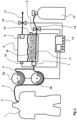
- Fig.1 the system according to the invention for the extracorporeal elimination of carbon monoxide is shown in a schematic illustration, wherein the person 1 can be connected to the gas exchange chamber 6 via a cannula 2 and a hose that has a first hose section 3 and a second hose section 4.
- a bidirectional pump 5 is used as the pump 5, which either transports blood from the bloodstream of the person 1 into the gas exchange chamber 6 or transports blood from the gas exchange chamber 6 back into the bloodstream of the person 1 or prevents a flow.
- This makes it possible to implement a system for the extracorporeal elimination of carbon monoxide by means of a single connection point to the bloodstream of the person 1 formed by the cannula 2.
- the pump 5 is a hose pump that can be operated bidirectionally.
- a hose pump offers the possibility of being operated bidirectionally in a simple manner and of preventing a flow between the first hose section 3 and the second hose section 4 in the deactivated state.
- only the first hose section 3 and the second hose section 4 come into contact with the blood, so that cleaning of the pump is not necessary, which has advantages, particularly for hygienic reasons.
- a bubble filter 7 is arranged between the second tube section 4 and the gas exchange chamber 6, which prevents gas bubbles 18 that are formed in the gas exchange chamber 6 from being returned to the bloodstream of the person 1.
- the bubble filter 7 advantageously has pores with a diameter in the range of 5 ⁇ m to 80 ⁇ m, so that the gas bubbles 18 that are possibly returned to the bloodstream of the person 1 do not have any negative effects there.
- the bubble filter 7 is preferably a membrane or a foam or a textile. A plastic fabric is particularly preferred as a bubble filter.
- the Fig.1 The embodiment of the invention shown has an oxygen supply 11, which is connected to an oxygen source 13 via an oxygen supply line 12.
- the oxygen supply feeds oxygen into the gas exchange chamber 6, thereby generating a high oxygen concentration within the gas exchange chamber 6.
- carbon monoxide in the blood is eliminated in the gas exchange chamber 6.
- the gas exchange chamber 6 is advantageously pressurized with a pressure in the range of 0.5 bar to 10 bar above the surrounding atmospheric pressure, so that the elimination takes place at increased pressure and is therefore more effective.
- An oxygen bottle is preferably used as the oxygen source 13, which on the one hand applies the necessary pressure and on the other hand, it is usually available in ambulances as well as in treatment rooms.
- the oxygen supply 11 has an outflow element which is designed to form gas bubbles 18.
- the outflow element can be formed by a perforated line, a perforated membrane or by a porous foam.
- the gas exchange chamber 6 has, in one embodiment, a carbon monoxide outlet 17 through which carbon monoxide and/or oxygen can escape from the gas exchange chamber 6. Furthermore, a foam filter 8 is arranged between the gas exchange chamber 6 and the carbon monoxide outlet 17, which ensures that only gases, i.e. oxygen and/or carbon monoxide, actually escape from the gas exchange chamber 6. The blood in the gas exchange chamber 6 provided with gas bubbles 18 is therefore not led out of the gas exchange chamber 6.
- the oxygen supply line 12 has a first valve 9.
- the amount of oxygen supplied to the gas exchange chamber 6 can be controlled by the first valve 9.
- the carbon monoxide discharge line 17 has a second valve 10 with which the pressure within the gas exchange chamber 6 and/or the discharge of carbon monoxide and/or oxygen can be controlled. This ensures that the process-related waste materials are discharged from the gas exchange chamber 6 and that the pressure within the gas exchange chamber 6 can be regulated.
- the first tube section 3 or the second tube section 4 has at least a third valve.
- a third valve By means of a third valve, a flow between the bloodstream of the person 1 and the gas exchange chamber 6 can thus be prevented, so that pumps can also be used for the system according to the invention which allow a flow in the non-pumping state.
- the use of a third valve enables Applying a higher pressure to the gas exchange chamber 6.
- the third valve is preferably arranged between the pump 5 and the bubble filter 7.
- a first sensor unit 15 is arranged on the gas exchange chamber 6, with which a carbon monoxide concentration can be determined, wherein optimal control of the system can be achieved by measuring the carbon monoxide concentration.
- the first sensor unit 15 ensures that only blood that has a sufficient oxygen concentration and/or a sufficiently low carbon monoxide concentration is returned to the bloodstream of the person 1.
- the gas exchange chamber 6 has a second sensor unit 16 with which a pressure within the gas exchange chamber 6 can be measured. This pressure sensor makes it possible to optimally adjust the pressure within the chamber.
- the degree of opening of the first valve 9 and/or the second valve 10 can be variably adjusted in order to ensure an optimal pressure and/or an optimal pressure curve in the gas exchange chamber 6.
- the system for eliminating carbon monoxide has a flow meter that determines the amount of blood that is fed into and/or out of the gas exchange chamber.
- an oxygen flow sensor and/or oxygen concentration sensor can be arranged on the oxygen supply line and/or a carbon monoxide flow sensor and/or carbon monoxide concentration sensor can be arranged on the carbon monoxide outlet.
- a level sensor is also integrated in the gas exchange chamber, which determines the blood level within the gas exchange chamber. The use of these additional sensors makes it possible to optimally control the system according to the invention and to achieve the most efficient possible elimination of carbon monoxide.
- the oxygen inflow and the carbon monoxide outflow can, for example, be set to an identical value, so that a continuous generation of bubbles is achieved at a constant pressure, which is in particular above atmospheric pressure.
- an embodiment of the invention has a control unit 14 which is designed to control the pump 5 and/or the first valve 9 and/or the second valve 10 and/or to read the first sensor unit 15 and/or the second sensor unit 16.
- the control unit 14 thus enables effective control of the system, wherein preferably three operating modes can be distinguished.
- the blood is transported from the bloodstream of the person 1 into the gas exchange chamber 6.
- This can be achieved, for example, by the first valve 9 being completely or partially closed, the second valve 10 being completely or partially opened and the pump 5 being controlled so that it transports the blood into the gas exchange chamber 6.
- the blood in the gas exchange chamber 6 is brought into contact with oxygen under increased pressure.
- the pump 5 is deactivated so that flow between the first hose section 3 and the second hose section 4 is prevented, and the degree of opening of the first valve 9 and the second valve 10 is varied, whereby the opening and closing can happen suddenly or at a controlled time.
- oxygen is introduced into the gas exchange chamber 6 through the oxygen supply 11 via the oxygen supply line 12 from the oxygen source 13, and the gas mixture of supplied oxygen and carbon monoxide eliminated from the blood is discharged via the carbon monoxide discharge line 17.
- the blood is pumped back from the gas exchange chamber 6 into the bloodstream of the person 1.
- the first valve 9 is completely or partially closed
- the second valve 10 is completely or partially opened, with the closing and opening occurring suddenly or in a time-controlled manner. can pass through, and the pump 5 is controlled so that the blood is transported from the gas exchange chamber 6 into the bloodstream of the person 1. This ensures that oxygen-enriched blood is fed back into the bloodstream of the person 1.
- the system is designed so that it can be stored in a portable case and is mobile and can be transported. In this way, it is possible to use the system according to the invention in ambulances or rescue vehicles or in hospitals and medical practices on site.
- Fig.2 is a schematic representation of the invention with two unidirectional pumps 5a and 5b.
- Such an embodiment of the invention offers the possibility of using unidirectional pumps 5a and 5b to implement the system according to the invention.
- the arrows indicate the flow direction in the activated state of the pumps 5a and 5b.
- Unidirectional pumps 5a and 5b can have the advantage that they are cheaper to purchase and have a longer service life.
- the control unit 14 is designed to control the pumps 5a and 5b and/or the first valve 9 and/or the second valve 10 and/or to read the first sensor unit 15 and/or the second sensor unit 16.
- the first pump 5a is deactivated, the second pump 5b is activated, the first valve 9 is completely or partially closed and the second valve 10 is completely or partially opened. In this way, it is ensured that the blood from the bloodstream of the person 1 is transported into the gas exchange chamber 6.
- both pumps 5a and 5b are deactivated and the degree of opening of the first valve 9 and the second valve 10 is varied. This transports oxygen into the gas exchange chamber 6, so that carbon monoxide is eliminated at increased pressure.
- the first pump 5a is activated, the second pump 5b is deactivated, the first valve 9 is completely or partially closed and the second valve 10 is completely or partially opened. In this way, the blood is returned to the bloodstream of the person 1 in the third operating mode.
- the pumps 5a and 5a shown are preferably pumps which, when deactivated, prevent flow between the first hose section 3 and the second hose section 4.
- the system according to the invention for the extracorporeal elimination of carbon monoxide makes it possible to treat blood effectively in portions with a compact design and in a simple manner and thus to realize a rapid and minimally invasive therapy of carbon monoxide poisoning immediately at the scene of the accident and/or during transport of the patient.
Landscapes
- Health & Medical Sciences (AREA)
- Heart & Thoracic Surgery (AREA)
- Urology & Nephrology (AREA)
- Emergency Medicine (AREA)
- Vascular Medicine (AREA)
- Hematology (AREA)
- Anesthesiology (AREA)
- Biomedical Technology (AREA)
- Engineering & Computer Science (AREA)
- Life Sciences & Earth Sciences (AREA)
- Animal Behavior & Ethology (AREA)
- General Health & Medical Sciences (AREA)
- Public Health (AREA)
- Veterinary Medicine (AREA)
- Cardiology (AREA)
- External Artificial Organs (AREA)
Description
- Die Erfindung betrifft ein System zur extrakorporalen Elimination von Kohlenmonoxid, umfassend zumindest eine Pumpe und eine Gasaustauschkammer, wobei wenigstens eine Pumpe durch einen mit einer Kanüle verbindbaren ersten Schlauchabschnitt mit dem Blutkreislauf einer Person verbindbar ist und über einen zweiten Schlauchabschnitt mit einer Gasaustauschkammer verbunden ist.
- Das Hämoglobin im Blut steht für die Bindung von Sauerstoff (O2) zu Verfügung, wobei Sauerstoff an die Eisenatome im Hämoglobin gebunden wird, so dass der Sauerstoff durch den Blutstrom von der Lunge in andere Organe und Gewebe transportiert wird. Ähnlich der SauerstoffBindung an Hämoglobin bindet auch Kohlenmonoxid (CO) an Hämoglobin, wobei dies mit einer bis zu 300-fach höheren Affinität als beim Sauerstoff stattfindet. Ist ein Eisenatom durch ein Kohlenmonoxidmolekül "blockiert", steht es für eine Bindung eines Sauerstoffmoleküls nicht mehr zur Verfügung. Durch die Blockade des Hämoglobins durch die Bindung mit dem Kohlenmonoxid, wird die Aufnahme- und Transportfähigkeit des Blutes für Sauerstoff herabgesetzt und dem Patient droht die innere Erstickung. Zudem gelangt Kohlenmonoxid mit dem Blut in den Körperkreislauf und lagert sich in Organen ab, beispielsweise im Herzmuskelgewebe, wo es gebunden an Myoglobin zur Unterversorgung des Herzens mit Sauerstoff und zum Herzinfarkt führen kann.
- Bei einer leichten Kohlenmonoxidvergiftung kann eine medikamentöse Therapie und/oder eine Therapie mit Sauerstoffbeatmung eingeleitet werden. Schwere Kohlenstoffmonoxidvergiftungen erfordern allerdings zur effektiven Therapie eine Behandlung des Patienten in einer Druckkammer mit hyperbarer Oxygenierung (HBO). Im Rahmen einer HBO-Therapie wird der Patient in einer Druckkammer platziert, er atmet Sauerstoff über eine Maske und der Umgebungsdruck in der Kammer wird erhöht. Durch den erhöhten Sauerstoffpartialdruck bzw. den physikalisch gelösten Sauerstoffanteil im Blut, der durch eine Einatmung von reinem Sauerstoff und dem erhöhten Umgebungsdruck entsteht, wird das Kohlenmonoxid deutlich schneller aus dem Blut eliminiert.
- Die Elimination von Kohlenmonoxid mittels einer HBO-Therapie ist ein verhältnismäßig langsamer Prozess, der über die Dauer von Minuten bis Stunden durchzuführen ist. Zudem ist die Anzahl an HBO-Zentren beschränkt. Beispielsweise gibt es in Deutschland 25 HBO-Zentren, die bundesweit räumlich ungleich verteilt sind, sodass eine schnelle und flächendeckende HBO-Therapie bei Kohlenmonoxidvergiftungen nicht gewährleistet ist. Eine schnelle Behandlung von Kohlenmonoxidvergiftungen ist jedoch wichtig, um die Sauerstoffversorgung des Patienten wiederherzustellen und eine Verbreitung des Kohlenmonoxids zu minimieren. Auf diese Weise sind schwere Folgeschäden oder ein tödlicher Verlauf durch eine Sauerstoffunterversorgung verhinderbar.
- Ein Verfahren und ein System zur Behandlung einer Kohlenmonoxidvergiftung wird im Patentdokument
WO 2012/082257 A1 vorgestellt. Das mit Kohlenmonoxid beladenem Hämoglobin (COHB) wird aus dem Blutkreislauf einer Person mittels einer Pumpe in eine Filtereinheit befördert. In der Filtereinheit wird das Kohlenmonoxid durch Sauerstoff ersetzt und über einen zweiten Schlauch in den Blutkreislauf des Patienten zugeführt. Die Filtereinheit ist dabei so aufgebaut, dass das Blut und ein Entnahmemedium, durch eine gasdurchlässige Membran getrennt, tangential aneinander vorbeifließen. Durch die gasdurchlässige Membran findet ein Gasaustausch zwischen dem mit Sauerstoff angereicherten Entnahmemedium und dem mit Kohlenstoffmonoxid belegten Hämoglobin statt. Somit ist kein direkter Kontakt zwischen Blut und Entnahmemedium möglich, was einen zusätzlichen Widerstand für einen effektiven Gasaustausch darstellt. Die Filtereinheit wird unidirektional durchströmt, somit kann mit dem vorgestellten System nur ein kontinuierlicher Prozess durchgeführt werden, bei dem während der Behandlung das mit Kohlenmonoxid beladene Blut über eine erste Kanüle aus dem Körper geleitet wird und durch eine zweite Kanüle sauerstoffangereichertes Blut in den Blutkreislauf zurückgeführt wird. Somit ist es bei diesem Verfahren notwendig zwei Kanülen am Patienten anzulegen. Des Weiteren ist ein zweiter Kreislauf mit einer zusätzlichen Pumpe für das Entnahmemedium notwendig, so dass die Komplexität dieses Aufbaus erhöht ist. - Aus
US 5,643,215 ist ein Blasen-Oxygenator bekannt, der mit nur einer Kanüle an den Blutkreislauf des Patienten angeschlossen wird. - Die Aufgabe der vorliegenden Erfindung besteht darin, ein einfaches System zur extrakorporalen Elimination von Kohlenmonoxid bereitzustellen, das einen geringen Wartungsaufwand aufweist, transportabel nutzbar ist, minimal invasiv an den Blutkreislauf einer Person anschließbar ist und mit einfachsten Mitteln zu betreiben ist.
- Erfindungsgemäß wird diese Aufgabe durch ein System mit den technischen Merkmalen des Anspruchs 1 gelöst, wobei das System zur extrakorporalen Elimination von Kohlenmonoxid dadurch gekennzeichnet ist, dass es dazu eingerichtet ist mittels zumindest einer Pumpe über einen ersten Schlauchabschnitt aus dem Blutkreislauf einer Person Blut, insbesondere über den zweiten Schlauchabschnitt, in eine Gasaustauschkammer abzuführen und aus der Gasaustauschkammer über denselben ersten Schlauchabschnitt in den Blutkreislauf der Person zurückzuführen.
- Dadurch, dass bei diesem System das Blut über den ersten Schlauchabschnitt entnommen und auch über denselben ersten Schlauchabschnitt in den Körper zurückgeführt wird, ist es möglich eine extrakorporale Elimination von Kohlenmonoxid durch das Anlegen eines einzigen Zugangs zu realisieren. Das System ermöglicht über den ersten Schlauchabschnitt somit eine portionsweise Behandlung von mit Kohlenmonoxid beladenem Hämoglobin in der Gasaustauschkammer. Erster Schlauchabschnitt und zweiter Schlauchabschnitt können dabei bevorzugt durch denselben ununterbrochenen Schlauch gebildet werden.
- Vorteilhafterweise wird dadurch eine minimal invasive Lösung für die extrakorporale Elimination von Kohlenmonoxid realisiert, da anstatt zwei Zugängen nur noch ein einzelner Zugang zum Blutkreislauf der Person notwendig ist. Zudem wird die Zeit die notwendig ist, um das System in Betriebsbereitschaft zu versetzen signifikant reduziert, da das Anlegen eines zweiten Zugangs entfällt. Zusätzlich ist das Füllvolumen des Systems geringer, weil kein zweiter Zugang mit Schlauchsystem für den Betrieb mit Blut gefüllt werden muss.
- Eine vorteilhafte Ausführung der Erfindung sieht es vor, dass das System eine Pumpe aufweist, die bidirektional betreibbar ist.
- Auf diese Weise ist es möglich das Blut über nur einen einzigen Schlauch und mittels nur einer Pumpe aus dem Blutkreislauf der Person in die Gasaustauschkammer abzuführen und aus der Gasaustauschkammer in den Blutkreislauf zurückzuführen. Beim Betrieb der bidirektional betreibbaren Pumpe in einer ersten Pumprichtung bzw. Drehrichtung wird das Blut also aus dem Blutkreislauf der Person in eine Gasaustauschkammer abgeführt. Bei umgekehrter Drehrichtung wird das mit Sauerstoff angereicherte Blut wieder in den Blutkreislauf der Person zurückgeführt.
- Die Verwendung einer bidirektionalen Pumpe hat den Vorteil, dass für eine portionsweise Behandlung des Blutes in der Gasaustauschkammer nur eine Pumpe notwendig ist, was zu einem möglichst einfachen Aufbau führt, einfach zu steuern und günstig zu realisieren ist. Zudem wird durch die Verwendung nur einer bidirektionalen Pumpe Platz und Gewicht gespart, so dass vorteilhafterweise ein transportables System zur extrakorporalen Elimination von Kohlenmonoxid zu verwirklichbar ist.
- Eine weitere Ausführung der Erfindung sieht es vor, dass der erste Schlauchabschnitt, der über eine Kanüle mit dem Blutkreislauf der Person verbindbar ist, mit zwei unidirektional betreibbaren Pumpen verbunden ist. Der erste Schlauchabschnitt wird vorzugsweise mittels eines Y-Konnektors aufgeteilt und über diesen mit den beiden unidirektional betreibbaren Pumpen verbunden. Durch die Verwendung von zwei unidirektional betreibbaren Pumpen ist es möglich das Blut portionsweise in der Gasaustauschkammer zu behandeln. Dafür wird beispielsweise eine erste Pumpe aktiviert, um das Blut aus dem Blutkreislauf der Person in die Gasaustauschkammer zu führen. Eine zweite unidirektionale Pumpe wird aktiviert, um das Blut aus der Gasaustauschkammer in den Blutkreislauf der Person zurückzuführen. Bezogen auf den ersten Schlauchabschnitt fördern somit beide Pumpen in entgegengesetzten Richtungen. Die Verwendung von zwei unidirektionalen Pumpen hat den Vorteil, dass man vergleichsweise günstige Pumpen für den Aufbau des erfindungsgemäßen Systems verwenden kann, die zudem eine hohe Zuverlässigkeit aufweisen.
- Eine besonders bevorzugte weitere Ausführungsform der Erfindung sieht es vor, dass die Pumpe oder die Pumpen Schlauchpumpen sind.
- Das zu befördernde Medium wird dabei durch äußere mechanische Verformung eines Schlauches durch diesen hindurch gedrückt. Durch die Verwendung einer Schlauchpumpe kann somit das Blut über einen Schlauch aus dem Blutkreislauf der Person abgeführt und wieder zurückgeführt werden ohne mit anderen Komponenten der Pumpe in Kontakt zu kommen.
- Dies bietet den Vorteil, dass die Pumpe selber bei der Umstellung auf neue Patienten nicht gereinigt werden muss, sondern nur der Austausch des Schlauches notwendig ist um einen Austausch von Blut unterschiedlicher Patienten zu verhindern. Durch die Verwendung von Schlauchpumpen ist deshalb eine hygienische Realisierung des Systems zur extrakorporalen Elimination von Kohlenmonoxid möglich.
- Die Erfindung sieht weiterhin vor, dass durch die Pumpe oder die Pumpen im deaktivierten nichtpumpenden Zustand ein Fluss zwischen dem ersten Schlauchabschnitt und dem zweiten Schlauchabschnitt verhindert ist.
- Der erste Schlauchabschnitt ist dabei mit einer Kanüle verbindbar wohingegen der zweite Schlauchabschnitt mit der Gasaustauschkammer verbunden ist.
- Beispielsweise lässt sich der Fluss im deaktivierten Zustand bei der Verwendung einer Schlauchpumpe verhindern, da die mechanische Verformung des Schlauches von außen dazu führt, dass ein Fluid diesen Schlauch nicht passieren kann. Durch die Verwendung einer Pumpe, die im deaktivierten Zustand einen Fluss zwischen dem ersten Schlauchabschnitt bzw. dem Blutkreislauf einer Person und dem zweiten Schlauchabschnitt bzw. der Gasaustauschkammer verhindert, ist es möglich eine Trennung zwischen dem Blutkreislauf einer Person und der Gasaustauschkammer auf einfache Weise zu realisieren. Insbesondere ist die Gasaustauschkammer bei deaktivierten Pumpen betreibbar, ohne den Blutkreislauf der Person zu beeinflussen.
- Die Verwendung von Pumpen, die im deaktivierten Zustand einen Fluss verhindern, bietet den Vorteil zwischen dem Blutkreislauf und der Gasaustauschkammer eine effektive Trennung zu realisieren, ohne weitere Ventile zu benötigen. Dies ermöglicht eine platzsparende, einfache und wartungsarme Realisierung eines Systems zur extrakorporalen Elimination von Kohlenmonoxid.
- In einer weiteren Ausführung der Erfindung ist es vorgesehen, dass zwischen dem zweiten Schlauchabschnitt und der Gasaustauschkammer ein Blasenfilter angeordnet ist.
- Die Verwendung eines Blasenfilters führt dazu, dass im aufbereiteten Blut befindliche Gasblasen herausgefiltert werden. Insbesondere führt ein Blasenfilter dazu, dass das Blut aus der Gasaustauschkammer, welches nach der Elimination von Kohlenmonoxid und der Sauerstoffanreicherung Gasblasen aufweisen kann, vor der Zurückführung in den Blutkreislauf der Person von diesen Gasblasen befreit wird.
- Dies hat den Vorteil, dass blasenfreies Blut aus der Gasaustauschkammer in den Blutkreislauf der Person zurückgeführt wird und dadurch negative Auswirkungen durch zu große Gasblasen im Blutkreislauf verhindert werden.
- Eine vorteilhafte Ausführung der Erfindung sieht vor, dass der Blasenfilter zwischen dem zweiten Schlauchabschnitt und der Gasaustauschkammer Poren mit einem Durchmesser im Bereich von 5 bis 80 µm aufweist. Durch Poren dieser Größe werden Gasblasen, die einen größeren Durchmesser aufweisen, am Durchfluss behindert. Beispielsweise kann ein entsprechender Blasenfilter durch eine Membran oder einen Schaum oder ein Textil gebildet sein. Ein Kunststoffgewebe ist besonders bevorzugt als Blasenfilter einzusetzen. Zudem ist es vorgesehen den Blasenfilter über eine Verschraubung und/oder eine Arretiervorrichtung an die Gasaustauschkammer anzubringen. Eine weitere Ausführung kann es vorsehen, dass der Blasenfilter in die Gasaustauschkammer integriert ist.
- Eine derartige Ausführung des Blasenfilter führt vorteilhafterweise dazu, dass das Blut, das in den Blutkreislauf der Person zurückgeführt wird nur Sauerstoffblasen aufweist, die zu keiner negativen Beeinträchtigung im Blutkreislauf führen. Durch die Befestigung mittels einer Verschraubung und/oder Arretiervorrichtung ist es vorteilhafterweise möglich den Blasenfilterbei Bedarf einfach auszutauschen.
- Gemäß der Erfindung ist vorgesehen, dass die Gasaustauschkammer eine Sauerstoffzuführung aufweist, die über eine Sauerstoffzuleitung mit einer Sauerstoffquelle verbunden ist. Die Sauerstoffquelle beinhaltet bevorzugt ein sauerstoffhaltiges Gasgemisch mit einer hohen Sauerstoffkonzentration, insbesondere mit einer Sauerstoffkonzentration von über 95 %.
- Auf diese Weise wird der Gasaustauschkammer, in der sich das mit Kohlenmonoxid beladene Hämoglobin befindet, Sauerstoff hinzugefügt. Die Vermischung des mit Kohlenmonoxid beladenen Hämoglobins mit Sauerstoff führt dazu, dass das Kohlenmonoxid durch Sauerstoff ersetzt wird und damit eine Elimination von Kohlenmonoxid aus dem Blut stattfindet. Ein Kontakt zwischen Sauerstoff und mit Kohlenmonoxid belegtem Hämoglobin hat den Vorteil, dass ein direkter Austausch stattfindet und auf weitere Komponenten, wie zum Beispiel Membranen, verzichtet werden kann.
- Durch die Zuführung von Sauerstoff und den direkten Kontakt zwischen Sauerstoff und Blut ist die erfindungsgemäße Gasaustauschkammer einfach zu realisieren und im Vergleich zu anderen Technologien wartungsarm.
- Die Erfindung sieht vor, dass die Gasaustauschkammer mit einem Druck über dem umgebenden Atmosphärendruck beaufschlagbar ist, z.B. 0,5 bis 10 bar darüber.
- Die Beaufschlagung der Gasaustauschkammer mit einem Druck führt dazu, dass der Kontakt zwischen dem mit Kohlenmonoxid beladenem Hämoglobin und dem Sauerstoff bei einem Druck stattfindet der den Austausch Kohlenmonoxids durch Sauerstoff positiv beeinflusst.
- Vorteilhafterweise führt die Beaufschlagung der Gasaustauschkammer mit einem Druck zu einer effektiveren und schnelleren Elimination des Kohlenmonoxids im Blut und damit zu einer schnelleren Behandlung des Patienten.
- In einer besonders praktischen Ausführung der Erfindung ist die Sauerstoffquelle eine Sauerstoffflasche. In dieser besonders praktischen Ausführung ist die Sauerstofflasche mit reinem Sauerstoff oder einem Gasgemisch mit sehr hohem Sauerstoffanteil gefüllt. Die Verwendung einer Sauerstoffflasche bietet die Möglichkeit der Gasaustauschkammer über die Sauerstoffzuleitung und die Sauerstoffzuführung Sauerstoff zuzuführen und damit den Austausch mit dem Kohlenmonoxid zu realisieren. Eine Gasflasche hat dabei den Vorteil, dass diese Druck aufbauen kann und zudem typischerweise in Rettungsfahrzeugen oder Behandlungsräumen vorliegt. Außerdem werden Sauerstoffflaschen in einer sehr hohen Stückzahl hergestellt, so dass sich auch eine günstige Lösung für ein System zur extrakorporalen Elimination von Kohlenmonoxid realisieren lässt. Weiterhin sind Sauerstofflaschen auch in kleiner Bauform verfügbar, was das System mobil transportierbar macht.
- Weiterhin ist die Erfindung dadurch gekennzeichnet, dass die Sauerstoffzuführung ein Ausströmelement aufweist, das zur Bildung von Gasblasen eingerichtet ist.
- Durch die Verwendung eines Ausströmelementes, das zur Bildung von Gasblasen eingerichtet ist, werden im Blut, das sich in der Gasaustauschkammer befindet, viele Gasblasen gebildet und somit die effektive Wechselwirkungsfläche zwischen Sauerstoff und Blut erhöht.
- Die Vergrößerung der effektiven Wechselwirkungsfläche zwischen Blut und Sauerstoff führt dazu, dass ein Austausch des Kohlenmonoxids durch Sauerstoff schneller stattfindet und damit eine effiziente Elimination von Kohlenmonoxid im Blut realisierbar ist.
- In einer besonders praktikablen Ausführung der Erfindung ist es vorgesehen, dass das Ausströmelement eine perforierte Leitung, eine perforierte Membran oder ein poröser Schaum ist.
- Durch die Verwendung einer perforierten Leitung, einer perforierten Membran oder eines porösen Schaumes ist es möglich auf effektive Weise Gasblasen in der Gasaustauschkammer herzustellen und auf diese Weise einen möglichst effektiven Austausch von Kohlenmonoxid durch Sauerstoff zu gewährleisten. Die Verwendung einer perforierten Leitung, einer perforierten Membran oder eines porösen Schaumes als Ausströmelement hat den Vorteil, dass auf einfache Weise mit üblichen Bauelementen die gewünschten Gasblasen im Blut der Gasaustauschkammer herzustellen sind.
- Eine weitere Ausführung der Erfindung sieht es vor, dass die Gasaustauschkammer eine Kohlenmonoxidableitung aufweist.
- Durch die Kohlenmonoxidableitung wird das Kohlenmonoxid, das im Blut durch Sauerstoff ersetzt worden ist und dadurch im gasförmigen Zustand in der Gasaustauschkammer befindlich ist, aus dieser abgeleitet. Über die Kohlenmonoxidableitung wird zudem der Sauerstoff abgeführt, der nicht durch das Hämoglobin des Blutes in der Gasaustauschkammer aufgenommen worden ist. Auf diese Weise werden die gasförmigen Abfallprodukte der Elimination von Kohlenmonoxid aus der Gaskammer abgeführt.
- Vorteilhafterweise wird dadurch die Konzentration des Kohlenmonoxids in der Gasaustauschkammer im Vergleich zur Sauerstoffkonzentration gering gehalten und dadurch ein effektiver Austausch zwischen Kohlenmonoxid und Sauerstoff erreicht.
- In einer weiteren bevorzugten Ausführungsvariante der Erfindung ist es vorgesehen, dass zwischen Gasaustauschkammer und Kohlenmonoxidableitung ein Schaumfilter angeordnet ist. Es kann vorteilhafterweise auch vorgesehen sein, dass der Schaumfilter in die Gasaustauschkammer integriert ist. Eine weitere Ausführung kann zudem vorsehen, dass der Schaumfilter auswechselbar an der Gasaustauschkammer angeordnet ist.
- Der Schaumfilter dient dazu, einen Austritt von schaumförmigem Blut, das sich durch Zuführung der Sauerstoffblasen in der Gasaustauschkammer bildet, zu unterbinden.
- Vorteilhafterweise wird somit ein Austritt von Blut und dadurch ein Blutverlust durch das System zur extrakorporalen Elimination von Kohlenmonoxid verhindert.
- Eine weitere Ausführung der Erfindung sieht es vor, dass die Sauerstoffzuleitung ein erstes Ventil und die Kohlenmonoxidableitung ein zweites Ventil aufweist, die insbesondere jeweils ansteuerbar sind.
- Die Verwendung dieser beiden Ventile macht es möglich je nach Bedarf Sauerstoff in die Gasaustauschkammer zuzuführen und/oder Kohlenmonoxid und Sauerstoff aus der Gasaustauschkammer abzuführen. Dadurch ist der Druck innerhalb der Gasaustauschkammer und der Sauerstoffdurchfluss in Form von Gasblasen durch das Blut steuerbar, so dass eine effektive Elimination von Kohlenmonoxid einstellbar ist.
- Vorteilhafterweise ermöglichen das erste und das zweite Ventile eine optimierte Einstellung des Drucks und des Sauerstoffdurchflusses und der Sauerstoffkonzentration in der Gasaustauschkammer sowie eine portionsweise Behandlung des Blutes innerhalb dieser für eine effektive und schnelle Elimination von Kohlenmonoxid vom Hämoglobin und einer Sauerstoffanreicherung am Hämoglobin.
- Gemäß einer weiteren Ausführungsvariante der Erfindung weist der erste Schlauchabschnitt oder der zweite Schlauchabschnitt zumindest ein drittes Ventil auf. Vorzugsweise ist das dritte Ventil zwischen dem Blasenfilter und der Pumpe angeordnet.
- Mit einem dritten Ventil, das sich zwischen dem Blutkreislauf der Person und der Gasaustauschkammer befindet, lässt sich ein Fluss zwischen dem Blutkreislauf und der Gasaustauschkammer verhindern. Insbesondere ermöglicht ein drittes Ventil eine druckdichte Verschließung der Gasaustauschkammer, sodass diese mit einem für die Elimination von Kohlenmonoxid optimalen Druck beaufschlagbar ist.
- Die Verwendung eines dritten Ventils bietet den Vorteil, dass der Blutkreislauf der Person auf einfache Weise von der Gasaustauschkammer zu trennen ist. Insbesondere ermöglicht ein drittes Ventil den Aufbau des erfindungsgemäßen Systems mit solchen Pumpen, die im deaktivierten Zustand einen Fluss nicht verhindern. Die Anordnung des dritten Ventils zwischen dem Blasenfilter und der Pumpe bietet den Vorteil, dass eine Druckvariation durch einen Betrieb des Ventils im ersten Schlauchabschnitt und damit auf den Blutkreislauf der Person reduziert oder verhindert wird.
- In einer weiteren Ausführungsvariante der Erfindung ist es vorgesehen, dass die Gasaustauschkammer eine erste Sensoreinheit aufweist, mit der eine Kohlenmonoxidkonzentration bestimmbar ist. Z.B. kann diejenige im Blut und/oder die im Gas gemessen werden.
- Die Verwendung eines Kohlenmonoxidsensors bietet die Möglichkeit die Ventile der Sauerstoffzuleitung und/oder der Kohlenmonoxidableitung gezielt, insbesondere also in Abhängigkeit der gemessenen Konzentration von Kohlenmonoxid zu steuern und so eine gewünschte Kohlenmonoxidkonzentration in der Gasaustauschkammer zu realisieren. Insbesondere lässt sich in Abhängigkeit von der Kohlenmonoxidkonzentration feststellen wann die Elimination des Kohlenmonoxids aus dem Blut soweit fortgeschritten ist, dass das mit Sauerstoff angereicherte Blut wieder in den Blutkreislauf der Person zurückführbar ist und somit die vorteilhafte portionsweise Behandlung des Blutes nach Bedarf möglich ist.
- Ein Kohlenmonoxidsensor hat somit den Vorteil, dass auf Grundlage der bestimmten Kohlenmonoxidkonzentration der Prozess zur Elimination von Kohlenmonoxid einstellbar und optimierbar ist.
- In einer weiteren bevorzugten Ausführungsvariante der Erfindung ist es vorgesehen, dass die Gasaustauschkammer eine zweite Sensoreinheit aufweist, mit der ein Druck innerhalb der Gasaustauschkammer messbar ist.
- Mittels des durch den Drucksensors bestimmten Druckes innerhalb der Gasaustauschkammer lässt sich die Zuführung von Sauerstoff über die Sauerstoffzuleitung und die Abführung von Kohlenmonoxid über die Kohlenmonoxidableitung derart einstellen, dass ein gewünschter Druck erreicht werden kann und für eine Zeit gehalten werden kann oder ein Druckverlauf abgefahren werden kann, insbesondere so eine optimale Elimination von Kohlenmonoxid stattfindet.
- In einer weiteren Ausführungsvariante der Erfindung weist das System ein Durchflussmesser auf, der die Blutmenge die in die Gasaustauschkammer hineingeführt und/oder herausgeführt wird bestimmt. Zudem kann es in einer Ausführung vorgesehen sein an die Sauerstoffzuleitung einen Sauerstoffdurchflusssensor und/oder Sauerstoffkonzentrationssensor und/oder an die Kohlenmonoxidableitung einen Kohlenmonoxiddurchflusssensor und/oder Kohlenmonoxidkonzentrationssensor anzuordnen. Vorteilhafterweise ist in der Gasaustauschkammer ein Füllstandsensor integriert, der den Blutfüllstand innerhalb der Gasaustauschkammer bestimmt.
- Die Verwendung dieser zusätzlichen Sensoren erlaubt es das erfindungsgemäße System optimal zu steuern und eine möglichst effiziente Elimination von
- Kohlenstoffmonoxid zu erzielen. Beispielsweise kann der Sauerstoffzufluss und der Kohlenmonoxidabfluss auf einen identischen Wert eingestellt werden, so dass bei konstantem Druck, der insbesondere über dem Atmosphärendruck liegt, eine kontinuierliche Erzeugung von Gasblasen erzielt wird.
- In einer besonders bevorzugten Ausführungsvariante der Erfindung ist das System dazu eingerichtet das Blut portionsweise zu behandeln, wobei in einem ersten Betriebsmodus Blut aus dem Blutkreislauf der Person in die Gasaustauschkammer befördert wird. Beispielsweise wird dazu im ersten Betriebsmodus das erste Ventil ganz oder teilweise geschlossen, das zweite Ventil ganz oder teilweise geöffnet und die Pumpe so angesteuert, dass das Blut in die Gasaustauschkammer befördert wird. Dadurch, dass das zweite Ventil geöffnet wird kann das Blut, das durch die Pumpe in Richtung Gasaustauschkammer geführt wird in diese hineinfließen ohne dass sich in der Kammer ein Gegendruck aufbaut. Es kann insbesondere von Vorteil sein, wenn beim Hineinbefördern des Blutes in die Gasaustauschkammer kein oder wenig Sauerstoff eingeführt wird, um eine unnötige Vergeudung von Sauerstoff zu vermeiden.
- Eine weitere Ausführung der Erfindung sieht es vor, dass das System dazu eingerichtet ist Blut portionsweise zu behandeln, wobei in einem zweiten Betriebsmodus Blut in der Gasaustauschkammer unter erhöhtem Druck mit Sauerstoff in Kontakt gebracht wird. Beispielsweise wird im zweiten Betriebsmodus die Pumpe deaktiviert und der Öffnungsgrad des ersten Ventils sowie des zweiten Ventils variiert. , wobei in einer besonders praktischen Ausführung die Steuerung des Öffnungsgrades des ersten Ventils und/oder des zweiten Ventils nichtplötzlich sondern zeitlich kontrolliert stattfinden. Zum Druckaufbau innerhalb der Gasaustauschkammer wird beispielsweise das erste Ventil ganz oder teilweise geöffnet und das zweite Ventil ganz oder Teilweise geschlossen. Für eine kontinuierliche Zuführung von Sauerstoff bei Konstantem Druck wird der Öffnungsgrade des ersten Ventils und des zweiten Ventils so eingestellt, dass der Sauerstoffzufluss und der Kohlenmonoxidabfluss einen identischen Wert einnehmen. Zum Druckabbau innerhalb der Gasaustauschkammer wird beispielsweise das erste Ventil ganz oder teilweise geschlossen und das zweite Ventil ganz oder teilweise geöffnet.
- Dadurch dass die Pumpe deaktiviert ist und das zweite Ventil ganz oder teilweise geschlossen ist, kann aus der Gasaustauschkammer keine Flüssigkeit entweichen. Durch das ganz oder teilweise Öffnen des ersten Ventils wird Sauerstoff in die Gasaustauschkammer hineingeführt und ein erhöhter Druck in der Gasaustauschkammer gebildet. Zudem ist durch eine gezielte Einstellung einer Sauerstoffzufuhr durch das erste Ventil und eine gezielte Einstellung einer Kohlenstoffmonoxidabfuhr durch das zweite Ventil ein kontinuierlicher Sauerstoffdurchfluss bei einem bestimmten Druck realisierbar, so dass eine zeitlich konstante Sauerstoffblasenbildung zu realisieren ist. Das Ablassen des Druckes innerhalb der Gasaustauschkammer über das zweite Ventil ermöglicht es in der Gasaustauschkammer den Druck wieder an den Atmosphärendruck anzupassen, so dass der Druck innerhalb Gasaustauschkammer an den Druck des Blutkreislaufs angeglichen ist. Der zweite Betriebsmodus bietet auf diese Weise den Vorteil, dass eine effektive Elimination von Kohlenmonoxid in der Gasaustauschkammer bei erhöhtem Druck mit einer hohen Sauerstoff-Blut-Kontaktfläche effektiv durchführbar ist.
- Das zweite Ventil ist in einer bevorzugten Ausführung ein Überdruckventil, das automatisch Druck ablässt, wenn der gewünschte Druck durch die Sauerstoffzuführung überschritten wird, so dass der Druck unter Zuführung von Sauerstoff konstant bleibt.
- In einer weiteren Ausführung der Erfindung ist es vorgesehen, dass das System dazu eingerichtet ist Blut portionsweise zu behandeln, wobei in einem dritten Betriebsmodus Blut aus der Gasaustauschkammer in den Blutkreislauf der Person zurück befördert wird. Beispielsweise wird in diesem Betriebsmodus das erste Ventil ganz oder teilweise geschlossen, das zweite Ventil ganz oder teilweise geöffnet und die Pumpe so angesteuert, dass das Blut aus der Gasaustauschkammer in den Blutkreislauf der Person befördert wird. In einer besonders praktischen Ausführung können das Schließen des ersten Ventils und/oder das Öffnen des zweiten Ventils nicht plötzlich, sondern zeitlich kontrolliert stattfinden.
- Bei der Zurückführung des Blutes in den Blutkreislauf ist das erste Ventil, also die Sauerstoffzuführung, geschlossen um unnötigen Verbrauch von Sauerstoff zu vermeiden. Das zweite Ventil in der Kohlenmonoxidableitung ist im dritten Betriebsmodus beispielsweise geöffnet, um eine einfachere Zurückführung des Blutes in den Blutkreislauf zu realisieren.
- Die portionsweise Behandlung von Blut durch aufeinander folgende Durchführung des ersten, des zweiten und des dritten Betriebsmodus ermöglicht vorteilhafterweise eine effektive Elimination von Kohlenmonoxid, wobei nur ein Zugang zum Blutkreislauf der Person anzulegen ist. Dadurch ist eine minimal invasive und schnelle Inbetriebnahme des erfindungsgemäßen Systems an der Person möglich. Eine wiederholte Durchführung der portionsweisen Behandlung von Blut durch die aufeinander folgende Durchführung des ersten, zweiten und des dritten Betriebsmodus ermöglicht vorteilhafterweise die schrittweise effektive Elimination von Kohlenmonoxid aus dem Blutkreislauf der Person.
- Eine besonders praktikable Ausführungsvariante der Erfindung sieht es vor, dass das System eine Steuereinheit aufweist, die dazu eingerichtet ist die Pumpe und/oder das erste Ventil und/oder das zweite Ventil zu steuern und/oder die erste Sensoreinheit und/oder die zweite Sensoreinheit auszulesen.
- Die Verwendung einer Steuereinheit, die die Komponenten des Systems je nach Bedarf steuert und/oder ausliest, ermöglicht eine effiziente Steuerung des erfindungsgemäßen Systems. Die Steuereinheit ist insbesondere dazu ausgelegt aufeinanderfolgend den ersten Betriebsmodus, den zweiten Betriebsmodus und den dritten Betriebsmodus durchzuführen. Zudem lassen sich die Betriebsmodi durch Auswertung des Drucks und der Kohlenmonoxidkonzentration über die erste und die zweite Sensoreinheit dahingehend optimieren, dass die Elimination von Kohlenmonoxid möglichst effektiv durchzuführen ist.
- Eine besonders anwenderfreundliche Ausführung der Erfindung sieht es vor, dass das System in einem tragbaren Koffer mobil transportierbar ist sowohl im Nichtbetrieb als auch im Betrieb an einer Person.
- Dadurch, dass das System in einem Koffer untergebracht werden kann und transportierbar ist, wird sichergestellt, dass das erfindungsgemäße System zur Elimination von Kohlenmonoxid in Krankenwagen oder Rettungswagen oder Notarztwagen mobil zu transportieren ist. Damit wird vorteilhafterweise sichergestellt, dass eine Elimination von Kohlenmonoxid auch ortsnah außerhalb eines Krankenhauses an einem Unfallort und direkt durchführbar ist, so das eine schnelle Behandlung der Patienten gewährleist ist und damit Folgeschäden durch die Kohlenmonoxidvergiftung reduziert werden.
- Im Folgenden werden Ausführungen der Erfindung anhand von Figuren vorgestellt und näher erläutert. Es zeigen:
- Fig. 1
- den schematischen Aufbau des erfindungsgemäßen Systems mit einer bidirektionalen Pumpe,
- Fig. 2
- in einer schematischen Darstellung das erfindungsgemäße System mit zwei unidirektionalen Pumpen.
- In
Fig. 1 ist das erfindungsgemäße System zur extrakorporalen Elimination von Kohlenmonoxid in einer schematischen Abbildung dargestellt, wobei die Person 1 über eine Kanüle 2 und über einen Schlauch, der einen ersten Schlauchabschnitt 3 und einen zweiten Schlauchabschnitt 4 aufweist, mit der Gasaustauschkammer 6 verbindbar ist. Als Pumpe 5 wird in diesem Ausführungsbeispiel eine bidirektionale Pumpe 5 eingesetzt, die entweder Blut aus dem Blutkreislauf der Person 1 in die Gasaustauschkammer 6 befördert oder Blut aus der Gasaustauschkammer 6 in den Blutkreislauf der Person 1 zurück befördert oder einen Fluss unterbindet. Dadurch ist es möglich mittels einer einzigen, durch die Kanüle 2 gebildeten Anschlussstelle an den Blutkreislauf der Person 1 ein System zur extrakorporalen Elimination von Kohlenmonoxid zu realisieren. - Die Pumpe 5 ist in einer bevorzugten Ausführungsform eine Schlauchpumpe, die bidirektional betreibbar ist. Eine Schlauchpumpe bietet auf einfache Weise die Möglichkeit bidirektional betrieben zu werden und einen Fluss zwischen dem ersten Schlauchabschnitt 3 und dem zweiten Schlauchabschnitt 4 im deaktivierten Zustand zu verhindern. Außerdem kommt nur der erste Schlauchabschnitt 3 und der zweite Schlauchabschnitt 4 in Kontakt mit dem Blut, sodass eine Reinigung der Pumpe entfällt, was insbesondere aus hygienischen Gründen Vorteile aufweist.
- In der in
Fig. 1 dargestellten Ausführungsvariante ist zwischen dem zweiten Schlauchabschnitt 4 und der Gasaustauschkammer 6 ein Blasenfilter 7 angeordnet, der verhindert dass Gasblasen 18, die in der Gasaustauschkammer 6 gebildet werden in den Blutkreislauf der Person 1 zurückgeführt werden. Vorteilhafterweise weist der Blasenfilter 7 Poren mit einem Durchmesser im Bereich von 5 µm bis 80 µm auf, so dass die Gasblasen 18, die ggf. in dem Blutkreislauf der Person 1 zurückgeführt werden, dort keine negativen Auswirkungen haben. Der Blasenfilter 7 ist dabei vorzugsweise eine Membran oder ein Schaum oder ein Textil. Ein Kunststoffgewebe ist als Blasenfilter besonders bevorzugt. - Die in
Fig. 1 dargestellt Ausführungsform der Erfindung weist eine Sauerstoffzuführung 11 auf, die über eine Sauerstoffzuleitung 12 mit einer Sauerstoffquelle 13 verbunden ist. Durch die Sauerstoffzuführung wird Sauerstoff in die Gasaustauschkammer 6 hineingeführt und damit eine hohe Sauerstoffkonzentration innerhalb der Gasaustauschkammer 6 erzeugt. Dies führt dazu, dass das mit Kohlenmonoxid beladene Hämoglobin mit Sauerstoff in Kontakt kommt und das Kohlenmonoxid durch Sauerstoff ausgetauscht wird. Auf diese Weise findet in der Gasaustauschkammer 6 eine Elimination von Kohlenmonoxid im Blut statt. Vorteilhafterweise wird die Gasaustauschkammer 6 mit einem Druck im Bereich von 0,5 bar bis 10 bar über dem umgebenden Atmosphärendruck beaufschlagt, so dass die Elimination bei erhöhtem Druck stattfindet und damit effektiver abläuft. Als Sauerstoffquelle 13 wird bevorzugt eine Sauerstoffflasche eingesetzt, die zum einen den notwendigen Druck aufbringt und zum anderen sowohl in Krankenwagen als auch in Behandlungsräumen üblicherweise zu Verfügung steht. - In einer nicht dargestellten Ausführungsform der Erfindung weist die Sauerstoffzuführung 11 ein Ausströmelement auf, das zur Bildung von Gasblasen 18 eingerichtet ist. Das Ausströmelement kann durch eine perforierte Leitung, eine perforierte Membran oder durch einen porösen Schaum gebildet sein.
- Wie in
Fig. 1 dargestellt, weist die Gasaustauschkammer 6 in einer Ausführungsvariante eine Kohlenmonoxidableitung 17 auf, über die Kohlenmonoxid und/oder Sauerstoff aus der Gasaustauschkammer 6 entweichen kann. Des Weiteren ist zwischen der Gasaustauschkammer 6 und Kohlenmonoxidableitung 17 ein Schaumfilter 8 angeordnet, der dafür sorgt dass tatsächlich nur Gase, also Sauerstoff und/oder Kohlenmonoxid aus der Gasaustauschkammer 6 entweichen. Das in der Gasaustauschkammer 6 befindliche mit Gasblasen 18 versehene Blut wird somit nicht aus der Gasaustauschkammer 6 geführt. - Die Sauerstoffzuleitung 12 weist in der dargestellten Ausführungsvariante ein erstes Ventil 9 auf. Durch das erste Ventil 9 ist die zugeführte Sauerstoffmenge in der Gasaustauschkammer 6 steuerbar. Des Weiteren weist die Kohlenmonoxidableitung 17 ein zweites Ventil 10 auf, mit dem der Druck innerhalb der Gasaustauschkammer 6 und/oder die Abführung von Kohlenmonoxid und/oder Sauerstoff steuerbar sind. Dadurch wird sichergestellt, dass die prozessbedingten Abfallstoffe aus der Gasaustauschkammer 6 abgeführt werden und der Druck innerhalb der Gasaustauschkammer 6 regulierbar ist.
- In einer nicht dargestellten Ausführungsvariante weist der erste Schlauchabschnitt 3 oder der zweite Schlauchabschnitt 4 zumindest ein drittes Ventil auf. Mittels eines dritten Ventils ist somit ein Fluss zwischen dem Blutkreislauf der Person 1 und der Gasaustauschkammer 6 verhinderbar, so dass für das erfindungsgemäße System auch Pumpen eingesetzt werden können, die im nichtpumpenden Zustand einen Fluss zulassen. Zudem ermöglicht die Verwendung eines dritten Ventils die Beaufschlagung der Gasaustauschkammer 6 mit einem höheren Druck. Das dritte Ventil wird bevorzugt zwischen der Pumpe 5 und dem Blasenfilter 7 angeordnet.
- Wie in
Fig. 1 dargestellt, ist an der Gasaustauschkammer 6 eine erste Sensoreinheit 15 angeordnet, mit der eine Kohlenmonoxidkonzentration bestimmbar ist, wobei durch die Messung der Kohlenmonoxidkonzentration eine optimale Steuerung des Systems realisiert werden kann. Insbesondere wird durch die erste Sensoreinheit 15 sichergestellt, dass nur Blut in den Blutkreislauf der Person 1 zurückgeführt wird, das eine ausreichende Sauerstoffkonzentration und/oder eine ausreichend geringe Kohlenmonoxidkonzentration aufweist. In der dargestellten Ausführungsform weist die Gasaustauschkammer 6 eine zweite Sensoreinheit 16 auf, mit der ein Druck innerhalb der Gasaustauschkammer 6 messbar ist. Dieser Drucksensor ermöglicht es den Druck innerhalb der Kammer optimal einzustellen. Insbesondere lässt sich der Öffnungsgrad des ersten Ventils 9 und/oder des zweiten Ventiles 10 variabel einstellen, um einen optimalen Druck und/oder einen optimalen Druckverlauf in der Gasaustauschkammer 6 zu gewährleisten. - In einer nicht dargestellten weiteren Ausführung der Erfindung weist das System zur Elimination von Kohlenmonoxid ein Durchflussmesser auf, der die Blutmenge die in die Gasaustauschkammer hineingeführt und/oder herausgeführt wird bestimmt. Zudem kann es in einer Ausführung vorgesehen sein an die Sauerstoffzuleitung einen Sauerstoffdurchflusssensor und/oder Sauerstoffkonzentrationssensor und/oder an die Kohlenmonoxidableitung einen Kohlenmonoxiddurchflusssensor und/oder Kohlenmonoxidkonzentrationssensor anzuordnen. Vorteilhafterweise ist in der Gasaustauschkammer zudem ein Füllstandsensor integriert, der den Blutfüllstand innerhalb der Gasaustauschkammer bestimmt. Die Verwendung dieser zusätzlichen Sensoren ermöglicht es das erfindungsgemäße System optimal zu steuern und eine möglich effiziente Elimination von Kohlenstoffmonoxid zu erzielen. Sauerstoffzufluss und der Kohlenmonoxidabfluss können beispielsweise auf einen identischen Wert eingestellt werden, so dass bei konstantem Druck, der insbesondere über dem Atmosphärendruck liegt, eine kontinuierliche Erzeugung von Blasen erzielt wird.
- Wie in
Fig. 1 dargestellt, weist eine Ausführungsvariante der Erfindung eine Steuereinheit 14 auf, die dazu eingerichtet ist die Pumpe 5 und/oder das erste Ventil 9 und/oder das zweite Ventil 10 zu steuern und/oder die erste Sensoreinheit 15 und/oder die zweite Sensoreinheit 16 auszulesen. Die Steuereinheit 14 ermöglicht somit eine effektive Steuerung des Systems, wobei bevorzugter Weise drei Betriebsmodi zu unterscheiden sind. - Bei dem ersten Betriebsmodus wird das Blut aus dem Blutkreislauf der Person 1 in die Gasaustauschkammer 6 befördert. Dies kann beispielsweise dadurch erreicht werden, dass das erste Ventil 9 ganz oder teilweise geschlossen wird, das zweite Ventil 10 ganz oder teilweise geöffnet ist und die Pumpe 5 so angesteuert wird, dass diese das Blut in die Gasaustauschkammer 6 befördert.
- Im zweiten Betriebsmodus wird das Blut in der Gasaustauschkammer 6 unter erhöhtem Druck mit Sauerstoff in Kontakt gebracht. Dazu wird beispielsweise die Pumpe 5 deaktiviert, sodass ein Fluss zwischen erstem Schlauchabschnitt 3 und dem zweiten Schlauchabschnitt 4 verhindert ist, zudem wird der Öffnungsgrad des ersten Ventils 9 und des zweiten Ventil 10 variiert, wobei das Öffnen und Schließen plötzlich oder zeitlich kontrolliert passieren kann. Im zweiten Betriebsmodus wird somit durch die Sauerstoffzuführung 11 über die Sauerstoffzuleitung 12 aus der Sauerstoffquelle 13 Sauerstoff in die Gasaustauschkammer 6 eingeführt, zudem wird die Gasmischung aus zugeführtem Sauerstoff und aus dem Blut eliminierten Kohlenmonoxid über die Kohlenmonoxidableitung 17 abgeführt. Als Folge dessen herrscht in der Gasaustauschkammer 6 eine hohe Sauerstoffkonzentration und gleichzeitig wird Kohlenmonoxid über die Kohlenmonoxidableitung 17 aus der Gasaustauschkammer 6 abgeführt, sodass eine effektive Elimination von Kohlenmonoxid realisiert ist.
- Im dritten Betriebsmodus wird das Blut aus der Gasaustauschkammer 6 in den Blutkreislauf der Person 1 zurück gefördert. Beispielsweise wird dafür das erste Ventil 9 ganz oder teilweise geschlossen, das zweite Ventil 10 ganz oder teilweise geöffnet, wobei das Schließen und Öffnen plötzlich oder zeitlich kontrolliert passieren kann, und die Pumpe 5 so angesteuert, dass das Blut aus der Gasaustauschkammer 6 in den Blutkreislauf der Person 1 befördert wird. Somit wird sichergestellt, dass mit Sauerstoff angereichertes Blut zurück in den Blutkreislauf der Person 1 geführt wird.
- Eine wiederholte Ausführung des ersten Betriebsmodus, des zweiten Betriebsmodus und des dritten Betriebsmodus führt zu einer portionsweisen Behandlung des Blutes und ermöglicht auf diese Weise eine minimal invasive Elimination von Kohlenmonoxid mit einem Zugang, bzw. einer Kanüle 2, an den Blutkreislauf der Person 1.
- In einer nicht explizit dargestellten Ausführungsform der Erfindung ist das System so ausgelegt, dass es in einem tragbaren Koffer Platz findet und mobil transportierbar ist. Auf diese Weise ist es möglich das erfindungsgemäße System in Krankenwagen oder Rettungswagen oder Krankenhäusern und Praxen vor Ort einzusetzen.
- In
Fig. 2 ist eine schematische Darstellung der Erfindung mit zwei unidirektional arbeitenden Pumpen 5a und 5b dargestellt. Eine derartige Ausführung der Erfindung bietet die Möglichkeit auch unidirektionale Pumpen 5a und 5b zur Realisierung des erfindungsgemäßen Systems einzusetzen. Die Pfeile geben dabei die Flussrichtung in aktivierten Zustand der Pumpen 5a und 5b an. Dabei können unidirektionale Pumpen 5a und 5b den Vorteil haben, dass sie günstiger zu beschaffen sind und eine längere Lebensdauer aufweisen. Bei der inFig. 2 dargestellten Ausführungsvariante ist die Steuereinheit 14 dazu eingerichtet, die Pumpen 5a und 5b und/oder das erste Ventil 9 und/oder das zweite Ventil 10 zu steuern und/oder die erste Sensoreinheit 15 und/oder zweite Sensoreinheit 16 auszulesen. Im ersten Betriebsmodus wird beispielsweise die erste Pumpe 5a deaktiviert, die zweite Pumpe 5b aktiviert, das erste Ventil 9 ganz oder teilweise geschlossen und das zweite Ventil 10 ganz oder teilweise geöffnet. Auf diese Weise wird sichergestellt, dass das Blut aus dem Blutkreislauf der Person 1 in die Gasaustauschkammer 6 befördert wird. Im zweiten Betriebsmodus werden beide Pumpen 5a und 5b deaktiviert und der Öffnungsgrad des ersten Ventils 9 und des zweiten Ventils 10 variiert. Dadurch wird Sauerstoff in die Gasaustauschkammer 6 hinein befördert, sodass bei erhöhtem Druck eine Elimination von Kohlenmonoxid stattfindet. Im dritten Betriebsmodus wird die erste Pumpe 5a aktiviert, die zweite Pumpe 5b deaktiviert, das erste Ventil 9 ganz oder teilweise geschlossen und das zweite Ventil 10 ganz oder teilweise geöffnet. Auf diese Weise wird im dritten Betriebsmodus eine Zurückbeförderung des Blutes in den Blutkreislauf der Person 1 realisiert. Bei den inFig. 2 dargestellten Pumpen 5a und 5a handelt es sich bevorzugt um Pumpen, die im deaktivierten Zustand einen Fluss zwischen dem ersten Schlauchabschnitt 3 und dem zweiten Schlauchabschnitt 4 verhindern. - Das erfindungsgemäße System zur extrakorporalen Elimination von Kohlenmonoxid ermöglicht es mit einem kompakten Aufbau und auf einfache Weise Blut effektiv portionsweise zu behandeln und damit eine schnelle und minimal invasive Therapie von Kohlenmonoxidvergiftungen sofort am Unfallort und/oder beim Transport des Patienten zu realisieren.
-
- 1
- Person
- 2
- Kanüle
- 3
- erster Schlauchabschnitt
- 4
- zweiter Schlauchabschnitt
- 5
- Pumpe
- 5a
- erste unidirektionale Pumpe
- 5b
- zweite unidirektionale Pumpe
- 6
- Gasaustauschkammer
- 7
- Blasenfilter
- 8
- Schaumfilter
- 9
- erstes Ventil
- 10
- zweites Ventil
- 11
- Sauerstoffzuführung
- 12
- Sauerstoffzuleitung
- 13
- Sauerstoffquelle
- 14
- Steuereinheit
- 15
- erste Sensoreinheit
- 16
- zweite Sensoreinheit
- 17
- Kohlenmonoxidableitung
- 18
- Gasblase
Claims (14)
- System zur extrakorporalen Elimination von Kohlenmonoxid, umfassend wenigstens eine Pumpe (5) und eine Gasaustauschkammer (6), wobei die wenigstens eine Pumpe (5) durch einen mit einer Kanüle (2) verbindbaren ersten Schlauchabschnitt (3) mit dem Blutkreislauf einer Person (1) verbindbar ist und über einen zweiten Schlauchabschnitt (4) mit der Gasaustauschkammer (6) verbunden ist, wobei das System dazu eingerichtet ist Blut mittels der wenigstens einen Pumpe (5) über den ersten Schlauchabschnitt (3) aus dem Blutkreislauf der Person (1) in die Gasaustauschkammer (6) abzuführen und aus der Gasaustauschkammer (6) über denselben ersten Schlauchabschnitt (3) in den Blutkreislauf der Person (1) zurückzuführen und wobei die Gasaustauschkammer (6) eine Sauerstoffzuführung (11) aufweist, die über eine Sauerstoffzuleitung (12) mit einer Sauerstoffquelle (13) verbunden ist und die Sauerstoffzuführung (11) ein Ausströmelement aufweist, das zur Bildung von Gasblasen eingerichtet ist,
dadurch gekennzeichnet, dassa. durch die wenigstens eine Pumpe, insbesondere eine Schlauchpumpe, im deaktivierten nichtpumpenden Zustand ein Fluß zwischen dem ersten Schlauchabschnitt (3) und zweiten Schlauchabschnitt (4) verhindert ist, oderb. der erste Schlauchabschnitt (3) oder der zweite Schlauchabschnitt (4) zumindest ein Ventil aufweist, mit dem ein Fluß zwischen dem Blutkreislauf der Person und der Gasaustauschkammer verhinderbar ist,so dass die Gasaustauschkammer bei deaktivierter Pumpe oder mit den Fluß verhinderndem Ventil betreibbar und mit einem Druck über dem umgebenden Atmosphärendruck beaufschlagbar ist, ohne den Blutkreislauf der Person zu beeinflussen. - System nach Anspruch 1, dadurch gekennzeichnet, dass das System eine einzige Pumpe (5) aufweist, die bidirektional betreibbar ist oder der erste Schlauchabschnitt (3) mit zwei unidirektional betreibbaren Pumpen (5a, 5b) verbindbar ist, mit denen Blut im ersten Schlauchabschnitt (3) in entgegengesetzten Richtungen förderbar ist.
- System nach einem der vorherigen Ansprüche, dadurch gekennzeichnet, dass zwischen dem zweiten Schlauchabschnitt (4) und der Gasaustauschkammer (6) ein Blasenfilter (7) angeordnet ist.
- System nach Anspruch 3, dadurch gekennzeichnet, dass der Blasenfilter (7) Poren mit einem Durchmesser im Bereich von 5 µm bis 80 µm aufweist, besonders bevorzugt im Bereich von 5 µm bis 40 µm.
- System nach einem der vorherigen Ansprüche, dadurch gekennzeichnet, dass die Sauerstoffquelle (13) eine Sauerstoffflasche ist.
- System nach einem der vorherigen Ansprüche, dadurch gekennzeichnet, dass das Ausströmelement eine perforierte Leitung, eine perforierte Membran oder ein poröser Schaum ist.
- System nach einem der vorherigen Ansprüche, dadurch gekennzeichnet, dass die Gasaustauschkammer (6) eine Kohlenmonoxidableitung (17) aufweist.
- System nach Anspruch 13, dadurch gekennzeichnet, dass zwischen Gasaustauschkammer (6) und Kohlenmonoxidableitung (17) ein Schaumfilter (8) angeordnet ist.
- System nach einem der vorherigen Ansprüche, dadurch gekennzeichnet, dass die Sauerstoffzuleitung (12) ein erstes Ventil (9) und die Kohlenmonoxidableitung (17) ein zweites Ventil (10) aufweist.
- System nach einem der vorherigen Ansprüche, dadurch gekennzeichnet, dass die Gasaustauschkammer (6) eine erste Sensoreinheit (15) aufweist, mit der eine Kohlenmonoxidkonzentration bestimmbar ist.
- System nach einem der vorherigen Ansprüche, dadurch gekennzeichnet, dass die Gasaustauschkammer (6) eine zweite Sensoreinheit (16) aufweist, mit der ein Druck innerhalb der Gasaustauschkammer (6) messbar ist.
- System nach einem der vorherigen Ansprüche, dadurch gekennzeichnet, dass das System dazu eingerichtet ist Blut portionsweise zu behandeln, wobei es in einem ersten Betriebsmodus dazu eingerichtet ist Blut, insbesondere eine begrenzte Portion von Blut aus dem Blutkreislauf der Person (1) in die Gasaustauschkammer (6) zu befördern und in einem zweiten Betriebsmodus Blut in der Gasaustauschkammer (6) unter erhöhtem Druck mit Sauersoff in Kontakt zu bringen und Kohlenmonoxid zu eliminieren und in einem dritten Betriebsmodus Blut aus der Gasaustauschkammer (6) in den Blutkreislauf der Person (1) zurück zu befördern.
- System nach einem der vorherigen Ansprüche, dadurch gekennzeichnet, dass das System eine Steuereinheit (14) aufweist, die dazu eingerichtet ist die Pumpe (5) oder die Pumpen (5a, 5b) und/oder nach Anspruch 9 das erste Ventil (9) zu steuern und/oder nach Anspruch 9 das zweite Ventil (10) zu steuern, insbesondere gemäß den Betriebsmodi des Anspruchs 12, und/oder nach Anspruch 10 die erste Sensoreinheit (15) auszulesen und/oder nach Anspruch 11 die zweite Sensoreinheit (16) auszulesen.
- System nach einem der vorherigen Ansprüche, dadurch gekennzeichnet, dass das System in einem tragbaren Koffer angeordnet ist und mit diesem mobil transportierbar ist, wobei das System auch im Betrieb an einer Person mit der Person mobil transportierbar ist.
Applications Claiming Priority (2)
| Application Number | Priority Date | Filing Date | Title |
|---|---|---|---|
| DE102016002950.1A DE102016002950A1 (de) | 2016-03-11 | 2016-03-11 | System zu extrakorporalen Elimination von Kohlenmonoxid |
| PCT/EP2017/000202 WO2017153034A1 (de) | 2016-03-11 | 2017-02-14 | System zur extrakorporalen elimination von kohlenmonoxid |
Publications (3)
| Publication Number | Publication Date |
|---|---|
| EP3426322A1 EP3426322A1 (de) | 2019-01-16 |
| EP3426322B1 true EP3426322B1 (de) | 2024-08-28 |
| EP3426322C0 EP3426322C0 (de) | 2024-08-28 |
Family
ID=58264459
Family Applications (1)
| Application Number | Title | Priority Date | Filing Date |
|---|---|---|---|
| EP17709578.3A Active EP3426322B1 (de) | 2016-03-11 | 2017-02-14 | System zur extrakorporalen elimination von kohlenmonoxid |
Country Status (4)
| Country | Link |
|---|---|
| US (1) | US11291754B2 (de) |
| EP (1) | EP3426322B1 (de) |
| DE (1) | DE102016002950A1 (de) |
| WO (1) | WO2017153034A1 (de) |
Family Cites Families (21)
| Publication number | Priority date | Publication date | Assignee | Title |
|---|---|---|---|---|
| US3807958A (en) * | 1972-06-05 | 1974-04-30 | Harvey Res Corp William | A bubble oxygenerator including a blood foam return exchanger device |
| FR2271898B1 (de) | 1974-05-22 | 1977-03-11 | Arbed | |
| US4203188A (en) | 1974-05-22 | 1980-05-20 | Acieries Reunies De Burbach-Eich-Dudelange S.A. Arbed | Method of producing welding wire constituted by a core of welding powder enclosed by a mantle of metal |
| US4336224A (en) * | 1979-01-16 | 1982-06-22 | Travenol Laboratories, Inc. | Bubble oxygenator |
| DE3232716A1 (de) | 1982-09-03 | 1984-03-08 | Arthur 2200 Elmshorn Lindner | Vorrichtung zur sauerstoffanreicherung von blut |
| US4828543A (en) * | 1986-04-03 | 1989-05-09 | Weiss Paul I | Extracorporeal circulation apparatus |
| UA864A1 (uk) | 1989-03-22 | 1993-12-15 | Інститут Електрозварювання Ім. Є.О. Патона Ан України | Електродhий дріт для зварюваhhя hизьковуглецевих, hизьколеговаhих сталей в захисhих газах |
| US5643215A (en) * | 1995-02-24 | 1997-07-01 | The Research Foundation Of State University Of New York | Gas exchange apparatus and method |
| DE19905937C1 (de) * | 1999-02-12 | 2000-07-13 | Karsten Kirchhof | Mobile Herz-Lungen-Maschine |
| DE19916234C2 (de) | 1999-03-01 | 2001-03-08 | Odermath Stahlwerkstechnik | Fülldraht zur Behandlung von Schmelzen mittels Drahtinjektion |
| CA2269890A1 (en) | 1999-04-26 | 2000-10-26 | Stephen A. Carter | Device for treatment of carbon monoxide poisoning |
| WO2005028002A1 (en) * | 2003-09-22 | 2005-03-31 | Dudu Haimovich | Blood oxygenation system with single lumen catheter |
| JP4533850B2 (ja) * | 2006-01-19 | 2010-09-01 | テルモ株式会社 | 人工肺 |
| US20100047616A1 (en) | 2006-12-18 | 2010-02-25 | Arcmelt Company, Lc. | Wire Feedstock and Process for Producing the Same |
| DE102009037015A1 (de) * | 2009-08-07 | 2011-02-17 | Michael Hajek | Vorrichtung und Verfahren zur Eliminierung von bioschädlichen Stoffen aus Körperflüssigkeiten |
| US20120157905A1 (en) | 2010-12-15 | 2012-06-21 | Biovec Transfusion, Llc | Methods for treating carbon monoxide poisoning by tangential flow filtration of blood |
| US20120172781A1 (en) * | 2011-01-03 | 2012-07-05 | Yanming Wang | Method of resuscitation |
| FR2974528A1 (fr) | 2011-04-26 | 2012-11-02 | Air Liquide Welding France | Procede et installation de fabrication de fil fourre par soudage laser avec recuit post soudage |
| US8579880B2 (en) * | 2012-03-01 | 2013-11-12 | Outcome Solutions, Llc | Devices and methods for making and administering an intravenous liquid with supersaturated dissolved gas |
| DE102013019698A1 (de) | 2013-05-03 | 2014-11-06 | Sms Siemag Ag | Verfahren zur Herstellung eines metallischen Bandes |
| JP6461975B2 (ja) * | 2013-12-23 | 2019-01-30 | ユニバーシティ・オブ・メリーランド・ボルティモアUniversity Of Maryland, Baltimore | 血液酸素付加装置 |
-
2016
- 2016-03-11 DE DE102016002950.1A patent/DE102016002950A1/de active Pending
-
2017
- 2017-02-14 EP EP17709578.3A patent/EP3426322B1/de active Active
- 2017-02-14 US US16/084,129 patent/US11291754B2/en active Active
- 2017-02-14 WO PCT/EP2017/000202 patent/WO2017153034A1/de not_active Ceased
Also Published As
| Publication number | Publication date |
|---|---|
| DE102016002950A1 (de) | 2017-09-14 |
| US11291754B2 (en) | 2022-04-05 |
| EP3426322A1 (de) | 2019-01-16 |
| EP3426322C0 (de) | 2024-08-28 |
| WO2017153034A1 (de) | 2017-09-14 |
| US20200289736A1 (en) | 2020-09-17 |
Similar Documents
| Publication | Publication Date | Title |
|---|---|---|
| DE69325037T2 (de) | Vorrichtung zur verbesserten insufflation | |
| EP2874678B1 (de) | Verfahren und vorrichtung zur einstellung der mengen oder der partialdrücke zweier gase in einer flüssigkeit | |
| EP1356836B1 (de) | Vorrichtung zur extrakorporalen Blutbehandlung | |
| EP3554578B1 (de) | Blutführungsvorrichtung zur durchführung einer extrakorporalen blutbehandlung, blutbehandlungssystem | |
| DE4411533C1 (de) | Anästhesiegerät | |
| DE102011052188A1 (de) | Anordnung zum Erwärmen und/oder Befeuchten des Spülgases eines Oxygenerators | |
| DE60224220T2 (de) | Vorrichtung zur intra- und extrakorporalen reinigung | |
| DE60118652T2 (de) | Gasgeneratorsystem mit variabler Ladegeschwindigkeit | |
| DE2149040A1 (de) | Verfahren und Einrichtung zur peritonalen Dialyse im staendigen Strom | |
| DE60127657T2 (de) | Blutreinigungssystem | |
| EP2736556B1 (de) | Anordnung zum entfernen von kohlenstoffdioxid aus einem exkorporalen blutstrom mittels inertgasen | |
| EP1900384A1 (de) | Therapieeinrichtung mit gedächtnisgestützter Regeleinrichtung | |
| DE3786138T2 (de) | Behandlungskreislauf zum Regenerieren von Körperflüssigkeit. | |
| DE102004015406A1 (de) | Verfahren und Vorrichtung zur Administration von Xenon an Patienten | |
| DE3048211A1 (de) | Natriumnitroprussid-natriumthiosulfat-perfusor-kit | |
| DE60017769T2 (de) | Infusionseinrichtung zum gebrauch mit einem infusionsbeutel | |
| WO2019180088A1 (de) | Entgasungsvorrichtung für blut und system zur behandlung von blut | |
| DE3874370T2 (de) | Apparat zum beatmen von patienten. | |
| EP3426322A1 (de) | System zur extrakorporalen elimination von kohlenmonoxid | |
| DE3834126C1 (de) | ||
| DE2525359A1 (de) | Atemgeraet | |
| DE2629717C2 (de) | Vorrichtung zur Steuerung des Flüssigkeits-Ausgleichs eines Patienten bei der Hämodiafiltration | |
| EP1827532B1 (de) | Vorrichtung zur abreicherung wenigstens einer komponente eines fluiden mediums | |
| EP4304674A1 (de) | Mischvorrichtung zur herstellung von dialyselösungen | |
| EP2020247A2 (de) | Konditionierung von Blut eines Patienten durch Gase |
Legal Events
| Date | Code | Title | Description |
|---|---|---|---|
| STAA | Information on the status of an ep patent application or granted ep patent |
Free format text: STATUS: UNKNOWN |
|
| STAA | Information on the status of an ep patent application or granted ep patent |
Free format text: STATUS: THE INTERNATIONAL PUBLICATION HAS BEEN MADE |
|
| PUAI | Public reference made under article 153(3) epc to a published international application that has entered the european phase |
Free format text: ORIGINAL CODE: 0009012 |
|
| STAA | Information on the status of an ep patent application or granted ep patent |
Free format text: STATUS: REQUEST FOR EXAMINATION WAS MADE |
|
| 17P | Request for examination filed |
Effective date: 20181011 |
|
| AK | Designated contracting states |
Kind code of ref document: A1 Designated state(s): AL AT BE BG CH CY CZ DE DK EE ES FI FR GB GR HR HU IE IS IT LI LT LU LV MC MK MT NL NO PL PT RO RS SE SI SK SM TR |
|
| AX | Request for extension of the european patent |
Extension state: BA ME |
|
| DAV | Request for validation of the european patent (deleted) | ||
| DAX | Request for extension of the european patent (deleted) | ||
| GRAP | Despatch of communication of intention to grant a patent |
Free format text: ORIGINAL CODE: EPIDOSNIGR1 |
|
| STAA | Information on the status of an ep patent application or granted ep patent |
Free format text: STATUS: GRANT OF PATENT IS INTENDED |
|
| INTG | Intention to grant announced |
Effective date: 20200430 |
|
| GRAJ | Information related to disapproval of communication of intention to grant by the applicant or resumption of examination proceedings by the epo deleted |
Free format text: ORIGINAL CODE: EPIDOSDIGR1 |
|
| STAA | Information on the status of an ep patent application or granted ep patent |
Free format text: STATUS: REQUEST FOR EXAMINATION WAS MADE |
|
| STAA | Information on the status of an ep patent application or granted ep patent |
Free format text: STATUS: EXAMINATION IS IN PROGRESS |
|
| INTC | Intention to grant announced (deleted) | ||
| 17Q | First examination report despatched |
Effective date: 20200917 |
|
| GRAP | Despatch of communication of intention to grant a patent |
Free format text: ORIGINAL CODE: EPIDOSNIGR1 |
|
| STAA | Information on the status of an ep patent application or granted ep patent |
Free format text: STATUS: GRANT OF PATENT IS INTENDED |
|
| INTG | Intention to grant announced |
Effective date: 20240408 |
|
| GRAS | Grant fee paid |
Free format text: ORIGINAL CODE: EPIDOSNIGR3 |
|
| GRAA | (expected) grant |
Free format text: ORIGINAL CODE: 0009210 |
|
| STAA | Information on the status of an ep patent application or granted ep patent |
Free format text: STATUS: THE PATENT HAS BEEN GRANTED |
|
| AK | Designated contracting states |
Kind code of ref document: B1 Designated state(s): AL AT BE BG CH CY CZ DE DK EE ES FI FR GB GR HR HU IE IS IT LI LT LU LV MC MK MT NL NO PL PT RO RS SE SI SK SM TR |
|
| REG | Reference to a national code |
Ref country code: GB Ref legal event code: FG4D Free format text: NOT ENGLISH |
|
| REG | Reference to a national code |
Ref country code: CH Ref legal event code: EP |
|
| REG | Reference to a national code |
Ref country code: DE Ref legal event code: R096 Ref document number: 502017016386 Country of ref document: DE |
|
| REG | Reference to a national code |
Ref country code: IE Ref legal event code: FG4D Free format text: LANGUAGE OF EP DOCUMENT: GERMAN |
|
| REG | Reference to a national code |
Ref country code: DE Ref legal event code: R081 Ref document number: 502017016386 Country of ref document: DE Owner name: RHEINISCH-WESTFAELISCHE TECHNISCHE HOCHSCHULE , DE Free format text: FORMER OWNER: ANMELDERANGABEN UNKLAR / UNVOLLSTAENDIG, 80297 MUENCHEN, DE |
|
| U01 | Request for unitary effect filed |
Effective date: 20240917 |
|
| U07 | Unitary effect registered |
Designated state(s): AT BE BG DE DK EE FI FR IT LT LU LV MT NL PT RO SE SI Effective date: 20241010 |
|
| PG25 | Lapsed in a contracting state [announced via postgrant information from national office to epo] |
Ref country code: NO Free format text: LAPSE BECAUSE OF FAILURE TO SUBMIT A TRANSLATION OF THE DESCRIPTION OR TO PAY THE FEE WITHIN THE PRESCRIBED TIME-LIMIT Effective date: 20241128 |
|
| PG25 | Lapsed in a contracting state [announced via postgrant information from national office to epo] |
Ref country code: PL Free format text: LAPSE BECAUSE OF FAILURE TO SUBMIT A TRANSLATION OF THE DESCRIPTION OR TO PAY THE FEE WITHIN THE PRESCRIBED TIME-LIMIT Effective date: 20240828 Ref country code: GR Free format text: LAPSE BECAUSE OF FAILURE TO SUBMIT A TRANSLATION OF THE DESCRIPTION OR TO PAY THE FEE WITHIN THE PRESCRIBED TIME-LIMIT Effective date: 20241129 |
|
| PG25 | Lapsed in a contracting state [announced via postgrant information from national office to epo] |
Ref country code: IS Free format text: LAPSE BECAUSE OF FAILURE TO SUBMIT A TRANSLATION OF THE DESCRIPTION OR TO PAY THE FEE WITHIN THE PRESCRIBED TIME-LIMIT Effective date: 20241228 |
|
| PG25 | Lapsed in a contracting state [announced via postgrant information from national office to epo] |
Ref country code: HR Free format text: LAPSE BECAUSE OF FAILURE TO SUBMIT A TRANSLATION OF THE DESCRIPTION OR TO PAY THE FEE WITHIN THE PRESCRIBED TIME-LIMIT Effective date: 20240828 |
|
| PG25 | Lapsed in a contracting state [announced via postgrant information from national office to epo] |
Ref country code: ES Free format text: LAPSE BECAUSE OF FAILURE TO SUBMIT A TRANSLATION OF THE DESCRIPTION OR TO PAY THE FEE WITHIN THE PRESCRIBED TIME-LIMIT Effective date: 20240828 Ref country code: RS Free format text: LAPSE BECAUSE OF FAILURE TO SUBMIT A TRANSLATION OF THE DESCRIPTION OR TO PAY THE FEE WITHIN THE PRESCRIBED TIME-LIMIT Effective date: 20241128 |
|
| U1N | Appointed representative for the unitary patent procedure changed after the registration of the unitary effect |
Representative=s name: COHAUSZ HANNIG BORKOWSKI WISSGOTT; DE |
|
| PG25 | Lapsed in a contracting state [announced via postgrant information from national office to epo] |
Ref country code: RS Free format text: LAPSE BECAUSE OF FAILURE TO SUBMIT A TRANSLATION OF THE DESCRIPTION OR TO PAY THE FEE WITHIN THE PRESCRIBED TIME-LIMIT Effective date: 20241128 Ref country code: PL Free format text: LAPSE BECAUSE OF FAILURE TO SUBMIT A TRANSLATION OF THE DESCRIPTION OR TO PAY THE FEE WITHIN THE PRESCRIBED TIME-LIMIT Effective date: 20240828 Ref country code: NO Free format text: LAPSE BECAUSE OF FAILURE TO SUBMIT A TRANSLATION OF THE DESCRIPTION OR TO PAY THE FEE WITHIN THE PRESCRIBED TIME-LIMIT Effective date: 20241128 Ref country code: IS Free format text: LAPSE BECAUSE OF FAILURE TO SUBMIT A TRANSLATION OF THE DESCRIPTION OR TO PAY THE FEE WITHIN THE PRESCRIBED TIME-LIMIT Effective date: 20241228 Ref country code: HR Free format text: LAPSE BECAUSE OF FAILURE TO SUBMIT A TRANSLATION OF THE DESCRIPTION OR TO PAY THE FEE WITHIN THE PRESCRIBED TIME-LIMIT Effective date: 20240828 Ref country code: GR Free format text: LAPSE BECAUSE OF FAILURE TO SUBMIT A TRANSLATION OF THE DESCRIPTION OR TO PAY THE FEE WITHIN THE PRESCRIBED TIME-LIMIT Effective date: 20241129 Ref country code: ES Free format text: LAPSE BECAUSE OF FAILURE TO SUBMIT A TRANSLATION OF THE DESCRIPTION OR TO PAY THE FEE WITHIN THE PRESCRIBED TIME-LIMIT Effective date: 20240828 |
|
| U20 | Renewal fee for the european patent with unitary effect paid |
Year of fee payment: 9 Effective date: 20250224 |
|
| PG25 | Lapsed in a contracting state [announced via postgrant information from national office to epo] |
Ref country code: SM Free format text: LAPSE BECAUSE OF FAILURE TO SUBMIT A TRANSLATION OF THE DESCRIPTION OR TO PAY THE FEE WITHIN THE PRESCRIBED TIME-LIMIT Effective date: 20240828 |
|
| PG25 | Lapsed in a contracting state [announced via postgrant information from national office to epo] |
Ref country code: CZ Free format text: LAPSE BECAUSE OF FAILURE TO SUBMIT A TRANSLATION OF THE DESCRIPTION OR TO PAY THE FEE WITHIN THE PRESCRIBED TIME-LIMIT Effective date: 20240828 |
|
| PG25 | Lapsed in a contracting state [announced via postgrant information from national office to epo] |
Ref country code: SK Free format text: LAPSE BECAUSE OF FAILURE TO SUBMIT A TRANSLATION OF THE DESCRIPTION OR TO PAY THE FEE WITHIN THE PRESCRIBED TIME-LIMIT Effective date: 20240828 |
|
| PLBE | No opposition filed within time limit |
Free format text: ORIGINAL CODE: 0009261 |
|
| STAA | Information on the status of an ep patent application or granted ep patent |
Free format text: STATUS: NO OPPOSITION FILED WITHIN TIME LIMIT |
|
| 26N | No opposition filed |
Effective date: 20250530 |
|
| PG25 | Lapsed in a contracting state [announced via postgrant information from national office to epo] |
Ref country code: MC Free format text: LAPSE BECAUSE OF FAILURE TO SUBMIT A TRANSLATION OF THE DESCRIPTION OR TO PAY THE FEE WITHIN THE PRESCRIBED TIME-LIMIT Effective date: 20240828 |
|
| REG | Reference to a national code |
Ref country code: CH Ref legal event code: PL |
|
| PG25 | Lapsed in a contracting state [announced via postgrant information from national office to epo] |
Ref country code: CH Free format text: LAPSE BECAUSE OF NON-PAYMENT OF DUE FEES Effective date: 20250228 |
|
| GBPC | Gb: european patent ceased through non-payment of renewal fee |
Effective date: 20250214 |
|
| PG25 | Lapsed in a contracting state [announced via postgrant information from national office to epo] |
Ref country code: GB Free format text: LAPSE BECAUSE OF NON-PAYMENT OF DUE FEES Effective date: 20250214 |
|
| PG25 | Lapsed in a contracting state [announced via postgrant information from national office to epo] |
Ref country code: IE Free format text: LAPSE BECAUSE OF NON-PAYMENT OF DUE FEES Effective date: 20250214 |
|
| U20 | Renewal fee for the european patent with unitary effect paid |
Year of fee payment: 10 Effective date: 20260106 |