EP3423060B1 - Imatinib for use in the treatment of stroke - Google Patents
Imatinib for use in the treatment of stroke Download PDFInfo
- Publication number
- EP3423060B1 EP3423060B1 EP17760399.0A EP17760399A EP3423060B1 EP 3423060 B1 EP3423060 B1 EP 3423060B1 EP 17760399 A EP17760399 A EP 17760399A EP 3423060 B1 EP3423060 B1 EP 3423060B1
- Authority
- EP
- European Patent Office
- Prior art keywords
- imatinib
- dose
- day
- administered
- patient
- Prior art date
- Legal status (The legal status is an assumption and is not a legal conclusion. Google has not performed a legal analysis and makes no representation as to the accuracy of the status listed.)
- Active
Links
Images
Classifications
-
- A—HUMAN NECESSITIES
- A61—MEDICAL OR VETERINARY SCIENCE; HYGIENE
- A61K—PREPARATIONS FOR MEDICAL, DENTAL OR TOILETRY PURPOSES
- A61K31/00—Medicinal preparations containing organic active ingredients
- A61K31/33—Heterocyclic compounds
- A61K31/395—Heterocyclic compounds having nitrogen as a ring hetero atom, e.g. guanethidine or rifamycins
- A61K31/495—Heterocyclic compounds having nitrogen as a ring hetero atom, e.g. guanethidine or rifamycins having six-membered rings with two or more nitrogen atoms as the only ring heteroatoms, e.g. piperazine or tetrazines
- A61K31/505—Pyrimidines; Hydrogenated pyrimidines, e.g. trimethoprim
- A61K31/506—Pyrimidines; Hydrogenated pyrimidines, e.g. trimethoprim not condensed and containing further heterocyclic rings
-
- A—HUMAN NECESSITIES
- A61—MEDICAL OR VETERINARY SCIENCE; HYGIENE
- A61K—PREPARATIONS FOR MEDICAL, DENTAL OR TOILETRY PURPOSES
- A61K47/00—Medicinal preparations characterised by the non-active ingredients used, e.g. carriers or inert additives; Targeting or modifying agents chemically bound to the active ingredient
- A61K47/02—Inorganic compounds
-
- A—HUMAN NECESSITIES
- A61—MEDICAL OR VETERINARY SCIENCE; HYGIENE
- A61K—PREPARATIONS FOR MEDICAL, DENTAL OR TOILETRY PURPOSES
- A61K9/00—Medicinal preparations characterised by special physical form
- A61K9/0012—Galenical forms characterised by the site of application
- A61K9/0019—Injectable compositions; Intramuscular, intravenous, arterial, subcutaneous administration; Compositions to be administered through the skin in an invasive manner
-
- A—HUMAN NECESSITIES
- A61—MEDICAL OR VETERINARY SCIENCE; HYGIENE
- A61K—PREPARATIONS FOR MEDICAL, DENTAL OR TOILETRY PURPOSES
- A61K9/00—Medicinal preparations characterised by special physical form
- A61K9/0012—Galenical forms characterised by the site of application
- A61K9/0053—Mouth and digestive tract, i.e. intraoral and peroral administration
-
- A—HUMAN NECESSITIES
- A61—MEDICAL OR VETERINARY SCIENCE; HYGIENE
- A61K—PREPARATIONS FOR MEDICAL, DENTAL OR TOILETRY PURPOSES
- A61K9/00—Medicinal preparations characterised by special physical form
- A61K9/08—Solutions
-
- A—HUMAN NECESSITIES
- A61—MEDICAL OR VETERINARY SCIENCE; HYGIENE
- A61P—SPECIFIC THERAPEUTIC ACTIVITY OF CHEMICAL COMPOUNDS OR MEDICINAL PREPARATIONS
- A61P9/00—Drugs for disorders of the cardiovascular system
- A61P9/10—Drugs for disorders of the cardiovascular system for treating ischaemic or atherosclerotic diseases, e.g. antianginal drugs, coronary vasodilators, drugs for myocardial infarction, retinopathy, cerebrovascula insufficiency, renal arteriosclerosis
Definitions
- This disclosure relates generally to the field of medicine and the treatment of stroke, and in particular to a novel method and use in the treatment of stroke involving the administration of Imatinib at a prescribed dose for at least 3 consecutive days.
- a stroke is defined as the sudden death of brain cells in a localized area due to interrupted or inadequate blood flow.
- European Cardiovascular Disease Statistics 2012 stroke is the second single most common cause of death in Europe: accounting for almost 1.1 million deaths each year. Over one in seven women (15%) and one in ten men (10%) die from the disease ( Melanie Nichols et al., European Cardiovascular Disease Statistics, 2012 Edition, Department of Public Health, University of Oxford ).
- a stroke can be designated as one of the following two main types: Ischemic stroke, which occurs as a result of an obstruction, or clot, within a blood vessel supplying blood to the brain. This accounts for the vast majority of all stroke cases.
- Hemorrhagic stroke which occurs when a blood vessel ruptures.
- the reason for the rupture can be an aneurysm or an arteriovenous malformation, which can be congenital defects.
- the most common cause is however uncontrolled hypertension.
- ischemic stroke and in particular acute ischemic stroke.
- the goal of all existing treatments of ischemic stroke is to quickly restore the blood flow and to prevent or at least reduce the likelihood of another stroke.
- tissue plasminogen activator tPA
- tPA works by dissolving the clot and improving blood flow to the part of the brain being deprived of blood flow. If administered early tPA may improve the chances of recovering from a stroke. tPA is however known to have serious side effects such as neurotoxicity and increased vascular permeability due to an altered blood-brain barrier function. There are indications that the balance between the positive effects of tPA and the side effects becomes less favourable to the patient when the onset of tPA therapy is delayed. The exact thresholds vary, but it is recommended in general that tPA therapy should be started as soon as possible, and preferably not later than 4 - 5 hours after the stroke. Sometimes an even narrower therapeutic window is recommended.
- thrombolysis Before administering tPA or other pharmaceutical thrombolysis, it has to be determined if the patient suffers from an acute ischemic stroke of from a hemorrhagic stroke. In the case of haemorrhage, the thrombolysis would worsen the condition. The symptoms alone are usually not specific enough to make this distinction, so usually the patient is subjected to a CT scan or MRI scan to rule out any intracranial haemorrhage. Only then can thrombolytic treatment be started. Depending on the available resources and diagnostic capabilities, this may delay the starting time of thrombolytic therapy, or even make the care giver refrain from such therapy altogether as a precaution. Further, in order to be most effective, thrombolysis should be started within 3 hours from the occurrence of the stroke, preferably as early as possible.
- Thrombolysis is the treatment of choice for acute stroke within 3 to 4.5 hours after symptom onset. There are trials indicating that alteplase 3-4.5 h after onset was better than placebo, and a registry study supporting this. Professional recommendations have issued in favour of these results but remain to be fully accepted. However, there are indications that late onset thrombolytic therapy may be associated with more severe side effects. As a consequence, it is possible that a patient does not receive the most appropriate therapy, either because of an uncertainty in the diagnosis (ischemic v. hemorrhagic stroke), or a delay in reaching the diagnosis (delays in obtaining a CT, or the lack of the necessary equipment), or a combination. In practice, only about 10 % of the patients receive thrombolytic therapy.
- thrombectomy i.e. the surgical removal or disintegration of the clot
- antiplatelet therapy preventing new clots from forming. Cumulating experience shows that thrombectomy significantly increases the odds of recovery or at least reduces the neurological damage following a stroke.
- the anti-platelet agents do not have effect on clots that are already present.
- Aspirin is the most commonly used antiplatelet agent, and there are indications that it is effective for the early treatment of acute ischemic stroke, preferably in combination with dipyridamol.
- WO 2007/124308 discloses methods and compositions for preventing or ameliorating the side effects, and for improving the treatment, or extending the treatment window, of tPA where thrombolysis is desired, by using platelet-derived growth factor (PDGF) and PDGF receptor antagonism to counter the undesirable effects of tPA.
- PDGF platelet-derived growth factor
- WO 2007/124308 also discloses a combination therapy in the treatment of ischemic stroke using tPA and a PDGF receptor antagonist. Imatinib mesylate is given as one example of suitable substances that inhibit the PDGF receptor.
- One objective is to improve the treatment of acute ischemic stroke, regardless if this involves surgical removal of a clot or clots (thrombectomy) or pharmaceutical thrombolytic treatment, such as the administration of a tissue plasminogen activator, or antiplatelet therapy, or a combination thereof.
- Another objective is to widen the therapeutic window for thrombolysis, by making it possible to start thrombolytic therapy later than currently recommended.
- Yet another objective is to make available new methods for the treatment of stroke, not limited to acute ischemic stroke, but also applicable for example to hemorrhagic stroke.
- Imatinib GLEEVEC®, GLIVEC®, STI-571, a tyrosine kinase inhibitor
- Imatinib can be used in the treatment of acute ischemic stroke, wherein said Imatinib is administered to a patient at a dose of 650 mg/day or higher for at least 3 consecutive days, preferably for at least 4 consecutive days, and most preferably for at least 5 consecutive days.
- said Imatinib is administered to a patient at a dose of 700 mg/day or higher, preferably 750 mg/day or higher, more preferably 800 mg/day or higher.
- said Imatinib is administered to a patient prior to, concurrent with, or subsequent to thrombectomy (surgical removal or breakdown of a clot).
- said Imatinib is administered to a patient prior to, concurrent with, or subsequent to thrombolysis (pharmacological breakdown of a blood clot).
- said Imatinib is administered to a patient prior to, undergoing or having undergone thrombectomy and thrombolysis.
- Imatinib is administered to a patient as soon as possible, even before it has been determined if the patient has suffered an acute ischemic stroke or a hemorrhagic stroke.
- said thrombolysis comprises the administration of a tissue plasminogen activator (tPA), preferably chosen from alteplase (ACTIVASE®), reteplase (RETEVASE®, RAPILYSIN®) and tenecteplase (TNKase®).
- tPA tissue plasminogen activator
- said Imatinib is administered to a patient at a starting dose of 1000 mg/day or higher on day 1, and at a dose in the interval of 650 mg/day to 1000 mg/day on the subsequent days.
- Imatinib should not be given at a higher dose than 1600 mg/day as the starting dose. Further, it is contemplated that Imatinib should not be given at doses higher than 1200 mg/day on any of the consecutive days. According to yet another embodiment, freely combinable with the above, said Imatinib is administered orally.
- Imatinib is administered intravenously. It is also contemplated that at least a portion of the starting dose of Imatinib is administered intravenously, whereas the subsequent, consecutive doses are administered orally.
- the present inventors make available a method for the treatment of acute ischemic stroke, wherein Imatinib (GLEEVEC®, GLIVEC®, STI- 571 , a tyrosine kinase inhibitor) is administered to a patient at a dose of 650 mg/day or higher for at least 3 consecutive days, preferably for at least 4 consecutive days, and most preferably for at least 5 consecutive days.
- Imatinib GLEEVEC®, GLIVEC®, STI- 571 , a tyrosine kinase inhibitor
- Imatinib is administered to a patient at a dose of 700 mg/day or higher, preferably 750 mg/day or higher, more preferably 800 mg/day or higher.
- Imatinib is administered to a patient prior to, concurrent with, or subsequent to thrombectomy.
- Thrombectomy is here understood as any surgical removal or breakdown of a clot, regardless of the method used.
- Imatinib is administered to a patient prior to, concurrent with, or subsequent to thrombolysis.
- Thrombolysis is here understood as the pharmacological breakdown of a blood clot, regardless of the particular drug or pharmacological treatment used.
- Imatinib is administered to a patient prior to, undergoing or having undergone thrombectomy and thrombolysis.
- Imatinib is administered to a patient as soon as possible, even before it has been determined if the patient has suffered an acute ischemic stroke or a hemorrhagic stroke.
- thrombolysis comprises the administration of a tissue plasminogen activator (tPA) (chosen from alteplase (ACTIVASE®), reteplase (RETEVASE®, RAPILYSIN®) and tenecteplase (TNKase®).
- tPA tissue plasminogen activator
- said Imatinib is administered to a patient at a starting dose of 1000 mg/day or higher on day 1, and at a dose in the interval of 650 mg/day to about 1000 mg/day on the subsequent days. While the starting dose should be higher that the subsequent dose or doses, it is currently contemplated that Imatinib should not be given at a higher dose than 1600 mg/day as the starting dose. Further, it is contemplated that Imatinib should not be given at doses higher than 1200 mg/day on any of the consecutive days.
- Imatinib is administered orally.
- Imatinib is administered intravenously. It is also contemplated that the at least a portion of the starting dose of Imatinib is administered intravenously, whereas the subsequent, consecutive doses are administered orally.
- a particular non-claimed embodiment includes a pharmaceutical composition for intravenous administration comprising Imatinib at a dose in a range of 400 to 1200, preferably 800 to 1000 mg in a suitable solution for intravenous administration, for example in 0.8-1.0 % NaCl solution, such as 500 ml 0.9% NaCl solution.
- the pharmaceutical composition for intravenous administration can be prepared in a hospital pharmacy, at the intensive care ward, or bedside (Point-of-care).
- Imatinib should be stored away from heat, moisture, and light.
- Imatinib is provided in lyophilized form, stored in sealed vials of dark glass, possibly in admixture with one or more suitable stabilizing agents.
- the lyophilized Imatinib is reconstituted by the addition of sterile WFI or saline, and added to a solution for i.v. administration in a desired concentration.
- a specific non-claimed embodiment is thus the use of a pharmaceutical composition suitable for intravenous administration, said composition comprising Imatinib and optionally adjuvants and excipients, in the treatment of stroke.
- kits of parts comprising Imatinib, preferably in lyophilized form, and a solution suitable for reconstituting the lyophilized Imatinib, and a solution suitable for intravenous administration, and optional adjuvants and excipients.
- Imatinib is supplied in doses of 400 mg and 800 mg in separate vials, and the solution suitable for intravenous administration is 0.8-1.0 % NaCl solution, preferably 0.9% NaCl solution, supplied in containers, such as flexible bags with a volume of 50 ml, 100 ml, 250 ml, 500 ml or 1000 ml, preferably 500 ml.
- Imatinib is administered intravenously, but as Imatinib is available in tablet form, it is contemplated that a starting dose of Imatinib is administered intravenously, during at least Day 1 of the treatment, whereas Imatinib during the remaining treatment is administered orally.
- a kit of parts comprising a solution of 1000 mg Imatinib in 500 ml 0.9% NaCl, and n * 400 mg Imatinib tablets, where n is an integer between 2 and 4.
- the term "about” is used to indicate a deviation of +/- 2 % of a given value, preferably +/- 5 %, and most preferably +/- 10 % of the given value, where applicable.
- Tyrosine kinase inhibitors are bioactive, usually aromatic, small molecules that are currently investigated for use in the treatment of cancer, inflammatory, metabolic, proliferative and neurodegenerative diseases. Tyrosine kinase inhibitors can bind to the active site of a TK receptor thus preventing phosphorylation and by doing so inhibit, regulate or modulate signalling, often with cytostatic activity. Some potent kinase inhibitors will exhibit selectivity for a certain TK receptors, while others are less selective.
- VEGFR Vascular Endothelial Growth Factor Receptor
- PDGFR Platelet Derived Growth Factor Receptor
- EGFR Epidermal Growth Factor Receptor
- TKI medications including Imatinib and Gefitinib have been approved by the Food and Drug Administration for use in humans as of today.
- One TKI, Toceranib (Palladia) was recently approved for the treatment of cancer in dogs.
- Erlotinib (Tarceva) which like Gefitinib, inhibits EGFR.
- Lapatinib (Tykerb) is a dual inhibitor of EGFR and a subclass called Human EGFR type 2. EGFR isn't the only growth factor targeted.
- Sunitinib (Sutent) is multi-targeted, inhibiting PDGFR and VEGF.
- Nilotinib (Tasigna), another small-molecule tyrosine kinase inhibitor, also inhibits the fusion protein bcr-abl and is typically prescribed when a patient has shown resistance to Imatinib. Nilotinib also targets PDGF receptors. There are indications that Nilotinib is more potent than Imatinib, for example 10 - 30 fold more potent than Imatinib in inhibiting Bcr-Abl tyrosine kinase activity.
- Nilotinib is currently commercially available as 150 mg and 200 mg hard gelatine capsules. It is contemplated that the findings made in the clinical study using Imatinib, and the subsequently defined new and surprising uses of Imatinib as well as the new methods for the treatment of stroke, are also transferrable to Nilotinib with appropriate adjustment of dose.
- Bosutinib targets abl and src kinases.
- Neratinib like Lapatinib, inhibits EGFR and Human EGFR type 2.
- Vatalanib inhibits both VEGFR and PDGFR.
- Imatinib GLEEVEC®, GLIVEC®, STI- 571 , a tyrosine kinase inhibitor
- Imatinib can be used in the treatment of acute ischemic stroke, wherein said Imatinib is administered to a patient at a dose of 650 mg/day or higher for at least 3 consecutive days, preferably for at least 4 consecutive days, and most preferably for at least 5 consecutive days.
- the exact dose can be adjusted by the treating physician, and adapted to the severity of the condition, the age and sex of the patient, body weight and other particulars of the patient.
- said Imatinib is administered to a patient at a dose of 700 mg/day or higher, preferably 750 mg/day or higher, more preferably 800 mg/day or higher.
- said Imatinib is administered to a patient prior to, concurrent with, or subsequent to thrombectomy.
- thrombectomy is here used to define any surgical and/or mechanical removal or breakdown of a clot.
- three classes of mechanical thrombectomy devices have been cleared by the FDA; coil retrievers, aspiration devices, and stent retrievers.
- Other devices and methods, currently under development, are also included in the definition of thrombectomy used herein.
- said Imatinib is administered to a patient prior to, concurrent with, or subsequent to thrombolysis.
- thrombolysis is here used to define any pharmacological breakdown of a blood clot.
- the currently most commonly used drug for thrombolytic therapy is tissue plasminogen activator (tPA), but there are alternative drugs that achieve the same effect.
- tPA tissue plasminogen activator
- Thrombolysis may involve the injection of a thrombolytic drug through an intravenous (IV) line or through a long catheter that delivers the drug directly to the site of the blockage. The chance of surviving and recovering from acute ischemic stroke is significantly improved if the patient is administered a thrombolytic drug within 12 hours after the stroke.
- thrombolytic treatment should be given within the first 30 minutes after arrival at the hospital.
- Imatinib is administered to a patient as soon as possible, even before it has been determined if the patient has suffered an acute ischemic stroke or a hemorrhagic stroke.
- thrombolytic treatment is usually initiated before thrombectomy can be performed, but as stated under the heading "Summary", the steps of any method disclosed herein do not have to be performed in the exact order disclosed, unless explicitly stated.
- said Imatinib is administered to a patient prior to, undergoing or having undergone thrombectomy and thrombolysis. More preferably Imatinib is administered to a patient as soon as possible, even before it has been determined if the patient has suffered an acute ischemic stroke or a hemorrhagic stroke.
- Imatinib improves the outcome for the patient, and additionally makes it possible to start thrombolysis therapy later, also outside the recommended window, in cases where there has been delays for example in the patient reaching the hospital, or delays in making a correct diagnosis, or a delay in determining that the patient has suffered from an ischemic stroke and not from a hemorrhagic stroke, for example due to delays in obtaining access to CT or MRI equipment.
- said thrombolysis comprises the administration of a tissue plasminogen activator (tPA), preferably chosen from alteplase (ACTIVASE®), reteplase (RETEVASE®, RAPILYSIN®) and tenecteplase (TNKase®).
- tPA tissue plasminogen activator
- ACTIVASE® reteplase
- RETEVASE® reteplase
- RAPILYSIN® reteplase
- TNKase® tenecteplase
- said Imatinib is administered to a patient at a starting dose of 1000 mg/day or higher on day 1, and at a dose in the interval of 650 mg/day to 1000 mg/day on the subsequent days. While the starting dose should be higher that the subsequent dose, it is currently contemplated that Imatinib should not be given at a higher dose than 1600 mg/day as the starting dose. Further, it is contemplated that Imatinib should not be given at doses higher than 1200 mg/day on any of the consecutive days. Again, the exact dose can be adjusted by the treating physician, and adapted to the severity of the condition, the age and sex of the patient, body weight and other particulars of the patient.
- Imatinib is formulated and administered to the patient as follows: 800 mg Imatinib is dissolved in a NaCl solution, such as 500 ml 0.9 % NaCl, or other suitable i.v. solution, and administered to the patient during about 12 hours. Following this initial dose, 400 mg Imatinib in 500 ml of a suitable i.v. solution is given for the consecutive 12 hour period. This amounts to a starting dose of 1200 mg/day on Day 1, and 800 mg/day on each consecutive day.
- a NaCl solution such as 500 ml 0.9 % NaCl, or other suitable i.v. solution
- Oral administration forms include tablets, capsules, caplets, suspensions, and solutions.
- a skilled person within the field of galenic chemistry can prepare a suitable oral administration form without undue burden.
- Intravenous administration forms include conventional i.v. solutions, such as saline (0.9 % sodium chloride in sterile water), hypotonic saline (0.45% or 0.33% sodium chloride is sterile water), hypertonic saline (3 - 5% sodium chloride in sterile water), dextrose in water, dextrose in saline, and electrolyte solutions, for example Ringer's solution.
- Imatinib is preferably administered by adding the desired dose to normal saline solution, for example 650 mg Imatinib to 500 ml saline.
- Imatinib can for example be given in concentrations such as 400 mg/500 ml, 500 mg/500 ml, 600 mg/500 ml, 700 mg/500 ml, and 800 mg/500 ml i.v. solution.
- the treating physician may however prescribe the addition of Imatinib to another i.v. solution, depending on the condition of the patient. Further, a person skilled within the field of galenic chemistry can prepare a suitable intravenous administration form without undue burden.
- Imatinib is administered intravenously, whereas the subsequent, consecutive doses are administered orally.
- the present inventors make available a method for the treatment of acute ischemic stroke, wherein Imatinib (GLEEVEC®, GLIVEC®, STI- 571 , a tyrosine kinase inhibitor) is administered to a patient at a dose of 650 mg/day or higher for at least 3 consecutive days, preferably for at least 4 consecutive days, and most preferably for at least 5 consecutive days.
- Imatinib GLEEVEC®, GLIVEC®, STI- 571 , a tyrosine kinase inhibitor
- Imatinib is administered to a patient at a dose of 700 mg/day or higher, preferably 750 mg/day or higher, more preferably 800 mg/day or higher.
- Imatinib is administered to a patient prior to, concurrent with, or subsequent to thrombectomy.
- Thrombectomy is here understood as any surgical removal or breakdown of a clot, regardless of the method used.
- Imatinib is administered to a patient prior to, concurrent with, or subsequent to thrombolysis.
- Thrombolysis is here understood as the pharmacological breakdown of a blood clot, regardless of the particular drug or pharmacological treatment used.
- Imatinib is administered to a patient undergoing or having undergone thrombectomy and thrombolysis.
- Imatinib is administered to a patient as soon as possible, even before it has been determined if the patient has suffered an acute ischemic stroke or a hemorrhagic stroke.
- thrombolysis comprises the administration of a tissue plasminogen activator (tPA) (chosen from alteplase (ACTIVASE®), reteplase (RETEVASE®, RAPILYSIN®) and tenecteplase (TNKase®).
- tPA tissue plasminogen activator
- said Imatinib is administered to a patient at a starting dose of 1000 mg/day or higher on day 1, and at a dose in the interval of 650 mg/day to about 1000 mg/day on the subsequent days. While the starting dose should be higher that the subsequent dose, it is currently contemplated that Imatinib should not be given at a higher dose than 1600 mg/day as the starting dose. Further, it is contemplated that Imatinib should not be given at doses higher than 1200 mg/day on any of the consecutive days. Again, the exact dose can be adjusted by the treating physician, and adapted to the severity of the condition, the age and sex of the patient, body weight and other particulars of the patient.
- Imatinib is administered orally.
- Oral administration forms include tablets, capsules, caplets, suspensions, and solutions.
- a skilled person within the field of galenic chemistry can prepare a suitable oral administration form without undue burden.
- Imatinib is administered intravenously.
- Intravenous administration forms include conventional i.v. solutions as exemplified above.
- a person skilled within the field of galenic chemistry can prepare a suitable i.v. administration form without undue burden.
- Imatinib is administered intravenously, whereas the subsequent, consecutive doses are administered orally.
- a particular non-claimed embodiment includes a pharmaceutical composition for intravenous administration comprising Imatinib at a dose of 1000 mg in 500 ml 0.9% NaCl solution. It is contemplated that, for emergency room use, ready-made i.v. solutions containing Imatinib in a suitable i.v. solution, and at a predefined dose, should be made available for immediate use. In the alternative, an i.v. solution containing Imatinib can be prepared by adding a concentrated Imatinib solution to a conventional i.v. solution, such as saline, dextrose or Ringer's.
- a conventional i.v. solution such as saline, dextrose or Ringer's.
- one non-claimed embodiment is a kit of parts, comprising Imatinib, preferably in lyophilized form, and a solution suitable for reconstituting the lyophilized Imatinib, and a solution suitable for intravenous administration, and optional adjuvants and excipients.
- Imatinib is supplied in doses of 400 mg and 800 mg in separate vials, and the solution suitable for intravenous administration is 0.9% NaCl solution, supplied in containers, such as flexible bags with a volume of 50 ml, 100 ml, 250 ml, 500 ml or 1000 ml, preferably 500 ml.
- Imatinib is administered intravenously, but as Imatinib is available in tablet form, it is contemplated that a starting dose of Imatinib is administered intravenously, during at least Day 1 of the treatment, whereas Imatinib during the remaining treatment is administered orally.
- a kit of parts comprising a solution of 1000 mg Imatinib in 500 ml 0.9% NaCl, and n * 400 mg Imatinib tablets, where n is an integer between 2 and 4.
- kits are made available, containing Imatinib both in the form of an i.v. solution, in different concentrations, and optionally also in an oral administration form, at the prescribed doses, and instructions for use, to allow for rapid and safe administration to a patient in need thereof.
- the present inventors conducted a phase II, dose escalating, safety and tolerability, regional multicentre clinical trial with randomized treatment-group assignment, open-label treatment, and blinded end-point evaluation in patients with acute ischemic stroke treated with intravenous thrombolysis.
- the first treatment occasion occurred as soon as practically possible after randomization (day 0).
- Treatment was given orally as a tablet of 400 mg, 600 mg or 800 mg, depending on the phase of the study. If required, tablets were crushed and given through a nasogastric tube. From day 1 to day 5, one tablet was given each morning, except for the highest dose level (800 mg) when tablets of 400 mg were given twice daily (morning and evening).
- Plasma concentrations of Imatinib were examined for one patient in phase one and all patients in phase two and three at the following three time points: 1) Three hours after the first tablet administration 2) Before the morning dose day 13) Before the morning dose day 2. For two patients, one with 600 mg/ day and one with 800 mg per day, plasma concentrations were also examined before the morning dose at day 3-5.
- a serious adverse event is defined as any untoward medical occurrence that results in death, is life threatening, requires inpatient hospitalization or prolongation of existing hospitalization, results in persistent or significant disability/incapacity or is a congenital anomaly/birth defect.
- a non-serious adverse event is defined as any other unfavourable an unintended sign (including, for example, an abnormal laboratory finding), symptom, or disease temporally associated with the use of a medicinal product, whether or not considered related to the medicinal product.
- NIHSS score was determined before intravenous thrombolysis and start of study treatment (baseline), 2 hours (day 0), day 1 and then daily until day 7. A final NIHSS score was included in the 3 months follow up examination. Assessment of any adverse event was done daily from day 0 to day 7, and finally at 3 months.
- CT scan was performed at baseline, 24 hours (accepted interval 22-36 hours) and, optionally, at 7 days, MRI at 24 h (accepted interval as for CT) and at 7 days. Definitions of hemorrhagic transformations, parenchymatous hemorrhages and edema are described in an earlier publicationRi and also listed in Table 1.
- mRS modified Rankin Scale
- Table 1 Definitions of hemorrhagic transformations, parenchymatous hemorrhages and cerebral edema Definitions of hemorrhagic transformations HI1: Hemorrhagic infarct type 1, small petechiae along the margins of the infarct HI2: Hemorrhagic infarct type 2, more confluent petechiae within the infarct area but without space-occupying effect
- PH1 Parenchymatous Hemorrhage type 1, blood clot(s) not exceeding 30% of the infarct area with some mild space-occupying effect
- PH2 Parenchymatous Haemorrhage type 2, blood clots exceeding 30% of the infarct area with significant space occupying effect
- PHr1 Remote Parenchymatous Hemorrhage type
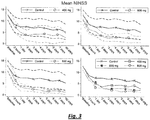
- the mean plasma concentration of Imatinib during the period from Day 0 - Day 6 was 530 ng/ml (95% CI 74-987) for 400 mg daily, 1094 ng/ml (797-1391) for 600 mg daily and 2054 ng/ml (1642-2465) for 800 mg daily (Fig F2). Within three hours of the first dose the plasma concentrations were 996 ng/ml for 400 mg, 1572 ng/ml for 600 mg and 1727 ng/ml for 800 mg.
- CED 1 cerebral edema
- NIHSS National Institutes of Health Stroke Scale
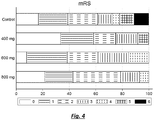
- the mean lowering (improvement) of the NIHSS score was, after adjustment for thrombectomy, 2 points for low dose (-2.30; 95% CI - 6.30 - 1.70; p ⁇ 0.259), 3 points for medium dose (-3.05; 95% CI -6.75 - 0.64; p ⁇ 0.106) and 5 points for high dose (-4.94; -8.78, -1.11; p ⁇ 0.012).
- NIHSS National Institutes of Health Stroke Scale
- Functional outcome was measured on the modified Rankin Score (mRS). Functional independence (mRS 0-2) was seen in 61% in the control group, 72% of all Imatinib treated patients, and in 79% of the high dose treated patients. For high dose, this was a 17% absolute increase of the proportion of functional independence (OR 2.33; 95% CI 0.48 - 11.44; p ⁇ 0.296).
Landscapes
- Health & Medical Sciences (AREA)
- Chemical & Material Sciences (AREA)
- Pharmacology & Pharmacy (AREA)
- Veterinary Medicine (AREA)
- Public Health (AREA)
- General Health & Medical Sciences (AREA)
- Animal Behavior & Ethology (AREA)
- Medicinal Chemistry (AREA)
- Life Sciences & Earth Sciences (AREA)
- Epidemiology (AREA)
- Engineering & Computer Science (AREA)
- Bioinformatics & Cheminformatics (AREA)
- Heart & Thoracic Surgery (AREA)
- Urology & Nephrology (AREA)
- Nuclear Medicine, Radiotherapy & Molecular Imaging (AREA)
- General Chemical & Material Sciences (AREA)
- Chemical Kinetics & Catalysis (AREA)
- Cardiology (AREA)
- Vascular Medicine (AREA)
- Organic Chemistry (AREA)
- Dermatology (AREA)
- Physiology (AREA)
- Nutrition Science (AREA)
- Inorganic Chemistry (AREA)
- Pharmaceuticals Containing Other Organic And Inorganic Compounds (AREA)
- Plural Heterocyclic Compounds (AREA)
Priority Applications (4)
| Application Number | Priority Date | Filing Date | Title |
|---|---|---|---|
| RS20211286A RS62465B1 (sr) | 2016-02-29 | 2017-02-27 | Imatinib za upotrebu u lečenju moždanog udara |
| HRP20211621TT HRP20211621T1 (hr) | 2016-02-29 | 2017-02-27 | Imatinib za uporabu u liječenju moždanog udara |
| SI201730931T SI3423060T1 (sl) | 2016-02-29 | 2017-02-27 | Imatinib za uporabo pri zdravljenju možganske kapi |
| PL17760399T PL3423060T3 (pl) | 2016-02-29 | 2017-02-27 | Imatynib do stosowania w leczeniu udaru mózgu |
Applications Claiming Priority (2)
| Application Number | Priority Date | Filing Date | Title |
|---|---|---|---|
| SE1650260A SE539450C2 (en) | 2016-02-29 | 2016-02-29 | Imatinib for use in the treatment of stroke |
| PCT/SE2017/050183 WO2017151043A1 (en) | 2016-02-29 | 2017-02-27 | Imatinib for use in the treatment of stroke |
Publications (3)
| Publication Number | Publication Date |
|---|---|
| EP3423060A1 EP3423060A1 (en) | 2019-01-09 |
| EP3423060A4 EP3423060A4 (en) | 2020-01-01 |
| EP3423060B1 true EP3423060B1 (en) | 2021-07-21 |
Family
ID=59744327
Family Applications (1)
| Application Number | Title | Priority Date | Filing Date |
|---|---|---|---|
| EP17760399.0A Active EP3423060B1 (en) | 2016-02-29 | 2017-02-27 | Imatinib for use in the treatment of stroke |
Country Status (17)
| Country | Link |
|---|---|
| US (2) | US10953010B2 (enExample) |
| EP (1) | EP3423060B1 (enExample) |
| JP (1) | JP6914957B2 (enExample) |
| CN (2) | CN119523986A (enExample) |
| AU (1) | AU2017227515B2 (enExample) |
| DK (1) | DK3423060T3 (enExample) |
| ES (1) | ES2895432T3 (enExample) |
| HR (1) | HRP20211621T1 (enExample) |
| HU (1) | HUE056798T2 (enExample) |
| LT (1) | LT3423060T (enExample) |
| PL (1) | PL3423060T3 (enExample) |
| PT (1) | PT3423060T (enExample) |
| RS (1) | RS62465B1 (enExample) |
| RU (1) | RU2739382C1 (enExample) |
| SE (1) | SE539450C2 (enExample) |
| SI (1) | SI3423060T1 (enExample) |
| WO (1) | WO2017151043A1 (enExample) |
Families Citing this family (5)
| Publication number | Priority date | Publication date | Assignee | Title |
|---|---|---|---|---|
| US10617756B2 (en) * | 2017-01-05 | 2020-04-14 | Shimojani, LLC | Drug regimen for treatment of cerebral ischemia |
| CN114306342B (zh) * | 2020-09-30 | 2024-06-28 | 江苏先声药业有限公司 | 一种注射用伊马替尼盐的药物组合物及其制备方法 |
| CN118524852A (zh) * | 2021-11-09 | 2024-08-20 | 真和制药有限公司 | 治疗或抑制心血管疾病的方法 |
| EP4311539A1 (en) | 2022-07-29 | 2024-01-31 | Artorange Ltd. | Imatinib formulation for parenteral administration |
| US20250000934A1 (en) | 2023-06-28 | 2025-01-02 | Pharmazz, Inc. | Lyophilized sovateltide-based injectable formulation and method for preparation thereof |
Citations (1)
| Publication number | Priority date | Publication date | Assignee | Title |
|---|---|---|---|---|
| US20100136094A1 (en) * | 2008-12-02 | 2010-06-03 | Searete Llc, A Limited Liability Corporation Of The State Of Delaware | Systems for modulating inflammation |
Family Cites Families (5)
| Publication number | Priority date | Publication date | Assignee | Title |
|---|---|---|---|---|
| MY148074A (en) * | 2005-05-10 | 2013-02-28 | Novartis Ag | Pharmaceutical compositions comprising imatinib and a release retardant |
| EP2021028A2 (en) | 2006-04-17 | 2009-02-11 | Ludwig Institute For Cancer Research | Methods and compositions for modulation of blood-neural barrier |
| US7977348B2 (en) * | 2006-04-27 | 2011-07-12 | Sicor Inc. | Polymorphic forms of imatinib mesylate and processes for preparation of novel crystalline forms as well as amorphous and form α |
| EP2076507A2 (en) * | 2006-10-26 | 2009-07-08 | Sicor, Inc. | Imatinib base, and imatinib mesylate and processes for preparation thereof |
| TR201911199T4 (tr) * | 2009-03-27 | 2019-08-21 | Moleac Pte Ltd | Hücre büyümesini arttırmak için tedavi. |
-
2016
- 2016-02-29 SE SE1650260A patent/SE539450C2/en not_active IP Right Cessation
-
2017
- 2017-02-27 CN CN202411509669.3A patent/CN119523986A/zh active Pending
- 2017-02-27 US US16/080,529 patent/US10953010B2/en active Active
- 2017-02-27 LT LTEPPCT/SE2017/050183T patent/LT3423060T/lt unknown
- 2017-02-27 SI SI201730931T patent/SI3423060T1/sl unknown
- 2017-02-27 HU HUE17760399A patent/HUE056798T2/hu unknown
- 2017-02-27 DK DK17760399.0T patent/DK3423060T3/da active
- 2017-02-27 HR HRP20211621TT patent/HRP20211621T1/hr unknown
- 2017-02-27 JP JP2018545843A patent/JP6914957B2/ja active Active
- 2017-02-27 RU RU2019122730A patent/RU2739382C1/ru active
- 2017-02-27 WO PCT/SE2017/050183 patent/WO2017151043A1/en not_active Ceased
- 2017-02-27 PL PL17760399T patent/PL3423060T3/pl unknown
- 2017-02-27 ES ES17760399T patent/ES2895432T3/es active Active
- 2017-02-27 CN CN201780013732.6A patent/CN108697711A/zh active Pending
- 2017-02-27 RS RS20211286A patent/RS62465B1/sr unknown
- 2017-02-27 PT PT177603990T patent/PT3423060T/pt unknown
- 2017-02-27 EP EP17760399.0A patent/EP3423060B1/en active Active
- 2017-02-27 AU AU2017227515A patent/AU2017227515B2/en active Active
-
2021
- 2021-02-26 US US17/186,303 patent/US20210236488A1/en not_active Abandoned
Patent Citations (1)
| Publication number | Priority date | Publication date | Assignee | Title |
|---|---|---|---|---|
| US20100136094A1 (en) * | 2008-12-02 | 2010-06-03 | Searete Llc, A Limited Liability Corporation Of The State Of Delaware | Systems for modulating inflammation |
Also Published As
| Publication number | Publication date |
|---|---|
| PT3423060T (pt) | 2021-10-20 |
| RS62465B1 (sr) | 2021-11-30 |
| AU2017227515B2 (en) | 2022-03-24 |
| ES2895432T3 (es) | 2022-02-21 |
| JP2019507165A (ja) | 2019-03-14 |
| SE539450C2 (en) | 2017-09-26 |
| LT3423060T (lt) | 2021-11-10 |
| CN108697711A (zh) | 2018-10-23 |
| RU2739382C1 (ru) | 2020-12-23 |
| JP6914957B2 (ja) | 2021-08-04 |
| CN119523986A (zh) | 2025-02-28 |
| US10953010B2 (en) | 2021-03-23 |
| DK3423060T3 (da) | 2021-10-25 |
| SE1650260A1 (en) | 2017-08-30 |
| WO2017151043A1 (en) | 2017-09-08 |
| AU2017227515A1 (en) | 2018-08-30 |
| EP3423060A1 (en) | 2019-01-09 |
| SI3423060T1 (sl) | 2021-11-30 |
| US20210236488A1 (en) | 2021-08-05 |
| HUE056798T2 (hu) | 2022-03-28 |
| EP3423060A4 (en) | 2020-01-01 |
| US20190030030A1 (en) | 2019-01-31 |
| PL3423060T3 (pl) | 2022-01-10 |
| HRP20211621T1 (hr) | 2022-02-04 |
Similar Documents
| Publication | Publication Date | Title |
|---|---|---|
| US20210236488A1 (en) | Imatinib for use in the treatment of stroke | |
| Diringer et al. | Aneurysmal subarachnoid hemorrhage: strategies for preventing vasospasm in the intensive care unit | |
| Polifka | Is there an embryopathy associated with first‐trimester exposure to angiotensin‐converting enzyme inhibitors and angiotensin receptor antagonists? A critical review of the evidence | |
| Guthrie | Review and management of side effects associated with antiplatelet therapy for prevention of recurrent cerebrovascular events | |
| JP2024523559A (ja) | アルドステロン合成酵素阻害剤を使用する方法 | |
| TW202423444A (zh) | 米爾維仙(milvexian)於治療或預防缺血性中風之用途 | |
| JP2025502266A (ja) | 有害な薬物相互作用及び影響を回避するためにウパダシチニブを投与する方法 | |
| US20230414567A1 (en) | Methods of treating conditions related to the s1p1 receptor | |
| US20250099465A1 (en) | Remibrutinib for use in the treatment of hidradenitis suppurativa | |
| KR20190134825A (ko) | 수축력 저하 수반성 배뇨근 과활동 개선제 | |
| RU2821032C1 (ru) | Способы лечения заболеваний, связанных с рецептором s1p1 | |
| Chen et al. | Propafenone-associated gross hematuria: a case report and review of the literature | |
| RU2845317C1 (ru) | Способ лечения постковидного синдрома | |
| JP2014527513A (ja) | 早漏症治療用の薬学組成物および早漏症治療方法 | |
| ALLAM | WCN23-0127 KIDNEY OUT COMES IN SUDANSES CHILDREN WITH LUPUS NEPHRITIES | |
| TW202400145A (zh) | 治療s1p受體相關病況之方法 | |
| Kim13 et al. | Eun‑Seok Jeon1, Sang Wook Lim2, Seok‑Yeon Kim3, Hyoung‑Mo Yang4, Moo Hyun Kim5, Moo‑Yong Rhee6, Seung Hwan Han7, Jinho Shin8, Kwang‑il Kim9, Jin‑Ok Jeong10, Ki Chul Sung11, Geu Ru Hong12 | |
| HK40073112A (en) | Methods of treating, reducing the incidence of, and/or preventing ischemic events | |
| KR20250084183A (ko) | 다발성 경화증에 대한 치료용 티로신 키나제 저해제 | |
| Pastromas | Newer Anticoagulants for Atrial Fibrillation: the Role of Dabigatran, Rivaroxaban, Apixaban and Edoxaban/RELY, ROCKET-AF, ARISTOTLE, & ENGAGE AF TIMI 48 Studies/Safety Issues | |
| US20180243247A1 (en) | Drug combinations for cerebrovascular disease | |
| Katayoun Vahedi | Surgery for acute ischemic stroke | |
| Appelboom¹ et al. | for Cerebral Vasospasm Following Aneurysmal Subarachnoid Hemorrhage | |
| HK1153668B (en) | Pirfenidone treatment for patients with atypical liver function |
Legal Events
| Date | Code | Title | Description |
|---|---|---|---|
| REG | Reference to a national code |
Ref country code: HR Ref legal event code: TUEP Ref document number: P20211621T Country of ref document: HR |
|
| STAA | Information on the status of an ep patent application or granted ep patent |
Free format text: STATUS: THE INTERNATIONAL PUBLICATION HAS BEEN MADE |
|
| PUAI | Public reference made under article 153(3) epc to a published international application that has entered the european phase |
Free format text: ORIGINAL CODE: 0009012 |
|
| STAA | Information on the status of an ep patent application or granted ep patent |
Free format text: STATUS: REQUEST FOR EXAMINATION WAS MADE |
|
| 17P | Request for examination filed |
Effective date: 20180927 |
|
| AK | Designated contracting states |
Kind code of ref document: A1 Designated state(s): AL AT BE BG CH CY CZ DE DK EE ES FI FR GB GR HR HU IE IS IT LI LT LU LV MC MK MT NL NO PL PT RO RS SE SI SK SM TR |
|
| AX | Request for extension of the european patent |
Extension state: BA ME |
|
| DAV | Request for validation of the european patent (deleted) | ||
| DAX | Request for extension of the european patent (deleted) | ||
| A4 | Supplementary search report drawn up and despatched |
Effective date: 20191204 |
|
| RIC1 | Information provided on ipc code assigned before grant |
Ipc: A61P 9/10 20060101ALI20191128BHEP Ipc: A61K 9/08 20060101ALI20191128BHEP Ipc: A61K 31/506 20060101AFI20191128BHEP Ipc: A61K 47/02 20060101ALI20191128BHEP |
|
| STAA | Information on the status of an ep patent application or granted ep patent |
Free format text: STATUS: EXAMINATION IS IN PROGRESS |
|
| 17Q | First examination report despatched |
Effective date: 20200728 |
|
| GRAP | Despatch of communication of intention to grant a patent |
Free format text: ORIGINAL CODE: EPIDOSNIGR1 |
|
| STAA | Information on the status of an ep patent application or granted ep patent |
Free format text: STATUS: GRANT OF PATENT IS INTENDED |
|
| INTG | Intention to grant announced |
Effective date: 20210226 |
|
| GRAS | Grant fee paid |
Free format text: ORIGINAL CODE: EPIDOSNIGR3 |
|
| GRAA | (expected) grant |
Free format text: ORIGINAL CODE: 0009210 |
|
| STAA | Information on the status of an ep patent application or granted ep patent |
Free format text: STATUS: THE PATENT HAS BEEN GRANTED |
|
| AK | Designated contracting states |
Kind code of ref document: B1 Designated state(s): AL AT BE BG CH CY CZ DE DK EE ES FI FR GB GR HR HU IE IS IT LI LT LU LV MC MK MT NL NO PL PT RO RS SE SI SK SM TR |
|
| REG | Reference to a national code |
Ref country code: GB Ref legal event code: FG4D |
|
| REG | Reference to a national code |
Ref country code: CH Ref legal event code: EP |
|
| REG | Reference to a national code |
Ref country code: DE Ref legal event code: R096 Ref document number: 602017042519 Country of ref document: DE |
|
| REG | Reference to a national code |
Ref country code: AT Ref legal event code: REF Ref document number: 1411958 Country of ref document: AT Kind code of ref document: T Effective date: 20210815 |
|
| REG | Reference to a national code |
Ref country code: IE Ref legal event code: FG4D |
|
| REG | Reference to a national code |
Ref country code: FI Ref legal event code: FGE |
|
| REG | Reference to a national code |
Ref country code: PT Ref legal event code: SC4A Ref document number: 3423060 Country of ref document: PT Date of ref document: 20211020 Kind code of ref document: T Free format text: AVAILABILITY OF NATIONAL TRANSLATION Effective date: 20211014 |
|
| REG | Reference to a national code |
Ref country code: DK Ref legal event code: T3 Effective date: 20211019 Ref country code: NO Ref legal event code: T2 Effective date: 20210721 |
|
| REG | Reference to a national code |
Ref country code: SE Ref legal event code: TRGR |
|
| REG | Reference to a national code |
Ref country code: NL Ref legal event code: FP |
|
| REG | Reference to a national code |
Ref country code: GR Ref legal event code: EP Ref document number: 20210402767 Country of ref document: GR Effective date: 20211111 |
|
| REG | Reference to a national code |
Ref country code: SK Ref legal event code: T3 Ref document number: E 38443 Country of ref document: SK |
|
| REG | Reference to a national code |
Ref country code: HR Ref legal event code: T1PR Ref document number: P20211621 Country of ref document: HR |
|
| REG | Reference to a national code |
Ref country code: ES Ref legal event code: FG2A Ref document number: 2895432 Country of ref document: ES Kind code of ref document: T3 Effective date: 20220221 |
|
| REG | Reference to a national code |
Ref country code: HR Ref legal event code: ODRP Ref document number: P20211621 Country of ref document: HR Payment date: 20220128 Year of fee payment: 6 |
|
| REG | Reference to a national code |
Ref country code: AT Ref legal event code: UEP Ref document number: 1411958 Country of ref document: AT Kind code of ref document: T Effective date: 20210721 |
|
| REG | Reference to a national code |
Ref country code: HU Ref legal event code: AG4A Ref document number: E056798 Country of ref document: HU |
|
| REG | Reference to a national code |
Ref country code: DE Ref legal event code: R097 Ref document number: 602017042519 Country of ref document: DE |
|
| PLBE | No opposition filed within time limit |
Free format text: ORIGINAL CODE: 0009261 |
|
| STAA | Information on the status of an ep patent application or granted ep patent |
Free format text: STATUS: NO OPPOSITION FILED WITHIN TIME LIMIT |
|
| PG25 | Lapsed in a contracting state [announced via postgrant information from national office to epo] |
Ref country code: SM Free format text: LAPSE BECAUSE OF FAILURE TO SUBMIT A TRANSLATION OF THE DESCRIPTION OR TO PAY THE FEE WITHIN THE PRESCRIBED TIME-LIMIT Effective date: 20210721 Ref country code: EE Free format text: LAPSE BECAUSE OF FAILURE TO SUBMIT A TRANSLATION OF THE DESCRIPTION OR TO PAY THE FEE WITHIN THE PRESCRIBED TIME-LIMIT Effective date: 20210721 |
|
| 26N | No opposition filed |
Effective date: 20220422 |
|
| PG25 | Lapsed in a contracting state [announced via postgrant information from national office to epo] |
Ref country code: MC Free format text: LAPSE BECAUSE OF FAILURE TO SUBMIT A TRANSLATION OF THE DESCRIPTION OR TO PAY THE FEE WITHIN THE PRESCRIBED TIME-LIMIT Effective date: 20210721 |
|
| PG25 | Lapsed in a contracting state [announced via postgrant information from national office to epo] |
Ref country code: LU Free format text: LAPSE BECAUSE OF NON-PAYMENT OF DUE FEES Effective date: 20220227 |
|
| REG | Reference to a national code |
Ref country code: HR Ref legal event code: ODRP Ref document number: P20211621 Country of ref document: HR Payment date: 20230127 Year of fee payment: 7 |
|
| REG | Reference to a national code |
Ref country code: HR Ref legal event code: ODRP Ref document number: P20211621 Country of ref document: HR Payment date: 20240131 Year of fee payment: 8 |
|
| PG25 | Lapsed in a contracting state [announced via postgrant information from national office to epo] |
Ref country code: CY Free format text: LAPSE BECAUSE OF FAILURE TO SUBMIT A TRANSLATION OF THE DESCRIPTION OR TO PAY THE FEE WITHIN THE PRESCRIBED TIME-LIMIT Effective date: 20210721 |
|
| PGFP | Annual fee paid to national office [announced via postgrant information from national office to epo] |
Ref country code: SK Payment date: 20240131 Year of fee payment: 8 |
|
| PGFP | Annual fee paid to national office [announced via postgrant information from national office to epo] |
Ref country code: SI Payment date: 20240209 Year of fee payment: 8 |
|
| PGFP | Annual fee paid to national office [announced via postgrant information from national office to epo] |
Ref country code: RS Payment date: 20240130 Year of fee payment: 8 Ref country code: HR Payment date: 20240131 Year of fee payment: 8 |
|
| PG25 | Lapsed in a contracting state [announced via postgrant information from national office to epo] |
Ref country code: MT Free format text: LAPSE BECAUSE OF FAILURE TO SUBMIT A TRANSLATION OF THE DESCRIPTION OR TO PAY THE FEE WITHIN THE PRESCRIBED TIME-LIMIT Effective date: 20210721 |
|
| PGFP | Annual fee paid to national office [announced via postgrant information from national office to epo] |
Ref country code: AL Payment date: 20240220 Year of fee payment: 8 |
|
| PGFP | Annual fee paid to national office [announced via postgrant information from national office to epo] |
Ref country code: NL Payment date: 20250225 Year of fee payment: 9 |
|
| PGFP | Annual fee paid to national office [announced via postgrant information from national office to epo] |
Ref country code: HU Payment date: 20250228 Year of fee payment: 9 |
|
| PGFP | Annual fee paid to national office [announced via postgrant information from national office to epo] |
Ref country code: DE Payment date: 20250220 Year of fee payment: 9 Ref country code: PT Payment date: 20250221 Year of fee payment: 9 |
|
| PGFP | Annual fee paid to national office [announced via postgrant information from national office to epo] |
Ref country code: DK Payment date: 20250224 Year of fee payment: 9 Ref country code: FI Payment date: 20250224 Year of fee payment: 9 Ref country code: RO Payment date: 20250224 Year of fee payment: 9 Ref country code: LT Payment date: 20250224 Year of fee payment: 9 |
|
| PGFP | Annual fee paid to national office [announced via postgrant information from national office to epo] |
Ref country code: BG Payment date: 20250225 Year of fee payment: 9 |
|
| PGFP | Annual fee paid to national office [announced via postgrant information from national office to epo] |
Ref country code: ES Payment date: 20250303 Year of fee payment: 9 |
|
| PGFP | Annual fee paid to national office [announced via postgrant information from national office to epo] |
Ref country code: IE Payment date: 20250221 Year of fee payment: 9 Ref country code: SE Payment date: 20250218 Year of fee payment: 9 |
|
| PGFP | Annual fee paid to national office [announced via postgrant information from national office to epo] |
Ref country code: NO Payment date: 20250227 Year of fee payment: 9 |
|
| PGFP | Annual fee paid to national office [announced via postgrant information from national office to epo] |
Ref country code: LV Payment date: 20250224 Year of fee payment: 9 Ref country code: AT Payment date: 20250225 Year of fee payment: 9 Ref country code: GR Payment date: 20250226 Year of fee payment: 9 Ref country code: CH Payment date: 20250301 Year of fee payment: 9 Ref country code: BE Payment date: 20250225 Year of fee payment: 9 |
|
| PGFP | Annual fee paid to national office [announced via postgrant information from national office to epo] |
Ref country code: PL Payment date: 20250224 Year of fee payment: 9 Ref country code: FR Payment date: 20250218 Year of fee payment: 9 Ref country code: CZ Payment date: 20250224 Year of fee payment: 9 |
|
| PGFP | Annual fee paid to national office [announced via postgrant information from national office to epo] |
Ref country code: GB Payment date: 20250219 Year of fee payment: 9 Ref country code: IT Payment date: 20250218 Year of fee payment: 9 |
|
| PGFP | Annual fee paid to national office [announced via postgrant information from national office to epo] |
Ref country code: TR Payment date: 20250217 Year of fee payment: 9 |
|
| REG | Reference to a national code |
Ref country code: HR Ref legal event code: PBON Ref document number: P20211621 Country of ref document: HR Effective date: 20250227 |
|
| REG | Reference to a national code |
Ref country code: SK Ref legal event code: MM4A Ref document number: E 38443 Country of ref document: SK Effective date: 20250227 |
|
| PG25 | Lapsed in a contracting state [announced via postgrant information from national office to epo] |
Ref country code: HR Free format text: LAPSE BECAUSE OF NON-PAYMENT OF DUE FEES Effective date: 20250227 |
|
| PG25 | Lapsed in a contracting state [announced via postgrant information from national office to epo] |
Ref country code: RS Free format text: LAPSE BECAUSE OF NON-PAYMENT OF DUE FEES Effective date: 20250227 |
|
| PG25 | Lapsed in a contracting state [announced via postgrant information from national office to epo] |
Ref country code: SK Free format text: LAPSE BECAUSE OF NON-PAYMENT OF DUE FEES Effective date: 20250227 |
|
| PGFP | Annual fee paid to national office [announced via postgrant information from national office to epo] |
Ref country code: MK Payment date: 20240131 Year of fee payment: 8 |