EP3421200A1 - Holzwerkstoffplatte mit hohlkugeln - Google Patents
Holzwerkstoffplatte mit hohlkugeln Download PDFInfo
- Publication number
- EP3421200A1 EP3421200A1 EP17179148.6A EP17179148A EP3421200A1 EP 3421200 A1 EP3421200 A1 EP 3421200A1 EP 17179148 A EP17179148 A EP 17179148A EP 3421200 A1 EP3421200 A1 EP 3421200A1
- Authority
- EP
- European Patent Office
- Prior art keywords
- wood
- glass
- spheres
- binder
- based panel
- Prior art date
- Legal status (The legal status is an assumption and is not a legal conclusion. Google has not performed a legal analysis and makes no representation as to the accuracy of the status listed.)
- Granted
Links
- 239000002023 wood Substances 0.000 title claims abstract description 59
- 239000002131 composite material Substances 0.000 title 1
- 239000011230 binding agent Substances 0.000 claims abstract description 57
- 239000000835 fiber Substances 0.000 claims abstract description 38
- QXJJQWWVWRCVQT-UHFFFAOYSA-K calcium;sodium;phosphate Chemical compound [Na+].[Ca+2].[O-]P([O-])([O-])=O QXJJQWWVWRCVQT-UHFFFAOYSA-K 0.000 claims abstract description 37
- 239000000463 material Substances 0.000 claims abstract description 13
- 238000004519 manufacturing process Methods 0.000 claims abstract description 7
- 239000011521 glass Substances 0.000 claims description 57
- 239000000203 mixture Substances 0.000 claims description 35
- 229920000877 Melamine resin Polymers 0.000 claims description 11
- 238000003825 pressing Methods 0.000 claims description 10
- 229920002689 polyvinyl acetate Polymers 0.000 claims description 9
- 239000011118 polyvinyl acetate Substances 0.000 claims description 9
- 239000000428 dust Substances 0.000 claims description 7
- 238000000034 method Methods 0.000 claims description 7
- 239000004640 Melamine resin Substances 0.000 claims description 6
- 238000002156 mixing Methods 0.000 claims description 5
- 239000000843 powder Substances 0.000 claims description 4
- 229920003180 amino resin Polymers 0.000 claims description 2
- 239000005388 borosilicate glass Substances 0.000 claims description 2
- 229920005989 resin Polymers 0.000 claims description 2
- 239000011347 resin Substances 0.000 claims description 2
- 229920005992 thermoplastic resin Polymers 0.000 claims description 2
- 240000005369 Alstonia scholaris Species 0.000 claims 1
- 239000010410 layer Substances 0.000 description 62
- 239000011093 chipboard Substances 0.000 description 32
- 239000011094 fiberboard Substances 0.000 description 11
- 230000008961 swelling Effects 0.000 description 11
- 239000008186 active pharmaceutical agent Substances 0.000 description 9
- 229920004482 WACKER® Polymers 0.000 description 6
- 239000002245 particle Substances 0.000 description 6
- UPMLOUAZCHDJJD-UHFFFAOYSA-N 4,4'-Diphenylmethane Diisocyanate Chemical compound C1=CC(N=C=O)=CC=C1CC1=CC=C(N=C=O)C=C1 UPMLOUAZCHDJJD-UHFFFAOYSA-N 0.000 description 5
- 229920001807 Urea-formaldehyde Polymers 0.000 description 5
- 238000010276 construction Methods 0.000 description 5
- 239000007788 liquid Substances 0.000 description 5
- 239000011324 bead Substances 0.000 description 4
- 230000008859 change Effects 0.000 description 4
- 239000011248 coating agent Substances 0.000 description 4
- 238000000576 coating method Methods 0.000 description 4
- 238000002474 experimental method Methods 0.000 description 4
- 238000009413 insulation Methods 0.000 description 4
- JDSHMPZPIAZGSV-UHFFFAOYSA-N melamine Chemical compound NC1=NC(N)=NC(N)=N1 JDSHMPZPIAZGSV-UHFFFAOYSA-N 0.000 description 4
- 229920001568 phenolic resin Polymers 0.000 description 4
- 229920003002 synthetic resin Polymers 0.000 description 4
- 239000000057 synthetic resin Substances 0.000 description 4
- 238000012360 testing method Methods 0.000 description 4
- WSFSSNUMVMOOMR-UHFFFAOYSA-N Formaldehyde Chemical compound O=C WSFSSNUMVMOOMR-UHFFFAOYSA-N 0.000 description 3
- 239000003292 glue Substances 0.000 description 3
- XSQUKJJJFZCRTK-UHFFFAOYSA-N Urea Chemical compound NC(N)=O XSQUKJJJFZCRTK-UHFFFAOYSA-N 0.000 description 2
- 239000004202 carbamide Substances 0.000 description 2
- 238000011161 development Methods 0.000 description 2
- 230000018109 developmental process Effects 0.000 description 2
- 229910052602 gypsum Inorganic materials 0.000 description 2
- 239000010440 gypsum Substances 0.000 description 2
- 239000005011 phenolic resin Substances 0.000 description 2
- ODGAOXROABLFNM-UHFFFAOYSA-N polynoxylin Chemical compound O=C.NC(N)=O ODGAOXROABLFNM-UHFFFAOYSA-N 0.000 description 2
- 239000004814 polyurethane Substances 0.000 description 2
- 238000012545 processing Methods 0.000 description 2
- 230000009467 reduction Effects 0.000 description 2
- GHMLBKRAJCXXBS-UHFFFAOYSA-N resorcinol Chemical compound OC1=CC=CC(O)=C1 GHMLBKRAJCXXBS-UHFFFAOYSA-N 0.000 description 2
- 150000004756 silanes Chemical class 0.000 description 2
- 239000002356 single layer Substances 0.000 description 2
- 239000007787 solid Substances 0.000 description 2
- 238000003892 spreading Methods 0.000 description 2
- 230000007480 spreading Effects 0.000 description 2
- KXGFMDJXCMQABM-UHFFFAOYSA-N 2-methoxy-6-methylphenol Chemical compound [CH]OC1=CC=CC([CH])=C1O KXGFMDJXCMQABM-UHFFFAOYSA-N 0.000 description 1
- BPQQTUXANYXVAA-UHFFFAOYSA-N Orthosilicate Chemical compound [O-][Si]([O-])([O-])[O-] BPQQTUXANYXVAA-UHFFFAOYSA-N 0.000 description 1
- BLRPTPMANUNPDV-UHFFFAOYSA-N Silane Chemical compound [SiH4] BLRPTPMANUNPDV-UHFFFAOYSA-N 0.000 description 1
- 229920002522 Wood fibre Polymers 0.000 description 1
- 239000000853 adhesive Substances 0.000 description 1
- 230000001070 adhesive effect Effects 0.000 description 1
- 238000004220 aggregation Methods 0.000 description 1
- 230000002776 aggregation Effects 0.000 description 1
- 230000033558 biomineral tissue development Effects 0.000 description 1
- 230000015572 biosynthetic process Effects 0.000 description 1
- 239000000919 ceramic Substances 0.000 description 1
- 229920001577 copolymer Polymers 0.000 description 1
- 230000007423 decrease Effects 0.000 description 1
- 238000013461 design Methods 0.000 description 1
- 238000009826 distribution Methods 0.000 description 1
- 230000000694 effects Effects 0.000 description 1
- 239000003822 epoxy resin Substances 0.000 description 1
- 239000006260 foam Substances 0.000 description 1
- IVJISJACKSSFGE-UHFFFAOYSA-N formaldehyde;1,3,5-triazine-2,4,6-triamine Chemical compound O=C.NC1=NC(N)=NC(N)=N1 IVJISJACKSSFGE-UHFFFAOYSA-N 0.000 description 1
- SLGWESQGEUXWJQ-UHFFFAOYSA-N formaldehyde;phenol Chemical compound O=C.OC1=CC=CC=C1 SLGWESQGEUXWJQ-UHFFFAOYSA-N 0.000 description 1
- CGXBXJAUUWZZOP-UHFFFAOYSA-N formaldehyde;phenol;1,3,5-triazine-2,4,6-triamine Chemical compound O=C.OC1=CC=CC=C1.NC1=NC(N)=NC(N)=N1 CGXBXJAUUWZZOP-UHFFFAOYSA-N 0.000 description 1
- 238000010438 heat treatment Methods 0.000 description 1
- 238000013101 initial test Methods 0.000 description 1
- 229910052500 inorganic mineral Inorganic materials 0.000 description 1
- 239000012978 lignocellulosic material Substances 0.000 description 1
- 239000011159 matrix material Substances 0.000 description 1
- 238000002844 melting Methods 0.000 description 1
- 230000008018 melting Effects 0.000 description 1
- WSFSSNUMVMOOMR-NJFSPNSNSA-N methanone Chemical compound O=[14CH2] WSFSSNUMVMOOMR-NJFSPNSNSA-N 0.000 description 1
- 239000011707 mineral Substances 0.000 description 1
- 230000001089 mineralizing effect Effects 0.000 description 1
- 239000011505 plaster Substances 0.000 description 1
- 229920000647 polyepoxide Polymers 0.000 description 1
- 229920002635 polyurethane Polymers 0.000 description 1
- 235000019353 potassium silicate Nutrition 0.000 description 1
- 238000002360 preparation method Methods 0.000 description 1
- 229910000077 silane Inorganic materials 0.000 description 1
- 238000002444 silanisation Methods 0.000 description 1
- 150000004760 silicates Chemical class 0.000 description 1
- NTHWMYGWWRZVTN-UHFFFAOYSA-N sodium silicate Chemical compound [Na+].[Na+].[O-][Si]([O-])=O NTHWMYGWWRZVTN-UHFFFAOYSA-N 0.000 description 1
- 239000000126 substance Substances 0.000 description 1
- 229920001169 thermoplastic Polymers 0.000 description 1
- 229920001187 thermosetting polymer Polymers 0.000 description 1
- 239000004416 thermosoftening plastic Substances 0.000 description 1
- 230000007704 transition Effects 0.000 description 1
- 239000002025 wood fiber Substances 0.000 description 1
Images

Classifications
-
- B—PERFORMING OPERATIONS; TRANSPORTING
- B27—WORKING OR PRESERVING WOOD OR SIMILAR MATERIAL; NAILING OR STAPLING MACHINES IN GENERAL
- B27N—MANUFACTURE BY DRY PROCESSES OF ARTICLES, WITH OR WITHOUT ORGANIC BINDING AGENTS, MADE FROM PARTICLES OR FIBRES CONSISTING OF WOOD OR OTHER LIGNOCELLULOSIC OR LIKE ORGANIC MATERIAL
- B27N3/00—Manufacture of substantially flat articles, e.g. boards, from particles or fibres
- B27N3/04—Manufacture of substantially flat articles, e.g. boards, from particles or fibres from fibres
-
- B—PERFORMING OPERATIONS; TRANSPORTING
- B27—WORKING OR PRESERVING WOOD OR SIMILAR MATERIAL; NAILING OR STAPLING MACHINES IN GENERAL
- B27N—MANUFACTURE BY DRY PROCESSES OF ARTICLES, WITH OR WITHOUT ORGANIC BINDING AGENTS, MADE FROM PARTICLES OR FIBRES CONSISTING OF WOOD OR OTHER LIGNOCELLULOSIC OR LIKE ORGANIC MATERIAL
- B27N3/00—Manufacture of substantially flat articles, e.g. boards, from particles or fibres
- B27N3/02—Manufacture of substantially flat articles, e.g. boards, from particles or fibres from particles
-
- B—PERFORMING OPERATIONS; TRANSPORTING
- B27—WORKING OR PRESERVING WOOD OR SIMILAR MATERIAL; NAILING OR STAPLING MACHINES IN GENERAL
- B27N—MANUFACTURE BY DRY PROCESSES OF ARTICLES, WITH OR WITHOUT ORGANIC BINDING AGENTS, MADE FROM PARTICLES OR FIBRES CONSISTING OF WOOD OR OTHER LIGNOCELLULOSIC OR LIKE ORGANIC MATERIAL
- B27N1/00—Pretreatment of moulding material
Definitions
- the invention relates to a wood-based panel with hollow spheres and a method for producing such wood-based panels with hollow spheres.
- plate-shaped materials which hardly swell when exposed to moisture and therefore subject to increasing humidity only a slight change in shape.
- these plate-shaped materials should have the lowest possible thermal conductivity, so that they cause the best possible thermal insulation.
- good mechanical properties are required so that these plate-shaped materials can be used as planking in the frame construction.
- plasterboard is often used for such applications, ie, plates of plaster, which are covered by a cardboard.
- These gypsum plasterboards have a low swelling and a low thermal conductivity. However, they have only limited mechanical properties and a relatively high weight.
- Such a plasterboard is in the DE-AS 1 276 314 described.
- the object is achieved with a wood-based panel according to claim 1 and a method for producing such a wood-based panel according to claim 13.
- a wood-based panel according to the invention has lignocellulosic chips or fibers, as well as a binder and also has the wood-based panel on glass hollow spheres.
- the wood-based panel according to the invention has lignocellulosic particles, in particular Chips or fibers.
- the chips are larger than the fibers; they are usually formed flat, the length and width are typically much greater than the thickness. Typical dimensions range from 5 mm to 200 mm in length, from 0.5 mm to 100 mm in width, and from 0.1 to 5 mm in thickness. Chips have a higher flexural elasticity than fibers.
- a fiber usually has an approximately equal width and thickness; the length is much larger than width or thickness. Typical dimensions range from 0.5 to 10 mm in length, the width and thickness are 0.1 mm to 3 mm.
- a chipboard can be designed in a single layer in a simple design. However, the chips of a chipboard are typically arranged in different layers, a middle layer with chips, which are usually thicker, often longer and wider than the chips of a cover layer flanking the middle layer and covering it to the outside.
- a typical construction of a chipboard has an inner middle layer and two outer cover layers.
- a fiberboard can also be constructed of middle and top layer, but it can also be constructed as a single layer of the same size fibers over the entire thickness.
- wood-based panels constructed from chips and / or fibers are part of the invention, ie chipboards, Oriented-Strand-Board panels, chipboards with a top layer of fiberboard or with a coating of fiberboard, low density fiberboard, e.g. B. fiber insulation panels, medium density fiberboard (MDF), high density fiberboard (HDF), coated and uncoated particleboard and / or fiberboard.
- MDF medium density fiberboard
- HDF high density fiberboard
- the wood-based panel according to the invention comprises an organic or an inorganic binder or a mixture of these binders.
- Typical organic binders are aminoplast, thermosetting and / or thermoplastic resins and mixtures thereof.
- Typical synthetic resins which can be used as binders in wood-based panels are urea or melamine resin, phenolic resin, usually in combination with formaldehyde, resorcinol resin, epoxy resin, polyvinyl acetate (PVAc), optionally in combination with copolymers, polyurethane, polymeric diphenylmethane diisocyanate (EMDI) or polymeric diphenylmethane diisocyanate (PMDI).
- Typical inorganic binders are silanes or silicates, e.g. B. water glass.
- the abovementioned binders can each be used alone or in a mixture.
- Typical combinations in which the binders are mixed prior to addition to the chips or fibers are urea-formaldehyde, melamine-formaldehyde, phenol-formaldehyde, urea-phenol-formaldehyde, melamine-phenol-formaldehyde, urea-melamine-phenol-formaldehyde or the mixture of a silane with a silicate.
- various binders can be used in different layers of a wood-based panel, for. B. PMDI in the middle layer and urea, melamine and / or phenolic resins, optionally in conjunction with formaldehyde in the outer layers.
- the binder can be used in liquid form. However, it can also be used at least in part in powdered or powdered form, the powder or dust particles having a diameter of 1 .mu.m to 20 .mu.m, preferably as small particles of 1 .mu.m to 5 .mu.m or as larger particles of 7 .mu.m to 15 ⁇ m are used.
- Powdered or dusty binder is preferably made of thermoplastic synthetic resins. Available are z. B. melamine resin dust or PVAc powder, which is also known as Hotleimpulver. Dust or powdery binder is preferably used in conjunction with liquid binder, wherein powder or dust and liquid represent either a combination of different binders or consist of the same substance, only in different state of aggregation.
- the wood-based panel contains hollow glass spheres.
- the hollow glass spheres reduce the weight of the wood-based panel. They reduce swelling and improve fire behavior.
- a cover layer contains hollow glass spheres.
- both outer cover layers contain hollow glass spheres.
- the inner middle layer contains hollow glass spheres.
- Particularly advantageous is an embodiment of the wood-based panel, in which both the two outer cover layers and the inner middle layer have hollow glass spheres. The more hollow glass spheres the wood-based panel contains, the more pronounced the improved swelling behavior with reduced change in shape under the influence of moisture and the lower the weight of the panel.
- the glass hollow spheres used in the wood-based panel according to the invention have a weight of 100 kg / m 3 to 600 kg / m 3 .
- Glass hollow spheres having a weight of 100 kg / m 3 to 450 kg / m 3 are advantageously used, particularly advantageously with a weight of 100 kg / m 3 to 350 kg / m 3 .
- the glass bubbles are lighter than the chips or fibers used, which at a humidity of z.
- B. 12% have a weight of 600 kg / m 3 to 1000 kg / m 3 .
- Glass bubbles can z. From 3M offering such hollow glass spheres as K Series, S Series and iM Series.
- the wood-based panel according to the invention advantageously has a weight of 400 kg / m 3 to 500 kg / m 3 .
- the glass hollow spheres have a diameter of 0.5 .mu.m to 10 .mu.m, preferably from 1 .mu.m to 5 .mu.m. According to an advantageous embodiment, hollow glass spheres of 1 to 3 ⁇ m are used in the cover layer and glass hollow spheres of 5 ⁇ m to 10 ⁇ m are used in the middle layer.
- the glass bubbles are made of glass or ceramic, preferably made of borosilicate glass.
- the surface of the hollow glass spheres is silanized, whereby the binding capacity is improved.
- a similar effect is achieved when the glass bubbles are coated with a film of melamine resin or polyvinyl acetate (PVAc).
- the hollow glass spheres are preferably mixed with a powdery or dusty melamine resin or PVAc.
- the desired film or coating is then formed. While silanizing is usually done before Used in the wood-based panel, the formation of a film or coating can be carried out with a synthetic resin during the manufacture of the plate.
- the chips of at least one covering layer can be mineralized.
- the mineralizing is z. B. in the DE 10 2010 051 059 A1 described, it refers to the sheathing of chips with inorganic or mineral binder.
- the mixture or the topcoat mixture is prepared by mixing the respective components, chips or fibers or a mixture of chips and fibers, binders and hollow glass spheres.
- the binder can be added in solid or liquid form or as a foam.
- the glass bubbles are distributed as they go far smaller than the chips and the fibers, on the surface of the chips or fibers. The distribution is uniform, especially when actively mixed, z. B. by circulation or swirling of the components.
- the binder also lays evenly around chips, fibers and glass bubbles.
- the pressing can be done on any press, both on a short-cycle press and on a continuous press, with a continuous press being preferred for economic reasons.
- the pressing conditions can be chosen in a wide range. Typical pressing conditions are z. B. print 10 to 50 bar press factor 1 s / mm to 10 s / mm temperature 120 ° C to 280 ° C
- the press factor shows how long the pressing time is to be measured per mm plate thickness.
- a 19 mm chipboard with 4 s press factor requires a pressing time of 76 s. It is advantageous to store the wood-based panels according to the invention for some time before use, for. B. a few hours or a few days, so that the strength of the plates is optimally developed.
- a first mixture of chips and / or fibers is produced with the pulverulent binder and a second mixture of glass hollow spheres and binder.
- the first and second mixtures are then combined to form a topcoat mixture.
- the further processing takes place as described above.
- This procedure ensures that the glass hollow spheres are surrounded during pressing by the melting of the binder and the flow to a film of a film of synthetic resin, in particular of melamine or PVAc, which binds the hollow glass balls particularly firmly in the wood-based panel.
- hollow glass spheres can be used with a silanized surface, wherein the silanization also causes the hollow glass balls in the solid Matrix of the wood-based panel to be integrated.
- the second cover layer of the cover layer mixture d. h., Made with glass bubbles.
- the middle layer also has hollow glass spheres.
- a wood-based panel which has glass bubbles over the entire cross-section, realizes the advantages of the invention best.
- the wood-based panel according to the invention can be used for planking wall constructions.
- the wood-based panel can be plastered directly or provided with a wall insulation. Plate joints can be dull, d. H. Without processing straight edges, glued using PU adhesive. The transition is not visible in the surface.
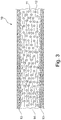
- Fig. 1 shows a wood board, here a particle board 1 with two outer layers 2, which together have a share of the total thickness of 36% (18% per cover layer), and an inner middle layer 3, which accounts for a share of 54% of the total thickness of Chipboard 1 occupies.
- the cover layer 2 is composed of chips 4 made of wood and glass hollow spheres 6 and the binder, not shown here. Glass hollow spheres were used by 3M with a density of 350 kg / m 3 . The diameter of 50% of the glass bubbles was a maximum of 4 microns, the maximum size was 8 ⁇ m.
- the middle layer 3 is composed of chips 5 (89% by weight) and the binder (11% by weight), likewise not shown.
- the proportion of hollow glass spheres 6 is 15 wt .-% based on the total weight of the outer layer 2.
- the proportion of the binder is 28 wt .-% and the proportion of chips 4 is 57 wt .-% based on the total weight of the cover layer second
- the chips 4 of the cover layer 2 have dimensions of on average 10 mm to 20 mm in length, 1 mm to 2 mm in thickness and 3 mm to 8 mm in width.
- the chips 5 of the middle layer 3 have a length of 25 mm to 35 mm, a width of 5 to 10 mm and a thickness of 1.5 mm to 3 mm.
- the smaller chips 4 of the cover layer are more densely packed, so that the cover layer has a greater density than the middle layer.
- the introduction of the hollow glass spheres 6 in the cover layer 2 thus reduces the area of the greatest density of the chipboard according to the invention. At the same time, the fact that the glass hollow spheres 6 occupy the surface of the chips 4 significantly reduces the change in shape due to the influence of moisture.
- the chipboard 1 with a thickness of 19 mm was prepared in a continuous press by first a first mixture of chips 3 for the cover layer 2 and powdery binder, here z. As melamine dust, and a second mixture of glass bubbles and pulverulent binder, such as melamine dust was prepared. The first and second mixtures were mixed into a topcoat mix.
- first a first outer cover layer was spread, then the inner middle layer and then a second outer cover layer, each in the layer thickness given above.
- the presscake thus prepared was transferred to the continuous press and pressed into a chipboard under the press conditions given above.
- the chipboard according to the invention has a significantly reduced weight of 500 kg / m 3 .
- the weight of the chipboard according to the invention can be 450 kg / m 3 to 550 kg / m 3 .
- a conventional chipboard, ie, an identical chipboard without glass bubbles, has a weight of 645 kg / m 3 to 660 kg / m 3 . Further weight savings can be achieved if more glass hollow spheres are used.
- the chipboard according to the invention has a 5% lower edge swelling compared to conventional chipboard (measured to EN 13329).
- the mechanical properties of the chipboard 1 according to the invention correspond to the type P5 according to EN 312.
- the thermal conductivity of the chipboard according to the invention is 0.10 W / mK or less.
- the chipboard 1 according to the invention can be used for planking wall constructions.
- the chipboard can be plastered directly or provided with a wall insulation.
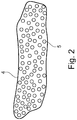
- Fig. 2 shows a single chip 4 on which adhere numerous glass bubbles 5 after mixing. If the chips are previously mixed separately with a pulverulent binder in a first mixture and the glass hollow spheres are mixed separately with a pulverulent binder in a second mixture, a comparable image is obtained after mixing the first and the second mixture into a topcoat mixture. The particles of the binder and the glass bubbles, which are also surrounded by binder, deposit on the surface of the chip.
- mineralized shavings ie chips sheathed with an inorganic binder.
- the mineralization can be done such. B. in the DE 10 2010 051 059 A1 whose content is the subject of this application.
- Fig. 3 shows a wood-based panel according to the invention, here a fiberboard 10, which is made of wood fibers 11, binder and hollow glass spheres 12.
- This fiberboard 10 is made by mixing the fibers with binder and glass bubbles, wherein silanized glass bubbles are used, ie hollow glass spheres whose surface is provided with a coating of silanes.
- the proportion of glass bubbles is 50 wt .-%
- the plate has a density of 450 kg / m 3 .
- Table 1 shows the production of 19 mm thick, three-layer chipboard with two outer cover and an inner middle layer. Used are wood chips for the top layer (DS), which are provided with urea-formaldehyde binder (UF) and which are mixed with glass hollow spheres and with another binder.
- the hollow glass spheres used are K15 glass spheres from 3M.
- the binder used is 5010 N from Wacker.
- the proportion of wood shavings is reduced from 76.6% by weight in test 2 to 55.6% by weight in test 2 and 7 to 47.1% by weight in test 5 and 9. This reduces the weight of the chipboard from 1.828 kg to 1.800 kg to 1.700 kg for the respective test plate.
- the thermal conductivity is 0.11 W / mK compared to an average thermal conductivity for gypsum boards of 0.23 W / mK to 0.28 W / mK and an average thermal conductivity of 0.19 W / mK for a comparable three-layer chipboard without glass bubbles.
- the edge swelling decreases from about 10% in the experiment 2 to about 7.9% to 8.0% in experiments 4 and 7 when using 22.2 wt .-% hollow glass spheres to values of 3.9% to 4% in the experiments 5 and 8 when using 20 , 4 wt .-% glass bubbles.
- the edge swelling of a comparable three-layer chipboard without glass bubbles is 20%.
Landscapes
- Life Sciences & Earth Sciences (AREA)
- Engineering & Computer Science (AREA)
- Manufacturing & Machinery (AREA)
- Wood Science & Technology (AREA)
- Forests & Forestry (AREA)
- Dry Formation Of Fiberboard And The Like (AREA)
Abstract
Description
- Die Erfindung betrifft eine Holzwerkstoffplatte mit Hohlkugeln und ein Verfahren zur Herstellung solcher Holzwerkstoffplatten mit Hohlkugeln.
- Insbesondere für Bauzwecke werden plattenförmige Werkstoffe gefordert, die bei Einwirkung von Feuchte kaum quellen und deshalb bei steigender Feuchte nur einer geringen Formänderung unterliegen. Zudem sollen diese plattenförmigen Werkstoffe eine möglichst geringe Wärmeleitfähigkeit aufweisen, so dass sie eine möglichst gute thermische Isolierung bewirken. Schließlich sind gute mechanische Eigenschaften gefordert, damit diese plattenförmigen Werkstoffe als Beplankung in der Rahmenbauweise eingesetzt werden können.
- Bisher werden für solche Anwendungen häufig Gipskartonplatten eingesetzt, d. h., Platten aus Gips, die von einem Karton umhüllt sind. Diese Gipskartonplatten weisen eine geringe Quellung und eine geringe Wärmeleitfähigkeit auf. Sie weisen allerdings nur eingeschränkte mechanische Eigenschaften und ein verhältnismäßig hohes Gewicht auf. Eine solche Gipskartonplatte ist in der
DE-AS 1 276 314 - Es ist Aufgabe der Erfindung, einen plattenförmigen Werkstoff insbesondere für Bauzwecke bereitzustellen, der die vorstehend beschriebenen Anforderungen erfüllt.
- Die Aufgabe wird gelöst mit einer Holzwerkstoffplatte nach Anspruch 1 und einem Verfahren zur Herstellung einer solchen Holzwerkstoffplatte nach Anspruch 13.
- Eine erfindungsgemäße Holzwerkstoffplatte weist lignocellulosische Späne oder Fasern, sowie ein Bindemittel auf und zudem weist die Holzwerkstoffplatte Glashohlkugeln auf.
- Die erfindungsgemäße Holzwerkstoffplatte weist lignocellulosische Partikel auf, insbesondere Späne oder Fasern. Die Späne sind größer als die Fasern; sie sind meist flächig ausgebildet, wobei die Länge und die Breite typischerweise sehr viel größer sind als die Dicke. Typische Abmessungen reichen von 5 mm bis zu 200 mm Länge, von 0,5 mm bis 100 mm Breite und von 0,1 bis 5 mm Dicke. Späne verfügen über eine höhere Biegeelastizität als Fasern. Eine Faser weist meist eine annähernd gleiche Breite und Dicke auf; die Länge ist sehr viel größer als Breite oder Dicke. Typische Abmessungen reichen von 0,5 bis 10 mm Länge, die Breite bzw. Dicke betragen 0,1 mm bis 3 mm.
- Eine Spanplatte kann in einer einfachen Ausführung einschichtig ausgeführt sein. Die Späne einer Spanplatte sind jedoch typisch in verschiedenen Schichten angeordnet, einer Mittelschicht mit Spänen, die meist dicker, oft auch länger und breiter sind als die Späne einer Deckschicht, die die Mittelschicht flankiert und nach außen abdeckt. Ein typischer Aufbau einer Spanplatte weist eine innen liegende Mittelschicht und zwei außen liegende Deckschichten auf. Eine Faserplatte kann ebenfalls aus Mittel- und Deckschicht aufgebaut sein, sie kann aber auch einschichtig aus gleich großen Fasern über die gesamte Dicke aufgebaut sein. Im Rahmen dieser Patentanmeldung zählen sämtliche aus Spänen und /oder Fasern aufgebauten Holzwerkstoffplatten zur Erfindung, also Spanplatten, Oriented-Strand-Board Platten, Spanplatten mit einer Deckschicht aus Faserplatten oder mit einer Beschichtung aus einer Faserplatte, Faserplatten geringer Dichte, z. B. Faserdämmplatten, Faserplatten mittlerer Dichte (MDF-Platten), Faserplatten hoher Dichte (HDF-Platten), beschichtete und unbeschichtete Span- und/oder Faserplatten.
- Die erfindungsgemäße Holzwerkstoffplatte weist ein organisches oder ein anorganisches Bindemittel oder eine Mischung dieser Bindemittel auf. Typische organische Bindemittel sind Aminoplast-, Duroplast- und/oder Thermoplastkunstharze sowie deren Mischungen. Typische Kunstharze, die in Holzwerkstoffplatten als Bindemittel eingesetzt werden können, sind Harnstoff- oder Melaminharz, Phenolharz, meist in Verbindung mit Formaldehyd, Resorcinharz, Epoxyharz, Polyvinylacetat (PVAc), ggf. in Verbindung mit Copolymeren, Polyurethan, polymeres Diphenylmethandiisocyanat (EMDI) oder polymeres Diphenylmethandiisocyanat (PMDI). Typische anorganische Bindemittel sind Silane oder Silikate, z. B. Wasserglas. Die vorstehend genannten Bindemittel können jeweils für sich oder in Mischung eingesetzt werden. Typische Kombinationen, bei denen die Bindemittel vor der Zugabe zu den Spänen oder Fasern gemischt werden, sind Harnstoff-Formaldehyd, Melamin-Formaldehyd, Phenol-Formaldehyd, Harnstoff-Phenol-Formaldehyd, Melamin-Phenol-Formaldehyd, Harnstoff-Melamin-Phenol-Formaldehyd oder die Mischung eines Silans mit einem Silikat. Alternativ oder ergänzend können auch verschiedene Bindemittel in verschiedenen Schichten einer Holzwerkstoffplatte eingesetzt werden, z. B. PMDI in der Mittellage und Harnstoff-, Melamin- und/oder Phenolharze ggf. in Verbindung mit Formaldehyd in den Deckschichten.
- Das Bindemittel kann in flüssiger Form eingesetzt werden. Es kann aber mindestens zum Teil auch in pulver- oder staubförmiger Form eingesetzt werden, wobei die Pulver- oder Staubpartikel einen Durchmesser von 1 µm bis 20 µm, bevorzugt als kleine Partikel von 1 µm bis 5 µm oder als größere Partikel von 7 µm bis 15 µm eingesetzt werden. Pulver- oder staubförmiges Bindemittel ist bevorzugt aus thermoplastischen Kunstharzen hergestellt. Verfügbar sind z. B. Melaminharzstaub oder PVAc-Pulver, das auch als Weißleimpulver bekannt ist. Staub- oder pulverförmiges Bindemittel wird bevorzugt in Verbindung mit flüssigem Bindemittel eingesetzt, wobei Pulver bzw. Staub und Flüssigkeit entweder eine Kombination von verschiedenen Bindemitteln darstellen oder aus derselben Substanz, lediglich in unterschiedlichem Aggregatszustand bestehen.
- Erfindungsgemäß enthält die Holzwerkstoffplatte Glashohlkugeln. Die Glashohlkugeln senken das Gewicht der Holzwerkstoffplatte. Sie reduzieren die Quellung und verbessern das Brandverhalten. Üblicherweise enthält eine Deckschicht Glashohlkugeln. Nach einer vorteilhaften Ausführung enthalten beide außen liegenden Deckschichten Glashohlkugeln. Nach einer weiter bevorzugten Ausführung enthält die innen liegende Mittelschicht Glashohlkugeln. Besonders vorteilhaft ist eine Ausführung der Holzwerkstoffplatte, bei der sowohl die beiden außen liegenden Deckschichten als auch die innen liegende Mittelschicht Glashohlkugeln aufweisen. Je mehr Glashohlkugeln die Holzwerkstoffplatte enthält, desto ausgeprägter ist das verbesserte Quellverhalten mit reduzierter Formänderung bei Feuchteeinfluss und desto geringer ist das Gewicht der Platte.
- Die in der erfindungsgemäßen Holzwerkstoffplatte eingesetzten Glashohlkugeln weisen ein Gewicht von 100 kg/m3 bis 600 kg/m3 auf. Vorteilhaft werden Glashohlkugeln mit einem Gewicht von 100 kg/m3 bis 450 kg/m3 eingesetzt, besonders vorteilhaft mit einem Gewicht von 100 kg/m3 bis 350 kg/m3. Damit sind die Glashohlkugeln leichter als die eingesetzten Späne oder Fasern, die bei einer Feuchte von z. B. 12 % ein Gewicht von 600 kg/m3 bis 1000 kg/m3 aufweisen. Glashohlkugeln können z. B. von 3M bezogen werden, die solche Glashohlkugeln als K Series, S Series und iM Series anbieten. Die erfindungsgemäße Holzwerkstoffplatte weist vorteilhaft ein Gewicht von 400 kg/m3 bis 500 kg/m3 auf.
- Die Glashohlkugeln weisen einen Durchmesser von 0,5 µm bis 10 µm auf, bevorzugt von 1 µm bis 5 µm. Nach einer vorteilhaften Ausführung werden in der Deckschicht Glashohlkugeln von 1 bis 3 µm eingesetzt und in der Mittelschicht Glashohlkugeln von 5 µm bis 10 µm. Die Glashohlkugeln sind aus Glas oder Keramik, bevorzugt aus Borsilikatglas hergestellt.
- Nach den vorstehenden Ausführungen zum Gewicht und den weiteren nützlichen Eigenschaften der Glashohlkugeln einerseits und der Späne bzw. Fasern andererseits liegt auf der Hand, dass so viele Glashohlkugeln wie möglich eingesetzt werden. Erste Versuche zeigen, dass wenn 5 Gew.-% bis 70 Gew.-% der Späne oder der Fasern einer Holzwerkstoffplatte durch Glashohlkugeln ersetzt werden, Holzwerkstoffplatten mit guten Festigkeitseigenschaften hergestellt werden können, die die geforderten Eigenschaften der reduzierten Formänderung unter Einfluss von Feuchtigkeit und die im Vergleich zu einer Referenzplatte aus demselben lignocellulosischen Material jedoch ohne Einsatz von Glashohlkugeln reduzierte Wärmeleitfähigkeit, reduziertes Gewicht und eine reduzierte Kantenquellung zeigen. Die vorgenannten Eigenschaften werden weiter verbessert, wenn auch die Deckschichten und die Mittelschicht Glashohlkugeln aufweisen.
- Glasoberflächen sind inert, so dass Bindemittel nicht ohne weiteres dort anbinden können. Nach einer vorteilhaften Ausführung ist die Oberfläche der Glashohlkugeln silanisiert, wodurch das Bindungsvermögen verbessert wird. Ein gleicher Effekt wird erreicht, wenn die Glashohlkugeln mit einem Film aus Melaminharz oder Polyvinylacetat (PVAc) überzogen werden. Bevorzugt werden die Glashohlkugeln mit einem pulver- oder staubförmigen Melaminharz oder PVAc gemischt. Beim Erhitzen bildet sich dann der gewünschte Film oder Überzug. Während das Silanisieren in der Regel vor dem Einsatz in der Holzwerkstoffplatte erfolgt, kann das Ausbilden eines Films oder Überzugs mit einem Kunstharz während der Herstellung der Platte erfolgen.
- Um den Widerstand gegen Feuer (Brandwiderstand) weiter zu verbessern, können die Späne mindestens einer Deckschicht mineralisiert werden. Das Mineralisieren ist z. B. in der
DE 10 2010 051 059 A1 beschrieben, es bezeichnet das Umhüllen von Spänen mit anorganischem bzw. mineralischem Bindemittel. - Die Erfindung umfasst weiter ein Verfahren zum Herstellen einer Holzwerkstoffplatte aufweisend lignocellulosische Späne oder Fasern, die vorzugsweise in einer innen liegenden Mittelschicht und zwei außen liegenden Deckschichten angeordnet sind, sowie ein Bindemittel, wobei die Holzwerkstoffplatte Glashohlkugeln aufweist, mit den Schritten
- Herstellen einer Mischung aufweisend Späne (4) oder Fasern mit Bindemittel und Glashohlkugeln (6)
- Herstellen eines Faserkuchens durch Streuen der Mischung und
- Pressen des Faserkuchens.
- Nach einer vorteilhaften Weiterbildung des Verfahrens weist mindestens eine Deckschicht die erfindungsgemäß eingesetzten Glashohlkugeln auf, wobei eine solche Holzwerkstoffplatte wie folgt hergestellt werden kann:
- Herstellen einer Deckschichtmischung aufweisend Deckschichtspäne oder - fasern mit Bindemittel und Glashohlkugeln
- Herstellen eines Faserkuchens durch Streuen einer ersten Deckschicht aus der Deckschichtmischung, Streuen einer Mittelschicht, aufweisend Späne oder Fasern für die Mittelschicht und Bindemittel, und Streuen einer zweiten Deckschicht aufweisend Späne oder Faser für die Deckschicht und Bindemittel und
- Pressen des Faserkuchens.
- Das Herstellen der Mischung oder der Deckschichtmischung erfolgt durch Mischen der jeweiligen Komponenten, Späne oder Fasern oder ein Gemisch aus Spänen und Fasern, Bindemittel und Glashohlkugeln. Das Bindemittel kann in fester oder flüssiger Form oder als Schaum zugesetzt werden. Die Glashohlkugeln verteilen sich, da sie weitaus kleiner sind als die Späne und die Fasern, auf der Oberfläche der Späne bzw. Fasern. Die Verteilung erfolgt gleichmäßig, insbesondere dann, wenn aktiv gemischt wird, z. B. durch Umwälzen oder Verwirbeln der Komponenten. Das Bindemittel legt sich ebenfalls gleichmäßig um Späne, Fasern und Glashohlkugeln.
- Das Pressen kann auf einer beliebigen Presse erfolgen, sowohl auf einer Kurztaktpresse als auch auf einer kontinuierlichen Presse, wobei aus wirtschaftlichen Gründen eine kontinuierliche Presse bevorzugt wird.
- Die Pressbedingungen können in einem weiten Rahmen gewählt werden. Typische Pressbedingungen sind z. B.
Druck 10 bis 50 bar Pressfaktor 1 s/mm bis 10 s/mm Temperatur 120 °C bis 280 °C - Der Pressfaktor zeigt, wie lang die Pressdauer zu bemessen ist je mm Plattendicke. Eine 19 mm Spanplatte mit 4 s Pressfaktor benötigt eine Pressdauer von 76 s. Es ist vorteilhaft, die erfindungsgemäßen Holzwerkstoffplatten vor der Verwendung einige Zeit zu lagern, z. B. einige Stunden oder einige Tage, damit die Festigkeit der Platten optimal entwickelt ist.
- Nach einer vorteilhaften Weiterentwicklung des Verfahrens werden bei Verwendung von pulverförmigem Bindemittel eine erste Mischung aus Spänen und/oder Fasern mit dem pulverförmigen Bindemittel und eine zweite Mischung aus Glashohlkugeln und Bindemittel erzeugt. Die erste und die zweite Mischung werden dann zu einer Deckschichtmischung zusammengeführt. Die weitere Verarbeitung erfolgt wie vorstehend beschrieben. Dieses Vorgehen gewährleistet, dass die Glashohlkugeln beim Pressen durch das Schmelzen des Bindemittels und das Verfließen zu einem Film von einem Film aus Kunstharz, insbesondere von Melamin oder PVAc umgeben werden, der die Glashohlkugeln besonders fest in die Holzwerkstoffplatte einbindet. Alternativ oder ergänzend zu dieser Ausführung können Glashohlkugeln mit einer silanisierten Oberfläche eingesetzt werden, wobei das Silanisieren ebenfalls bewirkt, dass die Glashohlkugeln fester in die Matrix der Holzwerkstoffplatte integriert werden.
- Bevorzugt wird auch die zweite Deckschicht aus der Deckschichtmischung, d. h., mit Glashohlkugeln, hergestellt. Weiter bevorzugt weist die Mittelschicht ebenfalls Glashohlkugeln auf. Eine Holzwerkstoffplatte, die über den gesamten Querschnitt Glashohlkugeln aufweist, verwirklicht die Vorteile der Erfindung am besten.
- Die erfindungsgemäße Holzwerkstoffplatte kann zum Beplanken von Wandkonstruktionen eingesetzt werden. Die Holzwerkstoffplatte kann unmittelbar verputzt oder mit einer Wanddämmung versehen werden. Plattenstöße können stumpf, d. h. ohne Bearbeitung gerader Kanten, mittels PU-Klebstoff verklebt werden. Der Übergang ist in der Fläche nicht sichtbar.
- Nachfolgend werden Details der Erfindung näher erläutert. Es zeigen:
- Fig. 1
- eine schematische Darstellung des Querschnitts einer erfindungsgemäßen Spanplatte,
- Fig. 2
- eine schematisierte Darstellung eines einzelnen Spans, dessen Oberfläche abschnittsweise mit Glashohlkugeln belegt ist und
- Fig. 3
- eine schematisierte Darstellung des Querschnitts einer erfindungsgemäßen Faserplatte.
- Sämtliche Figuren sind zur schematischen Darstellung gedacht; sie zeigen keine wahren Größenverhältnisse, insbesondere zeigen sie kein wahres Größenverhältnis zwischen Spänen oder Fasern einerseits und Glashohlkugeln andererseits.
-
Fig. 1 zeigt eine Holzwerkstoffplatte, hier eine Spanplatte 1 mit zwei außen liegenden Deckschichten 2, die gemeinsam einen Anteil an der Gesamtdicke von 36% (18 % je Deckschicht) haben, und einer innen liegenden Mittelschicht 3, die einen Anteil von 54% an der Gesamtdicke der Spanplatte 1 einnimmt. Die Deckschicht 2 ist aus Spänen 4 aus Holz und Glashohlkugeln 6 sowie dem hier nicht dargestellten Bindemittel zusammengesetzt. Eingesetzt wurden Glashohlkugeln von 3M mit einer Dichte von 350 kg/m3. Der Durchmesser von 50 % der Glashohlkugeln betrug maximal 4 µm, die maximale Größe betrug 8 µm. Die Mittelschicht 3 ist aus Spänen 5 (89 Gew.-%) und dem ebenfalls nicht dargestellten Bindemittel (11 Gew.-%) zusammengesetzt. Der Anteil der Glashohlkugeln 6 beträgt 15 Gew.-% bezogen auf das Gesamtgewicht der Deckschicht 2. Der Anteil des Bindemittels beträgt 28 Gew.-% und der Anteil der Späne 4 beträgt 57 Gew.-% bezogen auf das Gesamtgewicht der Deckschicht 2. - Die Späne 4 der Deckschicht 2 weisen Abmessungen von durchschnittlich 10 mm bis 20 mm Länge, 1 mm bis 2 mm Dicke und 3 mm bis 8 mm Breite auf. Die Späne 5 der Mittelschicht 3 weisen eine Länge von 25 mm bis 35 mm, eine Breite von 5 bis 10 mm und eine Dicke von 1,5 mm bis 3 mm auf. Die kleineren Späne 4 der Deckschicht sind dichter gepackt, so dass die Deckschicht eine größere Dichte aufweist als die Mittelschicht. Das Einbringen der Glashohlkugeln 6 in die Deckschicht 2 reduziert also gezielt den Bereich der größten Dichte der erfindungsgemäßen Spanplatte. Gleichzeitig wird dadurch, dass die Glashohlkugeln 6 die Oberfläche der Späne 4 belegen, die Formänderung durch den Einfluss von Feuchte signifikant reduziert.
- Die Spanplatte 1 mit einer Dicke von 19 mm wurde in einer kontinuierlichen Presse hergestellt, indem zuerst eine erste Mischung aus Spänen 3 für die Deckschicht 2 und pulverförmigem Bindemittel, hier z. B. Melaminstaub, und eine zweite Mischung aus Glashohlkugeln und pulverförmigem Bindemittel, beispielsweise Melaminstaub, hergestellt wurde. Die erste und die zweite Mischung wurden zu einer Deckschichtmischung gemischt.
- Zur Herstellung der Mittelschicht 3 wurden Späne 5 und Bindemittel, hier z. B. ein flüssiges Harnstoff-Melamin-Phenol-Harnstoffharz eingesetzt, wobei das Bindemittel auf die Späne 5 der Mittelschicht 3 aufgesprüht wurde.
- Nach Herstellung der Deckschicht- und der Mittelschichtmischungen wurde zunächst eine erste außen liegende Deckschicht gestreut, dann die innen liegende Mittelschicht und anschließend eine zweite außen liegende Deckschicht, jeweils in der vorstehend angegebenen Schichtdicke. Der so hergestellte Presskuchen wurde in die kontinuierliche Presse überführt und unter den oben angegebenen Pressbedingungen zu einer Spanplatte verpresst.
- Im Vergleich zur selben Spanplatte ohne Glashohlkugeln weist die erfindungsgemäße Spanplatte ein deutlich verringertes Gewicht von 500 kg/m3 auf. Je nach Anteil der Glashohlkugeln 6 kann das Gewicht der erfindungsgemäßen Spanplatte 450 kg/m3 bis 550 kg/m3 betragen. Eine konventionelle Spanplatte, d. h., eine identische Spanplatte ohne Glashohlkugeln, weist ein Gewicht von 645 kg/m3 bis 660 kg/m3 auf. Eine weitere Gewichtsersparnis ist erreichbar, wenn mehr Glashohlkugeln eingesetzt werden. Zudem weist die erfindungsgemäße Spanplatte eine im Vergleich zur konventionellen Spanplatte um 5% geringere Kantenquellung auf (gemessen nach EN 13329). Die mechanischen Eigenschaften der erfindungsgemäßen Spanplatte 1 entsprechen dem Typ P5 nach EN 312. Die Wärmeleitfähigkeit der erfindungsgemäßen Spanplatte beträgt 0,10 W/mK oder weniger.
- Die erfindungsgemäße Spanplatte 1 kann zum Beplanken von Wandkonstruktionen eingesetzt werden. Die Spanplatte kann unmittelbar verputzt oder mit einer Wanddämmung versehen werden.
-
Fig. 2 zeigt einen einzelnen Span 4, auf dem nach dem Mischen zahlreiche Glashohlkugeln 5 haften. Werden zuvor die Späne separat mit einem pulverförmigen Bindemittel in einer ersten Mischung gemischt und die Glashohlkugeln separat mit einem pulverförmigen Bindemittel in einer zweiten Mischung gemischt, so zeigt sich nach dem Mischen der ersten und der zweiten Mischung zu einer Deckschichtmischung ein vergleichbares Bild. Die Partikel des Bindemittels und die Glashohlkugeln, die ebenfalls von Bindemittel umgeben sind, lagern sich auf der Oberfläche des Spans ab. - Alternativ zu unbehandelten Spänen können auch mineralisierte Späne, also von einem anorganischen Bindemittel umhüllte Späne eingesetzt werden. Das Mineralisieren kann erfolgen wie z. B. in der
DE 10 2010 051 059 A1 angegeben, deren Inhalt wird zum Gegenstand dieser Anmeldung gemacht. -
Fig. 3 zeigt eine erfindungsgemäße Holzwerkstoffplatte, hier eine Faserplatte 10, die aus Holzfasern 11, Bindemittel und Glashohlkugeln 12 hergestellt ist. Diese Faserplatte 10 wird hergestellt, indem die Fasern mit Bindemittel und Glashohlkugeln gemischt werden, wobei silanisierte Glashohlkugeln eingesetzt werden, also Glashohlkugeln, deren Oberfläche mit einem Überzug aus Silanen versehen ist. Der Anteil der Glashohlkugeln beträgt 50 Gew.-% - Diese einheitliche Mischung wird gestreut und in einer kontinuierlichen Presse unter folgenden Bedingungen gepresst:
Druck 40 bar Pressfaktor 3,8 s/mm Temperatur 230 °C - Während des Pressens werden die äußeren Schichten 13 der Faserplatte 10 stärker verdichtet. Die Mittelschicht 14 wird weniger verdichtet. Die Glashohlkugeln 12 sind gleichmäßig in der Faserplatte 10 verteilt. Die Platte weist eine Dichte von 450 kg/m3 auf.
- Anliegend werden an Hand der Tabelle 1 Versuche erläutert, die einzelne Ausführungen der erfindungsgemäßen Holzwerkstoffplatte zeigen.
- Tabelle 1 zeigt die Herstellung von 19 mm dicken, dreischichtigen Spanplatten mit zwei außen liegenden Deck- und einer innen liegenden Mittelschicht. Eingesetzt werden Holzspäne für die Deckschicht (DS), die mit Harnstoff- Formaldehyd-Bindemittel (UF) versehen sind und die mit Glashohlkugeln sowie mit einem weiteren Bindemittel vermischt werden. Als Glashohlkugeln werden K15 Glaskugeln von 3M eingesetzt. Als Bindemittel wird 5010 N von Wacker eingesetzt.
- Der Anteil der Holzspäne wird von 76,6 Gew.-% im Versuch 2 auf 55,6 Gew.-% im Versuch 2 und 7 auf 47,1 Gew.-% im Versuch 5 und 9 herabgesetzt. Dadurch sinkt das Gewicht der Spanplatte von 1,828 kg auf 1,800 kg auf 1,700 kg für die jeweilige Versuchsplatte. Die Wärmeleitfähigkeit liegt bei 0,11 W/mK gegenüber einer durchschnittlichen Wärmeleitfähigkeit für Gipsplatten von 0,23 W/mK bis 0,28 W/mK und einer durchschnittlichen Wärmeleitfähigkeit von 0,19 W/mK für eine vergleichbare dreischichtige Spanplatte ohne Glashohlkugeln. Die Kantenquellung sinkt von ca. 10% im Versuch 2 auf ca. 7,9 % bis 8,0 % in den Versuchen 4 und 7 bei Einsatz von 22,2 Gew.-% Glashohlkugeln auf Werte von 3,9 % bis 4 % in den Versuchen 5 und 8 bei Einsatz von 20,4 Gew.-% Glashohlkugeln. Die Kantenquellung einer vergleichbaren dreischichtigen Spanplatte ohne Glashohlkugeln liegt bei 20%.
- Der Einsatz der Glashohlkugeln bewirkt also eine deutliche Reduzierung des Gewichts der Holzwerkstoffplatte und eine signifikante Verringerung der Wärmeleitfähigkeit sowie der Kantenquellung.
Tabelle 1 19 mm Spanplatte 19 mm Spanplatte Versuche 2 4 Menge in kg % Typ Menge in kg % Typ Holzspäne DS beleimt UF 1,40 76,6 DS (Standard) 1,00 55,6 DS (Standard) Glaskugeln 0,166 9,1 K15 (3M) 0,4 22,2 K15 (3M) Bindemittel 0,262 14,3 5010 N (Wacker) 0,4 22,2 5010 N (Wacker) Summe 1,828 100,0 1,800 100,0 Wärmeleitfähigkeit 0,11 W/mK 0,112 W/mK Kantenquellung 10,1 % 7,9 % 19 mm Spanplatte 19 mm Spanplatte Versuche 5 7 Menge in kg % Typ Menge in kg % Typ Holzspäne DS beleimt UF 0,80 47,1 DS (Standard) 1,00 55,6 DS (Standard) Glaskugeln 0,5 29,4 K15 (3M) 0,4 22,2 K15 (3M) Bindemittel 0,4 23,5 5010 N (Wacker) 0,4 22,2 Vinnapas B 60 (Wacker) Summe 1,700 100,0 1,800 100,0 Wärmeleitfähigkeit 0,11 W/mK 0,124 W/mK Kantenquellung 4,4 % 8,0 % 19 mm Spanplatte 19 mm Spanplatte Versuche 8 9 (Standard) Menge in kg % Typ Menge in kg % Typ Holzspäne DS beleimt UF 0,80 47,1 DS (Standard) Glaskugeln 0,5 29,4 K15 (3M) Bindemittel 0,4 23,5 Vinnapas B 60 (Wacker) Summe 1,700 100,0 Wärmeleitfähigkeit 0,098 W/mK 0,185 W/mK Kantenquellung 3,9 % ca. 20 %
Claims (17)
- Holzwerkstoffplatte, aufweisend lignocellulosische Späne (4) oder Fasern sowie ein Bindemittel, dadurch gekennzeichnet, dass die Holzwerkstoffplatte Glashohlkugeln (6) aufweist.
- Holzwerkstoffplatte nach Anspruch 1, dadurch gekennzeichnet, dass die Holzwerkstoffplatte (1) mindestens eine innen liegende Mittelschicht (3) und zwei außen liegende Deckschichten (2) aufweist.
- Holzwerkstoffplatte nach Anspruch 1 oder 2, dadurch gekennzeichnet, dass beide außen liegenden Deckschichten (2) und/oder die Mittelschicht (3) Glashohlkugeln (6) aufweisen.
- Holzwerkstoffplatte nach mindestens einem der Ansprüche 1 bis 3, dadurch gekennzeichnet, dass die Glashohlkugeln (6) einen Durchmesser von 0,5 µm bis 10 µm, insbesondere von 1 µm bis 5 µm aufweisen.
- Holzwerkstoffplatte nach mindestens einem der Ansprüche 1 bis 4, dadurch gekennzeichnet, dass der Anteil der Glashohlkugeln (6) am Gesamtgewicht der Holzwerkstoffplatte (1) 5 Gew.-% bis 70 Gew.-% beträgt.
- Holzwerkstoffplatte nach mindestens einem der Ansprüche 1 bis 5, dadurch gekennzeichnet, dass der Anteil der Glashohlkugeln (6) am Gesamtgewicht mindestens einer Deckschicht (2) und /oder der Mittelschicht (3) 5 Gew.-% bis 70 Gew.-% beträgt.
- Holzwerkstoffplatte nach mindestens einem der Ansprüche 1 bis 6, dadurch gekennzeichnet, dass die Glashohlkugeln (6) aus Borosilikatglas hergestellt sind.
- Holzwerkstoffplatte nach mindestens einem der Ansprüche 1 bis 7, dadurch gekennzeichnet, dass die Glashohlkugeln (6) eine silanisierte Oberfläche oder eine Oberfläche aufweisen, die mindestens abschnittsweise mit einem Film aus Melaminharz oder Polyvinylacetat versehen ist.
- Holzwerkstoffplatte nach mindestens einem der Ansprüche 1 bis 8, dadurch gekennzeichnet, dass als Bindemittel Aminoplast- oder Thermoplastkunstharze oder eine Mischung dieser Kunstharze eingesetzt werden.
- Holzwerkstoffplatte nach mindestens einem der Ansprüche 1 bis 9, dadurch gekennzeichnet, dass mindestens eine Teilmenge des Bindemittels in Form von Pulver oder Staub eingesetzt wird.
- Holzwerkstoffplatte nach mindestens einem der Ansprüche 1 bis 10, dadurch gekennzeichnet, dass die Späne (4) oder Fasern mindestens teilweise mineralisiert sind.
- Holzwerkstoffplatte nach mindestens einem der Ansprüche 1 bis 11, dadurch gekennzeichnet, dass das Gewicht der Holzwerkstoffplatte (1) 400 kg/m3 bis 500 kg/m3 beträgt.
- Verfahren zum Herstellen einer Holzwerkstoffplatte aufweisend lignocellulosische Späne (4) oder Fasern und ein Bindemittel, wobei die Holzwerkstoffplatte (1) Glashohlkugeln (6) aufweist, mit den Schritten- Herstellen einer Mischung aufweisend Späne (4) oder Fasern mit Bindemittel und Glashohlkugeln (6)- Herstellen eines Faserkuchens durch Streuen der Mischung und- Pressen des Faserkuchens.
- Verfahren nach Anspruch 13, dadurch gekennzeichnet, dass eine erste Mischung von Spänen (4) oder Fasern mit staubförmigem Bindemittel hergestellt wird, dass eine zweite Mischung von Glashohlkugeln (6) mit staubförmigem Bindemittel hergestellt wird, und dass die erste Mischung und die zweite Mischung zur Mischung gemischt werden.
- Verfahren nach Anspruch 13 oder 14, dadurch gekennzeichnet, dass auch die erste und/oder die zweite Deckschicht (2) aus der Mischung hergestellt wird.
- Verfahren nach mindestens einem der Ansprüche 13 bis 15, dadurch gekennzeichnet, dass auch die mindestens eine Mittelschicht (3) Glashohlkugeln (6) aufweist.
- Verfahren nach mindestens einem der Ansprüche 13 bis 16, dadurch gekennzeichnet, dass die Glashohlkugeln (6) vor dem Mischen mit staubförmigem Bindemittel silanisiert werden, oder dass die Oberfläche der Glashohlkugeln (6) mindestens abschnittsweise mit einem Film aus Melaminharz oder Polyvinylacetat versehen wird.
Priority Applications (2)
| Application Number | Priority Date | Filing Date | Title |
|---|---|---|---|
| EP17179148.6A EP3421200B1 (de) | 2017-06-30 | 2017-06-30 | Holzwerkstoffplatte mit hohlkugeln |
| PL17179148T PL3421200T3 (pl) | 2017-06-30 | 2017-06-30 | Płyta drewnopochodna z pustymi kulkami |
Applications Claiming Priority (1)
| Application Number | Priority Date | Filing Date | Title |
|---|---|---|---|
| EP17179148.6A EP3421200B1 (de) | 2017-06-30 | 2017-06-30 | Holzwerkstoffplatte mit hohlkugeln |
Publications (2)
| Publication Number | Publication Date |
|---|---|
| EP3421200A1 true EP3421200A1 (de) | 2019-01-02 |
| EP3421200B1 EP3421200B1 (de) | 2020-06-03 |
Family
ID=59269945
Family Applications (1)
| Application Number | Title | Priority Date | Filing Date |
|---|---|---|---|
| EP17179148.6A Active EP3421200B1 (de) | 2017-06-30 | 2017-06-30 | Holzwerkstoffplatte mit hohlkugeln |
Country Status (2)
| Country | Link |
|---|---|
| EP (1) | EP3421200B1 (de) |
| PL (1) | PL3421200T3 (de) |
Cited By (1)
| Publication number | Priority date | Publication date | Assignee | Title |
|---|---|---|---|---|
| EP3736095A3 (de) * | 2019-04-18 | 2021-01-27 | Swiss Krono TEC AG | Plattenförmiger werkstoff und verfahren zu dessen herstellung |
Citations (4)
| Publication number | Priority date | Publication date | Assignee | Title |
|---|---|---|---|---|
| DE1276314B (de) | 1963-03-11 | 1968-08-29 | United States Gypsum Co | Rechteckige Gipskartonplatte |
| US20050019548A1 (en) * | 2003-07-16 | 2005-01-27 | J. M. Huber Corporation | Strength-enhanced, lightweight lignocellulosic composite board materials and methods of their manufacture |
| US20110073253A1 (en) * | 2008-06-08 | 2011-03-31 | Clausi Robert N | Process for Producing Resilient Wood Particleboard, MDF and HDF |
| DE102010051059A1 (de) | 2010-11-11 | 2012-05-16 | Robert Kuhnhenn | Mineralisierter Holzspan |
Family Cites Families (2)
| Publication number | Priority date | Publication date | Assignee | Title |
|---|---|---|---|---|
| PL2762328T3 (pl) * | 2013-01-30 | 2016-06-30 | Flooring Technologies Ltd | Sposób wytwarzania płyty drewnopochodnej pokrytej obustronnie powłoką dekoracyjną |
| ES2683714T3 (es) * | 2014-05-09 | 2018-09-27 | Flooring Technologies Ltd. | Procedimiento para fabricar tableros de compuesto de madera decorados y panel de suelo fabricado a partir del tablero de compuesto de madera |
-
2017
- 2017-06-30 PL PL17179148T patent/PL3421200T3/pl unknown
- 2017-06-30 EP EP17179148.6A patent/EP3421200B1/de active Active
Patent Citations (4)
| Publication number | Priority date | Publication date | Assignee | Title |
|---|---|---|---|---|
| DE1276314B (de) | 1963-03-11 | 1968-08-29 | United States Gypsum Co | Rechteckige Gipskartonplatte |
| US20050019548A1 (en) * | 2003-07-16 | 2005-01-27 | J. M. Huber Corporation | Strength-enhanced, lightweight lignocellulosic composite board materials and methods of their manufacture |
| US20110073253A1 (en) * | 2008-06-08 | 2011-03-31 | Clausi Robert N | Process for Producing Resilient Wood Particleboard, MDF and HDF |
| DE102010051059A1 (de) | 2010-11-11 | 2012-05-16 | Robert Kuhnhenn | Mineralisierter Holzspan |
Cited By (1)
| Publication number | Priority date | Publication date | Assignee | Title |
|---|---|---|---|---|
| EP3736095A3 (de) * | 2019-04-18 | 2021-01-27 | Swiss Krono TEC AG | Plattenförmiger werkstoff und verfahren zu dessen herstellung |
Also Published As
| Publication number | Publication date |
|---|---|
| EP3421200B1 (de) | 2020-06-03 |
| PL3421200T3 (pl) | 2020-09-21 |
Similar Documents
| Publication | Publication Date | Title |
|---|---|---|
| EP1233041B1 (de) | Dekorative Platte und/oder Formteil, deren Verwendung und Verfahren zu deren Herstellung | |
| EP3736095B1 (de) | Plattenförmiger werkstoff und verfahren zu dessen herstellung | |
| DE102009005155B4 (de) | Verfahren zur Herstellung einer brandhemmenden Holzwerkstoffplatte und entsprechende Holzwerkstoffplatte | |
| EP4010189B1 (de) | Werkstoffplatte, verfahren und anlage zur herstellung einer werkstoffplatte sowie verwendung einer werkstoffplatte | |
| EP3322596B1 (de) | Verfahren zur herstellung eines laminates bestehend aus trägerplatte und dekorpapier | |
| EP1420127A2 (de) | Paneel und Verfahren zur Herstellung eines Paneels | |
| EP3275611B1 (de) | Verfahren zur herstellung einer faserplatte | |
| DE102004011931B4 (de) | Dämmstoffplatte aus einem Holzwerkstoff-Bindemittelfaser-Gemisch | |
| EP3725481B1 (de) | Plattenförmiger werkstoff und verfahren zu dessen herstellung | |
| EP3421200B1 (de) | Holzwerkstoffplatte mit hohlkugeln | |
| EP0524403A1 (de) | Mehrschichtmaterialstruktur | |
| DE102019121471A1 (de) | Werkstoffplatte und Verfahren zur Herstellung einer Werkstofplatte | |
| EP2319671B1 (de) | Verfahren zur Herstellung einer OSB-Platte | |
| DE10049050A1 (de) | Verfahren zur Herstellung einer Mehrschichtplatte und eine nach diesem Verfahren hergestellte Mehrschichtplatte | |
| DE3721664C2 (de) | ||
| DE102004022227A1 (de) | Verfahren zur Herstellung einer anorganisch gebundenen Platte aus geschichtet angeordneten Flachspanstreifen aus Holz | |
| EP3444086A1 (de) | Multifunktionsplatte aus holz- und bicomponentenfasern und verfahren zum herstellen einer multifunktionsplatte | |
| WO2005018890A1 (de) | Verfahren zur herstellung einer mehrschichtigen holzfaserplatte | |
| DE102017117917B4 (de) | Verfahren zum Herstellen einer Werkstoffplatte sowie Werkstoffplatte | |
| DE102007012691B4 (de) | Verfahren zur Herstellung von Platten aus Holzfasern und nach diesem Verfahren hergestellte LDF-, MDF- und HDF-Platten | |
| EP4241950B1 (de) | Verfahren zur herstellung einer spanplatte sowie spanplatte | |
| EP2864087B1 (de) | Holzverbundwerkstoff mit aerogele und entsprechendes herstellungsverfahren und verwendung | |
| DE102008004154A1 (de) | Verfahren zum Herstellen einer mehrschichtigen Pressplatte | |
| WO2023143963A1 (de) | Verfahren zum herstellen einer faserplatte | |
| EP2786849B1 (de) | Verfahren zur Herstellung einer Sandwich-Faserplatte, sowie Sandwich-Faserplatte |
Legal Events
| Date | Code | Title | Description |
|---|---|---|---|
| PUAI | Public reference made under article 153(3) epc to a published international application that has entered the european phase |
Free format text: ORIGINAL CODE: 0009012 |
|
| STAA | Information on the status of an ep patent application or granted ep patent |
Free format text: STATUS: THE APPLICATION HAS BEEN PUBLISHED |
|
| AK | Designated contracting states |
Kind code of ref document: A1 Designated state(s): AL AT BE BG CH CY CZ DE DK EE ES FI FR GB GR HR HU IE IS IT LI LT LU LV MC MK MT NL NO PL PT RO RS SE SI SK SM TR |
|
| AX | Request for extension of the european patent |
Extension state: BA ME |
|
| STAA | Information on the status of an ep patent application or granted ep patent |
Free format text: STATUS: REQUEST FOR EXAMINATION WAS MADE |
|
| 17P | Request for examination filed |
Effective date: 20190701 |
|
| RBV | Designated contracting states (corrected) |
Designated state(s): AL AT BE BG CH CY CZ DE DK EE ES FI FR GB GR HR HU IE IS IT LI LT LU LV MC MK MT NL NO PL PT RO RS SE SI SK SM TR |
|
| STAA | Information on the status of an ep patent application or granted ep patent |
Free format text: STATUS: EXAMINATION IS IN PROGRESS |
|
| 17Q | First examination report despatched |
Effective date: 20190912 |
|
| GRAP | Despatch of communication of intention to grant a patent |
Free format text: ORIGINAL CODE: EPIDOSNIGR1 |
|
| STAA | Information on the status of an ep patent application or granted ep patent |
Free format text: STATUS: GRANT OF PATENT IS INTENDED |
|
| RIC1 | Information provided on ipc code assigned before grant |
Ipc: B27N 3/04 20060101ALI20191128BHEP Ipc: B27N 3/02 20060101AFI20191128BHEP Ipc: B27N 1/00 20060101ALN20191128BHEP |
|
| RIC1 | Information provided on ipc code assigned before grant |
Ipc: B27N 3/02 20060101AFI20191129BHEP Ipc: B27N 3/04 20060101ALI20191129BHEP Ipc: B27N 1/00 20060101ALN20191129BHEP |
|
| INTG | Intention to grant announced |
Effective date: 20191217 |
|
| GRAJ | Information related to disapproval of communication of intention to grant by the applicant or resumption of examination proceedings by the epo deleted |
Free format text: ORIGINAL CODE: EPIDOSDIGR1 |
|
| STAA | Information on the status of an ep patent application or granted ep patent |
Free format text: STATUS: EXAMINATION IS IN PROGRESS |
|
| GRAP | Despatch of communication of intention to grant a patent |
Free format text: ORIGINAL CODE: EPIDOSNIGR1 |
|
| STAA | Information on the status of an ep patent application or granted ep patent |
Free format text: STATUS: GRANT OF PATENT IS INTENDED |
|
| INTC | Intention to grant announced (deleted) | ||
| INTG | Intention to grant announced |
Effective date: 20200212 |
|
| RIC1 | Information provided on ipc code assigned before grant |
Ipc: B27N 3/02 20060101AFI20200203BHEP Ipc: B27N 3/04 20060101ALI20200203BHEP Ipc: B27N 1/00 20060101ALN20200203BHEP |
|
| GRAS | Grant fee paid |
Free format text: ORIGINAL CODE: EPIDOSNIGR3 |
|
| GRAA | (expected) grant |
Free format text: ORIGINAL CODE: 0009210 |
|
| STAA | Information on the status of an ep patent application or granted ep patent |
Free format text: STATUS: THE PATENT HAS BEEN GRANTED |
|
| AK | Designated contracting states |
Kind code of ref document: B1 Designated state(s): AL AT BE BG CH CY CZ DE DK EE ES FI FR GB GR HR HU IE IS IT LI LT LU LV MC MK MT NL NO PL PT RO RS SE SI SK SM TR |
|
| REG | Reference to a national code |
Ref country code: GB Ref legal event code: FG4D Free format text: NOT ENGLISH |
|
| REG | Reference to a national code |
Ref country code: CH Ref legal event code: EP Ref country code: AT Ref legal event code: REF Ref document number: 1276556 Country of ref document: AT Kind code of ref document: T Effective date: 20200615 |
|
| REG | Reference to a national code |
Ref country code: DE Ref legal event code: R096 Ref document number: 502017005516 Country of ref document: DE |
|
| REG | Reference to a national code |
Ref country code: CH Ref legal event code: NV Representative=s name: PATENTANWALT DIPL.-ING. (UNI.) WOLFGANG HEISEL, CH |
|
| REG | Reference to a national code |
Ref country code: LT Ref legal event code: MG4D |
|
| PG25 | Lapsed in a contracting state [announced via postgrant information from national office to epo] |
Ref country code: SE Free format text: LAPSE BECAUSE OF FAILURE TO SUBMIT A TRANSLATION OF THE DESCRIPTION OR TO PAY THE FEE WITHIN THE PRESCRIBED TIME-LIMIT Effective date: 20200603 Ref country code: NO Free format text: LAPSE BECAUSE OF FAILURE TO SUBMIT A TRANSLATION OF THE DESCRIPTION OR TO PAY THE FEE WITHIN THE PRESCRIBED TIME-LIMIT Effective date: 20200903 Ref country code: GR Free format text: LAPSE BECAUSE OF FAILURE TO SUBMIT A TRANSLATION OF THE DESCRIPTION OR TO PAY THE FEE WITHIN THE PRESCRIBED TIME-LIMIT Effective date: 20200904 Ref country code: FI Free format text: LAPSE BECAUSE OF FAILURE TO SUBMIT A TRANSLATION OF THE DESCRIPTION OR TO PAY THE FEE WITHIN THE PRESCRIBED TIME-LIMIT Effective date: 20200603 Ref country code: LT Free format text: LAPSE BECAUSE OF FAILURE TO SUBMIT A TRANSLATION OF THE DESCRIPTION OR TO PAY THE FEE WITHIN THE PRESCRIBED TIME-LIMIT Effective date: 20200603 |
|
| REG | Reference to a national code |
Ref country code: NL Ref legal event code: MP Effective date: 20200603 |
|
| PG25 | Lapsed in a contracting state [announced via postgrant information from national office to epo] |
Ref country code: RS Free format text: LAPSE BECAUSE OF FAILURE TO SUBMIT A TRANSLATION OF THE DESCRIPTION OR TO PAY THE FEE WITHIN THE PRESCRIBED TIME-LIMIT Effective date: 20200603 Ref country code: BG Free format text: LAPSE BECAUSE OF FAILURE TO SUBMIT A TRANSLATION OF THE DESCRIPTION OR TO PAY THE FEE WITHIN THE PRESCRIBED TIME-LIMIT Effective date: 20200903 Ref country code: LV Free format text: LAPSE BECAUSE OF FAILURE TO SUBMIT A TRANSLATION OF THE DESCRIPTION OR TO PAY THE FEE WITHIN THE PRESCRIBED TIME-LIMIT Effective date: 20200603 Ref country code: HR Free format text: LAPSE BECAUSE OF FAILURE TO SUBMIT A TRANSLATION OF THE DESCRIPTION OR TO PAY THE FEE WITHIN THE PRESCRIBED TIME-LIMIT Effective date: 20200603 |
|
| PG25 | Lapsed in a contracting state [announced via postgrant information from national office to epo] |
Ref country code: AL Free format text: LAPSE BECAUSE OF FAILURE TO SUBMIT A TRANSLATION OF THE DESCRIPTION OR TO PAY THE FEE WITHIN THE PRESCRIBED TIME-LIMIT Effective date: 20200603 Ref country code: NL Free format text: LAPSE BECAUSE OF FAILURE TO SUBMIT A TRANSLATION OF THE DESCRIPTION OR TO PAY THE FEE WITHIN THE PRESCRIBED TIME-LIMIT Effective date: 20200603 |
|
| PG25 | Lapsed in a contracting state [announced via postgrant information from national office to epo] |
Ref country code: PT Free format text: LAPSE BECAUSE OF FAILURE TO SUBMIT A TRANSLATION OF THE DESCRIPTION OR TO PAY THE FEE WITHIN THE PRESCRIBED TIME-LIMIT Effective date: 20201006 Ref country code: RO Free format text: LAPSE BECAUSE OF FAILURE TO SUBMIT A TRANSLATION OF THE DESCRIPTION OR TO PAY THE FEE WITHIN THE PRESCRIBED TIME-LIMIT Effective date: 20200603 Ref country code: CZ Free format text: LAPSE BECAUSE OF FAILURE TO SUBMIT A TRANSLATION OF THE DESCRIPTION OR TO PAY THE FEE WITHIN THE PRESCRIBED TIME-LIMIT Effective date: 20200603 Ref country code: SM Free format text: LAPSE BECAUSE OF FAILURE TO SUBMIT A TRANSLATION OF THE DESCRIPTION OR TO PAY THE FEE WITHIN THE PRESCRIBED TIME-LIMIT Effective date: 20200603 Ref country code: EE Free format text: LAPSE BECAUSE OF FAILURE TO SUBMIT A TRANSLATION OF THE DESCRIPTION OR TO PAY THE FEE WITHIN THE PRESCRIBED TIME-LIMIT Effective date: 20200603 Ref country code: ES Free format text: LAPSE BECAUSE OF FAILURE TO SUBMIT A TRANSLATION OF THE DESCRIPTION OR TO PAY THE FEE WITHIN THE PRESCRIBED TIME-LIMIT Effective date: 20200603 |
|
| PG25 | Lapsed in a contracting state [announced via postgrant information from national office to epo] |
Ref country code: SK Free format text: LAPSE BECAUSE OF FAILURE TO SUBMIT A TRANSLATION OF THE DESCRIPTION OR TO PAY THE FEE WITHIN THE PRESCRIBED TIME-LIMIT Effective date: 20200603 Ref country code: IS Free format text: LAPSE BECAUSE OF FAILURE TO SUBMIT A TRANSLATION OF THE DESCRIPTION OR TO PAY THE FEE WITHIN THE PRESCRIBED TIME-LIMIT Effective date: 20201003 |
|
| REG | Reference to a national code |
Ref country code: DE Ref legal event code: R097 Ref document number: 502017005516 Country of ref document: DE |
|
| PG25 | Lapsed in a contracting state [announced via postgrant information from national office to epo] |
Ref country code: MC Free format text: LAPSE BECAUSE OF FAILURE TO SUBMIT A TRANSLATION OF THE DESCRIPTION OR TO PAY THE FEE WITHIN THE PRESCRIBED TIME-LIMIT Effective date: 20200603 Ref country code: LU Free format text: LAPSE BECAUSE OF NON-PAYMENT OF DUE FEES Effective date: 20200630 |
|
| PLBE | No opposition filed within time limit |
Free format text: ORIGINAL CODE: 0009261 |
|
| STAA | Information on the status of an ep patent application or granted ep patent |
Free format text: STATUS: NO OPPOSITION FILED WITHIN TIME LIMIT |
|
| REG | Reference to a national code |
Ref country code: BE Ref legal event code: MM Effective date: 20200630 |
|
| PG25 | Lapsed in a contracting state [announced via postgrant information from national office to epo] |
Ref country code: DK Free format text: LAPSE BECAUSE OF FAILURE TO SUBMIT A TRANSLATION OF THE DESCRIPTION OR TO PAY THE FEE WITHIN THE PRESCRIBED TIME-LIMIT Effective date: 20200603 Ref country code: IE Free format text: LAPSE BECAUSE OF NON-PAYMENT OF DUE FEES Effective date: 20200630 |
|
| 26N | No opposition filed |
Effective date: 20210304 |
|
| PG25 | Lapsed in a contracting state [announced via postgrant information from national office to epo] |
Ref country code: BE Free format text: LAPSE BECAUSE OF NON-PAYMENT OF DUE FEES Effective date: 20200630 Ref country code: SI Free format text: LAPSE BECAUSE OF FAILURE TO SUBMIT A TRANSLATION OF THE DESCRIPTION OR TO PAY THE FEE WITHIN THE PRESCRIBED TIME-LIMIT Effective date: 20200603 |
|
| PG25 | Lapsed in a contracting state [announced via postgrant information from national office to epo] |
Ref country code: TR Free format text: LAPSE BECAUSE OF FAILURE TO SUBMIT A TRANSLATION OF THE DESCRIPTION OR TO PAY THE FEE WITHIN THE PRESCRIBED TIME-LIMIT Effective date: 20200603 Ref country code: MT Free format text: LAPSE BECAUSE OF FAILURE TO SUBMIT A TRANSLATION OF THE DESCRIPTION OR TO PAY THE FEE WITHIN THE PRESCRIBED TIME-LIMIT Effective date: 20200603 Ref country code: CY Free format text: LAPSE BECAUSE OF FAILURE TO SUBMIT A TRANSLATION OF THE DESCRIPTION OR TO PAY THE FEE WITHIN THE PRESCRIBED TIME-LIMIT Effective date: 20200603 |
|
| PG25 | Lapsed in a contracting state [announced via postgrant information from national office to epo] |
Ref country code: MK Free format text: LAPSE BECAUSE OF FAILURE TO SUBMIT A TRANSLATION OF THE DESCRIPTION OR TO PAY THE FEE WITHIN THE PRESCRIBED TIME-LIMIT Effective date: 20200603 |
|
| PGFP | Annual fee paid to national office [announced via postgrant information from national office to epo] |
Ref country code: GB Payment date: 20220623 Year of fee payment: 6 |
|
| PGFP | Annual fee paid to national office [announced via postgrant information from national office to epo] |
Ref country code: PL Payment date: 20220609 Year of fee payment: 6 Ref country code: CH Payment date: 20220629 Year of fee payment: 6 Ref country code: AT Payment date: 20220617 Year of fee payment: 6 |
|
| PGFP | Annual fee paid to national office [announced via postgrant information from national office to epo] |
Ref country code: FR Payment date: 20220622 Year of fee payment: 6 |
|
| PGFP | Annual fee paid to national office [announced via postgrant information from national office to epo] |
Ref country code: IT Payment date: 20220630 Year of fee payment: 6 Ref country code: DE Payment date: 20220627 Year of fee payment: 6 |
|
| REG | Reference to a national code |
Ref country code: DE Ref legal event code: R119 Ref document number: 502017005516 Country of ref document: DE |
|
| REG | Reference to a national code |
Ref country code: CH Ref legal event code: PL |
|
| REG | Reference to a national code |
Ref country code: AT Ref legal event code: MM01 Ref document number: 1276556 Country of ref document: AT Kind code of ref document: T Effective date: 20230630 |
|
| GBPC | Gb: european patent ceased through non-payment of renewal fee |
Effective date: 20230630 |
|
| PG25 | Lapsed in a contracting state [announced via postgrant information from national office to epo] |
Ref country code: AT Free format text: LAPSE BECAUSE OF NON-PAYMENT OF DUE FEES Effective date: 20230630 |
|
| PG25 | Lapsed in a contracting state [announced via postgrant information from national office to epo] |
Ref country code: DE Free format text: LAPSE BECAUSE OF NON-PAYMENT OF DUE FEES Effective date: 20240103 Ref country code: AT Free format text: LAPSE BECAUSE OF NON-PAYMENT OF DUE FEES Effective date: 20230630 Ref country code: GB Free format text: LAPSE BECAUSE OF NON-PAYMENT OF DUE FEES Effective date: 20230630 Ref country code: CH Free format text: LAPSE BECAUSE OF NON-PAYMENT OF DUE FEES Effective date: 20230630 |
|
| PG25 | Lapsed in a contracting state [announced via postgrant information from national office to epo] |
Ref country code: FR Free format text: LAPSE BECAUSE OF NON-PAYMENT OF DUE FEES Effective date: 20230630 |
|
| PG25 | Lapsed in a contracting state [announced via postgrant information from national office to epo] |
Ref country code: IT Free format text: LAPSE BECAUSE OF NON-PAYMENT OF DUE FEES Effective date: 20230630 |
|
| PG25 | Lapsed in a contracting state [announced via postgrant information from national office to epo] |
Ref country code: PL Free format text: LAPSE BECAUSE OF NON-PAYMENT OF DUE FEES Effective date: 20230630 |
|
| PG25 | Lapsed in a contracting state [announced via postgrant information from national office to epo] |
Ref country code: PL Free format text: LAPSE BECAUSE OF NON-PAYMENT OF DUE FEES Effective date: 20230630 |