EP3418496B1 - Turbomaschinenrotorschaufel - Google Patents
Turbomaschinenrotorschaufel Download PDFInfo
- Publication number
- EP3418496B1 EP3418496B1 EP18178422.4A EP18178422A EP3418496B1 EP 3418496 B1 EP3418496 B1 EP 3418496B1 EP 18178422 A EP18178422 A EP 18178422A EP 3418496 B1 EP3418496 B1 EP 3418496B1
- Authority
- EP
- European Patent Office
- Prior art keywords
- cooling passage
- tip shroud
- rotor blade
- outlet
- coolant
- Prior art date
- Legal status (The legal status is an assumption and is not a legal conclusion. Google has not performed a legal analysis and makes no representation as to the accuracy of the status listed.)
- Active
Links
Images


Classifications
-
- F—MECHANICAL ENGINEERING; LIGHTING; HEATING; WEAPONS; BLASTING
- F01—MACHINES OR ENGINES IN GENERAL; ENGINE PLANTS IN GENERAL; STEAM ENGINES
- F01D—NON-POSITIVE DISPLACEMENT MACHINES OR ENGINES, e.g. STEAM TURBINES
- F01D5/00—Blades; Blade-carrying members; Heating, heat-insulating, cooling or antivibration means on the blades or the members
- F01D5/12—Blades
- F01D5/14—Form or construction
- F01D5/18—Hollow blades, i.e. blades with cooling or heating channels or cavities; Heating, heat-insulating or cooling means on blades
-
- F—MECHANICAL ENGINEERING; LIGHTING; HEATING; WEAPONS; BLASTING
- F01—MACHINES OR ENGINES IN GENERAL; ENGINE PLANTS IN GENERAL; STEAM ENGINES
- F01D—NON-POSITIVE DISPLACEMENT MACHINES OR ENGINES, e.g. STEAM TURBINES
- F01D5/00—Blades; Blade-carrying members; Heating, heat-insulating, cooling or antivibration means on the blades or the members
- F01D5/12—Blades
- F01D5/14—Form or construction
- F01D5/18—Hollow blades, i.e. blades with cooling or heating channels or cavities; Heating, heat-insulating or cooling means on blades
- F01D5/187—Convection cooling
-
- F—MECHANICAL ENGINEERING; LIGHTING; HEATING; WEAPONS; BLASTING
- F01—MACHINES OR ENGINES IN GENERAL; ENGINE PLANTS IN GENERAL; STEAM ENGINES
- F01D—NON-POSITIVE DISPLACEMENT MACHINES OR ENGINES, e.g. STEAM TURBINES
- F01D11/00—Preventing or minimising internal leakage of working-fluid, e.g. between stages
- F01D11/08—Preventing or minimising internal leakage of working-fluid, e.g. between stages for sealing space between rotor blade tips and stator
-
- F—MECHANICAL ENGINEERING; LIGHTING; HEATING; WEAPONS; BLASTING
- F01—MACHINES OR ENGINES IN GENERAL; ENGINE PLANTS IN GENERAL; STEAM ENGINES
- F01D—NON-POSITIVE DISPLACEMENT MACHINES OR ENGINES, e.g. STEAM TURBINES
- F01D5/00—Blades; Blade-carrying members; Heating, heat-insulating, cooling or antivibration means on the blades or the members
- F01D5/12—Blades
- F01D5/14—Form or construction
- F01D5/147—Construction, i.e. structural features, e.g. of weight-saving hollow blades
-
- F—MECHANICAL ENGINEERING; LIGHTING; HEATING; WEAPONS; BLASTING
- F01—MACHINES OR ENGINES IN GENERAL; ENGINE PLANTS IN GENERAL; STEAM ENGINES
- F01D—NON-POSITIVE DISPLACEMENT MACHINES OR ENGINES, e.g. STEAM TURBINES
- F01D5/00—Blades; Blade-carrying members; Heating, heat-insulating, cooling or antivibration means on the blades or the members
- F01D5/12—Blades
- F01D5/22—Blade-to-blade connections, e.g. for damping vibrations
- F01D5/225—Blade-to-blade connections, e.g. for damping vibrations by shrouding
-
- F—MECHANICAL ENGINEERING; LIGHTING; HEATING; WEAPONS; BLASTING
- F01—MACHINES OR ENGINES IN GENERAL; ENGINE PLANTS IN GENERAL; STEAM ENGINES
- F01D—NON-POSITIVE DISPLACEMENT MACHINES OR ENGINES, e.g. STEAM TURBINES
- F01D11/00—Preventing or minimising internal leakage of working-fluid, e.g. between stages
- F01D11/005—Sealing means between non relatively rotating elements
- F01D11/006—Sealing the gap between rotor blades or blades and rotor
-
- F—MECHANICAL ENGINEERING; LIGHTING; HEATING; WEAPONS; BLASTING
- F01—MACHINES OR ENGINES IN GENERAL; ENGINE PLANTS IN GENERAL; STEAM ENGINES
- F01D—NON-POSITIVE DISPLACEMENT MACHINES OR ENGINES, e.g. STEAM TURBINES
- F01D5/00—Blades; Blade-carrying members; Heating, heat-insulating, cooling or antivibration means on the blades or the members
- F01D5/02—Blade-carrying members, e.g. rotors
- F01D5/06—Rotors for more than one axial stage, e.g. of drum or multiple disc type; Details thereof, e.g. shafts, shaft connections
-
- F—MECHANICAL ENGINEERING; LIGHTING; HEATING; WEAPONS; BLASTING
- F05—INDEXING SCHEMES RELATING TO ENGINES OR PUMPS IN VARIOUS SUBCLASSES OF CLASSES F01-F04
- F05D—INDEXING SCHEME FOR ASPECTS RELATING TO NON-POSITIVE-DISPLACEMENT MACHINES OR ENGINES, GAS-TURBINES OR JET-PROPULSION PLANTS
- F05D2220/00—Application
- F05D2220/30—Application in turbines
- F05D2220/32—Application in turbines in gas turbines
-
- F—MECHANICAL ENGINEERING; LIGHTING; HEATING; WEAPONS; BLASTING
- F05—INDEXING SCHEMES RELATING TO ENGINES OR PUMPS IN VARIOUS SUBCLASSES OF CLASSES F01-F04
- F05D—INDEXING SCHEME FOR ASPECTS RELATING TO NON-POSITIVE-DISPLACEMENT MACHINES OR ENGINES, GAS-TURBINES OR JET-PROPULSION PLANTS
- F05D2240/00—Components
- F05D2240/20—Rotors
- F05D2240/30—Characteristics of rotor blades, i.e. of any element transforming dynamic fluid energy to or from rotational energy and being attached to a rotor
- F05D2240/307—Characteristics of rotor blades, i.e. of any element transforming dynamic fluid energy to or from rotational energy and being attached to a rotor related to the tip of a rotor blade
-
- F—MECHANICAL ENGINEERING; LIGHTING; HEATING; WEAPONS; BLASTING
- F05—INDEXING SCHEMES RELATING TO ENGINES OR PUMPS IN VARIOUS SUBCLASSES OF CLASSES F01-F04
- F05D—INDEXING SCHEME FOR ASPECTS RELATING TO NON-POSITIVE-DISPLACEMENT MACHINES OR ENGINES, GAS-TURBINES OR JET-PROPULSION PLANTS
- F05D2240/00—Components
- F05D2240/80—Platforms for stationary or moving blades
- F05D2240/81—Cooled platforms
-
- F—MECHANICAL ENGINEERING; LIGHTING; HEATING; WEAPONS; BLASTING
- F05—INDEXING SCHEMES RELATING TO ENGINES OR PUMPS IN VARIOUS SUBCLASSES OF CLASSES F01-F04
- F05D—INDEXING SCHEME FOR ASPECTS RELATING TO NON-POSITIVE-DISPLACEMENT MACHINES OR ENGINES, GAS-TURBINES OR JET-PROPULSION PLANTS
- F05D2260/00—Function
- F05D2260/20—Heat transfer, e.g. cooling
-
- F—MECHANICAL ENGINEERING; LIGHTING; HEATING; WEAPONS; BLASTING
- F05—INDEXING SCHEMES RELATING TO ENGINES OR PUMPS IN VARIOUS SUBCLASSES OF CLASSES F01-F04
- F05D—INDEXING SCHEME FOR ASPECTS RELATING TO NON-POSITIVE-DISPLACEMENT MACHINES OR ENGINES, GAS-TURBINES OR JET-PROPULSION PLANTS
- F05D2260/00—Function
- F05D2260/20—Heat transfer, e.g. cooling
- F05D2260/201—Heat transfer, e.g. cooling by impingement of a fluid
-
- Y—GENERAL TAGGING OF NEW TECHNOLOGICAL DEVELOPMENTS; GENERAL TAGGING OF CROSS-SECTIONAL TECHNOLOGIES SPANNING OVER SEVERAL SECTIONS OF THE IPC; TECHNICAL SUBJECTS COVERED BY FORMER USPC CROSS-REFERENCE ART COLLECTIONS [XRACs] AND DIGESTS
- Y02—TECHNOLOGIES OR APPLICATIONS FOR MITIGATION OR ADAPTATION AGAINST CLIMATE CHANGE
- Y02T—CLIMATE CHANGE MITIGATION TECHNOLOGIES RELATED TO TRANSPORTATION
- Y02T50/00—Aeronautics or air transport
- Y02T50/60—Efficient propulsion technologies, e.g. for aircraft
Definitions
- the present disclosure generally relates to turbomachines. More particularly, the present disclosure relates rotor blades for turbomachines.
- a gas turbine engine generally includes a compressor section, a combustion section, and a turbine section.
- the compressor section progressively increases the pressure of air entering the gas turbine engine and supplies this compressed air to the combustion section.
- the compressed air and a fuel e.g., natural gas
- the combustion gases flow from the combustion section into the turbine section where they expand to produce work. For example, expansion of the combustion gases in the turbine section may rotate a rotor shaft connected to a generator to produce electricity.
- the turbine section generally includes a plurality of rotor blades.
- Each rotor blade includes an airfoil positioned within the flow of the combustion gases.
- the rotor blades extract kinetic energy and/or thermal energy from the combustion gases flowing through the turbine section.
- Some rotor blades may include a tip shroud coupled to the radially outer end of the airfoil. The tip shroud reduces the amount of combustion gases leaking past the rotor blade.
- the rotor blades generally operate in extremely high temperature environments.
- the tip shroud of each rotor blade may define various cooling passages through which a coolant may flow. Nevertheless, the cooling passages may only provide limited cooling to certain portions of the tip shroud, such as various fillets. This may limit the operating temperature of the rotor blade and/or the service life of the rotor blade.
- EP 1 083 299 relates to an internally cooled tip blade shroud.
- EP 2 599 958 relates to a cooled turbine blade.
- US 2009/180895 relates to a turbine blade tip shroud.
- DE 11 2016 001 691 relates to a turbine blade.
- US 6811378 discloses an insulated cooling passageway for cooling a shroud of a turbine blade and discloses the technical features of the preamble of independent claim 1.
- the present disclosure is directed to a rotor blade for a turbomachine as disclosed in independent claim 1.
- the rotor blade includes an airfoil and a tip shroud coupled to the airfoil.
- the tip shroud includes a side surface.
- the airfoil and the tip shroud define a first cooling passage.
- the tip shroud further defines a second passage in fluid communication with the first cooling passage.
- the second cooling passage extends from the first cooling passage to a first outlet defined by the side surface.
- the first outlet is configured to direct a flow of coolant onto a tip shroud fillet of a first adjacent rotor blade.
- the present disclosure is directed to a turbomachine including a turbine section having a plurality of rotor blades.
- a first rotor blade of the plurality of rotor blades includes an airfoil and a tip shroud coupled to the airfoil.
- the tip shroud includes a side surface.
- the airfoil and the tip shroud define a first cooling passage.
- the tip shroud further defines a second passage in fluid communication with the first cooling passage.
- the second cooling passage extends from the first cooling passage to a first outlet defined by the side surface.
- the first outlet is configured to direct a flow of coolant onto a tip shroud fillet of a second rotor blade of the plurality of rotor blades.
- turbomachine including, but not limited to, aviation gas turbines (e.g., turbofans, etc.), steam turbines, and marine gas turbines.
- FIG. 1 schematically illustrates a gas turbine engine 10.
- the gas turbine engine 10 may include an inlet section 12, a compressor section 14, a combustion section 16, a turbine section 18, and an exhaust section 20.
- the compressor section 14 and turbine section 18 may be coupled by a shaft 22.
- the shaft 22 may be a single shaft or a plurality of shaft segments coupled together to form the shaft 22.
- the turbine section 18 may include a rotor shaft 24 having a plurality of rotor disks 26 (one of which is shown) and a plurality of rotor blades 28. Each rotor blade 28 extends radially outward from and interconnects to one of the rotor disks 26. Each rotor disk 26, in turn, may be coupled to a portion of the rotor shaft 24 that extends through the turbine section 18.
- the turbine section 18 further includes an outer casing 30 that circumferentially surrounds the rotor shaft 24 and the rotor blades 28, thereby at least partially defining a hot gas path 32 through the turbine section 18.
- the gas turbine engine 10 produces mechanical rotational energy, which may, e.g., be used to generate electricity. More specifically, air enters the inlet section 12 of the gas turbine engine 10. From the inlet section 12, the air flows into the compressor 14, where it is progressively compressed to provide compressed air to the combustion section 16. The compressed air in the combustion section 16 mixes with a fuel to form an air-fuel mixture, which combusts to produce high temperature and high pressure combustion gases 34. The combustion gases 34 then flow through the turbine 18, which extracts kinetic and/or thermal energy from the combustion gases 34. This energy extraction rotates the rotor shaft 24, thereby creating mechanical rotational energy for powering the compressor section 14 and/or generating electricity. The combustion gases 34 exit the gas turbine engine 10 through the exhaust section 20.
- FIG. 2 is a side view of an exemplary rotor blade 100, which may be incorporated into the turbine section 18 of the gas turbine engine 10 in place of the rotor blade 28.
- the rotor blade 100 defines an axial direction A, a radial direction R, and a circumferential direction C.
- the axial direction A extends parallel to an axial centerline 102 of the shaft 24 ( FIG. 1 )
- the radial direction R extends generally orthogonal to the axial centerline 102
- the circumferential direction C extends generally concentrically around the axial centerline 102.
- the rotor blade 100 may also be incorporated into the compressor section 14 of the gas turbine engine 10 ( FIG. 1 ).
- the rotor blade 100 may include a dovetail 104, a shank portion 106, and a platform 108. More specifically, the dovetail 104 secures the rotor blade 100 to the rotor disk 26 ( FIG. 1 ).
- the shank portion 106 couples to and extends radially outward from the dovetail 104.
- the platform 108 couples to and extends radially outward from the shank portion 106.
- the platform 108 includes a radially outer surface 110, which generally serves as a radially inward flow boundary for the combustion gases 34 flowing through the hot gas path 32 of the turbine section 18 ( FIG. 1 ).
- the dovetail 104, the shank portion 106, and the platform 108 may define an intake port 112, which permits a coolant (e.g., bleed air from the compressor section 14) to enter the rotor blade 100.
- a coolant e.g., bleed air from the compressor section 14
- the dovetail 104 is an axial entry fir tree-type dovetail.
- the dovetail 104 may be any suitable type of dovetail.
- the dovetail 104, shank portion 106, and/or platform 108 may have any suitable configurations.
- the rotor blade 100 further includes an airfoil 114.
- the airfoil 114 extends radially outward from the radially outer surface 110 of the platform 108 to a tip shroud 116.
- the airfoil 114 couples to the platform 108 at a root 118 (i.e., the intersection between the airfoil 114 and the platform 116).
- the airfoil 118 defines an airfoil span 120 extending between the root 118 and the tip shroud 116.
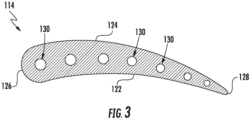
- the airfoil 114 also includes a pressure side surface 122 and an opposing suction side surface 124 ( FIG. 3 ).
- the pressure side surface 122 and the suction side surface 124 are joined together or interconnected at a leading edge 126 of the airfoil 114 and a trailing edge 128 of the airfoil 114. As shown, the leading edge 126 is oriented into the flow of combustion gases 34 ( FIG. 1 ), while the trailing edge 128 is spaced apart from and positioned downstream of the leading edge 126.
- the pressure side surface 122 and the suction side surface 124 are continuous about the leading edge 126 and the trailing edge 128. Furthermore, the pressure side surface 122 is generally concave, and the suction side surface 124 is generally convex.
- the rotor blade 100 may define one or more radially-extending cooling passages 130 extending therethrough. More specifically, the radially-extending cooling passages 130 may extend from the intake port 112 through the airfoil 114 to the tip shroud 116. In this respect, coolant may flow through the radially-extending cooling passages 130 from the intake port 112 to the tip shroud 116.
- the airfoil 114 defines seven radially-extending cooling passages 130. In alternate embodiments, however, the airfoil 114 may define more or fewer radially-extending cooling passages 130.
- the rotor blade 100 includes the tip shroud 116.
- the tip shroud 116 couples to the radially outer end of the airfoil 114 and generally defines the radially outermost portion of the rotor blade 100.
- the tip shroud 116 reduces the amount of the combustion gases 34 ( FIG. 1 ) that escape past the rotor blade 100.
- the tip shroud 116 may include a seal rail 132. Alternate embodiments, however, may include more seal rails 132 (e.g., two seal rails 132, three seal rails 132, etc.) or no seal rails 132.
- the tip shroud 116 includes various surfaces.
- the tip shroud 116 may include a forward side surface 134 positioned at a forward end 136 of the tip shroud 116 and an aft side surface 138 positioned at an aft end 140 of the tip shroud 116.
- the tip shroud 116 may also include a first pressure side surface 142, a second pressure side surface 144, and a third pressure side surface 146 positioned on a pressure side 148 of the tip shroud 116.
- the tip shroud 116 may also include a first suction side surface 150, a second suction side surface 152, and a third suction side surface 154 positioned on a suction side 156 of the tip shroud 116.
- the surfaces 134, 138, 142, 144, 146, 150, 152, 154 maybe collectively referred to as a side surface 158.
- the tip shroud 114 also includes a radially outer surface 160 from which the seal rail 132 may extend outward. As shown, in some embodiments, the seal rail 152 may extend between the second pressure side surface 144 and the second suction side surface 152. In alternate embodiments, however, the tip shroud 116 may have any suitable combination and/or configuration of surfaces.
- the tip shroud 116 has a Z-notch configuration. More specifically, the first, second, and third pressure side walls 142, 144, 146 define a Z-shape. In this respect, a pressure side convex fillet 162 transitions between the first and second pressure side walls 142, 144, while a pressure side concave fillet 164 transitions between the second and third pressure side walls 144, 146.
- the first, second, and third suction side walls 150, 152, 154 define a Z-shape that is complementary to the Z-shape of the pressure side walls 142, 144, 146.
- a suction side concave fillet 166 transitions between the first and second suction side walls 150, 152, while a suction side convex fillet 168 transitions between the second and third suction side walls 152, 154.
- the tip shroud 116 may have any suitable shape and/or configuration.
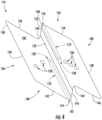
- the tip shroud 116 may define pressure side and suction side cooling passages 170, 172. As shown, the cooling passages 170, 172 respectively extend from different radially-extending cooling passages 130 to pressure side and suction side outlets 174, 176 defined by the side surface 158.
- the pressure side cooling passage 170 is fluidly coupled to one of the radially-extending cooling passages 130, such as one of the cooling passages 130 positioned forward of the seal rail 132. As such, the pressure side cooling passage 170 extends through the tip shroud 116 to the pressure side outlet 174. As shown, the cooling passage 170 may be positioned forward of the seal rail 132 in some embodiments.
- the suction side cooling passage 172 is fluidly coupled to another of the radially-extending cooling passages 130, such as one of the cooling passages 130 positioned aft of the seal rail 132.
- the suction side cooling passage 172 extends through the tip shroud 116 to the suction side outlet 176.
- the cooling passage 170 maybe positioned aft of the seal rail 132 in some embodiments.
- the pressure side cooling passage 170 and outlet 174 may positioned aft of the seal rail 132 and the suction side cooling passage 172 and outlet 176 may be positioned forward of the seal rail 132.
- the pressure side and suction side cooling passages 170, 172 extend toward the side surface 158 in opposite directions and may generally be parallel or substantially parallel to each other as shown in FIG. 4 .
- the cooling passages 170, 172 may extend along the seal rail 132, such as parallel or substantially parallel to the seal rail 132.
- the positioning of the cooling passage 170, 172 may be independent of the seal rail 132.
- the tip shroud 116 may entirely define the cooling passages 170, 172.
- the cooling passages 170, 172 may extend through the tip shroud 116 in any suitable manner.
- the tip shroud 116 may define only one of the pressure side or suction side cooling passages 170, 172.
- the pressure side and suction side cooling passages 170, 172 respectively have pressure side and suction side outlets 174, 176 defined by the side surface 158.
- the pressure side convex fillet 162 defines the pressure side outlet 174
- the suction side convex fillet 168 defines the suction side outlet 176.
- the outlets 174, 176 are configured to direct a flow of coolant onto the concave fillets 164, 166 of the adjacent rotor blades.
- the outlets 174, 176 are configured to expel the coolant at a sufficient velocity to traverse a gap 182 ( FIG.
- outlets 174, 176 have the same diameter as the corresponding cooling passage 170, 172. In alternate embodiments, however, any suitable portion of the side surface 158 may define the outlets 174, 176 so long as the outlets 174, 176 may be configured to direct the flow of coolant onto suitable tip shroud fillets of the adjacent rotor blades.
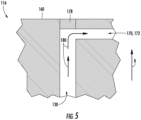
- the tip shroud 116 may include a plug 178 positioned within a radially outer portion of the radially-extending cooling passages 130 to which the pressure side and/or suction side cooling passages 170, 172 fluidly couple.
- the plug 178 may direct coolant 180 flowing through the cooling passage 130 into the corresponding cooling passage 170, 172.
- the plug 178 may direct all of the coolant 180 flowing through the cooling passage 130 into the corresponding cooling passage 170, 172.
- the plug 178 may be a weld or other suitable structure that occludes the radially outer portion of the corresponding cooling passages 130.
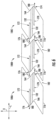
- FIG. 6 illustrates a plurality of adjacent rotor blades 100.
- first, second, and third rotor blades 100A, 100B, 100C are axially aligned and circumferentially spaced apart.
- the pressure side outlet 174 of the first rotor blade 100A is axially aligned with the suction side concave fillet 166 of the second rotor blade 100B.
- the pressure side outlet 174 of the second rotor blade 100B is axially aligned with the suction side concave fillet 166 of the third rotor blade 100C.
- the suction side outlet 176 of the second rotor blade 100B is axially aligned with the pressure side concave fillet 164 of the first rotor blade 100A.
- the suction side outlet 176 of the third rotor blade 100A is axially aligned with the pressure side concave fillet 164 of the second rotor blade 100B.
- the outlets 174, 176 of the rotor blades 100A-C may be aligned with any suitable concave tip shroud fillets of the corresponding adjacent rotor blades.
- the coolant 180 flows through the pressure side and suction side cooling passages 170, 172 to respectively cool the pressure side concave fillet 166 and the suction side concave fillet 164 of the corresponding adjacent rotor blades 100A-C. More specifically, the coolant 180 (e.g., bleed air from the compressor section 14) enters the rotor blade 100 through the intake port 112 ( FIG. 2 ). At least a portion of the coolant 180 flows through the cooling passages 130 in the airfoil 114 and into the pressure side and/or suction side cooling passages 170, 172.
- the coolant 180 e.g., bleed air from the compressor section 14
- the coolant 180 exits the cooling passages 170, 172 respectively through the outlets 174, 176 and impinges on the adjacent concave fillets 164, 166, thereby cooling the concave fillets 164, 166.
- the coolant 180 exiting the outlet 174 of the first rotor blade 100A impinges on the concave fillet 166 of the second rotor blade 100B.
- the coolant 180 exiting the outlet 174 of the second rotor blade 100B impinges on the concave fillet 166 of the third rotor blade 100C.
- the coolant 180 exiting the outlet 176 of the second rotor blade impinges on the concave fillet 164 of the first rotor blade 100A.
- the coolant 180 exiting the outlet 176 of the third rotor blade 100A impinges on the concave fillet 164 of the second rotor blade 100B.
- the outlets 174, 176 expel the coolant at a sufficient velocity to traverse the gaps 182 between the outlets 174, 176 and the corresponding concave fillets 164, 166 to facilitate such impingement cooling.
- the rotor blade 100 includes a tip shroud 116 that defines a pressure side and/or suction side cooling passage 170, 172, which direct the coolant 180 onto the fillets 164, 166 of adjacent rotor blades.
- the rotor blade 100 provides greater cooling to the fillets 164, 166 of the tip shroud 116 than conventional rotor blades.
- the rotor blade 100 may be able to withstand higher operating temperatures and/or have a longer service life than conventional rotor blades.
Landscapes
- Engineering & Computer Science (AREA)
- Mechanical Engineering (AREA)
- General Engineering & Computer Science (AREA)
- Architecture (AREA)
- Turbine Rotor Nozzle Sealing (AREA)
Claims (13)
- Rotorschaufel (100) für eine Turbomaschine (10), die Rotorschaufel (100) umfassend: ein Schaufelblatt (114); undeine Spitzenummantelung (116), die mit dem Schaufelblatt (114) gekoppelt ist, wobei die Spitzenummantelung (116) eine Seitenoberfläche (158) einschließt, das Schaufelblatt (114) und die Spitzenummantelung (116) einen ersten Kühlkanal (130) definieren, die Spitzenummantelung (116) ferner einen zweiten Kühlkanal (170, 172), der in Fluidverbindung mit dem ersten Kühlkanal (130) steht, definiert, der zweite Kühlkanal (170, 172) sich von dem ersten Kühlkanal (130) zu einem ersten Auslass (174, 176), der durch die Seitenoberfläche (158) definiert ist, erstreckt, wobei der erste Auslass (174, 176) derart konfiguriert ist, dass in Verwendung ein Kühlmittel (180) auf eine konkave Spitzenummantelungsausrundung (164, 166) einer ersten benachbarten Rotorschaufel (100) ausrichtbar ist;dadurch gekennzeichnet, dass;der erste Auslass (174, 176) den gleichen Durchmesser wie der entsprechende Kühlkanal (170, 172) aufweist und wobei der erste Auslass (174, 176) konfiguriert ist, um das Kühlmittel (180) mit einer ausreichenden Geschwindigkeit derart auszustoßen, um einen Spalt (182) zwischen dem ersten Auslass (174, 176) und der konkaven Spitzenummantelungsausrundung (164, 166) zu durchqueren, dass das Kühlmittel (180) auf die konkave Spitzenummantelungsausrundung (164, 166) der ersten benachbarten Rotorschaufel (100) auftrifft.
- Rotorschaufel (100) nach Anspruch 1, wobei die Spitzenummantelung (116) den zweiten Kühlkanal (170, 172) vollständig definiert.
- Rotorschaufel (100) nach Anspruch 1 oder 2, wobei die Spitzenummantelung (116) eine Dichtungsschiene (132) umfasst, die sich von einer radialen Außenoberfläche (160) der Spitzenummantelung (116) nach außen erstreckt, wobei sich der zweite Kühlkanal (170, 172) entlang der Dichtungsschiene (132) erstreckt.
- Rotorschaufel (100) nach Anspruch 1 oder 2, wobei die Spitzenummantelung (116) einen Stopfen (178) umfasst, der in einem radialen Außenende des ersten Kühlkanals (130) angeordnet ist, um das durch den ersten Kühlkanal (130) fließende Kühlmittel (180) in den zweiten Kühlkanal (170, 172) zu leiten.
- Rotorschaufel (100) nach Anspruch 4, wobei der Stopfen (178) das gesamte durch den ersten Kühlkanal (130) fließende Kühlmittel (180) in den zweiten Kühlkanal (170, 172) leitet.
- Rotorschaufel (100) nach einem der vorstehenden Ansprüche, wobei das Schaufelblatt (114) und die Spitzenummantelung (116) ferner einen dritten Kühlkanal (130) definieren, die Spitzenummantelung (116) ferner einen vierten Kühlkanal (170, 172), der in Fluidverbindung mit dem dritten Kühlkanal (130) steht, definiert, der vierte Kühlkanal (170, 172) sich von dem dritten Kühlkanal (130) zu einem zweiten Auslass (174, 176), der durch die Seitenoberfläche (158) definiert ist, erstreckt, wobei der zweite Auslass (174, 176) konfiguriert ist, um das Kühlmittel (180) auf eine konkave Spitzenummantelungsaufrundung (164, 166) einer zweiten benachbarten Rotorschaufel (100) zu leiten.
- Rotorschaufel (100) nach Anspruch 6, wobei der erste Auslass (174, 176) auf einer Druckseite (148) der Spitzenummantelung (116) angeordnet ist und der zweite Auslass (174, 176) auf einer Saugseite (156) der Spitzenummantelung (116) angeordnet ist.
- Rotorschaufel (100) nach Anspruch 6 oder 7, wobei die Spitzenummantelung (116) eine Dichtungsschiene (132) umfasst, die sich von einer radialen Außenoberfläche (160) der Spitzenummantelung (116) nach außen erstreckt, wobei der zweite Kühlkanal (170, 172) vor der Dichtungsschiene (132) angeordnet ist und der vierte Kühlkanal (170, 172) hinter der Dichtungsschiene (132) angeordnet ist.
- Rotorschaufel (100) nach Anspruch 6, 7 oder 8, wobei der zweite Kühlkanal (170, 172) und der vierte Kühlkanal (170, 172) im Wesentlichen parallel sind.
- Turbomaschine (10), umfassend:einen Turbinenabschnitt (18), der eine Vielzahl von Rotorschaufeln (100) einschließt, eine erste Rotorschaufel (100) der Vielzahl von Rotorschaufeln (100) umfassend eine Rotorschaufel nach einem der Ansprüche 1 bis 9,wobei der erste Auslass (174, 176) konfiguriert ist, um ein Kühlmittel (180) auf eine konkave Spitzenummantelungsaufrundung (164, 166) einer zweiten Rotorschaufel (100) der Vielzahl von Rotorschaufeln (100) zu leiten.
- Turbomaschine (10) nach Anspruch 10, wobei die Spitzenummantelung (116) den zweiten Kühlkanal (170, 172) vollständig definiert.
- Turbomaschine (10) nach Anspruch 10 oder 11, wobei die Spitzenummantelung (116) eine Dichtungsschiene (132) umfasst, die sich von einer radialen Außenoberfläche (160) der Spitzenummantelung (116) nach außen erstreckt, wobei sich der zweite Kühlkanal (170, 172) entlang der Dichtungsschiene (132) erstreckt.
- Turbomaschine (10) nach Anspruch 10 oder 11, wobei die Spitzenummantelung (116) einen Stopfen (178) umfasst, der in einem radialen Außenende des ersten Kühlkanals (130) angeordnet ist, um das durch den ersten Kühlkanal (130) fließende Kühlmittel (180) in den zweiten Kühlkanal (170, 172) zu leiten.
Applications Claiming Priority (1)
| Application Number | Priority Date | Filing Date | Title |
|---|---|---|---|
| US15/630,067 US11060407B2 (en) | 2017-06-22 | 2017-06-22 | Turbomachine rotor blade |
Publications (3)
| Publication Number | Publication Date |
|---|---|
| EP3418496A2 EP3418496A2 (de) | 2018-12-26 |
| EP3418496A3 EP3418496A3 (de) | 2019-01-02 |
| EP3418496B1 true EP3418496B1 (de) | 2024-10-09 |
Family
ID=62712824
Family Applications (1)
| Application Number | Title | Priority Date | Filing Date |
|---|---|---|---|
| EP18178422.4A Active EP3418496B1 (de) | 2017-06-22 | 2018-06-19 | Turbomaschinenrotorschaufel |
Country Status (5)
| Country | Link |
|---|---|
| US (1) | US11060407B2 (de) |
| EP (1) | EP3418496B1 (de) |
| JP (1) | JP7297413B2 (de) |
| KR (2) | KR20190000306A (de) |
| CN (1) | CN109113796A (de) |
Families Citing this family (3)
| Publication number | Priority date | Publication date | Assignee | Title |
|---|---|---|---|---|
| US20220090504A1 (en) * | 2020-09-24 | 2022-03-24 | General Electric Company | Rotor blade for a gas turbine engine having a metallic structural member and a composite fairing |
| GB202213804D0 (en) * | 2022-09-22 | 2022-11-09 | Rolls Royce Plc | Platform for stator vane |
| GB202213805D0 (en) | 2022-09-22 | 2022-11-09 | Rolls Royce Plc | Platform for stator vane |
Citations (2)
| Publication number | Priority date | Publication date | Assignee | Title |
|---|---|---|---|---|
| EP0928880A1 (de) * | 1997-06-26 | 1999-07-14 | Mitsubishi Heavy Industries, Ltd. | Deckband für gasturbinenschaufelspitzen |
| US6811378B2 (en) * | 2002-07-31 | 2004-11-02 | Power Systems Mfg, Llc | Insulated cooling passageway for cooling a shroud of a turbine blade |
Family Cites Families (36)
| Publication number | Priority date | Publication date | Assignee | Title |
|---|---|---|---|---|
| GB1423833A (en) | 1972-04-20 | 1976-02-04 | Rolls Royce | Rotor blades for fluid flow machines |
| FR2275975A5 (fr) | 1973-03-20 | 1976-01-16 | Snecma | Perfectionnements au refroidissement d'aubes de turbines a gaz |
| GB1514613A (en) | 1976-04-08 | 1978-06-14 | Rolls Royce | Blade or vane for a gas turbine engine |
| GB2223276B (en) * | 1988-09-30 | 1992-09-02 | Rolls Royce Plc | Turbine aerofoil blade |
| US5482435A (en) * | 1994-10-26 | 1996-01-09 | Westinghouse Electric Corporation | Gas turbine blade having a cooled shroud |
| US5785496A (en) * | 1997-02-24 | 1998-07-28 | Mitsubishi Heavy Industries, Ltd. | Gas turbine rotor |
| JPH1113402A (ja) * | 1997-06-23 | 1999-01-19 | Mitsubishi Heavy Ind Ltd | ガスタービン冷却翼チップシュラウド |
| JP3510467B2 (ja) * | 1998-01-13 | 2004-03-29 | 三菱重工業株式会社 | ガスタービンの動翼 |
| EP0935052B1 (de) * | 1998-02-04 | 2006-05-03 | Mitsubishi Heavy Industries, Ltd. | Gasturbinenlaufschaufel |
| EP1041247B1 (de) | 1999-04-01 | 2012-08-01 | General Electric Company | Gasturbinenschaufel mit einem offenen Kühlkreislauf |
| US6254345B1 (en) | 1999-09-07 | 2001-07-03 | General Electric Company | Internally cooled blade tip shroud |
| EP1591626A1 (de) | 2004-04-30 | 2005-11-02 | Alstom Technology Ltd | Schaufel für Gasturbine |
| US7837440B2 (en) * | 2005-06-16 | 2010-11-23 | General Electric Company | Turbine bucket tip cap |
| US7387488B2 (en) * | 2005-08-05 | 2008-06-17 | General Electric Company | Cooled turbine shroud |
| US7686581B2 (en) | 2006-06-07 | 2010-03-30 | General Electric Company | Serpentine cooling circuit and method for cooling tip shroud |
| US7568882B2 (en) * | 2007-01-12 | 2009-08-04 | General Electric Company | Impingement cooled bucket shroud, turbine rotor incorporating the same, and cooling method |
| US7887295B2 (en) * | 2007-11-08 | 2011-02-15 | General Electric Company | Z-Notch shape for a turbine blade |
| US7946816B2 (en) | 2008-01-10 | 2011-05-24 | General Electric Company | Turbine blade tip shroud |
| US8057177B2 (en) | 2008-01-10 | 2011-11-15 | General Electric Company | Turbine blade tip shroud |
| EP2180142B1 (de) * | 2008-10-23 | 2014-01-22 | Alstom Technology Ltd | Gasturbinenschaufel |
| US8096767B1 (en) * | 2009-02-04 | 2012-01-17 | Florida Turbine Technologies, Inc. | Turbine blade with serpentine cooling circuit formed within the tip shroud |
| CH700686A1 (de) | 2009-03-30 | 2010-09-30 | Alstom Technology Ltd | Schaufel für eine gasturbine. |
| US20120177479A1 (en) * | 2011-01-06 | 2012-07-12 | Gm Salam Azad | Inner shroud cooling arrangement in a gas turbine engine |
| JP5868609B2 (ja) | 2011-04-18 | 2016-02-24 | 三菱重工業株式会社 | ガスタービン動翼及びその製造方法 |
| US8956104B2 (en) * | 2011-10-12 | 2015-02-17 | General Electric Company | Bucket assembly for turbine system |
| JP5881369B2 (ja) * | 2011-10-27 | 2016-03-09 | 三菱重工業株式会社 | タービン動翼及びこれを備えたガスタービン |
| US9127560B2 (en) | 2011-12-01 | 2015-09-08 | General Electric Company | Cooled turbine blade and method for cooling a turbine blade |
| EP2607629A1 (de) | 2011-12-22 | 2013-06-26 | Alstom Technology Ltd | Turbinenschaufel mit Deckband und Kühlluftauslassöffnung an der Schaufelspitze und zugehöriges Herstellungsverfahren |
| US9845696B2 (en) * | 2014-12-15 | 2017-12-19 | Pratt & Whitney Canada Corp. | Turbine shroud sealing architecture |
| JP6025940B1 (ja) | 2015-08-25 | 2016-11-16 | 三菱日立パワーシステムズ株式会社 | タービン動翼、及び、ガスタービン |
| US10508554B2 (en) | 2015-10-27 | 2019-12-17 | General Electric Company | Turbine bucket having outlet path in shroud |
| US9885243B2 (en) | 2015-10-27 | 2018-02-06 | General Electric Company | Turbine bucket having outlet path in shroud |
| US10156145B2 (en) | 2015-10-27 | 2018-12-18 | General Electric Company | Turbine bucket having cooling passageway |
| US10202852B2 (en) | 2015-11-16 | 2019-02-12 | General Electric Company | Rotor blade with tip shroud cooling passages and method of making same |
| US10156142B2 (en) * | 2015-11-24 | 2018-12-18 | General Electric Company | Systems and methods for producing one or more cooling holes in an airfoil for a gas turbine engine |
| DE102016222720A1 (de) * | 2016-11-18 | 2018-05-24 | MTU Aero Engines AG | Dichtungssystem für eine axiale Strömungsmaschine und axiale Strömungsmaschine |
-
2017
- 2017-06-22 US US15/630,067 patent/US11060407B2/en active Active
-
2018
- 2018-06-15 JP JP2018114093A patent/JP7297413B2/ja active Active
- 2018-06-19 EP EP18178422.4A patent/EP3418496B1/de active Active
- 2018-06-19 KR KR1020180070260A patent/KR20190000306A/ko not_active Ceased
- 2018-06-22 CN CN201810650809.7A patent/CN109113796A/zh active Pending
-
2024
- 2024-10-21 KR KR1020240144153A patent/KR20240164477A/ko active Pending
Patent Citations (2)
| Publication number | Priority date | Publication date | Assignee | Title |
|---|---|---|---|---|
| EP0928880A1 (de) * | 1997-06-26 | 1999-07-14 | Mitsubishi Heavy Industries, Ltd. | Deckband für gasturbinenschaufelspitzen |
| US6811378B2 (en) * | 2002-07-31 | 2004-11-02 | Power Systems Mfg, Llc | Insulated cooling passageway for cooling a shroud of a turbine blade |
Also Published As
| Publication number | Publication date |
|---|---|
| US11060407B2 (en) | 2021-07-13 |
| JP7297413B2 (ja) | 2023-06-26 |
| KR20240164477A (ko) | 2024-11-19 |
| JP2019011756A (ja) | 2019-01-24 |
| US20180371921A1 (en) | 2018-12-27 |
| EP3418496A2 (de) | 2018-12-26 |
| EP3418496A3 (de) | 2019-01-02 |
| KR20190000306A (ko) | 2019-01-02 |
| CN109113796A (zh) | 2019-01-01 |
Similar Documents
| Publication | Publication Date | Title |
|---|---|---|
| EP3088675B1 (de) | Laufschaufel und zugehörige gasturbine | |
| US10830082B2 (en) | Systems including rotor blade tips and circumferentially grooved shrouds | |
| EP3214271B1 (de) | Rotorschaufel mit hinterkantenkühlung | |
| EP3415719B1 (de) | Kühlstruktur einer turbomaschinenschaufel | |
| EP3088674A1 (de) | Rotorblatt und zugehörige gasturbine | |
| US10301943B2 (en) | Turbomachine rotor blade | |
| EP3203024B1 (de) | Laufschaufel und zugehörige gasturbine | |
| KR20240164477A (ko) | 터보 기계의 로터 블레이드 | |
| EP3249162B1 (de) | Laufschaufel und zugehöriges gasturbinensystem | |
| EP3412869B1 (de) | Turbomaschinenrotorschaufel | |
| US10590777B2 (en) | Turbomachine rotor blade | |
| US10494932B2 (en) | Turbomachine rotor blade cooling passage | |
| US10472974B2 (en) | Turbomachine rotor blade | |
| US10577945B2 (en) | Turbomachine rotor blade | |
| US20190003320A1 (en) | Turbomachine rotor blade | |
| JP7187177B2 (ja) | ターボ機械用ロータブレードのポケット | |
| US10746029B2 (en) | Turbomachine rotor blade tip shroud cavity | |
| US20180216474A1 (en) | Turbomachine Blade Cooling Cavity |
Legal Events
| Date | Code | Title | Description |
|---|---|---|---|
| PUAI | Public reference made under article 153(3) epc to a published international application that has entered the european phase |
Free format text: ORIGINAL CODE: 0009012 |
|
| STAA | Information on the status of an ep patent application or granted ep patent |
Free format text: STATUS: THE APPLICATION HAS BEEN PUBLISHED |
|
| PUAL | Search report despatched |
Free format text: ORIGINAL CODE: 0009013 |
|
| AK | Designated contracting states |
Kind code of ref document: A2 Designated state(s): AL AT BE BG CH CY CZ DE DK EE ES FI FR GB GR HR HU IE IS IT LI LT LU LV MC MK MT NL NO PL PT RO RS SE SI SK SM TR |
|
| AX | Request for extension of the european patent |
Extension state: BA ME |
|
| AK | Designated contracting states |
Kind code of ref document: A3 Designated state(s): AL AT BE BG CH CY CZ DE DK EE ES FI FR GB GR HR HU IE IS IT LI LT LU LV MC MK MT NL NO PL PT RO RS SE SI SK SM TR |
|
| AX | Request for extension of the european patent |
Extension state: BA ME |
|
| RIC1 | Information provided on ipc code assigned before grant |
Ipc: F01D 5/22 20060101AFI20181123BHEP |
|
| STAA | Information on the status of an ep patent application or granted ep patent |
Free format text: STATUS: REQUEST FOR EXAMINATION WAS MADE |
|
| 17P | Request for examination filed |
Effective date: 20190625 |
|
| RBV | Designated contracting states (corrected) |
Designated state(s): AL AT BE BG CH CY CZ DE DK EE ES FI FR GB GR HR HU IE IS IT LI LT LU LV MC MK MT NL NO PL PT RO RS SE SI SK SM TR |
|
| STAA | Information on the status of an ep patent application or granted ep patent |
Free format text: STATUS: EXAMINATION IS IN PROGRESS |
|
| 17Q | First examination report despatched |
Effective date: 20210201 |
|
| RAP1 | Party data changed (applicant data changed or rights of an application transferred) |
Owner name: GENERAL ELECTRIC TECHNOLOGY GMBH |
|
| GRAP | Despatch of communication of intention to grant a patent |
Free format text: ORIGINAL CODE: EPIDOSNIGR1 |
|
| STAA | Information on the status of an ep patent application or granted ep patent |
Free format text: STATUS: GRANT OF PATENT IS INTENDED |
|
| INTG | Intention to grant announced |
Effective date: 20240402 |
|
| GRAS | Grant fee paid |
Free format text: ORIGINAL CODE: EPIDOSNIGR3 |
|
| GRAA | (expected) grant |
Free format text: ORIGINAL CODE: 0009210 |
|
| STAA | Information on the status of an ep patent application or granted ep patent |
Free format text: STATUS: THE PATENT HAS BEEN GRANTED |
|
| AK | Designated contracting states |
Kind code of ref document: B1 Designated state(s): AL AT BE BG CH CY CZ DE DK EE ES FI FR GB GR HR HU IE IS IT LI LT LU LV MC MK MT NL NO PL PT RO RS SE SI SK SM TR |
|
| REG | Reference to a national code |
Ref country code: CH Ref legal event code: EP |
|
| REG | Reference to a national code |
Ref country code: DE Ref legal event code: R096 Ref document number: 602018075121 Country of ref document: DE |
|
| REG | Reference to a national code |
Ref country code: IE Ref legal event code: FG4D |
|
| REG | Reference to a national code |
Ref country code: LT Ref legal event code: MG9D |
|
| REG | Reference to a national code |
Ref country code: NL Ref legal event code: MP Effective date: 20241009 |
|
| REG | Reference to a national code |
Ref country code: AT Ref legal event code: MK05 Ref document number: 1730794 Country of ref document: AT Kind code of ref document: T Effective date: 20241009 |
|
| PG25 | Lapsed in a contracting state [announced via postgrant information from national office to epo] |
Ref country code: NL Free format text: LAPSE BECAUSE OF FAILURE TO SUBMIT A TRANSLATION OF THE DESCRIPTION OR TO PAY THE FEE WITHIN THE PRESCRIBED TIME-LIMIT Effective date: 20241009 |
|
| PG25 | Lapsed in a contracting state [announced via postgrant information from national office to epo] |
Ref country code: NL Free format text: LAPSE BECAUSE OF FAILURE TO SUBMIT A TRANSLATION OF THE DESCRIPTION OR TO PAY THE FEE WITHIN THE PRESCRIBED TIME-LIMIT Effective date: 20241009 |
|
| PG25 | Lapsed in a contracting state [announced via postgrant information from national office to epo] |
Ref country code: HR Free format text: LAPSE BECAUSE OF FAILURE TO SUBMIT A TRANSLATION OF THE DESCRIPTION OR TO PAY THE FEE WITHIN THE PRESCRIBED TIME-LIMIT Effective date: 20241009 Ref country code: IS Free format text: LAPSE BECAUSE OF FAILURE TO SUBMIT A TRANSLATION OF THE DESCRIPTION OR TO PAY THE FEE WITHIN THE PRESCRIBED TIME-LIMIT Effective date: 20250209 Ref country code: PT Free format text: LAPSE BECAUSE OF FAILURE TO SUBMIT A TRANSLATION OF THE DESCRIPTION OR TO PAY THE FEE WITHIN THE PRESCRIBED TIME-LIMIT Effective date: 20250210 |
|
| PG25 | Lapsed in a contracting state [announced via postgrant information from national office to epo] |
Ref country code: FI Free format text: LAPSE BECAUSE OF FAILURE TO SUBMIT A TRANSLATION OF THE DESCRIPTION OR TO PAY THE FEE WITHIN THE PRESCRIBED TIME-LIMIT Effective date: 20241009 |
|
| PG25 | Lapsed in a contracting state [announced via postgrant information from national office to epo] |
Ref country code: BG Free format text: LAPSE BECAUSE OF FAILURE TO SUBMIT A TRANSLATION OF THE DESCRIPTION OR TO PAY THE FEE WITHIN THE PRESCRIBED TIME-LIMIT Effective date: 20241009 |
|
| PG25 | Lapsed in a contracting state [announced via postgrant information from national office to epo] |
Ref country code: ES Free format text: LAPSE BECAUSE OF FAILURE TO SUBMIT A TRANSLATION OF THE DESCRIPTION OR TO PAY THE FEE WITHIN THE PRESCRIBED TIME-LIMIT Effective date: 20241009 |
|
| PG25 | Lapsed in a contracting state [announced via postgrant information from national office to epo] |
Ref country code: NO Free format text: LAPSE BECAUSE OF FAILURE TO SUBMIT A TRANSLATION OF THE DESCRIPTION OR TO PAY THE FEE WITHIN THE PRESCRIBED TIME-LIMIT Effective date: 20250109 |
|
| PG25 | Lapsed in a contracting state [announced via postgrant information from national office to epo] |
Ref country code: LV Free format text: LAPSE BECAUSE OF FAILURE TO SUBMIT A TRANSLATION OF THE DESCRIPTION OR TO PAY THE FEE WITHIN THE PRESCRIBED TIME-LIMIT Effective date: 20241009 Ref country code: GR Free format text: LAPSE BECAUSE OF FAILURE TO SUBMIT A TRANSLATION OF THE DESCRIPTION OR TO PAY THE FEE WITHIN THE PRESCRIBED TIME-LIMIT Effective date: 20250110 Ref country code: AT Free format text: LAPSE BECAUSE OF FAILURE TO SUBMIT A TRANSLATION OF THE DESCRIPTION OR TO PAY THE FEE WITHIN THE PRESCRIBED TIME-LIMIT Effective date: 20241009 |
|
| PG25 | Lapsed in a contracting state [announced via postgrant information from national office to epo] |
Ref country code: PL Free format text: LAPSE BECAUSE OF FAILURE TO SUBMIT A TRANSLATION OF THE DESCRIPTION OR TO PAY THE FEE WITHIN THE PRESCRIBED TIME-LIMIT Effective date: 20241009 |
|
| PG25 | Lapsed in a contracting state [announced via postgrant information from national office to epo] |
Ref country code: RS Free format text: LAPSE BECAUSE OF FAILURE TO SUBMIT A TRANSLATION OF THE DESCRIPTION OR TO PAY THE FEE WITHIN THE PRESCRIBED TIME-LIMIT Effective date: 20250109 |
|
| PG25 | Lapsed in a contracting state [announced via postgrant information from national office to epo] |
Ref country code: SM Free format text: LAPSE BECAUSE OF FAILURE TO SUBMIT A TRANSLATION OF THE DESCRIPTION OR TO PAY THE FEE WITHIN THE PRESCRIBED TIME-LIMIT Effective date: 20241009 |
|
| PGFP | Annual fee paid to national office [announced via postgrant information from national office to epo] |
Ref country code: DE Payment date: 20250520 Year of fee payment: 8 |
|
| PG25 | Lapsed in a contracting state [announced via postgrant information from national office to epo] |
Ref country code: DK Free format text: LAPSE BECAUSE OF FAILURE TO SUBMIT A TRANSLATION OF THE DESCRIPTION OR TO PAY THE FEE WITHIN THE PRESCRIBED TIME-LIMIT Effective date: 20241009 |
|
| PGFP | Annual fee paid to national office [announced via postgrant information from national office to epo] |
Ref country code: GB Payment date: 20250520 Year of fee payment: 8 |
|
| REG | Reference to a national code |
Ref country code: DE Ref legal event code: R097 Ref document number: 602018075121 Country of ref document: DE |
|
| PG25 | Lapsed in a contracting state [announced via postgrant information from national office to epo] |
Ref country code: EE Free format text: LAPSE BECAUSE OF FAILURE TO SUBMIT A TRANSLATION OF THE DESCRIPTION OR TO PAY THE FEE WITHIN THE PRESCRIBED TIME-LIMIT Effective date: 20241009 |
|
| PG25 | Lapsed in a contracting state [announced via postgrant information from national office to epo] |
Ref country code: RO Free format text: LAPSE BECAUSE OF FAILURE TO SUBMIT A TRANSLATION OF THE DESCRIPTION OR TO PAY THE FEE WITHIN THE PRESCRIBED TIME-LIMIT Effective date: 20241009 |
|
| PG25 | Lapsed in a contracting state [announced via postgrant information from national office to epo] |
Ref country code: SK Free format text: LAPSE BECAUSE OF FAILURE TO SUBMIT A TRANSLATION OF THE DESCRIPTION OR TO PAY THE FEE WITHIN THE PRESCRIBED TIME-LIMIT Effective date: 20241009 |
|
| PG25 | Lapsed in a contracting state [announced via postgrant information from national office to epo] |
Ref country code: CZ Free format text: LAPSE BECAUSE OF FAILURE TO SUBMIT A TRANSLATION OF THE DESCRIPTION OR TO PAY THE FEE WITHIN THE PRESCRIBED TIME-LIMIT Effective date: 20241009 |
|
| PG25 | Lapsed in a contracting state [announced via postgrant information from national office to epo] |
Ref country code: IT Free format text: LAPSE BECAUSE OF FAILURE TO SUBMIT A TRANSLATION OF THE DESCRIPTION OR TO PAY THE FEE WITHIN THE PRESCRIBED TIME-LIMIT Effective date: 20241009 |
|
| PLBE | No opposition filed within time limit |
Free format text: ORIGINAL CODE: 0009261 |
|
| STAA | Information on the status of an ep patent application or granted ep patent |
Free format text: STATUS: NO OPPOSITION FILED WITHIN TIME LIMIT |
|
| PG25 | Lapsed in a contracting state [announced via postgrant information from national office to epo] |
Ref country code: SE Free format text: LAPSE BECAUSE OF FAILURE TO SUBMIT A TRANSLATION OF THE DESCRIPTION OR TO PAY THE FEE WITHIN THE PRESCRIBED TIME-LIMIT Effective date: 20241009 |
|
| 26N | No opposition filed |
Effective date: 20250710 |
|
| REG | Reference to a national code |
Ref country code: CH Ref legal event code: H13 Free format text: ST27 STATUS EVENT CODE: U-0-0-H10-H13 (AS PROVIDED BY THE NATIONAL OFFICE) Effective date: 20260127 |
|
| PG25 | Lapsed in a contracting state [announced via postgrant information from national office to epo] |
Ref country code: MC Free format text: LAPSE BECAUSE OF FAILURE TO SUBMIT A TRANSLATION OF THE DESCRIPTION OR TO PAY THE FEE WITHIN THE PRESCRIBED TIME-LIMIT Effective date: 20241009 |