EP3415134B1 - Detektions-, analyse- und alarmvorrichtung zur vorbeugung der bildung von dekubitus - Google Patents
Detektions-, analyse- und alarmvorrichtung zur vorbeugung der bildung von dekubitus Download PDFInfo
- Publication number
- EP3415134B1 EP3415134B1 EP18172721.5A EP18172721A EP3415134B1 EP 3415134 B1 EP3415134 B1 EP 3415134B1 EP 18172721 A EP18172721 A EP 18172721A EP 3415134 B1 EP3415134 B1 EP 3415134B1
- Authority
- EP
- European Patent Office
- Prior art keywords
- individual
- sensors
- detecting
- indicator
- movement
- Prior art date
- Legal status (The legal status is an assumption and is not a legal conclusion. Google has not performed a legal analysis and makes no representation as to the accuracy of the status listed.)
- Active
Links
Images

Classifications
-
- A—HUMAN NECESSITIES
- A61—MEDICAL OR VETERINARY SCIENCE; HYGIENE
- A61G—TRANSPORT, PERSONAL CONVEYANCES, OR ACCOMMODATION SPECIALLY ADAPTED FOR PATIENTS OR DISABLED PERSONS; OPERATING TABLES OR CHAIRS; CHAIRS FOR DENTISTRY; FUNERAL DEVICES
- A61G7/00—Beds specially adapted for nursing; Devices for lifting patients or disabled persons
- A61G7/05—Parts, details or accessories of beds
- A61G7/057—Arrangements for preventing bed-sores or for supporting patients with burns, e.g. mattresses specially adapted therefor
-
- A—HUMAN NECESSITIES
- A61—MEDICAL OR VETERINARY SCIENCE; HYGIENE
- A61B—DIAGNOSIS; SURGERY; IDENTIFICATION
- A61B5/00—Measuring for diagnostic purposes; Identification of persons
- A61B5/103—Measuring devices for testing the shape, pattern, colour, size or movement of the body or parts thereof, for diagnostic purposes
- A61B5/11—Measuring movement of the entire body or parts thereof, e.g. head or hand tremor or mobility of a limb
- A61B5/1113—Local tracking of patients, e.g. in a hospital or private home
- A61B5/1115—Monitoring leaving of a patient support, e.g. a bed or a wheelchair
-
- A—HUMAN NECESSITIES
- A61—MEDICAL OR VETERINARY SCIENCE; HYGIENE
- A61B—DIAGNOSIS; SURGERY; IDENTIFICATION
- A61B5/00—Measuring for diagnostic purposes; Identification of persons
- A61B5/103—Measuring devices for testing the shape, pattern, colour, size or movement of the body or parts thereof, for diagnostic purposes
- A61B5/11—Measuring movement of the entire body or parts thereof, e.g. head or hand tremor or mobility of a limb
- A61B5/1118—Determining activity level
-
- A—HUMAN NECESSITIES
- A61—MEDICAL OR VETERINARY SCIENCE; HYGIENE
- A61B—DIAGNOSIS; SURGERY; IDENTIFICATION
- A61B5/00—Measuring for diagnostic purposes; Identification of persons
- A61B5/44—Detecting, measuring or recording for evaluating the integumentary system, e.g. skin, hair or nails
- A61B5/441—Skin evaluation, e.g. for skin disorder diagnosis
- A61B5/447—Skin evaluation, e.g. for skin disorder diagnosis specially adapted for aiding the prevention of ulcer or pressure sore development, i.e. before the ulcer or sore has developed
-
- A—HUMAN NECESSITIES
- A61—MEDICAL OR VETERINARY SCIENCE; HYGIENE
- A61B—DIAGNOSIS; SURGERY; IDENTIFICATION
- A61B5/00—Measuring for diagnostic purposes; Identification of persons
- A61B5/68—Arrangements of detecting, measuring or recording means, e.g. sensors, in relation to patient
- A61B5/6887—Arrangements of detecting, measuring or recording means, e.g. sensors, in relation to patient mounted on external non-worn devices, e.g. non-medical devices
- A61B5/6892—Mats
-
- A—HUMAN NECESSITIES
- A61—MEDICAL OR VETERINARY SCIENCE; HYGIENE
- A61B—DIAGNOSIS; SURGERY; IDENTIFICATION
- A61B2562/00—Details of sensors; Constructional details of sensor housings or probes; Accessories for sensors
- A61B2562/16—Details of sensor housings or probes; Details of structural supports for sensors
- A61B2562/164—Details of sensor housings or probes; Details of structural supports for sensors the sensor is mounted in or on a conformable substrate or carrier
-
- A—HUMAN NECESSITIES
- A61—MEDICAL OR VETERINARY SCIENCE; HYGIENE
- A61G—TRANSPORT, PERSONAL CONVEYANCES, OR ACCOMMODATION SPECIALLY ADAPTED FOR PATIENTS OR DISABLED PERSONS; OPERATING TABLES OR CHAIRS; CHAIRS FOR DENTISTRY; FUNERAL DEVICES
- A61G2203/00—General characteristics of devices
- A61G2203/30—General characteristics of devices characterised by sensor means
Definitions
- the invention relates to the field of prevention of pressure ulcer formation, and more particularly to devices making it possible, by means of a web of movement sensors and a method for analyzing these movements, to prevent the pressure ulcer formation.
- the invention finds particular application in beds, in particular medical beds.
- bedsores here denotes skin ulcerations or necroses which follow prolonged compression of the soft parts on an underlying bony protrusion, at a bearing surface of the body. Pressure sores are skin lesions of ischemic origin.
- Risk factors for pressure ulcers are conventionally classified into extrinsic or mechanical factors (in particular pressure, friction, shear), and intrinsic or clinical factors (in particular immobility, nutrition, incontinence, skin condition, decreased circulatory flow, neuropathy, etc. age, history of pressure ulcers).
- the European Pressure Ulcer Advisory Panel has developed recommendations for the prevention of pressure ulcers, in conjunction with the American National Pressure Ulcer Advisory Panel (NPUAP).
- these recommendations include a large number of parameters: alteration of skin integrity (for example dry skin, excess humidity, erythema, edema, induration, local heat), nutritional indicators (for example malnutrition, anemia, hemoglobin, albuminemia, weight), factors affecting circulation and oxygenation (e.g. diabetes, low blood pressure), pressure, friction and shearing, repositioning frequency and techniques, advanced age, general health, body temperature.
- the assessment of the risk of pressure ulcers should therefore take into account a wide range of factors such as oxygenation and vascularization of tissues, skin condition, physical activity and mobility, and nutritional status.
- Pressure ulcer risk assessment scales have limitations. In particular, their use does not result from a continuous evaluation of the person, and the observer induces an inevitable subjectivity. It is common for people at high risk, based on their assessment by these scales, not to develop pressure sores. And it's also common for people at low risk to develop pressure sores. A presentation of the limitations of the existing scales is presented by Torressan, Prevalence of pressure ulcers in establishments for dependent elderly people in Aquitaine, Thesis, (2015 ).
- pressure ulcer risk assessment scales are conventionally taken into account when deciding on the setting up and financial support for technical means of pressure ulcer prevention. For example, in France, to determine the threshold for coverage by health insurance for the cost of mattresses, toppers and cushions to help prevent bedsores, the Norton scale is used, a criterion for taking under load being a score less than or equal to 14 on the Norton scale or a patient with an equivalent risk, assessed by another validated scale.
- Pressure ulcers are seen as adverse events during hospitalization, which may lead to legal recourse, common in the United States.
- the technical means implemented for the prevention of bedsores are typically gel cushions, memory foam cushions, mono-density waffle-shaped foam mattresses, viscoelastic memory foam toppers. , air mattresses (at constant pressure, dynamic, or mixed or with air loss), mattresses including inserts in areas at risk of pressure sores (water insert).
- the areas at risk and preferential locations for pressure ulcers are the sacrum and heels, in particular in patients bedridden in the dorsal position. Other locations are possible, such as the ischia, the trochanter (in people bedridden in a lateral position), or the occiput, all the points of support that may present a pressure sore, for example the elbows or the knees.
- the document EP1664712 describes the use of an interface pressure measuring device in an anti-decubitus device, such an interface pressure sensor being offered for integration into a seat, cf. Meffre et al Mapi: active interface pressure sensor intergrated into a seat, IRBM (2008), pp. 375-379 (See as well Meffre, Design and production of an instrumentation dedicated to the prediction of sitting comfort and the prevention of pressure ulcers, Thesis INSA Lyon, 2007 ).
- the document JPH 11-342161 (Denso ) describes a device for recording the postures of a bedridden individual, by means of pressure sensors arranged between the base and the mattress of a bed.
- the device is connected to a box capable of analyzing the positions of the individual and of displaying the support time on the mattress of each of the members of the individual.
- This display is configured to display an alert, when the support time of one of the members exceeds a predefined time.
- the document JPH 8-238275 (Yokohama Imeeji System) describes a device for measuring the support time of the individual's body on a pressure-sensitive conductive rubber.
- the device also comprises a box configured to give an alert, when the pressing time is greater than a predefined time.
- the document EP2508128 relates to the detection of change of position of patients, for example on a bed.
- a processor is configured to generate alarms based on the detected position of the patient, for example an alarm is triggered when the patient is out of bed, or seated on the edge of the bed.
- Pressure sensors can detect changes in pressure on the mattress, and the processor can adapt the pressure in the inflatable mattress. Sensors make it possible to detect minor changes in the patient's position, this detection making it possible to calculate a mobility score and an activity score, and these scores are presented as related to health risks, including that of the appearance of pressure sores .
- the document EP2508128 indicates that a high risk of pressure ulcers may or may not be associated with a high mobility score, other factors that can be taken into account such as the position in the bed, the firmness of the mattress, humidity, the patient's diet, friction.
- a first objective is to provide a method for providing a pressure ulcer risk indicator.
- a second objective is to provide such a method, measuring the frequency and amplitude of the movements of a bedridden individual.
- a third objective is to propose such a method, analyzing the measurements carried out.
- a fourth objective is to propose such a method, delivering an alert, as a function of the result of the analysis of the measurements.
- a fifth objective is to provide a device capable of implementing a method meeting the preceding objectives.
- the detection of the amplitude of the movements made by the person makes it possible to distinguish small movements, segmental movements without impact on posture, and large-amplitude movements, in particular turning.
- the detection of the amplitude of the movements also makes it possible to measure the time between two movements of large amplitude.
- a device 1 for the prevention of pressure ulcer formation comprising a cover 2, provided with sensors 3 and a protection covering the sensors 3.
- the device 1 is suitable for being placed on the mattress of a bed.
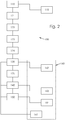
- the device 1 also comprises a housing 4, connected to the sensors 3 by means of a beam 5, capable of measuring and analyzing data supplied by the sensors 3 and of issuing an alert, according to the result of said analysis, in accordance with a method 100 shown in figure 2 .
- the inventors started from the assumption that the prevention of bedsores would be improved by a high frequency and amplitude of the movements of an individual lying on the bed.
- the presence of the individual on the bed is defined by a contact surface S greater than 20 percent of the reference surface R , for a period greater than 800 milliseconds.
- the cover 2 completely envelops the mattress, for example a foam mattress.
- the cover 2 is washable.
- the method and the device according to the invention thus have no impact on hygiene.
- the sensors 3 are preferably in the form of bands.
- the bands are arranged substantially parallel to each other.
- the sensors 3 are distant from each other.
- the sensors 3 are preferably arranged in a direction substantially perpendicular to a general direction in which the body of the individual extends. According to the embodiment illustrated in figure 1 , the sensors 3 are arranged across the width of a mattress.
- the cover 2 is strong enough not to be degraded if a more or less liquid material spreads over it resulting, for example, from an incontinence of the individual resting on the cover 2, from washing or sterilization thereof.
- Each sensor 3 comprises a connector 6, allowing a connection between the bundle 5 and the sensors 3 and their separations, when moving, washing or sterilizing the cover 2.
- the connectors 6 are preferably arranged at one end of the sensors 3, so that the connectors 6 and the harness 5 do not interfere with an individual resting on the cover 2.
- the cover 2 comprises eighteen sensors 3 of equal width l .
- the sensors 3 are separated two by two by the same distance d.
- the width l of the sensors 3 is 10 millimeters.
- the distance d separating the sensors 3 is equal to 100 millimeters.
- the sensors 3 are made from a flexible material. According to one embodiment, the sensors 3 are made of an electrically conductive fabric.
- the sensors 3 are advantageously arranged between the mattress and the protection.
- the sensors 3 are advantageously capacitive sensors 3 .
- the sensors 3 and the individual's body placed on the cover 2 define two separate frames, an insulating material defined by the protection.
- the sensors 3 generate a capacity C v when empty, if no individual is resting on the mattress. The more the individual's body is arranged opposite a sensor 3 plus a capacitance C generated is significant.
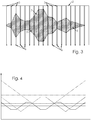
- the contact surface S is calculated as the sum of the areas A n of trapezoids 7, the bases of which are defined by an active length L of two neighboring sensors 3 .
- each sensor 3 corresponds to a portion of said sensor 3 in contact with the body of the individual.
- the figure 3 illustrates an example of such a contact surface S , for an individual resting on the mattress in a supine position, the head of the individual being positioned on the left of the figure and the feet of the individual being positioned on the right of the figure.
- the surface S does not take into account the area of each sensor in contact with the body of the individual.
- the calculation of the area S takes into account the area of each sensor in contact with the body of the individual.
- the areas A n are calculated as a function of the shape and the arrangement of the sensors 3, the areas are therefore not necessarily areas A n of trapezoids.
- the capacitance C generated is obtained by adding a capacitance generated by the beam 5 connecting the sensors 3 to the box 4 to a capacitance generated by the sensors 3.
- the capacity of the beam 5 can be considered as proportional to its length. In order to minimize the risk of errors when measuring the capacitance of each of the sensors 3, it is therefore advantageous to reduce the length of the beam 5 as much as possible.
- Table T shows the length of the bundle 5 connecting each sensor 3 to the housing 4 and the resulting capacitance for a bundle 5 comprising one part 8, two parts 8 or three parts 8.
- Table T also presents the average value of the capacitance generated by the beam, calculated for each of the beams 5 presented.
- the figure 4 is a graph showing the values in table T.
- the beam 5 comprising a single part 8 is shown in phantom, the beam 5 comprising two parts 8 is shown in dotted lines and the beam 5 comprising three parts 8 is shown in solid lines.
- the average values of the capacitance generated by the beams 5 are shown in bold lines.
- Table T and figure 4 clearly illustrate that the more the beam 5 is divided into a large number of parts 8, the lower the capacitance generated by the beam 5 .
- the bundle 5 of the device 1 comprises three parts 8. According to different embodiments, the bundle 5 could be divided into a different number of parts 8.
- the parts 8 are preferably identical.
- Each part 8 of the beam 5 is connected to a measuring element 9 belonging to the box 4.
- the measuring elements 9 are configured to periodically carry out the charging and discharging phases of the sensors 3.
- the charging and discharging phases are carried out at a constant current i.
- a voltage V is measured at the terminals of each sensor 3 by their respective measuring element 9 , at the end of the charging phase.
- the charging and discharging phases last for a predefined sampling time T.
- the charging and discharging phases preferably have the same duration, that is to say half of the sampling time T.
- the sampling time T is 1 millisecond.
- the measuring elements 9 perform the measurement of the voltage V at the request of a control element 10 belonging to the box 4 according to a step 110 of measuring the method 100 shown in FIG. figure 2 .
- the supply voltage of the measuring element 9 is, for example, 3.3 volts or 5.0 volts.
- V min the minimum voltage and the maximum voltage V max possible to define a minimum capacitance C min and C max maximum capacity capable of being generated by each sensor 3.
- control element 10 takes an average of the values of the voltage V measured at the end of several consecutive charging phases or an average of the values of the capacitance C generated, calculated at the end of several consecutive charging phases.
- said average is calculated taking into account the values of the voltage V measured for six consecutive charging phases.
- the measurement step 110 is carried out at constant voltage V , by measuring the intensity i, at variable voltage V or intensity i, by respectively measuring the intensity i or the voltage V or else by measuring both voltage V and current i.
- the measurement step 110 can also be carried out by measuring a pressure or any other quantity supplied by the sensors 3.
- the control element 10 suspends the measurements taken by the measuring element 9 if the measured voltage V , that is to say the measured power, drops suddenly.
- the active length L of each sensor 3 is obtained by the following formula, carried out in a second step 122 of calculating the method 100 :
- L VS - VS V ⁇ struct the struct variable being a coefficient, depending on the structure of device 1. This coefficient is determined experimentally. According to the embodiment, said coefficient is equal to 13.5 millimeters per picofarad.
- the calculation of the contact surface S by the control element 10 in the fourth calculation step 124 of the method 100 makes it possible to verify the presence of an individual on the bed, and to evaluate the level of movement of the individual. .
- the presence of an individual on the bed is expressed, in a step 130 of detecting the presence of an individual of the method 100, by the resolution of the following inequality, for a period greater than 800 milliseconds: S > R ⁇ 20 100
- the reference surface R is chosen, according to one embodiment, at a value corresponding to an individual whose mass is 45 kilograms.
- the minimum reference surface R min for an individual whose mass is 45 kilograms, is 155,000 square millimeters.
- the minimum reference surface R min is chosen for an individual whose mass is different.
- the minimum reference surface R min is chosen as a function of the direct characteristics of the individual lying on the bed.
- the presence of an individual on the bed is expressed, in step 130 of detecting the presence of an individual, by the resolution of the following inequation, for a period greater than 800 milliseconds: S > R min ⁇ 20 100 is is S > 31000
- a step 140 of detecting the absence of movement is carried out by the control element 10 .
- ⁇ S ⁇ 3 ⁇ 3444 400 1000 is ⁇ S ⁇ 25830 the variable ⁇ S (t) being the variation ⁇ S of the contact surface S of the body of the individual with the bed for a period of 400 milliseconds.
- control element 10 performs a fifth calculation step 125 upstream of the step 140 of detecting the absence of movement.
- This fifth calculation step 125 makes it possible to calculate the value ⁇ S (t) of the variation ⁇ S of the contact surface S of the body of the individual with the bed for a period of 400 milliseconds.
- variable A n (t) being the area A n of one of the trapezoids 7 at the instant t and dt being the period of time separating two measurements.
- the fifth calculation step 125 is carried out at another time of the method 100, as long as this fifth calculation step 125 is carried out after the fourth calculation step 124 and before the step 140 of detection of lack of movement.
- a step 150 of detecting the amplitude of the movements is carried out by the control element 10 .
- the level of amplitude of the movements of an individual present on the bed is expressed by solving the following inequality, over a period of 400 milliseconds:
- the reference surface R is chosen, according to the preferred embodiment, as the average reference surface R avg.
- the average reference surface R av for an average individual, is 350,000 square millimeters.
- the average reference surface R av is different.
- the average reference surface R av is chosen as a function of the direct characteristics of the individual lying on the bed.
- the amplitude of the movements of an individual present on the bed is therefore expressed, in step 150 of detecting the amplitude of the movements, by the resolution of the following inequation: ⁇ S t > R avg ⁇ 11 100 ⁇ 1 400 1000 is ⁇ S t > 350,000 ⁇ 11 100 ⁇ 1 400 1000 is ⁇ S t > 96250
- control element 10 is able to send, in a step 160 of notification of the method 100, one or more alerts or information taking into account the results of step 130 of detecting the presence of a individual, step 140 of detecting absence of movement and step 150 of detecting amplitude of movements.
- the notification step 160 comprises an information step 161 transmitting the results of the above detection steps 130, 140, 150 .
- the information step 161 is sent regularly, so as to allow monitoring of the condition of the individual lying on the bed.
- the information step 161 is sent at the request of a person wishing to know the state of said individual.
- the information step 161 provides information on the current state of the individual and / or on his past state, for example during the last 24 hours.
- the results of the above detection steps 130, 140, 150 are also issued in the form of alerts, targeting the person according to the condition of the individual lying on the bed.
- the step 160 of notification comprises a step 162 of alerting the non-presence of the individual, warning said person if the individual does not rest on the bed for a predetermined time.
- step 162 of alerting the non-presence of the individual occurs, for example, when an absence from the bed is detected, at step 130 of detecting the presence of an individual, between 8 o'clock in the evening and 8 o'clock in the morning for a period of more than 15 minutes, thus leaving time for the individual to go, for example, to the toilet.
- the step 162 of alerting the non-presence of the individual occurs, for example, when an absence from the bed is detected, in the step 130 of detecting the presence of one individual, for more than 5 seconds.
- the notification step 160 also comprises a step 163 of alerting the absence of movement, if an absence of movement of the individual is detected in the step 140 of detecting the absence of movement.
- the notification step 160 includes an amplitude of motion alert step 164 , if the step 150 of detecting the range of motion reveals that the individual is making small movements for a predetermined time.
- the notification step 160 also comprises an agitation alert step, if the step 140 of detecting the absence of movement reveals that the individual is making a predetermined number of movements for a period of time. given.
- the agitation alert step is performed if the amplitude of motion detection step 150 reveals that the individual is making a predetermined number of large or small movements during a given time. .
- the transmissions of the information step 161 and of the above alert steps 162, 163, 164 are carried out on a monitoring terminal 11 .
- the monitoring terminal 11 is advantageously connected to the box 4 via a wireless network.
- the monitoring terminal 11 is fixed and / or mobile.
- the transmission is carried out by means of a wired network and / or the monitoring terminal 11 comprises a screen capable of displaying the information step 161 and the steps 162, 163, 164 d 'alert.
- the box 4 preferably comprises a memory 12 able to store parameters allowing identification of the individual, of his physical parameters and / or of default parameters, making it possible to carry out the different steps of the method 100.
- the memory 12 is also able to store the results of the detection steps 130, 140, 150 .
- the calculation steps 121, 122, 123, 124, 125 do not calculate physical quantities but indicators of these quantities.
- the first calculation step 121 calculates an indicator of the capacity C
- the second calculation step 122 calculates an indicator of the length L
- the third calculation step 123 calculates an indicator of the area A n
- the fourth step 124 calculation calculates an indicator of the area S
- the fifth calculation step 125 calculates a variation ⁇ S of the indicator of the area S. Steps 130, 140, 150 use these indicators.
- the information supplied by the web of sensors makes it possible to provide an indicator of the risk of pressure ulcers, this indicator not exhibiting any subjectivity linked to an observer, the indicator resulting from an automatic, long and continuous observation of the movements of the person.
- an alert is generated and communicated for example to nursing staff.
- the information supplied by the sensor layer also makes it possible to alert the nursing staff of the risk of a person falling, wandering around, or agitating.
- the information supplied by the sensor web can be accessible on a fixed or mobile communication terminal, in particular in push mode for alerts.
- an acknowledgment system ensures that information broadcast in push mode has been seen by its recipient (for example a member of the family or a nursing staff), an alert being generated in the event of no acknowledgment.
- the sheet of sensors is advantageously in the form of a cover for a standard size mattress.
- the positioning of the sensor layer is thus facilitated.
- the cover is washable, the invention having no impact on the hygiene of the bedridden person.
- the sensor sheet is placed between a mattress and a removable protective cover, in particular a coated textile cover.
- the effectiveness of the method in preventing pressure ulcers can be easily demonstrated, especially by comparison with a control group.
Landscapes
- Health & Medical Sciences (AREA)
- Life Sciences & Earth Sciences (AREA)
- Animal Behavior & Ethology (AREA)
- Veterinary Medicine (AREA)
- Public Health (AREA)
- General Health & Medical Sciences (AREA)
- Pathology (AREA)
- Biophysics (AREA)
- Heart & Thoracic Surgery (AREA)
- Medical Informatics (AREA)
- Molecular Biology (AREA)
- Surgery (AREA)
- Engineering & Computer Science (AREA)
- Biomedical Technology (AREA)
- Physics & Mathematics (AREA)
- Physiology (AREA)
- Dentistry (AREA)
- Oral & Maxillofacial Surgery (AREA)
- Dermatology (AREA)
- Nursing (AREA)
- Invalid Beds And Related Equipment (AREA)
Claims (10)
- Verfahren (100) zur Bereitstellung eines Indikators für Dekubitusrisiken eines Individuums, das auf einer Unterlage ruht, wobei das Verfahren (100) umfasst:- einen Messschritt (110) mindestens einer Größe anhand von Sensoren (3), die zwischen der Unterlage und dem Individuum angeordnet sind;- einen Berechnungsschritt (121, 122, 123, 124, 125) eines Indikators einer Kontaktfläche (S) des Individuums mit der Unterlage auf der Basis der mindestens einen Größe;- einen Ermittlungsschritt (130) der Anwesenheit des Individuums auf der Unterlage in Abhängigkeit von dem Indikator der Kontaktfläche (S) des Individuums mit der Unterlage;- einen Ermittlungsschritt (140) der Abwesenheit von Bewegung, durchgeführt von dem Individuum, in Abhängigkeit von einer zeitlichen Variation (ΔS) des Indikators der berechneten Kontaktfläche (S), wenn während des Ermittlungsschritts (130) von Anwesenheit die Anwesenheit eines Individuums auf der Unterlage ermittelt wird;- einen Ermittlungsschritt (150) einer Amplitude der von dem Individuum durchgeführten Bewegungen in Abhängigkeit von der zeitlichen Variation (AS) des Indikators der berechneten Kontaktfläche (S), wenn während des Ermittlungsschritts (140) von Bewegungsabwesenheit keine Bewegungsabwesenheit ermittelt wird;- einen Informationsschritt (160) über den Zustand des Individuums.
- Verfahren nach vorangehendem Anspruch, dadurch gekennzeichnet, dass der Informationsschritt (160) über den Zustand des Individuums umfasst:- einen Informationsschritt (161) über den Zustand des Individuums, bei dem Ergebnisse des Ermittlungsschritts (130) von Anwesenheit des Individuums, des Ermittlungsschritts (140) von Bewegungsabwesenheit und des Ermittlungsschritts (150) von Bewegungsamplitude ausgegeben werden, wobei dieser Informationsschritt (161) regelmäßig erfolgt;- einen Warnschritt (162) bezüglich Nicht-Anwesenheit des Individuums auf der Unterlage, wobei dieser Warnschritt (162) bezüglich Nicht-Anwesenheit des Individuums erfolgt, wenn beim Ermittlungsschritt (130) von Anwesenheit des Individuums kein Individuum während einer vorher festgelegten Zeit ermittelt wird;- einen Warnschritt (163) bezüglich Bewegungsabwesenheit des Individuums, wobei dieser Warnschritt (163) bezüglich Bewegungsabwesenheit erfolgt wird, wenn beim Ermittlungsschritt (140) von Bewegungsabwesenheit keine Bewegung während einer vorher festgelegten Zeit ermittelt wird;- einen Warnschritt (164) bezüglich der Amplitude der Bewegungen des Individuums, wobei dieser Warnschritt (164) bezüglich der Amplitude der Bewegungen erfolgt, wenn beim Ermittlungsschritt (150) einer Bewegungsamplitude eine kleine Bewegung während einer vorher festgelegten Zeit ermittelt wird.
- Verfahren nach einem der vorangehenden Ansprüche, dadurch gekennzeichnet, dass der Informationsschritt (160) einen Warnschritt bezüglich Unruhe des Individuums umfasst, wobei dieser Warnschritt bezüglich Unruhe von einer vorher festgelegten Anzahl von Bewegungen abhängt, die in einer bestimmten Zeit ermittelt werden.
- Verfahren nach einem der vorangehenden Ansprüche, dadurch gekennzeichnet, dass die mindestens eine beim Messschritt (110) gemessene Größe eine elektrische Größe ist und dass der Berechnungsschritt (121, 122, 123, 124, 125) umfasst:- einen ersten Berechnungsschritt (121) eines Indikators einer von den Sensoren (3) erzeugten Kapazität (C);- einen zweiten Berechnungsschritt (122) eines Indikators einer aktiven Länge (L) jedes Sensors (3);- einen dritten Berechnungsschritt (123) eines Indikators eines Bereichs (An);- einen vierten Berechnungsschritt (124) des Indikators der Kontaktfläche (S);- einen fünften Berechnungsschritt (125) der zeitlichen Variation (ΔS) des Indikators der Kontaktfläche (S).
- Vorrichtung (1) zur Vorbeugung von Dekubitusbildung, wobei diese Vorrichtung (1) imstande ist, das Verfahren (100) nach einem der vorangehenden Ansprüche durchzuführen, wobei die Vorrichtung (1) umfasst:- die Sensoren (3), die zwischen der Unterlage und dem Individuum angeordnet sind, wobei die Sensoren (3) derart angeordnet sind, dass die Anwesenheit eines Objekts auf der Unterlage angezeigt wird;- ein Gehäuse (4), das mit den Sensoren (3) verbunden ist, wobei das Gehäuse (4) versehen ist mit:∘ einem Steuerelement (10), das ausgelegt ist, um die Schritte des Verfahrens (100) durchzuführen;∘ einem Speicher (12), der imstande ist, die Schritte des Verfahrens (100) zu speichern;- ein Überwachungsendgerät (11), das imstande ist, den Informationsschritt (160) über den Zustand des Individuums anzuzeigen.
- Vorrichtung nach vorangehendem Anspruch, dadurch gekennzeichnet, dass die Sensoren (3) jeweils die Form eines Bandes aufweisen.
- Vorrichtung nach einem der Ansprüche 5 und 6, dadurch gekennzeichnet, dass die Sensoren (3) etwa senkrecht zu einer Richtung sind, in der sich ein Körper des Individuums erstreckt.
- Vorrichtung nach einem der Ansprüche 5 bis 7, dadurch gekennzeichnet, dass die Sensoren (3) kapazitive Sensoren (3) sind, die die Kapazität (C) erzeugen.
- Vorrichtung nach einem der Ansprüche 5 bis 8, dadurch gekennzeichnet, dass sie einen Strahl (5) umfasst, der die Sensoren (3) und das Gehäuse (4) verbindet, wobei der Strahl (5) mehrere unabhängige Teile (8) umfasst.
- Vorrichtung nach vorangehendem Anspruch, dadurch gekennzeichnet, dass der Strahl (5) zwei Teile (8) umfasst.
Priority Applications (1)
| Application Number | Priority Date | Filing Date | Title |
|---|---|---|---|
| PL18172721T PL3415134T3 (pl) | 2017-06-13 | 2018-05-16 | Urządzenie zdolne do wykrywania, analizy i ostrzegania, żeby zapobiegać tworzeniu się odleżyn |
Applications Claiming Priority (1)
| Application Number | Priority Date | Filing Date | Title |
|---|---|---|---|
| FR1755311A FR3067245B1 (fr) | 2017-06-13 | 2017-06-13 | Procede et dispositif de detection, d'analyse et d'alerte pour prevenir la formation des escarres |
Publications (2)
| Publication Number | Publication Date |
|---|---|
| EP3415134A1 EP3415134A1 (de) | 2018-12-19 |
| EP3415134B1 true EP3415134B1 (de) | 2020-11-04 |
Family
ID=59381560
Family Applications (1)
| Application Number | Title | Priority Date | Filing Date |
|---|---|---|---|
| EP18172721.5A Active EP3415134B1 (de) | 2017-06-13 | 2018-05-16 | Detektions-, analyse- und alarmvorrichtung zur vorbeugung der bildung von dekubitus |
Country Status (5)
| Country | Link |
|---|---|
| EP (1) | EP3415134B1 (de) |
| DK (1) | DK3415134T3 (de) |
| ES (1) | ES2837435T3 (de) |
| FR (1) | FR3067245B1 (de) |
| PL (1) | PL3415134T3 (de) |
Cited By (1)
| Publication number | Priority date | Publication date | Assignee | Title |
|---|---|---|---|---|
| WO2023052497A1 (de) | 2021-09-30 | 2023-04-06 | Karma Technologies Ag | Verfahren und drucksensoreinheit |
Families Citing this family (2)
| Publication number | Priority date | Publication date | Assignee | Title |
|---|---|---|---|---|
| FR3099044B1 (fr) * | 2019-07-23 | 2022-10-14 | Winncare France | Systeme et procede de detection de l'incontinence de personnes alitees |
| FR3099042B1 (fr) | 2019-07-23 | 2022-11-25 | Winncare France | Systeme et procede de detection de presence de personnes alitees |
Family Cites Families (7)
| Publication number | Priority date | Publication date | Assignee | Title |
|---|---|---|---|---|
| JPH08238275A (ja) | 1995-03-02 | 1996-09-17 | Yokohama Imeeji Syst:Kk | 床ずれ予防警報装置 |
| JPH11342161A (ja) | 1998-04-03 | 1999-12-14 | Denso Corp | 床ずれ防止装置 |
| FR2858406B1 (fr) | 2003-08-01 | 2005-10-21 | Centre Nat Rech Scient | Capteur, dispositif et procede visant a mesurer la pression d'interface entre deux corps |
| US20050172398A1 (en) * | 2004-02-11 | 2005-08-11 | Bed-Check Corporation | Feedback control system to reduce the risk of pressure sores |
| US7557718B2 (en) * | 2004-04-30 | 2009-07-07 | Hill-Rom Services, Inc. | Lack of patient movement monitor and method |
| EP2680744B1 (de) * | 2011-03-04 | 2021-05-05 | PatienTech LLC | Sensorsystem und verfahren für patientenliegen |
| US20120259245A1 (en) * | 2011-04-08 | 2012-10-11 | Receveur Timothy J | Person support apparatus with activity and mobility sensing |
-
2017
- 2017-06-13 FR FR1755311A patent/FR3067245B1/fr active Active
-
2018
- 2018-05-16 DK DK18172721.5T patent/DK3415134T3/da active
- 2018-05-16 PL PL18172721T patent/PL3415134T3/pl unknown
- 2018-05-16 EP EP18172721.5A patent/EP3415134B1/de active Active
- 2018-05-16 ES ES18172721T patent/ES2837435T3/es active Active
Non-Patent Citations (1)
| Title |
|---|
| None * |
Cited By (1)
| Publication number | Priority date | Publication date | Assignee | Title |
|---|---|---|---|---|
| WO2023052497A1 (de) | 2021-09-30 | 2023-04-06 | Karma Technologies Ag | Verfahren und drucksensoreinheit |
Also Published As
| Publication number | Publication date |
|---|---|
| FR3067245A1 (fr) | 2018-12-14 |
| FR3067245B1 (fr) | 2019-08-02 |
| ES2837435T3 (es) | 2021-06-30 |
| EP3415134A1 (de) | 2018-12-19 |
| DK3415134T3 (da) | 2021-01-25 |
| PL3415134T3 (pl) | 2021-05-17 |
Similar Documents
| Publication | Publication Date | Title |
|---|---|---|
| US20240268707A1 (en) | Injury prevention system for remotely monitoring subjects | |
| Bushby et al. | Centiles for adult head circumference. | |
| Yusuf et al. | Microclimate and development of pressure ulcers and superficial skin changes | |
| JP6901707B2 (ja) | アナログマルチゾーン感圧性パッドを介して、人をモニタリングするシステムおよびその方法 | |
| US9814637B2 (en) | Patient monitoring systems and methods | |
| RU2695297C2 (ru) | Сенсорное устройство для измерения влажности и определения присутствия человека на опорной конструкции | |
| FR3067245B1 (fr) | Procede et dispositif de detection, d'analyse et d'alerte pour prevenir la formation des escarres | |
| Saito et al. | Domiciliary diurnal variation of exhaled nitric oxide fraction for asthma control | |
| US20150320352A1 (en) | System and method for preventing decubitus ulcers | |
| MX2014007330A (es) | Metodo para detectar una descarga de liquido en un articulo absorbente. | |
| CN113226156B (zh) | 脚部溃疡检测系统、检测设备、计算机程序产品 | |
| CN102892354A (zh) | 用于从压力感测系统中的压力传感器快速收集数据的系统和方法 | |
| Santos et al. | Assessing salivary osmolality as a caries risk indicator in cerebral palsy children | |
| Worsley et al. | Monitoring the biomechanical and physiological effects of postural changes during leisure chair sitting | |
| KR101234835B1 (ko) | 상황정보 기반의 고혈압 모니터링 및 알림 장치 | |
| Dai et al. | A robust wheelchair pressure relief monitoring system | |
| CN109259729A (zh) | 睡眠监测系统、方法、装置、设备和存储介质 | |
| Grap et al. | Use of high frequency ultrasound to detect changes in skin integrity: an image evaluation validation procedure | |
| Petersen et al. | Natural history of sensory function after herpes zoster | |
| Hosohata et al. | Reproducibility of nocturnal blood pressure assessed by self-measurement of blood pressure at home | |
| JP6986689B2 (ja) | 認知機能評価装置、認知機能評価システム、及び、プログラム | |
| Abe et al. | Transcutaneous PCO2 measurement at low temperature for reliable and continuous free flap monitoring: experimental and clinical study | |
| EP3769676B1 (de) | System und verfahren zur präsenzerkennung von bettlägerigen personen | |
| Fard et al. | Pressure ulcer risk assessment by monitoring interface pressure and temperature | |
| O’Brien et al. | Measurement of movement is an objective method to assist in assessment of opiate withdrawal in newborns |
Legal Events
| Date | Code | Title | Description |
|---|---|---|---|
| PUAI | Public reference made under article 153(3) epc to a published international application that has entered the european phase |
Free format text: ORIGINAL CODE: 0009012 |
|
| STAA | Information on the status of an ep patent application or granted ep patent |
Free format text: STATUS: THE APPLICATION HAS BEEN PUBLISHED |
|
| AK | Designated contracting states |
Kind code of ref document: A1 Designated state(s): AL AT BE BG CH CY CZ DE DK EE ES FI FR GB GR HR HU IE IS IT LI LT LU LV MC MK MT NL NO PL PT RO RS SE SI SK SM TR |
|
| AX | Request for extension of the european patent |
Extension state: BA ME |
|
| STAA | Information on the status of an ep patent application or granted ep patent |
Free format text: STATUS: REQUEST FOR EXAMINATION WAS MADE |
|
| 17P | Request for examination filed |
Effective date: 20190405 |
|
| RBV | Designated contracting states (corrected) |
Designated state(s): AL AT BE BG CH CY CZ DE DK EE ES FI FR GB GR HR HU IE IS IT LI LT LU LV MC MK MT NL NO PL PT RO RS SE SI SK SM TR |
|
| GRAP | Despatch of communication of intention to grant a patent |
Free format text: ORIGINAL CODE: EPIDOSNIGR1 |
|
| STAA | Information on the status of an ep patent application or granted ep patent |
Free format text: STATUS: GRANT OF PATENT IS INTENDED |
|
| INTG | Intention to grant announced |
Effective date: 20200827 |
|
| RIN1 | Information on inventor provided before grant (corrected) |
Inventor name: JOUET, PASCAL Inventor name: BARTHELAT, JULIEN Inventor name: HEBRARD, JOCELYN Inventor name: GEAY, PIERRE |
|
| GRAS | Grant fee paid |
Free format text: ORIGINAL CODE: EPIDOSNIGR3 |
|
| GRAA | (expected) grant |
Free format text: ORIGINAL CODE: 0009210 |
|
| STAA | Information on the status of an ep patent application or granted ep patent |
Free format text: STATUS: THE PATENT HAS BEEN GRANTED |
|
| AK | Designated contracting states |
Kind code of ref document: B1 Designated state(s): AL AT BE BG CH CY CZ DE DK EE ES FI FR GB GR HR HU IE IS IT LI LT LU LV MC MK MT NL NO PL PT RO RS SE SI SK SM TR |
|
| REG | Reference to a national code |
Ref country code: GB Ref legal event code: FG4D Free format text: NOT ENGLISH |
|
| REG | Reference to a national code |
Ref country code: CH Ref legal event code: EP |
|
| REG | Reference to a national code |
Ref country code: AT Ref legal event code: REF Ref document number: 1329879 Country of ref document: AT Kind code of ref document: T Effective date: 20201115 |
|
| REG | Reference to a national code |
Ref country code: DE Ref legal event code: R096 Ref document number: 602018009304 Country of ref document: DE |
|
| REG | Reference to a national code |
Ref country code: IE Ref legal event code: FG4D Free format text: LANGUAGE OF EP DOCUMENT: FRENCH |
|
| REG | Reference to a national code |
Ref country code: DK Ref legal event code: T3 Effective date: 20210120 |
|
| REG | Reference to a national code |
Ref country code: NL Ref legal event code: MP Effective date: 20201104 |
|
| REG | Reference to a national code |
Ref country code: AT Ref legal event code: MK05 Ref document number: 1329879 Country of ref document: AT Kind code of ref document: T Effective date: 20201104 |
|
| PG25 | Lapsed in a contracting state [announced via postgrant information from national office to epo] |
Ref country code: FI Free format text: LAPSE BECAUSE OF FAILURE TO SUBMIT A TRANSLATION OF THE DESCRIPTION OR TO PAY THE FEE WITHIN THE PRESCRIBED TIME-LIMIT Effective date: 20201104 Ref country code: RS Free format text: LAPSE BECAUSE OF FAILURE TO SUBMIT A TRANSLATION OF THE DESCRIPTION OR TO PAY THE FEE WITHIN THE PRESCRIBED TIME-LIMIT Effective date: 20201104 Ref country code: PT Free format text: LAPSE BECAUSE OF FAILURE TO SUBMIT A TRANSLATION OF THE DESCRIPTION OR TO PAY THE FEE WITHIN THE PRESCRIBED TIME-LIMIT Effective date: 20210304 Ref country code: GR Free format text: LAPSE BECAUSE OF FAILURE TO SUBMIT A TRANSLATION OF THE DESCRIPTION OR TO PAY THE FEE WITHIN THE PRESCRIBED TIME-LIMIT Effective date: 20210205 Ref country code: NO Free format text: LAPSE BECAUSE OF FAILURE TO SUBMIT A TRANSLATION OF THE DESCRIPTION OR TO PAY THE FEE WITHIN THE PRESCRIBED TIME-LIMIT Effective date: 20210204 |
|
| PG25 | Lapsed in a contracting state [announced via postgrant information from national office to epo] |
Ref country code: BG Free format text: LAPSE BECAUSE OF FAILURE TO SUBMIT A TRANSLATION OF THE DESCRIPTION OR TO PAY THE FEE WITHIN THE PRESCRIBED TIME-LIMIT Effective date: 20210204 Ref country code: LV Free format text: LAPSE BECAUSE OF FAILURE TO SUBMIT A TRANSLATION OF THE DESCRIPTION OR TO PAY THE FEE WITHIN THE PRESCRIBED TIME-LIMIT Effective date: 20201104 Ref country code: IS Free format text: LAPSE BECAUSE OF FAILURE TO SUBMIT A TRANSLATION OF THE DESCRIPTION OR TO PAY THE FEE WITHIN THE PRESCRIBED TIME-LIMIT Effective date: 20210304 Ref country code: SE Free format text: LAPSE BECAUSE OF FAILURE TO SUBMIT A TRANSLATION OF THE DESCRIPTION OR TO PAY THE FEE WITHIN THE PRESCRIBED TIME-LIMIT Effective date: 20201104 Ref country code: AT Free format text: LAPSE BECAUSE OF FAILURE TO SUBMIT A TRANSLATION OF THE DESCRIPTION OR TO PAY THE FEE WITHIN THE PRESCRIBED TIME-LIMIT Effective date: 20201104 |
|
| REG | Reference to a national code |
Ref country code: LT Ref legal event code: MG9D |
|
| PG25 | Lapsed in a contracting state [announced via postgrant information from national office to epo] |
Ref country code: HR Free format text: LAPSE BECAUSE OF FAILURE TO SUBMIT A TRANSLATION OF THE DESCRIPTION OR TO PAY THE FEE WITHIN THE PRESCRIBED TIME-LIMIT Effective date: 20201104 |
|
| REG | Reference to a national code |
Ref country code: ES Ref legal event code: FG2A Ref document number: 2837435 Country of ref document: ES Kind code of ref document: T3 Effective date: 20210630 |
|
| PG25 | Lapsed in a contracting state [announced via postgrant information from national office to epo] |
Ref country code: LT Free format text: LAPSE BECAUSE OF FAILURE TO SUBMIT A TRANSLATION OF THE DESCRIPTION OR TO PAY THE FEE WITHIN THE PRESCRIBED TIME-LIMIT Effective date: 20201104 Ref country code: SK Free format text: LAPSE BECAUSE OF FAILURE TO SUBMIT A TRANSLATION OF THE DESCRIPTION OR TO PAY THE FEE WITHIN THE PRESCRIBED TIME-LIMIT Effective date: 20201104 Ref country code: RO Free format text: LAPSE BECAUSE OF FAILURE TO SUBMIT A TRANSLATION OF THE DESCRIPTION OR TO PAY THE FEE WITHIN THE PRESCRIBED TIME-LIMIT Effective date: 20201104 Ref country code: SM Free format text: LAPSE BECAUSE OF FAILURE TO SUBMIT A TRANSLATION OF THE DESCRIPTION OR TO PAY THE FEE WITHIN THE PRESCRIBED TIME-LIMIT Effective date: 20201104 Ref country code: EE Free format text: LAPSE BECAUSE OF FAILURE TO SUBMIT A TRANSLATION OF THE DESCRIPTION OR TO PAY THE FEE WITHIN THE PRESCRIBED TIME-LIMIT Effective date: 20201104 Ref country code: CZ Free format text: LAPSE BECAUSE OF FAILURE TO SUBMIT A TRANSLATION OF THE DESCRIPTION OR TO PAY THE FEE WITHIN THE PRESCRIBED TIME-LIMIT Effective date: 20201104 |
|
| REG | Reference to a national code |
Ref country code: DE Ref legal event code: R097 Ref document number: 602018009304 Country of ref document: DE |
|
| PLBE | No opposition filed within time limit |
Free format text: ORIGINAL CODE: 0009261 |
|
| STAA | Information on the status of an ep patent application or granted ep patent |
Free format text: STATUS: NO OPPOSITION FILED WITHIN TIME LIMIT |
|
| 26N | No opposition filed |
Effective date: 20210805 |
|
| PG25 | Lapsed in a contracting state [announced via postgrant information from national office to epo] |
Ref country code: AL Free format text: LAPSE BECAUSE OF FAILURE TO SUBMIT A TRANSLATION OF THE DESCRIPTION OR TO PAY THE FEE WITHIN THE PRESCRIBED TIME-LIMIT Effective date: 20201104 Ref country code: NL Free format text: LAPSE BECAUSE OF FAILURE TO SUBMIT A TRANSLATION OF THE DESCRIPTION OR TO PAY THE FEE WITHIN THE PRESCRIBED TIME-LIMIT Effective date: 20201104 Ref country code: IT Free format text: LAPSE BECAUSE OF FAILURE TO SUBMIT A TRANSLATION OF THE DESCRIPTION OR TO PAY THE FEE WITHIN THE PRESCRIBED TIME-LIMIT Effective date: 20201104 |
|
| PG25 | Lapsed in a contracting state [announced via postgrant information from national office to epo] |
Ref country code: SI Free format text: LAPSE BECAUSE OF FAILURE TO SUBMIT A TRANSLATION OF THE DESCRIPTION OR TO PAY THE FEE WITHIN THE PRESCRIBED TIME-LIMIT Effective date: 20201104 |
|
| PG25 | Lapsed in a contracting state [announced via postgrant information from national office to epo] |
Ref country code: LU Free format text: LAPSE BECAUSE OF NON-PAYMENT OF DUE FEES Effective date: 20210516 Ref country code: MC Free format text: LAPSE BECAUSE OF FAILURE TO SUBMIT A TRANSLATION OF THE DESCRIPTION OR TO PAY THE FEE WITHIN THE PRESCRIBED TIME-LIMIT Effective date: 20201104 |
|
| PG25 | Lapsed in a contracting state [announced via postgrant information from national office to epo] |
Ref country code: IE Free format text: LAPSE BECAUSE OF NON-PAYMENT OF DUE FEES Effective date: 20210516 |
|
| PG25 | Lapsed in a contracting state [announced via postgrant information from national office to epo] |
Ref country code: IS Free format text: LAPSE BECAUSE OF FAILURE TO SUBMIT A TRANSLATION OF THE DESCRIPTION OR TO PAY THE FEE WITHIN THE PRESCRIBED TIME-LIMIT Effective date: 20210304 |
|
| PG25 | Lapsed in a contracting state [announced via postgrant information from national office to epo] |
Ref country code: CY Free format text: LAPSE BECAUSE OF FAILURE TO SUBMIT A TRANSLATION OF THE DESCRIPTION OR TO PAY THE FEE WITHIN THE PRESCRIBED TIME-LIMIT Effective date: 20201104 |
|
| PG25 | Lapsed in a contracting state [announced via postgrant information from national office to epo] |
Ref country code: HU Free format text: LAPSE BECAUSE OF FAILURE TO SUBMIT A TRANSLATION OF THE DESCRIPTION OR TO PAY THE FEE WITHIN THE PRESCRIBED TIME-LIMIT; INVALID AB INITIO Effective date: 20180516 |
|
| PG25 | Lapsed in a contracting state [announced via postgrant information from national office to epo] |
Ref country code: MK Free format text: LAPSE BECAUSE OF FAILURE TO SUBMIT A TRANSLATION OF THE DESCRIPTION OR TO PAY THE FEE WITHIN THE PRESCRIBED TIME-LIMIT Effective date: 20201104 |
|
| PG25 | Lapsed in a contracting state [announced via postgrant information from national office to epo] |
Ref country code: MT Free format text: LAPSE BECAUSE OF FAILURE TO SUBMIT A TRANSLATION OF THE DESCRIPTION OR TO PAY THE FEE WITHIN THE PRESCRIBED TIME-LIMIT Effective date: 20201104 |
|
| PGFP | Annual fee paid to national office [announced via postgrant information from national office to epo] |
Ref country code: PL Payment date: 20250429 Year of fee payment: 8 Ref country code: DE Payment date: 20250423 Year of fee payment: 8 |
|
| PGFP | Annual fee paid to national office [announced via postgrant information from national office to epo] |
Ref country code: DK Payment date: 20250423 Year of fee payment: 8 Ref country code: GB Payment date: 20250423 Year of fee payment: 8 Ref country code: ES Payment date: 20250602 Year of fee payment: 8 |
|
| PGFP | Annual fee paid to national office [announced via postgrant information from national office to epo] |
Ref country code: BE Payment date: 20250423 Year of fee payment: 8 |
|
| PGFP | Annual fee paid to national office [announced via postgrant information from national office to epo] |
Ref country code: FR Payment date: 20250519 Year of fee payment: 8 |
|
| PGFP | Annual fee paid to national office [announced via postgrant information from national office to epo] |
Ref country code: CH Payment date: 20250601 Year of fee payment: 8 |
|
| PG25 | Lapsed in a contracting state [announced via postgrant information from national office to epo] |
Ref country code: TR Free format text: LAPSE BECAUSE OF FAILURE TO SUBMIT A TRANSLATION OF THE DESCRIPTION OR TO PAY THE FEE WITHIN THE PRESCRIBED TIME-LIMIT Effective date: 20201104 |