EP3415134B1 - Device for detection, analysis and alert to prevent eschar formation - Google Patents
Device for detection, analysis and alert to prevent eschar formation Download PDFInfo
- Publication number
- EP3415134B1 EP3415134B1 EP18172721.5A EP18172721A EP3415134B1 EP 3415134 B1 EP3415134 B1 EP 3415134B1 EP 18172721 A EP18172721 A EP 18172721A EP 3415134 B1 EP3415134 B1 EP 3415134B1
- Authority
- EP
- European Patent Office
- Prior art keywords
- individual
- sensors
- detecting
- indicator
- movement
- Prior art date
- Legal status (The legal status is an assumption and is not a legal conclusion. Google has not performed a legal analysis and makes no representation as to the accuracy of the status listed.)
- Active
Links
Images

Classifications
-
- A—HUMAN NECESSITIES
- A61—MEDICAL OR VETERINARY SCIENCE; HYGIENE
- A61G—TRANSPORT, PERSONAL CONVEYANCES, OR ACCOMMODATION SPECIALLY ADAPTED FOR PATIENTS OR DISABLED PERSONS; OPERATING TABLES OR CHAIRS; CHAIRS FOR DENTISTRY; FUNERAL DEVICES
- A61G7/00—Beds specially adapted for nursing; Devices for lifting patients or disabled persons
- A61G7/05—Parts, details or accessories of beds
- A61G7/057—Arrangements for preventing bed-sores or for supporting patients with burns, e.g. mattresses specially adapted therefor
-
- A—HUMAN NECESSITIES
- A61—MEDICAL OR VETERINARY SCIENCE; HYGIENE
- A61B—DIAGNOSIS; SURGERY; IDENTIFICATION
- A61B5/00—Measuring for diagnostic purposes; Identification of persons
- A61B5/103—Measuring devices for testing the shape, pattern, colour, size or movement of the body or parts thereof, for diagnostic purposes
- A61B5/11—Measuring movement of the entire body or parts thereof, e.g. head or hand tremor or mobility of a limb
- A61B5/1113—Local tracking of patients, e.g. in a hospital or private home
- A61B5/1115—Monitoring leaving of a patient support, e.g. a bed or a wheelchair
-
- A—HUMAN NECESSITIES
- A61—MEDICAL OR VETERINARY SCIENCE; HYGIENE
- A61B—DIAGNOSIS; SURGERY; IDENTIFICATION
- A61B5/00—Measuring for diagnostic purposes; Identification of persons
- A61B5/103—Measuring devices for testing the shape, pattern, colour, size or movement of the body or parts thereof, for diagnostic purposes
- A61B5/11—Measuring movement of the entire body or parts thereof, e.g. head or hand tremor or mobility of a limb
- A61B5/1118—Determining activity level
-
- A—HUMAN NECESSITIES
- A61—MEDICAL OR VETERINARY SCIENCE; HYGIENE
- A61B—DIAGNOSIS; SURGERY; IDENTIFICATION
- A61B5/00—Measuring for diagnostic purposes; Identification of persons
- A61B5/44—Detecting, measuring or recording for evaluating the integumentary system, e.g. skin, hair or nails
- A61B5/441—Skin evaluation, e.g. for skin disorder diagnosis
- A61B5/447—Skin evaluation, e.g. for skin disorder diagnosis specially adapted for aiding the prevention of ulcer or pressure sore development, i.e. before the ulcer or sore has developed
-
- A—HUMAN NECESSITIES
- A61—MEDICAL OR VETERINARY SCIENCE; HYGIENE
- A61B—DIAGNOSIS; SURGERY; IDENTIFICATION
- A61B5/00—Measuring for diagnostic purposes; Identification of persons
- A61B5/68—Arrangements of detecting, measuring or recording means, e.g. sensors, in relation to patient
- A61B5/6887—Arrangements of detecting, measuring or recording means, e.g. sensors, in relation to patient mounted on external non-worn devices, e.g. non-medical devices
- A61B5/6892—Mats
-
- A—HUMAN NECESSITIES
- A61—MEDICAL OR VETERINARY SCIENCE; HYGIENE
- A61B—DIAGNOSIS; SURGERY; IDENTIFICATION
- A61B2562/00—Details of sensors; Constructional details of sensor housings or probes; Accessories for sensors
- A61B2562/16—Details of sensor housings or probes; Details of structural supports for sensors
- A61B2562/164—Details of sensor housings or probes; Details of structural supports for sensors the sensor is mounted in or on a conformable substrate or carrier
-
- A—HUMAN NECESSITIES
- A61—MEDICAL OR VETERINARY SCIENCE; HYGIENE
- A61G—TRANSPORT, PERSONAL CONVEYANCES, OR ACCOMMODATION SPECIALLY ADAPTED FOR PATIENTS OR DISABLED PERSONS; OPERATING TABLES OR CHAIRS; CHAIRS FOR DENTISTRY; FUNERAL DEVICES
- A61G2203/00—General characteristics of devices
- A61G2203/30—General characteristics of devices characterised by sensor means
Definitions
- the invention relates to the field of prevention of pressure ulcer formation, and more particularly to devices making it possible, by means of a web of movement sensors and a method for analyzing these movements, to prevent the pressure ulcer formation.
- the invention finds particular application in beds, in particular medical beds.
- bedsores here denotes skin ulcerations or necroses which follow prolonged compression of the soft parts on an underlying bony protrusion, at a bearing surface of the body. Pressure sores are skin lesions of ischemic origin.
- Risk factors for pressure ulcers are conventionally classified into extrinsic or mechanical factors (in particular pressure, friction, shear), and intrinsic or clinical factors (in particular immobility, nutrition, incontinence, skin condition, decreased circulatory flow, neuropathy, etc. age, history of pressure ulcers).
- the European Pressure Ulcer Advisory Panel has developed recommendations for the prevention of pressure ulcers, in conjunction with the American National Pressure Ulcer Advisory Panel (NPUAP).
- these recommendations include a large number of parameters: alteration of skin integrity (for example dry skin, excess humidity, erythema, edema, induration, local heat), nutritional indicators (for example malnutrition, anemia, hemoglobin, albuminemia, weight), factors affecting circulation and oxygenation (e.g. diabetes, low blood pressure), pressure, friction and shearing, repositioning frequency and techniques, advanced age, general health, body temperature.
- the assessment of the risk of pressure ulcers should therefore take into account a wide range of factors such as oxygenation and vascularization of tissues, skin condition, physical activity and mobility, and nutritional status.
- Pressure ulcer risk assessment scales have limitations. In particular, their use does not result from a continuous evaluation of the person, and the observer induces an inevitable subjectivity. It is common for people at high risk, based on their assessment by these scales, not to develop pressure sores. And it's also common for people at low risk to develop pressure sores. A presentation of the limitations of the existing scales is presented by Torressan, Prevalence of pressure ulcers in establishments for dependent elderly people in Aquitaine, Thesis, (2015 ).
- pressure ulcer risk assessment scales are conventionally taken into account when deciding on the setting up and financial support for technical means of pressure ulcer prevention. For example, in France, to determine the threshold for coverage by health insurance for the cost of mattresses, toppers and cushions to help prevent bedsores, the Norton scale is used, a criterion for taking under load being a score less than or equal to 14 on the Norton scale or a patient with an equivalent risk, assessed by another validated scale.
- Pressure ulcers are seen as adverse events during hospitalization, which may lead to legal recourse, common in the United States.
- the technical means implemented for the prevention of bedsores are typically gel cushions, memory foam cushions, mono-density waffle-shaped foam mattresses, viscoelastic memory foam toppers. , air mattresses (at constant pressure, dynamic, or mixed or with air loss), mattresses including inserts in areas at risk of pressure sores (water insert).
- the areas at risk and preferential locations for pressure ulcers are the sacrum and heels, in particular in patients bedridden in the dorsal position. Other locations are possible, such as the ischia, the trochanter (in people bedridden in a lateral position), or the occiput, all the points of support that may present a pressure sore, for example the elbows or the knees.
- the document EP1664712 describes the use of an interface pressure measuring device in an anti-decubitus device, such an interface pressure sensor being offered for integration into a seat, cf. Meffre et al Mapi: active interface pressure sensor intergrated into a seat, IRBM (2008), pp. 375-379 (See as well Meffre, Design and production of an instrumentation dedicated to the prediction of sitting comfort and the prevention of pressure ulcers, Thesis INSA Lyon, 2007 ).
- the document JPH 11-342161 (Denso ) describes a device for recording the postures of a bedridden individual, by means of pressure sensors arranged between the base and the mattress of a bed.
- the device is connected to a box capable of analyzing the positions of the individual and of displaying the support time on the mattress of each of the members of the individual.
- This display is configured to display an alert, when the support time of one of the members exceeds a predefined time.
- the document JPH 8-238275 (Yokohama Imeeji System) describes a device for measuring the support time of the individual's body on a pressure-sensitive conductive rubber.
- the device also comprises a box configured to give an alert, when the pressing time is greater than a predefined time.
- the document EP2508128 relates to the detection of change of position of patients, for example on a bed.
- a processor is configured to generate alarms based on the detected position of the patient, for example an alarm is triggered when the patient is out of bed, or seated on the edge of the bed.
- Pressure sensors can detect changes in pressure on the mattress, and the processor can adapt the pressure in the inflatable mattress. Sensors make it possible to detect minor changes in the patient's position, this detection making it possible to calculate a mobility score and an activity score, and these scores are presented as related to health risks, including that of the appearance of pressure sores .
- the document EP2508128 indicates that a high risk of pressure ulcers may or may not be associated with a high mobility score, other factors that can be taken into account such as the position in the bed, the firmness of the mattress, humidity, the patient's diet, friction.
- a first objective is to provide a method for providing a pressure ulcer risk indicator.
- a second objective is to provide such a method, measuring the frequency and amplitude of the movements of a bedridden individual.
- a third objective is to propose such a method, analyzing the measurements carried out.
- a fourth objective is to propose such a method, delivering an alert, as a function of the result of the analysis of the measurements.
- a fifth objective is to provide a device capable of implementing a method meeting the preceding objectives.
- the detection of the amplitude of the movements made by the person makes it possible to distinguish small movements, segmental movements without impact on posture, and large-amplitude movements, in particular turning.
- the detection of the amplitude of the movements also makes it possible to measure the time between two movements of large amplitude.
- a device 1 for the prevention of pressure ulcer formation comprising a cover 2, provided with sensors 3 and a protection covering the sensors 3.
- the device 1 is suitable for being placed on the mattress of a bed.
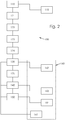
- the device 1 also comprises a housing 4, connected to the sensors 3 by means of a beam 5, capable of measuring and analyzing data supplied by the sensors 3 and of issuing an alert, according to the result of said analysis, in accordance with a method 100 shown in figure 2 .
- the inventors started from the assumption that the prevention of bedsores would be improved by a high frequency and amplitude of the movements of an individual lying on the bed.
- the presence of the individual on the bed is defined by a contact surface S greater than 20 percent of the reference surface R , for a period greater than 800 milliseconds.
- the cover 2 completely envelops the mattress, for example a foam mattress.
- the cover 2 is washable.
- the method and the device according to the invention thus have no impact on hygiene.
- the sensors 3 are preferably in the form of bands.
- the bands are arranged substantially parallel to each other.
- the sensors 3 are distant from each other.
- the sensors 3 are preferably arranged in a direction substantially perpendicular to a general direction in which the body of the individual extends. According to the embodiment illustrated in figure 1 , the sensors 3 are arranged across the width of a mattress.
- the cover 2 is strong enough not to be degraded if a more or less liquid material spreads over it resulting, for example, from an incontinence of the individual resting on the cover 2, from washing or sterilization thereof.
- Each sensor 3 comprises a connector 6, allowing a connection between the bundle 5 and the sensors 3 and their separations, when moving, washing or sterilizing the cover 2.
- the connectors 6 are preferably arranged at one end of the sensors 3, so that the connectors 6 and the harness 5 do not interfere with an individual resting on the cover 2.
- the cover 2 comprises eighteen sensors 3 of equal width l .
- the sensors 3 are separated two by two by the same distance d.
- the width l of the sensors 3 is 10 millimeters.
- the distance d separating the sensors 3 is equal to 100 millimeters.
- the sensors 3 are made from a flexible material. According to one embodiment, the sensors 3 are made of an electrically conductive fabric.
- the sensors 3 are advantageously arranged between the mattress and the protection.
- the sensors 3 are advantageously capacitive sensors 3 .
- the sensors 3 and the individual's body placed on the cover 2 define two separate frames, an insulating material defined by the protection.
- the sensors 3 generate a capacity C v when empty, if no individual is resting on the mattress. The more the individual's body is arranged opposite a sensor 3 plus a capacitance C generated is significant.
- the contact surface S is calculated as the sum of the areas A n of trapezoids 7, the bases of which are defined by an active length L of two neighboring sensors 3 .
- each sensor 3 corresponds to a portion of said sensor 3 in contact with the body of the individual.
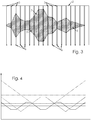
- the figure 3 illustrates an example of such a contact surface S , for an individual resting on the mattress in a supine position, the head of the individual being positioned on the left of the figure and the feet of the individual being positioned on the right of the figure.
- the surface S does not take into account the area of each sensor in contact with the body of the individual.
- the calculation of the area S takes into account the area of each sensor in contact with the body of the individual.
- the areas A n are calculated as a function of the shape and the arrangement of the sensors 3, the areas are therefore not necessarily areas A n of trapezoids.
- the capacitance C generated is obtained by adding a capacitance generated by the beam 5 connecting the sensors 3 to the box 4 to a capacitance generated by the sensors 3.
- the capacity of the beam 5 can be considered as proportional to its length. In order to minimize the risk of errors when measuring the capacitance of each of the sensors 3, it is therefore advantageous to reduce the length of the beam 5 as much as possible.
- Table T shows the length of the bundle 5 connecting each sensor 3 to the housing 4 and the resulting capacitance for a bundle 5 comprising one part 8, two parts 8 or three parts 8.
- Table T also presents the average value of the capacitance generated by the beam, calculated for each of the beams 5 presented.
- the figure 4 is a graph showing the values in table T.
- the beam 5 comprising a single part 8 is shown in phantom, the beam 5 comprising two parts 8 is shown in dotted lines and the beam 5 comprising three parts 8 is shown in solid lines.
- the average values of the capacitance generated by the beams 5 are shown in bold lines.
- Table T and figure 4 clearly illustrate that the more the beam 5 is divided into a large number of parts 8, the lower the capacitance generated by the beam 5 .
- the bundle 5 of the device 1 comprises three parts 8. According to different embodiments, the bundle 5 could be divided into a different number of parts 8.
- the parts 8 are preferably identical.
- Each part 8 of the beam 5 is connected to a measuring element 9 belonging to the box 4.
- the measuring elements 9 are configured to periodically carry out the charging and discharging phases of the sensors 3.
- the charging and discharging phases are carried out at a constant current i.
- a voltage V is measured at the terminals of each sensor 3 by their respective measuring element 9 , at the end of the charging phase.
- the charging and discharging phases last for a predefined sampling time T.
- the charging and discharging phases preferably have the same duration, that is to say half of the sampling time T.
- the sampling time T is 1 millisecond.
- the measuring elements 9 perform the measurement of the voltage V at the request of a control element 10 belonging to the box 4 according to a step 110 of measuring the method 100 shown in FIG. figure 2 .
- the supply voltage of the measuring element 9 is, for example, 3.3 volts or 5.0 volts.
- V min the minimum voltage and the maximum voltage V max possible to define a minimum capacitance C min and C max maximum capacity capable of being generated by each sensor 3.
- control element 10 takes an average of the values of the voltage V measured at the end of several consecutive charging phases or an average of the values of the capacitance C generated, calculated at the end of several consecutive charging phases.
- said average is calculated taking into account the values of the voltage V measured for six consecutive charging phases.
- the measurement step 110 is carried out at constant voltage V , by measuring the intensity i, at variable voltage V or intensity i, by respectively measuring the intensity i or the voltage V or else by measuring both voltage V and current i.
- the measurement step 110 can also be carried out by measuring a pressure or any other quantity supplied by the sensors 3.
- the control element 10 suspends the measurements taken by the measuring element 9 if the measured voltage V , that is to say the measured power, drops suddenly.
- the active length L of each sensor 3 is obtained by the following formula, carried out in a second step 122 of calculating the method 100 :
- L VS - VS V ⁇ struct the struct variable being a coefficient, depending on the structure of device 1. This coefficient is determined experimentally. According to the embodiment, said coefficient is equal to 13.5 millimeters per picofarad.
- the calculation of the contact surface S by the control element 10 in the fourth calculation step 124 of the method 100 makes it possible to verify the presence of an individual on the bed, and to evaluate the level of movement of the individual. .
- the presence of an individual on the bed is expressed, in a step 130 of detecting the presence of an individual of the method 100, by the resolution of the following inequality, for a period greater than 800 milliseconds: S > R ⁇ 20 100
- the reference surface R is chosen, according to one embodiment, at a value corresponding to an individual whose mass is 45 kilograms.
- the minimum reference surface R min for an individual whose mass is 45 kilograms, is 155,000 square millimeters.
- the minimum reference surface R min is chosen for an individual whose mass is different.
- the minimum reference surface R min is chosen as a function of the direct characteristics of the individual lying on the bed.
- the presence of an individual on the bed is expressed, in step 130 of detecting the presence of an individual, by the resolution of the following inequation, for a period greater than 800 milliseconds: S > R min ⁇ 20 100 is is S > 31000
- a step 140 of detecting the absence of movement is carried out by the control element 10 .
- ⁇ S ⁇ 3 ⁇ 3444 400 1000 is ⁇ S ⁇ 25830 the variable ⁇ S (t) being the variation ⁇ S of the contact surface S of the body of the individual with the bed for a period of 400 milliseconds.
- control element 10 performs a fifth calculation step 125 upstream of the step 140 of detecting the absence of movement.
- This fifth calculation step 125 makes it possible to calculate the value ⁇ S (t) of the variation ⁇ S of the contact surface S of the body of the individual with the bed for a period of 400 milliseconds.
- variable A n (t) being the area A n of one of the trapezoids 7 at the instant t and dt being the period of time separating two measurements.
- the fifth calculation step 125 is carried out at another time of the method 100, as long as this fifth calculation step 125 is carried out after the fourth calculation step 124 and before the step 140 of detection of lack of movement.
- a step 150 of detecting the amplitude of the movements is carried out by the control element 10 .
- the level of amplitude of the movements of an individual present on the bed is expressed by solving the following inequality, over a period of 400 milliseconds:
- the reference surface R is chosen, according to the preferred embodiment, as the average reference surface R avg.
- the average reference surface R av for an average individual, is 350,000 square millimeters.
- the average reference surface R av is different.
- the average reference surface R av is chosen as a function of the direct characteristics of the individual lying on the bed.
- the amplitude of the movements of an individual present on the bed is therefore expressed, in step 150 of detecting the amplitude of the movements, by the resolution of the following inequation: ⁇ S t > R avg ⁇ 11 100 ⁇ 1 400 1000 is ⁇ S t > 350,000 ⁇ 11 100 ⁇ 1 400 1000 is ⁇ S t > 96250
- control element 10 is able to send, in a step 160 of notification of the method 100, one or more alerts or information taking into account the results of step 130 of detecting the presence of a individual, step 140 of detecting absence of movement and step 150 of detecting amplitude of movements.
- the notification step 160 comprises an information step 161 transmitting the results of the above detection steps 130, 140, 150 .
- the information step 161 is sent regularly, so as to allow monitoring of the condition of the individual lying on the bed.
- the information step 161 is sent at the request of a person wishing to know the state of said individual.
- the information step 161 provides information on the current state of the individual and / or on his past state, for example during the last 24 hours.
- the results of the above detection steps 130, 140, 150 are also issued in the form of alerts, targeting the person according to the condition of the individual lying on the bed.
- the step 160 of notification comprises a step 162 of alerting the non-presence of the individual, warning said person if the individual does not rest on the bed for a predetermined time.
- step 162 of alerting the non-presence of the individual occurs, for example, when an absence from the bed is detected, at step 130 of detecting the presence of an individual, between 8 o'clock in the evening and 8 o'clock in the morning for a period of more than 15 minutes, thus leaving time for the individual to go, for example, to the toilet.
- the step 162 of alerting the non-presence of the individual occurs, for example, when an absence from the bed is detected, in the step 130 of detecting the presence of one individual, for more than 5 seconds.
- the notification step 160 also comprises a step 163 of alerting the absence of movement, if an absence of movement of the individual is detected in the step 140 of detecting the absence of movement.
- the notification step 160 includes an amplitude of motion alert step 164 , if the step 150 of detecting the range of motion reveals that the individual is making small movements for a predetermined time.
- the notification step 160 also comprises an agitation alert step, if the step 140 of detecting the absence of movement reveals that the individual is making a predetermined number of movements for a period of time. given.
- the agitation alert step is performed if the amplitude of motion detection step 150 reveals that the individual is making a predetermined number of large or small movements during a given time. .
- the transmissions of the information step 161 and of the above alert steps 162, 163, 164 are carried out on a monitoring terminal 11 .
- the monitoring terminal 11 is advantageously connected to the box 4 via a wireless network.
- the monitoring terminal 11 is fixed and / or mobile.
- the transmission is carried out by means of a wired network and / or the monitoring terminal 11 comprises a screen capable of displaying the information step 161 and the steps 162, 163, 164 d 'alert.
- the box 4 preferably comprises a memory 12 able to store parameters allowing identification of the individual, of his physical parameters and / or of default parameters, making it possible to carry out the different steps of the method 100.
- the memory 12 is also able to store the results of the detection steps 130, 140, 150 .
- the calculation steps 121, 122, 123, 124, 125 do not calculate physical quantities but indicators of these quantities.
- the first calculation step 121 calculates an indicator of the capacity C
- the second calculation step 122 calculates an indicator of the length L
- the third calculation step 123 calculates an indicator of the area A n
- the fourth step 124 calculation calculates an indicator of the area S
- the fifth calculation step 125 calculates a variation ⁇ S of the indicator of the area S. Steps 130, 140, 150 use these indicators.
- the information supplied by the web of sensors makes it possible to provide an indicator of the risk of pressure ulcers, this indicator not exhibiting any subjectivity linked to an observer, the indicator resulting from an automatic, long and continuous observation of the movements of the person.
- an alert is generated and communicated for example to nursing staff.
- the information supplied by the sensor layer also makes it possible to alert the nursing staff of the risk of a person falling, wandering around, or agitating.
- the information supplied by the sensor web can be accessible on a fixed or mobile communication terminal, in particular in push mode for alerts.
- an acknowledgment system ensures that information broadcast in push mode has been seen by its recipient (for example a member of the family or a nursing staff), an alert being generated in the event of no acknowledgment.
- the sheet of sensors is advantageously in the form of a cover for a standard size mattress.
- the positioning of the sensor layer is thus facilitated.
- the cover is washable, the invention having no impact on the hygiene of the bedridden person.
- the sensor sheet is placed between a mattress and a removable protective cover, in particular a coated textile cover.
- the effectiveness of the method in preventing pressure ulcers can be easily demonstrated, especially by comparison with a control group.
Landscapes
- Health & Medical Sciences (AREA)
- Life Sciences & Earth Sciences (AREA)
- Veterinary Medicine (AREA)
- Animal Behavior & Ethology (AREA)
- General Health & Medical Sciences (AREA)
- Public Health (AREA)
- Engineering & Computer Science (AREA)
- Surgery (AREA)
- Biophysics (AREA)
- Pathology (AREA)
- Physics & Mathematics (AREA)
- Biomedical Technology (AREA)
- Heart & Thoracic Surgery (AREA)
- Medical Informatics (AREA)
- Molecular Biology (AREA)
- Physiology (AREA)
- Dentistry (AREA)
- Oral & Maxillofacial Surgery (AREA)
- Nursing (AREA)
- Dermatology (AREA)
- Invalid Beds And Related Equipment (AREA)
Description
L'invention a trait au domaine de la prévention de la formation d'escarres, et plus particulièrement aux dispositifs permettant, par le biais d'une nappe de capteurs de mouvements et d'un procédé d'analyse de ces mouvements, de prévenir la formation d'escarres.The invention relates to the field of prevention of pressure ulcer formation, and more particularly to devices making it possible, by means of a web of movement sensors and a method for analyzing these movements, to prevent the pressure ulcer formation.
L'invention trouve notamment application dans les lits, en particulier les lits médicalisés.The invention finds particular application in beds, in particular medical beds.
Par « escarres » on désigne ici les ulcérations ou nécroses cutanées qui font suite à une compression prolongée des parties molles sur une saillie osseuse sous-jacente, au niveau d'une surface d'appui du corps. Les escarres sont des lésions cutanées d'origine ischémiques.The term “bedsores” here denotes skin ulcerations or necroses which follow prolonged compression of the soft parts on an underlying bony protrusion, at a bearing surface of the body. Pressure sores are skin lesions of ischemic origin.
Les facteurs de risque des escarres sont conventionnellement classés en facteurs extrinsèques ou mécaniques (en particulier pression, friction, cisaillement), et facteurs intrinsèques ou cliniques (en particulier immobilité, nutrition, incontinence, état de la peau, baisse du débit circulatoire, neuropathie, âge, antécédent d'escarres).Risk factors for pressure ulcers are conventionally classified into extrinsic or mechanical factors (in particular pressure, friction, shear), and intrinsic or clinical factors (in particular immobility, nutrition, incontinence, skin condition, decreased circulatory flow, neuropathy, etc. age, history of pressure ulcers).
Les facteurs de risques d'apparition d'escarres sont multiples, et restent objet de recherches, voir par exemple
L'European Pressure Ulcer Advisory Panel (EPUAP) a élaboré des recommandations en matière de prévention des escarres, en liaison avec l'American National Pressure Ulcer Advisory Panel (NPUAP). Dans leur version de 2014, ces recommandations comprennent de très nombreux paramètres altération de l'intégrité cutanée (par exemple peau sèche, excès d'humidité, érythème, œdème, induration, chaleur locale), indicateurs nutritionnels (par exemple malnutrition, anémie, taux d'hémoglobine, albuminémie, poids), facteurs affectant la circulation et l'oxygénation (par exemple diabète, pression artérielle basse), pression, friction et cisaillements, fréquence et techniques de repositionnement, âge avancé, état de santé générale, température corporelle. The European Pressure Ulcer Advisory Panel (EPUAP) has developed recommendations for the prevention of pressure ulcers, in conjunction with the American National Pressure Ulcer Advisory Panel (NPUAP). In their 2014 version, these recommendations include a large number of parameters: alteration of skin integrity (for example dry skin, excess humidity, erythema, edema, induration, local heat), nutritional indicators (for example malnutrition, anemia, hemoglobin, albuminemia, weight), factors affecting circulation and oxygenation (e.g. diabetes, low blood pressure), pressure, friction and shearing, repositioning frequency and techniques, advanced age, general health, body temperature.
L'évaluation du risque d'escarres devrait ainsi prendre en compte un vaste ensemble de facteurs tels que l'oxygénation et la vascularisation des tissus, l'état de la peau, l'activité physique et la mobilité, l'état nutritionnel.The assessment of the risk of pressure ulcers should therefore take into account a wide range of factors such as oxygenation and vascularization of tissues, skin condition, physical activity and mobility, and nutritional status.
De très nombreuses échelles d'évaluation du risque ont été proposées: échelle de Norton, cf.
Les échelles d'évaluation du risque d'escarres présentent des limitations. En particulier, leur utilisation ne résulte pas d'une évaluation continue de la personne, et l'observateur induit une subjectivité inévitable. Il est fréquent que des personnes présentant des risques élevés, au vu de leur évaluation par ces échelles, ne développent pas d'escarres. Et il est également fréquent que des personnes présentant des risques faibles développent des escarres. Une présentation des limitations des échelles existantes est présentée par
Malgré leurs limitations, les échelles d'évaluation des risques d'escarres sont conventionnellement prises en compte pour décider de la mise en place et de la prise en charge financière des moyens techniques de prévention des escarres. Par exemple, en France, pour déterminer le seuil de prise en charge par l'assurance maladie du coût des matelas, sur-matelas et coussins d'aide à la prévention des escarres, l'échelle de Norton est utilisée, un critère de prise en charge étant score inférieur ou égal à 14 sur l'échelle de Norton ou un patient ayant un risque équivalent, évalué par une autre échelle validée.Despite their limitations, pressure ulcer risk assessment scales are conventionally taken into account when deciding on the setting up and financial support for technical means of pressure ulcer prevention. For example, in France, to determine the threshold for coverage by health insurance for the cost of mattresses, toppers and cushions to help prevent bedsores, the Norton scale is used, a criterion for taking under load being a score less than or equal to 14 on the Norton scale or a patient with an equivalent risk, assessed by another validated scale.
L'apparition d'une escarre entraîne souvent une baisse importante de la qualité et du confort de vie, ainsi qu'une gêne et une souffrance physique, notamment lors des soins.The appearance of a pressure sore often leads to a significant drop in the quality and comfort of life, as well as discomfort and physical suffering, especially during care.
L'impact des escarres en termes de santé publique est très élevé. Une évaluation des coûts de prévention et traitement des escarres est présentée par
Les escarres sont vues comme des événements indésirables lors d'une hospitalisation, pouvant conduire à des recours en justice, fréquents aux Etats Unis.Pressure ulcers are seen as adverse events during hospitalization, which may lead to legal recourse, common in the United States.
Les moyens techniques mis en œuvre pour la prévention des escarres sont typiquement des coussins en gel, des coussins en mousse à mémoire de forme, des matelas en mousse mono-densité en forme de gaufrier, des sur-matelas en mousse viscoélastique à mémoire de forme, des sur-matelas à air (à pression constante, dynamique, ou mixte ou à perte d'air), des matelas comprenant des inserts dans les zones à risque d'escarre (insert à eau).The technical means implemented for the prevention of bedsores are typically gel cushions, memory foam cushions, mono-density waffle-shaped foam mattresses, viscoelastic memory foam toppers. , air mattresses (at constant pressure, dynamic, or mixed or with air loss), mattresses including inserts in areas at risk of pressure sores (water insert).
Les zones à risque et localisations préférentielles des escarres sont le sacrum et les talons, en particulier chez les patients alités en position dorsale. D'autres localisations sont possibles, comme les ischions, le trochanter (chez les personnes alitées en position latérale), ou l'occiput, tous les points d'appui pouvant présenter une escarre, par exemple les coudes ou les genoux.The areas at risk and preferential locations for pressure ulcers are the sacrum and heels, in particular in patients bedridden in the dorsal position. Other locations are possible, such as the ischia, the trochanter (in people bedridden in a lateral position), or the occiput, all the points of support that may present a pressure sore, for example the elbows or the knees.
La position dans laquelle le patient se trouve le plus souvent a un impact sur la localisation la plus probable d'une escarre. Ainsi, par exemple, à un décubitus dorsal sont associées des escarres à l'occiput, au sacrum, aux talons, au rachis dorsal, aux omoplates et aux coudes.The position in which the patient is most often has an impact on the most likely location of a pressure ulcer. So, for example, pressure sores on the occiput, sacrum, heels, dorsal spine, shoulder blades and elbows are associated with dorsal decubitus.
Pour identifier les zones à pression élevée, on connaît des nappes de capteurs résistifs ou capacitifs, fournissant une carte avec zones de couleurs de même index de pression (pressure area index). Le document
L'emploi d'algorithmes de traitement de données a été proposé dans la littérature, afin de fournir des niveaux de risques d'escarres, ces algorithmes traitant des données issues d'une surveillance continue et automatique des patients. Un état des recherches pour de telles méthodes peut être trouvé dans le document
Les méthodes proposées dans les travaux de recherche identifiés par Marchione et al présentent au moins un ou plusieurs des inconvénients suivants :
- aucune alerte d'un risque d'escarre n'est délivrée ;
- l'impact des moyens de contrôle sur le confort du patient n'est pas pris en compte ;
- l'impact des moyens de contrôle sur l'hygiène n'est pas pris en compte ;
- l'efficacité de la méthode dans la prévention des escarres n'est pas démontrée, et aucune comparaison n'est effectuée avec un groupe témoin.
- no warning of a risk of pressure sores is issued;
- the impact of control methods on patient comfort is not taken into account;
- the impact of the means of control on hygiene is not taken into account;
- The effectiveness of the method in preventing pressure ulcers has not been demonstrated, and no comparison is made with a control group.
Le document
Le document
Le document
Le document
Le document
Contrairement aux enseignements dominants l'état de la technique, mettant systématiquement en avant l'importance cruciale d'une pression appliquée durant un temps d'appui long, dans l'apparition d'escarres, les inventeurs ont considéré un paradigme très différent, selon lequel le risque d'apparition d'escarres est lié à la fréquence et l'amplitude des mouvements d'une personne, la fréquence de mouvements de grande amplitude pouvant s'avérer efficace dans la recirculation capillaire.Contrary to the dominant teachings of the state of the art, systematically emphasizing the crucial importance of a pressure applied during a long support time, in the appearance of pressure sores, the inventors considered a very different paradigm, according to in which the risk of the appearance of pressure sores is related to the frequency and amplitude of a person's movements, the frequency of large-amplitude movements being able to prove effective in capillary recirculation.
Un premier objectif est de proposer un procédé pour fournir un indicateur de risques d' escarres.A first objective is to provide a method for providing a pressure ulcer risk indicator.
Un deuxième objectif est de proposer un tel procédé, mesurant la fréquence et l'amplitude des mouvements d'un individu alité.A second objective is to provide such a method, measuring the frequency and amplitude of the movements of a bedridden individual.
Un troisième objectif est de proposer un tel procédé, analysant les mesures effectuées.A third objective is to propose such a method, analyzing the measurements carried out.
Un quatrième objectif est de proposer un tel procédé, délivrant une alerte, en fonction du résultat de l'analyse des mesures.A fourth objective is to propose such a method, delivering an alert, as a function of the result of the analysis of the measurements.
Un cinquième objectif est de proposer un dispositif apte à mettre en oeuvre un procédé répondant aux objectifs précédents.A fifth objective is to provide a device capable of implementing a method meeting the preceding objectives.
A ces fins, il est proposé, en premier lieu, un procédé pour fournir un indicateur de risques d' escarres d'un individu reposant sur un support, le procédé comprenant :
- une étape de mesure d'au moins une grandeur, par le biais de capteurs disposés entre le support et l'individu ;
- une étape de calcul d'un indicateur d'une surface de contact de l'individu avec le support, à partir de ladite au moins une grandeur ;
- une étape de détection de présence de l'individu sur le support, en fonction de la surface de contact de l'individu avec le support ;
- une étape de détection d'absence de mouvement réalisé par l'individu, en fonction d'une variation dans le temps de l'indicateur de la surface de contact calculée, si, au cours de l'étape de détection de présence, la présence d'un individu est détectée sur le support ;
- une étape de détection d'amplitude des mouvements réalisés par l'individu, en fonction de la variation dans le temps de l'indicateur de la surface de contact calculée, si, au cours de l'étape de détection d'absence de mouvement, une absence de mouvement n'est pas détectée ;
- une étape de notification de l'état de l'individu.
- a step of measuring at least one quantity, by means of sensors arranged between the support and the individual;
- a step of calculating an indicator of a contact area of the individual with the support, from said at least one quantity;
- a step of detecting the presence of the individual on the support, as a function of the contact surface of the individual with the support;
- a step of detecting the absence of movement carried out by the individual, as a function of a variation over time of the indicator of the calculated contact area, if, during the step of detecting presence, the presence of an individual is detected on the medium;
- a step of detecting the amplitude of the movements made by the individual, as a function of the variation over time of the indicator of the calculated contact area, if, during the step of detecting the absence of movement, an absence of movement is not detected;
- a step of notification of the state of the individual.
La détection de l'amplitude des mouvements réalisés par la personne permet de distinguer des petits mouvements, des mouvements segmentaires sans impact sur la posture, et des mouvements de grande amplitude, notamment des retournements.The detection of the amplitude of the movements made by the person makes it possible to distinguish small movements, segmental movements without impact on posture, and large-amplitude movements, in particular turning.
La détection de l'amplitude des mouvements permet en outre de mesurer la durée séparant deux mouvements de grande amplitude.The detection of the amplitude of the movements also makes it possible to measure the time between two movements of large amplitude.
Diverses caractéristiques supplémentaires peuvent être prévues, seules ou en combinaison:
- l'étape de notification de l'état de l'individu comprend :
- ∘ une étape d'information de l'état de l'individu, émettant des résultats de l'étape de détection de présence de l'individu, de l'étape de détection d'absence de mouvement et de l'étape de détection d'amplitude des mouvements, cette étape d'information étant émise régulièrement ;
- ∘ une étape d'alerte de non-présence de l'individu sur le support, cette étape d'alerte de non-présence de l'individu étant émise si, à l'étape de détection de présence de l'individu, aucun individu n'est détecté pendant un temps prédéterminé ;
- ∘ une étape d'alerte d'absence de mouvement de l'individu, cette étape d'alerte d'absence de mouvement étant émise si, à l'étape de détection d'absence de mouvement, aucun mouvement n'est détecté pendant un temps déterminé ;
- ∘ une étape d'alerte d'amplitude des mouvements de l'individu, cette étape d'alerte d'amplitude des mouvements étant émise si, à l'étape de détection d'amplitude des mouvements, un petit mouvement est détecté pendant un temps prédéterminé ;
- l'étape de notification comprend une étape d'alerte d'agitation de l'individu, cette étape d'alerte d'agitation étant fonction d'un nombre prédéterminé de mouvements détectés pendant un temps donné ;
- ladite au moins une grandeur mesurée à l'étape de mesure est une grandeur électrique, et l'étape de calcul comprend :
- ∘ une première étape de calcul d'un indicateur d'une capacité générée par les capteurs ;
- ∘ une deuxième étape de calcul d'un indicateur d'une longueur active de chaque capteur ;
- ∘ une troisième étape de calcul d'un indicateur d'une aire ;
- ∘ une quatrième étape de calcul de l'indicateur de la surface de contact ;
- ∘ une cinquième étape de calcul de la variation dans le temps de l'indicateur de la surface de contact.
- the step of notifying the individual's condition includes:
- ∘ an information step of the state of the individual, emitting results of the step of detecting the presence of the individual, of the step of detecting the absence of movement and of the step of detecting amplitude of movements, this information step being sent regularly;
- ∘ an alert step of the non-presence of the individual on the support, this step of alerting the non-presence of the individual being issued if, at the step of detecting the presence of the individual, no individual is detected for a predetermined time;
- ∘ an alert step for the absence of movement of the individual, this alert step for the absence of movement being issued if, at the step detection of absence of movement, no movement is detected for a determined time;
- ∘ an amplitude of movement alert step of the individual, this amplitude of movement alert step being issued if, at the amplitude of movement detection step, a small movement is detected for a time predetermined;
- the notification step comprises a step of alerting the individual to agitation, this agitation alert step being a function of a predetermined number of movements detected during a given time;
- said at least one quantity measured in the measuring step is an electrical quantity, and the calculating step comprises:
- ∘ a first step of calculating an indicator of a capacity generated by the sensors;
- ∘ a second step of calculating an indicator of an active length of each sensor;
- ∘ a third step of calculating an indicator of an area;
- ∘ a fourth step of calculating the contact surface indicator;
- ∘ a fifth step of calculating the variation over time of the indicator of the contact surface.
Il est proposé, en deuxième lieu, un dispositif pour la prévention de la formation d'escarres, ce dispositif étant apte à réaliser le procédé tel que présenté ci-dessus, le dispositif comprenant :
- les capteurs disposés entre le support et l'individu, les capteurs étant disposés de sorte à indiquer la présence d'un objet sur le support ;
- un boîtier relié aux capteurs, le boîtier étant muni :
- ∘ d'un élément de contrôle, configuré pour réaliser les étapes du procédé ;
- ∘ d'une mémoire, apte à enregistrer les étapes du procédé ;
- un terminal de suivi, apte à afficher l'étape de notification de l'état de l'individu.
- the sensors arranged between the support and the individual, the sensors being arranged so as to indicate the presence of an object on the support;
- a box connected to the sensors, the box being fitted with:
- ∘ a control element, configured to carry out the steps of the process;
- ∘ a memory, capable of recording the steps of the process;
- a monitoring terminal, able to display the step of notifying the state of the individual.
Diverses caractéristiques supplémentaires peuvent être prévues, seules ou en combinaison:
- les capteurs présentent chacun la forme d'une bande ;
- les capteurs sont sensiblement perpendiculaires à une direction suivant laquelle s'étend le corps de l'individu ;
- les capteurs sont des capteurs capacitifs ;
- le dispositif comprend un faisceau, reliant les capteurs et le boîtier, le faisceau comprenant plusieurs parties indépendantes ;
- le faisceau comprend deux ou trois parties.
- the sensors each have the shape of a strip;
- the sensors are substantially perpendicular to a direction in which the body of the individual extends;
- the sensors are capacitive sensors;
- the device comprises a bundle, connecting the sensors and the housing, the bundle comprising several independent parts;
- the bundle consists of two or three parts.
D'autres caractéristiques et avantages de l'invention apparaîtront plus clairement et de manière concrète à la lecture de la description ci-après de modes de réalisation, laquelle est faite en référence aux dessins annexés dans lesquels :
- la
figure 1 est une vue schématique d'un dispositif de détection, d'analyse et d'alerte, pour prévenir la formation des escarres ; - la
figure 2 est une représentation schématique, illustrant des étapes relatives à un mode de réalisation d'un procédé de mesure, d'analyse et d'alerte prévenant la formation des escarres ; - la
figure 3 est une représentation schématique d'une surface de contact du corps d'un individu reposant sur le dispositif, en position de décubitus dorsal ; - la
figure 4 est un graphique représentant la capacité de trois faisceaux dont les capteurs sont respectivement contrôlés par un, deux ou trois contrôleurs.
- the
figure 1 is a schematic view of a detection, analysis and warning device, to prevent the formation of bedsores; - the
figure 2 is a schematic representation, illustrating steps relating to an embodiment of a method for measuring, analyzing and alerting preventing the formation of bedsores; - the
figure 3 is a schematic representation of a contact surface of the body of an individual resting on the device, in a supine position; - the
figure 4 is a graph showing the capacity of three beams, the sensors of which are respectively controlled by one, two or three controllers.
Sur la
Le dispositif 1 est apte à être posé sur le matelas d'un lit.The
Le dispositif 1 comprend également un boîtier 4, relié aux capteurs 3 par le biais d'un faisceau 5, apte à mesurer et analyser des données fournies par les capteurs 3 et à émettre une alerte, en fonction du résultat de ladite analyse, conformément à un procédé 100 représenté sur la
Le lit, le matelas et la protection ne sont pas représentés sur les figures, pour des raisons de simplicité.The bed, the mattress and the protection are not shown in the figures, for reasons of simplicity.
Les inventeurs sont partis de l'hypothèse que la prévention des escarres serait améliorée par une fréquence et une amplitude importante des mouvements d'un individu reposant sur le lit.The inventors started from the assumption that the prevention of bedsores would be improved by a high frequency and amplitude of the movements of an individual lying on the bed.
Trois niveaux de mouvements sont pris en compte :
- une absence de mouvement,
- des petits mouvements, correspondant à une flexion inférieure à 30° d'une jambe de l'individu lorsque celui-ci est en position de décubitus latéral,
- et des grands mouvements, correspondant à une flexion supérieure à 30° d'une jambe de l'individu lorsque celui-ci est en position de décubitus latéral.
- an absence of movement,
- small movements, corresponding to a flexion of less than 30 ° of a leg of the individual when he is in a lateral decubitus position,
- and large movements, corresponding to a flexion greater than 30 ° of a leg of the individual when the latter is in a lateral decubitus position.
Dans une mise en oeuvre, une surface R de référence étant le quatre-vingt quinzième percentile de la surface S de contact d'un individu reposant sur le lit, pendant un temps prédéterminé :
- les petits mouvements sont définis comme une variation ΔS de la surface S inférieure ou égale à 11 pourcents d'une surface R de référence, pendant une durée de 400 millisecondes ;
- les grands mouvements sont définis comme la variation ΔS de la surface S supérieure à 11 pourcents de la surface R de référence, pendant une durée de 400 millisecondes.
- small movements are defined as a variation Δ S of the surface S less than or equal to 11 percent of a reference surface R , for a period of 400 milliseconds;
- large movements are defined as the variation Δ S of the surface S greater than 11 percent of the reference surface R , for a period of 400 milliseconds.
La présence de l'individu sur le lit est définie par une surface S de contact supérieure à 20 pourcents de la surface R de référence, pendant une durée supérieure à 800 millisecondes.The presence of the individual on the bed is defined by a contact surface S greater than 20 percent of the reference surface R , for a period greater than 800 milliseconds.
Selon un mode de réalisation avantageux, la housse 2 enveloppe intégralement le matelas, par exemple un matelas mousse.According to an advantageous embodiment, the
Avantageusement, la housse 2 est lavable. Le procédé et le dispositif selon l'invention n'ont ainsi aucun impact sur l'hygiène.Advantageously, the
Selon des modes de réalisation, la housse 2 enveloppe partiellement le matelas ou la housse 2 est apte à être posée sur un support différent d'un lit, permettant ainsi le suivi d'un individu reposant sur ledit support.According to embodiments, the
Les capteurs 3 se présentent, de préférence, sous la forme de bandes. Avantageusement, les bandes sont disposées sensiblement parallèlement entre elles. Selon le mode de réalisation préféré, les capteurs 3 sont distants les uns des autres.The
Les capteurs 3 sont de préférence disposés suivant une direction sensiblement perpendiculaire à une direction générale suivant laquelle s'étend le corps de l'individu. Selon le mode de réalisation illustré sur la
Avantageusement, la housse 2 est suffisamment résistante pour ne pas être dégradée si une matière plus ou moins liquide se répand sur celle-ci résultant, par exemple, d'une incontinence de l'individu reposant sur la housse 2, d'un lavage ou d'une stérilisation de celle-ci.Advantageously, the
Chaque capteur 3 comprend un connecteur 6, permettant une liaison entre le faisceau 5 et les capteurs 3 et leurs séparations, lors du déplacement, du lavage ou de la stérilisation de la housse 2. Each
Les connecteurs 6 sont, de préférence, disposés à une extrémité des capteurs 3, de sorte que les connecteurs 6 et le faisceau 5 ne gênent pas un individu reposant sur la housse 2. The connectors 6 are preferably arranged at one end of the
Selon un mode de réalisation, la housse 2 comprend dix-huit capteurs 3 de largeur l égales. Les capteurs 3 sont séparés deux à deux d'une même distance d. According to one embodiment, the
Selon un mode de réalisation, la largeur l des capteurs 3 est de 10 millimètres. La distance d séparant les capteurs 3 est égale à 100 millimètres.According to one embodiment, the width l of the
Avantageusement, les capteurs 3 sont fabriqués dans un matériau flexible. Selon un mode de réalisation, les capteurs 3 sont fabriqués en un tissu conducteur d'électricité.Advantageously, the
Les capteurs 3 sont avantageusement disposés entre le matelas et la protection.The
Les capteurs 3 sont avantageusement des capteurs 3 capacitifs. Ainsi, les capteurs 3 et le corps de l'individu disposé sur la housse 2 définissent deux armatures séparées un matériau isolant défini par la protection.The
Lors d'une mesure, les capteurs 3 génèrent une capacité Cv à vide, si aucun individu ne repose sur le matelas. Plus le corps de l'individu est disposé en regard d'un capteur 3 plus une capacité C générée est importante.During a measurement, the
Il est ainsi possible d'établir une schématisation de la surface S de contact du corps de l'individu avec la protection, en effectuant une mesure par le biais de tous les capteurs 3. It is thus possible to draw up a diagram of the contact surface S of the individual's body with the protection, by performing a measurement using all the
La surface S de contact est calculée comme la somme des aires An de trapèzes 7, dont les bases sont définies par une longueur L active de deux capteurs 3 voisins.The contact surface S is calculated as the sum of the areas A n of
La longueur L active de chaque capteur 3 correspond à une portion dudit capteur 3 en contact avec le corps de l'individu.The active length L of each
La
Dans le mode de réalisation décrit, la surface S ne prend pas en compte l'aire de chaque capteur en contact avec le corps de l'individu.In the embodiment described, the surface S does not take into account the area of each sensor in contact with the body of the individual.
Selon des modes de réalisation différents, le calcul de la surface S prend en compte l'aire de chaque capteur en contact avec le corps de l'individu. Les aires An sont calculées en fonction de la forme et de la disposition des capteurs 3, les aires ne sont donc pas forcément des aires A n de trapèzes.According to different embodiments, the calculation of the area S takes into account the area of each sensor in contact with the body of the individual. The areas A n are calculated as a function of the shape and the arrangement of the
La capacité C générée est obtenue par l'ajout d'une capacité générée par le faisceau 5 reliant les capteurs 3 au boîtier 4 à une capacité générée par les capteurs 3. The capacitance C generated is obtained by adding a capacitance generated by the beam 5 connecting the
La capacité du faisceau 5 peut être considérée comme proportionnelle à sa longueur. Afin de minimiser les risques d'erreurs lors de la mesure de la capacité de chacun des capteurs 3, il est donc avantageux de diminuer le plus possible la longueur du faisceau 5. The capacity of the beam 5 can be considered as proportional to its length. In order to minimize the risk of errors when measuring the capacitance of each of the
Il s'est avéré, à la suite d'essais présentés dans le tableau T ci-dessous et sur la
Le tableau T, ci-après, présente la longueur du faisceau 5 reliant chaque capteur 3 au boîtier 4 et la capacité en résultant pour un faisceau 5 comprenant une partie 8, deux parties 8 ou trois parties 8. Table T below shows the length of the bundle 5 connecting each
Le tableau T présente également la valeur moyenne de la capacité générée par le faisceau, calculée pour chacun des faisceaux 5 présentés.Table T also presents the average value of the capacitance generated by the beam, calculated for each of the beams 5 presented.
La
Le tableau T et la
Selon le mode de réalisation représenté sur la
Les parties 8 sont, de préférence, identiques.The parts 8 are preferably identical.
Chaque partie 8 du faisceau 5 est reliée à un élément 9 de mesure appartenant au boîtier 4. Each part 8 of the beam 5 is connected to a measuring
Les éléments 9 de mesure sont configurés pour réaliser périodiquement des phases de charge et de décharge des capteurs 3. Les phases de charge et de décharge sont réalisées à un courant i constant. Une tension V est mesurée, aux bornes de chaque capteur 3 par leur élément 9 de mesure respectif, à la fin de la phase de charge.The measuring
Les phases de charge et de décharge durent un temps T d'échantillonnage prédéfini. Les phases de charge et de décharge ont, de préférence, la même durée, c'est-à-dire la moitié du temps T d'échantillonnage.The charging and discharging phases last for a predefined sampling time T. The charging and discharging phases preferably have the same duration, that is to say half of the sampling time T.
Selon le mode de réalisation préféré, le temps T d'échantillonnage est de 1 milliseconde.According to the preferred embodiment, the sampling time T is 1 millisecond.
Les éléments 9 de mesure effectuent la mesure de la tension V sur requête d'un élément 10 de contrôle appartenant au boîtier 4 selon une étape 110 de mesure du procédé 100 représenté sur la
L'élément 10 de contrôle calcul la capacité C générée par chacun des capteurs 3, au cours d'une première étape 121 de calcul du procédé 100, avec la formule suivante : 
Des résultats d'essais ont révélé que, pour assurer une bonne qualité de mesure, la tension V mesurée devait être comprise entre une tension Vmin minimale et une tension Vmax maximale telles que : 

La tension d'alimentation de l'élément 9 de mesure est, par exemple, de 3,3 volts ou 5,0 volts.The supply voltage of the measuring
La tension Vmin minimale et la tension Vmax maximale permettent de définir une capacité Cmin minimale et une capacité Cmax maximale aptes à être générées par chaque capteur 3. V min the minimum voltage and the maximum voltage V max possible to define a minimum capacitance C min and C max maximum capacity capable of being generated by each
La capacité Cmin minimale et la capacité Cmax maximale sont égales à : 

Avantageusement, l'élément 10 de contrôle réalise une moyenne des valeurs de la tension V mesurée au terme de plusieurs phases de charge consécutives ou une moyenne des valeurs de la capacité C générée, calculée au terme de plusieurs phases de charge consécutives.Advantageously, the
Selon un mode de réalisation avantageux, ladite moyenne est calculée en tenant compte des valeurs de la tension V mesurée pour six phases de charge consécutives.According to an advantageous embodiment, said average is calculated taking into account the values of the voltage V measured for six consecutive charging phases.
Selon des modes de réalisation différents, l'étape 110 de mesure est réalisée à tension V constante, en mesurant l'intensité i, à tension V ou intensité i variables, en mesurant respectivement l'intensité i ou la tension V ou encore en mesurant à la fois la tension V et l'intensité i. According to different embodiments, the
L'étape 110 de mesure peut également être réalisée en mesurant une pression ou toute autre grandeur fournie par les capteurs 3. The
Avantageusement, dans une étape 115 d'arrêt du procédé 100 illustré sur la
La longueur L active de chaque capteur 3 est obtenue par la formule suivante, réalisée dans une deuxième étape 122 de calcul du procédé 100 : 
L'aire An d'un des trapèzes 7 est égale, selon une troisième étape 123 de calcul du procédé 100, à : 
La surface S de contact du corps de l'individu avec la protection est donc égale, selon une quatrième étape 124 de calcul du procédé 100 pour un dispositif 1 comprenant dix-huit capteurs 3, à : 
Le calcul de la surface S de contact par l'élément 10 de contrôle à la quatrième étape 124 de calcul du procédé 100 permet de vérifier la présence d'un individu sur le lit, et d'évaluer le niveau de mouvement de l'individu.The calculation of the contact surface S by the
Dans une mise en œuvre, la présence d'un individu sur le lit s'exprime, à une étape 130 de détection de présence d'un individu du procédé 100, par la résolution de l'inéquation suivante, pendant une durée supérieure à 800 millisecondes : 
Afin d'adapter la sensibilité de la détection à tout individu adulte, la surface R de référence est choisie, selon un mode de réalisation, à une valeur correspondant à un individu dont la masse est de 45 kilogrammes. A titre d'exemple, la surface Rmin de référence minimale, pour un individu dont la masse est de 45 kilogrammes, est de 155000 millimètres carrés.In order to adapt the sensitivity of the detection to any adult individual, the reference surface R is chosen, according to one embodiment, at a value corresponding to an individual whose mass is 45 kilograms. By way of example, the minimum reference surface R min , for an individual whose mass is 45 kilograms, is 155,000 square millimeters.
Selon des modes de réalisation différents, la surface Rmin de référence minimale est choisie pour un individu dont la masse est différente. Avantageusement, la surface Rmin de référence minimale est choisie en fonction des caractéristiques directes de l'individu reposant sur le lit.According to different embodiments, the minimum reference surface R min is chosen for an individual whose mass is different. Advantageously, the minimum reference surface R min is chosen as a function of the direct characteristics of the individual lying on the bed.
Selon un mode de réalisation, la présence d'un individu sur le lit s'exprime, à l'étape 130 de détection de présence d'un individu, par la résolution de l'inéquation suivante, pendant une durée supérieure à 800 millisecondes : 


Si la présence d'un individu est détectée à l'étape 130 de détection de présence, une étape 140 de détection d'absence de mouvement est réalisée par l'élément 10 de contrôle.If the presence of an individual is detected in the
L'absence de mouvement d'un individu présent sur le lit s'exprime, pour des capteurs 3 ayant une surface de 3444 millimètres carrés, par la résolution de l'inéquation suivante : 

Afin de vérifier cette inégalité, l'élément 10 de contrôle réalise une cinquième étape 125 de calcul en amont de l'étape 140 de détection d'absence de mouvement.In order to verify this inequality, the
Cette cinquième étape 125 de calcul permet de calculer la valeur ΔS(t) de la variation ΔS de la surface S de contact du corps de l'individu avec le lit pendant une durée de 400 millisecondes.This
Une variation ΔAn de l'aire d'un des trapèzes 7 en fonction du temps, est exprimée par l'équation suivante : 
La variable An(t) étant l'aire An d'un des trapèzes 7 à l'instant t et dt étant la période de temps séparant deux mesures.The variable A n (t) being the area A n of one of the
Ainsi : 
Cette équation nous permet de calculer la valeur ΔS(t) de la variation ΔS de la surface S de contact du corps de l'individu avec le lit pendant la durée séparant deux mesures, soit, dans le cas présent, 400 millisecondes : 
Selon un mode de réalisation différent, la cinquième étape 125 de calcul est réalisée à un autre moment du procédé 100, tant que cette cinquième étape 125 de calcul est réalisée après la quatrième étape 124 de calcul et avant l'étape 140 de détection d'absence de mouvement.According to a different embodiment, the
Si l'absence de mouvement n'est pas détectée à l'étape 140 de détection d'absence de mouvement, une étape 150 de détection d'amplitude des mouvements est réalisée par l'élément 10 de contrôle.If the absence of movement is not detected at the
Le niveau d'amplitude des mouvements d'un individu présent sur le lit s'exprime par la résolution de l'inéquation suivante, pendant une durée de 400 millisecondes :
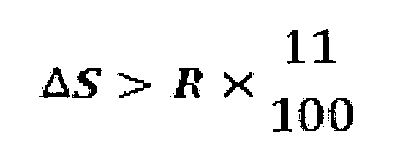
Si l'inéquation est vérifiée, alors l'individu reposant sur le lit effectue de grands mouvements. Sinon, celui-ci effectue de petits mouvements.If the inequality is true, then the individual lying on the bed performs large movements. Otherwise, it makes small movements.
Afin d'adapter la sensibilité de la détection à un individu moyen, la surface R de référence est choisie, selon le mode de réalisation préférée, comme surface R moy de référence moyenne.In order to adapt the sensitivity of the detection to an average individual, the reference surface R is chosen, according to the preferred embodiment, as the average reference surface R avg.
A titre d'exemple, la surface R moy de référence moyenne, pour un individu moyen, est de 350000 millimètres carrés.By way of example, the average reference surface R av , for an average individual, is 350,000 square millimeters.
Selon des modes de réalisation différents, la surface R moy de référence moyenne est différente. Avantageusement, la surface R moy de référence moyenne est choisie en fonction des caractéristiques directes de l'individu reposant sur le lit.According to different embodiments, the average reference surface R av is different. Advantageously, the average reference surface R av is chosen as a function of the direct characteristics of the individual lying on the bed.
Selon un mode de réalisation, l'amplitude des mouvements d'un individu présent sur le lit s'exprime donc, à l'étape 150 de détection d'amplitude des mouvements, par la résolution de l'inéquation suivante : 


Selon un mode de réalisation avantageux, l'élément 10 de contrôle est apte à émettre, dans une étape 160 de notification du procédé 100, une ou plusieurs alertes ou informations tenant compte des résultats de l'étape 130 de détection de présence d'un individu, de l'étape 140 de détection d'absence de mouvement et de l'étape 150 de détection d'amplitude des mouvements.According to an advantageous embodiment, the
Ainsi, l'étape 160 de notification comprend une étape 161 d'information émettant les résultats des étapes 130, 140, 150 de détection ci-dessus.Thus, the
L'étape 161 d'information est émise régulièrement, de sorte à permettre le suivi de l'état de l'individu reposant sur le lit.The
Selon un mode de réalisation différent, l'étape 161 d'information est émise à la demande d'une personne souhaitant connaître l'état dudit individu.According to a different embodiment, the
L'étape 161 d'information renseigne sur l'état actuel de l'individu et/ou sur son état passé, par exemple pendant les dernières 24 heures.The
Les résultats des étapes 130, 140, 150 de détection ci-dessus sont également émis sous formes d'alertes, visant la personne suivant l'état de l'individu reposant sur le lit.The results of the above detection steps 130, 140, 150 are also issued in the form of alerts, targeting the person according to the condition of the individual lying on the bed.
Selon un mode de réalisation, l'étape 160 de notification comprend une étape 162 d'alerte de non-présence de l'individu, avertissant ladite personne si l'individu ne repose pas sur le lit pendant un temps prédéterminé.According to one embodiment, the
Si l'individu est autonome, l'étape 162 d'alerte de non-présence de l'individu survient, par exemple, lorsqu'une absence du lit est détectée, à l'étape 130 de détection de présence d'un individu, entre 8 heures du soir et 8 heure du matin pendant une durée supérieure à 15 minutes, laissant ainsi le temps à l'individu d'aller, par exemple, aux toilettes.If the individual is autonomous, step 162 of alerting the non-presence of the individual occurs, for example, when an absence from the bed is detected, at
Si l'individu n'est pas autonome, l'étape 162 d'alerte de non-présence de l'individu survient, par exemple, lorsqu'une absence du lit est détectée, à l'étape 130 de détection de présence d'un individu, pendant plus de 5 secondes.If the individual is not autonomous, the
L'étape 160 de notification comprend également une étape 163 d'alerte d'absence de mouvement, si une absence de mouvement de l'individu est détectée à l'étape 140 de détection d'absence de mouvement.The
L'étape 160 de notification comprend une étape 164 d'alerte d'amplitude des mouvements, si l'étape 150 de détection d'amplitude des mouvements révèle que l'individu réalise des petits mouvements pendant un temps prédéterminé.The
Selon un mode de réalisation différent, l'étape 160 de notification comprend également une étape d'alerte d'agitation, si l'étape 140 de détection d'absence de mouvement révèle que l'individu réalise un nombre prédéterminé de mouvements pendant un temps donné.According to a different embodiment, the
Selon d'autres modes de réalisation, l'étape d'alerte d'agitation est réalisée si l'étape 150 de détection d'amplitude des mouvements révèle que l'individu réalise un nombre prédéterminé de grands ou de petits mouvements pendant un temps donné.According to other embodiments, the agitation alert step is performed if the amplitude of
Selon le mode de réalisation préféré, les émissions de l'étape 161 d'information et des étapes 162, 163, 164 d'alerte ci-dessus sont réalisées sur un terminal 11 de suivi.According to the preferred embodiment, the transmissions of the
Le terminal 11 de suivi est avantageusement relié au boîtier 4 par l'intermédiaire d'un réseau sans fil.The
Le terminal 11 de suivi est fixe et/ou mobile.The
Selon des modes de réalisation différents, l'émission est réalisée par le biais d'un réseau filaire et/ou le terminal 11 de suivi comprend un écran apte à afficher l'étape 161 d'information et les étapes 162, 163, 164 d'alerte.According to different embodiments, the transmission is carried out by means of a wired network and / or the
Le boîtier 4 comprend, de préférence, une mémoire 12 apte à mémoriser des paramètres permettant une identification de l'individu, de ses paramètres physiques et/ou de paramètres par défaut, permettant de réaliser les différentes étapes du procédé 100. The
La mémoire 12 est également apte à mémoriser les résultats des étapes 130, 140, 150 de détection.The
Selon un mode de réalisation différent, les étapes 121, 122, 123, 124,125 de calcul ne calculent pas des grandeurs physiques mais des indicateurs de ces grandeurs.According to a different embodiment, the calculation steps 121, 122, 123, 124, 125 do not calculate physical quantities but indicators of these quantities.
Ainsi, la première étape 121 de calcul calcule un indicateur de la capacité C, la deuxième étape 122 de calcul calcule un indicateur de la longueur L, la troisième étape 123 de calcul calcule un indicateur de l'aire An, la quatrième étape 124 de calcul calcule un indicateur de la surface S et la cinquième étape 125 de calcul calcule une variation ΔS de l'indicateur de la surface S. Les étapes 130, 140, 150 utilisent ces indicateurs.Thus, the
Le procédé et le dispositif selon l'invention présentent de nombreux avantages.The method and the device according to the invention have numerous advantages.
Les informations fournies par la nappe de capteurs permettent de fournir un indicateur de risque d'escarres, cet indicateur ne présentant pas de subjectivité liée à un observateur, l'indicateur résultant d'une observation automatique, longue et continue des mouvements de la personne.The information supplied by the web of sensors makes it possible to provide an indicator of the risk of pressure ulcers, this indicator not exhibiting any subjectivity linked to an observer, the indicator resulting from an automatic, long and continuous observation of the movements of the person.
En fonction de la valeur de cet indicateur, une alerte est générée et communiquée par exemple au personnel soignant.Depending on the value of this indicator, an alert is generated and communicated for example to nursing staff.
Les informations fournies par la nappe de capteur permettent en outre d'alerter le personnel soignant de risques de chute, de déambulation, ou d'agitation d'une personne.The information supplied by the sensor layer also makes it possible to alert the nursing staff of the risk of a person falling, wandering around, or agitating.
Les informations fournies par la nappe de capteur peuvent être accessibles sur terminal de communication fixe ou mobile, notamment en mode push pour les alertes. Avantageusement, un système d'acquittement assure qu'une information diffusée en mode push a été vue par son destinataire (par exemple un membre de la famille ou un personnel soignant), une alerte étant générée en cas d'absence d'acquittement.The information supplied by the sensor web can be accessible on a fixed or mobile communication terminal, in particular in push mode for alerts. Advantageously, an acknowledgment system ensures that information broadcast in push mode has been seen by its recipient (for example a member of the family or a nursing staff), an alert being generated in the event of no acknowledgment.
La nappe de capteurs se présente avantageusement sous la forme d'une housse pour matelas de dimension standard. La mise en place de la nappe de capteur est ainsi facilitée. Avantageusement, la housse est lavable, l'invention n'ayant pas d'impact sur l'hygiène de la personne alitée. Avantageusement, la nappe de capteur est disposée entre un matelas et une housse amovible de protection, notamment housse en textile enduit.The sheet of sensors is advantageously in the form of a cover for a standard size mattress. The positioning of the sensor layer is thus facilitated. Advantageously, the cover is washable, the invention having no impact on the hygiene of the bedridden person. Advantageously, the sensor sheet is placed between a mattress and a removable protective cover, in particular a coated textile cover.
La présence de la nappe de capteurs et les moyens de traitement de l'information fournie par les capteurs sont sans impact notable sur le confort du patient.The presence of the web of sensors and the means for processing the information supplied by the sensors have no appreciable impact on the comfort of the patient.
L'efficacité de la méthode dans la prévention des escarres peut être facilement démontrée, notamment par comparaison avec un groupe témoin.The effectiveness of the method in preventing pressure ulcers can be easily demonstrated, especially by comparison with a control group.
Les données numériques fournies dans la description ci-dessus sont appliquées au mode de réalisation décrit et ne sont en aucun cas limitatives.

Claims (10)
- A method (100) for providing an indicator of risks of pressure ulcers for an individual lying on a support, the method (100) comprising:- a step (110) of measuring at least one quantity, through sensors (3) disposed between the support and the individual;- a step (121, 122, 123, 124, 125) of calculating an indicator of a contact surface (S) of the individual with the support, from said at least one quantity;- a step (130) of detecting the presence of the individual on the support, as a function of the indicator of the contact surface (S) of the individual with the support;- a step (140) of detecting the absence of movement made by the individual, as a function of a variation (ΔS) over time of the indicator of the calculated contact surface (S), if, during the presence detecting step (130), the presence of an individual is detected on the support;- a step (150) of detecting the amplitude of movements made by the individual, as a function of the variation (ΔS) over time of the indicator of the calculated contact surface (S), if, during the step (140) of detecting the absence of movement, an absence of movement is not detected;- a step (160) of notifying the condition of the individual.
- The method according to the previous claim, characterised in that the step (160) of notifying the condition of the individual comprises:- a step (161) of informing about the condition of the individual transmitting results of the step (130) of detecting the presence of the individual, of the step (140) of detecting the absence of movement and the step (150) of detecting the amplitude of movements, this informing step (161) being regularly transmitted;- a step (162) of alerting about the non-presence of the individual on the support, this step (162) of alerting about the non-presence of the individual being transmitted if, in the step (130) of detecting the presence of the individual, no individual is detected for a predetermined time;- a step (163) of alerting about the absence of movement of the individual, this step (163) of alerting about the absence of movement being transmitted if, in the step (140) of detecting the absence of movement, no movement is detected for a predetermined time;- a step (164) of alerting about the amplitude of movements of the individual, this step (164) of alerting about the amplitude of movements being transmitted if, in the step (150) of detecting the amplitude of movements, a small movement is detected for a predetermined time.
- The method according to any of the previous claims, characterised in that the notifying step (160) comprises a step of alerting about agitation of the individual, this agitation alerting step being a function of a predetermined number of movements detected for a given time.
- The method according to any of the previous claims, characterised in that said at least one quantity measured in the measuring step (110) is an electric quantity and the calculating step (121, 122, 123, 124, 125) comprises:- a first step (121) of calculating an indicator of a capacitance (C) generated by the sensors (3);- a second step (122) of calculating an indicator of an active length (L) of each sensor (3);- a third step (123) of calculating an indicator of an area (An);- a fourth step (124) of calculating the indicator of the contact surface (S);- a fifth step (125) of calculating the variation (ΔS) over time of the indicator of the contact surface (S).
- A device (1) for preventing pressure ulcer formation, this device (1) being able to carry out the method (100) according to any of the previous claims, the device (1) comprising:- the sensors (3) disposed between the support and the individual, the sensors (3) being disposed so as to indicate the presence of an object on the support;- a package (4) connected to the sensors (3), the package (4) being provided with:∘ a control element (10), configured to carry out the steps of the method (100);∘ a memory (12), able to record the steps of the method (100);- a tracking terminal (11), able to display the step (160) of notifying the condition of the individual.
- The device according to the previous claim, characterised in that the sensors (3) each have the shape of a strip.
- The device according to any of claims 5 and 6, characterised in that the sensors (3) are substantially perpendicular to a direction along which the individual's body extends.
- The device according to any of claims 5 to 7, characterised in that the sensors (3) are capacitive sensors (3) generating the capacitance (C).
- The device according to any of claims 5 to 8, characterised in that it comprises a beam (5) connecting the sensors (3) and the package (4), the beam (5) comprising several independent parts (8).
- The device according to the previous claim, characterised in that the beam (5) comprises two parts (8).
Priority Applications (1)
| Application Number | Priority Date | Filing Date | Title |
|---|---|---|---|
| PL18172721T PL3415134T3 (en) | 2017-06-13 | 2018-05-16 | Device for detection, analysis and alert to prevent eschar formation |
Applications Claiming Priority (1)
| Application Number | Priority Date | Filing Date | Title |
|---|---|---|---|
| FR1755311A FR3067245B1 (en) | 2017-06-13 | 2017-06-13 | METHOD AND DEVICE FOR DETECTION, ANALYSIS AND ALERT TO PREVENT THE FORMATION OF ESCARRES |
Publications (2)
| Publication Number | Publication Date |
|---|---|
| EP3415134A1 EP3415134A1 (en) | 2018-12-19 |
| EP3415134B1 true EP3415134B1 (en) | 2020-11-04 |
Family
ID=59381560
Family Applications (1)
| Application Number | Title | Priority Date | Filing Date |
|---|---|---|---|
| EP18172721.5A Active EP3415134B1 (en) | 2017-06-13 | 2018-05-16 | Device for detection, analysis and alert to prevent eschar formation |
Country Status (5)
| Country | Link |
|---|---|
| EP (1) | EP3415134B1 (en) |
| DK (1) | DK3415134T3 (en) |
| ES (1) | ES2837435T3 (en) |
| FR (1) | FR3067245B1 (en) |
| PL (1) | PL3415134T3 (en) |
Cited By (1)
| Publication number | Priority date | Publication date | Assignee | Title |
|---|---|---|---|---|
| WO2023052497A1 (en) | 2021-09-30 | 2023-04-06 | Karma Technologies Ag | Method and pressure sensor unit |
Families Citing this family (2)
| Publication number | Priority date | Publication date | Assignee | Title |
|---|---|---|---|---|
| FR3099044B1 (en) * | 2019-07-23 | 2022-10-14 | Winncare France | SYSTEM AND METHOD FOR DETECTING THE INCONTINENCE OF BED-BED PERSONS |
| FR3099042B1 (en) | 2019-07-23 | 2022-11-25 | Winncare France | SYSTEM AND METHOD FOR DETECTING THE PRESENCE OF BED-BED PERSONS |
Family Cites Families (7)
| Publication number | Priority date | Publication date | Assignee | Title |
|---|---|---|---|---|
| JPH08238275A (en) | 1995-03-02 | 1996-09-17 | Yokohama Imeeji Syst:Kk | Alarm apparatus for preventing bedsore from occurring |
| JPH11342161A (en) | 1998-04-03 | 1999-12-14 | Denso Corp | Bedsore preventing device |
| FR2858406B1 (en) | 2003-08-01 | 2005-10-21 | Centre Nat Rech Scient | SENSOR, DEVICE AND METHOD FOR MEASURING INTERFACE PRESSURE BETWEEN TWO BODIES |
| CA2497143A1 (en) * | 2004-02-11 | 2005-08-11 | Bed-Check Corporation | Feedback control system to reduce the risk of pressure sores |
| US7557718B2 (en) * | 2004-04-30 | 2009-07-07 | Hill-Rom Services, Inc. | Lack of patient movement monitor and method |
| US20140039351A1 (en) * | 2011-03-04 | 2014-02-06 | Stryker Corporation | Sensing system for patient supports |
| US20120259245A1 (en) * | 2011-04-08 | 2012-10-11 | Receveur Timothy J | Person support apparatus with activity and mobility sensing |
-
2017
- 2017-06-13 FR FR1755311A patent/FR3067245B1/en active Active
-
2018
- 2018-05-16 PL PL18172721T patent/PL3415134T3/en unknown
- 2018-05-16 DK DK18172721.5T patent/DK3415134T3/en active
- 2018-05-16 ES ES18172721T patent/ES2837435T3/en active Active
- 2018-05-16 EP EP18172721.5A patent/EP3415134B1/en active Active
Non-Patent Citations (1)
| Title |
|---|
| None * |
Cited By (1)
| Publication number | Priority date | Publication date | Assignee | Title |
|---|---|---|---|---|
| WO2023052497A1 (en) | 2021-09-30 | 2023-04-06 | Karma Technologies Ag | Method and pressure sensor unit |
Also Published As
| Publication number | Publication date |
|---|---|
| ES2837435T3 (en) | 2021-06-30 |
| PL3415134T3 (en) | 2021-05-17 |
| FR3067245A1 (en) | 2018-12-14 |
| EP3415134A1 (en) | 2018-12-19 |
| DK3415134T3 (en) | 2021-01-25 |
| FR3067245B1 (en) | 2019-08-02 |
Similar Documents
| Publication | Publication Date | Title |
|---|---|---|
| EP3415134B1 (en) | Device for detection, analysis and alert to prevent eschar formation | |
| Bushby et al. | Centiles for adult head circumference. | |
| Yusuf et al. | Microclimate and development of pressure ulcers and superficial skin changes | |
| US9814637B2 (en) | Patient monitoring systems and methods | |
| JP6901707B2 (en) | Systems and methods for monitoring people via analog multi-zone pressure sensitive pads | |
| RU2695297C2 (en) | Sensor device for measuring humidity and determining presence of person on support structure | |
| Saito et al. | Domiciliary diurnal variation of exhaled nitric oxide fraction for asthma control | |
| US20150320352A1 (en) | System and method for preventing decubitus ulcers | |
| MX2014007330A (en) | Method for detecting a liquid discharge to an absorbent article. | |
| CN113226156B (en) | Foot ulcer detection system, detection device, and computer program product | |
| CN102892354A (en) | System and method for rapid data collection from pressure sensors in pressure sensing system | |
| Santos et al. | Assessing salivary osmolality as a caries risk indicator in cerebral palsy children | |
| KR101234835B1 (en) | A hypertension monitoring and notification device based on context information | |
| Worsley et al. | Monitoring the biomechanical and physiological effects of postural changes during leisure chair sitting | |
| Dai et al. | A robust wheelchair pressure relief monitoring system | |
| CN109259729A (en) | Sleep monitoring system, method, device, device and storage medium | |
| Grap et al. | Use of high frequency ultrasound to detect changes in skin integrity: an image evaluation validation procedure | |
| Petersen et al. | Natural history of sensory function after herpes zoster | |
| JP6986689B2 (en) | Cognitive function evaluation device, cognitive function evaluation system, and program | |
| Kim et al. | Physiological measurements of tissue health; implications for clinical practice | |
| EP3769676B1 (en) | System and method for detecting the presence of bedridden persons | |
| Fard et al. | Pressure ulcer risk assessment by monitoring interface pressure and temperature | |
| Jayasinghe et al. | The dynamic nature of naevi in adulthood: prospective population-based study using three-dimensional total-body photography | |
| O’Brien et al. | Measurement of movement is an objective method to assist in assessment of opiate withdrawal in newborns | |
| Burk et al. | Effects of position and operator on high-frequency ultrasound scan quality |
Legal Events
| Date | Code | Title | Description |
|---|---|---|---|
| PUAI | Public reference made under article 153(3) epc to a published international application that has entered the european phase |
Free format text: ORIGINAL CODE: 0009012 |
|
| STAA | Information on the status of an ep patent application or granted ep patent |
Free format text: STATUS: THE APPLICATION HAS BEEN PUBLISHED |
|
| AK | Designated contracting states |
Kind code of ref document: A1 Designated state(s): AL AT BE BG CH CY CZ DE DK EE ES FI FR GB GR HR HU IE IS IT LI LT LU LV MC MK MT NL NO PL PT RO RS SE SI SK SM TR |
|
| AX | Request for extension of the european patent |
Extension state: BA ME |
|
| STAA | Information on the status of an ep patent application or granted ep patent |
Free format text: STATUS: REQUEST FOR EXAMINATION WAS MADE |
|
| 17P | Request for examination filed |
Effective date: 20190405 |
|
| RBV | Designated contracting states (corrected) |
Designated state(s): AL AT BE BG CH CY CZ DE DK EE ES FI FR GB GR HR HU IE IS IT LI LT LU LV MC MK MT NL NO PL PT RO RS SE SI SK SM TR |
|
| GRAP | Despatch of communication of intention to grant a patent |
Free format text: ORIGINAL CODE: EPIDOSNIGR1 |
|
| STAA | Information on the status of an ep patent application or granted ep patent |
Free format text: STATUS: GRANT OF PATENT IS INTENDED |
|
| INTG | Intention to grant announced |
Effective date: 20200827 |
|
| RIN1 | Information on inventor provided before grant (corrected) |
Inventor name: JOUET, PASCAL Inventor name: BARTHELAT, JULIEN Inventor name: HEBRARD, JOCELYN Inventor name: GEAY, PIERRE |
|
| GRAS | Grant fee paid |
Free format text: ORIGINAL CODE: EPIDOSNIGR3 |
|
| GRAA | (expected) grant |
Free format text: ORIGINAL CODE: 0009210 |
|
| STAA | Information on the status of an ep patent application or granted ep patent |
Free format text: STATUS: THE PATENT HAS BEEN GRANTED |
|
| AK | Designated contracting states |
Kind code of ref document: B1 Designated state(s): AL AT BE BG CH CY CZ DE DK EE ES FI FR GB GR HR HU IE IS IT LI LT LU LV MC MK MT NL NO PL PT RO RS SE SI SK SM TR |
|
| REG | Reference to a national code |
Ref country code: GB Ref legal event code: FG4D Free format text: NOT ENGLISH |
|
| REG | Reference to a national code |
Ref country code: CH Ref legal event code: EP |
|
| REG | Reference to a national code |
Ref country code: AT Ref legal event code: REF Ref document number: 1329879 Country of ref document: AT Kind code of ref document: T Effective date: 20201115 |
|
| REG | Reference to a national code |
Ref country code: DE Ref legal event code: R096 Ref document number: 602018009304 Country of ref document: DE |
|
| REG | Reference to a national code |
Ref country code: IE Ref legal event code: FG4D Free format text: LANGUAGE OF EP DOCUMENT: FRENCH |
|
| REG | Reference to a national code |
Ref country code: DK Ref legal event code: T3 Effective date: 20210120 |
|
| REG | Reference to a national code |
Ref country code: NL Ref legal event code: MP Effective date: 20201104 |
|
| REG | Reference to a national code |
Ref country code: AT Ref legal event code: MK05 Ref document number: 1329879 Country of ref document: AT Kind code of ref document: T Effective date: 20201104 |
|
| PG25 | Lapsed in a contracting state [announced via postgrant information from national office to epo] |
Ref country code: FI Free format text: LAPSE BECAUSE OF FAILURE TO SUBMIT A TRANSLATION OF THE DESCRIPTION OR TO PAY THE FEE WITHIN THE PRESCRIBED TIME-LIMIT Effective date: 20201104 Ref country code: RS Free format text: LAPSE BECAUSE OF FAILURE TO SUBMIT A TRANSLATION OF THE DESCRIPTION OR TO PAY THE FEE WITHIN THE PRESCRIBED TIME-LIMIT Effective date: 20201104 Ref country code: PT Free format text: LAPSE BECAUSE OF FAILURE TO SUBMIT A TRANSLATION OF THE DESCRIPTION OR TO PAY THE FEE WITHIN THE PRESCRIBED TIME-LIMIT Effective date: 20210304 Ref country code: GR Free format text: LAPSE BECAUSE OF FAILURE TO SUBMIT A TRANSLATION OF THE DESCRIPTION OR TO PAY THE FEE WITHIN THE PRESCRIBED TIME-LIMIT Effective date: 20210205 Ref country code: NO Free format text: LAPSE BECAUSE OF FAILURE TO SUBMIT A TRANSLATION OF THE DESCRIPTION OR TO PAY THE FEE WITHIN THE PRESCRIBED TIME-LIMIT Effective date: 20210204 |
|
| PG25 | Lapsed in a contracting state [announced via postgrant information from national office to epo] |
Ref country code: BG Free format text: LAPSE BECAUSE OF FAILURE TO SUBMIT A TRANSLATION OF THE DESCRIPTION OR TO PAY THE FEE WITHIN THE PRESCRIBED TIME-LIMIT Effective date: 20210204 Ref country code: LV Free format text: LAPSE BECAUSE OF FAILURE TO SUBMIT A TRANSLATION OF THE DESCRIPTION OR TO PAY THE FEE WITHIN THE PRESCRIBED TIME-LIMIT Effective date: 20201104 Ref country code: IS Free format text: LAPSE BECAUSE OF FAILURE TO SUBMIT A TRANSLATION OF THE DESCRIPTION OR TO PAY THE FEE WITHIN THE PRESCRIBED TIME-LIMIT Effective date: 20210304 Ref country code: SE Free format text: LAPSE BECAUSE OF FAILURE TO SUBMIT A TRANSLATION OF THE DESCRIPTION OR TO PAY THE FEE WITHIN THE PRESCRIBED TIME-LIMIT Effective date: 20201104 Ref country code: AT Free format text: LAPSE BECAUSE OF FAILURE TO SUBMIT A TRANSLATION OF THE DESCRIPTION OR TO PAY THE FEE WITHIN THE PRESCRIBED TIME-LIMIT Effective date: 20201104 |
|
| REG | Reference to a national code |
Ref country code: LT Ref legal event code: MG9D |
|
| PG25 | Lapsed in a contracting state [announced via postgrant information from national office to epo] |
Ref country code: HR Free format text: LAPSE BECAUSE OF FAILURE TO SUBMIT A TRANSLATION OF THE DESCRIPTION OR TO PAY THE FEE WITHIN THE PRESCRIBED TIME-LIMIT Effective date: 20201104 |
|
| REG | Reference to a national code |
Ref country code: ES Ref legal event code: FG2A Ref document number: 2837435 Country of ref document: ES Kind code of ref document: T3 Effective date: 20210630 |
|
| PG25 | Lapsed in a contracting state [announced via postgrant information from national office to epo] |
Ref country code: LT Free format text: LAPSE BECAUSE OF FAILURE TO SUBMIT A TRANSLATION OF THE DESCRIPTION OR TO PAY THE FEE WITHIN THE PRESCRIBED TIME-LIMIT Effective date: 20201104 Ref country code: SK Free format text: LAPSE BECAUSE OF FAILURE TO SUBMIT A TRANSLATION OF THE DESCRIPTION OR TO PAY THE FEE WITHIN THE PRESCRIBED TIME-LIMIT Effective date: 20201104 Ref country code: RO Free format text: LAPSE BECAUSE OF FAILURE TO SUBMIT A TRANSLATION OF THE DESCRIPTION OR TO PAY THE FEE WITHIN THE PRESCRIBED TIME-LIMIT Effective date: 20201104 Ref country code: SM Free format text: LAPSE BECAUSE OF FAILURE TO SUBMIT A TRANSLATION OF THE DESCRIPTION OR TO PAY THE FEE WITHIN THE PRESCRIBED TIME-LIMIT Effective date: 20201104 Ref country code: EE Free format text: LAPSE BECAUSE OF FAILURE TO SUBMIT A TRANSLATION OF THE DESCRIPTION OR TO PAY THE FEE WITHIN THE PRESCRIBED TIME-LIMIT Effective date: 20201104 Ref country code: CZ Free format text: LAPSE BECAUSE OF FAILURE TO SUBMIT A TRANSLATION OF THE DESCRIPTION OR TO PAY THE FEE WITHIN THE PRESCRIBED TIME-LIMIT Effective date: 20201104 |
|
| REG | Reference to a national code |
Ref country code: DE Ref legal event code: R097 Ref document number: 602018009304 Country of ref document: DE |
|
| PLBE | No opposition filed within time limit |
Free format text: ORIGINAL CODE: 0009261 |
|
| STAA | Information on the status of an ep patent application or granted ep patent |
Free format text: STATUS: NO OPPOSITION FILED WITHIN TIME LIMIT |
|
| 26N | No opposition filed |
Effective date: 20210805 |
|
| PG25 | Lapsed in a contracting state [announced via postgrant information from national office to epo] |
Ref country code: AL Free format text: LAPSE BECAUSE OF FAILURE TO SUBMIT A TRANSLATION OF THE DESCRIPTION OR TO PAY THE FEE WITHIN THE PRESCRIBED TIME-LIMIT Effective date: 20201104 Ref country code: NL Free format text: LAPSE BECAUSE OF FAILURE TO SUBMIT A TRANSLATION OF THE DESCRIPTION OR TO PAY THE FEE WITHIN THE PRESCRIBED TIME-LIMIT Effective date: 20201104 Ref country code: IT Free format text: LAPSE BECAUSE OF FAILURE TO SUBMIT A TRANSLATION OF THE DESCRIPTION OR TO PAY THE FEE WITHIN THE PRESCRIBED TIME-LIMIT Effective date: 20201104 |
|
| PG25 | Lapsed in a contracting state [announced via postgrant information from national office to epo] |
Ref country code: SI Free format text: LAPSE BECAUSE OF FAILURE TO SUBMIT A TRANSLATION OF THE DESCRIPTION OR TO PAY THE FEE WITHIN THE PRESCRIBED TIME-LIMIT Effective date: 20201104 |
|
| PG25 | Lapsed in a contracting state [announced via postgrant information from national office to epo] |
Ref country code: LU Free format text: LAPSE BECAUSE OF NON-PAYMENT OF DUE FEES Effective date: 20210516 Ref country code: MC Free format text: LAPSE BECAUSE OF FAILURE TO SUBMIT A TRANSLATION OF THE DESCRIPTION OR TO PAY THE FEE WITHIN THE PRESCRIBED TIME-LIMIT Effective date: 20201104 |
|
| PG25 | Lapsed in a contracting state [announced via postgrant information from national office to epo] |
Ref country code: IE Free format text: LAPSE BECAUSE OF NON-PAYMENT OF DUE FEES Effective date: 20210516 |
|
| PG25 | Lapsed in a contracting state [announced via postgrant information from national office to epo] |
Ref country code: IS Free format text: LAPSE BECAUSE OF FAILURE TO SUBMIT A TRANSLATION OF THE DESCRIPTION OR TO PAY THE FEE WITHIN THE PRESCRIBED TIME-LIMIT Effective date: 20210304 |
|
| PG25 | Lapsed in a contracting state [announced via postgrant information from national office to epo] |
Ref country code: CY Free format text: LAPSE BECAUSE OF FAILURE TO SUBMIT A TRANSLATION OF THE DESCRIPTION OR TO PAY THE FEE WITHIN THE PRESCRIBED TIME-LIMIT Effective date: 20201104 |
|
| PG25 | Lapsed in a contracting state [announced via postgrant information from national office to epo] |
Ref country code: HU Free format text: LAPSE BECAUSE OF FAILURE TO SUBMIT A TRANSLATION OF THE DESCRIPTION OR TO PAY THE FEE WITHIN THE PRESCRIBED TIME-LIMIT; INVALID AB INITIO Effective date: 20180516 |
|
| PG25 | Lapsed in a contracting state [announced via postgrant information from national office to epo] |
Ref country code: MK Free format text: LAPSE BECAUSE OF FAILURE TO SUBMIT A TRANSLATION OF THE DESCRIPTION OR TO PAY THE FEE WITHIN THE PRESCRIBED TIME-LIMIT Effective date: 20201104 |
|
| PG25 | Lapsed in a contracting state [announced via postgrant information from national office to epo] |
Ref country code: MT Free format text: LAPSE BECAUSE OF FAILURE TO SUBMIT A TRANSLATION OF THE DESCRIPTION OR TO PAY THE FEE WITHIN THE PRESCRIBED TIME-LIMIT Effective date: 20201104 |
|
| PGFP | Annual fee paid to national office [announced via postgrant information from national office to epo] |
Ref country code: PL Payment date: 20250429 Year of fee payment: 8 Ref country code: DE Payment date: 20250423 Year of fee payment: 8 |
|
| PGFP | Annual fee paid to national office [announced via postgrant information from national office to epo] |
Ref country code: DK Payment date: 20250423 Year of fee payment: 8 Ref country code: GB Payment date: 20250423 Year of fee payment: 8 Ref country code: ES Payment date: 20250602 Year of fee payment: 8 |
|
| PGFP | Annual fee paid to national office [announced via postgrant information from national office to epo] |
Ref country code: BE Payment date: 20250423 Year of fee payment: 8 |
|
| PGFP | Annual fee paid to national office [announced via postgrant information from national office to epo] |
Ref country code: FR Payment date: 20250519 Year of fee payment: 8 |
|
| PGFP | Annual fee paid to national office [announced via postgrant information from national office to epo] |
Ref country code: CH Payment date: 20250601 Year of fee payment: 8 |
|
| PG25 | Lapsed in a contracting state [announced via postgrant information from national office to epo] |
Ref country code: TR Free format text: LAPSE BECAUSE OF FAILURE TO SUBMIT A TRANSLATION OF THE DESCRIPTION OR TO PAY THE FEE WITHIN THE PRESCRIBED TIME-LIMIT Effective date: 20201104 |